Cyberpunk is Now and No One Knows What to Do With It

By Pattern Theory

Source: Modern Mythology

Cyberpunk broke science fiction. Creeping in alongside the commercialization of the internet, it extrapolated the corruption and dysfunction of its present into a brutal and interconnected future that remained just a heartbeat away. Cyberpunk had an attitude that refused to be tamed, dressed in a style without comparison. Its resurgence shows that little has changed since its inception, and that’s left cyberpunk incapable of discussing our future.

Ghost in the Shell got the live-action treatment in 2017, a problematic remakeof the 1995 adaptation. Some praised its art direction for increasing the visual fidelity of retrofuture anime cityscapes, but the general consensus was that the story failed to apply care and consideration towards human brains and synthetic bodies like Mamoru Oshii had more than two decades before. A few months later came Blade Runner 2049, a sequel to the cyberpunk classic. Critics and fans praised it for high production values, sincere artistic effort, and meticulous direction. Yet something had gone wrong. Director Denis Villeneuve couldn’t shake the feeling that he was making a period movie, not one about the future.

Enough has changed since the 1980s that cyberpunk needs reinvention. New aesthetics. An expanded vocabulary. Code 46 managed this years ago. It rejects a fetish for all things Japanese and embraces China’s economic dominance. Conversations being in English and are soon peppered with Mandarin and Spanish. Life takes place at night to avoid dangerous, unfiltered sunlight. Corporations guide government decisions. Genetics determine freedom of movement and interaction. Climate refugees beg to leave their freeway pastures for the safety of cities.

Code 46 is cyberpunk as seen from 2003, a logical future that is now also outdated.

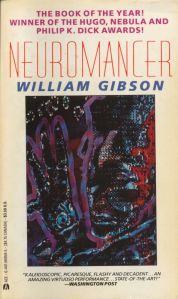
If Blade Runner established the look, Neuromancer defined cyberpunk’s voice. William Gibson’s debut novel was ahead of the curve by acknowledging the personal computer as a disruptive force when the Cold War was at its most threatening. “Lowlife and high tech” meant the Magnetic Dog Sisters headlining some creep joint across the street from a capsule hotel where console cowboys rip off zaibatsus with their Ono Sendai Cyberdeck. But Gibson’s view of the future would be incomplete without an absolute distrust of Reaganism:

“If I were to put together a truly essential thank-you list for the people who most made it possible for me to write my first six novels, I’d have to owe as much to Ronald Reagan as to Bill Gates or Lou Reed. Reagan’s presidency put the grit in my dystopia. His presidency was the fresh kitty litter I spread for utterly crucial traction on the icey driveway of uncharted futurity. His smile was the nightmare in my back pocket.” — William Gibson

“Fragments of a Hologram Rose” to Mona Lisa Overdrive is a decade of creative labor that was “tired of America-as-the-future, the world as a white monoculture.” The Sprawl is a cyberpunk trilogy where military superpowers failed and technology gave Japan leadership of the global village. Then Gibson wrote Virtual Light and readers witnessed extreme inequality shove the middle class into the gig economy as corporations schemed to profit off natural disasters with proprietary technology.

Gibson knew the sci-fi he didn’t care for would absorb cyberpunk and tame its “dissident influence”, so the genre could remain unchanged. “Punk” is the go-to suffix for emerging subgenres that want to appear subversive while posing a threat to nothing and no one. It’s how “hopepunk” becomes a thing. But to appreciate cyberpunk’s assimilation, look at how it’s presented sincerely.

CD Projekt Red (CDPR), known for the Witcher game series, has spent six years developing what’s arguably the most anticipated video game of the moment, Cyberpunk 2077. Like Gibson, Mike Pondsmith, creator the original “pen-n-paper” RPG, and collaborator on this adaptation of his work, has had his writing absorbed by mainstream sci-fi. CDPR could survive on that 31-year legacy, but they insist they’re taking their time with Cyberpunk 2077 to craft an experience with a distinct political identity that somehow allows players to remain apolitical. In a way this is reflective of CDPR’s reputation as a quality-driven business that’s pro-consumer, but has driven talent away by demanding they work excessive hours and promoting a hostile attitude towards unions. This crunch culture is a problem across the industry.

We’ll soon see how Cyberpunk 2077 developed. What we can infer from its design choices, like giving protagonist V a high-collar jacket seen on the cover of the 2nd edition game book from 1990, is that Cybperpunk 2077 will be familiar. Altered Carbon and Ready Player One share this problem. Altered Carbon is so derivative of first-wave cyberpunk it’s easy to forget its based on a novel from 2002. Ready Player One at least has the courtesy to be shameless in its love of pop culture, proud to proclaim that nothing is more celebrated today than our participation in media franchises without ever considering how that might be a problem.

What’s being suggested, intentionally or not, is that contemporary reality has avoided the machinations of the powerful at a time when technology is wondrous, amusing, and prolific. If only we were so lucky.

238 cities spent more than a year lobbying Amazon, one of two $1 trillion corporations in existence, for privilege of hosting their new office. In November it was announced that Amazon would expand to Crystal City, Virginia and Long Island City, Queens. Plenty of New Yorkers are incensedthat the world’s largest online marketplace will get $3 billion in subsidies, tax breaks, and grants to further disrupt a housing market that takes more from them than any city should allow. Some Amazon employees were so excited to relocate they made down payments on their new homes before the decision went public, telling real estate developers to get this corner of New York readyfor a few thousand transplants. But what of the people already there?

Long Island City is home to the Queensbridge Houses, the largest housing project in the US. Built in 1939, these two buildings are home to more then 6,000 people with an average income of $16,000. That’s far below the $54,000 for Queens residents overall. But neither group is anywhere near the average salary for the 25,000 employees Amazon will bring with them, which will exceed $150,000. How many of those positions will be filled by locals? How many will come from Queensbridge?

Over 800 languages are spoken in Queens, making it the most linguistically diverse place in the world. Those diverse speakers spend over 30% of their income on rent. They risk being priced out of their neighborhoods. Some will be forced out of the city. Has Governor Cuomo considered the threat this deal poses to people’s homes? Has Mayor de Blasio prepared for the inevitable drift to other boroughs once property values spike? Looking at Seattle and San Francisco, there’s no reason to expect local governments to be proactive. So New Yorkers have taken up the fight on their own.

Amazon boss Jeff Bezos toyed with these politicians. He floated the idea that any city could become the next Silicon Valley and they believed him. They begged for his recognition, handed over citizen data, and took part in the $100 billion ritual of subsidizing tech companies.

It was all for nothing. Crystal City is a 20-minute drive from Bezos’ house in Washington DC, where Amazon continues to increase its spending on lobbyists. That’ll seem like a long commute compared to the helicopter ride from Long Island City, the helipad for which is subsidized by the city, to Manhattan, the financial and advertising capital of the world, where Bezos owns four more houses.

The auction for Bezos’ favor was a farce. New York and Virginia give him regular access to people with decision-making power, invaluable data, and institutions that are are sure to expand his empire. These cities were always the only serious options.

Amazon’s plans read like the start of a corporate republic, a cyberpunk trope inspired by company towns. Employers were landlords, retailers, and even moral authorities to workforces too in debt to quit. Many had law enforcement and militias to call on in addition to the private security companies they hired to break labor strikes, investigate attempts at unionization, and maintain a sense of order that resulted in massacres like Ludlow, Colorado.

Amazon is known for labor abuses, monitoring, and tracking speed and efficiency in warehouses without bathroom breaks, where employees have collapsed from heat exhaustion. They sell unregulated facial recognition services to police departments, knowing it misidentifies subjects because of inherent design bias. Companies with a history of privacy abuses have unfettered access to their security devices. They control about half of all e-commerce in the US and, as Gizmodo’s Kashmir Hill found out, it is impossible to live our lives without encountering Amazon Web Services.

It doesn’t take a creative mind to imagine similar exposition being attributed to corporate villains like Cayman Global or Tai Yong Medical.

Rewarding corporations for their bad behavior is just one way the world resembles a fictive dystopia. We also have to face rapid ecological and institutional decay that fractionally adjusts our confidence in stability, feeding a persistent situational anxiety. That should make for broader and bolder conversations about the future, and a few artists have managed to do that.

Keiichi Matsuda is the designer and director behind Hyper-Reality, a short film that portrays augmented reality as a fever dream that influences consumption, and shows how freeing and frightening it is to be cut off from that network. Matsuda’s short film got him an invitation to the World Economic Forum in Davos to “speak truth to power.” What Matsuda witnessed were executives and billionaires pledging responsibility with t-shirts and sustainability, while simultaneously destroying the environment, as an audience of their peers and the press nodded and applauded “this brazen hypocrisy.” So Matsuda took a stanchion to his own installation.

Independence means Matsuda gets to decide how to talk about technology and capitalism, and how to separate his art and business. It also means smaller audiences and fewer productions.

Sam Esmail used a more visible platform to “bring cyberpunk to TV” with Mr. Robot. Like Gibson’s Pattern Recognition, it’s cyberpunk retooled for the present — post-cyberpunk. Esmail never hesitates to place our villains in Mr. Robot. Enron is an influence on logo designs and tactics of evil corps. Google, Verizon, and Facebook are called out for their complicity with the federal government in exposing customer data. AT&T’s Long Lines building, an NSA listening post since the 1970s, plays the role of a corporate data hub that reaches across the county. Even filming locations serve as commentary.

An anti-capitalist slant runs through Mr. Robot, exposing the American dream as a lie and our concept of meritocracy as a tool to protect the oligarchy, presenting hackers as in direct contact with a world of self-isolation and exploitation, those who dare to hope for a future affected by people rather than commerce. And Esmail somehow manages this without interference from NBC.

Blade Runner will get more life as an animeCowboy Bebop is joining Battle Angel Alita in live action. Altered Carbon is in the process of slipping into a new sleeve. There’s no shortage of revivals, remakes, and rehashing of cyberpunk’s past on the way. They’ll get bigger audiences than a short film about submitting to algorithms. More sites will discuss their pros and cons than a mobile tie-in that name-drops Peter Kropotkin and Maria Nikiforova. But in being descriptive and prescriptive, moving to the future and looking for sure footing in the accelerated present, Matsuda’s and Esmail’s work reminds us that cyberpunk needs to be more than just repeating what’s already been said about yuppies, Billy Idol, and the Apple IIc.

We live at a time where 3D printing is so accessible refugees can obtain prosthesis as part of basic aid. People forced to migrate because of an iceless arctic will rely on that assistance. Or we could lower temperatures and slow climate change by spraying the atmosphere with sulfate, an option that might disrupt advertising in low-orbit. Social credit systems are bringing oppressive governments together. Going cashless is altering our expectations of others. Young people earn so little they’re leveraging nude selfies to extend meager lines of credit. Productivity and constant notifications are enough to drive some into a locked room, away from anything with an internet connection. Deepfakes deny women privacy, compromise their identity, and obliterate any sense of safety in exchange for porn. Online communities are refining that same technology, making false video convincing, threatening our sense of reality. Researchers can keep our memories alive in chat bots distilled from social media, but the rich will outlive us all by transfusing bags of teenage blood purchased through PayPal.

In a world that increasingly feels like science fiction it’s important to remind ourselves that writing about the future is writing about the present. Artists worthy of an audience should be unable to look at the embarrassment of inspiration around them and refuse the chance to say something new.

Saturday Matinee: Radio Free Albemuth

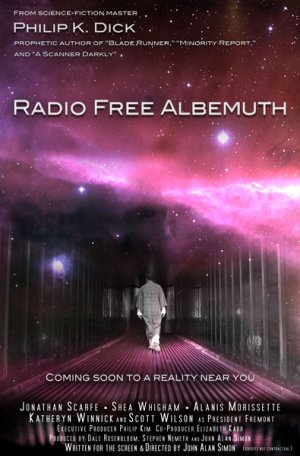
In light of Philip K. Dick’s birthday tomorrow (he would have been 90), it’s an appropriate time to visit (or revisit) the film adaptation of his posthumously published novel “Radio Free Albemuth”. Being a longtime PKD fan and one of the film’s Kickstarter contributors, I admittedly wouldn’t be a completely objective critic, but after having seen it a few times its achievements and shortcomings become more apparent.

Like the novel it’s based on, Radio Free Albemuth is one of the most personal of Philip K. Dick’s narratives, featuring the most faithful retelling of his 2-3-74 experiences. Filmed on a shoestring budget by John Alan Simon the movie has a fitting late 70s/early 80s aesthetic. Much of the dialogue is straight out of the novel but I personally would have wanted a more streamlined and nuanced script with less tangential details and exposition, though the actors across the board do a commendable job delivering their lines as naturally and believably as possible. The many dream sequences could have benefited from a higher budget and better visual consistency, but were able to accomplish what was needed for the plot. The prison scenes near the end seemed a bit rushed and not reflective of the oppressiveness of actual prisons, though that was probably largely due to budgetary reasons as well.

Despite its flaws, I still find the film engaging and worth recommending. Aspects of the story may come across to modern audiences as cheesy but still works on a meta level. In our sophisticated real life corporate techno-dystopia, the idea of individuals trying to incite revolution through subliminal messaging embedded in pop songs requires a suspension of disbelief. However in a more general general sense, countless creators through history (including writers and filmmakers) have made attempts to subvert society and culture with varying and impossible to quantify results.

Watch the full film on Hoopla here: https://www.hoopladigital.com/title/11350683

Saturday Matinee: The Man Who Fell to Earth

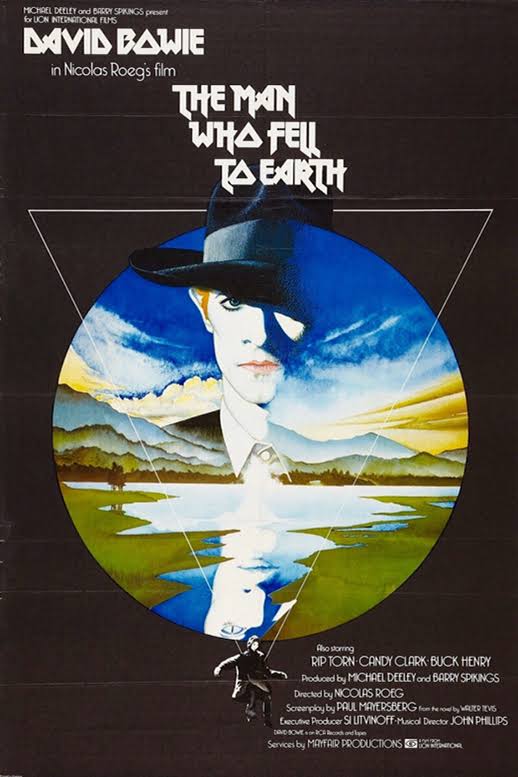
“The Man Who Fell to Earth” (1976) is a British science fiction film directed by Nicolas Roeg, written by Paul Mayersberg, and based on Walter Tevis’s 1963 novel of the same name. David Bowie (in his first feature film role) stars as an extraterrestrial who crash lands in New Mexico while on a mission to save his home planet. Going by the name of Thomas Newton, he soon meets Oliver Farnsworth (Buck Henry), Mary-Lou (Candy Clark) and Dr. Nathan Bryce (Rip Torn), who become his closest allies. Due to personal and professional betrayals, Newton’s secret is revealed and he’s captured by a government agency. While imprisoned he’s subject to tortuous medical tests which break his spirit, replacing his more “alien” personality traits with those of a modern American.

In Philip K. Dick’s novel VALIS, fictionalized versions of Dick and K. W. Jeter become obsessed with Valis, a film starring musician Eric Lampton. This plot element was based on Dick and Jeter’s real obsession with The Man Who Fell to Earth.

Watch the full film here: https://m2m.tv/watch/the-man-who-fell-to-earth/films


Saturday Matinee: Kaiba

A young man awakens without memories. There’s a hole in his chest, a symbol on his belly, and a blurry picture of a girl in a locket he has. Knowing nothing, he tries to escape a twisted city of stolen memories and exchangeable bodies in a world where minds are stored on chips when individuals die and the manipulation of other people’s memories has become the norm.

A surreal series of thirteen 26 minute episodes written and directed by Masaaki Yuasa (“Mind Game”).

Watch the full series here.

Saturday Matinee: Beyond the Black Rainbow

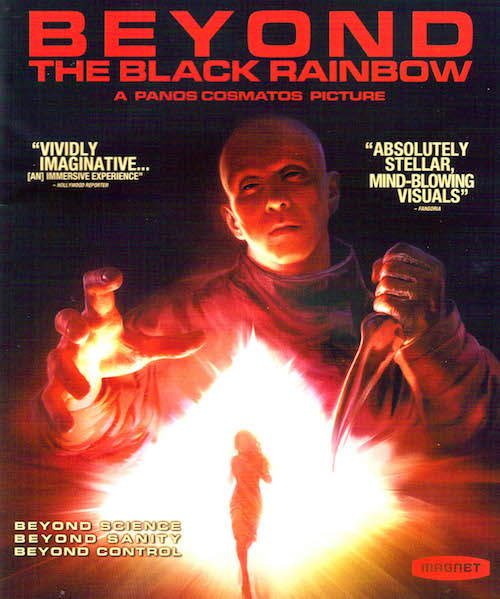
“Beyond the Black Rainbow” (2010) is a Canadian experimental sci-fi film written and directed by Panos Cosmatos. The Cronenberg-esque plot focuses on Elena, a test subject with ESP abilities, who struggles to escape a New Age lab facility called the Arboria Institute headed by the psychopathic Dr. Nyle. Set in 1983, the film is infused with a retro aesthetic heavily influenced by the director’s childhood experiences and recent tragedies as described in the following passage from Wikipedia about the film’s development:

As a child, Cosmatos frequented a video store named Video Addict. During these trips he would browse the horror film section looking at the boxes although he was not allowed to watch such films. During such times he would instead imagine what the film was. He would later reflect upon this experience when making Black Rainbow where one of his goals was “to create a film that is a sort of imagining of an old film that doesn’t exist.” The year 1983 was chosen for the story as it’s the first year he went to Video Addict. Additionally he thought the idea of setting such a film one year before 1984 was funny. The film’s genesis was an overlap between two projects Cosmatos wanted to do. One of these was a film about a girl trapped in an asylum while the other was an installation promoting a research facility that didn’t exist. Eventually Cosmatos realized that he could use both ideas in the same project.

The presence of his parents haunts “every frame of this film”, said the Rome-born filmmaker. His father was film director George P. Cosmatos (whose credits include Rambo: First Blood Part II and Cobra), deceased in April 2005, and his mother Swedish sculptor Birgitta Ljungberg-Cosmatos, who died in July 1997 after a lengthy battle with cancer. Unable to deal with his mother’s death, Panos “drifted into a slow motion mode of self-destruction and binge drinking”. When elder Cosmatos died, the grief he felt compounded. After that the aspiring writer/director started therapy and decided he wanted to make a film as part of the healing process. Cosmatos felt that his “filmmaking sensibility is a weird hybrid of both of them” – his father’s “popcorn movies” and his mother’s haunting, experimental art.

Beyond the Black Rainbow was financed by DVD residuals from Tombstone (1993), directed by Panos’ father. The film was shot in three weeks using a modified Panavision35 mm camera. This was suggested by cinematographer Norm Li, for he noted that Panos’ references – mostly films from the ’70s and ’80s – “were all grainy, colorful, and full of texture”, and he felt the 35 mm format was “the only way to shoot.”

Borrow and view the film from Hoopla here: https://www.hoopladigital.com/title/11910372

Saturday Matinee: Seam

A Synthetic Human Fights to Survive in Visually Stunning Scifi Short Seam 

By Cheryl Eddy

Source: io9

In the not-too-distant future, a tenuous peace between humans and remarkably humanlike “machines”—some don’t even know they’re not real—is tested when synthetics begin spontaneously exploding. A military-led search for these unwitting suicide bombers begins, sending a terrified machine woman and her human partner on the run.

Seam—named for a volatile border area sandwiched between the designated machine containment zone and the human world—borrows from some excellent inspirations, including Blade Runner. But the 20-minute short, made by twin brothers Rajeev and Elan Dassani, makes its mark with outstanding special effects and well-chosen location shooting. Though the film begins in sleek Hong Kong, its visual style is most unique when it contrasts the futuristic tech used by its characters with ancient settings, including a chase scene that winds through the narrow streets of Salt, Jordan. The climactic sequence takes place in Wadi Rum, the otherworldly desert last seen playing Jedha in Rogue One.

Saturday Matinee: A Boy and His Dog

The great science fiction writer Harlan Ellison recently passed away on June 27. Whether or not one is familiar with his large body of work (the majority of which are short stories), “A Boy and His Dog” (1975), is definitely worth watching. It’s the first and best feature film adaptation of one of Ellison’s stories and features Don Johnson as Vic who, with his dog Blood, struggles to survive the post-apocalyptic wasteland that the southwestern U.S. has become in 2024.

Superpowers and Concrete Towers: Katsuhiro Otomo’s ‘Domu: A Child’s Dream’

By Patrick Haddad

Source: We Are the Mutants

In 1989, almost a year after it was released in Japan, the Western world was given its first cinematic taste of anime with the sci-fi epic Akira. Acclaimed writer Katsuhiro Otomo’s vision of a post-apocalyptic Neo-Tokyo, a sea of concrete edifices laid waste by war, was adapted from the manga of the same name, serialized in Japan from 1982 to 1990. Religious fanatics, biker gangs, and shadowy government figures all vie for control of children with superhuman powers, while the truth behind World War III teases just out of reach. But before Akira, Otomo penned and illustrated a shorter piece of raw, dystopian horror: Domu: A Child’s Dream. Set in a government housing complex where a series of inexplicable deaths are taking place, Domu (serialized between 1980-1981) is resolved through a conflict between an old man and a young girl, both of whom secretly possess extrasensory powers.

While Domu foreshadowed Akira in many ways, it is a much more intimate story with fewer characters and just one location, the Tsutsumi Housing Complex. The residents of Tsutsumi are a forgotten, surplus community. Dreams left unfulfilled, private sufferings gone unchecked, and the struggle for identity in the monotonous wash of concrete go some way to explain the rash of suicides plaguing the complex, yet the police are at a loss to explain exactly how many of these deaths occurred. From the beginning, Otomo sets out to introduce the overwhelming, modernist structure as a character in and of itself. Full panel shots of the building in high detail and high contrast are found throughout, and are often employed as bookends to each chapter. Its circular layout insists upon dreary introspection for half of the residents it houses: there is no looking out to the city, to a potentially brighter future. Many prisons, schools, and hospitals also follow a similar template. The circular design—reminiscent of the Panopticon—allows for both greater visibility and fewer places to hide, and is often accompanied by a raised central observation point. Tsutsumi is monotonous in its aspect as well as its makeup: hard concrete, hard lines; no facade, no flair. Behind this impassive exterior lie grimy, cramped apartments hidden among a labyrinth of iron and concrete hallways. It isn’t much of a stretch to imagine Tsutsumi as the backdrop to one of Freddy Krueger’s nightmarish rampages, and Otomo almost certainly drew upon similar feelings of unease regarding the homogeneous modernization of postwar Japan as did Shinya Tsukamoto, who created the shocking cult horror film Tetsuo: The Iron Man (1989).

As the story progresses, it becomes clear—to the reader at least—that the mysterious deaths can be traced back to Old Cho, an apparently senile old man who is in fact using his telekinetic powers to cause fatal accidents or, as in the iconic scene featuring a depressed young man with a craft knife, forcing residents to commit suicide. Old Cho frequently kills from the background, unseen by his victims, his twisted revelry seeming to come from the building itself. Old Cho is not the only resident with special gifts. He finds an adversary in the form of a young girl called Etsuko. They clash the very moment Etsuko and her family move into the tower block, when she uses her abilities to catch the plummeting baby Cho, using his psychic powers, had snatched and dropped from the balcony.

As the story progresses, Cho’s and Etsuko’s confrontations escalate, as the tally of innocent victims climbs. The final act of Domu marks a stark departure from earlier passages, as the static panels showing the impassive monolith and its cowed inhabitants are replaced by dynamic and violent scenes, splashed with blood and fueled by emotion. By the end of the book, it is hard to tell who really won or what a victory would even mean, but it is clear that most of the violence was down to random malice, or misguided fear and rage. It is ironic, then, that the reduction of human beings to just pure function results in senseless, unproductive violence.

Many modernist, and particularly Brutalist, social housing structures were built after World War II in order to show that “A dwelling can be standardized to meet the needs of men whose lives are standardized,” according to urban design pioneer Le Corbusier. Projects such as Les Damiers in Paris, Robin Hood Gardens in London, Habitat 67 in Montreal, and the Unité d’habitation in Berlin are iconic examples of an architectural style that would dominate social housing well into the 1970s. However, the utopian vision set out by modernist architects—to create socially progressive and egalitarian housing—became twisted by time and by the reality of the project’s application. Affordable social housing turned into isolated ghettos, while the idea of social progress became just a gear, an empty promise, in the great Soviet machine. The modular, repetitive nature allowed for quick and cheap rebuilding, but, perhaps in part due to its success, it also aided in the dissolution of identity. Each building, each home, was just a copy of the last, with nothing substantial to distinguish each from each: an existence stripped of form, each building nothing but raw function. And so too its occupants.

In contrast to the urbanization implied by modernist housing, America saw large numbers of people, many of them returning veterans, flee the cities after World War II in favor of suburban living. Combining the power of assembly-line mass production with the G.I. Bill’s loan assistance saw entire communities of cookie-cutter homes spring up in a remarkably short space of time. Spreading out in a grid, rather than towering above, suburbia very often entailed a similar rationalization of living spaces. The mass produced sprawl, built to the same specifications and filled with the same stylish appliances, fits nicely into Le Corbusier’s definition of homes as “machines for living in.”

Things were much grimmer in Japan, of course. Suffering atomic bomb strikes that wiped two of its cities clean off the map, as well as the death of an Empire, caused a national crisis of identity. The country was then occupied by and rebuilt in the image of its conquerors: centuries of culture burned to the ground or consumed by industry and replaced with bloodless, uniform architecture. Tower blocks went up where pagodas once stood, no longer hewn from stone and wood but erected with concrete and rebar. British author Theodore Dalrymple describes modernist architecture as “inherently totalitarian… [it] delights to overwhelm and humiliate what went before it by its size and prepotency.” The seeds of modernism in Japan were planted before their defeat during World War II, however. Le Corbusier worked with two prominent Japanese architects during the 1930s, Kunio Maekawa and Junzo Sakakura. During this time, a synergy was found between Le Corbusier’s visions for flexible, open plan buildings filled with natural light and the traditional Japanese house, called Sukiya-zukuri. This synergy would be expanded upon in the later Metabolism movement, which sought to bring inspiration from organic, biological structures to modernist architecture during the 1960s.

In Domu, we find a manifestation of this dehumanizing monolith in the form of the Tsutsumi Housing Complex and it’s magpie avatar, Old Cho. For each of his victims, Cho claims a glittering prize, a personal token: a badge, a hat, a gun. Before being forced over the precipice of their hopelessness, literally and figuratively, a piece of their identity is stolen before being secreted away somewhere in the bowels of the building.

While it is unlikely that Otomo wrote Domu as an explicit attack on modernism in Japan, the influence of the displacement and anxiety it caused is clear in his work. In Domu, we see Otomo start to develop two of the principle themes that went on to make Akira a timeless classic: young people with exceptional, inherent power, and a dystopian vision of Neo-Tokyo as a failed totalitarianism, an endless landscape of monstrous and towering concrete. These themes went on to define an era of storytelling in manga and anime characterized by pervasively bleak visions of the future.

The loss of privacy and individualism caused by massive modernist social housing estates is also explored in J.G. Ballard’s High Rise (1975), in which tenants of a self-contained tower block in London degenerate into primal tribes, warring over territory and resources while normal city life continues outside. In High Rise, the dehumanizing power of Brutalism leads people to lose their “civilized” behavior and let base urges drive their lives, while in Domu we get a greater sense of the despondency that comes from being a lifeless industrial worker in a lifeless industrial landscape. It is as though living in this monochromatic, function-centric environment leaves us with only two potential identities: the animal, or the machine.

Regardless of whether you read Domu for its gripping and pioneering storytelling, for what it tells us about the role played by modernist architecture in postwar Japan, or purely for its wonderful aesthetic, it is a work that easily stands on its own two legs, despite often being overlooked as some sort of practice run for the Akira epic. Rather than the abstract, existentialist sprawl that is the latter, in Domu we have a more concise and personal tale, with a sense of looming oppression that bleeds from every page. The bare honesty found in some of Cho’s victims shines a light on the real lives lived quietly the world over, their deep fatigue resonating in profound echoes. The next time your morning commute takes you past some austere, concrete tower block, remember: somewhere inside may be a young girl who blows things up with her mind.


Read Domu for free here.