Although made in a ’90s ‘B-Movie’ style, Acción Mutante can be either viewed as a schlocky, gore laden, science fiction romp or a politically astute piece of social commentary in an innocuous wrapper. It could also, potentially, be both.
In a dystopian future where the world is ruled by the glamorous and ‘good looking’ people, the disfigured and disabled are marginalised and treated as second class citizens destined for a life of poverty. Fighting against this tyranny is a disparate band of characters, who call themselves mutants, using the name ‘Acción Mutante’ for their terrorist acts. For several years since the imprisonment of their leader ‘Ramon’ (Antonio Resines), the group, comprising of conjoined twins ‘Alex’ (Álex Angulo) & ‘Juan’ (Juan Viadas), ‘Quimicefa’ (Saturnino García), ‘Manitas’ (Karra Elejalde), ‘Chepa’ (Ion Gabella), and ‘M.A’ (Alfonso Martínez), have been ineptly continuing the fight, leading to many high profile blunders, especially when they try to kidnap someone. Upon his release, ‘Ramon’ immediately puts into motion a new plan to kidnap Patricia Orujo (Frédérique Feder), the daughter of the boss of the Orujo business empire (Fernando Guillén), and ransom her for 10,000,000 ‘ecus’ on a distant mining planet. This plan rapidly spirals out of control…
As a writer, producer and director, Álex de la Iglesia has become more well known for films such as The Oxford Murders, La Comunidad, and The Last Circus since Acción Mutante, his first directorial feature. This film was a brash introduction to what was he was later to create. With production being aided by Augustin and Pedro Almodóvar, and with several well known Spanish actors on board, this was by no means an effort made with little talent behind him and it shows what people saw in him, even then.
What he has made is, essentially, an obvious attack on the bourgeoisie and their ilk with commentary on the disabled and the way society treats them, all put together in a ‘Troma-esque’ black comedy. In the amount of gore, and especially the style of the gore, the Troma influence is apparent and it would sit comfortably alongside many Troma films. There is also an obvious influence in some scenes from Almodóvar, such as the party scene, where you may even notice Rossy De Palma, an Almodóvar regular. There are also some similarities to other European directors’ early work, such as Jean Pierre Jeunet & Marc Caro (Delicatessen), especially in terms of characters, which is not a bad thing.
These characters are a mixed bag, with some being broadly comedic and others being very one dimensional heroes or villains. What is clear is that a certain amount of hokey fun was had by the cast. They do a good job in hamming it up in the right manner for this kind of B-Movie with some good interplay, some clever idiosyncrasies, and some nice set pieces. Plot-wise, the pacing and structure are a little flawed. As the second half falls apart a bit, losing some of the good premise along the way, which is a shame. Much more could have been made of this premise and instead it treads a slightly simpler path with a cheaper, trashier angle. Having said that, it does still tend to work, but just not quite how you thought it was going to.
There are a couple of problematic areas, namely some excessive violence that is unnecessary and some misogynistic elements which are troubling. When the film originally came out on VHS, the BBFC (British Board of Film Classification) made some cuts, which have been put back in this DVD version, and we probably would have been better off without them as they do not enhance the plot or its coherence at all. I had previously only seen the VHS version and in no way was this better. As for the misogyny, it is pretty obvious that these elements are there, but I would be interested to hear what Álex de la Iglesia and producer Pedro Almodóvar have to say about it and whether they were making a particular point, as Almodóvar has a history of strong female characters and is often called a feminist.
Overall, I would say that if you’re a fan of the Troma-style of bonkers, splatter, comedy B-Movie, then you will find something to like here. This needs to be taken as a relatively stupid, schlocky comedy with some obvious social and political points to be made. However, I have read that there are some more specific points made for a Spanish audience that may not be immediately apparent for an international audience. As someone from the UK, I didn’t pick up on anything in particular, but that doesn’t mean it’s not there. Potentially, it could contain further depth. So, while it is problematic, it does show the signs of better work that was to come from Álex de la Iglesia, and can be enjoyed as an oddball thing of its own.
Werner Herzog’s documentary films lie at an extreme distance from the Anglo-American tradition of documentary filmmaking. Part of that distance can be linked to the distinction between two fundamental stances towards the depiction of reality: “Objectivism” and “Interactionism”, which I have discussed in other essays, for example, Avatar (2009), Close-Up (1990), and SiCKO (2007). American documentarians generally align themselves with Objectivism and hold that they are presenting an objective view of reality. An extreme form of this approach is “direct cinema”, which seeks to create the illusion that the filmmaker is an invisible “fly on the wall” and has no impact on the subjects being filmed, thereby supposedly ensuring scientific objectivity. But even in more conventional American documentaries with explicitly polemical content, there is a presumption that objective reality, independent of any observer, is being presented. Continental European documentary filmmakers, on the other hand, have had a tendency to lean towards Interactionism and have made more personal films in which the filmmaker and his or her point of view is a confessed part of the narrative. Herzog is so much on the Interactionist side of the ledger that his documentary films not only include his personal perspective, but seem primarily to be his own personal essays about the world – he, himself, is an implicit focus of the film, and the “reality” depicted is self-consciously Herzog’s own reality. Lessons of Darkness (Lektionen in Finsternis, 1992), which was shot in Kuwait in the immediate aftermath of the First Gulf War (1990-91) is one such example of Herzog’s style.
Although focussed on the harrowing events and ravages that happened in Iraq and Kuwait during that time, Lessons of Darkness has clear-cut affinities with Herzog’s first documentary Fata Morgana (1971), which was shot in Africa. In that earlier film Herzog edited footage that he had (seemingly randomly) shot in the African Sahel and tried to fashion a dark vision about man’s hopeless ineffectiveness, and consequently likely impermanent existence, on the planet – an ephemeral existence like a mirage. Some twenty years later, with Lessons of Darkness, Herzog again collected footage, this time in Kuwait, and then assembled his photographic essay in post-production, and again his vision is one of dark apocalypse and pessimism concerning man’s prospects for a sustainable future. In fact both Fata Morgana and Lessons of Darkness contain vague commentary that suggests that humankind on Earth is being clinically observed, with amazement and horror, by a visitor from another planet. However, in neither film is there any real narrative or sequence of events that could amount to a story – they are both more or less personal essays of despair. But if we assert that they are both cinematic commentaries, we have also to concede that neither of these two films provides an explicit disquisition or argument, or even has a clearly articulated thesis. What we are really presented with is just a suggestive sequence of images, on which the viewer reflectively fills in many of the blanks and faces a greater-than-usual task of constructing his or her own story or vision. This process of placing much of the narrative burden on the viewer essentially fails with Fata Morgana (which was almost a random collection of lurid images of garish and pathetic human folly), but is more successful with Lessons of Darkness, primarily because the viewer in this case is more likely to bring to the film considerable familiarity with what happened during the “First Gulf War”and use that material for his own imaginative reconstructions.
The greater part of Lessons of Darkness consists of lurid scenes of fires in the Kuwaiti oilfields burning out of control and spewing gargantuan clouds of smoke. These images are interspersed with images of devastation, both at the physical and human level, and with human firefighters seemingly overmatched in their efforts to quell the multiple, raging infernos. The images are apparently meant to be abstractly horrific, and there is almost no spoken dialogue and no explicit reference to the Gulf War, or to specific places, or to any historical context. To set some kind of context, Lessons of Darkness opens with images of wasteland and destruction, and the prologue refers to a planet “in our solar system” which evidently has undergone a catastrophic war. So the viewer sees things simultaneously with respect to two overarching narrative perspectives: the real Gulf War and an abstract metaphorical fable of how bizarre humankind’s self-destructive impulses might be to a detached, external observer. The film is then presented partitioned into thirteen chapters, each identified by apocalyptic, perhaps oracular, intertitles which suggest chapters to some sort of apocryphal Book of Revelations.
“A Capital City”. This section features an opening voiceover narration with images of Kuwait City filmed from a low-flying helicopter, ominously suggesting that this doomed city will soon be utterly destroyed by warfare (it wasn’t, and this footage was filmed after the conflict).
“The War”. Here is shown footage of the aerial bombing of Iraq as seen via night-vision video cameras. Although this section is relatively short and no mention of “Operation of Desert Storm” is made, the context is likely to be familiar to a worldwide audience, since it was widely viewed on CNN.
“After the Battle”. Images of war devastation are presented.
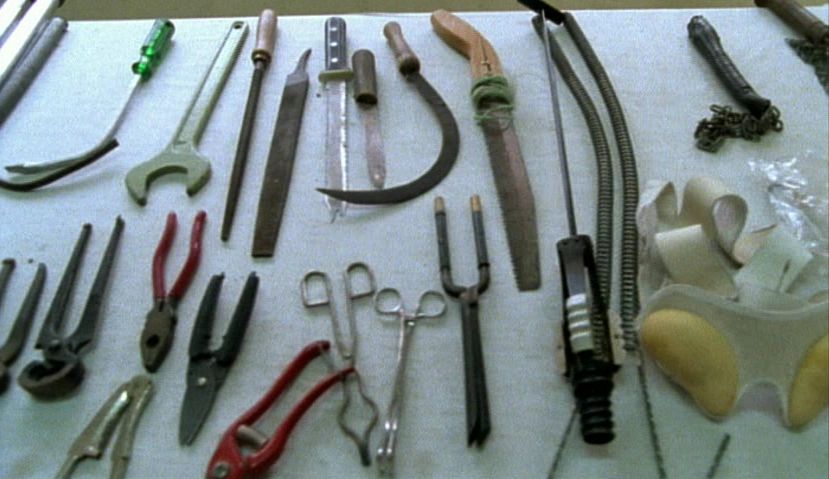
“Torture Chambers”. This thankfully brief section is one of the most memorable, though difficult to bear, sections in the film. First is shown what is apparently the insides of one of the torture chambers run by Saddam Hussein’s government, and it features a mute display of mechanical devices designed to inflict unbearable pain. Then an Arab woman is shown who was been rendered almost permanently speechless by having been forced by the authorities to witness her own sons being tortured to death.
“Satan’s National Park”. Helicopter footage of what seems to be a vast marshland are revealed to be in fact entirely flooded with oil.
“Childhood”. Another Arab mother is shown, this time with a young, disturbed boy who has been rendered speechless by what he has witnessed during the conflict. As with the woman shown earlier, the horror of what happened is not shown, it is only something so unspeakable that one cannot bear to think about it. The viewer’s imagination then fills in the blanks.
“And A Smoke Arose Like The Smoke From A Furnace”. Here, 23 minutes into the film, the raging fires take over the screen. Again, they are filmed from low-flying helicopters.
“A Pilgrimage”. Now the (American) firefighters are shown, sometimes relatively up close and at other times at a distance and dwarfed by the towering flames of the fires that burn endlessly. This section shows the firefighters using explosives to try to put out the fire.
“A Dinosaur’s Feast”. This is more or less a continuation of the previous section showing the firefighters, but now emphasizing some of the huge construction and excavation machines employed in their work. The machinery has monster-like appearances, with arching cranes, serpentine bodies, and huge digging claws.
“Protuberances” – a brief section showing closeups of oil–and-mud swamps bubbling and frothing, and evoking more nightmarish images of Hell.
“The Drying Up of the Wells”. The oil-covered firefighters are shown, often in slow-motion, intensely engaged in the mechanics of their operations. The functional nature of these activities is incomprehensible to the typical viewer, and it all appears perhaps as an abstract Ballet Mécanique from the dark side. The macabre strangeness of it all, and the degree to which these operations seem to be foreign to what we might call normal human intercourse, are worth comparing to Louis Malle’s documentary, Humain, Trop Humain (1974).
“Life Without Fire”. With many of the fires now apparently having been extinguished, the voiceover commentary of the interplanetary visitor expresses wonder as these strange creatures to him (i.e. the firefighters) engage in the baffling act of relighting an extinguished geyser of oil. He comments: “Has life without fire become unbearable for them? . . . . . Others, seized by madness, follow suit. . . . . Now they are content, now there’s something to extinguish again.”
“I am So Weary of Sighing, O Lord, Grant That the Night Cometh”. The final portion returns to the fires, themselves, carrying with it an air of resignation and gloom.
Herzog’s fascination with fire extends to a fascination with its opposite, darkness (hence the title). The demonic forces that lurk inside the hearts of men seem to be beyond civilized understanding or rational control. These issues of cruelty and madness are as elemental as fire, itself, and are not confined to the Middle East [1]. This apparently was Herzog’s project: not to focus on just the particular horror of what happened in one part of the globe, but to fashion a fiction that would portray a more universal damnation. To this end, he opens the film with his own fabricated quotation (“The collapse of the stellar universe will occur, like creation, in grandiose splendor”) which he probably attributes to Blaise Pascal in order to give it the appropriate resonance – Pascal is perhaps not so well-known to English-speaking audiences, but his genius occupies a peculiarly iconic place in the European mind.
The horror that Herzog attempts to convey by his images of man-made Hell is enhanced by its unspeakable nature – it is beyond human articulation. Instead of a deafening roar from the fires drowning out occasional shouts from the firefighters, much of the stoundtrack is filled with funereal, dirge-like orchestral music from Mahler, Prokofieff, Verdi, Wagner, and Arvo Part. The unspeakable nature of this horror is explicitly referenced by the two mothers: one mother is unable to speak comprehensibly, and the child of the other mother has been rendered speechless by rational choice. It is left to our imaginations to fill out these nightmares.
Notes:
For example, consider the use of germ warfare by the Japanese during the Second Sino-Japanese War (1937-45). Here is a quotation from an article on the subject (Judith Miller, “When Germ Warfare Happened”, City Journal, (Spring 2010)):
“The methods were brutal. Army trucks dumped gallons of deadly germs alongside roads and railway lines linking Chinese towns so that infections would spread from town to town; planes dropped porcelain bombs containing infected fleas on dozens of villages, causing devastating outbreaks of bubonic plague. The Japanese laced more than 1,000 wells in the area of Harbin with typhoid bacilli. They also inserted typhus into bottles of lemonade that children loved to drink in the summer, Harris reported. In Nanking, they distributed anthrax-filled chocolate and cake to hungry children. The Japanese discovered that packing fountain pens and walking sticks with deadly germs was a particularly effective way of secretly disseminating them. In 1940, Major General Ishii sent a train carrying 70 kilograms of typhus bacterium, 50 kilograms of cholera germs, and 5 kilograms of plague-infected fleas to the city of Hangzhou, a holiday resort favored by Shanghai’s wealthy. From there, the germs were dumped into ponds and reservoirs and spread by aerial spraying, contaminating all life in fields of wheat and millet during the harvest.”
In Oliver Stone’s The Doors (1992) Ray Manzarek (Kyle MacLachlan) tells Jim Morrison (Val Kilmer) a story about his experiences working in the Hollywood of the late 1960s. He says he told a studio executive that he did not need a script to make a film. “Godard doesn’t use one,” Manzarek claimed. The executive replied, “That’s great… Who’s Godard?”
By the late ’60s, Jean-Luc Godard was a legend among young cinephiles. Beginning withBreathless in 1960 and ending with Weekend just eight years later, the caustic former Cahiers Du Cinema film critic made 15 films which can only be described as revolutionary. Both in terms of cinematic form as well as political and personal content, these films broke the old rules while inventing new ones. The use of handheld cameras, jump-cuts, natural light, and improvisation were both old and new things he popularized. Many of these ideas were used during the freewheeling days of silent cinema before filmmaking was industrialized and, in the mind of Godard and his “New Wave” colleagues, fossilized.
Godard wanted to provoke. But unlike some of his more didactic later work, these initial films are playfully provocative. Most of them are defined by their adversarial relationship to popular movie genres. Breathless is Godard’s deconstructed take on the crime film. A Woman is a Woman (1961) is his musical comedy.
Alphaville(une étrange aventure de Lemmy Caution) (1965)is two genres for the price of one: science fiction and noir. Maybe it’s even a third genre as well. It can be argued that the film is just another Eddie Constantine “Lemmy Caution” flick. “Lemmy Caution” flicks were big business in France since the ’50s, and Constantine played the role in over a dozen of them. Created by British pulp novelist Peter Cheyney, Caution is either an FBI agent or a private detective, depending on which novel you read, but it doesn’t really matter. He’s less a character than a genre archetype and it’s the archetype that Godard wanted. Especially one that was already lost in translation: British novels about an American detective adapted into French films starring an American actor speaking French.
Constantine was synonymous with the role, so Godard simply dropped him like a found object into his dystopian science fiction plot. The old fashioned tough guy Lemmy Caution does not belong here. His simple macho values and violent responses are hilarious when placed into this new context. In one scene, he shoots and kills a man then attempts to question him. Caution appears to have no idea what question to ask anyway, as his bizarre mission pits him against a fascist sentient computer called Alpha-60, which rules Alphaville and forbids any expression of emotion. Caution is deadpan but filled with primitive emotions both violent and romantic. It’s no surprise that Godard considered calling the film “Tarzan Versus IBM”.
By the end of the film, Caution gives up trying to understand the computer’s semantic games and resorts to his base instincts to bring Alphaville down. Along with using his fists and a .45 automatic, Caution expresses love for Natacha Von Braun (Anna Karina), the daughter of Professor Von Braun aka Leonard Nosferatu (Howard Vernon) — the man who built Alpha-60. Natacha grew up in Alphaville and does not know the meaning of words like “Love”. Caution challenges her to understand the meaning and challenges Alpha-60 by telling it a riddle that it cannot possibly comprehend.
From this description, the film may seem like a cold intellectual exercise. A film made by Alpha-60 itself. But this isn’t the case. I find Ridley Scott’s Blade Runner (1982), which is obviously inspired by this movie, to be a much colder experience. Alphaville is one of Godard’s wittiest and most emotionally moving. The pulpy sci-fi plot acts as a warm coat of familiarity as Godard slyly subverts one genre trope after another. Godard never really stopped being a film critic. His films were as much essays on how films worked as they were films themselves.
So Godard reveals the artificiality of B-movie fight scenes by presenting them as a series of posed comic book stills and gives Caution melodramatic theme music, which turns abruptly on and off at the most dramatically incorrect and hilarious moments. The excellent score by Paul Misraki shifts from this intentionally clichéd thriller music to beautiful and haunting pieces full of romantic longing.
This romantic theme is used most effectively at the end of the film, a scene which is a perfect example of what fellow French New Wave director Francois Truffaut called a “privileged moment”; brief moments in cinema when the film captures something intangible in a way no other art form could. As Misraki’s score builds, Godard holds on a lengthy closeup of Anna Karina, whose eyes are as hypnotic as any performer in film history. Karina’s expression slowly and subtly shifts from cold to warm and she ends the film by speaking the words she could not comprehend earlier: “Je vous aime…”
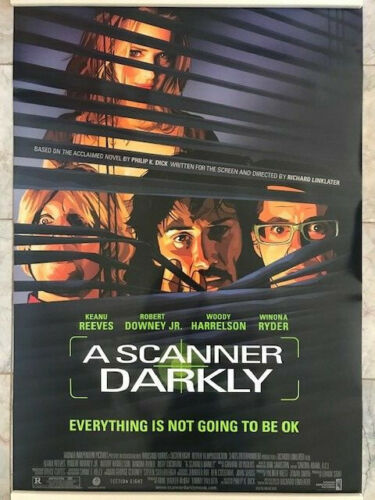
Based on the acclaimed novel by Philip K. Dick, Richard Linklater’s 2006 film of A Scanner Darkly presents a cautionary tale on drugs, surveillance, and perception in a unique formal arrangement. Set “seven years from now,” the film considers a tyrannical post-9/11 world oppressed by an ever-watchful government, widespread paranoia, corporate subjection, and pervasive pharmaceutical addiction—all elements further fuelled by the obsessive fear that governments, corporations, and even your friends conspire against you. Linklater’s decision to produce his film with rotoscoped animation turns his adaptation into one of the most visually and thematically original motion pictures in decades, and the most faithful of all Dick adaptations. The film’s world contains several Dickian existential and metaphysical dilemmas and paradoxes, from the notion of spying on oneself to becoming willing participants in one’s drug addiction. This unsettling and tragic world becomes deliciously skewed from the excessive filtering of surveillance technology and a crazed dystopian culture, so much so that it remains impossible to see anyone for who or what they really are. A Scanner Darkly beautifully, and chillingly, considers Dick’s persistent theme that our culture has destroyed its own ability to perceive objective reality.
Philip K. Dick was born in 1928 and became interested in science fiction at an early age. He attended the Berkeley, California, high school and graduated in 1947, alongside another future science fiction author, Ursula K. Le Guin, and briefly attended the University of California, Berkeley. He published his first science fiction story in 1951. From there on out, he would become one of the most prolific authors in his genre, publishing some 44 novels and more than 100 short stories until his death in 1982, just before the release of his first book-to-film adaptation, Blade Runner, based on his 1966 novel Do Androids Dream of Electric Sheep? Though science fiction was typically considered unsophisticated and a lower form of fiction, Dick’s caustic wit and social satires elevated sci-fi to the level of art. His self-proclaimed title was not that of an author but rather a truth-teller. He wrote his truth, and it consisted of a vast fictionalized philosophy, which some might argue was—and is—not necessarily fiction. His most enthusiastic followers might say his work is visionary, if not prophetic. Dick claimed his work spoke, and still speaks, to disturbed, troubled, and “off” members of society. His writing is for those who cannot rationalize society or reality: for those who need a satire, base, or frame of reference to rely on as coping mechanisms. Science fiction creates the desired satirical reality for readers, just as his characters in A Scanner Darkly see drugs as the only sane choice to escape the insane world.
Written in 1977, A Scanner Darkly stands as an ode to the drug counter-culture of Dick’s own Berkeley underground. But it’s also a thoughtful exploration of the metaphysical existence of drug users, as well as a mournful commentary on the government’s involvement in drug culture. Standing against the blatantly autocratic Nixon administration, marked by a reputation for undue suspicion and conspicuous surveillance, his Berkeley group purveyed conspiracy theories and widespread mistrust. And yet, this counter-culture also included a vast set of respected thinkers, unafraid to speak out—not just mindless stoners. According to an interview with French TV, Dick claims the group’s paranoia was not unjustified. During the interview, Dick speaks of secret CIA and FBI files on him, covert operations to get at his personal documents, and rampant spying led by the heads of various government organizations. To Nixon and his administration, the Berkeley group was an unknown element—a misunderstood collection of hippies seen through a distorted set of the administration’s famously paranoid views and political mechanisms. Fuelling this conflict between the two factions of Nixon’s administration and the Berkeley group, the author had a lifetime’s worth of experience with drugs, psychosis, and a slight case of schizophrenia. But in no way should those characteristics hinder the author’s message. Instead, Dick’s distinctiveness within the Berkeley group should reinforce that A Scanner Darkly may be more autobiographical than his other novels.
The story’s main character is Bob Arctor (Keanu Reeves), an addict of a drug called Substance D, also known as Slow Death. But Bob is also Fred, an undercover narc spying on Arctor’s group of Substance D-using friends. Arctor has lost sight of his identity because of Substance D, which chemically separates brain functions in the hemispheres; after prolonged use, the left and right sides of his brain are unaware of each other. Furthermore, the Fred portion of the main character must conceal his identity from his supervisors for his own safety. No one knows who Fred is; no one knows who Bob is—including himself. The sole man representing both the narc and the addict does not realize he is spying on himself, and in a way, informing on himself. This self-betrayal is tantamount to suicide, rendering him prey to both Substance D and the totalitarian police state that employs him. According to the novel, the drug is made from a flower called “mors ontological”—Latin for ontological death. To be sure, Dick saw first-hand the damage substance abuse caused his friends. He was not entirely unaffected himself; he relied on methamphetamines and psychedelics for much of his early career. But he weaned himself off drugs before writing this book. And at the very end of his novel, Dick dedicates his fiction to several friends who died or retained permanent physical and mental dysfunction due to excessive drug use (a dedication abbreviated at the end of Linklater’s film). He writes that users are punished excessively and even unknowingly for attempting to “play” with something dangerous.
So often, society deems drug users worthless or mindless junkies for their habits, but A Scanner Darkly—the story and the title itself—asks that we do not pass judgment until we can see, in its entirety, the role of users. However, because of the elaborate system of filters between our eyes and that which we wish to see, how can we ever trust that we see reality and not some malformed version of reality skewed through surveillance tools? These filters exist in the form of monitoring equipment such as cameras and scanners, but also the mind-altering Substance D. Drugs are the obscuring mechanism by which the narrative challenges audiences to accept and ultimately forgive the characters within. Throughout the film, viewers must accept drug use as a fact of the story rather than a downfall of the characters. The book’s title refers to a verse from the bible, namely 1 Corinthians 13: 11-12, a verse that is paradoxically read both at weddings and funerals:
For we know in part, and we prophesy in part. But when that which is perfect is come, then that which is in part shall be done away. When I was a child, I spake as a child, I understood as a child, I thought as a child: but when I became a man, I put away childish things. For now, we see through a glass, darkly; but then face to face: now I know in part; but then shall I know even as also I am known.
A pattern of dualism exists in this passage, particularly after its application to popular culture. Both in the novel and the film of A Scanner Darkly (not to mention Swedish director Ingmar Bergman’s film Through a Glass Darkly), the idea of childhood versus adulthood, known and knowing, and parts versus the whole, are circumscribed so that the reader or audience cannot reconcile metonym from metaphor.
Dick’s writing often tells of worlds that are not what they seem. With A Scanner Darkly, the world remains undefined, distorted through a complicated filtration process. Linklater magnificently captures that undercurrent through his use of rotoscoped animation. Throughout the narrative, we remain unsure about Reeves’ character’s identity—in part due to the setting’s massive use of surveillance technology. The protagonist is not altogether Bob, nor is he altogether Fred; he comprises several constructs that never assemble into a single, understandable symbol. Agent Fred watches Bob on numerous holo-scanners, located everywhere; scanners see every moment of every day in every location. Someone is always watching (or that is what they want you to think). Undoubtedly, there was a time when Fred realized he was Bob, but Substance D has destroyed his understanding of his dual roles. Now, Fred cannot fully understand or see Bob. Who is this mysterious figure? Fred wonders. Is he the mastermind behind the whole thing? When Fred looks, he watches through a filter: the scanner. He cannot see clearly because his mind has been altered. At the same time, Bob has an unsettling sensation that he’s being watched. Though Bob and Fred are the same person, they cannot fully understand themselves. Meanwhile, the overwhelming network of observational devices only puts the truth at a greater distance.
The main character questions his culture’s scoptophilia-driven ways of looking and its authenticity: “What does a scanner see?” he asks himself. “Into the head? Down into the heart? Does it see into me? Into us? Clearly or darkly? I hope it sees clearly because I can’t any longer see into myself. I see only murk. I hope for everyone’s sake the scanners do better, because if the scanner sees only darkly the way I do, then I’m cursed and cursed again, too.” The protagonist’s hopes are in vain, as scanners prevent authorities from seeing their suspects clearly. Drugs debatably prevent the film’s main characters from seeing reality clearly, just as Linklater’s innovative use of animation in the film prevents audiences from seeing clearly. All these devices—scanners, drugs, animation—are filtering devices within the film. They distance the viewer or the subject from the truth, for which knowledge thereof is impossible, thus brilliantly placing us on the same disjointed plane of existence as the protagonist. We see through these filters as if a sfumato haze lingered between our eyes, and what we see is a distortion that impedes an accurate understanding.
With the film’s animation, the distortion does not take away from the audience’s understanding of the story’s message. It adds to it. The rotoscoping technique postponed the film’s scheduled release yet made the lengthy, nearly two-year production worth every moment to waiting audiences. A Scanner Darkly’s journey to the screen actually struggled for well over a decade with interested directors and forgotten scripts. In the 1990s, filmmakers ranging from Terry Gilliam to David Cronenberg attempted but failed to get their proposed adaptation before cameras. Charlie Kaufman, the writer of Being John Malkovich and the very Philip K. Dick-esque Eternal Sunshine of the Spotless Mind, also wrote a screenplay for Dick’s much-praised drug novel, although the script was never produced. Eventually, writer and director Richard Linklater wrote an adaptation. He had previously wanted to adapt Dick’s fast-paced Ubik, but settled on A Scanner Darkly for its metaphysical pondering and sense of paranoia, both themes which Linklater had explored before. George Clooney and Steven Soderbergh’s production company Section Eight agreed to produce. And eventually, the film was sanctioned by the Philip K. Dick Trust.
Based in Austin, Texas, Linklater helped launch a movement in American independent cinema with his 1991 debut, Slacker, an ultra-low-budget film that follows a group of college-age thinkers and vagabonds in loosely connected conversational vignettes. Before that, Linklater demonstrated his love of cinema when he founded The Austin Film Society in 1985, a non-profit group devoted to rare and important filmic works, which today has an Advisory Board consisting of filmmakers such as Steven Soderbergh, Quentin Tarantino, Robert Rodriguez, Tobe Hooper, and Les Blank. After Slacker, Linklater released Dazed and Confused (1993), a box-office flop that has since become a cult favorite, along with launching the careers of Ben Affleck, Matthew McConaughey, and Parker Posey. He continued with films rooted in thoughtful conversations, such as Before Sunrise (1995), the first chapter in the transcendent Before trilogy, and subUrbia (1997), adapted from Eric Bogosian’s acidic play. Eventually, Linklater experimented with commercial work, such as The Newton Boys (1998), an underwhelming Prohibition-era bank robber story, and the underrated Jack Black comedy School of Rock (2003). But the writer-director’s real talents flourish in artistic films with a sly commercial appeal—such as the highly praised sequels to Before Sunrise, 2004’s Before Sunset and 2013’s Before Midnight; his part-documentary, part-dramatized real-life murder story Bernie(2011); or his ambitious 12-year project Boyhood (2014).
Outwardly, A Scanner Darkly remains most closely tied to Linklater’s 2001 release, Waking Life, a most meandering and philosophizing work that uses rotoscoped animation to follow an ongoing series of thought-provoking conversations. The process was originally used in 1914 by cartoonist Max Fleischer, and then next by Walt Disney, to help cartoonists simulate natural movement. By painting or inking on live-action footage, the characters in a film such as Sleeping Beauty (1959) were given more realistic bodily actions and facial expressions. But A Scanner Darkly would use the method for much more than merely painting over photography; the film uses animation to establish both reality and create hallucinatory images. As a result, the original plan scheduled nine months’ worth of post-production animation, but the process took eighteen months to allow for the detail and imagination Linklater wanted in his animation. The outcome, even in seemingly insignificant scenes, is breathtaking. The flawless animation appears to be a comic book with a pulse. Combine that with the bravado performances of the film’s actors, and the animation becomes just another piece of the apparatus that disappears in the glory of a great story. Some may hold reservations towards the technique, believing that the animation takes away from the actors’ performances or the narrative. Still, the approach helps rather than hinders the actors’ places in A Scanner Darkly’s bizarre, paranoid reality, aligning perfectly with Dick’s themes of reality distortion.
The most impressive piece of animation in the picture is Fred’s ever-shifting “scramble suit,” which prevents Fred’s supervisors from identifying him, maximizing the security of his cover. Fred’s boss wears a similar suit, and neither Fred nor his boss knows who is behind the other’s suit. The “scramble suit” projects false identities via constantly shifting characteristics so that no surveillance mechanism can pinpoint the wearer’s identity, therein eliminating any possibility of exposure. Animating the suit consists of creating hundreds, if not thousands, of facial and bodily fragments that dizzily rotate at random. But each momentary identity has to maintain an overall silhouette and still project the actor underneath. When Keanu Reeves’ Fred moves, even from under the continually changing scramble suit, the audience can still recognize Reeves’ movements and body language. The performances themselves were given by actors chosen not only for their sheer talent but, seemingly, for their off-screen reputation with drugs. Keanu Reeves, Robert Downey Jr., Woody Harrelson, Winona Ryder, and Rory Cochrane have all had or even lived similar roles to theirs in A Scanner Darkly. Somehow rotoscoping wipes away that stigma, compiling a new face literally painted over the actor’s old one. The performers are made whole again, permitting the audience to forget about Downey Jr.’s reoccurring drug problems or Harrelson’s history with pot. They are no longer actors but rather characters given free-range because of the innovative medium. Their off-screen reputations linger in our subconscious, to be remembered later upon reflecting on the film’s artistry.
The most notable performance of the group is Robert Downey Jr. as Barris—a suspicious character so burnt out from the drugs and constant onslaught of paranoia that he’s become sadistically mistrusting, if only internally, of his friends. Downey Jr. plays Barris as a fast-talking, often brilliant individual that can turn at any moment. Downey’s maniacal rapid-flow speech and brazen waving of the arms bring Barris—the most conniving, intelligent, humorous, sadistic, and strangely most likable character from the novel—to life. Reeves and Cochrane’s performances deserve acknowledgment as well, as each actor completely embodies their respective role. Reeves takes Bob (or is it Fred, or later Bruce?) to the ambiguous level demanded. While Reeves has taken his share of guff for his inexpressive acting, he seems at ease and perfectly cast here. Looking back, no other actor could have given Bob-Fred-Bruce the same ambivalence to the world and himself without making it appear too unintentional (or too intentional, for that matter). Cochrane plays Freck, an overdosing Substance D fiend and one of Arctor’s group of stoner friends. The first scenes in the film involve Freck attempting to wash and kill hallucinatory aphids from his body and out of his hair. Cochrane gives Freck the perfect helpless-yet-fearful twitch of a user who knows he has gone too far. Freck is pitiable in how prey is pitiable: although aware of his deteriorating state, he is too far gone to change the situation and helpless to prevent his eventual collapse.
This could be said for any of the characters in the film. Each floats like a moth on a calm pond—having landed on the water, they are now helpless to escape. They wait for some hideous predator from the murky bottom to float up and gulp them down. Both the film and Dick’s novel share a potent message—particularly in the story’s climax, which reveals that the foundation set up to cure people of Substance D addiction is the very organization creating it, a corporation called New Path. This turn speaks against the type of suspicious world where people have no choice but to escape. Neither the film nor the book condones drug use, but they understand it. They do not blame users for attempting to distract themselves from the ever-encroaching watchful eye of society and the government looming in. Or as Dick writes in his Author’s Note at the end of his novel:
Like children playing in the street; they could see one after another of them being killed—run over, maimed, destroyed—but they continued to play anyway. We really all were very happy for a while, sitting around not toiling but just bullshitting and playing, but it was for such a terrible brief time, and then the punishment was beyond belief; even when we could see it, we could not believe it.
Indeed, through A Scanner Darkly, Dick seems to indirectly remark on the allegations that the CIA participated in the Secret War in Laos, which in turn moved commercial opiates, including heroin, into the United States. Those who wished to “play” could do so thanks to their government, and in turn, they were destroyed for it. Surely Dick’s story would anticipate accusations of CIA cocaine trafficking, specifically during the Reagan and Clinton administrations: there are questions about how closely the government has worked alongside the Mexican Cartels; how the CIA has allowed drop points at the Mena Intermountain Municipal Airport; if the CIA collaborated to import cocaine and marijuana as part of the Contra war in Nicaragua; or how the CIA targeted certain Black neighborhoods during the 1980s crack epidemic. But, as with Freck and eventually Bob, we do not judge the users in A Scanner Darkly; instead, we see them as the product of ignorance, corruption, and an irresponsible government. Dick and his Berkeley group, which one can imagine were not dissimilar from Arctor’s group, were neither victims nor criminals for their usage.
Even today, several decades after his death, Dick’s work remains futurist and visionary, yet also reflective of our society. Since Blade Runner‘s release in 1982, Dick has become one of the most adapted-to-film authors, from Paul Verhoeven’s ruthless actioner Total Recall (1990, based on Dick’s short story “We Can Remember It For You Wholesale”) to Steven Spielberg’s breathless thriller Minority Report (2002, based on the short story of the same name). More recently, Amazon has turned Dick’s Hugo Award-winning book The Man in the High Castle into a triumphant series. But where other adaptations often abandon the author’s insights on the nature and illusion of existence in favor of sci-fi genre fun, Linklater’s A Scanner Darkly fully embraces Dick’s penchant for damaged souls and their metaphysical line of questioning. Linklater’s film has been praised, even by Philip K. Dick’s daughter Isa, as an accurate, generous, and artistic adaptation. Unfortunately, Dick’s work has a notorious reputation for being slaughtered by screenwriters, as viewers of Paycheck (2003) and Next (2007) can attest. The few good adaptations out there still stray from the writer’s original text, though in spirit, they remain faithful. But Linklater captured the plot, spirit, and most importantly, the questions of Dick’s original work. Instead of losing himself in science-fiction, he used the book to emphasize further the story’s focus on a particular subculture and what races through their minds.
Wondrous and curious sights are shown in this film—so wondrous that, quite intentionally, we begin to mistrust our eyes. When we cannot trust what we see and how we feel, when we suspect our senses, and when a world like the one depicted in A Scanner Darkly succeeds so well in drawing us in and making us as paranoid as its characters, we find ourselves involved in the story more so than we realized. Therein lies the subtle genius of A Scanner Darkly. Like the characters in the film, we’re involved in the long, drug-fueled conversations and skewed perceptions of reality, forgetting about the inherent dangers until all at once, we realize that Freck, Arctor, and eventually the rest, will succumb to a slow death. The film’s last shots are at once melancholy and hopeful. They find Arctor inside one of New Path’s many farms that produce the flower behind Substance D, though his brain has been fried beyond help. Perhaps, somehow, his presence and police work will lead to New Path’s end. Or perhaps not. Linklater superbly captures the sobering theme of Dick’s novel—how people are forced to rely on escape, either from their own psychosis or the world around them. Ultimately, they become willing casualties of their own addiction and complicit in their own demise; through their attempt to escape, they turn themselves into slaves of the very system they hoped to avoid.
Philip K. Dick, whose novel Do Androids Dream of Electric Sheep? inspired the film Blade Runner, did not live to enjoy his Hollywood success. He died on March 2, 1982, three months before the film was released.
In the years since, the novelist once dismissed as a gutter pulp sci-fi weirdo has steadily climbed the ladder of posthumous literary reputation. The case for Dick’s genius has never rested on his dystopian vision of technology, which he shared in common with masters like HG Wells and Stanislaw Lem, and with hundreds of sci-fi writers since. Good science fiction — as opposed to fantasy novels set on other planets — is defined by a quasi-philosophical examination of interactions between men and machines and other products of modern science. It is part novel and part thought-experiment, centered on our idea of the human.
What made Dick a literary genius, then, was not any special talent for predicting hand-held personal devices or atom bombs the size of a shoe which might have led him to a job in Apple’s marketing department. His gift was for what might be called predictive psychology — how the altered worlds he imagined, whether futuristic or merely divergent from existing historical continuums, would feel to the people who inhabited them. Dick’s answer was, very often: “Not good.”
Dick’s dystopian-psychological approach marks him less as a conventional science fiction writer than as a member of the California anti-utopian school of the Sixties, whose best-known members include Robert Stone, Thomas Pynchon, Ken Kesey, Joan Didion and Hunter Thompson. Seen from this angle, Dick was perhaps the most powerfully and sweepingly paranoid of a group of writers whose stock-in-trade was conspiracy and paranoia, the hallmarks of a society marked — at that moment, and this one — by violent street crime, drug-induced psychosis, and visionary promises gone terribly wrong. Of his anti-utopian peers, Dick’s sci-fi genre background made him the only one who had any particular feel for the proposition that technology was inseparable from, and would therefore inevitably alter, our idea of the human.
Technology was and is perhaps the most Californian aspect of the American mythos. The idea that the universal constants of human nature were at war with the mutilating demands of technology-driven systems was a very Sixties Californian conceit, to which Dick’s fellow anti-utopians each adhered in their own way: In Kesey’s showdown between man and the castrating nanny-state; in Didion’s emphasis on the vanishing virtue of self-reliance; in Pynchon’s degenerate Ivy League Puritanism; in Thompson’s drug-addled primitivism; and in Stone’s Catholic idea of devotion to a God that might somehow salve the wounds of the survivors once the great American adventure goes bust.
What Dick saw, and what his fellow anti-utopians did not, was that human psychology and technology are not separate actors, and that whatever emerged from the other side of the future would be different to the human thing that entered it.
* * *
Seeing and describing how large numbers of people will perceive reality before anyone else does requires imagining states of consciousness that, in the moment, seem deeply strange. It is no accident that the greatest of works of speculative psychology were written by revolutionaries whose outlook was often bleak to the point of despair. The negative tone of these works often led future generations to describe their authors as conservatives, though artistically and psychologically speaking, they are radicals. Or rather, in their rejection of the dominant order, they are radicals and reactionaries at the same time.
The anti-utopian tradition emerged in earnest in 19th-century Russia. The Russian pioneers of the genre were superior to their rivals in England and elsewhere because the latter’s visions were constrained by attachments to a settled society, which one can argue never really existed in Russia — and because the ideas of revolution and violent reaction have always been so closely allied in the Russian psyche. Fyodor’s Dostoyevsky’s Notes From Underground struck many of its initial readers as a kind of artless mental vomit, before revealing itself as a Rosetta Stone for the century of Adolf Hitler and Lee Harvey Oswald. Yevgeny Zamyatin’s We is probably the greatest of at least a dozen weirdly prophetic novels written in the years immediately after the Bolshevik Revolution. In We, Zamyatin predicted what a surveillance society run by engineers would feel like to its inhabitants with a nauseating accuracy that did not become fully apparent until the rise of the modern tech surveillance complex.
The Dick novel that directly predicted our information-addicted, socially-networked 21st-century society, A Scanner Darkly, was both a prophecy of future psychological states and a half-veiled memoir of Dick’s own experiences in the California drug culture. Published in 1977, the book was a detective noir set in a druggy future in which large portions of the population appear to spend their lives scheming and snitching on each other to feed their addictions to a drug called Substance D — the “D” standing for Death, of course.
A Scanner Darkly, a reference to the line in Corinthians in which men at first see God “as in a glass, darkly”, is Dick’s rawest book and the one that reads least like science fiction. The book’s protagonist is simultaneously a narcotics agent known to his peers as Fred and a Substance D addict named Bob Arctor. Fred/Arctor lives in a house — his former marital abode — with two fellow addicts, and is in love with another addict named Donna, who comes to visit him there. Donna helps Arctor obtain Substance D, which he consumes, while Fred uses Donna to attempt to climb higher on the drug distribution ladder. At the end of the novel, Donna turns out to be a drug agent, who is spying on Bob Arctor.
What’s so striking about the book is not Dick’s heartfelt, if futuristically bent, portrayal of the evils of Sixties drug culture. For that, read Stone, who was a master of connecting the physical, mental and moral corruption of drug dealing and dependency, and the fantasies those pursuits inevitably engender to the deeper corruption of man’s nature.
What Dick uniquely captured was something else: The degenerative effects of the split-screen existence of a human brain ceaselessly spying on and doubting and implicating itself while at the same time being spied on by others, all of whom are embedded within machine systems that record everything for reasons that humans cannot understand. Over the course of this machine-and-chemical fed process of human self-contradiction and self-destruction, of which Fred/Arctor is only intermittently aware, we see his thoughts and perceptions being short-circuited and reduced to gibberish.
Drug-induced paranoia aside, the psychology of Dick’s addicts and narcs is as good a description as exists of the spreading incoherence of today’s information ecosystem, which none of us are able to fully see or understand. As a thought experiment, it doesn’t matter that Dick chose a drug rather than the stories we tell about ourselves and our world. It’s not the technology; it’s the psychology. What Dick saw was that the process of splitting ourselves in two — into subject and narc — was a brutal assault on the idea of being human and would make thoughts and communication impossible.
“What does a scanner see?” Arctor wonders, after examining the surveillance apparatus that has been planted, with his knowledge, in his own home. “I mean, really see? Into the head? Down into the heart? Does a passive infra-red holographic scanner like they used to use, or a cube-type holo-scanner like they use these days, the latest thing, see into me – into us – clearly or darkly? I hope it does, see clearly,” Arctor continues, “because I can’t any longer these days see into myself. I see only murk. Murk outside; murk inside. I hope, for everyone’s sake, the scanners do better.” They don’t.
* * *
Jeremy Bentham’s panopticon, which the English philosopher sketched out in a series of letters between 1786 and 1788 while visiting the Mogilev district of the Russian Empire, was an architectural system of control in which all inmates of an institution could be made visible to a single guard. Bentham’s utopian-utilitarian idea was widely applied in Victorian England to a range of public and private spaces including prisons, asylums, hospitals, factories and even schools. The unique horror of the Benthamite set-up was not the power imbalance inherent in places like prisons and factories, whose existence is obvious to guards and prisoners alike. It was the attempt to eliminate privacy, which is a necessary precondition for being human.
Over the last decade, Bentham’s architecture of unfreedom has been replaced by the architecture of machines. This has created a new social reality where everyone is at once inmate and guard; a panopticon where nothing is private and no one is free. The invisible operations of the machines and programmes we use every day to buy books or food or communicate, which are linked to each other and to the surveillance operations of large government agencies in a single net, induces in most sentient beings a kind of free-floating paranoia of the type that destroys the inhabitants of AScanner Darkly. On the one hand, everyone knows that everyone is being watched. On the other, it is necessary to deny that knowledge in order to appear to be functioning normally.
One of the most unpleasant characteristics of the weird split-screen mentality of our times is how people must routinely speak against themselves — deny what they see, hear, feel and believe — in order to maintain the appearance of sanity. It is now routine, for example, to hear Americans on the Left and the Right deride their political opponents for believing in far-reaching conspiracy theories — while in the next breath revealing their own.
No doubt both sides are at least half right. During lockdowns, it became normal for public officials in Western countries to issue draconian edicts in the name of “science” for the supposed good of large numbers of people, only to violate those edicts themselves. The meaning of “science”, it turned out, had nothing to do with the “common good”, or with demonstrating a theory through evidence; it was “one rule for me and another for thee”.
The flagrant doublespeak that is nurtured in the surveillance societies of the West, which have sprung up around us unnoticed, is characteristic of totalitarian societies and mental asylums. The difference is that both totalitarian societies and asylums allow for nonthreatening zones of privacy in order to make life easier for the guards. What we live in today is something else, a set of mirrors into which we are encouraged to look so that our reflections can be distorted and then returned to us. As Bob Arctor puts it, reflecting on the words of Corinthians: “it is not through glass but reflected back by a glass. And that reflection that returns to you: it is you, it is your face, but it isn’t.”
Powerful people in Western societies have lately become convinced of their ability to accomplish great feats of moral and social engineering by controlling these mirrors, altering our reflections and selling them back to us, while undermining our ability to think coherently. The mirrors are not meant to help anyone think; they are systems of control. They are mechanisms of profit, which foster dependence. They are used to mete out punishment, and spy on us.
What’s alarming is that the people who delight in their mastery of these devices seem not to have thought very hard about the damage they are doing to the people who shoot up, a category that includes those who shoot up schools and malls. None of them seem to calculate what creating a miasma of nonsensical conspiracy theories will do to the psyches of their own children, who will inherit “the murk”. They appear to believe that people with minds that have been permanently broken by their gibberish machines will make the perfect workers on their farm. Let’s see how that turns out for them.
This year I have started to explore a more cultural take on my favorite genre by experiencing China’s take on science fiction. Cixin Liu wrote a phenomenal trilogy, The Three-Body Problem, which will be adapted by David Benioff and DB Weis for Netflix in 2023. RF Kuang’s The Poppy War is a scary exploration of the Poppy Wars and the Boxer Rebellion. And now I’m here to tell you about director Neysan Sobhani’s wondrous Guidance. Set in the late 21st century, ten years after the ‘Great War,’ the film, written by Sobhani, Anders R. Fransson, and Wang Pei Yu, explores the sloppy, dishonest interpersonal relationships of people and how technology can throw a monkey wrench into an otherwise good relationship.
Three months after a bomb scare at the lab Su Jie (Francisco Chen) works, Mai Xi Zuan (Harry Song) is taking his girlfriend, Han Miao (Jia Sun), on an extended weekend to the heritage resort/museum. During the bomb scare, Han Miao was stuck in Su Jie’s safe room for six hours. What we see transpire during those six hours is Su Jie’s attempts to seduce Han Miao. She has purposefully left Mai Xi Zuan in the dark about it, but the secret is slowly creating a rift between these two young people.
“Containing a built-in lie detector, the app prevents both of them from being less than fully honest.”
And then they take the pill for NIS, an AI interface Su Jie has been developing. Eventually, NIS will permit humans to have all manner of apps, but for the first few weeks, they start with an app Su Jie’s departed father was working on during the Great War. This app, Guidance, is intended to improve people and help them develop into more empathic, honest human beings. Or at least that’s the sales pitch. As we learn through a cross-cutting interview with Su Jie, itmay have been initially intended as a weapon used to dig secrets out of captives.
Guidance explores all these topics through the weekend getaway of Mai Xi Zuan and Han Miao. Containing a built-in lie detector, the app prevents both of them from being less than fully honest. This scenario presents so many questions about the direction of Artificial Intelligence. Can a weapon be rehabilitated? How does complete honesty impact a relationship? Given the human impulse to subvert such candor and honesty, it should come as no surprise both main characters attempt to alter the app’s parameters.
While a slow and atmospheric exploration of Han Miao and Mai Xi Zuan’s relationship, Sobhani’s film does what great science fiction always does: deepen our understanding of each other through science and technology. Guidance is a stellar production, and I encourage you to seek it out if you wish to dip your proverbial toe into another culture’s sci-fi offerings. This is a fascinating extrapolation of China’s current endeavor to lead the world in Artificial Intelligence research. Equal parts relationship drama, science fiction, and mystery, the filmleaves you stunned by its conclusion. This is a once-in-a-lifetime, truly great film, and I’m very interested to know what the filmmakers will do next.
“You see them on the street. You watch them on TV. You might even vote for one this fall. You think they’re people just like you. You’re wrong. Dead wrong.” — They Live
We’re living in two worlds.
There’s the world we see (or are made to see) and then there’s the one we sense (and occasionally catch a glimpse of), the latter of which is a far cry from the propaganda-driven reality manufactured by the government and its corporate sponsors, including the media.
Indeed, what most Americans perceive as life in America—privileged, progressive and free—is a far cry from reality, where economic inequality is growing, real agendas and real power are buried beneath layers of Orwellian doublespeak and corporate obfuscation, and “freedom,” such that it is, is meted out in small, legalistic doses by militarized police and federal agents armed to the teeth.
All is not as it seems.
Monsters with human faces walk among us. Many of them work for the U.S. government.
This is the premise of John Carpenter’s film They Live, which was released in November 1988 and remains unnervingly, chillingly appropriate for our modern age.
Best known for his horror film Halloween, which assumes that there is a form of evil so dark that it can’t be killed, Carpenter’s larger body of work is infused with a strong anti-authoritarian, anti-establishment, laconic bent that speaks to the filmmaker’s concerns about the unraveling of our society, particularly our government.
Time and again, Carpenter portrays the government working against its own citizens, a populace out of touch with reality, technology run amok, and a future more horrific than any horror film.
In Escape from New York, Carpenter presents fascism as the future of America.
In The Thing, a remake of the 1951 sci-fi classic of the same name, Carpenter presupposes that increasingly we are all becoming dehumanized.
In Christine, the film adaptation of Stephen King’s novel about a demon-possessed car, technology exhibits a will and consciousness of its own and goes on a murderous rampage.
In In the Mouth of Madness, Carpenter notes that evil grows when people lose “the ability to know the difference between reality and fantasy.”
And then there is Carpenter’s They Live, in which two migrant workers discover that the world is not as it seems. In fact, the population is actually being controlled and exploited by aliens working in partnership with an oligarchic elite. All the while, the populace—blissfully unaware of the real agenda at work in their lives—has been lulled into complacency, indoctrinated into compliance, bombarded with media distractions, and hypnotized by subliminal messages beamed out of television and various electronic devices, billboards and the like.
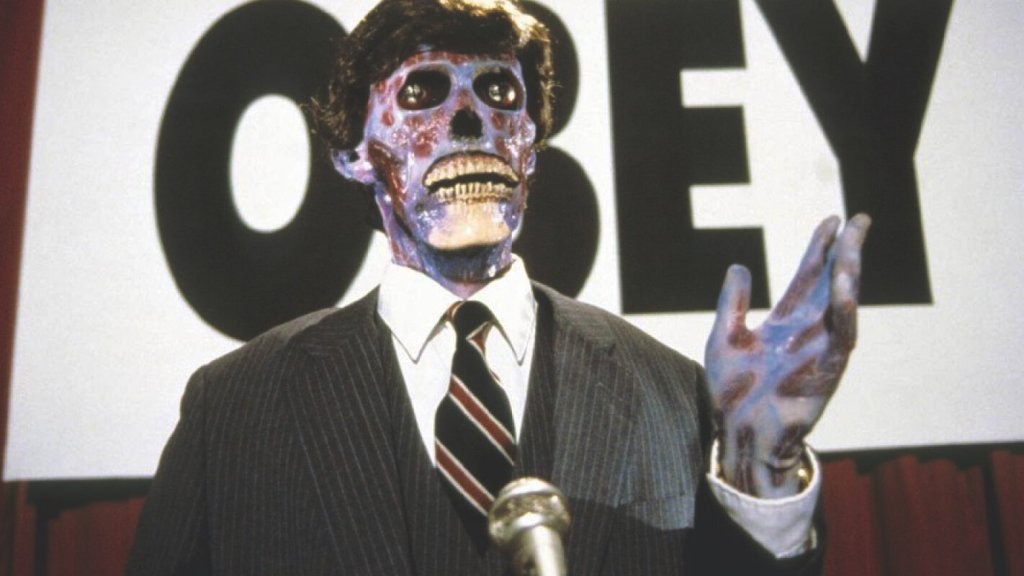
It is only when homeless drifter John Nada (played to the hilt by the late Roddy Piper) discovers a pair of doctored sunglasses—Hoffman lenses—that Nada sees what lies beneath the elite’s fabricated reality: control and bondage.
When viewed through the lens of truth, the elite, who appear human until stripped of their disguises, are shown to be monsters who have enslaved the citizenry in order to prey on them.
Likewise, billboards blare out hidden, authoritative messages: a bikini-clad woman in one ad is actually ordering viewers to “MARRY AND REPRODUCE.” Magazine racks scream “CONSUME” and “OBEY.” A wad of dollar bills in a vendor’s hand proclaims, “THIS IS YOUR GOD.”
When viewed through Nada’s Hoffman lenses, some of the other hidden messages being drummed into the people’s subconscious include: NO INDEPENDENT THOUGHT, CONFORM, SUBMIT, STAY ASLEEP, BUY, WATCH TV, NO IMAGINATION, and DO NOT QUESTION AUTHORITY.
This indoctrination campaign engineered by the elite in They Live is painfully familiar to anyone who has studied the decline of American culture.
A citizenry that does not think for themselves, obeys without question, is submissive, does not challenge authority, does not think outside the box, and is content to sit back and be entertained is a citizenry that can be easily controlled.
In this way, the subtle message of They Live provides an apt analogy of our own distorted vision of life in the American police state, what philosopher Slavoj Žižek refers to as dictatorship in democracy, “the invisible order which sustains your apparent freedom.”
We’re being fed a series of carefully contrived fictions that bear no resemblance to reality.
Tune out the government’s attempts to distract, divert and befuddle us and tune into what’s really going on in this country, and you’ll run headlong into an unmistakable, unpalatable truth: what we are dealing with today is an authoritarian beast that has outgrown its chains and will not be restrained.
Through its acts of power grabs, brutality, meanness, inhumanity, immorality, greed, corruption, debauchery and tyranny, the government has become almost indistinguishable from the evil it claims to be fighting, whether that evil takes the form of terrorism, torture, disease, drug trafficking, sex trafficking, murder, violence, theft, pornography, scientific experimentations or some other diabolical means of inflicting pain, suffering and servitude on humanity.
We have let the government’s evil-doing and abuses go on for too long.
We’re being fed a series of carefully contrived fictions that bear no resemblance to reality.
Despite the fact that we are 17,600 times more likely to die from heart disease than from a terrorist attack; 11,000 times more likely to die from an airplane accident than from a terrorist plot involving an airplane; 1,048 times more likely to die from a car accident than a terrorist attack, and 8 times more likely to be killed by a police officer than by a terrorist , we have handed over control of our lives to government officials who treat us as a means to an end—the source of money and power.
As the Bearded Man in They Live warns, “They are dismantling the sleeping middle class. More and more people are becoming poor. We are their cattle. We are being bred for slavery.”
We have bought into the illusion and refused to grasp the truth.
From the moment we are born until we die, we are indoctrinated into believing that those who rule us do it for our own good. The truth is far different.
The powers-that-be want us to feel threatened by forces beyond our control (terrorists, pandemics, mass shootings, etc.).
They want us afraid and dependent on the government and its militarized armies for our safety and well-being.
They want us distrustful of each other, divided by our prejudices, and at each other’s throats.
Most of all, they want us to continue to march in lockstep with their dictates as fearful, controlled, pacified zombies.
This brings me back to They Live, in which the real zombies are not the aliens calling the shots but the populace who are content to remain controlled.
When all is said and done, the world of They Live is not so different from our own. As one of the characters points out, “The poor and the underclass are growing. Racial justice and human rights are nonexistent. They have created a repressive society and we are their unwitting accomplices. Their intention to rule rests with the annihilation of consciousness. We have been lulled into a trance. They have made us indifferent to ourselves, to others. We are focused only on our own gain.”
We, too, are focused only on our own pleasures, prejudices and gains. Our poor and underclasses are also growing. Injustice is growing. Inequality is growing. A concern for human rights is nearly nonexistent. We too have been lulled into a trance, indifferent to others.
Oblivious to what lies ahead, we’ve been manipulated into believing that if we continue to consume, obey, and have faith, things will work out. But that’s never been true of emerging regimes. And by the time we feel the hammer coming down upon us, it will be too late.
So where does that leave us?
The characters who populate Carpenter’s films provide some insight.
Underneath their machismo, they still believe in the ideals of liberty and equal opportunity. Their beliefs place them in constant opposition with the law and the establishment, but they are nonetheless freedom fighters.
When, for example, John Nada destroys the alien hypno-transmitter in They Live, he delivers a wake-up call for freedom. As Nada memorably declares, “I have come here to chew bubblegum and kick ass. And I’m all out of bubblegum.”
In other words: we need to get active and take a stand for what’s really important.
Stop allowing yourselves to be easily distracted by pointless political spectacles and pay attention to what’s really going on in the country.
As I make clear in my book Battlefield America: The War on the American People and in its fictional counterpart The Erik Blair Diaries, the real battle for control of this nation is taking place on roadsides, in police cars, on witness stands, over phone lines, in government offices, in corporate offices, in public school hallways and classrooms, in parks and city council meetings, and in towns and cities across this country.
All the trappings of the American police state are now in plain sight.
Wake up, America.
If they live (the tyrants, the oppressors, the invaders, the overlords), it is only because “we the people” sleep.
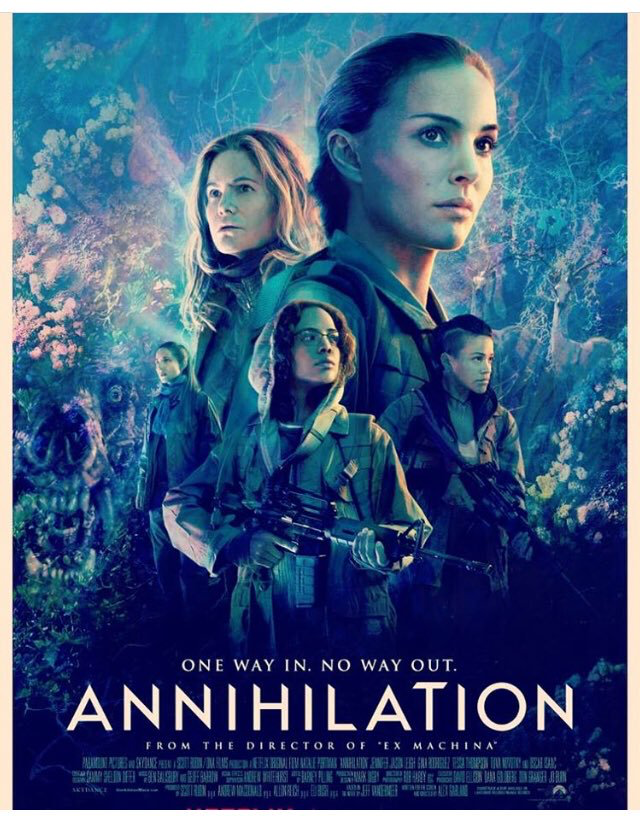
Directed by Alex Garland; screenplay by Alex Garland; based on the novel Annihilation by Jeff VanderMeer; cinematographed by Rob Hardy; edited by Barney Pilling; music by Geoff Barrow and Ben Salisbury; production design by Mark Digby; produced by Eli Bush, Andrew Macdonald, Allon Reich and Scott Rudin. Released in Feb. 2018 by Paramount Pictures. Running time: 115 minutes. Rated NNN
Starring: Natalie Portman as Lena, Oscar Isaac as Kane, Jennifer Jason Leigh as Dr. Ventress, Gina Rodriguez as Anya Thorensen, Tuva Novotny as Cass Sheppard, Tessa Thompson as Josie Radek, David Gyasi as Daniel and Benedict Wong as Lomax
There are many layers to this smart, tense, slow-building science fiction drama. It’s at once a nuanced exploration of trauma and identity, a surreal excursion into high-concept cosmic horror and an endlessly rich subject for intellectual debate. It’s a movie that invites many interpretations, having been read as a metaphor for everything from depression to cancer to radioactive contamination following a nuclear accident. Perhaps its most poignant subtext is that of nature fighting back against the encroachments of human civilization.
Loosely based on an eponymous 2014 novel by Jeff VanderMeer, Annihilation centers around a journey to the heart of an anomalous region known as Area X on America’s southern coast. Three years earlier, a meteorite crashed into a lighthouse in a national park, bringing with it an extraterrestrial entity that has since been transforming everything around it. During its spread inland, the alien has forged new ecosystems filled with mutations like something out of a psychedelic vision. At the edge of the contaminated zone lies a hypnotic, pulsating electromagnetic field called The Shimmer, from which almost no one who enters ever emerges—the one man to have done so bearing little trace of his former personality or memories afterward.
A clandestine government organization called Southern Reach has been created to study Area X with the aim of halting and reversing its progress. But Area X is impervious to satellite surveillance, and no one has picked up radio transmissions from any of the numerous teams that have ventured inside. So far, Southern Reach has managed to keep Area X under wraps, using the pretext of a chemical spill to evacuate the sparsely populated swampland that has thus far been consumed. But it’s only a matter of months before Area X will begin to expand into population centers, raising the prospect of mass evacuations that will be much harder to explain.
In the movie’s opening scene, the sole survivor of the latest expedition into Area X, a cellular biologist named Lena (Natalie Portman), is being questioned in a small, bare room by Southern Reach agents in hazmat suits. It’s been four months since she and the rest of her team embarked on their mission to reach and study the lighthouse that appears to be The Shimmer’s epicenter. The other members of her group were psychologist Dr. Ventress (Jennifer Jason Leigh), paramedic Anya Thorensen (Gina Rodriguez), geomorphologist Cass Sheppard (Tuva Novotny) and physicist Josie Radek (Tessa Thompson). They left with food rations, camping gear, weapons and their various scientific instruments. Lena’s questioners want to know what became of the others, how Lena lasted for months on only two weeks’ worth of food and what transpired between her and the lighthouse entity. The movie then flashes backward to recount the saga.
Portman gives a strong, sympathetic performance. Her character’s personal journey—which involves coming to terms with the fate of her husband Kane (Oscar Isaac), a special forces officer who was part of an earlier mission—forms the emotional core of the story. Leigh, who plays the group’s stoic leader, seems strangely subdued at first, until we come to understand her character’s motivations for heading into Area X. All of the actresses excel as action heroines during the movie’s periodic swings into action-thriller mode.
Unfortunately, some of the characters are given more to do than others. Lena and Josie are the only ones who really put their respective areas of expertise to use, each making important discoveries that advance our understanding of the entity’s threat. The others might as well just be soldiers.
Though subtle at first, the aberrations to the landscape and its flora and fauna grow increasingly dreamlike the closer the group comes to the lighthouse. The early mutations are, to use Lena’s words, “Corruptions of form. Duplicates of form.” But eventually the women encounter humanoid shrubs, stems harboring multiple plant species, an alligator with shark-like concentric rows of teeth, deer with flowering branches for antlers and trees made of glass. Josie hypothesizes that the alien being is a prism that refracts not only light rays and energy waves, but molecular structures as well, including DNA. This explains how shark’s teeth ended up in the mouth of an alligator, how sand formed into glass trees and how plants have melded with one another and with humans and deer.
Freakish things soon begin happening to the bodies and minds of our protagonists. Examining a drop of her own blood under a microscope, Lena finds it suffused with rapidly dividing alien cells. Anya is unnerved to see her fingerprint patterns moving. Paranoia begins to overrun the group. Some of the women fall victim to the creatures of Area X, while others turn into them, like Gregor Samsa becoming a cockroach in Franz Kafka’s “The Metamorphosis.” Characterized by intense emotions and moments that seem to occur out of sequence and without logical explanation, these events play out much like a dream sequence. This feeling is heightened by Geoff Barrow and Ben Salisbury’s musical score, whose sounds become increasingly unnatural and mesmerizing.
The movie’s frights are a mixed bag. At their best, they’re superb at evoking a sense of incomprehensible horror such as one finds in the works of H. P. Lovecraft. Indeed, Annihilation has been likened to Lovecraft’s 1927 short story “The Colour Out of Space”—as well as its numerous film adaptations—in which a life form brought to Earth on a meteorite wreaks madness and all manner of physical deformities upon the wildlife and human residents of a tract of Massachusetts woodland. (Unlike Annihilation’s alien, however, the being in that tale decimates its surroundings rather than creating something new from them.) The film also contains some very effective Cronenberg-esque body horror. However, not all the scares arise naturally from the plot and the characters; there are some monster attacks and shoot ’em up scenes that belong in a less lofty movie, and which are nowhere to be found in the book.
Beyond its similarity to the Lovecraft story (and despite VanderMeer stoutly denying he was influenced by either of the following two works), Annihilation also has obvious echoes of Arkady and Boris Strugatsky’s 1972 novel Roadside Picnic and its 1979 movie adaptation, Stalker. These also involve journeys through a restricted zone rife with strange mutations and inexplicable phenomena brought on by contamination left by an extraterrestrial presence.
Annihilation’s screenwriter and director is Alex Garland, whose previous film was another landmark of intelligent sci-fi filmmaking—and his directorial debut, no less—2014’s Ex Machina. With Annihilation, he takes great liberties with his source material, changing much of the plot, premise and thematic emphasis. The film has more human connection, more emotional interplay among the characters, than the novel does. (The book’s characters don’t relate; they’ve completely shed their names and pasts.) The book begins in medias res and bypasses much of its backstory, whereas the film starts more conventionally, with a full act of setup that relies on clichés such as a getting-to-know-you session between Lena and her future fellow expeditioners and tearful flashbacks to Lena’s personal drama that led her to agree to the mission. Neither version of the story is superior, really; they’re more like “refractions” of a single underlying inspiration.
The novel repeatedly stresses the pristineness of Area X. It’s a region that has managed, even if by otherworldly means, to beat back humankind. In the real world, of course, industrial humanity faces pushback from nature in the form of droughts, floods, diminishing returns in soil fertility, emerging infectious diseases and uncountable other threats to human habitat. Clearly, annihilation runs both ways.






 After the Crash