Washington’s Wars Eroding its Global Clout

By Salman Rafi Sheikh

Source: New Eastern Outlook

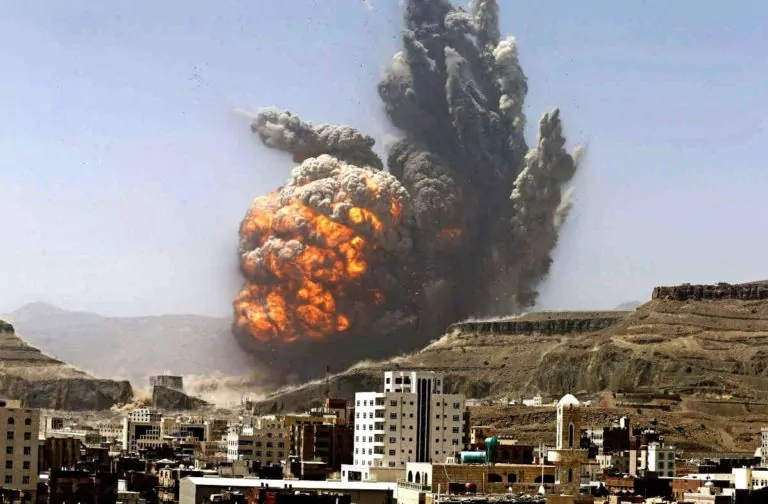
If war is politics by other means, Washington’s ongoing wars in the Middle East and Eastern Europe are meant to buttress its global influence on the one hand and undermine its competitors on the other. But the question is: how is this politics by other means working out for Washington? Not so good. Russia’s recent military victories in Ukraine and China’s expansive inroads into the Middle East alongside the growing anti-Americanism in the region (due to Washington’s support for Israel and its inability to prevent a genocide of the Palestinians) indicate an overall American inability to shape global geopolitics in unilateral ways to the exclusive advantage of Washington and its allies in Europe and elsewhere.

Russia’s recent military gains in Ukraine, for example, have very clearly established its military credentials as a power that has been able to withstand the combined military strength of the US and its European allies assembled in the North Atlantic Treaty Organization (NATO). What does this mean for Washington’s policies in Central Asia? Most certainly, Washington cannot simply present Russia as a ‘weak’ military power that can be simply ‘isolated’. But more than that, Russia is utilising its victories over NATO in various ways.

For instance, when the NATO-backed Russia-Ukraine military conflict began, most reports in the mainstream US media began to spread false messaging about Central Asia potentially moving itself out of the so-called ‘Russian clout’. The US saw in it an opportunity to push itself into the region. But this has turned out to be a fiasco. When the US imposed sanctions on Russia, many Russian companies began to relocate their businesses to Central Asia, directly contributing to Central Asia’s impressive 4.8 percent growth rate in 2023. According to the findings of the European Bank for Reconstruction and Development, the region is forecast to register an even more impressive level of growth at almost 5.7 percent in 2024-25.

In other words, thanks to Washington’s sanctions, the Russian political economy is now more deeply connected with Central Asia than it was before February 2021, which is also strengthening the Eurasian Economic Union. Now that this integration is working for the advantage of Central Asia means that the latter have little to no incentive to pay too much attention to Washington and/or the imperatives of moving decisively to Washington. It means that not only has the Biden administration’s policy of NATO expansion via Ukraine failed so far in Ukraine itself, but the ‘new’ Central Asia policy it inaugurated in the wake of the Russia-Ukraine conflict has also failed to make any impact on the ground. Russia defeated US design also by approaching relations with the Central Asian States in ways that gave them enough space to stay neutral in the conflict. While the West saw this neutrality as a sign of Russian weakness in the region and the Central Asian States’ growing assertiveness, it failed to read how this was part of Russia’s strategy to cultivate its ties in a more balanced way. This balance is also pretty evident in the ways Russia has not objected to, or even resisted, China’s growing footprint in the region, although reports in the Western media often see China’s role in Central Asia at the expense of Russia. But the West seems to have been misreading this region.

As far as Washington’s war in the Middle East is concerned, its military support for Israel plus its inability to stop genocide has eroded its credibility. Suppose Washington has been supporting Israel to maintain its dominance in the Middle East. In that case, Washington’s excessive support is now derailing its objectives, since the Middle East is now exercising a lot more strategic autonomy vis-à-vis Washington than was the case until a few years ago.

In the past few months, a flurry of Chinese activity indicates it much more clearly than anything else. China has convened leadership summits, met with Arab delegates, supported their stance vis-à-vis Israel, and held joint military exercises with one of the US’ most important allies in the region (Saudi Arabia). The UAE, otherwise a close US ally and one of the first states to sign the Abraham Accords to recognise Israel and establish diplomatic ties with it, actually withdrew from the US-led naval task force in May 2023, indicating policy and interest-based differences.

The UAE is also a country in the Middle East that has over 100,000 Chinese living there and involved in many businesses. But when it comes to the Middle East itself, and the fact that many countries in the region are involved in China’s Belt & Road Initiative (BRI), we see the region’s trade with China registering an overall growth of almost 45 percent in 2021 and 27 percent in 2022.

Given the economic integration, the Middle East is turning out to be a region where Washington’s clout is receding fast, without any signs of recovery in the immediate future at least. Although US strikes in the Red Sea on the Houthis are meant to indicate Washington’s willingness to offer a security umbrella to the Gulf states (against Iran-backed groups), the region appears to be past the point where it must have the US on its side to ensure security. Gulf states’ perceptions of Iran as an enemy are changing, thanks to Beijing’s mediation.

As far as Washington’s support for Israel is concerned and as far as the threat of a wider war in the region it is posing, Gulf states are on the edge of a conflict that might directly undermine their modernization programmes – development projects that mainly involve China in various capacities.

Therefore, if Washington’s involvement in the Israel war was meant to bring back the era of US dominance, the exact opposite is happening, both in the Middle East and Central Asia, which happen to be two of the world’s most energy-rich regions.

China’s unexpected gains from the Red Sea crisis

Despite Beijing’s maritime security priority, Yemen’s Red Sea ban on Israeli-linked shipping has boosted China’s regional standing while miring its US adversary in an unwinnable crisis.

By Giorgio Cafiero

Source: The Cradle

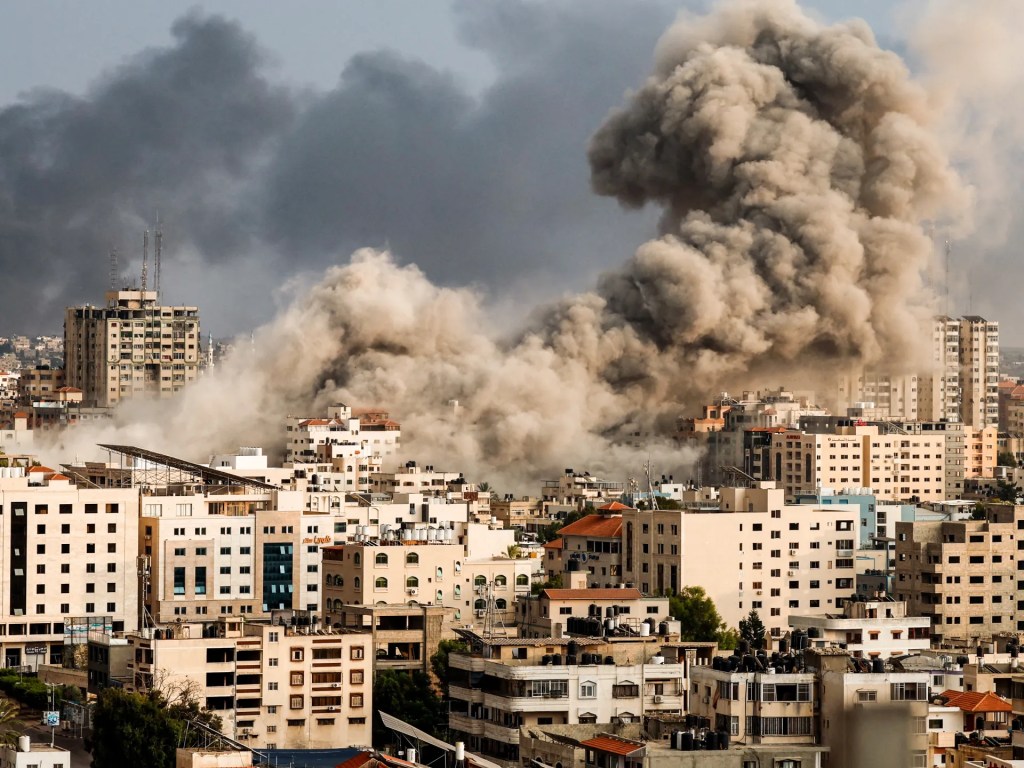
The Gaza war’s expansion into the Red Sea has created an international maritime crisis involving a host of countries. Despite a US-led bombing campaign aimed at deterring Yemen’s Ansarallah-aligned navy from carrying out missile and drone strikes in the Red Sea, the armed forces continue to ramp up attacks and now are using “submarine weapons.” 

As these clashes escalate dangerously, one of the world’s busiest bodies of water is rapidly militarizing. This includes the recent arrival to the Gulf of Aden of a Chinese fleet, including the guided-missile destroyer Jiaozuo, the missile frigate Xuchang, a replenishment vessel, and more than 700 troops – including dozens of special forces personnel – as part of a counter-piracy mission. 

Beijing has voiced its determination to help restore stability to the Red Sea. “We should jointly uphold the security on the sea lanes of the Red Sea in accordance with the law and also respect the sovereignty and territorial integrity of the countries along the Red Sea coast, including Yemen,” Chinese Foreign Minister Wang Yi emphasized last month.

As the largest trading nation in the world, China depends on the Red Sea as its “maritime lifeline.” Most of the Asian giant’s exports to Europe go through the strategic waterway, and large quantities of oil and minerals that come to Chinese ports transit the body of water. 

The Chinese have also invested in industrial parks along Egypt and Saudi Arabia’s Red Sea coasts, including the TEDA–Suez Zone in Ain Sokhna and the Chinese Industrial Park in Saudi Arabia’s Jizan City for Primary and Downstream Industries. 

Chinese neutrality in West Asia

Prior to the sending of the 46th fleet of the Chinese People’s Liberation Army Navy, Beijing’s response to Ansarallah’s maritime attacks had been relatively muted. China has since condemned the US–UK airstrikes against Ansarallah’s military capabilities in Yemen, and refused to join the western-led naval coalition, Operation Prosperity Guardian (OPG).

China’s response to mounting tension and insecurity in the Red Sea is consistent with Beijing’s grander set of foreign policy strategies, which include respect for the sovereignty of nation-states and a doctrine of “non-interference.” 

In the Persian Gulf, China has pursued a balanced and geopolitically neutral agenda resting on a three-pronged approach: enemies of no one, allies of no one, and friends of everyone. 

China’s position vis-à-vis all Persian Gulf countries was best exemplified almost a year ago when Beijing brokered a surprise reconciliation agreement between Iran and Saudi Arabia, in which it played the role of guarantor. 

In Yemen, although China aligns with the international community’s non-recognition of the Ansarallah-led government in Sanaa, Beijing has nonetheless initiated dialogues with those officials and maintained a non-hostile stance – unlike many Arab and western states.

Understanding Beijing’s regional role 

Overall, China tries to leverage its influence in West Asian countries to mitigate regional tensions and advance stabilizing initiatives. Its main goal is ultimately to ensure the long-term success of President Xi Jinping’s multi-trillion dollar Belt and Road Initiative (BRI) and keep trade routes free of conflict. 

Often labeled by the west as a “free rider,” China is accused of opportunistically benefiting from US- and European-led security efforts in the Persian Gulf and the northwestern Indian Ocean without contributing to them. 

But given China’s anti-piracy task force in the Gulf of Aden and its military base in Djibouti, this accusation isn’t entirely justified.

Beijing’s motivations for staying out of OPG were easy to understand: first, China has no interest in bolstering US hegemony; second, joining the naval military coalition could upset its multi-vector diplomacy vis-à-vis Ansarallah and Iran; and third, the wider Arab–Islamic world and the rest of the Global South would interpret it as Chinese support for Israel’s war on Gaza. 

Rejecting the OPG mission has instead bolstered China’s regional image as a defender of the Palestinian cause.

Speaking to The Cradle, Javad Heiran-Nia, director of the Persian Gulf Studies Group at the Center for Scientific Research and Middle East Strategic Studies in Iran, said: 

[Beijing’s] cooperation with the West in securing the Red Sea will not be good for China’s relations with the Arabs and Iran. Therefore, China has adopted political and military restraint to avoid jeopardizing its economic and diplomatic interests in the region.

Dropping the blame on Washington’s doorstep

Beijing recognizes the Red Sea security crisis to be a direct “spillover” from Gaza, where China has called for an immediate ceasefire.

As Yun Sun, co-director of the China Program at the Washington-based Stimson Center, informed The Cradle:

The Chinese do see the crisis in the Red Sea as a challenge to regional peace and stability but see the Gaza crisis as the fundamental origin of the crisis. Therefore, the solution to the crisis in the Chinese view will have to be based on ceasefire, easing of the tension and returning to the two-state solution.

Jean-Loup Samaan, a senior research fellow at the National University of Singapore’s Middle East Institute, agrees, telling The Cradle:

Chinese diplomats have been carefully commenting on the events, but in Beijing’s narrative, the rise of attacks is a consequence of Israel’s war in Gaza – and perhaps more importantly the US policy in support [of] the Netanyahu government.

But in January, after the US and UK began their bombing campaign of Ansarallah targets in Yemen, China began to weigh in with serious concerns about the Red Sea crisis. Beijing noted that neither Washington nor London had received authorization for the use of force from the UN Security Council, and, therefore, as Sun explained it, the US–UK strikes “lack legitimacy in the Chinese view.”  

How the Red Sea Crisis benefits Beijing

China has capitalized on intensifying anger directed against the US from all over the Islamic world and Global South. The Gaza war and its spread into the Red Sea have delivered Beijing some easy soft-power gains and reinforced to Arab audiences the vital importance of multipolarity.
This point was drummed home by Victor Gao, vice president of the Center for China and Globalization, when he told the 2023 Doha Forum: 

The fact that there is only one single country which [on 8 December, 2023] vetoed the United Nations Security Council Resolution calling for ceasefire in the Israel-Palestine War should convince all of us that we should be very lucky living not in the unipolar World.

Certainly, China has experienced some economic repercussions from the Red Sea crisis, although the extent of this is difficult to calculate. Yet Beijing’s political gains appear to trump any associated financial losses. As Sun explained to The Cradle, “The crisis does affect China, but the loss has been mostly economic and minor, while the gains are primarily political as China stands with the Arab countries on Gaza.”

In some ways, China has actually gained economically from the Red Sea crisis. With Ansarallah making a point of only targeting Israel-linked vessels, there is a widespread view that Chinese ships operating in the area are immune from Yemeni attacks. 

After many international container shipping lines decided to reroute around South Africa to avoid Ansarallah’s missiles and drones, two ships operating under the Chinese flag – the Zhong Gu Ji Lin and Zhong Gu Shan Dong – continued transiting the Red Sea. 
As Bloomberg reported early this month:

Chinese-owned merchant ships are getting hefty discounts on their insurance when sailing through the Red Sea, another sign of how Houthi attacks in the area are punishing the commercial interests of vessels with ties to the West.

US officials have since implored Beijing to pressure Iran into ordering the de-facto Yemeni government to halt maritime attacks. Those entreaties have failed, however, largely because Washington incorrectly assumes that Beijing holds influence over Tehran and that Iran can make demands of Ansarallah. Regardless, the fact that the US would turn to China for such help amid escalating tensions in the Red Sea is a boost to Beijing’s status as a go-to power amid global security crises.

China also has much to gain from the White House’s disproportionate focus on Gaza and the Red Sea. Since October–November 2023, the US has had significantly less bandwidth for its South China Sea and Taiwan files. In turn, this frees Beijing to act more confidently in West Asia while the US remains distracted. According to Heiran-Nia:

The developments in the Red Sea will keep America’s focus on the region and not open America’s hand to expand its presence in the Indo–Pacific region, [where] America’s main priority is to contain China. The war in Ukraine has the same advantage for China. While the connectivity of the Euro–Atlantic region with the Indo–Pacific region is expanding to contain China and increase NATO cooperation with the Indo–Pacific, the tensions in [West Asia] and Ukraine will be a boon for China.

Ultimately, the Red Sea crisis and Washington’s failure to deter Ansarallah signal yet another blow to US hegemony. From the Chinese perspective, the growing Red Sea conflict serves to further isolate the US and highlight its limitations as a security guarantor – particularly in light of its unconditional support for Israel’s brutal military assault on Gaza.

It is reasonable to call China a winner in the Red Sea crisis.

The World’s Gyre

Bu Alastair Crooke

Source: Strategic Culture Foundation

The U.S. is edging closer to war with Iraq’s Popular Mobilisation Forces, a state security agency composed of armed groups, some of which are close to Iran, but which for the main are Iraqi nationalists. The U.S. carried out a drone strike in Baghdad, Wednesday that killed three members of the Kataeb Hizbullah forces, including a senior commander. One of the assassinated, al-Saadi, is the most senior figure to have been assassinated in Iraq since the 2020 drone strike that killed senior Iraqi Commander al-Muhandis and Qassem Soleimani.

The target is puzzling as Kataeb more than a week ago suspended its military operations against the U.S. (at the request of the Iraqi government). The stand down was widely published. So why was this senior figure assassinated?

Tectonic twitches often are sparked by a single egregious action: the one final grain of sand which – on top of the others – triggers the slide, capsizing the sandpile. Iraqis are angry. They feel that the U.S. wantonly violates their sovereignty – showing contempt and disdain for Iraq, a once great civilisation, now brought low in the wake of U.S. wars. Swift and collective retaliation has been promised.

One act, and a gyre can begin. The Iraqi government may not be able to hold the line.

The U.S. tries to separate and compartmentalise issues: AnsarAllah’s Red Sea blockade is ‘one thing’; attacks on U.S. bases in Iraq and Syria, an unrelated ‘another’. But all know that such separateness is artificial – the ‘red’ thread woven through all these ‘issues’ is Gaza. The White House (and Israel) however, insists the connecting thread instead to be Iran.

Did the White House think this through properly, or was its latest assassination viewed as a ‘sacrifice’ to appease the ‘gods of war’ in the Beltway, clamouring to bomb Iran?

Whatever the motive, the Gyre turns. Other dynamics are running that will be fuelled by the attack.

The Cradle highlights one significant shift:

“by successfully obstructing Israeli vessels from traversing the Bab al-Mandab Strait, the Ansarallah-led Sanaa government has emerged as a powerful symbol of resistance in defence of the Palestinian people – a cause deeply popular across Yemen’s many demographics. Sanaa’s position stands in stark contrast to that of the Saudi and Emirati-backed government in Aden, which, to the horror of Yemenis, welcomed attacks by U.S. and British forces on 12 January”.

“The U.S.–UK airstrikes have prompting some heavyweight internal defections … a number of Yemeni militias previously aligned with the UAE and Saudi Arabia, consequently switched allegiance to Ansarallah … Disillusionment with the coalition will have profound political and military implications for Yemen, reshaping alliances, and casting the UAE and Saudi Arabia as national adversaries. Palestine continues to serve as a revealing litmus test throughout West Asia – and now in Yemen too – exposing those who only-rhetorically claim the mantle of justice and Arab solidarity”.

Yemen military defections – How does this matter?

Well, the Houthis and AnsarAllah have become heroes across the Islamic World. Look at social media. The Houthis are now the ‘stuff of myth’: Standing up for Palestinians whilst others don’t. A following is taking hold. AnsarAllah’s ‘heroic’ stance may lead to the ousting of western proxies, and so to dominate that ‘rest of Yemen’ they presently do not control. It seizes too, the Islamic world imagination (to the concern of the Arab Establishment).

In the immediate aftermath of the assassination of al-Saadi, Iraqis took to the streets of Baghdad chanting: “God is Great, America is the Great Satan”.

Do not imagine this ‘turn’ is lost on others – on the Iraqi Hashd al-Sha’abi, for example; or on the (Palestinians) of Jordan; or on the mass foot-soldiers of the Egyptian army; or indeed in the Gulf. There are 5 billion smartphones extant today. The ruling class do watch the Arabic channels, and view (nervously) social media. They worry that anger against the western flouting of international law may boil over, and they will be unable to contain it: What price the ‘Rules Order’ now since the International Court of Justice upended the notion of a moral content to western culture?

The wrongheadedness of U.S. policy is astonishing – and now has claimed the most central tenet in the ‘Biden strategy’ for resolving the crisis in Gaza. The ‘dangle’ of Saudi normalisation with Israel was viewed in the West as the pivot – around which Netanyahu would either be forced to give up on his maximalist security control from the River to the Sea mantra, or see himself pushed aside by a rival for whom the ‘normalisation bait’ held the allure of likely victory in the next Israeli elections.

Biden’s spokesperson was flagrant in this respect:

“[We] … are having discussions with Israel and Saudi Arabia … about trying to move forward with a normalization arrangement between Israel and Saudi Arabia. So those discussions are ongoing as well. We certainly received positive feedback from both sides that they’re willing to continue to have those discussions”.

The Saudi Government – possibly angry at the U.S. recourse to such deceptive language – duly kicked the plank out from beneath the Biden platform: It issued a written statement confirming unequivocally that: “there will be no diplomatic relations with Israel unless an independent Palestinian state is recognized on the 1967 borders, with East Jerusalem as its capital, and that the Israeli aggression on the Gaza Strip stops – and all Israeli occupation forces are withdraw from the Gaza Strip”. The Kingdom stands by the 2002 Arab Peace Initiative, in other words.

Of course, no Israeli could campaign on that platform in Israeli elections!

Recall how Tom Friedman set out how the ‘Biden Doctrine’ was supposed to fit together as a interlinked whole: First, through taking a “strong and resolute stand on Iran” the U.S. would signal to “our Arab and Muslim allies, that it needs to take on Iran in a more aggressive manner … that we can no longer allow Iran to try to drive us out of the region; Israel into extinction and our Arab allies into intimidation by acting through proxies — Hamas, Hezbollah, the Houthis and Shiite militias in Iraq — while Tehran blithely sits back and pays no price”.

The second strand was the Saudi dangle that would inevitably pave the path into the (third) element which was the “building of a credible legitimate Palestinian Authority as … a good neighbour to Israel …”. This “bold U.S. commitment to a Palestinian state would give us [Team Biden] legitimacy to act against Iran”, Friedman foresaw.

Let us be plain: this trifecta of policies, rather than gel into a single doctrine, are falling like dominoes. Their collapse owes to one thing: The original decision to back Israel’s use of overwhelming violence across Gaza’s civil society – ostensibly to defeat Hamas. It has turned the region and much of the World against the U.S. and Europe.

How did this happen? Because nothing changed by way of U.S. policies. It was the same old western bromides from decades ago: financial threats, bombing and violence. And the insistence on one mandatory ‘stand with Israel’ narrative (with no discussion).

The rest of the world has grown tired of it; even defiant towards it.

So to put it bluntly: Israel has now come face-to-face with the (self-destructive) inconsistency within Zionism: How to maintain special rights for Jews on territory in which there is an approximately equal number of non-Jews? The old answer has been discredited.

The Israeli Right argues that Israel then must go for broke: All or nothing. Take the risk of wider war (in which Israel, may or may not, be ‘victorious’); tell Arabs to move elsewhere; or abandon Zionism and themselves move on.

The Biden Administration, rather than help Israel look truth in the eye, has discarded the task of obliging Israel to face up to the contradictions in Zionism, in favour of restoring the broken status quo ante. Some 75 years after the founding of the Israeli state, as former Israeli negotiator, Daniel Levy, has. noted:

‘[We are back to] “the “banal debate” between the U.S. and Israel over “whether the bantustan shall be repackaged and marketed as a ‘state’”.

Could it have been different? Probably not. The reaction comes from deep in Biden’s nature.

The trifecta of U.S. failed responses paradoxically has nonetheless facilitated Israel’s slide to the Right (as evidenced by all recent polling). And has – absent a hostage deal; absent a Saudi credible ‘dangle’; or any credible path to a Palestinian State – precisely opened the path for the Netanyahu government to pursue his maximalist exit from collapsed deterrence through securing a ‘grand victory’ over the Palestinian resistance, Hizbullah, and even – he hopes – Iran.

None of these objectives can be achieved without U.S. help. Yet, where is Biden’s limit: Support for Israel in a Hizbullah war? And were it to widen, support for Israel in an Iran war too? Where is the limit?

The incongruity, coming as it does, at a moment when the West’s Ukraine Project is imploding, suggests that Biden may see himself needing some ‘grand victory’, as much as does Netanyahu.

“Not Wanting” A Wider Middle East War, the U.S. Has Started One

By Edward Curtin

Source: Dissident Voice

You have to hand it to the U.S. and its henchmen for brazenness.  In order to protect their client state Israel and its genocide in Gaza, the U.S., together with the UK, have in one week launched air and sea attacks on the Houthis in Yemen five times, referring to it as “self-defense” in their Orwellian lingo.  The ostensible reason being Yemen’s refusal to allow ships bound for Israel, which is committing genocide in Gaza, to enter the Red Sea, while permitting other ships to pass freely.

To any impartial observer, the Houthis should be lauded.  Yet, while the International Court of Justice considers the South African charge of genocide against Israel that is supported by overwhelming evidence, the U.S. and its allies have instigated a wider war throughout the Middle East while claiming they do not want such a war.  These settler colonial states want genocide and a much wider war because they have been set back on their heels by those they have mocked, provoked, and attacked – notably the Palestinians, Syrians, and Russians, among others.

While the criminalization of international law does not bode well for the ICJ’s upcoming ruling or its ability to stop Israeli’s genocide in Gaza, Michel Chossudovsky, of Global Research, as is his wont, has offered a superb analysis and suggestion for those who oppose such crimes: that Principle IV of the Nuremberg Charter – “The fact that a person [e.g. Israeli, U.S. soldiers, pilots] acted pursuant to order of his [her] Government or of a superior does not relieve him [her] from responsibility under international law, provided a moral choice was in fact possible to him.” – should be used to supplement the South African charges and appeal directly to the moral consciences of those asked to carry out acts of genocide. He writes:

Let us call upon Israeli and American soldiers and pilots “to abandon the battlefield”, as an act of refusal to participate in a criminal undertaking against the People of Gaza.  

South Africa’s legal procedure at the ICJ should be endorsed Worldwide. While it cannot be relied upon to put a rapid end to the genocide, it provides support and legitimacy to the “Disobey Unlawful Orders, Abandon the Battlefield”  campaign under Nuremberg Charter Principle IV.

While such an approach will not stop the continuing slaughter, it would remind the world that each person who participates in and supports it bears a heavy burden of guilt for their actions; that they are morally and legally culpable.  This appeal to the human heart and conscience, no matter what its practical effect, will at least add to the condemnation of a genocide happening in real time and full view of the world, even though no one will ever be prosecuted for such crimes since any real just use of international law has long disappeared.  Yet there is a edifying history of such conscientious objection to immoral war making, and though each person makes the decision in solitary witness, individual choices can inspire others and the solitary become solidary, as Albert Camus reminded us at the end of his short story, “The Artist at Work.”

With each passing day, it becomes more and more evident that Israel/U.S.A. and their allies do want a wider war.  Iran is their special focus, with Gaza, the West Bank, Lebanon, Syria, Iraq, and Yemen targets on the way.  Anyone who supports the genocide in Gaza, explicitly or through silence, bears responsibility for the conflagration to come.  There are no excuses.

And the facts show that it is axiomatic that waging war has been the modus operandi of the U.S./Israeli alliance for a long time.  Just as in early 2003 when the Bush administration said they were looking for a peaceful solution to their fake charges against Sadam Hussein with his alleged “weapons of mass destruction,” the Biden administration is lying, as the Bush administration lied about September 11, 2001 to launch its ongoing war on terror, starting in Afghanistan.  Without an expanded war, President Biden – aka the Democrats, since he will most probably not be the candidate – and his psychopathic partner Benjamin Netanyahu, will not survive.  It is bi-partisan war-mongering, of course, internationally and intramurally, since both U.S. political parties are controlled by the Israel Lobby and billionaire class that owns Congress and the “defense” industry that thrives on never-ending war to such an extent that even the notable independent candidate for the presidency, Robert Kennedy, Jr., who is running as an anti-war candidate, fully supports Israel which is tantamount to supporting Biden’s expanding war policy.

Biden and Netanyahu, who are always claiming after the fact that they were surprised by events or were fed bad advice by their underlings, are dumb scorpions. They are stupid but deadly.  And many people in the West, while perhaps decent people in their personal lives, are living in a fantasy world of “sincere ignorance and conscientious stupidity,” in MLK, Jr.’s words, as the growing threat of a world war increases and insouciance reigns.

Neither the Israeli nor American government can allow themselves to be humiliated, U.S./NATO by the Russians in Ukraine and the Israelis by the Palestinians.  Like cornered criminals with lethal weapons, they will kill as many as they can on their way down, taking their revenge on the weakest first.

Their “mistakes” are always well intentioned.  They stumble into wars through faulty intelligence.  They drop the ball because of bureaucratic mix-ups. They miscalculate the perfidy of the moneyed elites whom allegedly they oppose while pocketing their cash and ushering them into the national coffers out of necessity since they are too big to fail.  They never see the storm coming, even as they create it.  Their incompetence or the perfidy of their enemies is the retort to all those “nut cases” who conjure up conspiracy theories or plain facts to explain their actions or lack thereof.  They are innocent.  Always innocent.  And they can’t understand why those they have long abused reach a point when they will no longer impetrate for mercy but will fight fiercely for their freedom.

All signs point to a major war on the horizon.  Both the U.S.A. and Israel have been shown to be rogue states with no desire to negotiate a peaceful world.  Believing in high-tech weapons and massive firepower, neither has learned the hard lesson that anti-colonial wars have historically been won by those with far less weapons but with a passionate desire to throw off the chains of their oppressors.  Vietnam is the text-book case, and there are many others.  Failure to learn is the name of their game.

The Zionist project for a Greater Israel is doomed to fail, but as it does, desperate men like Biden and Netanyahu are intent on launching desperate acts of war.  Exactly when and how this expanded war will blaze across the headlines is the question.  It has started, but I think it prudent to expect a black swan event sometime this year when all hell will break loose.  The genocide in Gaza is the first step, and the U.S./Israel, “not wanting” a wider war, have already started one.

(For an excellent history lesson on the Zionist oppression of Palestinians and the current genocide, listen to Max Blumenthal’s and Miko Peled’s impassioned talk – “Where is the War in Gaza Going? – delivered from the heart of darkness, Washington D.C.  Two Jewish men who know the difference between Zionism and Judaism and whose consciences are aflame with justice for the oppressed Palestinians.)

US-British Attacks on Yemen a Portent for Wider War

By Brian Berletic

Source: New Eastern Outlook

In the opening weeks of 2024, the US and British unilaterally launched several large-scale missile and air strikes on targets in territory held by Ansar Allah (referred to as the “Houthis” across the Western media) in Yemen.

The strikes follow a campaign of missile strikes and boardings conducted by Ansar Allah against commercial shipping destined to and from Israel in response to Israel’s ongoing punitive operations in Gaza.

While the stated purpose of the US-British strikes are to protect commercial shipping, hostility of any kind in the Red Sea is likely to prompt international shipping companies to continue seeking out and using alternative routes until fighting of any kind subsides.

Indeed, according to Euronews Business, despite the US-British strikes on Ansar Allah, the CEO of Maersk, responsible for one-fifth of global maritime shipping, believes safely transiting the Red Sea is still months away.

Despite the political posturing that accompanied these attacks, strategically, they will do little to impact Ansar Allah’s fighting capacity. The political movement possesses a formidable military organization that has weathered years of full-scale war waged against it by a Saudi-led Arab coalition, backed by both the US and UK.

Not only did the US and UK encourage Saudi Arabia to sustain an air and ground war against Yemen, both Western nations contributed directly to Saudi Arabia’s war efforts.

The New York Times in a 2018 article titled, “Army Special Forces Secretly Help Saudis Combat Threat From Yemen Rebels” admitted that US special forces were operating, at a minimum, along the Saudi-Yemeni border, assisting Saudi Arabia’s armed forces in choosing targets.

The same article admits that the US was also lending assistance related to “aircraft refueling, logistics and general intelligence sharing.”

The Guardian in a 2019 article titled, “‘The Saudis couldn’t do it without us’: the UK’s true role in Yemen’s deadly war,” admitted to the scope of support provided by the UK to Saudi Arabia in its war on Yemen. It included supplying weapons and munitions, thousands of maintenance contractors, pilot training, and even sending British troops to fight alongside Saudi soldiers in Yemen itself.

The scale of both Saudi Arabia’s own war on Yemen and the scale of US and British assistance to Saudi Arabia, including through the use of thousands of contractors and hundreds of soldiers on the ground, dwarfs the current missile and air strikes conducted by the US and British from the Red Sea. Even if the US and British significantly expanded their current missile and air strike campaign, it would still pale in comparison to the war that has been waged against Yemen in recent years.

Clearly then, the current US-British strikes on Yemen hold little prospect of deterring Ansar Allah, so why is the US and British carrying out these strikes anyway?

Washington’s True Motives for Striking Yemen 

CNN in an article titled, “US and UK carry out strikes against Iran-backed Houthis in Yemen,” would claim:

For weeks, the US had sought to avoid direct strikes on Yemen because of the risk of escalation in a region already simmering with tension as the Israel-Hamas war continues, but the ongoing Houthi attacks on international shipping compelled the coalition to act.

Yet, because the strikes only ensure shipping in the Red Sea remains obstructed and because the strikes themselves have little hope of impacting Ansar Allah strategically, the only other explanation as to why the US launched them was to specifically raise “the risk of escalation in the region.”

Ansar Allah’s ally, Iran, has been the target of US-sponsored regime change operations for decades. Entire policy papers have been written by US government and corporate-funded think tanks, including the Brookings Institution and its 2009 paper, “Which Path to Persia?,” detailing options to achieve regime change including through deliberate attempts to draw Iran into a war by both covert action within Iran, and through attacks on Iran’s network of regional allies.

The Brookings paper admits:

“…it would be far more preferable if the United States could cite an Iranian provocation as justification for the airstrikes before launching them. Clearly, the more outrageous, the more deadly, and the more unprovoked the Iranian action, the better off the United States would be. Of course, it would be very difficult for the United States to goad Iran into such a provocation without the rest of the world recognizing this game, which would then undermine it. (One method that would have some possibility of success would be to ratchet up covert regime change efforts in the hope that Tehran would retaliate overtly, or even semi-overtly, which could then be portrayed as an unprovoked act of Iranian aggression.)”

Preceding the US-British missile and air strikes on Yemen, the US has carried out strikes on Iranian allies across the region, including in Syria and Iraq. Israel, with US-backing, has also carried out attacks across the region on Iranian allies, specifically on Hezbollah in southern Lebanon.

There was also recently a terrorist bombing inside of Iran, likely carried out by one of several terrorist organizations sponsored by the US to carry out just such attacks, as per the Brookings paper’s own suggestion regarding “ratcheting up cover regime change efforts inside Iran.” It should be noted that elsewhere in the Brookings paper the option of using known terrorist groups to carry out US-backed “insurgency” is afforded an entire chapter (Chapter 7, Inspiring an Insurgency – Supporting Iranian Minority and Opposition Groups). 

Together, this constitutes a strategy of attempting to degrade Iranian allies in the region ahead of a wider conflict, and as a means of provoking and thus drawing Iran itself into that wider conflict.

So far, Iran has exhibited tremendous patience. Iran, as both Russia and China who face similar US policies of encirclement and containment, knows time works in its favor. Iranian patience has already served Tehran well. It has afforded it the ability to diplomatically resolve tensions between itself and Saudi Arabia through Chinese mediation. It has also allowed Iran to continue building up not only its own military capabilities, but those across its network of allies in the region, leading to a gradual shift in the balance of power in Tehran’s favor.

Washington realizes this. This time next year, if events continue to unfold as they have in recent years, Iran will only be stronger and the US more isolated in the region. The US faced a similar problem of waning primacy in Europe, using its proxy war in Ukraine against Russia as a means of reasserting itself over Europe. Washington likely imagines it can use a similar strategy to reassert itself over the Middle East while using a regional conflict to collectively weaken and thus subordinate the nations therein.

Only time will tell if the US is as “successful” in the Middle East as it was in Europe. Already many factors are working against the US, but from Washington’s perspective, it isn’t paying the price for any of these conflicts – the regions these conflicts are fought in are paying that price. As long as Washington is absolved from any direct cost in such a foreign policy, it will continue pursuing it until it is finally and fully denied the means to continue doing so.