Millions Around the World Fleeing from Neoliberal Policy

Source: The Real News Network

Economist Michael Hudson says neoliberal policy will pressure U.S. citizens to emigrate, just as it caused millions to leave Russia, the Baltic States, and now Greece in search of a better life.

A research team from Columbia University’s Mailman School of Public Health in New York estimates 875,000 deaths in the United States in year 2000 could be attributed to social factors related to poverty and income inequality.

According to U.S. government statistics, 2.45 million Americans died in the same year. When compared to the Columbia research team’s finding, social deprivation could account for some 36% of the total deaths in 2000.

“Almost all of the British economists of the late 18th century said when you have poverty, when you have a transfer of wealth to the rich, you’re going to have shorter lifespans, and you’re also going to have emigration,” says Michael Hudson, Distinguished Research Professor of Economics at the University of Missouri-Kansas City.

Many countries, such as Russia, the Baltic States, and now Greece, have seen a massive outflow of their populations due to worsening social conditions after the implementation of neoliberal policy.

Hudson predicts the United States will undergo the same trend, as greater hardship results from the passage of the Trans-Pacific Partnership, changes to social security, and broader policy shifts due to prospective appointments to the U.S. Supreme Court and the next presidential cabinet.

“Now, the question is, in America, now that you’re having as a result of this polarization shorter lifespans, worse health, worse diets, where are the Americans going to emigrate? Nobody can figure that one out yet,” says Hudson.

Transcript

SHARMINI PERIES, TRNN: It’s the Real News Network. I’m Sharmini Peries coming to you from Baltimore.

After decades of sustained attacks on social programs and consistently high unemployment rates, it is no surprise that mortality rates in the country have increased. A research team from Columbia University’s Mailman School of Public Health in New York has estimated that 875,000 deaths in the United States in the year 2000 could be attributed to clusters of social factors bound up with poverty and income inequality. According to U.S. government statistics, some 2.45 million Americans died in the year 2000, thus the researchers’ estimate means that social deprivation was responsible for some 36 percent of the total deaths that year. A staggering total.

Now joining us to discuss all of this from New York City is Michael Hudson. Michael is a Distinguished Research Professor of Economics at the University of Missouri Kansas City. His latest book is Killing the Host: How Financial Parasites and Debt Bondage Destroy the Global Economy. Michael, good to have you with us.

MICHAEL HUDSON: Good to be back here.

PERIES: So, Michael, what do you make of these recent research and what it’s telling us about the death total in this country?

HUDSON: What it tells is almost identical to what has already been narrated for Russia and Greece. And what’s responsible for the increasing death rates is actually neoliberal economic policy, neoliberal trade policy, and the polarization and impoverishment of a large part of society. After the Soviet Union broke up in 1991, death rates soared, lifespans shortened, health standards decreased all throughout the Yeltsin administration, until finally President Putin came in and stabilized matters. Putin said that the destruction caused by neoliberal economic policies had killed more Russians than all of whom died in World War II, the 22 million people. That’s the devastation that polarization caused there.

Same thing in Greece. In the last five years, Greek lifespans have shortened. They’re getting sicker, they’re dying faster, they’re not healthy. Almost all of the British economists of the late 18th century said when you have poverty, when you have a transfer of wealth to the rich, you’re going to have shorter lifespans, and you’re also going to have immigration. The countries that have a hard money policy, a creditor policy, people are going to emigrate. Now, at that time that was why England was gaining immigrants. It was gaining skilled labor. It was gaining people to work in its industry because other countries were still in the post-feudal system and were driving them out. Russia had a huge emigration of skilled labor, largely to Germany and to the United States, especially in information technology. Greece has a heavy outflow of labor. The Baltic states have had almost a 10 percent decline in their population in the last decade as a result of their neoliberal policies. Also, health problems are rising.

Now, the question is, in America, now that you’re having as a result of this polarization shorter lifespans, worse health, worse diets, where are the Americans going to emigrate? Nobody can figure that one out yet. There’s no, seems nowhere for them to go, because they don’t speak a foreign language. The Russians, the Greeks, most Europeans all somehow have to learn English in school. They’’re able to get by in other countries. They’re not sure where on earth can the Americans come from? Nobody can really figure this out.

And the amazing thing, what’s going to make this worse, is the trade, the Trans-Pacific trade agreement, and the counterpart with the Atlantic states. In today’s news there’s news that President Obama plans to make a big push for the Trans-Pacific trade agreement, essentially the giveaway to corporations preventing governments from environmental protection, preventing them from imposing health standards, preventing them from having cigarette warnings or warning about bad food. Obama says he wants to push this in after the election. And the plan is the Republicans also are sort of working with them and saying okay, we’re going to wait and see. Maybe Donald Trump will come in and he’ll really do things. Or maybe we can get Hillary, who will move way further to the right than any Republican could, and bring the Congress.

But let’s say that we don’t know what’s happening after the elections, and the Republicans don’t want a risk. They’re going to do a number of things. They’re going to approve Obama’s Republican nominee to the Supreme Court that he’s already done, figuring, well, maybe Hillary will put in someone worse, or even Trump may put in someone worse. They may go along, at this point, with ratifying a trade agreement that’s going to vastly increase unemployment here, especially in industrial labor, turning much of the American industrial urban complex into a rust belt. And they’’re also talking about an October surprise or an early November surprise. It’s the last chance that Obama has, really, to start a war with Russia.

And there’s Stephen Cohen and a number of other sites have warned that there’s going to be a danger when they put in the atomic weapons in Romania. President Putin has said this is a red line. We’re not going to warn. We don’t have an army. We can only use atomic weapons. So you have danger coming not only from domestic decline in population, you have a real chance of war. And Obama has stepped things up. Hillary has, I think, almost announced that she is going to appoint Victoria Nuland as secretary of state, and Nuland is the person who was pushing the Ukrainian fascists in the [inaud.] assassinations and shootout.

So it looks, this trend looks very bad. If you want to see where America is going demographically, best to look at Greece, Latvia, Russia, and also in England. A Dr. Miller has done studies of health and longevity, and he’s found that the lower the income status of any group in England, the shorter the lifespan. Now, this is very important for the current debate about Social Security. You’’re having people talk about extending the Social Security age because people are living longer. Who’s living longer in America? The rich are living longer. The wealthy are living longer. But if you make under $30,000 a year, or even under $50,000 a year, you’re not living longer.

So the idea is how do we avoid having to pay Social Security for the lower-income people, you know, the middle class and the working class that die quicker, and only pay social security for the wealthier classes that live longer? Nobody’s somehow plugged this discussion of lifespans and longevity into the Social Security debate that Obama and Hillary are trying to raise the retirement age, to ostensibly save Social Security. By save Social Security she means to avoid taxing the higher brackets and paying for Social Security out of the general budget, which of course would entail taxing the higher-income people as well as the lower-income people.

PERIES: All right, Michael. Thank you for your report today, and we look forward to seeing you next week.

HUDSON: Thank you.

PERIES: And thank you for joining us on the Real News Network.

End


Michael Hudson is a Distinguished Research Professor of Economics at the University of Missouri, Kansas City. He is the author of The Bubble and Beyond and Finance Capitalism and its Discontents. His most recent book is titled Killing the Host: How Financial Parasites and Debt Bondage Destroy the Global Economy.

In a highly indebted world, austerity is a permanent state of affairs

images

By Mark Blyth

Source: Aeon

By 2010, everyone had heard the ‘austerity’ rallying cry. Immediately following the 2008 financial crisis, especially in Europe, it resounded: ‘Stimulate no more, now is the time for all to tighten!’ And tighten governments did, cutting public expenditure across continental Europe, and in the United Kingdom and the United States.

The logic behind ‘austerity’ holds that ‘the market’ – which the public had just bailed out – did not like the debt incurred when states everywhere rescued and recapitalised their banking systems. Unsurprisingly, tax revenues fell as the economy slowed and state expenditures rose. And what were once private debts on the balance sheets of banks became public debt on the balance sheet of states. Given this sorry state of affairs, states (policymakers and business leaders argued) had to take action to restore ‘business confidence’ – which is apparently always and everywhere created by cutting government spending. So governments cut.

Public debt, however, grew, because economies got smaller and grew slower the more they cut. The ‘confidence fairy’ as Paul Krugman named the expected effect, simply failed to show up. Why?

The reason is simple – and it is surprising anyone thought that anything else would happen. Imagine an economy as a sum, with a numerator and a denominator. Make total debt 100 and stick that on the top (the numerator). Make Gross Domestic Product (GDP) 100 and stick that on the bottom (the denominator) to give us a 100 per cent debt-to-GDP ratio. If you cut total spending by 20 per cent to restore ‘confidence’, the economy is ‘balanced’ at 100/80. That means the debt-to-GDP ratio of the country just went up to 120 per cent, all without the government issuing a single cent of new debt.

In short, cuts to spending in a recession make the underlying economy contract. After all, government workers have lost jobs or income, and government workers not shopping has the same effect as private sector workers not shopping. So the debt goes up as the economy shrinks further. States respond by cutting spending further. The pattern continues.

Having a common currency among different countries actually aggravates the problem because cuts in one state reverberate through many states, depressing them all. In 2008, euro area government debt as a share of the economy, including the already profligate Greeks, averaged around 65 per cent of GDP. Following budget cuts and monetary tightening (the European Central Bank twice pushed up interest rates in 2011) Euro Area government debt, by 2014, had risen to 92 per cent of GDP.

Greece is the poster child for this ‘denominator effect’. Under the auspices of ‘bailouts’ from the IMF and the EU, Greece cut more than 20 per cent of GDP in spending. It lost nearly 30 per cent in final consumption. Yet its debt increased from 103 per cent in 2006 to more than 180 per cent by 2014. That’s a 57 per cent increase in debt while spending is being cut.

Let’s look at the originating question again: how is destroying a third of the economy supposed to inspire consumer and business confidence? It won’t – unless you are a creditor – and that’s where the politics comes in.

If you are a holder of government debt (a creditor), three things hurt the value of your asset: if the inflation rate goes above the interest rate on your bond; if the exchange rate moves against you so that what the bond is worth vis-à-vis other currencies falls; and, of course, default – if the government takes the money and runs.

In the post-crisis world, despite major central banks putting trillions of dollars into the global money supply, there is almost no inflation anywhere in the developed world. Exchange rates (Brexit effects apart) are comparatively stable and ultimately move against each other relatively, so that’s not a huge worry. If the country whose debt you hold can have elections, and the public dares to vote against more budget cuts, the European Central Bank will shut down their banking system to make them revisit their choices. That’s what they did to Greece in the summer of 2015.

In this world, our present world, creditors will get paid and debtors will get squeezed. Budgets will be cut to make sure that bondholders get their money. And, in a highly indebted world, austerity – introduced as an ‘emergency’ measure to save the economy, to right the fiscal ship – becomes a permanent state of affairs.

As Britain’s former prime minister David Cameron said (standing beside a throne in a white bow-tie and tails) in 2013: ‘We need to do more with less. Not just now, but permanently.’ But here’s the question hidden in that blithe statement – are you and me part of the ‘we’ here?

Let’s go back to the huge jump in public debt that occurred when governments, ie the people, bailed out the banks. That debt was not, and is not, a liability. As difficult as it can be to make this reality part of the political conversation, public debt is an asset. Even at today’s low rates, it earns interest and retains value. No one is forced to invest in public debt, but every time bonds are issued investors show up and buy them by the truckload. By market criteria, public debt is a great investment.

But who pays for it? That would be the taxpayer. More generally, those who contribute to the payment of debts by not consuming government-produced services that have been cut. Basically, in most countries, this means that the bottom 70 per cent of the income distribution bears the cost of paying for public debt.

Over the past 25 years, to make up for chronically low wage growth, that same 70 per cent of the population has increased its personal indebtedness. Massively. Which means that in an economy deformed by austerity, they are the ones paying out – twice. With stagnant or declining wages, they have to service both the massive private debt they have accumulated to live and the public debt issued in their name.

Meanwhile, those whose assets the public bailed out – those with investible wealth, those who hold ‘all that debt’ and make money from it – do not suffer from the decline in public spending. Since they are net lenders, the hike in personal indebtedness does not trouble them either.

The result, and the situation in which we find ourselves, is a classic bad equilibrium. Those who can’t pay, and don’t earn enough, are being asked to pay the most to service debt, from which they do not and will not benefit. Those who can pay, and earn almost all the income, both contribute the least and benefit the most from ‘all that debt’.

Strip away all the electoral politics at the moment in the US, the UK, Italy, Spain and elsewhere, and that’s the underlying political economy. It’s a creditor/debtor stand-off where the creditors have the whip hand.

And yet, the more they crack the whip, the more the backlash against austerity, in all its forms, gains strength. Donald Trump, Jeremy Corbyn, Marine Le Pen, Pablo Iglesias: Left or Right, they are all riding debtor anger against creditor strength. It might be expressed as anger against, variously, ‘trade’ or ‘the elite’ or the ‘EU’. But what’s underneath all that is the politics of debt.

This is the ‘new normal’. It’s not about flat interest rates or anaemic growth rates. They are the consequences of austerity, not its causes. The new normal is the new politics of debtors versus creditors. It’s here to stay. As we already can see, it’s going to be anything but normal.

Five Ways America Is Like a Third-World Country

Some+of+the+90,000+abandoned+and+derelict+homes+of+Detroit

By Nathan Wellman

Source: U.S. Uncut

The United States of America is possibly the wealthiest nation in the history of the world. However, many third-world countries actually surpass America in many of the most vital gauges for measuring human development.

Here are five of the most jaw-droppingly unforgivable ways in which America is lagging behind the rest of the world:

1. America’s criminal justice system is broken

The U.S. represents only 5% of the world’s population, but this one country comprises 25% of the world’s prison population. According to the NAACP, a disproportionate 58% of America’s prisoners are African-American or Hispanic despite these demographics only adding up to about 30% of the U.S. population.

The only nation that imprisons a greater percentage of its citizens than America is North Korea. The U.S. jails 716 people for every 100,000 Americans, according to the International Center for Prison Studies. That’s nearly twice as many as Russia (484 prisoners per 100,000), and far more than Iran (284) or China (121). For context, the U.S. only jailed around 100-200 people per 100,000 citizens in the 1970s, and the incarcerated rate is only getting worse today, even as crime rates fall. A staggering 60% of prisoners are in jail for nonviolent drug charges.

Inside prison, about 600 victims are raped every day, according to an estimate from the Justice Department. An in-depth DOJ investigation found that of the approximate 217,000 prisoners raped each year, 17,000 were juveniles.

2. Gun Violence is an epidemic

America has 20 times more murders when compared to the average rate of the developed world. Even terrorism-plagued Iraq has half the murder rate of the U.S. Over half of the deadliest mass shootings from the last 50 years happened in America, and 79% of those shooters got ahold of their guns legally. Some American cities, particularly New Orleans and Detroit, even surpass many Latin American countries, which suffer from some of the highest gun violence rates in the world.

3. Healthcare costs too much and delivers too little

America is the only developed country that does not ensure healthcare to all of its citizens. Even in the wake of the Affordable Care Act, millions of poverty-stricken Americans have no medical insurance because Republican governors have refused to expand Medicaid, even though the federal government is paying the cost and the simple measure would actually save money for their states.

Life expectancy in many American counties is lower than Nicaragua, Algeria, or Bangladesh. The U.S. is unusual among developed countries in that Americans die in the tens of thousands as a direct result of a lack of health insurance. America also spends twice the percentage of our GDP on healthcare than the average wealthy country for these substandard results.

America also suffers from the highest infant mortality and teen pregnancy rate in the developed world.

4. Inequality is rampant

Researchers have shown that economic inequality directly correlates to public distrust in government representatives, as well as a decrease in health and well-being.

Unfortunately, the U.S. has the worst rates of income inequality in the world, according to the 2015 Global Wealth Report conducted by Allianz. The wealthiest one percent of Americans own nearly half of the nation’s wealth invested in stocks and mutual funds, and the overall gap between rich and poor has only grown since the recession, with almost all income gains going to the top 1% since 2009.

Despite the idea of America being a meritocracy, those born in the poorest 20% of the American population have less than a 3% chance of making it to the top quintile.

5. Infrastructure is crumbling

America is quite literally falling apart.

One study concludes that the U.S. needs to invest $3.6 trillion into infrastructure over the next six years. One out of every nine American bridges (66,405 bridges) have been labeled “structurally deficient.”

Water runs through dilapidated wooden pipes in certain parts of South Dakota, Alaska, and Pennsylvania. Some of Detroit’s sewer lines still used today were originally constructed in the mid-1800s.

A whopping 45% of Americans have no access to public transit, and the construction of the infamously still-incomplete Second Avenue subway line in New York City has been hit with delays dating all the way back to World War II.


America certainly has and continues to achieve greatness in many ways. But if we want to truly earn our oft-proclaimed slogan of “Greatest Country in the World,” these fatal flaws in our system must be acknowledged and addressed. Otherwise, the emperor will continue to parade about with no clothes, and we run the risk of being completely surpassed by a world marveling at our oblivious nakedness.

Living In A Van Down By The River – Time To Face The True State Of The Middle Class In America

maggie_smith_lives_on_alan_bennett_s_driveway_in_the_lady_in_the_van_trailer

By Michael Snyder

Source: InvestmentWatch

Do you remember the old Saturday Night Live sketches in which comedian Chris Farley portrayed a motivational speaker that lived in a van down by the river?  Unfortunately, this is becoming a reality for way too many Americans.  As the middle class has shrunk and the cost of living has increased, a lot of people have decided to quite literally “live on the road”.  Whether it is a car, a truck, a van, a bus or an RV, an increasing number of Americans are using their vehicles as their homes.  Just recently, someone that I know took a trip down the west coast of the United States and stayed at a number of campgrounds along the way.  What she discovered was that a lot of people were actually living at these campgrounds.  Of course there are some that actually prefer that lifestyle, but many others are doing it out of necessity.

Earlier this week, Circa.com posted a story about “the van life”.  One of the individuals that they featured was a recent graduate of the University of Southern California named Stephen Hutchins.  Without much of an income at the moment, he decided that the best way to cut expenses was to live in his van

“The main expenses are insurance for the van, which is like $60 a month,” said Hutchins. “Then, I have a storage unit for like $60.”

That puts his monthly rent at $120. The van cost him just $125 at an auction.

Living in a van is certainly not the most comfortable way to go, and many of you are probably wondering how he performs basic tasks such as cooking and bathing.  Well, it turns out that he makes extensive use of public facilities

He showers at the gym, cooks on a portable stove on a sidewalk (he stores his butane at his friends’ place nearby) and uses wifi at nearby coffeeshops.

For a while such a lifestyle may seem like “an adventure”, but after a while it will start to get really old.  And not a lot of women are going to be excited about dating a man that lives in a van, and you certainly wouldn’t want to raise a family in a vehicle.

Sadly, just like during the last economic crisis many Americans are getting to the point where staying in their homes may not be an option.  Just check out the following excerpt from a recent New York Post article entitled “The terrifying signs of a looming housing crisis“…

The number of New Yorkers applying for emergency grants to stay in their homes is skyrocketing — as the number of people staying in homeless shelters reached an all-time high last weekend, records show.

There were 82,306 applications for one-time emergency grants to prevent evictions in fiscal 2016, up 26 percent from 65,138 requests the previous year, according to the Mayor’s Management Report.

I put a couple of phrases in that quote in bold because I really wanted you to notice a couple of things.

First of all, it is very alarming to hear that the number of New Yorkers staying in homeless shelters “reached an all-time high” last weekend.  I thought that we were supposed to be in an “economic recovery”, but apparently things in New York are rapidly getting worse.

Secondly, the fact that applications for emergency grants are up 26 percent compared to last year is another indication of how rough things are right now for average families in New York.  We all remember what happened when millions of families lost their homes to foreclosure across the nation during the last financial crisis, and nobody should want to see a repeat of that any time soon.

During this election season, Barack Obama and Hillary Clinton would like all of us to believe that the economy is doing just fine, but that is not true at all.  Even using the doctored numbers that the government gives us, Barack Obama is solidly on track to be the only president in all of U.S. history to never have a single year of 3 percent GDP growth, and he has had two terms to try to do that.

Gallup CEO Jim Clifton is also quite skeptical of this “economic recovery”, and he recently authored an article on this subject that is receiving a tremendous amount of attention.  The following is how that article begins

I’ve been reading a lot about a “recovering” economy. It was even trumpeted on Page 1 ofThe New York Times and Financial Timeslast week.

I don’t think it’s true.

The percentage of Americans who say they are in the middle or upper-middle class has fallen 10 percentage points, from a 61% average between 2000 and 2008 to 51% today.

Other surveys have found that it is even worse than that.

For example, a Pew Research Center study from the end of last year discovered that the middle class in America has now actually become a minority in this country.

Here are some other numbers that Clifton included in his article

  1. According to the U.S. Bureau of Labor Statistics, the percentage of the total U.S. adult population that has afull-time job has been hovering around 48% since 2010this is the lowest full-time employment level since 1983.
  2. The number of publicly listed companies trading on U.S. exchanges has been cut almost in half in the past 20 years — from about 7,300 to 3,700. Because firms can’t grow organically — that is, build more business from new and existing customers — they give up and pay high prices to acquire their competitors, thus drastically shrinking the number of U.S. public companies. This seriously contributes to the massive loss of U.S. middle-class jobs.
  3. New business startups are at historical lows. Americans have stopped starting businesses. And the businesses that do start are growing at historically slow rates.

Once upon a time, America was the land of opportunity.

We were the place where anything was possible and where entrepreneurship was greatly encouraged.

But today we strangle small businesses to death with rules, regulations, red tape and taxes.

If we want a stronger middle class, we need to create a much better environment for the creation of small businesses.  Small business ownership often lifts individuals into the middle class, and small businesses have traditionally been the primary engine for the growth of good jobs in this country.

If the middle class continues to shrink, poverty will continue to rise.  Previously I have written about how the number of homeless children in the United States has shot up by 60 percent since the last economic crisis, and Poverty USA claims that a staggering 1.6 million children slept either in a homeless shelter or in some other form of emergency housing during 2015.

If you will be sleeping in a warm bed in a comfortable home tonight, you should be thankful.  An increasing number of Americans are sleeping in tent cities, in their vehicles or on the streets.  These hurting people deserve our love, our compassion and our prayers.


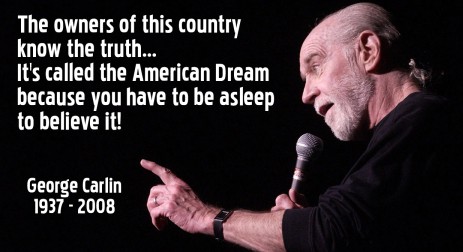
The American Dream is Dead

george-carlin-american-dream

By Dustin Meyer

Source: The Evolutionary Mind

To say the American Dream is Dead couldn’t be more true. The American people as a whole are ignorant. They grow up believing that there is a perfect lifestyle in which they will get once they get older and “pay their dues”. Unfortunately this is very far from wrong, the system is corrupt and is against anyone who thinks this way. Simply put, there is no American dream.

What is it? The American Dream, at least as I knew it was where you would live an ideal life, work a 9-5 job, have a house with a white picket fence, a yard, car, and a dog. More in a modern sense, it is getting rich and famous, owning a huge house, fancy car, having all the fanciest clothes and things. This is why it had been dying but not why it is dead. People are greedy, they want more and more, and forget to appreciate the simple life they have. Some people don’t even have their lives anymore, and yet so many people take theirs for granted.

Pop culture can be given much of the credit due to the skewing of the American dream. Since the people are influenced by anything and everything, they will believe any message conveyed to them. Music and film are the main mediums where this is, but a huge culprit is the news and daytime television. Also, unfortunately people are losing their individualism, which is leading to them falling more into this hole in which you cannot escape, you just aren’t you anymore once you’ve given in.

But a big question is why do I say it is dead? Well, the system in general is against us. The gap between rich and poor is expanding exponentially each and every day. The odds are not in the average person’s favor. People are working until they are 60+ years old and barely being able to retire, and with that work, most aren’t in executive type jobs. For the small business owner, you have huge corporations that are destroying your chances to even provide for your family. So why is it dead? Opening you eyes will show you.

People have to stand up, to realize that something is wrong. With this upcoming election (being quite possibly the worst election/selection of candidates’ ever.) we have to fight for the people. No matter who is in office no one will ever fight for you, unless you do. The people are for the people, we have a choice to change. The change must happen!

Fellow Americans, Wake Up & Escape The Matrix

MatrixBluePillRedPill-1024x534

Where Do Matters Stand?

On the eve of World War II the United States was still mired in the Great Depression and found itself facing war on two fronts with Japan and Germany. However bleak the outlook, it was nothing compared to the outlook today.

By Paul Craig Roberts

Source: Covert Geopolitics

Has anyone in Washington, the presstitute Western media, the EU, or NATO ever considered the consequences of constant military and propaganda provocations against Russia? Is there anyone in any responsible position anywhere in the Western world who has enough sense to ask: “What if the Russians believe us? What if we convince Russia that we are going to attack her?”

The same can be asked about China.

The recklessness of the White House Fool and the media whores has gone far beyond mere danger. What do the Russians think when they see that the Democratic Party intends to elect Hillary Clinton president of the US? Hillary is a person so crazed that she declared the president of Russia to be “the new Hitler” and organized through her underling, neocon monster Victoria Nuland, the overthrow of the democratically elected government of Ukraine. Nuland installed Washington’s puppet government in a former Russian province that until about 20 years ago was part of Russia for centuries.

I would bet that this tells even the naive pro-western part of the Russian government and population that the United States intends war with Russia.

Ever since Russia stood up to Obama over Syria, the Russians have been experiencing hostile propaganda and military operations on their borders. These provocations are justified by Washington and its NATO vassals as a response to “Russian aggression.” Russian aggression consists of nothing but obviously false assertions that Russia is about to invade the Baltics, Poland, and Romania and recreate the Soviet Empire, the Eastern European part of which, together with the former Russian provinces of Georgia and Ukraine, now belong to the American Empire.

The Russians know that the propaganda about “Russian aggression” is a lie. What is the purpose of the lie other than to prepare the Western peoples for war with Russia?

There is no other explanation.

Even morons such as Obama, Merkel, Hollande, and Cameron should be capable of understanding that it is extremely dangerous to convince a major military power that you are going to attack. To simultaneously also convince China doubles the danger.

Clearly, the West is incapable of producing leadership capable of preserving life on earth.

What can be done when the entire West demonstrates a death wish for Planet Earth?

Until the criminal regimes of Clinton, George W. Bush, and Obama, American presidents from John F. Kennedy forward worked to reduce tensions with the Soviets. Kennedy worked with Khrushchev to reduce tensions caused by US missiles in Turkey and Soviet missiles in Cuba. President Nixon negotiated SALT I (the Strategic Arms Limitation Treaty) and the Anti-Ballistic Missile Treaty. President Carter negotiated SALT II, which was never ratified by the US Senate but was observed by the executive branch. President Reagan negotiated with Soviet leader Gorbachev the end of the Cold War. President George H.W. Bush in exchange for Gorbachev’s agreement to the reunification of Germany promised that NATO would not move one inch to the East.

All of these achievements were thrown away by the neoconized Clinton, George W. Bush, and Obama regimes, each a criminal regime on par with Nazi Germany.

Today life on Planet Earth is far less secure than during the darkest days of the Cold War. Whatever threat global warming poses, it is miniscule compared to the threat of nuclear winter. If the evil that is concentrated in Washington and its vassals perpetrates nuclear war, cockroaches will inherit the earth.

I have been warning about the growing danger of a nuclear war resulting from the arrogance, hubris, ignorance, and evil personified by Washington. Recently, four knowledgable Russian-Americans spelled out the likely consequences of trying to drive Russia to submission with war threats: http://www.paulcraigroberts.org/2016/06/03/41522/

See also: http://www.paulcraigroberts.org/2016/05/28/as-our-past-wars-are-glorified-this-memorial-day-weekend-give-some-thought-to-our-prospects-against-the-russians-and-chinese-in-world-war-iii/

Don’t expect the brainwashed American population to have the moral conscience and fortitude to prevent nuclear war or even the intelligence to prevent their own vaporization. In a recent article in the Wall Street Journal Scott Sagan and Benjamin Valentino report that 59% of the US population support attacking Iran with nuclear weapons in the event that Iran sank one US Navy ship: http://www.wsj.com/articles/would-the-u-s-drop-the-bomb-again-1463682867

Republicans were much more likely than Democrats to approve attacking Iran with nuclear weapons with 81% of Republicans approving nuclear war compared to 47% of Democrats. Yet, the Democrats are behind Hillary who would be the first to use nuclear weapons. After all, a feminized woman has to prove how tough she is, just as Margaret Thatcher was “the Iron Lady.”

Before it is too late for Americans and all of humanity, arrogant Americans need to recall that “those who live by the sword, die by the sword.”

The economic picture is equally dismal and unpromising. The latest payroll jobs report was even more awful than reported. Hardly any new jobs were created, but what largely escaped reporting is the fact that the economy actually lost 59,000 full-time jobs.

Increasingly the US economy consists of part-time jobs that cannot support an independent existence. Thus, more Americans age 19-34 live at home with parents than independently with spouses or partners. Fully half of 25-year old Americans live in their childhood rooms in their parents’ homes.

This is the “New Economy” that the filthy lying neoliberal economists promised would be reward for the American work force giving up their manufacturing and professional skill jobs to foreigners. What a monstrous lie the neoliberal economists told so that corporate executives and shareholders could put into their own pockets the living wage of the American work force. These neoliberal economists, and, alas, libertarian “free market” ones, have not been held accountable for their impoverishment of the American work force deeply buried in debt with no future prospects.

Those few Americans who have any awareness are beginning to realize that the One Percent and the western governments that serve them are re-establishing feudalism. The brilliant and learned economist, Michael Hudson, has labeled our era the era of neo-feudalism.

He is correct. The majority of young Americans come out of university heavily indebted, primed for debtor prison. When half of 25-year olds cannot marry and form households, how can anyone believe that housing sales and prices are rising except as a result of speculative investors banking on rental income from a population that cannot even pay its student loans.

The United States is the sickest place on earth. There is no public or political discussion of any important issue or of the multiple crises that confront America or the crises that America brings to the world.

The American people are so stupid and unaware that they are capable of electing a criminal and a warmonger like Hillary president of the United States and be proud of it.

These “tough” Americans are so frightened of hoax dangers, such as “Muslim terrorists” and “Russian aggression” that they willingly sacrificed their depleted pocketbooks, the Constitution of the United States—an act of treason on the part of the American people who utterly failed their responsibility to protect the Constitution—and their own liberty to a universal police state that has all power over them.

It is extraordinary that once-proud, once-great European peoples look for leadership from a country of moronic non-entities who have pissed away the liberty, security, and prosperity that their Founding Fathers gave to them.

Fellow Americans, if you care to avoid vaporization and, assuming we do avoid it, live a life other than serfdom, you must wake up and realize that your most deadly enemy is Washington, not the hoax of “Russian aggression,” not the hoax of “Muslim terrorism,” not the hoax of “domestic extremism,” not the hoax of welfare bankrupting America, not the hoax of democracy voting away your wealth, which Wall Street and the corporations have already stolen and stuck in their pockets.

If you cannot wake up and escape The Matrix, your doom will bring the doom of the planet.

Is the US Economy Heading for Recession?

Why Are We Still Working?

intcap2

By Mike Dowson

Source: NewMatilda.com

This may be an opportune moment to consider the question. Especially if you’re not actually working.

You may have retired. Perhaps you’ve just left university, considering your options. Perhaps you’re taking a welcome break.

Maybe you have no choice but to take a break. Did you retire early because your job was axed? Has the casual work you depend on dried up? Have you been unable to find a job, despite your qualifications?

Perhaps, as you read this, you’re at work, filling in time, forgoing a holiday. Or at the beach, while the kids play in the surf, watching for emails on your phone.

Of course, it’s obvious why we work. Money. You don’t get something for nothing. And everything is so expensive these days.

If anything, most of us need to work more. Both spouses, extra hours, second jobs. Would anyone, except an idiot, seriously suggest we should all be working less?

Well, actually, yes.

As long ago as 1930, the economist John Maynard Keynes predicted that, by now, people in technologically advanced societies wouldn’t need to work much at all. When Keynes said this, advances in technology were yielding extraordinary increases in productivity. The implications seemed obvious. If it took less time to produce what we needed, surely we’d work less.

It turns out that for much of the 20th Century average working hours in developed countries steadily fell. Then, around the 1970s, the trend plateaued. In some countries, it reversed and working hours began to climb again. This occurred at the same time women were entering the workforce in great numbers so total workforce participation also increased.

In Australia, by the new millennium, many full time employees were working more than their grandparents had.

What happened? Did technology fail to deliver the gains Keynes expected?

On the contrary. Technological advancement outstripped even the giddy imaginations of futurists from a century ago. We can grow food, dig up minerals, make fridges and bridges, move things and ourselves around the planet and share knowledge and information much faster with a fraction of the workforce it once took.

But if staggering productivity gains haven’t manifested as lower working hours, where did they go?

Some prominent economists, including some Nobel laureates, have grappled with this question.

Gary Becker observed that our appetite for material goods has expanded along with our ability to produce them. Instead of working less hours, we opted for bigger houses with more gadgets, which we replace more often.

This process has been fuelled by a deluge of marketing, which persuades us to consume things we previously didn’t recognise a need for.

Does that explain it? Anthropologist David Graeber doesn’t think so. If it continually takes fewer human hours to produce these things, shouldn’t we be able to afford them without working more? What are all these working hours producing?

Graeber argues that, although productive jobs have, in fact, been steadily automated away just as predicted, we have also seen a vast proliferation of new jobs that only seem to exist to keep people working.

Consider this. Productivity growth has stalled in Australia. How can this be? Technology hasn’t stopped advancing. The time we should be winning back through productivity gains must be getting reabsorbed.

Productivity returns are highest in capital-intensive industries like mining and manufacturing. As those jobs disappear, either replaced by technology, or lost altogether, the workforce moves into labour-intensive industries like hospitality and professional services. This dilutes the gains in the other industries.

At the same time, unemployment has been trending up since 2008. Young people especially, are out of work. The number of underemployed people, who would work more if they could, is also high. More jobs are casual.

There’s a downward trend in job prospects for new graduates. Some of them settle for part-time work or a free internship. Many find work which is unrelated to primary qualification. That’s now more likely to be in a job without benefits, or multiple such jobs.

There’s another factor. Our lives are now longer relative to our working lives. We tend to start full-time work later, after years of study, and more of life is spent in retirement. Many jobless older people are struggling with the cost of living. Many would work more if they could.

Instead of everyone working less, what seems to be happening is that experienced workers, in professions which are still in demand, are working more, while the young, the old, and those with skills which no longer attract investment have difficulty finding work.

MIT academics Andrew McAfee and Erik Brynjolfsson refer to this as the great decoupling. For many years, real GDP per capita and median income rose in tandem. Since the 1970s, wages as a percentage of GDP have fallen dramatically, while corporate profits as a percentage of GDP are now at their highest level, despite recurring economic shocks.

To put it simply, labour isn’t as important to growth as it used to be.

There is nothing in the economic outlook or current government policy settings which suggests this trend is going to change.

Automation, artificial intelligence and robotics are encroaching on more human occupations. The Committee for Economic Development of Australia (CEDA) has estimated that as many as 40 per cent of the jobs that are left are vulnerable to replacement by technology over the next decade.

No matter how many politicians chant the jobs mantra for the media, more productive jobs are going to disappear.

The terrible irony in this situation is that there is so much that needs to be done.

Among the underemployed graduates I personally know of, there is a psychologist, a soil chemist and a biodiversity specialist. Have we run out of things to do in the areas of mental health, agriculture and the environment?

Mental illness is widespread. Our food bowl is under threat from climate change. We have a mass extinction on our hands.

What we don’t have, apparently, is sufficient money to invest in making full use of the talent that is available to face these challenges.

Why? What failure of collective enterprise could result in this absurd incongruity?

Capital, like technology, is largely blind to human need. Capital goes where the profit is. If there was profit in healing minds and saving species, some of it would go there. While there is more profit in alcohol, gambling and deforestation, more of it will go there.

People don’t register their desire for a healthy society by shopping for it. Capital doesn’t get that signal through the market. The argument that consumers somehow direct the course of civilisation by choosing dolphin-friendly tuna and “eco” cleaning products is stupid and facile. The factors that most affect our destiny are not options in the supermarket.

If a healthy society is something we want, we have to act collectively. Since few people are active major shareholders, for the time being that task tends to fall to governments.

Whether enacted via direct spending, or by creating incentives for private investment, government initiatives are funded from collective surplus – in other words, tax revenue or borrowing against future earnings increases. Despite political spin to the contrary, our tax is low compared to the OECD as a proportion of GDP.

The great decoupling has coincided with rising inequality. Those with money to invest get rich. Those with only labour to sell miss out. Capital doesn’t like to pay for labour, and it doesn’t like to pay tax either.

But why, if our labour isn’t needed for profit, are we still working?

Faced with a looming crisis in social services, but committed ideologically to low taxation, successive Australian governments used tax concessions to turn superannuation and real estate – where most Australians keep their wealth – into a mini-capitalist alternative to social security.

Of course, this only works while people have jobs that provide super and sufficient income to buy housing. And it doesn’t help the real economy, the place where we apply technological innovation to produce things of real value, especially things we can export.

Nevertheless, one group of people enriched themselves through property investment, pushing up the value of real estate around the country in the process. Another group of people became affluent with nothing more than a job that paid super and a home in a good location.

With commodity revenue pouring in from overseas, it was easy to believe we had discovered some kind of magic prosperity formula. But the surplus generated from commodities mostly wasn’t invested back into productive activity. Instead it was turned into tax cuts and other benefits. These had broad electoral appeal but favoured the wealthy, and encouraged further speculation.

The real estate boom didn’t make the country richer. Nor did it make housing more accessible. It simply transferred wealth from one group of people to another. In the process, it put a basic need out of reach of many, including young people, and diverted investment from the productive economy. It also lured a huge number of Australians into precarious debt.

Contrary to popular opinion, encouraged by unscrupulous politics, we have relatively low government debt, but we now have the largest per capita private debt in the world.

So why are we still working? Because we’re in debt.

Middle-aged people are the ones working long hours. They’re also the ones buying houses. And they’re the ones with the most credit card debt as well.

The generation before them had affordable housing, job security and a real social safety net. They’re not so fortunate, but for the ones after them, a steady job with enough for a deposit has become a kind of Holy Grail, and social security is survival at best.

The current trend points to a time when a young graduate might start adult life with a HECS debt, go into credit card debt on a part-time job and a free internship, and eventually get into massive debt to own a flat her grandparents could have bought with ease.

She might even find a job in financial services, if they haven’t all been automated. It’s the sector that helps wealthy people turn their money into more money. It’s also where ordinary people go to borrow money for a house.

Debt is profitable. Even during the great decoupling, as productive jobs disappear, and real wages fall, it’s proven possible to harness the aspirations of ordinary people for profit, without any of the effort or intelligence required for developing new productive capacity, by simply enticing a greater proportion of personal income into servicing debt.

The mining boom is over. Not that it was ever as important as the miners like to claim. Manufacturing continues its long decline. The banks have been warned they are overexposed.

Whatever combination of policy levers is applied, we need to create the conditions that direct investment into producing things that we and the world need, while caring for our environment and our population. We don’t need to direct it in into unearned private wealth at the expense of our neighbours, our country and future generations.

Our current class of politicians has so far failed to even acknowledge our present circumstances, let alone articulate a credible vision for change. Many of them became rich from property investment. Our Prime Minister is a former banker.

Naturally, the people who’ve done well for themselves are reluctant to sacrifice their advantage. Nevertheless, we have to change the narrative around “wealth creation” from one which is essentially about personal enrichment from gaming the system, to one which is about mutual benefit through innovation and productivity.

Change has come, whether we like it or not. If we respond intelligently, taking advantage of the potential we have developed through our education system, we may very well end up working less, but not in a divided society, with many of us struggling to survive.