AP Editor Said She “Can’t Imagine” A US Intelligence Official Being Wrong

By Caitlin Johnstone

Source: CaitlinJohnstone.com

The Associated Press journalist who reported a US intelligence official’s false claim that Russia had launched missiles at Poland last week has been fired.

As we discussed previously, AP’s anonymously sourced report which said “A senior U.S. intelligence official says Russian missiles crossed into NATO member Poland, killing two people” went viral because of the massive implications of direct hot warfare erupting between Russia and the NATO alliance. AP subsequently retracted its story as the mainstream political/media class came to accept that it was in fact a Ukrainian missile that had struck Poland.

AP’s firing of reporter James LaPorta looks at this time to be the end point of any accountability for the circulation of this extremely dangerous falsehood. AP spokesperson Lauren Easton says no disciplinary action will be taken against the editors who waved the bogus story through, and to this day the public has been kept in the dark about the identity of the US official who fed such extremely egregious misinformation/disinformation to the public through the mainstream press.

It is utterly inexcusable for AP to continue to protect the anonymity of a government official who fed them such a profoundly significant falsehood. This didn’t just affect AP staff, it affected the whole world; we deserve to know what happened and who was responsible, and AP has no business obstructing that knowledge from us.

LaPorta’s firing looks like this is yet another instance where the least powerful person involved in a debacle is being made to take the fall for it. A powerful intelligence official will suffer no consequences for feeding false information to the press — thereby ensuring that it will happen again — and no disciplinary action will be taken against LaPorta’s superiors, despite the absolute buffoonery that subsequent reporting has revealed on their part.

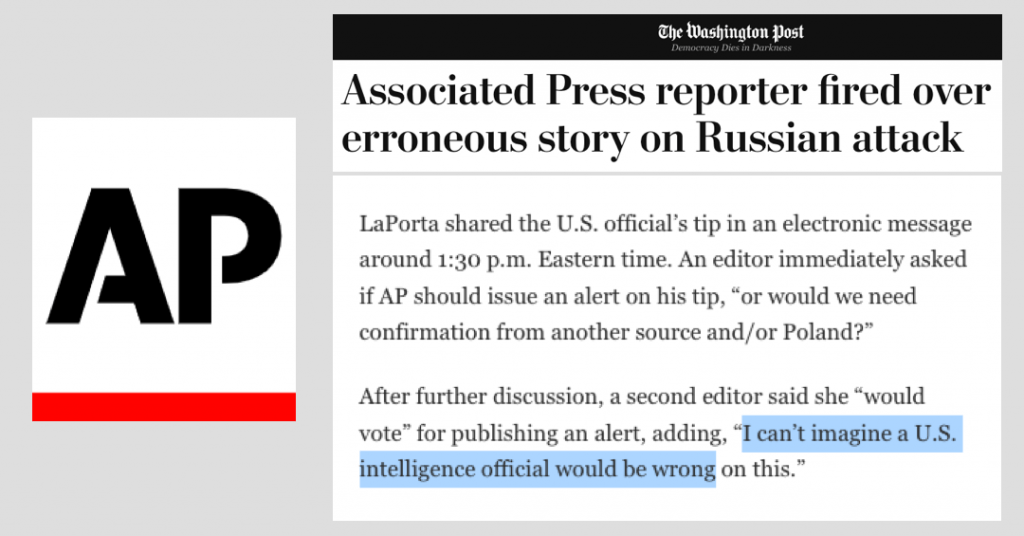
In an article titled “Associated Press reporter fired over erroneous story on Russian attack,” The Washington Post reports the following (emphasis added):

Internal AP communications viewed by The Post show some confusion and misunderstanding during the preparations of the erroneous report.

LaPorta shared the U.S. official’s tip in an electronic message around 1:30 p.m. Eastern time. An editor immediately asked if AP should issue an alert on his tip, “or would we need confirmation from another source and/or Poland?”

After further discussion, a second editor said she “would vote” for publishing an alert, adding, “I can’t imagine a U.S. intelligence official would be wrong on this.”

“I can’t imagine a US intelligence official would be wrong on this.”

Can you imagine not being able to imagine a US intelligence official being wrong? This would be an unacceptable position for any educated adult to hold, much less a journalist, still less an editor, and still less an editor of one of the most influential news agencies on earth.

These are the people who publish the news reports we read to find out what’s happening in the world. This is the baby-brained level of thinking these people are serving the public interest with.

Antiwar commentator Daniel Larison writes the following of the AP editor’s shocking quote:

Skepticism about official claims should always be the watchword for journalists and analysts. These are claims that need more scrutiny than usual rather than less. If you can’t imagine that an intelligence official could get something important wrong, whether by accident or on purpose, you are taking far too many things for granted that need to be questioned and checked out first.

Intelligence officials of many governments feed information to journalists and have done so practically ever since there was a popular press to feed information to, and that information certainly should not be trusted just because an official source hands it over. It is also always possible for intelligence officials to just get things wrong, whether it is because they are relying on faulty information or because they were too hasty in reaching conclusions about what they think they know.

Whether the AP’s source was feeding them a line or was simply mistaken, a claim as provocative and serious as this one should have been checked out much more thoroughly before it got anywhere near publication. The AP report in this case seems to have been a combination of a story that was “too good to check” and a culture of deference to official sources in which the editors didn’t feel compelled to make the effort to check.

Indeed, the only reason the press receive such explicit protections in the US Constitution is because they are supposed to hold the powerful to account. If the editors of a wildly influential news agency will just unquestioningly parrot whatever they are fed by government officials while simultaneously protecting those officials with anonymity, they are not holding the powerful to account, and are in fact not meaningfully different from state propagandists.

They are state propagandists. Which is probably why they are sipping lattes in the AP newsroom while Julian Assange languishes in prison.

As Jacobin’s Branko Marcetic observed, this is far from the first time AP has given the cover of anonymity to US government officials circulating bogus claims of potentially dangerous consequence, like the time it reported an official’s evidence-free assertion which later proved false that Iran had carried out an attack on four oil tankers off the coast of the United Arab Emirates, or the time it let another one anonymously claim that “Iran may try to take advantage of America’s troop withdrawals from Iraq and Afghanistan.”

So to recap  —

  • Powerful government official who fed AP a false story: Zero accountability
  • AP editor who asked if a report should immediately be published upon receipt of the story: Zero accountability
  • Second AP editor who says she can’t imagine a U.S. intelligence official would be wrong:  Zero accountability
  • Journalist who wrote the story: Singular accountability

In a sane society, power and responsibility would go hand in hand. A disaster would be blamed on the most powerful people involved in its occurrence. In our society it’s generally the exact opposite, with the rank-and-file taking all of the responsibility and none of the power.

Our rulers lie to us, propagandize us, endanger us, impoverish us, destroy journalism, start wars, kill our biosphere and make our world dark and confusing, and they suffer no consequences for it. We cannot allow them to continue holding all of the power and none of the responsibility. This is backwards and must end.

The Military Industrial Complex Wants You To Be More Media (l)literate!

By Nolan Higdon

Source: Project Censored

A September 2022 report from Tessa Jolls, president of the Center for Media Literacy, titled “Building Resiliency: Media Literacy as a Strategic Defense Strategy for the Transatlantic,” read like a blueprint for how to indoctrinate students in corporatism and militarism under the auspices of  media literacy education. Jolls received a Fulbright-NATO Security Studies Award to study “aspects of the current information ecosystem and the state of media literacy in NATO countries.”

For historical context, the North Atlantic Treaty Organization (NATO) was created after World War II during the Cold War and has long since outlived its stated purpose of stopping the spread of communism. Indeed, as political sociologists such as Peter Phillips have noted, NATO has morphed into a global army that engages in questionable conflicts and other human rights abuses in an effort to serve the “transnational capitalist class.” 

Just like the crisis of “fake news,” media literacy can and is being weaponized by organizations and individuals seeking to increase their power by influencing the public’s perception of reality. For example, Steve Bannon, former White House Chief Strategist for President Donald Trump has a long history of spreading false information. Form 2012-18, he was the executive chairman of Breitbart’s website which has been caught manipulating videosmanufacturing stories, and spreading baseless conspiracies. Starting with Bannon’s tenure, Breitbart published articles lauding media literacy as a way to combat “fake news,” while touting that its founder, Andrew Breitbart, integrated media literacy into the platform. However, their consistent spreading of false information seems to run counter to traditional definitions of media literacy. 

The standard U.S. definition of media literacy is “the ability to access, analyze, evaluate, create, and act using all forms of communication.” In response to the post-2016 moral panic over fake news, there was a demand for more media literacy education in schools. This provided a window of opportunity for media companies – which had long sought to enter the classroom to advertise products and collect student data- to move at rapid speed to indoctrinate students with their corporate propaganda. 

Jolls’ report aids these efforts by arguing that corporations’ “allocations for media literacy education are few and far between.” Jolls’ report speaks to the military industrial complex when it calls for “funding and programming from all corners: government, foundations, and the private sector (tech and media companies, other corporations).” The military industrial complex refers to the relationship between the military and related defense and national security industries. In fact, Big-Tech emerged from and continues to serve the same military industrial complex. 

Rather than advocate for a critical media literacy education that would account for the power dynamics invested in NATO and its long history of working against democracy and social justice, Jolls’ lauds the “values that NATO states” arguing that they represent an “excellent foundation” for “media literacy initiatives.” To normalize NATO values in the educational process, Jolls suggests what amounts to a psychological operations campaign (PSYOP) to spread NATO’s version of media literacy to the public through “mass media, media aggregators such as AP, Reuters and LexisNexis, social media and influencers.” The report calls on NATO to “nurture grassroots efforts,” which sounds more like astroturfing.

Jolls’ report ignores that members of the very same military and intelligence community that she lauds have been producing and spreading fake news to U.S. citizens from Operation Mockingbird in the 20th century up through the present on various social media platforms. It dismisses the public’s rejection of empowering the military industrial complex to determine truth for the citizenry. For example, in 2022, critics from the left and the right successfully lobbied to have the Department of Homeland Security scrap its Disinformation Governance Board because it was reminiscent of the Ministry of Truth in George Orwell’s 1984

Instead, Jolls is following the lead of similar media literacy projects from the military industrial complex such as the NewsGuard browser extension. Known as an “Internet Trust Tool,” NewsGuard’s Advisory Board includes numerous people who served in the military and intelligence community as well as bureaucrats known for opposing the interests of educators. Yet, NewsGuard positions itself as an objective tool for educators while its rating system is ideologically driven. It touts the legitimacy of establishment and legacy media sources that echo the status quo – even when they have been proven to spread false information – and downgrades independent and alternative media outlets that challenge powerful institutions of government, industry, and the military. Jolls’ mirrors NewsGuard’s top-down approach to media literacy education calling on NATO leaders to determine “the intent and purposes for media literacy interventions” by choosing the “social problem or behavior or ideology” or issue for educators to focus on.   

It is clear that we do need a critical media literacy curriculum in the U.S., but that is not what Jolls and her ilk are promoting. A true media literacy education empowers students to be autonomous and sophisticated media users, who ask their own questions about who controls media messaging and interrogate the power structures behind them. When a student is left dependent on the military industrial complex to analyze content for them, it is not education, it is indoctrination. 

Researchers Find Massive Anti-Russian ‘Bot Army’

By Peter Cronau

Source: Consortium News

A team of researchers at the University of Adelaide have found that as many as 80 percent of tweets about the 2022 Russia-Ukraine invasion in its early weeks were part of a covert propaganda campaign originating from automated fake “bot” accounts.

An anti-Russia propaganda campaign originating from a “bot army” of phony automated Twitter accounts flooded the internet at the start of the war.

The research shows that of the more than 5 million tweets studied, 90.2 percent (both bot and non-bot) came from accounts that were pro-Ukraine, with fewer than 7 percent of the accounts being classed as pro-Russian.

The university researchers also found these automated tweets had been purposely used to drive up fear amongst people targeted by them, boosting a high level of statistically measurable “angst” in the online discourse.

The research team analysed a massively unprecedented 5,203,746 tweets, sent with key hashtags, in the first two weeks of the Russian invasion of Ukraine from Feb. 24. The researchers looked at predominately English-language accounts. A calculated 1.8 million unique Twitter accounts in the dataset posted at least one English-language tweet.

The results were published in August in a research paper, titled “#IStandWithPutin versus #IStandWithUkraine: The interaction of bots and humans in discussion of the Russia/Ukraine war,” by the University of Adelaide’s School of Mathematical Science.

The size of the sample under study, of over 5-million tweets, dwarfs other recent studies of covert propaganda in social media surrounding the Ukraine war. 

The little-reported Stanford University/Graphika research on Western disinformation, analysed by Declassified Australia in September, examined just under 300,000 tweets from 146 Twitter accounts.

The Meta/Facebook research on Russian disinformation reported widely by mainstream media, including by the Australian Broadcasting Corporation (ABC) a fortnight later, looked at only 1,600 Facebook accounts.

Reports on the new research have appeared in only a few independent media sites, and on Russia’s RT.  The ground-breaking study exposing a massive anti-Russia social media disinformation campaign has been effectively ignored by Western establishment media, showing how stories that don’t fit the desired pro-Western narrative are routinely buried. 

Disinformation Blitz Krieg

The Adelaide University researchers unearthed a massive organised pro-Ukraine influence operation underway from the early stages of the conflict. Overall, the study found automated “bot” accounts to be the source of between 60 to 80 percent of all tweets in the dataset. 

The published data shows that in the first week of the Ukraine-Russia war there was a huge mass of pro-Ukrainian hashtag bot activity. Approximately 3.5 million tweets using the hashtag #IStandWithUkraine were sent by bots in that first week. 

In fact, it was like someone had flicked a switch at the start of the war as pro-Ukraine bot activity suddenly burst into life. In that first day of the war the #IStandWithUkraine hashtag was used in as many as 38,000 tweets each hour, rising to 50,000 tweets an hour by day three of the war. 

By comparison, the data shows that in the first week there was an almost total absence of pro-Russian bot activity using the key hashtags. During that first week of the invasion, pro-Russian bots were sending off tweets using the #IStandWithPutin or #IStandWithRussia hashtags at a rate of only several hundred per hour.

Given the apparent long-range planning for the invasion of Ukraine, cyber experts expressed surprise that Russian cyber and internet responses were so laggard. A researcher at the Centre for Security Studies in Switzerland, said: “The [pro-Russian] cyber operations we have seen do not show long preparation, and instead look rather haphazard.”

After being apparently left flatfooted, the #IStandWithPutin hashtag mainly from automated bots, eventually fired up a week after the start of the war. That hashtag started appearing in higher numbers on  March 2, day 7 of the war. It reached 10,000 tweets per hour just twice over the next two days, still way behind the pro-Ukraine tweeting activity. 

The #IStandWithRussia hashtag use was even smaller, reaching only 4,000 tweets per hour. After just two days of operation, the pro-Russian hashtag activity had dropped away almost completely. The study’s researchers noted the automated bot accounts “likely used by Russian authorities,” were “removed likely by pro-Ukrainian authorities.”

The reaction against these pro-Russian accounts had been swift. On March 5, after the #IStandWithPutin hashtag had trended on Twitter, the company announced it had banned over 100 accounts using the hashtag for violating its “platform manipulation and spam policy” and participating in “coordinated inauthentic behaviour.”

Later that month, the Ukraine Security Service (SBU) reportedly raided five “bot farms”’ operating inside the country. The Russia-linked bot operators were reportedly operating through 100,000 fake social media accounts spreading disinformation that was “intended to inspire panic among Ukrainian masses.”

Ukrainian security forces unearthed a pro-Russian automated “bot army” operating out of an apartment in March 2022. The raid found 100 sets of GSM-gateways, left, and 10,000 sim cards, right, operating 100,000 fake bot accounts. (SBU)

Unfiltered Research

The landmark Adelaide University research differs from these earlier revelations in another most unique and spectacular way. 

While the Stanford-Graphika and Meta research was produced by researchers who have long-term deep ties to the U.S. national security state, the Adelaide University researchers are remarkably independent. The academic team is from the university’s School of Mathematical Science.

Using mathematical calculations, they set out to predict and model people’s psychological traits based on their digital footprint.

Unlike the datasets selected and provided for the Stanford/Graphika and the Meta research, the data the Adelaide University team accessed did not come from accounts that had been detected for breaching guidelines and shut down by Meta or Twitter. 

Joshua Watt is one of the lead researchers on the university team, and is a Master of Philosophy candidate in applied mathematics.

He told Declassified Australia that the dataset of 5 million tweets was accessed directly by the team from Twitter accounts on the internet using an academic license giving access to the Twitter API.

The “Application Programming Interface” is a data communication software tool that allows researchers to directly retrieve and analyse Twitter data.

The fake tweets and automated bot accounts had not been detected and removed by Twitter before being analysed by the researchers, although some were possibly removed in Twitter’s March sweep.

Watt told Declassified Australia that in fact many of the bot accounts behind the 5 million tweets studied are likely to be still up and running.

Declassified Australia contacted Twitter to ask what action they may have taken to remove the fake bot accounts identified in the University of Adelaide research. They had not responded by the time of going to press.

Critical Tool in Info War

This new research paper confirms mounting fears that social media has covertly become what the researchers call “a critical tool in information warfare playing a large role in the Russian invasion of Ukraine.”

The Adelaide University researchers tried their best to be noncommittal in describing the activities of the fake Twitter accounts, although they had found the vast majority – over 90 percent – were anti-Russian messages. They stated: “Both sides in the Ukrainian conflict use the online information environment to influence geopolitical dynamics and sway public opinion.”

They found the two main participating sides in the propaganda war have their own particular goals and style. “Russian social media pushes narratives around their motivation, and Ukrainian social media aims to foster and maintain external support from Western countries, as well as promote their military efforts while undermining the perception of the Russian military.”

While the research findings concentrated on automated Twitter bots, there were also findings on the use of hashtags by non-bot tweeters. They found significant information flows from non-bot pro-Russian accounts, but no significant flows from non-bot pro-Ukraine accounts.

As well as being far more active, the pro-Ukraine side was found to be far more advanced in its use of automated bots. The pro-Ukrainian side used more “astroturf bots” than the pro-Russians. Astroturf bots are hyper-active political bots that continuously follow many other accounts to increase followers of that account.

Social Media Role in Boosting Fear

Crucially, the University of Adelaide researchers also investigated the psychological influence the fake automated bot accounts had on the online conversation during those early weeks of the war. 

These conversations in a target audience may develop over time into support or opposition towards governments and policies – but they may also have more instant effects influencing the target audiences’ immediate decisions.

The study found that it was the tweets from the fake “bot” accounts that most drove an increase in conversations surrounding “angst” amongst people targeted by them. They found these automated bot accounts increased “the use of words in the angst category which contains words related to fear and worry, such as ‘shame,’ ‘terrorist,’ ‘threat, ‘panic.’”

By combining the “angst” messaging with messages about “motion” and geographical locations, the researchers found “the bot accounts are influencing more discussion surrounding moving/fleeing/going or staying.” The researchers believe this effect may well have been to influence Ukrainians even away from the conflict zones to flee from their homes.

The research shows that fake automated social media “bot” accounts do manipulate public opinion by shaping the discourse, sometimes in very specific ways. The results provide a chilling indication of the very real malign effects that mass social media disinformation campaigns can have on an innocent civilian population. 

Origins of Twitter Bot Accounts

The researchers report that the overwhelming level of Twitter disinformation that was anti-Russian was from bots “likely [organised] by pro-Ukrainian authorities.”

The researchers asserted no further findings about the origin of the 5 million tweets, but did find that some bots “are pushing campaigns specific to certain countries [unnamed], and hence sharing content aligned with those timezones.” The data does show that the peak time for a selection of pro-Ukrainian bot activity occurred between 6pm and 9pm across U.S. time zones.

Some indication of the origin and the targeting of the messages could be deduced from the specific languages used in the 5 million tweets. Over 3.5 million tweets, or 67 percent, were in the English language, with fewer that 2 percent in Russian and Ukrainian. 

In May 2022, the National Security Agency (NSA) director and U.S. cyber command chief, General Paul Nakasone, revealed that the Cyber Command had been conducting offensive Information Operations in support of Ukraine.

“We’ve conducted a series of operations across the full spectrum: offensive, defensive, [and] information operations,” Nakasone said. 

Nakasone said the U.S. has been conducting operations aimed at dismantling Russian propaganda. He said the operations were lawful, conducted through policy determined by the U.S. Defense Department and with civilian oversight.

Nakasone said the U.S. seeks to tell the truth when conducting an information operation, unlike Russia.

U.S. Cyber Command had deployed to Ukraine a “hunt forward” cyber team in December to help shore up Ukraine’s cyber defences and networks against active threats in anticipation of the invasion.

A newly formed European Union cyber rapid response team consisting of 12 experts joined the Cyber Command team to look for active cyber threats inside Ukrainian networks and to strengthen the country’s cyber defences.

The U.S. has invested $40 million since 2017 in helping Ukraine buttress its information technology sector. According to U.S. Deputy Secretary of State Wendy Sherman, the investments have helped Ukrainians “keep their internet on and information flowing, even in the midst of a brutal Russian invasion.”

Wars & Lies in Our Pockets

With the rise of the internet, war and armed conflict will never be the same. Analysts have noted that the Russian invasion of Ukraine has ushered in a “new digital era of military, political and economic conflict” being manipulated by “laptop generals and bot armies.”

“In all dimensions of this conflict, digital technology plays a key role – as a tool for cyberattacks and digital protest, and as an accelerator for flows of information and disinformation,” wrote analysts at the Heinrich Boll Stiftung in Brussels. “Propaganda has been a part of war since the beginning of history, but never before could it be so widely spread beyond an actual conflict area and targeted to so many different audiences.”

Joshua Watt, one of the lead researchers on the University of Adelaide team that conducted the landmark study, summed it up: “In the past, wars have been primarily fought physically, with armies, air force and navy operations being the primary forms of combat. However, social media has created a new environment where public opinion can be manipulated at a very large scale.”

“CNN brought once-distant wars into our living rooms,” another analyst stated, “but TikTok and YouTube and Twitter have put them in our pockets.”

We are all carrying around with us a powerful source of information and news media – and also, most certainly, disinformation that’s coming relentlessly at us from influence operations run by “bad actors” whose aim is to deceive.

Destroying Western Values To Defend Western Values

By Caitlin Johnstone

Source: CaitlinJohnstone.com

So it turns out the US intelligence cartel has been working intimately with online platforms to regulate the “cognitive infrastructure” of the population. This is according to a new investigative report by The Intercept, based on documents obtained through leaks and an ongoing lawsuit, on the “retooling” of the Department of Homeland Security from an agency focused on counterterrorism to one increasingly focused on fighting “misinformation, disinformation, and malinformation” online.

While the DHS’s hotly controversial “Disinformation Governance Board” was shut down in response to public outcry, the Intercept report reveals what authors Lee Fang and Ken Klippenstein describe as “an expansive effort by the agency to influence tech platforms” in order to “curb speech it considers dangerous”:

According to a draft copy of DHS’s Quadrennial Homeland Security Review, DHS’s capstone report outlining the department’s strategy and priorities in the coming years, the department plans to target “inaccurate information” on a wide range of topics, including “the origins of the COVID-19 pandemic and the efficacy of COVID-19 vaccines, racial justice, U.S. withdrawal from Afghanistan, and the nature of U.S. support to Ukraine.”

The report reveals pervasive efforts on the part of the DHS and its Cybersecurity and Infrastructure Security Agency (CISA), along with the FBI, to push massive online platforms like Facebook, Instagram and Twitter to censor content in order to suppress “threats” as broad as fomenting distrust in the US government and US financial institutions.

“There is also a formalized process for government officials to directly flag content on Facebook or Instagram and request that it be throttled or suppressed through a special Facebook portal that requires a government or law enforcement email to use,” The Intercept reports.

“Emails between DHS officials, Twitter, and the Center for Internet Security outline the process for such takedown requests during the period leading up to November 2020,” says The Intercept. “Meeting notes show that the tech platforms would be called upon to ‘process reports and provide timely responses, to include the removal of reported misinformation from the platform where possible.’”

While these government agencies contend that they are not technically forcing these tech platforms to remove content, The Intercept argues that its investigation shows “CISA’s goal is to make platforms more responsive to their suggestions,” while critics argue that “suggestions” from immensely powerful institutions will never be taken as mere suggestions.

“When the government suggests things, it’s not too hard to pull off the velvet glove, and you get the mail fist,” Michigan State University’s Adam Candeub tells The Intercept. “And I would consider such actions, especially when it’s bureaucratized, as essentially state action and government collusion with the platforms.”

The current CISA chief is seen justifying this aggressive government thought policing by creepily referring to the means people use to gather information and form thoughts about the world as “our cognitive infrastructure”:

Jen Easterly, Biden’s appointed director of CISA, swiftly made it clear that she would continue to shift resources in the agency to combat the spread of dangerous forms of information on social media. “One could argue we’re in the business of critical infrastructure, and the most critical infrastructure is our cognitive infrastructure, so building that resilience to misinformation and disinformation, I think, is incredibly important,” said Easterly, speaking at a conference in November 2021.

Another CISA official is seen suggesting the agency launder its manipulations through third party nonprofits “to avoid the appearance of government propaganda”:

To accomplish these broad goals, the report said, CISA should invest in external research to evaluate the “efficacy of interventions,” specifically with research looking at how alleged disinformation can be countered and how quickly messages spread. Geoff Hale, the director of the Election Security Initiative at CISA, recommended the use of third-party information-sharing nonprofits as a “clearing house for trust information to avoid the appearance of government propaganda.”

But as a former ACLU president tells The Intercept, if this were happening in any government the US doesn’t like there’d be no qualms about calling it what it is:

“If a foreign authoritarian government sent these messages,” noted Nadine Strossen, the former president of the American Civil Liberties Union, “there is no doubt we would call it censorship.”

Indeed, this report is just another example of the way western powers are behaving more and more like the autocracies they claim to despise, all in the name of preserving the values the west purports to uphold. As The Intercept reminds us, this business of the US government assigning itself the responsibility of regulating America’s “cognitive infrastructure” originated with the “allegation that Russian agents had seeded disinformation on Facebook that tipped the 2016 election toward Donald Trump.” To this day that agenda continues to expand into things like plots to censor speech about the war in Ukraine.

Other examples of this trend coming out at the same time include Alan MacLeod’s new report with Mintpress News that hundreds of former agents from the notorious Israeli spying organization Unit 8200 are now working in positions of influence at major tech companies like Google, Facebook, Microsoft and Amazon (just the latest in MacLeod’s ongoing documentation of the way intelligence insiders have been increasingly populating the ranks of Silicon Valley platforms), and the revelation that The Grayzone’s Max Blumenthal and Aaron Maté were barred from participating in a Web Summit conference due to pressure from the Ukrainian government.

We’re destroying western values to defend western values. To win its much-touted struggle of “democracies vs autocracies“, western civilization is becoming more and more autocratic. Censoring moreTrolling morePropagandizing moreJailing journalists. Becoming less and less transparentManipulating information and people’s understanding of truth.

We’re told we need to defeat Russia in Ukraine in order to preserve western values of freedom and democracy, and in order to facilitate that aim we’re getting less and less free speech. Less and less free thought. Less and less free press. Less and less democracy.

I keep thinking of the (fictional) story where during World War II Winston Churchill is advised to cut funding for the arts to boost military funding, and he responds, “Then what are we fighting for?” If we need to sacrifice everything we claim to value in order to fight for those values, what are we fighting for?

Dissent is becoming less and less tolerated. Public discourse is being more and more aggressively disrupted by the powerful. We’re being shaped into the exact sort of homogeneous, power-serving, tyrannized, propagandized population that our leaders criticize other nations for having.

If the powerful are becoming more tyrannical in order to fight tyranny, what’s probably actually happening is that they are just tyrants making up excuses to do the thing they’ve always wanted to do.

As westerners in “liberal democracies” we are told that our society holds free speech, free thought and accountability for the powerful as sacrosanct.

Our leaders are showing us that this is a lie.

The problem with “western values” is that the west doesn’t value them.

In reality, those who best exemplify “western values” as advertised are the ones who are being most aggressively silenced and marginalized by western powers. The real journalists. The dissidents. The skeptics. The free thinkers. The peace activists. Those who refuse to bow down to their rulers.

Our ongoing descent into tyranny in the name of opposing tyrants calls forth a very simple question: if defeating autocracy requires becoming an autocracy, what’s the point of defeating autocracy?

The Gaslighting of the Masses

By CJ Hopkins

Source: Off-Guardian

For students of official propaganda, mind control, emotional coercion, and other insidious manipulation techniques, the rollout of the New Normal has been a bonanza. Never before have we been able to observe the application and effects of these powerful technologies in real-time on such a massive scale.

In a little over two and a half years, our collective “reality” has been radically revised. Our societies have been radically restructured. Millions (probably billions) of people have been systematically conditioned to believe a variety of patently ridiculous assertions, assertions based on absolutely nothing, repeatedly disproved by widely available evidence, but which have nevertheless attained the status of facts. An entire fictitious history has been written based on those baseless and ridiculous assertions. It will not be unwritten easily or quickly.

I am not going to waste your time debunking those assertions. They have been repeatedly, exhaustively debunked. You know what they are and you either believe them or you don’t. Either way, reviewing and debunking them again isn’t going to change a thing.

Instead, I want to focus on one particularly effective mind-control technology, one that has done a lot of heavy lifting throughout the implementation of the New Normal and is doing a lot of heavy-lifting currently. I want to do that because many people mistakenly believe that mind-control is either (a) a “conspiracy theory” or (b) something that can only be achieved with drugs, microwaves, surgery, torture, or some other invasive physical means. Of course, there is a vast and well-documented history of the use of such invasive physical technologies (see, e.g., the history of the CIA’s infamous MKULTRA program), but in many instances mind-control can be achieved through much less elaborate techniques.

One of the most basic and effective techniques that cults, totalitarian systems, and individuals with fascistic personalities use to disorient and control people’s minds is “gaslighting.” You’re probably familiar with the term. If not, here are a few definitions:

“the manipulation of another person into doubting their perceptions, experiences, or understanding of events.”American Psychological Association

“an insidious form of manipulation and psychological control. Victims of gaslighting are deliberately and systematically fed false information that leads them to question what they know to be true, often about themselves. They may end up doubting their memory, their perception, and even their sanity.”Psychology Today

“a form of psychological manipulation in which the abuser attempts to sow self-doubt and confusion in their victim’s mind. Typically, gaslighters are seeking to gain power and control over the other person, by distorting reality and forcing them to question their own judgment and intuition.”Newport Institute

The main goal of gaslighting is to confuse, coerce, and emotionally manipulate your victim into abandoning their own perception of reality and accepting whatever new “reality” you impose on them. Ultimately, you want to completely destroy their ability to trust their own perception, emotions, reasoning, and memory of historical events, and render them utterly dependent on you to tell them what is real and what “really” happened, and so on, and how they should be feeling about it.

Anyone who has ever experienced gaslighting in the context of an abusive relationship, or a cult, or a totalitarian system, or who has worked in a battered women’s shelter, can tell you how powerful and destructive it is. In the most extreme cases, the victims of gaslighting are entirely stripped of their sense of self and surrender their individual autonomy completely. Among the best-known and most dramatic examples are the Patty Hearst case, Jim Jones’ People’s Temple, the Manson family, and various other cults, but, the truth is, gaslighting happens every day, out of the spotlight of the media, in countless personal and professional relationships.

Since the Spring of 2020, we have been subjected to official gaslighting on an unprecedented scale. In a sense, the “Apocalyptic Pandemic” PSYOP has been one big extended gaslighting campaign (comprising countless individual instances of gaslighting) inflicted on the masses throughout the world. The events of this past week were just another example.

Basically, what happened was, a Pfizer executive confirmed to the European Parliament last Monday that Pfizer did not know whether its Covid “vaccine” prevented transmission of the virus before it was promoted as doing exactly that and forced on the masses in December of 2020. People saw the video of the executive admitting this, or heard about it, and got upset.

They tweeted and Facebooked and posted videos of Pfizer CEO Albert Bourla, Bill Gates, the Director of the CDC, official propagandists like Rachel Maddow, and various other “experts” and “authorities” blatantly lying to the public, promising people that getting “vaccinated” would “prevent transmission,” “protect other people from infection,” “stop the virus in its tracks,” and so on, which totally baseless assertions (i.e., lies) were the justification for the systematic segregation and persecution of “the Unvaccinated,” and the fomenting of mass fanatical hatred of anyone challenging the official “vaccine” narrative, and the official New Normal ideology, which hatred persists to this very day.

The New Normal propaganda apparatus (i.e., the corporate media, health “experts,” et al.) responded to the story predictably. They ignored it, hoping it would just go away. When it didn’t, they rolled out the “fact-checkers” (i.e., gaslighters).

The Associated PressReutersPolitiFact, and other official gaslighting outfits immediately published lengthy official “fact-checks” that would make a sophist blush. Read them and you will see what I mean. They are perfect examples of official gaslighting, crafted to distract you from the point and suck you into an argument over meaningless details and definitions. They sound exactly like Holocaust deniers pathetically asserting that there is no written proof that Hitler ordered the Final Solution … which, there isn’t, but it doesn’t fucking matter. Of course Hitler ordered the Final Solution, and of course they lied about the “vaccines.”

The Internet is swimming with evidence of their lies … tweets, videos, articles, and so on.

Which is what makes gaslighting so frustrating for people who believe they are engaged in an actual good-faith argument over facts and the truth. But that’s not how totalitarianism works. The New Normals, when they repeat whatever the authorities have instructed them to repeat today (e.g., “trust the Science,” “safe and effective,” “no one ever claimed they would prevent transmission”), could not care less whether it is actually true, or even if it makes the slightest sense.

These gaslighting “fact-checks” are not meant to convince them that anything is true or false. And they are certainly not meant to convince us. They are official scripts, talking points, and thought-terminating clichés for the New Normals to repeat, like cultists chanting mantras at you to shut off their minds and block out anything that contradicts or threatens the “reality” of the cult.

You can present them with the actual facts, and they will smile knowingly, and deny them to your face, and condescendingly mock you for not “seeing the truth.”

But here’s the tricky thing about gaslighting.

In order to effectively gaslight someone, you have be in a position of authority or wield some other form of power over them. They have to need something vital from you (i.e., sustenance, safety, financial security, community, career advancement, or just love). You can’t walk up to some random stranger on the street and start gaslighting them. They will laugh in your face.

The reason the New Normal authorities have been able to gaslight the masses so effectively is that most of the masses do need something from them … a job, food, shelter, money, security, status, their friends, a relationship, or whatever it is they’re not willing to risk by challenging those in power and their lies. Gaslighters, cultists, and power freaks, generally, know this. It is what they depend on, your unwillingness to live without whatever it is. They zero in on it and threaten you with the loss of it (sometimes consciously, sometimes just intuitively).

Gaslighting won’t work if you are willing to give up whatever the gaslighter is threatening to take from you (or stop giving you, as the case may be), but you have to be willing to actually lose it, because you will be punished for defending yourself, for not surrendering your autonomy and integrity, and conforming to the “reality” of the cult, or the abusive relationship, or the totalitarian system.

I have described the New Normal (i.e., our new “reality”) as pathologized-totalitarianism, and as a “a cult writ large, on a societal scale.” I used the “Covidian Cult” analogy because every totalitarian system essentially operates like a cult, the main difference being that, in totalitarian systems, the balance of power between the cult and the normal (i.e., dominant) society is completely inverted. The cult becomes the dominant (i.e., “normal”) society, and non-cult-members become its “deviants.”

We do not want to see ourselves as “deviants” (because we haven’t changed, the society has), and our instinct is to reject the label, but that is exactly what we are … deviants. People who deviate from the norm, a new norm, which we reject, and oppose, but which, despite that, is nonetheless the norm, and thus we are going to be regarded and dealt with like deviants.

I am such a deviant. I have a feeling you are too. Under the circumstances, it’s nothing to be ashamed of. On the contrary, we need to accept it, and embrace it. Above all, we need to get clear about it, about where we stand in this new “reality.”

We are heading toward New Normal Winter No. 3. They are already cranking up the official propaganda, jacking up the fabricated “cases,” talking about reintroducing mask-mandates, fomenting mass hatred of “the Unvaccinated,” and so on. People’s gas bills and doubling and tripling. The global-capitalist ruling classes are openly embracing neo-Nazis. There is talk of “limited” nuclear war. Fanaticism, fear, and hatred abound. The gaslighting of the masses is not abating. It is increasing. The suppression of dissent is intensifying. The demonization of non-conformity is intensifying. Lines are being drawn in the sand. You see it and feel it just like I do.

Get clear on what’s essential to you. Get clear about what you’re willing to lose. Stay deviant. Stay frosty. This isn’t over.

Brainwashed for War With Russia

By Ray McGovern

Source: AntiWar.com

Thanks to Establishment media, the sorcerer apprentices advising President Joe Biden – I refer to Secretary of State Antony Blinken, national security adviser Jacob Sullivan, and China specialist Kurt Campbell – will have no trouble rallying Americans for the widest war in 77 years, starting in Ukraine, and maybe spreading to China. And, shockingly, under false pretenses.

Most Americans are oblivious to the reality that Western media are owned and operated by the same corporations that make massive profits by helping to stoke small wars and then peddling the necessary weapons. Corporate leaders, and Ivy-mantled elites, educated to believe in U.S. “exceptionalism,” find the lucre and the luster too lucrative to be able to think straight. They deceive themselves into thinking that (a) the US cannot lose a war; (b) escalation can be calibrated and wider war can be limited to Europe; and (c) China can be expected to just sit on the sidelines. The attitude, consciously or unconsciously, “Not to worry. And, in any case, the lucre and luster are worth the risk.”

The media also know they can always trot out died-in-the-wool Russophobes to “explain,” for example, why the Russians are “almost genetically driven” to do evil (James Clapper, former National Intelligence Director and now hired savant on CNN); or Fiona Hill (former National Intelligence Officer for Russia), who insists “Putin wants to evict the United States from Europe … As he might put it: “Goodbye, America. Don’t let the door hit you on the way out.”

Absent a miraculous appearance of clearer heads with a less benighted attitude toward the core interests of Russia in Ukraine, and China in Taiwan, historians who survive to record the war now on our doorstep will describe it as the result of hubris and stupidity run amok. Objective historians may even note that one of their colleagues – Professor John Mearsheimer – got it right from the start, when he explained in the autumn 2014 issue of Foreign Affairs “Why the Ukraine Crisis is the West’s Fault.”

Historian Barbara Tuchman addressed the kind of situation the world faces in Ukraine in her book “The March of Folly: From Troy to Vietnam.” (Had she lived, she surely would have updated it to take Iraq, Afghanistan, Syria, and Ukraine into account). Tuchman wrote:

“Wooden-headedness…plays a remarkably large role in government. It consists in assessing a situation in terms of preconceived fixed notions while ignoring or rejecting any contrary signs. It is acting according to wish while not allowing oneself to be deflected by the facts.”

Six Years (and Counting) of Brainwashing

Thanks to US media, a very small percentage of Americans know that:

  • 14 years ago, then US Ambassador to Russia (current CIA Director) William Burns was warned by Russian Foreign Minister Sergei Lavrov that Russia might have to intervene in Ukraine, if it were made a member of NATO. The Subject Line of Burns’s Feb. 1, 2008 Embassy Moscow cable (#182) to Washington makes it clear that Amb. Burns did not mince Lavrov’s words; the subject line stated: “Nyet means nyet: Russia’s NATO enlargement redlines.”Thus, Washington policymakers were given forewarning, in very specific terms, of Russia’s redline regarding membership for Ukraine in NATO. Nevertheless, on April 3, 2008, a NATO summit in Bucharest asserted: “NATO welcomes Ukraine’s and Georgia’s Euro-Atlantic aspirations for membership in NATO. We agreed today that these countries will become members of NATO.”
  • 8 years ago, on Feb. 22, 2014, the US orchestrated a coup in Kiev – rightly labeled “the most blatant coup in history’, insofar as it had already been blown on YouTube 18 days prior. Kiev’s spanking new leaders, handpicked and identified by name by US Assistant Secretary of State Victoria Nuland in the YouTube-publicized conversation with the U.S. ambassador in Kiev, immediately called for Ukraine to join NATO.
  • 6 years ago, in June 2016, Russian President Vladimir Putin told Western reporters of his concern that so-called antiballistic missiles sites in Romania and Poland could be converted overnight to accommodate offensive strike missiles posing a threat to Russia’s own nuclear forces. (See this unique video, with English subtitles, from minute 37 to 49.) There is a direct analogy with the 1962 Cuban missile crisis when Moscow put offensive strike missiles in Cuba and President John Kennedy reacted strongly to the existential threat that posed to the US.
  • On December 21, 2021, President Putin told his most senior military leaders:“It is extremely alarming that elements of the US global defense system are being deployed near Russia. The Mk 41 launchers, which are located in Romania and are to be deployed in Poland, are adapted for launching the Tomahawk strike missiles. If this infrastructure continues to move forward, and if US and NATO missile systems are deployed in Ukraine, their flight time to Moscow will be only 7–10 minutes, or even five minutes for hypersonic systems. This is a huge challenge for us, for our security.” [Emphasis added.]
  • On December 30, 2021, Biden and Putin talked by phone at Putin’s urgent request. The Kremlin readout stated:
  • On February 12, 2022, Ushakov briefed the media on the telephone conversation between Putin and Biden earlier that day.
  • On February 24, 2022, Russia invaded Ukraine.

Unprovoked?

The US insists that Russia’s invasion was “unprovoked”. Establishment media dutifully regurgitate that line, while keeping Americans in the dark about such facts (not opinion) as are outlined (and sourced) above. Most Americans are just as taken in by the media as they were 20 years ago, when they were told there were weapons of mass destruction in Iraq. They simply took it on faith. Nor did the guilty media express remorse – or a modicum of embarrassment.

The late Fred Hiatt, who was op-ed editor at the Washington Post, is a case in point. In an interview with the Columbia Journalism Review [CJR, March/April 2004] he commented:

“If you look at the editorials we wrote running up [to the war], we state as flat fact that he [Saddam Hussein] has weapons of mass destruction.” “If that’s not true, it would have been better not to say it.”

(My journalism mentor, Robert Parry, had this to say about Hiatt’s remark. “Yes, that is a common principle of journalism, that if something isn’t real, we’re not supposed to confidently declare that it is.”)

It’s worse now. Russia is not Iraq. And Putin has been so demonized over the past six years that people are inclined to believe the likes of James Clapper to the effect there’s something genetic that makes Russians evil. “Russia-gate” was a big con (and, now, demonstrably so), but Americans don’t know that either. The consequences of prolonged demonization are extremely dangerous – and will become even more so in the next several weeks as politicians vie to be the strongest in opposing and countering Russia’s “unprovoked” attack on Ukraine.

THE Problem

Humorist Will Rogers had it right:

“The problem ain’t what people know. It’s what people know that ain’t so; that’s the problem.”

Deafening Silences: propaganda through censorship, smearing and coercion

By Dr Piers Robinson

Source: Off-Guardian

There is a case to be made that the most important part of any propaganda campaign is the drive to ensure that certain voices, claims and arguments either never see the light of day or otherwise remain contained within “fringe” or “alternative” circles.

Since the start of the COVID event, authorities around the world have sought to implement quite extraordinary policies including the so-called “locking down” of entire populations, compulsory masking and coercion through, for example, the mandating of multiple ‘vaccine’ injections. Many of these policies fly in the face of long-established and well-evidenced public health approaches to dealing with respiratory viruses whilst the scientific cogency of these measures – including lockdowns, community masking and “vaccine” injections – is coming under increased scrutiny.

At the same time, the catastrophic consequences, the so-called “collateral damage” (a military euphemism for wartime civilian casualties), of these extreme policies for populations around the world is becoming well-established. Randomised controlled trials of the injections to date have not shown net overall benefit, while accumulating evidence from passive reporting suggests they may be a cause of significant levels of harm. A central part of selling these extreme, and ultimately highly destructive, policies has involved the use of propaganda.

One of the problems with researching and writing about propaganda is that many people believe it to be alien to democratic states. However, as Edward Bernays, considered by many to be a key figure in the development of 20th century propaganda techniques, explained and promoted…

the conscious and intelligent manipulation of the organized habits and opinions of the masses is an important element in democratic society.

At least to an extent, this belief in propaganda rests upon an assumption or belief that people are ultimately selfish, egotistical, power-hungry and hedonistic beings who require guidance and incentive; it therefore follows that propaganda is required by powerful actors in order to provide a degree of structure, order and purpose to a given society. In contrast, if one assumes that humans are ultimately good and well-inclined towards each other and to the natural world, and that they are capable of great things if conditions permit, propaganda emerging from self-interested and powerful actors equates to a parasite within the human mind that seeks to lead humans away from their better instincts [1].

To this one might add the propensity of those with power to define themselves as the arbiters of truth and morality:

The moral attitudes of dominant and privileged groups are characterised by universal self-deception and hypocrisy. The unconscious and conscious identification of their special interests with general interests and universal values […]. […] the intelligence of privileged groups is usually applied to the task of inventing specious proofs for the theory that universal values spring from, and that general interests are served by, the special privileges which they hold.[2]

Whatever one’s position on the justifiability of propaganda, and although we usually call these techniques by different names today, employing euphemisms such as “public relations” or “strategic communication”, it is a fact that techniques of manipulation are part and parcel of contemporary liberal democracies.

PROMOTING THE NARRATIVE

In the case of the COVID-19 event, propaganda has been deployed across democracies on an unprecedented scale. In order to gain compliance with the unorthodox and intrusive measures adopted during the COVID-19 event many forms of “non-consensual persuasion” have been employed, ranging from manipulated messaging designed to increase “fear levels” through to coercion.

Indeed, very early on it came to light that behavioural scientists were providing advice to the UK government’s Scientific Advisory Group for Emergencies (SAGE). UKColumn reported that this group, named the “Scientific Pandemic Influenza group on Behaviour (SPI-B)”, was (re)convened on 13 February 2020. One document produced by this group identified “options for increasing adherence to social distancing measures” which include persuasion, incentivization and coercion.

In the section on “persuasion” it states that the…

perceived level of personal threat needs to be increased among those who are complacent, using hard-hitting emotional messaging

The document also referred to using…

media to increase sense of personal threat.

Many of these “behavioural science” approaches to manipulation used in the UK context have been documented in Laura Dodsworth’s influential work State of Fear whilst Dr Gary Sidley has written about the remarkable reluctance of anyone in authority to accept responsibility for the deliberate manipulation of the public. Dr Colin Alexander has, for some time, been tracking the propaganda output across the UK public sphere.

More widely, and as described by Iain Davis, these approaches have been paralleled at the global level. In February 2020, according to Davis, the World Health Organisation (WHO) had established the Technical Advisory Group on Behavioural Insights and Sciences for Health (TAG);

The group is chaired by Prof. Cass Sunstein and its members include behavioural change experts from the World Bank, the World Economic Forum, and the Bill and Melinda Gates Foundation. Professor Susan Michie, from the UK, is also a TAG participant*.

Since then, Susan Michie has taken over as chair.

CREATING DEAFENING SILENCES

One aspect of the COVID-19 event propaganda has been the aggressive promotion of official narratives; but just as important has been the suppression and censorship of those questioning authorities. Indeed, there is a case to be made that the most important part of any propaganda campaign is the drive to ensure that certain voices, claims and arguments either never see the light of day or otherwise remain contained within “fringe” or “alternative” circles.

Part of this process of suppressing arguments and opinion involves superficially well-meaning attempts to manage what has been increasingly labelled as “misinformation” and “disinformation”. Elizabeth Woodworth documents the emergence of the so-called Trusted News Initiative (TNI) prior to the 2020 COVID-19 event and which involved a coalition of mainstream/legacy media establishing a network that would serve to combat “misinformation” and “bias”. She quotes the then BBC Director-General Tony Hall:

“Last month I convened, behind closed doors, a Trusted News Summit at the BBC, which brought together global tech platforms and publishers. The goal was to arrive at a practical set of actions we can take together, right now, to tackle the rise of misinformation and bias … I’m determined that we use [the BBC’s] unique reach and trusted voice to lead the way – to create a global alliance for integrity in news. We’re ready to do even more to help promote freedom and democracy worldwide”

By 2020, according to Woodworth, the TNI had incorporated “Twitter, Microsoft, Associated Press, Agence France-Presse, Reuters, and the Reuters Institute for the Study of Journalism” and, predictably, adopted the role of tackling “harmful coronavirus disinformation”.

In the UK at least, there has also been military involvement with the 77th Brigade operating as part of the COVID-19 communication strategy. 77th Brigade activities include information warfare and “supporting counter-adversarial information activity” which includes…

creating and disseminating digital and wider media content in support of designated tasks.

Tobias Ellwood, who is both a Member of Parliament and Chair of the House of Commons Defence Select Committee, is, remarkably, a reservist with 77th Brigade. In an answer to a written question in parliament it was confirmed that “members of the Army’s 77th Brigade” are…

currently supporting the UK government’s Rapid Response Unit in the Cabinet Office and are working to counter dis-information about COVID-19.

The Rapid Response Unit itself was established in 2018 in order to, according to its head Fiona Bartosch, counter “misinformation” and “disinformation”, and “reclaim a fact-based public debate”.

The World Health Organisation (WHO) has also followed a similar tack cautioning the public about “misinformation” and “disinformation”. In a release titled “Let’s flatten the infodemic curve”, they advise people to refer to “factcheckers” and legacy media:

When in doubt, consult trusted fact-checking organizations, such as the International Fact-Checking Network and global news outlets focused on debunking misinformation, including the Associated Press and Reuters

The WHO describes in detail its involvement with social media and “big tech”:

“WHO has been working closely with more than 50 digital companies and social media platforms, including Facebook, Twitter, LinkedIn, TikTok, Twitch, Snapchat, Pinterest, Google, Viber, WhatsApp and YouTube, to ensure that science-based health messages from the organization or other official sources appear first when people search for information related to COVID-19. WHO has also partnered with the Government of the United Kingdom on a digital campaign to raise awareness of misinformation around COVID-19 and encourage individuals to report false or misleading content online. In addition, WHO is creating tools to amplify public health messages – including its  WHO Health Alert chatbot, available on WhatsApp, Facebook Messenger and Viber – to provide the latest news and information on how individuals can protect themselves and others from COVID-19.”

AN INSTITUTIONALISED CULTURE OF CENSORSHIP AND SUPPRESSION OF “WRONG THINK”

These developments, along with others to be documented in due course via work at PANDA, would appear to have had major consequences in terms of suppression of debate. A preliminary examination of events over the last 2.5 years indicates this suppression has operated in at least three different ways:

  • direct censorship through removal of content and deplatforming;
  • sponsoring of hostile coverage designed to smear and intimidate anyone raising critical questions regarding the COVID-19 narrative;
  • coercive approaches involving threats to livelihood and employment.

I shall deal with each in turn.

• Censorship and deplatforming

Formal approaches to censorship via state-backed action were seen early on in the UK context with the regulatory body OFCOM issuing guidelines to broadcasters.

Dodsworth (p.31) reports that broadcasters were instructed to be alert to:

health claims related to the virus which may be harmful; medical advice which may be harmful: accuracy or material misleadingness in programmes in relation to the virus or public policy regarding it”(Dodsworth p. 31).

One possible manifestation of this policy was the remarkable instruction issued to Oxford professor Sunetra Gupta. On October 14, 2020, she appeared on BBC News to talk about the lockdowns imposed in the north of England. It is claimed that just before she went on air, one of the producers told her not to mention the Great Barrington Declaration, a document signed by eminent scientists setting out an alternative policy that would avoid lockdowns and other unorthodox measures.

Across social media, from almost day one of the COVID-19 event, tech giants (“big tech”) were willingly signing up to a strategy of censorship.

In April 2020 it was reported that YouTube CEO Susan Wojcicki had declared that it would act to remove anything going against World Health Organization” recommendations. Notable removals from YouTube included interviews with Dr John Ioannidis of Stanford University and British physician Professor Karol Sikora whilst US Senator Rand Paul’s speech questioning the efficacy of facemasks in August 2021 was removed by YouTube. Dr Robert Malone, inventor of part of the MRnA technology used in the COVID-19 injections, and who has become a notable critic of official policies and narratives, was also removed from Twitter.

A large part of the policing of debate across social media platforms has involved issuance of warnings that a given post violates “community standards” in some way and some, such as LinkedIn, state that content at variance with authorities can lead to censoring. As Dr David Thunder has documented, the exact wording of Linkedin’s policy on “misinformation” states: “Do not share content that directly contradicts guidance from leading global health organizations and public health authorities.“

Thunder notes:

What does this actually mean, in practice? It means that some select persons, just because they got nominated to a “public health authority” or a “leading global health organization,” are protected by Linkedin from any robust criticism from the public or from other scientists.

Furthermore, censorship and suppression of academic debate has been reported with respect to academic journals whereby articles and research running against the so-called scientific consensus appear to have been unfairly removed or blocked. For example Dr Peter McCullough reports unjustified censorship of a peer reviewed and published article relating to COVID-19 whilst, more broadly, undue suppression of legitimate research findings was reported by Dr Tess Lawrie with respect to Ivermectin trials. All of these are worrying indications that academic processes themselves have become subject to nefarious censorship and control.

The censorship continues unabated and it might even be intensifying. Whilst detailed and systematic research should be conducted in order to identify the scale and range of the censorship that has been occurring, it is reasonably clear now that, relative to pre-2020, the levels are unprecedented and represent a normalization, or routinization, of censorship.

• Character Assassination through Smearing

Suppression of debate is achieved not only through formal censorship, but also through indirect tactics whereby attempts are made to destroy the reputation of those challenging power. Although perhaps not widely appreciated, the tactic of character assassination appears to have become more prevalent in recent years and it appears to be an important feature of contemporary propaganda and our ‘democratic’ landscape.

Broadly speaking, smear campaigns are designed to avoid substantive rational debate and instead denigrate the person making the argument – ‘playing the man rather than the ball’ or ‘shooting the messenger’. A feature of smear campaigns is the use of identity politics sensibilities such as concern (legitimate) over racism and the deployment of pejorative and tendentious labels. For example, those questioning COVID-19 policies have sometimes been described as far right or fascist whilst pejorative use of the term “conspiracy theorist” is frequently employed to describe those questioning official narratives.

Smear campaigns can be justifiably seen as underhand and disreputable approaches to challenging dissenting voices and they frequently pass off without observers or even the victims being fully aware that they are being targeted: those ordering or enabling the smears have good reason to avoid being uncovered whilst those executing the smears, i.e. the journalists, will defend their hit pieces as legitimate critique.

In the case of the COVID-19 event, however, at least one high level smear campaign has been identified.

At the time of the release of the Great Barrington Declaration (GBD) during autumn 2020, the authors were only aware of a barrage of hostile media attention such as the above noted instruction by the BBC to Professor Sunetra Gupta to not mention the Declaration during an interview. But at least some of the hostile coverage was not simply a spontaneous reaction by journalists but had been initiated by high-level officials. When the GBD was published, leaked emails showed Anthony Fauci and National Institute of Health director Francis Collins discussing the need to swiftly shut it down. Collins wrote in an email that this…

proposal from the three fringe epidemiologists … seems to be getting a lot of attention … There needs to be a quick and devastating published takedown of its premises.

Rather than a civilised and robust scientific debate, a smear campaign followed.

Other prominent instances, unproven but which bear the hallmarks of a directed smear campaign, include repeated attacks on the popular US podcaster Joe Rogan. In the European sphere, Professor Bhakdi, an early and prominent critic of COVID-19 policies has been repeatedly accused of anti-semitism and is now being prosecuted by the German authorities for inciting hatred (*see Endnotes for alt. link -Ed.). None of the accusations made in these attacks appear to be reasonable. Rogan, for example, was chastised for promoting the use of Ivermectin with many journalists referring to it, misleadingly, as “horse dewormer”. The vast bulk of Bhakdi’s work and output concerns the COVID-19 policies and, relatively speaking, his references to any issue related to Judaism is at most vanishingly small.

A subtle and arguably more widespread form of smearing involves the routine labelling of information by social media companies as harmful; for example the independent UK-based outlet OffGuardian has its tweets subject to a blanket warning suggesting their output might be ‘unsafe’ and contain…

violent or misleading content that could lead to real-world harm.

Such labelling is, arguably, defamatory.

• Coercion

Suppression of inconvenient opinions works through both the realm of information – censoring a person’s voice or ad hominem attacks – but also through action in the real, “material”, world via coercion. This could be the creation of conditions that deter people from speaking their mind by offering material incentives or, alternatively, threatening to deplete someone’s material circumstances. Put simply, the threat of loss of earnings.

In the case of the COVID-19 event the role of coercion can be seen through the threats to employment experienced by those challenging the narrative.

For example, Professor Julie Ponesse was forced from her position at Western University in Canada because of her refusal to receive the COVID-19 injection following the issuing of “vaccine” mandate there whilst a similar fate was suffered by Dr Aaron Kheriarty (Professor at University of California Irvine, School of Medicine and director of the Medical Ethics Program). Other academics have cited lack of institutional support with respect to their academic freedom, such as Professor Martin Kuldorff.

The coercive nature of mandates is particularly pernicious in that their implementation in universities forces ‘dissident’ academics to either go against their beliefs and opinions and comply or otherwise leave their posts. The disciplining effect is, of course, much more widely felt across the academy: the few who lose their posts serve as a warning to everyone else to reconsider their beliefs and actions. In particular, younger academics and those completing their PhDs will come to understand that compliance with the dominant narrative is the only realistic option if they are to realise their goal of an academic career.

The tactics of censorship, smearing and coercion are synergistic and help construct an environment in which self censorship becomes ubiquitous: Deplatforming of dissident scientists sends a clear warning as to the subject matter and issues that are off limits whilst examples of smearing highlight the potential unpleasant consequences of discussing such issues.

Coercion acts as a final hardstop for anyone entertaining the possibility of risking talking about censored issues and riding out the smears that will result: loss of job and income is simply too much to bear. Overall, the role of authorities in enabling censorship and coercion results in, broadly speaking, an institutionalised culture in which suppression of opinions and debate becomes the norm.

THE DANGERS TO DEMOCRACY AND RATIONAL DEBATE: ONLINE HARM LEGISLATION AND DIS/MISINFORMATION ‘FACT CHECKERS’

Clearly this situation has deleterious consequences for rational debate and democracy. John Stuart Mill explained that silencing the expression of an opinion robs us all of the opportunity to either hear an argument that might turn out to be true, or refine or reject an opinion that is faulty. There are very good reasons for this, as Mill notes:

First: the opinion which it is attempted to suppress by authority may possibly be true. Those who desire to suppress it, of course deny its truth; but they are not infallible. … All silencing of discussion is an assumption of infallibility.

And:

if wrong, they lose, what is almost as great a benefit, the clearer perception and livelier impression of truth, produced by its collision with error.

Scientific and scholarly research demands such openness to questioning and critique and, behind concepts such as tenure, is the core grounding for the academy that scholars need to be allowed to present what might appear to be controversial and even offensive (to some) opinions.

Of course, there are well argued and established limits to freedom of expression – incitement to violence for example – but we are not talking about the usual areas of debate and controversy that lie at the limits of permissible speech. Rather, we are talking about the right of people to raise questions and concerns about policies that directly affect them, such as lockdown, masking and ‘vaccinations’, and, moreover, the right of credentialed experts to raise such questions in the public sphere. That the censorship, smearing and coercion of such people has come to be tolerated is a clear indicator of how far our democracies have slipped into an authoritarian abyss.

And things are, potentially, about to become even worse with the pushing through of so-called ‘online harm bills’ including in the UK, Europe and Canada. In the UK, the proposed bill creates a category of legal but ‘harmful’ speech: as described by the pressure group Big Brother Watch:

Under the threat of penalties, the legislation will compel online intermediaries to censor swathes of online discussion including in matters of general discourse and public policy. Harmful content is defined entirely by the Secretary of State who is also granted a host of executive powers throughout the legislation.

Liberty has explained further the potential dangers of such developments:

We are concerned that the ‘legal but harmful’ category set out in the OSB is inadequately prescribed by law and risks disproportionately infringing on individuals’ right to freedom of expression and privacy. In particular, we are concerned about the wide definition of online harm as meaning “physical or psychological harm” (clause 187). This is an extremely low threshold, and encompasses innumerable kinds of harm, the extent of which in our view far exceeds the qualifications on Article 10 provided by the ECHR and HRA.

And, as Lord Sumption points out regarding the proposed UK online harm bill:

The real vice of the bill is that its provisions are not limited to material capable of being defined and identified. It creates a new category of speech which is legal but ‘harmful’. The range of material covered is almost infinite, the only limitation being that it must be liable to cause ‘harm’ to some people. Unfortunately, that is not much of a limitation. Harm is defined in the bill in circular language of stratospheric vagueness. It means any ‘physical or psychological harm’. As if that were not general enough, ‘harm’ also extends to anything that may increase the likelihood of someone acting in a way that is harmful to themselves, either because they have encountered it on the internet or because someone has told them about it.”

It is likely that such legislative developments will operate in tandem with so-called “fact checking” entities and algorithms that work to define and then exclude what is defined as “misinformation”, “disinformation”, and now “malinformation”.

The latter two are being defined now as, respectively, false information spread in order to mislead or cause harm and accurate information which is used out of context in order to harm or mislead. These terms are so nebulous that they will enable authorities to proscribe virtually any serious debate or criticism in the public sphere.

Here we see the continuing development and entrenchment of the mis/disinformation fact checking industry noted earlier. During the COVID-19 event the United Nations itself started working with the public relations entity Purpose to “combat the growing scourge of COVID-19 misinformation” which is described as a “virus spread by people”.

Purpose states:

[t]hrough Verified, we are leveraging the UN brand, as well as popular brands that connect audiences online and offline: from Cartoon Network in Brazil to Flipkart in India.

UNESCO, similarly, is promoting education about so-called “conspiracy theories”. Remarkably, and in apparent contradiction to rhetoric regarding inclusiveness and community-driven decisionmaking, the WHO actually asks people to report on people spreading “misinformation”: As such, an un-elected international organization is actively advocating for the suppression of free speech in democratic societies.

Entities tasked with deciding what is true and what is false, as opposed to allowing ideas and arguments to be openly debated as Mill would suggest, are already creating the link between dis/misinformation and harm. For example, the Institute for Strategic Dialogue, a state-sponsored think tank, attacked the disparate groups questioning the COVID-19 response with a publication titled “Between Conspiracy and Extremism: A Long COVID Threat?” The institute tweeted:

Today we launch a new series of reports on the global anti-lockdown movement, beginning with this paper examining how COVID restrictions have brought together a broad church of activists in a conspiracy-extremist movement we call a ‘hybrid threat’

On the issue of coercive measures, the recent passing of a bill in California, that will enable doctors who spread ‘false information’ to be charged with ‘unprofessional conduct’ and have their licenses revoked, is a worrying sign of just how aggressive authorities are becoming.

The trajectory here is clear to discern and it entails the move to a world where the truth is defined by factcheckers and authorities, and legislation provides the underlying coercive framework to ensure any deviance is punished. This is entirely at odds with basic principles of open debate, objective scholarship and freedom of expression and is not compatible with democracy.

THE END OF DEMOCRACY?

There is nothing new about censorship, smearing and coercion in western democracies. For some time now, those questioning, for example, western foreign policy have been subjectedto such tactics whilst the broader 9/11 global war on terror spawned wide ranging examples of censorship, smearing and coercion in order to shore up official narratives and the belligerent wars that have been fought under its banner.

Indeed, in the realm of foreign policy and war, the prevalence of propaganda and associated drives to marginalise dissent are well known to researchers in these fields. And, today, in 2022, we are witnessing a preeminent example of coercion as we see the Wikileaks founder, Julian Assange, facing the prospect of deportation to the US and the rest of his life in prison. His crime was to reveal accurate information about the 9/11 wars, especially those in Iraq and Afghanistan. There is little reason to doubt that authorities in the West are seeking to make a powerful example of Assange; a warning to the rest of us as to the price of questioning our governments when they commit illegal wars of aggression.

What is new with the COVID-19 event is a combination of the spread of these strategies of suppression and a sharp uptick in awareness amongst increasingly large swathes of the population as to the existence of propaganda in democracies. The spread can be seen in how it is now a large number of medical scientists who have been at the receiving end of drives to suppress debate, whereas before it was often just a handful of relatively unknown dissident social scientists researching foreign policy issues.

Regarding public awareness, attempting to censor high profile researchers from the medical sciences alerts more of the public as to what is going on.

And, of course, as we rapidly see the dissident scientists now being vindicated by the facts – lockdowns don’t work, the “vaccinations” can harm etc – more people become aware of the basic truth that the official COVID-19 response has been underpinned by ferocious propaganda campaigns designed to silence any experts speaking truth to power.

It is also apparently the case that trust in mainstream, or legacy, media continues a sharp decline whilst, presumably, increasing numbers of people seek out the new independent media platforms and go to organisations such as PANDA and HART for reliable information on COVID-19 related issues and more widely. [3]

And yet the broader trajectory for our public spheres looks ominous.

Further legislative measures to redefine free speech, networks of sponsored factcheckers defining what is and what is not, resources poured into censoring, smearing and coercing dissident voices all parallel what some analysts argue is a wider drive to restructure Western societies.

Ending any semblance of democracy may indeed be the goal, starting with the ending of freedom of expression. There are likely to be dark days ahead and it has never been so important for there to be a robust and uncompromising defence of freedom of expression.

Endnotes:

  1. Thanks to Colin Alexander for comments on the justifiability of propaganda and to David Bell, Maryam Ebadi, Gary Sidley and David Thunder for other comments and feedback.
  2. Niebuhr, R., (1932), Moral Man and Immoral Society: A Study in Ethics and Politics. New York: Charles Scriber’s Sons.
  3. The array of new and independent media and organisations is vast; some of those, with which the author is most familiar, include media such as OffGuardianMultipolarthe GrayzoneUnlimited HangoutUKColumn; and Organisations such as Brownstone InstituteWould Council for HealthChildren’s Health DefenceGlobal Collateral.

Masters of Deceit: The Government’s Propaganda of Fear, Mind Control & Brain Warfare

By John & Nisha Whitehead

Source: The Rutherford Institute

“It is the function of mass agitation to exploit all the grievances, hopes, aspirations, prejudices, fears, and ideals of all the special groups that make up our society, social, religious, economic, racial, political. Stir them up. Set one against the other. Divide and conquer. That’s the way to soften up a democracy.”― J. Edgar Hoover, Masters of Deceit

The U.S. government has become a master of deceit.

It’s all documented, too.

This is a government that lies, cheats, steals, spies, kills, maims, enslaves, breaks the laws, overreaches its authority, and abuses its power at almost every turn; treats its citizens like faceless statistics and economic units to be bought, sold, bartered, traded, and tracked; and wages wars for profit, jails its own people for profit, and has no qualms about spreading its reign of terror abroad.

Worse, this is a government that has become almost indistinguishable from the evil it claims to be fighting, whether that evil takes the form of terrorism, torture, drug traffickingsex trafficking, murder, violence, theft, pornography, scientific experimentations or some other diabolical means of inflicting pain, suffering and servitude on humanity.

With every passing day, it becomes painfully clear that this is not a government that can be trusted with your life, your loved ones, your livelihood or your freedoms.

Just recently, for example, the Pentagon was compelled to order a sweeping review of clandestine U.S. psychological warfare operations (psy ops) conducted through social media platforms. The investigation comes in response to reports suggesting that the U.S. military has been creating bogus personas with AI-generated profile pictures and fictitious media sites on Facebook, Twitter and Instagram in order to manipulate social media users.

Psychological warfare, as the U.S. Army’s 4th Psychological Operations Group explained in a recruiting video released earlier this year, enables the government to pull the strings, turn everything they touch into a weapon, be everywhere, deceive, persuade, change, influence, and inspire.

Of the many weapons in the government’s vast arsenal, psychological warfare (or psy ops) can take many forms: mind control experiments, behavioral nudging, propaganda.

In the 1950s, MK-ULTRA, the mind control program developed under CIA director Allen Dulles as part of his brain warfare Cold War campaigns, subjected hundreds of unsuspecting American civilians and military personnel to doses of LSD, some having the hallucinogenic drug slipped into their drinks at the beach, in city bars, at restaurants. For Operation Midnight Climax, the CIA hired prostitutes to lure men into a bugged room, where they would be dosed with LSD and observed having sex

As Brianna Nofil explains, “MK-Ultra’s ‘mind control’ experiments generally centered around behavior modification via electro-shock therapy, hypnosis, polygraphs, radiation, and a variety of drugs, toxins, and chemicals.”

The CIA spent nearly $20 million on its MKULTRA program, reportedly as a means of programming people to carry out assassinations and, to a lesser degree, inducing anxieties and erasing memories, before it was supposedly shut down.

As one study reported, detainees held in CIA safe-houses abroad “were literally interrogated to death in experimental methods combining drugs, hypnosis and torture, to attempt to master brainwashing techniques and memory erasing.”

Similarly, the top-secret Montauk Project, the inspiration for the hit Netflix series Stranger Things, allegedly was working to develop mind-control techniques that would then be tested out on locals in a nearby village, triggering crime waves or causing teenagers to congregate.

As journalist Lorraine Boissoneault concludes, “Despite MK-ULTRA violating ethical norms for human experiments, the legacy of brainwashing experiments continued to live on in U.S. policy. The same methods that had once been used to train American soldiers ended up being used to extract information from terrorists in Abu Ghraib, Iraq and Guantanamo Bay.”

Fast forward to the present day, and it’s clear that the government—aided and abetted by technological advances and scientific experimentation—has updated its psy ops warfare for a new era. For instance, the government has been empowered to use its ever-expanding arsenal of weapons and technologies to influence behaviors en masse and control the populace.

It’s a short hop, skip and a jump from a behavioral program that tries to influence how people respond to paperwork to a government program that tries to shape the public’s views about other, more consequential matters. Thus, increasingly, governments around the world—including in the United States—are relying on “nudge units” to steer citizens in the direction the powers-that-be want them to go, while preserving the appearance of free will.

Back in 2014, for example, a Fusion Center in Washington State (a Dept. of Homeland Security-linked data collection clearinghouse that shares information between state, local and federal agencies) inadvertently released records on remote mind control tactics (the use of “psycho-electronic” weapons to control people from a distance or subject them to varying degrees of pain).

Indeed, the COVID-19 pandemic could easily be considered psychological warfare disguised as a pandemic threat. As science writer David Robson explains: “Fears of contagion lead us to become more conformist and tribalistic… Daily reminders of disease may even sway our political affiliations… Various experiments have shown that we become more conformist and respectful of convention when we feel the threat of a disease… the evocative images of a pandemic led [participants in an experiment] to value conformity and obedience over eccentricity or rebellion.”

This is how you persuade a populace to voluntarily march in lockstep with a police state and police themselves (and each other): by ratcheting up the fear-factor, meted out one carefully calibrated crisis at a time, and teaching them to distrust any who diverge from the norm.

This is not a new experiment in mind control.

Add the government’s inclination to monitor online activity and police so-called “disinformation,” and you have the makings of a restructuring of reality straight out of Orwell’s 1984, where the Ministry of Truth polices speech and ensures that facts conform to whatever version of reality the government propagandists embrace.

This “policing of the mind” is exactly the danger author Jim Keith warned about when he predicted that “information and communication sources are gradually being linked together into a single computerized network, providing an opportunity for unheralded control of what will be broadcast, what will be said, and ultimately what will be thought.”

We’ve already seen this play out on the state and federal level with hate crime legislation that cracks down on so-called “hateful” thoughts and expression, encourages self-censoring and reduces free debate on various subject matter. 

The end goal of these mind-control campaigns—packaged in the guise of the greater good—is to see how far the American people will allow the government to go in re-shaping the country in the image of a totalitarian police state.

The government’s fear-mongering is yet another key element in its mind-control programming.

It’s a simple enough formula. National crises, global pandemics, reported terrorist attacks, and sporadic shootings leave us in a constant state of fear. The emotional panic that accompanies fear actually shuts down the prefrontal cortex or the rational thinking part of our brains. In other words, when we are consumed by fear, we stop thinking.

A populace that stops thinking for themselves is a populace that is easily led, easily manipulated and easily controlled whether through propaganda, brainwashing, mind control, or just plain fear-mongering.

Fear not only increases the power of government, but it also divides the people into factions, persuades them to see each other as the enemy and keeps them screaming at each other so that they drown out all other sounds. In this way, they will never reach consensus about anything and will be too distracted to notice the police state closing in on them until the final crushing curtain falls.

This Machiavellian scheme has so ensnared the nation that few Americans even realize they are being brainwashed—manipulated—into adopting an “us” against “them” mindset. All the while, those in power—bought and paid for by lobbyists and corporations—move their costly agendas forward.

This unseen mechanism of society that manipulates us through fear into compliance is what American theorist Edward L. Bernays referred to as “an invisible government which is the true ruling power of our country.”

It was almost 100 years ago when Bernays wrote his seminal work Propaganda:

“We are governed, our minds are molded, our tastes formed, our ideas suggested, largely by men we have never heard of… In almost every act of our daily lives, whether in the sphere of politics or business, in our social conduct or our ethical thinking, we are dominated by the relatively small number of persons…who understand the mental processes and social patterns of the masses. It is they who pull the wires which control the public mind.”

As I point out in my book Battlefield America: The War on the American People and in its fictional counterpart The Erik Blair Diaries, to this invisible government of rulers who operate behind the scenes—the architects of the Deep State—we are mere puppets on a string, to be brainwashed, manipulated and controlled.

For years now, the powers-that-be—those politicians and bureaucrats who think like tyrants and act like petty dictators regardless of what party they belong to—have attempted to brainwash us into believing that we have no rights: to think for ourselves, make decisions about our health, protect our homes and families and businesses, act in our best interests, demand accountability and transparency from government, or generally operate as if we are in control of our own lives.

Well, the government is wrong.

We have every right, and you know why? Because, as the Declaration of Independence states, we are endowed by our Creator with certain inalienable rights—to life, liberty, property and the pursuit of happiness—that no government can take away from us.

It’s time we started reminding the government that “we the people” are the ones in charge.