There are many thousands of groups that have formed themselves around the need to stand against the globalist attack on life on earth. There are thousands more presenting alternative vision/suggestions for a better future. And there are a small number who are doing both; declaring that one must commit to stopping the worst while simultaneously nurturing into life a new template for human and ecological emancipation.
It is the latter action which I subscribe to, because it strikes me that we have no choice other than to fight-off the most immediate threats to our fundamental life values; yet equally have no choice other than to recognise the obvious shortcomings of the day to day way of life that constitutes the accepted norm of most post industrial societies today.
Given this state of affairs, one finds oneself committed to taking a deeper look into both the causal factors behind the degradation of human values and what will form the key ingredients of a new society. That which emerges out of the darkness and leads the way beyond repetitions of the divisive trends destroying humanity’s integrity.
Quite recently I came across the term ‘Truth Movement’ and discovered that it stands for a broadly connected body of individuals all having a similar goal: the defeat of the globalists. This seemed to hark back to the term ‘truthers’ as applied to those ready to expose the 9/11 fraud.
What, I asked myself, would this ‘Truth Movement’ do if it were to actually succeed in fulfilling its ambition?
What would ensure that such a movement did not implode once faced by the responsibility for building a future purged of the ‘rotten apple’ factors that so often bring-down otherwise promising movements and visions?
By ‘rotten apple’ factor, I mean the tendency for jealousy, excessive ego, lack of importance given to trust, power complexes, political ambition and – I would add – the group psychology of demanding ‘consensus’ in decision making, thereby pulling down individual aspirations and ending-up with abdication to the lowest common denominator as the only way ‘to keep the peace’.
Within socio-economic structures which largely reject the notion of ‘leadership by the wise’, a palpable void opens-up when important/controversial decisions have to be taken which require more than a superficial five sense appraisal of the way forward.
When our Truth Movement is confronted by the need to decide the composition of ‘the new template for the new society’ it is to usher into reality, many different convictions are likely to be put forward.
For example: an end to racial discrimination; the common ownership of land; the dissolution of the banking industry and widespread redistribution of wealth; no more ‘government’; the rise of ‘rule by the people’; free green energy for all; organic food and farming being adopted as the prime means of food production.
So as to bring the dilemma presented by this situation to life in a ‘real time’ way, I’m going to paint my envisioned picture of how events might unfold.
As ideas pour in, a committee is established to find a pragmatic way to turn these ideals into political reality. A reality which reflects the broad banner heading ‘Truth Movement’, whose idealistic rhetoric has finally garnered enough support to overcome the long dominant globalist control system.
On this committee are the leading proponents of the various ideals deemed most essential for laying the foundation of the promised New Society.
However, the daunting task of turning this pool of individual potential into a unified body of pragmatic ground-breakers, leads to the realisation that some critically important ingredients have been neglected. Internal frictions start to come to the surface causing fractures in the once seeming unity.
Disagreements eventually come to a head and in a highly revealing and heated exchange, it emerges that the deeper significance of the word ‘truth’ has never been explored or even debated. Never understood as primarily a spiritual value, an inner commitment to the evolution of higher values, not just to outer changes in the functioning of society.
In an attempt to prevent the situation deteriorating into chaos, a respected analyst is brought to the table to put a few fundamental questions to the committee leaders:
How aligned are you in your personal lives with what you call upon others to do in order to solve the crisis in values you see around you?
How truthful are you to yourselves and to others, if you don’t consider it important to lead by example – but nevertheless expect others to live the changes you claim must be brought-about?
How committed are you to raising your own levels of consciousness? To gaining a higher level of awareness concerning your own ambitions and shortcomings?
Are you actually committed to ‘a path of truth’ in your own lives? To following disciplines that quieten the ego and develop your relationship with the deeper spiritual values that are, in practice, the only real expression of truth?
How determined are you not to be a hypocrite? To avoid turning-out like the very politicians you so readily condemn?
As leaders of ‘the truth movement’ can you honestly say that you are committed to uphold the highest standards of responsibility, integrity and trust in your dealings with others?
What specific qualities are necessary in order to lead your supporters wisely, honestly and effectively?
Faced by this penetrating examination, the room became strangely quiet.
Being asked to address an inner commitment to truth, as opposed to its relatively surface oriented outer manifestation, has led to the need for a traumatic reappraisal of ‘the order of values’. And has called for a new level of consciousness to be put at the very top of the agenda of what is most essential for the building of the new society.
I tell this tale so as to highlight the task which stands in front of all of us, as ‘activists’ and campaigners for a better world. For should the neo-liberal control system collapse or even be finally defeated, we will find ourselves at the forefront of a global situation in which the great majority are subjected to an uncharted sense of insecurity and loss of direction.
A life of slavery to task masters carries with it a kind of insurance policy of not having to deal with – or be responsible to – the wider world or one’s own inner quest for liberation.
Suddenly, or relatively suddenly, being placed in a position where the expectation of the majority is for those most vocal in exposing the wrong – to now step forward and establish ‘the right’- presents a formidable challenge.
At the centre of this challenge is a burning question which we should all be addressing now rather than waiting until the hour of need is thrust upon us.
The question centres around a very fundamental precept: is the decision making process – essential to establishing the new desired template – to be based on ‘leadership by the wise’ or by ‘group consensus’?
By a ‘committee of the wise and the good’ or by a continuation of ‘democratic representative governance’ and quasi-consensus decision making?
To put it a little more bluntly: a benign, wise dictatorship or an elected common denominator form of governance which has no base in wisdom or vision and which is very easily exploited by the power hungry?
Within the constitution of the British Isles and many other countries, there exists something called Natural Law/Common Law, which goes back a long way.
It states that there is only one indomitable law and that is the law of God. God’s law. A form of decree based upon universal truth and justice, founded upon the supreme wisdom of our Creator.
In a world overcome by rank injustice, the complete absence of truth, and no sign of wisdom, Common/Natural Law shines out as the light at the end of a very dark tunnel.
The emergence of an earthly law that reflects universal law can only be brought forward by a committee of the wise and true. Indeed, God’s laws can be described as emanating from ‘the Supreme Benign Dictator.’
At the most basic level, they are reflected in the laws of nature and the predilection for an ever expanding biodiversity of plant, animal and insect life.
At the human level, they represent the (age old) quest for truth, love and full emancipation of the soul of man. Even when individuals do not consciously know it, this is what all are longing for – and now is the time to go public about it.
We have passed the point of no return for ‘democracy’ or anything resembling it, so we may choose to call what will really open our minds and hearts: a ‘Veritocracy’.
Veritocracy from ‘veritas’ the Latin for truth. ‘Way of Truth’.
Going face to face with a cult regime based on darkness and division, demands a steadfast commitment to the opposite. Truth, as the unrestrained manifestation of the call of our souls.
This is the one force that will disintegrate the forces of darkness and disempower the globalist control system, once and for all.
It is the one force that can unite all of humanity and provide the dynamic foundation for true leadership and true trusteeship of the planet.
Let us commit now. Let us be properly prepared to lead the world beyond ruination and into rebirth.
“Philosophical thinking that doesn’t do violence to one’s settled mind is no philosophical thinking at all.” ~Rebecca Goldstein
Comfort zones are a curious thing. So warm and secure. So safe and reassuring. So satisfying and certain. Beliefs have a similar effect on us. Especially the core beliefs that we take for granted. But beliefs are comfort zones with reinforced invulnerability; or, at least, the illusion of it.
Such reinforcements are like prison bars that most of us are not even aware of. We’re so completely indoctrinated, so utterly pre-programmed, that we don’t even know that we don’t know that we’ve been conditioned to blindly believe in something simply because enough people convinced us it was true.
The problem with reinforced comfort zones is that there is no growth. A regular comfort zone, you can stretch. A reinforced comfort zone, you’re usually not even aware it needs to be stretched. A regular comfort zone allows for trial and error, it allows for questioning, and so there is at least potential for self-improvement and self-overcoming. But a reinforced comfort zone does not allow for trial and error. It doesn’t allow for “blasphemous” questioning, because it is taken for granted as already perfect or “simply the way it is.”
Regular comfort zones can be healthy, giving us a safe haven, a place where we can heal and lick our wounds. But reinforced comfort zones are unnecessary safety nets based upon fear (of God, the Unknown, Death) placation, and self-pity. It’s a place where cognitive dissonance rules and any notion of attempting to think outside the box is met with: You simply need to have faith in the “box”.
The Battle Against Bewitchment:
Philosophy is a battle against the bewitchment of our intelligence by means of language.” ~Ludwig Wittgenstein
Self-Inflicted Philosophy is at the forefront of the battle against bewitchment. Self-inflicted philosophy is about upsetting settled minds. It’s about toppling the reinforced comfort zones of blind belief. It’s about flattening the “box” that everyone talks a big game about thinking outside of but when it really comes down to it, they cling to the “box” out of fear of the unknown or out of faith in what they believe they know.
Foremost, self-inflicted philosophy is about questioning the self to the nth degree through self-interrogation. But you can only get so far in such questioning before you are met with the reinforced comfort zone of a blind belief. So, self-inflicted philosophy is also about questioning the layer-upon-layer of cultural, political, and religious indoctrination that led to that reinforced comfort zone to begin with.
When you don the cloak of a self-inflicted philosopher, no belief, no matter how true it may seem, is off the hook for being questioned with ruthless skepticism and unwavering circumspection. In the battle against bewitchment, the destruction of a belief, no matter how powerful, is mere collateral damage to the Occam’s razor of universal truth. Hell, even “universal truth” is not beyond questioning.
When you don the cloak of a self-inflicted philosopher, the concept of belief is nixed from your interpretation of the universe. There is no place for belief here, only thought, only deep inquiry, only imaginative curiosity. You replace all usage of “belief” or “believe” with “thought” or “think”. You don’t believe that you certainly exist, you “think” that you “probably” exist. But you could be wrong. So you remain circumspect, for even your interpretation of your own existence could be an illusion, no matter how “true” it may feel.
There will be those who will say, “You are merely believing that you don’t believe.” But that is patently false, because you are not “believing” in non-belief, you are “thinking/inquiring/imagining” through non-belief, with the understanding, the flexibility that your thinking “could” be wrong. And that’s the rub: it is much easier to alter a thought than a belief. It is almost impossible to alter a belief. You are more likely to question a thought than you are a belief. And so, rather than get trapped in a reinforced comfort zone, you stay ahead of the curve by thinking rather than believing, and then by questioning what you think so that you don’t accidentally begin to believe it.
In the spirit of upsetting settled minds, you don’t believe in having an unsettled mind, you think that having an unsettled mind is more productive, more progressive, and more open-minded than having a settled mind (an unquestioning belief). You realize that belief in general is counterproductive, because you understand that the human mind is a delusion-generator rather than a truth-generator. It pumps out delusions like a spider pumps out webs. But, unlike the spider, it tends to get caught in them. Thereby, you understand that the only window to truth is through a questioning, circumspect, and a skeptical mindset, rather than through an unquestioning, dogmatic, and certain mindset.
The only solution to a delusion-generator is a question-generator. Luckily, the human brain is both. As a self-inflicted philosopher, you don’t believe that this is certainly true; rather, you think that this is probably true. And you’re willing to question everything to “prove” it. Indeed, you’ve transformed Descartes’ “I think therefore I am” into I think, therefore I question.
Tapping into the question-generator:
“It is far better to grasp the universe as it really is than to persist in delusion, however satisfying and reassuring.” ~Carl Sagan
The problem with the human brain is that is never knows when it has been duped by a delusion, so it is almost always better to not believe anything just in case it’s a delusion. A kind of reverse Pascal’s Wager. It’s almost always better to, as Aristotle suggested, “entertain a thought without accepting it.” Just take it all into consideration and let it pass through the sieve of probability. Then, whatever doesn’t insult your soul, think about it, dissect it, inquire about it. Be curious about it. Just don’t make the mistake of believing it.
You are more likely to grasp the universe “as it really is” by questioning it than by believing it. You don’t believe the universe is certainly a certain way; rather, you think the universe may be a certain way, but you’re willing to question further so as to get you closer to the way the universe “really is”. If you cling to a particular belief of how the universe is, then you block yourself from ever getting closer to the universe “as it really is.” Better to simply not have a belief in the first place. Better to simply think and keep the motor running on the question-generator so as to keep the delusion-generator in check.
The opposite of belief is neither disbelief nor doubt, but clarity of a thought. Without beliefs reinforcing the comfort zone, you are liberated to stretch it. You are clear enough to think outside it, you are courageous enough to question it. When the reinforcements fall away, the comfort zone becomes a sacred rather than stagnant place. It is free to grow through self-improvement rather than remain stuck in self-reassurance. Indeed, without beliefs cluttering the mindset, you’re finally able to drop the “set” and move into “mind.”
Free of the “mindset” of a settled mind, you move into the mindfulness of a questioning mind. You become a walking, talking, question-generator, able to consistently counter-balance the delusion-generator of the human condition. You’re ahead of the curve, surfing Aslam’s Infinite Circle on the surfboard of Occam’s razor. In absolute awe over the beautiful unfolding of an ultimately unknowable universe. On the edge of your own curiosity, questioning all “answers” countering all beliefs, elusive of all delusions. You’re a self-inflicted philosopher, and not even God is safe from your ruthless inquiry.
When I was in secondary school, a teacher showed me an animated optical illusion in which a dancer appears to be spinning in one direction. I was adamant that the dancer was spinning clockwise, while my teacher insisted it was spinning counterclockwise. She then told me that you could change the direction of the dancer by focusing on the feet. I gazed with meditative fixation, and suddenly, to my amazement, the dancer started spinning counterclockwise! My teacher explained that since there are no visual cues for three-dimensional depth, your mind can determine what direction the dancer spins.
At that moment, I realised that reality is a construct of the mind, and we all potentially see the same world differently. I may have put it in less eloquent terms than that (considering I was only a teenager), but there was a fundamental shift in my understanding. The illusion made me realise that the notion of ‘objective truth’ was essentially arbitrary since our subjective beliefs mediate sensory experience.
My teacher and I could have argued for hours, days or weeks as to which direction the dancer was spinning; science couldn’t have proven either of us correct since it was a matter of perception rather than ‘truth’. In ‘reality’, the dancer was spinning in both directions, but since the brain has a natural tendency to classify, categorise and catalogue information in binary terms (up/down, left/right, black/white, clockwise/counterclockwise), the animated optical illusion appears monodirectional.
There are numerous examples of this in our day-to-day lives, like when we fail to appreciate other people’s viewpoints because we perceive the world differently. We believe we are right despite the multiple (if not infinite) interpretations about the nature of reality.
What are Reality Tunnels?
The countercultural guru Timothy Leary coined the term ‘reality-tunnel’ to describe our filtered perceptions of the world. Robert Anton Wilson later developed the concept to describe “pre-composed patterns of thinking which limit and distort the perception of reality by reducing complexity and options.”1 According to Wilson, reality-tunnels shape our phenomenological sense of self, editing out experiences that do not support our beliefs while focusing on those which do.2
An advocate for capitalism, for example, will gather facts to support the view that capitalism is the most effective socioeconomic model, discarding any information that runs contrary to this viewpoint. Similarly, a Marxist will construct arguments based on select information to support the view that communism is the best system, often neglecting evidence that contradicts their position.
As the psychedelic scholar Ido Hartogsohn states, “all of us harbour established ideas about minorities, religions, nationalities, the sexes, the right ways to think, act, feel govern, eat, drink, and what not. Reality tunnels act to help us fortify these ideas against challenging information.”3 In this sense, there is a crossover between the concept of reality-tunnels and confirmation bias, the latter described as the “human tendency to notice and assign significance to observations that confirm existing beliefs while filtering out or rationalising away observations that do not fit with prior beliefs and expectations.”4 The phenomenon of confirmation bias helps explain why people who ascribe to a reality-tunnel are oblivious. Most people believe their worldview corresponds to the “one true objective reality,” however, Wilson emphasises that many reality tunnels are artistic creations, a culmination of biological, cultural and environmental inputs.5
The notion that reality is shaped by the conditions of the human mind is not new. The 18th-century German philosopher Immanuel Kant proposed in his Critique of Pure Reason that experience is based “on the perception of external objects and a priori knowledge.”6 We receive information about the external world through our five senses, which is then processed by the brain, allowing us to conceptualise its contents. When I look at an object, such as a chair or a table, I have no understanding of its external nature. The qualities that enable me to denote the meaning of the object, such as shape, colour, size etc., have no objective existence; they are merely by-products of the brain.
The French psychoanalyst and psychiatrist Jacques Lacan proposed his theory distinguishing between ‘The Real’ and the ‘Symbolic’. Lacan argued that ‘The Real’ is the “imminent unified reality which is mediated through symbols that allow it to be parsed into intelligible and differentiated segments.”7 However, the ‘Symbolic’, which is primarily subconscious, is “further abstracted into the imaginary (our actual beliefs and understandings of reality). These two orders ultimately shape how we come to understand reality.”8
The Harvard sociologist, Talcott Parsons, uses the word gloss to describe how our minds come to perceive reality. According to Parsons, we are taught how to “put the world” together by others who subscribe to a consensus reality based on shared beliefs, norms and associations.9 A gloss constitutes a total system of language and/or perception. For example, the word ‘house’ is a gloss since we lump together a series of isolated phenomena – floor, ceiling, window, lights, rugs, etc. – and turn it into a totality of meaning.
The author and anthropologist Carlos Castaneda commented on this notion, stating, “we have to be taught to put the world together in this way. A child reconnoitres the world with few preconceptions until he is taught to see things in a way that corresponds to the descriptions everybody agrees on. The world is an agreement. The system of glossing seems to be somewhat like walking… we learn we are subject to the syntax of language and the mode of perception it contains.”10
The French philosopher Jacques Derrida stated that our understanding of objects (and the words which denote them) are only understood in relation to how they are contextually related to other objects (and denotive words).11
We can break free from prescribed reality-tunnels by using objects and language in unusual or disjointed ways, thereby creating new discursive meanings, associations and connotations. This was the aim and outcome of certain art movements such as Dadaism and Surrealism, as well as Brion Gysin and William Burroughs’ cut-up method.12
The famous ethnobotanist and psychonaut, Terence McKenna, argued that ideology and culture are tools “which give other people control over one’s experience and identity since they lead individuals to shape their identity according to pre-conceived forms. If a person identifies with commercial brands or with popular ideas of what is beautiful, true or important, they give away their power to other people.”13 McKenna once said that you should not see “culture and ideology as your friends,” implying that you should understand reality on your own terms rather than buying into “pre-packaged ideological and cultural ideals” such as communism, capitalism, democracy or some form of totalitarianism.14 Belief in itself, argued McKenna, was “limiting to the individual, because every time you believe in something you are automatically precluded from believing its opposite. By believing something, you are virtually shutting yourself from all contradictory information, thus once again performing the sin of imposing a rigid simplified structure upon an infinitely complex reality.”15
Much like McKenna, Wilson recommends that a “fully functioning human ought to be aware of their reality tunnel and be able to keep it flexible enough to accommodate and, to some degree, empathise with different ‘game rules’, different cultures.”16 According to Wilson, constructivist thinking, which considers how social and cultural processes determine our perception of the world, constitutes an exercise in metacognition, enabling us to become aware of how reality tunnels are never truly objective, thereby decreasing the “chance that we will confuse our map of the world with the actual world.”17
How Your Reality Tunnel Is Formed
The constraints of human biology partially limit our models of reality. As Wilson states, our DNA “evolved from standard primate DNA and still has a 98% similarity to chimpanzee (and 85% similarity to the DNA of the South American Spider Monkey). We have the same gross anatomy as other primates, the same nervous system and the same sense organs. While our highly developed pre-frontal cortex enables us to perform ‘higher’, more complex mental tasks than other primates, our perceptions remain largely within the primate norm.”18
The neural apparatus produced by our genetic coding helps create what ethologists call the umwelt, or “world-field.” Birds, reptiles and insects occupy a separate umwelt or reality-tunnel to primates (ourselves, included). For example, bees are able to perceive floral patterns in ultraviolet light, which we cannot (unless certain technologies are utilised). Canine, feline and primate reality-tunnels remain similar enough that friendship and communication can occur between these different species, however, a snake (for example) occupies such a different reality tunnel that their behaviour appears entirely alien.
As Wilson argues, the belief that human umwelt reveals “reality” or “deep-reality” is as “naïve as the notion that a yardstick shows more reality than a voltmeter or that ‘my religion is better than your religion’. Neurogenetic chauvinism has no more scientific justification than national or sexual chauvinisms.”19 He goes so far as to suggest that “no animal, including the domesticated primate, can smugly assume the world created by its senses and brain equal in all respects the ‘real world’ or the ‘only real world’.”20
Reality-tunnels are also influenced by “imprint vulnerability,” periods in our lives when early childhood/adolescent experiences “bond neurons into reflex networks which remain for life.”21 The psychological researchers, Lorenz and Tinbergen, won a Nobel Prize in 1973 for their research into imprinting, which demonstrated that “the statistically normal snow-goose imprints its mother, as distinct from any other goose, shortly after birth. This imprint creates a ‘bond’ and the gosling attaches itself to the mother in every possible way.”22 These imprints can be imposed onto literally anything. Lorenz observed a case in which a gosling, in the absence of its mother, imprinted a ping-pong ball. It followed the ping-pong ball around and, on reaching adulthood, “attempted to mount the ball sexually.”23
Wilson estimates that the age at which we are imprinted with language determines lifelong programs of “cleverness” (verbal intelligence) and “dumbness” (verbal unintelligence), since linguistic models enable us to articulate mental processing, evaluate complex ideas and communicate with those around us.24 Furthermore, how and when our first sexual experiences are imprinted can “determine lifelong programs of heterosexuality, brash promiscuity or monogamy etc.”25 In more obscure imprints, such as celibacy, foot-fetishism and sadomasochism, the “bounded brain circuitry seems quite as mechanical as the imprint which bounded the gosling to the ping-pong ball.”26
These examples suggest that experiences during childhood, when the brain exhibits optimal ‘neuroplasticity’ (a term used to refer to malleability of neural networks in the brain), can shape our reality tunnels far into adulthood. As Sigmund Freud proposed, many “rational” thoughts and behaviours are typically the result of “repressed” memories, impulses and desires, which dwell in the murky depths of the unconscious mind.27
Furthermore, reality-tunnels are shaped by social conditioning, the “sociological process of training in a society to respond in a manner generally approved by the society in general and peer groups within society.”28 Manifestations of social conditioning are multifarious but include nationalism, education, employment, entertainment, popular culture, spirituality and family life. Unlike imprinting, which usually requires only one powerful experience to set permanently into the neural networks of the brain, conditioning requires “many repetitions of the same experience and does not set permanently.”29
The processes of social conditioning vary greatly, depending on the cultural environment to which one is exposed. For example, an individual born in a Muslim country (such as Saudi Arabia) will likely believe in the teachings of the Quran and adhere to certain religious norms, customs and traditions. However, individuals born in a Western capitalist/consumerist country, or an Eastern country with Hindu or Buddhist traditions, will adhere to different cultural and behavioural codes.
Reality-tunnels are also formed through the process of learning. Much like conditioning, learning requires repetition, but it also requires motivation. Therefore, it plays “less of a role in human perception and belief than genetics and imprinting and even less than conditioning does.”30 Learning marks a major difference between how mammals, reptiles, insects and birds perceive the world. For example, snakes share the same reality tunnel since they merely act on biologically determined reflexes, with only minor imprinted differences. Mammals show “more conditioned and learned differences in their reality tunnels.”31
Humans demonstrate a higher aptitude for learning due to our highly developed cortex and frontal lobes as well as our prolonged infancy. This variability functions as “the greatest evolutionary strength of the human race” since it enables us to pass down knowledge from one generation to the next. But it also means that we can become brainwashed and label other people who do not share our beliefs as “mad,” “anti-social,” or “blasphemous.” In fact, it could be said that the majority of all wars are the result of two (or more) opposing reality tunnels fighting for supremacy. This is particularly evident in the case of religious conflict, where people kill each other in the name of “God.”
Tunnel Vision: The Politicisation of Reality
The rise of “identity politics” in the 21st century perfectly demonstrates how reality-tunnels prevent us from considering alternative perspectives and viewpoints. During the last decade, the political domain has become increasingly polarised as the left and right engage in a battle for cultural supremacy. Such polarisation was apparent in the Brexit referendum of 2016, in which 51.9% of the British public voted to leave the European Union while 48.1% voted to remain.32 The marginal success of the ‘leave’ campaign highlighted the strong division between both sides of the political spectrum. The former stressed the importance of the Union in promoting social and economic stability, while the latter emphasised the importance of national identity, sovereignty and independence.
The rhetoric employed by both the ‘leave’ and ‘remain’ campaign was so binary in its articulation that neither side engaged in meaningful dialogue; instead, the referendum became a series of baseless slogans, mottos and catchphrases – an advertising campaign designed to appeal to target demographics. The referendum was more about two separate reality-tunnels competing for ideological supremacy than a balanced analysis of benefits and risks.
The US presidential election of 2016 was a similar drama of competing reality-tunnels, shaped by masterful spin doctors and hidden persuaders who exploited modern advertising techniques to capture specific demographics based on class, age, sex, religion, geographical location and other criteria.
Donald Trump was well-known for his campaign slogan ‘Make America Great Again’ and other catchphrases that employed a lexicon of patriotism, populism and protectionism to appeal to those on the right. On the other hand, Hillary Clinton used the slogan ‘Stronger Together’ to evoke feelings of unity, compassion, and solidarity. The election became a battle between two contrasting reality-tunnels, grounded in meaningless rhetoric and hyperbole.
Another example of politicisation is the Covid-19 crisis, with the public divided into two camps – those who supported measures such as lockdowns versus the other side that rejected many of these same measures. Political polarisation demolished a sane balanced approach to the crisis, exacerbated and intensified by the ongoing political divide across the media landscape.
‘Echo Chambers’ & Identity Politics
Social media has fuelled identity politics by enabling groups and movements to generate an online presence and have real-world impacts. According to independent scholar and author Ilaria Bifarini, this results in the emergence of ‘echo chambers’ in which internet users “find information that validates their pre-existing opinions and activates confirmation bias.”33 This mechanism, says Bifarini, “strengthens one’s beliefs and radicalises them, without adding anything to information and knowledge. The result is the ideological extremism that we are observing today and in which we are taking part, where political debates have been replaced by supporters and verbal violence.”34
Another way this happens, for example, is how Google’s online video sharing and social media platform YouTube utilises algorithmic data to show users similar content to their prior engagements – content they are likely to engage with in the future, thus creating a feedback loop in which they are exposed to media reinforcing their political preferences.35 As media scholars Brooke E. Auxier and Jessica Vitak state, “many social media platforms structure their content-feeds based on what an algorithm determines to be the ‘top’ or most ‘relevant’ stories. While these tools may help users control their information and news environments – making consumption more manageable and mitigating information overload – it is possible that these tailoring tools will expose users to redundant information and singular viewpoints.”36
Both sides of the political spectrum fail to engage in meaningful discussion when they are entrapped in a single reality-tunnel, the stability of which is threatened by competing narratives. Instead, political dialogue becomes characterised by inflammatory insults, name-calling and defamation.
Loaded language – such as ‘virtue signallers’, ‘snowflakes’, ‘racist’, ‘transphobic’, ‘Islamophobic’, ‘hetero-normative’, ‘privileged’ – enables identity groups to protect the integrity of their reality-tunnel by excluding those who hold a different opinion. In the same way that religious cult leaders isolate their members from the outside world, so too do identity groups orientate themselves around a closed belief system, which is immune to criticism, contention or challenge.
In order to facilitate a more meaningful discussion, it is important that both sides learn to break free from the constraints of their reality-tunnel.
Rising Above the Fray
In his book Prometheus Rising, Robert Anton Wilson provides various techniques for challenging dominant reality tunnels. Writing in the early 1980s, Wilson suggested that “if you are a liberal, subscribe to the [conservative magazine] National Review… Each month try to enter their reality-tunnel for a few hours while reading their articles. If you are a conservative, subscribe to New York Review of Books for a year and try to get into their headspace for a few hours a month. If you are a rationalist, subscribe to Fate Magazine for a year. If you are an occultist, join the Committee for the Scientific Investigation of Claims of the Paranormal and read their journal, The Sceptical Inquirer, for a year.”37
To put a modern ‘spin’ on this exercise, if you follow conservative thinkers online such as Jordan Peterson or Ben Shapiro, expose yourself to leftist thinkers such as Slavoj Zizek or Noam Chomsky, and do the opposite if you are on the left. Subscribe to internet channels that do not align with your reality-tunnel. By performing this exercise, you will find that you can think about political issues in a more balanced, neutral and multidimensional way, free from the constraints of ideological dogma.
You can use the same technique with religion. In one exercise, Wilson says, “become a pious Roman Catholic. Explain in three pages why the Church is still infallible and holy despite Popes like Alexander VI (the Borgia Pope), Pious XII (ally of Hitler), etc.”38 Then explain why the Church is an immoral and outdated institution; also write three pages detailing why you believe this to be the case. If you have the time, you can perform the same exercise with other religions such as Hinduism, Buddhism, and even Satanism. Explain why these religions hold the key to the ‘true’ nature of ‘reality’ and then refute yourself by providing a counterargument.
You can use the same technique to become more conspiratorial in your thinking. In one exercise, Wilson says, “start collecting evidence that your phone is bugged. Everyone gets a letter occasionally that is slightly damaged. Assume that somebody is opening your mail and clumsily revealing it. Look around for evidence that your co-workers or neighbours think you’re a bit queer and are planning to have you committed to a mental hospital.”39 Observe how these assumptions influence your perception of other people and their behaviour – it won’t be long before you find evidence to support your paranoid thinking!
Once you have sufficiently experimented with this reality-tunnel, “try living a whole week with the program, ‘Everybody likes me and tries to help me achieve all of my goals’.”40 Then try living a whole month with the program, “I have chosen to be aware of this particular reality.”41 Then try living a day with the program, “I am God playing at being a human being. I created every reality I notice.”42 Then try living forever with the metaprogram, “Everything works out more perfectly than I plan it.”43 By adopting these different reality-tunnels, you will notice how malleable your perceptual faculties really are – the world can become a place of conspiracy and collusion or a place of benevolence and positivity, depending on how you view it.
Wilson provides another interesting exercise to expand the boundaries of consciousness, in which you “list at least 15 similarities between New York (or any large city) and an insect colony, such as a bee-hive or termite hill. Contemplate the information in the DNA loop, which created both of these enclaves of high coherence and organisation, in primate and insect societies.”44 Then, “Read the Upanishads and every time you see the word ‘Atman’ or ‘World Soul’, translate it as DNA blueprint. See if it makes sense to you that way.”45 According to Wilson, “Contemplating these issues usually triggers Jungian synchronicities. See how long after reading this chapter you encounter an amazing coincidence – e.g., seeing DNA on a license plate, having a copy of the Upanishads given to you unexpectedly…”46
Experimenting with different reality tunnels is a necessary practice if one wishes to challenge dominant narratives, perspectives and viewpoints and expand the boundaries of human consciousness. As we find ourselves in a post-modern ‘information age’, where an increasing number of political factions compete for informational authority, we are exposed to the hidden forces of propaganda more than ever before.
Every time we log into Facebook, Twitter, Instagram and YouTube, we allow ourselves to be manipulated by a complex system of algorithms that generates content based on our likes, dislikes, and even our differences. In order to escape the trappings of ideological dogma, we must become conscious of our biological, social and environmental conditioning and adopt a more multidimensional way of thinking.
Understanding about ‘reality-tunnels’ becomes instrumental in achieving true inner liberation since it enables us to think about the mind as a form of technological software that can be continually updated and reorganised. We achieve a state of metacognition, an awareness of one’s thought processes and an understanding of the patterns behind them. It is what the pioneering mind explorer John Lilly called our capacity for “metaprogramming,” the creation, revision, and reorganisation of mental programs.47
Although we are constrained by the limitations of biological programming (to a certain extent), the creativity of human consciousness is infinite, a maze of endless possibilities and potentialities waiting to be explored. As the Buddha said, “All that we are is the result of all that we have thought. It is founded on thought. It is based on thought.”48
Footnotes
1. Hartogsohn, I. (2015). The Psychedelic Society Revisited: On Reducing Valves, Reality Tunnels and the Question of Psychedelic Culture, Psychedelic Press, 3
36. Auxier, B. and Vitak (2019). Factors Motivating Customization and Echo Chamber Creation Within Digital News Environments. Social Media and Society, April-June 2019
37. Prometheus Rising, 83
38. Ibid, 159
39. Ibid, 241
40-43. Ibid, 242
44-46. Ibid, 190
47. Lilly, John C. Programming & Metaprogramming in the Human Biocomputer, New York: The Julian Press, Inc., 1967
Eliot Jacobson is a retired professor of mathematics and computer science who regularly appears on our Twitter feed discussing the climate crisis. He sends tweets under the grim title, ‘Your “moment of doom” for the day’. These channel the latest news on rapidly rising carbon emissions and temperatures, catastrophic examples of extreme weather, and so on. It’s depressing fare, and Jacobson is candid about the level of anguish he feels:
‘I woke up feeling angry at about 2:30 AM this morning.
‘It’s easy to find something wrong with just about anything I look at. It’s all projection. I’ve been writing and deleting Tweets, but I still feel angry.
‘I’m angry that there’s very little I can do and there’s no way out.’
‘This sadness is so overwhelming, so all-consuming, that it takes my breath away. The things I do to cope with the weight of it all are mere distractions from this sadness. Volunteer for a few hours, then sadness. Go for a walk, then sadness. Listen to music, read, visit websites, then sadness. Visit with friends or family, then sadness. Sadness returns every time I have a moment to reflect on the predicament of the present moment.’
I’m no stranger to this emotional roller-coaster. 1988 was the big year for me, when NASA scientist James Hansen told the world we were heading for disaster. I had no difficulty believing him.
It seemed inconceivable to me that the profit motive driving global industry could be restrained, let alone reversed, in time. I was then working as a marketing manager for British Telecom in the West End of London where I set up a Green Initiatives Group. Small changes were made, but they were just window dressing – deeper changes impacting profit were completely unthinkable. It seemed obvious to me that this fundamentalist corporate resistance must, sooner or later, lead to disaster.
I first protested for action on climate change with Friends of the Earth on the streets of central London in October 1989. I was 27 when I started campaigning; I’m now 61. I’ve thought a lot, worried a lot, talked a lot, read a lot, and written a lot about these issues for three and a half decades, more than half my life.
It seems absolutely incredible to me – by which I mean it seems something that I honestly would not have believed was possible – that what seemed like an urgent crisis to me in the late 1980s can still seem like ‘hype’, a ‘liberal tax scam’, an ‘oligarch plot’ and ‘bourgeois hysteria’ to large numbers of people in 2023. In the 1980s, we said things would change when there were ‘bodies in the streets’ – but the bodies are all around us now, and there is still no sign of meaningful change.
I say all this to make clear that I am in no way complacent about, or indifferent to, the looming climate catastrophe (it seems absurd to even describe it as ‘looming’). My comments below are not intended to detract from the vital need to take immediate action; they are addressed to the despair that I know many people, like Jacobson, are feeling.
You, Me And The Mysterium Tremendum
After everything I have myself suffered, it seems to me that we have two main tasks at the present time: first, to do everything in our power to avert the terrifying crisis threatening us with extinction. Second, to do everything we can to transform the fear and suffering of our predicament into love and bliss.
The first of these is new. The second may sound preposterous, even annoying, but it has actually always been the great human task.
Many activists devoted to action, to change, despise the very idea that our own happiness should be any kind of concern. The suggestion is dismissed as self-indulgent ‘navel gazing’. We have to dispense with all such ‘sentimentality’ and focus on ‘hard politics’. We have to plunge into the darkness of realpolitik and fight for our lives. It’s going to be bruising, to hurt – forget all kitten-cuddling ideas about ‘love’ and feeling good. And how on earth can you feel ‘bliss’ when the world is falling apart? Such nonsense!
As so often, the anger is rooted in fear – the fear that such concerns will divert energy and attention away from what really matters. The counter-argument is that not giving a damn about personal feelings, about our needs as human beings in this short life, is actually one of the key factors that got us into this fine mess in the first place. (See my Cogitation: ‘Our Indifference To Ourselves’ – Beyond The ‘Virtue’ Of Self-Sacrifice – Parts 1 and 2)
Just as I can’t understand how so many people can fail to see the truth of the existential crisis we’re facing, I can’t understand how people can feel so absolutely certain about the significance, the meaning, of this crisis that they fall into absolute despair.
First of all, we need to remember that despair is a function of mind; it is not something mandated by Existence. As Thoreau noted, we have a choice:
‘However mean your life is, meet it and live it; do not shun it and call it hard names.’ (Thoreau, ‘Walden’, Oxford University Press, 1997, p.292)
This has been as true for everyone in human history facing death from illness, starvation, genocide, as it is for all of us now, facing extinction.
I find the universe so mysterious, so fundamentally Unknown, and even Unknowable, that I cannot establish a solid base of existential certainty that allows me to be confidently desperate about even this situation.
Of course, climate collapse is terrible for us – I don’t want to die, you don’t want to die; we don’t want so-called human ‘civilisation’ to disappear. But we all do have to die and the deeper significance of even a disaster on this scale is fundamentally unknown.
We are a miniscule part of billions of years of existence involving 200 billion galaxies each containing 200 billion stars, and who knows how many planets, swirling over distances that completely defy imagination – all of it emerging out of the mysterium tremendum, the how and why of Existence (we can’t say Creation; we don’t even know if it has a beginning or an end).
This immensity of space and time has led to this moment that stands before us. Here we are! Everything in this cosmos has led us here. We can’t just blame politicians, corporate executives and their journalistic enablers – the universe made them as they are and this is what the universe has given us to deal with.
Who are we to break down in despair as if we were certain about the final meaning of what is happening? What do we really know about anything? Do we really know enough to find a solid position from which we can cast judgement even on the extinction of human life, or even of all life, on this planet?
In November, spiritual writer Steve Taylor posted a poem, ‘Being Watched by The Moon’, on Facebook. Taylor wrote of our cosmic near neighbour:
‘Then I noticed a look of concern on her face.
There was a glint of disapproval, a hint of dismay
in her gaze, as it followed me home
as if she was witnessing an accident, or a crime.
Had I done something wrong? I wondered.
Had I injured or offended someone?
Had I gone astray, and lost the meaning of my life?
But then I looked closer, and realised:
she wasn’t just watching me.
She was watching the whole world.’
A glint of ‘concern’, ‘disapproval’ and ‘dismay’, as if ‘witnessing an accident, or a crime’? Is this really the most likely reaction of the Moon? After all, she has seen a lot – she’s around 4.5 billion years old, about the same age as the Earth. Human beings have been around for just 2.8 million years, and in our problematic modern form for just 200,000 years. The Sun formed about 4.6 billion years ago from an enormous molecular cloud that gave birth to numerous other stars. Our star has about 5 billion years of life left; she’s in her prime. The universe itself is about 13.8 billion years old – at least in this cycle, if it is a cycle. We don’t know where all this comes from, what it means, what lies at the base of it all.
Worst case scenarios suggest that human-induced climate change might devastate most animal and plant species to such an extent that it could take five million years for life to recover. But 5 million years is a blink of the cosmic eye to old-timers like the Moon, Earth and Sun whose memories stretch back, not millions, but billions of years. And if things don’t work out here post-climate collapse, maybe they’ll go better among the billions and billions of stars out there – that’s a lot of stars, a lot of possibility. From this perspective, one might surmise that human despair at the prospect of human extinction is one more manifestation of an egotism that causes us to vastly overestimate our own importance.
Might it alter our despairing perspective to consider that the enlightened mystics might be right in declaring that, not just plants and animals, but the entire universe is alive? We think life arises miraculously, ‘accidentally’ (what on earth does that mean?), Lazarus-like, from dead matter. But atoms are pretty lively phenomena; they are whizzing flea circuses of jumping sub-atomic particles, quantum waves and other forms of energy. Might we one day conclude that what we call life arises from these subtler forms of life? Is energy in some sense life?
And might our despair be leavened by the possibility, as mystics also insist, that, not just human beings, but the entire cosmos is conscious? What would it mean, if it turns out that even rocks are consciousness in a kind of coma; that evolution is ultimately a process of consciousness awakening from the slumber (not the death) of matter?
If everything is alive and everything is conscious, then even human beings are unable to inflict any real damage – a manifestation of eternal life rises and falls, comes and goes, but the ocean of living consciousness continues completely unharmed.
The universe seems to consist of objects, of material ‘things’. But that is not all: these rocks, animals, planets and stars appear in the something that is no-thing that we call space. Likewise, our awareness also provides an internal space in which sense perceptions, thoughts and emotions can appear and be known. We assume the universe is material and yet awareness seems non-material, seems entirely other than that which is material. Is it possible that external space and the internal space of awareness are related? Could they actually be the same phenomenon? We tend to see our internal space as an epiphenomenon of the brain, but is external space an epiphenomenon of matter?
Could the mystics even be right when they insist that awareness evolves in the universe by moving from ageing bodies to new ones? Westerners find this a childishly obvious example of wishful thinking. But does that make it untrue? Do we imagine that Buddha, Bodhidharma, Nagarjuna, Lao tse and all other enlightened humans were inventing when they made this claim over and over again? Could they even be right in arguing that consciousness moves from old, exhausted planets to fresh, new planets better suited to the continued evolution of consciousness?
If that sounds ludicrous, is it any crazier than the idea that the universe suddenly emerged from nothingness – nothing, nothing, nothing, then, Bang! – or that it has somehow always existed? These appear to be the only two possibilities, and yet both seem totally nonsensical to us. If the only logical possibilities seem impossible, how can we so confidently root our despair in our clearly inadequate human capacity for logic?
‘Satchitananda‘
I controversially suggested our task was to find bliss in the face of looming extinction. Is that possible? Is it moral even to try in the face of so much suffering?
Seasoned meditators tell us that the mysterious awareness perceiving these words is inherently blissful. Not just pleasurable, mind you – ecstatic. We are told the bliss is already there, is always there; that it is the very nature of awareness. The idea is captured in the Sanskrit epithet ‘satchitananda’, or ‘reality, consciousness, bliss’ – existence is aware and awareness is blissful.
This sounds counter-intuitive standing at a bus stop on a rainy Monday morning commute to work. We are here, we are aware, thank you very much, and we are emphatically not beaming with delight.
There are two possible explanations for this contradiction: either all the enlightened mystics were talking nonsense, or we are not in fact here, not in fact aware, and are therefore not able to experience the bliss that is here.
But if we’re not here, where on earth are we?
We are physically here, of course, but our minds are not in the present; they are in the past and in the future. Because the past and future do not exist, because they are mere ideas in the mind, when we are thinking we are absent; we are not truly here.
There are times when I sit in meditation for an hour when thoughts finally drop away; thoughts by which I am otherwise unceasingly plagued by day and night (dreams are thinking in pictures). When thoughts drop away, even for a moment, something very subtle, but very powerful slips through. In my experience, it emerges like a wispy strand of pink candy floss spinning out from some completely unknown depth and melting into my heart (my ‘dantian’ and ‘lower dantian’, in the terminology of Qigong). The melting is experienced as a sweetness, a delight, that glows with unconditional love for everyone and everything.
It is clear, sitting alone in a room, that this loving bliss is uncaused. I may have been as miserable as sin about the state of the world before slumping down to watch my thoughts and feelings – nothing in my world has objectively changed in that hour. In fact, as all the mystics insist, this loving delight has not been caused; it has simply been unveiled, revealed.
Thought is the veil. This is why we can’t feel the bliss of existence: it is hidden from us by layer upon layer of thought, rather like the multiple layers of cloud that typically greet solemn holidaymakers returning to Britain.
Human beings are the only animal that can become lost in the unreal world of mentation. All the virtuous, politically correct and well-intentioned thought by which we have always hoped to make the world a better place – the whole, misguided 17th and 18th century dream of the European ‘Enlightenment’ – has combined with all other thoughts to form an almost impenetrable barrier between us and the real source of civilisation, of personal and global salvation, within us.
The truth is that we have destroyed our planet and become almost completely estranged from the inherent bliss of being because we have sought civilisation and happiness in our heads. In reality, true civilisation – not the ability to build machines to pyrrhically ‘conquer’ nature, other animals and humans – is found when we transcend thought and connect deeply and often with our hearts.
‘The Best People In The World’ – Actual Human Civilisation
The very idea of technological ‘progress’ implies some kind of ‘Manifest Destiny’. It is our ‘destiny’ – the natural path of any ‘advanced’ civilisation on any planet – to develop ever more powerful technology, that we might one day voyage across the cosmic ocean just as we once voyaged across the water and air of our home planet.
But this may be wrong. It may be that the right option is to journey inwards in an exploration of being, of consciousness, to an unimagined brave new world of love and bliss.
Perhaps we don’t hear anything from highly technological ‘civilisations’ out there in the cosmos because the whole effort is a suicidal wrong turn that leads to near-instant decline and extinction. The cosmos may nevertheless be teeming with genuinely civilised beings who have gone in a very different direction.
After all, even on our planet, there have been examples of authentically civilised humans – people who live in their hearts rather than in their heads, who are free of our obsessive thinking. They appear to have rooted their daily lives in the kind of love and bliss that we in the West can only find in meditation.
In his book, ‘The Conquest of Paradise’, writer and ecologist Kirkpatrick Sale described the low-tech, Taino society encountered by the Spanish conquistadors in 1492:
‘So little a part did violence play in their system that they seem, remarkably, to have been a society without war (at least we know of no war music or signals or artifacts, and no evidence of intertribal combats) and even without overt conflict (Las Casas reports that no Spaniard ever saw two Tainos fighting).’ (Kirkpatrick Sale, ‘The Conquest of Paradise’, Papermac, 1992, p.99)
But the lack of violence was only one aspect of the Tainos’ towering civilisation:
‘And here we come to what was obviously the Tainos’ outstanding cultural achievement, a proficiency in the social arts that led those who first met them to comment unfailingly on their friendliness, their warmth, their openness, and above all – so striking to those of an acquisitive culture – their generosity.’ (p.99)
Even Admiral Cristobal Colon (‘Christopher Columbus’ in old money), the man who brought death and disaster to the lives of the Taino, recorded in his journal:
‘They are the best people in the world and above all the gentlest. They became so much our friends that it was a marvel… They traded and gave everything they had, with good will.’ (pp.99-100)
He continued:
‘I sent the ship’s boat ashore for water, and they very willingly showed my people where the water was, and they themselves carried the full barrels to the boat, and took great delight in pleasing us. They are very gentle and without knowledge of what is evil; nor do they murder or steal.’
Colon added:
‘They love their neighbours as themselves, and they have the sweetest talk in the world, and are gentle and always laughing.’ (p.100)
Sale wrote poignantly:
‘It is to be regretted that the Admiral, unable to see past their nakedness, as it were, knew not the real virtues of the people he confronted. For the Tainos’ lives were in many ways as idyllic as their surroundings, into which they fit with such skill and comfort. They were well fed and well housed, without poverty or serious disease. They enjoyed considerable leisure, given over to dancing, singing, ballgames, and sex, and expressed themselves artistically in basketry, woodworking, pottery, and jewellery. They lived in general harmony and peace, without greed or covetousness or theft.’ (pp.100-101)
American geographical scholar Carl Sauer concluded:
‘…the tropical idyll of the accounts of Columbus… was largely true’. (p.101)
The Tainos were human beings who lived in their hearts, not in their heads. They had no august universities packed with thinkers, philosophers and other half-crazed intellectuals; no 24/7 outpourings of media pollution – they lived in the bliss of awareness unclouded by obsessive thought.
As for us! By painful contrast, in his book, ‘Impact of Western Man’, historian William Woodruff commented on the society from which Colon had sailed:
‘No civilization prior to the European had occasion to believe in the systematic material progress of the whole human race; no civilization placed such stress upon the quantity rather than the quality of life; no civilization drove itself so relentlessly to an ever-receding goal; no civilization was so passion-charged to replace what is with what could be; no civilization had striven as the West has done to direct the world according to its will; no civilization has known so few moments of peace and tranquillity.’ (Sale, ibid, p.91, my emphasis)
To live in the head, to sacrifice the moment for the future, to prioritise the ‘serious’, ‘important’ work of the greedy, plotting mind over the bliss of the heart is to build a self-destructive, doomed version of fake ‘civilisation’.
Or consider the experience of the Mexican anthropologist Miguel Covarrubias on visiting the island of Bali in 1938. Covarrubias wrote:
‘No other race gives the impression of living in such close touch with nature, creates such a complete feeling of harmony between the people and the surroundings… The Balinese belong in their environment in the same way that a humming-bird or an orchid belongs in a Central American jungle.’ (Miguel Covarrubias, ‘Island of Bali’, KPI, 1986, p.11)
Covarrubias added:
‘A man is assisted by his neighbours in every task he cannot perform alone; they help him willingly and as a matter of duty, not expecting any reward other than the knowledge that, were they in his case, he would help in the same manner’. (p.14)
The result, Covarrubias wrote, was a village system which operated as ‘a closely unified organism in which the communal policy is harmony and cooperation – a system that works to everybody’s advantage’. (p.15)
In the late 1990s, I worked with the Swedish ecologist and activist Helena Norberg-Hodge who lived for many years among the people of Ladakh on the Tibetan plateau of Northern India. In her book ‘Ancient Futures’, Norberg-Hodge wrote of how she was bewildered by the strange fact that the Ladakhis were always smiling:
‘At first I couldn’t believe that the Ladakhis could be as happy as they appeared. It took me a long time to accept that the smiles I saw were real. Then, in my second year there, while at a wedding, I sat back and observed the guests enjoying themselves. Suddenly I heard myself saying, “Aha, they really are that happy”. Only then did I recognize that I had been walking around with cultural blinders on, convinced that the Ladakhis could not be as happy as they seemed. Hidden behind the jokes and laughter had to be the same frustration, jealousy, and inadequacy as in my own society. In fact, without knowing it, I had been assuming that there were no significant cultural differences in the human potential for happiness. It was a surprise for me to realize that I had been making such unconscious assumptions, and as a result I think I became more open to experiencing what was really there.’ (Helena Norberg-Hodge, ‘Ancient Futures – Learning From Ladakh,’ Sierra, 1992, p.84)
As amongst the Tainos, fighting in traditional Ladakhi society was unknown, disputes were settled quickly and peaceably, and when one person had a problem the entire community did its best to help:
‘In traditional Ladakh, aggression of any sort is exceptionally rare: rare enough to say that it is virtually non-existent… Even arguments are rare. I have hardly ever seen anything more than mild disagreement in the traditional villages—certainly nothing compared with what you find in the West.’ (p.46)
Norberg-Hodge concluded:
‘I have never met people who seem so healthy emotionally, so secure, as the Ladakhis.’ (p.85)
These societies that seem so ‘primitive’ and ‘uncivilised’ to goal-oriented, power-obsessed, head-trapped Europeans, were actually exemplars of authentic human civilisation.
I am not suggesting that we can become like the Tainos, Balinese and Ladakhis. If we are too high-tech primitive to save ourselves from climate disaster, we can obviously not hope to create that kind of paradise on earth.
What I am suggesting, though, is that the existence of these societies powerfully supports the contention of the mystics: that awareness unclouded by obsessive thinking is indeed in the nature of bliss and love. I am suggesting that such low-tech civilisations may exist in abundance, undetected, on other planets that will of course continue to thrive no matter what happens on our planet. I am also suggesting that you and I can create a little patch of this paradise in our own hearts.
Perhaps in our world as it is, genuinely civilised, loving societies are doomed to be destroyed by brutal, head-trapped, Western-style societies. But you and I still have the freedom, even in the face of this wider brutality, even in the face of environmental catastrophe, to live a life overflowing with love and bliss. Maybe that is all that is possible for us, and maybe that is enough.
In his iconic 1950s anti-war hit song ‘Where Have All the Flowers Gone?’, Pete Seeger posed the eternal question about war: ‘when will they ever learn?’ Of course, Seeger’s question was primarily directed at those individuals who choose to participate in the fighting. But it might equally have been directed at those in the ‘anti-war’ movement.
A few years later in 1963, Native Canadian Buffy Sainte-Marie penned the equally iconic ‘Universal Soldier’ to draw attention to ‘individual responsibility’ for war.
The question ‘Why war?’ has troubled human beings for millennia and individuals of conscience have long resisted it, sometimes paying a heavy price for doing so. And back in 1932, two of humanity’s giants – Albert Einstein and Sigmund Freud – grappled with the question, exchanging letters on the subject.
Beyond war, a great deal of effort has gone into understanding conflict and violence, including their structural and cultural components, and I have noted some of these efforts, including my own, in a wide range of documents such as these:
Four things fundamentally missing from all previous efforts to halt a particular war or to end war generally, however, are these:
a serious effort to understand the dysfunctional psychology, and what causes it, that drives human violence generally,
a serious effort to analyse war as a system of power: Who is causing it, why and how? (This is important because understanding how power works in the world system as well as who, precisely, is driving what is happening, why, and how they are doing it are crucial prerequisites for developing an effective strategy to resist, or end, war.)
a sophisticated nonviolent strategy based on this understanding and analysis that is thoughtfully designed to address each of the foundational components of war, and
sufficient courageous people committed to implementing this strategy by participating in it themselves and mobilizing others to do so too.
Consequently, to say that anti-war efforts lack sophistication is to put it mildly in the extreme. As the very long history of ‘anti-war’ struggle clearly demonstrates.
And so it was listening to the anti-war speeches delivered in Washington DC at the Rage Against the War Machine rally on 19 February 2023. You can watch whole or abridged versions of these speeches here: Rage Against the War Machine.
Rage might give a person power in some contexts but, in itself, rage has zero strategic value. And are these people really feeling ‘rage’ about the ongoing war all over the planet or even the war in Ukraine? And acting on it? Of course not. Even if they were, as mentioned ‘rage’ is no substitute for acting powerfully (that is, strategically) to end war.
Moreover, there is a simple reason for this. Most anti-war activists do not feel rage against the war machine for the simple reason that they are terrified of it.
And this fear incapacitates them, leaving most anti-war activists too scared to seriously commit themselves to doing what is necessary to end war. Again, as the record demonstrates.
Hence, they complain powerlessly, rather than analysing, devising strategy and then acting powerfully knowing that their actions will contribute to the long-term struggle to end war once and for all.
So let me go back a step and analyze why the anti-war movement is so frightened and powerless and why it cannot learn from its own history of failure.
Why do most people complain?
In essence, this happens because when they were children, their parents interfered with their emotional expression which, in turn, stifled those innate behaviors bestowed by evolution to ensure that the baby, and later the child and then adult, acted to have their needs met. Usually by a young age, the child will learn to complain powerlessly when they do not get what they want. But complaining, rather than acting, does not meet their needs.
Thus, just as the child, endlessly thwarted by a parent who ignores the child’s genuine needs and then ignores their pleas to have these addressed, is trapped in the mode of complaining, most activists never learn that the role of politicians is to ignore them too. Of course, the value in this for those who genuinely wield power in society and whose aim is to facilitate perpetual war to achieve a variety of Elite ends (notably including the ongoing consolidation of Elite power and the maximization of corporate profits by financing both sides in any war) is that efforts of this nature, such as public protests against ‘government policies’ absorb and dissipate dissent, as intended.
And so it was on 19 February 2023 when a list of anti-war speakers echoed the eternal cries of powerlessness at one of the latest manifestations of an anti-war street protest:
As even former US Secretary of State Alexander Haig once noted about a massive anti-war demonstration: ‘Let them march all they want, as long as they continue to pay their taxes.’ See Alexander Haig. As a four-star general, Haig, not regarded as the most intelligent Secretary of State in US history, certainly understood that tactical choice is a question of strategy. Most activists have no idea.
So What Must We Do to End War?
Earlier in this article I identified four elements missing from the anti-war movement’s efforts. Let me restate them and offer my own learning in relation to these points.
a serious effort to understand the dysfunctional psychology, and what causes it, that drives human violence generally.
As the final stage of more than four decades investigating the cause of violence, I spent 14 years living in seclusion with Anita McKone. You can read what I learned in the document ‘Why Violence?’, in which I explain the destructive impact of the ‘visible’, ‘invisible’ and ‘utterly invisible’ violence that adults relentlessly inflict on children – resulting in the bulk of the adult human population being unconsciously terrified, self-hating and powerless, with Anita’s description of our process in:
a serious effort to analyse war as a system of power: Who is causing it, why and how? This is important because understanding how power works in the world system as well as who, precisely, is driving what is happening, why, and how they are doing it are crucial prerequisites for developing an effective strategy to resist, or end, war.
I made considerable effort to explain this as part of a wider study identifying the Global Elite and how its power is exercised in the world system. This included explaining why the Elite has a vested interest in ensuring that war continues. For more than 200 years, members of this Elite have carefully facilitated the precipitation of war and then profited immensely from financing both sides in any war of significance as well as the rebuilding of infrastructure and the care of injured soldiers in its aftermath. Hence, preparations for war, the conduct of war and the rebuilding/healing necessary post-war is the most profitable economic venture, by far, conducted on Planet Earth and it greatly enriches Elite families, such as the Rothschilds and Rockefellers, as well as their agents.
But for the simplest explanation of nonviolent strategy to end war, you can read it on this website starting with the list of ‘Strategic Goals for Ending War’.
sufficient courageous people committed to implementing this strategy by participating in it themselves and mobilizing others to do so too. This is important because nonviolent activism to end war has a price, measured in jail terms, adverse psychological assessments from people intent on stopping you, and a myriad other penalties depending on the legal jurisdiction in which the activist operates.
But if the antiwar activist is not willing to pay the price of their nonviolent activism, then the victims of wars in other places will pay the price of war with their lives.
Clearly, identifying sufficient courageous people is a primary challenge and the obvious shortage of courageous and tenacious people committed to strategically resisting war is just another outcome of our violently dysfunctional parenting of children mentioned in the first point above.
So if we are going to mobilize sufficient people willing to act powerfully over an extended period to resist all of those foundational elements that make war possible, we must profoundly alter our parenting model to produce powerful children and offer adults a chance to heal from the violence they suffered as children as well.
Otherwise we are condemned to watch people speak against war and march up and down in ‘anti-war’ rallies (or employ other tactics devoid of strategic impact) until the world is blown up.
An Obvious Criticism
An obvious criticism of the approach I have outlined above is that it is ‘too slow’. It offers no quick solution to deal with the immediacy of the threat we face at the current moment with the proxy war being fought by the US and NATO through Ukraine against Russia which includes the risk of the war ‘going nuclear’.
And I am well aware of the many calls for negotiations on the one hand – see, for example, ‘The Ukraine War: Think Deeper Or We Shall All Lose’ – and long-standing US war-fighting policy on the other as routinely explained in a plethora of US Government ‘defense strategy’ documents.
But the obvious response to the ‘too slow’ criticism of my longer-term proposals above is simple: The result of the current crisis is so far beyond the existing anti-war movement to realistically influence, it is laughable. And so, in my view – which is consistent with my research into, and analysis of, what has transpired historically:
And while there is undoubtedly considerable risk of the war ‘going nuclear’ through policy or strategic miscalculation – see ‘Stanislav Petrov, “The Man Who Saved The World,” Dies At 77’ – accident – see Command and Control – or rogue local ‘initiative’, the Elite will ‘gamble’ against these possibilities while (presumably) constraining it at policy level, as has most likely occurred throughout the nuclear age.
Insane? Of course, it is insane. See ‘The Global Elite is Insane Revisited’. It’s just that, in my view, there is nothing new to observe here: Just repetition of what we have seen before, which includes being taken to the brink of nuclear war and relying on ‘unknown factors’ – including, but not exclusively, background control by the Elite – to avoid it.
Conclusion
War is brutal. The Elite perpetuates war endlessly to capture control of people and resources to maintain the existing system of world power and make monumental profits. It will not be stopped because we make fine speeches, chant anti-war slogans at rallies or call for negotiations.
The human world is a system of power. And we need to understand how that system of power works to understand, and change, the world. This applies particularly when dealing with systems, structures and processes at the heart of Elite power, such as economics and war.
But underlying even this we need to understand the psychology of human violence because this also enables us to understand why the Elite controls world affairs to precipitate war (among a vast range of other violent and exploitative outcomes) as well as why ‘ordinary’ people fight in wars and the vast bulk of people who identify as ‘anti-war’ are so powerless.
In essence, war will be ended by analysing and understanding what makes it all happen and taking action intelligently, courageously and tenaciously to change what makes it possible; that is, by resisting in strategically appropriate ways the foundational components on which the entire system of war is built.
And given the ultimate foundation of the war system is our violent parenting model that renders virtually all humans into a state of fearful submission to violence, we haven’t even started the long journey to end war yet.
Nevertheless, while my own lifetime of effort has failed to remedy anything significant about the war system, out of love for my uncles, great uncles and humanity generally – see ‘Who Am I?’ – I continue to focus my own attention on undermining its foundations as documented above. It is slow, ‘unrewarding’ work in the short term.
Obviously, given the precarious state of the world in many respects, a tremendous amount of intelligent, strategically-oriented action will be needed for this hope to be realized.
Biodata: Robert J. Burrowes has a lifetime commitment to understanding and ending human violence. He has done extensive research since 1966 in an effort to understand why human beings are violent and has been a nonviolent activist since 1981. He is the author of ‘Why Violence?’ http://tinyurl.com/whyviolence His email address is flametree@riseup.net and his website is here. http://robertjburrowes.wordpress.com
“Be yourself; everyone else is already taken.” ~Oscar Wilde
There are now over eight billion people on the planet. We each have a different psychophysiological reaction to any given stimuli, no matter how minute the difference. From forks to forklifts, spoons to spoonerisms, folklore to philosophy. Every single one of us perceives everything differently.
The way I perceive the concept of something as simple as a tree is fundamentally different than the way every single other person perceives the “same” concept. This is due to our historically unique experiences with “trees.”
The memories we form influence our experience of perceiving trees. I may have fallen out of a tree and broken my arm. You may be blind and can only touch or smell a tree. I may have chopped down twenty trees to build a house. You may have crashed into a tree and totaled your car. The point is, every single historical interaction with a tree has formed a unique interpretation of “tree” in our psychophysiology.
The same thing applies to abstract concepts such as love, God, and philosophy. We each have historically unique experiences regarding these abstract concepts as well.
Which brings me to the point of this article: we should own up to the fact that we each have a devastatingly unique perception of all things, including philosophy. And rather than merely piggyback, kowtow, or place all our eggs into a single historical philosophy forsaking our individuality, we should make our individuality foremost and create our own philosophy out of the mulch, fodder, and compost of past philosophies.
We should double down on our uniqueness and fatten our individuality on the food of philosophies past.
Most people settle upon one established philosophy (religion, ideology, worldview), unaware that they have a unique perception of what that philosophy is. It is already the case that we perceive the concept of philosophy in a fundamentally different way than others do even within the same philosophy. Developing our own unique philosophy is simply becoming aware and honoring our unique perception.
It’s a matter of awareness and honor. Becoming aware of our unique perception of all things puts us into an existential pickle: We either admit it and honor it, or we deny it and dishonor it. If you choose the former, read on. If you choose the latter, not even the one-dimensional philosophy you lean on like a cripple can save you from yourself.
Here are five ways to discover yourself through your own philosophy…
1.) Practice self-inflicted philosophy:
“To go wrong in one’s own way is better than to go right in someone else’s.” ~Dostoevsky
What does it mean to inflict yourself with philosophy? It means being ruthless with your perception of reality. No excuses. No mercy. No self-pity. It means forcing your head over the edge of the abyss. No rose-colored glasses. No pie-in-the-sky delusions. No safety nets. Just you and the eternal darkness. Just you and the rawness of nihilism. Just you and the existential angst.
You’re faced with the bleeding-meat realness of reality, a snarling darkness puking up all things. It forces you into a vital confrontation, demanding you think rather than believe. Full-frontal, no punches pulled, it grabs you by the throat and asks you, point blank, “Are you ready to accept that everything you believed was a lie?”
Self-inflicted philosophy forces you to perceive reality with a clean slate. It gets down to brass tacks. It’s philosophy in action. It digs down to the roots of the human condition. It cuts deep into the pulsing blister of the mortal wound. It reveals the lodestone. It’s your ticket to staying ahead of the curve because it exposes how everything is on the curve. No exceptions.
As Marcus Aurelius said, “All that exists is the seed of what will emerge from it. You think the only seeds are the ones that make plants or children? Go deeper.”
2.) See the world from the shoulders of multiple giants:
“If I have seen further, it is by standing on the shoulders of giants.” ~Isaac Newton
Don’t be afraid of becoming an autodidact. Read a lot. Connect the dots. Stay curious. Seek the shoulders of giants. Seek help, expertise, guidance, and wisdom from others. Become a sponge for higher knowledge. Soak it up. Ring it out. Repeat. Learn; unlearn; relearn.
Don’t cling. Never settle. Putting down roots on a giant’s shoulder is a death knell for your uniqueness. Jump! Take a leap of courage out of faith. Stay loose. Stay flexible. Create a scaffolding between giants. Keep your curiosity ahead of your certainty.
Don’t get caught up in the hype. Don’t allow their destiny to prevent your own. Rather, use their destiny to invigorate your own hero’s journey.
What does this mean? It means staying out of your own way. It means allowing for guideposts, other points of view, and a healthy sense of detachment. It means sojourning, not standing, on the shoulders of multiple giants to see further than they did. It means employing self-interrogation strategies as pivot points in order to better navigate the labyrinth of life.
When you sojourn on the shoulders of giants, you are effectively building a bridge to the Overman. You rise above the outdated past to embrace the updated future.
3.) Interrogate the knowledge:
“As anywhere else in the world, the unwritten law defeated the written one.” ~Herman Hesse
The flipside of sojourning on the shoulders of giants is the ability to be circumspect with the knowledge gained. To truly be original one must be able to “entertain a thought without accepting it (Plato).” This means you must take the knowledge gained and interrogate your perception of it lest you become stuck in a belief.
Human ingenuity, like human evolution, is a flowing process of change and mutation. The key to maintaining the process is to allow reimagination despite past imaginings.
The stale and outdated past must give way to a fresh and updated future. Otherwise, there is only stagnation, devaluation, and de-evolution. Therefore, you must have the wherewithal to question everything you’ve learned to the nth degree.
The best way to do this is to honor what validates Universal Law and discard what doesn’t. A deep enough interrogation of the knowledge you gained from sojourning on the shoulders of giants should reveal its validity in relation to the benchmark of health.
When you use health as a benchmark, you realize that health is not a matter of opinion. Rather, it is dictated by an indifferent universe with universal laws that apply to everyone, despite our interests, biases, opinions, or beliefs. And this applies to everyone not only physically, but mentally and spiritually as well.
But health will only get you so far. It can teach you moderation and temperance. But it won’t get you outside the box, the comfort zone, the domesticated bliss, the indoctrination, the cultural conditioning, or the dogmatic mental paradigm. Only audacity and courage can do that.
It doesn’t take courage to blindly follow the dictates of the giants who came before you (manmade laws), but it does take courage to question them (using universal laws). Be audacious. Be courageous. Interrogate your knowledge.
4.) Blend it all together with your unique soul-signature imagination:
“Your time is limited, don’t waste it living someone else’s life.” ~Steve Jobs
If given a choice between the path most travelled and the path least travelled, choose neither. Choose your own path instead.
Don’t fall into the trap of following someone else’s plan. Deconstruct, analyze, and scrutinize their plan, then improvise it. Infuse it with your own essence. Take the knowledge gained from standing on the shoulders of giants and run it through the sieve of your imagination. Customize your life to your own fitting.
Take this piece from this ideology and that piece from that ideology, but then connect it all to your own unique perspective. Be creative. Think outside the box. Push your culturally prescribed comfort zone as far as it will go. It’s all yours for the making.
You are a pivot with a point of view. You are a wave crashing onto the shores of eternity. You are a unique emergence from the universal interdependent spirit molecule. You are the cosmos becoming aware of itself. And you are vital for the progressive evolution of the interconnectedness of all things, whether you realize it or not.
Don’t let anything else lay your uniqueness low, whether spiritually or psychologically. This is your life. This is your story to tell. As Nietzsche said, “The individual has always had to struggle to keep from being overwhelmed by the tribe. If you try it, you will be lonely often, and sometimes frightened. But no price is too high to pay for the privilege of owning yourself.”
Indeed. No price is too high to pay for the privilege of discovering yourself through your own philosophy. No price is too high to pay for the privilege of self-mastery.
5.) Recycle the mastery:
“To attain knowledge, add things every day. To attain wisdom, remove things every day.” ~Lao Tzu
When it’s all said and done, mastery is just as illusory is it is useful. Don’t allow it to kill your quest for truth. Let the life-death-rebirth process come alive inside you. Resurrect Beginner’s Mind. Keep the flow state flowing. Keep the fountainhead resonating. Keep the Truth Quest always ahead of the “truth.”
As Scott Adams said, “Awareness is about unlearning. It is the recognition that you don’t know as much as you thought you knew.”
For a true seeker there is no settled state, there is no final stage. There is always something more to learn. There is always an answer to question. Mastery is always recyclable. The journey is always the thing, or it is nothing. The sword is always sharpened dullness. The diamond is always pressurized coal. As James Hillman said, “the pearl is also always grit, an irritation as well as a luster.”
Mastery must be discarded on the funeral pyre of muscle memory lest it become the dogma that kills your journey. Feel the mastery, love it, relish being in awe and overwhelmed with gratitude for it. Then let it go. Surrender “mastery” to Cosmos. Practice detachment. When you’re attached to nothing, you’re connected to everything.
Since the dawn of human civilization 5,000 years ago, ordinary people like you and me have been engaged in an endless struggle to resist efforts by elites, whether local, national, international or global, to assert complete control over us and the resources around us.
And for 5,000 years, with some wins and a great many losses, we have managed to stave off the worst.
Finally, in January 2020, the World Economic Forum launched its ‘Great Reset’: The final assault in the Elite’s long war against humankind and nature itself.
As we pass the third anniversary since this final battle was launched, it is well worth evaluating the progress of our resistance.
Is our resistance being effective? Are we succeeding?
Unfortunately, as is obvious from any serious evaluation, we are being smashed. Let me explain why.
[While they are not addressed in this article, I wish to acknowledge the range of other profound threats that pose a serious risk to any worthwhile human future, most notably the threat of nuclear war which arguably stands greater than at any previous time in human history.]
Evaluating Progress
Any strategy to resolve a conflict of this nature must begin with a sound analysis of what is happening:
Who is driving it (which answers the question ‘Who benefits?’) What do they intend? Why are they doing it? And how?
Only once these questions have been clearly answered is it possible to develop a strategy that will be adequate to the challenge posed by the threat.
So who is doing what?
Whatever we have been told by such organizations as the World Health Organization, national governments and the corporate media during the past three years, the most cursory investigation reveals that the World Economic Forum has been just behind the scenes effectively directing the response of governments to the threat supposedly posed by a ‘pathogenic virus’ labeled SARS-CoV-2.
However, any serious investigation will reveal that even the World Economic Forum is simply another ‘front’ for more powerful individuals and their organizations, which I call ‘the Global Elite’
And if you want to watch or read other accounts carefully explaining why no ‘pathogenic virus’ has ever been isolated, here is a token sample of the extensive documentation of this point:
In parallel with monumental efforts to convince us that we are living under enormous medical threat, and must submit to an onerous series of restrictions on our freedom, including multiple injections of a gene-altering bioweapon, a great deal has been going on that has been deliberately obscured from public view.
However, while information about this program is readily available to those who investigate – see, for example, the World Economic Forum’s ‘Great Reset’ – the reality is that few people have investigated because they were terrorized into believing the cover story: Their life was threatened by a ‘virus’.
But if we spend time investigating the material presented on the World Economic Forum’s ‘Great Reset’ website and reading critiques of it offered by well-informed researchers, one has no difficulty discovering that, on behalf of the Global Elite, the WEF is now implementing the Elite’s long-planned changes to 200 areas of human life.
To briefly elaborate just one set of changes being imposed as part of this program, consider the prospect of our technological imprisonment as transhuman slaves in ‘smart cities’.
What does this mean?
In essence: the Elite is rapidly building a complete technocracy based on surveillance and control technologies.
These technologies include (among many others) 5G, 6G, the Internet of Things (which will be connected to artificial intelligence [AI] programs that monitor the network of ‘smart’ devices you were deceived into implanting in your body and installing in your home),
geofencing (which will technologically confine you to five kilometres from where you live),
smart street poles and lights (which will gather data via facial recognition cameras and environmental sensors,
display digital signage and use speakers to instruct the immediate population how to behave), digital identity (which will be used to control your access to ‘approved’ activities),
central bank digital currencies (that will be used to control what you can buy,
how much of it and where),
surveillance and (3D) facial recognition cameras deployed in all public spaces (to monitor your movements and control your access), license plate readers, vehicle kill switches,
drones (used as aerial police), robots (including as a ‘deadly force option’) as well as autonomous and electromagnetic weapons. Beyond this, transhuman slaves will become ancilliary ‘workers’ in an increasingly robotized workforce.
To reiterate, these technologies will be used to monitor your every movement and completely control your behaviour, including by using the utterly transformed model of AI policing by drones and robots armed with electromagnetic weapons, as just touched upon.
In case it is not already obvious, this Elite-controlled technocratic prison will subvert human identity, human dignity, human volition, human privacy and human freedom.
Everything that makes human life worth living will be taken from you.
Why is the Elite doing this?
In brief, using a variety of means, this program based on a reduction of a substantial proportion of the human population, as is now happening, imprison those left alive as transhuman slaves in technocratic ‘smart cities’, enclose the Commons forever and deliver all remaining wealth into Elite hands.
Hence, according to the WEF, by 2030 ‘You’ll Own Nothing. And You’ll Be Happy.
And how is the Elite implementing this heinous program?
While the brief discussion above highlights the responsibility of the Global Elite for planning this program and then having it implemented through Elite agents including the World Economic Forum, relevant international organizations such as the WHO, national governments, pharmaceutical corporations and national medical associations, a critically important role has long been played by education systems, the corporate entertainment industry as well as the corporate media in ensuring that what most people regard as ‘knowledge’ and what most people believe is ‘true’ is always consistent with the Elite-promoted narrative.
Hence, in the current context, government media channels and most corporate newspapers, television and radio news programs as well as corporate social media giants have heavily promoted the Elite-driven narrative and routinely censored those telling the truth in exposing the Elite program.
As a result, while some people resisted the onerous restrictions on human freedom, few of these people understood the genuine threat that we faced from the elite plan concealed behind the ‘virus’/‘vaccine’ narrative. Consequently, most resistance has been focused on the wrong people, using ineffective means and with negligible understanding of what is taking place.
Hence, we are three years into this crisis that portends profound changes to human society, including the death of billions of people and the transhuman enslavement of virtually all those left alive, with only negligible progress in resisting this long-planned and sophisticated Elite program.
Let me elaborate.
We Are Being Smashed Politically
With the vast bulk of the human population trapped in the delusion that governments make the important decisions that shape our lives, virtually all effort to halt the substantial encroachments on our identity, dignity, volition, rights and freedom, including the injection mandates, has been directed at protest demonstrations, lobbying politicians (or voting for them) and petition-signing with those mobilized demanding that governments withdraw the restrictions and mandates.
This has meant that three years of efforts to mobilize people to resist have been misdirected and the resulting demonstrations, lobbying/voting and petitions have absorbed and dissipated the dissent, as those who truly govern intend.
As has been systematically documented, Elites of a local, regional, national, international and, most recently, global reach have controlled the political destiny of the population over which they exercised jurisdiction making the word ‘government’ a meaningless term. For a brief elaboration of this point, see
Beyond this, however, since World War II there has been an ongoing series of developments to create global infrastructure that subverts any remaining national sovereignty while shifting power to the Global Elite.
Among many initiatives, for example, the Global Public-Private Partnership has been presented by Klaus Schwab and Peter Vanham, on behalf of the World Economic Forum.
So what is it? According to Davis, the Global Public-Private Partnership (G3P) is a worldwide network of stakeholder capitalists and their partners:
the Bank for International Settlements,
central banks, global (including media) corporations,
the ‘philanthropic’ foundations of multi-billionaires,
policy think tanks,
governments (and their agencies),
key non-governmental organizations and global charities,
selected academic and scientific institutions, labour unions and other chosen ‘thought leaders’. (You can see an instructive diagram in the article cited below.)
The G3P controls the world economy and global finance.
‘It sets world, national and local policy (via global governance) and then promotes those policies using the mainstream media’, typically distributes the policies through an intermediary such as the IMF, WHO or IPCC and uses governments to transform G3P global governance into hard policy, legislation and law at the national level. ‘In this way, the G3P controls many nations at once without having to resort to legislation.
This has the added advantage of making any legal challenge to the decisions made by the most senior partners in the G3P (an authoritarian hierarchy) extremely difficult.’ In short: global governance has already superseded the national sovereignty of states: ‘National governments had been relegated to creating the G3P’s enabling environment by taxing the public and increasing government borrowing debt.’ See ‘What Is the Global Public-Private Partnership?’
As Davis notes:
We are supposed to believe that a G3P-led system of global governance is beneficial for us and to accept that global corporations are committed to putting humanitarian and environmental causes before profit, when the conflict of interest is obvious. ‘Believing this requires a considerable degree of naïveté.’
Davis clearly perceives ‘an emergent global, corporate dictatorship that cares not one whit about truly stewarding the planet.
The G3P will determine the future state of global relations, the direction of national economies, the priorities of societies, the nature of business models and the management of a global commons. There is no opportunity for any of us to participate in either their project or the subsequent formation of policy.’ Davis goes on:
‘in theory, governments do not have to implement G3P policy, in reality they do. Global policies have been an increasing facet of our lives in the post-WW2 era…. It doesn’t matter who you elect, the policy trajectory is set at the global governance level. This is the dictatorial nature of the G3P and nothing could be less democratic.’
But, as explained previously and despite the claim by Davis of ‘an emergent global, corporate dictatorship’, this is just one of the more recent manifestations of national sovereignty being usurped by a Global Elite intent on removing even the delusion of any form of citizen engagement in policy determination and implementation. See ‘Historical Analysis of the Global Elite: Ransacking the World Economy Until “You’ll Own Nothing.”’
But, obviously, it doesn’t usually get to this. The Elite has a multitude of measures that enable it to control what most people like to believe are ‘democratic’ processes. For example, have you heard of the World Economic Forum’s ‘Young Global Leaders’ program in which the Forum indoctrinates carefully recruited young people to play their lifetime part in implementing Elite initiatives. You don’t get chosen for this program, or graduate from it, if you don’t have impeccable credentials. Just ask people as ‘diverse’ as President Emmanuel Macron, President Vladimir Putin and Prime Minister Justin Trudeau.
As WEF head Klaus Schwab boasted at Harvard University’s John F. Kennedy School of Government in 2017:
But the YGL isn’t the only program of this nature. Have you heard of Schwarzman Scholars?
And if you think that we have legal redress to defend all those rights and freedoms supposedly guaranteed by a plethora of treaties, conventions, national constitutions and human rights laws, then you haven’t been paying attention while these have long been systematically ignored, if not simply wiped out. After all, legal systems exist to defend Elite power, profit and privilege, as the record demonstrates. See ‘The Rule of Law: Unjust and Violent’.
Next time you hear of a legal ruling that appears to favour ‘ordinary’ people, check back some months and years later to see if it survived the usual appeal processes and was ever actually implemented. And, if it was, did it actually change anything or simply lead to more of the same, as happens, for example, when a corporation is occasionally fined for some outrageous behaviour but absorbs the fine as a ‘cost of doing business’.
In summary, if you believe that international or national legal processes will hold the Global Elite (and not just the occasional scapegoated minion) to account, strike down vaccine mandates and a vast range of other violations of human rights, or even allow some of us to get some form of genuine compensation for the vast death, injury and damage inflicted historically or even just during the last three years, then I simply encourage you to read some history to see if you can find any evidence to support your belief.
We Are Being Smashed Economically
While many people have noted the damage done to the world economy by a series of measures supposedly carried out in response to the threat posed by the ‘virus’, ranging from lockdowns (which shuttered vast areas of the economy by disrupting all parts of the global supply chain and stopped most people from working) to vaccine mandates, the fact is that these measures were just the latest and most visible in a 5,000-year history of Elite action to secure and consolidate economic control, progressively enclose the Commons, enslave the human population in work to achieve Elite ends and capture all wealth, among other outcomes explained elsewhere in this article.
But the essence of this report is simple: Building on millennia of effort, since the late C19th a small group of extraordinarily politically powerful and wealthy families, that I call the Global Elite, has accelerated previous efforts to create a global political, economic and legal infrastructure that facilitates the unending concentration of Elite power. This includes effective ownership and control of all key components of the economy including the banking, asset management, weapons, energy, technology, agrochemical, food, mining, pharmaceutical and media industries.
In this world order, neither international governmental organizations such as the United Nations nor national organizations such as governments have any significant say in what takes place. And you don’t either.
We Are Being Smashed Medically
As noted above, there is no documented scientific proof that any such thing as a ‘pathogenic virus’ has ever been isolated, including in the instance of SARS-CoV-2.
But underlying this fact is a very lengthy story about how many long-standing traditional natural healing methods that are very powerful and were used for millennia were systematically discredited and destroyed, as well as how a conflict of ideas about how to approach the maintenance of human health – characterised by the opposing views of Antoine Béchamp and Louis Pasteur in the C19th – culminated in the success of the latter’s ideas, because they enabled a rapid advance in the development of the centralized control desired by Elites, thus replacing long-standing and effective systems of health with one designed to attack human health and kill the patient or precipitate their (highly profitable) lifetime dependency on drugs.
Beyond this, however, ongoing strenuous efforts have consistently been made since the late C19th to control the health, medical and pharmaceutical information available to the public to ensure the suppression of effective treatments for various illnesses, including cancer – see Gerson Therapy – and thus ensure the profitability of the lethal medical, pharmaceutical, processed (including junk) food and confectionery industries, among others, as well as to endlessly consolidate the ever-tightening control over the human population exercised through medical means including through the latest manifestation of this effort, the Covid-19 scam.
However, like many subjects of this nature, much of the documentation in relation to this history has been carefully suppressed or eliminated, one way or another. Nevertheless you can read a sample of books that document it here:
In any case, as we discovered during the period supposedly marked by the Covid-19 ‘pandemic’ and, as noted above, despite the complete absence of any scientific evidence of the existence of any such thing as a ‘pathogenic virus’, including in the instance of SARS-CoV-2, we were nevertheless subjected to a wide range of measures that constituted martial law and violated a wide range of our human and constitutional rights.
Notably, for example, James Roguski characterized the proposed changes to the International Health Regulations as amounting to ‘medical martial law’ and, out of a list of 100 reasons he compiled for opposing the proposed changes, he highlighted ten that were particularly offensive. These included the facts that the proposed changes would alter the status of the WHO from an advisory body to one that made proclamations that are binding on governments; remove from Article 3 a provision requiring ‘respect for dignity, human rights and fundamental freedoms of people’; give the WHO the power to mandate medical examination, proof of prophylaxis, proof of vaccine, contact tracing, quarantine and treatment; institute an intrusive system of digital (or paper) health certificates; and greatly expand the WHO’s capacity to censor what they believe to be misinformation or disinformation, among many other onerous provisions. See ‘A World-Wide Call to Take Immediate and Massive Action’.
Given that these proposed changes to the draft Regulations violate long-standing laws, implemented following the Nuremberg trials of Nazi doctors – see ‘The Nuremberg Code, 1947’ – protecting people’s right to choose whether or not to seek the form of medical treatment of their choice, it is clear that the Elite interests that have exercised ever-deepening control of human society are intent on continuing to use the pharmaceutical and medical industries as key tools in their armory to kill off significant numbers of people and control those left alive.
As an aside, while Katherine Watt carefully details the ongoing militarization of public health since the 1960s and the use of US military ‘kill box’ planning and tactics in relation to Covid-19 – see ‘Kill Box: Multi-Service Tactics, Techniques and Procedures for Kill Box Planning and Employment’ – she attributes this approach to the ‘globalist central bankers’ realizing that pharmaceutical killing enabled a more credible ‘plausible deniability’ and more reliable basis for legal impunity, compared to some of its other measures – such as orchestrated wars, famines and financial crises – for killing off substantial human populations. See ‘Katherine Watt presentation’.
But, in fact, the Global Elite is well aware that there is no prospect of it being held accountable, legally or otherwise, just as its predecessor Elites have never been held accountable for their millennia-long rampage to kill off substantial human populations through wars, imperialism, colonialism, acts of genocide against indigenous and other peoples, the trans-Atlantic slave trade, precipitated famines, the functioning of capitalism, precipitation of depressions and other financial crises, as well as other measures. Why won’t the Global Elite be held accountable now? For the same reason Elites have never been held accountable, as illustrated above: A range of measures give it control over governments and legal systems, as well as control of the narrative (via ownership of the corporate media). See ‘Historical Analysis of the Global Elite: Ransacking the World Economy Until “You’ll Own Nothing.”’
And, just briefly on another initiative, Leo Hohmann has drawn attention to a new category added to the WHO’s International Classification of Diseases: a code specifically for those who are unvaxxed in relation to Covid-19 and another for those who have had inadequate booster shots. In short, your doctor will be required to advise your ‘disease’ if you have not been vaccinated.
As the past three years have demonstrated, after more than a century of harm and killing on a prodigious scale, with ‘medical error’ ranking third on the list of causes of death in the USA, the pharmaceutical-medical complex has been let loose to wreak havoc on humanity. And it is not over yet. See ‘Who’s Driving the Pandemic Express?’ and watch the plan for the next ‘pandemic’, already available: ‘Catastrophic Contagion’.
So if you think the threat to our health from the pharmaceutical-medical industry is over, the reality is that we have simply had the first, ‘warm-up’ round of what must be a very long fight.
We Are Being Smashed Technologically
While most people embrace any new technology without question, the most casual investigation soon reveals that most technologies being made now can be used to surveil and control us and/or to harm or kill us outright. And given that this is the explicit intention behind ‘smart’ technologies, the long-planned and incredibly detailed Elite program to kill off many of us and build a technocracy in which we are permanently enslaved is proceeding at a breathtaking pace.
If you doubt this, have a look at the extensive range of videos and ‘Transformation Maps’ accessible from the World Economic Forum’s ‘Strategic Intelligence’ website.
Among the critically important technologies that are making this transhuman enslavement possible, the deployment of 5G, introduction of Digital Identity and the shift to Central Bank Digital Currencies (CBDCs) are vital and are being rapidly rolled out around the world as you read this article. As a matter of interest, were you consulted about any of this? Were you shown the extensive documentation of the dangers of the electromagnetic radiation from 5G? See ‘Deadly Rainbow: Will 5G Precipitate the Extinction of All Life on Earth?’
Were you informed that your Digital ID will make your freedom and privacy a thing of the past, especially when your social credit score has been determined? See ‘Digitizing Your Identity is the Fast-Track to Slavery: How Can You Defend Your Freedom?’ And have you been told that, based on your social credit score, the CBDCs will be used to control where you can spend your ‘money’, on what it can be spent and how much you can spend at any one time in any one place?
Beyond this, have you been consulted about the facial recognition (which record and store a 3D representation of your face) and surveillance cameras being installed everywhere?
With some 20 billion cameras already installed, there will be plenty to keep an eye on you, wherever you are.
And did you know these cameras will be linked to artificial intelligence that will be keeping exact track of your movements. Of course, your phone, other smart household devices, along with the license plate readers and vehicle kill switches will make sure that you are kept within the 5 kilometres you are allowed to travel from your home, once you are technologically imprisoned in one of the Elite’s ‘smart’ (Self-Monitoring, Analysis and Reporting Technology) cities. With geofencing, that is simple.
In his thoughtful article on ‘smart’ cities, technocracy expert Patrick Wood briefly explains why smart cities are central to Elite plans: Because cities don’t have the physical resources – the land which makes it possible to farm, mine resources, harvest timber and so on – found in rural areas, the technocrats devised a strategy to force people from rural to urban settings and then imprison them there. See ‘Day 9: Technocracy And Smart Cities’.
And remember when you gave a voice recording as biometric evidence that it was your bank account? How safe was that, do you think? See
While much more could be written about the technological hell that is being built around us, a little time reading about the Metaverse is well worth the effort if you want a clearer understanding of the technocratic dystopia in which we might soon live. See ‘Virtual Beauty, Virtual Freedom, Virtual Love: Is the Matrix Metaverse Our Future?’
If you still doubt the technological threat we face, the good news is that key Elite agents in this context are happy to spell it out. For example, consider reading this original World Government Summit report written in 2018 with Elite projections for 2071: ‘Government in 2071: Guidebook. Preparing for new frontiers’.
At the latest World Government Summit just held in Dubai from 13-15 February 2023, Klaus Schwab was his usual, straightforward self: ‘Our life 10 years from now will be completely different, very much affected, and who masters [fourth industrial revolution] technologies, in some way, will be the masters of the world’. He also warns that failure to master these advanced technologies could mean that people like you and me ‘escape our power’. Watch ‘Klaus Schwab Calls For Global Government To “Master” AI Technologies’.
So unless you see yourself in the category of those who will master and control these technologies, and hence the rest of us, you will not be one of the ‘masters of the world’. You can read another critique of the recent conference, outlining more of the horrors being planned for us, here:
To summarize: Virtually all of us have been surrendering our personal data for decades and most of it is still stored on a government or corporate computer in a databank (referred to, misleadingly, as ‘the cloud’) where it can be accessed to determine your future social credit score (and everything that this score will, and will not, allow). Combined with the substantial range of technologies now available that are able to use this data in a multiplicity of ways, you will soon be imprisoned in a technocratic slave city, subject to the arbitrary rule of our ‘masters’, with escape virtually impossible.
In essence, we are endlessly being promised greater privacy, security and convenience. But all the evidence suggests that your data makes it very convenient for the Elite to invade your privacy and deny you security. And, of course, freedom simply won’t exist.
Why Fear Is Preventing Humanity from Resisting the Elite Program Strategically
As parents, teachers and religious figures, we are told we are responsible for socializing our children. In practice, as everyone unconsciously understands this, it means that we terrorize children into being submissively obedient.
How do we do this? We inflict an unending stream of violence – in three categories I have labeled ‘visible’, ‘invisible’ and ‘utterly invisible’ – on the children in our lives. The sophistication of this program of terrorizing children is obscured from public view because the bulk of the everyday violence we adults inflict is, literally, ‘invisible’ or even ‘utterly invisible’; that is, the behaviour is not perceived or acknowledged as violent even though that is how it is perceived by children who are on the receiving end of it. Moreover, it was perceived by us as violent when we were children but we were terrorized into suppressing our awareness of this reality. For a full explanation, see
So while other supposedly psychological explanations of what has transpired historically (the causes of war, imperialism, colonialism, genocide, slavery and a host of other heinous elements of human history) or even during the past three years, are routinely promulgated – see, for example, Mattias Desmet’s theory of ‘mass formation’:
One needs courage to face the truth, and to respond to it powerfully, and courage is not an attribute that can be genuinely ascribed to many people.
It is difficult to investigate the truth when a childhood of being terrorized into obediently believing and doing what you are told stands in the way.
Hence, human history proceeds in a simple linear fashion: We use violence to terrorize children into submissive obedience while using more (particularly ‘invisible’ and ‘utterly invisible’) violence to force them to suppress awareness of that fact. The child grows up having unconsciously ‘learned’ to use violence to achieve many outcomes, but particularly how to use violence against their own children to make them obedient. So violence is endlessly recycled: wars and violence of all kinds – against ourselves, other people and nature in an infinite variety of ways and settings – repeat endlessly.
Because it is not the violence we end up being too terrorized to confront. It is our own fear. Again, see ‘Why Violence?’
So we are rapidly entering a world in which all of that terrorizing of children has left us with a world of submissively obedient adults who are doing what they are told by international agencies, their government and the corporate media: Get injected four, six, eight… times; remain ‘locked down’ or, soon, in your ‘smart’ city prison; submit your data for a digital ID and a social credit score; accept the surveillance and control technologies without question (although they will tell you it is for your convenience, privacy and security just as your parents told you obedience ‘was for your own good’ when you were a child), and accept the delusional symbols of ‘freedom’ represented by your ability to travel up to 5 kilometres from your home to do one of the approved activities and to wear a metaverse mask to delude yourself that you are in a place you would prefer to be.
So while most people will fearfully delude themselves that ‘the worst is behind us’, those who are paying attention know that this fight has barely begun and that the Elite has a 50-year timeframe to impose their full program upon us, even if the worst will happen by 2030.
This means that if we are to survive not only the current onslaught but also maintain our commitment and capacity to sustain our struggle for years and, possibly, decades, we need to ensure that we are paying careful attention to our own emotional health and that of our family members and the people in our community too.
A long-planned, vast range and parallel sequence of measures is being rapidly implemented to capture political, social, economic, medical and technological control of the human population. The intention is to kill off a substantial proportion of humanity and imprison those left alive as transhuman slaves in the Elite’s technocratic (surveillance and control) ‘smart’ cities, which will be policed by a range of current and emerging technologies.
And, as I have explained previously and above, because the Global Elite controls conventional political, economic, financial, technological, medical, educational, media and other important levers of society, the Elite has control of how events unfold while simultaneously giving it control of the narrative about what is taking place. As a result, the truth about the Elite plan is easily concealed. Consequently, effective resistance to this complex and sophisticated program requires a response based on a full understanding of the Elite’s deeper agenda and that is equally sophisticated.
This means that we cannot rely on any conventional channel, political, legal or otherwise.
It also means that those campaigns based on a disintegrated set of actions that lack strategic focus can achieve nothing, although they mislead those resisting into wasting their effort: a rapid path to disempowerment and disenchantment for those deceived by people deluding themselves that they understand strategy.
The only way we can defeat this long-planned, complex and multifaceted threat, is to mobilize sufficient people all over the world who are willing to nonviolently noncooperate with its foundational components, that is, those elements that make the entire Elite program possible.
So if you are interested in being strategic in your resistance to the ‘Great Reset’ and its related agendas, you are welcome to participate in the ‘We Are Human, We Are Free’ campaign which identifies a list of 30 strategic goals for doing so.
In addition and more simply, you can download the one-page flyer that identifies a short series of crucial nonviolent actions that anyone can take. This flyer, now available in 23 languages (Chinese, Croatian, Czech, Danish, Dutch, English, Finnish, French, German, Greek, Hebrew, Hungarian, Italian, Japanese, Malay, Polish, Portuguese, Romanian, Russian, Serbian, Spanish, Slovak and Turkish) with several more languages in the pipeline, can be downloaded from here: ‘One-page Flyer’.
If this strategic resistance to the ‘Great Reset’ (and related agendas) appeals to you, consider joining the ‘We Are Human, We Are Free’ Telegram group (with a link accessible from the website).
And if you want to organize a mass mobilization, such as a rally, at least make sure that one or more of any team of organizers and/or speakers is responsible for inviting people to participate in this campaign and that some people at the event are designated to hand out the one-page flyer about the campaign.
If you like, you can also watch, share and/or organize to show, a short video about the campaign here: ‘We Are Human, We Are Free’ video.
In parallel with our resistance, we must create the political, economic and social structures that serve our needs, not those of the Elite. That is why long-standing efforts to encourage and support people to grow their own food – see ‘23 Reasons You Should Start a Garden in 2023’ – participate in local trading schemes (involving the exchange of knowledge, skills, services and products with or without a local medium of exchange) and develop structures for cooperation, governance, nonviolent defence and networking with other communities are so important.
Of course, indigenous peoples still have many of these capacities – lost to vast numbers of humans as civilization has expanded over the past five millennia – but many people are now engaged in renewed efforts to create local communities, such as ecovillages, and local trading schemes, including Community Exchange Systems. Obviously, we must initiate/expand these forms of individual and community engagement in city neighbourhoods too. And we must learn to defend them as well.
In addition, to reiterate, if you want to raise children who are powerfully able to investigate, analyze and act, you are welcome to make ‘My Promise to Children’.
Conclusion
We are currently living in the final phase of a 5,000 year effort to impose total control over the human population. There are many reasons why it has reached this point. Some key reasons are explained above. And despite the comfortable delusion that the most obvious and onerous restrictions that we have experienced over the past three years have temporarily receded, the fact remains that a vast range of political, economic, medical and technological measures are being implemented as you read these words and we have only just ended the first round of what must be, if we are to be successful, a protracted fight.
In essence, what we do between now and 2030 will determine the fate of humanity. If we can mobilize enough people to resist strategically, we will succeed. But there is little sign of that so far.
Understanding how power works in the world system as well as who, precisely, is driving what is happening, what they are doing, why, and how they are doing it are crucial prerequisites for developing an effective strategy to resist the current Elite program to kill off a substantial proportion of humanity, enslave those left alive in a technocratic prison, enclose the Commons forever and consolidate all wealth in Elite hands.
It is the failure to understand these crucial points that accounts for the ineffective ‘resistance’ that has characterized the past three years.
And this is complicated by the fact that fear makes most people unable to learn either from their own failed experience or to seriously investigate what is happening and how to resist it most effectively. So they fearfully repeat what is familiar, without even asking if it has worked in the past.
So each passing day we still witness fruitless attempts to convince one elite agent or another – a politician, a judge, a corporate media executive… – to take action that will turn the tide in our favour. But none of these individuals can help us.
The reality is simple: If we do not act strategically ourselves, and mobilize sufficient others to do so too, then human identity and freedom will be lost forever.
Biodata: Robert J. Burrowes has a lifetime commitment to understanding and ending human violence. He has done extensive research since 1966 in an effort to understand why human beings are violent and has been a nonviolent activist since 1981. He is the author of ‘Why Violence?’ http://tinyurl.com/whyviolence His email address is flametree@riseup.net and his website is here. http://robertjburrowes.wordpress.com
I would prefer not to relay the following very strange story given to me by a fellow sociologist, but he had done me a number of favors, and since he asked me to do him a favor in return, I feel obligated. I don’t know what to make of the whole thing. Following this brief introduction, you will find the manuscript he handed me. I realize you are getting this third hand, but there’s nothing I can do about that. I don’t know his friend. When he asked me to print it for him, I told him I would prefer not to, but then guilt got the best of me, so here it is.
This is one of those stories hard to believe. When I first heard it, I thought it was a joke, some sort of parable, and my friend who was telling it to me had had too much to drink or was just pulling my leg. I’m not sure. Like so much in today’s world, the difference between fiction and fact has become very blurry.
Let me call him Sean, since these days holding a strong dissenting opinion can cost you your job. He is a professor who, like the character David in John Fowles’ story, “The Ebony Tower,” teaches art history. And like Fowles’ character he is a very frustrated academic. In Sean’s case, he has had to contend with the transformation of his college from a place of learning to a place where “Woke” ideology stifles dissent. Perhaps more importantly, he has suffered from extreme writer’s block. He had just been telling me how, after years of writing copiously in his private journals, he had grown nauseated by it because it seemed so self-involved, concerning self and family stuff he was sick of. He wanted to write articles and books, yet when he tried, he couldn’t. All his energy had been going into his futile daily journals, where he felt trapped by family matters. Until one recent day at the bar where we regularly meet, he heard this strange story. It jolted him.
Here is what he told me over beer at the tavern. I am paraphrasing, but because his tale was so startling, I know I have the essentials right. He said:
“It was late in the afternoon last Wednesday when I came in here for a beer. I was feeling very tired that day, though depressed would be more accurate. The teaching routine seemed absurd to me. I wasn’t writing. I felt at a dead end. I guess I was. Anyway, you know that guy Tom whom we’ve talked to here before? Well, he was here and we got talking. The place was empty. It turns out his last name is Finn – Tom Finn. His father was Russell Finn, the famous painter, you know, the one the mainstream media gush over. A realistic sentimentalist is the way I’ve heard him described, although I would say he was a sick fabulist trying to repaint history for Hallmark Cards. Anyway, so this Tom Finn had had a few beers, and as he got talking, the both of us had a few more. It became obvious that he was obsessed with his father. He didn’t say that exactly, but I could guess it from the snide remarks about him he’d laugh out of the side of his mouth. I asked him about a big traveling exhibit of his father’s paintings which I had recently read about in the newspapers; had he seen it? ‘No,’ he said, ‘I don’t go to that kind of crap. That’s his bag of marbles.’ Things like that.
“It turns out the son is also a painter, but he said nothing about his own work, just that he painted. He talked all about his father’s work, how his father stole ideas, wasn’t very good, etc. I told him I agreed that his father’s work was overhyped and mediocre, but that my experience studying art taught me that was true for every era. I was trying to be nice, something I tend to overdo. I got the impression he turned to painting by default, it being some kind of knee-jerk reaction to his father, some kind of Oedipal contest.
“It turns out his real obsession is toys, no shit, and he got very animated as he talked about them. He wanted me to come over to his house to see his vast toy collection. The invitation was so weird, and with the beer’s effects, I couldn’t refuse. It was nearly dinner time, so I called Sara and told her I’d be late. I was actually interested in what made him tick. I mean, why would a grown man – I’d say he is in his mid-forties – collect fucking toys? And weirder still, he said his specialty was tiny plastic figures of all sorts. Of these he had more than 25,000 – for some reason he emphasized that number – that he’d periodically put on display at local libraries.
“So I followed him over to his house which is on that street adjoining the university where a number of art history professors live. Oak Terrace, I think it is. I couldn’t help laughing when I saw all those abstract sculptures decorating their lawns. It was getting dark and they were spotlighted. What a juxtaposition – so perfect – so-called realism and cerebral abstraction side-by-side. And both utter bullshit. I was reminded of a description of Russell Finn’s paintings that I once read: Cute wallpaper for readers of Reader’s Digest.
“Actually, Finn’s house is quite cute itself. When we were going in, I had to restrain myself from saying to him, ‘Life’s cute, isn’t it?’ I don’t think he would have appreciated that, although it’s very possible that he wouldn’t have known what the hell I was getting at. He’s a toy collector after all and what’s cuter than that.
“I’ll tell you this. I wasn’t prepared for what he showed me. He took me down to his finished basement, which he called ‘the laboratory.’ When he switched on the lights the room was empty except for the walls. They were covered with shelves about six inches apart that ran from wall to wall and ceiling to floor. It gave the large room this incredibly bizarre look as though it were a prison cell. There were even spotlights that illuminated the shelves, upon which, right along the outer edges looking out, he had lined up his collection of little figures. As we stood in the middle of the room, it was as though thousands of little people were staring at us, the giants. I felt as though I was hallucinating. Finn just chuckled when I said, ‘Pretty fucking amazing!” Then he said, ‘I like the perspective, don’t you?’ I knew he didn’t expect an answer and I could only chuckle in response, even as I felt a chill on the back of my neck. It was so eerie that I had to contain a shudder. For a brief moment I had the feeling that the door we had entered was going to shut and be bolted and that something terrifying was about to unfold.
“But at that moment he gestured to me to follow him to another door, over which a sign read, ‘The Family Fun Room.’ ‘This is my favorite,’ he said with a smile.
“In the middle of this pink painted room there was a cage that extended from floor to ceiling, and in the cage, sitting on stools, were two life-sized and very realistic figures of a man and a woman. They were both dressed in those black and white stripped prison uniforms you’ve seen in old movies. The woman was facing away from the man. I couldn’t tell who the woman was, but I immediately recognized the man. It was Finn’s father, down to the most realistic detail. He was holding a small toy figurine and was looking into its face. The door to the cell was padlocked shut. ‘That’s to make sure they can’t escape,’ Finn said with a straight face. ‘Now that I got them where I want them, I can’t take any chances. They’re dangerous and can cause me a lot of grief.’
“He then closed the door and we went upstairs. Neither of us said a word. He offered me a beer, but I declined. I felt spooked, some dreadful feeling in my gut. I told him I had to be leaving, which I did. On the way out I noticed a framed photograph in the foyer. It was a picture of Finn at about the age of nine or ten with his parents and sister. They are sitting together on a couch, the two kids caught between the parents. No one is smiling. Behind them on the wall is the father’s famous painting of a family of four sitting on a couch. In that one, everyone is smiling and the father in the painting is Finn’s father. As you probably know, that was one of his father’s favorite techniques – to put himself in his paintings. Such a cute double-message: I did it, of course, but how could I have done it when I’m in it. You’re left wondering: who really did it? Who executed the painting of these happy people. But since it’s all supposed to be so amusing, you’re left to chuckle, to think, how cute, how tricky. You’re supposed to smile. But no one was smiling in the picture on the wall. It seemed like a house of smoke and mirrors and I was damn glad to leave.
“As I drove home, I sure as hell wasn’t smiling. There was something terribly disturbing about it all. I felt nauseated, disgusted, really disturbed. Maybe it seems obvious, but I felt there was a connection between this weird experience and myself. A double connection, actually. I won’t go into all the details now, and you know about my writer’s block, but this bizarre experience has left me with a new sense of freedom, some kind of opening to a new way to write that at the time I couldn’t put my finger on. I’ve come to think of it as writing beyond a cage of categories.
“I thought about all the stuff we talk about, the political propaganda about everything, the loss of a sense of reality, the illusions and delusions with the digital technology, the warmongering by the U.S against Russian, the covid bullshit, all of it, all the stuff we share over beers. Especially the disconnect between the private and the public and the two-faced nature of a way of living that is so fucking phony. I realized why I had been hiding in my notebooks, how they had become my cage.
“To top it all off, when I got home and told Sara about my experiences with Tom Finn, the cage and all, she didn’t believe me. She accused me of having drunk too much, which I had to admit I did. She said I was scaring her with such a ridiculous tale and that I was sounding like a deluded conspiracy nut.
“Anyway, I’ve told no one else about Finn. I’m afraid they wouldn’t believe me either. You’re a sociologist and know all about Max Weber’s prediction of a coming disenchanted world with its iron cage. Shit, I feel like I had a small glimpse of it. Do you think anyone would believe me if I told this story?





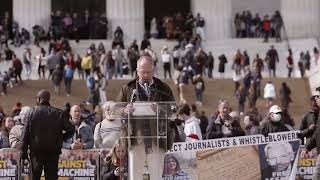



 After the Crash