Angelic Wars, Heart Openings and We the People

By rahkyt

Source: Sacred Space in Time

The awakening of the heart is not affecting us all the same way. Some people are lightening their psychological load, working through their issues, reconciling their pasts and choosing to be present in the Now in order to choose the best future.
Others are decidedly not doing that. For them, the heart is trying to open but they force it shut again, perhaps afraid of what is bubbling up to the surface. Traumas of childhood and life, hatreds and shames, dysfunctions sealed in by years of practice, thoughts acted out upon that should have been exorcised long ago.

But this is the way of things in the days of Light and Dark, when energies of such sublime potency inundate the earth, bringing us to our own personal encounters with angels and demons, gods and goddesses, the one God of All and his most beautiful angel Lucifer, the Light-bringer, too. Your orientation matters not, as dark and light as polarity manifest serve the deepest and highest Truth simultaneously. Names change over the span of the infinite and the eternal, but energy-types/archetypes do not. How we each choose is a function of who we are truly, not who we think we are.

Sometimes when you think your personality is who you are, you can make the mistake of choosing self-flagellation and suffer from martyr complexes, punishing yourself for sins imagined, not sins actualized. Human laws are not Divine laws in most instances although the original intent was to mirror heaven on earth, but we all see how that is working out.

The murderous and soulless serve the good as object lessons to the souled, every atrocity committed in darkness gives rise to the light in you, in me, can’t you feel it burning inside, when you read about the one who murders nine in a church, another today who murders eight after fighting with his ex, that one who killed two and injured another after hating two and the one who stopped another from killing hundreds, just because it was in his soul to hug a man, no matter the consequences.

The Light is born within as we see it without, you can feel it as a warmth, a vibration that rises from your core to permeate and encompass all of your very Being – from essence to ego – straining for release, in tears, in cries out to creation, to rising joy and righteousness as a quality of existence itself, bringing out the highest and most perfect Love, which is that Most High expression of multiversal consciousness encapsulated in form.

You.

Me.

We.

This world is perfect in its imperfection and nothing you and I do – or those others out there of each polarity and every shade of potentiality in between – is not known beyond the sphere of time and space that limits our perception of the Greater Good, whatever that might look like and mean beyond our limited conception of such infinite and eternal qualities.

Perhaps this is why believing is different from knowing, why data and information can often be a perceptive trap rather than an aid in our personal evolutionary schema. Garbage in, garbage out and the monkey mind ruminates endlessly observing the cascade of thoughts and processes beyond necessity, bordering closely upon the realms of obsessive compulsion and neurosis.

Once the heart opens, it cannot be stopped. For those who attempt it, perhaps they can quell it for a spell, clamp down with their will, shut out the dark corners of their minds and seek the sunshine of false cheer and the surface veneer of shiza and shinola. But it is a losing proposition. If not now, then later, the hurt and pain and agony and rage and despair will spill out indiscriminately, affecting all held dear, prized or cherished, depending upon the original state of inherent spiritual nature.

But for my soul peeps, my sista and brotha souls, those awakened who know they are here to combine in heart-born alliance to carry this planetary body into a new expression of potentiality, even if we do not live to see it, our job will be done, our purposes will become manifest. Our children will carry on. The light will live on, but for today, in the Now, each choice passes through the crucible of Divine fire that lives within us, each decision is pounded out on the crux, the core black hole/white hole singularity we call the heart, exuding energetic frequencies that birth the future through our own unique and fated expression.

The Fallen rise again, the Old Ones embody in form and nature, the cycle turned spiral tube torus-like in Fibonacci patterns of predestination and fate. The mind informs the practiced heart and what is prophesied becomes a fait accompli. Such is life in these wild, wild days. Feel the burn, process and accept the grief and the joy, stoking the fire within in preparation for the ascension of phoenix-like glory that is promised. The best future was chosen in the past and Now, we must live it.

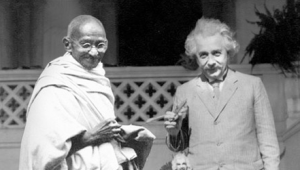
Why War? Building on the legacy of Einstein, Freud and Gandhi

By Robert J. Burrowes

In 1932, Sigmund Freud and Albert Einstein conducted a correspondence subsequently published under the title ‘Why War?’ See ‘Why War: Einstein and Freud’s Little-Known Correspondence on Violence, Peace, and Human Nature’. In many ways, this dialogue between two giants of the 20th century is symbolic of the effort made by many humans to understand that perplexing and incredibly damaging feature of human experience: the institution of war.

In a recent article, the founder of peace research, Professor Johan Galtung, reminded us of the legacy of Freud and Einstein in this regard and reflected on their dialogue, noting some shortcomings including their failure to ‘unpack conflict’. See ‘Freud-Einstein on Peace’.

Of course, Freud and Einstein weren’t the first to consider the question ‘Why War?’ and their dialogue was preceded by a long sequence of individuals and even some organizations, such as the Women’s International League for Peace and Freedom and War Resisters’ International, who sought to understand, prevent and/or halt particular wars, or even to understand and end the institution itself, as exemplified by the Kellogg-Briand Pact in 1928 outlawing war. Moreover, given the failure of earlier initiatives, many individuals and organizations since Freud and Einstein have set out to understand, prevent and/or halt wars and these efforts have taken divergent forms.

Notable among these, Mohandas K. Gandhi was concerned to develop a mode of action to deal with many manifestations of violence and he dramatically developed, and shared, an understanding of how to apply nonviolence, which he labeled satyagraha (holding firmly to the truth), in overcoming large-scale violence and exploitation. He successfully applied his strategic understanding of nonviolence to the Indian independence struggle against British colonial rule. But while Gandhi was happy to acknowledge his debt to those who had gone before, he was not shy in proclaiming the importance of finding new ways forward: ‘If we are to make progress, we must not repeat history but make new history. We must add to the inheritance left by our ancestors.’

My own journey to understand human violence was caused by the death of my two uncles, Bob and Tom, in World War II, ten years before I was born. My childhood in the 1950s and 1960s is dotted with memories of my uncles, stimulated through such events as attending memorial services at the Shrine of Remembrance where their war service was outlined. See ‘My Brothers’ on my father’s website.

But by the early 1960s, courtesy of newspaper articles and photos, I had become aware of exploitation and starvation in Africa and elsewhere, and as a young university student in the early 1970s I was reading literature about environmental destruction. It wasn’t just war that was problematic; violence took many other forms too.

‘Why are human beings violent?’ I kept asking. Because I thought that this question must have been answered somewhere, I kept reading, including the work of Freud and Karl Marx as an undergraduate, but also the thoughts of many other scholars, such as Frantz Fanon, as well as anarchists, feminists and those writing from other perspectives which offered explanations of violence, whether direct, structural or otherwise.

By the early 1980s I had started to read Gandhi and I had begun to understand nonviolence, as Gandhi practised and explained it, with a depth that seemed to elude the activists I knew and even the scholars in the field that I read.

Separately from this, I was starting to gain a sense that the human mind was not something that could be understood well by viewing it primarily as an organ of thinking and that much of the literature and certainly most of the practitioners in the field of psychology and related fields, especially psychiatry, had failed to understand the emotional depth and complexity of the human mind and the implications of this for dealing with conflict and violence. In this sense, it was clear to me, few had understood, let alone been able to develop, Freud’s legacy. This is because the fundamental problem is about feeling (and, in relation to violence, particularly suppressed fear and anger). Let me explain why.

Violence is something that is usually identified as physical: it involves actions like hitting, punching and using weapons such as a gun. This is one of the types of violence, and probably the one now most often lamented, that is inflicted on indigenous peoples, women and people of colour, among others.

Separately from this, Gandhi also identified exploitation as violence and Galtung elaborated this concept with his notion of ‘structural violence’. Other forms of violence have been identified and they take many forms such as financial violence, cultural violence and ecological violence. But violence can be more subtle than any of these and, hence, much less visible. I have given two of these forms of violence the labels ‘invisible violence’ and ‘utterly invisible violence’. Tragically, ‘invisible violence’ and ‘utterly invisible violence’ are inflicted on us mercilessly from the day we are born. And, as a result, we are all terrorized.

So what are ‘invisible’ and ‘utterly invisible’ violence?

In essence, ‘invisible’ violence is the ‘little things’ we do every day, partly because we are just ‘too busy’. For example, when we do not allow time to listen to, and value, a child’s thoughts and feelings, the child learns to not listen to themSelf thus destroying their internal communication system.

When we do not let a child say what they want (or ignore them when they do), the child develops communication and behavioural dysfunctionalities as they keep trying to meet their own needs (which, as a basic survival strategy, they are genetically programmed to do). When we blame, condemn, insult, mock, embarrass, shame, humiliate, taunt, goad, guilt-trip, deceive, lie to, bribe, blackmail, moralize with and/or judge a child, we both undermine their sense of Self-worth and teach them to blame, condemn, insult, mock, embarrass, shame, humiliate, taunt, goad, guilt-trip, deceive, lie, bribe, blackmail, moralize and/or judge.

The fundamental outcome of being bombarded throughout their childhood by this ‘invisible’ violence is that the child is utterly overwhelmed by feelings of fear, pain, anger and sadness (among many others). However, parents, teachers and other adults also actively interfere with the expression of these feelings and the behavioural responses that are naturally generated by them and it is this ‘utterly invisible’ violence that explains why the dysfunctional behavioural outcomes actually occur.

For example, by ignoring a child when they express their feelings, by comforting, reassuring or distracting a child when they express their feelings, by laughing at or ridiculing their feelings, by terrorizing a child into not expressing their feelings (e.g. by screaming at them when they cry or get angry), and/or by violently controlling a behaviour that is generated by their feelings (e.g. by hitting them, restraining them or locking them into a room), the child has no choice but to unconsciously suppress their awareness of these feelings.

However, once a child has been terrorized into suppressing their awareness of their feelings (rather than being allowed to have their feelings and to act on them) the child has also unconsciously suppressed their awareness of the reality that caused these feelings. This has many outcomes that are disastrous for the individual, for society and for nature because the individual will now easily suppress their awareness of the feelings that would tell them how to act most functionally in any given circumstance and they will progressively acquire a phenomenal variety of dysfunctional behaviours, including many that are violent towards themselves, others and/or the Earth.

Moreover, this emotional (or psychological) damage will lead to a unique combination of violent behaviours in each case. And some of these individuals will gravitate to working in one of the social roles that specifically requires, or justifies, the use of ‘legitimized violence’, such as the violence carried out by police, prosecuting lawyers, magistrates and judges, as well as that inflicted by the military. Others, of course, will operate outside the realm of legitimized violence and be labelled as ‘criminals’.

But, you might be wondering, what is the link between what happens in childhood and war?

The answer is simply that perpetrators of violence, and those who collaborate with them, are created during childhood. And these perpetrators and collaborators are all terrified, self-hating and powerless – for much greater detail of the precise psychological characteristics of perpetrators of violence and their collaborators, see ‘Why Violence?’  and ‘Fearless Psychology and Fearful Psychology: Principles and Practice’ – and they go on to perform all of the key roles in creating, maintaining, equipping, staffing and legitimizing the institutions of war and in conducting it.

If it weren’t for the violence to which we are all mercilessly subjected throughout childhood, there would be no interest in violence or war of any kind. If we were raised without violence, we would be naturally peaceful and cooperative, content to spend our time seeking to achieve our own unique evolutionary potential and to nurture the journey of others as well as life itself, rather than just become another cog in someone else’s military (or other bureaucratic or corporate) machine.

If any of the above resonates with you, then I invite you to make ‘My Promise to Children’.

In addition, if further reducing the violence in our world appeals to you, then you are also welcome to consider participating in ‘The Flame Tree Project to Save Life on Earth’,  signing the online pledge of ‘The People’s Charter to Create a Nonviolent World’ and/or considering using the strategic framework on one or the other of these two websites for your campaign to end violence or war in one context or another: Nonviolent Campaign Strategy and Nonviolent Defense/Liberation Strategy.

A child is not born to make war. But if you inflict enough violence on a child, and destroy their capacity to become their own unique and powerful self, they will be terrorised into perceiving violence and war as their society wants them to be perceived. And violence and war, and the institutions that maintain them, will flourish.

If we want to end war, we must halt the adult war against children as a priority.


Biodata: Robert J. Burrowes has a lifetime commitment to understanding
and ending human violence. He has done extensive research since 1966 in
an effort to understand why human beings are violent and has been a
nonviolent activist since 1981. He is the author of ‘Why Violence?
His email address is flametree@riseup.net
and his website is at http://robertjburrowes.wordpress.com


Robert J. Burrowes
P.O. Box 68
Daylesford
Victoria 3460
Australia
Email: flametree@riseup.net

Websites:
Nonviolence Charter
Flame Tree Project to Save Life on Earth
‘Why Violence?’
Nonviolent Campaign Strategy
Nonviolent Defense/Liberation Strategy
Anita: Songs of Nonviolence
Robert Burrowes
Global Nonviolence Network

Are We (Collectively) Depressed?

By Charles Hugh Smith

Source: Of Two Minds

We need to encourage honesty above optimism. Once we can speak honestly, there is a foundation for optimism.

Psychoanalysis teaches that one cause of depression is repressed anger.

The rising tide of collective anger is visible in many places: road rage, violent street clashes between groups seething for a fight, the destruction of friendships for holding the “incorrect” ideological views, and so on. I Think We Can Safely Say The American Culture War Has Been Taken As Far As It Can Go.

A coarsening of the entire social order is increasingly visible: The Age of Rudeness.

This raises a larger question: are we as a society becoming depressed as we repress our righteous anger and our sense of powerlessness as economic and social inequality rises?

Depression is a complex phenomenon, but it typically includes a loss of hope and vitality, absence of goals, the reinforcement of negative internal dialogs, and anhedonia, the loss of the joy of living (joie de vivre).

Depressive thoughts (and the emotions they generate) tend to be self-reinforcing, and this is why it’s so difficult to break out of depression once in its grip.

One part of the healing process is to expose the sources of anger that we are repressing. As psychiatrist Karen Horney explained in her 1950 masterwork, Neurosis and Human Growth: The Struggle Towards Self-Realization, anger at ourselves sometimes arises from our failure to live up to the many “shoulds” we’ve internalized, and the idealized track we’ve laid out for ourselves and our lives.

The recent article, The American Dream Is Killing Us does a good job of explaining how our failure to obtain the expected rewards of “doing all the right things” (getting a college degree, working hard, etc.) breeds resentment and despair.

Since we did the “right things,” the system “should” deliver the financial rewards and security we expected. This systemic failure to deliver the promised rewards is eroding social mobility and the social contract while generating frustration, anger, etc.

We are increasingly angry at the system, but we reserve some anger for ourselves, because the mass-media trumpets how well the economy is doing and how some people are doing extremely well. Naturally, we wonder, why them and not us? The failure is thus internalized.

One response to this sense that the system no longer works as advertised is to seek the relative comfort of echo chambers–places we can go to hear confirmation that this systemic stagnation is the opposing political party’s fault.

We don’t just self-sort ourselves into political “tribes” online–we congregate in increasingly segregated communities and states: The Simple Reason Why A Second American Civil War May Be Inevitable.

Americans are moving to communities that align more with their politics. Liberals are moving to liberal areas, and conservatives are moving to conservative communities. It’s been going on for decades. When Jimmy Carter was elected in 1976, 26.8% of Americans lived in landslide counties; that is counties where the president won or lost by 20% of the vote.

By 2004, 48.3% of the population lived in these counties. This trend continues to worsen. As Americans move to their preferred geographic bubbles, they face less exposure to opposing viewpoints, and their own opinions become more extreme. This trend is at the heart of why politics have become so polarizing in America.

We’re self-sorting at every level. Because of this, Americans are only going to grow more extreme in their beliefs, and see people on the other side of the political spectrum as more alien.”

Part of the American Exceptionalism we hear so much about is a can-do optimism: set your mind to it and everything is possible.

The failure to prosper as anticipated is generating a range of negative emotions that are “un-American”: complaining that you didn’t get a high-paying secure job despite having a college degree (or advanced degree) sounds like sour-grapes: the message is you didn’t work hard enough, you didn’t get the right diploma, etc.

It can’t be the system that’s failed, right? I discuss this in my book Why Our Status Quo Failed and Is Beyond Reform: the top 10% who are benefiting mightily dominate politics and the media, and their assumption is: the system is working great for me, so it must be working for everyone. That’s the implicit narrative parroted by status quo mouthpieces.

The inability to express our despair and anger generates depression. Some people will redouble their efforts, others will seek to lay the blame on “the other” (some external group) and others will give up. What few people will do is look at the sources of systemic injustice.

Perhaps we need a national dialog about declining expectations, rising inequality and the failure of the status quo that avoids the blame-game and the internalization trap (i.e. it’s your own fault you’re not well-off).

We need ways to express our resentment, anger, despair, etc. that are directed at the source, the complex system we inhabit, not “the other.” We need to encourage honesty above optimism. Once we can speak honestly, there is a foundation for optimism.


A Nonviolent Strategy to Defeat Genocide

Rohingya protesters gather in front of a United Nations regional office building to call for an end to the ongoing unrest and violence in Myanmar’s Rakhine State in Bangkok on June 11, 2012. AFP PHOTO/ Nicolas ASFOURI


By Robert J. Burrowes

It is a tragic measure of the depravity of human existence that genocide is a continuing and prevalent manifestation of violence in the international system, despite the effort following World War II to abolish it through negotiation, and then adoption and ratification of the 1948 ‘Genocide Convention‘.

According to the Genocide Convention, genocide is any act committed with the intent to destroy, in whole or in part, a national, ethnic, racial or religious group by killing members of the group, causing serious bodily or mental harm to members of the group, deliberately inflicting on the group conditions of life calculated to bring about its physical destruction in whole or in part, imposing measures intended to prevent births within the group and/or forcibly transferring children of the group to another group.

While this definition is contested because, for example, it excludes killing of political groups, and words such as ‘democide’ (the murder or intentionally reckless and depraved disregard for the life of any person or people by their government,) and ‘politicide’ (the murder of any person or people because of their political or ideological beliefs) have been suggested as complementary terms, in fact atrocities that have been characterized as ‘genocide’ by various authors include mass killings, mass deportations, politicides, democides, withholding of food and/or other necessities of life, death by deliberate exposure to invasive infectious disease agents or combinations of these. See ‘Genocides in history‘.

While genocide and attempts at genocide were prevalent enough both before World War II (just ask the world’s indigenous peoples) and then during World War II itself, which is why the issue attracted serious international attention in the war’s aftermath, it cannot be claimed that the outlawing of genocide did much to end the practice, as the record clearly demonstrates.

Moreover, given that the United Nations and national governments, out of supposed ‘deference’ to ‘state sovereignty’, have been notoriously unwilling and slow to meaningfully respond to genocides, as was the case in Rwanda in 1994 and has been the case with the Rohingya in Myanmar (Burma) for four decades – as carefully documented in ‘The Slow-Burning Genocide of Myanmar’s Rohingya‘ – there is little evidence to suggest that major actors in the international system have any significant commitment to ending the practice, either in individual cases or in general. For example, as official bodies of the world watch, solicit reports and debate whether or not the Rohingya are actually victims of genocide, this minority Muslim population clearly suffers from what many organizations and any decent human being have long labeled as such. For a sample of the vast literature on this subject, see ‘The 8 Stages of Genocide Against Burma’s Rohingya‘ and ‘Countdown to Annihilation: Genocide in Myanmar‘.

Of course, it is not difficult to understand institutional inaction. Despite its fine rhetoric and even legal provisions, the United Nations, acting in response to the political and corporate elites that control it, routinely fails to act to prevent or halt wars (despite a UN Charter and treaties, such as the Kellogg-Briand Pact, that empower and require it to do so), routinely fails to defend refugees, routinely fails to act decisively on issues (such as nuclear weapons and the climate catastrophe) that constitute global imperatives for human survival, and turns the other way when peoples under military occupation (such as those of Tibet, West Papua, Western Sahara and Palestine) seek their support.

Why then should those under genocidal assault expect supportive action from the UN or international community in general? The factors which drive these manifestations of violence serve a diverse range of geopolitical interests in each case, and are usually highly profitable into the bargain. What hope justice or even decency in such circumstances?

Moreover, the deep psychological imperatives that drive the phenomenal violence in the international system are readily nominated: in essence, phenomenal fear, self-hatred and powerlessness. These psychological characteristics, together with the others that drive the behaviour of perpetrators of violence, have been identified and explained – see ‘Why Violence?‘ and ‘Fearless Psychology and Fearful Psychology: Principles and Practice‘ – but it is the way these (unconsciously and deeply-suppressed) emotions are projected that is critical to understanding the violent (and insane) behavioural outcomes in our world. For brief explanations see, for example, ‘Understanding Self-Hatred in World Affairs‘ and ‘The Global Elite is Insane‘.

Given the deep psychological imperatives that drive the violence of global geopolitics and corporate exploitation (as well as national, subnational and individual acts of violence), we cannot expect a compassionate and effective institutional response to genocide in the prevailing institutional order, as the record demonstrates. So, is there anything a targeted population can do to resist a genocidal assault?

Fortunately, there is a great deal that a targeted population can do. The most effective response is to develop and implement a comprehensive nonviolent strategy to either prevent a genocidal assault in the first place or to halt it once it has begun. This is done most effectively by using a sound strategic framework that guides the comprehensive planning of the strategy. Obviously, there is no point designing a strategy that is incomplete or cannot be successful.

A sound strategic framework enables us to think and plan strategically so that once our strategy has been elaborated, it can be widely shared and clearly understood by everyone involved. It also means that nonviolent actions can then be implemented because they are known to have strategic utility and that precise utility is understood in advance.

There is little point taking action at random, especially if our opponent is powerful and committed (even if that ‘commitment’ is insane which, as briefly noted above, is invariably the case). There is a simple diagram presenting a 12-point strategic framework illustrated here in the form of the ‘Nonviolent Strategy Wheel‘.

In order to think strategically about nonviolently defending against a genocidal assault, a clearly defined political purpose is needed; that is, a simple summary statement of ‘what you want’. In general terms, this might be stated thus: To defend the [nominated group] against the genocidal assault and establish the conditions for the group to live in peace, free of violence and exploitation.

Once the political purpose has been defined, the two strategic aims (‘how you get what you want’) of the strategy acquire their meaning. These two strategic aims (which are always the same whatever the political purpose) are as follows: 1. To increase support for the struggle to defeat the genocidal assault by developing a network of groups who can assist you. 2. To alter the will and undermine the power of those groups inciting, facilitating, organizing and conducting the genocide.

While the two strategic aims are always the same, they are achieved via a series of intermediate strategic goals which are always specific to each struggle. I have identified a generalized set of 48 strategic goals that would be appropriate in the context of ending any genocide here. These strategic goals can be readily modified to the circumstances of each particular instance of genocide.

Many of these strategic goals would usually be tackled by action groups working in solidarity with the affected population campaigning in third-party countries. Of course, individual activist groups would usually accept responsibility for focusing their work on achieving just one or a few of the strategic goals (which is why any single campaign within the overall strategy is readily manageable).

As I hope is apparent, the two strategic aims are achieved via a series of intermediate strategic goals.

Not all of the strategic goals will need to be achieved for the strategy to be successful but each goal is focused in such a way that its achievement will functionally undermine the power of those conducting the genocide.

It is the responsibility of the struggle’s strategic leadership to ensure that each of the strategic goals, which should be identified and prioritized according to their precise understanding of the circumstances in the country where the genocide is occurring, is being addressed (or to prioritize if resource limitations require this).

I wish to emphasize that I have only briefly discussed two aspects of a comprehensive strategy for ending a genocide: its political purpose and its two strategic aims (with its many subsidiary strategic goals). For the strategy to be effective, all twelve components of the strategy should be planned (and then implemented). See Nonviolent Defense/Liberation Strategy.

This will require, for example, that tactics that will achieve the strategic goals must be carefully chosen and implemented bearing in mind the vital distinction between the political objective and strategic goal of any such tactic. See ‘The Political Objective and Strategic Goal of Nonviolent Actions‘.

It is not difficult to nonviolently defend a targeted population against genocide. Vitally, however, it requires a leadership that can develop a sound strategy so that people are mobilized and deployed effectively.


Biodata: Robert J. Burrowes has a lifetime commitment to understanding
and ending human violence. He has done extensive research since 1966 in
an effort to understand why human beings are violent and has been a
nonviolent activist since 1981. He is the author of ‘Why Violence?
His email address is flametree@riseup.net
and his website is at http://robertjburrowes.wordpress.com


Robert J. Burrowes
P.O. Box 68
Daylesford
Victoria 3460
Australia
Email: flametree@riseup.net

Websites:
Nonviolence Charter
Flame Tree Project to Save Life on Earth
‘Why Violence?’
Nonviolent Campaign Strategy
Nonviolent Defense/Liberation Strategy
Anita: Songs of Nonviolence
Robert Burrowes
Global Nonviolence Network

An Open Letter to People with ‘Mental Health’ Issues

Robert J. Burrowes

As ‘mental health’ issues gain more attention, sympathetic and
otherwise, in a wide variety of contexts and countries around the world,
the opportunity for inaccurate perceptions of what causes these issues,
and how to treat them, are likewise expanded.

So if you or someone you know is supposed to have a ‘mental illness’
such as anxiety, depression, schizophrenia, obsessive-compulsive
disorder (OCD), bipolar disorder, anorexia nervosa or post-traumatic
stress disorder (PTSD), I would like to give you the opportunity to
consider an explanation and a way forward that you are unlikely to have
come across.

My first suggestion is that you ignore any label that you have been
given. These labels are an inaccurate and unhelpful way of labeling the
appropriate, diverse and complex emotional responses that a normal human
being will have to emotionally disturbing events. It is inaccurate
because words such as these imply a ‘disorder’ that a normal individual
should not have in response to emotionally challenging events in their
life and it is unhelpful because the term suggests that many different
individuals are having the same (dysfunctional) response.

Human beings have a brilliantly diverse and complex array of emotions
and hence potential emotional responses as a result of the evolutionary
pressures that shaped the emergence of hominids over millions of years.
An extraordinary emotional capacity is one of the defining features of
our humanity and, I would argue, far more important than any other
feature such as our intellectual capacity.

Our emotions or, more simply, our feelings play the central role in
determining our behaviour in any given circumstance. Whatever we do, we
are responding to our feelings. If we are doing what we want to do, we
are doing what we feel like doing. If we are not doing what we feel like
doing, it is because our fear has been triggered sufficiently to
override feelings that would otherwise have us doing something more
functional and enjoyable. Regrettably, human ‘socialization’ (that is,
terrorization) plays heavily on our fear during childhood in order to
turn us into obedient slaves in the forms of student, worker/soldier and
citizen. And this happens irrespective of our level of intelligence. For
a full explanation, see ‘Why Violence?

Unfortunately, once our fear has been utilized to suppress our awareness
of how we genuinely feel and what we want to do – which is sometimes
euphemistically referred to as ’emotional regulation’ – we are no longer
able to access these feelings readily and we live our lives
unconsciously and powerlessly submitting to the will of those we fear
and the institutions they control. But the price for doing so is that
our lives are no longer our own.

As a unique individual who has experienced the ongoing violent trauma
virtually all of us experience during childhood you have found yourself
experiencing a level of emotional response that is very appropriate
given your experience but which is both exacerbated and complicated by
the sudden release of feelings that you had been suppressing since
childhood (and which you are probably being told are inappropriate now).

The fear you feel (probably labeled ‘anxiety’, ‘nervousness’ or
something else) in particular (and perhaps virtually all) contexts is
also triggering the monumental fear (of your parents, teachers,
religious figures and other adults) that you were scared into
suppressing as a child.

The anger you feel about how you were treated and/or what happened to
others (perhaps siblings) you know is merely the peak of the volcano of
anger that you have been keeping the lid on since childhood.

The sadness you feel about what has happened to you and perhaps others
you know is only the tip of the iceberg of sadness you have been
suppressing all of your life.

The guilt, shame, embarrassment… you feel, perhaps about those you let
down or for some other reason, is only the latest addition to the guilt
and other feelings you have been suppressing since childhood.

Do you think I am wrong? Then consider this. Were you ever allowed to
show your fear as a child (and to act on it)? Were you allowed to cry
freely and openly? Were you allowed to get angry (at being ‘done over’
or in defense of yourself)? As often as you needed? Or were you
endlessly admonished and, one way or another, terrorized into behaving
blandly (with ‘acceptable’ feelings like love and happiness tolerated in
particular doses and circumstances).

So if you want to deal powerfully with all of the emotional responses
that are causing your so-called ‘mental illness’, here is my suggestion.
Focus on feeling each and all of your feelings. If you wake from a
nightmare, deliberately and consciously focus on the imagery in the
nightmare while you feel just how terrified you are. Focus on this
feeling for as long as you can. It will be horrendous and will take
enormous courage. But, after a time, it will start to fade and you will
feel some relief. When your fear arises again, in any context, pay
conscious attention to it. You have been suppressing it all of your
life; it just wants to be heard and felt so that you can let it go
forever.

If you feel angry, instead of trying to suppress it, harming yourself or
harming someone else (perhaps, even, someone you love), express your
anger fully and completely but in a safe way. How? Here are some
suggestions but you will need to decide what will work best for you. Get
an axe and chop wood (thinking about utterly destroying who/what is
making you angry: parents, teachers, religious figures, politicians,
military officers…) until your anger has been vented. Or smash a bat or
racquet into a mattress or cushion. Or scream (into a pillow if noise is
an issue). Or punch a punching bag. If you feel angry you need to exert
enormous physical effort to adequately express it. This might require
several hours for any one session and you might need to do a great many
sessions. Remember, you need to work off a lifetime of anger! If you can
set up a safe space for your regular anger sessions, do so. Whatever you
do, however, don’t waste your time saying or writing ‘I feel angry…’.
And don’t waste a moment of your life in an ‘anger management’ course.
Anger, like all emotions, needs to be expressed, not ‘managed’ (that is,
suppressed).

Another reason why it is important that you express your anger as I have
just suggested is because you will often discover afterwards that you
are projecting your anger. Projection is another of the creative ways
that your mind can use to give you a lead back to some of your
suppressed feelings. Projection occurs, for example, when it feels like
you are angry with your spouse for something she/he has done but, once
you fully express the feelings, you realize that, in fact, while your
spouse did something that unintentionally triggered your anger, most of
the anger is actually about someone or something from your childhood.
You cannot discover the source of the projection without fully
expressing the feelings first. Many people who routinely abuse their
spouse and/or children are trapped in a projection which is why their
anger cannot lead to greater self-awareness. People often project their
fear and sadness too: phobias are the result of projected fear, for
example, while sad films enable some people to access their suppressed
sadness.

If you feel sad or anxious or ashamed or guilty or in pain or despairing
or obsessive or depressed or hopeless or compulsive or self-hating or
humiliated or anything else, just let yourself feel it, deeply. And let
it manifest in its own way: cry (if that is what happens when you feel
sad), shake (if that is what happens when you feel scared), feel guilty
or hopeless, feel horrible or …. Deliberately. Consciously. For as long
as it lasts or for as long as you are able to do at the time.

If you feel a sensation in your body, such as muscle tension or a pain
or a sense of contamination, focus on where you feel it and how it
feels. Eventually, after feeling the feelings from this sensation (which
might take very many sessions), you will discover why the sensation
originated and learn what it is trying to teach you.

If you feel suicidal it will often be because you are unconsciously
suppressing another shocking feeling that feels beyond your courage to
feel consciously, such as the feeling of self-hatred for something
shameful you have done, and suicide will seem the best way out. The
suicidal feeling might also arise out a sense of hopelessness or a
desire for release from enormous emotional and/or physical pain. Suicide
is an option that no-one should ever take from you, and I would never do
so, but I gently encourage you to focus on any suicidal feeling in the
belief that the underlying feeling – self-hatred, pain or something else
– will eventually be relieved and the urge to destroy yourself will pass
allowing you to keep traveling the journey of healing.

At this point, I should add that consciously focusing on feeling
physical pain (as a result of injuries or otherwise) is an important
element of any comprehensive healing strategy too.

As you have realized by now, this process of feeling isn’t necessarily
fun and my suggestion runs directly counter to our ‘feel good’ culture
which emphasizes ‘positive’ feelings while teaching you to suppress
‘negative’ ones. However, feeling your suppressed feelings will be,
ultimately, liberating and will progressively restore you to a life of
authenticity: a superior version of the life of dignity, honour and
courage that you once had (or should have had).

If new symptoms arise as you travel your healing journey and even if
these involve difficult feelings, it will usually be a sign that you are
making solid progress in uncovering the original sources of your
emotional ‘ill-health’. These symptoms, if any, simply provide another
opportunity for you to focus on how you feel. Take advantage of them
until they fade so that you learn what they are teaching you.

Another suggestion I have is to alter your diet to the consumption of
organically-grown, vegetarian whole (unprocessed) food so that your
brain gets the nutrition it needs to heal and function well. This also
means that you should discontinue using any drugs that are supposed to
suppress your awareness of your anxiety, depression, OCD, PTSD…
particularly given that psychiatric drugs might generate new symptoms,
worsen your existing symptoms and/or even cause brain damage. If you are
addicted (whether to psychiatric drugs, alcohol or illicit drugs), you
might consider consulting a natural health practitioner (such as a
homeopath or naturopath) who is familiar with assisting people to
withdraw from drugs and to detoxify their bodies, or consider buying the
Charlotte Gerson book ‘Healing the Gerson Way: Defeating Cancer and
other Chronic Diseases’ so that you can undertake Gerson Therapy at home to eliminate all of your physical drug addictions. Alternatively, you might consult the ‘Mad in America‘ website for other methods on how to safely and easily break your addictions.

In addition, I strongly encourage you to discontinue seeing all of those
psychiatrists, psychologists, psychotherapists, counsellors and doctors
(unless they qualify as specified below) who are more terrified of the
natural expression of your feelings than are you (and probably only
offer time-limited sessions). See ‘Defeating the Violence of
Psychiatry‘. You need to feel all of your feelings which have been an appropriate emotional
response to the terror of your childhood. It is feeling our feelings
that allows us to move on from violence and trauma to lead a meaningful
life. Evolution is not stupid even if many of its human products have,
indeed, been stupefied.

If you are lucky enough to know someone (relative, friend or
professional) who feels capable of listening to you while you talk about
violent/traumatic experiences (and thus enable your feelings to surface
more readily) and you trust them to do so, I encourage you to take
advantage of the listening. Ideally, this should happen on a daily basis
with each session lasting for as long as you need it.

Talk about your experiences (or don’t talk if you find this difficult)
but spend time focusing on how you feel about these experiences. Choose
an unpleasant memory from your past and focus on the feelings – sadness,
fear, anger, shame, guilt… – that arise as you talk and then think about
that memory. Keep replaying the memory as often as it feels productive
to do so, until the feelings attached to that memory have all been
felt/expressed and the memory is no longer difficult to contemplate. If
the feelings attached to a particular memory feel too horrible for you
to feel now, choose a memory with feelings that feel manageable and
tackle them first. The more horrible memories will wait until you feel
capable of feeling them because the courage you need to feel your worst
fears will gradually accumulate.

The listener should listen in silence (even if you are not speaking)
and, if capable of doing so, occasionally reflect any of your feelings
they can hear ‘beneath’ the words you are speaking; for example, ‘You
sound scared of your mother/father’ or ‘You sound angry that your
teacher forced you to do something against your will’. If the reflection
is accurate, keep focusing on how you feel by imagining what is bringing
up the feeling. If you feel like crying, then cry. If you need to get
angry, do so in the way that works for you (as mentioned above). And so
on. You are the only one who can interpret your feelings, nightmares,
dreams and other emotional experiences and you should ask any listener
to let you do so. Discourage any listener from reassuring or advising
you; deal with the reality of how you feel, finally, and discover your
own way forward. For more detail, see ‘Nisteling: The Art of Deep
Listening‘.

If you don’t know anyone who can listen without being triggered into
feelings of their own (because they are scared by what happened to
you/them) then you are better off listening to yourself. That means
having regular sessions, preferably on a daily basis, in a safe space
you have created when you allow yourself to deliberately focus on
traumatic experiences and to feel each and all of the feelings,
sometimes in combination, that arise when you do. It will sometimes mean
that you need to abandon what you are doing because something triggers a
sudden rush of feelings that demand your attention immediately. Not very
convenient I know, but neither were your traumatic experiences as a
child.

If you want more information about the process I have described above,
see Anita McKone ‘Fearless Psychology and Fearful Psychology: Principles
and Practice‘.

How long will it take? For many of you it will take a very long time,
perhaps several years of regular sessions. I would like to tell you
otherwise but you have been lied to far too often already – there are no
quick fixes to the emotional trauma you are suffering – and I won’t
insult you by doing so again. Having said ‘it will take a very long
time’, I will add that every individual has a unique healing journey
and, whatever the difficult feelings involved, each session of feeling
is a session of healing – which might reveal an important insight about
your life – and will take you one step closer to gaining a life free of
mental ill-health and full of emotional power.

In essence, it is vastly superior strategy to provide yourself with a
safe space in which your feelings can arise naturally so that you can
feel and express them, safely and completely, rather than endlessly try
to suppress them (but have them manifest ‘out of control’ anyway).

If you have a spouse or child who has been traumatized by your
behaviour, the information in this article is equally valid for them
too. In fact, it is useful information for any person because,
tragically, we were all terrorized during childhood.

Obviously, I haven’t dealt with every issue – like ‘How do I recover
from my emotional devastation when I need to work?’ or ‘How do I recover
emotionally if I have difficult physical injuries too?’ – so I am going
to have to trust you to work out answers to any unanswered questions. I
am just explaining how you can emotionally restore yourself.

Finally, if your life experience generally leaves you inclined to
believe that humans can do better than inflict mass violence on each
other in attempts to ‘resolve’ their conflicts, then you might consider
signing online ‘The People’s Charter to Create a Nonviolent World‘.

In conclusion, I want to summarize your options, which are the options
open to any human. You stand at the fork of two paths. The first path is
the one that takes you further along the journey that you are traveling,
offering you more of what you have now.

The second path, outlined above, offers you a long journey of difficult,
frightening and painful emotional healing – with regular periods of
relief and rewarding insights about your life – which will, if traveled,
lead you to a vastly superior version of your old life.

The third path, which will only open to you once you have traveled the
second path for a considerable time, will provide an encounter with ever
deeper layers of suppressed fear, sadness, pain, anger, shame, guilt,
anxiety, dread, humiliation, self-hatred … terror, fury … until its end
many years later (although your capacity to cope with such horror will
be steadily growing all of the time). At the end of this third path,
should you choose to travel it and once your final layer of suppressed
terror has been felt, you will become the person that evolution intended
you to be on the day you were born.


Biodata: Robert J. Burrowes has a lifetime commitment to understanding
and ending human violence. He has done extensive research since 1966 in
an effort to understand why human beings are violent and has been a
nonviolent activist since 1981. He is the author of ‘Why Violence?
His email address is flametree@riseup.net
and his website is at http://robertjburrowes.wordpress.com


Robert J. Burrowes
P.O. Box 68
Daylesford
Victoria 3460
Australia
Email: flametree@riseup.net

Websites:
Nonviolence Charter
Flame Tree Project to Save Life on Earth
‘Why Violence?’
Nonviolent Campaign Strategy
Nonviolent Defense/Liberation Strategy
Anita: Songs of Nonviolence
Robert Burrowes
Global Nonviolence Network

Truth or Delusion?

By Robert J. Burrowes

One inevitable outcome of the phenomenal violence we all suffer as
children is that most of us live in a state of delusion throughout our
lives. This makes it extraordinarily difficult for accurate information,
including vital information about the endangered state of our world and
how to respond appropriately, to penetrate the typical human mind.

‘Phenomenal violence?’ you might ask. ‘All of us?’ you wonder. Yes,
although, tragically, most of this violence goes unrecognised because it
is not usually identified as such. For most people, it is a
straightforward task to identify the ‘visible’ violence that they have
suffered and, perhaps, still suffer. However, virtually no-one is able
to identify the profoundly more damaging impact of the ‘invisible’ and
‘utterly invisible’ violence that is inflicted on us mercilessly from
the day we are born.

So what is this ‘invisible’ and ‘utterly invisible’ violence?

‘Invisible’ violence is the ‘little things’ that adults do to children
every day, partly because they are just ‘too busy’. For example, when
adults do not allow time to listen to, and value, a child’s thoughts and
feelings, the child learns to not listen to themSelf thus destroying
their internal communication system. When adults do not let a child say
what they want (or ignore them when they do), the child develops
communication and behavioural dysfunctionalities as they keep trying to
meet their own needs (which, as a basic survival strategy, they are
genetically programmed to do).

When adults blame, condemn, insult, mock, embarrass, shame, humiliate,
taunt, goad, guilt-trip, deceive, lie to, bribe, blackmail, moralize
with and/or judge a child, they both undermine their sense of Self-worth
and teach them to blame, condemn, insult, mock, embarrass, shame,
humiliate, taunt, goad, guilt-trip, deceive, lie, bribe, blackmail,
moralize and/or judge.

The fundamental outcome of being bombarded throughout their childhood by
this ‘invisible’ violence is that the child is utterly overwhelmed by
feelings of fear, pain, anger and sadness (among many others). However,
parents, teachers, religious figures and other adults also actively
interfere with the expression of these feelings and the behavioural
responses that are naturally generated by them and it is this ‘utterly
invisible’ violence that explains why the dysfunctional behavioural
outcomes actually occur.

For example, by ignoring a child when they express their feelings, by
comforting, reassuring or distracting a child when they express their
feelings, by laughing at or ridiculing their feelings, by terrorizing a
child into not expressing their feelings (e.g. by screaming at them when
they cry or get angry), and/or by violently controlling a behaviour that
is generated by their feelings (e.g. by hitting them, restraining them
or locking them into a room), the child has no choice but to
unconsciously suppress their awareness of these feelings.

However, once a child has been terrorized into suppressing their
awareness of their feelings (rather than being allowed to have their
feelings and to act on them) the child has also unconsciously suppressed
their awareness of the reality that caused these feelings. In brief,
this means that the child now lives in a state of delusion. And because
this state was caused by terrorizing the child, the child is unable to
perceive the series of delusions in which they now live.

Moreover, unless the child (or, later, adult) consciously feels their
fear and terror, it will be extraordinarily difficult for them to
perceive anything beyond the delusions that they acquired during
childhood. This is simply because the various elements of the child’s
delusional state (the ‘values’, beliefs, attitudes, prejudices, biases)
were the ones approved by the key adults – parents, teachers, religious
figures – in the child’s life.

Needless to say, living in a delusional state has many outcomes that are
disastrous for the individual, for society and for nature because the
individual will now behave on the basis of their delusions rather than
in response to an accurate assessment of all available information
through appropriate sensory, emotional, intellectual and conscientious
scrutiny. For a full explanation of this process, see ‘Why Violence?‘ and ‘Fearless Psychology and Fearful Psychology: Principles and Practice‘.

In essence then, the typical human being lives in a delusional state and
this state is held in place by enormous, but unconscious, terror: the
unfelt and hence unreleased childhood terror of being endlessly
threatened and punished (for not complying with parental or other adult
‘authority’ throughout childhood).

And if you have ever tried to persuade someone, by argument of an
intellectual nature, that a belief they hold is inaccurate and wondered
why you couldn’t get anywhere, it is because you have run into their
unconscious terror. And sheer terror beats the best argument in the
world ‘hands down’.

So when you listen to people like Donald Trump and Marine Le Pen, or
ponder those politicians and military generals who conduct endless wars,
or watch those people on the street protesting against Muslims and
refugees, or watch police beating up another indigenous or black person,
or hear someone else deny the climate science, remember that you are
witness to a person or people living in a terrified and delusional state
that prevents them from perceiving and responding intelligently to
reality. And that, in the case of political and corporate leaders, they
only have the support to do what they do because a great many other
delusional individuals (including voters and employees) enable them.

Equally importantly, however, it is also necessary to recognise that a
delusional state afflicts many of those we like to regard as ‘on our
side’. It is just that their delusions work differently, perhaps, for
example, by making them believe that only token ‘make it up as you go
along’ responses (rather than comprehensive strategies) are necessary if
we are to work our way out of the multifaceted crisis in which human
society now finds itself. This is why many ‘leaders’ of liberation
struggles as well as activist movements concerned with ending war(s) and
the climate catastrophe, for example, are so unable to articulate
appropriately visionary and functional strategies. But the problem
afflicts many other ‘progressive’ social movements as well, which limp
along making only occasional or marginal impact, if they have any impact
at all.

So what are we to do? Well, the most important thing you can do is to
never consciously participate in a delusion, whether your own or that of
anyone else. I say ‘consciously’ of course because unless you identify
the delusion, you will not be able to avoid participating in it. And
there are probably few humans in history who have avoided all of the
delusions their culture threw at them. If they did, they were probably
outcast or killed. Christ, Gandhi and King are reasonably good examples
of people in this latter category. But, historically speaking, many
activists have been killed for refusing to participate in elite-promoted
delusions. And many others have been marginalised, one way or another,
depending on the culture.

The value of not participating in a delusion, whether someone’s personal
delusion or a widespread social one, arises from the impact you have on
those around you: some of these people will have the courage to reflect
on your behaviour and reconsider their own.

If you believe you are relatively free of delusion and are committed to
taking serious steps to tackle one or more aspects of our multifaceted
global crisis, then you are welcome to consider making ‘My Promise to
Children‘,  and to consider participating in ‘The Flame Tree Project to Save Life on
Earth‘, signing the online pledge of ‘The People’s Charter to Create a Nonviolent World
and/or considering using the strategic framework on one or the other of these two websites for your campaign or liberation struggle: Nonviolent Campaign Strategy
and Nonviolent Defense/Liberation Strategy.

Living the truth on a daily basis is a tough road. And it will never
come without cost. But living in the comfort of delusion, rather than
taking action, is the path of cowards.


Biodata: Robert J. Burrowes has a lifetime commitment to understanding and ending human violence. He has done extensive research since 1966 in an effort to understand why human beings are violent and has been a nonviolent activist since 1981. He is the author of ‘Why Violence?‘ His email address is flametree@riseup.net and his website is at http://robertjburrowes.wordpress.com


Robert J. Burrowes
P.O. Box 68
Daylesford
Victoria 3460
Australia
Email: flametree@riseup.net

Websites:
Nonviolence Charter
Flame Tree Project to Save Life on Earth
‘Why Violence?’
Nonviolent Campaign Strategy
Nonviolent Defense/Liberation Strategy
Anita: Songs of Nonviolence
Robert Burrowes
Global Nonviolence Network

10 Life Lessons I Learned as a Psychiatric Nurse – and Patient

By Cortland Pfeffer

Source: Wake Up World

Over the past 25 years, I have been immersed in the mental health and addiction system as a patient, later as staff, as a Registered Nurse (RN), and eventually as a supervisor. My time in the mental health system officially began at age 17 when I was first hospitalized in a psychiatric unit. This preceded further hospitalizations, a number of treatment episodes for alcoholism/addiction, along with multiple stints of incarceration in jails. Eventually, through this experience, I was able to embrace recovery and ultimately gain employment at some of these same facilities in which I was treated.

Often I am asked about how I went from being a psychiatric patient and homeless drug addict to being a registered nurse and a supervisor at some of these facilities. While there is no magical answer to that question, there certainly have been some valuable life lessons learned along the way. These are 10 of the life lessons I have learned over time, which allowed me to continue on this journey.

1. If you are naturally different than the majority, you will be labeled.

It is our nature to want to try to fit in with the tribe. It can be lonely when you feel like you are different from other people. When you are not like the majority, others will notice this and try to get you to fit in to this box of normality. But defining “normal” is an impossible task. It is defined as conforming to a standard. However, this standard changes with different cultures and time periods. What was once normal, is now insane. Today we clearly live in an insane society – one in which we favor materialism over that of our fellow man; one in which there is more public uproar over a sporting event than the humanitarian crisis in Aleppo. To be “normal” in this type of society would actually make one insane. Yet, when you don’t follow the mold of a brainwashed culture you get labeled as different.

This can be quite destructive as Erich Fromm points out in his 1941 book “Escape from Freedom” as he highlights how people are drawn to authority as it is safer to go along with the pack than to think independently.

We go along with the societal norms for harmony, acceptance, and belonging – which are also innate human desires. Each human has a desire to feel a sense of community and purpose. However, when we go along with the group – even when it is violates our personal beliefs just for acceptance – it causes us to believe that something is wrong with us for thinking differently.

Solomon Asch tested human’s conformity in an experiment in 1951. Over the 12 critical trials approximately 75% of participants conformed at least once; and 25% of participants never conformed. In the control condition, the participants were asked to write down the correct match between the lines without sharing their answers with the group. The results showed that the participants were very accurate, giving the correct answers 98-percent of the time. This is one of many studies that show most people will go along with a crowd, even if it is not what they believe. So what happens if the tribe has decided that there is something “wrong” with you? Science will show that most of us will go along with that.

However this is a mistake. Take a look at the bell curve, which is used to show “normality distribution.” The bell curve is used in many areas of life and can be used here. In many bell curves, you see that 95-percent are within two deviations from the mean, or average. On the very end you will always see 5-percent of people. They are at the extreme end and do not fall inside the box of “normal.” It doesn’t make you bad to be outside the norm, and it also doesn’t make you crazy or sick. In fact, I would argue that those on the extreme ends are the ones that have changed the world.

For example, Mahatma Gandhi did not fit inside that box. The “norm” of his time was to accept the British imperialism in his home country of India. He saw the injustices and spent his life trying to free his people from oppression. He was imprisoned and survived many assassination attempts (although one finally killed him). Likewise, Martin Luther King Jr. also saw the injustices of African-Americans were facing in the United States and stood up to the oppression. They both went against the norms, were labeled, judged, and eventually lost their lives for speaking against the status quo. They both ended up dead, but years later we realized they were speaking the truth against an insane society.

Other people’s labels of you are just that — other people’s labels. It is out of fear and ignorance. Do not adapt to other people’s expectations. The world needs people of all sorts. We need diversity.

If you closely take a look at the criteria for someone who is gifted versus someone who has ADHD, Bipolar, Aspergers, and many other mental health diagnosis you will see that they are almost identical. So whether you are called bipolar or gifted doesn’t depend on you, but rather on the so-called expert assessing your life. It is all about perception and none of it matters. All that matters is that you are your most authentic and true version of yourself.

2. We as a society create mental health and addiction.

There have been numerous studies that have exposed the fact that trauma as a child leads to neural chemistry changes in your brain. Childhood trauma has been called the smoking of mental health. The same way smoking can cause or invoke many physical diseases, childhood trauma and maltreatment does the equivalent for mental health and addiction.

There are higher relapse rates for hypertension and heart disease than there are for addiction and mental health. However, we often treat the addict like they are a bad person or making bad choices. So we are taking someone who has been traumatized and often did not receive treatment for their trauma and we punish them by locking them up. This creates more shame, exasperating the trauma and causing the cycle to repeat itself. Additionally, the patient is not going to be readily willing to seek help in the first place due to the aforementioned shame.

What if we had a cancer drug that works 10-percent of the time and made people sicker? We would throw the drug away! However if a treatment center has a 10-percent success rate for addiction or mental health they’re considered successful. What other business could be 10-percent successful and would continue to exist?

The addiction and mental health industry continue to grow, despite this complete lack of success. There are extremely high rates of recidivism in these fields. Speaking from personal experience, more often than not the patients get sicker while in treatment.

The staff then blames this lack of success on the patient. They point fingers and say that the patient “was not ready” or that they have “poor insight.” The site that failed to provide adequate treatment blames the victim and takes no responsibility for their failure.

This system only continues because too many people are making too much money off keeping people sick. The staff tends to be undertrained, under-qualified, and lack any meaningful or diverse life experience. They are trained to believe that their patients are bad people that are making bad choices instead of a sick person who has been traumatized. This obviously results in receiving much different treatment.

Now there are some absolutely wonderful people in this field. That is a fact. However, in general there is an overall lack of humanity and compassion in the way this population has been treated. We are the most incarcerating society in the history of mankind and most of these prisoners are there for harmless drug offenses.  Due to this influx of incarcerations, we have created for-profit prisons which rely on mass incarcerations for profit. They set up contracts with governments to guarantee high occupancy rates and spend millions of dollars lobbying to congress to make tougher prison laws to ensure they stay profitable. In turn, members of congress then hold stock in these private prisons – meaning that the people that make the laws are making money off the laws they sign into action.

We are locking up people who have a disease to profit the rich. Punishment does not work for this disease – it never has and it never will. If it did work, we would not have a this astronomical recidivism rate in jails for drug offenses.

3. Be true to who you are.

We run from who we truly are because we are told to by our environment. We are told that it is not okay to be our true self from the time we are young and we begin to believe it to be true. We spend our whole lives living for other people and living based on other people’s expectations. We eventually lose ourselves and create a false persona (or false self) – This is what I refer to as “The Mask”.

The longer we wear the mask, the more we forget who we are underneath. We start to think that we are our masks – the character that we present to the world for acceptance. As this continues, we grow to dislike our mask because it is not our true self. This leads to depression, self-hate, or even suicidal ideation. We think we hate ourselves, but in reality we hate this false self that we have created. When we go against our own nature, it will always create depression.

If you have forgotten who you are, it’s easy to remember. You know the truth by how you feel. If you want to remember what that feeling is like, simply go do something that is pure, genuine, and has good intentions and see how that feels. If you can do something for somebody that can never repay you, you will remember this feeling – that is the feeling you are seeking.

Some of us may not even know who we really are because we’ve been wearing this mask for so long. In that case you get to explore and try new things. You get to discover who you truly are and what makes your soul feel alive. This can be viewed as an obstacle or an opportunity. You can now try everything – writing, dancing, singing, etc. – try anything you desire and you will find your true self in the process.

You will find out who you were, before the world told you who you were supposed to be.

This concept can be frightening, especially if we have become too accustomed to the mask. Some will do anything and everything to put the mask back on for safety, security, and possibly they are benefiting from pretending to be their false self. Although, in the long run it will create more inner dissent.

The world needs you to be you. Your true self fits into the world exactly how it should. When we go against this, we are robbing humanity of the gifts our true selves possess. Albert Einstein said, “great spirits have always encountered violent opposition from mediocre minds.”

It can be scary to finally be yourself. You will likely start feeling rejected and you will lose some people. But those are the people that you want to lose. You will also gain people in your lives – the ones that love the true you and not the false you.

This is a change that is painful and it causes most people to go back into their false self (ore put their mask back on). However, this is an essential struggle that you will encounter on your way. It will turn your world upside down and your relationships will change.  But as the old saying goes, “it is better to be hated for who you are than to be loved for who you are not.”

You are only doing a smidgen of what you are capable of doing by being your true self. You have no idea what you’re capable of until you embrace who you are and you will be blown away by the results.

4. Fear destroys us; and makes others money.

When we are not ourselves, then our lives are being lived and based on fear. When we are always afraid, it is from remembering pain or trauma. Just like any animal, when we are afraid we will hide. We live in a society in which many people benefit of us being afraid.

We are evolutionarily programmed to remember the negative experiences at a much higher rate, more clearly and more intensely, than positive experiences.

Many businesses profit off of our fear. The news gets higher ratings when they show fights, violence, and all the things that are wrong with the world. So that is what they show and that is what we see. They are not showing a true representation of the world, but a sample size that spreads fear and increases ratings. This is paid for by commercial advertisements that spend millions of dollars by spreading fear into your mind in an effort to buy their product. They will tell you might get bitten by a snake, so you need to buy a fence to keep the snakes out. They tell you to buy material items to fit into society or you will be left out and not included. When the fear does not go away, we continue to consume more. And it never goes away until we realize that we are being played.

“If tomorrow, women woke up and decided they really liked their bodies, just think how many industries would go out of business?” – Dr. Gail Dines

Our insane society has created these masks and then they profit off these masks they created. Then you are labeled as insane if you don’t want to wear your mask anymore. Because when we take off our masks, they lose business.

What goes into your brain will affect your subconscious mind. If you feed it with fear, it will seek fear. If you feed it with love, it will find love. The opposite of living in fear is living with love. Love is the antidote to fear.

When you live with love, you will be faced resistance from those still guided by fear. But remember, in the end, throughout history, every single time love always wins. There may be a time it seems this is not true. But it becomes a crucial point in your recovery when you decide to choose love over fear if you are going to succeed. Every person going through a true recovery will come to this stage and it is scary, it is lonely, and it is supposed to be. It takes immense strength to love when everything inside of you tells you to run away. Once you make it through this stage, you have reached a turning point and the mask begins to crumble.

5. Love, acceptance, and truly listening is far more powerful than any advice you can ever give someone.

We have all seen someone struggling and we want to fix it. Usually we want to fix it the way we would fix it for ourselves if we were in the same struggle. We tend to go in and tell people how to change. Although well-intentioned, when we do this, we begin to lose them. Everyone is different, and every recovery is different. Every mask is unique, and therefore every mask removal must be unique.

Relationships are the single most important thing to someone going through a recovery. You can have the cure for them, but if they do not trust you, they will not hear it. They do not care how much you know, until they know how much you care.

Accepting people for who they are and where they are at in their life will go further than any piece of advice you can ever give them. Giving someone love and a hug when everybody else is kicking them is what I call “psychological life support.”

I had two people that did this for me and they saved my life. Not those who criticized me and tried to force me into treatment. It was those who offered unconditional love and acceptance who kept me alive. Unconditional, meaning without conditions/judgments, but just loving them and accepting them in their entirety with no desire to change or point out their flaws. When I was ready to change, I went to the same people because I had gained their trust.

Relationships come first. If you cannot build a relationship, a trusting relationship, then you will only do damage. I believe many staff in this field are well-intentioned, however they make these problems much worse and the patients get much sicker simply because there is a lack of acceptance, love, and an overabundance of advice giving and fixing.

Trust me, if there was an easy-fix, the person would have already done so. In rushing to fix a person, you are sending the message that they are incompetent and could not think of this on their own. A broken person doesn’t need to be fixed, they need to be loved, then they are able to heal themselves.

When I say listening, I mean being present completely with that person. This means not checking your phone, not looking at the clock, and not even thinking about anything else. This is referred to as active listening. The ten people I think are the best in this field all do this. They make the person they are with feel like they are the most important person on earth in that moment. When the person can feel heard, the magic begins.

6. Embrace your struggles, they are gifts.

When I see a patient walking around a treatment center saying “everything is fine,” “everything is ok,” or “I’m doing great,” this becomes a giant red flag. You should be struggling. Muscles do not grow without struggle and the same goes for our soul.

Since we were young, we were trained to believe that admitting to a struggle is a sign of weakness, but in fact it is a great strength. We are all going through a struggle. We should be working on the thing that is the most difficult for us for optimum growth. The thing that you are most scared to do is probably the thing that is most essential to your recovery.

If you are in pain, if you are crying, if you are scared, then you are growing. If you are questioning why you are there, or why you are going through this, or questioning your own sanity, then you are growing. If you are angry, if you are tense, if you are isolating, then you are growing.

If there is no struggle, there is no growth. If there is no growth, there is no recovery.

Everything in my life in which I thought would be my demise, ended up being the very best things in the long run. We see a small portion of the big picture and act like that’s the reality, when it’s not. We must trust the process and trust in the bigger picture. Without the illusion, there would be no enlightenment.

There will come a time that you will think this is not worth it and feel like giving up. This means you are getting close to breaking through. We usually give up right before the miracle happens.

There is not one magical moment where you reach some mountaintop. It usually takes two steps forward, followed by one step back. It is a continuous, non-linear process. It is like a newborn baby deer trying to learn to walk. Their feet are wobbly and they fall down often. Falling down is not the issue, it is the learning process that makes you stronger and not having shame about the fall. It is about being around people that do not judge the fall.

The only way through the pain you have is to deal with it. There are many things we have hidden inside ourselves through the years because of fear and using the mask. Sometimes it may be for years, or decades, but all things eventually rise to the surface and all your pain is revealed. But that is the only way that it can be healed is for it to come to the surface. It cannot be healed when it is buried.

Let the storm come. After the storm comes the rainbow.

“Life isn’t about waiting for the storm to pass; it’s learning to dance in the rain.” – Vivian Greene

7. Our subconscious is what drives us.

We have two parts of our mind – the conscious and the subconscious. The conscious is all of which we are aware. The subconscious is the part that we are not aware, but all the millions of things we process daily and store away.

Our brain cannot tell if what is in our subconscious is true or not. It takes everything in as fact. It is like a hard drive that receives commands and stores everything as fact. It is built by other people and society – parents, siblings, teachers, television, pop culture, advertisements, etc. If we grow up being told that we are “bad,” our subconscious processes it to be true.

Everything is a perception and not reality. However, as different things start to play out in our conscious mind, then the subconscious files come to the surface to back it up as “evidence.” This creates stronger files in our subconscious mind. These files in our subconscious mind are what drives us; not what we are consciously aware.

As young children and even as adolescents, our brains are flooded with gray matter. This is the part of our brain that can be molded and create the person we are to become. This is what shapes the subconscious mind which will determine what drives us for a lifetime. If someone is told they are bad, lazy, incompetent, then they will be driven by this. If someone deals with pain, torture, trauma, and abandonment, they will be drive by this as well.

The good news is we can change the subconscious mind by implanting new messages. It is flexible, but it takes time, practice and patience.

Additionally, some of us will be more affected than others by these messages. Some people are naturally more sensitive, more prone to trauma,  and more prone to take things too personally.

We are all born with an innate temperament that lasts our entire lives. That would be like if a couple people were eating a pizza. One person takes a bite and it tastes lukewarm to them; but the other person burns their mouth and complains as to how hot it is. The others would not believe it to be true.  However when it comes to emotions, we can’t see anything, the scars or burns are invisible. So we are told that it is not real and our emotions are crazy, in which we believe to be true. This only further pushes our true selves down and creates more negative self-talk which creates files in the subconscious.

This leads to the most sensitive, warm, kind people in our society being invalidated and told they are “babies” for feeling and caring more than most. We tell them that they are not right when inside they are going through a trauma.

But if a young boy acts out in anger instead of crying, that is more acceptable in our society. That is one form of a mask that is created and is prevalent among young men. Then with this mask, and all masks, comes depression from not being your true self from going against nature.

That’s the inner voice, it is the subconscious.  It is strong but it may not even be true. The only way to combat this is to start telling yourself positive things (affirmations), surround yourself with positivity, changing your perceptions of the world (cognitive behavioral therapy), focus on the positive things in life (gratitude). This starts to build more positive files in your subconscious which drives you out of despair and into a positive direction.

We all are born pure, and with nothing but love in our hearts. This is often taken from some of us by a combination of temperament, environment, society, and trauma. We eventually believe that we are not good at our core. But we are. We can change our subconscious by what goes into our brain daily. This takes persistence and daily practice, and it is hard when we are used to thinking negatively about ourselves. However, this out of everything is probably the key to sustained long-term recovery- dealing with that inner voice and changing our thoughts.  It will seem foreign at first to say “I’m a good person.” If you are going to make it, you have to start doing on a daily basis. You can replace those files just like your body replaces every cell in the body every seven years. Soon those old files will be gone and the new positive files will be your subconscious.

8. Who you surround yourself with is one of the most important decisions you will make.

I have heard many wise people say that we are the average of the five people we spend the most time with. As I said above, that directly affects our subconscious and what we think of ourselves.

I remember years ago my oldest daughter enrolled in a private school. Everyone in the school was Catholic and she came home and believed in her inner core that the entire world was Catholic. She cried about it at night that she was different because she did not go up to get the fake bread at their ceremonies. Similarly, if you are around five people that smoke pot and you do not smoke pot, then you are the weirdo for not smoking pot. However, if you are with five people that do not smoke pot and you do, then you are considered strange for smoking pot.

At the end of the day, if you are around negativity — eg. those who consider you strange or different — it will eventually influence you.

Now some negativity can be good if you’re an overly positive person and turn a blind eye to all negativity because that is also unrealistic and can actually benefit the person. Also, being angry can help mobilize and motivate you to change. People who are totally happy and content at all times are never the ones that change the world – see Martin Luther King Jr. and Gandhi. It is those that are healthy discontents that create change.

On the flip side, if you only are surrounded by negativity it will suck the life out of you. Likewise if you are around a bunch of people who believe that you are a bad person, be that your family, friends, or relatives, then that’s going to creep right back into your subconscious and you creep right back into old patterns. Soon you believe that pattern as real.

You cannot do this alone. It took many others to help us put the mask on, and it will take others to help remove the mask as well. I came across five amazing people that helped change my life and save it.

Part of recovering is making the effort to be true to yourself. Once you can do this, you will find yourself in others. You start to see that all of life is a synchronicity. You will suddenly be around people who can help you and you have to be willing to accept help and make yourself vulnerable. If you cannot expose yourself and be vulnerable to these good people, then you will fall.

Vulnerability allows others to lift the mask.

You have to start all over sometimes; that may even mean leaving your family and lifelong friends. It is terrifying, but you will find new people that embrace your true self, whereas your friends and family have only got to know your mask and are not ready for your true self. You’ll find that people who you thought were close friends really were not; and people who you thought were not your friends actually were. You find out everybody’s true character when you go through this. It’s a gift in that way as well. Someone you may not have associated with five years ago, you’ll love them when you are your true self. This just means that the transformation is happening.

9. You must learn to truly love yourself or you will not make it.

I wrote earlier about being your true self and that is completely different from loving your true self. There is a reason we wear these masks and have these false selves. It is because we think that at our core, we are not OK. Then we start to be ourselves, but also seek to make changes. We have to 100-percent, truly, genuinely love our true self and embrace it or we will eventually slip back on our masks.

This is the often overlooked Steps Six and Seven of the 12-Steps. We are removing the parts of ourselves that are not true and keeping those that are. However, we get confused at this point because we feel that part of ourselves is flawed.

But, that is impossible! Every single person is perfect at their core. You do not have any flaws. That is a lie created by society. Every person is perfect and once you find your true self you will see this to be true.

Which is why, when you are finally being yourself you are likely going to be mocked, ridiculed, and teased. It begins to seem much easier to revert back to old ways (the mask). It is hard when you have run your whole life and been afraid. Then you start to be yourself and people start teasing you or pushing you away. You must realize that this has nothing to do with you and has everything to do with them. If somebody loves you that usually has more to do with them than you; and if somebody hates you that has more to do with them than you.

I remember when I had to have a psychological test done, I had to have my four closest people fill out a form and I figured it would all be the same answers that they gave. I got four completely different forms with four completely different sets of answers. Others love us based on their perception of us or they hate us based on their perception of us, none of this is reality – but it is reality to them.

What matters is what we think of ourselves. If we love ourselves, we will glow and other people will be drawn to us and some will be drawn away from us.

“The ego says, ‘Once everything falls into place, I’ll find peace.’ The spirit says, ‘Find your peace, and then everything will fall into place.’” – Marianne Williamson

10. Whatever you do, if you do it with love in your heart as your intention, you cannot go wrong.

The world is full of opinions. Everyone has the answers. You can’t do this, or you shouldn’t do that. People can show you evidence about why they are right and why you are wrong. Everyone will tell you how to handle your recovery and how to handle every situation in life. When we are listening to other people instead of our true selves, we are going against our own truth and against our own nature.

There is no right and wrong. We used to think smoking was okay for you and doctors advertised it. We used to think the world was flat. We used to think Columbus discovered America. There is no truth, there is only perception. You must do what your true inner self believes. Your mask is unique so your mask’s removal is going to be unique. The one thing that is common for all mask removals is connection and love. Science and studies have found out that we are breathing the same air that people breathed in and breathed out thousands of years ago. The air we breathe is composed of mainly nitrogen, gas, and oxygen gas. Very little is lost in space, and only occasionally is there a new source of carbon or oxygen introduced into this planet. So every breath you take has atoms that have been here for billions of years.

There was a computer program set up in various spots around the world. It would shoot off random numbers, there was no pattern ever seen for years. This is called a Random Number Generator. However when the September 11th attacks happened, or other moments that human consciousness became coherent, things changed. For instance, in the case of a severe tragedy in which all humans are thinking about similar things and having similar emotions, all the numbers become structured and organized. They show an unpredictable sequence of ones and zeroes. The odds of this happening by chance is one in a trillion. How is this possible?

Every single thing you can see around you — the rocks, the birds, and the trees — all are comprised of the same atoms. They are just expressed differently — yet intricately interconnected. Whatever you do and whatever decisions you make, if you do it with love as your motive and if your intentions are pure with love you cannot be wrong. So know your intentions and know your truth and embrace it. You were born with a light that others have tried to dim with a mask, let your light shine again and take your mask off. Humanity needs the gift that your true self possess.

Taking the Mask Off: Destroying the Stigmatic Barriers of Mental Health and Addiction Using a Spiritual Solution

Taking the Mask Off” is the new book by Cortland Pfeffer and Irwin Ozborne. Cortland Pfeffer spent years as a patient in psychiatric hospitals, treatment centers, and jails before becoming a registered nurse and working in the same facilities. Based on his experience, this story is told from both sides of the desk. It offers a unique and valuable perspective into mental health and addiction, revealing the problems with the psychiatric industry while also providing the solution – one that brings together science, spirituality, philosophy, and personal experience.

“Taking the Mask Off: Destroying the Stigmatic Barriers of Mental Health and Addiction Using a Spiritual Solution” is available on Amazon, and Balboa Press.

Jiddu Krishnamurti, the Inner Revolution, and Why We Don’t Really Love Our Children

(Editor’s note: on this anniversary of the birthday of Jiddu Krishnamurti [born May 11, 1895] please read and share this excellent overview of some of the key principles of his philosophy.)

By Matt Karamazov

Source: High Existence

“The mind must be utterly silent. Not asking, not hoping for experience. It must be completely still. Only then is there a possibility of that light which will dispel our darkness.”

— Jiddu Krishnamurti

IS FUNDAMENTAL CHANGE POSSIBLE?

In a collection of talks given throughout the 1950’s and gathered together in the book, The Revolution From Within, Jiddu Krishnamurti stressed the urgency of staging a revolution in our thinking.

Our habitual ways of thinking have led us to where we are now, he says, and nothing less than radical, fundamental change has any hope of remaking our thoughts, attitudes, and ultimately the societies in which we live. Anything less than fundamental change is a mere modification of what has come before, and key aspects of what has come before has in turn failed a large proportion of our population.

The paradox that Krishnamurti relentlessly demands us to consider, however, is that nothing we can DO can bring about this change. We can only observe the operations of our own mind, and ask questions about everything that we think we know.

Consider the question, “Is fundamental change possible?”, the jumping-off point leading to the multitudinous questions that Krishnamurti is asking us to examine deeply.

It’s where we have to begin if we want to observe the functioning of our own minds on a level that will have real significance with respect to the outside world, and how we live our lives.

So let’s go into this question, friends, with an open mind, a mind that is open to revelation.

If we go into it with the idea that we already know the answer, then we won’t turn up anything worthwhile. This is a question with real consequences for the way we organize our societies, parent our children, and direct our lives.

We must pursue the idea of fundamental change in the same way that Jiddu Krishnamurti relentlessly posed questions to his listeners.

You’ll notice, if you read the transcripts of some of his greatest talks, that Krishnamurti asks multiple questions for every single ‘answer’ that he gives. He might answer one, only to pose three others that each attempt to get at the original question in a more nuanced way.

Krishnamurti does this because life’s biggest questions have no final answers.

Given the asymptotic nature of perfect Truth, we can only approach it by negation; by discarding what isn’t true or helpful, in an effort to move past our conditioned thinking and to achieve radical, fundamental change.

But is such a change indeed possible?

This is something that must be gone into, and not just accepted because someone has said it. It has no meaning if you just merely accept it. Arguments from authority, that common logical fallacy, have no essential relationship to perfect Truth.

Truth needs no defenders or justification.

Rather, you must ceaselessly question what you think you know, and approach life’s biggest questions from the viewpoint of someone who knows nothing. And it really is clear that we do know nothing, in an absolute sense, as we will discuss later in more depth.

If I were to ask you who you are, where you came from, where you’ll ultimately end up, and where you are right now, you would have no satisfactory answers to any of these questions. There would always be a deeper level of Truth that you could never penetrate with your limited, conscious mind.

So let’s start from the beginning…

WHAT IS FUNDAMENTAL CHANGE?

What exactly is it that we can point to as evidence that a revolution in the mind has taken place that is not simply a modification of what was there before?

It’s clear that anything that can be incrementally added  is not fundamental change. It’s a modification, and it’s improvement, but it is not the fundamental change that we are seeking.

This “adding to” the mind, such as one can achieve by reading books or watching documentaries or listening to talks is simply an incremental increase of knowledge. No matter how compelling or insightful, this newfound knowledge will always be an addition to what was there before.

While learning is important, and proper education is never a waste of time, it’s merely representative of change on the surface, and change on the surface can never lead to radical, fundamental change. What we’re really after is meaningful change.

What kind of change IS meaningful? Is only fundamental change meaningful? How do we get closer to understanding what it might look like?

Let’s first take a look at a few examples of surface change, or simple modifications, in order to get an idea of what radical change is NOT. Thereby, we can approach the idea of fundamental change via negation.

For example:

If you are unhappy, and you are trying to BECOME happy, then you have instantaneously DEFINED YOURSELF as an unhappy person struggling to overcome his or her unhappiness.

You can become MORE happy, sure, but you will always be an unhappy person, always in the process of becoming slightly more happy, adding to your happiness, instead of experiencing the radical, fundamental change that brings with it a revolution in the mind.

Happiness will always be somewhere ‘over there’ and you will always be struggling to arrive there.

That can never be said to be true happiness and fulfillment, and it is certainly not what we mean by fundamental change.

In the same way, trying to become virtuous, we never acquire virtue, but rather expand our Self in the ‘guise’ of virtue.

Simply, a man who cultivates virtue ceases to be completely virtuous, because there is a part of him that is not, a part of him that is increasing his virtue. Likewise, a man who practices humility is no longer completely humble.

And further:

When violent, the mind has an ideal of non-violence which is ‘over there’ in the distance. It will take time to achieve that state, and in the meantime, the mind can continue to be violent.

This, too, is not the radical, fundamental change which we are seeking to illuminate.

So now that we know what fundamental change is not, do we know any more about what it is?

Is it not instantaneous, unconditional freedom in the here and now? Is it not timeless, in that we don’t have to wait for it to appear?

Are there any preconditions that have to be met?

I think that we can conclude, provisionally, that we have the freedom to drop our resentments and sadness at any time we so choose.

Easy for me to type, extremely difficult for you to do. I get that.

But from our current position, we can see that it is our mind, this thing that we call the self, that is preventing fundamental change from occurring. As we get further into our discussion, we’ll have a better handle on whether or not we can discard the restraints of the self, and realize radical, fundamental change.

THE NECESSITY OF FUNDAMENTAL CHANGE

Assuming that we can become radically different than we are today, we must ask ourselves:

Is this a pursuit that’s worthwhile?

Is it necessary?

Do we need to change at all?

I think it would be obvious to many people that we DO need to see fundamental change in our societies and our patterns of social interaction.

A world in which billions of people currently live on less than $2.00/day is crying out for change.

And to be clear, that figure is, shockingly, adjusted for purchasing power. It’s not what $2.00 would buy you in a developing country, although that would be bad enough; rather, billions of people are living on what you could buy for $2.00 a day in a country like Canada or the US.

Aside: There is commendable, although insufficient, progress being made by extremely committed individuals and organizations all over the world. In fact, the World Bank recently predicted that global extreme poverty will soon fall to under 10%. To make matters more complicated, there is an ongoing debate concerning what exactly constitutes “extreme poverty.”

To say that fundamental change isn’t necessary in a world like ours is akin to being in a sinking ship and saying: “I’m sure glad the hole isn’t in OUR end!”

However, we can state rather confidently that trying to change society, while leaving the individuals who constitute that society unchanged, is a dangerous error.

Simply put, we cannot afford to be “ordinary” any longer; the challenge of the world is too great.

We are the world; we are not on the sidelines. What we are, of that we make the world, and everywhere we face real problems that demand our urgent attention.

Thus, we return to the question at hand: Is fundamental change necessary?

I think it’s clear that it is necessary, if by fundamental change within our societies we mean implementing societal structures that would do better in meeting the needs of all our world’s inhabitants.

Obviously, this is a vastly more complex problem than it even may seem at first. It has many moving parts, but we can only begin where we are. A total revolution of the mind has to start from within. Society is comprised of individuals, and radical societal change starts at the level of the individual.

Yet, most of us are so eager to reform others and so little concerned with the transformation of ourselves.

Can we not see that this whole attitude is very confused?

We often look up to those who can help us or who can do something for us, and look down on those who cannot. So we are always looking up or looking down. Cannot the mind be free from this state of contempt and false respect?

Is it even possible to look through the lens of our own confusion and get a clear picture of the idea of radical, fundamental change?

It is to this question that we now turn.

WE ARE ALL CONFUSED

“There is a path to the known, but not to the unknowable. Thus every system of finding truth breaks down.”

— Jiddu Krishnamurti

Before going further in our discussion, I think it’s helpful to take a look at our own confusion when confronted with the problem and necessity of fundamental change.

We’ve asserted that it’s both possible and necessary, but what are the impediments to action? Why are we not all enlightened already? If it’s supposed to be instantaneous, why is it so difficult for us?

The answer has to lie somewhere within our own confusion.

It’s very difficult to admit to yourself that you are confused, but clearly, we are all confused.

And, truth be told, those who say they aren’t confused, are the most confused of all.

In order to be free from confusion, we would have to know that which it is impossible to know. We’d need to know where the universe in its totality is headed, we’d need to know our precise place within it, who we are fundamentally, and what we need to do with our lives.

Philosophers are good at coming up with “-isms” that seek to explain the world and its direction. We can look for answers in logical positivism, consequentialism, possibilianism, dialectical materialism, populism, liberalism, empiricism, and every other kind of ‘-ism’ that we can conceive of, but we are still going to remain confused. Every book and every teacher is only going to add to this confusion that prevents us from knowing what life is all about.

It may be that we do not know what living is about at all, and that is why death seems to be such a terrible thing. Obviously, everyone is confused about death, and many more things besides.

The whole totality of the mind is confused, and there simply isn’t a higher part of the mind which isn’t.

So how are we supposed to make sense out of all this confusion?

Is it possible to bring clarity to our naturally disordered minds?

Is there a method we can follow, or a path we can take towards clarity?

Krishnamurti explains that whenever one is confused, one must stop all activity, psychologically. Otherwise, anything new is just translated according to our own confusion.

If I’m confused, then I may read, or look, or ask, but my search, my asking, is the outcome of my confusion, and therefore it can only lead to further confusion.

We know this, but is there anything we can do about it?

The problem is not the real issue; rather, it is the mind which approaches the problem.

So, again we return to the necessity of radical, fundamental change.

We can’t keep incrementally increasing our store of knowledge and, at some distant point, realize fundamental change. So we have to drop down to the level of the mind, and see if we can’t somehow bypass the problem of incremental change altogether.

So, you see how our desire for the resolution of our confusion can never lead to fundamental change.

All solutions are based on desire, and the problem exists BECAUSE of desire.

Basically, thought is not the way out. All of our thought is conditioned, and a confused mind cannot resolve its own confusion.

You have chosen your political leaders, your religious leaders, out of your confusion.

You have chosen your career, your friends, your daily activities out of your confusion.

The books you’ve read, the experiences you’ve had, the lessons you’ve learned, have all been assimilated according to the confusion that already exists in your mind.

Collectively, we’ve established our social order based on our confusion. Our efforts to help the poor are based on our confusion. Our educational institutions are based on our confusion.

We don’t even know what we don’t know.

But…

When you realize that you don’t know, then you are beginning to find out.

THE FUTILITY OF SEEKING

“If we take this journey together, and simply observe as we go along the extraordinary width and depth and beauty of life, then out of this observation may come a love…which is a state of being free of all demand…and we may perhaps be awakened to something far more significant than the boredom and frustration, the emptiness and despair of our daily lives.”

— Jiddu Krishnamurti

How do we escape our confusion?

How can we even tell when we’re not confused any more?

Is there an end to our confusion while we are still alive?

Krishnamurti’s prescription is as follows:

“Observe the activities of the mind without trying to change them or put a stop to them, because the moment you seek an end, you are back in the ‘me, not-me’ duality.

It’s the mind that is unaware of its own activities that sets up as the authority someone or something external to which we go for help, and we therefore become slaves.”

He is saying that we can bring about a transformation in ourselves only when we understand the process of our own thinking.

What is important is to understand the whole field of thought, and see if the mind can go beyond all that.

He asks, “Is thought somehow different than the mind?”

This in turn leads us to the question of, “What is the ‘self’, the center of the ‘me’ from which all activity seems to spring?”

The self for most people is a center of desires, manifesting itself through various forms of continuity.

We ceaselessly desire to perpetuate ourselves, to satisfy our cravings, and to set ourselves up as an object of specialness in a world of meaning.

None of these desires are permanent except in the memory of what we have been and would like to be, although we try to make them permanent through clinging to various ideas, perceptions, and relationships.

For those who want more, more, more, life is an everlasting struggle.

Life is one thing, and what we want is another. We get what we want, only to discover that it’s not ultimately what we wanted at all. We wanted some other thing, tantalizingly just a little further up the road.

Can we live in this world without any effort to be or become something, without trying to achieve, to reject, to acquire?

I mean, of course, without trying to become something other than your authentic self?

Can the mind cease to think in terms of continuing, of the “me”?

The concern to become something more, to become something others want you to be, is the constant preoccupation of the mind and the primary cause of its superficiality.

That much is clear. Which leads Krishnamurti to say:

“It is my mind that creates the problem, my mind being the result of time, of memory, the seat of the ‘me’, which is everlastingly craving for the ‘more’, for immortality, for continuity, for permanency here and in the hereafter. It is this uncertainty within ourselves that leads to the outward manifestations of personal ambition, the desire to be somebody, the aggressive attitude towards life.”

What we are, of that we make the world. So in order to avoid superficiality and meaninglessness, there must be ceaseless questioning.

Any conscious effort on my part to become something other than what I am, or other than what I consciously want to become, only produces still further suffering, sorrow, and pain.

A man like Jiddu Krishnamurti would never tell his listeners that education was a waste of time. However, we must never believe that our education is over, or that we have somehow reached the end of our confusion.

Everything around us tells us what to think, books and teachers included, and we must continually renew our freedom from traditional and historical thinking in every moment.

Linear thinking and the all-too-human propensity to settle for easy answers has failed the bottom 40%. It even plagues those in the so-called ‘developed’ nations who are today stricken by existential anxiety.

At bottom, acquisitiveness and greed have destroyed our potential for gratitude.

Nationalism and eschatological certitude have crippled our capacity for understanding and reconciliation.

A radical, fundamental revolution from within can restore the unrestrained lust for life that gives us our reason for being. We can revive our capacity to greedily enjoy our friends, instead of our possessions.

But so long as there is the idea of the “me” or the “I”, then there must necessarily be loneliness.

And you can’t seek the immeasurable because you don’t know what it is; hence the futility of seeking.

But, can we give up seeking? Just like that?

Can we overcome our self-directed focus and do what is just and fair? Can we live with uprightness in a world often bereft of such character?

Or, even more basically, can we love our children?

JIDDU KRISHNAMURTI SAYS WE DON’T REALLY LOVE OUR CHILDREN

“If we did love our children, we would stop all wars tomorrow, obviously. We would not condition our children. They would not be English children or American children, they would just be children.”

— Jiddu Krishnamurti

If you have been following what has been discussed so far, you will see that fundamental change is absolutely critical to the dissolution of the threats to our continued existence.

Violence and suffering on a global scale can be reduced to the individual. It is the mind of the individual that approaches the problem that needs to change, and the world is made up of individuals.

Society is based on violence and comparisons, and as long as it is so, there will always be struggle within that society, not to mention all the struggles, pains, and difficulties that naturally accompany human existence. That is what Krishnamurti is driving at here.

Everything that we do is based on striving, ambition, success, achievement; but none of it is the abandonment of the self.

Granting that everyone is doing the best that they can, the best that they know how to do, how can it be otherwise that our toxic thoughts and undisciplined habits are being passed down to our children?

Our own confusion, with which we are now hopefully becoming intimately aware, cascades downward to future generations.

Parents want their children to conform to meet the demands of their insane societies, but is that education?

Since our society is not yet what it should be, why encourage our children to stay within its destructive pattern?

We are currently dependent on this pattern, but can we live without this dependence?

The insistence on one’s nationality, on race, on religious belief or any other idea, obviously separates. All of it represents the activities of the self, and its insistence on continuity and self-perpetuation. That much is clear.

We submit to authority because all of us have this inward demand to be safe, to feel secure. We have enough to think about with respect to our survival and to the “success” of our children, that we can easily settle into the acceptance of easy answers handed down to us from above. Whether that means from the state or from some religious authority.

This safety, so it seems to many, must be defended at all costs, because we have so much invested in it.

So much of our identities and our feelings of assurance of our continued survival rest on the perceived strengths of our existing institutions.

It’s here that Krishnamurti steps in with the bold and incendiary claim that we don’t really love our children.

You don’t really love your children, he says, so you sacrifice them to protect your property, to defend your State, or the church, or some other organization which demands of you certain things.

Organized religions don’t really insist that you step out of greed, envy, ruthless ambition, and cruelty. They are far more concerned with what you believe, with rituals and the rest of the confusion.

In contrast, righteousness of behavior is not something to be gained, to be arrived at, but must be understood from moment to moment in the actuality of daily living.

It requires a fundamental change in our approach to life, and constant awareness of how our actions impact others.

Krishnamurti’s own phrasing is as such:

“The man who is ceaselessly questioning, who has no authority, who does not follow any tradition, any book or teacher, becomes a light unto himself.”

Perhaps it’s radical, fundamental change that’s required to shake us out of our collective stupor and restore to us our humanity.

THE REVOLUTION

“Sirs, life is something extraordinary, if you observe it. Life is not merely this stupid little quarreling among ourselves, this dividing up of mankind into nations, races, classes; it is not just the contradiction and misery of our daily existence. Life is wide, limitless, it is that state of love which is beauty; life is sorrow and this tremendous sense of joy. But our joys and sorrows are so small, and from that shallowness of mind we ask questions and find answers.”

— Jiddu Krishnamurti

If there can be any conclusion at all, it’s that freedom is not at the end; it is at the very beginning, the now.

The end is at the beginning, which lies outside of time.

Radical, fundamental change does not come at the end. Rather, it’s our starting point. If we’re not happy now, then we never will be. If we don’t remake our societies now, then we never will.

Fundamental change doesn’t occur across time, but rather it is available to us at every moment.

Revolutions of the mind occur instantaneously, at the very moment when we cease our anguished searching.

And that is what our lives often are, correct?

We say: “I am ‘this’, and I would like to be ‘that,’” but the struggle to be something different is still within the pattern of our desire.

All suffering comes from desire, and so any incremental change that we pursue throughout our lives is not only going to be fraught with confusion, but will carry with it all the attendant suffering and anguish which it necessarily implies.

So where can we find relief for this condition of the mind?

Where can we go for some form of final answer to our continued searching and relentless questioning?

In the end, we must realize that life’s biggest questions have no definite answers. Indeed, the right question has no answer.

We must also conclude that a mind that seeks peace will never find it, and thought is not the way out.

When you see that fundamental change is instantaneous, and is a function of observing the workings of your own mind, you can break free of your past at any moment, and start to unravel your own conditioning.

It’s simple: The mind can never free itself through some system or method. Anything that your mind DOES can never bring about this kind of radical, fundamental change that we are discussing.

Anything that can be KNOWN is not what we’re looking for.

All that can be left to us is to observe the functioning of our own minds.

When we realize this, we also realize the truth of Krishnamurti’s words when he says:

“To have that inward fullness of life, which includes death, the mind must free itself from the known. The known must cease for the unknown to be.”

When you don’t know what it is that you’re looking for, and you don’t know what it’ll look like when you find it, all that remains to you is to examine the operations of your own mind.

Naturally, this leads to the falling away of every answer that has been and could be given concerning happiness and fulfillment, and concerning how we should govern our societies.

Since we see that the ideas of happiness and fulfillment are constantly changing, we must ask ourselves if there really is such a thing.

We’ve been discussing the necessity and possibility of fundamental change for some time now, and if you have been following the logical progression of our discussion, you can see that observing the function and operation of your own mind without judgement is the only way out of our collective confusion.

I can also assume that you WANT to love your children, that you WANT to overcome the destructive patterns of society, and that you WANT to affirm the meaningfulness of daily life.

So what’s stopping you?

What’s holding you back from experiencing this revolution of the mind?

In the final analysis, there is nothing to do, and nothing to attain.

“When you realize there is nothing lacking, the whole world belongs to you”

— Lao Tzu

There is no set of rules or precepts that you are required to follow, nothing that you are being asked to believe.

Rather, fundamental change is ready and waiting.

What are YOUR answers to these questions that we have been discussing? How will they impact you on the concrete level of your daily existence? Will you change?

If you don’t change now, then you never will.

All the best,

Matt Karamazov