It seems there are many reasons to get shadow-banned, but unfortunately we’re never told what “crime” we committed nor are we given a chance to defend ourselves from the “indictment” in whatever “court” found us “guilty.” As in a nightmarish tale right out of Kafka, the powers making the charges, declaring the verdict “guilty as charged” and imposing the penalty are completely obscured.
Those found “guilty” discover their secret “conviction” and “sentence” when their livelihood is destroyed (i.e. they’re demonetized) and their online presence suddenly diminishes or vanishes.
I call this being sent to Digital Siberia. As with the real gulag, most of those convicted in the secret digital Star Chamber are innocent of any real crime; their “crime” was challenging the approved narratives.
Which leads to my question: why was little old marginalized-blogger me shadow-banned? Those responsible are under no obligation to reveal my “crime,” the evidence used against me, or offer me an opportunity to defend myself against the charges, much less file an appeal.
My astonishment at being shadow-banned (everyone in Digital Siberia claims to be innocent, heh) is based on my relatively restrained online presence, as I stick to the journalistic standards I learned as a free-lancer for mainstream print media: source data, excerpts and charts from mainstream / institutional sources and raise the questions / build the thesis on those links / data.
I avoid conspiracy-related topics (not my interest, not my expertise) and hot-button ideological / political cleavages (us vs. them is also not my interest). My go-to source for charts and data is the Federal Reserve database (FRED) and government agencies such as the Census Bureau, Bureau of Labor Statistics, IRS, etc., and respected non-governmental organizations (NGOs) such as the Pew Research Center, RAND, investment banks, etc.
Given my adherence to journalistic standards, I wonder: how did someone like me get shadow-banned?
The standard cause (or excuse) for being overtly banned is “distributing misinformation.” This charge is never specific; something you posted “violates our community standards,” or equivalent broad-brush language.
Shadow-banning is even more pernicious because you’re not even notified that your visibility to others has been restricted or dropped to zero. You see your post, but nobody else does.
What are the precise standards for declaring a link or statement as “misinformation?” As the twitter files revealed, what qualifies as “misinformation” is constantly shifting as a sprawling ecosystem of censors share information and blacklists. This report is well worth reading: The Censorship-Industrial Complex: Top 50 Organizations To Know (Zero Hedge).
Not only do we not know what qualifies as “misinformation,” we also don’t know what Big Tech algorithms are flagging and what their response is to whatever’s been flagged. My colleague Nate Hagens, who is equally scrupulous about using authoritative sources, posted this comment last year:
“It’s both funny and scary. It was explained to me today that the new Facebook/Meta algorithm downrates users who have cookies w evidence of visiting non-mainstream news sources/blogs. Even when one uses proxy servers and incognito mode, if you frequent e.g. Aljazeera or other news sites instead of CNN or FOX the algorithms categorizes your FB content (even if it’s a chicken soup recipe) as ‘non-mainstream’. Big brother is watching (and not even thinking). Those ideas/voices outside the status quo aren’t on equal footing- and the status quo (material growth/cultural values) is what’s leading us down the current path, without a map or plan.”
The systems that shadow-ban us are completely opaque. Who’s to say that a knowledgeable human reviews who’s been banned or shadow-banned? Given the scale of these Big Tech platforms and Search Engines, is that even possible?
It’s well known that YouTube constantly changes its ranking algorithms so they are harder to game, i.e. manipulate to advance one’s visibility.
It’s also known that simply posting a link to a site flagged as “misinformation” is enough to get your post excommunicated and your site flagged in unknown ways with unknown consequences.
What I do know is that Of Two Minds was publicly identified as “Russian Propaganda” by a bogus organization with no supporting data, PropOrNot in 2016. This front’s blacklist was prominently promoted by the Washington Post on page one in 2016, more or less giving it the authority of a major MSM outlet.
One might ask how a respected, trusted newspaper could publish a list from a shadowy front without specifying the exact links that were identified as “Russian Propaganda.” Standard journalistic protocol requires listing sources, not just publishing unverified blacklists.
Clearly, the Washington Post should have, at a minimum, demanded a list of links from each site on the blacklist that were labeled as “Russian Propaganda” so the Post journalists could check for themselves. At a minimum, the Post should have included inks as examples of “Russian Propaganda” for each site on the list. They did neither, a catastrophic failure of the most fundamental journalistic standards. Yet no one in the media other than those wrongfully blacklisted even noted or questioned this abject failure.
In effect, the real propaganda was the unsourced, un-investigated blacklist on the front page of the Washington Post.
How did I get on a list of “Russian Propaganda” when I never wrote about Russia or anything related to Russia?
There are two plausible possibilities. One is “guilt by association.” I’ve been interviewed by Max Keiser since 2011, and Max and his partner Stacy Herbert posted their videos on RT (Russia Today) and an Iranian media outlet. Needless to say, these sources were flagged, as was anyone associated with them. So perhaps merely having a link to an interview I did with Max and Stacy was enough to get me shadow-banned. (Shout-out to Max and Stacy in El Salvador.)
Alternatively, perhaps questioning the coronation of Queen Hillary in any way also got me on the blacklist.
Once on the blacklist, then the damage was already done, as the network of censors share blacklists without verifying the “crime”–a shadowy “crime” without any indictment, hearing or recourse, right out of Kafka.
Shadow-banning manifests in a number of ways. Readers reported that they couldn’t re-tweet any of my tweets. Another reader said the Department of Commerce wouldn’t load a page from my site, declaring it “dangerous,” perhaps with the implication that it was a platform for computer viruses and worms–laughable because there is nothing interactive on my sites and thus no potential source for viruses other than links to legitimate sources and adverts served by Investing Channel.
Users of platforms such as Twitter and Facebook have probably noticed that your feed is populated by the same “friends” or “folks you follow.” In other words, the feed you’re presented with is curated by algorithms which sort and display posts / tweets / search results according to parameters that are invisible to users and regulators.
It’s easy to send flagged accounts to Digital Siberia, and trouble-free to leave them there until the trouble-maker goes broke.
It’s impossible to chart the extent of the shadow-banning, or who’s doing it, sharing blacklists, etc. This entire ecosystem of censorship is invisible. Recall that in the Soviet gulag, having an “anti-Soviet dream” was enough to get you a tenner (10-year sentence) in the gulag. Here, posting a flagged link will get you a tenner in Digital Siberia.
In today’s zeitgeist, merely mentioning the possibility that the COVID-19 virus escaped from a lab resulted in an instant ban in 2020. How could the possibility that it escaped from a nearby lab dedicated to viral research be labeled as “disinformation” when the facts were not yet known?
The answer is of course that the lab-escape theory was “politically sensitive” and therefore verboten.
You see the problem: what’s deemed “politically sensitive” changes with the wind, and so the boundaries of what qualifies as “misinformation” have no visible or definable edge. Virtually anything consequential can suddenly become “politically sensitive” and then declared “misinformation.” When the guidelines of what’s a “crime” and the processes of “conviction” are all opaque, and there is no hearing or recourse to being “convicted” of a shadow-“crime,” we’ve truly entered a Kafkaesque world.
How did someone like me get shadow-banned? There is no way to know, and that’s a problem for our society and our ability to solve the polycrisis we now face.
I joke that what got me shadow-banned was using Federal Reserve charts. Perhaps that’s not that far from reality.
Question 1—You think that Putin should have acted more forcefully from the beginning in order to end the war quickly. Is that an accurate assessment of your view on the war? And—if it is—then what do you think is the downside of allowing the conflict to drag on with no end in sight?
Paul Craig Roberts—Yes, you have correctly stated my position. But as my position can seem “unAmerican” to the indoctrinated and brainwashed many, those who watch CNN, listen to NPR, and read the New York Times, I am going to provide some of my background before going on with my answer.
I was involved in the 20th century Cold War in many ways: As a Wall Street Journal editor; as an appointee to an endowed chair in the Center for Strategic and International Studies, part of Georgetown University at the time of my appointment, where my colleagues were Henry Kissinger, National Security Advisor and Secretary of State, Zbigniew Brzezinski, National Security Advisor, and James Schlesinger, a Secretary of Defense and CIA director who was one of my professors in graduate school at the University of Virginia; as a member of the Cold War Committee on the Present Danger; and as a member of a secret presidential committee with power to investigate the CIA’s opposition to President Reagan’s plan to end the Cold War.
With a history such as mine, I was surprised when I took an objective position on Russian President Putin’s disavowal of US hegemony, and found myself labeled a “Russian dupe/agent” on a website, “PropOrNot,” which may have been financed by the US Department of State, the National Endowment for Democracy, or the CIA itself, still harboring old resentments against me for helping President Reagan end the Cold War, which had the potential of reducing the CIA’s budget and power. I still wonder what the CIA might do to me, despite the agency inviting me to address the agency, which I did, and explain why they went wrong in their reasoning.
I will also say that in my articles I am defending truth, not Putin, although Putin is, in my considered opinion, the most honest player, and perhaps the most naive, in the current game that could end in nuclear Armageddon. My purpose is to prevent nuclear Armageddon, not to take sides. I remember well President Reagan’s hatred of “those godawful nuclear weapons” and his directive that the purpose was not to win the Cold War but to end it.
Now to Mike’s question, which is to the point. Perhaps to understand Putin we need to remember life, or how it was presented by the West to the Soviet Union and the American broadcasts into the Soviet Union of the freedom of life in the West where streets were paved with gold and food markets had every conceivable delicacy. Possibly this created in the minds of many Soviets, not all, that life in the Western world was heavenly compared to the hell in which Russians existed. I still remember being on a bus in Uzbekistan in 1961 when a meat delivery truck appeared on the street. All traffic followed the truck to the delivery store where a several block long line already waited. When you compare this life with a visit to an American supermarket, Western superiority stands out. Russian hankerings toward the West have little doubt constrained Putin, but Putin himself has been affected by the differences in life between the US in those times and the Soviet Union.
Putin is a good leader, a human person, perhaps too human for the evil he faces. One way to look at my position that Putin does too little instead of too much is to remember the World War II era when British Prime Minister Chamberlin was accused of encouraging Hitler by accepting provocation after provocation. My own view of this history is that it is false, but it remains widely believed. Putin accepts provocations despite having declared red lines that he does not enforce. Consequently, his red lines are not believed. Here is one report:
RT reported on December 10 that “The US has quietly given Ukraine the go-ahead to launch long-range strikes against targets inside Russian territory, the Times reported on Friday, citing sources. The Pentagon has apparently changed its stance on the matter as it has become less concerned that such attacks could escalate the conflict.”
In other words, by his inaction Putin has convinced Washington and its European puppet states that he doesn’t mean what he says and will endlessly accept ever worsening provocations, which have gone from sanctions to Western financial help to Ukraine, weapons supply, training and targeting information, provision of missiles capable of attacking internal Russia, attack on the Crimea bridge, destruction of the Nord Stream pipelines, torture of Russian POWs, attacks on Russian parts of Ukraine reincorporated into the Russian Federation, and attacks on internal Russia.
At some point there will be a provocation that is too much. That’s when the SHTF.
Putin’s goal has been to avoid war. Thus, his limited military objective in Ukraine to throw the Ukrainian forces out of Donbass meant a limited operation that left Ukrainian war infrastructure intact, able to receive and deploy advanced weapons from the West, and to force Russian withdrawals to lines more defensible with the very limited forces Putin committed to the conflict. The Ukrainian offensives convinced the West that Russia could be defeated, thus making the war a primary way of undermining Russia as an obstacle to Washington’s hegemony. The British press proclaimed that the Ukrainian Army would be in Crimea by Christmas.
What Putin needed was a quick victory that made it completely clear that Russia had enforceable red lines that Ukraine had violated. A show of Russian military force would have stopped all provocations. The decadent West would have learned that it must leave the bear alone. Instead the Kremlin, misreading the West, wasted eight years on the Minsk Agreement that former German Chancellor Merket said was a deception to keep Russia from acting when Russia could have easily succeeded. Putin now agrees with me that it was his mistake not to have intervened in Donbass before the US created a Ukrainian army.
My last word to Mike’s question is that Putin has misread the West. He still thinks the West has in its “leadership” reasonable people, who no doubt act the role for Putin’s benefit, with whom he can have negotiations. Putin should go read the Wolfowitz Doctrine. If Putin doesn’t soon wake up, Armageddon is upon us, unless Russia surrenders.
Question 2—I agree with much of what you say here, particularly this: “Putin’s inaction has convinced Washington… that he doesn’t mean what he says and will endlessly accept ever worsening provocations.”
You’re right, this is a problem. But I’m not sure what Putin can do about it. Take, for example, the drone attacks on airfields on Russian territory. Should Putin have responded tit-for-tat by bombing supplylines in Poland? That seems like a fair response but it also risks NATO retaliation and a broader war which is definitely not in Russia’s interests.
Now, perhaps, Putin would not have faced these flashpoints had he deployed 500,000 combat troops to begin and leveled a number of cities on his way to Kiev, but keep in mind, Russian public opinion about the war was mixed at the beginning, and only grew more supportive as it became apparent that Washington was determined to defeat Russia, topple its government, and weaken it to the point where it could not project power beyond its borders. The vast majority of the Russian people now understand what the US is up-to which explains why Putin’s public approval ratings are presently at 79.4% while support for the war is nearly universal. In my opinion, Putin needs this level of support to sustain the war effort; so, postponing the mobilization of additional troops has actually worked to his benefit.
More importantly, Putin must be perceived to be the rational player in this conflict. This is absolutely essential. He must be seen as a cautious and reasonable actor who operates with restraint and within the confines of international law. This is the only way he will be able to win the continued support of China, India etc. We must not forget that the effort to build a multipolar world order requires coalition building which is undermined by impulsive, violent behavior. In short, I think Putin’s “go-slow” approach (your words) is actually the correct course of action. I think if he had run roughshod across Ukraine like Sherman on his way to the sea, he would have lost critical allies that will help him establish the institutions and economic infrastructure he needs to create a new order.
So, my question to you is this: What does a Russian victory look like? Is it just a matter of pushing the Ukrainian army out of the Donbas or should Russian forces clear the entire region east of the Dnieper River? And what about the west of Ukraine? What if the western region is reduced to rubble but the US and NATO continue to use it as a launching pad for their war against Russia?
I can imagine many scenarios in which the fighting continues for years to come, but hardly any that end in either a diplomatic settlement or an armistice. Your thoughts?
Paul Craig Roberts—I think, Mike, that you have identified the reasoning that explains Putin’s approach to the conflict in Ukraine. But I think Putin is losing confidence in his approach. Caution about approaching war is imperative. But when war begins it must be won quickly, especially if the enemy has prospects of gaining allies and their support. Putin’s caution delayed Russia’s rescue of Donbass for eight years, during which Washington created and equipped an Ukrainian army that turned what would have been an easy rescue in 2014 like Crimea into the current war approaching a year in duration. Putin’s caution in waging the war has given Washington and the Western media plenty of time to create and control the narrative, which is unfavorable to Putin, and to widen the war with US and NATO direct participation, now admitted by Foreign Minister Lavrov. The war has widened into direct attacks on Russia herself.
These attacks on Russia might bring the pro-Western Russian liberals into alignment with Putin, but the ability of a corrupt third world US puppet state to attack Russia is anathema to Russian patriots. The Russians who will do the fighting see in the ability of Ukraine to attack Mother Russia the failure of the Putin government.
As for China and India, the two countries with the largest populations, they have witnessed Washington’s indiscriminate use of force without domestic or international consequence to Washington. They don’t want to ally with a week-kneed Russia.
I will also say that as Washington and NATO were not constrained by public opinion in their two decades of wars in the Middle East and North Africa, based entirely on lies and secret agendas, what reason does Putin have to fear a lack of Russian public support for rescuing Donbass, formerly a part of Russia, from neo-Nazi persecution? If Putin must fear this, it shows his mistake in tolerating US-financed NGOs at work in Russia brainwashing Russians.
No, Putin should not engage in tit-for-tat. There is no need for him to send missiles into Poland, Germany, the UK, or the US. All Putin needs to do is to close down Ukrainian infrastructure so that Ukraine, despite Western help, cannot carry on the war. Putin is starting to do this, but not on a total basis.
The fact of the matter is that Putin never needed to send any troops to the rescue of Donbass. All he needed to do was to send the American puppet, Zelensky, a one hour ultimatum and if surrender was not forthcoming shut down with conventional precision missiles, and air attacks if necessary, the entirety of the power, water, and transportation infrastructure of Ukraine, and send special forces into Kiev to make a public hanging of Zelensky and the US puppet government.
The effect on the degenerate Woke West, which teaches in its own universities and public schools hatred of itself, would have been electric. The cost of messing with Russia would have been clear to all the morons who talk about Ukraine being in Crimea by Christmas. NATO would have dissolved. Washington would have removed all sanctions and shut up the stupid, war-crazy neoconservatives. The world would be at peace.
The question you have asked is, after all of Putin’s mistakes, what does a Russian victory look like? First of all, we don’t know if there is going to be a Russian victory. The cautious way that Putin reasons and acts, as you explained, is likely to deny Russia a victory. Instead, there could be a negotiated demilitarized zone and the conflict will be set on simmer, like the unresolved conflict in Korea.
On the other hand, if Putin is waiting the full deployment of Russia’s hypersonic nuclear missiles that no defense system can intercept and, following Washington, moves to first use of nuclear weapons, Putin will have the power to put the West on notice and be able to use the power of Russian military force to instantly end the conflict.
Question 3—You make some very good points, but I still think that Putin’s slower approach has helped to build public support at home and abroad. But, of course, I could be wrong. I do disagree strongly with your assertion that China and India “don’t want to ally with weak-kneed Russia”. In my opinion, both leaders see Putin as a bright and reliable statesman who is perhaps the greatest defender of sovereign rights in the last century. Both India and China are all-too-familiar with Washington’s coercive diplomacy and I’m sure they appreciate the efforts of a leader who has become the world’s biggest proponent of self-determination and independence. I’m sure the last thing they want, is to become cowering houseboys like the leaders in Europe who are, apparently, unable to decide anything without a ‘nod’ from Washington. (Note: Earlier today Putin said that EU leaders were allowing themselves to be treated like a doormat. Putin: “Today, the EU’s main partner, the US, is pursuing policies leading directly to the de-industrialization of Europe. They even try to complain about that to their American overlord. Sometimes even with resentment they ask ‘Why are you doing this to us?’ I want to ask: ‘What did you expect?’ What else happens to those who allow feet to be wiped on them?”)
Paul Craig Roberts—Mike, I agree that Russia for the reasons you provide is the choice partner of China and India. What I meant is that China and India want to see a powerful Russia that shields them from Washington’s interference. China and India are not reassured by what at times seems to be Putin’s irresolution and hesitancy. The rules that Putin plays by are no longer respected in the West.
Putin is correct that all European, and the Canadian, Australian, Japanese, and New Zealand governments, are doormats for Washington. What escapes Putin is that Washington’s puppets are comfortable in this role. Therefore, how much chance does he have in scolding them for their subservience and promising them independence? A reader recently reminded me about the Asch experiment in the 1950s, which found that people tended to conform to the prevalent narratives, and of the use to which Edward Bernays analysis of propaganda is put. And there is the information given me in the 1970s by a high government official that European governments do what we want because we “give the leaders bags of money. We own them. They report to us.”
In other words, our puppets live in a comfort zone. Putin will have a hard time breaking into this with merely exemplary behavior.
Question 4—For my final question, I’d like to tap into your broader knowledge of the US economy and how economic weakness might be a factor in Washington’s decision to provoke Russia. Over the last 10 months, we’ve heard numerous pundits say that NATO’s expansion to Ukraine creates an “existential crisis” for Russia. I just wonder if the same could be said about the United States? It seems like everyone from Jamie Diamond to Nouriel Roubini has been predicting a bigger financial cataclysm than the full-system meltdown of 2008. In your opinion, is this the reason why the media and virtually the entire political establishment are pushing so hard for a confrontation with Russia? Do they see war as the only way the US can preserve its exalted position in the global order?
Paul Craig Roberts—The idea that governments turn to war to focus attention away from a failing economy is popular, but my answer to your question is that the operating motive is US hegemony. The Wolfowitz Doctrine states it clearly. The doctrine says the principal goal of US foreign policy is to prevent the rise of any country that could serve as a constraint on US unilateralism. At the 2007 Munich security conference Putin made it clear that Russia will not subordinate its interest to the interest of the US.
There are some crazed neoconservatives in Washington who believe nuclear war can be won and who have shaped US nuclear weapons policy into a pre-emptive attack mode focused on reducing the ability of the recipient of a first strike to retaliate. The US is not seeking a war with Russia, but might blunder into one. The operative neoconservative policy is to cause problems for Russia that can cause internal problems, distract the Kremlin from Washington’s power moves, isolate Russia with propaganda, and even possibly pull off a color revolution inside Russia or in a former Russian province, such as Belarus, as was done in Georgia and Ukraine. People have forgot the US-instigated invasion of South Ossetia by the Georgian army that Putin sent in Russian forces to stop, and they have forgot the recent disturbances in Kazakhstan that were calmed by the arrival of Russian troops. The plan is to keep picking away at the Kremlin. Even if Washington doesn’t meet in every case with the success enjoyed in the Maidan Revolution in Ukraine, the incidents succeed as distractions that use up Kremlin time and energy, result in dissenting opinions within the government, and that require military contingency planning. As Washington controls the narratives, the incidents also serve to blacken Russia as an aggressor and portray Putin as “the new Hitler.” The propaganda successes are considerable–the exclusion of Russian athletes from competitions, refusals of orchestras to play music of Russian composers, exclusion of Russian literature, and a general refusal to cooperate with Russia in any way. This has a humiliating effect on Russians and might be corrosive of public support for the government. It has to be highly frustrating for Russian athletes, ice skaters, entertainers, and their fans.
Nevertheless, the conflict in Ukraine can turn into a general war intended or not. This is my concern and is the reason I think the Kremlin’s limited go-slow operation is a mistake. It offers too many opportunities for Washington’s provocations to go too far.
There is an economic element. Washington is determined to prevent its European empire from being drawn into closer relations with Russia from energy dependence and business relationships. Indeed, some explain the economic sanctions as de-industrializing Europe in behalf of Washington’s economic and financial hegemony. See: https://www.unz.com/mhudson/german-interview/
In the Soviet Union, everybody was aware that the media was controlled by the state. But in a corporate state like the U.S., a veneer of independence is still maintained, although trust in the media has been plummeting for years.
The Washington Post’s glaring conflicts of interest have of late once again been the subject of scrutiny online, thanks to a new article denouncing a supposed attempt to “soak” billionaires in taxes. Written by star columnist Megan McArdle — who previously argued that Walmart’s wages are too high, that there is nothing wrong with Google’s monopoly, and that the Grenfell Fire was a price worth paying for cheaper buildings — the article claimed that Americans have such class envy that the government would “destroy [billionaires’] fortunes so that the rest of us don’t have to look at them.” Notably, the Post chose to illustrate it with a picture of its owner, Jeff Bezos, making it seem as if it was directly defending his power and wealth, something they have been accusedof onmorethanoneoccasion.
There was considerable speculation online as to whether Bezos himself wrote the piece, so blatantly in his interest it was. Unfortunately, this sort of speculation has raged ever since the Amazon CEO bought the newspaper in 2013 for $250 million.
Being owned by the world’s richest individual does not mean that TheWashington Post and its employees are rolling in dough themselves. Far from it: Bezos’ revolution at the newspaper, which has led to both increased pageviews and company value, has been largely based on simply squeezing workers harder than before. In an interview with the Columbia Journalism Review, management acknowledged that Post reporters are pushed to produce almost four times as many stories as their peers at The New York Times. Furthermore, the Post writes and rewrites the same story but from slightly different angles and with different headlines in order to generate more clicks, and thus more revenue. Thanks to new technology, reporters’ every keystroke is monitored and they are under constant pressure from management not to fall behind. The technique of constant surveillance is not unlike what hyper-exploited Amazon warehouse workers who wear GPS devices or Fitbit watches have to endure.
Bezos is currently worth a shade under $200 billion, with his wealth nearly doubling since the beginning of the coronavirus pandemic in 2020. With such a fortune to protect, the obvious solution is to acquire media outlets to control the narrative in the face of rising public disenchantment with rampaging inequality. Omar Ocampo, a researcher for the Program on Inequality and the Common Good at the Institute for Policy Studies, said that this is a common tactic among the super wealthy. “Billionaire ownership of major news outlets is but another tool the billionaire class deploys for the purpose of wealth defense. It gives them the power to set the terms of the agenda and influence public opinion in their favor,” Ocampo told MintPress.
But Bezos is far from the only senior figure with questionable connections. The company’s CEO, Frederick Ryan, was a senior member of the Reagan White House, rising to become the 40th president’s assistant and later the chairman of the Ronald Reagan Presidential Foundation. He later became CEO of Politico. In the Post’s announcement of the hiring move, they themselves noted that among Ryan’s biggest achievements at their rival outlet was “helping the news organization win a lucrative advertising deal with Goldman Sachs and host presidential debates before the 2008 and 2012 Republican primaries.”
Another neoconservative in a key position is Editorial Page Editor Fred Hiatt. Under Hiatt’s tenure, anti-establishment columnists like Dan Froomkin were let go and warmongers like the late Charles Krauthammer, Paul Wolfowitz, and David Ignatius moved in. “After being so wrong on such a huge story as the invasion of Iraq, hawkish ideologue Fred Hiatt should have been terminated as editorial page editor,” Jeff Cohen, former Professor of Journalism at Ithaca College and founder of media watchdog group Fairness and Accuracy in Reporting, told MintPress, adding:
In a decent media system, someone who has been so inaccurate on so many issues as Hiatt would not be in a powerful media position two decades later. Powerful voices in U.S. media often argue that society should be a ‘meritocracy’ — with advancement based on ability or achievement. Hiatt proves that the U.S. corporate media system is just the opposite — a ‘kakistocracy’ — where the unqualified and unprincipled rise to the top.”
Other highly questionable hires include Jerusalem correspondent Ruth Eglash, who spent seven years putting out content that was often indistinguishable from Israeli government propaganda. At the time of her hire, activists highlighted the conflicts of interest she had, given her husband’s job as a PR rep for the country. In November 2020, Eglash quit the Post to become chief of communications for the Israeli ambassador to the United States and United Nations. “My experiences as a journalist have afforded me a great instinct of how to better tell Israel’s unique story,” she said, adding “a strong U.S.-Israel relationship and showcasing Israel’s successes to the world has [sic] always been a passion of mine.”
At the center of the news cosmos
The Washington Post is among the most powerful, influential, and widely-read media outlets in the United States. Its position as the dominant newspaper in the nation’s capital reinforces its place as a thought-leading, agenda-setting publication. Whatever appears in the Post will likely be in the rest of the nation’s media, so authoritative is its reputation.
There are no more important pages than its editorial section, where its board comes together to lay out the collective wisdom of its most senior journalists and editors. Through its editorial page, the senior staff lay out the newspaper’s line to others and broadcast what they see as the correct position on the most pressing issues of the day. Hence, editorials are essentially instructions to their well-heeled and influential readers in D.C. and around the country on what to think about any given subject.
This is particularly troublesome as, despite the fact the newspaper presents itself as a defender of liberty and a champion of the people (its tagline is “Democracy Dies in Darkness”), the editorial board has represented the interests of the powerful over ordinary Americans on issue after issue. The following editorials are examples of this in action.
Could we be any more pro-war?
The Post’s editorial board has generally been extremely supportive of whatever conflicts the U.S. has started, and has consistently warned against ending the violence. In a 2015 editorial entitled “Drone strikes are bad; no drone strikes would be worse,” it balked at the idea of stopping the highly controversial bombing campaigns throughout the Middle East and North Africa. By that time, President Barack Obama was bombing seven countries simultaneously. Nevertheless, the Post argued that drones had successfully defeated Al-Qaeda and that the use of drone strikes “shouldn’t be up for review.”
In recent times, the rising newspaper of record has also been a driver of increased hostilities with China, describing Beijing’s military’s moves in the South China Sea as “provocations” against the U.S., spreadingrumors about the COVID-19 virus’s origin, and demanding American companies like Apple “resist China’s tyranny” and begin to relocate their production facilities elsewhere to punish the Chinese government.
On Latin America too, the editorial board has proven to be extremely hawkish. It immediately endorsed a U.S.-backed far-right coup in Bolivia in 2019, insisting that “there could be little doubt who was ultimately responsible for the chaos: newly resigned President Evo Morales.” The Post condemned him for refusing to “cooperate” with “Bolivia’s more responsible leaders,” who were organizing his overthrow, and chastised him for using the word “coup” for what was going on. Morales, they concluded, was a victim of his own “insatiable appetite for power” and his inability to “accept that a majority of Bolivians wanted him to leave office.”
In 2002, the paper also supported a coup against Hugo Chavez, falsely claiming the Venezuelan president had ordered the shooting of thousands of demonstrators and absurdly asserting that “there’s been no suggestion that the United States had anything to do with [it].
The WaPo editorial board’s less than subtle take on drone warfare
In more recent times, it has demanded more action to unseat Chavez’s successor, Nicolas Maduro, including supporting U.S. sanctions that have now killed over 100,000 people, according to a United Nations rapporteur. The Post’s justification in 2017 was that Maduro was on the verge of carrying out his own “coup,” “abolish[ing] the opposition-controlled legislature, cancel[ing] future elections and establish[ing] a regime resembling that of Cuba’s” — none of which has happened. In its efforts to oust the democratically-elected leader, the Post even aligned itself with Donald Trump and endorsed far-right coup leader Juan Guaidó as “Venezuela’s legitimate president,” a position some polls have suggested as little as 3% of Venezuelans hold.
The editorial board has expressed its desire to see regime change in leftist-controlled Nicaragua, too. President Daniel Ortega, it claims, is “taking a sledgehammer” to opposition against him, while it also demands that the U.S., which has done nothing but offer “mild verbal opposition” to his rule, do more. What happened to the U.S. of the 1980s, “which spent so much money and political capital to promote democracy in Nicaragua?” they ask sadly.
In reality, of course, the U.S. is currently trying to strangle Nicaragua’s economy through sanctions. And in the 1980s, Washington’s “democracy promotion” agenda included the funding, training and arming of fascist death squads who wrought havoc across Central America, killing hundreds of thousands in genocides from which the area may never recover. The architects of the violence were found guilty in U.S. courts, while the Reagan administration was tried and convicted by the International Court of Justice on 15 counts that amount to international terrorism. That the Post’s editorial board remembers that history as “promoting democracy” is particularly worrisome.
Fake news, fake newspapers
The Washington Post was the key supporter of fake news detection system “PropOrNot,” which was almostimmediatelyexposed as a fake operation itself, forcing the newspaper to publicly distance itself from its own reporting. Yet it was the Post itself that perpetuated the most notorious and damaging fake news story of the 21st century: the Iraqi weapons of mass destruction hoax and Saddam Hussein’s fictional links to al-Qaeda.
In a highly influential editorial entitled “Irrefutable” the Post wrote that, after watching Secretary of State Colin Powell’s speech at the United Nations, “it is hard to imagine how anyone could doubt that Iraq possesses weapons of mass destruction… And [Powell] offered a powerful new case that Saddam Hussein’s regime is cooperating with a branch of the al-Qaeda organization that is trying to acquire chemical weapons and stage attacks in Europe.”
“No page was more crucial in propelling the disastrous U.S. invasion of Iraq than the Post‘s editorial page — which beat the drums for war in a couple dozen editorials in the six months leading up to the invasion,” Cohen told MintPress, adding:
The Post’s op-ed page was almost as cartoonishly wrong on Iraq, offering little dissent or corrective to the editorial page’s jingoism — especially in that pivotal media moment following Colin Powell’s error-filled U.N. speech. While the editorial page offered up its ‘Irrefutable’ verdict, the op-ed page’s liberal voice offered an embarrassing column, headlined ‘I’m Persuaded’.”
The Post played a major role in manufacturing consent for the deadliest war since Vietnam, publishing 27 editorials in support of an invasion. As with PropOrNot, it backtracked long after the dust had settled, apologizing for its role in amping the public up to accept that war. Yet to this day it continues to push for others.
Surveillance state champion
Despite telling its readers that “Democracy Dies in Darkness,” The Washington Post certainly has a negative opinion about those individuals who work to shine a light on illegal government activities. In 2016, its editorial board demanded “no pardon for Edward Snowden,” condemning his backers like filmmaker Oliver Stone and expressing outrage that Snowden had revealed that the U.S. was spying on Russia and carrying out cyberattacks against China. In its long denunciation, it insisted that the NSA’s massive surveillance operation against the American public resulted in “no specific harm, actual or attempted.” As such, the editorial board made history by becoming the first newspaper ever to call for the imprisonment of its own source, on whose back and information it won a Pulitzer Prize.
If Snowden was not worthy of defending, then it is no surprise that the Post’s editorial team expressed their delight when Julian Assange was dragged out of the Ecuadorian Embassy in London, declaring it a “victory for the rule of law.” “Julian Assange is not a free-press hero. And he is long overdue for personal accountability,” they wrote, spreading baseless conspiracy theories that the Australian publisher worked with Russia to hack American democracy.
The Ecuadorian government of Rafael Correa, which offered asylum to the Western dissidents, also came under fire. In 2013, the Post (falsely) labeled Correa an “autocrat” and “the hemisphere’s preeminent anti-U.S. demagogue.” They also directly threatened him, writing that, “If Mr. Correa welcomes Mr. Snowden, there will be an easy way to demonstrate that Yanqui-baiting has its price.”
Of course, the Post is now intimately linked with the national security state after Amazon signed a number of deals to provide intelligence and computing services to several three-letter agencies. In 2020, the Bezos-owned Amazon Web Services signed a new deal with the CIA worth tens of billions of dollars.
The editorial board has also gone up to bat for Immigration and Customs Enforcement (ICE) multiple times, insisting that it is “the wrong target for outrage,” presenting the agency as key in the battle against art theft and nuclear proliferation. “Abolishing ICE is not a serious policy proposal,” the board wrote in 2018, despite the fact that the U.S. survived without the agency perfectly well until its creation in 2003.
Attacking any pro-people policy
The Washington Post has aggressively attempted to beat back any new political movements challenging the establishment. Chief among them has been the one around Bernie Sanders, for whom the newspaper has reserved a special ire. In 2016, it famously ran 16 negative stories on Sanders in the space of 16 hours and has used its fact-checking page to relentlessly undermine him, sometimes to bizarre effect.
“Bernie Sanders keeps saying his average donation is $27, but his own numbers contradict that,” read the headline of one article, which detailed how his average donation was actually $27.89, not $27. It also gave his statement that six men (one of whom is Bezos) hold as much wealth as the bottom half of the world’s population “three Pinocchios” — the designation just below the most egregious lie. This was because, they argued, billionaires’ wealth is tied up in stocks, not money itself, and most people own essentially nothing. Why this disproved his assertion they did not explain. Going undisclosed is that both Bezos and the Post’s chief fact-checker Glen Kessler, who is the scion of a fossil fuel baron, would stand to lose a fortune if Sanders were elected.
In 2020, the Post was no less hostile to Sanders, publishing an editorial headlined “We should pay more attention to the Democrats who pay attention to reality,” which stated that “Mr. Sanders promises unlimited free stuff to everyone; other candidates propose smarter, more targeted approaches.”
The Post’s higher-ups have been careful to oppose virtually every piece of progressive or pro-people policy proposals. Chief among them has been healthcare. The United States is alone in the developed world in not offering some kind of universal healthcare to its population. Its privatized system is multiple times more expensive than that of comparable countries and has the worst outcomes in the West. Yet the board has consistently scare-mongered its readers, claiming “Single-payer health care would have an astonishingly high price tag,” and attacking Medicare-For-All proponents running for office. “Why go to the trouble of running for president to promote ideas that can’t work?” it asked rhetorically, before going on to insist that moving towards a healthcare system like that of Canada, Japan or Western Europe does not meet a “baseline degree of factual plausibility.”
On education, it has been just as regressive. “There are consequences to making college free,” it warned readers. Chief among these would be that private universities would make less money, which, apparently should be a major concern. “Forgiving student loans the wrong way will only worsen inequality,” ran the headline of another editorial, in which the board pretended to be ultra-left elite-hating radicals, arguing that we should not make college free because Ivy League graduates would benefit the most (around one-third of the Post’s editorial team attended an Ivy League school). It also feigned a far-left position on charter schools, pretending that essentially privatizing schools and handing them over to businesses to run would solve racial inequality in America, and that anyone who opposed them (like teachers’ unions) was no progressive.
Perhaps the most blatant conflict of interest the Post has displayed is in their committed opposition to a wealth tax. “Elizabeth Warren wants a ‘wealth tax.’ It might backfire,” they wrote, making a series of bizarre and illogical arguments against the plan, such as immigrants will stop wanting to come to the U.S. if such a tax is imposed (the threshold for paying a wealth tax is $50 million). Five months later, the board reaffirmed their position: “A wealth tax isn’t the best way to tax the rich,” they wrote, claiming that rich people “can afford the best accountants and lawyers,” and so taxing them is presumably impossible.
Of course, the Post’s owner, Jeff Bezos, has every reason to go all out to prevent a wealth tax gaining traction. A CNBCstudy calculated that Bezos would be forced to pay $5.7 billion annually if Warren’s tax plans came to fruition.
The Post has also taken a firm stand against serious regulation of monopolies, decrying a supposed “antitrust onslaught” against Google, spearheaded by simplistic “break-them-up” rhetoric from dishonest actors. In 2016, it also lambasted Sanders for his “oversimplified,” “crowd-pleasing” demagoguery on Wall Street regulation, insisting that there has actually been widespread reform of the financial sector since 2008, making another crash unlikely.
Unsurprisingly for an outlet owned by a poverty-wage employer, the Post has also consistently opposed a national $15 minimum wage. In March, it categorically stated that “[a] $15 minimum wage won’t happen” and Democrats should stop trying to make it happen. Instead, they advised, they should “practice the art of the possible.” This, the board explained, meant falling in line behind Arkansas arch-Republican Senator Tom Cotton to support his proposals for a creeping state-by-state rise to $10.
On the climate, too, the Post has pushed extremely regressive positions, opposing a Green New Deal outright and suggesting the atmosphere be turned into a giant free market where polluters can trade credits and speculate. “The left’s opposition to a carbon tax shows there’s something deeply wrong with the left,” they wrote. They also endorsed the highly controversial process of fracking. Seeing as the Post’s editorial board is littered with former employees of the notorious climate-change denyingWall Street Journal, its stance is perhaps not surprising.
On COVID, the Post has consistentlyopposedteachers’ unions calls to keep schools closed, as well as standing against $2,000 checks. A universal payout is a “bad idea” they stated, but one “whose time has come because of politics, not economics.” So committed was the editorial team’s opposition to the idea of helping the poor that it presented Republican Majority Leader Mitch McConnell as a voice of sanity in Washington.
This does not mean that the Post was against direct payments to all people. In fact, all Post employees received a $2,021 bonus from management in January as a gesture of appreciation for their work during the pandemic. Two grand for me, not for thee.
Junk-food news
The point of a fourth estate is that it is supposed to shine a light on the powerful and hold them to account. But when corporate media are largely owned and sponsored by the super wealthy themselves, the claim that this is what they do is increasingly hard to maintain. In the Soviet Union, everybody was aware that the media was controlled by the state. But in a corporate state like the U.S., a veneer of independence is still maintained, although trust in the media has been plummeting for years.
While The Washington Post presents itself as an adversarial publication standing up to power, the fact that its senior staff constantly comes to such a hardline neoliberal elitist consensus on so many issues shows how little ideological diversity there is among its staff. Democracy dies at The Washington Post editorial board.
The profit-maximizing Big Tech / Big Media Totalitarian regime hasn’t just strangled free speech and civil liberties; it’s also strangled democracy.
The U.S. has entered an extremely dangerous time, and the danger has nothing to do with the Covid virus. Indeed, the danger long preceded the pandemic, which has served to highlight how far down the road to ruin we have come.
The danger we are ill-prepared to deal with is the consolidation of the private-sector media and its unification of content into one Approved Narrative which is for sale to the highest bidders. This is the perfection of for-profit Totalitarianism in which dissent is crushed, dissenters punished and billions of dollars are reaped in managing the data and content flow of the one Approved Narrative.
So don’t post content containing the words (censored), (censored) or (censored), or you’ll be banned, shadow-banned, demonetized, demonized and marginalized. Your voice will be erased from public access via the Big Media platforms and you will effectively be disappeared but without any visible mess or evidence–or recourse in the courts.
That’s the competitive advantage of for-profit Totalitarianism–no legal recourse against the suppression of free speech and dissent. And if you’re shadow-banned as I was, you won’t even know just how severely your free speech has been suppressed because the Big Tech platforms are black boxes: no one outside the profit-maximizing corporation knows what its algorithms and filters actually do or exactly what happens to the disappeared / shadow-banned.
Shadow-banning is an invisible toxin to free speech: if you’re shadow-banned, you won’t even know that the audience for your posts, tweets, etc. has plummeted to near-zero and others can no longer retweet your content. You only see your post is online as usual, because this is the whole point of shadow-banning: you assume your speech is still free even as its been strangled to death by Big Tech black box platforms.
Since Andy Grove’s dictum only the paranoid survive is my Prime Directive, I’ve paid a bit more to have access to server traffic data. So I can pinpoint precisely when I was shadow-banned: my overall traffic fell off a cliff and the number of readers visiting from links on Big Tech platforms fell from thousands to near-zero.
The new consolidated Big Media Totalitarians play an interesting game of circular sources: in the traditional, now-obsolete / suppressed form of journalism, a reporter would be required to identify a minimum of three different sources for the story, and make at least a desultory effort to present two sides of the issue.
That model is out the window in the USSA’s Big Media Totalitarian regime. Now reporters only have to use a completely bogus, fabricated source in another Big Media story. Just being in another Big Media platform / publication is now “proof” that the source is legitimate.
In other words, investigative journalism is nothing but a Potemkin Village of circular sources conjured out of thin air by Big Media. Here’s an example from my own experience of being shadow-banned.
1. A completely bogus organization pops up out of nowhere and doesn’t bother identifying its owners, managers or sources.
2. This complete travesty of a mockery of a sham fabrication then issues a list of websites which it claims, with zero evidence, are stooges / outlets of Russian propaganda.
3. With zero investigation of this slanderous, evidence-free “source,” the venerable Washington Post (owned by Jeff Bezos) publishes an evidence-free hit piece glorifying this fabrication on Page One.
4. The other Big Media giants then amplify the bogus slander because it came from a “legitimate source,” the Washington Post.
Do you understand how circular sourcing works now? Once a flagrantly bogus bit of propaganda is embraced by one Big Media giant as part of the Approved Narrative, then every other Big Media / Big Tech corporation promotes the fabrication as “real news” even as it is obviously the acme of “fake news”, a complete fabrication.
The fake “source” was called PropOrNot, and the list included dozens of well-respected independent websites, all slandered with a completely fake accusation for one reason: each site had published some content that cast a skeptical eye on the crowning of Hillary Clinton in 2016 and the crushing of Bernie Sanders’ campaign by Big Media’s Approved Narrative.
As long as you post videos of kittens and kids dancing, you’re OK because your content (owned and controlled by the platform you posted it on–read the terms of Service) is free to the platforms and they use your content to “engage” users which generates billions in profits.
But if you question the Approved Narrative, you put a big day-glo target on your back. Now if you’re a multi-millionaire, you know, a top 0.1% per-center, you can afford to keep posting dissenting views even after you’ve been demonetized and your income falls to near-zero.
The rest of us aren’t quite so privileged. This is another of the toxic elements in Big Media / Big Tech’s consolidated control of what was once known as free speech: They don’t have to ban your content outright, which might cause a few ripples of tame protest; all they have to do is starve you into submission by strangling your source of income.
Thanks to watertight terms of service, even a multi-millionaire is legally powerless against the USSA’s Big Media Totalitarian regime. By posting content, you already gave away all your rights. So you can go solo and post content on some obscure corner of the web that no one knows exist, but that’s the functional equivalent of being banned and demonetized.
So go right ahead and enter a sound-proof box and scream your head off; nobody can hear you. Welcome to the totally privately owned, legally untouchable Big Tech / Big Media Totalitarian regime that will let you know what’s in the Approved Narrative because that’s all you’re allowed to see.
Gordon Long and I cover these topics and many more in our latest video Buying the Narrative (35:41) Since I’d like the video to actually be viewed more than 11 times, I avoided using the terms (censored), (censored) or (censored), and that’s the final fatal poison delivered by our profit-maximizing Big Tech / Big Media Totalitarian regime: self censorship. You know what you can’t say, so don’t say it. Stick with the kitten videos and you’ll be just fine.
You’ll be just fine but you no longer live in a functioning democracy. The profit-maximizing Big Tech / Big Media Totalitarian regime hasn’t just strangled free speech and civil liberties; it’s also strangled democracy.
It’s all fun and games until the pendulum of Totalitarian Consolidation and its Approved Narrative reaches an extreme (like, say, right now) and the pendulum swings back to an equal extreme at the other end of the spectrum. Keep in mind that hubris and money are no match for history: the more powerful you claim to be, the greater your fall. The way of the Tao is reversal.
This month, Facebook and Twitter deleted the accounts of hundreds of users, including many alternative media outlets maintained by American users. Among those wiped out in the coordinated purge were popular sites that scrutinized police brutality and U.S. interventionism like The Free Thought Project, Anti-Media, Cop Block and journalists like Rachel Blevins.
Facebook claimed that these sites had “broken our rules against spam and coordinated inauthentic behavior.” However, sites like The Free Thought Project were verified by Facebook and widely recognized as legitimate sources of news and opinion. John Vibes, an independent reporter who contributed to Free Thought, accused Facebook of “favoring mainstream sources and silencing alternative voices.”
In comments published here for the first time, a neoconservative Washington insider has apparently claimed a degree of credit for the recent purge and promised more takedowns in the near future.
“Russia, China, and other foreign states take advantage of our open political system,” remarked Jamie Fly, a senior fellow and director of the Asia program at the German Marshall Fund. “They can invent stories that get repeated and spread through different sites. So we are just starting to push back. Just this last week Facebook began starting to take down sites. So this is just the beginning.”
Fly went on to complain that “all you need is an email” to set up a Facebook or Twitter account, lamenting the sites’ accessibility to members of the general public. He predicted a long struggle on a global scale to fix the situation, and pointed out that to do so would require constant vigilance.
Fly made these stunning comments to Jeb Sprague, who is a visiting faculty in sociology at the University of California-Santa Barbara and co-author of this article. The two spoke during a lunch break at a conference on Asian security organized by the Stiftung Wissenschaft und Politik in Berlin, Germany.
In the tweet below, Fly is the third person from the left who appears seated at the table.
The remarks by Fly — “we are just starting to push back” — seemed to confirm the worst fears of the alternative online media community. If he was to be believed, the latest purge was motivated by politics, not spam prevention, and was driven by powerful interests hostile to dissident views, particularly where American state violence is concerned.
Rise of a neocon cadre
Jamie Fly is an influential foreign policy hardliner who has spent the last year lobbying for the censorship of “fringe views” on social media. Over the years, he has advocated for a military assault on Iran, a regime change war on Syria, and hiking military spending to unprecedented levels. He is the embodiment of a neoconservative cadre.
Like so many second generation neocons, Fly entered government by burrowing into mid-level positions in George W. Bush’s National Security Council and Department of Defense.
In 2009, he was appointed director of the Foreign Policy Initiative (FPI), a rebranded version of Bill Kristol’s Project for a New American Century, or PNAC. The latter outfit was an umbrella group of neoconservative activists that first made the case for an invasion of Iraq as part of a wider project of regime change in countries that resisted Washington’s sphere of influence.
By 2011, Fly was advancing the next phase in PNAC’s blueprint by clamoring for military strikes on Iran. “More diplomacy is not an adequate response,” he argued. A year later, Fly urged the US to “expand its list of targets beyond the [Iranian] nuclear program to key command and control elements of the Republican Guard and the intelligence ministry, and facilities associated with other key government officials.”
Fly soon found his way into the senate office of Marco Rubio, a neoconservative pet project, assuming a role as his top foreign policy advisor. Amongst other interventionist initiatives, Rubio has taken the lead in promoting harsh economic sanctions targeting Venezuela, even advocating for a U.S. military assault on the country. When Rubio’s 2016 presidential campaign floundered amid a mass revolt of the Republican Party’s middle American base against the party establishment, Fly was forced to cast about for new opportunities.
He found them in the paranoid atmosphere of Russiagate that formed soon after Donald Trump’s shock election victory.
PropOrNot sparks the alternative media panic
A journalistic insider’s account of the Hillary Clinton presidential campaign, Shattered, revealed that “in the days after the election, Hillary declined to take responsibility for her own loss.” Her top advisers were summoned the following day, according to the book, “to engineer the case that the election wasn’t entirely on the up-and-up … Already, Russian hacking was the centerpiece of the argument.”
Less than three weeks after Clinton’s defeat, the Washington Post’s Craig Timberg published a dubiously sourced report headlined, “Russian propaganda effort helped spread ‘fake news.’” The article hyped up a McCarthyite effort by a shadowy, anonymously run organization called PropOrNot to blacklist some 200 American media outlets as Russian “online propaganda.”
The alternative media outfits on the PropOrNot blacklist included some of those recently purged by Facebook and Twitter, such as The Free Thought Project and Anti-Media. Among the criteria PropOrNot identified as signs of Russian propaganda were, “Support for policies like Brexit, and the breakup of the EU and Eurozone” and, “Opposition to Ukrainian resistance to Russia and Syrian resistance to Assad.” PropOrNot called for “formal investigations by the U.S. government” into the outlets it had blacklisted.
According to Craig Timberg, the Washington Post correspondent who uncritically promoted the media suppression initiative, Propornot was established by “a nonpartisan collection of researchers with foreign policy, military and technology backgrounds.” Timberg quoted a figure associated with the George Washington University Center for Cyber and Homeland Security, Andrew Weisburd, and cited a report he wrote with his colleague, Clint Watts, on Russian meddling.
Timberg’s piece on was PropOrNot was promoted widely by former top Clinton staffers and celebrated by ex-Obama White House aide Dan Pfeiffer as “the biggest story in the world.” But after a wave of stinging criticism, including in the pages of the New Yorker, the article was amended with an editor’s note stating, “The [Washington] Post… does not itself vouch for the validity of PropOrNot’s findings regarding any individual media outlet.”
PropOrNot had been seemingly exposed as a McCarthyite sham, but the concept behind it — exposing online American media outlets as vehicles for Kremlin “active measures” — continued to flourish.
The birth of the Russian bot tracker
By August, a new, and seemingly related initiative appeared out of the blue, this time with backing from a bipartisan coalition of Democratic foreign policy hands and neocon Never Trumpers in Washington. Called the Alliance for Securing Democracy (ASD), the outfit aimed to expose how supposed Russian Twitter bots were infecting American political discourse with divisive narratives. It featured a daily “Hamilton 68” online dashboard that highlighted the supposed bot activity with easily digestible charts. Conveniently, the site avoided naming any of the digital Kremlin influence accounts it claimed to be tracking.
The initiative was immediately endorsed by John Podesta, the founder of the Democratic Party think tank, Center for American Progress, and former chief of staff of Hillary Clinton’s 2016 presidential campaign. Julia Ioffe, the Atlantic’s chief Russiagate correspondent, promoted the bot tracker as “a very cool tool.”
Unlike PropOrNot, the ASD was sponsored by one of the most respected think tanks in Washington, the German Marshall Fund, which had been founded in 1972 to nurture the special relationship between the US and what was then West Germany.
Though the German Marshall Fund did not name the donors that sponsored the initiative, it hosted a who’s who of bipartisan national security hardliners on the ASD’s advisory council, providing the endeavor with the patina of credibility. They ranged from neocon movement icon Bill Kristol to former Clinton foreign policy advisor Jake Sullivan to ex-CIA director Michael Morrell.
Jamie Fly, a German Marshall Fund fellow and Asia specialist, emerged as one of the most prolific promoters of the new Russian bot tracker in the media. Together with Laura Rosenberger, a former foreign policy aide to Hillary Clinton’s 2016 campaign, Fly appeared in a series of interviews and co-authored several op-eds emphasizing the need for a massive social media crackdown.
During a March 2018 interview on C-Span, Fly complained that “Russian accounts” were “trying to promote certain messages, amplify certain content, raise fringe views, pit Americans against each other, and we need to deal with this ongoing problem and find ways through the government, through tech companies, through broader society to tackle this issue.”
Yet few of the sites on PropOrNot’s blacklist, and none of the alternative sites that were erased in the recent Facebook purge that Fly and his colleagues take apparent credit for, were Russian accounts. Perhaps the only infraction they could have been accused of was publishing views that Fly and his cohorts saw as “fringe.”
What’s more, the ASD has been forced to admit that the mass of Twitter accounts it initially identified as “Russian bots” were not necessarily bots — and may not have been Russian either.
“I’m not convinced on this bot thing”
A November 2017 investigation by Max Blumenthal, a co-author of this article, found that the ASD’s Hamilton 68 dashboard was the creation of “a collection of cranks, counterterror retreads, online harassers and paranoiacs operating with support from some of the most prominent figures operating within the American national security apparatus.”
These figures included the same George Washington University Center for Cyber and Homeland Security fellows — Andrew Weisburd and Clint Watts — that were cited as experts in the Washington Post’s article promoting PropOrNot.
Weisburd, who has been described as one of the brains behind the Hamilton 68 dashboard, once maintained a one-man, anti-Palestinian web monitoring initiative that specialized in doxxing left-wing activists, Muslims and anyone he considered “anti-American.” More recently, he has taken to Twitter to spout off murderous and homophobic fantasies about Glenn Greenwald, the editor of the Intercept — a publication the ASD flagged without explanation as a vehicle for Russian influence operations.
Watts, for his part, has testified before Congress on several occasions to call on the government to “quell information rebellions” with censorious measures including “nutritional labels” for online media. He has received fawning publicity from corporate media and been rewarded with a contributor role for NBC on the basis of his supposed expertise in ferreting out Russian disinformation.
Clint Watts has urged Congress to “quell information rebellions”
However, under questioning during a public event by Grayzone contributor Ilias Stathatos, Watts admitted that substantial parts of his testimony were false, and refused to provide evidence to support some of his most colorful claims about malicious Russian bot activity.
In a separate interview with Buzzfeed, Watts appeared to completely disown the Hamilton 68 bot tracker as a legitimate tool. “I’m not convinced on this bot thing,” Watts confessed. He even called the narrative that he helped manufacture “overdone,” and admitted that the accounts Hamilton 68 tracked were not necessarily directed by Russian intelligence actors.
“We don’t even think they’re all commanded in Russia — at all. We think some of them are legitimately passionate people that are just really into promoting Russia,” Watts conceded.
But these stunning admissions did little to slow the momentum of the coming purge.
Enter the Atlantic Council
In his conversation with Sprague, the German Marshall Fund’s Fly stated that he was working with the Atlantic Council in the campaign to purge alternative media from social media platforms like Facebook.
The Atlantic Council is another Washington-based think tank that serves as a gathering point for neoconservatives and liberal interventionists pushing military aggression around the globe. It is funded by NATO and repressive, US-allied governments including Saudi Arabia, Bahrain and Turkey, as well as by Ukrainian oligarchs like Victor Pynchuk.
This May, Facebook announced a partnership with the Atlantic Council’s Digital Forensic Research Lab (DFRLab) to “identify, expose, and explain disinformation during elections around the world.”
The Atlantic Council’s DFRLab is notorious for its zealous conflation of legitimate online dissent with illicit Russian activity, embracing the same tactics as PropOrNot and the ASD.
Ben Nimmo, a DFRLab fellow who has built his reputation on flushing out online Kremlin influence networks, embarked on an embarrassing witch hunt this year that saw him misidentify several living, breathing individuals as Russian bots or Kremlin “influence accounts.” Nimmo’s victims included Mariam Susli, a well-known Syrian-Australian social media personality, the famed Ukrainian concert pianist Valentina Lisitsa, and a British pensioner named Ian Shilling.
In an interview with Sky News, Shilling delivered a memorable tirade against his accusers. “I have no Kremlin contacts whatsoever; I do not know any Russians, I have no contact with the Russian government or anything to do with them,” he exclaimed. “I am an ordinary British citizen who happens to do research on the current neocon wars which are going on in Syria at this very moment.”
With the latest Facebook and Twitter purges, ordinary citizens like Shilling are being targeted in the open, and without apology. The mass deletions of alternative media accounts illustrate how national security hardliners from the German Marshall Fund and Atlantic Council (and whoever was behind PropOrNot) have instrumentalized the manufactured panic around Russian interference to generate public support for a wider campaign of media censorship.
In his conversation in Berlin with Sprague, Fly noted with apparent approval that, “Trump is now pointing to Chinese interference in the 2018 election.” As the mantra of foreign interference expands to a new adversarial power, the clampdown on voices of dissent in online media is almost certain to intensify.
Victims of Facebook’s most recent purge should not forget the connections between the social media giant and the Western Military-Industrial Complex.
On Thursday, Facebook announced they were unpublishing, or purging, over 500 pages and 200 accounts who are accused of spreading political spam. Several of these pages and writers were also removed from Twitter on the same day.
“Today, we’re removing 559 Pages and 251 accounts that have consistently broken our rules against spam and coordinated inauthentic behavior,” Facebook stated in a blog post. Facebook states that the people behind this alleged spam “create networks of Pages using fake accounts or multiple accounts with the same names” and “post the same clickbait posts in dozens of Facebook Groups.”
Essentially, Facebook is accusing these pages of writing articles related to politics and then using the social media platform to…. post the articles in as many places as possible to reach as many people as possible. Hardly dangerous or scary stuff. However, these actions are in violation of Facebook’s Terms of Service. Facebook also accused the pages and accounts of using their fake accounts to generate fake likes and shares which may artificially inflate their reach and mislead people about their popularity. According to Facebook, “This activity goes against what people expect on Facebook, and it violates our policies against spam.”
Facebook also stated that “sensational political content” from across the political spectrum is being used to “build an audience and drive traffic to their websites, earning money for every visitor to the site.” Again, this does not qualify as dangerous or threatening activity. This is a standard practice for most media outlets who are trying to earn revenue to pay writers, editors, social media managers, etc. It is true that some of the pages on this list (see below for a current list) have indeed used clickbait headlines or even posts that are likely untrue. However, the list also includes legitimate independent news outlets such as The Anti-Media, The Free Thought Project, Cop Block, and Police the Police, which focused on countering mainstream and establishment narratives related to politics and police.
Facebook’s statement that the pages and accounts were “often indistinguishable from legitimate political debate” begs the question – which pages and accounts are “legitimate political debate”? and by which metric does Facebook decide what counts as legitimate? These questions are yet to be answered. Perhaps with time Facebook will come clean about their process, but in the meantime it’s important to reflect on Facebook’s recent partnership with the Atlantic Council and attempts to stifle the flow of information in the name of fighting “fake news.”
The fight against Fake News started immediately following the election of Donald Trump. In November 2016, Merrimack College associate professor Melissa Zimdars posted a public Google document titled, “False, Misleading, Clickbait-y, and/or Satirical ‘News’ Sources” which went viral after being reported on by most corporate mainstream outlets. This list lumped in some of the same outlets which fell victim to Facebook’s most recent purge with actual fake news websites which are well known among the indy and alt media industry. Within a matter of weeks, a new list appeared online from an organization calling itself PropOrNot, an allegedly independent group of researchers trying to find the truth about the dissemination of Russian propaganda and fake news. This list also contained names of prominent independent media outlets like The Anti-Media, The Corbett Report, MintPress News, and many others.
It was this combination of the Zimdars list and the PropOrNot list which had the immediate effect of placing a target on the vast majority of independent journalists and outlets who were now being accused of directly or indirectly conspiring with the Russians. Websites and social media pages for these outlets began suffering a drastic reduction in reach and interaction with their audiences and many websites lost access to Google advertising money due to these false associations.
The problem is that the majority of the mainstream media unquestionably reported on and repeated the claims made by these two lists without any attempt at investigative work. For example, PropOrNot claims they are “completely independent” and “nonpartisan” because they are not funded by anyone and have no formal institutional affiliations or political connections. They say the must remain anonymous for now because they are a “are civilian Davids taking on a state-backed adversary Goliath.” However, a report by Russian news outlet Sputnik (yes, I am aware many readers will automatically scream, “Fake news!”, but I encourage you to read on.) challenges the alleged unbiased nature of PropOrNot.
Sputnik reports that George Eliason, a Ukraine-based investigative journalist, authored an exposé of PropOrNot in which he argued the organization was a “deep-state hitjob on alternative news outlets.”
“So when you’re looking at PropOrNot, it’s just basic investigative techniques. Who are they — that’s the first thing you need to know,” Eliason told Sputnik. “So you look them up on the web and you find nothing. I went to their website and did a basic scan, and the funny thing about PropOrNot is that to get into their website, you need to be logged into the dashboard of The Interpreter magazine.”
So who runs The Interpreter?
Eliason states that “The Interpreter is also overseen by the the Broadcasting Board of Governors, who run Voice of America and half a dozen other US propaganda projects across the globe.”
In addition, “The Interpreter is a product of the Atlantic Council committee, who is basically setting our foreign policy right now in Eastern Europe and Russia,” Eliason stated. “They’re an NGO, they work outside the government, and they work with the Ukrainian diaspora. They actually have a signed contract with the diaspora — you can view them signing it.”
The important takeaway from this report is that only 4 months later, in May 2018, Facebook announced a new partnership with the Atlantic Council –the same think tank tied to PropOrNot – which officially claims to provide a forum for international political, business, and intellectual leaders. Facebook said the partnership is aimed at preventing the social media tool from “being abused during elections.” The press release promoted Facebook’s efforts to fight fake news by using artificial intelligence, as well as working with outside experts and governments.
The Atlantic Council of the United States was established in 1961 to bolster support for international relations. Although not officially connected to the North Atlantic Treaty Organization, the Atlantic Council has spent decades promoting causes and issues which are beneficial to NATO member states. In addition, The Atlantic Council is a member of the Atlantic Treaty Organization, an umbrella organization which “acts as a network facilitator in the Euro-Atlantic and beyond.” The ATA works similarly to the Atlantic Council, bringing together political leaders, academics, military officials, journalists and diplomats to promote values that are favorable to the NATO member states. Officially, ATA is independent of NATO, but the line between the two is razor thin.
Essentially, the Atlantic Council is a think tank which can offer companies or nation states access to military officials, politicians, journalists, diplomats, etc. to help them develop a plan to implement their strategy or vision. These strategies often involve getting NATO governments or industry insiders to make decisions they might not have made without a visit from the Atlantic Council team. This allows individuals or nations to push forth their ideas under the cover of hiring what appears to be a public relations agency but is actually selling access to high-profile individuals with power to affect public policy. Indeed, everyone from George H.W. Bush to Bill Clinton to the family of international agent of disorder Zbigniew Brzezinski have spoken at or attended council events.
The list of financial supporters reads like a who’s-who of think tanks and Non-Governmental Organizations. The Atlantic Council receives funding from the Brookings Institution, Carnegie Endowment, Cato Institute, Council on Foreign Relations, and the Rand Corporation, to name a few. In addition, various members of the Military-Industrial Complex are benefactors of the Atlantic Council, including Huntington Ingalls, the United States’ sole maker of aircraft carriers; Airbus, the plane manufacturer; Lockheed Martin, the shipbuilder and aviation company; and Raytheon, which makes missile systems. All of the companies have contracts with the U.S. Department of Defense and offer financial support to the Atlantic Council. The Council also receives support from Chevron and the Thomson Reuters Foundation. Finally, the Atlantic Council receives direct financial support from the U.S. Departments of the Air Force, Army, Navy and Energy and from the U.S. Mission to NATO.
Is it possible Facebook is acting under the direction of their partners at the Atlantic Council to suppress anti-war, anti-establishment voices three weeks before the U.S. midterm elections? It is absolutely possible and likely.
We should also remember this is not the first time Facebook has deleted accounts which operate outside the mainstream corporate media. In August, Facebook deleted accounts containing “fringe or holistic medicine,” including Just Natural Medicine (1 million followers), Natural Cures Not Medicine (2.3 million followers), and People’s Awakening (3.6 million followers). The same month Facebook and Twitter deleted pages they claimed were connected to Iran and Russia.
This entire ongoing attack of independent media and free thought stemmed from the establishment media’s nonstop coverage of what has become known as Fake News. Anyone and everyone who has countered the establishment narrative of endless war, a growing surveillance and police state, and an allegedly growing divide in American politics, has been labeled a Russian bot, accomplice, or useful idiot. One way or another, the message is clear: stand against the establishment and you will be labeled an enemy of the State.
By spreading the Fake News meme, the elitists behind the American power centers are able to attack growing independent media icons by painting them as propagators of false Russian propaganda. The media is also using this Fake News meme and Russian prop to accuse Trump of being an illegitimate president, further playing into the “Trump is an outsider” narrative. All of this is being done with the goal of keeping the domestic front as divided as possible while selling the brainwashed masses into another war. Coincidentally, all of this nonsense is taking place while the corporate media spreads lies about Syria and Russia.
It’s more important than ever to remain level headed and use critical thinking. It’s never been more important to follow the pages that were purged directly from their websites. See the full list below and decide which outlets you want to continue to support in the information war.
List of websites taken down on Thursday October 11, 2018:
The Free Thought Project – 3.1 million fans
The Anti-Media – 2.1 million fans
Police the Police – 1.9 million fans
Cop Block – 1.7 million fans
Filming Cops – 1.4 million fans
Rachel Blevins – 69,000 fans
V is For Voluntary – 160,000 fans
End the War on Drugs – 460,000 fans
Mass Report – 500,000 fans
Get Involved, You Live Here – 360,000 fans
Press for Truth – 350,000 fans
Political Junkie News Media – 300,000 fans
Murica Today – 180,000 fans
Choice & Truth – 2.9 million fans
You won’t see this on TV – 172,000 fans
Modern Slavery Hilarious Vines – 129,000 fans
Fuck the Government – 168,000 fans
Punk Rock Libertarians – 190,000 fans
Reverb Press – 700,000 fans
Nation In Distress – 3.2 million fans
Right Wing News –
Reasonable People United –
Psychologic Anarchist –
Policing the Police
Cop Logic
Legalizing Cannabis
Free Your Mind Conference – 75000
Hemp
End the Drug War
Anonymous News
Media outlets removed by Facebook on Thursday, in a massive purge of 800 accounts and pages, had previously been targeted in a blacklist of oppositional sites promoted by the Washington Post in November 2016.
The organizations censored by Facebook included The Anti-Media, with 2.1 million followers, The Free Thought Project, with 3.1 million followers, and Counter Current News, with 500,000 followers. All three of these groups had been on the blacklist.
In November 2016, the Washington Post published a puff-piece on a shadowy, and up to then largely unknown, organization called PropOrNot, which had compiled a list of organizations it claimed were part of a “sophisticated Russian propaganda campaign.”
The Post said the report “identifies more than 200 websites as routine peddlers of Russian propaganda during the election season, with combined audiences of at least 15 million Americans.”
The publication of the blacklist drew widespread media condemnation, including from journalists Matt Taibbi and Glenn Greenwald, forcing the Post to publish a partial retraction. The newspaper declared that it “does not itself vouch for the validity of PropOrNot’s findings regarding any individual media outlet.”
While the individuals behind PropOrNot have not identified themselves, the Washington Post said the group was a “collection of researchers with foreign policy, military and technology backgrounds.”
PropOrNot, which remains active on Twitter, publicly gloated about Facebook’s removal of the pages. “Russian propaganda is VERY VERY MAD about their various front outlets & fellow travellers getting suspended by @Facebook &/or @Twitter.” The tweet tagged The Anti Media and The Free Thought Project, and included a Russian flag emoji next to an emoji depicting feces.
PropOrNot did not attempt to reconcile its own narrative that the targeted organizations were front groups for the Kremlin with Facebook’s official claim that they operated independently of any government, but instead sought to “stir up political debate” for financial motives. This is because both accusations are hollow pretexts for political censorship.
In a separate post, Propornot added: “Well, look at that… @Facebook removed some of the most important gray/black Russian propaganda outlets from their platform! Bravo @Facebook – better late than never, so a BIG thank you for this.”
It added, ominously: “All of these [organizations] are cross platform & have websites, but one thing at a time.”
These comments by PropOrNot make clear where the US government’s censorship measures are going. While these organizations still “have websites,” the authorities are handling “one thing at a time.”
The clear implication is that censorship will not end with Google’s search platform or the removal of accounts by Facebook and Twitter. The ultimate aim is the total banning of oppositional news web sites.
The publication of the PropOrNot blacklist and its promotion by the Washington Post helped trigger a wave of censorship measures against oppositional news sites by the major technology companies, working at the instigation of the US intelligence agencies and leading politicians.
Last Year, the World Socialist Web Site reported that many of the sites, including Global Research, Counterpunch, ConsortiumNews, WikiLeaks, and Truth-out saw their search traffic plunge after search giant Google implemented a change to its search ranking algorithm.
In the subsequent period, search traffic to these sites has fallen even further. Search traffic to Counterpunch has fallen by 39 percent, and Consortium News has fallen by 51 percent.
These developments confirm the analysis made by the World Socialist Web Site in its open letter to Google alleging that it was censoring left-wing, anti-war and socialist websites.
“Censorship on this scale is political blacklisting,” the letter declared. “The obvious intent of Google’s censorship algorithm is to block news that your company does not want reported and to suppress opinions with which you do not agree. Political blacklisting is not a legitimate exercise of whatever may be Google’s prerogatives as a commercial enterprise. It is a gross abuse of monopolistic power. What you are doing is an attack on freedom of speech.”
On Tuesday, Google admitted that it and other technology companies had “gradually shifted away from unmediated free speech and towards censorship and moderation.” The document admitted that an aim of carrying out censorship was to “increase revenues” under conditions of growing government and commercial pressure.
The document acknowledged that such actions constitute a break with the “American tradition that prioritizes free speech for democracy.”
To the shock of many, Donald Trump won the 2016 presidential elections, becoming the 45th president of the United States. Not least shocked were corporate media, and the political establishment more generally; the Princeton Election Consortium confidently predicted an over 99 percent chance of a Clinton victory, while MSNBC’s Rachel Maddow (10/17/16) said it could be a “Goldwater-style landslide.”
Indeed, Hillary Clinton and her team actively attempted to secure a Trump primary victory, assured that he would be the easiest candidate to beat. The Podesta emails show that her team considered even before the primaries that associating Trump with Vladimir Putin and Russia would be a winning strategy and employed the tactic throughout 2016 and beyond.
With Clinton claiming, “Putin would rather have a puppet as president,” Russia was by far the most discussed topic during the presidential debates (FAIR.org, 10/13/16), easily eclipsing healthcare, terrorism, poverty and inequality. Media seized upon the theme, with Paul Krugman (New York Times, 7/22/16) asserting Trump would be a “Siberian candidate,” while ex-CIA Director Michael Hayden (Washington Post, 5/16/16) claimed Trump would be Russia’s “useful fool.”
The day after the election, Jonathan Allen’s book Shattered detailed, Clinton’s team decided that the proliferation of Russian-sponsored “fake news” online was the primary reason for their loss.
Within weeks, the Washington Post (11/24/16) was publicizing the website PropOrNot.com, which purports to help users differentiate sources as fake or genuine, as an invaluable tool in the battle against fake news (FAIR.org, 12/1/16, 12/8/16). The website soberly informs its readers that you see news sources critiquing the “mainstream media,” the EU, NATO, Obama, Clinton, Angela Merkel or other centrists are a telltale sign of Russian propaganda. It also claims that when news sources argue against foreign intervention and war with Russia, that’s evidence that you are reading Kremlin-penned fake news.
PropOrNot claims it has identified over 200 popular websites that “routinely peddle…Russian propaganda.” Included in the list were Wikileaks, Trump-supporting right-wing websites like InfoWars and the Drudge Report, libertarian outlets like the Ron Paul Institute and Antiwar.com, and award-winning anti-Trump (but also Clinton-critical) left-wing sites like TruthDig and Naked Capitalism. Thus it was uniquely news sources that did not lie in the fairway between Clinton Democrats and moderate Republicans that were tarred as propaganda.
PropOrNot calls for an FBI investigation into the news sources listed. Even its creators see the resemblance to a new McCarthyism, as it appears as a frequently asked question on their website. (They say it is not McCarthyism, because “we are not accusing anyone of lawbreaking, treason, or ‘being a member of the Communist Party.’”) However, this new McCarthyism does not stem from the conservative right like before, but from the establishment center.
That the list is so evidently flawed and its creators refuse to reveal their identities or funding did not stop the issue becoming one of the most discussed in mainstream circles. Media talk of fake news sparked organizations like Google, Facebook, Bing and YouTube to change their algorithms, ostensibly to combat it.
However, one major effect of the change has been to hammer progressive outlets that challenge the status quo. The Intercept reported a 19 percent reduction in Google search traffic, AlterNet 63 percent and Democracy Now! 36 percent. Reddit and Twitter deleted thousands of accounts, while in what came to be called the “AdPocalypse,” YouTube began demonetizing videos from independent creators like Majority Report and the Jimmy Dore Show on controversial political topics like environmental protests, war and mass shootings. (In contrast, corporate outlets like CNN did not have their content on those subjects demonetized.) Journalists that questioned aspects of the Russia narrative, like Glenn Greenwald and Aaron Maté, were accused of being agents of the Kremlin (Shadowproof, 7/9/18).
The effect has been to pull away the financial underpinnings of alternative media that question the corporate state and capitalism in general, and to reassert corporate control over communication, something that had been loosened during the election in particular. It also impels liberal journalists to prove their loyalty by employing sufficiently bellicose and anti-Russian rhetoric, lest they also be tarred as Kremlin agents.
When it was reported in February that 13 Russian trolls had been indicted by a US grand jury for sharing and promoting pro-Trump and anti-Clinton memes on Facebook, the response was a general uproar. Multiple senior political figures declared it an “act of war.” Clinton herself described Russian interference as a “cyber 9/11,” while Thomas Friedman said that it was a “Pearl Harbor–scale event.” Morgan Freeman’s viral video, produced by Rob Reiner’s Committee to Investigate Russia, summed up the outrage: “We have been attacked,” the actor declared; “We are at war with Russia.” Liberals declared Trump’s refusal to react in a sufficiently aggressive manner further proof he was Putin’s puppet.
The McCarthyist wave swept over other politicians that challenged the liberal center. Green Party presidential candidate Jill Stein refused to endorse the Russia narrative, leading mainstream figures like Rachel Maddow to insinuate she was a Kremlin stooge as well. After news broke that Stein’s connection to Russia was being officially investigated, top Clinton staffer Zac Petkanas announced:
Jill Stein is a Russian agent.
Jill Stein is a Russian agent.
Jill Stein is a Russian agent.
Jill Stein is a Russian agent.
Jill Stein is a Russian agent.
Jill Stein is a Russian agent.
Jill Stein is a Russian agent.
Jill Stein is a Russian agent.
“Commentary” that succinctly summed up the political atmosphere.
In contrast, Bernie Sanders has consistently and explicitly endorsed the RussiaGate theory, claiming it is “clear to everyone (except Donald Trump) that Russia was deeply involved in the 2016 election and intends to be involved in 2018.” Despite his stance, Sanders has also been constantly presented as another Russian agent, with the Washington Post (11/12/17) asking its readers, “When Russia interferes with the 2020 election on behalf of Democratic nominee Bernie Sanders, how will liberals respond?” The message is clear: The progressive wave rising across America is and will be a consequence of Russia, not of the failures of the system, nor of the Democrats.
It is not just politicians who have been smeared as Russian agents, witting or unwitting; virtually every major progressive movement challenging the system is increasingly dismissed in the same way. Multiple media outlets, including CNN (6/29/18), Slate (5/11/18), Vox (4/11/18) and the New York Times (2/16/18), have produced articles linking Black Lives Matter to the Kremlin, insinuating the outrage over racist police brutality is another Russian psyop. Others claimed Russia funded the riots in Ferguson and that Russian trolls promoted the Standing Rock environmental protests.
Meanwhile, Democratic insider Neera Tanden retweeted a description of Chelsea Manning as a “Russian stooge,” writing off her campaign for the Senate as “the Kremlin paying the extreme left to swing elections. Remember that.” Thus corporate media are promoting the idea that any challenge to the establishment is likely a Kremlin-funded astroturf effort.
The tactic has spread to Europe as well. After the poisoning of Russian double agent Sergei Skripal, the UK government immediately blamed Russia and imposed sanctions (without publicly presenting evidence). Jeremy Corbyn, the pacifist, leftist leader of the Labour Party, was uncharacteristically bellicose, asserting, “The Russian authorities must be held to account on the basis of the evidence and our response must be both decisive and proportionate.”
The British press was outraged—at Corbyn’s insufficient jingoism. The Sun‘s front page (3/15/18) attacked him as “Putin’s Puppet,” while the Daily Mail (3/15/18) went with “Corbyn the Kremlin Stooge.” As with Sanders, the fact that Corbyn endorsed the official narrative didn’t keep him from being attacked, showing that the conspiratorial mindset seeing Russia behind everything has little to do with evidence-based reality, and is increasingly a tool to demonize the establishment’s political enemies.
The Atlantic Council published a report claiming Greek political parties Syriza and Golden Dawn were not expressions of popular frustration and disillusionment, but “the Kremlin’s Trojan horses,” undermining democracy in its birthplace. Providing scant evidence, the report went on to link virtually every major European political party challenging the center, from right or left, to Putin. From Britian’s UKIP to Spain’s Podemos to Italy’s Five Star Movement, all are charged with being under one man’s control. It is this council that Facebookannounced it was partnering with to help promote “trustworthy” news and weed out “untrustworthy” sources (FAIR.org, 5/21/18), as its CEO Mark Zuckerberg met with representatives from some of the largest corporate outlets, like the New York Times, CNN and News Corp, to help develop a system to control what content we see on the website.
The utility of this wave of suspicion is captured in Freeman’s aforementioned video. After asserting that “for 241 years, our democracy has been a shining example to the world of what we can all aspire to”—a tally that would count nearly a century of chattel slavery and almost another hundred years of de jure racial disenfranchisement—the actor explains that “Putin uses social media to spread propaganda and false information, he convinces people in democratic societies to distrust their media, their political process.”
The obvious implication is that the political process and media ought to be trusted, and would be trusted were it not for Putin’s propaganda. It was not the failures of capitalism and the deep inequalities it created that led to widespread popular resentment and movements on both left and right pressing for radical change across Europe and America, but Vladimir Putin himself. In other words, “America is already great.”
For the Democrats, Russiagate allows them to ignore calls for change and not scrutinize why they lost to the most unpopular presidential candidate in history. Since Russia hacked the election, there is no need for introspection, and certainly no need to accommodate the Sanders wing or to engage with progressive challenges from activists on the left, who are Putin’s puppets anyway. The party can continue on the same course, painting over the deep cracks in American society. Similarly, for centrists in Europe, under threat from both left and right, the Russia narrative allows them to sow distrust among the public for any movement challenging the dominant order.
For the state, Russiagate has encouraged liberals to forego their faculties and develop a state-worshiping, conspiratorial mindset in the face of a common, manufactured enemy. Liberal trust in institutions like the FBI has markedly increased since 2016, while liberals also now espouse a neocon foreign policy in Syria, Ukraine and other regions, with many supporting the vast increases in the US military budget and attacking Trump from the right.
For corporate media, too, the disciplining effect of the Russia narrative is highly useful, allowing them to reassert control over the means of communication under the guise of preventing a Russian “fake news” infiltration. News sources that challenge the establishment are censored, defunded or deranked, as corporate sources stoke mistrust of them. Meanwhile, it allows them to portray themselves as arbiters of truth. This strategy has had some success, with Democrats’ trust in media increasing since the election.
None of this is to say that Russia does not strive to influence other countries’ elections, a tactic that the United States has employed even more frequently (NPR, 12/22/16). Yet the extent to which the story has dominated the US media to the detriment of other issues is a remarkable testament to its utility for those in power.

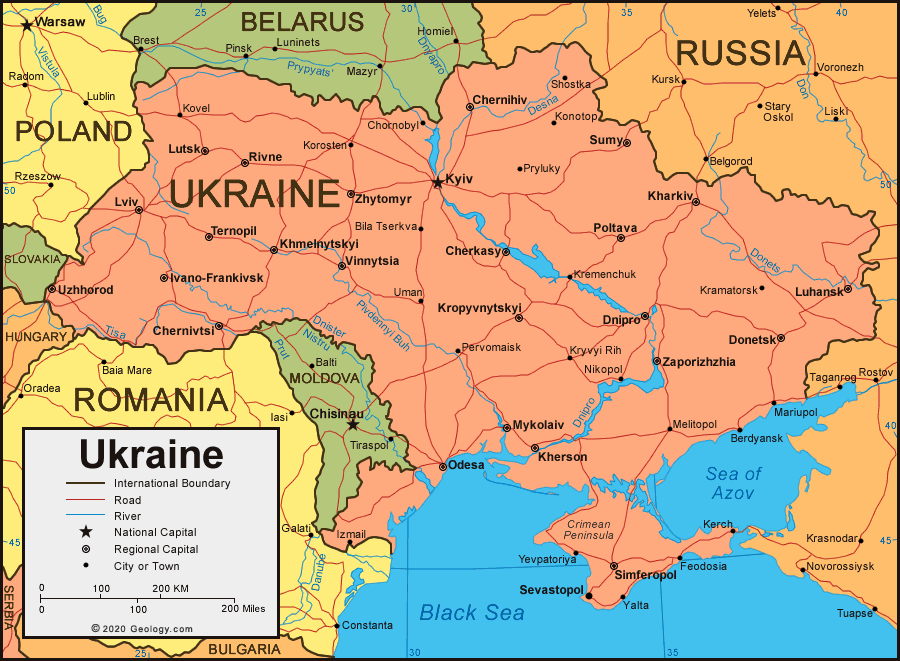
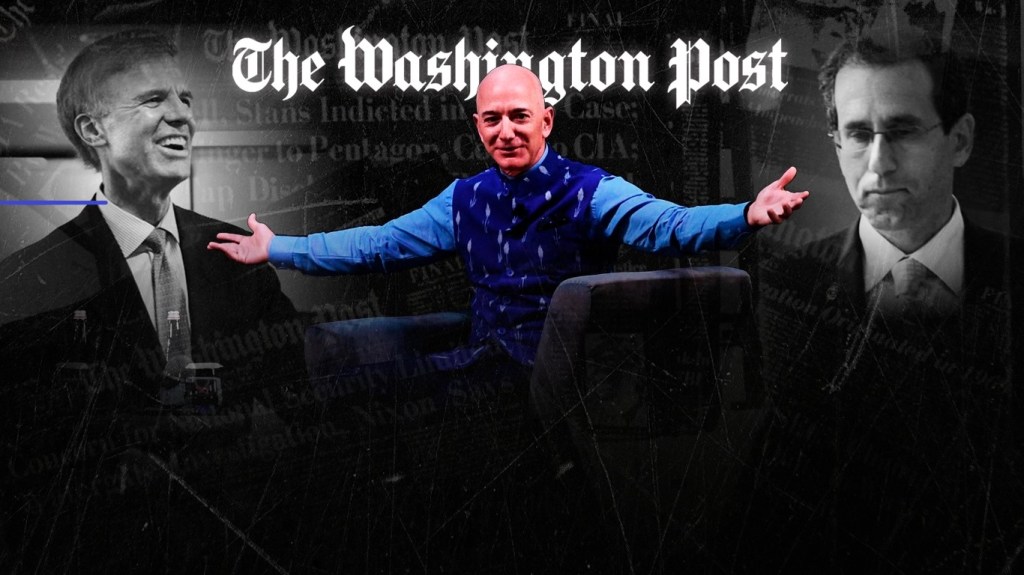
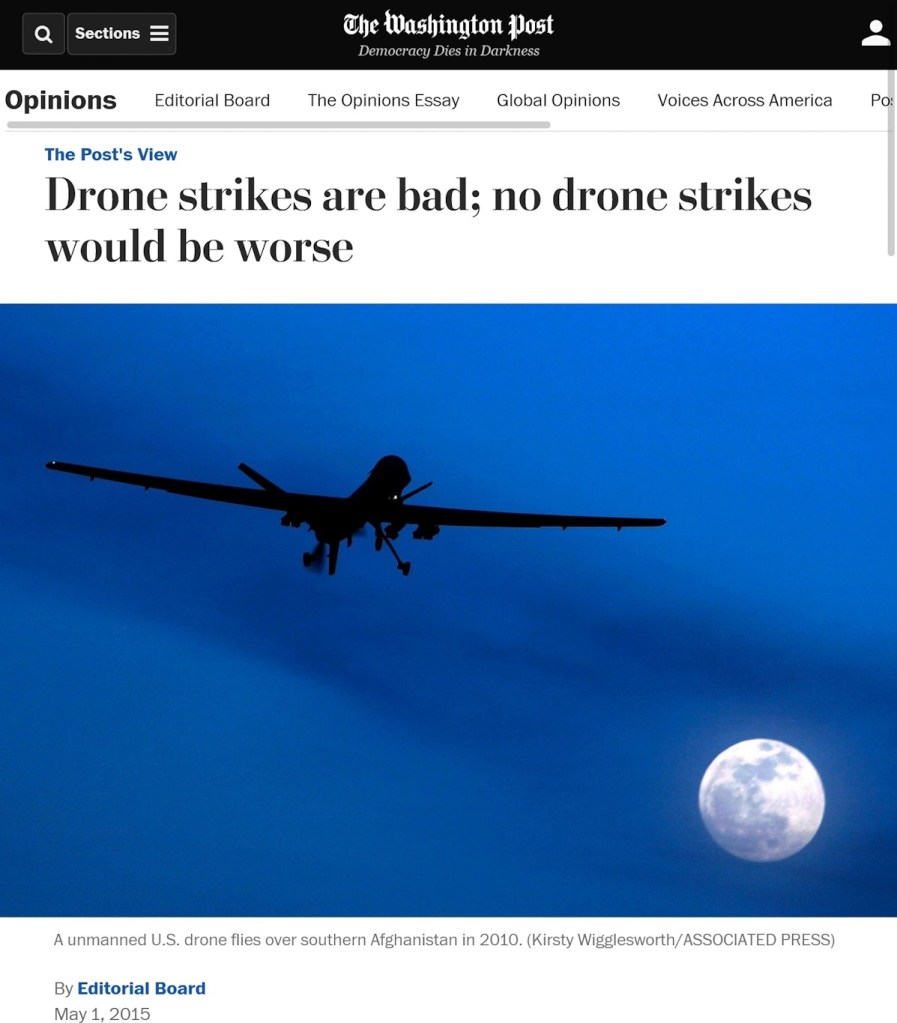

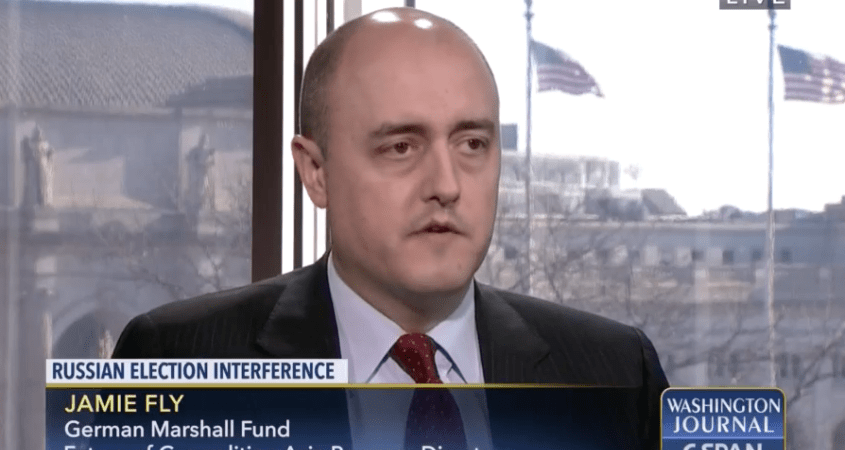
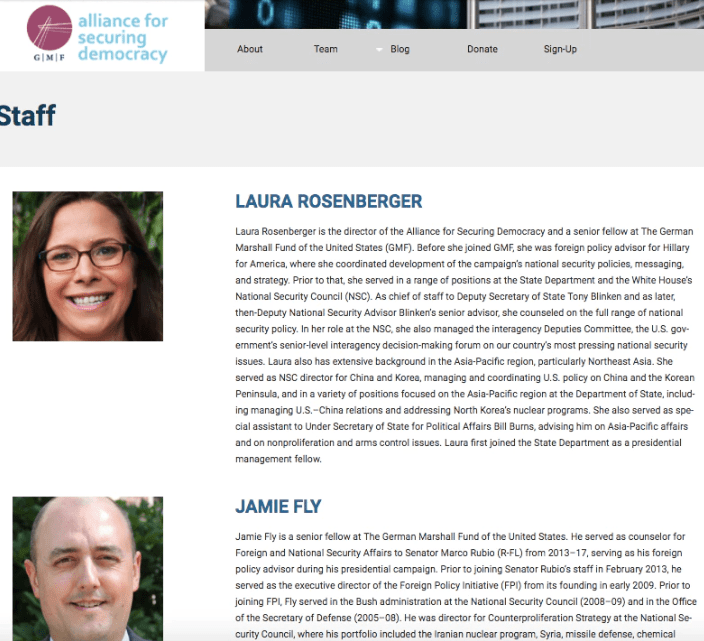
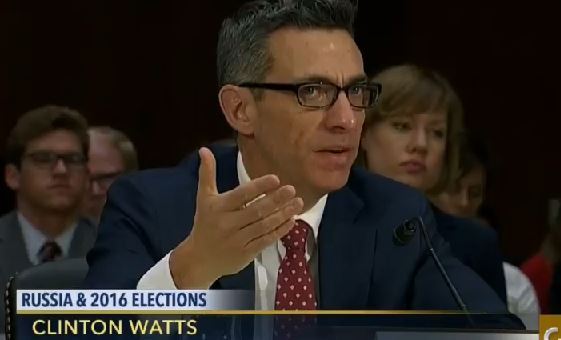


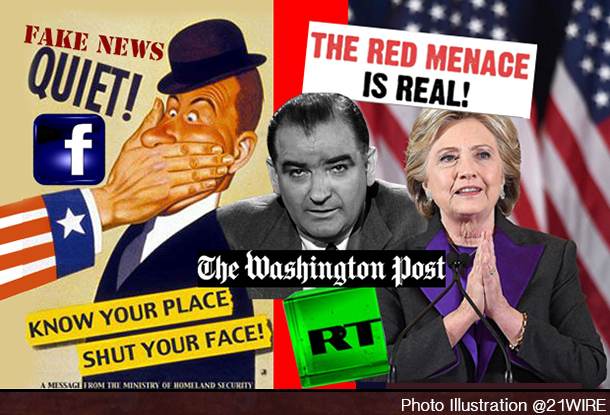
 After the Crash