
Fooled by What We Measure, Enlightened by What We Don’t Measure

By Charles Hugh Smith

Source: Of Two Minds

Economists and pundits are falling all over themselves to declare the US is chugging along splendidly, and to express their frustration with the public for their curmudgeonly lack of enthusiasm. For example: If this is a bad economy, please tell me what a good economy would look likeWe should acknowledge that things are going well, even as we continue to look for problems to solve and How the Recession Doomers Got the U.S. Economy So Wrong.

My intention is not to slam Noah Smith or Derek Thompson. I follow their work and gain value from their analysis.

The point I want to make is we only manage what we measure, and the reliance on statistics that are overly broad and easily distorted/gamed leads to generalizations that ignore consequential cause and effect: we are fooled by overly broad and easily distorted/gamed statistics and enlightened by looking at what is not measured or measured inadequately.

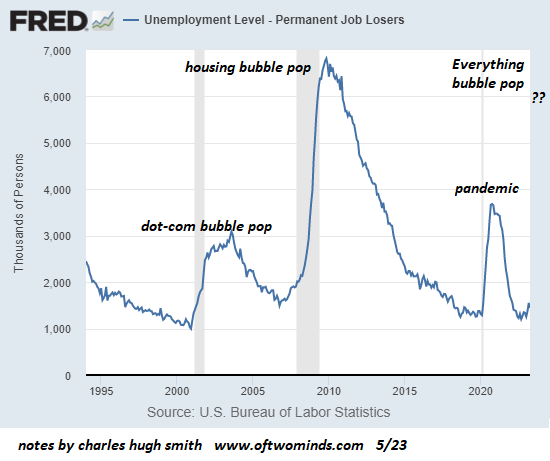
The consensus holds that inflation is declining rapidly and unemployment remains low, so the economy is doing great. Please glance at Chart #1 below to see what enthuses the mainstream: the unemployment rate is near historic lows.

But this measure leaves out a great deal of consequential factors. It’s well-known that the unemployment rate is distorted / gamed by leaving out everyone who is in the workforce but not “actively seeking work.” So what does this official unemployment rate actually measure? Not the percentage of the workforce that has a job.

Nor does it measure underemployment–those working far below their potential–or job insecurity or the percentage of workers being pushed into burnout–all consequential reflections of the real economy. All of these are potentially causal factors in why US productivity has fallen so dramatically.

And speaking of productivity, that’s the ultimate source of prosperity–not speculative bubbles or debt-binging. If productivity is tanking, eventually there are negative economic consequences that will be distributed to some segments of the populace, very likely asymmetrically.

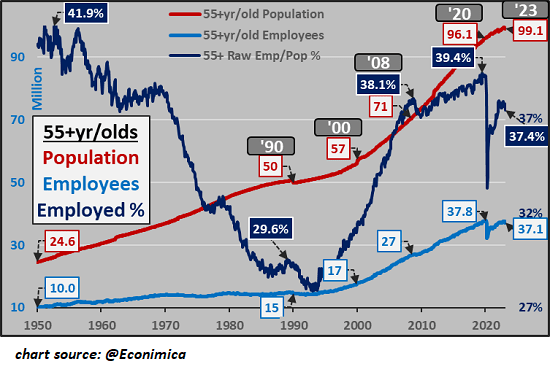
Such a broad-brush measure also ignores the consequences of demographics. Please glance at chart #2 below, of the 55 and over population and workforce. Note that virtually all the 20+ million jobs the US economy added in the past two decades are in this older workforce, which is of course steaming steadily into retirement, even as the percentage of this cohort who continues working has soared.

In other words, virtually all the job growth is the result of older workers working longer. Yes, 70 is the new 50, but try doing the same work at 70 that you did when you were 50. Sure, some people forego retirement because they love their work so much, but we don’t measure how many are still working because they have to for pressing financial reasons.

Have you observed the age of service workers and skilled workers recently? Do you reckon they really love working at Burger King so much that they’re doing it for enjoyment?

What if we measured financial pressures and job insecurity rather than risibly bogus “unemployment”? Would the economy still look so wonderful and resilient?

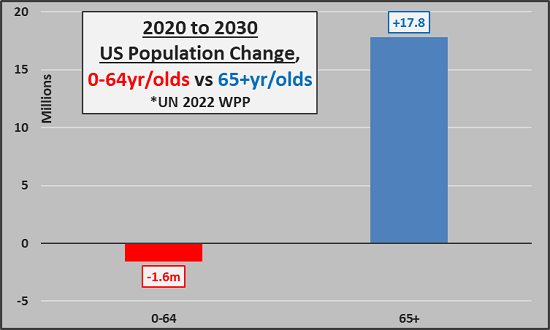
Chart #3 shows that virtually all the population growth ahead is in the cohort of older workers 65+ years old heading into retirement. So the workforce is rapidly aging and the unspoken / unexamined assumption is tens of millions of new workers will enter the workforce with the same skills, motivation, dedication and values as the tens of millions retiring.
But the demographics simply don’t support this breezy assumption.

Now glance at chart #4 which depicts the extraordinary rise in the number of workers who are now disabled. The causes of this are being debated (the pandemic obviously plays a role), but 2.5 million workers leaving the workforce in a few years is something that could be consequential if the trend continues. An assumption that this is a one-off is baseless until proven otherwise.
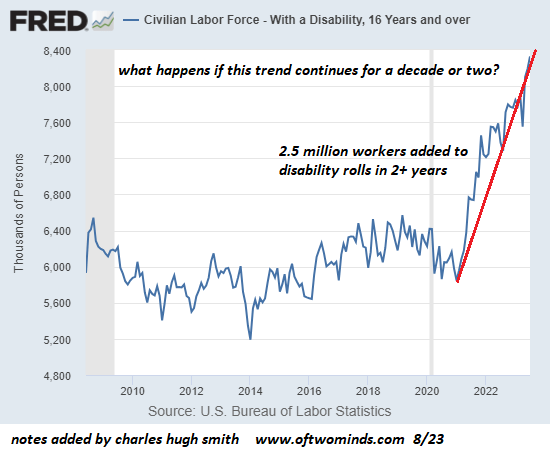
Once again, demographics, productivity and factors such as disability and burnout are not part of the unemployment, GDP and inflation measures currently being touted as proof of economic nirvana.

Item #1 of what’s not even measured is the crapification of goods and services. I addressed this in The “Crapification” of the U.S. Economy Is Now Complete (February 9, 2022) and Stainless Steal (February 26, 2023).

How do we measure the “inflation”–i.e. a loss of purchasing power–when appliances that lasted 20 years a generation ago now break down in 5 years? Where does that 75% decline in utility and durability show up in the official inflation data? How about the tools that once lasted a lifetime now breaking after a few years?

It’s been estimated that America’s food has lost 30% of its nutritive value in the past few decades. Protein per gram has dropped, trace nutrients have dropped, and so on. Rather than pursue sustainably nutrient-rich soil, Big Ag has maximized profits by dumping natural-gas-derived chemical fertilizers on depleted soil to boost production of nutrient-poor, tasteless “product.” A product deemed “organic” offers no guarantee that the soil isn’t depleted of nutrients.

Could this decline have anything to do with the American populace’s increasingly poor health? Nobody knows because these massive declines in quality and value aren’t measured and are certainly not part of the risibly bogus measures of unemployment, GDP and inflation.

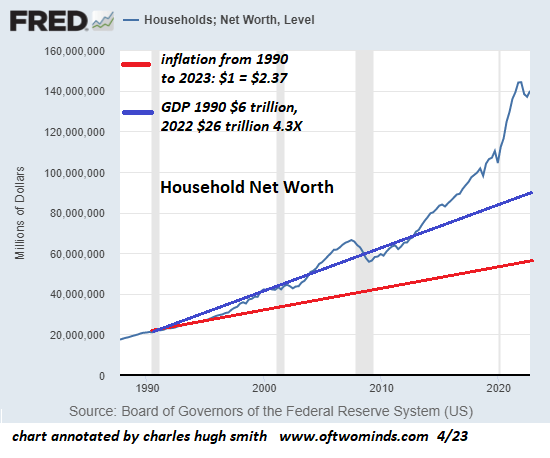
The official inflation rate ignores the multi-decade decline in the purchasing power of wages. Rents have soared 25% in a few years, and economists are looking at 5% increases in wages and worrying about the potential inflationary impact of workers’ wages not keeping up with real-world inflation.

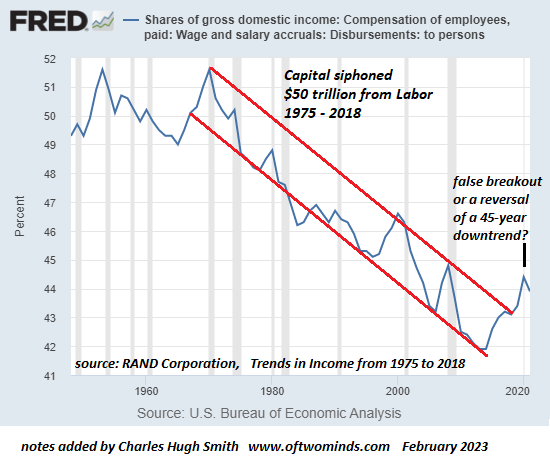
Cheerleading economists and pundits never mention the $50 trillion siphoned from labor by capital over the past 45 years. They also don’t mention the rising trend of loading more work on employees rather than hire more employees, or as a response to not being able to find qualified new hires.

Funny how rosy the picture can be tinted when all the consequential forces are ignored. But this studied ignorance characterizes the American elite, who delight in whining about airfares and travel delays, and finding someone to fix their pool pump. I address our Terminally Stratified Society here:

The Wealthy Are Not Like You and Me–Our Terminally Stratified Society (August 3, 2023)

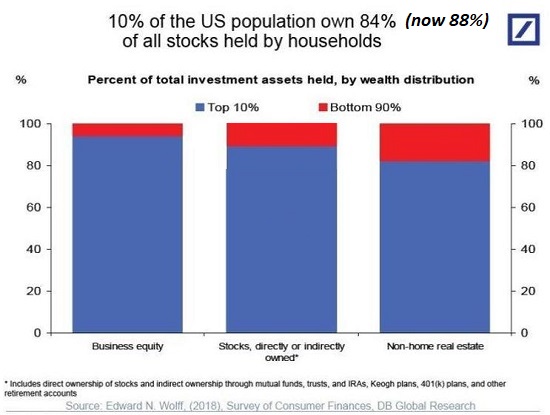
This protected elite don’t have to put up with the crapified goods and services which generate their capital gains and income. Their wealth and income enable their detachment from the crapified economy the bottom 90% experience. Their experience of the bottom 90% is as service workers, delivery people, etc. who serve their entitled tastes.

Correspondent Tomasz G. provided a telling excerpt from Houellebecq’s The Possibility of an Island:

“… the rich certainly like the company of the rich, no doubt it calms them, it’s nice for them to meet beings subject to the same torments as they are, and who seem to form a relationship with them that is not totally about money; it’s nice for them to convince themselves that the human species is not uniquely made up of predators and parasites… “

As correspondent Ryan R. observed, America’s privileged elites“were born on third, stole home (via asset inflation) and still think they hit that home run.”

We know who the parasites are, but economists and pundits are safely blind to America’s neofeudal aristocracy. After all, who butters the bread of economists and pundits?

Is it unsurprising there are no measures of neofeudalism or elite privilege? As for the incredible concentration of wealth in the top tiers and the resulting decline in the bottom 90%’s share of the nation’s wealth–nothing to see here, just globalization and financialization doing their thing. What matters is booking my next flight to yet another conference of economists and pundits where we nod our heads and dare not admit all the conferences are nothing but echo chambers of the privileged elites.

Cheerleading economists and pundits completely ignore the consequences of the system being rigged to favor capital and the already-wealthy who were given the means to buy assets back when they were cheap and affordable to the middle-class. Now that the system generates speculative credit-asset bubbles to create “the wealth effect,” assets such as homes in desirable regions are out of reach of the bottom 90%.

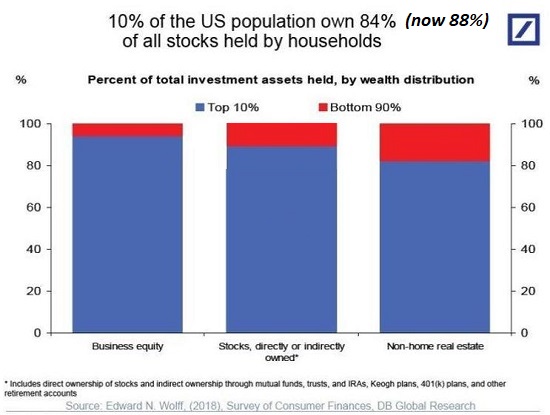
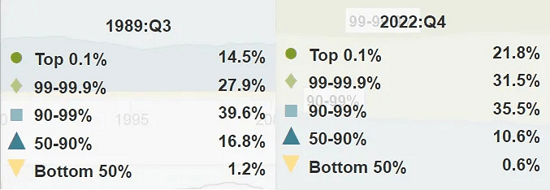
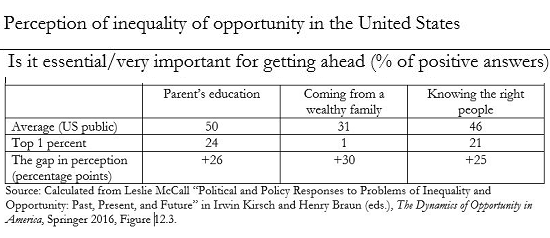
Please study the six charts below of wealth inequality. Try not to laugh out loud when you see that the top 1% reckon that “coming from a wealthy family” has near-zero impact on “getting ahead in America.”

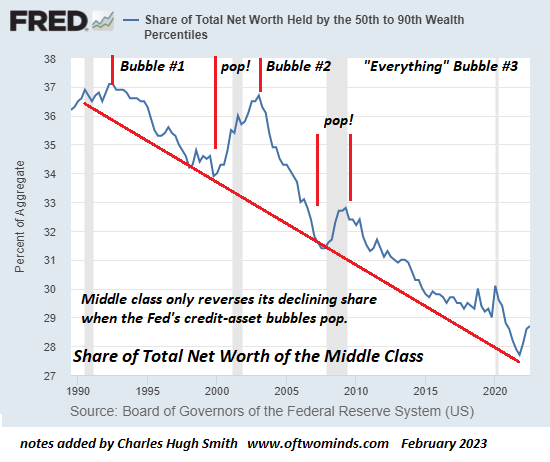
Also note the steady decline in the middle class percentage of national wealth, and how the middle class’s share only rises when the credit-asset bubbles that have enriched the top 10% deflate, a bubble-pop that never lasts longer than a few months thanks to the policies that favor the already-rich at the expense of those who don’t own stocks, rental properties, municipal bonds, etc.

Economists and pundits steer well clear of the eventual social and political consequences of America’s entrenched neofeudal wealth-income inequality. That this neofeudal configuration is inherently destabilizing–never mind, we don’t measure that, look at the wunnerful unemployment and inflation charts!

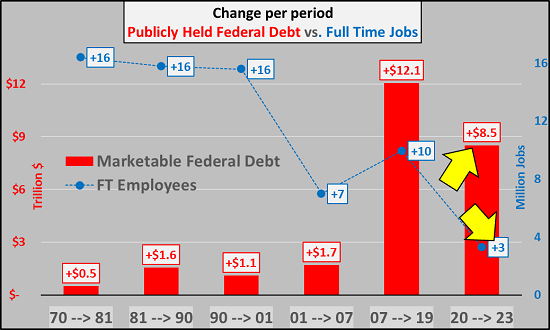
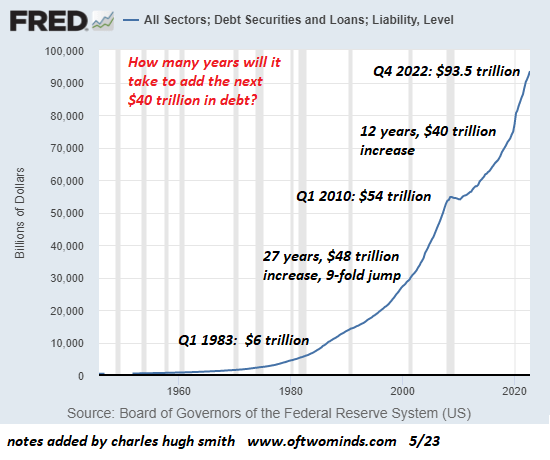
Lastly, consider the skyrocketing federal debt in terms of how many jobs are created in the era of soaring federal spending and debt. (Charts courtesy of CH / Economica) Debt doesn’t matter to economists and pundits, and neither does its diminishing effect on GDP and employment. The same can be said of total debt (public and private), which is skyrocketing (last chart): diminishing returns writ large as higher interest rates are embedded in the policy excesses and neofeudal structure of the past 45 years.

In essence, nothing that is consequential is properly quantified, so the pundit class keeps insisting everything is wunnerful and is mystified why people are so foolishly dissatisfied with our wunnerful economy. The reason why people are not buying the fantasyland story is they have to live and work in the crapified real economy, as serfs serving the economist-punditry-elite aristocracy.

If we want to avoid being led astray by misleading measures, we must seek enlightenment in what isn’t being measured or is cast aside as inconvenient to the “economy is wunnerful” party line.
Is the American Dream Still Alive? (Infographic)

Source: Strategic Culture Foundation

The post-WWII United States was at the peak of its soft power. One of its pillars was the American Dream. Every American could expect that his children would be better off – better off in every respect: healthier, longer-lived, better educated, happier, richer – than he was. Seventy years later, this dream seems to be blown to bits.

The Top 10% Is Doing Just Fine, The Middle Class Is Dying on the Vine

By Charles Hugh Smith

Source: Of Two Minds

Please study these charts as a means of understanding the inevitability of economic stagnation and a revolt of the decapitalized middle class.

I’ve been covering the decline of America’s middle class for over a decade with charts, data and commentary on the social depression that has accompanied the decline.

While there are many mutually reinforcing dynamics in this 45-year decline–demographics, global energy costs, financialization and globalization, to name a few– one term describes the accelerating erosion of America’s middle class: decapitalization.

To understand decapitalization, we need to start with the fundamentals of any economy between labor (wages) and capital and between investment and speculation. Although it’s tempting to oversimplify and demonize one or the other of these basics (speculators bad! etc.), they each provide an essential role in a healthy economy, one which is in dynamic equilibrium, a state analogous to a healthy ecosystem with constantly changing interactions of numerous species, individuals and inputs (weather, etc.). This variability enables the order of fluctuations (to use Ilya Prigogine’s profound phrase), a dynamic stability / equilibrium.

If labor’s share of the economy drops too low, the workforce cannot consume enough to support their households and the economy as a whole. If capital can no longer earn an attractive return, investment dries up and production stagnates. If speculators are not allowed to take on risk, liquidity dries up and risk crushes investment. But if speculation becomes the foundation of the economy’s “growth,” then the inevitable collapse of speculative bubbles will crash the economy.

In modern social-capitalist systems, the core stabilizer of the system is the wage-earning middle class which provides the stable workforce driving production and the stable pool of consumers needed to borrow money and consume enough to soak up the production of goods and services at a profit to producers.

Without a stable, dominant middle class, capital has few opportunities to invest in productive capacity. Without a stable, dominant middle class, the economy stagnates and is prone to collapse as it is far from equilibrium.

The process of middle class decline is best explained as decapitalization because the middle class is fundamentally a means of transforming labor into capital via savings and investment. The traditional ladder of social mobility from the working class to the middle class is one of capitalizing work: time and savings are invested in higher education, in effect capitalizing future labor by increasing productivity.

Capital isn’t limited to cash, land or tools; in an information economy, knowledge and skills are also capital, as is the social capital of social networking and relationships formed with mentors, suppliers, lenders, colleagues, investors, etc.

The second way to capitalize work is to save earnings and invest the savings in assets that produce income or gain value: a house, land, rental property, small business and income-producing financial assets such as bonds or dividend-paying stocks.

Thrift, investing, long-term planning and deferred consumption are all essential to capitalizing work by turning that labor into income-producing assets. As the household’s ownership of these assets that yield unearned income rises, so does their income and wealth. These increase the financial security of the household and build a nestegg which can be passed down to the next generation, improving their security via inheritance of income-producing assets.

As long as productivity is increasing the value of their labor, the middle class can leverage future earnings into assets by borrowing money to invest in assets: to buy a house, a mortgage is borrowed against future earnings. As long as the mortgage is a fixed-interest loan and income can be expected to rise with productivity, then this is a win-win situation: capital earns a predictable, low-risk return from the mortgage and the middle class household has stake in a family home, an asset which acts as a savings mechanism as the mortgage slowly pays down the debt and increases the household’s home equity–a form of savings.

The processes of decapitalization have upended this entire structure. In the systems context outlined above, our economy is out of balance and far from equilibrium and thus prone to collapse.

For the bottom 90%, which of course includes the middle class however you define it, it’s increasingly difficult to capitalize labor into capital. There are a number of factors driving this decapitalization:

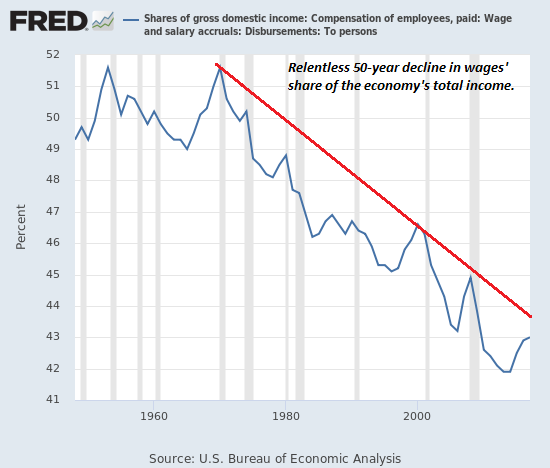
1. Wages’ share of the national income has continued a five-decade downtrend. (See chart below) National income since 1973 has shifted from labor (wages) to capital and more specifically, to debt and speculative gaming of the system, a.k.a. financialization.

Total household income in the U.S. in 2018 was $17.6 trillion. The decline in wages’ share of the national income from 1973 to 2018 is about 8.5%, which equals $1.5 trillion, the sum shifted from labor to capital every year. (See chart below)(source: https://www.statista.com/statistics/216756/us-personal-income/)

No, this is not a typo. As this RAND report documents, $50 trillion has been siphoned from labor (the lower 90% of the workforce) to the Financial Aristocracy and their technocrat lackeys (the top 10%) who own the vast majority of the capital (see charts below): Trends in Income From 1975 to 2018.

2. Within the workforce, wages have shifted to the top 10% who now earn 50% of all taxable income. (See RAND chart below) Financialization and globalization have decapitalized the skills of entire sectors of the workforce as automation and offshoring reduced the human capital of workers’ skills and experience and the value of their social capital. When the entire industry is offshored, skills and professional relationships lose their market value.

In a fully globalized economy, every worker producing tradable goods/services is competing with the entire global workforce, a reality that reduces wages in high-cost developed nations such as the U.S.

Financialization has heavily rewarded workers with specialized gaming the financial system skills and devalued every other skill as only the skills of financialization are highly profitable in a globalized, financialized economy.

3. As the high-wage jobs and capital shifted to coastal urban centers, middle class owners of homes and capital elsewhere saw the value of their assets decline. If a home valued at $100,000 in the late 1990s is now worth $150,000, the owners lost ground even with “official” inflation. In terms of real-world purchasing power, their home actually lost significant value in the past 23 years.

Meanwhile, middle class owners who bought their home in a coastal hot-spot for $100,000 23 years ago are now enjoying home valuations close to $1 million. Homes, along with every other asset, have been shifted into a casino where almost everyone is sorted into winners and losers, less often by skill and more often by luck.

For those who were too young to buy in 1997, sorry–the opportunity to buy a home for three times average middle class income is gone. The lucky generation who bought in the late 1990s in booming coastal magnets for global capital joined the top 10% and their colleagues in less desirable regions lost ground.

4. As capital siphoned off income and appreciation from labor (human and social capital), the gains accruing to capital accelerated. Those who already owned income-producing assets reaped both income and asset appreciation gains as yields on savings collapsed to near-zero as the Federal Reserve and other central banks dropped yields to near-zero in 2009 and kept them low for the following 13 years.

This had two devastating effects on the middle class: hundreds of billions of dollars that once flowed to savers and money markets disappeared, swallowed by the banks as a direct (and intentional) effect of the Fed’s ZIRP (zero-interest rate policy).

Since the Fed destroyed low-risk yields, anyone seeking any real yield (i.e. above inflation) would have to enter the casino and compete with hedge funds, insiders and the Financial Aristocracy. Very few middle class workers have the skills and experience to beat the pros in the casino, and so income and wealth accrued to those who already owned capital.

This is a key reason why the rich got richer and the poor got poorer. Those with capital accrued the majority of gains in income and wealth, leaving the bottom 90% in the dust.

A recent Foreign Affairs essay Monopoly Versus Democracy included these stunning statistics:

Ten percent of Americans now control 97 percent of all capital income in the country. Nearly half of the new income generated since the global financial crisis of 2008 has gone to the wealthiest one percent of U.S. citizens. The richest three Americans collectively have more wealth than the poorest 160 million Americans. (emphasis added.)

The 3% of income from capital collected by the bottom 90%–which includes the middle class– is basically signal noise: the middle class collects inconsequential crumbs of income from capital.

Prior to the Fed’s ZIRP and financialization of the economy, the middle class could both collect income from capital they owned and they could afford to acquire assets that yielded low-risk solid returns. Now they can do neither. Even worse, the puchasing power of their labor continues to decline, leaving them less able to save and buy assets.

This is why The Top 10% Is Doing Just Fine, The Middle Class Is Dying on the Vine. Please study these charts as a means of understanding the inevitability of economic stagnation and a revolt of the decapitalized middle class.


Re-Opening the Economy Won’t Fix What’s Broken


By Charles Hugh Smith

Source: Of Two Minds

Re-opening a fragile, brittle, bankrupt, hopelessly perverse and corrupt “normal” won’t fix what’s broken.

The stock market is in a frenzy of euphoria at the re-opening of the economy. Too bad the re-opening won’t fix what’s broken. As I’ve been noting recently, the real problem is the systemic fragility of the U.S. economy, which has lurched from one new extreme to the next to maintain a thin, brittle veneer of normalcy.

Fragile economies cannot survive any impact with reality that disrupts the distortions that are keeping the illusion of “growth” from shattering. For the past two decades, every collision with reality cracked the illusion, and the “fix” was to duct-tape the pieces together with new extremes of money-creation, debt, risk and speculative excess.

While the stock market has soared, the real world falls apart. If your region needs a new bridge built, count on about 20 years to get all the “stakeholders” to agree and get the thing actually built. Count on the cost quintupling from $500 million to $2.5 billion. Count on corners being cut as costs skyrocket, so those cheap steel bolts from China that are already rusting before the bridge is even finished? Oops. Replacing them will add millions to the already bloated budget.

Want to add a passenger stop on an existing railroad line? Count on 20 years to get it done. The complexity thicket of every regulatory agency with the power to say “no” basically guarantees the project will never get approved, because every one of these bureaucracies justifies its existence by saying “no.” Sorry, you need another study, another environmental review, and so on.

Need a new landfill? I hope you started the process 15 years ago, so you’ll get approval in only five more years. Every agency with the power to say “no” will stretch out the approval, so they have guaranteed “work” for another decade or two.

Did your subway fares double? Was the excuse repairing a crumbling system? Did the work get done on budget and on time? You must be joking, right? All the fare increase did was cover the costs of skyrocketing salaries, pensions and administrative costs. Repairs to the tracks and cars– that’s extra. Let’s float a $1 billion bond so nobody have to tighten their belts, and have riders pay for it indirectly, through higher taxes to pay the exorbitant costs of 20 years of interest on the bond.

Have you been thrown off your bicycle by the giant potholes in the city’s “bike lanes”? The city reluctantly admits that these streets that haven’t been maintained for decades–yes, decades. The city once paid for street maintenance out of its general budget, but alas, that’s been eaten up by skyrocketing salaries, pensions and administrative costs, so now we need to float $100 million bond to fund filling potholes. If all goes according to plan (ha-ha), we should be able to re-pave the streets that have been crumbling for 20 years in… the next 20 years.

These real-world examples are just four of thousands of manifestations of a broken system. Rather than make tough choices that drain power and wealth from vested interests, we simply borrow more money, in ever increasing amounts, to keep the entrenched interests and elites happy.

There are two “solutions” in the status quo: dump the debt on taxpayers or on powerless debt-serfs–for example, college students. (See chart below of the $1.6 trillion that’s stripmining student debt-serfs.) Who benefits from selling all the municipal bonds, bundled student loans, etc. to investors starving for a yield above 0.1%? Wall Street, of course.

The problem is that while debt has soared, productivity and earned income have stagnated. The statistical narrative has been ruthlessly gamed to hide the erosion of living standards, but even with the bogus “low inflation” of official statistics, wages for the bottom 95% have stagnated for decades.

Measures of productivity have also been gamed to mask the ugly reality that the vast majority of the U.S. economy is stagnating under the weight of interest payments on debt, mal-investments in speculative gambles, higher junk fees and taxes, crushing regulatory compliance, high costs imposed by monopolies and cartels and a well-cloaked decline in the quality of just about everything the bottom 95% uses or owns.

What little productivity gains have been made have been skimmed by the top 5%. Coupled with the Federal Reserve’s single-minded goosing of the one signaling device it controls, the stock market, the top 0.1% in America own more wealth than the bottom 80%.

If productivity stagnates and winners take all, the wages of the bottom 95% cannot rise. Real wealth is only created by increases in the productivity of labor and capital; everything else is phantom wealth.

The only way stagnant incomes can support more debt is if interest rates decline. Presto, the Fed dropped interest rates to near-zero a decade ago. Of course you and I can’t actually borrow millions for 0.1%; that privilege is reserved for financiers and other financial parasites and predators.

Debt-serfs were able to refinance their crushing mortgages to save a few bucks, and so they can afford to 1) take on more debt and 2) pay higher taxes to fund the ballooning public debt.

Every one of these extremes has increased the systemic fragility of the American economy. This fragility is reflected in the impoverishment of the bottom 95%, the thin line between solvency and bankruptcy, the decay of public trust in institutions run for the benefit of entrenched interests, and the quickening erosion of America’s social contract.

Re-opening a fragile, brittle, bankrupt, hopelessly perverse and corrupt “normal” won’t fix what’s broken.


Will Robots Take Your Job?

Walmart Robots

By Nick Srnicek and Alex Williams

Source: ROAR

In recent months, a range of studies has warned of an imminent job apocalypse. The most famous of these—a study from Oxford—suggests that up to 47 percent of US jobs are at high-risk of automation over the next two decades. Its methodology—assessing likely developments in technology, and matching them up to the tasks typically deployed in jobs—has been replicated since then for a number of other countries. One study finds that 54 percent of EU jobs are likely automatable, while the chief economist of the Bank of England has argued that 45 percent of UK jobs are similarly under threat.

This is not simply a rich-country problem, either: low-income economies look set to be hit even harder by automation. As low-skill, low-wage and routine jobs have been outsourced from rich capitalist countries to poorer economies, these jobs are also highly susceptible to automation. Research by Citi suggests that for India 69 percent of jobs are at risk, for China 77 percent, and for Ethiopia a full 85 percent of current jobs. It would seem that we are on the verge of a mass job extinction.

Nothing New?

For many economists however, there is nothing to worry about. If we look at the history of technology and the labor market, past experiences would suggest that automation has not caused mass unemployment. Automation has always changed the labor market. Indeed, one of the primary characteristics of the capitalist mode of production has been to revolutionize the means of production—to really subsume the labor process and reorganize it in ways that more efficiently generate value. The mechanization of agriculture is an early example, as is the use of the cotton gin and spinning jenny. With Fordism, the assembly line turned complex manufacturing jobs into a series of simple and efficient tasks. And with the era of lean production, we have had the computerized management of long commodity chains turn the production process into a more and more heavily automated system.

In every case, we have not seen mass unemployment. Instead we have seen some jobs disappear, while others have been created to replace not only the lost jobs but also the new jobs necessary for a growing population. The only times we see massive unemployment tend to be the result of cyclical factors, as in the Great Depression, rather than some secular trend towards higher unemployment resulting from automation. On the basis of these considerations, most economists believe that the future of work will likely be the same as the past: some jobs will disappear, but others will be created to replace them.

In typical economist fashion, however, these thoughts neglect the broader social context of earlier historical periods. Capitalism may not have seen a massive upsurge in unemployment, but this is not a necessary outcome. Rather, it was dependent upon unique circumstances of earlier moments—circumstances that are missing today. In the earliest periods of automation, there was a major effort by the labor movement to reduce the working week. It was a successful project that reduced the week from around 60 hours at the turn of the century, down to 40 hours during the 1930s, and very nearly even down to 30 hours. In this context, it was no surprise that Keynes would famously extrapolate to a future where we all worked 15 hours. He was simply looking at the existing labor movement. With reduced work per person, however, this meant that the remaining work would be spread around more evenly. The impact of technology at that time was therefore heavily muted by a 33 percent reduction in the amount of work per person.

Today, by contrast, we have no such movement pushing for a reduced working week, and the effects of automation are likely to be much more serious. Similar issues hold for the postwar era. With most Western economies left in ruins, and massive American support for the revitalization of these economies, the postwar era saw incredibly high levels of economic growth. With the further addition of full employment policies, this period also saw incredibly high levels of job growth and a compact between trade unions and capital to maintain a sufficient amount of good jobs. This led to healthy wage growth and, subsequently, healthy growth in aggregate demand to stimulate the economy and keep jobs coming. Moreover, this was a period where nearly 50 percent of the potential labor force was constrained to the household.

Under these unique circumstances, it is no wonder that capitalism was able to create enough jobs even as automation continued to transform for the labor process. Today, we have sluggish economic growth, no commitments to full employment (even as we have commitments to harsh welfare policies), stagnant wage growth, and a major influx of women into the labor force. The context for a wave of automation is drastically different from the way it was before.

Likewise, the types of technology that are being developed and potentially introduced into the labor process are significantly different from earlier technologies. Whereas earlier waves of automation affected what economists call “routine work” (work that can be laid out in a series of explicit steps), today’s technology is beginning to affect non-routine work. The difference is between a factory job on an assembly line and driving a car in the chaotic atmosphere of the modern urban environment. Research from economists like David Autor and Maarten Goos shows that the decline of routine jobs in the past 40 years has played a significant role in increased job polarization and rising inequality. While these jobs are gone, and highly unlikely to come back, the next wave of automation will affect the remaining sphere of human labor. An entire range of low-wage jobs are now potentially automatable, involving both physical and mental labor.

Given that it is quite likely that new technologies will have a larger impact on the labor market than earlier waves of technological change, what is likely to happen? Will robots take your job? While one side of the debate warns of imminent apocalypse and the other yawns from the historical repetition, both tend to neglect the political economy of automation—particularly the role of labor. Put simply, if the labor movement is strong, we are likely to see more automation; if the labor movement is weak, we are likely to see less automation.

Workers Fight Back

In the first scenario, a strong labor movement is able to push for higher and higher wages (particularly relative to globally stagnant productivity growth). But the rising cost of labor means that machines become relatively cheap in comparison. We can already see this in China, where real wages have been surging for more than 10 years, thereby making Chinese labor increasingly less cheap. The result is that China has become the world’s biggest investor in industrial robots, and numerous companies—most famously Foxconn—have all stated their intentions to move towards increasingly automated factories.

This is the archetype of a highly automated world, but in order to be achievable under capitalism it requires that the power of labor be strong, given that the relative costs of labor and machines are key determinants for investment. What then happens under these circumstances? Do we get mass unemployment as robots take all the jobs? The simple answer is no. Rather than mass decimation of jobs, most workers who have their jobs automated end up moving into new sectors.

In the advanced capitalist economies this has been happening over the past 40 years, as workers move from routine jobs to non-routine jobs. As we saw earlier, the next wave of automation is different, and therefore its effects on the labor market are also different. Some job sectors are likely to take heavy hits under this scenario. Jobs in retail and transport, for instance, will likely be heavily affected. In the UK, there are currently 3 million retail workers, but estimates by the British Retail Consortium suggest this may decrease by a million over the next decade. In the US, there are 3.4 million cashiers alone—nearly all of whose work could be automated. The transport sector is similarly large, with 3.7 million truck drivers in the US, most of whose jobs could be incrementally automated as self-driving trucks become viable on public roads. Large numbers of workers in such sectors are likely to be pushed out of their jobs if mass automation takes place.

Where will they go? The story that Silicon Valley likes to tell us is that we will all become freelance programmers and software developers and that we should all learn how to code to succeed in their future utopia. Unfortunately they seem to have bought into their own hype and missed the facts. In the US, 1.8 percent of all jobs require knowledge of programming. This compares to the agricultural sector, which creates about 1.5 percent of all American jobs, and to the manufacturing sector, which employs 8.1 percent of workers in this deindustrialized country. Perhaps programming will grow? The facts here are little better. The Bureau of Labor Statistics (BLS) projects that by 2024 jobs involving programming will be responsible for a tiny 2.2 percent of the jobs available. If we look at the IT sector as a whole, according to Citi, it is expected to take up less than 3 percent of all jobs.

What about the people needed to take care of the robots? Will we see a massive surge in jobs here? Presently, robot technicians and engineers take up less than 0.1 percent of the job market—by 2024, this will dwindle even further. We will not see a major increase in jobs taking care of robots or in jobs involving coding, despite Silicon Valley’s best efforts to remake the world in its image.

This continues a long trend of new industries being very poor job creators. We all know about how few employees worked at Instagram and WhatsApp when they were sold for billions to Facebook. But the low levels of employment are a widespread sectoral problem. Research from Oxford has found that in the US, only 0.5 percent of the labor force moved into new industries (like streaming sites, web design and e-commerce) during the 2000s. The future of work does not look like a bunch of programmers or YouTubers.

In fact, the fastest growing job sectors are not for jobs that require high levels of education at all. The belief that we will all become high-skilled and well-paid workers is ideological mystification at its purest. The fastest growing job sector, by far, is the healthcare industry. In the US, the BLS estimates this sector to create 3.8 million new jobs between 2014 and 2024. This will increase its share of employment from 12 percent to 13.6 percent, making it the biggest employing sector in the country. The jobs of “healthcare support” and “healthcare practitioner” alone will contribute 2.3 million jobs—or 25 percent of all new jobs expected to be created.

There are two main reasons for why this sector will be such a magnet for workers forced out of other sectors. In the first place, the demographics of high-income economies all point towards a significantly growing elderly population. Fewer births and longer lives (typically with chronic conditions rather than infectious diseases) will put more and more pressure on our societies to take care of elderly, and force more and more people into care work. Yet this sector is not amenable to automation; it is one of the last bastions of human-centric skills like creativity, knowledge of social context and flexibility. This means the demand for labor is unlikely to decrease in this sector, as productivity remains low, skills remain human-centric, and demographics make it grow.

In the end, under the scenario of a strong labor movement, we are likely to see wages rise, which will cause automation to rapidly proceed in certain sectors, while workers are forced to struggle for jobs in a low-paying healthcare sector. The result is the continued elimination of middle-wage jobs and the increased polarization of the labor market as more and more are pushed into the low-wage sectors. On top of this, a highly educated generation that was promised secure and well-paying jobs will be forced to find lower-skilled jobs, putting downward pressure on wages—generating a “reserve army of the employed”, as Robert Brenner has put it.

Workers Fall Back

Yet what happens if the labor movement remains weak? Here we have an entirely different future of work awaiting us. In this case, we end up with stagnant wages, and workers remain relatively cheap compared to investment in new equipment. The consequences of this are low levels of business investment, and subsequently, low levels of productivity growth. Absent any economic reason to invest in automation, businesses fail to increase the productivity of the labor process. Perhaps unexpectedly, under this scenario we should expect high levels of employment as businesses seek to maximize the use of cheap labor rather than investing in new technology.

This is more than a hypothetical scenario, as it rather accurately describes the situation in the UK today. Since the 2008 crisis, real wages have stagnated and even fallen. Real average weekly earnings have started to rise since 2014, but even after eight years they have yet to return to their pre-crisis levels. This has meant that businesses have had incentives to hire cheap workers rather than invest in machines—and the low levels of investment in the UK bear this out. Since the crisis, the UK has seen long periods of decline in business investment—the most recent being a 0.4 percent decline between Q12015 and Q12016. The result of low levels of investment has been virtually zero growth in productivity: from 2008 to 2015, growth in output per worker has averaged 0.1 percent per year. Almost all of the UK’s recent growth has come from throwing more bodies into the economic machine, rather than improving the efficiency of the economy. Even relative to slow productivity growth across the world, the UK is particularly struggling.

With cheap wages, low investment and low productivity, we see that companies have instead been hiring workers. Indeed, employment levels in the UK have reached the highest levels on record—74.2 percent as of May 2016. Likewise, unemployment is low at 5.1 percent, especially when compared to their neighbors in Europe who average nearly double that level. So, somewhat surprisingly, an environment with a weak labor movement leads here to high levels of employment.

What is the quality of these jobs, however? We have already seen that wages have been stagnant, and that two-thirds of net job creation since 2008 has been in self-employed jobs. Yet there has also been a major increase in zero-hour contracts (employment situations that do not guarantee any hours to workers). Estimates are that up to 5 percent of the labor force is in such situations, with over 1.7 million zero-hour contracts out. Full-time employment is down as well: as a percentage of all jobs, its pre-crisis levels of 65 percent have been cut to 63 percent and refused to budge even as the economy grows (slowly). The percentage of involuntary part-time workers—those who would prefer a full-time job but cannot find one—more than doubled after the crisis, and has barely begun to recover since.

Likewise with temporary employees: involuntary temporary workers as a percentage of all temporary workers rose from below 25 percent to over 40 percent during the crisis, only partly recovering to around 35 percent today. There is a vast number of workers who would prefer to work in more permanent and full-time jobs, but who can no longer find them. The UK is increasingly becoming a low-wage and precarious labor market—or, in the Tories’ view, a competitive and flexible labor market. This, we would argue, is the future that obtains with a weak labor movement: low levels of automation, perhaps, but at the expense of wages (and aggregate demand), permanent jobs and full-time work. We may not get a fully automated future, but the alternative looks just as problematic.

These are therefore the two poles of possibility for the future of work. On the one hand, a highly automated world where workers are pushed out of much low-wage non-routine work and into lower-wage care work. On the other hand, a world where humans beat robots but only through lower wages and more precarious work. In either case, we need to build up the social systems that will enable people to survive and flourish in the midst of these significant changes. We need to explore ideas like a Universal Basic Income, we need to foster investment in automation that could eliminate the worst jobs in society, and we need to recover that initial desire of the labor movement for a shorter working week.

We must reclaim the right to be lazy—which is neither a demand to be lazy nor a belief in the natural laziness of humanity, but rather the right to refuse domination by a boss, by a manager, or by a capitalist. Will robots take our jobs? We can only hope so.

Note: All uncited figures either come directly from, or are based on authors’ calculations of, data from the Bureau of Labor Statistics, O*NET and the Office for National Statistics.

The Clock Inside Us

time-travel_2

By Eman Shahata

Source: The New Inquiry

Once a weapon to combat idleness, the clock has become a prosthesis, augmenting the human body to override its need for rest

IF time is money, then sleep is theft. Today’s cult of busyness regards sleep as a defect that threatens to render people competitively unfit. In a recent article for the Guardian, Lucy Rock wrote about CEOs’ “competitive sleep deprivation,” with top executives sleeping for a mere three to four hours, mimicking Margaret Thatcher’s four-hour sleep cycle when she was in office. Similarly, Angela Ahrendts, head of retail at Apple and former CEO of Burberry, has claimed she “gets a headache when she sleeps for more than six hours.”

Such enthusiasm for sleeplessness seems to make an executive virtue out of a capitalistic necessity. But it has deep epistemological roots. In the wake of Enlightenment and in tandem with the emergence of capitalism, humans began to view nature as a pool of resources to be tamed, mastered, owned, and directed toward fulfilling human desires. It wasn’t long before this conquest of nature was redirected toward the intransigencies of human nature. Despite all the technological advances that positivistic science yielded, humans were still faced with their own physical limitations. They could build skyscrapers of glass and steel that defied gravity in the name of human reason, yet they could not tame the unreasonable demands of their own body for rest.

The attempt to tame the body of its unprofitable tendency to tire began as an effort to make “saving time” a moral issue. Sixteenth-century moralist and mercantilist discourses already regarded punctuality as a prerequisite for the conception of a modern man, the pinnacle of social development in an imagined context of linear progress. British historian E.P. Thompson points out in “Time, Work-Discipline and Industrial Capitalism” that toward the end of the 17th century, as wage labor relations began to become more prevalent, time began to be conceived as a precious commodity to be spent rather than merely passed. “Those who are employed experience a distinction between their employer’s time and their ‘own’ time,” Thompson notes. “And the employer must use the time of his labor, and see that it is not wasted.” Tolling bells and fines levied by employers taught students and workers that their time was being counted, that it was a regulated and regimented currency.

Moralists urged “time thrift,” and framed the waste of time as summoning divine punishment. As British nonconformist minister Oliver Heywood put it in the 17th century tract Meetness for Heaven, “This is our working day, our market time … O Sirs, sleep now, and awake in hell, whence there is no redemption.” Paternalist and colonialist discourses, whether in addressing the English poor or indigenous people from developing countries, represented idleness as a trait of those who are “naturally inferior.” For instance, as Thompson notes, clergyman John Clayton’s pamphlet “Friendly Advice to the Poor” urges the factory worker, whom he refers to as a “sluggard,” to use his time efficiently and refrain from “dulling his spirit by Indolence.” Similarly, where theories of social evolutionism gained prominence, time discipline was seen as essential for the transition to “mature societies.” Thompson notes how economic-growth theorists viewed Mexican mineworkers as “indolent and childlike people” because of their deficient time discipline.

Parallel to the rise of “time thrift” comes the monumental role of the clock. In 17th century Britain, clocks restructured work habits by materializing the ethic of time thrift, setting a clear demarcation between “work” and “life” and reminding workers of their tasks. The omnipresence of clocks was a guarantor of regulation, it ensured the institution of order in the workspace. The clock’s ubiquity legitimized time discipline and naturalized it, making it banal and commonsensical. It made sure that no one escaped the tempo.

One might say that the clock becomes a subject, with agency in its own right, shaping social customs and subjecting people to its rhythms. As anthropologist Bruno Latour has argued, technology and things are not simply animated by humans but also mediate human action. And as anthropologist Benjamin Snyder argues, clocks served the purpose of training and manipulating the body to accomplish set tasks, thereby “turning it into an inexhaustible source of energy.” The incessant sound of the ticking clock, the mounting anxiety it almost automatically evokes, has come to regulate the body and embed it within the culture of busyness.

If clocks are agents that shape human actions, is it valid to assume that clocks are an “other”? By making sure everyone maximizes their efficiency, clocks address the physical limitations of the human body, becoming a kind of prosthesis that pushes humans closer to reaching an “optimal” state of activity.

This is reflected in the late 19th century emergence of the idea of an “internal clock,” which exemplifies how biological processes can be redefined in terms of prominent material objects. By this means, the ideology of time discipline— inseparable from the clock—becomes seen as a natural imperative. In the wake of the clock’s ubiquity, positivist and scientific rhetoric began to depict the biological clock as an “endogenous” factor that operates according to “innate” biological rhythms, leading to medical advice shaped by the metaphors it employs: “how to reset your internal clock” and so on. Such advice points to the mechanization of the body, which now requires “daily maintenance.”

It may seem as if the presence of a master clock in our brains, which synchronizes and sets sleeping patterns on its own, means we no longer need an outside force to tame our bodies. Our bodies have internalized this systemic regulation, becoming in this sense, machinic. However, what implications arise from this? This mechanization of the body—a precursor and template for the ongoing reconceptualization of the self in terms of quantities alone—reflects how our bodies have become products, rather than agents, of a culture of busyness and rationality that glorifies productivity. Scientific discourses have succeeded in masking the way we’ve been clocked in and can no longer clock out. 

The Reason You Work So Hard to Participate in the Rat Race

6a01116888abb7970c01a3fd366b75970b-800wi-800x425

By M.J. Higby

Source: Waking Times

Ralph Waldo Emerson once said, “A man in debt is so far a slave.” Money has no intrinsic value yet we spend our days damaging our health and spirit in order to obtain it. Why do we sacrifice our well-being for it? Is it the cliché that “we just want to provide a better life for our kids than we had?” Is it just way of the civilized world? The most important question to ask, however, is what power do we have to change this way of thinking and living? The reality is simple: money is a vehicle for social control. Debt makes us good, obedient workers and citizens.

The traditional workweek started in 1908 at The New England Cotton Mill in order to allow followers of the Jewish religion to adhere to Sabbath.  With the passage of The Fair Labor Standards Act in 1938, the 40-hour workweek became the norm. Data from the 2013 American Community Survey showed that the average commute time in America is about 26 minutes each way. According to a Gallup poll, the average workweek in America is 34.4 hours, however, when only taking into account full time workers, that average shoots up to 47, or 9.4 hours per day during a 5-day workweek. Keeping averages in mind then, between commuting, working and figuring in an hour for lunch (usually less), that puts us at approximately 11 hours and 40 minutes for the average full time worker. If you have a family with young kids, just add in another few hours for homework, baths, etc.

When the day is done, how much time do you have for yourself? To exercise, meditate or otherwise unwind the way that all the healthy living gurus preach? And how much of yourself, your presence of mind, is left to devote to family? We give the company the heat of our most intense mental fire while our families get the smoke. Yet Jeb Bush, the 2016 GOP presidential hopeful, says we need to work more.

The answer to why we put ourselves through this daily grind is multifaceted. The most pervasive reason is workplace and societal pressures. We are raised in a matrix of sorts. The cycle starts around the age of five when we are expected to adhere to a regimented 8-hour day of school. At this age, we don’t have the intellect to question why, so we mechanistically follow the path that’s laid out. This daily path becomes engraved in our minds and becomes as automatic as the sun’s daily journey. Our school system is adept at churning out working class individuals en masse.  We are taught along the way not to question authority, again adhering to the working class mentality.

On the opposite end of the spectrum are those in power. They are the ones that like to color outside the lines. Many books abound with titles such as The Wisdom of Psychopaths that illustrate how people with psychopathic traits, ones who don’t tend to follow rules, are often found in managerial roles such as CEOs all the way up to presidents of countries. With these rare manipulative, coldhearted personalities in place and the rest of us following like good sheeple without questioning, the stage is set for compliance.

If you have been in the working world long enough, then the following statement should ring true: if you work extra hours, you are a great worker; if you decline, you’re useless and apathetic. In the work world, there’s typically no in between. The pressure to succeed for the pride and benefit of the company unfortunately supersedes that of the pressure to be a good parent, sibling, son or daughter. According to a study done by the economic policy institute, between 1948 and 2013, productivity has grown 240% while income for non-managerial workers has grown by 108%. To make up for this discordance, pride of doing what’s best for the company has been employed as a motivational tactic. This tactic has been used as a sharp IV needle that’s been inserted into our veins and we have willingly ingested the contents that are injected through it. Pressure to conform toward achieving the company’s goals has overcome our will to be compensated accordingly.

The other side of this pressure comes from society as a whole outside the education/workplace. A close friend of mine works for a state court and makes about $40K/year. He is also a self-employed business owner on the off hours. I estimate that he works about 70-80 hours a week. He owns a home in a well-to do neighborhood and he drives a seventy thousand dollar luxury car. This crystallizes the saying ‘big hat, no cattle.’ But when a lie is told over and over, the lie becomes the truth.

When we look at someone who drives a luxury car and lives in an upscale part of town, we see this as success because of how often that visual of it has been pounded tirelessly into our minds. We fail to see that these are nothing but symbols of success and false ones at that. They appear real because as a society, we have been conditioned to see them this way by the advertising industry. In the book, The Millionaire Next Door, the authors annihilate this illusion. Numbers don’t lie and the statistics show that most true millionaires, those with a net worth of over one million dollars, do not own those luxuries that we typically associate with success and wealth. They view them as the reality of what they are: a depreciating liability. According to the book, the typical millionaire owns a home in the two to three hundred thousand dollar-range and a non-luxury automobile. If something goes wrong with either, they have the cash reserves to fix it. On the other hand, the commonplace owner of the luxury home and car can’t afford the roof and the tires respectively without going deeper into debt if they should need replacing.

Ownership of these symbols of wealth becomes a self-perpetuating illusion to satisfy the psychological need for acceptance. Unfortunately, human behavior dictates that emotional needs often override logical thinking. It’s been said that the borrower is slave to the debt-owner and with luxury items, debt is the rule, not the exception. Debt is healthy for those in power and contributes to a needy and thus obligated worker.

The current wisdom of slave, spend and save for retirement has only one destiny. That destiny can be summed up in three sentences. Spend your healthiest and most productive years working to support a life of materials and thus illusions of success while elevated stress damage your health. During this time, be sure to save enough money for retirement so you can enjoy those years of the subsequent poor health. And lastly, do it in the name of pride for your company and country.

I take pride in being American, as I’m sure most Americans do, however, if you’re reading this you’re likely smart enough to see the holes in the daily grind. It saps our creative potential and our physical, as well as our spiritual energy. We don’t need any studies to tell us how stressed we are and subsequently, how unhealthy we are. The physical manifestations of stress such as obesity, hypertension, heart disease, increased risk of cancer, depression, anxiety and many others tell us all we need to know. They tell us that we need a better work/life balance. They tell us that the pendulum has swung too much in the direction of work and away from life. Fortunately, there’s a way that we can take it back.

The most important way to restore this balance is to realize the power that we, as consumers, hold. Tyler Durden, the protagonist in the film, Fight Club said it best…

“…advertising has us chasing cars and clothes, working jobs we hate so we can buy shit we don’t need.”

The marketing and advertising industry know, more than anyone else, what motivates the human mind and how to tap into those instinctual drives. To defend against this industries seductiveness, we need to journey within ourselves and bring to light what’s really important to us. What most of us will find is that experiences and time well spent, not materials, are what makes us happy. In the book, aptly titled Well Being, the authors Tom Rath and Jim Harter discuss how experiences have been proven to make us happier than material posessions.

We revel in the anticipation of the experience, we enjoy the experience itself and we look back on it fondly for as long as we live. We do this while the expensive car or house that we borrowed money long ago to obtain falls apart causing us to borrow more money. If we live according to the rule that everything we purchase, with the exception of a home, is acquired by cash, then we fail to become slaves to debt and by extension, work. We no longer relinquish our power to creditors.

Oscar Wilde was famously quoted as saying that anyone who lives within their means suffers from a lack of imagination. Materialistically speaking, living by this notion will bind us with shackles to a life of debt servitude. When we rip those shackles of debt from our wrists, our minds become clear and we see what truly makes us happy. We spend more time with friends and family. We focus on our passions and hobbies. In essence, we get back to the foundation of what it means to be human. After all, none of us will ever arrive upon the mountain of our last moments of existence wishing we spent more time at the office. We will instead arrive wishing we completed that book, that painting or that experience with those we love most. For those can be purchased not with debt, but with time. And there is no more cunning, covert and deceitful thief of time as that villain we call debt.


About the Author

M.J. Higby practices medicine in Phoenix, AZ. He is passionate about martial arts, most notably Brazilian Jiu Jitsu. He enjoys writing about mental, spiritual and physical well being and questioning the methods by which we attain it. You can reach him on Facebook and Twitter @MJHigby