US Empire of Debt Headed for Collapse

By Pepe Escobar

Source: The Unz Review

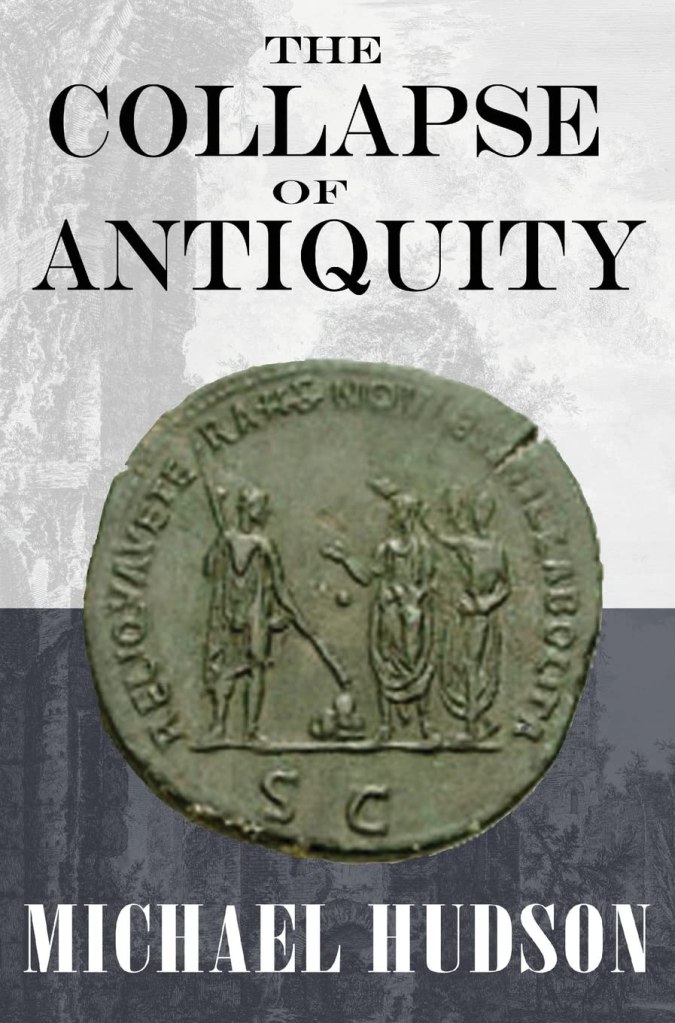
Prof. Michael Hudson’s new book, The Collapse of Antiquity: Greece and Rome as Civilization’s Oligarchic Turning Point is a seminal event in this Year of Living Dangerously when, to paraphrase Gramsci, the old geopolitical and geoeconomic order is dying and the new one is being born at breakneck speed.

Prof. Hudson’s main thesis is absolutely devastating: he sets out to prove that economic/financial practices in Ancient Greece and Rome – the pillars of Western Civilization – set the stage for what is happening today right in front of our eyes: an empire reduced to a rentier economy, collapsing from within.

And that brings us to the common denominator in every single Western financial system: it’s all about debt, inevitably growing by compound interest.

Ay, there’s the rub: before Greece and Rome, we had nearly 3,000 years of civilizations across West Asia doing exactly the opposite.

These kingdoms all knew about the importance of canceling debts. Otherwise their subjects would fall into bondage; lose their land to a bunch of foreclosing creditors; and these would usually try to overthrow the ruling power.

Aristotle succinctly framed it: “Under democracy, creditors begin to make loans and the debtors can’t pay and the creditors get more and more money, and they end up turning a democracy into an oligarchy, and then the oligarchy makes itself hereditary, and you have an aristocracy.”

Prof. Hudson sharply explains what happens when creditors take over and “reduce all the rest of the economy to bondage”: it’s what’s called today “austerity” or “debt deflation”.

So “what’s happening in the banking crisis today is that debts grow faster than the economy can pay. And so when the interest rates finally began to be raised by the Federal Reserve, this caused a crisis for the banks.”

Prof. Hudson also proposes an expanded formulation: “The emergence of financial and landholding oligarchies made debt peonage and bondage permanent, supported by a pro-creditor legal and social philosophy that distinguishes Western civilization from what went before. Today it would be called neoliberalism.”

Then he sets out to explain, in excruciating detail, how this state of affairs was solidified in Antiquity in the course of over 5 centuries. One can hear the contemporary echoes of “violent suppression of popular revolts” and “targeted assassination of leaders” seeking to cancel debts and “redistribute land to smallholders who have lost it to large landowners”.

The verdict is merciless: “What impoverished the population of the Roman Empire” bequeathed a “creditor-based body of legal principles to the modern world”.

Predatory oligarchies and “Oriental Despotism”

Prof Hudson develops a devastating critique of the “social darwinist philosophy of economic determinism”: a “self-congratulatory perspective” has led to “today’s institutions of individualism and security of credit and property contracts (favoring creditor claims over debtors, and landlord rights over those of tenants) being traced back to classical antiquity as “positive evolutionary developments, moving civilization away from ‘Oriental Despotism’”.

All that is a myth. Reality was a completely different story, with Rome’s extremely predatory oligarchies waging “five centuries of war to deprive populations of liberty, blocking popular opposition to harsh pro-creditor laws and the monopolization of the land into latifundia estates”.

So Rome in fact behaved very much like a “failed state”, with “generals, governors, tax collectors, moneylenders and carpet beggars” squeezing out silver and gold “in the form of military loot, tribute and usury from Asia Minor, Greece and Egypt.” And yet this Roman wasteland approach has been lavishly depicted in the modern West as bringing a French-style mission civilisatrice to the barbarians – while carrying the proverbial white man’s burden.

Prof. Hudson shows how Greek and Roman economies actually “ended in austerity and collapsed after having privatized credit and land in the hands of rentier oligarchies”. Does that ring a – contemporary – bell?

Arguably the central nexus of his argument is here:

“Rome’s law of contracts established the fundamental principle of Western legal philosophy giving creditor claims priority over the property of debtors – euphemized today as ‘security of property rights’. Public expenditure on social welfare was minimized – what today’s political ideology calls leaving matters to ‘the market’. It was a market that kept citizens of Rome and its Empire dependent for basic needs on wealthy patrons and moneylenders – and for bread and circuses, on the public dole and on games paid for by political candidates, who often themselves borrowed from wealthy oligarchs to finance their campaigns.”

Any similarity with the current system led by the Hegemon is not mere coincidence. Hudson: “These pro-rentier ideas, policies and principles are those that today’s Westernized world is following. That is what makes Roman history so relevant to today’s economies suffering similar economic and political strains.”

Prof. Hudson reminds us that Rome’s own historians – Livy, Sallust, Appian, Plutarch, Dionysius of Halicarnassus, among others – “emphasized the subjugation of citizens to debt bondage”. Even the Delphic Oracle in Greece, as well as poets and philosophers, warned against creditor greed. Socrates and the Stoics warned that “wealth addiction and its money-love was the major threat to social harmony and hence to society.”

And that brings us to how this criticism was completely expunged from Western historiography. “Very few classicists”, Hudson notes, follow Rome’s own historians describing how these debt struggles and land grabs were “mainly responsible for the Republic’s Decline and Fall.”

Hudson also reminds us that the barbarians were always at the gate of the Empire: Rome, in fact, was “weakened from within”, by “century after century of oligarchic excess.”

So this is the lesson we should all draw from Greece and Rome: creditor oligarchies “seek to monopolize income and land in predatory ways and bring prosperity and growth to a halt.” Plutarch was already into it: “The greed of creditors brings neither enjoyment nor profit to them, and ruins those whom they wrong. They do not till the fields which they take from their debtors, nor do they live in their houses after evicting them.”

Beware of pleonexia

It would be impossible to fully examine so many precious as jade offerings constantly enriching the main narrative. Here are just a few nuggets (And there will be more: Prof. Hudson told me, “I’m working on the sequel now, picking up with the Crusades.”)

Prof. Hudson reminds us how money matters, debt and interest came to the Aegean and Mediterranean from West Asia, by traders from Syria and the Levant, around 8th century B.C. But “with no tradition of debt cancellation and land redistribution to restrain personal wealth seeking, Greek and Italian chieftains, warlords and what some classicists have called mafiosi [ by the way, Northern European scholars, not Italians) imposed absentee land ownership over dependent labor.”

This economic polarization kept constantly worsening. Solon did cancel debts in Athens in the late 6th century – but there was no land redistribution. Athens’ monetary reserves came mainly from silver mines – which built the navy that defeated the Persians at Salamis. Pericles may have boosted democracy, but the eventful defeat facing Sparta in the Peloponnesian War (431-404 B.C.) opened the gates to a heavy debt-addicted oligarchy.

All of us who studied Plato and Aristotle in college may remember how they framed the whole problem in the context of pleonexia (“wealth addiction”) – which inevitably leads to predatory and “socially injurious” practices. In Plato’s Republic, Socrates proposes that only non-wealthy managers should be appointed to govern society – so they would not be hostages of hubris and greed.

The problem with Rome is that no written narratives survived. The standard stories were written only after the Republic had collapsed. The Second Punic War against Carthage (218-201 B.C.) is particularly intriguing, considering its contemporary Pentagon overtones: Prof. Hudson reminds us how military contractors engaged in large-scale fraud and fiercely blocked the Senate from prosecuting them.

Prof. Hudson shows how that “also became an occasion for endowing the wealthiest families with public land when the Rome state treated their ostensibly patriotic donations of jewelry and money to aid the war effort as retroactive public debts subject to repayment”.

After Rome defeated Carthage, the glitzy set wanted their money back. But the only asset left to the state was land in Campania, south of Rome. The wealthy families lobbied the Senate and gobbled up the whole lot.

With Caesar, that was the last chance for the working classes to get a fair deal. In the first half of the 1st century B.C. he did sponsor a bankruptcy law, writing down debts. But there was no widespread debt cancellation. Caesar being so moderate did not prevent the Senate oligarchs from whacking him, “fearing that he might use his popularity to ‘seek kingship’” and go for way more popular reforms.

After Octavian’s triumph and his designation by the Senate as Princeps and Augustus in 27 B.C., the Senate became just a ceremonial elite. Prof Hudson summarizes it in one sentence: “The Western Empire fell apart when there was no more land for the taking and no more monetary bullion to loot.” Once again, one should feel free to draw parallels with the current plight of the Hegemon.

Time to “uplift all labor”

In one of our immensely engaging email exchanges, Prof. Hudson remarked how he “immediately had a thought” on a parallel to 1848. I wrote in the Russian business paper Vedomosti: “After all, that turned out to be a limited bourgeois revolution. It was against the rentier landlord class and bankers – but was as yet a far cry from being pro-labor. The great revolutionary act of industrial capitalism was indeed to free economies from the feudal legacy of absentee landlordship and predatory banking — but it too fell back as the rentier classes made a comeback under finance capitalism.”

And that brings us to what he considers “the great test for today’s split”: “Whether it is merely for countries to free themselves from US/NATO control of their natural resources and infrastructure — which can be done by taxing natural-resource rent (thereby taxing away the capital flight by foreign investors who have privatized their natural resources). The great test will be whether countries in the new Global Majority will seek to uplift all labor, as China’s socialism is aiming to do.”

It’s no wonder “socialism with Chinese characteristics” spooks the Hegemon creditor oligarchy to the point they are even risking a Hot War. What’s certain is that the road to Sovereignty, across the Global South, will have to be revolutionary: “Independence from U.S. control is the Westphalian reforms of 1648 — the doctrine of non-interference in the affairs of other states. A rent tax is a key element of independence — the 1848 tax reforms. How soon will the modern 1917 take place?”

Let Plato and Aristotle weigh in: as soon as humanly possible.

Earth’s Ultimate War: A Battle to Control the Noosphere

By Phil Butler

Source: New Eastern Outlook

You feel it, don’t you? There’s something deeply wrong with our world. And I don’t refer to the planet’s geosphere. I mean, there’s something deadly wrong with society overall, and the ways in which we interact and react. Something is coming, and many understand what it is.

“We are like people under [a] sentence of death, waiting for the date to be set. We sense that something is about to happen. We know that things cannot go on as they are. History has reached an impasse. We are now on a collision course. Something is about to give.” – Reverend Billy Graham

A few years ago, I wrote a report on NEO entitled “Vladimir Putin’s Third Way: As Seen Through the Nooscope.” The piece covered Mr. Putin’s “Third Way” of governance, and a stunning invention by his now chief of staff Anton Vaino. The invention, the Nooscope was reportedly a device capable of measuring the noosphere, or the highest stage of biospheric development, that of humankind’s rational activities. And through the measurement of humanity’s activities, along with the use of advanced artificial intelligence (AI), the Russian leadership seemed to be seeking a new order not simply of which countries have a say so, but a system that could elevate humanity to its next logical level.

At first, the western academic and journalistic communities exhibited acute curiosity mixed with tongue in cheek skepticism such as is always leveled at Russian ideas. Then, of course, a maze of misinterpretations and distractive propaganda campaigns buried Putin’s ideas, and the probability that our collective conscious and energy can be measured for good. Sure, Google, Amazon, and a hundred other entities powered by Big and Minute data operate such measurements for profit, day in and day out. But those pesky Russians using advanced thinking and algorithms to fix humanity’s woes! This kind of idea had to be branded ridiculous propaganda. But is it?

Let’s remember that it was Plato who predicted that Noocracy was humanity’s future political system. The philosopher also claimed that Democracy (“the authority of the crowd”) and other forms of governance would eventually be replaced by a system such as that Vladimir Putin has suggested. So-called “Russia experts” scoff at the noosphere as a part of Russian Cosmism. However, a Rand Corporation report in 2020 acknowledge the developing noosphere, and made recommendations for the United States to considered adapting U.S. grand strategy to the information age—noopolitik, which favors the use of “soft power”—as a successor to realpolitik, with its emphasis on “hard power.” So, the bastardization of Mr. Putin’s “Third Way” concepts by the likes of the Brookings Institute and authors Clifford G. Gaddy and Barry W. Ickes (2009),

The theories of Pierre Teilhard de Chardin and Édouard Le Roy, who were the practical co-founders of the noosphere, in the early 1900s dealt with a noosphere wrapping Earth as a progression of the teleological character of evolution. Or, for lack of a better description, a result of an overarching “goal-directed evolution.”

Another report I completed that was never published deals with what I believe Putin has been working on. His “Third Way” and nooscope experiments having been put on hold by a new Cold War these days, is for purpose, I believe. There are those in the west who would welcome a new and more successful way of governance. And, there are those who are terrified that the Nooscope/Noosphere project will put an end to their engine of power. The latter group are certainly not attempting to halt the development of the noosphere, but they are trying to ensure it is the west that harnesses it for their purposes. This is one reason you see the western tech giants “all in” to try and censor the opposing side. Anyone who disagrees with the liberal order now, is an enemy of “the state.” As evidence, consider, that NASA and Cisco are currently collaborating on something called the Planetary Skin Insitute, a cousin or competitor to the Nooscope.

Putin’s “Third Way,” what an intriguing and potentially game changing thing! After having written about Russia’s emergence for a decade now, I continually recall what a speech V.V. Putin wrote an editorial for a German newspaper concerning his much-maligned Lisbon to Vladivostok proposed unified market. The quote below is from Putin’s editorial:

“We propose the creation of a harmonious economic community stretching from Lisbon to Vladivostok. In the future, we could even consider a free trade zone or even more advanced forms of economic integration. The result would be a unified continental market with a capacity worth trillions of euros.”

This was 2010, and the notion scared the hell out of everybody at the World Economic Forum, including the janitor. It was at about this time that the hierarchy decided that Putin and Russia as the boy from Leningrad envisioned it, must go. And here we are, witnessing a proxy war with one purpose, to tear a deep crevice in between Europe and Asia. The situation is a bit like the space race back in the late 1950s and early 1960s. Washington and the old gang in London cannot have the Russians controlling this evolved human potential. If anyone is going to take advantage of this noosphere, it’s going to be the same elites who dumbed our schoolchildren down to iPhone troglodytes.

Read the chapter Getting Back on Track Through Noopolitik, in the Rand report. It’s not a recommendation for the planet, but one for the deep state that currently has a former US president on trial to keep him out of office. You see, the liberal order is already manipulating the noosphere through owned media, academia, and government. To these people the sphere of human consciousness hugging our globe needs to be seeded with the “right” ideas. They seek to transform us, to evolve earth into the same slave planet it’s always been, only more efficient. It’s evil. A modern version of the worst parts of the Bible. The Matrix movie or 1984, take your pick.

We have to stop them. Or, wait until Jesus comes back.

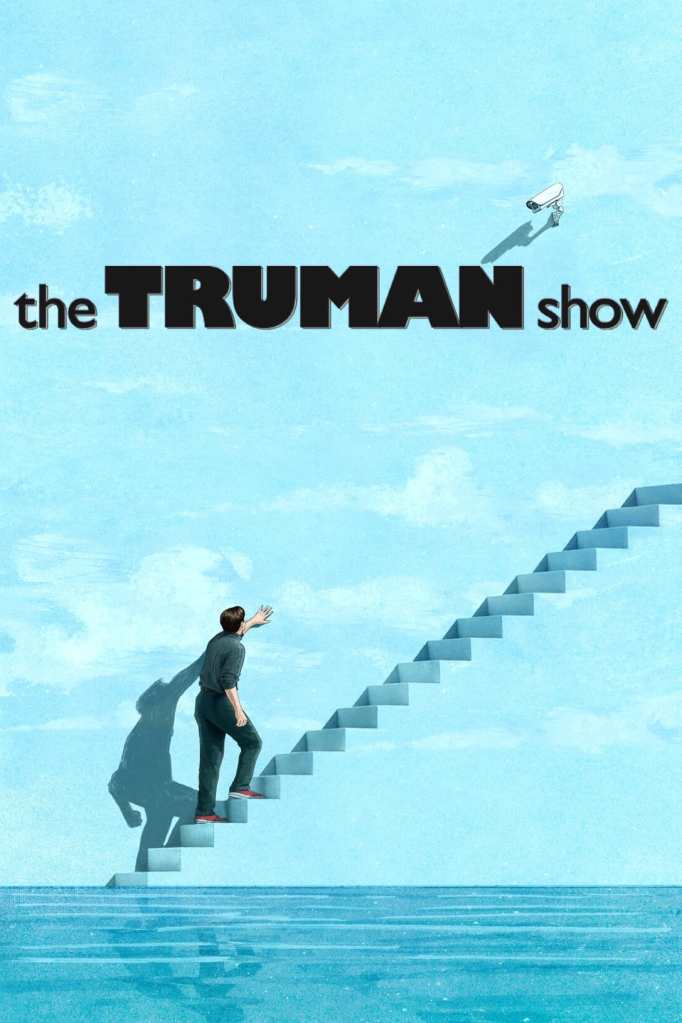
WE ARE TRAPPED IN A TRUMAN SHOW DIRECTED BY PSYCHOPATHS

“Whether in actual fact the policy of the boot-on-the-face can go on indefinitely seems doubtful. My own belief is that the ruling oligarchy will find less arduous and wasteful ways of governing and of satisfying its lust for power, and these ways will resemble those which I described in Brave New World. Within the next generation I believe that the world’s rulers will discover that infant conditioning and narco-hypnosis are more efficient, as instruments of government, than clubs and prisons, and that the lust for power can be just as completely satisfied by suggesting people into loving their servitude as by flogging and kicking them into obedience.” – Aldous Huxley – Letter to George Orwell about 1984 in 1949

“There will be, in the next generation or so, a pharmacological method of making people love their servitude, and producing dictatorship without tears, so to speak, producing a kind of painless concentration camp for entire societies, so that people will in fact have their liberties taken away from them, but will rather enjoy it, because they will be distracted from any desire to rebel by propaganda or brainwashing, or brainwashing enhanced by pharmacological methods. And this seems to be the final revolution” ― Aldous Huxley

When I step back from the day-to-day minutia and trivialities flooding my senses from all directions and media devices, it almost appears as if I’m living in a highly scripted reality TV program where the characters and plots are designed to create passions and reactions to support whatever narrative is being weaved by those directing the show. Huxley really did foresee the future as clearly and concisely as anyone could, decades before his dystopian vision came to fruition.

Orwell’s boot on the face vision is only now being initiated because a few too many critical thinkers have awoken from their pharmaceutically induced stupor and begun to question the plotline of this spectacle masquerading as our reality. The mass formation psychosis infecting the weak-minded masses; relentless mass propaganda designed to mislead, misinform, and brainwash a dumbed down and government indoctrinated populace; and complete control of the story line through media manipulation, regulation, and censorship of the truth; has run its course. As Charles Mackay stated 180 years ago, the masses go mad as a herd, but only regain their senses slowly, and one by one.

My recognition that the world seems to be scripted and directed by Machiavellian managers, working behind a dark shroud, representing an invisible governing authority, molding our minds, suggesting our ideas, dictating our tastes, and creating fear, triggered a recollection of the 1998 Jim Carrey movie – The Truman Show. The movie, directed by Peter Weir (Gallipoli, Witness, Dead Poet’s Society), had the surreal feel of Forest Gump, while beckoning the horrendous introduction of reality TV (Big Brother, Survivor), which poisons our shallow unserious society to this day. The plot of the movie focuses on individuality versus conformity, consumerism, voyeurism, reality versus manipulation, false narratives, the truth about the American Dream, and the dangers of surveillance in a technologically advanced society.

Truman Burbank is the unsuspecting star of The Truman Show, a reality television program filmed 24/7 through thousands of hidden cameras and broadcast to a worldwide audience. Christof, the show’s creator seeks to capture Truman’s authentic emotions and give audiences a relatable every man. Truman has been the unsuspecting star of the show since he was born 30 years prior. Truman’s hometown of Seahaven Island is a complete set built within an enormous dome, populated by crew members and actors who highlight the product placements that generate revenue for the show. The elaborate set allows Christof to control almost every aspect of Truman’s life, including the weather. The picture-perfect home, with picket fence and plastic people, is an attempt to convince Truman he is living the American Dream rather than in an inescapable dystopian techno-prison.

To prevent Truman from discovering his false reality, Christof manufactures scenarios that dissuade Truman’s desire for exploration, such as the “death” of his father in a sea storm to instill aquaphobia, and by constantly broadcasting and printing messages of the dangers of traveling and the virtues of staying home. One cannot but acknowledge the plotline to keep Truman under control, obedient, and locked down in his controlled environment, with no escape hatch visible, as exactly the plotline used by our overlords during the Covid scam. Using fear to regulate your subjects is a familiar theme used by those controlling the narrative and pulling the strings behind the scenes of our glorious democracy of dystopia.

The first task was to instill fear into the masses through fake videos, fake medical experts spewing fake “facts”, denying the reality masks, social distancing, and locking down the world did not stop a microscopic virus, while suppressing treatments which were clearly safe and effective (ivermectin, hydroxychloroquine) and forcing Fauci’s remdesivir and ventilators on patients – insuring their deaths. Truman’s life was built upon lies, deception, and fake narratives, controlled by a tyrannical director putting on a show to please his bosses and maximize profits. We are experiencing the same reality today.

Since March 2020 we have been trapped in a dystopian reality show based on lies, deception, and fake narratives about a weaponized virus created in a lab funded by Anthony Fauci and utilized to further the totalitarian Great Reset agenda of Schwab, Gates and their ilk, while maximizing the profits of Pfizer, TV networks and filling the pockets of politicians, shills, and apparatchiks willing to sellout the people of our country for thirty pieces of silver.

As the Truman Show approached its 30th anniversary, Truman began discovering unusual elements, such as a spotlight falling out of the sky in front of his house and a radio channel that precisely described his movements. He began to awaken to the fact he was nothing but a peculiarity trapped in a cage and constantly deterred from escaping at every turn, for the good of the show. He lived in a scripted world of conformity, where questioning the plot was not allowed, and the masses just played their parts.

This is exactly how a dictatorship without tears uses technology, pharmaceuticals, and psychological manipulation to convince the masses to love their servitude. This is the reality show we have been living in during this 21st Century dictatorship dystopia of dunces. But this psychological phenomenon is not new to mankind, as Plato described an ancient Truman Show analog in the 4th Century BC with his Allegory of the Cave. The nature of human beings has not changed across the trials and tribulations of history.

In the allegory, Plato describes a group of people who have lived chained in a cave all their lives, facing a blank wall. The people watch shadows projected on the wall from objects passing in front of a fire behind them and give names to these shadows. The shadows are the prisoners’ reality but are not an accurate representation of the real world. An enlightened man is like a prisoner who is freed from the cave and comes to understand the shadows on the wall are not reality.

The ignorant inmates do not desire to leave their prison/cave, for it is the only life they know, and they fear reality. The fire and the puppets, used to create shadows, are controlled by artists. Plato indicates the fire is also the political doctrine taught by a nation state. The artists use light and shadows to indoctrinate the masses with the dominant doctrines of the times. Few humans ever escape the cave. Most humans will remain at the bottom of the cave, with a small few elevated as major artists, to project the shadows keeping the masses disoriented, confused and fearful.

“Whereas the truth is that the State in which the rulers are most reluctant to govern is always the best and most quietly governed, and the State in which they are most eager, the worst.” ― Plato, The Allegory of the Cave

“Most people are not just comfortable in their ignorance, but hostile to anyone who points it out.” ― Plato, The Allegory of the Cave

The State is run by an eager group of psychopaths who are hell bent on destroying our civil society and common culture on behalf of globalists attempting to implement their Great Reset agenda, and enforcing it through technological surveillance, mind control through propaganda messaging, and strict management of the daily plot via mainstream media and social media censorship of the truth. As Plato contemplated twenty four centuries ago, most men will remain in their cave, believing shadows presented by their overlords is reality, never questioning their servitude or seeking the truth.

Never has this fact been truer than during this covid pandemic reality show directed by our Christof – mass murderer Anthony Fauci. The willful ignorance of the masses was assumed by the covid controllers who cast shadows of fear and death on the cave walls of the locked down extras in this well-orchestrated reality show. Using a purposefully misleading PCR test to vastly overestimate “cases”, paying hospitals to classify all deaths as covid, and having the propaganda professionals at CNN, MSNBC and Fox showing Covid Death Counters on their screens 24/7 to terrify the masses into compliance was the Covid Show.

Once the fear level was ramped to eleven on the control dial, the producers of this show introduced the miraculous Big Pharma vaccine antidote to save the day. Their script was so believable they were able to convince over 5 billion members of their captive audience to inject themselves with an untested, unproven genetic therapy, that didn’t prevent you from catching, transmitting, getting sick, being hospitalized, or dying from the Fauci funded Wuhan lab produced virus. But, as a dramatic twist to the tale, it seems the “vaccine” causes myocarditis, blood clots, infertility, miscarriages, heart attacks, cancer, and sudden death.

Despite the obvious dangers and failures of these “vaccines”, those bullied into getting jabbed became so comfortable in their ignorance, they were easily persuaded to hate the unjabbed and wish for their deaths. Orwell’s “Two Minutes of Hate” was extended for over a year and continues to this day. Rather than think critically and question why annual flu cases averaged 35 million per year prior to 2020 but dropped to near ZERO during the covid “emergency”, the cave dwellers lashed out in anger at anyone questioning the plot, because to admit they were duped would destroy their self-esteem and decrease their virtue signal credits.

The annual flu didn’t disappear. Covid was the annual flu, with a multi-billion-dollar marketing campaign. This wasn’t a pandemic, but an IQ test, and most people failed miserably. But the critical thinking unvaxxed are still considered the enemy of the state, especially since they have been proven right.

Whether we are trapped in an artificial world produced in a dome, cave, or our current technologically advanced surveillance propaganda state, the goal of those controlling our false reality is to take away our freedoms, crush dissent, keep us ignorant of the truth, and treat us as plebs to be taxed and molded. Christof, whose name is supposed to invoke him being a god-like figure ruling over Truman’s world, declares Truman could discover the truth and leave at any time, while using every diabolical trick to keep that from ever happening, because his show generated revenues exceeding the GDP of a small country.

Truman and ourselves are essentially prisoners in a vast production, and our overlords believe it is their duty to convince us to love our servitude and prefer our cells, because it is financially beneficial to the overlords and their crew.

Our world is not fake, but it is tightly controlled by those running the show. Seemingly random events, plots, and subplots are manipulated to generate specific emotions and reactions by the public in order to achieve the objectives of those benefiting from the various storylines. They are molding our minds and forming our tastes through psychological and technological manipulation of our daily existence. Christof explained why most rarely discover the truth or question the world they live in – “We accept the reality of the world with which we’re presented. It’s as simple as that.”

We have allowed men we have never seen to dictate how we live our lives, the choices we make, and which politicians and “experts” to believe, without ever putting in the effort to understand why we are being prodded to do so. We are locked in a self-imposed prison of desires, emotions, and needs through mass media messaging and a constant barrage of advertisements. Conformity and obedience are the desired traits sought by the ruling class, while individuality and skepticism are frowned upon and punished through social ostracism.

We are conditioned from birth to believe what they tell us to believe. Government school indoctrination and mass media misinformation does the trick. Distracted by our techno-gadgets and ignorant of truth is how the globalist oligarchs methodically implement their Great Reset agenda. They are so convinced of the ignorance of the masses they openly proclaim their depopulation and techno-prison schemes with no fear of push back or retribution.

The ending of the Truman Show is a lesson in resistance, persistence, and the strength of the individual, even in the face of a technologically advanced Big Brother state. It offers a message of hope, no matter how powerful our overlords appear to be. Refusing to obey or conform by one individual can inspire others to do likewise. Once Truman ‘awoke’ to his plight as a lab rat in a scripted show, he began to plot his escape. Using a makeshift tunnel in his basement, out of view of Christof’s cameras, he disappeared and forced the suspension of the broadcast for the first time in thirty years.

Christof discovers Truman sailing away from Seahaven in a small boat, as he has overcome the fake conditioning of fear instilled in him by the man who supposedly loves him but traumatized him about the sea by faking his father’s death while at sea. Christof chooses to almost drown Truman by creating a violent storm to deter him from discovering the truth. Ultimately the storm ceases and his boat strikes the wall of the dome.

This is exactly how our controllers treat the ignorant masses. They feed us stories designed to make us fearful and compliant to the exhortations of their paid experts. Paid to lie. Paid to misinform. Paid to persuade people a dangerous concoction is “safe and effective”. The evilness of using Sesame Street characters to convince four-year-old children they need this Big Pharma gene altering toxic brew, even though essentially ZERO children on earth died from covid, is a testament to the greed and malevolent impulses of those in power. Vast amounts of ever-increasing advertising revenue are what kept The Truman Show on the air for thirty years.

The covid advertising campaign will never be topped, as Hollywood stars, top athletes, famous writers, rock legends, supposedly impartial journalists, and all the major networks said SHOW ME THE MONEY!!!! Everyone was for sale, and all they had to do was lie and say the jabs were “safe and effective”. Product placement was the money-making formula for the Truman Show, while hard selling a Big Pharma phony cure over the airwaves 24/7 using the tax dollars of the victims was the final solution of the Great Reset Cabal.

The grand finale is a clash of the philosophies of reality versus false reality, as Truman discovers a staircase leading to an exit door. Christof speaks to Truman, claiming there was no more truth in the real world than in his artificial world, and he would be safe, with nothing to fear, in a world controlled by men invisible to him assuring him they have his best interests at heart. Truman chooses individuality, truth, risk, living a real meaningful life, and seeking honest relationships over a safe existence in a bubble where all decisions were made by others. Truman bows to the audience and exits, leaving Chistof to mourn the loss of his star and the revenue he generated. The ignorant masses watching the show cheer his escape and then ask, “what’s on next?” Plato captured the uncertainty and bewilderment Truman must have felt as he walked into the light.

The covid advertising campaign will never be topped, as Hollywood stars, top athletes, famous writers, rock legends, supposedly impartial journalists, and all the major networks said SHOW ME THE MONEY!!!! Everyone was for sale, and all they had to do was lie and say the jabs were “safe and effective”. Product placement was the money-making formula for the Truman Show, while hard selling a Big Pharma phony cure over the airwaves 24/7 using the tax dollars of the victims was the final solution of the Great Reset Cabal.

The grand finale is a clash of the philosophies of reality versus false reality, as Truman discovers a staircase leading to an exit door. Christof speaks to Truman, claiming there was no more truth in the real world than in his artificial world, and he would be safe, with nothing to fear, in a world controlled by men invisible to him assuring him they have his best interests at heart. Truman chooses individuality, truth, risk, living a real meaningful life, and seeking honest relationships over a safe existence in a bubble where all decisions were made by others. Truman bows to the audience and exits, leaving Chistof to mourn the loss of his star and the revenue he generated. The ignorant masses watching the show cheer his escape and then ask, “what’s on next?” Plato captured the uncertainty and bewilderment Truman must have felt as he walked into the light.

“Anyone who has common sense will remember that the bewilderments of the eyes are of two kinds, and arise from two causes, either from coming out of the light or from going into the light” ― Plato, The Allegory of the Cave

This world of manufactured dystopian pleasure harkens more towards Huxley’s Brave New World, where pharmaceuticals and conditioning would keep the public seeking pleasure, pre-occupied with trivialities, distracted by materialism, unable to think critically, and reduced to passivity and egoism through the control of messaging by their controllers. Our efficient totalitarian state has gained complete control by convincing the masses to love their servitude and beg for more rules, restrictions, and reduction of liberties in the name of safety and security.

Smart phones, smart cities, and smart streets are nothing more than code for spying on you and controlling you. Truman finally understood his liberty was his to choose and not Christof’s to give. There is a small minority of Americans who are realizing the same thing after two years of totalitarian measures designed to take away our freedoms and liberty. The question is whether enough will exit this tyrannical government produced show to make a difference. The future of mankind literally depends on the answer to this question.

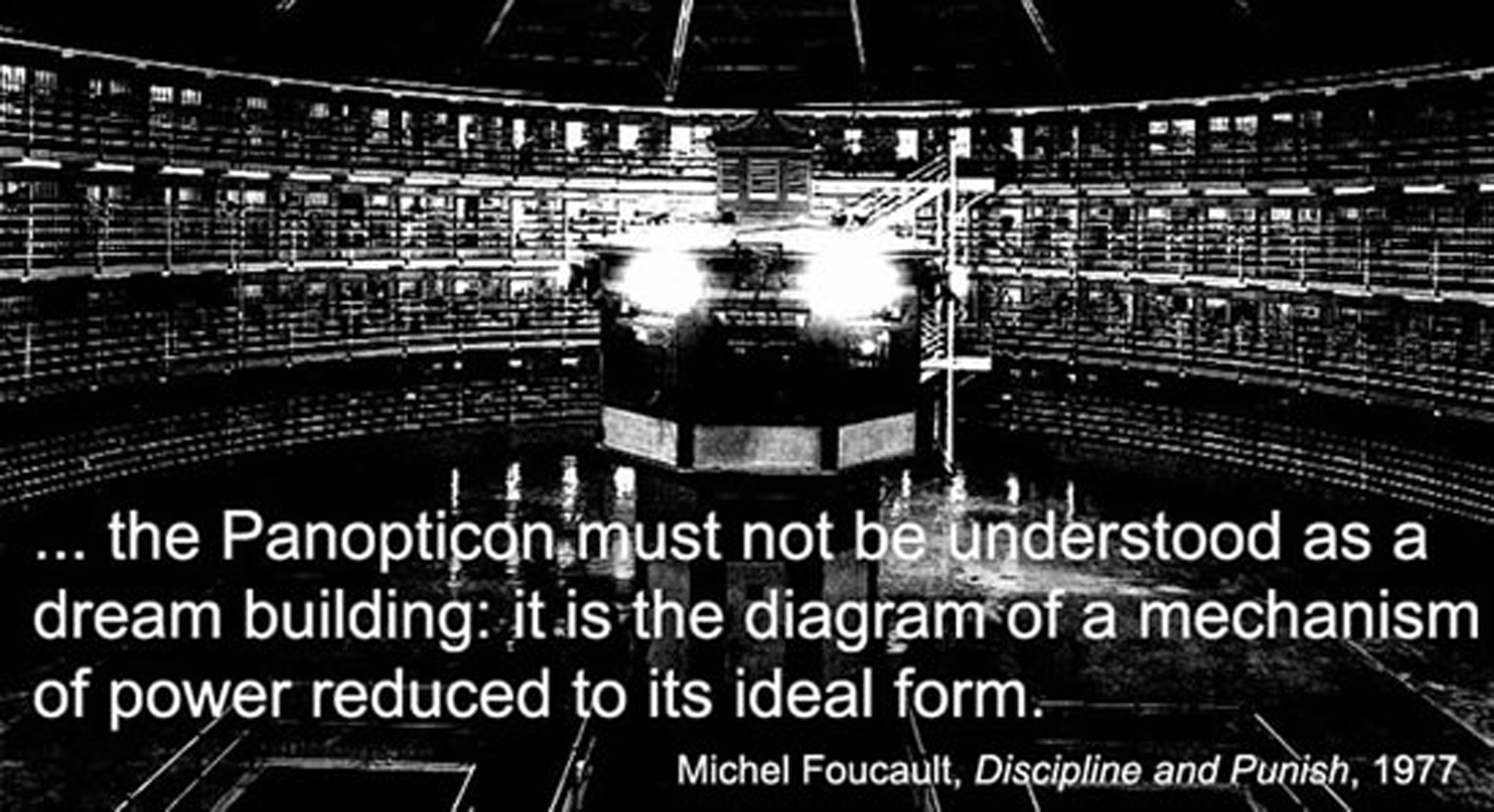
Media, Mind-Control, & Meditation: Plato’s E-Cave Panopticon and Beyond

panopticon-image

By Mankh (Walter E. Harris III)

Source: Axis of Logic

“Relax,” said the night man,
”We are programmed to receive.
You can check-out any time you like, 
But you can never leave!”

 – The Eagles, from “Hotel California”

In Plato’s Allegory of the Cave, people saw a shadow play on the wall and perceived it as reality. Today that Cave has morphed to provide umpteen TV channels and mini-screen gadgets; and the once sanctified living room cave has expanded into a free-range bubble of consciousness – heads bowed before an electronic altar, seemingly oblivious to the outside world.

“The “panopticon” refers to an experimental laboratory of power in which behaviour could be modified, and Foucault viewed the panopticon as a symbol of the disciplinary society of surveillance.”[1]

In Plato’s E-Cave, not only are the people watching a shadow play, they, and the shadows they watch, are being watched.

HyperNormalization
With a veneer of calm aplomb, the masses communicate 24-7, often in a frenetic urgency of the mundane, hence one interpretation of HyperNormalization. In all the years of overhearing cell-phone conversations in public, I can’t recall one snippet of philosophy or practical advice, rather stuff like, ‘yeah OMG I’ll get the chips!’ and ‘I’ll be there in like 30 seconds!’; if you’re old enough, you’d remember the days when, you got there when you got there! That said, a cell-phone can be a helpful even life-saving device.

The USEmpire election appears to have both proven and disproven the main theory of Adam Curtis’ fascinating new documentary “HyperNormalization.”

“Curtis argues that since the 1970s, governments, financiers, and technological utopians have given up on the complex “real world” and built a simple “fake world” that is run by corporations and kept stable by politicians.”[2]

The California cyber-tech-boom was a love-child of LSD-consciousness that found refuge in E-wizardy all the while looking to escape repressive politics. In his book “2030” Pepe Escobar describes it as: “Digital network capitalism would then shape post-modern globalization, from the New Economy before the end of the millennium to every digital wall to be broken beyond. California cosmology forged our world.”

According to Wikipedia:

“The term “hypernormalisation” is taken from Alexei Yurchak’s 2006 book Everything was Forever, Until it was No More: The Last Soviet Generation, about the paradoxes of life in the Soviet Union during the 20 years before it collapsed. A professor of anthropology at the University of California, Berkeley, he argues that everyone knew the system was failing, but as no one could imagine any alternative to the status quo, politicians and citizens were resigned to maintaining a pretence of a functioning society. Over time, this delusion became a self-fulfilling prophecy and the “fakeness” was accepted by everyone as real, an effect which Yurchak termed “hypernormalisation”.”[3]

First off, I see HyperNormalization as a half-truth because while the self-referential, gossipy world is fake, it is a veneer for a very real world of resource extraction and the violence perpetrated to maintain the status quo – and that is what the fakers ignore. As far as the election, many expected the Clinton dynasty to prevail as the corrupt, business as usual lesser of two evils. Breaking snooze: Where’s  the headline news that Melania Trump plans to focus on helping women and children?; I saw that mentioned on CNN’s Anderson Cooper 360, such a perfect antidote for Hillary’s loss and The Donald’s anti-feminist track record.

Even though WikiLeaks revealed the DNC (Democratic National Convention) was rigged against Sanders and leaks of Podesta/Clinton e-mails may have been proverbial straws for Hillary’s campaign camel, the prevailing media sentiment was that she would win – despite the fact that the day before the election some polls indicated a shrinking 3-4 point lead, thus with the typical margin of error, it was, in effect, tied. Yet the mass hyper-surprise!; and all that after the corporate media and comedy shows had simultaneously bashed Trump and given him more air-time than a kite on a windy day – both disdaining and elevating him, a media-mindfuck if ever there was one.

And there was little uproar when Gary Johnson and Jill Stein were excluded from debates and virtually banned from all corporate news, thus proving (if you didn’t know already) that it’s not a truly democratic election. Yet carry on we must and do the best we can with what we got, was the general sentiment, in other words, “the “fakeness” was accepted by everyone as real” aka HyperNormalization.

Yet the non-coastal, poor and middle America White working class (with sides of KKK and minorities!), which reportedly was the key demographic for The Don’s victory, was voting out of bare-bones needs; in effect they were not HyperNormalized. Then again, if Trump, who promises to challenge the status quo, caves-in to Deep State pressure, we will have an answer to an interesting article’s titular question: “President Trump: big liar going to Washington or Tribune of the People?”[4] And if that answer is the former, then the mostly White working poor will also have been duped/HyperNormalized.

You see, it’s hard to know what’s what; which all seems to prove HyperNormalization as the dominant societal charade; which screen is real, if any?

What you perceive is what you get
Another key phrase in Curtis’ documentary is “managed perception” – akin to Chomsky and Herman’s  “Manufacturing Consent: The Political Economy of the Mass Media” (1988) which showed how opinions and desensitized agreement to the status quo became a product to be mined and marketed. Witness CBS Chairman Les Moonves’ comment from February 2016:

“Man, who would have expected the ride we’re all having right now? … The money’s rolling in and this is fun. I’ve never seen anything like this, and this [is] going to be a very good year for us. Sorry. It’s a terrible thing to say. But, bring it on, Donald. Keep going.” [5] And, if i might satirically add, like an orangey topped Duracell battery, The Don does seem to have a lot of energy.

HyperNormalization is also akin to Sheldon Wolin’s theory  of “inverted totalitarianism,” where the faceless corporate machine wields so much entertainment and bureaucratic power that the people barely notice they are being played hook, line, and sinking feelings.

Some of Curtis’ info, however, is inaccurate or questionable. For examples, he blames the demise of the Occupy Movement on lack of vision and planning yet neglects to mention the FBI coordinated systemic crackdown on the ‘camps’ across the country. [6]

About Syria he says that President Bashar al-Assad retaliated with a “vengeful fury,” whereas Assad has defended his actions as self-defense for his people; numerous journalists back the Syrian President’s claim.

Post-election, I wonder: Why were so many liberals, lefties, and women more surprised that Trump won than that the DNC/HRC rigged it against Sanders? Were they simply feeling impotent due to HyperNormalized shadow play? Whatever the case, his victory revealed a crack in the smooth screen of HyperNormalization.

According to Patrick Caddell’s survey before the election, the populace seems to be hip to what’s happening:

“Powerful interests from Wall Street banks to corporations, unions and political interest groups have used campaign and lobbying money to rig the system for them. They are looting the national treasury of billions of dollars at the expense of every man, woman and child. AGREE = 81%; DISAGREE = 13%…

“The country is run by an alliance of incumbent politicians, media pundits, lobbyists and other powerful money interests for their own gain at the expense of the American people. AGREE = 87%; DISAGREE = 10%

The real struggle for America is not between Democrats and Republicans but between mainstream American and the ruling political elites. AGREE = 67%; DISAGREE = 24%.” [7]

This makes it seem it is the ‘how-to bring about change’ that is the deeper conundrum of the HyperNormalized world. Then again, people too often seem to have only their own best interests at heart. Approximately 90% of Americans want their food labeled so as to know if they contain GMOs etc. or not, yet hardly a peep out of anyone that climate change or the “environment” aka Mother Earth & Nature-beings were deliberately excluded as a main topic of the presidential debates. This makes it seem that, in general, Americans want clean food for themselves, they want a clean environment so they can go ‘play in the park’ by themselves. And that brings us to the Great Disconnect and Standing Rock.

Flow like water, be steady as a rock
Part of HyperNormalization is a disconnect from Nature and from being self- and community-guided, and therefore disconnected from the Original Peoples of Turtle Island. While many people are certainly aware of what’s happening with Standing Rock, the corporate media’s lack of attention, let alone empathy, fosters lack of concern for the outcome, lack of being outraged by the violent and racist treatment of those in prayer and peacefully protecting the main source of water for the Standing Rock Sioux and other Natives as well as approximately 17-million people downstream. The real-fake outrage is over the outcome of a fake election.

For many Native reservations where poverty and PTSD are prevalent, the people are anything but HyperNormalized; they are struggling to survive – as with Standing Rock, they are not asking for much: clean water and the space to live their lives with ancient traditions timelessly connected with the land, the water, the stones…

Plato, imagining a prisoner getting outside of the Cave, wrote: “Slowly, his eyes adjust to the light of the sun. First he can only see shadows. Gradually he can see the reflections of people and things in water and then later see the people and things themselves. Eventually, he is able to look at the stars and moon at night until finally he can look upon the sun itself .” [8]

Standing Rock is bringing people together, raising consciousness at many levels. As one example from a little over a week ago:

“In a “historic” show of interfaith solidarity, 500 clergy members prayed along the banks of North Dakota’s Cannonball River on Thursday where they “bore witness with the Standing Rock Sioux Nation,” which has faced intimidation, violence, and arrests for protecting their sacred land and water supply from the threats of a massive oil pipeline. According to the Episcopal News Service, “The interfaith group spent more than five hours on site, marching, singing hymns, sharing testimony, and calling others to join them in standing with the more than [300] tribes who have committed their support to the Sioux Nation as they protest the route of the Dakota Access Pipeline (DAPL).” [9]

This solidarity is in stark contrast with the election where a typically 51/49 system determines an outcome for a society literally programmed for exciting close-call winners – think sporting events,
reality shows, awards ceremonies.

Outside in and inside out
There are many ways to get outside the Cave. One of those is by going within. When I first started to meditate, as is common, I became aware of the constant chatter in my head and soon realized that the mind left unattended will rattle on endlessly. Meditation then showed me that once the chatter quiets, one then has access to other frequencies, other ‘channels’ – what happens then is a very personal matter yet also impersonal because one becomes connected with another source of thinking-seeing-feeling. Chatter, like cell-phones, has it’s usefulness, say, if you forgot to turn the stove off. My point to the personal anecdote is that the corporate media is too much chatter, endlessly looping itself. The gadgets, too, though useful, seem hard-wired for HyperNormalization.

Some of the chatter we must live with, yet by learning to follow our intuitions, listening to and connecting with Nature, talking with elders and little children we can better tune-out from the shadow-play, we can find new and ancient ways for more people – and that includes trees, rivers, etc. –  “to look at the stars and moon at night” and “look upon the sun itself.”

“Sin filo ya y derrotada se quejó: Soy más fuerte que ella, pero no le puedo hacer daño y ella a mi, sin pelear. me ha vencido.’”

“Without sharpness and defeated, it [the sword] complained: ‘I am stronger than the water, but I cannot harm her. And the water, without fighting, has conquered me.’” [10]

NOTES:
1.    Panopticism here and here.
2.    Ibid.
3.    HyperNormalization
4.    See here.
5.    “Les Moonves: Trump’s run is ‘damn good for CBS’”. See here.
6.    “Revealed: how the FBI coordinated the crackdown on Occupy
7.    “Patrick Caddell; The Pollster Who ‘Got it Right’
8.    “Allegory of the Cave
9.    “A Prayer for People and Planet: 500 Clergy Hold ‘Historic’ Mass Gathering for Standing Rock
10.    “Questions & Swords: Folktales of the Zapatista Revolution” as told by Subcomandante Marcos, Cino Puntos Press, El Paso, Texas, 2001, p.82.

To watch “HyperNormalization”, click here.

Mankh (Walter E. Harris III) is an essayist and resident poet on Axis of Logic. In addition to his work as a writer, he is a small press publisher and Turtle Islander. His new book of genre-bending poetic-nonfiction is “Musings With The Golden Sparrow.” You can contact him via his literary website.


Abandoning the Ship of Fools: Postmodernist and Wildist Responses to Civilization

220px-Narrenschiff_(1549)

By Jeriah Bowser

Source: The Hampton Institute

Once upon a time there was a people who lived with the Sea; living in connection, intimacy, and harmony with their aquatic environment for a very long time. Then one day a dangerous and powerful man had a bold idea. He thought that if he could build a Ship to sail over the Sea, he might find a better world to live in, a Paradise. He had a hard time convincing others that this Paradise was something to pursue, however, so in order to accomplish this he had to enslave lots of other sea-people to make the voyage possible. The sea-people, under threat of violence and death, built a large ship out of dead plant and animal people, stocked the ship with supplies, and took their place at the oars of the slave-galley. This great Ship then sailed away from the sea-people’s ancestral homeland and headed into the great unknown. After a long time at sea, the slaves forgot they were slaves. As they adapted to their new life of labor and hardship aboard the Ship, they forgot what life was like as sea-people and began identifying with the Ship and its mission. As they forgot how to live on their own away from the Ship, their survival and happiness became inextricably bound up with the Ship and the Captain, until they no longer saw themselves as slaves at all, but as willing participants onboard this fantastic adventure. Their language, culture, rituals, and mythology transformed to reflect their new way of life. They now worshipped the Captain and Paradise Gods as they saw themselves fundamentally separated from the Sea and its ways. The Captain created laws and morals with which to guide correct behavior aboard the Ship. They created rituals for themselves which gave them context for their roles on the Ship and gave meaning to their lives of labor and struggle. They lost all contact with their former ways of being and understanding the world. They were truly unanchored in the world; the Ship being their only reference point for Truth and Deception, Meaning and Nihilism, Beauty and Ugliness, Community and Individuality, Pleasure and Suffering, Sacredness and Profanity.

After a while, some of the slaves felt uncomfortable with what they perceived as unjust treatment aboard the Ship. They were tired of being beaten and starved and worked to death and wanted a better life. But instead of abandoning the Ship, they simply asked for more participation. The slaves had forgotten what life was like before the voyage, they couldn’t imagine living without the Ship and the Captain. They had begun identifying with the Ship and its mission so much that they wanted an equal role in participating.They were tired of just rowing and thought that the Navigator’s job might be fun, along with some of the other jobs on board the Ship that were usually reserved for the Captain’s friends. When this discontent reached a certain point, there would be mutinies where the slaves would demand equal access to the Ship, they demanded equal rights. The Captain, being a shrewd man, would listen to their requests and grant them greater access to the Ship. He even let some of the slaves take the wheel for a few minutes on special occasions; it was always a great spectacle when a slave would be called up from the galleys to the captain’s chair for a few minutes, turning the wheel this way and that, grinning idiotically as a rush of power, purpose, and meaning rushed through the slave until their turn was up and they were sent back down to the galleys. The hope of getting a turn at the wheel inspired much enthusiasm and loyalty to the project. Of course, no-one, not even the Captain perhaps, knew that the wheel had been broken for a long time now – it was merely a symbol. Even if the wheel did work, the Ocean current the Ship was now in was much too strong to break out of with a mere wheel turn. The Ship was now caught in a force much larger than itself, it had started on a voyage which it now had no control over.

One day, a few of the more clever slaves got together and started whispering to each other about some things that seemed strange about the whole affair. They couldn’t really put their finger on exactly what was wrong, they just felt that… something was wrong, so they began poking around and investigating. Some of these clever slaves had access to navigation equipment and, after much calculation, discovered that not only was the wheel broken, but the Ship was caught in a huge ocean current that was going in a giant circle and heading nowhere which meant that… there was no Paradise. This was very troubling news. Another member shared that he had discovered a mask with the Captain’s face on it – it seemed that the all-powerful Captain was a mere puppet. Was he in hiding? Was he still alive? Who had killed him? Was he ever real? These were even more troubling discoveries. A few others gained access to the forbidden areas of the Ship: the secret rooms and cellars where the Ships records were stored. As they began exploring the dark and musty belly of the Ship, they discovered that the Ship itself was starting to sink – water was slowly leaking in through the rotting hull and pulling the Great Ship down. Terrified and angry at having been lied to, they decided to try and jettison from the Ship as quickly as possible. They tore apart a section of a storeroom and, using the lumber and tools from the Ship, made a small dinghy together. They launched their dinghy one dark and stormy night, and spent a long time celebrating and high-fiving each other, full of self-congratulatory exhilaration at having escaped the fate of the other slaves. What they didn’t yet realize, however, was that they were caught in the same current as the Mother-Ship. They were headed for the same fate, they had no bearings in the great Sea, no ability to change their course even if they did know where they were, and their dinghy (having been made of the same tools and materials as the Mother-Ship) was already starting to rot and leak.
*****************
The mythology of the Ship of Fools is very old, it is first attributed to Plato, a 4th century BCE Greek philosopher. He used the Ship as an analogy for the fragility and irrationality of a democratic society, as only a strong Captain (a rigidly Rational and authoritarian political system) could maintain order and keep the Ship on course. Some have translated Plato’s metaphor (as well as the remainder of the Republic) as a work of psychology a well, as we mustn’t allow the chaos of our irrational desires and whims (the passengers) distract us or drown out the one voice of Reason (the Captain) in our heads. [1] Various philosophers and writers have since used this metaphor as a literary device and point of philosophical inquiry. Michel Foucault, a 20th century French postmodernist, used the story as a reference point in his book, “Madness and Civilization,” where he explored the history of the social construction of mental illness. In Foucault’s book, he talks about the mythological and historical legacy of the legend and discovered that there were indeed floating insane asylums – the “Narrenschiffs” – which carried those deemed insane from port to port in Europe, particularly in Germany, in the early 15th century. These floating asylums were eventually retired in favor of prison-like insane asylums, which eventually became our mental hospitals.[2] Sebastian Brant, a late-fifteenth century German theologian, used the mythology of the Ship of Fools as a satirical device as he mocked politicians, academics, and various prophets of Modernism during his time.[3] Ted Kaczynski used the Ship of Fools as a metaphor for industrial capitalism in order to critique the role that leftism/reformism plays in distracting and co-opting dissent, and his essay on the topic is considered to be Ted’s most coherent and accessible work.[4] In Max Horkheimer and Theodore Adorno’s landmark 1947 book, “Dialectic of Enlightenment,” they explore this myth by working from Homer’s epic poem, “The Odyssey.” Horkheimer and Adorno portray the epic story of Odysseus as a metaphor for humanity’s journey away from wildness and into civilization. [5]

Since my first introduction to this myth, I felt that it was heavy with archetypal symbolism which begged to be explored. I searched for an explanation which would satisfy my curiosity, but found none that sufficed. It looks like this task has fallen to me.

The Ocean is steeped in archetypal symbolism, most of it revolving around the theme of wildness, as it is the largest and most inaccessible wilderness on our planet. Jung described the Ocean as the very embodiment of the unconscious, with our consciousness a tiny island in the midst of it. [6] While every corner of land on our planet has been thoroughly mapped, every animal or plant we come across has been catalogued and placed on an evolutionary tree, and every “resource” depleted for human consumption, the Ocean still remains vast, mysterious, and elusive from the greedy hands of Science and Progress. The Sea still holds its own against those who would colonize it, although it is slowly being killed despite its resistance. As such, the Ocean holds great symbolism as our unconscious shadow side, our repressed hidden instincts and urges, the dark and dangerous animal that lies in us all.

In my retelling of the Ship of Fools, the Ocean also represents our ancestral homeland, as (according to evolutionary biologists) mammals came from the Ocean and I believe a part of us still recognizes that. I feel it when I stand on a beach and find myself staring out into the vast wild ancestral homeland of my species. I also made the Ocean our home because having a land-destination brings up to possibility of a destination and a potential rescue, it dangles the carrot of Paradise out in front of the Ship. No, there is no land, no destination, no possibility of a safe landing, there will be no survivors washing ashore. There is just more Ocean everywhere you look, more wildness, there is no escaping it. This also brings up the point that there never was a destination in the first place, just an inevitable return and release to wildness.

The Ship is an excellent metaphor for Civilization, as it is the great technological project that carries us to Paradise. Although I found scant mentions of ships in Jungian symbolism (not that I am an authority on Jung), the few mentions of it I did find present the Ship as the Animus (male quality) to the Anima (feminine quality) of the Sea. Therefore, ships refer to the Ego-consciousness and masculine energy, as these man-made floating islands rise above and ride on top of the vast feminine unconscious that is the Sea.[7] Trying my hand at depth psychology, I find that it also represents Technology, as a Ship is a piece of advanced technology which requires division of labor, slavery, private property, objectification, and anthropocentrism to exist. The presence of a slave-galley requires all of those ideas to become systemic and normalized, as well as the ever-present but invisible social violence of civilization which keeps the slaves rowing. A ship is made of dead trees, tar, rope, metal hardware, cloth sails, etc. It is a floating human container made of tree corpses, a vessel built out of and predicated on death. This technological vessel of death allows us to float a few feet above the reality of wildness, allowing us to act like the Ocean isn’t there while we go about our business aboard the floating Machine. It is literally a manufactured barrier between us and the cold, dark, mysterious reality of the Ocean. But no Ship is infinite. No matter what materials they are made out of, they will eventually succumb to the law of return: wood will eventually rot, metal will eventually rust, and fiberglass will eventually break down. The thin barrier between us and wildness will eventually erode; our model of infinite growth on a finite planet will have to face reality sooner or later.

The cultural transition of the slaves into willing participants represents the process of domestication. This is also known as trauma-bonding, colonization, or the Stockholm syndrome. When an animal becomes totally dependent on their domesticators for survival, approval, meaning, and validation, we begin to identify with our oppressors, releasing our hatred/resistance towards them and accepting their needs, beliefs, and desires as our own. [8] This takes place on many levels, and when a culture has become domesticated enough we will begin adapting our language, symbols, mythology, and rituals to correspond to our new reality. The old ways of understanding the world no longer make sense in a new world of separation, trauma, and domination. Mythology is a means of situating oneself within a community, a way of deriving meaning from a seemingly chaotic and uncontrollable reality. Ritual is a way of initiating one into and reaffirming cultural mythology. In the civilized world, our rituals reflect our mythology perfectly: we participate in self-destructive, dangerous, and meaningless rites of passage such as gang initiations, getting drunk, graduating high school, getting our driver’s license, or having sex, and our initiation societies are those which inculcate us further into Empire: academia, military, business, and street gangs invite us in, given us our identities, give us a role within a community, and use us until they are done with us and they find another young person desperate for meaning and purpose in their life. Aboard the Ship, we completely lose our bearings to reality as we are swept away into the future. All of our symbols reflect those of the Ship: we understand ourselves and the world around us only through the medium of Ship language and culture. We forget that another way of being in the world ever existed or even could exist.

The Captain represents God, Morality, Modernism, Science, and Objective Truth. The Captain is whatever or whomever currently holds Truth and Power. Of course, there actually is no Captain, nor was there ever, but that doesn’t stop everyone onboard from emphatically believing in his existence and striving to live their lives in ways that are acceptable to the Great Captain. His presence in this story is important for two reasons. One, it is important to realize that domestication is never a voluntary activity. That is, it is always done through oppression, violence, and Trauma. The slaves did not join this Ship voluntarily, they were forced into it – civilization is predicated on violent domination and slavery. Two, the Captain represents the ever-present specter of Morality/Truth/Power within civilized cultures. The Captain may have never existed, or he may have died a long time ago. It makes no difference to domesticated people, for once he has colonized us we reserve a special place for Him in our heads: He is always watching, and any infraction of His rules brings swift judgment from above in the form of conscience/guilt.

The slave revolts that take place aboard the Ship are the central focus of Kaczynski’s version of the story, as he was focused on exposing leftism/reformism as ultimately futile within the larger context of the Ship’s course. Conversations on “rights” or “equality” always take place within the larger context of civilization. “Granting Rights” is a legal term, it uses the language of Power, it means granting a person or a living thing a privileged position within the hierarchical structure of Power; it does not mean destroying the power structure. The critics of Wildism will point out that this itself is a privileged position: we must not care about the injustices of oppressed groups of people in order to take such a dismissive stand. This entirely misses the point. Do I want cops to be able to kill black people whenever they want? Do I want men to able to assault women whenever they want? Of course not. Leftism acts as a co-opting tool, it obfuscates power by playing with symbols. Police brutality in the US did not end with “racial equality,” because equality in this context means giving people with darker skin equal access to systems of oppressive power. I don’t want white cops killing anybody and I don’t want black cops killing anybody. I don’t want men assaulting anybody and I don’t want women assaulting anybody. I don’t want Latino lawyers or women presidents, I don’t think giving historically oppressed people an opportunity to share in oppression is progress at all… but of course it is Progress. Leftism serves as a safety-valve for cultural resistance. When the pressure gets a bit high, oppressed cultures can let off steam by participating in symbolic protests or fighting for equality, so long as they don’t actually challenge the dominant narrative, as long as they never question or challenge Civilization or Progress. Now, that doesn’t mean that resistance is always leftist/reformist, it just means that resistance to domination/oppression/domestication often gets subverted into some bullshit political agenda that challenges nothing and changes nothing.

The instances of slaves taking the wheel is of course a metaphor for the political system in general, as the entire puppet show is a complete distraction and has no bearing on the course of the Ship. The wheel has been broken for a long time, and even if a group of people genuinely tried to fix the wheel and steer the Ship somewhere else, they would find themselves trapped in the Ocean current. We are caught up in forces way beyond our comprehension or control. Civilization is experiencing massive overshoot, and the planet simply cannot continue supporting this way of being. But the wheel still sits there, tempting us to try and do something, fix something, if we can just be creative and committed enough… but even this great symbol of Hope and Progress will go down with the Ship.

The clever slaves represent the postmodernists – those who, having investigated the Ship and its Captain, have figured out that we have been duped, and are therefore trying to escape by jettisoning from the Mother-Ship. A noble effort, for sure, but ultimately doomed because they never looked past the Ship itself to see what lies beneath. Their survival craft is built with the same materials as the Mother-Ship, the postmodernists have not let go of any of the pillars of civilization but have instead tried to re-imagine them through language games and attempts at subjective Truth. Except for a thoroughly consistent rejection of Power and Objective Truth, the rest of the pillars of civilization remain present throughout much postmodern work: Anthropocentrism, Androcentrism, Progress, Atomization, Dualism, Hierarchy… the gang’s all here, sometimes questioned but never examined to their origins and then rejected. The postmodernists went all the way to the cellar of the Ship, but they stopped at the hull. They never tried to look past the thin barrier of death that lay between them and wildness, they never questioned what was on the other side, they simply took the Ship as an unfortunate but necessary reality and tried to rebuild a new Ship from some spare materials. Those clever slaves found themselves again stranded in the middle of nowhere in a rotting and leaking dinghy, this time without even the reassuring lies of Objective Truth to comfort them. They are truly a sorry lot. With no cultural mythology, context, or ritual to guide them, without connection, they are aimlessly and meaninglessly floating next to the Mother-Ship, caught in a current of impending destruction, in an Ocean of terrifying wildness.

Postmodernism has failed to provide meaning or connection primarily because it begins its search for meaning within the confines of civilization. Any course or book on Western philosophy begins with the Ancient Greeks: the Pre-Socratics. They call this period of time “Premodernism” and proceed from there, accepting the words and thoughts of these thoroughly domesticated humans as somehow representing our origins as humans. Postmodernism accepts radical disconnection/domestication/Trauma as a given, fast-forwards 8000 years, and then wonders why we are so disconnected/domesticated/Traumatized today.

Postmodernists ask a lot of really good questions; they relentlessly critique and question Power and Objective Truth, and they understand that Modernism has failed us miserably. However, they offer nothing better! In fact, one could make the argument that telling a thoroughly domesticated/traumatized person that Truth is subjective is almost a cruel joke; without context for understanding subjective experience, without connection, subjective Truth is terrifying and overwhelming. It is no favor to tell a civilized person that their entire framework for understanding reality is false, you leave them stranded on a leaky dinghy in the Ocean, with no context for how to find meaning in the universe, no guidance for situating themselves within their human and biotic communities, no advice for restoring connection and returning to wildness.

To return to the Ship metaphor, what other option is there? What are the anti-modernists, the anarcho-primitivists, the rewilders, and Wildists doing? Well, we are either actively sabotaging the Ship by attempting to burn it down and drilling holes in the hull, or we are literally jumping Ship – actively seeking a return to wildness and embracing the dark icy chill of the unknown. We know that the wheel of political change is a joke, there is no Paradise, the Captain is a lying sadistic tyrant (who doesn’t actually exist), the postmodernist dinghy is doomed to failure, and to stay aboard the Ship is to go down with it… so we are done with the whole thing. This does not mean that we will escape any of the consequences of civilization or that we will somehow survive the impending collapse of the Ship and the rise of Wildness, it simply means that we are done rowing and believing in the Ship, in Paradise, in the Captain, or in any false hope of rescue. Like the postmodernists, we emphatically reject any notion of Objective Truth, but our rejection is grounded in the context of relationship and connection. Our growing connection to the wildness both inside and outside of us orients us as we abandon Ship, as we allow the great terrifying, wild mystery of the Ocean consume us, destroy us, heal us, and take us home.

Notes


[1] “Republic: Book Six” – Plato

[2] “Madness and Civilization” – Michel Foucault (1964)

[3] “Ship of Fools” – Sebastian Brant (1494)

[5] “Dialectic of Enlightenment” – Max Horkheimer and Theodore Adorno (1944)

[6] “The Portable Jung” – C.G. Jung, edited by Joseph Campbell (1976)

[7] “The Archetypes and the Collective Unconscious” – C.G. Jung (1981)

[8] Frantz Fanon has explored this phenomenon of trauma-bonding, or colonization, exhaustively.I cannot more highly recommend his works for those interested in exploring the impacts of domestication on humans.

Coincidence, Chaos, & Archetypes in Our Science-Fictional World

4153262_orig

By Eric Wargo

Source: The Nightshirt

You don’t have to be a hardheaded materialist skeptic or an atheist to be troubled by the idea of synchronicity. The fundamental mystery—or really, outrage—of synchronicities is they seem arranged, stage managed, in a way that is impossible without imagining an active higher intelligence taking interest in guiding us and arranging the events of the wider world to produce unmistakeably uncanny outcomes. Even if we believe in God, many people aren’t comfortable living in a world of miracles and signs.

This was the problem faced by Philip K. Dick, whose Christianity couldn’t countenance fully divine meddling in his psyche and life. The story had to be more complex and also more rational. Hence, he tended to think that the synchronicities he experienced in 1974 reflected his own enlarged self haunting him from an orthogonal dimension of time, perpendicular to the four spacetime dimensions we ordinarily experience.

My last post sparked an interesting discussion in the comments about the apparent role of coincidence in synchronicities if they are really, as I argued, cases of misrecognized precognition or premonition. For instance, even if Jung’s famous scarab arriving at the window of his office was a purely random event that his patient had dreamed about the night before, there is still a coincidental element to it: Why a scarab, which has an archetypal meaning connected to the patient’s therapeutic situation, as opposed to some other insect?

Here’s where I think we really need to take seriously the revised picture of time that Dick grappled with through his 8-year frenetic journaling in his Exegesis: What is the connection between the archetypal world and the multidimensional nature of time? In a Eureka moment (not unlike the hundreds recorded by the manic Dick), I think I figured it out: Archetypes are an illusory effect produced by our failure to recognize self-confirmatory actions (feedback loops) made possible by the looping nature of time. Temporal feedback loops amplify the personal significance of symbolic formations, which (because we fail to recognize psi) appear as somehow objective or external to us.

For reasons I discussed in my Psi of Regret post, most information from the future should be negated by one’s own and others’ willed actions; but in a minority of cases, a self-confirming feedback effect could arise which would actually intensify or amplify the significance of the stimulating event in the future. This would happen specifically when that event involves a minor random coincidence (which are myriad) and/or fulfills some kind of unconscious thought or desire we had harbored.

Through this time-loop mechanism, minor coincidences, when they resonate with our own personal meanings and priorities, can be the nuclei of major significant moments (synchronicities) as well as meta-symbols (archetypes). Small coincidences, in other words, may be like grains of sand around which time’s oyster builds Platonic-Jungian pearls.

Bootstrapping Ourselves Toward Meaning

The idea of information from the future reaching us in the present should be unproblematic to parapsychologists and Forteans, yet we still tend to think of it somehow as a very special case. But if we grant the experimental results of Daryl Bem and Dean Radin and the observations of J.W. Dunne and others, then information must indeed be constantly rippling backwards in the time stream; this would have to produce all the paradoxical effects familiar from time travel stories in science fiction: doubling or multiplication or intensification of information (not unlike what happens in the interesting 2004 sci-fi film Primer), as well as self-cancelling effects such as I discussed in the context of Dune Messiah, and perhaps even wholesale self-negation (the famous grandfather paradox). If I am right about the future not being etched in stone (or glass, as in the Minkowski glass football)—that is, as subject to free will—then precognitive material cannot be about what is definitely going to happen but about what is probabilistic, and much of that information will be rendered inaccurate by our willed actions, and thus we would have no way of knowing it (i.e., because it didn’t come true or wasn’t close enough to how events unfolded to be discernible). It wouldn’t even be information, just noise.

However, in special circumstances, for instance when there is a slight perceived (and random) coincidence, such as between a specific genus of insect and the theme of therapeutic rebirth, it could instead have the effect of entraining our actions to the signal, in turn amplifying the felt significance of the signal into the past, generating a precognitive or premonitory experience which in turn feeds forward to intensify the uncanniness of the stimulating event, in turn boosting the signal into the past, and so on … The result would be an informatic/emotional time-loop feedback effect centered on what emerges as a truly uncanny, meaningful, and even decisive coincidence (the ’synchronicity’) that could even alter the course of a person’s life in a significant fashion going forward.

Within Jung’s larger and less radical paradigm of “individuation,” the unconscious is ever seeking out opportunities to progress and develop and change toward wholeness, and its capitalization on significant coincidences provides a way for the individual to bootstrap him/herself toward integration. The unconscious has no sense of time, so it doesn’t recognize this operation of atemporal time-looping—that is, the artificiality of the apparent coincidence (i.e., the fact that the person him/herself created the apparent coincidence through his/her actions and attributed it to objective external reality). The tendency of ‘synchronistic’ events to have a recursive, fractal, or self-similar quality, in some way being ‘about’ the whole notion of synchronicity or coincidence, reflects the tendency of the coincidence-receptive person to be attuned to coincidences in the first place. It is, quite literally, self-fulfilling prophecy.

Jung and Plato Must Die (that Psi May Live)

Thus the kinds of events that spark an emotional ripple into the past will be ones that support the ‘prophetic enjoyment’ I mentioned in the last post: Synchronicities are self-confirming effects produced by misrecognized precognition within an overall attitude of receptivity to mystery, magic, and meaningful coincidence. Belief in synchronicity produces synchronicity, which further reinforces the belief. In a larger sense, this mechanism may underlie the “law of attraction” in all its forms. It really is just like the “strange attractor” in Chaos Theory (and which is also identical to what Lacan and Žižek call the “symptom”).

What this suggests—and this is my Eureka—is that “archetypes” as such—as well as the Platonic world of “forms” that Dick suggested was the “fifth dimension” (printing out archetypes on the paper of history as on an IBM Selectric typewriter)—are really an illusory or anamorphic effect produced by not seeing or recognizing these self-confirmatory time loops, these informational/emotional eddies in the spacetime continuum, and failing to see our own role in feeding them through our perceptions and actions. We ourselves make meaning, including the intensified meaningful nuclei in the collective unconscious that so fascinated Jung and that formed the centerpiece of Platonic metaphysics.

At times, Dick came close to saying this: He suggested that synchronicities occur because we in the future are time traveling, cultivating our own development; that our own enlarged consciousess has the power to “stage manage” not because it is a white-bearded deity sitting up in a cloud reaching down and playing with us like chess pieces, but because of the nature of time itself. Coincidences may be the product of time tampering, our own time tampering in the future.

Where I’m departing from this notion is in emphasizing misrecognition and the role of the unconscious: Instead of our future (conscious) selves meddling in the past, our unconscious minds are constantly receiving and reacting to future information without knowing it comes from the future; through our actions, we thus sometimes confirm this information, particularly when it resonates with our priorities and unconscious beliefs about meaning or our own significance in the bigger cosmic picture. That sort of information will act as an ‘attractor’ in the Chaos Theory sense and give rise to the illusion of BIG coincidences and the meta-symbols that are necessary (in Jungian thinking) to make sense of them.

We live in a world that curves and bifurcates and loops back on itself, and these loopings and crossings and doublings and cancellations exert a shaping force on our lives and larger events via what we call psi, but we (a) think linearly and do not believe in time travel, (b) generally disbelieve in psi, and (c) fail to include the knower in the known even when we do believe in those possibilities. Consciously being open to coincidence and ‘larger meaning’ but failing to recognize our own role in creating significant moments, we inevitably imagine a Higher Knower who recognizes and certifies these eternal forms or archetypes, stage-managing these amazing occurrences as signals or signposts for us. But this is a mistake.

I’m suggesting we kill both Jung and Plato here in one stroke … maybe even God. Not only synchronicities but also archetypes and Ideal Forms are illusions caused by our failure to recognize the truly science-fictional way that informational-emotional time loops may intensify the potency of confluent events and symbols in our lives, and the role we ourselves play in the process.

We live in a science-fictional universe. To move forward, we need to recognize that fact.