
We Don’t Need A Government, We Need A Purpose

psychedelic-trippy-abstract-art-poster-soul-universe-time-cameron-gray-font-b-spiritual-b-font-art

By Lance Schuttler

Source: The Mind Unleashed

What truly motivates a person? Years ago I would have answered, “well, money of course. Money helps to to be able to pay for our food, shelter, some entertainment and allows us to (sometimes) further our education.”

While that answer is true in ways, today I would take it further and say that a purpose is what motivates us. It is not that money itself it motivating for us, but it is the security money can provide by allowing us to pay for our basic needs like food, shelter and clothing.

From our childhood, we have been conditioned to believe that it is necessary to have money and the institutions that direct the flow of money to the greater populace. However, if we analyze that deep enough, we see that it is a fact that such a means of rationing resources (which money does) and the institutions that control the rationing are not necessary, but are by choice.

Sure, in some ways government has served it’s purpose. It has allowed us to build an infrastructure on this planet where we can travel pretty much wherever we would like. It has also built schools, hospitals and allowed for the creation of all sorts of public services as well as public entertainment. However, what is important to remember is that it wasn’t governments who built these things. It was people. People made the choice each and every morning to wake up and go to their job to help create whatever it was they were working on.

Though money was almost certainly and incentive for many of these people, I believe that we human beings have an innate desire to help serve a greater cause. Perhaps for many of these people, an additional incentive for doing their work was that they knew on a deeper level, that this was in some way, big or small, to allow our civilization to develop and grow in a positive direction.

In today’s world, with the internet, 3-D printing and the ability to harness unlimited energy for the entire world in the forms of solar, wind, tidal and geothermal, not to mention the numerous patented “free energy” devices which are currently suppressed, the need for money and government has passed us. We no longer need money as a way to ration resources when we have the technology to create unlimited abundance for everyone on the planet. With no longer needing money, we no longer need a system such as governance who acts as the hub of rationing these resources through the means of money. 

While I do not think that immediately stopping the usage of money and governance simultaneously around the world would be a wise or even positive decision in the short-term, I do believe that we could easily begin the process of scaling these back tremendously with the intention of completely ridding them of our reality. 

It is no secret that many people today do not like their jobs or the work they do. However, people realize that the money that is paid to them allows them to pay for a place to live and for food to eat, which in turn allows them to continue their life. In a very real way, many people are working a job they couldn’t care less about, just in order to stay alive. Some say, “well, that’s life. Get used to it.” Or, “You have to work. Stop complaining.”

I say, “with the technology we have today that could easily provide abundance in all forms for every person on this planet, it is counter-productive to use our time doing things we do not enjoy doing.” If you knew that if we as a planet really want to, we can cleanly power the entire world, which will allow us to grow the food and resources needed to feed, house and clothe everyone. This in turn will allow the basic needs of everyone to be met. From there, we will stop doing the work we’ve been doing to earn the money, which in turns allows us to pay for our basic needs.

At that point, we will start doing things that are passionate about. We will move away from the need of a government and move into finding what is of purpose for us. Perhaps at that point we can move from competition to cooperation. We can begin to heal ourselves, our family and friends. We can then begin to heal our pets, the water and land of the Earth. We can create a truly peaceful paradise.

For those arguing, “this sounds like communism,” I say, “this has nothing to do with politics or money and is several levels evolved past such barbaric methods.” Remember, communism is a political system who also has been enslaved via the monetary system, just as every other political system has been, whether that is capitalism, feudalism, communism or fascism.

Again, powering, feeding, clothing and housing the entire world has nothing to do with politics. It does, however, have everything to do with the human spirit and the deservability that each person naturally has. Remember, we are human beings living on a planet that is flying through our solar system, who receives it’s warmth from a massive ball of gas known as the Sun. We are human beings. We are each a miracle. This planet’s existence is a miracle. We needn’t do a thing but simply exist to deserve the abundance this Earth can and one day will easily provide to all of us.

With that, I ask you: What is it that you can do, whether as a “job” or as a hobby that allows you feel a sense of purpose? What do you get passionate about? Maybe you are already in your purpose.

I do believe strongly that with the advancements we have made and continue to make technologically, but most importantly emotionally/spiritually, we are beginning the transition away from a monetary world and into a world where abundance, peace and purpose are the norm. What can you do to help add to this momentum?

I Participate

they-live-street-signs

By Jonathan Bessette

Source: Adbusters

Recall that you’re sitting in a rapid transit vehicle, carried along the sky-line above cement highways, paved in homage to the Romans, who designed a system of militarized paths stretching everywhere, causing everything to lead back to one place. Here we are everyone, the year of the Monkey, 2016, 98 years after The Great War … too bad it isn’t the year of the Dalmatians … Mickey Mouse recently Tweeted that Disney is working on buying the rights to the Chinese lunar calendar. Imagine 12 animated classics framing each and every year for the remainder of humanity’s existence. 

At this point human society is so vast, so complex, so multilayered, that it is impossible to stay updated, engaged, and participating in every area of local and global importance. Education takes us from a place of innocence, creativity and joy, forcing us to fall into the institutional lines of desks and faced forward attention. As a nodal point of knowledge each new person will be filled to the brim with information that makes them useful to the status quo.

Neuroscience now tells us that the brain has plasticity and the neurosynaptic networks that are created through nurturing, which become identity and personality, can be changed and overwritten. Newer pathways can be formed and strengthened and older ones can be reduced. Does this mean that our free-will has a physical manifestation as identity, as culture, and every choice affects the people, animals and objects around us? Everything we think and do reinforces everything we think and do, creating a strange logical loop which justifies our lives as ourselves. Without any major impetus, what reason do we have to change? Why compromise our internally consistent narrative and accept the narrative of someone else? What stands to be different?

Surreality is becoming a more constant state as life in the present starts to look like Science Fiction of the future from the past. The last historian wandering around Paris in the 21st Century, forgotten by a technologically advanced world that cares only for materialism. A beguiled Case, the lead character of Gibson’s Neuromancer, disenfranchised because he can no longer participate in the romance of cyberspace, looking something like a hacker barred by the law to approach or touch a computer. Of course cyborgs, robots, virtual reality and AI dance at the periphery, the momentum of current technological trends, yet we titillate ourselves with the practical possibility of these totems nearing our hearts and minds.

Information overflows like never before. Some cry Apocalypse! End Times! The Rapture! But most of the world is still filling up their gas tanks, believing that the day when Climate Change will actually affect them is the day that it will be clearly outlined in a power point presentation, at their offices or wherever they work, explaining the equity found in maintaining current profit margins while in the same breath rearranging the economic vehicle of prosperity.     

“Change without Changing!” might be the Party Slogan for whoever runs for the Presidency after Obama sputters to a close.

Take my hand and run through the ever-increasing fields of soya beans, where we can hear the Monsanto genetically-modified breeze blowing the answer in the wind, whispering corporate sonatas, proving that commercial capitalism is a system of religion. Faith in Profit! The Gospel of Endless Progress! Join our Church of Business! Maybe Monsanto can use its private militia to assassinate Thomas Piketty, because of the seeds he’s sowing about capitalism being a mechanical beast that needs regulation because its fuel is the disparity between rich and poor … the larger the gap the more efficacious the fuel.

Then I think whether or not you’ll be reading this on paper or a flat-screen … whether either will be made from recyclable resources, and the argument that the printed word is less sustainable than the digital, so let’s put them to the test, right here, right now:

What can you do with a single piece of printed paper? Read it, eat it, burn it, re-write on it, make origami, a paper airplane or a boat, use it as a funnel, snort powders with it, wipe our bums? What can we do with a tablet? Access every possible available medium via the Internet and software?

It takes at least a lumber, ink, metal, and print industry to create the basic elements to manufacture printed media on a large scale. The average printed matter, kept in modest condition, can last up to 100 years and still be usable. The space that a single printed work takes up is quite large, creating the need to provide space of the material itself. When recycling an old book there are few components to worry about, making it rather simple.

It takes at least most types of mining and the processing of raw materials (petroleum, silicon, zinc, aluminum), software and hardware development, manufacturing, and the assembly of components to create a tablet. The average tablet, kept in modest condition, can remain functional until it’s obsolete. It certainly will not last 100 years, and even if it did the components, chips and circuitry would be so worn down that anything you might have used it for would no longer be possible. Of course you can store a million, a billion, even a zillion books on a single tablet, but will everyone have equal access to it? Tablets are extremely difficult to recycle, their components don’t just make up another tablet. The loss from entropy alone assures destruction, and we cannot grow more zinc, petroleum, or aluminum.

But really none of this matters, we don’t have any control over what corporations choose to do with our futures, or what medium we will use. These new, futuristic developments, intended to define human culture, are being devised and formed inside of grand boardrooms, in tall skyscrapers, by CEOs and shareholders. They, the 1%, are only concerned with whether the product they create for us will become a necessary commodity, like food, like water, like shelter … like Subway, like Coke Cola, like Single Room Occupancies (SROs).

You hear someone talking about the protest on Burnaby Mountain. People don’t want Kinder-Morgan expanding the capacity of an already existent pipeline because it will significantly increase the traffic of oil tankers in the Burrard Inlet. Someone else discusses the unrest of activist groups in Vancouver; about the substandard living conditions; the war on the poor; the two new prisons … they care about housing those who arise from poverty and have been given nowhere else to go. Anger overtakes you for a moment and you think, I don’t like this, why is there so much injustice, maybe I can do something about it…

A flabbergasted voice backtracking intellectual missives comes on over the radio, you’re not sure if it’s in your head or not:
“Revolution is just going around and around, it’s a cycle, it begins with violence and it ends with violence and it only achieves the same power structure that precedes it.”

You think about the French Revolution, the Arab Spring, Anonymous, and realize grass-roots change can rise up from the ground, from the dirt, from the dust whence we came, to challenge the oligarchical deities of the political / corporate aristocracy. We can sell everything we own and buy whole streets collectively, live there together, change the land and what’s on it together. We can join all kinds of innovative communities. We can gather in massive groups and walk through the streets, calling attention to everything corruption has built up around us. We can participate in Civil Disobedience, because the obedience that is asked of us causes harm to someone or something that is alive and is not fairly allowed to defend itself.

No matter how much Ayn Rand and Alan Greenspan and Justin Trudeau tell you that the money will trickle down, no matter how much they tell you that they are the ones who created the railroads, produced the banks, developed the industries that sustain our economies … they didn’t do a damn thing. We laid the tracks, we hammered the spikes, we drove the trains, we maintained the services, we built the buildings, we painted the walls, we fitted the plumbing, we opened the doors, we mopped the floors, we surveyed the land, we mineral tested the rock, we operated the drills, we processed the crude and we shipped the products. None of these things that they presume to own did they make or build. They didn’t put one brick in the wall, they didn’t dig one trench, and they didn’t turn one switch. It’s all ours…

Now an unsettling feeling might skitter across you when you realize that you are implicated in this whole thing. Why do we feel so disenfranchised? Why does the 1% own so much more influence, so much more than we little peons? I feel powerless but every day I participate in the construction of human society. Every action contributes to a massive effect called the singularity of my life. Don’t fall into the kinds of aporia that Jacques Ellul observes in The Technological Society, where no one claims responsibility for the projects of technology. Who made this computer? Was it the engineers, or the design team, the software developers, the hardware makers? Or was it the companies who mined the silver, the petroleum, the zinc, the aluminum, the silicon? No single person in the process can take responsibility for the whole … so no one does, they just accept it, and its justification is its presence.

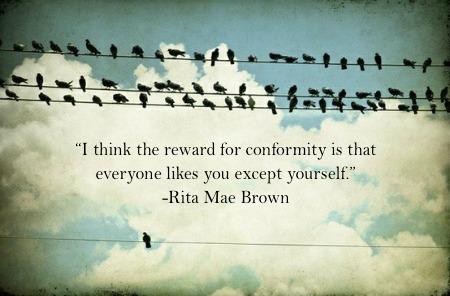
Well then … we are in a pickle aren’t we? But maybe revolution is the act of taking responsibility? Clips of revolution flicker through your mind-film, you see riots, Molotov cocktails, police lined up with transparent plastic shields. You realize you do not want to risk your comfort, your coziness, your conformity, so you fit in and play nice and salute whoever is in power. Or maybe you are just not interested, you have your soma, your serial monogamy, your fair trade Americano. Besides, you’re too busy, you’ve got kids, you work 60 hours a week, you recently bought a home in one of the most expensive housing markets in the world, you already have enough responsibilities …

The Desire to Fit In is the Root of Almost All Wrongdoing

226816_20150205_092434_mddtpdg

By Christopher Freiman

Source: aeon

Imagine that one morning you discover a ring that grants you magic powers. With this ring on your finger, you can seize the presidency, rob Fort Knox and instantly become the most famous person on the planet. So, would you do it?

Readers of Plato’s Republic will find this thought experiment familiar. For Plato, one of the central problems of ethics is explaining why we should prioritise moral virtue over power or money. If the price of exploiting the mythical ‘Ring of Gyges’ – acting wrongly – isn’t worth the material rewards, then morality is vindicated.

Notice that Plato assumes that we stray from the moral path through being tempted by personal gain – that’s why he tries to show that virtue is more valuable than the gold we can get through vice. He isn’t alone in making this assumption. In Leviathan (1651), Thomas Hobbes worries about justifying morality to the ‘fool’ who says that ‘there is no such thing as justice’ and breaks his word when it works to his advantage. And when thinking about our reasons to prefer virtue to vice, in his Enquiry Concerning the Principles of Morals (1751) David Hume confronts the ‘sensible knave’, a person tempted to do wrong when he imagines ‘that an act of iniquity or infidelity will make a considerable addition to his fortune’.

Some of history’s greatest philosophers, then, agree that wrongdoing tends to be motivated by self-interest. Alas, I’m not one of history’s greatest philosophers. Although most assume that an immoral person is one who’s ready to defy law and convention to get what they want, I think the inverse is often true. Immorality is frequently motivated by a readiness to conform to law and convention in opposition to our own values. In these cases, it’s not that we care too little about others; it’s that we care too much. More specifically, we care too much about how we stack up in the eyes of others.

Doing the wrong thing is, for most of us, pretty mundane. It’s not usurping political power or stealing millions of dollars. It’s nervously joining in the chorus of laughs for your co-worker’s bigoted joke or lying about your politics to appease your family at Thanksgiving dinner. We ‘go along to get along’ in defiance of what we really value or believe because we don’t want any trouble. Immanuel Kant calls this sort of excessively deferential attitude servility. Rather than downgrading the values and commitments of others, servility involves downgrading your own values and commitments relative to those of others. The servile person is thus the mirror image of the conventional, self-interested immoralist found in Plato, Hobbes and Hume. Instead of stepping on whomever is in his way to get what he wants, the servile person is, in Kant’s words, someone who ‘makes himself a worm’ and thus ‘cannot complain afterwards if people step on him’.

Kant thinks that your basic moral obligation is to not treat humanity as a mere means. When you make a lying promise that you’ll pay back a loan or threaten someone unless he hands over his wallet, you’re treating your victim as a mere means. You’re using him like a tool that exists only to serve your purposes, not respecting him as a person who has value in himself.

But Kant also says that you shouldn’t treat yourself as a mere means. This part of his categorical imperative gets less publicity than his injunction against mistreating others, but it’s no less important. Thomas Hill, a philosopher at the University of North Carolina, Chapel Hill, notes in Autonomy and Self-Respect (1991) that servility involves a mistaken assessment of your moral status. Crucially, the servile person is guilty of the same root error as the person who deceives or threatens others – namely, denying the basic moral equality of all persons. It’s just that the person you’re degrading is you. But servile behaviour neglects the fact that you’re entitled to the same respect as anyone else.

Now, maybe you’re thinking that lying about your opinion of Donald Drumpf [or Shillary Clinton] to placate your parents so you can eat your cranberry sauce in peace is no big deal. Fair enough. But servility can cause much graver moral transgressions.

Take the most famous psychological study of the 20th century: Stanley Milgram’s obedience experiments. Milgram discovered that most of his subjects would deliver excruciating – and sometimes apparently debilitating or lethal – electric shocks to innocent victims when an experimenter told them to do so. In ‘The Perils of Obedience’ (1973), Milgram explained that one reason why the typical subject goes along with malevolent authority is because he ‘fears that he will appear arrogant, untoward, and rude if he breaks off’. The subjects’ commitment to politeness overwhelmed their commitment to basic moral decency. And a lot of us are more like Milgram’s subjects than we’d care to admit: we don’t want to appear arrogant, untoward or rude at the dinner table, the classroom, the business meeting. So we swallow our objections and allow ourselves – and others – to be stepped on.

The pernicious consequences of servility aren’t confined to the lab, either. Indeed, Milgram’s experiment was motivated partly by his desire to understand how so many ordinary-seeming people could have participated in the moral horrors of the Holocaust. More recently, the military violence at Abu Ghraib has been explained in part by the soldiers’ socialisation into conformity. These examples and reflections on our own lives reveal an underappreciated moral lesson. It’s not always, or even usually, the case that we do wrong because we lack respect for others. Often it’s because we lack respect for ourselves.

Charlie Kaufman on Zombie Ants, Mind Control, and Consumerist Culture

By The Unknown

Source: High Existence

Charlie Kaufman has one of the most inventive and original minds in Hollywood. That’s probably why he has eluded mainstream success.

Mr. Kaufman is perhaps best known for writing the modern classic Eternal Sunshine of the Spotless Mind, for which he was awarded an Oscar for best original screenplay. He’s also the writer of Being John Malkovich, Adaptation, Anomalisa, and the writer-director of the little-known but brilliant Synecdoche, New York, which Roger Ebert named the “best film of the decade” (2000-2010).

In the words of fellow writer Jeremy Brock:

One of the few screenwriters to transcend his profession, Charlie Kaufman is responsible for some of the most unique, daring, and inventive screenplays in contemporary cinema. […] His films deal with identity, mortality, relationships, and the meaning or purpose of life. They are metaphysical, self-reflexive, hyper-aware, often using surrealist conceits to explore our fundamental anxieties. It is in this tradition of finding new, startling, and funny ways of exploring human psychology that Charlie Kaufman sits comfortably amongst the world’s greatest living writers.

Fans love him. Critics adore him. Mainstream audiences… ignore him.

And that’s a shame.

In a world filled with sequels, prequels, remakes, and reboots, creativity is dying in Hollywood.Worse than dying, I’d argue that creativity is being tied up, beaten, tortured, mocked, murdered, then thrown in a gutter and pissed on.

You could argue that I’m cynical.

You could also argue that I’m tired of being patronized by the regurgitated garbage Hollywood pukes up and tries to spoon feed us. We all know the difference between food and vomit, and Hollywood’s been steadily feeding us barf for the last ten years while distracting us with silly airplane noises like we’re babies.

But I’m getting sidetracked.

This isn’t about my personal disdain for Hollywood; this is about Charlie Kaufman’s views on consumerism, and Charlie Kaufman is much more polite, intelligent, and eloquent than I am.

I stumbled across a speech Charlie Kaufman delivered at a BAFTA lecture in 2011 and absolutely loved it.

Mr. Kaufman was supposed to deliver a speech about screenwriting, but gave the audience much more. The full speech covers a broad range of topics, but I spliced together a few of my favorites — Zombie Ants, Mind Control, and Consumerist Culture — and created the video below.

Watch and listen as Charlie Kaufman dissects and diagnoses the fallacies of our present-day culture, but rather than react with juvenile indignation (as I did in my brief rant earlier), he responds with poignant words of heartbroken yet hopeful wisdom.

Enjoy!

Teaching Children How to Think Instead of What to Think

pink-floyd-the-wall-alan-parker

By Will Stanton

Source: The Mind Unleashed

Right now our education system is doing more to indoctrinate our children than to educate them. In fact, that has been the case for quite some time. Our young minds are being told to accept authority as truth instead of truth as authority, and teachers talk at the students instead of with them.

Teachers have become repeaters of information. They are merely regurgitating everything they once learned from their own teachers, and perpetuating the recycling of information; information that has managed to evade scrutiny for generations. Children are no longer the masters of their own learning, and instead, their minds are being treated as storage containers.

The factory model of education, with its focus on academic and economic elitism, is churning out obedient workers for the system, encouraged to conform every step of the way. We are not being treated as organic, creative, investigative human beings, but instead as parts in the machine. The education system is filtering out the inquisitive nature of our being, with the ultimate goal being to prevent dissent against the system. The system doesn’t want thinkers. It doesn’t want people to question its methods. It wants a population that can be easily manipulated and controlled so as to relinquish all its power to the elite.

There are those who say that skills cannot be taught in schools. Socrates would likely scoff at that notion, were he still alive today. It was Socrates who said, “I cannot teach anybody anything; I can only make them think.”

If we’re going to solve the problem of indoctrination in our school system, we have to learn to begin asking questions instead of giving answers. Real learning is achieved through the investigative process. Children have to be encouraged to search for the answers themselves. It is up to the teachers to provide the tools and resources necessary for the children to conduct these inquiries and make meaningful discoveries. One well-formed question will do more to inspire than any number of answers. In every facet of our educational pursuits, it becomes crucial to begin an open dialogue with our students, to encourage healthy debate and to have them form their own conclusions.

The importance of teaching philosophy in schools cannot be underestimated. In a world where most of humanity is running on the treadmill with the blinders on, it is paramount that we re-evaluate our own perspectives from time to time, and look at the big picture.

What teaching philosophy does is it gets us thinking, it gets us questioning, and it gets us contemplating. Without these skills, humanity will continue to function on autopilot, and we will allow those in power to continue to dominate, oppress and enslave us in every way.

We need to reclaim our own minds…


Return of the Divine

maxresdefault

By rahkyt

Source: Sacred Space in Time

The skies have always given us our Gods, gods and goddesses, powers and principalities. All peoples, all places, have watched the skies. The stars, the planets, the clouds, the storms, the winds, hail, snow, rain and other things that have fallen from the heavens to earth. Nature has provided us with a bounty of environmental effects that we have anthropomorphized, given character, personality, intentionality.

Who is to say that celestial events of the past, witnessed the world across, did not conspire in essence to form the major and minor religions? That staggering immensities of planetary proportions – great arcs of lightning, waters in brobdingnagian amounts, comets and meteors in impossible numbers, falling to earth, from the skies – did not happen, cowing oceanic humanity, awakening abject fear and humbling terror, awing them into prostrate proselytization of an improbable yet undeniable extraterrestrial consciousness that made it or themselves undeniably known and unavoidably apparent to our distant ancestors, to their everlasting dismay and chagrin?

And who is to say, that these events do not occur cyclically? That collective terror has not resulted in a collective forgetting and mythologizing; that some events, are, indeed, too terrible to admit are true? That the Gods, gods and goddesses, existence – in all of their material and immaterial awesomeness – are too horrific in essence and action to admit are real and extant, somewhere, out there?

At what point, is rationality trumped by practicality? Scientists have recently admitted that we have not even identified 1% of all of the creatures living on this planet. They’ve “discovered” a new moon that circle this earth, new planets in this ancient solar system, new particles at the quantum level, new forms of matter, new energies posited, all indicative of our lack of knowledge and our shared and overwhelming, human insistence that our mere belief in a comprehensive science and its findings is instead the Totality of all that Was, Is, and Ever Shall Be. And that nothing outside of that belief – bolstered by a fledgling science barely a millennium in the formulation – is worthy of formal acknowledgement.

Hubris. Ignorance by definition. Ignoring the Wisdom of the Ages. In the public sphere, at least. The collected oral traditions of the world’s Indigenous peoples. The facts provided by the study of metaphysics and their implications to material science. The discounting of a full half of the human capacity to experience; the subjective, mental realm in favor of the surface, objective reality, alone.  Even when the scientifically-minded among us do give some credence to at least the potentiality of worth being implicit in these other forms of knowing, that acknowledgement is cavalier and pompous, obviously condescending and over-confident of its right to judge, appropriate and dismiss other knowings by sheer force of self-righteousness and arrogance.

Where do you fall along this spectrum? Do you presume to know? Or do you just believe? Can you admit as much, even to yourself? Let alone, others? Perhaps we have a long way to go, collectively.

As civilization cycles along predictable lines of social and material evolution tacit admittance that it is, in fact, a continuing spiral, should be cultivated. Just as our solar system cycles around the sun it spirals as well, the sun leading us thru time and space in the cyclical, galactic dance around the Milky Way’s central Spiritual/Black Sun/Hole. As Above, So Below. And that is where we are now, where other civilizations potentially have already been. At a certain space in an eternal cycle, spaced evenly along an infinite spiral.

What we individually think, has already been thought. What we say, has already been said. There is indeed, nothing new under the sun and even our attitudes of knowing and general sense of cultural – or other superiority complexes – ascendancy is an affectation of awareness, a perhaps unavoidable side-effect of life in the echo-chamber of human arrogance.

Perhaps we should pray that the more rational and less intuitive and “spiritual” among us are correct and the Multiverse is empty of all intelligence of the non-human variety. That our ancestors were indeed simple and dull-witted – despite all evidence to the contrary – and prone to fanciful ramblings and that nothing had come out of the sky or happened in the heavens except those things and types of events we are well familiar with.

Because if they were correct and terrific events did indeed traumatized humanity collectively at some point in Gaia-Sophia’s archaic past, the procession of the cycle and turn of the spiral is here and such events may be  scheduled to happen again, at a higher and more rarified level.

Ignorance is bliss. Do you choose belief? Or knowing? And are you willing to do what it takes, to truly know? Or are you confident enough in you beliefs to continue on, without seeking further information? If not, you may return, now, to your regularly scheduled programming. If you so choose.

Google’s lemmings: Pokémon go where Silicon Valley says

index

An analysis of Ingress and Pokémon Go reveals important truths about corporate control and the ability of our mobile phones to organize our desires.

By Alfie Brown

Source: ROAR Magazine

his article has a clickbaity title but a sobering and concerning point to make. In 2010, Google started up what is now a very important subsidiary, Niantic Inc. Google starts up a lot of companies each year and acquires a great many more, so there is nothing special in this. What is important is that whilst most of us see Google’s acquisition of every “start-up” and endless development of “subsidiary” companies with different names as simply an attempt to completely monopolize the market, the case of Niantic shows us that there is more to the extent of Google’s power.

Six years on from its inception with the launch of its biggest game yet, Pokémon Go, Niantic has hit the headlines and people are finally paying attention to the company, with some apparent leftists even claiming we ought to boycott Pokémon Go. In fact, Niantic have been working on mobile phone psychology and social organization for several years. An analysis of the company’s two big games, Ingress and Pokémon Go, shows us some important truths about the world we are living in, about corporate control and about the ability of our mobile phones to organize our desires.

Niantic developed their first major game, Ingress, in 2011. The game, one of the most important of recent years, is a key ideological tool for Google — one that, unlike Pokémon Go, is little publicized. Ingress has seven million or more players and Ingress tattoos show the degree to which people define themselves by the application. Some players even describe Ingress as a “lifestyle” rather than a “game”. The reader can be forgiven for thinking: “I don’t play it, so why would this apply to me?” But the entertainment coming out of Google via Niantic is in line with Google’s wider project of regulating our movements and experiences of the physical world; unless you don’t use Google or any of its applications, many of which come built-it to our phones and cannot be uninstalled, this applies to you.

Ingress reflects a trend of mobile phone application development (which includes Google Maps and Uber, among other well-known apps) designed to regulate and influence our experience of the city, turning the mobile phone into a new kind of unconscious: an ideological force driving our movements while we remain only semi-aware of what propels us and why we are propelled in the directions we are.

I first considered the importance of mobile phone games to be about a kind of “distraction” — an argument I made in my book and related article in The New Inquiry. Later, when playing Ingress for the first time, I realized there was a lot more to it than this. Ingress, rather than simply distracting us from the city around us, actually trains us to become Google’s perfect citizens. In Ingress, the player moves around the real environment capturing “portals” represented by landmarks, monuments and public art, as well as other less-famous features of the city. The player is required to be within physical range of the “portal” to capture it, so the game constantly tracks the player via GPS. Importantly, it not only monitors where we go, but directs us where it wants us to move.

As such it is very much the counterpart of Google Maps, which is also developing the ability not only to track our movements but to direct them. Of course, Google’s algorithms have long since dictated which restaurants we visit, which cafés we are aware of and which paths we take to get to these destinations. Now though, Google is developing new technology that actually predicts where you will want to go based on the time, your GPS location and your habitual history of movement stored in its infinitely powerful recording system. This, like Ingress, shows us a new pattern emerging in which the mobile phone dictates our paths around the city and encourages us, without realizing it, to develop habitual and repetitious patterns of movement. More importantly still, such applications anticipate our very desires, not so much giving us what we want as determining what we desire.

Here again, the connection with the concept of the unconscious is useful. While some have seen the unconscious as a morass of unregulated desires, followers of Freud and later of Lacanian psychoanalysis have been keen to show precisely how structured the unconscious is by outside forces. Our mobile phones pretend to be about fulfilling our every desire, giving us endless entertainment (games), easy transport (Uber) and instant access to food and drink (OpenRice, JustEat) and even near-instantaneous sex and love (Tindr, Grindr). Yet, what is much scarier than the fact that you can get everything you want via your mobile phone is the possibility that what you want is itself set in motion by the phone.

Into precisely this atmosphere enters Pokémon Go, out just days ago, and already the most significant mobile phone release of 2016. The game is, of course, made by none other than Niantic Labs. A series of hysterical events have already arisen from the ethical minefield that is Pokémon Go. In the case of Ingress, academic study has already been dedicated to the fact that the game has sent young children into unlit city parks at 3am. With Pokémon Go, Australian police have had to respond to a bunch of Pokémon trainers trying to get into a police station to capture the Pokémon within and some people found a dead body instead of a Pokémon. It has already been suggested that Pokémon Go is eventually going to kill someone — and since that article was published someone has crashed into a police car and another has been run-over while hunting Pokemon. But, as with Ingress, it is not the occasional mad story to emerge that should concern us, but the psychological and technological effects of every user’s experience.

The premise of Pokémon Go is simply that you use your GPS to find Pokémon in the real environment and then your camera to make the Pokémon visible, so that the world is enriched by looking through the screen at what lies behind it, as in the image below:

images

The Pokémon itself is an incredible phenomenon deserving of a book length study. Perhaps for now we can say that the Pokémon is the perfect example of what Jacques Lacan called the objet a, that perfectly cute fetishised but illusive object of desire that would truly make us happy if only we could just get our hands on it. We never do, because there is always a newer, cuter and harder to capture version that we just have to catch!

Dystopian visions of what technology and videogames would lead to seem to have got something completely wrong. Depictions of the dystopian videogame future have always tended to see the future as involving each individual isolated from the rest and sat quietly alone in a small room hooked up into a computer through which their lives are exclusively lived. In other words, the importance of the physical environment recedes in favor of the imaginary electronic world. On the contrary to these predictions of the future, we now live in a dystopia where Google and its subsidiaries send us madly around the city almost non-stop in directions of its choosing in search of the objects of desire, whether that be a lover on Tindr, a bowl of authentic Japanese ramen or that elusive Clefairy or Pikachu.

In the 1990s parents could ask their children to “get outside more” to escape the videogame space, but now it is the games that make us charge around the city capturing portals and collecting Pokémon and going on dates. Putting aside the full access that Google gets to your accounts via Pokémon Go, this shows us something really dangerous. It points to the increasing reality that there really is no escape from Google — and that while we are doing what we think we want, believing that we are just using our phones to help us get it, in fact Google has an even greater power, a truly revolutionary one: the ability to create and organize desire itself.

It is this truly revolutionary power that is important when it comes to Pokémon Go and Ingress. To say that these games are revolutionary is not to say that they are doing any good, nor that they are “radical”, and certainly it is not to say that they are left-wing — on the contrary, the revolution in desire appears to be corporate, hegemonic and centralized. If the left is to have any hope, however, it must not resist Pokémon Go, as Jacobin have now famously suggested, but understand and perhaps even embrace the power of the mobile phone to re-organize desire and look for ways forward from here.


Alfie Bown is the author of Enjoying It: Candy Crush and Capitalism (Zero, 2015) and The PlayStation Dreamworld (Polity, forthcoming 2017). He is the co-editor of the Hong Kong Review of Books and writes on the politics of technology and videogames for many publications.

SMARTPHONES, SOCIAL MEDIA AND SLEEP: THE INVISIBLE DANGERS OF OUR 24/7 CULTURE

cell-phone-addiction

By Martijn Schirp

Source: High Existence

If there is one book to read about our addictions to work, phones, consumption, and the current state of capitalism, it’s 24/7: Late Capitalism and the Ends of Sleep by Jonathan Crary, a professor of Modern Art & Theory at Columbia University. Crary argues that sleep is a standing affront to capitalism and while that seems grim, it highlights the very real dark sides of always having glowing LED screens clutched in our hands.

Technology has ushered us into a 24/7 state: we live in a world that never stops producing and is infinitely connected. We have digital worlds in our pockets, and we carry our phones and screens everywhere, feeding our dopamine addictions when we’re bored or lonely, cradling us before bed with endless scrolls of news and waking us up with notifications and emails.

The barrier between work and home life has disappeared, and most professionals are able to and choose to continue working all hours of the day in an increasingly competitive, winner-take-all environment.

Most of our time then, is either spent working or consuming (the upside of working so much is money, which is then used to consume): food, drugs, shopping, films, Youtube videos, Instagram feeds, news articles, updates from friends — even socializing-time has been reduced to a passive “Netflix & Chill”.

There are now very few significant interludes of human existence (with the colossal expectation of sleep) that have not been penetrated and taken over as work time, consumption time, or marketing time.

The social-world and the work-world are both digitized, which makes it increasingly difficult to distinguish between the two, and beyond the pop-ups and video ads, individuals have become their own marketers. Building a “personal brand” as a living is not uncommon.

It is only recently that the elaboration, the modeling of one’s personal and social identity, has been reorganized to conform to the uninterrupted operation of markets, information networks, and other systems. A 24/7 environment has the semblance of a social world, but it is actually a non-social model of machinic performance and a suspension of living that does not disclose the human cost required to sustain its effectiveness.

The average North American adult “now sleeps approximately six and a half hours a night, an erosion from eight hours a generation ago, and down from ten hours in the early twentieth century,” and what suffers most from this lack of sleep is our innate ability to dream. Most people tend to forget or don’t even think about their dreams, much less their extraordinary ability to control them. What is frightening about this is the prevalent attitude of accepting the current state of reality as it is:

The idea of technological change as quasi-autonomous, driven by some process of autopoiesis or self-organization, allows many aspects of contemporary social reality to be accepted as necessary, unalterable circumstances, akin to facts of nature. In the false placement of today’s most visible products and devices within an explanatory lineage that includes the wheel, the pointed arch, moveable type, and so forth, there is a concealment of the most important techniques invented in the last 150 years: the various systems for the management and control of human beings.

What may be the most important fact to remember: Nothing must be as it is. Here are a three ways to escape the never-ending 24/7 state:

Unplug Your Phone & Plug Into Your Imagination

Break your cell phone habit. The dopamine addiction is real. I keep my phone in a Faraday pouch, which blocks signals to my phone and keeps me to my rule of no cell phone or screen use one hour prior to sleeping and one hour after waking.

As “visual and auditory ‘content’ is most often ephemeral, interchangeable material that in addition to its commodity status, circulates to habituate and validate one’s immersion in the exigences of twenty-first-century capitalism,” it is important to focus on the power of our own imagination. The hierarchal and algorithm-driven fields of social media and newsfeeds tend to serve us things we already know or like, and keep us wanting.

Instead, we can explore the limitless field of our imagination. Write down your dreams in the morning and use them as a vehicle for self-exploration, or venture into lucid dreaming to manifest your own desires or to explore creative pursuits. And yet for most of us, when walking, during our daily commute, even sitting on the toilet or in any moment where it’s just us and our thoughts, we turn to our cell phones for comfort, to fill the silence:

One of the forms of disempowerment within 24/7 environments is the incapacitation of daydream or of any mode of absent-minded introspection that would otherwise occur in intervals of slow or vacant time.

Even when socializing with friends, it’s a common habit to check our phones again and again. I’ve found that when one person does this, it enables others:if I see someone sitting across from me at a dinner checking their Instagram feed, I’ll feel less guilty about doing the same. Make it can stop with you — turn off your phone.

Reevaluate Your Drug Habits & Addictions

Beyond digital dopamine, are you addicted to caffeine, sugar, alcohol, adderall, cocaine, Ambien, Lexapro, vicodin, etc., etc.? We live in a self-selecting society, where some drugs are perfectly acceptable as long as they are prescribed by a doctor and other drugs are deemed dangerous. I used to babysit for an eight-year-old who was fed Ritalin daily for his ADHD, and then at night, had to take a tranquilizer to help him fall asleep. He was speedballing throughout his childhood, and I’ve met others who had the same experience only to question the impact of these drugs on their personality and life-path.

There is a multiplication of the physical or psychological states for which new drugs are developed and then promoted as effective and obligatory treatments. As with digital devices and services, there is a fabrication of pseudo-necessities, or deficiencies for which new commodities are essential solutions… Over the last two decades, a growing range of emotional states have been increasingly pathologized in order to create vast new markets for previously unneeded products. The fluctuating textures of human affect and emotion that are only imprecisely suggested by the notions of shyness, anxiety, variable sexual desire, distraction, or sadness have been falsely converted into medical disorders to be targeted by hugely profitable drugs. Of the many links between the use of psychotropic drugs and communication devices, one is their parallel products of forms of social compliance.

Ritalin, adderall (and cocaine) not only make the takers compliant but fueled to tackle the 24/7 lifestyle, deadening empathy, increasing competitiveness and perhaps is linked to “destructive delusions about performance and self-aggrandizement”.

While methamphetamines are regularly fed to children, psychedelic drugs tend to be demonized as extreme and dangerous. Yet, refreshingly, there are organizations now like the Multidisciplinary Association of Psychedelic Studies (MAPS) and other studies looking into how psychedelics can not only treat addictions, anxiety, and disorders, but also how psychedelics can expand consciousness and leave lasting personality changes for the better.

Find Your Passion & Connect With Real Life Communities

Crary argues that “whatever remaining pockets of everyday life are not directed toward quantitative or acquisitive ends, or cannot be adapted to telematic participation, tend to deteriorate in esteem and desirability.” Our tendency to tie our social worth to digital networks takes the saying “if a tree falls in a forest and nobody is around to hear it, does it make a sound?” and turns it into “if you do something fun and meaningful and don’t post it to social media, does it matter?”

But those meaningful moments in real life do matter, as does having a strong community to participate in. After all, addictions are a result mostly of isolation and bad environments:

As stated earlier: it is much easier to fold to the insidious trap of looking at your cell phone or constantly working if the person across from you does so first. Find your passion beyond the screen. Find your source of dopamine, what drives you, what engages you and makes you want to get up every day.

Finding a real community centered around a meaningful activity can help tremendously. For me, rock climbing is a meditative activity that requires focus and attention, and is anchored in a community of people who are invested in your success as much as they are in their own. The nature of the sport is so individual because each person is unique; climbing is a niche that carves out time for people to participate in life without any social rules and concepts of winning over another. Climbing outdoors is a way to be connected to nature and to just hang out with friends.

I just returned from a week in New York City, the city that never sleeps, the capitol of the 24/7 world, and it took me two weeks just to be able to find the time to sit down and write this. It is not easy to accept the bleak claims in Crary’s book because it would be admitting our own addictions and how we play into this non-stop state. It’s just as hard to look away from our screens, but you can. Tonight, don’t put your phone or laptop into “sleep mode” — turn them off, and pay attention to your own dreams.

Further Study:


24/7: Late Capitalism and the Ends of Sleep
 by Jonathan Crary

24/7: Late Capitalism and the Ends of Sleep explores some of the ruinous consequences of the expanding non-stop processes of twenty-first-century capitalism. The marketplace now operates through every hour of the clock, pushing us into constant activity and eroding forms of community and political expression, damaging the fabric of everyday life.