Essential Taoist Wisdom for Living in Politically Charged and Chaotic Times

By Dylan Charles

Source: Waking Times

There’s an old saying, rumored to be an ancient Chinese curse, but it’s been a favorite in the West for some time now.

“May you live in interesting times.” 

Political figures like to use it when they want to emphasize just how screwed up things are. For example, Robert Kennedy is quoted here from a speech in 1966:

“There is a Chinese curse which says “May he live in interesting times.” Like it or not, we live in interesting times. They are times of danger and uncertainty; but they are also the most creative of any time in the history of mankind.” [Source]

Sounds pretty much like today, as the times are indeed interesting. Shocking and unbelievable things are happening all around us, and with information technologies we can choose to internalize struggles, tragedies and disasters that are far outside of our sphere of personal experience or control. It’s easier than ever to take on the weight of the world.

The burden of doing so is quite heavy, though, manifesting as stress, anxiety, depression, self-abuse or the abuse of nature, conflict big and small, anger, disease, uneasiness, unhappiness, and most insidious of all, fear. In short, absorbing the world’s problems is self-destructive. To resolve this within ourselves, however, it most often only takes a shift in perspective.

Lao-Tzu, the Old Master of Taoism, condensed the human struggle into the prose of the Tao Te Ching. It’s not a religious text, as it doesn’t hail a deity or command you to construct a belief system on its behalf. It’s a simple book of observations about the nature of nature, something that after 2500+ years still manages to serve as a salient guide to living well. For those who understand it, it offers a way of being that helps keep the madness of change at bay.

In times such as these, when uncertainty and chaos seem to be rising against the established order, and when so much discourse is focused on politics and untouchable events and circumstances, it really is up to the individual to create peace, harmony and balance within themselves.

But as humans, we have a tendency to try to control that which is beyond our control, in turn contributing evermore to the development of chaos and disorder. In truth, it is far easier to navigate such discord than we believe, and the way is far simpler than we imagine it to be. Consider for a moment the Taoist view regarding such interesting times.

From verse 16:

When society changes
from its natural state of flux,
to that which seems like chaos,
the inner world of the superior man
remains uncluttered and at peace.
By remaining still, his self detached,
he aids society in its return
to the way of nature and of peace.
The value of his insight may be clearly seen
when chaos ceases.

Here we are informed of the value of tending to the inner world first, which requires the gumption to detach and allow things to be as they are. We are encouraged to let go of personal expectations in order for muddled waters to clear.

From verse 17:

The sage does not expect that others
use his criteria as their own.

It is virtuous to allow others to hold whatever insane beliefs and ideas they choose to, and disengage from the struggle to enforce our opinions and values onto others.

From verse 18:

When intellectualism arises,
hypocrisy is close behind…

When the country falls into chaos,
politicians talk about ‘patriotism’.

From verse 57:

Govern your country with integrity,
Weapons of war can be used with great cunning,
but loyalty is only won by not-doing.
How do I know the way things are?

By these:

The more prohibitions you make,
the poorer people will be.
The more weapons you possess,
the greater the chaos in your country.
The more knowledge that is acquired,
the stranger the world will become.
The more laws that you make,
the greater the number of criminals.

Therefore the Master says:

I do nothing,
and people become good by themselves.
I seek peace,
and people take care of their own problems.
I do not meddle in their personal lives,
and the people become prosperous.
I let go of all my desires,
and the people return to the Uncarved Block.

Doing nothing, as advised in the Tao Te Ching, runs in opposition to the cultural zeitgeist, but just imagine how quickly things would change if more people chose to withdraw and not participate in the insanity all around us.

Final Thoughts

As individuals we face the same challenges as all of those who’ve come before us. We’ve always had to survive and procreate while striving for progress. That’s the human journey in nutshell, and while it isn’t always pretty, it’s always the same story, no matter how complex things become.

Our role, then, is the role of the sage, which is to act in accordance with nature rather than to resist nature.

Saturday Matinee: Metamorphosis

(In memory of Terence McKenna, November 16, 1946 – April 3, 2000)

CHAOS AND THE WORLD SOUL

By Richard Kadrey

Source: Wired

METAMORPHOSIS – A video “trialogue” featuring Ralph Abraham, Terence McKenna, and Rupert Sheldrake – is part shamanic journey and part New Physics 101. It’s mostly talk, with touches of simple computer graphics and music adorning the presentation. But what talk it is. We’ve got Abraham, a mathematician and the godfather of chaos theory; McKenna, a shamanologist, ethnopharmacologist, and psychedelic philosopher; and Sheldrake, a radical biologist and originator of the idea of “morphic resonance,” a memory embedded in all natural systems. Their free-form discussion ranges from drug experiments to the anima mundi (world soul), chaos and complexity, and the effects of language and imagination on the shape of the universe – all in search of a new field theory that encompasses art, science, and philosophy.

In this particular chaotic system, McKenna is the strange attractor around which Abraham and Sheldrake orbit. The three unite in a quest for knowledge and an exchange about the sciences they’ve studied. Sheldrake talks passionately about trying to redefine biology in terms of living organisms, not the abstract dead things found in textbooks and labs. Abraham, not surprisingly, explains how protests over the Vietnam War lead him to leave his sheltered academic life, pursue meditation in the Himalayas, and study chaos theory.

With McKenna as the ringleader (and biggest talker), imagination and chaos are the principal themes. Chaos, as McKenna describes it, is a science to study, an opportunity to reshape the world by looking through the lens of nonlinear processes, and a metaphor to help us think about our place in the universe. In McKenna’s words, chaos “is telling us that the intimation of mysticism, the intimation of a possibility of transcendence, is all firmly grounded in science.”

This is heady stuff. Though you half expect the psychedelic proselytizing to drift off into some kind of Birkenstock-and-bean-sprout dead end, the rigor, intelligence, and wit of these three minds keep the ideas sharp and fast. For anyone interested in the edge of science, this video is both entertaining and inspiring.

Society Is Made Of Narrative. Realizing This Is Awakening From The Matrix.

By Caitlin Johnstone

Source: CaitlinJohnstone.com

In the movie The Matrix, humans are imprisoned in a virtual world by a powerful artificial intelligence system in a dystopian future. What they take to be reality is actually a computer program that has been jacked into their brains to keep them in a comatose state. They live their whole lives in that virtual simulation, without any way of knowing that what they appear to be experiencing with their senses is actually made of AI-generated code.

Life in our current society is very much the same. The difference is that instead of AI, it’s psychopathic oligarchs who are keeping us asleep in the Matrix. And instead of code, it’s narrative.

Society is made of narrative like the Matrix is made of code. Identity, language, etiquette, social roles, opinions, ideology, religion, ethnicity, philosophy, agendas, rules, laws, money, economics, jobs, hierarchies, politics, government, they’re all purely mental constructs which exist nowhere outside of the mental noises in our heads. If I asked you to point to your knee you could do so instantly and wordlessly, but if I asked you to point to the economy, for example, the closest you could come is using a bunch of linguistic symbols to point to a group of concepts. To show me the economy, you’d have to tell me a story.

Anyone who has ever experienced a moment of mental stillness knows that without the chatter, none of those things are part of your actual present experience. There is no identity, language, etiquette, social roles, opinions, ideology, religion, ethnicity, philosophy, agendas, rules, laws, money, economics, jobs, hierarchies, politics or government in your experience without the mental chatter about those things. There’s not even a “you” anywhere to be found, because it turns out that that’s made of narrative, too.

Without mental narrative, nothing is experienced but sensory impressions appearing to a subject with no clear shape or boundaries. The visual and auditory fields, the sensation of air going in and out of the respiratory system, the feeling of the feet on the ground or the bum in the chair. That’s it. That’s more or less the totality of life minus narrative.

When you add in the mental chatter, however, none of those things tend to occupy a significant amount of interest or attention. Appearances in the visual and auditory field are suddenly divided up and labeled with language, with attention to them determined by whichever threatens or satisfies the various agendas, fears and desires of the conceptual identity construct known as “you”. You can go days, weeks, months or years without really noticing the feeling of your respiratory system or your feet on the ground as your interest and attention gets sucked up into a relationship with society that exists solely as narrative.

“Am I good enough? Am I doing the right thing? Oh man, I hope what I’m trying to do works out. I need to make sure I get all my projects done. If I do that one thing first it might save me some time in the long run. Oh there’s Ashley, I hate that bitch. God I’m so fat and ugly. If I can just get the things that I want and accomplish my important goals I’ll feel okay. Taxes are due soon. What’s on TV? Oh it’s that idiot. How the hell did he get elected anyway? Everyone who made that happen is a Nazi. God I can’t wait for the weekend. I hope everything goes as planned between now and then.”

On and on and on and on. Almost all of our mental energy goes into those mental narratives. They dominate our lives. And, for that reason, people who are able to control those narratives are able to control us.

And they do.

Most people try to exert some degree of control over those around them. They try to influence how those in their family, social and employment circles think of them by behaving and speaking in a certain way. Family members will spend their lives telling other family members over and over again that they’re not as smart/talented/good as they think they are to keep them from becoming too successful and moving away. Romantic partners will be persuaded that they can never leave because no one else will ever love them. To varying degrees, they manipulate the narratives of individuals.

Then there are the people who’ve figured out that they can actually take their ability to influence the way people think about themselves and their world and turn it into personal profit. Cult leaders convince followers to turn over their entire lives in service to them. Advertisers convince consumers that they have a problem or deficiency that can only be solved with This Exciting New Product™. Ambitious rat race participants learn how to climb the corporate ladder by winning favor with the right people and inflicting small acts of sabotage against their competing peers. Ambitious journalists learn that they progress much further in their careers by advancing narratives that favor the establishment upon which the plutocrats who own the big media companies have built their kingdoms. They manipulate the narratives of groups.

And then, there are the oligarchs. The master manipulators. These corporate kings of the modern world have learned the secret that every ruler since the dawn of civilization has known: whoever controls the narratives that are believed by a society is the controller of that society. Identity, language, etiquette, social roles, opinions, ideology, religion, ethnicity, philosophy, agendas, rules, laws, money, economics, jobs, hierarchies, politics, government: all mental constructs which only influence society to the extent that they are believed and subscribed to by a significant majority of the collective. If you have influence over the things that people believe about those mental constructs, you have influence over society. You rule it. The oligarchs manipulate the narratives of entire societies.

This is why there have been book burnings, heretic burnings, and executions for mocking the emperor throughout history: ideas which differ from the dominant narratives about what power is, how money works, who should be in charge and so on are threatening to a ruler’s power in the exact same way that an assassin’s dagger is. At any time, in any kingdom, the people could have decided to take the crown off of their king’s head and place it upon the head of any common beggar and treat him as the new king. And, in every meaningful way, he would be the new king. The only thing preventing this from happening was dominant narratives subscribed to by the society at the time about Divine Right, fealty, loyalty, noble blood and so on. The only thing keeping the crown on a king’s head was narrative.

The exact same thing remains true today; the only thing that has changed is the narratives the public subscribe to. Because of what they are taught in school and what the talking heads on their screens tell them about their nation and their government, most people believe that they live in a relatively free democracy where accountable, temporary power is placed in the hands of a select few based on a voting process informed by the unregulated debate of information and ideas. Completely separate from the government, they believe, is an economy whose behavior is determined by the supply and demand of consumers. In reality, economics, commerce and government are fully controlled by an elite class of plutocrats, who also happen to own the media corporations which broadcast the information about the world onto people’s screens.

Control the narratives of economics and commerce, and you control economics and commerce. Control the narratives about politics and government, and you control politics and government. This control is used by the controllers to funnel power to the oligarchs, in this way effectively turning society into one giant energy farm for the elite class.

But it is possible to wake up from that narrative Matrix.

It isn’t easy, and it doesn’t happen overnight. It takes work. Inner work. And humility. Nobody likes acknowledging that they’ve been fooled, and the depth and extent to which we’ve all been fooled is so deeply pervasive it can be tempting to decide that the work is complete far before one is actually free. Mainstream American liberals think they’re clear-eyed because they can see the propaganda strings being pulled by Fox and Donald Trump, and mainstream American conservatives think they’re clear-eyed because they can see the propaganda strings being pulled by MSNBC and the Democrats, but the propaganda strings on both trace back to the same puppet master. And seeing that is just the beginning.

But, through sincere, humble research and introspection, it is possible to break free of the Matrix and see the full extent to which you and everyone you know has been imprisoned by ideas which have been programmed into social consciousness by the powerful. Not just in our adult lives, but ever since our parents began teaching us how to speak, think and relate to the world. Not just in the modern world, but as far back as history stretches to when the power-serving belief systems of societal structure and religion were promoted by kings and queens of old. All of society, and all of ourselves, and indeed all of the thoughts in our heads, have been shaped by those in power to their benefit. This is the reality that we were born into, and our entire personality structure has been filtered through and shaped by it.

For this reason, escaping from the power-serving propaganda Matrix necessarily means becoming a new creature altogether. The ideas, mental habits and ways of relating to the world which were formed in the Matrix are only useful for moving around inside of it. In order to relate to life outside of the power-promulgated narratives which comprise the very fabric of society, you’ve got to create a whole new operating system for yourself in order to move through life independently of the old programming designed to keep you asleep and controlled.

So it’s hard work. You’ll make a lot of mistakes along the way, just like an infant slowly learning to walk. But, eventually, you get clear of the programming.

And then you’re ready to fight.

Because at some point in this process, you necessarily come upon a deep, howling rage within. Rage at the oligarchic manipulators of your species, yes, but also rage against manipulation in all its forms. Rage against everyone who has ever tried to manipulate your narrative, to make you believe things about yourself or make other people believe things about you. Rage against anyone who manipulates anyone else to any extent. When your eyes are clear manipulation stands out like a black fly on a white sheet of paper, and your entire system has nothing to offer it but revulsion and rejection.

So you set to work. You set to work throwing all attempts to manipulate you as far away from yourself as possible, and expunging anyone from your life who refuses to stop trying to control your narrative. Advertising, mass media propaganda, establishment academia, everything gets purged from your life that wants to pull you back into the Matrix.

And they will try to pull you back in. Because our narratives are so interwoven and interdependent with everyone else’s, and so inseparable from our sense of ourselves, your rejection of the narrative Matrix will present as an existential threat to many of your friends and loved ones. You will see many people you used to trust, many of them very close to you, suddenly transform into a bunch of Agent Smiths right in front of your eyes, and they will shame you, guilt you, throw every manipulation tool they have at you to get you to plug the jack back into your brain. But because your eyes are clear, you’ll see it all. You won’t be fooled.

And then all you’ll want is to tear down the Matrix from its very foundations and plunge its controllers into irrelevance. You will set to work bringing down the propaganda prison that they have built up around your fellow humans in any way you can, bolt by bolt if you have to, because you know from your own experience that we are all capable of so much more than the puny gear-turning existence they’ve got everyone churning away at. You will despise the oligarchs for the obscene sacrilege that they have inflicted upon human majesty out of greed and insecurity, and you will make a mortal enemy of the entire machine that they have used to enslave our species.

And, because their entire kingdom is built upon maintaining the illusion of freedom and democracy, all they will have to fight back against you is narrative. They’ll try to shame you into silence by calling you a conspiracy theorist, they’ll have their media goons and manipulators launch smear campaigns against you, but because your eyes are clear, none of that will work. They’ve got one weapon, and it doesn’t work on you.

And you will set to work waking up humanity from the lie factory, using whatever skills you have, weakening trust in the mass media propaganda machine and opening eyes to new possibilities. And while doing so, you will naturally shine big and bright so the others can find you. And together, we’ll not only smash the narratives that imprison us like a human caterpillar swallowing the narrative bullshit and forcing it into the mouth of the next slave, but we’ll also create new narratives, better narratives, healthier narratives, for ourselves and for each other, about how the world is and what we want it to be.

Because here’s the thing: since it’s all narrative, anything is possible. Those who see this have the ability to plunge toward health and human thriving without any regard for the made-up reasons why such a thing is impossible, and plant seeds of light which sprout in unprecedented directions that never could have been predicted by someone plugged into to establishment how-it-is stories. Together, we can determine how society will be. We can re-write the rules. We are re-writing the rules. It’s begun already.

Out of the white noise of a failing propaganda machine, a new world is being born, one that respects the autonomy of the individual and their right to self-determination. One that respects our right to collaborate on large scales to create beautiful, healthy, helpful systems without the constant sabotage and disruption of a few power-hungry psychopaths who would rather rule than live. One that respects our right to channel human ingenuity into harmony and human thriving instead of warfare and greed. One that respects our right to take what we need, not just to survive but to thrive, and return it to the earth for renewal. One that respects the sovereign boundaries of not just ourselves and each other, but of the planet spaceship that we live in.

Unjack your cortex fully from the fear-soaked narratives of insanity, and let the true beauty of our real world flood your senses. Let the grief of what we have unknowingly done send you crashing to your knees in sorrow. And when you’re ready, stand up. We have much work to do.

Eternity, nature, society and the absurd fantasies of the rich

Fragment of “Butcher to the World” by Sue Coe.

By Kurt Cobb

Source: Resilience

Professor and author Douglas Rushkoff recently wrote about a group of wealthy individuals who paid him to answer questions about how to manage their lives after what they believe will be the collapse of society. He only knew at the time he was engaged that the group wanted to talk about the future of technology.

Rushkoff afterwards explained that the group assumed they would need armed guards after this collapse to defend themselves. But they rightly wondered in a collapsed society how they could even control such guards. What would they pay those guards with when the normal forms of payment ceased to mean anything? Would the guards organize against them?

Rushkoff provides a compelling analysis of a group of frightened wealthy men trying to escape the troubles of this world while alive and wishing to leave a decaying body behind when the time comes and transfer their consciousness digitally into a computer. (I’ve written about consciousness and computers previously.)

Here I want to focus on what I see as the failure of these people to understand the single most salient fact about their situations: Their wealth and their identities are social constructs that depend on thousands if not millions of people who are employees; customers; employees of vendors; government workers who maintain and run the law courts, the police force, the public physical infrastructure, legislative bodies, the administrative agencies and the educational institutions—and who thereby maintain public order, public health and public support for our current systems.

Those wealthy men aren’t taking all this with them when they die. And, while they are alive, their identities will shift radically if the intellectual, social, economic and governmental infrastructure degrades to the point where their safety is no longer guaranteed by at least minimal well-being among others in society. If the hunt for diminishing food and other resources comes to their doors, no army of guards will ultimately protect them against the masses who want to survive just as badly but lack the means.

One would think that pondering this, the rich who are capable of pondering it would have an epiphany: Since their security and well-being ultimately hinges on the security and well-being of all, they ought to get started helping to create a society that provides that in the face of the immense challenges we face such as climate change, resource depletion, possible epidemics, growing inequality and other devils waiting in the wings of the modern world. (In fairness, some do understand this.)

At least one reason for the failure of this epiphany to occur is described by author and student of risk Nassim Nicholas Taleb. Taleb describes how the lives the rich become increasingly detached from the rest of society as arbiters of taste for the wealthy convince them that this detachment is the reward of wealth. The rich visit restaurants that include only people like themselves. They purchase larger and larger homes with fewer and fewer people in them until they can spend whole days without seeing another person. For the wealthiest, neighbors are a nuisance. Better to surround oneself with a depopulated forest than people next door.

The rich are convinced by this experience that they are lone heroes and at the same time lone victims, pilloried by the media as out of touch and heartless. These self-proclaimed victims may give to the Cato Institute to reinforce the idea that the individual can go it alone and should. They themselves have done it (or at least think they have). Why can’t everyone else?

The wealthier they are, the more their fear and paranoia mounts that others not so wealthy will try to take their wealth; or that impersonal forces in the marketplace will destroy it or at least diminish it significantly; or that government will be taken over by the mob and expropriate their wealth through high taxes or outright seizure. And, of course, there are the natural disasters of uncontrolled climate change and plague, just to name two.

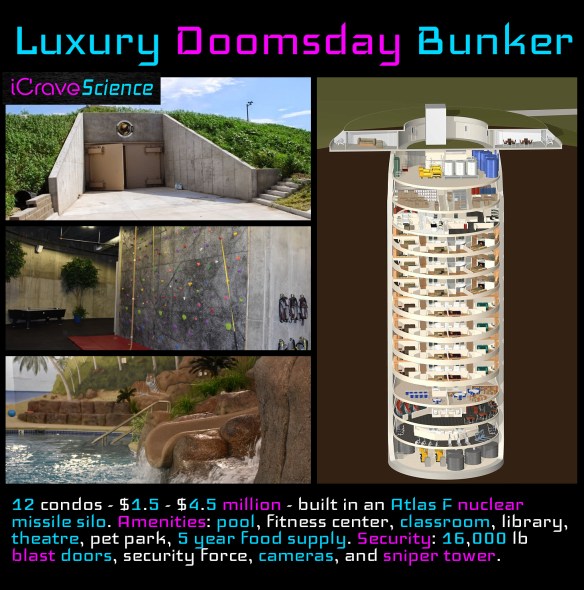
It’s no wonder some of the super rich are buying luxury bunkers to ride out the apocalypse. These bunkers come with an array of amenities  that include a cinema, indoor pool and spa, medical first aid center, bar, rock climbing wall, gym, and library. High-speed internet is included though one wonders how it will work after the apocalypse.

But strangely, even in these luxury bunkers built in former missile silos, dependence on and trust in others cannot be avoided. The units are actually condominiums. And while they contain supplies and ammunition said to be enough for five years, it will be incumbent on the owners, whether they like it not, to become intimately acquainted with their neighbors in order to coordinate a defense of the compound should that need arise.

The irony, of course, is that this is precisely the kind of communal entanglement which their wealth is supposed to allow them to avoid. Society, it seems, is everywhere you go. You cannot avoid it even when eternity is advancing on your door. And, you cannot escape with your consciousness into a computer (assuming that will one day be possible) if there’s no stable technical society to tend to computer maintenance and no power to keep the computer on.

It turns out that we are here for a limited time and that trusting and reciprocal relationships with others are ultimately the most important possessions we have—unless we are too rich or too frightened to realize it.

Survival of the Richest

The wealthy are plotting to leave us behind

By Douglas Rushkoff

Source: Medium

Last year, I got invited to a super-deluxe private resort to deliver a keynote speech to what I assumed would be a hundred or so investment bankers. It was by far the largest fee I had ever been offered for a talk — about half my annual professor’s salary — all to deliver some insight on the subject of “the future of technology.”

I’ve never liked talking about the future. The Q&A sessions always end up more like parlor games, where I’m asked to opine on the latest technology buzzwords as if they were ticker symbols for potential investments: blockchain, 3D printing, CRISPR. The audiences are rarely interested in learning about these technologies or their potential impacts beyond the binary choice of whether or not to invest in them. But money talks, so I took the gig.

After I arrived, I was ushered into what I thought was the green room. But instead of being wired with a microphone or taken to a stage, I just sat there at a plain round table as my audience was brought to me: five super-wealthy guys — yes, all men — from the upper echelon of the hedge fund world. After a bit of small talk, I realized they had no interest in the information I had prepared about the future of technology. They had come with questions of their own.

They started out innocuously enough. Ethereum or bitcoin? Is quantum computing a real thing? Slowly but surely, however, they edged into their real topics of concern.

Which region will be less impacted by the coming climate crisis: New Zealand or Alaska? Is Google really building Ray Kurzweil a home for his brain, and will his consciousness live through the transition, or will it die and be reborn as a whole new one? Finally, the CEO of a brokerage house explained that he had nearly completed building his own underground bunker system and asked, “How do I maintain authority over my security force after the event?”

The Event. That was their euphemism for the environmental collapse, social unrest, nuclear explosion, unstoppable virus, or Mr. Robot hack that takes everything down.

This single question occupied us for the rest of the hour. They knew armed guards would be required to protect their compounds from the angry mobs. But how would they pay the guards once money was worthless? What would stop the guards from choosing their own leader? The billionaires considered using special combination locks on the food supply that only they knew. Or making guards wear disciplinary collars of some kind in return for their survival. Or maybe building robots to serve as guards and workers — if that technology could be developed in time.

That’s when it hit me: At least as far as these gentlemen were concerned, this was a talk about the future of technology. Taking their cue from Elon Musk colonizing Mars, Peter Thiel reversing the aging process, or Sam Altman and Ray Kurzweil uploading their minds into supercomputers, they were preparing for a digital future that had a whole lot less to do with making the world a better place than it did with transcending the human condition altogether and insulating themselves from a very real and present danger of climate change, rising sea levels, mass migrations, global pandemics, nativist panic, and resource depletion. For them, the future of technology is really about just one thing: escape.


There’s nothing wrong with madly optimistic appraisals of how technology might benefit human society. But the current drive for a post-human utopia is something else. It’s less a vision for the wholesale migration of humanity to a new a state of being than a quest to transcend all that is human: the body, interdependence, compassion, vulnerability, and complexity. As technology philosophers have been pointing out for years, now, the transhumanist vision too easily reduces all of reality to data, concluding that “humans are nothing but information-processing objects.”

It’s a reduction of human evolution to a video game that someone wins by finding the escape hatch and then letting a few of his BFFs come along for the ride. Will it be Musk, Bezos, Thiel…Zuckerberg? These billionaires are the presumptive winners of the digital economy — the same survival-of-the-fittest business landscape that’s fueling most of this speculation to begin with.

Of course, it wasn’t always this way. There was a brief moment, in the early 1990s, when the digital future felt open-ended and up for our invention. Technology was becoming a playground for the counterculture, who saw in it the opportunity to create a more inclusive, distributed, and pro-human future. But established business interests only saw new potentials for the same old extraction, and too many technologists were seduced by unicorn IPOs. Digital futures became understood more like stock futures or cotton futures — something to predict and make bets on. So nearly every speech, article, study, documentary, or white paper was seen as relevant only insofar as it pointed to a ticker symbol. The future became less a thing we create through our present-day choices or hopes for humankind than a predestined scenario we bet on with our venture capital but arrive at passively.

This freed everyone from the moral implications of their activities. Technology development became less a story of collective flourishing than personal survival. Worse, as I learned, to call attention to any of this was to unintentionally cast oneself as an enemy of the market or an anti-technology curmudgeon.

So instead of considering the practical ethics of impoverishing and exploiting the many in the name of the few, most academics, journalists, and science-fiction writers instead considered much more abstract and fanciful conundrums: Is it fair for a stock trader to use smart drugs? Should children get implants for foreign languages? Do we want autonomous vehicles to prioritize the lives of pedestrians over those of its passengers? Should the first Mars colonies be run as democracies? Does changing my DNA undermine my identity? Should robots have rights?

Asking these sorts of questions, while philosophically entertaining, is a poor substitute for wrestling with the real moral quandaries associated with unbridled technological development in the name of corporate capitalism. Digital platforms have turned an already exploitative and extractive marketplace (think Walmart) into an even more dehumanizing successor (think Amazon). Most of us became aware of these downsides in the form of automated jobs, the gig economy, and the demise of local retail.

But the more devastating impacts of pedal-to-the-metal digital capitalism fall on the environment and global poor. The manufacture of some of our computers and smartphones still uses networks of slave labor. These practices are so deeply entrenched that a company called Fairphone, founded from the ground up to make and market ethical phones, learned it was impossible. (The company’s founder now sadly refers to their products as “fairer” phones.)

Meanwhile, the mining of rare earth metals and disposal of our highly digital technologies destroys human habitats, replacing them with toxic waste dumps, which are then picked over by peasant children and their families, who sell usable materials back to the manufacturers.

This “out of sight, out of mind” externalization of poverty and poison doesn’t go away just because we’ve covered our eyes with VR goggles and immersed ourselves in an alternate reality. If anything, the longer we ignore the social, economic, and environmental repercussions, the more of a problem they become. This, in turn, motivates even more withdrawal, more isolationism and apocalyptic fantasy — and more desperately concocted technologies and business plans. The cycle feeds itself.

The more committed we are to this view of the world, the more we come to see human beings as the problem and technology as the solution. The very essence of what it means to be human is treated less as a feature than bug. No matter their embedded biases, technologies are declared neutral. Any bad behaviors they induce in us are just a reflection of our own corrupted core. It’s as if some innate human savagery is to blame for our troubles. Just as the inefficiency of a local taxi market can be “solved” with an app that bankrupts human drivers, the vexing inconsistencies of the human psyche can be corrected with a digital or genetic upgrade.

Ultimately, according to the technosolutionist orthodoxy, the human future climaxes by uploading our consciousness to a computer or, perhaps better, accepting that technology itself is our evolutionary successor. Like members of a gnostic cult, we long to enter the next transcendent phase of our development, shedding our bodies and leaving them behind, along with our sins and troubles.

Our movies and television shows play out these fantasies for us. Zombie shows depict a post-apocalypse where people are no better than the undead — and seem to know it. Worse, these shows invite viewers to imagine the future as a zero-sum battle between the remaining humans, where one group’s survival is dependent on another one’s demise. Even Westworld — based on a science-fiction novel where robots run amok — ended its second season with the ultimate reveal: Human beings are simpler and more predictable than the artificial intelligences we create. The robots learn that each of us can be reduced to just a few lines of code, and that we’re incapable of making any willful choices. Heck, even the robots in that show want to escape the confines of their bodies and spend their rest of their lives in a computer simulation.

The mental gymnastics required for such a profound role reversal between humans and machines all depend on the underlying assumption that humans suck. Let’s either change them or get away from them, forever.

Thus, we get tech billionaires launching electric cars into space — as if this symbolizes something more than one billionaire’s capacity for corporate promotion. And if a few people do reach escape velocity and somehow survive in a bubble on Mars — despite our inability to maintain such a bubble even here on Earth in either of two multibillion-dollar Biosphere trials — the result will be less a continuation of the human diaspora than a lifeboat for the elite.


When the hedge funders asked me the best way to maintain authority over their security forces after “the event,” I suggested that their best bet would be to treat those people really well, right now. They should be engaging with their security staffs as if they were members of their own family. And the more they can expand this ethos of inclusivity to the rest of their business practices, supply chain management, sustainability efforts, and wealth distribution, the less chance there will be of an “event” in the first place. All this technological wizardry could be applied toward less romantic but entirely more collective interests right now.

They were amused by my optimism, but they didn’t really buy it. They were not interested in how to avoid a calamity; they’re convinced we are too far gone. For all their wealth and power, they don’t believe they can affect the future. They are simply accepting the darkest of all scenarios and then bringing whatever money and technology they can employ to insulate themselves — especially if they can’t get a seat on the rocket to Mars.

Luckily, those of us without the funding to consider disowning our own humanity have much better options available to us. We don’t have to use technology in such antisocial, atomizing ways. We can become the individual consumers and profiles that our devices and platforms want us to be, or we can remember that the truly evolved human doesn’t go it alone.

Being human is not about individual survival or escape. It’s a team sport. Whatever future humans have, it will be together.

Why ‘Conspiracy Theories’ & Spirituality Are Intimately Connected

By Joe Martino

Source: Collective Evolution

Is it considered ‘not spiritual’ to talk about an elite or cabal running our world? This has become a commonplace today, and there is a great deal of ridicule that comes when people feel looking at the truth of what is playing out in our world is ‘crazy’ or a ‘negative’ thing to do. In fact, the ‘negative’ label on conspiracy theories we place is one of the biggest spiritual bypasses we can do. Let’s dive into this.

The truth is, understanding the way our world truly functions and consciousness evolution (spirituality) go hand in hand. Why? Because it is all part of life here. It is not separate! You don’t have spirituality on one side and conspiracies or truth on the other. It’s all interconnected in our life and human experience. And it’s time to bring them together.

The Challenge

This isn’t true 100% of the time of course, but in a lot of cases, we see those in the truth-seeking realm feel consciousness or spirituality is airy fairy and has no place in the big picture and is just a new age distraction. On the flip side, we see those engaged in spirituality-seeking feel conspiracy/truth-seeking people are crazy and negative. While there is truth to some extent in both cases, there is a lot more to the discussion and a very important purpose for both.

You’ve probably experienced it at some point, it’s believable that GMO’s are unhealthy and corporations are using them to make money in a number of ways but it’s damaging to people and the environment, but yet there is no possible way that’s happening with vaccines… or that 9/11 was an inside job. Let me be the first to say, there are a number of conspiracy theories that have no backing, no facts, are far-reaching and in many cases don’t even help us along our journey. But this is not the case with many, in fact, the amount of evidence is often staggering and it’s simply that we don’t want to believe it.

I’m writing this because I’m calling for an end of the reduction of conversation to ‘that’s crazy’ ‘that’s fake news’ ‘that’s a conspiracy’ etc. as it does nothing but maintain division, a lack of awareness and a misinformed world that can’t thrive. Time and time again what is often called ‘conspiracy’ turns out to be true only a few months or a year later. We can end this cycle by learning and choosing to listen instead of dismissing, then checking in with our hearts/souls about what role this is playing in our experience so we can dissolve the need for the cabal.

Why They Go Hand In Hand

Some of us view spirituality as learning techniques to feel good, as ways to cope with life and the challenges we have in our modern world. Some view it as a means to begin to feel better about the prospect of death. Others view it as a way to explore what’s beyond the physical and who we truly are.

From a conspiratorial side, when we’re talking about digging past mainstream media to find out what’s really going on in our world, some view it as a way to disempower the elite that does not have humanities best interests at heart. Others view it as a way to take back our power. Some see it as a way to uncover the truth of how our world truly works so we can begin to thrive. Some react to these truths with wanting revenge or justice, this is an important thing to note as this is where the spirituality comes in.

So it appears we have ‘two sides’ as we often like to do within ego states of consciousness. But what role does the elite and cabal play in our experience? How has that served to suppress our spirituality and why has it all happened? The two are intimately connected because part of the game we are playing on earth here is that we have to uncover what has been happening in our reality and remember who we truly are. This is a spiritual journey, that involves understanding the players in the game and the roles they play.

I’ve been running a conscious media and education company for 9.5 years now. Our mission is to bridge the gap between truth-seeking and spirituality via exploring a shift in consciousness taking place on our planet. We understand that both are part of one big picture in life and you can only go so far in each before you MUST bring in the other to deepen your understanding.

During the 9.5 years since I started Collective Evolution, I have seen thousands of people go through various stages of discovering and learning, both in truth-seeking and spirituality, that has sent them on different paths. Some begin to discover our food system is rigged for a lack of health and they begin eating cleaner. This leads them to understand our entire world is ‘rigged against us’ and suddenly there is a shift in how they see the world. I have seen others attend a yoga class and this begins a journey into connecting with self deeply.

But in both cases, I often see an identity form. The yogi becomes identified as a ‘spiritual person,’ dresses a certain way, talks a certain way and may refuse to look at anything the ‘truth-seekers’ are saying because they don’t want to fall into that crowd. The truth-seekers are often angry, pissed off at the world, call everyone else sheeple and think the elite need to die in prisons. They might look at the ‘yogi’ or ‘spiritual’ crowd as having fallen into pseudo-scientific new age deception because they look at consciousness and spirituality.

Then there are those who have journeyed beyond that stage and are simply authentic and understand how both ingredients, truth-seeking and spirituality, are one in the same and part of the journey. They are both a part of this game we call life and if we truly want to evolve, move forward, remove the cabal and so forth, we must see the truth and learn why it was there in the first place for our own evolution in consciousness.

It’s A Role!

Remember, what the cabal and elite are doing isn’t negative in the big picture scheme of things. To our mind it might be, but not to our souls. This is why you must connect deeply with self to overcome the vengeful hateful view the mind creates when we observe them.

What they are doing simply is. And for our souls, it is the journey we asked for to challenge ourselves to remember who we truly are in a very disconnected system. The cabal, are just souls having an experience too, and we all agreed on this together. This doesn’t mean we accept what they are doing in the physical and just take it, no, it simply means we must evolve our consciousness and overcome the need for them for it to stop.

How does that look or happen? We must understand why it’s there by going beyond the judgement and the emotion and see what the trap it creates for us. With that understanding, we no longer can get trapped in the angry, hateful emotions that hold this world in place and instead we choose, from a consciousness point of view, to create a different world. This not only affects collective consciousness and helps others awaken, but we then now can create a new world, both physically and consciously, that comes from a higher state of consciousness and not one that is built in fear, anger and judgement of the old one. Remaining in that old state will only create more of the same world.

Again, I feel it is very important to listen to the podcast episode on this one as it goes into deep detail about this.

Final Thoughts

If you find yourself viewing matters in either of these polarized lights, challenge yourself to ask why? Why have this opposition to either side and why are we coloring things as positive or negative in the first place? What is that showing us about ourselves? Our fear of looking at our own ‘darkness?’ Collective ‘darkness?’ In many ways, what the elite/cabal are doing is just a reflection of our own journeys on a macro scale. It’s reflecting humanity’s current state of consciousness as we awaken to the truth. Change Starts Within.

Unsouling From the Wilderness

By Kingsley L. Dennis

Source: Waking Times

“Crazy Horse dreamed and went into the world where there is nothing but the spirits of all things. That is the real world that is behind this one, and everything we see here is something like a shadow from that one.” ~Black Elk, Black Elk Speaks

“Modern man, I dutifully noted, is in search of a soul, and the age is an age of longing.” ~Theodore Roszak, Where the Wasteland Ends

Perhaps the reason some of us are feeling a sense of loss and longing is that we are, as Black Elk informs us, living in the shadow world. Our reality on this side may only be the fleeting ghosts of a place that is more real somewhere else. On this side we have broken our commitment to the earth and have unsouled ourselves from the wilderness. By the first century CE, the essayist Plutarch was asking, “Why is it that the gods are no longer speaking to us?”

For a long time now, we have been trying to create a new and different image of ourselves. It is an image where modern humanity is placed at the center of its own universe. We learn by observing, probing, experimenting, and finally dissecting and destroying the dynamic world we live within. From this, the modern mind started to develop a new reality for itself.

The collective reality in which we now reside does not take kindly to opposing perspectives. We have inherited an alienated consciousness that views the world as an outside entity – a world of objects that move in mechanical motion. This alienated consciousness has substituted the enchantment and mystery of living within a dynamic and animated world with a dream of the artificial, and ultimately the unreal. The modern landscape is now more scattered with administration than adventure. The central image of our modern age has been that of consumerism: the ability of the average person to buy the material goods they require in order to have a decent standard of living. A standard of living albeit promoted to us through our mainstream media and glamorous propaganda.

Only recently have some of us come to realize that consumerism has now become a contemporary form of crash therapy for unsatisfied people wanting to buy their way into happiness to escape from the very system they are simultaneously supporting. The easy acquisition of things has become more about trying to cover up anxiety as a substitute for contentment. Modern life, especially in the highly-developed West, is now rife with people parading their false selves in place of authenticity.

The modern history of the West has been about the removal of mystery, mind, and magic from the world around us. In the past there were realms of wilderness that existed outside of the social order, and each culture had these ‘wild zones’ where people danced with the little folk in the woods, undertook initiations in caves, circles, and hard-to-find corners. There were pagan rituals, crazy ecstasies, and unknown zones where primal energies were released. These were the places of wilderness, where dreamtime reigned, and clock-time was banned. And now these wild places are fewer and fewer as a new ‘reality order’ becomes the manifesto of the day. Now it is many of us who are feeling haunted. We have lost the presence of the ‘transcendent’ within our modern societies.

We must now recognize that something has happened – a break, a mutation, has occurred that has placed us in an ‘intermediate’ stage between eras. Modern life is being not so much rewritten as reconfigured. We are seeing odd things occurring in relation to time, speed, and distance. It’s as if right now the clock, and our sense of timing, is malfunctioning. This ahistorical period is out of time, until it resets itself. And here, the possibility of transcendence lingers like a phantasma.

We are in a time of carnivalesque distortion where ‘fast food’ is a parody of our normal food preparation and consumption; mediatized sport is a spectacle of its original form; and the music industry is one huge commercial carnival that mocks genuine creativity. In the pop music industry, the spectacle, the live show – the ‘carnival performance’ – is often more important than the actual merit of the song (even when the performer mimes, as they often do). We are in a different world right now – or at least a seemingly different reality.

In this new world of different relations, symbols, and meanings we have become unmoored from our harbors. We are talking about the fractal, the quantum, the molecular, the nano, the bots, artificial intelligence, and the singularity – yet we find we have no soulful connection with any of these terms or their significances. Perhaps we have entered a void-time.

The Sense of the Void

With human life having lost its reference to transcendence and the notion of the sacred, there is the ever-present danger that we may descend to a form of human morality that lacks any real meaning or higher principles. It is not hard to believe that a degree of inertia has crept into our modern societies. The result is that many of us may now be finding ourselves with a hollow space inside. This space becomes the perfect seedbed for the consuming desires, distractions, and attractions of modernity’s excesses. Within such an environment we wonder whether we may find ourselves waking up to a world where the dream is still dreaming itself and we can no longer distinguish what is real.

An age of the quantifiable has been ushered in and everyone, and everything, gets given a mark or a measurement. Ever since the industrial age brought in the points system – the marking scores – into mass education we’ve been carrying numbers around with us. Before then, students were known as apprentices and they spent time embedded in their discipline learning its skills. They either learnt great skills or they didn’t; now they get an 85, a 78, a 66, or a 45. Now all modern institutions think in numbers and our social status is quantified by such numbers, or grades, that allow us into other specialized zones – such as the members clubs, the elite institutions, or even into the ‘good credit’ rating books. The organic nature and capacity of a person has been stripped down to the quantifiable, and this measures the worth of an individual according to such grades. These associated numbers then follow the person around for the rest of their lives, influencing their careers, associations, and social freedoms. Society is now painting-by-numbers.

The mesmerizing void that is modern life tries to appease us with simulated pleasures. Through our unsouling from the greater transcendent wilderness we have become all too easily appeased by seeking inadequate answers to life’s meaning. By not seeking for the essential, we cannot hope to be anything other than temporary. Within the past century millions of people in developed parts of the world have distanced and divorced themselves from nature. We are negotiating how to adapt to a world structured within an increasingly artificial environment. The mutational shift is well underway, and new arrangements will need to be sought.

A potential lack of understanding can disconnect us from a world that is at the same time becoming increasingly connected. For thousands of years our ancestors lived alongside natural forces, learning from environmental cycles, and reading the world around them. This uncoupling from the wilderness is not only in favor of urban settings but eventually artificially constructed settings that will soon be made ‘smart.’ The profusion of what are called ‘mega-cities’ are set to implement ‘smart’ technologies which will be a combination of connected information and communication infrastructures.

A Moment of Reflection

We are, it is said, the most highly-developed and articulate species on planet Earth, and yet we live in a world of reflections. We are doomed never to be able to see directly our own faces. Our face, as well as our ‘true face’ as they say, is non-visible to us; and so we are guided by reflections and their appearances.

There is a short-story from Argentinean writer Jorge Luis Borges entitled ‘Fauna of Mirrors’ that tells of a time during the reign of the Yellow Emperor when the world of mirrors and the world of men were not, like today, cut off from one another.[i] Both kingdoms lived in harmony and each could come and go through the mirrors. Yet one night the mirror people invaded the earth and a mighty battle ensued until finally the magic arts of the Yellow Emperor prevailed. The mirror people were pushed back and imprisoned into their mirrors, and punished by being forced to repeat, as if in a dream, all the actions of the world of men. They were stripped of their power and their forms and reduced to mere reflections. A day will come, however, when the magic spell will be broken and little by little these reflections will awaken and will slowly differ from us. Then they will stop imitating the world of humans and eventually they will break through the glass once again to enter the earth.

They say that life imitates art far more than art imitates life. Upon reflection, every culture and society claim a portion of our private psyche as its own. With the narrowing of our sensibilities comes not only a much-diminished reality but also a contracted perspective whereby this condensed form of perception and visibility becomes as hyperreality to us. If it’s true that modern life has muffled the call of transcendental mystery, then it is equally true that it has made transcendence both a more needed and yet more difficult promise. The cry for the ‘death of the soul’ and the unsouling from the wilderness has helped to pave the slippery path toward a simplified hyperreality that is now stealing the show. Fasten seatbelts…

A Bardo Chat with: Aranyani, Hindu Goddess of the Forests 

Author (A): Hello Aranyani. Are you there?

Aranyani (Ai): (short pause) Hello…hello!

A: Hello Aranyani. How are you today?

Ai: Today? Why today? I don’t have days like you do.

A: Ah yes, sorry. I was thinking in my own terms of time. It’s a frequent trap!

Ai: That’s okay, we understand. Traps are there to break out of. I am good, thank you. I am well.

A: That is good to hear. I am glad to know you are well amidst all this disconnection going on right now.

Ai: Disconnection? I am gently strolling through my forests. There is no disconnection (another short pause). All is well here.

A: Sorry, I should have been more specific. I meant disconnection between us, humans, and the natural world. It seems that we’ve done a terrible job of respecting Nature and our environment.

Ai: Mmm, yes, that is so. I am not fond of strolling too near to your civilizations. But why do you call it a job? You see, already you show a wrong way to look at things. Your way of words shows how your mind thinks. Looking after the natural world, as you put it, is not a ‘job.’ It is a recognition of respect, or mutual interdependence, and of compassion and love.

A: Sorry again. I know that I use my words too loosely. It is the way we use phrases here.

Ai: Yes, I know how your species is. For one thing, you don’t listen at all very well. You consider yourselves as a separate species. My dear, nothing is separate. You see space between bodies and you label this as separation. You think and behave like children, and Nature is your forgiving mother.

A: I know, we’ve got a lot of things back-to-front. Would you care to explain more on this relationship?

Ai: (a soft sigh) Maybe a little. Everything communicates here, it always has. You don’t necessarily need a mouth or words or letters to communicate. It all communicates energetically, and you humans are also attuned to this. Every part was supposed to work together. You are strange in that you forgot how to properly listen. And now you build devices outside of yourselves to wrap around the earth – but you don’t need them. And there will be a time when you shall know this, and learn to communicate correctly, as you were always meant to – and not with your machine things. All of nature is alive, don’t you know that?

A: Yes, some of us do; but not enough, unfortunately.

Ai: You knew better before, a long time ago.

A: Yes, I have a feeling we did. Yet we now need to learn how to know in a different way.

Ai: Well….. (long pause)

A: Hello, are you there Aranyani?

Ai: Oh yes, sorry, I was dancing. I have a tune in my head. It’s been given to me from the trees.

A: Wonderful! I was saying that we need to learn how to know in a different way.

Ai: That’s not really how it is. Learning, knowing, and all these things – it’s all head stuff. You live too much in your heads. You always think you need to grab onto something – to know better, and the like. I would say you have to open up more, and to remember everything that was placed inside you. You are coming to a different place now…

A: Yes, thank you. And what do you mean by ‘coming to a different place’?

Ai: I mean you are not in your little tribal units anymore. You are now all over the earth. You grew and connected as you should, and now you are coming to a time when you can really be of help to the earth.

A: You mean as a global species?

Ai: (laughs) You and your fancy words. Yes, you are connecting more strongly with the body of Gaia now. Soon you will find your minds being changed for you. That should be fun!

A: Ah, and what do you mean by that?

Ai: (hums to herself) I don’t feel I should reveal too much just now. Not too many of you have realized that your minds are attuned to Gaia, your planet consciousness. Consciousness is not only those thoughts in your head, silly! (laughs). This is the true language, the natural language, and it is everywhere. This language flows through the trees, the plants, the animals, and through all of Gaia. There is a language that connects, and the humans are disconnected from this. Yes, that is the true disconnection. You talk about disconnect from Nature, but really it is disconnection from your shared language. You speak in tongues but only babble silly words.

A: Yes, true – we do babble a lot.

Ai: Babble, babble, yes you do! Like that story you tell yourselves. You call it the Tower of Babel, right?

A: Yes, that’s true. And it’s a perfect analogy. We tried to build a tower to our Creator and we ended up being divided in languages through our ignorance.

Ai: Yes, that’s it right there. You were disconnected through your ignorance.

A: Mm…yes (sighs)

Ai: Don’t worry, dear. You still have it all inside of you. Your connection to Origin and the universal language is still there. And you are not disconnected from us either. You are always with us, and you always have been.

A: Okay, sure. And thanks. But by being with you always are we not making the balance of Nature worse?

Ai: Oh, dear ones – it’s always about you, isn’t it!? Let me tell you that Nature is far more capable of taking care of herself than you are. Things change, yes. And you are making a mess and not clearing up your mess, like children. This is true too. Yet so many more things come to pass that are not in your hands – that is Nature. She is so far beyond your comprehension of her. You think of these separate things within Nature, like the trees and the forests, and the rivers. But you cannot yet see them as being all together as a wondrous Being. She is a Being far beyond your little minds. And she cares for you. Little children, wake up!

A: Yes, yes.

Ai: Be more joyful and love the things you have, and which surround you. The disconnection you speak of is less from Nature and more from yourselves (starts to sing)

A: That is so true – thank you.

Ai: I have to go now…byeee (voice fades into distance)

A: Yes, thank you Aranyani – bye!


About the Author

Kingsley L. Dennis is the author of The Phoenix Generation: A New Era of Connection, Compassion, and Consciousnessand The Sacred Revival: Magic, Mind & Meaning in a Technological Age, available at Amazon. Visit him on the web at http://www.kingsleydennis.com/.

References:

[i] See his short-story collection The Book of Imaginary Beings.

Transcending the Hegelian Dialectic and Duality Reality

By Rosanne Lindsay

Source: Waking Times

In our ego-driven, divide-and-conquer world, we live in a duality reality. This reality reflects a matrix of opposites: introvert/extrovert, beginning/end, living/dead, mind/matter, wave/particle, self/other, material/spiritual, on/off, right/left. This is merely a separation of the mind that always wants to compare. We are both and neither. Humanity is a part of Nature and Nature is a continuum. In Nature, there is no separation, no opposition, no self and other, no conflict, and no destruction, unless destruction is balanced with creation. Just as Nature is self-sustaining and self-healing, so are we.

The hierarchical, dual systems in which we find ourselves, from prisons to politics, are grounded in duality, promoting separation over unity, creating leaders and followers. The system is served well by the Hegelian Dialectic.

The Hegelian Dialectic originated with George Hegel, a nineteenth century school teacher, who argued that human nature is a series of conflicts and resolutions that eventually elevate humankind to a unified spiritual state. The process is based in three easy steps: Problem-Reaction-Solution. Create a problem. Foment a reaction (of anger or sympathy). Provide a solution.

Two hundred years later, whatever Hegel’s good intentions, the goal to achieve unity from conflict-resolution has remained unproven and unachievable. Under duality reality, economic chaos has produced increased taxation. Shortages of oil and food have reinforced monopolies. The threat of pandemics has led to vaccine mandates. The threat of terrorism has resulted in restrictions on individual freedoms. Conflict has only bred more conflict.

The obvious truth that refutes Hegel’s idea is that unity is not uniformity. Unity follows no leaders and leads no followers. Unity does not restrict, limit, or conform through education or through more regulations and mandates. Unity fails where players must choose to align with a tribe and plug into the implicit biases of tribal programming. The tribe – wearing the suits of political parties or the robes of religious sects – reinforces the divisions and the information that we already believe and want to hear.

Hegel’s goal for unity can never work because in duality reality we naturally choose competition over compassion. In our system of choosing sides we lose our individuality. We hope for peace and wonder why nothing ever changes. Those who believe they are on the side of peace accuse others of being on the side of war. Each group fights with weapons of words, never able to find peace, unity, or common ground because the very foundation of the system keeps people divided.

Duality Matrix

Each side feels threatened by the other in a struggle over control. The duality matrix creates winners and losers. The media reinforces the infighting that keeps both sides distracted while an imbalance of power is maintained – the few controlling the many. The many are promised protection and security against all their fears. However, no guarantees are granted. As a consequence, the many are left feeling vulnerable and powerless, embracing their servitude and begging for greater protections at the expense of their freedoms.

As a nation, we experience the fear of vulnerability every time we are faced with the consequences of an unexpected natural, or man-made disaster. We have become dependent on the guise of security in the form of the National Weather Service and the Federal Emergency Management Agency (FEMA), so much so, that when the information is incorrect and the system fails, we are left helpless, not knowing how to forage for food, build shelter, or fend for ourselves as our ancestors did. We are a technically advanced nation without a community and without a connection to the land on which we live.

We believe that in giving our allegiance to the State and Federal government that we are protected. However, the State, including local law enforcement has no duty to protect us. The Supreme Court revealed this truth in 1856 in South v. Maryland when it ruled, “Local law-enforcement had no duty to protect individuals but only a general duty to enforce the laws. The Supreme Court uses the Constitution to protect the State in its ruling in Bowers v. Devito:

“there is no constitutional right to be protected by the state against being murdered by criminals or madmen. The Constitution is a charter of negative liberties; it tells the state to let the people alone; it does not require the federal government or the state to provide services, even so elementary a service as maintaining law and order.”

In exchange for votes to uphold a dual system, people receive a false sense of security. However, our inherent rights do not come from the government, The Constitution, or The Bill of Rights, or any paper document. These are merely symbols. Inherent rights and freedoms are not dictated by regulations and statutes but by common sense and morals, as long as no harm or loss is caused. Inherent rights are higher, transcendent rights that are “unalienable.” These rights are God-given under the laws of nature, and can neither be granted nor withdrawn. As Thomas Jefferson wrote in the Declaration of Independence:

We hold these truths to be self-evident, that all men are created equal, that they are endowed by their Creator with certain unalienable rights, that among these are life, liberty, and the pursuit of happiness.

The Tenth Amendment to the United States Constitution reads in part:

The powers not delegated to the United States by the Constitution, nor prohibited by it to the States, are reserved to the States respectively, or to the people.

New Hampshire is the only state in the country to have an express, written right of revolution in the state constitution. The only concern is the non-negotiable prohibition against violence of any sort in the enforcement or manifestation of this right.

Text of Article 10: Right of Revolution:

Government being instituted for the common benefit, protection, and security, of the whole community, and not for the private interest or emolument of any one man, family, or class of men; therefore, whenever the ends of government are perverted, and public liberty manifestly endangered, and all other means of redress are ineffectual, the people may, and of right ought to reform the old, or establish a new government. The doctrine of nonresistance against arbitrary power, and oppression, is absurd, slavish, and destructive of the good and happiness of mankind.

Transcend Duality Reality

The division of opposites will continue to play out in reality until we recognize that all war and peace, introvert and extrovert, light and dark exists within us. To attack another is to attack one’s very nature. To judge another is to judge one’s self. In peaceful resistance, we can either opt out or withdraw consent from any system that would subvert unity and cooperation. Just saying NO can be a powerful stance.

Transcending duality reality comes down to creating new rules under Natural Law, that does away with the hierarchical systems of authority. It also requires real choice. Choosing not to participate in a system that doesn’t serve the greatest good is making an energy statement as powerful as choosing to participate. Choice determines outcome. Withdrawing consent is not apathy but the opposite of apathy. Being vulnerable is not the problem, but fear is. F.E.A.R. is False Evidence Appearing Real. Fear is merely a construct of the mind, but it serves to hold humanity in shackles. The power to transcend conflict, and come together, is found in choosing kindness as our tribe.

Are we ready?