‘Guile’ and ‘cunning’ are two words that seldom feature in the modern vernacular, yet we need them now – because our species is under an unprecedented level of sustained attack – and it is guile and cunning that is being used to disguise this attack as some form of benevolent protection. The hypnotic effect this deception is having on mankind threatens to render our species extinct.
Who would guess? After all, those who believe what they read in the press and see on TV are sure they are being ‘saved’ not sacrificed.
Saved from Covid, global warming, the Russians and of course ‘terrorists’. While individuals in possession of a reasonable degree of awareness recognise that those calling the shots are trying to pull-off some grand plan which will leave them in charge of all the material avenues of daily life. What Klaus Schwab, director of the World Economic Forum likes to refer to as “you’ll own nothing and you’ll be happy.”
Which properly translates as “We’ll own everything and you’ll be fortunate if your still alive”.
Yet this is actually just one level of a multi pronged attack being prepared against humanity. It goes a lot deeper.
At the deeper level we are brought up against a struggle with our own minds to grasp the magnitude of the dark agenda proposed for life on earth. Many amongst us cannot even begin to fathom the fact that this is not just a new attempt to introduce a totalitarian dictatorship, but is in fact all out war on the life force itself. An attempt to render our very DNA for ever changed – engineered – into something wholly alien to that which drives the evolutionary dynamic of life on earth.
The origins of this anti-life persuasion stretch back a long way. They start with a refusal to recognise the essential spiritual composition of all matter. That at its essence, life – in all its animate and inanimate forms – is a manifestation of that which was brought to birth by a cosmic entity of pure spirit – over a great span of time – during which it evolved itself into what we call ‘matter’.
Matter is pure spirit congealed into material substance. That is why Jesus is cited as saying “Split wood, and I am there.” Our ancient rocks, soils, ferns, protozoa, aerobic microorganisms, insects, reptiles – and eventually man – form a grand diversity and continuum of expressions of one omnipotent cosmic source point we call God.
Initially, the life expression here on earth was of a very simple nature and lacked any form of self awareness. Yet all seemingly inanimate matter contains the seed of animation. It is, after all ‘all energy’ – but the fact that we cannot see the whirling atoms that form the composition of a rock does not mean they are not actual. That it is not alive.
The creative source point of all life is present even in the most ancient mountains and minerals of our planet.
All these are aspiring to become more than they are. They all have the capacity for constant movement towards a higher expression of themselves. Thus they ‘transform’ and move on, as it were, into subtler forms of expression of their original form. This is the true meaning of the word ‘evolution’.
We – mankind – are at the upper edge of this process of evolution, but we are still informed by all stages that got us here. We recognise them as being gradually evolving expressions within the development of our unique psycho-spiritual and physical propensities.
Thus we can today, if we so wish, feel ‘at one’ with the natural environment around us, simply because we are it – and it is us. There has never been a separation point, just a continuum of evolving expression of the pure source point from whence ‘life’ was birthed.
However, somewhere along the line, at a well developed stage of the continuum – with the human brain already active, a deviation of the natural evolutionary movement became manifest.
We will not speculate on what exactly that was, but will acknowledge its existence. This deviation could happen due to the ‘free will’ originally accorded to independent ‘thinking’ man.
Free will is the condition we call ‘freedom’ today; however, only when its intention is the continuing manifestation of the great diversity of the species and a further manifestation of its divine origins. A state I call ‘the responsibility of freedom’.
This ‘true freedom’ is precisely what came under attack many millennia ago. The motivation for the attack was based upon the desire that the riches the material world brings to birth should be seen and worshipped solely as inert matter, completely devoid of spirit. In other words, a denial of the existence of a (cosmic) creator which is reflected in all life forms – and a taking ownership of the material world (matter) as a ‘possession’ whose primary objective is personal enrichment.
Thus the divine source was stripped clean from the manifestation of its own creation.
From here, gorged on the wealth of three dimensional power, the false aspirants went on – driven by an insatiable infatuation with possession, to try to capture not just the material – but the innate spiritual expression of human and planetary evolution as well.
They saw that in spite of their taking a controlling influence over mankind, the life force remained irrepressible. This aroused a deep jealously in ‘the one who would be god-king’; and the only way of satiating this jealousy was to reek vengeance on this freedom loving life force. A force that would not allow itself to come under the control of a godless authority.
Great wars were set in motion by the jealous ones. The core of each was ‘divide man against himself’. Let him destroy himself.
But even the carnage reeked by this evil ploy did not completely vanquish the true human, driven as he/she is by the upwardly rising spirit of aspiration, resonant echo of the One Pure Spirit. That great mystery which stimulates the desire to consciously realise one’s oneness with Source.
So we arrive at today.
Today the jealous ones, bruised, but more vindictive than ever – thanks to their past failures – aim to attack and distort the very DNA of life itself. In order to splice into it the codes of their spirit-less digital mechanistic void, so as to create the ‘ex-human’ robotic designer-slave – that which has all its faculties genetically engineered, to the synthetic point of no return. No return to nature. No way home.
Thus the murderers seek to enthrone themselves as god-kings of their satanic empire.
Now they have declared open war on Earth as well as humanity – and are going for the jugular.
While this very small and very sick cabal leads the way, their army of foot soldiers trudge along behind, gazing into their mobile phones and wide screen TV’s, awaiting the next instructions. Their designer-slave minds already given over to the slow march into spiritual oblivion. Their bodies bent with denial. Their souls’ vital transmissions suffocated under a heavy blanket of uncontrolled and poisoned thinking, whose chief ingredient is – fear.
We know the plan – and we know of human-kind’s retrograde passivity which has been responsible for allowing this plan to get as far as it has.
We have learned that the Covid jab, chemtrails-aluminium, WiFi and fluoride combine to calcify the pineal gland and block its function as chief receptor of the higher vibrational cosmic energies.
We have learned that GMO and pesticides do a very similar thing to the plant kingdom which is here to nourish us. And we know that a great part of the food chain carries the burden of this toxicity.
We know that all such brutal attacks on this living planet and its occupants stem from a grossly distorted perception of what Life is all about. A reversal, in fact.
But we also know one more thing. That a rising tide of awakening humanity has recognised the deception and is now establishing a formidable resistance. And in doing so has discovered its inner powers and found the will to directly challenge the architects of destruction.
We start to understand how times of profound darkness can be precursors of times of searing illumination. How a great metamorphosis of life on earth is in the air.
A manifestation that will bring with it that which we nurture in our hearts and envision in our minds. We, guardians of the flag of truth and vanguard of a new society built on honour, wisdom, justice and truth.
It’s a battle royal, make no mistake. The road to peace is not secured via passivity and wishful thinking. Not at all. Not even prayer.
The great Indian Sadhu, Prabat Rajan Sarkar stated it this way “There is no other way of establishing peace than by fighting against the reasons that disturb the peace.”
So fight we will, until we win.
About the Author
Julian Rose is an early pioneer and practitioner of UK organic farming; an entrepreneur and leader of projects to create self sufficient communities based on local supply and demand; a teacher of holistic life approaches and the author of four books – one of which ‘Creative Solutions to a World in Crisis’ lays-out detailed guide-lines for the transformation of society into caring communities built upon ecological and spiritual awareness, justice and cooperation. See Julian’s website for more information www.julianrose.info
One of the recurring thought-forms that I hear repeated everywhere during these apocalyptic times is, “We are all in this together.” It is ironic that “we are all in this together,” and yet, our world feels anything but together, as it is in an incredibly polarized and dissociated state. Our species is suffering from what Jung calls a “sickness of dissociation,” which is a state of fragmentation deep within the unconscious itself that has seemingly spilled outside of our skulls and, through psychic forces beyond our conscious awareness, has taken the form of polarizing collective events playing themselves out en masse on the world stage. Our dissociation is not solely pathological, however, but is an expression of a deeper holistic process that is in the act of revealing itself. To quote Jung, “the sickness of dissociation in our world is at the same time a process of recovery, or rather, the climax of a period of pregnancy which heralds the throes of birth. A time of dissociation … is simultaneously an age of rebirth.”[1]
Whenever I hear “We are all in this together,” it reminds me of an amazing paragraph that Jung wrote in the late 1950’s that is as relevant today as it was then. Here is an excerpt: “We are in the soup that is going to be cooked for us, whether we claim to have invented it or not…. We are threatened with universal genocide if we cannot work out the way of salvation by a symbolic death.”[2] In other words, we are fated to suffer an unconscious “literal” death if we don’t consciously go through a “symbolic” death. What does Jung mean by this?
We are all in the soup together, yet we are suffering from a sickness of dissociation, and we are needing to go through a symbolic death experience, while another part of us is being reborn! What is going on here? Is what’s happening in our world meaningless chaos, or is there “something deeper” going on? The short answer: Our species has gotten drafted into an archetypal death/rebirth experience – in symbolically dying to a part of ourselves that is no longer serving us, another part of us is being reborn. As Jung points out, “there are times [and ours seems to be one of them] when the spirit is completely darkened because it needs to be reborn.”[3]
We can deepen our understanding of the archetypal process of death and rebirth that we are living out by shedding light on a prototypical example of death and rebirth – i.e., The Incarnation. Contemplating the West’s prevailing myth of the birth of God as a human being—the Christ event—psychologically, which is to say symbolically (i.e., as if it is a dream of our species) can help us gain some crucial insights into the deeper archetypal process that we are collectively enacting unconsciously on the world stage during these truly apocalyptic times.
The word “apocalypse,” etymologically speaking, refers to something previously hidden being unveiled and brought to light – in other words, something is being revealed to us during these apocalyptic times. Whereas in religious language, the apocalypse has to do with the Incarnation of God and the coming of the Messiah, psychologically speaking, the “apocalypse” means the momentous, world-shattering event of the coming of what Jung calls “the Self” (the wholeness of our personality, i.e., the God within) into conscious realization. Instead of incarnating through one man, however, like God did over two thousand years ago through the individual person of Jesus, the divine is now incarnating through the unconscious psyche of all of humanity. “God,” Jung writes, “wants to become man,” and instead of choosing a pure, guiltless vessel, God has chosen, in Jung’s words, “the creaturely man filled with darkness—the natural man who is tainted with original sin.”[4]
In that same amazing paragraph Jung writes, “Through his further incarnation God becomes a fearful task for man, who must now find ways and means to unite the divine opposites in himself. He is summoned…. Christ has shown how everybody will be crucified upon his destiny, i.e., upon his self, as he was. He did not carry his cross and suffer crucifixion so that we could escape.”[5] In other words, regardless of our outer religious orientation, everyone of us is fated (whether we like it or not) to carry our cross—to consciously bear our shadow and suffer the tension of the opposites within us—just as Christ did. And yet, something that we could not have created via the efforts of our own ego can potentially emerge as a result of consciously bearing this creative tension.
In being “summoned,” like a healer, shaman or artist who is being called by their inner voice and sacred vocation, we are being subpoenaed by a higher power. Whenever the archetype of the Self is constellated, due to the opposites intrinsic to the nature of this experience, we invariably feel a state of extreme conflict within us that is epitomized by the Christian symbol of the cross. Viewed symbolically, Christ on the cross reveals to us that the development and differentiation of consciousness leads to an ever-increasing awareness of a primordial conflict within our soul which necessarily involves a crucifixion of the ego. To understand this conflict psychologically, we could say that the unconscious longs to reach the light of consciousness, while at the same time continually recoils against it, because it would rather remain unconscious. In theological terms, to quote Jung, “God wants to become man, but not quite.”[6]
The Self is made manifest—i.e., real in space and time—through consciously suffering the conflict between the opposites to the point where we begin to experience their synthesis and complementarity. Jung comments, “This condition of the crucifixion, then, is a symbolic expression for the state of extreme conflict, where one simply has to give up, where one no longer knows, where one almost loses one’s mind. Out of that condition grows the thing which is really fought for … the birth of the self.”[7] It is by going through an internal experience of what the historical crucifixion symbolizes that the divine holy and whole-making spirit gets born through us.
Jung comments, “One shouldn’t evade this conflict by escaping into a premature and anticipated state of redemption, otherwise one provokes it in the outside world. And that is of the devil.”[8] If we don’t deal with the source of the divine conflict within us, it will get projected outside of ourselves and dreamed up in the external world. In other words, in our avoidance of dealing with the conflict within us, we are unwittingly colluding with the darker forces of death and destruction that are playing out in the outer world.
Nature herself does not come to a permanent standstill when confronted with opposites – rather, she uses them to create, out of their very opposition, a synthesis, a new birth. When Christ is nailed to the cross during the crucifixion, it symbolically represents that it is through the experience of being bound and severely limited in the space/time continuum that itself becomes the doorway through which we become introduced to the transcendent part of us that is beyond the physical, i.e., our spiritual nature. In other words, it is in experiencing our finite limitations to the max that becomes a doorway to the infinite part of ourselves.
Nothing so promotes the growth of consciousness as confronting the opposites within ourselves. Holding the tension of the opposites that is inherent in the crucifixion experience invariably liberates us from holding and identifying with our fixed and cherished perspectives. Helping us transcend the notion of a privileged and correct point of view, we become aperspectival in our viewpoint, as we see the relativity of all viewpoints – a way of seeing which coincides with the meta-perspective of the Self.
The essence of the Christian gnosis—the Incarnation of God through humanity—can be best understood as humanity’s creative confrontation with the opposites and their synthesis in the Self. The Self—which Jung equates with Christ—is present in everyone, but typically in an unconscious and unrealized condition. Once we withdraw our projections and fixations upon an external historical or metaphysical figure, however, we can realize that the Self/Christ (or whatever name we call it) lives within us – in Jung’s words, we then “wake up the Christ within.”[9]
Nature herself does not come to a permanent standstill when confronted with opposites – rather, she uses them to create, out of their very opposition, a synthesis, a new birth. When Christ is nailed to the cross during the crucifixion, it symbolically represents that it is through the experience of being bound and severely limited in the space/time continuum that itself becomes the doorway through which we become introduced to the transcendent part of us that is beyond the physical, i.e., our spiritual nature. In other words, it is in experiencing our finite limitations to the max that becomes a doorway to the infinite part of ourselves.
Nothing so promotes the growth of consciousness as confronting the opposites within ourselves. Holding the tension of the opposites that is inherent in the crucifixion experience invariably liberates us from holding and identifying with our fixed and cherished perspectives. Helping us transcend the notion of a privileged and correct point of view, we become aperspectival in our viewpoint, as we see the relativity of all viewpoints – a way of seeing which coincides with the meta-perspective of the Self.
The essence of the Christian gnosis—the Incarnation of God through humanity—can be best understood as humanity’s creative confrontation with the opposites and their synthesis in the Self. The Self—which Jung equates with Christ—is present in everyone, but typically in an unconscious and unrealized condition. Once we withdraw our projections and fixations upon an external historical or metaphysical figure, however, we can realize that the Self/Christ (or whatever name we call it) lives within us – in Jung’s words, we then “wake up the Christ within.”[9]
The cross is the symbol of the suffering Godhead that redeems humanity. This suffering would not have occurred without darker forces seemingly opposed to God. This is to say that the powers of evil play a crucial, mysterious and essential role in the redemption of humanity. Jung continues, “Christ is the model for the human answers and his symbol is the cross, the union of the opposites. This will be the fate of man, and this he must understand if he is to survive at all.”[11]
To quote Trappist monk and author Thomas Merton, “every man is Christ on the Cross, whether he realizes it or not. But we, if we are Christians [and in the deeper symbolic sense we are all “Christians”], must learn to realize it.”[12] Realizing we are Christ on the Cross re-contextualizes our suffering, transforming it from a deeply problematic personal situation to a more universal process in which we have all gotten enlisted. It is important to distinguish our neurotic suffering—which is a result of our unconscious clinging and is totally unproductive—from the suffering which is “sent by God” (as Christian mystics would say) in order to purify us of our obscurations. Our neurotic suffering blocks us from experiencing the divine, while the suffering that is a result of our participation in the archetypal process of crucifixion, through connecting us to the deeper passion that Christ went through, is the doorway introducing us to something beyond ourselves.
Russian philosopher Nicolas Berdyaev writes, “But there was a tendency to forget that the cross had a universal significance and application. The Crucifixion awaits not only the individual man but also society as a whole, a State or a civilization.”[13] In other words, it is not just individuals who are symbolically going through a crucifixion experience, but our global civilization as a whole. The microcosm (the individual) and the macrocosm (the collective), like iterations of the same fractal, are mirrored reflections of each other. The Self (or whatever name we call it) is incarnating through us—both individually and as a species—and it makes all the difference in the world whether we consciously realize this or not.[14]
If we remain unconscious when a living archetypal process is activated within us, this inner process will physically manifest itself externally in the outside world, where, as if by fate, it will get unconsciously dreamed up and acted out in a “literal,” concrete and oftentimes destructive way. Instead of going through an inner symbolic death, for example, we then literally kill each other, as well as, ultimately, ourselves. If we recognize, however, that we are being cast to play a role in a deeper cosmic process, instead of being destined to enact it unconsciously, and hence, destructively, we are able to consciously and creatively “incarnate” this archetypal process as individuation.
We, as a species, to quote Jung, have been “drawn into the cycle of the death and rebirth of the gods.”[15] In other words, having become part of a deeper mythic, archetypal and alchemical process of transformation, we are going through a cosmic death-rebirth experience of a higher order. Jung describes “how the divine process of change manifests itself to our human understanding and how man experiences it – as punishment, torment, death, and transfiguration.”[16] This divinely-sponsored process is subjectively experienced by the human ego as torture.[17] However, if we don’t personalize the experience, identify with it or get stuck in its nightmarish aspect—a great danger—but allow this deeper process to refine us as it needs to, it can lead to a transfiguration of our very being.
Whether consciously or not, we are all in a state of grieving – the world we have known is dying. In addition, our sense of who we think we are—imagining we exist as a separate self, alien to and apart from other separate selves as well as the rest of the universe—is an illusion whose expiration date has now been reached. This illusion is like a non-existent mirage that, if not recognized as illusory, can become reified and thereby become a lethal mirage. Either our illusion expires, or we do. As the poet Rumi would say, we need to “die before we die.”
To step out of the illusion of thinking we exist as a separate self is to recognize—and be born into—our greater identity (whether we call it the Self, Christ, Buddha, etc.), that includes and embraces everything under the sun. The Self—who we actually are—is simultaneously the source and fruit of life itself, enhancing life beyond measure. Connecting with the Self is not only our only hope in these dark times, it’s what everything that is happening in our world is potentially helping us to realize. And yet, the way to ascend to the light of the Higher Self (in Christian terminology, to attain The Resurrected Body)—as Christ himself indicates via his descent to the underworld after his death on the cross—is by journeying through the darkness.
To quote Jung, “God really wants to become man, even if he rends him asunder[18] … because he wants to become man, the uniting of his antinomy must take place in man.”[19] Where else, after all, could the opposites intrinsic to God’s nature (e.g., light and dark, good and evil) attain unity except in the very vessel—humanity—that God has prepared just for this very purpose? Being cooked in the soup together, we are being immersed and baptized into a deeper cosmic process. We are playing a crucial role in the divine drama of incarnation, an insight that renders meaning to our suffering and assists us in discovering our place in the world as well as helping us to find our very selves.
“Here the ways of men divide. If you wish to strive for peace of soul and happiness, then believe; if you wish to be a disciple of truth, then search.” ~Nietzsche
What does it mean to be undeceived?
To a certain extent, we are always deceived. For we are only human, all too human. But to the extent that we can become aware of deception—both self-deception and the deception of others—being undeceived means being ahead of the curve of the human condition.
First, it means embracing deception as an integral part of life. Then it means being strategically circumspect while creating your own meaning. It means taking everything that you’ve learned into consideration with humility and a good sense of humor. It means becoming so healthy that your very existence is a catalyst for healthy change. It means connecting courage to curiosity. It means taking a leap of courage. It means putting things into proper perspective by using health as a benchmark.
It is, paraphrasing Bruce Lee, “absorbing what is useful, discarding what is not, and adding what is uniquely your own.” Let’s break it down…
Absorb what is useful:
“If everyone is thinking alike, then no one is thinking.” ~Benjamin Franklin
What is useful? Well, if your goal is not only basic survival but also progressive evolution, then what is useful is what is healthy. Contrastingly, what is not useful is what is unhealthy.
So, how do you figure out what is healthy or not? Through logic, reason, and critical thinking. You cannot wish something into being healthy. You cannot simply believe something is healthy and, by your strong faith alone, expect it to be valid. You can only reason through if something is healthy or not. Once you have reasoned a thing to be healthy, you free yourself to absorb what is useful.
Absorbing what is useful is absorbing what is healthy. The path is then clear to question with a good conscience. You become undeceived. In a state of undeception, you are free to wield the question mark sword, the Sword of Truth, and to use it in a way that distinguishes what’s healthy from what’s not.
What is healthy is absorbed as something useful for progressive evolution. What is unhealthy can then be discarded as something useless, so as to avoid an unhealthy society.
Discard what is not useful:
“A fool thinks himself wise, a wise man knows himself to be a fool.” ~William Shakespeare
Discarding what is not useful (what is unhealthy) requires self-discipline. It requires vigilance. Most people don’t even know that they don’t know the difference between healthy and unhealthy. Especially people who have grown up, culturally conditioned and indoctrinated, in a profoundly sick society.
How do you know if you were born into a profoundly sick society?
1.) Any society that pollutes the air it needs to breathe is a profoundly sick society.
2.) Any society that pollutes the water it needs to drink is a profoundly sick society.
3.) Any society that pollutes the food it needs to eat is a profoundly sick society.
4.) Any society that pollutes the minds it needs to evolve with is a profoundly sick society.
You must have the self-discipline to daily question what is healthy and what is not. For health is not a matter of opinion. Health is a benchmark. Without this benchmark, you cannot discern what is useful from what is not useful.
As such, belief and certainty are the greatest obstacles blocking us from being able to discard what is not useful. This is especially dangerous when those beliefs and certainties are derived from the cultural conditioning of a profoundly sick society. Hence the importance of vigilance and strategic prudence.
In order to remain undeceived, we must remain circumspect. The Sword of Truth must be unleashed daily so that it may cut through the red tape of wishful thinking, irrational beliefs, and whimsical certitude.
It is only when our naïve beliefs have been shattered upon the hard concrete of reality that we are free to distinguish between what is healthy and what is not. As we begin to piece things together, we become undeceived. We are liberated to absorb what is useful and discard what is not.
Add what is uniquely your own:
“Small minds discuss people. Average minds discuss events. Great minds discuss ideas.” ~Henry Thomas Buckle
Once you have successfully threshed the chaff (unhealthy/useless) from the grain (healthy/useful), you are free to unleash your creativity. From swords to plowshares, your Sword of Truth becomes a Pen of Truth. With it, you are free to create high art; art that shatters molds, stretches comfort zones, and initiates wake up calls. You become free to prove why the pen will always be mightier than the sword.
Here, still, we must remain vigilant. For even art can become dogmatic. In order not to be deceived, we must always be in a state of questioning what we think we know and weighing it against the nonnegotiable scales of healthy/unhealthy. Should our art become dogmatic, we would be wise to absorb what is useful from it and discard what is not. This way we will always be openminded and openhearted enough to add what is uniquely our own.
Outdated truth must die so that it doesn’t taint the updated truth of the times. God must die so that God can be reborn. Creativity thrives off the ashes of old art. Evolution progresses or stagnates in proportion to how creative we can be after having absorbed what is useful (healthy) and discarding what is not (unhealthy).
The art of being undeceived is more like the juggler’s art than the interrogator’s. It should be flexible and adaptable to meet results which are sudden and unexpected. The undeceived understand that the self is masks all the way down perceiving delusions all the way up, and they have the acumen and the wherewithal to juggle both masks and delusions into a state of high humor and even higher art.
There’s a quote from an ancient Buddhist text called the Dhammapada that’s often translated as, “We are what we think. All that we are arises with our thoughts. With our thoughts we make the world.”
In other words our mental habits shape our personality and determine how that personality will behave, and that behavior contributes to the shaping of the world.
We see a similar line in the Upanishads of Hinduism: “As is your desire, so is your intention. As is your intention, so is your will. As is your will, so is your deed. As is your deed, so is your destiny.”
These are two different ways of expressing the same timeless observation we see pop up in various forms throughout philosophical traditions around the world: that our actions arise from our thoughts and our thoughts arise from our conditioned mental habits, so we need to be very careful about what those mental habits are since it will ultimately determine our destiny.
But the people who pour the most energy and attention into this timeless observation as a group are not the Buddhists, nor the Hindus, nor any religious or philosophical tradition at all. Those who are the most interested in studying and acting upon this insight are the powerful people who rule this world.
The powerful understand that because people’s actions follow from their thoughts and the destiny of the world follows from people’s actions, if you can control the thoughts people think at mass scale you can control the destiny of the world.
Control the way people collectively think about things and you can control the way they act, you can control the way they organize, and you can control the way they vote. This is important because people have become more literate and better at sharing information over the years, and therefore more aware of the value of freedom and equality, so it’s gotten harder and harder to deny them freedom and equality without sparking violent revolutions and winding up with your head in a basket.
Power structures of more “enlightened” societies have addressed this dilemma by giving people the illusion of freedom snd equality while still keeping them enslaved to the agendas of their rulers via mass-scale psychological manipulation. Media institutions, online platforms and think tanks are dominated by plutocrats in coordination with secretive government agencies to ensure that the information the majority of people consume serves the social, political, military and geostrategic interests of the ruling power structure.
This is why when you watch the news on TV it always kind of feels like they are deceiving you; that’s exactly what’s happening. Information that is inconvenient for the powerful is omitted, while information that serves the powerful is amplified and twisted in the most convenient light possible.
This happens not because the media-controlling class is personally leaning over the shoulder of every news reporter and instructing them to lie, but because if you control who runs a media outlet then you control who they will hire and who they will elevate, naturally giving rise to a system wherein reporters understand that the only way for them to advance their careers is to promote narratives which serve the ruling power establishment and marginalize narratives which don’t.
Many journalists – either for self-serving reasons or due to genuine befuddlement – are completely misinterpreting Bernie's media critique. The person who explained it most clearly was Noam Chomsky in this 90-second answer to an equally confused BBC host. This will clear it up: pic.twitter.com/AgznEp3LB1
The best way to manipulate people without their knowing it is to appeal to their strongest and most unconscious impulses. In practice this means tugging at the psychological hooks of the ego, which at their base level are fear and identity. If you’ve made a strong identity out of something like belonging to a certain political party or a certain ideological or ethnic group, then it will carry a lot of egoic weight for you. If you’re in a fear state then there will be a lot of egoic contraction and you’ll consequentially take your thoughts very seriously.
If you can appeal to people’s base impulses of fear and identification it becomes very easy to insert ideas into their minds and give them new mental habits, and that’s exactly what propagandists do. You need to fear the terrorists, the Russians and the Chinese, because they’re going to harm you. You need to support the Democratic Party and everything its pundits tell you, because that’s your tribe. Those anti-vaxxers over there are your real enemy, not the nuclear-armed globe-spanning power structure that is driving our world to its doom in myriad ways. And on and on and on.
They give us the illusion of freedom, but as long as they chain our minds with propaganda we are not free. It wouldn’t matter if they gave us every personal liberty imaginable if a critical mass of us were still thinking in ways which benefit the powerful, because those thoughts would cause us to act, organize and vote in a way that benefits our rulers and not us.
If we want to free our minds from the chains of power, it’s not enough to do research and memorize a bunch of facts about what’s really going on in our nation and our world. The most important step to freeing our minds from their shackles is to remove from ourselves the psychological hooks of fear and identity to which those shackles are attached. This means freeing ourselves from the delusions of egoic consciousness, which, funny enough, brings us right back around to the central tenets of Buddhism and Hinduism again.
As long as humanity is enslaved to the ego it will remain enslaved to abusive power structures, because manipulators will always be able to use our egoic hooks to propagandize us into supporting their interests at mass scale. Until then it won’t ultimately matter how many civil liberties we gain or lose, because we’ll still be unable to move beyond the bonds of our psychological chains.
Not until humanity collectively breaks free from the gravitational pull of egoic consciousness will we truly blast off into the real potentiality of our species.
“In order to be effective truth must penetrate like an arrow—and that is likely to hurt.” ~Wei Wu Wei
The path toward true awakening is painful and bumpy. It’s not pretty. In fact, it can be downright ugly. There are egoic pitfalls. There are soul-snaring brambles. There are existential knots. The way is never clear, until it is. And even then, it usually turns out to be an illusion.
The path is not soft and sweet but jagged and elusive. It is not artificially blissful but authentically painful. The joy of discovery on the one side is deep and can be genuinely ecstatic, but the agony on the other side cuts to the soul and can be devastatingly dismal.
Real awakening is both a reckoning and a wrecking, both an expansion and an annihilation. It is not pretend reconciliation. Authentic awakening is painfully transcendent. It grips the soul by the throat and doesn’t let go. Infinity casts its hook, and you’re taken—hook, line, and sinker—into Growth.
The key is to remain flexible and circumspect. The secret is to somehow find comfort within the discomfort. Easier said than done, sure. But as Spinoza said, “All things excellent are as difficult as they are rare.”
Heartbreaking Cognitive dissonance:
“Make no mistake about it – enlightenment is a destructive process. It has nothing to do with becoming better or being happier. Enlightenment is the crumbling away of untruth. It’s seeing through the facade of pretense. It’s the complete eradication of everything we imagined to be true.” ~Adyashanti
The Ugliness: psychological discomfort, ignorance, the pain of being wrong.
Cognitive dissonance is a humdinger of a psychosocial malady. It’s a counterintuitive glitch in the matrix, causing us to believe that belief is black and white. It’s not. Belief is relative to the observer. And when the “observer” is a fallible, imperfect, barely evolved, naked ape who’s prone to be mistaken about a great many things, belief can be downright blinding.
Cognitive dissonance is merely the discomfort experienced when two incongruent worldviews clash. It accounts for our hidden fears, our willful ignorance, and our tendency to cling to our comfort zone. It shines a spotlight on our utter inept ability to shine a spotlight. It’s the psychosocial irony of ironies. Indeed. It reveals that we are the fly in the ointment.
The Hidden beauty: clarity, clearness, curiosity, recalibration.
But if we can embrace our cognitive dissonance, if we can reconcile the discomfort of having been wrong, and if we can correct our incorrections, a deep clarity overcomes us. We’re suddenly able to reprogram outdated programming.
An overwhelming relation to Socrates quip “The only thing I know is that I know nothing,” grips us—balls to bones, ovaries to marrow. And our mind opens so wide that the only thing that can fit is everything.
Soulbreaking Mortal dread:
“What is above knows what is below, what is below does not know what is above.” ~Rene Daumal
The Ugliness: mortality, impermanence, soulbreak.
Existential Angst can be a soul-crippling thing. Death is a precipice; one in which we all share a natural fear of “heights.” Our mortality is a slap in the face to our immortal dreams. We wear our mortal coils like choke chains around our necks, gasping in sheer terror at the impermanence of all things.
But we ignore it at our own detriment. The more we repress our existential angst the uglier it gets. It festers within, eating away at our logic and reasoning. It becomes a blister of suppressed darkness that mercilessly sucks in love and light. It makes us ugly despite the beauty of life.
The Hidden beauty: honesty, adaptability, fearlessness, love.
Truly waking up to our mortality is allowing death to put life into perspective. This is a double-edged sword that cuts as it heals. It cuts with honesty and truth. It heals with the same, but a robustness comes from it, a resilience is born, tantamount to antifragility.
When we shine a light onto our mortal dread, we make an ally of our shadow. Absolute vulnerability trumps naïve invulnerability. Fear is transformed into fuel for the fire (fearlessness) of falling in love with our preciously short life.
Dark Night of the Soul:
“Undifferentiated consciousness, when differentiated, becomes the world.” ~Vedanta
The Ugliness: the existential black hole, ego death, choking on the red pill of truth.
Honestly facing our flaws, our wrongness, and our mortality creates a void. This void is the place where our ego goes to die. Where before, we naively clung to our beliefs and worldview through sheer ignorance, now, our innocence is burned away and the existential black hole opens wide before us, fierce and menacing, and threatening to consume all meaning.
Here, the egoic perspective is in deep crisis. The certainties of life fall apart. The puzzle becomes terribly more puzzling. We choke on the red pill. It gets lodged in our throat. We falsely imagine that all we need is the blue pill to wash it down. But as the ego dies, the soul is being born.
The Hidden beauty: transcendence, nonattachment, Soul initiation.
When we face our wrongness and our mortality with dignity and honor, with humor and honesty, with love and appreciation, we discover our ability to adapt and overcome. Our ego is baptized by the soul, becoming a workhorse for selflessness and growth as opposed to selfishness and comfort.
We transcend egocentric codependence through soulcentric interdependence. We learn how not to take ourselves too seriously. For we see how everything is transitory. All things are fleeting. The be-all-end-all is always beginning and always ending. We have learned the wisdom of practicing detachment as a way to remain connected to everything else.
Crushing Nihilism:
“Only to the extent that we can expose ourselves over and over to annihilation can that which is indestructible in us be found.” ~Pema Chodron
The Ugliness: deconstructed invulnerability, meaninglessness, Master’s Complex.
The higher we rise in our soulwork, the more meaningless the universe becomes. This is a crushing truth for a truth seeker. In our naivete and youthful ignorance, we imagined a universe full of meaning and purpose. We imagined a heavenly blueprint and a loving masterplan. But then we faced our cognitive dissonance and our mortal dread. We experienced ego-death, and it all came unraveled. The unrealistic, pie-in-the-sky, magical thinking center simply could not hold.
We were faced with a decision: remain stuck in comforting deception or discover the heartbreaking truth; remain blissfully ignorant or discover painful knowledge. We chose the latter, and it made all the difference. Nihilism, ennui, meaninglessness was the price we paid, but it was a whetstone we honed our souls against and now we are sharp enough to cut God.
The Hidden beauty: humor, absolute vulnerability, responsibility, meaning creation.
True awakening is a heartbreaking, soul shattering, meaning crushing experience. The wise develop a loving sense of humor regarding the cruelty of the cosmic joke. They smile though their heart is breaking. They laugh though their soul is trembling. They create meaning despite the collapse of meaning.
As Joseph Campbell profoundly stated, “Suddenly you’re ripped into being alive. And life is pain, and life is suffering, and life is horror, but my god you’re alive and it’s spectacular.” Indeed. And it is this spectacular experience that launches us into a state of reverence for the sharpening of suffering greatly.
Sharpness does not just come to a knife. Luster does not just come to a pearl. Crystallization does not just come to a diamond. The knife must be tested. The grit must be rubbed. The coal must be pressurized. Had we not been sharpened, had we not been rubbed, had we not been pressured by a cruel universe, then all we would have is grit, coal, and dullness. But we took the ugliness of our awakening and we transformed it into the beauty of living a life well-lived.
The communications system we live in is highly complex, mostly driven by greed and profit, in part semi-public, full of filth I know we’d be better off without, and increasingly openly censored and monitored by defenders of accepted good thinking.
Fascist nutcases are spreading dangerous nonsense, while billionaire monopolists are virtually disappearing critics and protesters. It’s easy to get confused about what ought to be done. It’s difficult to find any recommendation that isn’t confused. Different people want different outrages censored and censored by different entities; what they all have in common is a failure to think through the threats they are creating to the things they don’t want censored.
A 1975 Canadian government commission recommended censoring “libel, obscenity, breach of the Official Secrets Act, matters affecting the defense of Canada, treason, sedition, or promulgating information that leads to incitement of crime or violence.” This is a typical muddle. Half of those things were almost certainly already banned, as suggested by their identification through legal terminology. A few of those things probably should be banned, such as incitement of violence (though not promulgating information that “leads” to incitement of any crime or violence). Of course I would include as incitement of violence a speech by the Prime Minister advocating the shipping of Canadian “Peace Keepers” to Africa, but the Prime Minister (who would have more say than I) would no doubt have just identified me as commenting on a matter affecting the defense of Canada — plus, if he or she were in the mood, I’ve probably just promulgated something that will lead to inciting some crime or other, even if it’s just the crime of more people speaking on matters affecting the “defense” of Canada. (And it shouldn’t matter that I’m not Canadian, since Julian Assange is not from the United States.)
Well, what’s the solution? A simplistic and surprisingly popular one is to blame philosophers. Those idiot postmodernists said there was no such thing as truth, which allowed that great student of philosophy Donald Trump to declare news about him “fake” — which he never could have thought of doing without a bunch of leftist academics inspiring him; and the endless blatant lies about wars and economies and environmental collapse and straight-faced reporting of campaign promises can’t have anything at all to do with the ease people have in distrusting news reporting. So, now we need to swing the pendulum back in the direction of tattooing the Ten Commandments on our foreheads before morality perishes at the hands of the monster relativism. We can’t do that without censoring the numbskulls, regrettably of course.
This line of thinking is dependent on failing to appreciate the point of postmodern criticism. That the greater level of consensus that exists on chemistry or physics as opposed to on what should be banned as “obscenity” is a matter of degree, not of essential or metaphysical substance, is an interesting point for philosophy students, and a correct one, but not a guide to life for politicians or school teachers. That there is no possible basis for declaring some law of physics permanent and incapable of being replaced by a better one is not a reason for treating a law of physics as a matter of opinion or susceptible to alteration via fairy dust. If Isaac Newton not being God, and God also not being God, disturbs you and you’re mad at philosophers for saying it, you should notice what follows from it: the need for everyone to support your right to try to persuade them of their error. And what does not follow from it: the elimination of chemistry or physics because some nitwit claims he can fly or kill a hurricane with his gun. If that idiot has 100,000 followers on social media, your concern is not with philosophy but with stupidity.
The tech-giant censors’ concern is — in part — also with stupidity, but it’s not clear they have the tools to address it. For one thing, they just cannot help themselves. They have other concerns too. They are concerned with their profits. They are concerned with any challenges to power — their power and the power of those who empower them. They are concerned, therefore, with the demands and national bigotry of national governments. They are concerned — whether they know it or not — with creative thinking. Every time they censor an idea they believe crazy, they risk censoring one of those ideas that proves superior to existing ones. Their combination of interests appears to be self-defeating. Rather than persuade people of the benefits of their censorship, they persuade more and more people of the rightness of what was censored and of the arbitrary power-interests of those doing the censoring.
Our problem is not too many voices on the internet. It is too much concentration of wealth and power in too few media outlets that are too narrowly restricted to too few voices, relegating other voices to marginal and ghettoized corners of the internet. Nobody gets to find out they’re mistaken through respectful discourse. Nobody gets to show someone else they’re right. We need to prioritize that sort of exchange, before a flood of misguided good intentions drowns us all.
The “promulgating information that leads to incitement of crime or violence” bit of that proposed law seems to have had a surprisingly good intention, namely benevolent parental concern with all the “action-filled” (violence-filled) children’s entertainment on television, the violence-normalizing enter/info-tainment programming for all ages that studies and commonsense suggest increase violence. But can we ban all that garbage, or do we have to empower people who actually give a damn to produce and select programming, and empower families to turn it all off, and schools to be more engaging than cartoons?
The difficulty of censoring such content should be clear from the fact that discussions of it tend to stray into numerous unrelated topics, including the supposed need to censor wars for the protection of, not children, but weapons dealers. Once you allow a corporation to censor damaging news — poof! — there go all negative reports on its products. Once you tell it to put warning labels over recommendations to drink bleach as medicine, it starts putting warning labels on anything related to climate collapse or originating outside the United States of Goddamn Righteousness. You can imagine whether that ends up helping or hurting the supposed target, stupidity.
Censoring news, and labeling news as “factual,” seems to me a cheap fix that doesn’t fix. It’s a bit like legalizing bribery and gerrymandering and limited ballot access and corporate airwaves domination and then declaring that you’ll institute term limits so that every rotten candidate has to be quickly replaced by an even more rotten one. It’s a lovely sounding solution until you try it. Look at the “fact-checker” sections of corporate media outlets. They’re as wrong and inconsistent as any other sections; they’re just labeled differently.
The solutions that will work are not easy, and I’m no expert on them, but they’re not new or mysterious either. We should democratize and legitimize government. We should use government to break up media monopolies. We should publicly and privately facilitate and support numerous independent media outlets. We should invest in publicly funded but independent media dedicated to allowing a wide range of people to discuss issues without the overarching control of the profit interest or the immediate interests of the government.
We should not be simplistic about banning or allowing censorship, but highly wary of opening up any new types of censorship and imagining they won’t be abused. We should stick to what is already illegal outside of communications (such as violence) and censor communications only when it is actually directly a part of those crimes (such as instigating particular violence). We should be open to some limits on the forces empowered by our choice through our public dollars to shape our communications; I’d be happy to ban militaries from having any role in producing movies and video games (if they’re going to bomb children in the name of “democracy,” well, then, that’s my vote for the use of my dollars).
At the same time, we need — through schools and outside of them — radically better education that includes education in the skills of media consumption, BS-spotting, propaganda deciphering, fact-verification, respect, civility, decency, and honesty. I hardly think it’s entirely the fault of youtube that kids get less of their education from their classrooms — part of the fault lies with the classrooms. But I hardly think the eternal project of learning, and of learning how to learn, can be restricted to classrooms.
“But I don’t want to go among mad people,” Alice remarked. “Oh, you can’t help that,” said the Cat: “we’re all mad here. I’m mad. You’re mad.” “How do you know I’m mad?” said Alice. “You must be,” said the Cat, “or you wouldn’t have come here.”
We are living in a world where the degree of disinformation and outright lying has reached such a state of affairs that, possibly for the first time ever, we see the majority of the western world starting to question their own and surrounding level of sanity. The increasing frenzied distrust in everything “authoritative” mixed with the desperate incredulity that “everybody couldn’t possibly be in on it!” is slowly rocking many back and forth into a tighter and tighter straight jacket. “Question everything” has become the new motto, but are we capable of answering those questions?
Presently the answer is a resounding no.
The social behaviourist sick joke of having made everyone obsessed with toilet paper of all things during the start of what was believed to be a time of crisis, is an example of how much control they have over that red button labelled “commence initiation of level 4 mass panic”.
And can the people be blamed? After all, if we are being lied to, how can we possibly rally together and point the finger at the root of this tyranny, aren’t we at the point where it is everywhere?
“If you tell a lie big enough and keep repeating it, people will eventually come to believe it. The lie can be maintained only for such time as the State can shield the people from the political, economic and/or military consequences of the lie. It thus becomes vitally important for the State to use all of its powers to repress dissent, for the truth is the mortal enemy of the lie, and thus by extension, the truth is the greatest enemy of the State [under fascism].”
And here we find ourselves today, at the brink of fascism. However, we have to first agree to forfeit our civil rights as a collective before fascism can completely dominate. That is, the big lie can only succeed if the majority fails to call it out, for if the majority were to recognise it for what it is, it would truly hold no power.
The Battle for Your Mind
“Politicians, Priests, and psychiatrists often face the same problem: how to find the most rapid and permanent means of changing a man’s belief…The problem of the doctor and his nervously ill patient, and that of the religious leader who sets out to gain and hold new converts, has now become the problem of whole groups of nations, who wish not only to confirm certain political beliefs within their boundaries, but to proselytize the outside world.”
It had been commonly thought in the past, and not without basis, that tyranny could only exist on the condition that the people were kept illiterate and ignorant of their oppression. To recognise that one was “oppressed” meant they must first have an idea of what was “freedom”, and if one were allowed the “privilege” to learn how to read, this discovery was inevitable.
If education of the masses could turn the majority of a population literate, it was thought that the higher ideas, the sort of “dangerous ideas” that Mustapha Mond for instance expresses in “The Brave New World”, would quickly organise the masses and revolution against their “controllers” would be inevitable. In other words, knowledge is freedom, and you cannot enslave those who learn how to “think”.
However, it hasn’t exactly played out that way has it?
The greater majority of us are free to read whatever we wish to, in terms of the once “forbidden books”, such as those listed by The Index Librorum Prohibitorum. We can read any of the writings that were banned in “The Brave New World”, notably the works of Shakespeare which were named as absolutely dangerous forms of “knowledge”.
We are now very much free to “educate” ourselves on the very “ideas” that were recognised by tyrants of the past as the “antidote” to a life of slavery. And yet, today, the majority choose not to…
It is recognised, albeit superficially, that who controls the past, controls the present and thereby the future. George Orwell’s book “1984”, hammers this as the essential feature that allows the Big Brother apparatus to maintain absolute control over fear, perception and loyalty to the Party cause, and yet despite its popularity, there still remains a lack of interest in actually informing oneself about the past.
What does it matter anyway, if the past is controlled and rewritten to suit the present? As the Big Brother interrogator O’Brien states to Winston, “We, the Party, control all records, and we control all memories. Then we control the past, do we not? [And thus, are free to rewrite it as we choose…]”
Of course, we are not in the same situation as Winston…we are much better off. We can study and learn about the “past” if we so desire, unfortunately, it is a choice that many take for granted.
In fact, many are probably not fully aware that presently there is a battle waging for who will “control the past” in a manner that is closely resembling a form of “memory wipe”.
* * *
William Sargant was a British psychiatrist and, one could say, effectively the Father of “mind control” in the West, with connections to British Intelligence and the Tavistock Institute, which would influence the CIA and American military via the program MK Ultra. Sargant was also an advisor for Ewen Cameron’s LSD “blank slate” work at McGill University, funded by the CIA.
Sargant accounts for his reason in studying and using forms of “mind control” on his patients, which were primarily British soldiers that were sent back from the battlefield during WWII with various forms of “psychosis”, as the only way to rehabilitate extreme forms of PTSD.
The other reason, was because the Soviets had apparently become “experts” in the field, and out of a need for national security, the British would thus in turn have to become experts as well…as a matter of self-defence of course.
The work of Ivan Pavlov, a Russian physiologist, had succeeded in producing some disturbingly interesting insights into four primary forms of nervous systems in dogs, that were combinations of inhibitory and excitatory temperaments; “strong excitatory”, “balanced”, “passive” and “calm imperturbable”. Pavlov found that depending on the category of nervous system temperament the dog had, this in turn would dictate the form of “conditioning” that would work best to “reprogram behaviour”. The relevance to “human conditioning” was not lost on anyone.
It was feared in the West, that such techniques would not only be used against their soldiers to invoke free-flowing uninhibited confessions to the enemy but that these soldiers could be sent back to their home countries, as zombified assassins and spies that could be set off with a simple code word. At least, these were the thriller stories and movies that were pumped into the population. How horrific indeed! That the enemy could apparently enter what was thought the only sacred ground to be our own…our very “minds”!
However, for those who were actually leading the field in mind control research, such as William Sargant, it was understood that this was not exactly how mind control worked.
For one thing, the issue of “free will” was getting in the way.
No matter the length or degree of electro-shock, insulin “therapy”, tranquilizer cocktails, induced comas, sleep deprivation, starvation etc induced, it was discovered that if the subject had a “strong conviction” and “strong belief” in something, this could not be simply erased, it could not be written over with any arbitrary thing. Rather, the subject would have to have the illusion that their “conditioning” was in fact a “choice”. This was an extremely challenging task, and long term conversions (months to years) were rare.
However, Sargant saw an opening. It was understood that one could not create a new individual from scratch, however, with the right conditioning that was meant to lead to a physical breakdown using abnormal stress (effectively a reboot of the nervous system), one could increase the “suggestibility” markedly in their subjects.
Sargant wrote in his “Battle of the Mind”:
“Pavlov’s clinical descriptions of the ‘experimental neuroses’ which he could induce in dogs proved, in fact, to have a close correspondence with those war-neuroses which we were investigating at the time.”
In addition, Sargant found that a falsely implanted memory could help induce abnormal stress leading to emotional exhaustion and physical breakdown to invoke “suggestibility”. That is, one didn’t even need to have a “real stress” but an “imagined stress” would work just as effectively.
Sargant goes on to state in his book:
“It is not surprising that the ordinary person, in general, is much more easily indoctrinated than the abnormal…A person is considered ‘ordinary’ or ‘normal’ by the community simply because he accepts most of its social standards and behavioural patterns; which means, in fact, that he is susceptible to suggestion and has been persuaded to go with the majority on most ordinary or extraordinary occasions.”
Sargant then goes over the phenomenon of the London Blitz, which was an eight month period of heavy bombing of London during WWII. During this period, in order to cope and stay “sane”, people rapidly became accustomed to the idea that their neighbours could be and were buried alive in bombed houses around them. The thought was “If I can’t do anything about it what use is it that I trouble myself over it?” The best “coping” was thus found to be those who accepted the new “environment” and just focused on “surviving”, and did not try to resist it.
Sargant remarks that it is this “adaptability” to a changing environment which is part of the “survival” instinct and is very strong in the “healthy” and “normal” individual who can learn to cope and thus continues to be “functional” despite an ever changing environment.
It was thus our deeply programmed “survival instinct” that was found to be the key to the suggestibility of our minds. That the best “survivors” made for the best “brain-washing” in a sense.
Sargant quotes Hecker’s work, who was studying the dancing mania phenomenon that occurred during the Black Death, where Hecker observed that heightened suggestibility had the capability to cause a person to “embrace with equal force, reason and folly, good and evil, diminish the praise of virtue as well as the criminality of vice.”
And that such a state of mind was likened to the first efforts of the infant mind “this instinct of imitation when it exists in its highest degree, is also united a loss of all power over the will, which occurs as soon as the impression on the senses has become firmly established, producing a condition like that of small animals when they are fascinated by the look of a serpent.”
I wonder if Sargant imagined himself the serpent…
Sargant does finally admit:
“This does not mean that all persons can be genuinely indoctrinated by such means. Some will give only temporary submission to the demands made on them, and fight again when strength of body and mind returns. Others are saved by the supervention of madness. Or the will to resist may give way, but not the intellect itself.”
But he comforts himself as a response to this stubborn resistance that “As mentioned in a previous context, the stake, the gallows, the firing squad, the prison, or the madhouse, are usually available for the failures.”
How to Resist the Deconstruction of Your Mind
“He whom the gods wish to destroy, they first of all drive mad.”
For those who have not seen the 1944 psychological thriller “Gaslight” directed by George Cukor, I would highly recommend you do so since there is an invaluable lesson contained within, that is especially applicable to what I suspect many of us are experiencing nowadays.
The story starts with a 14 year old Paula (played by Ingrid Bergman) who is being taken to Italy after her Aunt Alice Alquist, a famous opera singer and caretaker of Paula, is found murdered in her home in London. Paula is the one who found the body, and horror stricken is never her old self again. Her Aunt was the only family Paula had left in her life. The decision is made to send her away from London to Italy to continue her studies to become a world-renowned opera singer like her Aunt Alice.
Years go by, Paula lives a very sheltered life and a heavy somberness is always present within her, she can never seem to feel any kind of happiness. During her singing studies she meets a mysterious man (her piano accompanist during her lessons) and falls deeply in love with him. However, she knows hardly anything about the man named Gregory.
Paula agrees to marry Gregory after a two week romance and is quickly convinced to move back into her Aunt’s house in London that was left abandoned all these years. As soon as she enters the house, the haunting of the night of the murder revisits her and she is consumed with panic and fear. Gregory tries to calm her and talks about the house needing just a little bit of air and sun, and then Paula comes across a letter written to her Aunt from a Sergis Bauer which confirms that he was in contact with Alice just a few days before her murder. At this finding, Gregory becomes bizarrely agitated and grabs the letter from Paula. He quickly tries to justify his anger blaming the letter for upsetting her. Gregory then decides to lock all of her Aunt’s belongings in the attic, to apparently spare Paula any further anguish.
It is at this point that Gregory starts to change his behaviour dramatically. Always under the pretext for “Paula’s sake”, everything that is considered “upsetting” to Paula must be removed from her presence. And thus quickly the house is turned into a form of prison. Paula is told it is for her best not to leave the house unaccompanied, not to have visitors and that self-isolation is the best remedy for her “anxieties” which are getting worst. Paula is never strictly forbidden at the beginning but rather is told that she should obey these restrictions for her own good.
Before a walk, he gives as a gift a beautiful heirloom brooch that belonged to his mother. Because the pin needs replacing, he instructs Paula to keep it in her handbag, and then says rather out of context, “Don’t forget where you put it now Paula, I don’t want you losing it.” Paula remarks thinking the warning absurd, “Of course I won’t forget!” When they return from their walk, Gregory asks for the brooch, Paula searches in her handbag but it is not there.
It continues on like this, with Gregory giving warnings and reminders, seemingly to help Paula with her “forgetfulness” and “anxieties”. Paula starts to question her own judgement and sanity as these events become more and more frequent. She has no one else to talk to but Gregory, who is the only witness to these apparent mishaps. It gets to a point where completely nonsensical behaviour is being attributed to Paula by Gregory. A painting is found missing on the wall one night. Gregory talks to Paula like she is a 5 year child and asks her to put it back. Paula insists she does not know who took it down. After her persistent passionate insistence that it was not her, she walks up the stairs almost like she were in a dream state and pulls the painting from behind a statue. Gregory asks why she lied, but Paula insists that she only thought to look there because that is where it was found the last two times this occurred.
For weeks now, Paula thinks she has been seeing things, the gas lights of the house dimming for no reason, she also hears footsteps above her bedroom. No one else seems to take notice. Paula is also told by Gregory that he found out that her mother, who passed away when she was very young, had actually gone insane and died in an asylum.
Despite Paula being reduced to a condition of an ongoing stupor, she decides one night to make a stand and regain control over her life. Paula is invited, by one of her Aunt Alice’s close friends Lady Dalroy, to attend a high society evening with musical performances. Recall that Paula’s life gravitated around music before her encounter with Gregory. Music was her life. Paula gets magnificently dressed up for the evening and on her way out tells Gregory that she is going to this event. Gregory tries to convince her that she is not well enough to attend such a social gathering, when Paula calmly insists that she is going and that this woman was a dear friend of her Aunt, Gregory answers that he refuses to accompany her (in those days that was a big deal). Paula accepts this and walks with a solid dignity, undeterred towards the horse carriage. In a very telling scene, Gregory is left momentarily by himself and panic stricken, his eyes bulging he snaps his cigar case shut and runs after Paula. He laughingly calls to her, “Paula, you did not think I was serious? I had no idea that this party meant so much to you. Wait, I will get ready.” As he is getting ready in front of the mirror, a devilish smirk appears.
Paula and Gregory show up to Lady Dalroy’s house late, the pianist is in the middle of the 1st movement of Beethoven’s Piano Sonata #8 in C minor. They quickly are escorted to two empty seats. Paula is immediately immersed in the piece, and Gregory can see his control is slipping. After only a few minutes, he goes to look at his pocket watch but it is not in his pocket. He whispers into Paula’s ear, “My watch is missing”. Immediately, Paula looks like she is going to be sick. Gregory takes her handbag and Paula looks in horror as he pulls out his pocket watch, insinuating that Paula had put it there. She immediately starts losing control and has a very public emotional breakdown. Gregory takes her away, as he remarks to Lady Dalroy that this is why he didn’t want Paula coming in the first place.
When they arrive home, Paula has by now completely succumbed to the thought that she is indeed completely insane. Gregory says that it would be best if they go away somewhere for an indefinite period of time. We later find out that Gregory is intending on committing her to an asylum. Paula agrees to leave London with Gregory and leaves her fate entirely in his hands.
In the case of Paula it is clear. She has been suspecting that Gregory has something to do with her “situation” but he has very artfully created an environment where Paula herself doubts whether this is a matter of unfathomable villainy or whether she is indeed going mad.
It is rather because she is not mad that she doubts herself, because there is seemingly no reason for why Gregory would put so much time and energy into making it look like she were mad, or at least so it first appears. But what if the purpose to her believing in her madness was simply a matter of who is in control?
Paula almost succeeds in gaining the upper-hand in this power-struggle, the evening she decided to go out on her own no matter what Gregory insisted was in her best interest. If she would have held her ground at Lady Dalroy’s house and simply replied, “I have no idea why your stupid watch ended up in my handbag and I could care less. Now stop interrupting this performance, you are making a scene!” Gregory’s spell would have been broken as simple as that. If he were to complain to others about the situation, they would also respond, “Who cares man, why are you so obsessed about your damn watch?”
We find ourselves today in a very similar situation to Paula. And the voice of Gregory is represented by the narrative of false news and the apocalyptic social behaviourist programming in our forms of entertainment. The things most people voluntarily subject themselves to on a daily, if not hourly, basis. Socially conditioning them, like a pack of salivating Pavlovian dogs, to think it is just a matter of time before the world ends and with a ring of their master’s bell…be at each other’s throats.
Paula ends up being saved in the end by a man named Joseph Cotten (a detective), who took notice and quickly discerned that something was amiss. In the end Gregory is arrested. It is revealed that Gregory is in fact Sergis Bauer. That he killed Alice Alquist and that he has returned to the scene of the crime after all these years in search for the famous jewels of the opera singer. The jewels were in fact rather worthless from the standpoint that they were too famous to be sold, however, Gregory never intended on selling these jewels but rather had become obsessed with the desire to merely possess them.
That is, it is Gregory who has been entirely mad all this time.
A Gregory is absolutely dangerous. He would have been the end of Paula if nothing had intervened. However, the power that Gregory held was conditional to the degree that Paula allowed it to control her. Paula’s extreme deconstruction was thus entirely dependent on her choice to let the voice of Gregory in. That is, a Gregory is only dangerous if we allow ourselves to sleep walk into the nightmare he has constructed for us.
“When I use a word,” Humpty Dumpty said in rather a scornful tone, “it means just what I choose it to mean — neither more nor less.” “The question is,” said Alice, “whether you can make words mean so many different things.” “The question is,” said Humpty Dumpty, “which is to be master – – that’s all.”
“A house constitutes a body of images that give mankind proofs or illusions of stability.” – Gaston Bachelard, The Poetics of Space
There is a vast and growing gulf between the world’s rich and poor. An obscene gulf. If we can read houses, they will confirm this. They offer a visible lesson in social class.
Houses stand before us like books on a shelf waiting to be read, and when the books are missing, as they are for a vast and growing multitude of the homeless exiled wandering ones and those imprisoned, their absence serves to indict the mansion-dwelling wealthy and to a lesser extent those whose homes serve to shield them from the truth of the ill-begotten gains of the wealthy elites who create the world’s suffering through their avarice, lies, and war making.
Many regular people want to say with Edmund in Eugene O’Neill’s play, Long Day’s Journey into Night:
The fog is where I wanted to be. Halfway down the path you can’t see this house. You’d never know it was here. Or any of the other places down the avenue. I couldn’t see but a few feet ahead. I didn’t meet a soul. Everything looked and sounded unreal. Nothing was what it is.That’s what I wanted – to be alone with myself in another world where truth is untrue and life can hide from itself….Who wants to see life as it is, if they can help it?
Yet the rich don’t hide or give a damn. They flaunt their houses. They know they are crooks and creators of illusions. Their nihilism is revealed in their conspicuous consumption and their predatory behavior; they want everyone else to see it too. So they rub it in their faces. Their wealth is built on the blood and suffering of millions around the world, but this is often hidden knowledge.
For many regular people prefer the fog to the harsh truth. It shields them from intense anger and the realization that the wealthy elites who run the world and control the media lie to them about everything and consider them beneath contempt. That would demand a response commensurate with the propaganda – rebellion. It would impose the moral demand to look squarely at the houses of death with their tiny cells in which the wealthy elites and their henchmen imprison and torture truth tellers like Julian Assange, an innocent man in a living hell; to make connections between wealth and power and the obscene flaunting of the rich elite’s sybaritic lifestyles in houses where every spacious room testifies to their moral depravity.
The recent news of Barack Obama’s vile selfie birthday celebration for his celebrity “friends” at his 29-acre estate and mansion (he has another eight-million-dollar mansion in Washington, D. C.) on Martha’s Vineyard is an egregious recent case in point. If he thinks this nauseating display is proof of his stability and strength – which obviously he does – then he is a deluded fool. But those who carry water for the military-intelligence-media complex are amply rewarded and want to tell the world that this is so. It’s essential for the Show. It must be conspicuous so the plebians learn their lesson.
Obama’s Vineyard mansion stands as an outward sign of his inner disgrace, his soullessness.
Trump’s golden towers and his never-ending self-promotion or the multiple million-dollar mansions of high-tech, sports, and Hollywood’s superstars send the same message.
Take Bill Gates’ sixty-three-million-dollar mansion, Xanadu, named after William Randolph Hearst’s estate in Citizen Kane, that took seven years to build.
Take the house up the hill from where I live in an erstwhile working-class town that sold for one million plus and now is being expanded to double its size with a massive swimming pool that leaves no grass uncovered. Every week, three black window-tinted SUVs arrive with New Jersey plates to join two white expensive sedans to oversee the progress in this small western Massachusetts town where McMansions rise throughout the hills faster than summer’s weeds.
Take the blue dolomite stone Searles Castle with its 60 acres, 40 rooms, and “dungeon” basement down the hill on Main St. that was recently bought by a NYC artist who also owns seven grand estates around the country that he showcases as examples of his fine artistic taste. “All these houses have endless things to do — it’s just mind-boggling,” he has said. The artist, Hunt Slonem, calls himself a “glamorizer,” and his “exotica” paintings, inspired by Andy Warhol’s repetition of soup cans and Marilyn Monroe, hang in galleries, museums, cruise ships, and the houses of film celebrities. Like his showcase houses, his exotica must have endless things to do.
What would Vincent van Gogh say? Perhaps what he wrote to his brother Theo: that the greatest people in painting and literature “have always worked against the grain” and in sympathy with the poor and oppressed. That might seem “mind-boggling” to Slonem.
Such ostentatious displays of wealth and power clearly reveal the delusions of the elites, as if there are no spiritual consequences for living so. Even if they read Tolstoy’s cautionary tale about greed, How Much Land Does A Man Need?, it is doubtful that its truth would register. Like Tolstoy’s protagonist Pahόm, they never have enough. But like Pahόm, the Devil has them in his grip, and like him, they will get their just rewards, a small room, a bit of land to imprison them forever.
His servant picked up the spade and dug a grave long enough for Pahóm to lie in, and buried him in it. Six feet from his head to his heels was all he needed.
Where does the money for all these estates, not just Slonem’s, come from? Who wants to ask?
Getting to the roots of wealth involves a little digging. Slonem’s castle was originally commissioned in the late 1800s by Mark Hopkins for his wife. Hopkins was one of the founders of the Central Pacific Railroad, which was built by Irish and Chinese immigrants. Labor history is quite illuminating on the ways immigrants have always been treated, in this case “the dregs of Asia” and the Irish dogs. Interestingly enough, the great black scholar and radical, W. E. B. Du Bois, a town native, worked at the castle’s construction site as a young man. No doubt it informed his future work against racism, capitalism, and economic exploitation.
Wealthy urbanites flooded this area after September 11, 2001, and now, in their terror of disease and death, they have bought every house they could find. Their cash-filled pockets overflow with blood-money and few ask why. To suggest that massive wealth is almost always ill-begotten is anathema. But innocence wears many masks, and the Show demands washed hands and no questions asked.
It is rare that one becomes super-wealthy in an honest and ethical way. The ways the rich get money almost without exception lead downward, to paraphrase Thoreau from his essay, “Life Without Principle.”
Since the corona crisis began, investment firms such as the Blackstone Group have been gobbling up vast numbers of houses across the United States as their prices have gone through the roof. The lockdowns – an appropriate prison term – have set millions of regular people back on their heels as the wealthiest have gotten exponentially wealthier. Poverty and starvation have increased around the world. This is not an accident. Despair and depression are widespread.
There is a taboo in life in general and in journalism: Do not ask where people’s money comes from. Thoreau was so advised long ago:
Do not ask how your bread is buttered; it will make you sick…
But the super-wealthy do not get sick. They are sick. For they revel in their depravity and push it in the faces of regular people, many who envy them and wish to become super-rich and powerful themselves. Of course there are the blue bloods whose method is understatement, but it takes many decades to enter their theater of deception. In many ways, these people are worse, for their personae have been crafted over decades of play-acting and public relations so their images are laundered to smell fresh and benevolent. They often wear the mask of philanthropy, while the history of their wealth lies shrouded in an amnestic fog.
Yet soul murder includes suicide, and while the old and new moneyed ones smoothly justify their oppression of the vast majority, many regular people kill the best in themselves by envying the rich.
Years ago, I discovered some documents that showed that one of this country’s most famous philosophers, known for his lofty moral pronouncements, owned a lot of stock in companies that were doing evil things – war making, poisoning and killings huge numbers with chemicals, etc. But his image was one of Mr. Clean, Mr. Good Guy. I suspect this is typical and that there are many such secrets in the basements and attics of the rich.
But let us also ask where the writers and presenters of the mainstream and alternative media get their money. Although “to follow the money” is a truism, few do. If we do, we will learn that money talks and those who take it toe the line, nor do they live in shacks by the side of the road or rent like so many others. They invest with Black Rock and their ilk and have money managers who can increase their wealth while shielding them from the ways that money is made on the backs of the poor and working people. And they lie about people like Assange, Daniel Hale, Reality Winner, Craig Murray, et al., all imprisoned for daring to reveal the depredations of the power elites, the violence at the heart of predatory capitalism.
Yes, houses speak. But few ever speak of where their money comes from. Those that are on the take – which has multiple meanings – always plead innocent. Yes, I can hear you say that I am being too harsh; that there are exceptions. That is obvious. So let’s skip the exceptions and focus on the general principle. There is a Buddhist principle that right livelihood is a core ethic in earning money. Jesus had another way of putting it but was of course in agreement, as were so many others whom people hold in highest esteem.
Thoreau wrote: “If you are acquainted with the principle, what do you care for a myriad instances and applications.”
The truth is that for most people, work, if they can find it, is drudgery and hard, a matter of survival. The late great Studs Terkel called it hell and rightly said that most jobs are not big enough for people because they crush the soul, they lack meaning. And behind all ledgers of great wealth lie crushed souls. This reality is so obvious and goes by many names, including class warfare, that further commentary would be redundant.
A few years ago, I visited Mark Twain’s house in Hartford, Connecticut. It is advertised as “a house with a heart and a soul.” It is not a house but a mansion, and it was an ostentatious display in Twain’s time. Similar or worse than Obama’s mansion on Martha’s Vineyard today. It has no soul or heart. It was built with Twain’s wife’s family money. Her father was an oil and coal tycoon from upstate New York. Twain reveled in opulent respectability. He lived the life of a Gilded Age tycoon, an American magnate. It is not a pretty story, but the Twain myth says otherwise. Not that he catered to popular tastes to please the crowd and his domineering wife and that he lived in luxury, but that he was a radical critic of the establishment. This is false. For he withheld for the most part the publication of his withering take on American imperialism until after his death. He committed soul murder. But his mansion impressed his neighbors and his humor distracted from his luxurious lifestyle. His house still stands as a cautionary tale for those who will read it.
Baudelaire once said that in palaces “there is no place for intimacy.” This is no doubt why in people’s dreams small, simple houses with a light in the window loom large. Bachelard says, “When we are lost in darkness and see a distant glimmer of light, who does not dream of a thatched cottage or, to go more deeply still into legend, of a hermit’s hut.” For here man and God meet in solitude; here human intimacy is possible. “The hut can receive none of the riches ‘of this world.’ It possesses the felicity of intense poverty; indeed, it is one of the glories of poverty; as destitution increases, it gives access to absolute refuge.”
He is not espousing actual poverty, but the oneiric depths of true desire, the dreams of hope, reconciliation, and simple living that run counter to the amassing of wealth to prove one’s power and majesty. A humble house of truth, not a mansion of lies. This, to borrow the title of William Goyen’s novel, is “the house of breath” where the spirit can live and pseudo-stability gives way to faith, for insecurity is the essence of life.
There is such a hermit’s hut where the light shines. It is the tiny cell in Belmarsh Prison where Julian Assange hangs onto his life by a thread. His witness for truth sends an inspiring message to all those lost in the world’s woods to look to his fate and not turn away. To follow to their sources the money that greases the palms of all the so-called journalists and politicians who want him dead or imprisoned for life, who tell their endless lies, not just about him, but about everything.
The house of propaganda is built on unanimity. When one person says no, the foundation starts to crumble. The houses of the rich dead and crooked souls, erected to project the stability of their bloody illusions, start to crumble into sand when people dissent one by one.
Soon the fog lifts and there is no hiding any more. At the end of the path, you can see the vultures circling overhead as their prey go running out of their mansions in terror.




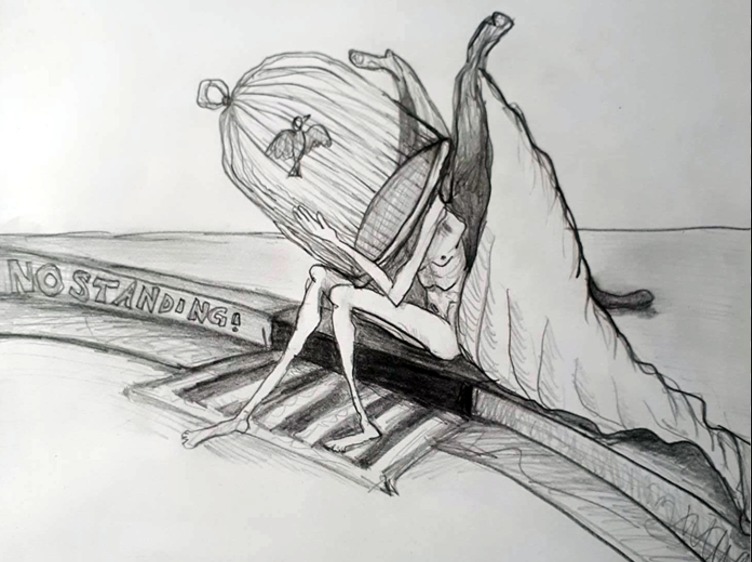




 After the Crash