
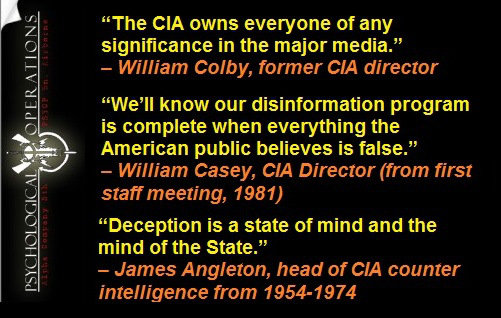
Everything Is a Weapon: The U.S. Government Is Waging Psychological Warfare on the Nation

By John W. Whitehead & Nisha Whitehead

Source: The Rutherford Institute

Have you ever wondered who’s pulling the strings? … Anything we touch is a weapon. We can deceive, persuade, change, influence, inspire. We come in many forms. We are everywhere.”— U.S. Army Psychological Operations recruitment video

The U.S. government is waging psychological warfare on the American people.

No, this is not a conspiracy theory.

Psychological warfare, according to the Rand Corporation, “involves the planned use of propaganda and other psychological operations to influence the opinions, emotions, attitudes, and behavior of opposition groups.”

For years now, the government has been bombarding the citizenry with propaganda campaigns and psychological operations aimed at keeping us compliant, easily controlled and supportive of the police state’s various efforts abroad and domestically.

The government is so confident in its Orwellian powers of manipulation that it’s taken to bragging about them. Just recently, for example, the U.S. Army’s 4th Psychological Operations Group, the branch of the military responsible for psychological warfare, released a recruiting video that touts its efforts to pull the strings, turn everything they touch into a weapon, be everywhere, deceive, persuade, change, influence, and inspire.

This is the danger that lurks in plain sight.

Of the many weapons in the government’s vast arsenal, psychological warfare may be the most devastating in terms of the long-term consequences.

As the military journal Task and Purpose explains, “Psychological warfare is all about influencing governments, people of power, and everyday citizens… PSYOP soldiers’ key missions are to influence ‘emotions, notices, reasoning, and behavior of foreign governments and citizens,’ ‘deliberately deceive’ enemy forces, advise governments, and provide communications for disaster relief and rescue efforts.”

Yet don’t be fooled into thinking these psyops (psychological operations) campaigns are only aimed at foreign enemies. The government has made clear in word and deed that “we the people” are domestic enemies to be targeted, tracked, manipulated, micromanaged, surveilled, viewed as suspects, and treated as if our fundamental rights are mere privileges that can be easily discarded.

Aided and abetted by technological advances and scientific experimentation, the government has been subjecting the American people to “apple-pie propaganda” for the better part of the last century.

Consider some of the ways in which the government continues to wage psychological warfare on a largely unsuspecting citizenry.

Weaponizing violence. With alarming regularity, the nation continues to be subjected to spates of violence that terrorizes the public, destabilizes the country’s ecosystem, and gives the government greater justifications to crack down, lock down, and institute even more authoritarian policies for the so-called sake of national security without many objections from the citizenry.

Weaponizing surveillance, pre-crime and pre-thought campaigns. Surveillance, digital stalking and the data mining of the American people add up to a society in which there’s little room for indiscretions, imperfections, or acts of independence. When the government sees all and knows all and has an abundance of laws to render even the most seemingly upstanding citizen a criminal and lawbreaker, then the old adage that you’ve got nothing to worry about if you’ve got nothing to hide no longer applies. Add pre-crime programs into the mix with government agencies and corporations working in tandem to determine who is a potential danger and spin a sticky spider-web of threat assessments, behavioral sensing warnings, flagged “words,” and “suspicious” activity reports using automated eyes and ears, social media, behavior sensing software, and citizen spies, and you having the makings for a perfect dystopian nightmare. The government’s war on crime has now veered into the realm of social media and technological entrapment, with government agents adopting fake social media identities and AI-created profile pictures in order to surveil, target and capture potential suspects.

Weaponizing digital currencies, social media scores and censorship. Tech giants, working with the government, have been meting out their own version of social justice by way of digital tyranny and corporate censorship, muzzling whomever they want, whenever they want, on whatever pretext they want in the absence of any real due process, review or appeal. Unfortunately, digital censorship is just the beginning. Digital currencies (which can be used as “a tool for government surveillance of citizens and control over their financial transactions”), combined with social media scores and surveillance capitalism create a litmus test to determine who is worthy enough to be part of society and punish individuals for moral lapses and social transgressions (and reward them for adhering to government-sanctioned behavior). In China, millions of individuals and businesses, blacklisted as “unworthy” based on social media credit scores that grade them based on whether they are “good” citizens, have been banned from accessing financial markets, buying real estate or travelling by air or train.

Weaponizing compliance. Even the most well-intentioned government law or program can be—and has been—perverted, corrupted and used to advance illegitimate purposes once profit and power are added to the equation. The war on terror, the war on drugs, the war on COVID-19, the war on illegal immigration, asset forfeiture schemes, road safety schemes, school safety schemes, eminent domain: all of these programs started out as legitimate responses to pressing concerns and have since become weapons of compliance and control in the police state’s hands.

Weaponizing entertainment. For the past century, the Department of Defense’s Entertainment Media Office has provided Hollywood with equipment, personnel and technical expertise at taxpayer expense. In exchange, the military industrial complex has gotten a starring role in such blockbusters as Top Gun and its rebooted sequel Top Gun: Maverick, which translates to free advertising for the war hawks, recruitment of foot soldiers for the military empire, patriotic fervor by the taxpayers who have to foot the bill for the nation’s endless wars, and Hollywood visionaries working to churn out dystopian thrillers that make the war machine appear relevant, heroic and necessary. As Elmer Davis, a CBS broadcaster who was appointed the head of the Office of War Information, observed, “The easiest way to inject a propaganda idea into most people’s minds is to let it go through the medium of an entertainment picture when they do not realize that they are being propagandized.”

Weaponizing behavioral science and nudging. Apart from the overt dangers posed by a government that feels justified and empowered to spy on its people and use its ever-expanding arsenal of weapons and technology to monitor and control them, there’s also the covert dangers associated with a government empowered to use these same technologies to influence behaviors en masse and control the populace. In fact, it was President Obama who issued an executive order directing federal agencies to use “behavioral science” methods to minimize bureaucracy and influence the way people respond to government programs. It’s a short hop, skip and a jump from a behavioral program that tries to influence how people respond to paperwork to a government program that tries to shape the public’s views about other, more consequential matters. Thus, increasingly, governments around the world—including in the United States—are relying on “nudge units” to steer citizens in the direction the powers-that-be want them to go, while preserving the appearance of free will.

Weaponizing desensitization campaigns aimed at lulling us into a false sense of security. The events of recent years—the invasive surveillance, the extremism reports, the civil unrest, the protests, the shootings, the bombings, the military exercises and active shooter drills, the lockdowns, the color-coded alerts and threat assessments, the fusion centers, the transformation of local police into extensions of the military, the distribution of military equipment and weapons to local police forces, the government databases containing the names of dissidents and potential troublemakers—have conspired to acclimate the populace to accept a police state willingly, even gratefully.

Weaponizing fear and paranoia. The language of fear is spoken effectively by politicians on both sides of the aisle, shouted by media pundits from their cable TV pulpits, marketed by corporations, and codified into bureaucratic laws that do little to make our lives safer or more secure. Fear, as history shows, is the method most often used by politicians to increase the power of government and control a populace, dividing the people into factions, and persuading them to see each other as the enemy. This Machiavellian scheme has so ensnared the nation that few Americans even realize they are being manipulated into adopting an “us” against “them” mindset. Instead, fueled with fear and loathing for phantom opponents, they agree to pour millions of dollars and resources into political elections, militarized police, spy technology and endless wars, hoping for a guarantee of safety that never comes. All the while, those in power—bought and paid for by lobbyists and corporations—move their costly agendas forward, and “we the suckers” get saddled with the tax bills and subjected to pat downs, police raids and round-the-clock surveillance.

Weaponizing genetics. Not only does fear grease the wheels of the transition to fascism by cultivating fearful, controlled, pacified, cowed citizens, but it also embeds itself in our very DNA so that we pass on our fear and compliance to our offspring. It’s called epigenetic inheritance, the transmission through DNA of traumatic experiences. For example, neuroscientists observed that fear can travel through generations of mice DNA. As The Washington Post reports, “Studies on humans suggest that children and grandchildren may have felt the epigenetic impact of such traumatic events such as famine, the Holocaust and the Sept. 11, 2001, terrorist attacks.”

Weaponizing the future. With greater frequency, the government has been issuing warnings about the dire need to prepare for the dystopian future that awaits us. For instance, the Pentagon training video, “Megacities: Urban Future, the Emerging Complexity,” predicts that by 2030 (coincidentally, the same year that society begins to achieve singularity with the metaverse) the military would be called on to use armed forces to solve future domestic political and social problems. What they’re really talking about is martial law, packaged as a well-meaning and overriding concern for the nation’s security. The chilling five-minute training video paints an ominous picture of the future bedeviled by “criminal networks,” “substandard infrastructure,” “religious and ethnic tensions,” “impoverishment, slums,” “open landfills, over-burdened sewers,” a “growing mass of unemployed,” and an urban landscape in which the prosperous economic elite must be protected from the impoverishment of the have nots. “We the people” are the have-nots.

The end goal of these mind control campaigns—packaged in the guise of the greater good—is to see how far the American people will allow the government to go in re-shaping the country in the image of a totalitarian police state.

The facts speak for themselves.

Whatever else it may be—a danger, a menace, a threat—the U.S. government is certainly not looking out for our best interests, nor is it in any way a friend to freedom.

When the government views itself as superior to the citizenry, when it no longer operates for the benefit of the people, when the people are no longer able to peacefully reform their government, when government officials cease to act like public servants, when elected officials no longer represent the will of the people, when the government routinely violates the rights of the people and perpetrates more violence against the citizenry than the criminal class, when government spending is unaccountable and unaccounted for, when the judiciary act as courts of order rather than justice, and when the government is no longer bound by the laws of the Constitution, then you no longer have a government “of the people, by the people and for the people.”

What we have is a government of wolves.

Our backs are against the proverbial wall.

“We the people”—who think, who reason, who take a stand, who resist, who demand to be treated with dignity and care, who believe in freedom and justice for all—have become undervalued citizens of a totalitarian state that views people as expendable once they have outgrown their usefulness to the State.

Brace yourselves.

As I make clear in my book Battlefield America: The War on the American People and in its fictional counterpart The Erik Blair Diaries, “we the people” have become enemies of the Deep State.
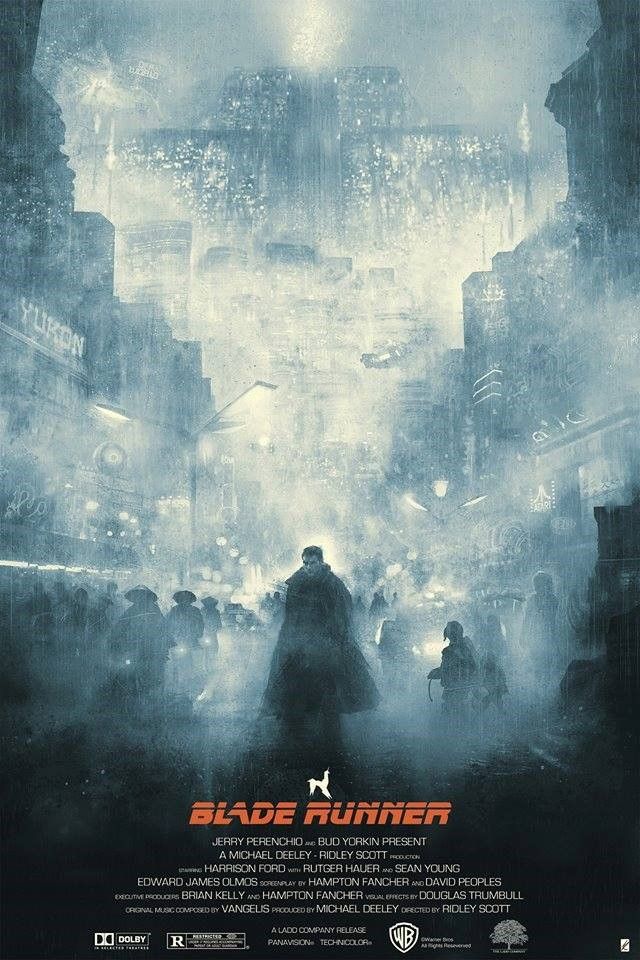
Tears in Rain: ‘Blade Runner’ and Philip K. Dick’s Legacy in Film

Blade Runner, and the work of Philip K. Dick, continues to find its way into our cinemas and minds. How did the visions of a paranoid loner become the most relevant science fiction of our time?

By Sean Bell

Source: PopMatters

You are an unusual man, Mr. Asher,” the cop beside him said. “Crazy or not, whatever it is that has gone wrong with you, you are one of a kind.”– Philip K. Dick, Flow My Tears, The Policeman Said.
“I’ve seen things you people wouldn’t believe…”
— Roy Batty, Blade Runner.

Los Angeles, 2019. The script simply reads: “Ext. Hades – Dusk”. Chemical flame bursts into the perpetual, post-nuclear Los Angeles gloom from skyscraping smokestacks, rising out of an industrial landscape Hieronymus Bosch might have envisaged. Flying cars flit through the darkness like fireflies. The camera moves slowly over impossible architecture with the immensity and decaying grandeur of ancient Egypt; a phantasmagorical megalopolis strung with necklaces of neon. The music rises.

The last war is over and nobody won. The Earth is living on borrowed time. Science has destroyed all boundaries between the real and unreal except those we choose to impose. Policemen are murderers, androids are lovers, nobody can be trusted, and everybody dies. Welcome back to the world of Blade Runner. Every time we return, it becomes more recognisable. Perhaps we never left.

Santa Ana, 1981. By now, Philip K. Dick — author, religious visionary and possible schizophrenic, who once said “You would have to kill me and prop me up in the seat of my car with a smile painted on my face to get me to go near Hollywood” — has read and approved the shooting script for Blade Runner by Hampton Fancher and David Peoples, as well as viewed a test reel of the movie’s groundbreaking special effects. In an effusive letter to Jeff Walker, the man in charge of the film’s marketing. Dick makes his prophetic opinion clear.

“Let me sum it up this way,” he wrote. “Science fiction has slowly and ineluctably settled into a monotonous death: it has become inbred, derivative, stale. Suddenly you people come in, some of the greatest talents currently in existence, and now we have a new life, a new start. As for my own role in the BLADE RUNNER project, I can only say that I did not know that a work of mine or a set of ideas of mine could be escalated into such stunning dimensions. My life and creative work are justified and completed by BLADE RUNNER… It will prove invincible.” (‘Letter to Jeff Walker regarding Blade Runner on Philip K Dick.com)

Dick, with a writer’s knack, chose the right words. Blade Runner has survived everything that could be thrown at it, including its initial critical reception, successive unsatisfactory edits, and dilution by both the science fiction genre and the film industry, which would plagiarise its vision with varying degrees of shamelessness for the next three decades. Yet nothing has been able to replicate its unique synthesis of elements, melding equal parts noir, action, romance, cyberpunk, dystopia and a meditation on what it means to be human. Whether praised or disparaged, ignored or overexposed, it has seen off all critics and challengers. Blade Runner‘s invincibility endures.

Unfortunately, the inimitable artistic fortitude of Ridley Scott‘s best work also allowed Hollywood to practice its favourite hobby of missing the point. The novels (or rather, in the film industry netherworld, ‘properties’) of Philip K. Dick — a writer largely unappreciated in his own lifetime who, at his lowest, claimed he he could not afford the late fee for a library book and infamously sustained himself on horse meat from a local pet store — have become highly prized and sought-after by studios eager to import intelligent ideas, rather than go through the hassle of conceiving their own. In the (twisted) spirit of Dick’s short story “We Can Remember It For You Wholesale“, no need for originality, we can develop it for you wholesale.

Question the nature of identity with Colin Farrell’s Douglas Quaid /Hauser as he flees the futuristic gunfire in the remake of Len Wiseman’s Total Recall (2012, an adaptation of an adaptation, as it were). Consider the limitations of free will with Tom Cruise’s Chief John Anderton (a well-known fan of unstable science fiction writers) in Steven Spielberg’s Minority Report (2012) while wondering how short he really is. Watch Jon Woo’s Paycheck (2003) and wonder how much Ben Affleck is actually being paid to appear in this piece of shit.

The names change, but the formula remains the same. Each summer, there must be blockbusters, and to fill the gaps in between the explosions with the barest bones of a Phil Dick story is, to the studio mindset, to buy instant, ready-made philosophical depth and artistic worth. Just add CGI!

Improbably, with 11 films based on his work and more in the pipeline, Dick has become the most adapted science fiction author in cinema history… And I’m not sure that’s a good thing.

“It’s a film about whether or not you can have a meaningful relationship with your toaster.” — Harrison Ford on Blade Runner in an interview with The Washington Post, 11 September 1992

That Scott is a director second only to George Lucas in his determination to tinker with a bygone masterwork until it meets his ultimate, exacting satisfaction (at last count, there are seven different versions of Blade Runner floating around the ether, finally culminating in Scott’s so-called ‘final cut’ in 2007), when a startling new interpretation of the film appeared online this June to wild acclaim, he had nothing to do with it. Instead, it was the work of the artist Anders Ramsell, who painstakingly recreated every frame of the movie’s opening 13 minutes with 3,285 gorgeous, haunting, impressionistic watercolours.

Dick, with a writer’s knack, chose the right words. Blade Runner has survived everything that could be thrown at it, including its initial critical reception, successive unsatisfactory edits, and dilution by both the science fiction genre and the film industry, which would plagiarise its vision with varying degrees of shamelessness for the next three decades. Yet nothing has been able to replicate its unique synthesis of elements, melding equal parts noir, action, romance, cyberpunk, dystopia and a meditation on what it means to be human. Whether praised or disparaged, ignored or overexposed, it has seen off all critics and challengers. Blade Runner‘s invincibility endures.

Unfortunately, the inimitable artistic fortitude of Ridley Scott‘s best work also allowed Hollywood to practice its favourite hobby of missing the point. The novels (or rather, in the film industry netherworld, ‘properties’) of Philip K. Dick — a writer largely unappreciated in his own lifetime who, at his lowest, claimed he he could not afford the late fee for a library book and infamously sustained himself on horse meat from a local pet store — have become highly prized and sought-after by studios eager to import intelligent ideas, rather than go through the hassle of conceiving their own. In the (twisted) spirit of Dick’s short story “We Can Remember It For You Wholesale“, no need for originality, we can develop it for you wholesale.

Question the nature of identity with Colin Farrell’s Douglas Quaid /Hauser as he flees the futuristic gunfire in the remake of Len Wiseman’s Total Recall (2012, an adaptation of an adaptation, as it were). Consider the limitations of free will with Tom Cruise’s Chief John Anderton (a well-known fan of unstable science fiction writers) in Steven Spielberg’s Minority Report (2012) while wondering how short he really is. Watch Jon Woo’s Paycheck (2003) and wonder how much Ben Affleck is actually being paid to appear in this piece of shit.

The names change, but the formula remains the same. Each summer, there must be blockbusters, and to fill the gaps in between the explosions with the barest bones of a Phil Dick story is, to the studio mindset, to buy instant, ready-made philosophical depth and artistic worth. Just add CGI!

Improbably, with 11 films based on his work and more in the pipeline, Dick has become the most adapted science fiction author in cinema history… And I’m not sure that’s a good thing.

“It’s a film about whether or not you can have a meaningful relationship with your toaster.” — Harrison Ford on Blade Runner in an interview with The Washington Post, 11 September 1992

That Scott is a director second only to George Lucas in his determination to tinker with a bygone masterwork until it meets his ultimate, exacting satisfaction (at last count, there are seven different versions of Blade Runner floating around the ether, finally culminating in Scott’s so-called ‘final cut’ in 2007), when a startling new interpretation of the film appeared online this June to wild acclaim, he had nothing to do with it. Instead, it was the work of the artist Anders Ramsell, who painstakingly recreated every frame of the movie’s opening 13 minutes with 3,285 gorgeous, haunting, impressionistic watercolours.

The painting technique employed to create this effect is known as aquarelle, which also acts as a sly commentary on Blade Runner‘s repeatedly-rejiggered legacy: because of its transparency, with aquarelle nothing can be painted over — once a mistake has been made, it has to be lived with. But as I watched what Ramsell called his ‘paraphrase’ of the movie, the familiar scenes and faces and voices emerging from the flickering, sensuous wash of colour, it seemed all the more appropriate. Other than Derek Jarman’s Caravaggio, I can think of no other film that so looks like a painting without paint — a piece of art that evokes other art, and yet remains entirely itself.

This is all a long way of saying that Blade Runner is beautiful, in almost every way possible. This has, ridiculously, sometimes been described as being to its detriment: Roger Ebert, one of the film’s more famous naysayers, wrote in a contemporary review in the Chicago Sun-Times that “It looks fabulous… but it is thin in its human story,” (11 September 1992) an oddly myopic remark to make about a parable on the nature of humanity. True, Blade Runner has an embarrassment of style, but never at the expense of substance, much like the best examples of the Cinema du look movement, which was just emerging in French cinema at the time of Blade Runner‘s release. Indeed, in appearance and atmosphere, Blade Runner is so distinct that it changed the aesthetic of science fiction, and new subgenres have since been invented simply to describe it — ‘future noir’, coined by the critic and filmmaker Paul M. Sammon, being the most enduring.

To those who have yet to experience the film, I wonder what to say that has not been said elsewhere. Based on Philip K. Dick’s 1968 novel Do Androids Dream of Electric Sheep?, Blade Runner somehow manages to be simultaneously the truest adaptation of Dick’s work yet produced — in spirit, if not plot — and also the freest in its interpretation of the material.

The central premise remains in both book and film; Rick Deckard (Harrison Ford), halfway between policeman and bounty hunter, makes his living by tracking and killing androids that are almost entirely indistinguishable from humans, living amongst us under false identities. The supposed test for distinguishing real from unreal humans is that of empathy, but as Deckard methodically adds to his ‘artificial’ bodycount, he begins to question who is really the unemotional machine.

Blade Runner dumps much of the novel’s narrative furniture — Scott justified this to Dick by saying: “You know you’re so dense, mate, that by page 32, there’s about 17 storylines” — in a way that, in almost any other adaptation, would be considered sacrilege. Most noticeably, in the novel, Deckard is trapped in a barely functional marriage, while in the movie, Harrison Ford’s laconic protagonist is the classic bachelor gumshoe.

Also prominent in the book are ‘Mercerism’, the religion based around its followers’ empathy for a man whom others were throwing rocks at, and the ‘Mood Organ’, the household device which stimulates any mood the user wishes to experience, and which much of the population now depends on in order to face another bleak, post-apocalyptic day — two tragicomic creations typical of Dick, but too wry to fit with the Blade Runner‘s overall tone. Despite such changes, Dick’s reading of the screenplay convinced him that this film could express his ideas in a way he had not thought possible.

The production could hardly be called smooth. Even before its release, troubling rumours had begun circulating, and as Paul M Sammon wrote ,”by the time BR (Blade Runner) officially completed principle photography in July on 1981, the gossip has become more specific — BR‘s workload had been horrendous, its shooting conditions miserable, and its director, difficult. Moreover, the whispers went, BR’s moneymen were unhappy, its leading man had clashed with his director, and the crew had been near revolt.” Some of these stories were indeed true, but one should bear in mind that movie moneymen are nearly always unhappy, and Harrison Ford will always be the man who told George Lucas that “you can type this shit, but you sure as hell can’t say it.”

Paranoia Runs Through Blade Runner Like a Knife Edge

When Blade Runner was first released, the reviews ran from lukewarm to underwhelmed to baffled, a fact that many critics have been doing their best to forget in the intervening years, polishing the film’s legend in a frantic effort to make up for missing the boat first time round. Considered today, in our gleaming plastic future of bad credit and worse politics, where we are reliant not on humanised robots but dehumanising gadgets, and where much of the movie’s retro-futurism appears as quaint as it does prescient, what is left to say about Blade Runner?

Should I recite the plaudits that have become ritualistic? Should I point out the Roy Batty’s (Rutger Hauer) ‘tears in rain’ monologue is among the most moving and eloquent ever written or performed? Or that Vangelis revolutionised jazz, electronic music and film scoring simultaneously in one of the best soundtracks ever composed? Is it really necessary to highlight the acting of all involved; Harrison Ford as one of the best soulful detectives to grace noir of any kind, an understated and heartbreaking Sean Young (as Rachael), a dangerous but innocent Daryl Hannah (as Pris), or Rutger Hauer’s mixture of the psychotic and the Shakespearean? Do I need to praise the costumes, the set design, or the script which balances so many themes, so many hidden or implied meanings, with such grace and economy?

Well, yes. You want a criticism of Blade Runner? I would’ve liked more of Edward James Olmos’ Gaff. He’s cool. I also want Deckard’s coat.

But we need to be reminded of these things, every now and again, as each new generation discovers the film afresh, and especially when the next logical question becomes: how did Blade Runner get it so right, more so than any other adaptation of Dick’s work since? What did it understand that they did not? To try and answer that, we have to go back to the source.

“Phil acknowledged that his talk sometimes sounded like “religious nonsense & occult nonsense” — but somewhere in it all was the truth. And he would never find it. God himself had assured him of that.” — Lawrence Sutin, Divine Invasions: A Life of Philip K. Dick.

In 2000, at the one and only Disinfo Con — a friendly gathering of millennial deviants concerning all things ‘counterculture’ — Grant Morrison, a writer who could arguably be counted as one of Dick’s prodigious bastard literary offspring, opened his keynote speech marvelling at the fact he spent his youth reading Robert Anton Wilson and now, all these years later, “we’re standing here, we’re talking about this shit and it’s real.”

Fans of Philip K. Dick have been feeling like that since at least the ’70s, when the dark realities on the other side of the Drug Revolution and the true possibilities of an all-powerful Nixonian surveillance state were becoming painfully apparent. Then as now, we use Dick’s paranoia to express our own.

Dick once commented that, with the making of Blade Runner, what had once been a private world that only he inhabited was now open to all; they would live in its murky depths, just as he did every day. At first, one might think that a paranoid and delusional visionary — and I use the word in its most literal sense — would want nothing more than for others to see and experience what he does. But perhaps Dick didn’t want anyone in his world. Maybe he didn’t think his world should be suffered by anyone else.

The fantastic, tortured mind of Philip K. Dick has been discussed, analysed and treated like an object of supreme curiosity since his death in 1982 (a few months shy of Blade Runner‘s release) and before. He had eked out an impoverished existence writing science fiction since the ’50s, when it was less a genre than a ghetto, and could only make a living by producing at a furious pace which he fuelled with huge amounts of amphetamines, at one point producing 12 novels over the course of two years.

But Dick was ever a seeker of truth, which made him, strangely, something of an oddity in science fiction. Within these novels, beneath the aliens and spaceships, moon colonies and interstellar wars, was arguably the best satire being done in science fiction on American life outside of Kurt Vonnegut‘s oeuvre, the philosophical undertones and untrammelled, often gothic imagination of which called to mind Jorge Luis Borges more than Isaac Asimov. The uniting thread that runs through his work — and, eventually, his life — is the notion that reality, as we know it, is fundamentally untrustworthy.

As the ’60s wore on, Dick’s involvement with the drug culture increased, adding a psychedelic aspect to both his ever-evolving philosophy and his ever-present paranoia. In 1971, Dick experienced a defining moment: his home was broken into, his safe blown open, and many of his personal papers burglerized. He never discovered who was responsible, though he had many suspects — local drug addicts, Black Panthers, the police, the FBI, the Soviets, or any of these, pretending to be one of the others.

The effect it left on Dick was to give him proof, unexplained and terrifying, that his paranoia was somehow justified. There had been comfort in simply telling himself he was crazy. But after years of grappling with his mental health, someone, it seemed, truly was out to get him.

“I mean,” he told the Aquarian magazine in a 1974 interview, “it’s a very frightening thing when the head of a police department tells you that you better leave the county because you have enemies, and you don’t know who these enemies are or why you’ve incurred their wrath.”

When one is peripherally aware of one’s own tenuous psychological condition (which we must be, we tell ourselves, if we have any hope of overcoming it), the uninitiated cannot imagine the sheer anguish, the self-doubt, the fear that follows when you know you cannot trust your own mind, and you cannot trust anyone to help you. The luckiest paranoids are also egotists, or better yet, megalomaniacs; they face the lurking forces of imagined persecution with a defiant roar or a knowing smirk.

Dick, on the other hand, was a sensitive, fragile, frightened soul, as well as a possible undiagnosed schizophrenic. His subsequent religious experiences — a series of hallucinations in which a beam of pink light connected him with a “transcendentally rational mind” — may have been his brain’s attempt to soothe his paranoia, or merely the next stage of his mental instability. In either case, as always, it provided inspiration for another novel.

Critics and biographers often talk about Dick’s paranoia and delusions like they were shocking fashion statements or extreme political opinions — just another interesting aspect to the bizarro image of a literary titan. What they don’t say, although the evidence is all around us, is that Dick’s paranoia is ours, as well. Ours may not have such colourful outlets or dramatic results, but we shall always carry our paranoia with us. It cannot be blotted out. There will forever be dark fears lurking in the deeper pools of our mind about our untrustworthy friends, co-workers, policemen, criminals, the FBI, the CIA, the Communists, the aliens, or God himself… and beyond. Existence will always be open to question, forever taunting us with its uncertainty. We can’t trust reality, but we have to live there.

This paranoia runs through Blade Runner like a knife edge. You cannot trust others, or yourself. You cannot trust your memories, your past, or your future. The entire world may be against you, even if it doesn’t appear to be. Then again, you don’t have to like it.

The heroes and villains of Blade Runner do not like, or accept, the oppression of the paranoid worldview. Deckard fights a series of seemingly impossible battles, even against what he thought was true, and finds romance where it should be impossible. Roy Batty, the leader of the renegade replicants, fights against death itself, seeking to extend and outlive his designer-mandated expiration date. The inhuman fights to become human, so humans must prove their humanity. This is the message at Blade Runner‘s core, and it has never been replicated.

Near the end of Dick’s 1976 novel Radio Free Albemuth, the protagonist, an author surrogate for Dick who also writes pulp science fiction, is faced by a gloating representative of the government conspiracy that the writer has become entangled with, who coolly informs him they will continue to put out books under his name — lurid trash scattered with a few of the author’s trademark concepts to keep it recognisable for his fans, but encoded with non-too-subtle propaganda messages designed to keep its readers afraid and unenlightened.

At our most cynical, it’s sometimes difficult not to think of Hollywood the same way: trading on Dick’s name and style and core ideas, but discarding the message and the mind behind them.

Authors often have to face a string of misfires and misinterpretations before their work gets the cinematic treatment it deserves; Dick, on the other hand, got a masterpiece on the first go. And it remains ours to enjoy: Blade Runner, as Dick wrote, is invincible.

Maybe it’s finally time for Hollywood to leave the legacy of Philip K. Dick at the local bookstore, where it belongs.

“What matters to me is the writing, the act of manufacturing the novel, because while I am doing it, at that particular moment, I am in the world I am writing about. It is real to me, completely and utterly. Then, when I’m finished, and I have to stop, withdraw from that world forever — that destroys me… I promise myself: I will never write another novel. I will never again imagine people from whom I will eventually be cut off. I tell myself this… and, secretly and cautiously, I begin another book.” — Philip K. Dick, “Notes Made Late At Night By A Weary SF Writer”, 1968.

How To Tell If Someone Is Controlled Opposition

By Caitlin Johnstone

Source: CaitlinJohnstone.com

Every day in my article comments and social media I get people warning me that this or that journalist, activist or politician is “controlled opposition”, meaning someone who pretends to oppose the establishment while covertly serving it. These warnings usually come after I’ve shared or written about something a dissident figure has said or done, and are usually accompanied by an admonishment not to ever do so again lest I spread their malign influence. If you’ve been involved in any kind of anti-establishment activism for any length of time, you’ve probably encountered this yourself.

Paranoia pervades dissident circles of all sorts, and it’s not entirely without merit, since establishment infiltration of political movements is the norm, not the exception. This article by Truthout documents multiple instances in which movements like the 1968 Chicago DNC protest and Peter Camejo’s 1976 anti-establishment presidential campaign were so heavily infiltrated by opaque government agencies that one out of every six people involved in them were secretly working for the feds. This trend of infiltration is known to have continued into the current day with movements like Occupy and Black Lives Matter, and we’d be ignorant not to assume that this has been at least as rampant in online circles where people organize and disseminate ideas and information.

So it’s understandable that people are extremely vigilant about prominent figures in dissident circles, and it’s understandable that people feel paranoid. Over and over again we see shining anti-establishment movements fizzle or rendered impotent, often seemingly with the help of people we once trusted, and it’s hard not to get frustrated and become suspicious of anyone who starts shining bright in antiwar, leftist, or other dissident circles.

The trouble with this paranoia and suspicion is that it doesn’t seem to function with any kind of intelligence. I have received such “controlled opposition” warnings about pretty much every prominent dissident figure in the English-speaking world at one time or another, and if I believed them all there’d be no one in the world whose words I could share or write about, including my own. I myself have been accused at different times of being a “plant” for the CIA, the Russians, Assad, the Chinese Communist Party, the Iranian mullahs, the alt-right, Trump, Pyongyang, and the Palestinians, which if all true would make me a very busy girl indeed. Since I know I’m not a plant for anybody, I know for myself that such accusations don’t come from a place of insight with any degree of reliability, and I’ve therefore had to find my own way to navigate this confusing landscape.

So since I know that infiltration and manipulation happens, but I don’t find other people’s whisperings about “controlled opposition” useful, how do I figure out who’s trustworthy and who isn’t? How do I figure out who it’s safe to cite in my work and who to avoid? How do I separate the fool’s gold from the genuine article? The shit from the Shinola?

Here is my answer: I don’t.

I spend no mental energy whatsoever concerning myself with who may or may not be a secret pro-establishment influencer, and for good reason. There’s no way to know for sure if an individual is secretly scheming to sheep dog the populace into support for the status quo, and as long as government agencies remain opaque and unaccountable there will never be a way to know who might be secretly working for them. What I can know is (A) what I’ve learned about the world, (B) the ways the political/media class is lying about what I know about the world, and (C) when someone says something which highlights those lies. I therefore pay attention solely to the message, and no attention to what may or may not be the hidden underlying agenda of the messenger.

In other words, if someone says something which disrupts establishment narratives, I help elevate what they’re saying in that specific instance. I do this not because I know that the speaker is legit and uncorrupted, but because their message in that moment is worthy of elevation. You can navigate the entire political/media landscape in this way.

Since society is made of narrative and power ultimately rests in the hands of those who are able to control those narratives, it makes no sense to fixate on individuals and it makes perfect sense to focus on narrative. What narratives are being pushed by those in power? How are those narratives being disrupted, undermined and debunked by things that are being said by dissident voices? This is the most effective lens through which to view the battle against the unelected power establishment which is crushing us all to death, not some childish fixation on who should or shouldn’t be our hero.

Have no heroes. Trust nobody but your own inner sense-maker. If someone says something that disrupts establishment narratives based on what you understand those narratives to be, go ahead and help throw what they’re saying into the gears of the machine. Don’t make a religion out of it, don’t get attached to it, just use it as a weapon to attack the narrative matrix.

This by the way is also a useful lens to look through in spiritual development, if you’re into that sort of thing. When you enter spiritual circles concerned with enlightenment, you’ll see all sorts of debates about what teachers are really enlightened and which ones are just pretending, and these conversations mimic precisely the exact kinds of debates you’ll see in marginalized political circles about who’s the real deal and who’s controlled opposition. But the truth is there’s no way to know with certainty what’s going on in someone else’s head, and the best thing to do is to stop concerning yourself with who has and has not attained some special realization or whatever and just focus on what they’re saying. If a spiritual teacher says something which helps you notice something you’d never noticed before about consciousness or perception, then use what they said and maybe stick around to see if they have anything else useful to say. If not, move on.

There’s no reason to worry about what journalists, activists and politicians are coming from a place of authenticity if you know yourself to be coming from a place of authenticity. As you learn more about the world and get better at distinguishing fact from narrative, you will get better and better at seeing the narrative matrix clearly, and you’ll come to see all the things that are being said about what’s going on in the world as weapons in the battle of narrative control. Pick up whatever weapons seem useful to you and use them in whatever ways they’ll be useful, without wasting energy concerning yourself with the individuals who created them. Call the bullshit what it is and use the truth for what it is.

Or maybe I’m fulla shit! Maybe I myself am being paid to say these things by some powerful influencer; you can’t know for sure. All you can know is what’s useful for you. If you really find it useful to try and organize individual dissident figures into “hero” and “controlled opposition” boxes, if that genuinely helps you take apart the system that’s hurting us all, you’d know that better than I would. But if you find what I’m saying here useful, pick it up and add it to your toolbox.