

Challenges for Resolving Complex Conflicts

By Robert J. Burrowes

While conflict theories and resolution processes advanced dramatically during the second half of the 20th century, particularly thanks to the important work of several key scholars such as Professor Johan Galtung – see ‘Conflict Transformation by Peaceful Means (the Transcend Method)’ – significant gaps remain in the conflict literature on how to deal with particular conflict configurations. Notably, these include the following four.

First, existing conflict theory does not adequately explain, emphasize and teach how to respond in those circumstances in which parties cannot be brought to the table to deeply consider a conflict and the measures necessary to resolve it. This particularly applies in cases where one or more parties is violently defending (often using a combination of direct and structural violence) substantial interrelated (material and non-material) interests. The conflict between China and Tibet over the Chinese-occupied Tibetan plateau, the many conflicts between western corporations and indigenous peoples over exploitation of the natural environment, and the conflict between the global elite and ‘ordinary’ people over resource allocation in the global economy are obvious examples of a vast number of conflicts in this category. As one of the rare conflict theorists who addresses this question, Galtung notes that structural violence ‘is not only evil, it is obstinate and must be fought’, and his preferred strategy is nonviolent revolution. See The True Worlds: A Transnational Perspective p. 140. But how?

Second, existing conflict theory does not explain how to respond in those circumstances in which one or more parties to the conflict are insane. The conflict between Israel and Palestine over Israeli-occupied Palestine classically illustrates this problem, particularly notable in the insanity of Israeli Prime Minister Binjamin Netanyahu, Defense Minister Avigdor Lieberman and Justice Minister Ayelet Shaked. But it is also readily illustrated by the insanity of the current political/military leadership in the USA and the insanity of the political, military and Buddhist leaders in Myanmar engaged in a genocidal assault on the Rohingya. For a brief discussion of the meaning and cause of this insanity see ‘The Global Elite is Insane Revisited’.

As an aside, there is little point deluding ourselves that insanity is not a problem or even ‘diplomatically’ not mentioning the insanity (if this is indeed the case) of certain parties in particular conflicts. The truth enables us to fully understand a conflict so that we can develop and implement a strategy to deal with all aspects of that truth. Any conflict strategy that fails to accurately identify and address all key aspects of the conflict, including the insanity of any of the parties, will virtually certainly fail.

Third, and more fundamentally, existing conflict theory does not take adequate account of the critical role that several unconscious emotions play in driving conflict in virtually all contexts, often preventing its resolution. This particularly applies in the case of (but is not limited to) suppressed terror, self-hatred and anger which are often unconsciously projected as fear of, hatred for and anger at an opponent or even an innocent third-party (essentially because this individual/group feels ‘safe’ to the person who is projecting). See ‘The Psychology of Projection in Conflict’.

While any significant ongoing conflict would illustrate this point adequately, the incredibly complex and interrelated conflicts being conducted in the Middle East, the prevalent Islamophobia in some western countries, and the conflicts over governance and exploitation of resources in the Democratic Republic of Congo are superlative examples. Ignoring suppressed (and projected) emotions can stymie conflict resolution in any context, interpersonally and geopolitically, and it does so frequently.

Fourth, existing conflict theory pays little attention to the extinction-causing conflict being ongoingly generated by human over-consumption in the finite planetary biosphere (and currently resulting in 200 species extinctions daily) which is sometimes inadequately identified as a conflict caused by capitalism’s drive for unending economic growth in a finite environment.

So what can we do?

Well, to begin, in all four categories of cases mentioned above, I would use Gandhian nonviolent strategy to compel violent opponents to participate in a conflict transformation process such as Galtung’s. Why nonviolent and why Gandhian? Nonviolent because our intention is to process the conflict to achieve a higher level of need satisfaction for all parties and violence against any or all participants is inconsistent with that intention. But Gandhian nonviolence because only Gandhi’s version of nonviolence has this conflict intention built into it. See ‘Conception of Nonviolence’.

‘But isn’t this nonviolent strategy simply coercion by another name?’ you might ask. Well, according to the Norwegian philosopher, Professor Arne Naess, it is not. In his view, if a change of will follows the scrutiny of norms in the context of new information while one is ‘in a state of full mental and bodily powers’, this is an act of personal freedom under optimal conditions. Naess highlights this point with the following example: Suppose that one person carries another against their will into the streets where there is a riot and, as a result of what they see, the carried person changes some of their attitudes and opinions. Was the change coerced? According to Naess, while the person was coerced into seeing something that caused the change, the change itself was not coerced. The distinction is important, Naess argues, because satyagraha (Gandhian nonviolent struggle) is incompatible with changes of attitudes or opinions that are coerced. See Gandhi and Group Conflict: An Exploration of Satyagraha pp. 91-92.

To elaborate this point: Unlike other conceptions of nonviolence, Gandhi’s nonviolence is based on certain premises, including the importance of the truth, the sanctity and unity of all life, and the unity of means and end, so his strategy is always conducted within the framework of his desired political, social, economic and ecological vision for society as a whole and not limited to the purpose of any immediate campaign. It is for this reason that Gandhi’s approach to strategy is so important. He is always taking into account the ultimate end of all nonviolent struggle – a just, peaceful and ecologically sustainable society of self-realized human beings – not just the outcome of this campaign. He wants each campaign to contribute to the ultimate aim, not undermine vital elements of the long-term and overarching struggle to create a world without violence.

Consequently, given his conception of nonviolence, Gandhi’s intention is to reach a conflict outcome that recognizes the sanctity and unity of all life which, obviously, includes the lives (but also the physical and emotional well-being) of his opponents. His nonviolent strategy is designed to compel participation in a conflict process but not to impose his preferred outcome unilaterally. See Nonviolent Campaign Strategy and Nonviolent Defense/Liberation Strategy.

This can apply in the geopolitical context or in relation to ordinary individuals ‘merely’ participating in the violence of overconsumption. Using nonviolent strategy to campaign on the climate catastrophe or other environmental issues can include mobilizing individuals and communities to emulate Gandhi’s asceticism in a modest way by participating in the fifteen-year strategy outlined in The Flame Tree Project to Save Life on Earth which he inspired.

But even if we can use nonviolent strategy effectively to get the conflicting parties together, the reality is that suppressed and projected emotions – particularly fear, self-hatred and anger as mentioned above – or even outright insanity on the part of one or more parties may still make efforts to effectively transform the conflict impossible. So for conflict resolution to occur, we need individuals who are willing and able to participate with at least minimal goodwill in designing a superior conflict outcome beneficial to everyone concerned.

Hence, I would do one more thing in connection with this process. Prior to, and then also in parallel with, the ‘formal’ conflict process, I would provide opportunities for all individuals engaged in the process (or otherwise critical to it because of their ‘background’ role, perhaps as a leader not personally present at the formal conflict process) to explore in a private setting with a skilled ‘nisteler’ (who is outside the conflict process), the unconscious emotions that are driving their particular approach to the conflict. See ‘Nisteling: The Art of Deep Listening’. The purpose of this nisteling is to allow each participant in the conflict process to bring a higher level of self-awareness to it. See ‘Human Intelligence or Human Awareness?’

I am not going to pretend that this would necessarily be possible, quick, easy or even work in every context. Insane individuals are obviously the last to know they have a psychological problem and the least likely to participate in a process designed to uncover and remove the roots of their insanity. However, those who are trapped in a dysfunctional psychological state short of insanity may be willing to avail themselves of the opportunity. In time, the value of this aspect of the conflict resolution process should become apparent, particularly because delusions and projections are exposed by the person themself (as an outcome of the expertise of the person nisteling).

Obviously, I am emphasizing the psychological aspects of the conflict process because my own considerable experience as a nonviolent activist together with my research convinces me that understanding violence requires an understanding of the psychology that drives it. If you are interested, you can read about the psychology of violence, including the 23 psychological characteristics in the emotional profile of archetype perpetrators of violence, in the documents Why Violence? and Fearless Psychology and Fearful Psychology: Principles and Practice.

Ideally, I would like to see the concept of nistelers operating prior to, and then parallel with, focused attention on the conflict itself normalized as an inherent part of the conflict resolution process. Clearly, we need teams of people equipped to perform this service, a challenge in itself in the short-term.

If, however, conflicting parties cannot be convinced to participate in this process with reasonable goodwill, we can always revert to using nonviolent strategy to compel them to do so. And, if all attempts to conduct a reasonable conflict process fail (particularly in a circumstance in which insanity is the cause of this failure), to impose a nonviolent solution which nevertheless takes account of the insane’s party’s legitimate needs. (Yes, on just that one detail, I diverge from Gandhi.)

Having stated that, however, I acknowledge that only a rare individual has the capacity to think, plan and act strategically in tackling a violent conflict nonviolently, so considerable education in nonviolent strategy will be necessary and is a priority.

Given what is at stake, however – a superior strategy for tackling and resolving violent geopolitical conflicts including those (such as the threat of nuclear war, the climate catastrophe and decimation of the biosphere) that threaten human extinction – any resources devoted to improving our capacity to deliver this outcome would be well spent.

Provided, of course, that reducing (and ultimately eliminating) violence and resolving conflict is your aim.

In addition to the above, I would do something else more generally (that is, outside the conflict process).

Given that dysfunctional parenting is ultimately responsible for the behaviour of those individuals who generate and perpetuate violent conflicts, I would encourage all parents to consider making ‘My Promise to Children’ so that we start to produce a higher proportion of functional individuals who know how to powerfully resolve conflicts in their lives without resort to violence. If any parent feels unable to make this promise, then they have the option of tackling this problem at its source by ‘Putting Feelings First’.

If we do not dramatically and quickly improve our individual and collective capacity to resolve conflicts nonviolently, including when we are dealing with individuals who are insane, then one day relatively soon we will share the fate of those 200 species of life we drove to extinction today.


Biodata: Robert J. Burrowes has a lifetime commitment to understanding and ending human violence. He has done extensive research since 1966 in an effort to understand why human beings are violent and has been a nonviolent activist since 1981. He is the author of Why Violence? His email address is flametree@riseup.net and his website is here.

Robert J. Burrowes
P.O. Box 68
Daylesford, Victoria 3460
Australia

Email: flametree@riseup.net

Websites:
Nonviolence Charter
Flame Tree Project to Save Life on Earth
‘Why Violence?’
Feelings First
Nonviolent Campaign Strategy
Nonviolent Defense/Liberation Strategy
Anita: Songs of Nonviolence
Robert Burrowes
Global Nonviolence Network

Nonviolence or Nonexistence? The Legacy of Martin Luther King Jr.

By Robert J. Burrowes

Fifty years ago, on 4 April 1968, the Reverend Martin Luther King Jr. was assassinated.

The night before he died, King gave another of his many evocative speeches; this one at the packed Mason Temple in Memphis. The speech included these words:

‘Men for years now have been talking about war and peace. Now no longer can they just talk about it. It is no longer a choice between violence and non-violence in this world, it is non-violence or non-existence. That is where we are today.’

In clearly identifying this stark choice and having been inspired by Mohandas K. Gandhi’s wideranging social concerns, King’s concerns were also broad:

‘The Triple Evils of poverty, racism and militarism are forms of violence that exist in a vicious cycle. They are interrelated, all-inclusive, and stand as barriers to our living in the Beloved Community. When we work to remedy one evil, we affect all evils.’ See ‘The King Philosophy’.

So what has changed in the past 50 years? The world has traveled a great deal further down the path of violence. So far, in fact, that nonexistence is now the most likely outcome for humanity. See ‘On Track for Extinction: Can Humanity Survive?’

Despite the vastly more perilous state of our planet, many people and organizations around the world are following in the footsteps of Gandhi, King and other nonviolent luminaries like Silo, and are engaged in what is effectively a last ditch stand to end the violence and put humanity on a path to peace, justice and sustainability.

Let me tell you about some of these people and organizations and invite you to join them.

In Bolivia, Nora Cabero works with the Movimient Humanista. The Movement has many programs including the Convergence of Cultures which aims to facilitate and stimulate true dialogue – oriented towards the search for common points present in the hearts of different peoples and individuals – to promote the relationship between different cultures and to resist discrimination and violence. Another program, World Without Wars and Violence emerged in 1994 and was presented for the first time internationally in 1995 at the Open Meeting of Humanism held in Chile at the University of Santiago. It is active in about 40 countries. It carries out activities in the social base and also promotes international campaigns such as Education for Nonviolence and the World March for Peace and Nonviolence.

Eddy Kalisa Nyarwaya Jr. is Executive Secretary of the Rwanda Institute for Conflict Transformation and Peace Building and also President of the Alternatives to Violence Program. For the past 18 years, he has been active in the fields of ‘peace, reconciliation, nonviolence, healing of societies, building harmonious communities’ in many countries including Burundi, Chad, eastern Congo, Darfur (western Sudan), Kenya, Rwanda, Somalia, South Sudan and northern Uganda. Late last year he was in New Zealand to deliver a paper on the Great Lakes conflict. In Rwanda, the Institute for Conflict Transformation particularly works on nonviolence education in schools, universities and refugee camps. Another initiative is the conduct of workshops on nonviolence and peace through sports for head teachers in the country but it also has programs to fight early marriages and pregnancies, as well as offering trauma counseling to refugees.

In Russia, Ella Polyakova is a key figure at the Soldiers’ Mothers of Saint-Petersburg. Ella and her colleagues work to defend the rights of servicemen and conscripts in the Russian military. Ella explains why:

‘When we were creating our organization, we understood that people knew little about their rights, enshrined in Russia’s Constitution, that the concept of “human dignity” had almost disappeared, that no one had been working with the problems of common people, let alone those of conscripts. We clearly understood what a soldier in the Russian army was a mere cog in the state machine, yet with an assault rifle. We felt how important hope, self-confidence and trust were for every person. At the beginning of our journey, we saw that people around us, as a rule, did not even know what it meant to feel free. It was obvious for us that the path towards freedom and the attainment of dignity was going through enlightenment. Therefore, our organization’s mission is to enlighten people around us. Social work is all about showing, explaining, proving things to people, it is about convincing them. Having equipped ourselves with the Universal Declaration of Human Rights and Russia’s Constitution, we started to demolish this dispossession belt between citizens and their rights. It was necessary to make sure that people clearly understood that, having a good knowledge of rights, laws, and situations at hand, they would be able to take responsibility and protect themselves from abuse.’

Bruce Gagnon, coordinator of the Global Network Against Weapons & Nuclear Power in Space, was recently part of a committed effort to convince the Maine state legislature not to give warship-builder General Dynamics, which has already received more than $200 million in state and local tax breaks for the Bath Iron Works (BIW), any more ‘corporate welfare’. Bruce recently completed a fast, which lasted for more than a month, as one of the actions that Maine peace activists took to try to prevent this welfare payment to a company that has spent $14.4 billion buying back its own stocks between 2013-2017 and whose CEO was paid $21 million in 2016.

Despite their efforts, the Maine House of Representatives voted 117-31 in favor of the $45million General Dynamics corporate welfare bill and the Senate supported it 25-9. The decision was announced on the same day that General Dynamics sacked 31 workers from the BIW. As Bruce noted: ‘It was an honor to work alongside [those] who stood up for the 43,000 children living in poverty across Maine, for the tens of thousands without health care, for our starving public education system, and for the crumbling physical infrastructure as Maine joins Mississippi in the “race to the bottom”’. You can read more about this ongoing campaign to convert the Bath Iron Works into a location for the production of socially useful and ecologically sustainable non-killing technologies on the website above. There are some great photos too.

Gaëlle Smedts and her partner Luz are the key figures at Poetry Against Arms based in Germany. ‘The inspiration for this campaign is the life, work and legacy of the Latin American poet, philosopher and mystic: Mario Rodriguez Cobos, also known as Silo. His total commitment to active nonviolence, his denunciation of all forms of violence, his doctrine for overcoming pain and suffering and his magnificent poetry are a great affirmation of the meaning of life and transcendence.’ Poetry Against Arms publishes poetry/songs of people around the world who take action to resist militarism.

Since the 1970s, the world’s leading rainforest activist, John Seed, has devoted his life to saving the world’s rainforests. Founder and Director of the Rainforest Information Centre in Australia, one of his latest projects is to save the tropical Andes of Ecuador, which is ‘at the top of the world list of biodiversity hotspots in terms of vertebrate species, endemic vertebrates, and endemic plants’. From the cloud forests in the Andes to the indigenous territories in the headwaters of the Amazon, the Ecuadorean government has covertly granted mining concessions to over 1.7 million hectares (4.25 million acres) of forest reserves and indigenous territories to multinational mining companies in closed-door deals without public knowledge or consent. These concessions will decimate headwater ecosystems and biodiversity hotspots of global significance. If you would like to read more about this campaign and what you can do to help, you can do so in John’s article ‘Ecuador Endangered’.

Apart from the individuals mentioned above, signatories and endorsing organizations are engaged in an incredibly diverse range of activities to end violence in one context or another. These include individuals and organizations working in many countries to end violence against women (including discriminatory practices against widows), to rehabilitate child soldiers and end sexual violence in the Congo, activists engaged in nonviolent defense or liberation struggles – see Nonviolent Defense/Liberation Strategy – in several countries and occupied territories, as well as campaigns on a vast range of environmental, climate and indigenous rights issues, campaigns to promote religious and racial harmony as well as campaigns for nuclear disarmament and to end war. See Nonviolent Campaign Strategy.

But it also includes many individuals tackling violence at its source – see Why Violence?’ and Fearless Psychology and Fearful Psychology: Principles and Practice – by focusing on their own healing – see ‘Putting Feelings First’ – and/or working on how they parent their children for a nonviolent world. See ‘My Promise to Children’.

Given the perilous state of the global environment and climate, still others are focusing their efforts on reducing their consumption and increasing their self-reliance in accordance with the fifteen-year strategy outlined in The Flame Tree Project to Save Life on Earth.

If you would like to be part of the worldwide movement to end violence that has drawn the six people and several organizations mentioned above together, along with many others in 103 countries around the world, you are welcome to sign the online pledge of The Peoples Charter to Create a Nonviolent World.

Reverend King posed the fundamental choice of our time: nonviolence or nonexistence. What is your choice?


Biodata: Robert J. Burrowes has a lifetime commitment to understanding and ending human violence. He has done extensive research since 1966 in an effort to understand why human beings are violent and has been a nonviolent activist since 1981. He is the author of Why Violence? His email address is flametree@riseup.net and his website is here.


Robert J. Burrowes
P.O. Box 68
Daylesford, Victoria 3460
Australia

Email: flametree@riseup.net

Websites:
Nonviolence Charter
Flame Tree Project to Save Life on Earth
‘Why Violence?’
Feelings First
Nonviolent Campaign Strategy
Nonviolent Defense/Liberation Strategy
Anita: Songs of Nonviolence
Robert Burrowes
Global Nonviolence Network


To Liberate Cambodia

By Robert J. Burrowes

A long-standing French protectorate briefly occupied by Japan during World War II, Cambodia became independent in 1953 as the French finally withdrew from Indochina. Under the leadership of Prince Norodom Sihanouk, Cambodia remained officially neutral, including during the subsequent US war on Indochina. However, by the mid-1960s, parts of the eastern provinces of Cambodia were bases for North Vietnamese Army and National Liberation Front (NVA/NLF) forces operating against South Vietnam and this resulted in nearly a decade of bombing by the United States from 4 October 1965. See ‘Bombs Over Cambodia: New Light on US Air War’.

In 1970 Sihanouk was ousted in a US-supported coup led by General Lon Nol. See ‘A Special Supplement: Cambodia’. The following few years were characterized by an internal power struggle between Cambodian elites and war involving several foreign countries, but particularly including continuation of the recently commenced ‘carpet bombing’ of Cambodia by the US Air Force.

On 17 April 1975 the Communist Party of Kampuchea (CPK), otherwise known as the Khmer Rouge, took control of Cambodia. Following four years of ruthless rule by the Chinese-supported Khmer Rouge, initially under Pol Pot, they were defeated by the Vietnamese army in 1979 and the Vietnamese occupation authorities established the People’s Republic of Kampuchea (PRK), installing Heng Samrin and other pro-Vietnamese Communist politicians as leaders of the new government. Heng was succeeded by Chan Sy as Prime Minister in 1981.

Following the death of Chan Sy, Hun Sen became Prime Minister of Cambodia in 1985 and, despite a facade of democracy, he and the Cambodian People’s Party (CPP) have been in power ever since. This period has notably included using the army to purge a feared rival in a bloody coup conducted in 1997. Hun Sen’s co-Prime Minister, Prince Norodom Ranariddh, was ousted and fled to Paris while his supporters were arrested, tortured and some were summarily executed.

The current main opposition party, the Cambodia National Rescue Party (CNRP) was founded in 2012 by merging the Sam Rainsy Party and the Human Rights Party. Emblematic of Cambodia’s ‘democratic’ status, more than two dozen opposition members and critics have been locked up in the past year alone and the CNRP leader, Kem Sokha, known for his nonviolent, politically tolerant views, is currently imprisoned at a detention centre in Tboung Khmum Province following his arrest on 3 September 2017 under allegations of treason, espionage and for orchestrating anti-government demonstrations in 2013-2014. These demonstrations were triggered by widespread allegations of electoral fraud during the Cambodian general election of 2013. See ‘Sokha arrested for “treason”, is accused of colluding with US to topple the government’.

On 16 November 2017 the CNRP was dissolved by Cambodia’s highest court and 118 of its members, including Sokha and exiled former leader Sam Rainsy, were banned from politics for five years.


Cambodian Society

Socially, Cambodia is primarily Khmer with ethnic populations of Chinese, Vietnamese, Cham, Thai and Lao. It has a population of 16 million people. The pre-eminent religion is Buddhism. The adult literacy rate is 75%; few Cambodians speak a European language limiting access to western literature. Most students complete 12 years of (low quality public) school but tertiary enrollment is limited. As in all countries, education (reinforced by state propaganda through the media) serves to intimidate and indoctrinate students into obedience of elites. Discussion of national politics in a school class is taboo and such discussions are rare at tertiary level. This manifests in the narrow range of concerns that mobilize student action: personal outcomes such as employment opportunities. Issues such as those in relation to peace, the environment and refugees do not have a significant profile. In short, the student population generally is neither well informed nor politically engaged.

However, many other issues engage at least some Cambodians, with demonstrations, strikes and street blockades being popular tactics, although the lack of strategy means that outcomes are usually limited and, despite commendable nonviolent discipline in many cases, violent repression is not effectively resisted. Issues of concern to workers, particularly low wages in a country with no minimum wage law, galvanize some response. See, for example, ‘Protests, Strikes Continue in Cambodia: Though their occupations differ, Cambodian workers are united in their push for a living wage’. Garment workers are a significant force because their sector is important to the national economy. Land grabbing and lack of housing mobilize many people but usually fail to attract support beyond those effected. See, for example, ‘Housing Activists Clash With Police in Street Protest’. Environmental issues, such as deforestation and natural resource depletion, fail to mobilize the support they need to be effective.

Having noted that, however, Cambodian activists require enormous courage to take nonviolent action as the possibility of violent state repression in response to popular mobilization is a real one, as illustrated above and documented in the Amnesty International report ‘Taking to the streets: Freedom of peaceful assembly in Cambodia’ from 2015.

Perhaps understandably, given their circumstances, international issues, such as events in the Middle East, North Korea and the plight of the Rohingya in neighbouring Myanmar are beyond the concern of most Cambodians.

Economically, Cambodians produce traditional goods for small local households with industrial production remaining low in a country that is still industrializing. Building on agriculture (especially rice), tourism and particularly the garment industry, which provided the basis for the Cambodian export sector in recent decades, the dictatorship has been encouraging light manufacturing, such as of electronics and auto-parts, by establishing ‘special economic zones’ that allow cheap Cambodian labour to be exploited. Most of the manufacturers are Japanese and despite poor infrastructure (such as lack of roads and port facilities), poor production management, poor literacy and numeracy among the workers, corruption and unreliable energy supplies, Cambodian factory production is slowly rising to play a part in Japan’s regional supply chain. In addition, Chinese investment in the construction sector has grown enormously in recent years and Cambodia is experiencing the common problem of development being geared to serve elite commercial interests and tourists rather than the needs (such as affordable housing) of ordinary people or the environment. See ‘China’s construction bubble may leave Cambodia’s next generation without a home’.

Environmentally, Cambodia does little to conserve its natural resources. For example, between 1990 and 2010, Cambodia lost 22% of its forest cover, or nearly 3,000,000 hectares, largely to logging. There is no commitment to gauging environmental impact before construction projects begin and the $US800m Lower Sesan 2 Dam, in the northeast of the country, has been widely accused of being constructed with little thought given to local residents (who will be evicted or lose their livelihood when the dam reservoir fills) or the project’s environmental impact.

Beyond deforestation (through both legal and illegal logging) then, environmental destruction in Cambodia occurs as a result of large scale construction and agricultural projects which destroy important wildlife habitats, but also through massive (legal and illegal) sand mining – see ‘Shifting Sand: How Singapore’s demand for Cambodian sand threatens ecosystems and undermines good governance’ – poaching of endangered and endemic species, with Cambodian businesses and political authorities, as well as foreign criminal syndicates and many transnational corporations from all over the world implicated in the various aspects of this corruptly-approved and executed destruction.

In the words of Cambodian researcher Tay Sovannarun: ‘The government just keeps doing business as usual while the rich cliques keep extracting natural resources and externalizing the cost to the rest of society.’ Moreover, three members of the NGO Mother Nature – Sun Mala, Try Sovikea and Sim Somnang – recently served nearly a year in prison for their efforts to defend the environment and the group was dissolved by the government in September 2017. See ‘Environmental NGO Mother Nature dissolved’.


Cambodian Politics

Politically, Cambodians are largely naïve with most believing that they live in a ‘democracy’ despite the absence of its most obvious hallmarks such as civil and political rights, the separation of powers including an independent judiciary, free and fair elections, the right of assembly and freedom of the press (with the English-language newspaper The Cambodia Daily recently closed down along with some radio stations). And this is an accurate assessment of most members of the political leadership of the CNRP as well.

Despite a 30-year record of political manipulation by Hun Sen and the CPP – during which ‘Hun Sen has made it clear that he does not respect the concept of free and fair elections’: see ‘30 Years of Hun Sen: Violence, Repression, and Corruption in Cambodia’ – which has included obvious corruption of elections through vote-rigging but also an outright coup in 1997 and the imprisonment or exile of opposition leaders since then, most Cambodians and their opposition leaders still participate in the charade that they live in a ‘democracy’ which could result in the defeat of Hun Sen and the CPP at a ‘free and fair’ election. Of course, there are exceptions to this naïveté, as a 2014 article written by Mu Sochua, veteran Cambodian politician and former minister of women’s affairs in a Hun Sen government, demonstrates. See ‘Crackdown in Cambodia’.

Moreover, as Sovannarun has noted: most Cambodians ‘still think international pressure is effective in keeping the CPP from disrespecting democratic principles which they have violated up until this day. Right now they wait for US and EU sanctions in the hope that the CPP will step back.’ See, for example, ‘The Birth of a Dictator’. He asks: ‘Even assuming it works, when will Cambodians learn to rely on themselves when the ruling party causes the same troubles again? Are they going to ask for external help like this every time and expect their country to be successfully democratized?’

The problem, Sovannarun argues, is that ‘Cambodians in general do not really understand what democracy is. Their views are very narrow. For them, democracy is just an election. Many news reports refer to people as “voters” but in Khmer, this literally translates as “vote owners” as if people cannot express their rights or power beside voting.’

Fortunately, recent actions by the CPP have led to opposition leaders and some NGOs finally declaring the Hun Sen dictatorship for what it is. See, for example, ‘The Birth of a Dictator’. But for Sovannarun, ‘democratization ended in 1997. The country should be regarded as a dictatorship since then. The party that lost the election in 1993 still controlled the national military, the police and security force, and the public administration, eventually using military force to establish absolute control in 1997. How is Cambodia still a democracy?’

However, recent comprehensive research undertaken by Global Witness goes even further. Their report Hostile Takeover ‘sheds light on a huge network of secret deal-making and corruption that has underpinned Hun Sen’s 30-year dictatorial reign of murder, torture and the imprisonment of his political opponents’. See ‘Hostile Takeover: The corporate empire of Cambodia’s ruling family’ and ‘Probe: Companies Worth $200M Linked to Cambodian PM’s Family’.

So what are the prospects of liberating Cambodia from its dictatorship?

To begin, there is little evidence to suggest that leadership for any movement to do so will come from within formal political ranks. Following the court-ordered dissolution of the CNRP on 16 November 2017 – see ‘Cambodia top court dissolves main opposition CNRP party’ – at the behest of Hun Sen, ‘half of their 55 members of parliament fled the country’. And this dissolution was preceded by actions that had effectively neutralized the opposition, with two dozen opposition members (including CNRP leader Kem Sokha) and critics imprisoned in the past year alone, as reported above, and the rapid flight of Opposition Deputy President Mu Sochua on 3 October after allegedly being notified by a senior official that her arrest was imminent. See ‘Breaking: CNRP’s Mu Sochua flees country following “warning” of arrest’. But while Mu Sochua called for a protest gathering after she had fled, understandably, nobody dared to protest: ‘Who dares to protest if their leader runs for their life?’ Sovannarun asks.

Of course, civil society leadership is fraught with danger too. Prominent political commentator and activist Kem Ley, known for his trenchant criticism of the Hun Sen dictatorship, was assassinated on 10 July 2016 in Phnom Penh. See ‘Shooting Death of Popular Activist Roils Cambodia’ and ‘Q&A With Kem Ley: Transparency on Hun Sen Family’s Business Interests is Vital’. Ley was the third notable activist to be killed following the union leader Chea Vichea in 2004 – see ‘Who Killed Chea Vichea?’ – and environmental activist Wutty Chut in 2012. See ‘Cambodian Environmental Activist Is Slain’. But they are not the only activists to suffer this fate.

In addition, plenty of politicians, journalists and activists have been viciously assaulted by the security forces and members of Hun Sen’s bodyguard unit – see, for example, ‘Dragged and Beaten: The Cambodian Government’s Role in the October 2015 Attack on Opposition Politicians’ – and/or imprisoned by the dictatorship. See ‘Cambodia: Quash Case Against 11 Opposition Activists: No Legal Basis for Trumped-Up Charges, Convictions, and Long Sentences’. In fact, Radio Free Asia keeps a record of ‘Cambodian Opposition Politicians and Activists Behind Bars’ for activities that the dictatorship does not like, including defending human rights, land rights and the natural environment.

Moreover, in another recent measure of the blatant brutality of the dictatorship, Hun Sen publicly suggested that opposition politicians Sam Rainsy and Kem Sokha ‘would already be dead’ had he known they were promising to ‘organise a new government’ in the aftermath of the highly disputed 2013 national election result. See ‘Rainsy and Sokha “would already be dead”: PM’. He also used a government-produced video to link the CNRP with US groups in fomenting a ‘colour revolution’ in Cambodia. See ‘Government ups plot accusations with new video linking CNRP and US groups to “colour revolutions”’.

In one response to Hun Sen’s ‘would already be dead’ statement, British human rights lawyer Richard Rogers, who had filed a complaint asking the International Criminal Court (ICC) to investigate the Cambodian ruling elite for widespread human rights violations in 2014, commented that it was simply more evidence of the government’s willingness to persecute political dissidents. ‘It shows that he is willing to order the murder of his own people if they challenge his rule’. Moreover: ‘These are not the words of a modern leader who claims to lead a democracy.’ See ‘Rainsy and Sokha “would already be dead”: PM’. Whether Hun Sen is even sane is a question that no-one asks.

So what can Cambodians do? Fortunately, there is a long history of repressive regimes being overthrown by nonviolent grassroots movements. And nonviolent action has proven powerfully effective in Cambodia as the Buddhist monk Maha Gosananda, and his supporters demonstrated on their 19-day peace walk from Siem Reap to Phnom Penh through war ravaged Khmer Rouge territory in Cambodia in May 1993, defying the expectations of the United Nations Transitional Authority in Cambodia (UNTAC) coordinators at the time that they would be killed by the Khmer Rouge. See ‘Maha Gosananda, a true peace maker’. However, for the Hun Sen dictatorship to be removed, Cambodians will be well served by a thoughtful and comprehensive strategy that takes particular account of their unique circumstances.

A framework to plan and implement a strategy to remove the dictatorship is explained in Nonviolent Defense/Liberation Strategy with Sovannarun’s Khmer translation of this strategy here.

This strategic framework explains what is necessary to remove the dictatorship and, among consideration of many vital issues, elaborates what is necessary to maintain strategic coordination when leaders are at high risk of assassination, minimize the risk of violent repression while also ensuring that the movement is not hijacked by government or foreign provocateurs whose purpose is to subvert the movement by destroying its nonviolent character – see, for example, ‘Nonviolent Action: Minimizing the Risk of Violent Repression’ – as well as deal with foreign governments (such as those of China, the European Union, Japan and the USA) who (categorically or by inaction) support the dictatorship, sometimes by supplying military weapons suitable for use against the domestic population.

Sovannarun is not optimistic about the short-term prospects for his country: Too many mistakes have been repeated too often. But he is committed to the nonviolent struggle to liberate Cambodia from its dictatorship and recognizes that the corrupt electoral process cannot restore democracy or enable Cambodians to meaningfully address the vast range of social, political, economic and environmental challenges they face.


Biodata: Robert J. Burrowes has a lifetime commitment to understanding and ending human violence. He has done extensive research since 1966 in an effort to understand why human beings are violent and has been a nonviolent activist since 1981. He is the author of ‘Why Violence?’ His email address is flametree@riseup.net and his website is here.

Websites:
Nonviolence Charter
Flame Tree Project to Save Life on Earth
‘Why Violence?’
Feelings First
Nonviolent Campaign Strategy
Nonviolent Defense/Liberation Strategy
Anita: Songs of Nonviolence
Robert Burrowes
Global Nonviolence Network

Why are Police in the USA so Terrified?

(AP Photo/Jeff Roberson, File)

Robert J. Burrowes

In a recent incident in the United States, yet another unarmed man was shot dead by police after opening his front door in response to their knock. The police were going to serve an arrest warrant on a domestic violence suspect – the man’s neighbour – but went to the wrong address. See ‘Police kill innocent man while serving warrant at wrong address’.

For those who follow news in the United States, the routine killing of innocent civilians by the police has become a national crisis despite concerted attempts by political and legal authorities and the corporate media to obscure what is happening. See ‘Killed by Police’ and ‘The Counted: People killed by police in the US’.

So far this year, US police have killed 1,044 people. In contrast, from 1990 to 2016, police in England and Wales killed just 62 people. See ‘Fatal police shootings’.

Of course, these murders by the police are just the tip of the iceberg of police violence as police continue to demonstrate that the freedoms ‘guaranteed’ by the Fourth Amendment have been eviscerated. See ‘What Country Is This? Forced Blood Draws, Cavity Searches and Colonoscopies’.

So why are the police so violent? you might ask. Well, several scholars have offered answers to this question and you can read a little about what they say in these articles reviewing recent books on the subject. See ‘The Fraternal Order of Police Must Go’ and ‘Our Ever-Deadlier Police State’.

While there is much in these works with which I agree – such as the racism in US policing and the corruption of the legal system which is used to violently manage oppressed peoples in the name of ‘justice’ while leaving the individuals, banks and corporations on Wall Street unaccountable for their endless, ongoing and grotesque crimes against society, the economy and the environment – I would like to pose a deeper question: Why are police in the USA so terrified? This is the important question because only people who are terrified resort to violence, even in the context of policing. Let me explain why this is the case and how it has occurred in the police context in the USA.

Violence does not arise ‘out of nowhere’. And, sadly, its origin can be traced to what is euphemistically called the ‘socialization’ of children but which is more accurately labeled ‘terrorization’. You might think that this sounds extreme but if you spend some time considering the phenomenal violence – ‘visible’, ‘invisible’ and ‘utterly invisible’ – that we adults inflict on children during the ordinary course of the day – see Why Violence? and Fearless Psychology and Fearful Psychology: Principles and Practice – while deluding ourselves that we are preparing them to become just, decent and powerful citizens, then you might be willing to reconsider your concept of what it means to nurture children. Tragically, we are so far from any meaningful understanding of this notion, that it is not even possible to generate a widespread social discussion about how we might go about it.

So, having terrorized children into submission so that they unthinkingly and passively accept their preordained role in life – to act as a cog in a giant and destructive enterprise which they are terrorized into not questioning and over which they have no control – each of them takes their place in the global ‘economy’ wherever they can find a set of tasks that feels least painful. The idea of seeking their true path in order to search out their own unique destiny never even occurs to most of them and so they lead ‘shadow lives’ endlessly suppressing their awareness of the life that might have been.

Some of these individuals end up as recruits at a police training facility, where they are further terrorized into believing an elite-sponsored ideology that precludes genuine appreciation of the diversity of people in the community they will later police (that is, terrorize) in the name of ‘law and order’. After all, elite social control is more readily maintained when people, including the police, live in fear.

Police training further terrorizes the individuals involved and militarizes policing by encouraging recruits ‘to adopt a “warrior” mentality and think of the people they are supposed to serve as enemies’; the equipment they use, such as battering rams, flashbang grenades and Armoured Personnel Carriers, evoke a sense of war. See ‘War Comes Home: The Excessive Militarization of American Policing’.

But it doesn’t end with terrorization during childhood and then police training. Police practice functions within a long-standing cultural framework which has both wider social dimensions and narrower, localized ones. And this cultural framework has been changing, more quickly in recent years too. Unfortunately, more than ever before, this framework is increasingly driven by fear and older, delusional social expectations that police are there to maintain public safety or defend the community from criminal violence have given way to militarized assumptions, language and procedures that regard virtually everyone (and certainly indigenous people and people of color) as both dangerous and guilty until proven otherwise and treat the family home and car as targets to be ‘neutralized’ with military-style tactics and weapons. And this trend has been accelerated under Donald Trump. See ‘Trump to lift military gear ban for local police’.

By triggering fear and using military-style tactics and weapons, however, the very essence of the relationship between police and civilians is more rapidly, completely and detrimentally transformed in accord with elite interests. It equates law-enforcement with counter-terrorism and community safety with social control.

Fundamentally, of course, this plays its part in ensuring minimal effective resistance to the broader elite agenda to secure militarized control of the world’s populations and resources for elite benefit.

This transformation in the relationship between police and civilians has been accelerated by training US police in the use of military tactics that the Israeli military employs against the occupied Palestinians. See ‘Israel trains US law-enforcement in counter-terrorism’.

But consider the implications of this.

As Rashid Khalidi, the Edward Said professor of modern Arab studies at Columbia University, has noted in discussing this phenomenon: US police are learning paramilitary and counterinsurgency tactics from the Israeli military, border patrol and intelligence services, which enforce military law.

‘If American police and sheriffs consider they’re in occupation of neighborhoods like Ferguson and East Harlem, this training is extremely appropriate – they’re learning how to suppress a people, deny their rights and use force to hold down a subject population’. See ‘US Police Get Antiterror Training In Israel’.

Moreover, the most tangible evidence that the militarized training is having an impact on US policing is that both Israel and the US are using identical equipment against demonstrators, according to a 2013 report by the Israeli human rights organization B’Tselem and photographs of such equipment taken at three demonstrations in the USA. ‘Tear gas grenades, “triple chaser” gas canisters and stun grenades made by the American companies Combined Systems Inc. and Defense Technology Corp. were used in all three U.S. incidents, as well as by Israeli security forces and military units.’ See ‘US Police Get Antiterror Training In Israel’.

Given the sheer terror that drives Israeli military policy towards occupied and militarily undefended Palestine, it is little wonder that this fear is transmitted as part of any training of US police. All knowledge and technology is embedded with emotion, and fear is utterly pervasive in any military activity. Especially when it is directed in pursuit of unjust ends.

So what can we do?

If you are interested in working to reduce police fear and violence, you will get plenty of ideas in the document ‘A Toolkit for Promoting Justice In Policing’ which is summarized here: ‘15 Things Your City Can Do Right Now to End Police Brutality’.

If you want to organize a nonviolent action while reducing police fear to minimize the risk of police violence, there is a comprehensive list of guidelines here: ‘Nonviolent Action: Minimizing the Risk of Violent Repression’.

If you want to work towards ending the underlying fear that drives police (and other) violence, consider making ‘My Promise to Children’. In essence, if you want powerful individuals who are capable of resisting elite social control, including that implemented through police violence, then don’t expect children terrorized into obedience by parents, teachers and religious figures to later magically have this power.

And if you are inclined to resist violence in other contexts, consider participating in The Flame Tree Project to Save Life on Earth, signing the online pledge of The Peoples Charter to Create a Nonviolent World and/or using the strategic framework explained in Nonviolent Campaign Strategy for your peace, environmental or social justice campaign.

Why are the police so terrified? Essentially because they were terrorized as children and then terrorized during police training to violently defend elite interests against the rest of us. Elite control depends on us being too terrified to defend ourselves against their violence.

If humans are to survive this elite-driven onslaught, we need people courageous enough to resist police violence and other elite-driven violence strategically. Can we count on you?


Biodata: Robert J. Burrowes has a lifetime commitment to understanding and ending human violence. He has done extensive research since 1966 in an effort to understand why human beings are violent and has been a nonviolent activist since 1981. He is the author of Why Violence? His email address is flametree@riseup.net and his website is here.


Robert J. Burrowes
P.O. Box 68
Daylesford
Victoria 3460
Australia
Email: flametree@riseup.net

Websites:
Nonviolence Charter
Flame Tree Project to Save Life on Earth
‘Why Violence?’
Nonviolent Campaign Strategy
Nonviolent Defense/Liberation Strategy
Anita: Songs of Nonviolence
Robert Burrowes
Global Nonviolence Network
 

Beyond Violence and Nonviolence

By Ben Case

Source: ROAR Magazine

The argument over violence and nonviolence — one of the oldest and most divisive on the left — is back. Broken windows, mass arrests and one well-timed punch marked Donald Trump’s inauguration alongside massive nonviolent marches. In the weeks since, demonstrators converged on international airports, adding weight to a heated judicial fight over a sweeping ban on refugees and immigrants from seven countries, and fiery protests outside a famed hate-monger’s talk at Berkeley cancelled the event and forced the speaker to flee under police escort.

Against the backdrop of a renascent fascist menace, the mix of tactical approaches has brought renewed fervor to the violence-vs-nonviolence debate. The dispute has been calcified into fixed positions, where it becomes less about persuading others to a strategic position and more about winning a point for one’s team.

Despite claims to the contrary, the current arguments over violence and nonviolence are based more in personal belief than in strategy. It is perfectly reasonable for an individual to dislike, be frightened of, or not want to participate in violent actions. To others, violent resistance on the part of the oppressed is inherently virtuous — and given social realities, the desire to break and burn things is understandable. But these personal positions should not be confused with strategic logic. In this debate, it does immense harm to the movement to represent personal sentiments as empirical fact.

Lucid strategic thinking is crucial in the present moment, and this type of quarrel is extremely destructive. It is time for movements to update frameworks for understanding disruptive actions, and that means thinking beyond the archaic violence-nonviolence dichotomy.

Nonviolence and Civil Resistance

The violence-nonviolence framework as we know it emerged from a twentieth-century context in which the paradigm for political revolution was armed struggle. Whether drawing inspiration from ideologically Maoist and Guevarist guerrilla strategies or theories of decolonization, revolutionaries took up arms and went to war with the state.

Original adherents to the doctrine of nonviolence, mostly pacifists, objected to acts of violence on a moral and historically religious basis. Gandhi’s philosophy of satyagraha, often translated as “adherence to Truth” or “truth force,” which means social change through and as the practice of nonviolence, was deeply influential for pacifists as an alternative to the dominant model of guerrilla warfare. In this view, nonviolence is valued over political victory, since enacting violence in order to achieve a material goal would not be victory at all.

The field of civil resistance studies changed the approach of “nonviolentism.” Gene Sharp, the founder of the field, separated Gandhi’s theory of nonviolent organizing from his theory of nonviolent spirituality. This new approach of “strategic nonviolence” argues for the use of nonviolent action as a political tool based on its superior strategic efficacy. Strategic nonviolentists distinguish themselves from “moral” or “principled” nonviolentists, who argue for nonviolence based on its inherent virtue. Here the value is placed on political victory, with nonviolent action understood to be the most effective method of achieving it.

Civil resistance studies has identified social and political dynamics that mass movements use to create material leverage in wildly lopsided power struggles with authoritarian regimes. The idea is to locate the “pillars of support” — the systemically loadbearing institutions — for a regime and to strategically dismantle them, focusing on the importance of mass noncooperation, polarizing populations through dramatic actions, and the backfiring effect of police repression.

In a moment when strategic thinking is desperately needed, the civil resistance framework is a powerful one. But the strategic nonviolent approach lags behind contemporary realities. The twentieth-century image of a revolutionary was the guerrilla unit facing off against the army; today it is the crowd facing off against lines of riot police. Of course, leftist armed struggle still exists, but it is increasingly framed as armed self-defense rather than armed conquest of the state, as in the Rojava Revolution and the Zapatista movement.

When guerrilla war was the prevailing method of revolutionary struggle, broadly distinguishing between violent and nonviolent strategy made more sense, because the strategic orientation of street protests was so dissimilar from that of warfare. In the emerging paradigm of revolutionary mass protest movements, whether or not any property is destroyed in a specific action is an entirely different issue, and far less consequential.

By Any Means Necessary

The use of low-level violent actions such as rioting and property destruction is often termed “diversity of tactics.” Like nonviolence, the defense of violent tactics can have both strategic and moral sides to it, and they can be equally difficult to separate.

Despite the objection that nonviolence depends on morality, arguments for the use of diversity of tactics frequently center on moral claims as well. For example, a common refrain is that the violence of breaking windows pales in comparison to the violence perpetrated by the state. While this is manifestly true, it does not constitute a strategic argument. A violent action being morally justifiable as a reaction to or defense from institutional violence does not mean that that type of action most effectively counters the institutional violence.

Malcolm X’s famous statement that “we want freedom by any means necessary” is frequently referenced to defend the use of diversity of tactics, classically juxtaposed to King’s nonviolence. However, the last word in Malcolm X’s sentence receives less attention than it should. The word “necessary” implies a strategic logic — by whichever means are required to achieve a particular goal — but in and of itself this approach does not point to a strategy. (It is worth noting that Malcolm X did not engage in any political violence himself.) Arguments for diversity of tactics might convince an activist that violence can be necessary, but questions of how and when those actions are strategically applied remain.

On the other hand, the study of civil resistance has focused on how and when certain tactics are most effective, but the field’s vestigial attachment to a totalizing concept of nonviolence limits its usefulness. Nonviolence is marketed as not only the most effective but the only viable method of political struggle. This position demands strict adherence to nonviolent discipline, as any act that can be reasonably perceived as violent is understood to help the enemy. Since violent actions nearly always occur at some point in large-scale social movements, a great deal of energy is wasted on hand-wringing over how these actions are hurting nonviolent efforts.

Focusing on What Works

The single most important study in civil resistance is published in Erica Chenoweth and Maria Stephan’s 2011 book Why Civil Resistance Works: The Strategic Logic of Nonviolent Conflict. Their claim is striking: nonviolent movements are almost twice as likely as violent ones to achieve “maximalist” political goals (overthrowing a leader, ousting a foreign occupation or seceding from a territory). This work has become the centerpiece of the assertion that nonviolence is more effective than violence.

Chenoweth and Stephan’s argument is based on a global dataset, Nonviolent and Violent Conflicts and Outcomes (NAVCO), which catalogues and compares uprisings between 1900 and 2006 based on whether or not the primary method was violent or nonviolent. The problem is that this study ignores riots and property destruction.

In fact, Chenoweth and Stephan’s study does not compare violence with nonviolence in the way those terms are used in movements today — it compares warfare to mass protests. According to the authors, NAVCO’s “violent” category comprises civil wars, while the nonviolent category is composed of campaigns that do not harm or threaten to harm opponents. Movements are ultimately categorized based on a campaign’s primary method of struggle, and the data contains no variables for any type of violent action that falls below the threshold for war.

NAVCO does include a variable for the “radical flank effect,” which in this case means an armed struggle being waged in the same country as a civilian protest movement. For example, during the civilian anti-Marcos protests in the Philippines in the 1980s, there was a separate armed insurgency going on at the same time elsewhere in the country — that is a radical flank in NAVCO data. This has nothing to do with the effect of protesters breaking windows or scuffling with police.

Indeed, campaigns in NAVCO’s nonviolent category contain prominent acts of violence. For example, the First Palestinian Intifada, iconically associated with people throwing rocks at soldiers, is listed as nonviolent because the movement was primarily nonviolent. The “Bulldozer Revolution” in Serbia, so named because activists used a bulldozer to break through police barricades at a crucial moment during climactic protests, allowing crowds to storm and burn government buildings, is also classified as nonviolent.

For the most part, activists today do not seriously discuss taking up arms and going to the mountains to wage guerrilla warfare. Instead, contemporary arguments over nonviolent discipline center around activities like smashing windows, throwing projectiles at police and punching neo-Nazis. To date, Chenoweth’s research does not address these actions whatsoever. Unfortunately, it is misrepresented as being directly relevant to the diversity of tactics debate, including by the researchers themselves, and has become the go-to reference for advocates of strict nonviolent discipline.

The gap between Chenoweth and Stephan’s findings and how they are presented is symptomatic of structural problems in the civil resistance field at large. The prevailing trend has been to ignore the types of actions that do not fit the theory. When violent actions occur, they are not investigated with the balanced, systematic analysis given to nonviolent actions, but are brushed off as random or unfortunate breaks from nonviolent discipline.

Between “Strategic” and “Nonviolence”

Though civil resistance studies claims to investigate which strategies are most effective for achieving a movement’s objectives, its conceptual framework ultimately emerged from a Gandhian view of political struggle. Sharp explained Gandhi’s movement in terms of its strategic approach and eventually abandoned the moral pacifism, but the foundational core of the field is still based on a theory of change constructed around the practice of spiritual nonviolence.

The term “strategic nonviolence” contains the contradiction within itself. A strategy that begins by assuming that a certain approach is correct is not actually a strategy but a belief. Civil resistance theorists claim to be motivated purely by the effectiveness of their approach, but if effectiveness is truly the goal, then one must be open to all possibilities that might prove to be effective in a given circumstance. If one rejects a priori all possibilities that are not nonviolence, then what is called strategy is actually selective evidence to support a preexisting conclusion.

While pacifism was never fully purged from strategic nonviolence, the attempt to abandon the moral foundation of nonviolence has had troubling consequences. Without a guiding ideology, that which is deemed to be most strategic can come to stand in for that which is just and correct. In other words, focusing exclusively on how movements win the next battle can obscure the meaning of the war. Ironically, moral nonviolentists like Gandhi and King were far more sympathetic to violent actions that were understood to be on the side of justice than strategic nonviolentists are to a broken bank window.

Rather than taking cues from Gandhi and King, who humanized and allied themselves with all resistance to oppression even when they disagreed with the methods, today’s strategic nonviolentists are quick to deride, abandon and even incriminate activists engaging in property destruction or self-defense. The loss of principle may have allowed strategic nonviolentists to pursue valuable research on effective tactics, but it has also led to a callous attitude towards fellow activists — one that is distinctly un-strategic in its approach to polarizing public opinion around systemic oppression.

Strategic Thinking Beyond Violence and Nonviolence

Like Chenoweth’s research, the field of civil resistance claims to do a lot more than it does — but what it does do is significant. The articulation of simple, user-friendly approaches for dismantling institutional targets using creative nonviolent disruption is important and needed. Research that illuminates how social movements effectively create widespread social and political change is one of the best uses of academic resources.

Unsurprisingly, there is evidence that violent actions generate greater police repression. At least one study suggests that mainstream tolerance for police repression of protests, especially violent ones, is quite high. These are important factors for activists to anticipate and strategize around, but this type of backlash does not necessarily undermine movements. In fact, state repression and polarizing public opinions are part of the cycle of disruption that is required for radical social change.

There are also many reasons to believe that use of limited violence, especially property destruction and community self-defense, might enhance a movement’s power. In addition to sometimes being strategic tools, acts of violence as collective resistance can be important components of consciousness-building and radicalization for many people, an effect that is sometimes overlooked by more clinical studies based on political outcomes. And far from being insulated from one another, there are often fluid interactions between more and less violent elements of movements — and those who participate in them.

Any tactic, whether or not it involves violence, has potential benefits and costs. Just as a riot might damage some people’s perception of a movement, it might galvanize others. A permitted demonstration led by liberal figureheads could play well on TV, but might also suck resources without challenging power. And of course there are differences in tactical impact between shorter term and broader strategic goals. The point is, violence is not necessarily the deciding factor in whether or not an action is strategic.

It is not about which team wins symbolic points in the violence-nonviolence debate; it is about how different groups’ tactical approaches can work in harmony to build power. In the context of today’s movements, the broad argument over violence and nonviolence is at best a distraction. At worst, it promotes a good protester/bad protester narrative that helps the state divide and conquer movements. We need a fresh approach.

Key principles of civil resistance such as noncooperation, mass participation, polarization and the backfiring effect are important and useful. If the blanket exclusion of all violent action is left aside, these principles are theoretically open to a much broader range of strategies and tactics than strict nonviolence currently admits.

Movement strategist Frances Fox Piven sees riots as a form of noncooperation in the routines of civic life. Riots can also dramatize and bring mass attention to serious issues in precisely the way civil resistance advocates. And it might turn out that the backfiring effect has more to do with disproportionate repression than the complete lack of violence on the part of protesters. For example, riots in Ferguson brought police militarization into national focus.

Importantly, these possibilities do not imply an inversion of nonviolent discipline, like some kind of violent discipline. Certainly there are many circumstances in which nonviolent actions are appropriate and effective. Contrary to what some diversity of tactics advocates claim, more violence does not necessarily indicate a more successful movement. But neither necessarily does less violence. We need dynamic strategic models — rooted in principles of solidarity, autonomy and equity — that can accommodate a spectrum of disruptive and prefigurative action.

The rhetoric and meanings of violence can and should be debated, but those meanings are no longer attached to distinct forms of political struggle. It does not make analytical sense to categorize movements or actions into two artificial, opposing categories based on whether or not activists do anything that can be called violence. The civil resistance playbook says that when there is protester violence, nonviolent groups should try to enforce nonviolent discipline or distance themselves. But this response is based less in strategic logic than in a stubborn and unfounded belief that any violence at all is necessarily a movement-stopper.

The moment is urgent. In terms of strategy, the violence-nonviolence dichotomy has outlived its usefulness. Organizers should not evaluate actions based on whether or not there is anything that could be interpreted as violence, but rather based on the potential of those actions to disrupt oppressive systems, build power and win short-term goals that can lead to long-term victory.

Why War? Building on the legacy of Einstein, Freud and Gandhi

By Robert J. Burrowes

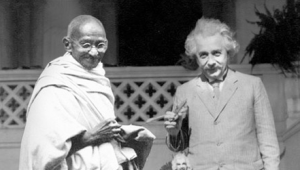
In 1932, Sigmund Freud and Albert Einstein conducted a correspondence subsequently published under the title ‘Why War?’ See ‘Why War: Einstein and Freud’s Little-Known Correspondence on Violence, Peace, and Human Nature’. In many ways, this dialogue between two giants of the 20th century is symbolic of the effort made by many humans to understand that perplexing and incredibly damaging feature of human experience: the institution of war.

In a recent article, the founder of peace research, Professor Johan Galtung, reminded us of the legacy of Freud and Einstein in this regard and reflected on their dialogue, noting some shortcomings including their failure to ‘unpack conflict’. See ‘Freud-Einstein on Peace’.

Of course, Freud and Einstein weren’t the first to consider the question ‘Why War?’ and their dialogue was preceded by a long sequence of individuals and even some organizations, such as the Women’s International League for Peace and Freedom and War Resisters’ International, who sought to understand, prevent and/or halt particular wars, or even to understand and end the institution itself, as exemplified by the Kellogg-Briand Pact in 1928 outlawing war. Moreover, given the failure of earlier initiatives, many individuals and organizations since Freud and Einstein have set out to understand, prevent and/or halt wars and these efforts have taken divergent forms.

Notable among these, Mohandas K. Gandhi was concerned to develop a mode of action to deal with many manifestations of violence and he dramatically developed, and shared, an understanding of how to apply nonviolence, which he labeled satyagraha (holding firmly to the truth), in overcoming large-scale violence and exploitation. He successfully applied his strategic understanding of nonviolence to the Indian independence struggle against British colonial rule. But while Gandhi was happy to acknowledge his debt to those who had gone before, he was not shy in proclaiming the importance of finding new ways forward: ‘If we are to make progress, we must not repeat history but make new history. We must add to the inheritance left by our ancestors.’

My own journey to understand human violence was caused by the death of my two uncles, Bob and Tom, in World War II, ten years before I was born. My childhood in the 1950s and 1960s is dotted with memories of my uncles, stimulated through such events as attending memorial services at the Shrine of Remembrance where their war service was outlined. See ‘My Brothers’ on my father’s website.

But by the early 1960s, courtesy of newspaper articles and photos, I had become aware of exploitation and starvation in Africa and elsewhere, and as a young university student in the early 1970s I was reading literature about environmental destruction. It wasn’t just war that was problematic; violence took many other forms too.

‘Why are human beings violent?’ I kept asking. Because I thought that this question must have been answered somewhere, I kept reading, including the work of Freud and Karl Marx as an undergraduate, but also the thoughts of many other scholars, such as Frantz Fanon, as well as anarchists, feminists and those writing from other perspectives which offered explanations of violence, whether direct, structural or otherwise.

By the early 1980s I had started to read Gandhi and I had begun to understand nonviolence, as Gandhi practised and explained it, with a depth that seemed to elude the activists I knew and even the scholars in the field that I read.

Separately from this, I was starting to gain a sense that the human mind was not something that could be understood well by viewing it primarily as an organ of thinking and that much of the literature and certainly most of the practitioners in the field of psychology and related fields, especially psychiatry, had failed to understand the emotional depth and complexity of the human mind and the implications of this for dealing with conflict and violence. In this sense, it was clear to me, few had understood, let alone been able to develop, Freud’s legacy. This is because the fundamental problem is about feeling (and, in relation to violence, particularly suppressed fear and anger). Let me explain why.

Violence is something that is usually identified as physical: it involves actions like hitting, punching and using weapons such as a gun. This is one of the types of violence, and probably the one now most often lamented, that is inflicted on indigenous peoples, women and people of colour, among others.

Separately from this, Gandhi also identified exploitation as violence and Galtung elaborated this concept with his notion of ‘structural violence’. Other forms of violence have been identified and they take many forms such as financial violence, cultural violence and ecological violence. But violence can be more subtle than any of these and, hence, much less visible. I have given two of these forms of violence the labels ‘invisible violence’ and ‘utterly invisible violence’. Tragically, ‘invisible violence’ and ‘utterly invisible violence’ are inflicted on us mercilessly from the day we are born. And, as a result, we are all terrorized.

So what are ‘invisible’ and ‘utterly invisible’ violence?

In essence, ‘invisible’ violence is the ‘little things’ we do every day, partly because we are just ‘too busy’. For example, when we do not allow time to listen to, and value, a child’s thoughts and feelings, the child learns to not listen to themSelf thus destroying their internal communication system.

When we do not let a child say what they want (or ignore them when they do), the child develops communication and behavioural dysfunctionalities as they keep trying to meet their own needs (which, as a basic survival strategy, they are genetically programmed to do). When we blame, condemn, insult, mock, embarrass, shame, humiliate, taunt, goad, guilt-trip, deceive, lie to, bribe, blackmail, moralize with and/or judge a child, we both undermine their sense of Self-worth and teach them to blame, condemn, insult, mock, embarrass, shame, humiliate, taunt, goad, guilt-trip, deceive, lie, bribe, blackmail, moralize and/or judge.

The fundamental outcome of being bombarded throughout their childhood by this ‘invisible’ violence is that the child is utterly overwhelmed by feelings of fear, pain, anger and sadness (among many others). However, parents, teachers and other adults also actively interfere with the expression of these feelings and the behavioural responses that are naturally generated by them and it is this ‘utterly invisible’ violence that explains why the dysfunctional behavioural outcomes actually occur.

For example, by ignoring a child when they express their feelings, by comforting, reassuring or distracting a child when they express their feelings, by laughing at or ridiculing their feelings, by terrorizing a child into not expressing their feelings (e.g. by screaming at them when they cry or get angry), and/or by violently controlling a behaviour that is generated by their feelings (e.g. by hitting them, restraining them or locking them into a room), the child has no choice but to unconsciously suppress their awareness of these feelings.

However, once a child has been terrorized into suppressing their awareness of their feelings (rather than being allowed to have their feelings and to act on them) the child has also unconsciously suppressed their awareness of the reality that caused these feelings. This has many outcomes that are disastrous for the individual, for society and for nature because the individual will now easily suppress their awareness of the feelings that would tell them how to act most functionally in any given circumstance and they will progressively acquire a phenomenal variety of dysfunctional behaviours, including many that are violent towards themselves, others and/or the Earth.

Moreover, this emotional (or psychological) damage will lead to a unique combination of violent behaviours in each case. And some of these individuals will gravitate to working in one of the social roles that specifically requires, or justifies, the use of ‘legitimized violence’, such as the violence carried out by police, prosecuting lawyers, magistrates and judges, as well as that inflicted by the military. Others, of course, will operate outside the realm of legitimized violence and be labelled as ‘criminals’.

But, you might be wondering, what is the link between what happens in childhood and war?

The answer is simply that perpetrators of violence, and those who collaborate with them, are created during childhood. And these perpetrators and collaborators are all terrified, self-hating and powerless – for much greater detail of the precise psychological characteristics of perpetrators of violence and their collaborators, see ‘Why Violence?’  and ‘Fearless Psychology and Fearful Psychology: Principles and Practice’ – and they go on to perform all of the key roles in creating, maintaining, equipping, staffing and legitimizing the institutions of war and in conducting it.

If it weren’t for the violence to which we are all mercilessly subjected throughout childhood, there would be no interest in violence or war of any kind. If we were raised without violence, we would be naturally peaceful and cooperative, content to spend our time seeking to achieve our own unique evolutionary potential and to nurture the journey of others as well as life itself, rather than just become another cog in someone else’s military (or other bureaucratic or corporate) machine.

If any of the above resonates with you, then I invite you to make ‘My Promise to Children’.

In addition, if further reducing the violence in our world appeals to you, then you are also welcome to consider participating in ‘The Flame Tree Project to Save Life on Earth’,  signing the online pledge of ‘The People’s Charter to Create a Nonviolent World’ and/or considering using the strategic framework on one or the other of these two websites for your campaign to end violence or war in one context or another: Nonviolent Campaign Strategy and Nonviolent Defense/Liberation Strategy.

A child is not born to make war. But if you inflict enough violence on a child, and destroy their capacity to become their own unique and powerful self, they will be terrorised into perceiving violence and war as their society wants them to be perceived. And violence and war, and the institutions that maintain them, will flourish.

If we want to end war, we must halt the adult war against children as a priority.


Biodata: Robert J. Burrowes has a lifetime commitment to understanding
and ending human violence. He has done extensive research since 1966 in
an effort to understand why human beings are violent and has been a
nonviolent activist since 1981. He is the author of ‘Why Violence?
His email address is flametree@riseup.net
and his website is at http://robertjburrowes.wordpress.com


Robert J. Burrowes
P.O. Box 68
Daylesford
Victoria 3460
Australia
Email: flametree@riseup.net

Websites:
Nonviolence Charter
Flame Tree Project to Save Life on Earth
‘Why Violence?’
Nonviolent Campaign Strategy
Nonviolent Defense/Liberation Strategy
Anita: Songs of Nonviolence
Robert Burrowes
Global Nonviolence Network

The Unifying Force of War Abolition

By David Swanson

Source: Let’s Try Democracy

Remarks at United National Antiwar Coalition in Richmond, Virginia, on June 18, 2017.

It’s not unusual for an activist, focused on one of the millions of worthy causes out there, to try to recruit other activists to that particular cause. That’s not exactly what I want to do. For one thing, if we are going to succeed we are going to have to recruit millions of new people into activism who are not now active at all.

Of course I do favor types of activism that eliminate the need for more activism, such as campaigns to make voter registration automatic or to index the minimum wage to the cost of living. But for the most part I want everyone to keep doing what inspires them. Only, I think I know a way to shift our emphases and unite out movements, a way that doesn’t usually occur to us.

It’s not unusual for an activist to think that their particular field is the unifying top priority.

For example:

If we don’t get the money out of politics how can we enact or enforce any laws not favored by money? We’ve legalized bribery for godsake! What else matters until we fix that?

Or:

If we don’t create credible democratic independent media, we can’t communicate. Door knocking can’t defeat television. We only know that Cindy Sheehan went to Crawford or Occupyers went to Wall Street because corporate television chose to tell us. Why have elections if we can’t tell the truth about the candidates?

Or:

Excuse me, the earth is cooking. Our species and many others are losing their habitats. If it’s not already too late, now is the time to decide whether we will have great grandchildren at all. If we don’t have any, what will it matter what kind of elections or television networks they have?

One can go on and on in this vein, as well as in claiming that one societal evil precedes and causes another. Racism or militarism or extreme materialism is the disease and the others are the symptoms.

All of this is also not exactly what I want to do. I want us to work on everything and use every means of unifying. I want us to recognize how each problem contributes to others and vice versa. Hungry scared people can’t end climate change. A culture that puts a trillion dollars a year into mass-killing of distant dark-skinned people can’t build schools or end racism. Unless we redistribute wealth, we cannot redistribute power. We can’t create media unless we have something important to say. We can’t protect the earth’s climate while steadfastly ignoring the top consumer of petroleum on earth because criticizing the military would be inappropriate. But we will go on ignoring it if we don’t create good media. We have to do it all, and there are various ways in which we can become more united, more strategic, and potentially more effective.

The way that I think we don’t pay enough attention to lies in developing a focus on complete and total war abolition, elimination of all weapons and militaries, all bases, all aircraft carriers, missiles, armed drones, generals, colonels, and if necessary all senators from Arizona.

Why war abolition? I’ll give you 10 reasons.

  1. It actually makes sense. The reasonable position of opposing some wars and cheering for others, but cheering for the troops even in the bad wars doesn’t attract a lot of energy because it doesn’t make any sense. Jeremy Corbyn just won votes by pointing out that wars generate terrorism, they are counter-productive on their own terms, endangering us rather than protecting us. They need to be replaced with diplomacy, aid, cooperation, the rule of law, the tools of nonviolence, the skills of de-escalation of conflict. Claiming that wars are sort of good but shouldn’t be overdone makes no sense at all — what is the point of them if not to win them? And if wars make murder OK, why is torture so unacceptable? And if bombs dropped by piloted planes are OK, what’s wrong with drones? And if Anthrax is barbaric, why are White Phosphrous and Napalm civilized? None of it makes any sense, which is one reason the top killer of U.S. troops is suicide. You know how to properly love the troops, end all war and give them life options that don’t make them want to kill themselves.
  2. Nuclear apocalypse is a growing danger on a par with climate chaos and will continue to grow unless war abolition succeeds.
  3. The biggest destroyer of water, air, land, and atmosphere that we have is militarism. It’s war or planet. Time to choose.
  4. War kills first and foremost by removing resources from where they are needed, including from famines and disease epidemics created by war. Any activism that seeks funding for any human or environmental needs has to look to ending war. It is where all the money is, more money every single year than could be taken once and only once from the billionaires.
  5. War creates secrecy, surveillance, classification of public business, warrantless spying on activists, patriotic lying, and illegal actions by secret agencies.
  6. War militarizes local police, making the public into an enemy.
  7. War fuels, just as it is fueled by, racism, sexism, bigotry, hatred, and domestic violence. It teaches people to solve problems by shooting guns.
  8. War divides humanity at a time when we must unite on major projects if we are to survive or prosper.
  9. A movement to abolish all war, all weapons, and all atrocities that flow out of war can unite opponents of the crimes of one government or group with the opponents of the crimes of another. Without equating all crimes with each other, we can unite as opponents of war rather than of each other.
  10. War is the primary thing our society does, it sucks down the majority of federal discretionary spending, its promotion permeates our culture. It is the very foundation of the belief that ends can justify evil means. Taking on the myths that sell us war as necessary or inevitable or glorious is an ideal way of opening our minds to rethinking what we’re doing on this little planet.

So let’s not work for an environmentally sensitive military into which women have the equal right to be drafted against their will. Let’s not oppose the weapons that are wasteful or don’t kill well enough. Let’s build a broad multi-issue movement in which one of the unifying factors is the cause of eliminating in its entirety the institution of organized mass murder.

A Nonviolent Strategy to Defeat Genocide

Rohingya protesters gather in front of a United Nations regional office building to call for an end to the ongoing unrest and violence in Myanmar’s Rakhine State in Bangkok on June 11, 2012. AFP PHOTO/ Nicolas ASFOURI


By Robert J. Burrowes

It is a tragic measure of the depravity of human existence that genocide is a continuing and prevalent manifestation of violence in the international system, despite the effort following World War II to abolish it through negotiation, and then adoption and ratification of the 1948 ‘Genocide Convention‘.

According to the Genocide Convention, genocide is any act committed with the intent to destroy, in whole or in part, a national, ethnic, racial or religious group by killing members of the group, causing serious bodily or mental harm to members of the group, deliberately inflicting on the group conditions of life calculated to bring about its physical destruction in whole or in part, imposing measures intended to prevent births within the group and/or forcibly transferring children of the group to another group.

While this definition is contested because, for example, it excludes killing of political groups, and words such as ‘democide’ (the murder or intentionally reckless and depraved disregard for the life of any person or people by their government,) and ‘politicide’ (the murder of any person or people because of their political or ideological beliefs) have been suggested as complementary terms, in fact atrocities that have been characterized as ‘genocide’ by various authors include mass killings, mass deportations, politicides, democides, withholding of food and/or other necessities of life, death by deliberate exposure to invasive infectious disease agents or combinations of these. See ‘Genocides in history‘.

While genocide and attempts at genocide were prevalent enough both before World War II (just ask the world’s indigenous peoples) and then during World War II itself, which is why the issue attracted serious international attention in the war’s aftermath, it cannot be claimed that the outlawing of genocide did much to end the practice, as the record clearly demonstrates.

Moreover, given that the United Nations and national governments, out of supposed ‘deference’ to ‘state sovereignty’, have been notoriously unwilling and slow to meaningfully respond to genocides, as was the case in Rwanda in 1994 and has been the case with the Rohingya in Myanmar (Burma) for four decades – as carefully documented in ‘The Slow-Burning Genocide of Myanmar’s Rohingya‘ – there is little evidence to suggest that major actors in the international system have any significant commitment to ending the practice, either in individual cases or in general. For example, as official bodies of the world watch, solicit reports and debate whether or not the Rohingya are actually victims of genocide, this minority Muslim population clearly suffers from what many organizations and any decent human being have long labeled as such. For a sample of the vast literature on this subject, see ‘The 8 Stages of Genocide Against Burma’s Rohingya‘ and ‘Countdown to Annihilation: Genocide in Myanmar‘.

Of course, it is not difficult to understand institutional inaction. Despite its fine rhetoric and even legal provisions, the United Nations, acting in response to the political and corporate elites that control it, routinely fails to act to prevent or halt wars (despite a UN Charter and treaties, such as the Kellogg-Briand Pact, that empower and require it to do so), routinely fails to defend refugees, routinely fails to act decisively on issues (such as nuclear weapons and the climate catastrophe) that constitute global imperatives for human survival, and turns the other way when peoples under military occupation (such as those of Tibet, West Papua, Western Sahara and Palestine) seek their support.

Why then should those under genocidal assault expect supportive action from the UN or international community in general? The factors which drive these manifestations of violence serve a diverse range of geopolitical interests in each case, and are usually highly profitable into the bargain. What hope justice or even decency in such circumstances?

Moreover, the deep psychological imperatives that drive the phenomenal violence in the international system are readily nominated: in essence, phenomenal fear, self-hatred and powerlessness. These psychological characteristics, together with the others that drive the behaviour of perpetrators of violence, have been identified and explained – see ‘Why Violence?‘ and ‘Fearless Psychology and Fearful Psychology: Principles and Practice‘ – but it is the way these (unconsciously and deeply-suppressed) emotions are projected that is critical to understanding the violent (and insane) behavioural outcomes in our world. For brief explanations see, for example, ‘Understanding Self-Hatred in World Affairs‘ and ‘The Global Elite is Insane‘.

Given the deep psychological imperatives that drive the violence of global geopolitics and corporate exploitation (as well as national, subnational and individual acts of violence), we cannot expect a compassionate and effective institutional response to genocide in the prevailing institutional order, as the record demonstrates. So, is there anything a targeted population can do to resist a genocidal assault?

Fortunately, there is a great deal that a targeted population can do. The most effective response is to develop and implement a comprehensive nonviolent strategy to either prevent a genocidal assault in the first place or to halt it once it has begun. This is done most effectively by using a sound strategic framework that guides the comprehensive planning of the strategy. Obviously, there is no point designing a strategy that is incomplete or cannot be successful.

A sound strategic framework enables us to think and plan strategically so that once our strategy has been elaborated, it can be widely shared and clearly understood by everyone involved. It also means that nonviolent actions can then be implemented because they are known to have strategic utility and that precise utility is understood in advance.

There is little point taking action at random, especially if our opponent is powerful and committed (even if that ‘commitment’ is insane which, as briefly noted above, is invariably the case). There is a simple diagram presenting a 12-point strategic framework illustrated here in the form of the ‘Nonviolent Strategy Wheel‘.

In order to think strategically about nonviolently defending against a genocidal assault, a clearly defined political purpose is needed; that is, a simple summary statement of ‘what you want’. In general terms, this might be stated thus: To defend the [nominated group] against the genocidal assault and establish the conditions for the group to live in peace, free of violence and exploitation.

Once the political purpose has been defined, the two strategic aims (‘how you get what you want’) of the strategy acquire their meaning. These two strategic aims (which are always the same whatever the political purpose) are as follows: 1. To increase support for the struggle to defeat the genocidal assault by developing a network of groups who can assist you. 2. To alter the will and undermine the power of those groups inciting, facilitating, organizing and conducting the genocide.

While the two strategic aims are always the same, they are achieved via a series of intermediate strategic goals which are always specific to each struggle. I have identified a generalized set of 48 strategic goals that would be appropriate in the context of ending any genocide here. These strategic goals can be readily modified to the circumstances of each particular instance of genocide.

Many of these strategic goals would usually be tackled by action groups working in solidarity with the affected population campaigning in third-party countries. Of course, individual activist groups would usually accept responsibility for focusing their work on achieving just one or a few of the strategic goals (which is why any single campaign within the overall strategy is readily manageable).

As I hope is apparent, the two strategic aims are achieved via a series of intermediate strategic goals.

Not all of the strategic goals will need to be achieved for the strategy to be successful but each goal is focused in such a way that its achievement will functionally undermine the power of those conducting the genocide.

It is the responsibility of the struggle’s strategic leadership to ensure that each of the strategic goals, which should be identified and prioritized according to their precise understanding of the circumstances in the country where the genocide is occurring, is being addressed (or to prioritize if resource limitations require this).

I wish to emphasize that I have only briefly discussed two aspects of a comprehensive strategy for ending a genocide: its political purpose and its two strategic aims (with its many subsidiary strategic goals). For the strategy to be effective, all twelve components of the strategy should be planned (and then implemented). See Nonviolent Defense/Liberation Strategy.

This will require, for example, that tactics that will achieve the strategic goals must be carefully chosen and implemented bearing in mind the vital distinction between the political objective and strategic goal of any such tactic. See ‘The Political Objective and Strategic Goal of Nonviolent Actions‘.

It is not difficult to nonviolently defend a targeted population against genocide. Vitally, however, it requires a leadership that can develop a sound strategy so that people are mobilized and deployed effectively.


Biodata: Robert J. Burrowes has a lifetime commitment to understanding
and ending human violence. He has done extensive research since 1966 in
an effort to understand why human beings are violent and has been a
nonviolent activist since 1981. He is the author of ‘Why Violence?
His email address is flametree@riseup.net
and his website is at http://robertjburrowes.wordpress.com


Robert J. Burrowes
P.O. Box 68
Daylesford
Victoria 3460
Australia
Email: flametree@riseup.net

Websites:
Nonviolence Charter
Flame Tree Project to Save Life on Earth
‘Why Violence?’
Nonviolent Campaign Strategy
Nonviolent Defense/Liberation Strategy
Anita: Songs of Nonviolence
Robert Burrowes
Global Nonviolence Network