ECOWAS Fiery Talk Towards Niger Loses Its Edge After Biden Talks With Its President

Biden’s little chat with Tinubu says a lot about the realities of what is going to happen and what can happen on the ground.

By Martin Jay

Source: Strategic Culture Foundation

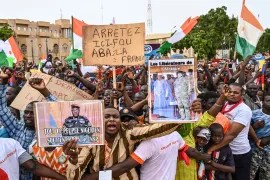
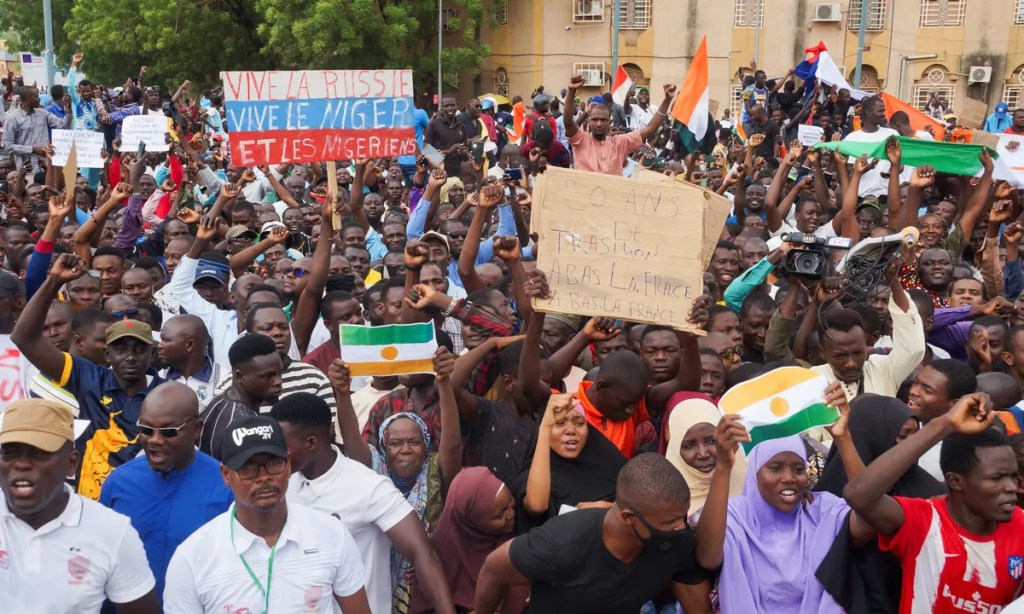
Three interesting facets of news over Niger appear to be doing the rounds. Firstly, that a terrorist group in Nigeria has openly appealed to the Nigerian President – who also happens to be the ECOWAS leader – to avoid at all costs a military intervention in Niger; secondly, that Joe Biden took the initiative to meet the same gentleman Bola Ahmed Tinubu in the corridors of the United Nations, hinting that huge amounts of U.S. investment could be directed towards Nigeria if Tinubu played ball; and thirdly, that just recently, the stakes were raised in Niger when its junta announced that it had invited the armies of both Mali and Burkina Faso onto its soil to help defend themselves against an “intervention” which ECOWAS has threatened was on the cards only days earlier.

But Biden’s little chat with Tinubu says a lot about the realities of what is going to happen and what can happen on the ground as clearly his administration does not want another proxy war between East and West on its hands before the re-election run up next year. The question of whether the U.S. would support ECOWAS militarily has been answered by Biden’s bribe to the Nigerian president. It’s not going to happen.

Tinubu, who is certainly the man at the centre of events, gives the impression in interviews that he is under great pressure from ECOWAS members to intervene, but he is the one cooling tempers and looking for a diplomatic solution. And yet, his comments to the press seem to have been written by the U.S. state department such is the proximity of his office and the U.S. administration – debunking the myth of how much ECOWAS is influenced by France (given that the majority of the countries are former French colonies). The Nigerian president’s role as ECOWAS chief is under the spotlight.

What does he really want? Are his objectives focussed more on Nigeria rather than the bloc?

Joe Biden’s offer of a fresh injection of investment from U.S. firms hasn’t seemed to hit the mark. It seems that Tinubu is after even faster and even easier cash.

Tinubu said that African democracies are “currently under assault by anti-democratic forces within and outside the continent”, which is really state department jargon for “the Russians are coming”.

He then called on the “American-backed development finance and multilateral institutions, which were designed to support war-torn Europe after World War II, to adopt a swift and comprehensive reform to meet the developmental requirements of young democracies in Africa”.

The translation isn’t too cryptic. Can the U.S. intervene and, also, while they’re at it, pump our central bank full of never-never-pay soft loans from IMF and World bank? Cheers!

Neither Biden nor Tinubu though seem to be bothered about the possibility of a fourth francophone African country falling into the hands of Mother Russia. Mali and Burkina Faso, who both can be assumed to be vassals of Russia have shown great solidarity with Niger which has lost no time kicking the French out and becoming a major pain in the arse for western elites who are confused about the events and want to oversimplify the nuances. “We lost Niger to the Russians” may be the well worn cliché although the facts on the ground and more complicated. There certainly seems in Niger to be an endearment towards the new junta’s government but Russia’s role so far is unclear.

About the only thing that Putin and Biden agree on is they don’t want a war in Niger.

It’s easy to forget though that Niger was a key player in ECOWAS and that many of its members placed great importance on Niger’s front line assault on Islamic groups in the region – which, if given more freedoms, could cause havoc right across West Africa but in particular in neighbouring Nigeria.

For the moment though, the so-called pressure from ECOWAS is unlikely to manifest itself beyond chest beating. ECOWAS members may have the hunger for intervention but they don’t have the guts for a war, which neither the U.S. or Russia will bankroll, so sobriety is likely to take over the narrative in the coming days. The war in Ukraine, the abysmal foreign policy blunders of Biden, the deluded arrogance of Macron and the emergence of BRICS have all contributed to the current crisis in Africa as the old relationship with the West is put to the test, with disastrous consequences. The only thing left of Obama’s “soft power” idea he conjured up in 2015 after his humiliation in Syria is a suitcase full of cash for a corrupt West African leader to share with his cabal. Pretty pathetic.

France never stopped looting Africa, now the tables are turning

As developments in West Africa demonstrate, the francophone countries are no longer willing to accept French neo-colonialism. With the fear factor finally removed, Africa’s quest for genuine independence is steadily coming to fruition.

By Brad Pearce

Source: TheCradle.co

The 26 July coup in the West African nation of Niger, which threatens to undermine French and US military presence in the region, has shed light on the historical exploitation and continued practices of Francafrique – the term used to describe the persistent exploitation by the former French Empire in Africa.

France heavily relies on nuclear energy, with 68 percent of its power coming from nuclear plants. It obtains 19 percent of the uranium required to run these plants from Niger. Despite this significant contribution toward France’s energy needs, only 14.3 percent of Nigeriens have access to a power grid, and even that is often unreliable. This stark contrast highlights the disparities and ongoing exploitation by rapine foreign powers throughout the African continent. 

The Legacy of Francafrique

Francafrique has been known for its exploitative systems designed to profit from African resources, using pressure, capital, and frequently outright force to maintain control over its former empire. As a result, many African states, including Niger, continue to face poverty and underdevelopment.

Burkina Faso’s young, charismatic leader Ibrahim Traore recently spoke at the Russia-Africa summit in St. Petersburg and decried the fact that Africa is resource-rich, but its people are poor, and criticized African leaders seeking hand-outs from the west, as they perpetuate dependency and poverty. He also described what is being imposed on Africa as a form of slavery, stating:

“As far as what concerns Burkina Faso today, for more than eight years we’ve been confronted with the most barbaric, the most violent form of imperialist neo-colonialism. Slavery continues to impose itself on us. Our predecessors taught us one thing: a slave who cannot assume his own revolt does not deserve to be pitied. We do not feel sorry for ourselves, we do not ask anyone to feel sorry for us.”

France’s inability to justify its presence in Africa with a coherent narrative further complicates the situation. Paris cannot openly confess its greed, feign a “civilizing mission,” or admit to any responsibility due to its past crimes. This lack of purpose weakens French power on the continent, leading to violence and poverty in its wake.

West Africa’s drive for further independence has left Atlanticists concerned about the opening this leaves for Eurasian powers like Russia and China to increase their influence in Africa. The west’s reaction reflects a lack of respect for the sovereignty of African countries, viewing the continent merely as a theater to maintain global dominance.

Since the Ukraine war’s onset in early 2022, Atlanticists have expressed alarm over the unwillingness of Global South states to support the west’s anti-Russia policies, a trend further amplified by the shift to multipolarism everywhere. This weakening of western hegemony has opened a path for many nations to avidly explore their geopolitical options and diversify their economies.

A report from the Munich Security Conference held in February highlighted this very real schism with the west:

“Many countries in Africa, Asia, and Latin America have steadily lost faith in the legitimacy and fairness of an international system which has neither granted them an appropriate voice in global affairs, nor sufficiently addressed their core concerns. To many states, these failures are deeply tied to the west. They find that the western-led order has been characterized by post-colonial domination, double standards, and neglect for developing countries’ concerns.”

Fleeced by the CFA Franc

The aftermath of the Second World War marked a significant shift in global power dynamics, and the victorious powers sought to establish a new world order that would maintain peace and promote economic balance. 

In the context of African colonies, where colonial troops played a major role in the allied victory, the victorious powers, including France, aimed to retain economic control and benefit from their former colonies even as the world moved towards decolonization.

This included the establishment of new currency systems, with French leader Charles De Gaulle creating two currencies collectively known as the CFA Franc in 1945 for former colonies in the Western and Central zone.

As the push for political independence grew stronger in the late 1950s, France organized referendums in its African colonies to vote on accepting a constitution drafted by the French. 

Guinea, led by former trade unionist Sekou Toure, opposed accepting the French constitution and voted overwhelmingly against it. In a furious response, De Gaulle’s government withdrew all French administrators from Guinea and took action to sabotage the country’s infrastructure and resources. The harsh measures by Paris aimed to serve as an example of what would happen to any former French colony that resisted France’s agenda.

During the Cold War, the Communist states exploited such actions by presenting themselves as liberators and allies of African countries that sought independence from European influence. This stance has led to some Africans viewing countries like Russia as more equitable partners compared to France.

Over the years, France has demonstrated a pattern of intervening militarily – over 50 times since 1960 – in African countries to secure governments that remain compliant with French economic interests, particularly related to the continued use of the CFA Franc.

The system by which the CFA Franc operates has historically been one of a fixed exchange rate where the currency has unlimited convertibility but is permanently pegged to the French currency, previously the Franc and then the Euro. 

African currency under French control

This means that African countries cannot influence the value of their own currency, and the difference in value makes it so that France can buy African products artificially cheap while Africans are able to buy fewer goods with the money they exchange.

Worse yet, France had requirements to store, and thus profit from, the foreign reserves owned by its former colonies, though the requirement of holding 50 percent of their foreign exchange reserves in a French-ran bank was dropped for the western zone in 2019. 

Under this scheme, African states received a nominal amount of interest, but the bank benefited from lending that capital out at higher rates and attaining massive profits off of African resources and labor. This is despite the fact that many countries in Francophone Africa are major gold exporters and thus have a multitude of options for storing wealth to back a currency in alternative central banks.

While the CFA Franc system has provided some benefits in terms of stability and preventing Zimbabwean-style hyperinflation, it has also come under scrutiny for imposing requirements on African countries that are not placed on more powerful nations. The lack of control over their own currency has hindered economic growth and made these countries vulnerable to global economic shocks.

Northern African states such as Tunisia, Algeria, and Morocco chose to leave the CFA Franc upon gaining independence and have experienced relatively higher prosperity. Similarly, Botswana’s success with its own national currency demonstrates that proper management can lead to stable democracy and economic growth, even for less developed nations.

Exclusive rights and privileges

The CFA Franc system has been the geopolitical equivalent of one’s father insisting he manages their savings while leaving them out of his will. There are benefits to having a trade and currency zone, such as the current ECOWAS union that covers the Western part of the continent, but by design under the CFA Franc system, independence has been an illusion by which France has fleeced these countries. 

France has been dependent on Africa for its status as a world power for more than a century. Among other privileges it has carved out for itself in post-colonial treaties, France has had the exclusive right to sell military equipment to former colonies, and enjoys the first right to any natural resources discovered. Paris makes great use of these privileges: as just one example, 36.4 percent of France’s gas is sourced from the African continent.

Moreover, a vast network of French business interests, which include major multinational companies, dominate industries such as energy, communications, and transportation in many African countries. France’s government also supports French businesses in Africa in several ways, including through an enormous public company called COFACE which guarantees French exports into these underdeveloped markets. 

Towards independence and self-reliance

This economic dependence has contributed to the perpetuation of a system where African states remain weak, pliant, and reliant on resource exports, primarily benefiting French companies and interests. Additionally, African states are obligated to ally with France in any major conflict, further eroding their national sovereignty. 

The African continent suffers from many ailments, but perhaps the most persistent and nefarious are a lack of sovereignty and access to capital. Meanwhile, much of Europe’s prosperity has been derived from looting the Global South for centuries. 

The case of Brussels, built on the wealth derived from the brutal exploitation of the Congo under Belgian King Leopold II, is a stark reminder of the deep-rooted impact of colonialism. When the monarch’s crimes against humanity were discovered, he was ultimately forced to bequeath the majority of his fortune to the Belgian state upon his death. 

Not wanting to do so, he embarked on an enormous series of public works to spend his ill-gotten gains, creating modern Brussels. Now the EU and NATO meet there and audaciously give disingenuous lectures about universal human rights while surrounded by the profits of some of the most brutal cases of oppression in human history. 

While military governments often face challenges in achieving their stated goals, it is evident that western-backed “civil democracies” have also struggled to significantly improve the security and well-being of the African public. 

The path to solving Africa’s problems lies in transformative leaders who can shrug off the legacy and remaining shackles of colonialism and enable the continent to carve out a genuine, homegrown path to independence and self-reliance.

From Chi-Town bagman to ECOWAS chairman: meet the former money launderer leading the push to invade Niger

By Alexander Rubinsteain and Kit Klarenberg

Source: The Grayzone

Since the overthrow of Niger’s US-friendly government, West African nations of the ECOWAS bloc have threatened an invasion of their neighbor.

Before leading the charge for intervention, ECOWAS chair Bola Tinubu spent years laundering millions for heroin dealers in Chicago, and has since been ensnared in numerous corruption scandals.

Hours after Niger’s Western-backed leader was detained by the country’s presidential guard on July 28, Nigerian President and chair of the Economic Community of West African States (ECOWAS) Bola Tinubu leapt into action, warning that the group of nations “will not tolerate any situation that incapacitates the democratically-elected government.”

“As the Chairperson of ECOWAS…I state without equivocation that Nigeria stands firmly with the elected government in Niger.”

Two days later, ECOWAS imposed severe sanctions on Niger, and the bloc issued a stark ultimatum: if the newly-inaugurated junta won’t reinstall the ousted president in a week’s time, the group’s pro-Western African governments will — by military means, if necessary. 

On Saturday, July 6 — one day before the deadline — ECOWAS leaders approved a plan to invade the country, with the ominous caveat that they are “not going to tell the coup plotters when and where we are going to strike.”

If ECOWAS gets its way, member states Benin, Cabo Verde, Côte d’Ivoire, The Gambia, Ghana, Guinea Bissau, Liberia, Nigeria, Sierra Leone, Sénégal and Togo will be pressured to send their soldiers to invade Niger.

These developments have thrust the typically-overlooked West African country of Niger into the Western media spotlight. But if hostilities break out, it wouldn’t just be one single impoverished African state in the crosshairs.

Neighboring Burkina Faso, Mali and Guinea, which are also governed by military administrations that recently seized power by force, have all warned that any attack on Niger will be viewed as an attack on them too. If their ECOWAS rivals make the first move, the nations which mainstream media have dubbed Africa’s “coup belt” have pledged to unleash their military forces as well — an announcement which should end any illusions that restoring the country’s previous president would be a painless process.

Leading the pro-Western coalition is the president of its most powerful country, Nigeria: Bola Tinubu. One of Nigeria’s wealthiest men, the source of the scandal-plagued president’s fortune remains unclear.

Documents reviewed by The Grayzone reveal Tinubu as a longtime US asset who was named as an accomplice in a massive drug running operation that saw him launder millions on behalf of a heroin-dealing relative. 

Bola Tinubu’s career marred by drug-trafficking, corruption allegations

For over 30 years, Bola Tinubu has been a major force in Nigeria’s political scene and the country’s economy, with local nicknames ranging from “the Mother of the Market” to “the Godfather of Lagos” and “the Lion of Bourdillon.” But his power inside Nigeria went largely unnoticed by international audiences until 2023, when he became ECOWAS chair after winning the presidency in an election closely tracked by the US government.

As president, Tinubu quickly instituted a regime of economic reforms backed by the US-controlled International Monetary Fund and the World Bank. Over the course of Tinubu’s political career in Nigeria, the African operator has cultivated a close relationship with the US embassy. According to a slew of classified State Department cables released by WikiLeaks, American officials relied heavily on Tinubu’s assessments of the domestic political landscape.

The ECOWAS chair’s early life is shrouded in mystery, and even his exact age is unknown. Nearly every detail of Tinubu’s personal history — prior to his appearance in Chicago on a student visa — is in dispute, including his legal birth name.

Records from Chicago State University show that Tinubu received a degree in Business Administration in 1979. In the following years, media reports indicate that Tinubu was employed in some capacity at a number of major US-based multinationals, including Mobil Oil Nigeria, consulting firm Deloitte, and GTE, which was the largest communication and utilities company in the US at the time.

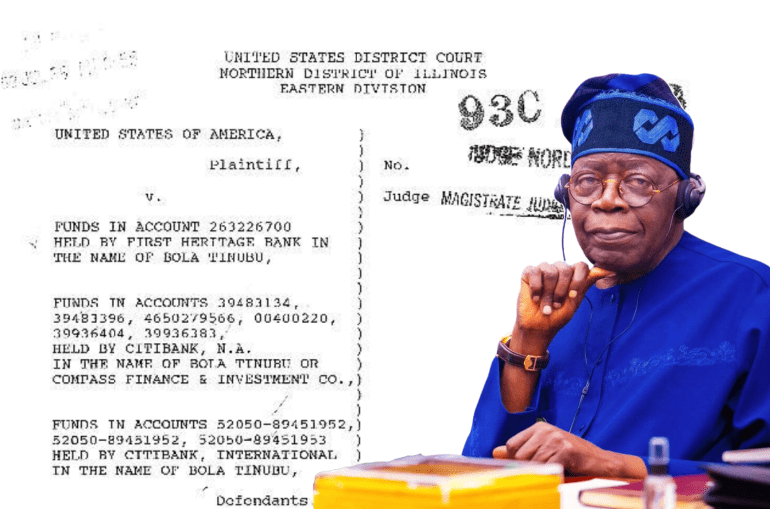
Of the few details about the Nigerian President’s early exploits which can be confirmed, many are derived from a 1993 court docket naming Tinubu as an accomplice in a massive midwestern drug smuggling operation. 

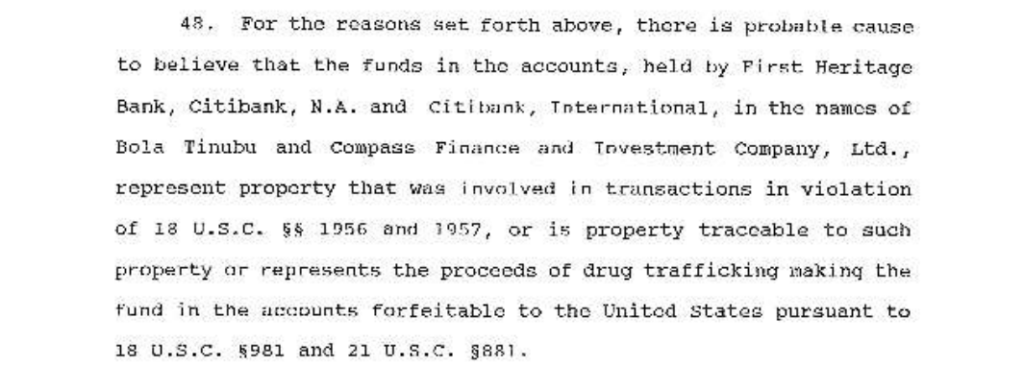
As journalist David Hundeyin has detailed, court documents from the US District Court’s Northern District of Illinois make it clear that Tinubu amassed a small fortune laundering money for a heroin-trafficking relative in Chicago, and that US government officials ultimately seized well over a million dollars from various bank accounts registered under the current Nigerian president’s name.

A 1993 report by IRS Special Agent Kevin Moss explained that “there is probable cause to believe that funds in certain bank accounts controlled by Bola Tinubu… represent proceeds of drug trafficking; therefore these funds are forfeitable to the United States.”

In the documents, Moss describes an extremely close working relationship between the future Nigerian president and two Nigerian heroin dealers named Abiodun Olasuyi Agbele and Adegboyega Mueez Akande, the latter of whom was listed as Tinubu’s cousin on an application for a vehicle loan.

“According to bank employees, when Bola Tinubu came to First Heritage Bank in December 1989 to open the accounts, he was introduced to them by Adegboyega Mueez Akande, who at that time maintained an account at the bank.” What’s more, bank records indicate that “Bola Tinubu also opened a joint checking account in his name and the name of his wife, Oluremi Tinubu,” who had “previously opened a joint bank account also at this bank with Audrey Akande, the wife of Adegboyega Mueez Akande,” Moss explained. In several of the applications, the addresses used by Tinubu exactly matched those previously used by Akande.

“According to bank records… Tinubu opened an individual money market account and a NOW account” at First Heritage Bank in December 1989, the special agent noted. “In the application, Tinubu stated that his address was 7504 South Stewart, Chicago, Illinois” — “the same address used previously by Akande.”

“Bank records disclosed that five days after the account was opened, on January 4, 1990, $80,000 was deposited into the NOW account at First Heritage Bank by wire transfer through First Chicago from Banc One Houston,” the report continues. According to the IRS, the money was sent by Akande.

But the Nigerian president’s financial dealings with the heroin traffickers went even further, according to the IRS special agent. He wrote that Citibank records documented “two additional corporate accounts held in the name of Compass Finance and Investment Company, Ltd. which were controlled by Bola Tinubu.”

“When Bola Tinubu opened these accounts,” he provided “a memorandum of association and articles of association” which “identified Mueez Adegboyega Akande and Abiodun Olasuyi Agbele as directors of Compass Finance and Investment Company, Ltd.,” Moss wrote.

In the end, Tinubu somehow managed to deposit over $660,000 in his First Heritage Bank account in 1990, and more than $1.2 million the next year — all while claiming to take home just $2,400 a month from his position at Mobil Oil Nigeria.

As the investigation into the money laundering scheme began to gain traction, Tinubu left the US and returned to Nigeria. Ultimately, Moss was able to speak to Tinubu by telephone on a number of occasions, and the special agent reported that the future president initially acknowledged his personal and financial dealings with the pair of drug traffickers. 

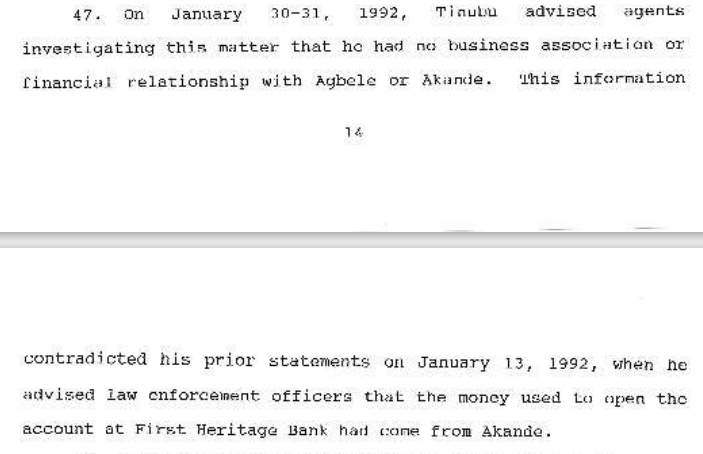
But in late January of 1992, “Tinubu advised agents investigating this matter that he had no business association or financial relationship with Abele or Akande,” Moss wrote. “This information contradicted his prior statements on January 13, 1992, when he advised law enforcement officers that the money used to open the account at First Heritage Bank had come from Akande.”

Back in Nigeria, Tinubu had already begun to transition into the political arena. By 1992, he’d been elected to the Senate, and in 1999 he became the Governor of Lagos State, a position he retained until 2007. At some point in his tenure, Tinubu established a relationship with the US Embassy which would last for years to come, according to a trove of diplomatic cables released by Wikileaks.

But even his State Department allies couldn’t help noticing Tinubu’s penchant for dishonesty. One particularly noteworthy cable pointed out that the politician was “known to play fast and loose with the facts” and “has been caught in the past embellishing his educational achievements.”

In the end, however, Tinubu’s usefulness seemed to outweigh his casual relationship with the truth, and the future Nigerian president went on to provide American officials with a near-continuous assessment of the political situation in his country. One typically intimate meeting with Tinubu ended with the US ambassador to Nigeria commenting: “as always, we found his take on the national political scene to be insightful.”

When the cables came to light in 2011, many Nigerians were shocked at the candor with which their elected officials spoke to Washington’s envoys. “The willingness of our elites to divulge unsolicited information about the nation to U.S. officials betrays an infantile thirst for a paternal dictatorship,” Nigerian-American professor and columnist Farooq Kperogi wrote.

Though Tinubu appeared to have escaped justice for his alleged role in a heroin trafficking conspiracy, accusations of corruption would continue to dog the ECOWAS chair throughout his political career in Nigeria. Since leaving office as governor of Lagos in 2007, Tinubu “picked every subsequent winning candidate,” according to German broadcaster DW, which noted earlier this year that the tycoon “is believed to be one of Nigeria’s richest politicians but the source of his wealth is unknown.”

In recent years, clues about the origins of the fortune amassed by one of Africa’s leading political players have begun to come to light.

In 2009, Tinubu came under investigation by the Metropolitan Police of London, who were probing allegations that the politician had pooled money with two other Nigerian governors to create a front company known as the “African Development Fund Incorporation.”

Investigators alleged the unusual business arrangement was actually a joint effort to illegally acquire shares of ECONET, a telecommunications firm founded by US intelligence asset and Gates Foundation trustee Strive Masiyiwa. But attempts to probe the legitimacy of the transactions in question were sidelined when the Nigerian federal government stonewalled the British investigation, which ultimately concluded without a single arrest. To this day, Nigerian authorities have yet to release the evidence requested by UK authorities.

In 2011, Tinubu was tried before the Code of Conduct Tribunal in Nigeria for illegally operating 16 foreign bank accounts. Eager to avoid the embarrassment he’d previously suffered when being photographed in court, the ECOWAS chair reportedly refused to take his place at the dock in a judicial hearing.

But the unwelcome attention appears to have done little to rein in the politician’s extravagant taste, and Tinubu once again found himself embroiled in a corruption scandal following an investigation into the luxurious 7,000-square foot mansion where the Nigerian president stays when receiving medical care in London.

According to Nigerian outlet Premium Times, the massive villa in London’s exclusive Westminster borough was picked up for a song by Tinubu’s son, who somehow managed to purchase the property at a discount of approximately $10 million from a wealthy fugitive – even though the seller’s assets, including the mansion in question, had been frozen by a Nigerian court. Photos published on social media in 2017 show Tinubu posing inside the villa alongside Nigeria’s president at the time, Muhammadu Buhari.

The current and previous president worked closely for decades, and Tinubu has publicly claimed sole credit for Buhari’s presidency while campaigning. “If it were not for me standing before you leading the army, saying ‘Buhari, go ahead, we’re behind you,’ he could never have become the president,” he told supporters at a rally last year.

But the suspicious confluence of money and influence didn’t end with the mysterious mansion in London. During Nigeria’s 2019 general election, footage of armored trucks entering Tinubu’s residence went viral on social media, and the incident was widely seen as proof that the politician was engaged in a fraudulent vote-buying scheme. But Tinubu remained defiant, telling reporters, “I keep money wherever I want.”

“Excuse me, is it my money or government money?” he asked. “If I don’t represent any agency of government and I have money to spend, if I have money, if I like, I give it to the people free of charge,” he insisted.

This January, the official explanation for the episode evolved again when one of his party’s representatives told a Nigerian TV station that the armored trucks in question had simply “missed [their] way” and arrived at the wrong address. Asked why Tinubu had seemingly admitted to dispensing cash to the public, the party’s organizing secretary in Lagos offered the bemused presenters an equally improbable explanation: “he said that jokingly.”

ECOWAS as a neocolonial weapon

While ECOWAS was officially founded via the Treaty of Lagos in 1975, its official history notes the bloc’s origins date back to the creation of the CFA Franc in 1945, which consolidated France’s West African empire into a single-currency union. Publicly, the move was described as a benevolent attempt to shield these colonies from the consequences of the French franc’s sharp devaluation in 1945, following the creation of the US-dominated Bretton Woods system. As the French finance minister said at the time:

“In a show of her generosity and selflessness, metropolitan France, wishing not to impose on her faraway daughters the consequences of her own poverty, is setting different exchange rates for their currency.”

In reality, the introduction of the CFA Franc meant that Paris was able to maintain highly unequal trading relationships with its African colonies, at a time when its economy was ravaged by World War II and its overseas empire was rapidly disintegrating. The currency made it cheap for member states to import from France and vice versa, but prohibitively expensive for them to export anything anywhere else.

This forced dependency in Francophone West Africa created a captive market for the French, and by extension the rest of Europe. That dynamic, which has stunted regional economic development for decades, persists to this day. The CFA Franc’s continued dominance ensures West African states remain under the economic and political control of France. Those African nations are powerless to enact meaningful policy changes, as they lack control over their own monetary policy.

That the currency features so prominently in the authorized history of ECOWAS is instructive, because the bloc has long-been criticized as an extension of French imperialism. It was not for nothing that in 1960, then-French President Charles de Gaulle made membership of the CFA Franc a precondition for decolonization in Africa.

Though ECOWAS is theoretically meant to maximize member states’ collective bargaining power by fostering “interstate economic and political cooperation,” such harmonization makes it easier for former imperial powers like France to exploit and enfeeble their constituent countries. The bloc imposes a strict, Western-approved legal and financial framework upon its members, and any state deviating from these rules is harshly punished.

In January 2022, ECOWAS imposed strict sanctions on Mali, prompting thousands to take to the streets in support of the military government that seized power in January the previous year. The new government’s efforts to purge the country of malign foreign influence saw a complete ban on French media imposed, a decision which was slammed by the UN but cheered by average Malians.

ECOWAS applied similar measures to Burkina Faso in response to a September 2022 military coup, which saw Paul-Henri Sandaogo Damiba removed after just eight months in power. Though Damiba himself seized via military coup, there was little condemnation from Western officials and few suggestions that ECOWAS impose sanctions — perhaps due to the ousted leader’s pro-Western orientation and status as a graduate of multiple elite US military and State Department training courses.

Since 1990, ECOWAS has waged seven separate conflicts in West Africa, in order to protect the West’s preferred despots across the region. Meanwhile, between 1960 and 2020, Paris launched 50 separate overt interventions in Africa. Figures for clandestine activities conducted during this time are unavailable, but the country’s fingerprints are plastered all over multiple rigged elections, coups, and assassinations that have sustained compliant, corrupt governments in power throughout the continent.

As President Jacques Chirac remarked in 2008, “without Africa, France will slide down into the rank of a third [world] power.” This perspective was reaffirmed in a 2013 French Senate report, Africa is Our Future. Indeed, the mere existence of anti-imperialist governments anywhere in the region is intolerable to Paris. 

Luckily for the French elite, compromised figures like Bola Tinubu are still on hand to do their dirty work for them.

Data governance and the new frontiers of resistance

The 21st century corporation is using algorithmic-based intelligence to accumulate data on a massive scale. Social movements need to grasp this change quickly.

By Anita Gurumurthy and Nandini Chami

Source: ROAR

Four centuries after the East India Company set the trend for corporate resource extraction, most of the world is now in the grip of unbridled corporate power. But corporate power is on the cusp of achieving “quantum supremacy” and social movements in the digital age need to understand this in order to shift gears in their struggles. The quantum shift here comes from “network-data” power; the ingredients that make up capitalism’s digital age recipe.

Contemporary capitalism is characterized by the accumulation of data-as-capital. Big Tech, as digital companies are collectively known, use the “platform” business model. This model provides a framework for interactions in the marketplace by connecting its many “nodes” — consumers, advertisers, service providers, producers, suppliers and even objects — that comprise the platform ecosystem, constantly harvesting their data and using algorithms to optimize interactions among them as a means to maximize profit.

The platform model emerged as a business proposition in the early 2000s when internet companies offering digital communication services began extracting user data from networked social interactions to generate valuable information for targeted advertising. It is estimated that by 2025, over 30 percent of global economic activity will be mediated by platform companies, an indication of the growing “platformization” of the real economy. In every economic sector, from agriculture to predictive manufacturing, retail commerce and even paid care work, the platform model is now an essential infrastructural layer.

Control over data-based intelligence gives platform owners a unique vantage point — the power to shape the nature of interactions among member nodes. Practices such as Amazon’s segmenting and hyper-targeting of consumers through price manipulation, Uber’s panoptic disciplining of its partner drivers, and TripAdvisor’s popularity ranking algorithm of listed properties, restaurants and hotels are all examples of how such platforms mediate economic transactions. The accumulation of data that feeds algorithmic optimization enables more intensified data extraction, in a self-propelling cycle that culminates in the platform’s totalizing control of entire economic ecosystems.

Amazon for instance, is no longer an online book store, and was perhaps never intended to be. With intimate knowledge about how the market works, Amazon is a market leader in anticipatory logistics and business analytics, providing both fulfillment and on-demand cloud-based computing services to third parties. Not only has it displaced traditional container-freight stations in port cities, it has begun to look increasingly like a shipping company. The dynamics of an intelligence economy have led to large swathes of economic activity being controlled by a handful of platform monopolies.

Studies suggest that in a matter of a couple of decades, platform monopolies have overtaken oil, automobile and financial corporations in market capitalization. Today, platform-based business models account for seven of the world’s top eight companies ranked by market capitalization. The pan-global platform corporation, with its DNA of data-based intelligence, has replaced the trans-national industrial corporation as the Leviathan of our times.

Enter the intelligent corporation

As the dominant form of economic organization in the capitalist world order, the corporation has always wielded power, not just in the market but also in political and socio-cultural realms. The rise of the “intelligent corporation” defined by the political economy of data capital has produced qualitative shifts in the exercise of corporate power, including the following.

From dominating the market to becoming the market

Like its predecessor, the intelligent corporation also aims at complete market domination. In platform-based capitalism, local business models based on intimate contextual knowledge are completely displaced by the data-based intermediation of marketplace and social transactions. It is by eliminating these disparate pockets of capital accumulation that platform owners maximize their profits.

The intelligent corporation also goes a step further, moving beyond “dominating the market” to “becoming the market.” Integrating across business lines, these companies both operate a platform and promote their own goods and services on it. This places them in direct competition with the businesses that use their infrastructure, and creates a conflict of interest. For example, Amazon uses its product marketplace data to consolidate its private labels, launching high-demand products at prices that undercut third-party sellers.

In this new strategy for acquiring market power, long-term market monopolization is privileged over the ability to break-even in the short run. The ecosystem that a platform seeks to capture has room only for one winner with the wherewithal to forgo immediate profits and invest in business integration — through aggressive acquisition — and systematic data-layer development. Other competitors are destined to fall by the wayside.

From cheap labor to freedom from labor

In the capitalist economy, the key contradiction is between capital and labor. Capital is in a perennial quest for freedom from labor through labor-substituting technological advances and territories to shift production to reduce labor costs. In the intelligence economy, capital seems to have come very close to realizing its primordial pursuit.

Using 360° surveillance, the intelligent corporation creates a self-optimizing ecosystem, manipulating each node, expanding its captive network, accumulating data capital and entrenching its dominance. It is able to achieve a global operational footprint with few assets and a minuscule employee base. Think Uber. Uber drivers are not considered to be employees in most places where the company runs its business. With a god’s eye view of the city and its roads, the customers and the driver, Uber takes over city transport, often without owning a single taxi. Passing off the liability to the driver, who must take a high-interest loan to acquire a vehicle to become Uber’s coveted “partner,” the corporation extracts from the driver more than just labor time.

In traditional labor-intensive manufacturing and services sectors, data capital is slowly but surely affecting far-reaching transformation. Projections show that automation based on artificial intelligence (AI) will eventually displace labor. It is estimated that over 40 percent of the global workforce will lose their jobs in AI-led disruption of manufacturing over the next 15–25 years. A limited number of high-paying jobs may open up for individuals with advanced skills in the development of data and AI technologies. But most of the labor force will end up in low-paid, personalized service work.

For countries in the Global South, the challenge will be especially pernicious. As rising wages erode the comparative advantage of labor in these economies, the shift to AI technology is likely to trigger a re-shoring trend whereby factories are relocated to richer countries that offer more sophisticated infrastructural support for deployment of AI systems. According to the World Bank, over two-thirds of the workforce in developing countries are likely to lose jobs. It is not clear how these changes will shift gender-based segmentation and gender hierarchies in labor markets. However, going by current trends, women seem to be the first to lose their jobs in this transition, with a reversal of both pay and status gains.

Planetary-scale time-space enclosure

Capturing previously non-commodified time and place has always been a central strategy of capitalist expansion. In the intelligence economy, we are witnessing a new phase of such “primitive accumulation” – through “data dispossession.” The expropriation of data from everyday social exchanges through the platform business model is comparable to the expropriation of natural resources for capitalist production in a previous age. The pervasive data extraction by platform companies has transformed data-mined social interaction into a factor of production, just as invaluable a resource as land for the creation of goods and services. The centralization of wealth and power today, derives from an unprecedented quality and scale of dispossession.

The dynamic of data dispossession is self-propelling. It is now well understood that platforms aggressively pursue a strategy of locking-in users, offering instant gratification in exchange for data and making it costly for them to leave a platform. The Chinese “super-platforms” WeChat and Meituan-Dianping combine news, entertainment, restaurant reviews, food delivery and ride-hailing, along with cross-cutting applications such as payment systems and digital wallets, demonstrating a “stickiness” that is almost addictive.

When participation in the platform on the platform owner’s terms becomes de facto the only choice for economic actors, data extractivism is normalized. Similar to the predatory practices of historical colonialism, the platform tactics of the intelligent corporation function as a neo-colonial project. The difference is that this time around, rather than European companies, the US and Chinese platform companies are in the driving seat.

A profoundly unsustainable exploitation of the natural world accompanies the rapid inroads of the intelligent corporation. Take the case of the vast ecological footprint of the online food-delivery sector. According to a 2018 study published in the science journal Resources, Conservation and Recycling, door-to-door fast-food delivery in China accounted for a nearly eightfold jump in packaging waste between 2015 and 2017, from 0.2 to 1.5 million tonnes. This has coincided with the exponential growth of the sector in the country, where the number of customers using food-delivery platforms has gone up from zero in 2009 to 406 million by the end of 2018! The intelligence economy is a veritable resource guzzler whose network data devices are expected to be consuming about one-fifth of global electricity by 2030 just to keep going.

The loss of self-determination for individuals and communities in these new intelligence-based modes of production reflects an asymmetry in power that was previously impossible. This is the route through which the brand-new corporation colonizes bodies and nature, takes control of production and social reproduction, and intensifies accumulation on a global scale.

The “deep corporate” and the death of the social contract

It is no secret that in the digital era, the deep state has had a makeover. Edward Snowden’s revelations and witness testimonies from China’s Uighur-dominated Xinjiang have exposed the dark workings of the contemporary military–industrial complex, the unholy nexus between Big Tech and the state. Trade justice activists have constantly pointed to the “hidden hand” of Silicon Valley and Chinese corporations using their governments to bat for their interests, reducing policy decisions to executive fiats for entrenching their power.

But what is only recently coming to light is the rise of the “deep corporate” — the extension of the Kraken-like tentacles of intelligent corporations into the heart of public life. The subsuming of social life by platform capitalism has distorted the political space thanks to the echo chambers of the automated public sphere. The contagion of mispropaganda and informational warfare in political campaigning has become impossible to contain in a public sphere determined by algorithmic filters. In this scenario, deliberative democracy itself is under the threat of extinction.

The social credit system being developed by China in partnership with eight tech companies takes the “corporatization” of governance to a whole new level. Access to benefits and citizens’ guaranteed rights are now predicated on behavioral scoring on the basis of online purchase history, financial transactions and social media connections on the partnering platforms. With the archetypal “good consumer” becoming the deserving citizen, citizenship is thus dislocated from political claims. The “deep corporate” acquires the formal authority to mediate the social contract.

Living with the intelligent corporation

We are living through a phase in capitalism that is marked by extreme market concentration, unprecedented inequality in wealth and the declining share of labor in global income; a state of affairs that has led even the IMF to express caution. It is no coincidence that this period of intensified economic injustice has coincided with the rise of platform capitalism and its real-world vehicle, the intelligent corporation.

What does living with the intelligent corporation mean?

What is new about this phase of capitalism that has spawned the intelligence economy is a deeply qualitative shift. Datafication and data capital transform the way capitalist “accumulation by dispossession” happens. “Intelligencification” makes plausible a planetary-scale colonization and commodification of everyday life by the new corporation in ways previously impossible. Both nature and caring bodies are trapped in a planetary enclosure insofar as everything and everybody can be turned into data.

It also feeds off and emboldens the financialization apparatus that runs the neoliberal economy. Through the perverse confluence of data and finance, the intelligent corporation universalizes and naturalizes its authority, destroying the marketplace of things and ideas.

Through data extractivism, the intelligent corporation ravages sociality, taking the ideological project of neoliberalism all the way to the expropriation of the political. This is a deep take-over, an “ontological encroachment” of human subjectivity.

Where does all this leave us?

As UNCTAD has highlighted, the pace of concentration of market power is extremely worrying. Consider this: Amazon’s profits-to-sales ratio increased from 10 percent in 2005 to 23 percent in 2015, while that of Alibaba increased in just four years from 10 percent in 2011 to 32 percent in 2015.

Policymakers across the world are struggling to reform their legacy laws to rein in the intelligent corporation. Even the domestic governments of powerful US and Chinese platform corporations are struggling to contain their excesses. The US Federal Trade Commission (FTC) is currently investigating Amazon and Facebook for abuse of market dominance while the US Justice Department is probing Google. The state of California is facing massive resistance from Uber and Lyft to its new regulation for labor rights of “gig” workers, with the two companies currently leading a $60 billion ballot initiative to extricate themselves from employer’s liability. In November 2019, the state administration for market regulation in China had to hold a meeting with Alibaba and other online retail platforms about their strong-arming of third-party vendors, in violation of existing regulations to curb anti-competitive conduct.

The loopholes of pre-digital taxation laws based on a physical presence in a given country have been effectively exploited by platform companies to escape tax liability, through profit shifting to low-tax jurisdictions. Similarly, when faced with liability for unfair market practices in overseas markets, it is very easy for platform companies to shift liability to their parent company outside the jurisdiction. For instance, Uber in South Africa resorted to the defense that its partner drivers were employees of the parent company headquartered in the Netherlands and not the South African subsidiary, in order to evade its liabilities under existing labor laws. The lack of binding international regulations governing cross-border data flows has also aided rampant data extractivism,

More recently, in the wake of malpractice lawsuits brought against Big Tech by their own employees; exposes about founding CEOs who have enjoyed a godly status; and public disenchantment with multiple revelations of clandestine data mining and algorithmic gaming, the early sheen seems to be wearing off. Google’s parent company Alphabet can no longer use its “Do the right thing” motto without irony. Facebook has been forced to switch to the “too big to fail” defense from the “protector and defender of the freedoms of the global community” line. Alibaba may not be able to proclaim its commitment to the development of small and medium enterprises in Africa for much longer. The façade has crumbled. And this rupture in the discursive hegemony of the intelligent corporation in which we are currently situated is the right moment to mount a collective challenge.

So, resist we must, so that the wealth of data and of networks can be appropriated and used to create a just and humane society. This means taking the intelligent corporation by the horns, and forging a movement that is able to grapple with the ethical–political boundaries of digital intelligence.

Taming the Leviathan and reclaiming the planet

Given the enormous economic and political clout of the modern corporation in the age of data, unshackling people and the planet from corporate power is an urgent task. Struggles against the extreme unfairness of the global trade and intellectual property regime by transnational social movements have shown the necessary connection between the agenda for development justice and the dismantling of corporate power.

Building alliances among movements has become a vital strategy in halting TNCs’ inexorable plunder. The trade justice movement against corporate globalization, the environment movement’s quest for sustainable development, feminist struggles to reclaim the body and the sphere of social reproduction from capital and workers’ struggle against the intensified squeeze on labor and the dismantling of social protection in neoliberal globalization are inspiring examples in this regard. Transnational civil society has painstakingly built alliances and solidarities across these movements to expose corporate excess, bringing pressure on the UN for a global binding treaty on TNCs’ human rights obligations in the face of near-insurmountable odds.

In the digital age, as corporate power assumes indomitable proportions — with tech CEOs carving out data dominions that they rule over — current frameworks of power analysis and action may not go very far. A concerted and coherent strategy is urgently needed in order to enable a more equitable distribution of the gains of data-based intelligence. The Digital Justice Manifesto released in November 2019 by the Just Net Coalition — through a process of strategic and sustained dialogue between digital rights, trade justice, feminist, environmental, labor and human rights groups and activists — outlines such a roadmap. As the Manifesto underlines, we need immediate action along three broad fronts to reclaim digital power from the intelligent corporation:

(a) Wrestling back ownership of our personal and collective data and intelligence by instituting an economic rights framework for data resources.

(b) Governing critical platform infrastructures as public utilities.

(c) Enforcing a local-to-global governance model for digital and data infrastructure that supports local economies and democratic self-determination of collectivities, preventing the enclosure of entire market and social ecosystems by a centralized intelligence. In other words, the governance of tech infrastructure must enable the flourishing of disparate local economies and make room for multiple platform models to function — co-operatives, social enterprises, public etc. — challenging the totalizing impetus of global intelligence capitalism.

Neoliberal globalization and financialization have led to profoundly unequal societies. The impunity of the TNC has been central to this dynamic. Social movements have placed several creative proposals to counter this: mandating charter renewal every five years overturning the principle of corporations’ perpetual legal existence; taxing stock trade on the basis of the holding period to contain excessive financial speculation; placing a cap on the individual assets of founders/CEOs and so on.

“Intelligencification” demands a new frontier for resistance. The power of the intelligent corporation must be contained through tactics small and big in political and cultural realms. A new wisdom about the governance of data must be explored for a truly emancipatory future for all.

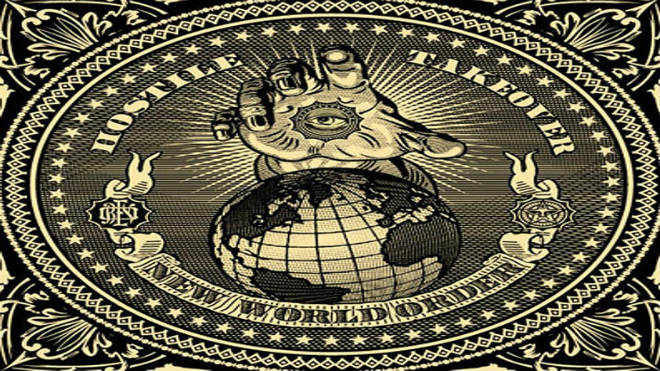
‘New World Order’ is falling apart

By Wayne Madsen

Source: Intrepid Report

One of the more welcomed outcomes of the paring back of the U.S. State Department bureaucracy is the elimination of scores of “status quo enthusiasts.” Since the end of World War II, the State Department’s ranks have been populated by foreign service officers and career diplomats who have championed the international status quo.

These minions of Foggy Bottom received encouragement for their protective stance on post-World War II and the Cold War in President George H. W. Bush’s speech on September 11, 1990, which was titled, “Toward a New World Order.” Under the “new world order,” regional and global security concerns would supplant democratic independence movements. The immediate effect of this “order” was brutal crackdowns on secession in the periphery of the former Soviet Union, including Abkhazia, South Ossetia, Nagorno-Karabakh, Transnistria, as well as in Somalia, the Kurdish regions of Iraq and Turkey, East Timor, Sudan, and Ethiopia. However, in Yugoslavia, which the United States and European Union wanted to see dissolved, secessionists in seven constituent states were encouraged to secede from the federation. That resulted in the bloodiest military conflicts in Europe since World War II.

Leaders of secessionist groups visiting Washington were traditionally shunned by the State Department. These hapless would-be presidents and prime ministers would be lucky to meet with a low-ranking State Department employee. However, if their independence movements were championed by the Central Intelligence Agency, they would get red carpet treatment. Such was the case with Secretary of State Madeleine Albright’s favorite Balkans “toy boy,” Hashim Thaci, the leader of the terrorist Kosovo Liberation Army and now president of the Republic of Kosovo, which was carved out of Serbia but is still unrecognized by many of the world’s most important nations, including China and Russia.

Today, one of the most-commonly seen words in State Department Country Desk reports is “secession.” In the past, State Department senior bureaucrats would be raising this development with the secretary of state as a major threat to U.S. interests. The CIA would then be instructed to remedy the situation by providing intelligence support to the countries where secessionist activity was a rising problem. “Support” would range from intelligence assistance to full-blown military aid.

As the United States recedes from the “world’s only superpower” status, to the chagrin of neoconservatives who are pouring into the Donald Trump administration in order to right the capsizing ship-of-state, secessionist activity is seen from the streets of Catalonia, which recently re-elected a pro-independence parliament, to virtual city-states in Mexico, which are increasingly going it alone to offset the breakdown in federal security and law enforcement support.

In the secessionist-minded Republika Srpska, a restive constituent region of the Bosnia-Herzegovina federation, Serbian nationalists have held a banned “statehood” celebration in the regional capital of Banja Luka. Srpska President Milorad Dodik demanded more autonomy for his region, declaring there were two Serbian states, Serbia and Republika Srpska. Present at the banned event were Serbian Defense Minister Aleksandar Vulin, Interior Minister Nebojsa Stefanovic, and former Serbian President Tomislav Nikolic. Joining them was Anatoly Bibilov, the president of the breakaway Republic of the Republic of South Ossetia–the State of Alania in the Caucasus region.

To the consternation of Eurocrats in Brussels and in the Balkans, also in attendance was Aleksandar Karadjordjevic and his wife, the heirs presumptive to the throne of the former Yugoslavia, and Johann Gudenus, the chairman of the Austrian Freedom Party (FPO), which makes up half of the governing coalition of Austria. Dodik awarded a Republika Srpska medal to Austrian Vice-Chancellor Hans Christian Strache, the leader of the FPO faction in the Austrian government. In the past, such an international outpouring of support for a secessionist-minded republic would have resulted in a flurry of diplomatic protests and démarches from the State Department.

After a recent election returned a coalition of pro-independence Catalonian parties to a majority of 70 seats in the Catalonian 135-seat parliament, the neofascist Madrid government of Mariano Rajoy has been put into a quandary. The Catalonian parliament has re-elected former Catalonian President Carles Puigdemont, who was removed by Rajoy after an October 1, 2017, referendum that favored independence. Puigdemont, who is in self-exile in Belgium, where he has the support of the powerful Flemish pro-independence party, faces arrest by the Madrid regime if he returns to Catalonia. The thuggish reaction by the Rajoy regime has engendered sympathy for the Catalonian cause in other secessionist-minded regions of Spain, including the Basque region, Valencia, and Galicia, and around the world.

The case of Catalonia has resulted in popular blowback against Spain from other parts of Europe, including Scotland, which is demanding a second referendum on independence upon Britain’s exit from the European Union. Support for continued membership in the EU has also increased demands for independence from Wales and Northern Ireland in the United Kingdom.

Taking a cue from the Madrid government, Nigerian authorities recently arrested Cameroonian Anglophone secessionist movement leader Sessekou Julius Ayuk Tabe, along with some of his aides, in the Nigerian capital of Abuja. The arrests came after Cameroon accused Nigeria of harboring supporters of the breakaway region of Ambazonia on the Nigerian side of the border. French-speaking Cameroon considers the English-speaking secessionist movement to be a “terrorist” organization, the usual appellation assigned by Third World dictatorships to pro-democracy groups and movements.

The newly-inaugurated president of Somaliland, Muse Bihi Abdi, was received with full diplomatic honors on his first trip abroad to neighboring Djibouti. What makes this newsworthy is that no country has formally recognized Somaliland’s self-declared independence from Somalia, even though the country has been independent for 19 years. Somaliland, which has its own currency and issues its own passports, maintains an effective government as compared to that of Somalia’s. In the past, Djibouti’s full honors for the Somaliland president would have resulted in a curt diplomatic note from the U.S. embassy in Djibouti for extending de facto recognition of Somaliland. There is now a scramble for military and political influence in the Horn of Africa by the United States, China, France, Turkey, Germany, Russia, Japan, Britain, the United Arab Emirates, Iran, Saudi Arabia, Egypt, and Qatar.

The UAE sees Somaliland and a restored independent South Yemen as in its national interests, hence, the oil-rich federation is establishing de facto bases in Somaliland’s port of Berbera, the Yemeni island of Socotra in the Gulf of Aden, and two key Yemeni islands in the Red Sea: Perim and Kamaran. In the past, the United States, which always wanted Socotra for its own military use, merely because it was once a Soviet intelligence base, would have threatened Yemen and the UAE with reprisals. However, Yemen is a failed state and the UAE is now overshadowing American influence in the Red Sea/Gulf of Aden region.

In Mexico, the town of Tancítaro, which lies deep within the drug cartel-controlled state of Michoacán, has decided to establish a de facto city-state. The “avocado capital of the world” is now governed by a “junta,” which is backed by wealthy avocado growers who have hired their own security force to contend with the narco-gangs. Similar quasi-city states have been established in Monterrey, where local businesses have taken over security duties from corrupt police, and Ciudad Nezahualcóуotl (or “Neza”), outside of Mexico City, where the local leftist administration has established its control over the local police, monitoring their every activity for corruption or human rights abuses.

The Algerian government has decided, after years of opposition, to acceding to some of the demands of the minority Berber Kabylie Independence Movement. Amazigh, the Berber language, is now an official language of Algeria. Algeria now celebrates January 12 as Yennayer, the Amazigh New Year. An Amazigh language academy is now planned in Algeria. In the past, the U.S. State Department, influenced by U.S. oil and gas firms active in southern Algeria, would have been aghast at concessions by the Algerian government to Berber nationalists. In what worries Spain, Amazigh is now the third most widely spoken language in Catalonia, after Spanish and Catalan. The Catalans and Amazigh share common ancient roots that have manifested themselves in modern cooperation to advance their statehood goals.

In India, some “scheduled tribals,” the name assigned by the government to indigenous tribal groups, are examining historical documents between British colonial officials and their own past leaders and are discovering they have every right to independence from India. Indian police recently arrested for “sedition” the 83-year-old Ramo Birua, from a village in Jharkhand state, because he called for the raising of the flag of an independent Kolhan state. Birua and his followers cited the rule imposed in 1837 by the British Agent for Kolhan region, Sir Thomas Wilkinson. The “Wilkinson Rule” stipulated that the existing civil and criminal laws of tribal states would be recognized by the British authorities. India’s independence did nothing to change the Wilkinson Rule, thus, “scheduled tribes” across India have a legal right to go their own way. In the case of Mr. Birua, he claims his tribe’s right to sovereignty is ensured by British Queen Elizabeth II, as the heir to Queen Victoria, the British monarch whose royal imprimatur was conferred upon the Wilkinson Rule.

Even within the United States, there is talk of “autonomy” by states from federal intrusions. Colorado is prepared to fight the Trump administration’s stated crack down on marijuana sales. In Colorado and other states that have legalized marijuana, Democratic and Republican officials are prepared to fight the Drug Enforcement Administration in any moves against their legalized medical and recreational marijuana industries. The same applies to federal authority to conduct offshore oil exploration and drilling. California, which has also declared its independence from Trump’s withdrawal from the Paris Climate Accord, is standing opposed to drilling in its Pacific waters. Florida successfully persuaded Trump to exempt it from the drilling order, however, Virginia, North Carolina, and other states are seeking similar exemptions. Other matters that are driving states’ rights rebellions against Washington are in the areas of immigration, federal land use, engine emissions standards, voting rights, health care, and public education. Puerto Rico and the U.S. Virgin Islands, abandoned by Washington after repeated hurricane disasters, are subtly re-evaluating their previous opposition to independence.

The demise of neo-colonialist busybody diplomats at the State Department has ushered a “global spring,” where both active and long-dormant independence movements are seeing glimmers of hope for their own nation-states.

Gaslighting: State Mind Control and Abusive Narcissism

By Vanessa Beeley

Source: 21st Century Wire

Exceptionalism: the condition of being different from the norm; also:  a theory expounding the exceptionalism especially of a nation or region.

There are many theories surrounding the origin of American exceptionalism. The most popular in US folklore, being that it describes America’s unique character as a “free” nation founded on democratic ideals and civil liberties. The Declaration of Independence from British colonial rule is the foundation of this theory and has persevered throughout the often violent history of the US since its birth as a free nation.

Over time, exceptionalism has come to represent superiority in the minds and hearts of Americans. Belief in their economic, military and ideological supremacy is what has motivated successive US governments to invest in shaping the world in their superior image with little or no regard for the destruction left in the wake of their exceptional hegemony.

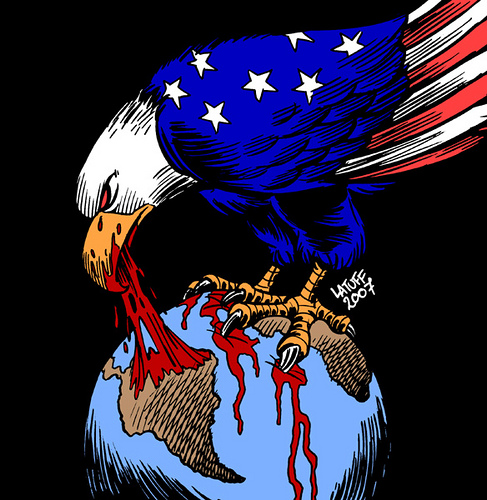
In considering itself, exceptional, the US has extricated itself from any legal obligation to adhere to either International law or even the common moral laws that should govern Humanity.  The US has become exceptionally lawless and authoritarian particularly in its intolerant neo-colonialist foreign policy.  The colonized have become the colonialists, concealing their brutal savagery behind a veneer of missionary zeal that they are converting the world to their form of exceptionalist Utopia.

Such is the media & marketing apparatus that supports this superiority complex, the majority of US congress exist within its echo chamber and are willing victims of its indoctrination. The power of the propaganda vortex pulls them in and then radiates outwards, infecting all in its path.  Self-extraction from this oligarchical perspective is perceived as a revolutionary act that challenges the core of US security so exceptionalism becomes the modus vivendi.

Just as Israel considers itself ‘the chosen people’ from a religious perspective, the US considers itself the chosen nation to impose its version of Democratic reform and capitalist hegemony the world over. One can see why Israel and the US make such symbiotic bedfellows.

“The fatal war for humanity is the war with Russia and China toward which Washington is driving the US and Washington’s NATO and Asian puppet states.  The bigotry of the US power elite is rooted in its self-righteous doctrine that stipulates America as the “indispensable country” ~ Paul Craig Roberts: Washington Drives the World Towards War.

So why do the American people accept US criminal hegemony, domestic and foreign brutal tyranny & neo-colonialist blood-letting with scant protest? Why do the European vassal states not rise up against this authoritarian regime that flaunts international law and drags its NATO allies down the path to complete lawlessness and diplomatic ignominy?

What is Gaslighting?

The psychological term “Gaslighting” comes from a 1944 Hollywood classic movie called Gaslight.  Gaslighting describes the abuse employed by a narcissist to instil in their victim’s mind, an extreme anxiety and confusion to the extent where they no longer have faith in their own powers of logic, reason and judgement. These gaslighting techniques were adopted by central intelligence agencies in the US and Europe as part of their psychological warfare methods, used primarily during torture or interrogation.

Gaslighting as an abuser’s modus operandi, involves, specifically, the withholding of factual information and its replacement with false or fictional information designed to confuse and disorientate. This subtle and Machiavellian process eventually undermines the mental stability of its victims reducing them to such a depth of insecurity and identity crisis that they become entirely dependent upon their abuser for their sense of reality and even identity.

Gaslighting involves a step by step psychological process to manipulate and destabilize its victim.  It is built up over time and consists of repetitive information feeds that enter the victim’s subconscious over a period of time, until it is fully registered on the subconscious “hard disk” and cannot be overridden by the conscious floppy disk.  Put more simply, it is brainwashing.

Overall, the main reason for gaslighting is to create a dynamic where the abuser has complete control over their victim so that they are so weak that they are very easy to manipulate.” ~ Alex Myles

Three Stages of Gaslighting: Stage One

The first stage depends upon trust in the integrity and unimpeachable intentions of the abuser, a state of reliance that has been engendered by the abuser’s artful self-promotion and ingratiating propaganda.  Once this trust is gained, the abuser will begin to subtly undermine it, creating situations and environments where the victim will begin to doubt their own judgement.  Eventually the victim will rely entirely upon the abuser to alleviate their uncertainty and to restore their sense of reality which is in fact that of the abuser.

Stage Two

The second stage, defence, is a process by which the abuser isolates the victim, not only from their own sense of identity but from the validation of their peers.  They are made to feel that their opinion is worthless, discredited, down-right weird.  In political circles they would be labelled a conspiracy theorist, a dissident, a terror apologist.  As a consequence, the victim will withdraw from society and cease to express themselves for fear of ridicule, judgement or punishment.

This stage can also be compared to Stockholm Syndrome where a hostage or captive is reduced,by psychological mind games, back to infantile dependency upon their captor.  Narcissistic abuse bonds the victim to the aggressor via trauma.  Stockholm Syndrome bonds the victim to the aggressor via regression to an infantile state where the abuser/aggressor becomes the “parent” who will rescue the victim from imminent annihilation.  Both methods tap into the victim’s survival mechanisms to gain and maintain control.

Stage Three

The final stage is depression.  A life under the tyrannical rule of a narcissist drives the victim into a state of extreme confusion.  They are stripped of dignity & self-reliance.  They, ultimately exist in an information vacuum which is only filled by that which the abuser deems suitable or relevant.  This can eventually invoke symptoms of PTSD [Post Traumatic Stress Disorder]. Flashbacks, constant apprehension, hyper vigilance, mind paralysis, rage and even violence.  The process is complete and the victim has been reduced to a willing accomplice in the abusers creation of a very distorted reality.

Exceptionalism or Narcissism?

We are currently seeing the transformation of US exceptionalism into an abusive Narcissism.

The gargantuan apparatus of mind bending and controlling is being put into hyper drive by the ruling elite.  We are inundated with propaganda that challenges our sense of reality but only after being “tenderized” by the fear factor.  Fear of “terror”, fear of war, fear of financial insecurity, fear of gun violence, fear of our own shadow.  Once we are suitably quaking in our boots, in comes the rendition of reality that relieves our anxiety.  If we challenge this version of events we are labelled a conspiracy theorist, a threat to security. We are hounded, discredited, slandered and ridiculed.  We are isolated and threatened.

Wars are started in the same way.  Despite the hindsight that should enable us to see it coming, the process swings into motion with resounding success. The ubiquitous dictator, the oligarch who threatens to destroy all that the US and her allies represent which of course is, freedom, equality & civil liberty all wrapped up in the Democracy shiny paper and tied with the exceptionalist ribbon.

Next the false flag to engender fear, terror and to foment sectarian strife. The support of a “legitimate” organic, indigenous “revolution” conveniently emerging in tandem with US ambitions for imposing their model of governance upon a target nation. The arming of “freedom fighters”, the securing of mercenary additions to these manufactured proxy forces.  All this is sold in the name of freedom and democracy to a public that is already in a state of anxiety and insecurity, lacking in judgement or insight into any other reality but that of their “abuser”.

The NGO Complex Deployment

Finally, the Humanitarians are deployed.  The forces for “good”, the vanguard of integrity and ethical intervention.  The power that offers all lost souls a stake-holding in the salvation of sovereign nations that have lost their way and need rescuing.  A balm for a damaged soul, to know they can leave their doubts and fears in such trustworthy hands as HRW, Amnesty International, they can assuage their deep sense of guilt at the suffering being endured by the people of far flung nations because they can depend upon the NGOs to provide absolution with minimal effort on their part.  They don’t realise that NGOs are an integral part of their abuser’s apparatus, operating on the leash of neo-colonialist financing and influence.  NGOs provide the optic through which the abuser will allow the victim to perceive their world and once absorbed into this flawed prism the victim’s own cognitive dissonance will ensure they do not attempt a jail break.

In this state of oppressed consciousness the victim accepts what they are told.  They accept that the US can sell cluster bombs to Saudi Arabia that obliterate human beings and lay waste to essential civilian infrastructure in Yemen.  They accept that the US financially, ideologically & militarily supports the illegal state of Israel and provides the arsenal of experimental weapons that maim and mutilate children and civilians on a scale that is unimaginable.  They accept that a crippling blockade of the already impoverished and starving nation of Yemen is “necessary” to resolve the issues of sectarian divisions that only exist in the minds of their Congressional abusers.

The majority of Americans accept mass murder under the pretext of the right to protect, because their ability to form rational and reasoned opinions has been engineered out of them.  This is now the definition of US exceptionalism.  It is their ability to manipulate the world into accepting their lawlessness and global hegemony agenda.  In seeking to impose its own image upon our world the US has drifted so far from its founding principles, one wonders how they will ever return to them.  They have employed a recognised form of torture to ensure capitulation to their mission of world domination which entails the mental, physical and spiritual torture of target civilian populations.

In conclusion, the US has indeed achieved exceptionalism.  The US has become an exceptional global executioner and persecutor of Humanity.  Imperialism is a euphemism for the depths of abuse the US is inflicting upon the people of this world.

Our only hope is to break the cycle of abuse with empathy for the victim and with appreciation for the years of brainwashing that precedes their agonizing passive-aggressive apathy towards crimes being committed in “their name”.

This was an email I received recently from one courageous young American girl whose epiphany is testament to the resilience and survival instinct of the human spirit.

My name is Caroline and I am a 22 year old US citizen. I only fairly recently discovered the truth about Empire/NATO’s activities in Syria and Libya and so many other countries (thanks to writers like Andre Vltchek, Cory Morningstar, Forrest Palmer). I am sickened when I remember that I signed some of those Avaaz petitions and I feel horrified at knowing that I have Syrian and Libyan blood on my hands. I want to believe that I’m not “really” guilty because I really thought (as I had been told) that I was not doing something bad at the time, but still, what I did contributed to the suffering of those people and I want to do something to atone in at least some small way, even though I probably can’t “make up” for what I did or erase my crime.

If it’s not too much trouble, could you please tell me what you think I should do, if there is anything?” 

She deserves an answer…


***

Author Vanessa Beeley is a contributor to 21WIRE, and since 2011, she has spent most of her time in the Middle East reporting on events there – as a independent researcher, writer, photographer and peace activist. She is also a member of the Steering Committee of the Syria Solidarity Movement, and a volunteer with the Global Campaign to Return to Palestine. See more of her work at her blog The Wall Will Fall.


Related Podcast:

The West Is Becoming Irrelevant, The World Is Laughing

By Andre Vltchek

Source: TruePublica

I was recently told by an Asian friend of mine who is working in Paris: “Lately I stopped following almost all that is happening politically in the United States, in the UK and even here in France. It all feels suddenly so irrelevant, a waste of time.”

Statements like this would be unimaginable only one decade ago. In the past, what came from Washington and (to a smaller extent) from London was monitored with great attentiveness and fear, all over the world.

But all of a sudden, things have begun to change, rapidly. Despite the extremely violent nature of the Western-designed-and-manufactured global regime, which has been over-imposed on so many parts of the world for decades and centuries, increasing amounts of people in Asia, Latin America and Africa stopped worrying and went leisurely to the ‘barricades’, beginning to rebel against the perverseness of the ‘world order’.

Did it all really happen ‘all of a sudden’?

Or were there various catalysts at work, for already quite a substantial period of time?

It is a well-known fact that any deep-seated, chronic anxiety cannot disappear in just a short moment. People who are enslaved, humiliated, scared into obedience, people who are forced to feel uncertain and constantly frightened, cannot reverse their state of mind without some important external factor or set of factors.

It became obvious to me, as I have been working continuously on all continents and in almost all conflict zones of our Planet, that the renewed pride and courage which is now inspiring millions of oppressed human beings, actually came from the decisive and determined stand of just several brave and determined nations, big and small.

The myth about the omnipotence of the Empire has received a few significant blows.

The fable of invincibility has not completely disappeared yet, but at least it has got fractured and gravely injured.

The gate of the terrible prison began cracking. It has not collapsed, but the fractures were wide enough for at least some sunlight to enter the dark and dreadful cavities inhabited by billions of unfortunate and shattered beings.

Some victims stood up immediately; not many but at least some did. Others raised their heads in feeble hope, still lying down on the dirty ground, still chained, and still shaking. That weak light alone entering the dungeon was actually much brighter than what most people ever experienced in their entire life. It has been strong enough to provoke wonderful, brilliant sparks of hope

Except for some temporary setbacks (like in Brazil and Argentina), the anti-imperialist coalition is now steadier than ever; it is determined and constantly expanding.

And it is clearly winning!

It is truly a ‘rainbow coalition’ of countries, big and small, ‘red’ and ‘pink’, even ‘green’.

The only unifying factor is the shared determination not to be controlled by Western imperialism and neo-colonialism.

For decades, Cuba stood against the Empire, even after the Soviet block was broken to bits, even when all mutual agreements ceased to be honored by the criminal Yeltsin administration. The Cuban people never surrendered. It is because most of them always believed, from the bottom of their hearts, in socialism and internationalism. And also because they have been convinced that the Western Empire is a morally corrupt and illegitimate entity and therefore has to be resisted.

A small and relatively poor country – Cuba – demonstrated to the entire world that while the Empire is mighty, sadistic and brutal, it is not omnipotent, and it is possible to defy it. There is no reason why one should not dare, or one should not dream about a much better world, why one shouldn’t fight for true freedom, attempting to win.

Cuba inspired the world. Its daring Revolution took place just a few miles from the shores of the United States. Soon after, its teachers and doctors went to all parts of the earth, spreading optimism, solidarity and kindness. Its heroic revolutionaries went to fight against the most dreadful forms of colonialism, which were torturing people, is such places as Congo, Angola and Namibia.

After Obama’s attempts to water down the determination of the Cuban citizens, many enemies began to predict, cynically: “Now Cuba will compromise and sell its Revolution.”

It never did! I travelled to the Island last year, driving through the countryside, and speaking to people in Havana, Guantanamo and Santiago de Cuba. Almost no one was ready to compromise. A greatly educated nation, Cuba saw through the Empire’s tricks and deceptions.

Now almost nobody speaks about the “Cuban compromise”, anymore, simply because there isn’t any on the table.

China, one of the oldest and greatest civilizations on Earth, went through the terrible period of ‘humiliation’. Divided, occupied and plundered by the West, it has never forgotten nor forgiven.

Now the Chinese Communist state and its mixed economy are helping countries in virtually all parts of the world, from Oceania and Latin America, to the Middle East and especially Africa, to survive and to finally stand on their own feet. Despite all the vitriolic propaganda regurgitated by the West (those people in Europe or North America who know close to zero about Africa or China, habitually passing ‘confident’ and highly cynical ‘judgments’ about China’s involvement in the poor world; judgments based exclusively on the lies and fabrications produced by the Western media), China has been gaining great respect and trust in virtually all corners of the globe.

The Chinese people and their government are now standing firmly against Western imperialism. They will not allow any recurrence of the disgraceful and dreary past.

The West is provoking this mighty and optimistic nation, pushing it into a terrible confrontation. China doesn’t want any military conflict. It is the most peaceful, the most non-confrontational large nation on Earth. But it is becoming clear that if pushed against the wall, this time it will not compromise: it will fight.

In the last years I have spoken to many Chinese people, as I travelled to all corners of the country, and I’m convinced that by now the nation is ready to meet strength with strength.

Such determination gives hope to many other countries on our Planet. The message is clear: the West cannot do whatever it wants, anymore. If it tries, it will be stopped. By reason or by force!

Russia is ready again, too. It is standing next to China, enormous and indignant.

Go to Novosibirsk or Tomsk, to Khabarovsk, Vladivostok or Petropavlovsk in Kamchatka. Talk to Russian people and you will soon understand: almost nobody there believes or respects the West, anymore. Throughout history, Russia was attacked and ransacked from the West. Millions, tens of millions of its people were murdered, literally exterminated. And now, the nation is facing what some consider to be yet another imminent attack.

Like the Chinese people, Russians are unwilling to compromise, anymore. The old Russian forecast is once again alive, that very one professed by Alexander Nevsky:

Go tell all in foreign lands that Russia lives! Those who come to us in peace will be welcome as a guest. But those who come to us sword in hand will die by the sword! On that Russia stands and forever will we stand!

In Russia, as in China, and as in so many other nations that were devastated by the Western plunderers, nothing is forgotten and no one is forgotten. It only appeared for a while that the memory had fainted. It never does. You cannot burn down an entire land, ruin the cities, burn the fields, and still pose as one with the moral mandate. Or as we say in Chile: “Justice takes time, but it always comes!”

And the world is watching. It is suddenly clearly registering this determined and brave, epic stand of morally strong nations. Many of those who are watching are deeply impressed with what they are seeing. Perhaps not in London or in Paris, but go and ask those in Johannesburg or Beirut, or even in Calcutta, Cairo or Buenos Aires. Perhaps you suspect what answers you’d receive there!

Throughout modern history, not once has Iran invaded a foreign country. Yet its secular, progressive and democratic government (under the leadership of Mohammad Mosaddegh) was overthrown in 1953, in a CIA-backed coup. What followed was the monstrosity of the ‘pro-Western Shah’, and then a horrendous war, an invasion by Iraq, which was also fully backed by the West and which took hundreds of thousands of human lives. Since then, Iran has been suffering from targeted killings of its scientists (by the West and Israel), as well as terrorist attacks also backed from abroad.

Instead of falling on its knees and begging for mercy, Iran defied the West. On several occasions and when provoked, it sent its battleships to the neutral waters near the US coast, and it pledged to defend its land, in case it was to be attacked.

Iran also showed great solidarity towards Latin America, working closely with virtually all of the revolutionary governments there. It stood firmly by Venezuela in a time of great crises, building social housing in Caracas and supporting the Process by all other means.

In Latin America, no one will ever forget how former Iranian President Mahmoud Ahmadinejad came to Caracas to attend the funeral of Venezuelan leader Hugo Chavez, his dear friend. During the memorial, the aged mother of Chavez suddenly approached Ahmadinejad, in tears. Breaking all religious protocol of a Shi’a country that he was representing, the Iranian President embraced her, and held her against his heart, until she calmed down.

This moment was expressing one simple and powerful reality: all of us, the internationalists and anti-imperialists, are fighting for the survival of humanity and this planet. There is more that unites us than what is tearing us apart. Once we win, and we will win, the world will be able to find a common language. The West wants to divide us, by spreading hostilities and distrust, all through ‘false news’ and fabrications. But we understand its game. We will not break our ranks, anymore.

The West is clearly losing. It knows it. It is in panic.

Its nihilism, its propaganda and indoctrination tactics will soon be defeated.

I wrote a lot about the DPRK and how it joined the list of the ‘most hated nations on Earth’. It is a well known fact that North Korea was, for years and decades, much richer and more democratic than South Korea (ROK). But it embarked on one tremendous humanist ‘project’, and together with Cuba, the Soviet Union and to some extent China, it liberated almost the entire African continent, at great cost and sacrifice. And not only that: it sent its top educators and doctors to all corners of the most devastated continent on Earth. Its pilots also flew Egyptian MIGs against Israel, during the 1967 war. These facts have been silenced by Western propaganda, but they clearly explain why the DPRK has been ostracized, pushed to the corner, hit by senseless embargos, and forced to react the way it has been reacting for at least the last two decades.

North Korea has never surrendered either, and it never will.

Neither has Venezuela, for many years the great sentinel and engine of the Bolivarian Revolution, as well as of Latin Internationalism and solidarity. Surviving coups, embargos, plots and propaganda campaigns, surviving attacks, even terror, of the foreign-backed ‘opposition’, Venezuela has been injured but it is alive. Just a few days ago I spoke to an Italian Parliamentary delegation, consisting of  the“5-Star-Movement” MPs, which recently returned from Caracas. Their conclusion was simple: “The worst is over”.

The world knows it! Venezuela, DPRK, Cuba – they never fell. No matter how many knives penetrated their bodies, despite so much pain caused by the sanctions, coup attempts and direct acts of terrorism administered by the West and its monstrous Empire.

It is becoming clear and obvious: the West is helpless against determination, true courage and patriotic love. It is powerless when confronted with humanist ideologies, and with true loyalty!

And the world keeps watching, drawing its conclusions.

I wrote about Syria, comparing Aleppo to the 20th Century Stalingrad. This is where racism, terrorism, and the lowest forms of Western imperialism were decisively stopped. The price was terrible, but the message to the world extremely clear: The people who love their country with their entire hearts can fight and win against all odds, especially if by their side stand truly great and reliable friends and comrades!

One day the world will thank the Syrian people, profusely and properly. One day, everything will be understood. One day, perhaps soon.

This is one of the greatest moments in human history, perhaps the greatest.

It has arrived without big salvos announcing monumental revolutions.

Everything is happening fast, in an organized and determined manner.

The greatest minds of Russia, China, Latin America and the rest of the world, are feverishly, day and night, trying to determine what really brought our world, our civilization, to this ludicrous downfall.

The simplified and stripped-down answer is this: Western imperialism (military, economic and ‘intellectual’/ ’cultural’), colonialism and neo-colonialism, as well as that dreadful by-product of all the above combined – a set of unchecked and savage form of capitalism.

Simultaneously, new forms of government, of economy and social systems are being, once again, planned.

The military strategists of the countries that are refusing to kneel in front of the barbaric terror of the West, responsible for hundreds of millions of murders and billions of ruined lives, are planning how to defend their countries and the world.

Once again, the world is at work! It is building trenches, educating people, preparing them for the final showdown with the culture that has been tormenting our Planet for centuries.

It is the moment of great hope and renewed enthusiasm.

Of course, if seen from Western capitals, everything is bleak and depressing. There is no ‘hope’ at all.

I agree fully: there is no hope ‘for them’.

The logic, the ‘philosophy’ with which the Europeans and the North Americans have become accustomed to analyze the world, has arrived at a dead end.

Yes, it is ‘the end of philosophy’, or as they say, ‘the end of history’. I fully agree: it is the end of their philosophy and of their history.

That’s why, reading about their elections or statements produced by their politicians, is nothing less than a waste of time. The world realizes it, more and more.

Their ‘new tricks’ are actually very old. Their entire system is outdated. It should have been retired at least one hundred years ago. It survived only because of its savagery and cruelty. It will go soon, anyway.

These days, encountering people inhabiting the West is like encountering those zombies who were living in Nazi Germany during WWII. After the war was over, they were streetwalking for years, at least many of them, repeating the same refrains: “We didn’t know!” “We never realized”. The Nazi propaganda and the one, which has been used in the West and in the colonies (as Noam Chomsky and I defined in our book “On Western Terrorism”), are based on precisely the same roots, foundations and methods. Both are extremely effective, when it comes to the total brainwashing of the population.

To follow up the last chapter of the imperialist and turbo capitalist morass of the West is embarrassing and useless.

Both Europe and the United States are suffering from a series of devastating mental illnesses, as was defined by the great Swiss psychologist Carl Gustav Jung, right after WWII.

Getting too much involved in pathological behavior, constantly studying and analyzing it, could only break and deeply depress any healthy person’s mind.

There is nothing more to understand. Hundreds of millions of victims in all parts of the world are speaking for themselves.

The only rational issue here is this: how to stop this horror, as soon as possible? How to allow humanity to return to its natural development and evolution patterns?

I don’t believe in ‘punishments’ and ‘trials’ and other vehicles of intimidation and of spreading fear. I don’t care whether the West will ‘pay’ for all that it has done to the world. I only want it to be stopped, once and for all.

I work very hard for it to be stopped.

So are others.

And the world is watching, and all of a sudden enjoying what it sees.

Suddenly more and more people are daring to laugh at the global regime. Of course not in Paris, London or New York (here they are scared and obedient, even more than before). But outside, yes!

People on all continents want to see and hear about what ‘others do’, what ‘we do’, not what the Empire and its mental conditions are producing.

They are laughing and waiting impatiently for what a new day, a new year will bring. They are waiting for the true new beginning to arrive.


Andre Vltchek is a philosopher, novelist, filmmaker and investigative journalist. He has covered wars and conflicts in dozens of countries. Three of his latest books are revolutionary novel “Aurora” and two bestselling works of political non-fiction: “Exposing Lies Of The Empire” and  “Fighting Against Western Imperialism. View his other books here. Andre is making films for teleSUR and Al-Mayadeen. Watch Rwanda Gambit, his groundbreaking documentary about Rwanda and DRCongo. After having lived in Latin America, Africa and Oceania, Vltchek presently resides in East Asia and the Middle East, and continues to work around the world. He can be reached through his website and his Twitter

Oligarchs, Bankers, and Swindlers

us-imperialism-latin-america-racism12

Washington’s “New Managers” in Latin America

By James Petras

Source: Dissident Voice

Amid raging corruption, social pathologies and outright political thuggery, a new gang of vassal regimes has taken-over Latin America. The new rulers are strictly recruited as the protégé’s of US financial and banking institutions. Hence the financial press refers to them as the “new managers” – of Wall Street.

The US financial media has once again provided a political cover for the vilest crimes committed by the ‘new managers’ as they launch their offensive against labor and in favor of the foreign and domestic financiers.

To understand the dynamics of the empire’s new vassal managers we will proceed by identifying (1) the illicit power grab (2) the neo-liberal policies they have pursued (3) the impact of their program on the class structure (4) their economic performance and future socio-political perspectives.

Vassals as Managers of Empire

Latin America’s current vassalage elite is of longer and shorter duration.

The regimes of longer duration with a historical legacy of submission, corruption and criminality include Mexico and Colombia where oligarchs , government officials and death squads cohabitate in close association with the US military, business and banking elites.

Over the past decades 100,000 citizens were murdered in Mexico and over 4 million peasants were dispossessed in Colombia. In both regimes over ten million acres of farmland and mining terrain were transferred to US and EU multinationals.

Hundreds of billions of illicit narco earnings were laundered by the Colombian and Mexican oligarchy to their US accounts via private banks.

The current political managers, Peña in Mexico and Santos in Colombia are rapidly de-nationalizing strategic oil and energy sectors, while savaging dynamic social movements – hundreds of students and teachers in Mexico and thousands of peasants and human rights activists in Colombia have been murdered.

The new wave of imperial vassals has seized power throughout most of Latin America with the direct and indirect intervention of the US. In 2009, Honduras President Manuel Zelaya was ousted by a military coup backed by Secretary of State Hillary Clinton. Zelaya’s program of agrarian reform, regional integration (with Venezuela) and constitutional elections was abolished. Zelaya was replaced by a US vassal, Roberto Micheletti who proceeded to murder several hundred landless rural workers and indigenous activists.

Washington moved to organize a constitutional cover by promoting a highly malleable landowner, Porfirio Lobo Sosa to the presidency.

The State Department next ousted Paraguyan President Francisco Lugo who governed between 2008-2012. Lugo promoted a moderate agrarian reform and a centrist regional integration agenda.

With the backing of Secretary of State Clinton, the Paraguayan oligarchy in Congress seized power, fabricated an impeachment decree and ousted President Lugo. He was briefly replaced by Vice President Federico Franco (2012-2013).

In 2013, Washington backed the capital Asuncion’s, notorious crime boss for President, one Horacio Castes – convicted for currency fraud in 1989, drug running in 1990, and most recently (2010) money laundering.

The Honduras and Paraguayan coups established (in miniature) the precedent for a new wave of ‘big country’ political vassals. The State Department moved toward the acceleration of banking takeovers in Brazil, Argentina and Peru.

In rapid succession, between December 2015 and April 2016 vassal managers seized power in Argentina and Brazil. In Argentina millionaire Mauricio Macri ruled by decree, by-passing constitutional legality. Macri fired scores of thousands of public service workers, closed social agencies and appointed judges and prosecutors without Congressional vote. He arbitrarily arrested social movement leaders – violating democratic procedures.

Macri’s Economic and Finance Ministers gained millions of dollars by ‘buying into’ multinational oil companies just prior to handing over private options on public enterprises.

The all-encompassing swindles and fraud carried out by the ‘new managers’ were covered up by the US media,who praised Macri’s professional team.

Moreover, Macri’s economic performance was a disaster. Exorbitant user fees on utilities and transport for consumers and business enterprises, increased three to ten-fold, forcing bankruptcy rates to soar and households to suffer light and gas closures.

Wall Street vulture funds received seven billion dollar payment from Macri’s managers, for defaulted loans purchased for pennies over a dollar, twenty-fold greater then the original lenders.

Data based on standard economic indicators,highlights the worst economic performance in a decade and a half.

Price inflation exceeds 40%; public debt increased by twenty percent in six months. Living standards and employment sharply declined. Growth and investment data was negative. Mismanagement, official corruption, and arbitrary governance did not induce confidence among local small and medium size businesses.

The respectable media, led by the New York Times, the Financial Times, the Wall Street Journal, and the Washington Post falsified every aspect of Macri’s regime. Failed economic policies implemented by bankers turned cabinet ministers were dubbed long-term successes; crude ideologically driven policies promoting foreign investor profiteering were re-invented as business incentives.

Political thugs dismantled and replaced civil service agencies were labelled ‘a new management team’ by the vulgar propaganda scribes of the financial press.

In Brazil, a phony political power grab by Congressional opportunists ousted elected President Dilma Rousseff. She was replaced by a Washinton approved serial swindler and notorious bribe taker, Michel Temer.

The new economic managers were predictably controlled by Wall Street, World Bank and IMF bankers. They rushed measures to slash wages, pensions and other social expenditures, to lower business taxes and privatize the most lucrative public enterprises in transport, infrastructure, landholdings, oil and scores of other activities.

Even as the prostitute press lauded Brazil’s new managers’, prosecutors and judges arrested three newly appointed cabinet ministers for fraud and money laundering. ‘President’ Temer is next in line for prosecution for his role in the mega Petrobras oil contracts scandal for bribes and payola.

The economic agenda by the new managers are not designed to attract new productive investments. Most inflows are short-term speculative ventures. Markets, especially in commodities, show no upward growth, much to the chagrin of the free market technocrats. Industry and commerce are depressed as a result of the decline in consumer credit, employment, and public spending induced by ‘the managers’ austerity policies.

Even as the US and Europe embrace free market austerity, it evokes a continent wide revolt. Nevertheless, Latin America’s wave of vassal regimes remain deeply embedded in decimating the welfare state and pillaging public treasuries led by a narrow elite of bankers and serial swindlers.

Conclusion

As Washington and the prostitute press hail their ‘new managers’ in Latin America, the celebration is abruptly given way to mass rage over corruption and demands for a shift to the political left.

In Brazil, “President” Temer rushes to implement big business measures, as his time in office is limited to weeks not months. His time out of jail is nearing a deadline. His cabinet of ‘technocrats’ prepare their luggage to follow.

Maurico Macri may survive a wave of strikes and protests and finish the year in office. But the plunging economy and pillage of the treasury is leading business to bankruptcy, the middle class to empty bank accounts and the dispossessed to spontaneous mass upheavals.

Washington’s new managers in Latin America cannot cope with an unruly citizenry and a failing free market economy.

Coups have been tried and work for grabbing power but do not establish effective rulership. Political shift to the right are gyrating out of Washington’s orbit and find no new counter-balance in the break-up of the European Union.

Vassal capitalist takeovers in Latin America generated publicist anesthesia and Wall Street euphoria; only to be rudely shocked to reality by economic pathologies.

Washington and Wall Street and their Latin America managers sought a false reality of unrestrained profits and pillaged wealth. The reality principle now forces them to recognize that their failures are inducing rage today and uprisings tomorrow.


James Petras is author of The End of the Republic and the Delusion of Empire, Extractive Imperialism in the Americas: Capitalism’s New Frontier (with Henry Veltmeyer), and The Politics of Empire: The US, Israel and the Middle East. Read other articles by James, or visit James’s website.