
Globalisation: Hyperstition, Surveillance, and the Empire of Reason

By S.C. Hickman

Source: Techno Occulture

Edmund Berger in his essay Underground Streams speaking of various tactics used by the Situationists, Autonomia, and the Carnivalesque:

“Like the Situationists the Autonomia would engage with the tradition of the Carnivalesque alongside a Marxist political analysis. Bakhtin had described the carnival as “political drama without footlights,” where the dividing line between “symbol and reality” was extremely vague, and the Autonomia had embodied this approach through their media-oriented tactics of detournement. But under a regime of emergency laws a great portion of the Autonomia was sent to prison or into exile, leaving its legacy through an extensive network of radical punk and anarchist squats and social centers.”

One of the things we notice is that the Autonomia movement actually struck a nerve at the heart of Power and forced their hand, which obligingly reacted and used their power over and dominion of the Security System to screen out, lock up, and exclude this threat. That’s the actual problem that will have to be faced by any emancipatory movement in the present and future: How to create a movement that can be subversive of the system, and yet chameleon like not rouse the reactionary forces to the point of invoking annihilation or exclusionary measures?

A movement toward bottom-up world building, hyperstition, and exit from this Statist system will have to do it on the sly utilizing a mirror world strategy that can counter the State and Public Security and Surveillance strategies.  Such Counter-Worlds of Exit and Hyperstitional instigation will need to work the shadow climes of the energetic unconscious, triggering a global movement from the shadows rather than in direct opposition.

In many ways as I think we need a politics of distortion, allure, and sincerity, one that invents a hyperstitional hyperobject among the various multidimensional levels of our socio-cultural systems, calling forth the energetic forces at the heart of human desire and intellect, bypassing the State and Corporate filters and Security Systems of power and control. Such a path will entail knowing more about the deep State’s secret Security apparatus and Surveillance methodologies, technologies, and tactics than most thinkers are willing to acknowledge or even apprehend. Like the Hacker movements of the 90’s up to Anonymous one will need to build shadow worlds that mimic the stealth weapons of the State and Corporate Global apparatus and assemblages; but with one caveat – these weapons are non-violent “weapons of the mind”, and go unseen and unrecognized by the State Security Systems at Local and Global levels.

A global system of mass, warrantless, government surveillance now imperils privacy and other civil liberties essential to sustaining the free world. This project to unilaterally, totally control information flow is a product of complex, ongoing interplay between technological, political, legal, corporate, economic, and social factors, including research and development of advanced, digital technologies; an unremitting “war on terror”; relaxed surveillance laws; government alliances with information technology companies; mass media manipulation; and corporate globalism. One might say it as the Googling of the World.

The United Stats internally hosts 17 intelligence agencies under the umbrella known as the Security Industrial Complex. They are also known for redundancy, complexities, mismanagement and waste. This “secret state” occupies 10,000 facilities across the U.S. Over the past five years the total funding budget exceeded half a trillion dollars. The notion of globalization which has its roots in the so called universalist discourses of the Enlightenment had as its goal one thing: to impose a transparent and manageable design over unruly and uncontrollable chaos: to bring the world of humans, hitherto vexingly opaque, bafflingly unpredictable and infuriatingly disobedient and oblivious to human wishes and objectives, into order: a complete, incontestable and unchallenged order. Order under the indomitable rule of Reason.1

This Empire of Reason spreads its tentacles across the known world through networks and statecraft, markets and tradecraft, war and secrecy, drugs and pharmakon.  The rise of the shadow state during Truman’s era began a process that had already been a part of the Corporate worldview for decades. The monopoly and regulation of a mass consumption society was and always will be the goal of capitalist market economies. In our time the slow and methodical spread of the American surveillance state and apparatus has shaped the globalist agenda. Because of it the reactionary forces of other state based control systems such as Russia and China are exerting their own power and surveillance systems as counters to Euro-American hegemony.

Surveillance is a growing feature of daily news, reflecting its rapid rise to prominence in many life spheres. But in fact surveillance has been expanding quietly for many decades and is a basic feature of the modern world. As that world has transformed itself through successive generations, so surveillance takes on an ever changing character. Today, modern societies seem so fluid that it makes sense to think of them being in what Bauman terms a ‘liquid’ phase. Always on the move, but often lacking certainty and lasting bonds, today’s citizens, workers, consumers and travelers also find that their movements are monitored, tracked and traced. Surveillance slips into a liquid state.

As Bauman relates it liquid surveillance helps us grasp what is happening in the world of monitoring, tracking, tracing, sorting, checking and systematic watching that we call surveillance. Such a state of affairs engages with both historical debates over the panopticon design for surveillance as well as contemporary developments in a globalized gaze that seems to leave nowhere to hide, and simultaneously is welcomed as such. But it also stretches outwards to touch large questions sometimes unreached by debates over surveillance. It is a conversation in which each participant contributes more or less equally to the whole. (Bauman)

Our network society has installed its own “superpanopticon” (Mark Poster). Such a system is ubiquitous and invisible to the mass of users. As Poster states it “The unwanted surveillance of one’s personal choice becomes a discursive reality through the willing participation of the surveilled individual. In this instance the play of power and discourse is uniquely configured. The one being surveilled provides the information necessary.” For Poster, this supply of self-surveillance is provided through consumer transactions stored and immediately retrievable via databases in their constitution of the subject as a “sum of the information in the fields of the record that applies to that name.” The database compiles the subject as a composite of his or her online choices and activities as tracked by IFS. This compilation is fixed on media objects (images, text, MP3s, Web pages, IPs, URLs) across the deluge of code that can be intercepted through keyword pattern recognition and private lists of “threatening” URLs.2

Our so called neoliberal society has erased the Public Sphere for the atomized world of total competition in a self-regulated market economy devoid of politics except as stage-craft. As authors in the Italian autonomist movements have argued for the past fifty and more years, this “total subsumption” of capital upon the life-sphere has been accomplished through “material” and “immaterial” means.  According to these authors, capital in late capitalism and neoliberalism has attempted to progressively colonize the entire life-sphere. Resistance, they argue, comes through the “reserves” to capital that remain as the social and intellectual foundation from which capital draws, including through “immaterial labor” using digital means. Gradually during modernity, such theorists have argued, life itself has been taken as a target for capitalist subsumption, through the cooptation of communication, sexual and familial relationships (Fortunati 1995), education, and every other sphere of human activity, with economic exchange and survival as the ultimate justification for all relationships.3

Capital’s “apparatus of capture” has become increasingly efficient and broad in its appropriation of selves as subjects of its political economy through the combination of appropriating governmental functions such as: buying off political actors and agencies, cutting public funding to modernist institutions and infrastructures, redefining the agenda of education and other cultural institutions toward capitalist values, owning and narrowing the focus of the media, forcing family structures and individuals to adapt to scarcity economies, and using government police and surveillance forces and economic pressures to crush resistance. In short, it is said that neoliberalism has advanced by the totalitarian institutionalization of national and international capitalism, one nation after another, using domestic means to force compliance in domestic markets and using international pressures (economic, military, cultural) to do the same to other countries, cultures, and peoples. (Day, pp. 126-127)

The increased accuracy (or believed accuracy) of increased surveillance and feedback targeting through the collection of social big data and its analyses and social and political uses (ranging from drone predators to state surveillance in both democratic and communist/ authoritarian governments to consumer targeting— for example, the targeting done by Target Corporation, as described in a 2012 New York Times article [Duhigg 2012])— belong to a conjoined mechanism of cybernetic and neoliberal governmentality, which crosses governmental and corporate databases and organizations. Social big data seeks to demarcate trends, which then directly or indirectly act as norms, which further consolidate individual and group action within market-determined norms (Rouvroy 2013). People are forced into competition, into a “freedom” that is monitored and checked within systems of feedback control. As Norbert Weiner suggested in the Cold War period (Wiener 1954, 1961), communicative control can be used toward a discourse of “rationality”; a rationality that is seen as proper to a given political economy. The documentary indexing of the subject provides the codes for the subject’s social positioning and expressions by others and by itself. Thanks to networked, mobile devices, the subject can attempt to continuously propose him- or herself to the world as the subject of documentary representation. (Day, pp. 132-133)

Those of us in the West who use mobile devices are becoming hooked into an elaborate datasociety in which every aspect of our lives is conditioned to enforce a self-regulatory system of choices and taboos. The surveillance is done at the level of individuals, who are monitored and whose actions are predicted throughout key moments of their consumption or production, marking changes in trends and phase states, and recalculating the trajectory of entities according to these new parameters and relationships. Our algorithmic society is splicing us all into a grid of total control systems from which it will become increasingly difficult to extricate ourselves.

As Douglas Rushkoff said recently digital technology is programmed. This makes it biased toward those with the capacity to write the code. In a digital age, we must learn how to make the software, or risk becoming the software. It is not too difficult or too late to learn the code behind the things we use—or at least to understand that there is code behind their interfaces. Otherwise, we are at the mercy of those who do the programming, the people paying them, or even the technology itself.4 More and more our mass society is being programmed through an immaterial grid of datafied compliance and surveillance that captures our desires and regulates our choices. In some ways we’ve become the mindless generation, unable to stand back from the immersive worlds of our technosphere in which we live and breath. We’ve become enamored with our Mediatainment Industrial Complex that encompasses us to the point that those being born now will not know there ever was a word without gadgets. In fact we’ve all become gadgets in a market world of science fiction, our desires captured by the very gadgets we once thought would free us from the drudgery of time. Instead we’ve been locked within a world without time, a timeless realm in which the very truth of history has been sucked out of it and instead we live in a mythic time of no time, prisoners of a cartoon world of endless entertainment and false desires. In such a world the virtual has become actual, we wander through life caught in the mesh of a fake world of commodity cartoons, citizens of a dreamland turned nightmare. Shall we ever wake up?

Modern radical thought has always seen subjectivation as an energetic process: mobilization, social desire and political activism, expression, participation have been the modes of conscious collective subjectivation in the age of the revolutions. But in our age, energy is running out and desire, which has given modern social dynamics their soul, is absorbed in the black hole of virtualization and financial games, as Jean Baudrillard argues in his 1976 book, Symbolic Exchange and Death. In this book, Baudrillard analyzes the hyperrealistic stage of capitalism, and the instauration of the logic of simulation.

The end of the spectacle brings with it the collapse of reality into hyperrealism, the meticulous reduplication of the real, preferably through another reproductive medium such as advertising or photography. Through reproduction from one medium into another the real becomes volatile, it becomes the allegory of death, but it also draws strength from its own destruction, becoming the real for its own sake, a fetishism of the lost object which is no longer the object of representation, but the ecstasy of denegation and its own ritual extermination: the hyperreal. […]

The reality principle corresponds to a certain stage of the law of value. Today the whole system is swamped by indeterminacy, and every reality is absorbed by the hyperreality of the code and simulation. The principle of simulation governs us now, rather that the outdated reality principle. We feed on those forms whose finalities have disappeared. No more ideology, only simulacra. We must therefore reconstruct the entire genealogy of the law of value and its simulacra in order to grasp the hegemony and the enchantment of the current system. A structural revolution of value. This genealogy must cover political economy, where it will appear as a second-order simulacrum, just like all those that stake everything on the real: the real of production, the real of signification, whether conscious or unconscious.

Capital no longer belongs to the order of political economy: it operates with political economy as its simulated model. The entire apparatus of the commodity law of value is absorbed and recycled in the larger apparatus of the structural law of value, this becoming part of the third order of simulacra. Political economy is thus assured a second life, an eternity, within the confines of an apparatus in which it has lost all its strict determinacy, but maintains an effective presence as a system of reference for simulation. (Baudrillard 1993a: 71-72, 2).5

We’ve all become simulations now. It’s not our bodies that matter in this digital universe of data, but rather the dividual traces we leave across the virtualized world that can be manipulated to produce profit. In the sphere of semiocapitalism, financial signs are not only signifiers pointing to particular referents. The distinction between sign and referent is over. The sign is the thing, the product, the process. The “real” economy and financial expectations are no longer distinct spheres. In the past, when riches were created in the sphere of industrial production, when finance was only a tool for the mobilization of capital investment in the field of material production, recovery could not be limited to the financial sphere. It also took employment and demand. Industrial capitalism could not grow if society did not grow. Nowadays, we must accept the idea that financial capitalism can recover and thrive without social recovery. Social life has become residual, redundant, irrelevant. (Bifo)

Those of us of an older generation still remember what existed the other side of the virtual screen, but the mass of young being born now will not have that luxury and their minds will be completely immersed in this new virtual actuality with no sense of the Outside.

While those on the Left still ponder outmoded political worlds the world of capital has abandoned both the political and the social. It’s time to wake up … I wanted to say, “before it’s too late”. My problem, my despair is that it is already too late. And, yet, I continue throwing out my little posts in hopes that someone is listening, that someone will awaken from their dogmatic slumber and act… is that you?


  1. Bauman, Zygmunt; Lyon, David. Liquid Surveillance: A Conversation (PCVS-Polity Conversations Series) (pp. 79-80). Wiley. Kindle Edition.
  2. Raiford Guins. Edited Clean Version: Technology and the Culture of Control (Kindle Locations 1304-1308). Kindle Edition.
  3. Day, Ronald E.. Indexing It All: The Subject in the Age of Documentation, Information, and Data (History and Foundations of Information Science) (p. 126). The MIT Press. Kindle Edition.
  4. Douglas Rushkoff. Program or Be Programmed (Kindle Locations 1363-1367). Kindle Edition.
  5. Berardi, Franco Bifo. After the Future (Kindle Locations 2276-2294). AK Press. Kindle Edition.

War on Terror: Greatest Covert Op

(Editor’s Note: The following commentary is drawn from a speech delivered by Douglas Valentine at a 2010 peace conference. In expanded version is included as the final chapter of his book “The CIA as Organized Crime: How Illegal Operations Corrupt America and the World”.)
By Douglas Valentine

Source: Consortium News

The politics of terror are the greatest covert operation ever.

In explaining why, I’ll begin by defining some terms, because, when discussing the covert op called “the politics of terror,” words and their management are all important.

How are politics and terror actually defined: how are these meanings manipulated; for what purposes, and by whom?

Terrorism is defined as “violence against civilians intended to obtain a political purpose.”

This is an ambiguous phrase, which begs the questions: what are politics and violence?

Politics is defined as “the process by which groups of people make collective decisions.” And violence in this context is the use of force to compel a person or group to do or think something against their will. That includes the violence of words – of threatening to hurt – and of social structures, as well as the violence of deeds.

So, by definition, terrorism is political violence – hurting people, or threatening to hurt them, in order to make them govern themselves (or acquiesce to an external force) against their will.

In America, terrorism is always condemned by the government, and, accordingly, America is never a perpetrator of terrorism, but always the victims of it.

The U.S. war on terror is the ultimate expression of this principle: it is a military response to terrorism; violence in self-defense, not (ostensibly) violence for a political purpose.

That’s the official story – the assumption. But I’m going to show that America does engage in terrorism – violence against civilians for political purposes. This “state” terrorism, however, is covert, in so far as it is equated with national security, and thanks to that built-in ambiguity, it has both stated and unstated purpose.

The State and Unstated Policy in America 

Politics is a process by which groups of people make collective decisions. But who really makes the overarching political decisions in America? Who governs us?

The two political parties represent the people and they compete for control of the government. Historically, Republicans have generally favored business and Democrats have favored labor. The political division is, generally, class based.

Now, the government can be controlled by either political party; but the state endures –  “the state” being the nation’s indispensable industries and infrastructure (banking, auto industry, insurance, Microsoft), and the institutions which defend the nation’s enduring interests: the military, law enforcement, the intelligence and security services.

In Europe they often, cynically, refer to the state as “industry” or Big Business. In America we tend to call “the state” the Establishment – an ambiguous word that needs to be defined.

The dictionary defines Establishment as, “An exclusive group of powerful people who rule a government or society by means of private agreements and decisions.”

I would venture to say that the interests of the state and the Establishment are the same, and that the definition of Establishment with a capital E is the pivotal phrase in discussing “state” terrorism.

Consider this: there is the politics of the two parties vying for control of the government, and there is the Establishment, the state, making the covert (ostensibly non-political) decisions that effectively govern America.

Many of those covert decisions concern national security: they are unstated policy.

Moreover, these covert policy decisions about national security are made by people who control the military, law enforcement, and intelligence and security services. These guardians of “the state” are collectively called the National Security Establishment.

Like the Establishment that secretly rules the “state,” the National Security Establishment is an exclusive group that is not accountable to the political whims of the people.

These professional guardians of the state – the Establishment – are assumed to be above partisan politics. Their loyalty is assumed to be to the law or national security. And that assumption is the Big Lie upon which state terrorism is based.

Yes, it is true that the National Security Establishment is not accountable to the people: and, in fact, it has built a series of ever-larger, concentric moats around itself called the National Security State, precisely to keep the people out of its business.

The National Security Establishment rules the National Security State, with an iron fist, but it is pure propaganda that the National Security Establishment and State are not political.

In order to get inside the National Security Establishment, and rise to a position of authority within it, one must be born there (like Bush or make billions like Bill Gates), or submit to years of right-wing political indoctrination calibrated to a series of increasingly restrictive security clearances.

Political indoctrination – adopting the correct right-wing ideology – and security clearances represent the drawbridge across the moats.

The National Security State is the covert social structure of the Establishment, and it has as its job not just defending the Establishment from foreign enemies, but also expanding the Establishment’s economic and military influence abroad, while preserving its class prerogatives at home.

By “class prerogatives,” I mean the National Security State is designed to keep the lower class from exerting any political control over the state; especially, redistributing the Establishment’s private wealth.

To these unstated ends – imperialism abroad and repression at home – the National Security State engages in terrorism – i.e. political violence – on behalf of the Establishment.

Indeed, the National Security State is political violence, terrorism, in its purest form.

The Establishment and its National Security State as Terrorism

The lower classes in America have little voice in making government or state policy. Some members of the lower classes have given up hope, others are content: but in either case, voter turnout is a mere 54 percent.

Whether hopeless or content, they know they cannot fight conventional thinking. For example, when the Establishment exerts its influence, it is not considered politics; it is simply the status quo. The rich create jobs and must be accommodated with trillion-dollar bailouts, paid for by workers taking furloughs.

That’s just the way it is. Politicians in the service of the Establishment, for over-arching reasons of national security, have to keep the capitalist financial system afloat.

It is the same thing with the National Security Establishment: America invaded Iraq, and there was nothing the people could do about it. The decision was made for them. Peace activists, least of all, had no voice in the decision, because they are assumed to have no stake in national security.

You will not find peace activists in the National Security Establishment; and that political repression is part of covert state terrorism.

Likewise, if labor seeks to exercise influence, its efforts are described as exploiting the state for more than it deserves, because it does not have an enduring stake in the state.

It is a fact: only Establishment wealth – ownership – is equated with national security.

Consider the immortal words of Leona Helmsley: “Only the little people pay taxes.”

That injustice in the tax code is political repression and, in so far as it makes the people fearful, it is state terrorism. The Establishment fears losing its loopholes, while workers and the poor fear losing their homes: two types of fear, one for each class, one stated, one unstated.

The Establishment engages imperialism and political repression through propaganda (word management violence) and social structures. This state terrorism also is unstated, covert.

Only when the people rebel and challenge the Establishment is the word terrorism applied.

Likewise, the military, police or intelligence actions that provoke rebellion, or the responses to rebellion, are never called terrorism: they are national security.

And that’s how the management of words helps to repress the lower classes.

Language and the Psychology of State Terror

America’s industrial-sized war machine was never said to terrorize Iraq; the invasion was not political because the war machine is owned by the Establishment.

The Establishment profiting from war is not politics; it is ideological neutral “profits.”

In fact, America exerts its unwanted political influence overseas, through the state terror of aircraft carrier fleets, bombers, nuclear subs, shock and awe invasions, pacification programs, the overthrow of governments, and support of repressive puppet regimes.

This state terrorism, which you never hear about, is the biggest covert psychological warfare operation of all time.

This psywar operation depends on narrowly defining terrorism as a suicide bomber, a hijacked plane, the decapitated body of a collaborator: the “selective terrorism” of rebels and nationalists who, outgunned and outlawed in their own country, have no other options, other than submission.

The purpose of this “selective terrorism” by rebels is psychological: to isolate collaborators, while demonstrating to the people the ability of the rebels to strike at their oppressors. Brutal pacification cam­paigns – state terrorism – prevent people from making a living. Selective terrorism does not.

That’s a big, meaningful “class” difference.

The National Security Establishment understands that selective terror achieves political and psychological goals that state terror does not – that it rallies people to revolutionary ideals.  So the National Security Establishment engages in selective terror, too, by targeting the rebel, his family and friends in their homes.

This is the selective terror con­ducted by counter-terrorists. But don’t be confused: it is terrorism. All terrorism is psychological and political; state terror seeks to immobilize people and make them submissive, apathetic and/or ostensibly “content.”

The National Security Establishment fully understands that once people have been terrorized, they have been politically defeated, without necessarily receiving bullets.

As former Director of Central Intelligence William Colby once said: “The implication or latent threat of terror was sufficient to insure that the people would comply.”

This principle of the psychological use of “the implication or latent threat of terror” is what brings us back to America and the business of terror.

The Business of Terror

State terror – colonization abroad and political repression at home – is a key means of extracting profits and maintaining ownership of property. Ask the American Indian.

In its colonies abroad, the U.S. engages in state terrorism by removing all legal protections for rebels; detention, torture, and summary execution are the price for rebellion against U.S. policy.

State terrorism overseas, imperialism, is never acknowledged by the U.S. media, because the media is a big business closely affiliated with the National Security Establishment; indeed, two of the major networks are owned by defense contractors.

And state terrorism applied domestically to ensure “internal” security is never acknowledged. But the National Security State is well thought out, by professionals in language management, and political and psychological warfare, aimed at you.

“Personal violence is for the amateur in dominance,” says Johan Galtung, a founder of the disciipline of peace and conflict studies. But he adds “structural violence is the tool of the professional. The amateur who wants to dominate uses guns; the professional uses social structure. The legal criminality of the social system and its institutions, of government…is tacit violence. Structural violence is a structure of exploitation and social injustice.”

As Colby said:The implication or latent threat is enough to insure people will comply.”

The war on terror and its domestic version “homeland security” are the law of the land – America’s new legally criminal social structure based on administrative detention, enshrined in The Patriot Act and a number of executive orders, some secret.

This lack of due process comes on top of a justice system already skewed to protect the propertied elite and pack the prisons with the poor, through “structural violence,” mainly the drug wars.

The Establishment’s new anti-terror and anti-drug laws make the National Security State the most fearsome covert political and psywar machine the world has ever seen. And the National Security State is growing: the “Top Secret America” series in the Washington Post put it at 750,000 cadres.

This secret state within a state extends into the homeland’s critical infrastructure and beyond. For example, the arms industry provides good jobs, making American imperial aggression seem a positive value.

And this is how the psyched-out people become one of the moats.

As it is modeled on the totalitarian corporate paradigm, the National Security State in all its manifestations fits the classic definition of a fascist dictatorship. And we know what its intentions are. They have been stated.

In the days after 9/11, right-wing Republican stalwart Kenneth W. Starr, the Clinton inquisitor, said the danger of terrorism requires “deference to the judgments of the political branches with respect to matters of national security.”

But is there an on-going emergency that requires deference to the political branches, meaning the right-wing ideologues who rule the National Security State? And what does it mean for Establishment opponents if due process is completely abandoned at home, and subjected to politics?

Michael Ledeen, a former counter-terror expert on Reagan’s National Security Council, blamed 9/11 on President Bill Clinton “for failing to properly organize our nation’s security apparatus.”

Ledeen’s solution to the problem of those who sneered at security was “to stamp out” the “corrupt habits of mind.” By which he means Liberalism.

In other words, the reactionary right-wing that owns the National Security State wants to impose its total rule on the people in order to create a security conscious, uniform citizenry – marching in lock step, flags waving – that is necessary to win the war on terror.

This is how the National Security professionals are incrementally creating the requisite fascist social structure – through terror, the best organizing principle ever.

“This is time for the old motto, ‘kill them all, let God sort ’em out.’ New times require new people with new standards,” Ledeen asserted. “The entire political world will understand it and applaud it. And it will give us a chance to prevail.”

When Ledeen says “political” world he means the “owners of the business” of state terror, the right-wing ideologues who pack the National Security State and the capitalist Establishment they serve.

And they have won the propaganda war, folks.

The Deep State’s Dominant Narratives and Authority Are Crumbling

By Charles Hugh Smith

Source: Of Two Minds

This is why the Deep State is fracturing: its narratives no longer align with the evidence.

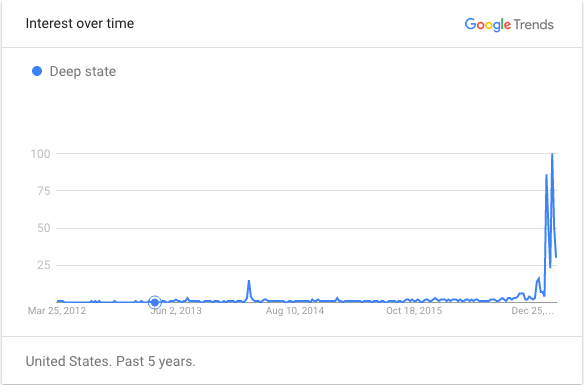
As this chart from Google Trends illustrates, interest in the Deep State has increased dramatically in 2017. The term/topic has clearly moved from the specialist realm to the mainstream. I’ve been writing about the Deep State, and specifically, the fractures in the Deep State, for years.

Amusingly, now that “Progressives” have prostituted themselves to the Security Agencies and the Neocons/Neoliberals, they are busy denying the Deep State exists. For example, There is No Deep State (The New Yorker).

In this risible view, there is no Deep State “conspiracy” (the media’s favorite term of dismissal/ridicule), just a bunch of “good German” bureaucrats industriously doing the Empire’s essential work of undermining democracies that happen not to prostrate themselves at the feet of the Empire, murdering various civilians via drone strikes, surveilling the U.S. populace, planting bugs in new iPhones, issuing fake news while denouncing anything that questions the dominant narratives as “fake news,” arranging sweetheart deals with dictators and corporations, and so on.

The New Yorker is right about one thing–the Deep State is not a “conspiracy:” it is a vast machine of control that is largely impervious to the views or demands of elected representatives or the American people. The key to understanding this social-political-economic control is to grasp that control of the narratives, expertise and authority is control of everything. Allow me to illustrate how this works.

The typical politician has a busy daily schedule of speaking at the National Motherhood and Apple Pie Day celebration, listening to the “concerns” of important corporate constituents, attending a lunch campaign fundraiser, meeting with lobbyists and party committees, being briefed by senior staff, and so on.

Senior administrators share similarly crowded schedules, minus the fundraising but adding budget meetings, reviewing employee complaints and multiple meetings with senior managers and working groups.

Both senior elected officials and senior state administrators must rely on narratives, expertise and authority because they have insufficient time and experience to do original research and assessment.

Narratives create an instant context that “makes sense” of various data points and events. Narratives distill causal factors into an explanatory story with an implicit teleology–because of this and that, the future will be thus and so.

For example: because Iraq has weapons of mass destruction (WMD), the future promises the terrible likelihood (more than a possibility, given Iraqi deployment of poison gas in the Iraq-Iran War) that America or its allies will be devastated by Iraqi weapons of mass destruction. This teleology leads to the inescapable need to eliminate Iraq’s weapons of mass destruction by any means necessary, and remove the political will to use them by removing Iraq’s leader from power.

Politicos and senior administrators rely on expertise and authority as the basis of deciding whether something is accurate and actionable. Professional specialists are assumed to have the highest available levels of expertise, and their position in institutions that embody the highest authority give their conclusions the additional weight of being authoritative. The experts’ conclusion doesn’t just carry the weight of expertise, it has been reviewed by senior officials of the institution, and so it also carries the weight of institutional authority.

So when the C.I.A. briefing by its experts claims Iraq has WMD, and the briefing includes various threads of evidence that the institution declares definitive, who is a non-expert to challenge this conclusion and teleology? On what technical basis does the skeptic reject the expertise and authority of the institution?

We can now define the Deep State with some precision. The Deep State is fundamentally the public-private centralized nodes that collect, archive and curate dominant narratives and their supporting evidence, and disseminate these narratives (and their implicit teleologies) to the public via the media and to the state agencies via formal and informal inter-departmental communication channels.

By gaining control of the narratives, evidence, curation and teleology, each node concentrates power. the power to edit out whatever bits contradict the dominant narrative is the source of power, for once the contradictory evidence is buried or expunged, it ceases to exist.

For example, the contradictory evidence in the Pentagon Papers was buried by being declared Top Secret. The bureaucratic means to bury skeptical (i.e. heretical) views or evidence are many. Sending the authors to figurative Siberia is remarkably effective, as is burying the heretical claims in a veritable mountain of data that few if any will ever survey.

Curation is a critical factor in maintaining control of the narrative and thus of control; the evidence is constantly curated to best support the chosen narrative which in turn supports the desired teleology, which then sets the agenda and the end-game.

The senior apparatchiks of the old Soviet Union were masters of curation; when a Soviet leader fell from favor, he was literally excised from the picture–his image was erased from photos.

This is how narratives are adjusted to better fit the evidence. Thus the accusation that “the Russians hacked our election” has been tabled because it simply doesn’t align with any plausible evidence. That narrative has been replaced with variants, such as “the Russians hacked the Democratic National Committee.” Now that this claim has also been shown to be false, new variants are popping up weekly, with equally poor alignment with evidence.

The primary claim of each Deep State node is that its expertise and authority cannot be questioned. In other words, while the dominant narrative can be questioned (but only cursorily, of course), the expertise and authority of the institutional node cannot be questioned.

This is why the Deep State is fracturing: the expertise and authority of its nodes are delaminating because its narratives no longer align with the evidence. If various Security Agencies sign off on the narrative that “Russia hacked our election” (a nonsense claim from the start, given the absurd imprecision of the “hacking”–hacking into what? Voting machines? Electoral tallies?), and that narrative is evidence-free and fact-free, i.e. false, then the expertise and authority of those agencies comes into legitimate question.

Once the legitimacy of the expertise and authority is questioned, control of the narrative is imperiled. The control of the narrative is control of the teleology, the agenda and the end-game–in other words, everything. If the institution loses control of the dominant narrative, it loses its hold on power.

This is why the Deep State is in turmoil–its narratives no longer make sense, or are in direct conflict with other nodes’ narratives or have been delegitimized by widening gaps between “definitive” claims and actual evidence.

There is indeed a Deep State, but its control of dominant narratives, and thus its source of control and power, is crumbling. The gap between the narratives and the evidence that supports them has widened to the point of collapse.


Why Do “Progressives” Like War?

kelly-cold-war

By Philip Giraldi

Source: Unz Review

Liberals are supposed to be antiwar, right? I went to college in the 1960s, when students nationwide were rising up in opposition to the Vietnam War. I was a Young Republican back then and supported the war through sheer ignorance and dislike of the sanctimoniousness of the protesters, some of whom were surely making their way to Canada to live in exile on daddy’s money while I was on a bus going to Fort Leonard Wood for basic combat training. I can’t even claim that I had some grudging respect for the antiwar crowd because I didn’t, but I did believe that at least some of them who were not being motivated by being personally afraid of getting hurt were actually sincere in their opposition to the awful things that were happening in Southeast Asia.

As I look around now, however, I see something quite different. The lefties I knew in college are now part of the Establishment and generally speaking are retired limousine liberals. And they now call themselves progressives, of course, because it sounds more educated and sends a better message, implying as it does that troglodytic conservatives are anti-progress. But they also have done a flip on the issue of war and peace. In its most recent incarnation some of this might be attributed to a desperate desire to relate to the Hillary Clinton campaign with its bellicosity towards Russia, Syria and Iran, but I suspect that the inclination to identify enemies goes much deeper than that, back as far as the Bill Clinton Administration with its sanctions on Iraq and the Balkan adventure, which resulted in hundreds of thousands of deaths and the creation of a terror-narco state in the heart of Europe. And more recently we have seen the Obama meddling in Libya, Yemen and Syria in so called humanitarian interventions which have turned out to be largely fraudulent. Yes, under the Obama Dems it was “responsibility to protect time” (r2p) and all the world trembled as the drones were let loose.

Last Friday I started to read an op-ed in The Washington Post by David Ignatius that blew me away. It began “President Trump confronts complicated problems as the investigation widens into Russia’s attack on our political system.” It then proceeded to lay out the case for an “aggressive Russia” in the terms that have been repeated ad nauseam in the mainstream media. And it was, of course, lacking in any evidence, as if the opinions of coopted journalists and the highly politicized senior officials in the intelligence community should be regarded as sacrosanct. These are, not coincidentally, the same people who have reportedly recently been working together to undercut the White House by leaking and then reporting highly sensitive transcripts of phone calls with Russian officials.

Ignatius is well plugged into the national security community and inclined to be hawkish but he is also a typical Post politically correct progressive on most issues. So here was your typical liberal asserting something in a dangerous fashion that has not been demonstrated and might be completely untrue. Russia is attacking “our political system!” And The Post is not alone in accepting that Russia is trying to subvert and ultimately overthrow our republic. Reporting from The New York Times and on television news makes the same assumption whenever they discuss Russia, leading to what some critics have described as mounting American ‘hysteria’ relating to anything coming out of Moscow.

Rachel Maddow is another favorite of mine when it comes to talking real humanitarian feel good stuff out one side of her mouth while beating the drum for war from the other side. In a bravura performance on January 26th she roundly chastised Russia and its president Vladimir Putin. Rachel, who freaked out completely when Donald Trump was elected, is now keen to demonstrate that Trump has been corrupted by Russia and is now controlled out of the Kremlin. She described Trump’s lord and master Putin as an “intense little man” who murders his opponents before going into the whole “Trump stole the election with the aid of Moscow” saga, supporting sanctions on Russia and multiple investigations to get to the bottom of “Putin’s attacks on our democracy.” Per Maddow, Russia is the heart of darkness and, by way of Trump, has succeeded in exercising control over key elements in the new administration.

Unfortunately, people in the media like Ignatius and Maddow are not alone. Their willingness to sell a specific political line that carries with it a risk of nuclear war as fact, even when they know it is not, has been part of the fear-mongering engaged in by Democratic Party loyalists and many others on the left. Their intention is to “get Trump” whatever it takes, which opens the door to some truly dangerous maneuvering that could have awful consequences if the drumbeat and military buildup against Russia continues, leading Putin to decide that his country is being threatened and backed into a corner. Moscow has indicated that it would not hesitate use nuclear weapons if it is being confronted militarily and facing defeat.

The current wave of Russophobia is much more dangerous than the random depiction of foreigners in negative terms that has long bedeviled a certain type of American know-nothing politics. Apart from the progressive antipathy towards Putin personally, there is a virulent strain of anti-Russian sentiment among some self-styled conservatives in congress, best exemplified by Senators John McCain and Lindsey Graham. Graham has recently said “2017 is going to be a year of kicking Russia in the ass in Congress.”

It is my belief that many in the National Security State have convinced themselves that Russia is indeed a major threat against the United States and not because it is a nuclear armed power that can strike the U.S. That appreciation, should, if anything constitute a good reason to work hard to maintain cordial relations rather than not, but it is seemingly ignored by everyone but Donald Trump.

No, the new brand of Russophobia derives from the belief that Moscow is “interfering” in places like Syria and Ukraine. Plus, it is a friend of Iran. That perception derives from the consensus view among liberals and conservatives alike that the U.S. sphere of influence encompasses the entire globe as well as the particularly progressive conceit that Washington should serve to “protect” anyone threatened at any time by anyone else, which provides a convenient pretext for military interventions that are euphemistically described as “peace missions.”

There might be a certain cynicism in many who hate Russia as having a powerful enemy also keeps the cash flowing from the treasuring into the pockets of the beneficiaries of the military industrial congressional complex, but my real fear is that, having been brainwashed for the past ten years, many government officials are actually sincere in their loathing of Moscow and all its works. Recent opinion polls suggest that that kind of thinking is popular among Americans, but it actually makes no sense. Though involvement by Moscow in the Middle East and Eastern Europe is undeniable, calling it a threat against U.S. vital interests is more than a bit of a stretch as Russia’s actual ability to make trouble is limited. It has exactly one overseas military facility, in Syria, while the U.S. has more than 800, and its economy and military budget are tiny compared to that of the United States. In fact, it is Washington that is most guilty of intervening globally and destabilizing entire regions, not Moscow, and when Donald Trump said in an interview that when it came to killing the U.S. was not so innocent it was a gross understatement.

Ironically, pursuing a reset with Russia is one of the things that Trump actually gets right but the new left won’t give him a break because they reflexively hate him for not embracing the usual progressive bromides that they believe are supposed to go with being antiwar. Other Moscow trashing comes from the John McCain camp which demonizes Russia because warmongers always need an enemy and McCain has never found a war he couldn’t support. It would be a tragedy for the United States if both the left and enough of the right were to join forces to limit Trump’s options on dealing with Moscow, thereby enabling an escalating conflict that could have tragic consequences for all parties.

Keep Fear Alive

DHSFEAR3

The bald-eagle boondoggle of the terror wars

By Kade Crockford

Source: The Baffler

“If you’re submitting budget proposals for a law enforcement agency, for an intelligence agency, you’re not going to submit the proposal that ‘We won the war on terror and everything’s great,’ cuz the first thing that’s gonna happen is your budget’s gonna be cut in half. You know, it’s my opposite of Jesse Jackson’s ‘Keep Hope Alive’—it’s ‘Keep Fear Alive.’ Keep it alive.”

—Thomas Fuentes, former assistant director, FBI Office of International Operations

Can we imagine a free and peaceful country? A civil society that recognizes rights and security as complementary forces, rather than polar opposites? Terrorist attacks frighten us, as they are designed to. But when terrorism strikes the United States, we’re never urged to ponder the most enduring fallout from any such attack: our own government’s prosecution of the Terror Wars.

This failure generates all sorts of accompanying moral confusion. We cast ourselves as good, but our actions show that we are not. We rack up a numbing litany of decidedly uncivil abuses of basic human rights: global kidnapping and torture operations, gulags in which teenagers have grown into adulthood under “indefinite detention,” the overthrow of the Iraqi and Libyan governments, borderless execution-by-drone campaigns, discriminatory domestic police practices, dragnet surveillance, and countless other acts of state impunity.

The way we process the potential cognitive dissonance between our professed ideals and our actual behavior under the banner of freedom’s supposed defense is simply to ignore things as they really are. They hate us for our freedom, screech the bald-eagle memes, and so we must solemnly fight on. But what, beneath the official rhetoric of permanent fear, explains the collective inability of the national security overlords to imagine a future of peace?

Incentives, for one thing. In a perverse but now familiar pattern, what we have come to call “intelligence failures” produce zero humility, and no promise of future remedies, among those charged with guarding us. Instead, a new array of national security demands circulate, which are always rapidly met. In America, the gray-haired representatives of the permanent security state say their number one responsibility is to protect us, but when they fail to do so, they go on television and growl. To take but one recent example, former defense secretary Donald Rumsfeld appeared before the morally bankrupt pundit panel on MSNBC’s Morning Joe to explain that intractable ethnic, tribal, and religious conflict has riven the Middle East for more than a century—the United States, and the West at large, were mere hapless bystanders in this long-running saga of civilizational decay. This sniveling performance came, mind you, just days after Politico reported that, while choreographing the run-up to the 2003 invasion of Iraq, Rumsfeld had quietly buried a report from the Joint Chiefs of Staff indicating that military intelligence officials had almost no persuasive evidence that Saddam Hussein was maintaining a serious WMD program. Even after being forced to resign in embarrassment over the botched Iraq invasion a decade ago, Rumsfeld continues to cast himself as an earnestly outmanned casualty of Oriental cunning and backbiting while an indulgent clutch of cable talking heads nods just as earnestly along.

And the same refrain echoes throughout the echelons of the national security state. Self-assured and aloof as the affluenza boy, the FBI, CIA, and NSA fuck up, and then immediately apply for a frenzied transfer of ever more money, power, and data in order to do more of what they’re already doing. Nearly fifteen years after the “Global War on Terror” began, the national security state is a trillion-dollar business. And with the latest, greatest, worst-ever terrorist threat always on the horizon, business is sure to keep booming.

The paradox produces a deep-state ouroboros: Successful terrorist attacks against the West do not provoke accountability reviews or congressional investigations designed to truly understand or correct the errors of the secret state. On the contrary, arrogant spies and fearful politicians exploit the attacks to cement and expand their authority. This permits them, in turn, to continue encroaching on the liberties they profess to defend. We hear solemn pledges to collect yet more information, to develop “back doors” to decrypt private communications, to keep better track of Muslims on visas, send more weapons to unnamed “rebel groups,” drop more cluster bombs. Habeas corpus, due process, equal protection, freedom of speech, and human rights be damned. And nearly all the leaders in both major political parties play along, like obliging extras on a Morning Joe panel. The only real disagreement between Republican and Democratic politicians on the national stage is how quickly we should dispose of our civil liberties. Do we torch the Bill of Rights à la Donald Trump and Dick Cheney, or apply a scalpel, Obama-style?

Safety Last

Both Democrats and Republicans justify Terror War abuses by telling the public, either directly or indirectly, that our national security hangs in the balance. But national security is not the same as public safety. And more: the things the government has done in the name of preserving national security—from invading Iraq to putting every man named Mohammed on a special list—actually undermine our public safety.

That’s because, as David Talbot demonstrates in The Devil’s Chessboard, his revelatory Allen Dulles biography and devastating portrait of a CIA run amok, national security centers on “national interests,” which translates, in the brand of Cold War realpolitik that Dulles pioneered, into the preferred policy agendas of powerful corporations.

Public safety, on the other hand, is concerned with whether you live or die, and how. Any serious effort at public safety requires a harm-reduction approach acknowledging straight out that no government program can foreclose the possibility of terroristic violence. The national security apparatus, by contrast, grows powerful in direct proportion to the perceived strength of the terrorist (or in yesterday’s language, the Communist) threat—and requires that you fear this threat so hysterically that you release your grip on reason. Reason tells you government cannot protect us from every bad thing that happens. But the endlessly repeated national security meme pretends otherwise, though the world consistently proves it wrong.

When it comes to state action, the most important distinction between what’s good for public safety (i.e., your health) and what’s good for national security (i.e., the health of the empire, markets, and prominent corporations) resides in the concept of the criminal predicate. This means, simply, that an agent of the government must have some reasonable cause to believe you are involved with a crime before launching an investigation into your life. When the criminal predicate forms the basis for state action, police and spies are required to focus on people they have reason to believe are up to no good. Without the criminal predicate, police and spies are free to monitor whomever they want. Police action that bypasses criminal predicates focuses on threats to people and communities that threaten power—regardless of whether those threats to power are fully legal and legitimate.

Nearly fifteen years after the “Global War on Terror” began, the national security state is a trillion-dollar business.

We can see the results of this neglect everywhere the national security state has set up shop. Across the United States right now, government actors and private contractors paid with public funds are monitoring the activities of dissidents organizing to end police brutality and the war on drugs, Israeli apartheid and colonization in Palestine, U.S. wars in the Middle East, and Big Oil’s assault on our physical environment. In the name of fighting terrorism, Congress created the Department of Homeland Security, which gave state and local law enforcement billions of dollars to integrate police departments into the national intelligence architecture. As a result, we now have nearly a million cops acting as surrogates for the FBI. But as countless studies have shown, the “fusion centers” and intelligence operations that have metastasized under post-9/11 authorities do nothing to avert the terror threat. Instead, they’ve targeted dissidents for surveillance, obsessive documentation, and even covert infiltration. When government actors charged with protecting us use their substantial power and resources to track and disrupt Black Lives Matter and Earth First! activists, they are not securing our liberties; they’re putting them in mortal peril.

Things weren’t always like this. Once upon a time, America’s power structure was stripped naked. When the nation saw the grotesque security cancer that had besieged the body politic in the decades after World War II (just as Harry Truman had warned it would) the country’s elected leadership reasserted control, placing handcuffs on the wrists of the security agencies. This democratic counterattack on the national security state not only erected a set of explicit protocols to shield Americans from unconstitutional domestic political policing, but also advanced public safety.

Mission Creeps

As late as the 1970s, the FBI was still universally thought to be a reputable organization in mainstream America. The dominant narrative held that J. Edgar Hoover’s capable agents, who had to meet his strict height, weight, and dress code requirements, were clean-cut, straight-laced men who followed the rules. Of course, anyone involved with the social movements of that age—anti-war, Communist, Black Power, American Indian, Puerto Rican Independence—knew a very different FBI, but they had no evidence to prove what they could see and feel all around them. And since this was the madcap 1970s, the disparity between the FBI’s glossy reputation as honest crusaders and its actual dirty fixation on criminalizing the exercise of domestic liberties drove a Pennsylvania college physics professor and anti-war activist named William Davidon to take an extraordinary action. On the night of the Muhammad Ali vs. Joe Frazier fight of March 8, 1971, Davidon and some friends broke into an FBI office in Media, Pennsylvania. They stole every paper file they could get their hands on. In communiqués to the press, to which they attached some of the most explosive of the Hoover files, they called themselves the Citizens’ Commission to Investigate the FBI.

Not one of the costly post-9/11 surveillance programs based on suspicionless, warrantless monitoring stopped Tsarnaev from blowing up the marathon.

When Davidon and his merry band of robbers broke into the FBI office, they blew the lid off of decades of secret—and sometimes deadly—police activity that targeted Black and Brown liberation organizers in the name of fighting the Soviet red menace. According to Noam Chomsky, the Citizens’ Commission concluded that the vast majority of the files at the FBI’s Media, Pennsylvania, office concerned political spying rather than criminal matters. Of the investigative files, only 16 percent dealt with crimes. The rest described FBI surveillance of political organizations and activists—overwhelmingly of the left-leaning variety—and Vietnam War draft resisters. As Chomsky wrote, “in the case of a secret terrorist organization such as the FBI,” it was impossible to know whether these Pennsylvania figures were representative of the FBI’s national mandate. But for Bill Davidon and millions of Americans—including many in Congress who were none too pleased with the disclosures—these files shattered Hoover’s image as a just-the-facts G-man. They proved that the FBI was not a decent organization dedicated to upholding the rule of law and protecting the United States from foreign communist threats, but rather a domestic political police primarily concerned with preserving the racist, sexist, imperialist status quo.

In a cascade of subsequent transparency efforts, journalists, activists, and members of Congress all probed the darker areas of the national security state, uncovering assassination plots against foreign leaders, dragnet surveillance programs, and political espionage targeting American dissidents under the secret counterintelligence program known as COINTELPRO. Not since the birth of the U.S. deep state, with the 1947 passage of the National Security Act, had the activities of the CIA, FBI, or NSA been so publicly or thoroughly examined and contested.

Subsequent reforms included the implementation of new attorney general’s guidelines for domestic investigations, which, for the first time in U.S. history, required FBI agents to suspect someone of a crime before investigating them. Under the 1976 Levi guidelines, named for their author, Nixon attorney general Edward Levi, the FBI could open a full domestic security investigation against someone only if its agents had “specific and articulable facts giving reason to believe that an individual or group is or may be engaged in activities which involve the use of force or violence.” The criminal predicate was now engraved in the foundations of the American security state—and the Levi rules prompted a democratic revolution in law enforcement and intelligence circles. It would take decades and three thousand dead Americans for the spies to win back their old Hoover-era sense of indomitable mission—and their investigative MO of boundless impunity.

False Flags

In the years following the 9/11 attacks, the Bush administration began Hoovering up our private records in powerful, secret dragnets. When we finally learned about the warrantless wiretapping program in 2005, it was a national scandal. But just as important, and much less discussed, was the abolition of Levi’s assertion of the criminal predicate. So-called domestic terrorism investigations would be treated principally as intelligence or espionage cases—not criminal ones. This shift has had profound, if almost universally ignored, implications.

Michael German, an FBI agent for sixteen years working undercover in white supremacist organizations to identify and arrest terrorists, saw firsthand what the undoing of the 1970s intelligence reforms meant for the FBI. And German argues, persuasively, that the eradication of the criminal predicate didn’t just put Americans at risk of COINTELPRO 2.0. It also threatened public safety. The First and Fourth Amendments, which protect, respectively, our rights to speech and association and our right to privacy, don’t just create the conditions for political freedom; they also help law enforcement focus, laser-like, on people who have the intent, the means, and the plans to harm the rest of us.

Think of it like this, German told me: You’re an FBI agent tasked with infiltrating a radical organization that promotes violence as a means of achieving its political goals—the Ku Klux Klan, for example. KKK members say horrible and disgusting things. But saying disgusting things isn’t against the law; nor, as numerous studies have shown, is it a reliable predictor of whether the speaker will commit an act of political violence. When surrounded by white supremacists constantly spouting hate speech, a law enforcement officer has to block it out. If he investigates people based on their rhetoric, his investigations will lead nowhere. After all, almost no white supremacist seriously intending to carry out a terrorist attack is all that likely to broadcast that intent in public. (Besides, have you noticed how many Americans routinely say disgusting things?)

Today, more than a decade after it shrugged off the Levi guidelines, the FBI conducts mass surveillance directed at the domestic population. But dragnet surveillance, however much it protects “national security,” doesn’t increase public safety, as two blue-ribbon presidential studies have in recent years concluded. Indeed, the Boston bombings, the Paris attacks, and the San Bernardino and Planned Parenthood shootings have all made the same basic point in the cold language of death. The national security state has an eye on everyone, including the people FBI director James Comey refers to as “the bad guys.” But despite its seeming omniscience, the Bureau does not stop those people from killing the rest of us in places where we are vulnerable.

The curious case of Boston Marathon bomber Tamerlan Tsarnaev demonstrates the strange consequences of sidelining criminal investigations for national security needs. In 2011, about eighteen months before the bombings, Tsarnaev’s best friend and two other men were murdered in a grisly suburban scene in Waltham, Massachusetts—their throats slashed, marijuana sprinkled on their mutilated corpses. These murders were never solved. But days after the marathon bombings, law enforcement leaked that they had forensic and cellphone location evidence tying Tamerlan Tsarnaev to those unsolved crimes. Not one of the costly post-9/11 surveillance programs based on suspicionless, warrantless monitoring stopped Tsarnaev from blowing up the marathon. But if the police leaks were correct in assigning him responsibility for the 2011 murders, plain old detective work likely would have.

If security agencies truly want to stop terrorism, they should eliminate all domestic monitoring that targets people who are not suspected of crimes. This would allow agents to redirect space and resources now devoted to targeting Muslims and dissidents into serious investigations of people actually known to be dangerous. It’s the only reasonable answer to the befuddling question: Why is it that so many of these terrorists succeed in killing people even though their names are on government lists of dangerous men?

After the terrorist attacks in November, the French government obtained greater emergency powers in the name of protecting a fearful public. Besides using those powers to round up hundreds of Muslims without evidence or judicial oversight, French authorities also put at least twenty-four climate activists on house arrest ahead of the Paris Climate Change Conference—an approach to squashing dissent that didn’t exactly scream liberté, and had nothing to do with political violence. As with the Boston Marathon and countless other attacks on Western targets, the men who attacked the Bataclan were known to intelligence agencies. In May 2015, months before the attacks in Paris, French authorities gained sweeping new surveillance powers authorizing them to monitor the private communications of suspected terrorists without judicial approval. The expanded surveillance didn’t protect the people of Paris. In France, as in the United States, the devolution of democratic law enforcement practice has opened up space that’s filled with political spying and methods of dragnet monitoring that enable social and political control. This is not only a boondoggle for unaccountable administrators of mass surveillance; it also obstructs the kind of painstaking detective work that might have prevented the attacks on the Bataclan and the marathon.

Our imperial government won’t ever admit this, but we must recognize that the best method for stopping terrorism before it strikes is to stop engaging in it on a grand scale. Terrorist attacks are the price we pay for maintaining a global empire—for killing a million Iraqis in a war based on lies, for which we have never apologized or made reparations, and for continuing to flood the Middle East with weapons. No biometrics program, no database, no algorithm, no airport security system will protect us from ourselves.

Does “Creative Destruction” Include the State?


uncle-sam-gun-head

By Charles Hugh Smith

Source: Of Two Minds

When do we get to exercise democracy and fire every factotum, apparatchik, toady and lackey in the state who has abused his/her authority?

Everyone lauds “creative destruction” when it shreds monopolies and disrupts private enterprise “business as usual.” If thousands lose their middle-class livelihoods– hey, that’s the price of progress.

Improvements in productivity and efficiency can’t be stopped, and those employed making buggy whips and collecting horse manure from fetid streets will have to move on to other employment.

This raises an obvious question few dare ask: does this inevitable process of creative destruction include the state? If not, why not? Aren’t the state and the central bank the ultimate monopolies begging to be disrupted for the benefit of all? If government is inefficient and unproductive, shouldn’t it be “creatively destroyed” in the same fashion as private enterprise?

The obvious answer is yes. Why should a monopoly (government) remain untouched by new knowledge and competition as it skims the cream from society to fund its own monopolies and grants one monopoly/cartel privilege after another to its private-sector cronies?

Under the tender care of the state, we now have uncompetitive, inefficient parastic cartels dominating higher education, national defense, healthcare insurance, pharmaceuticals and hospitals– to name but a few of the major industries that are now state-enforced cartels thanks to the heavy hand of the state (i.e. regulatory capture).

Under the tender mercies of the state, prosecutors have a 90% conviction rate thanks to rigged forensic evidence, threats of life imprisonment (better to plea-bargain than risk years in America’s gulag) and other strong-arm tactics that presume guilt, not innocence. We have the best judicial system that money can buy, meaning you’re jail-bait if you can’t put your hands on a couple hundred thousand for legal defense and the all-important media campaign.

No wonder “we’re number one” in false convictions, innocent people rotting away in the drug gulag and overcrowded prisons. The citizenry are fish in a barrel for overzealous prosecutors and “get tough on drugs” politicos.

And for goodness sake, don’t get caught with cash–you must be a drug lord! Only drug lords have more than $200 cash on them at any one time. Once again, the state monopoly on force reckons you’re guilty until proven innocent–and in cases where your cash and car were “legally stolen” (a.k.a. civil forfeiture) by the state, that will cost you months or years and tens of thousands in legal fees to get your property back–unless you’re targeted for further investigation.

As I have described here in detail, the state can empty your bank account on the barest suspicion that you might owe more taxes than you paid. Due process and rule of law have been replaced with legalized looting and harassment by government in America.

Orwell and Kafka Do America: How the Government Steals Your Money–“Legally,” Of Course (March 24, 2015)

Welcome to the Predatory State of California–Even If You Don’t Live There (March 20, 2012)

The Predatory State of California, Part 2 (March 21, 2012)

Criminalizing Poverty For Profit: Local Government’s New Debtors Prisons

Pimping the Empire, Conservative-Style

Pimping the Empire, Progressive-Style

When the Savior State Becomes the Enemy of the People (October 30, 2009)

As for using your rights to uncover whatever illegal spying and dirty tricks the state imposed on you in years past–good luck getting a Freedom of Information claim processed. The state’s organs of security are busy targeting suspected terrorists with drone strikes, and your trivial concerns about constitutional rights don’t count.

In fact, why exactly are you asking? Your inquiry is highly suspicious.

If there is a difference between the U.S. national security state and the Stasi, it is merely technological. We don’t have to depend on snitches; we got high-tech tools, pilgrim.

There are two systems under our state: one for insiders and one for the rest of us. Insiders get a free pass, everyone else gets the state’s boot on their neck. If you’re Hillary Clinton, rules are for the little people who haven’t managed to skim tens of millions in bribes ( a.k.a. speaking fees and campaign contributions). There is no financial crime that can’t be turned into a heroic expression of America’s greatness–if you can afford the bribes.

Here’s how bad it is: let’s say you’re a senior U.S. senator whose husband is the penultimate crony insider worth hundreds of millions of dollars. This is a power couple to be reckoned with, wielding state and private-wealth power.

So what did the national security state say when the senator asked for minimal factual reports on agency activities? Blow chow, honey.

The lady in question is senior U.S. senator Dianne Feinstein, who is married to investment banker/financier Richard Blum. Interestingly, Feinstein had carried the national security state’s water for years in the senate, defending our Stasi/KGB from inquiry or even the dimmest light of media exposure.

Hey, America’s Stasi: you guys really know how to reward your water carriers.

The full story can be found in the new book Lords of Secrecy: The National Security Elite and America’s Stealth Warfare.

Here’s my question: when do we get to exercise democracy and fire every factotum, apparatchik, toady and lackey in the state who has abused his/her authority, trampled on our constitutional rights, participated in civil forfeiture, threatened innocent citizens, looted the system for personal gain and committed malfeasance? It’s called accountability and rule of law, people.

If you can’t fire your Stasi, KGB, corrupt prosecutors, greedy cops and parasitic politicos, then you don’t have a real democracy, you just have a phony facsimile of democracy, an empty shell that’s up held up as propaganda to a skeptical world.

The New American Order

natsec

1% Elections, The Privatization of the State, a Fourth Branch of Government, and the Demobilization of “We the People” 

By Tom Engelhardt

Source: TomDispatch.com

Have you ever undertaken some task you felt less than qualified for, but knew that someone needed to do? Consider this piece my version of that, and let me put what I do understand about it in a nutshell: based on developments in our post-9/11 world, we could be watching the birth of a new American political system and way of governing for which, as yet, we have no name.

And here’s what I find strange: the evidence of this, however inchoate, is all around us and yet it’s as if we can’t bear to take it in or make sense of it or even say that it might be so.

Let me make my case, however minimally, based on five areas in which at least the faint outlines of that new system seem to be emerging: political campaigns and elections; the privatization of Washington through the marriage of the corporation and the state; the de-legitimization of our traditional system of governance; the empowerment of the national security state as an untouchable fourth branch of government; and the demobilization of “we the people.”

Whatever this may add up to, it seems to be based, at least in part, on the increasing concentration of wealth and power in a new plutocratic class and in that ever-expanding national security state. Certainly, something out of the ordinary is underway, and yet its birth pangs, while widely reported, are generally categorized as aspects of an exceedingly familiar American system somewhat in disarray.

1. 1% Elections

Check out the news about the 2016 presidential election and you’ll quickly feel a sense of been-there, done-that. As a start, the two names most associated with it, Bush and Clinton, couldn’t be more familiar, highlighting as they do the curiously dynastic quality of recent presidential contests.  (If a Bush or Clinton should win in 2016 and again in 2020, a member of one of those families will have controlled the presidency for 28 of the last 36 years.)

Take, for instance, “Why 2016 Is Likely to Become a Close Race,” a recent piece Nate Cohn wrote for my hometown paper.  A noted election statistician, Cohn points out that, despite Hillary Clinton’s historically staggering lead in Democratic primary polls (and lack of serious challengers), she could lose the general election.  He bases this on what we know about her polling popularity from the Monica Lewinsky moment of the 1990s to the present.  Cohn assures readers that Hillary will not “be a Democratic Eisenhower, a popular, senior statesperson who cruises to an easy victory.”  It’s the sort of comparison that offers a certain implicit reassurance about the near future.  (No, Virginia, we haven’t left the world of politics in which former general and president Dwight D. Eisenhower can still be a touchstone.)

Cohn may be right when it comes to Hillary’s electability, but this is not Dwight D. Eisenhower’s or even Al Gore’s America. If you want a measure of that, consider this year’s primaries. I mean, of course, the 2015 ones. Once upon a time, the campaign season started with candidates flocking to Iowa and New Hampshire early in the election year to establish their bona fides among party voters. These days, however, those are already late primaries.

The early primaries, the ones that count, take place among a small group of millionaires and billionaires, a new caste flush with cash who will personally, or through complex networks of funders, pour multi-millions of dollars into the campaigns of candidates of their choice.  So the early primaries — this year mainly a Republican affair — are taking place in resort spots like Las Vegas, Rancho Mirage, California, and Sea Island, Georgia, as has been widely reported. These “contests” involve groveling politicians appearing at the beck and call of the rich and powerful, and so reflect our new 1% electoral system. (The main pro-Hillary super PAC, for instance, is aiming for a kitty of $500 million heading into 2016, while the Koch brothers network has already promised to drop almost $1 billion into the coming campaign season, doubling their efforts in the last presidential election year.)

Ever since the Supreme Court opened up the ultimate floodgates with its 2010 Citizens United decision, each subsequent election has seen record-breaking amounts of money donated and spent. The 2012 presidential campaign was the first $2 billion election; campaign 2016 is expected to hit the $5 billion mark without breaking a sweat.  By comparison, according to Burton Abrams and Russell Settle in their study, “The Effect of Broadcasting on Political Campaign Spending,” Republicans and Democrats spent just under $13 million combined in 1956 when Eisenhower won his second term.

In the meantime, it’s still true that the 2016 primaries will involve actual voters, as will the election that follows. The previous election season, the midterms of 2014, cost almost $4 billion, a record despite the number of small donors continuing to drop. It also represented the lowest midterm voter turnout since World War II. (See: demobilization of the public, below — and add in the demobilization of the Democrats as a real party, the breaking of organized labor, the fragmenting of the Republican Party, and the return of voter suppression laws visibly meant to limit the franchise.) It hardly matters just what the flood of new money does in such elections, when you can feel the weight of inequality bearing down on the whole process in a way that is pushing us somewhere new.

2. The Privatization of the State (or the U.S. as a Prospective Third-World Nation)

In the recent coverage of the Hillary Clinton email flap, you can find endless references to the Clintons of yore in wink-wink, you-know-how-they-are-style reporting; and yes, she did delete a lot of emails; and yes, it’s an election year coming and, as everyone points out, the Republicans are going to do their best to keep the email issue alive until hell freezes over, etc., etc.  Again, the coverage, while eyeball gluing, is in a you’ve-seen-it-all-before, you’ll-see-it-all-again-mode.

However, you haven’t seen it all before. The most striking aspect of this little brouhaha lies in what’s most obvious but least highlighted.  An American secretary of state chose to set up her own private, safeguarded email system for doing government work; that is, she chose to privatize her communications.  If this were Cairo, it might not warrant a second thought.  But it didn’t happen in some third-world state.  It was the act of a key official of the planet’s reigning (or thrashing) superpower, which — even if it wasn’t the first time such a thing had ever occurred — should be taken as a tiny symptom of something that couldn’t be larger or, in the long stretch of history, newer: the ongoing privatization of the American state, or at least the national security part of it.

Though the marriage of the state and the corporation has a pre-history, the full-scale arrival of the warrior corporation only occurred after 9/11.  Someday, that will undoubtedly be seen as a seminal moment in the formation of whatever may be coming in this country.  Only 13 years later, there is no part of the war state that has not experienced major forms of privatization.  The U.S. military could no longer go to war without its crony corporations doing KP and guard duty, delivering the mail, building the bases, and being involved in just about all of its activities, including training the militaries of foreign allies and even fighting.  Such warrior corporations are now involved in every aspect of the national security state, including torture, drone strikes, and — to the tune of hundreds of thousands of contract employees like Edward Snowden — intelligence gathering and spying.  You name it and, in these years, it’s been at least partly privatized.

All you have to do is read reporter James Risen’s recent book, Pay Any Price, on how the global war on terror was fought in Washington, and you know that privatization has brought something else with it: corruption, scams, and the gaming of the system for profits of a sort that might normally be associated with a typical third-world kleptocracy.  And all of this, a new world being born, was reflected in a tiny way in Hillary Clinton’s very personal decision about her emails.

Though it’s a subject I know so much less about, this kind of privatization (and the corruption that goes with it) is undoubtedly underway in the non-war-making, non-security-projecting part of the American state as well.

3. The De-legitimization of Congress and the Presidency

On a third front, American “confidence” in the three classic check-and-balance branches of government, as measured by polling outfits, continues to fall.  In 2014, Americans expressing a “great deal of confidence” in the Supreme Court hit a new low of 23%; in the presidency, it was 11%, and in Congress a bottom-scraping 5%.  (The military, on the other hand, registers at 50%.)  The figures for “hardly any confidence at all” are respectively 20%, 44%, and more than 50%.  All are in or near record-breaking territory for the last four decades.

It seems fair to say that in recent years Congress has been engaged in a process of delegitimizing itself.  Where that body once had the genuine power to declare war, for example, it is now “debating” in a desultory fashion an “authorization” for a war against the Islamic State in Syria, Iraq, and possibly elsewhere that has already been underway for eight months and whose course, it seems, will be essentially unaltered, whether Congress authorizes it or not.

What would President Harry Truman, who once famously ran a presidential campaign against a “do-nothing” Congress, have to say about a body that truly can do just about nothing?  Or rather, to give the Republican war hawks in that new Congress their due, not quite nothing.  They are proving capable of acting effectively to delegitimize the presidency as well.  House Majority Leader John Boehner’s invitation to Israeli Prime Minister Benjamin Netanyahu to undercut the president’s Iranian nuclear negotiations and the letter signed by 47 Republican senators and directed to the Iranian ayatollahs are striking examples of this.  They are visibly meant to tear down an “imperial presidency” that Republicans gloried in not so long ago.

The radical nature of that letter, not as an act of state but of its de-legitimization, was noted even in Iran, where fundamentalist Supreme Leader Ali Khamenei proclaimed it “a sign of a decline in political ethics and the destruction of the American establishment from within.” Here, however, the letter is either being covered as a singularly extreme one-off act (“treason!”) or, as Jon Stewart didon “The Daily Show,” as part of a repetitive tit-for-tat between Democrats and Republicans over who controls foreign policy.  It is, in fact, neither.  It represents part of a growing pattern in which Congress becomes an ever less effective body, except in its willingness to take on and potentially take out the presidency.

In the twenty-first century, all that “small government” Republicans and “big government” Democrats can agree on is offering essentially unconditional support to the military and the national security state.  The Republican Party — its various factions increasingly at each other’s throats almost as often as at those of the Democrats — seems reasonably united solely on issues of war-making and security.  As for the Democrats, an unpopular administration, facing constant attack by those who loath President Obama, has kept its footing in part by allying with and fusing with the national security state.  A president who came into office rejecting torture and promoting sunshine and transparency in government has, in the course of six-plus years, come to identify himself almost totally with the U.S. military, the CIA, the NSA, and the like.  While it has launched an unprecedented campaign against whistleblowers and leakers (as well as sunshine and transparency), the Obama White House has proved a powerful enabler of, but also remarkably dependent upon, that state-within-a-state, a strange fate for “the imperial presidency.”

4. The Rise of the National Security State as the Fourth Branch of Government

One “branch” of government is, however, visibly on the rise and rapidly gaining independence from just about any kind of oversight.  Its ability to enact its wishes with almost no opposition in Washington is a striking feature of our moment.  But while the symptoms of this process are regularly reported, the overall phenomenon — the creation of a de facto fourth branch of government — gets remarkably little attention.  In the war on terror era, the national security state has come into its own.  Its growth has been phenomenal.  Though it’s seldom pointed out, it should be considered remarkable that in this period we gained a second full-scale “defense department,” the Department of Homeland Security, and that it and the Pentagon have become even more entrenched, each surrounded by its own growing “complex” of private corporations, lobbyists, and allied politicians.  The militarization of the country has, in these years, proceeded apace.

Meanwhile, the duplication to be found in the U.S. Intelligence Community with its 17 major agencies and outfits is staggering.  Its growing ability to surveil and spy on a global scale, including on its own citizens, puts the totalitarian states of the twentieth century to shame.  That the various parts of the national security state can act in just about any fashion without fear of accountability in a court of law is by now too obvious to belabor.  As wealth has traveled upwards in American society in ways not seen since the first Gilded Age, so taxpayer dollars have migrated into the national security state in an almost plutocratic fashion.

New reports regularly surface about the further activities of parts of that state.  In recent weeks, for instance, we learned from Jeremy Scahill and Josh Begley of the Intercept that the CIA has spent years trying to break the encryption on Apple iPhones and iPads; it has, that is, been aggressively seeking to attack an all-American corporation (even if significant parts of its production process are actually in China).  Meanwhile, Devlin Barrett of the Wall Street Journal reported that the CIA, an agency barred from domestic spying operations of any sort, has been helping the U.S. Marshals Service (part of the Justice Department) create an airborne digital dragnet on American cell phones.  Planes flying out of five U.S. cities carry a form of technology that “mimics a cellphone tower.” This technology, developed and tested in distant American war zones and now brought to “the homeland,” is just part of the ongoing militarization of the country from its borders to its police forces.  And there’s hardly been a week since Edward Snowden first released crucial NSA documents in June 2013 when such “advances” haven’t been in the news.

News also regularly bubbles up about the further expansion, reorganization, and upgrading of parts of the intelligence world, the sorts of reports that have become the barely noticed background hum of our lives.  Recently, for instance, Director John Brennan announced a major reorganization of the CIA meant to break down the classic separation between spies and analysts at the Agency, while creating a new Directorate of Digital Innovation responsible for, among other things, cyberwarfare and cyberespionage.  At about the same time, according to the New York Times, the Center for Strategic Counterterrorism Communications, an obscure State Department agency, was given a new and expansive role in coordinating “all the existing attempts at countermessaging [against online propaganda by terror outfits like the Islamic State] by much larger federal departments, including the Pentagon, Homeland Security and intelligence agencies.”

This sort of thing is par for the course in an era in which the national security state has only grown stronger, endlessly elaborating, duplicating, and overlapping the various parts of its increasingly labyrinthine structure.  And keep in mind that, in a structure that has fought hard to keep what it’s doing cloaked in secrecy, there is so much more that we don’t know.  Still, we should know enough to realize that this ongoing process reflects something new in our American world (even if no one cares to notice).

5. The Demobilization of the American People

In The Age of Acquiescence, a new book about America’s two Gilded Ages, Steve Fraser asks why it was that, in the nineteenth century, another period of plutocratic excesses, concentration of wealth and inequality, buying of politicians, and attempts to demobilize the public, Americans took to the streets with such determination and in remarkable numbers over long periods of time to protest their treatment, and stayed there even when the brute power of the state was called out against them.  In our own moment, Fraser wonders, why has the silence of the public in the face of similar developments been so striking?

After all, a grim new American system is arising before our eyes.  Everything we once learned in the civics textbooks of our childhoods about how our government works now seems askew, while the growth of poverty, the flatlining of wages, the rise of the .01%, the collapse of labor, and the militarization of society are all evident.

The process of demobilizing the public certainly began with the military.  It was initially a response to the disruptive and rebellious draftees of the Vietnam-era.  In 1973, at the stroke of a presidential pen, the citizen’s army was declared no more, the raising of new recruits was turned over to advertising agencies (a preview of the privatization of the state to come), and the public was sent home, never again to meddle in military affairs.  Since 2001, that form of demobilization has been etched in stone and transformed into a way of life in the name of the “safety” and “security” of the public.

Since then, “we the people” have made ourselves felt in only three disparate ways: from the left in the Occupy movement, which, with its slogans about the 1% and the 99%, put the issue of growing economic inequality on the map of American consciousness; from the right, in the Tea Party movement, a complex expression of discontent backed and at least partially funded by right-wing operatives and billionaires, and aimed at the de-legitimization of the “nanny state”; and the recent round of post-Ferguson protests spurred at least in part by the militarization of the police in black and brown communities around the country.

The Birth of a New System

Otherwise, a moment of increasing extremity has also been a moment of — to use Fraser’s word — “acquiescence.”  Someday, we’ll assumedly understand far better how this all came to be.  In the meantime, let me be as clear as I can be about something that seems murky indeed: this period doesn’t represent a version, no matter how perverse or extreme, of politics as usual; nor is the 2016 campaign an election as usual; nor are we experiencing Washington as usual.  Put together our 1% elections, the privatization of our government, the de-legitimization of Congress and the presidency, as well as the empowerment of the national security state and the U.S. military, and add in the demobilization of the American public (in the name of protecting us from terrorism), and you have something like a new ballgame.

While significant planning has been involved in all of this, there may be no ruling pattern or design.  Much of it may be happening in a purely seat-of-the-pants fashion.  In response, there has been no urge to officially declare that something new is afoot, let alone convene a new constitutional convention.  Still, don’t for a second think that the American political system isn’t being rewritten on the run by interested parties in Congress, our present crop of billionaires, corporate interests, lobbyists, the Pentagon, and the officials of the national security state.

Out of the chaos of this prolonged moment and inside the shell of the old system, a new culture, a new kind of politics, a new kind of governance is being born right before our eyes. Call it what you want. But call it something. Stop pretending it’s not happening.

Tom Engelhardt is a co-founder of the American Empire Project and the author of The United States of Fear as well as a history of the Cold War, The End of Victory Culture. He is a fellow of the Nation Institute and runs TomDispatch.com. His latest book is Shadow Government: Surveillance, Secret Wars, and a Global Security State in a Single-Superpower World(Haymarket Books).

[Note: My special thanks go to my friend John Cobb, who talked me through this one.  Doing it would have been inconceivable without him.  Tom]

Follow TomDispatch on Twitter and join us on Facebook. Check out the newest Dispatch Book, Rebecca Solnit’s Men Explain Things to Me, and Tom Engelhardt’s latest book, Shadow Government: Surveillance, Secret Wars, and a Global Security State in a Single-Superpower World