Media and Me

As was often the case during my stay at Neuro ICU, I’d be kept awake by anguished thoughts of the recent past or anxious thoughts of the present and future. As an escape, I’d delve into memories from the distant past; the earliest experiences I could recall from my childhood in a small suburban home in mid-70s Concord, California. More often than not, these memories would have some connection with mass media, from singing along with my brother to early rock music from our parent’s record collection to listening to soft rock on AM radio with my mom in the kitchen as she cooked or cleaned. Sometimes she’d play heartfelt renditions of her favorite songs on the piano with the help of sheet music or songbook collections. 

Even before I could read I was fascinated by comics, Mad Magazine, and images in storybooks, but my favorite media, despite relatively limited offerings at the time, was television. Like many kids of our generation, my brother and I were encouraged to watch public television programs like Sesame Street, 321 Contact, and The Electric Company. We also gravitated towards re-runs such as The Twilight Zone, Time Tunnel, Star Trek, Batman, Lost in Space, and Spider-Man as well as more ‘contemporary’ shows like Space: 1999, Battlestar Galactica, Buck Rogers, In Search Of…, Quark, The Muppet Show, Star Blazers, and various Saturday morning cartoons. On special occasions we’d catch Rankin/Bass and Peanuts holiday specials and rare (for that time) airings of feature films such as Planet of the Apes, Godzilla, and their numerous sequels.

The first feature film I can recall seeing in a theater was Star Wars (1977), which reinforced my interest in all things sci-fi and also spawned a craving for Star Wars tie-ins from toys, lunch boxes and trading cards to comics, children’s books and soundtrack album. Earlier that year my parents let my brother and I stay up late with them to watch the network premier of 2001: a Space Odyssey, which was an equally formative experience. Both films inspired an appreciation for the medium which would expand through the 80s and beyond. The success of Star Wars led to a wave of genre films, many of which I was fortunate enough to have seen in theaters including Lord of the Rings (1978), Superman (1978), The Black Hole (1979), Flash Gordon (1980), and Clash of the Titans (1981).

My childhood experiences were fortunately not entirely mediated, but media was definitely a large influence on my developing interests and worldview. It may also have been a causal factor or symptom of ADHD, which I had no idea I had until college.

Another Long Night

As Danielle and Florence prepared to go back home for the evening, they made sure a mouth-activated nurse-call button was within reach in case of an emergency. They both gave a farewell hug which, while emotionally comforting, was physically painful not unlike putting pressure on a bruise.

Danielle also set up a small bluetooth speaker connected to my phone. At home I’d occasionally listen to music or a podcast through an earpiece to be able to sleep through the noise of my c-pap machine. Since my mind was still too foggy to follow a podcast I opted for music on a Spotify playlist.

I started creating the playlist around 2022 and envisioned it as a sampling of songs for an imaginary pirate radio station (inspired by early 90s Radio Free Hawaii). It gradually grew to many hours of music and is the same playlist as the one on the Spotify widget on the bottom-left corner of this site. I hoped it’d be a distraction from obsessive thoughts, but it backfired initially.

In my fragile state of mind I felt highly attuned to the emotions of others including the musicians’. Any song performed with a modicum of authenticity (especially involving themes of heartbreak or loss) was enough to trigger a steady flow of tears. This was surprising at first because I normally wouldn’t be so moved by music, but of course my circumstances weren’t normal and I struggled to hold back tears for the sake of my visitors throughout the day.

Another characteristic of some of the triggering songs was their association with specific memories. I was transported to happier times with Danielle such as driving to a campsite, attending concerts, dinner parties with friends, even cooking breakfast at home on a random weekend. These memories led to a different train of thought which was all of the activities I could no longer do and places I could no longer see in person.

At this point I was well aware I was spiraling into depression but gave myself permission to continue. I’ve always had a tendency to suppress my feelings but I felt if I continued that pattern it would make the trauma worse.

Pop Culture Has Become an Oligopoly

By Adam Mastroianni

Source: Experimental History

You may have noticed that every popular movie these days is a remake, reboot, sequel, spinoff, or cinematic universe expansion. In 2021, only one of the ten top-grossing films––the Ryan Reynolds vehicle Free Guy––was an original. There were only two originals in 2020’s top 10, and none at all in 2019.

People blame this trend on greedy movie studios or dumb moviegoers or competition from Netflix or humanity running out of ideas. Some say it’s a sign of the end of movies. Others claim there’s nothing new about this at all.

Some of these explanations are flat-out wrong; others may contain a nugget of truth. But all of them are incomplete, because this isn’t just happening in movies. In every corner of pop culture––movies, TV, music, books, and video games––a smaller and smaller cartel of superstars is claiming a larger and larger share of the market. What used to be winners-take-some has grown into winners-take-most and is now verging on winners-take-all. The (very silly) word for this oligopoly, like a monopoly but with a few players instead of just one.

I’m inherently skeptical of big claims about historical shifts. I recently published a paper showing that people overestimate how much public opinion has changed over the past 50 years, so naturally I’m on the lookout for similar biases here. But this shift is not an illusion. It’s big, it’s been going on for decades, and it’s happening everywhere you look. So let’s get to the bottom of it.

(Data and code available here.)

Movies 

At the top of the box office charts, original films have gone extinct. 

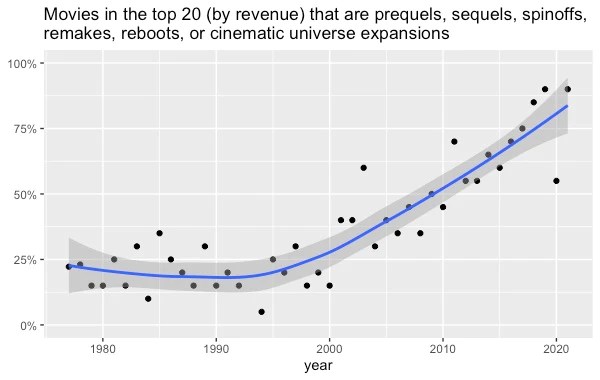
I looked at the 20 top-grossing movies going all the way back to 1977 (source), and I coded whether each was part of what film scholars call a “multiplicity”—sequels, prequels, franchises, spin-offs, cinematic universe expansions, etc. This required some judgment calls. Lots of movies are based on books and TV shows, but I only counted them as multiplicities if they were related to a previous movie. So 1990’s Teenage Mutant Ninja Turtles doesn’t get coded as a multiplicity, but 1991’s Teenage Mutant Ninja Turtles II: The Secret of the Ooze does, and so does the 2014 Teenage Mutant Ninja Turtles remake. I also probably missed a few multiplicities, especially in earlier decades, since sometimes it’s not obvious that a movie has some connection to an earlier movie.

Regardless, the shift is gigantic. Until the year 2000, about 25% of top-grossing movies were prequels, sequels, spinoffs, remakes, reboots, or cinematic universe expansions. Since 2010, it’s been over 50% ever year. In recent years, it’s been close to 100%.

Original movies just aren’t popular anymore, if they even get made in the first place.

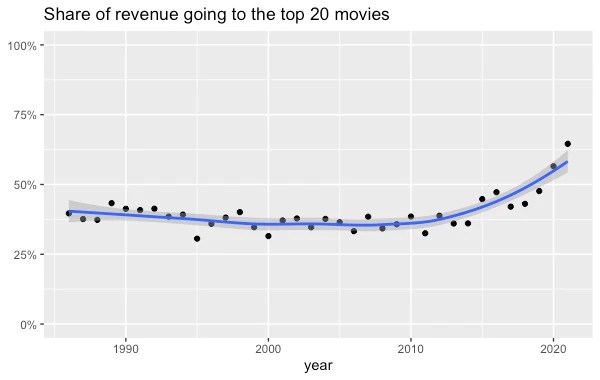
Top movies have also recently started taking a larger chunk of the market. I extracted the revenue of the top 20 movies and divided it by the total revenue of the top 200 movies, going all the way back to 1986 (source). The top 20 movies captured about 40% of all revenue until 2015, when they started gobbling up even more.

Television

Thanks to cable and streaming, there’s way more stuff on TV today than there was 50 years ago. So it would make sense if a few shows ruled the early decades of TV, and now new shows constantly displace each other at the top of the viewership charts.

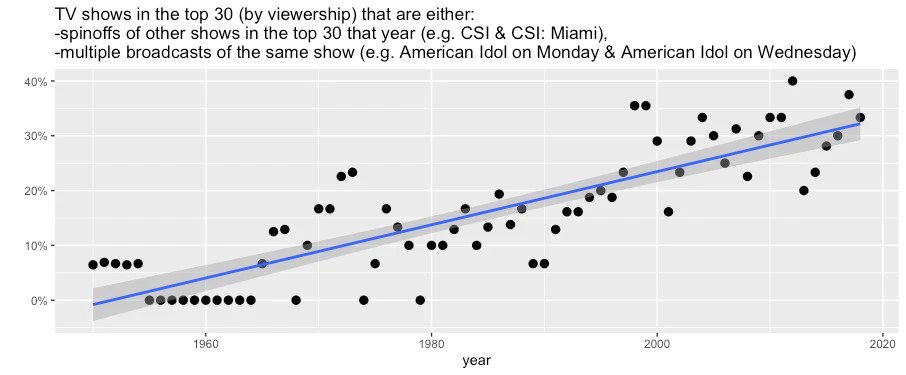
Instead, the opposite has happened. I pulled the top 30 most-viewed TV shows from 1950 to 2019 (source) and found that fewer and fewer franchises rule a larger and larger share of the airwaves. In fact, since 2000, about a third of the top 30 most-viewed shows are either spinoffs of other shows in the top 30 (e.g., CSI and CSI: Miami) or multiple broadcasts of the same show (e.g., American Idol on Monday and American Idol on Wednesday). 

Two caveats to this data. First, I’m probably slightly undercounting multiplicities from earlier decades, where the connections between shows might be harder for a modern viewer like me to understand––maybe one guy hosted multiple different shows, for example. And second, the Nielsen ratings I’m using only recently started accurately measuring viewership on streaming platforms. But even in 2019, only 14% of viewing time was spent on streaming, so this data isn’t missing much.

Music

It used to be that a few hitmakers ruled the charts––The Beatles, The Eagles, Michael Jackson––while today it’s a free-for-all, right?

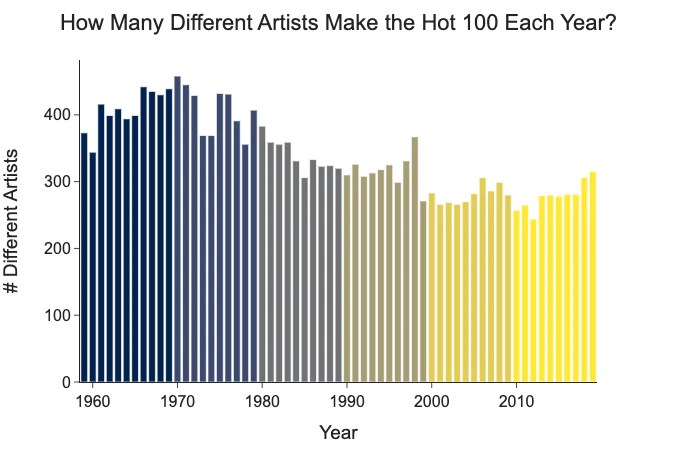
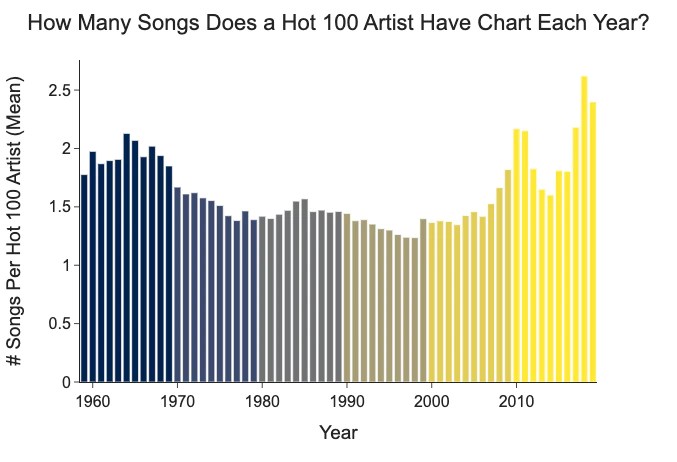
Nope. A data scientist named Azhad Syed has done the analysis, and he finds that the number of artists on the Billboard Hot 100 has been decreasing for decades.

And since 2000, the number of hits per artist on the Hot 100 has been increasing. 

(Azhad says he’s looking for a job––you should hire him!)

A smaller group of artists tops the charts, and they produce more of the chart-toppers. Music, too, has become an oligopoly.

Books

Literature feels like a different world than movies, TV, and music, and yet the trend is the same.

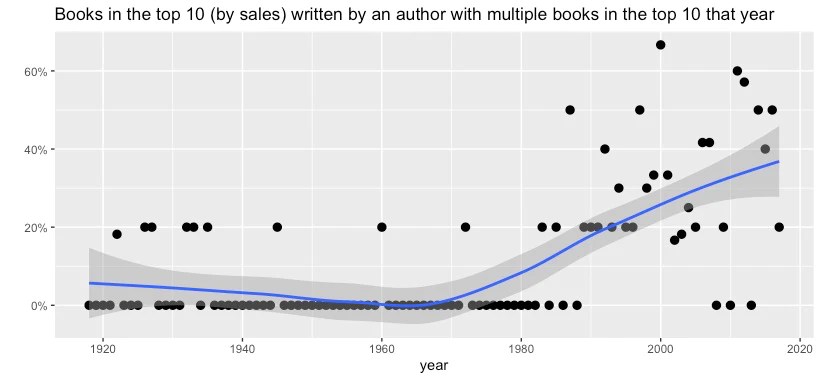
Using LiteraryHub’s list of the top 10 bestselling books for every year from 1919 to 2017, I found that the oligopoly has come to book publishing as well. There are a couple ways we can look at this. First, we can look at the percentage of repeat authors in the top 10––that is, the number of books in the top 10 that were written by an author with another book in the top 10.

It used to be pretty rare for one author to have multiple books in the top 10 in the same year. Since 1990, it’s happened almost every year. No author ever had three top 10 books in one year until Danielle Steel did it 1998. In 2011, John Grisham, Kathryn Stockett, and Stieg Larsson all had two chart-topping books each.

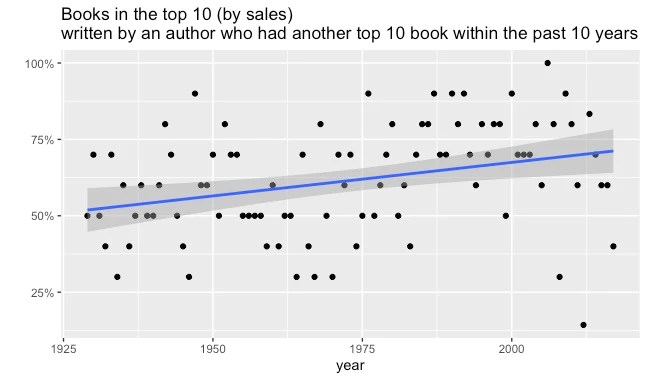
We can also look at the percentage of authors in the top 10 were already famous––say, they had a top 10 book within the past 10 years. That has increased over time, too. 

In the 1950s, a little over half of the authors in the top 10 had been there before. These days, it’s closer to 75%.

Video games

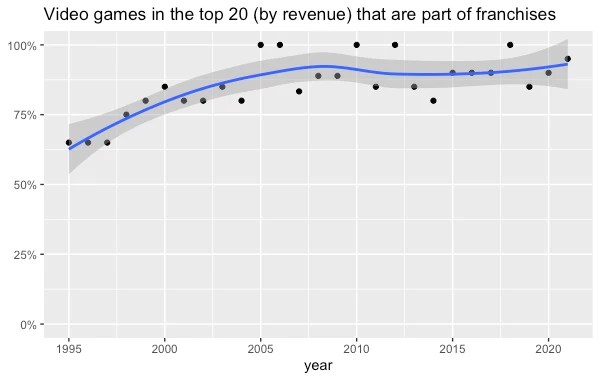
I tracked down the top 20 bestselling video games for each year from 1995 to 2021 (sources: 1234567) and coded whether each belongs to a preexisting video game franchise. (Some games, like Harry Potter and the Sorcerer’s Stone, belong to franchises outside of video games. For these, I coded the first installment as originals and any subsequent installments as franchise games.)

The oligopoly rules video games too:

In the late 1990s, 75% or less of bestselling video games were franchise installments. Since 2005, it’s been above 75% every year, and sometimes it’s 100%. At the top of the charts, it’s all Mario, Zelda, Call of Duty, and Grand Theft Auto.

Why is this happening?

Any explanation for the rise of the pop oligopoly has to answer two questions: why have producers started producing more of the same thing, and why are consumers consuming it? I think the answers to the first question are invasionconsolidation, and innovation. I think the answer to the second question is proliferation.

Invasion

Software and the internet have made it easier than ever to create and publish content. Most of the stuff that random amateurs make is crap and nobody looks at it, but a tiny proportion gets really successful. This might make media giants choose to produce and promote stuff that independent weirdos never could, like an Avengers movie. This can’t explain why oligopolization started decades ago––YouTube only launched in 2005, for example, and most Americans didn’t have broadband until 2007––but it might explain why it’s accelerated and stuck around.

Consolidation

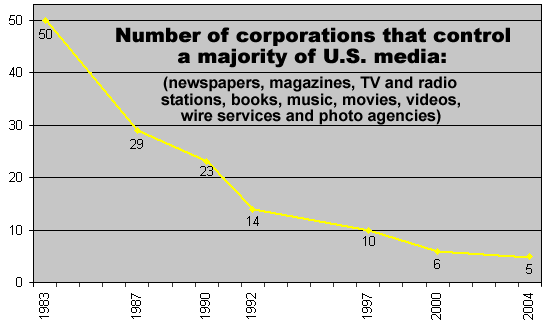
Big things like to eat, defeat, and outcompete smaller things. So over time, big things should get bigger and small things should die off. Indeed, movie studiosmusic labelsTV stations, and publishers of books and video games have all consolidated. Maybe it’s inevitable that major producers of culture will suck up or destroy everybody else, leaving nothing but superstars and blockbusters. Indeed, maybe cultural oligopoly is merely a transition state before we reach cultural monopoly.

Innovation

You may think there’s nothing left to discover in art forms as old as literature and music, and that they simply iterate as fashions change. But it took humans thousands of years to figure out how to create the illusion of depth in paintings. Novelists used to think that sentences had to be long and complicated until Hemingway came along, wrote some snappy prose, and changed everything. Even very old art forms, then, may have secrets left to discover. Maybe the biggest players in culture discovered some innovations that won them a permanent, first-mover chunk of market share. I can think of a few:

  • In books: lightning-quick plots and chapter-ending cliffhangers. Nobody thinks The Da Vinci Code is high literature, but it’s a book that really really wants you to read it. And a lot of people did!
  • In music: sampling. Musicians seem to sample more often these days. Now we not only remake songs; we franchise them too.
  • In movies, TV, and video games: cinematic universes. Studios have finally figured out that once audiences fall in love with fictional worlds, they want to spend lots of time in them. Marvel, DC, and Star Wars are the most famous, but there are also smaller universe expansions like Better Call Saul and El Camino from Breaking Bad and The Many Saints of Newark from The Sopranos. Video game developers have understood this for even longer, which is why Mario does everything from playing tennis to driving go-karts to, you know, being a piece of paper.

Proliferation

Invasion, consolidation, and innovation can, I think, explain the pop oligopoly from the supply side. But all three require a willing audience. So why might people be more open to experiencing the same thing over and over again?

As options multiply, choosing gets harder. You can’t possibly evaluate everything, so you start relying on cues like “this movie has Tom Hanks in it” or “I liked Red Dead Redemption, so I’ll probably like Red Dead Redemption II,” which makes you less and less likely to pick something unfamiliar. 

Another way to think about it: more opportunities means higher opportunity costs, which could lead to lower risk tolerance. When the only way to watch a movie is to go pick one of the seven playing at your local AMC, you might take a chance on something new. But when you’ve got a million movies to pick from, picking a safe, familiar option seems more sensible than gambling on an original.

This could be happening across all of culture at once. Movies don’t just compete with other movies. They compete with every other way of spending your time, and those ways are both infinite and increasing. There are now 60,000 free books on Project Gutenberg, Spotify says it has 78 million songs and 4 million podcast episodes, and humanity uploads 500 hours of video to YouTube every minute. So uh, yeah, the Tom Hanks movie sounds good.

What do we do about it?

Some may think that the rise of the pop oligopoly means the decline of quality. But the oligopoly can still make art: Red Dead Redemption II is a terrific game, “Blinding Lights” is a great song, and Toy Story 4 is a pretty good movie. And when you look back at popular stuff from a generation ago, there was plenty of dreck. We’ve forgotten the pulpy Westerns and insipid romances that made the bestseller lists while books like The Great GatsbyBrave New World, and Animal Farm did not. American Idol is not so different from the televised talent shows of the 1950s. Popular culture has always been a mix of the brilliant and the banal, and nothing I’ve shown you suggests that the ratio has changed.

The problem isn’t that the mean has decreased. It’s that the variance has shrunk. Movies, TV, music, books, and video games should expand our consciousness, jumpstart our imaginations, and introduce us to new worlds and stories and feelings. They should alienate us sometimes, or make us mad, or make us think. But they can’t do any of that if they only feed us sequels and spinoffs. It’s like eating macaroni and cheese every single night forever: it may be comfortable, but eventually you’re going to get scurvy. 

We haven’t fully reckoned with what the cultural oligopoly might be doing to us. How much does it stunt our imaginations to play the same video games we were playing 30 years ago? What message does it send that one of the most popular songs in the 2010s was about how a 1970s rock star was really cool? How much does it dull our ambitions to watch 2021’s The Matrix: Resurrections, where the most interesting scene is just Neo watching the original Matrix from 1999? How inspiring is it to watch tiny variations on the same police procedurals and reality shows year after year? My parents grew up with the first Star Wars movie, which had the audacity to create an entire universe. My niece and nephews are growing up with the ninth Star Wars movie, which aspires to move merchandise. Subsisting entirely on cultural comfort food cannot make us thoughtful, creative, or courageous.

Fortunately, there’s a cure for our cultural anemia. While the top of the charts has been oligopolized, the bottom remains a vibrant anarchy. There are weird books and funky movies and bangers from across the sea. Two of the most interesting video games of the past decade put you in the role of an immigration officer and an insurance claims adjuster. Every strange thing, wonderful and terrible, is available to you, but they’ll die out if you don’t nourish them with your attention. Finding them takes some foraging and digging, and then you’ll have to stomach some very odd, unfamiliar flavors. That’s good. Learning to like unfamiliar things is one of the noblest human pursuits; it builds our empathy for unfamiliar people. And it kindles that delicate, precious fire inside us––without it, we might as well be algorithms. Humankind does not live on bread alone, nor can our spirits long survive on a diet of reruns.

Saturday Matinee: Punk: Attitude

“Punk: Attitude” (2005) is a documentary tracing the roots, meaning and enduring influence of the punk movement of the late 70s and early 80s. Directed by Don Letts, the film offers an insider’s perspective because Letts was a catalyzing agent for the developing London punk scene, having run a clothing store called Acme Attractions and hosted parties as a reggae DJ, both often frequented by band members of groups such as The Sex Pistols, The Clash and The Pretenders. Letts later managed The Slits and began his film career as a director of Clash music videos.

Punk: Attitude also features interviews with artists directly and indirectly involved with the early punk scene including Wayne Kramer (The MC5), Mick Jones (The Clash), Jello Biafra (The Dead Kennedys), Chrissie Hynde (The Pretenders), and David Johansen (The New York Dolls) among many others. Though some punk fans may dispute the relevance of certain featured musicians or feel others were overlooked, the film provide a candid, fairly comprehensive and at times contradictory overview of punk rock as iconoclastic, raw and diverse as the music itself.

Inventing the Future: The Collective Joy of Mark Fisher’s ‘k-punk’

By Michael Grasso

Source: We Are the Mutants

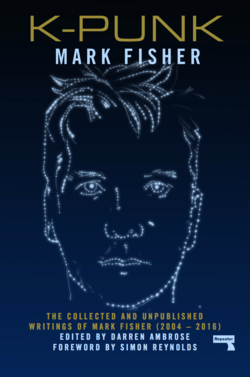
k-punk
By Mark Fisher
Foreword by Simon Reynolds, Edited by Darren Ambrose
Repeater Books, 2018

A little over two years ago, theorist and cultural critic Mark Fisher took his own life at the age of 48. I remember feeling numb at hearing the news; not out of sadness but more a sense of deja vu, of familiarity. I’d been through something similar already with David Foster Wallace’s suicide back in 2008; his Infinite Jest (1996) was one of the single most searing, searching moral indictments of the post-Cold War social and political order in the West, and a tremendously important work to me personally. Fisher toiled in very much the same fields in his writings. Both men had used their own struggles with depression (and in Wallace’s case, addiction) to fuel their insights into a world order that had run out of promise, of hope for the future. Wallace died two months before Barack Obama was elected, in the midst of the 2008 financial crisis; Fisher immediately after the election of Donald Trump. One American election offered (misplaced) hope, the other, a terminal kind of despair.

Over the past year or so I’ve also had the opportunity, while finishing my Master’s degree, to delve deeply into the work of cultural critic Walter Benjamin, who came to intellectual maturity in the Weimar Republic and found himself an exile with the rise of the Nazis in 1933. Like Wallace and Fisher, Benjamin used the cultural environment around him to help explain the world, to make sense of the turmoil that was roiling the once-orderly social order around him. Benjamin also killed himself, as he fled from the Nazi invasion of France in 1940 at the age of 48, just like Fisher. The parallels between all three men, to my mind, were uncanny. In the end, I feel the same thing got all three of these men: the encroaching feeling of dread at observing a world that had spun off its axis, beyond their ability to explain it.

I offer all this as a preface to my review of Mark Fisher’s collected online and unpublished writings, k-punk (Repeater Books, 2018), because I find myself thinking more often these days about the void of Fisher’s loss rather than the wealth of writings that he gave us while he was alive. And I feel like my despair essentially misunderstands what Mark Fisher was all about. The overwhelming feeling of most of the writings collected in k-punk is one of utter joy, whether it’s in celebrating a lost piece of media that Fisher wants us to know about, or his just and righteous delight in explaining exactly what late capitalism is doing to all of us.

A couple of years ago, my podcast partner Rob MacDougall and I had occasion to talk about the intellectual history of defining and preventing sexual harassment in the workplace for our podcast about WKRP in Cincinnati. And I’ll never forget the way he explained how clearly and uncompromisingly that defining a social problem can be the most important first step in combating it. He said, “Language is technology. Until you can name [something], you can’t get at it.” And I think that’s the legacy of Mark Fisher in a lot of ways. He gave us new terms—“pulp modernism,” “the precariat,” “hauntology,” “capitalist realism,” “acid communism”—that helped define not only our problems but our collective dreams for a better world. Like Benjamin before him, Fisher used his precise and profoundly moral observations of the world around him to give us a vocabulary to understand and express what is being done to us and how we can find our way out of it.

First things first: k-punk is a monster. Repeater Books has collected Fisher’s blog posts and unpublished writings in a massive 800-page tome. Given that the average length of one of these essays is about 3-4 pages, what you end up with is a bewilderingly encyclopedic collection of Fisher’s thoughts on seemingly everything. The conversion of once-hyperlink-laden web text to paper is sometimes jarring—the editor Darren Ambrose has done yeoman work in providing footnotes to mark where links to other bloggers and commenters once lay—but the reader almost never feels lost in figuring out what Fisher was trying to say. The foreword is by Fisher’s contemporary and friend, the music critic Simon Reynolds, whose seminal 2005 work on post-punk, Rip It Up and Start Again, is a favorite of mine. The same author’s 2011 Retromania: Pop Culture’s Addiction to Its Own Past was, like Fisher’s work, a major inspiration for my own Master’s capstone project on nostalgia and its use in museums. Reynolds’ foreword is not only a heartfelt and deeply touching tribute to Fisher’s life and work, it also illustrates well the cultural milieu in which both men worked in the early part of this century. Getting to know someone better by reading their blog everyday is a deeply familiar mode to me and many members of my generation, and here Reynolds nails the somewhat uncanny feeling of getting to be best friends with someone you’ve only hung out with a few times in person. Probably it will be less strange for the generations who come after us. I do admit stifling a chuckle as one of the first essays in this paperback collection is a “tag five friends” meme; seeing such an essentially “online” phenomenon in print, in an esteemed cultural critic’s essay collection no less, would probably be considered “weird” in the Fisherian “weird/eerie” schema: an intruder from Outside whose alien presence inflects its surroundings.

In his foreword, Reynolds dubs Fisher a member of a disappearing breed: “the music critic as prophet.” Both Reynolds and Fisher came of age in the golden era of British publications like the NME, which treated its readers with a modicum of sophistication and intellectual respect. British music critics in the 1980s were never afraid to throw in references to contemporary political philosophers and cultural critics from the world of academia, nor were they reluctant to blur the lines between artist and critic. Fisher himself offers tribute to one of these writer-artists in “Choose Your Weapons,” an essay focusing on NME writer and Art of Noise member/ZTT Records co-founder Paul Morley, as well as his fellow NME writer Ian Penman. Reynolds sees Fisher as the clear heir to this type of rock journalist; Fisher even had his own musical group in the early 1990s, D-Generation, which peppered press releases and music with references to cultural theory.

As mentioned above and in my earlier piece on him, Fisher was never afraid to unearth a piece of forgotten media from his childhood or adolescence for examination in the cold light of our present late capitalism. His mourning for the loss of risk-taking on the part of the gatekeepers at public broadcasters such as the BBC is well-known. (I highly recommend the essay “Precarity and Paternalism” in k-punk for Fisher’s breathtaking rhetorical link between the blandness of pop culture today and the burning down of the public sphere under neoliberalism.) But what k-punk puts forth clearly (and Reynolds makes clear in his foreword) is that Fisher was never solely a backwards-looking critic. In these essays you can see him fully engaged in the contemporary cultural scene in a way that can sometimes get lost in his reputation as “the hauntology guy.” I found Fisher’s recuperation of Donnie Darko director Richard Kelly’s odd little Twilight Zone riff from 2009, The Box, to be downright essential in explaining why I liked it so much but couldn’t articulate why at the time. Ironically, Fisher avers that it is a rare piece of American hauntology (an aesthetic I’ve been desperately trying to quantify here at We Are the Mutants), with Kelly exploring the legacy of his NASA employee dad during NASA’s own final years of glory as a public agency (the late ’70s era of the Viking and Voyager probes) before the ultimately doomed Shuttle program. As someone who only gave the k-punk blog a cursory look prior to Fisher’s death, being far more familiar with his published writings, reading Fisher on the Christopher Nolan Batman trilogy or on contemporary television series that I watched from the beginning, like Breaking Bad and The Americans, hit me in that same Fisherian-weird way.

Even though the essays in the k-punk collection are organized by content type—reviews of books, music, television/film, political writings, interviews—it’s easy to note Fisher’s evolution as a writer, with each content area organized chronologically within. Perhaps this is only my prejudice, but I notice in the early years of Fisher’s k-punk posts a distinct anxiety of influence with older writers and theoreticians, out of which he eventually matures. His early-’00s work centers writers and thinkers like J.G. Ballard, Franz Kafka, Dennis Potter, even Freud and Spinoza. Slavoj Žižek also looms very large, probably for no other reason than that he was (and still is) one of the only voices engaging intelligently with the political impact of the pop culture detritus of late capitalism. But it’s in this occasional early tension with Žižek that you start to see Fisher make his own conclusions, state his own thoughts. It’s not necessarily that Fisher ever makes an explicit break with Žižek; it’s just that you see him mentioned less and less and, finally, not at all.

It was in music that Fisher saw the greatest potential for social and cultural revolution. It’s become a thoroughly lazy trope among armchair cultural critics to keep quoting that bit from Plato’s Republic about how changing a society’s music will change the society, but Fisher actually convinces the reader of that idea, in a profoundly vital and contemporary context. For Fisher, mod, glam, and to a certain extent punk all offered the working classes a chance to grab the same aristocratic glamor and glory to which the bourgeoisie had always had access. (Reading Fisher on the unearthly magical “glamour” of pop stars gets me thinking about Kieron Gillen’s “gods come to earth as pop stars” comic The Wicked + the Divine; I’d be shocked if Gillen wasn’t a k-punk reader from way back.) I personally find Fisher far stronger on post-punk. His multi-part examination of The Fall and Mark E. Smith is downright essential; I thought often while reading how much I wish Fisher could have read Richard McKenna’s Sapphire And Steel-referencing encomium to Smith. A pure love of Green Gartside of Scritti Politti and his dance-floor theoretics, so beloved by that very same theory-soaked 1980s NME, shines through in several k-punk essays. Fisher’s multiple essays on the goth aesthetic (and adjunct aesthetic movements like steampunk) are insightful, even as he holds goth at a bit of a remove as compared to post-punk and dance music. His essays on the Cure, Nick Cave, and specifically Siouxsie Sioux’s visual aesthetic from early swastika-armband-wearing punk provocateur to glittering Klimt spectacle on A Kiss in the Dreamhouse are particularly good.

And it’s here in Fisher’s music writing that we see yet another evolution, this time in three phases roughly analogous to the Marxist-Fichtean dialectic. Fisher begins with an arguably essentialist, archetypal, borderline Paglian view of the aristocratic charisma inherent in pop music; moves to a canny and earnest recognition of the purely proletarian qualities of post-punk and dance music (and the paradoxically populist power of the “public information” aesthetic of hauntological music); and then shifts to an eventual synthesis of these very different conceptions of music-as-liberation.

That synthesis was to be the topic of his next book, Acid Communism, the preface for which is included at the end of k-punk: Fisher was going to look back at the origin point for neoliberalism in the 1970s and pinpoint exactly where the workers’ movement and the left had begun to lose the battle for power. Through a re-examination of the 1960s New Left under thinkers such as Herbert Marcuse, Fisher locates the real revolutionary promise and potential in the bewildering flowering of popular culture that occurred in the ’60s, as well as the profound societal change that this revolution in culture propelled. “Mass culture—and music culture in particular—was a terrain of struggle rather than a dominion of capital,” Fisher notes. The true conflict of workers’ leftism vs. neoliberalism, Fisher argued, happened nearly a decade before neoliberalism’s origin point, in the struggle between the liberal Cold War orthodoxies in the West and the profoundly psychedelic movement of the youth rebelling against these staid establishment cultural tendencies. In America, of course, this series of youth movements became inexorably intertwined with resistance to the Vietnam War, perhaps to its detriment. Fisher posits instead a youth movement that worked against the assumptions of Cold War-era society on a much more elemental level. He finds much more interesting the movements where the left chafed against the High Cold War hegemony of labor-leftism in the West and indeed the very idea of work, and sees glimmers of his “acid communism” in social milieus as disparate as Paris in 1968, the British miners’ strike (aided by students) in 1972, the GM strike in Lordstown Ohio in 1972, and Bologna in 1977. The essential question asked in all these times and places: what if the revolution happens and we are in thrall to just another set of labor bureaucrats? One might answer that this actually happened with the ascension of the Baby Boomers to places of authority in the supposedly kinder, gentler, more “diverse” digital capitalism we live with today.

Obviously, virtually every bit of cultural writing that Fisher published was viewed through the prism of a leftist politics, but in the Politics and Interviews sections of k-punk, we get those politics unfiltered through any particular piece of pop culture. Here is where you see Fisher at his most passionate, his most personal, his most vital. Most important, in my mind, is his relentless insistence that capitalism kills both body and soul. While a Marxist theory of alienation is certainly nothing new, Fisher’s own personal experiences with being a member of the “precariat,” dealing with the peculiar doublethink of the purported “freedom” of the gig economy, demonstrates how the market hands us all slavery in the guise of self-actualization. And here is where Fisher’s writing intersects with his profound personal interest in public health, specifically mental health. Digital technology allows the gig worker to be relentlessly surveilled and ruthlessly “reviewed”; the disappearance of the old forms of authority and hierarchy in the workplace are distributed among one’s fellow consumers to create a web of virtual bureaucracy that creates constant cognitive dissonance and the distinct feeling that one is truly never off the job. From the ancient dream of never working to the modern reality of constantly working: Fisher thus asks us over and over if it’s any wonder we are all anxious and depressed?

It’s glaringly obvious stuff to most of us living in 2019, but again: Fisher’s moral clarity shines through and illuminates the darker corners of a world to which we’ve all slowly acquiesced. And yes, Mark Fisher did suffer from severe depression himself. One of the editorial decisions that I disagree with most is the stated decision to not include Fisher’s more “pessimistic” work from earlier in his career. Here is k-punk‘s editor Ambrose on this decision:

A very small number of early k-punk posts, e.g. on antinatalism, are excluded by virtue of the fact that they seemed wildly out of step with Mark’s overall theoretical and political development, and because they seemed to reflect a temporary enthusiasm for a dogmatic theoretical misanthropy he repudiated in his later writing and life.

You still see glimpses of this pessimism and near-nihilism in a few of the essays; a startlingly good review of Mel Gibson’s The Passion of the Christ where Fisher sees its neo-Gnostic underpinnings, or a deep intrigue with the antinatalist works of horror writer and philosopher Thomas Ligotti (who would find unexpected mass popularity with Nic Pizzolatto’s use of Ligotti in the first season of True Detective). But speaking as someone who suffers with mental illness and profound depression, let me make clear: it is absolutely reasonable to expect someone even as optimistic and positive as Fisher to occasionally look at the world with abject despair. Moreover, I believe it is more than merely reasonable, it’s necessary. To dispute or deny that anyone with a modicum of political awareness would not be occasionally nihilistically fucking depressed with the world as it is today seems a massive mistake to me.

Immediately before presenting the unfinished introduction to Acid Communism, we’re presented with two of Fisher’s most famous essays: his polemic against the contemporary left’s tendency towards ideological puritanism, “Exiting the Vampire Castle,” and his personal memoir of living (and working) with depression, “Good For Nothing.” No two pieces in this book depict the central contradictions and tensions of Fisher’s ethics and philosophy more clearly. “Vampire Castle” is, in my personal opinion, one of Fisher’s greatest missteps and the one piece of his writing where I most see a distressing tendency towards a lack of empathy for his comrades. In the essay, Fisher excoriates a certain faction of the left and its tendency to center “identity politics.” He further posits that these identity-based politics are a way in which the mechanisms of late capitalist control attempt to neuter and split the political left, a profoundly “individualistic” movement rather than one that builds cross-cultural solidarity. Fisher states that humorless scolds participating in “call-out culture” are preventing the left from building true power. Every time I go back to this essay, I initially find myself seeing some some modicum of logic in Fisher’s arguments. But then I remember how much of the modern capitalism that Fisher despised is literally built on the backs of genocide, racism, slavery, colonialism. I remember all of capitalism’s own constant essentializing and dividing of the proletariat, purely on the basis of identity, a superstructure that has systematically disenfranchised entire peoples on this globe, and ultimately I react with, “This is the kind of take that only a white guy from Britain could make.” It’s tone-deaf, destructive, and has given fuel to the worst strains of white exceptionalism and disdain for so-called “idpol” on the left in the past few years. I would argue that nothing good and quite a bit that is bad has come from it.

In fact, I wish someone would’ve told Mark how harmful this piece was. I have a feeling all it would have taken is one person—a woman, a person of color, an indigenous person, someone queer—to explain to him that while there should obviously be solidarity on the left, there are profound issues of historical materialism here that stretch back centuries, unfinished work that needs a profound upheaval and seizure of power from below (and yes, to some degree the anger and fury and the positive social knock-on effects of a “call-out culture”) to even begin to deal with restoratively. I want to believe he’d understand. It can be true that the capitalist powers-that-be love watching the left devour their own over issues that might seem personalized and “individual” to a white British man, but it can also be true that the profound historical injustices inflicted on colonized peoples the world over need to be centered in any revolutionary left solidarity. Both can be true.

And then you have “Good For Nothing,” an essay that I can say confidently has saved my life, maybe several times, since I first read it a few years ago. It is overflowing with empathy: for those of us hedged in by our class identities and made to feel inferior, uneducated, unworthy, a cog in a machine that only views us for how useful we can be to an employer or to the economy. It is a crisp distillation of every piece of personal writing Fisher ever wrote about the dehumanizing and alienating collective psychological effects of neoliberalism. Most importantly, it is a clarion call for solidarity:

For some time now, one of the most successful tactics of the ruling class has been responsibilisation. Each individual member of the subordinate class is encouraged into feeling that their poverty, lack of opportunities, or unemployment, is their fault and their fault alone. Individuals will blame themselves rather than social structures, which in any case they have been induced into believing do not really exist (they are just excuses, called upon by the weak)…

Collective depression is the result of the ruling class project of resubordination. For some time now, we have increasingly accepted the idea that we are not the kind of people who can act. This isn’t a failure of will any more than an individual depressed person can “snap themselves out of it” by “pulling their socks up.” The rebuilding of class consciousness is a formidable task indeed, one that cannot be achieved by calling upon ready-made solutions—but, in spite of what our collective depression tells us, it can be done. Inventing new forms of political involvement, reviving institutions that have become decadent, converting privatised disaffection into politicised anger: all of this can happen, and when it does, who knows what is possible?

This call for collective action on a political, economic, psychological, and even spiritual level is the voice of Mark Fisher’s that I remember and hold close to my heart every day. In every one of us there is a person worthy of respect and dignity, regardless of how “useful” we might be to a boss or a manager; in all of us a person who deserves not to live a life of misery, a person worthy of joy and music and glamour. That’s the Mark Fisher who throbs under the surfaces of nearly every one of these 800 pages. k-punk is a fitting tribute to a thinker who showed us the wonder in our past and the promise in our future, if we but remembered each other and not merely ourselves.


Michael Grasso is a Senior Editor at We Are the Mutants. He is a Bostonian, a museum professional, and a podcaster. You can read his thoughts on museums and more on Twitter at @MuseumMichael.

Cosmic Pessimism

By Eugene Thacker

Source: continent.

We’re Doomed.
Pessimism is the night-side of thought, a melodrama of the futility of the brain, a poetry written in the graveyard of philosophy. Pessimism is a lyrical failure of philosophical thinking, each attempt at clear and coherent thought, sullen and submerged in the hidden joy of its own futility. The closest pessimism comes to philosophical argument is the droll and laconic “We’ll never make it,” or simply: “We’re doomed.” Every effort doomed to failure, every project doomed to incompletion, every life doomed to be unlived, every thought doomed to be unthought.

Pessimism is the lowest form of philosophy, frequently disparaged and dismissed, merely the symptom of a bad attitude. No one ever needs pessimism, in the way that one needs optimism to inspire one to great heights and to pick oneself up, in the way one needs constructive criticism, advice and feedback, inspirational books or a pat on the back. No one needs pessimism, though I like to imagine the idea of a pessimist activism. No one needs pessimism, and yet everyone—without exception—has, at some point in their lives, had to confront pessimism, if not as a philosophy then as a grievance—against one’s self or others, against one’s surroundings or one’s life, against the state of things or the world in general.

There is little redemption for pessimism, and no consolation prize. Ultimately, pessimism is weary of everything and of itself. Pessimism is the philosophical form of disenchantment—disenchantment as chanting, a chant, a mantra, a solitary, monophonic voice rendered insignificant by the intimate immensity surrounding it.

In pessimism, the first axiom is a long, low, funereal sigh.

~*~

We’re Still Doomed.
No one has time for pessimism. After all, there are only so many hours in a day. Whatever our temperament, happy or sad, engaged or disengaged, we know pessimism when we hear it. The pessimist is usually understood as the complainer, forever pointing out what is wrong with the world without ever once offering a solution. But more often than not pessimists are the quietest of philosophers, submerging their own sighs within the lethargy of discontent. What little sound it makes is of interest to no one—“I’ve heard it all before,” “tell me something I don’t know,” sound and fury, signifying nothing. In raising problems without solutions, in posing questions without answers, in retreating to the hermetic, cavernous abode of complaint, pessimism is guilty of that most inexcusable of Occidental crimes—the crime of not pretending it’s for real. Pessimism fails to live up to the most basic tenet of philosophy—the “as if.” Think as if it will be helpful, act as if it will make a difference, speak as if there is something to say, live as if you are not, in fact, being lived by some murmuring non-entity both shadowy and muddied.

Had it more self-assurance and better social skills, pessimism would turn its disenchantment into a religion, possibly calling itself The Great Refusal. But there is a negation in pessimism that refuses even such a Refusal, an awareness that, from the start, it has already failed, and that the culmination of all that is, is that all is for naught.

Pessimism tries very hard to present itself in the low, sustained tones of a Requiem Mass, or the tectonic rumbling of Tibetan chant. But it frequently lets loose dissonant notes at once plaintive and pathetic. Often, its voice cracks, its weighty words abruptly reduced to mere shards of guttural sound.

~*~

Maybe It’s Not So Bad, After All.
If we know pessimism when we hear it, this is because we’ve heard it all before—and we didn’t need to hear it in the first place. Life is hard enough. What you need is a change of attitude, a new outlook, a shift in perspective… a cup of coffee.

If we have no ears for pessimism, this is because it is always reducible to something as reliably mutable as a voice. If pessimism is so frequently disparaged, it is because it brings everyone down, determined as it is to view each day as a bad day, if only by virtue of the fact that it is not yet a bad day. For pessimism the world is brimming with negative possibility, the collision of a bad mood with an impassive world. In fact, pessimism is the result of a confusion between the world and a statement about the world, a confusion that also prevents it from fully entering the hallowed halls of philosophy. If pessimism is so often dismissed, this is because it is often impossible to separate a “bad mood” from a philosophical proposition (and do not all philosophies stem from a bad mood?)

The very term “pessimism” suggests a school of thought, a movement, even a community. But pessimism always has a membership of one—maybe two. Ideally, of course, it would have a membership of none, with only a scribbled, illegible note left behind by someone long forgotten. But this seems unrealistic, though one can always hope.

~*~

Anatomy of Pessimism.
Though it may locate itself at the margins of philosophy, pessimism is as much subject to philosophical analysis as any other form of thought. Pessimism’s lyricism of failure gives it the structure of music. What time is to the music of sorrow, reason is to a philosophy of the worst. Pessimism’s two major keys are moral and metaphysical pessimism, its subjective and objective poles, an attitude towards the world and a claim about the world. For moral pessimism, it is better not to have been born at all; for metaphysical pessimism, this is the worst of all possible worlds. For moral pessimism the problem is the solipsism of human beings, the world made in our own image, a world-for-us. For metaphysical pessimism, the problem is the solipsism of the world, objected and projected as a world-in-itself. Both moral and metaphysical pessimism are compromised philosophically; moral pessimism by its failure to locate the human within a larger context, and metaphysical pessimism by its failure to recognize the complicity in the very claim of realism.

This is how pessimism makes its music of the worst, a generalized misanthropy without the anthropos. Pessimism crystallizes around this futility—it is its amor fati, rendered as musical form.

~*~

Melancholy of Anatomy.
There is a logic of pessimism that is fundamental to its suspicion of philosophical system. Pessimism involves a statement about a condition. In pessimism each statement boils down to an affirmation or a negation, just as any condition boils down to the best or the worst.

With Schopenhauer, that arch-pessimist, the thinker for whom the philosopher and the curmudgeon perfectly overlap, we see a no-saying to the worst, a no-saying that secretly covets a yes-saying (through asceticism, mysticism, quietism), even if this hidden yes-saying is a horizon at the limits of comprehension. With Nietzsche comes the pronouncement of a Dionysian pessimism, a pessimism of strength or joy, a yes-saying to the worst, a yes-saying to this world as it is. And with Cioran yet another variation, futile yet lyrical, a no-saying to the worst, and a further no-saying to the possibility of any other world, in here or out there. With Cioran one approaches, but never reaches, an absolute no-saying, a studied abandonment of pessimism itself.

The logic of pessimism moves through three refusals: a no-saying to the worst (refusal of the world-for-us, or Schopenhauer’s tears); a yes-saying to the worst (refusal of the world-in-itself, or Nietzsche’s laughter); and a no-saying to the for-us and the in-itself (a double refusal, or Cioran’s sleep).

Crying, laughing, sleeping—what other responses are adequate to a life that is so indifferent?

~*~

Cosmic Pessimism.
Both moral and metaphysical pessimism point to another kind, a pessimism that is neither subjective nor objective, neither for-us nor in-itself, and instead a pessimism of the world-without-us. We could call this a cosmic pessimism… but this sounds too majestic, too full of wonder, too much the bitter aftertaste of the Great Beyond. Words falter. And so do ideas. And so we have a cosmic pessimism, a pessimism that is first and last a pessimism about cosmos, about the necessity and possibility of order. The contours of cosmic pessimism are a drastic scaling-up or scaling-down of the human point of view, the unhuman orientation of deep space and deep time, and all of this shadowed by an impasse, a primordial insignificance, the impossibility of ever adequately accounting for one’s relationship to thought—all that remains of pessimism is the desiderata of affects—agonistic, impassive, defiant, reclusive, filled with sorrow and flailing at that architectonic chess match called philosophy, a flailing that pessimism tries to raise to the level of an art form (though what usually results is slapstick).

~*~

Song of Futility.
An ethics of futility pervades pessimism. Futility, however, is different from fatality, and different again from simple failure (though failure is never simple). Failure is a breakage within the heart of relations, a fissure between cause and effect, a fissure hastily covered over by trying and trying again. With failure, there is always plenty of blame to go around; it’s not my fault, it’s a technical difficulty, it’s a miscommunication. For the pessimist, failure is a question of “when,” not “if”—failure as a metaphysical principle. Everything withers and passes into an obscurity blacker than night, everything from the melodramatic decline of a person’s life to the banal flickering moments that constitute each day. Everything that is done undone, everything said or known destined for a kind of stellar oblivion.

When scaled up in this way, failure becomes fatality. Fatality is the hermeticism of cause and effect. In fatality, everything you do, whatever you do, always leads to a certain end, and ultimately to the end—though that end, or the means to that end, remain shrouded in obscurity. Nothing you do makes a difference because everything you do makes a difference. Hence the effects of your actions are hidden from you, even as you deceive yourself into thinking that, at last, this time you will outwit the order of things. By having a goal, planning ahead, and thinking things through carefully, we attempt, in a daily Prometheanism, to turn fatality to our advantage, to gain a glimpse of an order that seems buried deeper and deeper in the fabric of the universe.

But even fatality has its comforts. The chain of cause and effect may be hidden from us, but that’s just because disorder is the order we don’t yet see; it’s just complex, distributed, and requires advanced mathematics. Fatality still clings to the sufficiency of everything that exists… When fatality relinquishes even this idea, it becomes futility. Futility arises out of the grim suspicion that, behind the shroud of causality we drape over the world, there is only the indifference of what exists or doesn’t exist; whatever you do ultimately leads to no end, an irrevocable chasm between thought and world. Futility transforms the act of thinking into a zero-sum game.

~*~

Song of the Worst.
At the center of pessimism lies the term pessimus, “the worst,” a term as relative as it is absolute. The worst is about as bad as it gets, “the worst” as “the best” in disguise, shrouded by the passage of time or the twists and turns of fortune. For the pessimist, “the worst” is the propensity for suffering that gradually occludes each living moment, until it eclipses it entirely, overlapping perfectly in death… which, for the pessimist, is no longer “the worst.”

Pessimism is marked by an unwillingness to move beyond “the worst,” something only partially attributable to a lack in motivation. In pessimism “the worst” is the ground that gives way beneath every existent—things could be worse, and, things could be better. “The worst” invariably implies a value judgment, one made based on scant evidence and little experience; in this way, pessimism’s greatest nemesis is its moral orientation. Pessimism’s propositions have all the gravitas of a bad joke.

Perhaps this is why the true optimists are the most severe pessimists—they are optimists that have run out of options. They are almost ecstatically inundated by the worst. Such an optimism is the only possible outcome of a prolonged period of suffering, physical or metaphysical, intellectual or spiritual. But does this not also describe all the trials and tribulations of each day—in short, of “life?” It seems that sooner or later we are all doomed to become optimists of this sort (the most depressing of thoughts…)

~*~

Song of Doom.
Rather than serving as a cause for despair, gloom and doom are the forms of consolation for any pessimist philosophy. Neither quite affects nor quite concepts, gloom and doom transform pessimism into a mortification of philosophy.

Doom is not just the sense that all things will turn out badly, but that all things inevitably come to an end, irrespective of whether or not they really do come to an end. What emerges from doom is a sense of the unhuman as an attractor, a horizon towards which the human is fatally drawn. Doom is humanity given over to unhumanity in an act of crystalline self-abnegation.

Gloom is not simply the anxiety that precedes doom. Gloom is literally atmospheric, climate as much as impression, and if people are also gloomy, this is simply the by-product of an anodyne atmosphere that only incidentally involves human beings. Gloom is more climatological than psychological, the stuff of dim, hazy, overcast skies, of ruins and overgrown tombs, of a misty, lethargic fog that moves with the same languorousness as our own crouched and sullen listening to a disinterested world.

In a sense, gloom is the counterpoint to doom—what futility is to the former, fatality is to the latter. Doom is marked by temporality—all things precariously drawn to their end—whereas gloom is the austerity of stillness, all things sad, static, and suspended, a meandering smoke hovering over cold lichen stones and damp fir trees. If doom is the terror of temporality and death, then gloom is the horror of a hovering stasis that is life.

At times I like to imagine that this realization alone is the thread that connects the charnel ground Aghori and the graveyard poets.

~*~

Song of Spite.
There is an intolerance in pessimism that knows no bounds. In pessimism spite begins by fixing on a particular object of spite—someone one hardly knows, or someone one knows too well; a spite for this person or a spite for all of humanity; a spectacular or a banal spite; a spite for a noisy neighbor, a yapping dog, a battalion of strollers, the meandering idiot walking in front of you on their smart phone, large loud celebrations, traumatic injustices anywhere in the world regurgitated as media blitz, spite for the self-absorbed and overly performative people talking way too loud at the table next to you, technical difficulties and troubleshooting, the reduction of everything to branding, spite of the refusal to admit one’s own errors, of self-help books, of people who know absolutely everything and make sure to tell you, of all people, all living beings, all things, the world, the spiteful planet, the inanity of existence…

Spite is the motor of pessimism because it is so egalitarian, so expansive, it runs amok, stumbling across intuitions that can only half-heartedly be called philosophical. Spite lacks the confidence and the clarity of hatred, but it also lacks the almost cordial judgment of dislike. For the pessimist, the smallest detail can be an indication of a metaphysical futility so vast and funereal that it eclipses pessimism itself—a spite that pessimism carefully places beyond the horizon of intelligibility, like the experience of dusk, or like the phrase, “it is raining jewels and daggers.”

~*~

Song of Sleep.
A paraphrase of Schopenhauer: what death is for the organism, sleep is for the individual. Pessimists sleep not because they are depressed, but because for them sleep is a form of ascetic practice. Sleep is the askesis of pessimism. If, while sleeping, we have a bad dream, we abruptly wake up, and suddenly the horrors of the night vanish. There is no reason to think that the same does not happen with the bad dream we call “life.”

~*~

Song of Sorrow.
Nietzsche, commenting on pessimism, once castigated Schopenhauer for taking things too lightly. He writes:

…Schopenhauer, though a pessimist, really—played the flute. Every day, after dinner: one should read his biography on that. And incidentally: a pessimist, one who denies God and the world but comes to a stop before morality—who affirms morality and plays the flute… what? Is that really—a pessimist?

We know that Schopenhauer did possess a collection of instruments, and we also know that Nietzsche himself composed music. There is no reason to think that either of them would ever banish music from the Republic of philosophy.

But Nietzsche’s jibes at Schopenhauer are as much about music as they are about pessimism. For the pessimist who says no to everything and yet finds comfort in music, the no-saying of pessimism can only be a weak way of saying yes—the weightiest statement undercut by the flightiest of replies. The least that Schopenhauer could’ve done is to play the bass.I’m not a big fan of the flute, or, for that matter, wind instruments generally. But what Nietzsche forgets is the role that the flute has historically played in Greek tragedy. In tragedy, the flute (aulos) is not an instrument of levity and joy, but of solitude and sorrow. The Greek aulos not only expresses the grief of tragic loss, but it does so in a way that renders weeping and singing inseparable from each other. The classicist Nicole Loraux calls this the mourning voice. Set apart from the more official civic rituals of funerary mourning, the mourning voice of Greek tragedy constantly threatens to dissolve song into wailing, music into moaning, and the voice into a primordial, disarticulate anti-music. The mourning voice delineates all the forms of suffering—tears, weeping, sobbing, wailing, moaning, and the convulsions of thought reduced to an elemental unintelligibility.

In the collapsed space between the voice that speaks and the voice that sings, pessimism discovers its mourning voice. Pessimism: the failure of sound and sense, the disarticulation of phone and logos.

Have we rescued Schopenhauer from Nietzsche? Probably not. Perhaps Schopenhauer played the flute to remind himself of the real function of the mourning voice—sorrow, sighs, and moaning rendered indistinguishable from music, the crumbling of the human into the unhuman. Failure par excellence of pessimism.

~*~

Song of Nothing.
In Buddhist thought, the First Noble Truth of existence is encapsulated in the Pali term dukkha, conventionally translated as “suffering,” “sorrow,” or “misery.” The Buddhist teachings are clear, however, that this is an objective claim, and not simply one point of view among others. Existence is suffering and sorrow—and yet this is not, the teachings tell us, a pessimistic attitude.

It is likely that Schopenhauer, reading the Buddhist texts available to him, recognized some filiation with the concept of dukkha. But dukkha is a multi-faceted term. There is, certainly, dukkha in the usual sense of the suffering, strife, and loss associated with living a life. But this is, in turn, dependent on the finitude and temporality of dukkha, existence as determined by impermanence and imperfection. And this ultimately points to the way in which both suffering and finitude are grounded by the paradoxical groundlessness of dukkha as a metaphysical principle—the insubstantiality and the emptiness of all that is. Beyond what is worse to me, beyond a world ordered for the worst, there is the emptiness of dukkha as an impersonal suffering… the tears of the cosmos.

In this context, it is easy to see how Schopenhauer’s pessimism attempts to compress all the aspects of dukkha into a nothingness at the core of existence, a Willlessness coursing through the Will. Though one thing for certain is that with Schopenhauer we do not find the “ever-smiling” countenance of Buddhism—or do we?

The texts of the Pali Canon also contain lists of the different types of happiness—including the happiness of renunciation and the strange happiness of detachment. But Buddhism considers even the different types of happiness as part of dukkha, in this final sense of nothingness or emptiness. Perhaps Schopenhauer understood Buddhism better than he is usually given credit for. Thus the experiment of Schopenhauer’s philosophy—the point at which a Western pessimus and an Eastern dukkha overlap or exchange glances. Empty sorrow, a lyricism of indifference. The result is a strange, and ultimately untenable, nocturnal form of Buddhism.

~*~

Cioran once called music a “physics of tears.” If this is true, then perhaps metaphysics is its commentary. Or its apology.

~*~

Pessimism would be more mystical were it not for its defeatism. Mysticism is much too proactive for the pessimist, and pessimism too impassive even for the mystic. At the same time, there is something enviable about mysticism—despite its sufferings. There is a sense in which pessimists are really failed mystics.

~*~

You, the Night, and the Music.
In a suggestive passage, Schopenhauer once noted that, “music is the melody to which the world is the text.”

Given Schopenhauer’s view on life—that life is suffering, that human life is absurd, that the nothingness before my birth is equal to the nothingness after my death—given all this, one wonders what kind of music Schopenhauer had in mind when he described music as the melody to which the world is text—was it opera, a Requiem Mass, a madrigal, or perhaps a drinking song? Or something like Eine kleine Nachtmusik, a little night music for the twilight of thought, a sullen nocturne for the night-side of logic, an era of sad wings sung by a solitary banshee.

Perhaps the music Schopenhauer had in mind is music eliminated to non-music. A whisper would suffice. Perhaps a sigh of fatigue or resignation, perhaps a moan of despair or sorrow. Perhaps a sound just articulate enough that it could be heard to dissipate.

~*~

Teach me to laugh through tears.

~*~

Pessimism always falls short of being philosophical. My back aches, my knees hurt, I couldn’t sleep last night, I’m stressed-out, and I think I’m finally coming down with something. Pessimism abjures all pretenses towards system—towards the purity of analysis and the dignity of critique. We didn’t really think we could figure it out, did we? It was just passing time, taking a piss, something to do, a bold gesture put forth in all its fragility, according to rules that we have agreed to forget that we made up in the first place. Every thought marked by a shadowy incomprehension that precedes it, and a futility that undermines it. That pessimism speaks, in whatever voice, is the singing testimony to this futility and this incomprehension—take a chance and step outside, lose some sleep and say you tried…

~*~

Is there a music of pessimism? And would such a music be audible?

~*~

The impact of music on a person compels them to put their experience into words. When this fails, the result is a faltering of thought and language that is itself a kind of music. Cioran writes: “Music is everything. God himself is nothing more than an acoustic hallucination.”

~*~

If a thinker like Schopenhauer has any redeeming qualities, it is that he identified the great lie of Western culture—the preference for existence over non-existence. As he notes: “If we knocked on the graves and asked the dead whether they would like to rise again, they would shake their heads.”

In Western cultures it is commonly accepted that one celebrates birth and mourns death. But there must be a mistake here. Wouldn’t it make more sense to mourn birth and celebrate death? Strange though, because the mourning of birth would, presumably, last the entirety of that person’s life, so that mourning and living would the be same thing.

~*~

To the musical idea of the harmony of the universe corresponds the philosophical principle of sufficient reason. Like the music of mourning, pessimism gives voice to the inevitable breakdown of word and song. In this way, music is the overtone of thought.

~*~

The Patron Saints of Pessimism.
The patron saints of pessimism watch over suffering. Laconic and sullen, the patron saints of pessimism never seem to do a good job at protecting, interceding, or advocating for those who suffer. Perhaps they need us more than we need them.

Lest we forget, there do exist patron saints of philosophy, but their stories are not happy ones. There is, for instance, the fourth century Saint Catherine of Alexandria, or Catherine of the Wheel, named after the torture device used on her. A precocious fourteen year old scholar, Catherine was subject to continual persecution. After all forms of torture failed—including the “breaking wheel”—the emperor finally settled for her decapitation, a violent yet appropriate reminder of the protector of philosophers.

There are also patron saints of music and musicians, but theirs too are sad stories. In the second century, Saint Cecilia was also subject to persecution and torture. As she knelt to receive the blade that would separate her head from her body, she ardently sang a song to God. It took three attempts before she was fully decapitated, all the while she continued, perhaps miraculously, to sing.

Does pessimism not deserve its own patron saints, even if they are unworthy of martyrdom? But in our search, even the most ardent nay-sayers frequently lapse into brief moments of enthusiasm—Pascal’s love of solitude, Leopardi’s love of poetry, Schopenhauer’s love of music, Nietzsche’s love of Schopenhauer, and so on. Should one then focus on individual works of pessimism? We could include Kierkegaard’s trilogy of horror—Sickness Unto Death, The Concept of Dread, and Fear and Trembling—but all these are undermined by their fabricated and unreliable authors. Besides, how can one separate the pessimist from the optimist in works like Unamuno’s The Tragic Sense of Life, Shestov’s Postetas Clavium, or Edgar Saltus’ under-read The Philosophy of Disenchantment? Even in cases where the entire corpus of an author is pessimistic, the project always seems incomplete—witness Cioran’s trajectory, from his first book, On the Heights of Despair, to the last unpublished notebooks of acrid and taut aphorisms. And this is to say nothing of literary pessimism, from Goethe’s sorrowful Werther, to Dostoevsky’s underground man, to Pessoa’s disquiet scribbler; Baudelaire’s spleen and ennui, the mystical Satanism of Huysmans and Strindberg, the hauntologies of Mário de Sá-Carniero, Izumi Kyoka, H.P. Lovecraft, grumpy old Beckett… even the great pessimist comedians. All that remains are singular, perhaps anomalous statements of pessimism, a litany of quotes and citations crammed into fortune cookies.

Patron saints are traditionally named after a locale, either a place of birth or of a mystical experience. Perhaps the better approach is to focus on the places where pessimists were forced to live out their pessimism—Schopenhauer facing an empty Berlin lecture hall, Nietzsche mute and convalescent at the home of his sister, Wittgenstein the relinquished professor and solitary gardener, Cioran grappling with Alzheimer’s in his tiny writing alcove in the Latin Quarter.

~*~

There’s a ghost that grows inside of me, damaged in the making, and there’s a hunt sprung from necessity, elliptical and drowned. Where the moving quiet of our insomnia offers up each thought, there’s a luminous field of grey inertia, and obsidian dreams burnt all the way down.

~*~

If pessimism has any pedagogical value, it is that the failure of pessimism as a philosophy is inextricably tied to the failure of pessimism as voice. I read the following, from Shestov’s The Apotheosis of Groundlessness:

When a person is young he writes because it seems to him he has discovered a new almighty truth which he must make haste to impart to forlorn humankind. Later, becoming more modest, he begins to doubt his truths: and then he tries to convince himself. A few more years go by, and he knows he was mistaken all round, so there is no need to convince himself. Nevertheless he continues to write, because he is not fit for any other work, and to be accounted a superfluous person is so horrible.


References

A talk given at A Special Form of DarknessArika Episode II, Glasgow, 26 February, 2012.

Soul Resonance and Music

cymatics-300x225

Many interesting insights on the nature and power of music in a recent article posted at Montalk.net. Tom’s writings on his site are steeped in knowledge on physics, spirituality, and multidisciplinary research on a number of academic and esoteric fields of study. The piece excerpted below is no exception, begining with an exploration of the various cultural, environmental, physiological and emotional factors forming one’s musical preferences, continuing onto effects of music on soul, spirit, and psychology and concluding with speculation on the origins, evolution and future of music:

Introduction

There are subjective and objective reasons why you might prefer one song over another. Subjective reasons include:

  • Tradition: because that is what you heard while growing up. Your preference then arises from habit and identification with your family and culture. You derive pleasure from safety, comfort, and familiarity. Folk and country music feature this prominently.
  • Identity: because the song is a token representation of some subculture you have invested your social identity into, whereby the music is more a fashion accessory or emblem displayed before others. You derive satisfaction from the reactions you get from others. Anything associated with a distinctive look such as rap, punk, goth, country, and metal can serve this function.
  • Sentiment: because you hear a song during a meaningful or emotional time in your life, and the two become linked together in your mind. The song will then trigger those same emotions when heard again in the future. Like a scent of perfume bringing back fond memories, you derive pleasure from the sentimental effect this brings. Pop songs, especially ballads frequently played on the radio, appeal to this factor.

Alone, these factors have little to do with the intrinsic musicality of the song. They merely project subjective values upon what is heard.

True music is measured by the degree to which its melody, harmony, rhythm, and texture in and of themselves evoke an objective response in us. For example, a minor chord sounds sad without us ever needing to be conditioned to feel that. Infants can distinguish between harmonious and dissonant chords well before their enculturation. A beat can make us clap or tap our foot without having to be taught to do so, as seen in babies who bend their knees and bounce to the music instinctively. Similarly, an odd pattern of strange sounds can make us tilt our heads in curiosity.

Some objective responses stimulate the intellect, some the physical body, and some the emotional and spiritual aspects of our being. So in addition to the aforementioned subjective reasons for musical preference, there are also objective ones:

  • Intrigue: your intellect is aroused by the originality, quirkiness, or complexity of a song. You find amusement in being stirred from boredom, apathy, or jadedness by its novelty. Experimental electronica, noise, and math rock focus exclusively on this aspect.
  • Groove: the song’s beat and rhythm stimulate the motor and speech areas of your brain, provoking you to dance. You derive pleasure from the endorphins released through physical movement, from the social approval and camaraderie present when dancing with others, and it simply feels good being physically motivated and energized by the sonic equivalent of a stimulant drug.
  • Resonance: there is something within a song that stimulates something within you at the emotional, spiritual, archetypal level. It evokes a response according to how much we inwardly resonate with that song’s combination of melody, harmony, rhythm, and texture.

Songs typically represent a mixture of all the above. When a song combines several factors, it has greater impact and wider appeal:

  • A bit of emotional resonance goes a long way toward building associative conditioning, which then amplifies the apparent emotional intensity of the song and leads to a strong sentimental effect. This is the basis of sappy ballads played on radio stations throughout the 70s and 80s.
  • Groove enhances intellectually fascinating songs by adding some physical energy, making it both interesting and fun, with many examples to be found in electronic music.
  • Groove combined with tradition makes for a high dance factor, as can be heard in Eastern European folk dances, samba and salsa, Mexican polka, American hoedowns and country line dancing.
  • Identity, groove, intrigue, and resonation of anger may be found in most forms of nu metal, djent, screamo, grindcore, etc.

Musical Preferences

We know that people differ in the degree to which they respond to a song. Some may not identify with the tradition being represented; some find its intellectual complexity confusing and irritating; some only desire groove and find little appeal in a slow emotional ballad; some do not have within their souls the aspects that a song is aiming to resonate; some never had a meaningful or emotional experience linked with a particular song that, for someone else, has much sentimental value.

So when different people respond differently to the same song, understand that in regard to the objective factors, the difference involves only the degree to which that factor is present in that person. A quirky and complex experimental piece might arouse much interest in one person, little interest in another, and strong disinterest in a third. When a song has groove, one person will dance uncontrollably, another will only tap his or her foot, and another with no sense of rhythm will fold his arms in boredom. When a song resonates the emotion of happiness, one person will have tears in her eyes, another will merely feel uplifted, and another might not care for feeling happy at the moment. It’s about varying degrees on the same scale.

On the other hand, the subjective factors have no such consistency:

  • One man hears a song during his first kiss, another just prior to the car accident that killed his wife. The same song by association will evoke a smile in the first and sadness in the latter.
  • The same rap song brings a sense of belonging and identity to one person and a sense of hatred or contempt against black culture in another.
  • Negative association can be so strong that it overrides the intrinsic resonance value of a song. One person likes metal because it resonates his inner sense of valor and strength, another hates it solely because her abusive ex-boyfriend was in a metal band.

Strong antipathy against certain music is usually due to a combination of lack of resonance, negative conditioned associations, clash against one’s tradition or subcultural affiliation, and dislike of the bodily responses induced by a song’s texture and rhythm (such as strong dance beats coming off as licentious to the prudish, or distorted guitars grating the ears of those who prefer comfort and gentleness).

So the question arises, what does musical preference say about a person? Here are some possibilities:

  • If you like a song solely because of tradition, identification, or sentimentalism then that simply indicates the nature of the experiences and social influences you have been imprinted with. It says very little about your inner being. How can it, if resonance to a song’s intrinsic musicality played no part in your always listening to it or singing it?
  • If you like a song solely for its intellectual intrigue, then that merely indicates you haven’t really heard something like it before. It is something new, surprising, and thus amusing. If the song is complex and abstract, maybe it says you have an active intellect that enjoys abstract sensory stimulation. But it says nothing about your soul.
  • If you like songs solely for their groove, then you’re probably a kinesthetic person with good hand-eye coordination and a healthy motor-speech system in the brain. It speaks more to your physiological and neurological composition than anything.

These factors don’t provide much insight into your inner emotional, spiritual, archetypal composition. For that, we must look at the resonance factor, whereby something in music resonates something in you. In other words, pure communication from song to soul.

Soul Resonance

Our internal compositions differ; we don’t all have the same emotional resonance spectrum. A song can only resonate what is there to be resonated, and if a portion of one’s inner spectrum is absent, then the corresponding qualities of the song will not be noticed, let alone felt. Like two people with different types of color blindness, it’s possible for one person to see something in a song that the other cannot, and vice versa. This kind of difference is not due to a difference in subjective projection or association, but inner perception of what is objectively there.

So what we’re really talking about here is soul resonance characteristics, meaning the unique spectrum of emotions, themes of experience, and pathways to fulfillment that you most deeply respond to and yearn for. These can be glimpsed by asking yourself the following questions:

  • What are your deepest priorities?
  • What brings you the greatest fulfillment?
  • What motivates your existence?
  • What completes you as a being?

The answers may correspond to the music you resonate with most. Esoterically, the answers to these questions also correspond to the “story of your life.” The same soul resonance characteristics that are touched by music are also touched by your inner responses to life events. In fact, it is these resonance characteristics that synchronistically attract such events in the first place through quantum-metaphysical processes. Thus the theme of your life, the nature of your soul, and the musical qualities of the songs you resonate with all share correspondence.

Read the full article with audio examples at http://montalk.net/metaphys/265/soul-resonance-and-music

Why Does the Music Industry Keep “Underground Hip-Hop” Underground?

media-ownership

Timothy Alexander Guzman of Silent Crow News just posted an excellent analysis of the modern music industry (currently monopolized by a cartel of just a few dominant entertainment corporations) and their effect on society.

Highlights from the article:

The Corporate Music industry has had a monopoly on what youths from all around the world listen to. They have been controlling the thoughts and beliefs of our youths and even adults through their control of the music industry. The Music industry is a multi-billion dollar business. There are now “Big Three” record labels since 2012 that include Sony Music Entertainment, Warner Music Group and Universal Music Group that dominate the market. They control the artist and set what percentage of the sales receipts they keep as profits. They also keep the competition between the major record labels at a minimum since they are already a monopoly.

…There are many “underground Hip-Hop artists that are politically conscious-driven such as Common, Flobots, Dead Prez, Rebel Diaz and many others. Lowkey is another underground Hip-Hop artist, a former member of Poisonous Poets, lives in the UK and has traveled the world in support of Anti-war and human rights causes. He announced last year that he will leave the Music Industry to pursue his studies. Lowkey is a rapper that can easily be distinguished from main stream rappers. He has numerous albums produced independently that include Dear Listener, Soundtrack to the Struggle and Uncensored. One of his most popular songs is called ‘Obama Nation’. He has toured the world with several rappers including Talib Kweli and Lupe Fiasco. He is an influential part of the underground world of Hip-Hop music transforming how rap music can be used to inform and educate people not to turn them into consumers. Lowkey is one of several rappers who are at the forefront. The main stream media does not mention Lowkey, instead they continue to play Hip-Hop music from the likes of Kanye West, Jay-Z, Snopp Dog among many others. Their Music has no substance or positive meaning behind the lyrics. It is music that destroys the minds of urban youths. But according to the media whether based in the United States, Great Britain and Israel, all criticize Lowkey. The Jewish Chronicle Online describes in a 2011 article how Lowkey and other artists such as Elvis Costello can become a “Potential Nightmare” that can influence youths during an event organized by the Palestine Solidarity Campaign for the second anniversary of Operation Cast Lead and the Gaza conflict that killed thousands:

One expert studying anti-Israel activity described the increasing influence of performers such as Lowkey as a “potential nightmare,” and compared the impact of his backing for the campaign to the effect of artists such as Annie Lennox and Elvis Costello attacking the Jewish state.

…Many rappers in the West come from poor neighborhoods where crime, drugs and high incarceration rates affects their communities and do rap about “life in the ghetto”. But many rap about sex, drugs, prison and money. I have seen rap videos where they have numerous women on multi-million dollar yachts as Jay-Z’s video called ‘Big Pimpin’. According to Dr. Carolyn West, associate professor of psychology and the study of prevention of violence at the University of Washington said “What’s changed over time is the greater sexualization of hip-hop. Initially, it started off as a revolutionary form of music. Now, large corporations produce images that sell, and there is a blatant link between hip-hop and pornography” in a Pittsburg Post-Gazette article in 2008 called ‘Researcher cites negative influences of hip-hop.’ Rappers promote business agenda’s for the music industry where advertisements and propaganda prevail over young minds. Lowkey raps about real issues that affect life on earth. He wants his music to make a change in society. Why does the main stream media (MSM) and the Music industry criticize Lowkey? Why does the Jewish Chronicle Online call him and other musicians of consciousness a “Potential Nightmare?” Can Lowkey’s music inspire youth to seek change or the truth for that matter? Yes, the MSM and the music industry want to keep youths interested in issues that don’t matter. They want them to follow “Uninspiring rappers” who are about nothing. The majority of rappers are used by the major labels to sell propaganda. They use rappers to further demoralize people who have no idea what is happening in their communities and the world. Do music fans who follow main stream rappers know who Lowkey is? I doubt it. But I will bet that the state of Israel does. In 2009, Lowkey was detained in Israel, when he arrived in Tel Aviv’s airport for 9 hours.

Read the full article here: http://silentcrownews.com/wordpress/?p=2405

I highly recommend reading the entire post at Silent Crow News, which includes excerpts of interviews with Jay Woodson (organizer of NHHPC, National Hip Hop Political Convention), Lauryn Hill, Lowkey, and Cee-Lo Green.