Of all the elements of today’s “New Normal,” the most ominous is the “reform” that effectively changed the meanings of previously accepted words or terms. The following glossary illustrates how changes to our vocabulary played a central role in making the world a more dangerous and frightening place.
New Normal – “Normal” is something that has long been the norm and is accepted as the norm. The key point is that the “old” normal no longer applies. This change in thinking provided authority figures the license to enact reforms that would not have been widely accepted in the past.
In the old normal, a citizen might not have complied with authoritarian mandates, but in the New Normal, most will… that is, if one accepts the premise that we now have a New Normal, a premise most people now accept.
Vaccine — Previously a vaccine was an injection that provided “immunity” or prevented diseases, as well as the spread of diseases. Today, at least as it involves the COVID “vaccines,” vaccines simply (and allegedly) reduce the probability someone will develop a severe case of this disease or die from this disease.
Safe — An activity that is not dangerous or does not cause harm.
According to public health officials and almost all doctors, COVID vaccines are “safe and effective.” According to VAERS, approximately one million Americans believe they have suffered adverse medical reactions to COVID vaccines, with approximately 20,000 deaths possibly caused by the vaccines. Several studies have concluded that VAERS captures only a small fraction of such adverse events.
Effective — Certainly today “effective” does not mean COVID vaccines prevent infection or virus spread. In many heavily vaccinated countries, the vaccinated comprise a greater percentage of new COVID cases than the unvaccinated.
Harm — Something that injures, perhaps even kills, or causes someone pain or discomfort. The key change here is that “harm” can now be caused by speech. The nexus that would definitively trace any alleged harm to any piece of speech is nebulous and impossible to prove.
Still, a person who composes words determined to include “misinformation” or “disinformation” is held guilty of causing potential harm to people who might read these words. Such a person can be censored, maligned, lose their jobs, or even be prosecuted. In our Old Normal, this rarely happened. In our New Normal, it happens daily.
Misinformation or Disinformation — In its simplest terms, this would be information that is provably false.
In our “New Normal,” misinformation or disinformation is simply any information that challenges the veracity of pronouncements made by authorized experts or authorities. That is, Dr. Anthony Fauci, America’s leading public health authority, cannot be charged with producing “disinformation,” but skeptic Robert F. Kennedy, Jr. can and should be.
Also, in today’s New Normal, many people censor their own thoughts as they know “free speech” can result in personal or professional harm. By now, the censors don’t even have to censor everyone. People do it themselves.
Science and “The science” — A theory largely accepted by the scientific community and public.
“Science” used to be the process of testing a hypothesis and was almost never “settled.” In the past, a skeptic who examined or challenged the conclusions of peers was himself engaging in science. Today, “The Science” is what the authorized scientists and officials at public health bureaucracies say it is, and cannot or should not be challenged by other “scientists…” who perhaps should not even be called scientists and should now be labeled as “science deniers.” Or as…
Anti-vaxxer — Technically, this would be a person who opposes all vaccines. In Newspeak, it means anyone who is against mandatory COVID vaccines. In practice, this term is used as a slur to denigrate anyone who questions the pronouncements of authorities. If you oppose mandatory COVID vaccines for whatever reason, you are a “science denier” or “anti-science…” and, as such can and should be punished or censored because you could be causing “harm” to the public.
Free or freedom — In “the land of the free” the definition of freedom has also been radically changed.
Today, some Americans are “free” to keep their jobs or go to a restaurant or see a play if they can prove they have received at least two injections of an experimental vaccine (a vaccine where the vaccinated waive their right to sue if they later suffer harm). Americans may be allowed to engage in “free speech” on social media… if they say the right things.
It’s not just “COVID” topics that are now being regulated by speech monitors. If you publish “extremist” speech or politically incorrect speech that can be labeled as “harmful” or “dangerous,” you also can lose your job or speech privileges.
With the precedent established that speech can cause “harm” and that the primary role of government is to protect people from harm, the harm of being “offended” by speech is now a sanctionable offense.
Patriotism or patriot — In the past, a “patriot” was one who stood up to tyrannical governments and/or displayed a great love for their country. Today, for many Americans, a patriot is one who complies with the edicts of their government and helps attack or embarrasses those who challenge governmental authority.
Just this week, President Biden proclaimed that Americans who get vaccinated are doing their patriotic duty. This statement builds on the “us-against-them” theme, the good American vs. bad American narrative.
Public health — This term once meant the state of overall health in hundreds of millions of people who comprise “the public.” In the last two years, it’s come to mean the “health” of people who may or may not have COVID-19.
Today, cancer, heart disease, diabetes, mental health, obesity – all the conditions that kill and harm people — are afterthoughts when compared to “COVID health.”
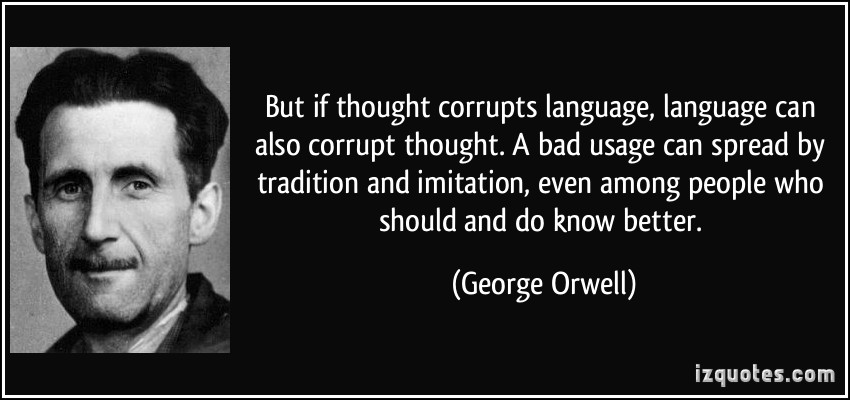
All of the above was made possible by changes in accepted language. George Orwell was right. If you want to control people, first control the language.
COVID, a virus that poses no significant health risk to 98 percent of the population, has given us a “New Normal” where “vaccines” are not vaccines, where “freedom” is now a privilege granted to those who obey, and where unelected public health officials have made billions of dollars for pharmaceutical companies.
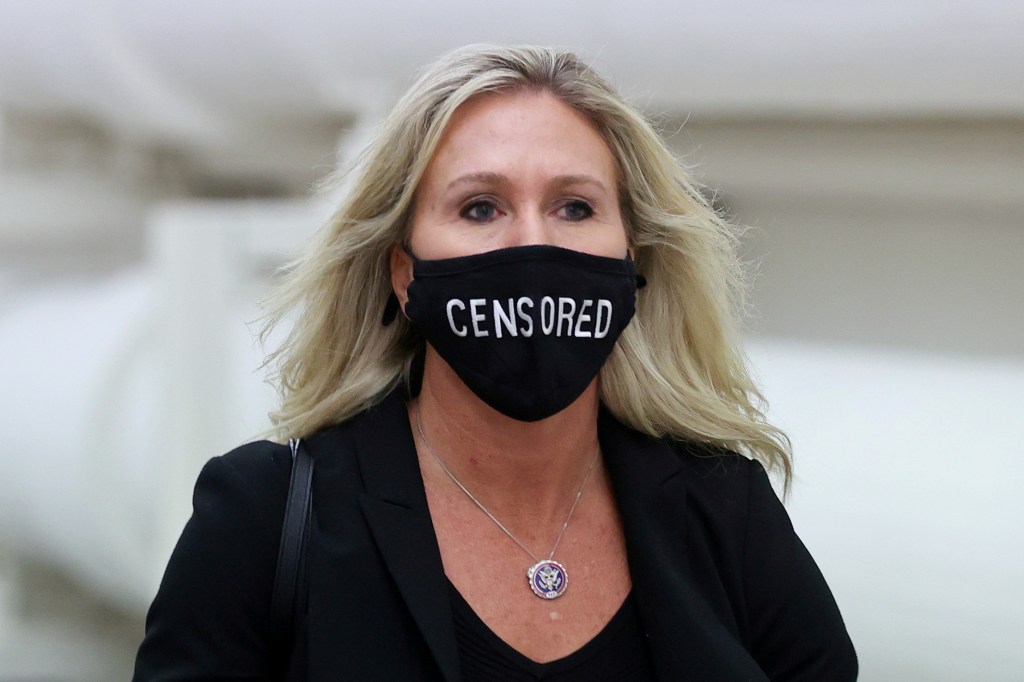
Twitter has permanently suspended the personal account of Republican Congresswoman Marjorie Taylor Greene for what the platform calls “repeated violations of our COVID-19 misinformation policy,” much to the delight of liberals and pro-censorship leftists everywhere. This follows the Twitter ban of Dr Robert Malone on the same grounds a few days prior, which followed an unbroken pattern of continually escalating and expanding censorship protocols ever since the 2016 US election.
In reality nobody ever gets banned for “Covid misinformation”; that’s just today’s excuse. Before that it was the fallout from the Capitol riot, before that it was election security, before that it was Russian disinformation, foreign influence ops, fake news, etc. In reality the real agenda behind the normalization of internet censorship is the normalization of internet censorship itself. That’s the real reason so many people get banned.
I myself had already written many, many articles warning warning about the increasingly widespread use of internet censorship via algorithm manipulation and deplatforming long before the first “Covid misinformation” bans started happening. Arguably the most significant political moment in the US since 9/11 and its aftermath was when liberal institutions decided that Trump’s 2016 election was not a failure of status quo politics but a failure of information control, which just so happened to align perfectly with the agendas of the ruling power structure to control the dominant narratives about what’s going on in the world.
Having unelected tech oligarchs ban duly elected members of Congress – or even the sitting President – from using their massive platforms is dystopian. Remember how many world leaders warned that FB & Twitter's banning of Trump was a threat to democracy.https://t.co/zIT7l04hMWhttps://t.co/2BPFrgeZXv
We saw this exemplified in 2017 when Google, Facebook and Twitter were called before the Senate Judiciary Committee and instructed to come up with a strategy “to prevent the fomenting of discord”.
“We all must act now on the social media battlefield to quell information rebellions that can quickly lead to violent confrontations and easily transform us into the Divided States of America,” the social media giants were told by think tanker and former FBI agent Clint Watts, who added, “Stopping the false information artillery barrage landing on social media users comes only when those outlets distributing bogus stories are silenced—silence the guns and the barrage will end.”
Since that time the coordination between those tech platforms and the US government in determining whose voices should be silenced has gotten progressively more intimate, so now we have these giant platforms which people have come to rely on to share ideas and information censoring speech in complete alignment with the will of the most powerful government on earth.
The danger of this is obvious to anyone who isn’t a stunted emotional infant. The danger of government-tied monopolistic tech platforms controlling worldwide speech far outweighs the danger of whatever voice you might happen to dislike at any given moment. The only way for this not to be clear to you is if you are so psychologically maladjusted that you can’t imagine anything bad coming from your personal preferences for human expression being imposed upon society by the most powerful institutions on earth.
Silicon Valley Should Not Restrict Public Discourse About Covid Measures Which Affect Everyone
"Government-tied oligarchic megacorporations are among the very last institutions who should be in charge of worldwide political discourse."https://t.co/WlDypacgmM
It really only takes the tiniest bit of personal growth to understand this. I for example absolutely hate QAnoners. Hate them, hate them, hate them. They always used to make my job annoying because they saw my criticisms of the mass media and the oligarchic empire as aligning with their view that Donald Trump was leading a righteous crusade against the Deep State, so they’d often clutter my comments sections with foam-brained idiocy that perfectly served the very power structures I oppose. They saw me as on their side when in reality we had virtually nothing in common and couldn’t really be more opposed.
When QAnon accounts were purged from all mainstream social media platforms following the Capitol riot, it made my work significantly less irritating. I no longer had to share social media spaces with people I despised, and, if I were an immature person, I would see this as an inherently good thing. But because I am a grown adult, I understand that the danger of giant monopolistic government-tied platforms controlling worldwide human speech to a greater and greater extent far outweighs the emotional ease I personally receive from their absence.
I therefore would choose to allow QAnoners to voice their dopey nonsense freely on those platforms if it were up to me. Whatever damage they might do is vastly less destructive than allowing widespread communication to be regulated by powerful oligarchic institutions who amount to US government proxies. The same is true of Marjorie Taylor Greene and everyone like her.
This should not be an uncommon perspective. It doesn’t require a lot of maturity to get this, it just requires some basic self-preservation and enough psychological growth to understand that the world should not be forced to align with your personal will. It says bad things about the future that even this kindergarten-level degree of insight has become rare in some circles.
The Biden Administration’s effort to withdraw nearly all US troops from Afghanistan and Iraq before the end of the year is commendable and it is hoped that a departure from Syria will follow soon thereafter, but one must nevertheless be concerned that the overseas moves are being made to concentrate government resources on the domestic war that has already begun. I am, of course, referring to the ongoing efforts being made to extirpate “extremists” among American citizens who have been further identified as largely consisting of “white supremacists.”
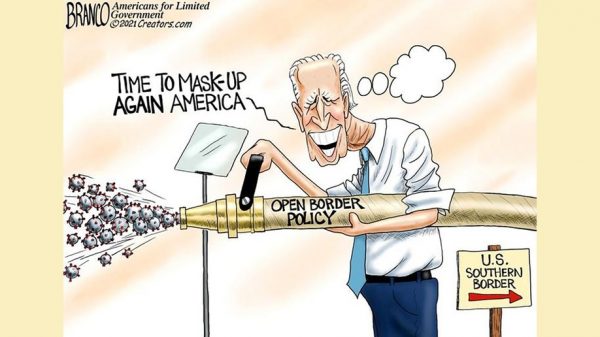
As part of the new war, ideas or even demonstrable facts that are considered to be undesirable are being targeted by the government working together with internet resources, most particularly the social media, to attack critics. It is being argued that the alleged provision of “misinformation” is doing actual harm to the country and the American people. Recently, much of the focus has been on the COVID virus, in support of the government’s intention to have all Americans vaccinated and, increasingly, again compelled to be masked when inside buildings that are accessible to the public. These efforts are being supported by media including Facebook, which features pop-ups directing the reader to a “safe” site whenever a piece appears that challenges the government orthodoxy on the spread of the virus.
One might reasonably argue that there is a national public health crisis that is part of a global problem which requires coordinated government intervention, but the actual statistics that reveal the existing low levels of infection and death in most states would not support that contention. And one might also observe that the growing problem involving the regulation of speech and even ideas by government working in cooperation with large corporations is potentially more serious than COVID or any other virus.
If the United States government and its corporate partners were in an honest way trying to protect the American people one might at least be sympathetic regarding the efforts being made, but both government and businesses have proven to be serial liars and purveyors of egregious untruths to serve their own agendas. Recently, the White House spokesman Jen Psaki suggested that those spreading false information about COVID vaccinations might well be banned from spreading such lies on social media. The implication was that the government could compile lists of such “extremists” and use its regulatory authority to compel companies on the internet to censor individuals and groups in compliance with orders coming from the White House. The justification would be that government in this case gets a pass on limiting free speech and association due to a national health crisis.
Psaki has undoubtedly discovered a certain benevolence in big government which few Americans have noted before. Foreigners, however, being on the receiving end of wars resulting from the stream of lies emanating from Washington might well have a different viewpoint. President Bill Clinton relied on a false narrative to go to war in the Balkans and then used unprovoked attacks on Sudan and Afghanistan to draw attention away from an affair he was having with an intern. George W. Bush and his pack of neocon scoundrels, most of whom are still holding prestigious positions, used what was known to be fake information to justify destroying Afghanistan and Iraq. Barack Obama lied to overthrow the governments in Libya and Ukraine while also attempting to do the same in Syria.
All lies, all the time, and now we Americans are supposed to believe that the Biden Administration is seeking to benefit us? Online one wag quipped that “The party that believes that men can get pregnant now wants to control ‘misinformation’ on the internet?” Never forget that policies that compel all Americans to behave in certain ways, no matter how innocent in appearance, can also be used and expanded upon to mandate something more sinister.
And what about the social media companies? Facebook has long had a censorship group headed by a former Israeli government official. CEO Mark Zuckerberg has admitted to Congress that Facebook suppresses nearly all so-called “hate speech” automatically using computer algorithms that rely on word associations to determine what is allowed on the site. Pieces that are considered borderline are allowed only limited exposure, having their distribution among contacts automatically restricted and disabling sharing. Google search uses similar algorithms to make sure that sites and individuals that it does not approve of do not appear among search results. It also uses software to actually “re-direct” users away from sites that it does not approve.
And now PayPal, owned by online auction service eBay and an essential tool for small public interest groups’ support, has now announced that it will henceforth be working with the Anti-Defamation League (ADL) to “fight hate” by cutting off financing of extremist groups. But its definition of “hate,” criticized as highly subjective and inclined to condemn groups disliked by ADL for political reasons, has prompted legitimate concerns about where this all is going. ADL has often been criticized for finding hate virtually everywhere, particularly among conservative white groups. RT cites a recent example of such fervor “in response to an article published in Canada’s National Post, which was denounced by the ADL because its author mentioned that one of the 32 US lawmakers supporting a tax reform belonged to a Jewish fraternity.” In short, any discussion of Israel or of the behavior of Jewish individuals and groups in anything but a positive context will be considered “hate” by ADL and PayPal.
Indeed, PayPal and ADL issued a self-serving statement last week which said “PayPal and ADL will focus on further uncovering and disrupting the financial pipelines that support extremist and hate movements,” adding that they would also go after “actors and networks spreading and profiting from all forms of hate and bigotry against any community.”
The joint venture will also include the “launch[ing] of a research effort” to determine how “extremist and hate movements throughout the US are attempting to leverage financial platforms to fund criminal activity.” The negative information collected will be shared with police, financial services, and the government, presumably to create an environment where such groups will be marginalized and shut out of the public space completely, to include possibly having their supporters arrested, charged and convicted.
The growing collusion between big government and large public-accessible online information and opinion services is not a good thing. It permits those well-funded and politically connected organizations to work together to limit what the public is allowed to know. Its zeal to eliminate “misinformation” is misplaced, replacing dissident voices that have limited access to a wider audience with massive agenda driven public-private organizations that will essentially determine what is acceptable and what is not. If allowed to continue, it will be the death of free speech in this country as everything that disagrees with the approved narrative will be labeled “hateful” or “extremist,” eventually to include criminal penalties for those who disagree. It is not too much to suggest that we are witnessing the first steps in the creation of a totalitarian de facto one-party state. Perhaps that is the intention.
Far from being a war against “white supremacy,” the Biden administration’s new “domestic terror” strategy clearly targets primarily those who oppose US government overreach and those who oppose capitalism and/or globalization.
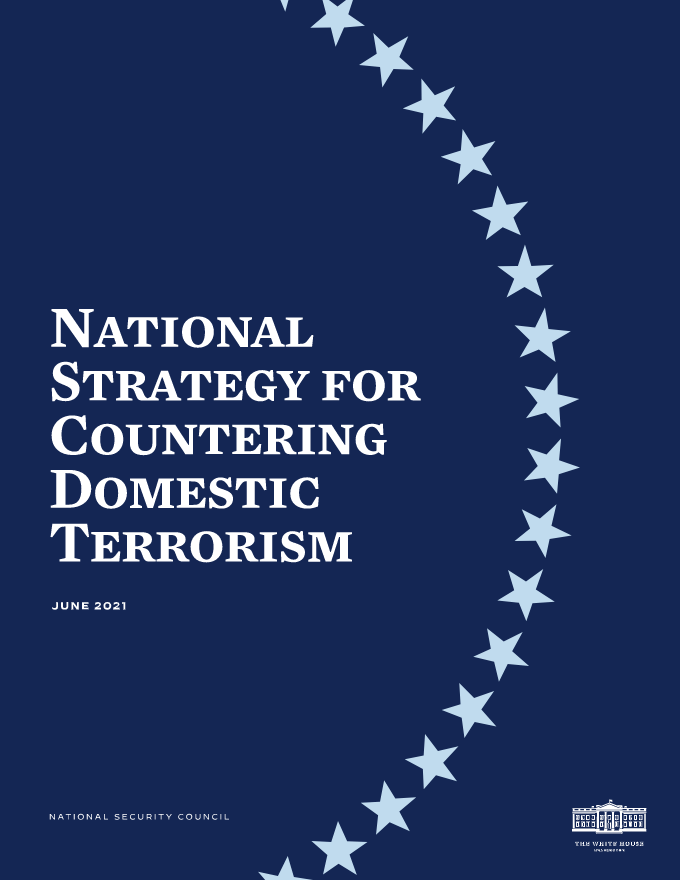
In the latest sign that the US government’s War on Domestic Terror is growing in scope and scale, the White House on Tuesday revealed the nation’s first ever government-wide strategy for confronting domestic terrorism. While cloaked in language about stemming racially motivated violence, the strategy places those deemed “anti-government” or “anti-authority” on a par with racist extremists and charts out policies that could easily be abused to silence or even criminalize online criticism of the government.
Even more disturbing is the call to essentially fuse intelligence agencies, law enforcement, Silicon Valley, and “community” and “faith-based” organizations such as the Anti-Defamation League, as well as unspecified foreign governments, as partners in this “war,” which the strategy makes clear will rely heavily on a pre-crime orientation focused largely on what is said on social media and encrypted platforms. Though the strategy claims that the government will “shield free speech and civil liberties” in implementing this policy, its contents reveal that it is poised to gut both.
Indeed, while framed publicly as chiefly targeting “right-wing white supremacists,” the strategy itself makes it clear that the government does not plan to focus on the Right but instead will pursue “domestic terrorists” in “an ideologically neutral, threat-driven manner,” as the law “makes no distinction based on political view—left, right or center.” It also states that a key goal of this strategic framework is to ensure “that there is simply no governmental tolerance . . . of violence as an acceptable mode of seeking political or social change,” regardless of a perpetrator’s political affiliation.
Considering that the main cheerleaders for the War on Domestic Terror exist mainly in establishment left circles, such individuals should rethink their support for this new policy given that the above statements could easily come to encompass Black Lives Matter–related protests, such as those that transpired last summer, depending on which political party is in power.
Once the new infrastructure is in place, it will remain there and will be open to the same abuses perpetrated by both political parties in the US during the lengthy War on Terror following September 11, 2001. The history of this new “domestic terror” policy, including its origins in the Trump administration, makes this clear.
It’s Never Been Easier to Be a “Terrorist”
In introducing the strategy, the Biden administration cites “racially or ethnically motivated violent extremists” as a key reason for the new policy and a main justification for the War on Domestic Terror in general. This was most recently demonstrated Tuesday in Attorney General Merrick Garland’s statement announcing this new strategy. However, the document itself puts “anti-government” or “anti-authority” “extremists” in the same category as violent white supremacists in terms of being a threat to the homeland. The strategy’s characterization of such individuals is unsettling.
AG Merrick Garland: “In the FBI’s view, the top domestic violent extremist threat comes from racially or ethically motivated violent extremists specifically those who advocate for the superiority of the white race.” pic.twitter.com/4JtruuMSv2
For instance, those who “violently oppose” “all forms of capitalism” or “corporate globalization” are listed under this less-discussed category of “domestic terrorist.” This highlights how people on the left, many of whom have called for capitalism to be dismantled or replaced in the US in recent years, could easily be targeted in this new “war” that many self-proclaimed leftists are currently supporting. Similarly, “environmentally-motivated extremists,” a category in which groups such as Extinction Rebellion could easily fall, are also included.
In addition, the phrasing indicates that it could easily include as “terrorists” those who oppose the World Economic Forum’s vision for global “stakeholder capitalism,” as that form of “capitalism” involves corporations and their main “stakeholders” creating a new global economic and governance system. The WEF’s stakeholder capitalism thus involves both “capitalism” and “corporate globalization.”
The strategy also includes those who “take steps to violently resist government authority . . . based on perceived overreach.” This, of course, creates a dangerous situation in which the government could, purposely or otherwise, implement a policy that is an obvious overreach and/or blatantly unconstitutional and then label those who resist it “domestic terrorists” and deal with them as such—well before the overreach can be challenged in court.
Another telling addition to this group of potential “terrorists” is “any other individual or group who engages in violence—or incites imminent violence—in opposition to legislative, regulatory or other actions taken by the government.” Thus, if the government implements a policy that a large swath of the population finds abhorrent, such as launching a new, unpopular war abroad, those deemed to be “inciting” resistance to the action online could be considered domestic terrorists.
Such scenarios are not unrealistic, given the loose way in which the government and the media have defined things like “incitement” and even “violence” (e. g., “hate speech” is a form of violence) in the recent past. The situation is ripe for manipulation and abuse. To think the federal government (including the Biden administration and subsequent administrations) would not abuse such power reflects an ignorance of US political history, particularly when the main forces behind most terrorist incidents in the nation are actually US government institutions like the FBI (more FBI examples here, here, here, and here).
Furthermore, the original plans for the detention of American dissidents in the event of a national emergency, drawn up during the Reagan era as part of its “continuity of government” contingency, cited popular nonviolent opposition to US intervention in Latin America as a potential “emergency” that could trigger the activation of those plans. Many of those “continuity of government” protocols remain on the books today and can be triggered, depending on the whims of those in power. It is unlikely that this new domestic terror framework will be any different regarding nonviolent protest and demonstrations.
Yet another passage in this section of the strategy states that “domestic terrorists” can, “in some instances, connect and intersect with conspiracy theories and other forms of disinformation and misinformation.” It adds that the proliferation of such “dangerous” information “on Internet-based communications platforms such as social media, file-upload sites and end-to-end encrypted platforms, all of these elements can combine and amplify threats to public safety.”
Thus, the presence of “conspiracy theories” and information deemed by the government to be “misinformation” online is itself framed as threatening public safety, a claim made more than once in this policy document. Given that a major “pillar” of the strategy involves eliminating online material that promotes “domestic terrorist” ideologies, it seems inevitable that such efforts will also “connect and intersect” with the censorship of “conspiracy theories” and narratives that the establishment finds inconvenient or threatening for any reason.
Pillars of Tyranny
The strategy notes in several places that this new domestic-terror policy will involve a variety of public-private partnerships in order to “build a community to address domestic terrorism that extends not only across the Federal Government but also to critical partners.” It adds, “That includes state, local, tribal and territorial governments, as well as foreign allies and partners, civil society, the technology sector, academic, and more.”
The mention of foreign allies and partners is important as it suggests a multinational approach to what is supposedly a US “domestic” issue and is yet another step toward a transnational security-state apparatus. A similar multinational approach was used to devastating effect during the CIA-developed Operation Condor, which was used to target and “disappear” domestic dissidents in South America in the 1970s and 1980s. The foreign allies mentioned in the Biden administration’s strategy are left unspecified, but it seems likely that such allies would include the rest of the Five Eyes alliance (the UK, Australia, Canada, New Zealand) and Israel, all of which already have well-established information-sharing agreements with the US for signals intelligence.
The new domestic-terror strategy has four main “pillars,” which can be summarized as (1) understanding and sharing domestic terrorism-related information, including with foreign governments and private tech companies; (2) preventing domestic terrorism recruitment and mobilization to violence; (3) disrupting and deterring domestic terrorism activity; and (4) confronting long-term contributors to domestic terrorism.
The first pillar involves the mass accumulation of data through new information-sharing partnerships and the deepening of existing ones. Much of this information sharing will involve increased data mining and analysis of statements made openly on the internet, particularly on social media, something already done by US intelligence contractors such as Palantir. While the gathering of such information has been ongoing for years, this policy allows even more to be shared and legally used to make cases against individuals deemed to have made threats or expressed “dangerous” opinions online.
Included in the first pillar is the need to increase engagement with financial institutions concerning the financing of “domestic terrorists.” US banks, such as Bank of America, have already gone quite far in this regard, leading to accusations that it has begun acting like an intelligence agency. Such claims were made after it was revealed that the BofA had passed to the government the private banking information of over two hundred people that the bank deemed as pointing to involvement in the events of January 6, 2021. It seems likely, given this passage in the strategy, that such behavior by banks will soon become the norm, rather than an outlier, in the United States.
The second pillar is ostensibly focused on preventing the online recruitment of domestic terrorists and online content that leads to the “mobilization of violence.” The strategy notes that this pillar “means reducing both supply and demand of recruitment materials by limiting widespread availability online and bolstering resilience to it by those who nonetheless encounter it.“ The strategy states that such government efforts in the past have a “mixed record,” but it goes on to claim that trampling on civil liberties will be avoided because the government is “consulting extensively” with unspecified “stakeholders” nationwide.
Regarding recruitment, the strategy states that “these activities are increasingly happening on Internet-based communications platforms, including social media, online gaming platforms, file-upload sites and end-to-end encrypted platforms, even as those products and services frequently offer other important benefits.” It adds that “the widespread availability of domestic terrorist recruitment material online is a national security threat whose front lines are overwhelmingly private-sector online platforms.”
The US government plans to provide “information to assist online platforms with their own initiatives to enforce their own terms of service that prohibits the use of their platforms for domestic terrorist activities” as well as to “facilitate more robust efforts outside the government to counter terrorists’ abuse of Internet-based communications platforms.”
Given the wider definition of “domestic terrorist” that now includes those who oppose capitalism and corporate globalization as well as those who resist government overreach, online content discussing these and other “anti-government” and “anti-authority” ideas could soon be treated in the same way as online Al Qaeda or ISIS propaganda. Efforts, however, are unlikely to remain focused on these topics. As Unlimited Hangout reported last November, both UK intelligence and the US national-security state were developing plans to treat critical reporting on the COVID-19 vaccines as “extremist” propaganda.
Another key part of this pillar is the need to “increase digital literacy” among the American public, while censoring “harmful content” disseminated by “terrorists” as well as by “hostile foreign powers seeking to undermine American democracy.” The latter is a clear reference to the claim that critical reporting of US government policy, particularly its military and intelligence activities abroad, was the product of “Russian disinformation,” a now discredited claim that was used to heavily censor independent media. This new government strategy appears to promise more of this sort of thing.
It also notes that “digital literacy” education for a domestic audience is being developed by the Department of Homeland Security (DHS). Such a policy would have previously violated US law until the Obama administration worked with Congress to repeal the Smith-Mundt Act, thus lifting the ban on the government directing propaganda at domestic audiences.
The third pillar of the strategy seeks to increase the number of federal prosecutors investigating and trying domestic-terror cases. Their numbers are likely to jump as the definition of “domestic terrorist” is expanded. It also seeks to explore whether “legislative reforms could meaningfully and materially increase our ability to protect Americans from acts of domestic terrorism while simultaneously guarding against potential abuse of overreach.” In contrast to past public statements on police reform by those in the Biden administration, the strategy calls to “empower” state and local law enforcement to tackle domestic terrorism, including with increased access to “intelligence” on citizens deemed dangerous or subversive for any number of reasons.
To that effect, the strategy states the following (p. 24):
“The Department of Justice, Federal Bureau of Investigation, and Department of Homeland Security, with support from the National Counterterrorism Center [part of the intelligence community], are incorporating an increased focus on domestic terrorism into current intelligence products and leveraging current mechanisms of information and intelligence sharing to improve the sharing of domestic terrorism-related content and indicators with non-Federal partners. These agencies are also improving the usability of their existing information-sharing platforms, including through the development of mobile applications designed to provide a broader reach to non-Federal law enforcement partners, while simultaneously refining that support based on partner feedback.”
Such an intelligence tool could easily be, for example, Palantir, which is already used by the intelligence agencies, the DHS, and several US police departments for “predictive policing,” that is, pre-crime actions. Notably, Palantir has long included a “subversive” label for individuals included on government and law enforcement databases, a parallel with the controversial and highly secretive Main Core database of US dissidents.
DHS Secretary Alejandro Mayorkas made the “pre-crime” element of the new domestic terror strategy explicit on Tuesday when he said in a statement that DHS would continue “developing key partnerships with local stakeholders through the Center for Prevention Programs and Partnerships (CP3) to identify potential threats and prevent terrorism.” CP3, which replaced DHS’ Office for Targeted Violence and Terrorism Prevention this past May, officially “supports communities across the United States to prevent individuals from radicalizing to violence and intervene when individuals have already radicalized to violence.”
The fourth pillar of the strategy is by far the most opaque and cryptic, while also the most far-reaching. It aims to address the sources that cause “terrorists” to mobilize “towards violence.” This requires “tackling racism in America,” a lofty goal for an administration headed by the man who controversially eulogized Congress’ most ardent segregationist and who was a key architect of the 1994 crime bill. As well, it provides for “early intervention and appropriate care for those who pose a danger to themselves or others.”
In regard to the latter proposal, the Trump administration, in a bid to “stop mass shootings before they occur,” considered a proposal to create a “health DARPA” or “HARPA” that would monitor the online communications of everyday Americans for “neuropsychiatric” warning signs that someone might be “mobilizing towards violence.” While the Trump administration did not create HARPA or adopt this policy, the Biden administration has recently announced plans to do so.
Finally, the strategy indicates that this fourth pillar is part of a “broader priority”: “enhancing faith in government and addressing the extreme polarization, fueled by a crisis of disinformation and misinformation often channeled through social media platforms, which can tear Americans apart and lead some to violence.” In other words, fostering trust in government while simultaneously censoring “polarizing” voices who distrust or criticize the government is a key policy goal behind the Biden administration’s new domestic-terror strategy.
Calling Their Shots?
While this is a new strategy, its origins lie in the Trump administration. In October 2019, Trump’s attorney general William Barr formally announced in a memorandum that a new “national disruption and early engagement program” aimed at detecting those “mobilizing towards violence” before they commit any crime would launch in the coming months. That program, known as DEEP (Disruption and Early Engagement Program), is now active and has involved the Department of Justice, the FBI, and “private sector partners” since its creation.
Barr’s announcement of DEEP followed his unsettling “prediction” in July 2019 that “a major incident may occur at any time that will galvanize public opinion on these issues.” Not long after that speech, a spate of mass shootings occurred, including the El Paso Walmart shooting, which killed twenty-three and about which many questions remain unanswered regarding the FBI’s apparent foreknowledge of the event. After these events took place in 2019, Trump called for the creation of a government backdoor into encryption and the very pre-crime system that Barr announced shortly thereafter in October 2019. The Biden administration, in publishing this strategy, is merely finishing what Barr started.
Indeed, a “prediction” like Barr’s in 2019 was offered by the DHS’ Elizabeth Neumann during a Congressional hearing in late February 2020. That hearing was largely ignored by the media as it coincided with an international rise of concern regarding COVID-19. At the hearing, Neumann, who previously coordinated the development of the government’s post-9/11 terrorism information sharing strategies and policies and worked closely with the intelligence community, gave the following warning about an imminent “domestic terror” event in the United States:
“And every counterterrorism professional I speak to in the federal government and overseas feels like we are at the doorstep of another 9/11, maybe not something that catastrophic in terms of the visual or the numbers, but that we can see it building and we don’t quite know how to stop it.”
This “another 9/11” emerged on January 6, 2021, as the events of that day in the Capitol were quickly labeled as such by both the media and prominent politicians, while also inspiring calls from the White House and the Democrats for a “9/11-style commission” to investigate the incident. This event, of course, figures prominently in the justification for the new domestic-terror strategy, despite the considerable video and other evidence that shows that Capitol law enforcement, and potentially the FBI, were directly involved in facilitating the breach of the Capitol. In addition, when one considers that the QAnon movement, which had a clear role in the events of January 6, was itself likely a government-orchestratedpsyop, the government hand in creating this situation seems clear.
It goes without saying that the official reasons offered for these militaristic “domestic terror” policies, which the US has already implemented abroad—causing much more terror than it has prevented—does not justify the creation of a massive new national-security infrastructure that aims to criminalize and censor online speech. Yet the admission that this new strategy, as part of a broader effort to “enhance faith in government,” combines domestic propaganda campaigns with the censorship and pursuit of those who distrust government heralds the end of even the illusion of democracy in the United States.
ɪˈluːʒ(ə)n/ noun
an instance of a wrong or misinterpreted perception of a sensory experience.
a deceptive appearance or impression.
a false idea or belief.
We live in a society in which spurious realities are manufactured by the media, by governments, by big corporations, by religious groups, political groups. I ask, in my writing, ‘What is real?’ Because unceasingly we are bombarded with pseudo realities manufactured by very sophisticated people using very sophisticated electronic mechanisms. ~Philip K. Dick
On the face of it, life is unruly – it is too complex, too dirty, too full of uncertainties and unknowns that would only disturb the masses. People, after all, need to be comforted. That’s why another reality is conjured up that is manufactured by the media. Philip K. Dick asks what is real as we are under the bombardment and assault of pseudo realities. We may ask ourselves the same question, what is real? Perhaps our perfect crime has been to hide the real so well that our modern societies have ventured beyond the illusion of reality itself. The perfect crime is the perfect cover up. The power to make better choices comes from the power to have information. Information has been the life-blood of our societies and cultures and has been guarded tenaciously throughout the centuries. Whether sacred ‘divine’ knowledge or information on how to improve one’s life in general; they have all been guarded by various institutions throughout our history. From priest kings to shamans; from religious figures to scientists; from life-coaches to gurus; and from governments to mainstream media – information has always come at a price, if it has come at all.
Information was something traditionally given to people in a controlled manner. The masses were provided information generally in-keeping with their level of intelligence as well as their need to know. And traditionally, both these factors were notoriously kept low. Anthropologists tend to agree that homo sapiens has conquered the globe due to its flexible ability to cooperate on a mass scale and with strangers. And historians add to this by saying that human societies have proved so successful because they are able to socially organize themselves and survive as long as order is maintained. That is, the unified elites have always been able to dominate the disorderly masses. The masses remain disorganized if they lack sufficient access to credible information. And that is where the cult of information and the spectacle of entertainment enter into the picture.
Modern life has become inundated with information, and it has spilled over into the hands of the masses. The age of illiterate masses listening to their local church sermons to receive the word of divine guidance is long gone. The Gutenberg Press managed to signal the end to the monopoly on scribes. Books began to bring new and inspiring information to the masses whom were quickly learning to read. And then something enormously powerful happened at the end of the 20th century – the communication channels were multiplied, and people began to talk back, in droves. People were no longer only receivers of information as in the past; they could now produce the information themselves and share it with a potential audience of millions around the globe. The planetary talking box was opened, and people were finding they had voices. And that is when propaganda stepped up a notch to become even more of a hardcore science and governmental tool.
In our not so distant past, if you wanted to seize political power in a country then normally your first step would be to control the army and the police; that is, the institutions of brute force. Today though it is only in the less ‘democratic’ countries where dictatorships still use such overt force when trying a coup d’etat. The real war is the war of minds. The day after the fall of Khrushchev in the former Soviet Union the editors of Pravda, Izvestiia, and the heads of the radio and television were replaced but the army wasn’t called out. More recently, after the failed coup attempt in Turkey, in July 2016, the incumbent government came down heavy on what it considered to be the country’s alternative media. In the immediate aftermath, 148 journalists and media workers were jailed, and 169 media and publishing outlets were closed down under the state of emergency.[i] And that was just the beginning. In any society it is important who controls the news information, and how it is dispersed. Yet since we now live in an ‘Internet Age’ of global communication and information networks, it is increasingly harder by the day to keep a tight control on things. In a sense, Pandora’s Box has already opened. And if there is so much information out there then how do you maintain order? The best answer is – provide more of it. Provide so much information that people are drowning in it. And then add some more to discredit what is already out there. People are then not only swimming in information but begin to drown in it. And the rest – well, that’s entertainment!
The Illusion of Truth
A spectral illusion is created through our mainstream media and news in order to offer a simplified vision of the world to us. It is Us vs. Them; Good vs. Bad; Developed vs. Undeveloped; Legal vs. Illegal; and all the rest of these bland dichotomies that are brandished as deep truths.
We have an ‘official culture’ that functions as the ether. We are immersed in it even if we are not aware, as fish in the sea do not always debate the water. This official culture creates the signs and symbols that affectively dictates our slice of reality: money, credit, status, intellect, policy, major sports, lesser sports, celebrities, good film, bad film, popular book, ignored book, love, sexy, seduction, disappointment, etc, etc. We buy into all these terms so deeply that it is no surprise to learn that we are a cultural species in therapy. We have been brought up and ‘educated’ to protect ourselves with the illusion of truth. Everything withdraws behind its own appearance, so that things appear to take place even when they do not. This is the great absence in our lives – excuses riddled with illusion, hiding through false appearance. We are left to decipher the world, to try and pull back the illusionary curtains. The crime of life is its incompleteness – a living absence that gnaws at us. We drift between second-hand news as ghosts drift between walls. If everyone believes in a lie, it doesn’t stop it from being a lie, or make it into a truth.
The illusion is often what many people want to hear, rather than the brutalities, or mundane reality, of life. It is as if we prefer bland information and filtered news, or celebrity gossip, as a complement to one’s own sense of restricted reality. Most modern societies thrive by the cultivation of illusion. In the end, such cultures of illusion may succeed in robbing the masses of their perceptual abilities to separate illusion from truth. As journalist Chris Hedges notes – ‘not since the Soviet and fascist dictatorships, and perhaps the brutal authoritarian control of the Catholic Church in the Middle Ages, has the content of information been as skillfully and ruthlessly controlled and manipulated.’1 Our so-called developed societies manufacture and peddle their illusion of reality as much as they can. And any denouncement or doubt upon this illusion is immediately met by a systemic defense that labels the critics as conspiracy theorists, anarchists, or anti-social. In other words, those who question the cultural narrative (a.k.a. illusion) are branded as deluded. Reality, it seems, is that which the majority believe.
It has been said that when a culture, and its people, become unmoored from reality then they retreat into a world of fantasy. And then this fantasy mode can invert meanings, truths, and all sense of what is going on. Such collective illusions – or ‘bubble realities’- can feed the populace on trigger words and phrases like war on terror or yes, we can or make us great again, and within these narrow hypnotic parameters all critical thought, ambiguity, and conscious observation vanish. And when the people can no longer distinguish between what is truth and what is fiction (make-believe), then reality gets usurped and the fantasy world takes over.
An epidemic of information can just as easily turn into a pandemic of misinformation. In many ways it already has. Information has always been used as a tool of psychological warfare as it forms a part of state-sponsored operations that serve as a new back door into peoples’ minds. Once false information is planted inside of our minds then it becomes harder to be objective or to make clear distinctions. Such information can then easily be hash-tagged, trended, and go viral. Going viral is now a common word, used to denote things, both positive and negative, that have gained rapid, and often unexpected, popularity. The word viral used to signify the behavior of a virus; that is, a small, infectious agent. The analogy is an apt one – agents of infection are now constantly roaming our information networks and entering into our minds. Information we receive is likely to be infected with a ‘viral agent’ just like coughing can and does spread the common cold. And one of the largest spreaders of ‘thought viruses’ today is social media. The social media, with customized targeting of news and adverts, is increasingly reinforcing the opinions, viewpoints, and beliefs we have already chosen to accept rather than presenting us with challenging new ones. We end up reinforcing our own bubbles of perception instead of expanding them.
The criteria and legitimacy of truth has been substituted by the promotion of incredulous untruths throughout our media systems. We now have a serious credibility issue with our major social institutions – media, politics, education, and finance. The mainstream media now represents the triumphant illusionism; the ambiguity of the spectacle that deceives and anaesthetizes the imagination. The gradual, uniform bombardment of information has succeeded in leveling out difference and now much of the content comes across as being almost the same. Diversity is just a superficial sleight-of-hand distraction. It doesn’t really matter which mainstream news channel a person tunes into; they are all getting their information from a very limited selection of sources. Information is dispersed from a very tightly centralized sphere of power.
Media Centralization
These days most western media organizations are owned by only a handful of giant conglomerates, such as Comcast; Disney; Time Warner; News Corp; Viacom; Vivendi Universal; and Bertelsmann. Over the years they have continued to absorb rival companies – called mergers – that expand their broadcasting reach. For example, the average person is not very likely to have heard of Charter Communications. Are they famous? Are they big? They are the second-largest cable operator in the United States, just behind Comcast, and the third largest pay-TV operator. In 2015 Charter bought out Time-Warner Cable in a deal valued at 78.7 billion dollars. Now that’s big. After the corporations, perhaps the next biggest information sources are the journalistic press companies, such as Associated Press and Reuters News. Are they objective?
In the US especially, television journalism has become a masquerade. Much of our news is personalized tidbits, intimate stories of stars, politicians, and the celebrity elite that are passed off as news in order to distract us. Such crass journalism seeks out not stories of depth or worth but a fantasy play of personalities. And the more ‘larger-than-life’ the stories then the more chance they have of success and of being taken into people’s hearts. Stories that reflect these ‘celebrity’ personalities get media attention, especially when saturated in gossip, relationships, or domestic struggles. Personalities are less adored when they go marching against fracking practices or oil pipeline proposals. Somehow it just doesn’t feel right that a beautiful star from a movie franchise should be protesting in a jumpsuit and sneakers in the rain. The two images just don’t go together well in people’s heads.
Information itself has now become its own form of stagecraft. And most of the news in today’s modern world is booby-trapped.
Newsflash: News is Fake
Today’s information and news is more about perception management than it is about educating the people. Influencing minds is more favorable, and more lucrative, than informing them. The end result is both more guaranteed and more controlled. Open information has always been a dangerous thing, as religious and social institutions have long known. Controlled information seeks to create contrived headlines, censored and cut images, and sanitized news. And as consumers of such news, we are accepting and buying into an encroaching unrealism. It is a world of substitution that subverts the mind. It is often easier to confuse and misinform than it is to inculcate opinion.
Today we are faced with a new type of news. We have entered a mirror hall of journalism where fake news and alternative facts are further obscuring the veneer of truth by tampering with the already fragile and fragmented sense of reality. The malady of the unreal is spreading like a pandemic. Fake is the new ‘new’!
In the last couple of years, the meme of ‘alternative facts’ has been gaining ground, especially in political talk. It is a convenient way of brushing off inconvenient news as well as appearing to discredit the source of the information. Not only that, it is also a deliberate way to add confusion to the issue. Once people begin to question the validity of reported news and the ‘facts of the truth’ then no one can be sure again of what is real or not. This appeared to be a political tactic during the 2016 US presidential campaign, especially on the part of the Republican nominee Donald Trump (who subsequently became president). Not only did Trump like to refer to inconvenient news as ‘alternative facts’ but he also cultivated a habit (whether consciously or not) of contradicting himself and being inconsistent in his policies. In the end, it proved confusing for journalists to pin him down, and social media was rife with a flood of contradictory statements, opinions, and criticism. Nobody really knew what Trump stood for, either politically or personally; and in the end not only did it not seem to matter to many, but the uncertainty and confusion most likely worked in his favor.
In a similar manner, it was noted by astute commentators that the Putin government in Russia also plays the ‘uncertainty card’ by playing all sides of the political game. In his documentary Hypernormalization Adam Curtis points out that the Putin regime backed and supported many of their political opponents and critical factions, unbeknown to the factions themselves, and then exposed this tactic publicly. The result was that credibility in the political domain was eroded and in its wake was left uncertainty and confusion. The role of ‘truth’ was no longer viable. It is hard for anyone to discern what is real and what is credible information when the playing field is deliberately manipulated with misinformation. A similar strategy has been used by governmental spy agencies the world over. In fact, it would be fair to say that a great deal of mainstream information currently in circulation is misinformation. That is, it has been tampered, doctored, censored, or falsified. Perhaps the only real ‘truth’ is that which comes through personal experience. The rest is a fabrication of the world. The recent much-publicized phenomenon of ‘fake news’ is not something new, only that once upon a time it was under controlled dispersion and called mainstream news.
Nowadays, that which is classed as knowledge is more often data-information that has been agreed upon for general dissemination. We find in our daily news that extracts from an upcoming political speech have been ‘leaked’ to the press. Why is it that the press seems to know what’s upcoming in almost all of the political speeches? It’s obvious to any half-serious observer that political offices pass on parts of their upcoming speeches deliberately to test the waters with their content and to prepare the public of what is to come. Leaky channels are just another name for information channels these days.
These all-too-often instances of leaks, or ‘legitimate’ news dissemination, are nothing when compared to the state-sponsored infiltrations from government agencies. The so-called ‘Russiagate’ scandal is just another mix of hypocrisy and misinformation. It shows a shameless level of hypocrisy in that it is well-known, and documented, that countries such as the US and China have a horde of cyber-technicians infiltrating online forums, chat sites, web gatherings, blogs, etc, and deliberately seeding and spreading a range of calculated (mis)information. This information may be pro-government propaganda, deliberate misinformation, alternative ‘facts,’ or downright post-truth irregularities aimed at confusing the infosphere. The information highways are an open playing field where many actors, agencies, and agendas are vying for presence, infiltration, and dominance. The game is now on in the digital realms – and it’s all about the management of perception. It’s hard to judge just exactly who is saying what, or why.
Who is saying what?
It is going to be increasingly likely that the news you read online or from your favorite newspaper will not have been written by whom you thought it was. Take a look at this example:
Thomas Keehn didn’t allow a single run as Stags defeated Good Counsel 1-0 on Wednesday. Keehn allowed just two hits and induced a fly out from Walker to end the game.
The pitching was strong on both sides. Thomas Keehn struck out nine, while Orie sat down three.
Stags captured the lead in the second inning.
A single by Grass in the second inning was a positive for Good Counsel.
Keehn earned the win for Stags. He went seven innings, giving up zero runs, two hits, and striking out nine. Orie took the loss for Good Counsel. He tossed six innings, giving up one run, three hits, and striking out three.
Timmy Pyne went 2-for-2 at the plate to lead Stags in hits.[ii]
Maybe not the most prosaic of pieces; and it certainly will not win any literary prizes. Yet I doubt that the author will care, for it is neither a he nor a she – it is an algorithm. It was written by a powerful artificial intelligence engine, named ‘Quill,’ that was created by Narrative Science, Inc; a company set up to produce automated articles in a variety of areas, including sports, business, and politics. This intelligence software can generate a news story approximately every thirty seconds. Many of their automated articles are already published and used by widely known and respected websites that prefer not to disclose this fact. A quick way to find articles produced by ‘Quill’ is to do a search using the following words – ‘Powered by Narrative Science and GameChanger Media’ – as I just did to find the above extract. The idea that people write all the news stories is just another illusion. At a 2011 industry conference the co-founder of Narrative Science, Kristian Hammond, predicted that the number of news articles that would be written by algorithms within fifteen years would be over ninety percent.2
On their homepage website Narrative Science boldly claim that:
Narrative Science is humanizing data like never before, with technology that interprets your data, then transforms it into Intelligent Narratives at unprecedented speed and scale. With Narrative Science, your data becomes actionable—a powerful asset you can use to make better decisions, improve interactions with customers and empower your employees.[iii]
So, our data information is being humanized ‘like never before’ by taking out the human element – how’s that? Well, it’s just another illusion – a great sleight-of-hand and the deft art of perception management. Yet whilst it’s hard to totally agree with the above prediction that in the near future over ninety percent of our news will be written by algorithms, it does show how those in the industry perceive our ever-decreasing human future.
My own sense is that with the continued rise of social media there will be a healthy civil journalism from the people on the ground. There is also likely to be an increase in alternative news gathering and dissemination. Yet it does beg the question of whether we will be able to discern the difference between human-generated news and an algorithm. How would you know that something you read online was written by an algorithm or not? And this takes us to the issue of trust, which is likely to be a growing area of concern in the years ahead. As the illusion of our information intensifies, the notion of trusted networks and trusted sources will become paramount. And trust is a matter of discernment.
During these years we will need to strengthen our senses of discernment. To have discernment means that we have an active critical faculty – and that means being alert. Alert to the sources of our news, opinions, and cultural reporting. And especially alert to what is being told (or fed) to us through our leaky political channels. We need to be alert and observe how the information is being played out through our mainstream institutional channels. Most of the news and information that will be on ‘public display’ in these years will be directed at an emotional level. And much of this too will be a pendulum swing between trite entertainment and emotional fear. The saturated world of information in which we now live can be a rich source for us or it can be a distracting circus. It is our responsibility to decide which one we wish to make it.
We need to really see what’s going on, and to see through the show. We have to take out the trash before it has a chance to enter into our minds. Working on being the grounded observer is subtler than we may ever suspect. And in our increasingly carnivalesque cultures it is ever more needed, and a counterbalance to the sparkling spectacles that beguile us. The spectacle, I suspect, is about to get a lot more expressive.
In a surreal and stunning example of 21st century propaganda and censorship, Google has cobbled together a coalition it is calling “First Draft” to tackle what it calls “misinformation online.”
First Draft’s “founding partners” include News Corporation’s (parent company of Fox News) Storyful and NATO think tank Atlantic Council’s “Bellingcat” blog, headed by formally unemployed social worker Eliot Higgins who now fashions himself as a weapons expert and geopolitical analyst despite no formal training, practical real-world experience or track record of honest, unbiased reporting. In fact, between News Corporation and Bellingcat alone, Google’s First Draft appears to be itself a paragon of, and nexus for “misinformation online.”
Google’s Glaring Conflicts of Interest
Google too, having for years now worked closely with the US State Department, faces its own conflicts of interest in “social newsgathering and verification.” In fact, Google has admittedly been involved in engineering intentional deceptions aimed specifically to skew public perception, including doctoring its maps and Google Earth in real-time amid conflicts in favor of US-backed militant groups and through the development of applications designed to psychologically target the Syrian government into capitulating before US-backed militant groups.
An interactive tool created by Google was designed to encourage Syrian rebels and help bring down the Assad regime, Hillary Clinton’s leaked emails have reportedly revealed. By tracking and mapping defections within the Syrian leadership, it was reportedly designed to encourage more people to defect and ‘give confidence’ to the rebel opposition.
The article would continue:
The email detailing Google’s defection tracker purportedly came from Jared Cohen, a Clinton advisor until 2010 and now-President of Jigsaw, formerly known as Google Ideas, the company’s New York-based policy think tank. In a July 2012 email to members of Clinton’s team, which the WikiLeaks release alleges was later forwarded to the Secretary of State herself, Cohen reportedly said: “My team is planning to launch a tool on Sunday that will publicly track and map the defections in Syria and which parts of the government they are coming from.”
Cohen would conclude:
“Our logic behind this is that while many people are tracking the atrocities, nobody is visually representing and mapping the defections, which we believe are important in encouraging more to defect and giving confidence to the opposition.”
Can Google then be relied upon to sort out “misinformation online” if it itself is directly involved in manipulating public perception to achieve US foreign policy objectives? To impartial observers, the answer is clearly “no.”
Today, news breaks online. Today, the first images to emerge from a breaking news event have been captured by an eyewitness. Today, injustices that may never have been reported become global news stories because a bystander reached for their smartphone. Today, malicious hoaxes and fake news reports are published in increasingly convincing and sophisticated ways. We live in a time when trust and truth are issues that all newsrooms, and increasingly the social platforms themselves, are facing. In July, the Guardian’s Editor-in-Chief Katharine Viner wrote about the ways technology is disrupting the truth, explaining “in the news feed on your phone, all stories look the same – whether they come from a credible source or not.” Filtering out false information can be hard. Even if news organisations only share fact-checked and verified stories, everyone is a publisher and a potential source.
The members that constitute the First Draft coalition, however, have enjoyed an uncontested monopoly for decades in determining just what the “truth” actually is, as well as a monopoly over propagating things the global public now know for a fact were “untruths.” Again, we see another case of the proverbial fox guarding the hen house.
The Liars Who Lied About WMDs in Iraq Will Protect Us from Liars Online?
Indeed, many of the organizations that constitute First Draft’s coalition played a pivotal role in perhaps the most destructive and costly lie of the 21st century (to date), that involving alleged “weapons of mass destruction” or “WMDs” in Iraq, serving as the pretext for the 2003 US-led invasion of Iraq.
According to some estimates, up to a million perished in the initial invasion and subsequent occupation. More conservative estimates are still in the hundreds of thousands.
Undoubtedly, the invasion, justified by lies propagated across the entirety of US and European media, helped trigger a predictable chain of catastrophes that have left the Middle East to this day in conflict and ruination. These same US and European media organizations, the same ones now signing their names to First Draft, also helped justify the continued presence of US troops in Iraq for years after the invasion, up to and including today.
And the same names signed on to First Draft are also the same names who helped sell the disastrous intervention in Libya and who are now attempting to sell yet another direct Western military intervention in Syria.
And it is perhaps the lack of success these same names are having in selling this most recent potential intervention in Syria that has precipitated First Draft’s creation in the first place.
There is a burgeoning alternative media composed of individual independent journalists, analysts and commentators both biased and impartial, both professional and amateur, competing directly with and overcoming the West’s longstanding monopoly over international public perception. There is also the emergence of professional and competitive national media organizations across the developing world who are taking increasingly large shares of both the West’s media monopoly and its monopoly over the public’s trust.
It is clear that First Draft has no intention of protecting the truth as none among its membership have done so until now individually, but rather in collectively protecting what the special interests behind these organizations want the global public to believe is the truth. First Draft is a desperate measure taken by Western special interests to reassert the West’s dominance over global public perception by leveraging the widely used social media platforms it controls, including Facebook and Twitter, as well as IT giant Google and its large range of services and applications.
In the end, all that First Draft is likely to accomplish is convincing the developing world of the necessity of creating domestic alternatives to Facebook, Google and Twitter, as well as to continue expanding their own domestic media organizations to better represent their respective national interests upon the global stage and to dilute the dangerous and destructive media monopoly the West has enjoyed and abused for decades.
Until the members of First Draft can cite a lie told by their competitors that is as destructive and as costly as their own lies preceding and underpinning the invasion and occupation of Iraq or the more recent destruction of Libya, their efforts appear more as a means of further deflecting away from the truth, not defending it.



 After the Crash