Pop Culture Has Become an Oligopoly

By Adam Mastroianni

Source: Experimental History

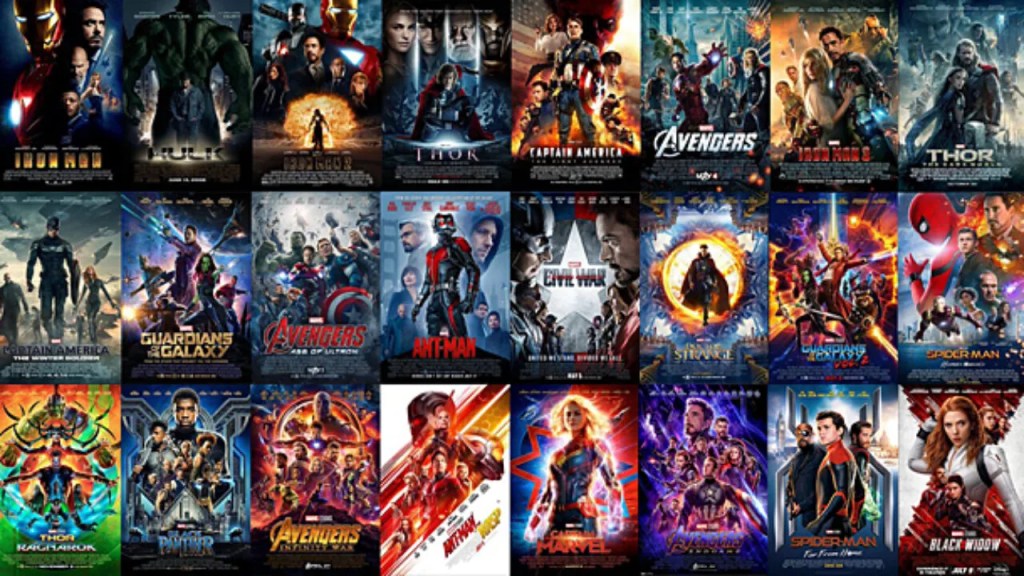
You may have noticed that every popular movie these days is a remake, reboot, sequel, spinoff, or cinematic universe expansion. In 2021, only one of the ten top-grossing films––the Ryan Reynolds vehicle Free Guy––was an original. There were only two originals in 2020’s top 10, and none at all in 2019.

People blame this trend on greedy movie studios or dumb moviegoers or competition from Netflix or humanity running out of ideas. Some say it’s a sign of the end of movies. Others claim there’s nothing new about this at all.

Some of these explanations are flat-out wrong; others may contain a nugget of truth. But all of them are incomplete, because this isn’t just happening in movies. In every corner of pop culture––movies, TV, music, books, and video games––a smaller and smaller cartel of superstars is claiming a larger and larger share of the market. What used to be winners-take-some has grown into winners-take-most and is now verging on winners-take-all. The (very silly) word for this oligopoly, like a monopoly but with a few players instead of just one.

I’m inherently skeptical of big claims about historical shifts. I recently published a paper showing that people overestimate how much public opinion has changed over the past 50 years, so naturally I’m on the lookout for similar biases here. But this shift is not an illusion. It’s big, it’s been going on for decades, and it’s happening everywhere you look. So let’s get to the bottom of it.

(Data and code available here.)

Movies 

At the top of the box office charts, original films have gone extinct. 

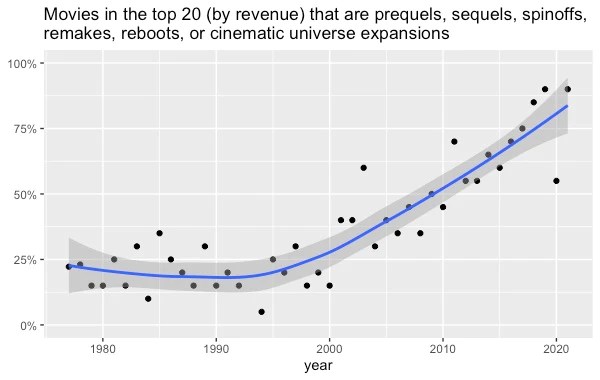
I looked at the 20 top-grossing movies going all the way back to 1977 (source), and I coded whether each was part of what film scholars call a “multiplicity”—sequels, prequels, franchises, spin-offs, cinematic universe expansions, etc. This required some judgment calls. Lots of movies are based on books and TV shows, but I only counted them as multiplicities if they were related to a previous movie. So 1990’s Teenage Mutant Ninja Turtles doesn’t get coded as a multiplicity, but 1991’s Teenage Mutant Ninja Turtles II: The Secret of the Ooze does, and so does the 2014 Teenage Mutant Ninja Turtles remake. I also probably missed a few multiplicities, especially in earlier decades, since sometimes it’s not obvious that a movie has some connection to an earlier movie.

Regardless, the shift is gigantic. Until the year 2000, about 25% of top-grossing movies were prequels, sequels, spinoffs, remakes, reboots, or cinematic universe expansions. Since 2010, it’s been over 50% ever year. In recent years, it’s been close to 100%.
Original movies just aren’t popular anymore, if they even get made in the first place.

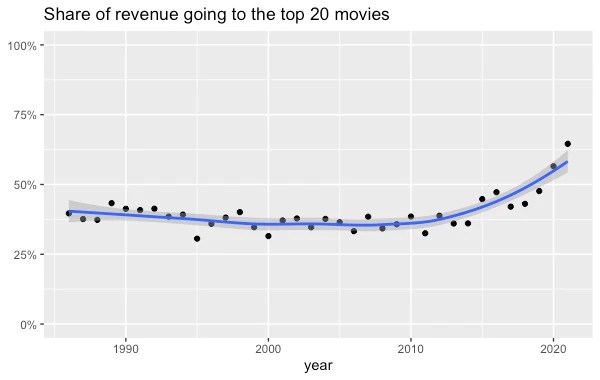
Top movies have also recently started taking a larger chunk of the market. I extracted the revenue of the top 20 movies and divided it by the total revenue of the top 200 movies, going all the way back to 1986 (source). The top 20 movies captured about 40% of all revenue until 2015, when they started gobbling up even more.
Television

Thanks to cable and streaming, there’s way more stuff on TV today than there was 50 years ago. So it would make sense if a few shows ruled the early decades of TV, and now new shows constantly displace each other at the top of the viewership charts.

Instead, the opposite has happened. I pulled the top 30 most-viewed TV shows from 1950 to 2019 (source) and found that fewer and fewer franchises rule a larger and larger share of the airwaves. In fact, since 2000, about a third of the top 30 most-viewed shows are either spinoffs of other shows in the top 30 (e.g., CSI and CSI: Miami) or multiple broadcasts of the same show (e.g., American Idol on Monday and American Idol on Wednesday). 
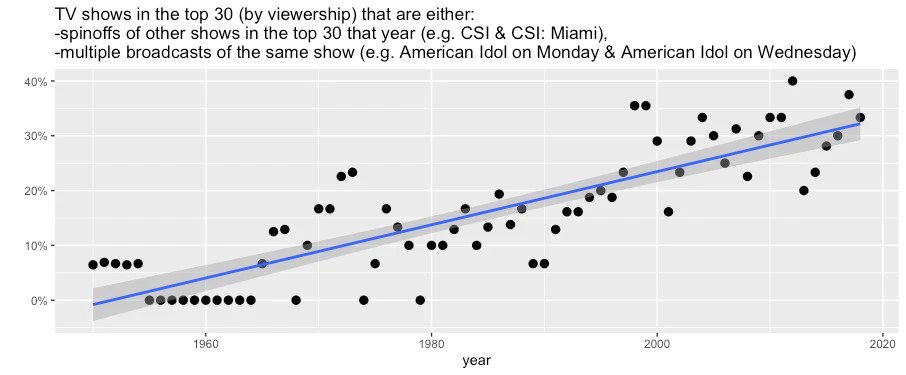
Two caveats to this data. First, I’m probably slightly undercounting multiplicities from earlier decades, where the connections between shows might be harder for a modern viewer like me to understand––maybe one guy hosted multiple different shows, for example. And second, the Nielsen ratings I’m using only recently started accurately measuring viewership on streaming platforms. But even in 2019, only 14% of viewing time was spent on streaming, so this data isn’t missing much.

Music

It used to be that a few hitmakers ruled the charts––The Beatles, The Eagles, Michael Jackson––while today it’s a free-for-all, right?

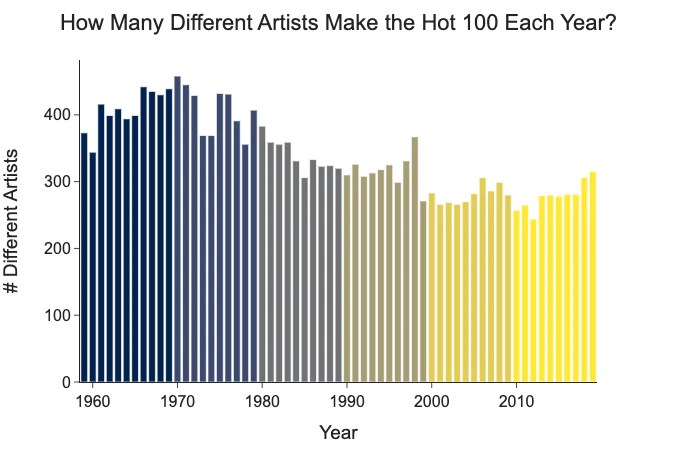
Nope. A data scientist named Azhad Syed has done the analysis, and he finds that the number of artists on the Billboard Hot 100 has been decreasing for decades.
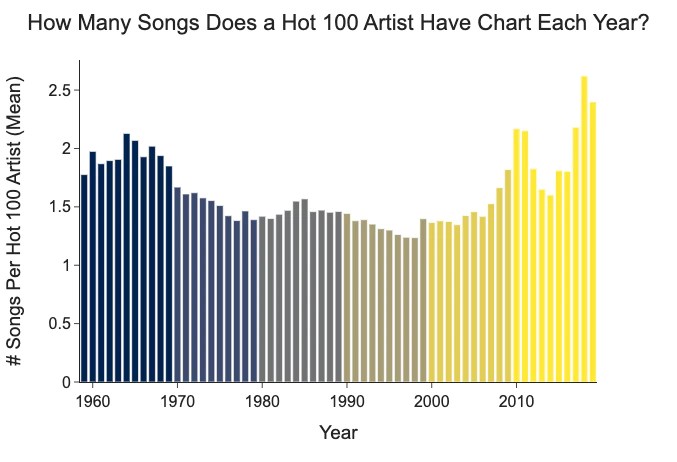
And since 2000, the number of hits per artist on the Hot 100 has been increasing. 
(Azhad says he’s looking for a job––you should hire him!)

A smaller group of artists tops the charts, and they produce more of the chart-toppers. Music, too, has become an oligopoly.

Books

Literature feels like a different world than movies, TV, and music, and yet the trend is the same.

Using LiteraryHub’s list of the top 10 bestselling books for every year from 1919 to 2017, I found that the oligopoly has come to book publishing as well. There are a couple ways we can look at this. First, we can look at the percentage of repeat authors in the top 10––that is, the number of books in the top 10 that were written by an author with another book in the top 10.
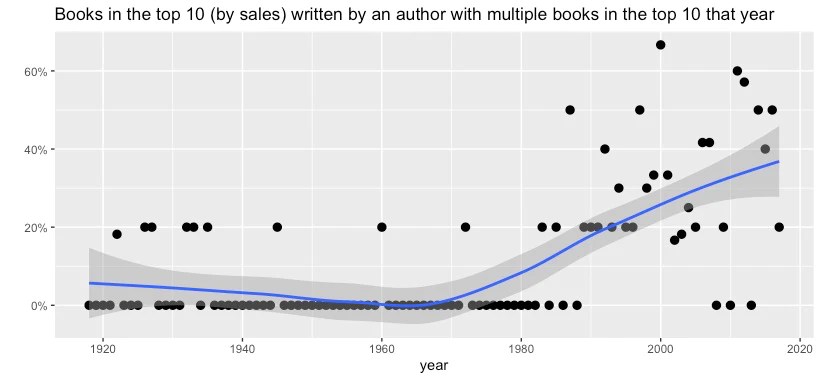
It used to be pretty rare for one author to have multiple books in the top 10 in the same year. Since 1990, it’s happened almost every year. No author ever had three top 10 books in one year until Danielle Steel did it 1998. In 2011, John Grisham, Kathryn Stockett, and Stieg Larsson all had two chart-topping books each.

We can also look at the percentage of authors in the top 10 were already famous––say, they had a top 10 book within the past 10 years. That has increased over time, too. 
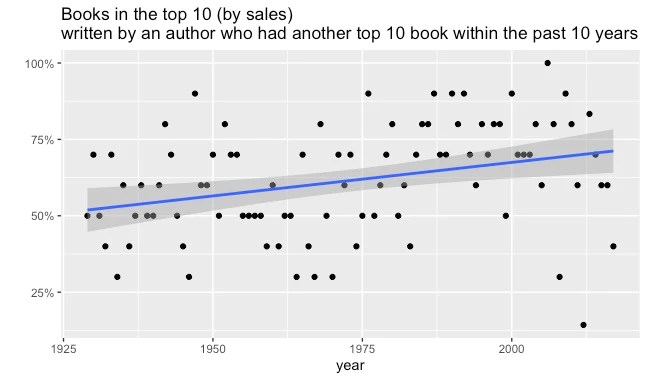
In the 1950s, a little over half of the authors in the top 10 had been there before. These days, it’s closer to 75%.

Video games

I tracked down the top 20 bestselling video games for each year from 1995 to 2021 (sources: 1234567) and coded whether each belongs to a preexisting video game franchise. (Some games, like Harry Potter and the Sorcerer’s Stone, belong to franchises outside of video games. For these, I coded the first installment as originals and any subsequent installments as franchise games.)

The oligopoly rules video games too:
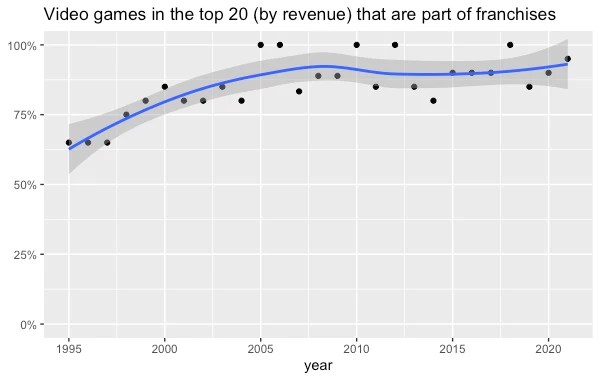
In the late 1990s, 75% or less of bestselling video games were franchise installments. Since 2005, it’s been above 75% every year, and sometimes it’s 100%. At the top of the charts, it’s all Mario, Zelda, Call of Duty, and Grand Theft Auto.

Why is this happening?

Any explanation for the rise of the pop oligopoly has to answer two questions: why have producers started producing more of the same thing, and why are consumers consuming it? I think the answers to the first question are invasionconsolidation, and innovation. I think the answer to the second question is proliferation.

Invasion

Software and the internet have made it easier than ever to create and publish content. Most of the stuff that random amateurs make is crap and nobody looks at it, but a tiny proportion gets really successful. This might make media giants choose to produce and promote stuff that independent weirdos never could, like an Avengers movie. This can’t explain why oligopolization started decades ago––YouTube only launched in 2005, for example, and most Americans didn’t have broadband until 2007––but it might explain why it’s accelerated and stuck around.

Consolidation

Big things like to eat, defeat, and outcompete smaller things. So over time, big things should get bigger and small things should die off. Indeed, movie studiosmusic labelsTV stations, and publishers of books and video games have all consolidated. Maybe it’s inevitable that major producers of culture will suck up or destroy everybody else, leaving nothing but superstars and blockbusters. Indeed, maybe cultural oligopoly is merely a transition state before we reach cultural monopoly.

Innovation

You may think there’s nothing left to discover in art forms as old as literature and music, and that they simply iterate as fashions change. But it took humans thousands of years to figure out how to create the illusion of depth in paintings. Novelists used to think that sentences had to be long and complicated until Hemingway came along, wrote some snappy prose, and changed everything. Even very old art forms, then, may have secrets left to discover. Maybe the biggest players in culture discovered some innovations that won them a permanent, first-mover chunk of market share. I can think of a few:

  • In books: lightning-quick plots and chapter-ending cliffhangers. Nobody thinks The Da Vinci Code is high literature, but it’s a book that really really wants you to read it. And a lot of people did!
  • In music: sampling. Musicians seem to sample more often these days. Now we not only remake songs; we franchise them too.
  • In movies, TV, and video games: cinematic universes. Studios have finally figured out that once audiences fall in love with fictional worlds, they want to spend lots of time in them. Marvel, DC, and Star Wars are the most famous, but there are also smaller universe expansions like Better Call Saul and El Camino from Breaking Bad and The Many Saints of Newark from The Sopranos. Video game developers have understood this for even longer, which is why Mario does everything from playing tennis to driving go-karts to, you know, being a piece of paper.

Proliferation

Invasion, consolidation, and innovation can, I think, explain the pop oligopoly from the supply side. But all three require a willing audience. So why might people be more open to experiencing the same thing over and over again?

As options multiply, choosing gets harder. You can’t possibly evaluate everything, so you start relying on cues like “this movie has Tom Hanks in it” or “I liked Red Dead Redemption, so I’ll probably like Red Dead Redemption II,” which makes you less and less likely to pick something unfamiliar. 

Another way to think about it: more opportunities means higher opportunity costs, which could lead to lower risk tolerance. When the only way to watch a movie is to go pick one of the seven playing at your local AMC, you might take a chance on something new. But when you’ve got a million movies to pick from, picking a safe, familiar option seems more sensible than gambling on an original.

This could be happening across all of culture at once. Movies don’t just compete with other movies. They compete with every other way of spending your time, and those ways are both infinite and increasing. There are now 60,000 free books on Project Gutenberg, Spotify says it has 78 million songs and 4 million podcast episodes, and humanity uploads 500 hours of video to YouTube every minute. So uh, yeah, the Tom Hanks movie sounds good.

What do we do about it?

Some may think that the rise of the pop oligopoly means the decline of quality. But the oligopoly can still make art: Red Dead Redemption II is a terrific game, “Blinding Lights” is a great song, and Toy Story 4 is a pretty good movie. And when you look back at popular stuff from a generation ago, there was plenty of dreck. We’ve forgotten the pulpy Westerns and insipid romances that made the bestseller lists while books like The Great GatsbyBrave New World, and Animal Farm did not. American Idol is not so different from the televised talent shows of the 1950s. Popular culture has always been a mix of the brilliant and the banal, and nothing I’ve shown you suggests that the ratio has changed.

The problem isn’t that the mean has decreased. It’s that the variance has shrunk. Movies, TV, music, books, and video games should expand our consciousness, jumpstart our imaginations, and introduce us to new worlds and stories and feelings. They should alienate us sometimes, or make us mad, or make us think. But they can’t do any of that if they only feed us sequels and spinoffs. It’s like eating macaroni and cheese every single night forever: it may be comfortable, but eventually you’re going to get scurvy. 

We haven’t fully reckoned with what the cultural oligopoly might be doing to us. How much does it stunt our imaginations to play the same video games we were playing 30 years ago? What message does it send that one of the most popular songs in the 2010s was about how a 1970s rock star was really cool? How much does it dull our ambitions to watch 2021’s The Matrix: Resurrections, where the most interesting scene is just Neo watching the original Matrix from 1999? How inspiring is it to watch tiny variations on the same police procedurals and reality shows year after year? My parents grew up with the first Star Wars movie, which had the audacity to create an entire universe. My niece and nephews are growing up with the ninth Star Wars movie, which aspires to move merchandise. Subsisting entirely on cultural comfort food cannot make us thoughtful, creative, or courageous.

Fortunately, there’s a cure for our cultural anemia. While the top of the charts has been oligopolized, the bottom remains a vibrant anarchy. There are weird books and funky movies and bangers from across the sea. Two of the most interesting video games of the past decade put you in the role of an immigration officer and an insurance claims adjuster. Every strange thing, wonderful and terrible, is available to you, but they’ll die out if you don’t nourish them with your attention. Finding them takes some foraging and digging, and then you’ll have to stomach some very odd, unfamiliar flavors. That’s good. Learning to like unfamiliar things is one of the noblest human pursuits; it builds our empathy for unfamiliar people. And it kindles that delicate, precious fire inside us––without it, we might as well be algorithms. Humankind does not live on bread alone, nor can our spirits long survive on a diet of reruns.
New York Times — a Bastion of Censorship and Corruption — Warns ‘America Has a Free Speech Problem’

The New York Times editorial board recently opined that Americans are losing “the right to speak their minds and voice their opinions,” yet this same newspaper refused to review, or even publish an advertisement for, RFK, Jr.’s runaway bestseller, “The Real Anthony Fauci.”

By Tony Lyons

Source: The Defender

In a bold, but clearly disingenuous, statement from its famed editorial board, “a group of opinion journalists whose views are informed by expertise, research, debate, and certain longstanding values,” The New York Times issued a cautionary statement:

“For all the tolerance and enlightenment that modern society claims, Americans are losing hold of a fundamental right as citizens of a free country: the right to speak their minds and voice their opinions in public without fear of being shamed or shunned.”

The editorial board pounded the point home:

“People should be able to put forward viewpoints, ask questions and make mistakes, and take unpopular but good-faith positions on issues that society is still working through — all without fearing cancellation …. Freedom of speech requires not just a commitment to openness and tolerance in the abstract. It demands conscientiousness…

“We believe it isn’t enough for Americans to just believe in the rights of others to speak freely; they should also find ways to actively support and protect those rights.”

Of course, The New York Times should be leading by example. In fact, it has not supported free speech, protected the First Amendment, or allowed honest debate. It has not allowed competing perspectives about the most important issues of the day.

Instead, it has been a mouthpiece for greedy corporations and corrupt government officials.

In support of the newspaper’s interests, and at the expense of the interests of American citizens, The New York Times censored Robert F. Kennedy, Jr.’s latest book, “The Real Anthony Fauci,” in every conceivable way.

It ranked the book No. 7 on its non-fiction bestseller list even though the book outsold any other book in America that week by thousands of copies.

Then it refused to allow Skyhorse Publishing to place an advertisement for the book because its censorship division, ironically called “Standards Management,” decided the book itself constituted misinformation — despite the paper’s stated policy that “Standards” only looks into whether an ad itself is “non-defamatory and accurate.”

The New York Times followed up with a scathing hit piece targeting Kennedy as “a leading voice in the campaign to discredit coronavirus vaccines and other measures being advanced by the Biden White House to battle a pandemic that was … killing close to 1,900 people a day.”

The Times accused Kennedy of circulating “false information” — without indicating what that information was or explaining why it was false — and of comparing the government pandemic response to the Holocaust, even though he didn’t do that.

Finally, The New York Times refused to review “The Real Anthony Fauci” or so much as comment on its historic grassroots success, even though it’s become a cult classic, selling more than 1 million copies in just four months, and launching a worldwide movement against government corruption and corporate greed.

“Despite all the lying, or maybe in reaction to it,” Tucker Carlson told me, “Robert F. Kennedy, Jr. is becoming a legitimate folk hero.”

He is a folk hero because he stood up, grabbed a bullhorn and spoke truth to power. He’s risked everything. He’s realized that you either care about justice or you care about personal consequences.

And for him there have been many.

After suppressing freedom of speech for two years and defending a specific, myopic and harmful narrative, the editorial board of the New York Times decided it was the perfect time to take a strong stance against censorship and cancel culture.

The irony of the most powerful and high-profile violator of First Amendment rights lamenting the lack of free speech — and offering up ideas to protect the rights of Americans — was palpable, inescapable and despicable.

Like Captain Renault in “Casablanca,” when he closes Rick’s Café Americain and proclaims: “I’m shocked, shocked to find that gambling is going on in here,” The New York Times gladly accepts its winnings.

The paper’s profitability has soared during the worst and most pervasive period of censorship in recent American history. Its owners have done absolutely nothing to protect the free speech rights of hundreds, if not thousands, of doctors, nurses, scientists and concerned citizens who have tried to discuss views, make arguments and analyze scientific studies that challenge the prevailing COVID narrative.

The Times has silenced debate, worked tirelessly to chastise, vilify and discredit those whose positions they disagree with, and failed to investigate serious claims of government corruption.

Nevertheless, the paper claims to lament that “when public discourse in America is narrowed, it becomes harder to answer … the urgent questions we face as a society.”

What could be more important, more urgent, than the truth about corruption at the highest levels of government, about a pandemic response that led to more serious illness and death than was necessary, about the most powerful public health official in the country being more concerned with helping Big Pharma maximize return on investment and mitigate risk to industry, rather than protecting people’s lives?

As The Times wrote, the worst kind of censorship is cancel culture and the worst kind of cancel culture is the “piling on” kind.

Why then, one might ask, did the paper run a hit piece about Robert F. Kennedy, Jr. that covered essentially the same subject matter as a dozen other hit pieces? Why now? Why this target?

His family thinks he’s wrong about vaccines, The Times noted. His friends think he’s wrong about vaccines. Dr. Fauci thinks he’s wrong about vaccines. Ever heard that before?

Any analysis about vaccine safety? Any facts? Any citations? Any discussion of Dr. Fauci’s despicable corruption as described in “The Real Anthony Fauci”?

No, no, no, no and no.

What was The New York Times doing when the whole world was attacking Robert F. Kennedy, Jr.?

Where was The New York Times when Robert F. Kennedy, Jr., Dr. Robert Malone, Dr. Judy Mikovits, Dr. Pierre Kory — and so many other impressive voices — were being stifled?

They were “piling on.” (If The New York Times really wants to do something for free speech, it should publish a book review, finally, of the runaway bestseller — “The Real Anthony Fauci.”)

The Times has stated it won’t “publish ad hominem attacks,” but it does publish hit pieces that any rational person understands are meant to discredit a book they don’t mention and obviously haven’t read.

The Times protects corrupt government officials against the unsuspecting public by forwarding policy statements or official memos their editors and reporters have not thoroughly vetted, investigated or corroborated.

The Times writers and editors are the worst kind of co-conspirators: the kind that claims to be protecting their victims.

The New York Times writes:

“At the individual level, human beings cannot flourish without the confidence to take risks, to pursue ideas and express thoughts that others might reject…. When speech is stifled or when dissenters are shut out of the public discourse, a society also loses its ability to resolve conflict, and it faces the risk of political violence.”

That’s where we are in America today. There is no debate, no public discourse, and we have lost the ability to resolve conflict.

We have separated the country into two Americas, at least partially because of the policies and practices of The New York Times.

The New York Post pointed out that the New York Times “published lies to serve a biased narrative.” The Post accused The Times of “malicious misreporting” and cites a book, “The Grey Lady Winked,” by Ashley Rindsberg.

Rindsberg is quoted as calling The New York Times “a truth-producing machine.” He believes the “fabrications and distortions” they’ve peddled since the 1920s were a system of twisting facts to manipulate public opinion about everything from “Hitler’s Germany and Stalin’s Russia to Vietnam and the Iraq War.”

The “reporting” is designed to “support a narrative aligned with the corporate whims, economic needs and political preferences” of The New York Times, Rindsberg claims. He believes the paper has consistently created “false narratives.”

The New York Post says The Times has the resources to do it:

“With close to $2 billion in annual revenue, the Times has the money, prestige, experience and stature to set the narratives that other news outlets invariably follow.”

Rindsberg alleges a former Times bureau chief in Berlin was a Nazi collaborator and that another star reporter for the paper parroted Soviet propaganda to defend Stalin.

The New York Times coverage in the lead-up to the Vietnam and Iraq wars seemed like government disinformation designed to support going to war.

More recently Rindsberg points to the stories that The New York Times published about Russia putting a bounty on U.S. soldiers in Afghanistan, which the Biden administration later conceded was misinformation, and the story about Capitol Police Officer Brian Sicknick being “murdered by rampaging Trump supporters,” though it was later proven he died of a stroke.

Similarly, Glenn Greenwald accused The New York Times of participating in “one of the most successful disinformation campaigns in modern electoral history.”

The Times, which before the 2020 election dismissed the Hunter Biden laptop as Russian disinformation, recently conceded that it was authentic.

It seems likely The New York Times coverage of the COVID Pandemic isn’t any different than its coverage of Hitler, Stalin, Vietnam, the Iraq War, January 6, the Russian bounty on American soldiers or the Hunter Biden laptop.

Like most of the major Big Tech platforms, The New York Times appears to have worked closely with Dr. Fauci and others, as representatives of the U.S. government, to control and propagate a specific narrative and to do what the government can’t legally do itself — censor ideas that it disagrees with or narratives that might be harmful to its corporate partners.

As discussed above, The New York Times actively suppressed Robert F. Kennedy, Jr.’s book and his allegations of corruption against Dr. Anthony Fauci. It defended Dr. Fauci without any investigation, without a full, free and fair discussion of what is clearly the most important book of the decade.

By ignoring Kennedy’s book, by refusing to review it, by not allowing advertisements, by misrepresenting its success on its bestseller list, the paper clearly did everything in its power to avoid any debate whatsoever about the real science behind the origins of COVID or the best practices for controlling the virus and protecting the public.

The New York Times has shown a total disregard for the scientific process, individual due process rights or for any real search for truth.

And, once again, it did all this while lecturing us about the importance of free speech.

We have arrived at George Orwell’s “1984.” Doublespeak is the universal language. The paper of record floods the world with disinformation, claims to be working tirelessly to protect the American people and has clearly become The Ministry of Truth.

Reading Robert F. Kennedy, Jr.’s book, “The Real Anthony Fauci” — the book Big Pharma, Dr. Fauci, the U.S. government and The New York Times will do absolutely anything to prevent you from reading — has become an act of rebellion, a blow to fascism and a clear message that censorship in America just doesn’t work.

Tony Lyons, president and publisher at Skyhorse publishing, and an attorney, was publisher at The Lyons Press between 1997 and 2004. He founded Skyhorse Publishing in 2006 and has been involved with every aspect of the book publishing process.

Humilitainment: How to Control the Citizenry Through Reality TV Distractions

By John W. Whitehead & Nisha Whitehead

Source: The Rutherford Institute

Big Brother does not watch us, by his choice. We watch him, by ours…. When a population becomes distracted by trivia, when cultural life is redefined as a perpetual round of entertainments, when serious public conversation becomes a form of baby-talk, when, in short, a people become an audience, and their public business a vaudeville act, then a nation finds itself at risk; culture-death is a clear possibility.”—Professor Neil Postman

Once again, the programming has changed.

Like clockwork, the wall-to-wall news coverage of the latest crisis has shifted gears.

We have gone from COVID-19 lockdowns to Trump-Biden election drama to the Russia-Ukraine crisis to the Ketanji Brown Jackson confirmation hearings to Will Smith’s on-camera assault of comedian Chris Rock at the Academy Awards Ceremony.

The distractions, distortions, and political theater just keep coming.

The ongoing reality show that is life in the American police state feeds the citizenry’s voracious appetite for titillating, soap opera drama.

Much like the fabricated universe in Peter Weir’s 1998 film The Truman Show, in which a man’s life is the basis for an elaborately staged television show aimed at selling products and procuring ratings, the political scene in the United States has devolved over the years into a carefully calibrated exercise in how to manipulate, polarize, propagandize and control a population.

This is the magic of the reality TV programming that passes for politics today: as long as we are distracted, entertained, occasionally outraged, always polarized but largely uninvolved and content to remain in the viewer’s seat, we’ll never manage to present a unified front against tyranny (or government corruption and ineptitude) in any form.

The more that is beamed at us, the more inclined we are to settle back in our comfy recliners and become passive viewers rather than active participants as unsettling, frightening events unfold.

We don’t even have to change the channel when the subject matter becomes too monotonous. That’s taken care of for us by the programmers (the corporate media).

“Living is easy with eyes closed,” observed John Lennon, and that’s exactly what reality TV that masquerades as American politics programs the citizenry to do: navigate the world with their eyes shut.

As long as we’re viewers, we’ll never be doers.

Studies suggest that the more reality TV people watch—and I would posit that it’s all reality TV, entertainment news included—the more difficult it becomes to distinguish between what is real and what is carefully crafted farce.

“We the people” are watching a lot of TV.

On average, Americans spend five hours a day watching television. By the time we reach age 65, we’re watching more than 50 hours of television a week, and that number increases as we get older. And reality TV programming consistently captures the largest percentage of TV watchers every season by an almost 2-1 ratio.

This doesn’t bode well for a citizenry able to sift through masterfully-produced propaganda in order to think critically about the issues of the day, whether it’s fake news peddled by government agencies or foreign entities.

Those who watch reality shows tend to view what they see as the “norm.” Thus, those who watch shows characterized by lying, aggression and meanness not only come to see such behavior as acceptable and entertaining but also mimic the medium.

This holds true whether the reality programming is about the antics of celebrities in the White House, in the board room, or in the bedroom.

It’s a phenomenon called “humilitainment.”

A term coined by media scholars Brad Waite and Sara Booker, “humilitainment” refers to the tendency for viewers to take pleasure in someone else’s humiliation, suffering and pain.

Humilitainment” largely explains not only why American TV watchers are so fixated on reality TV programming but how American citizens, largely insulated from what is really happening in the world around them by layers of technology, entertainment, and other distractions, are being programmed to accept the government’s brutality, surveillance and dehumanizing treatment as things happening to other people.

The ramifications for the future of civic engagement, political discourse and self-government are incredibly depressing and demoralizing.

This explains how we keep getting saddled with leaders in government who are clueless about the Constitution and out-of-touch with the needs of the people they were appointed to represent.

This is also what happens when an entire nation—bombarded by reality TV programming, government propaganda and entertainment news—becomes systematically desensitized and acclimated to the trappings of a government that operates by fiat and speaks in a language of force.

Ultimately, the reality shows, the entertainment news, the surveillance society, the militarized police, and the political spectacles have one common objective: to keep us divided, distracted, imprisoned, and incapable of taking an active role in the business of self-government.

Look behind the political spectacles, the reality TV theatrics, the sleight-of-hand distractions and diversions, and the stomach-churning, nail-biting drama, and you will find there is a method to the madness.

We have become guinea pigs in a ruthlessly calculated, carefully orchestrated, chillingly cold-blooded experiment in how to control a population and advance a political agenda without much opposition from the citizenry.

This is mind-control in its most sinister form.

How do you change the way people think? You start by changing the words they use.

In totalitarian regimes where conformity and compliance are enforced at the end of a loaded gun, the government dictates what words can and cannot be used.

In countries where tyranny hides behind a benevolent mask and disguises itself as tolerance, the citizens censor themselves, policing their words and thoughts to conform to the dictates of the mass mind.

Even when the motives behind this rigidly calibrated reorientation of societal language appear well-intentioned—discouraging racism, condemning violence, denouncing discrimination and hatred—inevitably, the end result is the same: intolerance, indoctrination, infantilism, the chilling of free speech and the demonizing of viewpoints that run counter to the cultural elite.

As George Orwell recognized, “In times of universal deceit, telling the truth is a revolutionary act.”

Orwell understood only too well the power of language to manipulate the masses.

In Orwell’s 1984, Big Brother does away with all undesirable and unnecessary words and meanings, even going so far as to routinely rewrite history and punish “thoughtcrimes.” In this dystopian vision of the future, the Thought Police serve as the eyes and ears of Big Brother, while the Ministry of Peace deals with war and defense, the Ministry of Plenty deals with economic affairs (rationing and starvation), the Ministry of Love deals with law and order (torture and brainwashing), and the Ministry of Truth deals with news, entertainment, education and art (propaganda). The mottos of Oceania: WAR IS PEACE, FREEDOM IS SLAVERY, and IGNORANCE IS STRENGTH.

Orwell’s Big Brother relied on Newspeak to eliminate undesirable words, strip such words as remained of unorthodox meanings and make independent, non-government-approved thought altogether unnecessary.

Where we stand now is at the juncture of Oldspeak (where words have meanings, and ideas can be dangerous) and Newspeak (where only that which is “safe” and “accepted” by the majority is permitted).

Truth is often lost when we fail to distinguish between opinion and fact, and that is the danger we now face as a society. Anyone who relies exclusively on television/cable news hosts and political commentators for actual knowledge of the world is making a serious mistake.

Unfortunately, since Americans have by and large become non-readers, television has become their prime source of so-called “news.” This reliance on TV news has given rise to such popular news personalities who draw in vast audiences that virtually hang on their every word.

In our media age, these are the new powers-that-be.

Yet while these personalities often dispense the news like preachers used to dispense religion, with power and certainty, they are little more than conduits for propaganda and advertisements delivered in the guise of entertainment and news.

Given the preponderance of news-as-entertainment programming, it’s no wonder that viewers have largely lost the ability to think critically and analytically and differentiate between truth and propaganda, especially when delivered by way of fake news criers and politicians.

While television news cannot—and should not—be completely avoided, the following suggestions will help you better understand the nature of TV news.

1. TV news is not what happened. Rather, it is what someone thinks is worth reporting. Although there are still some good TV journalists, the old art of investigative reporting has largely been lost. While viewers are often inclined to take what is reported by television “news” hosts at face value, it is your responsibility to judge and analyze what is reported.

2. TV news is entertainment. There is a reason why the programs you watch are called news “shows.” It’s a signal that the so-called news is being delivered as a form of entertainment. “In the case of most news shows,” write Neil Postman and Steve Powers in their insightful book, How to Watch TV News (1992), “the package includes attractive anchors, an exciting musical theme, comic relief, stories placed to hold the audience, the creation of the illusion of intimacy, and so on.”

Of course, the point of all this glitz and glamour is to keep you glued to the set so that a product can be sold to you. (Even the TV news hosts get in on the action by peddling their own products, everything from their latest books to mugs and bathrobes.) Although the news items spoon-fed to you may have some value, they are primarily a commodity to gather an audience, which will in turn be sold to advertisers.

3. Never underestimate the power of commercials, especially to news audiences. In an average household, the television set is on over seven hours a day. Most people, believing themselves to be in control of their media consumption, are not really bothered by this. But TV is a two-way attack: it not only delivers programming to your home, it also delivers you (the consumer) to a sponsor.

People who watch the news tend to be more attentive, educated and have more money to spend. They are, thus, a prime market for advertisers. And sponsors spend millions on well-produced commercials. Such commercials are often longer in length than most news stories and cost more to produce than the news stories themselves. Moreover, the content of many commercials, which often contradicts the messages of the news stories, cannot be ignored. Most commercials are aimed at prurient interests in advocating sex, overindulgence, drugs, etc., which has a demoralizing effect on viewers, especially children.

4. It is vitally important to learn about the economic and political interests of those who own the “corporate” media. There are few independent news sources anymore. The major news outlets are owned by corporate empires.

5. Pay special attention to the language of newscasts. Because film footage and other visual imagery are so engaging on TV news shows, viewers are apt to allow language—what the reporter is saying about the images—to go unexamined. A TV news host’s language frames the pictures, and, therefore, the meaning we derive from the picture is often determined by the host’s commentary. TV by its very nature manipulates viewers. One must never forget that every television minute has been edited. The viewer does not see the actual event but the edited form of the event. For example, presenting a one- to two-minute segment from a two-hour political speech and having a TV talk show host critique may be disingenuous, but such edited footage is a regular staple on news shows. Add to that the fact that the reporters editing the film have a subjective view—sometimes determined by their corporate bosses—that enters in.

6. Reduce by at least one-half the amount of TV news you watch. TV news generally consists of “bad” news—wars, torture, murders, scandals and so forth. It cannot possibly do you any harm to excuse yourself each week from much of the mayhem projected at you on the news. Do not form your concept of reality based on television. TV news, it must be remembered, does not reflect normal everyday life. Studies indicate that a heavy viewing of TV news makes people think the world is much more dangerous than it actually is.

7. One of the reasons many people are addicted to watching TV news is that they feel they must have an opinion on almost everything, which gives the illusion of participation in American life. But an “opinion” is all that we can gain from TV news because it only presents the most rudimentary and fragmented information on anything. Thus, on most issues we don’t really know much about what is actually going on. And, of course, we are expected to take what the TV news host says on an issue as gospel truth. But isn’t it better to think for yourself? Add to this that we need to realize that we often don’t have enough information from the “news” source to form a true opinion. How can that be done? Study a broad variety of sources, carefully analyze issues in order to be better informed, and question everything.

The bottom line is simply this: Americans should beware of letting others—whether they be television news hosts, political commentators or media corporations—do their thinking for them.

As I make clear in my book Battlefield America: The War on the American People and in its fictional counterpart The Erik Blair Diaries, a populace that cannot think for themselves is a populace with its backs to the walls: mute in the face of elected officials who refuse to represent us, helpless in the face of police brutality, powerless in the face of militarized tactics and technology that treat us like enemy combatants on a battlefield, and naked in the face of government surveillance that sees and hears all.

It’s time to change the channel, tune out the reality TV show, and push back against the real menace of the police state.

If not, if we continue to sit back and lose ourselves in political programming, we will remain a captive audience to a farce that grows more absurd by the minute.

President Joe Biden seeks to destroy Russia and Punish the Russian People

He supported savage sanctions that killed one million Iraqis in the 1990s and criminally ignores the plight of post-war Afghanistan

By John Stanton

Source: Intrepid Report

Who, really, is the war criminal?

So what does President Joe Biden want the sanctions imposed on Russia to do? Think back to the 1990s and what the US-NATO imposed no-fly zone and sanctions did to the people of Iraq?  The results were almost 1 million Iraqis dead, according to the website GlobalIssues.org.

Over at truthout.org, Jake Batinga reported that President Joe Biden strongly supported those sanctions as a US senator and recently has turned a blind eye to the humanitarian crisis unfolding in Afghanistan: “Senator Biden strongly supported the sanctions and advocated for even more aggressive policies toward Iraq. Biden was not then, and is not now, known for his humanitarian impulses or dovish foreign policy stances.”

Batinga also notes that: “More Afghans are poised to die from US sanctions over the next few months alone than have died at the hands of the Taliban and US military forces over the last 20 years combined— by a significant margin. Yet, as journalist Murtaza Hussain recently wrote, US establishment politicians and intellectuals who decried the humanitarian crisis during the fall of Kabul are seemingly unbothered by imminent mass starvation, imposed by us.”

The Biden administration— which routinely laments human rights violations perpetrated by China, Iran, Russia, and other adversaries— is ignoring desperate pleas from humanitarian organizations and UN human rights bodies, choosing instead to maintain policies virtually guaranteed to cause mass starvation and death of civilians, especially children. Yet it is important to note, and remember, that as a matter of policy, this is not particularly new; the US has often imposed harsh economic sanctions, causing mass civilian death. A previous imposition of sanctions resulted in one of the worst humanitarian catastrophes, one largely forgotten in mainstream historical memory.

In 1990, the US imposed sanctions on Iraq through the UN following the Iraqi invasion of Kuwait. These sanctions continued for more than a decade after Iraq withdrew from Kuwait, and had horrific humanitarian consequences eerily similar to the imminent mass starvation of Afghan civilians. The sanctions regime against Iraq— which began under President George H.W. Bush but was primarily administered by President Bill Clinton’s administration— froze Iraq’s foreign assets, virtually banned trade, and sharply limited imports. These sanctions crashed the Iraqi economy and blocked the import of humanitarian supplies, medicine, food, and other basic necessities, killing scores of civilians.”

BRIC’s made of straw

The BRIC nations, Brazil, Russia, India and China have been in the news lately and for good reason. There is talk, and talk is cheap of course, of China and Russia creating an alternative payment system to the US dollar dominated international payments system SWIFT.

Already Russia has joined China’s Cross Border Interbank Payment System Payment as an alternative to SWIFT, along with joining China’s UnionPay credit card system which serves as an alternative to Visa and Master Card who, along with dozens of other Western country businesses (Europe, USA plus Japan and South Korea), bolted Russia’s marketplace after its military operation got started in Ukraine in late February.

India apparently is trading with Russia in a rupee, ruble swap but that seems ad hoc, at best. And there is news of Saudi Arabia cutting a deal with China to use the yuan as an exchange currency. Brazil has enough internal problems to deal with: crime, disease, Amazon deforestation.

Chinese leaders must realize that if Russia falters in Ukraine which means it is unable to liberate the Republics of Luhansk and Donetsk, gain international recognition of Crimea—and maintain territorial gains made on the coast of the Black and Azov Sea’s—and/or President Putin is removed from office and Russia destabilizes, the United States will chop up Russia into separate republics, steal its resources and cancel the billions in deals signed with China for oil, gas, and grains

The United States will bring the NATO military alliance to China’s doorstep and likely put on show trials in the International Criminal Court arguing that Putin and his general staff are war criminals, which would be utter nonsense given US policies and actions in Iraq, Afghanistan and Yemen.

China is trying to placate the US because it still fears US economic and military power. Its party officials probably figure that they can keep building up the People’s Liberation Army, Navy, Air Force and Strategic nuclear capability and when there is enough firepower, will be able to challenge US dominance in the Pacific. But how?

The PLA forces have no modern combat experience to speak of and their plan seems to be; well, no plan at all. They are faced with the combined forces of the USA that are building new aircraft carriers, submarines and long distance B-21 bombers, along with upgrading all three legs of its nuclear TRIAD.

Which brings us back to Russia and the economic support it needs so that Biden’s sanctions don’t end up killing a million Russians. Because that is what Biden intends and his track record on supporting sanctions is disturbingly clear. When China looks at what the USA-NATO have done to the Russian economy, they are looking at their own future.

Hypocrisy

Joe Scalice at the World Socialist Website notes the hypocrisy of the USA-NATO and the compliant MSM Western media:

“The wars of aggression of Clinton, Bush, Obama and Trump contained the accumulated evil of the torture in Abu Ghraib and Guantanamo, the drone bombing of children at play, villages leveled by precision missiles and refugees drowned in the Mediterranean. Baghdad crumbled beneath the shock and awe of unstinting US bombing; Fallujah burned with white phosphorus.

The American mass media is complicit in these crimes. They never challenged the government’s assertions, but trumpeted its pretexts. They whipped up a war-frenzy in the public. Pundits who now denounce Putin were ferocious in demanding that the United States bomb civilians.

Thomas Friedman wrote in the New York Times in 1999 of the bombing of Serbia under Clinton, “It should be lights out in Belgrade: every power grid, water pipe, bridge, road and war-related factory has to be targeted… [W]e will set your country back by pulverizing you. You want 1950? We can do 1950. You want 1389? We can do 1389 too.” [Biden supported bombing Belgrade]

Biden labels Putin a war criminal in the midst of a new media hysteria. Never referring to the actions of the United States, never pausing for breath, the media pumps out the fuel for an ever-expanding war. Hubris and hypocrisy stamp every statement from Washington with an audacity perhaps unique in world history. Its hands bathed in blood up to the elbows, US empire gestures at its enemies and cries war crimes.”

Tactics

Indeed, the media have capitulated to the war propaganda narrative of the Biden Administration. The US MSM relies almost exclusively on Ukrainian sources for its error filled reporting. If you are reading the New York Times or the Washington Post, you aren’t getting the full story. Pro-Russia sites like Southfront, Newsfront, War Gonzo and others tell a different story. For example, the Retroville Mall destruction on March 21 was reported in the West as a wanton and random attack on a shopping place. In fact, the below-building parking lot was home to Ukrainian military vehicles clearly shown by a set of photos that appeared on Newsfront. Residential buildings are clearly being used by the Ukrainian forces to hide their weapons or launch anti-tank attacks from apartment building roofs or top floor apartments. That’s a tactic that makes sense. The Russians know that.

You’ve got to look at all the news sources, even the ones you don’t want to view, in order to be informed about this conflict.

They don’t just lie to us about wars; they lie to us about everything

By Caitlin Johnstone

Source: Intrepid Report

Propaganda isn’t just about manufacturing consent for wars and ridiculous governmental measures we’d never normally accept. That’s what most people think of when they hear that word, but there’s so very, very much more to it than that.

The lion’s share of propaganda goes not toward convincing us to accept new agendas of the powerful, but toward keeping us entranced in the status quo dream world which enables the powerful to have power in the first place. Toward normalizing status quo systems and training us to shape ourselves to fit into them like neat little cogs in a well-oiled machine.

And it’s not even a grand, monolithic conspiracy in most cases. The giant corporations who indoctrinate us with their advertisements, their Hollywood movies and shows, their apps, their websites and their news media are all naturally incentivized to point us further and further into delusion by the fact that they benefit from the status quo systems which have elevated them to wealth.

So day in and day out we are presented with media which train us what to value, where to place our interest and attention, what success looks like, and how a normal human behaves on this planet. And it always aligns perfectly with the interests of the rich and powerful.

They don’t just teach us what to believe. They teach us who we are. They give us the frameworks upon which we cast our ambitions and evaluate our success, and we build psychological identities out of those constructs. I am a businessman. I am unemployed. My life is about making money. My life is about disappointing people. I am a success. I am a failure. They invent the test of our adequacy, and they invent the system by which we are graded.

These artificial constructs take up such vast portions of our personal psychology that people will live their entire lives completely enslaved to them, making them their entire focus. This enslavement is so pervasive that people will often even take their own lives based on what those made-up constructs tell them about who they are and what they’re worth.

And it’s all a lie. A dream world, made entirely of narrative, constructed by the powerful for the benefit of the powerful. Things as intimate as the thoughts in our heads and the movement of our interest and attention are controlled and dominated with iron-fisted force, all for the benefit of some stupid made-up games about imaginary money and fictional authority.

So most of us sleepwalk through life chasing make believe goals and fleeing artificially constructed demons. Too preoccupied with the illusion to look up and notice the thunderous majesty of life as it really is, and usually too confused to truly perceive it even on those rare occasions when we snap out of the trance for a moment to make an effort.

Untangling yourself from this dream world isn’t easy. It takes time. It takes work. It takes a deep, sustained curiosity about what’s really going on underneath all the muddled mental chatter, about what life truly is underneath all the stories we’ve been told about what life is, about who we truly are underneath all the stories we’ve been told about who we are.

The difference between what we’ve been told and what we find over the course of this investigation is the difference between dream and waking life. The real world is as different from the status quo narrative about the world as it is from any other work of fiction. The two things really could not be any more different.

And the good news is that just as your false view of yourself and your world shaped your human expression in the service of the powerful, the rolling back of that mind fog shapes your human expression into something else entirely. Something grounded in reality. Something authentic. Something primal. Something that exists not for the benefit of some faceless oligarchic empire, but for the same reason the grass grows and the galaxies spin in the cosmos.

And that’s what humanity looks like on the other side of this awkward transition phase that our species is going through at this adolescent point in its development. Free from illusion. In harmony with the real. Enslaved to nobody. Striding clear-eyed into the mystery of what’s to come.

American Pravda: Anne Frank, Sirhan Sirhan, and AIDS

By Ron Unz

Source: The Unz Review

As an heir to the most famous political family in modern American history, Robert F. Kennedy, Jr. is hardly an obscure individual, and recent events have greatly elevated his national prominence.

Although he had spent most of his career as a highly-successful environmental attorney, during the early 2000s he gradually became involved with the grassroots movement questioning the safety and efficacy of our proliferating vaccines, a cause widely ridiculed or ignored by our national elites but increasingly resonating with many worried families.

Then the sudden Covid epidemic moved public health issues to the absolute center of the political debate, including the highly controversial steps taken to control the disease. For the first time in history, most Americans were suddenly subjected to lockdowns, which imposed severe restrictions upon their freedom of movement and assembly, and although these were originally presented as temporary measures expected to last only a couple of weeks, across much of the country they actually remained in place for a year or longer. Moreover, the permanent solution proposed for the crisis was the largest mass-vaccination drive in world history, with the leading vaccines relying upon a new and relatively untested mRNA biotechnology developed by our profit-hungry pharmaceutical giants, a situation that raised deep suspicions among many citizens.

Given these developments, the once marginal anti-vaxxing movement suddenly exploded onto the national stage, cutting across many existing political, social, and ideological fault-lines and encompassing perhaps 20-30% of America’s population, with Kennedy and his Children’s Health Defense non-profit soon becoming leading champions of these fearful individuals. Despite lacking any media coverage or a promotional advertising campaign, his book The Real Anthony Fauci sold over 500,000 copies by early January, spending two months on the Amazon bestseller list, much of that time at the very top.

The media establishment regards our vaccination drive as an absolutely crucial national priority and is intensely hostile to those who challenge it, so Kennedy soon became one of its leading villains. In mid-December, a team of six journalists and researchers at the Associated Press unleashed a ferocious 4,000 word assault, followed a few weeks later by a similar critique in leftist Counterpunch. But both these pieces attacked Kennedy on rather mundane grounds, claiming that his anti-vaccination arguments were wrong, dangerous, and possibly financially motivated, and neither gained much attention, nor seemed to damage his popular momentum.

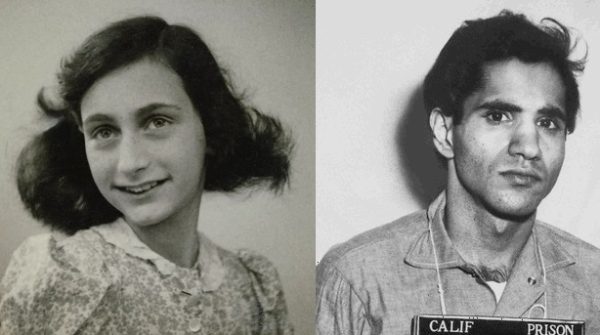
When the media targets an individual, it monitors his every utterance, seeking the slightest opening to vilify him, and last week an opportunity came as Kennedy spoke before a crowd of 30,000 anti-vaxxers at a rally in Washington, DC. Indulging in overly-heated rhetoric, he declared “We have witnessed over the last 20 months a coup d’état against democracy, and the controlled demolition of the United States Constitution and the Bill of Rights.” He further suggested that that government requirements for vaccinations and mandates were imposing “fascism” on our society, with families having nowhere to escape: “Even in Hitler’s Germany, you could cross the Alps to Switzerland. You could hide in an attic like Anne Frank did.”

In our deeply secular society, Nazi Germany has replaced Satan as the epitome of pure evil, while Anne Frank—a Jewish teenager who died of typhus in a German hospital near the end of the war—has been elevated to the status of a sacred martyr. Although drawing such historical analogies is hardly uncommon in political rhetoric, it can sometimes produce angry reactions, especially if these are orchestrated by a hostile media, and Kennedy’s supposedly scandalous references immediately provoked a firestorm of critical coverage, soon leading him to apologize.

With Kennedy’s enemies fanning the flames, his brief reference to the sad fate of a girl who died three generations ago may have received a hundred times more media coverage than the large rally he had headlined or the huge sales of his national bestseller. When the media seeks to destroy someone’s reputation, it will react with hair-trigger reflexes to his slightest misstep.

Yet oddly enough, the same media organs that created a major national controversy out of a few ill-chosen words at a political rally had previously allowed certain of Kennedy’s other, seemingly far greater vulnerabilities to pass almost entirely unnoticed.

These days being labeled a “conspiracy theorist” is a particularly serious charge, with the slur suggesting dangerous mental illness, and surely stigmatizing Kennedy in such a manner would have been an ideal means of discrediting him. But although the author had publicly proclaimed himself a conspiracy theorist of the most explicit sort last month, almost all our hostile journalists carefully averted their eyes.

In the 1960s the conspiratorial term of abuse was first applied to those who challenged the official story that President Kennedy had died at the hands of a deranged lone gunman, and was later broadened to include the many other assassinations that soon followed, including that of the president’s own brother. And on December 8th, nearly the entire Forum page of the San Francisco Chronicle was filled by a Kennedy column arguing that his father Sen. Robert F. Kennedy had been slain by a group of secret conspirators, with the convicted gunman merely being an innocent patsy who should finally be released from prison.

Yet although Kennedy’s legion of media critics attacked him on almost all other grounds, fair or unfair, they carefully avoided that seemingly easy means of branding him as delusional. The long AP attack that ran a week later mentioned not a word, nor did the January Counterpunch piece. As a consequence, I doubt whether more than a tiny slice of the public is aware that Kennedy is a “conspiracy theorist.”

The obvious reason for this strange media reticence was that Kennedy’s position was very solidly grounded in hard factual evidence. In 2018 I drew upon some of the material in David Talbot’s widely-praised 2008 book Brothers to describe the strange aspects of the assassination.

If the first two dozen pages of the Talbot book completely overturned my understanding of the JFK assassination, I found the closing section almost equally shocking. With the Vietnam War as a political millstone about his neck, President Johnson decided not to seek reelection in 1968, opening the door to a last minute entry into the Democratic race by Robert Kennedy, who overcame considerable odds to win some important primaries. Then on June 4, 1968, he carried gigantic winner-take-all California, placing him on an easy path to the nomination and the presidency itself, at which point he would finally be in a position to fully investigate his brother’s assassination. But minutes after his victory speech, he was shot and fatally wounded, allegedly by another lone gunman, this time a disoriented Palestinian immigrant named Sirhan Sirhan, supposedly outraged over Kennedy’s pro-Israel public positions, although these were no different than those expressed by most other political candidates in America.

All this was well known to me. However, I had not known that powder burns later proved that the fatal bullet had been fired directly behind Kennedy’s head from a distance of three inches or less although Sirhan was standing several feet in front of him. Furthermore, eyewitness testimony and acoustic evidence indicated that at least twelve bullets were fired although Sirhan’s revolver could hold only eight, and a combination of these factors led longtime LA Coroner Dr. Thomas Naguchi, who conducted the autopsy, to claim in his 1983 memoir that there was likely a second gunman. Meanwhile, eyewitnesses also reported seeing a security guard with his gun drawn standing immediately behind Kennedy during the attack, and that individual happened to have a deep political hatred of the Kennedys. The police investigators seemed uninterested in these highly suspicious elements, none of which came to light during the trial. With two Kennedy brothers now dead, neither any surviving members of the family nor most of their allies and retainers had any desire to investigate the details of this latest assassination, and in a number of cases they soon moved overseas, abandoning the country entirely. JFK’s widow Jackie confided in friends that she was terrified for the lives of her children, and quickly married Aristotle Onassis, a Greek billionaire, whom she felt would be able to protect them.

Over the years, the 1968 Robert Kennedy assassination has attracted merely a sliver of the books and research devoted to the earlier killing of his elder brother in Dallas, and Talbot’s text spent only a few pages sketching out the strong evidence that the convicted gunman was merely an innocent dupe, manipulated by the true conspirators. But in 2018, two additional books appeared that were entirely focused on the case.

A Lie Too Big To Fail by longtime journalist and conspiracy researcher Lisa Pease ran 500 pages and covered the events of that fatal California evening in exhaustive detail, winning the endorsements of filmmaker Oliver Stone and renowned JFK researcher James W. Douglass. When I read it a few months ago, I found the huge volume of material quite useful but felt that it relied too heavily upon the recollections of eyewitnesses, which can easily grow attenuated over the decades. I was also disturbed to note that the text sometimes seemed to gradually transform reasonable suspicions into apparent certainties, eventually arguing that 3-4 different gunmen were probably firing at the presidential candidate that evening while Sirhan’s own gun had held only blanks.

At the very end, the author also veered off into building castles in the air with regard to other assassinations, arguing that Oswald probably had multiple personalities and that Jack Ruby was operating under a post-hypnotic suggestion, thinly documented claims that seriously weakened her credibility, as did her earlier suggestion that John Lennon had been killed by a government-programmed assassin in 1980 for his past criticism of the Vietnam War. Sometimes less is better, and I think that Pease’s book would have been much stronger if it had been heavily edited and substantially cut. All those extraneous elements should have been left on the cutting-room floor rather than distracting from the central evidence she provided regarding the existence of an RFK assassination conspiracy and Sirhan’s likely innocence.

Meanwhile, The Assassination of Robert F. Kennedy by Tim Tate and the Brad Johnson was released that same year and suffered from none of these flaws. The two conspiracy researchers had spent some 25 years heavily involved in the case, and although their volume was only around half the length of the Pease book, it seemed a far more effective treatment of the topic, including eyewitness accounts but focused primarily upon the undeniable physical and forensic evidence while avoiding any damaging bouts of unwarranted speculation.

While working at CNN, one of the authors had originally obtained the audiotape establishing the number of shots fired, which probably constitutes the single strongest piece of evidence in the case. The book analyzed and evaluated that crucial item in tremendous detail, and also focused upon the fatal shot, which was fired at point-blank range from behind the candidate while Sirhan, the supposed gunman, was standing several feet in front. But since both the publisher and the lead author were British, the work seems to have received much less attention in this country, and I only discovered and read it after Kennedy cited it in his SF Chronicle column.

Unlike many other controversial American killings or terrorist attacks, the powerful evidence of a conspiracy in the case of the RFK assassination was physical and seemingly undeniable. Wikipedia is notoriously reluctant to promote conspiratorial narratives, but in this case the striking facts are presented with only rather weak challenges.

The conclusive proof from the audio recording only came to light in 2004, but I was surprised to discover that all the other strong evidence, including the large number of unexplained bullet holes, had already been known and reported for decades.

Former Congressman Allard K. Lowenstein had been heavily involved in the 1968 election campaign, playing a major role in the effort to unseat incumbent President Lyndon Johnson. In 1977 he published a long cover-story in the influential Saturday Review, setting forth the overwhelming evidence that a second gunman had been involved in the shooting, and my content-archiving system provides a convenient PDF copy. So nearly all the crucial facts in the case have been known for 45 years, but were almost always ignored by our dishonest or cowardly American media.

Three years after publicly revealing that explosive information, Lowenstein himself was dead, supposedly shot at the age of 51 by a deranged lone gunman who had been a former student of his, but I have been informed that his personal friends never believed that story.

Given this massive preponderance of evidence, we can easily understand why the harsh media attacks upon Kennedy had so carefully avoided mentioning his conspiratorial beliefs regarding his father’s assassination. Such criticism would have merely brought the issue to wider public attention, and anyone who began looking into the matter would have quickly concluded that Kennedy was probably correct while our media had spent a half-century covering up the true facts of the 1968 assassination. And if Kennedy were telling the truth and the media lying, many people would begin to wonder if the same might also be true on the vaxxing issue.

Over the last couple of months, I have noted that this pattern of media reticence has been even more pronounced with regard to the actual contents of Kennedy’s landmark book. Perhaps one might argue that his statements about the death of his father were personal matters exempt from media scrutiny, or even that the details of a particular assassination so many decades ago had no relevance to his vaxxing arguments. But it seemed utterly bizarre that all of the harsh attacks on his book had carefully avoided mentioning its major theme.

I had opened Kennedy’s book assuming that it would focus almost entirely on the vaccination issues with which the author had long been identified. Yet I soon discovered that nearly half the text—some 200 pages—was instead devoted to the disease of AIDS, an entirely different topic, and that the claims he made were absolutely incendiary. As I wrote in December:

Yet according to the information provided in Kennedy’s #1 Amazon bestseller, this well-known and solidly-established picture, which I had never seriously questioned, is almost entirely false and fraudulent, essentially amounting to a medical media hoax. Instead of being responsible for AIDS, the HIV virus is probably harmless and had nothing to do with the disease. But when individuals were found to be infected with HIV, they were subjected to the early, extremely lucrative AIDS drugs, which were actually lethal and often killed them. The earliest AIDS cases had mostly been caused by very heavy use of particular illegal drugs, and the HIV virus had been misdiagnosed as being responsible. But since Fauci and the profit-hungry drug companies soon built enormous empires upon that misdiagnosis, for more than 35 years they have fought very hard to maintain and protect it, exerting all their influence to suppress the truth in the media while destroying the careers of any honest researchers who challenged that fraud. Meanwhile, AIDS in Africa was something entirely different, probably caused mostly by malnutrition or other local conditions.

I found Kennedy’s account as shocking as anything I have ever encountered.

In 1985 AZT, an existing drug, was found to kill the HIV virus in laboratory tests. Fauci then made tremendous efforts to speed it through clinical trials as an appropriate treatment for healthy, HIV-positive individuals, with FDA approval finally coming in 1987, producing Fauci’s first moment of triumph. Priced at $10,000/year per patient, AZT was one of the most expensive drugs in history, and with the cost covered by health insurance and government subsidies, it produced an unprecedented financial windfall for its manufacturer.

Kennedy devotes an entire chapter to the story of AZT, and the tale he tells is something out of Kafka or perhaps Monty Python. Apparently, Fauci had been under enormous pressure to produce medical breakthroughs justifying his large budget, so he manipulated the AZT trials to conceal the extremely toxic nature of the drug, which rapidly killed many of the patients who received it, with their symptoms being ascribed to AIDS. So following FDA approval in 1987, hundreds of thousands of perfectly healthy individuals found to be infected with HIV were placed on a regimen of AZT, and the large number of resulting deaths was misattributed to the virus rather than to the anti-viral drug. According to the scientific experts cited in the book, the vast majority of post-1987 “AIDS deaths” were actually due to AZT.

Prior to the Covid outbreak, AIDS had spent almost four decades as the world’s highest-profile disease, absorbing perhaps a couple of trillion dollars of funding and becoming the central focus of an army of scientists and medical experts. It simply boggles the mind for someone to suggest that HIV/AIDS might have largely been a hoax, and that the vast majority of deaths were not from the illness but from the drugs taken to treat it.

My science textbooks sometimes mentioned that during the benighted 18th century, leading Western physicians treated all manner of ailments with bleeding, a quack practice that regularly caused the deaths of their patients, with our own George Washington often numbered among the victims. Indeed, some have argued that for several centuries prior to modern times, standard medical treatments inadvertently took far more lives than they saved, and those too poor or backward to consult a doctor probably benefited from that lack. But I had never dreamed that this same situation might have occurred during the most recent decades of our modern scientific age.

Since the 1980s AIDS has been an explosive topic in the public sphere, and anyone—whether scientist or layman—who questioned the orthodox narrative was viciously denounced as having blood on his hands. During the early 2000s South African President Thabo Mbeki had cautiously raised such possibilities and was massively vilified by the international media and the academic community. Yet when Kennedy’s #1 Amazon bestseller went much farther, devoting seven full chapters to making the case that HIV/AIDS was merely a medical hoax, his media antagonists carefully avoided that subject even while they attacked him on all other grounds.

Once again, the only plausible explanation is that the hostile journalists and their editors have recognized that Kennedy’s factual evidence was too strong and any such attacks might prove disastrously counter-productive. As far back as the 1990s, a former Harvard professor had publicly declared that the AIDS hoax was as great a scientific scandal as the notorious Lysenko fraud, and if a substantial portion of the American public concluded that AIDS was indeed a medical phantom that had been promoted for 35 years by our gullible and dishonest media, the credibility of the latter on current vaccination issues might be completely annihilated.

It would have been the easiest thing in the world for the media to accurately blast Kennedy as “a conspiracy theorist whose book claims that AIDS is a hoax,” and that simple, short phrase would have immediately dealt a massive body-blow to his public reputation. But many people would then have begun looking into the facts, and once they did so, the tables might have quickly turned, destroying the credibility of his critics. The total silence of the media suggests that they greatly feared that possibility.

The hostile media demanded that Kennedy immediately apologize for his heated words regarding fascism and Anne Frank, and to his credit he quickly did so. But I believe that he now has every right to demand that the same media publicly apologize for having spent the last fifty years concealing the true facts of his father’s assassination from his own family and from the American people. And he and others should also begin demanding that the media and medical establishments apologize for the catastrophic HIV/AIDS disaster they inflicted upon our society, a disaster that probably led to the horrible deaths of hundreds of thousands of perfectly healthy Americans. These two matters carry vastly greater weight than a glancing spoken reference to the events of World War II.

One reason that the remarkable silence surrounding Kennedy’s controversial disclosures was so easily apparent to me is that I have become familiar with that pattern. Over the last several years both media outlets and activist organizations have similarly shied away from the published contents of this website and my own writings, doing their best to avert their eyes from material that was many times more controversial than what they would have eagerly attacked and denounced elsewhere. I have discussed what I call this “Lord Voldemort Effect,” and have described some notable examples in the media.

Many of my own essays have dealt directly with the same controversial topics highlighted in Kennedy’s writings and public statements, and for those so interested in exploring them, they are conveniently grouped together in these categories:

Related Reading:

Flu/Covid Fake News Over the Real Thing

By Stephen Lendman

Source: StephenLendman.com

Drowning in the former, much more of the latter is needed at the most perilous time in world history.

Things will keep worsening without mass rebellion against made-in-the-USA war against humanity with unparalleled draconian aims in mind.

Ruling US/Western regimes and their vassal state counterparts want countless millions and billions of unwanted people eliminated at home and abroad.

They want what remains of free and open societies eliminated worldwide.

They want what no one should tolerate anywhere.

Never before have so many people in so many places been assaulted by nonstop fake news over truth and full disclosure on any issues over a longer duration than on kill shots and all else flu/covid related.

For over two years, it’s been the most predominantly reported of all issues with Big Lies drowning out vital to know hard truths.

What should be explained is suppressed.

What’s reported by official sources and MSM is all fake news all the time — truth and full disclosure perhaps on the cusp of being banned.

According to fake news by the Pharma-controlled WHO, half of Europe could contract flu/covid before end of winter 2022 from what it dubiously called a “tidal wave sweeping across the” continent (sic).

Its Europe director Hans Kluge falsely claimed that “over seven million (flu/covid) cases (occurred) in the first week of 2022 (sic).”

Pushing health-destroying kill shots, including boosters, he defied science by falsely claiming that they’re remarkably effective at preventing severe illness and death (sic).

He lied claiming that in Denmark, unjabbed individuals hospitalized for flu/covid are sixfold higher than for their jabbed counterparts (sic).

He fear-mongered unacceptably about the more scariant than variant omicron — a made-in-the-West scam.

Like his counterparts throughout the US/West, he failed to explain that it’s virtually identical to other flu/covid strains.

That they’re all virtually alike.

That numbers of strains don’t matter.

That pre-2020, fear-mongering mass deception unacceptably created public hysteria about seasonal flu-now called covid.

That everything going on since early 2020 has nothing to do with protecting public health.

That it’s all about destroying it and what remains of free and open societies — along with letting Pharma cash in big on a bonanza of profits from kill shots.

Kluge and his counterparts throughout the US West consistently leave unexplained that virtually all reported outbreaks based on PCR test results are false positives.

The test isn’t designed to detect illness. 

It’s been used to falsely diagnose healthy people as ill.

The vast majority of claimed flu/covid outbreaks are either among the jabbed or based on PCR false positive results.

The real number of cases is a tiny fraction of what’s officially reported.

Former Pfizer chief scientist for allergy and infectious diseases, Dr. Michael Yeadon, is an unsung, truth-telling global hero on flu/covid jabs.

They’re designed “to harm people,” not protect them, he explained.

Experimental, improperly tested, rushed to market mRNA technology used in Pfizer and Moderna kill shots are extremely hazardous.

All vaccines risk harm. None protect as falsely claimed.

Flu/covid jabs were designed to inflict maximum harm on maximum numbers of people.

“By choosing this design, the range of outcomes is probably 1,000 times worse than it would be for a conventional vaccine,” Yeadon stressed.

What’s going on is a state-sponsored, MSM proliferated conspiracy against public health.

There’s “clear evidence of fraud,” said Yeadon, adding:

“This is a conspiracy led by the central banking clique and their clients to take over the world.”

“Once they’ve done that, destroyed the economy…a great financial reset which will have us using our vax passes and digital ID, and central bank digital currency…you won’t like those, you really won’t.” 

“It’ll be the end of cash and any privacy for any transactions.”

Without vax passes, you’ll be treated like a pariah, ostracized from society, maybe involuntarily interned, criminalized.

The diabolical “setup is so perfect” for pursuing depopulation on a never before imagined scale, saud Yeadon.

“(C)urrent so-called ‘good’ (kill shot) batches could be batches with code to activate longterm adverse events” — killing jabbed individuals slowly. 

Inventor of mRNA technology Dr. Robert Malone called state-approved, MSM proliferated rubbish “full-on media warfare, information warfare, political warfare…like we’ve never seen before, and coordinated globally.”

“The other thing for me has been the personal journey of coming to terms with what the (diabolical) World Economic Forum really represents…”

“It is a full-on globalist totalitarian vision with money in control.”

It’s beyond totalitarian rule to full-blown tyranny with the worst of diabolical aims in mind.

They include elimination of billions of unwanted people, transforming societies to ruler/serf ones worldwide, and eliminating what remains of greatly eroded freedoms.

No one understands mRNA technology better than Malone, its inventor.

“(N)obody should (be mandated to be jabbed with what’s) experimental” and unsafe based on indisputable evidence.

What’s happening throughout the US/West, Australia, apartheid Israel and elsewhere is in flagrant breach of “the Nuremberg Code, the Helsinki Agreement, the Common Rule, the Belmont Report, etc.” 

It’s state-sponsored “lawless behavior” going on unchecked.

Malone never expected that his scientific invention would land him in the eye of the storm — because of how it’s being misused.

“(A)symmetric…guerrilla warfare” is ongoing is most parts of the world, he said.

What’s crucially needed is “a great awakening” to counter the most diabolically destructive scheme ever concocted by dark forces against humanity in world history.

Is it already too late to say goodbye?

By Jonathan Cook

Source: Jonathan Cook Blog

It seems we may have reached the moment when it is time to say goodbye. It has been fun, educational and sometimes cathartic – for me at least. I hope you got something from our time together too.

I am not going anywhere, of course. Not for now at least. I love to write. For as long as I feasibly can, I will continue to rail against injustice, call out corporate power and its abuses, and demand a fairer and more open society.

But I have to be realistic. I have to recognise that a growing number of you will not be joining me here on this page for much longer. And it feels rude after so much time together not to bid you a fond farewell before it is too late. I will miss you.

Many of you may have assumed it wouldn’t end this way. You probably imagined that I would get banned by Facebook or Twitter. You would be able to rally round, send in complaints worded in the strongest possible terms, and lobby for my reinstatement. Maybe even sign a petition.

But it isn’t going to end like that. There will be no bang. I have been too careful for that to be my fate. I have avoided rude and crude words. I have steered clear of insults (apologies if my responses have sometimes been a little caustic). I have not defamed anyone. I have avoided “fake news” – except to critique it. I have not peddled “conspiracy theories”, unless quoting the British Medical Journal on Covid now counts as misinformation (yes, I know for a few of you it does).

But none of that has helped. My blog posts once attracted tens of thousands of shares. Then, as the algorithms tightened, it became thousands. Now, as they throttle me further, shares can often be counted in the hundreds. “Going viral” is a distant memory.

No, I won’t be banned. I will fade incrementally, like a small star in the night sky – one among millions – gradually eclipsed as its neighbouring suns grow ever bigger and brighter. I will disappear from view so slowly you won’t even notice.

Which is why I am saying my goodbyes now while I can still reach you, my most obstinate followers.

But this isn’t really about one small light being snuffed out. This isn’t just about our relationship coming to an end. Something bigger, and more disturbing, is taking place.

Journalists like me are part of an experiment – in a new, more democratised media landscape. We have developed new reader-funded models so that we can break free of the media corporations, which until now ensured billionaires and the state controlled the flow of information in one direction only: to speak down to us.

The corporate media need corporate advertising – or their owners’ deep pockets – to survive. They don’t need you, except as a captive audience. You’re both their prisoner and their product.

But the lifeblood of a reader-funded journalist, as the name suggests, are readers. The more of you we attract, the better chance there is that we can generate donations and income and make the model sustainable. Our Achilles’ heel is our dependence on social media to find you, to keep reaching you, to offer you an alternative from the corporate media.

If Facebook (sorry, the Meta universe) and Twitter stop independent writers from growing their readerships by manipulating the algorithms, by ghosting and shadow-banning them, and by all the other trickery we do not yet understand, then new voices cannot grow their funding base and break free of corporate control.

And equally, for those like me who are already established and have significant numbers of readers, these tech giants can whittle them away one by one. Ostensibly, I have many tens of thousands of followers, but for several years now I have been reaching fewer and fewer of you. I am starved of connection. The danger, already only too obvious, is that my readership, and funding model, will slowly start to shrivel and die.

Joe Rogan, Russell Brand and a handful of titans of the new media age are so big they can probably weather it out. But the rest of us will not be so lucky.

Readers will lose sight of us, as our light slowly fades, and then we will be gone completely. Vanished.

I have lost count of the followers who – because, god knows, an algorithm slipped up? – tell me they have received a social media post many months after they last saw one from me. In the cacophony of media noise, they had not noticed that I had unexpectedly gone quiet until that reminder arrived or else they assumed I had given up writing.

Which is why, if you want to keep seeing posts from me and writers like me, if this is not soon to be a final goodbye, if you think it important to read non-corporate analysis and commentary, then you need to act. You should be bookmarking your favourite writers and visiting their sites regularly – not just when you are prompted to by Mark Zuckerberg.

You need to be an active consumer of news – not a passive one, as you were raised to be when the choice was between three TV channels and a dozen print newspapers.

You need to search out and maintain those connections before they are gone entirely and the window has closed. Because those voices you prize now will wither and decay like autumn leaves if they have no audience. If you leave it too long, even when you finally remember to go search for them, you may find they are no longer there to be discovered. You will have missed the chance to say goodbye.

So let us say it now, while we still can: Farewell.

UPDATE:

Writing is a solitary activity, and it can be easy to imagine that what was obvious inside your head will be clear to others when that idea takes its place in the outside world. But a proportion of early readers of this post have mistaken it for an actual goodbye, rather than as a cautionary tale of what has been happening and what is still to come. So let me reassure you: I am going to continue writing and you can continue reading me, so long as either Twitter and Facebook direct you to me or you make the effort to find me.

Here’s hoping that my goodbye will prove unnecessary.