
Rule by Criminals: When Dissidents Become Enemies of the State

By John & Nisha Whitehead

Source: The Rutherford Institute

In these days of worldwide confusion, there is a dire need for men and women who will courageously do battle for truth.”— Martin Luther King Jr.

When exposing a crime is treated as committing a crime, you are being ruled by criminals.

In the current governmental climate, obeying one’s conscience and speaking truth to the power of the police state can easily render you an “enemy of the state.”

The government’s list of so-called “enemies of the state” is growing by the day.

Wikileaks founder Julian Assange is merely one of the most visible victims of the police state’s war on dissidents and whistleblowers.

Five years ago, on April 11, 2019, police arrested Assange for daring to access and disclose military documents that portray the U.S. government and its endless wars abroad as reckless, irresponsible, immoral and responsible for thousands of civilian deaths.

Included among the leaked materials was gunsight video footage from two U.S. AH-64 Apache helicopters engaged in a series of air-to-ground attacks while American air crew laughed at some of the casualties. Among the casualties were two Reuters correspondents who were gunned down after their cameras were mistaken for weapons and a driver who stopped to help one of the journalists. The driver’s two children, who happened to be in the van at the time it was fired upon by U.S. forces, suffered serious injuries.

There is nothing defensible about crimes such as these perpetrated by the government.

When any government becomes almost indistinguishable from the evil it claims to be fighting—whether that evil takes the form of war, terrorism, torture, drug trafficking, sex trafficking, murder, violence, theft, pornography, scientific experimentations or some other diabolical means of inflicting pain, suffering and servitude on humanity—that government has lost its claim to legitimacy.

These are hard words, but hard times require straight-talking.

It is easy to remain silent in the face of evil.

What is harder—what we lack today and so desperately need—are those with moral courage who will risk their freedoms and lives in order to speak out against evil in its many forms.

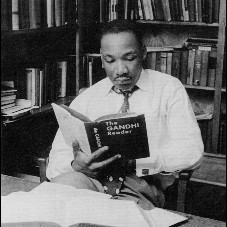
Throughout history, individuals or groups of individuals have risen up to challenge the injustices of their age. Nazi Germany had its Dietrich Bonhoeffer. The gulags of the Soviet Union were challenged by Aleksandr Solzhenitsyn. America had its color-coded system of racial segregation and warmongering called out for what it was, blatant discrimination and profiteering, by Martin Luther King Jr.

And then there was Jesus Christ, an itinerant preacher and revolutionary activist, who not only died challenging the police state of his day—namely, the Roman Empire—but provided a blueprint for civil disobedience that would be followed by those, religious and otherwise, who came after him.

Indeed, it is fitting that we remember that Jesus Christ—the religious figure worshipped by Christians for his death on the cross and subsequent resurrection—paid the ultimate price for speaking out against the police state of his day.

A radical nonconformist who challenged authority at every turn, Jesus was a far cry from the watered-down, corporatized, simplified, gentrified, sissified vision of a meek creature holding a lamb that most modern churches peddle. In fact, he spent his adult life speaking truth to power, challenging the status quo of his day, and pushing back against the abuses of the Roman Empire.

Much like the American Empire today, the Roman Empire of Jesus’ day had all of the characteristics of a police state: secrecy, surveillance, a widespread police presence, a citizenry treated like suspects with little recourse against the police state, perpetual wars, a military empire, martial law, and political retribution against those who dared to challenge the power of the state.

For all the accolades poured out upon Jesus, little is said about the harsh realities of the police state in which he lived and its similarities to modern-day America, and yet they are striking.

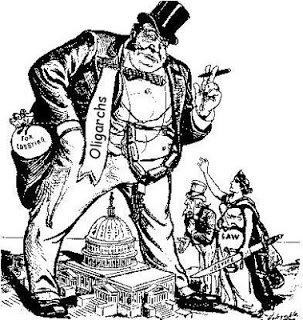
Secrecy, surveillance and rule by the elite. As the chasm between the wealthy and poor grew wider in the Roman Empire, the ruling class and the wealthy class became synonymous, while the lower classes, increasingly deprived of their political freedoms, grew disinterested in the government and easily distracted by “bread and circuses.” Much like America today, with its lack of government transparency, overt domestic surveillance, and rule by the rich, the inner workings of the Roman Empire were shrouded in secrecy, while its leaders were constantly on the watch for any potential threats to its power. The resulting state-wide surveillance was primarily carried out by the military, which acted as investigators, enforcers, torturers, policemen, executioners and jailers. Today that role is fulfilled by the NSA, the FBI, the Department of Homeland Security and the increasingly militarized police forces across the country.

Widespread police presence. The Roman Empire used its military forces to maintain the “peace,” thereby establishing a police state that reached into all aspects of a citizen’s life. In this way, these military officers, used to address a broad range of routine problems and conflicts, enforced the will of the state. Today SWAT teams, comprised of local police and federal agents, are employed to carry out routine search warrants for minor crimes such as marijuana possession and credit card fraud.

Citizenry with little recourse against the police state. As the Roman Empire expanded, personal freedom and independence nearly vanished, as did any real sense of local governance and national consciousness. Similarly, in America today, citizens largely feel powerless, voiceless and unrepresented in the face of a power-hungry federal government. As states and localities are brought under direct control by federal agencies and regulations, a sense of learned helplessness grips the nation.

Perpetual wars and a military empire. Much like America today with its practice of policing the world, war and an over-arching militarist ethos provided the framework for the Roman Empire, which extended from the Italian peninsula to all over Southern, Western, and Eastern Europe, extending into North Africa and Western Asia as well. In addition to significant foreign threats, wars were waged against inchoate, unstructured and socially inferior foes.

Martial law. Eventually, Rome established a permanent military dictatorship that left the citizens at the mercy of an unreachable and oppressive totalitarian regime. In the absence of resources to establish civic police forces, the Romans relied increasingly on the military to intervene in all matters of conflict or upheaval in provinces, from small-scale scuffles to large-scale revolts. Not unlike police forces today, with their martial law training drills on American soil, militarized weapons and “shoot first, ask questions later” mindset, the Roman soldier had “the exercise of lethal force at his fingertips” with the potential of wreaking havoc on normal citizens’ lives.

A nation of suspects. Just as the American Empire looks upon its citizens as suspects to be tracked, surveilled and controlled, the Roman Empire looked upon all potential insubordinates, from the common thief to a full-fledged insurrectionist, as threats to its power. The insurrectionist was seen as directly challenging the Emperor.  A “bandit,” or revolutionist, was seen as capable of overturning the empire, was always considered guilty and deserving of the most savage penalties, including capital punishment. Bandits were usually punished publicly and cruelly as a means of deterring others from challenging the power of the state.  Jesus’ execution was one such public punishment.

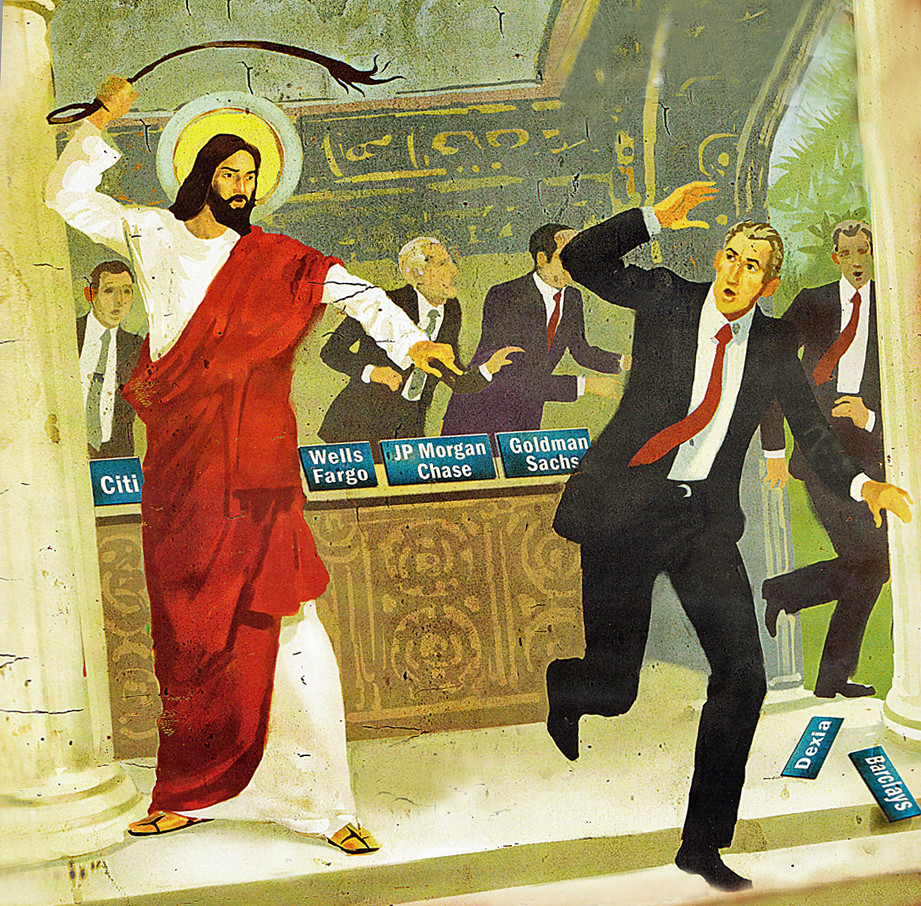
Acts of civil disobedience by insurrectionists. Much like the Roman Empire, the American Empire has exhibited zero tolerance for dissidents such as Julian Assange, Edward Snowden and Chelsea Manning who exposed the police state’s seedy underbelly. Jesus was also branded a political revolutionary starting with his attack on the money chargers and traders at the Jewish temple, an act of civil disobedience at the site of the administrative headquarters of the Sanhedrin, the supreme Jewish council.

Military-style arrests in the dead of night. Jesus’ arrest account testifies to the fact that the Romans perceived Him as a revolutionary. Eerily similar to today’s SWAT team raids, Jesus was arrested in the middle of the night, in secret, by a large, heavily armed fleet of soldiers.  Rather than merely asking for Jesus when they came to arrest him, his pursuers collaborated beforehand with Judas. Acting as a government informant, Judas concocted a kiss as a secret identification marker, hinting that a level of deception and trickery must be used to obtain this seemingly “dangerous revolutionist’s” cooperation. 

Torture and capital punishment. In Jesus’ day, religious preachers, self-proclaimed prophets and nonviolent protesters were not summarily arrested and executed. Indeed, the high priests and Roman governors normally allowed a protest, particularly a small-scale one, to run its course. However, government authorities were quick to dispose of leaders and movements that appeared to threaten the Roman Empire. The charges leveled against Jesus—that he was a threat to the stability of the nation, opposed paying Roman taxes and claimed to be the rightful King—were purely political, not religious. To the Romans, any one of these charges was enough to merit death by crucifixion, which was usually reserved for slaves, non-Romans, radicals, revolutionaries and the worst criminals.

Jesus was presented to Pontius Pilate “as a disturber of the political peace,” a leader of a rebellion, a political threat, and most gravely—a claimant to kingship, a “king of the revolutionary type.” After Jesus is formally condemned by Pilate, he is sentenced to death by crucifixion, “the Roman means of executing criminals convicted of high treason.”  The purpose of crucifixion was not so much to kill the criminal, as it was an immensely public statement intended to visually warn all those who would challenge the power of the Roman Empire. Hence, it was reserved solely for the most extreme political crimes: treason, rebellion, sedition, and banditry. After being ruthlessly whipped and mocked, Jesus was nailed to a cross.

Jesus—the revolutionary, the political dissident, and the nonviolent activist—lived and died in a police state. Any reflection on Jesus’ life and death within a police state must take into account several factors: Jesus spoke out strongly against such things as empires, controlling people, state violence and power politics. Jesus challenged the political and religious belief systems of his day. And worldly powers feared Jesus, not because he challenged them for control of thrones or government but because he undercut their claims of supremacy, and he dared to speak truth to power in a time when doing so could—and often did—cost a person his life.

Unfortunately, the radical Jesus, the political dissident who took aim at injustice and oppression, has been largely forgotten today, replaced by a congenial, smiling Jesus trotted out for religious holidays but otherwise rendered mute when it comes to matters of war, power and politics.

Yet for those who truly study the life and teachings of Jesus, the resounding theme is one of outright resistance to war, materialism and empire.

What a marked contrast to the advice being given to Americans by church leaders to “submit to your leaders and those in authority,” which in the American police state translates to complying, conforming, submitting, obeying orders, deferring to authority and generally doing whatever a government official tells you to do.

Telling Americans to blindly obey the government or put their faith in politics and vote for a political savior flies in the face of everything for which Jesus lived and died.

Will we follow the path of least resistance—turning a blind eye to the evils of our age and marching in lockstep with the police state—or will we be transformed nonconformists “dedicated to justice, peace, and brotherhood”?

As Martin Luther King Jr. reminds us in a powerful sermon delivered 70 years ago, “This command not to conform comes … [from] Jesus Christ, the world’s most dedicated nonconformist, whose ethical nonconformity still challenges the conscience of mankind.”

Ultimately, as I make clear in my book Battlefield America: The War on the American People and in its fictional counterpart The Erik Blair Diaries, this is the contradiction that must be resolved if the radical Jesus—the one who stood up to the Roman Empire and was crucified as a warning to others not to challenge the powers-that-be—is to be an example for our modern age.
Born in a Police State: The Deep State’s Persecution of Its Most Vulnerable Citizens

By John & Nisha Whitehead

Source: The Rutherford Institute

“When the song of the angels is stilled, when the star in the sky is gone, when the kings and princes are home, when the shepherds are back with their flocks, the work of Christmas begins: to find the lost, to heal the broken, to feed the hungry, to release the prisoner, to rebuild the nations, to bring peace among the people, to make music in the heart.”—Howard Thurman, theologian and civil rights activist

The Christmas story of a baby born in a manger is a familiar one.

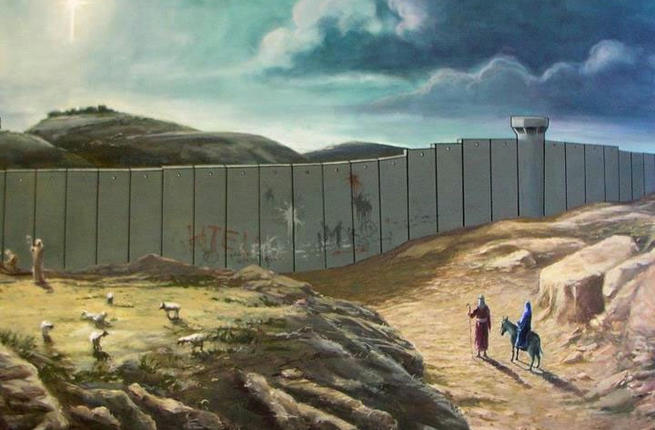
The Roman Empire, a police state in its own right, had ordered that a census be conducted. Joseph and his pregnant wife Mary traveled to the little town of Bethlehem so that they could be counted. There being no room for the couple at any of the inns, they stayed in a stable (a barn), where Mary gave birth to a baby boy, Jesus. Warned that the government planned to kill the baby, Jesus’ family fled with him to Egypt until it was safe to return to their native land.

Yet what if Jesus had been born 2,000 years later?

What if, instead of being born into the Roman police state, Jesus had been born at this moment in time? What kind of reception would Jesus and his family be given? Would we recognize the Christ child’s humanity, let alone his divinity? Would we treat him any differently than he was treated by the Roman Empire? If his family were forced to flee violence in their native country and sought refuge and asylum within our borders, what sanctuary would we offer them?

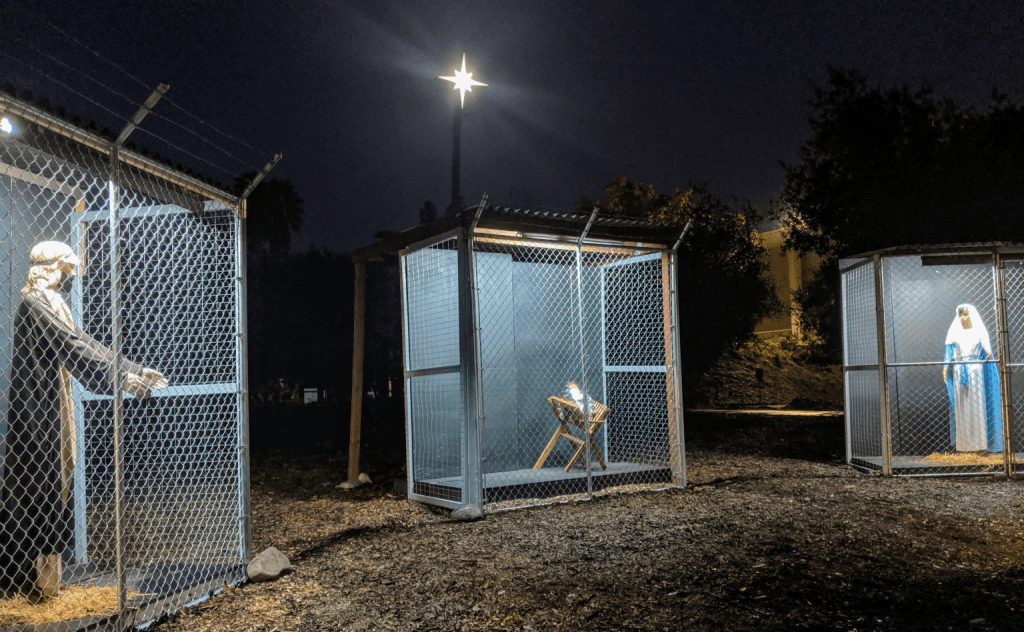
A singular number of churches across the country have asked those very questions in recent years, and their conclusions were depicted with unnerving accuracy by nativity scenes in which Jesus and his family are separated, segregated and caged in individual chain-link pens, topped by barbed wire fencing.

Those nativity scenes were a pointed attempt to remind the modern world that the narrative about the birth of Jesus is one that speaks on multiple fronts to a world that has allowed the life, teachings and crucifixion of Jesus to be drowned out by partisan politics, secularism, materialism and war, all driven by a manipulative shadow government called the Deep State.

The modern-day church has largely shied away from applying Jesus’ teachings to modern problems such as war, poverty, immigration, etc., but thankfully there have been individuals throughout history who ask themselves and the world: what would Jesus do?

What would Jesus—the baby born in Bethlehem who grew into an itinerant preacher and revolutionary activist, who not only died challenging the police state of his day (namely, the Roman Empire) but spent his adult life speaking truth to power, challenging the status quo of his day, and pushing back against the abuses of the Roman Empire—do about the injustices of our  modern age?

Dietrich Bonhoeffer asked himself what Jesus would have done about the horrors perpetrated by Hitler and his assassins. The answer: Bonhoeffer was executed by Hitler for attempting to undermine the tyranny at the heart of Nazi Germany.

Aleksandr Solzhenitsyn asked himself what Jesus would have done about the soul-destroying gulags and labor camps of the Soviet Union. The answer: Solzhenitsyn found his voice and used it to speak out about government oppression and brutality.

Martin Luther King Jr. asked himself what Jesus would have done about America’s warmongering. The answer: declaring “my conscience leaves me no other choice,” King risked widespread condemnation as well as his life when he publicly opposed the Vietnam War on moral and economic grounds.

Even now, despite the popularity of the phrase “What Would Jesus Do?” (WWJD) in Christian circles, there remains a disconnect in the modern church between the teachings of Christ and the suffering of what Jesus in Matthew 25 refers to as the “least of these.”

Yet this is not a theological gray area: Jesus was unequivocal about his views on many things, not the least of which was charity, compassion, war, tyranny and love.

After all, Jesus—the revered preacher, teacher, radical and prophet—was born into a police state not unlike the growing menace of the American police state. When he grew up, he had powerful, profound things to say, things that would change how we view people, alter government policies and change the world. “Blessed are the merciful,” “Blessed are the peacemakers,” and “Love your enemies” are just a few examples of his most profound and revolutionary teachings.

When confronted by those in authority, Jesus did not shy away from speaking truth to power. Indeed, his teachings undermined the political and religious establishment of his day. It cost him his life. He was eventually crucified as a warning to others not to challenge the powers-that-be.

Can you imagine what Jesus’ life would have been like if, instead of being born into the Roman police state, he had been born and raised in the American police state?

Consider the following if you will.

Had Jesus been born in the era of the America police state, rather than traveling to Bethlehem for a census, Jesus’ parents would have been mailed a 28-page American Community Survey, a mandatory government questionnaire documenting their habits, household inhabitants, work schedule, how many toilets are in your home, etc. The penalty for not responding to this invasive survey can go as high as $5,000.

Instead of being born in a manger, Jesus might have been born at home. Rather than wise men and shepherds bringing gifts, however, the baby’s parents might have been forced to ward off visits from state social workers intent on prosecuting them for the home birth. One couple in Washington had all three of their children removed after social services objected to the two youngest being birthed in an unassisted home delivery.

Had Jesus been born in a hospital, his blood and DNA would have been taken without his parents’ knowledge or consent and entered into a government biobank. While most states require newborn screening, a growing number are holding onto that genetic material long-term for research, analysis and purposes yet to be disclosed.

Then again, had Jesus’ parents been undocumented immigrants, they and the newborn baby might have been shuffled to a profit-driven, private prison for illegals where they first would have been separated from each other, the children detained in make-shift cages, and the parents eventually turned into cheap, forced laborers for corporations such as Starbucks, Microsoft, Walmart, and Victoria’s Secret. There’s quite a lot of money to be made from imprisoning immigrants, especially when taxpayers are footing the bill.

From the time he was old enough to attend school, Jesus would have been drilled in lessons of compliance and obedience to government authorities, while learning little about his own rights. Had he been daring enough to speak out against injustice while still in school, he might have found himself tasered or beaten by a school resource officer, or at the very least suspended under a school zero tolerance policy that punishes minor infractions as harshly as more serious offenses.

Had Jesus disappeared for a few hours let alone days as a 12-year-old, his parents would have been handcuffed, arrested and jailed for parental negligence. Parents across the country have been arrested for far less “offenses” such as allowing their children to walk to the park unaccompanied and play in their front yard alone.

Rather than disappearing from the history books from his early teenaged years to adulthood, Jesus’ movements and personal data—including his biometrics—would have been documented, tracked, monitored and filed by governmental agencies and corporations such as Google and Microsoft. Incredibly, 95 percent of school districts share their student records with outside companies that are contracted to manage data, which they then use to market products to us.

From the moment Jesus made contact with an “extremist” such as John the Baptist, he would have been flagged for surveillance because of his association with a prominent activist, peaceful or otherwise. Since 9/11, the FBI has actively carried out surveillance and intelligence-gathering operations on a broad range of activist groups, from animal rights groups to poverty relief, anti-war groups and other such “extremist” organizations.

Jesus’ anti-government views would certainly have resulted in him being labeled a domestic extremist. Law enforcement agencies are being trained to recognize signs of anti-government extremism during interactions with potential extremists who share a “belief in the approaching collapse of government and the economy.”

While traveling from community to community, Jesus might have been reported to government officials as “suspicious” under the Department of Homeland Security’s “See Something, Say Something” programs. Many states, including New York, are providing individuals with phone apps that allow them to take photos of suspicious activity and report them to their state Intelligence Center, where they are reviewed and forwarded to law-enforcement agencies.

Rather than being permitted to live as an itinerant preacher, Jesus might have found himself threatened with arrest for daring to live off the grid or sleeping outside. In fact, the number of cities that have resorted to criminalizing homelessness by enacting bans on camping, sleeping in vehicles, loitering and begging in public has doubled.

Viewed by the government as a dissident and a potential threat to its power, Jesus might have had government spies planted among his followers to monitor his activities, report on his movements, and entrap him into breaking the law. Such Judases today—called informants—often receive hefty paychecks from the government for their treachery.

Had Jesus used the internet to spread his radical message of peace and love, he might have found his blog posts infiltrated by government spies attempting to undermine his integrity, discredit him or plant incriminating information online about him. At the very least, he would have had his website hacked and his email monitored.

Had Jesus attempted to feed large crowds of people, he would have been threatened with arrest for violating various ordinances prohibiting the distribution of food without a permit. Florida officials arrested a 90-year-old man for feeding the homeless on a public beach.

Had Jesus spoken publicly about his 40 days in the desert and his conversations with the devil, he might have been labeled mentally ill and detained in a psych ward against his will for a mandatory involuntary psychiatric hold with no access to family or friends. One Virginia man was arrested, strip searched, handcuffed to a table, diagnosed as having “mental health issues,” and locked up for five days in a mental health facility against his will apparently because of his slurred speech and unsteady gait.

Without a doubt, had Jesus attempted to overturn tables in a Jewish temple and rage against the materialism of religious institutions, he would have been charged with a hate crime. More than 45 states and the federal government have hate crime laws on the books.

Had anyone reported Jesus to the police as being potentially dangerous, he might have found himself confronted—and killed—by police officers for whom any perceived act of non-compliance (a twitch, a question, a frown) can result in them shooting first and asking questions later.

Rather than having armed guards capture Jesus in a public place, government officials would have ordered that a SWAT team carry out a raid on Jesus and his followers, complete with flash-bang grenades and military equipment. There are upwards of 80,000 such SWAT team raids carried out every year, many on unsuspecting Americans who have no defense against such government invaders, even when such raids are done in error.

Instead of being detained by Roman guards, Jesus might have been made to “disappear” into a secret government detention center where he would have been interrogated, tortured and subjected to all manner of abuses. Chicago police have “disappeared” more than 7,000 people into a secret, off-the-books interrogation warehouse at Homan Square.

Charged with treason and labeled a domestic terrorist, Jesus might have been sentenced to a life-term in a private prison where he would have been forced to provide slave labor for corporations or put to death by way of the electric chair or a lethal mixture of drugs.

Indeed, as I make clear in my book Battlefield America: The War on the American People and in its fictional counterpart The Erik Blair Diaries, given the nature of government then and now, it is painfully evident that whether Jesus had been born in our modern age or his own, he still would have died at the hands of a police state.

Thus, as we draw near to Christmas with its celebration of miracles and promise of salvation, we would do well to remember that what happened in that manger on that starry night in Bethlehem is only the beginning of the story. That baby born in a police state grew up to be a man who did not turn away from the evils of his age but rather spoke out against it.

We must do no less.

We the Targeted: How the Government Weaponizes Surveillance to Silence Its Critics

By John & Nisha Whitehead

Source: The Rutherford Institute

“Once a government is committed to the principle of silencing the voice of opposition, it has only one way to go, and that is down the path of increasingly repressive measures, until it becomes a source of terror to all its citizens and creates a country where everyone lives in fear.” — President Harry S. Truman

Ever since Martin Luther King Jr. delivered his groundbreaking “I Have a Dream” speech during the March on Washington for Jobs and Freedom on Aug. 28, 1963, the Deep State has been hard at work turning King’s dream into a living nightmare.

The end result of the government’s efforts over the past 60 years is a country where nothing ever really changes, and everyone lives in fear.

Race wars are still being stoked by both the Right and the Left; the military-industrial complex is still waging profit-driven wars at taxpayer expense; the oligarchy is still calling the shots in the seats of government power; and the government is still weaponizing surveillance in order to muzzle anti-government sentiment, harass activists, and terrorize Americans into compliance.

This last point is particularly disturbing.

Starting in the 1950s, the government relied on COINTELPRO, its domestic intelligence program, to neutralize domestic political dissidents. Those targeted by the FBI under COINTELPRO for its intimidation, surveillance and smear campaigns included: Martin Luther King Jr., Malcom X, the Black Panther Party, John Lennon, Billie Holiday, Emma Goldman, Aretha Franklin, Charlie Chaplin, Ernest Hemingway, Felix Frankfurter, and hundreds more.

In more recent decades, the powers-that-be have expanded their reach to target anyone who opposes the police state, regardless of their political leanings.

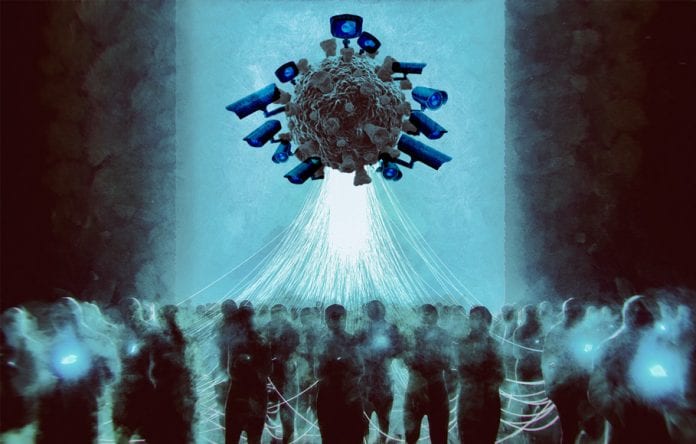
Advances in technology have enabled the government to deploy a veritable arsenal of surveillance weapons in order to “expose, disrupt, misdirect, discredit, or otherwise neutralize” perceived threats to the government’s power.

Surveillance cameras mounted on utility poles, traffic lights, businesses, and homes. License plate readers. Ring doorbells. GPS devices. Dash cameras. Drones. Store security cameras. Geofencing and geotracking. FitBits. Alexa. Internet-connected devices. Geofencing dragnets. Fusion centers. Smart devices. Behavioral threat assessments. Terror watch lists. Facial recognition. Snitch tip lines. Biometric scanners. Pre-crime. DNA databases. Data mining. Precognitive technology. Contact tracing apps.

What these add up to is a world in which, on any given day, the average person is now monitored, surveilled, spied on and tracked in more than 20 different ways by both government and corporate eyes and ears.

Consider just a small sampling of the ways in which the government is weaponizing its 360 degree surveillance technologies to flag you as a threat to national security, whether or not you’ve done anything wrong.

Flagging you as a danger based on your feelings. Customs and Border Protection is reportedly using an artificial intelligence surveillance program that can detect “sentiment and emotion” in social media posts in order to identify travelers who may be “a threat to public safety, national security, or lawful trade and travel.”

Flagging you as a danger based on your phone and movements. Cell phones have become de facto snitches, offering up a steady stream of digital location data on users’ movements and travels. For instance, the FBI was able to use geofence data to identify more than 5,000 mobile devices (and their owners) in a 4-acre area around the Capitol on January 6. This latest surveillance tactic could land you in jail for being in the “wrong place and time.” Police are also using cell-site simulators to carry out mass surveillance of protests without the need for a warrant. Moreover, federal agents can now employ a number of hacking methods in order to gain access to your computer activities and “see” whatever you’re seeing on your monitor. Malicious hacking software can also be used to remotely activate cameras and microphones, offering another means of glimpsing into the personal business of a target.

Flagging you as a danger based on your DNA. DNA technology in the hands of government officials completes our transition to a Surveillance State. If you have the misfortune to leave your DNA traces anywhere a crime has been committed, you’ve already got a file somewhere in some state or federal database—albeit it may be a file without a name. By accessing your DNA, the government will soon know everything else about you that they don’t already know: your family chart, your ancestry, what you look like, your health history, your inclination to follow orders or chart your own course, etc. After all, a DNA print reveals everything about “who we are, where we come from, and who we will be.” It can also be used to predict the physical appearance of potential suspects. It’s only a matter of time before the police state’s pursuit of criminals expands into genetic profiling and a preemptive hunt for criminals of the future.

Flagging you as a danger based on your face. Facial recognition software aims to create a society in which every individual who steps out into public is tracked and recorded as they go about their daily business. Coupled with surveillance cameras that blanket the country, facial recognition technology allows the government and its corporate partners to identify and track someone’s movements in real-time. One particularly controversial software program created by Clearview AI has been used by police, the FBI and the Department of Homeland Security to collect photos on social media sites for inclusion in a massive facial recognition database. Similarly, biometric software, which relies on one’s unique identifiers (fingerprints, irises, voice prints), is becoming the standard for navigating security lines, as well as bypassing digital locks and gaining access to phones, computers, office buildings, etc. In fact, greater numbers of travelers are opting into programs that rely on their biometrics in order to avoid long waits at airport security. Scientists are also developing lasers that can identify and surveil individuals based on their heartbeats, scent and microbiome.

Flagging you as a danger based on your behavior. Rapid advances in behavioral surveillance are not only making it possible for individuals to be monitored and tracked based on their patterns of movement or behavior, including gait recognition (the way one walks), but have given rise to whole industries that revolve around predicting one’s behavior based on data and surveillance patterns and are also shaping the behaviors of whole populations. One smart “anti-riot” surveillance system purports to predict mass riots and unauthorized public events by using artificial intelligence to analyze social media, news sources, surveillance video feeds and public transportation data.

Flagging you as a danger based on your spending and consumer activities. With every smartphone we buy, every GPS device we install, every Twitter, Facebook, and Google account we open, every frequent buyer card we use for purchases—whether at the grocer’s, the yogurt shop, the airlines or the department store—and every credit and debit card we use to pay for our transactions, we’re helping Corporate America build a dossier for its government counterparts on who we know, what we think, how we spend our money, and how we spend our time. Consumer surveillance, by which your activities and data in the physical and online realms are tracked and shared with advertisers, has become a $300 billion industry that routinely harvests your data for profit. Corporations such as Target have not only been tracking and assessing the behavior of their customers, particularly their purchasing patterns, for years, but the retailer has also funded major surveillance in cities across the country and developed behavioral surveillance algorithms that can determine whether someone’s mannerisms might fit the profile of a thief.

Flagging you as a danger based on your public activities. Private corporations in conjunction with police agencies throughout the country have created a web of surveillance that encompasses all major cities in order to monitor large groups of people seamlessly, as in the case of protests and rallies. They are also engaging in extensive online surveillance, looking for any hints of “large public events, social unrest, gang communications, and criminally predicated individuals.” Defense contractors have been at the forefront of this lucrative market. Fusion centers, $330 million-a-year, information-sharing hubs for federal, state and law enforcement agencies, monitor and report such “suspicious” behavior as people buying pallets of bottled water, photographing government buildings, and applying for a pilot’s license as “suspicious activity.”

Flagging you as a danger based on your social media activities. Every move you make, especially on social media, is monitored, mined for data, crunched, and tabulated in order to form a picture of who you are, what makes you tick, and how best to control you when and if it becomes necessary to bring you in line. As The Intercept reported, the FBI, CIA, NSA and other government agencies are increasingly investing in and relying on corporate surveillance technologies that can mine constitutionally protected speech on social media platforms such as Facebook, Twitter and Instagram in order to identify potential extremists and predict who might engage in future acts of anti-government behavior. This obsession with social media as a form of surveillance will have some frightening consequences in coming years. As Helen A.S. Popkin, writing for NBC News, observed, “We may very well face a future where algorithms bust people en masse for referencing illegal ‘Game of Thrones’ downloads… the new software has the potential to roll, Terminator-style, targeting every social media user with a shameful confession or questionable sense of humor.”

Flagging you as a danger based on your social network. Not content to merely spy on individuals through their online activity, government agencies are now using surveillance technology to track one’s social network, the people you might connect with by phone, text message, email or through social message, in order to ferret out possible criminals. An FBI document obtained by Rolling Stone speaks to the ease with which agents are able to access address book data from Facebook’s WhatsApp and Apple’s iMessage services from the accounts of targeted individuals and individuals not under investigation who might have a targeted individual within their network. What this creates is a “guilt by association” society in which we are all as guilty as the most culpable person in our address book.

Flagging you as a danger based on your car. License plate readers are mass surveillance tools that can photograph over 1,800 license tag numbers per minute, take a picture of every passing license tag number and store the tag number and the date, time, and location of the picture in a searchable database, then share the data with law enforcement, fusion centers and private companies to track the movements of persons in their cars. With tens of thousands of these license plate readers now in operation throughout the country, affixed to overpasses, cop cars and throughout business sectors and residential neighborhoods, it allows police to track vehicles and run the plates through law enforcement databases for abducted children, stolen cars, missing people and wanted fugitives. Of course, the technology is not infallible: there have been numerous incidents in which police have mistakenly relied on license plate data to capture out suspects only to end up detaining innocent people at gunpoint.

Flagging you as a danger based on your political views. The Church Committee, the Senate task force charged with investigating COINTELPRO abuses in 1975, concluded that the government had carried out “secret surveillance of citizens on the basis of their political beliefs, even when those beliefs posed no threat of violence or illegal acts on behalf of a hostile foreign power.” The report continued: “Groups and individuals have been harassed and disrupted because of their political views and their lifestyles… Intelligence agencies have served the political and personal objectives of presidents and other high officials.” Nothing has changed since then.

Flagging you as a danger based on your correspondence. Just about every branch of the government—from the Postal Service to the Treasury Department and every agency in between—now has its own surveillance sector, authorized to spy on the American people. For instance, the U.S. Postal Service, which has been photographing the exterior of every piece of paper mail for the past 20 years, is also spying on Americans’ texts, emails and social media posts. Headed up by the Postal Service’s law enforcement division, the Internet Covert Operations Program (iCOP) is reportedly using facial recognition technology, combined with fake online identities, to ferret out potential troublemakers with “inflammatory” posts. The agency claims the online surveillance, which falls outside its conventional job scope of processing and delivering paper mail, is necessary to help postal workers avoid “potentially volatile situations.”

Now the government wants us to believe that we have nothing to fear from these mass spying programs as long as we’ve done nothing wrong.

Don’t believe it.

As Matthew Feeney warns in the New York Times, “In the past, Communists, civil rights leaders, feminists, Quakers, folk singers, war protesters and others have been on the receiving end of law enforcement surveillance. No one knows who the next target will be.

The government’s definition of a “bad” guy is extraordinarily broad, and it results in the warrantless surveillance of innocent, law-abiding Americans on a staggering scale.

Moreover, there is a repressive, suppressive effect to surveillance that not only acts as a potentially small deterrent on crime but serves to monitor and chill lawful First Amendment activity, and that is the whole point.

Weaponized surveillance is re-engineering a society structured around the aesthetic of fear.

As I make clear in my book Battlefield America: The War on the American People and in its fictional counterpart The Erik Blair Diaries, the police state wants us silent, servile and compliant.

They definitely do not want us to engage in First Amendment activities that challenge the government’s power, reveal the government’s corruption, expose the government’s lies, and encourage the citizenry to push back against the government’s many injustices.

And they certainly do not want us to remember that we have rights, let alone attempting to exercise those rights peaceably and lawfully, whether it’s protesting police brutality and racism, challenging COVID-19 mandates, questioning election outcomes, or listening to alternate viewpoints—even conspiratorial ones—in order to form our own opinions about the true nature of government. 

Yes, Jesus Would Have Been Branded a Domestic Extremist Today

By John & Nisha Whitehead

Source: The Rutherford Institute

“When the song of the angels is stilled, when the star in the sky is gone, when the kings and princes are home, when the shepherds are back with their flocks, the work of Christmas begins: to find the lost, to heal the broken, to feed the hungry, to release the prisoner, to rebuild the nations, to bring peace among the people, to make music in the heart.”—Howard Thurman, theologian and civil rights activist

The Christmas story of a baby born in a manger is a familiar one.

The Roman Empire, a police state in its own right, had ordered that a census be conducted. Joseph and his pregnant wife Mary traveled to the little town of Bethlehem so that they could be counted. There being no room for the couple at any of the inns, they stayed in a stable (a barn), where Mary gave birth to a baby boy, Jesus. Warned that the government planned to kill the baby, Jesus’ family fled with him to Egypt until it was safe to return to their native land.

Yet what if Jesus had been born 2,000 years later.

What if, instead of being born into the Roman police state, Jesus had been born at this moment in time? What kind of reception would Jesus and his family be given? Would we recognize the Christ child’s humanity, let alone his divinity? Would we treat him any differently than he was treated by the Roman Empire? If his family were forced to flee violence in their native country and sought refuge and asylum within our borders, what sanctuary would we offer them?A singular number of churches across the country have asked those very questions in recent years, and their conclusions were depicted with unnerving accuracy by nativity scenes in which Jesus and his family are separated, segregated and caged in individual chain-link pens, topped by barbed wire fencing.

Those nativity scenes were a pointed attempt to remind the modern world that the narrative about the birth of Jesus is one that speaks on multiple fronts to a world that has allowed the life, teachings and crucifixion of Jesus to be drowned out by partisan politics, secularism, materialism and war, all driven by a manipulative shadow government called the Deep State.

The modern-day church has largely shied away from applying Jesus’ teachings to modern problems such as war, poverty, immigration, etc., but thankfully there have been individuals throughout history who ask themselves and the world: what would Jesus do.

What would Jesus—the baby born in Bethlehem who grew into an itinerant preacher and revolutionary activist, who not only died challenging the police state of his day (namely, the Roman Empire) but spent his adult life speaking truth to power, challenging the status quo of his day, and pushing back against the abuses of the Roman Empire—do about the injustices of our  modern age.

Dietrich Bonhoeffer asked himself what Jesus would have done about the horrors perpetrated by Hitler and his assassins. The answer: Bonhoeffer was executed by Hitler for attempting to undermine the tyranny at the heart of Nazi Germany.

Aleksandr Solzhenitsyn asked himself what Jesus would have done about the soul-destroying gulags and labor camps of the Soviet Union. The answer: Solzhenitsyn found his voice and used it to speak out about government oppression and brutality.

Martin Luther King Jr. asked himself what Jesus would have done about America’s warmongering. The answer: declaring “my conscience leaves me no other choice,” King risked widespread condemnation as well as his life when he publicly opposed the Vietnam War on moral and economic grounds.

Even now, despite the popularity of the phrase “What Would Jesus Do?” (WWJD) in Christian circles, there remains a disconnect in the modern church between the teachings of Christ and the suffering of what Jesus in Matthew 25 refers to as the “least of these.

Yet this is not a theological gray area: Jesus was unequivocal about his views on many things, not the least of which was charity, compassion, war, tyranny and love.

After all, Jesus—the revered preacher, teacher, radical and prophet—was born into a police state not unlike the growing menace of the American police state. When he grew up, he had powerful, profound things to say, things that would change how we view people, alter government policies and change the world. “Blessed are the merciful,” “Blessed are the peacemakers,” and “Love your enemies” are just a few examples of his most profound and revolutionary teachings.

When confronted by those in authority, Jesus did not shy away from speaking truth to power. Indeed, his teachings undermined the political and religious establishment of his day. It cost him his life. He was eventually crucified as a warning to others not to challenge the powers-that-be.

Can you imagine what Jesus’ life would have been like if, instead of being born into the Roman police state, he had been born and raised in the American police state.

Consider the following if you will.

Had Jesus been born in the era of the America police state, rather than traveling to Bethlehem for a census, Jesus’ parents would have been mailed a 28-page American Community Survey, a mandatory government questionnaire documenting their habits, household inhabitants, work schedule, how many toilets are in your home, etc. The penalty for not responding to this invasive survey can go as high as $5,000.

Instead of being born in a manger, Jesus might have been born at home. Rather than wise men and shepherds bringing gifts, however, the baby’s parents might have been forced to ward off visits from state social workers intent on prosecuting them for the home birth. One couple in Washington had all three of their children removed after social services objected to the two youngest being birthed in an unassisted home delivery.

Had Jesus been born in a hospital, his blood and DNA would have been taken without his parents’ knowledge or consent and entered into a government biobank. While most states require newborn screening, a growing number are holding onto that genetic material long-term for research, analysis and purposes yet to be disclosed.

Then again, had Jesus’ parents been undocumented immigrants, they and the newborn baby might have been shuffled to a profit-driven, private prison for illegals where they first would have been separated from each other, the children detained in make-shift cages, and the parents eventually turned into cheap, forced laborers for corporations such as Starbucks, Microsoft, Walmart, and Victoria’s Secret. There’s quite a lot of money to be made from imprisoning immigrants, especially when taxpayers are footing the bill.

From the time he was old enough to attend school, Jesus would have been drilled in lessons of compliance and obedience to government authorities, while learning little about his own rights. Had he been daring enough to speak out against injustice while still in school, he might have found himself tasered or beaten by a school resource officer, or at the very least suspended under a school zero tolerance policy that punishes minor infractions as harshly as more serious offenses.

Had Jesus disappeared for a few hours let alone days as a 12-year-old, his parents would have been handcuffed, arrested and jailed for parental negligence. Parents across the country have been arrested for far less “offenses” such as allowing their children to walk to the park unaccompanied and play in their front yard alone.

Rather than disappearing from the history books from his early teenaged years to adulthood, Jesus’ movements and personal data—including his biometrics—would have been documented, tracked, monitored and filed by governmental agencies and corporations such as Google and Microsoft. Incredibly, 95 percent of school districts share their student records with outside companies that are contracted to manage data, which they then use to market products to us.

From the moment Jesus made contact with an “extremist” such as John the Baptist, he would have been flagged for surveillance because of his association with a prominent activist, peaceful or otherwise. Since 9/11, the FBI has actively carried out surveillance and intelligence-gathering operations on a broad range of activist groups, from animal rights groups to poverty relief, anti-war groups and other such “extremist” organizations.

Jesus’ anti-government views would certainly have resulted in him being labeled a domestic extremist. Law enforcement agencies are being trained to recognize signs of anti-government extremism during interactions with potential extremists who share a “belief in the approaching collapse of government and the economy.

While traveling from community to community, Jesus might have been reported to government officials as “suspicious” under the Department of Homeland Security’s “See Something, Say Something” programs. Many states, including New York, are providing individuals with phone apps that allow them to take photos of suspicious activity and report them to their state Intelligence Center, where they are reviewed and forwarded to law-enforcement agencies.

Rather than being permitted to live as an itinerant preacher, Jesus might have found himself threatened with arrest for daring to live off the grid or sleeping outside. In fact, the number of cities that have resorted to criminalizing homelessness by enacting bans on camping, sleeping in vehicles, loitering and begging in public has doubled.

Viewed by the government as a dissident and a potential threat to its power, Jesus might have had government spies planted among his followers to monitor his activities, report on his movements, and entrap him into breaking the law. Such Judases today—called informants—often receive hefty paychecks from the government for their treachery.

Had Jesus used the internet to spread his radical message of peace and love, he might have found his blog posts infiltrated by government spies attempting to undermine his integrity, discredit him or plant incriminating information online about him. At the very least, he would have had his website hacked and his email monitored.

Had Jesus attempted to feed large crowds of people, he would have been threatened with arrest for violating various ordinances prohibiting the distribution of food without a permit. Florida officials arrested a 90-year-old man for feeding the homeless on a public beach.

Had Jesus spoken publicly about his 40 days in the desert and his conversations with the devil, he might have been labeled mentally ill and detained in a psych ward against his will for a mandatory involuntary psychiatric hold with no access to family or friends. One Virginia man was arrested, strip searched, handcuffed to a table, diagnosed as having “mental health issues,” and locked up for five days in a mental health facility against his will apparently because of his slurred speech and unsteady gait.

Without a doubt, had Jesus attempted to overturn tables in a Jewish temple and rage against the materialism of religious institutions, he would have been charged with a hate crime. More than 45 states and the federal government have hate crime laws on the books.

Had anyone reported Jesus to the police as being potentially dangerous, he might have found himself confronted—and killed—by police officers for whom any perceived act of non-compliance (a twitch, a question, a frown) can result in them shooting first and asking questions later.

Rather than having armed guards capture Jesus in a public place, government officials would have ordered that a SWAT team carry out a raid on Jesus and his followers, complete with flash-bang grenades and military equipment. There are upwards of 80,000 such SWAT team raids carried out every year, many on unsuspecting Americans who have no defense against such government invaders, even when such raids are done in error.

Instead of being detained by Roman guards, Jesus might have been made to “disappear” into a secret government detention center where he would have been interrogated, tortured and subjected to all manner of abuses. Chicago police have “disappeared” more than 7,000 people into a secret, off-the-books interrogation warehouse at Homan Square.

Charged with treason and labeled a domestic terrorist, Jesus might have been sentenced to a life-term in a private prison where he would have been forced to provide slave labor for corporations or put to death by way of the electric chair or a lethal mixture of drugs.

Indeed, as I make clear in my book Battlefield America: The War on the American People and in its fictional counterpart The Erik Blair Diaries, given the nature of government then and now, it is painfully evident that whether Jesus had been born in our modern age or his own, he still would have died at the hands of a police state.

Thus, as we draw near to Christmas with its celebration of miracles and promise of salvation, we would do well to remember that what happened in that manger on that starry night in Bethlehem is only the beginning of the story. That baby born in a police state grew up to be a man who did not turn away from the evils of his age but rather spoke out against it.

We must do no less.

Stand Up to Tyranny: How to Respond to the Evils of Our Age

By John W. Whitehead & Nisha Whitehead

Source: The Rutherford Institute

“The church must be reminded that it is not the master or the servant of the state, but rather the conscience of the state. It must be the guide and the critic of the state, and never its tool. If the church does not recapture its prophetic zeal, it will become an irrelevant social club without moral or spiritual authority.”—Martin Luther King Jr. (A Knock at Midnight, June 11, 1967)

In every age, we find ourselves wrestling with the question of how Jesus Christ—the itinerant preacher and revolutionary activist who died challenging the police state of his time, namely, the Roman Empire—would respond to the moral questions of our day.

For instance, would Jesus advocate, as so many evangelical Christian leaders have done in recent years, for congregants to “submit to your leaders and those in authority,” which in the American police state translates to complying, conforming, submitting, obeying orders, deferring to authority and generally doing whatever a government official tells you to do?

What would Jesus do? 

Study the life and teachings of Jesus, and you may be surprised at how relevant he is to our modern age.

A radical nonconformist who challenged authority at every turn, Jesus spent his adult life speaking truth to power, challenging the status quo of his day, pushing back against the abuses of the Roman Empire, and providing a blueprint for standing up to tyranny that would be followed by those, religious and otherwise, who came after him.

Those living through this present age of government lockdowns, immunity passports, militarized police, SWAT team raids, police shootings of unarmed citizens, roadside strip searches, invasive surveillance and the like might feel as if these events are unprecedented. However, the characteristics of a police state and its reasons for being are no different today than they were in Jesus’ lifetime: control, power and money.

Much like the American Empire today, the Roman Empire of Jesus’ day was characterized by secrecy, surveillance, a widespread police presence, a citizenry treated like suspects with little recourse against the police state, perpetual wars, a military empire, martial law, and political retribution against those who dared to challenge the power of the state.

A police state extends far beyond the actions of law enforcement.  In fact, a police state “is characterized by bureaucracy, secrecy, perpetual wars, a nation of suspects, militarization, surveillance, widespread police presence, and a citizenry with little recourse against police actions.”

Indeed, the police state in which Jesus lived (and died) and its striking similarities to modern-day America are beyond troubling.

Secrecy, surveillance and rule by the elite. As the chasm between the wealthy and poor grew wider in the Roman Empire, the ruling class and the wealthy class became synonymous, while the lower classes, increasingly deprived of their political freedoms, grew disinterested in the government and easily distracted by “bread and circuses.” Much like America today, with its lack of government transparency, overt domestic surveillance, and rule by the rich, the inner workings of the Roman Empire were shrouded in secrecy, while its leaders were constantly on the watch for any potential threats to its power. The resulting state-wide surveillance was primarily carried out by the military, which acted as investigators, enforcers, torturers, policemen, executioners and jailers. Today that role is fulfilled by the NSA, the FBI, the Department of Homeland Security and the increasingly militarized police forces across the country.

Widespread police presence. The Roman Empire used its military forces to maintain the “peace,” thereby establishing a police state that reached into all aspects of a citizen’s life. In this way, these military officers, used to address a broad range of routine problems and conflicts, enforced the will of the state. Today SWAT teams, comprised of local police and federal agents, are employed to carry out routine search warrants for minor crimes such as marijuana possession and credit card fraud.

Citizenry with little recourse against the police state. As the Roman Empire expanded, personal freedom and independence nearly vanished, as did any real sense of local governance and national consciousness. Similarly, in America today, citizens largely feel powerless, voiceless and unrepresented in the face of a power-hungry federal government. As states and localities are brought under direct control by federal agencies and regulations, a sense of learned helplessness grips the nation.

Perpetual wars and a military empire. Much like America today with its practice of policing the world, war and an over-arching militarist ethos provided the framework for the Roman Empire, which extended from the Italian peninsula to all over Southern, Western, and Eastern Europe, extending into North Africa and Western Asia as well. In addition to significant foreign threats, wars were waged against inchoate, unstructured and socially inferior foes.

Martial law. Eventually, Rome established a permanent military dictatorship that left the citizens at the mercy of an unreachable and oppressive totalitarian regime. In the absence of resources to establish civic police forces, the Romans relied increasingly on the military to intervene in all matters of conflict or upheaval in provinces, from small-scale scuffles to large-scale revolts. Not unlike police forces today, with their martial law training drills on American soil, militarized weapons and “shoot first, ask questions later” mindset, the Roman soldier had “the exercise of lethal force at his fingertips” with the potential of wreaking havoc on normal citizens’ lives.

A nation of suspects. Just as the American Empire looks upon its citizens as suspects to be tracked, surveilled and controlled, the Roman Empire looked upon all potential insubordinates, from the common thief to a full-fledged insurrectionist, as threats to its power. The insurrectionist was seen as directly challenging the Emperor.  A “bandit,” or revolutionist, was seen as capable of overturning the empire, was always considered guilty and deserving of the most savage penalties, including capital punishment. Bandits were usually punished publicly and cruelly as a means of deterring others from challenging the power of the state.  Jesus’ execution was one such public punishment.

Acts of civil disobedience by insurrectionists. Starting with his act of civil disobedience at the Jewish temple, the site of the administrative headquarters of the Sanhedrin, the supreme Jewish council, Jesus branded himself a political revolutionary. When Jesus “with the help of his disciples, blocks the entrance to the courtyard” and forbids “anyone carrying goods for sale or trade from entering the Temple,” he committed a blatantly criminal and seditious act, an act “that undoubtedly precipitated his arrest and execution.” Because the commercial events were sponsored by the religious hierarchy, which in turn was operated by consent of the Roman government, Jesus’ attack on the money chargers and traders can be seen as an attack on Rome itself, an unmistakable declaration of political and social independence from the Roman oppression.

Military-style arrests in the dead of night. Jesus’ arrest account testifies to the fact that the Romans perceived Him as a revolutionary. Eerily similar to today’s SWAT team raids, Jesus was arrested in the middle of the night, in secret, by a large, heavily armed fleet of soldiers.  Rather than merely asking for Jesus when they came to arrest him, his pursuers collaborated beforehand with Judas. Acting as a government informant, Judas concocted a kiss as a secret identification marker, hinting that a level of deception and trickery must be used to obtain this seemingly “dangerous revolutionist’s” cooperation. 

Torture and capital punishment. In Jesus’ day, religious preachers, self-proclaimed prophets and nonviolent protesters were not summarily arrested and executed. Indeed, the high priests and Roman governors normally allowed a protest, particularly a small-scale one, to run its course. However, government authorities were quick to dispose of leaders and movements that appeared to threaten the Roman Empire. The charges leveled against Jesus—that he was a threat to the stability of the nation, opposed paying Roman taxes and claimed to be the rightful King—were purely political, not religious. To the Romans, any one of these charges was enough to merit death by crucifixion, which was usually reserved for slaves, non-Romans, radicals, revolutionaries and the worst criminals.

Jesus was presented to Pontius Pilate “as a disturber of the political peace,” a leader of a rebellion, a political threat, and most gravely—a claimant to kingship, a “king of the revolutionary type.” After Jesus is formally condemned by Pilate, he is sentenced to death by crucifixion, “the Roman means of executing criminals convicted of high treason.”  The purpose of crucifixion was not so much to kill the criminal, as it was an immensely public statement intended to visually warn all those who would challenge the power of the Roman Empire. Hence, it was reserved solely for the most extreme political crimes: treason, rebellion, sedition, and banditry. After being ruthlessly whipped and mocked, Jesus was nailed to a cross.

As Professor Mark Lewis Taylor observed:

The cross within Roman politics and culture was a marker of shame, of being a criminal. If you were put to the cross, you were marked as shameful, as criminal, but especially as subversive. And there were thousands of people put to the cross. The cross was actually positioned at many crossroads, and, as New Testament scholar Paula Fredricksen has reminded us, it served as kind of a public service announcement that said, “Act like this person did, and this is how you will end up.”

Jesus—the revolutionary, the political dissident, and the nonviolent activist—lived and died in a police state. Any reflection on Jesus’ life and death within a police state must take into account several factors: Jesus spoke out strongly against such things as empires, controlling people, state violence and power politics. Jesus challenged the political and religious belief systems of his day. And worldly powers feared Jesus, not because he challenged them for control of thrones or government but because he undercut their claims of supremacy, and he dared to speak truth to power in a time when doing so could—and often did—cost a person his life.

Unfortunately, the radical Jesus, the political dissident who took aim at injustice and oppression, has been largely forgotten today, replaced by a congenial, smiling Jesus trotted out for religious holidays but otherwise rendered mute when it comes to matters of war, power and politics.

Yet for those who truly study the life and teachings of Jesus, the resounding theme is one of outright resistance to war, materialism and empire.

Ultimately, as I point out in my book Battlefield America: The War on the American People, this is the contradiction that must be resolved if the radical Jesus—the one who stood up to the Roman Empire and was crucified as a warning to others not to challenge the powers-that-be—is to be an example for our modern age.
After all, there is so much suffering and injustice in the world, and so much good that can be done by those who truly aspire to follow Jesus Christ’s example.

We must decide whether we will follow the path of least resistance—willing to turn a blind eye to what Martin Luther King Jr. referred to as the “evils of segregation and the crippling effects of discrimination, to the moral degeneracy of religious bigotry and the corroding effects of narrow sectarianism, to economic conditions that deprive men of work and food, and to the insanities of militarism and the self-defeating effects of physical violence”—or whether we will be transformed nonconformists “dedicated to justice, peace, and brotherhood.”

As King explained in a powerful sermon delivered in 1954, “This command not to conform comes … [from] Jesus Christ, the world’s most dedicated nonconformist, whose ethical nonconformity still challenges the conscience of mankind.”

Furthermore:

We need to recapture the gospel glow of the early Christians, who were nonconformists in the truest sense of the word and refused to shape their witness according to the mundane patterns of the world.  Willingly they sacrificed fame, fortune, and life itself in behalf of a cause they knew to be right.  Quantitatively small, they were qualitatively giants.  Their powerful gospel put an end to such barbaric evils as infanticide and bloody gladiatorial contests.  Finally, they captured the Roman Empire for Jesus Christ… The hope of a secure and livable world lies with disciplined nonconformists, who are dedicated to justice, peace, and brotherhood.  The trailblazers in human, academic, scientific, and religious freedom have always been nonconformists.  In any cause that concerns the progress of mankind, put your faith in the nonconformist!

…Honesty impels me to admit that transformed nonconformity, which is always costly and never altogether comfortable, may mean walking through the valley of the shadow of suffering, losing a job, or having a six-year-old daughter ask, “Daddy, why do you have to go to jail so much?”  But we are gravely mistaken to think that Christianity protects us from the pain and agony of mortal existence.  Christianity has always insisted that the cross we bear precedes the crown we wear.  To be a Christian, one must take up his cross, with all of its difficulties and agonizing and tragedy-packed content, and carry it until that very cross leaves its marks upon us and redeems us to that more excellent way that comes only through suffering.

In these days of worldwide confusion, there is a dire need for men and women who will courageously do battle for truth.  We must make a choice. Will we continue to march to the drumbeat of conformity and respectability, or will we, listening to the beat of a more distant drum, move to its echoing sounds?  Will we march only to the music of time, or will we, risking criticism and abuse, march to the soul saving music of eternity?

Gandhi’s Despair and the Struggle for Truth and Love

By Robert J. Burrowes

‘When I despair, I remember that all through history the ways of truth and love have always won. There have been tyrants, and murderers, and for a time they can seem invincible, but in the end they always fall. Think of it – always.’ M.K. Gandhi

As we remember Gandhi Jayanti on 2 October, the Mahatma’s 149th birthday and the International Day of Nonviolence, there is plenty of room for despair.

Never before has the Earth and its many inhabitants been under siege as they are now, more than 100 years after Gandhi started warning us of the predicament in which we are embroiled and presenting his strategy for addressing it before it spiraled out of control.

Whether it is the threat of nuclear war, the ongoing wars in many parts of the world and particularly the Middle East, the multiple and synergistic threats to the global environment or the ongoing climate catastrophe, the Earth is under assault on all fronts and its precious lifeforms (human and otherwise) are being killed outright in vast numbers and driven to extinction at the rate of 200 species daily. And the evidence is rapidly accumulating that humans themselves will be extinct by 2026 as well. See ‘Human Extinction by 2026? A Last Ditch Strategy to Fight for Human Survival’.

Moreover, unlike the tyrants to which Gandhi was referring, the current ‘tyrant’ is a global elite that has acquired extraordinary power to kill and destroy as they pursue their insane compulsion to accumulate and control resources at the expense of life. See ‘The Global Elite is Insane Revisited’.

So are we to give up in despair? To quit without a fight? Or even delude ourselves that nothing needs to be done? Obviously, these were not ways that Gandhi would contemplate because, as noted in his words cited above: ‘the ways of truth and love have always won’. Although, as Gandhi did not bother to add: we must struggle, relentlessly, to ensure that truth and love prevail.

And, fortunately, there are many people around the world who agree with him.

Tackling the pervasive violence in our world requires a comprehensive strategy involving many campaigns focused on a wide range of peace, justice and environmental issues, and substantial mobilization. There is no single or simple path. Let me tell you about some of the people engaged in this effort and the nature of their commitment, together with what connects their involvement.

Remarkable activist and progressive journalist Abby Martin, based in the USA, was formerly creator and presenter of the investigative news program ‘Breaking the Set’ and is now creator and presenter of its successor program ‘The Empire Files’. With the support of her fine team, Abby researches and presents reports from ‘inside history’s biggest empire… recording a world shaped by war & inequality’ so that the truth is exposed for all to see. Abby, who is also an artist, interviews a wide range of people from ‘ordinary’ activists to progressive intellectuals to political leaders to penetrate the veil of obscurity cast by the global elite’s corporate media. You can watch Abby’s terrific programs, providing insight into how our incredibly violent world works, on her website ‘The Empire Files’. You can also read about the latest attack on her work and how you can help in the article ‘US Sanctions Shut Down “The Empire Files” with Abby Martin’. Keep fighting Abby! We are with you all the way.

Ina Curic in Romania writes illustrated children’s books designed to teach children a variety of lessons for living an empowered, socially and environmentally conscious life. Her book Queen Rain, King Wind: The Practice of Heart Gardening was published in May and Anagrania’s Challenge: Turning Conflict into Opportunity has just been published. Anagrania’s Challenge is a beautifully created story that offers clear and simple guidance on three subjects vital to our shared future on Earth: what we need to be ourselves, what we need to be healthy, and that acceptance of uniqueness and creatively dealing with conflict are essential if we are to live together and celebrate the benefits and advantages of our differences. If you are looking for children’s books that promote nonviolent living and conflict resolution, you will have trouble finding better books than those by Ina. You can read about Ina, as well as how to obtain her books, on her website Imagine Creatively.

Pakistani Canadian Dr. Mahboob A. Khawaja is a scholar who writes searing critiques of international relations exposing the deep conflicts driving global events. Two of his recent articles are ‘World Affairs and Insanity as Entertainment: Are We at the End of Human Morality?’ and ‘Mankind Must Know: The UNO and Global Leaders are a Menace to Peace and Problem-Solving’.

Moreover, in support of his son Momin, a computer science graduate and IT entrepreneur, who has been unjustly imprisoned since 2004 on terrorism charges (and facing a sentence of life plus 24 years), Mahboob has created a website to raise awareness of Momin’s struggle for justice and freedom, and organized a petition for those who wish to express their support for him.

Edith Rubinstein in Belgium is definitely an ‘activist senior’. Now 86 and in a center of recuperation following a severe depression and bout of unconsciousness earlier this year, Edith still has her computer and continues her work as an activist. ‘Because I am an activist since a very long time, a feminist, a woman in Black, and I translated free Ecofeminism from Maria Mies and Vandana Shiva…. Since many years, I have translated alternative articles and finally it made me sick.’ In fact, Edith admits, ‘I am completely “abnormal”. Somebody who feels bad to live in a world where hundreds of thousand people are killed or die … because they have nothing to eat anymore and nobody seems to care…. I feel very bad to live in this kind of world. Yes, terrible what is happening in the Congo! But unfortunately it is not the only case. And I am very scandalized by the behavior of the Western World!!!!’

Zakia Haddouch in Morocco continues to report the extraordinarily difficult circumstances of people in that country as she and other activists continue their various struggles to bring some semblance of justice to Moroccan affairs. One prominent issue is the ongoing debate in relation to ‘the forced military service (for both young female and male subjects and I don’t say citizens). It was lately decreed by the king.’ Another struggle is taking place in the wake of the death of Mohcine Fikri on 28 October 2016, who was crushed to death in a rubbish truck trying to recover merchandise confiscated by a policeman. Following this event, Hirak (literally ‘The Movement’) was born and it quickly mobilized widespread support for its vigorous protests. While most of Hirak’s concerns are about local issues, it draws upon a national repertory of nonviolent actions fueled by the experiences of activists around the country. Between October 2016 and May 2017, and faced with social unrest of an unprecedented vitality which increasingly challenged him personally, Mohamed VI remained silent. However, when Hirak leader Nasser Zefzazi – who has never failed to stress nonviolence and advocate self-restraint – interrupted a sermon on 26 May 2017 in which an imam claimed the social movement was tantamount to a ‘fratricidal struggle or even civil war within Islam’, the government took this pretext to clamp down on Hirak. Many activists were jailed – over 200 so far – and demonstrations are now systematically broken up. Zefzazi was among those arrested (on 29 May 2017) and, along with other members of Hirak, subsequently jailed for 20 years. The repression has nipped in the bud any hopes for resolving the crisis quickly. But this doesn’t mean that Zakia and other activists have been intimidated into silence or inaction.

Daniel Dalai reports modestly about his visionary initiative Earthgardens in Guatemala. Earthgardens provides opportunities for girls to realize and practice their inherent leadership potential, particularly as part of Eco-Teams in preserving natural biodiversity. ‘More and more 3rd world governments are proving to be a colossal waste of money as corrupt politicians get rich without addressing local needs. The Sembradores’ model of Girl Power is gaining acceptance as people realize girls are more efficient, more concerned, and less corruptible in solving the simple problems of local needs. Clean water, cheap electricity, food production, and tourist development are urgent needs in many parts of the globe. You may become a volunteer working with children or an Eco-Team assessor in Latin America or Africa.’ Please contact Kate Teggins <earthgardens@outlook.com> The beautiful Earthgardens website has just been updated and the stunning photos alone will tell you much about what these remarkable girls are doing. See Earthgardens.

Young Nigerian Idowu Jawando has been reflecting deeply on the shocking state of our world and his own role in fixing that. ‘Over here in Lagos civilization advances steadily with all its domination and exploitation, squeezing the juice out of all of us. But yet here and there, traces of a smile, the fragrance of love releases its perfume… things seem bearable for a while. The big question on my mind is this: Can civilization be deconstructed? A part of me thinks: Yes of course, it is the actions of individuals that create this world, these same individuals also have the power to take everything down. But how about the police, the armies, the nuclear weapons and what-have you? Things are the way they are because of force. And most especially the threat of starvation too. It forces us into activities and relationships not of our choosing. Civilization uses and discards the people, over and over, squeezing them like lemons.

‘Will the global leaders who are driven to this insane struggle for power and profit suddenly grow a compassionate nature, one that has no doubt been lost a long time ago? You and I know they won’t. With all the disasters that go on, we still see them stripping the earth bare of its life, still forcing people into precarious situations. We find ourselves at a quandary. I personally find myself in a very stifling situation, but I try my best not to let it define, instead I study it as one would study a dangerous toy….

‘Indeed I have found that tenderness impacts strength and courage in others, this is something I have seen in my own existence. But can one be tender to an oppressor? I guess if there was a mass refusal of this world and all its mechanisms, there will be a lot of headway. Such a situation in my own thinking, won’t be one of making demands to any government, but collectively and individually deciding how we want to live our beautiful mortal lives and what we want the world around us to reflect: the ugliness of mindless profit-seeking or co-creative play with earthly life.

‘Many just go through life unquestioningly, accepting the state of things as normal; as well, the walls that prevent us from truly connecting with one another, is one major obstacle. The education, religious systems only encourage people to be followers, never masters of themselves…. I will keep thinking about this. I realize it might take my whole life and then more, to tackle the evils of the world. But it would please me if I am moving inch by inch and encouraging others to do the same. The torch of freedom must never be extinguished. But must pass from generation to generation.’

Each of the inspiring individuals mentioned above is a signatory of The Peoples Charter to Create a Nonviolent World. If you feel inclined to join this worldwide movement to end violence in all of its manifestations, you are welcome to sign the Charter pledge too.

Like those individuals mentioned above, signatories of the Nonviolence Charter come from a diverse range of backgrounds. They live all over the world (in 105 countries). They represent a wide range of genders, races, religions, classes and abilities. And they work on a phenomenal variety of issues with an increasing number recognizing the need to work on ending violence against children. As Gandhi noted:

‘If we are to reach real peace in this world and if we are to carry on a real war against war, we shall have to begin with children.’

This requires us to understand the cause of violence, including violence against children – see Why Violence?’ and Fearless Psychology and Fearful Psychology: Principles and Practice – and to consider making ‘My Promise to Children’. In some cases, it means undertaking the personal healing necessary to nurture children powerfully. See ‘Putting Feelings First’.

Recognizing, as Gandhi put it, that ‘Earth provides enough to satisfy every [person’s] needs, but not every [person’s] greed’, others are tackling the full range of environmental and climate challenges by participating in The Flame Tree Project to Save Life on Earth.

And given the elite insanity that drives violence in many contexts, still other signatories are engaged in nonviolent struggles – see Nonviolent Campaign Strategy – or national liberation struggles – see Nonviolent Defense/Liberation Strategy – to tackle violence in these contexts.

So if you are inclined to ponder the meaning of Gandhi’s life, you just need to picture a man dressed simply in khadi, walking to the sea to collect salt in defiance of the law of the British occupying power.

The Reverend Martin Luther King Jr. once noted: ‘The enemy is violence.’ But for Gandhi: ‘The enemy is fear.’

This is because it is fear that drives violence but also fear that prevents us responding strategically and nonviolently to the violence in our world. As Gandhi observed: ‘You may never know what results come of your actions, but if you do nothing there will be no results.’

So as humans are beckoned to extinction within the next few years, Gandhi would remind us that ‘The future depends on what we do in the present.’

What will you do?


Biodata: Robert J. Burrowes has a lifetime commitment to understanding and ending human violence. He has done extensive research since 1966 in an effort to understand why human beings are violent and has been a nonviolent activist since 1981. He is the author of ‘Why Violence?’ http://tinyurl.com/whyviolence His email address is flametree@riseup.net and his website is here. http://robertjburrowes.wordpress.com

Robert J. Burrowes
P.O. Box 68
Daylesford, Victoria 3460
Australia

Email: flametree@riseup.net

Websites:
Nonviolence Charter
Flame Tree Project to Save Life on Earth
‘Why Violence?’
Feelings First
Nonviolent Campaign Strategy
Nonviolent Defense/Liberation Strategy
Anita: Songs of Nonviolence
Robert Burrowes
Global Nonviolence Network

The U.S. is ruled by the worst among us

By Carla Binion

Source: Intrepid Report

Is it possible for the human race to evolve beyond war, extreme income inequality, corporate money’s control of political systems, and other anti-democratic trends? Some people say even hoping for such evolution is too idealistic, even impossible. Others have said if humanity doesn’t evolve it will soon self-destruct. Martin Luther King once said society has to begin to either “love or perish.”

The U.S. today is rapidly becoming more an oligarchy than a democratic republic, and this oligarchy is polluting the environment, siphoning money from the poor and middle class, and dismantling civil liberties and democracy at an ever-accelerating pace. This trend won’t end well.

As our politicians hurtle downhill, the U.S. will experience many disasters and an eventual fatal crash. Many citizens feel their corrupt politicians of both major parties have taken so much power that the people can’t possibly play a significant role in improving the U.S. political system today.

Ordinary Americans often say we oppose our government’s perpetual wars, regressive tax system, extreme income inequality and other ills, but many say it would be impossible to reform the present system. I think meaningful change is possible based on what history has shown us.

The world has always included people who think it’s possible for the human race to evolve and others who say fundamental change isn’t possible. We’ve always had war and greedy politicians. Still, in some parts of the world at given moments in time, human beings have taken sudden leaps and left behind certain inhumane practices. If that weren’t true, we’d still have rampant blood sacrifices, witch burning and the same widespread use of slavery in the same areas of the world where they once existed.

Today some populations still practice those things, but many have evolved beyond them. The changes that happened started with a sort of “tipping point” where enough people acknowledged that a social ill such as slavery should end.

The more enlightened views, anti-slavery, anti witch-burning, etc., picked up speed, and the public took action to move beyond the old way. In a sense, the condoning of slavery, etc., became obsolete and unthinkably cruel. There is no reason to cling to the belief that the U.S. today can’t make perpetual illegal war and other egregious political abuses obsolete.

During the 1860s in the U.S. more and more people began to acknowledge slavery was unacceptable and started to challenge the power structure. Once the public conscience was awakened, people organized abolitionist groups, created the Underground Railroad, and spoke out publicly. Influential writers such as Ralph Waldo Emerson and Henry David Thoreau spoke out often against slavery. A slave, Frederick Douglass, wrote prolifically and gave passionate speeches.

If those abolitionists and writers had not believed a big leap in human evolution was possible, they would never have made the effort to organize or speak out. Their action started with their confidence that abolishing slavery was possible, and it’s not that they didn’t know what they were up against.

In his May 11, 1847, speech before the American Anti-Slavery Society, “The Right to Criticize American Institutions,” Frederick Douglass talked about the country’s entrenched pro-slavery power structure. He acknowledged that the U.S. government was then so committed to maintaining the atrocities of slavery for financial reasons that he would need to appeal to authorities outside the government to help end slavery.

There are relevant parallels in America today. People who want to help end our country’s continual illegal wars and corporate money’s control of our political system are in a position similar to the one Douglass described.

Douglass said, “Where, pray, can we go to find moral power in this nation, sufficient to overthrow Slavery? To what institution, to what party shall we apply for aid? . . . [Slavery] is such a giant crime, so darkening to the soul, so blinding in its moral influence, so well calculated to blast and corrupt all the human principles of our nature . . . that the people among whom it exists have not the moral power to abolish it. Shall we go to the Church for this influence? We have heard its character described. Shall we go to politicians or political parties.”

He added that instead of helping end slavery, the church, politicians, press and political parties were “voting supplies for Slavery—voting supplies for the extension, the stability, the perpetuation of slavery in this land.”

Today, U.S. politicians, press, political parties and most spiritual leaders keep voting for (by supporting or passively tolerating) perpetual war, income inequality and other injustices. Average citizens who see we need to evolve beyond these maladies feel they have nowhere to turn, just as Douglass did.

However, in the same speech, Douglass also said that although the pro-slavery government was very powerful, there was one thing it couldn’t resist. He said, “Americans may tell of their ability, and I have no doubt they have it, to keep back the invader’s hosts . . . of its capacity to build its ramparts so high that no foe can hope to scale them . . . but, sir, there is one thing it cannot resist, come from what quarter it may. It cannot resist truth. You cannot build your forts so strong, nor your ramparts so high, nor arm yourself so powerfully, as to be able to withstand the overwhelming moral sentiment against slavery now flowing into this land.”

It turns out he was right. It wasn’t that public opinion alone ended slavery, but it was a game-changing factor, just as strong public sentiment against the Vietnam War played an important role in its resolution.

At various points in history, when the people reached a tipping point and became fed up with given injustices, they started to be vocal and organize to move humanity in a healthier direction. Their collective efforts did change things for the better. Humanity evolved.

Even though U.S. politicians have unprecedented power to do evil and squelch dissent, the public can step up its efforts to speak, write and organize to help us evolve beyond perpetual war, devastating income disparity, and the country’s anti-democratic drift. Writers and other public figures can help by clarifying what is going on and urging the few politicians with conscience to join us in finding solutions.

Throughout history the big evolutionary leaps, including moves away from slavery in certain parts of the world, started with the widespread public attitude that change was both imperative and possible. It is imperative and possible for the U.S. to change its war-for-profit paradigm and its condoning and allowing the other government corruption covered here.

A fitting excerpt from the Declaration of Independence says: “Mankind are more disposed to suffer, while evils are sufferable than to right themselves by abolishing the forms to which they are accustomed.” People will put up with a large amount of abuse from their government before they make any effort to change it for the better.

It could be the U.S. public hasn’t yet reached a tipping point and will give in to a feeling of powerlessness. There is never a shortage of “can’t do” dialogue, and the pessimists have a point. We’re faced with daunting challenges.

However, as one of my favorite “lefties,” the late historian Howard Zinn once said, “To be hopeful in bad times is not being foolishly romantic. It is based on the fact that human history is a history not only of competition and cruelty but also of compassion, sacrifice, courage, kindness.

“What we choose to emphasize in this complex history will determine our lives. If we see only the worst, it destroys our capacity to do something. If we remember those times and places—and there are so many—where people have behaved magnificently, it energizes us to act, and raises at least the possibility of sending this spinning top of a world in a different direction. And if we do act, in however small a way, we don’t have to wait for some grand Utopian future. The future is an infinite succession of presents, and to live now as we think human beings should live, in defiance of all that is bad around us, is itself a marvelous victory.”

Can humanity evolve beyond continual war and rule by the worst among us? Yes and no. We can do it if enough of us begin to see we need this evolution in order for our species to survive, and if we start to believe change is doable and take action. We can’t evolve, and probably won’t survive, if most of us stay in denial about the need for change, give in to a sense of powerlessness and do nothing. Frederick Douglass’s idea that powerful evil political forces can be overcome via the truth and public moral sentiment, and Martin Luther King’s view that humanity must ultimately either love or perish, are keys to sorting out which path we should take.


Nonviolence or Nonexistence? The Legacy of Martin Luther King Jr.

By Robert J. Burrowes

Fifty years ago, on 4 April 1968, the Reverend Martin Luther King Jr. was assassinated.

The night before he died, King gave another of his many evocative speeches; this one at the packed Mason Temple in Memphis. The speech included these words:

‘Men for years now have been talking about war and peace. Now no longer can they just talk about it. It is no longer a choice between violence and non-violence in this world, it is non-violence or non-existence. That is where we are today.’

In clearly identifying this stark choice and having been inspired by Mohandas K. Gandhi’s wideranging social concerns, King’s concerns were also broad:

‘The Triple Evils of poverty, racism and militarism are forms of violence that exist in a vicious cycle. They are interrelated, all-inclusive, and stand as barriers to our living in the Beloved Community. When we work to remedy one evil, we affect all evils.’ See ‘The King Philosophy’.

So what has changed in the past 50 years? The world has traveled a great deal further down the path of violence. So far, in fact, that nonexistence is now the most likely outcome for humanity. See ‘On Track for Extinction: Can Humanity Survive?’

Despite the vastly more perilous state of our planet, many people and organizations around the world are following in the footsteps of Gandhi, King and other nonviolent luminaries like Silo, and are engaged in what is effectively a last ditch stand to end the violence and put humanity on a path to peace, justice and sustainability.

Let me tell you about some of these people and organizations and invite you to join them.

In Bolivia, Nora Cabero works with the Movimient Humanista. The Movement has many programs including the Convergence of Cultures which aims to facilitate and stimulate true dialogue – oriented towards the search for common points present in the hearts of different peoples and individuals – to promote the relationship between different cultures and to resist discrimination and violence. Another program, World Without Wars and Violence emerged in 1994 and was presented for the first time internationally in 1995 at the Open Meeting of Humanism held in Chile at the University of Santiago. It is active in about 40 countries. It carries out activities in the social base and also promotes international campaigns such as Education for Nonviolence and the World March for Peace and Nonviolence.

Eddy Kalisa Nyarwaya Jr. is Executive Secretary of the Rwanda Institute for Conflict Transformation and Peace Building and also President of the Alternatives to Violence Program. For the past 18 years, he has been active in the fields of ‘peace, reconciliation, nonviolence, healing of societies, building harmonious communities’ in many countries including Burundi, Chad, eastern Congo, Darfur (western Sudan), Kenya, Rwanda, Somalia, South Sudan and northern Uganda. Late last year he was in New Zealand to deliver a paper on the Great Lakes conflict. In Rwanda, the Institute for Conflict Transformation particularly works on nonviolence education in schools, universities and refugee camps. Another initiative is the conduct of workshops on nonviolence and peace through sports for head teachers in the country but it also has programs to fight early marriages and pregnancies, as well as offering trauma counseling to refugees.

In Russia, Ella Polyakova is a key figure at the Soldiers’ Mothers of Saint-Petersburg. Ella and her colleagues work to defend the rights of servicemen and conscripts in the Russian military. Ella explains why:

‘When we were creating our organization, we understood that people knew little about their rights, enshrined in Russia’s Constitution, that the concept of “human dignity” had almost disappeared, that no one had been working with the problems of common people, let alone those of conscripts. We clearly understood what a soldier in the Russian army was a mere cog in the state machine, yet with an assault rifle. We felt how important hope, self-confidence and trust were for every person. At the beginning of our journey, we saw that people around us, as a rule, did not even know what it meant to feel free. It was obvious for us that the path towards freedom and the attainment of dignity was going through enlightenment. Therefore, our organization’s mission is to enlighten people around us. Social work is all about showing, explaining, proving things to people, it is about convincing them. Having equipped ourselves with the Universal Declaration of Human Rights and Russia’s Constitution, we started to demolish this dispossession belt between citizens and their rights. It was necessary to make sure that people clearly understood that, having a good knowledge of rights, laws, and situations at hand, they would be able to take responsibility and protect themselves from abuse.’

Bruce Gagnon, coordinator of the Global Network Against Weapons & Nuclear Power in Space, was recently part of a committed effort to convince the Maine state legislature not to give warship-builder General Dynamics, which has already received more than $200 million in state and local tax breaks for the Bath Iron Works (BIW), any more ‘corporate welfare’. Bruce recently completed a fast, which lasted for more than a month, as one of the actions that Maine peace activists took to try to prevent this welfare payment to a company that has spent $14.4 billion buying back its own stocks between 2013-2017 and whose CEO was paid $21 million in 2016.

Despite their efforts, the Maine House of Representatives voted 117-31 in favor of the $45million General Dynamics corporate welfare bill and the Senate supported it 25-9. The decision was announced on the same day that General Dynamics sacked 31 workers from the BIW. As Bruce noted: ‘It was an honor to work alongside [those] who stood up for the 43,000 children living in poverty across Maine, for the tens of thousands without health care, for our starving public education system, and for the crumbling physical infrastructure as Maine joins Mississippi in the “race to the bottom”’. You can read more about this ongoing campaign to convert the Bath Iron Works into a location for the production of socially useful and ecologically sustainable non-killing technologies on the website above. There are some great photos too.

Gaëlle Smedts and her partner Luz are the key figures at Poetry Against Arms based in Germany. ‘The inspiration for this campaign is the life, work and legacy of the Latin American poet, philosopher and mystic: Mario Rodriguez Cobos, also known as Silo. His total commitment to active nonviolence, his denunciation of all forms of violence, his doctrine for overcoming pain and suffering and his magnificent poetry are a great affirmation of the meaning of life and transcendence.’ Poetry Against Arms publishes poetry/songs of people around the world who take action to resist militarism.

Since the 1970s, the world’s leading rainforest activist, John Seed, has devoted his life to saving the world’s rainforests. Founder and Director of the Rainforest Information Centre in Australia, one of his latest projects is to save the tropical Andes of Ecuador, which is ‘at the top of the world list of biodiversity hotspots in terms of vertebrate species, endemic vertebrates, and endemic plants’. From the cloud forests in the Andes to the indigenous territories in the headwaters of the Amazon, the Ecuadorean government has covertly granted mining concessions to over 1.7 million hectares (4.25 million acres) of forest reserves and indigenous territories to multinational mining companies in closed-door deals without public knowledge or consent. These concessions will decimate headwater ecosystems and biodiversity hotspots of global significance. If you would like to read more about this campaign and what you can do to help, you can do so in John’s article ‘Ecuador Endangered’.

Apart from the individuals mentioned above, signatories and endorsing organizations are engaged in an incredibly diverse range of activities to end violence in one context or another. These include individuals and organizations working in many countries to end violence against women (including discriminatory practices against widows), to rehabilitate child soldiers and end sexual violence in the Congo, activists engaged in nonviolent defense or liberation struggles – see Nonviolent Defense/Liberation Strategy – in several countries and occupied territories, as well as campaigns on a vast range of environmental, climate and indigenous rights issues, campaigns to promote religious and racial harmony as well as campaigns for nuclear disarmament and to end war. See Nonviolent Campaign Strategy.

But it also includes many individuals tackling violence at its source – see Why Violence?’ and Fearless Psychology and Fearful Psychology: Principles and Practice – by focusing on their own healing – see ‘Putting Feelings First’ – and/or working on how they parent their children for a nonviolent world. See ‘My Promise to Children’.

Given the perilous state of the global environment and climate, still others are focusing their efforts on reducing their consumption and increasing their self-reliance in accordance with the fifteen-year strategy outlined in The Flame Tree Project to Save Life on Earth.

If you would like to be part of the worldwide movement to end violence that has drawn the six people and several organizations mentioned above together, along with many others in 103 countries around the world, you are welcome to sign the online pledge of The Peoples Charter to Create a Nonviolent World.

Reverend King posed the fundamental choice of our time: nonviolence or nonexistence. What is your choice?


Biodata: Robert J. Burrowes has a lifetime commitment to understanding and ending human violence. He has done extensive research since 1966 in an effort to understand why human beings are violent and has been a nonviolent activist since 1981. He is the author of Why Violence? His email address is flametree@riseup.net and his website is here.


Robert J. Burrowes
P.O. Box 68
Daylesford, Victoria 3460
Australia

Email: flametree@riseup.net

Websites:
Nonviolence Charter
Flame Tree Project to Save Life on Earth
‘Why Violence?’
Feelings First
Nonviolent Campaign Strategy
Nonviolent Defense/Liberation Strategy
Anita: Songs of Nonviolence
Robert Burrowes
Global Nonviolence Network