Zuck’s New Scam

Don’t buy into Facebook’s pivot to privacy

By Lizzie O’Shea

Source: The Baffler

THE RHETORIC AT FACEBOOK—the largest social media platform in the world—is changing. In 2010, Mark Zuckerberg claimed that privacy was no longer a “social norm.” Today, the same man is asserting that “the future is private.” This was the buzz phrase at the company’s developer conference last month, F8, as the platform reoriented away from the newsfeed toward private chats, groups, and stories. Has Mark Zuckerberg been occupied by a parasitic fungus and become a zombie?

There is something stunning about this cultural shift in a corporation that holds such significant global power. It shows that when people speak up and agitate around privacy and data mining it can have a material effect. The idea that people don’t care about privacy, that they are willing to give it all away for the convenience of free services, has been debunked. Facebook specifically has been unable to ignore the waves of criticism it has experienced of late. The capitalist behemoths of the digital age often seem untouchable, and it is easy to forget that they operate in a social context. Like any powerful actor in society, Facebook is subject to the influence of organized people who will not shut up.

Nonetheless, it’s also important to be wary: savvy marketing is not the same as progress. The company is still fundamentally motivated by growth and profit. The presentations at F8 were focused on getting people onto Facebook-owned apps (including Instagram and WhatsApp) and building a sticky web around this engagement so they need never leave. You will shortly be able to buy things, find a date, even apply for a job—all directly through Facebook. Throughout these processes, Facebook will be able to grow its library of behavioral surplus, and in doing so, continue to expand its core business as the most effective and sophisticated supplier of advertising space in human history.

This context can help us better understand Zuckerberg’s privacy turn. Lest you feel uncomfortable about living more of your digital life through Facebook, they want to remind you that they are sufficiently forward thinking and benevolent to respect your privacy. As your adherence to the platform inches toward total, you can be sure the Facebook team is creating “a place where you are safe and supported.”

Well, sorry, Mark, your idea of privacy isn’t the same as mine. Privacy is too often framed in these discussions in highly superficial terms. It is about tinkering with the ways users engage with a platform as a matter of consumer choice. Mark wants you to be able to easily exclude people from seeing your messages and stories—unless that person happens to be him. This vision of privacy doesn’t hold any power because it does not challenge the definitive power framework for users of social media.

Privacy has necessarily become an expansive concept in the digital age, given the myriad ways in which technology occupies more of our personal spaces. To that end: the right to privacy includes the right to exist outside of the market. It is the right to enjoy spaces without feeling as though your presence is being used by marketers to predict your future.

In her recent book, Surveillance Capitalism, Shoshana Zuboff, writes about how these platform collect data and feed it into sophisticated algorithms, to be fabricated into prediction products that anticipate what you will do now, next, and later. Our participation becomes fodder for the “behavioral futures market,” and in turn, this has an influence on our psychology and sense of self. Private groups on Facebook might be slightly more comforting cyber spaces, but the essential topography remains the same. The fancy developer conferences and user products continue to be funded in a specific way. The logic of surveillance capitalism cannot be circumnavigated via a new company slogan. If anything, Zuckerberg’s privacy talk is an endorsement of this model. As Bernard Harcourt points out, “the watching works best not when it is internalized, but when it is absentmindedly forgotten.”

It need not be so: we can expropriate this moment. A better understanding of privacy will not be limited to design concepts generated by highly profitable social media platforms. It needs to encompass how privacy is an essential component of our agency as human beings. Agency, to be explored and expressed fully, requires that we have space outside the influence of capitalism—to have freedom from market forces seeking to manipulate our unconscious. Privacy demands that human emotions like shame, joy, guilt, and desire be explored without someone seeking to profit from the process without us noticing.

The unconscious exists as “neither individual nor collective,” writes the philosopher Mladen Dolar, but rather “precisely between the two, in the very establishment of the ties between an individual (becoming a subject) and a group to which s/he would belong.” In other words, there is a dialectic process at play between the social forces that shape us and our own personality. The baron capitalists of the data era seek to monetize this space—the right to privacy is the theoretical foundation for resistance. We need to elevate privacy to its full rhetorical potential, and recognize how it is both paradoxically individual and collective, and is defined not by consumer choice but agency. And privacy is therefore something that Facebook cannot offer—unless the company is prepared to change their entire business model.

When Are We Going to Tackle the For-Profit Monopolies Which Censored RussiaGate Skeptics?

By Charles Hugh Smith

Source: Of Two Minds

We either take down Facebook and Google and turn them into tightly regulated transparent public utilities available to all or they will destroy what little is left of American democracy.

The RussiaGate Narrative has been revealed as a Big Con (a.k.a. Nothing-Burger), but what’s dangerously real is the censorship that’s being carried out by the for-profit monopolies Facebook and Google on behalf of the status quo’s Big Con.

This site got a taste of Facebook-Google-Big-Media’s Orwellian Authoritarian-Totalitarian censorship back in 2016 when a shadowy fake-news site called PropOrNot aggregated every major alt-media site that had published anything remotely skeptical of the coronation of Hillary Clinton as president and labeled us all shills for Russian propaganda.

Without any investigation of the perps running the site or their fake-news methodology, The Washington Post (Jeff Bezos’ plaything) saw fit to promote the fake-news on Page One as if it were journalistically legitimate. Why would a newspaper that supposedly values the integrity of its content run with such shameless fake-news propaganda? Because it fit the Post’s own political agenda and biases.

This is the essence of Facebook-Google-Big-Media’s Orwellian Authoritarian-Totalitarian censorship: sacrifice accepted journalistic practice, free speech and transparency to promote an absurdly obvious political and social agenda.

If there was any real justice in America, Facebook CEO Mark Zuckerberg and Google CEO Sundar Pichai should be wearing prison jumpsuits for what Facebook and Google have done to American democracy. Both of these monopolies have manipulated news feeds, search results and what individuals are shown in complete secret, with zero public oversight or transparency.

The damage to democracy wrought by Facebook and Google is severe: free speech no longer exists except in name, and what individuals see in search and social media feeds is designed to manipulate them without their consent or knowledge–and for a fat profit. Whether Facebook and Google are manipulating users for profit or to buy off Status Quo pressures to start regulating these monopolistic totalitarian regimes or to align what users see with their own virtue-signaling, doesn’t matter.

What matters is that no one can possibly know how Facebook and Google have rigged their algorithms and to what purpose. The typical corporation can buy political influence, but Facebook and Google are manipulating the machinery of democracy itself in three ways:

1. They are secretly censoring alternative media and skeptics of the status quo narratives.

2. They are selling data and ads to anyone interested in manipulating voters and public opinion.

3. They are providing data to the National Security organs of the state which can then use this data to compile dossiers on “enemies of the people,” i.e. skeptics and dissenters who question the “approved” context and narrative.

That’s a much more dangerous type of power than buying political influence or manipulating public opinion by openly publishing biased “commentary.”

We all understand how America’s traditional Corporate Media undermines democracy: recall how every time Bernie Sanders won a Democratic primary in 2016, The New York Times and The Washington Post “reported” the news in small typeface in a sidebar, while every Hillary Clinton primary win was trumpeted in large headlines at the top of page one.

But this sort of manipulation is visible; what Google and Facebook do is invisible. What their algorithms do is invisible, and the shadow banning and other forms of invisible censorship cannot be easily traced.

A few of us can trace shadow banning because we have access to our site’s server data. Please consider the data of Google searches and direct links from Facebook to oftwominds.com from November 2016 and November 2018:

Nov. 2016: Google Searches: 36,779
Nov. 2016: links from Facebook: 9,888

Nov. 2018: Google Searches: 12,671
Nov. 2018: links from Facebook: 859

Oftwominds.com has been around since 2005 and consistently draws around 250,000 page views monthly (via oftwominds.com and my mirror site on blogspot, which is owned/operated by Google. Interestingly, traffic to that site has been less affected by shadow banning; Coincidence? You decide….).

Given the consistency of my visitor traffic over the years, it’s “interesting” how drastically the site’s traffic with Google and Facebook has declined in a mere two years. How is this shadow banning not Orwellian Authoritarian-Totalitarian censorship? It’s akin to China’s Orwellian Social Credit system but for private profit.

It wouldn’t surprise me to find my photo airbrushed out of group photos on Facebook and Google just as the Soviet propaganda organs did when someone fell out of favor in the 1930s.

Fortunately, oftwominds.com isn’t dependent on Facebook or Google for its traffic; other content creators who were skeptical of RussiaGate are not so fortunate. One of the implicit goals of shadow banning and filters is to destroy the income of dissenting sites without the content creators knowing why their income plummeted.

Strip dissenters of their income and you strip them of the ability to dissent. Yay for “free speech” controlled by for-profit monopolies!

Where’s the “level playing field” of free speech? As long as Facebook and Google are free to censor and filter in secret, there is no free speech in America. All we have is a simulacrum of free speech in which parroting “approved” narratives is promoted and dissent is censored/banned–but without anyone noticing or even being able to tell what’s been filtered, censored or banned.

So when are we going to tackle privately held monopolies which are selling user data to the highest bidder, obliterating free speech in secret and manipulating news feeds and search to promote hidden agendas? I’ve argued (see links below) that the solution is very simple:

1. Regulate Facebook and Google as public utilities. Ban them from collecting and selling user data to anyone, including federal agencies.

2. Allow a modest profit to each firm via display adverts that are shown equally to every user.

3. Require any and all search/content filters and algorithms be made public, i.e. published daily.

4. Any executive or employee of these corporations who violates these statutes will face criminal felony charges and be exposed to civil liability lawsuits from users or content providers who were shadow-banned or their right to free speech was proscribed or limited by filters or algorithms.

There is no intrinsic right for privately held corporations to establish monopolies that can manipulate and filter free speech in secret to maximize profits and secret influence. We either take down Facebook and Google and turn them into tightly regulated transparent public utilities available to all or they will destroy what little is left of American democracy.

I recently addressed these invisible (but oh-so profitable) mechanisms in a series of essays:

How Far Down the Big Data/’Psychographic Microtargeting’ Rabbit Hole Do You Want to Go?

Is Profit-Maximizing Data-Mining Undermining Democracy?

Should Facebook, Google and Twitter Be Public Utilities?

Should Facebook and Google Pay Users When They Sell Data Collected from Users?

Are Facebook and Google the New Colonial Powers? September 18, 2017

The Demise of Dissent: Why the Web Is Becoming Homogenized November 17, 2017

Addictions: Social Media & Mobile Phones Fall From Grace November 24, 2017

The Blowback Against Facebook, Google and Amazon Is Just Beginning April 27, 2018

Shadow Banning Is Just the Tip of the Iceberg: We’re All Digital Ghosts Now October 27, 2018

Hell Hath No Fury Like a Liberal Scorned: The Media Turns on Facebook and Google November 19, 2018

The Dystopian Future of Facebook

By Mark Kernan

Source: CounterPunch

This year Facebook filed two very interesting patents in the US. One was a patent for emotion recognition technology; which recognises human emotions through facial expressions and so can therefore assess what mood we are in at any given time-happy or anxious for example. This can be done either by a webcam or through a phone cam. The technology is relatively straight forward. Artificially intelligent driven algorithms analyses and then deciphers facial expressions, it then matches the duration and intensity of the expression with a corresponding emotion. Take contempt for example. Measured by a range of values from 0 to 100, an expression of contempt could be measured by a smirking smile, a furrowed brow and a wrinkled nose. An emotion can then be extrapolated from the data linking it to your dominant personality traits: openness, introverted, neurotic, say.

The accuracy of the match may not be perfect, its always good to be sceptical about what is being claimed, but as AI (Artificial Intelligence) learns exponentially and the technology gets much better; it is already much, much quicker than human intelligence.

Recently at Columbia University a competition was set up between human lawyers and their AI counterparts. Both read a series of non-disclosure agreements with loopholes in them. AI found 95% compared to 88% by humans. The human lawyers took 90 minutes to read them; AI took 22 seconds. More incredibly still, last year Google’s AlphaZero beat Stockfish 8 in chess. Stockfish 8 is an open-sourced chess engine with access to centuries of human chess experience. Yet AlphaZero taught itself using machine learning principles, free of human instruction, beating Stockfish 8 28 times and drawing 72 out of 100. It took AlphaZero four hours to independently teach itself chess. Four hours from blank slate to genius.

A common misconception about algorithms is that they can be easily controlled, rather they can learn, change and run themselves-a process known as deep “neural” learning. In other words, they run on self-improving feed back loops. Much of this is positive of course, unthought of solutions by humans to collective problems like climate change are more possible in the future. The social payoffs could be huge too. But what of the use of AI for other means more nefarious. What if, as Yuval Noah Hariri says, AI becomes just another tool to be used by elites to consolidate their power even further in the 21stcentury. History teaches us that it isn’t luddite to ask this question, nor is it merely indulging in catastrophic thinking about the future. Rapidly evolving technology ending up in the hands of just a few mega companies, unregulated and uncontrolled, should seriously concern us all.

Algorithms, as Jamie Bartlett the author of The People Vs Tech puts it, are “the keys to the magic kingdom” of understanding deep seated human psychology: they filter, predict, correlate, target & learn. They also manipulate. We would be naive in the extreme to think they already don’t, and even more naive to think the manipulation is done only by commercial entities. After all, it’s not as if there aren’t lots of online tribes, some manufactured and some not, to be manipulated into and out of political viewpoints, our fleeced of their money.

In 2017 Facebook said they could detect teenagers’ moods and emotions such as feeling nervous and insecure by their entries, a claim they denied later, adding we do not, “offer tools to target people based on their emotional state”. The internal report was written by two Australian executives-Andy Sinn and David Fernandez. The report according to The Guardian was written for a large bank and said that, “the company has a database of its young users – 1.9 million high schoolers, 1.5 million tertiary students and 3 million young workers”.

Going one better still, Affectiva, a Boston company, claims to be able to detect and decode complex emotional and cognitive data from your face, voice and physiological state using emotion recognition technology (ECT)-amassing 12 billion “emotion data points” across gender, age & ethnicity.  Its founder has declared that Affectiva’s ECT can read your heart rate from a webcam without the you wearing any sensors, simply by using the reflection of your face which highlights blood flow-a reflection of your blood pressure. Next time you’re listening to Newstalk’s breakfast show, think of that.

Affectiva’s ultimate goal of course, when you get past all the feel-good optimistic guff about “social connectivity”, “awesome innovation”, and worst of all “empowering” is, to use their own words, to “enable media creators to optimize their content”. Profiting from decoding our emotional states in other words.

Maybe Facebook (and Google) would use this technology wisely for our benefit, then again maybe not. It isn’t such a stretch to imagine how it could be used unethically too. To microtarget customised ads and messages at us depending on our state of mind at given time, say, and allowing Cambridge Analytica to harvest the personal data of 87 million Facebook users to subvert democracy with Brexit & Trump. Facebook claims they weren’t aware of this though.  Well, maybe, maybe not, and in spite of their protests in recent years they are still not especially transparent or accountable given their enormous cultural and social power in our lives. Curiouser and Curiouser you might think, and you’d be right.

The second Facebook patent is even more interesting, if that’s the right word, or dystopian if you prefer. Patented this June, published under the code US20180167677 (with the abstract title of Broadcast Content View Analysis Based on Ambient Audio Recording, application no: 15/376,515) illustrates a process by which secret messages- ‘ambient audio fingerprints’ in the jargon-embedded in TV ads, would trigger your smart technology (phone or TV) to record you while the ad was playing. Presumably to gauge your reaction to the product being advertised at you through, perhaps, voice biometrics (i.e. the identification and recognition of the pitch and tone of your voice).

As the patent explains in near impenetrable but just about understandable jargon this is done by first, detecting one or more broadcasting signals (the advertisement) of a content item. Second, ambient audio of the content item is recorded, and then the audio feature is extracted “from the recorded ambient audio to generate an ambient fingerprint” and finally, wait for it, “ the ambient audio fingerprint, time information of the recorded ambient audio, and an identifier of an individual associated with a client device (you and your phone or smart TV) recording the ambient audio” is sent, “to an online system for determining whether there was an impression of the content by the individual.” It goes on to say that “the impression of the identified content item by the identified individual” is logged in a “data store of the online system”.

It goes on to state that “content providers have a vested interest in knowing who have listened and/or viewed their content” and that the feature described in the patent are not exhaustive, and that “many additional features and advantages will be apparent to one of ordinary skill in the art…”.

It is already obvious we don’t know how much Facebook and other big tech platforms monitor us, neither do we know how much data they hold on us individually and collectively and, critically, who has access to that data and how they could use it.

If you can sell consumer goods by such manipulation why not whole ideologies, chipping away at our human agency one dystopian tech innovation at a time, paving the way for the morphing of late stage capitalism into authoritarian capitalism; one efficiency gain at a time.

If put into place such “innovations” are designed to monitor our emotional states for monetary gain. In essence, it is a type of online mood tracking where we are the digital lab rats.  Facebook is already valued at half a trillion US dollars giving it huge economic and cultural power.

According to Private Eye magazine, Facebook’s legal team say the patent was filed “to prevent aggression from other companies”, and that “patents tend to focus on future-looking technology that is often speculative in nature and could be commercialised by other companies”. As Private Eye pointed out though, it’s not as if Facebook has been completely transparent about such secretive issues in the past or present. The fact that Facebook generates billions by manipulating our emotions is not a surprise us, their business model is based on it, but how they intend to do it in the future should surprise, and alert us. We are after all the product. Over 90% of their revenues comes from selling adverts. They have the market incentive.

How will all this play out in the future? It isn’t difficult to build a picture of a commercialised and rapacious big tech dystopia, the very opposite of the freedoms and civil liberties envisaged by the original pioneers of the internet, and the opposite of how they currently perceive themselves.

Verint, a leading multinational analytics & biometric corporation, with an office in Ireland, has been known to install and sell, “intrusive mass surveillance systems worldwide including to authoritarian governments”, according to Privacy International. Governments that routinely commit human rights abuses on their own citizens.

China, a world leader in surveillance capitalism, recently declared that by 2020 a national video surveillance network, Xueliang, will be fully operationable, Sharp Eyes in English-Kafka and Orwell must be smirking knowingly somewhere. The term sharp eyes harks back to the post war slogan in communist China of “The people have sharp eyes”, when neighbours were encouraged to spy and tell on other neighbours of counter revolutionary or defeatist gossip about the 1949 revolution.

Democracies too have built overarching systems of surveillance. Edward Snowden told us in 2013 that the NSA was given secret direct access to the servers of big tech companies (Facebook, YouTube, Google and others) to collect private communications. As Glenn Greenwald said, the NSA’s unofficial “motto of omniscience” is: Know it all, Collect it all, Process it all.

Jaron Lanier, pioneer of virtual reality technology and a tech renegade, and an apostate to some, recently called the likes of Facebook and Google “behaviour manipulation empires”. Their pervasive surveillance and subtle manipulation through “weaponised advertising” he argues debases democracy by polarising debate at a scale unthinkable even just five or ten years ago, and it’s not only advertising that can be weaponised. Facebook, Google, Twitter and Instagram all have “manipulation engines” (algorithms we know little about) running in the background Lanier says, designed specifically by thousands of psychological & “emotional engineers” (“choice architects” or “product philosophers” to use the inane corporate gobbledygook). Their job is to keep you addicted to what’s now known as the “attention economy”-and attention equals profit. A better description still might be the attention/anxiety economy. Twitter has for instance a 3 second time delay between the page loading and notification loading, Facebook something similar-and always red for urgent. They are known in psychology as intermittent variable rewards, negative reinforcement in this context which keep behaviour going by the hope of maybe being rewarded, with a like or a follower. This builds anticipation and releases feel good neurotransmitters, and taps into your need to belong, and to be heard-we’re intensely social creatures. The downside is the opposite of course,where we can be thrown into an emotional rollercoaster if the expected dopamine hit doesn’t come.

The goal is addiction into a consumption frenzy of socially approved validation. Big Tech’s social media universe is, as one reformed “choice architect” put it, “an attention seeking gravitational wormhole” that sucks you into their profit seeking universe. If you don’t think so, check how many times you look at your phone every day. The average person checks 150 times. Most of that is social media. We’re all in an attention arms race now.

There is a great German word: Zukunftsangst. It means translated, roughly, future-anxiety. Maybe it should be renamed Zuckerbergangst instead.

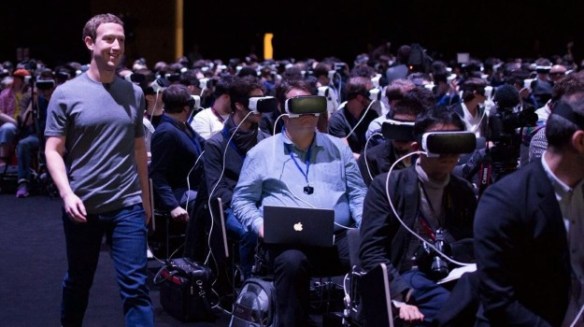
CEOs should have been the fall guys; why are they still heroes?

By Carl Rhodes

Source: aeon

On 15 September 2008, the giant financial services firm Lehman Brothers filed for bankruptcy, starting a chain reaction that saw the global economy spiralling toward total collapse. The global financial crisis that ensued revealed just how fragile and unstable the world economic order really was. If there was ever a time that neoliberal capitalism should have faced a legitimation crisis, this was it.

One only needs to think back to December 2008 when the then US president Barack Obama scolded the heads of the largest US auto firms for flying to Washington in private jets to ask for financial bailouts. As one Democratic Party representative added: ‘Couldn’t you all have downgraded to first class or jet-pooled or something to get here? It would have at least sent a message that you do get it.’

For a short time after the crash, those on the top of the corporate ladder seemed as powerless as those on the bottom. The failure demonstrated that neither chief executive officers (CEOs) nor their financial advisors had much of an idea of how the market worked or how to control it. All that was left for modern citizens was to brace themselves as a runaway global free market fell off the proverbial cliff. The CEO suddenly appeared like a fall guy for the crash rather than as a hero.

Fast-forward 10 years, and it’s hard to believe that the economic and political supremacy of the CEO could have even been put into radical question the way it was in 2008. CEOs never really lost their stride and, now more than ever, they are considered to be visionaries and idealised as leaders. Nor did they lose their corporate jets. Other than for a brief symbolic belt-tightening immediately after the crisis, CEOs were soon flying high again on company planes.

Today, business founders such as Elon Musk, Mark Zuckerberg or even Larry Fink epitomise a new class of celebrity CEOs, seen by so many as personal heroes who can save the world, and the same goes for the larger array of employee CEOs such as Jamie Dimon at JPMorgan Chase or Tim Cook at Apple. Yet all the while, CEOs participate in a world economy wracked by increasing inequality, as epitomised by the kind of obscene CEO remuneration that sees the likes of Amazon’s boss Jeff Bezos earning almost a million times that of the workers in his warehouses.

More ominously, millions of Americans voted for an ostentatiously super-rich CEO, electing Donald Trump as their president. In his acceptance speech, Trump praised his own business acumen as being key to his political success: ‘I’ve spent my entire life in business, looking at the untapped potential in projects and in people all over the world. That is now what I want to do for our country.’

The barely interrupted veneration of the CEO as a hero, marked most expressively by the Trump presidency, has brought us to a point today where CEOs are not just valued for their skills in business but have become role models in all walks of life. We now live in what we call a ‘CEO society’: a society where corporate leadership has become the model for transforming not just business, but all human activity, where everyone from politicians to jobseekers to even those seeking love are expected to imitate the qualities of the lionised corporate executive.

The contemporary adulation and admiration of CEOs raises the question of what enabled their continued idolisation, given what could well have been their fall from grace 10 years ago? At the time, many hoped that the sad devastation of the crisis might open the door for an economic and political paradigm shift that would usher in a fairer, more equal and just society. It’s not that this promise of change has not arrived, it’s that it seems farther away than ever.

After 2008, for a brief time, people clamoured for CEOs to be held accountable and be prosecuted. This was, not least, a practical matter. With jobs being lost, shop fronts being boarded up, and politicians crying austerity, what people wanted above all else was economic recovery. Yet with the world’s top executives in disgrace, who could lead such a dramatic economic revival?

What arose from peril was a novel fantasy of executive-led recovery that allowed the shattered reputation of the CEO to stage a prompt, if not miraculous, comeback. This played into an appealing crisis narrative. With such a narrative, all faith must be invested in the recuperation of an imaginary golden past that existed before the upheaval. Most recently, this has manifested in Brexit’s investment in the promise of a renewed British sovereignty, as well as in populist political rallying cries such as ‘Make America Great Again’.

These desires for recovery and return are of course perfectly understandable, and they clearly shed light on why ideologies of free-market heroism thrived again after crisis. But this still only scratches the surface of why CEOs continue to be idolised by so many. Whereas individual executives from Martin Shkreli of Turing Pharmaceuticals to Harvey Weinstein of Miramax might be reviled for their greed, corruption or abuse of power, the CEO – as an ideal – has been reinstated with a solid-gold allure.

The financial crisis pointed to a deep insecurity rested in the fear that it was futile for humans to control the economic world that we had created, and this reverberated with a more general fear that we lack agency more widely. Suddenly, people were pushed into facing the possibility that their lives were lost to the whims and unpredictable fate of a supernatural market. Where since the advent of the 20th century it had been righteously condemned that ‘money is the secular God of the world’, now it was feared that finance had become an even more reckless God, one who cared little for the humans who worshiped at his gilded altar.

The quick rehabilitation of the image of the CEO in the popular imagination was not just a practical matter of wanting to hold on to the material benefits afforded by neoliberal capitalism. It was a psychic measure needed to counteract the fear of dehumanisation at the hands of a runaway Frankenstein economy. In other words, we just wanted to pretend that someone was in control, even if all the facts and evidence were telling us that this wasn’t the case. Everything could be forgiven if hope could be returned.

The retention of the CEO myth was an assertion of the power of individuals to shape events and control their destiny. To achieve this meant holding on to the heroic character of the CEO such that people might regain a sense of control over their own lives too.

Maintaining faith in the CEO was less a matter of empirical fact and more a symptom of a human need to find something to believe in at the end of a hard-earned day; with the reality too hard to bear, the fantasy had to return. Held out was the promise that everyone could receive grace if only he accepted the modern CEO gospel. This is the very same faith that allows people to believe that the business acumen of an impetuous, loud-mouthed, misogynist bully is able to lead America to greatness. When Trump said that he would run the US like a business project, ‘under budget and ahead of schedule’, enough people believed him to pave his way to the White House.

CEOs represent the ability to be in control of a market that appears uncontrollable and uncaring of its profound human costs. This desire for control belies the reality for too many people of being on the wrong side of the rising tide of inequality, and of being subjected to the tyranny of a new singleminded political authoritarian intolerance. Let’s hope that with the next crisis we learn that we need to let go of the fantasy of the CEO.

Facebook is Not Your Friend

By Glen Ford

Source: Black Agenda Report

Facebook has become The Great Censor, ready to pull the pages of dissenters that seek to “stir up political debate” in ways that threaten the legitimacy of corporate rule.

Facebook is indispensable to maintaining the global corporate monopoly on truth — as is Google.”

Facebook has declared war on political dissent. In a rash of purges last week, the behemoth corporation banned 30 pages, with a total of 22 million fans, on the grounds that the accounts were “created to stir up political debate in the US, the Middle East, Russia and the UK.” At the top of the list were the anti-police lawlessness pages Cop Block, Filming Cops , The Free Thought Project and Police the Police, with a combined audience of 8.1 million. The other banned pages range across the non-establishment spectrum , from the reactionary Right Wing News, to Punk Rock Libertarians and the pro-marijuana page, Hemp.

These pages are “inauthentic,” Facebook claims , because they “use sensational political content” to “drive traffic to their websites.” Of course, the New York Times the Washington Post  and virtually every other organ of corporate media also maintain Facebook pages that are designed to “drive traffic to their websites.” The daily content of these imperial propagandists is filled with “sensational” stories that are designed to inflame the public, laying the groundwork for endless wars — most often on evidence that turns out to be fictitious. Yet Facebook has enlisted as “fact-checkers” the same corporate media that vouched for the presence of weapons of mass destruction in Iraq, spread lies about Viagra-fueled mass rape by Muammar Gaddafi’s soldiers in Libya, and continue to mask the U.S. alliance with al Qaida fighters in Syria. These same corporate “news” organs have treated allegations of Russian collusion with Trump during the 2016 elections as fact — without a shred of evidence — in order to whip up a new Cold War.

At the top of the list were the anti-police lawlessness pages Cop Block, Filming Cops, The Free Thought Project and Police the Police.”

Polls have long showed that the U.S. public — of all racial and political shades — no longer believes the corporate media version of reality, which almost routinely turns out to be false, and which Black people have always known to be false. This crisis of legitimacy for the ruling class and its media organs became acute in 2016, when the wildly unpredictable Donald Trump seemed to threaten the gentlemen’s agreement between the two corporate parties on regime change warfare and so-called free trade. Barely a week after Trump’s surprise victory at the polls, outgoing President Barack Obama, on a visit with German Chancellor Angela Merkel, called for the imposition of a standardized version of truth.

“Because in an age where there’s so much active misinformation and its packaged very well and it looks the same when you see it on a Facebook page or you turn on your television,” said Obama . “If everything seems to be the same and no distinctions are made, then we won’t know what to protect.” Or, as he put it later in an interview  with David Letterman: “One of the biggest challenges that we have to our democracy is the degree to which we do not share a common baseline of facts.”

Obama was calling for censorship of the Internet, and for corporate media to reassert its ideological supremacy in defense of the ruling order. The “danger” was not to democracy, but to the legitimacy of the corporate rule.

Barack Obama, on a visit with German Chancellor Angela Merkel, called for the imposition of a standardized version of truth.

A week after Obama’s remarks in Germany, the Washington Post published the first salvo in the censorship offensive, with an article titled, “Russian propaganda effort helped spread ‘fake news’ during election, experts say.” The “experts” were anonymous members of a shadowy organization called Prop-or-Not, whose identities the Post insisted on concealing. The Prop-or-Not list slandered 200 web sites, including many of the best left-wing addresses on the web, as “witting or unwitting” dupes of Russia. Black Agenda Report had the distinction of being the only Black-owned site on the list.

Facebook was dragooned into the censorship frenzy under relentless pressure from Democrats in Congress, who dutifully embraced the role of chief warmongers when Trump started making noises about improving relations with the Russians. Fully two-thirds of Americans are active monthly Facebook users who assumed that the service’s constant invitations to share what’s on their minds included political thought. Not any more. Mark Zuckerberg’s behemoth, that began as a student social networking service at Harvard 14 years ago, is now valued conservatively at $140 billion and claims to reach 2.23 billion monthly active worldwide users, 214 million in the United States. Facebook is indispensable to maintaining the global corporate monopoly on truth — as is Google, another mega-monopoly of the Internet. Both have joined the censorship project in defense of empire in decline.

“Google has rigged its algorithms to hide blacklisted sites during web searches, resulting in decreased visitation of up to 75 percent.”

An internal Google document assessed that: “In response to public outcries about the accessibility of unsavory and harmful content, tech firms have been adjusting their software to make it harder to stumble upon it.” The firm was talking about itself, and the “public” it is responding to is actually the capitalist ruling class, seeking to regain legitimacy through censorship. Google has rigged its algorithms to hide blacklisted sites during web searches, resulting in decreased visitation of up to 75 percent. They are strangling the Left, including Black Agenda Report.

Facebook has signed on to the new Cold War, under the ruse of protecting U.S. elections from Russian interference. “We’re excited to launch a new partnership with the Atlantic Council , which has a stellar reputation looking at innovative solutions to hard problems.” In the real world, the Council is the global public relations and think tank resource for NATO, the U.S.-led military alliance, funded by the whole constellation of war industries. Facebook has outsourced its censorship project to the Deep State.

Clearly, the Revolution will not be Friended by such people. Some Black folks may celebrate Facebook’s purges, glad that white supremacist Trump boosters and other overt racists are among the targets. But majorities of white people in the U.S. supported Trump, and there is no possibility that Facebook or any other corporation could effectively police — or even recognize — the racism of most of their users. But they do silence the cop-watchers. What Facebook is attempting to enforce is the absolute authority of the corporate media as the arbiter of Truth — a dictatorship of the white moneyed classes. And that can never be in Black folks’ interest.


BAR executive editor Glen Ford can be contacted at Glen.Ford@BlackAgendaReport.com

ThinkProgress Censored By Facebook After Cheerleading Facebook Censorship

By Caitlin Johnstone

Source: CaitlinJohnstone.com

In an article last month titled “Facebook announces that fake accounts are now coming not just from Russia”, fauxgressive establishment apologia firm ThinkProgress falsely reported that I have been writing for an outlet that is alleged to be part of an Iranian propaganda campaign. I repeatedly brought this false claim to the attention of Casey Michel, the article’s author, telling him that ten seconds of research or any attempt to contact me would have shown him that the articles published by the outlet in question were just reblogs of earlier publications from my platform, but Michel ignored the many notifications he received from myself and my Twitter followers and went on merrily interacting with other posters. As of this writing, the article remains uncorrected.

In the article, Michel documented Facebook’s heroic efforts to shut down alleged Iranian propaganda outlets, ominously warning his readers that “Russia is by no means the only foreign adversary exploiting social media’s inherent openness.” In other articles for ThinkProgress, Michel is repeatedly seen wagging his finger at Facebook and Twitter for not doing more to censor “Russian propaganda”, and in a July article titled “Facebook says both sides share fake news, defends Infowars’ presence on its platform — Mark Zuckerberg has an interesting way of prioritizing ‘high quality news’” another ThinkProgress author criticized Facebook for not censoring Alex Jones. Jones was censored by Facebook the following month.

So I think it’s understandable that those of us who have been warning of the dangers of internet censorship find it a bit funny to see ThinkProgress now complaining that it has been censored by Facebook.

ThinkProgress reports that its traffic from Facebook has been slashed by eighty percent due to a “fact check” by the Weekly Standard which, through a series of moronic mental contortions, found ThinkProgress guilty of reporting fake news about Brett Kavanaugh of all things. In a twist of irony which would be delicious if it weren’t so disgusting, the Weekly Standard is one of Facebook’s authorized “fact checkers”, and happens to be the brainchild of none other than bloodthirsty psychopath and rehabilitated #Resistance hero Bill Kristol.

ThinkProgress is part of a very large and diverse branch of progressive punditry whose ultimate job is to help centrist empire loyalists feel like leftist revolutionaries, and since 2016 one of the many appalling consequences of this bizarre environment has been the embracing of Iraq-raping neoconservatives like Kristol and Max Boot by Democratic Party loyalists. In a bid to stay relevant despite having been consistently wrong about literally everything in foreign policy for the last two decades, these murderous ghouls have repackaged themselves as a woke, cuddly alternative to the Trumpian faction of the Republican Party, and have been rewarded for their efforts with regular platforms on MSNBC and the Washington Post.

So with ThinkProgress getting censored by Facebook, you really couldn’t ask for a more clear-cut case of reaping what you sow. Nevertheless, it is wrong for anyone to be deprived of political speech, even if much of their political speech consists of attempts to silence the political speech of others. And if there is anything more gross than political speech being regulated by Silicon Valley plutocrats and a NATO psyop factory, it’s political speech being regulated by Silicon Valley plutocrats, a NATO psyop factory, and Bill Kristol. ThinkProgress should not have its audience restricted.

All the “let me help you cheer for the establishment while pretending to oppose it” pundits who celebrated Alex Jones’ coordinated de-platforming last month are falling all over themselves to spin this new development in a way that allows them to feel as though they aren’t being proven wrong day after day after day, but of course they are. Facilitating the censorship of anyone’s speech is facilitating the censorship of your own speech in the long run, and we’re not even having to wait long to see it this time around. In a corporatist system of government, corporate censorship is state censorship; the massive new media corporations being implored to regulate which political speech gets an audience and which doesn’t have extensive ties to secretive government agenciesand a vested interest in maintaining the status quo.

I do not expect ThinkProgress to remain on Facebook’s restricted list for long; the real targets of internet censorship are not partisan outlets which prop up establishment politics and help legitimize America’s two-headed one party system. But that isn’t the point. The point is that Silicon Valley plutocrats, the NATO propaganda firm Atlantic Council, and the Weekly Standard should not be determining who gets an audience in the new media environment and who doesn’t. Nothing that has anything to do with Bill Kristol should ever have any power over anyone. If our choices are between letting people think for themselves and letting the guy who’s always wrong about everything determine what shows up in people’s news feed, the choice is obviously the one which doesn’t involve placing faith in the man who helped deceive America into butchering a million Iraqis.

Censorship in America: The New Normal

By Stephen Lendman

Source: StephenLendman.org

Dark forces in America threaten speech, media, and academic freedoms.

Social media, Google, and other tech giants are complicit in a campaign to suppress content conflicting with the official narrative.

What’s increasingly going on is the hallmark of totalitarian rule – controlling the message, eliminating what conflicts with it, notably on major geopolitical issues.

Losing the right of free expression endangers all others. When truth-telling and dissent are considered threats to national security, free and open societies no longer exist – the slippery slope where America and other Western societies are heading.

The following headlines should scare everyone:

NYT: “Facebook Says It Removed Pages Related to ‘Inauthentic Behavior’ ”

Washington Post: “Sprawling Iranian influence operation globalizes tech’s war on disinformation”

Wall Street Journal: “Facebook Pulls Accounts Peddling Misinformation From Iran, Russia”

CNN: “Facebook takes down 652 pages after finding disinformation campaigns run from Iran and Russia”

The UK owned and controlled BBC: “Facebook and Twitter remove accounts linked to Russia and Iran campaigns”

Other Western major media had similar headlined reports. On Tuesday, Facebook CEO Mark Zuckerberg said hundreds of pages on its platform were removed for exhibiting signs of “ties to state-owned media” – including “activities the US government (said are) linked to Russian military intelligence” and Iran.

Facebook deleted accounts based on information supplied by the CIA, US State and Treasury Departments, acting as an agent for the imperial state.

The same goes for Twitter, Google, YouTube, Microsoft, and other tech giants – in cahoots with Washington against the most fundamental of fundamental freedoms.

Facebook removed 652 pages. Twitter suspended 284 accounts for engaging in what it called “coordinated manipulation” – code language for truth-telling dark forces in Washington want suppressed.

Google removed Google Plus and YouTube content – based on information supplied by the CIA-funded FireEye cybersecurity firm, Langley calling the company a “critical addition to our strategic investment portfolio for security technologies.”

According to Facebook, pages allegedly connected to Russia, Iran, and other US sanctioned countries are targeted for removal, claiming some seek to influence US midterm elections – providing no evidence proving any of the targeted pages were involved in illegal or improper activities.

FB allied with the Atlantic Council (AC) – a neocon infested enemy of world peace and stability think tank, promoting NATO’s killing machine, America’s military, industrial, security, major media complex, and Ziofascist Israel.

FB partnered with AC’s imperial geopolitical agenda to censor material falsely called “foreign interference” – AC’s Digital Forensic Research Lab involved in so-called “fact-checking,” code language for flagrant censorship.

The CIA-linked FireEye said so-called “inauthentic behavior” targeted for removal includes “anti-Saudi, anti-Israeli, and pro-Palestinian themes, as well as support for specific US policies favorable to Iran, such as the US-Iran nuclear deal (JCPOA).”

In cahoots with dark forces in Washington, Microsoft’s so-called Digital Crimes Unit shut down 84 websites it claimed were associated with Russian hackers – no evidence cited proving it.

Its Microsoft AccountGuard initiative offers free cybersecurity protection to US political candidates and campaign offices at the federal, state and local levels.

No evidence suggests any threats to America’s political process exists – just invented ones to bash Russia.

The new normal in America and other Western societies considers anything conflicting with the official narrative on vital issues “inauthentic behavior.”

Are these nations heading toward eliminating the right of free expression altogether- falsely claiming it’s to protect national security?

It appears to be what’s going on in the West – the possible elimination of free and open societies already gravely threatened.

Facebook is Filtering Out News That Doesn’t Bolster US Foreign Policy

Facebook has shed any pretense of neutrality in handling political information concerning the foreign affairs of the U.S. government.

By WT Whitney

Source: Mint Press News

Facebook has its admirers. Shareholders are enamored of its profits – $15.9 billion in 2017 – and hordes of the world’s population – 1.47 billion people – look at Facebook every day.  Individually on their Facebook pages they are communicating with, on average, 338 so-called “friends.” Editors, the media, and political commentators are similarly entranced. One unpretentious website receiving the present writer’s contributions claims 89,834 Facebook friends and another, 125,060 of them.

But now anyone dealing with political news and analyses of a progressive nature has reason to re-evaluate, even to draw back. Facebook apparently is now primed to censor that kind of information and discussion.

Facebook, for example, has its sights on Venezuela.  Revolutionary currents there have rankled the U.S. government and dominant U.S. media. The latter has frequently referred to the failed violent anti-government coup of August 4 as an “apparent” or “alleged” coup while identifying it as a future pretext for repression by Venezuela’s government.

Venezuelanalysis.com, almost alone, has provided English-language news and views that “challenge the corporate mainstream media narrative on Venezuela” Recently that platform has reported on “the growing international campaign to End US and Canadian Sanctions against Venezuela.” On August 9 Facebook removed the website’s account from its rolls; it was restored two days later. There were no explanations.

In 2005, the government of former Venezuelan president Hugo Chavez, vilified by the U.S. government, took the lead in forming TeleSUR news service which has provided information on resistance and integration movements throughout Latin America and the Caribbean. TeleSUR’s English-language page briefly disappeared from Facebook in January, 2018 and again on August 13 – for two days on that occasion.

These disruptions of two Facebook accounts are, by themselves, of no great moment.  But in Facebook’s hands, the flow of English-language political information on Latin America now seems generally precarious, the more so when it deviates from U.S. official doctrine.

At a press briefing July 31, Facebook’s chief operating officer, Sheryl Sandberg, indicated that “32 pages and accounts from Facebook and Instagram” had been removed because they “involve and coordinate inauthentic behavior.” TeleSUR English and the Venezuelanalysis may have been among the offenders.

The social media giant on May 17 announced that, “We’re doubling the number of people who work on safety and security and using technology like artificial intelligence to more effectively block fake accounts. [Additionally] we’re more actively working with outside experts, governments and other companies because we know that we can’t solve these challenges on our own … Today, we’re excited to launch a new partnership with the Atlantic Council.”

The new alliance bolsters suspicions that Facebook has shed any pretense of neutrality in handling political information concerning the foreign affairs of the U.S. government.

The context is a Facebook damage-control mission undertaken presumably to shore up profitability.  The social media giant came under criticism in Washington for allowing private information to fall into the hands of Cambridge Analytica. That British firm used it to provide data to Donald Trump’s 2016 presidential campaign viewed as injurious to contender Hillary Clinton.

Testifying April 10 before the Senate commerce and judiciary committees, Facebook CEO and founder Mark Zuckerberg declared, “It was my mistake.” He apologized for Facebook’s tolerance of “fake news, foreign interference in elections, and hate speech.” The office of influential Republican Sen. Mark Warner in July issued a draft white paper titled, in part, “Proposals for Regulation of Social Media.”

Facebook outlined a plan to “outsource many of the most sensitive political decisions” and henceforth to rely upon the Atlantic Council and its Digital Forensic Research Lab. According to Reutersthe Lab uses “its own software and other tools [and] sorts through social media postings for patterns.” Facebook’s recent donation to the Lab, Reuters said, was substantial enough, “to vault the company to the top of the Atlantic Council’s donor list, alongside the British government.”

The Washington-based Atlantic Council, founded in 1961, takes in $21million in revenue annually. By means of “galvanizing its uniquely influential network of global leaders,” the Council claims to foster “co­op­er­a­tion be­tween North Amer­ica and Europe that be­gan af­ter World War II.” Drawing together “political leaders, academics, military officials, journalists and diplomats in an effort to further the values set forth in the North Atlantic Treaty,” the Council is supposedly  a “network facilitator” that, according to the New York Times, offers “access to United States and foreign government officials in exchange for contributions.”

Contributors include NATO member governments, defense contractors, oil companies, aerospace companies, U.S. military services, the State Department, and multiple banks and fi­nan­cial or­ga­ni­za­tions. High U.S. military, intelligence, and diplomatic officials, both retired and on their way to top jobs, serve the Atlantic Council as leaders.

For one critic, the Council is “a leading geopolitical strategy think-tank seen as a de facto PR agency for the U.S. government and NATO military alliance.” Another, writing for alternet.org, is blunt: journalist Max Blumenthal characterizes the Council “as a pro-regime change think tank that is funded by Western governments and their allies.”

The Atlantic Council is most certainly aligned with the objectives of U.S foreign policies. Now Facebook is using the Council as authenticator-in-chief of international news and views flowing through its portals.  On both accounts, therefore, Facebook may have already lost any claim to promoting the free flow of political information.