State Secrets and the National-Security State

By Jacob G. Hornberger

Source: Activist Post

Inadvertently released federal documents reveal that U.S. officials have apparently secured a secret indictment against Julian Assange, the head of WikiLeaks who released secret information about the internal workings of the U.S. national-security establishment. In any nation whose government is founded on the concept of a national-security state, that is a cardinal sin, one akin to treason and meriting severe punishment.

Mind you, Assange isn’t being charged with lying or releasing false or fraudulent information about the U.S. national-security state. Everyone concedes that the WikiLeaks information was authentic. His “crime” was in disclosing to people the wrongdoing of the national-security establishment. No one is supposed to do that, even if the information is true and correct.

It’s the same with Edward Snowden, the American contractor with the CIA and the NSA who is now relegated to living in Russia. If Snowden returns home, he faces federal criminal prosecution, conviction, and incarceration for disclosing secrets of the U.S. national-security establishment. Again, his “crime” is disclosing the truth about the internal workings of the national-security establishment, not disseminating false information.

Such secrecy and the severe punishment for people who disclose the secrets to the public were among the things that came with the conversion of the federal government to a national-security state.

Recall that when the U.S. government was called into existence by the Constitution, it was a type of governmental structure known as a limited-government republic. Under that type of governmental structure, the federal government’s powers were extremely limited. The only powers that federal officials could lawfully exercise were those few that were enumerated in the Constitution itself.

Under the republic form of government, there was no enormous permanent military establishment, no CIA, and no NSA, which are the three components of America’s national-security state. The last thing Americans wanted was that type of government. In fact, if Americans had been told that the Constitution was going to bring into existence a national-security state, they never would have approved the deal and would have continued operating under the Articles of Confederation, a type of governmental system where the federal government’s powers were so few that it didn’t even have the power to tax.

Under the republic, governmental operations were transparent. There was no such thing as “state secrets” or “national security.” Except for the periodic backroom deals in which politicians would make deals, things generally were open and above-board for people to see and make judgments on.

That all changed when the federal government was converted from a limited-government republic to a national-security state after World War II. Suddenly, the federal government was vested with omnipotent powers, so long as they were being exercised by the Pentagon, the CIA, or the NSA in the name of “national security.”

Interestingly enough, the conversion of the federal government to a national-security state was not done through constitutional amendment. Nonetheless, the federal judiciary has long upheld or simply deferred to the exercise of omnipotent powers by the national-security establishment.

An implicit part of the conversion was that the Pentagon, the CIA, and the NSA would be free to exercise their omnipotent powers in secret. Secrecy has always been a core element in any government that is structured as a national-security state, especially when it involves dark, immoral, and nefarious powers that are being exercised for the sake of “national security.”

One action that oftentimes requires the utmost in secrecy involves assassination, which is really nothing more than legalized murder. Not surprisingly, many national-security officials want to keep their role in state-sponsored murder secret. Another example is coups initiated in foreign countries. U.S. officials bend over backwards to hide their role in such regime-change operations. And then there are the surveillance schemes whereby citizens are foreigners are spied up and monitored. Kidnapping, indefinite detention, and torture are still more examples.

Of course, these are the types of things that we ordinarily identify with totalitarian regimes. The reason for that is that a national-security state governmental system is inherent to totalitarian regimes. For example, the Nazi government, which was a national-security state too, had an enormous permanent military establishment and a Gestapo, which wielded the powers of assassination, indefinite detention, torture, and secret surveillance. And not surprisingly, to disclose the secrets of German’s national-security state involved severe punishment.

But it’s not just Nazi Germany. There are many other examples of totalitarian regimes that are based on the concept of national security and structured as a national-security state. Chile under Pinochet. The Soviet Union. Communist China. North Korea. Vietnam. Egypt. Pakistan. Iraq. Afghanistan. Saudi Arabia. Turkey, Myanmar. And the United States. The list goes on and on.

And every one of those totalitarian regimes has a state-secrets doctrine, the same doctrine that the Pentagon, CIA, and NSA have.

A newspaper in Vietnam, which of course is ruled by a communist regime, reported that a Vietnamese citizen named Phan Van Anh Vu was sentenced to 9 years in prison for “deliberately disclosing state secrets.”

A website for the Committee to Protect Journalists reported that the Chinese communist regime charged a Chinese journalist named Yang Xiuqiong with “illegally providing state secrets overseas.” The Chinese Reds have also charged a prominent environmental activist named Liu Shu with “revealing state secrets related to China’s counterespionage work.”

The military dictatorship in Myanmar convicted two Reuters reporters for violating the country’s law that prohibits the gathering of secret documents to help an enemy.

RT reports that the Russian military will “launch obligatory courses on the protection of state secrets starting next year.

US News reports that the regime in Turkey is seeking the extradition from Germany of Turkish journalist Can Dunbar, who was convicted of revealing state secrets.

Defenders of Assange and Snowden and other revealers of secrets of the U.S. national security state point to the principles of freedom of speech and freedom of the press to justify their disclosures.

I’ve got a better idea: Let’s just dismantle America’s decades-long, nightmarish Cold War-era experiment with the totalitarian structure known as a national-security state and restore a limited-government republic to our land.


The Guardian’s Reputation In Tatters After Forger Revealed To Have Co-Authored Assange Smear

By Elizabeth Vos

Source: Disobedient Media

Regular followers of WikiLeaks-related news are at this point familiar with the multiple serious infractions of journalistic ethics by Luke Harding and the Guardian, especially (though not exclusively) when it comes to Julian Assange and WikiLeaks. However, another individual at the heart of this matter is far less familiar to the public. That man is Fernando Villavicencio, a prominent Ecuadorian political activist and journalist, director of the USAID-funded NGO Fundamedios and editor of online publication FocusEcuador.

Most readers are also aware of the Guardian’s recent publication of claims that Julian Assange met with former Trump campaign manager Paul Manafort on three occasions. This has now been definitively debunked by Fidel Narvaez, the former Consul at Ecuador’s London embassy between 2010 and 2018, who says Paul Manafort has never visited the embassy during the time he was in charge there. But this was hardly the first time the outlet published a dishonest smear authored by Luke Harding against Assange. The paper is also no stranger to publishing stories based on fabricated documents.

In May, Disobedient Media reported on the Guardian’s hatchet-job relating to ‘Operation Hotel,’ or rather, the normal security operations of the embassy under former Ecuadorian President Rafael Correa. That hit-piece, co-authored by Harding and Dan Collyns, asserted among other things that (according to an anonymous source) Assange hacked the embassy’s security system. The allegation was promptly refuted by Correa as “absurd” in an interview with The Intercept, and also by WikiLeaks as an “anonymous libel” with which the Guardian had “gone too far this time. We’re suing.”

A shared element of The Guardian’s ‘Operation Hotel’ fabrications and the latest libel attempting to link Julian Assange to Paul Manafort is none other than Fernando Villavicencio of FocusEcuador. In 2014 Villavicencio was caught passing a forged document to the Guardian, which published it without verifying it. When the forgery was revealed, the Guardian hurriedly took the document down but then tried to cover up that it had been tampered with by Villavicencio when it re-posted it a few days later.

How is Villavicencio tied to The Guardian’s latest smear of Assange? Intimately, it turns out.

Who is Fernando Villavicencio?

Earlier this year, an independent journalist writing under the pseudonym Jimmyslama penned a comprehensive report detailing Villavicencio’s relationships with pro-US actors within Ecuador and the US. She sums up her findings, which are worth reading in full:

“…The information in this post alone should make everyone question why in the world the Guardian would continue to use a source like Villavicencio who is obviously tied to the U.S. government, the CIA, individuals like Thor Halvorssen and Bill Browder, and opponents of both Julian Assange and former President Rafael Correa.”

As most readers recall, it was Correa who granted Assange asylum in the Ecuadorian Embassy in London. Villavicencio was so vehemently opposed to Rafael Correa’s socialist government that during the failed 2010 coup against Correa he falsely accused the President of “crimes against humanity” by ordering police to fire on the crowds (it was actually Correa who was being shot at). Correa sued him for libel, and won, but pardoned Villavicencio for the damages awarded by the court.

Assange legal analyst Hanna Jonasson recently made the link between the Ecuadorian forger Villavicencio and Luke Harding’s Guardian stories based on dubious documents explicit. She Tweeted2014 Ecuador’s Foreign Ministry accused the Guardian of publishing a story based on a document it says was fabricated by Fernando Villavicencio, pictured below with the authors of the fake Manafort-Assange ‘secret meeting’ story, Harding and Collyns.”

Jonasson included a link to a 2014 official Ecuadorian government statement  which reads in part: “There is also evidence that the author of this falsified document is Fernando Villavicencio, a convicted slanderer and opponent of Ecuador’s current government. This can be seen from the file properties of the document that the Guardian had originally posted (but which it has since taken down and replaced with a version with this evidence removed).”  The statement also notes that Villavicencio had fled the country after his conviction for libeling Correa during the 2010 coup and was at that time living as a fugitive in the United States.

It is incredibly significant, as Jonasson argues, that the authors of the Guardian’s latest libelous article were photographed with Villavicencio in Ecuador shortly before publication of the Guardian’s claim that Assange had conducted meetings with Manafort.

Jonasson’s Twitter thread also states: This video from the news wire Andes alleges that Villavicencio’s name appeared in the metadata of the document originally uploaded alongside The Guardian’s story.” The 2014 Guardian piece, which aimed a falsified shot at then-President Rafael Correa, would not be the last time Villavicencio’s name would appear on a controversial Guardian story before being scrubbed from existence.

Just days after the backlash against the Guardian reached fever-pitch, Villavicencio had the gall to publish another image of himself with Harding and Collyns, gloating : “One of my greatest journalistic experiences was working for months on Assange’s research with colleagues from the British newspaper the Guardian, Luke Harding, Dan Collins and the young journalist Cristina Solórzano from somos_lafuente” [Translated from Spanish]

https://twitter.com/VillaFernando_/status/1069079592927928320

The tweet suggests, but does not specifically state, that Villavicencio worked with the disastrous duo on the Assange-Manafort piece. Given the history and associations of all involved, this statement alone should cause extreme skepticism in any unsubstantiated claims, or ‘anonymously sourced’ claims, the Guardian makes concerning Julian Assange and Ecuador.

Astoundingly, and counter to Villavicencio’s uncharacteristic coyness, a recent video posted by WikiLeaks via Twitter does show that Villavicencio was originally listed as a co-author of the Guardian’s Manafort-Assange allegations, before his name was edited out of the online article. The original version can be viewed, however, thanks to archive services.

The two photographs of Villavicencio with Harding and Collyns as well as the evidence showing he co-authored the piece doesn’t just capture a trio of terrible journalists, it documents the involvement of multiple actors associated with intelligence agencies and fabricated stories.

All of this provoke the question: did Villavicencio provide more bogus documents to Harding and Collyns – Harding said he’d seen a document, though he didn’t publish one (or even quote from it) so readers might judge its veracity for themselves – or perhaps these three invented the accusations out of whole-cloth?

Either way, to quote WikiLeaks, the Guardian has “gone too far this time” and its already-tattered reputation is in total shambles.

Successful Propaganda, Failed Journalism

Craig Murray calls Harding an “MI6 tool“, but to this writer, Harding seems worse than an MI6 stooge: He’s a wannabe-spook, hanging from the coat-tails of anonymous intelligence officers and publishing their drivel as fact without so much as a skeptical blink. His lack of self-awareness and conflation of anecdote with evidence sets him apart as either one of the most blatant, fumbling propagandists of our era, or the most hapless hack journalist to stain the pages of printed news.

To provide important context on Harding’s previous journalistic irresponsibility, we again recall that he co-authored the infamous book containing the encryption password of the entire Cablegate archive, leading to a leak of the unredacted State Department Cables across the internet. Although the guilty Guardian journalists tried to blame Assange for the debacle, it was they themselves who ended up on the receiving end of some well-deserved scorn.

In addition to continuing the Guardian’s and Villavicencio’s vendetta against Assange and WikiLeaks, it is clearly in Harding’s financial interests to conflate the pending prosecution of Assange with Russiagate. As this writer previously noted, Harding penned a book on the subject, titled: “Collusion: Secret Meetings, Dirty Money, and How Russia Helped Donald Trump Win.” Tying Assange to Russiagate is good for business, as it stokes public interest in the self-evidently faulty narrative his book supports.

Even more concerning is the claim amongst publishing circles, fueled by recent events, that Harding may be writing another book on Assange, with publication presumably timed for his pending arrest and extradition and designed to cash in on the trial. If that is in fact the case, the specter arises that Harding is working to push for Assange’s arrest, not just on behalf of US, UK or Ecuadorian intelligence interests, but also to increase his own book sales.

That Harding and Collyns worked intensively with Villavicencio for “months” on the “Assange story,” the fact that Villavicencio was initially listed as a co-author on the original version of the Guardian’s article, and the recent denial by Fidel Narvaez, raises the likelihood that Harding and the Guardian were not simply the victims of bad sources who duped them, as claimed by some.

It indicates that the fake story was constructed deliberately on behalf of the very same intelligence establishment that the Guardian is nowadays only too happy to take the knee for.

In summary, one of the most visible establishment media outlets published a fake story on its front page, in an attempt to manufacture a crucial cross-over between the pending prosecution of Assange and the Russiagate saga. This represents the latest example in an onslaught of fake news directed at Julian Assange and WikiLeaks ever since they published the largest CIA leak in history in the form of Vault 7, an onslaught which appears to be building in both intensity and absurdity as time goes on.

The Guardian has destroyed its reputation, and in the process, revealed the desperation of the establishment when it comes to Assange.

In A Corporatist System Of Government, Corporate Censorship Is State Censorship

By Caitlin Johnstone

Source: CaitlinJohnstone.com

Last year, representatives of Facebook, Twitter, and Google were instructed on the US Senate floor that it is their responsibility to “quell information rebellions” and adopt a “mission statement” expressing their commitment to “prevent the fomenting of discord.”

“Civil wars don’t start with gunshots, they start with words,” the representatives were told. “America’s war with itself has already begun. We all must act now on the social media battlefield to quell information rebellions that can quickly lead to violent confrontations and easily transform us into the Divided States of America.”

Yes, this really happened.

Today [8/7] Twitter has silenced three important anti-war voices on its platform: it has suspended Daniel McAdams, the executive director of the Ron Paul Institute, suspended Scott Horton of the Scott Horton Show, and completely removed the account of prominent Antiwar.com writer Peter Van Buren.

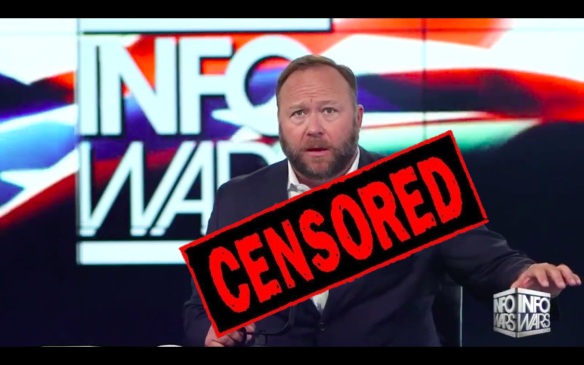
I’m about to talk about the censorship of Alex Jones and Infowars now, so let me get the “blah blah I don’t like Alex Jones” thing out of the way so that my social media notifications aren’t inundated with people saying “Caitlin didn’t say the ‘blah blah I don’t like Alex Jones’ thing!” I shouldn’t have to, because this isn’t actually about Alex Jones, but here it is:

I don’t like Alex Jones. He’s made millions saying the things disgruntled right-wingers want to hear instead of telling the truth; he throws in disinfo with his info, which is the same as lying all the time. He’s made countless false predictions and his sudden sycophantic support for a US president has helped lull the populist right into complacency when they should be holding Trump to his non-interventionist campaign pledges, making him even more worthless than he was prior to 2016.

But this isn’t about defending Alex Jones. He just happens to be the thinnest edge of the wedge.

As of this writing, Infowars has been censored from Facebook, Youtube (which is part of Google), Apple, Spotify, and now even Pinterest, all within hours of each other. This happens to have occurred at the same time Infowars was circulating a petition with tens of thousands of signatures calling on President Trump to pardon WikiLeaks editor-in-chief Julian Assange, who poses a much greater threat to establishment narratives than Alex Jones ever has. Assange’s mother also reports that this mass removal of Infowars’ audience occurred less than 48 hours after she was approached to do an interview by an Infowars producer.

In a corporatist system of government, wherein there is no meaningful separation between corporate power and state power, corporate censorship is state censorship. Because legalized bribery in the form of corporate lobbying and campaign donations has given wealthy Americans the ability to control the US government’s policy and behavior while ordinary Americans have no effective influence whatsoever, the US unquestionably has a corporatist system of government. Large, influential corporations are inseparable from the state, so their use of censorship is inseparable from state censorship.

This is especially true of the vast megacorporations of Silicon Valley, whose extensive ties to US intelligence agencies are well-documented. Once you’re assisting with the construction of the US military’s drone program, receiving grants from the CIA and NSA for mass surveillance, or having your site’s content regulated by NATO’s propaganda arm, you don’t get to pretend you’re a private, independent corporation that is separate from government power. It is possible in the current system to have a normal business worth a few million dollars, but if you want to get to billions of dollars in wealth control in a system where money translates directly to political power, you need to work with existing power structures like the CIA and the Pentagon, or else they’ll work with your competitors instead of you.

And yet every time I point to the dangers of a few Silicon Valley plutocrats controlling all new media political discourse with an iron fist, Democratic Party loyalists all turn into a bunch of hardline free market Ayn Rands. “It’s not censorship!” they exclaim. “It’s a private company and can do whatever it wants with its property!”

They do this because they know their mainstream, plutocrat-friendly “centrist” views will never be censored. Everyone else is on the chopping block, however. Leftist sites have already had their views slashed by a manipulation of Google’s algorithms, and it won’t be long before movements like BDS and Antifa and skeptics of the establishment Syria and Russia narratives can be made to face mass de-platforming on the same exact pretext as Infowars.

This is a setup. Hit the soft target so your oligarch-friendly censorship doesn’t look like what it is, then once you’ve manufactured consent, go on to shut down the rest of dissenting media bit by bit.

Don’t believe that’s the plan? Let’s ask sitting US Senator Chris Murphy:

“Infowars is the tip of a giant iceberg of hate and lies that uses sites like Facebook and YouTube to tear our nation apart,” Murphy tweeted in response to the news. “These companies must do more than take down one website. The survival of our democracy depends on it.”

That sure sounds an awful lot like the warnings issued to the Silicon Valley representatives on the Senate floor at the beginning of this article, no? This is headed somewhere dark.

We’re going to have to find a way to keep the oligarchs from having their cake and eating it too. Either (A) corporations are indeed private organizations separate from the government, in which case the people need to get money out of politics and government agencies out of Silicon Valley so they can start acting like it, and insist that their owners can’t be dragged out on to the Senate floor and instructed on what they can and can’t do with their business, or (B) these new media platforms get treated like the government agencies they function as, and the people get all the First Amendment protection that comes with it. Right now the social engineers are double-dipping in a way that will eventually give the alliance of corporate plutocrats and secretive government agencies the ability to fully control the public’s access to ideas and information.

If they accomplish that, it’s game over for humanity. Any hope of the public empowering itself over the will of a few sociopathic, ecocidal, omnicidal oligarchs will have been successfully quashed. We are playing for all the chips right now. We have to fight this. We have no choice.

Technology giants hold censorship meeting with US intelligence agencies

By Will Morrow

Source: WSWS.org

The New York Times and Washington Post this week published reports of a private meeting last month between eight major technology and social media corporations and the US intelligence agencies, to discuss their censorship operations in the lead-up to the November 2018 mid-term elections.

The meeting was convened at Facebook’s Menlo Park, California, headquarters on May 23, and was attended by representatives from Amazon, Apple, Google, Microsoft, Snap, Twitter and Oath, which owns Yahoo and the telecommunications network Verizon, along with agents from the FBI and the Department of Homeland Security.

The Post described the meeting, organized at the request of Facebook, as a “new overture by the technology industry to develop closer ties to law enforcement.” Both articles were based on anonymous statements by individuals who attended. One attendee told the Post that the conversation was a “back-and-forth, with both sides talking about how they were thinking about the problem and how we were looking for opportunities to work together.”

The meeting is yet another testament to the increasing integration of the technology giants with the US military/intelligence apparatus. These companies, which provide a growing share of the technical infrastructure for the repressive apparatus of the state, increasingly see the censorship of left-wing, anti-war, and progressive viewpoints as an integral part of their business strategy.

Amazon, Microsoft and Google are competing to secure control over a $10 billion project to host the Pentagon’s Cloud infrastructure, a position that will literally mean hosting the communications between military units engaged in battle. Employees at the three companies have also written letters in recent months denouncing their provision of artificial intelligence technology to improve drone targeting (Google), facial recognition of civilians by police agencies (Amazon), and assisting in the operations of the Immigration and Customs Enforcement (Microsoft).

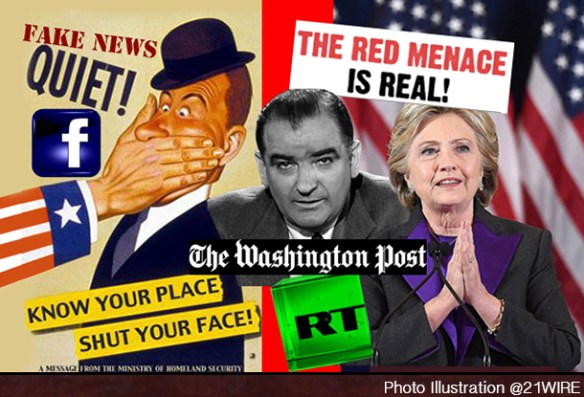
The Times and the Post are the main media voices for the campaign by the Democratic Party and intelligence agencies for Internet censorship, under the guise of opposing the spread of “misinformation” by the Russian government. This McCarthyite campaign is based on the totally unsubstantiated allegation that Russian “fake news” led to popular disillusionment with Hillary Clinton in the 2016 vote, and the subsequent election of Donald Trump. The newspapers’ synchronized reports therefore present last month’s meeting as aimed at preventing Russian interference in the mid-term elections.

But the real target of the censorship campaign is popular access to left-wing news sources not controlled by the corporate media, and the proliferation of oppositional social media content, such as videos of police killings, mass roundups of immigrants, military interventions, protests and exposures of corporate malfeasance and government criminality.

Since the beginning of the year, Facebook has rolled out a series of changes to its News Feed, including demoting political content in favor of so-called “personal moments,” and prioritizing content from so-called “trustworthy sources”—in reality pro-establishment propaganda outlets—including the Times and the Wall Street Journal. The social media giant has also changed its algorithms to reduce the spread of “viral videos,” which CEO Mark Zuckerberg declared are “not good for people’s well-being and society.”

Last Thursday, Facebook published an announcement by its Head of News Integrity Tessa Lyons, announcing a further expansion of these measures, including the introduction of “fact-checking” for videos and photos. The post also stated that Facebook is introducing “machine learning to help identify and demote foreign Pages that are likely to spread financially-motivated hoaxes to people in other countries.” These will work alongside Facebook’s army of “fact checkers”—i.e., censors—many of them former security and intelligence agents, who belong to the 20,000 people employed in its “security” and “moderation” department.

The “demotion” of what Facebook calls “false news” was codified in “community guidelines” published by the company in April. The guidelines state that because the suppression of “false news” is a “sensitive issue,” the company does not openly remove news stories, which would be easily detected by publishers and their followers, but does the same thing secretly: “significantly reduc[ing] its distribution by showing it lower on the News Feed.” (See: “Facebook codifies its censorship regime”)

Lyons repeated this line of argument in an interview with PBS’ Miles O’Brien on May 16. Admitting that “censoring and fully removing information unless it violates our community standards is not the expectation from our community,” Lyons explained that instead “we work to reduce the damage it can do” by restricting its proliferation. The Washington Post reported yesterday that while speaking at the International Fact Checkers Network conference last week, Lyons “told attendees that … [Facebook] will soon use machine learning to predict pages that are more likely to share misinformation.”

With the official ending of net neutrality this month, the financial oligarchy that controls both the search and social media monopolies and internet service providers has further tightened its grip over the freedom of expression on the internet, with ISPs given the prerogative to block and throttle internet content at will.

The expansion of internet censorship takes place amidst mounting pressure on whistleblower Julian Assange, the Wikileaks journalist who has been effectively imprisoned in the Ecuadorian embassy in London since 2012, where he was forced to take refuge to avoid being extradited to the US and charged for publishing evidence of US government crimes. The persecution of Assange for the “crime” of publishing the truth is aimed at intimidating whistleblowers and honest journalists all around the world.

Google , which attended last month’s meeting with the FBI and Department of Homeland Security, has altered its search engine algorithms to censor left-wing and anti-war websites, including the World Socialist Web Site, whose Google search traffic fell by three quarters in response to changes by the search engine in April 2017. There are indications that Google has recently intensified its censorship of the World Socialist Web Site, with search impressions falling by as much as one third over the past month.

In August 2017, the World Socialist Web Site published an open letter to Google demanding that it end its censorship of the internet, declaring, “Censorship on this scale is political blacklisting. The obvious intent of Google’s censorship algorithm is to block news that your company does not want reported and to suppress opinions with which you do not agree.”

We urge all readers of the World Socialist Web Site seeking to defend the freedom of expression online to contact us and join the struggle against internet censorship.

Still Waiting for Evidence of a Russian Hack

More than two years after the allegation of Russian hacking of the 2016 U.S. presidential election was first made, conclusive proof is still lacking and may never be produced, says Ray McGovern.

By Ray McGovern

Source: Consortium News

If you are wondering why so little is heard these days of accusations that Russia hacked into the U.S. election in 2016, it could be because those charges could not withstand close scrutiny. It could also be because special counsel Robert Mueller appears to have never bothered to investigate what was once the central alleged crime in Russia-gate as no one associated with WikiLeaks has ever been questioned by his team.

Veteran Intelligence Professionals for Sanity — including two “alumni” who were former National Security Agency technical directors — have long since concluded that Julian Assange did not acquire what he called the “emails related to Hillary Clinton” via a “hack” by the Russians or anyone else. They found, rather, that he got them from someone with physical access to Democratic National Committee computers who copied the material onto an external storage device — probably a thumb drive. In December 2016 VIPS explained this in some detail in an open Memorandum to President Barack Obama.

On January 18, 2017 President Obama admitted that the “conclusions” of U.S. intelligence regarding how the alleged Russian hacking got to WikiLeaks were “inconclusive.” Even the vapid FBI/CIA/NSA “Intelligence Community Assessment of Russian Activities and Intentions in Recent U.S. Elections” of January 6, 2017, which tried to blame Russian President Vladimir Putin for election interference, contained no direct evidence of Russian involvement.  That did not prevent the “handpicked” authors of that poor excuse for intelligence analysis from expressing “high confidence” that Russian intelligence “relayed material it acquired from the Democratic National Committee … to WikiLeaks.”  Handpicked analysts, of course, say what they are handpicked to say.

Never mind. The FBI/CIA/NSA “assessment” became bible truth for partisans like Rep. Adam Schiff (D-CA), ranking member of the House Intelligence Committee, who was among the first off the blocks to blame Russia for interfering to help Trump.  It simply could not have been that Hillary Clinton was quite capable of snatching defeat out of victory all by herself.  No, it had to have been the Russians.

Five days into the Trump presidency, I had a chance to challenge Schiff personally on the gaping disconnect between the Russians and WikiLeaks. Schiff still “can’t share the evidence” with me … or with anyone else, because it does not exist.

WikiLeaks

It was on June 12, 2016, just six weeks before the Democratic National Convention, that Assange announced the pending publication of “emails related to Hillary Clinton,” throwing the Clinton campaign into panic mode, since the emails would document strong bias in favor of Clinton and successful attempts to sabotage the campaign of Bernie Sanders.  When the emails were published on July 22, just three days before the convention began, the campaign decided to create what I call a Magnificent Diversion, drawing attention away from the substance of the emails by blaming Russia for their release.

Clinton’s PR chief Jennifer Palmieri later admitted that she golf-carted around to various media outlets at the convention with instructions “to get the press to focus on something even we found difficult to process: the prospect that Russia had not only hacked and stolen emails from the DNC, but that it had done so to help Donald Trump and hurt Hillary Clinton.”  The diversion worked like a charm.  Mainstream media kept shouting “The Russians did it,” and gave little, if any, play to the DNC skullduggery revealed in the emails themselves. And like Brer’ Fox, Bernie didn’t say nothin’.

Meanwhile, highly sophisticated technical experts, were hard at work fabricating “forensic facts” to “prove” the Russians did it.  Here’s how it played out:

June 12, 2016: Assange announces that WikiLeaks is about to publish “emails related to Hillary Clinton.”

June 14, 2016: DNC contractor CrowdStrike, (with a dubious professional record and multiple conflicts of interest) announces that malware has been found on the DNC server and claims there is evidence it was injected by Russians.

June 15, 2016: “Guccifer 2.0” affirms the DNC statement; claims responsibility for the “hack;” claims to be a WikiLeaks source; and posts a document that the forensics show was synthetically tainted with “Russian fingerprints.”

The June 12, 14, & 15 timing was hardly coincidence. Rather, it was the start of a pre-emptive move to associate Russia with anything WikiLeaks might have been about to publish and to “show” that it came from a Russian hack.

Enter Independent Investigators

A year ago independent cyber-investigators completed the kind of forensic work that, for reasons best known to then-FBI Director James Comey, neither he nor the “handpicked analysts” who wrote the Jan. 6, 2017 assessment bothered to do.  The independent investigators found verifiable evidence from metadata found in the record of an alleged Russian hack of July 5, 2016 showing that the “hack” that day of the DNC by Guccifer 2.0 was not a hack, by Russia or anyone else.

Rather it originated with a copy (onto an external storage device – a thumb drive, for example) by an insider — the same process used by the DNC insider/leaker before June 12, 2016 for an altogether different purpose. (Once the metadata was found and the “fluid dynamics” principle of physics applied, this was not difficult to disprove the validity of the claim that Russia was responsible.)

One of these independent investigators publishing under the name of The Forensicator on May 31 published new evidence that the Guccifer 2.0 persona uploaded a document from the West Coast of the United States, and not from Russia.

In our July 24, 2017 Memorandum to President Donald Trump we stated, “We do not know who or what the murky Guccifer 2.0 is. You may wish to ask the FBI.”

Our July 24 Memorandum continued: “Mr. President, the disclosure described below may be related. Even if it is not, it is something we think you should be made aware of in this general connection. On March 7, 2017, WikiLeaks began to publish a trove of original CIA documents that WikiLeaks labeled ‘Vault 7.’ WikiLeaks said it got the trove from a current or former CIA contractor and described it as comparable in scale and significance to the information Edward Snowden gave to reporters in 2013.

“No one has challenged the authenticity of the original documents of Vault 7, which disclosed a vast array of cyber warfare tools developed, probably with help from NSA, by CIA’s Engineering Development Group. That Group was part of the sprawling CIA Directorate of Digital Innovation – a growth industry established by John Brennan in 2015. [ (VIPS warned President Obama of some of the dangers of that basic CIA reorganization at the time.]

Marbled

“Scarcely imaginable digital tools – that can take control of your car and make it race over 100 mph, for example, or can enable remote spying through a TV – were described and duly reported in the New York Times and other media throughout March. But the Vault 7, part 3 release on March 31 that exposed the “Marble Framework” program apparently was judged too delicate to qualify as ‘news fit to print’ and was kept out of the Times at the time, and has never been mentioned since.

“The Washington Post’s Ellen Nakashima, it seems, ‘did not get the memo’ in time. Her March 31 article bore the catching (and accurate) headline: ‘WikiLeaks’ latest release of CIA cyber-tools could blow the cover on agency hacking operations.’

“The WikiLeaks release indicated that Marble was designed for flexible and easy-to-use ‘obfuscation,’ and that Marble source code includes a “de-obfuscator” to reverse CIA text obfuscation.

“More important, the CIA reportedly used Marble during 2016. In her Washington Post report, Nakashima left that out, but did include another significant point made by WikiLeaks; namely, that the obfuscation tool could be used to conduct a ‘forensic attribution double game’ or false-flag operation because it included test samples in Chinese, Russian, Korean, Arabic and Farsi.”

A few weeks later William Binney, a former NSA technical director, and I commented on Vault 7 Marble, and were able to get a shortened op-ed version published in The Baltimore Sun.

The CIA’s reaction to the WikiLeaks disclosure of the Marble Framework tool was neuralgic. Then Director Mike Pompeo lashed out two weeks later, calling Assange and his associates “demons,” and insisting; “It’s time to call out WikiLeaks for what it really is, a non-state hostile intelligence service, often abetted by state actors like Russia.”

Our July 24 Memorandum continued:  “Mr. President, we do not know if CIA’s Marble Framework, or tools like it, played some kind of role in the campaign to blame Russia for hacking the DNC. Nor do we know how candid the denizens of CIA’s Digital Innovation Directorate have been with you and with Director Pompeo. These are areas that might profit from early White House review.  [ President Trump then directed Pompeo to invite Binney, one of the authors of the July 24, 2017 VIPS Memorandum to the President, to discuss all this.  Binney and Pompeo spent an hour together at CIA Headquarters on October 24, 2017, during which Binney briefed Pompeo with his customary straightforwardness. ]

“We also do not know if you have discussed cyber issues in any detail with President Putin. In his interview with NBC’s Megyn Kelly he seemed quite willing – perhaps even eager – to address issues related to the kind of cyber tools revealed in the Vault 7 disclosures, if only to indicate he has been briefed on them. Putin pointed out that today’s technology enables hacking to be ‘masked and camouflaged to an extent that no one can understand the origin’ [of the hack] … And, vice versa, it is possible to set up any entity or any individual that everyone will think that they are the exact source of that attack.

“‘Hackers may be anywhere,’ he said. ‘There may be hackers, by the way, in the United States who very craftily and professionally passed the buck to Russia. Can’t you imagine such a scenario? … I can.’

New attention has been drawn to these issues after I discussed them in a widely published 16-minute interview last Friday.

In view of the highly politicized environment surrounding these issues, I believe I must append here the same notice that VIPS felt compelled to add to our key Memorandum of July 24, 2017:

“Full Disclosure: Over recent decades the ethos of our intelligence profession has eroded in the public mind to the point that agenda-free analysis is deemed well nigh impossible. Thus, we add this disclaimer, which applies to everything we in VIPS say and do: We have no political agenda; our sole purpose is to spread truth around and, when necessary, hold to account our former intelligence colleagues.

“We speak and write without fear or favor. Consequently, any resemblance between what we say and what presidents, politicians and pundits say is purely coincidental.” The fact we find it is necessary to include that reminder speaks volumes about these highly politicized times.

WikiLeaks and whistleblowers condemn new allegations against Julian Assange

By James Cogan

Source: WSWS.org

WikiLeaks has announced it will sue the British Guardian over the scurrilous allegations it made on May 15 that Julian Assange “hacked” the communication system of the Ecuadorian embassy in London where he has been confined since he sought political asylum in June 2012.

The only and obvious motive behind the unsubstantiated, “anonymous” allegations is to provide the Ecuadorian government with a pretext to renege on Assange’s asylum and force him out of the embassy. Upon doing so, he would be arrested by waiting British police for breaching bail conditions. Once in British custody, the WikiLeaks editor would face the prospect of extradition to the US to stand trial on charges of espionage, which could lead to his protracted imprisonment or, potentially, even his execution (see: “Conspiracy emerges to push Julian Assange into British and US hands”).

In a tweet issued shortly after the publication of the Guardian articles, WikiLeaks denounced the assertions as an “anonymous libel” made on behalf of the “current UK-US government onslaught against Mr Assange’s asylum—while he can’t respond. You’ve gone too far this time. We’re suing.”

Assange cannot respond because on March 28, more than seven weeks ago, the Ecuadorian government of President Lenín Moreno cut off all his communications with the outside world and has blocked him from even receiving visitors. Ample indications exist that Ecuador did so on the demand of Washington, as part of the price for improved relations with the US.

WikiLeaks ended its tweet with a link to the scathing review that Assange wrote of the Guardian-published 2014 book, The Snowden Files: The Inside Story of the World’s Most Wanted Man. The author of the book was Luke Harding, the same Guardian journalist who co-wrote the May 15 attack on Assange and WikiLeaks.

In the first sentence of his review, Assange described Harding’s work as a “hack job in the purest sense of the word” and more than substantiated that characterisation. He condemned the Guardian for having “caved to government pressure” over the publication of leaked material and for leaving Edward Snowden “in the lurch” when the NSA whistleblower fled to Hong Kong in June 2013. It was a representative of WikiLeaks who organised for Snowden to escape to Russia, where he was eventually granted political asylum.

Harding and the Guardian did not have credibility in 2014 and they do not today.

Beside WikiLeaks and the World Socialist Web Site, only a handful of other websites and individuals have stepped forward to denounce the Guardian for serving as the conduit for the anti-Assange vendetta of the US government and intelligence agencies. In the main, there is a complicit silence on the part of the pro-imperialist establishment media and no less pro-imperialist pseudo-left organisations.

Former British whistleblower Craig Murray, who has vocally defended Assange from the outset, wrote on his blog yesterday that the Guardian articles included “outright lies.” Murray exposed, for example, the false claim by the newspaper that Sweden was “unable to question Assange” over allegations he may have committed sexual offences in 2010. The reprehensible attempt to slander Assange as a “rapist” has been relentlessly used to try and undermine the immense international support for WikiLeaks and its editor.

In fact, Assange was questioned before he left Sweden for Britain and a prosecutor deemed he had no case to answer. A second prosecutor, however, reopened the case and pursued it aggressively, gaining an arrest warrant to force Assange to return to Sweden to answer “questions.” The warrant was issued under conditions in which US and allied governments were baying for Assange’s blood because WikiLeaks had published vast amounts of damning evidence of war crimes and intrigues that had been courageously leaked by then Private Bradley [now Chelsea] Manning.

Assange correctly refused to submit to the politically-motivated warrant and challenged it in the British courts. He sought asylum in June 2012 only when his legal avenues ran out to prevent his extradition to Sweden, and likely rendition on to the US.

When Swedish authorities finally agreed to Assange’s longstanding offer to answer any questions, from Britain, he was interviewed by prosecutors and police for two days in November 2016. In May 2017, Sweden completely dropped the case. After more than six years of persecution, Assange was never charged with any crime.

Craig Murray characterised the May 15 Guardian articles as a “new low… in a collaboration between long term MI6 mouthpiece Luke Harding and the CIA financed neo-con propagandists of Focus Ecuador”—the right-wing Spanish-language site which was also provided the “anonymous” information that Assange “hacked” the embassy.

Murray opined: “I would bet any money that these anonymous ‘sources’ are as always Harding’s mates in the British security services.”

The Intercept website featured today an interview conducted by Glenn Greenwald, its editor and former whistleblower, with previous Ecuadorian President Rafael Correa, whose administration granted Assange asylum in 2012.

Correa denounced his protégé and successor Lenín Moreno for cutting off Assange’s communications and visitors, labelling it as “basically torture and “a clear violation of his rights.” He declared the Ecuadorian government “is attacking Julian’s mental health.” He reviewed the closer relations between Moreno’s administration and Washington that had been developed immediately prior to the attack on Assange

Correa stated that the Guardian allegations that Assange hacked the embassy were “absurd” and that it had “presented no evidence for this, just an anonymous source.”

The ex-president stated that if Moreno allowed the WikiLeaks’ editor to be forced out of the London embassy without an iron-clad guarantee he would not be extradited to the US, it would be a “terrible betrayal, a violation of the rules of asylum and a breach of Ecuador’s responsibility to protect the safety and welfare of Julian Assange.”

The almost universal hostility towards Assange and indifference to his fate on the part of the establishment press and self-styled “left” is in stark contrast to mass popular sentiment. On Facebook, Twitter and other social media, every defence of Assange is being responded to with a stream of supportive comments, retweets and shares, and sharp and informed rebuttals of all those who attempt to attack Assange and WikiLeaks with pro-state propaganda and lies.

The social force that must be politically mobilised in defence of democratic rights is the international working class. It must be alerted and educated as to the tremendous dangers posed by the steadily escalating efforts to censor the Internet, suppress free speech and railroad whistleblowers and principled journalists like Julian Assange into prison or worse.


The author also recommends:

Ecuador hints it may hand over Julian Assange to Britain and the US
[12 May 2018]

Freedom for Julian Assange!
[11 January 2018]

America’s Descent Into Despotism: Finding Our Source of Power Within

By Nozomi Hayase

Source: The Indicter

The United States is in a major upheaval. Trump’s cabinet shake-up moves the country into an alarming direction. From the nomination of torturer Gina Haspel as the head of the Central Intelligence Agency to Mike Pompeo, former CIA Director and a vocal opponent of the nuclear deal with Iran as new secretary of state, his selection exposes the White House’s dangerous kill instincts.

An ultimatum came with the president’s appointment of John Bolton, the former American ambassador to the United Nations as his 3rd national security advisor. Bolton,  who served in the George W. Bush administration is notorious for his hawkishness, with a great zeal for military action against Iran and North Korea. This rearranging of the deck chairs in the sinking empire signals the great calamity of foreign policy ahead with potential threats of war.

In this seeming free-fall toward despotism, what can ordinary people do? Tackling corruption of our political system and averting a doomed future requires us to truly understand the problems we are facing. The crisis of representation didn’t just arise with Trump, the new commander in chief. A glimpse of it was shown during the 2008 financial meltdown, which was covered up swiftly by bank bailouts and politics of ‘hope and change’. The truth is that seeds for dystopia have been inside this country all along. The roots of the issues that are now emerging in Trump’s America go back to the very beginning of this nation.

In its modern formation, the United States inspired the world with its torch of liberty and equality. At the same time, this beacon of light had its darkness within. From the onset, America contained internal contradictions manifested as the founder’s hypocrisy and the violation of its own ideals with genocide of natives, slavery of blacks and suppression of women. The Founding Fathers of the United States brought a victory of rejecting the power of the King’s monarchy and pioneered a path for one’s own self-determination. The concept of “a government of laws, not of men” was groundbreaking at that time. Yet without reconciling its own shadow, this nation of law failed to fully shield the republic from the tyranny of the Old World.

Supremacy of reason

The unredeemed darkness found in America’s troubled past was a force inside Western civilization that tries to define history, subjugating other perspectives to its single vision. Europe, with its ethos of separation and objectivity set out to conquer the world, spreading its influence across many continents. This domineering power of reason found its new front of exploration in the New World.

America, driven by the monotheistic goal of Manifest Destiny, expanded its territory with brutality. It swallowed what is edible, assimilating immigrants one by one to its conception of what is civil, while spitting out those that it considered impalatable, relegating them into three-fifths of a person or exterminating them from the earth altogether as savages.

This maddened head centricity was manifested in the structure of a new government. Sheldon Wolin, author of Democracy Inc noted how the framers of the Constitution created a so-called managed democracy, a system that favored elite rule and that “the American political system was not born a democracy, but born with a bias against democracy” (2008, p. 228).

The intellectual elites regarded the democratic majority rule as an irrational force and they feared the tyranny of popular majorities. While the faculty of reason positioned itself as a supreme force, a potential to account its autocratic power was found inside America.

The sovereign power of We the People

Expressed in the preamble of the Constitution “We the People” was faith in the wisdom of ordinary people to govern themselves. This was an intention to shift from the model of government that acts as authority of their lives to one that places power in the hands of ordinary people. In this government established under the rule of the people, the source of legitimacy was not derived from a god or king, but was meant to come from people themselves.

This arrangement of governance was not granted from above. It was first demanded by those who opposed the ratification of the 1787 Constitution that lacked the guarantee of individual liberties. The proponents of the Bill of Rights articulated essential parts of the sovereign power of We the People as a freedom of expression; freedom of speech, religion, assembly and the right to petition the government for a redress of grievances. By building upon First Amendment rights, further efforts emerged from below. From abolitionists’ defiance and the women’s suffrage movement to civil rights and free speech movements, people’s determination for individual autonomy persisted.

Assault on this power of ordinary people intensified with the rise of corporate power in the ‘60s. Manifest Destiny is now carried out with Nike’s slogan of “just do it”. With limited liability and having no human beings in charge, the abstraction of the head inside transnational corporations took flight from the communal ground, plundering their way into the globe, without ever having to take responsibility for the consequences of their actions. Giant corporations became a sponsor for this managed democracy, gaining control over media to manipulate public perception, keeping American voters in hostage with the lesser of the two evils charade politics.

WikiLeaks, the rise of cryptographic direct action

In the political winter of the post-911 war on terror, as fear and apathy spread around the globe, a new civic force surfaced online. The waves of whistleblowers began shedding light on the collaborative secrecy of elites that deceive and manipulate the public behind a façade of democracy.

WikiLeaks, with its motto of “privacy for the weak and transparency for the powerful”, opened a floodgate of a free flow of information. This world’s first global Fourth Estate embodies the philosophy of cypherpunks– a loosely tied group of online privacy advocates who saw the potential of cryptography to shift the balance of power between individuals and the state. With the idea that cryptography is the “ultimate form of non-violent direct action” (2012, p. 5), WikiLeaks founder and editor in chief Julian Assange built the system of scientific journalism that would give everyday people around the world tools to combat military might and confront the madness of fallen reason that censors free speech.

The invention of the anonymous drop box was truly revolutionary. It enabled anyone to send information securely without a trace of his or her identity. Through the robust decentralized infrastructure built around this game changing technology, WikiLeaks was able to provide unprecedented source protection in the history of journalism. Here, the organization that derived its source of inspiration in American founding ideas, freed the First Amendment that had been captured through a corporate monopoly and co-optation of the media, making it available to people all around the world.

It is through WikiLeaks’ adamant commitment to the principle of free press that former U.S. Army intelligence analyst and whistleblower Chelsea Manning was able to exercise uncompromising free speech and engage in the American tradition of civil disobedience. Manning, whom the late attorney and President Emeritus of the Center for Constitutional Rights, Michael Ratner described as the “conscience of our nation”, let the American public see the US imperialism in action in the Middle East.

In her request for a presidential pardon, Manning stated her commitment to the ideal of America, saying how she was willing to pay the price if it would make this country be “truly conceived in liberty and dedicated to the proposition that all women and men are created equal.” Through her non-violent cryptographic direct action, she helped America find its conscience.

One individual’s act of courage brought another. Inspired by Manning, Edward Snowden came forward to inform people about the NSA’s mass surveillance. In one of the addresses he made, Snowden also described his act as a public service and connected it with Dr. King’s non-violent civil disobedience. Through his whistleblowing, the former NSA contractor defended individual privacy as fundamental civil rights for all people and tried to preserve the world where people can share creativity, love and friendship freely without every conversation and interaction being monitored and recorded.

Whistleblowers and their faith in ordinary people

From WikiLeaks disruptions to Snowden revelations, courageous act of truth-tellers renewed the faith in the wisdom of ordinary people to govern themselves. Both Manning and Snowden believed in the public’s right to know and held a view that when people are informed, they can make changes and determine their own destiny.

Faith is different than mere belief. It is not about one blindly trusting or passively accepting something. Faith is an active will that requires one to choose out of themselves to believe in something. When established media and trusted institutions failed, Manning chose to put her trust in the journalistic organization that was little known at that time. When the government’s internal mechanisms of accountability were broken, combined with the betrayal of Obama’s campaign promises and his war on whistleblowers, Snowden turned to American journalists whom he could trust by his own judgment of the integrity of their work. They placed faith not in political leaders or authority but in fellow men and women.

It is to this faith in the ability for the wise and knowledgeable public to govern themselves that fearless journalism responded. WikiLeaks, the publisher of last resort kept its promise to the source by publishing full archives with maximum political impact and bringing information back to the historical record. Through honoring Snowden’s wishes, journalists Glenn Greenwald, Laura Poitras and Barton Gellman broke the story of NSA surveillance and led the Guardian’s independent journalism, making the established media fulfill its duty. In the aftermath of Snowden’s disclosures, when this young whistleblower was stranded in Hong Kong, WikiLeaks demonstrated its extraordinary source protection with journalist Sarah Harrison risking her own liberty to help Snowden attain asylum.

With this faith given by peers, citizens around the world who have been distrusted by their own governments and made powerless began to claim their own power. By recognizing that someone believed in them and sacrificed their lives so that they can be free, they were able to believe in their own ability to protect those they love and preserve rights that they cherish. The will to respond to this faith in one another awakened love for one’s neighbor. This made it possible for ordinary people to carry out extraordinary acts, to choose paths that do not lead to financial success, fame and security, but one of scourging, persecution and punishment.

Manning was sentenced to prison for 35 years, initially being held in a cage in Kuwait and then being put in a tiny cell in solitary confinement. Snowden remains in exile, being called for execution by the president and his new nominee for the secretary of state, Mike Pompeo. WikiLeaks has been declared an enemy of the state by the most powerful government in the world, being subjected to legal and extra-legal pressure. Unconstitutional secret U.S. Grand Jury investigation against WikiLeaks and its staff continues, keeping its founder in long years of arbitrary detention in the Ecuadorian embassy in London in violation of the UN ruling. Now, threats of a free press increase with Trump’s Department of Justice stating the arrest of the Assange is a “priority” and the former CIA chief calling the whistleblowing site a “hostile intelligence service”.

Bitcoin, Innovation without Permission

Contagious courage lit by people’s faith created a fellowship that can withstand the state violence. It began to shift the balance of power, replacing the source of legitimacy from trusted institutions to ordinary people’s trust in one another. As the network of resistance grew, new attacks emerged. Following the release of U.S. diplomatic cables in 2010, WikiLeaks faced the unlawful financial blockade imposed by Bank of America, VISA, MasterCard, PayPal and Western Union. When this economic sanction starved the whistleblowing site, destroying 95% of their revenue, the flow of autonomy that helped the organization circumvent economic censorship came from fellow cypherpunks.

Bitcoin, as a peer-to-peer electronic cash was the holy grail of cypherpunks. With its defining feature of censorship resistance and permissionlessness, Bitcoin makes free speech an app that can be distributed across borders and used by anyone regardless of nationality, religion, race, gender or economic status. Here, imagination from computer science redeemed the reason that lost its connection to the heart, by synthesizing bits of isolated knowledge that had created separation and injustice, transforming them into a higher order of unification.

Networks of equal peers emerging around this invention opened up a new avenue of dissent in a form of decentralization. Adam Back, notable cryptographer whose work was cited in the Bitcoin white paper, described cypherpunks as “a state of mind” and explained its philosophy of “writing code” as a “proactive approach to societal change by doing: building and deploying tech – rather than by lobbying politicians or asking permission.”

This path toward decentralization was first taken by the creator of this technology. The anonymity of Satoshi Nakamoto represents the power of ordinary people. Through an act of publishing the white paper under a pseudonymous name and making the protocol open source, the mysterious author gave up ownership and simultaneously gave users control of the software, making it possible for each individual to use it as a tool to govern themselves.

What is enshrined in a piece of mathematics is wisdom of ordinary people that understands that man is corruptible, as well as perfectible and recognizes the security holes inherent in the existing model of governance that requires trust in third parties. It is the wisdom of history that teaches us how the best way to secure the system is not to have levers of control in the first place through which power concentrates, leading to despotism. With a consensus algorithm placed as a foundation, laws can be built that is more immune to man’s fallen nature. With this, idea of a government of laws, not of men can be truly realized. Governance of We the People now becomes possible, where rules of law are validated by consensus of ordinary people as opposed to elected officials having power over them.

Andreas Antonopoulos, a technologist and one of the respected figures in Bitcoin, in his talk titled “Courage to Innovate”, captured new enthusiasm and passion ignited around this technology in a phrase “innovation without permission” and connected it with civil disobedience. He reminded the audience how “almost every important innovation in history starts out being illegal or unregulated” and interesting technology started out with people who forgot to ask permission. Describing technology’s core invention as a platform to scale trust, Antonopoulos described how this is a system that makes it possible for people to make social decisions without hierarchy, whether it is government bureaucracy, corporations or any other institution. This system Antonopoulos characterized as “rules without rulers” is being built by people around the world without central coordination.

Claiming our revolutionary spirit

Our Founding Fathers, no matter how imperfect they were, brought us ideas conceived in a revolutionary spirit. The genius of the Constitution is that it makes fundamental laws and principles of government amendable. The highest law of the land preserved space for people to not accept authority imposed on them and even to revolt against it when it is necessary, by giving ordinary people means to change rules. America indeed was founded on rebelliousness and distrust of their own government, demonstrated in the Declaration that reads “whenever any Form of Government becomes destructive… it is the Right of the People to alter or to abolish it, and institute a new Government…”

The government brought by our forebears not only allowed dissent, but depended on our rebellion. The realization of the Constitution as the fulfillment of ideals in the Declaration required individuals with a strong and independent mind. It demanded people to develop moral courage to defend these ideals against special interests of single groups or nations and any adversarial forces that try to deny them.

From the civil rights movement to whistleblowers at the frontier of digital liberation, we have seen the awakening of revolutionary spirit in people’s courageous civic action upholding the ideals of this country. The networks from below expands, converging together to build a new global civil society. Bitcoin developers around the world put their knowledge and skills together, making improvement proposals and fixing bugs, striving to meet the demands of all users.

Innovation without permission is enlivening entrepreneurship. Instead of waiting for problems to be solved by politicians or corporate CEOs, working class began to have faith in their ability to make changes, finding strength and resources within themselves. Around this currency, a new economy is now being bootstrapped, with startups and new businesses hiring people and providing them with skills and knowledge, while many other industries are stagnating.

Solutions to the crisis of representation are within us. Ordinary people, through freely associating with one another, can now give birth to the rule of a real democracy, securing Life, Liberty and the pursuit of Happiness for all.
Thought Police for the 21st Century

By Chris Hedges

Source: TruthDig

The abolition of net neutrality and the use of algorithms by Facebook, Google, YouTube and Twitter to divert readers and viewers from progressive, left-wing and anti-war sites, along with demonizing as foreign agents the journalists who expose the crimes of corporate capitalism and imperialism, have given the corporate state the power to destroy freedom of speech. Any state that accrues this kind of power will use it. And for that reason I traveled last week to Detroit to join David North, the chairperson of the international editorial board of the World Socialist Web Site, in a live-stream event calling for the formation of a broad front to block an escalating censorship while we still have a voice.

“The future of humanity is the struggle between humans that control machines and machines that control humans,” Julian Assange, the founder of WikiLeaks, said in a statement issued in support of the event. “Between the democratization of communication and usurpation of communication by artificial intelligence. While the Internet has brought about a revolution in people’s ability to educate themselves and others, the resulting democratic phenomena has shaken existing establishments to their core. Google, Facebook and their Chinese equivalents, who are socially, logistically and financially integrated with existing elites, have moved to re-establish discourse control. This is not simply a corrective action. Undetectable mass social influence powered by artificial intelligence is an existential threat to humanity. While still in its infancy, the trends are clear and of a geometric nature. The phenomena differs in traditional attempts to shape cultural and political phenomena by operating at scale, speed and increasingly at a subtlety that eclipses human capacities.”

In late April and early May the World Socialist Web Site, which identifies itself as a Trotskyite group that focuses on the crimes of capitalism, the plight of the working class and imperialism, began to see a steep decline in readership. The decline persisted into June. Search traffic to the World Socialist Web Site has been reduced by 75 percent overall. And the site is not alone. AlterNet’s search traffic is down 71 percent, Consortium News’ traffic is down 72 percent. And the situation appears to be growing worse.

The reductions coincided with the introduction of algorithms imposed by Google to fight “fake news.” Google said the algorithms are designed to elevate “more authoritative content” and marginalize “blatantly misleading, low quality, offensive or downright false information.” It soon became apparent, however, that in the name of combating “fake news,” Google, Facebook, YouTube and Twitter are censoring left-wing, progressive and anti-war sites. The 150 most popular search terms that brought readers to the World Socialist Web Site, including “socialism,” “Russian Revolution” and “inequality,” today elicit little or no traffic.

Monika Bickert, head of global policy management at Facebook, told the U.S. Senate Committee on Commerce, Science, and Transportation in a hearing Wednesday that Facebook employs a security team of 10,000—7,500 of whom “assess potentially violating content”—and that “by the end of 2018 we will more than double” it to over 20,000. Social media companies are intertwined with and often work for U.S. intelligence agencies. This army of censors is our Thought Police.

The group, Bickert said, includes “a dedicated counterterrorism team” of “former intelligence and law-enforcement officials and prosecutors who worked in the area of counterterrorism.” She testified that artificial intelligence automatically flags questionable content. Facebook, she said, does not “wait for these … bad actors to upload content to Facebook before placing it into our detection systems.” The “propaganda” that Facebook blocks, she said, “is content that we identify ourselves before anybody” else can see it. Facebook, she said, along with over a dozen other social media companies has created a blacklist of 50,000 “unique digital fingerprints” that can prevent content from being posted.

“We believe that a key part of combating extremism is preventing recruitment by disrupting the underlying ideologies that drive people to commit acts of violence,” she told the committee. “That’s why we support a variety of counterspeech efforts.”

“Counterspeech” is a word that could have been lifted from the pages of George Orwell’s dystopian novel “1984.”

Eric Schmidt, who is stepping down this month as the executive chairman of Google’s parent company, Alphabet, has acknowledged that Google is creating algorithms to “de-rank” Russian-based news websites RT and Sputnik from its Google News services, effectively blocking them. The U.S. Department of Justice forced RT America, on which I host a show, “On Contact,” that gives a voice to anti-imperialist and anti-capitalist voices, to register as a “foreign agent.” Google removed RT from its “preferred” channels on YouTube. Twitter has blocked the Russian news service agencies RT and Sputnik from advertising.

This censorship is global. The German government’s Network Enforcement Act fines social media companies for allegedly objectionable content. French President Emmanuel Macron has vowed to remove “fake news” from the internet. Facebook and Instagram erased the accounts of Ramzan Kadyrov, the dictator of the Chechen Republic, because he is on a U.S. sanctions list. Kadyrov is certainly repugnant, but this ban, as the American Civil Liberties Union points out, empowers the U.S. government to effectively censor content. Facebook, working with the Israeli government, has removed over 100 accounts of Palestinian activists. This is an ominous march to an Orwellian world of Thought Police, “Newspeak” and “thought-crime” or, as Facebook likes to call it, “de-ranking” and “counterspeech.”

The censorship, justified in the name of combating terrorism by blocking the content of extremist groups, is also designed to prevent a distressed public from accessing the language and ideas needed to understand corporate oppression, imperialism and socialism.

“Don’t you see that the whole aim of Newspeak is to narrow the range of thought?” Orwell wrote in “1984.” “In the end we shall make thought-crime literally impossible, because there will be no words in which to express it. Every concept that can ever be needed will be expressed by exactly one word, with its meaning rigidly defined and all its subsidiary meanings rubbed out and forgotten. … Every year fewer and fewer words, and the range of consciousness always a little smaller. …”

Corporate capitalism, and the ideology that justifies it—neoliberalism, the free market, globalization—no longer has any credibility. All of the utopian promises of globalization have been exposed as lies. Allowing banks and corporations to determine how we should order human society and govern ourselves did not spread global wealth, raise the living standards of workers or implant democracy across the globe. The ideology, preached in business schools and by pliant politicians, was a thin cover for the rapacious greed of the elites, elites who now control most of the world’s wealth.

The ruling elites know they are in trouble. The Republican and Democratic parties’ abject subservience to corporate power is transparent. The insurgencies in the two parties that saw Bernie Sanders nearly defeat the seemingly preordained Democratic nominee, Hillary Clinton, and the election of Donald Trump terrify the elites. The elites, by attacking critics and dissidents as foreign agents for Russia, are seeking to deflect attention from the cause of these insurgencies—massive social inequality. Critics of the corporate state and imperialism, already pushed to the margins, are now dangerous because the elites no longer have a viable counterargument. And so these dissidents must be silenced.

“What’s so specifically important about this is that in a period of growing political radicalization among young people, among workers, they start to look for oppositional information, they become interested in socialism, revolution, terms like ‘equality,’ those terms which previously would bring thousands of readers to the World Socialist Web Site, now were bringing no readers to the World Socialist Web Site,” North said. “In other words, they were setting up a quarantine between those who may be interested in our site and the WSWS. From being a bridge, Google was becoming a barrier, a guard preventing access to our site.”

The internet, with its ability to reach across international boundaries, is a potent tool for connecting workers across the earth who are fighting the same enemy—corporate capitalism. And control of the internet, the elites know, is vital to suppress information and consciousness.

“There is no national solution to the problems of American capitalism,” North said. “The effort of the United States is to overcome this through a policy of war. Because what, ultimately, is imperialism? The inability to solve the problems of the nation-state within national borders drives the policy of war and conquest. That is what is emerging. Under conditions of war, the threat of war, conditions of growing and immeasurable inequality, democracy cannot survive. The tendency now is the suppression of democracy. And just as there is no national solution for capitalism, there is no national solution for the working class.”

“War is not an expression of the strength of the system,” North said. “It is an expression of profound and deep crisis. Trotsky said in the Transitional Program: ‘The ruling elites toboggan with eyes closed toward catastrophe.’ In 1939, they went to war, as in 1914, aware of the potentially disastrous consequences. Certainly, in 1939, they knew what the consequences of war were: War brings revolution. But they could not see a way out. The global problems which exist can only be solved in one of two ways: the capitalist, imperialist solution is war and […] fascism. The working-class solution is socialist revolution. This is, I think, the alternative we’re confronted with. So, the question that has come up, in the broadest sense, [is] what is the answer to the problems we face? Building a revolutionary party.”

“There is going to be, and there is already unfolding, massive social struggles,” North said. “The question of social revolution is not utopian. It is a process that emerges objectively out of the contradictions of capitalism. I think the argument can be made—and I think we made this argument—that really, since 2008, we have been witnessing an acceleration of crisis. It has never been solved, and, indeed, the massive levels of social inequality are themselves not the expression of a healthy but [instead] a deeply diseased socioeconomic order. It is fueling, at every level, social opposition. Of course, the great problem, then, is overcoming the legacy of political confusion, produced, as a matter of fact, by the defeats and the betrayals of the 20th century: the betrayal of the Russian Revolution by Stalinism; the betrayals of the working class by social democracy; the subordination of the working class in the United States to the Democratic Party. These are the critical issues and lessons that have to be learned. The education of the working class in these issues, and the development of perspective, is the most critical point … the basic problem is not an absence of courage. It is not an absence of the desire to fight. It is an absence of understanding.”

“Socialist consciousness must be brought into the working class,” North said. “There is a working class. That working class is open now and receptive to revolutionary ideas. Our challenge is to create the conditions. The workers will not learn this in the universities. The Marxist movement, the Trotskyist movement, must provide the working class with the intellectual, cultural tools that it requires, so that it understands what must be done. It will provide the force, it will provide the determination, the emotional and passionate fuel of every revolutionary movement is present. But what it requires is understanding. And we will, and we are seeking to defend internet freedom because we want to make use of this medium, along with others, to create the conditions for this education and revival of revolutionary consciousness to take place.”