Why Kim Dotcom Connects The DNC Email Leak To The Murder Of Seth Rich

By: b

Source: Moon of Alabama

Last week we learned a new fact about the DNC email leak in 2016 and of the events that likely led to the killing of Seth Rich.

A quite aggressive Wikipedia page discusses the Murder of Seth Rich:

The murder of Seth Rich occurred on July 10, 2016, at 4:20 a.m. in the Bloomingdale neighborhood of Washington, D.C. Rich died about an hour and a half after being shot twice in the back. The perpetrators were never apprehended; police suspected he had been the victim of an attempted robbery.

The 27-year-old Rich was an employee of the Democratic National Committee (DNC), and his murder spawned several right-wing conspiracy theories, including the false claim, contradicted by the law enforcement branches that investigated the murder, that Rich had been involved with the leaked DNC emails in 2016. It was also contradicted by the July 2018 indictment of 12 Russian military intelligence agents for hacking the e-mail accounts and networks of Democratic Party officials and by the U.S. intelligence community’s conclusion the leaked DNC emails were part of Russian interference in the 2016 United States elections. Fact-checking websites like PolitiFact, Snopes, and FactCheck.org stated that the theories were false and unfounded. The New York Times, the Los Angeles Times and The Washington Post wrote that the promotion of these conspiracy theories was an example of fake news.

Well, that is not what really had happened.

Yes, Seth Rich worked as IT administrator for the Democratic National Committee. He was a fan of Bernie Sanders. During the 2016 primaries DNC functionaries did their best to work against Bernie Sanders and for Hillary Clinton. To make that public Seth Rich collected an archive of all DNC emails, copied it onto an USB stick and looked for someone who would publish them.

UPDATE 20:00 UTC

The former British ambassador Craig Murray said that he was given the USB stick by an intermediary of a disgusted Democratic whistleblower and brought it from Washington DC to Wikileaks which eventually published the emails. The data involved were not only from the DNC but also from Clinton’s campaign chair John Podesta:

WikiLeaks made the DNC messages public in July and the incriminating emails from Podesta were published in October. The messages predominantly showed that DNC officials were bent on sabotaging the presidential campaign of Bernie Sanders in favor of Hillary Clinton. Murray insisted that the information was leaked and not hacked by Russia.

“Neither of the leaks came from the Russians. The source had legal access to the information. The documents came from inside leaks, not hacks…leakers were motivated by disgust at the corruption of the Clinton Foundation and the tilting of the primary election playing field against Bernie Sanders.”

/End Update/

Craig Murray did not mention Seth Rich. Up to last week we did not know if Seth Rich really made contact with Wikileaks.

But we did know that the DNC was never ‘hacked’ by anything Russia. The date/timestamps of the leaked files were consistent with local copying and inconsistent with an internet transfer. The company Crowdstrike which was hired to protect the DNC’s networks and which did an investigation into the case never observed an actual ‘Russian’ hack or any data exfiltration from the DNC network. As ITwire wrote in May 2020:

The controversial American security firm CrowdStrike, which was called in to investigate the alleged Russian hack of DNC servers in 2016, had no proof that any emails from the system had been exfiltrated despite public assertions that this had occurred, according to the transcript of an interview released by the US Government a few days ago.

The transcript was from an interview conducted with CrowdStrike’s president of services and chief security officer Shawn Henry by the US House Permanent Select Committee on Intelligence in December 2017, but only released to the US Special Counsel Robert Mueller who conducted a two-year inquiry into alleged Russian collusion in the 2016 presidential poll.

While the exfiltration of emails from the DNC server has been accepted as a proven fact, Henry’s answers to queries from committee members make it clear that this was definitely not the case.

In one typical exchange, Henry was asked, “What about the emails that everyone is so, you know, knowledgeable of? Were there also indicators that they were prepared but not evidence that they actually were exfiltrated?” To this Henry responded, “There’s not evidence that they were actually exfiltrated. There’s circumstantial evidence – but no evidence that they were actually exfiltrated.”

PolitiFact, Snopes and FactCheck.org are, unsurprisingly, wrong with their assertions.

But how did the emails find their way to Julian Assange at Wikileaks. Assange has never explained that. But Wikileaks set out a $20,000 reward for finding the killer of Seth Rich. That made it obvious that there was a connection between them but no one gave further explanations of it.

It took until last week for the world to learn more about what really happened. On April 21 some rather pungent NAFO activist, Pekka Kallionniemi, launched a Twitter thread with an attack on a person well known in IT circles:

Pekka Kallioniemi @P_Kallioniemi – 10:09 UTC · Apr 21, 2023

In today’s #vatniksoup, I’ll introduce a German-Finnish entrepreneur, conspiracy theorist and propagandist, Kim Dotcom. He’s best-known for his illegal online activities and projects, for his hate towards the US, and for his unwavering support for Putin’s imperialism.
1/18
[…]
In 2017, Dotcom claimed that he worked with Seth Rich, a US citizen and employee on the Democratic National Committee who was murdered during a suspected robbery.His death spawned..
10/18
[…]
..several conspiracy theories stating that he was a whistleblower who had leaked documents damning Hillary Clinton and her campaign manager, John Podesta. The hack-and-leak operation was actually conducted by Russian intelligence service GRU’s hacker group called Fancy Bear.
11/18

Who is Kim Dotcom you might ask:

Kim Dotcom (born Kim Schmitz; 21 January 1974), also known as Kimble and Kim Tim Jim Vestor, is a German-Finnish Internet entrepreneur and political activist who lives in Glenorchy, New Zealand.

Dotcom is the founder and former CEO of the defunct file hosting service Megaupload (2005–2012). In 2012, the United States Department of Justice seized its website and pressed charges against Dotcom, including criminal copyright infringement, money laundering, racketeering and wire fraud. Dotcom was residing in New Zealand at the time; at the request of US authorities, New Zealand police raided his home in 2012 and arrested him. Dotcom posted bail and has been going through legal proceedings ever since to avoid extradition to the United States.

In 2017, Dotcom played a role in spreading conspiracy theories about the murder of Seth Rich.

In May 2017 the Washington Post wrote:

When Seth Rich’s Gmail account received an alert this week from Mega.com, attempting to start a new account on a website created by the New Zealand-based Internet businessman and convicted hacker Kim Dotcom, his family knew that something was off.

Over seven frenzied days, Dotcom had become a leading purveyor of the theory that Rich, a staffer at the Democratic National Committee who was shot dead near his home in Northeast Washington last summer, had supplied DNC documents to WikiLeaks and was killed as a result. Multiple security analysts and an FBI investigation have tied the release to hackers with ties to Russia. D.C. police have said repeatedly that they think Rich was slain in a random robbery attempt.

According to experts and Rich’s family, the emailed invitation from welcome@mega.nz appeared to be an attempt to gain access to Rich’s email. Joel Rich, who monitors his late son’s Gmail account when new emails come in, did not click the link. Dotcom had not worked at Mega itself for years, but he was promising on Twitter to prove that the younger Rich had been in contact with WikiLeaks — and Fox News host Sean Hannity was telling his 2.37 million Twitter followers to be ready for a ­revelation.

Hannity had invited Dotcom to appear on his show for what he said on Twitter would be a “#GameChanger” interview. The implication: that Dotcom would finally offer evidence of his claim that Rich had sent internal DNC documents to WikiLeaks before his death.

All that began to unravel Tuesday afternoon when Fox News retracted a story that had claimed the same Rich-WikiLeaks connection, telling readers that the article was “not initially subjected to the high degree of editorial scrutiny we require for all our reporting.” Fox News did not respond to a request for comment, but Dotcom wrote on his website that he would not speak further about his allegations.

Since then little on the issue was heard from Kim Dotcom. There was no explanation why he was involved in the Seth Rich issue in the first place.

But after Pekka Kallionniemi’s attack was widely retweeted Kim Dotcom contested it:

Kim Dotcom @KimDotcom – 0:41 UTC · Apr 22, 2023

🧵 NAFO bullying exposed

I’m responding to an attempted character assassination by NAFO troll @P_Kallioniemi who prides himself with having attacked over 150 “pro-Russian actors and propagandists.”

His problem is that he picked the wrong guy for his cyber bullying.

Who is Pekka? A research fellow at Tampere University in Finland and a self-proclaimed disinformation expert. Ironic because most of the claims in his attack against me are false. I’m tagging the Dean of Tampere University @SaariJuho to make him aware of Pekka’s NAFO bullying.

First of all I’m in good company because some of the people Pekka has bullied on Twitter are @ggreenwald, @mtaibbi, @rustyrockets & @jimmy_dore. None are “Russian propagandists” or “grifters looking to make some easy money” as Pekka claims. They are truth-tellers, like myself.

False claim 1: Kim was deported from Thailand to Germany.<

Truth: I was never deported from Thailand. I left voluntarily.
[…]
False claim 6: Dotcom claimed that he worked with Seth Rich.

Truth: Seth Rich contacted me and offered information about the DNC. I rejected receiving the data personally and forwarded him to someone close to Wikileaks. That’s how Wikileaks got the DNC and Hillary Clinton leaks.

False claim 7: The (DNC) hack and leak operation was conducted by Russian intelligence.

Truth: A forensic analysis of the leaked DNC data by former US intelligence officials proved that it wasn’t remotely transferred. The meta data shows that the files were transferred locally.

The bold part is significant as it is first time that we learn:

  • That there was a direct connection between Seth Rich and Wikileaks.
  • Why Kim Dotcom had involved himself in the Seth Rich case after Rich had been killed.

You may say that the first claim is not new because many had presumed that. But no one involved had ever actually publicly made the claim. Dotcom’s assertion of this connection through him is new.

After contacting Kim Dotcom Seth Rich was pointed to someone else near to Wikileaks. Eventually Wikileaks asked Craig Murray to fly to DC and to bring the files to Wikileaks. The  Clinton server emails were published by Wikileaks in March 2016. The DNC emails were published in June and July 2016. The Podesta emails were published in October 2016.

I hope that Kim Dotcom will one day write down the complete sequence of events that are related to Seth Rich and the publishing of the Clinton, Podesta and DNC leaks by Wikileaks.

Russiagate as Organized Distraction

By Oliver Boyd-Barrett

Source: Consortium News

For over two years Russiagate has accounted for a substantial proportion of all mainstream U.S. media political journalism and, because U.S. media have significant agenda-setting propulsion, of global media coverage as well. The timing has been catastrophic. The Trump administration has shredded environmental protections,jettisoned nuclear agreements, exacerbated tensions with U.S. rivals and pandered to the rich.

In place of sustained media attention to the end of the human species from global warming, its even more imminent demise in nuclear warfare, or the further evisceration of democratic discourse in a society riven by historically unprecedented wealth inequalities and unbridled capitalistic greed, corporate media suffocate their publics with a puerile narrative of alleged collusion between the 2016 Trump campaign and Russia.

The Russiagate discourse is profoundly mendacious and hypocritical. It presumes that the U.S. electoral system enjoys a high degree of public trust and security. Nothing could be further from the truth. The U.S. democratic system is deeply entrenched in a dystopian two-party system dominated  by the rich and largely answerable to corporate oligopolies; it is ideologically beholden to the values of extreme capitalism and imperialist domination. Problems with the U.S. electoral system and media are extensive and well documented.

U.S. electoral procedures are profoundly compromised by an Electoral College that detaches votes counted from votes that count. The composition of electoral districts has been gerrymandered to minimize the possibility of electoral surprises. Voting is dependent on easily hackable corporate-manufactured electronic voting systems. Right-wing administrations reach into a tool-box of voter-suppression tactics that run the gamut from minimizing available voting centers and voting machines through to excessive voter identification requirements and the elimination of swathes of the voting lists (e.g. groups such as people who have committed felonies or people whose names are similar to those of felons, or people who have not voted in previous elections). Even the results of campaigns are corrupted when outgoing regimes abuse their remaining weeks in power to push through regulations or legislation that will scuttle the efforts of their successors. Democratic theory presupposes the formal equivalence of voice in the battlefield of ideas. Nothing could be further from the reality of the U.S. “democratic” system in which a small number of powerful interests enjoy ear-splitting megaphonic advantage on the basis of often anonymous “dark” money donations filtered through SuperPacs and their ilk, operating outside the confines of (the somewhat more transparently monitored) electoral campaigns.

Free and Open Exchange of Ideas

Regarding media, democratic theory presupposes a public communications infrastructure that facilitates the free and open exchange of ideas. No such infrastructure exists.  Mainstream media are owned and controlled by a small number of large, multi-media and multi-industrial conglomerates that lie at the very heart of U.S. oligopoly capitalism and much of whose advertising revenue and content is furnished from other conglomerates.

The inability of mainstream media to sustain an information environment that can encompass histories, perspectives and vocabularies that are free of the shackles of U.S. plutocratic self-regard is also well documented. Recent U.S. media coverage of the U.S.-gestated crisis in Venezuela is a case in point.

The much-celebrated revolutionary potential of social media is illusory. The principal suppliers of social media architecture are even more corporatized than their legacy predecessors. They depend not just on corporate advertising but on the sale of big data that they pilfer from users and sell to corporate and political propagandists often for non-transparent AI-assisted micro-targeting during “persuasion” campaigns. Like their legacy counterparts, social media are imbricated within, collaborate with, and are vulnerable to the machinations of the military-industry-surveillance establishment. So-called election meddling across the world has been an outstanding feature of the exploitation of social and legacy media by companies linked to political, defense and intelligence such as – but by no means limited to – the former Cambridge Analytica and its British parent SCL.

Against this backdrop of electoral and media failures, it makes little sense to elevate discussion of and attention to the alleged social media activities of, say, Russia’s Internet Research Agency.

Russian Contacts Deplored

Attention is being directed away from substantial, and substantiated, problems and onto trivial, and unsubstantiated, problems. Moreover, in a climate of manufactured McCarthyite hysteria, Russiagate further presupposes that any communication between a presidential campaign and Russia is in itself deplorable. Even if one were to confine this conversation only to communication between ruling oligarchs of both the U.S. and Russia, however, the opposite would surely be the case. This is not simply because of the benefits that accrue from a broader understanding of the world, identification of shared interests and opportunities, and their promise for peaceful relations. A real politick analysis might advise the insertion of wedges between China and Russia so as to head off the perceived threat to the USA of a hybrid big-power control over a region of the world that has long been considered indispensable for truly global hegemony.

Even if we address Russiagate as a problem worthy of our attention, the evidentiary basis for the major claims is weak.

Former Special Counsel Robert Mueller’s indictments and investigations implicated several individuals for activities that in some cases have no connection whatsoever to the 2016 presidential campaign.  In some other instances they appear to have been more about lies and obstructions to his investigation rather than material illegal acts, or amount to charges that are unlikely ever to be contested in a court of law.

The investigation itself is traceable back to two significant but extremely problematic reports made public in January 2017. One was the “Steele dossier” by former MI6 officer Christopher Steele. This is principally of interest for its largely unsupported allegations that in some sense or another Trump was in cahoots with Russia. Steele’s company, Orbis, was commissioned to write the report by Fusion GPS which in turn was contracted by attorneys working for the Democratic National Campaign. Passage of earlier drafts of the Steele report through sources close to British intelligence, and accounts by Trump adviser George Papadopoulos concerning conversations he had concerning possible Russian possession of Clinton emails with a character who may as likely have been a British as a Russian spy, were instrumental in stimulating FBI interest in and spying on the Trump campaign.

There are indirect links between Steele, another former MI6 agent, Pablo Miller (who also worked for Orbis) and Sergei Skripal, a Russian agent who had been recruited as informer to MI6 by Miller and who was the target of an attempted assassination in 2018. This event has occasioned controversial, not to say highly implausible and mischievous British government claims and accusations against Russia.

The  most significant matter raised by a second report, issued by the Intelligence Community Assessment and representing the conclusions of a small team picked from the Director of Intelligence office, CIA, FBI and NSA, was its claim that Russian intelligence was responsible for the hacking of the computer systems of the DNC and its chairman John Podesta in summer 2016 and that the hacked documents had been passed to Julian Assange and WikiLeaks. No evidence for this was supplied.

Although the hacking allegations have become largely uncontested articles of faith in the RussiaGate discourse they are significantly reliant on the problematic findings of a small private company hired by the DNC. There is also robust evidence that the documents may have been leaked rather than hacked and by U.S.-based sources. The fact that the documents revealed that the DNC, a supposedly neutral agent in the primary campaign, had in fact been biased in favor of the candidacy of Hillary Clinton, and that Clinton’s private statements to industry were not in keeping with her public positions, has long been obscured in media memory in favor a preferred narrative of Russian villainy.

Who Benefits?

Why then does the Russiagate discourse have so much traction? Who benefits?

Russiagate serves the interest of a (No. 1) corrupted Democratic Party, whose biased and arguably incompetent campaign management lost it the 2016 election, in alliance (No. 2) with powerful factions of the U.S. industrial-military-surveillance establishment that for the past 19 years, through NATO and other malleable international agencies, has sought to undermine Russian President Vladimir Putin’s leadership, dismember Russia and the Russian Federation (undoubtedly for the benefit of Western capital) and, more latterly, further contain China in a perpetual and titanic struggle for the heart of EurAsia.

In so far as Trump had indicated (for whatever reasons) in the course of his campaign that he disagreed with at least some aspects of this long-term strategy, he came to be viewed as unreliable by the U.S. security state.

While serving the immediate purpose of containing Trump, U.S. accusations of Russian meddling in U.S. elections were farcical in the context of a well-chronicled history of U.S. “meddling” in the elections and politics of nations for over 100 years. This meddling across all hemispheres has included the staging of coups, invasions and occupations on false pretext in addition to numerous instances of “color revolution” strategies involving the financing of opposition parties and provoking uprisings, frequently coupled with economic warfare (sanctions).

A further beneficiary (No.3) is the sum of all those interests that favor a narrowing of public expression to a framework supportive of neoliberal imperialism. Paradoxically exploiting the moral panic associated with both Trump’s plaintive wailing about “fake news” whenever mainstream media coverage is critical of him, and social media embarrassment over exposure of their big-data sales to powerful corporate customers, these interests have called for more regulation of, as well as self-censorship by, social media.

Social media responses increasingly involve more restrictive algorithms and what are often partisan “fact-checkers” (illustrated by Facebook financial support for and dependence on the pro-NATO “think tank,” the Atlantic Council). The net impact has been devastating for many information organizations in the arena of social media whose only “sin” is analysis and opinion that runs counter to elite neoliberal propaganda.

The standard justification of such attacks on free expression is to insinuate ties to Russia and/or to terrorism. Given these heavy handed and censorious responses by powerful actors, it would appear perhaps that the RussiaGate narrative is increasingly implausible to many and the only hope now for its proponents is to stifle questioning. These are dark days indeed for democracy.


Oliver Boyd-Barrett is professor emeritus at Bowling Green State University. He is author of “RussiaGate and Propaganda: Disinformation in the Age of Social Media” London and New York (Routledge).

The Thought Police Are Coming

By Chris Hedges

Source: TruthDig

Chris Hedges gave this talk Tuesday, June 11, at an event held in London in support of Julian Assange.

Ask the Iraqi parents of Sabiha Hamed Salih, aged 15, and Ashwaq Hamed Salih, aged 16, who were killed by shrapnel in Baghdad on July 31, 2004, what they think of Julian Assange.

Ask the man and his two young daughters who saw their wife and mother shot to death and were themselves wounded in a car fired upon by U.S. Marines in Fallujah on July 22, 2005, what they think of Julian Assange.

Ask the parents of Huda Haleem, an 18-year-old girl, and Raghad Muhamad Haleem, a 5-year-old boy, shot dead by U.S. soldiers on June 2, 2006, in Iraq’s Diyala province what they think of Julian Assange.

Ask the parents of the 15-year-old boy choked with a wire and then shot to death by U.S. Marines in Ramadi on Aug. 10, 2006, what they think of Julian Assange.

Ask the relatives of Ahmed Salam Mohammad, who was shot dead on Nov. 27, 2006, when U.S. troops attacked a wedding party near Mosul, an attack that also left four wounded, what they think of Julian Assange.

Ask the families of the over one dozen people shot to death with .50-caliber machine guns by bantering U.S. Apache helicopter crews in east Baghdad in July 2007—the crew members can be heard laughing at the “dead bastards” and saying “light ’em up” and “keep shooting, keep shooting”—a massacre that included two journalists for Reuters—Namir Noor-Eldeen and Saeed Chmagh—what they think of Julian Assange. Ask the then 10-year-old Sajad Mutashar and his 5-year-old sister, Doaha, both wounded, whose 43-year-old father, Saleh, was shot to death from the air as he attempted to assist one of the wounded men in the Baghdad street what they think of Julian Assange.

There is nothing like the boot of the oppressor on your neck to give you moral clarity.

None of these war crimes, and hundreds more reported to the U.S. military but never investigated, would have been made public without Julian, Chelsea Manning and WikiLeaks. That is the role of journalists—to give a voice to those who without us would have no voice, to hold the powerful to account, to give the forgotten and the demonized justice, to speak the truth.

We have watched over the last decade as freedom of the press and legal protection for those who expose government abuses and lies have been obliterated by wholesale government surveillance and the criminalizing of the leaking and, with Julian’s persecution, publication of these secrets. The press has been largely emasculated in the United States. The repeated use of the Espionage Act, especially under the Obama administration, to charge and sentence whistleblowers has shut down our ability to shine a light into the inner workings of power and empire. Governmental officials with a conscience, knowing all of their communications are monitored, captured and stored by intelligence agencies, are too frightened to reach out to reporters. The last line of defense lies with those with the skills that allow them to burrow into the records of the security and surveillance state and with the courage to make them public, such as Edward Snowden, Chelsea Manning and Jeremy Hammond, now serving a 10-year prison term in the United States for hacking into the Texas-based private security firm Strategic Forecasting Inc., or Stratfor. The price of resistance is high not only for them, but for those such as Julian willing to publish this information. As Sarah Harrison has pointed out: “This is our data, our information, our history. We must fight to own it.”

Even if Julian were odious, which he is not, even if he carried out a sexual offense, which he did not, even if he was a poor houseguest—a bizarre term for a man trapped in a small room for nearly seven years under house arrest—which he was not, it would make no difference. Julian is not being persecuted for his vices. He is being persecuted for his virtues.

His arrest eviscerates all pretense of the rule of law and the rights of a free press. The illegalities carried by the Ecuadorian, British and U.S. governments in the seizure of Julian two months ago from the Ecuadorian Embassy in London are ominous. They presage a world where the internal workings, abuses, corruption, lies and crimes, especially war crimes, carried out by the global ruling elite will be masked from the public. They presage a world where those with the courage and integrity to expose the misuse of power, no matter what their nationality, will be hunted down around the globe and seized, tortured, subjected to sham trials and given lifetime prison terms. They presage an Orwellian dystopia where journalism is outlawed and replaced with propaganda, trivia, entertainment and indoctrination to make us hate those demonized by the state as our enemies.

The arrest of Julian marks the official beginning of the corporate totalitarianism and constant state surveillance, now far advanced in China, that will soon define our lives. The destruction of all protection of the rule of law, which is what we are witnessing, is essential to establishing an authoritarian or totalitarian state.

The BBC China correspondent Stephen McDonell was locked out of WeChatin China a few days ago after posting photos of the candlelight vigil in Hong Kong marking 30 years since student protesters in Beijing’s Tiananmen Square were gunned down by Chinese soldiers in June 1989.

“Chinese friends started asking on WeChat what the event was?” he wrote. “Why were people gathering? Where was it? That such questions were coming from young professionals here shows the extent to which knowledge of Tiananmen 1989 has been made to disappear in China. I answered a few of them, rather cryptically, then suddenly I was locked out of WeChat.”

In order to get back on WeChat he had to agree that he was responsible for spreading “malicious rumors” and provide what is called a faceprint.

“I was instructed to hold my phone up—to ‘face front camera straight on’—looking directly at the image of a human head. Then told to ‘Read numbers aloud in Mandarin Chinese.’ My voice was captured by the App at the same time it scanned my face.”

Governmental abuse of WeChat, he wrote, “could deliver to the Communist Party a life map of pretty much everybody in this country, citizens and foreigners alike. Capturing the face and voice image of everyone who was suspended for mentioning the Tiananmen crackdown anniversary in recent days would be considered very useful for those who want to monitor anyone who might potentially cause problems.”

This is almost certainly our future, and it is a future that Julian has fought courageously to prevent.

In another sign the noose is tightening, the offices of the Australian Broadcasting Corp., the country’s national broadcaster, were raided by federal police last Wednesday. The raid was carried out because the broadcaster had disclosed detailed accounts of Australian special forces in Afghanistan killing unarmed people, including children. That story was generated, in part, by a leak of hundreds of classified military documents. The police raid and search through raw footage and thousands of files, emails and internal documents appear to be part of a hunt for the source, who will, no doubt, be arrested and imprisoned.

Under what law did Ecuadorian President Lenín Moreno capriciously terminate Julian’s rights of asylum as a political refugee? Under what law did Moreno authorize British police to enter the Ecuadorian Embassy—diplomatically sanctioned sovereign territory—to arrest a nationalized citizen of Ecuador? Under what law did Prime Minister Theresa May order the British police to grab Julian, who has never committed a crime? Under what law did Donald Trump demand the extradition of Julian, who is not a U.S. citizen and whose news organization is not based in the United States?

The psychological torture of Julian—documented by the United Nations special rapporteur on torture and ill treatment, Nils Melzer—mirrors the breaking of the dissident Winston Smith at the end of the novel “1984.” It is said the Gestapo broke bones and the East German Stasi secret police broke souls. Today, we too have refined the cruder forms of torture of the Gestapo. We break souls as well as bodies. It is more effective. This is why Julian, his physical and psychological health in serious decline, has been moved to a prison hospital. We can all be taken to George Orwell’s dreaded Room 101 to be made compliant and harmless. These “special administrative measures”—and you can be sure there are American intelligence operatives here assisting the British in the psychological torture of Julian—have destroyed thousands of detainees in black sites around the globe. These techniques, including prolonged solitary confinement, are the staple form of control in maximum-security prisons in the United States, where the corporate state makes war on its most oppressed and politically astute underclass—African Americans.

There has been a coordinated smear campaign against Julian by our Thought Police, one that is amplified by the very media organizations that published WikiLeaks material. The campaign was detailed in a leaked Pentagon document prepared by the Cyber Counterintelligence Assessments Branch and dated March 8, 2008. The document called for eradicating the “feeling of trust” that is WikiLeaks’ “center of gravity” and destroying Julian’s reputation.

This character assassination was championed by the Democratic Party establishment after WikiLeaks published 70,000 hacked emails copied from the accounts of John Podesta, Hillary Clinton’s campaign chairman. The Podesta emails exposed the donation of millions of dollars from Saudi Arabia and Qatar, two of the major funders of Islamic State, to the Clinton Foundation. It exposed the $657,000 that Goldman Sachs paid to Hillary Clinton to give talks, a sum so large it can only be considered a bribe. It exposed Clinton’s repeated mendacity. She was caught in the emails, for example, telling the financial elites that she wanted “open trade and open borders” and believed Wall Street executives were best positioned to manage the economy, a statement that contradicted her campaign statements. It exposed the Clinton campaign’s efforts to influence the Republican primaries to ensure that Trump was the Republican nominee. It exposed Clinton’s advance knowledge of questions in a primary debate. It exposed Clinton as the principal architect of the war in Libya, a war she believed would burnish her credentials as a presidential candidate. Journalists can argue that this information, like the war logs provided to WikiLeaks by Chelsea Manning, should have remained hidden, that the public did not have a right to know, but they can’t then call themselves journalists.

WikiLeaks has done more to expose the abuses of power and crimes of the American Empire than any other news organization. In addition to the war logs and the Podesta emails, it made public the hacking tools used by the CIA and the National Security Agency and their interference in foreign elections, including in the French elections. It disclosed the internal conspiracy against British Labour Party leader Jeremy Corbyn by Labour members of Parliament. It intervened to save Snowden from extradition to the United States by helping him flee from Hong Kong to Moscow after he made public the wholesale surveillance of the American public by our intelligence agencies. The Snowden leaks also revealed that Julian was on a U.S. “manhunt target list.”

We must build popular movements to force the British government to halt the extradition and judicial lynching of Julian. We must build popular movements to force the Australian government to intervene on behalf of Julian. We must build popular movements to reclaim democracy and the rule of law. If Julian is extradited and tried, it will create a legal precedent that will terminate the ability of the press, which Donald Trump has attacked as “the enemy of the people,” to hold power accountable. The crimes of war and finance, the persecution of dissidents, minorities and immigrants, the pillaging of the ecosystem and the ruthless impoverishment of working men and women to swell the profits of corporations and consolidate the global oligarchs’ total grip on power will no longer be part of public debate. First Julian. Then us.


The Martyrdom of Julian Assange

By Chris Hedges

Source: Truthdig

The arrest Thursday of Julian Assange eviscerates all pretense of the rule of law and the rights of a free press. The illegalities, embraced by the Ecuadorian, British and U.S. governments, in the seizure of Assange are ominous. They presage a world where the internal workings, abuses, corruption, lies and crimes, especially war crimes, carried out by corporate states and the global ruling elite will be masked from the public. They presage a world where those with the courage and integrity to expose the misuse of power will be hunted down, tortured, subjected to sham trials and given lifetime prison terms in solitary confinement. They presage an Orwellian dystopia where news is replaced with propaganda, trivia and entertainment. The arrest of Assange, I fear, marks the official beginning of the corporate totalitarianism that will define our lives.

Under what law did Ecuadorian President Lenin Moreno capriciously terminate Julian Assange’s rights of asylum as a political refugee? Under what law did Moreno authorize British police to enter the Ecuadorian Embassy—diplomatically sanctioned sovereign territory—to arrest a naturalized citizen of Ecuador? Under what law did Prime Minister Theresa May order the British police to grab Assange, who has never committed a crime? Under what law did President Donald Trump demand the extradition of Assange, who is not a U.S. citizen and whose news organization is not based in the United States?

I am sure government attorneys are skillfully doing what has become de rigueur for the corporate state, using specious legal arguments to eviscerate enshrined rights by judicial fiat. This is how we have the right to privacy with no privacy. This is how we have “free” elections funded by corporate money, covered by a compliant corporate media and under iron corporate control. This is how we have a legislative process in which corporate lobbyists write the legislation and corporate-indentured politicians vote it into law. This is how we have the right to due process with no due process. This is how we have a government—whose fundamental responsibility is to protect citizens—that orders and carries out the assassination of its own citizens such as the radical cleric Anwar al-Awlaki and his 16-year-old son. This is how we have a press legally permitted to publish classified information and a publisher sitting in jail in Britain awaiting extradition to the United States and a whistleblower, Chelsea Manning, in a jail cell in the United States.

Britain will use as its legal cover for the arrest the extradition request from Washington based on conspiracy charges. This legal argument, in a functioning judiciary, would be thrown out of court. Unfortunately, we no longer have a functioning judiciary. We will soon know if Britain as well lacks one.

Assange was granted asylum in the embassy in 2012 to avoid extradition to Sweden to answer questions about sexual offense allegations that were eventually dropped. Assange and his lawyers always argued that if he was put in Swedish custody he would be extradited to the United States. Once he was granted asylum and Ecuadorian citizenship the British government refused to grant Assange safe passage to the London airport, trapping him in the embassy for seven years as his health steadily deteriorated.

The Trump administration will seek to try Assange on charges that he conspired with Manning in 2010 to steal the Iraq and Afghanistan war logs obtained by WikiLeaks. The half a million internal documents leaked by Manning from the Pentagon and the State Department, along with the 2007 video of U.S. helicopter pilots nonchalantly gunning down Iraqi civilians, including children, and two Reuters journalists, provided copious evidence of the hypocrisy, indiscriminate violence, and routine use of torture, lies, bribery and crude tactics of intimidation by the U.S. government in its foreign relations and wars in the Middle East. Assange and WikiLeaks allowed us to see the inner workings of empire—the most important role of a press—and for this they became empire’s prey.

U.S. government lawyers will attempt to separate WikiLeaks and Assange from The New York Times and the British newspaper The Guardian, both of which also published the leaked material from Manning, by implicating Assange in the theft of the documents. Manning was repeatedly and often brutally pressured during her detention and trial to implicate Assange in the seizure of the material, something she steadfastly refused to do. She is currently in jail because of her refusal to testify, without her lawyer, in front of the grand jury assembled for the Assange case. President Barack Obama granted Manning, who was given a 35-year sentence, clemency after she served seven years in a military prison.

Once the documents and videos provided by Manning to Assange and WikiLeaks were published and disseminated by news organizations such as The New York Times and The Guardian, the press callously, and foolishly, turned on Assange. News organizations that had run WikiLeaks material over several days soon served as conduits in a black propaganda campaign to discredit Assange and WikiLeaks. This coordinated smear campaign was detailed in a leaked Pentagon document prepared by the Cyber Counterintelligence Assessments Branch and dated March 8, 2008. The document called on the U.S. to eradicate the “feeling of trust” that is WikiLeaks’ “center of gravity” and destroy Assange’s reputation.

Assange, who with the Manning leaks had exposed the war crimes, lies and criminal manipulations of the George W. Bush administration, soon earned the ire of the Democratic Party establishment by publishing 70,000 hacked emails belonging to the Democratic National Committee (DNC) and senior Democratic officials. The emails were copied from the accounts of John Podesta, Hillary Clinton’s campaign chairman. The Podesta emails exposed the donation of millions of dollars from Saudi Arabia and Qatar, two of the major funders of Islamic State, to the Clinton Foundation. It exposed the $657,000 that Goldman Sachs paid to Hillary Clinton to give talks, a sum so large it can only be considered a bribe. It exposed Clinton’s repeated mendacity. She was caught in the emails, for example, telling the financial elites that she wanted “open trade and open borders” and believed Wall Street executives were best positioned to manage the economy, a statement that contradicted her campaign statements. It exposed the Clinton campaign’s efforts to influence the Republican primaries to ensure that Trump was the Republican nominee. It exposed Clinton’s advance knowledge of questions in a primary debate. It exposed Clinton as the primary architect of the war in Libya, a war she believed would burnish her credentials as a presidential candidate. Journalists can argue that this information, like the war logs, should have remained hidden, but they can’t then call themselves journalists.

The Democratic leadership, intent on blaming Russia for its election loss, charges that the Podesta emails were obtained by Russian government hackers, although James Comey, the former FBI director, has conceded that the emails were probably delivered to WikiLeaks by an intermediary. Assange has said the emails were not provided by “state actors.”

WikiLeaks has done more to expose the abuses of power and crimes of the American Empire than any other news organization. In addition to the war logs and the Podesta emails, it made public the hacking tools used by the CIA and the National Security Agency and their interference in foreign elections, including in the French elections. It disclosed the internal conspiracy against British Labour Party leader Jeremy Corbyn by Labour members of Parliament. It intervened to save Edward Snowden, who made public the wholesale surveillance of the American public by our intelligence agencies, from extradition to the United States by helping him flee from Hong Kong to Moscow. The Snowden leaks also revealed that Assange was on a U.S. “manhunt target list.”

A haggard-looking Assange, as he was dragged out of the embassy by British police, shook his finger and shouted: “The U.K. must resist this attempt by the Trump administration. … The U.K. must resist!”

We all must resist. We must, in every way possible, put pressure on the British government to halt the judicial lynching of Assange. If Assange is extradited and tried, it will create a legal precedent that will terminate the ability of the press, which Trump repeatedly has called “the enemy of the people,” to hold power accountable. The crimes of war and finance, the persecution of dissidents, minorities and immigrants, the pillaging by corporations of the nation and the ecosystem and the ruthless impoverishment of working men and women to swell the bank accounts of the rich and consolidate the global oligarchs’ total grip on power will not only expand, but will no longer be part of public debate. First Assange. Then us.


Cyberwar: #RussiaGate Is US

By Rob Williams

Source: Project Censored

The following is a critical book review of Kathleen Hall Jamieson’s Cyberwar: How Russian Hackers and Trolls Helped Elect A President – What We Don’t, Can’t, And Do Know (Oxford: Oxford University Press, 2018).

“Russia hacked the 2016 US election!”

Since November 2016, the US “news” chatterati – pundits and poets, priests, prognosticators and politicians – have repeated this statement ad nauseum. The #RussiaGate story has become a commonly-accepted article of faith amongst the US neoliberal faithful – disgruntled Clintonistas, bereaved “Bernie Bros,” US news flaks, and anyone else who dislikes the current occupant of the White House. If the “Russia hacked the 2016 US election” meme warriors had a high-viz US standard bearer, it would probably be popular MSNBC performance artist Rachel “All Russia, All The Time” Maddow, who serves up the #RussiaGate sauce with reckless abandon to high TeeVee viewer ratings, earning somewhere between $30 and $40 K daily in salary. (LINK to RM mashup here).

And now, we have a scholarly book published by Oxford University Press with an epic title – Cyberwar: How Russian Hackers and Trolls Helped Elect A President – What We Don’t, Can’t, And Do Know – that purports to prove that Russia’s cyber-meddling helped sabotage the HRC campaign, swinging the 2016 US presidential election in favor of DJT.

To approach Cyberwar, first consider everything on the table re: the 2016 US presidential election.

Here‘s just a short list.

Witness the two most unpopular presidential candidates in US political history (one of whom confidently encouraged the other to run, convinced she could beat him); massive and well-documented bipartisan digital vote count manipulation (“electile dysfunction”) courtesy the 2002 “Help America Vote Act” (Orwell would be impressed); the grotesque (human) nature of Donald J Trump and Republicans’ comical attempts to first displace and then eventually come to terms with his 2016 candidacy; the complete corruption of the national Democratic Party leadership, which did everything it could to crown HRC the Dem standard bearer, from systematically undermining insurgent Vermont “progressive” Bernie Sanders’ presidential bid (read the 110 page report “Democracy Lost” for detailed descriptions of how the DNC manipulated 2016 Democratic primary outcomes in 11 swing states) to diverting DNC fundraising – millions of dollars collected from the pockets of ordinary Americans – away from so-called “down ballot” local office races and into HRC presidential campaign coffers during the heated months of 2016.

There’s so much more, but I’ll simply stop there.

Rather than looking in the 2016 mirror, however, US blames…Russians?

To be clear, I approached Cyberwar with an open mind. I am a big fan of the book’s author, distinguished US media scholar Kathleen Hall Jamieson (KHJ), longtime badass in the world of political communications scholarship, and current Elizabeth Ware Packard Professor at the Annenberg School for Communication at the University of Pennsylvania and the Director of the Annenberg Public Policy Center. Jamieson’s got street cred. However, after a close read and re-read of KHJ’s new book, including all the footnotes, Cyberwar left me unconvinced by its “more or less” central conclusion – “Russia trolled and hacked the 2016 US election, sorta!” In fact, I’d suggest that Cyberwar is a deeply problematic book, a fascinating scholarly study in “manufacturing consent” – the term Edward Herman and Noam Chomsky borrowed from Walter Lippman to title their 1988 book of the same name – describing how US elites “massage” US news channels like the New York Times, “filtering” into public view the “news” stories most beneficial to their strategic goals, while downplaying or censoring other worthy “news” stories of significance.

To fully understand my critique of Cyberwar, start with Jamieson’s credulous acceptance of “facts” provided by the US “intelligence community” (my new favorite Orwellian trope) re: the Russian government’s “interference” to advance her Cyberwar case. More on that in a moment. In the meantime, here is KHJ’s central Cyberwar claim, summarized in a single long sentence, slightly paraphrased for brevity, from her book’s conclusion: “In the run up to the 2016 US presidential election, Russian trolls and hackers carried out a strategically systematic and ultimately successful communications campaign to discredit Democratic presidential candidate Hillary Rodham Clinton and support Republican presidential candidate Donald J. Trump through sufficiently widespread messaging that focused on issues compatible with Trump’s strategic needs, addressing constituencies he had to mobilize and demobilize, by employing persuasive, visually evocative and well-targeted content that was amplified in swing states through sharing, liking, and commenting.” (p. 203).

It’s a mouthful, I know, and when you read it over a few times, removing both Clinton and Trump’s names, you quickly realize that this is what ANY strategic political campaign using digital tools –Cyberspace’s unique power and reach – would set out to do to try and win any election, anywhere. Russian president Vladimir Putin himself concedes that Russia wages “campaigns of political influence” wherever and whenever they can, just as the US and other powerful countries do and have done for decades, using as many communications tools as they can leverage.

So – how does Jamieson set out to prove Russian Cyberwar? She divides her book into four parts.

Part One of Jamieson’s book explores “who did it, why, and what research says about it might matter.” Here, KHJ flags the Internet Research Agency (IRA), a Russian troll farm, and introduces the reader to her previous ground-breaking work on communications effects research – how techniques like agenda-setting, framing, priming and “contagion creation” have worked over time to influence US voter decisions, and thus, perhaps, election outcomes. Big caveat here, that KHJ leaves unacknowledged. To wit – presumably, Russian “trolls” share the same primary goal as ALL trolls on the Internet, namely, maximizing audience engagement (and thus profit) through the creation and deployment of relevant content, with their chief “currency” being click-throughs, likes, shares, retweets, etc.

In Part Two of Cyberwar, Jamieson looks at what she calls “the prerequisites of [Russian] troll influence.” “Were the extent and virality of Russian social media content and the nature, coverage, and exposure of Russian-hacked Democratic materials,” she asks, “sufficient and sufficiently persuasive to plausibly affect the outcome of an election decided in three states by about 78,000 votes?” (p. 65). Hint – her final answer is a circumspectly strong “maybe.”

Part Three of Cyberwar finds KHJ considering “how the Russians affected the news and debate agendas in the last month of the presidential campaign.” Here, Jamieson looks at how “Russian hacked content” (her words) transformed the nature of US news coverage surrounding HRC in the month before the 2016 election, with a particular focus on the “drip drip drip” impact of “WikiLeak’d” emails illegally obtained from Democratic National Committee (DNC) servers, as well as FBI director James Comey’s role, during October 2016, in reopening the investigation into “newly-found” HRC emails, which KHJ argues helped shape public impressions around HRC for undecided US voters in the days just before the election.

Jamieson uses Cyberwar Part Four to provide a brief summary of “what we don’t, can’t, and do know about how Russian hackers and trolls helped elect Donald Trump.” “My case that the uses of Russian-hacked (emphasis added) Democratic materials influenced voters is built on scholars’ understandings of the effects of linguistic priming, media agenda setting, and framing the susceptibilities of late deciders, the dispositions of those who view both candidates unfavorably, the effects of imbalances in the amount of negative information available about alternative candidates, and scholarship on how debates affect voter attitudes,” Jamieson concludes. “It is scaffolded on evidence that the hacked content not only altered the media and debate agendas but also increased the negative press about Clinton. And it is bolstered by the possibility that Russian access and anticipated use of illegally gotten or fabricated Democratic content shaped a key decision by FBI director Comey.” (210)

To be fair, Cyberwar is an engaging read. Jamieson is a fine scholarly writer, and she has a field day digging into the aesthetics of individual Russian troll farm memes – complete with pictures. (The “Army Of Jesus” Facebook page, purportedly created by Russian trolls, features a boxing glove clad HRC sporting devil horns engaged in a fierce arm-wrestling match with Aryan Jesus himself. Hilarious.) KHJ also does a credible job tracing the evolution of the US news narrative around HRC in the weeks leading up to the 2016 election, showing how pivotal moments may have influenced voter perceptions about both HRC and DJT.

However! Individual Russian troll farm memes and evolving US “news” media coverage negatively impacting HRC do NOT a strategic Kremlin-led messaging campaign make.

Cyberwar continually flirts with a central question (which has become a story routinely told by US “news” media outlets)  – “Was Russian troll farming some sort of Kremlin-staged strategic cyber-op?” – without ever really answering it. The result is a book-length begging of this very important question, and here we come to the primary problem with Cyberwar– and it’s a whopper. Jamieson build her case for the Russian “tanking” of HRC’s candidacy on two central assumptions, both unproven.

Assumption #1: Jamieson implicitly asserts in Cyberwar that the Russians “hacked” into the Democratic National Committee (DNC) computer servers (as well as other hacks) and obtained digital copies of thousands of what became publicly damning emails from members of the DNC leadership team – Clinton campaign advisor John Podesta, HRC herself, and others – and then (by extension) tried to leverage the contents of these stolen documents for months in US social media spaces (and, by extension, influenced the shaping of US news narratives about HRC.) Interestingly, KHJ sneaks in “Russia hacked” and “Russian-stolen Democratic content” language into the last third of her book, without directly addressing this BIG rhetorical move or providing any proof that the Russians did so. Instead, she appears to implicitly draw on “evidence” for Russian hacking provided by the US “intelligence community” – former FBI director turned Trump special prosecutor Bob Mueller, former director of national intelligence James Clapper, and former National Security Agency director Michael Hayden chief among them. (Mueller, Clapper, Hayden – three US government officials who have all been less than honest with the American people, and I’m being generous.)

The counternarrative to the “Russia hacked into the DNC computers” story? Information was “leaked” from inside the DNC, not hacked from the outside. How might we know? Former NSA cryptographer Bill Binney, former CIA official Ray McGovern, and many other members of the 2003-founded Veteran Intelligence Professionals for Sanity (VIPS) argue that, based on their review of computer bit rate information, the stolen DNC content traveled at bandwidth rates too high to have been an external “hack,” but rather an internal “leak.” The reality? We’ll never know for sure, because the DNC refused to hand over their compromised computer servers to the FBI, instead contracting with Crowd Strike, a private US cybersecurity firm, to ascertain affirmative Russian hacking involvement (#Surprise!). For interested readers, NSA whistleblower Bill Binney discusses his “leak versus hack” conclusions on this recent episode of Brass Check TV between 1:27 – 1:37 here.

Assumption #2: In Cyberwar, Jamieson implies that WikiLeaks closely collaborated with the Russian government, or at the very least (it’s a bit hard to tell from her lack of analysis here), Putin used WikiLeaks as its public relations machine to destroy HRC’s reputation and elevate DJT as a presidential candidate. In other words, from his Ecuadorian embassy prison, Assange was in close cahoots with Putin, Cyberwar implies, or at the very least, Assange served as a “useful idiot” for the Kremlin. Here again, KHJ offers no proof, other than continually flagging the usual suspects, Russian troll farmers and hackers, as well as other sources such as the popular RT (formerly Russia Today) news channel for alleged disinformation shenanigans, such as broadcasting an exclusive in-depth interview between independent British journalist John Pilger and WikiLeaks’ co-founder Julian Assange on November 6, 2016, two days before the election.

Side note – this interview, entitled “Secret World of US Election,” is fascinating (see here).

RT/Russia Today now carries a variety of US news shows  hosted by US news journalists now unable to find access to the US airwaves, individuals like former MSNBC journalist Ed Schultz (now deceased), former US talk show host Larry King, and Pulitzer Prize winning former New York Times foreign correspondent Chris Hedges. Ironically, RT’s news content is often much more in-depth than any stories provided by the US corporate commercial TeeVee channels – watch any episode of Chris Hedges’ “On Contact,” for example, to hear perspectives on US politics you’ll rarely find on any other US news channel. On December 31, 2018, RT aired an episode of Larry King’s program talking with longtime Russia expert and War With Russia? author Stephen Cohen, and the show begins with King parroting the “Russia interfered in the US election” meme, a claim Cohen respectfully disputes before launching into a cogent and thoughtful analysis of the importance of a 21st century US-Russia “partnership” (not “friendship”) instead of more US/NATO aggression on Russia’s borders,  and how DJT’s overtures to Russia have been continually hamstrung by US political and media elites. Here’s a link for further listening. It bears repeating, and King and Cohen discuss this at some length, that Cohen’s point of view re: Russia is now considered “radical” in US policy-making circles, despite the Cold War between the US and Russia having been officially over for thirty years.

Back to WikiLeaks and the organization’s alleged conspiring with the Kremlin. Suffice to say, as the world’s first truly “stateless” news organization, WikiLeaks’ role as a powerful platform for publishing information provided by corporate and state insiders-turned-whistleblowers has been consistently credible and accurate, as well as proving a colossal PITA for US political and economic elites on all sides of the aisle. And yes, Assange and WikiLeaks have reserved special ire for the Clintons, and indeed, Assange admitted to actively working with the DJT campaign in the months leading up to the 2016 US presidential election. To implicitly blame the Russians for WikiLeaks’ behavior, however, as KHJ does in Cyberwar, is disingenuous at best.

Here’s a single example of this troublesome conflation based on faulty assumptions from page 149 pf KHJ’s Cyberwaranalysis: In early October 2016, Jamieson asserts, “a DHS-ODNI intelligence report confirmed that the Russians were behind the hacking of the DNC…and a first tranche of Russian-hacked Podesta emails was WikiLeak’d.” She then goes on to detail (rightly in my estimation) the damning impact of these documents on US news coverage of HRC’s campaign. But read her sentence above again to understand the broad leaps she is making, which go well beyond Russian troll farmers.

And here is the rub. At day’s end, Jamieson’s case for Russian Cyberwar squarely rests on these two assumptions, both unproven. The result? KHJ makes mountains out of molehills – amateurish Russian troll farming on Facebook and Twitter, and (maybe?) a “campaign of influence targeting HRC” is transmogrified, in her implicit final analysis AND by uncritical coverage of her Cyberwar book in the popular US news media, into Putin’s Russian government strategically penetrating to the very heart of the US electoral process, “gaming” the outcome against HRC and in favor of DJT. In this tense geopolitical moment, when corporate for-profit and “deep state” US “news” media mouthpieces supporting the Empire’s “full-spectrum dominance” of planet Earth on the Pentagon’s behalf are blindly thrashing about looking for someone (or some country) to blame, Cyberwar only adds fuel to the fires of the #RussiaGate hysteria.

Bigger picture? Even more troublesome for any American who still believes in the transformative power of free, open, and democratic discourse are the ways in which the two-year-old #RussiaGate tale is now being leveraged by US elites here in the “Homeland.” “Behavioral microtargeting,” a digital communications strategy pioneered in 2016 by UK-based Cambridge Analytica CEO Alexander Nix, Trump chief strategist Steve Bannon, and Facebook (unwittingly?) through “data breaches” of 50 million (with an M) Facebook user accounts, is now being used in state and local political races around the US as a viable political strategy. Social media censorship, meanwhile, is emerging as a strategic US synergistic state/corporate response to so-called “fake news” – witness neoliberal think tank Atlantic Council’s recent collaboration with Facebook to “purge” more than 800 “suspect” Facebook accounts, or Google’s “algorithmic censorship,” gaming its algorithm to marginalize US news outlets – TruthDig, Alternet, TruthOut, WWSA – critical of the US imperial status quo, or the complete purging of controversial independent analyst and so-called “conspiracy theorist” Alex Jones from pretty much ALL mainstream (read corporate) US digital platforms – all happened within the past year. And, as US comedienne Michelle Wolf pointed out at the annual Washington Press Club banquet last spring, MOUNDS of money are being made by US neoliberal “news” outlets – clicks, ratings, book sales – through this sort of Trump-bashing and fear-mongering, while pressing issues impacting the lives of ordinary Americans – “still no clean water in Flint, Michigan!” – are completely ignored. #RussiaGate, in sum, is now a rationale for demonizing, marginalizing, and censoring any US individual or organization that does not tow the #RussiaGate party line.

Despite the US news-induced hysteria surrounding the #RussiaGate tale, voices of reason persist. Most prominent include Rolling Stone investigative journalist Matt Taibbi, LA-based nightclub comedian Jimmy Dore (who regularly covers the excesses of the #RussiaGate story with his comedic colleagues on is popular YouTube channel “The Jimmy Dore Show”), and Nation reporter Aaron Maté, whose December 28, 2018 article calls BS on the #Russiagate nonsense. The complete title of Maté’s article? “New Studies Show Pundits Are Wrong About Russian Social-Media Involvement in US Politics – Far from being a sophisticated propaganda campaign, it was small, amateurish, and mostly unrelated to the 2016 election.” (read Maté’s piece here). Maté, who has covered the #RussiaGate story extensively since 2016, provides in-depth analysis of two new reports alleging Russian cyber meddling – one produced by the University of Oxford’s Computational Propaganda Research Project and the other by the US consulting corporation with deep ties to the national security state, New Knowledge. I encourage interested readers to take the time to read his story.

Maté’s conclusion, meanwhile, is worth quoting here at length:

Based on all of this data, we can draw this picture of Russian social-media activity: It was mostly unrelated to the 2016 election; microscopic in reach, engagement, and spending; and juvenile or absurd in its content. This leads to the inescapable conclusion, as the New Knowledge study acknowledges, that “the operation’s focus on elections was merely a small subset” of its activity. They qualify that “accurate” narrative by saying it “misses nuance and deserves more contextualization.” Alternatively, perhaps it deserves some minimal reflection that a juvenile social-media operation with such a small focus on elections is being widely portrayed as a seismic threat that may well have decided the 2016 contest.

Indeed.

Would that Kathleen Hall Jamieson was not a bit more “nuanced” in “contextualizing” her Cyberwar analysis.

What to do? The best answer is critical media literacy education – moving beyond partisan politics and moral panics to more thoughtfully engage these important political questions in open dialogue and debate.

Until we do so, we will continue to be enthralled by the #RussiaGate tale, with potentially deleterious geopolitical consequences. (Again, Cohen’s interview with Larry King is a good starting place).

To wit, in Pogo’s famous phrase – “we have met the enemy and he is US.”

Facebook Censorship of Alternative Media “Just the Beginning,” Says Top Neocon Insider

At a Berlin security conference, hardline neocon Jamie Fly appeared to claim some credit for the recent coordinated purge of alternative media.

By Max Blumenthal and Jeb Sprague

Source: Gray Zone

This month, Facebook and Twitter deleted the accounts of hundreds of users, including many alternative media outlets maintained by American users. Among those wiped out in the coordinated purge were popular sites that scrutinized police brutality and U.S. interventionism like The Free Thought Project, Anti-Media, Cop Block and journalists like Rachel Blevins.

Facebook claimed that these sites had “broken our rules against spam and coordinated inauthentic behavior.” However, sites like The Free Thought Project were verified by Facebook and widely recognized as legitimate sources of news and opinion. John Vibes, an independent reporter who contributed to Free Thought, accused Facebook of “favoring mainstream sources and silencing alternative voices.”

In comments published here for the first time, a neoconservative Washington insider has apparently claimed a degree of credit for the recent purge and promised more takedowns in the near future.

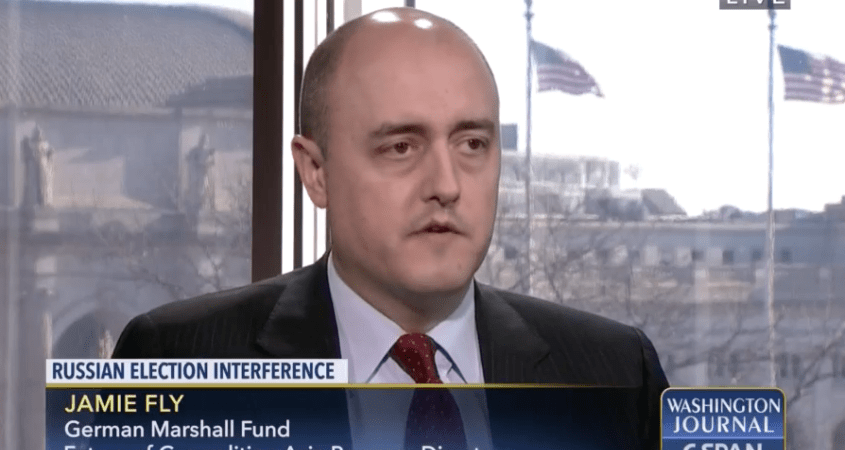
“Russia, China, and other foreign states take advantage of our open political system,” remarked Jamie Fly, a senior fellow and director of the Asia program at the German Marshall Fund. “They can invent stories that get repeated and spread through different sites. So we are just starting to push back. Just this last week Facebook began starting to take down sites. So this is just the beginning.”

Fly went on to complain that “all you need is an email” to set up a Facebook or Twitter account, lamenting the sites’ accessibility to members of the general public. He predicted a long struggle on a global scale to fix the situation, and pointed out that to do so would require constant vigilance.

Fly made these stunning comments to Jeb Sprague, who is a visiting faculty in sociology at the University of California-Santa Barbara and co-author of this article. The two spoke during a lunch break at a conference on Asian security organized by the Stiftung Wissenschaft und Politik in Berlin, Germany.

In the tweet below, Fly is the third person from the left who appears seated at the table.

The remarks by Fly — “we are just starting to push back” — seemed to confirm the worst fears of the alternative online media community. If he was to be believed, the latest purge was motivated by politics, not spam prevention, and was driven by powerful interests hostile to dissident views, particularly where American state violence is concerned.

Rise of a neocon cadre

Jamie Fly is an influential foreign policy hardliner who has spent the last year lobbying for the censorship of “fringe views” on social media. Over the years, he has advocated for a military assault on Iran, a regime change war on Syria, and hiking military spending to unprecedented levels. He is the embodiment of a neoconservative cadre.

Like so many second generation neocons, Fly entered government by burrowing into mid-level positions in George W. Bush’s National Security Council and Department of Defense.

In 2009, he was appointed director of the Foreign Policy Initiative (FPI), a rebranded version of Bill Kristol’s Project for a New American Century, or PNAC. The latter outfit was an umbrella group of neoconservative activists that first made the case for an invasion of Iraq as part of a wider project of regime change in countries that resisted Washington’s sphere of influence.

By 2011, Fly was advancing the next phase in PNAC’s blueprint by clamoring for military strikes on Iran. “More diplomacy is not an adequate response,” he argued. A year later, Fly urged the US to “expand its list of targets beyond the [Iranian] nuclear program to key command and control elements of the Republican Guard and the intelligence ministry, and facilities associated with other key government officials.”

Fly soon found his way into the senate office of Marco Rubio, a neoconservative pet project, assuming a role as his top foreign policy advisor. Amongst other interventionist initiatives, Rubio has taken the lead in promoting harsh economic sanctions targeting Venezuela, even advocating for a U.S. military assault on the country. When Rubio’s 2016 presidential campaign floundered amid a mass revolt of the Republican Party’s middle American base against the party establishment, Fly was forced to cast about for new opportunities.

He found them in the paranoid atmosphere of Russiagate that formed soon after Donald Trump’s shock election victory.

PropOrNot sparks the alternative media panic

A journalistic insider’s account of the Hillary Clinton presidential campaign, Shattered, revealed that “in the days after the election, Hillary declined to take responsibility for her own loss.” Her top advisers were summoned the following day, according to the book, “to engineer the case that the election wasn’t entirely on the up-and-up … Already, Russian hacking was the centerpiece of the argument.”

Less than three weeks after Clinton’s defeat, the Washington Post’s Craig Timberg published a dubiously sourced report headlined, “Russian propaganda effort helped spread ‘fake news.’” The article hyped up a McCarthyite effort by a shadowy, anonymously run organization called PropOrNot to blacklist some 200 American media outlets as Russian “online propaganda.”

The alternative media outfits on the PropOrNot blacklist included some of those recently purged by Facebook and Twitter, such as The Free Thought Project and Anti-Media. Among the criteria PropOrNot identified as signs of Russian propaganda were, “Support for policies like Brexit, and the breakup of the EU and Eurozone” and, “Opposition to Ukrainian resistance to Russia and Syrian resistance to Assad.” PropOrNot called for “formal investigations by the U.S. government” into the outlets it had blacklisted.

According to Craig Timberg, the Washington Post correspondent who uncritically promoted the media suppression initiative, Propornot was established by “a nonpartisan collection of researchers with foreign policy, military and technology backgrounds.” Timberg quoted a figure associated with the George Washington University Center for Cyber and Homeland Security, Andrew Weisburd, and cited a report he wrote with his colleague, Clint Watts, on Russian meddling.

Timberg’s piece on was PropOrNot was promoted widely by former top Clinton staffers and celebrated by ex-Obama White House aide Dan Pfeiffer as “the biggest story in the world.” But after a wave of stinging criticism, including in the pages of the New Yorker, the article was amended with an editor’s note stating, “The [Washington] Post… does not itself vouch for the validity of PropOrNot’s findings regarding any individual media outlet.”

PropOrNot had been seemingly exposed as a McCarthyite sham, but the concept behind it — exposing online American media outlets as vehicles for Kremlin “active measures” — continued to flourish.

The birth of the Russian bot tracker

By August, a new, and seemingly related initiative appeared out of the blue, this time with backing from a bipartisan coalition of Democratic foreign policy hands and neocon Never Trumpers in Washington. Called the Alliance for Securing Democracy (ASD), the outfit aimed to expose how supposed Russian Twitter bots were infecting American political discourse with divisive narratives. It featured a daily “Hamilton 68” online dashboard that highlighted the supposed bot activity with easily digestible charts. Conveniently, the site avoided naming any of the digital Kremlin influence accounts it claimed to be tracking.

The initiative was immediately endorsed by John Podesta, the founder of the Democratic Party think tank, Center for American Progress, and former chief of staff of Hillary Clinton’s 2016 presidential campaign. Julia Ioffe, the Atlantic’s chief Russiagate correspondent, promoted the bot tracker as “a very cool tool.”

Unlike PropOrNot, the ASD was sponsored by one of the most respected think tanks in Washington, the German Marshall Fund, which had been founded in 1972 to nurture the special relationship between the US and what was then West Germany.

Though the German Marshall Fund did not name the donors that sponsored the initiative, it hosted a who’s who of bipartisan national security hardliners on the ASD’s advisory council, providing the endeavor with the patina of credibility. They ranged from neocon movement icon Bill Kristol to former Clinton foreign policy advisor Jake Sullivan to ex-CIA director Michael Morrell.

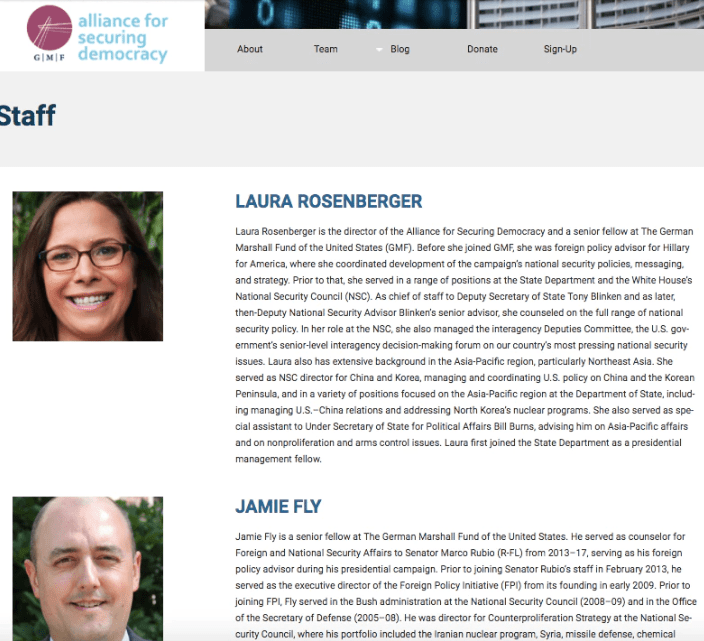
Jamie Fly, a German Marshall Fund fellow and Asia specialist, emerged as one of the most prolific promoters of the new Russian bot tracker in the media. Together with Laura Rosenberger, a former foreign policy aide to Hillary Clinton’s 2016 campaign, Fly appeared in a series of interviews and co-authored several op-eds emphasizing the need for a massive social media crackdown.

During a March 2018 interview on C-Span, Fly complained that “Russian accounts” were “trying to promote certain messages, amplify certain content, raise fringe views, pit Americans against each other, and we need to deal with this ongoing problem and find ways through the government, through tech companies, through broader society to tackle this issue.”

Yet few of the sites on PropOrNot’s blacklist, and none of the alternative sites that were erased in the recent Facebook purge that Fly and his colleagues take apparent credit for, were Russian accounts. Perhaps the only infraction they could have been accused of was publishing views that Fly and his cohorts saw as “fringe.”

What’s more, the ASD has been forced to admit that the mass of Twitter accounts it initially identified as “Russian bots” were not necessarily bots — and may not have been Russian either.

“I’m not convinced on this bot thing”

A November 2017 investigation by Max Blumenthal, a co-author of this article, found that the ASD’s Hamilton 68 dashboard was the creation of “a collection of cranks, counterterror retreads, online harassers and paranoiacs operating with support from some of the most prominent figures operating within the American national security apparatus.”

These figures included the same George Washington University Center for Cyber and Homeland Security fellows — Andrew Weisburd and Clint Watts — that were cited as experts in the Washington Post’s article promoting PropOrNot.

Weisburd, who has been described as one of the brains behind the Hamilton 68 dashboard, once maintained a one-man, anti-Palestinian web monitoring initiative that specialized in doxxing left-wing activists, Muslims and anyone he considered “anti-American.” More recently, he has taken to Twitter to spout off murderous and homophobic fantasies about Glenn Greenwald, the editor of the Intercept — a publication the ASD flagged without explanation as a vehicle for Russian influence operations.

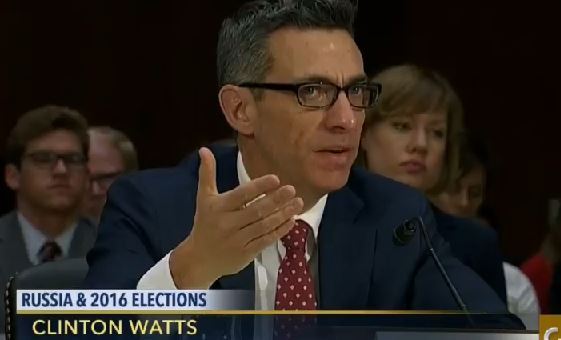
Watts, for his part, has testified before Congress on several occasions to call on the government to “quell information rebellions” with censorious measures including “nutritional labels” for online media. He has received fawning publicity from corporate media and been rewarded with a contributor role for NBC on the basis of his supposed expertise in ferreting out Russian disinformation.

Clint Watts has urged Congress to “quell information rebellions”

However, under questioning during a public event by Grayzone contributor Ilias Stathatos, Watts admitted that substantial parts of his testimony were false, and refused to provide evidence to support some of his most colorful claims about malicious Russian bot activity.

In a separate interview with Buzzfeed, Watts appeared to completely disown the Hamilton 68 bot tracker as a legitimate tool. “I’m not convinced on this bot thing,” Watts confessed. He even called the narrative that he helped manufacture “overdone,” and admitted that the accounts Hamilton 68 tracked were not necessarily directed by Russian intelligence actors.

“We don’t even think they’re all commanded in Russia — at all. We think some of them are legitimately passionate people that are just really into promoting Russia,” Watts conceded.

But these stunning admissions did little to slow the momentum of the coming purge.

Enter the Atlantic Council

In his conversation with Sprague, the German Marshall Fund’s Fly stated that he was working with the Atlantic Council in the campaign to purge alternative media from social media platforms like Facebook.

The Atlantic Council is another Washington-based think tank that serves as a gathering point for neoconservatives and liberal interventionists pushing military aggression around the globe. It is funded by NATO and repressive, US-allied governments including Saudi Arabia, Bahrain and Turkey, as well as by Ukrainian oligarchs like Victor Pynchuk.

This May, Facebook announced a partnership with the Atlantic Council’s Digital Forensic Research Lab (DFRLab) to “identify, expose, and explain disinformation during elections around the world.”

The Atlantic Council’s DFRLab is notorious for its zealous conflation of legitimate online dissent with illicit Russian activity, embracing the same tactics as PropOrNot and the ASD.

Ben Nimmo, a DFRLab fellow who has built his reputation on flushing out online Kremlin influence networks, embarked on an embarrassing witch hunt this year that saw him misidentify several living, breathing individuals as Russian bots or Kremlin “influence accounts.” Nimmo’s victims included Mariam Susli, a well-known Syrian-Australian social media personality, the famed Ukrainian concert pianist Valentina Lisitsa, and a British pensioner named Ian Shilling.

In an interview with Sky News, Shilling delivered a memorable tirade against his accusers. “I have no Kremlin contacts whatsoever; I do not know any Russians, I have no contact with the Russian government or anything to do with them,” he exclaimed. “I am an ordinary British citizen who happens to do research on the current neocon wars which are going on in Syria at this very moment.”

With the latest Facebook and Twitter purges, ordinary citizens like Shilling are being targeted in the open, and without apology. The mass deletions of alternative media accounts illustrate how national security hardliners from the German Marshall Fund and Atlantic Council (and whoever was behind PropOrNot) have instrumentalized the manufactured panic around Russian interference to generate public support for a wider campaign of media censorship.

In his conversation in Berlin with Sprague, Fly noted with apparent approval that, “Trump is now pointing to Chinese interference in the 2018 election.” As the mantra of foreign interference expands to a new adversarial power, the clampdown on voices of dissent in online media is almost certain to intensify.

As Fly promised, “This is just the beginning.”

Brazile Fallout: Hillary Privatized the DNC with Help from a Washington Law Firm

By Pam Martens and Russ Martens

Source: Wall Street On Parade

Secret side agreements are a common maneuver by corporate law firms. Here’s how they work. An agreement that is legal and passes the smell test is drafted and submitted to a court or a regulatory body for public consumption. Then, a separate, secret side agreement is written and signed by both sides and it contains all of the smelly, shady, ethically questionable hard details on how the original agreement will be carried out.

Donna Brazile, the former interim Chair of the Democratic National Committee (DNC) during the 2016 presidential campaign, has written a new book, “Hacks: The Inside Story of the Break-ins and Breakdowns that Put Donald Trump in the White House,” and has revealed the secret side agreement that the DNC had with Hillary Clinton’s campaign.

In 2015, Hillary Clinton’s campaign set up a joint fundraising committee called the Hillary Victory Fund (HVF) with the DNC and over 30 state democratic committees. The public portion of the agreement indicated that Hillary would raise funds for her own campaign while also allocating a portion to the DNC to help the overall Democratic Party as well as allocating funds to state democratic committees in order to support down-ballot candidates in their local elections. But the secret side agreement that effectively privatized the DNC, giving Hillary and her campaign lawyers control of the DNC and its money, had yet to see the light of day.

This is how Brazile describes the secret side agreement in her book:

“The agreement—signed by Amy Dacey, the former CEO of the DNC, and Robby Mook [Clinton’s campaign manager] with a copy to Marc Elias [lawyer at Perkins Coie]  — specified that in exchange for raising money and investing in the DNC, Hillary would control the party’s finances, strategy, and all the money raised. Her campaign had the right of refusal of who would be the party communications director, and it would make final decisions on all the other staff. The DNC also was required to consult with the campaign about all other staffing, budgeting, data, analytics, and mailings.”

The Clinton camp has now attempted to defend itself by saying these terms are standard because they were not going to kick in until the Democratic Party had chosen its official presidential nominee at its party convention in July 2016. But that’s not what the actual secret side agreement says. It indicates the following: “Beginning October 1, 2015,” the HVF would begin transferring $1.2 million to the DNC at the start of each month with that release “conditioned on” Hillary Clinton’s primary campaign personnel being consulted “and have joint authority over strategic decisions over the staffing, budget, expenditures, and general election related communications, data, technology, analytics, and research. The DNC will provide HFA advance opportunity to review on-line or mass email, communications that features a particular Democratic primary candidate.”

Additionally, the secret agreement states that “the DNC agrees that no later than September 11, 2015 it will hire one of two candidates previously identified as acceptable to HFA” (Hillary for America, the primary campaign fund for Clinton) as its Communications Director. All of this is occurring in the fall of 2015 with the official Democratic nominating convention not taking place until July 2016.

As Politico reported in May 2016, the Hillary Victory Fund was a sham in multiple other ways. First, Politico writes that less than 1 percent of the money raised stayed in the state’s coffers. The Treasurer of the Hillary Victory Fund actually had the power to move money in and out of state committee bank accounts. Politico reporters Ken Vogel and Isaac Arnsdorf cite the following example to show how things actually worked:

“…the Minnesota Democratic-Farmer-Labor Party received $43,500 from the victory fund on Nov. 2, only to transfer the same amount to the DNC that same day. The pattern repeated itself after the Minnesota party received transfers from the victory fund of $20,600 on Dec. 1 (the party sent the same amount to the DNC the next day) and $150,000 on Jan. 4 (it transferred the same amount to the DNC that day).

“That means that Minnesota’s net gain from its participation in the victory fund was precisely $0 through the end of March. Meanwhile, the DNC pocketed an extra $214,100 in cash routed through Minnesota — much of which the DNC wouldn’t have been able to accept directly, since it came from donors who had mostly had already maxed out to the national party committee.

“A similar pattern transpired with most of the participating state parties. As of March 31, only eight state parties (most of which were in battleground states such as Colorado, Florida, Nevada, New Hampshire and Virginia) had received more from the victory fund than was transferred from their accounts to the DNC.”

Brazile backs up this account in her book, writing that “the states kept less than half of 1 percent of the $82 million they had amassed from the extravagant fund-raisers Hillary’s campaign was holding….”

Brazile notes in her book that the lawyer, Marc Elias, of the politically-connected law firm, Perkins Coie, was copied on the secret side agreement. Elias has repeatedly come under scrutiny for his multi-faceted roles in the 2015-2016 presidential campaign. Most recently, he was exposed as the guy behind the hiring of Fusion GPS which compiled the scandalous Russian dossier on Donald Trump, using both Hillary campaign funds and DNC funds. The Washington Post reported that Elias was allowed to spend these funds “without oversight by campaign officials, according to a spokesperson for his law firm.”

Elias served as the General Counsel to Hillary’s primary campaign committee, Hillary for America, as well as serving as one of a team of lawyers from Perkins Coie that provided legal advice to the DNC. (Elias also provided legal advice to the Democratic Senatorial Campaign Committee, Democratic Congressional Campaign Committee, and Democratic Governors Associations, according to the Perkins Coie web site last year.)

As a legal adviser to the DNC, Elias should have known that its charter mandated fairness and impartiality to all primary candidates. But when WikiLeaks released emails last year that had been hacked at the DNC, Marc Elias was caught giving advice on how to tar Senator Bernie Sanders after his campaign suggested that the Hillary Victory Fund was skirting Federal election law. The email from Elias read:

“My suggestion is that the DNC put out a statement saying that the accusations the Sanders campaign are not true. The fact that CNN notes that you aren’t getting between the two campaigns is the problem. Here, Sanders is attacking the DNC and its current practice, its past practice with the POTUS and with Sec Kerry. Just as the RNC pushes back directly on Trump over ‘rigged system’, the DNC should push back DIRECTLY at Sanders and say that what he is saying is false and harmful the [sic] the Democratic party.”

Writing for Politico in 2014, Ken Vogel detailed how Elias and Perkins Coie have not only been the legal go-to guys for the Democratic party over the years but how they have also tinkered with Federal election law to shift more power to the 1 percent. Vogel writes:

“Perkins Coie’s political law practice, anchored by Elias and former White House Counsel Bob Bauer, has something of a stranglehold on the Democratic Party’s election law business, representing not only the party committees themselves but everyone from [Harry] Reid (whose various committees have paid $317,000 in legal fees to Perkins Coie over the years) to Obama ($7.4 million) to the major Democratic super PACs ($19 million).”

The thrust of the article, however, is that Elias played a central role in further opening the spigots for legal revenues his firm might be expected to collect in the future by tinkering with Federal legislation at the eleventh hour. Vogel writes:

“A powerful Democratic lawyer helped craft a provision that was slipped into a year-end spending bill allowing political parties to raise huge new pools of cash — including some for legal fees that are likely going to be collected by his own firm…

“The change has the potential to halt or at least slow the erosion of power of the political parties, since it would increase the maximum amount of cash that rich donors may give to the national Democratic and Republican party committees each year from $97,400 to $777,600 or more.”

The question that no one seems to be asking is who are the main beneficiaries of Perkins Coie’s heavy influence at the top of the Democratic Party. Despite Obama’s re-election for a second term, the Democratic Party shed nearly 1,000 seats from coast to coast. The Republicans now control both houses of Congress and the Executive Branch. A man with the lowest approval rating in modern history now occupies the Oval Office.

The primary beneficiaries of this hubris have been the 1 percent – Wall Street and hedge fund titans – and giant multi-national corporations that dominate the client roster at Perkins Coie.

Those within the Clinton camp and DNC who are suggesting to the American people that there is nothing to see here, time to move along, are dead wrong. Just because the Republican presidential campaign may have been corrupted by outside forces doesn’t mean that the Democratic campaign wasn’t also corrupted by its own outside forces. It’s time to follow the obscene political money trail wherever it leads.

Related Articles:

Are Hillary Clinton and the DNC Skirting Election Law?

DNC’s Direct Marketing Firm Shows Bias on Facebook Against Bernie Sanders

WikiLeaks Bombshell: Emails Show Citigroup Had Major Role in Shaping and Staffing Obama’s First Term

Democratic Party crisis explodes in wake of Brazile revelations

By Patrick Martin

Source: WSWS.org

The political crisis in the Democratic Party, brought to the surface with the publication Thursday of excerpts of a campaign memoir by the former interim chairman of the Democratic National Committee (DNC), Donna Brazile, erupted into mutual denunciations over the weekend.

Brazile made public an unprecedented agreement between the DNC (under previous chair Debbie Wasserman Schultz) and the Hillary Clinton presidential campaign that involved Clinton paying off the DNC’s debts and providing it a monthly subsidy in return for gaining control over the appointment of DNC officials and the right of approval over key operational decisions.

The deal was concluded in August 2015, six months before the first votes were to be cast in caucuses or primaries, when the DNC was required by its own rules to remain neutral in the contest between Clinton, Vermont Senator Bernie Sanders and several other candidates for the Democratic presidential nomination.

A further revelation from Brazile’s book was made public Saturday: she acknowledged discussions among leading Democrats in September 2016, after Hillary Clinton had collapsed at a ceremony in New York City marking the 15th anniversary of the 9/11 attacks, over whether Clinton should be replaced as the presidential candidate because of health concerns. Brazile writes that she herself considered Vice President Joe Biden as the logical replacement, but did not make the proposal.

Within hours of this report, 100 former Clinton campaign aides, headed by campaign chairman John Podesta and campaign manager Robby Mook, put their signatures on an open letter denouncing Brazile’s criticism of the Clinton campaign.

The “Open Letter From Hillary For America 2016 Team” makes use of the same Russia-baiting technique employed by the Democrats in their political conflict with the Trump White House, but this time directed against a former top Democrat. In assailing Brazile, the first paragraph of the open letter declares: “It is particularly troubling and puzzling that she would seemingly buy into false Russian-fueled propaganda, spread by both the Russians and our opponent, about our candidate’s health.”

The health questions about Clinton were fueled, however, not by Moscow, but by video broadcast over American cable television networks showing the candidate being lifted into a vehicle by aides and Secret Service agents, in visible distress. The characteristic duplicity of top campaign officials, who initially sought to conceal the incident, added to the ensuing furor.

Even more revealing is what is missing from the Clinton camp’s “Open Letter”: there is no reference whatsoever to the main revelation stemming from Brazile’s book—the secret joint fundraising agreement between the Clinton campaign and the DNC, six months before the first caucus in Iowa, giving Clinton effective control of the party apparatus. The Clinton aides do not dispute that this backroom deal occurred and make no attempt to justify it.

On Sunday morning, Brazile appeared on the ABC News program “This Week with George Stephanopoulos.” The host, himself a former top political aide in the White House of Bill Clinton, provided a platform for Brazile to repeat her exposure of the collusion between the Clinton campaign and the DNC and discuss the “Open Letter” from the former Clinton campaign officials.

She bitterly denounced the Clinton camp, both for its treatment of the DNC while she was in charge, and for their ferocious response to her new book. “George, for those who are telling me to shut up, they told Hillary that a couple of months ago,” Brazile declared. “You know what I tell them? Go to hell! I’m going to tell my story.”

Brazile also touched on a topic of intense but largely behind-the-scenes discussion in official Washington: the July 2016 murder of Seth Rich, a low-level IT staffer at the DNC, who was shot to death in what police called a failed robbery attempt. The Trump White House and ultra-right media allies, including Alex Jones of InfoWars and Sean Hannity of Fox News, have portrayed Rich, rather than Russian hackers, as the likely source for the DNC emails obtained by WikiLeaks, and his killing as a retaliatory “hit” ordered by the Clinton campaign.

Brazile reportedly suggests in her book—which will not be available to the public until Tuesday—that Rich’s death, warnings from the Obama administration about Russian hacking and repeated online threats from Trump supporters had made her extremely concerned about security issues, to the point where she had her home swept for bugs and installed multiple security devices. In her interview Sunday with Stephanopoulos, she spoke of her fears for her own personal safety. Her mention of Seth Rich, entirely unsolicited, seemed a veiled warning to the Clinton camp that more revelations about 2016 campaign skullduggery could be forthcoming.

Current DNC Chair Tom Perez was interviewed Sunday on “Meet the Press” on NBC and directly rejected the two main issues raised by Brazile. He maintained, “The charge that Hillary Clinton was somewhere incapacitated is quite frankly ludicrous,” although he did not attribute that concern to Russian propaganda.

He went on to argue that Clinton won the Democratic primary contest by four million votes, and the DNC was not in control of those elections, which are run by the state governments, while noting that the caucuses, which are controlled by the party apparatus, were mostly won by Sanders, not Clinton. Perez would concede only that “the DNC fell short during critical moments of the primary,” in terms of openly favoring Clinton over Sanders.

Significantly, neither Sanders nor any of his top aides or supporters made an appearance on any of the Sunday television talk shows. Sanders issued a statement on Brazile’s revelations suggesting that the conduct of the 2016 campaign was a diversion from the effort to mobilize opposition to the Trump administration.

The fact is that Brazile informed Sanders of the joint fundraising agreement and the takeover of the DNC by Clinton more than a year ago, and he has chosen to say nothing about it. This is part of his effort to prop up the Democratic Party and prevent the millions of working people and youth who supported his campaign from drawing the political conclusion that it is necessary to break with the Democrats in order to conduct any genuine struggle against the billionaires who dominate the US political system.

The conflict within the Democratic Party has erupted under conditions where the Republican Party is bordering on civil war, with several Republican senators denouncing Trump as a threat to American democracy—and then announcing they would retire from office rather than oppose him—and a vicious conflict developing between the party establishment and the fascist-minded elements around Trump, spearheaded by his former chief political aide and campaign manager, Stephen Bannon, now returned to his position as chief executive of the ultra-right Breitbart News.

In recent days, it has been reported that in an upcoming book titled The Last Republicans, the author cites interviews with George H. W. Bush and his son George W. Bush in which the two last Republican presidents before Trump denounce the current occupant of the White House and reveal that they refused to vote for him in 2016. In response, Trump tweeted an attack on his Republican presidential critics.

The ABC “This Week” program on which Brazile was interviewed began with the presentation of a new Washington Post/ABC News poll showing public support for Trump falling to its low point for the year, only 37 percent, with 59 percent opposing. Trump’s showing was the worst for any first-year president since modern polling began. Other polls have shown public support for the Republican-controlled Congress hitting new lows as well.

The vast majority of working people are increasingly alienated from the two-party political system in the United States, correctly regarding both the Democrats and the Republicans as tools of the super-rich and looking for an alternative. The central political question is the building of a political movement of the working class that will fight the capitalist system as a whole and advance a program to defend jobs, living standards and democratic rights, and oppose imperialist war.