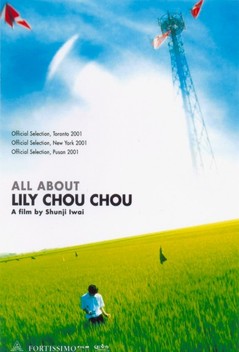
Saturday Matinee: All About Lily Chou Chou

THE GRAY TRAGEDY OF YOUTH IN JAPAN: SHUNJI IWAI’S “ALL ABOUT LILY CHOU-CHOU”

By Luke Powell

Source: Sabukaru

Released in 2001, writer and director Shunji Iwai’s “All About Lily Chou-Chou” 「リリイ• シュシュのすべて」is a masterclass in complex and powerful storytelling, cinematography, and meta-textual messaging that puts on display the formative, introspective, and oftentimes malicious enigma that is the life of youth in Japan.

Set in the town of Ashikaga, the story centers around the relationship of two young boys, Shusuke Hoshino and Yuichi Hasumi, as they progress through junior high school. Hoshino is known to be one of the top students in their school and is harassed and ostracized by his classmates as a result, a commonplace occurrence for those caught outside the boundaries of conformity while growing up in Japan. Yuichi, in contrast, is shy and submissive to the societal structures that surround him, only paying attention and devoting all his personal time to the singer and songwriter Lily Chou-Chou.

In his free time, Yuichi manages an online BBS chatroom titled “Lilyholic,” which is completely dedicated to Lily and her music, and the messages sent between users of this website overlay much of the film. The mystery surrounding this chatroom and the messages between its users acts as a crucial plot point that slowly unravels in conjunction with the film’s events.

At one point, Yuichi, Hoshino, and their friends manage to secure a trip to Okinawa, during which Hoshino has a near-death experience that serves as the foundation for the cruel and unusual monster that he becomes, changing his and Yuichi’s relationship forever as he usurps his way into being the school’s bully the following school year.  Despite the title, this is not simply a story about a fictional songwriter and her music, but the disturbing and oftentimes glossed-over ways in which modern society corrupts the minds of youth, and the various ways those children attempt to cope against such odds. 

Yuichi’s love and devotion for Lily Chou-Chou is the emotional epicenter of this film, as it displays the profound ability for music to save and give meaning to young people’s lives, especially when surrounded by ignorant adults and inhumane peers. While the musician herself is fictional, Lily Chou-Chou’s mythical music expands over the course of the film, overlaying its imagery of lonesomeness, isolation, and absurdity with luscious, calming, and poignant bits of melancholic bliss; a reflection of Yuichi’s character and perspective on the world around him.

Users of the chatroom “Lilyholic” continuously exclaim their love for Lily and her ability to channel the “Ether,” an invisible yet omni-present force that connects all fans of Lily Chou-Chou together in their existence through Lily’s music. The “Ether” is an intrinsic aspect of the power her music has on those who listen to her, serving as the connective thread that weaves its way through the fabric of a fragile reality, allowing those lost in the tribulations of life to hold onto something organic, warm, and personal, an oasis among a desert of expectations, conformity, and isolation. 

It goes without saying that the music on display in this film is truly special and should be experienced firsthand, with the soundtrack growing organically as the audience learns more about Lily, her music, and the different characters in the film who become impacted by her compositions [for better or for worse].

Throughout the film, there are multiple references to the classical French composer Claude Debussy, whom users of Lilyholic cite as being one of Lily’s musical inspirations, as he was able to produce the “Ether” through his compositions. For example, the song that accompanies the opening scene of the film, titled 「アラベスク」[“Arabesuku”] is based off of Debussy’s “Arabesque No. 1.” Lily’s shrill yet comforting voice glides over synthesized piano chords, distanced hints of strained guitar, and a lo-fi drum beat that subjects the 19th-century classical work to a cybernetic restructuring – all of which results in one of the most captivating opening experiences in film.

Arranged and produced by Takeshi Kobayashi, the music of “All About Lily Chou-Chou” is a kaleidoscope of sonic captivity, melting between Lily’s somber yet grungy aesthetic as well as moments of clarity through the use of classical composers like Debussy, combining to create less of a soundtrack and more of an experience that will cling to you long after the credits have finished rolling.

The narrative direction and cinematography of “All About Lily Chou-Chou” are also aspects that cannot be ignored. The narrative’s timeline is fractured, starting chronologically from the middle of the story, eventually flashing back to the canonical beginning, and finally returning to the present to finish out the film. The script is adapted from an online novel that was written by director Shunji Iwai himself in the chatroom of a real-life version of the “Lilyholic” website, in which the director plays out the story of “All About Lily Chou-Chou” through the chat exchanges of two site users. A version of this website can still be accessed online today, and its existence is only the tip of the iceberg for the extensive material surrounding this film beyond its screen time. The narrative, in this sense, is multi-layered and meta-textual – an interactive and organic experience that not only goes beyond the medium of film but places a sense of participation and influence in the viewer, only to be powerless against the fierce, apathetic, and surreal scenes we witness.

The cinematography by Noboru Shinoda [“Hana and Alice,” “Love Letter”] is just as varied and complex as the film’s narrative, as it switches between ethereal, lush views of rice fields and angelic classroom settings in one shot, to the jarring use of hand-held cameras and disorienting angles in the next. Shinoda and Iwai were the first Japanese filmmakers to use the now discontinued Sony HDW-F900 digital video camera which was designed to reflect the look of 35mm film, further emphasizing the thematic imagery of nostalgia and dream-like isolation.

The camera work almost seems to be shot by a child at times, such as an unseen member of Yuichi’s friend group or class as they youthfully document the strange and disturbing events occurring in front of them, only focusing on the power a digital camera has without considering what they are actually recording. Or rather, Iwai may be intending for us, the viewer, to put ourselves behind the lens, acting as a silent observer to the events that unfold without the voice or power to do anything about it, which is strikingly similar to Yuichi’s character in the film itself. The combination of a fractal narrative structure and an abrasive yet realistic use of the camera encapsulates so much of the themes and messaging this film has to offer – mainly that being the confusing, frustrating, and unapologetic nature of growing up surrounded by unforgiving societal structures, while at the same time blindly attempting to hold onto and bask in the naiveté of youth. 

The subject of youth is the eye of Iwai’s proverbial hurricane of emotion and turmoil that is “All About Lily Chou-Chou.” Made in 2001, this film was produced at a time in Japan that saw a sharp increase in teenage crime and suicide following the economic collapse of 1991. In a country so wrought with societal and familial expectations, the bursting of their economic bubble proved disastrous for Japan’s teenage and young-adult population, as they were now tasked with bearing said expectations and cultural conformity against a historically low employment rate.

Commonly referred to as the “Lost Decade,” the 1990s in Japan was filled with headlines detailing the effect of the recession on the country’s young population, as teenage crime doubled in frequency, and reports of bullying and assault within schools skyrocketed. The rise in crime and disillusionment among the country’s youth resulted in many Japanese filmmakers attempting to grasp this idea of “teenage rage” through their films in the late 90s and early 2000s, such as in Takashi Miike’s “Fudoh: The New Generation” [1996] and Kinji Fukasaku’s “Battle Royale” [2000]. While these films painted a more dystopian and fantastical perspective of the violent phenomenon, Shunji Iwai wanted to represent this general angst and discontent in a more realistic manner that would directly connect with the audience it sought to portray. In one interview from 1995, Iwai reflects on his perspective towards the children who will be watching his stories: “We have to make movies that appeal to them and reflect the world they live in.” 

The characters within “All About Lily Chou-Chou” represent the cruel realities of the “Lost Decade.” They don’t conduct acts of headline-defining mass crime or comical absurdity, but instead are portrayed as unheard, misguided, and tragic children who are following in the steps of complicit adults as they attempt to find answers in a confusing world that they have no power in controlling. As shown in the film, some of these characters choose to find those answers in disturbing cruelty or abusive domination over their peers, while others try to be as passive or silent as humanly possible just to survive. And yet, while each character within this film leads a complex and difficult life that sometimes results in catastrophe, all of them are connected through the “Ether,” endlessly searching for a sense of comfort, acceptance, and understanding through the soundscape of Lily Chou-Chou. It could be said that the characters within this film are all living in, as Yuichi states in one monologue, “the age of Gray,” a liminal space of reality that seems to place their lives in a state of constant immobility and pain. Life is made void of color by the brutal violence and betrayal that these children either commit or fall victim to, and for some, Lily provides safety and guidance in that darkness, while she may also fuel the angry, merciless fire burning inside others. 

“All About Lily Chou-Chou” is dark, disturbing, and cruel in its presentation, but manages to be something so much more intimate, profound, and human in its substance. It discusses themes surrounding the troubles of youth in Japan, who are constantly cornered by cultural and familial expectations, conformity, and a social hierarchy that can be detrimental to those caught in its jaws. It portrays the fragility of youth, how easily corruptible a young mind can be, and how one source of bliss can be enough to hold onto the hope of a better tomorrow. Today, in a world dominated by online interactions, superficial connections, and an uncertain future, this film is more relevant than ever before – a true cyber hymn that anyone and everyone can find meaning within. 

We have attached the album that was released under the name “Lily Chou-Chou” after the movie was released so that you can get a better feel for the movie and the artist that is the titular character of the entire film. It features all of Lily’s music that is present in the film, and is titled “Kokyu” [or “Breathe” in English], which is in reference to the project that she released during the movie itself.

The entire thing can also be streamed on Spotify. In particular, the following songs are absolutely stunning and very representative of the movie itself:

  • Arabesque [アラベスク “Arabesuku”]
  • Flightless Wings [飛べない翼 “Tobenai Tsubasa”]
  • Glide [グライド “Guraido”] 

Watch All About Lily Chou Chou on Kanopy here: https://www.kanopy.com/en/product/5636535

Saturday Matinee: Cops vs. Thugs

Cops Vs. Thugs — No Honour Among Thieves (or Cops)

By Ben Warnock

Source: Ben Warnock Blog

“Yakuza and cops are just the same. We respect the law instead of a code. We’re the dropouts who couldn’t get good jobs.”

“We too are the dropouts of society. We all are!”

Kinji Fukasaku’s yakuza films are perhaps best described as being surrounded by an almost impenetrable, bleak aura of despair and nihilism. The cops who are supposed to be the protectors of the people are corrupt to the core, Fukasaku basically presents them as a mercenary force — one that can be bought if the bid is high enough. Government officials often use the police to do their bidding and much like their underlings are as corrupt as they come. This damning indictment of these systems does not mean that the director sides with the yakuza — often portraying them as morally reprehensible criminals — whilst their code may be one of honour, post-war Japan has created a society that allows for greedy capitalists to gain power simply at the expense of sullying their morals and code. Those who stick to a code of honour become the dead that litters the senseless gang wars that follow. Corruption is a recurring theme throughout Fukasaku’s yakuza films and Cops Vs. Thugs is perhaps his most interesting example of this outside of his famous Battles Without Honour and Humanity series.

Much like the aforementioned series of films, Fukasaku looks to highlight the corrupting nature of power and that those who seek power are often those who are corrupted the easiest. The police of the film are split between those who are corrupt but perhaps honourable in their own, twisted way — as characterised by Bunta Sugawara’s Kuno whose corruption is described as a way of keeping the peace — and the new faction led by Kaida who is vehemently against collaboration with the yakuza. However, Kaida’s allegiances should not be mistaken as honourability as Fukasaku is certain to illustrate. Kaida’s behaviour humiliates his co-workers in public spectacles — including repeatedly using his judo skills on an elderly police officer — where his power is cemented amongst the other police officers. This damning indictment of the police is nothing new to the films of Fukasaku but here, the director highlights that those who seek the position of a police officer are those who are power-hungry and susceptible to corruption from many outside forces. As Sugawara’s Kuno states when asked why he became a cop:

“I wanted to carry a gun. After the war only cops and narcotic agents could carry guns….we were short of food…every time we tried to buy rice on the black market, the cops snatched it away. So I decided to be a snatcher”.

Unlike the famous notion that power corrupts, Fukasaku’s films prove that it is not power that corrupts but it is in the nature of those who seek positions of power in a patriarchal, capitalist system to become corrupt. It is the damaged system’s cyclical nature that corrupts individuals.

The fates of those characters who have a shred of honour — Kuno and Kawamoto — ultimately end in tragedy. Kuno’s honour and trust in his friend Hirotani ultimately leads to his escape attempt and forces Kuno’s hand in killing Hirotani. Violence begets violence and Kuno — after being demoted and transferred as a reward for saving Kaida’s life — is killed by the remaining members of Hirotani’s gang. The yakuza honour forces them to avenge the death of their leader. Kawamoto, on the other hand, attempts to save his friend’s life by getting them to surrender and is gunned down by the very friend he tried to save. The honour and trust showcased have no place within the world of the police and the yakuza. Corrupt institutions whose original purposes have become eroded and replaced by pawns of the capitalist society they inherit. This ever-changing, impermeable alliance between characters is highlighted by Fukasaku’s camera. Battles devolve into a sweeping landscape of betrayal with snitches followed by the judging eye of the camera and gunfights where the action can barely be contained within the confines of the screen. Fukasaku’s frantic kineticism within these scenes is indicative of the disorientating landscape of unknown allegiances which these characters inhabit and thrive.

The world which is represented in Cops Vs. Thugs is one that is inherently damaged from its systems of government to its criminals whose honour and code have become meaningless in the current political landscape. The real threat presented to the governing officials is not the yakuza who seek to exploit the corrupted system but a change in ideology that would bring the system crashing down. Fukasaku even highlights this own threat with the police officer whose entire character consists of his hatred of communists even ahead of the very criminals that are terrorising the streets he is meant to protect. Fukasaku’s (literal) red herring of communism here is one that rewards those who buy into the paranoia. The anti-communist officer is inexplicably a member of Kaida’s team and Fukasaku ensures that he is the first officer seen to be arresting the yakuza once they surrender. This perhaps explains that Kaida’s corruption does not lie with the yakuza but the capitalist government which seeks to strengthen its own resolve within society. The film’s epilogue showing the demotion and untimely fate of Kuno also highlights that Kaida is now a leading figure in Nikko Oil — a company that was mentioned to be corrupt as well. Hiding behind a facade of friendly exercising with his co-workers — Fukasaku pulls out from a close-up to a wide shot allowing the audience to realise that this corrupt institution is just one of many within the industrial landscape. Corruption does not just lie with the police working with the yakuza but also — and more dangerously so — lies with the police collaborating with the government.

Watch Cops vs. Thugs on Kanopy here: https://www.kanopy.com/product/cops-vs-thugs-0

Cyberpunk is Dead

By John Semley

Source: The Baffler

“It was an embarrasser; what did I want? I hadn’t thought that far ahead. Me, caught without a program!”
—Bruce Bethke, “Cyberpunk” (1983)

Held annually in a downtown L.A. convention center so massive and glassy that it served as a futurist backdrop for the 1993 sci-fi action film Demolition Man and as an intergalactic “Federal Transport Hub” in Paul Verhoeven’s 1997 space-fascism satire Starship Troopers, the Electronic Entertainment Expo, a.k.a. “E3,” is the trade show of the future. Sort of.

With “electronic entertainment” now surpassing both music and movies (and, indeed the total earnings of music and movies combined), the future of entertainment, or at least entertainment revenue, is the future of video games. Yet it’s a future that’s backward-looking, its gaze locked in the rearview as the medium propels forward.

Highlights of E3’s 2019 installment included more details around a long-gestating remake of the popular PlayStation 1-era role-playing game Final Fantasy VII, a fifth entry in the demon-shooting franchise Doom, a mobile remake of jokey kids side-scroller Commander Keen, and playable adaptations of monster-budget movie franchises like Star Wars and The Avengers. But no title at E3 2019 garnered as much attention as Cyberpunk 2077, the unveiling of which was met with a level of slavish mania one might reserve for a stadium rock concert, or the ceremonial reveal of an efficacious new antibiotic.

An extended trailer premiere worked to whet appetites. Skyscrapers stretched upward, slashed horizontally with long windows of light and decked out with corporate branding for companies called “DATA INC.” and “softsys.” There were rotating wreaths of bright neon billboards advertising near-futuristic gizmos and gee-gaws, and, at the street level, sketchy no-tell motels and cars of the flying, non-flying, and self-piloting variety. In a grimy, high-security bunker, a man with a buzzcut, his face embedded with microchips, traded blows with another, slightly larger man with a buzzcut, whose fists were robotically augmented like the cyborg Special Forces brawler Jax from Mortal Kombat. The trailer smashed to its title, and to wild applause from congregated gamers and industry types.

Then, to a chug-a-lug riff provided by Swedish straight-edge punkers Refused (recording under the nom de guerre SAMURAI) that sounded like the sonic equivalent of a can of Monster energy drink, an enormous freight-style door lifted, revealing, through a haze of pumped-out fog, a vaguely familiar silhouette: a tall, lean-muscular stalk, scraggly hair cut just above the shoulders. Over the PA system, in smoothly undulating, bass-heavy movie trailer tones, a canned voice announced: “Please welcome . . . Keanu Reeves.” Applause. Pitchy screams. Hysterics in the front row prostrating themselves in Wayne’s World “we’re not worthy!” fashion. “I gotta talk to ya about something!” Reeves roared through the din. Dutifully reading from a teleprompter, he plugged Cyberpunk 2077’s customizable characters and its “vast open world with a branching storyline,” set in “a metropolis of the future where body modification has become an obsession.”

More than just stumping for Cyberpunk 2077, Reeves lent his voice and likeness to the game as a non-playable character (NPC) named “Johnny Silverhand,” who is described in the accompanying press materials as a “legendary rockerboy.” A relative newbie to the world of blockbuster Xbox One games, Reeves told the audience at E3 that Cyberpunk piqued his interest because he’s “always drawn to fascinating stories.” The comment is a bit rich—OK, yes, this is a trade show pitch, but still—considering that such near-futuristic, bodily augmented, neon-bathed dystopias are hardly new ground for Reeves. His appearance in Cyberpunk 2077 serves more to lend the game some genre cred, given Reeves’s starring roles in canonical sci-fi films such as Johnny Mnemonic (1995) and the considerably more fantastic Matrix trilogy (1999-2003)—now quadrilogy; with an anticipated fourth installment announced just recently. Like many of E3 2019’s other top-shelf titles, Cyberpunk 2077 looked forward by reflecting back, conjuring its tech-noir scenario from the nostalgic ephemera of cyberpunk futures past.

This was hardly lost among all the uproar and excitement. Author William Gibson, a doyenne of sci-fi’s so-called “cyberpunk” subgenre, offered his own withering appraisal of Cyberpunk 2077, tweeting that the game was little more than a cloned Grand Theft Auto, “skinned-over with generic 80s retro-future” upholstery. “[B]ut hey,” Gibson added, a bit glibly, “that’s just me.” One would imagine that, at least in the burrows of cyberpunk fandom, Gibson’s criticism carries considerable weight.

After all, the author’s 1984 novel Neuromancer is a core text in cyberpunk literature. Gibson also wrote the screenplay for Johnny Mnemonic, adapted from one of his own short stories, which likewise developed the aesthetic and thematic template for the cyberpunk genre: future dystopias in which corporations rule, computer implants (often called “wetware”) permit access to expansive virtual spaces that unfold before the user like a walk-in World Wide Web, scrappy gangs of social misfits unite to hack the bad guys’ mainframes, and samurai swords proliferate, along with Yakuza heavies, neon signs advertising noodle bars in Kanji, and other fetish objects imported from Japanese pop culture. Gibson dissing Cyberpunk 2077 is a bit like Elvis Presley clawing out of his grave to disparage the likeness of an aspiring Elvis impersonator.

Gibson’s snark speaks to a deeper malaise that has beset cyberpunk. A formerly lively genre that once offered a clear, if goofy, vision of the future, its structures of control, and the oppositional forces undermining those authoritarian edifices, it has now been clouded by a kind of self-mythologizing nostalgia. This problem was diagnosed as early as 1991 by novelist Lewis Shiner, himself an early cyberpunk-lit affiliate.

“What cyberpunk had going for it,” Shiner wrote in a New York Times op-ed titled “Confessions of an Ex-Cyberpunk, “was the idea that technology did not have to be intimidating. Readers in their teens and 20’s responded powerfully to it. They were tired of hearing how their home computers were tempting them into crime, how a few hackers would undermine Western civilization. They wanted fiction that could speak to the sense of joy and power that computers gave them.”

That sense of joy had been replaced, in Shiner’s estimation, by “power fantasies” (think only of The Matrix, in which Reeves’s moonlighting hacker becomes a reality-bending god), which offer “the same dead-end thrills we get from video games and blockbuster movies” (enter, in due time, the video games and blockbuster movies). Where early cyberpunk offerings rooted through the scrap heap of genre, history, and futurist prognostication to cobble together a genre that felt vital and original, its modern iterations have recourse only to the canon of cyberpunk itself, smashing together tropes, clichés, and old-hat ideas that, echoing Gibson’s complaint, feel pathetically unoriginal.

As Refused (in their pre-computer game rock band iteration) put it on the intro to their 1998 record The Shape of Punk to Come: “They told me that the classics never go out of style, but . . . they do, they do.”

Blade Ran

The word was minted by author Bruce Bethke, who titled a 1980 short story about teenage hackers “Cyberpunk.” But cyberpunk’s origins can be fruitfully traced back to 1968, when Philip K. Dick published Do Androids Dream of Electric Sheep?, a novel that updated the speculative fiction of Isaac Asimov’s Robot series for the psychedelic era. It’s ostensibly a tale about a bounty hunter named Rick Deckard chasing rogue androids in a post-apocalyptic San Francisco circa 1992. But like Dick’s better stories, it used its ready-made pulp sci-fi premise to flick at bigger questions about the nature of sentience and empathy, playing to a readership whose conceptions of consciousness were expanding.

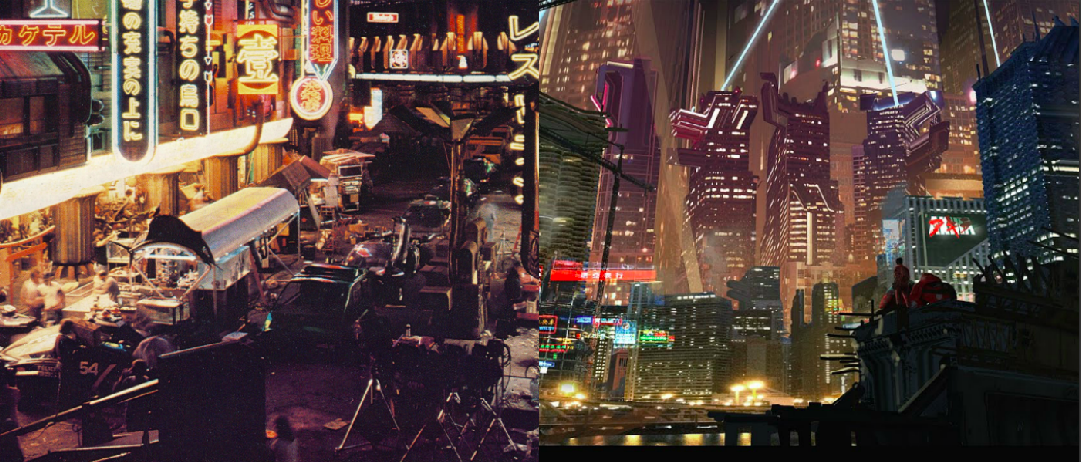
Ridley Scott brought Dick’s story to the big screen with a loose 1982 film adaptation, Blade Runner, which cast Harrison Ford as Deckard and pushed its drizzly setting ahead to 2019. With its higher order questions about what it means to think, to feel, and to be free—and about who, or what, is entitled to such conditions—Blade Runner effectively set a cyberpunk template: the billboards, the neon, the high-collared jackets, the implants, the distinctly Japanese-influenced mise-en-scène extrapolated from Japan’s 1980s-era economic dominance. It is said that William Gibson saw Blade Runner in theaters while writing Neuromancer and suffered something of a crisis of conscience. “I was afraid to watch Blade Runner,” Gibson told The Paris Review in 2011. “I was right to be afraid, because even the first few minutes were better.” Yet Gibson deepened the framework established by Blade Runner with a crucial invention that would come to define cyberpunk as much as drizzle and dumpsters and sky-high billboards. He added another dimension—literally.

Henry Case, Gibson establishes early on, “lived for the bodiless exultation of cyberspace.” As delineated in Neuromancer, cyberspace is an immersive, virtual dimension. It’s a fully realized realm of data—“bright lattices of logic unfolding across that colorless void”—which hackers can “jack into” using strapped-on electrodes. That the matrix is “bodiless” is a key concept, both of Neuromancer and of cyberpunk generally. It casts the Gibsonian idea of cyberspace against another of the genre’s hallmarks: the high-tech body mods flogged by Keanu Reeves during the Cyberpunk 2077 E3 demo.

Early in Neuromancer, Gibson describes these sorts of robotic, cyborg-like implants and augmentations. A bartender called Ratz has a “prosthetic arm jerking monotonously” that is “cased in grubby pink plastic.” The same bartender has implanted teeth: “a webwork of East European steel and brown decay.” Gibson’s intense, earthy descriptions of these body modifications cue the reader into the fundamental appeal of Neuromancer’s matrix, in which the body itself becomes utterly immaterial. Authors from Neal Stephenson (Snow Crash) to Ernest Cline (Ready Player One, which is like a dorkier Snow Crash, if such a thing is conceivable), further developed this idea of what theorist Fredric Jameson called “a whole parallel universe of the nonmaterial.”

As envisioned in Stephenson’s Snow Crash, circa 1992, this parallel universe takes shape less as some complex architecture of unfathomable data, and more as an immersive, massively multiplayer online role-playing game (MMORPG). Stephenson’s “Metaverse”—a “moving illustration drawn by [a] computer according to specifications coming down the fiber-optic cable”—is not a supplement to our real, three-dimensional world of physical bodies, but a substitute for it. Visitors navigate the Metaverse using virtual avatars, which are infinitely customizable. As Snow Crash’s hero-protagonist, Hiro Protagonist (the book, it should be noted, is something of a satire), describes it: “Your avatar can look any way you want it to . . . If you’re ugly, you can make your avatar beautiful. If you’ve just gotten out of bed, your avatar can still be wearing beautiful clothes and professionally applied makeup. You can look like a gorilla or a dragon or a giant talking penis in the Metaverse.”

Beyond Meatspatial Reasoning

The Metaverse seems to predict the wide-open, utopian optimism of the internet: that “sense of joy and power” Lewis Shiner was talking about. It echoes early 1990s blather about the promise of a World Wide Web free from corporate or government interests, where users could communicate with others across the globe, forge new identities in chat rooms, and sample from a smorgasbord of lo-res pornographic images. Key to this promise was, to some extent, forming new identities and relationships by leaving one’s physical form behind (or jacked into a computer terminal in a storage locker somewhere).

Liberated from such bulky earthly trappings, we’d be free to pursue grander, more consequential adventures inside what Gibson, in Neuromancer, calls “the nonspace of the mind.” Elsewhere in cyberpunk-lit, bodies are seen as impediments to the purer experience of virtuality. After a character in Cory Doctorow’s Down and Out in the Magic Kingdom unplugs from a bracingly real simulation immersing him in the life of Abraham Lincoln, he curses the limitations of “the stupid, blind eyes; the thick, deaf ears.” Or, as Case puts it in Neuromancer, the body is little more than “meat.”

In Stephenson’s Metaverse, virtual bodies don’t even obey the tedious laws of physics that govern our non-virtual world. In order to manage the high amount of pedestrian traffic within the Metaverse and prevent users from bumping around endlessly, the complicated computer programming permits avatars simply to pass through one another. “When things get this jammed together,” Hiro explains, “the computer simplifies things by drawing all of the avatars ghostly and translucent so you can see where you’re going.” Bodies—or their virtual representations—waft through one another, as if existing in the realm of pure spirit. There is an almost Romantic bent here (Neuromancer = “new romancer”). If the imagination, to the Romantics, opened up a gateway to deep spiritual truth, here technology serves much the same purpose. Philip K. Dick may have copped something of the 1960s psychedelic era’s ethos of expanding the mind to explore the radiant depths of the individual soul, spirit, or whatever, but cyberpunk pushed that ethos outside, creating a shared mental non-space accessible by anyone with the means—a kind of Virtual Commons, or what Gibson calls a “consensual hallucination.”

Yet outside this hallucination, bodies still persist. And in cyberpunk, the physical configurations of these bodies tend to express their own utopian dimension. Bruce Bethke claimed that “cyberpunk” resulted from a deliberate effort to “invent a new term that grokked the juxtaposition of punk attitudes and high technology.” Subsequent cyberpunk did something a bit different, not juxtaposing but dovetailing those “punk attitudes” with high-tech. (“Low-life, high-tech” is a kind of a cyberpunk mantra.) Neuromancer’s central heist narrative gathers a cast of characters—hacker Henry Case, a cybernetically augmented “Razorgirl” named Molly Millions, a drug-addled thief, a Rastafari pilot—that can be described as “ragtag.” The major cyberpunk blockbusters configure their anti-authoritarian blocs along similar lines.

In Paul Verhoeven’s cyberpunk-y action satire Total Recall, a mighty construction worker-cum-intergalactic-spy (Arnold Schwarzenegger) joins a Martian resistance led by sex workers, physically deformed “mutants,” little people, and others whose physical identities mirror their economic alienation and opposition to a menacing corporate-colonial overlord named Cohaagen.

In Johnny Mnemonic, Keanu Reeves’s businesslike “mnemonic courier” (someone who ferries information using computer implants embedded in the brain) is joined by a vixenish bodyguard (Dina Meyer’s Jane, herself a version of Neuromancer’s Molly Millions), a burly doctor (Henry Rollins), and a group of street urchin-like “Lo-Teks” engaged in an ongoing counterinsurgency against the mega-corporation Pharmakom. Both Mnemonic and Recall rely on cheap twists, in which a figure integral to the central intrigue turns out to be something ostensibly less- or other-than-human. Total Recall has Kuato, a half-formed clairvoyant mutant who appears as a tumorous growth wriggling in the abdomen of his brother. Even more ludicrously, Mnemonic’s climax reveals that the Lo-Teks’ leader is not the resourceful J-Bone (Ice-T), but rather Jones, a computer-augmented dolphin. In cyberpunk, the body’s status as “dead meat” to be transcended through computer hardware and neurological implantation offers a corollary sense of freedom.

The idea of the cybernetic body as a metaphor for the politicized human body was theorized in 1985, cyberpunk’s early days, by philosopher and biologist Donna Haraway. Dense and wildly eclectic, by turns exciting and exasperating, Haraway’s “Cyborg Manifesto” is situated as an ironic myth, designed to smash existing oppositions between science and nature, mind and body. Haraway was particularly interested in developing an imagistic alternative to the idea of the “Goddess,” so common to the feminism of the time. Where the Goddess was backward-looking in orientation, attempting to connect women to some prelapsarian, pre-patriarchal state of nature, the cyborg was a myth of the future, or at least of the present. “Cyborg imagery,” she writes, “can suggest a way out of the maze of dualisms in which we have explained our bodies and our tools to ourselves.” Part machine and part flesh, Haraway visualizes the cyborg as a being that threatens existing borders and assumes responsibility for building new ones.

Though they are not quite identical concepts, Haraway’s figure of the cyborg and the thematics of cyberpunk share much in common. A character like Gibson’s Molly Millions, for example, could be described as a cyborg, even if she is still essentially gendered as female (the gender binary was one of the many “dualisms” Haraway believed the cyborg could collapse). Cyborgs and cyberpunk are connected in their resistance to an old order, be it political and economic (as in Neuromancer, Johnny Mnemonic, etc.) or metaphysical (as in Haraway). The cyborg and the cyberpunk both dream of new futures, new social relationships, new bodies, and whole new categories of conceptions and ways of being.

The historical problem is that, for the most part, these new categories and these new relationships failed to materialize, as cyberpunk’s futures were usurped and commodified by the powers they had hoped to oppose.

Not Turning Japanese

In an introduction to the Penguin Galaxy hardcover reissue of Neuromancer, sci-fi-fantasy writer Neil Gaiman ponders precisely how the 1980s cyberpunk visions came to shape the future. “I wonder,” he writes, “to what extent William Gibson described a future, and how much he enabled it—how much the people who read and loved Neuromancer made the future crystallize around his vision.”

It’s a paradox that dogs most great sci-fi writers, whose powers for Kuato-style clairvoyance have always struck me as exaggerated. After all, it’s not as if, say, Gene Roddenberry literally saw into the future, observed voice-automated assistants of the Siri and Alexa variety, and then invented his starship’s speaking computers. It’s more that other people saw the Star Trek technology and went along inventing it. The same is true of Gibson’s matrix or Stephenson’s Metaverse, or the androids of Asimov and Dick. And the realization of many technologies envisioned by cyberpunk—including the whole concept of the internet, which now operates not as an escapist complement to reality, but an essential part of its fabric, like water or heat—has occurred not because of scrappy misfits and high-tech lowlifes tinkering in dingy basements, but because of gargantuan corporate entities. Or rather, the cyberpunks have become the corporate overlords, making the transition from the Lo-Teks to Pharmakom, from Kuato to Cohaagen. In the process, the genre and all its aspirations have been reduced to so much dead meat. This is what Shiner was reacting to when, in 1991, he renounced his cyberpunk affiliations, or when Bruce Bethke, who coined the term, began referring to “cyberpunk” as “the c-word.”

The commodification of the cool is a classic trick of capitalism, which has the frustrating ability to mutate faster than the forces that oppose it. Yet even this move toward commodification and corporatization is anticipated in much cyberpunk. “Power,” for Neuromancer’s Henry Case, “meant corporate power.” Gibson goes on: “Case had always taken it for granted that the real bosses, the kingpins in a given industry, would be both more and less than people.” For Case (and, it follows, Gibson, at least at the time of his writing), this power had “attained a kind of immortality” by evolving into an organism. Taking out one-or-another malicious CEO hardly matters when lines of substitutes are waiting in the wings to assume the role.

It’s here that cyberpunk critiques another kind of body. Not the ruddy human form that can be augmented and perfected by prosthetics and implants, but the economic body. Regarding the economy as a holistic organism—or a constituent part of one—is an idea that dates back at least as far as Adam Smith’s “invisible hand.” The rhetoric of contemporary economics is similarly biological. An edifying 2011 argument in Al Jazeera by Paul Rosenberg looked at the power of such symbolic conceptions of the economy. “The organic metaphor,” Rosenberg writes, “tells people to accept the economy as it is, to be passive, not to disturb it, to take a laissez faire attitude—leave it alone.”

This idea calls back to another of cyberpunk’s key aesthetic influences: the “body economic” of Japan in the 1980s. From the 2019 setting of 1982’s Blade Runner, to the conspicuous appearance of yakuza goons in Gibson’s stories, to Stephenson’s oddly anachronistic use of “Nipponese” in Snow Crash, cyberpunk’s speculative futures proceed from the economic ascendency of 1980s Japan, and the attendant anxiety that Japan would eventually eclipse America as an economic powerhouse. This idea, that Japan somehow is (or was) the future, has persisted all the way up to Cyberpunk 2077’s aesthetic template, and its foregrounding of villains like the shadowy Arasaka Corporation. It suggests that, even as it unfolds nearly sixty years from our future, the blockbuster video game is still obsessed with a vision of the future past.

Indeed, it’s telling that as the robust Japanese economy receded in the 1990s, its burly body giving up the proverbial ghost, that Japanese cinema became obsessed with avenging spirits channeled into the present by various technologies (a haunted video cassette in Hideo Nakata’s Ringu, the internet itself in Kiyoshi Kurosawa’s Kairo, etc.). But in the 1980s, Japan’s economic and technologic dominance seemed like a foregone conclusion. In a 2001 Time article, Gibson called Japan cyberpunk’s “de facto spiritual home.” He goes on:

I remember my first glimpse of Shibuya, when one of the young Tokyo journalists who had taken me there, his face drenched with the light of a thousand media-suns—all that towering, animated crawl of commercial information—said, “You see? You see? It is Blade Runner town.” And it was. It so evidently was.

Gibson’s analysis features one glaring mistake. His insistence that “modern Japan simply was cyberpunk” is tethered to its actual history as an economic and technological powerhouse circa the 1980s, and not from its own science-fictional preoccupations. “It was not that there was a cyberpunk movement in Japan or a native literature akin to cyberpunk,” he writes. Except there so evidently was.

The Rusting World

Even beyond the limp, Orwellian connotations, 1984 was an auspicious year for science-fiction. There was Neuromancer, yes. But 1984 also saw the first collected volume of Akira, a manga written and illustrated by Katsuhiro Otomo. Originally set, like Blade Runner, in 2019, Akira imagines a cyberpunk-y Neo-Tokyo, in which motorcycle-riding gangs do battle with oppressive government forces. Its 1988 anime adaptation was even more popular, in both Japan and the West. (The film’s trademark cherry red motorcycle has been repeatedly referenced in the grander cyberpunk canon, appearing in Steven Spielberg’s film adaptation of Ready Player One and, if pre-release hype is to believed, in Cyberpunk 2077 itself.) In 2018, the British Film Institute hailed Akira, accurately, as “a vital cornerstone of the cyberpunk genre.”

Japan has plenty of other, non-Akira cyberpunk touchstones. As a cinematic subgenre, Japanese cyberpunk feels less connected to the “cyber” and more to the spirit of “punk,” whether in the showcasing of actual Japanese punk rock bands (as in 1982’s Burst City) or the films’ own commitment to a rough-hewn, low-budget, underground aesthetic. Chief among the latter category of films is Shinya Tsukamoto’s Tetsuo: The Iron Man, which was shot on 16mm over a grueling year-and-a-half, mostly in and around Tetsuo actress and cinematographer Kei Fujiwara’s apartment, which also housed most of the film’s cast and crew.

Unlike the Western cyberpunk classics, Tsukamoto’s vision of human-machine hybridization is demonstrably more nightmarish. The film follows two characters, credited as the Salaryman (Tomorowo Taguchi) and the Guy (a.k.a. “The Metal Fetishist,” played by writer/director/producer/editor Tsukamoto himself), bound by horrifying mutations, which see their flesh and internal organs sprouting mechanical hardware.

In its own way, Tetsuo works as a cyberpunk-horror allegory for the Japanese economy. As the Salaryman and the Fetishist learn to accept the condition of their mechanization, they merge together, absorbing all the inorganic matter around them, growing enormously like a real-world computer virus or some terrifying industrial Katamari. Their mission resonates like a perverse inversion of Japan’s post-industrial promise. As Tsukamoto’s Fetishist puts it: “We can rust the whole world and scatter it into the dust of the universe.”

Like Haraway’s development of the cyborg as a metaphoric alternative to the New Age “goddess,” Tetsuo’s titular Iron Man can offer a similar corrective. If cyberpunk has become hopelessly obsessed with its own nostalgia, recycling all its 1980s bric-a-brac endlessly, then we need a new model. Far from the visions of Gibson, in which technology provides an outlet for a scrappy utopian impulse that jeopardizes larger corporate-political dystopias, Tetsuo is more pessimistic. It sees the body—both the individual physical body and the grander corpus of political economy—as being machine-like. Yet, as Rosenberg notes in his Al Jazeera analysis of economic rhetoric, it may be more useful to conceive of the economy not as a “body” or an organism but as a machine. The body metaphor is conservative, “with implications that tend toward passivity and acceptance of whatever ills there may be.” Machines, by contrast, can be fixed, greased, re-oriented. They are, unlike bodies, a thing separate from us, and so subject to our designs.

Cybernetic implants and cyborg technology are not some antidote to corporate hegemony. The human does not meld with technology to transcend the limitations of humanity. Rather, technology and machinery pose direct threats to precisely that condition. We cannot, in Tsukamoto’s film, hack our way to a better future, or technologically augment our way out of collective despair. Technology—and the mindless rush to reproduce it—are, to Tsukamoto, the very conditions of that despair. Even at thirty years old, Tetsuo offers a chilling vision not of the future, or of 1980s Japan, but of right now: a present where the liberating possibilities of technology have been turned inside-out; where hackers become CEOs whose platforms bespoil democracy; where automation offers not the promise of increased wealth and leisure time, but joblessness, desperation, and the wholesale redundancy of the human species; where the shared hallucination of the virtual feels less than consensual.

There’s nothing utopian about the model of cyberpunk developed in Tetsuo: The Iron Man. It is purely dystopian. But this defeatism offers clarity. And in denying the collaborative, collectivist, positive vision of a technological future in favor of a vision of identity-destroying, soul-obliterating horror, Tsukamoto’s stone-cold classic of Japanese cyberpunk invites us to imagine our own anti-authoritarian, anti-corporate arrangements. The enduring canon of American-style cyberpunk may have grown rusty. It has been caught, as Bethke put it in his genre-naming story, “without a program.” But the genre’s gnarlier, Japanese iterations have plenty to offer, embodying sci-fi’s dream of imagining a far-off future as a deep, salient critique of the present. It is only when we accept this cruel machinery of the present that we can freely contemplate how best to tinker with its future.

Left to peddle such a despairing vision in a packed-out L.A. convention center, even cyberpunk’s postmortem poster boy Keanu Reeves would be left with little to say but a resigned, bewildered, “Woah . . .”

Saturday Matinee: Millenium Actress

An enchanting Japanese animated film about a woman whose life is propelled by the yearning of her heart for a mysterious stranger.

Review by Frederic and Mary Ann Brussat

Source: Spirituality & Practice

In the opening scene of this exquisite Japanese animated film directed by Satoshi Kon [10/12/63 – 8/24/10], Genya Tachibana, a documentary filmmaker, and his cameraman are climbing a hill to the retreat of Chiyoko Fujiwara, a popular actress who mysteriously abandoned her career 30 years ago. The meeting with her has great significance for Genya since he has secretly been in love with her all these years and can’t wait to present the famous 70-year-old with an old key that was once her fondest possession. When she holds it in her hand, the memories of her past begin to unspool in a narrative that intermixes the movies she was in and the real events of her personal life. As an added treat that often provides some funny and delightful moments, Genya and his cameraman find themselves magically transported into the story as befuddled participants in Chiyoko’s movies and daily life.

The actress was born in 1923 when a gigantic earthquake hit Tokyo. She becomes an actress as a little girl despite the pleas of her mother that she is too timid. Oddly enough the most poignant moment in her early life is not her first major role but a brief encounter with an artist who is being pursued by government authorities for some unknown actions against the state. Chiyoko puts herself in jeopardy by taking this handsome and wounded stranger to their storage shed. In gratitude for her assistance, he presents her with a key. After he leaves, this remains a talisman of her love for him, and she recalls again and again his words that the key is the most important thing there is.

In each of her movies, Chiyoko moves through a different period of Japanese history from the fifteenth century to the space age playing a princess, a ninja, a geisha, and even an astronaut. Over the years, the actress still yearns for connection with the mysterious stranger. It is the force that carries her through her career and supercedes anything that she does on the screen. Of course, this intensity of feeling draws out the ire of a competing older actress and a man with a scar who is pursuing the artist. In this retelling of her life, the documentary filmmaker is always rescuing her in moments of distress. He did work on several films with her as a young man when he was breaking into the business, but she never knew of his ardor until they meet for the interview.

Spiritual writer Joan Chittister has written, “Longing is a compass that guides us through life. We may never get what we really want, that’s true, but every step along the way will be determined by it.” In this Japanese animated film, Chiyiko’s longing is represented by her always running to find the mysterious artist. Those who are propelled through their lives by a deep yearning of the heart are lucky individuals: some might even call them enchanted. Millennium Actress is an enchanting movie that will appeal to those who are looking for something special at the multiplex.

Watch the full film here: https://fantasyanime.com/anime/millennium-actress-sub

Saturday Matinee: Kyoshin (aka Mirrored Mind)

Synopsis from Dejima Japanese Film Festival

Renowned cyber-punk director ISHII Sogo strays from his roots, entering the realm of the subconscious with Mirrored Mind, a composed, contemplative and also a very personal film. Guiding us along with an actress who suffers an identity crisis when all at once she finds herself spirited away from the bustle of Tokyo to a tropical paradise, director ISHII poses philosophical questions about the origins of our soul. A visually stunning ode to the need for a spiritual and tranquil life. Mirrored Mind is the feature length version of the short by the same name, which was made as part of the Jeonju International Film Festival initiated Digital Short Films by Three Filmmakers 2004.

To activate English subtitles, click the “cc” button near the bottom right corner of the video window.

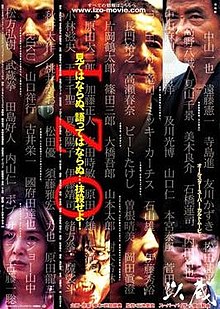
Saturday Matinee: Izo

Synopsis from Wikipedia:

IZO is a 2004 Japanese film, directed by Takashi Miike. The main character of the film is Izo Okada (1832–1865), the historical samurai and assassin in 19th century Japan who was tortured and executed by beheading in Tosa.

Izo appeared previously in Hideo Gosha‘s Hitokiri (1969), then played by Shintaro Katsu. However, Miike’s portrayal of the character (or rather his spirit) transcends reality (and time and space) and is more of a surrealist exposé of Izo’s exceedingly bloody yet philosophical encounters in an afterlife heavy on symbolism, occasionally interrupted by stock footage of World War II accompanied by acid-folk singer Kazuki Tomokawa on guitar. Kazuya Nakayama plays Izo and the many characters he encounters on his journey include figures played by Takeshi Kitano and Bob Sapp.

Watch the full film with english subtitles here: http://www1.newasiantv.co/watch/izo.3864.77305.html

Saturday Matinee: Grave of the Fireflies

Review by Roger Ebert

In the waning days of World War II, American bombers drop napalm canisters on Japanese cities, creating fire storms. These bombs, longer than a tin can but about as big around, fall to earth trailing cloth tails that flutter behind them; they are almost a beautiful sight. After they hit, there is a moment’s silence, and then they detonate, spraying their surroundings with flames. In a Japanese residential neighborhood, made of flimsy wood and paper houses, there is no way to fight the fires.

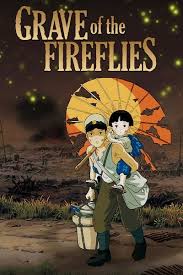
“Grave of the Fireflies” (1988) is an animated film telling the story of two children from the port city of Kobe, made homeless by the bombs. Seita is a young teenager, and his sister Setsuko is about 5. Their father is serving in the Japanese navy, and their mother is a bomb victim; Seita kneels beside her body, covered with burns, in an emergency hospital. Their home, neighbors, schools are all gone. For a time an aunt takes them in, but she’s cruel about the need to feed them, and eventually Seita finds a hillside cave where they can live. He does what he can to find food, and to answer Setsuko’s questions about their parents. The first shot of the film shows Seita dead in a subway station, and so we can guess Setsuko’s fate; we are accompanied through flashbacks by the boy’s spirit.

“Grave of the Fireflies” is an emotional experience so powerful that it forces a rethinking of animation. Since the earliest days, most animated films have been “cartoons” for children and families. Recent animated features such as “The Lion King,” “Princess Mononoke” and “The Iron Giant” have touched on more serious themes, and the “Toy Story” movies and classics like “Bambi” have had moments that moved some audience members to tears. But these films exist within safe confines; they inspire tears, but not grief. “Grave of the Fireflies” is a powerful dramatic film that happens to be animated, and I know what the critic Ernest Rister means when he compares it to “Schindler’s List” and says, “It is the most profoundly human animated film I’ve ever seen.”

It tells a simple story of survival. The boy and his sister must find a place to stay, and food to eat. In wartime their relatives are not kind or generous, and after their aunt sells their mother’s kimonos for rice, she keeps a lot of the rice for herself. Eventually, Seita realizes it is time to leave. He has some money and can buy food–but soon there is no food to buy. His sister grows weaker. Their story is told not as melodrama, but simply, directly, in the neorealist tradition. And there is time for silence in it. One of the film’s greatest gifts is its patience; shots are held so we can think about them, characters are glimpsed in private moments, atmosphere and nature are given time to establish themselves.

Japanese poets use “pillow words” that are halfway between pauses and punctuation, and the great director Yasujiro Ozu uses “pillow shots”–a detail from nature, say, to separate two scenes. “Grave of the Fireflies” uses them, too. Its visuals create a kind of poetry. There are moments of quick action, as when the bombs rain down and terrified people fill the streets, but this film doesn’t exploit action; it meditates on its consequences.

The film was directed by Isao Takahata, who is associated with the famous Ghibli Studio, source of the greatest Japanese animation. His colleague there is Hayao Miyazaki (“Princess Mononoke,” “Kiki’s Delivery Service,” “My Neighbor Totoro”). His films are not usually this serious, but “Grave of the Fireflies” is in a category by itself. It’s based on a semi-autobiographical novel by Nosaka Akiyuki–who was a boy at the time of the firebombs, whose sister did die of hunger and whose life has been shadowed by guilt.

The book is well-known in Japan, and might easily have inspired a live-action film. It isn’t the typical material of animation. But for “Grave of the Fireflies,” I think animation was the right choice. Live action would have been burdened by the weight of special effects, violence and action. Animation allows Takahata to concentrate on the essence of the story, and the lack of visual realism in his animated characters allows our imagination more play; freed from the literal fact of real actors, we can more easily merge the characters with our own associations.

Hollywood animation has been pursuing the ideal of “realistic animation” for decades, even though that’s an oxymoron. People who are drawn do not look like people who are photographed. They’re more stylized, more obviously symbolic, and (as Disney discovered in painstaking experiments) their movements can be exaggerated to communicate mood through body language. “Grave of the Fireflies” doesn’t attempt even the realism of “The Lion King” or “Princess Mononoke,” but paradoxically it is the most realistic animated film I’ve ever seen–in feeling.

The locations and backgrounds are drawn in a style owing something to the 18th century Japanese artist Hiroshige and his modern disciple Herge (the creator of Tin Tin). There is great beauty in them–not cartoon beauty, but evocative landscape drawing, put through the filter of animated style. The characters are typical of much modern Japanese animation, with their enormous eyes, childlike bodies and features of great plasticity (mouths are tiny when closed, but enormous when opened in a child’s cry–we even see Setsuko’s tonsils). This film proves, if it needs proving, that animation produces emotional effects not by reproducing reality, but by heightening and simplifying it, so that many of the sequences are about ideas, not experiences.

There are individual moments of great beauty. One involves a night when the children catch fireflies and use them to illuminate their cave. The next day, Seita finds his little sister carefully burying the dead insects–as she imagines her mother was buried. There is another sequence in which the girl prepares “dinner” for her brother by using mud to make “rice balls” and other imaginary delicacies. And note the timing and the use of silence in a sequence where they find a dead body on the beach, and then more bombers appear far away in the sky.

Rister singles out another shot: “There’s a moment where the boy Seita traps an air bubble with a wash rag, submerges it, and then releases it into his sister Setsuko’s delighted face–and that’s when I knew I was watching something special.”

There are ancient Japanese cultural currents flowing beneath the surface of “Grave of the Fireflies,” and they’re explained by critic Dennis H. Fukushima Jr., who finds the story’s origins in the tradition of double-suicide plays. It is not that Seita and Setsuko commit suicide overtly, but that life wears away their will to live. He also draws a parallel between their sheltering cave and hillside tombs.

Fukushima cites an interview with the author, Akiyuki: “Having been the sole survivor, he felt guilty for the death of his sister. While scrounging for food, he had often fed himself first, and his sister second. Her undeniable cause of death was hunger, and it was a sad fact that would haunt Nosaka for years. It prompted him to write about the experience, in hopes of purging the demons tormenting him.”

Because it is animated and from Japan, “Grave of the Fireflies” has been little seen. When anime fans say how good the film is, nobody takes them seriously. Now that it’s available on DVD with a choice of subtitles or English dubbing, maybe it will find the attention it deserves. Yes, it’s a cartoon, and the kids have eyes like saucers, but it belongs on any list of the greatest war films ever made.


Note: To activate English subtitles, click on the “CC” button on the bottom-left corner of the video window.

Saturday Matinee: The Twilight Samurai

“The Twilight Samurai” (aka Tasogare Seibei たそがれ清兵衛, 2002), is a realist Samurai drama co-written and directed by Yoji Yamada set in mid-19th century Japan. It stars Hiroyuki Sanada as Seibei, a low-ranking samurai widower struggling to support his daughters and dementia-afflicted mother, who is forced by his clan’s leaders to kill a skilled rogue samurai. The film was inspired by the short story “The Bamboo Sword” by Shuhei Fujisawa and was groundbreaking for its approach to the genre; a samurai equivalent to a revisionist western.

Watch the full film here.