Superpowers and Concrete Towers: Katsuhiro Otomo’s ‘Domu: A Child’s Dream’

By Patrick Haddad

Source: We Are the Mutants

In 1989, almost a year after it was released in Japan, the Western world was given its first cinematic taste of anime with the sci-fi epic Akira. Acclaimed writer Katsuhiro Otomo’s vision of a post-apocalyptic Neo-Tokyo, a sea of concrete edifices laid waste by war, was adapted from the manga of the same name, serialized in Japan from 1982 to 1990. Religious fanatics, biker gangs, and shadowy government figures all vie for control of children with superhuman powers, while the truth behind World War III teases just out of reach. But before Akira, Otomo penned and illustrated a shorter piece of raw, dystopian horror: Domu: A Child’s Dream. Set in a government housing complex where a series of inexplicable deaths are taking place, Domu (serialized between 1980-1981) is resolved through a conflict between an old man and a young girl, both of whom secretly possess extrasensory powers.

While Domu foreshadowed Akira in many ways, it is a much more intimate story with fewer characters and just one location, the Tsutsumi Housing Complex. The residents of Tsutsumi are a forgotten, surplus community. Dreams left unfulfilled, private sufferings gone unchecked, and the struggle for identity in the monotonous wash of concrete go some way to explain the rash of suicides plaguing the complex, yet the police are at a loss to explain exactly how many of these deaths occurred. From the beginning, Otomo sets out to introduce the overwhelming, modernist structure as a character in and of itself. Full panel shots of the building in high detail and high contrast are found throughout, and are often employed as bookends to each chapter. Its circular layout insists upon dreary introspection for half of the residents it houses: there is no looking out to the city, to a potentially brighter future. Many prisons, schools, and hospitals also follow a similar template. The circular design—reminiscent of the Panopticon—allows for both greater visibility and fewer places to hide, and is often accompanied by a raised central observation point. Tsutsumi is monotonous in its aspect as well as its makeup: hard concrete, hard lines; no facade, no flair. Behind this impassive exterior lie grimy, cramped apartments hidden among a labyrinth of iron and concrete hallways. It isn’t much of a stretch to imagine Tsutsumi as the backdrop to one of Freddy Krueger’s nightmarish rampages, and Otomo almost certainly drew upon similar feelings of unease regarding the homogeneous modernization of postwar Japan as did Shinya Tsukamoto, who created the shocking cult horror film Tetsuo: The Iron Man (1989).

As the story progresses, it becomes clear—to the reader at least—that the mysterious deaths can be traced back to Old Cho, an apparently senile old man who is in fact using his telekinetic powers to cause fatal accidents or, as in the iconic scene featuring a depressed young man with a craft knife, forcing residents to commit suicide. Old Cho frequently kills from the background, unseen by his victims, his twisted revelry seeming to come from the building itself. Old Cho is not the only resident with special gifts. He finds an adversary in the form of a young girl called Etsuko. They clash the very moment Etsuko and her family move into the tower block, when she uses her abilities to catch the plummeting baby Cho, using his psychic powers, had snatched and dropped from the balcony.

As the story progresses, Cho’s and Etsuko’s confrontations escalate, as the tally of innocent victims climbs. The final act of Domu marks a stark departure from earlier passages, as the static panels showing the impassive monolith and its cowed inhabitants are replaced by dynamic and violent scenes, splashed with blood and fueled by emotion. By the end of the book, it is hard to tell who really won or what a victory would even mean, but it is clear that most of the violence was down to random malice, or misguided fear and rage. It is ironic, then, that the reduction of human beings to just pure function results in senseless, unproductive violence.

Many modernist, and particularly Brutalist, social housing structures were built after World War II in order to show that “A dwelling can be standardized to meet the needs of men whose lives are standardized,” according to urban design pioneer Le Corbusier. Projects such as Les Damiers in Paris, Robin Hood Gardens in London, Habitat 67 in Montreal, and the Unité d’habitation in Berlin are iconic examples of an architectural style that would dominate social housing well into the 1970s. However, the utopian vision set out by modernist architects—to create socially progressive and egalitarian housing—became twisted by time and by the reality of the project’s application. Affordable social housing turned into isolated ghettos, while the idea of social progress became just a gear, an empty promise, in the great Soviet machine. The modular, repetitive nature allowed for quick and cheap rebuilding, but, perhaps in part due to its success, it also aided in the dissolution of identity. Each building, each home, was just a copy of the last, with nothing substantial to distinguish each from each: an existence stripped of form, each building nothing but raw function. And so too its occupants.

In contrast to the urbanization implied by modernist housing, America saw large numbers of people, many of them returning veterans, flee the cities after World War II in favor of suburban living. Combining the power of assembly-line mass production with the G.I. Bill’s loan assistance saw entire communities of cookie-cutter homes spring up in a remarkably short space of time. Spreading out in a grid, rather than towering above, suburbia very often entailed a similar rationalization of living spaces. The mass produced sprawl, built to the same specifications and filled with the same stylish appliances, fits nicely into Le Corbusier’s definition of homes as “machines for living in.”

Things were much grimmer in Japan, of course. Suffering atomic bomb strikes that wiped two of its cities clean off the map, as well as the death of an Empire, caused a national crisis of identity. The country was then occupied by and rebuilt in the image of its conquerors: centuries of culture burned to the ground or consumed by industry and replaced with bloodless, uniform architecture. Tower blocks went up where pagodas once stood, no longer hewn from stone and wood but erected with concrete and rebar. British author Theodore Dalrymple describes modernist architecture as “inherently totalitarian… [it] delights to overwhelm and humiliate what went before it by its size and prepotency.” The seeds of modernism in Japan were planted before their defeat during World War II, however. Le Corbusier worked with two prominent Japanese architects during the 1930s, Kunio Maekawa and Junzo Sakakura. During this time, a synergy was found between Le Corbusier’s visions for flexible, open plan buildings filled with natural light and the traditional Japanese house, called Sukiya-zukuri. This synergy would be expanded upon in the later Metabolism movement, which sought to bring inspiration from organic, biological structures to modernist architecture during the 1960s.

In Domu, we find a manifestation of this dehumanizing monolith in the form of the Tsutsumi Housing Complex and it’s magpie avatar, Old Cho. For each of his victims, Cho claims a glittering prize, a personal token: a badge, a hat, a gun. Before being forced over the precipice of their hopelessness, literally and figuratively, a piece of their identity is stolen before being secreted away somewhere in the bowels of the building.

While it is unlikely that Otomo wrote Domu as an explicit attack on modernism in Japan, the influence of the displacement and anxiety it caused is clear in his work. In Domu, we see Otomo start to develop two of the principle themes that went on to make Akira a timeless classic: young people with exceptional, inherent power, and a dystopian vision of Neo-Tokyo as a failed totalitarianism, an endless landscape of monstrous and towering concrete. These themes went on to define an era of storytelling in manga and anime characterized by pervasively bleak visions of the future.

The loss of privacy and individualism caused by massive modernist social housing estates is also explored in J.G. Ballard’s High Rise (1975), in which tenants of a self-contained tower block in London degenerate into primal tribes, warring over territory and resources while normal city life continues outside. In High Rise, the dehumanizing power of Brutalism leads people to lose their “civilized” behavior and let base urges drive their lives, while in Domu we get a greater sense of the despondency that comes from being a lifeless industrial worker in a lifeless industrial landscape. It is as though living in this monochromatic, function-centric environment leaves us with only two potential identities: the animal, or the machine.

Regardless of whether you read Domu for its gripping and pioneering storytelling, for what it tells us about the role played by modernist architecture in postwar Japan, or purely for its wonderful aesthetic, it is a work that easily stands on its own two legs, despite often being overlooked as some sort of practice run for the Akira epic. Rather than the abstract, existentialist sprawl that is the latter, in Domu we have a more concise and personal tale, with a sense of looming oppression that bleeds from every page. The bare honesty found in some of Cho’s victims shines a light on the real lives lived quietly the world over, their deep fatigue resonating in profound echoes. The next time your morning commute takes you past some austere, concrete tower block, remember: somewhere inside may be a young girl who blows things up with her mind.


Read Domu for free here.

FIGHTING FOR OKINAWA — MY HOME, NOT A MILITARY BASE

By Moé Yonamine

Source: Rethinking Schools

My family moved to the United States from Okinawa when I was 7. But Okinawa is still home — and I’m hurt and angered at how the United States and Japan continue to treat Okinawa as little more than a colonial outpost. As a teacher, I’m even more dismayed at how the conventional school curriculum keeps young people in this country ignorant about the abuse, but also about the resistance, in my home islands.

“They are burying our beautiful ocean,” read the recent message from my mother in Okinawa, as though she was grieving the loss of a loved one. After decades of protest by Okinawan people to completely get rid of all U.S. military bases that occupy a fifth of the Ryukyu Island chain, the United States and Japan signed a treaty to evacuate one of the most contested bases located in the center of the main island, Futenma Marine Corps (MCAS) base. In exchange for the removal, both governments announced that they would construct a floating military base off the northeast coast of Henoko. Okinawans expressed vehement opposition, with a majority voting in a referendum for the complete removal of all bases. Still the construction continued and the people persisted in protest — marching for miles down main streets, creating human chains for peace, linking arms around military bases, elders repeatedly lying down in front of bulldozers. Governor Takeshi Onaga demanded the Japanese government terminate the heliport construction and city mayors prevented access of U.S. military construction vehicles through their districts — later overturned by federal court order last December sought by the Japanese federal government.

Today, the concrete seawalls are finished, and soon, rocks will be crushed and sand will pile high, burying the tropical, clear waters. The Japanese government and U.S. military continue to pursue the construction of the runway, despite community complaints of environmental damage and pollution, endangerment to sea life, harm to the fishing and tourism industry, as well as the ongoing threat to cultural survival and island sovereignty. On July 6th the Ryukyu Shimpo announced that the Japanese government would not return the land occupied by MCAS Futenma to the Okinawan people. The U.S. and Japan added a condition to the promise for Futenma’s removal: The Naha International Airport must be made available for the U.S. military any time they declare an emergency. When Governor Onaga rejected this demand, the U.S. military withdrew its promise to remove Futenma. Japanese Defense Minister Tomomi Inada stated, “If the requisite conditions for the return of Futenma are not met, it will not be returned.” In a surge of anger, pain and frustration, word spread quickly in Okinawa across social media.

Devastated at the sacrifice of my home, I turned to the news here in the United States, and there was not one story about Okinawa on any major network. Frustrated, I recalled my conversation with an elderly grandmother I met at a peace rally in my neighborhood when I went home last summer. When I told her I was a teacher in the United States, she told me that the best thing we as teachers can do is to teach kids about what’s happening in Okinawa and how we want a world without war. She said, “They need to know our story so they can stand up with us.”

But when I turn to a typical U.S. textbook, I see how students are ill-equipped to understand what’s happening in Okinawa. For example, in Holt McDougal’s widely used The Americans, there are a mere three paragraphs about Okinawa under the section, “The Atomic Bomb Ends the War.”

Discussion of Okinawa begins and ends with a skewed description of the Battle of Okinawa during WWII: “In April 1945, U.S. Marines invaded Okinawa,” it begins. “By the time the fighting ended on June 21, 1945, more than 7,600 Americans had died. But the Japanese paid an even greater price — 110,000 lives — in defending Okinawa.” Okinawans are completely invisible in this account of the war, the bloodiest battle in the history of the Pacific, where our islands were used as a battleground between the United States and Japan. The highest cost was in Okinawan lives, where more than a third of the population was killed within three months — almost 150,000 — and more than 92 percent were left homeless. The majority of today’s families — including mine — have experienced grief and loss of loved ones.What The Americans does not teach is that Okinawa was once an independent kingdom, was colonized by Japan, then controlled by the United States for 27 years, and finally became a Japanese prefecture. At the end of the war, the U.S. military stripped Japan of its constitution and replaced it with one that took away Japan’s right to have an offensive military. Henceforth, the United States would “protect” Japan, and create bases throughout Japanese territory. However, three-quarters of all U.S. bases on Japanese territory are on Okinawa, even though Okinawa makes up only .6 percent of Japan’s total landmass. Okinawa’s main island is just 62 miles long; and its width averages one mile.

MCAS Futenma was constructed in the middle of our skinny island — creating environmental destruction, air pollution and noise pollution, blocking direct access to roads in a densely populated community, and exposing survivors and families to the sights and sounds of war. Frequent violent crimes against women and children continue to bring hundreds of thousands of protesters together demanding justice and humanity — and the complete removal of U.S. military bases.

Not only do commercial textbooks fail to equip students to understand what’s happening in Okinawa, the mainstream school curriculum does not help students understand issues affecting island people more broadly. I have seen time and time again the shock when my high school students in Portland, Oregon, learn about the U.S. military’s long-standing nuclear testing in the Marshall Islands, the environmental damage to Vieques in Puerto Rico, or the history of U.S. military trainings on indigenous Hawaiian soil. Many of my students are confused when they learn that Guam is a “U.S. territory,” has the highest per capita U.S. military enlistment, has a huge U.S. base presence, but its people have no right to vote in U.S. elections. When I talk about the International Women’s Network Against Militarism, students wonder why women from places with high U.S. military presence — the Philippines, South Korea, Hawai’i, Puerto Rico, Guam and Okinawa — gather regularly to talk and organize.

When people say to me, “Why are Okinawans complaining? We’re there to protect you,” I want them to learn our whole history and to know our colonized story. When people ask, “Why don’t Okinawans complain to the Japanese government?” I want them to know about the history of our people’s movements to demand our rights. When people say, “So what? It’s just one little island,” I want them to know this is my home; it’s sacred — these are my loved ones. What’s more, our story of struggle today represents issues affecting so many island people.

The elderly grandmother from the peace rally told me that we must teach the children “that we have been fighting because we have always wanted peace but now we need the world to fight with us. Go back and tell our story.” Our story though, is much more than three short paragraphs in a textbook. It is a story about a people’s determination for sovereignty in the face of imperialism, resilience in midst of colonization, and perseverance for peace as survivors of war. Our story is urgent and it is a call for global action in the name of peace and justice. The history of Okinawa is a story of resistance but also a call to the world.


Moé Yonamine (moe@rethinkingschools.org) teaches at Roosevelt High School in Portland, Oregon, and is an editor of Rethinking Schools magazine. Yonamine is part of a network of Zinn Education Project teachers developing original people’s history curriculum. She is the author of “The Other Internment: Teaching the Hidden Story of Japanese Latin Americans During WWII,” “‘ANPO: Art X War’: A Film Tackles the U.S. Occupation of Japan,” a film review with teaching activities of “ANPO: Art X War,” a documentary about visual resistance to U.S. military bases in Japan, and “Uchinaaguchi: The Language of My Heart.”

Why Okinawa Should Matter

2015051815015274208

By Richard Falk

Source: Foreign Policy Journal

Okinawa has been a mostly unhappy host of American military bases, and the issue has been prominent at times on the agenda of the Japanese peace movement.

When President Barack Obama visited Hiroshima in May of 2016, there was an effort to persuade him to put Okinawa on his travel itinerary, but as has happened frequently throughout the long tortured history of Okinawa, the request was ignored, and the people of the island were once more disappointed. In an important sense, Okinawa is the most shameful legacy of Japan’s defeat in World War II, exceeding even the sites of the atomic attacks by its daily reminders of a continued colonialist encroachment on Okinawan national dignity and wellbeing.

Actually, Okinawa is being victimized by overlapping exploitations with that of the United States reinforced and legitimized by mainland Japan. For the United States, Okinawa serves as a hub for its strategic military operations throughout the Pacific, with at least 14 separate military bases occupying about 20% of the island. Kadena Air Base was used for B-29 bombing missions during the Korean War more than a half century ago, and the island was used as a major staging area throughout the Vietnam War. It has also been used as a secret site for the deployment of as many as 1,000 nuclear warheads in defiance of Japanese declared no-nukes policy. Actually, in recent years Okinawa rarely receives global news coverage except when there occurs a sex crime by American servicemen that provokes local outrage and peaceful mass demonstrations followed by the strained apologies of local American military commanders.

Japan’s role in the misfortunes of Okinawa is more than one of a passive acceptance of the enduring side effects of its defeat and humiliation in World War II. After a series of military incursions, Japan finally conquered Okinawa and the Ryukyu island chain of which it is a part in 1879, and then imposed its rule in ways that suppressed the culture, traditions, and even the language of the native populations of the islands. What is virtually unknown in the West is that Okinawa was the scene of the culminating catastrophic land battle between the United States and Japan in the spring of 1945 that resulted in the death of an astounding one-third of the island’s civilian population of then 300,000 and its subsequent harsh military administration by the United States for the next 27 years until the island was finally turned back to Japan in 1972. Despite an estimated 60-80% of Okinawans being opposed to the U.S. bases, confirmed by the recent election of an anti-bases governor of prefecture, the government in Tokyo, currently headed by a dangerous militarist, Shinzo Abe, is comfortable with the status quo, which allows most of the unpopular continuing American military presence to be centered outside of mainland Japan, and hence no longer a serious political irritant within the country.

What the plight of Okinawans exemplifies is the tragic ordeal of a small island society, which because of its small population and size, entrapment within Japan, and geopolitical significance, failed to be included in the decolonizing agenda that was pursued around the world with such success in the last half of the 20th century. This tragic fate that has befallen Okinawa and its people results from being a ‘colony’ in a post-colonial era. Its smallness of current population (1.4 million) combined with its enclosure within Japanese sovereign statehood and its role in pursuing the Asian strategic interests of the United States, as well as joint military operations with Japan make it captive of a militarized world order that refuses to acknowledge the supposedly inalienable right of self-determination, an entitlement of all peoples according to common Article 1 of both human rights covenants. In this respect, Okinawa, from a global perspective, is a forgotten remnant of the colonial past, which means it is subjugated and irrelevant from the perspective of a state-centric world order. In this respect, it bears a kinship with such other forgotten peoples as those living in Kashmir, Chechnya, Xinjiang, Tibet, Hawaii, Puerto Rico, Palau, Marianas Islands, among many others.

There are other ways of being forgotten. I have for many years been concerned about the Palestinian ordeal, another geopolitical and historical casualty of Euro-American priorities and the colonialist legacy. Here, too, the indigenous population of Palestine has endured decades of suffering, denials of basic rights, and a dynamic of victimization initiated a century ago when the British Foreign Office issued the Balfour Declaration pledging support to the world Zionist movement for the establishment of a Jewish Homeland in historic Palestine, later placed under the tutorial role of the United Kingdom with the formal blessings of the League of Nations until the end of World War II. Instead of Japan playing the intermediate role as in Okinawa, it is Israel that pursues its own interests and teams with the United States and Europe as a strategic partner to carry forward its shared geopolitical goals throughout the Middle East and North Africa. Of course, there are crucial differences. Japan is constrained as a partner by its postwar peace constitution, which Abe is keen to circumvent and dilute, while Israel has become a military powerhouse in the region, enjoying a special relationship with the United States that includes the incredible assurance by Washington of a military capability capable of defeating any foreseeable combination of Arab adversaries. Also, unlike Okinawa, there are no American military bases in Israel. There is no need for them. Israel acts as an American surrogate, and sometimes even vice versa. Yet the result is the same—force projection unconnected with self-defense, but vital for upholding regional strategic interests that involve maintaining a visible military presence and offering allies in the region credible promises of protection.

When we raise questions about the future of Okinawa, we come face to face with the role and responsibility of global civil society. The Palestinian goals appear to remain more ambitious than those of the Okinawans, although such an impression could be misleading. The Palestinian movement is centered upon realizing the right of self-determination, which means at the very least an end to occupation and a diplomacy that achieves a comprehensive, sustainable, and just peace. For Okinawans, long integrated into the Japanese state, earlier dreams of independence seem to have faded, and the focus of political energy is currently devoted to the anti-bases campaign. Taking moral globalization seriously means conceiving of citizenship as borderless with respect to space and time, an overall identity I have described elsewhere under the label ‘citizen pilgrim,’ someone on a life journey to build a better future by addressing the injustices of the present wherever encountered.

In this respect, acting as citizen pilgrims means giving attention to injustices that the world as a whole treats as invisible except when an awkward incident of lethal abuse occurs. Okinawa has been effectively swept under the dual rugs of statism (Okinawa is part of the sovereign state of Japan) and geopolitics (Okinawa offers the United States indispensable military bases), and even the mainly Japanese peace movement may have grown fatigued and distracted, being currently preoccupied with its opposition to the revival of Japanese militarism under Abe’s leadership. Whether attention to the plight of Okinawa will give rise to false hopes is a concern, but the aspiration is to produce an empowering recognition throughout the world that for some peoples the struggle against colonialism remains a present reality rather than a heroic memory that can be annually celebrated as an independence day holiday. Until we in the United States stand in active solidarity with such victims of colonialist governance we will never know whether more can be done to improve prospects of their emancipation. This awareness and allegiance is the very least that we can do if we are to act in the spirit of a citizen pilgrimage.


This article was originally published at RichardFalk.Wordpress.com. An earlier version first appeared in the Japanese publication Ryukyu Shimpo.


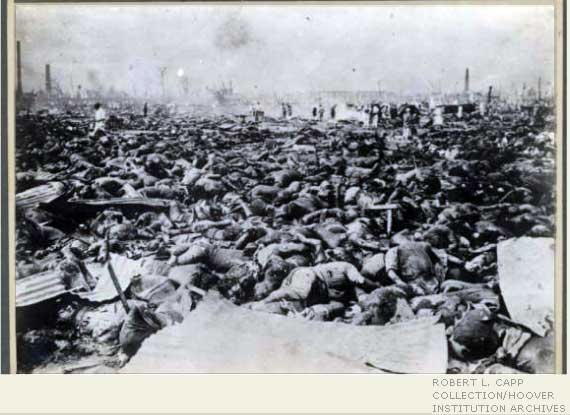
America’s Barbaric Logic of Hiroshima 70 Years On

Hiroshima_Capp

By Finnian Cunningham

Source: Strategic Culture Foundation

Even if we accept that there was a plausible military imperative to drop the atomic bombs on Hiroshima and Nagasaki – to bring about a swift defeat of Japan and thus an end to the Pacific War – the horror of civilian death toll from those two no-warning aerial attacks places a disturbing question over the supposed ends justifying the means.

But what if the official military rationale touted by US President Harry Truman and his administration turns out to be bogus? That is, the real reason for dropping the A-bombs on Hiroshima and Nagasaki 70 years ago on August 6 and 9, 1945, had little to do with defeating imperial Japan and saving the lives of American troops. What if the real reason was the deliberate and cold-blooded demonstration of raw military power by Washington in order to warn the Soviet Union of America’s postwar demarcation of global hegemony?

That leads to the most chilling conclusion – a conclusion far worse than the official American narrative would have us believe. For it means that the act of obliterating up to 200,000 Japanese civilians was an event of premeditated mass murder whose intent was solely political. Or, in other words, an ineffable act of state terrorism committed by the United States.

This conjecture about the ulterior motive for the American atomic bombing of Japan has been around for many years. In January 1995, the New York Times reported: «Indeed, some historians contend that the bombing was not aimed so much at the wartime enemy Japan as at the wartime ally Soviet Union, delivered as a warning against postwar rivalry».

With complacent equivocation, the New York Times did not follow through on the horrendous implications of its own partial admission for why the atomic bombs were dropped. If the official US calculation was indeed «a warning against postwar rivalry» to the Soviet Union, then that makes the act an indefensible political decision that had nothing to do with a moral imperative of promptly ending a war. It was, as noted, a supreme act of terrorism.

Professsor Gar Alperovitz – one of several American historians – has over the decades compiled a compelling case that the Truman administration did in fact make the decision to use the A-bombs as a political weapon against the Soviet Union.

The author of ‘The Decision to Use the Atomic Bomb’ wrote: «Though most Americans are unaware of the fact, increasing numbers of historians now recognise that the United States did not need to use the atomic bomb to end the war against Japan in 1945. Moreover, this essential judgment was expressed by the vast majority of top American military leaders in all three services in the years after the war ended: Army, Navy and Army Air Force».

Alperovitz cites then US Secretary of War Henry L Stimson and such military luminaries as General Dwight Eisenhower and Joint Chiefs of Staff Admiral William D Leahy who were explicitly opposed to using the A-bomb on Japan. Eisenhower said it was»completely unnecessary» while Leahy noted: «The use of this barbarous weapon at Hiroshima and Nagasaki was of no material assistance in our war against Japan. The Japanese were already defeated and ready to surrender».

This points to covert political decision-making during the critical three-week period between the Potsdam conference (July 17-August 2 1945) and the dropping of the A-bombs on Japan. During that period it appears that Truman and his aides decided in secret that the then Soviet wartime ally was to be henceforth made the postwar enemy. The Cold War was being formulated.

Bear in mind that for months before Potsdam, the US and Britain were appealing to Russian leader Josef Stalin to join the Pacific War soon after the defeat of Nazi Germany. Two months after the Third Reich was vanquished in May 1945, the Potsdam conference between the Big Three allies achieved the much-anticipated commitment from Stalin to redeploy the Red Army against Japan. The Soviet Union was scheduled to officially enter the Pacific War on August 15. As it turned out, Stalin ordered the Red Army into Manchuria on August 8, a week ahead of the scheduled offensive.

As Harry Truman gleefully wrote in a private letter during Potsdam this commitment from the Soviet Union meant that «the Japs were finished».

However, the successful testing of the first A-bomb by the United States in the desert of New Mexico on July 16 – only the day before begining the Potsdam summit – was a point of no return. With this awesome new weapon, US planners must have quickly realised that they could finish the war against Japan without the Soviet Union entering the Pacific theatre, by dropping the A-bomb.

But the primary US objective wasn’t to finish the Pacific War per se. American and British military chiefs and intelligence were convinced that the mere entry of Russia into the war against Japan would precipitate the latter’s surrender. And besides the American invasion of mainland Japan was not planned to take place until November 1945.

It seems clear then that the Truman administration rushed ahead to use its new atomic weapon on Japan because its concern was to circumscribe any advance by the Soviet Union in Asia-Pacific. Not only was the Red Army poised to take Manchuria and the Korean Peninsula but mainland Japan as well.

Hiroshima and Nagasaki – two civilian centres of no military value – were thus selected as the venues for demonstrating the most spellbinding act of terror, not to an all but defeated Japan, but to the Soviet Union. The atomic bombing of Japan was therefore not the last act of the Pacific War, as the official American narrative contends, but rather it was the first, brutal act of the nascent Cold War by the US towards Soviet Russia.

That puts the horrific events in an altogether different criminal light. Because the atomic bombings can then be seen as a deliberate act of mass murder for no other strategic reason other than to intimidate a perceived geopolitical rival – Moscow.

Seventy years on, history proves that this barbaric logic of the US ruling elite still holds. After the official end of the Cold War nearly a quarter of a century ago, Washington has evidently no intention of disarming its nuclear arsenal. In fact, the US government under President Barack Obama is planning to spend $355 billion over the next decade to upgrade its stockpile of some 5,000 nuclear warheads – each many times more powerful than the A-bombs that were originally dropped on Japan.

Furthermore, Washington has offiicially declared Russia, along with China, as its top strategic enemy, as recent as this month, according to senior Pentagon figures.

The unilateral withdrawal by the US from the Anti-Ballistic Missiles Treaty in 2002 and the ongoing expansion of US missile systems on Russia’s borders and in the Pacific with provocative reference to China are testimony to the inherent bellicose intent that resides in Washington.

As with the first and only use of nuclear weapons 70 years ago, the US logic that led to the holocaust at Hiroshima and Nagasaki is a barbaric logic than pertains to this day. It is still being aimed at Russia, as it was seven decades ago.

Only the full exposure and eradication of this uniquely American barbaric logic will lead to peaceful international relations.

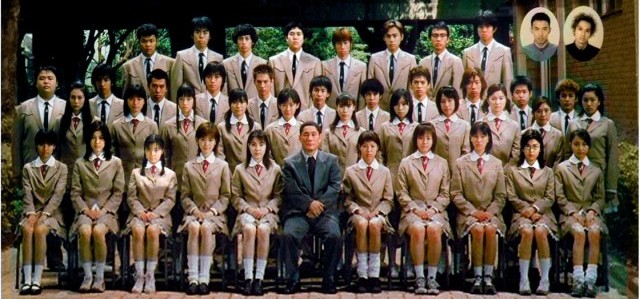
Saturday Matinee: Battle Royale

battleroyale_spotlight-e1293591661834

With the recent release of the Hunger Games sequel, it seems fitting to feature a cult classic that may have been the inspiration for that series: “Battle Royale”. Released in 2000, it was Kinji Fukasaku’s final film, a director previously best known for his “Battles Without Honor and Humanity” series of Yakuza films. Kinji died of cancer shortly after filming the first scene of the sequel, “Battle Royale 2: Requiem”, which was completed by his son Kenta in 2003. Battle Royale takes place in a dystopian society whose government regularly forces a class of high school students to participate in a deathmatch on a small island until just one survivor is left.  Each student is given a bag containing food, water, a compass, a map of the island, and a randomly selected weapon. The students are also outfitted with surveillance collars that can track their movements and detonate if they wander into “danger zones” or refuse to cooperate.

Though the film is at times physically and emotionally brutal, it works effectively as a parable for the way youth are cynically manipulated by society and the different approaches people take dealing with tyranny. When Kinji Fukasaku first read the novel his film was based on, it resonated with him because of traumatic personal experiences. As he related in a Director’s statement for Battle Royale:

I immediately identified with the 9th graders in the novel, Battle Royale. I was fifteen when World War II came to an end. By then, my class had been drafted and was working in a munitions factory.

In July 1945, we were caught up in artillery fire. Up until then, the attacks had been air raids and you had a chance of escaping from those. But with artillery, there was no way out. It was impossible to run or hide from the shells that rained down. We survived by diving for cover under our friends.

After the attacks, my class had to dispose of the corpses. It was the first time in my life I’d seen so many dead bodies. As I lifted severed arms and legs, I had a fundamental awakening … everything we’d been taught in school about how Japan was fighting the war to win world peace, was a pack of lies. Adults could not be trusted.

The emotions I experienced then–an irrational hatred for the unseen forces that drove us into those circumstances, a poisonous hostility towards adults, and a gentle sentimentality for my friends–were a starting point for everything since. This is why, when I hear reports about recent outbreaks of teenage violence and crimes, I cannot easily judge or dismiss them.

This is the point of departure for all my films. Lots of people die in my films. They die terrible deaths. But I make them this way because I don’t believe anyone would ever love or trust the films I make, any other way.

BATTLE ROYALE, my 60th film, returns irrevocably to my own adolescence. I had a great deal of fun working with the 42 teenagers making this film, even though it recalled my own teenage battleground.

Watch the full film here.

The Ocean is Broken

Pacific-garbage-patch-map_2010_noaamdp

A recent article from Australia’s Newcastle Herald has been going viral, and for good reason. It’s a chilling and heartbreaking first-hand account of the state of the Pacific Ocean. These observations in particular depict a hellish scenario:

“After we left Japan, it felt as if the ocean itself was dead,” Macfadyen said.

“We hardly saw any living things. We saw one whale, sort of rolling helplessly on the surface with what looked like a big tumour on its head. It was pretty sickening.

“I’ve done a lot of miles on the ocean in my life and I’m used to seeing turtles, dolphins, sharks and big flurries of feeding birds. But this time, for 3000 nautical miles there was nothing alive to be seen.”

In place of the missing life was garbage in astounding volumes.

“Part of it was the aftermath of the tsunami that hit Japan a couple of years ago. The wave came in over the land, picked up an unbelievable load of stuff and carried it out to sea. And it’s still out there, everywhere you look.”

Ivan’s brother, Glenn, who boarded at Hawaii for the run into the United States, marvelled at the “thousands on thousands” of yellow plastic buoys. The huge tangles of synthetic rope, fishing lines and nets. Pieces of polystyrene foam by the million. And slicks of oil and petrol, everywhere.

Countless hundreds of wooden power poles are out there, snapped off by the killer wave and still trailing their wires in the middle of the sea.

“In years gone by, when you were becalmed by lack of wind, you’d just start your engine and motor on,” Ivan said.

Not this time.

“In a lot of places we couldn’t start our motor for fear of entangling the propeller in the mass of pieces of rope and cable. That’s an unheard of situation, out in the ocean.

“If we did decide to motor we couldn’t do it at night, only in the daytime with a lookout on the bow, watching for rubbish.

“On the bow, in the waters above Hawaii, you could see right down into the depths. I could see that the debris isn’t just on the surface, it’s all the way down. And it’s all sizes, from a soft-drink bottle to pieces the size of a big car or truck.

“We saw a factory chimney sticking out of the water, with some kind of boiler thing still attached below the surface. We saw a big container-type thing, just rolling over and over on the waves.

“We were weaving around these pieces of debris. It was like sailing through a garbage tip.

“Below decks you were constantly hearing things hitting against the hull, and you were constantly afraid of hitting something really big. As it was, the hull was scratched and dented all over the place from bits and pieces we never saw.”

Plastic was ubiquitous. Bottles, bags and every kind of throwaway domestic item you can imagine, from broken chairs to dustpans, toys and utensils.

And something else. The boat’s vivid yellow paint job, never faded by sun or sea in years gone past, reacted with something in the water off Japan, losing its sheen in a strange and unprecedented way.

BACK in Newcastle, Ivan Macfadyen is still coming to terms with the shock and horror of the voyage.

“The ocean is broken,” he said, shaking his head in stunned disbelief.

Read the full article here: http://www.theherald.com.au/story/1848433/the-ocean-is-broken/

Large-scale human over-consumption and toxic waste are undoubtedly major factors contributing to a rash of unusual die-offs of Salmon, Herring, Sardines, Starfish, Dolphins, and others.

Fukushima: The Curse That Keeps on Cursing

david_dees_japanese_tohoku_nuclear_catastrope_radiation_spread

Today The Internet Post brought to my attention a series of updates on Fukushima that paints a grim picture of the scope of ongoing radiation hazards (a story which gets relatively little coverage in corporate news outlets).

On this clip from 10/1, thousands of Japanese are reporting recurring nosebleeds while doctors are forced to keep quiet about suspicions of radiation sickness:

Also, today a new radioactive water leak was found at the Fukushima plant and radioactive Bluefin Tuna was caught off the California coast.

At Energy News, they highlighted these excerpts from an interview with Tetsuro Tsutsui, an engineer of industrial tanks such as the ones used in Fukushima:

[…]the latest problem was emblematic of how TEPCO runs the precarious plant. He said it was “unthinkable” to fill tanks up to the top, or build them on a tilted ground without building a level foundation.

“That’s only common sense,” Tsutsui, also a member of a citizens group of experts proposing safety measures for the plant. “But that seems to be the routine at the Fukushima Dai-ichi. I must say these are not accidents. There must be a systematic problem in the way things are run over there.” […]

“All Wars Are Based on Deception” – Sun Tzu

I’ve been thinking of Sun Tzu’s line from “The Art of War” a lot lately because of the blatant lies about Syria currently being pushed by U.S. government officials and the corporate media. The quote is just as true today as it was in ancient China. Another quote that applies to our current situation is “Those who don’t know history are condemned to repeat it.” (Edmund Burke). There’s much truth to that, but it’s only part of the story. I would add that those who profit most from major historical events such as wars and stock market crashes are motivated to recreate the conditions to repeat them. And those who only learn the winner’s version of history and are ignorant of the truth are more likely to be okay with it and let it happen. That’s why I encourage everyone to read an important article by Michael Rivero called “Fake Terror – The Road to War and Dictatorship”. It outlines how lies and deception were used to start wars from 70 BC Rome to America in the 1990s (though the lying has ramped up quite a bit since then) . Even wars we think of as being “good wars” like World War 2 are not exempt, as explained in this excerpt from the article:

Roosevelt needed an enemy, and if America would not willingly attack that enemy, then one would have to be maneuvered into attacking America, much as Marcus Licinius Crassus has maneuvered Spartacus into attacking Rome.

…The first step was to place oil and steel embargoes on Japan, using Japan’s wars on the Asian mainland as a reason. This forced Japan to consider seizing the oil and mineral rich regions in Indonesia. With the European powers militarily exhausted by the war in Europe, the United States was the only power in the Pacific able to stop Japan from invading the Dutch East Indies, and by moving the Pacific fleet from San Diego to Pearl Harbor, Hawaii, Roosevelt made a pre-emptive strike on that fleet the mandatory first step in any Japanese plan to extend its empire into the “southern resource area”.

…To enrage the American people as much as possible, Roosevelt needed the first overt attack by Japan to be as bloody as possible, appearing as a sneak attack much as the Japanese had done to the Russians. From that moment up until the attack on Pearl Harbor itself, Roosevelt and his associates made sure that the commanders in Hawaii, General Short and Admiral Kimmel, were kept in the dark as much as possible about the location of the Japanese fleet and its intentions, then later scapegoated for the attack. (Congress recently exonerated both Short and Kimmel, posthumously restoring them to their former ranks).

But as the Army board had concluded at the time, and subsequent de-classified documents confirmed, Washington DC knew the attack was coming, knew exactly where the Japanese fleet was, and knew where it was headed.

On November 29th, Secretary of State Hull showed United Press reporter Joe Leib a message with the time and place of the attack, and the New York Times in its special 12/8/41 Pearl Harbor edition, on page 13, reported that the time and place of the attack had been known in advance!

The much repeated claim that the Japanese fleet maintained radio silence on its way to Hawaii was a lie. Among other intercepts still held in the Archives of the NSA is the UNCODED message sent by the Japanese tanker Shirya stating, “proceeding to a position 30.00 N, 154.20 E. Expect to arrive at that point on 3 December.” (near HI)

Read the complete article here: http://whatreallyhappened.com/WRHARTICLES/ARTICLE5/index.php