Saturday Matinee: Ukraine on Fire – The Real Story

A Documentary You’ll Likely Never See

By James DiEugenio

Source: Consortium News

It is not very often that a documentary film can set a new paradigm about a recent event, let alone, one that is still in progress. But the new film Ukraine on Fire has the potential to do so – assuming that many people get to see it.

Usually, documentaries — even good ones — repackage familiar information in a different aesthetic form. If that form is skillfully done, then the information can move us in a different way than just reading about it.

A good example of this would be Peter Davis’s powerful documentary about U.S. involvement in Vietnam, Hearts and Minds. By 1974, most Americans understood just how bad the Vietnam War was, but through the combination of sounds and images, which could only have been done through film, that documentary created a sensation, which removed the last obstacles to America leaving Indochina.

Ukraine on Fire has the same potential and could make a contribution that even goes beyond what the Davis film did because there was very little new information in Hearts and Minds. Especially for American and Western European audiences, Ukraine on Fire could be revelatory in that it offers a historical explanation for the deep divisions within Ukraine and presents information about the current crisis that challenges the mainstream media’s paradigm, which blames the conflict almost exclusively on Russia.

Key people in the film’s production are director Igor Lopatonok, editor Alex Chavez, and writer Vanessa Dean, whose screenplay contains a large amount of historical as well as current material exploring how Ukraine became such a cauldron of violence and hate. Oliver Stone served as executive producer and conducted some high-profile interviews with Russian President Vladimir Putin and ousted Ukrainian President Viktor Yanukovych.

The film begins with gripping images of the violence that ripped through the capital city of Kiev during both the 2004 Orange Revolution and the 2014 removal of Yanukovich. It then travels back in time to provide a perspective that has been missing from mainstream versions of these events and even in many alternative media renditions.

A Longtime Pawn

Historically, Ukraine has been treated as a pawn since the late Seventeenth Century. In 1918, Ukraine was made a German protectorate by the Treaty of Brest Litovsk. Ukraine was also a part of the Molotov-Ribbentrop Pact of 1939 signed between Germany and Russia, but violated by Adolf Hitler when the Nazis invaded the Soviet Union in the summer of 1941.

The reaction of many in Ukraine to Hitler’s aggression was not the same as it was in the rest of the Soviet Union. Some Ukrainians welcomed the Nazis. The most significant Ukrainian nationalist group, Organization of Ukrainian Nationalists (OUN), had been established in 1929. Many of its members cooperated with the Nazis, some even enlisted in the Waffen SS and Ukrainian nationalists participated in the massacre of more than 33,000 Jews at Babi Yar ravine in Kiev in September 1941. According to scholar Pers Anders Rudling, the number of Ukrainian nationalists involved in the slaughter outnumbered the Germans by a factor of 4 to 1.

But it wasn’t just the Jews that the Ukrainian nationalists slaughtered. They also participated in massacres of Poles in the western Ukrainian region of Galicia from March 1943 until the end of 1944. Again, the main perpetrators were not Germans, but Ukrainians.

According to author Ryazard Szawlowksi, the Ukrainian nationalists first lulled the Poles into thinking they were their friends, then turned on them with a barbarity and ferocity that not even the Nazis could match, torturing their victims with saws and axes. The documentary places the number of dead at 36,750, but Szawlowski estimates it may be two or three times higher.

OUN members participated in these slaughters for the purpose of ethnic cleansing, wanting Ukraine to be preserved for what OUN regarded as native Ukrainians. They also expected Ukraine to be independent by the end of the war, free from both German and Russian domination. The two main leaders in OUN who participated in the Nazi collaboration were Stepan Bandera and Mykola Lebed. Bandera was a virulent anti-Semite, and Lebed was rabidly against the Poles, participating in their slaughter.

After the war, both Bandera and Lebed were protected by American intelligence, which spared them from the Nuremburg tribunals. The immediate antecedent of the CIA, Central Intelligence Group, wanted to use both men for information gathering and operations against the Soviet Union. England’s MI6 used Bandera even more than the CIA did, but the KGB eventually hunted down Bandera and assassinated him in Munich in 1959. Lebed was brought to America and addressed anti-communist Ukrainian organizations in the U.S. and Canada. The CIA protected him from immigration authorities who might otherwise have deported him as a war criminal.

The history of the Cold War was never too far in the background of Ukrainian politics, including within the diaspora that fled to the West after the Red Army defeated the Nazis and many of their Ukrainian collaborators emigrated to the United States and Canada. In the West, they formed a fierce anti-communist lobby that gained greater influence after Ronald Reagan was elected in 1980.

Important History

This history is an important part of Dean’s prologue to the main body of Ukraine on Fire and is essential for anyone trying to understand what has happened there since the collapse of the Soviet Union in 1991. For instance, the U.S.-backed candidate for president of Ukraine in 2004 — Viktor Yushchenko — decreed both Bandera and his military assistant Roman Shukhevych, who was also involved in atrocitites, were both named national heroes by Yushchenko.

Bandera, in particular, has become an icon for post-World War II Ukrainian nationalists. One of his followers was Dmytro Dontsov, who called for the birth of a “new man” who would mercilessly destroy Ukraine’s ethnic enemies.

Bandera’s movement was also kept alive by Yaroslav Stetsko, Bandera’s premier in exile. Stetsko fully endorsed Bandera’s anti-Semitism and also the Nazi attempt to exterminate the Jews of Europe. Stetsko, too, was used by the CIA during the Cold War and was honored by Yushchenko, who placed a plaque in his honor at the home where he died in Munich in 1986. Stetsko’s wife, Slava, returned to Ukraine in 1991 and ran for parliament in 2002 on the slate of Yushchenko’s Our Ukraine party.

Stetsko’s book, entitled Two Revolutions, has become the ideological cornerstone for the modern Ukrainian political party Svoboda, founded by Oleh Tyahnybok, who is pictured in the film calling Jews “kikes” in public, which is one reason the Simon Wiesenthal Center has ranked him as one of the most dangerous anti-Semites in the world.

Another follower of Bandera is Dymytro Yarosh, who reputedly leads the paramilitary arm of an even more powerful political organization in Ukraine called Right Sektor. Yarosh once said he controls a paramilitary force of about 7,000 men who were reportedly used in both the overthrow of Yanukovych in Kiev in February 2014 and the suppression of the rebellion in Odessa a few months later, which are both fully depicted in the film.

This historical prelude and its merging with the current civil war is eye-opening background that has been largely hidden by the mainstream Western media, which has downplayed or ignored the troubling links between these racist Ukrainian nationalists and the U.S.-backed political forces that vied for power after Ukraine became independent in 1991.

The Rise of a Violent Right

That same year, Tyahnybok formed Svoboda. Three years later, Yarosh founded Trident, an offshoot of Svoboda that eventually evolved into Right Sektor. In other words, the followers of Bandera and Lebed began organizing themselves immediately after the Soviet collapse.

In this time period, Ukraine had two Russian-oriented leaders who were elected in 1991 and 1994, Leonid Kravchuk, and Leonid Kuchma. But the hasty transition to a “free-market” economy didn’t go well for most Ukrainians or Russians as well-connected oligarchs seized much of the wealth and came to dominate the political process through massive corruption and purchase of news media outlets. However, for average citizens, living standards went down drastically, opening the door for the far-right parties and for foreign meddling.

In 2004, Viktor Yanukovych, whose political base was strongest among ethnic Russians in the east and south, won the presidential election by three percentage points over the U.S.-favored Viktor Yushchenko, whose base was asmostly in the country’s west where the Ukrainian nationalists are strongest.

Immediately, Yushchenko’s backers claimed fraud citing exit polls that had been organized by a group of eight Western nations and four non-governmental organizations or NGOs, including the Renaissance Foundation founded by billionaire financial speculator George Soros. Dick Morris, former President Bill Clinton’s political adviser, clandestinely met with Yushchenko’s team and advised them that the exit polls would not just help in accusations of fraud, but would bring protesters out into the streets. (Cambridge Review of International Affairs, Vol. 19, Number 1, p. 26)

Freedom House, another prominent NGO that receives substantial financing from the U.S.-government-funded National Endowment for Democracy (NED), provided training to young activists who then rallied protesters in what became known as the Orange Revolution, one of the so-called “color revolutions” that the West’s mainstream media fell in love with. It forced an election rerun that Yushchenko won.

But Yushchenko’s presidency failed to do much to improve the lot of the Ukrainian people and he grew increasingly unpopular. In 2010, Yushchenko failed to make it out of the first round of balloting and his rival Yanukovych was elected president in balloting that outside observers judged free and fair.

Big-Power Games

If this all had occurred due to indigenous factors within Ukraine, it could have been glossed over as a young nation going through some painful growing pains. But as the film points out, this was not the case. Ukraine continued to be a pawn in big-power games with many Western officials hoping to draw the country away from Russian influence and into the orbit of NATO and the European Union.

In one of the interviews in Ukraine on Fire, journalist and author Robert Parry explains how the National Endowment for Democracy and many subsidized political NGOs emerged in the 1980s to replace or supplement what the CIA had traditionally done in terms of influencing the direction of targeted countries.

During the investigations of the Church Committee in the 1970s, the CIA’s “political action” apparatus for removing foreign leaders was exposed. So, to disguise these efforts, CIA Director William Casey, Reagan’s White House and allies in Congress created the NED to finance an array of political and media NGOs.

As Parry noted in the documentary, many traditional NGOs do valuable work in helping impoverished and developing countries, but this activist/propaganda breed of NGOs promoted U.S. geopolitical objectives abroad – and NED funded scores of such projects inside Ukraine in the run-up to the 2014 crisis.

Ukraine on Fire goes into high gear when it chronicles the events that occurred in 2014, resulting in the violent overthrow of President Yanukovych and sparking the civil war that still rages. In the 2010 election, when Yushchenko couldn’t even tally in the double-digits, Yanukovych faced off against and defeated Yulia Tymoshenko, a wealthy oligarch who had served as Yushchenko’s prime minister.

After his election, Yanukovych repealed Bandera’s title as a national hero. However, because of festering economic problems, the new president began to search for an economic partner who could provide a large loan. He first negotiated with the European Union, but these negotiations bogged down due to the usual draconian demands made by the International Monetary Fund.

So, in November 2013, Yanukovych began to negotiate with Russian President Putin who offered more generous terms. But Yanukovych’s decision to delay the association agreement with the E.U. provoked street protests in Kiev especially from the people of western Ukraine.

As Ukraine on Fire points out, other unusual occurrences also occurred, including the emergence of three new TV channels – Spilno TV, Espreso TV, and Hromadske TV – going on the air between Nov. 21 and 24, with partial funding from the U.S. Embassy and George Soros.

Pro-E.U. protests in the Maidan square in central Kiev also grew more violent as ultra-nationalist street fighters from Lviv and other western areas began to pour in and engage in provocations, many of which were sponsored by Yarosh’s Right Sektor. The attacks escalated from torch marches similar to Nazi days to hurling Molotov cocktails at police to driving large tractors into police lines – all visually depicted in the film. As Yanukovich tells Stone, when this escalation happened, it made it impossible for him to negotiate with the Maidan crowd.

One of the film’s most interesting interviews is with Vitaliy Zakharchenko, who was Minister of the Interior at the time responsible for law enforcement and the conduct of the police. He traces the escalation of the attacks from Nov. 24 to 30, culminating with a clash between police and protesters over the transport of a giant Christmas tree into the Maidan. Zakharchenko said he now believes this confrontation was secretly approved by Serhiy Lyovochkin, a close friend of U.S. Ambassador Geoffrey Pyatt, as a pretext to escalate the violence.

At this point, the film addresses the direct involvement of U.S. politicians and diplomats. Throughout the crisis, American politicians visited Maidan, as both Republicans and Democrats, such as Senators John McCain, R-Arizona, and Chris Murphy, D-Connecticut. stirred up the crowds. Yanukovych also said he was in phone contact with Vice President Joe Biden, who he claims was misleading him about how to handle the crisis.

The film points out that the real center of American influence in the Kiev demonstrations was with Ambassador Pyatt and Assistant Secretary of State for European Affairs Victoria Nuland. As Parry points out, although Nuland was serving under President Obama, her allegiances were really with the neoconservative movement, most associated with the Republican Party.

Her husband is Robert Kagan, who worked as a State Department propagandist on the Central American wars in the 1980s and was the co-founder of the Project for the New American Century in the 1990s, the group that organized political and media pressure for the U.S. invasion of Iraq in 2003. Kagan also was McCain’s foreign policy adviser in the 2008 presidential election (although he threw his support behind Hillary Clinton in the 2016 race).

Adept Manipulators

As Parry explained, the neoconservatives have become quite adept at disguising their true aims and have powerful allies in the mainstream press. This combination has allowed them to push the foreign policy debate to such extremes that, when anyone objects, they can be branded a Putin or Yanukovych “apologist.”

Thus, Pyatt’s frequent meetings with the demonstrators in the embassy and Nuland’s handing out cookies to protesters in the Maidan were not criticized as American interference in a sovereign state, but were praised as “promoting democracy” abroad. However, as the Maidan crisis escalated, Ukrainian ultra-nationalists moved to the front, intensifying their attacks on police. Many of these extremists were disciples of Bandera and Lebed. By February 2014, they were armed with shotguns and rapid-fire handguns.

On Feb. 20, 2014, a mysterious sniper, apparently firing from a building controlled by the Right Sektor, shot both police and protesters, touching off a day of violence that left about 14 police and some 70 protesters dead.

With Kiev slipping out of control, Yanukovich was forced to negotiate with representatives from France, Poland and Germany. On Feb. 21, he agreed to schedule early elections and to accept reduced powers. At the urging of Vice President Biden, Yanukovych also pulled back the police.

But the agreement – though guaranteed by the European nations – was quickly negated by renewed attacks from the Right Sektor and its street fighters who seized government buildings. Russian intelligence services got word that an assassination plot was in the works against Yanukovych, who fled for his life.

On Feb. 24, Yanukovych asked permission to enter Russia for his safety and the Ukrainian parliament (or Rada), effectively under the control of the armed extremists, voted to remove Yanukovych from office in an unconstitutional manner because the courts were not involved and the vote to impeach him did not reach the mandatory threshold. Despite these irregularities, the U.S. and its European allies quickly recognized the new government as “legitimate.”

Calling a Coup a Coup

But the ouster of Yanukovych had all the earmarks of a coup. An intercepted phone call, apparently in early February, between Nuland and Pyatt revealed that they were directly involved in displacing Yanukovych and choosing his successor. The pair reviewed the field of candidates with Nuland favoring Arseniy Yatsenyuk, declaring “Yats is the guy” and discussing with Pyatt how to “glue this thing.” Pyatt wondered about how to “midwife this thing.” They sounded like Gilded Age millionaires in New York deciding who should become the next U.S. president. On Feb. 27, Yatsenyuk became Prime Minister of Ukraine.

Not everyone in Ukraine agreed with the new regime, however. Crimea, which had voted heavily for Yanukovych, decided to hold a referendum on whether to split from Ukraine and become a part of Russia. The results of the referendum were overwhelming. Some 96 percent of Crimeans voted to unite with Russia. Russian troops – previously stationed in Crimea under the Sevastopol naval base agreement – provided security against Right Sektor and other Ukrainian forces moving against the Crimean secession, but there was no evidence of Russian troops intimidating voters or controlling the elections. The Russian government then accepted the reunification with Crimea, which had historically been part of Russia dating back hundreds of years.

Two eastern provinces, Donetsk and Lugansk, also wanted to split off from Ukraine and also conducted a referendum in support of that move. But Putin would not agree to the request from the two provinces, which instead declared their own independence, a move that the new government in Kiev denounced as illegal. The Kiev regime also deemed the insurgents “terrorists” and launched an “anti-terrorism operation” to crush the resistance. Ultra-nationalist and even neo-Nazi militias, such as the Azov Battalion, took the lead in the bloody fighting.

Anti-coup demonstrations also broke out in the city of Odessa to the south. Ukrainian nationalist leader Andrei Parubiy went to Odessa, and two days later, on May 2, 2014, his street fighters attacked the demonstrators, driving them into the Trade Union building, which was then set on fire. Forty-two people were killed, some of whom jumped to their deaths.

‘Other Side of the Story’

If the film just got across this “other side of the story,” it would provide a valuable contribution since most of this information has been ignored or distorted by the West’s mainstream media, which simply blames the Ukraine crisis on Vladimir Putin. But in addition to the fine work by scenarist Vanessa Dean, the direction by Igor Lopatonok and the editing by Alexis Chavez are extraordinarily skillful and supple.

The 15-minute prologue, where the information about the Nazi collaboration by Bandera and Lebed is introduced, is an exceptional piece of filmmaking. It moves at a quick pace, utilizing rapid cutting and also split screens to depict photographs and statistics simultaneously. Lopatonok also uses interactive graphics throughout to transmit information in a visual and demonstrative manner.

Stone’s interviews with Putin and Yanukovych are also quite newsworthy, presenting a side of these demonized foreign leaders that has been absent in the propagandistic Western media.

Though about two hours long, the picture has a headlong tempo to it. If anything, it needed to slow down at points since such a large amount of information is being communicated. On the other hand, it’s a pleasure to watch a documentary that is so intelligently written, and yet so remarkably well made.

When the film ends, the enduring message is similar to those posed by the American interventions in Vietnam and Iraq. How could the State Department know so little about what it was about to unleash, given Ukraine’s deep historical divisions and the risk of an escalating conflict with nuclear-armed Russia?

In Vietnam, Americans knew little about the country’s decades-long struggle of the peasantry to be free from French and Japanese colonialism. Somehow, America was going to win their hearts and minds and create a Western-style “democracy” when many Vietnamese simply saw the extension of foreign imperialism.

In Iraq, President George W. Bush and his coterie of neocons was going to oust Saddam Hussein and create a Western-style democracy in the Middle East, except that Bush didn’t know the difference between Sunni and Shiite Moslems and how Iraq was likely to split over sectarian rivalries and screw up his expectations.

Similarly, the message of Ukraine on Fire is that short-sighted, ambitious and ideological officials – unchecked by their superiors – created something even worse than what existed. While high-level corruption persists today in Ukraine and may be even worse than before, the conditions of average Ukrainians have deteriorated.

And, the Ukraine conflict has reignited the Cold War by moving Western geopolitical forces onto Russia’s most sensitive frontier, which, as scholar Joshua Shifrinson has noted, violates a pledge made by Secretary of State James Baker in February 1990 as the Soviet Union peacefully accepted the collapse of its military influence in East Germany and eastern Europe. (Los Angeles Times, 5/30/ 2016)

This film also reminds us that what happened in Ukraine was a bipartisan effort. It was begun under George W. Bush and completed under Barack Obama. As Oliver Stone noted in the discussion that followed the film’s premiere in Los Angeles, the U.S. painfully needs some new leadership reminiscent of Franklin Roosevelt and John Kennedy, people who understand how America’s geopolitical ambitions must be tempered by on-the-ground realities and the broader needs of humanity to be freed from the dangers of all-out war.

James DiEugenio is a researcher and writer on the assassination of President John F. Kennedy and other mysteries of that era. His most recent book is Reclaiming Parkland.
The truth about « fake news »

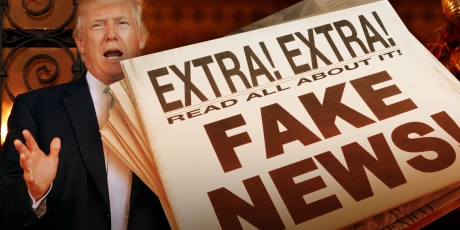
While NATO was busy setting up a vast network with which to accuse Russia of perpetuating propaganda from the Soviet era, Washington was suddenly swamped by a wave of hysteria. In an attempt to discredit the new US President, the dominant media accuse him of talking rubbish – in response, the President accuses them of propagating fake news. This cacophony is amplified by the swift development of the social media, which had once been intended for use as weapons of the State Department against nationalist regimes, but which today are popular forums used to combat abuse by all kinds of elites – with Washington at the top of the list.

By Thierry Meyssan

Source: Voltaire Network

As soon as the announcement of his surprise election was made public, and even before he had access to the White House, the immense majority of US and NATO media began screaming about the negligence and insanity of President Trump. Battle was joined between the media class and the new President, with each side accusing the other of propagating fake news.

Almost everywhere in the NATO countries – and only in these countries – political representatives began denouncing fake news. This was intended to reveal the supposed influence of Russian propaganda within the « Western democracies ». The State which has been the most seriously impacted by this campaign is France, whose President Emmanuel Macron recently announced the drafting of a law specifically aimed at fighting these « attacks on democracy », but only during « an electoral period ».

The fact that the English expression fake news is maintained in all the languages of the NATO countries attests to the Anglo-Saxon origin of the problem, when in fact the phrase designates a phenomenon as old as the world – false information.

At the origin of the campaign against « fake news » – NATO

In 2009, at the NATO summit in Strasbourg-Kehl, President Obama announçed his intention of creating an Alliance « Strategic Communication » service [1]. It took six years to implement, using elements of the 77th Brigade of the British Land Army and the 361st Civil Affairs Brigade of the United States Land Army (based in Germany and Italy).

At first, their mission was to counter communications accusing the US deep state of having itself organised the attacks of 9/11, then those accusing the Anglo-Saxons of having planned the « Arab Springs » and the war against Syria — such communications were termed « conspiracy theories ». However, the situation evolved rapidly in such a way as to convince the populations of the Alliance that Russia was continuing to apply propaganda from the Soviet era – and thus that NATO was still useful.

Finally, in April 2015, the European Union created a « Work Group for Strategic Communications – East » (East StratCom Task Force). Every week, this group addresses a report on Russian propaganda to thousands of journalists. For example, its last edition (dated 11 January 2018) accuses Sputnik of pretending that the Copenhagen zoo feeds its predators with abandoned household pets. Lord help us, the « democracies » are under attack ! Clearly, it is difficult for these specialists to find meaningful examples of Russian interference. In August of the same year, NATO inaugurated its « Centre for Strategic Communication » in Riga (Latvia). The following year, the US State Department created a Global Engagement Center which works on the same principles.

How Facebook, Hillary Clinton’s pet obsession, turned against her

In 2009, Secretary of State Hillary Clinton, at the instigation of Jared Cohen (leading member of the Policy Planning Staff ), persuaded herself that it was possible to overthrow the Islamic Republic of Iran by manipulating the social media. This theory did not have the desired affect. However, two years later, in 2011, the same Jared Cohen — since become the the CEO of Google Ideas — managed to mobilise the youth of Cairo. Although the « revolution » of Tahrir Square had not swayed the opinion of the Egyptian people, the myth of the extension of the American way of life via Facebook was born. As a result, the State Department sponsored a number of associations and assemblies to promote Facebook.

However, the US Presidential election of 2016 was a shock. An outsider, real estate promoter Donald Trump, eliminated all his rivals one by one, including Hillary Clinton, and was swept into the White House, having benefited from the advice of Facebook. For the first time, the dream of the Muse of professional politicians became reality, but worked against her. Overnight, Facebook was demonised by the dominant Press.

It became evident on this occasion that it is possible to artificially create crowd movements with the social media, but that after a few days, media users regain their senses. This is the constant fact for all systems of information manipulation — they are fleeting. The only form of lie which makes it possible to create long-term behaviour patterns supposes that one has forced the citizens into a form of minor engagement, in other words, that one has brainwashed them [2].

Indeed, Facebook understood this very well, creating its « Politics & Government Outreach Program » and handing it over to the care of Katie Harbath. It was intended to create collective emotions in favour of one client or another, but does not seek to organise lasting campaigns [3]. This is why President Macron proposes to legislate the social media only during electoral periods. He was himself elected thanks to a brief disorder created jointly by a weekly newspaper and Facebook against his rival François Fillon — an operation orchestrated by Jean-Pierre Jouyet [4]. Furthermore, Emmanuel Macron’s fear that next time the social media may be used against him fits with NATO’s desire to demonstrate the continuity of USSR-Russia propaganda. As an example of manipulation, Macron therefore cites an interview with Sputnik concerning his private life and the publishing of an allegation concerning a foreign bank account.

The Christopher Steele Report

During the US Presidential campaign, Hillary Clinton’s team ordered an inquiry on Donald Trump from an ex-agent of the British Secret Services, Christopher Steele. Ex-chief of MI6’s « Russia House », he was known for his scandalous and always unverifiable allegations. After having accused Vladimir Putin, without proof, of having commanded the poisoning of Alexander Litvinenko by Polonium 210, he accused him of having caught Donald Trump in a sex trap and blackmailing him. The Steele Report was then discretely handed to various journalists, politicians and master spies, and finally published [5].

This is the source of the hypothesis according to which, seeking to get his puppet elected and hamper the election of Hillary Clinton, the lord of the Kremlin had ordered « his » media to buy publicity on Facebook and spread lies about the ex-Secretary of State – a hypothesis which may be supported by a conversation between the Australian ambassador in London with one of Donald trump’s advisors [6]. It doesn’t matter that Russia Today and Sputnik only spent a total of a few thousand dollars for publicity which rarely concerned Mrs. Clinton, the US ruling class is persuaded that they turned back the popular tide in favour of the Democrat candidate and her 1.2 billion dollar campaign. In Washington, people persist in believing that technological inventions can be used to manipulate the human race.

It is no longer a question of noting that Donald Trump and his partisans ran their campaign on Facebook because the totality of the written and audiovisual Press was hostile to them, but pretending that Facebook was manipulated by Russia in order to prevent the election of the Muse of Washington.

The legal privilege of Google, Facebook and Twitter

By seeking to prove the interference of Moscow, the US Press underlined the exorbitant privilege enjoyed by Google, Facebook and Twitter — these three companies are not considered responsible for their content. From the point of view of US law, they are no more than transporters of information (common carrier).

The experiments carried out by Facebook, which demonstrated the possibility of creating collective emotions on one hand, and the legal non-responsibility of this company on the other, attest to an anomaly in the system.

Particularly since the privilege enjoyed by Google, Facebook and Twitter is clearly undue. Indeed, these three companies act in at least two different ways to modify the content they transport. First of all, they unilaterally censor certain messages, either via the direct intervention of their personnel, or mechanically, via hidden algorithms. Then they promote their vision of the truth to the detriment of other points of view (fact-checking).

For example, in 2012, Qatar ordered from Google Ideas, already directed by Jared Cohen, the creation of software which would make it possible to follow the progression of defections in the Syrian Arab Army. The point was to show that Syria was indeed a dictatorship, and that the people were beginning to revolt. But it very quickly became clear that this vision of affairs was false. The number of soldiers who defected never rose above 25,000 in an army of 450,000 men. This is why, after having promoted the software, Google discretely retired it.

Conversely, for seven years, Google promoted articles which relayed communiqués from the Syrian Observatory for Human Rights (SOHD). Day after day, they gave the exact count of the number of victims in both camps. Of course, these figures are imaginary – it is impossible for anyone to count them. Never, in a time of war, has a state been able to determine, on a daily basis, the number of soldiers killed in combat and the civilians killed behind the lines. And yet, in the United Kingdom, the SOHD claims to know what the people who live there, in Syria, cannot know.

Far from being just the common carriers, Google, Facebook and Twitter are the forgers of the information they transport, and as such, they ought to be counted legally responsible for their content.

The rules of the freedom of expression

Let’s imagine that the efforts of NATO and those of President Macron against Russia in terms of audiovisual Internet traffic meet with failure. It is nonetheless necessary to enter these new medias into general law.

The principles which regulate the freedom of expression are only legitimate if they are identical for all citizens and for all media. This is not the case today. While the general law applies, there is no specific rule concerning denial or the right to reply for the messages on Internet and the social media.

As always in the history of information, the old medias attempt to sabotage the new. Thus I remember the violent editorial that the French daily Le Monde dedicated in 2002 to my work on the Internet concerning the responsibility for the attacks of 9/11. What shocked the newspaper just as much as my conclusions was that the Voltaire Network was free from the financial obligations of which it felt prisoner [7]. This is the same corporatist attitude that it demonstrates again, fifteen years later, with its service, Le Decodex. Rather than developing a critique of the articles or videos of the new medias, Le Monde proposes to note the reliability of its rival Internet sites. Of course, only the sites issued by their paper colleagues find grace in their eyes, all the others are judged less trustworthy.

To shore up the campaign against the social media, the Fondation Jean-Jaures (that is to say the foundation of the Socialist Party linked to the National Endowment for Democracy) has published an imaginary poll [8]. With a display of numbers, it aims to demonstrate that unsophisticated people – the working classes and the partisans of the National Front – are gullible. It claims that 79 % of French people believe in one conspiracy theory or another. As proof of their naïveté, it points out that 9 % of them are convinced that the Earth is flat.

However, neither myself nor any of my French friends consulted by Internet have ever met any of our compatriots who believe that the Earth is flat. The figure is obviously invented and discredits the entire study. As it happens, although it is linked to the Socialist Party, the Fondation Jean-Jaures still has Gerard Collomb as its general secretary – Collomb has since become President Macron’s Minister for the Interior. This same foundation had already published, two years ago, a study aimed at discrediting the political opponents of the system that it already qualified as « conspiracy theorists » [9].


Translation
Pete Kimberley


Financial Tyranny: ‘We the People’ Are the New Permanent Underclass in America

By John W. Whitehead

Source: The Rutherford Institute

“When plunder becomes a way of life for a group of men in a society, over the course of time they create for themselves a legal system that authorizes it and a moral code that glorifies it.” ― Frédéric Bastiat, French economist

Americans can no longer afford to get sick and there’s a reason why.

That’s because a growing number of Americans are struggling to stretch their dollars far enough to pay their bills, get out of debt and ensure that if and when an illness arises, it doesn’t bankrupt them.

This is a reality that no amount of partisan political bickering can deny.

Many Americans can no longer afford health insurance, drug costs or hospital bills. They can’t afford to pay rising healthcare premiums, out-of-pocket deductibles and prescription drug bills.

They can’t afford to live, and now they can’t afford to get sick or die, either.

To be clear, my definition of “affordable healthcare” is different from the government’s. To the government, you can “afford” to pay for healthcare if your income falls above the poverty line. That takes no account of rising taxes, the cost of living, the cost to clothe and feed a household, the cost of transportation and communication and education, or any of the other line items that add up to a life worth living.

As Helaine Olen points out in The Atlantic:

Just because a person is insured, it doesn’t mean he or she can actually afford their doctor, hospital, pharmaceutical, and other medical bills. The point of insurance is to protect patients’ finances from the costs of everything from hospitalizations to prescription drugs, but out-of-pocket spending for people even with employer-provided health insurance has increased by more than 50 percent since 2010.”

For too many Americans, achieving any kind of quality of life has become a choice between putting food on the table and paying one’s bills or health care coverage.

It’s a gamble any way you look at it, and the medical community is not helping.

Healthcare costs are rising, driven by a medical, insurance and pharmaceutical industry that are getting rich off the sick and dying.

Indeed, Americans currently pay $3.4 trillion a year for medical care. We spent more than $10,000 per person on health care in 2016. Those attempting to shop for health insurance coverage right now are understandably experiencing sticker shock with premiums set to rise 34% in 2018. It’s estimated that costs may rise as high as $15,000 by 2023.

As Bloomberg reports, “Rising health-care costs are eating up the wage gains won by American workers, who are being asked by their employers to pick up more of the heftier tab… The cost of buying health coverage at work has increased faster than wages and inflation for years, pressuring household budgets.”

Appallingly, Americans spend more than any developed country on healthcare and have less to show for it. We don’t live as long, we have higher infant mortality rates, we have fewer hospital and physician visits, and the quality of our healthcare is generally worse. We also pay astronomical amounts for prescription drugs, compared to other countries.

Whether or not you’re insured through an employer, the healthcare marketplace, a government-subsidized program such as Medicare or Medicaid, or have no health coverage whatsoever, it’s still “we the consumers” who have to pay to subsidize the bill whenever anyone gets sick in this country. And that bill is a whopper.

While Obamacare (a.k.a. the Affordable Care Act) may have made health insurance more accessible to greater numbers of individuals, it has failed to make healthcare any more affordable.

Why?

As journalist Laurie Meisler concludes, “One big reason U.S. health care costs are so high: pharmaceutical spending. The U.S. spends more per capita on prescription medicines and over-the-counter products than any other country.”

One investigative journalist spent seven months analyzing hundreds of bills from hospitals, doctors, drug companies, and medical equipment manufacturers. His findings confirmed what we’ve known all along: health care in America is just another way of making corporations rich at consumer expense.

An examination of an itemized hospital bill (only available upon request) revealed an amazing amount of price gouging. Tylenol, which you can buy for less than $10 for a bottle, was charged to the patient at a rate of $15 per pill, for a total of $345 for a hospital stay. $8 for a plastic bag to hold the patient’s personal items and another $8 for a box of Kleenex. $23 for a single alcohol swab. $53 per pair for non-sterile gloves (adding up to $5,141 for the entire hospital stay). $10 for plastic cup in which to take one’s medicine. $93 for the use of an overhead light during a surgical procedure. $39 each time you want to hold your newborn baby. And $800 for a sterile water IV bag that costs about a dollar to make.

This is clearly not a problem that can be remedied by partisan politics.

The so-called Affordable Care Act pushed through by the Obama administration is proving to be anything but affordable for anyone over the poverty line. And the Trump administration’s “fixes” promise to be no better. Indeed, for too many Americans who live paycheck to paycheck and struggle just to get by, the tax penalty for not having health insurance will actually be cheaper than trying to find affordable coverage that actually pays for care.

This is how the middle classes, who fuel the nation’s economy and fund the government’s programs, get screwed repeatedly.

When almost 60% of Americans are so financially strapped that they don’t have even $500 in savings and nothing whatsoever put away for retirement, and yet they are being forced to pay for government programs that do little to enhance their lives, we’re not living the American dream.

We’re living a financial nightmare.

We have no real say in how the government runs, or how our taxpayer funds are used, but that doesn’t prevent the government from fleecing us at every turn and forcing us to pay for endless wars that do more to fund the military industrial complex than protect us, pork barrel projects that produce little to nothing, and a police state that serves only to imprison us within its walls.

We have no real say, but we’re being forced to pay through the nose, anyhow.

George Harrison, who died 16 years ago this month, summed up this outrageous state of affairs in his song Taxman:

If you drive a car, I’ll tax the street,
If you try to sit, I’ll tax your seat.
If you get too cold I’ll tax the heat,
If you take a walk, I’ll tax your feet.

Don’t ask me what I want it for
If you don’t want to pay some more
‘Cause I’m the taxman, yeah, I’m the taxman

Now my advice for those who die
Declare the pennies on your eyes
‘Cause I’m the taxman, yeah, I’m the taxman
And you’re working for no one but me.

In other words, in the eyes of the government, “we the people, the voters, the consumers, and the taxpayers” are little more than indentured servants and sources of revenue.

If you have no choice, no voice, and no real options when it comes to the government’s claims on your property and your money, you’re not free.

Consider: The government can seize your home and your car (which you’ve bought and paid for) over nonpayment of taxes. Government agents can freeze and seize your bank accounts and other valuables if they merely “suspect” wrongdoing. And the IRS insists on getting the first cut of your salary to pay for government programs over which you have no say.

It wasn’t always this way, of course.

Early Americans went to war over the inalienable rights described by philosopher John Locke as the natural rights of life, liberty and property.

It didn’t take long, however—a hundred years, in fact—before the American government was laying claim to the citizenry’s property by levying taxes to pay for the Civil War. As the New York Times reports, “Widespread resistance led to its repeal in 1872.”

Determined to claim some of the citizenry’s wealth for its own uses, the government reinstituted the income tax in 1894. Charles Pollock challenged the tax as unconstitutional, and the U.S. Supreme Court ruled in his favor. Pollock’s victory was relatively short-lived. Members of Congress—united in their determination to tax the American people’s income—worked together to adopt a constitutional amendment to overrule the Pollock decision.

On the eve of World War I, in 1913, Congress instituted a permanent income tax by way of the 16th Amendment to the Constitution and the Revenue Act of 1913. Under the Revenue Act, individuals with income exceeding $3,000 could be taxed starting at 1% up to 7% for incomes exceeding $500,000.

It’s all gone downhill from there.

Unsurprisingly, the government has used its tax powers to advance its own imperialistic agendas and the courts have repeatedly upheld the government’s power to penalize or jail those who refused to pay their taxes.

Irwin A. Schiff was one of the nation’s most vocal tax protesters. He spent a good portion of his life arguing that the income tax was unconstitutional. He paid the price for his resistance, too: Schiff served three separate prison terms (more than 10 years in all) over his refusal to pay taxes. He died at the age of 87 serving a 14-year prison term. As constitutional activist Robert L. Schulz noted in Schiff’s obituary, “In a society where there is so much fear of government, and in particular of the I.R.S., [Schiff] was probably the most influential educator regarding the illegal and unconstitutional operation and enforcement of the Internal Revenue Code. It’s very hard to speak to power, but he did, and he paid a very heavy price.”

It’s still hard to speak to power, and those who do are still paying a very heavy price.

All the while the government continues to do whatever it likes—levy taxes, rack up debt, spend outrageously and irresponsibly—with little thought for the plight of its citizens.

The national debt is $20 trillion and growing. The amount this country owes is now greater than its gross national product (all the products and services produced in one year by labor and property supplied by the citizens). We’re paying more than $270 billion just in interest on that debt annually. And the top two foreign countries who “own” our debt are China and Japan.

To top it all off, all of those wars the U.S. is so eager to fight abroad are being waged with borrowed funds. As The Atlantic reports, “For 15 years now, the United States has been putting these wars on a credit card… U.S. leaders are essentially bankrolling the wars with debt, in the form of purchases of U.S. Treasury bonds by U.S.-based entities like pension funds and state and local governments, and by countries like China and Japan.”

If Americans managed their personal finances the way the government mismanages the nation’s finances, we’d all be in debtors’ prison by now.

Still, the government remains unrepentant, unfazed and undeterred in its money grabs.

While we’re struggling to get by, and making tough decisions about how to spend what little money actually makes it into our pockets after the federal, state and local governments take their share (this doesn’t include the stealth taxes imposed through tolls, fines and other fiscal penalties), the police state is spending our hard-earned tax dollars to further entrench its powers and entrap its citizens.

For instance, American taxpayers have been forced to shell out $5.6 trillion since 9/11 for the military industrial complex’s costly, endless so-called “war on terrorism.” That translates to roughly $23,000 per taxpayer to wage wars abroad, occupy foreign countries, provide financial aid to foreign allies, and fill the pockets of defense contractors and grease the hands of corrupt foreign dignitaries.

Mind you, that staggering $6 trillion is only a portion of what the Pentagon spends on America’s military empire.

That price tag keeps growing, too.

The 16-year war in Afghanistan, which now stands as the longest and one of the most expensive wars in U.S. history, is about to get even longer and more costly, thanks to President Trump’s promise to send more troops over.

In this way, the military industrial complex will get even richer, and the American taxpayer will be forced to shell out even more funds for programs that do little to enhance our lives, ensure our happiness and well-being, or secure our freedoms.

As Dwight D. Eisenhower warned in a 1953 speech:

Every gun that is made, every warship launched, every rocket fired signifies, in the final sense, a theft from those who hunger and are not fed, those who are cold and are not clothed. This world in arms is not spending money alone. It is spending the sweat of its laborers, the genius of its scientists, the hopes of its children. The cost of one modern heavy bomber is this: a modern brick school in more than 30 cities. It is two electric power plants, each serving a town of 60,000 population. It is two fine, fully equipped hospitals. It is some fifty miles of concrete pavement. We pay for a single fighter plane with a half million bushels of wheat. We pay for a single destroyer with new homes that could have housed more than 8,000 people. This is, I repeat, the best way of life to be found on the road the world has been taking. This is not a way of life at all, in any true sense. Under the cloud of threatening war, it is humanity hanging from a cross of iron. […] Is there no other way the world may live?

This is still no way of life.

Yet it’s not just the government’s endless wars that are bleeding us dry.

We’re also being forced to shell out money for surveillance systems to track our movements, money to further militarize our already militarized police, money to allow the government to raid our homes and bank accounts, money to fund schools where our kids learn nothing about freedom and everything about how to comply, and on and on.

Are you getting the picture yet?

The government isn’t taking our money to make our lives better. Just take a look at the nation’s failing infrastructure, and you’ll see how little is being spent on programs that advance the common good.

We’re being robbed blind so the governmental elite can get richer.

This is nothing less than financial tyranny.

“We the people” have become the new, permanent underclass in America.

It’s tempting to say that there’s little we can do about it, except that’s not quite accurate.

There are a few things we can do (demand transparency, reject cronyism and graft, insist on fair pricing and honest accounting methods, call a halt to incentive-driven government programs that prioritize profits over people), but it will require that “we the people” stop playing politics and stand united against the politicians and corporate interests who have turned our government and economy into a pay-to-play exercise in fascism.

We’ve become so invested in identity politics that label us based on our political leanings that we’ve lost sight of the one label that unites us: we’re all Americans.

As I make clear in my book Battlefield America: The War on the American People, the powers-that-be want to pit us against one another. They want us to adopt an “us versus them” mindset that keeps us powerless and divided. Trust me, the only “us versus them” that matters anymore is “we the people” against the police state.

We’re all in the same boat, folks, and there’s only one real life preserver: that’s the Constitution and the Bill of Rights.

The Constitution starts with those three powerful words: “We the people.”

The message is this: there is power in our numbers.

That remains our greatest strength in the face of a governmental elite that continues to ride roughshod over the populace. It remains our greatest defense against a government that has claimed for itself unlimited power over the purse (taxpayer funds) and the sword (military might). As Patrick Henry declared in the last speech before his death, “United we stand, divided we fall. Let us not split into factions … or … exhaust [our strength] in civil commotions and intestine wars.”

This holds true whether you’re talking about health care, war spending, or the American police state.

‘New World Order’ is falling apart

By Wayne Madsen

Source: Intrepid Report

One of the more welcomed outcomes of the paring back of the U.S. State Department bureaucracy is the elimination of scores of “status quo enthusiasts.” Since the end of World War II, the State Department’s ranks have been populated by foreign service officers and career diplomats who have championed the international status quo.

These minions of Foggy Bottom received encouragement for their protective stance on post-World War II and the Cold War in President George H. W. Bush’s speech on September 11, 1990, which was titled, “Toward a New World Order.” Under the “new world order,” regional and global security concerns would supplant democratic independence movements. The immediate effect of this “order” was brutal crackdowns on secession in the periphery of the former Soviet Union, including Abkhazia, South Ossetia, Nagorno-Karabakh, Transnistria, as well as in Somalia, the Kurdish regions of Iraq and Turkey, East Timor, Sudan, and Ethiopia. However, in Yugoslavia, which the United States and European Union wanted to see dissolved, secessionists in seven constituent states were encouraged to secede from the federation. That resulted in the bloodiest military conflicts in Europe since World War II.

Leaders of secessionist groups visiting Washington were traditionally shunned by the State Department. These hapless would-be presidents and prime ministers would be lucky to meet with a low-ranking State Department employee. However, if their independence movements were championed by the Central Intelligence Agency, they would get red carpet treatment. Such was the case with Secretary of State Madeleine Albright’s favorite Balkans “toy boy,” Hashim Thaci, the leader of the terrorist Kosovo Liberation Army and now president of the Republic of Kosovo, which was carved out of Serbia but is still unrecognized by many of the world’s most important nations, including China and Russia.

Today, one of the most-commonly seen words in State Department Country Desk reports is “secession.” In the past, State Department senior bureaucrats would be raising this development with the secretary of state as a major threat to U.S. interests. The CIA would then be instructed to remedy the situation by providing intelligence support to the countries where secessionist activity was a rising problem. “Support” would range from intelligence assistance to full-blown military aid.

As the United States recedes from the “world’s only superpower” status, to the chagrin of neoconservatives who are pouring into the Donald Trump administration in order to right the capsizing ship-of-state, secessionist activity is seen from the streets of Catalonia, which recently re-elected a pro-independence parliament, to virtual city-states in Mexico, which are increasingly going it alone to offset the breakdown in federal security and law enforcement support.

In the secessionist-minded Republika Srpska, a restive constituent region of the Bosnia-Herzegovina federation, Serbian nationalists have held a banned “statehood” celebration in the regional capital of Banja Luka. Srpska President Milorad Dodik demanded more autonomy for his region, declaring there were two Serbian states, Serbia and Republika Srpska. Present at the banned event were Serbian Defense Minister Aleksandar Vulin, Interior Minister Nebojsa Stefanovic, and former Serbian President Tomislav Nikolic. Joining them was Anatoly Bibilov, the president of the breakaway Republic of the Republic of South Ossetia–the State of Alania in the Caucasus region.

To the consternation of Eurocrats in Brussels and in the Balkans, also in attendance was Aleksandar Karadjordjevic and his wife, the heirs presumptive to the throne of the former Yugoslavia, and Johann Gudenus, the chairman of the Austrian Freedom Party (FPO), which makes up half of the governing coalition of Austria. Dodik awarded a Republika Srpska medal to Austrian Vice-Chancellor Hans Christian Strache, the leader of the FPO faction in the Austrian government. In the past, such an international outpouring of support for a secessionist-minded republic would have resulted in a flurry of diplomatic protests and démarches from the State Department.

After a recent election returned a coalition of pro-independence Catalonian parties to a majority of 70 seats in the Catalonian 135-seat parliament, the neofascist Madrid government of Mariano Rajoy has been put into a quandary. The Catalonian parliament has re-elected former Catalonian President Carles Puigdemont, who was removed by Rajoy after an October 1, 2017, referendum that favored independence. Puigdemont, who is in self-exile in Belgium, where he has the support of the powerful Flemish pro-independence party, faces arrest by the Madrid regime if he returns to Catalonia. The thuggish reaction by the Rajoy regime has engendered sympathy for the Catalonian cause in other secessionist-minded regions of Spain, including the Basque region, Valencia, and Galicia, and around the world.

The case of Catalonia has resulted in popular blowback against Spain from other parts of Europe, including Scotland, which is demanding a second referendum on independence upon Britain’s exit from the European Union. Support for continued membership in the EU has also increased demands for independence from Wales and Northern Ireland in the United Kingdom.

Taking a cue from the Madrid government, Nigerian authorities recently arrested Cameroonian Anglophone secessionist movement leader Sessekou Julius Ayuk Tabe, along with some of his aides, in the Nigerian capital of Abuja. The arrests came after Cameroon accused Nigeria of harboring supporters of the breakaway region of Ambazonia on the Nigerian side of the border. French-speaking Cameroon considers the English-speaking secessionist movement to be a “terrorist” organization, the usual appellation assigned by Third World dictatorships to pro-democracy groups and movements.

The newly-inaugurated president of Somaliland, Muse Bihi Abdi, was received with full diplomatic honors on his first trip abroad to neighboring Djibouti. What makes this newsworthy is that no country has formally recognized Somaliland’s self-declared independence from Somalia, even though the country has been independent for 19 years. Somaliland, which has its own currency and issues its own passports, maintains an effective government as compared to that of Somalia’s. In the past, Djibouti’s full honors for the Somaliland president would have resulted in a curt diplomatic note from the U.S. embassy in Djibouti for extending de facto recognition of Somaliland. There is now a scramble for military and political influence in the Horn of Africa by the United States, China, France, Turkey, Germany, Russia, Japan, Britain, the United Arab Emirates, Iran, Saudi Arabia, Egypt, and Qatar.

The UAE sees Somaliland and a restored independent South Yemen as in its national interests, hence, the oil-rich federation is establishing de facto bases in Somaliland’s port of Berbera, the Yemeni island of Socotra in the Gulf of Aden, and two key Yemeni islands in the Red Sea: Perim and Kamaran. In the past, the United States, which always wanted Socotra for its own military use, merely because it was once a Soviet intelligence base, would have threatened Yemen and the UAE with reprisals. However, Yemen is a failed state and the UAE is now overshadowing American influence in the Red Sea/Gulf of Aden region.

In Mexico, the town of Tancítaro, which lies deep within the drug cartel-controlled state of Michoacán, has decided to establish a de facto city-state. The “avocado capital of the world” is now governed by a “junta,” which is backed by wealthy avocado growers who have hired their own security force to contend with the narco-gangs. Similar quasi-city states have been established in Monterrey, where local businesses have taken over security duties from corrupt police, and Ciudad Nezahualcóуotl (or “Neza”), outside of Mexico City, where the local leftist administration has established its control over the local police, monitoring their every activity for corruption or human rights abuses.

The Algerian government has decided, after years of opposition, to acceding to some of the demands of the minority Berber Kabylie Independence Movement. Amazigh, the Berber language, is now an official language of Algeria. Algeria now celebrates January 12 as Yennayer, the Amazigh New Year. An Amazigh language academy is now planned in Algeria. In the past, the U.S. State Department, influenced by U.S. oil and gas firms active in southern Algeria, would have been aghast at concessions by the Algerian government to Berber nationalists. In what worries Spain, Amazigh is now the third most widely spoken language in Catalonia, after Spanish and Catalan. The Catalans and Amazigh share common ancient roots that have manifested themselves in modern cooperation to advance their statehood goals.

In India, some “scheduled tribals,” the name assigned by the government to indigenous tribal groups, are examining historical documents between British colonial officials and their own past leaders and are discovering they have every right to independence from India. Indian police recently arrested for “sedition” the 83-year-old Ramo Birua, from a village in Jharkhand state, because he called for the raising of the flag of an independent Kolhan state. Birua and his followers cited the rule imposed in 1837 by the British Agent for Kolhan region, Sir Thomas Wilkinson. The “Wilkinson Rule” stipulated that the existing civil and criminal laws of tribal states would be recognized by the British authorities. India’s independence did nothing to change the Wilkinson Rule, thus, “scheduled tribes” across India have a legal right to go their own way. In the case of Mr. Birua, he claims his tribe’s right to sovereignty is ensured by British Queen Elizabeth II, as the heir to Queen Victoria, the British monarch whose royal imprimatur was conferred upon the Wilkinson Rule.

Even within the United States, there is talk of “autonomy” by states from federal intrusions. Colorado is prepared to fight the Trump administration’s stated crack down on marijuana sales. In Colorado and other states that have legalized marijuana, Democratic and Republican officials are prepared to fight the Drug Enforcement Administration in any moves against their legalized medical and recreational marijuana industries. The same applies to federal authority to conduct offshore oil exploration and drilling. California, which has also declared its independence from Trump’s withdrawal from the Paris Climate Accord, is standing opposed to drilling in its Pacific waters. Florida successfully persuaded Trump to exempt it from the drilling order, however, Virginia, North Carolina, and other states are seeking similar exemptions. Other matters that are driving states’ rights rebellions against Washington are in the areas of immigration, federal land use, engine emissions standards, voting rights, health care, and public education. Puerto Rico and the U.S. Virgin Islands, abandoned by Washington after repeated hurricane disasters, are subtly re-evaluating their previous opposition to independence.

The demise of neo-colonialist busybody diplomats at the State Department has ushered a “global spring,” where both active and long-dormant independence movements are seeing glimmers of hope for their own nation-states.

To Liberate Cambodia

By Robert J. Burrowes

A long-standing French protectorate briefly occupied by Japan during World War II, Cambodia became independent in 1953 as the French finally withdrew from Indochina. Under the leadership of Prince Norodom Sihanouk, Cambodia remained officially neutral, including during the subsequent US war on Indochina. However, by the mid-1960s, parts of the eastern provinces of Cambodia were bases for North Vietnamese Army and National Liberation Front (NVA/NLF) forces operating against South Vietnam and this resulted in nearly a decade of bombing by the United States from 4 October 1965. See ‘Bombs Over Cambodia: New Light on US Air War’.

In 1970 Sihanouk was ousted in a US-supported coup led by General Lon Nol. See ‘A Special Supplement: Cambodia’. The following few years were characterized by an internal power struggle between Cambodian elites and war involving several foreign countries, but particularly including continuation of the recently commenced ‘carpet bombing’ of Cambodia by the US Air Force.

On 17 April 1975 the Communist Party of Kampuchea (CPK), otherwise known as the Khmer Rouge, took control of Cambodia. Following four years of ruthless rule by the Chinese-supported Khmer Rouge, initially under Pol Pot, they were defeated by the Vietnamese army in 1979 and the Vietnamese occupation authorities established the People’s Republic of Kampuchea (PRK), installing Heng Samrin and other pro-Vietnamese Communist politicians as leaders of the new government. Heng was succeeded by Chan Sy as Prime Minister in 1981.

Following the death of Chan Sy, Hun Sen became Prime Minister of Cambodia in 1985 and, despite a facade of democracy, he and the Cambodian People’s Party (CPP) have been in power ever since. This period has notably included using the army to purge a feared rival in a bloody coup conducted in 1997. Hun Sen’s co-Prime Minister, Prince Norodom Ranariddh, was ousted and fled to Paris while his supporters were arrested, tortured and some were summarily executed.

The current main opposition party, the Cambodia National Rescue Party (CNRP) was founded in 2012 by merging the Sam Rainsy Party and the Human Rights Party. Emblematic of Cambodia’s ‘democratic’ status, more than two dozen opposition members and critics have been locked up in the past year alone and the CNRP leader, Kem Sokha, known for his nonviolent, politically tolerant views, is currently imprisoned at a detention centre in Tboung Khmum Province following his arrest on 3 September 2017 under allegations of treason, espionage and for orchestrating anti-government demonstrations in 2013-2014. These demonstrations were triggered by widespread allegations of electoral fraud during the Cambodian general election of 2013. See ‘Sokha arrested for “treason”, is accused of colluding with US to topple the government’.

On 16 November 2017 the CNRP was dissolved by Cambodia’s highest court and 118 of its members, including Sokha and exiled former leader Sam Rainsy, were banned from politics for five years.


Cambodian Society

Socially, Cambodia is primarily Khmer with ethnic populations of Chinese, Vietnamese, Cham, Thai and Lao. It has a population of 16 million people. The pre-eminent religion is Buddhism. The adult literacy rate is 75%; few Cambodians speak a European language limiting access to western literature. Most students complete 12 years of (low quality public) school but tertiary enrollment is limited. As in all countries, education (reinforced by state propaganda through the media) serves to intimidate and indoctrinate students into obedience of elites. Discussion of national politics in a school class is taboo and such discussions are rare at tertiary level. This manifests in the narrow range of concerns that mobilize student action: personal outcomes such as employment opportunities. Issues such as those in relation to peace, the environment and refugees do not have a significant profile. In short, the student population generally is neither well informed nor politically engaged.

However, many other issues engage at least some Cambodians, with demonstrations, strikes and street blockades being popular tactics, although the lack of strategy means that outcomes are usually limited and, despite commendable nonviolent discipline in many cases, violent repression is not effectively resisted. Issues of concern to workers, particularly low wages in a country with no minimum wage law, galvanize some response. See, for example, ‘Protests, Strikes Continue in Cambodia: Though their occupations differ, Cambodian workers are united in their push for a living wage’. Garment workers are a significant force because their sector is important to the national economy. Land grabbing and lack of housing mobilize many people but usually fail to attract support beyond those effected. See, for example, ‘Housing Activists Clash With Police in Street Protest’. Environmental issues, such as deforestation and natural resource depletion, fail to mobilize the support they need to be effective.

Having noted that, however, Cambodian activists require enormous courage to take nonviolent action as the possibility of violent state repression in response to popular mobilization is a real one, as illustrated above and documented in the Amnesty International report ‘Taking to the streets: Freedom of peaceful assembly in Cambodia’ from 2015.

Perhaps understandably, given their circumstances, international issues, such as events in the Middle East, North Korea and the plight of the Rohingya in neighbouring Myanmar are beyond the concern of most Cambodians.

Economically, Cambodians produce traditional goods for small local households with industrial production remaining low in a country that is still industrializing. Building on agriculture (especially rice), tourism and particularly the garment industry, which provided the basis for the Cambodian export sector in recent decades, the dictatorship has been encouraging light manufacturing, such as of electronics and auto-parts, by establishing ‘special economic zones’ that allow cheap Cambodian labour to be exploited. Most of the manufacturers are Japanese and despite poor infrastructure (such as lack of roads and port facilities), poor production management, poor literacy and numeracy among the workers, corruption and unreliable energy supplies, Cambodian factory production is slowly rising to play a part in Japan’s regional supply chain. In addition, Chinese investment in the construction sector has grown enormously in recent years and Cambodia is experiencing the common problem of development being geared to serve elite commercial interests and tourists rather than the needs (such as affordable housing) of ordinary people or the environment. See ‘China’s construction bubble may leave Cambodia’s next generation without a home’.

Environmentally, Cambodia does little to conserve its natural resources. For example, between 1990 and 2010, Cambodia lost 22% of its forest cover, or nearly 3,000,000 hectares, largely to logging. There is no commitment to gauging environmental impact before construction projects begin and the $US800m Lower Sesan 2 Dam, in the northeast of the country, has been widely accused of being constructed with little thought given to local residents (who will be evicted or lose their livelihood when the dam reservoir fills) or the project’s environmental impact.

Beyond deforestation (through both legal and illegal logging) then, environmental destruction in Cambodia occurs as a result of large scale construction and agricultural projects which destroy important wildlife habitats, but also through massive (legal and illegal) sand mining – see ‘Shifting Sand: How Singapore’s demand for Cambodian sand threatens ecosystems and undermines good governance’ – poaching of endangered and endemic species, with Cambodian businesses and political authorities, as well as foreign criminal syndicates and many transnational corporations from all over the world implicated in the various aspects of this corruptly-approved and executed destruction.

In the words of Cambodian researcher Tay Sovannarun: ‘The government just keeps doing business as usual while the rich cliques keep extracting natural resources and externalizing the cost to the rest of society.’ Moreover, three members of the NGO Mother Nature – Sun Mala, Try Sovikea and Sim Somnang – recently served nearly a year in prison for their efforts to defend the environment and the group was dissolved by the government in September 2017. See ‘Environmental NGO Mother Nature dissolved’.


Cambodian Politics

Politically, Cambodians are largely naïve with most believing that they live in a ‘democracy’ despite the absence of its most obvious hallmarks such as civil and political rights, the separation of powers including an independent judiciary, free and fair elections, the right of assembly and freedom of the press (with the English-language newspaper The Cambodia Daily recently closed down along with some radio stations). And this is an accurate assessment of most members of the political leadership of the CNRP as well.

Despite a 30-year record of political manipulation by Hun Sen and the CPP – during which ‘Hun Sen has made it clear that he does not respect the concept of free and fair elections’: see ‘30 Years of Hun Sen: Violence, Repression, and Corruption in Cambodia’ – which has included obvious corruption of elections through vote-rigging but also an outright coup in 1997 and the imprisonment or exile of opposition leaders since then, most Cambodians and their opposition leaders still participate in the charade that they live in a ‘democracy’ which could result in the defeat of Hun Sen and the CPP at a ‘free and fair’ election. Of course, there are exceptions to this naïveté, as a 2014 article written by Mu Sochua, veteran Cambodian politician and former minister of women’s affairs in a Hun Sen government, demonstrates. See ‘Crackdown in Cambodia’.

Moreover, as Sovannarun has noted: most Cambodians ‘still think international pressure is effective in keeping the CPP from disrespecting democratic principles which they have violated up until this day. Right now they wait for US and EU sanctions in the hope that the CPP will step back.’ See, for example, ‘The Birth of a Dictator’. He asks: ‘Even assuming it works, when will Cambodians learn to rely on themselves when the ruling party causes the same troubles again? Are they going to ask for external help like this every time and expect their country to be successfully democratized?’

The problem, Sovannarun argues, is that ‘Cambodians in general do not really understand what democracy is. Their views are very narrow. For them, democracy is just an election. Many news reports refer to people as “voters” but in Khmer, this literally translates as “vote owners” as if people cannot express their rights or power beside voting.’

Fortunately, recent actions by the CPP have led to opposition leaders and some NGOs finally declaring the Hun Sen dictatorship for what it is. See, for example, ‘The Birth of a Dictator’. But for Sovannarun, ‘democratization ended in 1997. The country should be regarded as a dictatorship since then. The party that lost the election in 1993 still controlled the national military, the police and security force, and the public administration, eventually using military force to establish absolute control in 1997. How is Cambodia still a democracy?’

However, recent comprehensive research undertaken by Global Witness goes even further. Their report Hostile Takeover ‘sheds light on a huge network of secret deal-making and corruption that has underpinned Hun Sen’s 30-year dictatorial reign of murder, torture and the imprisonment of his political opponents’. See ‘Hostile Takeover: The corporate empire of Cambodia’s ruling family’ and ‘Probe: Companies Worth $200M Linked to Cambodian PM’s Family’.

So what are the prospects of liberating Cambodia from its dictatorship?

To begin, there is little evidence to suggest that leadership for any movement to do so will come from within formal political ranks. Following the court-ordered dissolution of the CNRP on 16 November 2017 – see ‘Cambodia top court dissolves main opposition CNRP party’ – at the behest of Hun Sen, ‘half of their 55 members of parliament fled the country’. And this dissolution was preceded by actions that had effectively neutralized the opposition, with two dozen opposition members (including CNRP leader Kem Sokha) and critics imprisoned in the past year alone, as reported above, and the rapid flight of Opposition Deputy President Mu Sochua on 3 October after allegedly being notified by a senior official that her arrest was imminent. See ‘Breaking: CNRP’s Mu Sochua flees country following “warning” of arrest’. But while Mu Sochua called for a protest gathering after she had fled, understandably, nobody dared to protest: ‘Who dares to protest if their leader runs for their life?’ Sovannarun asks.

Of course, civil society leadership is fraught with danger too. Prominent political commentator and activist Kem Ley, known for his trenchant criticism of the Hun Sen dictatorship, was assassinated on 10 July 2016 in Phnom Penh. See ‘Shooting Death of Popular Activist Roils Cambodia’ and ‘Q&A With Kem Ley: Transparency on Hun Sen Family’s Business Interests is Vital’. Ley was the third notable activist to be killed following the union leader Chea Vichea in 2004 – see ‘Who Killed Chea Vichea?’ – and environmental activist Wutty Chut in 2012. See ‘Cambodian Environmental Activist Is Slain’. But they are not the only activists to suffer this fate.

In addition, plenty of politicians, journalists and activists have been viciously assaulted by the security forces and members of Hun Sen’s bodyguard unit – see, for example, ‘Dragged and Beaten: The Cambodian Government’s Role in the October 2015 Attack on Opposition Politicians’ – and/or imprisoned by the dictatorship. See ‘Cambodia: Quash Case Against 11 Opposition Activists: No Legal Basis for Trumped-Up Charges, Convictions, and Long Sentences’. In fact, Radio Free Asia keeps a record of ‘Cambodian Opposition Politicians and Activists Behind Bars’ for activities that the dictatorship does not like, including defending human rights, land rights and the natural environment.

Moreover, in another recent measure of the blatant brutality of the dictatorship, Hun Sen publicly suggested that opposition politicians Sam Rainsy and Kem Sokha ‘would already be dead’ had he known they were promising to ‘organise a new government’ in the aftermath of the highly disputed 2013 national election result. See ‘Rainsy and Sokha “would already be dead”: PM’. He also used a government-produced video to link the CNRP with US groups in fomenting a ‘colour revolution’ in Cambodia. See ‘Government ups plot accusations with new video linking CNRP and US groups to “colour revolutions”’.

In one response to Hun Sen’s ‘would already be dead’ statement, British human rights lawyer Richard Rogers, who had filed a complaint asking the International Criminal Court (ICC) to investigate the Cambodian ruling elite for widespread human rights violations in 2014, commented that it was simply more evidence of the government’s willingness to persecute political dissidents. ‘It shows that he is willing to order the murder of his own people if they challenge his rule’. Moreover: ‘These are not the words of a modern leader who claims to lead a democracy.’ See ‘Rainsy and Sokha “would already be dead”: PM’. Whether Hun Sen is even sane is a question that no-one asks.

So what can Cambodians do? Fortunately, there is a long history of repressive regimes being overthrown by nonviolent grassroots movements. And nonviolent action has proven powerfully effective in Cambodia as the Buddhist monk Maha Gosananda, and his supporters demonstrated on their 19-day peace walk from Siem Reap to Phnom Penh through war ravaged Khmer Rouge territory in Cambodia in May 1993, defying the expectations of the United Nations Transitional Authority in Cambodia (UNTAC) coordinators at the time that they would be killed by the Khmer Rouge. See ‘Maha Gosananda, a true peace maker’. However, for the Hun Sen dictatorship to be removed, Cambodians will be well served by a thoughtful and comprehensive strategy that takes particular account of their unique circumstances.

A framework to plan and implement a strategy to remove the dictatorship is explained in Nonviolent Defense/Liberation Strategy with Sovannarun’s Khmer translation of this strategy here.

This strategic framework explains what is necessary to remove the dictatorship and, among consideration of many vital issues, elaborates what is necessary to maintain strategic coordination when leaders are at high risk of assassination, minimize the risk of violent repression while also ensuring that the movement is not hijacked by government or foreign provocateurs whose purpose is to subvert the movement by destroying its nonviolent character – see, for example, ‘Nonviolent Action: Minimizing the Risk of Violent Repression’ – as well as deal with foreign governments (such as those of China, the European Union, Japan and the USA) who (categorically or by inaction) support the dictatorship, sometimes by supplying military weapons suitable for use against the domestic population.

Sovannarun is not optimistic about the short-term prospects for his country: Too many mistakes have been repeated too often. But he is committed to the nonviolent struggle to liberate Cambodia from its dictatorship and recognizes that the corrupt electoral process cannot restore democracy or enable Cambodians to meaningfully address the vast range of social, political, economic and environmental challenges they face.


Biodata: Robert J. Burrowes has a lifetime commitment to understanding and ending human violence. He has done extensive research since 1966 in an effort to understand why human beings are violent and has been a nonviolent activist since 1981. He is the author of ‘Why Violence?’ His email address is flametree@riseup.net and his website is here.

Websites:
Nonviolence Charter
Flame Tree Project to Save Life on Earth
‘Why Violence?’
Feelings First
Nonviolent Campaign Strategy
Nonviolent Defense/Liberation Strategy
Anita: Songs of Nonviolence
Robert Burrowes
Global Nonviolence Network

$21 Trillion of Unauthorized Spending by US Govt Discovered by Economics Professor

Source: Covert Geopolitics

he US government may have misspent $21 trillion, a professor at Michigan State University has found. Papers supporting the study briefly went missing just as an audit was announced.

Two departments of the US federal government may have spent as much as $21 trillion on things they can’t account for between 1998 and 2015. At least that’s what Mark Skidmore, a Professor of Economics at MSU specializing in public finance, and his team have found.

They came up with the figure after digging the websites of departments of Defense (DoD) and Housing and Urban Development (HUD) as well as repots of the Office of the Inspector General (OIG) over summer.

The research was triggered by Skidmore hearing Catherine Austin Fitts, a former Assistant Secretary in the HUD in the first Bush administration, saying the Inspector General found $6.5 trillion worth of military spending that the DoD couldn’t account for. She was referring to a July 2016 report by the OIG, but Skidmore thought she must be mistaking billion for trillion. Based on his previous experience with public finances, he thought the figure was too big even for an organization as large as the US military.

“Sometimes you have an adjustment just because you don’t have adequate transactions… so an auditor would just recede. Usually it’s just a small portion of authorized spending, maybe one percent at most. So for the Army one percent would be $1.2 billion of transactions that you just can’t account for,” he explained in an interview with USAWatchdog.com earlier this month.

After discovering that the figure was accurate, he and Fitts collaborated with a pair of graduate students to comb through thousands of reports of the OIG dating back to 1998, when new rules of public accountability for the federal government were set and all the way to 2015, the time of the latest reports available at the time. The research was only for the DoD and the HUD.

“This is incomplete, but we have found $21 trillion in adjustments over that period. The biggest chunk is for the Army. We were able to find 13 of the 17 years and we found about $11.5 trillion just for the Army,” Skidmore said.

The professor would not suggest whether the missing trillions went to some legitimate undisclosed projects, wasted or misappropriated, but believes his find indicates that there is something profoundly wrong with the budgeting process in the US federal government. Such lack of transparency goes against the due process of authorizing federal spending through the US Congress, he said.

Skidmore also co-authored a column on Forbes, explaining his research.

The same week the interview took place the DoD announced that it will conduct its first-ever audit. “It is important that the Congress and the American people have confidence in DoD’s management of every taxpayer dollar,” Comptroller David Norquist told reporters as he explained that the OIG has hired independent auditors to dig through the military finances.

“While we can’t know for sure what role our efforts to compile original government documents and share them with the public has played, we believe it may have made a difference,” Skidmore commented.

Interestingly, in early December the authors of the research discovered that the links to key document they used, including the 2016 report, had been disabled. Days later the documents were reposted under different addresses, they say.

This is probably where the Deep State government called CIA and State Department took their extra fund to topple uncooperative governments around the world. The bulk, of course, may have gone to the military industrial complex.

The United States has double the military budget of the combined military spending of Russia, China and G7 countries. Said military spending remains unauditable due to “widespread material internal control weaknesses, significant uncertainties, and other limitations” according to a GAO report in 2010.

So, how can a government spread its wings beyond its own borders, and demand democratic ideals elsewhere when it is not practicing the same values at home?

The Pentagon’s New Wonder Weapons for World Dominion

Or Buck Rogers in the 21st Century

By Alfred McCoy

Source: The Unz Review

[This piece has been adapted and expanded from Alfred W. McCoy’s new book, In the Shadows of the American Century: The Rise and Decline of U.S. Global Power.]

Not quite a century ago, on January 7, 1929, newspaper readers across America were captivated by a brand-new comic strip, Buck Rogers in the 25th Century. It offered the country its first images of space-age death rays, atomic explosions, and inter-planetary travel.

“I was twenty years old,” World War I veteran Anthony “Buck” Rogers told readers in the very first strip, “surveying the lower levels of an abandoned mine near Pittsburgh… when suddenly… gas knocked me out. But I didn’t die. The peculiar gas… preserved me in suspended animation. Finally, another shifting of strata admitted fresh air and I revived.”

Staggering out of that mine, he finds himself in the 25th century surrounded by flying warriors shooting ray guns at each other. A Mongol spaceship overhead promptly spots him on its “television view plate” and fires its “disintegrator ray” at him. He’s saved from certain death by a flying woman warrior named Wilma who explains to him how this all came to be.

“Many years ago,” she says, “the Mongol Reds from the Gobi Desert conquered Asia from their great airships held aloft by gravity Repellor Rays. They destroyed Europe, then turned toward peace-loving America.” As their disintegrator beams boiled the oceans, annihilated the U.S. Navy, and demolished Washington, D.C. in just three hours, “government ceased to exist, and mobs, reduced to savagery, fought their way out of the cities to scatter and hide in the country. It was the death of a nation.” While the Mongols rebuilt 15 cities as centers of “super scientific magnificence” under their evil emperor, Americans led “hunted lives in the forests” until their “undying flame of freedom” led them to recapture “lost science” and “once more strike for freedom.”

After a year of such cartoons filled with the worst of early-twentieth-century Asian stereotypes, just as Wilma is clinging to the airship of the Mongol Viceroy as it speeds across the Pacific , a mysterious metallic orb appears high in the sky and fires death rays, sending the Mongol ship “hissing into the sea.” With her anti-gravity “inertron” belt, the intrepid Wilma dives safely into the waves only to have a giant metal arm shoot out from the mysterious orb and pull her on board to reveal — “Horrors! What strange beings!” — Martians!

With that strip, Buck Rogers in the 25th Century moved from Earth-bound combat against racialized Asians into space wars against monsters from other planets that, over the next 70 years, would take the strip into comic books, radio broadcasts, feature films, television serials, video games, and the country’s collective conscious. It would offer defining visions of space warfare for generations of Americans.

Back in the 21st Century

Now imagine us back in the 21st century. It’s 2030 and an American “triple canopy” of pervasive surveillance systems and armed drones already fills the heavens from the lower stratosphere to the exo-atmosphere. It can deliver its weaponry anywhere on the planet with staggering speed, knock out enemy satellite communications at a moment’s notice, or follow individuals biometrically for great distances. It’s a wonder of the modern age. Along with the country’s advanced cyberwar capacity, it’s also the most sophisticated military information system ever created and an insurance policy for global dominion deep into the twenty-first century.

That is, in fact, the future as the Pentagon imagines it and it’s actually under development, even though most Americans know little or nothing about it. They are still operating in another age, as was Mitt Romney during the 2012 presidential debates when he complained that “our Navy is smaller now than at any time since 1917.”

With words of withering mockery, President Obama shot back: “Well, Governor, we also have fewer horses and bayonets, because the nature of our military’s changed… the question is not a game of Battleship, where we’re counting ships. It’s what are our capabilities.” Obama then offered just a hint of what those capabilities might be: “We need to be thinking about cyber security. We need to be talking about space.”

Indeed, working in secrecy, the Obama administration was presiding over a revolution in defense planning, moving the nation far beyond bayonets and battleships to cyberwarfare and the future full-scale weaponization of space. From stratosphere to exosphere, the Pentagon is now producing an armada of fantastical new aerospace weapons worthy of Buck Rogers.

In 2009, building on advances in digital surveillance under the Bush administration, Obama launched the U.S. Cyber Command. Its headquarters were set up inside the National Security Agency (NSA) at Fort Meade, Maryland, and a cyberwar center staffed by 7,000 Air Force employees was established at Lackland Air Base in Texas. Two years later, the Pentagon moved beyond conventional combat on air, land, or sea to declare cyberspace both an offensive and defensive “operational domain.” In August, despite his wide-ranging attempt to purge the government of anything connected to Barack Obama’s “legacy,” President Trump implemented his predecessor’s long-delayed plan to separate that cyber command from the NSA in a bid to “strengthen our cyberspace operations.”

And what is all this technology being prepared for? In study after study, the intelligence community, the Pentagon, and related think tanks have been unanimous in identifying the main threat to future U.S. global hegemony as a rival power with an expanding economy, a strengthening military, and global ambitions: China, the home of those denizens of the Gobi Desert who would, in that old Buck Rogers fable, destroy Washington four centuries from now. Given that America’s economic preeminence is fading fast, breakthroughs in “information warfare” might indeed prove Washington’s best bet for extending its global hegemony further into this century — but don’t count on it, given the history of techno-weaponry in past wars.

Techno-Triumph in Vietnam

Ever since the Pentagon with its 17 miles of corridors was completed in 1943, that massive bureaucratic maze has presided over a creative fusion of science and industry that President Dwight Eisenhower would dub “the military-industrial complex” in his farewell address to the nation in 1961. “We can no longer risk emergency improvisation of national defense,” he told the American people. “We have been compelled to create a permanent armaments industry of vast proportions” sustained by a “technological revolution” that is “complex and costly.” As part of his own contribution to that complex, Eisenhower had overseen the creation of both the National Aeronautics and Space Administration, or NASA, and a “high-risk, high-gain” research unit called the Advanced Research Projects Agency, or ARPA, that later added the word “Defense” to its name and became DARPA.

For 70 years, this close alliance between the Pentagon and major defense contractors has produced an unbroken succession of “wonder weapons” that at least theoretically gave it a critical edge in all major military domains. Even when defeated or fought to a draw, as in Vietnam, Iraq, and Afghanistan, the Pentagon’s research matrix has demonstrated a recurring resilience that could turn disaster into further technological advance.

The Vietnam War, for example, was a thoroughgoing tactical failure, yet it would also prove a technological triumph for the military-industrial complex. Although most Americans remember only the Army’s soul-destroying ground combat in the villages of South Vietnam, the Air Force fought the biggest air war in military history there and, while it too failed dismally and destructively, it turned out to be a crucial testing ground for a revolution in robotic weaponry.

To stop truck convoys that the North Vietnamese were sending through southern Laos into South Vietnam, the Pentagon’s techno-wizards combined a network of sensors, computers, and aircraft in a coordinated electronic bombing campaign that, from 1968 to 1973, dropped more than a million tons of munitions — equal to the total tonnage for the whole Korean War — in that limited area. At a cost of $800 million a year, Operation Igloo White laced that narrow mountain corridor with 20,000 acoustic, seismic, and thermal sensors that sent signals to four EC-121 communications aircraft circling ceaselessly overhead.

At a U.S. air base just across the Mekong River in Thailand, Task Force Alpha deployed two powerful IBM 360/65 mainframe computers, equipped with history’s first visual display monitors, to translate all those sensor signals into “an illuminated line of light” and so launch jet fighters over the Ho Chi Minh Trail where computers discharged laser-guided bombs automatically. Bristling with antennae and filled with the latest computers, its massive concrete bunker seemed, at the time, a futuristic marvel to a visiting Pentagon official who spoke rapturously about “being swept up in the beauty and majesty of the Task Force Alpha temple.”

However, after more than 100,000 North Vietnamese troops with tanks, trucks, and artillery somehow moved through that sensor field undetected for a massive offensive in 1972, the Air Force had to admit that its $6 billion “electronic battlefield” was an unqualified failure. Yet that same bombing campaign would prove to be the first crude step toward a future electronic battlefield for unmanned robotic warfare.

In the pressure cooker of history’s largest air war, the Air Force also transformed an old weapon, the “Firebee” target drone, into a new technology that would rise to significance three decades later. By 1972, the Air Force could send an “SC/TV” drone, equipped with a camera in its nose, up to 2,400 miles across communist China or North Vietnam while controlling it via a low-resolution television image. The Air Force also made aviation history by test firing the first missile from one of those drones.

The air war in Vietnam was also an impetus for the development of the Pentagon’s global telecommunications satellite system, another important first. After the Initial Defense Satellite Communications System launched seven orbital satellites in 1966, ground terminals in Vietnam started transmitting high-resolution aerial surveillance photos to Washington — something NASA called a “revolutionary development.” Those images proved so useful that the Pentagon quickly launched an additional 21 satellites and soon had the first system that could communicate from anywhere on the globe. Today, according to an Air Force website, the third phase of that system provides secure command, control, and communications for “the Army’s ground mobile forces, the Air Force’s airborne terminals, Navy ships at sea, the White House Communications Agency, the State Department, and special users” like the CIA and NSA.

At great cost, the Vietnam War marked a watershed in Washington’s global information architecture. Turning defeat into innovation, the Air Force had developed the key components — satellite communications, remote sensing, computer-triggered bombing, and unmanned aircraft — that would merge 40 years later into a new system of robotic warfare.

The War on Terror

Facing another set of defeats in Afghanistan and Iraq, the twenty-first-century Pentagon again accelerated the development of new military technologies. After six years of failing counterinsurgency campaigns in both countries, the Pentagon discovered the power of biometric identification and electronic surveillance to help pacify sprawling urban areas. And when President Obama later conducted his troop “surge” in Afghanistan, that country became a frontier for testing and perfecting drone warfare.

Launched as an experimental aircraft in 1994, the Predator drone was deployed in the Balkans that very year for photo-reconnaissance. In 2000, it was adapted for real-time surveillance under the CIA’s Operation Afghan Eyes. It would be armed with the tank-killing Hellfire missile for the agency’s first lethal strike in Kandahar, Afghanistan, in October 2001. Seven years later, the Air Force introduced the larger MQ-9 “Reaper” drone with a flying range of 1,150 miles when fully loaded with Hellfire missiles and GBU-30 bombs, allowing it to strike targets almost anywhere in Europe, Africa, or Asia. To fulfill its expanding mission as Washington’s global assassin, the Air Force plans to have 346 Reapers in service by 2021, including 80 for the CIA.

Between 2004 and 2010, total flying time for all unmanned aerial vehicles rose sharply from just 71 hours to 250,000 hours. By 2011, there were already 7,000 drones in a growing U.S. armada of unmanned aircraft. So central had they become to its military power that the Pentagon was planning to spend $40 billion to expand their numbers by 35% over the following decade. To service all this growth, the Air Force was training 350 drone pilots, more than all its bomber and fighter pilots combined.

Miniature or monstrous, hand-held or runway-launched, drones were becoming so commonplace and so critical for so many military missions that they emerged from the war on terror as one of America’s wonder weapons for preserving its global power. Yet the striking innovations in drone warfare are, in the long run, likely to be overshadowed by stunning aerospace advances in the stratosphere and exosphere.

The Pentagon’s Triple Canopy

As in Vietnam, despite bitter reverses on the ground in Iraq and Afghanistan, Washington’s recent wars have been catalysts for the fusion of aerospace, cyberspace, and artificial intelligence into a new military regime of robotic warfare.

To effect this technological transformation, starting in 2009 the Pentagon planned to spend $55 billion annually to develop robotics for a data-dense interface of space, cyberspace, and terrestrial battle space. Through an annual allocation for new technologies reaching $18 billion in 2016, the Pentagon had, according to the New York Times, “put artificial intelligence at the center of its strategy to maintain the United States’ position as the world’s dominant military power,” exemplified by future drones that will be capable of identifying and eliminating enemy targets without recourse to human overseers. By 2025, the United States will likely deploy advanced aerospace and cyberwarfare to envelop the planet in a robotic matrix theoretically capable of blinding entire armies or atomizing an individual insurgent.

During 15 years of nearly limitless military budgets for the war on terror, DARPA has spent billions of dollars trying to develop new weapons systems worthy of Buck Rogers that usually die on the drawing board or end in spectacular crashes. Through this astronomically costly process of trial and error, Pentagon planners seem to have come to the slow realization that established systems, particularly drones and satellites, could in combination create an effective aerospace architecture.

Within a decade, the Pentagon apparently hopes to patrol the entire planet ceaselessly via a triple-canopy aerospace shield that would reach from sky to space and be secured by an armada of drones with lethal missiles and Argus-eyed sensors, monitored through an electronic matrix and controlled by robotic systems. It’s even possible to take you on a tour of the super-secret realm where future space wars will be fought, if the Pentagon’s dreams become reality, by exploring both DARPA websites and those of its various defense contractors.

Drones in the Lower Stratosphere

At the bottom tier of this emerging aerospace shield in the lower stratosphere (about 30,000 to 60,000 feet high), the Pentagon is working with defense contractors to develop high-altitude drones that will replace manned aircraft. To supersede the manned U-2 surveillance aircraft, for instance, the Pentagon has been preparing a projected armada of 99 Global Hawk drones at a mind-boggling cost of $223 million each, seven times the price of the current Reaper model. Its extended 116-foot wingspan (bigger than that of a Boeing 737) is geared to operating at 60,000 feet. Each Global Hawk is equipped with high-resolution cameras, advanced electronic sensors, and efficient engines for a continuous 32-hour flight, which means that it can potentially survey up to 40,000 square miles of the planet’s surface daily. With its enormous bandwidth needed to bounce a torrent of audio-visual data between satellites and ground stations, however, the Global Hawk, like other long-distance drones in America’s armada, may prove vulnerable to a hostile hack attack in some future conflict.

The sophistication, and limitations, of this developing aerospace technology were exposed in December 2011 when an advanced RQ-170 Sentinel drone suddenly landed in Iran, whose officials then released photos of its dart-shaped, 65-foot wingspan meant for flights up to 50,000 feet. Under a highly classified “black” contract, Lockheed Martin had built 20 of these espionage drones at a cost of about $200 million with radar-evading stealth and advanced optics that were meant to provide “surveillance support to forward-deployed combat forces.”

So what was this super-secret drone doing in hostile Iran? By simply jamming its GPS navigation system, whose signals are notoriously susceptible to hacking, Iranian engineers took control of the drone and landed it at a local base of theirs with the same elevation as its home field in neighboring Afghanistan. Although Washington first denied the capture, the event sent shock waves down the Pentagon’s endless corridors.

In the aftermath of this debacle, the Defense Department worked with one of its top contractors, Northrop Grumman, to accelerate development of its super-stealth RQ-180 drone with an enormous 130-foot wingspan, an extended range of 1,200 miles, and 24 hours of flying time. Its record cost, $300 million a plane, could be thought of as inaugurating a new era of lavishly expensive war-fighting drones.

Simultaneously, the Navy’s dart-shaped X-47B surveillance and strike drone has proven capable both of in-flight refueling and of carrying up to 4,000 pounds of bombs or missiles. Three years after it passed its most crucial test by a joy-stick landing on the deck of an aircraft carrier, the USS George H.W. Bush in July 2013, the Navy announced that this experimental drone would enter service sometime after 2020 as the “MQ-25 Stingray” aircraft.

Dominating the Upper Stratosphere

To dominate the higher altitudes of the upper stratosphere (about 70,000 to 160,000 feet), the Pentagon has pushed its contractors to the technological edge, spending billions of dollars on experimentation with fanciful, futuristic aircraft.

For more than 20 years, DARPA pursued the dream of a globe-girding armada of solar-powered drones that could fly ceaselessly at 90,000 feet and would serve as the equivalent of low-flying satellites, that is, as platforms for surveillance intercepts or signals transmission. With an arching 250-foot wingspan covered with ultra-light solar panels, the “Helios” drone achieved a world-record altitude of 98,000 feet in 2001 before breaking up in a spectacular crash two years later. Nonetheless, DARPA launched the ambitious “Vulture” project in 2008 to build solar-powered aircraft with hugewingspans of 300 to 500 feet capable of ceaseless flight at 90,000 feet for five years at a time. After DARPA abandoned the project as impractical in 2012, Google and Facebook took over the technology with the goal of building future platforms for their customers’ Internet connections.

Since 2003, both DARPA and the Air Force have struggled to shatter the barrier for suborbital speeds by developing the dart-shaped Falcon Hypersonic Cruise Vehicle. Flying at an altitude of 100,000 feet, it was expected to “deliver 12,000 pounds of payload at a distance of 9,000 nautical miles from the continental United States in less than two hours.” Although the first test launches in 2010 and 2011 crashed in midflight, they did briefly reach an amazing 13,000 miles per hour, 22 times the speed of sound.

As often happens, failure produced progress. In the wake of the Falcon’s crashes, DARPA has applied its hypersonics to develop a missile capable of penetrating China’s air-defenses at an altitude of 70,000 feet and a speed of Mach 5 (about 3,300 miles per hour).

Simultaneously, Lockheed’s secret “Skunk Works” experimental unit is using the hypersonic technology to develop the SR-72 unmanned surveillance aircraft as a successor to its SR-71 Blackbird, the world’s fastest manned aircraft. When operational by 2030, the SR-72 is supposed to fly at about 4,500 mph, double the speed of its manned predecessor, with an extreme stealth fuselage making it undetectable as it crosses any continent in an hour at 80,000 feet scooping up electronic intelligence.

Space Wars in the Exosphere

In the exosphere, 200 miles above Earth, the age of space warfare dawned in April 2010 when the Defense Department launched the robotic X-37B spacecraft, just 29 feet long, into orbit for a seven-month mission. By removing pilots and their costly life-support systems, the Air Force’s secretive Rapid Capabilities Office had created a miniaturized, militarized space drone with thrusters to elude missile attacks and a cargo bay for possible air-to-air missiles. By the time the second X-37B prototype landed in June 2012, its flawless 15-month flight had established the viability of “robotically controlled reusable spacecraft.”

In the exosphere where these space drones will someday roam, orbital satellites will be the prime targets in any future world war. The vulnerability of U.S. satellite systems became obvious in 2007 when China used a ground-to-air missile to shoot down one of its own satellites in orbit 500 miles above the Earth. A year later, the Pentagon accomplished the same feat, firing an SM-3 missile from a Navy cruiser to score a direct hit on a U.S. satellite 150 miles high.

Unsuccessful in developing an advanced F-6 satellite, despite spending over $200 million in an attempt to split the module into more resilient microwave-linked components, the Pentagon has opted instead to upgrade its more conventional single-module satellites, such as the Navy’s five interconnected Mobile User Objective Systems (MUOS) satellites. These were launched between 2013 and 2016 into geostationary orbits for communications with aircraft, ships, and motorized infantry.

Reflecting its role as a player in the preparation for future and futuristic wars, the Joint Functional Component Command for Space, established in 2006, operates the Space Surveillance Network. To prevent a high-altitude attack on America, this worldwide system of radar and telescopes in 29 remote locations like Ascension Island and Kwajalein Atoll makes about 400,000 observations daily, monitoring every object in the skies.

The Future of Wonder Weapons

By the mid-2020s, if the military’s dreams are realized, the Pentagon’s triple-canopy shield should be able to atomize a single “terrorist” with a missile strike or, with equal ease, blind an entire army by knocking out all of its ground communications, avionics, and naval navigation. It’s a system that, were it to work as imagined, just might allow the United States a diplomatic veto of global lethality, an equalizer for any further loss of international influence.

But as in Vietnam, where aerospace wonders could not prevent a searing defeat, history offers some harsh lessons when it comes to technology trumping insurgencies, no less the fusion of forces (diplomatic, economic, and military) whose sum is geopolitical power. After all, the Third Reich failed to win World War II even though it had amazingly advanced “wonder weapons,” including the devastating V-2 missile, the unstoppable Me-262 jet fighter, and the ship-killing Hs-293 guided missile.

Washington’s dogged reliance on and faith in military technology to maintain its hegemony will certainly guarantee endless combat operations with uncertain outcomes in the forever war against terrorists along the ragged edge of Asia and Africa and incessant future low-level aggression in space and cyberspace. Someday, it may even lead to armed conflict with rivals China and Russia.

Whether the Pentagon’s robotic weapon systems will offer the U.S. an extended lease on global hegemony or prove a fantasy plucked from the frames of a Buck Rogers comic book, only the future can tell. Whether, in that moment to come, America will play the role of the indomitable Buck Rogers or the Martians he eventually defeated is another question worth asking. One thing is likely, however: that future is coming far more quickly and possibly far more painfully than any of us might imagine.

The Other Side of the Post’s Katharine Graham

By Norman Solomon

Source: Consortium News

Movie critics are already hailing “The Post,” directed by Steven Spielberg and starring Meryl Streep as Washington Post publisher Katharine Graham. Millions of people will see the film in early winter. But the real-life political story of Graham and her newspaper is not a narrative that’s headed to the multiplexes.

“The Post” comes 20 years after Graham’s autobiography Personal History appeared and won enormous praise. Read as a memoir, the book is a poignant account of Graham’s long quest to overcome sexism, learn the newspaper business and gain self-esteem. Read as media history, however, it is deceptive.

“I don’t believe that whom I was or wasn’t friends with interfered with our reporting at any of our publications,” Graham wrote. However, Robert Parry — who was a Washington correspondent for Newsweek during the last three years of the 1980s — has shed some light on the shadows of Graham’s reassuring prose. Contrary to the claims in her book, Parry said he witnessed “self-censorship because of the coziness between Post-Newsweek executives and senior national security figures.”

Among Parry’s examples: “On one occasion in 1987, I was told that my story about the CIA funneling anti-Sandinista money through Nicaragua’s Catholic Church had been watered down because the story needed to be run past Mrs. Graham, and Henry Kissinger was her house guest that weekend. Apparently, there was fear among the top editors that the story as written might cause some consternation.” (The 1996 memoir of former CIA Director Robert Gates confirmed that Parry had the story right all along.)

Graham’s book exudes affection for Kissinger as well as Robert McNamara and other luminaries of various administrations who remained her close friends until she died in 2001. To Graham, men like McNamara and Kissinger — the main war architects for Presidents Lyndon Johnson and Richard Nixon — were wonderful human beings.

In sharp contrast, Graham devoted dozens of righteous pages to vilifying Post press operators who went on strike in 1975. She stressed the damage done to printing equipment as the walkout began and “the unforgivable acts of violence throughout the strike.” It is a profound commentary on her outlook that thuggish deeds by a few of the strikers were “unforgivable” — but men like McNamara and Kissinger were lovable after they oversaw horrendous slaughter in Southeast Asia.

Graham’s autobiography portrays union stalwarts as mostly ruffians or dupes. “Only a handful of [Newspaper Guild] members had gone out for reasons I respected,” she told readers. “One was John Hanrahan, a good reporter and a nice man who came from a longtime labor family and simply couldn’t cross a picket line. He never did come back. Living your beliefs is a rare virtue and greatly to be admired.”

But for Hanrahan (whose Republican parents actually never belonged to a union) the admiration was far from mutual. As he put it, “The Washington Post under Katharine Graham pioneered the union-busting ‘replacement worker’ strategy that Ronald Reagan subsequently used against the air-traffic controllers and that corporate America — in the Caterpillar, Bridgestone/Firestone and other strikes — used to throw thousands of workers out of their jobs in the 1980s and the ’90s.”

The Washington Post deserves credit for publishing sections of the Pentagon Papers immediately after a federal court injunction in mid-June 1971 stopped the New York Times from continuing to print excerpts from the secret document. That’s the high point of the Washington Post’s record in relation to the Vietnam War. The newspaper strongly supported the war for many years.

Yet Graham’s book avoids any semblance of introspection about the Vietnam War and the human costs of the Post’s support for it. Her book recounts that she huddled with a writer in line to take charge of the editorial page in August 1966: “We agreed that the Post ought to work its way out of the very supportive editorial position it had taken, but we couldn’t be precipitous; we had to move away gradually from where we had been.” Vast carnage resulted from such unwillingness to be “precipitous.”

Although widely touted as a feminist parable, Graham’s Pulitzer Prize-winning autobiography is notably bereft of solidarity for women without affluence or white skin. They barely seemed to exist in her range of vision; painful realities of class and racial biases were dim, faraway specks. Overall the 625-page book gives short shrift to the unrich and unfamous, whose lives are peripheral to the drama played out by the wealthy publisher’s dazzling peers. The name of Martin Luther King Jr. does not appear in her star-studded, history-drenched book.

Katharine Graham’s decision to publish the Pentagon Papers was indeed laudable, helping to expose lies that had greased the wheels of the war machinery with such horrific consequences in Vietnam. But the Washington Post was instrumental in avidly promoting the lies that made the Vietnam War possible in the first place. No amount of rave reviews or Oscar nominations for “The Post” will change that awful truth.


Norman Solomon is the coordinator of the online activist group RootsAction.org and the executive director of the Institute for Public Accuracy. He is the author of a dozen books including “War Made Easy: How Presidents and Pundits Keep Spinning Us to Death.”