
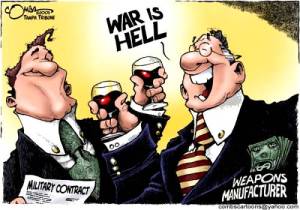
It’s a $cam! The American Way of War in the Twenty-First Century

war-is-money

By Tom Engelhardt

Source: TomDispatch.com

Let’s begin with the $12 billion in shrink-wrapped $100 bills, Iraqi oil money held in the U.S.  The Bush administration began flying it into Baghdad on C-130s soon after U.S. troops entered that city in April 2003.  Essentially dumped into the void that had once been the Iraqi state, at least $1.2 to $1.6 billion of it was stolen and ended up years later in a mysterious bunker in Lebanon.  And that’s just what happened as the starting gun went off.

It’s never ended.  In 2011, the final report of the congressionally mandated Commission on Wartime Contracting estimated that somewhere between $31 billion and $60 billion taxpayer dollars had been lost to fraud and waste in the American “reconstruction” of Iraq and Afghanistan.  In Iraq, for instance, there was that $75 million police academy, initially hailed “as crucial to U.S. efforts to prepare Iraqis to take control of the country’s security.”  It was, however, so poorly constructed that it proved a health hazard.  In 2006, “feces and urine rained from the ceilings in [its] student barracks” and that was only the beginning of its problems.

When the bad press started, Parsons Corporation, the private contractor that built it, agreed to fix it for nothing more than the princely sum already paid.  A year later, a New York Timesreporter visited and found that “the ceilings are still stained with excrement, parts of the structures are crumbling, and sections of the buildings are unusable because the toilets are filthy and nonfunctioning.”  This seems to have been par for the course.  Typically enough, the Khan Bani Saad Correctional Facility, a $40 million prison Parsons also contracted to build, was never even finished.

And these were hardly isolated cases or problems specific to Iraq.  Consider, for instance, those police stations in Afghanistan believed to be crucial to “standing up” a new security force in that country.  Despite the money poured into them and endless cost overruns, many were either never completed or never built, leaving new Afghan police recruits camping out.  And the police were hardly alone.  Take the $3.4 million unfinished teacher-training center in Sheberghan, Afghanistan, that an Iraqi company was contracted to build (using, of course, American dollars) and from which it walked away, money in hand.

And why stick to buildings, when there were those Iraqi roads to nowhere paid for by American dollars? At least one of them did at least prove useful to insurgent groups moving their guerrillas around (like the $37 million bridge the U.S. Army Corps of Engineers built between Afghanistan and Tajikistan that helped facilitate the region’s booming drug trade in opium and heroin).  In Afghanistan, Highway 1 between the capital Kabul and the southern city of Kandahar, unofficially dubbed the “highway to nowhere,” was so poorly constructed that it began crumbling in its first Afghan winter.

And don’t think that this was an aberration.  The U.S. Agency for International Development (USAID) hired an American nonprofit, International Relief and Development (IRD), to oversee an ambitious road-building program meant to gain the support of rural villagers.  Almost $300 million later, it could point to “less than 100 miles of gravel road completed.” Each mile of road had, by then, cost U.S. taxpayers $2.8 million, instead of the expected $290,000, while a quarter of the road-building funds reportedly went directly to IRD for administrative and staff costs.  Needless to say, as the road program failed, USAID hired IRD to oversee other non-transportation projects.

In these years, the cost of reconstruction never stopped growing.  In 2011, McClatchy Newsreported that “U.S. government funding for at least 15 large-scale programs and projects grew from just over $1 billion to nearly $3 billion despite the government’s questions about their effectiveness or cost.”

The Gas Station to Nowhere

So much construction and reconstruction — and so many failures.  There was the chicken-processing plant built in Iraq for $2.58 million that, except in a few Potemkin-Village-like moments, never plucked a chicken and sent it to market.  There was the sparkling new, 64,000-square-foot, state-of-the-art, $25 million headquarters for the U.S. military in Helmand Province, Afghanistan, that doubled in cost as it was being built and that three generals tried to stop.  They were overruled because Congress had already allotted the money for it, so why not spend it, even though it would never be used?  And don’t forget the $20 million that went into constructing roads and utilities for the base that was to hold it, or the$8.4 billion that went into Afghan opium-poppy-suppression and anti-drug programs and resulted in… bumper poppy crops and record opium yields, or the aid funds that somehow made their way directly into the hands of the Taliban (reputedly its second-largest funding source after those poppies).

There were the billions of dollars in aid that no one could account for, and a significant percentage of the 465,000 small arms (rifles, machine guns, grenade launchers, and the like) that the U.S. shipped to Afghanistan and simply lost track of.  Most recently, there was the Task Force for Business Stability Operations, an $800-million Pentagon project to help jump-start the Afghan economy.  It was shut down only six months ago and yet, in response to requests from the Special Inspector General for Afghanistan Reconstruction, the Pentagon swears that there are “no Defense Department personnel who can answer questions about” what the task force did with its money.  As ProPublica’s Megan McCloskey writes, “The Pentagon’s claims are particularly surprising since Joseph Catalino, the former acting director of the task force who was with the program for two years, is still employed by the Pentagon as Senior Advisor for Special Operations and Combating Terrorism.”

Still, from that pile of unaccountable taxpayer dollars, one nearly $43 million chunk did prove traceable to a single project: the building of a compressed natural gas station.  (The cost of constructing a similar gas station in neighboring Pakistan: $300,000.)  Located in an area that seems to have had no infrastructure for delivering natural gas and no cars converted for the use of such fuel, it represented the only example on record in those years of a gas station to nowhere.

All of this just scratches the surface when it comes to the piles of money that were poured into an increasingly privatized version of the American way of war and, in the form ofovercharges and abuses of every sort, often simply disappeared into the pockets of the warrior corporations that entered America’s war zones.  In a sense, a surprising amount of the money that the Pentagon and U.S. civilian agencies “invested” in Iraq and Afghanistan never left the United States, since it went directly into the coffers of those companies.

Clearly, Washington had gone to war like a drunk on a bender, while the domestic infrastructure began to fray.  At $109 billion by 2014, the American reconstruction program in Afghanistan was already, in today’s dollars, larger than the Marshall Plan (which helped put all of devastated Western Europe back on its feet after World War II) and still the country was a shambles. In Iraq, a mere $60 billion was squandered on the failed rebuilding of the country.  Keep in mind that none of this takes into account the staggering billions spent by the Pentagon in both countries to build strings of bases, ranging in size from American towns (with all the amenities of home) to tiny outposts.  There would be 505 of them in Iraq and at least 550 in Afghanistan.  Most were, in the end, abandoned, dismantled, or sometimes simply looted.  And don’t forget the vast quantities of fuel imported into Afghanistan to run the U.S. military machine in those years, some of which was siphoned off by American soldiers, to the tune of at least $15 million, and sold to local Afghans on the sly.

In other words, in the post-9/11 years, “reconstruction” and “war” have really been euphemisms for what, in other countries, we would recognize as a massive system of corruption.

And let’s not forget another kind of “reconstruction” then underway. In both countries, the U.S. was creating enormous militaries and police forces essentially from scratch to the tune of at least $25 billion in Iraq and $65 billion in Afghanistan.  What’s striking about both of these security forces, once constructed, is how similar they turned out to be to those police academies, the unfinished schools, and that natural gas station.  It can’t be purely coincidental that both of the forces Americans proudly “stood up” have turned out to be the definition of corrupt: that is, they were filled not just with genuine recruits but with serried ranks of “ghost personnel.”

In June 2014, after whole divisions of the Iraqi army collapsed and fled before modest numbers of Islamic State militants, abandoning much of their weaponry and equipment, it became clear that they had been significantly smaller in reality than on paper.  And no wonder, as that army had enlisted 50,000 “ghost soldiers” (who existed only on paper and whose salaries were lining the pockets of commanders and others).  In Afghanistan, the U.S. is still evidently helping to pay for similarly stunning numbers of phantom personnel, though no specific figures are available.  (In 2009, an estimated more than 25% of the police force consisted of such ghosts.)  As John Sopko, the U.S. inspector general for Afghanistan,warned last June: “We are paying a lot of money for ghosts in Afghanistan… whether they are ghost teachers, ghost doctors or ghost policeman or ghost soldiers.”

And lest you imagine that the U.S. military has learned its lesson, rest assured that it’s still quite capable of producing nonexistent proxy forces.  Take the Pentagon-CIA program to train thousands of carefully vetted “moderate” Syrian rebels, equip them, arm them, and put them in the field to fight the Islamic State.  Congress ponied up $500 million for it, $384 million of which was spent before that project was shut down as an abject failure.  By then, less than 200 American-backed rebels had been trained and even less put into the field in Syria — and they were almost instantly kidnapped or killed, or they simply handed over their equipment to the al-Qaeda-linked al-Nusra Front.  At one point, according to the congressional testimony of the top American commander in the Middle East, only four or five American-produced rebels were left “in the field.”  The cost-per-rebel sent into Syria, by the way, is now estimated at approximately $2 million.

A final footnote: the general who oversaw this program is, according to the New York Times, still a “rising star” in the Pentagon and in line for a promotion.

Profli-gate

You’ve just revisited the privatized, twenty-first-century version of the American way of war, which proved to be a smorgasbord of scandal, mismanagement, and corruption as far as the eye could see.  In the tradition of Watergate, perhaps the whole system could be dubbed Profli-gate, since American war making across the Greater Middle East has represented perhaps the most profligate and least effective use of funds in the history of modern warfare.  In fact, here’s a word not usually associated with the U.S. military: the war system of this era seems to function remarkably like a monumental scam, a swindle, a fraud.

The evidence is in: the U.S. military can win battles, but not a war, not even against minimally armed minority insurgencies; it can “stand up” foreign militaries, but only if they are filled with phantom feet and if the forces themselves are as hollow as tombs; it can pour funds into the reconstruction of countries, a process guaranteed to leave them more prostrate than before; it can bomb, missile, and drone-kill significant numbers of terrorists and other enemies, even as their terror outfits and insurgent movements continue to grow stronger under the shadow of American air power.  Fourteen years and five failed states later in the Greater Middle East, all of that seems irrefutable.

And here’s something else irrefutable: amid the defeats, corruption, and disappointments, there lurks a kind of success.  After all, every disaster in which the U.S. military takes part only brings more bounty to the Pentagon.  Domestically, every failure results in calls for yet more military interventions around the world.  As a result, the military is so much bigger and better funded than it was on September 10, 2001.  The commanders who led our forces into such failures have repeatedly been rewarded and much of the top brass, civilian and military, though they should have retired in shame, have taken ever more golden parachutes into the lucrative worlds of defense contractors, lobbyists, and consultancies.

All of this couldn’t be more obvious, though it’s seldom said.  In short, there turns out to be much good fortune in the disaster business, a fact which gives the whole process the look of a classic swindle in which the patsies lose their shirts but the scam artists make out like bandits.

Add in one more thing: these days, the only part of the state held in great esteem by conservatives and the present batch of Republican presidential candidates is the U.S. military.  All of them, with the exception of Rand Paul, swear that on entering the Oval Office they will let that military loose, sending in more troops, or special ops forces, or air power, and funding the various services even more lavishly; all of this despite overwhelming evidence that the U.S. military is incapable of spending a dollar responsibly or effectively monitoring what it’s done with the taxpayer funds in its possession.  (If you don’t believe me, forget everything in this piece and just check out the finances of the most expensive weapons system in history, the F-35 Lightning II, which should really be redubbed the F-35 Overrun for its madly spiraling costs.)

But no matter. If a system works (particularly for those in it), why change it?  And by the way, in case you’re looking for a genuine steal, I have a fabulous gas station in Afghanistan to sell you…


Tom Engelhardt is a co-founder of the American Empire Project and the author of The United States of Fear as well as a history of the Cold War, The End of Victory Culture. He is a fellow of the Nation Institute and runs TomDispatch.com. His latest book is Shadow Government: Surveillance, Secret Wars, and a Global Security State in a Single-Superpower World.

Time Is Running Out For Pax Americana’s Apologists

aa-American-Empire-statue-of-liberty-and-military

By Rostisla Ischenko

Source: Dissident Voice

The paradox of the current global crisis is that for the last five years, all relatively responsible and independent nations have made tremendous efforts to save the United States from the financial, economic, military, and political disaster that looms ahead. And this is all despite Washington’s equally systematic moves to destabilize the world order, rightly known as the Pax Americana (“American peace”).

Since policy is not a zero-sum game; i.e., one participant’s loss does not necessarily entail a gain for another, this paradox has a logical explanation. A crisis erupts within any system when there is a discrepancy between its internal structure and the sum total of available resources (that is, those resources will eventually prove inadequate for the system to function normally and in the usual way).

There are at least three basic options for addressing this situation:

  1. Through reform, in which the system’s internal structure evolves in such a way as to better correspond to the available resources.
  2. Through the system’s collapse, in which the same result is achieved via revolution.
  3. Through preservation, in which the inputs threatening the system are eliminated by force, and the relationships within the system are carefully preserved on an inequitable relationship basis (whether between classes, social strata, castes, or nations).

The preservation method was attempted by the Ming and Qing dynasties in China, as well as the Tokugawa Shogunate in Japan. It was utilized successfully (in the 19th century) prior to the era of capitalist globalization. But neither of those Eastern civilizations (although fairly robust internally) survived their collision with the technologically more advanced (and hence more militarily and politically powerful) European civilization. Japan found its answer on the path of modernization (reform) back in the second half of the 19th century, China spent a century immersed in the quagmire of semi-colonial dependence and bloody civil wars, until the new leadership of Deng Xiaoping was able to articulate its own vision of modernizing reforms.

This point leads us to the conclusion that a system can be preserved only if it is safeguarded from any unwanted external influences; i.e., if it controls the globalized world.

The contradiction between the concept of escaping the crisis, which has been adopted by the US elite, and the alternative concept – proposed by Russia and backed by China, then by the BRICS nations and now a large part of the world – lay in the fact that the politicians in Washington were working from the premise that they are able to fully control the globalized world and guide its development in the direction they wish. Therefore, faced with dwindling resources to sustain the mechanisms that perpetuate their global hegemony, they tried to resolve the problem by forcefully suppressing potential opponents in order to reallocate global resources in their favor.

If successful, the United States would be able to re-enact the events of the late 1980s – early 1990s, when the collapse of the Soviet Union and the global socialist system under its control allowed the West to escape its crisis. At this new stage, it has become a question of no longer simply reallocating resources in favor of the West as a collective whole, but solely in favor of the United States. This move offered the system a respite that could be used to create a regime for preserving inequitable relationships, during which the American elite’s definitive control over the resources of power, raw materials, finance, and industrial resources safeguarded them from the danger of the system’s internal implosion, while the elimination of alternative power centers shielded the system from external breaches, rendering it eternal (at least for a historically foreseeable period of time).

The alternative approach postulated that the system’s total resources might be depleted before the United States can manage to generate the mechanisms to perpetuate its global hegemony. In turn, this will lead to strain (and overstrain) on the forces that ensure the imperial suppression of those nations existing on the global periphery, all in the interests of the Washington-based center, which will later bring about the inevitable collapse of the system.

Two hundred, or even one hundred years ago, politicians would have acted on the principle of “what is falling, that one should also push” and prepared to divvy up the legacy of yet another crumbling empire. However, the globalization of not only the world’s industry and trade (that was achieved by the end of the 19th century), but also global finance, caused the collapse of the American empire through a policy that was extremely dangerous and costly for the whole world. To put it bluntly, the United States could bury civilization under its own wreckage.

Consequently, the Russian-Chinese approach has made a point of offering Washington a compromise option that endorses the gradual, evolutionary erosion of American hegemony, plus the incremental reform of international financial, economic, military, and political relations on the basis of the existing system of international law.

America’s elite have been offered a “soft landing” that would preserve much of their influence and assets, while gradually adapting the system to better correspond to the present facts of life (bringing it into line with the available reserve of resources), taking into account the interests of humanity, and not only of its “top echelon” as exemplified by the “300 families” who are actually dwindling to no more than thirty.

In the end, it is always better to negotiate than to build a new world upon the ashes of the old. Especially since there has been a global precedent for similar agreements.

Up until 2015, America’s elite (or at least the ones who determine US policy) had been assured that they possessed sufficient financial, economic, military, and political strength to cripple the rest of the world, while still preserving Washington’s hegemony by depriving everyone, including (at the final stage) even the American people of any real political sovereignty or economic rights. European bureaucrats were important allies for that elite; i.e., the cosmopolitan, comprador-bourgeoisie sector of the EU elite, whose welfare hinged on the further integration of transatlantic (i.e., under US control) EU entities (in which the premise of Atlantic solidarity has become geopolitical dogma) and NATO, although this is in conflict with the interests of the EU member states.

However, the crisis in Ukraine, which has dragged on much longer than originally planned, Russia’s impressive surge of military and political energy as it moved to resolve the Syrian crisis (something for which the US did not have an appropriate response) and, most important, the progressive creation of alternative financial and economic entities that call into question the dollar’s position as the de facto world currency, have forced a sector of America’s elite that is amenable to compromise to rouse itself (over the last 15 years that elite has been effectively excluded from participation in any strategic decisions).

The latest statements by Kerry and Obama which seesaw from a willingness to consider a mutually acceptable compromise on all contentious issues (even Kiev was given instructions “to implement Minsk“) to a determination to continue the policy of confrontation – are evidence of the escalating battle being fought within the Washington establishment.

It is impossible to predict the outcome of this struggle – too many high-status politicians and influential families have tied their futures to an agenda that preserves imperial domination for that to be renounced painlessly. In reality, multibillion-dollar positions and entire political dynasties are at stake.

However, we can say with absolute certainty that there is a certain window of opportunity during which any decision can be made. And a window of opportunity is closing that would allow the US to make a soft landing with a few trade-offs. The Washington elite cannot escape the fact that they are up against far more serious problems than those of 10-15 years ago. Right now the big question is about how they are going to land, and although that landing will already be harder than it would have been and will come with costs, the situation is not yet a disaster.

But the US needs to think fast. Their resources are shrinking much faster than the authors of the plan for imperial preservation had expected. To their loss of control over the BRICS countries can be added the incipient, but still fairly rapid loss of control over EU policy as well as the onset of geopolitical maneuvering among the monarchies of the Middle East. The financial and economic entities created and set in motion by the BRICS nations are developing in accordance with their own logic, and Moscow and Beijing are not able to delay their development overlong while waiting for the US to suddenly discover a capacity to negotiate.

The point of no return will pass once and for all sometime in 2016, and America’s elite will no longer be able to choose between the provisions of compromise and collapse. The only thing that they will then be able to do is to slam the door loudly, trying to drag the rest of the world after them into the abyss.

Rostislav Ischenko is the President of Centre for System Analysis and Forecasting (Kiev) currently living in Moscow. Read other articles by Rostisla.

Remember To Use Your Forgettery To Forget All the Trivia Meant To Divert Your Attention from Important Matters

yndwy

By Edward Curtin

Source: OpEdNews.com

What is the explanation for the brainwashing of so many Americans when it involves the nefarious, unspeakable deeds of their government? Why are so many so easily duped time and again? Why is there such a vast ignorance of the truth behind national and international affairs?

I would suggest that the answer lies not just with the specific issues themselves and the lies and propaganda used to befuddle the American people, but with the cultural and social background that frames Americans’ thinking. The latter serves to cut to the root people’s belief in their own power to think freely and clearly about the former. Invade people’s minds over many years with an ongoing series of interconnected memes, occupy their minds with alleged facts that induce a frenzied depression, and then fooling them on specific issues — e.g. Ukraine, Iraq, Syria, etc. – becomes much easier.

I am a sociology professor, and my students always laugh when during a discussion of memory, social and personal, I ask them about their forgetties (the actual word is forgetteries, but the shorter rhyme gets more laughs). They think I’m joking. Maybe you do, too. I’m not. But when I suggest that if they “possess” the faculty to remember, then they must “possess” the faculty to forget, they are astonished. You can’t forget, they reply, you just don’t remember; you can’t retrieve the memories that are stored in your brain. In other words, there are no forgottens, just temporarily unavailable memories. From there we are onto a discussion of retrieving (I think of dogs), processing (their word for thinking and mine for making American cheese), and all the computer lingo that has been the surround of their lives. Like fish in water, the mechanistic computer memes have been their environment since birth. They are shocked at the suggestion that there might be more outside the cultural water, and that they could go there.

And they have a lot of company.

This may sound flippant, but it’s crucial for understanding why so many Americans can’t comprehend and pay attention to the ways their minds are scrambled and confused about life and death issues, how their country has fallen victim to the military-industrial-intelligence apparatus that operates deep in the shadows, and oftentimes right in the open.

If we examine the social and cultural context of the last twenty-five years, we can see a number of issues that have dominated Americans’ “thinking.” These issues have been promulgated and repeated ad infinitum by the corporate media, professional classes, and schools at all levels. We have been swimming in these issues for years. I suggest the following five are key: the inability to concentrate or pay attention (ADD/ADHD), memory/forgetting (dementia, Alzheimer’s, technological memory devices), people’s lack of time and constant busyness (a recent email I received from a publisher read: “crazy-busy? use our power-point decks”), drugs legal or illegal as problems or solutions (over 4 billion prescriptions written in the U.S.A. yearly), and technology as our savior.

Together with shopping and the weather, these five topics have been the stuff of endless conversations and media chatter over the years.

When people are questioned about major issues of war and peace; political assassinations, such as those of JFK, MLK, or RFK; the alleged war on terror; the downing of Malaysian airlines; the overthrow of elected governments in the Ukraine or Egypt; the events of 9/11; government spying; economic robbery by the elites — the list is long, it’s common for people to echo the government/corporate media, or, if pressed, to say, I don’t know, I can’t remember, no one knows for sure, it’s impossible to know, we’ll never know, etc.. The confused responses are replete with an unacknowledged despair at ever arriving at clear and certain conclusions, not to say being able to do anything about them. On many issues they bounce between the twin absurdities of Democratic and Republican talking points, thinking they are being perceptive.

Why?

If we set aside the substantive issues, and examine the aforementioned cultural memes, the answers are not hard to find. Here most people speak as if they are certain. “Of course there isn’t a forgettery.” “Depression is caused by a chemical imbalance.” “Memories are all stored in the brain.” “I really am so busy all the time.” “Facts are just opinions.” Americans have internalized the ethos presented to them by the elites. At the core of this is the propaganda of scientific materialism and biological determinism that we are not free but are victims of our genes, neurotransmitters, brain/computers and chemicals, technology, etc. Having lost our minds and fixated on our brains, we have been taught to be determined to be determined, not free. And whether consciously or unconsciously, most have obliged. The linkages between memory, attention, distraction, drugs, technology all point to the brain and the obsessive cultural discussion of brain matters. We have been told interminably that our lives revolve around our brains (our bodies) and that the answers to our problems lie with more brain research, drugs, genetic testing, etc. It is not coincidental that the U. S. government declared the 1990s the decade of brain research, followed up with 2000-2010 as the decade of the behavior project, and our present decade being devoted to mapping the brain and artificial intelligence, organized by the Office of Science and Technology Project and the Defense Advanced Research Projects Agency. How convenient! George H. W. Bush, Clinton, George W. Bush, Obama — what a difference! But this is science and the welfare of the world.

For years we have been fed philosophical presuppositions smuggled in as fact. It’s an old trick, ever young. Tell people over and over and over again that life is in essence a mindless material/biological trap and over time they will believe it. Of course there are unspoken exceptions — those who are the masters of this con-game, the few, the elite, those who make and reinforce the case. And even some of them are too ignorant to comprehend their questionable presuppositions. They hoist themselves by their own petards while cashing in at the bank.

My students can’t forget because they don’t believe in it. But they can’t remember either. They don’t know why. So, like the older generation, they fall into the careless habit of inaccuracy, to turn Oscar Wilde on his head. They have downloaded their memories, uploaded their trifles, and been tranquilized by trivia.

As the great American sociologist C. Wright Mills wrote over fifty years ago, “Nowadays people often feel that their private lives are a series of traps.” That is truer today than then. A sense of entrapment and determinism pervades our culture. And it extends to public issues as well. We are told either to accept official explanations for public events or be dismissed as crazies.

I would suggest that for people to break through to a true understanding of the important public events of our time, they must also come to understand the false memes of their culture, the way they have been mindwashed to believe that at the most rudimentary level they are not free.

Maybe the first best step toward free thought and out of the propaganda trap would to accept that you “possess” a forgettery . Listen to the American philosopher Paul Simon sing, “When I think back to all the crap I learned in high school, it’s a wonder I can think at all.” Use your forgettery and forget the crap. Make haste slowly to question everything. Remember that the corporate media works hand in glove with the ruling elites on two levels of propaganda — cultural and political, and it is necessary to understand how they are intertwined. Freedom is indivisible.

That’s worth remembering.

Top Reasons You Should Never Buy E-Cigs From Big Tobacco

Cigarette-butts

Source: Cascadia Vape Blog

It’s long been suspected that Big Tobacco money was behind early efforts to attack the e-cig industry because it posed a potential threat to the tobacco cigarette industry. Now it’s apparent Big Tobacco is not only jumping on the bandwagon, but setting its sights on taking over the bandwagon.

Lorillard, the 3rd largest Big Tobacco company in the US acquired Blu brand e-cigs last year and just earlier this month Reynolds, America’s 2nd largest Big Tobacco company announced its entry into the market with Vuse e-cigarettes. The no. 1 US Big Tobacco company, Altria, acquired Green Smoke for $110 million in February and is planning national distribution of a new e-cig, NuMark, by the end of the year while Philip Morris, a subsidiary of Altria, recently announced it acquired British e-cigarette maker Nicocig for an undisclosed price. Some in the e-cig community might see this as a positive development thinking that with increased marketing from Big Tobacco brands there’ll be increased public awareness of e-cigarettes. However, I think there’s good reasons to worry about the quality of information and products Big Tobacco pushes to the public, leading to the first of the reasons to not support them:

Reason 1: It is in the interests of Big Tobacco to associate e-cigarettes with tobacco cigarettes.

Big Tobacco companies aren’t about to lose their customer base without a fight, and even as more smokers continue to switch to e-cigarettes, they’re often lured towards e-cig brands owned by the corporations that understand their addiction best. Big Tobacco have decades of experience effectively marketing cigarettes and they’re using similar tactics to make e-cigs especially attractive to smokers and former smokers. Big Tobacco e-cigs such as Green Smoke and Vuse are designed and packaged to look very similar to tobacco cigarettes and are often marketed as “tobacco products”. This may seem like a fair label on the surface because e-cigs use liquids containing nicotine usually extracted from tobacco, but one could argue they’re not exactly tobacco products because nicotine is a chemical that can be synthesized and is found in other plants such as eggplant, tomatoes and peppers. It’s an important distinction to make because a common misconception is that e-cigs are as harmful as tobacco cigarettes when in fact much of the damage caused by smoking cigarettes can be attributed to the combustion of processed tobacco which have been found to contain radiation, gmo genes, ammonia and pesticides. There is at least one e-cig specifically designed for use with tobacco and not surprisingly it’s made by Philip Morris. Many e-cigs produced by big tobacco are designed to emulate the experience of smoking with smoke-like nicotine content and taste. This is great for smokers content to continue vaping in a manner similar to how they’re accustomed to smoking, but not so good for those trying to decrease or end their addiction or would like to experience a wider range of flavors, vape temperatures, nicotine levels, or psychoactive substances. E-cigs and vapes produced by smaller businesses are far more versatile, allowing users to choose the flavors and nicotine content of e-liquids they use, select from variable voltage settings, and with modular attachments they can also vape non-tobacco herbs, oils and concentrates instead. E-cigs from Big Tobacco, on the other hand, use disposable cartridges which have a host of problems leading to the next argument:

Reason 2: E-cigs produced by Big Tobacco are more harmful to you and the environment. 

Nearly every Big Tobacco-owned electronic cigarette uses disposable cartridges which are cheap to produce but end up costing consumers more in the long run than refillable cartridges. They also limit consumer choice because such cartridges are usually proprietary, not designed for use with components from other brands and more limited in selection of flavors and nicotine content than liquids sold separately. E-cigs using disposable cartridges are also potentially more hazardous to your health than other forms of vaporizers. Though there still needs to be more research on comparative health effects, a 2009 FDA study (often cited by critics as proof that e-cigs emit low levels of tobacco-specific nitrosamines and other impurities) only tested devices using disposable cartridges (“Njoy”, “Smoking Everywhere” and “Nicotrol” brands). Just like with tobacco cigarette filters, we may one day see disposable e-cig cartridges littered everywhere if Big Tobacco has its way. As with other cheap disposable products, disposable e-cigs and e-cig filters are designed for planned obsolescence; a policy which creates demand by making a product obsolete faster forcing consumers to buy more regularly and discard old products into landfills more often. Such practices of Big Tobacco and other large corporations leads to the third argument:

Reason 3: Big Tobacco has proven itself untrustworthy.

The history of the American tobacco industry is steeped in shame. Early settlers ripped off Native American tribes in order to acquire more land for tobacco fields. Indentured servants were exploited for labor intensive tobacco field work later to be replaced by slaves from Africa. By the 1880s, the industry was dominated by the monopolistic American Tobacco Company which was one of the companies forced to dissolve to comply with the Sherman Antitrust Act. The dissolution led to an increase in cigarette advertising while the four firms created from the breakup continue to dominate the tobacco market to this day. We now know that senior scientists and executives within the cigarette industry knew there was a correlation between smoking and cancer as early as the 1940s and were aware that smoking could cause lung cancer by the mid 1950s. However, it wasn’t until the 1990’s amidst successful lawsuits against Big Tobacco aided by leaked documents that major US cigarette manufacturers publicly admitted to varying degrees that smoking causes cancer and other health problems. Given their track record, it should come as no surprise how Big Tobacco approaches the e-cig market with the same focus on the bottom line.

Like many other large corporations with outsize influence, Big Tobacco is less concerned with wealth creation which extracts value by engaging in mutually beneficial transactions than rent-seeking; the use of social institutions such as government to gain monopolistic advantages while imposing disadvantages on competitors. The effects of rent-seeking are reduced economic efficiency through poor allocation of resources, reduced wealth creation, increased income inequality, lost government revenue (except for select paid-off legislators and regulators), decreases in innovation and entrepreneurship and national decline. Large corporations also create fewer quality domestic jobs per capita because they have the ability to cut costs through increased automation and outsourcing overseas. While CEOs of such companies may have wonderful jobs, there’s an increasingly wide income and quality gap between their position and the people at the lowest level of the company. In most cases, much of their profits are siphoned off to a small group at the top of the hierarchy who hoard it in offshore bank accounts.

Smaller domestic companies, while they may have to source certain components from overseas, tend to do more of the work in-house such as assembly, quality control, packaging, warehousing, etc. which creates more local jobs that distribute wealth into local economies. Small businesses also tend to have less of a wealth gap between employees and are run by people who are more passionate about their line of work, not people who inherited their careers, acquired it through connections or were hired by committee solely for their ability to generate income.

For the sake of your health, the environment, the economy and country, don’t support Big Tobacco. Support responsible small businesses and spread the message.

Podcast Roundup

6/8: Hosts Mickey Huff and Peter Phillips discuss the ongoing situation in the Ukraine with Dr. Michael Parenti, Prof. Michel Chossudovsky, and former Congresswomen and Green Party Presidential candidate Cynthia McKinney on “the Project Censored Show”. All of them are contributors to a new book by Clarity Press edited by Stephen Lendman, “Flashpoint Ukraine: How the US Drive for Hegemony Risks WWIII.”

https://s3.amazonaws.com/Pcradiodos/Project+Censored+060614.mp3

6/9: On “the Progressive Commentary Hour”, host Gary Null interviews Dr. Andrew Wakefield, a gastroenterologist and academician specializing in inflammatory bowel disease and the measles-mumps-rubella vaccine or MMR. They discuss how the US government uses corporations and universities to support policies, silence top scientists, jeopardize public health and protect corporate profits.

http://s36.podbean.com/pb/3f11f4e516587793b6f2d38475623afc/5398ccbc/data1/blogs18/371244/uploads/ProgressiveCommentaryHour_060914.mp3

6/10: On “the Higherside Chats”, Adam Gorightly and Vyzygoth joins host Greg Carlwood for a freewheeling but illuminating conversation about the suppressed history of the United States hidden beneath lies and disinformation most have been led to believe.

http://thehighersidechats.com/wp-content/uploads/2014/06/112-Vyzygoth.mp3

6/12: KMO talks with Vincent Horn of Buddhist Geeks on the lastest C-Realm podcast. They discuss the use of mindfulness techniques in technological society and its connection to DIY, Quanitifed Self and Maker movements. KMO wraps up with commentary on the nature of individualism and community.

http://www.c-realm.com/wp-content/uploads/418_Adaptive_Comtemplation.mp3


America: The Country that Wrote the Playbook on the Destabilization of a Neighbor

By Wayne Madsen

Source: Strategic Culture Foundation


A nuclear-armed superpower deployed intelligence operatives to a neighboring country. The intelligence agents immediately set about the infiltrate a radical secessionist movement in order to push it toward committing acts of kidnapping, assassination, and other violence. After the kidnapping of a foreign diplomat, the central government invoked draconian national security and war measures statutes, suspending civil liberties. The secessionists, who demanded their language, cultural, and political rights within a supposed «federal» system, were demonized by the foreign-led infiltration and radicalization of their movement.

This scenario is not Ukraine in 2014 but Canada, and, particularly Quebec, in 1970. That year, the Quebec Liberation Front (FLQ) launched a campaign of violence against the Quebec provincial government and the federal government in Ottawa. The radicalization of the FLQ was largely carried out by agents of the U.S. Central Intelligence Agency who were infiltrated into Quebec in an effort to portray Quebec nationalists as radical «terrorists». Today, the United States falsely accuses Russia of carrying out a similar scenario in Ukraine. However, what the United States is claiming is coming from one of the most hypocritical nations in recent world history. And, as far as the Obama administration is concerned, what the CIA carried out in Quebec and Canada in 1970 is a long forgotten footnote of history, however, the same destabilization playbook being used by the United States and Canada in the late 60s and early 70s is being copied today by the CIA and its partners in Kiev.

By the late 1960s, the CIA became concerned about the possibility that the majority French-speaking province of Quebec may opt for independence from the rest of Canada. An independent Quebec, which the CIA believed would drift to the left and withdraw from NATO, was a nightmare for the trans-Atlantic status quo enthusiasts at the CIA and its affiliated think tanks, as well as the Pentagon brass and the Wall Street minions of the Bilderberg Group.

The warnings signs for the CIA included a series of events. On July 24, 1967, French President Charles de Gaulle, declared «Vive le Québec libre!» (Long live free Quebec!), from the balcony of the Montreal City Hall. That same year, de Gaulle withdrew France from the military command structure of NATO and ordered NATO headquarters and other activities to leave France. De Gaulle, arriving in Montreal on the French warship «Colbert» to help celebrate the opening of Expo 67, bypassed the federal capital Ottawa, and was wildly cheered by Quebecois who used the occasion to loudly boo the Governor General of Canada during the playing of «God Save the Queen».

De Gaulle’s proclamation gave a morale boost to Quebec’s nascent separatist movement. However, in Ottawa, the French-speaking Justice Minister and future Prime Minister Pierre Trudeau, along with Prime Minister Lester Pearson, grew alarmed at what they considered French involvement in the domestic affairs of Canada. Secretly, the Security Service of the Royal Canadian Mounted Police, at the time, Canada’s primary foreign intelligence agency, contacted their colleagues in the CIA for assistance to deal with what was perceived as an existential threat to Canada posed by the Quebec nationalists.

The CIA was fearful of the leftward drift of Quebec nationalism, as shown by the nationalization of Quebec’s hydro-electric resources by Hydro-Quebec, owned by the province of Quebec, and the rising popularity of Rene Levesque, a former Liberal Party member of the Quebec National Assembly, who, in the euphoria surrounding De Gaulle’s 1967 visit and proclamation, founded the Mouvement Souveraineté-Association that same year. Levesque merged his party with another autonomist party, the Ralliement National, forming the Parti Québecois (PQ).

The RCMP Security Service and the CIA decided to begin infiltrating a small radical Quebec secessionist movement, the Front de libération du Québec (FLQ). Almost overnight, the FLQ, which had only been a nuisance, began carrying out serious bombings, kidnappings, and assassinations, culminating in the «October Crisis» of 1970. Targeted for kidnapping by the FLQ were James Cross, the British Trade Commissioner to Canada, and Pierre Laporte, a vice premier in the Liberal government of Quebec Premier Robert Bourassa. Laporte was murdered a few days after his kidnapping.

Not only Bourassa, but clandestinely, the CIA and RCMP joint Quebec task force convinced Prime Minister Trudeau to invoke the War Measures Act in Quebec. Canadian rule of law was suspended and police began rounding up Quebecois who were strong supporters of Quebec independence. Of the 497 people detained by police, 435 were later deemed to be innocent and were freed. The invocation of the War Measures Act by Trudeau proved to the CIA that the vocally anti-U.S. prime minister could be counted on to support a status quo that was beneficial to the United States and NATO. Trudeau’s son, Justin Trudeau, the leader of the opposition Liberal Party today, is viewed in much the same light as someone who will continue to carry Washington’s water domestically and internationally if the sycophantically pro-U.S. Stephen Harper ever leaves office.

Although the FLQ collapsed after the October Crisis, the damage sought by the CIA and RCMP to the cause of Quebec sovereignty was accomplished. Levesque’s PQ failed to win control of the Quebec National Assembly in the 1970 and 1973 elections and Levesque, himself, failed to win a seat in the assembly in both elections. However, in 1976, Levesque and his PQ won control of the National Assembly and the new government and carried out a plebiscite on sovereignty association with Canada in 1980. After a concerted propaganda barrage by Ottawa, Washington, and Montreal’s influential Jewish community, the referendum resulted in a 60 percent vote against and 40 percent vote for the sovereignty-association status. The following year, federal Justice Minister Jean Chretien hammered out a new Canadian constitution with the agreement of all the provincial premiers except for Levesque, the British Parliament and Queen Elizabeth, and the Canadian Supreme Court, which ruled that a new constitution of Canada was legal even though it did not have the approval of Quebec. To this day, Canada’s constitution was never approved by Quebec.

In 1995, the PQ, once again in power, held another referendum on independence. It failed with a 50.6 percent vote of «no» and a «yes» vote of 49.4 percent. A clear majority of French-speakers voted for separation from Canada but the same coalition of English-speakers and Montreal Jews who were able to defeat the 1976 plebiscite did so again.

This year, PQ Premier Pauline Marois and her party lost the election to the Liberal Party, although most major polls predicted the PQ would easily win re-election. There were suspicions in a number of political quarters that the Harper government in Ottawa, working with the U.S. and the Mont Royal clique, pulled off a massive election fraud. But with the defeat of the PQ and Marois, who lost her own seat, the notion of Quebec independence was, once again, dead on arrival.

The repeated repression of the PQ in Quebec is directly tied to CIA activities. A CIA agent named Jules «Ricco» Kimble was later reported to have not only infiltrated the FLQ in the 1960s but maintained a CIA station in the Mont Royal neighborhood. Kimble said he committed two murders that were pinned on the FLQ, although it is not known if one of them was the assassination of Laporte.

In 1991, a former Quebec minister, who spoke anonymously, confirmed Kimble’s status as a CIA agent. The ex-minister said, «I heard about this place on Mont Royal and its work with the CIA».

In 1971, the Montreal Star published a TOP SECRET CIA memorandum dated October 16, 1970, which stated that the CIA was behind the violence committed in the name of the FLQ. The memo stated, «Some sources recommend that we take urgent measures to temporarily cease contacts with the measures of FLQ militants because of Canadian undesirable consequences with the Canadian government». In other words, the CIA admitted to have conducted «false flag» terrorist operations in Canada. Expectedly, the Richard Nixon administration and Trudeau denounced the CIA document as a forgery.

The chief of counter-intelligence for the RCMP Security Service, Leslie J. Bennett, confirmed, in 1973, that Montreal was infiltrated by a number of CIA agents during the October Crisis of 1970. Shortly after he made this statement, Bennett was falsely accused by the RCMP of being a Soviet KGB mole and he was forced to move to exile in Australia. It was not until 1993 that the Canadian government admitted that its charges against Bennett being a Soviet double agent were a fabrication.

It has also been revealed by arrested members of Mexico’s Sinaloa drug cartel, in addition to CIA and Drug Enforcement Administration (DEA) sources, that the CIA has been busy destabilizing by shipping weapons to Mexican drug cartels using the U.S. Justice Department’s «Fast and Furious» operation as cover. Some sources claim that the Obama administration authorized weapons transfers to the two main Mexican drug cartels, the Sinaloa and Los Zetas gangs, in order to generate a national security crisis in Mexico, thus paving the way for the election in 2012 of globalist and pro-privatization and pro-American candidate Enrique Pena Nieto and the defeat of the leftist candidate Andres Manuel Lopez Obrador. Many of the paramilitary leaders of the Los Zetas and Sinaloa cartels were trained under the watchful eyes of the CIA, by the infamous U.S. Army’s School of the Americas, now the Western Hemisphere Institute of Security Cooperation (WHINSEC) in Fort Benning, Georgia.

The entire gamut of false flag operations currently being waged in eastern and southern Ukraine by the CIA and its Ukrainian partners should be viewed through the lens of the CIA’s sordid activities in committing terrorist acts, libeling innocent people, and, perhaps, illegally manipulating elections in Quebec from the early 1960s to the present day. There is only one nuclear-armed country that has destabilized one neighboring nation that has demanded linguistic, cultural, and political rights and another seeking to wrest itself from domination by its more powerful northern neighbor. That country is the United States.


Overthrowing other people’s governments: The Master List

Corporate-domination

By William Blum

Originally posted at RINF.com

Instances of the United States overthrowing, or attempting to overthrow, a foreign government since the Second World War. (* indicates successful ouster of a government)

  • China 1949 to early 1960s
  • Albania 1949-53
  • East Germany 1950s
  • Iran 1953 *
  • Guatemala 1954 *
  • Costa Rica mid-1950s
  • Syria 1956-7
  • Egypt 1957
  • Indonesia 1957-8
  • British Guiana 1953-64 *
  • Iraq 1963 *
  • North Vietnam 1945-73
  • Cambodia 1955-70 *
  • Laos 1958 *, 1959 *, 1960 *
  • Ecuador 1960-63 *
  • Congo 1960 *
  • France 1965
  • Brazil 1962-64 *
  • Dominican Republic 1963 *
  • Cuba 1959 to present
  • Bolivia 1964 *
  • Indonesia 1965 *
  • Ghana 1966 *
  • Chile 1964-73 *
  • Greece 1967 *
  • Costa Rica 1970-71
  • Bolivia 1971 *
  • Australia 1973-75 *
  • Angola 1975, 1980s
  • Zaire 1975
  • Portugal 1974-76 *
  • Jamaica 1976-80 *
  • Seychelles 1979-81
  • Chad 1981-82 *
  • Grenada 1983 *
  • South Yemen 1982-84
  • Suriname 1982-84
  • Fiji 1987 *
  • Libya 1980s
  • Nicaragua 1981-90 *
  • Panama 1989 *
  • Bulgaria 1990 *
  • Albania 1991 *
  • Iraq 1991
  • Afghanistan 1980s *
  • Somalia 1993
  • Yugoslavia 1999-2000 *
  • Ecuador 2000 *
  • Afghanistan 2001 *
  • Venezuela 2002 *
  • Iraq 2003 *
  • Haiti 2004 *
  • Somalia 2007 to present
  • Libya 2011*
  • Syria 2012

Q: Why will there never be a coup d’état in Washington?

A: Because there’s no American embassy there.

William Blum is an author, historian, and renowned critic of U.S. foreign policy. He is the author of Killing Hope: U.S. Military and CIA Interventions Since World War II and Rogue State: A Guide to the World’s Only Superpower, among others. Visit his blog.

Nicaragua: Land of Revolution, Poetry and Solidarity

IMG_4622

Given its richness and complexity, it would be impossible to give an accurate overview of contemporary Nicaraguan society without years of research and experience within the country. What I humbly offer is just one visitor’s perspective of aspects of the culture picked up from about three week’s worth of experiences and interactions with a small cross-section of the population (mostly poor and middleclass people working as cab drivers, tour guides, museum docents, restaurant/shop employees, and agricultural workers) as well as tourists and expats.

What becomes apparent to visitors to Nicaragua soon after getting off the plane is the country’s pride in two of its most famous figures, revolutionary Augusto Sandino and poet Rubén Darío. Images of them can be seen on posters and decorating various items in gift shops within the airport, and in almost every town and city one can find them depicted on murals and statue monuments (other popular figures include Carlos Fonseca, Che Guevara and Hugo Chavez). The culture’s love for poetry is also expressed through its annual International Poetry Festival which has been hosted in Granada since 2005 (parts of which I was fortunate enough to witness while I was there).

Another sign of Nicaragua’s love for language arts and literacy is the ubiquity of bookstores and libraries which can be found in even the smallest towns. Roots of this aspect of the culture goes as far back as the late 19th century when the Spanish-American literary movement known as Modernismo was started by Rubén Darío who was born in Matagalpa and raised in León (where he also died). Another factor is the Sandinista Literacy Campaigns of 1980 and 2005-2009 whose mission was not just to eradicate illiteracy but to increase political awareness and nurture attitudes and skills related to creativity, production, co-operation, discipline and analytical thinking.

A sophistication of political thought and sense of social consciousness in Nicaraguan society was made apparent to me through extended conversations on history and current events with tour guides of diverse backgrounds (who were the locals I happened to speak with for the longest periods of time due to the nature of the activity) as well as shorter exchanges with random people encountered during the trip. While my impressions of the culture may be biased due to comparatively low levels of political awareness I usually sense when conversing with most U.S. citizens (not including readers & followers of this blog) and more frequent interactions with Nicaraguans from progressive organizations I intentionally sought out to support, I’ve heard similar or related observations from other travelers and expats. I feel it’s a real phenomenon that could be a result of the Literacy Campaigns as well as having collectively experienced relatively recent violent dictatorship, revolution, counter-revolution and widespread poverty. Just as individuals of more privileged backgrounds and little experience dealing with loss tend to have less empathy and understanding of moral complexity than those who have lived through tragedy and hardship, perhaps the same could be said of societies?

Other shared, seemingly culturally determined traits I’ve noticed was a sense of directness and sincerity and willingness to treat everyone as human beings. This is especially true regarding dealings with tourists from the U.S. I was a little surprised to experience no sense of resentment directed towards me for being from the country whose government has been the source of so much pain and suffering. Imagine if some country’s government propped up tyrants in the U.S. or supported militant terrorist groups with money and weapons (which the CIA has done in many places including the U.S.). Would we be as charitable towards the citizens of that country? In fact, from speaking to a docents at the Carlos Fonseca Museum, and León’s Museum of the Revolution, even former adversaries on different sides of the revolution have for the most part resolved their differences and resumed relationships as friends, family and fellow citizens. But this isn’t to say there aren’t differences in political perspectives and opinions on the current government.

One of the more surprising opinions I heard was from a young eco-tour guide in Jinotega who was a recent graduate of a college in León. He mentioned that he was doubtful that Nicaragua would be much different had the Samoza regime stayed in power. This was a bit shocking for me in light of what I’ve heard about Samoza’s human rights abuses but it made me think of how things might have changed or stayed the same. It’s likely the crackdown on dissidents would continue or worsen, but would the economy have been improved had the revolution and embargo never happened, or would it have been the same or worse due to increasing militarization and corruption? In either case, it seems unlikely Nicaragua would avoid long term economic harm caused by structural adjustment policies demanded by the International Monetary Fund and World Bank. In contrast to the guide in Jinotega was the eco-tour guide in Matagalpa who took me and other tourists to Mombacho Volcano. He made it clear that he felt Nicaragua had greatly improved since the overthrow of Samoza, embedding his views into the tour by talking about how during the Samoza regime prisoners would sometimes be dropped from helicopters into active volcanoes. He also took pride in the fact that Nicaraguans now have access to free education and healthcare.

The most memorable and moving conversation was with Hugo, a docent at the Museum of the Revolution in León who fought for the Sandinistas as a young man. Through an interpreter he told me of the impact the revolution has had on his life. Many of his siblings and relatives were forced to leave the country and many of his comrades died in battle. He seemed disappointed that there has not been greater improvements as a result of the massive struggle and sacrifice. He mentioned how after the revolution some Sandinista veterans were given parcels of land but many were given less support than they deserved and were promised in terms of land, pensions and healthcare. Hugo himself was struggling economically. As a side-gig he also sold bootleg documentary dvds outside the museum, one of which I purchased (FSLN: Un Pueblo en Armas). Despite his personal hardships, he made it clear that he remains a patriot and has no regrets about fighting the Somoza regime.

One topic that often arose unprompted was upcoming plans for a new canal allowing ships to travel back and forth from the Atlantic Ocean through the San Juan River and Lake Nicaragua to the Pacific Ocean. Though such ideas were proposed nearly 200 years ago, just last year Nicaragua’s National Assembly approved a concession agreement with the Hong Kong Nicaragua Canal Development Investment Company (HKND) giving them the rights to construct and manage the canal for 50 years. In January HKND CEO Wang Jing and President Daniel Ortega issued a statement that construction of the canal would begin in December 2014. Across the board, Nicaraguans I spoke with seemed excited about the plans but conflicted. The most skeptical opinion came from the eco-tour guide in Jinotega who took me to Lake Apanas. Though he acknowledged the potential benefits it would have for Nicaragua’s economy, he was well aware of the inevitable negative impact it would have on indigenous species and ecosystems. At the same time, he seemed resigned to the fact that coming changes are inevitable. He pointed out that Lake Apanas was artificially created to produce hydroelectric power for several towns. Once thriving trees and farmland are now underwater, but the area is now a habitat of different and diverse flora and fauna which supports the local economy through recreation, tourism and fishing. Other people I spoke with about the canal voiced concerns about whether Nicaragua would truly benefit from the project or if it would create a flow-through economy in which most workers and contractors would be brought from China and primarily Chinese corporations reaped the profits.

Another topic that frequently came up (most likely because the livelihoods of many people I spoke with are largely dependent on it), was the rise of Nicaragua’s tourism industry within the past few years. While its effect of boosting the economy is widely acknowledged, it has also in some cases led to problems such as gentrification, inadequate access to land and resources reserved for tourists and foreign owned corporations, commodification or loss of culture. I’ve also witnessed first-hand how Nicaraguan service sector workers have had to tolerate rude behavior from entitled wealthy tourists or expats doing their visa runs. To their credit, the workers showed incredible patience and professionalism, much more, I suspect, than employees and native citizens in the U.S. would show towards foreign tourists and expats had the tables been turned.

The following are just some of the more trivial miscellaneous observations that seemed odd or interesting to me from a visitor’s perspective:

  • It seems to be trendy for car owners (especially in larger cities) to decorate their vehicles with colorful LED lights on the hood, around license plates, underneath, etc.
  • Motorcycles are extremely popular. One tour guide who’s also a motorcycle rider said he estimates the number of other bikers he sees on the roads has nearly doubled in the past 7 years.
  • On a “Chicken Bus”, be prepared to be squashed like sardines if you don’t get a seat. And try not to end up near the front door because they usually won’t close it even while speeding through steep winding (occasionally unpaved) roads in the mountains.
  • The rule of the road is usually the largest vehicle that gets there first has the right of way. The order of hierarchy looks something like this: large truck>bus>van>SUV/small truck>sedan>Horse>tuk-tuk/pedicab>motorcycle>scooter>bicyclist>pedestian
  • DVD bootleggers work extremely quickly. I saw a bootleg of the Robocop remake on the streets at least a day or two before its official release in theaters.
  • While staying at the few places that had cable television I flipped through channels to get an idea of what Nicaraguan viewers were offered. I was disappointed to find that out of nearly 100 channels, about 2/3 of them featured primarily dubbed or subtitled U.S. television programming and Hollywood blockbusters. Out of the remaining 1/3, about a dozen featured mostly telenovela soap operas, another dozen were spanish language original programing featuring occasional dubbed or subtitled Hollywood films and spanish language versions of popular North American game shows and reality TV, there were about a half dozen music channels featuring latin and some U.S. pop music and just a few regional and public access stations devoted solely to news, local culture and community events.
  • For some reason, 70s-80s era adult contemporary or “yacht rock” music seems to be popular. While in more than a few shops and restaurants that don’t cater to tourists I’ve heard the likes of Brian Adams, Air Supply and Christopher Cross playing on the radio in the background.
  • In more bohemian “cultural cafes” the music of choice seems to be artists eternally popular with college kids and hippies (ie. Hendrix, Doors, Beatles, Pink Floyd, Bob Marley etc.) which though I am neither I do enjoy.
  • Backpacks and shoes seem to be popular items. At almost every major street market  in every town I’ve been to, usually located close to the main bus stations, there were huge numbers and varieties of these items sold at multiple booths. My theory is that since most kids in Nicaragua go to Catholic schools and are forced to wear uniforms they might value these items more as expressions of individuality (and they’re practical).
  • Many young people in Nicaragua (mostly middle/upper-middle class) are just as enraptured by wireless technology as people in the states.
  • Another favorite pastime among the youth is hanging out in the central parks (usually located near the largest church) where I’ve seen some groups do awesome breakdancing competitions.
  • The “typico” Nicaraguan meal of salsa, beans, rice, eggs, cheese and plantains is cheap, delicious and will get you through the day.