A New Aesthetic

By Damaris Zehner

Source: Resilience

There are all these good ideas – intensive agriculture, organic farming, permaculture, the local food movement. But why is most food still not grown this way, if it really is better? Why don’t farmers switch to sustainable land use methods? It seems to me there are at least four reasons.

First is the conservative nature of farming. Any activity that involves a large and long investment for an uncertain outcome is going to be conservative; no one wants to experiment when a year’s income is riding on the results. Farmers tend to stick to what has seemed to work. The psychology of previous investment plays a part in their choices as well. Once you’ve bought the huge combine, well, you have to use it.

Even when things don’t work so well, farmers will keep doing them if there are financial incentives to do so. This is the second reason. Government programs have tended to encourage big agribusinesses and have been less friendly to smaller, more varied farms.

Third, farmers love their machines. All Americans do. We fall every time for the promise that new technology will make our lives easier, more fun, more productive, and more sophisticated, and people with outdated technology, whether cell phones or tractors, get made fun of. Many people don’t have the time or the patience for more manual ways of working. I knew of a horse farmer who recently complained that he wouldn’t hire young men on his farm because they got impatient with the horses and, as he put it, just wanted to be roaring off with an internal combustion engine. (His workers were young women). These young men have become habituated to the speed and power made possible by fossil fuels and get rattled when asked to move more slowly.

Finally, there is an unconscious but still powerful motivation why farmers don’t want to stop spraying and switch to more natural methods of food production. It is a mistaken aesthetic that dictates how people see and judge the land around them, that tells us what looks beautiful and productive and “American” – that is, efficient, high-tech, and gleaming with the promise of the future. Perfect, undisturbed expanses of commodity crops, synchronized lines of combines churning through thousand-acre wheat fields, shiny factories, and brightly colored grocery stores are our proof that we are not a third-world nation, or Amish, or hippies – that we are still orthodox worshipers of the god of progress.

I don’t dispute the attraction of the aesthetic. Honestly, the land around here looks pretty good. Or at least it looks pretty. But the cost of those perfect fields and vast expanses of monoculture may be more than we can pay. Our aesthetics are as damaging to the environment as our greed or carelessness. So we need to move toward a new aesthetic.

Before we can do so, we need to ask ourselves: how much of the world are we responsible for tidying up? Nature is messy by our standards. A patch of disturbed earth becomes populated with a swirling mob of what we’d call weeds – dock, plantain, dandelion, mulberry, crabgrass, lamb’s quarters, and a hundred plants I don’t have a name for. And that bothers us. We spray, mow, and weed, in the process disturbing the natural succession of plants. We say that keeping our lawns, gardens, and fields as pure monoculture is more efficient and attractive. I drove with farmers past fields of soybeans shortly after the introduction of Round-Up herbicide, and they talked about how beautiful the thick carpet of identical plants is. They’re not wrong. The lush uniformity is beautiful. But I’m not sure we have the right to expect the same sort of beauty from nature that we can create within our houses. Should a farm field look like wall-to-wall carpeting? Should every molehill be leveled, every fence row scorched, whatever t cost, just because we think it looks nicer?

We have neighbors down the road whose property has been described as a doll’s house because of its detailed perfection. It’s a good description – they treat their two acres as if it were as entirely under their control as a doll’s house. The fences have lines of brown under them where the mower can’t reach and herbicide has been sprayed. Their lawn is grass only, no violets or dandelions. Their mature hardwood trees are all pollarded to be a matching height. It’s pretty, I suppose. It’s also horrifying as an illustration of their attitude toward natural beauty. To speak in hyperbolic terms, those friendly neighbors are conducting an all-out war on nature, with policies of scorched earth and ethnic cleansing, and the result is extreme totalitarianism. This stands in striking contrast to the permaculture sites I’ve visited, which look like a hodgepodge of annuals, perennials, weeds, and small creatures and don’t involve any mowing. I suspect that everyone’s first reaction to seeing permaculture in action is, in fact, “Why don’t they mow?” They have their reasons, and they have a different aesthetic.

I admit I like the cleanliness and order that humans impose. I’m all right with keeping my house clean, but I have to decide how far my household extends. If I find insects on my kitchen counter, I kill them. But should I kill the insects in my yard? All the insects in the world? Because if farmers adopt a policy of insect genocide, as most do, it’s going to have costs to the surroundings – which include me. When the summer crop-dusting airplanes fly overhead carpet-bombing bugs and weeds, I have to run to bring the laundry inside and shut the windows if it’s windy, which it usually is, because – call me a crazy tree-hugger – I prefer my sheets and towels to smell of fresh air and not the toxin du jour. That’s where my aesthetic differs from the farmers’.

Farmers around here will tell you that they are aiming for efficiency, and I do appreciate that harvesting crops is easier when the equipment is not clogged with morning glory vines and ragweed stalks. I also understand that weeds and other plants compete with the crops and lower farmers’ yields, so there is a financial as well as an aesthetic motivation for them to keep their fields clean. But there’s no question that these farmers are also driven by the false aesthetic of human-imposed purity. I watch while they grub out a small patch of trees that they had no problem maneuvering around, just so the field looks “clean.”

It’s a competitive aesthetic, too. People in this small community will gossip about and criticize landowners whose fields aren’t clean – I hear them every year talking about whose land isn’t yet sprayed, tilled, or ditched. People from out of our area have asked me when they’ve come over to visit, “Whose land is that down the road? It looks bad.” What they mean when they say that farmers are not keeping their land “clean” is that farmers are not leaving a toe-hold for nature on their property. Rabbits and deer have no right to a corridor of shelter; killdeer and quail have to keep packing up and moving as their surroundings are cut down; coyotes are shot. And once we’ve expunged the aborigines, we can live the mindless imperialist lifestyle we like.

I have some sympathy, I guess. I don’t want coyotes eating my goats or rabbits ruining my garden. But I have to ask the question again: how much of the natural world do we have the right to control at the same level that we control our houses and yards? If we are going to live in a better balance with nature than we do now, we have to change not only our acquisitiveness and our focus on profit and exploitation; we also have to learn to see beauty in what we now consider messiness.

RFK Jr. Slams Gov’t & Big Pharma In Eye Opening Speech About Forced Vaccinations

By Arjun Walla

Source: Collective Evolution

California has very strict compulsory vaccination laws for children in school, and as a result more parents are deciding to homeschool their children. The latest information regarding vaccines in California that’s making noise is Senate Bill 276 by Senator Richard Pan. The bill eliminated nearly all vaccine medical exemptions. Under this bill, politicians, not physicians, are in charge of deciding whether or not children may receive medical exemptions, which in turn would determine whether or not they can attend school.

This bill, which was recently signed into law, represents medical tyranny that is similar to a police state. Forcing vaccinations on any segment of the population and taking away their freedom of choice is ridiculous. All of this is done under the assumption that unvaccinated children pose a danger to vaccinated children, and this is simply not true for several reasons.

Herd immunity is a largely theoretical concept, yet for decades, it has furnished one of the key underpinnings for vaccine mandates in the United States. The public health establishment borrowed the herd immunity concept from pre-vaccine observations of natural disease outbreaks. Then, without any apparent supporting science, officials applied the concept to vaccination, using it not only to justify mass vaccination but to guilt-trip anyone objecting to the nation’s increasingly onerous vaccine mandates.

In a 2014 analysis in the Oregon Law Review by New York University (NYU) legal scholars Mary Holland and Chase E. Zachary (who also has a Princeton-conferred doctorate in chemistry), the authors show that 60 years of compulsory vaccine policies “have not attained herd immunity for any childhood disease.” It is time, they suggest, to cast aside coercion in favor of voluntary choice.

This is true, in fact, there has been a history of disease outbreaks in heavily vaccinated populations. I wrote an article not long ago providing multiple studies showing this, and the studies are elaborated on and linked in that article, which you can go through here.

According to a MedAlerts search of the FDA Vaccine Adverse Event Reporting System (VAERS) database as of 2/5/19, the cumulative raw count of adverse events from measles, mumps, and rubella vaccines alone was: 93,929 adverse events, 1,810 disabilities, 6,902 hospitalizations, and 463 deaths. What is even more disturbing about these numbers is that VAERS is a voluntary and passive reporting system that has been found to only capture 1% of adverse events.

How can vaccines produce herd immunity if they’re not safe for everybody? It’s impossible.

The various forms of vaccine failure not only make herd immunity impossible to achieve, but also feed the occurrence of “vaccine-preventable illnesses” in highly or even fully vaccinated populations. There are numerous examples of this in published literature, again, some of which I link and go into greater detail about measles here.

Vaccines Aren’t Safe For Everyone

It’s no secret that vaccines are not completely safe for everyone, it’s clearly not a ‘one size fits all’ product, and that’s evident by the fact that nearly $4 billion has been paid out to families of vaccine injured children via the National Childhood Vaccine Injury Act (NCVIA). As astronomical as the monetary awards are, they’re even more alarming when you consider that only an estimated 1% of vaccine injuries are even reported to the Vaccine Adverse Events Reporting System (VAERS). If the numbers from VAERS are correct – only 1% of vaccine injuries are reported and only 1/3 of the petitions are compensated – then up to 99% of vaccine injuries go unreported and the families of the vast majority of people injured by vaccines are picking up the costs, once again, for vaccine makers’ flawed products.

This completely debunks the validity of herd immunity.

Speech From Kennedy

While California’s tragic fall into what might rightly be described as a Medical Police State has many up in arms, RFK Jr. spontaneously delivered a speech outside Gov. Newsom’s office, helping to transform the anger and grief experienced by thousands of shaken onlookers into inspiration and hope, no doubt catalyzing further what is clearly becoming this country’s next grassroots civil rights movement.

In the astoundingly powerful and uplifting speech by RFK Jr. below, one senses the historical importance of what just transpired. And that the fall of California into medical fascism also marks the beginning of a new, broad-based civil rights movement, including all sexes, races, walks of life, religions, and socioeconomic classes — as it concerns the primary, inviolable human right of bodily self-sovereignty and health freedom, and a parent’s right to make informed health choices for their children, which can have life and death consequences. [From the Youtube video description]

https://www.youtube.com/watch?v=jPn86xIjpq0&feature=youtu.be

Another Informative Statement From Kennedy

Via Robert F. Kennedy Jr.

Merck introduced its measles vaccine in 1963, claiming the vaccine would convey lifelong immunity equivalent to a natural infection, with health officials promising that 55% vaccine coverage would produce “herd immunity” sufficient to eradicate measles by 1967.

Leading scientists of the day, including the world’s preeminent bacteriologist, Sir Graham Wilsonand Harvard Virologist John Enders, who first isolated measles, warned against introducing a vaccine unless it provided lifelong immunity. Measles, they cautioned, would rebound with increased virulence and mortality as the vaccine forced the evolution of more virulent strains and shifted outbreaks away from children—biologically evolved to handle measles—to the elderly who could die from pneumonia, and young infants now unequipped with maternal immunity.

A 1984 Johns Hopkins University modeling study predicted that Merck’s population-wide experiment would increase measles outbreaks by 2050, (when the last generation subject to natural immunity died off,) compared to the pre-vaccine era. This is exactly what has happened. Merck’s vaccine, with a growing failure rate has been incapable of abolishing the disease. Vaccine failure has left millions of adult Californians effectively unvaccinated. And 79% of people affected by measles in this year’s California outbreak were adults.

When eradication predictably didn’t materialize and measles attacked fully-vaccinated populations, Merck simply moved the goalpost saying that herd immunity required 75% vaccination, then 85%, then 95%, then 98%. And now 99%. To distract the world’s citizens from its failed vaccine, Merck started blaming “anti-vaxxers.” (The Vaccine Safety Movement)

California’s bought or brain-dead lawmakers are proposing to “fix” Merck’s vaccine failure problem by punishing 4,000 vulnerable children with medical exemptions. In an act of legislative savagery, Democratic politicians propose to forcibly vaccinate children whose doctors have told them that a vaccine could kill or severely injure them. SB276 will not fix the measles outbreak or solve the problem of vaccine failure, it will only reward a corrupt company for a defective product.

The Takeaway

The idea that politicians can force children to be vaccinated, including those deemed to be in danger of severe adverse reactions, and strip them of their rights to attend public school is insane. Freedom of choice and medical freedom should always exist, especially with regards to vaccines. If parents want to vaccinate, fine, but parents who wish to not vaccinate their children for whatever reasons should always have the freedom to do so.

Mandatory vaccination is tyrannical.

“The fight for liberty and health freedom in California is far from over. There will be legal challenges,” said RFK. Jr., “all the way up to the Supreme Court if necessary. In fact, this incident brings to the forefront a deep, dark problem in the United States that has been festering for decades: the rise of the Pharmaceutical industry’s influence on the government to mandate products that the free market would otherwise reject, due to the profound liability these products have now underwritten completely by the government via their indemnification through the National Childhood Vaccine Injury Compensation Act (NCVIA) of 1986. Now, over three decades since the inception of NVICA, that same industry is starting to use the police powers of the state to enforce these mandates.” [Taken from the Youtube description in the video posted above]

Me, Me, Me – The Neurotic Satisfactions of the Selfie Generation

By Julian Rose

Source: Waking Times

We humans are rather curious creatures, I’ll admit. So many sides to our nature, so many colours to our emotions, so many journeys of our imaginations. But the question must arise, do we learn any more about these traits by making ourselves the perpetual object of our own fascination?

One would certainly assume so based upon the cult of the ‘selfie’ which rages around the world at this particular juncture of human evolution. I am tempted to say ‘devolution’, but going backwards would at least stand the chance of putting us in touch with something tangible, earthy even – whereas to live life as a virtual reality experience with one’s own photographic image as the central point of attraction – fails to provoke my sense of admiration for the human race.

The cult of the selfie has gone so far that reports are now emerging that addicts often put themselves in positions of real danger in order to get the perfect shot. A number have already died as a result of the dare-devil approach to getting the perfect selfie.

If I was to take a relaxed and laid-back view of all this, I might say, “OK, sure, we all need to get our kicks in some form or other, just let it be – let people have fun with their cameras on poles; apart from the excesses we hear about it’s pretty harmless fun isn’t it?”

It would be simple enough to go along with such a prognosis were it not for the fact that the whole thing is surely telling us something more than just what the crazy craze of the moment is. It is telling us something quite profound about an advanced preoccupation with superficiality per se. A kind of ego flattering sport whose popularity has presently reached the point of pandemic.

Is this just a kick-back against a sense of loneliness and sense of insignificance in a world that appears indifferent to the fate of the individual? Is it a wish to be noticed in an age of hyper inflated promotion of the engineered stars of stage, screen, video, social media et al? A range of elevated self-importance that runs from TV chef to porn star to political poser?

Whatever the cause, its ubiquitous nature is undeniable and has added yet more techno baggage to the 21st century tourist’s arsenal of seemingly indispensable smart gizmos. If one isn’t squinting into the illuminated screen of a smart phone while walking through a beautiful landscape, one is posing against the same background smiling cheesily for a selfie. While a discourse with nature herself, the source of all our deepest and most practical needs, is shunned. Left out of the picture, except to the extent that she forms the backdrop to the vanity inflated self.

Here lies a clue to this infliction. Modern day living has contrived to be a virtual reality form of existence, one which has alienated human beings from their roots. The ability to find a deep appreciation for beauty, quiet and the actual power of landscape has been smothered by an electro-smog of self satisfying surface pursuits; the sum total of which have formed a veritable barrier against true instincts, perceptions and genuinely life satisfying experiences.

This is a dangerous state of affairs, because we need these qualities to be at the forefront of our daily lives in order to gain/regain a true sense of equilibrium and balance. To find in ourselves that which gives us the courage and vision we need to negotiate and ultimately to vanquish the miasma of deceptions, twisted truths and outright lies legion at this time.

Those who feel the necessity to surround themselves with stimulants for the nourishment of their superficial selves cannot resist slavery to the controlling powers that be. Cannot resist becoming pawns to the carefully planned sales promotions that make such people feel they ‘must have’ the latest, most advance, most essential addition to the range. It is an addiction which includes uncritical acceptance of the disinformation that forms the great majority of what appears on mainstream television, newspapers, glossy journals and all channels of communication that maintain a wall of conscious-blocking visual and printed fake news and views 24/7.

It’s only a small step from here to open armed acceptance of life in a ‘Smart City’. A life where electromagnetic microwaves come with the very air you breathe. No choice. A place where ‘being monitored’ and ‘monitoring’ form a framework around the chief activities of the day – and no doubt night. A place designed and built for technology addicts, one might surmise. But actually a sinister prison camp for the imposition of a cyborgian programme of control.

It’s a place where no trees will be present because they interrupt the 5G signals which are the controlling motor of everything that happens in this arid world of concrete, glass and microwave radiation. Woe betide you if you should lose your personal chip which gives access to everything you need including your own self autonomous self driving car and the ability to unlock the front door of your home. In a smart city, should you lose or destroy your chip, permission will have to be sought from Big Brother to get back into your house, turn on the lights and open the refrigerator.

The ‘internet of everything’ which is to be the techno-hub of the 5G Smart City, ensures citizens cannot act outside the authority of the centralised computer master control.

Orwellian fantasy? No, already existing reality in its first stages.

But all this will, I presume be a source of frisson to those who willingly accept a fate controlled by anyone other than themselves. Who find such a techno-psychotic existence a direct extension of their fascination with all that comes under the word ‘superficial’. And that brings us full circle back to the exponents of narcissistic selfies, who roam the world camera triggered extension pods so as to photograph themselves against exotic backgrounds and famous works of architecture as though they were just empty cut-outs for a theatre set. After all, for selfie exponents, the only thing of real importance is themselves.

It is a remarkable seductive trait that leads to the entrapment of the spirit and soul of man. The master stroke in all this is that it all appears to be oh so normal – and those who do not conform are regarded with incredulity and relegated to the old pastures rare breeds museum for special research into their strange individualistic traits.

The rare breeds, however, turn out to have strong genes and resistant immune systems. They never abandoned nature in favour of the arid virtual 5G powered smartscape. Instead they organised resistance and were supported by energies that were not recognised or understood by adherents of the smartscape.

They kept alive the torch of justice and truth and they grew in number in spite of the dystopian landscape around them. They retained the collective name ‘humanity’ and the warm feelings that underpin that name – the state we call ‘human’. And in the course of time, they came to nurture back to health the planet that nourished them and to rescue those drowning in the narcissistic electro- magnetic soup of their naive choosing. They heeded the cries of desperation of these prisoners – to find a way back out of their oh so ordinary self-imposed toxic prison. It was only the irredeemable selfie who never made it back to real life. The rest experienced the flowering of a self they never knew existed. An unselfish self.

How successfully this unselfish self had been kept at bay by the distractions and fakery of the now defunct soulless smartscapes of yesteryear. As has been noted many times over the millennia, the only real learning is learning by experience.

Extinction is Stalking Humanity: The Threats to Human Survival Accumulate

By Robert J. Burrowes

I have previously written a summary of the interrelated psychological, sociological, political-economic, military, nuclear, ecological and climate threats to human survival on Earth which threaten human extinction by 2026. See ‘Human Extinction by 2026? A Last Ditch Strategy to Fight for Human Survival’.

Rather than reiterate the evidence in the above article, I would like to add to it by focusing attention on three additional threats – geoengineering, medical vaccinations and electromagnetic radiation – that are less well-known (largely because the evidence is officially suppressed and only made available by conscientious investigative activists) and which, either separately or in combination with other threats, significantly increase the prospect of extinction for humans and most (and possibly all) life on Earth by the above date, particularly given the failure to respond strategically to these interrelated threats.

Before doing this, however, let me emphasize, yet again, that it is (unconscious) fear that is driving all of these crises in the first place and fear that underpins our collective failure to strategically address each of these interrelated threats in turn. And, as I have explained elsewhere and reiterate now, if we do not address this fear as a central feature of any overall strategy for survival, then extinction in the near term is certain. See, for example, ‘The Limited Mind: Why Fear is Driving Humanity to Extinction’.

So, beyond the usual issues that are considered imminent threats to human survival – particularly nuclear war, ecological collapse and climate catastrophe based on dysfunctional political, economic, legal and social institutions – let me briefly outline some of these other threats and, once again, invite a strategic response to each and all of these threats so that we give ourselves some chance of surviving.

In the ‘‘Human Extinction by 2026?’ article I cited above, I referred to the use of geoengineering to wage war on Earth’s climate, environment and ultimately ourselves. See, for example, ‘Engineered Climate Cataclysm: Hurricane Harvey’ and ‘The Ultimate Weapon of Mass Destruction: “Owning the Weather” for Military Use’.

But if you are unfamiliar with the evidence of how Earth is being geoengineered for catastrophe, by inflicting enormous damage on the biosphere, try watching this recent interview by Dane Wigington of Dr. Dietrich Klinghardt on the subject. Dr. Klinghardt carefully explains why geoengineering (simply: the high altitude aerial introduction of particulates – especially a synthesized compound of nanonized aluminium and the poison glyphosate in this case – into Earth’s atmosphere to manipulate the climate) creates a ‘supertoxin’ that is generating ‘a crisis of neurological diseases’ and, for example, crosses the blood-brain barrier causing diseases on the Autism spectrum (a spectrum of diseases virtually unknown prior to 1975 and now at epidemic proportions in countries, like the USA, where geoengineering is conducted extensively). See ‘World-Renowned Doctor Addresses Climate Engineering Dangers’.

While careful to distinguish the offending toxic compounds of aluminium and making the point that these adversely impact all lifeforms on the planet, Dr. Klinghardt nevertheless maintains that ‘Aluminium could be isolated as the single factor that is right now creating the mass extinction on the planet including our own’.

Because Dr. Klinghardt cites the corroborating research on glyophosate and aluminium by Dr Stephenie Seneff, Senior Research Scientist at MIT, who investigates ‘the impact of nutritional deficiencies and environmental toxins on human health’, you might like to consult relevant documentation from her research too – see Dr Stephenie Seneff – or watch one of her lectures on the subject. See ‘Autism Explained: Synergistic Poisoning from Aluminum and Glyphosate’.

Given the role of vaccination in precipitating autism, among a great many other disorders, by introducing into the body contaminants such as aluminium and glyphosate as well, you might also like to check out Sayer Ji’s 326 page bibliography with a vast number of references to the literature explaining the exceptional range of shocking dangers from vaccination. See ‘Vaccination’.

Or, if you wish to just read straightforward accounts of the history of vaccine damage and the ongoing dangers, see these articles by Gary G. Kohls MD: ‘A Comprehensive List of Vaccine-Associated Toxic Reactions’ and ‘Identifying the Vaccinology-Illiterate among Us’.

Before proceeding, it is worth mentioning that given his commitment to understanding the causes of, and healing, disorders on the autism spectrum but many others besides, Dr Klinghardt offers treatment protocols for many (now) chronic illnesses, including those on the autism spectrum, on his website: Klinghardt Academy or Institut für Neurobiologie.

But worse than these already horrible impacts, Dr Klinghardt also explains how the nanonized aluminium becomes embedded in our body, including the mitochondria (thus ‘jamming’ the body’s energy production ‘machinery’). More importantly, the metal reacts extremely negatively to electromagnetic radiation (such as wifi, which will get enormously worse as 5G is progressively introduced) and this destroys the mitochondria in the DNA very rapidly thus spelling ‘the end of higher evolution in the next six to eight years’. Why so soon? Dr Klinghardt carefully explains the exponential nature, a poorly understood concept, of what is taking place. See ‘World-Renowned Doctor Addresses Climate Engineering Dangers’.

Moreover, he explains, because geoengineering is not confined to what is sprayed over land masses but includes what is sprayed over the ocean as well, the world’s oceans effectively have a layer of microplastic and metal covering their surfaces creating the effect of confining the Earth’s oceans in a gigantic sealed plastic bag. As Dr Klinghardt explains: This has reduced the water content of the atmosphere by 40% in the past two decades, causing droughts and desertification throughout Europe and the Middle East, for example, and substantially reduced the capacity of algae in the ocean to produce oxygen.

Having mentioned 5G above, if you are not aware of the monumental hazards of this technology, which is already being introduced without informed public consultation, the following articles and videos will give you a solid understanding of key issues from the viewpoint of human and planetary well-being. See ‘5G Technology is Coming – Linked to Cancer, Heart Disease, Diabetes, Alzheimer’s, and Death’, ‘20,000 Satellites for 5G to be Launched Sending Focused Beams of Intense Microwave Radiation Over Entire Earth’, ‘Will 5G Cell Phone Technology Lead To Dramatic Population Reduction As Large Numbers Of Men Become Sterile?’, ‘The 5G Revolution: Millions of “Human Guinea Pigs” in Big Telecom’s Global Experiment’ and ‘5G Apocalypse – The Extinction Event’.

In essence then, there is enormous evidence that geoengineering, vaccinations and 5G technology pose a monumental (and, in key ways, interrelated) threat to human and planetary health and threaten near term extinction for humans and a vast number of other species. Of course, as mentioned above, these are not the only paths to extinction that we face.

How have these threats come about? Essentially because the insane global elite, over the past thousand years, has progressively secured control over world affairs in order to maximize its privilege, profit and power, at any cost to the Earth and its populations (and now, ultimately, even its own members), successfully co-opting all major political, economic, corporate, legal and social institutions and those who work in these institutions – see ‘The Global Elite is Insane Revisited’ – while the bulk of the human population has been terrorized and disempowered to such as extent that our resistance has been tokenistic and misdirected (almost invariably at governments). See, for example, ‘Why Activists Fail’.

And this is why, even now, as humanity stands at the brink of extinction, most people’s unconscious fear will prevent them from seeking out or considering the type of evidence offered in this article or, if they do read it, to dismiss it from their mind. That is how unconscious fear works: it eliminates unpalatable truths from awareness.

Fear and Extinction

So here we stand. We are on the brink of human extinction (with 200 species of life on Earth being driven to extinction daily) and most humans utterly oblivious to (or in denial of) the desperate nature and timeframe of our plight.

Why? Because the first three capacities that fear shuts down are awareness (of what is happening around us), faculties such as conscience and feelings (particularly the anger that gives us the courage to act) and intelligence (to analyze and strategize our response). Which is why I go to some pains to emphasize that our unconscious fear is the primary driver of our accelerating rush to extinction and I encourage you to seriously consider incorporating strategies to address this fear into any effort you make to defend ourselves from extinction.

‘But I am not afraid’ you (or someone else) might say. Aren’t you? Your unconscious mind has had years to learn the tricks it needed when you were a child to survive the onslaught of the violent parenting and schooling you suffered – see ‘Why Violence?’, ‘Fearless Psychology and Fearful Psychology: Principles and Practice’ and ‘Do We Want School or Education?’ – among the many other possibilities of violence, including those of a structural nature, that you will have also suffered.

But your mind only learned these ‘tricks’ – such as the trick of hiding your fear behind chronic overconsumption: see ‘Love Denied: The Psychology of Materialism, Violence and War’ – at great cost to your functionality and it now diverts the attention from reality of most people so effectively that they cannot even pay attention to the obvious and imminent threats to human survival, such as the threats of nuclear war, ecological collapse and climate catastrophe, let alone the many other issues including the more ‘obscure’ ones (if your attention has been successfully diverted) I touched on above.

The reality is that fear induces most people to live in delusion and to believe such garbage as ‘The Earth is bountiful’ (and can sustain endless economic growth) or that the ‘end of century’ is our timeframe for survival. But the fear works in a great many ways, only a few of which I have touched on in ‘The Limited Mind: Why Fear is Driving Humanity to Extinction’, for example.

Defending Ourselves from Extinction

So how do we defend ourselves from extinction, particularly when there is an insane global elite endlessly impeding our efforts to do so?

For most people, this will include starting with yourself. See ‘Putting Feelings First’.

For virtually all adults, it will include reviewing your relationship with children and, ideally, making ‘My Promise to Children’. Critically, this will include learning the skill of nisteling. See ‘Nisteling: The Art of Deep Listening’.

For those who feel courageous enough, consider campaigning strategically to achieve the outcomes we need, whether it is to end violence against children or end war (and the threat of nuclear war), halt geoengineering, stop the destruction of Earth’s climate, stop the deployment of 5G or end the destruction of Earth’s rainforests. See Nonviolent Campaign Strategy or Nonviolent Defense/Liberation Strategy. A lot of people doing a bit here and there, or lobbying governments, is not going to get us out of this mess.

The global elite is deeply entrenched – fighting its wars, upgrading its nuclear arsenal, exploiting people, geoengineering the destruction of the biosphere, destroying the climate, invading/occupying resource-rich countries – and not about to give way without a concerted effort by many of us campaigning strategically on several key fronts. So strategy is imperative if we are to successfully deal with all of the issues that confront us in the time we have left.

If you recognize the pervasiveness of the fear-driven violence in our world, consider joining the global network of people resisting it by signing the online pledge of ‘The People’s Charter to Create a Nonviolent World’.

But if you do nothing else while understanding the simple point that Earth’s biosphere cannot sustain a human population of this magnitude of whom more than half endlessly over-consume, then consider accelerated participation in the strategy outlined in ‘The Flame Tree Project to Save Life on Earth’.

Or, if this feels too complicated, consider committing to:

The Earth Pledge

Out of love for the Earth and all of its creatures, and my respect for their needs, from this day onwards I pledge that:

  1. I will listen deeply to children (see explanation above)
  2. I will not travel by plane
  3. I will not travel by car
  4. I will not eat meat and fish
  5. I will only eat organically/biodynamically grown food
  6. I will minimize the amount of fresh water I use, including by minimizing my ownership and use of electronic devices
  7. I will not buy rainforest timber
  8. I will not buy or use single-use plastic, such as bags, bottles, containers, cups and straws
  9. I will not use banks, superannuation (pension) funds or insurance companies that provide any service to corporations involved in fossil fuels, nuclear power and/or weapons
  10. I will not accept employment from, or invest in, any organization that supports or participates in the exploitation of fellow human beings or profits from killing and/or destruction of the biosphere
  11. I will not get news from the corporate media (mainstream newspapers, television, radio, Google, Facebook, Twitter…)
  12. I will make the effort to learn a skill, such as food gardening or sewing, that makes me more self-reliant
  13. I will gently encourage my family and friends to consider signing this pledge.

Sometime in the next few years, the overwhelming evidence is that homo sapiens will join other species that only exist as part of the fossil record.

Therefore, you have two vital choices to make: Will you fight for survival? And will you do it strategically?

If you do not make both choices consciously, your unconscious fear will make them for you.


Biodata: Robert J. Burrowes has a lifetime commitment to understanding and ending human violence. He has done extensive research since 1966 in an effort to understand why human beings are violent and has been a nonviolent activist since 1981. He is the author of ‘Why Violence?’ His email address is flametree@riseup.net and his website is here.

‘Deaths of despair’ soaring among Gen Z & millennials: ‘It’s the economy, stupid’

By Helen Buyniski

Source: RT.com

Young Americans are killing themselves in record numbers, the victims of a confluence of economic and sociological factors that have singled them out – even above a nationwide surge in so-called “deaths of despair.”

Suicide rates among teens and young adults aged 15 to 24 – the older end of “Generation Z” – spiked in 2017, reaching their highest point since 2000, according to a study published Tuesday in the Journal of the American Medical Association (JAMA). They’ve risen 51 percent in the past 10 years, buoyed by rising rates of anxiety and depression along with social media and drug use, and the figures may be even higher, since some intentional overdoses are not counted as suicides.

Young men saw the steepest rise in deaths, according to the JAMA study, though women are catching up to them at an alarming pace. Teens and young adults report higher rates of anxiety and depression than previous generations, and multiple studies in recent years have shown that social media use exacerbates both conditions, creating a self-perpetuating feedback loop that can have tragic consequences.

But Generation Z is simply following in the footsteps of its predecessors. The much-maligned millennial generation, defined by the Census Bureau as those born between 1982 and 2000 (meaning some are included in the JAMA study), are also killing themselves in record numbers. Drug-related deaths among ages 18 to 34 have increased 108 percent since 2007, while alcohol-related deaths are up 69 percent and suicides are up 35 percent, according to a report published last week by Trust for America’s Health. While millennials have long been written off as entitled, spoiled snowflakes, the media and society are belatedly realizing that they aren’t just layabouts unmotivated to exit their parents’ basement – this “despair” has a cause, and it’s primarily economic.

The rise of millennial and Gen Z “deaths of despair” can be traced to the yawning gap between reality and expectations. Raised on the myths of the American Dream, these are the first Americans to experience a markedly lower standard of living than their parents, the Baby Boomers who grew prosperous on the fruits of the postwar economic boom. The national debt has ballooned, driven by two decades of an unwinnable war whose cost is poised to top $6 trillion, and the Pentagon’s budget has swollen to an unprecedented size even as cuts to social services have decimated what little social safety net Americans could once count on. Multiple rounds of tax cuts for the wealthy and corporations destroyed the government’s revenue base, and perhaps unsurprisingly, economic inequality has grown to exceed even the rates seen during the Great Depression.

And even these concerns are beside the point for a generation that left college already shackled with student loan debt that can run into the hundreds of thousands of dollars and cannot be canceled even by declaring bankruptcy. Millennials who graduated in the aftermath of the 2008 crash entered the “real world” to find no jobs waiting for them. Lucky if they could find an unpaid internship or a waitressing gig, they were forced to retreat back into their parents’ basements, a crushing blow for anyone but particularly for a generation told since birth that they were special, that they could do anything they wanted, that the world was their oyster.

The US, perhaps uniquely in the developed world, views poverty as a sin, and many millennials suffer in silence, believing they are the only ones in their peer group to “flunk out” of the “real world.” Instead of finding support from friends and family, they take advantage of the ready availability of alcohol and opioids, a factor that has caused the number of “deaths of despair” to skyrocket. Some economically-depressed states, like West Virginia, have seen drug overdoses increase more than fivefold in the last 12 years, according to a report published earlier this month by the Commonwealth Fund, and many more have seen their number double and triple. That pharmaceutical companies flooded the market with opioids at the same time the rise of social media devastated the quality and complexity of human relationships is a particularly deadly coincidence.

Since 1996, the average net worth of “consumers” under 35 has declined 35 percent, according to management consultancy Deloitte. Advertisers are starting to realize that targeting this group, while it may seem like a savvy marketing decision – they constitute a quarter of the US population, after all – doesn’t make sense, since they can’t afford to buy anything. Student debt is up 160 percent since 2004 for the under-30 population, and the home-ownership rate for millennials is only 37 percent – fully eight percentage points lower than their parents. Fully 89 percent would like to own a home, according to a survey conducted last year, but nearly half have zero dollars in savings – let alone the 20 percent most mortgages require for a down payment.

Young people aren’t the only ones afflicted by the “deaths of despair” phenomenon. Life expectancy nationwide is down for the third year in a row, and a report from Trust for America’s Health published last year projects that this “epidemic” – which they define as drug and alcohol deaths plus suicide – is on track to kill more than 1.6 million people by 2025 if it continues to grow at its current rate. As the Baby Boomers start to retire only to find they cannot live on their meager savings – assuming they still have any – they, too, are killing themselves more often, with suicide rates up 40 percent from 2007 to 2015.

This is not only a young people’s problem, nor is it an easy one to solve, but acknowledging the systemic poverty afflicting the “richest country in the world” – where two-thirds of the population doesn’t have enough saved to cover a $500 crisis – is a good place to start.

The Limited Mind: Why Fear is Driving Humanity to Extinction

By Robert J. Burrowes

I have previously written many articles describing one or more aspects of the dysfunctional nature of the typical human mind, together with an explanation of how this came about and what we can do about it. See, for example, many of the articles republished in ‘Key Articles’ and the source documents Why Violence?’ and Fearless Psychology and Fearful Psychology: Principles and Practice.

I have also explained that it is this dysfunctional psychological foundation that generated the behaviors, as well as the political, economic, legal and social institutions (such as capitalism), that are driving the multifaceted and existential crisis in which humanity now finds itself.

Moreover, on that basis, my own focus has significantly evolved from the research and nonviolent activism that occupied me for several decades to now include an ongoing effort to have this psychological dysfunctionality addressed as a central feature of our efforts to understand and transform dysfunctional political, economic, legal and social institutions as well as to understand and end war (including the threat of nuclear war), the environmental crisis (including the climate catastrophe) and all other ongoing conflicts that bedevil humanity.

You may believe that psychology is unimportant to your understanding of conflict or that it is the realm of specialists but, in fact, it is crucial to any deeper and complete understanding of the origin and unfolding of our crisis and it is far from complicated simply because any psychological dysfunctionality can be explained in straightforward language which is readily understood by most people. For a sample, try ‘The Disintegrated Mind: The Greatest Threat to Human Survival on Earth’.

But because only the rarest psychologist and psychiatrist understands human psychology – as I have explained in ‘Defeating the Violence of Psychiatry’ – most of the literature on psychology and psychiatry is virtually incomprehensible, not to mention inaccurate. This lack of understanding has four immediate and disastrous outcomes.

First, it leads to groups of psychological symptoms being linked together and then given an arbitrary label (so that the fields of psychology/psychiatry can sound as if they know what they are talking about while excluding those who do not comprehend their jargon).

Second, it provides cover for the pharmaceutical industry to profit massively from the manufacture and sale of drugs that theoretically suppress key symptoms of, rather than cure, the psychological dysfunction that has been ‘diagnosed’.

Third, it precludes accurate diagnosis and treatment of any dysfunction: obviously, if a problem is not understood it cannot be responded to powerfully so that the issue is resolved. (Of course, it is more profitable for practitioners and the pharmaceutical industry if any dysfunction is not resolved but simply requires ongoing – that is, endless – ‘therapy’/drugs.)

Fourth and most fundamentally of all, it limits the domain of what is considered psychological dysfunctionality to those with ‘identifiable’ mental illnesses. But psychological dysfunctionality goes well beyond those considered to have a mental illness and is simply an outcome of the fact that mental health, like physical health, has many dimensions that require appropriate attention for the human organism to function optimally.

So, beyond the many examples I have offered previously in the articles I cited above (and others not cited but also available on the ‘Feelings First’ website), I would now like to describe further common examples of psychological dysfunctionality that are impeding both activists and those they are trying to mobilize in the effort to save Earth’s biosphere and avert human extinction, particularly given the timeframe in which this must now happen. See ‘Human Extinction by 2026? A Last Ditch Strategy to Fight for Human Survival’.

As a result of the ‘socialization’ (more accurately labeled ‘terrorization’) to which all children are subjected throughout their childhood and adolescence (which involves inflicting unending ‘visible’, ‘invisible’ and ‘utterly invisible’ violence on them during these periods) – see Why Violence?’ – the typical young human being obediently (or, often enough, unconsciously) acquires the set of attitudes, beliefs and values (as well as the consequent behaviors) that are approved by the significant adults (and predominant institutions) in their life. These attitudes, beliefs and values, however, are often so deeply entrenched by the (unconscious) fear that holds them in place that they are never subjected to serious scrutiny by the individual: whether functional or otherwise, they are accepted without question and, over time, acquire the status of ‘incontrovertible fact’ (as the individual perceives them).

The most obvious (and highly negative) consequence of being terrorized into accepting the attitudes, beliefs and values of the significant adults (and predominant institutions) around them is that the capacities to analyze a problem or conflict (often including its roots in the nature of their society), to seek out relevant (and perhaps complex) evidence to understand the issues arising from it, to plan a strategy so that underlying drivers of the problem or conflict are addressed in depth and to then behave strategically (often in concert with others) to achieve this outcome are simply never developed beyond the most superficial levels (sufficient, say, for a socially approved career, whether trade or professional).

As a result, the typical human being is simply going through the routine of ‘growing up’ (which also critically involves being further terrorized into becoming a submissive citizen and worker/soldier at school for a decade or more: see ‘Do We Want School or Education?’), choosing post-secondary education and/or an approved job doing what someone else tells you, and then doing that job (or an equivalent) for decades (usually having a partner and children in the process and perhaps some hobby as well).

Fundamentally, humans are terrorized into taking on the ‘socially-constructed delusional identity’ that their society imposes on them and then calling it ‘me’. Their personal life journey is now so utterly obliterated from their awareness that the idea of seeking out their own unique destiny never even occurs to them. Of course, some people (in industrialized societies at least) are compensated for their sacrifice: wages, entertainment, travel and other trinkets. But, for most, these trinkets are given in sparing quantities and for many others around the world (in deliberately ‘underdeveloped’ countries), not at all.

Terrorized into believing that this is all that life has to offer, only the rarest individual aspires to more. Endless consumption of goods and services (no matter the quality, beauty or functionality) – see ‘Love Denied: The Psychology of Materialism, Violence and War’ – at the expense of the Earth, becomes the reason for living. Because life itself no longer has meaning.

So here we are, a human population that is so devoid of self and planetary awareness that we are on the brink of precipitating our own extinction. Do you really believe that this is where we would be if we were all psychologically functional? Manipulated and controlled by an unaccountable global elite that is utterly insane – see ‘The Global Elite is Insane Revisited’ – using its many agents, including governments, to easily deceive us into consuming ever more in pursuit of capitalism’s ‘God’ – endless economic growth (that is, corporate profit, power and privilege) – the bulk of the human population submissively unaware (except of the latest scandal or sports result) and most activists (who purport to be trying to do something about the perilous state of the world) incapable of thinking, planning and acting strategically to struggle for outcomes that are so desperately needed. See, for example, ‘Why Activists Fail’.

So what can we do?

Well, given that the enormous psychological dysfunctionality of most humans is the primary driver of our accelerating rush to extinction – again, see ‘Human Extinction by 2026? A Last Ditch Strategy to Fight for Human Survival’ – I encourage you to seriously consider incorporating strategies to address this dysfunctionality into any effort you make to improve our world.

For most people, this will include starting with yourself. See ‘Putting Feelings First’.

For virtually all adults, it will include reviewing your relationship with children and, ideally, making ‘My Promise to Children’. Critically, this will include learning the skill of nisteling. See ‘Nisteling: The Art of Deep Listening’.

For those who feel psychologically capable, consider campaigning strategically to achieve the outcomes we need. See Nonviolent Campaign Strategy or Nonviolent Defense/Liberation Strategy. The global elite is deeply entrenched – fighting its wars, exploiting people, destroying the biosphere, invading/occupying resource-rich countries – and not about to give way without a concerted effort by many of us campaigning strategically on several key fronts.

If you recognize the pervasiveness of the fear-driven violence in our world, consider joining the global network of people resisting it by signing the online pledge of The Peoples Charter to Create a Nonviolent World.

But if you do nothing else while understanding the simple point that Earth’s biosphere cannot sustain a human population of this magnitude of whom more than half endlessly over-consume, then consider accelerated participation in the strategy outlined in The Flame Tree Project to Save Life on Earth.

Or, if this feels too complicated, consider committing to:

The Earth Pledge

Out of love for the Earth and all of its creatures, and my respect for their needs, from this day onwards I pledge that:

  1. I will listen deeply to children (see explanation above)
  2. I will not travel by plane
  3. I will not travel by car
  4. I will not eat meat and fish
  5. I will only eat organically/biodynamically grown food
  6. I will minimize the amount of fresh water I use, including by minimizing my ownership and use of electronic devices
  7. I will not buy rainforest timber
  8. I will not buy or use single-use plastic, such as bags, bottles, containers, cups and straws
  9. I will not use banks, superannuation (pension) funds or insurance companies that provide any service to corporations involved in fossil fuels, nuclear power and/or weapons
  10. I will not accept employment from, or invest in, any organization that supports or participates in the exploitation of fellow human beings or profits from killing and/or destruction of the biosphere
  11. I will not get news from the corporate media (mainstream newspapers, television, radio, Google, Facebook, Twitter…)
  12. I will make the effort to learn a skill, such as food gardening or sewing, that makes me more self-reliant
  13. I will gently encourage my family and friends to consider signing this pledge.


Conclusion

There is a great deal wrong with our world, which continues to get worse every day. And, as should be obvious from my argument above, if we as a species do not start to remove the (largely unconscious) fear that limits our minds and governs our behavior, we will continue contributing to this predicament rather than resolving it.

I am well aware that this point is not where the typical individual wants to start and that is assuming the point is even understood. After all, because most fear is unconscious, it is easy for people to fail to identify their own dysfunctional behavior (or to rationalize it by believing in the ‘importance’ of what they do). So while you may like to believe that we do not have to ‘start’ with this point, collectively speaking, we cannot ignore it either, if human survival is our aim.

The key issue is that for our strategy to mobilize people in this great struggle for survival to be effective, we must also be mobilizing parents, teachers, religious leaders and other adults to reconsider and profoundly revise their relationship with children. This is because every child who is not dysfunctionalized becomes a powerful agent for change. If we do not do this, we will continue to undermine the overall struggle, even if we precipitate some interim victories along the way.

My own preoccupation is ending violence, averting human extinction and building anew and sustainably our relationships with the Earth and each other. What about you?


Biodata: Robert J. Burrowes has a lifetime commitment to understanding and ending human violence. He has done extensive research since 1966 in an effort to understand why human beings are violent and has been a nonviolent activist since 1981. He is the author of Why Violence? His email address is flametree@riseup.net and his website is here.

On Authentic Spirituality

By Caitlin Johnstone

Source: CaitlinJohnstone.com

Spirituality, as it is implemented in our world today, is almost entirely useless.

No, that’s not fair, I take that back. Spirituality as it is implemented in our world today has been very useful for giving people pleasant narratives to tell themselves about the nature of reality, for helping people to compartmentalize and dissociate away from their feelings and their psychological trauma, and for giving people a sense of belonging and the egoically pleasing feeling of having superior beliefs to other people.

Spirituality as it is implemented in our world today is great for escapism, in the same way that doing drugs, playing video games or binging on Netflix is great for escapism. I think it’s fair to say that more than 99 percent of what is generally practiced and recognized as spirituality today is nothing other than glorified escapism, whether you’re talking about organized religious spirituality, casual spiritual-but-not-religious spirituality, or even individuals who’ve made potentially authentic spiritual practices totally central in their lives.

Spirituality is great for escapism, but when it comes to what really matters, the way most people incorporate spirituality into their lives is utterly worthless.

What really matters is life itself: really showing up for it, really, deeply experiencing it in all its fullness, and, hopefully, transforming the world so that life can survive and thrive on this beautiful planet of ours. Spirituality as it is typically put into practice is useless for this. Spirituality as it is typically put into practice is inauthentic.

Within all of the innumerable manifestations of inauthentic spirituality, there is a very small kernel of truth. This kernel of truth points to authentic spirituality. Authentic spirituality is what we’re all ultimately seeking, underneath all the confusion and ancient religious texts and gospel songs and prostrations and “boy look how enlightened I am” egoic constructs and sage burning and crystals and New Age platitudes.

Escapism can take many forms, from sexual impulsivity, to substance abuse, to gambling, to online discussion forums, to religiosity, to getting really good at meditating so you don’t have to feel your feelings, to getting really good at self-inquiry so you can form an identity out of disembodied awareness instead of showing up and leaning into life. These are all essentially the same thing, and they are all movements away from authentic spirituality.

Authentic spirituality, the kind that is a worthwhile endeavor to invest one’s short time on this earth exploring, is the exact opposite of escapism. This type of spirituality is exceedingly rare, which is unfortunate, because it could very easily save our world.

Authentic spirituality takes no interest in providing you with comfortable stories to hold onto, like why we’re all here or what happens to us when we die. It takes no interest in How It Is narratives about the Ultimate Nature of Absolute Reality, in giving you some story about everything being God or everything being oneness or everything being emptiness or anything being anything at all. Authentic spirituality takes no interest in the escapism of comfortable narratives. Authentic spirituality is perfectly comfortable with not knowing and not pretending to know.

Authentic spirituality takes no interest in helping you to avoid uncomfortable feelings like rage, terror, confusion, hurt, shame, dissonance, or fear of death. It doesn’t give you any comforting narratives about how God will always be there for you or how everything happens for a reason, and it doesn’t encourage you to sedate and dissociate from your emotions using meditation, mantras or re-framing your experience into a new spiritual-sounding narrative. Authentic spirituality knows that feelings are for feeling. It doesn’t act those feelings out unconsciously; that would just be another form of escapism. It deeply experiences them, listens to what they’ve got to say, and explores them completely, all the way down.

Authentic spirituality takes no interest in carrying you to any kind of special level or attainment, whether that be Heaven, holiness, worthiness, or enlightenment. Authentic spirituality is solely concerned with what’s really going on, right here and right now, not in some lofty, egoically pleasing goal for the future.

Authentic spirituality is always leaning right into life, while inauthentic spirituality is always leaning back and away from it.

Authentic spirituality means coming all the way out into the light, even your most tender, hidden, carefully guarded bits. It means doing everything you can from moment to moment to become fully aware of your own inner processes, your own habits of cognition, perception and behavior which otherwise govern the way you experience the world without your being aware of them. It means being relentlessly honest with yourself about what’s really happening for you in your present experience, to the furthest extent possible in each moment.

Authentic spirituality is intensely curious about the true nature of your experience. It asks always, “What is this experience?”, “How am I fooling myself?”, “What’s real and what am I imagining?”, and “What the hell am I, anyway?” It peels away every belief you’ve ever formed about the nature of reality and your experience of it, right down to your very most basic assumptions about what you are, what all this is, and how it’s all happening, and questions it all with the burning and innocent curiosity of a child.

Authentic spirituality strips away the assumptions we’ve always made about life and works only with what you can immediately know for yourself, in your own experience, here and now. It moves toward a recognition that life is experienced as a continuous, mysterious explosion of sensory impressions, thoughts, memories and feelings appearing in your field of consciousness, and that this field of consciousness is experienced by an imperceptible experiencer. It then moves toward clearly seeing exactly how that’s all happening, and relinquishing old and inaccurate assumptions and habits that were built upon early misperceptions of that happening.

Authentic spirituality works always to bring your entire operating system into alignment with a clear understanding of how life is actually being experienced. Insights into the nature of consciousness and self are fine, but until your whole being is brought into alignment with those insights they are worthless. The only way to bring about this alignment is to consciously process through your conditioning, your old habits of cognition, perception and behavior which were formed during your lifetime while you were misperceiving fundamental aspects of reality.

When you are fully leaned into life and fully showing up for it, with no part of you hiding in the shadows of unconsciousness or working to keep any aspect of life from being experienced, you become capable of moving in the world in a very helpful, guided and efficient way. And it just so happens that that’s exactly what you want to do, because since you have embodied your decision to really be here, you want us all to keep being here. You want humanity to remain in this world, on this beautiful planet, in a collaborative relationship with itself and with its ecosystem, fully conscious and fully present.

And yes, it happens to be the case that when you become lucid on how your life is actually being experienced, life does become a lot more enjoyable, and you are bombarded with uncomfortable feelings a lot less. It turns out that most human suffering is caused by unconscious mental habits which steer us through life in a very blind and haphazard way, since habit is a useless tool for navigating through a world that is always moving and changing. In the end authentic spirituality ends up resolving all the unpleasantness that inauthentic spirituality was created to avoid via escapism, and does so far more effectively. But for authentic spirituality this was never the goal; it’s just a side-effect of being true to what’s real.

It all begins with the decision to cease hiding from yourself. So very much of people’s inner lives are hidden from them, because keeping things unconscious, unseen and undealt with is in the short term a lot more comfortable than exposing your tender, dissonant, shame-laden aspects to the light of consciousness. But it’s the only path toward fully experiencing life, and if you’re not choosing to do that, then why are you even here? Refusal to fully experience life is escapism, and escapism is just suicide for cowards.

Almost everyone practices escapism in some way, and all we’re ever doing is running away from what it is that we really want deep down. The whole world is running in the exact opposite direction of the way it truly wants to go. The best thing you can do to turn us away from our omnicidal, ecocidal trajectory is to turn yourself around, and take the first step in the right direction.

In the same way that the world as a whole is pointed towards death because we default to domination, addiction and playing out unconscious patterns, individually we find these patterns in us as well, in small, seemingly benign ways. Turn your individual compass towards health. Grit your teeth, scrape the gunk from your mental wounds, and investigate their cause. Every return to health is a win for humanity.

HOW THE AMERICAN CULTURE OF CONVENIENCE IS KILLING US

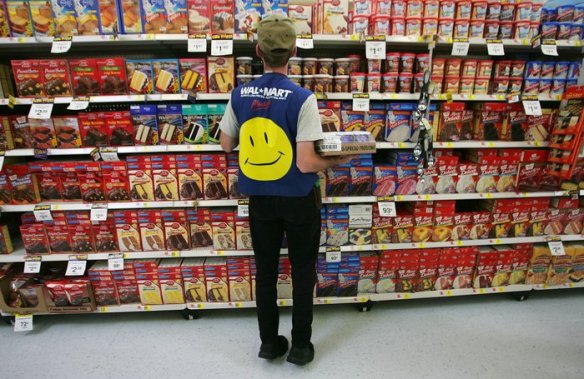
TROY, OH – MAY 11: An employee restocks a shelf in the grocery section of a Wal-Mart Supercenter May 11, 2005 in Troy, Ohio. Wal-Mart, America’s largest retailer and the largest company in the world based on revenue, has evolved into a giant economic force for the U.S. economy. With growth, the company continues to weather criticism of low wages, anti-union policies as well as accusations that it has homogenized America’s retail economy and driven traditional stores and shops out of business. (Photo by Chris Hondros/Getty Images)

By Daisy Luther

Source: Waking Times

In the United States, we are lucky to have massive convenience at our fingertips. I was talking to one of the instructors for the urban survival course, who is from Sweden, on a car ride. He was blown away by some of the things I told him about the levels of convenience and comfort in the United States. Things I completely took for granted don’t even exist there. I thought some of you might be interested in hearing about some of the insights we discussed.

Before I left for the course, I was walking my dogs a mile or two every day with my dogs, but that was about it. I thought it was enough but I learned during the field exercises that it wasn’t even close to the physicality required during an SHTF situation. But I digress. Let’s get back to convenience.

A caveat before people respond indignantly and tell me about all the inconvenience with which they deal every day: this is an opinion piece. Obviously many people in America still work out hard and have manual jobs. But when two-thirds of American adults and 30% of American children are overweight or obese, you have to see that you are not in the majority.

And it’s the majority here that I’m discussing. Between a combination of low-quality food and extremely sedentary lifestyles, the majority are killing themselves with convenience.

The American Culture of Convenience

The first thing that struck me when I landed in the Balkans was how different their lifestyle is from ours in the United States. But the longer I’ve been here, the more obvious it has become.

In the United States, depending on where you live, everything is dropped in your lap.

Food can be quickly acquired by shouting your order into a microphone and driving around a building, all without you having to leave your car. And if you live in a larger town or city, with the advent of services like GrubHub and DoorDash, the food delivered to your home is no longer the domain of pizza chains. You can have your choice of practically any restaurant in town brought right to your door within 45 minutes.

But it isn’t just about food. Instacart offers pick-up services from a wide variety of stores, including places like chain grocers, Wal-Mart, and Target. All you have to do is drive up, let them know by phone that you’ve arrived, and pop your trunk. Poof. Your shopping is done. In some cities, you can even use services like Instacart to have these things brought to your door.

Amazon has brought us practically anything else we could want with two-day shipping, regardless of where you live in the country. Gone are the days of scouring half a dozen stores to locate the whatchamacallit you needed. A quick search on Amazon and One-Click ordering and it’s yours within 48 hours and you never moved off your comfy chair.

If you need to go somewhere you don’t even have to drive yourself or take public transit. Uber or Lyft will happily send somebody to pick you up and drive you anywhere you need to go for a reasonable price, and you can watch the approach of your driver from the convenience of your phone.

Entire billion dollar industries are evolving to make our lives more convenient and easy every single day. Imagine how stunned our hunter-gatherer ancestors would be to discover we don’t even have to leave the house to be clothed and fed in epic abundance.

We don’t walk much, either.

And speaking of drive-thrus and driving to the store to get your Instacart packages, we drive everywhere. Part of this is because of the way suburbia is developed. It’s rare to live in a neighborhood where you can walk to the market, the bakery, and the wine store. So instead of walking to get our goods, we drive there, dash in, and get back in our cars. Those in big cities probably walk far more than those in suburbia, and for those in the country, it depends if they actually have a place to walk and whether they’re taking care of a large property.

And if we’re not walking to run our errands, we’re not carrying stuff. We get as close as possible with our cars if heavy groceries need to be lugged in and we carry as little as we can if we’re heading somewhere. When you walk the dogs, you might take your phone and some poop bags but you’re generally not taking it as a training opportunity and strapping on a pack.

Then there are the stairs.

Even two-story buildings in the United States have elevators much of the time because everything, by law, has to be easily accessible to every person. (And no, I’m not saying that people in wheelchairs need to try to haul themselves up the stairs. I’m discussing a trend.) But it goes even further than that. Adding elevators to your home is a growing trend in both the United States and Canada. New home builders are including elevators in the original design of some homes.

On the other hand, in Europe, they don’t have elevators in many buildings with fewer than five floors. I walked up and down more stairs in the past month than I have in the past year at home combined, and I live in a three-story house.

And the list of conveniences that would blow the minds of people I met in the Balkans goes on.

It’s an agoraphobic’s paradise in the United States.

You can get all sorts of mobile services that come to your door – everything from hairstyling to dog grooming. Other people mow our lawns, clean our homes, service our vehicles, and take care of us in general. There are even people who hire others to walk their dogs. Some people definitely need help with physical tasks but able-bodied people should be able to do a little yard work, shouldn’t we? Especially if we’re preparing for some kind of apocalypse.

In many areas, things are perfectly level, the sidewalks are carefully maintained (because who wants to ask for trouble in our litigious society), and a slight incline is considered a “hill” that people avoid to make their dog walk a little easier.

You can get meal kits brought to your door with every single ingredient you need to make a gourmet meal, right down to the seasonings accurately doled out in little packages. You can have fresh fruits and vegetables dropped off at your door by your local CSA. You can get subscription services of all types with the delivery of things like cosmetics, fitness gear, food from exotic locales, wine, candy, home decor items, socks, and dog paraphernalia.

Looking at it from the perspective of the area where I’ve been spending time, it’s simply mind-boggling that all of these riches are brought to you at the click of a button.

And it’s killing us.

As I mentioned earlier in this article, the obesity rate in the United States is staggering. A lot of it is our food. Thanks to subsidization by the USDA, many of the foods that are cheap are highly processed with low-quality ingredients. The NY Times reports:

At a time when almost three-quarters of the country is overweight or obese, it comes as no surprise that junk foods are the largest source of calories in the American diet. Topping the list are grain-based desserts like cookies, doughnuts and granola bars. (Yes, granola bars are dessert.)

That’s according to data from the federal government, which says that breads, sugary drinks, pizza, pasta dishes and “dairy desserts” like ice cream are also among Americans’ top 10 sources of calories.

What do these foods have in common? They are largely the products of seven crops and farm foods — corn, soybeans, wheat, rice, sorghum, milk and meat — that are heavily subsidized by the federal government, ensuring that junk foods are cheap and plentiful, experts say.

Between 1995 and 2010, the government doled out $170 billion in agricultural subsidies to finance the production of these foods, the latter two in part through subsidies on feed grains. While many of these foods are not inherently unhealthy, only a small percentage of them are eaten as is. Most are used as feed for livestock, turned into biofuels or converted to cheap products and additives like corn sweeteners, industrial oils, processed meats and refined carbohydrates. (source)

And even when we try to clean up our diets, foods are genetically modified, produce is doused in pesticides, and it’s packaged in all sorts of hormone-disrupting material that leaches in when you heat it up.

But it’s not just the crappy food. A lot of folks in the United States just do not get off their butts. And – I hate to say it – but I’m talking to a lot of people in the survival and preparedness world. Sitting at a keyboard or phone typing all day while Netflix plays in the background is sedentary to a deadly degree. On average Americans sit for 8.2 hours per day and this does not include the average 7-ish hours a day we’re sleeping.  And when we’re not sitting, it doesn’t mean we’re doing things that are good for us. We spend a great deal of time standing in line and driving in our cars. And the trend toward inactivity is only increasing.

Meanwhile, obesity contributes to many diseases such as:

  • High blood glucose (sugar) or diabetes.
  • High blood pressure (hypertension).
  • High blood cholesterol and triglycerides (dyslipidemia, or high blood fats).
  • Heart attacks due to coronary heart disease, heart failure, and stroke.
  • Bone and joint problems, more weight puts pressure on the bones and joints. This can lead to osteoarthritis, a disease that causes joint pain and stiffness.
  • Stopping breathing during sleep (sleep apnea). This can cause daytime fatigue or sleepiness, poor attention, and problems at work.
  • Gallstones and liver problems.
  • Some cancers.

The National Institute of Health is incredibly concerned about the future of overweight, sedentary Americans.

More recent evidence points to differential roles for body fat distribution patterns, in addition to excess overall adiposity, in elevating risk of many major chronic diseases. The large numbers of children entering adulthood overweight, together with increased weight gain in adulthood, portend an enormous burden in terms of human suffering, lost productivity, and health care expenditure in the coming decades. (source)

And – since it’s the purview of this website – imagine if the SHTF and you were too overweight and sedentary to go out and acquire the supplies you need to survive. Imagine what will happen when your medication runs out and you have a preventable disease brought on by your sedentary lifestyle. Imagine how your family will feel watching you suffer.

You need to add more movement to your life.

Unless you are among the 23% of Americans who meet the national exercise guidelines, you need to add more movement to your life. I suspect that there are a lot of people who believe they are disabled because getting started on a movement program is hard. It really does hurt, I know. But there’s a very good chance as you begin to move more it will become far easier. Don’t give in to it if your doctor says, “Oh, you’re disabled” and hands you a sticker for your car unless you really, truly are. If there’s even a glimmer of doubt in your mind, try to move just a few more steps each day. Instead of using the scooter to shop, push a cart to give yourself something to lean on. You aren’t training for a marathon – 10 extra steps a day will add up if you keep on pushing. But, MOVE.

The best way to increase movement is to decrease convenience. I don’t mean that you need to suddenly become a hunter-gatherer but you need to get off your duff. (To get started, check out this article or Bug Out Boot Camp and of course, always contact your doctor before beginning an exercise program. Blah, blah, blah.)

You need to carry heavy things instead of getting them delivered. You need to climb the stairs instead of taking the elevator or escalator. You need to actually go inside the store to do your shopping instead of sitting in your car, waiting for stuff to get loaded into your trunk. Park at the back of the parking lot, or better yet, at a store further away. Quit ordering from Amazon and buy things locally so you can walk around the store. Look for the hills and walk up and down them instead of avoiding them. If you want to eat restaurant food, go to the dad-gum restaurant. Find a place to walk to every day – maybe the post office, a coffee shop, or the dog park – and make it part of your routine.

It’s not unusual in other parts of the world to walk 8, 10, or even more miles, every single day. You don’t need to start there but maybe you should strive to get there. Once you’re in your groove, it should only take an hour or so to walk 4 miles. Using your feet as transportation is one of the healthiest things you can do.