The Way to Defeat the Globalist Reset: Local Production for Local Consumption…

By Peter Koenig

Source: Dissident Voice

The Globalists have semi-clandestinely introduced some kind of “covid-Martial Law” that overrules everything that is an otherwise Constitutional Right. We are in most of the western world a direct dictatorship. In most countries the Constitutional Amendment from “Democracy” to Dictatorship has happened clandestinely or at least semi-clandestinely. That’s what dictators do. Most of the people have no idea. Many of those who do know, don’t agree. They launch initiatives for new laws – that fall by the way side, because they have no teeth under a Martial Law-broken Constitution.

In Switzerland, the situation is slightly different, better of sorts. The Confederation Helvetica (CH) has a semi-direct Democracy. With 50,000 signatures, scrupulously verified for their validity, Swiss citizens can launch a referendum against a specific law. The referendum may eventually come to a popular vote, and a government/Parliament let law may be overruled. Though, this happens very rarely – the money lobby-propaganda is too strong – occasionally the people may have a chance. In these covid-times, it may actually happen.

We are currently undergoing the worst “tyrannification” of society in human history and in all western world countries. Covid-martial law overrules everything. This happened very fast. Within 18 months, from the beginning of 2020 to about mid-2021 citizens have basically no longer the very rights they could otherwise call as a human right. HRs have become worthless. In most cases police and military are under strict orders to obey. Those who don’t may lose their jobs, or worse.

Although, there are vivid and positive signs that the tides are turning. For example, at a London anti-covid-measures, anti-vaxx-certificates rally in London. Dr. Reiner Fuellmich, Corona Committee, spoke via a huge video screen to the crowd on Trafalgar Square, tens of thousands of people, telling them that class actions suits are under way in the US, Canada, and that institutions and individuals, especially those responsible for the invalid PCR-tests, particularly in Europe and the US, that are the basis for governments lying about “cases”, serving to manipulate up-and-down the “infection” figures, leading to false numbers on hospitalization and death, about a virus that is less deadly than the common flu. Yes, you read correctly, less deadly than the common flu. This is the onset to Nuremberg 2.0 – where justice will prevail, as much as light prevails over darkness.

Dr. Fuellmich closed his talk on a positive and encouraging note.

It is humanity, versus inhumanity. We are human. We can laugh, cry, sing and hug. The other side can’t. The other side has no access to the spiritual side. Therefore, the other side, without any doubt, the inhuman side, will lose this inhuman battle for life….

See this 10-min video.

The transformation is beginning to take place. This is the health side, the human side, the most immediately important side – where real science is overcoming “bought” science, in order to avoid a genocide of biblical proportions – which is the eugenists plan, probably developing over the past about 100 years. However, there are two other, complementary plans which also need to be stopped.

The first one of the two is the digitization of everything. It is already descending upon humanity, had actually started already decades ago – and is now in its final round – just so as to coincide with the massive population reduction. It includes not only digitization of all forms of monetary transactions – which is rapidly pushing forward, through Artificial Intelligence (AI) algorithms and most importantly, the vehicle to drive it all, the worldwide installation of 5G and soon to come 6G. This is foreseen to turn the entire globe into an electromagnetic field. And humans will be turned into “transhumans”, especially those that have survived the experimental, untested messenger spike protein injections called mRNA inoculations, falsely called “vaccines”.

This is not a joke. This is actually the plan already divulged in 2016 by Klaus Schwab, founder and forever CEO of the World Economic Forum (WEF) in an interview with Swiss French TV broadcast, see this 2-min video:

According to Klaus Schwab’s “The Great Reset”, algorithms, Artificial Intelligence (AI) and robots will soon rule the masses. By 2025, give or take a year or two, about half of today’s jobs will be run by AI. This electronic technology will in turn be ruled by some dirty-rich individuals, who somehow have given themselves the liberty to “run the world”. And we, the people, have let them.

They – the Deep Dark Statlers – call them Satanists – have planned this for about the last century. With great precision and intensity at times – and – what’s worse, much worse, right in front of our eyes. We have ignored them. Anybody who dared to draw attention to their evil machinations was dismissed with the convenient label “conspiracy theorist”.

Imagine, according to the Great Reset, half of our jobs will be taken over by AI, in just the next 5 years or so. By 2030, only about 5% to 10% of the current jobs will be existing and carried out by humans – maybe “transhumans”. All the others may be gone. Massive unemployment?  Maybe. But Schwab tries to tranquilize the world, saying that there will be new jobs for which newly unemployed people will be trained. They may be transhumans, because training is done by, and in partnership with, AI – and for the Epsilon People, the down-to-earth working class, robots will do the supervising.

This may sound depressing, despairing. It ain’t, if we think about the situation which we, pretty much on our own, have allowed to happen. It is not the end of the road, but only a stepping stone, onto which we too can step, when awakened – and not in anger, but with the bright spirit of light – a new world shaped by humans, shaped with the forces of light, Leaving the devil behind. Not even mentioning the beast. No letting it bother our minds. We are up to something much higher, much cleaner, clearer and much nobler. Our project is for humanity, for planet earth with all her sentient beings.

The simple model “Small is Beautiful” may be an appropriate vision forward. It may include another simple principle:
Local production for local consumption with local money, a local community run central bank working with a public banking system. Trade will be practiced with like-minded mostly neighboring sister countries, benefiting from comparative advantages. The money supply will be a reflection of the local economy. It will be backed by the local economy. Quite different from the current globalist-run fiat money pyramid.

This appears like a perfect recipe for de-globalization. And deglobalize we must. We must become again individuals that can and want to bond, not separate, individuals for whom solidarity is not just a term from a rusty vocabulary but means “we do it together”. This is the way to go, we will be satisfied with what we can achieve as a common, as a society with goals that serve the people, with values that do not depend on vertical growth, but rather reflect horizontal expansion of social infrastructure and well-being.

Let’s imagine a new type of economy with novel yardsticks – Happiness Indicators. Actually, not so novel, just not often talked about. In July 2011, the UN General Assembly adopted resolution 65/309 Happiness: Towards a Holistic Definition of Development inviting member countries to measure the happiness of their people and to use the data to help guide public policy. The first Happiness report was issued by the UN in April 2012.

If we are able to abandon the magical concept of “growth” and exchange it for happiness, we not only protect and preserve Mother Earth but will also preserve our human health – our sanity. Our today’s society is sick. It strives for ever more growth, for more possessions, for more affluence, for more control – but happiness that is the basis for a healthy life – is but an abstract term in today’s business-driven world. Happiness is more often than not confused with material wealth.

The no-growth, but social growth concept, is the basis for our escaping from the globalist agenda.

Human wealth comes from the heart. And it is through the heart that we may pass it on, replicate it. How does one define Happiness? There surely is no blueprint for happiness, as we are moving away from the all-modelled sets of values, away from the “musts” and the “Must-nots”.

The website “LifeHack.org” offers a few definitions of Happiness. Among them, the following two:

Happy people find balance in their lives. Folks who are happy have this in common: they’re content with what they have, and don’t waste a whole lot of time worrying and stressing over things they don’t. Unhappy people do the opposite: they spend too much time thinking about what they don’t have,; and,

According to the Dalai Lama, Happiness is not something readymade. It comes from your own actions. And let me add, from our actions driven by our heart and soul.

The General Assembly of the United Nations in its resolution 66/281 of 12 July 2012 proclaimed 20 March the International Day of Happiness recognizing the relevance of happiness and well-being as universal goals and aspirations in the lives of human beings around the world.

How does the UN define “Happiness”? Happiness is not contained in GDP, and less in GDP growth. To the contrary. It’s most important that we start detaching from material wealth, that we see the moral and friendship wealth in our society. That we see and strive for equality, inclusion, solidarity – that we learn to smile at each other, even in adverse situations. This requires an elevated spirit, a mentality of light that defeats satanic darkness.

Happy people abide by the golden rule: They let stuff go. Happy people realize this, are able to take things in stride, and move on – without fear.

That’s what we have to do – shed the fear – and move on, in a higher spiritual mode, floating out of the darkness into the light. It’s possible. Let’s give it a collective try. ‘They’ are blackmailing us into accepting the poisonous jab they fraudulently call vaccine. They may go as far as blocking us from getting food, from entering supermarkets without the vaccine certificate – or getting the test every time you need food. – No worries. They won’t succeed.

Is this ever-more encroaching human rights abuse-tyranny a malicious provocation? See this.

Are they on purpose driving people to the edge? To provoke a revolution? And bring in NATO and maybe even UN troops to subdue the upheavals, personal freedoms, national sovereignty – and even national borders towards a globalist world, a One World Order, a One Government world, led by the WEF and the club of billionaires directed by a satanic cult?

It is possible. But we are stronger. We will defeat this evil cult. Dr. Reiner Fuellmich et al, from the Corona Council, has already launched class action suits in Canada and the US and is taking legal actions against EU institutions and individuals. The tide is turning. Of course, you will not read or hear about it in the mainstream media.

Think small. Think community – your community, think self-sufficiency as much as possible. Think local production for local consumption with local money and local banks for the wellbeing of all within the community. Think trading with friends and with think-alike nations, societies, people.

We shall overcome – and we will.

The semi-satisfied life

Renowned for his pessimism, Arthur Schopenhauer was nonetheless a conoisseur of very distinctive kinds of happiness

By David Bather Woods

Source: aeon

On 13 December 1807, in fashionable Weimar, Johanna Schopenhauer picked up her pen and wrote to her 19-year-old son Arthur: ‘It is necessary for my happiness to know that you are happy, but not to be a witness to it.’

Two years earlier, in Hamburg, Johanna’s husband Heinrich Floris had been discovered dead in the canal behind their family compound. It is possible that he slipped and fell, but Arthur suspected that his father jumped out of the warehouse loft into the icy waters below. Johanna did not disagree. Four months after the suicide, she had sold the house, soon to leave for Weimar where a successful career as a writer and saloniste awaited her. Arthur stayed behind with the intention of completing the merchant apprenticeship his father had arranged shortly before his death. It wasn’t long, however, before Arthur wanted out too.

In an exchange of letters throughout 1807, mother and son entered tense negotiations over the terms of Arthur’s release. Johanna would be supportive of Arthur’s decision to leave Hamburg in search of an intellectually fulfilling life – how could she not? – including using her connections to help pave the way for his university education. But on one condition: he must leave her alone. Certainly, he must not move to be near her in Weimar, and under no circumstances would she let him stay with her.

What her line of 13 December doesn’t reveal is that Johanna simply couldn’t tolerate Arthur: ‘All your good qualities,’ she wrote on 6 November, ‘become obscured by your super-cleverness and are made useless to the world merely because of your rage at wanting to know everything better than others … If you were less like you, you would only be ridiculous, but thus as you are, you are highly annoying.’ He was, in short, a boorish and tiresome know-it-all.

If people found Arthur Schopenhauer’s company intolerable, the feeling was mutual. He spent long depressive periods in self-imposed isolation, including the first two months of 1832 in his new rooms in Frankfurt, the city that became his adoptive home after a stint in Berlin. He defended himself against loneliness with the belief that solitude is the only fitting condition for a philosopher: ‘Were I a King,’ he said, ‘my prime command would be – Leave me alone.’ The subject of happiness, then, is not normally associated with Schopenhauer, neither as a person nor as a philosopher. Quite the opposite: he is normally associated with the deepest pessimism in the history of European philosophy.

Schopenhauer’s pessimism is based on two kinds of observation. The first is an inward-looking observation that we aren’t simply rational beings who seek to know and understand the world, but also desiring beings who strive to obtain things from the world. Behind every striving is a painful lack of something, Schopenhauer claims, yet obtaining this thing rarely makes us happy. For, even if we do manage to satisfy one desire, there are always several more unsatisfied ones ready to take its place. Or else we become bored, aware that a life with nothing to desire is dull and empty. If we are lucky enough to satisfy our basic needs, such as hunger and thirst, then in order to escape boredom we develop new needs for luxury items, such as alcohol, tobacco or fashionable clothing. At no point, Schopenhauer says, do we arrive at final and lasting satisfaction. Hence one of his well-known lines: ‘life swings back and forth like a pendulum between pain and boredom’.

Schopenhauer knew from his extensive studies of classical Indian philosophy that he wasn’t the first to observe that suffering is essential to life. The Buddhists have a word for this suffering, dukkha, which is acknowledged in the first of its Four Noble Truths. The fourth and final of these truths, magga, or the Noble Eightfold Path that leads to the cessation of dukkha, would also inspire large parts of his moral philosophy.

The second kind of observation is outward-looking. According to Schopenhauer, a glance at the world around us disproves the defining thesis of Gottfried Leibniz’s optimism that ours is the best of all possible worlds. On the contrary, Schopenhauer claims, if our world is ordered in any way, it is ordered to maximise pain and suffering. He gives the example of predatory animals that cannot but devour other animals in order to survive and so become ‘the living grave of thousands of others’. Nature as a whole is ‘red in tooth and claw’, as Alfred, Lord Tennyson later put it, pitting one creature against another, either as the devourer or the devoured, in a deadly fight for survival.

Civilisation doesn’t help much either. It adds so many sites of human suffering. In The World as Will and Representation (1818), Schopenhauer wrote:

if you led the most unrepentant optimist through the hospitals, military wards, and surgical theatres, through the prisons, torture chambers and slave stalls, through battlefields and places of judgment, and then open for him all the dark dwellings of misery that hide from cold curiosity, then he too would surely come to see the nature of this best of all possible worlds.

If you had to guess the world’s purpose just by looking at the results it achieves, you could only think it was a place of punishment.

These observations, the first on human nature and the second on nature itself, support Schopenhauer’s pessimistic claims that life is not worth living and the world should not exist. We are never given in advance the choice whether to exist or not but, if we were, it would be irrational to choose to exist in a world where we can’t profit from life but only lose. Or as Schopenhauer puts it in another key line: ‘life is a business that does not cover its costs’.

Is there a place for happiness in all this? There certainly should be. It can’t be ignored that happiness exists; too many people have experienced happiness for themselves and seen it in others. But once Schopenhauer admits that happiness exists, there is a risk that his pessimism will start to unravel. Even if it’s true that every living thing must encounter suffering, this suffering might be offset by finding some amount of happiness too. Some suffering might be the means to a happiness worth having or even a part of such happiness. If this is so, then Schopenhauer hasn’t yet given us a good reason not to want to exist. Happiness might make life worth living after all.

Schopenhauer doesn’t deny that happiness exists. He does, however, think that we are generally mistaken about what happiness is. According to him, happiness is no more than the absence of pain and suffering; the moment of relief occasionally felt between the fulfilment of one desire and the pursuit of the next. For example, imagine the satisfaction of buying your first home. What makes us happy here, Schopenhauer would say, is not the positive state of being a homeowner, but the negative state of relief from the worries that come with not owning your own home (as well as relief from the notoriously stressful process of buying property itself). This happiness, Schopenhauer would be quick to point out, is likely to be short-lived, as a host of new worries and stresses emerge, such as paying down the mortgage, or doing up the bathroom.

He reinforces his stance on the negative nature of happiness with some astute psychological observations. All of them highlight the difficulty of achieving and appreciating happiness. For example, we tend not to notice all the things that are going well for us, but instead we focus on the bad things, or as Schopenhauer puts it with his keen eye for an analogy: ‘we do not feel the health of our entire body but only the small place where the shoe pinches’. If we do manage to resolve whatever is bothering us, we tend quickly to take it for granted and shift our focus to the next problem: ‘it is like a bite of food we have enjoyed, which stops existing for our feeling the moment it is swallowed.’ Moreover, however small the next problem, we tend to magnify it to match the previous one: ‘it still knows how to puff itself up so that it seems to equal it in size, and so it can fill the whole throne as the main worry of the day.’ Consequently, we rarely feel the benefit of the things we have while we still have them: ‘We do not become aware of the three greatest goods in life as such – that is, health, youth and freedom – so long as we possess them, but only after we have lost them.’ Or as later immortalised in lyrics by Joni Mitchell: ‘You don’t know what you’ve got ’til it’s gone.’

None of this is to say that no one ever feels happy. Again, this would fly in the face of the personal experience of countless people who have felt happy at some point in their lives. It does tell us, however, that happiness differs from pain and suffering in the way that it’s felt. Pain and suffering announce themselves whether we like it or not. They highlight that something is wrong and needs fixing. However small and trivial the problem might be, pain and suffering will make it our number-one priority. Happy feelings, on the other hand, don’t always announce themselves. We can have all the things that should make us feel happy and yet fail to feel happy. It could be because pain and suffering are tirelessly flagging up things not to feel happy about, but it could just be that – like the mouthful of food after it’s swallowed – we have forgotten all the things that are doing us good.

For this reason, Schopenhauer emphasises the essential role of recollection and reflection in generating feelings of happiness: ‘Our cognition of satisfaction and pleasure is only indirect, when we remember the sufferings and privations that preceded them and ceased when they appeared.’ To appreciate the benefit of having things, in other words, we must recall what it was like not to have them. The fact that this happiness is based on the cessation of previous suffering is not incompatible with intense feelings of pleasure. The intensity of the pleasure is proportionate to the intensity of the suffering that preceded it. Although far from happiness, Primo Levi gives a powerful example of the possibilities of profound relief in his book If This Is a Man (1947), his account of imprisonment at Auschwitz, when he reports on the brief moments between the labour tasks he was forced to complete: ‘When we reach the cylinder, we unload the tie on the ground, and I stand stiffly, my eyes vacant, mouth open, and arms dangling, sunk in the ephemeral and negative ecstasy of the cessation of pain.’

In fact, recalling our own actual suffering from the past is not our only option for feeling good about the present. We can instead reflect on all the suffering that was merely possible for us. This kind of reflection might be just as effective in generating feelings of relief, only about the limitless bad things that could have happened to us but fortunately never did. We might even reflect on the bad things that are happening or have happened to other people. In this respect, Levi’s painful recollections offer us another service: it is impossible for observers to read If This Is a Man without feeling extremely fortunate never to have encountered the scarcely imaginable hardships and indignities that Levi describes.

On the pleasure of avoiding another’s misfortune, Schopenhauer quotes Lucretius:

It is a joy to stand at the sea, when it is lashed by stormy winds,
To stand at the shore and to see the skipper in distress,
Not that we like to see another person in pain,
But because it pleases us to know that we are free of this evil.

Schopenhauer wisely cautions us about this kind of pleasure because it ‘lies very near the source of true and positive malice’. He might have in mind its proximity to – or identity with – Schadenfreude, the attitude of taking joy in the suffering of others. Lucretius identifies the thin line that separates Schadenfreude from sadism: it is not that we enjoy someone else’s misfortune, but that their misfortune acts as a reminder of how fortunate we are, and enables us to feel pleased about it.

Sometimes, however, Schopenhauer condemns Schadenfreude in the strongest terms: ‘the worst trait in human nature is Schadenfreude’. The difference between Schadenfreude and cruelty, he says, is merely the difference between attitude and action: ‘As Schadenfreude is simply theoretical cruelty, so cruelty is simply practical Schadenfreude.’ While attitudes such as envy – wanting someone else’s success for yourself – are flawed but merely human and therefore excusable, Schadenfreude is positively ‘devilish’.

On Schopenhauer’s understanding of things, then, in order to be happy, we must aim to eliminate pain and suffering from our lives, and in order to feel happy, we must also take the time to reflect on their absence. In search of an ethical system based on similar insights, Schopenhauer turned not to the moral philosophers of his own day but instead to ancient Greek schools of thought. Of all of these schools, he suggests, his own views on happiness have the closest affinity with Stoicism: like him, he claims, the Stoic philosophers such as Stobaeus, Epictetus and Seneca identified a happy life with a painless existence.

In general, ancient Greece is a good place to start the search for a philosophy of happiness because, according to Schopenhauer, the Greeks agreed on one thing: the task of practical reason is to figure out the best kind of life and how it can be achieved. Furthermore, Schopenhauer says, with the exception of Plato, they all equated this task with providing a guide to a happy life. They cared only about how virtue can improve our earthly lives, and thought little about how it might relate to any life after death or otherworldly realm.

Thinking of happiness as the avoidance of suffering is the view that distinguishes Stoicism from other schools, according to Schopenhauer, as well as the one he shares with it. He identifies two functions of practical reason that the Stoics used in their quest for a painless existence. There is the indirect function, on the one hand, where careful planning and forethought allow the Stoic to pick out and follow the least painful path through life. On the other, there is the direct function, where instead of removing or avoiding obstacles in life’s path, the Stoic reconsiders these obstacles in a way that changes his feelings towards them. One is a change in practice, while the other a change in thinking.

Stoicism’s distinctive contribution to ethics lies in the nature of the change in thinking it recommends, according to Schopenhauer. First, the Stoic observes that painful feelings of privation ‘do not follow immediately and necessarily from not-having, but rather from wanting-to-have and yet not having’. It then becomes obvious that to avoid these painful feelings altogether, we must eliminate the wanting-to-have part. Furthermore, the bigger our ambitions about what we want to have and the higher our hopes of achieving them, the sharper the pain when we fail. If we cannot help wanting to have some things, then we should at least keep those wants within realistic and achievable proportions. Perhaps lapsing back into his own pessimism, Schopenhauer adds that we should become suspicious of ourselves if we begin to expect a great amount of happiness waiting for us in the future; we are almost certainly being unrealistic. ‘Every lively pleasure,’ he says, ‘is a delusion.’

Thus the Stoic aims for ataraxia, a state of inner calmness and serenity however turbulent the world outside might be. Schopenhauer believes his observations about the inevitability of suffering can help to achieve this aim if taken on as convictions. Pain and suffering sting all the more if we think they are accidental and could have been avoided. While it might be true of any particular suffering that it could have been avoided, suffering in general is unavoidable and universal. If we manage to take this on board, Schopenhauer thinks, we might worry less about encountering suffering, or at least worry about it in the way that we worry about other things we can’t avoid, such as old age (for most of us) and death.

The last thing we should do is believe the opposite: that we are destined to find happiness in life rather than encounter suffering. If we believe the world owes us happiness, we are bound to be sorely disappointed, not least because, when we do achieve whatever we think will make us happy, we will have new unfulfilled desires that will supersede the old ones. We are also bound to feel resentment towards the obstacles that stand between us and the happiness we feel entitled to. Some people, Schopenhauer observes, concentrate and externalise this resentment by setting a goal for a happy life that on some level they know is unachievable. Then, when it never materialises, they always have something other than themselves to point to and blame for why they aren’t happy. ‘In this respect,’ Schopenhauer says, ‘the external motive for sadness plays the same role that a blister remedy does on the body, drawing together all the bad humours that would have otherwise been scattered.’

While Schopenhauer does feel an affinity for the Stoic way of thinking, he doesn’t see eye to eye with Stoicism on every issue. In fact, he rejects the basic premise common to all the ancient Greek schools; a happy life is not even possible, according to Schopenhauer, because, remember, all life is suffering. Devising systems of morals to act as a guide to a happy life is, as far as Schopenhauer is concerned, a fool’s errand. The logical end of Stoicism is especially sticky, according to Schopenhauer, because it conceives the goal of happiness as the task of eliminating pain. If he is right that all life is suffering, then the only way really to eliminate suffering is to eliminate life itself. The ultimate end of Stoicism, then, would be suicide.

Instead, Schopenhauer gives us a different picture of a happy life, one that is not total happiness. While suffering can’t be excluded from life altogether, it can be reduced by making sure no kind of suffering goes on for too long. Going back to Schopenhauer’s image of the pendulum, a happy life would include enough success in fulfilling our desires that we are never in too much pain, but also enough failure to ensure that we are never too bored. It would be a ‘game of constantly passing from desire to satisfaction and from this to a new desire, a game whose rapid course is called happiness and slow course is called suffering.’ A well-paced oscillation between wish and fulfilment, which is at most a semi-satisfied life, is the best we can hope for as far as happiness is concerned.

If a good life, conceived as a happy life, is a futile aim for ethics, this raises the question of what the real aim of ethics should be. The background of Schopenhauer’s pessimism is never far away from this question. It’s not obvious to Schopenhauer that the semi-satisfied life presented above is better than nonexistence. Such a life would still contain a preponderance of suffering, even if no kind of suffering would go on for too long.

Rather than trying to make the world into a happy home, then, Schopenhauer opts for an ethics that might save us from the world altogether. He endorses asceticism, the practice of severe self-denial exemplified in the saints and mystics of many world religions, over Stoicism:

How completely different they seem, next to the Stoic sage, those who the wisdom of India sets before us and has actually brought forth, those voluntary penitents who overcome the world; or even the Christian saviour … who, with perfect virtue, holiness and sublimity, nevertheless stands before us in a state of the utmost suffering.

Note that Schopenhauer’s otherworldly ascetics are not happy. They have entirely given up the game of a semi-satisfied life. Instead, they accept, and come to symbolise, the universality and inevitability of suffering, in order to transcend it. In relation to the ascetic, Schopenhauer is more likely to use words such as composure and peace than happiness and pleasure.

To say that Schopenhauer endorsed asceticism might appear to suggest that he practised it himself. Far from it. The most ascetic part of his daily routine in Frankfurt was the cold sponge bath he took between seven and eight every morning. After that, he made his own coffee and settled down to write for a few hours before receiving selected visitors, until his housekeeper appeared at noon, cuing them to leave. He played flute for half an hour each day – an activity that, according to Friedrich Nietzsche, belied the sincerity of his pessimism – and then made his way to his favourite spot to eat, the Hôtel d’Angleterre, for a hearty afternoon meal. After this he might make himself another coffee, take an hour’s nap, then read a little light literature before walking his dog, a white poodle called Atma, while smoking a cigar, all before settling in for his typical nine-hour sleep. The life of the Buddha it was not.

Schopenhauer’s endorsement of asceticism is more admiration than aspiration, then. In his defence, and again unlike the ancient Greeks, Schopenhauer thought that the theoretical study of ethics had little to do with living an ethical life, or vice versa: ‘it is just as unnecessary for the saint to be a philosopher as it is for a philosopher to be a saint,’ he wrote, ‘just as it is completely unnecessary for a perfectly beautiful person to be a great sculptor or a great sculptor to be beautiful.’ Only a small number of exceptional individuals achieve the ascetic life in which true salvation consists, he said. The rest of us have to make do with a semi-satisfied life at best. But if Schopenhauer’s way of living constitutes an example of such a life, it might not seem so bad after all.

It’s better to focus on where you are going than how you are feeling

By Christian Jarrett

Source: aeon

The notion that emotional pain and suffering reflect a deviation from a default happy baseline has been referred to as the ‘assumption of healthy normality’. But it’s a mistaken assumption. Estimates of the lifetime prevalence of psychiatric disorders indicate that around one in two adults will meet the criteria for a mental-health condition at some point in their lives. Given that psychological pain is so ubiquitous, we should focus less on what might make us happy, and more on achieving a sense of meaning, regardless of how we’re feeling. Psychotherapy should help people manage effective functioning while they are distressed, above and beyond aiming to reduce symptoms such as difficult thoughts, emotions and sensations. Acceptance and commitment therapy (ACT) takes this approach, using mindfulness, acceptance and other behavioural strategies to promote more flexible and value-driven behaviours. The goals in ACT are not necessarily to change or reduce one’s problematic thoughts or emotions, but to foster meaningful and effective behaviours regardless of mood, motivation or thinking. In other words, the primary goal is to promote what therapists call ‘valued living’.

Think of valued living as going about your daily life in the service of values that you find important, whereby engaging in these actions creates a sense of meaning and purpose. From an ACT perspective, symptoms of psychiatric disorders, and psychological suffering more broadly, are problematic when they are linked to rigid behaviours that pull us away from valued living. We might not have any control over the pain we experience – in fact, our emotional pain is profoundly human – but one area where we can exert some control is what we do in response to that suffering. Many common responses to difficult thoughts and emotions – such as avoidance, substance abuse, withdrawal and aggression – can alleviate distress in the short term, but also lead to long-term damage in our relationships, our jobs, our freedom and our personal growth – the very areas that provide that sense of meaning and purpose. By letting go of an agenda guided by minimising pain, and recalibrating toward a more value-driven agenda, our choices can be based on who we want to be, rather than how we want to feel.

In their 2013 study, the psychologists Todd Kashdan and Patrick McKnight of George Mason University in Virginia examined the day-to-day relationships between valued living and wellbeing in a sample of individuals with social anxiety disorder. This is a common but debilitating condition that’s marked by intense fear of social situations that might involve being negatively judged by others. People with social anxiety disorder often want and value positive relationships but considerable distress makes them avoid social interactions, so this is an excellent group in which to examine values and meaning.

In the study, participants began by identifying their central aim or purpose in life (eg, ‘trying to be a good role model to others’). Then, each day over the next two weeks, they rated their daily efforts and progress toward this goal, and provided daily ratings of their self-esteem, meaning in life, and experience of positive and negative emotions. On days when they reported investing greater effort toward their main life goal, they also tended to enjoy greater wellbeing: they said their life had more meaning, and they scored higher on self-esteem and the experience of positive emotions. Importantly, support was not found for the reverse path – greater wellbeing did not predict greater effort or progress toward strivings. This study highlights that sometimes we need to make the value-guided choice, regardless of how we feel.

If only it were so easy, though. For this reason, in ACT-based treatments, there is substantial focus on skills and techniques that can assist one in cultivating a more aware, willing and tolerant stance toward difficult feelings and other internal experiences. This stands in explicit contrast to a ‘do X and your distress will alleviate’ approach. The ACT techniques are not in the service of changing emotional states – they are in the service of facilitating valued action.

The effectiveness of ACT across different diagnoses and problem areas shows that committing to the benefits of valued living transcends traditional diagnostic categories. In addition to anxiety disorders, in studies of post-traumatic stress disorderdepression and resiliencechronic painsuicidal ideation and many more, engaging in behaviours consistent with personally held values has been linked to a range of positive outcomes.

Which brings me back to my work as a therapist. While the breadth of exercises and techniques employed in ACT is beyond the scope of this article, there is one exercise I’d like to share that has helped some of my clients see the inextricable link between valued living and painful experiences. In this activity (of which there are different variations), the therapist first asks the client to write on an index card some of the internal experiences they are struggling with most – difficult thoughts and judgments, emotions, memories.

I ask them, what do you notice when you read that index card? I feel awful, I don’t want this. What do you want to do with the card? I want to throw it in the trash. Then the client flips the card over, and I ask them to write out some of the things that are most important, most meaningful to them – being a parent, caring and supporting others, learning, growing, etc. What do you notice when you read this side? Warmth, it feels right, this is who I want to be. Where is the pain, where is the other stuff? Still here, on the other side of the card. What happens if you push that pain away, escape or avoid it? I push the meaningful stuff away too. In your heart of hearts, what does your experience tell you right now? If I’m going to do the things that are important to me, be the person that I want to be, I also have to make room for the painful stuff.

In my experience, this is both an emotionally difficult exercise and also one that helps a person grasp that it’s impossible to disentangle pain and valued living. Sometimes it is hard to engage with those struggles in session, but we regularly return to the rationale of the approach – that maybe a different stance toward pain is necessary. And that is the crux of the work in ACT – opening up to the demons, judgments and suffering that lie underneath, all for the purpose of moving toward that which is meaningful.

The valued path is not necessarily the happy path. Social connectedness sometimes brings us in contact with memories of abuse and trauma. Being a parent stirs up doubts, uncertainty and feelings of anxiety, fear, anger and shame. Advocating for social justice requires repeated exposure to the inequities in our societies and the feelings of helplessness that can come from fighting for an equality that might not exist until after you’re gone. But a growing body of psychological research suggests that the valued path is the more workable one, whereas the happy path can be more of an illusion.

For readers who would like to find out more, I recommend the book Get Out of Your Mind and Into Your Life (2005) co-authored by the founder of ACT, Steven Hayes, and also Things Might Go Terribly, Horribly Wrong (2010) co-authored by another ACT pioneer, Kelly Wilson. And here is the international directory of ACT therapists, maintained by the Association for Contextual Behavioral Science.

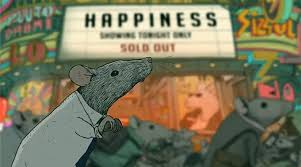
Saturday Matinee: Happiness (Short Film)

Happiness – by Steve Cutts

Can we buy happiness? Are we really trapped? An economic textbook about our contemporary society

By Chiara Pascali

Source: GoodShortFilms

Try to google the word Happiness, the first (sponsored) result of your search will be shophappiness.com. Happiness can be bought. This is a plus point for the British animator and artist Steve Cutts, director of the short film Happiness.

Cutts imagines humanity as a horde of rats, adored by the marketing god, bewitched by Black Friday or Cyber ​​Monday. Loose cannon looking for the last offer. Happiness is the penny that is always missing at the prices of super discount products.  Happiness is a commodity exchange of the new capitalism.

Happiness, by definition, is the moment in which all one’s desires are satisfied, but humanity always wants more. Like so many rats, we are looking for compulsive crumbs of happiness. Producers sow these crumbs on online and offline advertisements.

There are products that answer any type of question, even for the inability to endure frustration of being constantly dissatisfied.

This limitless race is rendered in an excellent way by the images of Happiness, full of details and oversized information. Chaos. Steve Cutts describes the irrepressible frenzy of modern society, the compulsive and often illogical search to possess new objects, and lastly, the money, motor that moves the world.

Happiness is a short economic textbook and an explicit critique of contemporary society. The final question does not spare anyone – are we trapped?

The Lonely American

By Sean Posey

Source: The Hampton Institute

In 2015, psychotherapist Traci Ruble started a “community listening project” in San Francisco dubbed “Sidewalk Talk.” The project sends trained volunteers to meet strangers on the street and listen to them discuss their problems and concerns. In a promotional video, Ruble is shown with her fellow volunteers, asking people if they’d like to sit for a talk. “You want to be listened to? It feels good!” Sidewalk Talk has apparently caught on and is now in 29 cities across the country.

Are there large numbers of Americans so bereft of friends and confidants that they have only strangers in the street to confide in? There apparently are. New studies are showing that Americans are increasingly lonely, isolated, and unhappy. Unmoored from one another and from a (fading) sense of community. More and more of our fellow citizens are going through life alone. This has devastating consequences for individual health and portends a troubled future for the American experiment.

According to a recent Cigna study involving 20,000 adults, loneliness in America has reached “epidemic proportions.” “Most Americans,” the report states, “are now considered lonely.” When asked how often they feel like no one knows them well, 54 percent responded that they sometimes or always feel that way. Nearly half of respondents report feeling sometimes or always alone. The numbers are even more disturbing when broken down:

“We also see that roughly one in four respondents rarely/never feel as though there are people who really understand them (27%), that they belong to a group of friends (27%), can find companionship when they want it (24%), or again feel as though they have a lot in common with others (25%).” Only 53 percent of American have daily “meaningful in-person social interactions,” according to Cigna.

Loneliness and social isolation, both “actual and perceived,” have direct consequences on one’s health, according to a 2015 study published in the journal Perspectives on Psychological Science. The effects of loneliness on mortality are the equivalent of smoking 15 cigarettes a day, which makes prolonged loneliness a bigger individual health risk than obesity.

Loneliness is also connected, perhaps not surprisingly, to mental disorders. According to the National Institute of Mental Health , nearly one in five adults have a mental health condition. Mental health issues are now one of the fastest growing causes of long-term absences from work. More disturbing still is the connection between loneliness and suicide, which recently hit a 30-year high in America. Even the opioid crisis, a main contributor to the country’s declining life expectancy, has been connected to the loneliness epidemic. These deaths are increasingly classified by researchers and the media as “deaths of despair.”

The World Happiness Report 2017, compiled by a group of independent experts for the United Nations, recently delivered even more bad news for Americans. The introduction to the report (written by John F. Helliwell, Richard Layard, and Jeffrey Sachs) states “Happiness is increasingly considered the proper measure of social progress and the goal of public policy.”

The top countries on the list rank highly on six key factors, the report explains: “healthy years of life expectancy, social support (as measured by having someone to count on in times of trouble), trust (as measured by a perceived absence of corruption in government and business), perceived freedom to make life decisions, and generosity (as measured by recent donations).” Norway, Denmark, Iceland, and Switzerland are the happiest nations. The US, on the other hand, finished in 19th place. Rising levels of corruption and “declining social support” are listed among the primary reasons for America’s dismal placing.

While the phenomena of decreasing happiness and increasing loneliness are finally getting notice, much of the blame is often placed on recent developments in the country’s history, including the rise of neoliberalism (understandable) and the election of Donald Trump as president (equally understandable). However, historical roots and recent developments alike seem to constitute important elements of the country’s failure to develop a meaningful sense of community and attachment among its citizenry.

American culture is often described – rightly – as highly individualistic. Despite the Puritans and their quest for ” a city upon a hill,” as John Winthrop so memorably put it, the first immigrants to the New World often arrived seeking material, not spiritual, prosperity. “Even in the sixteenth century,” writes historian Leo Marx, “the American countryside was the object of something like a calculated real estate promotion.” This was a “business civilization,” as historian Morris Berman refers to it (something Calvin Coolidge echoed during the 1920s when he said, “The business of America is business”).

The peerless observer Alexis de Tocqueville saw this during his travels through the country in 1831. While de Tocqueville admired much of the American character, he understood the downside of the relentless individualism that permeated every aspect of social and cultural life: “They owe nothing to any man, they expect nothing from any man; they acquire the habits of always considering themselves as standing alone, and they apt to imagine that their whole destiny is in their hands.”

Americans proved to be relentless seekers; first moving beyond the Royal Proclamation line that the British issued to separate their colonies from Indian lands; and then, finally, fulfilling “Manifest Destiny” and closing the frontier in the 19th century. The existence of the frontier in American life nurtured a “dominant individualism,” according to historian Frederick Jackson Turner – one that failed to disappear with the frontier itself.

War, however, proved to be a force for increasing civic mindedness, and it provided a boon for voluntary associations – trends that no doubt helped combat the social isolation which certainly accompanied the settling of the country. According to historian Theda Skocpol, the five largest civic associations of the late 19th and early 20th centuries formed between 1864 and 1868.

Robert Putnam found similar evidence for an increase in civic mindedness among the generation shaped by World War II. In the seminal book Bowling Alone: The Collapse and Revival of American Community, Putnam calls the generation that fought the war the “long civic generation,” also known as the “Greatest Generation.” According to the Cigna study, they’re the generation least affected by the epidemic of loneliness. On the other hand, Generation Z (those born between 1995 and 2010) reported the highest levels of loneliness. The civic connectedness and civic mindedness of the Greatest Generation simply did not last. “The [generational] changes are probably part of a larger societal shift toward individual and material values and away from communal values,” Putnam writes in Bowling Alone.

There’s evidence to support his assertion. In Bowling Alone, Putnam cites a Roper study from 1972 that asked adults to identify essential elements of “the good life.” Approximately 38 percent chose “a lot of money,” but an equal percentage chose “a job that contributes to the welfare of society.” By 1996, the percentage of people who chose making a lot of money had risen to 63 percent. According to current research, 71 percent of millennials place a similar emphasis on making money.

But much like other Americans, outcomes for the wealthy compare poorly to those of their peers in other countries. For example, according to a 2007 study in the Journal of the American Psychological Association, the “richest, healthiest Americans” are as a sick as the poorest citizens in Britain. What’s the reason? The study’s author, Sir Michael Marmot of University College London Medical School, gives two reasons: Americans worker longer hours, are more stressed than their counterparts in other wealthy democracies, and Americans are apparently more likely to feel “friendless and isolated.”

This pervading sense of loneliness and disconnection, while felt particularly by the young, cuts across class, gender and race, according to Cigna. The rise of social media is sometimes blamed for an increase in feelings of loneliness and isolation, but its use did not figure as a major cause of loneliness in the study.

For much of the past century, some American artists and intellectuals have pointed fingers at the country’s culture – or what passes for culture – as being at the root of societal anomie. In 1950, playwright and novelist Thornton Wilder stated that a lack of a codification of ideals was making American life difficult to process. Americans, he said, were always on the move – a “very un-European” manner of life.

Famed sociologist Philip Slater delivered perhaps one of the most pointed critiques of American life in his 1970 book, The Pursuit of Loneliness. He declared the human desire for engagement, community, and yes, dependence, were frustrated at every turn by American life. “Americans have created a society in which they are automatic nobodies,” he writes, “since no one has any stable place or enduring connection.”

And it hasn’t only been liberals who have echoed such criticisms. Michael Hendrix writes in the National Review, “Americans conceive of themselves as individuals isolated from others in such a way that it becomes an imperative for them to form their own meaning for their own lives.” Clearly, many Americans aren’t forming a meaning for their own lives, at least not alone. The dismal statistics tell us as much. But as we have seen – with some exceptions – this is a problem as old as America itself. A country where individuals are adrift and leading lives without meaningful, connective and nourishing attachments is a country with a grim future indeed. And the problem is now accelerating, as levels of loneliness and disconnection rise among the millennials and Generation Z.

How will the country solve its most vexing problems when Americans are no longer capable of holding onto even the most elementary attachments to one another and their surrounding communities? We might find out, too late, that a society of atomized individuals is no society at all.

OUR NEW, HAPPY LIFE? THE IDEOLOGY OF DEVELOPMENT

By Charles Eisenstein

Source: Waking Times

In George Orwell’s 1984, there is a moment when the Party announces an “increase” in the chocolate ration – from thirty grams to twenty. No one except for the protagonist, Winston, seems to notice that the ration has gone down not up.

‘Comrades!’ cried an eager youthful voice. ‘Attention, comrades! We have glorious news for you. We have won the battle for production! Returns now completed of the output of all classes of consumption goods show that the standard of living has risen by no less than 20 percent over the past year. All over Oceania this morning there were irrepressible spontaneous demonstrations when workers marched out of factories and offices and paraded through the streets with banners voicing their gratitude to Big Brother for the new, happy life which his wise leadership has bestowed upon us.

The newscaster goes on to announce one statistic after another proving that everything is getting better. The phrase in vogue is “our new, happy life.” Of course, as with the chocolate ration, it is obvious that the statistics are phony.

Those words, “our new, happy life,” came to me as I read two recent articles, one by Nicholas Kristof in the New York Times and the other by Stephen Pinker in the Wall Street Journal, both of which asserted, with ample statistics, that the overall state of humanity is better now than at any time in history. Fewer people die in wars, car crashes, airplane crashes, even from gun violence. Poverty rates are lower than ever recorded, life expectancy is higher, and more people than ever are literate, have access to electricity and running water, and live in democracies.

Like in 1984, these articles affirm and celebrate the basic direction of society. We are headed in the right direction. With smug assurance, they tell us that thanks to reason, science, and enlightened Western political thinking, we are making strides toward a better world.

Like in 1984, there is something deceptive in these arguments that so baldly serve the established order.

Unlike in 1984, the deception is not a product of phony statistics.

Before I describe the deception and what lies on the other side of it, I want to assure the reader that this essay will not try to prove that things are getting worse and worse. In fact, I share the fundamental optimism of Kristof and Pinker that humanity is walking a positive evolutionary path. For this evolution to proceed, however, it is necessary that we acknowledge and integrate the horror, the suffering, and the loss that the triumphalist narrative of civilizational progress skips over.

What hides behind the numbers

In other words, we need to come to grips with precisely the things that Stephen Pinker’s statistics leave out. Generally speaking, metrics-based evaluations, while seemingly objective, bear the covert biases of those who decide what to measure, how to measure it, and what not to measure. They also devalue those things which we cannot measure or that are intrinsically unmeasurable. Let me offer a few examples.

Nicholas Kristof celebrates a decline in the number of people living on less than two dollars a day. What might that statistic hide? Well, every time an indigenous hunter-gatherer or traditional villager is forced off the land and goes to work on a plantation or sweatshop, his or her cash income increases from zero to several dollars a day. The numbers look good. GDP goes up. And the accompanying degradation is invisible.

For the last several decades, multitudes have fled the countryside for burgeoning cities in the global South. Most had lived largely outside the money economy. In a small village in India or Africa, most people procured food, built dwellings, made clothes, and created entertainment in a subsistence or gift economy, without much need for money. When development policies and the global economy push entire nations to generate foreign exchange to meet debt obligations, urbanization invariably results. In a slum in Lagos or Kolkata, two dollars a day is misery, where in the traditional village it might be affluence. Taking for granted the trend of development and urbanization, yes, it is a good thing when those slum dwellers rise from two dollars a day to, say, five. But the focus on that metric obscures deeper processes.

Kristof asserts that 2017 was the best year ever for human health. If we measure the prevalence of infectious diseases, he is certainly right. Life expectancy also continues to rise globally (though it is leveling off and in some countries, such as the United States, beginning to fall). Again though, these metrics obscure disturbing trends. A host of new diseases such as autoimmunity, allergies, Lyme, and autism, compounded with unprecedented levels of addiction, depression, and obesity, contribute to declining physical vitality throughout the developed world, and increasingly in developing countries too. Vast social resources – one-fifth of GDP in the US – go toward sick care; society as a whole is unwell.

Both authors also mention literacy. What might the statistics hide here? For one, the transition into literacy has meant, in many places, the destruction of oral traditions and even the extinction of entire non-written languages. Literacy is part of a broader social repatterning, a transition into modernity, that accompanies cultural and linguistic homogenization. Tens of millions of children go to school to learn reading, writing, and arithmetic; history, science, and Shakespeare, in places where, a generation before, they would have learned how to herd goats, grow barley, make bricks, weave cloth, conduct ceremonies, or bake bread. They would have learned the uses of a thousand plants and the songs of a hundred birds, the words of a thousand stories and the steps to a hundred dances. Acculturation to literate society is part of a much larger change. Reasonable people may differ on whether this change is good or bad, on whether we are better off relying on digital social networks than on place-based communities, better off recognizing more corporate logos than local plants and animals, better off manipulating symbols rather than handling soil. Only from a prejudiced mindset could we say, though, that this shift represents unequivocal progress.

My intention here is not to use written words to decry literacy, deliciously ironic though that would be. I am merely observing that our metrics for progress encode hidden biases and neglect what won’t fit comfortably into the worldview of those who devise them. Certainly, in a society that is already modernized, illiteracy is a terrible disadvantage, but outside that context, it is not clear that a literate society – or its extension, a digitized society – is a happy society.

The immeasurability of happiness

Biases or no, surely you can’t argue with the happiness metrics that are the lynchpin of Pinker’s argument that science, reason, and Western political ideals are working to create a better world. The more advanced the country, he says, the happier people are. Therefore the more the rest of the world develops along the path we blazed, the happier the world will be.

Unfortunately, happiness statistics encode as assumptions the very conclusions the developmentalist argument tries to prove. Generally speaking, happiness metrics comprise two approaches: objective measures of well-being, and subjective reports of happiness. Well-being metrics include such things as per-capita income, life expectancy, leisure time, educational level, access to health care, and many of the other accouterments of development.  In many cultures, for example, “leisure” was not a concept; leisure in contradistinction to work assumes that work itself is as it became in the Industrial Revolution: tedious, degrading, burdensome. A culture where work is not clearly separable from life is misjudged by this happiness metric; see Helena Norberg-Hodge’s marvelous film Ancient Futures for a depiction of such a culture, in which, as the film says, “work and leisure are one.”

Encoded in objective well-being metrics is a certain vision of development; specifically, the mode of development that dominates today. To say that developed countries are therefore happier is circular logic.

As for subjective reports of individual happiness, individual self-reporting necessarily references the surrounding culture. I rate my happiness in comparison to the normative level of happiness around me. A society of rampant anxiety and depression draws a very low baseline. A woman told me once, “I used to consider myself to be a reasonably happy person until I visited a village in Afghanistan near where I’d been deployed in the military. I wanted to see what it was like from a different perspective. This is a desperately poor village,” she said. “The huts didn’t even have floors, just dirt which frequently turned to mud. They barely even had enough food. But I have never seen happier people. They were so full of joy and generosity. These people, who had nothing, were happier than almost anyone I know.”

Whatever those Afghan villagers had to make them happy, I don’t think shows up in Stephen Pinker’s statistics purporting to prove that they should follow our path. The reader may have had similar experiences visiting Mexico, Brazil, Africa, or India, in whose backwaters one finds a level of joy rare amidst the suburban boxes of my country. This, despite centuries of imperialism, war, and colonialism. Imagine the happiness that would be possible in a just and peaceful world.

I’m sure my point here will be unpersuasive to anyone who has not had such an experience first-hand. You will think, perhaps, that maybe the locals were just putting on their best face for the visitor. Or maybe that I am seeing them through romanticizing “happy-natives” lenses. But I am not speaking here of superficial good cheer or the phony smile of a man making the best of things. People in older cultures, connected to community and place, held close in a lineage of ancestors, woven into a web of personal and cultural stories, radiate a kind of solidity and presence that I rarely find in any modern person. When I interact with one of them, I know that whatever the measurable gains of the Ascent of Humanity, we have lost something immeasurably precious. And I know that until we recognize it and turn toward its recovery, that no further progress in lifespan or GDP or educational attainment will bring us closer to any place worth going.

What other elements of deep well-being elude our measurements? Authenticity of communication? The intimacy and vitality of our relationships? Familiarity with local plants and animals? Aesthetic nourishment from the built environment? Participation in meaningful collective endeavors? Sense of community and social solidarity? What we have lost is hard to measure, even if we were to try. For the quantitative mind, the mind of money and data, it hardly exists. Yet the loss casts a shadow on the heart, a dim longing that no assurance of new, happy life can assuage.

While the fullness of this loss – and, by implication, the potential in its recovery – is beyond measure, there are nonetheless statistics, left out of Pinker’s analysis, that point to it. I am referring to the high levels of suicide, opioid addiction, meth addiction, pornography, gambling, anxiety, and depression that plague modern society and every modernizing society. These are not just random flies that have landed in the ointment of progress; they are symptoms of a profound crisis. When community disintegrates, when ties to nature and place are severed, when structures of meaning collapse, when the connections that make us whole wither, we grow hungry for addictive substitutes to numb the longing and fill the void.

The loss I speak of is inseparable from the very institutions – science, technology, industry, capitalism, and the political ideal of the rational individual – that Stephen Pinker says have delivered humanity from misery. We might be cautious, then, about attributing to these institutions certain incontestable improvements over Medieval times or the early Industrial Revolution. Could there be another explanation? Might they have come despite science, capitalism, rational individualism, etc., and not because of them?

The empathy hypothesis

One of the improvements Stephen Pinker emphasizes is a decline in violence. War casualties, homicide, and violent crime, in general, have fallen to a fraction of their levels a generation or two ago. The decline in violence is real, but should we attribute it, as Pinker does, to democracy, reason, rule of law, data-driven policing, and so forth? I don’t think so. Democracy is no insurance against war – in fact, the United States has perpetrated far more military actions than any other nation in the last half-century. And is the decline in violent crime simply because we are better able to punish and protect ourselves from each other, clamping down on our savage impulses with the technologies of deterrence?

I have another hypothesis. The decline in violence is not the result of perfecting the world of the separate, self-interested rational subject. To the contrary: it is the result of the breakdown of that story, and the rise of empathy in its stead.

In the mythology of the separate individual, the purpose of the state was to ensure a balance between individual freedom and the common good by putting limits on the pursuit of self-interest. In the emerging mythology of interconnection, ecology, and interbeing, we awaken to the understanding that the good of others, human and otherwise, is inseparable from our own well-being.

The defining question of empathy is, What is it like to be you? In contrast, the mindset of war is the othering, the dehumanization and demonization of people who become the enemy. That becomes more difficult the more accustomed we are to considering the experience of another human being. That is why war, torture, capital punishment, and violence have become less acceptable. It is not that they are “irrational.” To the contrary: establishment think tanks are quite adept at inventing highly rational justifications for all of these.

In a worldview in which competing self-interested actors is axiomatic, what is “rational” is to outcompete them, dominate them, and exploit them by any means necessary? It was not advances in science or reason that abolished the 14-hour workday, chattel slavery, or debtors’ prisons.

The worldview of ecology, interdependence, and interbeing offers different axioms on which to exercise our reason. Understanding that another person has an experience of being, and is subject to circumstances that condition their behavior, makes us less able to dehumanize them as a first step in harming them. Understanding that what happens to the world in some way happens to ourselves, reason no longer promotes war. Understanding that the health of soil, water, and ecosystems is inseparable from our own health, reason no longer urges their pillage.

In a perverse way, science & technology cheerleaders like Stephen Pinker are right: science has indeed ended the age of war. Not because we have grown so smart and so advanced over primitive impulses that we have transcended it. No, it is because science has brought us to such extremes of savagery that it has become impossible to maintain the myth of separation. The technological improvements in our capacity to murder and ruin make it increasingly clear that we cannot insulate ourselves from the harm we do to the other.

It was not primitive superstition that gave us the machine gun and the atomic bomb. Industry was not an evolutionary step beyond savagery; it applied savagery at an industrial scale. Rational administration of organizations did not elevate us beyond genocide; it enabled it to happen on an unprecedented scale and with unprecedented efficiency in the Holocaust. Science did not show us the irrationality of war; it brought us to the very extreme of irrationality, the Mutually Assured Destruction of the Cold War. In that insanity was the seed of a truly evolutive understanding – that what we do to the other, happens to ourselves as well. That is why, aside from a retrograde cadre of American politicians, no one seriously considers using nuclear weapons today.

The horror we feel at the prospect of, say, nuking Pyongyang or Tehran is not the dread of radioactive blowback or retributive terror. It arises, I claim, from our empathic identification with the victims. As the consciousness of interbeing grows, we can no longer easily wave off their suffering as the just deserts of their wickedness or the regrettable but necessary price of freedom. It as if, on some level, it would be happening to ourselves.

To be sure, there is no shortage of human rights abuses, death squads, torture, domestic violence, military violence, and violent crime still in the world today. To observe, in the midst of it, a rising tide of compassion is not a whitewash of the ugliness, but a call for fuller participation in a movement. On the personal level, it is a movement of kindness, compassion, empathy, taking ownership of one’s judgments and projections, and – not contradictorily – of bravely speaking uncomfortable truths, exposing what was hidden, bringing violence and injustice to light, telling the stories that need to be heard. Together, these two threads of compassion and truth might weave a politics in which we call out the iniquity without judging the perpetrator, but instead seek to understand and change the circumstances of the perpetration.

From empathy, we seek not to punish criminals but to understand the circumstances that breed crime. We seek not to fight terrorism but to understand and change the conditions that generate it. We seek not to wall out immigrants, but to understand why people are so desperate in the first place to leave their homes and lands, and how we might be contributing to their desperation.

Empathy suggests the opposite of the conclusion offered by Stephen Pinker. It says, rather than more efficient legal penalties and “data-driven policing,” we might study the approach of new Philadelphia District Attorney Larry Krasner, who has directed prosecutors to stop seeking maximum sentences, stop prosecuting cannabis possession, steer offenders toward diversionary programs rather than penal programs, cutting inordinately long probation periods, and other reforms. Undergirding these measures is compassion: What is it like to be a criminal? An addict? A prostitute? Maybe we still want to stop you from continuing to do that, but we no longer desire to punish you. We want to offer you a realistic opportunity to live another way.

Similarly, the future of agriculture is not in more aggressive breeding, more powerful pesticides, or the further conversion of living soil into an industrial input. It is in knowing soil as a being and serving its living integrity, knowing that its health is inseparable from our own. In this way, the principle of empathy (What is it like to be you?) extends beyond criminal justice, foreign policy, and personal relationships. Agriculture, medicine, education, technology – no field is outside its bounds. Translating that principle into civilization’s institutions (rather than extending the reach of reason, control, and domination) is what will bring real progress to humanity.

This vision of progress is not contrary to technological development; neither will science, reason, or technology automatically bring it about. All human capacities can be put into service to a future embodying the understanding that the world’s wellbeing, human and otherwise, feeds our own.

Inequality Social Dysfunction and Misery

By Graham Peebles

Source: Dissident Voice

Year on year the economic divisions and sub-divisions in the world deepen, the associated social ills increase: The rich, comfortable, and the very extremely rich keep getting richer, and the rest, well, whilst some may be raised up out of crippling poverty into relative poverty, the majority of people continue to live under a blanket of economic insecurity and largely remain where they are.

Straddling the global ladder of economic and social division sit the Multi-Billionaires (there are now 2,208 billionaires), 42 of whom (down from 61 in 2016), according to a recent report by Oxfam, own the same amount of wealth as the poorest half of humanity combined. Together with their lesser cohorts this coterie of Trillionaires sucked up “eighty-two percent of the wealth generated [in the world] last year…while the 3.7 billion people who make up the poorest half of the world saw no increase in their wealth.”

The defining challenge of our time

Income and wealth inequality is not simply a monetary issue, it is a complex social crisis that supports and strengthens notions of superiority and inferiority, and was described by President Barak Obama in 2013 as “the defining challenge of our time.”

Today’s obscene levels of inequality are the result of the Neo-Liberal economic system. This extreme form of capitalism took hold first in America and Britain in the early 1980s when Reagan and Thatcher ruled, workers’ rights were trampled on, ‘society’ was a dirty word and community responsibility was abandoned to selfishness and greed. With the aid of the World Bank and the IMF, Neoliberalism swiftly spread throughout the world, polluting life in every city, town and village with its divisive, cruel ideology. Commercialization and competition are key principles and have infiltrated every area of contemporary life; everything and everyone is seen as a commodity, and the size of ones bank account determines the level of health care, education and housing available, as well as one’s access to culture and freedom to travel.

Social injustice is inherent in the system, as is inequality, which is itself a major form of injustice. Inequality strengthens deep-seated social imbalances based on class and social standing, and in a world where everything is classified, commercialized and priced; i.e., attributed value, external wealth and position have become the common criteria for determining the internal worth of a human being. Comparison and imitation follow, individuality is perverted and fear fostered; fear of inadequacy, fear of failure, fear of not being loved, because not ‘deserving’ love, not being able to ‘afford’ love. Resentment, anger and self-loathing are fed, leading to a range of mental health issues, including anxiety, depression and drug and alcohol addiction.

Happiness and inequality

The impact of financial inequality on the health and well being of society has been extensively studied by Richard Wilkinson; British co-author of Spirit Level, Professor Emeritus of Social Epidemiology at the University of Nottingham. In order to establish national levels of inequality Wilkinson and his team used a benchmark based on how much richer the top 20% is to the bottom 20%: Japan and Scandinavia (Finland, Norway, Sweden, Denmark) came out most equal, and now, Slovenia and the Czech Republic have moved towards this group. Israel, New Zealand, Australia, Britain, Portugal and USA were found to have the greatest levels of inequality, and by some margin. Recent data suggests that Russia, South Africa and Turkey should now be added to the most unequal pile. Germany, Spain and Switzerland sit somewhere in the middle.

Data relating to a range of social issues was examined: The most unequal countries were found to have lower life expectancy than more equal societies, higher infant mortality, many more homicides, larger prison populations (by 10-15 times), applied longer sentences; had higher teenage pregnancies, lower mathematic/literacy levels, more obesity, less social mobility, and, according to The World Value Survey, a great deal less trust. In more equal countries, like Sweden and Norway, around 65% of people trust others, whereas in unequal societies like America a mere 15% admitted to trusting their fellow citizens.

In all areas, countries with high levels of inequality did worse, in many cases much worse, than more equal nations. Mental health, for example, (figures from the World Health Organization): In Japan around 8% of the population suffers from some form of mental health issue, compared to 30% in America. Children are considerably healthier in more equal countries – based on UNICEF’s Index of Child Well-Being – and feel a good deal happier. Wilkinson concludes, “What we’re looking at is general social dysfunction related to inequality. It’s not just one or two things that go wrong, it’s most things.”

Look to Scandinavia

If one of the primary purposes of any socio-economic system is to create environments in which human beings can grow and live happily together, then the nations suffering under the shadow of inequality need to learn from Sweden, Norway, Denmark and Finland, which are not just the least unequal, they are also the happiest countries in the world. Throughout Scandinavia public services – education (which is probably the best in the world), health care and housing, are valued, and taxes levied in order to fund them properly; there are greater levels of social justice, this allows for trust to develop, and where there is trust relationships flower. The extremes of staggering wealth and stifling poverty don’t exist as they do in the more unequal parts of the world; social mobility is greater and the dream of betterment more realistic, as Richard Wilkinson says, “if Americans want to live the ‘American dream’ they should go and live in Denmark.”

The first duty of government is to protect the people; this involves not only dealing with terrorism and the like, but requires the development of socio-economic policies that contribute to the creation of a healthy harmonious environment. By supporting extreme inequality (which has been shown to fuel a range of social issues) governments in the more unequal countries are totally failing in this fundamental duty. Politicians, who in many cases rely on big business and wealthy benefactors for their funding, are either blind to, or negligent of, the inherent faults of the current system, and the unhealthy, negative way of life it supports.

The case for fundamental change in the economic order, and a shift away from the destructive values it promotes is becoming irrefutable; however, change occurs only gradually and resistance is great. In the meantime, governments (particularly in the most unequal states) need to acknowledge the connection between the dysfunction and disease within society and their socio-economic methodology, which is literally making people ill, as well and poisoning the natural world. They need to invest properly in public services, address wage differences, ban bonuses, introduce progressive tax reform, and, unlike America and France which are taking retrograde steps by designing tax codes which will fuel inequality, look to the Scandinavian countries and learn from their example.

For too long socio-economic systems have been designed and maintained to cater to the desires and interests of a privileged few, while the majority live inhibited lives under the shadow of financial uncertainty. For harmonious societies to evolve this long-standing injustice needs to be addressed and a degree of balance found. This requires that those whose table is full to overflowing share some of their bounty, so that all may have enough, not excess, enough.

As a wise man has said, “The rich must give up what they want, so that the poor can have what they need.” What the rich and comfortable must give up is greed (another car, another house, more designer clothes, etc.), what the rest need is freedom from economic insecurity and the fear of destitution, freedom from exploitation and dependency; secure, comfortable, and well-designed accommodation, and access to good education, health care and culture. Such essential needs are the rights of all; when made manifest they go a long way towards establishing social justice, and where there is social justice, functional, compassionate communities do evolve, conflict is reduced and collective harmony is cultivated.

A Zen Master Explains the Art of ‘Letting Go’, And It Isn’t What You Think

By Christina Sarich

Source: Waking Times

Thich Naht Hanh, the Zen Buddhist master, has some interesting advice about what it means to truly let go. Many people mistake detachment or non-clinging to be a form of aloofness, or emotional disconnect from others, but as Hanh explains, truly letting go often means loving someone more than you have ever loved them before.

The Buddha taught that detachment, one of the disciplines on the Noble Path, also called ariyasaavaka, is not a physical act of withdrawal or even a form of austerity. Though the Buddha teaches of a “non-action which is an integral part of the Right Way,” if it is taken out of context it can give the impression that we should develop a lack of concern for others, and that we should live without truly feeling or expressing our emotions – cutting ourselves off from life.

These type of misinterpretations are sadly common, since there are not always direct translations from the Paali language into English.

This form of “detachment” is an erroneous understanding of the Buddha’s message. Master Hanh states that to truly let go we must learn to love more completely. Non-attachment only happens when our love for another extends beyond our own personal expectations of gain, or our anticipation of a specific, desired outcome.

Hanh describes four forms of complete detachment, which surprisingly, aren’t about holing yourself up in a cave and ignoring everyone who has broken your heart, or ignoring your lust or desire for a romantic interest. This is not detachment. Letting go, means diving in. For example:

Maitri (Not the Love You Know)

Hanh describes the importance of Maitri, not love as we normally understand in a Westernized use of the word. He states,

“The first aspect of true love is maitri (metta, in Pali), the intention and capacity to offer joy and happiness. To develop that capacity, we have to practice looking and listening deeply so that we know what to do and what not to do to make others happy. If you offer your beloved something she does not need, that is not maitri. You have to see her real situation or what you offer might bring her unhappiness.”

In other words, your detachment may come in accepting that certain things you would normally do to make another person feel loved and appreciated may not be what the person you are actively loving now, needs. Instead of forcing that behavior on another person, with an egoic intent to “please” them, you simply detach from that need in yourself, and truly observe what makes another person feel comfortable, safe, and happy.

Hanh further explains,

We have to use language more carefully. “Love” is a beautiful word; we have to restore its meaning. The word “maitri” has roots in the word mitra which means friend. In Buddhism, the primary meaning of love is friendship.”

Karuna (Compassion)

The next form of true detachment is compassion. When we let go, we don’t stop offering a compassionate touch, word, or deed to help someone who is in pain. We also don’t expect to take their hurt or pain away. Compassion contains deep concern, though. It is not aloofness It is not isolation from others.

The Buddha smiles because he understands why pain and suffering exist, and because he also knows how to transform it. You become more deeply involved in life when you become detached form the outcome, but this does not mean you don’t participate fully – even in others’ pain.

Gratitude and Joy

In truly letting go you practice gratitude. Mudita, or joy arises when we are overcome with gratitude for all that we have, such that we no longer cling to some other longed-for result. The Buddha’s definition of joy is more like “Unselfish joy.” It means that we don’t only find happiness when something good happens to us, but when others find happiness.

If you’ve ever had to say goodbye to a love or friend so that they could continue on their life’s path – one that may not have continued to intertwine with your own – you may have felt pain when they found someone new to love, or made a new friend that seemed to take your place. This is not true detachment. Joy arises when you find happiness even when others find joy – and it has little or nothing to do with you.

Upeksha (Equanimity)

Master Hanh describes the final quality of true love which sheds inordinate light on the true process of letting go.

He states,

The fourth element of true love is upeksha, which means equanimity, non-attachment, nondiscrimination, even-mindedness, or letting go. Upa means “over,” and iksha means “to look.” You climb the mountain to be able to look over the whole situation, not bound by one side or the other. If your love has attachment, discrimination, prejudice, or clinging in it, it is not true love.


People who do not understand Buddhism sometimes think upeksha means indifference, but true equanimity is neither cold nor indifferent. If you have more than one child, they are all your children. Upeksha does not mean that you don’t love. You love in a way that all your children receive your love, without discrimination.”

Hanh explains that without this quality our love tends to become possessive – a stomping ground of the ego. We try to put our beloved in our pocket and carry them with us, when they are more like the wind, or a butterfly, or a stream, needing to move and flow, or risk dying. This is not love, this is destruction.

For love to be true love, it must have elements of compassion, joy, and equanimity – and this is truly letting go.

The Art of Letting Go is Artless

The real secret is that letting go is not an art, it is an allowing, a being. A non-attached relationship is healthy, strong and filled with effortless love, kindness and compassion. It is completely selfless because your sense of ‘self’ is no longer asserted in every situation. If you want to truly let go, you’ve got to love more, not less. This is the most common misunderstanding about this priceless teaching of the Buddha.