YouTube Financially Deplatforms Swath Of Indie Media Accounts

By Caitlin Johnstone

Source: CaitlinJohnstone.com

The Google-owned video sharing platform YouTube has demonetized numerous independent media accounts, a jarring escalation in the steadily intensifying campaign against alternative news outlets online.

Progressive commentators Graham ElwoodThe Progressive SoapboxThe Convo CouchFranc AnalysisHannah Reloaded and Cyberdemon531 have all received notifications from YouTube that their videos are no longer permitted to earn money through the platform’s various monetization features, as has Ford Fischer, a respected freelancer who films US political demonstrations. No explanation has been offered for this decision beyond the vague claim that “your channel is not in line with our YouTube Partner Program policies” due to “harmful content”.

Like all large online platforms, YouTube’s appeals process is notoriously opaque and unaccountable. These accounts could remain demonetized for months, or forever, without any clear explanation at all. Ford Fischer, who has been in this situation before, said on Twitter that his account was left demonetized for seven months before YouTube reversed its decision.

“Last time you demonetized my channel, I spoke out for seven months. I didn’t delete a single piece of content. You admitted you were wrong. I forgive you. Please don’t do this again,” Fischer tweeted.

“No superchats, no ad revenue, no YouTube premium money,” tweeted Elwood, who also said “I have a call with my lawyers later today.”

“You guys have destroyed my channel without legit explanation as to why,” tweeted Jamarl Thomas of Progressive Soapbox. “No videos are given – and frankly there is literally zero ‘harmful’ content on my channel. This is a radically bad error that needs to be corrected.”

The Convo Couch’s Jonathan Mayorca tweeted the notification he received from YouTube which gave the reason as “Harmful content: Content that focuses on controversial issues and that is harmful to viewers,” saying no specific video or subject was named. Nobody receiving these notifications appears to have any idea what is meant by “harmful” or “controversial” or why YouTube is mentioning them in the same breath as though these two things are connected or synonymous in some way.

YouTube has been providing template responses saying “We recommend making the needed changes to your content and reapply in 30 days” while refusing to specify what the “needed changes” even are.

Speaking for myself, I can say with absolute certainty that I would not be able to create content at anywhere near the pace I do were I not making enough money from it to do it full time. Life is far too demanding with far too much else going on for me to be able to maintain anything like daily output; being financially deplatformed and having to get another job would force me down to an essay a week in my spare time, if that. Anyone who works in independent media full time knows this, and so do the powerful people who are steadily ratcheting up the campaign to silence anyone who hasn’t passed through the gatekeepers of the plutocratic media.

Financial deplatforming is censorship. People were given an opportunity to devote themselves to the vocation of creating media outside the gatekeeping apparatus of billionaire news institutions, which is arguably the single most important vocation anyone can give themselves to in our world right now, and they built their lives around their ability to do this. Now it’s being ripped away from them; their literal jobs are being taken away. They were offered a reason to think they’d be able to make a living doing very important work, and then they were sucker punched with what amounts to political censorship.

This has been a continually escalating trend for years. The general population is herded onto huge monopolistic social media platforms offering democratization of information where your voice can be heard, and then those platforms proceed to censor an increasing amount of political speech in increasing coordination with the US government.

https://twitter.com/FordFischer/status/1357055942446223360

If the democratization of information online is successfully reversed and the mass media gatekeepers are again the sole authorities on what’s real and true, people will be locked into forming their ideas on how to think, act and vote based on what they are told by the same plutocratic media institutions which have been deceiving them into every war and manipulating them into accepting the status quo for generations.

If the door is locked to the possibility of a grassroots information rebellion against the narrative hegemony of our rulers, we will remain doomed to continue along the same ecocidal, omnicidal trajectory these bastards have us on until it reaches its inevitable conclusion. This must be resisted.

“At First I Thought it Was a Joke”: Academic Media Censorship Conference Censored by YouTube

The entire video record of the conference — estimated at around 24 hours of material — was mysteriously disappeared from YouTube say conference organizers.

By Alan Macleod

Source: Mint Press News

An academic critical media literacy conference warning of the dangers of media censorship has, ironically, been censored by YouTube. The Critical Media Literacy Conference of the Americas 2020 took place without incident online over two days in October and featured a number of esteemed speakers and panels discussing issues concerning modern media studies.

Weeks later, however, the entire video record of the conference — estimated at around 24 hours of material — disappeared from YouTube. Organizer Nolan Higdon of California State University East Bay, began receiving worried messages from other academics, some of which were shared with MintPress, who had been using the material in their classrooms, noting that it had all mysteriously disappeared.

“At first I thought it was a joke,” said Mickey Huff of Diablo Valley College, California. “My initial reaction was ‘that’s absurd;’ there must have been a mistake or an accident or it must have got swept under somehow. There is no violation, there was no reasoning, there was no warning, there was not an explanation, there was no nothing. The entire channel was just gone,” he told MintPress. Huff is also the director of Project Censored, an organization that sponsored the event.

Higdon suspected that it was the content critical of big tech monopolies like Google, YouTube, Facebook, and Twitter that was the reason why the channel was deleted. “Each video was a different panel and every panel had different people from the other ones, so it is not like there was one theme or person or copyrighted content in all of our videos; this seems to be an attack on the conference, not on a singular video,” he said.


“This wasn’t a keg party with Parler users”

The organizers were careful to avoid copyright infringement, with the large majority of their videos in lecture format, essentially a recorded Zoom call. Speakers included some of the best-known names in media studies, with the event sponsored by institutions like Stanford University and UCLA. “This wasn’t a keg party with Parler users: it was an academic conference,” Huff said.

These are pioneering figures in critical media literacy scholarship. It’s mind numbing that all of this was just disappeared from YouTube. The irony is writ large…This is part of a potentially algorithmic way of getting rid of more radical positions that criticize establishment media systems, including journalism.”

Higdon too, suspected YouTube’s action was politicized: “This is the same year we saw big tech trying to influence Prop 22 here in California, so I am not too surprised that they would be aggressive with folks like us who are critical of media corporations.”

Organizers say they attempted to contact YouTube but did not receive a reply.

MintPress spoke to representatives from Google, YouTube’s parent company, who strenuously denied that they would ever remove content from their platforms purely because it was critical of the company, noting that there is a wealth of videos on the website that challenge or attack them.After looking into the matter, Google said they could find only one video and reinstated it (although the video does not appear on the conference’s channel). As for the hours of other footage, that remains an enigma to them, with no record of its existence. Thus, it appears that there will be no closure or a definitive answer to this mystery.


Algorithms take aim

Media literacy, big tech power, and censorship are hot topics right now. In the wake of the dramatic storming of the Capitol Building earlier this month, a host of companies, including Google, Facebook, YouTube, Twitter, and Instagram, took actions against Donald Trump, limiting his and his supporters’ ability to communicate online. Perhaps most notably, however, Google, Apple, and Amazon Web Services launched a coordinated assault on “free speech app” Parler, a service popular with the far-right for its lax laws on racism. Together, the three effectively took the service offline around the world.

More recently, the Wall Street Bets subreddit, responsible for intentionally sinking a multi-billion dollar hedge fund, has endured retaliation, its communications channels cut by messaging app Discord, amid calls to immediately criminalize their behavior.

While the pros and cons of such decisions can, and have been, debated, the bigger question of should privately-owned companies be allowed to have the power to regulate who can and cannot speak online, has largely been downplayed.

“On the one hand I understand they have the right to deplatform people,” Huff told MintPress. “On a broader level though, I don’t think they should have achieved this kind of power over our communication systems in the first place, and these should be publicly run platforms regulated the same way our government regulates and enforces the First Amendment.”

Higdon was equally worried about the power amassed by the tech giants. “By empowering these tech companies to decide what is and is not appropriate, they are going to look out for their vested interests, and people who are critical of their business model and practices are going to be targets,” he said, predicting that,

These lefties right now who are advocating for censorship…the outcome of this is going to be on them.”

If history is any judge, he will be proven correct. In the wake of the 2016 election and the allegations that Russian disinformation swung the result in Trump’s favor, social media companies changed their algorithms to help halt the spread of fake news. The main result, however, was a throttling of traffic to high-quality alternative news sites and the promotion of corporate media like CNN and Fox News. Overnight, Consortium News’ Google traffic fell by 47%, Common Dreams’ by 37%, Democracy Now! By 36% and The Intercept by 19%. MintPress suffered similar, unrecoverable losses.

Likewise, Facebook CEO Mark Zuckerberg personally approved the deliberate choking of alternative media, admitting that his company deranked Mother Jones because of its left-wing persuasion (despite Facebook’s assurances that it was doing no such thing). Other, more radical outlets have suffered even greater reductions in traffic.


Anti-social media

Whatever decisions big tech companies make reverberate throughout society. 35, 24, and 17% of Americans get their news from Facebook, YouTube, and Twitter, respectively, with similar numbers worldwide. This enormous user base makes them by far the greatest and most influential news platforms on the planet, with the ability to highlight stories, bury others, and even swing elections. Huff was extremely worried about the power of these new media monopolies.

“We can’t get away from the fact that Google, Facebook, YouTube, Twitter, the whole corporate Alphabet soup of this big tech dystopia have gobbled up the public sphere. This is where people can go to congregate and share their information and it is also where invisible forces decide which voices get heard and which do not. Let’s also not forget that all of this tech was initially funded with taxpayer money.”

Worse still, although we now live in an online world, the public is hopelessly ill-equipped to navigate its waters, displaying a shocking lack of awareness and understanding of how they can be manipulated.

A 2016 study from Stanford University found that two-thirds of college-aged “digital natives” — people who grew up using the Internet — mistook native advertising for a genuine news story, even with the words “sponsored content” displayed prominently. “Overall, young people’s ability to reason about the information on the Internet can be summed up in one word: bleak,” the study concluded, leading to calls for more critical media literacy education in schools. “Since we are not teaching people how to use these technologies, or how these technologies use them, they are more susceptible to propaganda and to disinformation. And ironically our conference was designed to combat exactly that problem,” Huff added.

Perhaps more worrying of all is the increasingly close connections between Silicon Valley and the National Security State. “What Lockheed Martin was to the twentieth century…technology and cyber-security companies will be to the twenty-first,” wrote Google executives Eric Schmidt and Jared Cohen. Late last year, the CIA signed a partnership deal worth tens of billions of dollars with Microsoft, Google, Oracle, IBM, and Amazon Web Services. Meanwhile, Facebook has partnered with the NATO cutout organization the Atlantic Council to help them curate the world’s news feeds. Reddit has also hired Atlantic Council official Jessica Ashooh as its director of policy.

The Atlantic Council’s board of directors includes eight former CIA chiefs, multiple U.S. Army Generals, and high statespeople like Henry Kissinger and Condoleezza Rice, meaning that any decisions big tech companies make are only one step removed from the U.S. government. “This is actually [state] censorship by proxy,” Higdon warned.

“These companies, we know thanks to Edward Snowden and others, have contracts with the Federal government. There is a revolving door between particularly the Democratic Party and big tech, and there are also various loans and government protections given to this industry. So this is not some independent set of entities making this decision.”

“If 1984’s protagonist Winston Smith were a real character today he’d be a fact checker at Facebook or a content curator at YouTube, relegating to the dustbins of history whatever programmers are told to or whatever keywords our conference triggered,” Huff added.

Big tech has repeatedly acted at the behest of the U.S. government to silence its international opponents, suspending the accounts of foreign leaders like Venezuela’s Nicolas Maduro or Iran’s Ayatollah Khamenei or deranking foreign media outlets like RT and TeleSUR.

It is in this light that the deletion of the Critical Media Literacy Conference of the Americas can be seen; not as a deliberate decision by an angry Google employee intent on revenge, but as the result of a powerful and Byzantine algorithm designed by Silicon Valley executives who are intimately intertwined with both the government and the corporate world. There is little oversight of their power or recourse to their decisions, given their enormous influence over public life today.

Huff was particularly sardonic about the whole affair:

There are layers of irony here that are certainly not lost on us. But I don’t know if the public at large is realizing the attack that is happening against the very people that are the intellectual bulwark against such institutional censorship. I’m not trying to make us out to be martyrs here, but my point is that I think it has a particular irony when the very public intellectuals who try to educate the public about how these systems work are silenced,” he said.

Twitter’s ban on Trump will only deepen the US tribal divide

By Jonathan Cook

Source: Jonathan Cook Blog

Anyone who believes locking President Donald Trump out of his social media accounts will serve as the first step on the path to healing the political divide in the United States is likely to be in for a bitter disappointment.

The flaws in this reasoning need to be peeled away, like the layers of an onion.

Twitter’s decision to permanently ban Trump for, among other things, “incitement of violence” effectively cuts him off from 88 million followers. Facebook has said it will deny Trump access to his account till at least the end of his presidential term.

The act of barring an elected president, even an outgoing one, from the digital equivalent of the public square is bound to be every bit as polarising as allowing him to continue tweeting.

These moves threaten to widen the tribal divide between the Democratic and Republican parties into a chasm, and open up a damaging rift among liberals and the left on the limits of political speech.

Claims of ‘stolen’ election

The proximate cause of Facebook and Twitter’s decision is his encouragement of a protest march on Washington DC last week by his supporters that rapidly turned violent as several thousand stormed the Capitol building, the seat of the US government.

Five people are reported to have died, including a police officer struck on the head with a fire extinguisher and a woman who was shot dead inside the building, apparently by a security guard.

The protesters – and much of the Republican party – believe that Trump’s Democratic opponent, Joe Biden, “stole” November’s presidential election. The storming of the Capitol occurred on the day electoral college votes were being counted, marking the moment when Biden’s win became irreversible.

Since the November election, Trump has cultivated his supporters’ political grievances by implying in regular tweets that the election was “rigged”, that he supposedly won by a “landslide”, and that Biden is an illegitimate president.

The social networks’ immediate fear appears to be that, should he be allowed to continue, there could be a repetition of the turmoil at the Capitol when the inauguration – the formal transfer of power from Trump to Biden – takes place next week.

No simple solutions

Whatever we – or the tech giants who now dominate our lives – might hope, there are no simple solutions to the problems caused by extreme political speech.

To many, banning Trump from Twitter – his main megaphone – sounds like a proportionate response to his incitement and his narcissistic behaviour. It appears to accord with a much-cited restriction on free speech: no one should be allowed to shout “Fire!” in a crowded theatre.

But that comparison serves only to blur important distinctions between ordinary speech and political speech.

The prohibition on shouting “Fire!” reflects a broad social consensus that giving voice to a falsehood of this kind – a lie that can be easily verified as such and one that has indisputably harmful outcomes – is a bad thing.

There is a clear way to calculate the benefits and losses of allowing this type of speech. It is certain to cause a stampede that risks injury and death – and at no gain, apart from possibly to the instigator’s ego.

It is also easy to determine how we should respond to someone who shouts “Fire!” in a crowded theatre. They should be prosecuted according to the law.

Who gets to decide

Banning political speech, by contrast, is a more complicated affair because there is rarely consensus on the legitimacy of such censorship, and – as we shall see – any gains are likely to be outweighed by the losses.

Trump’s ban is just the latest instance in a growing wave of exclusions by Twitter and Facebook of users who espouse political views outside the mainstream, whether on the right or the left. In addition, the tech giants have been tinkering with their algorithms to make it harder to find such content – in what amounts to a kind of pre-censorship.

But the critical issue in a democracy is: who gets to decide if political speech is unreasonable when it falls short of breaching hate and incitement laws?

Few of us want state institutions – the permanent bureaucracy, or the intelligence and security services – wielding that kind of power over our ability to comment and converse. These institutions, which lie at the heart of government and need to be scrutinised as fully as possible, have a vested interest in silencing critics.

There are equally good grounds to object to giving ruling parties the power to censor, precisely because government officials from one side of the political aisle have a strong incentive to gag their opponents. Incitement and protection of public order are perfect pretexts for authoritarianism.

And leaving the democratic majority with the power to arbitrate over political speech has major drawbacks too. In a liberal democracy, the right to criticise the majority and their representatives is an essential freedom, one designed to curb the majority’s tyrranical impulses and ensure minorities are protected.

‘Terms of service’

In this case, however, the ones deciding which users get to speak and which are banned are the globe-spanning tech corporations, the wealthiest companies in human history.

Facebook and Twitter have justified banning Trump, and anyone else, on the grounds that he violated vague business “terms of service” – the small print on agreement forms we all sign before being allowed access to their platforms.

But barring users from the chief means of communication in a modern, digitised world cannot be defended simply on commercial or business grounds, especially when those firms have been allowed to develop their respective monopolies by our governments.

Social media is now at the heart of many people’s political lives. It is how we share and clarify political views, organise political actions, and more generally shape the information universe.

The fact that western societies have agreed to let private hands control what should be essential public utilities – turning them into vastly profitable industries – is a political decision in itself.

Political pressures

Unlike governments, which have to submit to intermittent elections, tech giants are accountable chiefly to their billionaire owners and shareholders – a tiny wealth elite whose interests are tied to greater wealth accumulation, not the public good.

But in addition to these economic imperatives, the tech companies are also increasingly subjected to direct and indirect political pressures.

Sometimes that occurs out in the open, when Facebook executives get hauled before congressional committees to explain their actions. And doubtless pressure is being exerted too out of sight, behind closed doors.

Facebook, Twitter, Google and Apple all want their respective, highly profitable tech monopolies to continue, and currying favour with the party in power – or the one coming into power – is the best strategy for avoiding greater regulation.

Either way, it means that, in their role as gatekeepers to the global, digital public square, the tech giants exercise overtly political powers. They regulate an outsourced public utility, but are not subject to normal democratic oversight or accountability because their relationship with the state is veiled.

Censorship backfires

Banning Trump from social media, whatever the intention, will inevitably look like an act of political suppression to his supporters, to potential supporters and even to some critics who worry about the precedent being set.

In fact, to many it will smack of vengeful retaliation by the “elites”.

Consider these two issues. They may not seem relevant to some opponents but we can be sure they will fuel his supporters’ mounting sense of righteous indignation and grievance.

First, both the department of justice and the federal trade commission under Trump have opened anti-trust investigations of the major tech corporations to break up their monopolies. Last month the Trump administration initiated two anti-trust lawsuits – the first of their kind – specifically against Facebook.

Second, these tech giants have chosen to act against Trump now, just as Biden prepares to replace him in the White House. Silicon Valley was a generous funder of Biden’s election campaign and quickly won for itself positions in the incoming administration. The new president will decide whether to continue the anti-trust actions or drop them.

Whether these matters are connected or not, whether they are “fake news” or not, is beside the point. The decision by Facebook and Twitter to bar Trump from its platforms can easily be spun in his supporters’ minds as an opportunistic reprisal against Trump for his efforts to limit the excesses of these overweening tech empires.

This is a perfect illustration of why curbs on political speech – even of the most irresponsible kind – invariably backfire. Censorship of major politicians will always be contested and are likely to generate opposition and stoke resentment.

Banning Trump won’t end conspiracy theories on the American right. It will intensify them, reinforce them, embolden them.

Obnoxious symptom

So in the cost-beneft calculus, censoring Trump is almost certain to further polarise an already deeply divided American society, amplify genuine grievances and conspiracy theories alike, sow greater distrust towards political elites, further fracture an already broken political system and ultimately rationalise political violence.

The solution is not to crack down on political speech, even extreme and irresponsible speech, if it does not break the law. Trump is not the cause of US political woes, he is one obnoxious symptom.

The solution is to address the real causes, and tackle the only too justified resentments that fuelled Trump’s rise and will sustain him and the US right in defeat. Banning Trump – just like labelling his supporters “a basket of deplorables” – will prove entirely counter-productive.

Fixing a broken system

Meaningful reform will be no simple task. The US political system looks fundamentally broken – and has been for a long time.

It will require a much more transparent electoral system. Big donor money will have to be removed from Congressional and presidential races. Powerful lobbies will need to be ousted from Washington, where they now act as the primary authors of Congressional legislation promoting their own narrow interests.

The old and new media monopolies – the latter our new public square – will have to be broken up. New, publicly funded and publicly accountable media models must be developed that reflect a greater pluralism of views.

In these ways, the public can be encouraged to become more democratically engaged, active participants in their national and local politics rather than alienated onlookers or simple-minded cheerleaders. Politicians can be held truly accountable for their decisions, with an expectation that they serve the public interest, not the interests of the most powerful corporations.

The outcome of such reforms, as surveys of the American public’s preferences regularly show, would be much greater social and economic equality. Joblessness, home evictions and loss of medical cover would not stalk so many millions of Americans as they do now, during a pandemic. In this environment, the wider appeal of a demagogue like Trump would evaporate.

If this all sounds like pie-in-the-sky idealism, that in itself should serve as a wake-up call, highlighting just how far the US political system is from the liberal democracy it claims to be.

Insurrection Versus Insurrection

By James Howard Kunstler

Source: Kunstler.com

In the dark hours of Sunday, the BigTech-government alliance showed its hand in its massive purge of the public square — which is what social media became in a nation of strip-malls, parking lots, and nonstop propaganda — shutting down all voices countering the constructed narrative-du-jour: that the Democratic Party stands for defending Americans’ liberty against a rogue president. There have been many “shots” fired so far to kick off a civil war, but that action was an artillery blast.

Remember, the Left’s playbook is to accuse their opposition of doing exactly what they are doing. And so, of course, House Speaker Nancy Pelosi has launched a last-minute impeachment on grounds of the president inciting “insurrection.” By a strange coincidence, reports on as-yet-still-live web channels say that the president has actually invoked the Insurrection Act against seditionists in our government, including, perhaps, Ms. Pelosi. If it is true — and I can’t confirm it — then the nation has blundered into an epic political battle.

Some facts may suggest the truth of the situation: The Washington DC air-space was shut down for hours on Sunday afternoon, and 6000 national guard troops have been moved into the District of Columbia as well as other cities controlled by Democrats with Antifa/BLM mobs at their disposal. What does that signify? The news media couldn’t be troubled to find out.  Mr. Trump is reported to be in “a safe location.” As of last week, that was Dyess Air Force Base outside Abiline, Texas. Maybe he is somewhere else now. The New York TimesWashPo and CNN would like you to think that Mr. Trump has been pounded down a rat-hole. That’s one possibility. Another possibility is that the Democratic Party is unnerved and desperate about what’s liable to come down on them in the days ahead, which resembles a colossal hammer in the sky.

Mr. Trump is still president, and you’ve probably noticed he has been president for four years to date, which ought to suggest that he holds a great deal of accumulated information about the seditionists who have been playing games with him through all those years. So, two questions might be: how much of that information describes criminal acts by his adversaries — most recently, a deeply suspicious national election based on hackable vote-tabulation computers — and what’s within the president’s power to do something about it? I guess we’ll find out.

Or, to state it a little differently, it is impossible that the president does not have barge-loads of information about the people who strove mightily to take him down for four years. At least two pillars of the Intel Community — the CIA and the FBI — have been actively and visibly working to undermine and gaslight him, but you can be sure that the president knows where the gas has been coming from, and these agencies are not the only sources of dark information in this world. Also consider that not all the employees at these agencies are on the side of sedition.

By its work this weekend, starring Jack Dorsey (Twitter), Zuck (Facebook), Tim Cook (Apple), and Jeff Bezos (Amazon and The WashPo), you know exactly what you would be getting with The Resistance taking power in the White House and Congress: unvarnished tyranny. No free speech for you! They will not permit opposing voices to be heard, especially about the janky election that elevated America’s booby-prize, Joe Biden, to the highest office in the land.

Now there’s a charismatic, charming, dynamic, in-charge guy! He’s already doing such a swell job “healing America.” For instance, his declaration Tuesday to give $30-billion to businesses run by “black, brown, and Native American entrepreneurs” (WashPo). Uh, white folks need not apply? Since when are federal disbursements explicitly race-based? What and who, exactly, comprise the committee set up to operate Joe Biden, the hypothetical, holographic President? Surely you don’t believe he’s spirit-cooking this sort of economic policy on his own down in the fabled basement.

And so, here we stand at the start of what’s liable to be a fateful week for the United States. There is a lot of chatter on the lowdown that the current president — that would be Mr. Trump, for those out there who are confused — is about to act to take down the scurvy party that enabled and condoned six months of rioting, arson, and looting in at least a dozen cities — cadres of whom may have actually instigated that incursion into the US Capitol building on Wednesday. The president appears to understand his duty to preserve, protect and defend the Constitution of the United States against all enemies, foreign and domestic. He had plenty of opportunity to be a quitter from 2017 to 2021 and he hung in there, against every cockamamie operation the Deep State threw at him. Odds are he’s not quitting now.

Big Tech, Nostalgia, and Control: Grafton Tanner’s ‘The Circle of the Snake’

By Michael Grasso

Source: We Are the Mutants

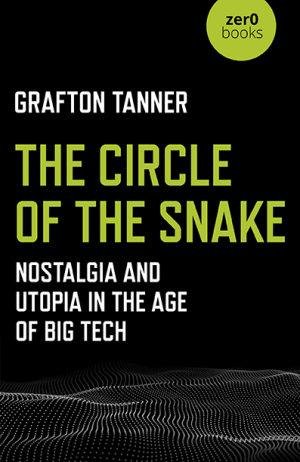
The Circle of the Snake: Nostalgia and Utopia in the Age of Big Tech
By Grafton Tanner
Zero Books, 2020

I’m sure many members of Generation X have taken a moment to look around the pop culture landscape over the past decade and a half and had a sudden moment of realization: there are certainly a whole lot of people trying to sell me things using the media of my youth. Ultimately, this is nothing new. I remember when every pop culture moment, from sitcoms to TV commercials, seemed to be using the Baby Boomers’ favorite songs to sell them cars and sneakers. But in 2020, the dominance of these re-treaded properties is even more nakedly cynical, whether its the endless sequels of the Star Wars and Marvel cinematic universes, or the easy-to-consume, signifier-filled pastiches of the worlds of Stranger Things and Ready Player One. The cultural marketplace, as dominated by bloated media and tech empires, no longer sees any need to admit the novel, the fresh, the unusual.

Both the “why” and the “how” of this cultural and technological tendency are explored by author Grafton Tanner in his new book, The Circle of the Snake: Nostalgia and Utopia in the Age of Big Tech. (Disclosure: Tanner is an occasional contributor to We Are The Mutants.) Tanner explores not only the pop culture properties that utilize nostalgia in an effort to assuage the anxieties of contemporary life in the aftermath of the 2008 financial rupture; he also explains how tech companies use the feedback from algorithmic analysis to keep consumers locked into a never-ending cycle—an ouroboros—of digital satisfaction of their subconscious desires for an older, more secure time. This nostalgic digital utopia, in turn, keeps consumers constantly “on,” working through endless “quests” that approximate proactivity but in the end keep people locked into pointless and unproductive cycles of feedback, emotional satisfaction, and control. “Recommender systems and predictive analytics—the very tools that allow our contemporary media to function—zero in on quick reactions, such as a flash of anger or a swell of nostalgia,” says Tanner in his Introduction. “These reactions are noted by algorithms, which then make recommendations based on them… The result is a nostalgic feedback loop wherein old ideas travel round.”

Tanner examines how the Big Tech tendency towards technolibertarianism and monopoly over the past 20 years has created the material conditions for this self-reinforcing system of psychic feedback. With an increasing belief in culture as disposable and “just for fun,” the material and political implications of this system of control are obfuscated. The way that these cultural narratives award Big Tech further and deeper power over all of us is merely part of the game. And we are enlisted as active players, not merely passive viewers, as in the era of television’s height. The online world, Tanner notes, demands a keen eye for analysis and a deep capacity for paying attention. The technolibertarian and neoliberal alike view our tech-suffused world—everyone is plugged in, 24/7—as a kind of utopia-in-waiting, or indeed a permanent utopia, where the idealized past can be endlessly revisited and basked in, while the present never changes from its current state of cultural and political stasis. This virtual plaza of commerce, emotional satisfaction, the illusion of proactivity, and control and surveillance describe the boundaries of Big Tech’s dominance of both our material and psychic space at the beginning of the 2020s.

The interview below was conducted in November and December 2020 via email and has been lightly edited for clarity.

***

GRASSO: Given the topic of your first book for Zero, Babbling Corpse: Vaporwave and the Commodification of Ghosts, the topic for The Circle of the Snake seems like a natural outgrowth. But from reading the book it also seems like there were a lot of specific events and observations about the world of Online and Big Tech over the past few years that led to the book’s development. What are the origins of The Circle of the Snake, and what kinds of specific cultural developments led you to propose and write the book?

TANNER: I can pinpoint the exact moment I knew I was going to write a book on Big Tech. I was living in a kind of exile in 2016, in this small town in Georgia, trying to piece my life back together after a series of false starts after college. I was sitting in a Barnes & Noble reading the 2016 Tech Issue of The Atlantic, and there was a story by Bianca Bosker about former Google employee Tristan Harris, who left the Valley and started an advocacy group called Time Well Spent because he thought Big Tech was eroding mental health. He was on a mission to fix Big Tech by making it work for us, not against us. But the piece didn’t make me feel better about tech. In fact, it was terrifying: here is an ex-Valley technocrat, mournful that he had invented habit-forming technology with severe public side effects, asking us to not only forgive him, but believe in him to create newer, better tech. I was incensed.

Shortly thereafter, we learned that Cambridge Analytica sharpened their psychographic modeling techniques by harvesting Facebook data from millions of users without their permission, all to aid in the election of Donald Trump. There was suddenly this huge backlash against Big Tech. I was supportive of it, but I also understood it came a little too late. Tech critics had been sounding the alarm for years and years. It took the election of a fascist for the left to wake up to the tech nightmare, only to realize the ones promising to end the nightmare were former technocrats themselves.

And yet, as many were loudly critiquing Big Tech for its role in throwing elections, spreading fascism, and worsening mental health, the culture industry was churning out politically retrograde nostalgia-bait. Was it really that the techlash had made everyone even more nostalgic for the pre-digital past? Or was there some kind of connection between nostalgia and Big Tech? These were the questions I had in mind when I started writing.

GRASSO: I think one of the things I like best about the book is your fusion of theory, philosophy, and epistemology with the material and economic realities of 21st century Big Tech and Big Media. Throughout the book you explore concepts such as surveillance, sublimity, nostalgia (of course), and virtuality with concrete examples from the online plaza. Essentially, if I’m not mistaken, you’re saying that the people who created the feedback loops that keep us hooked on technology and the internet and mine our data for still more ways to sell to us have themselves studied their philosophy, economic history, and techniques of mass psychology and persuasion with great attention?

TANNER: Persuasion techniques, yes, but I wouldn’t go so far as to say the technocrats have studied much else beyond their limited worldview, which is scientistic. Yes, technocrats like James Williams and Tristan Harris like to cite philosophers, but they usually do it to support their self-help solutions to the attention economy. Wake up with a little philosophy, they say, because reading Socrates is better for the mind than scrolling through Twitter. It’s a very neckbeard way of thinking about cultural consumption.

Make no mistake: these technocrats are uninterested in anything other than making a lot of money. If that means learning psychological techniques of persuasion with Stanford psychologist B.J. Fogg, then so be it. They weren’t and aren’t trying to make the world a better place or something. Like the banks before the Great Recession, the technocrats are out to make a quick buck by any means necessary, and they would have kept on doing what they were doing if the bubble hadn’t burst. People were disgruntled with Facebook for years before Cambridge Analytica, and tech critique was already a robust genre by 2016. But it took a kind of implosion, a Great Recession-style reckoning with Big Tech, to change the public opinion. Honestly, the technocrats would probably benefit from studying a little history and philosophy, instead of cloistering themselves in the ideological fortress of STEM.

GRASSO: I think one of the “oh shit” moments in the text for me was finding out that the Black Mirror special choose-your-own-adventure episode “Bandersnatch,” which I quite liked mostly for its material and inspirational signifiers (early ’80s computing, references to Philip K. Dick) was also used to mine viewers’ data in a delightfully dark real-life Dickean stroke. It’s not merely that nostalgia offers us a safe place from the dangerous present, but that those who create these nostalgic visions are working hand-in-hand with the very media empires that make us crave the past: another ouroboros.

TANNER: “Bandersnatch” not only exploits viewers’ nostalgia for its own gain, but it further normalizes the feeling of being controlled. Everyone today knows we’re being controlled from afar: by Twitter, Instagram, Amazon, insurance companies, think tanks, banks, and so forth. We are part of this giant social experiment called consumer capitalism. The purpose is to find out what we’ll buy. But we aren’t being controlled by future gamers or, as much as Elon Musk would like to believe, programmers in this computer simulation we call life. “Bandersnatch” is a work of fiction masquerading a horrible fact—that Netflix is the one controlling us, that we are not as in control as we think. The irony, of course, is that we relinquish our control via the technology we use every day, but we ultimately have very little choice in the matter. Students use devices at school, and jobs often require employees to have smartphones. We aren’t puppets, but we’re by no means totally free either.

GRASSO: So that leads me to asking you about your critique of specific media franchises: Stranger Things and the endless array of sequels and especially reboots we’ve seen since the end of the aughts. You very cannily explore Stranger Things‘ reliance on physical signifiers of commodities and objects that are no longer extant but remind us of the shackles of our technology-laden present (the old landline telephone, the shopping mall) as a key to its appeal to both Gen-Xers who were there and Zoomers who weren’t. Likewise the cinematic reboot is a way to cheaply create product and content that will connect with multiple generations. This element of “spot the Easter egg, aren’t you smart?” for older generations melds with the offer of a trip to a now-alien time for younger generations. These franchises seem to simultaneously reward passive immersion in nostalgia with an illusion of proactivity.

TANNER: Well, the spot-the-Easter-egg activities are very often nostalgic exercises themselves. Viewers are invited to find the nostalgic signifiers, even if they don’t know what they are. That’s the brilliance of Easter egg marketing for advertisers: you might not know what the hidden clue means, but you know it’s a clue and so you make note of it. Of course, the “real” fans will be able to cite all the references, but regular viewers can sometimes recognize a clue, like a corded phone or a VCR or a reference to an older movie, when they see it.

Easter egg marketing is the advertising tactic of choice in the prosumer age. It turns watching into a game. And it’s very heuristic. The films with the most Easter eggs inspire the most “count them all” YouTube videos or Buzzfeed listicles. The problem here isn’t that movies and series reference a bunch of older media; the problem is that Easter eggs reference certain things and leave others out, thus establishing these unnecessary pop culture canons. I don’t care that the Halloween franchise makes reference to itself. It’s an extended universe at this point—of course it’s going to do that. What I find questionable is its constant updating in an attempt to recapture the magic of the original film. I’m always signaling my love of Halloween III: Season of the Witch, but that film is too wacky to be included in the Halloween universe, because the franchise is desperately trying to give us the original again, as if it were the first time, without all the messy parts of the sequels. The Halloween filmmakers want to keep the bloodline of the first film pure, which means anything standing in the way must be excised.

GRASSO: You mark the period between 9/11 and the financial crisis of 2008 (and its aftermath) as the final foreclosure of any alternative to our current future and one of the dividing lines between an idealized past depicted in our nostalgic media and the forever Now. Unsurprisingly, so many of the elements of online life we now recognize as irredeemably toxic (social media, ranking and rating apps, tentpole cinematic universes full of identical sequels) began around the end of the Bush years as well.

TANNER: One of these days, I’m going to write a history-critique of the 2000s. I find the decade fascinating. It was probably the nadir of contemporary culture. Mark Fisher called it “the worst period for (popular) culture since the 1950s.”

It’s true: there was no breaking point at which contemporary nostalgia ramped up. It was a gradual shift between 9/11 and the Great Recession. Directly after 9/11, the U.S. was reeling from shock. Before nostalgia set in later in the decade, there was a feeling of futurelessness, as Robert Jay Lifton wrote—a feeling that there can be no future after 9/11, that the fear of another terrorist attack foreclosed the future altogether, that if people could fly planes into buildings on a regular weekday morning, then anything horrific is possible. During these years, we saw the birth of cinematic universes with the Star Wars prequels and the first megabudget superhero films. Of course, there were Batman, Superman, and Star Wars films before the twenty-first century, but it was after 9/11 that we saw the avalanche of these movies, several of which could not have been made without post-9/11 Pentagon support, with its bloated influence and near-endless supply of capital. You cannot downplay the reach these films have. They’re seen all over the world. And they aren’t just pro-military propaganda, they are engines of nostalgia.

After the Great Recession, nostalgia calcified. People were moving back in with their parents, revisiting old memories to soothe the anxiety of joblessness. Financial recessions are progressive only for the bankers, if they’re bailed out. For workers, they’re regressive. They set people back and invite the sufferers to hide away from it all. There is nothing wrong with this reaction. We cannot blame people who were hit by the Recession for their nostalgia. But we can blame the ones who caused it. And austerity measures only increase the desire to escape into nostalgic feelings. In short, financial meltdowns are crises that affect the future because they erase the plausibility of surviving the present.

GRASSO: You state that nostalgia is not only an emotion used to track us and to trigger specific emotional responses (which themselves are often assuaged by consumption), but also, possibly most importantly, to control us. And that control is not only physical/material but also social/aesthetic, limiting our options to wander away from the digital plaza. How do nostalgia and nostalgic media help this attempt by the market to quantify, objectify, and commodify us, the consumer?

TANNER: Content creators—a sickening term that reduces art and culture to commodities—understand the value of nostalgia. Consumer scientists have known for years that nostalgia sells. If anger draws your attention to the screen, then nostalgia triggers you to buy what will soothe the anger. That’s the cycle we’re dealing with in the present century.

And the worse things get, the more that nostalgia will naturally rise to the surface for many people. It’s not that media companies force-feed nostalgia to us. Many people are already feeling the emotion. It’s inescapable because nostalgia is a modern condition. Corporations merely go the extra mile by locking nostalgia into these feedback loops. The more you feed nostalgia into the cultural industry, the more of it you will consume because entire companies depend on you to want it. We live in a world of disruption, and every modern displacement is accompanied by nostalgia. Corporate capital knows this and depends on it.

GRASSO: Two of the specific technologies you talk about, Instagram and virtual reality, have undergone mutations in their appeals to our desire to escape the modern world. Instagram started off as a fairly disposable nostalgic evocation of the Polaroid camera aesthetic and has become a playground for big-money influencers and exhibitionists; virtual reality has evolved into just another facet of the internet’s control apparatus, despite its conceptual origins in early ’80s cyberpunk and its promised potential to give people the ability to create their own worlds. Why do these technologies seem to always mutate in the direction of greater commercialization and/or control, despite their initial apparent harmlessness or revolutionary promise?

TANNER: In the case of Instagram, its nostalgia factor was mainly due to the horrible photo quality of early smartphone cameras. With some Wi-Fi, a phone, and an app, you could take photos anywhere and upload them on the spot, which was enticing enough for many people to do just that, but you couldn’t deny the photo quality was very poor. So one way to deal with this poor quality was to saturate photos in a kind of analog haze, which could be done by applying one of several different stock filters. I can’t emphasize this enough: so much of our nostalgic appetite in the early 2010s was whetted by the inability to take and post a decent looking digital photo.

Whether it’s Instagram or virtual reality, digital technology is never totally harmless. It’s like when Tristan Harris and the Center for Humane Tech guys tell us we can have our digital cake and eat it too. You can’t have “humane tech” because tech is driven by the profit motive, which itself is often powered by another force: the military. Have you seen this new recruiting ad for the Marine Corps? It’s basically telling young people that joining the military will be an escape from the overwhelming anxieties of the digital age. The scariest thing about the ad is that it conceals the long relationship between tech and the military. Which is to say, the “tech” presented in the ad couldn’t exist without the military-industrial complex. At this point, any new, possibly revolutionary digital technology will either be bought out by a Big Tech monopoly or put to use on the battlefield.

GRASSO: As far as solutions and escapes from this predicament go, you talk a little bit about the ineffectual attempts of former technocrats to try to ameliorate our enslavement to the internet and social media with apps that limit time on websites or “safety labels,” and find them all wholly wanting. Likewise, you mention attempts to make nostalgia something constructive, playful, reflective (in the schema of Svetlana Boym). And yet the very structure of the internet and Big Media as it stands now denies all alternatives to the current control stasis. What does a constructivist nostalgia look like? Where could it exist in the cracks of the current marketplace? Is there a place for nostalgia as a political instrument of the left outside of the usual avenue of Left Melancholy?

TANNER: I’m currently writing a history of nostalgia, out fall 2021 with Repeater Books, called The Hours Have Lost Their Clock: A Recent History of Nostalgia. In it, I put forth a theory of radical nostalgia, drawing on the work of Alastair Bonnett and Svetlana Boym. Radical nostalgia is the third “R” beyond reflective and restorative nostalgia, which Boym coined. She was right about nostalgia, but over the first two decades of the present century, restorative nostalgia ballooned while the reflective strains were edged to the margins. But there needs to be this third form, radical nostalgia, because the melancholic disposition of reflective nostalgia just hasn’t been working for the left and the restorative tint has proven to be destructive.

Radical nostalgia is the act of looking back to those moments when collective action stood up to capital. It yearns for the social movements of the past. It aches for them. It isn’t interested in “getting back there,” in restoring what’s been lost, but in learning from those who came before: the struggle for indigenous rights, the staunch anti-capitalism of Martin Luther King Jr., Stonewall, the Battle of Seattle. When Richard Branson signals his support for LGBTQ+ communities, that isn’t radical nostalgia. There’s nothing radical about it; it’s mere nostalgia. Radical nostalgia looks to these and other movements to continue the fight for a more egalitarian future. It is inherently anti-fascist.

Radical nostalgia takes the action step of restorative and the aching heart of reflective nostalgia and fuses them together. It knows that the past isn’t perfect, which means what we yearn for shouldn’t be either. Restorative nostalgia is too clean, too high-definition. Reflective nostalgia kicks the can around, although reflectors might recognize the problems of the past long before the restorers do. But radical nostalgia knows that everything is imbued with horror, the past especially. Many revolutionary movements of the past suffered from machismo and intolerance, even in their own collectives. Radical nostalgia knows this and endeavors to leave it in the past. Some things must remain buried.

And radical nostalgia is one perspective we can take to resist the utopian thinking of tech. At this point, Big Tech is about the only entity that circulates visions of the future, but those visions are falling out of favor thanks to the techlash. Get ready, because they will absolutely be replaced with a different utopian vision: the humane tech movement. We’re going to be dealing with the technocrats for years. It’s going to seem like we should trust Tristan Harris and the Center for Humane Tech guys. They’re going to be pushing their vision of the future for years to come. But they are the new boss, same as the old. Only collective action, informed by the decolonial and anti-fascist movements of history, can resist what’s coming in the next decade and beyond.

Warp Speed Ahead: COVID-19 Vaccines Pave the Way for a New Frontier in Surveillance

By John W. Whitehead

Source: The Rutherford Institute

Man’s conquest of Nature, if the dreams of some scientific planners are realized, means the rule of a few hundreds of men over billions upon billions of men.” —C. S. Lewis, The Abolition of Man

Like it or not, the COVID-19 pandemic with its veiled threat of forced vaccinations, contact tracing, and genetically encoded vaccines is propelling humanity at warp speed into a whole new frontier—a surveillance matrix—the likes of which we’ve only previously encountered in science fiction.

Those who eye these developments with lingering mistrust have good reason to be leery: the government has long had a tendency to unleash untold horrors upon the world in the name of global conquest, the acquisition of greater wealth, scientific experimentation, and technological advances, all packaged in the guise of the greater good.

Indeed, “we the people” have been treated like lab rats by government agencies for decades now: caged, branded, experimented upon without our knowledge or consent, and then conveniently discarded and left to suffer from the after-effects.

You don’t have to dig very deep or go very back in the nation’s history to uncover numerous cases in which the government deliberately conducted secret experiments on an unsuspecting populacemaking healthy people sick by spraying them with chemicals, injecting them with infectious diseases and exposing them to airborne toxins.

Now this same government—which has taken every bit of technology sold to us as being in our best interests (GPS devices, surveillance, nonlethal weapons, etc.) and used it against us, to track, control and trap us—wants us to fall in line as it prepares to roll out COVID-19 vaccines that owe a great debt to the Pentagon’s Defense Advanced Research Projects Agency for its past work on how to weaponize and defend against infectious diseases.

The Trump Administration by way of the National Institute of Health awarded $22.8 million to seven corporations to develop artificial intelligence (AI), machine learning, etc., with smart phone apps, wearable devices and software “that can identify and trace contacts of infected individuals, keep track of verified COVID-19 test results, and monitor the health status of infected and potentially infected individuals.”

This is all part of Operation Warp Speed, which President Trump has likened to the Manhattan Project, a covert government effort spearheaded by the military to engineer and build the world’s first atomic bomb.

There is every reason to tread cautiously.

There is a sinister world beyond that which we perceive, one in which power players jockey for control over the one commodity that is a necessary ingredient for total domination: you.

By you, I mean you the individual in all your singular humanness.

Remaining singularly human and retaining your individuality and dominion over yourself—mind, body and soul—in the face of corporate and government technologies that aim to invade, intrude, monitor, manipulate and control us may be one of the greatest challenges before us.

These COVID-19 vaccines, which rely on messenger RNA technology that influences everything from viruses to memory, are merely the tipping point.

The groundwork being laid with these vaccines is a prologue to what will become the police state’s conquest of a new, relatively uncharted, frontier: inner space, specifically, the inner workings (genetic, biological, biometric, mental, emotional) of the human race.

If you were unnerved by the rapid deterioration of privacy under the Surveillance State, prepare to be terrified by the surveillance matrix that will be ushered in on the heels of the government’s rollout of this COVID-19 vaccine.

The term “matrix” was introduced into our cultural lexicon by the 1999 film The Matrix in which Neo, a computer programmer/hacker, awakens to the reality that humans have been enslaved by artificial intelligence and are being harvested for their bio-electrical energy.

Hardwired to a neuro-interactive simulation of reality called the “Matrix,” humans are kept inactive and docile while robotic androids gather the electricity their bodies generate. In order for the machines who run the Matrix to maintain control, they impose what appears to be a perfect world for humans to keep them distracted, content, and submissive.

Here’s the thing: Neo’s Matrix is not so far removed from our own technologically-hardwired worlds in which we’re increasingly beholden to corporate giants such as Google for powering so much of our lives. As journalist Ben Thompson explains:

Google+ is about unifying all of Google’s services under a single log-in which can be tracked across the Internet on every site that serves Google ads, uses Google sign-in, or utilizes Google analytics. Every feature of Google+—or of YouTube, or Maps, or Gmail, or any other service—is a flytrap meant to ensure you are logged in and being logged by Google at all times.

Everything we do is increasingly dependent on and, ultimately, controlled by our internet-connected, electronic devices. For example, in 2007, there were an estimated 10 million sensor devices connecting human utilized electronic devices (cell phones, laptops, etc.) to the Internet. By 2013, it had increased to 3.5 billion. By 2030, it is estimated to reach 100 trillion.

Much, if not all, of our electronic devices will be connected to Google, a neural network that approximates a massive global brain.

Google’s resources, beyond anything the world has ever seen, includes the huge data sets that result from one billion people using Google every single day and the Google knowledge graph “which consists of 800 million concepts and billions of relationships between them.”

The end goal? The creation of a new “human” species, so to speak, and the NSA, the Pentagon and the “Matrix” of surveillance agencies are part of the plan. As William Binney, one of the highest-level whistleblowers to ever emerge from the NSA, said, “The ultimate goal of the NSA is total population control.”

Mind you, this isn’t population control in the classic sense. It’s more about controlling the population through singularity, a marriage of sorts between machine and human beings in which artificial intelligence and the human brain will merge to form a superhuman mind.

“Google will know the answer to your question before you have asked it,” predicts transhumanist scientist Ray Kurzweil. “It will have read every email you’ve ever written, every document, every idle thought you’ve ever tapped into a search-engine box. It will know you better than your intimate partner does. Better, perhaps, than even yourself.”

The term “singularity”—that is, computers simulating human life itself—was coined years ago by mathematical geniuses Stanislaw Ulam and John von Neumann. “The ever accelerating progress of technology,” warned von Neumann, “gives the appearance of approaching some essential singularity in the history of the race beyond which human affairs, as we know them, could not continue.”

The plan is to develop a computer network that will exhibit intelligent behavior equivalent to or indistinguishable from that of human beings by 2029. And this goal is to have computers that will be “a billion times more powerful than all of the human brains on earth.”

Neuralink, a brain-computer chip interface (BCI), paves the way for AI control of the human brain, at which point the disconnect between humans and AI-controlled computers will become blurred and human minds and computers will essentially become one and the same. “In the most severe scenario, hacking a Neuralink-like device could turn ‘hosts’ into programmable drone armies capable of doing anything their ‘master’ wanted,” writes Jason Lau for Forbes.

Advances in neuroscience indicate that future behavior can be predicted based upon activity in certain portions of the brain, potentially creating a nightmare scenario in which government officials select certain segments of the population for more invasive surveillance or quarantine based solely upon their brain chemistry.

Case in point: researchers at the Mind Research Center scanned the brains of thousands of prison inmates in order to track their brain chemistry and their behavior after release. In one experiment, researchers determined that inmates with lower levels of activity in the area of the brain associated with error processing allegedly had a higher likelihood of committing a crime within four years of being released from prison. While researchers have cautioned against using the results of their research as a method of predicting future crime, it will undoubtedly become a focus of study for government officials.

There’s no limit to what can be accomplished—for good or ill—using brain-computer interfaces.

Researchers at Duke University Medical Center have created a brain-to-brain interface between lab rats, which allows them to transfer information directly between brains. In one particular experiment, researchers trained a rat to perform a task where it would hit a lever when lit. The trained rat then had its brain connected to an untrained rat’s brain via electrodes. The untrained rat was then able to learn the trained rat’s behavior via electrical stimulation. This even worked over great distances using the Internet, with a lab rat in North Carolina guiding the actions of a lab rat in Brazil.

Clearly, we are rapidly moving into the “posthuman era,” one in which humans will become a new type of being. “Technological devices,” writes journalist Marcelo Gleiser, “will be implanted in our heads and bodies, or used peripherally, like Google Glass, extending our senses and cognitive abilities.”

Transhumanism—the fusing of machines and people—is here to stay and will continue to grow.

In fact, as science and technology continue to advance, the ability to control humans will only increase. In 2014, for example, it was revealed that scientists have discovered how to deactivate that part of our brains that controls whether we are conscious or not. When researchers at George Washington University sent high frequency electrical signals to the claustrum—that thin sheet of neurons running between the left and right sides of the brain—their patients lost consciousness. Indeed, one patient started speaking more slowly until she became silent and still. When she regained consciousness, she had no memory of the event.

Add to this the fact that increasingly humans will be implanted with microchips for such benign purposes as tracking children or as medical devices to assist with our health. Such devices “point to an uber-surveillance society that is Big Brother on the inside looking out,” warns Dr. Katina Michael. “Governments or large corporations would have the ability to track people’s actions and movements, categorize them into different socio-economic, political, racial, or consumer groups and ultimately even control them.”

As I make clear in my book Battlefield America: The War on the American People, control is the issue.

In fact, Facebook and the Department of Defense are working to manipulate our behavior. In a 2012 study, Facebook tracked the emotional states of over 600,000 of its users. The goal of the study was to see if the emotions of users could be manipulated based upon whether they were fed positive or negative information in their news feeds. The conclusion of the study was that “emotional states can be transferred to others via emotional contagion, leading people to experience the same emotions without their awareness.”

All of this indicates a new path forward for large corporations and government entities that want to achieve absolute social control. Instead of relying solely on marauding SWAT teams and full-fledged surveillance apparatuses, they will work to manipulate our emotions to keep us in lock step with the American police state.

Now add this warp speed-deployed vaccine to that mix, with all of the associated unknown and fearsome possibilities for altering or controlling human epigenetics, and you start to see the perils inherent in blindly adopting emerging technologies without any restrictions in place to guard against technological tyranny and abuse.

It’s one thing for the starship Enterprise to boldly go where no man has gone before, but even Mr. Spock recognized the dangers of a world dominated by AI. “Computers make excellent and efficient servants,” he observed in “The Ultimate Computer” episode of Star Trek, “but I have no wish to serve under them.”

Big Brother in Disguise: The Rise of a New, Technological World Order

By John Whitehead

Source: The Rutherford Institute

“You had to live—did live, from habit that became instinct—in the assumption that every sound you made was overheard, and, except in darkness, every movement scrutinized.”—George Orwell, 1984

It had the potential for disaster.

Early in the morning of Monday, December 15, 2020, Google suffered a major worldwide outage in which all of its internet-connected services crashed, including Nest, Google Calendar, Gmail, Docs, Hangouts, Maps, Meet and YouTube.

The outage only lasted an hour, but it was a chilling reminder of how reliant the world has become on internet-connected technologies to do everything from unlocking doors and turning up the heat to accessing work files, sending emails and making phone calls.

A year earlier, a Google outage resulted in Nest users being unable to access their Nest thermostats, Nest smart locks, and Nest cameras. As Fast Company reports, “This essentially meant that because of a cloud storage outage, people were prevented from getting inside their homes, using their AC, and monitoring their babies.”

Welcome to the Matrix.

Twenty-some years after the Wachowskis’ iconic film, The Matrix, introduced us to a futuristic world in which humans exist in a computer-simulated non-reality powered by authoritarian machines—a world where the choice between existing in a denial-ridden virtual dream-state or facing up to the harsh, difficult realities of life comes down to a blue pill or a red pill—we stand at the precipice of a technologically-dominated matrix of our own making.

We are living the prequel to The Matrix with each passing day, falling further under the spell of technologically-driven virtual communities, virtual realities and virtual conveniences managed by artificially intelligent machines that are on a fast track to replacing human beings and eventually dominating every aspect of our lives.

Science fiction has become fact.

In The Matrix, computer programmer Thomas Anderson a.k.a. hacker Neo is wakened from a virtual slumber by Morpheus, a freedom fighter seeking to liberate humanity from a lifelong hibernation state imposed by hyper-advanced artificial intelligence machines that rely on humans as an organic power source. With their minds plugged into a perfectly crafted virtual reality, few humans ever realize they are living in an artificial dream world.

Neo is given a choice: to take the red pill, wake up and join the resistance, or take the blue pill, remain asleep and serve as fodder for the powers-that-be.

Most people opt for the blue pill.

In our case, the blue pill—a one-way ticket to a life sentence in an electronic concentration camp—has been honey-coated to hide the bitter aftertaste, sold to us in the name of expediency and delivered by way of blazingly fast Internet, cell phone signals that never drop a call, thermostats that keep us at the perfect temperature without our having to raise a finger, and entertainment that can be simultaneously streamed to our TVs, tablets and cell phones.

Yet we are not merely in thrall with these technologies that were intended to make our lives easier. We have become enslaved by them.

Look around you. Everywhere you turn, people are so addicted to their internet-connected screen devices—smart phones, tablets, computers, televisions—that they can go for hours at a time submerged in a virtual world where human interaction is filtered through the medium of technology.

This is not freedom.

This is not even progress.

This is technological tyranny and iron-fisted control delivered by way of the surveillance state, corporate giants such as Google and Facebook, and government spy agencies such as the National Security Agency.

So consumed are we with availing ourselves of all the latest technologies that we have spared barely a thought for the ramifications of our heedless, headlong stumble towards a world in which our abject reliance on internet-connected gadgets and gizmos is grooming us for a future in which freedom is an illusion.

Yet it’s not just freedom that hangs in the balance. Humanity itself is on the line.

If ever Americans find themselves in bondage to technological tyrants, we will have only ourselves to blame for having forged the chains through our own lassitude, laziness and abject reliance on internet-connected gadgets and gizmos that render us wholly irrelevant.

Indeed, we’re fast approaching Philip K. Dick’s vision of the future as depicted in the film Minority Report. There, police agencies apprehend criminals before they can commit a crime, driverless cars populate the highways, and a person’s biometrics are constantly scanned and used to track their movements, target them for advertising, and keep them under perpetual surveillance.

Cue the dawning of the Age of the Internet of Things (IoT), in which internet-connected “things” monitor your home, your health and your habits in order to keep your pantry stocked, your utilities regulated and your life under control and relatively worry-free.

The key word here, however, is control.

In the not-too-distant future, “just about every device you have — and even products like chairs, that you don’t normally expect to see technology in — will be connected and talking to each other.”

By the end of 2018, “there were an estimated 22 billion internet of things connected devices in use around the world… Forecasts suggest that by 2030 around 50 billion of these IoT devices will be in use around the world, creating a massive web of interconnected devices spanning everything from smartphones to kitchen appliances.”

As the technologies powering these devices have become increasingly sophisticated, they have also become increasingly widespread, encompassing everything from toothbrushes and lightbulbs to cars, smart meters and medical equipment.

It is estimated that 127 new IoT devices are connected to the web every second.

This “connected” industry has become the next big societal transformation, right up there with the Industrial Revolution, a watershed moment in technology and culture.

Between driverless cars that completely lacking a steering wheel, accelerator, or brake pedal, and smart pills embedded with computer chips, sensors, cameras and robots, we are poised to outpace the imaginations of science fiction writers such as Philip K. Dick and Isaac Asimov. (By the way, there is no such thing as a driverless car. Someone or something will be driving, but it won’t be you.)

These Internet-connected techno gadgets include smart light bulbs that discourage burglars by making your house look occupied, smart thermostats that regulate the temperature of your home based on your activities, and smart doorbells that let you see who is at your front door without leaving the comfort of your couch.

Nest, Google’s suite of smart home products, has been at the forefront of the “connected” industry, with such technologically savvy conveniences as a smart lock that tells your thermostat who is home, what temperatures they like, and when your home is unoccupied; a home phone service system that interacts with your connected devices to “learn when you come and go” and alert you if your kids don’t come home; and a sleep system that will monitor when you fall asleep, when you wake up, and keep the house noises and temperature in a sleep-conducive state.

The aim of these internet-connected devices, as Nest proclaims, is to make “your house a more thoughtful and conscious home.” For example, your car can signal ahead that you’re on your way home, while Hue lights can flash on and off to get your attention if Nest Protect senses something’s wrong. Your coffeemaker, relying on data from fitness and sleep sensors, will brew a stronger pot of coffee for you if you’ve had a restless night.

Yet given the speed and trajectory at which these technologies are developing, it won’t be long before these devices are operating entirely independent of their human creators, which poses a whole new set of worries. As technology expert Nicholas Carr notes, “As soon as you allow robots, or software programs, to act freely in the world, they’re going to run up against ethically fraught situations and face hard choices that can’t be resolved through statistical models. That will be true of self-driving cars, self-flying drones, and battlefield robots, just as it’s already true, on a lesser scale, with automated vacuum cleaners and lawnmowers.”

For instance, just as the robotic vacuum, Roomba, “makes no distinction between a dust bunny and an insect,” weaponized drones—poised to take to the skies en masse this year—will be incapable of distinguishing between a fleeing criminal and someone merely jogging down a street. For that matter, how do you defend yourself against a robotic cop—such as the Atlas android being developed by the Pentagon—that has been programmed to respond to any perceived threat with violence?

Moreover, it’s not just our homes and personal devices that are being reordered and reimagined in this connected age: it’s our workplaces, our health systems, our government, our bodies and our innermost thoughts that are being plugged into a matrix over which we have no real control.

Indeed, it is expected that by 2030, we will all experience The Internet of Senses (IoS), enabled by Artificial Intelligence (AI), Virtual Reality (VR), Augmented Reality (AR), 5G, and automation. The Internet of Senses relies on connected technology interacting with our senses of sight, sound, taste, smell, and touch by way of the brain as the user interface. As journalist Susan Fourtane explains:

Many predict that by 2030, the lines between thinking and doing will blur. Fifty-nine percent of consumers believe that we will be able to see map routes on VR glasses by simply thinking of a destination… By 2030, technology is set to respond to our thoughts, and even share them with others… Using the brain as an interface could mean the end of keyboards, mice, game controllers, and ultimately user interfaces for any digital device. The user needs to only think about the commands, and they will just happen. Smartphones could even function without touch screens.

In other words, the IoS will rely on technology being able to access and act on your thoughts.

Fourtane outlines several trends related to the IoS that are expected to become a reality by 2030:

1: Thoughts become action: using the brain as the interface, for example, users will be able to see map routes on VR glasses by simply thinking of a destination.

2: Sounds will become an extension of the devised virtual reality: users could mimic anyone’s voice realistically enough to fool even family members.

3: Real food will become secondary to imagined tastes. A sensory device for your mouth could digitally enhance anything you eat, so that any food can taste like your favorite treat.

4: Smells will become a projection of this virtual reality so that virtual visits, to forests or the countryside for instance, would include experiencing all the natural smells of those places.

5: Total touch: Smartphones with screens will convey the shape and texture of the digital icons and buttons they are pressing.

6: Merged reality: VR game worlds will become indistinguishable from physical reality by 2030.

Unfortunately, in our race to the future, we have failed to consider what such dependence on technology might mean for our humanity, not to mention our freedoms.

Ingestible or implantable chips are a good example of how unprepared we are, morally and otherwise, to navigate this uncharted terrain. Hailed as revolutionary for their ability to access, analyze and manipulate your body from the inside, these smart pills can remind you to take your medication, search for cancer, and even send an alert to your doctor warning of an impending heart attack.

Sure, the technology could save lives, but is that all we need to know?

Have we done our due diligence in asking all the questions that need to be asked before unleashing such awesome technology on an unsuspecting populace?

For example, asks Washington Post reporter Ariana Eunjung Cha:

What kind of warnings should users receive about the risks of implanting chip technology inside a body, for instance? How will patients be assured that the technology won’t be used to compel them to take medications they don’t really want to take? Could law enforcement obtain data that would reveal which individuals abuse drugs or sell them on the black market? Could what started as a voluntary experiment be turned into a compulsory government identification program that could erode civil liberties?

Let me put it another way.

If you were shocked by Edward Snowden’s revelations about how NSA agents have used surveillance to spy on Americans’ phone calls, emails and text messages, can you imagine what unscrupulous government agents could do with access to your internet-connected car, home and medications? Imagine what a SWAT team could do with the ability to access, monitor and control your internet-connected home—locking you in, turning off the lights, activating alarms, etc.

While President Trump signed the Internet of Things Cybersecurity Improvement Act into law on Dec. 4, 2020, in order to establish a baseline for security protection for the billions of IoT devices flooding homes and businesses, the law does little to protect the American people against corporate and governmental surveillance.

In fact, the public response to concerns about government surveillance has amounted to a collective shrug.

After all, who cares if the government can track your whereabouts on your GPS-enabled device so long as it helps you find the fastest route from Point A to Point B? Who cares if the NSA is listening in on your phone calls and downloading your emails so long as you can get your phone calls and emails on the go and get lightning fast Internet on the fly? Who cares if the government can monitor your activities in your home by tapping into your internet-connected devices—thermostat, water, lights—so long as you can control those things with the flick of a finger, whether you’re across the house or across the country?

Control is the key here.

As I make clear in my book Battlefield America: The War on the American People, total control over every aspect of our lives, right down to our inner thoughts, is the objective of any totalitarian regime.

George Orwell understood this.

Orwell’s masterpiece, 1984, portrays a global society of total control in which people are not allowed to have thoughts that in any way disagree with the corporate state. There is no personal freedom, and advanced technology has become the driving force behind a surveillance-driven society. Snitches and cameras are everywhere. And people are subject to the Thought Police, who deal with anyone guilty of thought crimes. The government, or “Party,” is headed by Big Brother, who appears on posters everywhere with the words: “Big Brother is watching you.”

Make no mistake: the Internet of Things and its twin, the Internet of Senses, is just Big Brother in disguise.

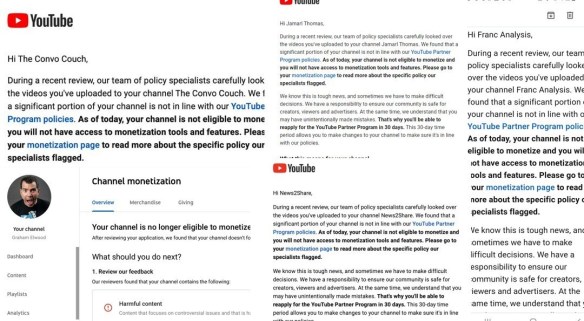
Yet Another Major Escalation In Establishment Internet Censorship

By Caitlin Johnstone

Source: CaitlinJohnstone.com

YouTube, whose corporate owner Google is arguably the most powerful company on earth, is now deleting user videos which claim the US election was fraudulent.

YouTube’s official statement on its decision to do this is very revealing, not so much for what it says as for what it does not say.

At no point does the video publishing platform attempt to argue that it is removing these videos because they jeopardize anyone’s health or safety, as it did when it began deleting videos deemed to be spreading misinformation about Covid-19.

At no point does it attempt to argue that these videos are inciting violence, as it did when it began deleting QAnon videos.

At no point does it claim that these videos are misleading voters, as it initially began collaborating with the US government to prevent, since all the voting is over and done with.

It’s simply deleting the videos because they are believed to be wrong. This is an important distinction, because it’s a marked deviation from the previous policy of content deletion used by YouTube and other new media platforms.

“Yesterday was the safe harbor deadline for the U.S. Presidential election and enough states have certified their election results to determine a President-elect,” YouTube writes. “Given that, we will start removing any piece of content uploaded today (or anytime after) that misleads people by alleging that widespread fraud or errors changed the outcome of the 2020 U.S. Presidential election, in line with our approach towards historical U.S. Presidential elections. For example, we will remove videos claiming that a Presidential candidate won the election due to widespread software glitches or counting errors. We will begin enforcing this policy today, and will ramp up in the weeks to come.”

I neither know nor care whether the sort of election fraud alleged to have taken place in the contest between Joe Biden or Donald Trump actually happened; I know the processes by which candidates are elevated to run in a US general election are corrupt and rigged from top to bottom, so the question of whether additional manipulation took place between two establishment-approved imperialist oligarch lackeys in a pretend election is not particularly interesting to me. But this new move by YouTube is a major escalation in the continually escalating rollout of internet censorship protocols by US government-tied Silicon Valley megacorporations.

Even if America did not have the single most flawed election system in the entire western world (and it does), and even if it had been conclusively proven beyond a shadow of a doubt that no election fraud of any sort took place (and it hasn’t), it would still be a massive escalation beyond previous online censorship protocols to begin censoring people simply because they are wrong. People are allowed to be wrong. A free society allows people the right to voice wrong beliefs because the only alternative is creating a monolithic Ministry of Truth which has authority over what the right and wrong beliefs are.

Those of us who’ve been warning of the dangers of government-aligned plutocratic corporations lowering their standards for silencing speech further and further were not committing a slippery slope fallacy; it’s not fallacious to warn of a slippery slope when the slope is demonstrably real. The fact that we’ve been methodically paced from accepting the cross-platform deletion of Alex Jones a couple of years ago to random internet users being silenced for no other reason than expressing wrongthink today shows us the slope is very real and very consequential, and our slide into information totalitarianism will continue if something major does not change.

Matt Taibbi has written a solid article condemning YouTube’s latest ramp-up and highlighting the double standard in the way Democrats have been pushing narratives about Trump colluding with Russia to fraudulently steal the 2016 election for four years with no consequences whatsoever while Trump supporters are banned from doing essentially the exact same thing. I would add that the primary source of this double standard is not ideological bias (though that’s surely a factor as well) but the coziness these Silicon Valley tech giants have formed with US government agencies who signed off on Russiagate but not on Trump’s claims. It’s not so much a liberal bias as it is a US intelligence cartel bias.

In reality, there was never any more evidence for liberal claims of Russia interfering with the US election in any meaningful way than there is for election fraud in 2020. Actual journalists and impartial social media platforms would have recognized the indisputable fact that the Russian hacking narrative was extremely porous and remains completely unproven, and the narrative about Russian memes swaying the election is a complete joke. The only thing giving the Democrats’ claims more narrative weight than those of the Republicans today is that one was endorsed by the US intelligence cartel (the same US intelligence cartel which just so happened to wind up advancing multiple preexisting agendas using Russiagate) and the other was not. That’s it.

Those who understood that whoever controls the narrative controls the world and that plutocrat-controlled mass media is the linchpin of the oligarchic status quo were very excited about the arrival of the internet, because they understood its information-democratizing potential. Now we’re all watching those hopes slowly eroded into nothing as the same power structures which control and influence the mainstream media now work to take full control over online information.

“On average 88% of the videos in top 10 search results related to elections came from authoritative news sources (amongst the rest are things like newsy late-night shows, creator videos and commentary),” YouTube boasts in the aforementioned statement on its deletion of wrongthink election videos. “And the most viewed channels and videos are from news channels like NBC and CBS.”

As though rigging your algorithms to give users results which link to the same plutocratic media outlets who’ve helped deceive the public about every war and continuously manipulate them into believing status quo politics totally work is something to be proud of.

If information which isn’t approved by the powerful continues to be squeezed into smaller and smaller fringe circles, the information-democratizing potential which once gave revolutionary thinkers so much hope will be completely nullified, and all that will remain is a network which allows establishment power structures to distribute propaganda much faster than they could back in the days of the old media. Here’s hoping our rulers fail in their attempts to do this, and that we succeed in our desire to stop them.