Resisting Genetically Mutilated Food & the Eco-Modern Nightmare: Together, ‘Just You and Me’  

By Colin Todhunter

Source: OffGuardian

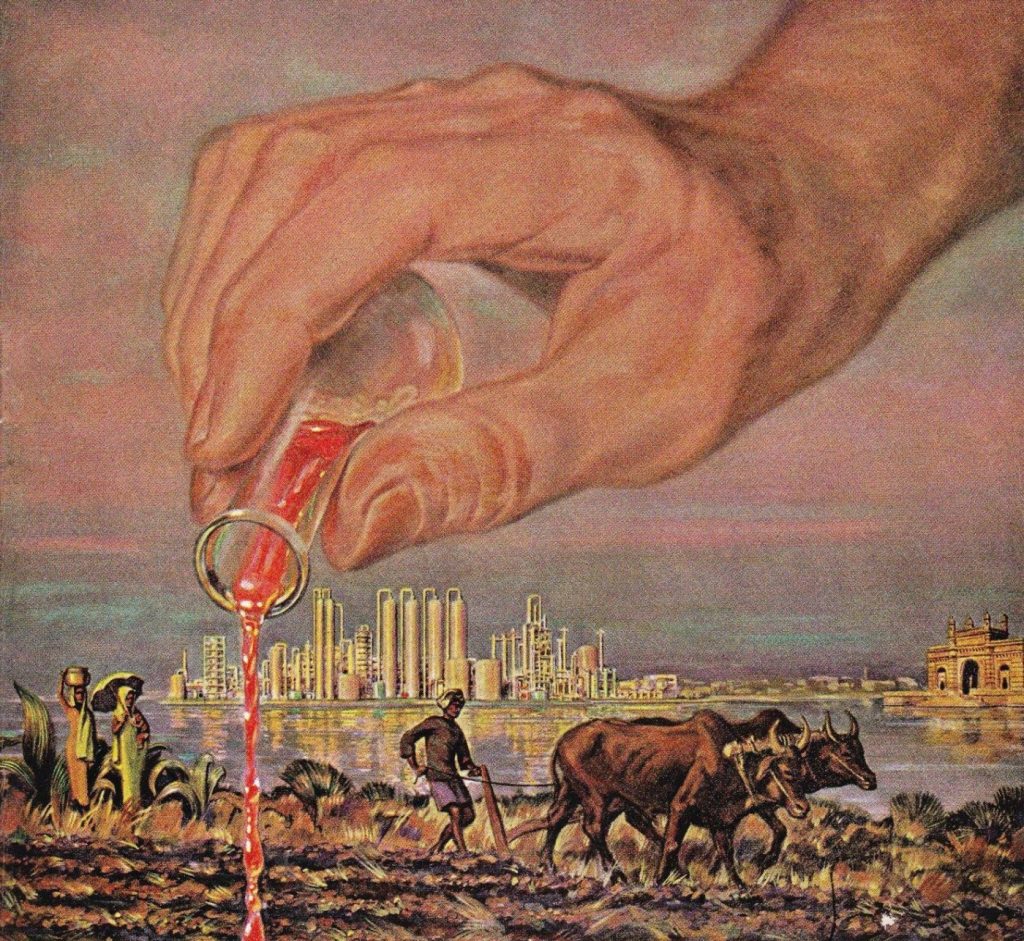
This image is symbolic of everything that is wrong with modern society.

A gas leak from Union Carbide’s pesticide plant in Bhopal in 1984 resulted in around 560,000 injured (respiratory problems, eye irritation, etc.), 4,000 severely disabled and 20,000 dead.

Not only that, but the pesticides produced at the factory and the model of farming promoted has caused well-documented misery for farmers, harm to soil, water sources and the health of the population and a radical transformation of social relations in rural communities. And these issues apply not only to India but also to other countries.

That old advertising brochure dating from around the early 1960s encapsulates the arrogance of billionaires and their companies that think they are the hand of God, that they are the truth and the science, and that we should all be in awe of the technology they produce.

Facilitated by the likes of the Rockefeller Foundation and the Bill and Melinda Gates Foundation, they uproot highly productive traditional agriculture, saying it is deficient. They poison the soil, the food, the waterways and people. But that’s not enough. They pirate, own and genetically engineer the seeds. The chemicals and engineering do not result in more or better food. Quite the opposite. Diets have become narrower, and the nutritional content of many food items has progressively diminished (see McCance and Widdowson’s the Mineral Depletion of Foods). Moreover, food secure regions have become food insecure.

But it goes beyond this.

Consider the amount of killer-chemicals that the likes of Union Carbide’s promised techno-utopian consumer society (Union Carbide produced numerous other similar brochures to the one presented above, promoting the role of science and technology across all sectors) has gifted to humanity in everyday products from shampoos to toys, pans, packaging, sofas and tins.

It is notable that glyphosate, the world’s most used agricultural herbicide, began life as an industrial chelator of minerals in metal pipes to prevent blockages and deterioration. It now ensures mineral depletion/nutrient deficiencies in the human body. Glyphosate affects human soil – the gut microbiome – which directly feeds the major organs. Little wonder we witness a proliferation of illness and disease.

But forget about what has become modernism’s spiralling public health crisis – don’t forget to take that money-spinning experimental booster jab because, remember, they said that they really care about you and your health.

Meanwhile, bioscience parks across the world expand and promise an even more marvellous techno-dystopia than the one already created. They are working on injecting you with nanotechnology to ‘cure’ you of all the diseases that the modernist type of thinking, products and technology created in the first place – or on manipulating your DNA-physiology to hook you up to the internet (of things). The patents are there – this is not speculation.

And as these bioscience parks expand, their success is measured in annual turnover, profits and ‘growth’. They want more and more ‘talent’ to study life sciences and health subjects and to take up positions at the biotech companies. And they call for more public subsidies to facilitate this. More kids to study science so that they can be swept up into the ideology and practices of the self-sustaining paradigm of modern society.

Of course, ‘sustainability’ is the mantra. Sustainability in terms of fake-green, net-zero ideology but, more importantly, sustainable growth and profit.

Meanwhile, across the world, most notably in the Netherlands, these parks demand more land. More land for expansion and more land to house ‘global talent’ to be attracted to work. That means displacing farmers under the notion that they are the major emitters of ‘greenhouse gases’, which, in the Netherlands at least, they are clearly not. Look towards other sectors or even the US military if you require a prime example of a major polluter. But that’s not up for discussion, not least because military-related firms are often intertwined with the much-valued bioscience-business ‘ecosystems’ promoted.

And once the farmers have gone and the farmland is concreted over under the concept (in the Netherlands) of a Tristate City, do not worry – your ‘food’ will be created in a lab courtesy of biosynthetic, nanotechnological, biopharmaceutical, genetically engineered microbes and formulas created at the local bioscience park.

Any carbon-related pollution created by these labs will supposedly be ‘offset’ by a fraudulent carbon credit trading Ponzi scheme – part of which will mean buying up acres in some poor country to plant trees on the land of the newly dispossessed.

This brave new ecomodernism is to be overseen by supranational bodies like the UN and the WHO. National uniparty politicians will not be engaged in policy formation. They will be upholders of the elite-determined status quo – junior ‘stakeholders’ and technocratic overseers of an algorithm/AI-run system, ensuring any necessary tweaks are made.

Of course, not everything that happens under the banner of bioscience should be dismissed out of hand, but science is increasingly the preserve of an increasingly integrated global elite who have created the problems that they now rollout the ‘solutions’ for. It is a highly profitable growth industry – under the banner of ‘innovation’, cleaning up the mess you created.

But the disturbing trend is that the ‘science’ and the technology shall not be questioned. A wealthy financial-digital-corporate elite funds this science, determines what should be studied, how it should be studied and how the findings are disseminated and how the technology produced is to be used.

As we saw with the COVID event, this elite has the power to shut down genuine debate, prevent scrutiny of ‘the science’ and to smear and censor world-renowned scientists and others who even questioned the narrative. And it also pulls the strings of nation states so much so that former New Zealand PM Jacinda Arden said that her government is ‘the truth’. The marriage of science and politics in an Orwellian dystopia.

The prevailing thinking is that the problems of illness, hunger, malnutrition, unemployment, pollution, resource usage and so on are all to be solved down at the bioscience park by what farmer/author Chris Smaje says through technical innovation and further integration into private markets which are structured systematically by centralised power in favour of the wealthy.

The ecomodernist ideology we see embedded within the mindsets of those lobbying for more resources, land and funding have nothing much to say about how humanity got ill, infertile, poor, dispossessed, colonised, depressed, unemployed or marginalised in the first place. Driven by public funding, career progression and profit, they remain blinkered and push ahead with an ideology whose ‘solutions’ only produce more problems that call for more ‘innovation’ and more money.

At the same time, any genuine solutions are too often dismissed as being driven by ideology and ignorance that will lead us all to ruin. A classic case of projection.

As I have written previously, current hegemonic policies prioritise urbanisation, global markets, long supply chains, commodified corporate knowledge, highly processed food and market dependency at the expense of rural communities, independent enterprises and smallholder farms, local markets, short supply chains, indigenous knowledge, diverse agroecological cropping, nutrient-dense diets and food sovereignty.

And this has led us to where we are now.

Trade and agriculture policy specialist Devinder Sharma once said that we need family farms not family doctors. Imagine the reduction in illnesses and all manner of conditions. Imagine thriving local communities centred on smallholder production, nutrient-dense food and healthy people. Instead, we get sprawling bioscience parks centred on economic globalisation, sickness and the manipulation of food and human bodies.

Although a few thousand immensely powerful people are hellbent on marching humanity towards a dystopian ecomodernist future, we can, in finishing, take some inspiration from the words of John Seymour (1912-2004), a pioneer of the self-sufficiency movement.

Seymour was described as a one-man rebellion against modernism by writer and ecologist Herbert Girardet. But as a farmer himself, Seymour regarded himself a ‘crank peasant’ and offered solutions in terms of localism, small-scale economics, a return to the land and organic agriculture.

In a call to action, he stated:

The tiny amount you and I can do is hardly likely to bring the huge worldwide moloch of plundering industry down? Well, if you and I don’t do it, it will not be done, and the Age of Plunder will terminate in the Age of Chaos. We have to do it – just the two of us – just you and me. There is no ‘them’ – there is nobody else. Just you and me. On our infirm shoulders we must take up this heavy burden now… Tomorrow will be too late.”

Pouring Poison and Planting Seeds of Dependency

By Colin Todhunter

Source: Off-Guardian

Do you remember the iconic Union Carbide image from the 1950s or early 1960s? The one with the giant hand coming from the sky, pouring pesticides onto Indian soil.

The blurb below the image includes the following:

Science helps build a new India – India has developed bold new plans to build its economy and bring the promise of a bright future to its more than 400 million people. But India needs the technical knowledge of the western world. For example working with Indian engineers and technicians, Union Carbide recently made available its fast scientific resource to help build a chemicals and plastics plant near Bombay. Throughout the free world, Union Carbide has been actively engaged in building plants for the manufacture of chemicals, plastics, carbons, gases and metals.”

In the bottom corner is the Union Carbide logo and the statement ‘A HAND IN THINGS TO COME’.

This ‘hand of god’ image has become infamous. Union Carbide’s ‘hand in things to come’ includes the gas leak at its pesticides plant in Bhopal in 1984. It resulted in around 560,000 injured (respiratory problems, eye irritation, etc), 4,000 severely disabled and 20,000 dead.

As for the chemical-intensive agriculture it promoted, we can now see the impacts: degraded soils, polluted water, illness, farmer debt and suicides (by drinking pesticides!), nutrient-dense crops/varieties being side-lined, a narrower range of crops, no increase in food production per capita (in India at least), the corporate commodification of knowledge and seeds, the erosion of farmers’ environmental learning, the undermining of traditional knowledge systems and farmers’ dependency on corporations.

Whether it involves the type of ecological devastation activist-farmer Bhaskar Save outlined for policy makers in his 2006 open letter or the social upheaval documented by Vandana Shiva in the book The Violence of the Green Revolution, the consequences have been far-reaching.

And yet – whether it involves new genetic engineering techniques or more pesticides –  there is a relentless drive by the agritech conglomerates to further entrench their model of agriculture by destroying traditional farming practices with the aim of placing more farmers on corporate seed and chemical treadmills.

These corporations have been pushing for the European Commission to remove any labelling and safety checks for new genomic techniques. The European Court of Justice ruled in 2018 that organisms obtained with new genetic modification techniques must be regulated under the EU’s existing GMO laws. However, there has been intense lobbying from the agriculture biotech industry to weaken the legislation, aided financially by the Gates Foundation.

Since 2018, top agribusiness and biotech corporations have spent almost €37 million lobbying the European Union. They have had 182 meetings with European Commissioners, their cabinets and director generals. More than one meeting a week.

In recent weeks, Syngenta (a subsidiary of ChemChina) CEO Erik Fyrwald has come to the fore to cynically lobby for these techniques.

But before discussing Fyrwald, let us turn to another key agribusiness figure who has been in the news. Former Monsanto chairman and CEO Hugh Grant recently appeared in court to be questioned by lawyers on behalf of a cancer patient in the case of Allan Shelton v Monsanto.

Shelton has non-Hodgkin lymphoma and is one of the 100,000-plus people in the US claiming in lawsuits that exposure to Monsanto’s Roundup weedkiller and its other brands containing the chemical glyphosate caused their cancer.

His lawyers argued that Grant was an active participant and decision-maker in the company’s Roundup business and should be made to testify at the trial.

Why not? After all, he did make a financial killing from peddling poison.

Bayer acquired Monsanto in 2018 and Grant received an estimated $77 million post-sale payoff. Bloomberg reported in 2017 that Monsanto had increased Grant’s salary to $19.5 million.

By 2009, Roundup-related products, which include genetically modified seeds developed to withstand glyphosate-based applications, represented about half of Monsanto’s gross margin.

Roundup was integral to Monsanto’s business model and Grant’s enormous income and final payoff.

Consider the following quote from a piece that appeared on the Bloomberg website in 2014:

Chairman and Chief Executive Officer Hugh Grant is focused on selling more genetically modified seeds in Latin America to drive earnings growth outside the core US market. Sales of soybean seeds and genetic licenses climbed 16%, and revenue in the unit that makes glyphosate weed killer, sold as Roundup, rose 24%.”

In the same piece, Chris Shaw, a New York-based analyst at Monness Crespi Hardt & Co, is reported as saying “Glyphosate really crushed it” – meaning the sales of glyphosate were a major boost.

All fine for Grant and Monsanto. But this has had devastating effects on human health. ‘The Human Cost of Agrotoxins. How Glyphosate is killing Argentina’, which appeared on the Lifegate website in November 2015, serves as a damning indictment of the drive for “earnings growth” by Monsanto. Moreover, in the same year, some 30,000 doctors in that country demanded a ban on glyphosate.

The bottom line for Grant was sales and profit maximisation and the unflinching defence of glyphosate, no matter how carcinogenic to humans it is and, more to the point, how much Monsanto knew it was.

Noam Chomsky underlines the commercial imperative:

… the CEO of a corporation has actually a legal obligation to maximize profit and market share. Beyond that legal obligation, if the CEO doesn’t do it, and, let’s say, decides to do something that will, say, benefit the population and not increase profit, he or she is not going to be CEO much longer –  they’ll be replaced by somebody who does do it.”

Syngenta’s CEO is cut from the same cloth as Grant. While Monsanto’s crimes are well documented, Syngenta’s transgressions are less well publicised.

In 2006, writer and campaigner Dr Brian John claimed:

GM Free Cymru has discovered that Syngenta, in its promotion of GM crops and foods, has been involved in a web of lies, deceptions and obstructive corporate behaviour that would have done credit to its competitor Monsanto.”

Some weeks ago, Fyrwald called for organic farming to be abandoned. In view of the food crisis, brought on by the war in Ukraine, he claimed rich countries had to increase their crop production – but organic farming led to lower yields. Fyrwald also called for gene editing to be at the heart of the food agenda in order to increase food production.

He stated:

“The indirect consequence is that people are starving in Africa because we are eating more and more organic products.”

In response, Kilian Baumann, a Bernese organic farmer and president of the Swiss Small Farmers’ Association, called Fyrwald’s arguments “grotesque”. He claimed Fyrwald was “fighting for sales”.

Writing on the GMWatch website, Jonathan Matthews says the Russian invasion of Ukraine seems to have emboldened Fyrwald’s scaremongering.

Matthews states:

Fyrwald’s comments reflect the industry’s determination to undermine the European Union’s Farm to Fork strategy, which aims by 2030 not just to slash pesticide use by 50% and fertilizer use by 20% but to more than triple the percentage of EU farmland under organic management (from 8.1% to 25%), as part of the transition towards a ‘more sustainable food system’ within the EU’s Green Deal.”

He adds:

Syngenta view[s] these goals as an almost existential threat. This has led to a carefully orchestrated attack on the EU strategy.”

The details of this PR offensive have been laid out in a report by the Brussels-based lobby watchdog Corporate Europe Observatory (CEO): A loud lobby for a silent spring: The pesticide industry’s toxic lobbying tactics against Farm to Fork.

Mathews quotes research that shows GM crops have no yield benefit. He also refers to a newly published report that draws together research clearly showing GM crops have driven substantial increases – not decreases – in pesticide use. The newer and much-hyped gene-edited crops look set to do the same.

Syngenta is among the corporations criticised by a report from the UN for “systematic denial of harms” and “unethical marketing tactics”. Matthews notes that selling highly hazardous pesticides is actually at the core of Syngenta’s business model.

According to Matthews, even with the logistical disruptions to maize and wheat crops caused by the war in Ukraine, there is still enough grain available to the world market to meet existing needs. He says the current price crisis (not food crisis) is a product of fear and speculation.

Matthews concludes:

If Erik Fyrwald is really so concerned about hunger, why isn’t he attacking the boondoggle that is biofuels, rather than going after organic farming? The obvious answer is that the farmers being subsidised to grow biofuels are big consumers of agrichemicals and, in the US case, GMO seeds – unlike organic farmers, who buy neither.”

Fyrwald has a financial imperative to lobby for particular strategies and technologies. He is far from an objective observer. And he is far from honest in his appraisal – using fear of a food crisis to push his agenda.

Meanwhile, the sustained attacks on organic agriculture have become an industry mainstay, despite numerous high-level reports and projects indicating it could feed the world, mitigate climate change, improve farmers’ situations, lead to better soil, create employment and provide healthier and more diverse diets.

There is a food crisis but not the one alluded to by Fyrwald –  denutrified food and unhealthy diets that are at the centre of a major public health crisis, a loss of biodiversity which threatens food security, degraded soils, polluted and depleted water sources and smallholder farmers, so vital to global food production (especially in the Global South), squeezed off their land and out of farming.

Transnational agribusiness has lobbied for, directed and profited from policies that have caused much of the above. And what we now see is these corporations and their lobbyists espousing (fake) concern (a cynical lobbying tactic) for the plight of the poor and hungry while attempting to purchase EU democracy to the tune of €37 million. Cheap at the price considering the financial bonanza that its new patented genetic engineering technologies and seeds could reap.

Various scientific publications show these new techniques allow developers to make significant genetic changes, which can be very different from those that happen in nature. These new GMOs pose similar or greater risks than older-style GMOs.

By attempting to dodge regulation as well as avoid economic, social, environmental and health impact assessments, it is clear were the industry’s priorities lie.

Unfortunately, Fyrwald, Bill Gates, Hugh Grant and their ilk are unwilling and too often incapable of viewing the world beyond their reductionist mindsets that merely regard seed/chemical sales, output-yield and corporate profit as the measuring stick of success.

What is required is an approach that sustains indigenous knowledge, local food security, better nutrition per acre, clean and stable water tables and good soil structure. An approach that places food sovereignty, local ownership, rural communities and rural economies at the centre of policy and which nurtures biodiversity, boosts human health and works with nature rather than destroying these.

Fyrwald’s scaremongering is par for the course – the world will starve without corporate chemicals and (GM) seeds, especially if organics takes hold. This type of stuff has been standard fare from the industry and its lobbyists and bought career scientists for many years.

It flies in the face of reality, not least how certain agribusiness concerns have been part of a US geopolitical strategy that undermines food security in regions across the world. These concerns have thrived on the creation of dependency and profited from conflict. Moreover, there is the success of agroecological approaches to farming that have no need for what Fyrwald is hawking.

Instead, the industry continues to promote itself as the saviour of humanity – a hand of god powered by a brave new techno-utopian world of corporate science, pouring poison and planting seeds of corporate dependency with the missionary zeal of Western saviourism.

Locked Down and Locking in the New Global Order

By Colin Todhunter

Source: CounterPunch

On 12 March, British PM Boris Johnson informed the public that families would continue to “lose loved ones before their time” as the coronavirus outbreak worsens. He added:

“We’ve all got to be clear, this is the worst public health crisis for a generation.”

In a report, the Imperial College had warned of modelling that suggested over 500,000 would die from the virus in the UK. The lead author of the report, epidemiologist Neil Ferguson, has since revised the estimate downward to a maximum of 20,000 if current ‘lockdown’ measures work. Johnson seems to have based his statement on Ferguson’s original figures.

Before addressing the belief that a lockdown will help the UK, it might be useful to turn to an ongoing public health crisis that receives scant media and government attention – because context is everything and responses that are proportionate to crises are important.

The silent public health crisis

In a new 29-page open letter to Fiona Godlee, editor-in-chief of the British Medical Journal, environmentalist Dr Rosemary Mason spends 11 pages documenting the spiralling rates of disease that she says (supported by numerous research studies cited) are largely the result of exposure to health-damaging agrochemicals, not least the world’s most widely used weedkiller – glyphosate.

The amount of glyphosate-based herbicides sprayed by UK farmers on crops has gone from 226,762 kg in 1990 to 2,240,408 kg in 2016, a 10-fold increase. Mason discusses links between multiple pesticide residues (including glyphosate) in food and steady increases in the number of cancers both in the UK and worldwide as well as allergic diseases, chronic kidney disease, Alzheimer’s, Parkinson’s, obesity and many other conditions.

Mason is at pains to stress that agrochemicals are a major contributory factor (or actual cause) for the spikes in these diseases and conditions. She says this is the real public health crisis affecting the UK (and the US). Each year, she argues, there are steady increases in the numbers of new cancers in the UK and increases in deaths from the same cancers, with no treatments making any difference to the numbers.

Of course, it would be unwise to lay all the blame at the door of the agrochemicals sector: we are subjected each day to a cocktail of toxic chemicals via household goods, food processing practices and food additives and environmental pollution. Yet there seems to be a serious lack of action to interfere with corporate practices and profits on the part of public bodies, so much so that a report by the Corporate Europe Observatory said in 2014 that the then outgoing European Commission had become a willing servant of a corporate agenda.

In a 2017 report, Hilal Elver, UN Special rapporteur on the right to food, and UN Special Rapporteur on human rights and hazardous substances and wastes Baskut Tuncak were severely critical of the global corporations that manufacture pesticides, accusing them of the “systematic denial of harms”, “aggressive, unethical marketing tactics” and heavy lobbying of governments which has “obstructed reforms and paralysed global pesticide restrictions”.

The authors said that pesticides have catastrophic impacts on the environment, human health and society as a whole, including an estimated 200,000 deaths a year from acute poisoning.  They concluded that it is time to create a global process to transition toward safer and healthier food and agricultural production.

At the time, Elver said that, in order to tackle this issue, the power of the corporations must be addressed.

While there is currently much talk of the coronavirus placing immense strain on the NHS, Mason highlights that the health service is already creaking and that due to weakened immune systems brought about by the contaminated food we eat, any new virus could spell disaster for public health.

But do we see a ‘lockdown’ on the activities of the global agrochemical conglomerates? Not at all. As Mason has highlighted in her numerous reports, we see governments and public health bodies working hand in glove with the agrochemicals and pharmaceuticals manufacturers to ensure ‘business as usual’. So, it might seem strange to many that the UK government is seemingly going out of its way (by stripping people of their freedoms) under the guise of a public health crisis but is all too willing to oversee a massive, ongoing one caused by the chemical pollution of our bodies.

Mason’s emphasis on an ongoing public health crisis brought about by poisoned crops and food is but part of a wider story. And it must be stated that it is a ‘silent’ crisis because the mainstream media and various official reports in the UK have consistently ignored or downplayed the role of pesticides in fuelling this situation.

Systemic immiseration

Another part of the health crisis story involves ongoing austerity measures.

The current Conservative administration in the UK is carrying out policies that it says will protect the general population and older people in particular. This is in stark contrast to its record over the previous decade which demonstrates contempt for the most vulnerable in society.

In 2019, a leading UN poverty expert compared Conservative welfare policies to the creation of 19th-century workhouses and warned that unless austerity is ended, the UK’s poorest people face lives that are “solitary, poor, nasty, brutish, and short”. Philip Alston, the UN rapporteur on extreme poverty, accused ministers of being in a state of denial about the impact of policies. He accused them of the “systematic immiseration of a significant part of the British population”.

In another 2019 report, it was claimed that more than 130,000 deaths in the UK since 2012 could have been prevented if improvements in public health policy had not stalled as a direct result of austerity cuts.

Over the past 10 years in the UK, there has been rising food poverty and increasing reliance on food banks, while the five richest families are now worth more than the poorest 20% and about a third of Britain’s population lives in poverty.

Almost 18 million cannot afford adequate housing conditions; 12 million are too poor to engage in common social activities; one in three cannot afford to heat their homes adequately in winter; and four million children and adults are not properly fed (Britain’s population is estimated at 63 to 64 million). Welfare cuts have pushed hundreds of thousands below the poverty line since 2012, including more than 300,000 children.

In the wake of a lockdown, we can only speculate about how a devastated economy might be exploited to further this ‘austerity’ agenda. With bailouts being promised to companies and many workers receiving public money to see them through the current crisis, this will need to be clawed back from somewhere. Will that be the excuse for defunding the NHS and handing it over to private healthcare companies with health insurance firms in tow? Are we to see a further deepening of the austerity agenda, let alone an extension of the surveillance state given the current lockdown measures which may not be fully rolled back?

The need for the current lockdown and the eradication of our freedoms has been questioned by some, not least Lord J. Sumption, former Supreme Court Justice. He has questioned the legitimacy of Boris Johnson’s press conference/statement to deprive people of their liberty and has said:

“There is a difference between law and official instructions. It is the difference between a democracy and a police state”.

Journalist Peter Hitchens says a newspaper headline for what Sumption says might be – ‘Former Supreme Court justice says Johnson measures lead towards police state’ or ‘TOP JUDGE WARNS OF POLICE STATE’.

But, as Hitchens implies, such headlines do not appear. Indeed, where is the questioning in the mainstream media or among politicians about any of this? To date, there have been a few isolated voices, with Hitchens himself being one.

In his recent articles, Hitchens has questioned the need for the stripping of the public’s rights and freedoms under the pretext of a perceived coronavirus pandemic. He has referred to esteemed scientists who question the need for and efficacy of ‘social distancing’ and keeping the public under virtual ‘house arrest’.

An open Letter from Dr. Sucharit Bhakdi, emeritus professor of medical microbiology at the Johannes Gutenberg University Mainz, to Angela Merkel calls for an urgent reassessment of Germany’s lockdown response to Covid-19. Then there is Dr Ioannidis, a professor of medicine and professor of epidemiology and population health at Stanford University. He argues that we have made such decisions on the basis of unreliable data. These two scientists are not alone. On the OffGuardian website, two articles have appeared which present the views of 22 experts who question policies and/or the data that is being cited about the coronavirus.

Shift in balance of power

Professor Michel Chossudovsky has looked at who could ultimately benefit from current events and concludes that certain pharmaceutical companies could be (are already) major beneficiaries as they receive lavish funding to develop vaccines. He asks whether we can trust the main actors behind what could amount to a multibillion dollar global (compulsory) vaccination (surveillance) project.

The issue of increased government surveillance has also been prominent in various analyses of the ongoing situation, not least in pushing the world further towards cashless societies (under the pretext that cash passes on viruses) whereby our every transaction is digitally monitored and a person’s virtual money could be declared null and void if a government so decides. Many discussions have implicated the Bill and Melinda Gates Foundation in this – an entity that for some time has been promoting the roll-out of global vaccine programmes and a global ‘war on cash’.

For instance, financial journalist Norbert Haring notes that the Gates Foundation and US state-financial interests had an early pivotal role in pushing for the 2016 demonestisation policy with the aim of pushing India further towards a cashless society. However, the policy caused immense damage to the economy and the lives and livelihoods of hundreds of millions in India who rely on cash in their everyday activities.

But that does not matter to those who roll out such policies. What matters is securing control over global payments and the ability to monitor and block them. Control food you control people. Control digital payments (and remove cash), you can control and monitor everything a country and its citizens do and pay for.

India has now also implemented a lockdown on its population and tens of millions of migrant workers have been returning to their villages. If there is a risk of corona virus infection, masses of people congregating in close proximity then returning to the countryside does not bode well.

Indeed, the impact of lockdowns and social isolation could have more harm than the effects of the coronavirus itself in terms of hunger, depression, suicides and the overall deterioration of the health of older people who are having operations delayed and who are stuck indoors with little social interaction or physical movement.

If current events show us anything, it is that fear is a powerful weapon for securing hegemony. Any government can manipulate fear about certain things while conveniently ignoring real dangers that a population faces. In a recent article, author and researcher Robert J Burrowes says:

“… if we were seriously concerned about our world, the gravest and longest-standing health crisis on the planet is the one that starves to death 100,000 people each day. No panic about that, of course. And no action either.”

And, of course, each day we live with the very real danger of dying a horrific death because of the thousands of nuclear missiles that hang over our heads. But this is not up for discussion. The media and politicians say nothing. Fear perception can be deliberately managed, while Walter Lippmann’s concept of the ‘bewildered herd’ cowers on cue and demands the government to further strip its rights under the guise of safety.

Does the discussion thus far mean that those who question the mainstream narrative surrounding the coronavirus are in denial of potential dangers and deaths that have been attributed to the virus? Not at all. But perspective and proportionate responses are everything and healthy debate should still take place, especially when our fundamental freedoms are at stake.

Unfortunately, many of those who would ordinarily question power and authority have meekly fallen into line: those in the UK who would not usually accept anything at face value that Boris Johnson or his ministers say, are now all too easily willing to accept the data and the government narrative. This is perplexing as both the government and the mainstream media have serious trust deficits (putting it mildly) if we look at their false narratives in numerous areas, including chemical attacks in Syria, ‘Russian aggression’, baseless smear campaigns directed at Jeremy Corbyn and WMDs in Iraq.

What will emerge from current events is anyone’s guess. Some authors like economist and geopolitical analyst Peter Koenig have presented disturbing scenarios for a future authoritarian world order under the control of powerful state-corporate partners. Whatever the eventual outcome, financial institutions, pharmaceuticals companies and large corporations will capitalise on current events to extend their profits, control and influence.

Major corporations are already in line for massive bailouts despite them having kept workers’ wages low and lining the pockets of top executives and shareholders by spending zero-interest money on stock buy backs. And World Bank Group President David Malpass has stated that poorer countries will be ‘helped’ to get back on their feet – on the condition that further neoliberal reforms and the undermining of public services are implemented and become further embedded:

“Countries will need to implement structural reforms to help shorten the time to recovery and create confidence that the recovery can be strong.  For those countries that have excessive regulations, subsidies, licensing regimes, trade protection or litigiousness as obstacles, we will work with them to foster markets, choice and faster growth prospects during the recovery.”

In the face of economic crisis and stagnation at home, this seems like an ideal opportunity for Western capital to further open up and loot economies abroad. In effect, the coronavirus provides cover for the further entrenchment of dependency and dispossession. Global conglomerates will be able to hollow out the remnants of nation state sovereignty, while ordinary people’s rights and ability to organise and challenge the corporate hijack of economies and livelihoods will be undermined by the intensified, globalised system of surveillance that beckons.

Toxic Agriculture and the Gates Foundation

By Colin Todhunter

Source: Dissident Voice

The Bill and Melinda Gates Foundation was launched in 2000 and has $46.8 billion in assets (December 2018). It is the largest charitable foundation in the world and distributes more aid for global health than any government. One of the foundation’s stated goals is to globally enhance healthcare and reduce extreme poverty.

The Gates Foundation is a major funder of the CGIAR system (formerly the Consultative Group for International Agricultural Research) — a global partnership whose stated aim is to strive for a food-secured future. Its research is aimed at reducing rural poverty, increasing food security, improving human health and nutrition and ensuring sustainable management of natural resources.

In 2016, the Gates Foundation was accused of dangerously and unaccountably distorting the direction of international development. The charges were laid out in a report by Global Justice Now: ‘Gated Development – Is the Gates Foundation always a force for good?‘ According to the report, the foundation’s strategy is based on deepening the role of multinational companies in the Global South.

On release of the report, Polly Jones, the head of campaigns and policy at Global Justice Now, said:

The Gates Foundation has rapidly become the most influential actor in the world of global health and agricultural policies, but there’s no oversight or accountability in how that influence is managed.

She added that this concentration of power and influence is even more problematic when you consider that the philanthropic vision of the Gates Foundation seems to be largely based on the values of ‘corporate America’:

The foundation is relentlessly promoting big business-based initiatives such as industrial agriculture, private health care and education. But these are all potentially exacerbating the problems of poverty and lack of access to basic resources that the foundation is supposed to be alleviating.

The report’s author, Mark Curtis, outlines the foundation’s promotion of industrial agriculture across Africa, which would undermine existing sustainable, small-scale farming that is providing the vast majority of food across the continent.

Curtis describes how the foundation is working with US agri-commodity trader Cargill in an $8 million project to “develop the soya value chain” in southern Africa. Cargill is the biggest global player in the production of and trade in soya with heavy investments in South America where GM soya monocrops (and associated agrochemicals) have displaced rural populations and caused health problems and environmental damage.

According to Curtis, the Gates-funded project will likely enable Cargill to capture a hitherto untapped African soya market and eventually introduce GM soya onto the continent. The Gates foundation is also supporting projects involving other chemical and seed corporations, including DuPont, Syngenta and Bayer. It is effectively promoting a model of industrial agriculture, the increasing use of agrochemicals and patented seeds, the privatisation of extension services and a very large focus on genetically modified crops.

What the Gates Foundation is doing is part of the Alliance for a Green Revolution in Africa (AGRA) initiative, which is based on the premise that hunger and malnutrition in Africa are mainly the result of a lack of technology and functioning markets. Curtis says AGRA has been intervening directly in the formulation of African governments’ agricultural policies on issues like seeds and land, opening up African markets to US agribusiness.

More than 80% of Africa’s seed supply comes from millions of small-scale farmers recycling and exchanging seed from year to year. But AGRA is promoting the commercial production of seed and is thus supporting the introduction of commercial (chemical-dependent) seed systems, which risk enabling a few large companies to control seed research and development, production and distribution.

The report notes that over the past two decades a long and slow process of national seed law reviews, sponsored by USAID and the G8 along with Bill Gates and others, has opened the door to multinational corporations’ involvement in seed production, including the acquisition of every sizeable seed enterprise on the African continent.

Gates, pesticides and global health

The Gates Foundation is also very active in the area of health, which is ironic given its promotion of industrial agriculture and its reliance on health-damaging agrochemicals. This is something that has not been lost on environmentalist Dr Rosemary Mason.

Mason notes that the Gates Foundation is a heavy pusher of agrochemicals and patented seeds. She adds that the Gates Foundation is also reported to be collaborating in Bayer’s promotion of “new chemical approaches” and “biological crop protection” (i.e. encouraging agrochemical sales and GM crops) in the Global South.

After having read the recent ‘A Future for the World’s Children? A WHO-UNICEF-Lancet Commission’, Mason noticed that pesticides were conspicuous by their absence and therefore decided to write to Professor Anthony Costello, director of the UCL Institute for Global Health, who is the lead author of the report.

In her open 19-page letter, ‘Why Don’t Pesticides Feature in the WHO-UNICEF-Lancet Commission?’, she notes in the Costello-led report that there is much talk about greater regulation of marketing of tobacco, alcohol, formula milk and sugar-sweetened beverages but no mention of pesticides.

But perhaps this should come as little surprise: some 42 authors’ names are attached to the report and Mason says that in one way or another via the organisations they belong to, many (if not most) have received funding from the Bill and Melinda Gates Foundation. The Gates Foundation is a prominent funder of the World Health Organization and UNICEF. Gates has been the largest or second largest contributor to the WHO’s budget in recent years. His foundation provided 11% of the WHO’s entire budget in 2015, which is 14 times greater than the UK government’s contribution.

Perhaps this sheds some light on to why a major report on child health would omit the effects of pesticides. Mason implies this is a serious omission given what the UN expert on toxics  Baskut Tuncak said in a November 2017 article in the Guardian:

Our children are growing up exposed to a toxic cocktail of weedkillers, insecticides, and fungicides. It’s on their food and in their water, and it’s even doused over their parks and playgrounds. Many governments insist that our standards of protection from these pesticides are strong enough. But as a scientist and a lawyer who specialises in chemicals and their potential impact on people’s fundamental rights, I beg to differ. Last month it was revealed that in recommending that glyphosate – the world’s most widely-used pesticide – was safe, the EU’s food safety watchdog copied and pasted pages of a report directly from Monsanto, the pesticide’s manufacturer. Revelations like these are simply shocking.

Mason notes that in February 2020, Tuncak rejected the idea that the risks posed by highly hazardous pesticides could be managed safely. He told Unearthed (GreenPeace UK’s journalism website) that there is nothing sustainable about the widespread use of highly hazardous pesticides for agriculture. Whether they poison workers, extinguish biodiversity, persist in the environment or accumulate in a mother’s breast milk, Tuncak argued that these are unsustainable, cannot be used safely and should have been phased out of use long ago.

In his 2017 article, he stated:

The UN Convention on the Rights of the Child, the most ratified international human rights treaty in the world (only the US is not a party), makes it clear that states have an explicit obligation to protect children from exposure to toxic chemicals, from contaminated food and polluted water, and to ensure that every child can realise their right to the highest attainable standard of health. These and many other rights of the child are abused by the current pesticide regime. These chemicals are everywhere and they are invisible.

Tuncak added that paediatricians have referred to childhood exposure to pesticides as creating a “silent pandemic” of disease and disability. He noted that exposure in pregnancy and childhood is linked to birth defects, diabetes, and cancer and stated that children are particularly vulnerable to these toxic chemicals: increasing evidence shows that even at ‘low’ doses of childhood exposure, irreversible health impacts can result.

He concluded that the overwhelming reliance of regulators on industry-funded studies, the exclusion of independent science from assessments and the confidentiality of studies relied upon by authorities must change.

However, it seems that the profits of agrochemical manufacturers trump the rights of  children and the public at large: a joint investigation by Unearthed and the NGO Public Eye has found the world’s five biggest pesticide manufacturers are making more than a third of their income from leading products, chemicals that pose serious hazards to human health and the environment.

Mason refers to an analysis of a huge database of 2018’s top-selling ‘crop protection products’ which revealed the world’s leading agrochemical companies made more than 35% of their sales from pesticides classed as “highly hazardous” to people, animals or ecosystems. The investigation identified billions of dollars of income for agrochemical giants BASF, Bayer, Corteva, FMC and Syngenta from chemicals found by regulatory authorities to pose health hazards like cancer or reproductive failure.

This investigation is based on an analysis of a huge dataset of pesticide sales from the agribusiness intelligence company Phillips McDougall. This firm conducts detailed market research all over the world and sells databases and intelligence to pesticide companies. The data covers around 40% of the $57.6bn global market for agricultural pesticides in 2018. It focuses on 43 countries, which between them represent more than 90% of the global pesticide market by value.

While Bill Gates promotes a chemical-intensive model of agriculture that dovetails with the needs and value chains of agri-food conglomerates, Mason outlines the spiraling rates of disease in the UK and the US and lays the blame at the door of the agrochemical corporations that Gates has opted to get into bed with. She focuses on the impact of glyphosate-based herbicides as well as the cocktail of chemicals sprayed on crops.

Mason has discussed the health-related impacts of glyphosate in numerous previous reports and in her open letter to Costello again refers to peer-reviewed studies and official statistics which indicate that glyphosate affects the gut microbiome and is responsible for a global metabolic health crisis provoked by an obesity epidemic. Moreover, she presents evidence that glyphosate causes epigenetic changes in humans and animals – diseases skip a generation then appear.

However, the mainstream narrative is to blame individuals for their ailments and conditions which are said to result from ‘lifestyle choices’. Yet Monsanto’s German owner Bayer has confirmed that more than 42,700 people have filed suits against Monsanto alleging that exposure to Roundup herbicide caused them or their loved ones to develop non-Hodgkin lymphoma and that Monsanto covered up the risks.

Mason says that each year there are steady increases in the numbers of new cancers and increases in deaths from the same cancers, with no treatments making any difference to the numbers; at the same time, she argues, these treatments maximise the bottom line of the drug companies while the impacts of agrochemicals remains conspicuously absent from the disease narrative.

She states that we are exposed to a lifetime’s exposure to thousands of synthetic chemicals that contaminate the blood and urine of nearly every person tested – “a global mass poisoning.”

Gates Foundation in perspective

As part of its hegemonic strategy, the Gates Foundation says it wants to ensure global food security and optimise health and nutrition.

However, Rosemary Mason alludes to the fact that the Gates Foundation seems happy to ignore the deleterious health impacts of agrochemicals while promoting the interests of the firms that produce them, but it facilitates many health programmes that help boost the bottom line of drug companies.  Health and health programmes seem only to be defined with certain parameters which facilitate the selling of the products of the major pharmaceutical companies which the foundation partners with. Indeed, researcher Jacob Levich argues that the Gates Foundation not merely facilitates unethical low-cost clinical trials (with often devastating effects for participants) in the Global South but also assists in the creating new markets for the “dubious” products of pharmaceuticals corporations.

As for food security, the foundation would do better by supporting agroecological  (agrochemical-free) approaches to agriculture, which various high-level UN reports have advocated for ensuring equitable global food security. But this would leave smallholder agriculture both intact and independent from Western agro-capital, something which runs counter to the underlying aims of the corporations that the foundation supports – dispossession and market dependency.

And these aims have been part of a decades-long strategy where we have seen the strengthening of an emerging global food regime based on agro-export mono-cropping linked to sovereign debt repayment and World Bank/IMF ‘structural adjustment’ directives. The outcomes have included a displacement of a food-producing peasantry, the consolidation of Western agri-food oligopolies and the transformation of many countries from food self-sufficiency into food deficit areas.

While Bill Gates is busy supporting the consolidation of Western agro-capital in Africa under the guise of ensuring ‘food security’, it is very convenient for him to ignore the fact that at the time of decolonisation in the 1960s Africa was not just self-sufficient in food but was actually a net food exporter with exports averaging 1.3 million tons a year between 1966-70. The continent now imports 25% of its food, with almost every country being a net food importer. More generally, developing countries produced a billion-dollar yearly surplus in the 1970s but by 2004 were importing US$ 11 billion a year.

The Gates Foundation promotes a (heavily subsidised and inefficient – certainly when the externalised health, social and environment costs are factored in) corporate-industrial farming system and the strengthening of a global neoliberal, fossil-fuel-dependent food regime that by its very nature fuels and thrives on, among other things, unjust trade policies, population displacement and land dispossession (something which the Gates Foundation once called for but euphemistically termed “land mobility”), commodity monocropping, soil and environmental degradation, illness, nutrient-deficient diets, a narrowing of the range of food crops, water shortages, pollution and the eradication of biodiversity.

At the same time, the foundation is helping powerful corporate interests to appropriate and commodify knowledge. For instance, since 2003, CGIAR (mentioned at the start of this article) and its 15 centres have received more than $720 million from the Gates Foundation. In a June 2016 article in The Asian Age, Vandana Shiva says the centres are accelerating the transfer of research and seeds to corporations, facilitating intellectual property piracy and seed monopolies created through IP laws and seed regulations.

Besides taking control of the seeds of farmers in CGIAR seed banks, Shiva adds that the Gates Foundation (along with the Rockefeller Foundation) is investing heavily in collecting seeds from across the world and storing them in a facility in Svalbard in the Arctic — the ‘doomsday vault’.

The foundation is also funding Diversity Seek (DivSeek), a global initiative to take patents on the seed collections through genomic mapping. Seven million crop accessions are in public seed banks.

Shiva says that DivSeek could allow five corporations to own this diversity and argues:

Today, biopiracy is carried out through the convergence of information technology and biotechnology. It is done by taking patents by ‘mapping’ genomes and genome sequences… DivSeek is a global project launched in 2015 to map the genetic data of the peasant diversity of seeds held in gene banks. It robs the peasants of their seeds and knowledge, it robs the seed of its integrity and diversity, its evolutionary history, its link to the soil and reduces it to ‘code’. It is an extractive project to ‘mine’ the data in the seed to ‘censor’ out the commons.

She notes that the peasants who evolved this diversity have no place in DivSeek — their knowledge is being mined and not recognised, honoured or conserved: an enclosure of the genetic commons.

This process is the very foundation of capitalism – appropriation of the commons (seeds, water, knowledge, land, etc.), which are then made artificially scarce and transformed into marketable commodities.

The Gates Foundation talks about health but facilitates the roll-out of a toxic form of agriculture whose agrochemicals cause immense damage. It talks of alleviating poverty and malnutrition and tackling food insecurity but it bolsters an inherently unjust global food regime which is responsible for perpetuating food insecurity, population displacement, land dispossession, privatisation of the commons and neoliberal policies that remove support from the vulnerable and marginalised, while providing lavish subsidies to corporations.

The Gates Foundation is part of the problem, not the solution. To more fully appreciate this, let us turn to a February 2020 article in the journal Globalizations. Its author, Ashok Kumbamu, argues that the ultimate aim of promoting new technologies – whether GM seeds, agrochemicals or commodified knowledge — on a colossal scale is to make agricultural inputs and outputs essential commodities, create dependency and bring all farming operations into the capitalist fold.

To properly understand Bill Gates’s ‘philanthropy’ is not to take stated goals and objectives at face value but to regard his ideology as an attempt to manufacture consent and prevent and marginalise more radical agrarian change that would challenge prevailing power structures and act as impediments to capitalist interests. The foundation’s activities must be located within the hegemonic and dispossessive strategies of imperialism: displacement of the peasantry and subjugating those who remain in agriculture to the needs of global distribution and supply chains dominated by the Western agri-food conglomerates whose interests the Gates Foundation facilitates and legitimises.


The full text of Rosemary Mason’s 19-page document (with relevant references) — ‘Why Don’t Pesticides Feature in the WHO-UNICEF-Lancet Commission?’ — can be accessed via the academia.edu website)  

Extinction is Stalking Humanity: The Threats to Human Survival Accumulate

By Robert J. Burrowes

I have previously written a summary of the interrelated psychological, sociological, political-economic, military, nuclear, ecological and climate threats to human survival on Earth which threaten human extinction by 2026. See ‘Human Extinction by 2026? A Last Ditch Strategy to Fight for Human Survival’.

Rather than reiterate the evidence in the above article, I would like to add to it by focusing attention on three additional threats – geoengineering, medical vaccinations and electromagnetic radiation – that are less well-known (largely because the evidence is officially suppressed and only made available by conscientious investigative activists) and which, either separately or in combination with other threats, significantly increase the prospect of extinction for humans and most (and possibly all) life on Earth by the above date, particularly given the failure to respond strategically to these interrelated threats.

Before doing this, however, let me emphasize, yet again, that it is (unconscious) fear that is driving all of these crises in the first place and fear that underpins our collective failure to strategically address each of these interrelated threats in turn. And, as I have explained elsewhere and reiterate now, if we do not address this fear as a central feature of any overall strategy for survival, then extinction in the near term is certain. See, for example, ‘The Limited Mind: Why Fear is Driving Humanity to Extinction’.

So, beyond the usual issues that are considered imminent threats to human survival – particularly nuclear war, ecological collapse and climate catastrophe based on dysfunctional political, economic, legal and social institutions – let me briefly outline some of these other threats and, once again, invite a strategic response to each and all of these threats so that we give ourselves some chance of surviving.

In the ‘‘Human Extinction by 2026?’ article I cited above, I referred to the use of geoengineering to wage war on Earth’s climate, environment and ultimately ourselves. See, for example, ‘Engineered Climate Cataclysm: Hurricane Harvey’ and ‘The Ultimate Weapon of Mass Destruction: “Owning the Weather” for Military Use’.

But if you are unfamiliar with the evidence of how Earth is being geoengineered for catastrophe, by inflicting enormous damage on the biosphere, try watching this recent interview by Dane Wigington of Dr. Dietrich Klinghardt on the subject. Dr. Klinghardt carefully explains why geoengineering (simply: the high altitude aerial introduction of particulates – especially a synthesized compound of nanonized aluminium and the poison glyphosate in this case – into Earth’s atmosphere to manipulate the climate) creates a ‘supertoxin’ that is generating ‘a crisis of neurological diseases’ and, for example, crosses the blood-brain barrier causing diseases on the Autism spectrum (a spectrum of diseases virtually unknown prior to 1975 and now at epidemic proportions in countries, like the USA, where geoengineering is conducted extensively). See ‘World-Renowned Doctor Addresses Climate Engineering Dangers’.

While careful to distinguish the offending toxic compounds of aluminium and making the point that these adversely impact all lifeforms on the planet, Dr. Klinghardt nevertheless maintains that ‘Aluminium could be isolated as the single factor that is right now creating the mass extinction on the planet including our own’.

Because Dr. Klinghardt cites the corroborating research on glyophosate and aluminium by Dr Stephenie Seneff, Senior Research Scientist at MIT, who investigates ‘the impact of nutritional deficiencies and environmental toxins on human health’, you might like to consult relevant documentation from her research too – see Dr Stephenie Seneff – or watch one of her lectures on the subject. See ‘Autism Explained: Synergistic Poisoning from Aluminum and Glyphosate’.

Given the role of vaccination in precipitating autism, among a great many other disorders, by introducing into the body contaminants such as aluminium and glyphosate as well, you might also like to check out Sayer Ji’s 326 page bibliography with a vast number of references to the literature explaining the exceptional range of shocking dangers from vaccination. See ‘Vaccination’.

Or, if you wish to just read straightforward accounts of the history of vaccine damage and the ongoing dangers, see these articles by Gary G. Kohls MD: ‘A Comprehensive List of Vaccine-Associated Toxic Reactions’ and ‘Identifying the Vaccinology-Illiterate among Us’.

Before proceeding, it is worth mentioning that given his commitment to understanding the causes of, and healing, disorders on the autism spectrum but many others besides, Dr Klinghardt offers treatment protocols for many (now) chronic illnesses, including those on the autism spectrum, on his website: Klinghardt Academy or Institut für Neurobiologie.

But worse than these already horrible impacts, Dr Klinghardt also explains how the nanonized aluminium becomes embedded in our body, including the mitochondria (thus ‘jamming’ the body’s energy production ‘machinery’). More importantly, the metal reacts extremely negatively to electromagnetic radiation (such as wifi, which will get enormously worse as 5G is progressively introduced) and this destroys the mitochondria in the DNA very rapidly thus spelling ‘the end of higher evolution in the next six to eight years’. Why so soon? Dr Klinghardt carefully explains the exponential nature, a poorly understood concept, of what is taking place. See ‘World-Renowned Doctor Addresses Climate Engineering Dangers’.

Moreover, he explains, because geoengineering is not confined to what is sprayed over land masses but includes what is sprayed over the ocean as well, the world’s oceans effectively have a layer of microplastic and metal covering their surfaces creating the effect of confining the Earth’s oceans in a gigantic sealed plastic bag. As Dr Klinghardt explains: This has reduced the water content of the atmosphere by 40% in the past two decades, causing droughts and desertification throughout Europe and the Middle East, for example, and substantially reduced the capacity of algae in the ocean to produce oxygen.

Having mentioned 5G above, if you are not aware of the monumental hazards of this technology, which is already being introduced without informed public consultation, the following articles and videos will give you a solid understanding of key issues from the viewpoint of human and planetary well-being. See ‘5G Technology is Coming – Linked to Cancer, Heart Disease, Diabetes, Alzheimer’s, and Death’, ‘20,000 Satellites for 5G to be Launched Sending Focused Beams of Intense Microwave Radiation Over Entire Earth’, ‘Will 5G Cell Phone Technology Lead To Dramatic Population Reduction As Large Numbers Of Men Become Sterile?’, ‘The 5G Revolution: Millions of “Human Guinea Pigs” in Big Telecom’s Global Experiment’ and ‘5G Apocalypse – The Extinction Event’.

In essence then, there is enormous evidence that geoengineering, vaccinations and 5G technology pose a monumental (and, in key ways, interrelated) threat to human and planetary health and threaten near term extinction for humans and a vast number of other species. Of course, as mentioned above, these are not the only paths to extinction that we face.

How have these threats come about? Essentially because the insane global elite, over the past thousand years, has progressively secured control over world affairs in order to maximize its privilege, profit and power, at any cost to the Earth and its populations (and now, ultimately, even its own members), successfully co-opting all major political, economic, corporate, legal and social institutions and those who work in these institutions – see ‘The Global Elite is Insane Revisited’ – while the bulk of the human population has been terrorized and disempowered to such as extent that our resistance has been tokenistic and misdirected (almost invariably at governments). See, for example, ‘Why Activists Fail’.

And this is why, even now, as humanity stands at the brink of extinction, most people’s unconscious fear will prevent them from seeking out or considering the type of evidence offered in this article or, if they do read it, to dismiss it from their mind. That is how unconscious fear works: it eliminates unpalatable truths from awareness.

Fear and Extinction

So here we stand. We are on the brink of human extinction (with 200 species of life on Earth being driven to extinction daily) and most humans utterly oblivious to (or in denial of) the desperate nature and timeframe of our plight.

Why? Because the first three capacities that fear shuts down are awareness (of what is happening around us), faculties such as conscience and feelings (particularly the anger that gives us the courage to act) and intelligence (to analyze and strategize our response). Which is why I go to some pains to emphasize that our unconscious fear is the primary driver of our accelerating rush to extinction and I encourage you to seriously consider incorporating strategies to address this fear into any effort you make to defend ourselves from extinction.

‘But I am not afraid’ you (or someone else) might say. Aren’t you? Your unconscious mind has had years to learn the tricks it needed when you were a child to survive the onslaught of the violent parenting and schooling you suffered – see ‘Why Violence?’, ‘Fearless Psychology and Fearful Psychology: Principles and Practice’ and ‘Do We Want School or Education?’ – among the many other possibilities of violence, including those of a structural nature, that you will have also suffered.

But your mind only learned these ‘tricks’ – such as the trick of hiding your fear behind chronic overconsumption: see ‘Love Denied: The Psychology of Materialism, Violence and War’ – at great cost to your functionality and it now diverts the attention from reality of most people so effectively that they cannot even pay attention to the obvious and imminent threats to human survival, such as the threats of nuclear war, ecological collapse and climate catastrophe, let alone the many other issues including the more ‘obscure’ ones (if your attention has been successfully diverted) I touched on above.

The reality is that fear induces most people to live in delusion and to believe such garbage as ‘The Earth is bountiful’ (and can sustain endless economic growth) or that the ‘end of century’ is our timeframe for survival. But the fear works in a great many ways, only a few of which I have touched on in ‘The Limited Mind: Why Fear is Driving Humanity to Extinction’, for example.

Defending Ourselves from Extinction

So how do we defend ourselves from extinction, particularly when there is an insane global elite endlessly impeding our efforts to do so?

For most people, this will include starting with yourself. See ‘Putting Feelings First’.

For virtually all adults, it will include reviewing your relationship with children and, ideally, making ‘My Promise to Children’. Critically, this will include learning the skill of nisteling. See ‘Nisteling: The Art of Deep Listening’.

For those who feel courageous enough, consider campaigning strategically to achieve the outcomes we need, whether it is to end violence against children or end war (and the threat of nuclear war), halt geoengineering, stop the destruction of Earth’s climate, stop the deployment of 5G or end the destruction of Earth’s rainforests. See Nonviolent Campaign Strategy or Nonviolent Defense/Liberation Strategy. A lot of people doing a bit here and there, or lobbying governments, is not going to get us out of this mess.

The global elite is deeply entrenched – fighting its wars, upgrading its nuclear arsenal, exploiting people, geoengineering the destruction of the biosphere, destroying the climate, invading/occupying resource-rich countries – and not about to give way without a concerted effort by many of us campaigning strategically on several key fronts. So strategy is imperative if we are to successfully deal with all of the issues that confront us in the time we have left.

If you recognize the pervasiveness of the fear-driven violence in our world, consider joining the global network of people resisting it by signing the online pledge of ‘The People’s Charter to Create a Nonviolent World’.

But if you do nothing else while understanding the simple point that Earth’s biosphere cannot sustain a human population of this magnitude of whom more than half endlessly over-consume, then consider accelerated participation in the strategy outlined in ‘The Flame Tree Project to Save Life on Earth’.

Or, if this feels too complicated, consider committing to:

The Earth Pledge

Out of love for the Earth and all of its creatures, and my respect for their needs, from this day onwards I pledge that:

  1. I will listen deeply to children (see explanation above)
  2. I will not travel by plane
  3. I will not travel by car
  4. I will not eat meat and fish
  5. I will only eat organically/biodynamically grown food
  6. I will minimize the amount of fresh water I use, including by minimizing my ownership and use of electronic devices
  7. I will not buy rainforest timber
  8. I will not buy or use single-use plastic, such as bags, bottles, containers, cups and straws
  9. I will not use banks, superannuation (pension) funds or insurance companies that provide any service to corporations involved in fossil fuels, nuclear power and/or weapons
  10. I will not accept employment from, or invest in, any organization that supports or participates in the exploitation of fellow human beings or profits from killing and/or destruction of the biosphere
  11. I will not get news from the corporate media (mainstream newspapers, television, radio, Google, Facebook, Twitter…)
  12. I will make the effort to learn a skill, such as food gardening or sewing, that makes me more self-reliant
  13. I will gently encourage my family and friends to consider signing this pledge.

Sometime in the next few years, the overwhelming evidence is that homo sapiens will join other species that only exist as part of the fossil record.

Therefore, you have two vital choices to make: Will you fight for survival? And will you do it strategically?

If you do not make both choices consciously, your unconscious fear will make them for you.


Biodata: Robert J. Burrowes has a lifetime commitment to understanding and ending human violence. He has done extensive research since 1966 in an effort to understand why human beings are violent and has been a nonviolent activist since 1981. He is the author of ‘Why Violence?’ His email address is flametree@riseup.net and his website is here.

From Dollar Hegemony to Global Warming

Globalization, Glyphosate and Doctrines of Consent

By Colin Todhunter

Source: Dissident Voice

There has been an on-going tectonic shift in the West since the abandonment of the Bretton Woods agreement in 1971. This accelerated when the USSR ended and has resulted in the ‘neoliberal globalization’ we see today.

At the same time, there has been an unprecedented campaign to re-engineer social consensus in the West. Part of this strategy, involves getting populations in Western countries to fixate on ‘global warming’, ‘gender equity’ and ‘anti-racism’: by focusing on identity politics and climate change, the devastating effects and injustices brought about by globalized capitalism and associated militarism largely remain unchallenged by the masses and stay firmly in the background.

This is the argument presented by Denis Rancourt, researcher at Ontario Civil Liberties Association, in a new report. Rancourt is a former full professor of physics at the University of Ottawa in Canada and author of ‘Geo-economics and geo-politics drive successive eras of predatory globalization and socialengineering: Historical emergence of climate change, gender equity, andanti-racism as state doctrines’ (April 2019).

In the report, Rancourt references Michael Hudson’s 1972 book Super Imperialism: The Economic Strategy of American Empire to help explain the key role of maintaining dollar hegemony and the importance of the petrodollar to US global dominance. Aside from the significance of oil, Rancourt argues that the US has an existential interest to ensure that opioid drugs are traded in US dollars, another major global commodity. This explains the US occupation of Afghanistan. He also pinpoints the importance of US agribusiness and the arms industry in helping to secure US geo-strategic goals.

Since the fall of the USSR in 1991, Rancourt says that US war campaigns have, among other things, protected the US dollar from abandonment, destroyed nations seeking sovereignty from US dominance, secured the opium trade, increased control over oil and have frustrated Eurasian integration. In addition, we have seen certain countries face a bombardment of sanctions and hostility in an attempt to destroy energy-producing centres that the US does not control, not least Russia.

He also outlines the impacts within Western countries too, including: the systematic relative loss of middle-class economic status, the rise of urban homelessness, the decimation of the industrial working class, corporate megamergers, rising inequality, the dismantling of welfare, financial speculation, stagnant wages, debt, deregulation and privatisation. In addition, the increased leniency in food and drug regulation has led to the dramatic increase in the use of the herbicide glyphosate, which has been concurrent with upsurges of many diseases and chronic ailments.

In the face of this devastation, Western nations have had to secure ongoing consent among their own populations. To help explain how this has been achieved, Rancourt focuses on gender equity, anti-racism and global warming as state doctrines that have been used to divert attention from the machinations of US empire (and also to prevent class consciousness taking hold). I recently asked Denis Rancourt about this aspect of his report.

Colin Todhunter:  Can you say a bit about yourself and how you came to produce this report? What is it meant to achieve?

Denis Rancourt:  I’m a former physics professor, environmental scientist and a civil rights advocate. I currently work as a researcher for the Ontario Civil Liberties Association (ocla.ca). During a conversation about civil rights issues I had with the executive director of OCLA, we identified several important societal and economic phenomena that seemed to be related to the early 1990s. So, I eventually settled in to do some ‘heavy lifting’, research wise.

While there is no lack of hired intellectuals and experts to wrongly guide our perception, my research demonstrates a link between surges in large-scale suppression and exploitation of national populations with the acceleration of an aggressive, exploitative globalization.

CT: In your report, you’ve described the consequences of the abandonment of Bretton Woods and the dissolution of the USSR in terms of dollar hegemony, US militarism and the devastating impacts of ‘neoliberal globalisation’ both for nation states and for ordinary people.

DR: There is little doubt that Russian and Chinese analysts have a solid understanding of what I have outlined in my report. For instance, foreshadowing Trump’s trade war, the People’s Liberation Army Major-General Qiao Liang’s April 2015 speech to the Chinese Communist Party’s Central Committee and government office, included the following:

Since that day [dissolution of Bretton Woods], a true financial empire has emerged, the US dollar’s hegemony has been established, and we have entered a true paper currency era. There is no precious metal behind the US dollar. The government’s credit is the sole support for the US dollar. The US makes a profit from the whole world. This means that the Americans can obtain material wealth from the world by printing a piece of green paper. […] If we [now] acknowledge that there is a US dollar index cycle [punctuated by engineered crises, including war] and the Americans use this cycle to harvest from other countries, then we can conclude that it was time for the Americans to harvest China…

CT: You discuss the need for states to ensure consent: the need to pacify, hypnotize and align populations for continued globalization; more precisely, the need to divert attention from the structural violence of economic policies and the actual violence of militarism. Can you say something about how the issue of global warming relates to this?

DR:  Irrespective of whether the so-called ‘climate crisis’ is real, exaggerated or fabricated, it is clear, from the data in my report, that the ethos of global warming was engineered on a global scale and benefits the exploiters of the carbon-economy and, more indirectly, the state.

For example, one of the studies that I review shows that a many-fold increase in mainstream media reporting about global warming suddenly occurred in the mid-2000s, in all the leading news media, at the same time that the financiers and their acolytes such as Al Gore decided to make and manage a global carbon economy. This media campaign has been sustained ever since and the global warming ethos has been institutionalized.

Carbon sequestration schemes have devastated local communities on every occupied continent. If anything, carbon schemes − from wind farms to biofuel harvesting to industrial battery production to solar-cell array installations to mining uranium to mega hydro-dam construction and so on – have accelerated habitat destruction.

Meanwhile, economic and military warfare rages, glyphosate is dumped into the ecosphere at unprecedented rates (poured on GM herbicide-resistant cash crops), active genocides are in progress (Yemen), the US is unilaterally withdrawing from nuclear treaties and forcing an arms race with next generation death machines and US-held extortionary loans are serviced by land-use transformation on the scale of nations; while our educated children have nervous breakdowns trying to get governments to “act” on “climate”.

In the early-1990s, a world conference on climate environmentalism was an express response to the dissolution of the Soviet Union. This was part of a global propaganda project intended to mask the new wave of accelerated predatory globalism that was unleashed now that the USSR was definitively out of the way.

CT: What are your thoughts on Greta Thunberg and the movement surrounding her?

DR:  It is sad and pathetic. The movement is a testament to the success of the global propaganda project that I describe in my report. The movement is also an indicator of the degree to which totalitarianism has taken hold in Western societies; wherein individuals, associations and institutions lose their ability for independent thought to steer society away from the designs of an occupying elite. Individuals (and their parents) become morality police in the service of this ‘environmentalism’.

CT: You also talk about the emergence of gender-equity (third wave feminism) and anti-racism as state doctrines. Can you say something about this?

DR: In my report, I use historical institutional records and societal data to demonstrate that a triad of ‘state religions’ was globally engendered and emerged on cue following the dissolution of the Soviet Union. This triad consists of climate alarmism, exaggerated tunnel-vision focus on gender equity and a campaign of anti-racism focused on engineering thoughts, language and attitudes.

These state ideologies were conceived and propelled by UN efforts and the resulting signed protocols. Western academia enthusiastically took up and institutionalized the program. Mainstream media religiously promoted the newly minted ethos. Political parties largely applied increased quotas of gender and race elected representatives.

These processes and ideas served to sooth, massage and occupy the Western mind, especially among the upper-middle, professional and managerial classes and the elite classes of economically occupied territories but did nothing to alleviate the most violent and globally widespread forms of actual racism and misogyny as a result of predatory globalization and militarism.

Ironically, the global attacks on human dignity, human health and the environment were in proportion to the systematic and sometimes shrill calls for gender equity, anti-racism and climate ‘action’. The entire edifice of these ‘state religions’ leaves no room for required conflicts of class and expressly undermines any questioning of the mechanisms and consequences of globalization.

CT: Can you say something about the Gilets Jaunes (Yellow Vests), Brexit and the Trump electoral phenomenon?

DR: Combine aggressive globalization, constant financial predation, gutting of the Western working and middle classes and a glib discourse of climate change, anti-racism and gender equity and something has to give. French geographer Christophe Guilluy predicted the reactions in some detail, and it is not difficult to understand. It is no accident that the revolting working- and middle-classes are critical of the narratives of climate crisis, anti-racism and gender equity; and that their voices are cast by the mainstream media as racist, misogynist and ignorant of science.

It seems that any class which opposes its own destruction is accused of being populated by racist and ignorant folks that can’t see that salvation lies in a carbon-managed and globalized world. It becomes imperative, therefore, to shut down all the venues where such an ‘ignorant lot’ could communicate their views, attempt to organize and thereby threaten the prevailing social order.

How GMO Seeds and Monsanto/Bayer’s “RoundUp” are Driving US Policy in Venezuela

Hugo Chavez and Luiz Inacio Lula da Silva visit a soy farm in El Tigre in Venezuela’s Anzoategui state, Oct. 30, 2009. Ariana Cubillos | AP

With Juan Guaidó’s parallel government attempting to take power with the backing of the U.S., it is telling that the top political donors of those in the U.S. most fervently pushing regime change in Venezuela have close ties to Monsanto and major financial stakes in Bayer.

By Whitney Webb

Source: MintPress News

As the political crisis in Venezuela has unfolded, much has been said about the Trump administration’s clear interest in the privatization and exploitation of Venezuela’s oil reserves, the largest in the world, by American oil giants like Chevron and ExxonMobil.

Yet the influence of another notorious American company, Monsanto — now a subsidiary of Bayer — has gone largely unmentioned.

While numerous other Latin American nations have become a “free for all” for the biotech company and its affiliates, Venezuela has been one of the few countries to fight Monsanto and other international agrochemical giants and win. However, since that victory — which was won under Chavista rule — the U.S.-backed Venezuelan opposition has been working to undo it.

Now, with Juan Guaidó’s parallel government attempting to take power with the backing of the U.S., it is telling that the top political donors of those in the U.S. most fervently pushing regime change in Venezuela have close ties to Monsanto and major financial stakes in Bayer.

In recent months, Monsanto’s most controversial and notorious product — the pesticide glyphosate, branded as Roundup, and linked to cancer in recent U.S. court rulings — has threatened Bayer’s financial future as never before, with a litany of new court cases barking at Bayer’s door. It appears that many of the forces in the U.S. now seeking to overthrow the Venezuelan government are hoping that a new Guaidó-led government will provide Bayer with a fresh, much-needed market for its agrochemicals and transgenic seeds, particularly those products that now face bans in countries all over the world, including once-defoliated and still-poisoned Vietnam.


U.S.-Backed Venezuelan opposition seeks to reverse Chavista seed law and GMO ban

In 2004, then-president of Venezuela, Hugo Chávez, surprised many when he announced the cancellation of Monsanto’s plans to plant 500,000 acres of Venezuelan agricultural land in genetically modified (GM) soybeans. The cancellation of Monsanto’s Venezuela contract led to what became an ad hoc ban on all GM seeds in the entire country, a move that was praised by local farmer groups and environmental activists. In contrast to anti-GM movements that have sprung up in other countries, Venezuela’s resistance to GM crops was based more on concerns about the country’s food sovereignty and protecting the livelihoods of farmers.

Although the ban has failed to keep GM products out of Venezuela — as Venezuela has long imported a majority of its food, much of it originating in countries that are among the world’s largest producers of genetically modified foods — one clear effect has been preventing companies like Monsanto and other major agrochemical and seed companies from gaining any significant foothold in the Venezuelan market.

In 2013, a new seed law was nearly passed that would have allowed GM seeds to be sold in Venezuela through a legal loophole. That law, which was authored by a member of the Chavista United Socialist Party of Venezuela (PSUV), was widely protested by farmers, indigenous activists, environmentalists, and eco-socialist groups, which led to the law’s transformation into what has been nicknamed the “People’s Seed Law.” That law, passed in 2015, went even farther than the original 2004 ban by banning not just GM seeds but several toxic agrochemicals, while also strengthening heirloom seed varieties through the creation of the National Seed Institute.

Soon after the new seed law was passed in 2015, the U.S.-backed Venezuelan opposition led by the Roundtable of Democratic Unity (MUD) — a group comprised of numerous U.S.-funded political parties, including Guaidó’s Popular Will — took control of the country’s National Assembly. Until Venezuela’s Supreme Court dissolved the assembly in 2017, the MUD-legislature attempted to repeal the seed law on several occasions. Those in favor of the repeal called the seed bill “anti-scientific” and damaging to the economy.

Despite the 2017 Supreme Court decision, the National Assembly has continued to meet, but the body holds no real power in the current Venezuelan government. However, if the current government is overthrown and Guaidó  — the “interim president” who is also president of the dissolved National Assembly — comes to power, it seems almost certain that the “People’s Seed Law” will be one of the first pieces of legislation on the chopping block.


The AEI axis

Some of the key figures and loudest voices supporting the efforts of the Trump administration to overthrow the Venezuelan government in the United States are well-connected to one particular think-tank, the American Enterprise Institute (AEI). For instance, John Bolton — now Trump’s national security advisor and a major player in the administration’s aggressive Venezuela policy — was a senior fellow at AEI until he became Trump’s top national security official. As national security adviser, Bolton advises the president on foreign policy and issues of national security while also advising both the Secretary of State and the Secretary of Defense. As of late, he has been pushing for military action in Venezuela, according to media reports.

Another key figure in Trump’s Venezuela policy — Elliott Abrams, the State Department’s Special Representative for Venezuela — has been regularly featured at AEI summits and as a guest on its panels and podcasts. According to Secretary of State Mike Pompeo, Abrams’ current role gives him the “responsibility for all things related to our efforts to restore democracy” in Venezuela. Other top figures in the administration, including Vice President Mike Pence and Secretary of State Mike Pompeo, were featured guests at the AEI’s “secretive” gathering in early March. As MintPress and other outlets have reported, Guaidó declared himself “interim president” of Venezuela at Pence’s behest. Pompeo is also intimately involved in directing Trump’s Venezuela policy as the president’s main adviser on foreign affairs.

Other connections to the Trump administration include Secretary of Education Betsy DeVos who was previously on AEI’s board of trustees.

AEI has long been a key part of the “neoconservative” establishment and employs well-known neoconservatives such as Fred Kagan — the architect of the Iraq “troop surge” — and Paul Wolfowitz, the architect of the Iraq War. Its connections to the George W. Bush administration were particularly notable and controversial, as more than 20 AEI employees were given top positions under Bush. Several of them, such as Bolton, have enjoyed new prominence in Trump’s administration.

Other key Bush officials joined the AEI soon after leaving their posts in the administration. One such was Roger Noriega, who was the U.S. representative to the Organization of American States (OAS) during the failed, U.S.-backed 2002 coup and went on to be assistant secretary of state for Western Hemisphere affairs from 2003 to 2005, where he was extremely influential in the administration’s policies towards Venezuela and Cuba.

Since leaving the Bush administration and promptly joining the AEI, Noriega has been instrumental in pushing claims that lack evidence but aim to paint Venezuela’s current President Nicolas Maduro-led government as a national security threat, such as claiming that Venezuela is helping Iran acquire nuclear weapons and hosts soldiers from Lebanon’s Hezbollah. He also lobbied Congress to support Venezuelan opposition leader Leopoldo López, Guaidó’s political mentor and leader of his political party, Popular Will.

Not only that, but Noreiga teamed up with Martin Rodil, a Venezuelan exile formerly employed by the IMF, and José Cardenas, who served in the Bush administration, to found Visión Américas, a private risk-assessment and lobbying firm that was hired to “support the efforts of the Honduran private sector to help consolidate the democratic transition in their country” after the U.S.-backed Honduran coup in 2009. In recent months, Noriega and his associates have been very focused on Venezuela, with Cardenas offering Trump public advice about how “to hasten Maduro’s exit,” while Rodil has publicly offered “to get you a deal” if you have dirt on Venezuela’s government.

While the AEI is best known for its hawkishness, it is also a promoter of big agricultural interests. Since 2000, It has hosted several conferences on the promise of “biotechnology” and genetically modified seeds and has heavily promoted the work of former Monsanto lobbyist Jon Entine, who was an AEI visiting fellow for several years. The AEI also has long-time connections to Dow Chemical.

The most likely reason for the AEI’s interest in promoting biotech, however, can be found in its links to Monsanto. In 2013, The Nation acquired a 2009 AEI document, obtained through a filing error and not intended for public disclosure, that revealed the think tank’s top donors. The form, known as the “schedule of contributors,” revealed that the AEI’s top two donors at the time were the Donors Capital Fund and billionaire Paul Singer.

The Donors Capital Fund, which remains a major contributor to the AEI, is linked to Monsanto interests through the vice chairman of its board, Kimberly O. Dennis, who is also currently a member of the AEI’s National Council. According to AEI, the National Council is composed of “business and community leaders from across the country who are committed to AEI’s success and serve as ambassadors for AEI, providing us with advice, insight, and guidance.”

Dennis is the long-time executive chairwoman of the Searle Freedom Trust, which was founded in 1988 by Daniel Searle after he oversaw the sale of his family pharmaceutical company — G.D. Searle and Company — to Monsanto in 1985 for $2.7 billion. The money Searle had made from that merger was used to fund the trust that now funds the AEI and other right-wing think tanks. Searle was also close to Donald Rumsfeld, who led G.D. Searle and Co. for years and was Secretary of Defense under Gerald Ford and George W. Bush. Searle was also a trustee of the Hudson Institute, which once employed Elliott Abrams.

After the family company — which gained notoriety for faking research about the safety of its sweetener, aspartame or NutraSweet — was sold to Monsanto, G.D. Searle executives close to Daniel Searle rose to prominence within the company. Robert Shapiro, who was G.D. Searle’s long-time attorney and head of its NutraSweet division, would go on to become Monsanto’s vice president, president and later CEO. Notably, Daniel Searle’s grandson, D. Gideon Searle, was an AEI trustee until relatively recently.


Why is a top to Marco Rubio increasing his stake in Bayer while others flee?

Yet, it is AEI’s top individual donor noted in the accidental “schedule of contributors” disclosure who is most telling about the private biotech interests guiding the Trump administration’s Venezuela policy. Paul Singer, the controversial billionaire hedge fund manager, has long been a major donor to neoconservative and Zionist causes — helping fund the Foreign Policy Initiative (FPI), the successor to the Project for a New American Century (PNAC); and the neoconservative and islamophobic Foundation for the Defense of Democracies (FDD), in addition to the AEI.

Singer is notably one of the top political donors to Senator Marco Rubio (R-FL) and has been intimately involved in the recent chaos in Venezuela. He has been called one of the architects of the administration’s current regime-change policy, and was the top donor to Rubio’s presidential campaign, as well as a key figure behind the controversial “dossier” on Donald Trump that was compiled by Fusion GPS. Indeed, Singer had been the first person to hire Fusion GPS to do “opposition research” on Trump. However, Singer has largely since evaded much scrutiny for his role in the dossier’s creation, likely because he became a key donor to Trump following his election win in 2016, giving $1 million to Trump’s inauguration fund.

Singer has a storied history in South America, though he has been relatively quiet about Venezuela. However, a long-time manager of Singer’s hedge fund, Jay Newman, recently told Bloomberg that a Guaidó-led government would recognize that foreign creditors “aren’t the enemy,” and hinted that Newman himself was weighing whether to join a growing “list of bond veterans [that have] already begun staking out positions, anticipating a $60 billion debt restructuring once the U.S.-backed Guaidó manages to oust President Nicolas Maduro and take control.” In addition, the Washington Free Beacon, which is largely funded by Singer, has been a vocal advocate for the Trump administration’s regime-change policy in Venezuela.

Beyond that, Singer’s Elliott Management Corporation gave Roger Noriega, the former assistant secretary of state for Western Hemisphere affairs under Bush, $60,000 in 2007 to lobby on the issue of sovereign debt and for “federal advocacy on behalf of U.S. investors in Latin America.” During the time Noriega was on Singer’s payroll, he wrote articles linking Argentina and Venezuela to Iran’s nonexistent nuclear program. At the time, Singer was aggressively pursuing the government of Argentina in an effort to obtain more money from the country’s prior default on its sovereign debt.

While Singer has been mum himself on Venezuela, he has been making business decisions that have raised eyebrows, such as significantly increasing his stake in Bayer. This move seems at odds with Bayer’s financial troubles, a direct result of the slew of court cases regarding the link between Monsanto’s glyphosate and cancer. The first ruling that signaled trouble for Monsanto and its new parent company Bayer took place last August, but Singer increased his stake in the company starting last December, even though it was already clear by then that Bayer’s financial troubles in relation to the glyphosate court cases were only beginning.

Since the year began, Bayer’s problems with the Monsanto merger have only worsened, with Bayer’s CEO recently stating that the lawsuits had “massively affected” the company’s stock prices and financial performance.


Forcing open a new market for RoundUp

Part of Singer’s interest in Bayer may relate to Venezuela, given that Juan Guaido’s “Plan País” to “rescue” the Venezuelan economy includes a focus on the country’s agricultural sector. Notably, prior to and under Chavismo, agricultural productivity and investment in the agricultural sector took a backseat to oil production, resulting in under 25 percent of Venezuelan land being used for agricultural purposes despite the fact that the nation has a wealth of arable land. The result has been that Venezuela needs to import much of its food from abroad, most of which originate in Colombia or the United States.

Under Chávez and his successor, Maduro, there has been a renewed focus on small-scale farming, food sovereignty and organic agriculture. However, if Maduro is ousted and Guaidó moves to implement his “Plan País,” the opposition’s coziness with foreign corporations, the interests of U.S. coup architects in Bayer/Monsanto, and the opposition’s past efforts to overturn the GM seed ban all suggest that a new market for Bayer/Monsanto products — particularly glyphosate — will open up.

South America has long been a key market for Monsanto and — as the company’s problems began to mount prior to the merger with Bayer — it became a lifeline for the company due to less stringent environmental and consumer regulations that many Western countries. In recent years, when South American governments have opened their countries to more “market-friendly” policies in their agricultural sectors, Monsanto has made millions.

For instance, when Brazil sought to expand biotechnology (i.e. GM seed) investment in 2012, Monsanto saw a 21% increase in its sales of GM corn seed alone, generating an additional $1 billion in profits for the company. A similar comeback scenario is needed more than every by Bayer/Monsanto, as Monsanto’s legal troubles saw the company’s profits plunge late last year.

With countries around the world now weighing glyphosate bans as a result of increased litigation over the chemical’s links to cancer, Bayer needs a new market for the chemical to avoid financial ruin. As Singer now has a significant stake in the company, he — along with the politicians and think tanks he funds — may see promise in the end of the anti-GM seed ban that a Guaidó-led government would bring.

Furthermore, given that Guaidó’s top adviser wants the Trump administration to have a direct role in governing Venezuela if Maduro is ousted, it seems likely that Singer would leverage his connections to keep Bayer/Monsanto afloat amid the growing controversy surrounding glyphosate. Such behavior on the part of Singer would hardly be surprising in light of the fact that international financial media have characterized him as a “ruthless opportunist” and “overly aggressive.”

Such an outcome would be in keeping with the increased profit margins for Monsanto and related companies that have followed its expansion into countries following U.S.-backed coups. For instance, after the U.S.-backed coup in Ukraine in 2014, the loans given to Ukraine by the International Monetary Fund and the World Bank forced the country to open up and expand the use of “biotechnology” and GM crops in its agricultural sector, and Monsanto, in particular, made millions as the prior government’s ban on GM seeds and their associated agrochemicals was reversed. If Maduro is ousted, a similar scenario is likely to play out in Venezuela, given that the Guaidó-led government made known its intention to borrow heavily from these institutions just days after Guaidó declared himself “interim president.”


Whitney Webb is a MintPress News journalist based in Chile. She has contributed to several independent media outlets including Global Research, EcoWatch, the Ron Paul Institute and 21st Century Wire, among others. She has made several radio and television appearances and is the 2019 winner of the Serena Shim Award for Uncompromised Integrity in Journalism.

Kieran Barr contributed to the research used in this report.

The Stomach-Churning Violence of the Agrochemical Oligopoly

By Colin Todhunter

Source: OffGuardian

As humans, we have evolved with the natural environment over millennia. We have learned what to eat and what not to eat, what to grow and how to grow it and our diets have developed accordingly. We have hunted, gathered, planted and harvested. Our overall survival as a species has been based on gradual, emerging relationships with the seasons, insects, soil, animals, trees and seeds. And out of these relationships, we have seen the development of communities whose rituals and bonds have a deep connection with food production and the natural environment.

However, over the last couple generations, agriculture and food production has changed more than it had done over previous millennia. These changes have involved massive social upheaval as communities and traditions have been uprooted and have entailed modifying what we eat, how we grow our food and what we apply to it. All of this has been driven by geopolitical concerns and powerful commercial interests with their proprietary chemicals and patented seeds. The process of neoliberal globalisation is accelerating the process as farmers are encouraged to produce for global supply chains dominated by transnational agribusiness.

Certain crops are now genetically engineered, the range of crops we grow has become less diverse, synthetic biocides have been poured on crops and soil and our bodies have been subjected to a chemical bombardment. We have arrived at a point where we have lost touch with our deep-rooted microbiological and social connection with nature and have developed an arrogance that has placed ‘man’ above the environment and all other species. One of the consequences is that we have paid an enormous price in terms of the consequent social, environmental and health-related devastation.

Despite the promise and potential of science, it has too often in modern society become a tool of vested interests, an ideology wrapped in the vestiges of authority and the ‘superstition’ that its corporate-appointed priesthood should not be challenged nor questioned. Instead of liberating humankind, it has now too often become a tool of deception in the hands of agribusiness conglomerates which make up the oligopoly that controls what is an increasingly globalised system of modern food and agriculture.

These corporations have successfully instituted the notion that the mass application of biocides, monocropping and industrial agriculture are necessary and desirable. They are not. However, these companies have used their science and propaganda to project certainty in order to hide the fact that they have no real idea what their products and practices are doing to human health or the environment (and in cases when they do know, they do their best to cover it up or hide behind the notion of ‘commercial confidentiality’).

Based on their limited, tainted studies and co-opted version of science, they say with certainty that, for example, genetically engineered food and glyphosate are ‘safe’. And when inconvenient truths do emerge, they will mobilise their massive lobbying resources to evade regulations, they will seek to hide the dangers of their products or they will set out to destroy scientists whose findings challenge their commercial bottom line.

Soil microbiologists are still trying to fully comprehend soil microbes and how they function as anintegrated network in relation to plants. The agrochemical sector has little idea of how their biocides have affected soils. It merely churns out public relations spin that their inputs are harmless for soil, plants and human health. Such claims are not based on proper, in-depth, long-term studies. They are based on a don’t look, don’t find approach or a manipulation of standards and procedures that ensure their products make it on to the commercial market and stay there.

And what are these biocides doing to us as humans? Numerous studies have linked the increase in pesticide us with spiralling rates of ill health. Kat Carrol of the National Health Federation is concerned about the impacts on human gut bacteria that play a big role in how organs function and our neurological health. The gut microbiome can contain up to six pounds of bacteria and is what Carroll calls ‘human soil’. She says that with their agrochemicals and food additives, powerful companies are attacking this ‘soil’ and with it the sanctity of the human body.

And her concerns seem valid. Many important neurotransmitters are located in the gut. Aside from affecting the functioning of major organs, these transmitters affect our moods and thinking. Feed gut bacteria a cocktail of biocides and is it any surprise that many diseases are increasing?

For instance, findings published in the journal ‘Translational Psychiatry’ provide strong evidence that gut bacteria can have a direct physical impact on the brain. Alterations in the composition of the gut microbiome have been implicated in a wide range of neurological and psychiatric conditions, including autism, chronic pain, depression, and Parkinson’s Disease.

Environmental campaigner Dr Rosemary Mason has written extensively on the impacts of agrochemicals (especially glyphosate) on humans, not least during child and adolescent development. In her numerous documents and papers, she cites a plethora of data and studies that link the use of agrochemicals with various diseases and ailments. She has also noted the impact of these chemicals on the human gut microbiome.

The science writer Mo Costandi discusses the importance of gut bacteria and their balance. In adolescence the brain undergoes a protracted period of heightened neural plasticity, during which large numbers of synapses are eliminated in the prefrontal cortex and a wave of ‘myelination’ sweeps across this part of the brain. These processes refine the circuitry in the prefrontal cortex and increase its connectivity to other brain regions. Myelination is also critical for normal, everyday functioning of the brain. Myelin increases a nerve fibre’s conduction velocity by up to a hundred times, and so when it breaks down, the consequences can be devastating.

Other recent work shows that gut microbes control the maturation and function of microglia, the immune cells that eliminate unwanted synapses in the brain; age-related changes to gut microbe composition might regulate myelination and synaptic pruning in adolescence and could, therefore, contribute to cognitive development. Upset those changes, and, As Mason argues, there are going to be serious implications for children and adolescents. Mason places glyphosate at the core of the ailments and disorders currently affecting young people in Wales and the UK in general.

Yet we are still being subjected to an unregulated cocktail of agrochemicals which end up interacting with each other in the gut. Regulatory agencies and governments appear to work hand in glove with the agrochemical sector.

Carol Van Strum has released documents indicating collusion between the manufacturers of dangerous chemicals and regulatory bodies. Evaggelos Vallianatos has highlighted the massive fraud surrounding the regulation of biocides and the wide scale corruption at laboratories that were supposed to test these chemicals for safety. Many of these substances were not subjected to what was deemed proper testing in the first place yet they remain on the market. The late Shiv Chopra also highlighted how various dangerous products were allowed on the commercial market and into the food chain due to collusion between these companies and public officials.

Powerful transnational corporations are using humanity as their collective guinea pig. But those who question them, or their corporate science, are automatically labelled anti-science and accused of committing crimes against humanity because they are preventing their products from being commercialised ‘to help the poor or hungry’. Such attacks on critics by company mouthpieces who masquerade as public officials, independent scientists or independent journalists are mere spin. They are, moreover, based on the sheer hypocrisy that these companies (owned and controlled by elite interests) have humanity’s and the environment’s best interests at heart.

Many of these companies have historically profited from violence. Unfortunately, that character of persists. They directly profit on the back of militarism, whether as a result of the US-backed ‘regime change’ in Ukraine or the US invasion of Iraq. They also believe they can cajole (poison) nature by means of chemicals and bully governments and attack critics, while rolling out propaganda campaigns for public consumption.

Whether it involves neocolonialism and the destruction of indigenous practices and culturesunder the guise of ‘development’, the impoverishment of farmers in India, the twisting and writing of national and international laws, the destruction of rural communities, the globalisation of bad food and illness, the deleterious impacts on health and soil, the hollowing out of public institutions and the range of human rights abuses we saw documented during The Monsanto Tribunal, what we are witnessing is structural violence in many forms.

Pesticides are in fact “a global human rights concern” and are in no way vital to ensuring food security. Ultimately, what we see is ignorance, arrogance and corruption masquerading as certainty and science.

…when we wound the planet grievously by excavating its treasures – the gold, mineral and oil, destroy its ability to breathe by converting forests into urban wastelands, poison its waters with toxic wastes and exterminate other living organisms – we are in fact doing all this to our own bodies… all other species are to be enslaved or driven to extinction if need be in the interests of human ‘progress’… we are part of the same web of life –where every difference we construct artificially between ‘them’ and ‘us’ adds only one more brick to the tombstone of humankind itself.”
from Micobes of the World Unite! by Satya Sager