
We Are Being Smashed Politically, Economically, Medically and Technologically by the Elite’s ‘Great Reset’: Why? How Do We Fight Back Effectively?

By Robert J. Burrowes

Since the dawn of human civilization 5,000 years ago, ordinary people like you and me have been engaged in an endless struggle to resist efforts by elites, whether local, national, international or global, to assert complete control over us and the resources around us.

And for 5,000 years, with some wins and a great many losses, we have managed to stave off the worst.

Finally, in January 2020, the World Economic Forum launched its ‘Great Reset’: The final assault in the Elite’s long war against humankind and nature itself.

As we pass the third anniversary since this final battle was launched, it is well worth evaluating the progress of our resistance.

Is our resistance being effective? Are we succeeding?

Unfortunately, as is obvious from any serious evaluation, we are being smashed. Let me explain why.

[While they are not addressed in this article, I wish to acknowledge the range of other profound threats that pose a serious risk to any worthwhile human future, most notably the threat of nuclear war which arguably stands greater than at any previous time in human history.]

Evaluating Progress

Any strategy to resolve a conflict of this nature must begin with a sound analysis of what is happening:

Who is driving it (which answers the question ‘Who benefits?’) What do they intend? Why are they doing it? And how?

Only once these questions have been clearly answered is it possible to develop a strategy that will be adequate to the challenge posed by the threat.

So who is doing what?

Whatever we have been told by such organizations as the World Health Organization, national governments and the corporate media during the past three years, the most cursory investigation reveals that the World Economic Forum has been just behind the scenes effectively directing the response of governments to the threat supposedly posed by a ‘pathogenic virus’ labeled SARS-CoV-2.

However, any serious investigation will reveal that even the World Economic Forum is simply another ‘front’ for more powerful individuals and their organizations, which I call ‘the Global Elite’

– see ‘Historical Analysis of the Global Elite: Ransacking the World Economy Until “You’ll Own Nothing.”’

– and that no such thing as a ‘pathogenic virus’ has ever been isolated, including in the instance of SARS-CoV-2. See, for example, Christine Massey’s exhaustive attempts to identify a health or scientific institution anywhere in the world that has isolated the ‘virus’: ‘211 health/science institutions globally all failed to cite even 1 record of “SARS-COV-2” purification, by anyone, anywhere, ever’.

And if you want to watch or read other accounts carefully explaining why no ‘pathogenic virus’ has ever been isolated, here is a token sample of the extensive documentation of this point:

‘Dismantling the Virus Theory – The “measles virus” as an example’,

What Really Makes You Ill? Why everything you thought you knew about disease is wrong,

‘ZERO Evidence that COVID Fulfills Koch’s 4 Germ Theory Postulates – Dr. Andrew Kaufman & Sayer Ji’,

‘COVID-19: The virus does not exist – it is confirmed!’ and

‘Statement On Virus Isolation (SOVI)’.

In parallel with monumental efforts to convince us that we are living under enormous medical threat, and must submit to an onerous series of restrictions on our freedom, including multiple injections of a gene-altering bioweapon, a great deal has been going on that has been deliberately obscured from public view.

However, while information about this program is readily available to those who investigate – see, for example, the World Economic Forum’s ‘Great Reset’ – the reality is that few people have investigated because they were terrorized into believing the cover story: Their life was threatened by a ‘virus’.

But if we spend time investigating the material presented on the World Economic Forum’s ‘Great Reset’ website and reading critiques of it offered by well-informed researchers, one has no difficulty discovering that, on behalf of the Global Elite, the WEF is now implementing the Elite’s long-planned changes to 200 areas of human life.

To briefly elaborate just one set of changes being imposed as part of this program, consider the prospect of our technological imprisonment as transhuman slaves in ‘smart cities’.

What does this mean?

In essence: the Elite is rapidly building a complete technocracy based on surveillance and control technologies.

These technologies include (among many others) 5G, 6G, the Internet of Things (which will be connected to artificial intelligence [AI] programs that monitor the network of ‘smart’ devices you were deceived into implanting in your body and installing in your home),

geofencing (which will technologically confine you to five kilometres from where you live),

smart street poles and lights (which will gather data via facial recognition cameras and environmental sensors,

display digital signage and use speakers to instruct the immediate population how to behave), digital identity (which will be used to control your access to ‘approved’ activities),

central bank digital currencies (that will be used to control what you can buy,

how much of it and where),

surveillance and (3D) facial recognition cameras deployed in all public spaces (to monitor your movements and control your access), license plate readers, vehicle kill switches,

drones (used as aerial police), robots (including as a ‘deadly force option’) as well as autonomous and electromagnetic weapons. Beyond this, transhuman slaves will become ancilliary ‘workers’ in an increasingly robotized workforce.

To reiterate, these technologies will be used to monitor your every movement and completely control your behaviour, including by using the utterly transformed model of AI policing by drones and robots armed with electromagnetic weapons, as just touched upon.

In case it is not already obvious, this Elite-controlled technocratic prison will subvert human identity, human dignity, human volition, human privacy and human freedom.

Everything that makes human life worth living will be taken from you.

Why is the Elite doing this?

In brief, using a variety of means, this program based  on a reduction of a substantial proportion of the human population, as is now happening, imprison those left alive as transhuman slaves in technocratic ‘smart cities’, enclose the Commons forever and deliver all remaining wealth into Elite hands.

Hence, according to the WEF, by 2030 ‘You’ll Own Nothing. And You’ll Be Happy.

’ See ‘3.5 BILLION could be injured or killed by the jab. Are YOU ready?’,

‘Killing Off Humanity: How The Global Elite Is Using Eugenics And Transhumanism To Shape Our Future’,

‘Beware the Transhumanists: How “Being Human” Is Being Re-Engineered by the Elite’s Coup’ and ‘8 predictions for the world in 2030’.

And how is the Elite implementing this heinous program?

While the brief discussion above highlights the responsibility of the Global Elite for planning this program and then having it implemented through Elite agents including the World Economic Forum, relevant international organizations such as the WHO, national governments, pharmaceutical corporations and national medical associations, a critically important role has long been played by education systems, the corporate entertainment industry as well as the corporate media in ensuring that what most people regard as ‘knowledge’ and what most people believe is ‘true’ is always consistent with the Elite-promoted narrative.

See, for example, ‘Do We Want School or Education?’ and Propaganda.

Hence, in the current context, government media channels and most corporate newspapers, television and radio news programs as well as corporate social media giants have heavily promoted the Elite-driven narrative and routinely censored those telling the truth in exposing the Elite program.

See ‘WHO Labels Unvaccinated People a “Major Killing Force Globally”’ and ‘Propaganda Perpetuates the Pandemic and Censorship’.

As a result, while some people resisted the onerous restrictions on human freedom, few of these people understood the genuine threat that we faced from the elite plan concealed behind the ‘virus’/‘vaccine’ narrative. Consequently, most resistance has been focused on the wrong people, using ineffective means and with negligible understanding of what is taking place.

Hence, we are three years into this crisis that portends profound changes to human society, including the death of billions of people and the transhuman enslavement of virtually all those left alive, with only negligible progress in resisting this long-planned and sophisticated Elite program.

Let me elaborate.

We Are Being Smashed Politically

With the vast bulk of the human population trapped in the delusion that governments make the important decisions that shape our lives, virtually all effort to halt the substantial encroachments on our identity, dignity, volition, rights and freedom, including the injection mandates, has been directed at protest demonstrations, lobbying politicians (or voting for them) and petition-signing with those mobilized demanding that governments withdraw the restrictions and mandates.

This has meant that three years of efforts to mobilize people to resist have been misdirected and the resulting demonstrations, lobbying/voting and petitions have absorbed and dissipated the dissent, as those who truly govern intend.

As has been systematically documented, Elites of a local, regional, national, international and, most recently, global reach have controlled the political destiny of the population over which they exercised jurisdiction making the word ‘government’ a meaningless term. For a brief elaboration of this point, see

‘The Elite Coup to Kill or Enslave Us: Why Can’t Governments, Legal Actions and Protests Stop Them?’

Beyond this, however, since World War II there has been an ongoing series of developments to create global infrastructure that subverts any remaining national sovereignty while shifting power to the Global Elite.

Among many initiatives, for example, the Global Public-Private Partnership has been presented by Klaus Schwab and Peter Vanham, on behalf of the World Economic Forum.

See Stakeholder Capitalism: A Global Economy that Works for Progress, People and Planet summarized in ‘What is stakeholder capitalism?’

While this sanitized account obscures the threat it poses to humankind, Iain Davis and Whitney Webb have thoughtfully critiqued it

– see ‘Sustainable Debt Slavery’

– noting that even a 2016 UN Department of Economic and Social Affairs report

– see ‘Public-Private Partnerships and the 2030 Agenda for Sustainable Development: Fit for purpose?’

– also found it ‘unfit for purpose’.

So what is it? According to Davis, the Global Public-Private Partnership (G3P) is a worldwide network of stakeholder capitalists and their partners:

the Bank for International Settlements,

central banks, global (including media) corporations,

the ‘philanthropic’ foundations of multi-billionaires,

policy think tanks,

governments (and their agencies),

key non-governmental organizations and global charities,

selected academic and scientific institutions, labour unions and other chosen ‘thought leaders’. (You can see an instructive diagram in the article cited below.)

The G3P controls the world economy and global finance.

‘It sets world, national and local policy (via global governance) and then promotes those policies using the mainstream media’, typically distributes the policies through an intermediary such as the IMF, WHO or IPCC and uses governments to transform G3P global governance into hard policy, legislation and law at the national level. ‘In this way, the G3P controls many nations at once without having to resort to legislation.

This has the added advantage of making any legal challenge to the decisions made by the most senior partners in the G3P (an authoritarian hierarchy) extremely difficult.’ In short: global governance has already superseded the national sovereignty of states: ‘National governments had been relegated to creating the G3P’s enabling environment by taxing the public and increasing government borrowing debt.’ See ‘What Is the Global Public-Private Partnership?’

As Davis notes:

We are supposed to believe that a G3P-led system of global governance is beneficial for us and to accept that global corporations are committed to putting humanitarian and environmental causes before profit, when the conflict of interest is obvious. ‘Believing this requires a considerable degree of naïveté.’

Davis clearly perceives ‘an emergent global, corporate dictatorship that cares not one whit about truly stewarding the planet.

The G3P will determine the future state of global relations, the direction of national economies, the priorities of societies, the nature of business models and the management of a global commons. There is no opportunity for any of us to participate in either their project or the subsequent formation of policy.’ Davis goes on:

‘in theory, governments do not have to implement G3P policy, in reality they do. Global policies have been an increasing facet of our lives in the post-WW2 era…. It doesn’t matter who you elect, the policy trajectory is set at the global governance level. This is the dictatorial nature of the G3P and nothing could be less democratic.’

But, as explained previously and despite the claim by Davis of ‘an emergent global, corporate dictatorship’, this is just one of the more recent manifestations of national sovereignty being usurped by a Global Elite intent on removing even the delusion of any form of citizen engagement in policy determination and implementation. See ‘Historical Analysis of the Global Elite: Ransacking the World Economy Until “You’ll Own Nothing.”’

And just to highlight the impotence of Presidents and Prime Ministers, let alone lesser government figures, if a political leader steps out of line, they are simply removed or killed, with an extensive historical list of uncooperative political leaders removed or killed in coups – see ‘Overthrowing Other People’s Governments: The Master List of U.S. “Regime Changes”’ – and, in the current context, five assassinated so far. See ‘Five Presidents Who Opposed Covid Vaccines Have Conveniently Died, Been Replaced by Pro-Vaxxers’.

But, obviously, it doesn’t usually get to this. The Elite has a multitude of measures that enable it to control what most people like to believe are ‘democratic’ processes. For example, have you heard of the World Economic Forum’s ‘Young Global Leaders’ program in which the Forum indoctrinates carefully recruited young people to play their lifetime part in implementing Elite initiatives. You don’t get chosen for this program, or graduate from it, if you don’t have impeccable credentials. Just ask people as ‘diverse’ as President Emmanuel Macron, President Vladimir Putin and Prime Minister Justin Trudeau.

As WEF head Klaus Schwab boasted at Harvard University’s John F. Kennedy School of Government in 2017:

‘What we are very proud of, is that we penetrate the global cabinets of countries with our WEF Young Global Leaders… like Justin Trudeau.’ Watch ‘WEF’s Klaus Schwab Boasts of Young Global Leaders Penetration of Western Cabinets’.

But the YGL isn’t the only program of this nature. Have you heard of Schwarzman Scholars?

And if you think that we have legal redress to defend all those rights and freedoms supposedly guaranteed by a plethora of treaties, conventions, national constitutions and human rights laws, then you haven’t been paying attention while these have long been systematically ignored, if not simply wiped out. After all, legal systems exist to defend Elite power, profit and privilege, as the record demonstrates. See ‘The Rule of Law: Unjust and Violent’.

Next time you hear of a legal ruling that appears to favour ‘ordinary’ people, check back some months and years later to see if it survived the usual appeal processes and was ever actually implemented. And, if it was, did it actually change anything or simply lead to more of the same, as happens, for example, when a corporation is occasionally fined for some outrageous behaviour but absorbs the fine as a ‘cost of doing business’.

In summary, if you believe that international or national legal processes will hold the Global Elite (and not just the occasional scapegoated minion) to account, strike down vaccine mandates and a vast range of other violations of human rights, or even allow some of us to get some form of genuine compensation for the vast death, injury and damage inflicted historically or even just during the last three years, then I simply encourage you to read some history to see if you can find any evidence to support your belief.

We Are Being Smashed Economically

While many people have noted the damage done to the world economy by a series of measures supposedly carried out in response to the threat posed by the ‘virus’, ranging from lockdowns (which shuttered vast areas of the economy by disrupting all parts of the global supply chain and stopped most people from working) to vaccine mandates, the fact is that these measures were just the latest and most visible in a 5,000-year history of Elite action to secure and consolidate economic control, progressively enclose the Commons, enslave the human population in work to achieve Elite ends and capture all wealth, among other outcomes explained elsewhere in this article.

I have explained and illustrated this point at great length in this study: ‘Historical Analysis of the Global Elite: Ransacking the World Economy Until “You’ll Own Nothing.”’

But the essence of this report is simple: Building on millennia of effort, since the late C19th a small group of extraordinarily politically powerful and wealthy families, that I call the Global Elite, has accelerated previous efforts to create a global political, economic and legal infrastructure that facilitates the unending concentration of Elite power. This includes effective ownership and control of all key components of the economy including the banking, asset management, weapons, energy, technology, agrochemical, food, mining, pharmaceutical and media industries.

In this world order, neither international governmental organizations such as the United Nations nor national organizations such as governments have any significant say in what takes place. And you don’t either.

We Are Being Smashed Medically

As noted above, there is no documented scientific proof that any such thing as a ‘pathogenic virus’ has ever been isolated, including in the instance of SARS-CoV-2.

But underlying this fact is a very lengthy story about how many long-standing traditional natural healing methods that are very powerful and were used for millennia were systematically discredited and destroyed, as well as how a conflict of ideas about how to approach the maintenance of human health – characterised by the opposing views of Antoine Béchamp and Louis Pasteur in the C19th – culminated in the success of the latter’s ideas, because they enabled a rapid advance in the development of the centralized control desired by Elites, thus replacing long-standing and effective systems of health with one designed to attack human health and kill the patient or precipitate their (highly profitable) lifetime dependency on drugs.

Beyond this, however, ongoing strenuous efforts have consistently been made since the late C19th to control the health, medical and pharmaceutical information available to the public to ensure the suppression of effective treatments for various illnesses, including cancer – see Gerson Therapy – and thus ensure the profitability of the lethal medical, pharmaceutical, processed (including junk) food and confectionery industries, among others, as well as to endlessly consolidate the ever-tightening control over the human population exercised through medical means including through the latest manifestation of this effort, the Covid-19 scam.

However, like many subjects of this nature, much of the documentation in relation to this history has been carefully suppressed or eliminated, one way or another. Nevertheless you can read a sample of books that document it here:

Béchamp or Pasteur? A Lost Chapter in the History of Biology and Pasteur: Plagiarist, Impostor: The Germ Theory Exploded,

Medical Nemesis: The Expropriation of Health,

Murder by Injection: The Story of the Medical Conspiracy Against America and Death by Medicine;

check out the ‘Table Of Iatrogenic Deaths In The United States’; watch a reasonable summary of the disaster known as ‘modern medicine’ in ‘Rockefeller Medicine’ and watch Katherine Watt systematically outline the ‘authorization’ and illegalities of the Covid-19 measures in the USA. See ‘Katherine Watt presentation’.

In any case, as we discovered during the period supposedly marked by the Covid-19 ‘pandemic’ and, as noted above, despite the complete absence of any scientific evidence of the existence of any such thing as a ‘pathogenic virus’, including in the instance of SARS-CoV-2, we were nevertheless subjected to a wide range of measures that constituted martial law and violated a wide range of our human and constitutional rights.

In addition, just one of a host of ongoing measures is the World Health Organization’s current attempt to usurp national and individual sovereignty and capture full control of the human population through its ‘Pandemic Treaty’ and update of the International Health Regulations – see ‘Strengthening WHO preparedness for and response to health emergencies: Proposal for amendments to the International Health Regulations (2005)’ – which proposed the outright negation of a range of longstanding human rights, among other objectionable provisions, and has been critiqued by many authors. See, for example, ‘Amendments to WHO’s International Health Regulations: An Annotated Guide’‘“Pandemic Treaty” will hand WHO keys to global government’‘WHO Pandemic Treaty and the Banality of Evil’ and ‘The Top 100 REASONS to #StopTheTreaty, #StopTheAmendments, and #ExitTheWHO’.

Notably, for example, James Roguski characterized the proposed changes to the International Health Regulations as amounting to ‘medical martial law’ and, out of a list of 100 reasons he compiled for opposing the proposed changes, he highlighted ten that were particularly offensive. These included the facts that the proposed changes would alter the status of the WHO from an advisory body to one that made proclamations that are binding on governments; remove from Article 3 a provision requiring ‘respect for dignity, human rights and fundamental freedoms of people’; give the WHO the power to mandate medical examination, proof of prophylaxis, proof of vaccine, contact tracing, quarantine and treatment; institute an intrusive system of digital (or paper) health certificates; and greatly expand the WHO’s capacity to censor what they believe to be misinformation or disinformation, among many other onerous provisions. See ‘A World-Wide Call to Take Immediate and Massive Action’.

Given that these proposed changes to the draft Regulations violate long-standing laws, implemented following the Nuremberg trials of Nazi doctors – see ‘The Nuremberg Code, 1947’ – protecting people’s right to choose whether or not to seek the form of medical treatment of their choice, it is clear that the Elite interests that have exercised ever-deepening control of human society are intent on continuing to use the pharmaceutical and medical industries as key tools in their armory to kill off significant numbers of people and control those left alive.

As an aside, while Katherine Watt carefully details the ongoing militarization of public health since the 1960s and the use of US military ‘kill box’ planning and tactics in relation to Covid-19 – see ‘Kill Box: Multi-Service Tactics, Techniques and Procedures for Kill Box Planning and Employment’ – she attributes this approach to the ‘globalist central bankers’ realizing that pharmaceutical killing enabled a more credible ‘plausible deniability’ and more reliable basis for legal impunity, compared to some of its other measures – such as orchestrated wars, famines and financial crises – for killing off substantial human populations. See ‘Katherine Watt presentation’.

But, in fact, the Global Elite is well aware that there is no prospect of it being held accountable, legally or otherwise, just as its predecessor Elites have never been held accountable for their millennia-long rampage to kill off substantial human populations through wars, imperialism, colonialism, acts of genocide against indigenous and other peoples, the trans-Atlantic slave trade, precipitated famines, the functioning of capitalism, precipitation of depressions and other financial crises, as well as other measures. Why won’t the Global Elite be held accountable now? For the same reason Elites have never been held accountable, as illustrated above: A range of measures give it control over governments and legal systems, as well as control of the narrative (via ownership of the corporate media). See ‘Historical Analysis of the Global Elite: Ransacking the World Economy Until “You’ll Own Nothing.”’

And, just briefly on another initiative, Leo Hohmann has drawn attention to a new category added to the WHO’s International Classification of Diseases: a code specifically for those who are unvaxxed in relation to Covid-19 and another for those who have had inadequate booster shots. In short, your doctor will be required to advise your ‘disease’ if you have not been vaccinated.

See ‘EXCLUSIVE Special Report: Medical profession implements WHO digital diagnosis code for the unvaxxed’.

As the past three years have demonstrated, after more than a century of harm and killing on a prodigious scale, with ‘medical error’ ranking third on the list of causes of death in the USA, the pharmaceutical-medical complex has been let loose to wreak havoc on humanity. And it is not over yet. See ‘Who’s Driving the Pandemic Express?’ and watch the plan for the next ‘pandemic’, already available: ‘Catastrophic Contagion’.

So if you think the threat to our health from the pharmaceutical-medical industry is over, the reality is that we have simply had the first, ‘warm-up’ round of what must be a very long fight.

We Are Being Smashed Technologically

While most people embrace any new technology without question, the most casual investigation soon reveals that most technologies being made now can be used to surveil and control us and/or to harm or kill us outright. And given that this is the explicit intention behind ‘smart’ technologies, the long-planned and incredibly detailed Elite program to kill off many of us and build a technocracy in which we are permanently enslaved is proceeding at a breathtaking pace.

If you doubt this, have a look at the extensive range of videos and ‘Transformation Maps’ accessible from the World Economic Forum’s ‘Strategic Intelligence’ website.

Among the critically important technologies that are making this transhuman enslavement possible, the deployment of 5G, introduction of Digital Identity and the shift to Central Bank Digital Currencies (CBDCs) are vital and are being rapidly rolled out around the world as you read this article. As a matter of interest, were you consulted about any of this? Were you shown the extensive documentation of the dangers of the electromagnetic radiation from 5G? See ‘Deadly Rainbow: Will 5G Precipitate the Extinction of All Life on Earth?’

Were you informed that your Digital ID will make your freedom and privacy a thing of the past, especially when your social credit score has been determined? See ‘Digitizing Your Identity is the Fast-Track to Slavery: How Can You Defend Your Freedom?’ And have you been told that, based on your social credit score, the CBDCs will be used to control where you can spend your ‘money’, on what it can be spent and how much you can spend at any one time in any one place?

Beyond this, have you been consulted about the facial recognition (which record and store a 3D representation of your face) and surveillance cameras being installed everywhere?

With some 20 billion cameras already installed, there will be plenty to keep an eye on you, wherever you are.

And did you know these cameras will be linked to artificial intelligence that will be keeping exact track of your movements. Of course, your phone, other smart household devices, along with the license plate readers and vehicle kill switches will make sure that you are kept within the 5 kilometres you are allowed to travel from your home, once you are technologically imprisoned in one of the Elite’s ‘smart’  (Self-Monitoring, Analysis and Reporting Technology) cities. With geofencing, that is simple.

See ‘“SMART Cities” worldwide being converted into “open concentration camps,” says ex-Silicon Valley engineer turned whistleblower’ and

‘China’s Futuristic City Is a Test of Its Planning Power: Xiongan is a window into Xi Jinping’s ambitions’.

In his thoughtful article on ‘smart’ cities, technocracy expert Patrick Wood briefly explains why smart cities are central to Elite plans: Because cities don’t have the physical resources – the land which makes it possible to farm, mine resources, harvest timber and so on – found in rural areas, the technocrats devised a strategy to force people from rural to urban settings and then imprison them there. See ‘Day 9: Technocracy And Smart Cities’.

And remember when you gave a voice recording as biometric evidence that it was your bank account? How safe was that, do you think?  See

‘Neural Codec Language Models are Zero-Shot Text to Speech Synthesizers’,

‘VALL-E: Neural Codec Language Models are Zero-Shot Text to Speech Synthesizers’ and

‘Microsoft’s new AI can simulate anyone’s voice with 3 seconds of audio’.

While much more could be written about the technological hell that is being built around us, a little time reading about the Metaverse is well worth the effort if you want a clearer understanding of the technocratic dystopia in which we might soon live. See ‘Virtual Beauty, Virtual Freedom, Virtual Love: Is the Matrix Metaverse Our Future?’

If you still doubt the technological threat we face, the good news is that key Elite agents in this context are happy to spell it out. For example, consider reading this original World Government Summit report written in 2018 with Elite projections for 2071‘Government in 2071: Guidebook. Preparing for new frontiers’.

At the latest World Government Summit just held in Dubai from 13-15 February 2023, Klaus Schwab was his usual, straightforward self: ‘Our life 10 years from now will be completely different, very much affected, and who masters [fourth industrial revolution] technologies, in some way, will be the masters of the world’. He also warns that failure to master these advanced technologies could mean that people like you and me ‘escape our power’. Watch ‘Klaus Schwab Calls For Global Government To “Master” AI Technologies’.

So unless you see yourself in the category of those who will master and control these technologies, and hence the rest of us, you will not be one of the ‘masters of the world’. You can read another critique of the recent conference, outlining more of the horrors being planned for us, here:

‘World Government Summit: How the Merging of Humans and Technology Will Define the Next 50 Years’.

To summarize: Virtually all of us have been surrendering our personal data for decades and most of it is still stored on a government or corporate computer in a databank (referred to, misleadingly, as ‘the cloud’) where it can be accessed to determine your future social credit score (and everything that this score will, and will not, allow). Combined with the substantial range of technologies now available that are able to use this data in a multiplicity of ways, you will soon be imprisoned in a technocratic slave city, subject to the arbitrary rule of our ‘masters’, with escape virtually impossible.

In essence, we are endlessly being promised greater privacy, security and convenience. But all the evidence suggests that your data makes it very convenient for the Elite to invade your privacy and deny you security. And, of course, freedom simply won’t exist.

Why Fear Is Preventing Humanity from Resisting the Elite Program Strategically

As parents, teachers and religious figures, we are told we are responsible for socializing our children. In practice, as everyone unconsciously understands this, it means that we terrorize children into being submissively obedient.

How do we do this? We inflict an unending stream of violence – in three categories I have labeled ‘visible’, ‘invisible’ and ‘utterly invisible’ – on the children in our lives. The sophistication of this program of terrorizing children is obscured from public view because the bulk of the everyday violence we adults inflict is, literally, ‘invisible’ or even ‘utterly invisible’; that is, the behaviour is not perceived or acknowledged as violent even though that is how it is perceived by children who are on the receiving end of it. Moreover, it was perceived by us as violent when we were children but we were terrorized into suppressing our awareness of this reality. For a full explanation, see

‘Why Violence?’‘Fearless Psychology and Fearful Psychology: Principles and Practice’

and ‘Do We Want School or Education?’

So while other supposedly psychological explanations of what has transpired historically (the causes of war, imperialism, colonialism, genocide, slavery and a host of other heinous elements of human history) or even during the past three years, are routinely promulgated – see, for example, Mattias Desmet’s theory of ‘mass formation’:

‘The Psychology of Totalitarianism: From rationalism to mass formation – and towards Truth speech’ – any popularity they acquire is simply the result of the fact that they divert responsibility from us as individuals. After all, if we do not feel responsible for what is happening why should we do anything about it?

One needs courage to face the truth, and to respond to it powerfully, and courage is not an attribute that can be genuinely ascribed to many people.

It is difficult to investigate the truth when a childhood of being terrorized into obediently believing and doing what you are told stands in the way.

Hence, human history proceeds in a simple linear fashion: We use violence to terrorize children into submissive obedience while using more (particularly ‘invisible’ and ‘utterly invisible’) violence to force them to suppress awareness of that fact. The child grows up having unconsciously ‘learned’ to use violence to achieve many outcomes, but particularly how to use violence against their own children to make them obedient. So violence is endlessly recycled: wars and violence of all kinds – against ourselves, other people and nature in an infinite variety of ways and settings – repeat endlessly.

Because it is not the violence we end up being too terrorized to confront. It is our own fear. Again, see ‘Why Violence?’

So we are rapidly entering a world in which all of that terrorizing of children has left us with a world of submissively obedient adults who are doing what they are told by international agencies, their government and the corporate media: Get injected four, six, eight… times; remain ‘locked down’ or, soon, in your ‘smart’ city prison; submit your data for a digital ID and a social credit score; accept the surveillance and control technologies without question (although they will tell you it is for your convenience, privacy and security just as your parents told you obedience ‘was for your own good’ when you were a child), and accept the delusional symbols of ‘freedom’ represented by your ability to travel up to 5 kilometres from your home to do one of the approved activities and to wear a metaverse mask to delude yourself that you are in a place you would prefer to be.

Does this sound insane to you? Of course it is. Do you think the Elite is insane? Of course it is. See ‘The Global Elite is Insane Revisited’.

So while most people will fearfully delude themselves that ‘the worst is behind us’, those who are paying attention know that this fight has barely begun and that the Elite has a 50-year timeframe to impose their full program upon us, even if the worst will happen by 2030.

This means that if we are to survive not only the current onslaught but also maintain our commitment and capacity to sustain our struggle for years and, possibly, decades, we need to ensure that we are paying careful attention to our own emotional health and that of our family members and the people in our community too.

For adults generally, this means ‘Putting Feelings First’ and, when supporting others, using ‘Nisteling: The Art of Deep Listening’.

For parents and concerned adults, it means making ‘My Promise to Children’.

How Can We Resist Effectively?

A long-planned, vast range and parallel sequence of measures is being rapidly implemented to capture political, social, economic, medical and technological control of the human population. The intention is to kill off a substantial proportion of humanity and imprison those left alive as transhuman slaves in the Elite’s technocratic (surveillance and control) ‘smart’ cities, which will be policed by a range of current and emerging technologies.

And, as I have explained previously and above, because the Global Elite controls conventional political, economic, financial, technological, medical, educational, media and other important levers of society, the Elite has control of how events unfold while simultaneously giving it control of the narrative about what is taking place. As a result, the truth about the Elite plan is easily concealed. Consequently, effective resistance to this complex and sophisticated program requires a response based on a full understanding of the Elite’s deeper agenda and that is equally sophisticated.

This means that we cannot rely on any conventional channel, political, legal or otherwise.

It also means that those campaigns based on a disintegrated set of actions that lack strategic focus can achieve nothing, although they mislead those resisting into wasting their effort: a rapid path to disempowerment and disenchantment for those deceived by people deluding themselves that they understand strategy.

The only way we can defeat this long-planned, complex and multifaceted threat, is to mobilize sufficient people all over the world who are willing to nonviolently noncooperate with its foundational components, that is, those elements that make the entire Elite program possible.

So if you are interested in being strategic in your resistance to the ‘Great Reset’ and its related agendas, you are welcome to participate in the ‘We Are Human, We Are Free’ campaign which identifies a list of 30 strategic goals for doing so.

In addition and more simply, you can download the one-page flyer that identifies a short series of crucial nonviolent actions that anyone can take. This flyer, now available in 23 languages (Chinese, Croatian, Czech, Danish, Dutch, English, Finnish, French, German, Greek, Hebrew, Hungarian, Italian, Japanese, Malay, Polish, Portuguese, Romanian, Russian, Serbian, Spanish, Slovak and Turkish) with several more languages in the pipeline, can be downloaded from here: ‘One-page Flyer’.
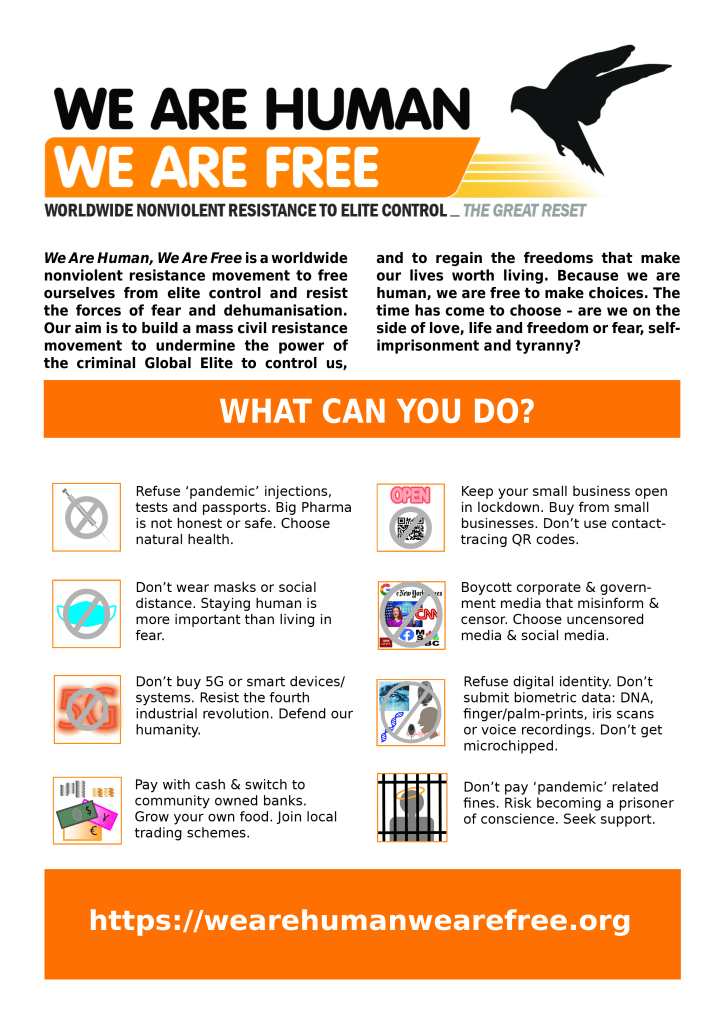
If this strategic resistance to the ‘Great Reset’ (and related agendas) appeals to you, consider joining the ‘We Are Human, We Are Free’ Telegram group (with a link accessible from the website).

And if you want to organize a mass mobilization, such as a rally, at least make sure that one or more of any team of organizers and/or speakers is responsible for inviting people to participate in this campaign and that some people at the event are designated to hand out the one-page flyer about the campaign.

If you like, you can also watch, share and/or organize to show, a short video about the campaign here: ‘We Are Human, We Are Free’ video.

In parallel with our resistance, we must create the political, economic and social structures that serve our needs, not those of the Elite. That is why long-standing efforts to encourage and support people to grow their own food – see ‘23 Reasons You Should Start a Garden in 2023’ – participate in local trading schemes (involving the exchange of knowledge, skills, services and products with or without a local medium of exchange) and develop structures for cooperation, governance, nonviolent defence and networking with other communities are so important.

Of course, indigenous peoples still have many of these capacities – lost to vast numbers of humans as civilization has expanded over the past five millennia – but many people are now engaged in renewed efforts to create local communities, such as ecovillages, and local trading schemes, including Community Exchange Systems. Obviously, we must initiate/expand these forms of individual and community engagement in city neighbourhoods too. And we must learn to defend them as well.

In addition, to reiterate, if you want to raise children who are powerfully able to investigate, analyze and act, you are welcome to make ‘My Promise to Children’.

Conclusion

We are currently living in the final phase of a 5,000 year effort to impose total control over the human population. There are many reasons why it has reached this point. Some key reasons are explained above. And despite the comfortable delusion that the most obvious and onerous restrictions that we have experienced over the past three years have temporarily receded, the fact remains that a vast range of political, economic, medical and technological measures are being implemented as you read these words and we have only just ended the first round of what must be, if we are to be successful, a protracted fight.

In essence, what we do between now and 2030 will determine the fate of humanity. If we can mobilize enough people to resist strategically, we will succeed. But there is little sign of that so far.

Understanding how power works in the world system as well as who, precisely, is driving what is happening, what they are doing, why, and how they are doing it are crucial prerequisites for developing an effective strategy to resist the current Elite program to kill off a substantial proportion of humanity, enslave those left alive in a technocratic prison, enclose the Commons forever and consolidate all wealth in Elite hands.

It is the failure to understand these crucial points that accounts for the ineffective ‘resistance’ that has characterized the past three years.

And this is complicated by the fact that fear makes most people unable to learn either from their own failed experience or to seriously investigate what is happening and how to resist it most effectively. So they fearfully repeat what is familiar, without even asking if it has worked in the past.

So each passing day we still witness fruitless attempts to convince one elite agent or another – a politician, a judge, a corporate media executive… – to take action that will turn the tide in our favour. But none of these individuals can help us.

The reality is simple: If we do not act strategically ourselves, and mobilize sufficient others to do so too, then human identity and freedom will be lost forever.

Biodata: Robert J. Burrowes has a lifetime commitment to understanding and ending human violence. He has done extensive research since 1966 in an effort to understand why human beings are violent and has been a nonviolent activist since 1981. He is the author of ‘Why Violence?’ http://tinyurl.com/whyviolence His email address is flametree@riseup.net and his website is here. http://robertjburrowes.wordpress.com

Ransacking the World Economy Until “You’ll Own Nothing.”

Part 1: 5,000 Years Setting the Stage

By Robert J. Burrowes

According to a video published by the World Economic Forum in 2016, by 2030 ‘You’ll Own Nothing. And You’ll Be Happy.’

See 8 predictions for the world in 2030’.

Clearly, if this prediction is to come true, then many things must happen. Let me identify why the World Economic Forum believes it will happen and then investigate these claims. Among other questions, I will examine whether those who will own nothing will include the Rothschild, Rockefeller and other staggeringly wealthy families. Or, perhaps, whether they just mean people like you and me.

In fact, a primary intention behind the Elite’s ongoing technocratic coup, initiated in January 2020, is to trigger a process of depopulation, as well fundamentally reshape world order including by turning those humans left alive into “transhuman slaves”, drive the global economy to collapse and implement the final redistribution of global wealth from everyone else to this Elite.

Let me start with the briefest of histories so that what is happening can be understood as the ultimate conclusion of a long-standing agenda, identify who I mean by the ‘Global Elite’ (and its agents), then present the evidence to explain how this is happening and, most importantly, a comprehensive strategy to defeat it.

Needless to say, in the interests of keeping this study manageable, many critical historical events – including how imperialism and colonialism, the international slave trade, a great number of wars and coups, Wall Street support for the Bolshevik Revolution in Russia in 1917 and precipitation of the Great Depression in 1929, were used to advance the Elite program – are not addressed in this investigation. But for accounts of the latter two events which provide evidence consistent with the analysis offered below, see Wall Street and The Bolshevik Revolution and The Secrets of the Federal Reserve.

A Brief Economic History

Following the Neolithic revolution 12,000 years ago, agriculture allowed human settlement to supersede the hunter-gatherer economy. However, while the Neolithic revolution occurred spontaneously in several parts of the world, some of the Neolithic societies that emerged in Asia, Europe, Central America and South America resorted to increasing degrees of social control, ostensibly to achieve a variety of social and economic outcomes, including increased efficiency in food production.

Civilizations emerged just over 5,000 years ago and, utilizing this higher degree of social control, were characterized by towns or cities, efficient food production allowing a large minority of the community to be engaged in more specialized activities, a centralized bureaucracy and the practice of skilled warfare. See ‘A Critique of Human Society since the Neolithic Revolution’.

With the emergence of civilization, elites of a local nature (such as the Pharoahs of Egypt), elites with imperial reach (including Roman emperors), elites of a religious nature (such as Popes and officials of the Vatican), elites of an economic character (particularly the City of London Corporation) and elites of a ‘national’ type (especially the monarchies of Europe) progressively emerged, essentially to manage the administration associated with maintaining and expanding their realms (political, economic and/or religious).

The Peace of Westphalia in 1648 formally established the nation-state system in Europe. Enriched by the long-standing and profitable legacy of their control over local domestic populations, support for the imperial conquest of non-European lands, colonial subjugation of indigenous peoples and the international slave trade, European elites, backed by military violence, were able to impose a long series of changes over national political, economic and legal systems which facilitated the emergence of industrial capitalism in Europe in the 18th century.

These interrelated political, economic and legal changes facilitated scientific research that was increasingly geared towards utilizing new resources and technological innovation that drove the ongoing invention of machinery and the harnessing of coal-fired power to make industrial production possible.

Beyond this, and following several centuries of more and less formal versions of it, Elite political and economic imperatives drove the ‘legal’ enclosure of the Commons to force people off their land and into the poorly-paid labour force needed in the emerging industrial cities. In these cities, an ongoing series of developments in the organization of work in factories, electrification, banking, and other changes and technologies dramatically expanded the gap between rich and poor. Along with subsequently imposed changes to education and, later, healthcare, national economies and the global economy were increasingly structured to profoundly disconnect ‘ordinary’ people from their land, traditional knowledge and long-standing healthcare practices to make them dependent while dramatically reinforcing an institutional reality progressively consolidated since the dawn of human civilization: Elite control ensured that the economy perpetually redistributed wealth from those who have less to those who have more.

As noted by Adam Smith, for example, in his classic work An Inquiry into the Nature and Causes of the Wealth of Nations published in 1775: ‘All for ourselves, and nothing for other people, seems, in every age of the world, to have been the vile maxim of the masters of mankind’.

And this was exemplified, for example, by the 150-year struggle between the bankers working to establish a privately-owned central bank in the newly independent United States and those Presidents (such as Andrew Jackson and Abraham Lincoln) and members of Congress who worked tirelessly to defeat it. In fact: ‘Most of the founding fathers realized the potential dangers of banking and feared bankers’ accumulation of wealth and power.’ Why?

Having observed how the privately-owned British central bank, the Bank of England, had run up the British national debt to such an extent that Parliament had been forced to place unfair taxes on the American colonies, the founders in the US understood the evils of a privately-owned central bank, which Benjamin Franklin later claimed was the real cause of the American Revolution.

As James Madison, principal author of the US Constitution argued: ‘History records that the Money Changers used every form of abuse, intrigue, deceit, and violent means possible to maintain their control over governments by controlling money, and its issuance.’ Another founder, Thomas Jefferson, put it this way: ‘I sincerely believe that banking institutions are more dangerous to our liberties than standing armies. The issuing power should be taken from the banks and restored to the people to whom it properly belongs.’ As it turns out, the battle over who would get the power to issue US money raged from 1764, changing hands eight times, until the bankers’ final deceitful victory in 1913 with the establishment of the Federal Reserve System. ‘The battle over who gets to issue our money has been the pivotal issue throughout the history of the United States. Wars are fought over it. Depressions are caused to acquire it. Yet after WWI, this battle was rarely mentioned in the newspapers or history books. Why? By WWI, the Money Changers with their dominant wealth had seized control of most of the nation’s press.’ Watch The Money Masters: How International Bankers Gained Control of America (with the relevant section of the four-part transcript of the video available here: The Money Masters: Part I.)

Why the objection to a private central bank? Well, consider the formation and ownership of the inaccurately named Bank of England, established in 1694.

By the end of the C17th, England was in financial ruin: 50 years of more or less continuous wars with France and Holland had depleted it. So government officials asked the bankers for the loans necessary to pursue their political purposes. What did these bankers want in return? ‘The price was high: a government-sanctioned, privately owned bank which could issue money created out of nothing.’ It became the world’s first privately-owned central bank and, although it was deceptively called the Bank of England to make people think it was part of the government, it was not. Moreover, like any other private corporation, the Bank of England sold shares to get started. ‘The investors, whose names were never revealed, were supposed to put up 1,250,000 British pounds in gold coins, to buy their shares in the bank. But only 750,000 pounds was ever received.’ Despite that, the bank was duly chartered in 1694 and started the business of loaning out several times the money it supposedly had in reserves, all at interest.

Let me restate that for clarity: The British government legislated to create a privately-owned central bank (that is, a bank owned by a small group of wealthy individuals) that loaned out vast amounts of money it did not have so that it could make a profit by charging interest.

This practice is called ‘fractional reserve banking’ to make it sound like some sophisticated economic concept rather than a deceitful practice that, should you or I do it, we would be jailed. ‘In exchange the Bank would loan the British politicians as much of the new currency as they wanted, as long as they secured the debt by direct taxation of the British people.’ In other words, the Bank could not lose.

So, as William T. Still notes: ‘legalization of the Bank of England amounted to nothing less than the legal counterfeiting of a national currency for private gain.’

‘Unfortunately’, he goes on, ‘nearly every nation now has a privately controlled central bank, using the Bank of England as their basic model. Such is the power of these central banks, that they soon take total control over a nation’s economy. It soon amounts to nothing else than a plutocracy, rule by the rich.’ Watch The Money Masters: How International Bankers Gained Control of America (with the relevant section of the four-part transcript of the video available here: The Money Masters: Part I.)

Before proceeding, if how the banking system works isn’t your strong point, this brief video does a good job of spelling out essential points in a non-technical way. Watch ‘Banking – the Greatest Scam on Earth’.

And for a thoughtful explanation of the meaning and history of money, see Nick Szabo’s superb article  ‘Shelling Out: The Origins of Money’.

In any case, the fundamental point is simple: After 5,000 years, the various processes by which local elites, then ‘national’ elites, then international elites, and now the Global Elite have continuously asserted their control to enhance their capacity to shape how the world works and to accumulate wealth has now reached its climax. Thus we are on the brink of being herded into an Elite-controlled technocracy in which, as the World Economic Forum makes clear: By 2030 ‘You’ll Own Nothing. And You’ll Be Happy.’

So you will own nothing.

And why would you be happy about that? Because you will be a transhuman slave: an organism that no longer even owns their own mind.

Who is the Global Elite and How does it Operate?

Many authors have, directly or indirectly, addressed this question and each has come up with their own nuanced combination of wealthy individuals and families, their political connections, as well as the financial instruments and organizational structures through which their power is gained and exercised.

For the purposes of this study, I am going to define the Global Elite as those families that had acquired their vast wealth and firmly established their preeminent political and economic power in global society by the end of the 19th century. These families have thus played the central role in shaping institutions and events both before but also since that time, thus providing the framework in which other wealthy people have since emerged.

In order to perform their fundamental role in shaping the modern world to serve their purposes, this Elite has facilitated the creation of a vast network of agents – corporations, institutions, other families and individuals – who are owned and/or controlled by this Elite and act as ‘fronts’ to advance Elite interests. In any given period, the Elite families remain largely unchanged (while succeeding generations of individuals further the families’ interests) but the organizational and individual agents through which these families work vary, depending on Elite aims in the contexts it precipitates.

Let me briefly illustrate my approach by using one family – the ‘House of Rothschild’ – as a case study before moving onto a wider description of how Elite families use their wealth to shape corporations, institutions, events and people to serve their own purposes.

This example is drawn from the official Rothschild Archive and two (sometimes conflicting) Rothschild-authorized accounts of the family’s history written at different times. See The Rothschild ArchiveThe House of Rothschild – Money’s Prophets, 1798-1848 and The Rothschilds: A Family Portrait.

In addition, the account draws on sources that report neutrally on Rothschild involvement as well as some sources that are critical. These sources are cited in context below.

By the mid-18th century, the ancestors of Mayer Amschel had long been small merchants in the town ghetto of Frankfurt. But, as a Jew without a family name and before street numbering was used, Mayer was also known by the name some ancestors had used on the house sign where they once lived: Rothschild (Red Shield). With more ability than other merchants and having been sent to learn the rudiments of business in the firm of Wolf Jakob Oppenheim, he became a dealer in rare coins, medals and antiques, the buyers of which were almost invariably aristocratic collectors, including William, Hereditary Prince of Hesse-Kassel. It was this business that enabled Mayer Amschel to accumulate the capital to move into banking, a natural outgrowth of his policy of extending credit to some of his clients. His wealth started to increase rapidly as he focused more on state and merchant banking, both local and international.

With a policy of seeking little profit from interest on loans while seeking trade concessions in other areas, seeking clientele only among ‘the noblest personages in Germany’, secret bookkeeping in parallel with the official one and, later, deploying his five sons to replicate his style and activities in England (Nathan, who, after a few years in Manchester, established himself in the City of London), Paris (Jakob, known as James), Naples (Kalman, or Carl), Vienna (Salomon) as well as Frankfurt (where eldest son Amschel eventually succeeded father Mayer), the Rothschild dynasty and ‘multinational business model’ quickly established itself throughout Europe. Critically, it was serviced by the maintenance of close relationships with leading political figures and salaried agents working in financial markets who provided essential political and commercial news, as well as private communications channels (including coaches with secret compartments) that worked with enormous efficiency.

And it was this ‘Red Shield’ communication network, later operating under Royal patronage, combined with a certain audacity, that enabled the Rothschilds to profit handsomely from a variety of adverse circumstances including the restrictions on trade between England and the continent which characterized the Napoleonic period, and the Napoleonic Wars as well. This included smuggling vast amounts of contraband goods from England to the continent and transferring a substantial hoard of gold bullion through France to finance the feeding of Wellington’s army.

Most spectacularly, and despite family efforts to suppress awareness of this fact, the Rothschilds profited enormously from their privileged notice that Wellington defeated Napoleon at Waterloo in 1815, as recorded by William T. Still and Patrick S.J. Carmack in their 3.5 hour documentary The Money Masters: How International Bankers Gained Control of America (with the relevant section of the four-part transcript of the video available here: The Money Masters: Part II.)

How did this happen?

Following a long series of wars across Europe and the eastern Mediterranean, during which he was very successful, rapidly promoted and, in 1804, elected Emperor of France, Napoleon was eventually defeated. He abdicated and was exiled to Elba, an island off the Tuscan coast, in 1814 but escaped nine months later in February 1815.

As he returned to Paris, French troops were sent out to capture Napoleon but such was his charisma that ‘the soldiers rallied around their old leader and hailed him as their emperor once again.’ And, having borrowed funds to rearm, in March 1815 Napoleon’s freshly equipped army marched out to be ultimately defeated by Britain’s Duke of Wellington at Waterloo less than three months later. As Still remarks: ‘Some writers claimed Napoleon borrowed 5 million pounds from the Bank of England to rearm. But it appears these funds actually came from Ubard Banking House in Paris. Nevertheless, from about this point on, it was not unusual for privately controlled central banks to finance both sides in a war.’

‘Why would a central bank finance opposing sides in a war?’ Still asks. ‘Because war is the biggest debt generator of them all. A nation will borrow any amount for victory. The ultimate loser is loaned just enough to hold out the vain hope of victory, and the ultimate winner is given enough to win. Besides, such loans are usually conditioned upon the guarantee that the victor will honor the debts of the vanquished.’

While the outcome of the battle at Waterloo was certainly in doubt, back in London Nathan Rothschild planned to use the outcome, no matter who won or lost, to try to seize control over the British stock and bond market and possibly even the Bank of England. How did he do this? Here is one account. ‘Rothschild stationed a trusted agent, a man named Rothworth, on the north side of the battlefield, closer to the English Channel.’ Once the battle had been decided, at the cost of many thousands of French, English and other European lives, Rothworth headed immediately for the Channel. He delivered the news to Nathan Rothschild, a full 24 hours before Wellington’s own courier arrived with the news.

Rothschild hurried to the stock market and, with all eyes on him given the Rothschild’s legendary communications network was well known, others present observed Rothschild knowing that if Wellington had been defeated, and Napoleon was again at large in Europe, the British financial situation would become grave indeed. Rothschild began selling his consoles (British government bonds). ‘Other nervous investors saw that Rothschild was selling. It could only mean one thing: Napoleon must have won, Wellington must have lost.’

The market plummeted. Soon everyone was selling their own consoles and prices dropped sharply. ‘But then Rothschild started secretly buying up the consoles through his agents for only a fraction of their worth hours before.’

Fallacious? As Still concludes this recounting of the episode: ‘One hundred years later, the New York Times ran the story that Nathan Rothschild’s grandson had attempted to secure a court order to suppress a book with that stock market story in it. The Rothschild family claimed that the story was untrue and libelous. But the court denied the Rothschilds’ request and ordered the family to pay all court costs.’

In any case, having built their initial fortune using various means – some of which, as just illustrated, were neither moral nor legal – throughout the 19th century the Rothschild family continued to accumulate wealth through the international bond market, which they played a key role in developing, as well as other forms of financial business: bullion broking and refining, accepting and discounting commercial bills, direct trading in commodities, foreign exchange dealing and arbitrage, even insurance. The Rothschilds also had a select group of clients – usually royal and aristocratic individuals whom they wished to cultivate – to whom they offered a range of ‘personal banking services’ ranging from large personal loans (such as that to the Austrian Chancellor Prince Metternich) to a first class private postal service (for Queen Victoria). The family also had substantial mining interests and was a major industrial investor backing the construction of railway lines in Europe in the 1830s and 1840s. But, apart from its other interests, the family continued to be heavily involved in ‘the money trade’.

‘From 1870 onwards, London was the centre of Britain’s greatest export: money. Vast quantities of savings and earnings were gathered and invested at considerable profit through the international merchant banks of Rothschild, Baring, Lazard, and Morgan in the City’. See Hidden History: The Secret Origins of the First World War, p. 220.

But what, exactly, is the City?

The City of London Corporation, an independent square mile in the heart of London, was founded in about AD50 and quickly established itself as an important commercial centre which ultimately gave birth to some of the world’s greatest financial institutions such as the London Stock Exchange, Lloyd’s of London and, in 1694, the Bank of England. The City’s ‘modern period’ is sometimes dated from 1067.

However, as explained by Nicholas Shaxson, the City ‘is an ancient, [semi-foreign] entity lodged inside the British nation state; a “prehistoric monster which had mysteriously survived into the modern world”, as a 19th century would-be City reformer put it…. the corporation is an offshore island inside Britain, a tax haven in its own right.’ Of course, the term ‘tax haven’ is a misnomer, ‘because such places aren’t just about tax. What they sell is escape: from the laws, rules and taxes of jurisdictions elsewhere, usually with secrecy as their prime offering. The notion of elsewhere (hence the term “offshore”) is central. The Cayman Islands’ tax and secrecy laws are not designed for the benefit of the 50,000-odd Caymanians, but help wealthy people and corporations, mostly in the US and Europe, get around the rules of their own democratic societies. The outcome is one set of rules for a rich elite and another for the rest of us.’

In the words of Shaxson:

The City’s ‘elsewhere’ status in Britain stems from a simple formula: over centuries, sovereigns and governments have sought City loans, and in exchange the City has extracted privileges and freedoms from rules and laws to which the rest of Britain must submit. The City does have a noble tradition of standing up for citizens’ freedoms against despotic sovereigns, but this has morphed into freedom for money. See The tax haven in the heart of Britain.

As Gerry Docherty and Jim Macgregor explain it then, by 1870:

City influence and investments crossed national boundaries and raised funds for governments and companies across the entire world. The great investment houses made billions, their political allies and agents grew wealthy…. Edward VII, both as king and earlier as Prince of Wales, swapped friendship and honours for the generous patronage of the Rothschilds, Cassel, and other Jewish banking families like the Montagus, Hirschs and Sassoons…. The Bank of England was completely in the hands of these powerful financiers, and the relationship went unchallenged….

The flow of money into the United States during the nineteenth century advanced industrial development to the immense benefit of the millionaires it created: Rockefeller, Carnegie, Morgan, Vanderbilt and their associates. The Rothschilds represented British interests, either directly through front companies or indirectly through agencies that they controlled. Railroads, steel, shipbuilding, construction, oil and finance blossomed…. These small groups of massively rich individuals on both sides of the Atlantic knew one another well, and the Secret Elite in London initiated the very select and secretive dining club, the Pilgrims, that brought them together on a regular basis. See Hidden History: The Secret Origins of the First World War, p. 220.

To choose one example from those just listed, you can read an official account of the Rothschild family’s early involvement in oil production, including its ‘decisive influence’ in the formation of Royal Dutch Shell, in the Rothschild Archive. See Searching for Oil in Roubaix’.

Beyond their investments in the industries just listed, however, the Rothschilds had significant media interests: Their Paribas Bank ‘controlled the all-powerful news agency Havas, which in turn owned the most important advertising agency in France.’ See Hidden History: The Secret Origins of the First World War, p. 214.

And, by the late 19th century, direct Rothschild investment in major ‘armaments companies’ (now better known as weapons corporations) and related industries was substantial with official biographer Niall Ferguson candidly noting ‘If late-nineteenth-century imperialism had its “military-industrial complex” the Rothschilds were unquestionably part of it.’ See The House of Rothschild – Volume 2 – The World’s Banker, 1849-1998, p. 579.

Of course, as noted previously, the Rothschild family is not the only family that uses its wealth to exercise enormous economic and political power and to profit from war, but the evidence suggests that it has long been the most deeply entrenched in the institutions, including those it has created, that facilitate the exercise of this power. Moreover, it is linked to many other wealthy families through a multitude of arrangements as will be shown.

Consider the following examples of how the power of wealth is exercised and note the names of some other wealthy families.

Invariably working ‘in the background’, elite figures spend considerable time manipulating ‘well-positioned’ people, and none are more adept at this than the Rothschilds. To cite just one of many examples, ‘both the great estates of Balmoral and Sandringham, so intimately associated with the British royal family, were facilitated, if not entirely paid for, through the largess of the House of Rothschild’ thus maintaining the long-standing Rothschild tradition of gifting ‘loans’ – that is, bribes, as the brothers had long before privately acknowledged – to royalty (and other key officials).

Of course, this manipulation of people is done to ensure the creation of particular institutions or to precipitate or facilitate a particular sequence of events. Just one obvious example of this occurred when the British government was manipulated into the Boer War of 1899-1902 by ‘the secret society of Cecil Rhodes’ as it was originally known and of which Lord (Nathan) Rothschild was a founding member along with Alfred, later Lord, Milner who succeeded Rhodes as head of this exclusive secret club. While the British public was given a more palatable pretext for this war via the media, it was fundamentally fought to defend and consolidate the rich South African gold-mining interests of wealthy businesspeople, including the Rothschilds. By the time the war ended, the Transvaal’s gold was finally in their hands. The cost? ‘32,000 deaths in the concentration camps, [of whom more than 26,000 were women and children]; 22,000 British Empire troops were killed and 23,000 wounded. Boer casualties numbered 34,000. Africans killed amounted to 14,000.’ See Hidden History: The Secret Origins of the First World War, pp. 23 & 38-50 and The Anglo-American Establishment: From Rhodes to Cliveden.

The US Federal Reserve System

In his classic work The Creature from Jekyll Island: A Second Look at the Federal Reserve, in which he describes the formation, structure and function of the US Federal Reserve System, which governs banking in the United States, G. Edward Griffin identified the seven men and who they represented, at the secret meeting held at the private resort of J.P. Morgan on Jekyll Island off the coast of Georgia in November 1910 when the System was conceived (and later passed as The Federal Reserve Act in 1913).

The seven men at this meeting represented the great financial institutions of Wall Street and, indirectly, Europe as well: that is, they represented one-quarter of the total wealth of the entire world. They were Nelson W. Aldrich, Republican ‘whip’ in the US Senate, Chair of the National Monetary Commission and father-in-law of John D. Rockefeller Jr.; Henry P. Davison, senior partner of J.P. Morgan Company; Charles D. Norton, President of the 1st National Bank of New York; A. Piatt Andrew, Assistant Secretary of the Treasury; Frank A. Vanderlip, President of the National City Bank of New York, representing William Rockefeller; Benjamin Strong, head of J.P. Morgan’s Bankers Trust Company and later to become head of the System; and Paul M. Warburg, a partner in Kuhn, Loeb & Company, representing the Rothschilds and Warburgs in Europe.

But lest you think that there is some ‘diversity’ here, long-standing ties generated from huge financial injections at crucial times meant that several other key banks owed much to Rothschild wealth. For example, in 1857 a run on U.S. banks saw the bank Peabody, Morgan and Company in deep trouble as four other banks were driven out of business. But Peabody, Morgan and Company was saved by the Bank of England. Why? Who initiated the rescue? According to Docherty and Macgregor, ‘The Rothschilds held immense sway in the Bank of England and the most likely answer is that they intervened to save the firm. Peabody retired in 1864, and Junius Morgan inherited a strong bank with powerful links to Rothschild.’ Junius was the father of J.P. Morgan. See Hidden History: The Secret Origins of the First World War, p. 222.

A similar thing happened when Nathaniel Rothschild headed the Bank of England committee that rescued Barings Bank from imminent collapse in 1890. But other big banks ‘were beholden to or fronts for the Rothschilds…. Like J.P. Morgan, Barings and Kuhn Loeb, the M.M. Warburg Bank owed its survival and ultimate success to Rothschild money.’ To reiterate then: ‘by the early twentieth century numerous major banks, including J.P. Morgan and Barings, and armaments firms, were beholden to or fronts for the Rothschilds.’ And this had many advantages. J.P. Morgan, who was deeply involved with the Pilgrims – an exclusive club that linked major U.K. and U.S. businesspeople – was clearly perceived as an upright Protestant guardian of capitalism, who could trace his family roots to pre-Revolutionary times, so by acting in the interests of the London Rothschilds he shielded their American profits from the poison of anti-Semitism.

But the connections do not end there. Superficially, ‘there were periods of blistering competition between the investment and banking houses, the steel companies, the railroad builders and the two international goliaths of oil, Rockefeller and Rothschilds, but by the turn of the century the surviving conglomerates adopted a more subtle relationship, which avoided real competition.’ A decade earlier, Baron de Rothschild had accepted an invitation from John D. Rockefeller to meet in New York behind the closed doors of Standard Oil’s headquarters on Broadway where they had quickly reached a confidential agreement. ‘Clearly both understood the advantage of monopolistic collusion.’ The apparent rivalry between major stakeholders in banking, industry and commerce has long been a convenient facade, which they are content to leave much of the world believing. See Hidden History: The Secret Origins of the First World War, pp. 222-225.

Beyond business and financial links of this nature, of course, there is marriage. For example, according to  Dean Henderson: ‘The Warburgs, Kuhn Loebs, Goldman Sachs, Schiffs and Rothschilds have intermarried into one big happy banking family. The Warburg family… tied up with the Rothschilds in 1814 in Hamburg, while Kuhn Loeb powerhouse Jacob Schiff shared quarters with Rothschilds in 1785. Schiff immigrated to America in 1865. He joined forces with Abraham Kuhn and married Solomon Loeb’s daughter. Loeb and Kuhn married each others sisters and the Kuhn Loeb dynasty was consummated. Felix Warburg married Jacob Schiff’s daughter. Two Goldman daughters married two sons of the Sachs family, creating Goldman Sachs. In 1806 Nathan Rothschild married the oldest daughter of Levi Barent Cohen, a leading financier in London.’ See Big Oil and Their Bankers in the Persian Gulf: Four Horsemen, Eight Families and Their Global Intelligence, Narcotics and Terror Network, p. 488.

So to return to the foundation of the US Federal Reserve System, according to Griffin:

The reason for secrecy was simple. Had it been known that rival factions of the banking community had joined together, the public would have been alerted to the possibility that the bankers were plotting an agreement in restraint of trade – which, of course, is exactly what they were doing.

What emerged was a cartel agreement with five objectives:

stop the growing competition from the nation’s newer banks;

obtain a franchise to create money out of nothing for the purpose of lending;

get control of the reserves of all banks so that the more reckless ones would not be exposed to currency drains and bank runs;

get the taxpayer to pick up the cartel’s inevitable losses; and convince Congress that the purpose was to protect the public.

It was realized that the bankers would have to become partners with the politicians and that the structure of the cartel would have to be a central bank. The record shows that the Fed has failed to achieve its stated objectives. That is because those were never its true goals. As a banking cartel, and in terms of the five objectives stated above, it has been an unqualified success.

To reiterate Griffin’s key point: ‘a primary objective of that cartel was to involve the federal government as an agent for shifting the inevitable losses from the owners of those banks to the taxpayers.’ And this is confirmed by the ‘massive evidence of history since the System was created’.

Or, in the words of economics Professor Antony C. Sutton, who carefully detailed the longstanding links between Wall Street and the family of US President Franklin D. Roosevelt, including Roosevelt himself (a banker and speculator from 1921 to 1928): ‘The Federal Reserve System is a legal private monopoly of the money supply operated for the benefit of a few under the guise of protecting and promoting the public interest.’ See Wall Street and F.D.R.

And, as U.S. Congressman Louis Thomas McFadden, chairman of the House Committee on Banking and Currency, observed in 1932: ‘When the Federal Reserve Act was passed, the people of the United States did not perceive that… this country was to supply financial power to an international superstate – a superstate controlled by international bankers and international industrialists acting together to enslave the world for their own pleasure.’ See ‘Speech by Rep. Louis T. McFadden denouncing the Federal Reserve System’.

Equally importantly, creation of the Federal Reserve was just one of many preliminary steps taken over a 25-year period by a select group of men in key positions who conspired to ignite The Great War to both shape the future world order and profit enormously from the death and destruction. You can read detailed accounts of what took place, including key players, their motives and instigation of the Boer War in South Africa, touched on above, as part of the process, in books such as these:

Hidden History: The Secret Origins of the First World War,

The Anglo-American Establishment: From Rhodes to Cliveden,

The House of Rothschild – Volume 2 – The World’s Banker, 1849-1998 and

Prolonging the Agony: How the Anglo-American Establishment Deliberately Extended WWI by Three-and-a-Half Years.

There is also a thoughtful summary in ‘A crime against humanity: the Great Reset of 1914-1918’ and an excellent video on the subject: ‘The WWI Conspiracy’.

The primary cost of World War I was 20 million human lives, but it was immensely profitable for some.

The Bank for International Settlements

Another critical development in this period was the creation of the Bank for International Settlements (BIS) – as ‘the central bank of central banks’ – in 1930. As described by Professor Carroll Quigley, the BIS was the apex of efforts by elite bankers ‘to create a world system of financial control in private hands able to dominate the political system of each country and the economy of the world as a whole.’

But the push started many years before with Montagu Norman (Bank of England) and Benjamin Strong (the first governor of the Federal Reserve Bank of New York) both committed advocates. ‘In the 1920’s, they were determined to use the financial power of Britain and of the United States to force all the major countries of the world to go on the gold standard and to operate it through central banks free from all political control, with all questions of international finance to be settled by agreements by such central banks without interference from governments.’

This system was to be controlled in a feudalist fashion by the central banks of the world acting in concert, by secret agreements arrived at in frequent private meetings and conferences. The apex of the system was to be the Bank for International Settlements in Basle, Switzerland, a private bank owned and controlled by the world’s central banks which were themselves private corporations.

Each central bank, in the hands of men like Montagu Norman of the Bank of England, Benjamin Strong of the New York Federal Reserve Bank, Charles Rist of the Bank of France, and Hjalmar Schacht of the Reichsbank, sought to dominate its government by its ability to control Treasury loans, to manipulate foreign exchanges, to influence the level of economic activity in the country, and to influence cooperative politicians by subsequent economic rewards in the business world. The B.I.S. as a private institution was owned by the seven chief central banks and was operated by the heads of these, who together formed its governing board.

But, Quigley points out:

It must not be felt that these heads of the world’s chief central banks were themselves substantive powers in world finance. They were not. Rather, they were the technicians and agents of the dominant investment bankers of their own countries, who had raised them up and were perfectly capable of throwing them down.

The substantive financial powers of the world were in the hands of these investment bankers (also called ‘international’ or ‘merchant’ bankers) who remained largely behind the scenes in their own unincorporated private banks.

These formed a system of international cooperation and national dominance which was more private, more powerful, and more secret than that of their agents in the central banks. This dominance of investment bankers was based on their control over the flows of credit and investment funds in their own countries and throughout the world. They could dominate the financial and industrial systems of their own countries by their influence over the flow of current funds through bank loans, the discount rate, and the re-discounting of commercial debts; they could dominate governments by their control over current government loans and the play of the international exchanges. Almost all of this power was exercised by the personal influence and prestige of men who had demonstrated their ability in the past to bring off successful financial coupe, to keep their word, to remain cool in a crisis, and to share their winning opportunities with their associates. In this system the Rothschilds had been preeminent during much of the nineteenth century. See Tragedy & Hope: A History of the World in Our Time, pp. 242-3 & 245.

Ensuring that this select group of international bankers could operate without any form of accountability to any other authority in the world, the BIS ‘Headquarters Agreement with Switzerland’ Articles 4 and 12 specifically identify a range of ‘privileges and immunities’ that, among others, provide that ‘The Bank shall enjoy immunity from jurisdiction’ and ‘members of the Board of Directors of the Bank, together with the representatives of those central banks which are members of the Bank’ with ‘immunity from arrest or imprisonment’. See ‘Agreement between the Swiss Federal Council and the Bank for International Settlements to determine the Bank’s legal status in Switzerland’.

In plain language, the BIS and its members are beyond the reach of governments, key international organizations and the rule of law. They are accountable to no-one. And this is why the BIS was never held to account for its commission of war crimes. See ‘History – the BIS during the Second World War (1939-48)’. For an excellent and detailed account of the Bank for International Settlements, see Adam LeBor’s Tower of Basel: The Shadowy History of the Secret Bank that Runs the World.

Beyond this, as Sutton notes, because politicians sympathetic to financial capitalism and academics with ideas about world control are kept in line with a system of rewards and penalties, ‘in the early 1930s the guiding vehicle for this international system of financial and political control’ was the BIS, headquartered in Basle. The BIS ‘continued its work during World War II as the medium through which the bankers – who… were not at war with each other – continued a mutually beneficial exchange of ideas, information, and planning for the post-war world.’ In this sense only, the war was irrelevant to them. See Wall Street and The Rise of Hitler, pp. 11-12.

So while elite figures, including the Rothschilds, continued to shape institutions and events to restructure world order and make it more profitable for themselves, virtually everyone else in the world was an unwitting victim of their secret programs, many at the cost of their own life.

A notable exception was US Major General Smedley Butler who at least spelled out the critical role that war played in wealth creation for the elite. Following more than three decades of highly-decorated service in the US Marine Corp, Butler later described his experience in the following terms: ‘I spent most of my time being a high-class muscle man for Big Business, for Wall Street and for the bankers. In short, I was a racketeer for capitalism.’ See ‘Major General Smedley Butler’.

In his book published in 1935, he wrote:

‘War is a racket. It always has been. It is possibly the oldest, easily the most profitable, surely the most vicious…. It is the only one in which the profits are reckoned in dollars and the losses in lives…. It is conducted for the benefit of the very few, at the expense of the very many. Out of war a few people make huge fortunes.’

He went on to describe some of the individuals and corporations that made huge profits out of World War I. See War IA Racket.

World War II

And, just a few years later, World War II demonstrated that ‘war is a racket’ yet again. By carefully penetrating the cloak of deception behind which it was hidden, Professor Antony C. Sutton considered original documentation and eyewitness accounts to reveal what remains one of the most remarkable and under-reported facts of World War II. In his account of this orchestrated conflagration, Sutton carefully documents how prominent Wall Street banks and US businesses supported Hitler’s rise to power by financing and trading with Nazi Germany, reaching the unsavory conclusion that ‘the catastrophe of World War II was extremely profitable for a select group of financial insiders’ including J.P. Morgan, T.W. Lamont, the Rockefeller interests, General Electric, Standard Oil, and the National City, Chase, and Manhattan banks, Kuhn, Loeb and Company, General Motors, Ford Motor Company, and scores of others in ‘the bloodiest, most destructive war in history’. See Wall Street and The Rise of Hitler.

To illustrate the complex and wide-ranging collaboration between US business interests and the Nazis throughout the war, consider just one example: On the eve of World War II the German chemical complex of I.G. Farben, which included the banker Max Warburg (brother of Paul of the US Federal Reserve) on its Board of Directors, was the largest chemical manufacturing enterprise in the world, with extraordinary political and economic power within Hitler’s Nazi state. The Farben cartel dated from 1925 and had been created with financial assistance from Wall Street by the organizing genius of Hermann Schmitz, a prominent early Nazi who, through I.G. Farben, helped fund Hitler’s seizure of control in March 1933. Schmitz created the super-giant chemical enterprise out of six already giant German chemical companies.

So critical was I.G. Farben to the Nazi war effort that it produced 100% of its lubricating oil and various other products, 95% of its poison gas – ‘enough gas to kill 200 million humans’ – used in the extermination chambers, 84% of its explosives, 70% of its gunpowder, and very high proportions of many other critical products including aviation fuel. As Sutton concludes: ‘Without the capital supplied by Wall Street, there would have been no I.G. Farben in the first place and almost certainly no Adolf Hitler and World War II.’ See Wall Street and The Rise of Hitler, pp.17-20.

The cost in human lives of World War II was 70-85 million. But there was no cost to those Wall Street corporations and their fellow war profiteers that collaborated with Nazi Germany. Just massive profits.

Following World War II

Documenting what had become the long-standing collusion between political, corporate and military elites, sociology Professor C. Wright Mills published his classic work The Power Elite in 1956. This scholarly effort was among the earliest of the post-World War II era to document the nature of the US elite and how it functioned, highlighting the interlocking power of corporate, political and military elites as they exercised control over US national society and went about the task of exploiting the general population.

But a weakness of the account by Mills was his failure to grapple with the already long-standing power of a global elite to manipulate key events in any one country, and certainly the United States, even if much of this was done through the relevant national elite(s).

This ‘global reach’ of the Elite is again clearly apparent in any study of ownership of the world’s oil resources. In his 1975 book The Seven Sisters, Anthony Sampson popularized this collective name for the shadowy oil cartel that, throughout its history, had vigorously worked to eliminate competitors and control the world’s oil. See The Seven Sisters: The Great Oil Companies and the World They Shaped. Several decades later, Dean Henderson simply observed that ‘After a tidal wave of mergers at the turn of the millennium, Sampson’s Seven Sisters were Four Horsemen: Exxon Mobil, Chevron Texaco, BP Amoco and Royal Dutch/Shell.’ Beyond this, however, Henderson noted the following:

The oil wealth generated in the Persian Gulf region is the main source of capital [for the international mega-banks]. They sell the Gulf Cooperation Council sheiks 30-year treasury bonds at 5% interest, then loan the sheiks’ oil money out to Third World governments and Western consumers alike at 15-20% interest. In the process these financial overlords – who produce nothing of economic import – use debt as their lever in consolidating control over the global economy.

See Big Oil and Their Bankers in the Persian Gulf: Four Horsemen, Eight Families and Their Global Intelligence, Narcotics and Terror Network, pp. 168, 451.

And, following a series of mergers and then the 2008 banking crisis, four giant banks emerged to dominate the US economy: JP Morgan Chase, Citigroup, Bank of America and Wells Fargo. Moreover, these banks, along with Deutsche Bank, Banque Paribas, Barclays ‘and other European old money behemoths’, own the four oil giants and are also ‘among the top 10 stock holders of virtually every Fortune 500 corporation’ giving them vast control over the global economy.

See Big Oil and Their Bankers in the Persian Gulf: Four Horsemen, Eight Families and Their Global Intelligence, Narcotics and Terror Network, pp. 470, 473.

So who owns these banks? By now it should come as no surprise that several scholars at different times during the past 100 years have investigated this issue and come to essentially the same conclusion: the major families, increasingly interrelated by blood, marriage and/or business interests, have simply consolidated their control over the banks. Apart from scholars already mentioned above, in the 1983 revision of his book, Eustace Mullins noted that a few families still controlled the New York City banks which, in turn, hold the controlling stock of the Federal Reserve Bank of New York. Mullins identified the families of the Rothschilds, Morgans, Rockefellers, Warburgs and others.

See The Secrets of the Federal Reserve, p. 224.

Several scholars have written on the subject of elite power since Mills with Professor Peter Phillips penning the 2018 book Giants: The Global Power Elite which reviews ‘the transition from the nation state power elites described by Mills to a transnational power elite centralized on the control of global capital around the world. The Global Power Elite function as a nongovernmental network of similarly educated wealthy people with common interests of managing, facilitating, and protecting concentrated global wealth and insuring the continued growth of capital.’

Aside from the obvious criticism that Phillips effectively repeats the mistake made by Mills in assuming that there was no pre-existing ‘transnational power elite’ even if in different form, Phillips goes on to usefully identify the world’s top seventeen asset management firms, such as BlackRock and J.P Morgan Chase, that collectively manage (by now) more than $US50 trillion in a self-invested network of interlocking capital that spans the globe.

More precisely, Phillips identifies the 199 individual directors of the seventeen global financial Giants and the importance of those transnational institutions that serve a unifying function – including:

the World Bank, International Monetary Fund, G20, G7, World Trade Organization (WTO),

World Economic Forum  (WEF), Trilateral Commission,

Bilderberg Group(with a review of Daniel Estulin’s book The True Story of the Bilderberg Group here:

‘“The True Story of the Bilderberg Group” and What They May Be Planning Now’),

Bank for International Settlements and the Council on Foreign Relations

(see ‘One World Governance and the Council on Foreign Relations. “We Shall have World Government… by Conquest or Consent.”’) – and particularly two very important global elite policy-planning organizations:

the Group of Thirty (which has 32 members) and the extended executive committee of the Trilateral Commission (which has 55 members).

And Phillips carefully explains why and how the Global Elite defends its power, profits and privilege against rebellion by the ‘unruly exploited masses’: ‘the Global Power Elite uses NATO and the US military empire for its worldwide security…. The whole system continues wealth concentration for elites and expanded wretched inequality for the masses.’ Advocating the importance of systemic change and the redistribution of wealth, Phillips goes on to argue that ‘This concentration of protected wealth leads to a crisis of humanity, whereby poverty, war, starvation, mass alienation, media propaganda, and environmental devastation are reaching a species-level threat.’

Hence, it is worth reiterating: War plays an ongoing and vital role in the exercise of Elite power to reshape world order to maximize wealth concentration by the Elite. If you want further evidence of this, you might find these recent reports instructive: the US Congressional Research Service report

‘Instances of Use of United States Armed Forces Abroad, 1798-2022’,

the Tufts University Fletcher Center for Strategic Studies report ‘Military Intervention Project (MIP) Research’

and an article and video that summarize and discuss these two reports in US launched 251 military interventions since 1991, and 469 since 1798.

But, as the discussion above and below illustrates, war is not the only mechanism the Elite uses.

For an account which focuses on identifying many of the world’s largest corporations, in many industries, and then illustrates the interlocking nature of corporate ownership while demonstrating that they are all owned by the same small group of giant asset management corporations – notably including Vanguard, BlackRock and State Street – this video is very instructive: ‘Monopoly: Who Owns the World?’

And for a penetrating critique of BlackRock and its overall strategy to acquire vast worldwide control, including by using its Aladdin investment analysis technology (which employs massive data collection, artificial intelligence and machine learning to derive investment insight),

see ‘BlackRock: Bringing Together Man and Machine’

and this three-part series by James Corbett: ‘How BlackRock Conquered the World’.

In the ‘Monopoly’ video, you will again see the names of some familiar individuals and families who own significant shareholdings in these corporations and asset management firms. After showcasing families such as the Rothschilds, Rockefellers and Morgans, the narrator simply observes in relation to Vanguard that its ‘largest shareholders are the private funds and nonprofit organizations of these families’.

And if you think that national Elites in countries like China and Russia are somehow not involved in all this, you might find it interesting to read articles that discuss the wealth and political influence of the Chinese ‘immortals’ and the Russian oligarchs –

see ‘China’s red aristocracy’ and ‘List of Oligarchs and Russian elites featured in ICIJ investigations’ – or read the ‘Joint Statement of the Russian Federation and the People’s Republic of China on the International Relations Entering a New Era and the Global Sustainable Development’.

Beyond this, however, Emanuel Pastreich points out that if anyone attributes responsibility for Chinese policies in relation to data collection and control based on QR codes and contact tracing, they inevitably identify the Chinese government.

‘But the truth is that few, or none, of these policies were made up or implemented by the Chinese government itself, but rather that the Chinese government is occupied by IT corporations that report to the billionaires (often through Israel and the United States) and bypass the Chinese government altogether.’

Pastreich goes on to offer some insight into how key Elite intelligence and finance corporations are driving the technocratic social control policies being implemented under cover of the ‘virus’ in China.

See ‘The Third Opium War Part One: The agenda behind the COVID-19 assault on China’and ‘The Third Opium War Part Two: The True Threat Posed by China’ or watch ‘Western Tech & China: Who Serves whom?’

In fact, as Patrick Wood points out, referencing a much earlier book of his own and Professor Antony Sutton – see Trilaterals Over Washington Volumes I & II  – ‘Thanks to early members of the [Elite’s] Trilateral Commission, China was brought out of its dark ages Communist dictatorship and onto the world stage. Furthermore, the Trilateral Commission orchestrated and then facilitated a massive transfer of technology to China in order to build up its non-existent infrastructure….  As a failed Communist dictatorship, China was a blank slate with over 1.2 billion citizens under its control. However, Chinese leadership knew nothing about capitalism and free enterprise, and [key Trilateralist Zbigniew] Brzezinski made no effort to teach them about it. Instead, he planted seeds of Technocracy…. In the 20-year period from 1980 to 2000, a transformation took place that was considered nothing short of an economic miracle; but it was not of China’s doing. Rather, it can be fully attributed to the masters of Technocracy within the ranks of the Trilateral Commission.’ After listing several key features of China’s technocracy (5G, AI, social credit scores…), Wood concludes that ‘China is a full-blown Technocracy and it is the first of its kind on planet earth.’ See this article on China as one of Wood’s 12-part series on technocracy: ‘Day 7: China Is A Technocracy’.

And in relation to Russia,  Riley Waggaman simply observes that ‘As for “COVID-triggered” economic restructuring: the Russian government has openly embraced the World Economic Forum’s Fourth Industrial Revolution. In October [2021], the Russian government and the WEF signed a memorandum on the establishment of a Center for the Fourth Industrial Revolution in Russia.

Russia has already adopted a law allowing for “experimental legal regimes” to allow corporations and institutions to deploy AI and robots into the economy, without being encumbered by regulatory red tape. Returning to Gref and his digital Sbercoin: Russia’s central bank is already planning to test-run a digital ruble that, among other nifty features, could be used to restrict purchases.’ See ‘I believe we are facing an evil that has no equal in human history’.

Moreover, according to Mikhail Delyagin, a deputy of the State Duma of the Russian Federation: ‘In the 90s, under Yeltsin, the external management of global banksters was carried out through the IMF and through [Russian oligarch Anatoly] Chubais. Now under Putin, external management will be done by Big Tech, social global platforms, and Big Pharma through the WHO. Exactly the same management.’ Cited in ‘Duma deputy: “Protect yourself and Russia from a coup d’état!”. Russian lawmaker issues video appeal to the nation. Will anyone listen?’

Separately from this, bear in mind that the Elite, as well as its agents and organizations (including those in China and Russia), have vast wealth stashed in ‘secrecy jurisdictions’ (better known as tax havens): locations around the world where wealthy individuals, criminals and terrorists, as well as governments and government agencies (such as the CIA), banks, corporations, hedge funds, international organizations (such as the Vatican) and crime syndicates (such as the Mafia), can stash their money so that they can avoid regulation and oversight, and evade tax. Just how much wealth is stashed in tax havens? While this is impossible to know precisely, it can only be measured in tens of trillions of dollars as well as an unknown number of gold bricks, artworks, yachts and racehorses.

See ‘Elite Banking at Your Expense: How Secretive Tax Havens are Used to Steal Your Money’.

How is this possible? Well, it is protected by government legislation and legal systems, with an ‘army’ of Elite agents – accountants, auditors, bankers, businesspeople, lawyers and politicians – ensuring that they remain protected. The point here is simple: if you have enough money, the law simply does not exist. And you can evade taxes legally and in the full knowledge that your vast profits (even from immorally-acquired wealth such as sex trafficking, gun-running, endangered species trafficking, conflict diamonds and drug trafficking) are ‘lawful’ and will escape regulation and oversight of any kind. See ‘The Rule of Law: Unjust and Violent’.

But legal systems facilitate monstrous injustice in other ways too. For example, they ensure that owners of corporations are enabled to ruthlessly exploit both their workers and all taxpayers as well. For a thoughtful and straightforward account of how this works, see this article by Professor James Petras: ‘How Billionaires Become Billionaires’.

And to briefly revisit a subject discussed above: Who owns the US Federal Reserve System now?

According to Dean Henderson writing in 2010, it is ‘the Goldman Sachs, Rockefellers, Lehmans and Kuhn Loebs of New York; the Rothschilds of Paris and London; the Warburgs of Hamburg; the Lazards of Paris; and the Israel Moses Seifs of Rome.’

Henderson goes on to state that ‘The control that these banking families exert over the global economy cannot be overstated and is quite intentionally shrouded in secrecy. Their corporate media arm is quick to discredit any information exposing these money powers as halfbaked conspiracy theory. The word “conspiracy” itself has been demonized, much like the word “communism”. Anyone who dare utter the word is quickly excluded from public debate and written off as insane. Yet the facts remain.’

See Big Oil and Their Bankers in the Persian Gulf: Four Horsemen, Eight Families and Their Global Intelligence, Narcotics and Terror Network, pp. 473-4.

Other scholars in the field agree.

In his exceptionally detailed investigation into three major historical events of the C20th – the Bolshevik Revolution, the rise of Franklin D. Roosevelt and the rise of Hitler – Professor Antony Sutton identified the seat of political power in the United States not as the US Constitution authorized but ‘the financial establishment in New York: the private international bankers, more specifically the financial houses of J.P. Morgan, the Rockefeller-controlled Chase Manhattan Bank, and in earlier days (before amalgamation of their Manhattan Bank with the former Chase Bank), the Warburgs.’

For most of the twentieth century the Federal Reserve System, particularly the Federal Reserve Bank of New York (which is outside the control of Congress, unaudited and uncontrolled, with the power to print money and create credit at will), has exercised a virtual monopoly over the direction of the American economy. In foreign affairs the Council on Foreign Relations, superficially an innocent forum for academics, businessmen, and politicians, contains within its shell, perhaps unknown to many of its members, a power center that unilaterally determines U.S. foreign policy. The major objective of this submerged – and obviously subversive – foreign policy is the acquisition of markets and economic power (profits, if you will), for a small group of giant multi-nationals under the virtual control of a few banking investment houses and controlling families. See Wall Street and The Rise of Hitler, pp.125-126.

So what has changed?

Nothing has changed.

But it is not just fine scholars who have reached this conclusion. Consider David Rockefeller’s delusionary whitewashing of his own family’s key role in the killing, devastation and destruction outlined above: ‘Some even believe we are part of a secret cabal working against the best interests of the United States, characterizing my family and me as “internationalists” and of conspiring with others around the world to build a more integrated global political and economic structure – one world, if you will. If that’s the charge, I stand guilty, and I am proud of it…. one of the most enduring [conspiracies] is that a secret group of international bankers and capitalists, and their minions, control the world’s economy…. [but these people] ignore the tangible benefits that have resulted from our active international role during the past half-century’. See Memoirs, p. 483.

If you are wondering how all of this happens without any significant pushback from within elite circles, there is a simple answer: They are all insane and control to maximize resource accumulation has become the perpetual substitute for their destroyed capacity to engage emotionally in their own lives and empathize with their fellow human beings. For more detail, see ‘Love Denied: The Psychology of Materialism, Violence and War’ and ‘The Global Elite is Insane Revisited’.

So while some of us occasionally ponder how we can contribute more to improve the human condition and the state of the world, and then endeavour to do something along those lines, there are plenty of terrified people whose daily life is consumed (consciously or unconsciously) by the question ‘How can I take more?’ And people like that have been taking more since the dawn of human civilization and, no doubt, earlier.

The Global Elite is simply those who have been insanely ruthless and organized enough to take more, whatever the cost to humanity and all other life on Earth.

The Post World War II Superstructure to Transform World Order, Destroy the World Economy and Capture All Wealth

So how, precisely, is the Global Elite driving the transformation of world order, the collapse of the world economy and capturing final control of all wealth?

There are three parts to the answer to this question: 1. The foundations progressively laid over the past 5,000 years, as outlined above; 2. The superstructure (including such institutions as the United Nations, the World Bank and International Monetary Fund) that has been built since World War II and, more recently, under the guise of the United Nation’s Sustainable Development agenda, to impose global governance on the human population and, particularly, to intrude global financial governance into every aspect of our lives. In the words of Iain Davis and Whitney Webb, this is because the UN’s sustainable development goals ‘do not promote “sustainability” as most conceive it and instead utilise the same debt imperialism long used by the Anglo-American Empire to entrap nations in a new, equally predatory system of global financial governance’ – see ‘Sustainable Debt Slavery’ – and 3. The final part relates to political, economic and, especially, technological measures being imposed as part of the World Economic Forum’s ‘Great Reset’ under cover of the fake narrative about a Covid-19 ‘pandemic’.

If we briefly consider elements of the post-World War II superstructure, for example, both the World Bank and International Monetary Fund have historically used debt to force countries, mostly in the developing world, to adopt policies that redistribute wealth to the elite via their banks, corporations and institutions. But corporations have employed their own ‘economic hit men’ to do the same thing: By identifying and ‘persuading’ leaders of developing nations, using a variety of devices – ranging from false economic projections and bribes to military threats and assassinations – to accept enormous ‘development’ loans for projects which are contracted with western corporations, countries quickly become entrapped in debt. This is then used to force those countries to implement unpopular austerity policies, deregulate financial and other markets, and privatize state assets, thus eroding national sovereignty. See The New Confessions of an Economic Hit Man.

If you want to read further evidence of the role of the World Bank and the IMF as agents of Elite policy against nation-states, you might find the US Army’s manual of unconventional warfare interesting. See ‘Army Special Operations Forces: Unconventional Warfare’. Originally released by Wikileaks in 2008 and described by them as the US military’s ‘regime change handbook’, as elaborated by Webb, ‘the U.S. Army states that major global financial institutions – such as the World Bank, International Monetary Fund (IMF), the Organization for Economic Cooperation and Development (OECD) [and the Bank for International Settlements (BIS] – are used as unconventional, financial “weapons in times of conflict up to and including large-scale general war,” as well as in leveraging “the policies and cooperation of state governments.”’ See ‘Leaked Wikileaks Doc Reveals US Military Use of IMF, World Bank as “Unconventional” Weapons’.

Beyond this, however, what we have seen since the UN, increasingly a tool of corporations since the 1990s, adopted its Sustainable Development Goals is a dramatically expanded set of mechanisms designed to enslave the bulk of the human population, not just those in ‘developing’ countries, and take complete control of Earth’s ecosystems and natural processes.

Among many initiatives, for example, the Global Public-Private Partnership has been presented by Klaus Schwab and Peter Vanham, on behalf of the World Economic Forum. See Stakeholder Capitalism: A Global Economy that Works for Progress, People and Planet summarized in What is stakeholder capitalism?

While this sanitized account obscures the threat it poses to humankind, Iain Davis and Whitney Webb have thoughtfully critiqued it – see ‘Sustainable Debt Slavery’ – noting that even a 2016 UN Department of Economic and Social Affairs report – see ‘Public-Private Partnerships and the 2030 Agenda for Sustainable Development: Fit for purpose?’ – also found it ‘unfit for purpose’. So what is it? According to Davis, the Global Public-Private Partnership (G3P) is a worldwide network of stakeholder capitalists and their partners: the Bank for International Settlements, central banks, global (including media) corporations, the ‘philanthropic’ foundations of multi-billionaires, policy think tanks, governments (and their agencies), key non-governmental organizations and global charities, selected academic and scientific institutions, labour unions and other chosen ‘thought leaders’. (You can see an instructive diagram in the article cited below.)

The G3P controls the world economy and global finance. ‘It sets world, national and local policy (via global governance) and then promotes those policies using the mainstream media’, typically distributes the policies through an intermediary such as the IMF, WHO or IPCC and uses governments to transform G3P global governance into hard policy, legislation and law at the national level. ‘In this way, the G3P controls many nations at once without having to resort to legislation. This has the added advantage of making any legal challenge to the decisions made by the most senior partners in the G3P (an authoritarian hierarchy) extremely difficult.’ In short: global governance has already superseded the national sovereignty of states: ‘National governments had been relegated to creating the G3P’s enabling environment by taxing the public and increasing government borrowing debt.’ See ‘What Is the Global Public-Private Partnership?’

As Davis notes: We are supposed to believe that a G3P-led system of global governance is beneficial for us and to accept that global corporations are committed to putting humanitarian and environmental causes before profit, when the conflict of interest is obvious. ‘Believing this requires a considerable degree of naïveté.’ Davis clearly perceives ‘an emergent global, corporate dictatorship that cares not one whit about truly stewarding the planet. The G3P will determine the future state of global relations, the direction of national economies, the priorities of societies, the nature of business models and the management of a global commons. There is no opportunity for any of us to participate in either their project or the subsequent formation of policy.’ Davis goes on: ‘in theory, governments do not have to implement G3P policy, in reality they do. Global policies have been an increasing facet of our lives in the post-WW2 era…. It doesn’t matter who you elect, the policy trajectory is set at the global governance level. This is the dictatorial nature of the G3P and nothing could be less democratic.’

Another initiative was launched at the COP26 conference in November 2021. The Glasgow Financial Alliance for Net Zero (GFANZ) is an industry-led and UN-convened alliance of private banking and financial institutions that announced plans to overhaul the role of global and regional financial institutions, including the World Bank and IMF, as part of a broader plan to ‘transform’ the global financial system. See ‘Our progress and plan towards a net-zero global economy’.

But this report makes it clear that GFANZ will simply employ the same exploitative tactics that the ‘economic hitmen’ and agents such as the multilateral ‘development’ banks (MDBs) – including the World Bank, Inter-American Development Bank, Asian Development Bank, the African Development Bank and the European Bank for Reconstruction and Development – have long used to force even greater deregulation on ‘developing’ countries to facilitate supposedly climate and environmentally-friendly investments by alliance members. In fact, composed of several “subsector alliances”, including the Net Zero Asset Managers Initiative, the Net Zero Asset Owner Alliance and the Net Zero Banking Alliance, GFANZ commands ‘a formidable part of global private banking and finance interests’. Moreover, the ‘largest financial players’ who dominate GFANZ include the CEOs of BlackRock, Citi, Bank of America, Banco Santander and HSBC as well as the CEO of the London Stock Exchange Group and chair of the Investment Committee of the David Rockefeller Fund. In essence then, as Whitney Webb goes on to explain it:

[T]hrough the proposed increase in private-sector involvement in MDBs, such as the World Bank and regional development banks, alliance members seek to use MDBs to globally impose massive and extensive deregulation on developing countries by using the decarbonization push as justification. No longer must MDBs entrap developing nations in debt to force policies that benefit foreign and multinational private-sector entities, as climate change-related justifications can now be used for the same ends….

Though GFANZ has cloaked itself in lofty rhetoric of ‘saving the planet,’ its plans ultimately amount to a corporate-led coup that will make the global financial system even more corrupt and predatory and further reduce the sovereignty of national governments in the developing world. See ‘UN-Backed Banker Alliance Announces “Green” Plan to Transform the Global Financial System’.

But, again, it is not just their fellow human beings over whom the Elite wants total control. They want that control over nature too, and that is yet another project in which the Elite has been long engaged.

Hence, in September 2021, the New York Stock Exchange (NYSE) announced the launch of a new asset class, jointly developed with Intrinsic Exchange Group (IEG) – whose founding investors included the Inter-American Development Bank and the Rockefeller Foundation – for Natural Asset Companies: ‘sustainable enterprises that hold the rights to ecosystem services’ that enable natural asset owners ‘to convert nature’s value into financial capital, providing additional resources necessary to power a sustainable future’.

According to the IEG: ‘Natural areas, underpinned by biodiversity, are inherently valuable in and of themselves.’ See ‘Natural Areas’. Either unaware of their ignorance or, perhaps, making hypocritically tokenistic use of some key words often-expressed by indigenous peoples and deep ecologists (including the inventor of the term ‘deep ecology’, Professor Arne Naess, in his 1973 article ‘The Shallow and the Deep, Long-Range Ecology Movement’) – the IEG goes on to express this ‘value’ in strictly economic terms: ‘They also contribute life supporting services upon which humanity and the global economy depends. These include provisioning services such as food, water, timber, and genetic resources; regulating services that affect climate, floods, disease, and water quality; cultural services that provide recreational, aesthetic, and spiritual benefits; and supporting services such as soil formation, photosynthesis, and nutrient cycling.’

And in its report on this subject, the World Economic Forum’s Global Future Council on Nature-Based Solutions urged investors, corporations and governments ‘to create and strengthen market-based mechanisms for valuing nature.’ See ‘Scaling Investments in Nature: The Next Critical Frontier for Private Sector Leadership’, p.14.

Elaborating the IEG’s delusional conception of how further business investment in natural resources will work, Douglas Eger, the CEO of IEG, suggests that ‘This new asset class on the NYSE will create a virtuous cycle of investment in nature that will help finance sustainable development for communities, companies and countries.’ Really? I wonder how. But IEG’s motives are more likely revealed in this fact: ‘The asset class was developed to enable exposure to the opportunities created by the estimated $125 trillion annual global ecosystem services market, encompassing areas such as carbon sequestration, biodiversity and clean water.’

See ‘NYSE to List New “Natural Asset Companies” Asset Class, Targeting Massive Opportunity in Ecosystem Services’.

Hence, to clarify: corporations are now engaged in the largest land and resource grab in history. This will enable Elite corporations to privately own the ecosystem services of a pristine rainforest, a majestic waterfall plunging into a lagoon, an expansive grassland, a picturesque cave, a magnificent wetland, a trout-filled lake, a beautiful coral reef or other natural area and then sell clean air, fresh water, pollination services, food, medicines, and a range of biodiversity services such as the enjoyment of nature, while displacing the world’s remaining indigenous populations.

So what about the Commons? ‘The Commons is property shared by all, inclusive of natural products like air, water, and a habitable planet, forests, fisheries, groundwater, wetlands, pastures, the atmosphere, the high seas, Antarctica, outer space, caves, all part of ecosystems of the planet.’ Or are corporations finally about to own the Commons as well? See ‘Mother Nature, Inc.’

Are we to reduce everything in nature to its value as a profit-making commodity?

As Robert Hunziker concludes his own critique of this initiative: ‘The sad truth is Mother Nature, Inc. will lead to extinction of The Commons, as an institution, in the biggest heist of all time. Surely, private ownership of nature is unseemly and certainly begs a much bigger relevant question that goes to the heart of the matter, to wit: Should nature’s ecosystems, which benefit society at large, be monetized for the direct benefit of the few?’ See ‘Mother Nature, Inc.’

More could be written about this, as Webb, for example, has done in ‘Wall Street’s Takeover of Nature Advances with Launch of New Asset Class’.

But if you believe that corporations – extensively documented to destroy pristine natural environments in their rapacious efforts to exploit fossil fuels, minerals, rainforest products and a vast range of other products, as well as force indigenous peoples off their land to do so: see, for example, ‘Seven (of Hundreds) Environmental Nightmares Created by Open Pit Mines (and the Obligatory Tailings Ponds) that have Caused Irremediable, Highly Toxic Contamination Downstream’ – are about to become ‘virtuous investors’ in nature when 4 billion years of Earth’s history and 200,000 years of indigenous people living harmoniously with nature have an impeccable record of preserving ecosystems and their services, without the involvement of these ‘virtuous investors’, then you will do extremely well on any gullibility test you attempt.

In Part 2 of this investigation, I will examine how the Global Elite is implementing its final coup to take complete technocratic control over all life on Earth and what we must do to prevent this happening.

I thank Anita McKone for thoughtful suggestions to improve the original draft of this investigation.

Robert J. Burrowes has a lifetime commitment to understanding and ending human violence. He has done extensive research since 1966 in an effort to understand why human beings are violent and has been a nonviolent activist since 1981. He is the author of ‘Why Violence?’ His email address is flametree@riseup.net and his website is here. He is a regular contributor to Global Research.

Is It Joe Biden’s New World Order?

By Iain Davis

Source: In This Together

Speaking at a White House business convention on 21st March 2022 the US President, Joe Biden, said:

We are at an inflection point, I believe, in the world economy [. . .] it occurs every three of four generations. [. . .] Now is a time when things are shifting, there’s going to be a new world order out there, and we’ve got to lead it and we’ve got to unite the rest of the free world in doing it.

This caused a bit of a storm because Biden, once again, used the term “New World Order” (NWO). We are told that there is no identifiable globalist project called the NWO. Apparently, the only people who think such a project exists are “conspiracy theorists.” These people are all antesemites, can’t be trusted and absolutely must not be heard, or something like that.

In his 1992 article for the Wall Street Journal titled, How I Learned To Love The New World Order, Biden spoke about “America’s proper role in the new world order.” His latest statement indicates that his concern lingers, on this occasion with good reason. The US position as nominal leaders of the NWO is under threat from Russia and China.

Politicians, oligarchs and other alleged “leading voices” keep talking about the NWO. Every time they mention it the mainstream media (MSM) immediately spring into action, eager to “dispel the myths” or “set the record straight”, defining the term for us. Why do they feel the need to keep doing this? Why are the establishment and their media so sensitive about the term “new world order?”

The NWO Is Not an Antisemitic Trope

The “new world order” is a phrase that gets flung around by all sorts of people for a variety of reasons. It is occasionally expressed in distinctly antisemitic terms.

Some people believe that the NWO is a “Jewish plot to enslave humanity.” Very few people, who have researched and studied the NWO, share this view. It is not supported by the evidence.

Nonetheless, the false allegations of antisemitism applied to anyone who talks about the NWO provides a very useful canard which “debunkers” consistently deploy. As the historian Prof. Antony C. Sutton pointed out in his exploration of Wall Street and The Bolshevik Revolution:

The persistence with which the Jewish-conspiracy myth has been pushed suggests that it may well be a deliberate device to divert attention from the real issues and the real causes. [. . .] What better way to divert attention from the real operators than by the medieval bogeyman of anti-Semitism?

The mainstream media (MSM) role is to confuse and mislead the public. They do not want the people to know what the NWO really is. They hide its history and generally deny its existence, but if that fails they will exploit the Holocaust to bolster their disinformation.

Antisemitism means “hostility to or prejudice against Jewish people.” That hostility and prejudice led to the Holocaust. Falsely accusing people of antisemitism, simply to undermine their arguments, dilutes its true meaning. Doing so shows a lack of respect for the victims of the Holocaust and a casual disregard for Jewish people and their history.

The MSM insist that when US Presidents talk about the NWO they are simply referring to changes in the behavioural norms, regulations and laws that broadly shape international relations. This may be the case, but that doesn’t alter the fact that the NWO has a precise historical meaning.

Given that it is a heavily charged term, is it likely that senior politicians, foreign policy strategists and national leaders would routinely use it unwittingly, without understanding what it means? Perhaps so in some cases but not in all. It is clear than many presidents, prime ministers and geoplitical experts have referred to the NWO in its proper context.

The Term “New World Order” As Propaganda

In a typical example of MSM disinformation, the UK’s Independent newspaper attempted to cover up Biden’s slip by trotting-out the usual denials and obfuscations. They claimed that Biden was simply referring to the “shifting sands of geopolitical relations.”

The Independent did not divulge the reality of the NWO to their readers. Instead it relied upon the tired slurs and allegations traditionally used to discredit those who discuss the NWO. The Independent alleged:

[P]ost-war paranoia tapped into much more ancient social anxieties about the possibility of shadowy secret covens engaging in evil [. . .] The Illuminati, the model for all subsequent sinister behind-closed-doors cabals feared by conspiracy theorist [. . .] traces its origins to the German Enlightenment of the 18th century. Belief in such a group plotting insurrection to realise its “new world order” first gained real prominence in the US among anti-government extremists in the 1990s. [. . .] The movement brings together American right-wing militant instincts with Christian fundamentalist doom prophecies [. . .] and has exploded over the last three decades in tandem with the growth of the internet. [. . .] Conspiracy theories have now become a form of mass entertainment on social media. [. . .] [Z]ealots, bored in lockdown during the pandemic, blended ancient anti-Semitic smears with quest narrative mythologies and pop cultural borrowings to worrying ends.

The so-called “newspaper” followed all of the state approved propaganda to the letter. Mixing genuine history—yes, the Illuminati really did exist—with total gibberish—there is no “movement” of NWO-exposing “extremists”—the Independent managed to fuse “conspiracy theory” with “right-wing” extremism and antisemitism. This is the standard approach to NWO denialism.

By linking the whole hodgepodge together, in a word-salad of misdirection and innuendo, the Independent were able to deliver their essential message: people who talk about the NWO do not trust government and questioning government can only lead to “worrying ends.”

The Independent didn’t offer any evidence to substantiate its conclusion, but informing readers wasn’t the point of the article. Claiming that NWO investigators are all antisemites who believe in “lizard men” allows the reader to safely discount the historians and geopolitical analysts, who have published NWO research, as crazy people.

According to the Independent, no one would even bother talking about the NWO were it not for the Internet. By claiming that questioning government policy online is “extremism,” the Independent offered its support for the government’s proposed censorship of the Internet.

Ironically, the best NWO historians published their work long before the Internet was invented. As pointed out, in one of the many contradictions in the Independent’s article, the NWO was a hot topic of conversation decades before we took to our keyboards and devices.

Introducing The New World Order

Contrary to the opinions of propagandists and debunkers, the NWO is a defined globalist project. The objective is to establish global governance. It was inaugurated more than 100 years ago and it has undergone numerous changes over subsequent generations.

While it wields immense political influence it is not “all powerful.” The NWO is tyrannical and oppressive by nature, hence the need for subterfuge and concealment. Its architects cannot simply enforce their dictatorship and expect to get away with it. We would resist, and if we did so in sufficient numbers there’s not much the NWO could do about it.

Therefore we need to be controlled by other means. Education, society, culture, economics, party politics, finance, applied psychology, behaviour modification, censorship, propaganda, war and crisis management are all used to manoeuvre us into accepting the NWO’s policy agendas. We persistently fall into this trap because we imagine our “elected” leaders are making the ‘big’ decisions: they’re not.

The New World Order (NWO) is an idea that was first proposed by Cecil Rhodes’ Round Table Movement. It was envisaged as a secret system of global governance led by an anglo trans-Atlantic alliance. It didn’t stay “secret” for very long.

Not only have politicians and the leaders of industry, commerce and finance frequently spoken about it, it has also been thoroughly exposed by historians and researchers. Perhaps most notably by Professors Carroll Quigley and Antony C. Sutton.

Even in the early 20th Century, when it was first devised, the concept of the NWO wasn’t a particularly novel idea. It was simply an attempt, by a Western hegemonic power-bloc, to establish global dominion. It is an extension of the age-old game of empires.

Rhodes’ NWO project was itself built upon pre-existing global power structures. The Venetian bankers and the other private enterprises, such as the British East India Company, had already surpassed nation states in terms of their resources, wealth and global political control. Rhodes’ vision was to convert this private financial power, which he possessed in abundance, into one, cohesive system of global rule.

The NWO model, which emerged after Rhodes’ death in 1902, immediately came unstuck. Rhodes was a British imperialist who, alongside his fellow Brits, bemoaned the loss of “their” American colony. The NWO was supposed to re-assert British control in the US, with the city of London ruling Wall Street. This is not how the US contingent viewed the burgeoning trans-Atlantic alliance and it is they who would soon come to the fore. Internecine struggles have been a consistent feature of the NWO throughout its history.

The NWO that Rhodes and his subsequent movement proposed was a hierarchical, compartmentalised, authoritarian structure. It was designed as a system of rings-within-rings.

It was led from the centre by “the Society of the Elect” who would oversee, and be protected, by the first ring of power called “the Association of Helpers.” Consecutive rings were then established, affording NWO control of financial institutions, multinational corporations, governments, intelligence agencies and militaries, etc.

Only the members of the “Society” and the “Association” had a full grasp of the entire NWO project. Conceptualisation of the whole system, among the members of each subsequent ring, progressively diminished as their positions moved away from the centre of power. NWO controlled assets, placed in key administrative, academic, military, media or political roles, only knew enough to be able to perform their required tasks and report accurately back to their handlers.

There’s Nothing “New” about the NWO

Tyrants have always sought to impose their authority upon as many people as possible. Just like Sumerian kings or Roman emperors, the leaders of the NWO sought exactly the same despotism, though on a grander scale. As technology has advanced the goal of centralised authority over a global governance structure has become more attainable.

While the manipulation and control techniques have advanced, the goal hasn’t changed. This ambition is as old as civilisation itself. There have always been people who wish to rule and many more who are content to be ruled.

Our collective obedience to authority guarantees tyranny. The NWO is by no means the first kleptocracy to have cultivated and exploited our compliance.

Like all the empires that preceded it, from its inception the proposed NWO was designed to take the form of a public-private partnership between government and an immensely wealthy “Superclass.” Often these individuals and family dynasties came from the world of international finance or banking, but leading industrialists and media moguls were also prominent.

They formed the hand behind the throne. As Prof. Quigley noted in 1966:

There really is a “world system of financial control in private hands” that is “able to dominate the political system of each country and the economy of the world.” [. . .] They now control every major international institution, every major multinational and transnational corporation both public and private, every major domestic and international banking institution, every central bank, every nation-state on earth, the natural resources on every continent and the people around the world through complicated inter-locking networks that resemble giant spider webs. [. . .] They were responsible for World War I, World War II, [. . .] They have created periods of inflation and deflation in order to confiscate and consolidate the wealth of the world. [. . .] This wealth is now being used to construct and maintain the World Empire that is in the last stages of development. [. . .] The chief architects of this new World Empire are planning another war—World War III—to eliminate any vestiges of political, economic or religious freedom from the face of the earth. They will then completely control the earth and its natural resources.

Elected politicians, and the governments they formed, were always the junior partners in this network. Many were hand picked for their malleability, predisposition to corruption or loyalty to the NWO project. With the intelligence and security agencies thoroughly co-opted, the deep state—the “state within the state” or “shadow state”—flourished.

The Party Political system was permitted because it ensured that electorates could never derail the NWO project. They could be placated with a misplaced sense of democratic oversight. Party politics also kept the masses occupied and distracted, leaving the NWO to get on with business unhindered .

Policy agendas were set and then political puppets were installed to sell the desired policies to the people, no matter who they voted for. Quigley explained the NWO’s approach to party based, representative democracy:

The argument that the two parties should represent opposed ideals and policies, one, perhaps, of the Right and the other of the Left, is [. . .] a foolish idea acceptable only to the doctrinaire and academic thinkers. Instead, the two parties should be almost identical, so the American people can ‘throw the rascals out’ at any election without leading to any profound or extreme shifts in policy.

The Leaders of the New World Order

The self-proclaimed leaders of the NWO are drawn from the so-called “Superclass.” Their only distinguishing attributes are immense private wealth, a ruthless willingness to act and an unshakeable belief in their divine right to rule.

The “old money” dynasties, sometimes referred to as the Black Nobility, have maintained their financial and monetary control for nearly a thousand years. They have been joined, in recent centuries, by banking families, industrialists and latterly the “new money” from the post WWII entrepreneurial, billionaire set.

The notion of a “Superclass” was proposed by Prof. David Rothkopf. As a member of the deep state think-tanks the Council on Foreign Relations (CFR) and the Carnegie Endowment for International Peace (CEIP), among others, Rothkopf was well positioned to be personally acquainted with the robber barons he eulogised:

We’re not looking at just the wealthy; we’re looking at power. And so, the definition that we used was people who influence the lives of millions across borders on a regular basis. [. . .] It’s a tiny, tiny fraction of the people of the planet Earth. [. . .] [T]he really defining characteristics of this group is the nature of the networks, that networking is the force multiplier in any kind of power structure[.]

The “people who influence the lives of millions across borders on a regular basis” have gone by many names. “The Rhodes Crowd,” “All Souls Group,” “the Cliveden set,” “the Pilgrims” and many more. Today we often refer to them as oligarchs, thought leaders or stakeholders. No one elected Rothkopf’s “Superclass” to power.

Their wealth is often inherited from their forefathers’ war profits, often it’s the product of nepotism or profits accrued from more recent military interventions. Others have enriched themsleves from the exploitation of slave labour, rigged markets, resource theft, the drug trade, financial crime or usury, etc. The “parasite class” is a more accurate description.

The New World Order Today

It isn’t clear if the “Society of the Elect” or the “Association of Helpers” still remain. What can be said is that the current global management network is a compartmentalised, authoritarian structures. Everything first proposed by Rhodes’ pilgrims remains on track and appears to be nearing completion.

The NWO has been through several iterations and has been re-marketed in different forms. The COVID-19 pseudopandemic has seen the World Economic Forum’s Great Reset come to public attention. This is simply a new brand for the NWO as the WEF makes its bid to be the central pillar of the Global Public-Private-Partnership (G3P). The G3P represents the current management structure of the NWO.

The proposed operating system for NWO global governance is Technocracy. There are a number of key elements which, once installed, will end the last vestiges of human freedom and place the world’s population under the totalitarian control of the technocrats. In turn, the technocrats will serve the interests of the parasite class, not humanity.

Democracy will continue in name only, reassuring the masses for a while, in the form of a communitarian “civil society.” Government, working in partnership with private corporations, will encourage civil society groups to “debate” policies. Every single one of those policies will be pre-selected by the technocratic state (Technate). The apparent political choice will remain an illusion.

The global economy is currently being transformed as new markets are created. As outlined in the 1992 UN Agenda 21 document (section 8.41), the “basis for action” has already been established. A global accountancy system for all business will use stakeholder capitalism metrics to rate assets, ensuring “the integration of sustainability into economic management.”

The rating mechanisms, such as environmental, social and governance ratings (ESG’s), will enable centralised global economic planning. It will determine which ventures receive or do not receive investment. Favoured corporate partners within the G3P will do very well, as long as they promote G3P goals. Those who don’t will go bankrupt without question.

The ratings system provides a “better measurement of the crucial role of the environment as a source of natural capital.” Natural Asset Companies will transform forests into ‘carbon sequestration services’ and natural water sources into ‘human settlement resource services,’ or some such thing.

By claiming that they own nature, the G3P will create new markets worth a projected $4 quadrillion. Thereby removing oil, as the base commodity of value, and replacing it with nature (natural assets). This transformation is called “sustainable development.” It has nothing to do with environmentalism or combatting “climate change.”

The notion of uniting all of humanity to work together to solve the “climate crisis” is a contrivance to facilitate global governance. It was fabricated in the late 1980’s and early 1990’s by the globalist think-tanks that set the world’s policy agendas.

The Club of Rome, the think-tank which greatly influenced the nascent WEF, took credit for imagining the perfect global crisis. In their 1991 publications The First Global Revolution, on page 75 under the heading “the common enemy of humanity is Man,” the Club of Rome wrote:

In searching for a common enemy against whom we can unite, we came up with the idea that pollution, the threat of global warming, water shortages, famine and the like, would fit the bill. [. . .] All these dangers are caused by human intervention in natural processes, and it is only through changed attitudes and behaviour that they can be overcome. The real enemy then is humanity itself.

This statement expresses two of the parasite class’ core beliefs. The assumed legitimacy of their claim to rule, which enables them to imagine they have the right to “designate” a global enemy, and their shared commitment to population control. They herd us like cattle, as they decide how to change our attitudes and behaviour to suit their objectives.

The International Monetary and Financial System (IMFS) has also undergone a transformation. With the introduction of Central Bank Digital Currency (CBDC) it will be revolutionised. CBDC currency will be issued by central banks as their liability. They are solely responsible for that liability. CBDC will always be their money.

CBDC is electronic money, it is therefore programmable money. This means the central banks will have complete control over every unit of CBDC currency. Whether it is in your wallet or not, it is the central bank’s money and they will permit or deny every transaction you make with it.

For example, the decisions you currently make about where you travel have already been restricted by the global policy response to a fake pandemic. If CBDC is fully adopted, you will no longer have any choice at all.

CBDC will enable your central bank’s AI algorithm to decide where you can go and when. If CBDC becomes the only form of currency available to us, none of us, no matter how much money we think we have, will have any financial freedom.

In order for Technocracy to operate, every citizen must be continually surveilled and controlled by the state (Technate). The technology capable of doing this is already being distributed globally as part of the so-called Fourth Industrial Revolution (4ID).

The Internet of Things (IoT) will see every device that we use report that use back to the Technate’s data centres. The Internet of Bodies (IoB) will enhance the Technates ability to monitor us in real time. Combined with the Digital-ID, that every nation is rushing towards, the surveillance and control of every individual “global citizen” will be centrally managed at the global governance level.

The New World Order, under the current management structure of the Global Public-Private Partnership, is nearing completion. It is a truly global system of governance. There are no leading governments anywhere on Earth opposed to it. All are racing ahead to adopt it with equal enthusiasm.

The Way Forward For The NWO

With Russia’s recent military operation in Ukraine, it has been suggested by some that the Russian and Chinese governments are not prepared to accept the imposition of the NWO. We can only be guided by their major policy statements and their actions. If these are anything to go by, both governments are fully on-board with the NWO agenda.

Both Russia and China are absolutely committed to sustainable development, Digital ID, 4ID, COVID biosecurity and vaccine-passports. Russia is ahead of most Western nations with regards to CBDC and China has surpassed Russia, having already started to use CBDC on a significant scale.

On 4th February Presidents Vladimir Putin and Xi Jinping issued a joint statement on the future relationship between Russia and China. It read, in part:

Today, the world is going through momentous changes, and humanity is entering a new era of rapid development and profound transformation. [. . .] of the global governance architecture and world order. [. . .] The ongoing pandemic of the new coronavirus infection poses a serious challenge to the fulfilment of the UN 2030 Agenda for Sustainable Development. [. . .] In order to accelerate the implementation of the UN 2030 Agenda for Sustainable Development, the sides call on the international community to take practical steps in key areas of cooperation such as poverty reduction, food security, vaccines and epidemics control, financing for development, climate change, sustainable development, including green development, industrialization, digital economy, and infrastructure connectivity. [. . .] [We] will further increase cooperation in the development and manufacture of vaccines. [. . .] Russia and China intend to encourage interaction in the fields of public health, digital economy, science, innovation and technology, including artificial intelligence technologies [. . .] Particular emphasis will be placed on the fight against the novel coronavirus infection pandemic and economic recovery, digitalization of a wide range of different spheres of life.

There is no evidence to suggest that either Russia or China wish to derail the objectives of the WEF’s Great Reset. On the contrary, the evidence points towards Russia and China as perhaps the most enthusiastic and aggressive advocates for the NWO agenda. China is the world’s first Technate and Russia is a major WEF partner, most notably on cybersecurity.

Much has been made of the WEF’s decision to distance itself from Russia and sanctioned individuals. Notably this is a “temporary” freeze and smacks more of political expediency and PR, rather than any genuine severance.

There is no aspect of the NWO, G3P managed agenda that either Russia or China stand against. Their joint statement read like a Great Reset checklist.

Perhaps this is all a cunning deception. Part of a “secret plot” by Russia and China to fight the NWO. However, it looks far more like a pact between two powers bidding for political leadership of the NWO.

There is no doubt that the NWO was conceived as a project of Western based oligarchs. In the post WWII era it has bared its teeth on the geopolitical stage as the “international rules-based order.” This unipolar order, centred around the G7 group of nations, with the US led NATO alliance providing the muscle, has been dominant within the Global Public-Private Partnership (G3P).

Russia’s military intervention in Ukraine, and the G7/NATO alliance response to it, appears to be a watershed moment. Together, Russia and China are challenging the G7 clique with a BRICS based, G20 focused, multipolar model. It seems they are determined to seize primacy within the G3P management structure.

As a paid spokesperson for the G7 rules-based order, Joe Biden anxiously observed “there’s going to be a new world order out there, and we’ve got to lead it.” The US-led alliance’s problem is that Russia and China, in league with their BRICS partners, are pursuing exactly the same objective.

The “New Normal” & the Civil Society Deception

A global network of stakeholder capitalist partners are collaborating to usher in what they claim to be a new model of enhanced democratic accountability that includes “civil society”. However, beneath their deceptive use of the term civil society lies an ideology which offers this network an unprecedented degree of political control that threatens to extinguish representative democracy entirely.

By Iian Davis

Source: Unlimited Hangout

Representative democracy is quietly being phased out to be replaced with a “new normal.” This “new normal” is a nascent form of governance being referred to as “civil society.” It is founded upon the principles of communitarianism and it is being offered to us as an illusory replacement for representative democracy.

The Global Public-Private Partnership (G3P), who set the worldwide policy agenda, have long-seen the manipulation of the concept of civil society as a means to achieve their ambitions. This is at odds with how many emergent “civil society” groups understand their allocated roll.

Set against the background of a corporate, global state, in this article, we will explore the exploitation of communitarian civil society and consider the evidence that, despite possibly good intentions, civil society is very far from the system of increased democratic accountability that communitarians had hoped for. In the hands of the G3P, what they refer to as “civil society” is a tyranny.

Shaping the Global Public-Private Partnership

Speaking at the World Economic Forum (WEF) annual Davos meeting in 1998, then United Nations (UN) Secretary General Kofi Annan, described the transformation of the United Nations. He signalled the transition to the G3P model of global governance:

“The United Nations has been transformed since we last met here in Davos. The Organization has undergone a complete overhaul that I have described as a ‘quiet revolution’ […] A fundamental shift has occurred. The United Nations once dealt only with governments. By now we know that peace and prosperity cannot be achieved without partnerships involving governments, international organizations, the business community and civil society […] The business of the United Nations involves the businesses of the world.”

The WEF describes itself as the “International Organization for Public-Private Cooperation.” It represents the interests of more than 1000 global corporations and, in June 2019, it signed a Strategic Partnership Framework agreement with the United Nations. The WEF and the UN agreed to work together to “accelerate implementation of the 2030 Agenda for Sustainable Development.”

Agenda 2030 establishes the initial waypoints along the path to completion of the plan for the 21st century, also known as Agenda 21. The policies required to achieve these goals will be developed by the multi-stakeholder partnership. The UN explain how this is envisaged to operate:

“Cross sectorial and innovative multi-stakeholder partnerships will play a crucial role for getting us to where we need by the year 2030. Partnerships for sustainable development are multi-stakeholder initiatives voluntarily undertaken by Governments, intergovernmental organizations, major groups and others stakeholders, which efforts are contributing to the implementation of inter-governmentally agreed development goals and commitments, as included in Agenda 21.”

For its part, the UN describes itself as the “place where the world’s nations can gather together, discuss common problems and find shared solutions.” Currently 193 sovereign states are signed up to the UN Charter

National governments commit to abide by the principles of the Charter and the ruling arbitration of the International Court of Justice. While UN General Assembly recommendations are non-binding on member states, the UN provides a mechanism by which governments can take collective action.

With the Strategic Partnership in place, the WEF and the corporations they represent are now engaged in “effective collaboration” with the 193 national governments represented at the UN. They are directly partnering with government in the development of global policy agendas.

The partnership will guide the formation of policies and regulations related to international finance and the global financial system; the transition to a new, low carbon global economy; international public health policy, disaster preparedness and global health security; the technological development deemed necessary to bring about the Fourth Industrial Revolution; policies on diversity, inclusion and equality; oversight of the global education systems and more.

In an attempt to add a veneer of democratic accountability to this Strategic Partnership Framework, as the world uniformly moves towards Agenda 2030 Sustainable Development Goals (SDGs), the UN strongly advocates collaboration with “civil society.” Indeed, SDG 17 specifically refers to this arrangement: “Goal 17 further seek to encourage and promote effective public, public-private and civil society partnerships”

Civil society will be engaged by utilising the WEF concept of the “multistakeholder platform.” This is a core element of the WEF’s definition of stakeholder capitalism. 

The communitarian model of civil society is based upon a triumvirate power sharing structure between state (public sector), market (private sector) and community (social or third sector.) However, the WEF’s interpretation of stakeholder capitalism assumes that the public-private partnership stakeholders (state-market) select the civil society communities (social or third sector) they wish to engage with. 

Selection bias is a concern, as it obviously excludes the communities the public-private partnership does not wish to engage with. In part, this contradicts the communitarian view of civil society. 

The WEF’s multistakeholder platform appears to exploit, rather than embrace, communitarian civil society. Understandably, the WEF’s partnership with the UN drew strong criticism from many civil society groups. The Transnational Institute (TNI) encapsulated their concerns as follows: 

“This public-private partnership will permanently associate the UN with transnational corporations […] This is a form of corporate capture […] The provisions of the strategic partnership effectively provide that corporate leaders will become ‘whisper advisors’ to the heads of UN system departments, using their private access to advocate market-based profit-making ‘solutions’ to global problems while undermining real solutions […] The UN’s acceptance of this partnership agreement moves the world toward WEF’s aspirations for multistakeholderism becoming the effective replacement of multilateralism […] The goal was to weaken the role of states in global decision-making and to elevate the role of a new set of ‘stakeholders’, turning our multilateral system into a multistakeholder system, in which companies are part of the governing mechanisms. This would bring transnational corporations, selected civil society representatives, states and other non-state actors together to make global decisions, discarding or ignoring critical concerns around conflicts of interest, accountability and democracy.”

Less than six months after the Strategic Partnership Framework was signed the pseudopandemic allegedly began in Wuhan, China. Resulting world events have somewhat obscured the corporate capture of global governance from public attention, but it remains in place. 

The Civil Society Tradition

Representative democracies have a long tradition of civil society. Between 1835 and 1840 the French aristocrat, Alexis de Tocqueville, wrote and published two volumes of “Democracy in America.” He noted that, for the representative democracy of the “new world,” the voluntary institutions of civil society promoted active engagement in decision making and acted as a bulwark against the excesses of centralised, governmental authority:

“Americans of all ages, all conditions, and all dispositions, constantly form associations. They have not only commercial and manufacturing companies, in which all take part, but associations of a thousand other kinds -religious, moral, serious, futile, extensive, or restricted, enormous or diminutive. The Americans make associations to give entertainments, to found establishments for education, to build inns, to construct churches, to diffuse books […] and in this manner they found hospitals, prisons, and schools […] they form a society.”

While he found that American civil society empowered the citizenry, de Tocqueville also identified some of the apparent risks:

“When several members of an aristocracy agree to combine, they easily succeed in doing so; as each of them brings great strength to the partnership, the number of its members may be very limited; and when the members of an association are limited in number, they may easily become mutually acquainted, understand each other, and establish fixed regulations. The same opportunities do not occur amongst democratic nations, where the associated members must always be very numerous for their association to have any power.”

There is nothing intrinsically wrong with concept of civil society, but even in the 19th century the potential for it to be exploited by powerful interest groups was apparent.

Today, civil society is sold to us as a way to fix what many people see as the “democratic deficit”. First coined in the late 70’s by the Congress of Young European Federalists (JEF), the “deficit” was conceived to explain the observed failings in representative democracy.

The JEF held that the ponderous, centralised bureaucracy of national government was unable to adapt to rapidly changing economic and social conditions. Further, that the interdependent, international nature of modern, technologically advanced industrial societies created conditions that no single nation could address in isolation.

This left the electorate unable to affect the policy changes they needed, as government became unresponsive to social and economic realities. Civil society was suggested as a way to bridge the gap between governance, government and community. Unfortunately, the inherent credulity of the communitarian theory driving it rendered civil society vulnerable to manipulation by more Machiavellian global forces.

Communitarian Civil Society Model

In 1848, Karl Marx and Frederick Engels published the first edition of the Communist Manifesto. In it they criticised their intellectual forebears, Henri de Saint-Simon, Charles Fourier and others, for their utopian naivety. In particular they decried the “utopian socialist” rejection of the class struggle, pointing out that, in their opinion, the proletariat needed an independent political movement in order to overturn the rule of the bourgeoisie.

In 1841, John Goodwyn Barmby coined the term “communitarian.” He was among those who Marx would subsequently label as utopian socialists. Communitarianism elucidated their theory that individual identity was a product of familial, social and community interactions. Communitarianism wasn’t widely referenced until, in 1996, the Canadian philosopher Charles Taylor highlighted that a new form of political communitarianism was building in the US:

“The term has been taken up by a group under the leadership of Amitai Etzioni in the US. This group has a political agenda. One might say that they are concerned social democrats who are worried about the way that various forms of individualism are undermining the welfare state. They see the need for solidarity, and hence for ‘community’ on a number of levels, from the family to the state.”

Amitai Etzioni, an Israeli-American dual citizen, is the director of the Center for Communitarian Policy Studies at George Washington University. A former advisor to the Carter administration, he formed an association of like minded sociologists and other scholars called the Communitarian Network.

In 1991, the Network produced its manifesto in the form of the Responsive Communitarian Platform. Etzioni et al. defined civil society as the moral and political space between community and state. They suggested that global problems could only be tackled with the participation of civil society:

“A communitarian perspective must be brought to bear on the great moral, legal and social issues of our time […] Moral voices achieve their effect mainly through education and persuasion, rather than through coercion […] they exhort, admonish, and appeal to what Lincoln called the better angels of our nature […] this important moral realm, which is neither one of random individual choice nor of government control, has been much neglected […] we see an urgent need for a communitarian social movement to accord these voices their essential place […] civil society is a constant, ongoing enterprise.”

Communitarianism is opposed to authoritarian control. It specifies “community” as representative of the people. Accordingly, in order for government to be genuinely responsive to the changing needs of the electorate, it must engage with communities:

“We seek to find ways to accord citizens more information, and more say, more often. We seek to curb the role of private money, special interests, and corruption in government. Similarly, we ask how ‘private governments,’ whether corporations, labor unions, or voluntary associations, can become more responsive to their members and to the needs of the community.”

Etzioni and other communitarians, like the utopian socialists before them, believe that the community represents the individual. Therefore, the community can speak for the individual. Further, they believe that governments and “private governments” can engage with the people via consultation with the communities. In combination, these communities form civil society.

Communitarian Assumptions

In his 2000 commissioned treatise for the UK-based, privately funded think tank DEMOS, titled The Third Way To A Good Society, Etzioni argued that civil society could remedy public disillusionment in democratic institutions. He noted the dwindling public trust in government and increasing sense of disenfranchisement. The remedy he proposed for this democratic deficit has since proven disastrous:

“We aspire to a society that is not merely civil but is good […] When we bond with family, friends or community members we live up to the basic principle of the good society […] The good society is one that balances three often partially incompatible elements: the state, the market and the community. […] Communities, in my understanding, are based on two foundations […] First, communities provide bonds of affection that turn groups of people into social entities resembling extended families. Second, they transmit a shared moral culture (a set of shared social meanings and values that characterise what the community considers virtuous verses unacceptable behaviour) […] These traits differentiate communities from other social groups […] Contemporary communities evolve among members of one profession working for the same institution […] members of an ethnic or racial group even if dispersed among others; people who share a sexual orientation; or intellectuals of the same political or cultural feather […]Groups that merely share specific interests – to prevent the Internet from being taxed or to reduce the costs of postage – are solely an interest group or lobby. They lack the affective bonds and shared culture that make communities.”

For communitarians shared morality defines the “good society” which manifests in the exercise of power sharing between “the state, the market and the community.” Communities, as defined, stand apart from mere “interest groups” because they have “affective bonds” whereas interest groups don’t, in the communitarian’s view.

Community is, according to the communitarians, held together because people have affection for each other. They suggest that interest groups lack cohesion by comparison.

Community is “good” and therefore the power-sharing triangle is “good” for society. Certainly the vast majority of us want to live in a peaceful society, where families of every shape and size can thrive, where children have the opportunity to reach their full potential and conflict is resolved without resorting to violence. Nonetheless, communitarianism poses some questions.

Absent a shared “specific interest,” it is not easy to define community. Which “communities” will be chosen to form civil society, how is this decision made and who makes it? Who represents the local community? Is it the church, if so which church? Is it a local charity or an environmentalist group? Does the local cyclist community represent the interests of the local road hauliers community? What “good” values do these selected communities promote, who among us agree with them and how many of us share their aims and objectives?

Who is selected from each alleged community to represent the opinions of all of its constituent members? Do the community members share the views of their representatives? Are they happy for these community leaders to speak for them?

In the multistakeholder platform-based model of civil society it appears that these judgments fall to the public-private partnership. How confident can the rest of us be in their rationale? Even the notion of the local community is a nebulous concept. Where are the boundaries of local? Is it our street, our town, city or nation state? Does everyone who lives in whatever is prescribed as the local community agree? Do we all share the same opinions, do we even want to be part of a community?

Communitarians offer few, if any, answers to these questions. It is an implicit assumption of communitarianism that this thing they call community is capable of acting as a voice for the individual. This is not evident.

Communitarian “New Normal” Intolerance

An oft quoted sound-bite during the 2020 iteration of the pseudopandemic was the phrase the “new normal.” Many of us probably believed that the prospect of a new normal referred to little more than the introduction of stringent public health measures following an unprecedented global pandemic. However, this is not what “new normal” means.

While he was far from the first to use it, the “new normal” was a phrase offered by Amitai Etzioni in his 2011 book of the same name. He accompanied his book with an essay, titled The New Normal, also written in 2011. In both the book and the essay, Etzioni explored the communitarian view on the new, post global economic collapse world. The “new normal” was the name Etzioni gave to a society of “diminished economic condition.”

He suggested that people must accept that continual growth was unlikely and should, in any case, eschew consumerism as a measure of success. He welcomed this envisaged change to a society that valued relationships as well as emotional, intellectual and spiritual growth beyond material acquisition. He claimed that a reduction in consumption was required to save the planet. We all needed to reduce our carbon footprints, he asserted.

As people have come to question the often dispiriting pursuit of modern materialism, Etzioni’s perspective was welcome perhaps. However, it is in Etzioni’s exploration of the balance between individual rights and the “common good” where doubts arise. Etzioni, alongside most communitarians, considers that balance to be fluid. Neither individual rights nor the common good take precedent in a sociological concept Etzioni called “libertarian communitarianism.” 

As new situations arise and technologies emerge, what is good for the community today may not be good for the community tomorrow. Therefore, the point at which the common good does override individual rights—as it must—is constantly shifting, according to libertarian communitarianism.

However, one value which communitarianism does not espouse is diversity of opinion. In the communitarian model, the power to define the common good is absolute. The traditional democratic values of freedom of speech and expression are distinctly unwelcome in communitarian philosophy. This is not admitted, but it is implicit to their theory. For communitarians, dissent from the community or disagreement with the stated “common good” is not tolerated.

For example, the Responsive Communitarian Platform states:

“We should not hesitate to speak up and express our moral concerns to others when it comes to issues we care about deeply […] Those who neglect these duties, should be explicitly considered poor members of the community […] A good citizen is involved in a community or communities. We know that enduring responsive communities cannot be created through fiat or coercion, but only through genuine public conviction […] Although it may seem utopian, we believe that in the multiplication of strongly democratic communities around the world lies our best hope for the emergence of a global community that can deal concertedly with matters of general concern to our species as a whole.”

Communitarians are ambitious. They see their civil society as a global project where everyone involved has a “genuine public conviction” to communitarian principles. This ambition is shared by the G3P, but for very different reasons.

What if we are not convinced? What if we believe individual sovereignty is sacrosanct and that freedom of speech and expression, of organic public protest and freedom of choice are more important than a commitment to any prescribed community or the community’s authorised version of the common good?

According to communitarians, like Etzioni, this makes us poor members of the community. We are not “good citizens” and they suggest how we should be dealt with:

“Responsibilities are anchored in community […] communities define what is expected of people; they educate their members to accept these values; and they praise them when they do and frown upon them when they do not […] Whenever individuals or members of a group are harassed, many non-legal measures are appropriate to express disapproval of hateful expressions and to promote tolerance among the members of the polity.”

This is community as a control mechanism, not as an extension of any egalitarian meritocracy where individuals can flourish. The community will define our responsibilities and spell out what is expected of us. The community will instill its values and we must agree with them. If we don’t, we will be “educated” to accept them.

If we strongly express disagreement with community values this could constitute “hate” and “harassment” of community members. Those of us outside of the community, for any reason, will be receive its disapproval and efforts will be made to make us more tolerant of the community’s beliefs. Whatever they may be.

Therefore, uniformity of opinion within these communities is enforced. Debate will be welcome as long as it doesn’t challenge the community’s precepts. These are off limits. Members will probably have to leave independent thought at the door before entering the community and certainly before being accepted by it.

There is a significant risk that groupthink will develop. The roots of communitarianism are in the utopian socialist view that identity is formed by the community. In turn, this also suggests that community identity becomes individual identity.

An individual suffering from groupthink possesses unquestioned certainty, intolerance for any opposing views and an inability to engage in logical discourse. Their critical thinking skills are impaired, because to question the community is to question their own identity. 

Those who do not share the ordained group ethos, or those who question the evidence base underpinning the group’s certainty, are not part of the community. They are “other.”

Etzioni describes anyone who doesn’t embrace vaccine passports as Individual Rights Luddites. Having thought about vaccine passports, he concluded:

“These passports could enable scores of millions of people to leave their depressing quarantines, to go to work, to attend school, and to be socially active again, all of which would help revive the economy and reduce social tensions.”

He accepts that lockdowns and the closure of the global economy was an unavoidable response to a global pandemic and not a policy choice. He believes that school closures make sense and that the economy will be revived once the vaccine passport system is established. He believes that the mRNA and viral vector injections are vaccines and that they work as described by the manufacturers.

In other words Etzioni accepts a whole raft of assumptions. Based upon them, he insists that denying access to society to those who don’t want to be injected is not “discrimination” but rather “differentiation.” Applying his communitarian principles he wrote:

“Differentiation will exert some pressure on those who refuse to be vaccinated, as they will be unable to reap the benefits of the passports unless they reconsider their position.”

Etzioni has defined the common good. Or rather, he accepts the common good as defined for him. Freedom of choice or principles such as bodily autonomy are overridden by the “common good.” 

Etzioni disagrees with the philosopher Giorgio Agamben who pointed out the horrific ramifications of a biosecurity state. This is fine, disagreement and debate are welcome in any free society.

Unfortunately, unlike Agamben, Etzioni doesn’t advocate a free society. He suggests a communitarian civil society based upon the consensus view of what does or does not constitute the common good. As did Hitler’s National Socialists in 1930s Germany, a society from which Etzioni fled as a child to what is now the state of Israel.

Communitarians oppose the abuse of power and it is unfair to describe them as fascists. Nonetheless, it is entirely reasonable to point out the parallels. Both political ideologies accept authoritarian diktat. That is what enforcement of the “common good” is. 

However, this is not the most worrying aspect of the communitarianism. It is communitarians’ naive grasp of the global realpolitik, which renders communitarian civil society the perfect policy vehicle for the G3P. This is what should concern us most. Unlike communitarians, the G3P definitely wants to enforce dictatorial control.

The Political Class Embraces Communitarian Civil Society

In one sense, the global political class’ apparent enthusiasm for communitarian civil society seems surprising. It is unusual for them to seek ways to increase public scrutiny of state and corporate power or public involvement in their policy development. 

While public consultation is nothing new, policy is typically designed via internal party political processes, set at party conferences and so-forth. The parties then produce manifestos that the people are invited to select in elections, once every 4 or 5 years.

Civil society, as envisioned by communitarians, suggests a permanent power sharing structure that affords individual voters “more say, more often” in an effort to “curb the role of private money, special interests, and corruption in government.” It is rare that governments, and the political parties that form them, willingly diminish their own power and authority. 

That this seeming diminution of party political power should be embraced both simultaneously and globally is unprecedented. Yet, that is what we have seen, as Western representative democracies have advocated, what appears to be, increasing political power for civil society groups.

The recent COP26 summit, which established the basis for action for the new global economy, invited representatives from “governments, businesses, NGOs, and civil society groups.” The US State Department brought together “leaders from government, civil society, and the private sector” for their Summit For Democracy to deliberate on US foreign policy.

The German government has appointed a National Civil Society Body to monitor the site selection for potential nuclear waste storage facilities. The UK government has created the Office for Civil Society within the Department for Digital, Culture, Media & Sport. On the surface, it seems democracy is exploding everywhere.

Communitarian Civil Society Is A G3P Project

The Communitarian Network’s ideas certainly enthralled the western political class. During the 1990s, US president Clinton and then UK Prime Minister Tony Blair, with German Chancellor Gerhard Schröder leading the mainland European charge, embraced what they called “the Third Way.”

In New Labour’s Third Way: pragmatism and governance, Dr. Michael Temple outlined how this new form of communitarianism was interpreted in the polity of the 1990s:

“Elements of both stakeholding and communitarianism can be found in the Third Way […] communitarian ideas have undoubtedly influenced New Labour [..] Outputs and not ideology are driving the new agenda of governance under New Labour. This is seen to have its roots in the new ways of working the party has embraced in local governance, where public–private partnerships have become the norm and a new ethos of public service has emerged.”

This transformation in governance was not solely a political shift of the “progressive left.” Following the demise of the UK Labour government, the Conservative-led coalition, under David Cameron, advocated the “Big Society.” Today, under another Conservative government, virtually no UK policy initiative or announcement is complete unless it speaks of engagement with “civil society.”

“Public-private partnerships” became prevalent in UK local government decision-making during the 1980s & 90s. This was an aspect of the forerunner of the Third Way, named by the UK Labour party as the “stakeholder society.”

The idea of the stakeholder society owed much to the reforms introduced by former UK Conservative Prime Minster, Margaret Thatcher. Under her leadership in the 1980s the pursuit of “Reagonomics” led the introduction of compulsory competitive tendering (CCT) for all local authority contracts.

Hitherto, standard local government practice had been to allocate infrastructure projects to private contractors while the regional government provided many local services. With CCT, all contracts were opened up to the private sector. This meant that multinational corporations had access to new taxpayer-funded markets.

Prof. Andrew Gamble and Gavin Kelly, who formed the Resolution Foundation policy think tank, welcomed Tony Blair’s 1996 speech in Singapore. They emphasised the stakeholder society as a crucial element of Blair’s vision of “one nation socialism”:

“The key idea behind one nation socialism is the stakeholder society, a society in which all individuals and interests have a stake through democratic representation, and through the adoption by political parties like the Labour Party of a conception of the public interest.”

However, the stakeholder society redefined who would determine the public interest? Traditionally, this had primarily been an undertaking for elected governments. They could be kicked out of office if the public disagreed with their policies. However, the stakeholder society gave a formal policymaking role to both the third (social) and the private sector. No one voted for them, nor could they be removed through any electoral process.

Nor was the Third Way simply a European project. In the US, the Third Way policy think tank was formed in Washington in 2005. Supposedly a think tank of the “progressive left”, the Third Way was heavily backed by global corporations and lobbied Congress intensively to adopt multinational trade deals, such as the Trans-Pacific Partnership (TPP). 

Initially, it seems difficult to understand why global corporations and governments would be eager to promote an idea like the Third Way or civil society. For global corporations, the ability to focus their lobbying efforts on a handful of elected officials would appear preferable, and easier, than trying to influence the communities forming civil society. Centralised authority benefits them, so why would they seek to to dilute it?

The “key idea” of the stakeholder society did not originate in centre-left think tanks like the Resolution Foundation or the Third Way. It sprang from the heart of the global capitalist network forming the Global Public Private Partnership (G3P).

Stakeholder capitalism is supposedly a new model of so-called responsible capitalism which the founder and current executive chairman of the World Economic Forum (WEF), Klaus Schwab, pioneered in the 1970s. The G3P he represents claims the right to act as trustees of society. In December 2019, Schwab wrote “What Kind of Capitalism Do We Want”, where he outlined the stakeholder capitalism concept:

“Stakeholder capitalism, a model I first proposed a half-century ago, positions private corporations as trustees of society, and is clearly the best response to today’s social and environmental challenges.”

“Trustee” has a specific legal definition:

“The person appointed, or required by law, to execute a trust; one in whom an estate, interest, or power is vested, under an express or implied agreement to administer or exercise it for the benefit or to the use of another.”

The referenced “other” is us, the population. We all apparently agree that private corporations should be invested with the power to administer the global estate. Or at least that is the assumption at the heart of stakeholder capitalism.

Communitarianism and stakeholder capitalism merge to form what is now being referred to as “civil society.” This then is the proposed model of representative democracy that will ostensibly enable us to have a say in the policy formation process. If we examine this claim, however, it is resoundingly hollow.

In the hands of the global stakeholder capitalists, with the connivance of a power hungry “progressive” left, Etzioni’s dream of a communitarian civil society has metastasised into a global control mechanism for the G3P. Civil society, as the term is now being used, is a threat to every democratic principle we value.

The Tyranny of the New Normal Communitarian Civil Society

Etzioni, Michael Sandel, Charles Taylor and other proponents of communitarianism, who advocate local and national governance via civil society, offer a model ripe for exploitation. Governments across the world have enthusiastically seized the opportunity presented by this rendering of civil society, typically in the form of people’s or citizen’s assemblies.

Many assemblies have formed their consultative community through the drawing of lots. So-called sortition is a governance model that invites members of the local community to deliberate on important policy issues. For example, the UK Government commissioned the Climate Assembly to look at policy enabling the UK to achieve “net zero” carbon emissions by 2050.

Selected delegates were able to debate what the net zero policy priorities should be. They considered how fast net zero policies should be implemented and looked at how net zero policies could impact their communities, considering what mitigation measures may be required. What they could not do is question net zero policy nor the underlying assumptions it is based upon.

The World Economic Forum (WEF) succinctly explains how they interpret the communitarian civil society:

“Civil society actors from a wide range of fields come together to collaborate with government and business leaders on finding and advocating solutions to global challenges. They also focus on how to best leverage the transformation brought by the Fourth Industrial Revolution and partner with industry, philanthropy, government and academia to take action and engage in the development, deployment, use and governance of technology. Non-governmental organizations (NGOs), labour and religious leaders, faith-based organizations and other civil society stakeholders are key members of the World Economic Forum’s multistakeholder platform.”

There is no questioning of either government or business. No opportunity is provided for the people, the subjects of the policy agenda under debate, to explore alternatives.

The necessity for the WEF model of the Fourth Industrial Revolution is assumed, as is the partnership with industry to achieve it. The problems are predetermined and the “solutions” have already been decided before civil society has the opportunity to “collaborate with government and business.”

The civil society stakeholders are chosen. Representatives from NGOs, religious communities, unions and philanthropic foundations are the selected stakeholders whose only role is to agree with the policies placed on the table by the public-private partnership. Their consent is deemed to be public consent.

As previously stated, the communitarian civil society creates a power sharing structure between state (public sector), market (private sector) and community (social or third sector.) It assumes that all three sectors are independent of each other and therefore governance, the setting of policy agendas, is achieved through equal compromise of all three parties.

This fatal naivety effectively extinguishes, rather than enhances, democratic accountability. In truth, the public and private sector are not independent of each other. They are working as equals in partnership. 

Between them, they have all the money, all the legal authority, all the resources. Via the public sector (government), they also possess a monopoly on the use of force to compel communities to comply.

On the other side of the civil society equation sits some abstract form of “community” that is invited by the public-private partnership to collaborate. The public-private partnership selects the community or communities they want to rubber stamp their policies. The community has neither power, nor access to resources. Unlike their civil society “partners”, the community can’t force anyone to do anything.

The parameters of the alleged debate are set before the community joins and it will only be allowed to select from whatever “solutions” are put in front of it. All of this fulfills the immediate objectives of the G3P.

At the same time, this allows the G3P to address an issue that has plagued it for years: the democratic deficit or the public’s loss of trust in the institutions of government.

Within the G3P, governments don’t necessarily devise policy. Instead, their primary role is to market the policy and then enforce it. 

Governments also provide the enabling environment for G3P policy agendas. They provide this environment both in terms of investment, via the taxpayer, and perhaps more importantly because the population is more likely to accept the rule of an allegedly democratic government rather than a dictatorship composed of a network of global corporations, NGOs and philanthropic foundations.  

Consequently, a democratic deficit that erodes that trust is a problem. If you want to convert your policy agenda into legislation and regulation that impacts people’s lives, then you need to make them believe they still have some way of holding decision makers to account. Otherwise, they might resist your undemocratic rule. 

The communitarian model of civil society is a gift for the G3P. Not only can they use it to continue maintaining the illusion of democracy, they can exploit claimed engagement with the community and build trust. Building trust is a current, major goal fo the G3P. For example, a “Crucial Year to Rebuild Trust” was the central theme of the 2021 Davos summit, hosted largely virtually by the WEF, and their planned theme for 2022 is “Working Together, Restoring Trust.”

Our continued “trust” in their institutions is vital for the G3P and the stability of their rule. The constant reference to civil society is intended to convince us that we too are stakeholders in the G3P’s multistakeholder platform. In reality, we aren’t. This is a deceit. 

Instead, we are the subjects of the predetermined policy agendas that civil society will be invited to approve on our behalf. If we question the selected representative civil society groups, their communitarian beliefs or their assumed right to speak for us, we will be castigated as “bad citizens.” 

Being in a community of like-minded souls, with whom we feel a bond, is nice but such a community has no chance against against a committed “interest group.” Such groups have a shared goal and often the will and the resources to attain it. Throughout history, communities have been ruthlessly oppressed by such “interest groups.”

Interest groups’ big advantage is that their members don’t have to feel any affection for each other or even agree on anything other than their objective. Its constituent members simply need to settle their purpose and they do so because each recognises how it benefits them. They are committed to the cause, not to each other.

In the case of the G3P, their cause is the creation and control of new markets and, in doing so, the establishment of a new global economic model. Civil society has helped to set this process in motion.

One of the G3P objectives is the global roll-out of Central Bank Digital Currencies (CBDCs). This offers the G3P the ability to individually monitor and control every financial transaction on Earth. We have every reason to fiercely oppose its introduction. It represents nothing less than absolute economic enslavement.  

Yet, the civil society deception is being used to convince us that we are somehow stakeholders in its development. This will undoubtedly be exploited to persuade us to accept its imminent introduction.

The Bank of England (BoE), who claim they have yet to make a decisions on CBDC, has committed its CBDC Taskforce to “engage widely with stakeholders on the benefits, risks and practicalities.”

To this end, they have set up the CBDC Engagement Forum (EF). The BoE states that the EF will:

“Provide a forum to engage senior stakeholders and gather strategic input on all non-technology aspects of CBDC from a diverse cross-section of expertise and perspectives […] The EF will inform the Bank’s further exploration of the challenges and opportunities of potentially implementing CBDC […] Participation in the EF is at the invitation of the Bank and HMT (Her Majesty’s Treasury.) Members will be drawn from the relevant range of CBDC stakeholders: from financial institutions, to civil society groups, to merchants, business users and consumers.”

Given that the introduction of CBDC will radically transform all our lives, it would be good to know who the civil society groups are that will supposedly be representing the public interest. The BoE explains that representatives will be invited to join, following their application, from any of the following organisations:

“Organisation active in retail or the digital economy, a university, a trade or consumer representative body, a think-tank, a registered charity or non-government organisation.”

It is not clear how any of these hand-picked delegates will actually advocate in the public’s interest. However, the BoE assures us that they will:

“On an individual level, the EF will be representative of the gender and ethnic diversity of the UK population, and seek to incorporate members of different backgrounds to support diversity of thought.”

This is what the BoE call engaging widely with stakeholders. In many respects, it is the epitome of communitarian ideology. 

The community (in this case, the British public) will be represented because the EF will reflect the right gender and ethnic balance. This is appropriate, but it is missing one vital aspect of diversity: Class.

Just like the utopian socialists who inspired Etzioni and other communitarian thinkers, the BoE does not think that economic power matters when it comes to defining civil society. As long as they tick the right diversity boxes, class is not an issue. However, when they decide to introduce CBDC, it is the working and middle class who will suffer most as a result.

This may not be the model of civil society that the communitarians intended, but it is the model that the rest of us are going to get. A powerful interest group, the G3P, has seized upon the opportunity of communitarianism to construct a form of fake democratic accountability that consolidates their power and authority.

In one sense, it does fix the democratic deficit. By cutting out the electorate, the “new normal” communitarian civil society effectively ends representative democracy.