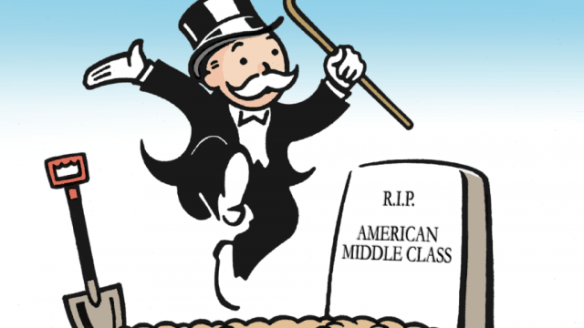
As often noted in the passionate writings of Henry Giroux, poor Americans are becoming increasingly ‘disposable’ in our winner-take-all society. After 35 years of wealth distribution to the super-rich, inequality has forced much of the middle class towards the bottom, to near-poverty levels, and to a state of helplessness in which they find themselves being blamed for their own misfortunes.
The evidence keeps accumulating: income and wealth — and health — are declining for middle-class America. As wealth at the top grows, the super-rich feel they have little need for the rest of society.
Income Plummets for the Middle Class
According to Pew Research, in 1970 three of every ten income dollars went to upper-income households. Now five of every ten dollars goes to them.
The Social Security Administration reports that over half of Americans make less than $30,000 per year. That’s less than an appropriate average living wage of $16.87 per hour, as calculated by Alliance for a Just Society.
For every $100 owned by a middle-class household in 2001, that household now has just $72.
Not surprisingly, race plays a role in the diminishing of middle America. According to Pew Research, the typical black family has only enough liquid savings to last five days, compared to 12 days for the typical Hispanic household, and 30 days for a white household.
Our Deteriorating Health
In a disgraceful display of high-level disregard for vital health issues, House Republicans are attempting to cut back on lunches for over 3 million kids.
The evidence for the health-related disposability of poor Americans comes from a new study that finds nearly a 15 year difference in life expectancy for 40-year-olds among the richest 1% and poorest 1% (10 years for women). Much of the disparity has arisen in just the past 15 years.
It’s not hard to understand the dramatic decline in life expectancy, as numerous studies have documented the health problems resulting from the inequality-driven levels of stress and worry and anger that make Americans much less optimistic about the future. The growing disparities mean that our children will likely see less opportunities for their own futures.
It May Be Getting Worse
The sense derived from all this is that half of America is severely financially burdened, at risk of falling deeper into debt.
It may be more than half. The Wall Street Journal recently reported on a JP Morgan study’s conclusion that “the bottom 80% of households by income lack sufficient savings to cover the type of volatility observed in income and spending.” Fewer than one in three 25- to 34-year-olds live in their own homes, a 20 percent drop in just the past 15 years.
It may be even worse for renters. The number of families spending more than half their incomes on rent — the ‘severely’ cost-burdened renters — has increased by a stunning 50 percent in just ten years. Billionaire Steve Schwarzman, whose company Blackstone has been buying up tens of thousands of homes at rock-bottom prices and then renting them back while waiting out the housing market, finds the growing anger among voters “astonishing.” What’s astonishing is the disregard that many of the super-rich have for struggling Americans.
Paul Buchheit is a college teacher, an active member of US Uncut Chicago, founder and developer of social justice and educational websites (UsAgainstGreed.org, PayUpNow.org, RappingHistory.org), and the editor and main author of “American Wars: Illusions and Realities” (Clarity Press). He can be reached at paul@UsAgainstGreed.org.
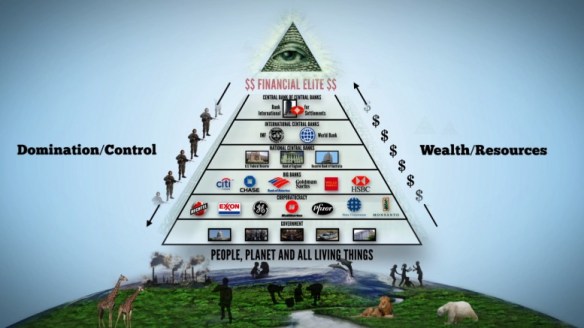
More destructive than bombs, money has become the weapon of choice for the global elite, for the hidden hand of finance can plunder and conquer entire nations, assimilate whole cultures, exploit resources and rape the earth while forcing billions into poverty, all with the surprising stealth of pen-strokes and business contracts.
Neoliberalism is the economic and political philosophic driving force in the world today. It suggests that human progress is the result of competition, best expressed by an extremist version of unfettered capitalism, where privatization of profits and socialization of losses are acceptable ethics, regardless of human and environmental costs incurred along the way.
Neoliberalism is the killer plague of the 21st century. Neoliberalism is economic fascism. It is a criminal doctrine. Globalized neoliberalism privatizes public goods for private profit. Neoliberalism led by Washington with the shameful complicity of Europe has in the last fifteen years killed between 12 and 15 million people by wars, famine, deprived health services… forced refugees. Today a small world elite of corporate and Wall Street CEOs and selected politicians call the shots. ~Peter Koenig
First defined in 1938, its global implementation today is the product of the Washington Consensus of 1989 which describes a set of economic prescriptions for developing and crisis-wracked nations created by the World Bank, the International Monetary Fund and the U.S. Treasury Department. It is a policy which relies on the creation of social and financial crises to distract and soften target nations and peoples, creating problems while providing the ‘solutions.’
It [Neoliberalism] finds that representative democracy has been perverted through fear, putting central political decisions in the hands of power groups with special interests.The social impact of this process has been devastating, with a polarized income distribution, falling wages, increased precarious jobs, rising inequality, and extreme violence. Health conditions have also deteriorated and disorders associated with violence, chronic stress, and a changing nutritional culture have become dominating. [Source]
Journalist George Monbiot describes neoliberalism as follows:
Neoliberalism sees competition as the defining characteristic of human relations. It redefines citizens as consumers, whose democratic choices are best exercised by buying and selling, a process that rewards merit and punishes inefficiency. It maintains that “the market” delivers benefits that could never be achieved by planning.
Attempts to limit competition are treated as inimical to liberty. Tax and regulation should be minimised, public services should be privatised. The organisation of labour and collective bargaining by trade unions are portrayed as market distortions that impede the formation of a natural hierarchy of winners and losers. Inequality is recast as virtuous: a reward for utility and a generator of wealth, which trickles down to enrich everyone. Efforts to create a more equal society are both counterproductive and morally corrosive. The market ensures that everyone gets what they deserve. ~[Source]
Economic hitman turned whistleblower, John Perkins, wrote in detail of his ‘boots-on-the-ground’ experiences in conquering third-world nations through economic aid and infrastructure financing in his seminal classic, Confessions of an Economic Hitman. He’s since been on a world crusade to expose the madness of neoliberalism, seeking redemption by connecting with many of the indigenous cultures he previously had worked to enslave and oppress.
In recent years, Greece has become a more visible victim of this policy as the IMF and the European Union have forced the people of this ancient culture into austerity and starvation as part of a plan of economic restructuring to force repayment of illegitimate debts to international bankers.
Speaking at The Delphi Initiative in 2015, economist, geopolitical analyst, and former World Bank staffer, Peter Koenig, explained the scourge of this political and economic philosophy and how it is destroying our world today.
What we are confronted with today is the globalization, and the globalization basically that we are living is like a fetish of the neoliberals. The neoliberals who want to reduce the world to one culture, to one set of values, all based on greed consumption and maximizing profits. ~Peter Koenig
Koenig also speaks of neoliberalism as the root of the type of endless global conflict we see today, including wars of occupation and their resulting terrorism, noting that the U.S. economy is now so dependent on military spending that if peace were to break out, our economy would collapse.
Although from 2015, Koenig’s message is critically important today as the world continues to wake up to the reality that our lives are in the hands of a small exploitative group of inhumane corporations and governments who will stop at nothing to control the resources which make life possible, including water, destroying any civilization that stands in its way.
Perhaps they believe that their underground survival bunkers with bullet-resistant doors and geothermal power and anti-chemical air filters and infrared surveillance devices and pepper spray detonators will sustain them for two or three generations.
Perhaps they feel immune from the killings in the streets, for they rarely venture into the streets anymore. They don’t care about the great masses of ordinary people, nor do they think they need us.
Or do they? There are a number of ways that the super-rich, because of their greed and lack of empathy for others, may be hastening their own demise, while taking the rest of us with them.
1. Pandemic (Because of Their Disdain for Global Health)
“A year ago the world was in a panic over Ebola. Now it’s Zika at the gate. When will it end?” –Public health expert Dr. Ali Khan.
It could end with a global pandemic that spreads with the speed of the 1918 Spanish Flu, but with a virulence that kills over half of us, rich and poor alike. Vanderbilt University’s Dr. William Schaffner warned us a decade ago, “You’ve got to really invest vast resources right now to protect us from a pandemic.” Added infectious disease specialist Dr. Stephen Baum, “There’s nobody making vaccines anymore because the profitability is low and the liability is high.”
The flu is just one of our worries. It has been estimated that less than 10 percent of the budget for health research is spent on diseases that cause 90 percent of the world’s illnesses. According to a study in The Lancet, of the 336 new drugs developed in the first decade of this century, only four of them were for diseases impacting third-world peoples. World Health Organization director Margaret Chan lamented the long decades of disregard for the African-centered effects of the Ebola virus: “Ebola has historically been confined to poor African nations. The R&D incentive is virtually non-existent. A profit-driven industry does not invest in products for markets that cannot pay.”
The super-rich had better make sure their anti-chemical air filters are also anti-viral.
2. Terrorism (Because of Global Inequality)
In The Spirit Level, Richard Wilkinson and Kate Pickett document some of the most frightening effects of inequality: higher levels of crime and violence, impacting all classes of people.
Inequality is worst at the global level, and the victims of global greed are getting more violent. The World Protests report concluded that the most recent decade represents one of the most agitated periods in modern history — comparable to pre-Civil-War days, World War 1, and the Civil Rights era. According to expert Scott Atran, terrorism primarily appeals to young men who are bored and underemployed; for them, “jihad is an egalitarian, equal-opportunity employer.”
The terrorism of the future could easily take the form of the viral killers mentioned above. As Dr. Khan notes, “A deadly microbe like smallpox — to which we no longer have immunity — can be easily recreated in a rogue laboratory.”
3. Drought (Because of Their Denial of Environmental Destruction)
National Geographic’s 2012 Greendex Survey reveals a remarkable human response to environmental damage: “[Those] demonstrating the least sustainable behavior as consumers, are least likely to feel guilty about the implications of their choices for the environment.” Citizens of Mexico, Brazil, China, and India tend to be most concerned about climate change, pollution, and species loss, while American, French, and British consumers are more concerned about the state of the economy and the cost of energy and fuel.
Even worse than denial is the outright suppression of climate-saving technologies, as, for example, by the American Legislative Exchange Council (ALEC), which wants to charge the “freeriders” who install solar panels on their roofs.
The result of this environmental contempt, according to a Columbia University study, is the prospect of “drought beyond the sub-tropics and into the Northern Hemisphere mid-latitudes, regions of globally important agricultural production.”
The super-rich can while away the hours in their underground bunkers watching videos of the good old days when the earth was cool.
4. Atrophy (Because of the Debt-Induced Collapse of Innovation)
A Small Business Administration studyfound that only 2% of the Millennial Generation are entrepreneurs (self-employed or business owners), compared to 6.7% of Baby Boomers and 5.4% in Generation X. According to the Kauffman Foundation, 20- to 34-year-olds made up over a third of all new business startups in 1997, but less than a quarter of them today. The super-rich have manipulated the financial system to the point that would-be entrepreneurs, many of them young and deeply in debt, are unable or unwilling to take chances on new startups.
Yet on a global scale youth entrepreneurship is on the rise. America is exceptional in its entrepreneurial decline.
5. Decay (Because of Their Disregard for Our Crumbling Infrastructure)
The corporate elite may face further business collapse if they continue to ignore the breakdown in our nation’s infrastructure. The American Society of Civil Engineers estimates that every American household is losing $3,400 per year in disposable income due to infrastructure deficiencies.
The tens of billions of dollars already being paid for additional transportation and storage costs may not kill the capitalists, but the losses to China and other fast-developing nations will surely deflate their stock prices and their egos.
How the Super-Rich Could Help Themselves
Amidst all the talk of unity and prayer and peace, a solution exists: job opportunities and affordable housing. The super-rich could prolong life for all of us, including themselves, if they recognized the need to support a strong society. If not, they’ll be ensconced in their bunkers with their children at their sides, with nowhere to go and nothing to do.
Economist Michael Hudson says neoliberal policy will pressure U.S. citizens to emigrate, just as it caused millions to leave Russia, the Baltic States, and now Greece in search of a better life.
A research team from Columbia University’s Mailman School of Public Health in New York estimates 875,000 deaths in the United States in year 2000 could be attributed to social factors related to poverty and income inequality.
According to U.S. government statistics, 2.45 million Americans died in the same year. When compared to the Columbia research team’s finding, social deprivation could account for some 36% of the total deaths in 2000.
“Almost all of the British economists of the late 18th century said when you have poverty, when you have a transfer of wealth to the rich, you’re going to have shorter lifespans, and you’re also going to have emigration,” says Michael Hudson, Distinguished Research Professor of Economics at the University of Missouri-Kansas City.
Many countries, such as Russia, the Baltic States, and now Greece, have seen a massive outflow of their populations due to worsening social conditions after the implementation of neoliberal policy.
Hudson predicts the United States will undergo the same trend, as greater hardship results from the passage of the Trans-Pacific Partnership, changes to social security, and broader policy shifts due to prospective appointments to the U.S. Supreme Court and the next presidential cabinet.
“Now, the question is, in America, now that you’re having as a result of this polarization shorter lifespans, worse health, worse diets, where are the Americans going to emigrate? Nobody can figure that one out yet,” says Hudson.
Transcript
SHARMINI PERIES, TRNN: Its the Real News Network. Im Sharmini Peries coming to you from Baltimore.
After decades of sustained attacks on social programs and consistently high unemployment rates, it is no surprise that mortality rates in the country have increased. A research team from Columbia Universitys Mailman School of Public Health in New York has estimated that 875,000 deaths in the United States in the year 2000 could be attributed to clusters of social factors bound up with poverty and income inequality. According to U.S. government statistics, some 2.45 million Americans died in the year 2000, thus the researchers estimate means that social deprivation was responsible for some 36 percent of the total deaths that year. A staggering total.
Now joining us to discuss all of this from New York City is Michael Hudson. Michael is a Distinguished Research Professor of Economics at the University of Missouri Kansas City. His latest book is Killing the Host: How Financial Parasites and Debt Bondage Destroy the Global Economy. Michael, good to have you with us.
MICHAEL HUDSON: Good to be back here.
PERIES: So, Michael, what do you make of these recent research and what its telling us about the death total in this country?
HUDSON: What it tells is almost identical to what has already been narrated for Russia and Greece. And whats responsible for the increasing death rates is actually neoliberal economic policy, neoliberal trade policy, and the polarization and impoverishment of a large part of society. After the Soviet Union broke up in 1991, death rates soared, lifespans shortened, health standards decreased all throughout the Yeltsin administration, until finally President Putin came in and stabilized matters. Putin said that the destruction caused by neoliberal economic policies had killed more Russians than all of whom died in World War II, the 22 million people. Thats the devastation that polarization caused there.
Same thing in Greece. In the last five years, Greek lifespans have shortened. Theyre getting sicker, theyre dying faster, theyre not healthy. Almost all of the British economists of the late 18th century said when you have poverty, when you have a transfer of wealth to the rich, youre going to have shorter lifespans, and youre also going to have immigration. The countries that have a hard money policy, a creditor policy, people are going to emigrate. Now, at that time that was why England was gaining immigrants. It was gaining skilled labor. It was gaining people to work in its industry because other countries were still in the post-feudal system and were driving them out. Russia had a huge emigration of skilled labor, largely to Germany and to the United States, especially in information technology. Greece has a heavy outflow of labor. The Baltic states have had almost a 10 percent decline in their population in the last decade as a result of their neoliberal policies. Also, health problems are rising.
Now, the question is, in America, now that youre having as a result of this polarization shorter lifespans, worse health, worse diets, where are the Americans going to emigrate? Nobody can figure that one out yet. Theres no, seems nowhere for them to go, because they dont speak a foreign language. The Russians, the Greeks, most Europeans all somehow have to learn English in school. They’re able to get by in other countries. Theyre not sure where on earth can the Americans come from? Nobody can really figure this out.
And the amazing thing, whats going to make this worse, is the trade, the Trans-Pacific trade agreement, and the counterpart with the Atlantic states. In todays news theres news that President Obama plans to make a big push for the Trans-Pacific trade agreement, essentially the giveaway to corporations preventing governments from environmental protection, preventing them from imposing health standards, preventing them from having cigarette warnings or warning about bad food. Obama says he wants to push this in after the election. And the plan is the Republicans also are sort of working with them and saying okay, were going to wait and see. Maybe Donald Trump will come in and hell really do things. Or maybe we can get Hillary, who will move way further to the right than any Republican could, and bring the Congress.
But lets say that we dont know whats happening after the elections, and the Republicans dont want a risk. Theyre going to do a number of things. Theyre going to approve Obamas Republican nominee to the Supreme Court that hes already done, figuring, well, maybe Hillary will put in someone worse, or even Trump may put in someone worse. They may go along, at this point, with ratifying a trade agreement thats going to vastly increase unemployment here, especially in industrial labor, turning much of the American industrial urban complex into a rust belt. And they’re also talking about an October surprise or an early November surprise. Its the last chance that Obama has, really, to start a war with Russia.
And theres Stephen Cohen and a number of other sites have warned that theres going to be a danger when they put in the atomic weapons in Romania. President Putin has said this is a red line. Were not going to warn. We dont have an army. We can only use atomic weapons. So you have danger coming not only from domestic decline in population, you have a real chance of war. And Obama has stepped things up. Hillary has, I think, almost announced that she is going to appoint Victoria Nuland as secretary of state, and Nuland is the person who was pushing the Ukrainian fascists in the [inaud.] assassinations and shootout.
So it looks, this trend looks very bad. If you want to see where America is going demographically, best to look at Greece, Latvia, Russia, and also in England. A Dr. Miller has done studies of health and longevity, and hes found that the lower the income status of any group in England, the shorter the lifespan. Now, this is very important for the current debate about Social Security. You’re having people talk about extending the Social Security age because people are living longer. Whos living longer in America? The rich are living longer. The wealthy are living longer. But if you make under $30,000 a year, or even under $50,000 a year, youre not living longer.
So the idea is how do we avoid having to pay Social Security for the lower-income people, you know, the middle class and the working class that die quicker, and only pay social security for the wealthier classes that live longer? Nobodys somehow plugged this discussion of lifespans and longevity into the Social Security debate that Obama and Hillary are trying to raise the retirement age, to ostensibly save Social Security. By save Social Security she means to avoid taxing the higher brackets and paying for Social Security out of the general budget, which of course would entail taxing the higher-income people as well as the lower-income people.
PERIES: All right, Michael. Thank you for your report today, and we look forward to seeing you next week.
HUDSON: Thank you.
PERIES: And thank you for joining us on the Real News Network.
End
Michael Hudson is a Distinguished Research Professor of Economics at the University of Missouri, Kansas City. He is the author of The Bubble and Beyond and Finance Capitalism and its Discontents. His most recent book is titled Killing the Host: How Financial Parasites and Debt Bondage Destroy the Global Economy.
By 2010, everyone had heard the ‘austerity’ rallying cry. Immediately following the 2008 financial crisis, especially in Europe, it resounded: ‘Stimulate no more, now is the time for all to tighten!’ And tighten governments did, cutting public expenditure across continental Europe, and in the United Kingdom and the United States.
The logic behind ‘austerity’ holds that ‘the market’ – which the public had just bailed out – did not like the debt incurred when states everywhere rescued and recapitalised their banking systems. Unsurprisingly, tax revenues fell as the economy slowed and state expenditures rose. And what were once private debts on the balance sheets of banks became public debt on the balance sheet of states. Given this sorry state of affairs, states (policymakers and business leaders argued) had to take action to restore ‘business confidence’ – which is apparently always and everywhere created by cutting government spending. So governments cut.
Public debt, however, grew, because economies got smaller and grew slower the more they cut. The ‘confidence fairy’ as Paul Krugman named the expected effect, simply failed to show up. Why?
The reason is simple – and it is surprising anyone thought that anything else would happen. Imagine an economy as a sum, with a numerator and a denominator. Make total debt 100 and stick that on the top (the numerator). Make Gross Domestic Product (GDP) 100 and stick that on the bottom (the denominator) to give us a 100 per cent debt-to-GDP ratio. If you cut total spending by 20 per cent to restore ‘confidence’, the economy is ‘balanced’ at 100/80. That means the debt-to-GDP ratio of the country just went up to 120 per cent, all without the government issuing a single cent of new debt.
In short, cuts to spending in a recession make the underlying economy contract. After all, government workers have lost jobs or income, and government workers not shopping has the same effect as private sector workers not shopping. So the debt goes up as the economy shrinks further. States respond by cutting spending further. The pattern continues.
Having a common currency among different countries actually aggravates the problem because cuts in one state reverberate through many states, depressing them all. In 2008, euro area government debt as a share of the economy, including the already profligate Greeks, averaged around 65 per cent of GDP. Following budget cuts and monetary tightening (the European Central Bank twice pushed up interest rates in 2011) Euro Area government debt, by 2014, had risen to 92 per cent of GDP.
Greece is the poster child for this ‘denominator effect’. Under the auspices of ‘bailouts’ from the IMF and the EU, Greece cut more than 20 per cent of GDP in spending. It lost nearly 30 per cent in final consumption. Yet its debt increased from 103 per cent in 2006 to more than 180 per cent by 2014. That’s a 57 per cent increase in debt while spending is being cut.
Let’s look at the originating question again: how is destroying a third of the economy supposed to inspire consumer and business confidence? It won’t – unless you are a creditor – and that’s where the politics comes in.
If you are a holder of government debt (a creditor), three things hurt the value of your asset: if the inflation rate goes above the interest rate on your bond; if the exchange rate moves against you so that what the bond is worth vis-à-vis other currencies falls; and, of course, default – if the government takes the money and runs.
In the post-crisis world, despite major central banks putting trillions of dollars into the global money supply, there is almost no inflation anywhere in the developed world. Exchange rates (Brexit effects apart) are comparatively stable and ultimately move against each other relatively, so that’s not a huge worry. If the country whose debt you hold can have elections, and the public dares to vote against more budget cuts, the European Central Bank will shut down their banking system to make them revisit their choices. That’s what they did to Greece in the summer of 2015.
In this world, our present world, creditors will get paid and debtors will get squeezed. Budgets will be cut to make sure that bondholders get their money. And, in a highly indebted world, austerity – introduced as an ‘emergency’ measure to save the economy, to right the fiscal ship – becomes a permanent state of affairs.
As Britain’s former prime minister David Cameron said (standing beside a throne in a white bow-tie and tails) in 2013: ‘We need to do more with less. Not just now, but permanently.’ But here’s the question hidden in that blithe statement – are you and me part of the ‘we’ here?
Let’s go back to the huge jump in public debt that occurred when governments, ie the people, bailed out the banks. That debt was not, and is not, a liability. As difficult as it can be to make this reality part of the political conversation, public debt is an asset. Even at today’s low rates, it earns interest and retains value. No one is forced to invest in public debt, but every time bonds are issued investors show up and buy them by the truckload. By market criteria, public debt is a great investment.
But who pays for it? That would be the taxpayer. More generally, those who contribute to the payment of debts by not consuming government-produced services that have been cut. Basically, in most countries, this means that the bottom 70 per cent of the income distribution bears the cost of paying for public debt.
Over the past 25 years, to make up for chronically low wage growth, that same 70 per cent of the population has increased its personal indebtedness. Massively. Which means that in an economy deformed by austerity, they are the ones paying out – twice. With stagnant or declining wages, they have to service both the massive private debt they have accumulated to live and the public debt issued in their name.
Meanwhile, those whose assets the public bailed out – those with investible wealth, those who hold ‘all that debt’ and make money from it – do not suffer from the decline in public spending. Since they are net lenders, the hike in personal indebtedness does not trouble them either.
The result, and the situation in which we find ourselves, is a classic bad equilibrium. Those who can’t pay, and don’t earn enough, are being asked to pay the most to service debt, from which they do not and will not benefit. Those who can pay, and earn almost all the income, both contribute the least and benefit the most from ‘all that debt’.
Strip away all the electoral politics at the moment in the US, the UK, Italy, Spain and elsewhere, and that’s the underlying political economy. It’s a creditor/debtor stand-off where the creditors have the whip hand.
And yet, the more they crack the whip, the more the backlash against austerity, in all its forms, gains strength. Donald Trump, Jeremy Corbyn, Marine Le Pen, Pablo Iglesias: Left or Right, they are all riding debtor anger against creditor strength. It might be expressed as anger against, variously, ‘trade’ or ‘the elite’ or the ‘EU’. But what’s underneath all that is the politics of debt.
This is the ‘new normal’. It’s not about flat interest rates or anaemic growth rates. They are the consequences of austerity, not its causes. The new normal is the new politics of debtors versus creditors. It’s here to stay. As we already can see, it’s going to be anything but normal.
While most of us have been taking our kids to Little League games, betting on the Super Bowl, taking an occasional vacation and waiting for the American Dream to become a reality, we haven’t noticed something important happening all around us. Society has been crumbling at the edges for the last several decades.
This is not to say that lots of human beings haven’t already experienced the early stages of this societal disintegration. But they tend to be the people at the margins. People without a voice. People whose interests are not understood, let alone represented in the great debates of our times.
Think of the Mideast. Think ISIS here. Think of terrorism. Terrorists don’t attack us because of our freedoms. They attack out of desperation. Out of a frustration that comes with no future, and a feeling of impotence in the face of the continued economic violence committed in the name of corporate profits and greed. Corporations protected by the most powerful military in the history of the world. Ours!
Is it any mystery why we have over six hundred military installations in other countries around the world? We’re not under threat from anyone, but our corporation’s interests in those countries must be protected while they rape them of their labor and natural resources.
History is written by the victors and the popular public narratives are circumscribed by those whose interests they serve and not those who suffer. At the core of this phenomenon is complicity. A subconscious complicity made up of an ultra-resistant trifecta of human thinking — greed, ignorance, and certainty.
Greed now normalized has made the great American dream indistinguishable from having basic financial security to making everyone a billionaire-in-waiting. An inability to distinguish fact from opinion leads the wave of ignorance that engulfs us. Our arrogance disguised as fervent patriotism defends our ignorance and allows us to reject the knowledge we need to save ourselves.
Our generalized confusion of what constitutes a fact allows an individual’s certainty to form a resistance similar to the bacterial infections that threaten to make modern antibiotics useless. It continues to evolve. “If I can’t figure out who’s lying, I’ll believe the one who confirms my point of view. Of that I’m certain.”
Until we learn that having our beliefs validated by a media being paid to manipulate us for political gain, society will continue to disintegrate for larger and larger groups of people.
Seems like a stretch, I know. But think about how we’ve become polarized. How we are so sure of our positions that we just can’t have a conversation with those from the other side. The very conversation we need to have to figure out how we’re being duped. Then think about how our politicians use the greed, ignorance and certainty on both sides to work us up into an emotional lather. And finally, how they ignore our interests while they do the bidding of their owners keeping us distracted with our petty differences with each other.
This will come to an end. There will either be a major social revolution at the least or outright raw violence at the worst. As the authority structures lose the willing conformance of the masses, all that’s left to police them is force. And at some point – like is beginning now — the response will be violence in return. Think of the proliferation of guns in America. Think of people shooting police.
It doesn’t take much discernment to see that corporate structures are highly sophisticated mechanisms for funneling money upwards. That government collusion protects the interests of the owners of capital at the expense of the employees, customers, the general public. And the military protects their international interests.
The largest wealth producer in the world is the financial industry that simply makes money from money and produces nothing. It serves no interests but its own. Yes, some of us fortunate to have salvaged what’s left of our life savings after repeated financial crashes still enjoy the crumbs from the tables of the elite. I do mean crumbs.
Do the math. At the current rate of the upward movement of wealth, there is no other outcome but final disaster. The top 1/10th of 1 percent — not 1 percent — but 1/10th of 1 percent in America owns almost as much wealth as the bottom 90 percent in America, and it gets worse as you leave our shores.
At this rate, the world will eventually consist of gated enclaves of the mega-wealthy guarded by elite corps of paid mercenaries surrounded by billions of impoverished people.
This trajectory has increased dramatically for the last several decades. More and more of the world’s wealth is pouring into the coffers of the mega-rich. This is a zero sum game. When the masses have no wealth left, the game will be over. No matter how powerful the wealthy are, no matter how much wealth they possess, the game will be over.
The United States of America is possibly the wealthiest nation in the history of the world. However, many third-world countries actually surpass America in many of the most vital gauges for measuring human development.
Here are five of the most jaw-droppingly unforgivable ways in which America is lagging behind the rest of the world:
1. America’s criminal justice system is broken
The U.S. represents only 5% of the world’s population, but this one country comprises 25% of the world’s prison population. According to the NAACP, a disproportionate 58% of America’s prisoners are African-American or Hispanic despite these demographics only adding up to about 30% of the U.S. population.
3. Healthcare costs too much and delivers too little
America is the only developed country that does not ensure healthcare to all of its citizens. Even in the wake of the Affordable Care Act, millions of poverty-stricken Americans have no medical insurance because Republican governors have refused to expand Medicaid, even though the federal government is paying the cost and the simple measure would actually save money for their states.
Life expectancy in many American counties is lower than Nicaragua, Algeria, or Bangladesh. The U.S. is unusual among developed countries in that Americans die in the tens of thousands as a direct result of a lack of health insurance. America also spends twice the percentage of our GDP on healthcare than the average wealthy country for these substandard results.
Despite the idea of America being a meritocracy, those born in the poorest 20% of the American population have less than a 3% chance of making it to the top quintile.
5. Infrastructure is crumbling
America is quite literally falling apart.
One study concludes that the U.S. needs to invest $3.6 trillion into infrastructure over the next six years. One out of every nine American bridges (66,405 bridges) have been labeled “structurally deficient.”
Water runs through dilapidated wooden pipes in certain parts of South Dakota, Alaska, and Pennsylvania. Some of Detroit’s sewer lines still used today were originally constructed in the mid-1800s.
America certainly has and continues to achieve greatness in many ways. But if we want to truly earn our oft-proclaimed slogan of “Greatest Country in the World,” these fatal flaws in our system must be acknowledged and addressed. Otherwise, the emperor will continue to parade about with no clothes, and we run the risk of being completely surpassed by a world marveling at our oblivious nakedness.
One amusing angle on the news media broadside about Russia “hacking” the US election is the failure to mention — or even imagine! — that the US incessantly and continually runs propaganda psy-ops against every other country in the world. And I’m not even including the venerable, old, out-in-the-open propaganda organs like Voice of America and Radio Free Europe (reminder: the Iron Curtain came down a quarter century ago). Do you suppose that nobody at Langley, or the Pentagon, or the NSA’s sprawling 1.5 million square foot Utah Data Center is laboring night and day to sow confusion among other societies to push our various agendas?
The main offensive started with The Washington Post’s publication on Nov 26 of “The List,” a story calling out dozens of blogs and web news-sites as purveyors of “fake news” fronting for Russian disinformation forces. The list included Zero Hedge, Naked Capitalism, and David Stockman’s blog. There were several whack-job sites mixed in the list for seasoning — The Daily Stormer (Nazis), Endtime.com (Evangelical apocalyptic), GalacticConnection (UFO shit). The rest range between tabloid-silly and genuine, valuable news commentary. What else would you expect in a society with an Internet AND a completely incoherent consensus about reality?
Pretty obviously, the struggle between mainstream news and Web news climaxed over the election, with the mainstream overwhelmingly pimping for Hillary, and then having a nervous breakdown when she lost. Desperate to explain the loss, the two leading old-line newspapers, The New York Times and The Washington Post, ran with the Russia-Hacks-Election story — because only Satanic intervention could explain the fall of Ms. It’s-My-Turn / I’m-With-Her. Thus, the story went, Russia hacked the Democratic National Committee (DNC), gave the hacked emails to Wikileaks, and sabotaged not only Hillary herself but the livelihoods of every myrmidon in the American Deep State termite mound, an unforgivable act.
Also interestingly, these newspapers and their handmaidens on TV, were far less concerned as to whether the leaked information was true or not — e.g. the Clinton Foundation donors’ influence-peddling around arms deals made in the State Department; the DNC’s campaign to undermine Bernie Sanders in the primaries; DNC temporary chair (and CNN employee) Donna Brazille conveying debate questions to HRC; the content of HRC’s quarter-million-dollar speeches to Wall Street banks. All of that turned out to be true, of course.
Then, a few weeks after the election, the US House of Representatives passed H.R. 6393, the Intelligence Authorization Act for Fiscal Year 2017. Blogger Ronald Thomas West reports:
Section 501 calls for the government to “counter active measures by Russia to exert covert influence … carried out in coordination with, or at the behest of, political leaders or the security services of the Russian Federation and the role of the Russian Federation has been hidden or not acknowledged publicly.”
The measure has not been passed by the Senate or signed into law yet, and the holiday recess may prevent that. But it is easy to see how it would empower the Deep State to shut down whichever websites they happened to not like. My reference to the Deep State might even imply to some readers that I’m infected by the paranoia virus. But I’m simply talking about the massive “security” and surveillance matrix that has unquestionably expanded since the 9/11 airplane attacks, creating a gigantic NSA superstructure above and beyond the Central Intelligence Agency, the Department of Defense’s DIA, and the hoary old FBI.
A little paranoia about the growing fascist behavior of the US government is a useful corrective to trends that citizens ought to be concerned about — for instance, the militarization of police; the outrageous “civil forfeiture” scam that allows police to steal citizens cash and property without any due process of law; the preferential application of law as seen in the handling of the Clinton Foundation activities and the misconduct of banking executives; the attempt to impose a “cashless society” that would herd all citizens into a financial surveillance hub and eliminate their economic liberty.
These matters are especially crucial as the nation stumbles into the next financial crisis and the Deep State becomes desperate to harvest every nickel it can to rescue itself plus the cast of “systemically important” (Too-Big-To-Fail) banks and related institutions like Fannie Mae and Freddie Mac, which are about to once again be left holding colossal bags of worthless non-performing mortgages, not to mention the pension funds and insurance companies that will also founder in the Great Unwind that is likely to commence as Trump hangs his golden logo over the White House portico.





 After the Crash