Saturday Matinee: Starship Troopers

Starship_Troopers_-_movie_poster

Paul Verhoeven and Edward Neumeier, the writer/director team behind the original Robocop returned a decade later with an equally satirical vision mocking while paying homage to propagandistic and militaristic Hollywood tropes: “Starship Troopers” (2007). The story follows a new recruit and his circle of friends as they go through training and onto the battlefield in a war against hostile aliens. It’s a story told countless times before and since but rarely with as much self-awareness and overtly fetishized fascism.

Watch the full film here.

Cutting the Cords of Empire: The Spectacle of US Elections

the-powers-that-be-deep-state

By William Hawes

Source: Global Research

“The more powerful the class, the more it claims not to exist.” -Guy Debord, The Society of the Spectacle

It’s almost time for our quadrennial political distraction, masquerading as the US presidential election. As opposed to previous elections, this one feels quite different. Even with Obama/Romney in 2012, important, basic economic issues were discussed, health care reform was questioned, and foreign policy was given its due.

However, this time, the spectacle of the personalities seems to dominate the conversation: Mrs. Clinton is somehow on a feminist crusade, an inspiration for women everywhere. Going unmentioned are her irredeemable backers, such as the genocidal Henry Kissinger and Madeleine Albright. As for Trump, his version of America is as naïve, narrow-minded, and delusional as a Leave It to Beaver episode, or a Captain America comic book. In the background, the monstrosity of global capitalism goes unquestioned, and the cries from victims of US institutional racism and structural violence go unheard.

Global warming, broad economic policy, and nuanced foreign policy are simply too much to ask of these candidates. Their stupidity knows no end; their corruption and depravity know no bounds, and many of both of their supporters, as well as media, political, and corporate backers and sycophants can be considered “deplorable”. Many supporters of the two-party system do not bother to think about the damage either potential president would do to people outside the US. Many backers of Trump and Clinton have little to no basic knowledge of world cultures and history.

What are the cords that connect us to these “leaders”, to our American Empire? They are the same ones that the Industrial Revolution, the basis of our civilization, has implanted in each of us since birth, as Alvin Toffler explains in The Third Wave. As our social world became modeled on the factory floors developed in the 18th and 19th centuries, a set of unspoken principles were ironed out, and transferred to the political, social, and economic realms. (1)  As we shall see, these principles spread unchecked, and have infiltrated political discourse and social hierarchies. Toffler identifies these implicit rules as:

1) Standardization: Industry, production, and factory life revolved around endless loops and inputs of metals, fabrics, coal, oil, and specialized parts for trains, cars, etc. The simplification and standard mechanical parts used were mirrored and reflected in the culture at large: eventually, markets, the media, radio and TV, and even great art and literature succumbed to commoditization and homogenization. We now have mass marketing, public relations, and “electioneering”, where our duopoly controls all branches of government.

2) Specialization: With the explosion in the fields of science and engineering, specialized techniques were taught to develop, invent, and maintain mechanical and electric equipment. Yet again, this philosophy infected the general society:  only bureaucrats are able to work in the halls of power, only industrial experts are able to administer federal agencies, creating the disgraceful revolving door phenomena in Washington.

3) Synchronization: As more people flocked into cities with gleaming promises of steady, factory jobs, time and punctuality became of prime importance. Punching timecards and meeting quotas were necessary: there was no room for leeway, as assembly lines demanded strict timelines. The time demands of labor leaked into white-collar work as well: in banking and finance, railroads, time zones, and office jobs, advanced scheduling became the norm. Eventually, synchronization of the political system gained traction, and the imperial system came to resemble a deathly machine, marching in time to bloody footsteps: military, immoral diplomacy and ideology, and industry worked together to lord over Latin America with the Monroe Doctrine, annihilate Native Americans using Manifest Destiny, even as today, the excuse of the “War on Terror” is used to exterminate entire populations in Afghanistan, Iraq, Syria, Libya, and elsewhere.

4) Concentration: Think of the vast oil and coal stored underground for millions of years, only to be strip-mined, taken up by rigs, and transported by rail and tanker into vast refineries: concentration of energy. Further, every class of people became absorbed and intensified in the industrial system: workers into factories, children into schools, mentally ill into institutions, finance concentrated into New York, London, and Paris. Mega-mergers of corporations: today, it is the Apple, Google, Shell, and BP’s of the world who have coffers of blood money held tidily in banks throughout the world. Further, the concentration of technocrats who we supposedly need to run our societies: in the West, the military-industrialists, just as the Soviets were once told the nomenklatura was necessary.

5) Maximization: Firms were encouraged to grow as large as possible, and expand into as many fields as possible. Companies in Japan in the mid-twentieth century would actually have workers sing of the glory and greatness of their employer. Today, 62 people have the same wealth as half the world’s population. This is concentration and maximizing at its most obscene. Of course, you won’t hear Clinton, Trump, or anyone in Washington talking about this. Maximizing GDP, corporate profits, fossil fuel use, and flexing imperial muscle is what the Feds do best.

6) Centralization: Connected to the first five rules of empire stated above, centralizing power, wealth, and using knowledge for private gain is required to uphold the industrial state. Taxation, subsidies for industry, political debates via the sham Committee on Presidential Debates, the backroom shenanigans of the DNC and RNC, and cloak and dagger lobbying and bribery now dominate our system of government. Further, the Leviathan of state-sanctioned violence now lords over the world from the Pentagon and NATO, and the centralization of information runs through fiber-optic cables straight to the infernal, yet temperature-controlled offices of the CIA and NSA.

The elections have adopted all the patterns of the industrial, imperial state: we have standardized TV, scripted questions, airbrushed candidates, and childlike debates. We’ve seen specialized tactics of gerrymandering, vote-rigging, PR bullshit, and strategists whose careers accomplish nothing for the public good. We all know of the synchronization of Wall Street, defense and oil companies. The concentration of power in the hands of the few hardly needs mention: here’s the study by Princeton and Northwestern professors who conclude that the US is an oligarchy, not a democracy. We’ve witnessed the maximization of endless primaries, debates, press conferences, and town-hall meetings ad infinitum. The centralization of political ideology (triangulation in Clintonite terms, Machiavellian to a rational person) and the limitations of discourse that our candidates display are all too clear.

These are the iron chains holding us down, shackling us in Plato’s cave: our candidates are figureheads, shadows on the wall; they are puppets of the super-elite. The central position they carve out in the mainstream is really a pit, an abyss: one that we all find ourselves in, as we continue to vote for those who don’t fight for our interests.

The two best options for this election seem to be: voting for Jill Stein, or boycotting the election, as Joel Hirschhorn advocates. As for our obscene election cycles, I believe Zach de la Rocha summed it up best:

  A spectacle monopolized

The camera’s eyes on choice disguised

Was it cast for the mass who burn and toil?

Or for vultures who thirst for blood and oil?

William Hawes is a writer specializing in politics and environmental issues. His articles have appeared online at Global Research, Counterpunch, Dissident Voice, The World Financial Review, Gods & Radicals, and Countercurrents. He is author of the e-book Planetary Vision: Essays on Freedom and EmpireYou can reach him at wilhawes@gmail.com

Notes:

1.) Alvin Toffler. The Third Wave. Bantam, 1980. p. 46-60.


Fascism Trumps Democracy: America, A State of Impunity

what-corporate-america-wants

By

Source: CounterPunch

Notwithstanding my title’s oblique reference to Trump, he is not the greater of the dangers now facing America, but an entirely known factor, representing a gut incipient fascism grounded primarily in capital accumulation, a nymphomaniac drive for ownership, deal-making, undisguised prestige—in short, the very traits becoming to American’s wish for wealth, power, and status on which its system of capitalism is based. Ethnocentrism gives it a psychological heart, sheer ignorance of humane sensibility, a soul, indifference to the humiliation and destruction of others because of capitalism’s workings, a modal personality and societal mental set. We’ve had many examples of The Donald up-and-down the line, from the 10%, 5%, 1%, down to the bottom of the social-class scale, that being how effective false consciousness has been disseminated downward through the American value system. He presently vibrates with what appears to be a significant portion of the working class. So be it; at least the portents and record are there for fighting back.

Not so the Obamas and Clintons in our midst, largely free from serious criticism by a supine, homogenized radicalism, chanting the “lesser-of-two-evils” song on the way, not to the gas chambers (not even Trump has, as yet, gone this far), but a manifestation and structure of liberal fascism, possibly more militaristic, more ensconced deeply in a Cold War mental set, talking a good game on immigration while actively promoting a class-state of monopolism equal to anything Trump favors. We have then a condition of growing fascistization with little internal checks and differentiate primarily by rhetorical flourishes. Obama is the point man, exceeding his predecessors, in global counterrevolution, intervention, regime change, and the steady pressures toward confrontation with, above all, China, but also Russia. Meanwhile, Clinton fits the bill, perhaps more viscerally combative, with Russia, rather than China, the chief ADVERSARY. (Caps. are necessary, because the US cannot exist, much less thrive, without an enemy, whether for the mammoth defense industry, an hegemonic foreign policy, or the social discipline at home, to keep the internal market going, ferret out dissent on policy, favor the already enriched and favored.)

Stealth destroyers, appropriation $4B+, already noticed in today’s Times; the safety net grows more outmoded, environmental degradation and pollution continue apace, the murder rate in Chicago and other major cities climbs, but imperialism is, literally, business-as-usual. And business itself is business as usual: Bank of America last week’s poster boy of questionable behavior. “You break it, you own it” might be the slogan in a small business souvenir shop, but what of the bigger picture? American business, notably, railroads and banking, by the mid-19th century, had already broken the promise of democracy, and fixing the system on democratic lines has grown more remote with time. That is where “fascism” is not an expletive, but reality: the interpenetration of business and government, capitalism and the State, the cozy amalgam of wealth, power, the military, which even the strongest chisel could not pry them apart.

Germany had its form, Italy, its, Japan, its, all signifying cultural and linguistic differences, but not systemic ones, capitalism in each case, and the social structure of hierarchy it created, the determinative factor in shaping the polity and its purposes of Order, deservedly the dirtiest word in the political lexicon. Everyone knows his/her place in a fascist social order. Substantive protest is muted, whether through repression or indoctrination. America now joins the 20th century’s historical Big Three of fascist persuasion, relying more on indoctrination than explicit, overt repression. Fly-over military jets at football games is the Pavlovian reminder of requisite patriotism to be considered, and consider oneself, the Good American. (Trump merely echoes the man-in-the-street, his difference being a silk shirt for a denim work shirt.) But it is Clinton who deserves, and has earned the respect, of all right-thinking Americans, parroting the vitriol of the defense intellectuals, propaganda masters (even Axelrod in today’s paper seems to have become critical), her controlled shrillness, backed by her husband’s man-of-destiny complex, posing more serious risks for putting nails into the coffin of democracy.

Why choose either, Trump or Clinton? Elections are rigged, not by corruption, but, more profoundly, by the political culture and class structure of the society, the candidates merely the façade for several centuries of political-economic-ideological development, cumulative, self-renewing, above all, hubristic, i.e., exaggerated pride, the Chosen, backed by the military force to cram it down the throats of all and sundry, where “friends and allies” become, for these purposes of unilateral global dominance, indistinguishable from adversaries and enemies in successfully maintaining claims of leadership and greatness.


Norman Pollack Ph.D. Harvard, Guggenheim Fellow, early writings on American Populism as a radical movement, prof., activist.. His interests are social theory and the structural analysis of capitalism and fascism. He can be reached at pollackn@msu.edu.

America, the World’s Most Dangerous Dictatorship

american-imperialism-39-638

By Gordon Duff

Source: New Eastern Outlook

Though Russia doesn’t consider herself a superpower, other than the US, and just perhaps China, Russia is as close as we come. A very real problem is that Russia has a very poor understanding of America, how politics work, what Americans think and, more than anything else, Russia still thinks America is a democracy.

You see, at the same time America was tearing the Soviet Union apart, the same thing was being done to America. Neither nation survived, it wasn’t just the Soviet Union that fell to the New World Order, it was America as well. Let me explain as succinctly as possible.

During the Clinton years, powerful Nazi inspired elements in America plotted what has been the successful overthrow of America’s constitution. The movement was led by rogue “industrialist” John Mellon Scaife and lawyers Antonio Scalia and Newt Gingrich. Financing them all was the Rothschild owned and controlled Federal Reserve Corporation.

A secret society hidden in plain sight was set up called the Federalist Society. This Nazi controlled group, backed by the powerful Israel lobby, moved into every law school in America, recruiting top candidates based on skill sets needed.

This program was devised by the CIA and recruited thousands of budding sociopathic personality types, recruiting them into the Federalist Society and channeling them into top law firms or government agencies.

Adding to these recruits were senior lawyers with ties to organized and corporate crime, thousands of them in a major CIA operation.

There, they were pushed forward and after a decade ran the US Department of Justice, nearly every court in the nation, controlled the law schools, controlled the American Bar Association, the FBI and had put over 150 of their members into the Congress of the United States.

They also controlled every regulatory agency, environment, banking and finance, food and drug safety, you can see where this is going.

They also controlled 5 justices of the Supreme Court of the United States.

During the Clinton Administration, they managed to temporarily get control of the US House of Representatives through the help of the Contract with America and Newt Gingrich, financed by Zionist “black propaganda” moneyman Rupert Murdoch. In payment for this, “Newt” gave Murdoch an American broadcast network, Fox, though illegal. You see, non-Americans can’t control networks, or couldn’t. That’s ok, Gingrich eventually gave Murdoch illegal American citizenship as well.

Murdoch only had to publish Newt’s useless books and give his wife, and Newt traded them in with regularity, a highly paid “do nothing job” as a bribe.

Where things really paid off was 2000. During the Clinton administration, Scaife hired lawyer Ken Starr to investigate Clinton and get himself nominated as Special Prosecutor. Scaife paid Starr by naming him President of Pepperdine University, which Scaife controlled, for those who care about facts.

Clinton backer George Soros hired a former CIA agent named Steve Kangas to get dirt on Scaife. Kangas amassed enough evidence on Scaife and his deal with Starr to send them both to the electric chair. Scaife, Scalia and the Federalists had Kangas kidnapped and murdered in order to save Ken Starr who had been promised a seat on the US Supreme Court. Look into it.

The deal really came to life in 2000. The CIA and Diebold Corporation had contracted with a computer guru named Michael Connell who developed software that would simply flip votes done on electronic voting machines. Targeted would be the states of Ohio, Florida and Virginia only, piling up votes in key precincts just enough to guarantee control of the Electoral College.

Without this it is impossible for the Republican Party to get a president elected without staging an international incident such as the kidnapping of US diplomats in Tehran. We aren’t going to say the Ayatollah was an MI6 agent and was sent to Iran for exactly this purpose, even though it is true and we can prove it.

In 2000, even with millions of votes flipped, exit polls support Bush losing by 5 million votes, the election couldn’t be saved. Here, the Federalists stepped in and had their 5 Supreme Court justices step in and overthrow both the areas of equal protection and states’ rights of the US Constitution to place Bush in office.

2000 was important. This was a presidential election that also took place on a census year. You see, the census is a rationale for redistricting the US House of Representatives using State legislatures, which were largely taken over by the Federalist Society. Bribes and payoffs at state level are hard to control and organized crime easily got control of enough states to allow redistricting.

Here, the CIA developed a program for designing odd shaped congressional districts that would pile union workers and minorities into bizarre and often discontiguous shapes, taking districts away from democrats by joining them together and creating new republican only districts, often with almost no people living in them.

Additionally, problem representatives like Ohio’s Dennis Kucinich were eliminated entirely, their districts were simply erased, all of this, and it is called gerrymandering, is illegal.

By 2004 there were no more free elections for the House of Representatives, giving this house free rein to investigate anyone, any time and to quell any investigation as well, such as 9/11.

By 2005, by a 5/4 vote, the Supreme Court in the Citizens United case overturned for all time limitations on foreign and corporate spending on American elections, citing an end to democracy in America.

Mike Connell, GOP “guru” died in a mysterious plane crash in Ohio just before testifying about his role in CIA “vote flipping.”

This is as short and sweet as it could be put. For those who fail to understand the Federalist Society and the hold organized crime through the Republican Party has gained over American government, the new Cold War and the threat of a hot war as well is a total surprise.

For those who pay attention, we saw it coming all along.

The Real Reason Brazil’s Democratically Elected Dilma Rousseff Was Impeached

images

By Graham Vanbergen

Source: TruePublica

The real reason for the democratically elected leader of the largest country in South America being ‘impeached’ was not alleged corruption by its socialist president Dilma Rousseff, but more about Brazil’s elite power class and their media oligarchs who have failed time and time again to be democratically elected.

This by David Miranda from Brazil, The Guardian – “Slowly, the outside world has begun to see past the pleasing, two-dimensional caricature manufactured by its domestic press, and to recognise who will be empowered once Rousseff is removed. It has now become clear that corruption is not the cause of the effort to oust Brazil’s twice-elected president; rather, corruption is merely the pretext.

The story of Brazil’s political crisis, and the rapidly changing global perception of it, begins with its national media. The country’s dominant broadcast and print outlets are owned by a tiny handful of Brazil’s richest families, and are steadfastly conservative. For decades, those media outlets have been used to agitate for the Brazilian rich, ensuring that severe wealth inequality (and the political inequality that results) remains firmly in place.

But what most outside Brazil did not see was that the country’s plutocratic media had spent months inciting protests (while pretending merely to “cover” them). The protesters were not remotely representative of Brazil’s population. They were, instead, disproportionately white and wealthy: the very same people who have opposed the PT and its anti-poverty programmes for two decades.”

A New York Times article last week reported that “60% of the 594 members of Brazil’s Congress” – the ones voting to impeach Rousseff – “face serious charges like bribery, electoral fraud, illegal deforestation, kidnapping and homicide”. By contrast, said the article, Rousseff “is something of a rarity among Brazil’s major political figures: she has not been accused of stealing for herself”.

And from TruePublica columnist Stephen Lendman“President Dilma Rousseff’s ouster was orchestrated in Washington, complicit with corrupted Brazilian fascists – usurping power by removing her. Her impeachment was certain once the nation’s corruption-ridden Senate suspended her in May on trumped up budget-manipulation charges.

On August 31, it became official. Tyranny replaced Brazilian democracy. Telesur reported 49 senators voting for Rousseff’s impeachment “are themselves targets of criminal inquiries.” She committed no crimes. Nothing justified her removal. Allegations against her were fabricated. 

Wednesday’s vote combined tragedy and farce – annulling 54 million votes electing her, returning the country to fascist rule, a sad moment for millions of Brazilians deserving better.”

Back in May this year The Guardian also headlined with “Brazil minister ousted after secret tape reveals plot to topple President Rousseff” in which “The credibility of Brazil’s interim government was rocked on Monday when a senior minister was forced to step aside amid further revelations about the machiavellian plot to impeach president Dilma Rousseff.

Just 10 days after taking office, the planning minister, Romero Jucá, announced that he would “go on leave” following the release of a secretly taped telephone conversation in which he said Rousseff needed to be removed to quash a vast corruption investigation that implicated him and other members of the country’s political elite.”

A plot was hatched to put into power one Michel Temer. He has since been implicated by corruption allegations himself following the release of a plea-bargain testimony implicating him in an enormous scandal centered on the country’s state oil company that included funds being illegally diverted to his party.

Perhaps it should be of no surprise then that as The Wall Street Journal said “It was the first time Mr. Temer has been directly implicated in the blockbuster corruption investigation known as Operation Car Wash, which has ensnared dozens of high-profile business and political figures, including leading members of Mr. Temer’s Brazilian Democratic Movement Party, or PMDB.”

At the time of the WSJ report in June this year, Mr. Temer was leading a government with an 11.3% approval rating – woeful by any estimation. Even George W. Bush had an approval rating of 22% at the end of his disastrous tenure as President of the USA.

And ZeroHedge was clearly taking no prisoners with its headline Another US-Sponsored Coup? Brazil’s New President Was An Embassy Informant For US Intelligence – “the Temer presidency may be nothing more than the latest manifestation of the US state department’s implementation of yet another puppet government. We know this because earlier today, Wikileaks released evidence via a declassified cable that Brazil’s new interim president was an embassy informant for US intelligence and military.”

The ousting of Brazil’s democratically elected President is yet more evidence that money and power leads to corruption on a grand scale. A propaganda war was waged against the electorate by a tiny elite who own the media and are a part of what is now a plutocratic regime. Yet again, we see another ‘scalp’ for America’s neocon lust and blood campaign for global domination as the evidence suggests CIA involvement and government support.

Here’s Why Hillary Won’t Allow Her Corporate Speeches to be Published

UTI1781548_r900x493

By Eric Zuesse

Source: RINF

In a previous report, I indicated “Why Hillary Clinton’s Paid Speeches Are Relevant”, but not what they contained. The present report indicates what they contained. 

One speech in particular will be cited and quoted from as an example here, to show the type of thing that all of her corporate speeches contained, which she doesn’t want the general public to know about. 

This is the day’s keynote speech, which she gave on Wednesday, 25 June 2014, to the Biotechnology Industry Organization, a lobbying organization in DC, at their annual convention, which in 2014 was held in San Diego. The announcement for attendees said: “Wednesday’s Keynote session is sponsored by Genentech, and is open to Convention registrants with Convention Access and Convention Access & Partnering badges only. Seating is limited.” Somehow, a reporter from a local newspaper, the Times of San Diego, managed to get in. Also, somehow, an attendee happened to phone-video the 50-minute interview that the BIO’s CEO did of Clinton, which took place during the hour-and-a-half period, 12-1:30, which was allotted to Clinton.

The Times of San Diego headlined that day, “Hillary Clinton Cheers Biotechers, Backing GMOs and Federal Help”, and gave an excellent summary of her statements, including of the interview. Here are highlights:

It was red meat for the biotech base. Hillary Rodham Clinton, in a 65-minute appearance at the BIO International Convention on Wednesday, voiced support for genetically modified organisms and possible federal subsidies. … 

“Maybe there’s a way of getting a representative group of actors at the table” to discuss how the federal government could help biotechs with “insurance against risk,” she said.

Without such subsidies, she said, “this is going to be an increasing challenge.” …

She said the debate about GMOs might be turned toward the biotech side if the benefits were better explained, noting that the “Frankensteinish” depictions could be fought with more positive spin.

“I stand in favor of using seeds and products that have a proven track record,” she said [at 29:00 in the video next posted here], citing drought-resistant seeds she backed as secretary of state. “There’s a big gap between the facts and what the perceptions are.” [that too at 29:00] …

Minutes earlier, Gov. Jerry Brown made a rousing 3-minute pitch for companies to see California as biotech-friendly.

“You’ve come to the right place.” …

Brown had some competition for biotech boosterism in the form of Virginia Gov. Terry McAuliffe, the longtime Clinton ally who pitched his own state as best for biotech. …

[Clinton was] Given a standing ovation at the start and end of her appearance.

In other words: As President, she would aim to sign into law a program to provide subsidies from U.S. taxpayers to Monsanto and other biotech firms, to assist their PR and lobbying organizations to eliminate what she says is “a big gap between the facts and what the perceptions are” concerning genetically modified seeds and other GMOs. In other words: she ignores the evidence that started to be published in scientific journals in 2012 showing that Monsanto and other GMO firms were selectively publishing studies that alleged to show their products to be safe, while selectively blocking publication of studies that — on the basis of better methodology — showed them to be unsafe. She wants U.S. taxpayers to assist GMO firms in their propaganda that’s based on their own flawed published studies, financed by the GMO industry, and that ignores the studies that they refuse to have published. She wants America’s consumers to help to finance their own being poisoning by lying companies, who rake in profits from poisoning them.

Her argument on this, at 27:00 to 30:00 in the video of the 50-minute interview of Clinton, starts by her citing the actual disinformation (that’s propagandized by the fossil-fuels industries, which actually back her Presidential campaign) that causes the American public to reject the view that humans have caused global warming. At 27:38 in the video, she said “98% of scientists in the world agree that man has caused the problem” of global warming, and she alleged that the reason why there is substantial public resistance to GMOs is the same as the reason why there’s substantial public resistance to the reality that global warming exists and must be actively addressed: Americans don’t know the science of the matter. She received several applauses from this pro-GMO audience, for making that false analogy. The reality, that it’s false, is that on 15 May 2013, the definitive meta-study, which examined the 11,944 published studies that had been done relating to the question of global warming and its causes, reported that “97.1% endorsed the consensus position that humans are causing global warming.” The meta-study was titled “Quantifying the consensus on anthropogenic global warming in the scientific literature”. So, Clinton’s statement “98%” was only 0.9% off regarding the size of the scientific consensus. However, her implication that the public’s rejection of that actual 97.1% of experts’ findings on global warming, is at all analogous to the public’s rejection of the actually bogus finding by GMO industry ‘experts’ that GMOs are safe, is pure deception by her. The reality is the exact contrary: The fossil-fuels industries have financed the propaganda ‘discrediting’ the scientists’ consensus about global warming, much like the GMO industries have financed the deception of the public to think that ‘scientists’ ‘find’ that GMOs are safe. In fact, as was reported in Scientific American, on 23 December 2013, “’Dark Money’ Funds Climate Change Denial Effort”, and the study they were summarizing, from the journal Climate Change, was titled “Institutionalizing delay: foundation funding and the creation of U.S. climate change counter-movement organizations”. It found that:

“From 2003 to 2007, the Koch Affiliated Foundations and the ExxonMobil Foundation were heavily involved in funding CCCM [climate change counter-movement] organizations. But since 2008, they are no longer making publicly traceable contributions to CCCM organizations. Instead, funding has shifted to pass through [two] untraceable sources [both of which had been set up by the Kochs: Donors Trust, and Donors Capital Fund].

On 23 April 2016, Politico headlined “Charles Koch: ‘It’s possible’ Clinton is preferable to a Republican for president”, but this isn’t the only indication that Hillary is merely pretending to be their enemy. On 24 February 2016, I headlined “Hillary Clinton’s Global-Burning Record” and summarized and linked to news reports such as the opening there: “On 17 July 2015, Paul Blumenthal and Kate Sheppard at Huffington Post bannered, ‘Hillary Clinton’s Biggest Campaign Bundlers Are Fossil Fuel Lobbyists’ and the sub-head was ‘Clinton’s top campaign financiers are linked to Big Oil, natural gas and the Keystone pipeline.’”

In other words: the same pro-GMO lobbyists who applaud Hillary for verbally endorsing the science that affirms global warming, applaud her for endorsing their own fake ‘science’ which asserts that GMOs have been proven safe. They just love her lie, which analogizes them to the authentic scientists who (97.1%) say that global warming exists and is caused by humans’ emissions of global-warming gases.

Also, she expressed the wish that: “the federal government could help biotechs with ‘insurance against risk,’ she said. Without such subsidies, she said, this is going to be an increasing challenge,” because otherwise, biotech companies might get bankrupted by lawsuits from consumers who might have become poisoned by their products. She wants the consuming public to bear the risk from those products — not the manufacturers of them to bear any of the risks that could result from those manufacturers’ rigged ‘safety’ ‘studies’ (a.k.a.: their propaganda).

In other words: the reason why Hillary Clinton won’t allow her 91 corporate speeches, for which she was paid $21,667,000, to be published, is the lying political cravenness of her pandering to those corporations there. Each group of lobbyists is happy to applaud her lying, regardless of whether her lies include insults against another group of lobbyists, to whom she might be delivering similar lies to butter them up at a different annual convention or etc.

In other words: she’s telling all of them collectively: You’re my type of people, and the public who despise you are merely misguided, but as President I’ll set them straight and they’ll even end up paying part of the bill to be ‘educated’ about these matters, by my Administration, and even part of the bill to pay corporations’ product-liability suits.

The reason why Clinton doesn’t want those speeches to be made public is that she doesn’t want the voters to know that she intends to use their money to propagandize to them for the benefit of those corporations, and also to protect those corporations from liability for harms their products cause the public.

This is called (by the propagandists) ‘capitalism’ and ‘democracy’. Mussolini, with pride, called it sometimes “fascism,” and sometimes “corporationism.” But whatever it’s called, it’s what she supports, and what she represents, to the people who are paying her. And even most of her own voters would find it repulsive, if they knew about it. So: she can’t let them know about it. And she doesn’t.

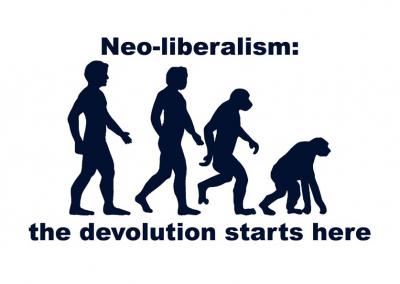
This Is Our Neoliberal Nightmare: Hillary Clinton, Donald Trump, and Why the Market and the Wealthy Win Every Time

neo_liberalism_devolution_via_permanentculturenow.com_

The rage driving our politics stems from cruelty of capitalism. So why do we vote for those who worship the market?

By Anis Shivani

Source: AlterNet

Over the last fifteen years, editors often asked me not to mention the word “neoliberalism,” because I was told readers wouldn’t comprehend the “jargon.” This has begun to change recently, as the terminology has come into wider usage, though it remains shrouded in great mystery.

People throw the term around loosely, as they do with “fascism,” with the same confounding results. Imagine living under fascism or communism, or earlier, classical liberalism, and not being allowed to acknowledge that particular frame of reference to understand economic and social issues. Imagine living under Stalin and never using the communist framework but focusing only on personality clashes between his lieutenants, or likewise for Hitler or Mussolini or Mao or Franco and their ideological systems! But this curious silence, this looking away from ideology, is exactly what has been happening for a quarter century, since neoliberalism, already under way since the early 1970s, got turbocharged by the Democratic party under the Democratic Leadership Council (DLC) and Bill Clinton. We live under an ideology that has not been widely named or defined!

Absent the neoliberal framework, we simply cannot grasp what is good or bad for citizens under Cruz versus Trump, or Clinton versus Sanders, or Clinton versus Trump, away from the distraction of personalities. To what extent does each of them agree or disagree with neoliberalism? Are there important differences? How much is Sanders a deviation? Can we still rely on conventional distinctions like liberal versus conservative, or Democrat versus Republican, to understand what is going on? How do we grasp movements like the Tea Party, Occupy, and now the Trump and Sanders insurgencies?

Neoliberalism has been more successful than most past ideologies in redefining subjectivity, in making people alter their sense of themselves, their personhood, their identities, their hopes and expectations and dreams and idealizations. Classical liberalism was successful too, for two and a half centuries, in people’s self-definition, although communism and fascism succeeded less well in realizing the “new man.”

It cannot be emphasized enough that neoliberalism is not classical liberalism, or a return to a purer version of it, as is commonly misunderstood; it is a new thing, because the market, for one thing, is not at all free and untethered and dynamic in the sense that classical liberalism idealized it. Neoliberalism presumes a strong state, working only for the benefit of the wealthy, and as such it has little pretence to neutrality and universality, unlike the classical liberal state.

I would go so far as to say that neoliberalism is the final completion of capitalism’s long-nascent project, in that the desire to transform everything—every object, every living thing, every fact on the planet—in its image had not been realized to the same extent by any preceding ideology. Neoliberalism happens to be the ideology—unlike the three major forerunners in the last 250 years—that has the fortune of coinciding with technological change on a scale that makes its complete penetration into every realm of being a possibility for the first time in human history.

From the early 1930s, when the Great Depression threatened the classical liberal consensus (the idea that markets were self-regulating, and the state should play no more than a night-watchman role), until the early 1970s, when global instability including currency chaos unraveled it, the democratic world lived under the Keynesian paradigm: markets were understood to be inherently unstable, and the interventionist hand of government, in the form of countercyclical policy, was necessary to make capitalism work, otherwise the economy had a tendency to get out of whack and crash.

It’s an interesting question if it was the stagflation of the 1970s, following the unhitching of the United States from the gold standard and the arrival of the oil embargo, that brought on the neoliberal revolution, with Milton Friedman discrediting fiscal policy and advocating a by-the-numbers monetarist policy, or if it was neoliberalism itself, in the form of Friedmanite ideas that the Nixon administration was already pursuing, that made stagflation and the end of Keynesianism inevitable.

It should be said that neoliberalism thrives on prompting crisis after crisis, and has proven more adept than previous ideologies at exploiting these crises to its benefit, which then makes the situation worse, so that each succeeding crisis only erodes the power of the working class and makes the wealthy wealthier. There is a certain self-fulfilling aura to neoliberalism, couched in the jargon of economic orthodoxy, that has remained immune from political criticism, because of the dogma that was perpetuated—by Margaret Thatcher and her acolytes—that There Is No Alternative (TINA).

Neoliberalism is excused for the crises it repeatedly brings on—one can think of a regular cycle of debt and speculation-fueled emergencies in the last forty years, such as the developing country debt overhang of the 1970s, the savings and loan crisis of the 1980s, the Asian currency crisis of the 1990s, and the subprime mortgage crisis of the 2000s—better than any ideology I know of. This is partly because its very existence as ruling ideology is not even noted by the population at large, which continues to derive some residual benefits from the welfare state inaugurated by Keynesianism but has been led to believe by neoliberal ideologues to think of their reliance on government as worthy of provoking guilt, shame, and melancholy, rather than something to which they have legitimate claim.

It is not surprising to find neoliberal multiculturalists—comfortably established in the academy—likewise demonizing, or othering, not Muslims, Mexicans, or African Americans, but working-class whites (the quintessential Trump proletariat) who have a difficult time accepting the fluidity of self-definition that goes well with neoliberalism, something that we might call the market capitalization of the self.

George W. Bush’s useful function was to introduce necessary crisis into a system that had grown too stable for its own good; he injected desirable panic, which served as fuel to the fire of the neoliberal revolution. Trump is an apostate—at least until now—in desiring chaos on terms that do not sound neoliberal, which is unacceptable; hence Jeb Bush’s characterization of him as the “candidate of chaos.” Neoliberalism loves chaos, that has been its modus operandi since the early 1970s, but only the kind of chaos it can direct and control.

To go back to origins, the Great Depression only ended conclusively with the onset of the second world war, after which Keynesianism had the upper hand for thirty-five years. But just as the global institutions of Keynesianism, specifically the IMF and the World Bank, were being founded at the New Hampshire resort of Bretton Woods in 1944, the founders of the neoliberal revolution, namely Friedrich Hayek, Ludwig von Mises, Milton Friedman, and others were forming the Mount Pelerin Society (MPS) at the eponymous Swiss resort in 1947, creating the ideology which eventually defeated Keynesianism and gained the upper hand during the 1970s.

So what exactly is neoliberalism, and how is it different from classical liberalism, whose final manifestation came under Keynesianism?

Neoliberalism believes that markets are self-sufficient unto themselves, that they do not need regulation, and that they are the best guarantors of human welfare. Everything that promotes the market, i.e., privatization, deregulation, mobility of finance and capital, abandonment of government-provided social welfare, and the reconception of human beings as human capital, needs to be encouraged, while everything that supposedly diminishes the market, i.e., government services, regulation, restrictions on finance and capital, and conceptualization of human beings in transcendent terms, is to be discouraged.

When Hillary Clinton frequently retorts—in response to demands for reregulation of finance, for instance—that we have to abide by “the rule of law,” this reflects a particular understanding of the law, the law as embodying the sense of the market, the law after it has undergone a revolution of reinterpretation in purely economic terms. In this revolution of the law persons have no status compared to corporations, nation-states are on their way out, and everything in turn dissolves before the abstraction called the market.

One way to sum up neoliberalism is to say that everything—everything—is to be made over in the image of the market, including the state, civil society, and of course human beings. Democracy becomes reinterpreted as the market, and politics succumbs to neoliberal economic theory, so we are speaking of the end of democratic politics as we have known it for two and a half centuries. As the market becomes an abstraction, so does democracy, but the real playing field is somewhere else, in the realm of actual economic exchange—which isnot, however, the market. We may say that all exchange takes place on the neoliberal surface.

Neoliberalism is often described—and this creates a lot of confusion—as “market fundamentalism,” and while this may be true for neoliberal’s self-promotion and self-presentation, i.e., the market as the ultimate and only myth, as were the gods of the past, I would argue that in neoliberalism there is no such thing as the market as we have understood it from previous ideologies.

The neoliberal state—actually, to utter the word state seems insufficient here, I would claim that a new entity is being created, which is not the state as we have known it, but an existence that incorporates potentially all the states in the world and is something that exceeds their sum—is all-powerful, it seeks to leave no space for individual self-conception in the way that classical liberalism, and even communism and fascism to some degree, were willing to allow.

There are competing understandings of neoliberal globalization, when it comes to the question of whether the state is strong or weak compared to the primary agent of globalization, i.e., the corporation, but I am taking this logic further, I am suggesting that the issue is not how strong the state is in the service of neoliberalism, but whether there is anything left over beyond the new definition of the state. Another way to say it is that the state has become the market, the market has become the state, and therefore both have ceased to exist in the form we have classically understood them.

Of course the word hasn’t gotten around to the people yet, hence all the confusion about whether Hillary Clinton is more neoliberal than Barack Obama, or whether Donald Trump will be less neoliberal than Hillary Clinton. The project of neoliberalism—i.e., the redefinition of the state, the institutions of society, and the self—has come so far along that neoliberalism is almost beyond the need of individual entities to make or break its case. Its penetration has gone too deep, and none of the democratic figureheads that come forward can fundamentally question its efficacy.

I said almost. The reason why Bernie Sanders, self-declared democratic socialist, is so threatening to neoliberalism is that he has articulated a conception of the state, civil society, and the self that is not founded in the efficacy and rationality of the market. He does not believe—unlike Hillary Clinton—that the market can tackle climate change or income inequality or unfair health and education outcomes or racial injustice, all of which Clinton propagates. Clinton’s impending “victory” (whatever machinations were involved in engineering it) will only strengthen neoliberalism, as the force that couldn’t be defeated even when the movement was as large and transcendent as Sanders’s. Although Sanders doesn’t specify “neoliberalism” as the antagonist, his entire discourse presumes it.

Likewise, while Trump supporters want to take their rebellion in a fascist direction, their discomfort with the logic of the market is as pervasive as the Sanders camp, and is an advance, I believe, over the debt and unemployment melancholy of the Tea Party, the shame that was associated with that movement’s loss of identity as bourgeois capitalists in an age of neoliberal globalization. The Trump supporters, I believe, are no longer driven by shame, as was true of the Tea Party, and as has been true of the various dissenting movements within the Republican party, evangelical or otherwise, in the recent past. Rather, they have taken the shackles off and are ready for a no-holds barred “politically incorrect” fight with all others: they want to be “winners,” even at the cost of exterminating others, and that is not the neoliberal way, which doesn’t acknowledge that there can be winners and losers in the neoliberal hyperspace.

In the current election campaign, Hillary Clinton has been the most perfect embodiment of neoliberalism among all the candidates, she is almost its all-time ideal avatar, and I believe this explains, even if not articulated this way, the widespread discomfort among the populace toward her ascendancy. People can perceive that her ideology is founded on a conception of human beings striving relentlessly to become human capital (as her opening campaign commercialso overtly depicted), which means that those who fail to come within the purview of neoliberalism should be rigorously ostracized, punished, and excluded.

This is the dark side of neoliberalism’s ideological arm (a multiculturalism founded on human beings as capital), which is why this project has become increasingly associated with suppression of free speech and intolerance of those who refuse to go along with the kind of identity politics neoliberalism promotes.

And this explains why the 1990s saw the simultaneous and absolutely parallel rise, under the Clintons, of both neoliberal globalization and various regimes of neoliberal disciplining, such as the shaming and exclusion of former welfare recipients (every able-bodied person should be able to find work, therefore under TANF welfare was converted to a performance management system designed to enroll everyone in the workforce, even if it meant below-subsistence wages or the loss of parental responsibilities, all of it couched in the jargon of marketplace incentives).

The actual cost to the state of the AFDC program was minimal, but its symbolism was incalculable. The end of welfare went hand in hand with the disciplinary “crime bill” pushed by the Clintons, leading to an epidemic of mass incarceration. Neoliberalism, unlike classical liberalism, does not permit a fluidity of self-expression as an occasional participant in the market, and posits prison as the only available alternative for anyone not willing to conceive of themselves as being present fully and always in the market.

I believe that the generation of people—in their forties or older—supporting Hillary have already internalized neoliberal subjectivity, which they like to frame as realism or pragmatism, refusing for instance to accept that free college or health care are even theoretical possibilities. After all, they have maintained a measure of success in the past three or four decades after conceptualizing themselves as marketplace agents. Just as the Tea Party supporters found it intolerable that government should help irresponsible homeowners by bailing them out of unsustainable debt, the Clinton supporters hold essentially the same set of beliefs toward those who dare to think of themselves outside the discipline of the market.

I spoke of the myth of the market, as something that has no existence in reality, because none of the elements that would have to exist for a market to work are actually in place; this is even more true for neoliberalism than it was for the self-conscious annihilation of the market by communism, because at least in that system the market, surreptitiously, as in various Eastern European countries, kept making an appearance. But when the market takes neoliberal shape, i.e., the classical conceptions of the buyer and seller as free agents are gone, then radical inequality is the natural outcome. And inequality in the last four decades, as statistics for the U.S. and everywhere neoliberalism has made inroads prove beyond a doubt, has exploded, thereby invalidating neoliberalism’s greatest claim to legitimacy, that it brings about a general increase in welfare. So neoliberalism, to the extent that the inequality discourse has made itself manifest recently, must insist all the more vocally on forms of social recognition, what Clinton, for example, likes to call the “fall of barriers.”

Neoliberalism likes to focus on public debt—in the Clinton years debt reduction became a mania, though George W. Bush promptly spent all the accumulated surpluses on tax cuts for the wealthy and on wars of choice—rather than inequality, because the only way to address inequality is through a different understanding of public debt; inequality can only be addressed through higher taxation, which has by now been excluded from the realm of acceptable discourse—except when Sanders, Trump, or Jeremy Corbyn in England go off script.

So to recapitulate neoliberalism’s comprehensive success, let us note that we have gone from a liberal, Keynesian, welfare state to a neoliberal, market-compliant, disciplinary state.

Neoliberalism expects—and education at every level has been redesigned to promote this—that economic decision-making will be applied to all areas of life (parenthood, intimacy, sexuality, and identity in any of its forms), and that those who do not do so will be subject to discipline. Everyone must invest in their own future, and not pose a burden to the state or anyone else, otherwise they will be refused recognition as human beings.

This supposed economic “rationality” (though it is the greatest form of irrationality) applies to civil society as much as the state, so that none of the ideals of classical liberalism, or previous ideologies rooted in humanism, are valid any longer, the only value is the iteration of the market (as myth, not reality); in other words, neoliberalism, unlike the elevation of the individual in classical liberalism or the state in fascism or the collectivity in communism, has erected something, the market, that has no real existence, as the only god to serve! And it is just like a god, with an ethereal, unchallengeable, irrefutable, ubiquitous presence. Whatever in state policy does not serve market-conformity is to be banned and banished from memory (the secular scriptures are to be rewritten), which explains neoliberalism’s radical narrowing of public discourse, including the severance of identity politics from any class foundation.

Neoliberalism will continue to perpetuate reduced opportunity, because one of its characteristics—as in any system that wants to thrive on the world stage—is to constantly refine the field upon which the human subject can operate.

As such, those displaced workers who have suffered the most from the erosion of the old industries in the former manufacturing centers of the world are not even factors to contend with, they are invisible and cannot be part of the policy equation. To the extent that their actual presence is reckoned with, the economy can be said to have crashed; but the problem doesn’t arise because of the management of unemployment or underemployment statistics, unlike a housing crash which is palpable and cannot escape statistical definition.

The danger for neoliberalism—as is clear from the support of millions of displaced human beings for Trump—is that with each crisis neoliberalism sheds more workers, makes individuals and firms more “disciplined,” narrows the scope of opportunity even further. At times, the disciplining of the non-neoliberal other—as with the killing of Michael Brown or Eric Garner—explodes to surface consciousness in an unsavory way, so an expert manager like Clinton or Obama is required to tamp down the emotions of such unruly entities as Black Lives Matter which arise in response. If climate change, according to Clinton and her cohort, can and should have market solutions, then surely racial disparity, or police violence, should also have market solutions and no others; it is here that neoliberal multiculturalism, operating in the academy, is so insidious, because at the elite level it functions to validate market discourse, it does not step outside it.

The present breakdown of both major political parties can be explained by the frustration that has built up in the body politic over the past decade, because after the crash there was no sustained intellectual movement to question the myth of the market. The substitution of economic justice with identity politics is something Ralph Nader, Howard Dean, and now Bernie Sanders have contested in a humane manner, while the same process is at work, admittedly in an inhumane way, in the Trump phenomenon.

Thus, also, Hillary Clinton’s animus against free college education; that form of expansion of opportunity, which was a reality from the 1950s to the 1980s, cannot be allowed to return, human beings are supposed to invest in their own future earnings potential, they are not entitled to a transcendent experience without barriers manifesting in discipline and self-correction. Education, like everything else, including one’s own health, becomes an expensive consumer good, not a right, no longer an experience that might lead to a consciousness beyond the market but something that should be fully encapsulated by the market. If one is a capable market player, education as we have classically understood it becomes redundant.

Unlike the interregnum between 1945-1973, the rising tide—no matter the befuddlements Arthur Laffer and his fellow Reaganite ideologues proffered—does not lift all boats today, it is outside the logic of neoliberalism that it do so, so the idea of reforming neoliberalism, or what is often called “globalization with a human face,” is a rhetorical distraction. All of the policy innovations—interpreted as “socialism” by the Tea Partiers—offered by Barack Obama fall within the purview of neoliberalism, above all the Affordable Care Act, whose genesis was hatched in neoliberal think tanks decades ago.

It is important to note that neoliberal economic restructuring necessarily means social restructuring, i.e., a movement toward disciplinarity and away from liberalism; the disciplinarity can take a Bushian, Clintonian, or Trumpian form, but these are manifestations of the same tendency.

When wage growth is decoupled from economic growth (as it has been since Friedman and others inaugurated the revolution in the early 1970s), this means that the human subject is ripe for discipline. Furthermore, wage fairness cannot be rationally discussed (hence the obfuscation surrounding the $15 minimum wage orchestrated by Clinton and others) because the concept of the market has been disembedded from society; the market as abstraction, not a concrete reality, makes any notion of reform or restructuring impossible. Like the minimum wage, something like free child care also remains outside the bounds of discourse, because public policy cannot accommodate discussions that do not take the self-regulating market as unassailable myth.

What neoliberalism can accommodate is relentless tax cuts (Trump has already offered his huge tax cut plan, as Bush did as his first order of business), which only exacerbate the problem, leading to increasing concentrations of wealth. It has to be said, though, that Ted Cruz more comfortably fit the neoliberal paradigm, with his familiar calls for lower taxes along with reduced regulation and further limits on social welfare, whereas Trump shows, for now, some elements of apostasy. If neoliberalism were to get a Cruz, it would have no problem working with him, or rather, Cruz would have had no problem executing neoliberalism, beyond the surface dissimilarities from Hillary Clinton.

As Sanders has consistently noted, economic inequality leads to political inequality, which means that democracy, after a certain point, becomes only theoretical (viz. Citizens United and the electoral influence of such powerful entities as the Koch brothers). Both processes—economic inequality and political inequality—have accelerated after each downturn in the forty-five-year history of neoliberalism, therefore a downturn is always exciting, and even preordained, for a Bush, a Trump, or a Clinton. Again, economic inequality and political polarity (polarity is simply a manifestation of democracy having become dysfunctional) strongly correlate, and both have come to a head in this election.

Neoliberalism’s task, from this point on, is to mask and manage the increasing inequalities that are likely to befall humanity, especially as the planet reaches a crisis point in its health. In a way, George W. Bush threw a wrench—he was a perverted Keynesian in a way, believing in war to prime the pump, or inflating unsustainable bubbles, or spending exorbitantly on grandiose gestures—into the process of neoliberal globalization that was going very smoothly indeed under Bill Clinton and would likely have flourished under Al Gore as well. With Hillary Clinton, the movement will be toward further privatization of social welfare, “reforming” it along market principles, as has been true of every neoliberal avatar, whether it was Bill Clinton’s incentives to work in the performance management makeover of welfare, George Bush’s proposed private social security accounts, Mitt Romney’s proposed private health care accounts, or the school vouchers that tempt all of them from time to time.

What remains to be seen is the extent to which the millennial generation might be capable of thinking outside the neoliberal paradigm, i.e., they don’t just want more of what neoliberal promises to give them yet fails to deliver, but want things that neoliberalism does not or cannot promise. On this rests the near-term future of the neoliberal project.

Beyond Sanders himself, the key question is the ability of the millennial generation to conceive of themselves outside the neoliberal subjectivity they have been pushed to internalize. They have been encouraged to think of themselves as capital producers, turning their intellectuality into social media popularity for the benefit of capital, in the service of the same abstract market that has no place, no role, no definition beyond the fallen liberal calculus. Does the millennial generation believe, even about its most intimate core, that everything has been privatized?

I am not necessarily making a pessimistic prediction. I am merely outlining the strength of an opponent that has refused to be named for forty-five years, although it has been the ruling ideology that long! In defining neoliberalism, I have sought to distance myself from the distraction of personalities, and tried to expose the dark side of our politics which we can only see when we name and understand the ideology as such. We are up against a system that is so strong that it has survived, for the most part, the last crash, as citizens couldn’t get their heads around the idea of nationalizing banks or health care.

It is existentially imperative to ponder what happens beyond Sanders, because neoliberalism has its end-game in sight, letting inequality continue to escalate past the crash point (meaning the point where the economy works for most people), past any tolerable degradation of the planet (which is being reconceptualized in the shape of the market).

What, indeed, does happen beyond Sanders, because as we have seen Hillary Clinton is one of the founders of neoliberal globalization, one of its central historical figures (having accelerated the warehousing of the poor, the attack on trade unions, and the end of welfare and of regulatory prowess), while Trump is an authoritarian figure whose conceptions of the state and of human beings within the state are inconsistent with the surface frictionlessness neoliberalism desires? To go back to Hillary Clinton’s opening campaign commercial, to what extent will Americans continue to believe that the self must be entrepreneurially leveraged toward maximum market gains, molded into mobile human capital ever ready to serve the highest bidder?

As to whether a non-neoliberal globalization is possible and what that might look like on the international stage after a quarter-century of Clinton, Bush, and Obama—which is essentially the frustration Trump is tapping into—I’ll take that up in a follow-up essay, which will further clarify the differences between Sanders versus Clinton, and Trump versus Clinton.

I would suggest that it is not that globalization causes or has caused neoliberalism, but that neoliberalism has pushed a certain form of globalization that suits its interests. This is a crucial distinction, on which everything else hinges. The neoliberal market doesn’t actually exist; at the moment it is pure abstraction; what is actually filling up economic and political space can only be discussed when we step away from this abstraction, as Sanders has so ably done, and as the Occupy and Black Lives Matter movements tentatively set in motion.

 

Anis Shivani is the author of several books of fiction, poetry, and criticism, including, most recently, My Tranquil War and Other Poems. His novel Karachi Raj (HarperCollins/Fourth Estate) was released this summer. His next book is the poetry collection Whatever Speaks on Behalf of Hashish, out in October.

Welcome to 1984

1984

By Chris Hedges

Source: truthdig

The artifice of corporate totalitarianism has been exposed. The citizens, disgusted by the lies and manipulation, have turned on the political establishment. But the game is not over. Corporate power has within its arsenal potent forms of control. It will use them. As the pretense of democracy is unmasked, the naked fist of state repression takes its place. America is about—unless we act quickly—to get ugly.

“Our political system is decaying,” said Ralph Nader when I reached him by phone in Washington, D.C. “It’s on the way to gangrene. It’s reaching a critical mass of citizen revolt.”

This moment in American history is what Antonio Gramsci called the “interregnum”—the period when a discredited regime is collapsing but a new one has yet to take its place. There is no guarantee that what comes next will be better. But this space, which will close soon, offers citizens the final chance to embrace a new vision and a new direction.

This vision will only be obtained through mass acts of civic mobilization and civil disobedience across the country. Nader, who sees this period in American history as crucial, perhaps the last opportunity to save us from tyranny, is planning to rally the left for three days, from May 23 to May 26 at Constitution Hall in Washington, D.C., in what he is calling “Breaking Through Power” or “Citizen’s Revolutionary Week.” He is bringing to the capital scores of activists and community leaders to speak, organize and attempt to mobilize to halt our slide into despotism.

“The two parties can implode politically,” Nader said. “They can be divided by different candidates and super PACs. But this doesn’t implode their paymasters.”

“Elections have become off-limits to democracy,” he went on. “They have become off-limits to democracy’s fundamental civil community or civil society. When that happens, the very roots shrivel and dry up. Politics is now a sideshow. Politics does not bother corporate power. Whoever wins, they win. Both parties represent Wall Street over Main Street. Wall Street is embedded in the federal government.”

Donald Trump, like Hillary Clinton, has no plans to disrupt the corporate machinery, although Wall Street has rallied around Clinton because of her predictability and long service to the financial and military elites. What Trump has done, Nader points out, is channel “the racist, right-wing militants” within the electorate, embodied in large part by the white working poor, into the election process, perhaps for one last time.

Much of the left, Nader argues, especially with the Democratic Party’s blatant rigging of the primaries to deny Bernie Sanders the nomination, grasps that change will come only by building mass movements. This gives the left, at least until these protofascist forces also give up on the political process, a window of opportunity. If we do not seize it, he warns, we may be doomed.

He despairs over the collapse of the commercial media, now governed by the primacy of corporate profit.

“Trump’s campaign has enormous appeal to the commercial mass media,” Nader said. “He brought huge ratings during the debates. He taunted the networks. He said, ‘I’m boycotting this debate. It’s going to cost you profit.’ Has this ever happened before in American history? It shows you the decay, the commercialization of public elections.”

The impoverished national discourse, fostered by a commercial mass media that does not see serious political debate as profitable and focuses on the trivial, the salacious and the inane, has empowered showmen and con artists such as Trump.

“Trump speaks in a very plain language, at the third-grade level, according to some linguists,” Nader said. “He speaks like a father figure. He says, ‘I’ll get you jobs. I’ll bring back industry. I’ll bring back manufacturing. I’ll protect you from immigrants.’ The media never challenges him. He is not asked, ‘How are we going do all of this? What is step one? Step two? Is the White House going to ignore the Congress and the courts?’ He astonishes his audience. He amazes them with his bullying, his lying, his insults, like ‘Little Marco,’ the wall Mexico is going to pay for, no more entry in the country by Muslims—a quarter of the human race—until we figure it out. The media never catches up with him. He is always on the offensive. He is always news. The commercial media wants the circus. It gives them high ratings and high profit.”

The focus on info-entertainment has left not only left the public uninformed and easily manipulated but has locked out the voices that advocate genuine reform and change.

“The commercial media does not have time for citizen groups and citizen leaders who are really trying to make America great, whether by advancing health safety or economic well-being,” Nader bemoaned. “These groups are overwhelmed. They’re marginalized. They’re kept from nourishing the contents of national, state and local elections. Look at the Sunday news shows. No one can get on to demonstrate that the majority of the people want full Medicare for all with the free choice of doctors and hospitals, not only more efficient but more life-saving. There was a major press conference a few days ago at the National Press Club. The leading advocates of full Medicare for all, or single-payer, were there, Dr. Steffie Woolhandler and Dr. Sidney Wolfe, the heads of Physicians for a National Health Program. This is a group with about 15,000 physicians on board. Nobody came. There was a stringer for an indie media outlet and the corporate crime reporter. There are all kinds of major demonstrations, 1,300 arrests outside the Congress protesting the corruption of money in politics. Again no coverage, except a little on NPR and on ‘Democracy Now!’ ”

“The system is gamed,” he said. “The only way out of it is to mobilize the civil society.

“We are organizing the greatest gathering of accomplished citizen advocacy groups on the greatest number of redirections and reforms ever brought together in American history under one roof,” he said of his upcoming event. “The first day is called Breaking Through Power, How it Happens. We have 18 groups who have demonstrated it with tiny budgets for over three decades on issues such as road safety, removing hundreds of hazardous or ineffective pharmaceuticals from the market, changing food habits from junk food to nutrition and rescuing people from death row who were falsely convicted of homicides. What if we tripled the budgets and the staffs of these groups? Eighteen of these groups have a total budget that is less than what one of dozens of CEOs make in a year.”

Nader called on Sanders to join in the building of a nationwide civic mobilization. He said that while Clinton may borrow some of his rhetoric, she and the Democratic Party establishment would not incorporate Sander’s populist appeals against Wall Street into the party platform. If Sanders does not join a civic mobilization, Nader warned, there would be “a complete disintegration of his movement.”

Nader also said he was worried that Clinton’s high negativity ratings, along with potential scandals, including the possible release of her highly paid speeches to corporations such as Goldman Sachs, could see Trump win the presidency.

“I have her lecture contract with the Harry Walker lecture agency,” he said. “She had a clause in the contract with these business sponsors, which basically said the doors will be closed. There will be no press. You will pay $1,000 for a stenographer to give me, for my exclusive use, a stenographic record of what I said. You will pay me $5,000 a minute. She has it all. She can’t say, ‘We will look into it or we’ll see if we can find it.’ She has been dissembling. And her latest rant is, ‘I’ll release the transcripts if everyone else does.’ ‘Who is everybody else?’ as Bernie Sanders rebutted. He doesn’t give highly paid speeches behind closed doors to Wall Street firms, business executives or business trade groups. Trump doesn’t give quarter-of-a-million-dollar speeches behind closed doors to business. So by saying ‘I will release all of my transcripts if everyone else does,’ she makes a null and void assertion. This is characteristic of the Clintons’ dissembling and slipperiness. It’s transcripts for Hillary. It’s tax returns for Trump.”

While Nader supports the building of third parties, he cautions that these parties—he singles out the Green Party and the Libertarian Party—will go nowhere without mass mobilization to pressure the centers of power. He called on the left to reach out to the right in a joint campaign to dismantle the corporate state. Sanders could play a large role in this mobilization, Nader said, because “he is in the eye of the mass media. He is building this rumble from the people.”

“What does he have to lose?” Nader asked of Sanders. “He’s 74. He can lead this massive movement. I don’t think he wants to let go. His campaign has exceeded his expectations. He is enormously energized. If he leads the civic mobilization before the election, whom is he going to help? He’s going to help the Democratic Party, without having to go around being a one-line toady expressing his loyalty to Hillary. He is going to be undermining the Republican Party. He is going to be saying to the Democratic Party, ‘You better face up to the majoritarian crowds and their agenda, or you’re going to continue losing in these gerrymandered districts to the Republicans in Congress.’ These gerrymandered districts can be overcome with a shift of 10 percent of the vote. Once the rumble from the people gets underway, nothing can stop it. No one person can, of course, lead this. There has to be a groundswell, although Sanders can provide a focal point”

Nader said that a Clinton presidency would further enflame the right wing and push larger segments of the country toward extremism.

“We will get more quagmires abroad, more blowback, more slaughter around the world and more training of fighters against us who will be more skilled to bring their fight here,” he said of a Clinton presidency. “Budgets will be more screwed against civilian necessities. There will be more Wall Street speculation. She will be a handmaiden of the corporatists and the military industrial complex. There comes a time, in any society, where the rubber band snaps, where society can’t take it anymore.”