Dictators Bent on Building Military Empires: The Cost of the Nation’s Endless Wars

By John & Nisha Whitehead

Source: The Rutherford Institute

“Autocrats only understand one word: no, no, no. No you will not take my country, no you will not take my freedom, no you will not take my future… A dictator bent on rebuilding an empire will never be able to ease the people’s love of liberty. Brutality will never grind down the will of the free.”—President Biden

Oh, the hypocrisy.

To hear President Biden talk about the Russia’s aggression against Ukraine, you might imagine that Putin is the only dictator bent on expanding his military empire through the use of occupation, aggression and oppression.

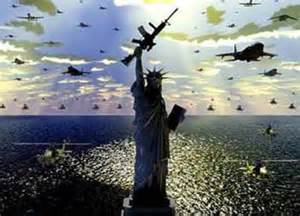
Yet the United States is no better, having spent much of the past half-century policing the globe, occupying other countries, and waging endless wars.

What most Americans fail to recognize is that these ongoing wars have little to do with keeping the country safe and everything to do with propping up a military industrial complex that has its sights set on world domination.

War has become a huge money-making venture, and the U.S. government, with its vast military empire, is one of its best buyers and sellers.

America’s part in the showdown between Russia and the Ukraine has already cost taxpayers more than $112 billion and shows no signs of abating.

Clearly, it’s time for the U.S. government to stop policing the globe.

The U.S. military reportedly has more than 1.3 million men and women on active duty, with more than 200,000 of them stationed overseas in nearly every country in the world.

American troops are stationed in Somalia, Iraq and Syria. In Germany, South Korea and Japan. In Saudi Arabia, Jordan and Oman. In Niger, Chad and Mali. In Turkey, the Philippines, and northern Australia.

Those numbers are likely significantly higher in keeping with the Pentagon’s policy of not fully disclosing where and how many troops are deployed for the sake of “operational security and denying the enemy any advantage.” As investigative journalist David Vine explains, “Although few Americans realize it, the United States likely has more bases in foreign lands than any other people, nation, or empire in history.”

Incredibly, America’s military forces aren’t being deployed abroad to protect our freedoms here at home. Rather, they’re being used to guard oil fields, build foreign infrastructure and protect the financial interests of the corporate elite. In fact, the United States military spends about $81 billion a year just to protect oil supplies around the world.

The reach of America’s military empire includes close to 800 bases in as many as 160 countries, operated at a cost of more than $156 billion annually. As Vine reports, “Even US military resorts and recreation areas in places like the Bavarian Alps and Seoul, South Korea, are bases of a kind. Worldwide, the military runs more than 170 golf courses.”

This is how a military empire occupies the globe.

After 20 years of propping up Afghanistan to the tune of trillions of dollars and thousands of lives lost, the U.S. military may have finally been forced out, but those troops represent just a fraction of our military presence worldwide.

In an ongoing effort to police the globe, American military servicepeople continue to be deployed to far-flung places in the Middle East and elsewhere.

This is how the military industrial complex, aided and abetted by the likes of Joe Biden, Donald Trump, Barack Obama, George W. Bush, Bill Clinton and others, continues to get rich at taxpayer expense.

Yet while the rationale may keep changing for why American military forces are policing the globe, these wars abroad aren’t making America—or the rest of the world—any safer, are certainly not making America great again, and are undeniably digging the U.S. deeper into debt.

War spending is bankrupting America.

Although the U.S. constitutes only 5% of the world’s population, America boasts almost 50% of the world’s total military expenditure, spending more on the military than the next 19 biggest spending nations combined.

In fact, the Pentagon spends more on war than all 50 states combined spend on health, education, welfare, and safety.

The American military-industrial complex has erected an empire unsurpassed in history in its breadth and scope, one dedicated to conducting perpetual warfare throughout the earth.

Since 2001, the U.S. government has spent more than $4.7 trillion waging its endless wars.

Having been co-opted by greedy defense contractors, corrupt politicians and incompetent government officials, America’s expanding military empire is bleeding the country dry at a rate of more than $32 million per hour.

In fact, the U.S. government has spent more money every five seconds in Iraq than the average American earns in a year.

Future wars and military exercises waged around the globe are expected to push the total bill upwards of $12 trillion by 2053.

Talk about fiscally irresponsible: the U.S. government is spending money it doesn’t have on a military empire it can’t afford.

Unfortunately, even if we were to put an end to all of the government’s military meddling and bring all of the troops home today, it would take decades to pay down the price of these wars and get the government’s creditors off our backs.

As investigative journalist Uri Friedman puts it, for more than 15 years now, the United States has been fighting terrorism with a credit card, “essentially bankrolling the wars with debt, in the form of purchases of U.S. Treasury bonds by U.S.-based entities like pension funds and state and local governments, and by countries like China and Japan.”

War is not cheap, but it becomes outrageously costly when you factor in government incompetence, fraud, and greedy contractors. Indeed, a leading accounting firm concluded that one of the Pentagon’s largest agencies “can’t account for hundreds of millions of dollars’ worth of spending.”

Unfortunately, the outlook isn’t much better for the spending that can be tracked.

A government audit found that defense contractor Boeing has been massively overcharging taxpayers for mundane parts, resulting in tens of millions of dollars in overspending. As the report noted, the American taxpayer paid:

$71 for a metal pin that should cost just 4 cents; $644.75 for a small gear smaller than a dime that sells for $12.51: more than a 5,100 percent increase in price. $1,678.61 for another tiny part, also smaller than a dime, that could have been bought within DoD for $7.71: a 21,000 percent increase. $71.01 for a straight, thin metal pin that DoD had on hand, unused by the tens of thousands, for 4 cents: an increase of over 177,000 percent.

That price gouging has become an accepted form of corruption within the American military empire is a sad statement on how little control “we the people” have over our runaway government.

Mind you, this isn’t just corrupt behavior. It’s deadly, downright immoral behavior.

Americans have thus far allowed themselves to be spoon-fed a steady diet of pro-war propaganda that keeps them content to wave flags with patriotic fervor and less inclined to look too closely at the mounting body counts, the ruined lives, the ravaged countries, the blowback arising from ill-advised targeted-drone killings and bombing campaigns in foreign lands, or the transformation of our own homeland into a warzone.

That needs to change.

The U.S. government is not making the world any safer. It’s making the world more dangerous. It is estimated that the U.S. military drops a bomb somewhere in the world every 12 minutes. Since 9/11, the United States government has directly contributed to the deaths of around 500,000 human beings. Every one of those deaths was paid for with taxpayer funds.

The U.S. government is not making America any safer. It’s exposing American citizens to alarming levels of blowback, a CIA term referring to the unintended consequences of the U.S. government’s international activities. Chalmers Johnson, a former CIA consultant, repeatedly warned that America’s use of its military to gain power over the global economy would result in devastating blowback.

The 9/11 attacks were blowback. The Boston Marathon Bombing was blowback. The attempted Times Square bomber was blowback. The Fort Hood shooter, a major in the U.S. Army, was blowback.

The U.S. military’s ongoing drone strikes will, I fear, spur yet more blowback against the American people.

The war hawks’ militarization of America—bringing home the spoils of war (the military tanks, grenade launchers, Kevlar helmets, assault rifles, gas masks, ammunition, battering rams, night vision binoculars, etc.) and handing them over to local police, thereby turning America into a battlefield—is also blowback.

James Madison was right: “No nation could preserve its freedom in the midst of continual warfare.” As Madison explained, “Of all the enemies to public liberty war is, perhaps, the most to be dreaded because it comprises and develops the germ of every other. War is the parent of armies; from these proceed debts and taxes… known instruments for bringing the many under the domination of the few.”

We are seeing this play out before our eyes.

The government is destabilizing the economy, destroying the national infrastructure through neglect and a lack of resources, and turning taxpayer dollars into blood money with its endless wars, drone strikes and mounting death tolls.

Clearly, our national priorities are in desperate need of an overhauling.

At the height of its power, even the mighty Roman Empire could not stare down a collapsing economy and a burgeoning military. Prolonged periods of war and false economic prosperity largely led to its demise. As historian Chalmers Johnson predicts:

The fate of previous democratic empires suggests that such a conflict is unsustainable and will be resolved in one of two ways. Rome attempted to keep its empire and lost its democracy. Britain chose to remain democratic and in the process let go its empire. Intentionally or not, the people of the United States already are well embarked upon the course of non-democratic empire.

This is the “unwarranted influence, whether sought or unsought, by the military-industrial complex” that President Dwight Eisenhower warned us more than 50 years ago not to let endanger our liberties or democratic processes.

Eisenhower, who served as Supreme Commander of the Allied forces in Europe during World War II, was alarmed by the rise of the profit-driven war machine that emerged following the war—one that, in order to perpetuate itself, would have to keep waging war.

We failed to heed his warning.

As I make clear in my book Battlefield America: The War on the American People and in its fictional counterpart The Erik Blair Diaries, war is the enemy of freedom.

As long as America’s politicians continue to involve us in wars that bankrupt the nation, jeopardize our servicemen and women, increase the chances of terrorism and blowback domestically, and push the nation that much closer to eventual collapse, “we the people” will find ourselves in a perpetual state of tyranny.
There Are No Permanent Allies, Only Permanent Power

If we do not build left-right coalitions on issues such as militarism, health care, a living wage and union organizing, we will be impotent in the face of corporate power and the war machine.

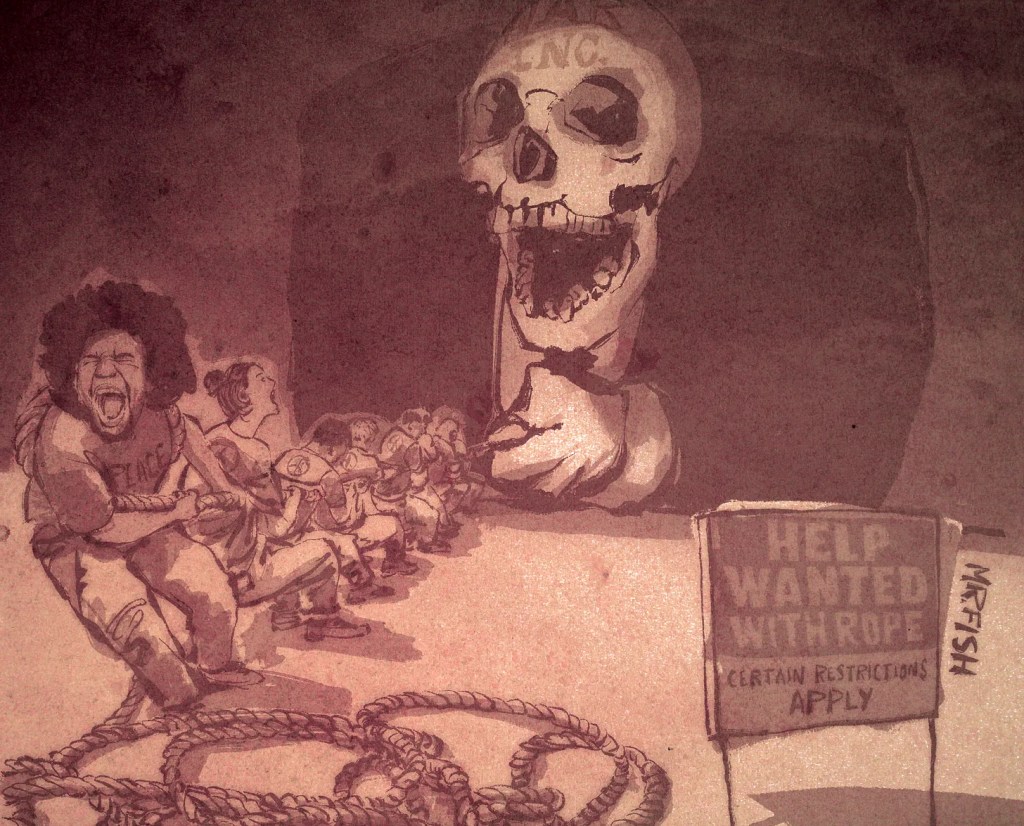
Give Enough Rope – by Mr. Fish

By Chris Hedges

Source: The Chris Hedges Report

On Sunday, February 19, I will be at the Lincoln Memorial in Washington at noon to speak at the anti-war rally, Rage Against the War Machine. There, I will be joined by Jimmy DoreDennis KucinichAnn WrightJill SteinMax BlumenthalCynthia McKinneyAnya ParampilDavid Swanson and other left-wing, anti-war activists I have shared platforms with for many years. I will also be joined by Ron PaulScott Horton and right-libertarian, anti-war figures whose political and cultural opinions I often disagree with. The inclusion of the right-wing has seen anti-war groups I respect, such as Veterans for Peace (VFP), refuse to join the rally. VFP issued a statement sent to me on Friday saying that “to endorse this event would have caused a huge disruption in VFP and had little effect on the outcome of the demonstration.” The board of Code Pink asked its co-founder, Medea Benjamin, one of the nation’s most important and effective left-wing and anti-war activists, to cancel her scheduled talk at the rally. 

“The left has become largely irrelevant in the U.S. because it is incapable of working with the right,” said Nick Brana, chair of The People’s Party, which organized the rally with libertarians. “It clings to identity politics over jobs, health care, wages and war, and condemns half the country as deplorables.”

We will not topple corporate power and the war machine alone. There has to be a left-right coalition, which will include people whose opinions are not only unpalatable but even repugnant, or we will remain marginalized and ineffectual. This is a fact of political life. Alliances are built around particular issues, in this case permanent war, which often fall apart when confronting other concerns. If I had organized the rally, there are some speakers I would not have invited. But I didn’t. This does not mean that there are no red lines: I would not join a protest that included neo-Nazi groups such as Aryan Nations or militias such as The Proud Boys or Oath Keepers. 

My father, a Presbyterian minister who was an army sergeant in North Africa during World War II, was a member of Concerned Clergy and Laity About Vietnam, an anti-war group that included the radical Catholic priests Philip and Daniel Berrigan. He took me with other clergy, almost all veterans, to anti-war rallies. There was much in the anti-war movement that he and other members of the religious group opposed, from the Yippies — who put forward a 145-pound pig named Pigasus the Immortal as a presidential candidate in 1968 — to groups such as the Weather Underground that embraced violence. He and the other clergy disliked the widespread drug use and propensity of some protestors to insult and bait the police. They had little in common with the Maoists, Stalinists, Leninists and Trotskyites within the movement. Daniel Berrigan, one of the most important anti-war activists in American history who was constantly in and out of jail and spent two years in federal prison, opposed abortion — a stance that today would probably see him deplatformed by many on the left. These clergy understood that the masters of war were their real enemies. They understood that the success of the anti-war movement meant forming alliances with people whose ideologies and beliefs were far removed from their pacifism, abstemious lifestyles and Christian faith. When I was about 12, my father told me that if the war was still going on when I turned 18 and I was drafted, he would go to prison with me. The jolt of that promise has remained with me my entire life.

The demands of the Rage Against the War Machine rally are ones I share. They include Not One More Penny for War in Ukraine; Negotiate Peace; Stop the War Inflation; Disband NATO; Global Nuclear De-Escalation; Slash the Pentagon Budget; Abolish the CIA and Military Industrial Deep State; Abolish War and Empire; Restore Civil Liberties; and Free Julian Assange.

I know war. I spent two decades reporting on conflicts all over the globe, including many months in Gaza, the world’s largest open-air prison, containing two million people including over a million children. I saw thousands of lives destroyed by United States military adventurism in Central America, Africa and the Middle East. Dozens of people I knew and worked with, including Kurt Schork, a Reuters reporter, and the Spanish cameraman Miguel Gil Moreno de Mora, died violent deaths.  

We must halt the decades of rampant and futile industrial killing. This includes ending the proxy war in Ukraine. It includes drastic cuts to the funding of the U.S. war machine, a state within a state. It includes disbanding NATO, which was established to prevent Soviet expansion into Eastern and Central Europe, not wage war around the globe. If Western promises to Moscow not to expand NATO beyond the borders of a unified Germany had been kept, I expect the Ukrainian war would have never happened.

To those who suffer directly from U.S. aggression, these demands are not academic and theoretical issues. The victims of this militarism do not have the luxury of virtue-signaling. They want the rule of law to be reinstated and the slaughter stopped. So do I. They welcome any ally who opposes endless war. For them, it is a matter of life or death. If some of those on the right are anti-war, if they also want to free Julian Assange, it makes no sense to ignore them. These are urgent existential issues that, if we do not mobilize soon, could see us slip into a direct confrontation with Russia, and perhaps China, which could lead to nuclear war. 

The Democratic Party, along with most of the Republican Party, is captive to the militarists. Each year, Congress increases the budget for the war industry, including for fiscal year 2023. It approved $847 billion for the military — a total that is boosted to $858 billion when accounts that don’t fall under the Armed Services committees’ jurisdiction are included. The Democrats, including nearly all 100 members of the House Congressional Progressive Caucus, and Republicans slavishly hand the Pentagon everything it demands.

The rally on February 19 is not about eliminating Social Security and Medicare or abolishing the minimum wage, which many libertarians propose. It is not a rally to denounce the rights of the LGBTQ community, which have been attacked by at least one of the speakers. It is a rally to end permanent war. Should these right-wing participants organize around those other issues, I will be on the other side of the barricades.

“I supported the Rage Against the War Machine Rally from the time of its conception and I support it today, even though I will not be one of the speakers because the organization I have been associated with for 20 years, CODEPINK, urged me not to speak,” Medea Benjamin told me in an email. “The CODEPINK staff felt that my participation would hurt the group’s standing with other coalitions committed to gay rights, women’s rights and anti-racism. They felt that Jackson Hinkle has taken stands that are anti-gay, anti-trans, anti-feminist and Islamophobic, and they were concerned about the sponsorship of the Libertarian Party’s Mises Caucus which, according to the Southern Poverty Law Center, has ties to white nationalists.”

“So why do I support the rally?” she asked. “Because I am heartbroken by a war that is causing such death and destruction in Ukraine. Because I have real fears that this war could lead us into World War III or a nuclear confrontation. Because both political parties are complicit in giving over $100 billion to Ukraine to keep this war going. Because the Biden administration is pushing this war to weaken Russia instead of promoting solutions. Because we urgently need as many voices as possible, from a broad variety of perspectives, to speak out so we can be much more effective at pressuring Congress and the White House to move this conflict from the bloody battlefield to the negotiating table. The future of our world stands in the balance.”

Benjamin said although she will not speak, she will be at the rally “cheering on the speakers” and is planning a lobby day two days later, on February 21, for those who want to take their anti-war message directly to the offices of Congress. You can register for the lobby day here.

Ralph Nader, who has just founded the Capitol Hill Citizena newspaper focused on Congress, has long advocated a left-right coalition as the only effective mechanism to push back against corporate power. He argues that those on the left who refuse to join left-right alliances are engaging in “self-immolation.” This refusal, he says, fosters political paralysis, not unlike the paralysis in the face of Senator Joseph McCarthy’s witch hunts in the 1950s against supposed Communists. Although many loathed McCarthy, the Republican establishment refused to join forces with the liberals and Democrats to end the smearing, blacklisting and imprisonment of dissidents. The left-right coalition is especially important if we are to rebuild labor unions, Nader points out, the only mechanism capable of crippling the ruling oligarchy. If we cannot reach across ideological divides, we will slit our own throats.  

“A left-right alliance on issue after issue, whether it’s on a living wage, ending endless wars of aggression by the United States; whether it’s striking down hard on corporate crime, fraud and abuse; whether it’s universal health insurance is an unbeatable movement,” Nader told me when I reached him by phone. “Just think of a senator receiving ten constituents from back home and five are liberals and five are conservatives. How is a senator going to game them? How is a senator going to sugarcoat them? It’s very difficult. Any time there is a left-right alliance, as in the enactment over 30 years ago of the Federal False Claims Act to go after corporate fraud in government programs and contracts, it’s an unbeatable combination.”

Sponsored by leading Republicans and Democrats, the False Claims Act amendments of 1986 have been used by the federal government to recover more than $62 billion of fraud and mismanagement funds stolen by corporations with government contracts.

“If you want to prevail on Congress to fulfill its duties under the Constitution and never engage in wars or become co-belligerents without a declaration of war by Congress — the last war that was declared by Congress was World War II, and we’ve engaged in many wars since then and are continuing to do so — you must have a left-right coalition,” Nader said. “Because there is no coalition in Congress, both Republicans and Democrats are war parties. They support a Pentagon budget that gives the generals more than they ask for. They have done this for almost eight years, most recently giving the Pentagon $48 billion more than the generals and President Biden requested, instead of giving that money for public health to prevent pandemics, death, injury and disease.”

Those who will pay the steepest price for this paralysis are those killed, wounded and displaced by the war machine, including the over 900,000 civilians killed directly, and millions more indirectly, as a result in the post-9/11 U.S. wars in Iraq, Afghanistan, Yemen, Syria, Libya, Somalia and Pakistan. But the left, mesmerized by a self-defeating boutique activism, also pays a price. As the empire unravels, the woke left, demanding moral absolutism, marginalizes and discredits itself at a moment of crisis. This myopia is a gift to the oligarchs, militarists and Christian fascists we must defeat.

360 Degree Surveillance: How Police Use Public-Private Partnerships to Spy on Americans

By John & Nisha Whitehead

Source: The Rutherford Institute

We live in a surveillance state founded on a partnership between government and the technology industry.”— Law Professor Avidan Y. Cover

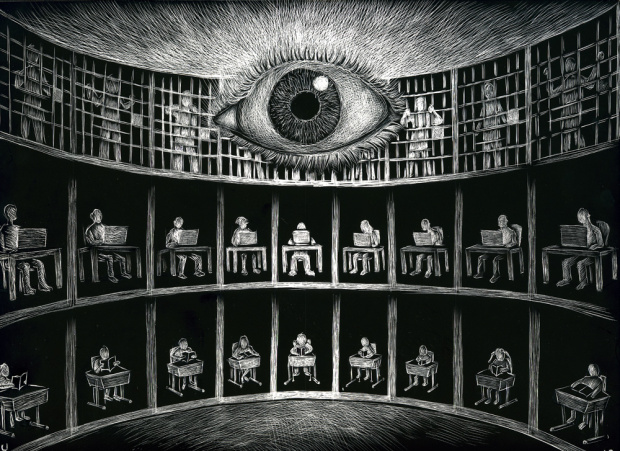
In this age of ubiquitous surveillance, there are no private lives: everything is public.

Surveillance cameras mounted on utility poles, traffic lights, businesses, and homes. License plate readers. Ring doorbells. GPS devices. Dash cameras. Drones. Store security cameras. Geofencing and geotracking. FitBits. Alexa. Internet-connected devices.  

There are roughly one billion surveillance cameras worldwide and that number continues to grow, thanks to their wholehearted adoption by governments (especially law enforcement and military agencies), businesses, and individual consumers.

With every new surveillance device we welcome into our lives, the government gains yet another toehold into our private worlds.

Indeed, empowered by advances in surveillance technology and emboldened by rapidly expanding public-private partnerships between law enforcement, the Intelligence Community, and the private sector, police have become particularly adept at sidestepping the Fourth Amendment.

As law professor Avidan Y. Cover explains:

A key feature of the surveillance state is the cooperative relationship between the private sector and the government. The private sector’s role is vital to the surveillance both practically and legally. The private sector, of course, provides the infrastructure and tools for the surveillance… The private sector is also critical to the surveillance state’s legality. Under the third-party doctrine, the Fourth Amendment is not implicated when the government acquires information that people provide to corporations, because they voluntarily provide their information to another entity and assume the risk that the entity will disclose the information to the government. Therefore, people do not have a reasonable expectation of privacy in their calling data, or potentially even their emails. As a result, the government does not normally need a warrant to obtain information transmitted electronically. But the Fourth Amendment is not only a source of protection for individual privacy; it also limits government excess and abuse through challenges by the people. The third-party doctrine removes this vital and populist check on government overreach.

Critical to this end run around the Fourth Amendment’s prohibitions against unreasonable searches and seizures by government agents is a pass play that allows police to avoid public transparency requirements (open bids, public meetings, installation protocols) by having private companies and individuals do the upfront heavy lifting, leaving police to harvest the intel on the back end.

Stingray devices, facial recognition technology, body cameras, automated license plate readers, gunshot detection, predictive policing software, AI-enhanced video analytics, real-time crime centers, fusion centers: all of these technologies and surveillance programs rely on public-private partnerships that together create a sticky spiderweb from which there is no escape.

As the cost of these technologies becomes more affordable for the average consumer, an effort underwritten by the tech industry and encouraged by law enforcement agencies and local governing boards, which in turn benefit from access to surveillance they don’t need to include in their budgets, big cities, small towns, urban, suburban and rural communities alike are adding themselves to the surveillance state’s interconnected grid.

What this adds up to for government agencies (that is, FBI, NSA, DHS agents, etc., as well as local police) is a surveillance map that allows them to track someone’s movements over time and space, hopscotching from doorbell camera feeds and business security cameras to public cameras on utility poles, license plate readers, traffic cameras, drones, etc.

It has all but eliminated the notion of privacy and radically re-drawn the line of demarcation between our public and private selves.

Over the past 50 years, surveillance has brought about a series of revolutions in how governments govern and populations are policed to the detriment of us all. Cybersecurity expert Adam Scott Wandt has identified three such revolutions.

The first surveillance revolution came about as a result of government video cameras being installed in public areas. There were a reported 51 million surveillance cameras blanketing the United States in 2022. It’s estimated that Americans are caught on camera an average of 238 times every week (160 times per week while driving; 40 times per week at work; 24 times per week while out running errands and shopping; and 14 times per week through various other channels and activities). That doesn’t even touch on the coverage by surveillance drones, which remain a relatively covert part of police spying operations.

The second revolution occurred when law enforcement agencies started forging public-private partnerships with commercial establishments like banks and drug stores and parking lots in order to gain access to their live surveillance feeds. The use of automatic license plate readers (manufactured and distributed by the likes of Flock Safety), once deployed exclusively by police and now spreading to home owners associations and gated communities, extends the reach of the surveillance state that much further afield. It’s a win-win for police budgets and local legislatures when they can persuade businesses and residential communities to shoulder the costs of the equipment and share the footage, and they can conscript the citizenry to spy on each other through crowdsourced surveillance.

The third revolution was ushered in with the growing popularity of doorbell cameras such as Ring, Amazon’s video surveillance doorbell, and Google’s Nest Cam.

Amazon has been particularly aggressive in its pursuit of a relationship with police, enlisting them in its marketing efforts, and going so far as to hosting parties for police, providing free Ring doorbells and deep discounts, sharing “active camera” maps of Ring owners, allowing access to the Law Enforcement Neighborhood Portal, which enables police to directly contact owners for access to their footage, and coaching police on how to obtain footage without a warrant.

Ring currently partners with upwards of 2,161 law enforcement agencies and 455 fire departments, and that number grows exponentially every year. As Vice reports, “Ring has also heavily pursued city discount programs and private alliances with neighborhood watch groups. When cities provide free or discounted Ring cameras, they sometimes create camera registries, and police sometimes order people to aim Ring cameras at their neighbors, or only give cameras to people surveilled by neighborhood watches.”

In November 2022, San Francisco police gained access to the live footage of privately owned internet cameras as opposed to merely being able to access recorded footage. No longer do police even have to request permission of homeowners for such access: increasingly, corporations have given police access to footage as part of their so-called criminal investigations with or without court orders.

We would suggest a fourth revolutionary shift to be the use of facial recognition software and artificial intelligence-powered programs that can track people by their biometrics, clothing, behavior and car, thereby synthesizing the many strands of surveillance video footage into one cohesive narrative, which privacy advocates refer to as 360 degree surveillance.

Finally, Wandt sees autonomous cars equipped with cameras that record everything around them as yet another revolutionary expansion of surveillance to be tapped by police.

Yet in the present moment, it’s those public-private partnerships that signify a watershed moment in the transition from a police state to a surveillance state and sound a death knoll for our privacy rights. This fusion of government power and private power is also at the heart of the surveillance state’s growing stranglehold on the populace.

As always, these intrusions into our personal lives are justified in the name of national security and fighting crime. Yet while the price to be paid for having the government’s so-called protection is nothing less than our right to privacy, the guarantee of safety remains dubious, at best.

As a study on camera surveillance by researchers at City University of New York concluded, the presence of cameras were somewhat effective as a deterrent for crimes such as car burglaries and property theft, but they had no significant effect on violent crimes.

On the other hand, when you combine overcriminalization with wall-to-wall surveillance monitored by police in pursuit of crimes, the resulting suspect society inevitably gives way to a nation of criminals. In such a society, we are all guilty of some crime or other.

The predatory effect of these surveillance cameras has also yet to be fully addressed, but they are vulnerable to being hacked by third parties and abused by corporate and government employees.

After all, power corrupts. We’ve seen this abuse of power recur time and time again throughout history. For instance, as an in-depth investigative report by the Associated Press concludes, the very same mass surveillance technologies that were supposedly so necessary to fight the spread of COVID-19 are now being used to stifle dissent, persecute activists, harass marginalized communities, and link people’s health information to other surveillance and law enforcement tools. As the AP reports, federal officials have also been looking into how to add “‘identifiable patient data,’ such as mental health, substance use and behavioral health information from group homes, shelters, jails, detox facilities and schools,” to its surveillance toolkit.

These cameras—and the public-private eyes peering at us through them—are re-engineering a society structured around the aesthetic of fear and, in the process, empowering “people to not just watch their neighborhood, but to organize as watchers,” creating not just digital neighborhood watches but digital gated communities.

Finally, there is a repressive, suppressive effect to surveillance that not only acts as a potentially small deterrent on crime but serves to monitor and chill lawful First Amendment activity. As Matthew Feeney warns in the New York Times, “In the past, Communists, civil rights leaders, feminists, Quakers, folk singers, war protesters and others have been on the receiving end of law enforcement surveillance. No one knows who the next target will be.

No one knows, but it’s a pretty good bet that the surveillance state will be keeping a close watch on anyone seen as a threat to the government’s chokehold on power.

It’s George Orwell’s 1984 on a global scale.

As I make clear in my book Battlefield America: The War on the American People and in its fictional counterpart The Erik Blair Diaries, Orwell’s dystopian nightmare has become our looming reality.

Don’t Trust the Government with Your Privacy, Property or Your Freedoms

By John & Nisha Whitehead

Source: The Rutherford Institute

How do you trust a government that continuously sidesteps the Constitution and undermines our rights? You can’t.

When you consider all the ways “we the people” are being bullied, beaten, bamboozled, targeted, tracked, repressed, robbed, impoverished, imprisoned and killed by the government, one can only conclude that you shouldn’t trust the government with your privacy, your property, your life, or your freedoms.

Consider for yourself.

Don’t trust the government with your privacy, digital or otherwise. In the two decades since 9/11, the military-security industrial complex has operated under a permanent state of emergency that, in turn, has given rise to a digital prison that grows more confining and inescapable by the day. Wall-to wall surveillance, monitored by AI software and fed to a growing network of fusion centers, render the twin concepts of privacy and anonymity almost void. By conspiring with corporations, the Department of Homeland Security “fueled a massive influx of money into surveillance and policing in our cities, under a banner of emergency response and counterterrorism.” For instance, all across the country, police are installing Flock Safety license plate readers as part of a public-private partnership program between police and the surveillance industry. These cameras, which upload data in real time to fusion crime centers, signal a turning point in the transition from a police state to a police-driven surveillance state.

Don’t trust the government with your property. In yet another effort to legitimize warrantless searches, police are employing “hit-and-hold” tactics in which police enter a home, carry out an initial sweep of the property, handcuff the occupants, then wait for official search warrants to be secured and applied retroactively. In the meantime, police have managed to bypass the Fourth Amendment. The rationale, to prevent possible destruction of evidence, is the same one used to deadly effect with no-knock raids. If government agents can invade your home, break down your doors, kill your dog, damage your furnishings and terrorize your family, your property is no longer private and secure—it belongs to the government. Hard-working Americans are having their bank accounts, homes, cars electronics and cash seized by police under the assumption that they have allegedly been associated with some criminal scheme.

Don’t trust the government with your finances. The U.S. government—and that includes the current administration—is spending money it doesn’t have on programs it can’t afford, and “we the taxpayers” are being forced to foot the bill for the government’s fiscal insanity. The national debt is $31.3 trillion and growing, and we’re paying more than $300 billion in interest every year on that public debt, yet there seems to be no end in sight when it comes to the government’s fiscal insanity. According to Forbes, Congress has raised, extended or revised the definition of the debt limit 78 times since 1960 in order to allow the government to essentially fund its existence with a credit card.

Don’t trust the government with your health. For all intents and purposes, “we the people” have become lab rats in the government’s secret experiments, which include MKULTRA and the U.S. military’s secret race-based testing of mustard gas on more than 60,000 enlisted men. Indeed, you don’t have to dig very deep or go very back in the nation’s history to uncover numerous cases in which the government deliberately conducted secret experiments on an unsuspecting populace—citizens and noncitizens alike—making healthy people sick by spraying them with chemicals, injecting them with infectious diseases and exposing them to airborne toxins. Unfortunately, the public has become so easily distracted by the political spectacle out of Washington, DC, that they are altogether oblivious to the grisly experiments, barbaric behavior and inhumane conditions that have become synonymous with the U.S. government, which has meted out untold horrors against humans and animals alike.

Don’t trust the government with your life: At a time when growing numbers of unarmed people have been shot and killed for just standing a certain way, or moving a certain way, or holding something—anything—that police could misinterpret to be a gun, or igniting some trigger-centric fear in a police officer’s mind that has nothing to do with an actual threat to their safety, even the most benign encounters with police can have fatal consequences. The number of Americans killed by police continues to grow, with the majority of those killed as a result of police encounters having been suspected of a non-violent offense or no crime at all, or during a traffic violation. According a report by Mapping Police Violence, police killed more people in 2022 than any other year within the past decade. In 98% of those killings, police were not charged with a crime.

Don’t trust the government with your freedoms. For years now, the government has been playing a cat-and-mouse game with the American people, letting us enjoy just enough freedom to think we are free but not enough to actually allow us to live as a free people. Freedom no longer means what it once did. This holds true whether you’re talking about the right to criticize the government in word or deed, the right to be free from government surveillance, the right to not have your person or your property subjected to warrantless searches by government agents, the right to due process, the right to be safe from militarized police invading your home, the right to be innocent until proven guilty and every other right that once reinforced the founders’ belief that this would be “a government of the people, by the people and for the people.” On paper, we may be technically free, but in reality, we are only as free as a government official may allow.

Whatever else it may be—a danger, a menace, a threat—the U.S. government is certainly not looking out for our best interests, nor is it in any way a friend to freedom.

Remember the purpose of a good government is to protect the lives and liberties of its people.

Unfortunately, what we have been saddled with is, in almost every regard, the exact opposite of an institution dedicated to protecting the lives and liberties of its people.

As I make clear in my book Battlefield America: The War on the American People and in its fictional counterpart The Erik Blair Diaries, “we the people” should have learned early on that a government that repeatedly lies, cheats, steals, spies, kills, maims, enslaves, breaks the laws, overreaches its authority, and abuses its power at almost every turn can’t be trusted.

ABOUT JOHN W. WHITEHEAD

Constitutional attorney and author John W. Whitehead is founder and president of The Rutherford Institute. His most recent books are the best-selling Battlefield America: The War on the American People, the award-winning A Government of Wolves: The Emerging American Police State, and a debut dystopian fiction novel, The Erik Blair Diaries. Whitehead can be contacted at staff@rutherford.org. Nisha Whitehead is the Executive Director of The Rutherford Institute. Information about The Rutherford Institute is available at www.rutherford.org.

Why Orwell matters

His defence of freedom flies in the face of all that is woke and regressive today.

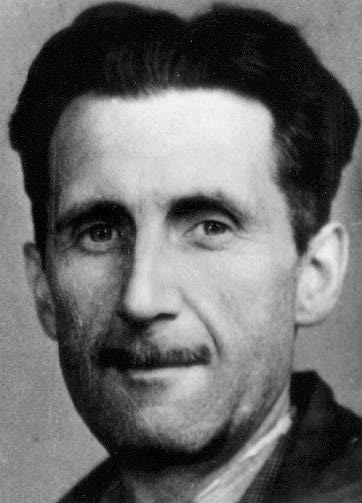
George Orwell aka Eric Blair (25 June 1903 – 21 January 1950)

By Bruno Waterfield

Source: Spike Online

Most people think that George Orwell was writing about, and against, totalitarianism – especially when they encounter him through the prism of his great dystopian novel, Nineteen Eighty-Four.

This view of Orwell is not wrong, but it can miss something. For Orwell was concerned above all about the particular threat posed by totalitarianism to words and language. He was concerned about the threat it posed to our ability to think and speak freely and truthfully. About the threat it posed to our freedom.

He saw, clearly and vividly, that to lose control of words is to lose control of meaning. That is what frightened him about the totalitarianism of Nazi Germany and Stalinist Russia – these regimes wanted to control the very linguistic substance of thought itself.

And that is why Orwell continues to speak to us so powerfully today. Because words, language and meaning are under threat once more.

Totalitarianism in Orwell’s time

The totalitarian regimes of Nazi Germany and Stalin’s Soviet Union represented something new and frightening for Orwell. Authoritarian dictatorships, in which power was wielded unaccountably and arbitrarily, had existed before, of course. But what made the totalitarian regimes of the 20th century different was the extent to which they demanded every individual’s complete subservience to the state. They sought to abolish the very basis of individual freedom and autonomy. They wanted to use dictatorial powers to socially engineer the human soul itself, changing and shaping how people think and behave.

Totalitarian regimes set about breaking up clubs, trade unions and other voluntary associations. They were effectively dismantling those areas of social and political life in which people were able to freely and spontaneously associate. The spaces, that is, in which local and national culture develops free of the state and officialdom. These cultural spaces were always tremendously important to Orwell. As he put it in his 1941 essay, ‘England Your England’: ‘All the culture that is most truly native centres round things which even when they are communal are not official – the pub, the football match, the back garden, the fireside and the “nice cup of tea”.’

Totalitarianism may have reached its horrifying zenith in Nazi Germany and Stalin’s USSR. But Orwell was worried about its effect in the West, too. He was concerned about the Sovietisation of Europe through the increasingly prominent and powerful Stalinist Communist Parties. He was also worried about what he saw as Britain’s leftwing ‘Europeanised intelligentsia’, which, like the Communist Parties of Western Europe, seemed to worship state power, particularly in the supranational form of the USSR. And he was concerned above all about the emergence of the totalitarian mindset, and the attempt to re-engineer the deep structures of mind and feeling that lie at the heart of autonomy and liberty.

Orwell could see this mindset flourishing among Britain’s intellectual elite, from the eugenics and top-down socialism of Fabians, like Sidney and Beatrice Webb and HG Wells, to the broader technocratic impulses of the intelligentsia in general. They wanted to remake people ‘for their own good’, or for the benefit of the race or state power. They therefore saw it as desirable to force people to conform to certain prescribed behaviours and attitudes. This threatened the everyday freedom of people who wanted, as Orwell put it, ‘the liberty to have a home of your own, to do what you like in your spare time, to choose your own amusements instead of having them chosen for you from above’.

In the aftermath of the Second World War, this new intellectual elite started to gain ascendancy. It was effectively a clerisy – a cultural and ruling elite defined by its academic achievements. It had been forged through higher education and academia rather than through traditional forms of privilege and wealth, such as public schools.

Orwell was naturally predisposed against this emergent clerisy. He may have attended Eton, but that’s where Orwell’s education stopped. He was not part of the clerisy’s world. He was not an academic writer, nor did he position himself as such. On the contrary, he saw himself as a popular writer, addressing a broad, non-university-educated audience.

Moreover, Orwell’s antipathy towards this new elite type was long-standing. He had bristled against the rigidity and pomposity of imperial officialdom as a minor colonial police official in Burma between 1922 and 1927. And he had always battled against the top-down socialist great and good, and much of academia, too, who were often very much hand in glove with the Stalinised left.

The hostility was mutual. Indeed, it accounts for the disdain that many academics and their fellow travellers continue to display towards Orwell today.

The importance of words

Nowadays we are all too familiar with this university-educated ruling caste, and its desire to control words and meaning. Just think, for example, of the way in which our cultural and educational elites have turned ‘fascism’ from a historically specific phenomenon into a pejorative that has lost all meaning, to be used to describe anything from Brexit to Boris Johnson’s Tory government – a process Orwell saw beginning with the Stalinist practice of calling Spanish democratic revolutionaries ‘Trotsky-fascists’ (which he documented in Homage to Catalonia (1938)).

Or think of the way in which our cultural and educational elites have transformed the very meanings of the words ‘man’ and ‘woman’, divesting them of any connection to biological reality. Orwell would not have been surprised by this development. In Nineteen Eighty-Four, he shows how the totalitarian state and its intellectuals will try to suppress real facts, and even natural laws, if they diverge from their worldview. Through exerting power over ideas, they seek to shape reality. ‘Power is in tearing human minds to pieces and putting them together in new shapes of your own choosing’, says O’Brien, the sinister party intellectual. ‘We control matter because we control the mind. Reality is inside the skull… You must get rid of these 19th-century ideas about the laws of nature.’

In Nineteen Eighty-Four, the totalitarian regime tries to subject history to similar manipulation. As anti-hero Winston Smith tells his lover, Julia:

‘Every record has been destroyed or falsified, every book has been rewritten, every picture has been repainted, every statue and street and building has been renamed, every date has been altered. And that process is continuing day by day and minute by minute. History has stopped. Nothing exists except an endless present in which the Party is always right.’

As Orwell wrote elsewhere, ‘the historian believes that the past cannot be altered and that a correct knowledge of history is valuable as a matter of course. From the totalitarian point of view history is something to be created rather than learned.’

This totalitarian approach to history is dominant today, from the New York Times’ 1619 Project to statue-toppling. History is something to be erased or conjured up or reshaped as a moral lesson for today. It is used to demonstrate the rectitude of the contemporary establishment.

But it is language that is central to Orwell’s analysis of this form of intellectual manipulation and thought-control. Take ‘Ingsoc’, the philosophy that the regime follows and enforces through the linguistic system of Newspeak. Newspeak is more than mere censorship. It is an attempt to make certain ideas – freedom, autonomy and so on – actually unthinkable or impossible. It is an attempt to eliminate the very possibility of dissent (or ‘thoughtcrime’).

As Syme, who is working on a Newspeak dictionary, tells Winston Smith:

‘The whole aim… is to narrow the range of thought. In the end we shall make thoughtcrime literally impossible, because there will be no words in which to express it. Every year fewer and fewer words, and the range of consciousness always a little smaller… Has it ever occurred to you, Winston, that by the year 2050, at the very latest, not a single human being will be alive who could understand such a conversation as we are having now?’

The parallels between Orwell’s nightmarish vision of totalitarianism and the totalitarian mindset of today, in which language is policed and controlled, should not be overstated. In the dystopia of Nineteen Eighty-Four, the project of eliminating freedom and dissent, as in Nazi Germany or Stalinist Russia, was backed up by a brutal, murderous secret police. There is little of that in our societies today – people are not forcibly silenced or disappeared.

However, they are cancelled, pushed out of their jobs, and sometimes even arrested by the police for what amounts to thoughtcrime. And many more people simply self-censor out of fear of saying the ‘wrong’ thing. Orwell’s concern that words could be erased or their meaning altered, and thought controlled, is not being realised in an openly dictatorial manner. No, it’s being achieved through a creeping cultural and intellectual conformism.

The intellectual turn against freedom

But then that was always Orwell’s worry – that intellectuals giving up on freedom would allow a Big Brother Britain to flourish. As he saw it in The Prevention of Literature (1946), the biggest danger to freedom of speech and thought came not from the threat of dictatorship (which was receding by then) but from intellectuals giving up on freedom, or worse, seeing it as an obstacle to the realisation of their worldview.

Interestingly, his concerns about an intellectual betrayal of freedom were reinforced by a 1944 meeting of the anti-censorship organisation, English PEN. Attending an event to mark the 300th anniversary of Milton’s Areopagitica, Milton’s famous 1644 speech making the case for the ‘Liberty of Unlicenc’d Printing’, Orwell noted that many of the left-wing intellectuals present were unwilling to criticise Soviet Russia or wartime censorship. Indeed, they had become profoundly indifferent or hostile to the question of political liberty and press freedom.

‘In England, the immediate enemies of truthfulness, and hence of freedom of thought, are the press lords, the film magnates, and the bureaucrats’, Orwell wrote, ‘but that on a long view the weakening of the desire for liberty among the intellectuals themselves is the most serious symptom of all’.

Orwell was concerned by the increasing popularity among influential left-wing intellectuals of ‘the much more tenable and dangerous proposition that freedom is undesirable and that intellectual honesty is a form of anti-social selfishness’. The exercise of freedom of speech and thought, the willingness to speak truth to power, was even then becoming seen as something to be frowned upon, a selfish, even elitist act.

An individual speaking freely and honestly, wrote Orwell, is ‘accused of either wanting to shut himself up in an ivory tower, or of making an exhibitionist display of his own personality, or of resisting the inevitable current of history in an attempt to cling to unjustified privilege’.

These are insights which have stood the test of time. Just think of the imprecations against those who challenge the consensus. They are dismissed as ‘contrarians’ and accused of selfishly upsetting people.

And worst of all, think of the way free speech is damned as the right of the privileged. This is possibly one of the greatest lies of our age. Free speech does not support privilege. We all have the capacity to speak, write, think and argue. We might not, as individuals or small groups, have the platforms of a press baron or the BBC. But it is only through our freedom to speak freely that we can challenge those with greater power.

Orwell’s legacy

Orwell is everywhere today. He is taught in schools and his ideas and phrases are part of our common culture. But his value and importance to us lies in his defence of freedom, especially the freedom to speak and write.

His outstanding 1946 essay, ‘Politics and the English Language’, can actually be read as a freedom manual. It is a guide on how to use words and language to fight back.

Of course, it is attacked today as an expression of privilege and of bigotry. Author and commentator Will Self cited ‘Politics and the English Language’ in a 2014 BBC Radio 4 show as proof that Orwell was an ‘authoritarian elitist’. He said: ‘Reading Orwell at his most lucid you can have the distinct impression he’s saying these things, in precisely this way, because he knows that you – and you alone – are exactly the sort of person who’s sufficiently intelligent to comprehend the very essence of what he’s trying to communicate. It’s this the mediocrity-loving English masses respond to – the talented dog-whistler calling them to chow down on a big bowl of conformity.’

Lionel Trilling, another writer and thinker, made a similar point to Self, but in a far more insightful, enlightening way. ‘[Orwell] liberates us’, he wrote in 1952:

‘He tells us that we can understand our political and social life merely by looking around us, he frees us from the need for the inside dope. He implies that our job is not to be intellectual, certainly not to be intellectual in this fashion or that, but merely to be intelligent according to our lights – he restores the old sense of the democracy of the mind, releasing us from the belief that the mind can work only in a technical, professional way and that it must work competitively. He has the effect of making us believe that we may become full members of the society of thinking men. That is why he is a figure for us.’

Orwell should be a figure for us, too – in our battle to restore the democracy of the mind and resist the totalitarian mindset of today. But this will require having the courage of our convictions and our words, as he so often did himself. As he put it in The Prevention of Literature, ‘To write in plain vigorous language one has to think fearlessly’. That Orwell did precisely that was a testament to his belief in the public just as much as his belief in himself. He sets an example and a challenge to us all.

Prostitutes of the Press

By Stephen Lendman

Source: The Stephen Lendman Blog

Western MSM operate as fake news ministries of truth in nations where they’re located.

They’re bribed with big bucks to lie and mass-deceive by sticking exclusively to the fabricated official narrative.

On major world and national issues, what’s reported on TV, radio or in print is based on state-approved talking points.

Orwell long ago explained today’s reality, his no longer fiction dystopian “1984” novel saying the following:

“The Ministry of Peace concerns itself with war, the Ministry of Truth with lies, the Ministry of Love with torture and the Ministry of Plenty with starvation.” 

“These contradictions are not accidental, nor do they result from from ordinary hypocrisy.”

“They are deliberate exercises in doublethink.”

Orwell’s Ministry of Truth was all about controlling the message, eliminating whatever conflicts with it, memory holes used for this purpose.

What’s suppressed is “whirled away (in) enormous furnaces…devoured by flames,” Orwell, adding:

“(T)here were the directing brains who co-ordinated the whole effort and laid down policy which made it necessary that this fragment of the past should be preserved, that one falsified, and the other rubbed out of existence.”

No memory holes are needed today throughout the decadent, depraved West.

MSM operate as willing co-conspirators in support of manipulating the public mind with rubbish unfit to print or report electronically.

A daily diet of fake news over the real thing includes drug pushing by heavily promoting health-destroying kill shots, the scourge of Nazism in Ukraine and use of its criminal class for perpetual war on Russia because it’s free from hegemon USA control.

Truth and full disclosure are mortal enemies of peace, equity, justice, imperial rampaging and the rule of law.

So MSM are used to suppress what conflicts with the fabricated official narrative in support of hegemon USA-dominated NATO’s war on humanity domestically and worldwide.

Russia and China are targeted for regime change because they alone stand in the way of the US war party’s drive for unchallenged hegemony by a policy of perpetual war-making on invented enemies.

Throughout the US/West, free and open societies, including democracy as it should be, are virtually banned.

Nor do their ruling regimes tolerate these notions anywhere, targeting them for elimination where exist.

Yet state-approved MSM-proliferated fake news, information and opinion pretend otherwise.

Turning reality on its head and trampling on it, they pretend that Nazi-infested Ukraine is democratic, that its battered and degraded military is defeating overwhelmingly superior Russian firepower.

And well over $100 billion worth of weapons, munitions and equipment supplied to Ukrainian Nazis by US/Western regimes since 2014 were largely destroyed by Russia or resold by Kiev kleptocrats for self-enrichment.

Unable to defeat Russia’s military superiority on the battlefield, regime troops largely focus on terror-shelling of its residential areas in Donetsk, Lugansk and elsewhere to kill, injure and terrorize noncombatants in harm’s way.

Yet US/Western regimes, Kiev Nazis and their MSM press agents falsely blame Russia for war crimes committed against the state and its people.

There’s been no ambiguity about the ability of Russian forces to demilitarize and deNazify Ukraine from day-one of its liberating SMO.

And sanctions war on Russia by US/Western regimes is deindustrializing Europe as planned by the empire of lies, while leaving the Russian Federation largely unscathed. 

Separately on Wednesday, Sergey Lavrov stressed the following:

Hegemon USA-dominated Western regimes “closed ranks” against Russia.

“Their mentality of domination” is hard-wired with no signs of “moderat(ing).”

Russia is “at war with the collective West led by” nuclear armed and recklessly dangerous USA.

“China is next in line.”

“It poses the most formidable and systemic longterm challenge and is the only country capable of surpassing (hegemon USA) in almost all areas” to eventually become the dominant world power politically, economically, financially and militarily.

The notion has both wings of the US war party planning for war on a nation it cannot win.

Yet with Taiwan as an invented pretext like Ukraine is used against Russia, the threat of war on China by the empire of lies is ominously real. 

Built on a one-China foundation a half century ago, normalized Sino/US relations no longer exist.

A state of war exists by hegemon USA against nonthreatening Russia, China earmarked for regime change by its war party in similar fashion.

Brave new dystopian world order proponent/notorious international con man, George Soros, once said we need a global sheriff.

Did he have hegemon USA or himself in mind by enforcing a policy of perpetual war on humanity?

Yes, Jesus Would Have Been Branded a Domestic Extremist Today

By John & Nisha Whitehead

Source: The Rutherford Institute

“When the song of the angels is stilled, when the star in the sky is gone, when the kings and princes are home, when the shepherds are back with their flocks, the work of Christmas begins: to find the lost, to heal the broken, to feed the hungry, to release the prisoner, to rebuild the nations, to bring peace among the people, to make music in the heart.”—Howard Thurman, theologian and civil rights activist

The Christmas story of a baby born in a manger is a familiar one.

The Roman Empire, a police state in its own right, had ordered that a census be conducted. Joseph and his pregnant wife Mary traveled to the little town of Bethlehem so that they could be counted. There being no room for the couple at any of the inns, they stayed in a stable (a barn), where Mary gave birth to a baby boy, Jesus. Warned that the government planned to kill the baby, Jesus’ family fled with him to Egypt until it was safe to return to their native land.

Yet what if Jesus had been born 2,000 years later.

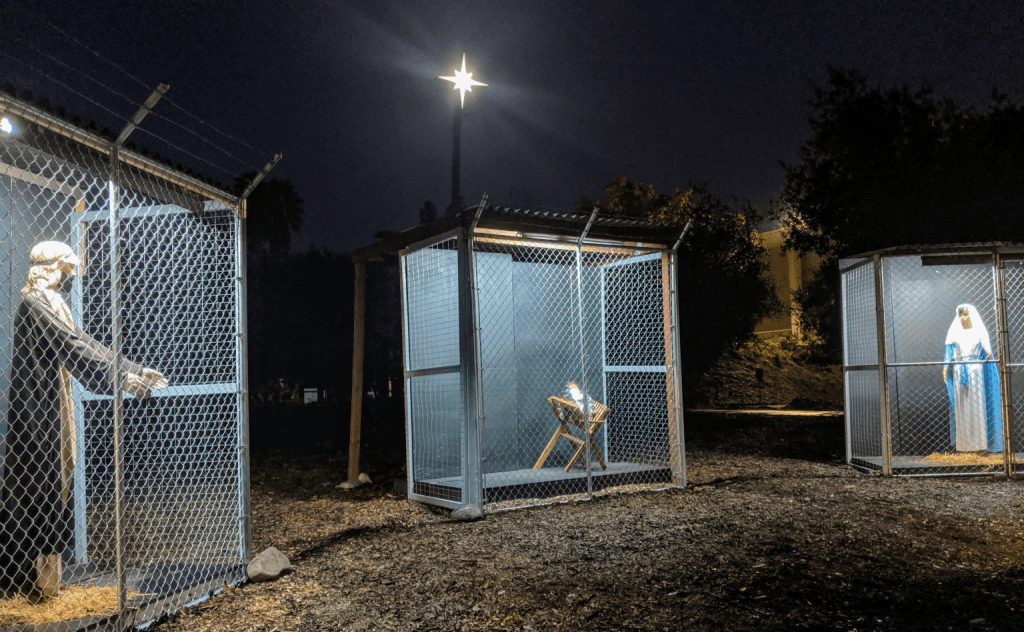
What if, instead of being born into the Roman police state, Jesus had been born at this moment in time? What kind of reception would Jesus and his family be given? Would we recognize the Christ child’s humanity, let alone his divinity? Would we treat him any differently than he was treated by the Roman Empire? If his family were forced to flee violence in their native country and sought refuge and asylum within our borders, what sanctuary would we offer them?A singular number of churches across the country have asked those very questions in recent years, and their conclusions were depicted with unnerving accuracy by nativity scenes in which Jesus and his family are separated, segregated and caged in individual chain-link pens, topped by barbed wire fencing.

Those nativity scenes were a pointed attempt to remind the modern world that the narrative about the birth of Jesus is one that speaks on multiple fronts to a world that has allowed the life, teachings and crucifixion of Jesus to be drowned out by partisan politics, secularism, materialism and war, all driven by a manipulative shadow government called the Deep State.

The modern-day church has largely shied away from applying Jesus’ teachings to modern problems such as war, poverty, immigration, etc., but thankfully there have been individuals throughout history who ask themselves and the world: what would Jesus do.

What would Jesus—the baby born in Bethlehem who grew into an itinerant preacher and revolutionary activist, who not only died challenging the police state of his day (namely, the Roman Empire) but spent his adult life speaking truth to power, challenging the status quo of his day, and pushing back against the abuses of the Roman Empire—do about the injustices of our  modern age.

Dietrich Bonhoeffer asked himself what Jesus would have done about the horrors perpetrated by Hitler and his assassins. The answer: Bonhoeffer was executed by Hitler for attempting to undermine the tyranny at the heart of Nazi Germany.

Aleksandr Solzhenitsyn asked himself what Jesus would have done about the soul-destroying gulags and labor camps of the Soviet Union. The answer: Solzhenitsyn found his voice and used it to speak out about government oppression and brutality.

Martin Luther King Jr. asked himself what Jesus would have done about America’s warmongering. The answer: declaring “my conscience leaves me no other choice,” King risked widespread condemnation as well as his life when he publicly opposed the Vietnam War on moral and economic grounds.

Even now, despite the popularity of the phrase “What Would Jesus Do?” (WWJD) in Christian circles, there remains a disconnect in the modern church between the teachings of Christ and the suffering of what Jesus in Matthew 25 refers to as the “least of these.

Yet this is not a theological gray area: Jesus was unequivocal about his views on many things, not the least of which was charity, compassion, war, tyranny and love.

After all, Jesus—the revered preacher, teacher, radical and prophet—was born into a police state not unlike the growing menace of the American police state. When he grew up, he had powerful, profound things to say, things that would change how we view people, alter government policies and change the world. “Blessed are the merciful,” “Blessed are the peacemakers,” and “Love your enemies” are just a few examples of his most profound and revolutionary teachings.

When confronted by those in authority, Jesus did not shy away from speaking truth to power. Indeed, his teachings undermined the political and religious establishment of his day. It cost him his life. He was eventually crucified as a warning to others not to challenge the powers-that-be.

Can you imagine what Jesus’ life would have been like if, instead of being born into the Roman police state, he had been born and raised in the American police state.

Consider the following if you will.

Had Jesus been born in the era of the America police state, rather than traveling to Bethlehem for a census, Jesus’ parents would have been mailed a 28-page American Community Survey, a mandatory government questionnaire documenting their habits, household inhabitants, work schedule, how many toilets are in your home, etc. The penalty for not responding to this invasive survey can go as high as $5,000.

Instead of being born in a manger, Jesus might have been born at home. Rather than wise men and shepherds bringing gifts, however, the baby’s parents might have been forced to ward off visits from state social workers intent on prosecuting them for the home birth. One couple in Washington had all three of their children removed after social services objected to the two youngest being birthed in an unassisted home delivery.

Had Jesus been born in a hospital, his blood and DNA would have been taken without his parents’ knowledge or consent and entered into a government biobank. While most states require newborn screening, a growing number are holding onto that genetic material long-term for research, analysis and purposes yet to be disclosed.

Then again, had Jesus’ parents been undocumented immigrants, they and the newborn baby might have been shuffled to a profit-driven, private prison for illegals where they first would have been separated from each other, the children detained in make-shift cages, and the parents eventually turned into cheap, forced laborers for corporations such as Starbucks, Microsoft, Walmart, and Victoria’s Secret. There’s quite a lot of money to be made from imprisoning immigrants, especially when taxpayers are footing the bill.

From the time he was old enough to attend school, Jesus would have been drilled in lessons of compliance and obedience to government authorities, while learning little about his own rights. Had he been daring enough to speak out against injustice while still in school, he might have found himself tasered or beaten by a school resource officer, or at the very least suspended under a school zero tolerance policy that punishes minor infractions as harshly as more serious offenses.

Had Jesus disappeared for a few hours let alone days as a 12-year-old, his parents would have been handcuffed, arrested and jailed for parental negligence. Parents across the country have been arrested for far less “offenses” such as allowing their children to walk to the park unaccompanied and play in their front yard alone.

Rather than disappearing from the history books from his early teenaged years to adulthood, Jesus’ movements and personal data—including his biometrics—would have been documented, tracked, monitored and filed by governmental agencies and corporations such as Google and Microsoft. Incredibly, 95 percent of school districts share their student records with outside companies that are contracted to manage data, which they then use to market products to us.

From the moment Jesus made contact with an “extremist” such as John the Baptist, he would have been flagged for surveillance because of his association with a prominent activist, peaceful or otherwise. Since 9/11, the FBI has actively carried out surveillance and intelligence-gathering operations on a broad range of activist groups, from animal rights groups to poverty relief, anti-war groups and other such “extremist” organizations.

Jesus’ anti-government views would certainly have resulted in him being labeled a domestic extremist. Law enforcement agencies are being trained to recognize signs of anti-government extremism during interactions with potential extremists who share a “belief in the approaching collapse of government and the economy.

While traveling from community to community, Jesus might have been reported to government officials as “suspicious” under the Department of Homeland Security’s “See Something, Say Something” programs. Many states, including New York, are providing individuals with phone apps that allow them to take photos of suspicious activity and report them to their state Intelligence Center, where they are reviewed and forwarded to law-enforcement agencies.

Rather than being permitted to live as an itinerant preacher, Jesus might have found himself threatened with arrest for daring to live off the grid or sleeping outside. In fact, the number of cities that have resorted to criminalizing homelessness by enacting bans on camping, sleeping in vehicles, loitering and begging in public has doubled.

Viewed by the government as a dissident and a potential threat to its power, Jesus might have had government spies planted among his followers to monitor his activities, report on his movements, and entrap him into breaking the law. Such Judases today—called informants—often receive hefty paychecks from the government for their treachery.

Had Jesus used the internet to spread his radical message of peace and love, he might have found his blog posts infiltrated by government spies attempting to undermine his integrity, discredit him or plant incriminating information online about him. At the very least, he would have had his website hacked and his email monitored.

Had Jesus attempted to feed large crowds of people, he would have been threatened with arrest for violating various ordinances prohibiting the distribution of food without a permit. Florida officials arrested a 90-year-old man for feeding the homeless on a public beach.

Had Jesus spoken publicly about his 40 days in the desert and his conversations with the devil, he might have been labeled mentally ill and detained in a psych ward against his will for a mandatory involuntary psychiatric hold with no access to family or friends. One Virginia man was arrested, strip searched, handcuffed to a table, diagnosed as having “mental health issues,” and locked up for five days in a mental health facility against his will apparently because of his slurred speech and unsteady gait.

Without a doubt, had Jesus attempted to overturn tables in a Jewish temple and rage against the materialism of religious institutions, he would have been charged with a hate crime. More than 45 states and the federal government have hate crime laws on the books.

Had anyone reported Jesus to the police as being potentially dangerous, he might have found himself confronted—and killed—by police officers for whom any perceived act of non-compliance (a twitch, a question, a frown) can result in them shooting first and asking questions later.

Rather than having armed guards capture Jesus in a public place, government officials would have ordered that a SWAT team carry out a raid on Jesus and his followers, complete with flash-bang grenades and military equipment. There are upwards of 80,000 such SWAT team raids carried out every year, many on unsuspecting Americans who have no defense against such government invaders, even when such raids are done in error.

Instead of being detained by Roman guards, Jesus might have been made to “disappear” into a secret government detention center where he would have been interrogated, tortured and subjected to all manner of abuses. Chicago police have “disappeared” more than 7,000 people into a secret, off-the-books interrogation warehouse at Homan Square.

Charged with treason and labeled a domestic terrorist, Jesus might have been sentenced to a life-term in a private prison where he would have been forced to provide slave labor for corporations or put to death by way of the electric chair or a lethal mixture of drugs.

Indeed, as I make clear in my book Battlefield America: The War on the American People and in its fictional counterpart The Erik Blair Diaries, given the nature of government then and now, it is painfully evident that whether Jesus had been born in our modern age or his own, he still would have died at the hands of a police state.

Thus, as we draw near to Christmas with its celebration of miracles and promise of salvation, we would do well to remember that what happened in that manger on that starry night in Bethlehem is only the beginning of the story. That baby born in a police state grew up to be a man who did not turn away from the evils of his age but rather spoke out against it.

We must do no less.

Hunting the Twitter Files

Legacy Media Censor Details About Censorship

By Nolan Higdon

Source: Project Censored

More than two years since Big Tech made the historic decision to limit access to the New York Post’s story about President Joe Biden’s son Hunter, users are getting a glimpse into how Twitter came to that decision. However, delusional legacy and social media outlets are doing everything they can to misrepresent and bury the consequential details of the process.

An October 2020 New York Post story titled “Smoking-gun email reveals how Hunter Biden introduced Ukrainian businessman to VP dad” offered sensationalistic photos and details of Hunter’s addiction issues coupled with damning emails indicating that Hunter utilized his connection with his father to curry favor and economic opportunity in foreign countries. At the time, intelligence officials told members of the press that the story was Russian propaganda aimed at influencing that year’s election. As a result, Big Tech platforms limited access to the story including in direct messages which is usually done only in extreme cases such as child pornography.

On Friday, December 2, 2022, Elon Musk promised to release files related to the matter. Soon afterward, journalist Matt Taibbi published a report based on thousands of internal Twitter documents. Taibbi demonstrated that Twitter’s decision to remove the Hunter Biden story was influenced in part by Biden’s campaign. Indeed, as Taibbi described, Twitter’s staff regularly fields phone calls from powerful people in government and acts upon their requests to moderate content. And it’s is not just Twitter. During a 2022 interview with Joe Rogan, co-founder, chairman, and CEO of Meta (formerly Facebook) Mark Zuckerberg admitted that his company’s decision to moderate content – including the 2020 Hunter story – is sometimes based on recommendations from the intelligence community. Similarly, The Intercept reported in 2022 that the Department of Homeland Security regularly informs Big Tech’s content moderation practices.

In any other country, the revelation that government and Big Tech collude to shape public discourse and democratic participation would make Americans irate, but the story has received little coverage. The coverage received by legacy media has been dismissive. CNN reduced the files as simply showing “how employees debated how to handle 2020 New York Post Hunter Biden story.” Variety echoed the same sentiments. Meanwhile, giving readers less than 24-hours to process what Taibbi reported, WAPO declared that Musk’s Twitter Files “haven’t changed minds.”

The lack of substantive coverage of the Twitter Files is rooted in the legacy media’s fears over the broader implications of the story. Since 2015, legacy media have been fostering a moral panic over fake news and blamed their competition – digital media – for its spread. They have practically begged Big Tech overlords to fix the country and restore faith in journalism by censoring problematic content, which they often refer to as misinformation or disinformation. Taibbi’s reporting demonstrates that the news media’s framing of Big Tech content moderation as a solution to anti-democratic practices, actually functioned as an anti-democratic position that enables the elite political class to shape public dialogue and manufacture consent of the electorate.

Adding to the news media’s inability to cover the story is their business model which depends on framing every story as an issue of left versus right, blue versus red, Democrat versus Republican. Indeed, whether it is cable news audiences or legacy newspaper subscribers, news outlets cater to audiences’ confirmation biases by villainizing a caricature of the “otherside.” This has reduced every story to a partisan issue, and fostered such high levels of hyper-partisanship vitriol that half of Americans cite “other Americans” as their number one fear, while 40% contend that a civil war will occur in their lifetime.

Although they still try, the legacy media has found it impossible to frame the Twitter Files as a hyper-partisan story because the political duopoly, not one party, utilizes Big Tech to manufacture the consent of the people. For example, Big Tech’s content moderation of was influenced by Biden’s Campaign in 2020 and leading Democrats after January 6th. Similarly, Donald Trump’s campaign spent $100 million to work with Facebook staff to amplify their campaign messages, and Trump met personally with Zuckerberg in secret meetings throughout his presidency. Furthermore, legacy news media outlets cannot villainize the “other side” for censorship when loyalists for both parties are complicit. Indeed, the feckless liberals who begged Big Tech overlords to censor content about elections and Covid-19 are equally complicit as the neocons who championed censorship of the press and individuals, and organizations during the War on Terror and Trump supporters who lauded his attacks on the free press and whistleblowers such as Julian Assange.

Anyone can, and will, argue that Hunter’s photos are not newsworthy, but that is for the citizens to decide when they encounter the story. That is how a free press in a democratic republic works. A democracy does not depend on Big Tech overlords acting at the behest of the political class to determine what content the public should see. The notion that censorship will erode hate, correct falsehoods, or solve national problems is a fallacy of utmost proportions.  The contemporary censorious crowd seems to be in such a state of delusion that they have come to believe that World War II and the Holocaust could have been avoided if Twitter was around to censor Nazis. It is ludicrous and the establishment news media deserve part of the blame for perpetuating this lunacy.

A truly independent press would privilege narratives that expose Silicon Valley propaganda, which has led users of all political ideologies to a delusional state of Stockholm Syndrome, where Big Tech exploits their labor, erodes their privacy, and manufactures their consent for the duopoly, but users still laud and entrust the industry with their democracy. To be clear, Big Tech commercialized tools that were developed by the military industrial complex during the Cold War (which was not so cold in much of the world) to surveil and exploit users. They advertised their platforms as transformative tools that strengthen democracy and inclusion. As whistleblower after whistleblower remind us, this is all nonsense: Big Tech’s oligarchs are rapacious capitalists who time and time again put profits over people. No entity should be moderating information in a democracy, and as the Twitter Files reveal, the unaccountable profiteers in Big Tech are no exception.

Related Video: