How Facebook Has Become The Strategic Media Mouthpiece For The Global Elite

By Richard Enos

Source: Collective Evolution

It’s not clear whether Facebook was truly conceived by an innocent genius with noble intent, but one fact has become abundantly clear: Facebook is now a mouthpiece and tool for the proliferation of mainstream perception. This is specifically designed to enrich the global elite and continue to disenfranchise ordinary citizens and any attempts to bring important truths to light that would threaten the elite. And, of course, Mark Zuckerberg is now a ‘junior partner’ in this global elite.

The episode of the Jimmy Dore show found in the video below, which is worth watching to get the full context of the discussion, introduces whistleblower Vikram Kumar, a former promoter of third-party videos on Facebook. Dore brings interesting insights into Facebook’s latest strategies in terms of controlling the news commentary. He explains how Facebook is proliferating the establishment’s narrative while limiting and blocking alternative voices which, of course, Facebook characterizes as ‘Fake News’. Here, Kumar discusses Mark Zuckerberg’s testimony in Congress to this effect:

Back in 2017 there was that TechCrunch report that said that Facebook was taking measures to stop the spread of ‘Fake News’ by banning certain political accounts from promoting their videos on their newsfeed. So when I heard Mark Zuckerberg in 2018 telling Congress that he would be doing the same thing, I thought, what changed between 2017 and 2018? Are they taking new measures, are they re-taking the measures?  And it wasn’t until a week later that I realized that Variety Magazine reported that Facebook Watch, which is Facebook’s media platform, had reached a multi-million dollar deal with CNN, Fox News, ABC, and large media outlets.

The congressional testimony was the perfect opportunity for the political establishment, the media establishment, and the tech companies to form an alliance against small media outlets.


One of the biggest issues to remedy was the lack of viewership that traditional mainstream media was getting from young people, which is really the target market not only for advertisers but the social engineering wing of the global elite as well. Here’s how Kumar describes it:

As you know, young people, they don’t watch cable… the viewership of Fox News, CNN, and ABC are dying off, they’re getting older and older, and so what Facebook is, is access to young people, right, and so they viewed small anti-establishment media outlets such as yourself as an existential threat to their next generation of revenue.

Tech companies view media companies extremely valuably, you could go back to 1996, there was that merger between Microsoft, General Electric and NBC to create MSNBC.com. A lot of people don’t know that the ‘MS’ in MSNBC stands for Microsoft, and the reason why media companies and tech companies are so intertwined with each other is ’cause you can influence young people so much when you have the distribution network of something like Facebook, and with Facebook Watch, and their media platform, and their deal with CNN, Fox News, and ABC, they’re able to indoctrinate the next generation of young people. And so they want to take viewership away from shows like yours, and put those young people that haven’t been paying attention with cable news back into the pockets of companies like Fox News, ABC, and CNN.

Every media company wants some of that Facebook Watch dough. And so the companies that have coverage that Facebook doesn’t like are out of there, and new companies that have coverage that Facebook likes are back into the deal. And so Facebook is already taking steps to craft the political landscape in the framing that they find positively. And so you get that whole thing where Facebook shuts down over 800 political pages and accounts, and even legitimate political pages that expose things like police brutality… you’re already seeing a coordinated effort from the establishment media and tech companies to kind of craft the narrative for young people.

This is how that Variety Magazine article Kumar talked about characterizes the deal between Facebook and Mainstream Media:

After going through the fake-news wringer, Facebook is shelling out money on original news content. The strategy is partly aimed at driving up viewing on its Facebook Watch platform — but it also is supposed to demonstrate the social-media giant’s commitment to funding trustworthy journalism.

A corporate conglomerate now giving itself the authority to judge what is and isn’t trustworthy journalism. What could possibly go wrong?

Is Facebook Still Just A Tech Company?

The slippery slope that Facebook is trying to anchor itself to is as clear as the nose on Mark Zuckerberg’s face. He continues to want us to think about Facebook as a social media platform whose objective is still ‘to make the world more open and connected,’ yet at the same time he wants Facebook to become the prime arbiter of the ‘news that is fit to print,’ or in this case, to decide which sources of news will benefit and not benefit from Facebook’s tremendous reach. The same Variety article reinforces the idea that Facebook is trying to have things both ways, gaining the advantages of defining itself as a tech company, and not taking on the liabilities inherent in being a media company:

In the past, CEO Mark Zuckerberg has remarked that Facebook is a technology company — not a media company. Asked whether Facebook is now in fact a media company, given that it’s paying for a growing slate of content, Brown responded, “Having worked for big media companies, I don’t think Facebook is a media company. But are we responsible for the media on Facebook? Yes.”

The fact is that we have entered into somewhat uncharted territory in terms of what defines a media company since the rise of the Internet. We can only hope that we will collectively awaken to the fact that Facebook has clearly gone beyond being a platform that provides equal access to all voices and commentaries, and has given in to the temptation to control the flow and proliferation of information. As this Wired article starts off,

FACEBOOK STEADFASTLY RESISTS categorization as a traditional media company. Instead, CEO Mark Zuckerberg insists on calling the social network a technology platform—even though nearly half of all American adults get their news on Facebook. These old arguments no longer work, especially as Facebook starts making its own video content.

It is incumbent upon the awakening community to clearly grasp what is happening here and to act accordingly in terms of our future engagement with social media sites like Facebook. It is important to see how Bill Clinton’s Telecommunications Act of 1996, which allowed media cross-ownership that led to mergers between tech companies and media companies, was a seed that has already started to bear the fruit of an Orwellian dystopia, where the global elite are permitted to continue to proliferate mainstream propaganda and limit exposure to alternative views that are a threat to their agenda.

Corporate America Is an Anti-Social Black Plague: Negative Network Effects Run Amok

By Charles Hugh Smith

Source: Of Two Minds

The anti-social carnage unleashed by Corporate America’s “lock-in” / negative network effects has no real limits.

Here’s the U.S.economy in a nutshell: Corporate America is an anti-social Black Plague, gorging on cartel-monopoly profits reaped from negative network effects running amok, enriching the few at the expense of the many and concentrating political power in the hands of the most rapacious, anti-democratic corporate sociopaths.

Let’s start with network effects: the conventional definition is “When a network effect is present, the value of a product or service increases according to the number of others using it.”

So for example, when telephone service was only available to a few users, its value was limited. As more people obtained telephone service, the value of the network increased to both its owners and to users, who could reach more people and conduct commerce more easily as a result of having telephone service.

In the conventional analysis, negative network effects occur from “congestion,” i.e. the network is adding new users so quickly that “more users make a product less valuable.”

But this superficial analysis misses the fatally anti-social consequences of corporate negative network effects, a dynamic described by analyst Simons Chase in this essay. Here is an excerpt:

Even the most imaginative and far-reaching narratives about non-obvious economic fragility and off balance sheet risks are mere rants without constructive ideas about causes and solutions.

Consider network effects, the popular economic construct applied to market concentration and increasing returns for strategies pursued by some leading tech companies. This dynamic economic agent is also known as demand side economies of scale.

W. Brian Arthur, the economist credited with first developing the theory, described the condition of increasing returns as a game of strategic positioning and building up a user base to the point where ‘lock in’ of dominant players occurs. Companies able to tap network effects have been rewarded with huge valuations and highly defensible businesses.

But what about negative network effects? What if the same dynamic applies to the U.S.’s pay-to-play political industry where the government promotes or approves of something through a policy, subsidy or financial guarantee due to private sector influence.

Benefits accrue only to the purchaser of the network effects, and consumers, induced by the false signal of large network size, ultimately suffer from asymmetric risk and experience what I’m calling a loss of intangible net worth for each additional member after the ‘bandwagon’ wares off.

If this were the case, then you would see companies experience rapid revenue growth (out of line with traditional asset leverage models), executives accumulating huge fortunes and political campaign coffers swelling.

But the most striking feature would be the anti-social outcomes, the ones not available without the instant critical mass of government-supported network effects, the ones that, at scale, monetize a society’s intangible net worth.

Some products tied to these metrics include: prescriptions drugs, junk food targeting children, mortgages, diplomas, and social media. The list of industries that are likely to have gained through the purchasing of network effects in D.C. maps closely to the decay that is visible in U.S. society.

The loss of intangible capital and other manifestations of non-obvious economic fragility (to use Simons’ apt phrase) is the subject of my latest book, Will You Be Richer or Poorer? Profit, Power and A.I. in a Traumatized World, in which I catalog the anti-social consequences of negative network effects and other forces eroding our nation’s intangible capital.

Consider Facebook, a classic case of negative network effects running amok, creating immensely anti-social consequences while reaping billions in profits: Facebook isn’t free speech, it’s algorithmic amplification optimized for outrage (TechCrunch.com).

The full social cost of social media’s negative network effects are difficult to tally, but studies have found that loneliness and alienation are correlated to how many hours a day individuals spend on social media. (An Internet search brings up dozens of reports such as NPR’s Feeling Lonely? Too Much Time On Social Media May Be Why.)

Facebook is trying to leverage its social media “lock-in” to issue its own global currency and both Facebook and Google are trying to offer banking services without any of the pesky regulations imposed on legitimate banks. (Will $10 million in lobbying do the trick? How about $100 million? We’ve got billions to “invest” in corrupting and controlling public agencies and political power.)

Once Corporate America locks in cartel-monopoly power, i.e. you have to use our services and products, the corporate sociopaths use their billions in market cap and profits to buy the sociopaths in government. Pay-to-play is the real political machinery; “democracy” is the PR fig-leaf to mask the private sector “lock-in” (monopoly) and the public-sector “lock-in” (regulatory influence, anti-competitive barriers to entry, the legalization of corporate fraud, cooking the books, embezzlement, etc.)

Consider Boeing, an effective monopoly which used $12 billion in profits to buy back its own shares and “invested” millions in buying political influence so it could minimize public-sector oversight.

Rather than spend the $12 billion designing a new safe aircraft, Boeing cobbled together a fatally flawed design dependent on software, as described in The Case Against Boeing (The New Yorker) to maximize the profitability of its “lock-in”.

Google is running amok on so many levels, it’s difficult to keep track of its anti-social “let’s be evil, it’s so incredibly profitable” agenda: Google’s Secret ‘Project Nightingale’ Gathers Personal Health Data on Millions of Americans (Wall Street Journal). The goal, of course, is to reap more billions in profits for insiders and corporate sociopaths.

The anti-social carnage unleashed by Corporate America’s “lock-in” / negative network effects has no real limits. Consider the essentially limitless private and social damage caused by Big Tech: Child Abusers Run Rampant as Tech Companies Look the Other Way (New York Times).

Then there’s the opioid epidemic, whose casualties run into the hundreds of thousands, an epidemic that was entirely a creature of Corporate America seeking to maximize “lock-in” profits by buying regulatory approval and pushing false claims that the corporate products were safe and non-addictive.

Note the media sources of these reports: these are the top tier of American journalism, not some easily dismissed alt-media source.

What does this tell us? It tells us the anti-social consequences are now so extreme and so apparent that the corporate media cannot ignore them. Once Corporate America locks-in market, financial and political power, it acts as a virulent Black Plague on the social order, legitimate democracy, and an entire spectrum of intangible social capital including the rule of law.

As Simons put it: “The ethical dimension underpinning the whole system is this: what’s moral is what’s legal and what’s legal is for sale.” Where does this Black Plague pathology take us? To a collapse of the status quo which enabled it, cheered it, and so richly rewarded it.

Social Media Censorship Reaches New Heights as Twitter Permanently Bans Dissent

Mnar Muhawesh speaks with journalist Daniel McAdams about being permanently banned from Twitter, social media censorship and more.

By Mnar Muhawesh

Source: Mint Press News

It’s an open secret. The deep state is working hand in hand with Silicon Valley social media giants like Twitter, Facebook and Google to control the flow of information. That includes suppressing, censoring and sometimes outright purging dissenting voices – all under the guise of fighting fake news and Russian propaganda.

Most recently, it was revealed that Twitter’s senior editorial executive for Europe, the Middle East and Africa is an active officer in the British Army’s 77th Brigade, a unit dedicated to online warfare and psychological operations.

In other words: he specializes in disseminating propaganda.

The news left many wondering how a member of the British Armed Forces secured such an influential job in the media.

The bombshell that one of the world’s most influential social networks is controlled in part by an active psychological warfare officer was not covered at all in the New York Times, CNN, CNBC, MSNBC or Fox News, who appear to have found the news unremarkable.

But for those paying attention and for those who have been following ’MintPress News’ extensive coverage of social media censorship, this revelation was merely another example of the increasing closeness between the deep state and the fourth estate.

Amazon owner, and world’s richest man, Jeff Bezos was paid $600 million by the CIA to develop software and media for the agency, that’s more than twice as much as Bezos bought the Washington Post for, and a move media critics warn spells the end of journalistic independence for the Post.

Meanwhile, Google has a very close relationship with the State Department, its former CEO Eric Schmidt’s book on technological imperialism was heartily endorsed by deep state warmongers like Henry Kissinger, Hillary Clinton and Tony Blair.

In their book titled, The New Digital Age: Reshaping the Future of People, Nations and Business, Eric Schmidt and fellow Google executive Jared Cohen wrote:

What Lockheed Martin was to the twentieth century…technology and cyber-security companies [like Google] will be to the twenty-first.”

Another social media giant partnering with the military-industrial complex is Facebook. The California-based company announced last year it was working closely with the neoconservative think tank, The Atlantic Council, which is largely funded by Saudi Arabia, Israel and weapons manufacturers to supposedly fight foreign “fake news.”

The Atlantic Council is a NATO offshoot and its board of directors reads like a rogue’s gallery of warmongers, including the notorious Henry Kissinger, Bush-era hawks like Condoleezza Rice, Colin Powell, James Baker, the former head of the Department of Homeland Security and author of the PATRIOT Act, Michael Chertoff, a number of former Army Generals including David Petraeus and Wesley Clark and former heads of the CIA Michael Hayden, Leon Panetta and Michael Morell.

39 percent of Americans, and similar numbers of people in other countries, get their news from Facebook, so when an organization like the Atlantic Council is controlling what the world sees in their Facebook news feeds, it can only be described as state censorship on a global level.

After working with the council, Facebook immediately began banning and removing accounts linked to media in official enemy states like Iran, Russia and Venezuela, ensuring the world would not be exposed to competing ideas and purging dissident voices under the guise of fighting “fake news” and “Russian bots.”

Meanwhile, the social media platform has been partnering with the U.S. and Israeli governments to silence Palestinian voices that show the reality of life under Israeli apartheid and occupation. The Israeli Justice Minister proudly revealed that Facebook complied with 95 percent of Israeli government requests to delete Palestinian pages. At the same time, Google deleted dozens of YouTube and blog accounts supposedly connected to the government of Iran.

In the last week alone, Twitter has purged several Palestinian news pages, including Quds News Network — without warning or explanation.

Electronic Intifada co-founder Ali Abunimah wrote, 

This alarming act of censorship is another indication of the complicity of major social media firms in Israel’s efforts to suppress news and information about its abuses of Palestinian rights.”

Alternative voices not welcome

The vast online purge of alternative voices has also been directed at internal “enemies.”

Publishers like Julian Assange and whistleblowers like Chelsea Manning are still being held in solitary confinement in conditions that international bodies and human rights groups call torture, for their crime of revealing the extent of the global surveillance network and the control over the media that Western governments have built.

As attempts to re-tighten the state and corporate grip over our means of communication increases, high-quality alternative media are being hit the hardest, as algorithm changes from the media monoliths have deranked, demoted, deleted and disincentivized outlets that question official narratives, leading to huge falls in traffic and revenue.

The message from social media giants is clear: independent and alternative voices are not welcome.

One causality in this propaganda war is Daniel McAdams, Executive Director of the Ron Paul Institute for Peace and Prosperity, a public advocacy group that argues that a non-interventionist foreign policy is crucial to securing a prosperous society at home. McAdams served as Senator Paul’s foreign affairs advisor between 2001 and 2012. Before that, he was a journalist and editor for the Budapest Sun and a human rights monitor across Eastern Europe.

McAdams, who spent much of his time on Twitter calling out the war machine supported by both parties, was recently permanently banned from the platform for so-called “hateful conduct.” His crime? Challenging Fox News anchor Sean Hannity over his hour-long segment claiming to be against the “deep state,” while simultaneously wearing a CIA lapel pin. In the exchange, McAdams called Hannity “retarded,” claiming he was becoming stupider every time he watched him.

Yes, despite that word and its derivatives having been used on Twitter over ten times in the previous minute, and often much more aggressively than McAdams used it – only McAdams fell victim to Twitter’s ban hammer. Something didn’t make sense about this ban. One only needs to read the replies under any of President Trump’s tweets to see far more hateful speech than what McAdams displayed to suspect foul play.

I spoke with McAdams about the ban and began by asking him if he accepts the premise of the ban, or if he believes something else was afoot.

The Tech Giants Are a Conduit for Fascism

By Michael Krieger

Source: Liberty Blitzkrieg

A second former Amazon employee would spark more controversy. Deap Ubhi, a former AWS employee who worked for Lynch, was tasked with gathering marketing information to make the case for a single cloud inside the DOD. Around the same time that he started working on JEDI, Ubhi began talking with AWS about rejoining the company. As his work on JEDI deepened, so did his job negotiations. Six days after he received a formal offer from Amazon, Ubhi recused himself from JEDI, fabricating a story that Amazon had expressed an interest in buying a startup company he owned. A contracting officer who investigated found enough evidence that Ubhi’s conduct violated conflict of interest rules to refer the matter to the inspector general, but concluded that his conduct did not corrupt the process. (Ubhi, who now works in AWS’ commercial division, declined comment through a company spokesperson.)

Ubhi worsened the impression by making ill-advised public statements while still employed by the DOD. In a tweet, he described himself as “once an Amazonian, always an Amazonian.”

– From the must read ProPublica expose: How Amazon and Silicon Valley Seduced the Pentagon

That U.S. tech giants are willing participants in facilitating mass government surveillance has been widely known for a while, particularly since whistleblower Edward Snowden risked his life and liberty to tell us about it six years ago. We also know what happens to executives who don’t play ball.

Perhaps the most high profile example relates to Joseph Nacchio, CEO of telecom company Qwest in the aftermath of 9/11. Courageously, he was the only executive who pushed back against government attempts to violate the civil liberties of his customers. A few years later, he was thrown in jail for insider trading and stayed locked up for four years. He claimed his incarceration was retaliation for not bending the knee to government, which seems likely.

Charges his defense team claimed were U.S. government retaliation for his refusal to give customer data to the National Security Agency in February, 2001. This defense was not admissible in court because the U.S. Department of Justice filed an in limine motion, which is often used in national security cases, to exclude information which may reveal state secrets. Information from the Classified Information Procedures Act hearings in Nacchio’s case was likewise ruled inadmissible

Fast forward to today, and the tech giants have willingly and enthusiastically transformed themselves into compliant organs of the national security state. Big tech executives have by and large embraced this extremely lucrative and powerful role rather than push back against it. There’s simply too much money at stake, and nobody wants to go to the big house like Joe Nacchio. There is no resistance.

Just yesterday, we learned that Twitter’s executive for the Middle East is an actual British Army ‘psyops’ soldier. Unfortunately, this is not a joke.

As reported by Middle East Eye:

The senior Twitter executive with editorial responsibility for the Middle East is also a part-time officer in the British Army’s psychological warfare unit, Middle East Eye has established.

Gordon MacMillan, who joined the social media company’s UK office six years ago, has for several years also served with the 77th Brigade, a unit formed in 2015 in order to develop “non-lethal” ways of waging war.

The 77th Brigade uses social media platforms such as Twitter, Instagram and Facebook, as well as podcasts, data analysis and audience research to wage what the head of the UK military, General Nick Carter, describes as “information warfare”.

Here’s how Twitter responded to the revelation…

Twitter would say only that “we actively encourage all our employees to pursue external interests.”

They don’t even care.

While that’s troubling enough, I want to focus your attention on a brilliant and extremely important piece published a couple of months ago at ProPublica, which many of you may have missed. It details the troubling and incestuous relationship between Amazon and Google executives with the Department of Defense. A relationship which virtually guarantees these CEOs immunity as long as they play ball. It’s impossible to read this piece and come away thinking these are “just private companies.” They demonstrably are not.

In the case of Amazon, a Pentagon whistleblower named Roma Laster grew uncomfortable with the cozy relationship Jeff Bezos had with DOD leaders.

We learn:

On Aug. 8, 2017, Roma Laster, a Pentagon employee responsible for policing conflicts of interest, emailed an urgent warning to the chief of staff of then-Secretary of Defense James Mattis. Several department employees had arranged for Jeff Bezos, the CEO of Amazon, to be sworn into an influential Pentagon advisory board despite the fact that, in the year since he’d been nominated, Bezos had never completed a required background check to obtain a security clearance.

Mattis was about to fly to the West Coast, where he would personally swear Bezos in at Amazon’s headquarters before moving on to meetings with executives from Google and Apple. Soon phone calls and emails began bouncing around the Pentagon. Security clearances are no trivial matter to defense officials; they exist to ensure that people with access to sensitive information aren’t, say, vulnerable to blackmail and don’t have conflicts of interest. Laster also contended that it was a “noteworthy exception” for Mattis to perform the ceremony. Secretaries of defense, she wrote, don’t hold swearing-in events…

The swearing-in was canceled only hours before it was scheduled to occur.

Bezos would’ve certainly been sworn into that board had Laster not had the courage to speak up. She later received her reward.

Laster did her best to enforce the rules. She would challenge the Pentagon’s cozy relationship not only with Bezos, but with Google’s Eric Schmidt, the chairman of the defense board that Bezos sought to join. The ultimate resolution? Laster was shunted aside. She was removed from the innovation board in November 2017 (but remains at the Defense Department). “Roma was removed because she insisted on them following the rules,” said a former DOD official knowledgeable about her situation.

Real whistleblowers are never celebrated by mass media and are always punished. That’s how you distinguish a real whistleblower from a fraud.

As mentioned above, Laster also called out and angered Eric Schmidt who, as chairman of Alphabet (Google, Youtube, etc), was trying to sell services to the Pentagon while at the same time serving as Chairman of the Department of Defense’s Innovation Board. That’s about as incestuous and corrupt as it gets.

Schmidt, the chairman of the innovation board, embraced the mission. In the spring and summer of 2016, he embarked, with fellow board members, on a series of visits to Pentagon operations around the world. Schmidt visited a submarine base in San Diego, an aircraft carrier off the coast of the United Arab Emirates and Creech Air Force Base, located deep in the Nevada desert near Area 51.

Inside the drone operations center at Creech, according to three people familiar with the trip, Schmidt observed video as a truck in a contested zone somewhere was surveilled by a Predator drone and annihilated. It was a mesmerizing display of the U.S. military’s lethal reach…

A little more than a year after Schmidt’s visit, Google won a $17 million subcontract in a project called Maven to help the military use image recognition software to identify drone targets — exactly the kind of function that Schmidt witnessed at Creech…

Schmidt’s influence, already strong under Carter, only grew when Mattis arrived as defense secretary. Schmidt’s travel privileges at the DOD, which required painstaking approval from the agency’s chief of staff for each stop of every trip, were suddenly unfettered after Schmidt requested carte blanche, according to three sources knowledgeable about the matter. Mattis granted him and the board permission to travel anywhere they wanted and to talk to anyone at the DOD on all but the most secret programs.

Such access is unheard-of for executives or directors of companies that sell to the government, say three current and former DOD officials, both to prevent opportunities for bribery or improper influence and to ensure that one company does not get advantages over others. “Mattis changed the rules of engagement and the muscularity of the innovation board went from zero to 60,” said a person who has served on Pentagon advisory boards. “There’s a lot of opportunity for mischief”…

Over the next months, Schmidt and two other board members with Google ties would continue flying all over the country, visiting Pentagon installations and meeting with DOD officials, sessions that no other company could attend. It’s hard to reconstruct what occurred in many of those meetings, since they were private. On one occasion, Schmidt quizzed a briefer about which cloud service provider was being used for a data project, according to a memo that Laster prepared after the briefing. When the briefer told him that Amazon handled the business, Schmidt asked if they’d considered other cloud providers. Laster’s memo flagged Schmidt’s inquiry as a “point of concern,” given that he was the chairman of a major cloud provider.

The DOD became unusually deferential to Schmidt. He preferred to travel on his personal jet, and he would ferry fellow board members with him. But that created a problem for his handlers: DOD employees are not permitted to ride on private planes. Still, the staff at the board didn’t want to inconvenience Schmidt by making him wait for his department support team to arrive on commercial flights. So, according to a source knowledgeable about the board’s spending, on at least one occasion the department requisitioned military aircraft at a cost of $25,000 an hour to transport its employees to meet Schmidt on his tour. (The DOD’s spokesperson said employees did this because “there were no commercial flights available.”)

Similar to the situation with Bezos, Roma Laster started asking questions, which angered master of the tech and military-industrial-complex universe Eric Schmidt.

Schmidt responded by threatening to go over her head to Mattis, according to her grievance. She was told to stand down and never again speak to Schmidt. According to the grievance, her boss told her, “Mr. Schmidt was a billionaire and would never accept pushback, warnings or limits.”

There’s so much more in this excellent article, but the key takeaway is the troubling extent of the existing merger between tech giants and the national security state. Disturbingly, this appears to have become even worse in the aftermath of the Snowden revelations, and the reasons why are clear. First, there are billions upon billions of dollars to be made. Second, nobody from the private sector ever gets punished for violating the civil liberties of the American public on behalf of the government and intelligence agencies. On the contrary, the only people who ever lose their freedoms and livelihoods are those who blow the whistle on government criminality (Thomas Drake, John Kiriakou, Chelsea Manning, Edward Snowden and Julian Assange, just to name a few).

Which brings up a very uncomfortable, yet fundamental question. How dangerous are tech giants that have near monopoly level power in core areas such as communications and online retail and also enjoy state sponsorship and the total immunity that comes with it? Add to the equation the enormous amount of money up for grabs provided you play ball with the national security state and you have a very precarious situation. This isn’t a hypothetical future dystopian scenario. It’s where we stand today. 

Facebook and Google are two companies with known ties to the national security state that together have enormous control over who, for all practical purposes, gets to speak in the modern online public square. Then consider that the tech giants represent a perfect vehicle for the national security state to censor or disappear from the conversation those deemed problematic to imperial narratives.

The U.S. government cannot explicitly restrict most kinds of speech, but tech giants can do whatever they please and don’t even need to provide a reasonable justification. This means any relationship between companies with this sort of online speech-policing power and the national security state is extremely dangerous. It’s a conduit for fascism.

Then there’s Amazon. A company that has a $600 million contract with the CIA, has used questionable practices in attempts to secure a $10 billion JEDI cloud deal with Pentagon, is aggressively marketing its facial recognition software to police departments across the country, and is coaching cops on how to obtain surveillance footage from its Ring doorbell camera without a warrant. But it gets even worse.

In light of recent public concerns around facial recognition, Bezos and his company are actively writing legislation for Congress on the issue.

We learn:

Amazon CEO Jeff Bezos says his company is developing a set of laws to regulate facial recognition technology that it plans to share with federal lawmakers.

In February, the company, which has faced escalating scrutiny over its controversial facial recognition tech, called Amazon Rekognition, published guidelines it said it hoped lawmakers would consider enacting. Now Amazon is taking another step, Bezos told reporters in a surprise appearance following Amazon’s annual Alexa gadget event in Seattle on Wednesday.

“Our public policy team is actually working on facial recognition regulations; it makes a lot of sense to regulate that,” Bezos said in response to a reporter’s question.

The idea is that Amazon will write its own draft of what it thinks federal legislation should look like, and it will then pitch lawmakers to adopt as much of it as possible…

In a statement, ACLU Northern CA Attorney Jacob Snow said:

“It’s a welcome sign that Amazon is finally acknowledging the dangers of face surveillance. But we’ve seen this playbook before. Once companies realize that people are demanding strong privacy protections, they sweep in, pushing weak rules that won’t protect consumer privacy and rights. Cities across the country are voting to ban face surveillance, while Amazon is pushing its surveillance tech deeper into communities.”

Meanwhile, Amazon is now using mafia tactics to pressure retailers who feel forced to use the platform given its dominance in online retail, to pay for advertising. It’s not just small brands under the gun, even large companies with high name recognition like Samsonite are being twisted via increasingly unethical practices.

Via Vox:

As Recode’s Jason Del Rey explored in his Land of the Giants podcast about the rise of Amazon, companies that sell on Amazon are increasingly having to pay to show up in search results — even when people are searching for their specific brands.

Case in point: the luggage brand Samsonite, which has to pay for sponsored ads in order to be the top result when you search “Samsonite” on Amazon.

As Samsonite’s Chief E-commerce Officer Charlie Cole told Del Rey, “Amazon is making money off your products, making money off your data by creating brands, and Amazon is making money off the privilege of being on their platform by selling you advertising to protect your brand.”

“It’s been a tough relationship,” he added.

Think about how completely insane that is, yet it’s also exactly what you’d expect to happen when one company comes to completely dominate a space as fundamental to the modern economy as online shopping.

Naturally, there’s more. It’s been well documented how Amazon uses its knowledge of product sales on its platform to then rip off existing brands by copying them and making its own version.

The more connected these tech giants are to the national security state, the more dangerous and unassailable they become. A destructive process which is already very much underway.

Centralized and unaccountable government power is alway an existential threat to human liberty, but centralized and unaccountable government power exercised via tech behemoths which aren’t restrained by the Constitution is even worse. This is the world being built around us, and we’d be wise to address it soon.

Algorithmic Feudalism

By Michael Krieger

Source: Liberty Blitzkrieg

Stiegler insists, however, that authentic thinking and calculative thinking are not mutually exclusive; indeed, mathematical rationality is one of our major prosthetic extensions. But the catastrophe of the digital age is that the global economy, powered by computational “reason” and driven by profit, is foreclosing the horizon of independent reflection for the majority of our species, in so far as we remain unaware that our thinking is so often being constricted by lines of code intended to anticipate, and actively shape, consciousness itself. 

– Via TruthDig: Fighting the Unprecedented ‘Proletarianization’ of the Human Mind

As the share price of Google parent company Alphabet soared to new highs in the U.S. equity market last week, several articles were published detailing just how out of control and dangerous this tech behemoth has become.

First, we learned Google is in the process of secretly sucking up the personalized healthcare data of up to 50 million Americans without the permission of patients or doctors. This was followed by a detailed report in the Wall Street Journal outlining how the search giant is meddling with its algorithms far more aggressively than executives lead people to believe. Despite these revelations, or more likely because of them, the stock price jumped to record levels. This is the world we live in.

We should’ve known right away that a tech company with the motto “don’t be evil,” would quickly and without any hesitation embrace as much evil as possible. Although pushback against America’s most dangerous tech giants (Google, Facebook and Amazon) has been growing, it hasn’t amounted to anything serious, and investors don’t expect much if the share price is any indication. Perhaps after seeing zero bank executives jailed after last decade’s financial crime spree, coupled with Boeing executives likewise facing no real repercussions despite killing hundreds out of profit-obsessed negligence, we’ve come to embrace our sociopathic, depraved overlords. Give me liberty, or give me new highs in the S&P500.

It’s important to note that while much of the recent focus on tech giants revolves around market dominance and anti-competitiveness, the real danger posed is far more extensive. Particularly since the post-election “panic of 2016,” these companies have begun to more earnestly morph into digital information gatekeepers in the name of empire and the national security state.

Day by day, tweaked algorithm by tweaked algorithm, and with each new thought criminal banished from major digital platforms, we’ve seen not only dissident views marginalized, but we’ve also lost a capacity to access information we’re looking for should tech company CEOs or their national security state partners deem it inappropriate. The powers that be have determined the internet permitted too much freedom of thought and opinion, so the tech giants stand ready to bluntly throw the hammer down in order to reverse that trend and regain narrative control. The algorithm will be used to get you in line, and if you don’t comply, the algorithm will destroy you.

More from TruthDig:

Stiegler believes that digital technology, in the hands of technocrats whom he calls “the new barbarians,” now threatens to dominate our tertiary memory, leading to a historically unprecedented “proletarianization” of the human mind. For Stiegler, the stakes today are much higher than they were for Marx, from whom this term is derived: proletarianization is no longer a threat posed to physical labor but to the human spirit itself…

Stiegler firmly believes that a distinction must always be upheld between “authentic thinking” and “computational cognitivism” and that today’s crisis lies in confusing the latter for the former: we have entrusted our rationality to computational technologies that now dominate everyday life, which is increasingly dependent on glowing screens driven by algorithmic anticipations of their users’ preferences and even writing habits (e.g., the repugnantly named “predictive text” feature that awaits typed-in characters to regurgitate stock phrases)… As Stiegler’s translator, the philosopher and filmmaker Daniel Ross, puts it, our so-called post-truth age is one “where calculation becomes so hegemonic as to threaten the possibility of thinking itself.” 

This is the true crux of what we’re dealing with, and so we find ourselves at a terrifying transition point in the entire historical human experience should we fail to correct it. As a consequence of their dominant market shares in core areas of our modern digital world like e-commerce (Amazon), human-to-human communication (Facebook) and information access (Google), tech giants now have the capacity to replace human curiosity and thought with opaque and ever-changing algorithms.

Here’s some of what the WSJ revealed in its investigation published last week:

More than 100 interviews and the Journal’s own testing of Google’s search results reveal:

Google made algorithmic changes to its search results that favor big businesses over smaller ones, and in at least one case made changes on behalf of a major advertiser, eBay Inc., contrary to its public position that it never takes that type of action. The company also boosts some major websites, such as Amazon.com Inc.and Facebook Inc., according to people familiar with the matter. 

• Google engineers regularly make behind-the-scenes adjustments to other information the company is increasingly layering on top of its basic search results. These features include auto-complete suggestions, boxes called “knowledge panels” and “featured snippets,” and news results, which aren’t subject to the same company policies limiting what engineers can remove or change.

Despite publicly denying doing so, Google keeps blacklists to remove certain sites or prevent others from surfacing in certain types of results. These moves are separate from those that block sites as required by U.S. or foreign law, such as those featuring child abuse or with copyright infringement, and from changes designed to demote spam sites, which attempt to game the system to appear higher in results.

• In auto-complete, the feature that predicts search terms as the user types a query, Google’s engineers have created algorithms and blacklists to weed out more-incendiary suggestions for controversial subjects, such as abortion or immigration, in effect filtering out inflammatory results on high-profile topics. 

• Google employees and executives, including co-founders Larry Page and Sergey Brin, have disagreed on how much to intervene on search results and to what extent. Employees can push for revisions in specific search results, including on topics such as vaccinations and autism. 

• To evaluate its search results, Google employs thousands of low-paid contractors whose purpose the company says is to assess the quality of the algorithms’ rankings. Even so, contractors said Google gave feedback to these workers to convey what it considered to be the correct ranking of results, and they revised their assessments accordingly, according to contractors interviewed by the Journal. The contractors’ collective evaluations are then used to adjust algorithms.

This comes down to power and control, and the tech giants are now maturing into their predictable role as algorithmic gatekeepers of a new digital feudalism. Google has the power to shape your mind by limiting what you have access to, while at the same time wielding the power to destroy your livelihood with a tweak of an algorithm. Although a lot of the most nefarious stuff is still being conducted at the margins so the masses don’t realize what’s happening, stealth censorship will continue to be rolled out until the internet most people use becomes for all practical purposes an information gulag where nothing but shameless propaganda is pumped onto screens by hidden algorithms tweaked (for your own good) by billionaires.

A perfect example of this can be seen in how YouTube hides ones of the most popular videos ever made regarding the attacks of September 11, 2001. The short clip made by James Corbett, is titled 9/11: A Conspiracy Theory, and has over 3.2 million views. Nevertheless, here’s what YouTube spits out if you search by the exact title of the video.

Keep scrolling and you still won’t find it. This isn’t YouTube helping users find the information they want, it’s YouTube hiding content from its users. Moreover, the only reason I’m aware of the censoring of this particular item is because I’m familiar with the video from years ago. You can be certain this sort of thing is more common than you realize and will only get worse.

The internet was supposed to free information while connecting people and ideas across borders. This promise is being lost with each passing day, and rectifying the situation is one of the most significant challenges we face. Should we fail, we can look forward to a future where humanity consists of little more than digitally lobotomized automatons responding like lab rats to algorithms created by tech CEOs and their national security state partners.


Facebook and YouTube remove posts naming CIA impeachment whistleblower

By Kevin Reed

Source: WSWS.org

Multiple media sources reported on Friday that the social media platforms Facebook and YouTube were removing posts that identified by name the CIA whistleblower behind the Congressional impeachment inquiry of President Donald Trump.

In an email statement, Facebook said, “Any mention of the potential whistleblower’s name violates our coordinating harm policy, which prohibits content ‘outing of witness, informant or activist’,” adding, “We are removing any and all mentions of the potential whistleblower’s name and will revisit this decision should their name be widely published in the media or used by public figures in debate.”

CNN also reported that YouTube issued a statement saying that it was using a combination of artificial intelligence software and human monitors to find and delete videos with the name of the “Ukrainegate” whistleblower. “The removals, the spokesperson added, would affect the titles and descriptions of videos as well as the video’s actual content,” the CNN report said.

The World Socialist Web Site has independently confirmed that Facebook is deleting posts containing the name of alleged CIA whistleblower Eric Ciaramella.

Facebook’s claim that any content posted on its platform naming Ciaramella constitutes “outing” the whistleblower is absurd. The alleged identity of the career CIA analyst who filed a complaint regarding the July 25 phone call between President Trump and Ukrainian President Volodymyr Zelensky has been known since October 30 when the pro-Republican Real Clear Politics website published his name.

When his name was published by Real Clear Politics, the whistleblower’s attorneys—in typical CIA fashion—said they could “neither confirm nor deny” that Ciaramella was their client.

Ciaramella is a plausible candidate for being whistleblower, given his background as a registered Democrat and CIA analyst with expertise in Ukraine and Russia. He worked under both Obama National Security Advisor Susan Rice and Trump National Security Advisor H.R. McMaster. In mid-2017 he was sent back to the CIA amid accusations that he was leaking anti-Trump information to the media.

While Ciaramella’s name has been widely circulated by Republican political figures, right-wing news sites and former CIA analyst and Trump aide Fred Fleitz said, “everyone knows who he is,” the Democrats and their allies in the media at the New York Times, Washington Post and major television networks have not made his name public.

Even an article in the New York Times on Friday that reported on Facebook’s censoring of posts by the right-wing website Breitbart did not include Ciaramella’s name. By taking the step of scrubbing posts mentioning allegations that are widely shared and reported, Facebook and YouTube are now joining with these corporate media organizations and blocking the public from having access to important information.

The latest heavy-handed social media censorship—so obviously being carried out in the service of the Democratic Party impeachment inquiry and the CIA—actually helps the Trump administration, the Republican Party and the extreme right-wing political forces defending the White House, allowing them to adopt the false posture of advocating free flow of information, even as Trump continues to demonize the media as the “enemies of the people.”

The mass scrubbing of all social media content by Facebook and YouTube that mentions the name Eric Ciaramella is part of the broader censorship efforts by the technology monopolies, in collaboration with the intelligence state, and sets the stage for even more draconian attacks on freedom of expression.

This must be seen within the context of the drive by a substantial section of the ruling establishment for the social media platforms to “step up to the plate” and, as Hillary Clinton said last week, take down “false, deceptive or deliberately misleading content” or “pay a price.” Leading figures within the Democratic Party, including presidential candidate Elizabeth Warren, Congresswoman Alexandria Ocasio-Cortez and Congresswoman Rashida Tlaib, have been campaigning for social media censorship that will block what they call “untruthful statements.”

As explained on the World Socialist Web Site, the increasing calls for censorship on social media are part of a protracted campaign by the US intelligence apparatus, under conditions of a growing movement of the working class and young people and increasing interest and support for socialism, to suppress left-wing, antiwar and progressive political viewpoints.

Furthermore, the WSWS has pointed out that what is determined as “fake” or “real” is not to be decided by the government or giant tech monopolies: “All the dishonesty of the campaign for internet censorship is contained in the failure to answer, much less consider, one central question: Who is to determine what is true and what is false?”

The publication of the name of the CIA analyst who submitted his complaint memo to the heads of the House and Senate Intelligence Committees in August is not a crime. In fact, his identity is of substantial consequence, given that his complaint became the starting point of an effort to remove a sitting president through impeachment.

How to Avert a Digital Dystopia

By Jumana Abu-Ghazaleh

Source: OneZero

“What I find [ominous] is how seldom, today, we see the phrase ‘the 22nd century.’ Almost never. Compare this with the frequency with which the 21st century was evoked in popular culture during, say, the 1920s.”

—William Gibson, famed science-fiction author, in an interview on dystopian fiction.

The 2010s are almost over. And it doesn’t quite feel right.

When the end of 2009 came into view, the end of the 2000s felt like a relatively innocuous milestone. The current moment feels so much more, what’s the word?

Ah, yes: dystopian.

Looking back, “dystopia” might have been the watchword of the 2010s. Black Mirror debuted close to the beginning of the decade, and early in its run, it was sometimes critiqued for how over-the-top it all felt. Now, at the end of the decade, it’s regularly critiqued as made obsolete by reality.

And it’s not just prestige TV like Black Mirror reflecting the decade’s mood of incipient collapse. Of the 2010s top 10 highest-grossing films, by my count at least half involve an apocalypse either narrowly averted or, in fact, taking place (I’m looking at you, Avengers movies).

People have reasons to wallow. I get it. The existential threat of climate change alone — and seeing efforts to mitigate it slow down precisely as it becomes more pressing — could fuel whole libraries of dystopian fiction.

Meanwhile, our current tech landscape — the monopolies, the wild spread of disinformation, the sense that your most private data could go public whenever, with no recourse, all the things that risk making Black Mirror feel quaint — truly feels dystopian.

We enjoy watching distant, imaginary dystopias because they distract us from oncoming, real dystopias.

Since no one in a position to actually do something about our dystopian reality seems to be admitting it — no business leaders, politicians or legacy media — it makes sense that you might get catharsis of acknowledgment from pop culture instead. And yet, the most popular end-of-the-world fiction isn’t about actual imminent threats from climate or tech. It’s about Thanos coming to snap half of life out of existence. Or Voldemort threatening to destroy us Muggles.

Maybe that kind of pop culture, which acknowledges dystopia but not the actual threats we currently face, gives us a feeling of control: Sure, Equifax could leak my social security number and face zero consequences, but there are no Hunger Games. Wow — it really could be so much worse! Maybe we enjoy watching distant, imaginary dystopias because they distract us from oncoming, real dystopias.

But let’s look at those actual potential dystopias for a moment and think about what we need to do to avert them.

I’d suggest the big four U.S. tech giants — Amazon, Facebook, Apple, Google — each have a distinct possible dystopia associated with them. If we don’t turn around our current reality, we will likely get all four — after all, for all the antagonistic rhetoric among the giants, they are rather co-dependent. Let’s look at what we might have, ahem, look forward to — unless we demand the tech giants deliver on the utopia they purportedly set out to achieve when their respective founders raised their rounds of millions. I would argue not only that we can, but that we must hold them accountable.

“Mad Max,” or, slowly then all at once: starring Apple

“‘How did you go bankrupt?’ Bill asked. ‘Two ways,’ Mike said. ‘Gradually and then suddenly.’”

—Ernest Hemingway, The Sun Also Rises.

When you think of Mad Max, you probably think of an irradiated, post-apocalyptic desert hellscape. You’re also not thinking of Mad Max.

In the original 1979 film, the apocalypse hasn’t quite yet happened. There’s been a substantial social breakdown, but things are getting worse in slow motion. There are still functioning towns. Our protagonist, Max, is a working-class cop; and while there’s reason to believe a big crash is coming, or has even begun, society is still hanging on. (It’s only in the sequels that we’re well into the post-apocalyptic landscape people are thinking of when they say “Mad Max.”)

A relatively subtle dystopia, where things gradually decline in the background, is also a good day-to-day description of a society overrun by algorithms, even without the attention-grabbing mega-scandals of a Cambridge Analytica or massive data breach. A kind of dystopia “light” — and Apple is its poster child.

After all, Apple has a genuinely better track record than some of the other tech giants on a few key privacy issues. But it’s also genuinely aware of the value of promulgating that vision of itself — and that can lead Apple users into danger.

In January, Apple purchased a multistory billboard outside the Consumer Electronics Show in Las Vegas, with this message: “What happens on your iPhone, stays on your iPhone.” Sounds great — but it’s deeply misleading, and as journalist Mark Wilson noted, Apple’s mismatch between rhetoric and behavior fuels the nightmare that is our current data security crisis:

“[iPhone] contents are encrypted by default […] But that doesn’t stop the 2 million or so apps in the App Store from spying on iPhone users and selling details of their private lives. “Tens of millions of people have data taken from them — and they don’t have the slightest clue,” says [the] founder of [the] cybersecurity firm Guardian […] The Wall Street Journal studied 70 iOS apps […] and found several that were delivering deeply private information, including heart rate and fertility data, to Facebook.” [Emphasis mine.]

A tech giant that is claiming it’s the path to salvation, while effectively creating a trap for those who believe it, sounds ironically familiar given Apple’s famous evocation of Big Brother.

After all, when people talk about habit-forming technology in terms so terrifying they’ve convinced Silicon Valley executives to limit their children’s access to their own products, let’s be real: They’re talking about iPhones.

When academic child psychology researcher Jean Twenge talks about a possible teenage mental health epidemic fueled by social media, we know what’s at the heart of it: She’s talking about iPhones.

All those aforementioned horror stories, and a huge slice of those algorithms you’ve heard so much about, are likely first reaching you on smartphones that, with world market share above 50%, are largely, you guessed it, iPhones. (And none of these stories even mention Apple workers at overseas at facilities like Foxconn who create our iPhones and who really are living in a kind of explicit dystopia.)

What happens on your iPhone almost certainly doesn’t stay on your iPhone. But who created that surveillance capitalism running it all in the first place?

Enter Google.

“Black Mirror:” “Nosedive,” or, welcome to surveillance capitalism: starring Google

“We know where you are. We know where you’ve been. We can more or less know what you’re thinking about.”

—Google’s then-CEO Eric Schmidt, in a 2011 interview.

You’ve probably heard it before: “if you’re not paying, you’re the product.” This is usually in reference to ostensibly “free” services like Facebook or Gmail. It’s a creepy thought. And, according to Shoshana Zuboff, professor emeritus at Harvard and economic analyst of what she’s termed “surveillance capitalism,” the selling of your personal information undermines autonomy. It’s worse than you being the product: “You are not the product. You are the abandoned carcass.”

Google, according to Zuboff, is the original inventor of Surveillance Capitalism. In their early “Don’t Be Evil” days, the idea of accessing people’s private Google searches and selling them was considered unthinkable. Then Google realized it could use search data for targeting purposes — and never stopped creating opportunities to surveil their users:

“Google’s new methods were prized for their ability to find data that users had opted to keep private and to infer extensive personal information that users did not provide. These operations were designed to bypass user awareness. […]In other words, from the very start Google’s breakthrough depended upon a one-way mirror: surveillance.”

Twenty years later, surveillance capitalism has become so ubiquitous that it’s hard to live in Western society without being surveilled constantly by private actors.

As far as I know, no mass popular culture has really yet captured this reality, but one small metaphor that kind of hits on its effects is a Black Mirror episode called “Nosedive.”

In “Nosedive,” everyday people’s lived experience is very clearly the picked-apart carcass for an entire economic and social order; a kind of surveillance-driven social credit score affects every aspect of your daily life, from customer service to government resources to friendships, all based on your app usage and, most creepily, how other people rate you in the app.

If surveillance capitalism has been the engine powering our economy in the background for nearly two decades, it’s now having a coming-out party. Increasingly, Google isn’t just surveilling us in private — with its “designing smart cities” initiatives, the company will literally be making city management decisions instead of citizens: Sidewalk Labs, a Google sister company, plans to develop “the most innovative district in the entire world” in the Quayside neighborhood of Toronto, and Google itself is planning on siphoning every bit of data about how Quayside residents live and breathe and move via ubiquitous monitoring sensors that will likely inform — for a fee naturally — how other cities will develop.

If surveillance capitalism has been the engine powering our economy in the background for nearly two decades, it’s now having its coming-out party.

Much like Apple, Google takes pains to present itself as a conscientious corporate citizen. They might be paternalistic, or antidemocratic — but they have learned it’s important to their brand that they’re seen as responsive to their workers and the broader public, largely thanks to the courageous and persistent effort of their workers and consumer advocates in civil society.

Not so much with Amazon.

“Elysium,” or, dystopia for some, Prime Day for others: starring Amazon

“[The New York Times] claims that our intentional approach is to create a soulless, dystopian workplace where no fun is had and no laughter heard. Again, I don’t recognize this Amazon and I very much hope you don’t either.” —Jeff Bezos, August 17, 2015 letter to staff after the New York Times investigation into working conditions at the company.

In 2015, Jeff Bezos felt the need to set the record straight: The New York Times was wrong about Amazon. Working there did not feel like a dystopia.

The years since have only validated the New York Times story, which focused on life for coders and executives at Amazon. Notably, when the Times and other investigative journalists have probed life for the far more numerous warehouse workers employed by Amazon, Bezos has largely stayed silent.

In fact, the further down the corporate ladder you get at Amazon, the more likely it seems that Jeff Bezos will stay quiet on any controversy. Just this month, in a report published almost exactly four years after Bezos’ “Amazon is not a dystopia” declaration, the New York Times has uncovered almost a dozen previously unreported deaths allegedly caused by Amazon’s decentralized delivery network. Rather than defend itself out loud, Amazon has kept quiet while repeating the same argument in the courts: Those delivery people aren’t Amazon workers at all, and thus Amazon is not liable.

Amazon, like every major tech giant, has a key role in the dystopia of surveillance capitalism — the monopolylike market share of Amazon Web Services, and Amazon’s involvement in increasingly ubiquitous facial recognition software, represent their own deeply dystopian trends. But the most visible dystopia Amazon creates, for all to see, is dystopia in the workplace.

In many ways, Amazon is the single company that best explains the appeal of an Andrew Yang figure to a certain slice of economically alienated young voters. When speaking near Amazon’s HQ in Seattle, Yang explicitly talked about the surveillance of Amazon workers, and how reliable those jobs are in any case:

“All the Amazon employees [here] are like, ‘Oh shit, is Jeff watching me right now?’… [Amazon will] open up a fulfillment warehouse that employs, let’s call it 20,000 people. How many retail workers worked at the malls that went out of business because of Amazon? [The] greatest thing would be if Jeff Bezos just stood up one day and said, ‘Hey, the truth is we are one of the primary organizations automating away millions of American jobs.’ […] I have friends who work at Amazon and they say point-blank that ‘we are told we are going to be trying to get rid of our own jobs.’”

You can flat-out disagree with Yang’s proposed solutions, but a lot of his appeal stems from the fact that he’s diagnosing a problem that broad swaths of people don’t feel is being talked about. Yang validates his supporters’ concerns that they are, in fact, living in a dystopia of the corporate overlord variety.

In the movie Elysium, most work is done in warehouses, under constant surveillance, with workers creating the very automation systems that surveil and punish them. The movie takes place in a company townlike setting, with no such thing as a class system or social mobility. Meanwhile, the ruling class in Elysium lives in space, having left everyone else behind to work on Earth, a planet now fully ravaged by climate change.

That might sound particularly far-fetched, but given Bezos’ explicit intention to colonize space because “we are in the process of destroying this planet,” it suddenly doesn’t feel so off the mark. And in an era where Governors and Mayors openly genuflect to Amazon, preemptively giving up vast swaths of democratic powers for the mere possibility that Amazon might host an office building there, it’s hard not to feel like we’re already in an Elysium-flavored dystopia.

Amazon has their dystopia picked out, flavor and all. But what happens when the biggest social network in the world can’t decide which dystopia it wants to be when it grows up?

Pick a dystopia — any dystopia!: starring Facebook

“Understanding who you serve is always a very important problem, and it only gets harder the more people that you serve.”

—Mark Zuckerberg, 2014 interview with the New York Times.

Ready Player One is one of the more popular recent dystopian novels.

The bleak future it depicts is relatively straightforward: In the face of economic and ecological collapse, the vast majority of human interaction and commercial activity happens over a shared virtual reality space called Oasis.

In Oasis, the downtrodden masses compete in enormous multiplayer video games, hoping to win enough prizes and gain sufficient corporate sponsorship to scrape out a decent existence. Imagine a version of The Matrix, where people choose to constantly log into unreality because actual reality has gotten so unbearably terrible, electing to let the real world waste away. Horrific.

Ready Player One is also the book that Oculus founder and former Facebook employee Palmer Luckey used to give new hires, working on virtual reality to get them “excited” about the “potential” of their work.

Sound beyond parody? In so many ways, Facebook is unique among the tech giants: It’s not hiding the specter of dystopia. It’s amplifying dystopia.

It’s hard to pick a popular dystopia Facebook isn’t invested in.

Surveillance capitalism? Google invented it, but Facebook has taken it to a whole new level with its social and emotional contagion experiments and relentless tracking of even nonusers.

1984? Sure, Facebook says, quietly patenting technology that lets your phone record you without warning.

Brave New World? Lest we forget, Facebook literally experimented with making depression contagious in 2014.

28 Days Later, or any of the various other mass-violence-as-disease horror movies like The Happening? Facebook has been used to spread mass genocidal panics far more terrifying than any apocalyptic Hollywood film.

What about the seemingly way out there dystopias — something like THX-1138 or a particularly gnarly Black Mirror episode where a brain can have its thoughts directly read, or even electronically implanted? It won’t comfort you to know that Facebook just acquired CTRL-Labs, which is developing a wearable brain-computer interface, raising questions about literal thought rewriting, brain hacking, and psychological “discontinuity.”

Roger McNamee, an early Zuckerberg advisor and arguably its most important early investor, has become unadorned about it: Facebook has become a dystopia. It’s up to the rest of us to catch up.

We spent the 2010s on dystopia—let’s spend the 2020s on utopia instead

“Plan for the worst, hope for the best, and maybe wind up somewhere in the middle.” —Bright Eyes, “Loose Leaves”

People generally seem to think dystopias are possible, but utopias are not. No one ridicules you for conceiving of a dystopia.

I think part of that is because it gives us an easy out. Dystopias paralyze us. They overwhelm. They make us feel small and powerless. Envisioning Dystopia is like getting married anticipating the divorce. All we can do is make sure it’s amicable.

Is there room for a utopian counterweight? There’s not only room, there’s an urgent need if we want to look forward (as opposed to despondently) to the 22nd century. We cannot avert or undo dystopias without believing in their counterparts.

But we need to make the utopian alternative feel real, accessible, and achievable. We need to be rooting not for the lesser of two evils, but for something actually good.

Dystopias — real, about-to-unfold dystopias — have been averted before. The threat of nuclear apocalypse during the Cold War. The shrinking hole in the ozone layer (which is both distinct from, and has lessons to teach us about, the climate crisis). We didn’t land in utopia, but it was only by hitching our wagons to a utopian vision that we averted the worst.

In 2017, cultural historian Jill Lepore penned a kind of goodbye letter to dystopian fiction, calling for a renewal of utopian imagination. “Dystopia,” she lamented, “used to be a fiction of resistance; it’s become a fiction of submission.” Dystopian narratives once served as stark warnings of what might be in store for us if we do nothing, spurring us on to devise a brighter future. Today, dystopian fiction is so prevalent and comes in so many unsavory flavors that our civic imaginations are understandably confined to identifying the one we deem most likely to inevitably happen, and to come to terms with it.

But we don’t have to.

A new decade is on the way. Let’s spend the 2020s exercising our utopian imaginations — the muscles we use to envision dystopia are now all too-well-developed, and a body that only exercises one set of muscles quickly grows off-balance.

Dystopias disempower. We are tiny, inconsequential — how could we do anything about them? Utopias, on the other hand, are rhetorical devices calling upon us to build. They invite our participation. Because a utopia where we don’t matter is a contradiction in terms.

Let’s envision a world where those creating algorithms are thinking not only about their reach, but also about their impact. A world in which we are not the carcass left behind by surveillance capitalism. A world in which calling for ethical norms and standards is in itself a utopian act.

Let’s spend the next decade fighting for what we actually want: A world in which the powerful few are held to a higher standard; an industry in which ethics aren’t an afterthought, and the phrase “unintended consequences” doesn’t absolve actors from the fall out of their very deliberate acts.

Let’s actualize the utopia which, ironically enough, the tech giants themselves so enthusiastically promised us when they set out to change the world.

Let’s spend this next decade asking for what we actually want.

How the CIA, Mossad and “the Epstein Network” are Exploiting Mass Shootings to Create an Orwellian Nightmare

Graphic by Claudio Cabrera

By Whitney Webb

Source: Mint Press News

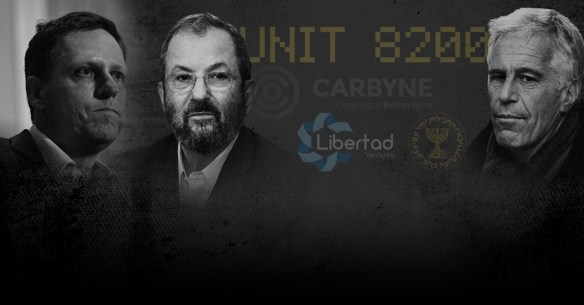
Following the arrest and subsequent death in prison of alleged child sex trafficker Jeffrey Epstein, a little-known Israeli tech company began to receive increased publicity, but for all the wrong reasons. Not long after Epstein’s arrest, and his relationships and finances came under scrutiny, it was revealed that the Israeli company Carbyne911 had received substantial funding from Jeffrey Epstein as well as Epstein’s close associate and former Prime Minister of Israel Ehud Barak, and Silicon Valley venture capitalist and prominent Trump backer Peter Thiel.

Carbyne911, or simply Carbyne, develops call-handling and identification capabilities for emergency response services in countries around the world, including the United States, where it has already been implemented in several U.S. counties and has partnered with major U.S. tech companies like Google. It specifically markets its product as a way of mitigating mass shootings in the United States without having to change existing U.S. gun laws.

Yet, Carbyne is no ordinary tech company, as it is deeply connected to the elite Israeli military intelligence division, Unit 8200, whose “alumni” often go on to create tech companies — Carbyne among them — that frequently maintain their ties to Israeli intelligence and, according to Israeli media reports and former employees, often “blur the line” between their service to Israel’s defense/intelligence apparatus and their commercial activity. As this report will reveal, Carbyne is but one of several Israeli tech companies marketing themselves as a technological solution to mass shootings that has direct ties to Israeli intelligence agencies.

In each case, these companies’ products are built in such a way that they can easily be used to illegally surveil the governments, institutions and civilians that use them, a troubling fact given Unit 8200’s documented prowess in surveillance as a means of obtaining blackmail and Israel’s history of using tech companies to aggressively spy on the U.S. government. This is further compounded by the fact that Unit 8200-linked tech companies have previously received U.S. government contracts to place “backdoors” into the U.S.’ entire telecommunications system as well as into the popular products of major American tech companies including Google, Microsoft and Facebook, many of whose key managers and executives are now former Unit 8200 officers.

Israeli Prime Minister Benjamin Netanyahu has made it no secret that placing Unit 8200 members in top positions in multinational tech companies is a “deliberate policy” meant to ensure Israel’s role as the dominant global “cyber power”, while also combating non-violent boycott movements targeting Israel’s violations of international law and stifling the United Nations’ criticisms of Israeli government policy and military operations abroad.

As Jeffrey Epstein’s links to intelligence in both the United States and Israel — the subject of a recent four-part series exclusive to MintPress — began to be revealed in full, his financing of Carbyne came under scrutiny, particularly for the company’s deep ties to Israeli intelligence as well as to certain Americans with known connections to U.S. intelligence. Ehud Barak’s own role as both financier and chairman of Carbyne has also added to that concern, given his long history of involvement in covert intelligence operations for Israel and his long-standing ties to Israeli military intelligence.

Another funder of Carbyne, Peter Thiel, has his own company that, like Carbyne, is set to profit from the Trump administration’s proposed hi-tech solutions to mass shootings. Indeed, after the recent shooting in El Paso, Texas, President Trump — who received political donations from and has been advised by Thiel following his election — asked tech companies to “detect mass shooters before they strike,” a service already perfected by Thiel’s company Palantir, which has developed “pre-crime software” already in use throughout the country. Palantir is also a contractor for the U.S. intelligence community and also has a branch based in Israel.

Perhaps most disturbing of all, whatever technological solution is adopted by the Trump administration, it is set to use a controversial database first developed as part of a secretive U.S. government program that involved notorious Iran-Contra figures like Oliver North as a means of tracking and flagging potential American dissidents for increased surveillance and detention in the event of a vaguely defined “national emergency.”

As this report will reveal, this database — often referred to as “Main Core” — was created with the involvement of Israeli intelligence and Israel remained involved years after it was developed, and potentially to the present. It was also used by at least one former CIA official on President Reagan’s National Security Council to blackmail members of Congress, Congressional staffers and journalists, among others.

Given recent reports on the Trump administration’s plan to create a new government agency to use “advanced technology” to identify “neurobehavioral signs” of “someone headed toward a violent explosive act” using data collected by consumer electronic devices, the picture painted by the technology currently being promoted and implemented under the guise of “keeping Americans safe” is deeply Orwellian. In fact, it points directly to the genesis of a far-reaching surveillance state far more extensive than anything yet seen in American history and it is being jointly developed by individuals connected to both American and Israeli intelligence.


Demystifying Carbyne

Carbyne911, which will be referred to simply as Carbyne in this report, is an Israeli tech-startup that promises to revolutionize how calls are handled by emergency service providers, as well as by governments, corporations and educational institutions. Not long after it was founded in 2014 by veterans of Israeli military intelligence, Carbyne began to be specifically marketed as a solution to mass shootings in the United States that goes “beyond the gun debate” and improves the “intelligence that armed emergency responders receive before entering an armed shooter situation” by providing video-streaming and acoustic input from civilian smartphones and other devices connected to the Carbyne network.

Prior to Jeffrey Epstein’s arrest in July, Carbyne had been receiving high praise from U.S. and Israeli media, with Fox News hailing the company’s services as the answer to the U.S.’ “aging 911 systems” and the Jerusalem Post writing that the company’s platform offers “hi-tech protection to social workers and school principals.” Other reports claimed that Carbyne’s services result in “a 65% reduction in time-to-dispatch.”

Carbyne’s call-handling/crisis management platform has already been implemented in several U.S. counties and the company has offices not only in the U.S. but also in Mexico, Ukraine and Israel. Carbyne’s expansion to more emergency service provider networks in the U.S. is likely, given that federal legislation seeks to offer grants to upgrade 911 call centers throughout the country with the very technology of which Carbyne is the leading provider. One of the main lobby groups promoting this legislation, the National Emergency Number Association (NENA), has a “strong relationship” with Carbyne, according to Carbyne’s website. In addition, Carbyne has also begun marketing its platform for non-emergency calls to governments, educational institutions and corporations.

Yet, what seemed like the inevitability of Carbyne’s widespread adoption in the U.S. hit a snag following the recent arrest and subsequent death of sex trafficker and pedophile Jeffrey Epstein, who exploited underage girls for the purpose of obtaining “blackmail” on the rich and poweful, an operation that had clear ties to intelligence. Epstein, after his first arrest and light sentence for soliciting sex from a minor in 2007, was tapped by former Israeli Prime Minister and former head of Israeli military intelligence Ehud Barak, to become a key financial backer of Carbyne.

As a result of increased scrutiny of Epstein’s business activities and his ties to Israel, particularly to Barak, Epstein’s connection to Carbyne was revealed and extensively reported on by the independent media outlet Narativ, whose exposé on Carbyne revealed not only some of the key intelligence connections of the start-up company but also how the architecture of Carbyne’s product itself raises “serious privacy concerns.”

MintPress detailed many of Carbyne’s main intelligence connections in Part III of the investigative series “Inside the Jeffrey Epstein Scandal: Too Big to Fail.” In addition to Barak — former Israeli prime minister and former head of Israeli military intelligence — serving as Carbyne’s chairman and a key financer, the company’s executive team are all former members of Israeli intelligence, including the elite military intelligence unit, Unit 8200, which is often compared to the U.S. National Security Agency (NSA).

Carbyne’s current CEO, Amir Elichai, served in Unit 8200 and tapped former Unit 8200 commander and current board member of AIPAC Pinchas Buchris to serve as the company’s director and on its board. In addition to Elichai, another Carbyne co-founder, Lital Leshem, also served in Unit 8200 and later worked for Israeli private spy company Black Cube. The only Carbyne co-founder that didn’t serve in Unit 8200 is Alex Dizengof, who previously worked for Israel’s Prime Minister’s office.

As MintPress noted in a past report detailing Israeli military intelligence’s deep ties to American tech giant Microsoft, Unit 8200 is an elite unit of the Israeli Intelligence corps that is part of the IDF’s Directorate of Military Intelligence and is involved mainly in signal intelligence (i.e., surveillance), cyberwarfare and code decryption. It is frequently described as the Israeli equivalent of the NSA and Peter Roberts, senior research fellow at Britain’s Royal United Services Institute, characterized the unit in an interview with the Financial Times as “probably the foremost technical intelligence agency in the world and stand[ing] on a par with the NSA in everything except scale.”

Notably, the NSA and Unit 8200 have collaborated on numerous projects, most infamously on the Stuxnet virus as well as the Duqu malware. In addition, the NSA is known to work with veterans of Unit 8200 in the private sector, such as when the NSA hired two Israeli companies, to create backdoors into all the major U.S. telecommunications systems and major tech companies, including Facebook, Microsoft and Google. Both of those companies, Verint and Narus, have top executives with ties to Israeli intelligence and one of those companies, Verint (formerly Comverse Infosys), has a history of aggressively spying on U.S. government facilities. Unit 8200 is also known for spying on civilians in the occupied Palestinian territories for “coercion purposes” — i.e., gathering info for blackmail — and also for spying on Palestinian-Americans via an intelligence-sharing agreement with the NSA.

Unlike many other Unit 8200-linked start-ups, Carbyne also boasts several tie-ins to the Trump administration, including Palantir founder and Trump ally Peter Thiel — another investor in Carbyne. In addition, Carbyne’s board of advisers includes former Palantir employee Trae Stephens, who was a member of the Trump transition team, as well as former Secretary of Homeland Security Michael Chertoff. Trump donor and New York real-estate developer Eliot Tawill is also on Carbyne’s board, alongside Ehud Barak and Pinchas Buchris.

Yet, privacy concerns with Carbyne go beyond the company’s ties to Israeli intelligence and U.S. intelligence contractors like Peter Thiel. For instance, Carbyne’s smartphone app extracts the following information from the phones on which it is installed:

Device location, video live-streamed from the smartphone to the call center, text messages in a two-way chat window, any data from a user’s phone if they have the Carbyne app and ESInet, and any information that comes over a data link, which Carbyne opens in case the caller’s voice link drops out.” (emphasis added)

According to Carbyne’s website, this same information can also be obtained from any smartphone, even if it does not have Carbyne’s app installed, if that phone calls a 911 call center that uses Carbyne or merely any other number connected to Carbyne’s network.

Carbyne is a Next-Generation 9-11 (NG911) platform and the explicit goal of NG911 is for all 911 systems nationwide to become interconnected. Thus, even if Carbyne is not used by all 911 call centers using an NG911 platform, Carbyne will ostensibly have access to the data used by all emergency service providers and devices connected to those networks. This guiding principle of NG911 also makes it likely that one platform will be favored at the federal level to foster such interconnectivity and, given that it has already been adopted by several counties and has ties to the Trump administration, Carbyne is the logical choice.

Another cause for concern is how other countries have used platforms like Carbyne, which were first marketed as emergency response tools, for the purpose of mass surveillance. Narativ noted the following in its investigation of Carbyne:

In May, Human Rights Watch revealed Chinese authorities use a platform not unlike Carbyne to illegally surveil Uyghurs. China’s Integrated Joint Operations Platform brings in a much bigger data-set and sources of video, which includes an app on people’s phones. Like Carbyne, the platform was designed to report emergencies. Chinese authorities have turned it into a tool of mass surveillance.

Human Rights Watch reverse-engineered the app. The group discovered the app automatically profiles a user under 36 “person types” including “followers of Six Lines” which is the term used to identify Uyghurs. Another term refers to “Hajj,” the annual Islamic pilgrimage to Mecca. The app monitors every aspect of a user’s life, including personal conversations [and] power usage, and tracks a user’s movement.”

Such technology is currently used by Israeli military intelligence and Israel’s domestic intelligence agency Shin Bet to justify “pre-crime” detentions of Palestinians in the occupied West Bank. As will be noted in greater detail later in this report, Palestinians’ comments on social media are tracked by artificial intelligence algorithms that flag them for indefinite detention if they write social media posts that contain “tripwire” phrases such as “the sword of Allah.”

Carbyne’s platform has its own “pre-crime” elements, such as it’s c-Records component, which stores and analyzes information on past calls and events that pass through its network. This information “enables decision makers to accurately analyze the past and present behavior of their callers, react accordingly, and in time predict future patterns.” (emphasis added)

Concerns have recently been raised that “pre-crime” technology may soon become more widely adopted in the U.S., after President Trump stated that one of his planned solutions to mass shootings in the wake of the recent tragedy in El Paso was for big tech companies to detect potential shooters before they strike.


Israeli intelligence, Blackmail and Silicon Valley

Though many of the individuals involved in funding or managing Carbyne have proven ties to intelligence, a closer look into several of these players reveals even deeper connections to both Israeli and U.S. intelligence.

One of Carbyne’s clearest connections to Israeli intelligence is through its chairman and one of its funders, Ehud Barak. Though Barak is best known for being a former prime minister of Israel, he is also a former minister of defense and the former head of Israeli military intelligence. He oversaw Unit 8200’s operations, as well as other units of Israeli military intelligence, in all three of those positions. For most of his military and later political career, Barak has been closely associated with covert operations.

Prior to the public scrutiny of Barak’s relationship to Jeffrey Epstein, following the latter’s arrest this past July and subsequent death, Barak had come under fire for his ties to disgraced film mogul Harvey Weinstein. Indeed, it was Ehud Barak who put Weinstein in contact with the Israeli private intelligence outfit Black Cube, which employs former Mossad agents and Israeli military intelligence operatives, as Weinstein sought to intimidate the women who had accused him of sexual assault and sexual harassment. Former Mossad director Meir Dagan led Black Cube’s board until his death in 2016 and Carbyne co-founder Lital Leshem is Black Cube’s former director of marketing.

After Barak put him in contact with Black Cube’s leadership, Weinstein, according to The New Yorker, used the private spy firm to “‘target,’ or collect information on, dozens of individuals, and compile psychological profiles that sometimes focused on their personal or sexual histories.” In addition, The New Yorker noted that “Weinstein monitored the progress of the investigations personally” and “also enlisted former employees from his film enterprises to join in the effort, collecting names and placing calls that, according to some sources who received them, felt intimidating.”

Yet, more recently, it has been Barak’s close relationship to Epstein that has raised eyebrows and opened him up to political attacks from his rivals. Epstein and Barak were first introduced by former Israeli Prime Minister Shimon Peres in 2002, a time when Epstein’s pedophile blackmail and sex trafficking operation was in full swing.

Barak was a frequent visitor to Epstein’s residences in New York, so often that The Daily Beast reported that numerous residents of an apartment building linked to Epstein “had seen Barak in the building multiple times over the last few years, and nearly half a dozen more described running into his security detail,” adding that “the building is majority-owned by Epstein’s younger brother, Mark, and has been tied to the financier’s alleged New York trafficking ring.” Specifically, several apartments in the building were “being used to house underage girls from South America, Europe and the former Soviet Union,” according to a former bookkeeper employed by one of Epstein’s main procurers of underage girls, Jean Luc Brunel.

Barak is also known to have spent the night at one of Epstein’s residences at least once, was photographed leaving Epstein’s residence as recently as 2016, and has admitted to visiting Epstein’s island, which has sported nicknames including “Pedo Island,” “Lolita Island” and “Orgy Island.” In 2004, Barak received $2.5 million from Leslie Wexner’s Wexner Foundation, where Epstein was a trustee as well as one of the foundation’s top donors, officially for unspecified “consulting services” and “research” on the foundation’s behalf.

In 2015, Barak formed a limited partnership company in Israel for the explicit purpose of investing in Carbyne (then known as Reporty) and invested millions of dollars in the company, quickly becoming a major shareholder and subsequently the company’s public face and the chairman of its board. At least $1 million of the money invested in this Barak-created company that was later used to invest in Carbyne came from the Southern Trust Company, which was owned by Jeffrey Epstein.

In July, Bloomberg reported that Epstein’s Southern Trust Company is identified in U.S. Virgin Islands filings as “a DNA database and data mining” company. Given Carbyne’s clear potential for data-mining and civilian profiling, Epstein’s investment in Carbyne using this specific company suggests that Carbyne’s investors have long been aware of this little advertised aspect of Carbyne’s product.

In a statement to the Israeli newspaper Haaretz, Barak asserted:

I saw the business opportunity and registered a partnership in my control in Israel. A small number of people I know invest in it…Since these are private investments, it wouldn’t be proper or right for me to expose the investors’ details.”

However, Barak later admitted that Epstein had been one of the investors.

MintPress’ recent series on the Jeffrey Epstein scandal noted in detail Epstein’s ties to CIA/Mossad intelligence assets, such as Adnan Khashoggi; CIA front companies, such as Southern Air Transport; and organized crime, through his close association with Leslie Wexner. In addition, Epstein’s long-time “girlfriend” and alleged madam, Ghislaine Maxwell, has family links to Israeli intelligence through her father, Robert Maxwell. While it appears that Epstein may have been working for more than one intelligence agency, Zev Shalev, former executive producer for CBS News and journalist at Narativ, recently stated that he had independently confirmed with two unconnected sources “closely connected to the Epstein story and in a position to know” that Epstein had “worked for Israeli military intelligence.”

Notably, Epstein, who was known for his interest in obtaining blackmail through the sexual abuse of the underaged girls he exploited, also claimed to have “damaging information” on prominent figures in Silicon Valley. In a conversation last year with New York Times reporter James Stewart, Epstein claimed to have “potentially damaging or embarrassing” information on Silicon Valley’s elite and told Stewart that these top figures in the American tech industry “were hedonistic and regular users of recreational drugs.” Epstein also told Stewart that he had “witnessed prominent tech figures taking drugs and arranging for sex” and claimed to know “details about their supposed sexual proclivities.”

In the lead-up to his recent arrest, Jeffrey Epstein appeared to have been attempting to rebrand as a “tech investor,” as he had done interviews with several journalists including Stewart about technology investing in the months before he was hit with federal sex trafficking charges.

Jessica Lessin, editor-in-chief of The Information, told Business Insider that a journalist working for The Information had interviewed Epstein a month before his recent arrest because “he was believed to be an investor in venture capital funds.” However, Lessin claimed that the interview was not “newsworthy” and said the site had no plans to publish its contents. Business Insider claimed that the way the interviews with Epstein had been arranged “suggests that someone in Silicon Valley may have been trying to help Epstein connect with reporters.”

Though it is unknown exactly which Silicon Valley figures were most connected to Epstein and which tech executives were potentially being blackmailed by Epstein, it is known that Epstein associated with several prominent tech executives, including Google co-founder Sergey Brin, Facebook co-founder Mark Zuckerberg, Tesla CEO Elon Musk, Microsoft co-founder Bill Gates, and LinkedIn co-founder Reid Hoffman.

Last year, Epstein claimed to be advising Tesla and Elon Musk, who had been previously photographed with Epstein’s alleged madam Ghislaine Maxwell. A few years ago, Epstein also attended a dinner hosted by LinkedIn’s Reid Hoffman, where Musk had allegedly introduced Epstein to Mark Zuckerberg. Google’s Sergey Brin is known to have attended a dinner hosted by Epstein at his New York residence where Donald Trump was also in attendance.

Elon Musk with Epstein’s alleged madam Ghislaine Maxwell at an Oscars after-party on March 2, 2014. Kevin Mazur | VF14

These associations suggest that the person in Silicon Valley who was trying to boost Epstein’s image as a tech investor before his arrest may have been Peter Thiel, whose Founders Fund had also invested in Carbyne. Thiel was an early investor in Facebook and is still on its board, connecting him to Zuckerberg; he is also a funder of Elon Musk’s SpaceX and a former colleague of Musk’s through PayPal. In addition, Thiel has ties to Reid Hoffman and both Thiel and Hoffman are prominent backers of Facebook.

It is unknown whether Epstein’s “damaging information” and apparent blackmail on notable individuals in the American technology industry were used to advance the objectives of Carbyne, which recently partnered with tech giants Google and Cisco Systems — and, more broadly, the expansion of Israeli intelligence-linked tech companies into the American tech sector, particularly through the acquisition of Israeli tech start-ups linked to Unit 8200 by major U.S. tech companies.

The latter seems increasingly likely given that the father of Ghislaine Maxwell — one of Epstein’s chief co-conspirators in his intelligence-linked sexual blackmail operation involving minors — was a Mossad operative who helped sell software that had been bugged by Israeli intelligence to government agencies and sensitive facilities around the world, including in the United States.

As will be noted later in this report, Israel’s Prime Minister Benjamin Netanyahu — to whom all of Israel’s intelligence agencies answer by virtue of his position — has stated on more than one occasion that the acquisition of Israeli intelligence-linked start-ups by foreign tech giants, especially in Silicon Valley, is a current and “deliberate policy” of the state of Israel.


Carbyne’s ties to U.S. intelligence

While Epstein and Barak are the two financiers of Carbyne whose ties to intelligence are clearest, another funder of Carbyne, Peter Thiel, has ties to U.S. intelligence and a history of investing in other companies founded by former members of Unit 8200. Thiel co-founded and still owns a controlling stake in the company Palantir, which was initially funded with a $2 million investment from the CIA’s venture capital fund In-Q-Tel and quickly thereafter became a contractor for the CIA.

After the success of its contract with the CIA, Palantir became a contractor for a variety of federal agencies, including the FBI, the Defense Intelligence Agency (DIA), the National Security Agency (NSA), the Department of Homeland Security(DHS) and the military’s Special Operations Command, among others. Last year, it won a contract to create a new battlefield intelligence system for the U.S. Army. Palantir is also in demand for its “pre-crime technology,” which has been used by several U.S. police departments. According to the Guardian, “Palantir tracks everyone from potential terrorist suspects to corporate fraudsters, child traffickers and what they refer to as ‘subversives’… it is all done using prediction.”

Thiel has gained attention in recent years for his support of President Trump and for becoming an adviser to Trump following the 2016 election, when he was “a major force in the transition,” according to Politico, and “helped fill positions in the Trump administration with former staff.” One of those former staffers was Trae Stephens, who is also on Carbyne’s board of advisers. Thiel also has business ties to Trump’s son-in-law and influential adviser, Jared Kushner, as well as to Kushner’s brother Josh. A senior Trump campaign aide told Politico in 2017 that “Thiel is immensely powerful within the administration through his connection to Jared.”

Thiel has also backed some prominent Israeli tech start-ups connected to Unit 8200, such as BillGuard, which Thiel funded along with former Google CEO Eric Schmidt and other investors. BillGuard was founded by Raphael Ouzan, a former officer in Unit 8200, who serves on the board of directors of Start-Up Nation Central (SUNC) alongside neoconservative American hedge fund manager Paul Singer, neoconservative political operative and adviser Dan Senor, and Terry Kassel, who works for Singer at his hedge fund, Elliott Management.

Peter Thiel Netanyahu
Peter Thiel greets Netanyahu during a 2017 meeting in Israel. Photo | Israel PM

SUNC is an organization founded by Paul Singer, who has donated heavily to both President Trump and Israeli Prime Minister Netanyahu. Since it was founded in 2012, SUNC has sought to integrate Unit 8200-connected Israeli tech start-ups into foreign companies, primarily American companies, and has helped oversee the shift of thousands of high-paying tech jobs from the U.S. to Israel.

Another Carbyne-connected individual worth noting is the former head of the Department of Homeland Security, Michael Chertoff, who serves on Carbyne’s board of advisers. In addition to Chertoff’s ties to DHS, Chertoff’s company, The Chertoff Group, employees several prominent former members of the U.S. intelligence community as principals, including Michael Hayden, former director of the CIA and former director of the NSA; and Charles Allen, former assistant director of Central Intelligence for Collection at the CIA, who worked at the agency for over 40 years.

The Chertoff Group has a long-standing and lucrative contract with the company OSI Systems, which produces full-body scanners and markets itself as a solution to mass shootings and crisis events, not unlike Carbyne. While Chertoff’s company was advising OSI Systems, Chertoff went on a media blitz to promote the widespread use of the machines produced by OSI Systems and even called on Congress to “fund a large-scale deployment of next-generation systems.” Chertoff did not disclose his conflict of interest while publicly promoting OSI’s full-body scanners.

Some have also alleged that Chertoff’s mother, Livia Eisen, had links to Israeli intelligence. According to her 1998 obituary, cited by both researcher/author Christopher Bollyn and journalist Jonathan Cook, Eisen participated in the Mossad operation code-named “Magic Carpet” while working for Israel’s El Al Airlines. Both Bollyn and Cook have suggested that Eisen’s participation in this covert Israeli intelligence operation strongly indicates that she had ties to the Mossad.


Melding into Silicon Valley

Beyond its troubling connections to Silicon Valley oligarchs, Israeli military intelligence and the U.S.-military industrial complex, Carbyne’s recent partnerships with two specific technology companies — Google and Cisco Systems — raise even more red flags.

Carbyne announced its partnership with Cisco Systems this past April, with the latter announcing that it would begin “aligning its unified call manager with Carbyne’s call-handling platform, allowing emergency call centers to collect data from both 911 callers and nearby government-owned IoT [Internet of Things] devices.” A report on the partnership published by Government Technology magazine stated that “Carbyne’s platform will be integrated into Cisco Kinetic for Cities, an IoT data platform that shares data across community infrastructure, smart city solutions, applications and connected devices.” The report also noted that “Carbyne will also be the only 911 solution in the Cisco Marketplace.”

As part of the partnership, Carbyne’s President of North American Operations Paul Tatro told Government Technology that the Carbyne platform would combine the data it obtains from smartphones and other Carbyne-connected devices with “what’s available through nearby Cisco-connected road cameras, roadside sensors, smart streetlamps, smart parking meters or other devices.” Tatro further asserted that “Carbyne can also analyze data that’s being collected by Cisco IoT devices … and alert 911 automatically, without any person making a phone call, if there appears to be a worthy problem,” and expressed his view that soon most emergency calls will not be made by human beings but “by smart cars, telematics or other smart city devices.”

A few months after partnering with Cisco Systems, Carbyne announced its partnership with Google on July 10, just three days after Carbyne funder Jeffrey Epstein was arrested in New York on federal sex trafficking charges. Carbyne’s press release of the partnership described how the company and Google would be teaming up in Mexico “to offer advanced mobile location to emergency communications centers (ECCs) throughout Mexico” following the conclusion of a successful four-week pilot program between Carbyne and Google in the Central American nation.

Netanyahu Eric Schmidt
Google Executive Chairman Eric Schmidt meets Netanyahu at his Jerusalem office. Israel PM | YouTube

The press release also stated:

Carbyne will provide Google’s Android ELS (Emergency Location Service) in real time from emergency calls made on AndroidTM devices. Deployment for any ECC in the country won’t require any integration, with Carbyne providing numerous options for connection to their secure ELS Gateway once an ECC is approved. The Carbyne automated platform, requiring no human interaction, has the potential to save thousands of lives each year throughout Mexico.”

The reason Carybne’s partnerships with Cisco Systems and Google are significant lies in the role that Cisco and former Google CEO Eric Schmidt have played in the creation of a controversial “incubator” for Israeli tech start-ups with deep ties to Israeli military intelligence, American neoconservative donor Paul Singer, and the U.S.’ National Security Agency (NSA).

This company, called Team8, is an Israeli company-creation platform whose CEO and co-founder is Nadav Zafrir, former commander of Unit 8200. Two of the company’s other three co-founders are also “alumni” of Unit 8200. Among Team8’s top investors is Schmidt, the former CEO of Google, who also joined Peter Thiel in funding the Unit 8200-linked BillGuard, as well as major tech companies including Cisco Systems and Microsoft.

Last year, Team8 controversially hired the former head of the NSA and U.S. Cyber Command, Retired Admiral Mike Rogers, and Zafrir stated that his interest in hiring Rogers was that Rogers would be “instrumental in helping strategize” Team8’s expansion in the United States. Jake Williams, a veteran of NSA’s Tailored Access Operations (TAO) hacking unit, told CyberScoop:

Rogers is not being brought into this role because of his technical experience. …It’s purely because of his knowledge of classified operations and his ability to influence many in the U.S. government and private-sector contractors.”

Team8 has also been heavily promoted by Start-Up Nation Central (SUNC). SUNC prominently features Team8 and Zafrir on the cybersecurity section of its website and also sponsored a talk by Zafrir and an Israeli government economist at the World Economic Forum, often referred to as “Davos,” that was attended personally by Paul Singer.

SUNC itself has deep ties to Israeli military intelligence, with former Unit 8200 officer Raphael Ouzan serving on its board of directors. Another example of SUNC-Unit 8200 ties can be seen with Inbal Arieli, who served as SUNC’s Vice President of Strategic Partnerships from 2014 to 2017 and continues to serve as a senior adviser to the organization. Arieli, a former lieutenant in Unit 8200, is the founder and head of the 8200 Entrepreneurship and Innovation Support Program (EISP), which was the first start-up accelerator in Israel aimed at harnessing “the vast network and entrepreneurial DNA of [Unit] 8200 alumni” and is currently one of the top company accelerators in Israel, alongside Team8. Arieli was the top executive at 8200 EISP while working at SUNC and several other top SUNC staffers are also connected to Israeli military intelligence.

Thus, Google and Cisco’s connections to Team8 suggests that their partnerships with another Israeli military intelligence-connected firm like Carbyne is a deepening of those two companies’ links to the growing bi-national security state that is uniting key players in the U.S. military-industrial complex and Israeli intelligence.


Mossad-backed Panic Buttons, coming to a school near you

Carbyne is hardly the only Israeli intelligence-linked tech company marketing itself in the United States as a solution to mass shootings. Another Israeli start-up, known as Gabriel, was founded in 2016 in response to a shooting in Tel Aviv and the Pulse Nightclub shooting in the United States, which took place just days apart.

Created by Israeli-American Yoni Sherizen and Israeli citizen Asaf Adler, Gabriel is similar to Carbyne in the sense that elements of its crisis response platform require installation on civilian smartphones as well as devices used by crisis responders. The main difference is that Gabriel also installs one or a series of physical “panic buttons,” depending on the size of the building to be secured, that also double as video and audio communication devices connected to the Gabriel network.

As with Carbyne, the ties between Gabriel and Israeli intelligence are obvious. Indeed, Gabriel’s four-person advisory board includes Ram Ben-Barak, former deputy director of the Mossad and former director-general of Israel’s intelligence ministry; Yohanan Danino, former chief of police for the state of Israel; and Kobi Mor, former director of overseas missions for the Israeli intelligence agency Shin Bet. The only American on the advisory board is Ryan Petty, the father of a Parkland shooting victim and friend of former Florida Governor Rick Scott.

Gabriel’s only disclosed funder is U.S.-based MassChallenge, a start-up accelerator non-profit. Gabriel is funded by MassChallenge’s Israel branch, which was opened six months prior to Gabriel’s creation and is partnered with the Israeli government and the Kraft Group. The Kraft Group is managed by Robert Kraft, who is currently embroiled in a prostitution scandal and is also a close friend of President Trump.

Notably, one of MassChallenge Israel’s featured experts is Wendy Singer, the executive director of SUNC, the organization created and funded by neoconservative Trump backer Paul Singer with the explicit purpose of promoting Israel’s tech start-ups and their integration into foreign, chiefly American, businesses. As was noted in a recent MintPress report on SUNC, Wendy Singer is the sister of neoconservative political operative Dan Senor, who founded the now-defunct Foreign Policy Initiative with Robert Kagan and Bill Kristol, and was previously the director of AIPAC’s Israel office for 16 years.

Gabriel’s founders have been quite upfront about the fact that the uptick in shootings in the U.S. has greatly aided their company’s growth and success. Last November, Sherizen told The Jerusalem Post that new mass shootings in the U.S. not only increased U.S. demand for his company’s product but also were opportunities to show the effectiveness of Gabriel’s approach:

Unfortunately every month there seems to be another high-profile event of this nature. After the Vegas shooting, we were able to show [that] our system would have managed to identify the location of the shooter much quicker.”

The Jerusalem Post noted that Gabriel is set to make considerable profits if concern over mass shootings continues to build in the U.S., writing:

With more than 475,000 soft targets across the US and amid increasing security fears, the potential market for Gabriel is huge. The company could gain revenues of almost $1 billion if only 10% of soft targets were to invest around $20,000 in its alert systems.”

Sherizen told the Jerusalem Post:

Our starter kit costs $10,000. Depending on the size and makeup of the community building, it would cost between $20-30,000 to fully outfit the location. We have made it very affordable. This is a game-changer for the lock-down and active shooter drills that are now a standard part of any child’s upbringing in the States.”


Much more than just a start-up

While it is certainly possible that numerous former officials and commanders of elite Israeli intelligence agencies may have no ulterior motive in advising or founding technology start-up companies, it is worth pointing out that top figures in Israel’s military intelligence agencies and the Mossad don’t see it that way.

Last March, Israeli media outlet Calcalist Tech published a report entitled “Israel Blurs the Line Between Defense Apparatus and Local Cybersecurity Hub,” which noted that “since 2012, cyber-related and intelligence projects that were previously carried out in-house in the Israeli military and Israel’s main intelligence arms are transferred to companies that in some cases were built for this exact purpose.” (emphasis added)

The article notes that beginning in 2012, Israel’s intelligence and military intelligence agencies began to outsource “activities that were previously managed in-house, with a focus on software and cyber technologies.” (emphasis added)

It continues:

In some cases, managers of development projects in the Israeli military and intelligence arms were encouraged to form their own companies, which then took over the project,’ an Israeli venture capitalist familiar with the matter told Calcalist Tech.”

Notably, Calcalist Tech states that the controversial company Black Cube was created this way and that Black Cube had been contracted, and is likely still contracted, by Israel’s Ministry of Defense. The private security agency Black Cube is known to have two separate divisions for corporations and governments. The firm was recently caught attempting to undermine the Iran nuclear deal — then also a top political objective of Israeli Prime Minister Benjamin Netanyahu — by attempting to obtain information on the “financial or sexual impropriety” (i.e., blackmail) of top U.S. officials involved in drafting the accord. NBC News noted last year that “Black Cube’s political work frequently intersects with Israel’s foreign policy priorities.” As previously mentioned, one of Carbyne’s co-founders — Lital Leshem, also a veteran of Unit 8200 — worked for Black Cube prior to starting Carbyne.

One of the main companies profiled in the Calcalist Tech report appeared to be a front for Israeli intelligence, as its registered owner was found not to exist: even high-level employees at the company had never heard of him; his registered addresses were for nonexistent locations in Israel’s capital of Tel Aviv; and the three people with that name in Tel Aviv denied any association with the business.

This company — which Calcalist Tech was unable to name after the Israeli military censor determined that doing so could negatively impact Israeli “national security” — was deliberately created to service the Israeli military and Israeli intelligence. It is also “focused on cyber technologies with expertise in research and development of advanced products and applications suitable for defense and commercial entities.” (emphases added) In addition, the company’s management consists largely of “veterans of Israeli military technology units.”

Notably, a former employee of this company told Calcalist Tech that “crossing the lines between military service and employment at the commercial outfit was ‘commonplace’ while he was working at the company.”

It’s not exactly clear why Israel’s military intelligence and other intelligence agencies decided to begin outsourcing its operations in 2012, though Calcalist Tech suggests the reasoning was related to the difference in wages between the private sector and the public sector, with pay being much higher in the former. However, it is notable that 2012 was also the year that Paul Singer — together with Netanyahu’s long-time economic adviser and former chair of the Israeli National Economic Council, Eugene Kandel — decided to create Start-Up Nation Central.

As MintPress noted earlier this year, SUNC was founded as part of a deliberate Israeli government effort to counter the nonviolent Boycott, Divest and Sanctions (BDS) movement and to make Israel the dominant global “cyber power.” This policy is aimed at increasing Israel’s diplomatic power and specifically undermining BDS as well as the United Nations, which has repeatedly condemned Israel’s government for war crimes and violations of international law in relation to the Palestinians.

Last year, Netanyahu was asked by Fox News host Mark Levin whether the large growth seen in recent years in Israel’s technology sector, specifically tech start-ups, was part of Netanyahu’s plan. Netanyahu responded, “That’s very much my plan … It’s a very deliberate policy.” He later added that “Israel had technology because the military, especially military intelligence, produced a lot of capabilities. These incredibly gifted young men and women who come out of the military or the Mossad, they want to start their start-ups.”

Netanyahu again outlined this policy at the 2019 Cybertech Conference in Tel Aviv, where he stated that Israel’s emergence as one of the top five “cyber powers” had “required allowing this combination of military intelligence, academia and industry to converge in one place” and that this further required allowing “our graduates of our military and intelligence units to merge into companies with local partners and foreign partners.”

The direct tie-ins of SUNC to Israel’s government and the successful effort led by SUNC and other companies and organizations to place former military intelligence and intelligence operatives in strategic positions in major multinational technology companies reveal that this “deliberate policy” has had a major and undeniable impact on the global tech industry, especially in Silicon Valley.


Mossad gets its own In-Q-Tel

This “deliberate policy” of Netanyahu’s also recently resulted in the creation of a Mossad-run venture capital fund that is specifically focused on financing Israeli tech start-ups. The venture capital fund, called Libertad, was first announced by Israel’s Prime Minister’s Office and was created with the explicit purpose of “increasing the Israeli intelligence agency’s knowledge base and fostering collaboration with Israel’s vibrant startup scene” It was modeled after the CIA’s venture capital fund In-Q-Tel, which invested in several Silicon Valley companies turned government and intelligence contractors — including Google and Palantir — with a similar goal in mind.

Libertad declines to reveal the recipients of its funding, but announced last December that it had chosen five companies in the fields of robotics, energy, encryption, web intelligence, and natural language processing and text analysis. In regard to its interest in web intelligence, a Mossad employee told the Jerusalem Post that the intelligence agency was specifically interested in “innovative technologies for [the] automatic identification of personality characteristics – personality profiling – based on online behavior and activity, using methods based on statistics, machine learning, and other areas.” (emphasis added)

According to Libertad’s website, in return for its investment, now set at NIS 2 million (~$580,000) per year per company, “the Mossad will receive access to the IP [initial product] developed during R&D [Research and Development] while under contract, and a non-commercial, non-exclusive license to use it. Libertad’s contract with the company will not provide it with any additional rights.” In an interview with Calcalist Tech, Mossad Director Yossi Cohen told the paper that the Mossad’s partnership with civilian companies in Israel is “excellent” and that the agency will continue to strengthen those ties.

Israeli intelligence has a documented history in placing “backdoors” into technology products for the purpose of surveillance, with one well-known case being Israel’s repurposing of the PROMIS software, discussed in Part III of MintPress’ series on Jeffrey Epstein. Furthermore, given that U.S. intelligence, specifically the NSA, had “backdoors” placed into the products of major Silicon Valley companies (a service performed by Israeli intelligence-linked tech companies no less), Mossad may very well plan on doing the same with the technology products of companies it backs through Libertad.

Tim Shorrock, investigative journalist and author of Spies For Hire: The Secret World of Intelligence Outsourcing, told MintPress that the Mossad’s continuation of such practices through Libertad was definitely plausible, especially given what Shorrock described as the “unusual” choice of Libertad choosing not to release the identities of the companies in which it invests.

“The Mossad is trying to hide what they are investing in,” Shorrock stated, adding that Libertad’s secrecy “raises a lot of questions” particularly given that it was modeled after the CIA’s In-Q-Tel. Shorrock noted that In-Q-Tel and other venture capital funds with ties to U.S. intelligence or the U.S. military rarely, if ever, hide the identities of the companies they finance.

However, Libertad is merely the latest and most public expression of the Mossad’s interest in Israeli tech start-ups, the lion’s share of which are created by veterans of Unit 8200 or other Israeli intelligence agencies. Indeed, former Mossad Director Tamir Pardo stated in 2017 that “everyone” in the Israeli cybertechnology sector is an “alumni” of either Israeli intelligence, like the Mossad, or Israeli military intelligence, like Unit 8200. Pardo even went as far as to say that the Mossad itself is “like a start-up.”

Pardo himself, after leaving his post as Mossad director in 2016, dove straight into the world of Israeli tech start-ups, becoming chairman of Sepio Systems, whose two CEOs are former Unit 8200 officers. Sepio Systems’ advisory board includes the former chief information security officer of the CIA, Robert Bigman; former member of the U.S. Military’s Joint Special Operations Command (JSOC), Geoff Hancock; and former head of the Israel National Cyber Bureau and veteran of Israeli military intelligence, Rami Efrati. Sepio Systems’ cybersecurity software has been adopted by several banks, telecom and insurance companies, including in the U.S. and Brazil.

Pardo is not the only prominent figure in Israel’s intelligence community to compare Israeli intelligence agencies to tech start-ups. Shin Bet Director Nadav Argaman described Israel’s domestic spy agency in similar terms. “The Shin Bet is like an evolving start-up, with unmatched strength,” Argaman stated in a June 2017 speech, as he extolled the agency’s use of “pre-crime” technology to detain Palestinians based on their social media activity.

Argaman, at the time, claimed that more than 2,000 Palestinians, whom he described as “potential lone-wolf terrorists,” had been arrested as a result of these “breakthrough technological advances” that use artificial-intelligence algorithms to monitor the social media accounts of Palestinians, especially younger Palestinians, for the use of “tripwire” phrases that have been used by Palestinians who later committed acts of violence. In the case of those who use such terms, “their phones are tracked to see if they meet other suspects, or leave their districts to move towards potential Israeli targets. In such cases, security forces detain the suspect,” according to a 2017 report on the practice by The Economist.


The road to fascism, paved by a corrupted PROMIS

Though Israeli intelligence’s interest in tech companies goes back several years, there is a well-documented history of Israeli intelligence using bugged software to surveil and gain “backdoor” access to government databases around the world, particularly in the United States.

As was mentioned in Part III of MintPress’ Epstein series, a sinister yet cunning plan was executed to place a backdoor for Israeli intelligence into the Prosecutor’s Management Information System (PROMIS) software, which was then being used by the U.S. Department of Justice and was the envy of government agencies, particularly intelligence agencies, around the world. This bugged version of PROMIS — born out of the collusion between Earl Brian, Ronald Reagan’s then-envoy to Iran, and Rafi Eitan, then-director of the now-defunct Israeli intelligence agency Lekem — was seeded around the world by Brian’s company Hadron as well as by Mossad-linked media mogul Robert Maxwell, father of Jeffrey Epstein’s long-time girlfriend and alleged madam, Ghislaine Maxwell.

After this first PROMIS “backdoor” was discovered, Israel would again gain access to sensitive U.S. government communications, as well as civilian communications, thanks to the collusion between Israeli intelligence and Israeli telecom and tech companies, especially Amdocs and Comverse Infosys (now Verint), that were operating throughout the United States. Today, Unit 8200-linked start-ups appear to have taken up the torch.

While the PROMIS software is perhaps best known for offering Israeli intelligence a backdoor into as many as 80 intelligence agencies and other sensitive locations around the world for nearly a decade, it was also used for a very different purpose by prominent officials linked to Iran-Contra.

One key Iran-Contra figure — Lt. Col. Oliver North, then serving on the National Security Council — decided to use PROMIS neither for espionage nor for foreign policy. Instead, North turned PROMIS’ power against Americans, particularly perceived dissidents, a fact that remained unknown for years.

Beginning in 1982, as part of the highly classified Continuity of Government (COG) program, North used the PROMIS software at a 6,100-square-foot “command center” in the Department of Justice, as well as at a smaller operations room at the White House, to compile a list of American dissidents and “potential troublemakers” if the COG protocol was ever invoked.

According to a senior government official with a high-ranking security clearance and service in five presidential administrations who spoke to Radar in 2008, this was:

A database of Americans, who, often for the slightest and most trivial reason, are considered unfriendly, and who, in a time of panic might be incarcerated. The database can identify and locate perceived ‘enemies of the state’ almost instantaneously.”

In 1993, Wired described North’s use of PROMIS in compiling this database as follows:

Using PROMIS, sources point out, North could have drawn up lists of anyone ever arrested for a political protest, for example, or anyone who had ever refused to pay their taxes. Compared to PROMIS, Richard Nixon’s enemies list or Sen. Joe McCarthy’s blacklist look downright crude.”

The COG program defined this “time of panic” as “a national crisis, such as nuclear war, violent and widespread internal dissent, or national opposition to a US military invasion abroad,” whereby the government would suspend the Constitution, declare martial law, and incarcerate perceived dissidents and other “unfriendlies” in order to prevent the government’s (or then-serving administration’s) overthrow.

This secretive database has often been referred to as “Main Core” by government insiders and, most troubling of all, it still exists today. Journalist Christ Ketcham, citing senior government officials, reported in 2008 that, at that time, Main Core was believed to contain the names of as many as 8 million Americans. Eleven years later, it is highly likely that the number of Americans included in the Main Core database has grown considerably.

Author and investigative journalist Tim Shorrock also covered other disturbing aspects of the evolution of Main Core back in 2008 for Salon. At the time, Shorrock reported that the George W. Bush administration was believed to have used Main Core to guide its domestic surveillance activities following the September 11 attacks.

Citing “several former U.S. government officials with extensive knowledge of intelligence operations,” Shorrock further noted that Main Core — as it was 11 years ago at the time his report was published — was said to contain “a vast amount of personal data on Americans, including NSA intercepts of bank and credit card transactions and the results of surveillance efforts by the FBI, the CIA and other agencies.”

Bill Hamilton, former NSA intelligence officer and the original creator of the PROMIS software, told Shorrock at the time that he believed that “U.S. intelligence uses PROMIS as the primary software for searching the Main Core database” and had been told as much by an intelligence official in 1992 and an NSA official in 1995. Dan Murphy, former deputy director at the CIA, had told Hamilton that the NSA’s use of PROMIS was “so seriously wrong that money alone cannot cure the problem.” “I believe in retrospect that Murphy was alluding to Main Core,” Hamilton had told Shorrock.

Though most reporting on Main Core, from the time its existence was first revealed to the present, has treated the database as something used by the U.S. government and U.S. intelligence for domestic purposes, MintPress has learned that Israeli intelligence was also involved with the creation of the Main Core database. According to a former U.S. intelligence official with direct knowledge of the U.S. intelligence community’s use of PROMIS and Main Core from the 1980s to 2000s, Israeli intelligence played a role in the U.S. government’s deployment of PROMIS as the software used for the Main Core domestic surveillance database system.

Israeli intelligence remained involved with Main Core at the time of the August 1991 death of journalist Danny Casolaro, who was investigating not only the government’s misuse of the stolen PROMIS software but also the Main Core database. This same official, who chose to remain anonymous, told MintPress that, shortly before his death, Casolaro had obtained copies of computer printouts from the PROMIS-based Main Core domestic surveillance database system from NSA whistleblower Alan Standorf, who was found murdered a few months before Casolaro’s lifeless body would be found in a West Virginia hotel room.

The source also stated that Main Core’s contents had been used for the political blackmail of members of Congress and their staff, journalists, and others by Walter Raymond, a senior CIA covert operator in psyops and disinformation who served on President Reagan’s National Security Council during and after Main Core’s creation. If used for this purpose by Raymond in the 1980s, Main Core has also likely been used by other individuals with access to the database for blackmailing purposes in the years since.

Given that Israeli intelligence was known to have placed a backdoor into the PROMIS software, before it was marketed and sold around the world by Earl Brian and Robert Maxwell, its role in the U.S. government’s decision to use PROMIS in the creation of Main Core suggests that Israeli intelligence likely advocated for the version of PROMIS containing this backdoor, thereby giving Israeli intelligence access to Main Core. Given that Reagan aides and officials colluded with Israeli “spymaster” Rafi Eitan in his efforts to create a backdoor into the software for Israeli military intelligence, the use of this version of PROMIS in the Main Core database is certainly plausible.

Furthermore, the fact that Israeli intelligence was known to be involved in Main Core nearly a decade after its creation suggests that Israeli intelligence may have played a role in certain aspects of the database, such as the criteria used to flag Americans as “unfriendly,” and — like Walter Raymond — may have used information in the database to blackmail Americans. In addition, the fact that the cooperation between U.S. and Israeli intelligence, particularly between Unit 8200 and the NSA, has only grown since 1991 further suggests that Israeli involvement in Main Core continues to the present.

While Main Core’s very existence is troubling for many reasons, the alleged involvement of a foreign intelligence service in the creation, expansion and maintenance of a database with personal details and potentially damaging information on millions of Americans targeted for detention or increased surveillance in times of crisis is chilling. It is especially so considering that the Trump administration’s latest proposals to prevent mass shootings before they occur are likely to use Main Core to flag certain Americans for increased surveillance or potentially detention, as was done by the George W. Bush administration following the September 11 attacks.

It appears that Main Core serves a dual purpose; first as a mass targeted surveillance system to crush dissent during times of “national crisis” — whether spontaneous or engineered — and, second, as a massive blackmail database used to keep every potential opponent in line during non-emergencies.


Peter Thiel’s Seeing Stone

As was mentioned earlier in this report, Palantir — the company co-founded by Peter Thiel — is set to profit handsomely from the Trump administration’s plans to use its “pre-crime” technology, which is already used by police departments throughout the country and also used to track Americans based on the company’s integrative data-mining approach. Palantir, named for the “seeing stones” in the Lord of the Rings novels, also markets software to foreign (and domestic) intelligence agencies that predicts the likelihood that an individual will commit an act of terrorism or violence.

Aside from its “pre-crime” products, Palantir has come under fire in recent years as a result of the company’s contracts with Immigration and Customs Enforcement (ICE), where it created an intelligence system known as Investigative Case Management (ICM). The IB Times described ICM as “a vast ‘ecosystem’ of data to help immigration officials in identifying targets and creating cases against them” and also “provides ICE agents with access to databases managed by other federal agencies.” ICM further gives ICE access to “targets’ personal and sensitive information, such as background on schooling, employment, family relationships, phone records, immigration history, biometrics data, criminal records as well as home and work addresses.” In other words, Palantir’s ICM is essentially a “Main Core” for immigrants.

Notably, part of Oliver North’s original intentions in “Main Core” was to track immigrants then coming from Central America as well as Americans who opposed Reagan era policy with respect to Central America. At that time, Main Core was believed to be controlled by the Federal Emergency Management Administration (FEMA), which is now part of the Department of Homeland Security (DHS).

VICE News reported in July that the Northern California Regional Intelligence Center, which is run by DHS, “serves around 300 communities in northern California and is what is known as a ‘fusion center,’ a Department of Homeland Security intelligence center that aggregates and investigates information from state, local, and federal agencies, as well as some private entities, into large databases that can be searched using software like Palantir. “ VICE further noted that this center alone used Palantir to surveil as many as 8 million Ameicans. There are many more such DHS “fusion centers” throughout the United States.

If the Trump administration moves forward with its proposal of employing technology to detect potential mass shooters before they strike, Palantir’s technology is set to be used, given that it has already been used by U.S. law enforcement and U.S. intelligence to determine which people run “the highest risk of being involved in gun violence,” according to an investigation of Palantir by The Verge. Furthermore, Palantir’s close ties to the Trump administration make the company’s role in a future nationwide “pre-crime” prevention system based on technology appear inevitable.
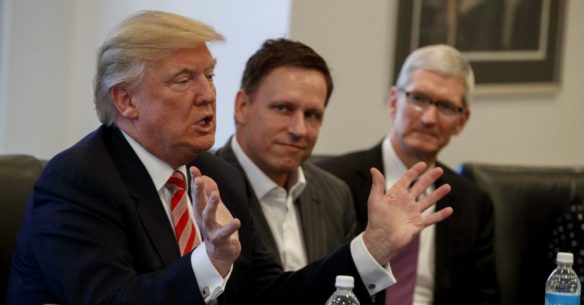
Apple CEO Tim Cook, right, and PayPal founder Peter Thiel, center, listen as President-elect Donald Trump speaks during a meeting with technology industry leaders at Trump Tower in New York, Wednesday, Dec. 14, 2016. (AP Photo/Evan Vucci)

Worse still is the apparent overlap between Palantir and Main Core. Palantir — which has obvious similarities to PROMIS — is already known to use its software to track potential terror threats, including domestic terror threats, and a category of people it refers to as “subversives.” Palantir’s tracking of these individuals “is all done using prediction.” Palantir’s close ties to the U.S. intelligence community suggest that Palantir may already have access to the Main Core database. Tim Shorrock told MintPress that Palantir’s use of Main Core is “certainly possible,” particularly in light of the company’s use of the term “subversive” to describe a category of people that its software tracks.

Palantir also has alleged ties to Israeli intelligence, as there have long been suspicions that Israeli intelligence has used Palantir as part of its AI “pre-crime” algorithms targeting Palestinians after Palantir opened a research and development (R&D) center in Israel in 2013. The current head of Palantir Israel, Hamultal Meridor, previously founded a brain-machine interface organization and was senior director of web intelligence at Verint (formerly Comverse Infosys), which has deep connections to Unit 8200, a history of espionage in the United States and was one of the two companies contracted by the NSA to insert a “backdoor” into the U.S. telecommunications system and popular products of major American tech companies.

Given the above, Peter Thiel’s 2018 decision to fund Carbyne, the Unit 8200-linked start-up that markets itself as a technological solution to mass shootings in the U.S., strongly suggests that Thiel has been anticipating for some time the now-public efforts of the Trump administration to employ “pre-crime” technology to track and target Americans who show signs of “mental illness” and “violent tendencies.”


A nightmare even Orwell could not have predicted

In early August, in the wake of the shooting at an El Paso Walmart, President Trump called on big tech companies to collaborate with the Justice Department in the creation of software that “stops mass murders before they start” by detecting potential mass shooters before they cnm act. Though Trump’s ideas were short on specifics, there is now a new proposal that would create a new government agency that will use data gathered from civilian electronic devices to identify “neurobehavioral” warning signs, thereby flagging “potential shooters” for increased surveillance and potentially detention.

This new agency, as proposed by the foundation led by former NBC Universal president and vice chairman of General Electric Robert Wright, would be known as the Health Advanced Research Projects Agency (HARPA) and would be modeled after the Defense Advanced Research Projects Agency (DARPA). Per the proposal, recently detailed by the Washington Post, the flagship program of HARPA would be “Safe Home” (Stopping Aberrant Fatal Events by Helping Overcome Mental Extremes), which would use “breakthrough technologies with high specificity and sensitivity for early diagnosis of neuropsychiatric violence,” specifically “advanced analytical tools based on artificial intelligence and machine learning.”

The program would cost an estimated $60 million over four years and would use data from “Apple Watches, Fitbits, Amazon Echo and Google Home” and other consumer electronic devices, as well as information provided by health-care providers to identify who may be a threat.

The Washington Post reported that President Trump has reacted “very positively” to the proposal and that he was “sold on the concept.” The Post also noted that Wright sees the president’s daughter, Ivanka, as “the most effective champion of the proposal and has previously briefed her on HARPA himself.” Ivanka has previously been cited as a driving force behind some of her father’s policy decisions, including his decision to bomb Syria after an alleged chemical weapons attack in 2017.

Liz Fed — president of the Susan Wright Foundation, which is led by Robert Wright and created the proposal for HARPA and “Safe Home” — told The Post that the proposal emulated DARPA because “DARPA is a brilliant model that works. They have developed the most transformational capabilities in the world for national security…We’re not leveraging the tools and technologies available to us to improve and save lives.” Fed further asserted that DARPA’s technological approach had yet to be applied to the field of healthcare.

For anyone familiar with DARPA, such claims should immediately sound loud alarm bells, especially since DARPA is already developing its own solution to “mental health” issues in the form of a “brain-machine interface” as part of its N3 program. That program, according to reports, involves “noninvasive and ‘minutely’ invasive neural interfaces to both read and write into the brain,” help distance soldiers “from the emotional guilt of warfare” by “clouding their perception” and “to program artificial memories of fear, desire, and experiences directly into the brain.” Though N3 is intended to improve the prowess of American soldiers, it is also set to be used as a means of pursuing DARPA’s Systems-Based Neurotechnology for Emerging Therapies (SUBNETS) project, which aims to “to develop a tiny, implanted chip in the skull to treat psychiatric disorders such as anxiety, PTSD and major depression.”

Given that HARPA’s lead scientific adviser is Dr. Geoffrey Ling, former director and founder of DARPA’s Biological Technologies Office (BTO), which “merges biology, engineering, and computer science to harness the power of natural systems for national security,” it seems likely that DARPA’s neurological-focused research programs, like SUBNETS and N3, would be folded into HARPA’s portfolio, making the proposed agency’s approach to mental health very questionable indeed.

Aside from the dystopian nature of both DARPA and potentially HARPA’s approach to mental health, there is grave cause for concern regarding the Trump administration’s moves to address U.S. mass shooting events by implementing pre-crime technology based on artificial intelligence, data-mining and mass surveillance, technologies already laying in wait thanks to companies like Palantir and numerous Israeli tech start-ups led by former Unit 8200 officers.

With companies like Carbyne — with its ties to both the Trump administration and to Israeli intelligence — and the Mossad-linked Gabriel also marketing themselves as “technological” solutions to mass shootings while also doubling as covert tools for mass data collection and extraction, the end result is a massive surveillance system so complete and so dystopian that even George Orwell himself could not have predicted it.

Following another catastrophic mass shooting or crisis event, aggressive efforts will likely follow to foist these “solutions” on a frightened American public by the very network connected, not only to Jeffrey Epstein, but to a litany of crimes and a frightening history of plans to crush internal dissent and would-be dissenters in the United States.

Feature photo | Graphic by Claudio Cabrera

Whitney Webb is a MintPress News journalist based in Chile. She has contributed to several independent media outlets including Global Research, EcoWatch, the Ron Paul Institute and 21st Century Wire, among others. She has made several radio and television appearances and is the 2019 winner of the Serena Shim Award for Uncompromised Integrity in Journalism.