America Escalates its “Democratic” Oil War in the Near East

By Michael Hudson

Source: CounterPunch

The mainstream media are carefully sidestepping the method behind America’s seeming madness in assassinating Islamic Revolutionary Guard general Qassim Suleimani to start the New Year. The logic behind the assassination was a long-standing application of U.S. global policy, not just a personality quirk of Donald Trump’s impulsive action. His assassination of Iranian military leader Suleimani was indeed a unilateral act of war in violation of international law, but it was a logical step in a long-standing U.S. strategy. It was explicitly authorized by the Senate in the funding bill for the Pentagon that it passed last year.

The assassination was intended to escalate America’s presence in Iraq to keep control of the region’s oil reserves, and to back Saudi Arabia’s Wahabi troops (Isis, Al Quaeda in Iraq, Al Nusra and other divisions of what are actually America’s foreign legion), to support U.S. control of Near Eastern oil as a buttress of the U.S. dollar. That remains the key to understanding this policy, and why it is in the process of escalating, not dying down.

I sat in on discussions of this policy as it was formulated nearly fifty years ago when I worked at the Hudson Institute and attended meetings at the White House, met with generals at various armed forces think tanks and with diplomats at the United Nations. My role was as a balance-of-payments economist, having specialized for a decade at Chase Manhattan, Arthur Andersen and oil companies in the oil industry and military spending. These were two of the three main dynamics of American foreign policy and diplomacy. (The third concern was how to wage war in a democracy where voters rejected the draft in the wake of the Vietnam War.)

The media and public discussion have diverted attention from this strategy by floundering speculation that President Trump did it, except to counter the (non-)threat of impeachment with a wag-the-dog attack, or to back Israeli lebensraum drives, or simply to surrender the White House to the neocon hate-Iran syndrome. The actual context for the neocon’s action was the balance of payments, and the role of oil and energy as a long-term lever of American diplomacy.

The balance of payments dimension

The major deficit in the U.S. balance of payments has long been military spending abroad. The entire payments deficit, beginning with the Korean War in 1950-51 and extending through the Vietnam War of the 1960s, was responsible for forcing the dollar off gold in 1971. The problem facing America’s military strategists was how to continue supporting the 800 U.S. military bases around the world and allied troop support without losing America’s financial leverage.

The solution turned out to be to replace gold with U.S. Treasury securities (IOUs) as the basis of foreign central bank reserves. After 1971, foreign central banks had little option for what to do with their continuing dollar inflows except to recycle them to the U.S. economy by buying U.S. Treasury securities. The effect of U.S. foreign military spending thus did not undercut the dollar’s exchange rate, and did not even force the Treasury and Federal Reserve to raise interest rates to attract foreign exchange to offset the dollar outflows on military accounts. In fact, U.S. foreign military spending helped finance the domestic U.S. federal budget deficit.

Saudi Arabia and other Near Eastern OPEC countries quickly became a buttress of the dollar. After these countries quadrupled the price of oil (in retaliation for the United States quadrupling the price of its grain exports, a mainstay of the U.S. trade balance), U.S. banks were swamped with an inflow of  foreign deposits – which were lent out to Third World countries in an explosion of bad loans that blew up in 1972 with Mexico’s insolvency. This destroyed Third World government credit for a decade, forcing it into dependence on the United States via the IMF and World Bank.

To top matters, of course, what Saudi Arabia does not save in dollarized assets with its oil-export earnings is spent on buying hundreds of billion of dollars of U.S. arms exports. This locks them into dependence on U.S. supply of replacement parts and repairs, and enables the United States to turn off Saudi military hardware at any point of time, in the event that the Saudis may try to act independently of U.S. foreign policy.

So maintaining the dollar as the world’s reserve currency became a mainstay of U.S. military spending. Foreign countries would not have to pay the Pentagon directly for this spending. They simply finance the U.S. Treasury and U.S. banking system.

Fear of this development was a major reason why the United States moved against Libya, whose foreign reserves were held in gold, not dollars, and which was urging other African countries to follow suit in order to free themselves from “Dollar Diplomacy.” Hillary and Obama invaded, grabbed their gold supplies (we still have no idea who ended up with these billions of dollars worth of gold) and destroyed Libya’s government, its public education system, its public infrastructure and other non-neoliberal policies.

The great threat to this is dedollarization as China, Russia and other countries seek to avoid recycling dollars. Without the dollar’s function as the vehicle for world saving – in effect, without the Pentagon’s role in creating the Treasury debt that is the vehicle for world central bank reserves – the U.S. would find itself constrained militarily and hence diplomatically constrained, as it was under the gold exchange standard.

That is the same strategy that the U.S. has followed in Syria and Iraq. Iran was threatening this dollarization strategy and its buttress in U.S. oil diplomacy.

The oil industry as buttress of the U.S. balance of payments and foreign diplomacy

The trade balance is buttressed by oil and farm surpluses. Oil is the key, because it is imported by U.S. companies at almost no balance-of-payments cost (the payments end up in the oil industry’s head offices here as profits and payments to management), while profits on U.S. oil company sales to other countries are remitted to the United States (via offshore tax-avoidance centers, mainly Liberia and Panama for many years). And as noted above, OPEC countries have been told to keep their official reserves in the form of U.S. securities (stocks and bonds as well as Treasury IOUs, but not direct purchase of U.S. companies being deemed economically important). Financially, OPEC countries are client slates of the Dollar Area.

America’s attempt to maintain this buttress explains U.S. opposition to any foreign government steps to reverse global warming and the extreme weather caused by the world’s U.S.-sponsored dependence on oil. Any such moves by Europe and other countries would reduce dependence on U.S. oil sales, and hence on the U.S’s ability to control the global oil spigot as a means of control and coercion. These are viewed as hostile acts.

Oil also explains U.S. opposition to Russian oil exports via Nordstream. U.S. strategists want to treat energy as a U.S. national monopoly. Other countries can benefit in the way that Saudi Arabia has done – by sending their surpluses to the U.S. economy – but not to support their own economic growth and diplomacy. Control of oil thus implies support for continued global warming as an inherent part of U.S. strategy.

How a “democratic” nation can wage international war and terrorism

The Vietnam War showed that modern democracies cannot field armies for any major military conflict, because this would require a draft of its citizens. That would lead any government attempting such a draft to be voted out of power. And without troops, it is not possible to invade a country to take it over.

The corollary of this perception is that democracies have only two choices when it comes to military strategy: They can only wage airpower, bombing opponents; or they can create a foreign legion, that is, hire mercenaries or back foreign governments that provide this military service.

Here once again Saudi Arabia plays a critical role, through its control of Wahabi Sunnis which motivates terrorist jihadis willing to sabotage, bomb, assassinate, blow up and otherwise fight any target designated as an enemy of “Islam,” the euphemism for Saudi Arabia acting as a U.S. client state. (Religion really is not the key; I know of no ISIS or similar Wahabi attack on Israeli targets.) The United States needs the Saudis to supply or finance Wahabi crazies. So in addition to playing a key role in the U.S. balance of payments by recycling its oil-export earnings into U.S. stocks, bonds and other investments, Saudi Arabia provides manpower by supporting the Wahabi members of America’s foreign legion, ISIS and Al-Nusra/Al-Qaeda. Terrorism has become the “democratic” mode of today U.S. military policy.

What makes America’s oil war in the Near East “democratic” is that this is the only kind of war a democracy can fight – an air war, followed by a vicious terrorist army that makes up for the fact that no democracy can field its own army in today’s world. The corollary is that, terrorism has become the “democratic” mode of warfare.

From the U.S. vantage point, what is a “democracy”? In today’s Orwellian vocabulary, it means any country supporting U.S. foreign policy. Bolivia and Honduras have become “democracies” since their coups, along with Brazil. Chile under Pinochet was a Chicago-style free market democracy. So was Iran under the Shah, and Russia under Yeltsin – but not since it elected Vladimir Putin president, any more than is China under President Xi.

The antonym to “democracy” is “terrorist.” That simply means a nation willing to fight to become independent from U.S. neoliberal democracy. It does not include America’s proxy armies.

Iran’s role as U.S. nemesis

What stands in the way of U.S. dollarization, oil and military strategy? Obviously, Russia and China have been targeted as long-term strategic enemies for seeking their own independent economic policies and diplomacy. But next to them, Iran has been in America’s gun sights for nearly seventy years.

America’s hatred of Iran is starts with its attempt to control its own oil production, exports and earnings. It goes back to 1953, when Mossadegh was overthrown because he wanted domestic sovereignty over Anglo-Persian oil. The CIA-MI6 coup replaced him with the pliant Shah, who imposed a police state to prevent Iranian independence from U.S. policy. The only physical places free from the police were the mosques. That made the Islamic Republic the path of least resistance to overthrowing the Shah and re-asserting Iranian sovereignty.

The United States came to terms with OPEC oil independence by 1974, but the antagonism toward Iran extends to demographic and religious considerations. Iranian support of its Shi’ite population and those of Iraq and other countries – emphasizing support for the poor and for quasi-socialist policies instead of neoliberalism – has made it the main religious rival to Saudi Arabia’s Sunni sectarianism and its role as America’s Wahabi foreign legion.

America opposed General Suleimani above all because he was fighting against ISIS and other U.S.-backed terrorists in their attempt to break up Syria and replace Assad’s regime with a set of U.S.-compliant local leaders – the old British “divide and conquer” ploy. On occasion, Suleimani had cooperated with U.S. troops in fighting ISIS groups that got “out of line” – meaning the U.S. party line. But every indication is that he was in Iraq to work with that government seeking to regain control of the oil fields that President Trump has bragged so loudly about grabbing.

Already in early 2018, President Trump asked Iraq to reimburse America for the cost of “saving its democracy” by bombing the remainder of Saddam’s economy. The reimbursement was to take the form of Iraqi Oil. More recently, in 2019, President Trump asked, why not simply grab Iraqi oil. The giant oil field has become the prize of the Bush-Cheney post 9-11 Oil War. “‘It was a very run-of-the-mill, low-key, meeting in general,” a source who was in the room told Axios.’ And then right at the end, Trump says something to the effect of, he gets a little smirk on his face and he says, ‘So what are we going to do about the oil?’”

Trump’s idea that America should “get something” out of its military expenditure in destroying the Iraqi and Syrian economies simply reflects U.S. policy.

In late October, 2019, The New York Times reported that: “In recent days, Mr. Trump has settled on Syria’s oil reserves as a new rationale for appearing to reverse course and deploy hundreds of additional troops to the war-ravaged country. He has declared that the United States has “secured” oil fields in the country’s chaotic northeast and suggested that the seizure of the country’s main natural resource justifies America further extending its military presence there. ‘We have taken it and secured it,’ Mr. Trump said of Syria’s oil during remarks at the White House on Sunday, after announcing the killing of the Islamic State leader, Abu Bakr al-Baghdadi.” A CIA official reminded the journalist that taking Iraq’s oil was a Trump campaign pledge.

That explains the invasion of Iraq for oil in 2003, and again this year, as President Trump has said: “Why don’t we simply take their oil?” It also explains the Obama-Hillary attack on Libya – not only for its oil, but for investing its foreign reserves in gold instead of recycling its oil surplus revenue to the U.S. Treasury – and of course, for promoting a secular socialist state.

It explains why U.S. neocons feared Suleimani’s plan to help Iraq assert control of its oil and withstand the terrorist attacks supported by U.S. and Saudi Arabia. That is what made his assassination an immediate drive.

American politicians have discredited themselves by starting off their condemnation of Trump by saying, as Elizabeth Warren did, how “bad” a person Suleimani was, how he had killed U.S. troops by masterminding the Iraqi defense of roadside bombing and other policies trying to repel the U.S. invasion to grab its oil. She was simply parroting the U.S. media’s depiction of Suleimani as a monster, diverting attention from the policy issue that explains why he was assassinated now.

The counter-strategy to U.S. oil, dollar and global-warming diplomacy

This strategy will continue, until foreign countries reject it. If Europe and other regions fail to do so, they will suffer the consequences of this U.S. strategy in the form of a rising U.S.-sponsored war via terrorism, the flow of refugees, and accelerated global warming (and extreme weather).

Russia, China and its allies already have been leading the way to dedollarization as a means to contain the balance-of-payments buttress of U.S. global military policy. But everyone now is speculating over what Iran’s response should be.

The pretense – or more accurately, the diversion – by the U.S. news media over the weekend has been to depict the United States as being under imminent attack. Mayor de Blasio has positioned policemen at conspicuous key intersections to let us know how imminent Iranian terrorism is – as if it were Iran, not Saudi Arabia that mounted 9/11, and as if Iran in fact has taken any forceful action against the United States. The media and talking heads on television have saturated the air waves with warnings of Islamic terrorism. Television anchors are suggesting just where the attacks are most likely to occur.

The message is that the assassination of General Soleimani was to protect us. As Donald Trump and various military spokesmen have said, he had killed Americans – and now they must be planning an enormous attack that will injure and kill many more innocent Americans. That stance has become America’s posture in the world: weak and threatened, requiring a strong defense – in the form of a strong offense.

But what is Iran’s actual interest? If it is indeed to undercut U.S. dollar and oil strategy, the first policy must be to get U.S. military forces out of the Near East, including U.S. occupation of its oil fields. It turns out that President Trump’s rash act has acted as a catalyst, bringing about just the opposite of what he wanted. On January 5 the Iraqi parliament met to insist that the United States leave. General Suleimani was an invited guest, not an Iranian invader. It is U.S. troops that are in Iraq in violation of international law. If they leave, Trump and the neocons lose control of oil – and also of their ability to interfere with Iranian-Iraqi-Syrian-Lebanese mutual defense.

Beyond Iraq looms Saudi Arabia. It has become the Great Satan, the supporter of Wahabi extremism, the terrorist legion of U.S. mercenary armies fighting to maintain control of Near Eastern oil and foreign exchange reserves, the cause of the great exodus of refugees to Turkey, Europe and wherever else it can flee from the arms and money provided by the U.S. backers of Isis, Al Qaeda in Iraq and their allied Saudi Wahabi legions.

The logical ideal, in principle, would be to destroy Saudi power. That power lies in its oil fields. They already have fallen under attack by modest Yemeni bombs. If U.S. neocons seriously threaten Iran, its response would be the wholesale bombing and destruction of Saudi oil fields, along with those of Kuwait and allied Near Eastern oil sheikhdoms. It would end the Saudi support for Wahabi terrorists, as well as for the U.S. dollar.

Such an act no doubt would be coordinated with a call for the Palestinian and other foreign workers in Saudi Arabia to rise up and drive out the monarchy and its thousands of family retainers.

Beyond Saudi Arabia, Iran and other advocates of a multilateral diplomatic break with U.S. neoliberal and neocon unilateralism should bring pressure on Europe to withdraw from NATO, inasmuch as that organization functions mainly as a U.S.-centric military tool of American dollar and oil diplomacy and hence opposing the climate change and military confrontation policies that threaten to make Europe part of the U.S. maelstrom.

Finally, what can U.S. anti-war opponents do to resist the neocon attempt to destroy any part of the world that resists U.S. neoliberal autocracy? This has been the most disappointing response over the weekend. They are flailing. It has not been helpful for Warren, Buttigieg and others to accuse Trump of acting rashly without thinking through the consequences of his actions. That approach shies away from recognizing that his action did indeed have a rationale—to draw a line in the sand, to say that yes, America WILL go to war, will fight Iran, will do anything at all to defend its control of Near Eastern oil and to dictate OPEC central bank policy, to defend its ISIS legions as if any opposition to this policy is an attack on the United States itself.

I can understand the emotional response of yet new calls for impeachment of Donald Trump. But that is an obvious non-starter, partly because it has been so obviously a partisan move by the Democratic Party. More important is the false and self-serving accusation that President Trump has overstepped his constitutional limit by committing an act of war against Iran by assassinating Soleimani.

Congress endorsed the assassination of Soleimani as ordered by Trump (and his neocon advisor, Secretary of State Pompeo) and is fully as guilty as he is for having approved the Pentagon’s budget. This is due to the Senate’s removal of the amendment to the 2019 National Defense Authorization Act where Bernie Sanders, Tom Udall and Ro Khanna inserted an amendment in the House of Representatives version, explicitly not authorizing the Pentagon to wage war against Iran or assassinate its officials. When this budget was sent to the Senate, the White House and Pentagon (a.k.a. the military-industrial complex and neoconservatives) removed that constraint. That was a red flag announcing that the Pentagon and White House did indeed intend to wage war against Iran and/or assassinate its officials. Congress lacked the courage to argue this point at the forefront of public discussion.

Conclusion

First came the 9/11 attack (Sept 2001).

In the wake of this, Congress passed the 2002 Authorization Act. This authorized the President to move against Al Qaeda.

Fast forward to today: Suleimani and Iran were fighting AGANST Al Qaeda and its offshoot, ISIS/Daesh. Saudi Arabia had asked Suleimani (with U.S. approval) to help negotiate a peace, whereby the Saudi’s would stop backing ISIS. It was an official mission invited by Iraq to negotiate peace between Saudi Arabia, Iran and Iraq.

This infuriated the United States, which wanted a permanent warfare there as an excuse to occupy Iraq and prevent a Shi’ite Crescent linking Iran, Iraq, Syria and Lebanon, which incidentally would serve as part of China’s Belt and Road initiative. So it killed Suleimani to prevent the peace negotiation.

The implication is that the US wants a PERMANENT occupation of Iraq, which is needed to secure the US grab of Iraq’s oil and Syria’s oil, as well as to prevent any non-U.S. oil transit.

The question is, how to get the world’s politicians – U.S., European and Asians – to see how America’s all-or-nothing policy is threatening new waves of war, refugees, extreme weather and the disruption of the oil trade in the Strait of Hormuz. Ultimately, the aim is to ensure neoliberal dollarization is imposed on all countries to subsidize US imperial hegemony.

It is a sign of how little power exists in the United Nations that no countries are calling for a new Nurenberg-style war crimes trial following the assassination, no threat to withdraw from NATO or even to avoid holding reserves in the form of money lent to the U.S. Treasury to fund America’s military budget.


Notes.

[1] https://www.axios.com/trump-to-iraqi-pm-how-about-that-oil-1a31cbfa-f20c-4767-8d18-d518ed9a6543.html. The article adds: “In the March meeting, the Iraqi prime minister replied, ‘What do you mean?’ according to the source in the room. And Trump’s like, ‘Well, we did a lot, we did a lot over there, we spent trillions over there, and a lot of people have been talking about the oil.’”

[2] Michael Crowly, “‘Keep the Oil’: Trump Revives Charged Slogan for new Syria Troop Mission,” The New York Times, October 26, 2019. . The article adds: “‘I said keep the oil,’ Mr. Trump recounted. ‘If they are going into Iraq, keep the oil. They never did. They never did.’”

The Gulag of the Mind

By Charles Hugh Smith

Source: Of Two Minds

There are no physical barriers in the Gulag of the Mind–we imprison ourselves, and love our servitude. Indeed, we fear the world outside our internalized gulag, because we’ve absorbed the narrative that the gulag is secure and permanent.

We’ve also absorbed the understanding that escape will be punished. Dissent will quickly be suppressed or vilified, and the dissenter socially and economically marginalized.

In a peculiarly human pathology, we now believe the exact opposite of reality: our abuser is our savior, we’re getting wealthier when in fact we’re getting poorer, the government will always save us, even though the government is the problem, not the solution, and we’re entitled to all sorts of good things even as the entire system clings to a veneer of normalcy that is increasingly difficult to maintain.

We dare not realize the crises we’re about to face are novel, and the thinking of the past is worse than useless, as doing more of what’s failed is about to bear real consequences that cannot be papered over.

Michael Grant described this clinging to the past in his excellent account The Fall of the Roman Empire:

There was no room at all, in these ways of thinking, for the novel, apocalyptic situation which had now arisen, a situation which needed solutions as radical as itself. (The Status Quo) attitude is a complacent acceptance of things as they are, without a single new idea.

This acceptance was accompanied by greatly excessive optimism about the present and future. Even when the end was only sixty years away, and the Empire was already crumbling fast, Rutilius continued to address the spirit of Rome with the same supreme assurance.

This blind adherence to the ideas of the past ranks high among the principal causes of the downfall of Rome. If you were sufficiently lulled by these traditional fictions, there was no call to take any practical first-aid measures at all.

The Gulag of the Mind is constructed of both traditional fictions–that all the looming crises can be solved by repeating what worked in the past 50 years– and the new ones of virtual signaling–that publicly signaling our virtuous convictions is magically equivalent to actually solving problems, as if our problems are all nothing but a scarcity of virtuous convictions rather than real-world crises that will require immense fortitude and sacrifice to weather, much less resolve.

The Gulag of the Mind depends on technology–or more precisely, on a magical thinking faith that technology will always effortlessly save us: some new form of magic will manifest at the moment of need and we won’t have to change anything in our lifestyle or our corrupt power structure.

In the Gulag of the Mind, a perversion of justice passes for real justice: there are two sets of laws and two levels of enforcement: the wealthy and powerful escape justice while commoners are given life-crushing prison sentences for Drug Gulag offenses, and their vehicles and belongings are confiscated for being too poor to pay the state’s onerous penalties and fees.

Befuddled and blind, we wander toward the cliff without even seeing it, focusing on our little screens of entertainment and self-absorption. The bottom of the cliff beckons, and filled with the magical sense of security bestowed by the Gulag of the Mind, we imagine we can walk on air and escape unhurt.

Iran goes for “maximum counter-pressure”

A U.S. Air Force B-52H Stratofortress aircraft assigned to the 20th Expeditionary Bomb Squadron taxis for takeoff on a runway at Al Udeid Air Base, Qatar, May 12, 2019. U.S. Air Force photo by Staff Sgt. Ashley Gardner

By Pepe Escobar

Source: Information Clearing House

Sooner or later the US “maximum pressure” on Iran would inevitably be met by “maximum counter-pressure”. Sparks are ominously bound to fly.

For the past few days, intelligence circles across Eurasia had been prodding Tehran to consider a quite straightforward scenario. There would be no need to shut down the Strait of Hormuz if Quds Force commander, General Qasem Soleimani, the ultimate Pentagon bête noire, explained in detail, on global media, that Washington simply does not have the military capacity to keep the Strait open.

As I previously reported, shutting down the Strait of Hormuz would destroy the American economy by detonating the $1.2 quadrillion derivatives market; and that would collapse the world banking system, crushing the world’s $80 trillion GDP and causing an unprecedented depression.

Soleimani should also state bluntly that Iran may in fact shut down the Strait of Hormuz if the nation is prevented from exporting essential two million barrels of oil a day, mostly to Asia. Exports, which before illegal US sanctions and de facto blockade would normally reach 2.5 million barrels a day, now may be down to only 400,000.

Soleimani’s intervention would align with consistent signs already coming from the IRGC. The Persian Gulf is being described as an imminent “shooting gallery.” Brigadier General Hossein Salami stressed that Iran’s ballistic missiles are capable of hitting “carriers in the sea” with pinpoint precision. The whole northern border of the Persian Gulf, on Iranian territory, is lined up with anti-ship missiles – as I confirmed with IRGC-related sources.

We’ll let you know when it’s closed

Then, it happened.

Chairman of the Chiefs of Staff of the Iranian Armed Forces, Major General Mohammad Baqeri, went straight to the point; “If the Islamic Republic of Iran were determined to prevent export of oil from the Persian Gulf, that determination would be realized in full and announced in public, in view of the power of the country and its Armed Forces.”

The facts are stark. Tehran simply won’t accept all-out economic war lying down – prevented to export the oil that protects its economic survival. The Strait of Hormuz question has been officially addressed. Now it’s time for the derivatives.

Presenting detailed derivatives analysis plus military analysis to global media would force the media pack, mostly Western, to go to Warren Buffett to see if it is true. And it is true. Soleimani, according to this scenario, should say as much and recommend that the media go talk to Warren Buffett.

The extent of a possible derivatives crisis is an uber-taboo theme for the Washington consensus institutions. According to one of my American banking sources, the most accurate figure – $1.2 quadrillion – comes from a Swiss banker, off the record. He should know; the Bank of International Settlements (BIS) – the central bank of central banks – is in Basle.

The key point is it doesn’t matter how the Strait of Hormuz is blocked.

It could be a false flag. Or it could be because the Iranian government feels it’s going to be attacked and then sinks a cargo ship or two. What matters is the final result; any blocking of the energy flow will lead the price of oil to reach $200 a barrel, $500 or even, according to some Goldman Sachs projections, $1,000.

Another US banking source explains; “The key in the analysis is what is called notional. They are so far out of the money that they are said to mean nothing. But in a crisis the notional can become real.  For example, if I buy a call for a million barrels of oil at $300 a barrel, my cost will not be very great as it is thought to be inconceivable that the price will go that high.  That is notional.  But if the Strait is closed, that can become a stupendous figure.”

BIS will only commit, officially, to indicate the total notional amount outstanding for contracts in derivatives markers is an estimated $542.4 trillion. But this is just an estimate.

The banking source adds, “Even here it is the notional that has meaning.  Huge amounts are interest rate derivatives. Most are notional but if oil goes to a thousand dollars a barrel, then this will affect interest rates if 45% of the world’s GDP is oil. This is what is called in business a contingent liability.”

Goldman Sachs has projected a feasible, possible $1,000 a barrel a few weeks after the Strait of Hormuz being shut down. This figure, times 100 million barrels of oil produced per day, leads us to 45% of the $80 trillion global GDP. It’s self-evident the world economy would collapse based on just that alone.

War dogs barking mad

As much as 30% of the world’s oil supply transits the Persian Gulf and the Strait of Hormuz. Wily Persian Gulf traders – who know better – are virtually unanimous; if Tehran was really responsible for the Gulf of Oman tanker incident, oil prices would be going through the roof by now. They aren’t.

Iran’s territorial waters in the Strait of Hormuz amount to 12 nautical miles (22 km). Since 1959, Iran recognizes only non-military naval transit.

Since 1972, Oman’s territorial waters in the Strait of Hormuz also amount to 12 nautical miles. At its narrowest, the width of the Strait is 21 nautical miles (39 km). That means, crucially, that half of the Strait of Hormuz is in Iranian territorial waters, and the other half in Oman’s. There are no “international waters”.

And that adds to Tehran now openly saying that Iran may decide to close the Strait of Hormuz publicly – and not by stealth.

Iran’s indirect, asymmetric warfare response to any US adventure will be very painful. Prof. Mohammad Marandi of the University of Tehran once again reconfirmed, “even a limited strike will be met by a major and disproportionate response.” And that means gloves off, big time; anything from really blowing up tankers to, in Marandi’s words, “Saudi and UAE oil facilities in flames”.

Hezbollah will launch tens of thousands of missiles against Israel. As Hezbollah’s secretary-general Hasan Nasrallah has been stressing in his speeches, “war on Iran will not remain within that country’s borders, rather it will mean that the entire [Middle East] region will be set ablaze. All of the American forces and interests in the region will be wiped out, and with them the conspirators, first among them Israel and the Saudi ruling family.”

It’s quite enlightening to pay close attention to what this Israel intel op is saying. The dogs of war though are barking mad.

Earlier this week, US Secretary of State Mike Pompeo jetted to CENTCOM in Tampa to discuss “regional security concerns and ongoing operations” with – skeptical – generals, a euphemism for “maxim pressure” eventually leading to war on Iran.

Iranian diplomacy, discreetly, has already informed the EU – and the Swiss – about their ability to crash the entire world economy. But still that was not enough to remove US sanctions.

War zone in effect

As it stands in Trumpland, former CIA Mike “We lied, We cheated, We stole” Pompeo – America’s “top diplomat” – is virtually running the Pentagon. “Acting” secretary Shanahan performed self-immolation. Pompeo continues to actively sell the notion the “intelligence community is convinced” Iran is responsible for the Gulf of Oman tanker incident. Washington is ablaze with rumors of an ominous double bill in the near future; Pompeo as head of the Pentagon and Psycho John Bolton as Secretary of State. That would spell out War.

Yet even before sparks start to fly, Iran could declare that the Persian Gulf is in a state of war; declare that the Strait of Hormuz is a war zone; and then ban all “hostile” military and civilian traffic in its half of the Strait. Without firing a single shot, no shipping company on the planet would have oil tankers transiting the Persian Gulf.


A Nonviolent Strategy to Defeat the US Coup Attempt in Venezuela

By Robert J. Burrowes

To the People of Venezuela

Yet again, the United States elite has decided to attempt to impose its will on the people of another nation, in this case, and not for the first time either, your country Venezuela.

On 23 January 2019, following careful secret planning in the preceding weeks and a late night telephone call the previous day from US Vice President Mike Pence – see ‘Pence Pledged U.S. Backing Before Venezuela Opposition Leader’s Move’ and ‘Venezuela – Trump’s Coup Plan Has Big Flaws’ – the US initiated a coup against your President, Nicolás Maduro, and his Government, whom you democratically re-elected to represent you on 20 May 2018. See ‘The Case for the Legitimacy of Maduro’s Second Term’.

By organizing, recognizing and supporting as ‘interim president’ the US puppet trained for the purpose over the past decade – see ‘The Making of Juan Guaidó: How the US Regime Change Laboratory Created Venezuela’s Coup Leader’ – the United States government has simply brought into clearer focus and now precipitated its long-standing plan to seize control of Venezuela’s huge oil, gas, gold, water and other natural resources, with the oil and gas conveniently close to Texan refineries. In relation to gold, for example, see ‘Bank of England refused to return $1.2bn in gold to Venezuela – reports’ and then ‘Bank Of England Urged To Hand Over Venezuela’s Gold To Guaidó’.

Of course, this coup is perfectly consistent with US foreign policy for the past two centuries, the essential focus of which has been to secure control over key geostrategic areas of the world and to steal the resources of foreign nations. For a list of only the ‘most notable U.S. interventions’ in Central/South America over that period, see ‘Before Venezuela: The long history of U.S. intervention in Latin America’. But you can also read a more complete list of US interventions overseas (only since 1945) in William Blum’s ‘Overthrowing other people’s governments: The Master List’.

Needless to say, this latest attempt at ‘regime change’ is in clear violation of international law on so many counts it is difficult to document them concisely. First, the ongoing US intervention over an extended period has always been a violation of international law, including Chapter IV, Article 19 of the Charter of the Organization of American States. Second, sanctions are illegal under so many treaties it is sickening. See ‘Practice Relating to Rule 103. Collective Punishments’. And third, the coup is a violation of Venezuela’s constitution. See ‘The Failure of Guaido’s Constitutional Claim to the Presidency of Venezuela’.

Unfortunately, international law (like domestic law) is simply used as another means to inflict violence on those outside the elite circle and, as casual observation of the record demonstrates, is routinely ignored by elites in the US and elsewhere when their geopolitical, economic and/or other interests ‘require’ it.

As usual, there is no remotely reasonable pretext for this coup, despite the usual alphabet of sycophantic US allies such as Australia, Britain, Canada, France, Germany, Israel…. – see, for example, ‘Australia recognises Juan Guaidó as Venezuela president’ and ‘Emmanuel Macron, Pedro Sanchez, Angela Merkel and Theresa May Have No Right to Issue an Ultimatum to Venezuela’ – as well as the elite-controlled corporate media, lying that there is such pretext. Mind you, given the flagging domestic support for many of these political leaders in light of their obvious incompetence in dealing with issues of critical import to their own constituencies – is this where we mention words like ‘Brexit’ and ‘Yellow Vests’, for example? – it is little wonder that the distraction offered by events elsewhere is also used to provide some relief from the glare focused on their own ineptitude.

Of course, Luis Almagro, the submissive head of the Organization of American States (OAS), recognized Guaidó in violation of both the OAS Charter and a majority vote of that organization – see ‘Message of the OAS Secretary General on Venezuela’ and ‘Caricom to Almagro: “You Don’t Speak For The Entire OAS”’ – and the cowardly European Union (EU), also kneeling in the face of US pressure to ignore international law, simply add to the picture of a global system devoid of moral compass and the rule of law, let alone courage.

It is true, as most of you are well aware, that Venezuela has been experiencing dire economic circumstances but, as most of you also know, these circumstances have been caused by ‘outside intervention, internal sabotage and the decline in oil prices’, particularly including the deepening economic sanctions imposed by the United States in recent years. For solid accounts of what has taken place in Venezuela in recent times, particularly the external factors causing these dire economic circumstances, see the report on behalf of the United Nations Human Rights Council written by Alfred de Zayas ‘Report of the Independent Expert on the promotion of a democratic and equitable international order on his mission to the Bolivarian Republic of Venezuela and Ecuador’ which identified the crisis the US ‘economic warfare’ was precipitating – see ‘Former UN Rapporteur: US Sanctions Against Venezuela Causing Economic and Humanitarian Crisis’ – as well as the research reported in ‘Opposition Protests In Venezuela Rooted In Falsehoods’, ‘Trump’s Sanctions Make Economic Recovery in Venezuela Nearly Impossible’, ‘US Regime Change in Venezuela: The Documented Evidence’ and ‘Venezuela: What Activists Need To Know About The US-Led Coup’.

But lest some people think this US coup is only about resources, geopolitical control is also vital. As noted by Garikai Chengu: ‘America seeks control of Venezuela because it sits atop the strategic intersection of the Caribbean, South and Central American worlds. Control of the nation, has always been a remarkably effective way to project power into these three regions and beyond.’ See ‘Sanctions of Mass Destruction: America’s War on Venezuela’.

Of course, even though the outstanding problems in Venezuela have been primarily caused by the ongoing illegal US inteference, the eminently reasonable government of your country remains willing to engage in dialogue to resolve these problems. See, for example, ‘Venezuela leader Nicolas Maduro seeks talks with Obama’ and ‘Maduro Reaffirms Willingness For Dialogue’. However, this willingness for dialogue does not interest the US elite or its sycophantic western and local (both within Central/South America and within Venezuela) allies who, as noted above, are intent on usurping control from the people of Venezuela and stealing your resources.

In any case, and most importantly, for those of us paying attention to the truth, rather than the garbage reported in the elite-controlled corporate media – see, for example, ‘Can Venezuela Have a Peaceful Transition?’ but outlined more fully in ‘“Resistance” Media Side With Trump to Promote Coup in Venezuela’ – we are well aware of what you all think about this. Because, according to recent polling, you are heavily against US and other outside intervention in any form. See 86% of Venezuelans Oppose Military Intervention, 81% Are Against U.S. Sanctions, Local Polling Shows’.

Fortunately, of course, you have many solidarity allies including countries such as Russia, China, Cuba and Turkey who acknowledge your right to live with the government you elected and do not wish to steal your resources. Moreover, at an ‘emergency’ meeting of the UN Security Council on 26 January 2019, called by the United States to seek authorization for interference in Venezuela, the Council was divided as China, Equatorial Guinea, Russia and South Africa opposed the move, with Côte d’Ivoire and Indonesia abstaining. See ‘UN political chief calls for dialogue to ease tensions in Venezuela; Security Council divided over path to end crisis’.

And there is a vast number of people, including prominent public intellectuals, former diplomats and ordinary people who are solidly on your side as you defend yourselves from the latest bout of western imperialism. For example, Professor Noam Chomsky and other prominent individuals have publicly declared their support – see ‘Open Letter by Over 70 Scholars and Experts Condemns US-Backed Coup Attempt in Venezuela’ – and former UK ambassador Craig Murray has argued that ‘The Coup in Venezuela Must Be Resisted’.

Anyway, given your existing and ongoing resistance to the coup in defense of your elected government, I would like to offer another avenue of support for you to consider. My support, if you like, to plan and implement a comprehensive nonviolent strategy to defeat the coup.

So what is required?

I have explained in detail how to formulate and implement a strategy for defeating coup attempts such as this in the book The Strategy of Nonviolent Defense: A Gandhian Approach.

However, I have also outlined the essential points of this strategy on the website Nonviolent Defense/Liberation Strategy. The pages of this website provide clear guidance on how to easily plan and then implement the twelve components of this strategy.

If you like, you can see a diagrammatic representation of this strategy by looking at the Nonviolent Strategy Wheel.

And on the Strategic Aims page you can see the basic list of 23 strategic goals necessary to defeat a coup of the type you are resisting at the moment. These strategic goals can easily be adopted, modified and/or added to if necessary, in accordance with your precise circumstances as you decide.

If you want to read a straightforward account of how to plan and conduct a nonviolent tactic so that it has strategic impact, you can do so here: ‘Nonviolent Action: Why and How it Works’.

This will require awareness of the difference between ‘The Political Objective and Strategic Goal of Nonviolent Actions’.

And, to ensure that your courage is most powerfully utilized, you are welcome to consider the 20 points designed to ensure that you are ‘Minimizing the Risk of Violent Repression’ whenever you take nonviolent action where repression is a risk. The information is useful for both neutralizing violent provocateurs but also in the event that sections of the police or army defect to support the US puppet Guaidó in the days or weeks ahead, as often happens in contexts such as these.

In essence, your ongoing resistance to the coup is essential if you are to defeat the coupmakers and defend your elected government. But the chances of success are vastly enhanced if your struggle, and that of your solidarity allies around the world, is focused for maximum strategic impact and designed to spread the cost of doing so.

Remember, it is you who will decide the fate of Venezuela. Not the US elite and not even your President and government.

Of course, whether or not you decide to consider and/or adopt my proposed strategy, you have my solidarity.


Biodata: Robert J. Burrowes has a lifetime commitment to understanding and ending human violence. He has done extensive research since 1966 in an effort to understand why human beings are violent and has been a nonviolent activist since 1981. He is the author of Why Violence? His email address is flametree@riseup.net and his website is here.

Robert J. Burrowes
P.O. Box 68
Daylesford, Victoria 3460
Australia

Email: flametree@riseup.net

Websites:
Nonviolence Charter
Flame Tree Project to Save Life on Earth
‘Why Violence?’
Feelings First
Nonviolent Campaign Strategy
Nonviolent Defense/Liberation Strategy
Anita: Songs of Nonviolence
Robert Burrowes
Global Nonviolence Network

National Bankruptcy as a Board Game

By Dmitry Orlov

Source: Club Orlov

Most people are familiar with the game Monopoly. Its goal is to teach capitalist kiddies a valuable lesson about capitalism; namely, that in running a business it isn’t useful to shoot for some happy modicum of accommodation with your competitors or to strive for a sustainable steady state. Instead, what you need to do to survive (never mind win) is to grow as quickly as possible and eat up your competitors alive, or you’ll get eaten up yourself. That’s not just a game; that’s exactly how capitalism actually works, and if that doesn’t work for you (it doesn’t for most people) then that’s exactly how capitalism doesn’t work.

And so the Waltons couldn’t just run Walmart as a mart; they had to make it into a global empire—just in order to survive. Now, most governments in the world realize that this sort of unbridled capitalism is harmful and seek to regulate it. For instance, Russia has a Federal Antimonopoly Service. The US Justice Department has an Antitrust Division, which is aptly named if its mission is to destroy Americans’ trust in their government’s ability to regulate business. It also has a website which currently says: “Due to the lapse in appropriations, Department of Justice websites will not be regularly updated.” Perhaps that’s all right for a country that seeks to monopolize everything—international finance and law, defense procurement and, of course, the dispensation of “freedom and democracy” and “universal values.”

Most people are also familiar with the concept of national debt. The federal debt of the US government currently equals… never mind; it’s going up much faster than you can write it down. If you want to watch it go up real time, you can look it up here. The exact number is useless: if you take a snapshot of it—say, $21,921,420,945,123.00—that will no longer be the payoff amount by the time you write out the check, and if you write out the check, no matter who you are, it will bounce. But it won’t even get that far: if you mail that check to the US Treasury Department, they wouldn’t be able to deposit it because “Due to the lapse in appropriations…” (You get the picture.)

The debt goes up all the time, and the rate at which it goes up is accelerating. The concept of acceleration may not be intuitive for some of you, so let me explain. Debt goes up with some speed. Acceleration is the amount by which that speed increases, measured in, for example, dollars per minute per minute. Calculating it is a fun little arithmetic exercise. During Barak Obama’s reign it went up by $8.6 trillion, starting from $11.6 trillion and gong up to $20.2 trillion. Trump plans to add $4.8 trillion during his first three years. (Relevant numbers can be looked up here).

Thus, Obama’s velocity was $8.6 trillion over 8 years—roughly $1 trillion per year or $2 million per minute while Trump’s velocity is roughly $1.6 trillion per year or a little over $3 million per minute. Therefore, the acceleration is only a few cents per minute per minute—but it sure adds up! Acceleration tends to sneak up on you. For instance, if you want to gain some intuitive appreciation for acceleration due to gravity (9.81m or 32 feet per second per second) then try jumping off a chair while keeping your knees straight. You can also ponder the fact that satellites that fall out of Earth’s orbit tend to burn up on reentry as they decelerate due to friction with the atmosphere.

Any sane, numerate person can tell you that increases in debt are fine provided your revenues are increasing significantly faster, but if that’s not the case then the eventual result is bankruptcy. And that is most definitely not the case. Hence the name of this board game is National Bankruptcy. But I am not sure what the objective of the game should be. Is it to go bankrupt as quickly and efficiently as possible, or is to go bankrupt as slowly and painfully as possible?

I am quite sure that players who aren’t on a path to national bankruptcy would prefer to keep it that way, and would furthermore prefer to be rid of all sovereign debt issued by whoever is going to go bankrupt before that happens. (Russia seems to have that problem solved already while China is far behind.) In any case, I am a very serious person who doesn’t like jokes and doesn’t have time to play games, board games included, so I’ll leave it to others to ponder such questions. Still, the board game metaphor seems useful for discussing this topic.

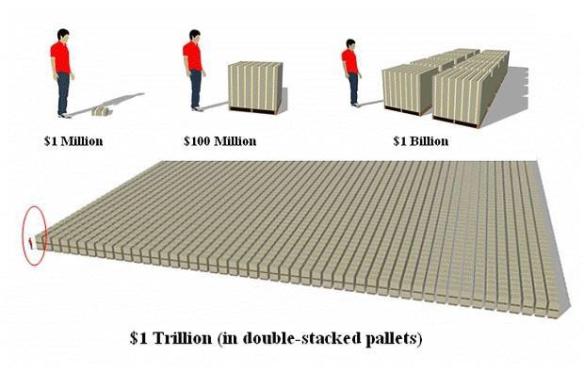
One problem with playing this game is the problem of scale. People have a problem appreciating such huge numbers. They are familiar with what a dollar is, but what’s a trillion? Here it is, represented as double-stacked pallets of $100 bills.

That seems a bit cumbersome for our board game. Reasonable values for the chips in our National Bankruptcy game would be $100 billion, $500 billion and $1 trillion. We could use a few $5 trillion and $10 trillion chips too, though not too many because I doubt that the game would go on long enough to make them useful.

I propose that for the sake of this game we introduce a handy new unit called a “piffle” which is equal to $100 billion. A trillion is 10 piffles, 10 trillion is 100 piffles. Then our chips can be 1, 5, 10, 50 and 100 piffles. Piffles allow us to express various huge quantities without going through any arithmetic contortions. US federal debt is currently 220 piffles. US trade deficit for 2018 was 6 piffles while the US defense budget was 7 piffles. For 2019 the federal budget deficit (covered by increased borrowing) is 10 piffles and rising while tax revenues are just 3 piffles and falling. The interest payment on federal debt is 3 piffles but with rising interest rates it’s going to 5 piffles within a few years.

Speaking of rising interest rates… just today Trump wished for 0% interest rates again, like Obama had while he was running up his 80 piffles’ worth of debt. But now it’s hovering around 3% and is unlikely to go down no matter what Trump wishes. Why? Well, here’s the reason. The US imports much more than it exports because it can’t afford to or lacks the ability to make all the stuff it needs; that’s why there are 6 piffles’ worth of trade deficit. When other nations sell to the US more than they buy, they end up holding lots of piffles, and since the US needs lots of piffles (remember, the budget deficit is 10 piffles) it makes plenty of sense to borrow that money right back. A little while back it was possible to borrow it back at 0% interest because the US was powerful enough to threaten those who refused to play this game with military annihilation (cue pictures of bombed-out Libya and Iraq). But times have changed, and unless the US bribes its debt-holders with 3% interest rate or better—no deal.

How have times changed? There are two effects worth mentioning. First, the military annihilation threat isn’t working any more. Yes, the US still spends a stunning, record-shattering sum of 7 piffles on defense, but none of that is working. Call it the free money effect. When people spend their own hard-earned money, they tend to be careful with it, but if it’s somebody else’s money that they got for free never intending to pay it back, then they tend to throw caution to the wind. And so US military spending has become less and less effective over time, in one of two ways: procurement costs have gone through the roof, and the resulting products have become useless.

In terms of procurement costs, the purchasing parity between the US and (just as an example) Russia seems to be at least ten to one: to get the same result, the US has to spend at least ten times more than Russia. And so although Russia spends well less than 1 piffle on defense, its military is far more effective. In terms of product uselessness, the Pentagon now resembles a woman who has a closet jam-packed with expensive designer labels but has absolutely nothing to wear because her entire wardrobe is no longer fashionable. There is the entire set of aircraft carriers none of which can operate close enough to enemy shores to be of any use at all because they can be readily sunk using hypersonic rockets launched from very far away. There are the stockpiles of Tomahawk cruise missiles which can’t make it past Soviet-era air defense systems (with a few electronics and software upgrades). There are the Patriot air defense systems which are useless even for stopping Soviet-era SCUD missiles, never mind anything more modern.

Add to this Russia’s (and soon China’s) new hypersonic weapons with conventional payloads and new air and space defense systems such as the S-400: these provide what’s known as “escalation dominance.” Suppose the US does something unspeakably nasty and Russia and/or China decide to teach it a lesson. They now have the ability to blow up any target within the US without getting anywhere near it and without placing any of their military assets at risk.

They could, for instance, take out the US electric grid in a way that will take many months to get it back on line. They can then reliably intercept anything that the US tries to retaliate with. Of course, the US can become suicidal—that’s always a risk—and launch a full-on nuclear first strike, then sit back and wait to be completely obliterated along with much of the rest of the planet. But that’s not a military strategy, that’s pure suicide, and the officers in charge of military strategy tend to be emotionally stable family men who look forward to playing with their grandchildren upon retirement.

So, why then should the US continue to spend 7 piffles on defense? The sad answer is that it will go bankrupt whether it zeroes out the defense budget or not. If the defense budget goes to 0, then there is still 3 piffles’ worth of budget deficit left, plus those 6 piffles of trade deficit aren’t going anywhere but up. But what about MAGA?—you might ask—What about firing up US manufacturing, bringing the jobs back and exporting our way out of this? After all, if we turn those 6 piffles of trade deficit into 6 piffles of trade surplus, suddenly it all works out and bankruptcy becomes avoidable.

No, sorry, that just not realistic. You see, in order to get an industrial economy going again the US needs several things. It needs cheap energy, cheap labor, low cost of doing business and readily available markets, both domestic and export. And the US doesn’t have any of these. In terms of energy—and oil is by far the most important form of energy—in 2019 the US will import exactly as much oil as it did in 1998—around 8 million barrels a day. Yes, the shale oil industry has sprung up in the meantime, and the US is currently producing 11.5 million barrels per day. But also in the meantime US oil consumption has gone up a lot—to 20 million barrels a day, which is a stunning 20% of the world’s consumption for 4.4% of the world’s population.

And so the oil deficit is still very much there. Plus the shale oil patch has never made any money but has accumulated over 2 piffles’ worth of debt and has spent over a piffle’s worth more than it made. With interest rates going up they are unlikely to be able to borrow enough to keep up the same hectic drilling rate, and with declines from existing wells at over half a million barrels per day per month it won’t take many months to whittle down that 11.5 million barrels per day, forcing the US to either boost imports or cut consumption.

But the oil price has gone down a lot lately, so there shouldn’t be a problem in any case, right? Again, sorry, no. Peak Oil for most countries has come and gone. There is now only a handful of countries left that are able to meaningfully boost oil production: Russia, Canada (mostly tar sands), Iran, Iraq, United Arab Emirates, Kuwait and Brazil. Russia has recently announced that it isn’t planning to boost production. Saudi Arabia is a huge oil producer but does not seem to have any spare capacity left. Canada’s tar sands patch is a money-losing environmental disaster. Iran and Iraq (call them Iranq, since they are both Shia Moslem, are politically aligned and neither loves America too much) aren’t exactly going to gallop to the rescue. That leaves UAE, Kuwait and Brazil, and if you add them all up together that’s nowhere near enough. So, get ready for oil price spikes, followed by a wave of demand destruction, followed by oil price collapses, followed by supply destruction—you know, the usual.

Moving on to labor. In order to stay competitive, the US will need to lower its median wage a lot. It has to be lower than what the Chinese and the Southeast Asians earn because the US needs to outcompete them to steal their export market share. Without various other major changes this will cause US workers to either rebel or starve to death in short order. The changes involve nationalizing medicine and education to drive down their costs by a factor of 1000 or so, converting to public transportation and pretty much banning the use of private cars to make transportation affordable, putting up high-rises right next to factories for affordable worker housing and so on. That’s a lot of piffles’ worth of effort!

The cost of doing business is a tough one too. The US spends way more on courts and lawyers, insurance and regulatory compliance than most other countries, and the regulatory maze that entrepreneurs have to run in order to run even a small and simple business is very costly and absolutely confounding. How does one take a machete to that whole ridiculous, corrupt scheme? I have no idea. It’s an imponderable. The Chinese would probably just call it a “cultural revolution,” round up all the lawyers and the bureaucrats, make them wear dunce caps and sandwich boards that say “I am what is wrong with this country” and march them in procession while pelting them with rocks and beating them with sticks. Something like that…

Finally, there is the question of export markets. What exactly is the US going to export more effectively than other countries are exporting already? China out-manufactures just about anybody on the planet and isn’t about to give up its spot. Russia exports grain and other foodstuffs (all non-GMO, unlike the US), nuclear and space technology, defense technology (that actually works) and much else. Pakistan and India, and various other countries, export textiles. The world is full up with product. It’s consumers to bankrupt that are in short supply. And if the US cuts its labor rates to make itself competitive, then its consumer base will shrink rather dramatically.

So it looks like bankruptcy is it, no use fighting it. But what should the US do in the meantime? I suggest that it should put up some really huge walls—just for the sake of leaving behind some spectacular ruins for future generations to marvel at. The one along the southern border seems to be going up already, but there should be at least two more. There needs to be a wall along the Mason-Dixon line, because given the heated state of US politics there needs to be a way to prevent people from trying to reenact the Civil War (a misnomer, that!) with actual real weapons and live ammo. And there also needs to be a wall along the northern border, to keep various groups of armed troglodytes from escaping to Canada and ransacking it (it’s the least we can do for our peaceful northern neighbors). How much will these three walls cost? Glad you asked! They will cost roughly 0.005 piffles apiece, 0.015 piffles total—a truly piffling amount. That’s my 0.000000002 piffle’s worth. But, you know, it’s the thought that counts.

Oh, and if you want to actually design this National Bankruptcy board game, please resist the temptation to contact me about it. Seriously, I don’t like games, board games especially. I am a very serious person who doesn’t have time for such piffles.

Reflections on 2018, Forecasting 2019

By Robert J. Burrowes

In many ways it is painful to reflect on the year 2018; a year of vital opportunities lost when so much is at stake.

Whether politically, militarily, socially, economically, financially or ecologically, humanity took some giant strides backwards while passing up endless opportunities to make a positive difference in our world.

Let me, very briefly, identify some of the more crucial backward steps, starting with the recognition by the Bulletin of the Atomic Scientists in January that the year had already started badly when they moved the Doomsday Clock to two minutes to midnight, the closest it has ever been to ‘doomsday’ (and equal to 1953 when the Soviet Union first exploded a thermonuclear weapon matching the US capacity). See ‘It is now two minutes to midnight’.

This change reflected the perilous state of our world, particularly given the renewed threat of nuclear war and the ongoing climate catastrophe. It didn’t even mention the massive and unrelenting assault on the biosphere (apart from the climate) nor, of course, the ongoing monumental atrocities against fellow human beings.

Some Lowlights of 2018

  1. The global elite, using key elite fora such as the Group of 30, the Trilateral Commission, the Bilderberg Group and the World Economic Forum, continued to plan, generate and exacerbate the many ongoing wars, deepening exploitation within the global economy, climate and environmental destruction, and the refugee crisis, among many other violent impacts, in pursuit of greater elite power, profit and privilege.
  1. International organizations (such as the United Nations, the World Bank and International Monetary Fund) and national governments used military forces, legal systems, police forces and prison systems around the world to serve the global elite by defending its interests against the bulk of the human population, including those individuals and organizations audacious enough to challenge elite power, profit and privilege.
  1. $US1.7 trillion was officially spent worldwide on military weapons to kill fellow human beings and other lifeforms, and to destroy the biosphere. See ‘Global military spending remains high at $1.7 trillion’.

However, so out-of-control is this spending that the United States has now spent $US21trillion on its military in the past 20 years for which it cannot even account! That’s right, $US1trillion each year, including 2018, above the official US national budget for killing is ‘lost’. See Army General Fund Adjustments Not Adequately Documented or Supported, ‘Has Our Government Spent $21 Trillion Of Our Money Without Telling Us?’ and ‘The Pentagon Can’t Account for $21 Trillion (That’s Not a Typo)’.

  1. War and other military violence continued to rage across the planet wreaking devastation on many countries and regions, particularly in the Middle East and Africa. If you missed this, read what is happening to Yemen, described as ‘ the world’s worst [humanitarian] crisis in decades’ with ‘three quarters of the entire Yemeni population – 22 million women, children and men – dependent on some form of humanitarian assistance to survive.’ See ‘Yemen: UN chief hails “signs of hope” in world’s worst man-made humanitarian disaster’.
  1. Not content with the nature and extent of the military violence they are inflicting already, during 2018 elites continued to plan how to do it more effectively in future with research and development of artificial intelligence just one manifestation of this: ‘an “arms race in AI” is now underway, with the U.S., China, Russia, and other nations (including Britain, Israel, and South Korea) seeking to gain a critical advantage in the weaponization of artificial intelligence and robotics’ so that ‘artificial intelligence will be applied to every aspect of warfare, from logistics and surveillance to target identification and battle management’. See ‘“Alexa, Launch Our Nukes!” Artificial Intelligence and the Future of War’.
  1. The United States government unilaterally withdrew from the Intermediate Nuclear Forces (INF) Treaty (which limits the deployment of intermediate range nuclear weapons).
  1. Another significant proportion of global private financial wealth – conservatively estimated by the Tax Justice Network in 2010 to already total between $US21 and $US32 trillion – has been invested virtually tax-free through the world’s still-expanding black hole of more than 80 ‘offshore’ tax havens (such as the City of London Corporation, Jersey, Guernsey, the Isle of Man, Bermuda, the Cayman Islands, Hong Kong, Nauru, St. Kitts, Antigua, Tortola, Switzerland, the Channel Islands, Monaco, Cyprus, Gibraltar and Liechtenstein). This is just financial wealth. ‘A big share of the real estate, yachts, racehorses, gold bricks – and many other things that count as non-financial wealth – are also owned via offshore structures where it is impossible to identify the owners.’ See Tax Justice Network.

Controlled by the global elite, Wall Street and other major banks manage this monstrous diversion of wealth under Government protection. ‘Their business is fraud and grand theft.’ Tax haven locations offer more than tax avoidance. ‘Almost anything goes on.’ It includes ‘bribery, illegal gambling, money laundering, human and sex trafficking, arms dealing, toxic waste dumping, conflict diamonds and endangered species trafficking, bootlegged software, and endless other lawless practices.’ See ‘Trillions Stashed in Offshore Tax Havens’.

  1. The world’s major corporations continued to inflict enormous ongoing violence (in a myriad of ways) in their pursuit of endless profit at the expense of living beings (human and otherwise) and Earth’s biosphere by producing and marketing a wide range of life-destroying products ranging from nuclear weapons and nuclear power to junk food, pharmaceutical drugs, synthetic poisons and genetically mutilated organisms (GMOs). These corporations include those involved in the following industries: weapons manufacturers, major banks and their ‘industry groups’ like the International Monetary Conference, asset management firms, investment companies, financial services companies, fossil fuel (coal, oil and gas) corporations, technology corporations, media corporations, major marketing and public relations corporations, agrochemical (pesticides, seeds, fertilizers) giants, pharmaceutical corporations, biotechnology (genetic mutilation) corporations, mining corporations, nuclear power corporations, food multinationals and water corporations. You can see a list of the major corporations in this article: ‘The Global Elite is Insane Revisited’.
  1. More than a billion people continued to live under occupation, dictatorship or threat of genocidal assault. See, for example, ‘500 Years is Long Enough! Human Depravity in the Congo’.
  1. 36,500,000 human beings (mainly in Africa, Asia and Central/South America) were starved to death.
  1. 18,250,000 children were killed by adults in wars, by starving them to death, and in a large variety of other ways.
  1. 8,000,000 children were trafficked into sexual slavery; executed in sacrificial killings after being kidnapped; bred to be sold as a ‘cash crop’ for sexual violation, to produce child pornography (‘kiddie porn’) and ‘snuff’ movies (in which children are killed during the filming); ritually tortured and murdered as well as raped by dogs trained for the purpose. See ‘Humanity’s “Dirty Little Secret”: Starving, Enslaving, Raping, Torturing and Killing our Children’.
  1. Hundreds of thousands of individuals were kidnapped or tricked into slavery, which now denies 46,000,000 human beings the right to live the life of their choice, condemning many individuals – especially women and children – to lives of sexual slavery, forced labor or as child soldiers. See The Global Slavery Index’ and 46 million people living as slaves, latest global index reveals’.
  1. Well over 100,000 people (particularly Falun Gong practitioners) in China, where an extensive state-controlled program is conducted, were subjected to forced organ removal for the trade in human organs. See Bloody Harvest and The Slaughter.
  1. 15,750,000 people were displaced by war, persecution or famine. There are now 68,500,000 people, more that half of whom are children and 10,000,000 of whom are stateless, who have been forcibly displaced worldwide and remain precariously unsettled, usually in adverse circumstances. One person in the world is forcibly displaced every two seconds. See ‘Figures at a Glance’.
  1. Millions of people were made homeless in their own country as a result of war, persecution, ‘natural’ disasters, internal conflict, poverty or as a result of elite-driven national economic policy. The last time a global survey was attempted – by the United Nations back in 2005 – an estimated 100 million people were homeless worldwide. As many as 1.6 billion people lack adequate housing (living in slums, for example). See ‘Global Homelessness Statistics’.
  1. 73,000 species of life (plants, birds, animals, fish, amphibians, insects and reptiles) on Earth were driven to extinction with the worldwide loss of insects, including vital pollinators such as bees, now between 75% and 90%, depending on the species. See ‘Insect Decimation Upstages Global Warming’. Have you seen a butterfly recently?
  1. Separately from global species extinctions, Earth continued to experience ‘a huge episode of population declines and extirpations, which will have negative cascading consequences on ecosystem functioning and services vital to sustaining civilization. We describe this as a “biological annihilation” to highlight the current magnitude of Earth’s ongoing sixth major extinction event.’ Moreover, local population extinctions ‘are orders of magnitude more frequent than species extinctions. Population extinctions, however, are a prelude to species extinctions, so Earth’s sixth mass extinction episode has proceeded further than most assume.’ See ‘Biological annihilation via the ongoing sixth mass extinction signaled by vertebrate population losses and declines’ and ‘Biological Annihilation on Earth Accelerating’.
  1. Wildlife trafficking, worth up to $20 billion in 2018, is pushing many endangered species to the brink of extinction. Illegal wildlife products include jewelry, traditional medicine, clothing, furniture, and souvenirs, as well as some exotic pets, most of which are sold to unaware/unconcerned consumers in the West. See, for example, Stop Wildlife Trafficking.
  1. 16,000,000 acres of pristine rainforest were destroyed (with more than 40,000 tropical tree species now threatened with extinction). See ‘Measuring the Daily Destruction of the World’s Rainforests’, ‘Estimating the global conservation status of more than 15,000 Amazonian tree species’ and ‘Half of Amazon Tree Species Face Extinction’.
  1. Vast quantities of soil were washed away as we destroyed the rainforests, and enormous quantities of both inorganic constituents (such as heavy metals like cadmium, chromium, lead, mercury, nickel and zinc) and organic pollutants (particularly synthetic chemicals in the form of fertilizers, pesticides and herbicides) were dumped into the soil as well, thus reducing its nutrients and killing the microbes within it. We also contaminated enormous quantities of soil with radioactive waste. See Soil-net, ‘Glyphosate effects on soil rhizosphere-associated bacterial communities’ and ‘Disposing of Nuclear Waste is a Challenge for Humanity’.
  1. The TEPCO nuclear power plant in Fukushima, Japan discharged 109,000 tons of radioactive waste into the Pacific Ocean killing an incalculable number of fish and other marine organisms and indefinitely contaminating expanding areas of that ocean. See ‘Fukushima: A Nuclear War without a War: The Unspoken Crisis of Worldwide Nuclear Radiation’.
  1. Human use of fossil fuels to power aircraft, shipping and vehicles (among other purposes) released 10 billion metric tons (gigatons) of carbon dioxide into Earth’s atmosphere, a 2.7% increase over 2017. See ‘Global Carbon Budget 2018’ and ‘Carbon dioxide emissions will hit a record high globally in 2018’. As a measure of their concern elite-controlled governments and corporations around the world are currently planning or have under construction 1,380 new coal plants? That’s right. 1,380 new coal plants. In 59 countries. See ‘NGOs Release List of World’s Top Coal Plant Developers’ and ‘2018 Coal Plant Developers List’.
  1. 90 billion land animals and 60 billion marine animals were killed for human consumption, more than 100 million animals were killed for laboratory purposes in the United States alone and there were other animal deaths in shelters, zoos and in blood sports. See ‘How Many Animals Are Killed Each Year?’

In addition, 40 million animals were killed for their fur. Approximately 30 million of these animals were raised on fur farms and killed, about 10 million wild animals were trapped and killed, and hundreds of thousands of seals were killed for their fur. See ‘How Many Animals are Killed Each Year?’

  1. Farming of animals for human consumption released 7,100,000,000 tonnes of CO2-equivalent into Earth’s atmosphere. About 44% of livestock emissions were in the form of methane (which was 44% of anthropogenic CH4 emissions), 29% as Nitrous Oxide (which was 53% of anthropogenic N2O emissions) and 27% as Carbon Dioxide (which was 5% of anthropogenic CO2 emissions). See ‘GHG Emissions by Livestock’.
  1. Human use of fossil fuels and farming of animals released 3.2 million metric tons of (CO2 equivalent) nitrous oxide (N2O) into Earth’s atmosphere. See ‘Nitrous oxide emissions’.
  1. As a result of previous greenhouse gas (GHG) emissions and the consequent rise of about one degree celsius in the global temperature, causing the melting of Arctic permafrost and undersea methane ice clathrates, an incalculable quantity of methane was uncontrollably released into the atmosphere during 2018 (with the quantity being released getting ever closer to ‘exploding’). See ‘7,000 underground gas bubbles poised to “explode” in Arctic’ and ‘Release of Arctic Methane “May Be Apocalyptic,” Study Warns’.
  1. Ice in the Antarctic is melting at a record-breaking rate, losing 219 billion tonnes of ice in 2018 at a rate that has accelerated threefold in the last five years. See ‘Antarctic ice melting faster than ever, studies show’.
  1. An incalculable amount of agricultural poisons, fossil fuels and other wastes was discharged into the ocean, adversely impacting life at all ocean depths – see ‘Staggering level of toxic chemicals found in creatures at the bottom of the sea, scientists say’ – and generating ocean ‘dead zones’: regions that have too little oxygen to support marine organisms. See ‘Our Planet Is Exploding With Marine “Dead Zones”’.
  1. At least 8 million metric tons of plastic, of which 236,000 tons were microplastics, was discharged into the ocean. See ‘Plastic waste inputs from land into the ocean’ and ‘Plastics in the Ocean’.
  1. Earth’s fresh water and ground water was further depleted and contaminated. These contaminants included bacteria, viruses and household chemicals from faulty septic systems; hazardous wastes from abandoned and uncontrolled hazardous waste sites (of which there are over 20,000 in the USA alone); leaks from landfill items such as car battery acid, paint and household cleaners; the pesticides, herbicides and other poisons used on farms and home gardens; radioactive waste from nuclear tests; and the chemical contamination caused by hydraulic fracturing (fracking) in search of shale gas, for which about 750 chemicals and components, some extremely toxic and carcinogenic like lead and benzene, have been used. See ‘Groundwater contamination’, ‘Groundwater drunk by BILLIONS of people may be contaminated by radioactive material spread across the world by nuclear testing in the 1950s’ and ‘Fracking chemicals’.
  1. The longstanding covert military use of geoengineering – spraying tens of millions of tons of highly toxic metals (including aluminium, barium and strontium) and toxic coal fly ash nanoparticulates (containing arsenic, chromium, thallium, chlorine, bromine, fluorine, iodine, mercury and radioactive elements) into the atmosphere from jet aircraft to weaponize the atmosphere and weather – in order to enhance elite control of human populations, continued unchecked. Geoengneering is systematically destroying Earth’s ozone layer – which blocks the deadly portion of solar radiation, UV-C and most UV-B, from reaching Earth’s surface – as well as adversely altering Earth’s weather patterns and polluting its air, water and soil at incredible cost to the health and well-being of living organisms and the biosphere. See ‘Geoengineering Watch’.
  1. As one outcome of our dysfunctional parenting model and political systems, fascism continued to rise around the world. See ‘The Psychology of Fascism’.
  1. Despite the belief that we have ‘the right to privacy’, privacy (in any sense of the word) was ongoingly eroded in 2018 and is now effectively non-existent, particularly thanks to Alphabet (owner of Google). Taken together, ‘Uber, Amazon, Facebook, eBay, Tinder, Apple, Lyft, Foursquare, Airbnb, Spotify, Instagram, Twitter, Angry Birds… have turned our computers and phones into bugs that are plugged in to a vast corporate-owned surveillance network. Where we go, what we do, what we talk about, who we talk to, and who we see – everything is recorded and, at some point, leveraged for value.’ Moreover, given Google’s integrated relationship with the US government, the US military, the CIA, and major US weapons manufacturers, there isn’t really anything you can do that isn’t known by those who want to know it. In essence, Google is ‘a powerful global corporation with its own political agenda and a mission to maximise profits for shareholders’ and it partly achieves this by expanding the surveillance programs of the national security state at the direction of the global elite. See ‘Google’s Earth: How the Tech Giant Is Helping the State Spy on Us’ and the documentary ‘The Modern Surveillance State’.
  1. The right to free speech was ongoingly eroded in 2018. For just a couple of examples in the United States alone, see ‘Marc Lamont Hill On Getting Fired From CNN, His Remarks On Palestine + More’ and ‘A Texas Elementary School Speech Pathologist Refused to Sign a Pro-Israel Oath, Now Mandatory in Many States – so She Lost Her Job’.
  1. Believing that we know better than evolution, humans created the first gene-edited baby in 2018. See ‘Why we are not ready for genetically designed babies’ and China’s Golem Babies: There is Another Agenda’.
  1. An incalculable amount of junk was added to the 100 trillion items of junk already in Space. See ‘Space Junk: Tracking & Removing Orbital Debris’.
  1. Incalculable amounts of antibiotic waste, nuclear waste, nanowaste and genetically engineered organisms were released into Earth’s biosphere. See ‘Junk Planet: Is Earth the Largest Garbage Dump in the Universe?’
  1. Ongoing violence against children – see Why Violence? and Fearless Psychology and Fearful Psychology: Principles and Practice – ensured that more people will grow up accepting (and quite powerless to challenge) our dysfunctional and violent world, as described above.
  1. The corporate media, education and entertainment industries continued to distract us from reality ensuring that most people remain oblivious to our predicament and their own role in it, let alone what they can do to respond powerfully.

While the above list of the setbacks humanity and the Earth suffered in 2018 is very incomplete, it still provides clear evidence that humanity is rapidly entering a dystopian future far more horrific than the worst novel or film in the genre. The good news is that, at the current rate, this dystopian world will be shortlived as humans drive themselves over the edge of extinction. See ‘Human Extinction by 2026? A Last Ditch Strategy to Fight for Human Survival’.

But so that the picture is clear and ‘balanced’: were there any gains made against this onslaught?

Of course, it goes without saying that the global elite, international organizations (such as the United Nations), governments, corporations and other elite agents continued to live in delusion/denial endlessly blocking any initiative requiring serious action that would cut into corporate profits, or arguing over tangential issues of insignificant consequence to humanity’s future.

In short, I could find no record of official efforts during the year to plan for the development and implementation of a comprehensive, just and sustainable peace, but perhaps I missed it.

Separately from this, there have been some minor activist gains: for example, some western banks and insurance companies are no longer financially supporting the expansion of the western weapons industry and the western coal industry, some rainforest groups have managed to save portions of Earth’s rainforest heritage, and activist groups continue to work on a variety of issues sometimes making modest gains.

In essence however, as you probably realize, many of the issues above are not even being tackled and, even when they are, activist efforts have been hampered by inadequate analysis of the forces driving conflicts and problems, limited vision (particularly unambitious aims such as those in relation to ending war and the climate catastrophe), unsophisticated strategy (necessary to have profound impact against a deeply entrenched, highly organized and well-resourced opponent, with the endless lobbying of elite institutions, such as governments and corporations, despite this effort simply absorbing and dissipating our dissent, as is intended – as Mark Twain once noted: ‘If voting made a difference, they wouldn’t let us do it.’) and failure to make the difficult decisions to promote necessary solutions that are ‘unpopular’.

Fundamentally, these ‘difficult decisions’ include the vital need to campaign for the human population, particularly in the West, to substantially reduce their consumption – by 80% – involving both energy and resources of every kind as the central feature of any strategy to curtail destruction of the environment and climate, to undermine capitalism and to eliminate the primary driver of war: violent resource acquisition from Middle Eastern and developing nations for the production of consumer goods and services for western consumers.

While we live in the delusion that we can simply substitute renewable energy for fossil fuels and nuclear power (or believe such delusions that a 1.5 degrees celsius increase above the preindustrial temperature is acceptable or that we have an ‘end of century’ timeframe to solve the climate crisis), we ignore the fundamental reality that Earth’s biosphere is under siege on many fronts as a result of our endless extraction of its natural resources – such as fresh water, minerals, timber and, again, fossil fuels – for consumer production and the provision of services that go well beyond energy.

In short, for example, we will not save the world’s rainforests because we switch to renewable energy. We must reduce demand for the consumer products that require rainforest inputs. We must stop mining the Earth for minerals that end up in our mobile phones, computers, vehicles, ships and aircraft by not using the products and services these minerals make possible. We must stop eating meat and other animal products. And so the list goes on.

Forecasting 2019

In many ways it is painful to forecast what will happen in 2019 mainly because of the absurd simplicity of doing so: It will be another year when vital opportunities will be lost when so much is at stake.

Given the insanity of the global elite – see ‘The Global Elite is Insane Revisited’ – which will continue to drive the dynamics producing the lowlights mentioned above with the active complicity of their agents in governments and corporations coupled with a human population that is largely terrified, self-hating and powerless to resist – see ‘In Defense of the Human Individual’ – it is a straightforward task to forecast what will happen in 2019.

So let me forecast 40 lowlights for 2019:

  1. See list above.
  2. See list above.
  3. See list above.

.
.

  1. See list above.

So unless you play your part, 2019 and the few years thereafter will simply be increasingly worse versions of 2018 and it will all be over by 2026. See ‘Human Extinction by 2026? A Last Ditch Strategy to Fight for Human Survival’ which cites a wide range of scientific and other evidence which you are welcome to consider for yourself if this date seems premature.

Responding Powerfully

If you already feel able to act powerfully in response to this multifaceted crisis, in a way that will have strategic impact, you are invited to consider joining those participating in The Flame Tree Project to Save Life on Earth, which outlines a simple plan for you to systematically reduce your consumption, by at least 80%, involving both energy and resources of every kind – water, household energy, transport fuels, metals, meat, paper and plastic – while dramatically expanding your individual and community self-reliance in 16 areas, so that all environmental and climate concerns are effectively addressed.

If you are also interested in conducting or participating in a campaign to systematically address one of the issues identified above, you are welcome to consider acting strategically in the way that Mohandas K. Gandhi did. Whether you are engaged in a peace, climate, environment or social justice campaign, the 12-point strategic framework and principles are the same. See Nonviolent Campaign Strategy. And, for example, you can see a basic list of the strategic goals necessary to end war and halt the climate catastrophe. See ‘Strategic Aims’.

If you want to know how to nonviolently defend against a foreign invading power or a political/military coup, to liberate your country from a dictatorship or a foreign occupation, or to defeat a genocidal assault, you will learn how to do so in Nonviolent Defense/Liberation Strategy.

If you are interested in nurturing children to live by their conscience and to gain the courage necessary to resist elite violence fearlessly, while living sustainably despite the entreaties of capitalism to over-consume, then you are welcome to make ‘My Promise to Children’.

To reiterate: capitalism, war and destruction of the environment and climate are outcomes of our dysfunctional parenting of children which distorts their intellectual and emotional capacities, destroys their conscience and courage, and actively teaches them to over-consume as compensation for having vital emotional needs denied. See ‘Love Denied: The Psychology of Materialism, Violence and War’.

If your own intellectual and/or emotional functionality is the issue and you have the self-awareness to perceive that, and wish to access the conscience and courage that would enable you to act powerfully, try ‘Putting Feelings First’.

And if you want to be part of the worldwide movement committed to ending all of the violence identified above, consider signing the online pledge of ‘The People’s Charter to Create a Nonviolent World’.

In summary: if we do not rapidly, systematically and substantially reduce our consumption in several key areas and radically alter our parenting model, while resisting elite violence strategically on several fronts, homo sapiens will enter Earth’s fossil record within a few years. Given the fear, self-hatred and powerlessness that paralyses most humans, your choices in these regards are even more vital than you realize.


Biodata: Robert J. Burrowes has a lifetime commitment to understanding and ending human violence. He has done extensive research since 1966 in an effort to understand why human beings are violent and has been a nonviolent activist since 1981. He is the author of Why Violence? His email address is flametree@riseup.net and his website is here.

Robert J. Burrowes
P.O. Box 68
Daylesford, Victoria 3460
Australia

Email: flametree@riseup.net

Websites:
Nonviolence Charter
Flame Tree Project to Save Life on Earth
‘Why Violence?’
Feelings First
Nonviolent Campaign Strategy
Nonviolent Defense/Liberation Strategy
Anita: Songs of Nonviolence
Robert Burrowes
Global Nonviolence Network

Demise Of The Petrodollar Has The Potential To Reshape The Geopolitical World

By James ONeill

Source: New Eastern Outlook

In the early 1970s President Richard Nixon instigated two changes that had profound effects. The first of these was taking United States off the gold standard; i.e. henceforth US dollars would no longer be convertible to Gold. Ordinarily this might have been expected to have significant ramifications for the value of the US dollar.

Deleterious effects however, were avoided by another equally profound change. Nixon’s National Security Adviser Henry Kissinger negotiated an agreement with Saudi Arabia that henceforth all oil(initially from Saudi Arabia but rapidly extended to all OPEC) countries would be traded only in US dollars, the birth of the so called petrodollar.

It was a classic mafia style arrangement. In exchange for Saudi Arabia’s agreement to the sole use of the dollar for oil transactions, the US underwrote Saudi Arabia’s security thereby ensuring the continuity of one of the world’s most corrupt and repressive regimes.

Also unknown at the time, the US and Saudi Arabia entered an arrangement whereby Islamist terrorist groups (as long as they were Sunni) would be financed by Saudi Arabia and armed by the Americans and then used in pursuit of US geopolitical goals. Operation Cyclone, begun under the Carter administration in the 1970s was an early forerunner of this tactic, but it has been refined and utilized in different formats in a wide number of countries ever since.

The objective was always fundamentally the same: to undermine and if necessary replace governments that were insufficiently compliant with US geopolitical aims. As and when necessary, US troops and their “coalition” allies would be inserted into the target countries. The destruction of Afghanistan (2001 and continuing) Iraq (2003 and continuing) Libya (2011 and continuing) are only three of the better-known examples.

The huge financial cost of these military and geopolitical ventures did not impose a proper price upon the US because of the hegemonic role of the US dollar. The US, in effect, had their multiple wars of choice paid for by other countries as the dollar’s role in world trade created a constant demand for US Treasury bonds.

The role of the US dollar also permitted the US to impose sanctions on recalcitrant countries. The selective nature of the sanctions, always directed toward a US geopolitical or commercial advantage, were clearly an instrument of repressive power. Notwithstanding claims that they were to “punish” the alleged misconduct of the specified country, their actually use betrayed their geopolitical purpose.

Sanctions against Russia for its” invasion” of Ukraine “annexation” of Crimea, and against Iran for its “nuclear program” are two of the better known illustrations of sanctions being justified on spurious grounds..

The use and abuse of the dollar’s power is clearly unacceptable, but the capacity to invoke countermeasures was until quite recently severely limited. The single most important countervailing force is the rise of China as the economic powerhouse of the world, and importantly, the creation of alternative structures in trade, finance and security, that translate China’s economic power into a force for major change.

That change is assisted by the number of collateral developments. In 1990, the G7 nations (Canada, France, Germany, Italy, Japan, the US and UK) had a combined GDP approximately six times greater then the seven economically most important emerging nations (Brazil, China, India, Indonesia, Mexico, Russia and South Korea).

By 2013 the “emerging seven” had surpassed the G7’s GDP total and according to the IMF’s estimates for 2017, the GDP of the two groups will be $47 .5 trillion and $37.8 trillion for the emerging seven and the G7 respectively. Turkey, which is growing at 5% per annum, has replaced Mexico in the top emerging seven.

BRICS, which contains four of the emerging seven nations and the Shanghai Corporation Organisation (SCO), which includes China, India and Russia, are working together on the architecture of a monetary alternative to the dollar. The SCO alone contains 42% of the world’s population.

India’s role in BRICS and the SCO is one reason it is being assiduously cultivated by Australia, Japan and the United States in an attempt to set up a “quadrilateral four” to slow and undermine the role of China and Russia in creating an alternative to longstanding western domination and exploitation.

It was in this context that Russia’s President Putin at the recent BRICS meeting in Xiamen, China said that

“Russia shares the BRICS countries concerns over the unfairness of the global financial and economic architecture, which does not give due regard to the growing weight of the emerging economies.”

This speech developed a theme that Putin had developed in an article published prior to the BRICS meeting. Putin bluntly vowed to destroy the US led financial system, aiming to reform a system that gives excessive domination to a limited number of reserve (i.e. predominantly western) currencies.

China has developed a new Cross Border Interbank Payments System (CIPS) to replace the US dominated SWIFT system, itself used as a tool for financial bullying by the US. Russia has also taken steps to insulate itself from the ill effects of being excluded from SWIFT.

Other major changes are also occurring. Venezuela, with the world’s largest known oil reserves, has ceased accepting payment in US dollars. In the past US retaliation through regime change would have been immediate as happened to Libya’s Gaddafi (confirmed by Clinton’s leaked emails) and the Iraq’s Saddam Hussein who had announced that he would henceforth accept payment in euros and not dollars.

China and Qatar recently concluded a $50 billion deal denominated in Yuan. There were immediate threats and absurd demands from Saudi Arabia, undoubtedly acting as the voice of the US administration, but nothing more serious. The lack of military intervention or attempted regime change was probably attributable to Turkey’s military intervention, a series of agreements with Iran, and the probable implied threat of Chinese intervention should the Saudis further demonstrate their military incompetence (as in Yemen) by anything as rash as direct military moves against Qatar.

Saudi Arabia is rapidly reaching a crunch point in its relationship with China, a huge purchaser of Saudi Arabia’s oil. It is widely known that China wants future oil contracts denominated in Yuan. The attraction for Saudi Arabia is that the Chinese guarantee their Yuan with gold traded on the Hong Kong and Shanghai exchanges. Ironically, this puts China in the same position as the United States prior to Nixon’s withdrawal from the gold backed dollar.

The dilemma for the Saudis is that if they comply with the Chinese demands they risk losing the Americans underwriting their security. US instigated regime change in Saudi Arabia is a very real possibility and the recent maneuverings by Mohammad bin Salman to consolidate his power can be interpreted as a response to that possibility.

Typically, the western media focused on relative trivialities, such as women being able to drive motor vehicles from 2018 (in limited circumstances), rather than examining the underlying geopolitical power struggle.

The other major development worth mentioning in this context is the rapid increase in the number of countries doing deals with China using the Yuan or their own national currencies as the medium of exchange. China’s Belt and Road Initiative, currently involving 65 nations, will undoubtedly accelerate this trend. Russia and China are already each other’s critically important trading partners and all agreements between them are being denominated in either Yuan or Rubles.

It would be naïve to assume that this is all going to occur without a massive rearguard action by the Americans who know full well that their ability to defy economic logic is only possible because of the dollar’s unique role, allowing in turn military interventions to prop up their now rapidly declining power.

The United States’ aggressive and provocative actions in the South China Sea, North Korea, Ukraine, Syria and elsewhere our best interpreted as the flailing’s of a declining empire. The real question is will the United States accept the disappearance of the unique power that it has wielded since the Bretton Woods agreement of 1944 and adjust its policies accordingly, or destroy us all in their attempts to recapture a lost world.

For Purely Technical Reasons

peak-oil

By Dmitry Orlov

Source: Club Orlov

It is tempting for us to think that our technological choices—whether we choose to live in a city, a suburb or out in the country; whether we want to drive a pick-up truck, a gasoline-electric hybrid or ride a bicycle; whether we take a train, drive long distances or fly—are determined by our tastes. We may flatter ourselves that we are in control, and that our choices are reflective of our enlightened, environmentally conscious values. This view rests on a foundation of circular reasoning: we behave in enlightened ways because we are enlightened, and we are enlightened because, to wit, we behave in enlightened ways. As to why what we consider enlightened is in fact enlightened rather than a question of possibly questionable personal taste—that is not to be discussed: de gustibus non est disputandum.

But there is an alternative viewpoint, which seems more realistic in many ways, because it rests on a foundation of physical, technical specifics rather than fickle and arbitrary consumer preference, whim or taste. From this viewpoint, our technology and associated lifestyle choices are dictated by the technical requirements of their underlying technologies, both physical (the operation of the energy industry, the transportation industry, etc.) and political (the operation of political machines that segregate society by net worth and income, relegating wage-earners to a global disenfranchised underclass).

A few years ago I found out that I needed to replace the diesel engine on my boat (the old one blew up definitively) and looked at a number of options, one of which was to replace it with an electric motor and a large bank of batteries. The electric option was touted as being quiet, non-polluting, and having just enough range to get in and out of the marina and to get back to dock if the wind died during a typical daysail. It turned out to be more than twice as expensive as a replacement diesel engine. As to what one might do to take such a boat any great distance (that involves many hours of motoring) the solution is to… add a diesel engine hooked up to a very large alternator, at triple the cost of just replacing the diesel. And so I just replaced the diesel.

Diesel engines have a lot of positive qualities: they can run continuously for tens of thousands of hours; they can be rebuilt many times just by replacing the bearings, the cylinder sleeves, the piston rings and the valves; they are exceptionally reliable; the fuel they use is energy-dense. For these reasons, they are found throughout freight and construction industries and are used for small-scale power generation. They can be very large: the larger ships have engines that are as big as houses, with ladders welded to their cylinder walls, so that servicemen can climb down into them to service them after the cylinder head and the piston assembly are pulled out using an overhead shop crane. Small diesel engines make a lot less sense, and the silliest of them are the ones found on small yachts. There are many aspects of their design that make them silly, but there is also an overriding reason: they use the wrong fuel.

You see, diesel is a precious commodity, used in the transportation industry (by trucks, locomotives and ships), and in construction equipment, with no alternative that is feasible. A cousin of diesel fuel is jet fuel—another petroleum distillate—that is used to power jet engines, again, with no alternative that is feasible. And then there is a fuel that is only really useful as a small engine fuel: gasoline, that is. Gasoline engines beyond a certain size become much more trouble than they are worth.

Each barrel of crude oil can be distilled and refined into a certain amount of diesel and jet fuel, a certain amount of gasoline, some tar and some far less useful substances such as naphtha. The diesel is spoken for, because it literally moves the world; but if enough small engines cannot be found to burn all the gasoline that is produced, it becomes a waste product and has to be flared off at the oil refinery, at a loss. Indeed, prior to Henry Ford coming up with the brilliant plan to build cars cheap enough for his workers to afford, gasoline was dumped into rivers just to get rid of it, because while everyone burned kerosene (a distillate, like jet fuel and diesel) in lamps, cars remained playthings of the rich, and there simply wasn’t a market for any great quantities of gasoline.

Therefore, it became very important to find ways to sell gasoline, by finding enough uses for it, no matter how superfluous they happened to be. And although some people think that the private automobile is a symbol of luxury and freedom and feel the thrill of the open road, the reason they think that is because these ideas were implanted in their heads by the people who were tasked with finding a market for gasoline. Alongside cars, great effort was put into marketing all sorts of other small engines: for lawn mowers, jet skis, motorcycles, ATVs, boat outboard motors… The only semi-industrial use of gasoline is in chainsaws, small generators and air compressors, service and delivery vehicles, and outboard engines.

And so people were sold on the idea of driving their own car, whether they needed to or not, and spending lots of time stuck in traffic—all so that they would pay for gasoline. By causing all that excess traffic congestion, they also created the need to widen roads and highways, generating demand for another borderline useless petroleum product: road tar. And since there was a problem with cramming all these cars into cities (where cars are generally not needed if the cities are laid out using proper urban design, with sufficient numbers of tram, light rail and subway lines, etc.) the solution was to move everybody out to the suburbs. And so the reason half of the US population now lives in suburbia and drives has nothing to do with their needs, and everything to do with the need to sell them gasoline.

Some people may react negatively to the idea that their suburban castle and their magic chariot are all just part of a plan to make them spend much of their life paying for the right to dispose of toxic waste in unsafe ways. Rest assured, their preprogrammed negative reaction is part of the plan. Every effort has been made to program people to think that this waste disposal job—carried out at one’s own expense—is, in fact, something that should be considered a sign of success. The most efficient way to motivate a slave to perform is to convince him that he is free. To this end, driving is celebrated in music and film and portrayed as a way of life. Calling it what it is—being a slave to a machine—is bound to cause cognitive dissonance, all the more so because driving a lot destroys one’s mind: in the immortal words of a character from the movie Repo Man, ”The more you drive, the less intelligent you become.” In this respect, most of the people living in the US are far past the point of no return, and it is pointless to attempt to impart to them any ideas that are discordant with the dead-end lifestyle into which they have been unconsciously coerced.

Getting back to electric vehicles, such as what my boat would have ended up if I were gullible and made of money: they are obviously a defective idea. Their range is limited, they take longer to charge than it takes to fill a gas tank, and they use expensive and dangerous lithium-ion batteries that need periodic replacement. There is not enough lithium available to continue making batteries for laptops and smartphones (which periodically burst into flames), never mind providing for a giant expansion of battery-building to support lots of electric cars. Perhaps most importantly, they shrink the market for gasoline. So, what’s the reason behind the push?

It certainly isn’t part of any particular effort to electrify transportation in general, because no electric solution exists for ships or planes, and electrifying rail freight is an impossibly expensive proposition. It certainly isn’t part of an effort to cut greenhouse gas emissions, because most of the ways electricity is currently generated is by burning coal and natural gas—and will be, while supplies last, because electricity is hard to store, and no matter how many solar arrays and wind farms are installed something will be needed to power the electric grid on overcast, windless days.

No, the push for electric cars is motivated by a different sort of technology—political technology. You see, the oil age is drawing to a close. Last year the oil companies only discovered 1 barrel of oil for every 10 barrels they produced; at the turn of the century it was closer to 1 for every 4. At the same time, most of the easy-to-get-at oil has already been produced, and now it takes 1 barrel’s worth of energy to produce something like 10 barrels, whereas at the dawn of the age of oil it was closer to 1 for every 100 barrels. Such a low level of net energy production is turning out to be insufficient to maintain an industrial civilization, and as a result economic growth has largely stalled out. And although large investments in oil production have succeeded in keeping large volumes of oil flowing, for now, this is turning out to be an ineffective way to invest money, with many energy companies, once so profitable, now unable to pay the interest on their debt. And even though constant injections of free money are currently keeping developed economies from cratering into bankruptcy, it has been clear for some time that each additional dollar of debt produces significantly less than a dollar’s worth of economic growth. Growing debt within a growing economy can be very nice; but if the economy isn’t growing as fast, it’s fatal.

As the oil age winds down, personal transportation, in the form of the automobile, is bound to once again become a plaything of the very rich. But then, when it comes to electric cars, it already is! And I don’t mean Tesla: the most commonly used electric vehicle worldwide is the golf cart. And who uses golf carts? Members of golf clubs; guests at resorts; residents of posh gated communities; employees at corporate and academic campuses… And what do all these people have in common? They are all members of the salaried elite; they are definitely not members of the wage-earning class. To them, the electric car offers a way of preserving a semblance of the status quo for themselves while setting themselves apart (in their own minds) from all of the gasoline-burning riffraff. Let the great unwashed in the flyover states, with their pickup trucks complete with gun racks, burn what’s left of the gasoline while overdosing on synthetic opiates while the salaried elites and individuals of high net worth, ensconced in their campuses and gated communities, will create a different future for themselves, replete with wind turbines, solar panels and electric cars (until they all get shot by all those they have disenfranchised).