America Leader of the Free World? How to Forget U.S. interference in Foreign Elections

By Philip Giraldi

Source: Strategic Culture Foundation

Joe Biden should read up on the history of American political and military interventions, regime changes and electoral interference worldwide.

After only five months in office, President Joe Biden has already become notorious for his verbal gaffes and mis-spokes, so much so that an admittedly Republican-partisan physician has suggested that he be tested to determine his cognitive abilities. That said, however, there is one June 16th tweet that he is responsible for that is quite straightforward that outdoes everything else for sheer mendacity. It appeared shortly after the summit meeting with Russian President Vladimir Putin and was apparently intended to be rhetorical, at least insofar as Biden understands the term. It went: “How would it be if the United States were viewed by the rest of the world as interfering with the elections directly of other countries and everybody knew it? What would it be like if we engaged in activities that he engaged in? It diminishes the standing of a country.”

There have been various estimates of just exactly how many elections the United States has interfered in since the Second World War, the numbers usually falling somewhere between 80 and 100, but that does not take into account the frequent interventions of various kinds that took place largely in Latin America between the Spanish-American War and 1946. One recalls how the most decorated Marine in the history of the Corps Major General Smedley Butler declared that “War is a racket” in 1935. He confessed to having “…helped make Mexico, especially Tampico, safe for American oil interests in 1914. I helped make Haiti and Cuba a decent place for the National City Bank boys to collect revenues in. I helped in the raping of half a dozen Central American republics for the benefits of Wall Street. The record of racketeering is long. I helped purify Nicaragua for the international banking house of Brown Brothers in 1909-1912. I brought light to the Dominican Republic for American sugar interests in 1916. In China I helped to see to it that Standard Oil went its way unmolested.”

And there have been since 1900 other regime change and interventionist actions, both using military force and also brought about by corrupting local politicians with money and other inducements. And don’t forget the American trained death squads active in Latin America. Some would also include in the list the possibly as many as 50 Central Intelligence Agency and Special Ops political assassinations that have been documented, though admittedly sometimes based on thin evidence.

That Joe Biden, who has been at a reasonably high level in the federal government for over forty years, including as Vice President for eight years and now President should appear to be ignorant of what his own government has done and quite plausibly continues to do is astonishing. After all, Biden was VP when Victoria Nuland worked for the Obama Administration as the driving force behind efforts in 2013-2014 to destabilize the Ukrainian government of President Viktor Yanukovych. Yanukovych, an admittedly corrupt autocrat, nevertheless became Prime Minister after a free election. Nuland, who is the Assistant Secretary of State for European and Eurasian Affairs at the State Department, provided open support to the Maidan Square demonstrators opposed to Yanukovych’s government, to include media friendly appearances passing out cookies on the square accompanied by Senator John McCain to encourage the protesters.

A Dick Cheney and Hillary Clinton protégé who is married to leading neocon Robert Kagan, Nuland openly sought regime change for Ukraine by brazenly supporting government opponents in spite of the fact that Washington and Kiev had ostensibly friendly relations. As Biden’s tweet even recognized in a backhanded way, it is hard to imagine that any U.S. administration would tolerate a similar attempt by a foreign nation to interfere in U.S. domestic politics, particularly if it were backed by a $5 billion budget, but Washington has long believed in a global double standard for evaluating its own behavior. Biden clearly is part of that and also clearly does not understand what he is doing or saying.

Nuland is most famous for her foul language when referring to the potential European role in managing the unrest that she and the National Endowment for Democracy had helped create. The Obama and Biden Administration’s replacement of the government in Kiev was the prelude to a sharp break and escalating conflict with Moscow over Russia’s attempts to protect its own interests in Ukraine, most particularly in Crimea. That point of conflict has continued to this day, with a U.S. warships in the Black Sea engaging in exercises with the Ukrainian navy.

Biden was also with the Obamas when they chose to destabilize and destroy Libya. Nor should Russia itself be forgotten. Boris Yeltsin was re-elected president of Russia in 1996 after the Clinton Administration pumped billions of dollars into his campaign, enabling him to win a close oligarch-backed victory that had been paid for and managed by Washington. Joe Biden was a Senator at the time.

And then there is Iran, where democratically elected Mohammed Mossadeq was deposed by the CIA in 1953 and replaced by the Shah. The Shah was replaced by the Islamic Republic in turn in 1979 and the poisoned relationship between Washington and Tehran has constituted a tit-for-tat quasi-cold war ever since, marked by assassinations and sabotage.

And who can forget Chile where Salvador Allende was removed by the CIA in 1973 and replaced by Augusto Pinochet? Or Cuba and the Bay of Pigs invasion in 1961 where the CIA failed to bring about regime change in Havana? Can it be that Joe Biden cannot recall any of those “interventions,” which were heavily covered in the international media at the time?

And to make up the numbers, Joe can possibly consider the multiple “interferences in elections,” which is more precisely what he was referring to. As a CIA officer stationed in Europe and the Middle East in and 1970s through the early 1990s, I can assure him that I personally know about nearly continuous interference in elections in places like France, Spain, Portugal and Italy, all of which had prominent communist parties, some of which were on the verge of government entry. Bags of money went to conservative parties, politicians were bribed and journalists bought. In fact, during that time period I would dare to say there was hardly an election that the United States did not somehow get involved in.

Does it still go on? The U.S. has been seeking regime change in Syria since 2004 and is currently occupying part of the country. And of course, Russia is on the receiving end of a delegitimization process through a controlled western media that is seeking to get rid of Putin by exploiting a CIA and western intelligence funded opposition. China has no real opposition or open elections, nor can its regime plausibly be changed, but it is constantly being challenged by depicting it and its behavior in the most negative fashion possible.

Joe Biden really should read up on the history of American political and military interventions, regime changes and electoral interference worldwide. He just might learn something. The most important point might, however, elude him. All of the intervention and all of the deaths have turned out badly both for the U.S. and for the people and countries being targeted. Biden has taken a bold step to withdraw U.S. forces from Afghanistan, though it now appears that that decision might be in part reversed. Much better to complete the process and also do the same thing in places like Iraq, Somalia and Syria. The whole world will be a better place for it.

Uncle Sam, the Human Rights Hypocrite

By Paul Street

Source: TruthDig

This year marks the 70th anniversary of the Universal Declaration of Human Rights. Signed by the United States and adopted by the United Nations General Assembly on Dec. 10, 1948, the document was a great and shining step forward in the articulation of how human beings might organize their social and political systems in accord with democratic and civilized ideals.

The U.S. has long wielded the Universal Declaration (UD) as a weapon to brandish selectively against officially designated enemies. But seven decades after its signing (and trumpeting) the document, American society stands in rarely noted gross violation of the declaration’s key principles.

Take the UD’s first’s article: “All human beings are born free and equal in dignity and rights. They are endowed with reason and conscience and should act towards one another in a spirit of brotherhood.”

The United States falls far short here. Someone born into one of the 57 percent of U.S. households with less than $1,000 in savings will not enjoy remotely the same amount of “dignity and rights” as those enjoyed by someone born into the top 1 percent of households, which together possess as much wealth as the bottom 90 percent of U.S. citizens. Access to basic means of comfort, dignity and freedom—like quality housing, quality education, strong legal representation, leisure, travel, health care, quality food and recreation—is filtered by the militantly disparate distribution of wealth and income in the U.S., the most savagely unequal nation among all Western “capitalist democracies.” Like the polarized and nasty political culture to which it is merged, the nation’s extreme socioeconomic imbalance is inconsistent with calls for conscience and brotherhood.

Article 2 of the UD proclaims, among other things, that everyone is entitled to human rights and freedoms without distinctions of “race, color” and “national or social origin.” Here again, the U.S. stands in stark contravention.

Median white wealth is 12 times higher than median black wealth in the U.S.—a reflection of persistent anti-black discrimination and segregation built into the nation’s social structures and institutions. Reflecting stark racial disparities in arrest, prosecution, legal representation and sentencing, black and Latinos make up 56 percent of the nation’s 2.2 million incarcerated people though they comprise roughly 32 percent of the U.S. population. One in three adult black males is saddled with the crippling lifelong mark of a felony record—a critical barrier to opportunity and full citizenship (even the right to vote in many U.S. states) on numerous levels. Thanks to the racially disparate waging of the so-called war on drugs, one of every 10 U.S. black men in their 30s is in jail or prison on any given day. African-Americans and whites use drugs at similar rates, but the imprisonment rate of African-Americans for drug charges is almost six times that of whites.

Millions of undocumented immigrant workers and residents are unwilling to fight for their “universal human rights” in the U.S. because they reasonably fear arrest and deportation.

The UD’s fourth article declares, “No one shall be held in slavery or servitude.” Hundreds of thousands of U.S. prisoners—the modern-day and very disproportionately nonwhite human chattel that provides the essential raw material for the self-declared “Land of Freedom’s” curiously gigantic prison-industrial complex—perform labor tasks for tiny levels of compensation and often for no payment at all. The Global Slavery Index estimates that 57,000 people are victims of human trafficking, the modern form of slavery, with illegal smuggling and trading of people, for forced labor or sexual exploitation, in the United States.

Hundreds of millions of nominally free Americans are de facto slaves and servants to employers (upon whom a shocking number of Americans absurdly depend for health coverage), financial institutions, insurance corporations, retail corporations, credit agencies, property associations, government tax collectors, gambling agencies (including state lottery systems), health care providers, lawyers and drug dealers.

The UD’s fifth article says, “No one shall be subjected to torture or to cruel, inhuman or degrading treatment or punishment.” Torture and such treatment is endemic across the United States’ vast prison system, the largest in world history. One particularly widespread and egregious form of cruel and inhuman treatment inside that system is solitary confinement—a punishment well known to cause grave damage to its victims’ mental and physical health. The American Civil Liberties Union reports that:

Over the last two decades, the use of solitary confinement in U.S. correctional facilities has surged … 44 states and the federal government have supermax units, where prisoners are held in extreme isolation, often for years or even decades. On any given day in this country, it’s estimated that over 80,000 prisoners are held in isolated confinement. This massive increase in the use of solitary has happened despite criticism from legal and medical professionals, who have deemed the practice unconstitutional and inhumane.

Other forms of torture and cruel and inhumane treatment that are common in the nation’s vast archipelago of racially disparate mass incarceration include widespread beatings, rape, ignoring cries for help, overcrowding, underfunding, forcing inmates to fight, dehydration, starvation, denial of medical care, executions (including botched executions) and forced scalding showers.

Article 7 of the UD proclaims, “All are equal before the law and are entitled without any discrimination to equal protection of the law.”

This principle, too, is brazenly violated in the purported homeland and headquarters of global freedom and democracy. Many Americans are familiar with the old working-class aphorism that “money talks and bullshit walks”—meaning that the wealthy few hire high-priced lawyers to enhance their chances and power in the courts while everyday people do far less well with fewer resources to pay for legal representation. It’s no joke. As the Georgia gubernatorial candidate and former Georgia House Minority Leader Stacey Abrams noted last February, people with money “artfully navigate the criminal justice system and maybe even avoid it altogether,” but those who are poor are overwhelmed.

Wall Street chieftains who threw millions of Americans out of work and destroyed billions of dollars in lost savings through their reckless and often criminal practices have escaped prosecution while the nation’s jails and prisons are loaded with disproportionately black, Latino and poor people serving long terms for comparative small-time drug offenses. Hundreds of thousands of Americans rot in jail prior to conviction for the simple reason that they lack the financial resources to “make bail.” Abrams reports, “The majority of Georgians incarcerated in local jails have never been convicted of crime. They are simply too poor to pay their bail.”

The UD’s ninth and 10th articles say that “[n]o one shall be subjected to arbitrary arrest, detention or exile” and “Everyone is entitled in full equality to a fair and public hearing by an independent and impartial tribunal, in the determination of his rights and obligations and of any criminal charge against him.”

The 11th article says, “Everyone charged with a penal offence has the right to be presumed innocent until proved guilty according to law in a public trial at which he has had all the guarantees necessary for his defence.”

The “land of freedom” contravenes these core civil-libertarian principles without the slightest hint of embarrassment. The U.S. National Defense Authorization Act (NDAA) authorizes the indefinite military detention, without charge or trial, of any person labeled a “belligerent”—including an American citizen. The legislation overrides habeas corpus, the critical legal procedure that prevents the government from detaining you indefinitely without showing just cause.

In addition, the federal government has used the post 9/11 Authorization to Use Military Force (AUMF) law to justify the direct killing (without a trial or verdict) of anyone proclaimed an “enemy combatant” in the global war on terrorism. The AUMF is unbound by geographic or time limitations. U.S. citizens are not exempted, nor is U.S. territory.

Meanwhile, The Washington Post reported last January, “For the third year in a row, [U.S. local and state] police nationwide shot and killed nearly 1,000 people. …” Police killings, disproportionately inflicted against poor people and people of color, amount to executions, without trial or verdict.

The presumption of innocence does not prevent hundreds of thousands of American from experiencing the torture of incarceration simply because they cannot pay bail while awaiting trial.

The UD’s 12th article proclaims, “No one shall be subjected to arbitrary interference with his privacy, family, home or correspondence.” So what? Americans are subject to a vast private and public surveillance apparatus that has essentially abolished privacy in the name of “national security.” As the ACLU reports:

Numerous government agencies—including the National Security Agency, the Federal Bureau of Investigation, the Department of Homeland Security, and state and local law enforcement agencies—intrude upon the private communications of innocent citizens, amass vast databases of who we call and when, and catalog “suspicious activities” based on the vaguest standards. … Innocuous data is fed into bloated watchlists, with severe consequences—innocent individuals have found themselves unable to board planes, barred from certain types of jobs, shut out of their bank accounts, and repeatedly questioned by authorities. Once information is in the government’s hands, it can be shared widely and retained for years, and the rules about access and use can be changed entirely in secret without the public ever knowing.

Article 15 of the UD says, “Everyone has the right to a nationality” and “No one shall be deprived of the right to change his nationality.” Millions of “illegal” immigrants in flight from impoverished and repressive regimes supported by the United States are stateless people, too afraid of deportation to declare their foreign citizenship or to fight for decent conditions inside the U.S. They are not free to change their nationality by becoming U.S. citizens.

The UD’s 19th article declares, “Everyone has the right to freedom of opinion and expression; this right includes freedom to hold opinions without interference.” That’s nice. Millions of U.S. citizen-subjects know very well that they cannot write or say (or sing or post or march on behalf of) what they believe without putting their livelihoods at risk by offending or otherwise concerning their employers and other authorities. And in the United States, where health insurance is strongly and absurdly tied to place of employment, putting one’s job at risk also endangers a person’s and his or her family’s access to health care.

Freedom of expression is strictly qualified, to say the least, in the hidden and despotic abode of the capitalist workplace, where most working-age Americans spend most of their waking hours under managerial supervision.

Even tenured academics can be fired for expressing their opinions. The University of Illinois at Urbana-Champaign fired tenured professor Steven Salaita over his personal tweets criticizing Israel’s mass-murderous 2014 assault on Gaza. The prolific radical Native American author Ward Churchill was stripped of his tenured professorship on trumped-up grounds because of political comments he made on the 9/11 terror attacks.

Article 20 of the UD says, “Everyone has the right to freedom of peaceful assembly and association.”

These rights are strictly qualified in the U.S., where public assembly is controlled by onerous permitting processes and fees and peaceful protest gatherings commonly face militarized police forces that make random arrests, infiltrate marches and meetings, target organizers, give protesters petty charges (and deadly criminal records) and rough-up protesters. Numerous Republican-controlled states have passed bills that increase penalties for public protest in the wake of the many protests that accompanied Donald Trump’s election and inauguration.

Workers are fired for trying to organize unions in the U.S., where once union-friendly labor laws have been eviscerated.

The UD’s 21st article proclaims that “Everyone has the right to take part in the government of his country, directly or through freely chosen representatives. The will of the people shall be the basis of the authority of government; this shall be expressed in periodic and genuine elections which shall be by universal and equal suffrage and shall be held by secret vote or by equivalent free voting procedures.”

The reality of U.S. politics and policy stands in brazen defiance of this universal human right. As the distinguished liberal political scientists Benjamin Page (Northwestern) and Marin Gilens (Princeton) showed in their expertly researched book, “Democracy in America?” last year:

[T]he best evidence indicates that the wishes of ordinary Americans actually have little or no impact on the making of federal government policy. Wealthy individuals and organized interest groups—especially business corporations—have had much more political clout. When they are taken into account, it becomes apparent that the general public has been virtually powerless. … The will of majorities is often thwarted by the affluent and the well-organized, who block popular policy proposals and enact special favors for themselves. … Majorities of Americans favor … programs to help provide jobs, increase wages, help the unemployed, provide universal medical insurance, ensure decent retirement pensions, and pay for such programs with progressive taxes. Most Americans also want to cut “corporate welfare.” Yet the wealthy, business groups, and structural gridlock have mostly blocked such new policies [and programs].

“Elections alone,” Page and Gilens note, “do not guarantee democracy.” Majority U.S. opinion is regularly trumped by a deadly complex of forces in the nation’s politics, including:

    • The campaign finance, candidate-selection, lobbying and policy agenda-setting power of wealthy individuals, corporations and interest groups
    • The special primary election influence of full-time party activists
    • The disproportionately affluent, white and older composition of the active (voting) electorate
    • The manipulation and restriction of voter turnout
    • The widespread dissemination of distracting, confusing, misleading and just plain false information
    • Absurdly and explicitly unrepresentative political institutions like the Electoral College, the unelected Supreme Court, the over-representation of the predominantly white rural population in the U.S. Senate and the one-party rule in the House of “Representatives”
    • The fragmentation of authority in government
    • Corporate ownership of the reigning media, which frames current events in accord with the wishes and world view of the nation’s real owners—its “unelected dictatorship or money”
    • Americans get to vote but mammon reigns nonetheless in the United States, where, Page and Gilens find, “government policy … reflects the wishes of those with money, not the wishes of the millions of ordinary citizens who turn out every two years to choose among the preapproved, money-vetted candidates for federal office.

You wouldn’t know a thing about these and other brazen violations of the UD (you can find supplemental text on U.S. “homeland” violations of UD articles 22, 23, 24, 25, 27 and 28 on my website) by reading the U.S. State Department’s recently released annual “Country Reports on Human Rights Abuses.” Beyond two disturbing novelties—the deletion of most prior reporting on women’s rights and reproductive rights and the redaction of the term “Occupied Territories” from the report’s description of Israel and its, well, occupied territories—the Trump-era rendering of the annual State Department document (this year’s is the first put together entirely by the Trump State Department) runs in four familiar grooves. Consistent with previous versions, it fails to acknowledge the United States’ longstanding political, economic and military backing of governments whose human rights abuses it mentions—as if Washington had nothing to do with them.

We learn, for example, that Saudi Arabia kills civilians in Yemen and carries out “unlawful killings, including execution for other than the most serious offenses and without requisite due process; torture; arbitrary arrest and detention, including of lawyers” in its own territory. The report says nothing about how Washington considers the Saudi regime one of its most prized allies. Or that it equips the absolutist Saudi state (whose crown prince was recently hosted by Donald Trump, who boasted during the royal’s visit of U.S. arms sales to Saudi Arabia) with tens of billions worth of lethal military equipment. Nor does it say anything about the United States’ own direct egregious abrogation of human rights through things like its horrific torture camp at Guantanamo Bay and its ongoing arch-criminal drone war program of “targeted assassination” (execution without trial) Noam Chomsky has called “the most extensive global terrorism campaign the world has yet seen.”

The world has every reason to respond to the State Department’s report with another old maxim: “Don’t piss on my boots and tell me it’s raining.”

The Country Reports document continues the United States’ longstanding practice of selective criticism, playing up violations in rival and enemy nations over those in allied nations. Relying on just the document’s country-level write-ups, one would think that human rights are no better in Iran and Cuba than they are in Saudi Arabia and Honduras. You’d never know that the Saudis make Iran look like a bastion of civil liberties, women’s rights and democracy by comparison. Or that ordinary Cubans enjoy remarkable guaranteed incomes and access to educational resources and health care services that are unrivaled across Latin America and especially in right-wing Latin American states like Honduras, where a vicious right-wing regime was installed with no small help from the U.S. nine years ago.

The State Department report vastly understates the scale of the Saudis’ U.S.-backed and U.S.-equipped crimes in Yemen. It gives no sense that the U.S.-Saudi war on that small nation has created there one of the worst humanitarian catastrophes (replete with a mass outbreak of deadly cholera) in recent history.

In rolling out the report, John Sullivan, Trump’s then-acting secretary of state, singled out Russia and China as leading “threats to global stability,” claiming that their poor human rights records put them in the same dastardly club as evil Iran and North Korea. Where, one might well ask, should we rank U.S. allies like Saudi Arabia, Honduras, Egypt and Israel? The last country has recently and openly slaughtered unarmed Palestinians who were peacefully protesting along its border with Gaza, which is essentially an open-air Palestinian prison subjected to a vicious blockade by Israel and Egypt since 2007. What about other U.S.-allied states like the Philippines, whose strongman president Rodrigo Duterte has ordered the death-squad killings of drug dealers and drug users and been praised by Trump for doing “an unbelievable job on the drug problem”?

It has not been lost on properly critical observers that that the Trump administration has curiously designated the American Empire’s top strategic rivals—China, Russia, Iran and North Korea—as the world’s worst human rights violators.

As per usual, the latest State Department global human rights report ignores positive human rights accomplishments of states on the wrong side of Uncle Sam’s division of the world into friend and enemy. It has nothing to say, for example, about Cuba’s remarkable achievements in reducing poverty, providing health care, educating its citizens and developing its economy and society with a low-carbon footprint that reduces its contribution to the greatest problem of our times, one whose advance is being led by the United States: anthropogenic climate change.

Last, but not least, this year’s version of the report has, as usual, absolutely nothing to say against or about egregious and endemic human rights abuses carried out by (both at home and abroad) and inside the United States—the supposed “beacon to the world of the way life should be,” to quote former U.S. Sen. Kay Bailey Hutchinson (currently Trump’s permanent representative to NATO) in a fall 2002 speech in support of Congress authorizing George W. Bush to criminally invade Iraq if he wanted to (he did). The State Department’s “Country Reports on Human Rights Abuses” covers every country on the planet but one: The most powerful nation on earth, the headquarters of a historically unparalleled global empire that most of the world’s politically cognizant populace has long and with good reason identified as the leading threat to peace and stability on earth. Fully 194 countries are covered in the reports, just not the world’s only superpower, itself home to 4.4 percent of the world’s population but 22 percent of the world’s prisoners—quite an accomplishment for the self-declared homeland and headquarters of global freedom and democracy.

As far as the State Department, Washington and the nation’s reigning corporate, financial, and imperial power elite is concerned, the violations of the UD outlined at the outset of this article (and in my linked supplemental text) belong down George Orwell’s memory hole, consistent with the principle that history is written by and for the winners and Big Bother’s maxim: “He who controls the past controls the future. He who controls the present controls the past.”

It’s nothing remotely new or distinctive to the Trump era. The United States sees itself as an inherently splendid and humanitarian City on a Hill, fit to judge other nations, particularly those it deems as rivals and enemies, while giving itself an “exceptionalist” free pass because, as Bill Clinton’s Secretary State Madeleine Albright once explained, “The United States is good.” That’s no way to get its human rights reports taken seriously by world citizens familiar with the timeworn adage that “people who live in glass houses shouldn’t throw stones.”

The US Middle Class is Shrinking and Moving Towards a “Dual Economy”

MIT Economist Peter Temin, the author of “The Vanishing Middle Class,” explains how the US is moving towards two economies, one for the lower 80% and one for the upper 20%

By Gregory Wilpert and Peter Temin

Source: Real News Network

GREGORY WILPERT: Welcome to The Real News Network. I’m Gregory Wilpert, coming to you from Quito, Ecuador. Inequality in the world, and specifically in the United States, has been gaining more and more attention recently. Last week, the Pew Research Center, released a new study on the size of the middle class in the U.S. and in ten European countries. The study found that the middle class shrank significantly in the U.S. in the last two decades from 1991 to 2010. While it also shrank in several other Western European countries, it shrank far more in the U.S. than anywhere else. Meanwhile, another study also released last week, and published in the journal “Science”, shows that class mobility in the U.S. declined dramatically in the 1980s, relative to the generation before that. Finally, a book released last March by MIT economist Peter Temin argues that the U.S. is increasingly becoming what economists call a “dual economy”; that is, where there are two economies in effect, and one of the populations lives in an economy that is prosperous and secure, and the other part of the population lives in an economy that resembles those of some third world countries. Joining us to talk about all of this from Cambridge, Massachusetts, is Professor Temin, the author of the book, “The Vanishing Middle Class: Prejudice and Power in a Dual Economy”. He is Professor Emeritus of Economics at the Massachusetts Institute of Technology. Thanks, Professor Temin, for making the time to talk about your book today.

PETER TEMIN: Okay. Thank you. Glad to be here.

GREGORY WILPERT: You begin your book with an analysis of the middle class, kind of like what the Pew study does that I mentioned in my introduction. You show that the middle class’s income, as a percentage of all incomes, has been shrinking between 1970 and 2014. At the same time, the upper class income grew significantly. I want to ask first, how do you define the middle class, and what conclusions did you draw from the shrinking income of the middle class?

PETER TEMIN: Okay. I’ve taken my definition from the Pew Research Service. In a slightly earlier episode, they showed that the middle class was losing out. That’s the first figure in my book. And it’s defined to be from two-thirds of the median earning to twice the median earning. The median earning are the earnings of a person who is mid-way among all the incomes received by people in the United States. And so that’s kind of the middle person there, and that’s why this is called the middle class, deviating up and down around that middle person. And then… okay. The new study uses after-tax disposable income, whereas the previous study that I did used before-tax income; and so that that makes a little difference in the numbers, but the effects are exactly the same. The middle class is shrinking in the United States; and I argue in my book that this is an effect of both the advance of technology, and American policies. That is shown dramatically in the new study, because the United States is compared with many European countries; and in some of them, the middle class is expanding in the last two decades, and in others it’s decreasing. And while technology crosses national borders, national policies affect things within the country. I argue that, in the United States, our policies have divided us into two groups. Above the median income – above the middle class – is what I call the FTE sector, Finance, Technology and Electronics sector, of people who are doing well, and whose incomes are rising as our national product is growing. The middle class and below are losing shares of income, and their incomes are shrinking as the Pew studies, both of them, show. And I argue… Oh, okay. Go ahead.

GREGORY WILPERT: Yeah. No, I was just going to say, before we go into the issue of the dual economy, I just wanted to look at some of the explanations for what has been happening. That is, you show another interesting graph which shows the relationship between the average wages and productivity between 1945 and I think it was 2014; and it clearly shows that while the two lines – productivity and average wages – grew in parallel from 1945 to the 1970s, after the 1970s they began to diverge very strongly; and wages remained stagnant while productivity continued to increase at the same rate as before. What is the significance of this divergence and why do you… why would you say that these two lines have begun to diverge?

PETER TEMIN: Okay. They diverged in the 1970s by policies that were the result of a backlash against the civil rights revolution of the 1960s. And so the policies were against unions; were a reorganization of industry and a variety of things on that side. They were also the result of decontrol of the national economy. It started under President Nixon, and then were expanded greatly under President Reagan in the early 1980s. But the wage divergence from the overall productivity began almost immediately. And the progress that came was partly electronics and the things that we know about communication, that allowed businesses to control the activities of people, and allowed, then, large firms to spin off a variety of their activities; So that instead of making a wage decision about their ordinary, less-skilled workers, they made a purchasing decision to hire a company that supervised these people. And that was good for the company, because it emphasized their core value, and was reflected in their share price and in the stock market. But it was bad for consumers, because… or workers, because there was an ethical… an equity consideration on wage decision, where wages of the less-skilled workers were to keep up with the wages of the highly-skilled ones; but a purchasing decision, or a sub-contracting decision; and none of these equities avail.

GREGORY WILPERT: I just wanted to turn to now the question about the dual economy. I mean, it was established… or you’ve established that the middle class is definitely shrinking across… according to these other studies. But how do you reach the conclusion that there are two economies in the U.S., that is, a dual economy? I mean, after all, why not talk about perhaps a triple economy: one for the poor, one for the middle class, and one for the upper class? Why a dual economy?

PETER TEMIN: Well, I used that model because the model – which is an old model from the 1950s – shows that the FTE sector makes policy for itself, and really does not consider how well the low wage sector is doing. In fact, it wants to keep wages and earnings low in the low wage sector, to provide cheap labour for the industrial employment. But the people in the United States, in the FTE sector, are largely ignorant of what’s going on in the low wage sector. For example, about this time also started an increase in criminal employment, resulting now in the United States having more people in prison, relative to its population, than any other advanced country in the world. And most people in the FTE sector are not aware of this. Prisons are located in rural areas; the judicial processes take place there; and people are not conscious of this at all. But having a lot of people in prison then rebounds badly on public education in the neighborhoods that the people come from. And the discussion of urban education never refers to mass incarceration. It doesn’t really provide any extra resources to compensate the kids who are involved – who are affected by having so many adults in prison. And so the dual economy helps to take these disparate things about mass incarceration, and education, and see the connections between them.And the connections, I argue, are because the dual economy – they are in their own dual economy – and they make rules, and laws, and so on, for their own benefit, and are punitive or neglectful of things going on in the low wage sector.

GREGORY WILPERT: Well, unfortunately, we need to stop here for the end of the first part of our interview with Professor Temin, the author of the book, “The Vanishing Middle Class: Prejudice and Power in the Dual Economy”. We will return for the second part. We’ll also explore some of the reasons for how this was possible; also particularly that this 20% – or the upper part of the dual economy – is able control the economy to such a large extent, and the politics. So make sure you watch the second part of our interview here on The Real News. Thanks, Professor Temin, and we’ll connect again in a couple of minutes for the second part.

PETER TEMIN: Okay. Thank you.

GREGORY WILPERT: And thank you for watching The Real News Network.

GREGORY WILPERT: Welcome to The Real News Network. I’m Gregory Wilpert, coming to you from Quito, Ecuador. This is Part 2 of our interview with Professor Temin, the author of the book, “The Vanishing Middle Class: Prejudice and Power in a Dual Economy”. Thanks again for being here, Professor. P

ETER TEMIN: Okay. Thank you.

GREGORY WILPERT: You developed the rather provocative thesis that we started talking about in the first part of this interview; about that the bottom 80%, more or less, are beginning to live in very separate and different conditions from the other, the top 20%; and that this bottom 80% lives in conditions that begin to resemble more those of a third world country, than those of a first world country. Explain that a little bit more. How is it that… I mean, what makes this lower 80%’s living conditions resemble those of a developing country more than a developed country, such as we usually think of?

PETER TEMIN: Okay. I thank you. Well, I mentioned in the first part that urban public education was in crisis. And so that’s one way you can see this; that where the rich people live in the suburbs around public schools are fine – you know, they have their problems, but they’re good schools – but in the inner cities, they are starved of funds and having problems. This results, in part, from the great migration, where African-Americans moved out of the South – and the New Jim Crow that they were subject to in there – into the North. And court decisions, Supreme Court decisions in the 1970s, deprived the inner cities of funds. Now, in addition to education, if we take infrastructure, and think about public transportation in the cities; that the rail systems that served the larger cities – you know, the ones … Boston, New York, Washington – are aging, and they are beginning to break down. And yet nothing is being done to really help them. The American Society of Civil Engineers gave the United States a D-minus – that is, almost failing – grade for its infrastructure. Going up from subways and things; if we think of rail tunnels, Governor Christie, some years back, halted a program to build another tunnel under the Hudson River from New Jersey to New York, to enable cars and trains to go from where people could afford to live with where they were working; and so that results in much congestion and delays and problems in getting there. On the roads, also in urban roads, there are lots of potholes and so you have to drive carefully. Very much, I had better roads in Guatemala when I was there some years ago, it seems to me. Although there were some problems there, so I don’t want to say they were great roads. But of course there wasn’t as much traffic on the roads, so it was easy to avoid…

GREGORY WILPERT: Sorry. One thing that I’m wondering about, though, is… I mean, you kind of mentioned this, or alluded to it, in the first part; which is this kind of strange phenomenon where… I mean, 80% make up a vast majority of the population, yet they’re suffering from the policies that are determined by the top 20%. Supposedly — or presumably — the United States is a democracy. How is it possible, then, that we live in such a dual economy, in which the 80% don’t get a chance to change the policies that are contributing to this, so to speak, the dualization, if you will, of the economy?

PETER TEMIN: Yes. That is the big question. But another Supreme Court decision decided that money was speech; and therefore the constitutional grant that there should be freedom of speech, meant that there should be freedom of people to spend money to support political candidates. And that has resulted in a tremendous increase in the amount of money going into politics. And so the influence of this money has pushed the representatives who make the decisions toward being responsive to the upper… the FTE sector, rather than the desires of the voters. And many political scientists have found that congressional decisions — the policies that come out of congressional action — are in fact responsive more toward the moneyed group of people than they are toward the majority. And so this is coupled with another Supreme Court decision that gutted the part of the Voting Rights Act from the 1960s – that’s in the civil rights revolution – that allowed the federal government to suspend state actions, mainly in the South where the Confederacy was, but some in the North too. That was eliminated, and so voter suppression has increased. And the way… after the civil rights movement, we can’t talk about whites versus blacks as they did earlier; but you have code words that you say; for example, that several states are flirting at the moment with requiring a photo ID in order to vote. And I heard on the radio, when this was being discussed, that one of the commentators said, “Oh, yes, well, that’s no problem. Everybody has a photo ID.” Everybody in the upper sector has a photo ID, because that person has a driver’s license, or a passport, or something else related to their employment. But in the lower sector, a lot of poor people do not have photo ID; because they don’t have cars; because they use the subways, that I say are now in trouble; or they’re rural; or all kinds of reasons why poor people don’t have photo ID. But that’s a coded word for keeping African-Americans from voting. And the policies are directed towards all poor people, so they keep Latinos from voting, and they keep poor whites from voting.

GREGORY WILPERT: Sorry – just before we finish up – I just want to quickly touch on the issue of the policy recommendations that you develop in your book. In order to get the U.S. out of the dual economy, what kinds of measures could be taken – just very briefly?

PETER TEMIN: Well, the most important one, and the one I listed first, was to improve public education.That is to say, in the model that I’m using, the transition – which you say is getting harder in the United States because of the growing inequality of income –- the primary way of getting from the low wage sector into the higher sector is through education. But education requires a lot of commitment on the part of the families being educated, and a lot of support from the government, which it is not getting at this point. Support should start really with early education — the mayor of New York is trying to have early education start at three years old, and that is a very good measure; I don’t know how successful he will be; but it’s a move in the right direction – to compensate for the fact that in the upper sector children grow up with books all around them. In the lower sector, children have often not even seen books until they get to school. And so there is a whole question of acculturation to academic study for these poorer people. That is to say, that urban public schools need to have more resources than suburban schools – which serve the higher people in the higher sector – but in fact now they get fewer resources per student. And this education needs to be continued through schools; through primary school, secondary school; and then to get into the higher sector, you really need to go on to college. And college, a generation ago, let’s say before the 1970s, was open, because every state had a state university with essentially free tuition. Now, the states have withdrawn from supporting the state university, and so most of the revenue of the state universities comes from private sources; and they need to raise tuition on the student to keep the college operating. Now, when poor people try to go to college, they don’t have the money, and there are none of these free colleges available for them. They need to borrow money. And the amount of educational loans has skyrocketed in the last several decades; and so the problem of student debt is second only to the problem of mortgage debt in the United States.And the oppression of having large student debts keeps people – youngsters – from trying this effort… well, they keep trying, and that’s why they get into debt. But it keeps more of them from getting… well, more of them from trying to get into the higher sector; and those who try often find themselves so burdened by debt that they can’t get there at all.

GREGORY WILPERT: Right. Well, unfortunately we’ve run out of time. But thanks so much, Professor Temin, for having joined us today to talk about your book, “The Vanishing Middle Class”.

PETER TEMIN: Okay. Thank you very much for having me.

GREGORY WILPERT: And thank you for watching The Real News Network.

How to get rid the bastards before they murder us all

march_of_tyranny

By Jack Balkwill

Source: Intrepid Report

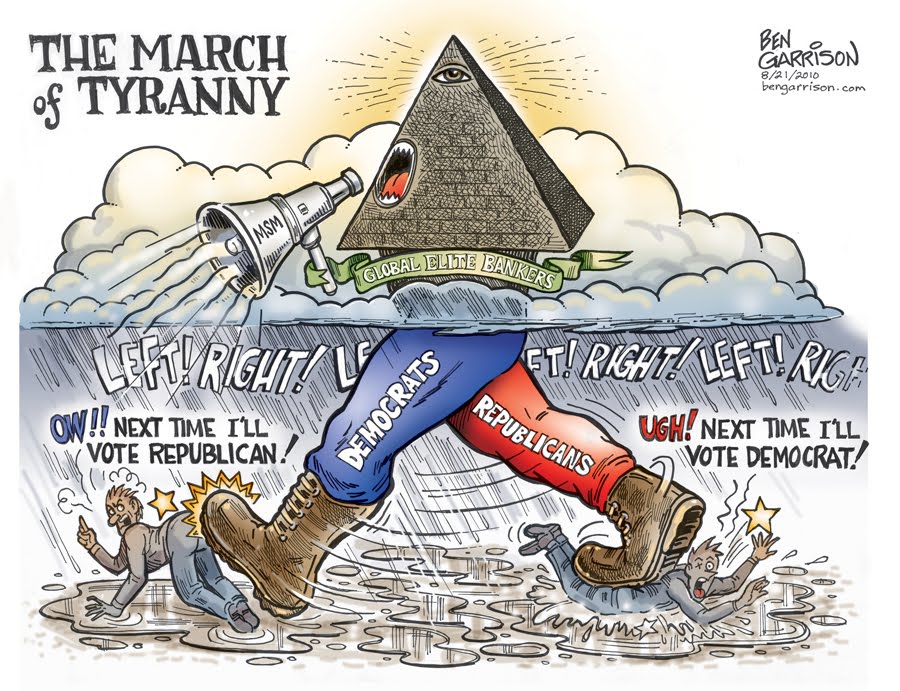
If most Americans knew what was happening in our extremely corrupt government, there would be a bloody riot, and most of the Democrats and Republicans would be slaughtered with as little mercy as they’ve shown the American public.

Through their actions, Democrats and Republicans have caused the deaths of millions from unsafe products, unsafe workplaces, lack of minimal health care, unnecessary wars, and other malfeasance resulting from their serving the vile capitalists who finance their elections.

True, a fourth of the electorate vote Democrat, and another fourth Republican, because they see no other hope. Delusions of “lesser evils” lead them to line up, lambs to the slaughter, hoping that the stinking pile of dung for whom they vote will enable less horror than the other stinking pile of dung.

Half of the electorate routinely do not vote, understanding that, in our system, decent candidates are not allowed air time by the corporate-viewpoint media, nor allowed the mountains of cash given to the Democrats and Republicans with which to purchase additional media exposure for deceitful campaign ads.

If a candidate of the people did find a way to be recognized, he or she would not be allowed into the controlled debates. Ballot access is another way the establishment blocks democracy from breaking out in the Land of the Free. The ruling plutocratic oligarchs have pretty much covered all the bases to snuff out any hope for an iota of democracy.

In many of our elections, far more than half of eligible voters do not cast ballots. Propaganda control by mainstream media tell us this is because those who do not cast votes are satisfied, when anybody with an IQ higher than their shoe size knows it’s a lie. “Let’s see now,” these potential voters ponder, should I vote for the guy who’ll stick a knife in my left hand, or the one who will put an ice pick through my right foot?

I’ve watched for decade after decade as young people voted for “lesser evil” scum, saying they will do better next time. Next time they do the same thing. The system is evil itself, if anything is evil, encouraging the hopeless to vote for scumbags with the hope to stop other scumbags from winning.

It is a part of American capitalism, where everything of importance is controlled and nobody is supposed to notice that it only works for the capitalists—those few who control most of the capital. American capitalism is so badly broken that it requires the world’s largest prison system to make it barely chug along. It requires thousands dying for a lack of health care each year, higher numbers than in any industrialized nation. It requires the highest homelessness and hunger among major industrialized nations.

And the corporate media, fawning lap dogs that they are, never notice any of it. If a corporate-paid journalist did, they would soon find themselves to be among the unemployed. Capitalism loves unemployment because it draws down wages, allowing the capitalists to increase their profits, the only thing that works in capitalism. That is why our submissive government lies about unemployment figures constantly, always giving the numbers as half or less than half of the true misery index.

When people begin to minimally get jobs, the Federal Reserve raises interest rates to increase unemployment and maintain the wealth disparity. As the poor are wiped out by the millions, no billionaire is allowed to lose a penny in the rigged system.

The problem in doing something about it is that the doors have just about all been shut by corrupt laws. There are groups of voters who have more right to be upset than others, but they are locked out of the system to prevent an outbreak of democracy.

For example, in most states convicted felons are not allowed to vote, even though they have officially “paid for their crime.” These people are ripe for voting for a people’s party, and the establishment knows it, so bars them. Unemployed, they may have sold some pot to feed their kids, the only real shot there is for many at the bottom of an economy in which more illegal drugs are sold than in any other nation.

And I’ve tried for decades to change the law in Virginia so that homeless people can vote. Long ago I was feeding homeless people on the street, spooning out grits in freezing cold, watching people with ice around their faces crawl out from doorways where they slept and thinking, “What if I could bring registration forms, get them to sign up and encourage them to vote for the Greens?”

I even found a legislator, a Black woman named Mary Christian, to sponsor me to speak before the Constitution Committee of the House of Delegates, the oldest legislature in North America, and ask that they allow homeless people to vote. To make a long story short, I failed in that attempt.

Didn’t know that homeless people can’t vote? Check your state and you will probably find it’s near impossible there as well. In Virginia, if you are caught with a false address on your registration, you are subject to a year in jail and a $10,000 fine. If you are homeless, and you register as living in the building whose doorway you slept in last night, chances are you won’t be there the next night after a cop tells you to move along.

The establishment knows who could be trouble, and has already enacted laws to make democratic participation hell for millions of Americans.

Most Americans live in ignorance of almost anything of importance to them, knowing only the myths given to them by the corporate media. That is what makes it so difficult to organize them—their heads are filled with propaganda. “But if I don’t vote for Hitler, Satan will get in. . . .”

So, in my entire life of trying to find ways to disrupt the system and make it work for the people, I always come back to the one thing that holds promise, and that is to find a way to get information to the masses around the corporate-viewpoint media. It is that mainstream media which keeps the masses ignorant and in thrall.

I hate to agree with Donald Trump, but he’s right that the mainstream media is the enemy of the people. They have been all my 72 years, but it is getting worse.

Once there were big dreamers in our government who came up with National Public Radio and the Public Broadcasting System, which were a great idea. The idea was to allow opinions around the corporate media, so that the public could get a second opinion.

But good ideas soon hit a meat grinder in our system. The scum who run the country had their bought-and-paid-for politicians cut funding, forcing NPR and PBS to take more and more corporate money, until they became a clone of ABC, NBC, CBS, CNN, FOX, etc.

If we had one TV channel of our own, we could destroy the entire house of cards. Years ago I wrote about it and it appears we need a Social Justice Network more than ever today. The thing the establishment fears most is information and democracy, and a Social Justice Network could bring us both, by opening the eyes of the public to the scam that keeps a boot on their backs. Ignorant people are controlled people.


Jack Balkwill has been published from the little read Rectangle, magazine of the English Honor Society, to the (then) millions of readers USA Today and many progressive publications/web sites such as Z Magazine, In These Times, Counterpunch, This Can’t Be Happening, Intrepid Report, and Dissident Voice. He is author of “An Attack on the National Security State,” about peace activists in prison.

Saturday Matinee: Election

large_kncnvghcqhiz0kiamwwgmjx6b4i

“Election” (1999) is a sharp political satire in a high school setting directed by Alexander Paine and based on a novel by Tom Perrotta. Matthew Broderick stars as Mr. McAllister, a popular high school teacher who holds a personal grudge against insufferable over-achieving student Tracy Flick (Reese Witherspooon). When Tracy runs for student council president initially unopposed, McAllister attempts to derail her political future by encouraging Paul Metzler, an injured football jock, to run against her. Meanwhile, Paul’s younger adopted sister Tammy (Jessica Campbell) is dumped by her girlfriend who immediately starts dating Paul. Tammy retaliates by joining the race for school president on an anarchist platform so successful it threatens the best-laid plans of Tracy Flick, Mr. McCallister and the high school administration.

Watch the full film here.

The Imperial President’s Toolbox of Terror: A Dictatorship Waiting to Happen


pimps-inc-improved_presidential_seal_by_sharpwriter-d486y6m_zps3hnflawe

By John W. Whitehead

Source: Waking Times

“When the President does it, that means that it is not illegal.”~Richard Nixon

Presidents don’t give up power.

Executive orders don’t expire at the end of each presidential term.

And every successive occupant of the Oval Office since George Washington, who issued the first executive order, has expanded the reach and power of the presidency.

The Constitution invests the President with very specific, limited powers: to serve as Commander-in-Chief of the military, grant pardons, make treaties (with the approval of Congress), appoint ambassadors and federal judges (again with Congress’ blessing), and veto legislation.

In recent years, however, American presidents have anointed themselves with the power to wage war, unilaterally kill Americans, torture prisoners, strip citizens of their rights, arrest and detain citizens indefinitely, carry out warrantless spying on Americans, and erect their own secretive, shadow government.

These are the powers that will be inherited by the next heir to the throne, and it won’t make a difference whether it’s a President Trump or a President Clinton occupying the Oval Office.

The powers amassed by each successive president through the negligence of Congress and the courts—powers which add up to a toolbox of terror for an imperial ruler—empower whomever occupies the Oval Office to act as a dictator, above the law and beyond any real accountability.

Consider some of the presidential powers—which have been acquired through the use of executive orders, decrees, memorandums, proclamations, national security directives and legislative signing statements and can be activated by any sitting president—that have allowed past presidents to operate above the law and beyond the reach of the Constitution.

The power to kill. As the New York Times concluded, “President Obama, who came to office promising transparency and adherence to the rule of law, has become the first president to claim the legal authority to order an American citizen killed without judicial involvement, real oversight or public accountability.” Obama’s kill lists—signature drone strikes handpicked by the president—have been justified by the Justice Department as lawful because they are subject to internal deliberations by the executive branch. “In other words,” writes Amy Davidson for the New Yorker, “it’s due process if the President thinks about it.”

The power to wage war. Ever since Congress granted George W. Bush the authorization to use military force in the wake of 9/11, the United States has been in a state of endless war without Congress ever having declared one. Having pledged to end Bush’s wars, Barack Obama has extended them. As the New York Times notes, “He has now been at war longer than Mr. Bush, or any other American president… he will leave behind an improbable legacy as the only president in American history to serve two complete terms with the nation at war.” More than that, as the Atlantic makes clear, “Obama is inaugurating an era of unbridled war-making by the commander in chief, without any of the checks and balances contemplated by the American constitutional system.”

The power to torture. Despite the fact that the Bush Administration’s use of waterboarding as a torture tactic was soundly criticized by Obama, the Obama Administration refused to hold anyone accountable for participating in the rendition and torture programs. In the absence of any finding of criminality, the authorization of such torture tactics remain part of the president’s domain—should he or she ever choose to revive it.

The power to spy on American citizens. In the wake of the 9/11 terror attacks, President Bush secretly authorized the National Security Agency to carry out surveillance on Americans’ phone calls and emails. The Bush Administration claimed that the Constitution gives the president inherent powers to protect national security. The covert surveillance has continued under Obama.

The power to indefinitely detain American citizens. In 1942, President Franklin D. Roosevelt issued an executive order requiring that all Japanese-Americans be held in internment camps. While that order was later rescinded, the U.S. Supreme Court declared it to be constitutional. The ruling has never been overturned. Pointing out that such blatantly illegal detentions could happen again—with the blessing of the courts—Justice Scalia warned, “In times of war, the laws fall silent.” In fact, each National Defense Authorization Act enacted since 2012 has included a provision that permits the military to detain individuals—including Americans citizens—indefinitely without trial.

The power to strip American citizens of their constitutional rights. The Bush Administration claimed it could strip American citizens of their constitutional rights, imprison them indefinitely, and deny them legal representation simply by labeling them as enemy combatants. While the Obama Administration jettisoned the use of the term “enemy combatant,” it has persisted in defending the president’s unilateral and global right to detain anyone suspected of supporting terrorist activities.

The power to secretly rewrite or sidestep the laws of the country. Secret courts, secret orders, and secret budgets have become standard operating procedure for presidential administrations in recent years. A good case in point is Presidential Policy Directive 20, a secret order signed by President Obama as a means of thwarting cyberattacks. Based on what little information was leaked to the press about the clandestine directive, it appears that the president essentially put the military in charge of warding off a possible cyberattack. A FOIA request by the Electronic Privacy Information Center (EPIC) seeking more details on the directive was allegedly denied because doing so could cause “exceptionally grave damage to the national security.” However, EPIC believes the order allows for military deployment within the United States, including the ability to shut off communications with the outside world if the military believes it is necessary.

The power to transform the police into extensions of the military and indirectly institute martial law. What began in the 1960s as a war on drugs transitioned into an all-out campaign to transform America’s police forces into extensions of the military. Every successive president since Nixon has added to the police’s arsenal, tactics and authority. In fact, the Obama Administration has accelerated police militarization by distributing military weapons and equipment to police and incentivizing SWAT team raids and heavy-handed police tactics through the use of federal grants and asset forfeiture schemes.

The power to command the largest military and intelligence capabilities in the world and, in turn, “wag the dog.”As law professor William P. Marshall points out:

In his roles as Commander-in-Chief and head of the Executive Branch, the President directly controls the most powerful military in the world and directs clandestine agencies such as the Central Intelligence Agency and National Security Agency. That control provides the President with immensely effective, non-transparent capabilities to further his political agenda and/or diminish the political abilities of his opponents. Whether a President would cynically use such power solely for his political advantage has, of course, been the subject of political thrillers and the occasional political attack. President Clinton, for one, was accused of ordering the bombing of terrorist bases in Afghanistan to distract the nation from the Lewinsky scandal, and President Nixon purportedly used the Federal Bureau of Investigation to investigate his political enemies. But regardless whether such abuses actually occurred, there is no doubt that control of covert agencies provides ample opportunity for political mischief, particularly since the inherently secretive nature of these agencies means their actions often are hidden from public view. And as the capabilities of these agencies increase through technological advances in surveillance and other methods of investigation, so does the power of the President.

Thus, it doesn’t matter what the pundits predict, the candidates promise, and the people decree.

It doesn’t even matter whether the people elect Trump or Clinton. After all, politicians sing a different tune once elected. For instance, the Chicago Tribune editorial board observed that although Barack Obama opposed the imperial tendencies of George W. Bush, once in office, Obama “wound up behaving as if he had a scepter and throne.”

What matters is that the damage has already been done.

As Professor Marshall explains, “every extraordinary use of power by one President expands the availability of executive branch power for use by future Presidents.” Moreover, it doesn’t even matter whether other presidents have chosen not to take advantage of any particular power, because “it is a President’s action in using power, rather than forsaking its use, that has the precedential significance.”

In other words, each successive president continues to add to his office’s list of extraordinary orders and directives, granting him- or herself near dictatorial powers.

So let’s not have any more talk of which candidate would be more dangerous with these powers.

The fact that any individual—or branch of government—is empowered to act like a dictator is danger enough.

This abuse of presidential powers has been going on for so long that it has become the norm and it will continue no matter which corporate puppet wins the election. The Constitution be damned.

The government of laws idealized by John Adams has fallen prey to a government of men.

As a result, we no longer have a system of checks and balances.

“The system of checks and balances that the Framers envisioned now lacks effective checks and is no longer in balance,”concludes Marshall. “The implications of this are serious. The Framers designed a system of separation of powers to combat government excess and abuse and to curb incompetence. They also believed that, in the absence of an effective separation-of-powers structure, such ills would inevitably follow. Unfortunately, however, power once taken is not easily surrendered.”

The solution is far from simple but it’s time, as Marshall suggests, to recalibrate the balance of power. This will mean putting an end to the use of executive orders, decrees, memorandums, proclamations, national security directives and legislative signing statements as a means of getting around Congress and the courts. It will mean that Americans will have to stop letting their politics blind them to government wrongdoing. And it will mean holding all three branches of government accountable to the Constitution (i.e., if they abuse their powers, vote them out of office).

Thus far, Congress, with little spine, less integrity and too busy running for re-election, has offered little attempt at oversight, enabling the president to ride roughshod over the Constitution. The media—the perfect accomplice in this stealthy, bloodless coup—continues to inundate us with the latest celebrity scandal, says virtually nothing about these burgeoning powers. All the while, most Americans continue to operate in blissful near-ignorance, unaware or uncaring that the republic is about to fall.

Yet as I point out in my book Battlefield America: The War on the American People, it will be “we the people”—not the president, the politicians, the corporate elite or the media—who will suffer the consequences when freedom falls and tyranny rises. They may justify violating our freedoms in the name of whatever phantom menace-of-the-month threatens “national security,” but we will always be the ones to pay the price.


Electoral Politics and the Illusion of Control

what-corporate-america-wants

By William Hawes

Source: Dissident Voice

We have all been told a lie. The lie that says democracy can be maintained only through voting, through purely representative, parliamentarian means. When the founding fathers set up the Constitution and Bill of Rights, they were wary of any truly popular, working and middle class control of the United States. Our government was to be run as a republic, designed by elites, for the elites. Our three branches of government were not simply invented for checks and balances: another reason was to stymie any massively popular mandates that would go against the interests of the oligarchy.

Today, the checks and balances used ostensibly to prevent tyranny are being used against us: even though a high majority (65%) is against government surveillance which violates privacy, and 78% want Citizens United overturned, we are stuck with a broken system and statesmen bought off by corporations. Even though 80% of eligible citizens didn’t vote in the 2014 elections, this year our out-of-touch pundits and mass media puppets prattle on unceasingly about our democracy, still misguidedly believing these candidates represent the will of the people.

Just sixteen years ago, our very own electoral system, in the form of a gilded cage, shut down the popular will of the people, as Al Gore won about 500,000 more votes than George W. Bush, yet still lost. Although the decision was made over 200 years ago, we have decided that the antiquated Electoral College system should still be used today.

More broadly, our never-ending election cycle serves as a palliative for ordinary Americans, but does nothing to cure the underlying disease and rot within our political system. Progressive liberals can take pleasure in Sanders’ statements supporting a raise in the minimum wage, debt relief for students, fighting income inequality, etc. Yet Sanders has no broad coalition in Congress to advance his agenda and to fight his “revolution”. Isolationist, non-interventionist conservatives can take pride in Trump’s support of Russia’s fight against ISIS in Syria, and his token rhetoric towards re-working unfair free trade agreements and bringing back jobs. Yet Trump’s pandering towards racists and xenophobes will only accelerate the descent towards fascism that the US has been slipping into for decades.

The second lie we’ve been told, or assumed implicitly, is that we are in control of our national destiny. Through the vote, we can supposedly make a clean slate every four years, to make up for the misdeeds of our past political leaders. The truth is much murkier. Our national security state and intelligence services have been built up to Leviathan levels, and presidential candidates are instantly discredited and marginalized for suggesting even small decreases in military spending. Corporate lobbyists and the conglomerate multinationals control the political landscape, determining the limits of discourse and shutting down anyone who exceeds the boundaries. Absurdly, third party candidates, some of the only ones with fresh ideas to invigorate our democracy, are demonized. Mainstream media coverage reinforces these imaginary limits of discussion, and Independents, Greens, Socialists, and Libertarians are relegated to the sidelines.

As the neoliberal order reinforces and deepens material poverty and intellectual ignorance, public discourse narrows without totalitarian overt manipulation. This makes issues seem as if they are progressing naturally, when public debate and consent is in actuality homogenized and conformist. This is analogous to the concept known to scientists as “shifting baselines”: here it applies to a public that accepts deeper cuts to social services, increases in privatizations, and increased militarization and policing of the public sphere, because the momentum seems inexorable and immutable. The establishment uses rhetorical threats and excuses to further corporate agendas and destroy civil society, all in the name of maintaining “economic growth” and upholding “law and order”.

The truth is that only by staring into the abyss can we collectively begin to dig ourselves out of our self-dug graves. The US has been in an unofficial recession since 2008. Millions of Americans live paycheck to paycheck, with minimal society safety nets, leading to insecurity, uncertainty and cynicism towards the future, and crippling anxiety. Politicians routinely show they do not care about the working class and the poor when they speak to the “middle class”, whatever that means anymore. Our leaders are handpicked by Wall Street billionaires, and/or defense and fossil fuel industrialists. Abroad, covert war is ongoing in a dozen or more countries in Asia and North Africa.

With so many minds confined to the hypnotic and myopic gaze focused on high technology, mass media, and our official “leaders”, 21st century man falls further into enslavement every day. As Fromm would say, we Escape from Freedom into self-indulgence and apathy, leaving hard decisions to technocrats and oligarchs. Control over our food, medicine, intellectual property, and basic social and environmental rights are consolidated into a handful of multinational corporations who inundate us with false needs through advertising and propaganda. Computer algorithms tell us what to buy, and social media manipulates our emotions, fulfilling the preaching of techno-dystopian prophets who warn of non-human intelligence guiding humanity towards dark futures.

Revolutionary fervor lurks under the surface, yet whether a popular progressive movement can blossom remains to be seen. Conversely, a missed revolution could easily result in an authoritarian and fascist takeover by the reactionary far-right. One thing we know for certain is that continuing under this two-party charade will only lead us to our doom.

Average citizens have never had any control of the republic since its founding. A complete constitutional overhaul is needed, and forms of direct, consensus, and deliberative democracy must be woven into a hybrid system. Elections should be funded by the public, with no corporate money allowed, shorter election cycles, and no discrimination towards third parties, unlike the current Commission on Presidential Debates. State governments should gain power, and federal programs reigned in and redefined towards streamlined regulation and oversight. Tax subsidies should be stripped from the fossil fuel industries entirely and redirected towards the best scientists and engineers in the field of renewable energy.

What is desperately needed is a shift in worldview to promote government that sees its job as not simply to tax and legislate, but to also support healthy life-world systems. Also, promoting humble and dedicated leaders who are stewards of community and the Earth, who do not insist on blatant exploitation of distant nations and pillaging resources, would go a long way. This cannot be done within the confines of the Democratic and Republican parties, who thrive on domination, coercion, control, and manipulation of public interests.

To break the cycle, we must collectively embrace our frailties and limitations. The deadly, patriarchal energy technologies such as the petrochemical industries and nuclear energy must be shut down. We must learn from the man-made tragedies of Bhopal, Katrina, Chernobyl, and Fukushima, and dismantle dangerous plants and factories, and begin to move humanity away from areas susceptible to natural disasters and coastal flooding. The US, Russia, and the nuclear nations must formally apologize for the atmospheric nuclear testing in the fifties and sixties which will kill millions from cancer, and ban nuclear weapons for good.

Learning to relinquish control and learning to keep one’s ego in check are two of the ultimate tests our leaders must accept. As the Tao Te Ching says:

Therefore the sages:
Manage the work of detached actions
Conduct the teaching of no words
They work with myriad things but do not control
They create but do not possess
They act but do not presume
They succeed but do not dwell on success
It is because they do not dwell on success
That it never goes away.1

  1. Tao Te Ching: Annotated and Explained. Derek Lin. SkyLight Paths. 2006.  Translation by Derek Lin. [↩]


William Hawesis a writer specializing in politics and the environment. You can find his e-book of collected essays here. His articles have appeared online at Global Research, Countercurrents, Dissident Voice, and Counterpunch. You can email him at wilhawes@gmail.com Read other articles by William.

An Open Letter to the People of the United States: Election or Revolution?

votefornobody

(Editor’s note: While we do believe positive change is possible on a local level through grass-roots campaigns and voter initiatives, until major systemic changes are forced into existence we have no reason to expect anything from presidential politics other than what we’ve been subjected to for the past few decades.)

By Robert J. Burrowes

As citizens of the USA with a presidential election approaching you have a wonderful opportunity to ponder whether to participate in this election or to participate in the ongoing American Revolution.

Your first revolution might have overthrown the authority of the British monarchy and aristocracy but the one in progress must remove the US elite which has executed a political coup against your government. And you cannot remove elite coupmakers in a fraudulently conducted election in which the ‘choice’ is essentially between two violently insane individuals, each of whom represents the violently insane US elite. See ‘The Global Elite is Insane‘ and ‘Why Violence?

The real value of this second revolution, which moves along steadily with routine outbreaks over a multitude of peace, environmental and social justice issues and occasional ‘uprisings’, such as the Occupy Movement in 2011 which spawned a range of new and visionary initiatives, is that it could give citizens of your country the chance to finally reclaim the Republic for those people who genuinely care about ‘life, liberty and the pursuit of happiness’. And, just as importantly, have sufficient vision to regard these aspirations as something to be shared with the entire US population, starting with Native Americans, and even those of us in the rest of the world including those countries that are currently victims of US elite violence, whether it be wars, drone strikes, coups, economic exploitation or ecological destruction.

Such a revolution might rewrite your constitution and replace the second amendment ‘right of the people to keep and bear arms’ with the right to live free of the fear of gun violence. It might result in a form of social organization that distributes wealth equitably (perhaps by actually taxing the wealthy and outlawing the use of offshore tax havens) while reallocating the annual military (killing) budget to life-enhancing projects such as poverty alleviation, affordable housing, free education, free healthcare, clean water, renewable energy technologies, and a substantial budget for compensation to those countries that the US elite has systematically exploited or simply destroyed during the past 200 years. This would allow the 50 million US citizens who live in poverty, and another billion people around the world who also live in poverty, the chance to live a decent life.

Now, you might ask, ‘How are we, the ordinary citizens of the United States, even with our handguns, rifles and assault weapons, going to take on the US military and police to remove elite control of our government?’ Well, the answer is that you do not need even one weapon for this ongoing revolution and, in fact, you are vastly better off without them. Weapons have only one use – to kill people – and any revolution worth the name has a more profoundly ambitious aim than this.

What you need is intelligence, commitment, courage and a sound nonviolent strategy. The US elite controls your government and has crippled your republic because, over successive generations, you have let them. Every time you cooperate with the elite, because you are scared, by paying your taxes (more than 50% of which finances US wars and other military violence), putting your money into their corporate banks, shopping at their corporate shopping malls, buying and consuming the ‘news’ presented by their corporate media, rationalizing their policies as reasonable, participating in their unjust and violent legal system, fighting (as an enlisted person or as a mercenary) in their military forces, working in their prison system, accepting exploited employment of any kind, eating their poisoned and genetically mutilated foods (GMOs), going along with their endless attempts to divide you along racial, class, religious and other lines, you simply consent to their control. Why?

You have a simple alternative. Consciously and systematically participate in the ongoing nonviolent revolution that is already taking place and give it added life by your presence. Remake the US republic as you want it by withdrawing your cooperation with elite structures and processes while creating alternatives that meet your needs and the needs of those around you.

Join those US visionaries who are creating cooperatives where people are both managers and valued workers, take your money out of elite banks and put it into financial organizations that exist or which you create to serve the interests of their members (or, if you prefer, use LETSystems), refuse to participate in or pay for (with your taxes) US imperialism (and win friends all over the world), grow or buy healthy locally-grown organic/biodynamic (and, if you are concerned about the climate catastrophe as well, vegetarian) food, read progressive news outlets so that you know what is really going on in the USA and the world, read literature that deepens your understanding and concern for humanity and doesn’t just offer you a distraction from the horror in which you live, and support or even become one of those many fine nonviolent activists in your country who take personal risks in the struggle to create a better world.

If you want more of what you have, then you should vote and/or buy a gun. They have an equivalent outcome: they both legitimize elite violence and exploitation directed at you and those you love.

If you want to participate in this second and ongoing American revolution, then spend your time participating in the wholesome activities that many grassroots organizations already offer and in creating its next manifestations in your own neighborhood. It is the powerful conscience-based choices that you make as an individual that define your Self. And it is these choices that will have most impact on your family, neighborhood, community organization, trade union, religious organization and elsewhere and that will help decide the future of the USA and its role in the world.

Now you might say, I do some or even all of the sorts of things you mentioned above, so why not vote too? My answer is simply this: Voting is an act of disempowerment. It’s essential message is ‘I appoint you to govern for me’. I prefer to govern myself (both meanings intended). And you?

So what of those who present the ‘lesser evil’ argument: one candidate is so bad that it is better to have the other. This ‘argument’ is not worthy of scrutiny. If you are deceived by this argument, you will vote forever in the delusional hope that you will one day get a choice to vote for someone genuinely decent. In 2008, Barack Obama was supposed to be the candidate of hope and change. Did you get that hope and change? Are you going to get it with Clinton or Trump? Of course not. Elites simply ensure that change via the electoral system cannot happen; its function is to absorb and dissipate our dissent.

If you vote you are saying that you endorse this system of electoral exploitation. The tragedy is that even third-party candidates, who may be people of genuine principle, have no chance. Even worse, they add a veneer of legitimacy to your corrupt electoral system.

In essence, if you vote for the ‘lesser evil’ you are still voting for an ‘evil’ and, more importantly, you have participated in and endorsed an ‘evil’ system: one which denies you a genuine ‘free and fair’ choice to vote for a candidate who actually represents your interests and views and has a reasonable chance of winning. And, having won, is then able to actually implement their policies (rather than be stymied by a power structure that has no intention of letting this happen). Given your circumstances, ‘the only winning move is not to play’ their corrupt game and to put your energy into a genuinely winning move: working for the regeneration of American society.

Look at it this way. If there are two rotten eggs, would you choose the one that is less rotten and eat it? Presumably you would seek another option and only after you have identified and fixed what is causing the problem in the first place. The point is this: Unless you spend your time deeply contemplating the nature of the society in which you want to live and then devoting your time and energy into creating that society, you will never have it. And you have betrayed yourself.

The reality is that either Clinton or Trump is going to be president of the USA for the next four years and a lot of people (both in the US but particularly in foreign countries) are going to die because of it (through US military violence and corporate exploitation). What we can do is to invest our political energy into creating a United States in which, at some point in the future, the likes of Clinton and Trump, and those they represent, no longer drive outcomes in our world.

To reiterate: I am not saying ‘Don’t vote and do nothing’ (as so many people do already). I am suggesting that you ponder the dysfunctionality of your society, do some research into the secretive ‘deep state’ (or military-industrial complex or power elite or the 1% or however you wish to describe it) that controls your ‘republic’ with its electoral system designed to delude you into believing that you have a say in governing your nation, and then consider how you want to engage politically and act in accord with your conscience in doing so. It is only by doing this that we will have any chance of getting the society and the world that we want, even if it is beyond our lifetimes (and assuming we can avert extinction at our own hand in the meantime).

In summary, profound change only occurs from the ‘bottom up’ when enough ordinary people take the initiative to remake their own society. And if you are really interested in doing this, one important place to start is by reviewing the way in which you nurture children. See ‘My Promise to Children‘.

Other straightforward options, in addition to those mentioned above, include participation in ‘The Flame Tree Project to Save Life on Earth‘ and signing the online pledge of ‘The People’s Charter to Create a Nonviolent World‘.

But for those of you who are serious strategic thinkers, I have outlined a strategy for removing coupmakers on the website Nonviolent Defense/Liberation Strategy which is a straightforward presentation of the more detailed explanation offered in the book
The Strategy of Nonviolent Defense: A Gandhian Approach‘.

Is our destiny in our own hands? Only if we have enough people of courage to accept responsibility for it. Are you one of them?


Biodata: Robert J. Burrowes has a lifetime commitment to understanding
and ending human violence. He has done extensive research since 1966 in
an effort to understand why human beings are violent and has been a
nonviolent activist since 1981. He is the author of ‘Why Violence?
His email address is flametree@riseup.net
and his website is at http://robertjburrowes.wordpress.com


Robert J. Burrowes
P.O. Box 68
Daylesford
Victoria 3460
Australia
Email: flametree@riseup.net

Websites:
Nonviolence Charter
Flame Tree Project to Save Life on Earth
‘Why Violence?’
Nonviolent Campaign Strategy
Nonviolent Defense/Liberation Strategy
Anita: Songs of Nonviolence
Robert Burrowes
Global Nonviolence Network