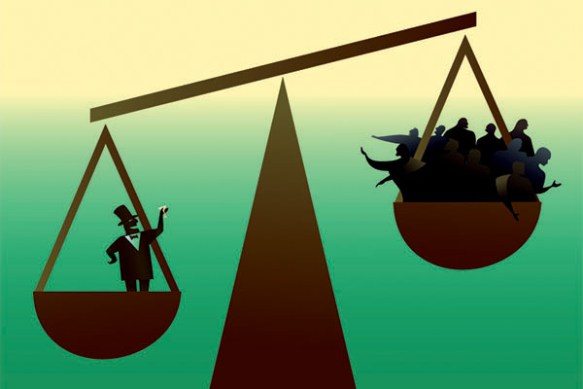
For Economic Truth Turn To Michael Hudson

By Paul Craig Roberts

Source: PaulCraigRoberts.org

Readers ask me how they can learn economics, what books to read, what university economics departments to trust. I receive so many requests that it is impossible to reply individually. Here is my answer.

There is only one way to learn economics, and that is to read Michael Hudson’s books. It is not an easy task. You will need a glossary of terms. In some of Hudson’s books, if memory serves, he provides a glossary, and his recent book “J Is for Junk Economics” defines the classical economic terms that he uses. You will also need patience, because Hudson sometimes forgets in his explanations that the rest of us don’t know what he knows.

The economics taught today is known as neoliberal. This economics differs fundamentally from classical economics that Hudson represents. For example, classical economics stresses taxing economic rent instead of labor and real investment, while neo-liberal economics does the opposite.

An economic rent is unearned income that accrues to an owner from an increase in value that he did nothing to produce. For example, a new road is built at public expense that opens land to development and raises its value, or a transportation system is constructed in a city that raises the value of nearby properties. These increases in values are economic rents. Classical economists would tax away the increase in values in order to pay for the road or transportation system.

Neoliberal economists redefined all income as earned. This enables the financial system to capitalize economic rents into mortgages that pay interest. The higher property values created by the road or transportation system boost the mortgage value of the properties. The financialization of the economy is the process of drawing income away from the purchases of goods and services into interest and fees to financial entities such as banks. Indebtedness and debt accumulate, drawing more income into their service until there is no purchasing power left to drive the economy.

For example, formerly in the US lenders would provide a home mortgage whose service required up to 25% of the family’s monthly income. That left 75% of the family’s income for other purchases. Today lenders will provide mortgages that eat up half of the monthly income in mortgage service, leaving only 50% of family income for other purchases. In other words, a financialized economy is one that diverts purchasing power away from productive enterprise into debt service.

Hudson shows that international trade and foreign debt also comprise a financialization process, only this time a country’s entire resources are capitalized into a mortgage. The West sells a country a development plan and a loan to pay for it. When the debt cannot be serviced, the country is forced to impose austerity on the population by cutbacks in education, health care, public support systems, and government employment and also to privatize public assets such as mineral rights, land, water systems and ports in order to raise the capital with which to pay off the loan. Effectively, the country passes into foreign ownership. This now happens even to European Community members such as Greece and Portugal.

Another defect of neoliberal economics is the doctrine’s denial that resources are finite and their exhaustion a heavy cost not born by those who exploit the resources. Many local and regional civilizations have collapsed from exhaustion of the surrounding resources. Entire books have been written about this, but it is not part of neoliberal economics. Supplement study of Hudson with study of ecological economists such as Herman Daly.

The neglect of external costs is a crippling failure of neoliberal economics. An external cost is a cost imposed on a party that does not share in the income from the activity that creates the cost. I recently wrote about the external costs of real estate speculators. https://www.paulcraigroberts.org/2018/04/26/capitalism-works-capitalists/ Fracking, mining, oil and gas exploration, pipelines, industries, manufacturing, waste disposal, and so on have heavy external costs associated with the activities.

Neoliberal economists treat external costs as a non-problem, because they theorize that the costs can be compensated, but they seldom are. Oil spills result in companies having to pay cleanup costs and compensation to those who suffered economically from the oil spill, but most external costs go unaddressed. If external costs had to be compensated, in many cases the costs would exceed the value of the projects. How, for example, do you compensate for a polluted river? If you think that is hard, how would the short-sighted destroyers of the Amazon rain forest go about compensating the rest of the world for the destruction of species and for the destructive climate changes that they are setting in motion? Herman Daly has pointed out that as Gross Domestic Product accounting does not take account of external costs and resource exhaustion, we have no idea if the value of output is greater than all of the costs associated with its production. The Soviet economy collapsed, because the value of outputs was less than the value of inputs.

Supply-side economics, with which I am associated, is not an alternative theory to neoliberal economics. Supply-side economics is a successful correction to neoliberal macroeconomic management. Keynesian demand management resulted in stagflation and worsening Phillips Curve trade-offs between employment and inflation. Supply-side economics cured stagflation by reversing the economic policy mix. I have told this story many times. You can find a concise explanation in my short book, “The Failure of Laissez Faire Capitalsim.” This book also offers insights into other failures of neoliberal economics and for that reason would serve as a background introduction to Hudson’s books.

I can make some suggestions, but the order in which you read Michael Hudson is up to you. “J is for Junk Economics” is a way to get information in short passages that will make you familiar with the terms of classical economic analysis. “Killing the Host” and “The Bubble and Beyond” will explain how an economy run to maximize debt is an economy that is self-destructing. “Super Imperialism” and “Trade, Development and Foreign Debt” will show you how dominant countries concentrate world economic power in their hands. “Debt and Economic Renewal in the Ancient Near East” is the story of how ancient economies dying from excessive debt renewed their lease on life via debt forgiveness.

Once you learn Hudson, you will know real economics, not the junk economics marketed by Nobel prize winners in economics, university economic departments, and Wall Street economists. Neoliberal economics is a shield for financialization, resource exhaustion, external costs, and capitalist exploitation.

Neoliberal economics is the world’s reigning economics. Russia is suffering much more from neoliberal economics than from Washington’s economic sanctions. China herself is overrun with US trained neoliberal economists whose policy advice is almost certain to put China on the same path to failure as all other neoliberal economies.

It is probably impossible to change anything for two main reasons. One is that so many greed-driven private economic activities are protected by neoliberal economics. So many exploitative institutions and laws are in place that to overturn them would require a more thorough revolution than Lenin’s. The other is that economists have their entire human capital invested in neoliberal economics. There is scant chance that they are going to start over with study of the classical economists.

Neoliberal economics is an essential part of The Matrix, the false reality in which Americans and Europeans live. Neoliberal economics permits an endless number of economic lies. For example, the US is said to be in a long economic recovery that began in June 2009, but the labor force participation rate has fallen continuously throughout the period of alleged recovery. In previous recoveries the participation rate has risen as people enter the work force to take advantage of the new jobs.

In April the unemployment rate is claimed to have fallen to 3.9 percent, but the participation rate fell also. Neoliberal economists explain away the contradiction by claiming that the falling participation rate is due to the retirement of the baby boom generation, but BLS jobs statistics indicate that those 55 and older account for a large percentage of the new jobs during the alleged recovery. This is the age class of people forced into the part time jobs available by the absence of interest income on their retirement savings. What is really happening is that the unemployment rate does not include discouraged workers, who have given up searching for jobs as there are none to be found. The true measure of the unemployment rate is the decline in the labor force participation rate, not a 3.9 percent rate concocted by not counting those millions of Americans who cannot find jobs. If the unemployment rate really was 3.9 percent, there would be labor shortages and rising wages, but wages are stagnant. These anomalies pass without comment from neoliberal economists.

The long expansion since June 2009 might simply be a statistical artifact due to the under-measurement of inflation, which inflates the GDP figure. Inflation is under-estimated, because goods and services that rise in price are taken out of the index and less costly substitutes are put in their place and because price increases are explained away as quality improvements. In other words, statistical manipulation produces the favorable picture required by The Matrix.

Since the financial collapse caused by the repeal of Glass-Steagall and by financial deregulation, the Federal Reserve has robbed tens of millions of American savers by driving real interest rates down to zero for the sole purpose of saving the “banks too big to fail” that financial deregulation created. A handful of banks has been provided with free money—in addition to the money that the Federal Reserve created in order to take the banks’ bad derivative investments off their hands—to put on deposit with the Fed from which to collect interest payments and with which to speculate and to drive up stock prices.

In other words, for a decade the economic policy of the United States has been run for the benefit of a few highly concentrated financial interests at the expense of the American people. The economic policy of the United States has been used to create economic rents for the mega-rich.

Neoliberal economists point out that during the 1950s the labor force participation rate was much lower than today and, thereby, they imply that the higher rates prior to the current “recovery” are an anomaly. Neoliberal economists have no historical knowledge as the past is of no interest to them. They do not even know the history of economic thought. Whether from ignorance or intentional deception, neoliberal economists ignore that the lower labor force participation rates of the 1950s reflect a time when married women were at home, not in the work force. In those halcyon days, one earner was all it took to sustain a family. I remember the days when the function of a married woman was to provide household services for the family.

But capitalists were not content to exploit only one member of a family. They wanted more, and by using economic policy to suppress pay while fomenting inflation, they drove married women into the work force, imposing huge external costs on the family, child-raising, relations between spouses, and on the children themselves. The divorce rate has exploded to 50 percent and single-parent households are common in America.

In effect, unleashed Capitalism has destroyed America. Privatization is now eating away Europe. Russia is on the same track as a result of its neoliberal brainwashing by American economists. China’s love of success and money could doom this rising Asian giant as well if the government opens China to foreign finance capital and privatizes public assets that end up in foreign hands.

Why do corporate boards so overpay US CEOs?

By Sam Pizzigati

Source: Nation of Change

Back in 1999, near the dizzying height of the dot-com boom, no executive in Corporate America personified the soaring pay packages of America’s CEOs more than Jack Welch, the chief exec at General Electric. Welch took home $75 million that year.

What explained the enormity of that compensation? Welch didn’t claim any genius on his part. He credited his success, instead, to the genius of the free market.

“Is my salary too high?” mused Welch. “Somebody else will have to decide that, but this is a competitive marketplace.”

Translation: “I deserve every penny. The market says so.”

Top U.S. corporate execs today, on average, are doing even better than top execs in Welch’s heyday. In 1999, notes a just-released new report from the Economic Policy Institute, CEOs at the nation’s 350 biggest corporations pocketed 248 times the pay of average workers in their industries. Top execs last year averaged 312 times more.

What explains this growing generosity to America’s top corporate chiefs? Today’s apologists for over-the-top CEO compensation, like Jack Welch a generation ago, point to the market.

One leading critic of these apologists, the Dutch management scientist Manfred Kets de Vries, neatly summed up this market world view earlier this year: Big CEO pay packages “reflect market demands for a CEO’s unique skills and contribution to the bottom line.” Mega-million executive paychecks “merely represent the market forces of supply and demand.”

Or, as the University of Chicago’s Steven Kaplan puts it, “The market for talent puts pressure on boards to reward their top people at competitive pay levels in order to both attract and retain them.”

In the world that CEO cheerleaders like Kaplan inhabit, impartial, unbiased markets determine executive compensation. Corporate boards simply play by market rules. They pay their execs what the market says their execs deserve. If they don’t, they risk losing their executive talent.

American corporate leaders take scarcity – of CEO talent – as a given. How else, in a market economy, to explain rapidly rising CEO pay? If quality CEOs abounded, executive compensation would not be soaring. But that compensation is soaring, so qualified CEOs obviously must be few and far between – and totally deserving of whatever many millions they receive. Simple market logic.

And simply wrong. American corporations today confront no scarcity of executive talent. The numbers of people qualified to run multi-billion-dollar companies have never, in reality, been more plentiful. These numbers have been growing steadily over recent decades, in part because America’s graduate schools of business have been graduating, year after year, thousands of rigorously trained executives.

America’s first graduate school for executives, the Tuck School of Business at Dartmouth, currently boasts an alumni network over 10,000 strong. MBAs in the equally prestigious Harvard Business School alumni network total over 46,000. Add in the alumni from other widely acclaimed institutions and the available supply of executives trained at America’s top-notch business schools approaches several hundred thousand.

Just how many of these academically trained executives have the skills and experience really needed to run a Fortune 500 company? Let’s assume, conservatively, that only 1 percent of the alumni from the “best” business schools have enough skills and experience to run a big-time corporation.

That arithmetic would give Fortune 500 companies that go looking for a new CEO at least several thousand eminently qualified candidates. No supply shortage here.

Indeed, today’s business world is overflowing with eminently qualified CEO candidates, once you add in the grads from business schools abroad. INSEAD, perhaps the most prominent of these international schools, now has over 56,000 active alumni.

In the past, to be sure, American corporations seldom looked beyond the borders of the United States for executive talent. That tunnel vision made some sense. Executives inside the United States and executives outside worked in different business environments. Foreign executives could hardly be expected to succeed in an unfamiliar American marketplace, even if they did speak flawless English.

But today, in our celebrated “globalized” economy, that distinction between domestic and foreign executives no longer matters nearly as much. In dozens of foreign nations, in hundreds of foreign corporations, executives are competing in the same global marketplace as their American counterparts. They’re using the same technologies, studying the same market data, and strategizing toward the same business goals. Together, taken as a group, executives from elsewhere in the world constitute a huge new pool of talent for American corporations.

Pay consultants in the United States, for their part, do acknowledge the reality of this global marketplace for executive talent. In fact, they cite global competition as one important reason why executive pay in the United States is rising. American companies, the argument goes, now have to compete against foreign companies for executive talent, the argument goes. This competition is forcing up executive pay in the United States.

Really? What ever happened to market logic? If corporations all around the world paid their executives at comparable rates, market competition would certainly force up executive compensation worldwide. But corporations don’t all pay executives at comparable rates.

American executives take home far more compensation than their foreign counterparts, on average over triple the pay of execs in America’s peer nations. By classic market logic, any competition between highly paid American executives and equally qualified but more modestly paid international executives ought to end up lowering, not raising, the higher pay rates in the United States.

Why, after all, would an American corporation pay $50 million for an American CEO when a skilled international CEO could easily be had for one-fifth or even one-fiftieth that price?

We have here, in short, a situation that a deep, abiding faith in the “market” does not explain. In the executive talent marketplace, American corporations face plenty, not scarcity, yet the going rate for American executives keeps rising.

Has someone repealed the laws of supply and demand? How else could executive pay in the United States have ascended to such lofty levels?

Some analysts do have an alternate explanation to offer. Markets, they point out, still operate by supply and demand. But markets don’t set executive pay.

“CEOs who cheerlead for market forces wouldn’t think of having them actually applied to their own pay packages,” as commentator Matthew Miller has noted in the Los Angeles Times. “The reality is that CEO pay is set through a clubby, rigged system in which CEOs, their buddies on board compensation committees and a small cadre of lawyers and ‘compensation consultants’ are in cahoots to keep the millions coming.”

“CEO compensation,” agree Lawrence Michel and Jessica Schieder, the authors of the new Economic Policy Institute executive pay report, “appears to reflect not greater productivity of executives but the power of CEOs to extract concessions.”

If CEOs earned less, the pair add, we would see “no adverse impact on output or employment.” Instead, they go on, lower executive paychecks would mean higher rewards for corporate workers, since the huge paydays that go to CEOs today reflect “income that otherwise would have accrued to others.”

How could those “others,” the rest of us, best go about lowering CEO compensation? Michel and Schieder offer a variety of promising proposals, ranging from higher marginal income tax rates to higher corporate tax rates on companies with excessively wide CEO-to-worker compensation ratios.

And what might a reasonable CEO-to-worker pay ratio be? The new Economic Policy Institute research suggests one plausible goal. Back in 1965, Michel and Schieder calculate, America’s top execs only pulled down 20 times more pay than the nation’s average workers.

America’s Debt Dependence Makes It An Easy Economic Target

By Brandon Smith

Source: Alt-Market.com

There is a classic denial tactic that many people use when confronted with negative facts about a subject they have a personal attachment to; I would call it “deferral denial” — or a psychological postponing of reality.

For example, point out the fundamentals on the U.S. economy such as the fact that unemployment is not below 4% as official numbers suggest, but actually closer to 20% when you factor in U-6 measurements including the record 96 million people not counted because they have run out of unemployment benefits. Or point out that true consumer inflation in the U.S. is not around 3% as the Federal Reserve and the Bureau of Labor Statistics claims, but closer to 10% according to the way CPI used to be calculated before the government started rigging the numbers.  For a large part of the public including a lot of economic analysts, there is perhaps a momentary acceptance of the danger, but then an immediate deferral — “Well, maybe things will get worse down the road, 10 or 20 years from now, but it’s not that bad today…”

This is cognitive dissonance at its finest. The economy is in steep decline now, but the mind in denial says “it could be worse,” and this is how you get entire populations caught completely off guard by a financial crash. They could have easily seen the signs, but they desperately wanted to believe that all bad things happen in some illusory future, not today.

There is also another denial tactic I see often in the world of politics and economics, which is what I call “paying it backward.” This is what people do when they have a biased attachment to a person or institution and refuse to see the terrible implications of their actions. For example, when we point out that someone like Donald Trump makes destructive decisions, such as the continued support of Israel and Saudi Arabia in Syria and Yemen, or the reinstatement of funding for the White Helmets in Syria who are tied to ISIS, Trump supporters will often say “Well what about Obama?”

This is a game of shifting accountability. Is one person worse than the other? Possibly. I say give it time and make notes. However, the negative decisions of one politician we don’t like do not diminish the negative decisions of another politician we might like. They should BOTH be held accountable.

The same goes for countries and economies. When an analyst points out that U.S. debt is at historic highs and is utterly unsustainable, people in denial will say “but what about China or Europe?” One does not negate the other and, of course, there are differences that make the situation in the U.S. far more tenuous.

Primarily I am talking about America’s endless dependency on the world reserve status of the U.S. dollar and, beyond that, the steady expansion of debt at low interest rates for the past decade.

The Federal Reserve, once the No. 1 buyer of U.S. debt, has essentially declared it is cutting off support and has begun dumping assets from its balance sheet. The only assets the Fed seems to be maintaining are Mortgage Backed Securities (MBS). All others are being cut, including Treasuries. The American economy is inexorably attached to the idea of our Treasury debt as a safe investment, with our national debt spiking above $21 trillion and many trillions more owed to entitlement programs depending on how you calculate the expenditures, there is a vital need for steady foreign investment in U.S. debt.

But what happens when investment in U.S. debt becomes politically unsavory? Consider the current escalation of the trade war; Many pro-dollar talking heads and cheerleaders have argued in the past that no nation has the guts to dump dollar denominated assets and risk the wrath of American “economic might.” But, already we have seen Russia dump half its U.S. Treasury holdings in a single month and the trade war has only just begun.

Is Russia’s action a sign of things to come? Will other nations like China follow the same strategy? We will have to wait and see, but I believe this is the inevitable outcome of the trade war if it drags on for the rest of the year.

America’s dependent nature, feeding off of foreign investment to support its debts, is a disaster waiting to happen. The concept of economic “recovery” is laughable until this issue is addressed.  And, entering into a trade war while ignoring this blaring weakness is foolish, to say the least.

Beyond the issue of government (taxpayer) debt, let’s not forget about American corporations and consumers. U.S. corporate debt as a percentage of gross domestic product is at historic highs not seen since the housing bubble of 2008 or the dot-com bubble of 2001. There is a distinct difference, though, that makes today’s bubble far more insidious. After years of near-zero interest rates, corporations have become addicted to cheap debt. So much so that they have been borrowing nonstop to support their own stock prices through stock buyback manipulation. But now the Fed is raising interest rates and has committed to expanded hikes in the future.

So, what will corporations do as the cheap debt dries up? Thus far, they are spending the majority of their Trump tax cut still trying to artificially prop up stock process. When this money runs out (and I believe it will much faster than the mainstream thinks), the existing debt of these companies will cost much more to finance, and future borrowing at the same pace will become impossible. This is a threat that is developing now, not in some far-off future.

Eventually, corporations will have to make deep spending cuts rather than borrow. This means mass layoffs, store closures and potential cuts to pensions. And, of course, no more stock buybacks, meaning a market crash will ensue.

What about the U.S. consumer? U.S. consumer debt is set to reach new highs by the end of the year; around $4 trillion by official estimates.  While discussion continues about the alleged “labor shortage” in the U.S., one thing is clear — the jobs that do exist do NOT pay wages that keep up with true inflation. When we see spikes in retail sales in the U.S. and this is applauded as economy recovery, very few mainstream analysts point out that higher retail sales are merely tracking higher inflation.

That is to say, consumers are spending more money on less stuff. Again, this is unsustainable, which is why consumer debt is exploding. Dependency on credit cards and loans is being used by the public to offset much higher costs. But as the Fed raises interest rates, this too will end. Higher Fed rates translate to higher credit rates as well as higher mortgage rates (indirectly). With higher interest payments comes a large drop in overall spending.

As you can see, there are at least two forces at work here that will end all talk of U.S. recovery and which undermine any notion of economic strength — the first is the trade war, which I believe is a massive distraction designed to draw attention away from the actions of international banks and central banks. The second is the Federal Reserve, which has addicted the country to cheap fiat and is now flushing the drugs. We cannot delude ourselves into thinking that this trend will remain slow or that it will not develop into a crash in the near term. We also cannot simply deflect to other countries like China or those in Europe as if their problems are somehow worse and therefore ours are not a concern.

The fact that the health of the US economy is inexorably reliant on the continued foreign demand for the dollar and Treasury debt means any reduction of the dollar’s world reserve status or petro-status, or any decline in treasury purchases, will directly affect the carefully crafted image of America as a stable system.  Without a sudden and aggressive resurgence of domestic production and innovation America has no safety net in the event that our debt addiction is used against us.

The argument that the central bank can jump in at any time to monetize that debt and reduce the danger is also delusional.  This assumes first and foremost that the Fed WANTS to reduce the danger.  I believe they want the danger to increase, not decrease.  Debt monetization also has the added bonus of causing even more inflation as foreign investors dump their dollar denominated assets back into the US.  Monetization is a poison, not a cure.

The crisis is here, now. Seeing and accepting it allows us to prepare accordingly. Denying it as inconsequential sets people up as victims of their own bias and ignorance.

National (In)Security In the United States of Inequality

By Rajan Menon

Source: Unz Review

So effectively has the Beltway establishment captured the concept of national security that, for most of us, it automatically conjures up images of terrorist groups, cyber warriors, or “rogue states.” To ward off such foes, the United States maintains a historically unprecedented constellation of military bases abroad and, since 9/11, has waged wars in Afghanistan, Iraq, Syria, Libya, and elsewhere that have gobbled up nearly $4.8 trillion. The 2018 Pentagon budget already totals $647 billion — four times what China, second in global military spending, shells out and more than the next 12 countries combined, seven of them American allies. For good measure, Donald Trump has added an additional $200 billion to projected defense expenditures through 2019.

Yet to hear the hawks tell it, the United States has never been less secure. So much for bang for the buck.

For millions of Americans, however, the greatest threat to their day-to-day security isn’t terrorism or North Korea, Iran, Russia, or China. It’s internal — and economic. That’s particularly true for the 12.7% of Americans (43.1 million of them) classified as poor by the government’s criteria: an income below $12,140 for a one-person household, $16,460 for a family of two, and so on… until you get to the princely sum of $42,380 for a family of eight.

Savings aren’t much help either: a third of Americans have no savings at all and another third have less than $1,000 in the bank. Little wonder that families struggling to cover the cost of food alone increased from 11% (36 million) in 2007 to 14% (48 million) in 2014.

The Working Poor

Unemployment can certainly contribute to being poor, but millions of Americans endure poverty when they have full-time jobs or even hold down more than one job. The latest figures from the Bureau of Labor Statistics show that there are 8.6 million“working poor,” defined by the government as people who live below the poverty line despite being employed at least 27 weeks a year. Their economic insecurity doesn’t register in our society, partly because working and being poor don’t seem to go together in the minds of many Americans — and unemployment has fallen reasonably steadily. After approaching 10% in 2009, it’s now at only 4%.

Help from the government? Bill Clinton’s 1996 welfare “reform” program concocted in partnership with congressional Republicans, imposed time limits on government assistance, while tightening eligibility criteria for it. So, as Kathryn Edin and Luke Shaefer show in their disturbing book, $2.00 a Day: Living on Almost Nothing in America, many who desperately need help don’t even bother to apply. And things will only get worse in the age of Trump. His 2019 budget includes deep cuts in a raftof anti-poverty programs.

Anyone seeking a visceral sense of the hardships such Americans endure should read Barbara Ehrenreich’s 2001 book Nickel and Dimed: On (Not) Getting By in America. It’s a gripping account of what she learned when, posing as a “homemaker” with no special skills, she worked for two years in various low-wage jobs, relying solely on her earnings to support herself. The book brims with stories about people who had jobs but, out of necessity, slept in rent-by-the-week fleabag motels, flophouses, or even in their cars, subsisting on vending machine snacks for lunch, hot dogs and instant noodles for dinner , and forgoing basic dental care or health checkups. Those who managed to get permanent housing would choose poor, low-rent neighborhoods close to work because they often couldn’t afford a car. To maintain even such a barebones lifestyle, many worked more than one job.

Though politicians prattle on about how times have changed for the better, Ehrenreich’s book still provides a remarkably accurate picture of America’s working poor. Over the past decade the proportion of people who exhausted their monthly paychecks just to pay for life’s essentials actually increased from 31% to 38%. In 2013, 71% of the families that had children and used food pantries run by Feeding America, the largest private organization helping the hungry, included at least one person who had worked during the previous year. And in America’s big cities, chiefly because of a widening gap between rent and wages, thousands of working poor remain homeless, sleeping in shelters, on the streets, or in their vehicles, sometimes along with their families. In New York City, no outlier when it comes to homelessness among the working poor, in a third of the families with children that use homeless shelters at least one adult held a job.

The Wages of Poverty

The working poor cluster in certain occupations. They are salespeople in retail stores, servers or preparers of fast food, custodial staff, hotel workers, and caregivers for children or the elderly. Many make less than $10 an hour and lack any leverage, union or otherwise, to press for raises. In fact, the percentage of unionized workers in such jobs remains in the single digits — and in retail and food preparation, it’s under 4.5%. That’s hardly surprising, given that private sector union membership has fallen by 50% since 1983 to only 6.7% of the workforce.

Low-wage employers like it that way and — Walmart being the poster child for this — work diligently to make it ever harder for employees to join unions. As a result, they rarely find themselves under any real pressure to increase wages, which, adjusted for inflation, have stood still or even decreased since the late 1970s. When employment is “at-will,” workers may be fired or the terms of their work amended on the whim of a company and without the slightest explanation. Walmart announced this year that it would hike its hourly wage to $11 and that’s welcome news. But this had nothing to do with collective bargaining; it was a response to the drop in the unemployment rate, cash flows from the Trump tax cut for corporations (which saved Walmart as much as $2 billion), an increase in minimum wages in a number of states, and pay increases by an arch competitor, Target. It was also accompanied by the shutdown of 63 of Walmart’s Sam’s Club stores, which meant layoffs for 10,000 workers. In short, the balance of power almost always favors the employer, seldom the employee.

As a result, though the United States has a per-capita income of $59,500 and is among the wealthiest countries in the world, 12.7% of Americans (that’s 43.1 million people), officially are impoverished. And that’s generally considered a significant undercount. The Census Bureau establishes the poverty rate by figuring out an annual no-frills family food budget, multiplying it by three, adjusting it for household size, and pegging it to the Consumer Price Index. That, many economists believe, is a woefully inadequate way of estimating poverty. Food prices haven’t risen dramatically over the past 20 years, but the cost of other necessities like medical care (especially if you lack insurance) and housing have: 10.5% and 11.8% respectively between 2013 and 2017 compared to an only 5.5% increase for food.

Include housing and medical expenses in the equation and you get the Supplementary Poverty Measure (SPM), published by the Census Bureau since 2011. It reveals that a larger number of Americans are poor: 14% or 45 million in 2016.

Dismal Data

For a fuller picture of American (in)security, however, it’s necessary to delve deeper into the relevant data, starting with hourly wages, which are the way more than 58%of adult workers are paid. The good news: only 1.8 million, or 2.3% of them, subsist at or below minimum wage. The not-so-good news: one-third of all workers earn less than $12 an hour and 42% earn less than $15. That’s $24,960 and $31,200 a year. Imagine raising a family on such incomes, figuring in the cost of food, rent, childcare, car payments (since a car is often a necessity simply to get to a job in a country with inadequate public transportation), and medical costs.

The problem facing the working poor isn’t just low wages, but the widening gap between wages and rising prices. The government has increased the hourly federal minimum wage more than 20 times since it was set at 25 cents under the 1938 Fair Labor Standards Act. Between 2007 and 2009 it rose to $7.25, but over the past decade that sum lost nearly 10% of its purchasing power to inflation, which means that, in 2018, someone would have to work 41 additional days to make the equivalent of the 2009 minimum wage.

Workers in the lowest 20% have lost the most ground, their inflation-adjusted wages falling by nearly 1% between 1979 and 2016, compared to a 24.7% increase for the top 20%. This can’t be explained by lackluster productivity since, between 1985 and 2015, it outstripped pay raises, often substantially, in every economic sector except mining.

Yes, states can mandate higher minimum wages and 29 have, but 21 have not, leaving many low-wage workers struggling to cover the costs of two essentials in particular: health care and housing.

Even when it comes to jobs that offer health insurance, employers have been shifting ever more of its cost onto their workers through higher deductibles and out-of-pocket expenses, as well as by requiring them to cover more of the premiums. The percentage of workers who paid at least 10% of their earnings to cover such costs — not counting premiums — doubled between 2003 and 2014.

This helps explain why, according to the Bureau of Labor Statistics, only 11% of workers in the bottom 10% of wage earners even enrolled in workplace healthcare plans in 2016 (compared to 72% in the top 10%). As a restaurant server who makes $2.13 an hour before tips — and whose husband earns $9 an hour at Walmart — put it, after paying the rent, “it’s either put food in the house or buy insurance.”

The Affordable Care Act, or ACA (aka Obamacare), provided subsidies to help people with low incomes cover the cost of insurance premiums, but workers with employer-supplied healthcare, no matter how low their wages, weren’t covered by it. Now, of course, President Trump, congressional Republicans, and a Supreme Court in which right-wing justices are going to be even more influential will be intent on poleaxing the ACA.

It’s housing, though, that takes the biggest bite out of the paychecks of low-wage workers. The majority of them are renters. Ownership remains for many a pipe dream. According to a Harvard study, between 2001 and 2016, renters who made $30,000-$50,000 a year and paid more than a third of their earnings to landlords (the threshold for qualifying as “rent burdened”) increased from 37% to 50%. For those making only $15,000, that figure rose to 83%.

In other words, in an ever more unequal America, the number of low-income workers struggling to pay their rent has surged. As the Harvard analysis shows, this is, in part, because the number of affluent renters (with incomes of $100,000 or more) has leapt and, in city after city, they’re driving the demand for, and building of, new rental units. As a result, the high-end share of new rental construction soared from a third to nearly two-thirds of all units between 2001 and 2016. Not surprisingly, new low-income rental units dropped from two-fifths to one-fifth of the total and, as the pressure on renters rose, so did rents for even those modest dwellings. On top of that, in places like New York City, where demand from the wealthy shapes the housing market, landlords have found ways — some within the law, others not — to get rid of low-income tenants.

Public housing and housing vouchers are supposed to make housing affordable to low-income households, but the supply of public housing hasn’t remotely matched demand. Consequently, waiting lists are long and people in need languish for years before getting a shot — if they ever do. Only a quarter of those who qualify for such assistance receive it. As for those vouchers, getting them is hard to begin with because of the massive mismatch between available funding for the program and the demand for the help it provides. And then come the other challenges: finding landlords willing to accept vouchers or rentals that are reasonably close to work and not in neighborhoods euphemistically labelled “distressed.”

The bottom line: more than 75% of “at-risk” renters (those for whom the cost of rent exceeds 30% or more of their earnings) do not receive assistance from the government. The real “risk” for them is becoming homeless, which means relying on shelters or family and friends willing to take them in.

President Trump’s proposed budget cuts will make life even harder for low-income workers seeking affordable housing. His 2019 budget proposal slashes $6.8 billion(14.2%) from the resources of the Department of Housing and Urban Development’s (HUD) by, among other things, scrapping housing vouchers and assistance to low-income families struggling to pay heating bills. The president also seeks to slash funds for the upkeep of public housing by nearly 50%. In addition, the deficits that his rich-come-first tax “reform” bill is virtually guaranteed to produce will undoubtedly set the stage for yet more cuts in the future. In other words, in what’s becoming the United States of Inequality, the very phrases “low-income workers” and “affordable housing” have ceased to go together.

None of this seems to have troubled HUD Secretary Ben Carson who happily ordered a $31,000 dining room set for his office suite at the taxpayers’ expense, even as he visited new public housing units to make sure that they weren’t too comfortable (lest the poor settle in for long stays). Carson has declared that it’s time to stop believing the problems of this society can be fixed merely by having the government throw extra money at them — unless, apparently, the dining room accoutrements of superbureaucrats aren’t up to snuff.

Money Talks

The levels of poverty and economic inequality that prevail in America are not intrinsic to either capitalism or globalization. Most other wealthy market economies in the 36-nation Organization for Economic Cooperation and Development (OECD) have done far better than the United States in reducing them without sacrificing innovation or creating government-run economies.

Take the poverty gap, which the OECD defines as the difference between a country’s official poverty line and the average income of those who fall below it. The United States has the second largest poverty gap among wealthy countries; only Italy does worse.

Child poverty? In the World Economic Forum’s ranking of 41 countries — from best to worst — the U.S. placed 35th. Child poverty has declined in the United States since 2010, but a Columbia University report estimates that 19% of American kids (13.7 million) nevertheless lived in families with incomes below the official poverty line in 2016. If you add in the number of kids in low-income households, that number increases to 41%.

As for infant mortality, according to the government’s own Centers for Disease Control, the U.S., with 6.1 deaths per 1,000 live births, has the absolute worst record among wealthy countries. (Finland and Japan do best with 2.3.)

And when it comes to the distribution of wealth, among the OECD countries only Turkey, Chile, and Mexico do worse than the U.S.

It’s time to rethink the American national security state with its annual trillion-dollar budget. For tens of millions of Americans, the source of deep workaday insecurity isn’t the standard roster of foreign enemies, but an ever-more entrenched system of inequality, still growing, that stacks the political deck against the least well-off Americans. They lack the bucks to hire big-time lobbyists. They can’t write lavish checks to candidates running for public office or fund PACs. They have no way of manipulating the myriad influence-generating networks that the elite uses to shape taxation and spending policies. They are up against a system in which money truly does talk — and that’s the voice they don’t have. Welcome to the United States of Inequality.


Rajan Menon, a TomDispatch regular, is the Anne and Bernard Spitzer Professor of International Relations at the Powell School, City College of New York, and Senior Research Fellow at Columbia University’s Saltzman Institute of War and Peace Studies. He is the author, most recently, of The Conceit of Humanitarian Intervention 

Society Is Made Of Narrative. Realizing This Is Awakening From The Matrix.

By Caitlin Johnstone

Source: CaitlinJohnstone.com

In the movie The Matrix, humans are imprisoned in a virtual world by a powerful artificial intelligence system in a dystopian future. What they take to be reality is actually a computer program that has been jacked into their brains to keep them in a comatose state. They live their whole lives in that virtual simulation, without any way of knowing that what they appear to be experiencing with their senses is actually made of AI-generated code.

Life in our current society is very much the same. The difference is that instead of AI, it’s psychopathic oligarchs who are keeping us asleep in the Matrix. And instead of code, it’s narrative.

Society is made of narrative like the Matrix is made of code. Identity, language, etiquette, social roles, opinions, ideology, religion, ethnicity, philosophy, agendas, rules, laws, money, economics, jobs, hierarchies, politics, government, they’re all purely mental constructs which exist nowhere outside of the mental noises in our heads. If I asked you to point to your knee you could do so instantly and wordlessly, but if I asked you to point to the economy, for example, the closest you could come is using a bunch of linguistic symbols to point to a group of concepts. To show me the economy, you’d have to tell me a story.

Anyone who has ever experienced a moment of mental stillness knows that without the chatter, none of those things are part of your actual present experience. There is no identity, language, etiquette, social roles, opinions, ideology, religion, ethnicity, philosophy, agendas, rules, laws, money, economics, jobs, hierarchies, politics or government in your experience without the mental chatter about those things. There’s not even a “you” anywhere to be found, because it turns out that that’s made of narrative, too.

Without mental narrative, nothing is experienced but sensory impressions appearing to a subject with no clear shape or boundaries. The visual and auditory fields, the sensation of air going in and out of the respiratory system, the feeling of the feet on the ground or the bum in the chair. That’s it. That’s more or less the totality of life minus narrative.

When you add in the mental chatter, however, none of those things tend to occupy a significant amount of interest or attention. Appearances in the visual and auditory field are suddenly divided up and labeled with language, with attention to them determined by whichever threatens or satisfies the various agendas, fears and desires of the conceptual identity construct known as “you”. You can go days, weeks, months or years without really noticing the feeling of your respiratory system or your feet on the ground as your interest and attention gets sucked up into a relationship with society that exists solely as narrative.

“Am I good enough? Am I doing the right thing? Oh man, I hope what I’m trying to do works out. I need to make sure I get all my projects done. If I do that one thing first it might save me some time in the long run. Oh there’s Ashley, I hate that bitch. God I’m so fat and ugly. If I can just get the things that I want and accomplish my important goals I’ll feel okay. Taxes are due soon. What’s on TV? Oh it’s that idiot. How the hell did he get elected anyway? Everyone who made that happen is a Nazi. God I can’t wait for the weekend. I hope everything goes as planned between now and then.”

On and on and on and on. Almost all of our mental energy goes into those mental narratives. They dominate our lives. And, for that reason, people who are able to control those narratives are able to control us.

And they do.

Most people try to exert some degree of control over those around them. They try to influence how those in their family, social and employment circles think of them by behaving and speaking in a certain way. Family members will spend their lives telling other family members over and over again that they’re not as smart/talented/good as they think they are to keep them from becoming too successful and moving away. Romantic partners will be persuaded that they can never leave because no one else will ever love them. To varying degrees, they manipulate the narratives of individuals.

Then there are the people who’ve figured out that they can actually take their ability to influence the way people think about themselves and their world and turn it into personal profit. Cult leaders convince followers to turn over their entire lives in service to them. Advertisers convince consumers that they have a problem or deficiency that can only be solved with This Exciting New Product™. Ambitious rat race participants learn how to climb the corporate ladder by winning favor with the right people and inflicting small acts of sabotage against their competing peers. Ambitious journalists learn that they progress much further in their careers by advancing narratives that favor the establishment upon which the plutocrats who own the big media companies have built their kingdoms. They manipulate the narratives of groups.

And then, there are the oligarchs. The master manipulators. These corporate kings of the modern world have learned the secret that every ruler since the dawn of civilization has known: whoever controls the narratives that are believed by a society is the controller of that society. Identity, language, etiquette, social roles, opinions, ideology, religion, ethnicity, philosophy, agendas, rules, laws, money, economics, jobs, hierarchies, politics, government: all mental constructs which only influence society to the extent that they are believed and subscribed to by a significant majority of the collective. If you have influence over the things that people believe about those mental constructs, you have influence over society. You rule it. The oligarchs manipulate the narratives of entire societies.

This is why there have been book burnings, heretic burnings, and executions for mocking the emperor throughout history: ideas which differ from the dominant narratives about what power is, how money works, who should be in charge and so on are threatening to a ruler’s power in the exact same way that an assassin’s dagger is. At any time, in any kingdom, the people could have decided to take the crown off of their king’s head and place it upon the head of any common beggar and treat him as the new king. And, in every meaningful way, he would be the new king. The only thing preventing this from happening was dominant narratives subscribed to by the society at the time about Divine Right, fealty, loyalty, noble blood and so on. The only thing keeping the crown on a king’s head was narrative.

The exact same thing remains true today; the only thing that has changed is the narratives the public subscribe to. Because of what they are taught in school and what the talking heads on their screens tell them about their nation and their government, most people believe that they live in a relatively free democracy where accountable, temporary power is placed in the hands of a select few based on a voting process informed by the unregulated debate of information and ideas. Completely separate from the government, they believe, is an economy whose behavior is determined by the supply and demand of consumers. In reality, economics, commerce and government are fully controlled by an elite class of plutocrats, who also happen to own the media corporations which broadcast the information about the world onto people’s screens.

Control the narratives of economics and commerce, and you control economics and commerce. Control the narratives about politics and government, and you control politics and government. This control is used by the controllers to funnel power to the oligarchs, in this way effectively turning society into one giant energy farm for the elite class.

But it is possible to wake up from that narrative Matrix.

It isn’t easy, and it doesn’t happen overnight. It takes work. Inner work. And humility. Nobody likes acknowledging that they’ve been fooled, and the depth and extent to which we’ve all been fooled is so deeply pervasive it can be tempting to decide that the work is complete far before one is actually free. Mainstream American liberals think they’re clear-eyed because they can see the propaganda strings being pulled by Fox and Donald Trump, and mainstream American conservatives think they’re clear-eyed because they can see the propaganda strings being pulled by MSNBC and the Democrats, but the propaganda strings on both trace back to the same puppet master. And seeing that is just the beginning.

But, through sincere, humble research and introspection, it is possible to break free of the Matrix and see the full extent to which you and everyone you know has been imprisoned by ideas which have been programmed into social consciousness by the powerful. Not just in our adult lives, but ever since our parents began teaching us how to speak, think and relate to the world. Not just in the modern world, but as far back as history stretches to when the power-serving belief systems of societal structure and religion were promoted by kings and queens of old. All of society, and all of ourselves, and indeed all of the thoughts in our heads, have been shaped by those in power to their benefit. This is the reality that we were born into, and our entire personality structure has been filtered through and shaped by it.

For this reason, escaping from the power-serving propaganda Matrix necessarily means becoming a new creature altogether. The ideas, mental habits and ways of relating to the world which were formed in the Matrix are only useful for moving around inside of it. In order to relate to life outside of the power-promulgated narratives which comprise the very fabric of society, you’ve got to create a whole new operating system for yourself in order to move through life independently of the old programming designed to keep you asleep and controlled.

So it’s hard work. You’ll make a lot of mistakes along the way, just like an infant slowly learning to walk. But, eventually, you get clear of the programming.

And then you’re ready to fight.

Because at some point in this process, you necessarily come upon a deep, howling rage within. Rage at the oligarchic manipulators of your species, yes, but also rage against manipulation in all its forms. Rage against everyone who has ever tried to manipulate your narrative, to make you believe things about yourself or make other people believe things about you. Rage against anyone who manipulates anyone else to any extent. When your eyes are clear manipulation stands out like a black fly on a white sheet of paper, and your entire system has nothing to offer it but revulsion and rejection.

So you set to work. You set to work throwing all attempts to manipulate you as far away from yourself as possible, and expunging anyone from your life who refuses to stop trying to control your narrative. Advertising, mass media propaganda, establishment academia, everything gets purged from your life that wants to pull you back into the Matrix.

And they will try to pull you back in. Because our narratives are so interwoven and interdependent with everyone else’s, and so inseparable from our sense of ourselves, your rejection of the narrative Matrix will present as an existential threat to many of your friends and loved ones. You will see many people you used to trust, many of them very close to you, suddenly transform into a bunch of Agent Smiths right in front of your eyes, and they will shame you, guilt you, throw every manipulation tool they have at you to get you to plug the jack back into your brain. But because your eyes are clear, you’ll see it all. You won’t be fooled.

And then all you’ll want is to tear down the Matrix from its very foundations and plunge its controllers into irrelevance. You will set to work bringing down the propaganda prison that they have built up around your fellow humans in any way you can, bolt by bolt if you have to, because you know from your own experience that we are all capable of so much more than the puny gear-turning existence they’ve got everyone churning away at. You will despise the oligarchs for the obscene sacrilege that they have inflicted upon human majesty out of greed and insecurity, and you will make a mortal enemy of the entire machine that they have used to enslave our species.

And, because their entire kingdom is built upon maintaining the illusion of freedom and democracy, all they will have to fight back against you is narrative. They’ll try to shame you into silence by calling you a conspiracy theorist, they’ll have their media goons and manipulators launch smear campaigns against you, but because your eyes are clear, none of that will work. They’ve got one weapon, and it doesn’t work on you.

And you will set to work waking up humanity from the lie factory, using whatever skills you have, weakening trust in the mass media propaganda machine and opening eyes to new possibilities. And while doing so, you will naturally shine big and bright so the others can find you. And together, we’ll not only smash the narratives that imprison us like a human caterpillar swallowing the narrative bullshit and forcing it into the mouth of the next slave, but we’ll also create new narratives, better narratives, healthier narratives, for ourselves and for each other, about how the world is and what we want it to be.

Because here’s the thing: since it’s all narrative, anything is possible. Those who see this have the ability to plunge toward health and human thriving without any regard for the made-up reasons why such a thing is impossible, and plant seeds of light which sprout in unprecedented directions that never could have been predicted by someone plugged into to establishment how-it-is stories. Together, we can determine how society will be. We can re-write the rules. We are re-writing the rules. It’s begun already.

Out of the white noise of a failing propaganda machine, a new world is being born, one that respects the autonomy of the individual and their right to self-determination. One that respects our right to collaborate on large scales to create beautiful, healthy, helpful systems without the constant sabotage and disruption of a few power-hungry psychopaths who would rather rule than live. One that respects our right to channel human ingenuity into harmony and human thriving instead of warfare and greed. One that respects our right to take what we need, not just to survive but to thrive, and return it to the earth for renewal. One that respects the sovereign boundaries of not just ourselves and each other, but of the planet spaceship that we live in.

Unjack your cortex fully from the fear-soaked narratives of insanity, and let the true beauty of our real world flood your senses. Let the grief of what we have unknowingly done send you crashing to your knees in sorrow. And when you’re ready, stand up. We have much work to do.

Exposing the Giants: The Global Power Elite

Diego Rivera, Man at the Crossroads/Man, Controller of the Universe, 1933

By Robert J. Burrowes

Developing the tradition charted by C. Wright Mills in his 1956 classic The Power Elite, in his latest book, Professor Peter Phillips starts by reviewing the transition from the nation state power elites described by authors such as Mills to a transnational power elite centralized on the control of global capital.

Thus, in his just-released study Giants: The Global Power Elite, Phillips, a professor of political sociology at Sonoma State University in the USA, identifies the world’s top seventeen asset management firms, such as BlackRock and J.P Morgan Chase, each with more than one trillion dollars of investment capital under management, as the ‘Giants’ of world capitalism. The seventeen firms collectively manage more than $US41.1 trillion in a self-invested network of interlocking capital that spans the globe.

This $41 trillion represents the wealth invested for profit by thousands of millionaires, billionaires and corporations. The seventeen Giants operate in nearly every country in the world and are ‘the central institutions of the financial capital that powers the global economic system’. They invest in anything considered profitable, ranging from ‘agricultural lands on which indigenous farmers are replaced by power elite investors’ to public assets (such as energy and water utilities) to war.

In addition, Phillips identifies the most important networks of the Global Power Elite and the individuals therein. He names 389 individuals (a small number of whom are women and a token number of whom are from countries other than the United States and the wealthier countries of Western Europe) at the core of the policy planning nongovernmental networks that manage, facilitate and defend the continued concentration of global capital. The Global Power Elite perform two key uniting functions, he argues: they provide ideological justifications for their shared interests (promulgated through their corporate media), and define the parameters of action for transnational governmental organizations and capitalist nation-states.

More precisely, Phillips identifies the 199 directors of the seventeen global financial Giants and offers short biographies and public information on their individual net wealth. These individuals are closely interconnected through numerous networks of association including the World Economic Forum, the International Monetary Conference, university affiliations, various policy councils, social clubs, and cultural enterprises. For a taste of one of these clubs, see this account of The Links in New York. As Phillips observes: ‘It is certainly safe to conclude they all know each other personally or know of each other in the shared context of their positions of power.’

The Giants, Phillips documents, invest in each other but also in many hundreds of investment management firms, many of which are near-Giants. This results in tens of trillions of dollars coordinated in a single vast network of global capital controlled by a very small number of people. ‘Their constant objective is to find enough safe investment opportunities for a return on capital that allows for continued growth. Inadequate capital-placement opportunities lead to dangerous speculative investments, buying up of public assets, and permanent war spending.’

Because the directors of these seventeen asset management firms represent the central core of international capital, ‘Individuals can retire or pass away, and other similar people will move into their place, making the overall structure a self-perpetuating network of global capital control. As such, these 199 people share a common goal of maximum return on investments for themselves and their clients, and they may seek to achieve returns by any means necessary – legal or not…. the institutional and structural arrangements within the money management systems of global capital relentlessly seek ways to achieve maximum return on investment, and … the conditions for manipulations – legal or not – are always present.’

Like some researchers before him, Phillips identifies the importance of those transnational institutions that serve a unifying function. The World Bank, International Monetary Fund, G20, G7, World Trade Organization (WTO), World Economic Forum (WEF), Trilateral Commission, Bilderberg Group, Bank for International Settlements, Group of 30 (G30), the Council on Foreign Relations and the International Monetary Conference serve as institutional mechanisms for consensus building within the transnational capitalist class, and power elite policy formulation and implementation. ‘These international institutions serve the interests of the global financial Giants by supporting policies and regulations that seek to protect the free, unrestricted flow of capital and debt collection worldwide.’

But within this network of transnational institutions, Phillips identifies two very important global elite policy-planning organizations: the Group of Thirty (which has 32 members) and the extended executive committee of the Trilateral Commission (which has 55 members). These nonprofit corporations, which each have a research and support staff, formulate elite policy and issue instructions for their implementation by the transnational governmental institutions like the G7, G20, IMF, WTO, and World Bank. Elite policies are also implemented following instruction of the relevant agent, including governments, in the context. These agents then do as they are instructed. Thus, these 85 members (because two overlap) of the Group of Thirty and the Trilateral Commission comprise a central group of facilitators of global capitalism, ensuring that ‘global capital remains safe, secure, and growing’.

So, while many of the major international institutions are controlled by nation-state representatives and central bankers (with proportional power exercised by dominant financial supporters such as the United States and European Union countries), Phillips is more concerned with the transnational policy groups that are nongovernmental because these organizations ‘help to unite TCC power elites as a class’ and the individuals involved in these organizations facilitate world capitalism. ‘They serve as policy elites who seek the continued growth of capital in the world.’

Developing this list of 199 directors of the largest money management firms in the world, Phillips argues, is an important step toward understanding how capitalism works globally today. These global power elite directors make the decisions regarding the investment of trillions of dollars. Supposedly in competition, the concentrated wealth they share requires them to cooperate for their greater good by identifying investment opportunities and shared risk agreements, and working collectively for political arrangements that create advantages for their profit-generating system as a whole.

Their fundamental priority is to secure an average return on investment of 3 to 10 percent, or even more. The nature of any investment is less important than what it yields: continuous returns that support growth in the overall market. Hence, capital investment in tobacco products, weapons of war, toxic chemicals, pollution, and other socially destructive goods and services are judged purely by their profitability. Concern for the social and environmental costs of the investment are non-existent. In other words, inflicting death and destruction are fine because they are profitable.

So what is the global elite’s purpose? In a few sentences Phillips characterizes it thus: The elite is largely united in support of the US/NATO military empire that prosecutes a repressive war against resisting groups – typically labeled ‘terrorists’ – around the world. The real purpose of ‘the war on terror’ is defense of transnational globalization, the unimpeded flow of financial capital around the world, dollar hegemony and access to oil; it has nothing to do with repressing terrorism which it generates, perpetuates and finances to provide cover for its real agenda. This is why the United States has a long history of CIA and military interventions around the world ostensibly in defense of ‘national interests’.


Wealth and Power

An interesting point that emerges for me from reading Phillips thoughtful analysis is that there is a clear distinction between those individuals and families who have wealth and those individuals who have (sometimes significantly) less wealth (which, nevertheless, is still considerable) but, through their positions and connections, wield a great deal of power. As Phillips explains this distinction, ‘the sociology of elites is more important than particular elite individuals and their families’. Just 199 individuals decide how more than $40 trillion will be invested. And this is his central point. Let me briefly elaborate.

There are some really wealthy families in the world, notably including the families Rothschild (France and the United Kingdom), Rockefeller (USA), Goldman-Sachs (USA), Warburgs (Germany), Lehmann (USA), Lazards (France), Kuhn Loebs (USA), Israel Moses Seifs (Italy), Al-Saud (Saudi Arabia), Walton (USA), Koch (USA), Mars (USA), Cargill-MacMillan (USA) and Cox (USA). However, not all of these families overtly seek power to shape the world as they wish.

Similarly, the world’s extremely wealthy individuals such as Jeff Bezos (USA), Bill Gates (USA), Warren Buffett (USA), Bernard Arnault (France), Carlos Slim Helu (Mexico) and Francoise Bettencourt Meyers (France) are not necessarily connected in such a way that they exercise enormous power. In fact, they may have little interest in power as such, despite their obvious interest in wealth.

In essence, some individuals and families are content to simply take advantage of how capitalism and its ancilliary governmental and transnational instruments function while others are more politically engaged in seeking to manipulate major institutions to achieve outcomes that not only maximize their own profit and hence wealth but also shape the world itself.

So if you look at the list of 199 individuals that Phillips identifies at the centre of global capital, it does not include names such as Bezos, Gates, Buffett, Koch, Walton or even Rothschild, Rockefeller or Windsor (the Queen of England) despite their well-known and extraordinary wealth. As an aside, many of these names are also missing from the lists compiled by groups such as Forbes and Bloomberg, but their absence from these lists is for a very different reason given the penchant for many really wealthy individuals and families to avoid certain types of publicity and their power to ensure that they do.

In contrast to the names just listed, in Phillips’ analysis names like Laurence (Larry) Fink (Chairman and CEO of BlackRock), James (Jamie) Dimon (Chairman and CEO of JPMorgan Chase) and John McFarlane (Chairman of Barclays Bank), while not as wealthy as those listed immediately above, wield far more power because of their positions and connections within the global elite network of 199 individuals.

Predictably then, Phillips observes, these three individuals have similar lifestyles and ideological orientations. They believe capitalism is beneficial for the world and while inequality and poverty are important issues, they believe that capital growth will eventually solve these problems. They are relatively non-expressive about environmental issues, but recognize that investment opportunities may change in response to climate ‘modifications’. As millionaires they own multiple homes. They attended elite universities and rose quickly in international finance to reach their current status as giants of the global power elite. ‘The institutions they manage have been shown to engage in illegal collusions with others, but the regulatory fines by governments are essentially seen as just part of doing business.’

In short, as I would characterize this description: They are devoid of a legal or moral framework to guide their actions, whether in relation to business, fellow human beings, war or the environment and climate. They are obviously typical of the elite.

Any apparent concern for people, such as that expressed by Fink and Dimon in response to the racist violence in Charlottesville, USA in August 2017, is simply designed to promote ‘stability’ or more precisely, a stable (that is, profitable) investment and consumer climate.

The lack of concern for people and issues that might concern many of us is also evident from a consideration of the agenda at elite gatherings. Consider the International Monetary Conference. Founded in 1956, it is a private yearly meeting of the top few hundred bankers in the world. The American Bankers Association (ABA) serves as the secretariat for the conference. But, as Phillips notes: ‘Nothing on the agenda seems to address the socioeconomic consequences of investments to determine the impacts on people and the environment.’ A casual perusal of the agenda at any elite gathering reveals that this comment applies equally to any elite forum. See, for example, the agenda of the recent WEF meeting in Davos. Any talk of ‘concern’ is misleading rhetoric.

Hence, in the words of Phillips: The 199 directors of the global Giants are ‘a very select set of people. They all know each other personally or know of each other. At least 69 have attended the annual World Economic Forum, where they often serve on panels or give public presentations. They mostly attended the same elite universities, and interact in upperclass social setting[s] in the major cities of the world. They all are wealthy and have significant stock holdings in one or more of the financial Giants. They are all deeply invested in the importance of maintaining capital growth in the world. Some are sensitive to environmental and social justice issues, but they seem to be unable to link these issues to global capital concentration.’

Of course, the global elite cannot manage the world system alone: the elite requires agents to perform many of the functions necessary to control national societies and the individuals within them. ‘The interests of the Global Power Elite and the TCC are fully recognized by major institutions in society. Governments, intelligence services, policymakers, universities, police forces, military, and corporate media all work in support of their vital interests.’

In other words, to elaborate Phillips’ point and extend it a little, through their economic power, the Giants control all of the instruments through which their policies are implemented. Whether it be governments, national military forces, ‘military contractors’ or mercenaries (with at least $200 billion spent on private security globally, the industry currently employs some fifteen million people worldwide) used both in ‘foreign’ wars but also likely deployed in future for domestic control, key ‘intelligence’ agencies, legal systems and police forces, major nongovernment organizations, or the academic, educational, ‘public relations propaganda’, corporate media, medical, psychiatric and pharmaceutical industries, all instruments are fully responsive to elite control and are designed to misinform, deceive, disempower, intimidate, repress, imprison (in a jail or psychiatric ward), exploit and/or kill (depending on the constituency) the rest of us, as is readily evident.


Defending Elite Power

Phillips observes that the power elite continually worries about rebellion by the ‘unruly exploited masses’ against their structure of concentrated wealth. This is why the US military empire has long played the role of defender of global capitalism. As a result, the United States has more than 800 military bases (with some scholars suggesting 1,000) in 70 countries and territories. In comparison, the United Kingdom, France, and Russia have about 30 foreign bases. In addition, US military forces are now deployed in 70 percent of the world’s nations with US Special Operations Command (SOCOM) having troops in 147 countries, an increase of 80 percent since 2010. These forces conduct counterterrorism strikes regularly, including drone assassinations and kill/capture raids.

‘The US military empire stands on hundreds of years of colonial exploitation and continues to support repressive, exploitative governments that cooperate with global capital’s imperial agenda. Governments that accept external capital investment, whereby a small segment of a country’s elite benefits, do so knowing that capital inevitably requires a return on investment that entails using up resources and people for economic gain. The whole system continues wealth concentration for elites and expanded wretched inequality for the masses….

‘Understanding permanent war as an economic relief valve for surplus capital is a vital part of comprehending capitalism in the world today. War provides investment opportunity for the Giants and TCC elites and a guaranteed return on capital. War also serves a repressive function of keeping the suffering masses of humanity afraid and compliant.’

As Phillips elaborates: This is why defense of global capital is the prime reason that NATO countries now account for 85 percent of the world’s military spending; the United States spends more on the military than the rest of the world combined.

In essence, ‘the Global Power Elite uses NATO and the US military empire for its worldwide security. This is part of an expanding strategy of US military domination around the world, whereby the US/ NATO military empire, advised by the power elite’s Atlantic Council, operates in service to the Transnational Corporate Class for the protection of international capital everywhere in the world’.

This entails ‘further pauperization of the bottom half of the world’s population and an unrelenting downward spiral of wages for 80 percent of the world. The world is facing economic crisis, and the neoliberal solution is to spend less on human needs and more on security. It is a world of financial institutions run amok, where the answer to economic collapse is to print more money through quantitative easing, flooding the population with trillions of new inflation-producing dollars. It is a world of permanent war, whereby spending for destruction requires further spending to rebuild, a cycle that profits the Giants and global networks of economic power. It is a world of drone killings, extrajudicial assassinations, death, and destruction, at home and abroad.’


Where is this all heading?

So what are the implications of this state of affairs? Phillips responds unequivocally: ‘This concentration of protected wealth leads to a crisis of humanity, whereby poverty, war, starvation, mass alienation, media propaganda, and environmental devastation are reaching a species-level threat. We realize that humankind is in danger of possible extinction’.

He goes on to state that the Global Power Elite is probably the only entity ‘capable of correcting this condition without major civil unrest, war, and chaos’ and elaborates an important aim of his book: to raise awareness of the importance of systemic change and the redistribution of wealth among both the book’s general readers but also the elite, ‘in the hope that they can begin the process of saving humanity.’ The book’s postscript is a ‘A Letter to the Global Power Elite’, co-signed by Phillips and 90 others, beseeching the elite to act accordingly.

‘It is no longer acceptable for you to believe that you can manage capitalism to grow its way out of the gross inequalities we all now face. The environment cannot accept more pollution and waste, and civil unrest is everywhere inevitable at some point. Humanity needs you to step up and insure that trickle-down becomes a river of resources that reaches every child, every family, and all human beings. We urge you to use your power and make the needed changes for humanity’s survival.’

But he also emphasizes that nonviolent social movements, using the Universal Declaration of Human Rights as a moral code, can accelerate the process of redistributing wealth by pressuring the elite into action.


Conclusion

Peter Phillips has written an important book. For those of us interested in understanding elite control of the world, this book is a vital addition to the bookshelf. And like any good book, as you will see from my comments both above and below, it raised more questions for me even while it answered many.

As I read Phillips’ insightful and candid account of elite behavior in this regard, I am reminded, yet again, that the global power elite is extraordinarily violent and utterly insane: content to kill people in vast numbers (whether through starvation or military violence) and destroy the biosphere for profit, with zero sense of humanity’s now limited future. See ‘The Global Elite is Insane Revisited’ and ‘Human Extinction by 2026? A Last Ditch Strategy to Fight for Human Survival’ with more detailed explanations for the violence and insanity here: Why Violence? and Fearless Psychology and Fearful Psychology: Principles and Practice.

For this reason I do not share his faith in moral appeals to the elite, as articulated in the letter in his postscript. It is fine to make the appeal but history offers no evidence to suggest that there will be any significant response. The death and destruction inflicted by elites is highly profitable, centuries-old and ongoing. It will take powerful, strategically-focused nonviolent campaigns (or societal collapse) to compel the necessary changes in elite behavior. Hence, I fully endorse his call for nonviolent social movements to compel elite action where we cannot make the necessary changes without their involvement. See ‘A Nonviolent Strategy to End Violence and Avert Human Extinction’ and Nonviolent Campaign Strategy.

I would also encourage independent action, in one or more of several ways, by those individuals and communities powerful enough to do so. This includes nurturing more powerful individuals by making ‘My Promise to Children’, participating in ‘The Flame Tree Project to Save Life on Earth’ and signing the online pledge of ‘The People’s Charter to Create a Nonviolent World’.

Fundamentally, Giants: The Global Power Elite is a call to action. Professor Peter Phillips is highly aware of our predicament – politically, socially, economically, environmentally and climatically – and the critical role played by the global power elite in generating that predicament.

If we cannot persuade the global power elite to respond sensibly to that predicament, or nonviolently compel it to do so, humanity’s time on Earth is indeed limited.


Biodata: Robert J. Burrowes has a lifetime commitment to understanding and ending human violence. He has done extensive research since 1966 in an effort to understand why human beings are violent and has been a nonviolent activist since 1981. He is the author of ‘Why Violence?’ http://tinyurl.com/whyviolence His email address is flametree@riseup.net and his website is here. http://robertjburrowes.wordpress.com

Robert J. Burrowes
P.O. Box 68
Daylesford, Victoria 3460
Australia

Email: flametree@riseup.net

Websites:
Nonviolence Charter
Flame Tree Project to Save Life on Earth
‘Why Violence?’
Feelings First
Nonviolent Campaign Strategy
Nonviolent Defense/Liberation Strategy
Anita: Songs of Nonviolence
Robert Burrowes
Global Nonviolence Network

The Suicidal Empire

By Dmitry Orlov

Source: Club Orlov

There are a lot of behaviors being exhibited by those in positions of power in the US that seem disparate and odd. We watch Trump who is imposing sanctions on country after country, dreaming of eradicating his country’s structural trade deficit with the rest of the world. We watch pretty much all of US Congress falling over each other in their attempt to impose the harshest possible sanctions on Russia. People in Turkey, a key NATO country, are literally burning US dollars and smashing iPhones in a fit of pique. Confronted with a new suite of Russian and Chinese weapons systems that largely neutralize the ability of the US to dominate the world militarily, the US is setting new records in the size of its already outrageously bloated yet manifestly ineffectual defense spending. As a backdrop to this military contractor feeding frenzy, the Taliban are making steady gains in Afghanistan, now control over half the territory, and are getting ready to stamp “null and void,” in a repeat of Vietnam, on America’s longest war. A lengthening list of countries are set to ignore or compensate for US sanctions, especially sanctions against Iranian oil exports. In a signal moment, Russia’s finance minister has recently pronounced the US dollar “unreliable.” Meanwhile, US debt keeps galloping upwards, with its largest buyer being reported as a mysterious, possibly entirely nonexistent “Other.”

Although these may seem like manifestations of many different trends in the world, I believe that a case can be made that these are all one thing: the US—the world’s imperial overlord—standing on a ledge and threatening to jump, while its imperial vassals—too many to mention—are standing down below and shouting “Please, don’t jump!” To be sure, most of them would be perfectly happy to watch the overlord plummet and jelly up the sidewalk. But here is the key point: if this were to happen today, it would cause unacceptable levels of political and economic collateral damage around the world. Does this mean that the US is indispensable? No, of course not, nobody is. But dispensing with it will take time and energy, and while that process runs its course the rest of the world is forced to keep it on life support no matter how counterproductive, stupid and demeaning that feels.

What the world needs to do, as quickly as possible, is to dismantle the imperial center, which is in Washington politically and militarily and in New York and London financially, while somehow salvaging the principle of empire. “What?!” you might exclaim, “Isn’t imperialism evil.” Well, sure it is, whatever, but empires make possible efficient, specialized production and efficient, unhindered trade over large distances. Empires do all sorts of evil things—up to and including genocide—but they also provide a level playing field and a method for preventing petty grievances from escalating into tribal conflicts.

The Roman Empire, then Byzantium, then the Tatar/Mongol Golden Horde, then the Ottoman Sublime Porte all provided these two essential services—unhindered trade and security—in exchange for some amount of constant rapine and plunder and a few memorable incidents of genocide. The Tatar/Mongol Empire was by far the most streamlined: it simply demanded “yarlyk”—tribute—and smashed anyone who attempted to rise above a level at which they were easy to smash. The American empire is a bit more nuanced: it uses the US dollar as a weapon for periodically expropriating savings from around the world by exporting inflation while annihilating anyone who tries to wiggle out from under the US dollar system.

All empires follow a certain trajectory. Over time they become corrupt, decadent and enfeebled, and then they collapse. When they collapse, there are two ways to go. One is to slog through a millennium-long dark age—as Western Europe did after the Western Roman Empire collapsed. Another is for a different empire, or a cooperating set of empires, to take over, as happened after the Ottoman Empire collapsed. You may think that a third way exists: of small nations cooperating sweetly and collaborating successfully on international infrastructure projects that serve the common good. Such a scheme may be possible, but I tend to take a jaundiced view of our simian natures.

We come equipped with MonkeyBrain 2.0, which has some very useful built-in functions for imperialism, along with some ancillary support for nationalism and organized religion. These we can rely on; everything else would be either a repeat of a failed experiment or an untested innovation. Sure, let’s innovate, but innovation takes time and resources, and those are the exact two things that are currently lacking. What we have in permanent surplus is revolutionaries: if they have their way, look out for a Reign of Terror, followed by the rise of a Bonaparte. That’s what happens every time.

Lest you think that the US isn’t an empire—a collapsing one—consider the following. The US defense budget is larger than that of the next ten countries combined, yet the US can’t prevail even in militarily puny Afghanistan. (That’s because much of its defense budget is trivially stolen.) The US has something like a thousand military bases, essentially garrisoning the entire planet, but to unknown effect. It claims the entire planet as its dominion: no matter where you go, you still have to pay US income taxes and are still subject to US laws. It controls and manipulates governments in numerous countries around the world, always aiming to turn them into satrapies governed from the US embassy compound, but with results that range from unprofitable to embarrassing to lethal. It is now failing at virtually all of these things, threatening the entire planet with its untimely demise.

What we are observing, at every level, is a sort of blackmail: “Do as we say, or no more empire for you!” The US dollar will vanish, international trade will stop and a dark age will descend, forcing everyone to toil in the dirt for a millennium while mired in futile, interminable conflicts with neighboring tribes. None of the old methods of maintaining imperial dominance are working; all that remains is the threat of falling down and leaving a huge mess for the rest of the world to deal with. The rest of the world is now tasked with rapidly creating a situation where the US empire can be dealt a coup de grâce safely, without causing any collateral damage—and that’s a huge task, so everyone is forced to play for time.

There is a lot of military posturing and there are political provocations happening all the time, but these are sideshows that are becoming an unaffordable luxury: there is nothing to be won through these methods and plenty to be lost. Essentially, all the arguments are over money. There is a lot of money to be lost. The total trade surplus of the BRICS countries with the West (US+EU, essentially) is over a trillion dollars a year. SCO—another grouping of non-Western countries—comes up with almost the same numbers. That’s the amount of products these countries produce for which they currently have no internal market. Should the West evaporate overnight, nobody will buy these products. Russia alone had a 2017 trade surplus of $116 billion, and in 2018 so far it grew by 28.5%. China alone, in its trade just with the US, generated $275 billion in surplus. Throw in another $16 billion for its trade with the EU.

Those are big numbers, but they are nowhere near enough if the project is to build a turnkey global empire to replace US+EU in a timely manner. Also, there are no takers. Russia is rather happy to have shed its former Soviet dependents and is currently invested in building a multilateral, international system of governance based on international institutions such as SCO, BRICS and EAEU. Numerous other countries are very interested in joining together in such organizations: most recently, Turkey has expressed interest in turning BRICS into BRICTS. Essentially, all of the post-colonial nations around the world are now forced to trade away some measure of their recently won independence, essentially snatching defeat from the jaws of victory. The job vacancy of Supreme Global Overlord is unlikely to attract any qualified candidates.

What everyone seems to want is a humble, low-budget, cooperative global empire, without all of the corruption and with a lot less life-threatening militarism. It will take time to build, and the resources to build it can only come from one place: from gradually bleeding US+EU dry. In order to do this, the wheels of international commerce must continue to spin. But this is exactly what all of the new tariffs and sanctions, the saber-rattling and the political provocations, are attempting to prevent: a ship laden with soya is now doing circles in the Pacific off the coast of China; steel I-beams are rusting at the dock in Turkey…

But it is doubtful that these attempts will work. The EU has been too slow in recognizing just how pernicious its dependence on Washington has become, and will take even more time to find ways to free itself, but the process has clearly started. For its part, Washington runs on money, and since its current antics will tend to make money grow scarce even faster than it otherwise would, those who stand to lose the most will make the Washingtonians feel their pain and will force a change of course. As a result, everyone will be pushing in the same direction: toward a slow, steady, controllable imperial collapse. All we can hope for is that the rest of the world manages to come together and build at least the scaffolding of a functional imperial replacement in time to avoid collapsing into a new post-imperial dark age.

Survival of the Richest

The wealthy are plotting to leave us behind

By Douglas Rushkoff

Source: Medium

Last year, I got invited to a super-deluxe private resort to deliver a keynote speech to what I assumed would be a hundred or so investment bankers. It was by far the largest fee I had ever been offered for a talk — about half my annual professor’s salary — all to deliver some insight on the subject of “the future of technology.”

I’ve never liked talking about the future. The Q&A sessions always end up more like parlor games, where I’m asked to opine on the latest technology buzzwords as if they were ticker symbols for potential investments: blockchain, 3D printing, CRISPR. The audiences are rarely interested in learning about these technologies or their potential impacts beyond the binary choice of whether or not to invest in them. But money talks, so I took the gig.

After I arrived, I was ushered into what I thought was the green room. But instead of being wired with a microphone or taken to a stage, I just sat there at a plain round table as my audience was brought to me: five super-wealthy guys — yes, all men — from the upper echelon of the hedge fund world. After a bit of small talk, I realized they had no interest in the information I had prepared about the future of technology. They had come with questions of their own.

They started out innocuously enough. Ethereum or bitcoin? Is quantum computing a real thing? Slowly but surely, however, they edged into their real topics of concern.

Which region will be less impacted by the coming climate crisis: New Zealand or Alaska? Is Google really building Ray Kurzweil a home for his brain, and will his consciousness live through the transition, or will it die and be reborn as a whole new one? Finally, the CEO of a brokerage house explained that he had nearly completed building his own underground bunker system and asked, “How do I maintain authority over my security force after the event?”

The Event. That was their euphemism for the environmental collapse, social unrest, nuclear explosion, unstoppable virus, or Mr. Robot hack that takes everything down.

This single question occupied us for the rest of the hour. They knew armed guards would be required to protect their compounds from the angry mobs. But how would they pay the guards once money was worthless? What would stop the guards from choosing their own leader? The billionaires considered using special combination locks on the food supply that only they knew. Or making guards wear disciplinary collars of some kind in return for their survival. Or maybe building robots to serve as guards and workers — if that technology could be developed in time.

That’s when it hit me: At least as far as these gentlemen were concerned, this was a talk about the future of technology. Taking their cue from Elon Musk colonizing Mars, Peter Thiel reversing the aging process, or Sam Altman and Ray Kurzweil uploading their minds into supercomputers, they were preparing for a digital future that had a whole lot less to do with making the world a better place than it did with transcending the human condition altogether and insulating themselves from a very real and present danger of climate change, rising sea levels, mass migrations, global pandemics, nativist panic, and resource depletion. For them, the future of technology is really about just one thing: escape.


There’s nothing wrong with madly optimistic appraisals of how technology might benefit human society. But the current drive for a post-human utopia is something else. It’s less a vision for the wholesale migration of humanity to a new a state of being than a quest to transcend all that is human: the body, interdependence, compassion, vulnerability, and complexity. As technology philosophers have been pointing out for years, now, the transhumanist vision too easily reduces all of reality to data, concluding that “humans are nothing but information-processing objects.”

It’s a reduction of human evolution to a video game that someone wins by finding the escape hatch and then letting a few of his BFFs come along for the ride. Will it be Musk, Bezos, Thiel…Zuckerberg? These billionaires are the presumptive winners of the digital economy — the same survival-of-the-fittest business landscape that’s fueling most of this speculation to begin with.

Of course, it wasn’t always this way. There was a brief moment, in the early 1990s, when the digital future felt open-ended and up for our invention. Technology was becoming a playground for the counterculture, who saw in it the opportunity to create a more inclusive, distributed, and pro-human future. But established business interests only saw new potentials for the same old extraction, and too many technologists were seduced by unicorn IPOs. Digital futures became understood more like stock futures or cotton futures — something to predict and make bets on. So nearly every speech, article, study, documentary, or white paper was seen as relevant only insofar as it pointed to a ticker symbol. The future became less a thing we create through our present-day choices or hopes for humankind than a predestined scenario we bet on with our venture capital but arrive at passively.

This freed everyone from the moral implications of their activities. Technology development became less a story of collective flourishing than personal survival. Worse, as I learned, to call attention to any of this was to unintentionally cast oneself as an enemy of the market or an anti-technology curmudgeon.

So instead of considering the practical ethics of impoverishing and exploiting the many in the name of the few, most academics, journalists, and science-fiction writers instead considered much more abstract and fanciful conundrums: Is it fair for a stock trader to use smart drugs? Should children get implants for foreign languages? Do we want autonomous vehicles to prioritize the lives of pedestrians over those of its passengers? Should the first Mars colonies be run as democracies? Does changing my DNA undermine my identity? Should robots have rights?

Asking these sorts of questions, while philosophically entertaining, is a poor substitute for wrestling with the real moral quandaries associated with unbridled technological development in the name of corporate capitalism. Digital platforms have turned an already exploitative and extractive marketplace (think Walmart) into an even more dehumanizing successor (think Amazon). Most of us became aware of these downsides in the form of automated jobs, the gig economy, and the demise of local retail.

But the more devastating impacts of pedal-to-the-metal digital capitalism fall on the environment and global poor. The manufacture of some of our computers and smartphones still uses networks of slave labor. These practices are so deeply entrenched that a company called Fairphone, founded from the ground up to make and market ethical phones, learned it was impossible. (The company’s founder now sadly refers to their products as “fairer” phones.)

Meanwhile, the mining of rare earth metals and disposal of our highly digital technologies destroys human habitats, replacing them with toxic waste dumps, which are then picked over by peasant children and their families, who sell usable materials back to the manufacturers.

This “out of sight, out of mind” externalization of poverty and poison doesn’t go away just because we’ve covered our eyes with VR goggles and immersed ourselves in an alternate reality. If anything, the longer we ignore the social, economic, and environmental repercussions, the more of a problem they become. This, in turn, motivates even more withdrawal, more isolationism and apocalyptic fantasy — and more desperately concocted technologies and business plans. The cycle feeds itself.

The more committed we are to this view of the world, the more we come to see human beings as the problem and technology as the solution. The very essence of what it means to be human is treated less as a feature than bug. No matter their embedded biases, technologies are declared neutral. Any bad behaviors they induce in us are just a reflection of our own corrupted core. It’s as if some innate human savagery is to blame for our troubles. Just as the inefficiency of a local taxi market can be “solved” with an app that bankrupts human drivers, the vexing inconsistencies of the human psyche can be corrected with a digital or genetic upgrade.

Ultimately, according to the technosolutionist orthodoxy, the human future climaxes by uploading our consciousness to a computer or, perhaps better, accepting that technology itself is our evolutionary successor. Like members of a gnostic cult, we long to enter the next transcendent phase of our development, shedding our bodies and leaving them behind, along with our sins and troubles.

Our movies and television shows play out these fantasies for us. Zombie shows depict a post-apocalypse where people are no better than the undead — and seem to know it. Worse, these shows invite viewers to imagine the future as a zero-sum battle between the remaining humans, where one group’s survival is dependent on another one’s demise. Even Westworld — based on a science-fiction novel where robots run amok — ended its second season with the ultimate reveal: Human beings are simpler and more predictable than the artificial intelligences we create. The robots learn that each of us can be reduced to just a few lines of code, and that we’re incapable of making any willful choices. Heck, even the robots in that show want to escape the confines of their bodies and spend their rest of their lives in a computer simulation.

The mental gymnastics required for such a profound role reversal between humans and machines all depend on the underlying assumption that humans suck. Let’s either change them or get away from them, forever.

Thus, we get tech billionaires launching electric cars into space — as if this symbolizes something more than one billionaire’s capacity for corporate promotion. And if a few people do reach escape velocity and somehow survive in a bubble on Mars — despite our inability to maintain such a bubble even here on Earth in either of two multibillion-dollar Biosphere trials — the result will be less a continuation of the human diaspora than a lifeboat for the elite.


When the hedge funders asked me the best way to maintain authority over their security forces after “the event,” I suggested that their best bet would be to treat those people really well, right now. They should be engaging with their security staffs as if they were members of their own family. And the more they can expand this ethos of inclusivity to the rest of their business practices, supply chain management, sustainability efforts, and wealth distribution, the less chance there will be of an “event” in the first place. All this technological wizardry could be applied toward less romantic but entirely more collective interests right now.

They were amused by my optimism, but they didn’t really buy it. They were not interested in how to avoid a calamity; they’re convinced we are too far gone. For all their wealth and power, they don’t believe they can affect the future. They are simply accepting the darkest of all scenarios and then bringing whatever money and technology they can employ to insulate themselves — especially if they can’t get a seat on the rocket to Mars.

Luckily, those of us without the funding to consider disowning our own humanity have much better options available to us. We don’t have to use technology in such antisocial, atomizing ways. We can become the individual consumers and profiles that our devices and platforms want us to be, or we can remember that the truly evolved human doesn’t go it alone.

Being human is not about individual survival or escape. It’s a team sport. Whatever future humans have, it will be together.