True Revolution

Artwork by Patricia Allingham Carlson

By Caitlin Johnstone

Source: CaitlinJohnstone.com

A radical change in human behavior away from its patterns of oppression, exploitation, war and ecocide will necessarily involve a drastic transformation in humanity’s relationship with thought. I’ve been saying this over and over again in different ways for a long time now, and yet I still get criticisms saying that I have useful insights but I don’t provide any plan of action.

The transformation in human consciousness is the plan of action. I really don’t know how to say it any clearer than that. And I will go so far as to say that that it is the only plan of action which will pull us out of our destructive patterns and into a healthy state of collaboration with each other and with our ecosystem. Unless we radically change the way we function above the neck, we will keep killing, consuming and destroying like a bunch of mindless automatons until everything is dead. I really don’t see any other way out of this.

I understand the criticism, though. When people read about the problem of capitalist ecocide and oligarchic strangulation, they don’t want to hear a bunch of stuff about mass ego death and spiritual enlightenment, they want to hear about nationwide demonstrations or organizing the working class or forming a new political party or cryptocurrencies or ending the Federal Reserve, or something along those lines depending on where they believe the problem is localized. In general, they want a fairy tale about people coming together to effect drastic, sweeping changes and turn the status quo on its head, which they will do because something something reasons, cough cough.

Seriously, why do people think revolution happens? Why do they believe their ideas have a chance of winning out over the existing paradigm? There are many who espouse dissident opinions more as a sort of ideological fashion statement than because they actually want to change the world, but presumably a lot of the people promoting Marxism, libertarianism, anarchism etc are doing so because they genuinely would like to see a world in which the status quo is overturned and replaced with something more wholesome. But why would that happen? Why would millions or billions of people overturn existing power structures and replace the current system with something drastically different in a world where plutocrats buy up massive amounts of media influence to convince everyone to keep everything the same?

It doesn’t seem like many proponents of revolution and change have really thought about this very much. They have a good idea, and they can envision a world in which that idea is implemented, but getting from the idea to its manifestation seems like it’s often a jumbled mess in a lot of dissidents’ minds, not unlike the “Phase 1: Collect underpants / Phase 2: ??? / Phase 3: Profit” model of the Underpants Gnomes from South Park. Most dissident voices I see are primarily interested in Phase 1, and to a much lesser extent in Phase 3. Phase 2 is what I’m interested in, and in my opinion it necessarily involves a drastic shift in human consciousness.

People are not going to deviate from their patterns and suddenly begin shrugging off ruling power structures for no reason. Revolutions historically happen for one of two reasons: (1) things get sufficiently bad to make people lash out against their government out of sheer desperation, and/or (2) people are manipulated into revolting by other powerful forces. Historically neither of these things ever lead to the creation of a stable, beneficent government that takes good care of its citizens or the world, so neither will be sufficient for creating a world in which humanity takes good care of itself and its environment, and even if that were not the case it’s unlikely that either will ever be allowed to occur by an establishment so powerful and skillful at manipulation as the US-centralized empire.

So if there is to be a people’s revolution which is effective in both (A) removing our oligarchic oppressors from power and (B) leading to the creation of a healthy, harmonious new paradigm, it will necessarily come from a place that is historically unprecedented. It will involve people rising up against existing power structures not because things got so bad they had no choice, nor because they were manipulated into it by other rival power structures, but because people realized collectively that it is in their best interests to do so.

This would require a level of wisdom and insight that the majority of human beings simply do not possess right now. Right now, most people are very easily manipulated into advancing establishment interests by plutocrat-controlled media, and until that changes there will never be an effective and beneficial revolution. For that to change, humanity is going to have to shed its ubiquitous habit of creating mental egoic patterns which make us susceptible to manipulation via fear, greed, and herd mentality.

This doesn’t mean that the existing systems of capitalism and government aren’t going to have to change; of course they’ll have to change. But they’re not going to change unless we find a way to wake up from the deeply conditioned egoic patterns which are the norm in the world we were born into. We’ll keep repeating and repeating the same old patterns in whatever way we’ve been conditioned to until we either go the way of the dinosaur or find a way to transcend our conditioning.

So yes, true revolution means abandoning the insane strategy of endless economic expansion in a world made up of finite space and resources, but it also means seeing through the illusory nature of our sense of self and ceasing to believe the babbling mental narratives which are premised upon it. Yes, true revolution means ceasing the worldwide frantic, futile scramble to do what ever it takes in order to get the right kind of numbers in our bank account so we don’t starve to death in an arbitrary economic system based on imaginary bureaucratic fiat, but it also means bringing our unconscious coping mechanisms into consciousness and healing our childhood traumas. Yes, true revolution means organizing and engaging in politics and creating new systems together, but it also means learning to really love the most tender, guarded parts of ourselves which we used to leave unattended running on autopilot in our subconscious mental processes.

I firmly believe that we are capable of such a collective awakening, and there are experts in the field of inner transformation who claim to have observed signs that such an awakening may be underway. Teachers like Eckhart TolleAdyashanti and Jac O’Keefe all say something is very different in their field of work, and individuals are now having an easier time awakening from egoic consciousness than they used to. Spontaneous shifts are becoming commonplace to the point where teachers like Tony Parsons now center their entire body of teaching around the possibility of snapping out of one’s old perceptual frame of reference without engaging in any spiritual practices at all.

Of this potential for large scale awakening, Tolle says the following:

“I see signs that it is already happening. For the first time there is a large scale awakening on our planet. Why now? Because if there is no change in human consciousness now, we will destroy ourselves and perhaps the planet. The insanity of the collective egoic mind, amplified by science and technology, is rapidly taking our species to the brink of disaster. Evolve or die: that is our only choice now. Without considering the Eastern world, my estimate is that at this time about ten percent of people in North America are already awakening. That makes thirty million Americans alone, and in addition to those people in other North American countries, about ten percent of the population of Western European countries are also awakening. This is probably enough of a critical mass to bring about a new earth. So the transformation of consciousness is truly happening even though they won’t be reporting it on tonight’s news. Is it happening fast enough? I am hopeful about humanity’s future, much more so now than when I wrote The Power of Now. In fact that is why I wrote that book. I really wasn’t sure that humanity was going to survive. Now I feel differently. I see many reasons to be hopeful.”

There aren’t many people who’d be in a position to say if human consciousness has been making a marked shift over the last few years, but Tolle, who interfaces with that information constantly as an essential part of his work as a spiritual teacher, is certainly one of them.

So there are reasons to believe it is possible for us to pull up from our omnicidal, ecocidal, exploitative trajectory and create something new together. We may pass this test yet. But even if I’m wrong about that, what the hell else are we going to do? What better chance do we have, and what more productive way is there to spend one’s time on this earth than coming to a deep and abiding insight into your true nature? From my point of view, the front lines of the revolution are in our own consciousness here and now, not as some intriguing marginal facet of the battle for humanity, but as its source, its heart, and its apex.

Know thyself, oh rebel. Know thyself and save the world.

How Globalists Plan To Use Technology And Poverty To Enslave The Masses

By Brandon Smith

Source: Alt-Market.com

Tyranny is often seen as a sudden and inexplicable development in a society; the product of a singular despot that rockets to power for a limited window of time due to public fear or stupidity. This is one of the great lies of the modern era.

The truth is that for at least the past century almost every historically despised “tyrant” was merely a puppet of a larger managerial cabal, and the construction of each totalitarian state was accomplished slowly and quietly over the course of decades by those same financial elitists. From the Bolsheviks, to Hitler and the Third Reich, to Mao Zedong, to most tin-pot dictators across the Middle East and Africa, there has always been an organized group of money men and think tanks fueling the careers of the worst politicians and military juntas of the epoch.

The rise of a tyrannical system takes extensive time, planning and staging. Human beings do not simply jump right into the arms of a dystopian nightmare regime impulsively at a moment’s notice. We have been told by popular media that this is how it works; that during hard economic or social conditions men with charismatic personalities and evil intentions suddenly rise to the surface and take power by promising a better world in exchange for public fealty. But where did those economic and social crises come from to begin with? Were they a natural consequence of the era, or were they deliberately engineered?

The reality is that people must be psychologically conditioned to trade freedom for the illusion of safety. Sometimes this takes generations.  Every attempt at a totalitarian framework inevitably elicits a rebellion. Therefore, the most successful tyranny would be one that the public DEMANDS. They have to think it is their idea, otherwise they will eventually fight it.

Globalist financiers and power addicts need something more than mere military might or bureaucratic force to obtain their ideal slave society. They need 4th Generation warfare tactics. They need to con the masses into accepting their own servitude.

There are two tools that make this outcome possible: The first is controlled economic decline, the second is the integration of a technological gulag into every aspect of public life.

Economic Weapons Of Mass Distraction

It is no coincidence that dictatorial governments gain prominence as the global economy suffers; it is extremely difficult for people to remain vigilant to tyranny when they are completely distracted by their own survival. This is why my focus as an analyst has always been primarily on economics and solutions to fiscal disaster; it all begins and ends with the economy. If the public can be prepped to develop their own alternative economic systems before a crisis occurs, then they will be less distracted by the chaos and more apt to notice when the globalists offer tyranny as a fix-all.

Without alternative markets at the local level there is no redundancy, no protection from a crash. With most people dependent on the existing system for their livelihoods, the economy becomes a very useful weapon for the globalists.

Holding the economy hostage creates numerous advantages. Through deflationary pressure wages can be kept low while higher paying jobs disappear. Manufacturing can be phased out or outsourced overseas, as in the U.S. Small business ownership becomes difficult as taxes generally rise while financial conditions decline.

Through inflationary or stagflationary pressures, low wages and the inadequate job market are combined with exploding prices. This makes survival for many people untenable without government aid.

In this environment, the working public becomes reliant on the service sector, which provides no useful skill sets. Soon, you have entire generations of people with no production abilities whatsoever. They become drones working in meaningless office and retail jobs squandering away their days knowing that they are accomplishing nothing beyond a meager paycheck.

The lack of a greater purpose or mission in life and the nagging realization that the average person has no productive capacity creates a palpable atmosphere of desperation. They do not own their own work, and they have nothing much to show for their labor; nothing to point at and say, “I built that.” The public gets to the point that they may even welcome an economic collapse simply to escape the drudgery.

This is where movements to support totalitarianism come from — the subset of citizens that are fed up with fighting against the economy and have no sense of independence. These people do not know how to solve their own problems, they are always looking for someone else to do it for them. The globalists are happy to suggest their own predetermined solutions to the public once the financial structure hits a point of maximum pain.

However, after the economy is repaired in exchange for the submission of the citizenry, people might still decide one day that the trade was unfair. Thus, a deterrent is needed to keep them in line.

The Technological Fish Tank

It is important to understand that there is no major country in the western OR eastern world that is not building a digital control grid, and this helps to support my position that eastern nations are just as subservient to globalist demands as western nations. All the geopolitical drama surrounding events like the trade war, the Syrian war or various elections, etc.; none of this matters in the end. When determining if the strings of a particular government are being pulled by the globalist cabal, all you have to do is look at how quickly they are implementing oppressive systems that serve globalist interests.

For example, India’s government has been hitting the news feeds lately as their supreme court recently ruled that the controversial Aadhaar biometric program is legal. In a nation of 1.3 billion people, around 1 billion have already been biometrically profiled in a national database. This data can include fingerprints, iris scans and face scans.

I have heard it argued that India is a rather odd place to experiment with such a database, considering 60% of the population is under the poverty line and most people barely have basic amenities. But I would point out that this is why it is a PERFECT place for the globalists to start cataloging the world population on larger scale.

Again, financial desperation and a lack of productions skills tends to produce subservience. Hundreds of millions of poverty stricken people in India’s sprawling urban sewers are voluntarily giving up their biometric data in exchange for government aid programs.

For the people not anchored down by the poor economy India has instituted other measures, including requiring anyone accessing government services, opening a bank account or signing up for a mobile phone service also give up their biometrics to the government.  In nations not yet impoverished at India’s level, more subversive measures have been instituted for surveillance of the population. Data is simply taken rather than traded.

In Russia, Vladimir Putin has put the Yarovaya laws he signed in 2016 into effect. All digital data from phone conversations to emails is now recorded and stored by telecoms for government access for a minimum of six months, this includes Facebook and Twitter posts. The 2014 bloggers law also requires any blogger with over 3,000 followers be put on government file and they cannot remain anonymous. Any business operating a public Wi-Fi network is required by law to identify users by ID, which is also stored for at least six months.

Russia’s FISA-style surveillance grid is vast, yet, many people in the liberty movement seem to ignore this reality with misplaced Putin-worship. As I have noted in numerous articles, Russia is heavily influenced by international financiers.

Goldman Sachs and JP Morgan are the largest investment banks in the country. Their central bank works closely with the IMF and the BIS. The Kremlin has in the past called for a global currency controlled by the IMF. And Putin even admits in his own biography First Person that he has been friends with New World Order salesman Henry Kissinger since before he became president of Russia. In a latest show of how globalist Russia really is, the Russian Foreign Minister recently criticized the U.S. in a speech to the U.N. general assembly over its “attacks” on the “international order,” including undermining the World Trade Organization and global climate change agreements.

With the above in mind, it should come as no surprise to anyone that Russia is playing right along with globalist efforts to identify and track every single living person. It should also come as no surprise that Donald Trump, surrounded by globalists within his own cabinet, is continuing and expanding FISA surveillance under his administration.

At the beginning of 2018 Trump signed a bill renewing the National Security Agency’s warrantless FISA mass surveillance of the American population. Leading Democrats happily supported the action. Despite all of Trump’s rhetoric against FISA recently, it was Trump that made FISA’s continuation possible.

Major social media companies are cooperating wholeheartedly with mass surveillance efforts as they share personal data with governments around the world regularly.  Facebook alone saw an increase in government requests for data of over 33% in 2017, and the nature of most of this data sharing is not open to public scrutiny.

This is one reason why I’m rather bewildered by the recent conservative fury over social media discrimination – it’s as if personal liberty activists are being tricked with reverse psychology to DEMAND unhindered participation in media sites that spy on them.  Why does anyone still want to sign up for these websites?

But where is this all going? How does the combination of poverty and digital surveillance translate to tyranny? I believe China’s “social credit” program is the answer.  The system is based on the idea of “maintaining trust”, but whose trust?  Well, the government’s trust, of course.  Trust is measured using a social credit score that is tracked over a citizen’s life.  Punished behaviors include anything from smoking in a no smoking area to publishing internet content that the powers-that-be disapprove of.

China is representative of the end game for the globalist ideal for civilization. With mass economic struggle leading to dependency on government welfare programs and employment opportunities, few citizens can afford to be “blacklisted.” China’s social credit system creates an environment in which any and every action on the part of citizens is tracked and then “rated” for acceptance or consequence. This includes how people express attitudes toward the government itself. Obviously, this is the ultimate control mechanism, very similar to the Cheka established by Lenin and Stalin in Russia after the Bolshevik Revolution, but on a massive digital scale.

This is why mass surveillance is evil, regardless of whether someone is breaking the laws or not. It gives government the power to dictate and mold behavior by inspiring self-censorship rather than holding people directly at gun point. It is tyranny enforced in a less obvious way; a prison in which the prisoners maintain the locks and the chains and the bars.  Individuals do not dare do anything outside of collective norms for fear that it could be interpreted as socially negative. Punishment might include loss of access to the economy itself, and when most people are living from paycheck to paycheck, this could mean death.

Wealth of 400 richest Americans hits record $2.9 trillion

These six men own as much wealth as half the world’s population

By Alec Anderson

Source: WSWS.org

On Wednesday, the US finance magazine Forbes released its annual “Forbes 400” list of wealthiest Americans, revealing an immense increase in wealth among the top social stratum in the United States.

The total net worth of the 400 people included on the list hit a record $2.9 trillion this year, up from $2.7 trillion last year. The most heavily represented sector was finance, from which 88 people on the list, including bank executives, hedge fund managers and investors, drew their wealth.

The next highest proportion comes from technology giants such as Google and Facebook. The CEO of Twitter and payments firm Square, Jack Dorsey, registered the greatest percentage growth in wealth from the previous year, an increase of 186 percent to $6.3 billion. This was due in large part to a jump in Square’s stock price.

The threshold necessary for inclusion on the list rose to $2.2 billion in 2018, up $100 billion from last year’s threshold. Fully one-third of billionaires in the United States, a record 204 individuals, failed to make this year’s Forbes 400 list.

The average net worth of billionaires on the list rose to $7.2 billion, an increase of a half-billion over last year’s average of $6.7 billion.

As Forbes notes, the vast increase in wealth among the very richest Americans is largely thanks to a continuing surge in US stock indexes. They have reached new record highs in part due to unprecedented levels of stock buybacks and dividend increases, which are parasitic diversions of wealth away from productive investment in areas that produce decent-paying jobs and to the detriment of pursuits such as research and development. The billionaires on the Forbes 400 list have also benefited immensely from the Trump tax cuts for corporations and the wealthy signed into law in December 2017.

Topping the list is Amazon CEO and world’s richest person Jeff Bezos, whose $160 billion is $63 billion more than the second-wealthiest person on the list, Bill Gates, and a full $78.5 billion more than last year. Bezos has made his fortune through the super-exploitation of warehouse workers around the world, enabling Amazon to move its products faster and at cheaper prices than its retail competitors.

The staggering increase in Bezos’s wealth over the past year has been due to the more than 100 percent increase in Amazon’s stock price. The $2,950 Jeff Bezos has earned per second in 2018 is more than the $2,796 a fulfillment center worker in India makes in an entire year.

Ironically, the Forbes report was published the same day that the press was full of praise for Bezos’s supposed generosity and humanitarian concern for his workers, occasioned by the announcement that he was raising the minimum wage of his US-based employees to the poverty-level wage of $15 an hour.

If the $160 billion fortune Bezos holds were divided among Amazon’s global workforce of 500,000, each worker would receive $320,000.

Coming in second on the list with a net worth of $97 billion is Microsoft co-founder and former CEO Bill Gates, who had topped the Forbes list since 1994. The top 10 wealthiest people on the list alone have a total net worth of $730 billion, up from $610 billion in 2018.

However, just the top 45 individuals out of the 400 on the list accounted for fully half of the total wealth, or $1.45 trillion. That amounts to an average fortune of more than $32 billion each, which is more than the estimated $30 billion required to end world hunger, according to a United Nations estimate.

The Forbes report illustrates that the barrier to resolving societal ills, such as poverty, hunger and disease, is the siphoning off and hoarding of a growing proportion of society’s resources by the wealthiest segment of society.

The $2.9 trillion in the hands of these 400 richest people in the United States is roughly three-quarters of the total federal budget. It represents nearly three times the 2018 budget for the Department of Health and Human Services, which was slashed from over $1.126 trillion in 2017 to $1.112 trillion this year, and 176 times the $16.4 billion budget for the Department of Education in 2018.

Rather than addressing these issues, the Democratic Party’s midterm election campaign has instead been centered on a right-wing effort to channel opposition to Supreme Court nominee Brett Kavanaugh and Donald Trump behind a #MeToo-style hysteria over alleged sexual abuse. This is accompanied by the ongoing campaign to demonize Russia and Vladimir Putin and brand Trump as a stooge of the Kremlin.

The timing of the release of the Forbes list is significant, coming as it does on the 10-year anniversary of the passage of the Troubled Asset Relief Program (TARP)—the $700 billion bank bailout that set the stage for the trillions that were essentially stolen from the working class to rescue the financial oligarchy and make it richer than ever. The result of the decade-long plundering of society since the crash, carried out by both Republican and Democratic administrations, is the ever-increasing concentration of wealth at the very top reflected in the new Forbes 400 list.

Why We’re Blind to the System Destroying Us

By Jonathan Cook

Source: Information Clearing House

I rarely use this blog to tell readers what they should believe. Rather I try to indicate why it might be wise to distrust, at least without very good evidence, what those in power tell us we should believe.

We have well-known sayings about power: “Knowledge is power”, and “Power tends to corrupt, while absolute power tends to corrupt absolutely.” These aphorisms resonate because they say something true about how we experience the world. People who have power – even very limited power they hold on licence from someone else – tend to abuse it, sometimes subtly and unconsciously, and sometimes overtly and wilfully.

If we are reasonably self-aware, we can sense the tendency in ourselves to exploit to our advantage whatever power we enjoy, whether it is in our dealings with a spouse, our children, a friend, an employee, or just by the general use of our status to get ahead.

This isn’t usually done maliciously or even consciously. By definition, the hardest thing to recognise are our own psychological, emotional and mental blind spots – and the biggest, at least for those born with class, gender or race privileges, is realising that these too are forms of power.

Nonetheless, these are all minor forms of power compared to the power wielded collectively by the structures that dominate our societies: the financial sector, the corporations, the media, the political class, and the security services.

But strangely most of us are much readier to concede the corrupting influence of the relatively small power of individuals than we are the rottenness of vastly more powerful institutions and structures. We blame the school teacher or the politician for abusing his or her power, while showing a reluctance to do the same about either the education or political systems in which they have to operate.

Similarly, we are happier identifying the excessive personal power of a Rupert Murdoch than we are the immense power of the corporate empire behind him and on which his personal wealth and success depend.

And beyond this, we struggle most of all to detect the structural and ideological framework underpinning or cohering all these discrete examples of power.

Narrative control

It is relatively easy to understand that your line manager is abusing his power, because he has so little of it. His power is visible to you because it relates only to you and the small group of people around you.

It is a little harder, but not too difficult, to identify the abusive policies of your firm – the low pay, cuts in overtime, attacks on union representation.

It is more difficult to see the corrupt power of large institutions, aside occasionally from the corruption of senior figures within those institutions, such as a Robert Maxwell or a Richard Nixon.

But it is all but impossible to appreciate the corrupt nature of the entire system. And the reason is right there in those aphorisms: absolute power depends on absolute control over knowledge, which in turn necessitates absolute corruption. If that were not the case, we wouldn’t be dealing with serious power – as should be obvious, if we pause to think about it.

Real power in our societies derives from that which is necessarily hard to see – structures, ideology and narratives – not individuals. Any Murdoch or Trump can be felled, though being loyal acolytes of the power-system they rarely are, should they threaten the necessary maintenance of power by these interconnected institutions, these structures.

The current neoliberal elite who effectively rule the planet have reached as close to absolute power as any elite in human history. And because they have near-absolute power, they have a near-absolute control of the official narratives about our societies and our “enemies”, those who stand in their way to global domination.

No questions about Skripals

One needs only to look at the narrative about the two men, caught on CCTV cameras, who have recently been accused by our political and media class of using a chemical agent to try to murder Sergei Skripal and his daughter Yulia back in March.

I don’t claim to know whether Alexander Petrov and Ruslan Boshirov work for the Russian security services, or whether they were dispatched by Vladimir Putin on a mission to Salisbury to kill the Skripals.

What is clear, however, is that the British intelligence services have been feeding the British corporate media a self-serving, drip-drip narrative from the outset – and that the media have shown precisely no interest at any point in testing any part of this narrative or even questioning it. They have been entirely passive, which means their readers – us – have been entirely passive too.

That there are questions about the narrative to be raised is obvious if you turn away from the compliant corporate media and seek out the views of an independent-minded, one-time insider such as Craig Murray.

A former British ambassador, Murray is asking questions that may prove to be pertinent or not. But at this stage, when all we have to rely on is what the intelligence services are selectively providing, these kinds of doubts should be driving the inquiries of any serious journalist covering the story. But as is so often the case, not only are these questions not being raised or investigated, but anyone like Murray who thinks critically – who assumes that the powerful will seek to promote their interests and avoid accountability – is instantly dismissed as a conspiracy theorist or in Putin’s pocket.

That is no meaningful kind of critique. Many of the questions that have been raised – like why there are so many gaps in the CCTV record of the movements of both the Skripals and the two assumed assassins – could be answered if there was an interest in doing so. The evasion and the smears simply suggest that power intends to remain unaccountable, that it is keeping itself concealed, that the narrative is more important than the truth.

And that is reason enough to move from questioning the narrative to distrusting it.

Ripples on a lake

Journalists typically have a passive relationship to power, in stark contrast to their image as tenacious watchdog. But more fundamental than control over narrative is the ideology that guides these narratives.  Ideology ensures the power-system is invisible not only to us, those who are abused and exploited by it, but also to those who benefit from it.

It is precisely because power resides in structures and ideology, rather than individuals, that it is so hard to see. And the power-structures themselves are made yet more difficult to identify because the narratives created about our societies are designed to conceal those structures and ideology – where real power resides – by focusing instead on individuals.

That is why our newspapers and TV shows are full of stories about personalities – celebrities, royalty, criminals, politicians. They are made visible so that we do not notice the ideological structures we live inside that are supposed to remain invisible.

News and entertainment are the ripples on a lake, not the lake itself. But the ripples could not exist without the lake that forms and shapes them.

Up against the screen

If this sounds like hyperbole, let’s stand back from our particular ideological system – neoliberalism – and consider earlier ideological systems in the hope that they offer some perspective. At the moment, we are like someone standing right up against an IMAX screen, so close that we cannot see that there is a screen or even guess that there is a complete picture. All we see are moving colours and pixels. Maybe we can briefly infer a mouth, the wheel of a vehicle, a gun.

Before neoliberalism there were other systems of rule. There was, for example, feudalism that appropriated a communal resource – land – exclusively for an aristocracy. It exploited the masses by forcing them to toil on the land for a pittance to generate the wealth that supported castles, a clergy, manor houses, art collections and armies. For several centuries the power of this tiny elite went largely unquestioned.

But then a class of entrepreneurs emerged, challenging the landed artistocracy with a new means of industrialised production. They built factories and took advantage of scales of economy that slightly widened the circle of privilege, creating a middle class. That elite, and the middle-class that enjoyed crumbs from their master’s table, lived off the exploitation of children in work houses and the labour of a new urban poor in slum housing.

These eras were systematically corrupt, enabling the elites of those times to extend and entrench their power. Each elite produced justifications to placate the masses who were being exploited, to brainwash them into believing the system existed as part of a natural order or even for their benefit. The aristocracy relied on a divine right of kings, the capitalist class on the guiding hand of the free market and bogus claims of equality of opportunity.

In another hundred years, if we still exist as a species, our system will look no less corrupt – probably more so – than its predecessors.

Neoliberalism, late-stage capitalism, plutocratic rule by corporations – whatever you wish to call it – has allowed a tiny elite to stash away more wealth and accrue more power than any feudal monarch could ever have dreamt of. And because of the global reach of this elite, its corruption is more endemic, more complete, more destructive than any ever known to mankind.

A foreign policy elite can destroy the world several times over with nuclear weapons. A globalised corporate elite is filling the oceans with the debris from our consumption, chopping down the forest-lungs of our planet for palm-oil plantations so we can satisfy our craving for biscuits and cake. And our media and intelligence services are jointly crafting a narrative of bogeymen and James Bond villains – both in Hollywood movies, and in our news programmes – to make us fearful and pliable.

Assumptions of inevitability

Most of us abuse our own small-power thoughtlessly, even self-righteously. We tell ourselves that we gave the kids a “good spanking” because they were naughty, rather than because we established with them early on a power relationship that confusingly taught them that the use of force and coercion came with a parental stamp of approval.

Those in greater power – from minions in the media to executives of major corporations – are no different. They are as incapable of questioning the ideology and the narrative – how inevitable and “right” our neoliberal system is – as the rest of us. But they play a vital part in maintaining and entrenching that system nonetheless.

David Cromwell and David Edwards of Media Lens have provided two analogies – in the context of the media – that help explain how it is possible for individuals and groups to assist and enforce systems of power without having any conscious intention to do so, and without being aware that they are contributing to something harmful. Without, in short, being aware that they are conspiring in the system.

The first:

When a shoal of fish instantly changes direction, it looks for all the world as though the movement was synchronised by some guiding hand. Journalists – all trained and selected for obedience by media all seeking to maximise profits within state-capitalist society – tend to respond to events in the same way.

The second:

Place a square wooden framework on a flat surface and pour into it a stream of ball bearings, marbles, or other round objects. Some of the balls may bounce out, but many will form a layer within the wooden framework; others will then find a place atop this first layer. In this way, the flow of ball bearings steadily builds new layers that inevitably produce a pyramid-style shape. This experiment is used to demonstrate how near-perfect crystalline structures such as snowflakes arise in nature without conscious design.

The system – whether feudalism, capitalism, neoliberalism – emerges out of the real-world circumstances of those seeking power most ruthlessly. In a time when the key resource was land, a class emerged justifying why it should have exclusive rights to control that land and the labour needed to make it productive. When industrial processes developed, a class emerged demanding that it had proprietary rights to those processes and to the labour needed to make them productive.

Our place in the pyramid

In these situations, we need to draw on something like Darwin’s evolutionary “survival of the fittest” principle. Those few who are most hungry for power, those with least empathy, will rise to the top of the pyramid, finding themselves best-placed to exploit the people below. They will rationalise this exploitation as a divine right, or as evidence of their inherently superior skills, or as proof of the efficiency of the market.

And below them, like the layers of ball bearings, will be those who can help them maintain and expand their power: those who have the skills, education and socialisation to increase profits and sell brands.

All of this should be obvious, even non-controversial. It fits what we experience of our small-power lives. Does bigger power operate differently? After all, if those at the top of the power-pyramid were not hungry for power, even psychopathic in its pursuit, if they were caring and humane, worried primarily about the wellbeing of their workforce and the planet, they would be social workers and environmental activists, not CEOs of media empires and arms manufacturers.

And yet, base your political thinking on what should be truisms, articulate a worldview that distrusts those with the most power because they are the most capable of – and committed to – misusing it, and you will be derided. You will be called a conspiracy theorist, dismissed as deluded. You will be accused of wearing a tinfoil hat, of sour grapes, of being anti-American, a social warrior, paranoid, an Israel-hater or anti-semitic, pro-Putin, pro-Assad, a Marxist.

None of this should surprise us either. Because power – not just the people in the system, but the system itself – will use whatever tools it has to protect itself. It is easier to deride critics as unhinged, especially when you control the media, the politicians and the education system, than it is to provide a counter-argument.

In fact, it is vital to prevent any argument or real debate from taking place. Because the moment we think about the arguments, weigh them, use our critical faculties, there is a real danger that the scales will fall from our eyes. There is a real threat that we will move back from the screen, and see the whole picture.

Can we see the complete picture of the Skripal poisoning in Salisbury; or the US election that led to Trump being declared president; or the revolution in Ukraine; or the causes and trajectory of fighting in Syria, and before it Libya and Iraq; or the campaign to discredit Jeremy Corbyn as leader of the Labour party; or the true implications of the banking crisis a decade ago?

Profit, not ethics

Just as a feudal elite was driven not by ethics but by the pursuit of power and wealth through the control of land; just as early capitalists were driven not by ethics but by the pursuit of power and wealth through the control of mechanisation; so neoliberalism is driven not by ethics but the pursuit of power and wealth through the control of the planet.

The only truth we can know is that the western power-elite is determined to finish the task of making its power fully global, expanding it from near-absolute to absolute. It cares nothing for you or your grand-children. It is a cold-calculating system, not a friend or neighbour. It lives for the instant gratification of wealth accumulation, not concern about the planet’s fate tomorrow.

And because of that it is structurally bound to undermine or discredit anyone, any group, any state that stands in the way of achieving its absolute dominion.

If that is not the thought we hold uppermost in our minds as we listen to a politician, read a newspaper, watch a film or TV show, absorb an ad, or engage on social media, then we are sleepwalking into a future the most powerful, the most ruthless, the least caring have designed for us.

Step back, and take a look at the whole screen. And decide whether this is really the future you wish for your grand-children.


The Richest Sociopath in the World

By John Rachel

Source: Dissident Voice

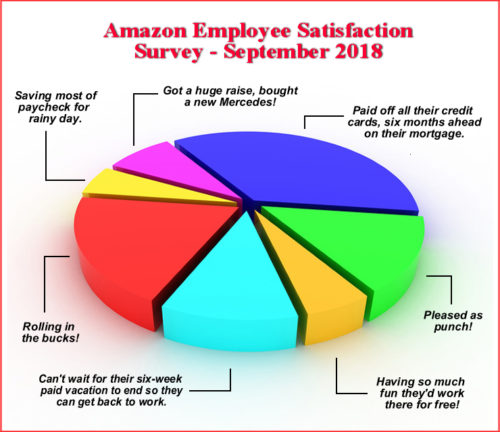
Obviously the above pie chart is a put-on. It is well-documented that working conditions for most employees of Amazon are  abysmaldehumanizing, bordering on abuse we normally associate with slavery.

Moreover, the median employee’s salary under Jeff Bezos’ imperial lordship is $28,446. No one working as a regular there has paid off their credit cards and is driving to work in a Mercedes. 

Jeff Bezos is referred to as The Richest Man in the World and his personal fortune, while growing by $191,000 each minute, is currently estimated at $168 billion.

So …

$28,446 vs. $168,000,000,000? While I can acknowledge the simple math, I find the contrast of such numbers on a gut level difficult to grasp.

To get a handle on such inequality, let’s try approaching it from different angles.

One way to put the disparity into perspective is to recognize it takes Bezos just under 9 seconds to earn what Amazon’s median worker does in an entire year.

Another is to recognize that for a worker to go through Jeff Bezos’ current personal fortune — and, of course, it continues mounting at accelerating levels as I write this — at his/her current median annual income of $28,446 per year, WOULD TAKE 5,905,927 YEARS! That’s close to 6 million years!

For Jeff Bezos himself to go through his current $168 billion, assuming his earnings stopped dead this very moment — which as you and I know they won’t — SPENDING $1,000,000 A DAY, would take NEARLY 460 years. Yes, even spending $1 million a day, in the year 2475 he’d still have plenty of cash, tens of million of dollars mad money. We can feel confident that he wouldn’t be foraging through the dumpster behind 7-11. 

Now, further consider that while the $28,446 median salary is above the national poverty line for a single individual if that person is the sole breadwinner for a family of four, it is marginally above it, which is why many Amazon employees must rely on government assistance to keep from starving.

As well as calculation, I did some speculation — a simple exercise in imagination.

Apparently Bezos’ wealth generating machine is raking it in so fast, he’s currently making $11.5 million per hour … every hour … 24 hours a day … seven days a week. $11,500,000 per hour! 

So here’s what I was picturing in my mind’s eye … 

If for 40 hours of the 168 hours in a week, Bezos were willing to scrape by on a mere $5,840,000 per hour, he could give every one of his 566,000 Amazon employees a $10 per hour raise. Of course, the remaining 128 hours in each week, Bezos could continue earning his normal $11.5 million per hour, not having to share any of it with the pathetic slobs who work for him.

Rhetorical question: Does Jeff Bezos have any concept of what that $10 per hour increase would mean to his employees? 

I’m not going to even suggest here I’m offering this for Bezos to entertain. There are so many advantages to him both as a putative member of the human race and the employer of over a half million workers — advantages that are so OBVIOUS — if they haven’t occurred to him up until now, then his brain functions in ways beyond my understanding. For one thing, he could point to his new fig leaf of “generosity” and ask people to stop calling him a selfish prick. Second, Amazon employees I’m sure would respond to his largesse with greater company loyalty and increased tolerance for his onerous working conditions. He’d still be the richest SOB on the block and could mock the pauperish Bill Gates and Warren Buffett as pitiable wannabees.

Consider …

The most poorly paid Amazon employee now makes $12 per hour. The $10 per hour raise I proposed would boost those $12 per hour workers right up there with Costco employees, who make an average of $21 per hour. And with the across-the-board $10 per hour increase, Bezos’ higher paid employees would be earning among the finest wages in the world provided by a major corporation. 

And by golly, there’s a plus side to the plus side …

Bezos’s bold and gracious gesture would result in a public relations coup of cosmic proportions! Amazon would no longer be demonized — well, not quite as much — by us bleeding-heart lefties as a capitalistic scourge and one-way ticket to Hell for the future of mankind, even if its environmental record is appalling and its business model generally the stuff of steroid-laced neo-feudalism.

Granted, Bezos would have to do some belt-tightening. He’d have to watch his pennies but could probably manage it, eh? Maybe he could skip a couple meals and do some of his own weeding at his estate. After all, after lavishing the $10 per hour raise on all of his employees, he’d only be pulling in $1,705,600,000 per week. I know I know! Like me you’re probably getting all teary-eyed for the poor guy.

Let me get to the extremely anti-climactic conclusion of this lament qua analysis.

Since nothing will change until the system itself changes, meaning the one in place now that creates, incentivizes, and lionizes the obscenely wealthy — reference current holder of the Office of President of the United States of America — I can only recommend this …

We have been labeling Jeff Bezos as ‘The Richest Man in the World’. Yet, quite honestly I don’t personally know any human, man or woman, who behaves like this gluttonous chunk of self-indulgent meat. It actually makes me nauseous to think we’re members of the same species.

Thus, from now on let’s use the correct terminology. Let’s call Jeff Bezos what he really is: the Richest Sociopath in the World.

We could probably order bumper stickers to help correct the record … from Amazon, of course.

The USA Is Now a 3rd World Nation

By Charles Hugh Smith

Source: Of Two Minds

I know it hurts, but the reality is painfully obvious: the USA is now a 3rd World nation.

Dividing the Earth’s nations into 1st, 2nd and 3rd world has fallen out of favor; apparently it offended sensibilities. It has been replaced by the politically correctdeveloped and developing nations, a terminology which suggests all developing nations are on the pathway to developed-nation status.

What’s been lost in jettisoning the 1st, 2nd and 3rd world categories is the distinction between developing (2nd world) and dysfunctional states (3rd world), states we now label “failed states.”

But 3rd World implied something quite different from “failed state”: failed state refers to a failed government of a nation-state, i.e. a government which no longer fulfills the minimum duties of a functional state: basic security, rule of law, etc.

3rd World referred to a nation-state which was dysfunctional and parasitic for the vast majority of its residents but that worked extremely well for entrenched elites who controlled most of the wealth and political power. Unlike failed states, which by definition are unstable, 3rd World nations are stable, for the reason that they work just fine for the elites who dominate the wealth, power and machinery of governance.

Here are the core characteristics of dysfunctional but stable states that benefit the entrenched few at the expense of the many, i.e. 3rd Worldnations:

1. Ownership of stocks and other assets is highly concentrated in entrenched elites. The average household is disconnected from the stock market and other measures of wealth; only a thin sliver of households own enough financial/speculative wealth to make an actual difference in their lives.

2. The infrastructure of the nation used by the many is poorly maintained and costly to operate as entrenched elites plunder the funding to pad their payrolls, pensions and sweetheart/insider contracts.

3. The financial/political elites have exclusive access to parallel systems of transport, healthcare, education, etc. The elites avoid trains, subways, lenders, coach-class air transport, standard healthcare and the rest of the decaying, dysfunctional systems they own that extract wealth from the debt-serfs.

They fly on private aircraft, have their own healthcare and legal services, use their privileges to get their offspring into elite universities and institutions and have access to elite banking and lending services that are unavailable to their technocrat lackeys and enforcers.

4. The elites fund lavish monuments to their own glory disguised as “civic or national pride.” These monuments take the form of stadiums, palatial art museums, immense government buildings, etc. Meanwhile the rest of the day-to-day infrastructure decays in various states of dysfunction.

5. There are two classes that only interact in strictly controlled ways: the wealthy, who live in gated, guarded communities and who rule all the institutions, public and private, and the debt-serfs, who are divided into well-paid factotums, technocrat lackeys and enforcers who serve the interests of the entrenched elites and rest of the populace who own virtually nothing and have zero power.

The elites make a PR show of being a commoner only to burnish the absurd illusion that debt-serf votes actually matter. (They don’t.)

6. Cartels and quasi-monopolies are parasitically extracting the wealth of the nation for their elite owners and managers. Google: quasi-monopoly. Facebook: quasi-monopoly. Healthcare: cartel. Banking: cartel. National defense: cartel. National Security: cartel. Corporate mainstream media: cartel. Higher education: cartel. Student loans: cartel. I think you get the point: every key institution or function is controlled by cartels or quasi-monopolies that serve the interests of the few via parasitic exploitation of the powerless.

7. The elites use the extreme violence and repressive powers of the government to suppress, marginalize and/or destroy any dissent. There are two systems of “law”: one for the elites ($10 million penalties for ripping off the public for $10 billion, no personal liability for outright fraud) and one for the unprotected-unprivileged: “tenners” (10-year prison sentences) for minor drug infractions, renditions or assassinations (all “legal,” of course) and institutional forces of violence (bust down your door on the rumor you’ve got drugs, confiscate your car because we caught you with cash, so you must be a drug dealer, and so on, in sickening profusion).

8. Dysfunctional institutions with unlimited power to extract money via junk fees, licensing fees, parking tickets, penalties, late fees, etc., all without recourse. Mess with the extractive, parasitic bureaucracy and you’ll regret it: there’s no recourse other than another layer of well-paid self-serving functionaries that would make Kafka weep.

9. The well-paid factotums, bureaucrats, technocrat lackeys and enforcers who fatten their own skims and pensions at the expense of the public and slavishly serve the interests of the entrenched elites embrace the delusion that they’re “wealthy” and “the system is working great.” These deluded servants of the elites will defend the dysfunctional system because it serves their interests to do so.

The more dysfunctional the institution, the greater their power, so they actively increase the dysfunction at every opportunity.

The USA is definitively a 3rd World nation. Read the list above and then try to argue the USA is not a 3rd World nation. Try arguing against the facts displayed in this chart:

I know it hurts, but the reality is painfully obvious: the USA is now a 3rd World nation.


Amazon and Apple: Wall Street’s Trillion Dollar Babies

By Dean Baker

Source: CounterPunch

Last month Amazon joined Apple, becoming the second company in the world to have a $1 trillion market capitalization. Amazon’s accomplishment didn’t cause quite as much celebration as Apple’s – it pays to be number one – nonetheless this was treated as a milestone that all of us should view as good news.

Actually, the celebratory coverage of both events demonstrated the incredibly ill-informed nature of much economic reporting in the United States. A big run-up in share prices is good news for the people who own lots of stock in the company; it is not especially good news for anyone else.

In principle, the value of a stock is supposed to represent the expected future earnings of the company. I said “supposed” because stock prices fluctuate wildly in response to all sorts of things that are not obviously connected to future earnings, but in the textbook definition, it is the discounted value of future earnings that determine stock prices. To be clear, this is not the socialist textbook, this is the capitalist textbook that is taught in business schools.

What does it mean that Amazon and Apple have market valuations of more $1 trillion? Presumably, it means that investors are now more optimistic about the companies’ future profit potential. It’s difficult to see why the rest of us should celebrate this outcome.

Apple obviously makes products that consumers value, and in that sense, it is contributing to the economy and generating wealth. But, suppose instead of one huge company we had 10 little (or littler) Apples that sold iPhones, computers, and the other items that comprise Apple’s product line? Would we be any poorer as a society in that case, even if the market cap of our leading tech company was just $100 billion?

Or, even with Apple as our dominant tech company, suppose the surge over the $1 trillion barrier was due to a victory in an antitrust case, which would allow Apple to charge higher prices going forward. That’s great for Apple’s stockholders, but what exactly would the rest of us be celebrating? Paying more money for our iPhones?

In the same vein, in the past, Apple has been caught conspiring with other Silicon Valley companies, agreeing not to compete for workers. Apple, along with its co-conspirators, ended up paying a substantial settlement as a result.

Suppose Apple found a legal way to fix wages or bought a judge to make it legal. The prospect of a lower wage bill would also be good for Apple’s stock price, but not especially good news for those of us who are more likely to make our living from working than owning Apple stock. Again, there is not much in this story for most of us to celebrate.

The celebration for Amazon is even more peculiar. Amazon is clearly an innovative company that has sped the development of Internet retailing. It also has specialized in tax avoidance, eliciting investment incentives from state and local governments, and abusive labor practices.

Perhaps the crossing of the $1 trillion threshold was associated with investors’ confidence that Amazon’s CEO had developed a new and more effective tax avoidance scheme. Again, great news for Amazon stockholders, but pretty bad news for the folks who will have to make up the revenue shortfall.

What is notably different about Amazon is that, unlike Apple, the company does not have huge profits. While Apple earned $48.4 billion in after-tax profits in 2017, Amazon’s profit was just over $3 billion. That gives the company an incredible price-to-earnings ratio of more than 300-to-1.

There are two stories we can tell here. One is that investors expect Amazon’s profits to increase enormously. This would be a case where it takes advantage of its market power to increase its profit margins hugely. Ordinarily, this would be the basis for antitrust action, but given the corruption of the political system, it is certainly possible the company could get away with it. Again, is a future of higher prices something the rest of us should really be celebrating?

The other possibility is that Amazon’s stock price is driven by fantasy, like the Internet stocks of the late 1990s or Bitcoin today. Presumably, at some point reality will reassert itself, but should the rest of us celebrate ill-informed investors being taken for ride?

It is striking that so many would see economic or social progress as being in some way captured by stock valuations. In 1953 Jonas Salk developed the polio vaccine. This eventually led to the near eradication of a disease that had killed or crippled tens of millions of people.

Salk didn’t try to patent his invention. A private charity funded the research. But, what if there had been a Salk Inc. that had the patent on a vaccine that could save tens of millions of lives? Surely the market cap would be an order of magnitude larger than either Apple’s or Amazon’s. Was it a loss to society that the vaccine was made available for pennies rather than tens of thousands of dollars a shot?

If we want to talk about value to society, the anti-smoking crusaders of the last four decades have saved tens of thousands of lives and improved the health of millions more by reducing smoking in the United States and around the world. The people who led this fight, most of whom were women, won’t be featured on the covers of business magazines, but they did much more to enhance society’s wealth than Jeff Bezos.

Anyhow, congratulations to Apple and Amazon’s stockholders on their stock gains. They have been fortunate. The rest of us, not so much.

Taxpayers Are Footing the Bill for Sky-High CEO Salaries

Billions in taxpayer funds go to CEOs who pay their workers peanuts. We can change that.

By Sam Pizzigati

Source: Other Words

Politicians often gab about the “private sector” and the “public sector,” as if these two categories of economic activity operated as two completely separate worlds.

In reality, these two sectors have always been deeply intertwined.

How deeply? Every year, the federal government spends about half a trillion dollars buying goods and services from the private sector. State and local government contracts with private-sector enterprises add hundreds of billions more.

And private-sector companies don’t just receive contracts from our governmental entities. They receive all sorts of subsidies — billions upon billions of dollars in “corporate welfare.”

Where do all these dollars come from? They come from us, America’s taxpayers. Without the tax dollars we provide, almost every major corporation in the United States would flounder. Some would simply cease to exist. The defense contractor Lockheed Martin, for instance, takes in almost all its revenue from government contracts.

This private sector reliance on public tax dollars gives us, as citizens, some leverage over the behavior of our largest and most powerful corporations. We could, if we so chose, deny those dollars to corporations that engage in behaviors that undermine the values we hold dear.

On other fronts, we already do this denying. For over a generation now, we’ve leveraged the power of the public purse against companies with employment practices that discriminate on the basis of race and gender. Companies that discriminate can’t get government contracts because we’ve come to a consensus, as a society, that we don’t want our tax dollars subsidizing racial and gender inequality.

Unfortunately, our tax dollars are still subsidizing — in a big way — economic inequality, as a new Institute for Policy Studies report on CEO pay details quite vividly. Billions of our tax dollars are annually going to corporations that pay their top executives more in a week, or even a day, than their typical employees can make over an entire year.

The late Peter Drucker, the founder of modern management science, believed that no corporate enterprise that pays its CEO over 25 times what its workers are earning could operate efficiently and effectively over the long haul. In 2017, every single one of the federal government’s 50 largest private contractors paid its chief executive over 25 times more than its most typical workers.

In fact, most paid their top execs well over 100 times more.

And at one, DXC Technology, the CEO pulled down over $32 million in 2017 pay — over 800 times the compensation of the firm’s typical employees.

Let’s add a little context here. The president of the United States earns $400,000 a year. The CEOs of the 50 private companies with the largest federal contracts last year averaged over $13.5 million. The CEOs of the 50 largest recipients of federal subsidies last year averaged over $12 million.

Our tax dollars, in other words, are helping a lucky few become fabulously rich.

We do live, as our politicians like to point out, in a “free country.” Corporations can pay their top execs whatever they want. But we taxpayers have freedom, too. We can freely deny our tax dollars to enterprises that are making our society ever more unequal.

Some lawmakers are starting to step in that direction. Five states have begun considering legislation that would make it harder for companies with wide CEO-worker pay gaps to get government contracts and tax breaks. And one city — Portland, Oregon — has already enacted legislation that taxes corporations with wide CEO-worker pay gaps at a higher rate than corporations with more modest gaps.

We need more Portlands.