At the American Enterprise Institute, Mark Perry (“Yes, America’s middle class has been disappearing… into higher income groups,” Dec. 17) justifies the shrinking middle class and growing economic inequality by citing the finding of a recent Pew Institute study that of the 11% shrinkage in the American middle class, 7% have gone to the top and only 4% to the bottom.
First, movement between strata doesn’t legitimize stratification if the structure itself is illegitimate. Meritocracy is a legitimizing myth created to distract people from the question of whether the system of power those meritocratic functionaries serve is just. As Chris Dillow, an unorthodox British Marxist economist, observed (“Beyond social mobility,” Stumbling and Mumbling, Dec. 19):
“Imagine a dictator were to imprison his people, but offer guard jobs to those who passed exams, and well-paid sinecures to those who did especially well. We’d have social mobility — even meritocracy and equality of opportunity. But we wouldn’t have justice, freedom or a good society. They all require that the prisons be torn down.”
Also note that what’s called the “upper class” in the study includes not only the super-rich rentier classes and people in the C-Suites with million-dollar salaries, but also most of the larger managerial stratum. There’s a good reason this stratum has expanded from 14% to 21% of the general population. As David Gordon argued in Fat and Mean, it was the neoliberal decision in the ’70s to cap real hourly wages and shift a greater share of income upwards to rentiers and cowboy CEOs that resulted in increasing internal authoritarianism in the corporation and a need for a larger class of overseers to monitor the (understandably) increasingly disgruntled work force.
And despite the increased income of the managerial classes, the great bulk of them are still salaried employees whose income depends on the ongoing approval of their superiors. That 14-21% of the population is more or less what Orwell, in 1984, called the “middle” stratum (represented in the story by the Inner Party to which Winston and Julia belonged). Here’s how Orwell described the same general type in the corporate England of his day in another novel, Coming Up for Air: “in every one of those little stucco boxes there’s some poor bastard who’s never free except when he’s fast asleep…”
Not only do these people continue to collect their managerial salary at the good pleasure of the senior oligarchs of the corporate hierarchy, but to even have a shot at that management pay in the first place they’ve got to put themselves in a position of student debt peonage that will likely eat up a major part of that increased income for years (along with a mortgage that means they’ll really be renting their house from the bank into old age). Add to that the long hours middle management types have to work coupled with the endless bureaucratic toadyism and sycophancy required of them, and the ongoing precarity of their position.
Getting back to the issue of legitimacy, there’s also the fact that the functions exercised by most of these managerial types are illegitimate and would be unnecessary absent an exploitative class society. They are, in anarchist anthropologist David Graeber’s famous phrase, “b***s*** jobs.” They exist because the American state, in league with corporate capital, has cartelized the economy under the control of bureaucratic hierarchies many times larger than the point of declining returns in efficiency, and because the authoritarian nature of those hierarchies and the rent-seeking nature of their management creates a conflict of interest that necessitates intensified surveillance and control.
The late Joe Bageant aptly described the nature of the work these people perform: “The empire needs… about 20-25% of its population… to administrate and perpetuate itself — through lawyers, insurance managers, financial managers, college teachers, media managers, scientists, bureaucrats, managers of all types and many other professions and semi-professions.”
When workers own the firm and manage their own work, as in the recuperated enterprises of Argentina, not only can workers be trusted to use their own superior knowledge of the work process but what little coordinating costs remain are a small fraction of U.S. corporate administrative costs. In fact eliminating all those management salaries solved the unit costs problem at one stroke.
The upper quintile is growing in size and income because all the value created by actual productive workers in the lower quintiles gets extracted by those at the top. When the top classes rob everybody else, they need a lot more guard labor to keep their stolen loot secure.
And whether or not there’s been an increase in the real income of the lower four strata, production workers’ loss of control over the work force and increased precarity is even worse than that of those middle managers in the top 21%. Whether for production workers or middle management, stress correlates directly with powerlessness.
Transnational corporations are wreaking havoc on financial, economic, social and ecological systems in a creeping colonisation of public life where just 147 organisations now controls 40 per cent of global trade.
We all have a feeling that something is not quite right any more. We know there is a creeping colonisation of public life by corporations because we know a slow motion coup d’état is taking place by transnational organisations facilitated by our political leaders. The incontrovertible proof stares at us in the face every day with wave after wave of financial, economic, social and ecological crisis.
A clear and troublesome picture of corporate power has emerged in recent years where rising inequality is now simply the distinction of expanding corporate activity and those being left behind.
A study in 2000 by Corporate Watch, Global Policy Forum and the Institute for Policy Studies (IPS) revealed some alarming facts about a rising corporatocracy that should have been brought to heel by western government’s years ago. Instead, corporations are now literally at the helm.
At the turn of the millennia this study confirmed that whilst there were around 40,000 worldwide corporations, just 200 had true global reach and influence. These colossal organisations, many larger than national economies controlled well over one quarter of global economic activity whilst 80 per cent of the world’s population were either left out completely, marginalised or were net losers as a direct result of their activities.1
The decade long IPS study made for very uncomfortable reading. The most alarming amongst a long list of culpability is that as corporate profits soared – wealth concentration followed, and it did so in an environment of stagnating workers wages.
For perspective, the report highlighted that of the 100 largest economies in the world, 51 were corporations; only 49 were countries. Wal-Mart for example, was bigger than 161 countries. Mitsubishi was larger than the fourth most populous nation on earth: Indonesia. General Motors was bigger than Denmark. Ford was bigger than South Africa.
The top 200 corporations were bigger than the combined economies of 182 countries and have twice the economic influence than 80 per cent of all humanity.
You might find it something of a surprise to learn that these same 200 global corporations employed less than one third of one per cent of the world’s people – just 18.8 million.
Trading, automobiles, banking, retailing and electronics are where most corporate concentration accumulates and even then one third of all trade is transactions among various units of the same corporation.
By 2012, the top 25 corporations in the world were earning $177,000 per second with Wal-Mart’s annual revenue having risen to $470 billion.
Today the outlook is even worse. Three mathematicians at Zurich Polytechnic Institute published a quite remarkable in-depth report on transnational corporations (TNCs) according to their connections to other TNCs. Beginning with a data base that has now grown to 43,000 corporations, they refine the ownership connections, up and downstream and highlight the most interconnected of these companies. Finally, they arrive at a “core” of 147 companies that now controls an astonishing 40 per cent of the economic value of the entire sample and therefore, global trade.
In little more than a decade, TNCs share of the global market place has increased dramatically whilst competition fell by almost the same factor.
And yet, armed with such damning and conclusive information, the situation continues to deteriorate as politicians abandon any fragments of morality in favour of lucrative revolving door careers leaving entire nations with little more than the hollowed out remains of once thriving economies based on manufacturing and the corpse of democracy.
In the late 1970’s the share of economic value going to labour in the form of wages in Europe was around 70 per cent of GDP. Over the decades there has been a dire shift. Capital has had a very favourable 10 per cent rise in returns and by contrast labour a 10 per cent fall. With an economy worth €13 trillion, the loss to an already stretched working and middle class is €1.3 trillion a year. Shareholders used to be content with returns of say 3 or 4 per cent but now demand near on double digit returns or the CEO is ousted. The consequence being that corporations want to win no matter what the cost.
In Susan George’s “State of Corporations” the observation is made that “From the mid-1990s, the largest American banking, securities, insurance and accounting transnational corporations joined forces and, employing 3000 people, spent $5 billion to get rid of all the New Deal laws passed under the Roosevelt administration in the 1930s – the very laws that had protected the American economy for over sixty years. Through this collective lobbying push, they won total freedom to remove any money-losing assets from their balance-sheets and move them into “shadow” banks that appeared nowhere on their balance sheets. They became free to create and trade hundreds of billions worth of toxic derivative products, such as bundles of sub-prime mortgages, with no regulation whatever.”2
The peak of their collective effort was a global implosion of the finance industry in 2008 and eight years later its lingering state of decline now threatens the Great Depression of 1929 as the longest running recession in history – already the slowest recovery ever recorded.
In the US alone, over 10 million families had their homes repossessed and according to Bloomberg, $14.5 trillion, or 33%, of the value of the world’s companies and nearly 14% of US GDP was wiped out by the crisis. This forgets the effects on developing and third world economies where $3.3 trillion of promised aid remains just that – promised and unpaid.
In the era of “too big to fail and jail” virtually no one was brought to heel or sent to prison for such devastating crimes. Today, the banking industry is almost totally out of control. Daily derivative trading is now a third greater than at the peak of the 2008 crisis. Fraud, rigging, insider dealing and money laundering reach a new summit of lawlessness each day. In the top twenty of global corporations, five are banks.
In the meantime, learning from previous successes, corporate lobbyists now termed “expert committees” meet daily with EU Commission officials to hammer out a trade deal whilst almost no consumer or environmental organisations are represented. Civil society is excluded, as are their representatives in the guise of MEP’s with the illusion of democracy fading fast.
Corporations now place their profits in ultra low or no tax jurisdictions and their losses in high-tax ones, where an estimated $32 trillion is shielded from making any contribution to the societies they extract their wealth from with little or no scrutiny from government’s.
What we now have is anarchy by very rich and powerful corporations. The roll call of shame is never-ending – auto manufacturers, banking, pharmaceutical, food manufacturers, energy industries to name few.
Epic financial crimes, monumental tax evasion, ecological damage on an industrial scale and non-stop illegal wars to ensure a never-ending resource supply is a shameful system based on corporate greed. In its wake we now have 1920’s style rampant inequality and rising poverty reminiscent of the era of Dickens. All of this somehow is the new normal.3
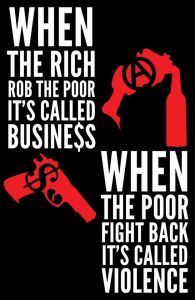
Steal a loaf of bread and it’s prison for you, loot an entire country and it’s a Knighthood. For instance, the British public believes as a result of a long, malicious class-war style political campaign, that benefits fraud is a huge social problem. A recent poll by the workers union TUC showed people believe that 27% of the welfare budget is fraudulently claimed. The figure is in fact 0.7%. As it turns out benefit underpayments by the government outweighs benefit fraud.
Contrast that with one of Britain’s biggest fraudsters – HSBC. In a few short years it has been caught laundering billions of ill-gotten gains on behalf of dictators and despots, international gangsters, traffickers, drug barons, murderers and every other criminal down a particularly odious food chain. It was also caught red-handed in the huge Swiss tax evasion scandal benefitting corporations before we even got to hear of the Panama Papers. The Conservatives gave its boss Stephen Green a plum ministerial role as trade minister in 2011 and he sits in the House of Lords as a Tory peer in an irony lost on themselves and the media.4
Globalisation has continually compounded corporate power and consolidated its influential reach on global governance. Again, trade deals such as TTP and TTIP where entire continents are subjected to corporate domination are evidence of that, but their reach has a more sinister outcome. Corporate lobbyists who now have unprecedented privilege granted by global decision makers to sideline sovereign regulations designed to protect citizen rights and the environment have infiltrated the United Nations.
The UN has a special section for corporations called the “Global Compact” founded about fifteen years ago by Kofi Annan and the then President of Nestle. To become a member, a corporation need only sign on for fifteen principles in the areas of human or labour rights and the environment.5
The corporations of the Global Compact added themselves to members of the World Business Council for Sustainable Development and other trade bodies such as the Chambers of Commerce. When the UN held its “environmental” conference in Rio 2012, business completely dominated proceedings for the first time. Corporate interests now have a disproportionality high level of political influence on a truly global scale.
A good example would be Cecilia Malmstrom, the lead EU Trade Commissioner of the TTIP negotiations between Europe and the US. She was questioned by a reporter from The Independent a few months back on why she continued her persistent promotion of the deal against such massive public opposition, her response was: “I do not take my mandate from the European people.”6
Just a few weeks ago we discover that the European Parliament voted in favour of the “Trade Secrets Protection Directive” – a law that gives corporations alarming new superpowers to prosecute and criminalise whistleblowers, journalists, and news organisations that publish leaked internal documents.
As Dr. Paul Craig Roberts former Assistant Secretary of the US Treasury for Economic Policy and associate editor of the Wall Street Journal put it recently “politically powerful corporations have gained the power in Western “democracies” to sacrifice the welfare of all populations to corporate greed for profit regardless of the cost to peoples, countries, and societies. American “democratic capitalism” is total and irredeemable. TTIP gives corporations unaccountable power over governments and peoples”
Democracy is now on the verge of going from farce to tragedy as a direct result of the indomitable rise of corporate power.
We now live in an era where the fetid reality between rich and poor is demonstrated no better than the rapidly rising inequality of wealth distribution. In 1976 America, the top 1% earned 9 per cent of the national wealth. Thirty years later and their take of national wealth has almost tripled to 24 per cent.7
One of the greatest challenges of our time is to understand the influence of transnational corporations over public policy and how we can engineer a form of capitalism that benefits a wider range of people whilst wrestling social and environmental injustice back into the safe arms of a fully functional democracy.
Currently, the only thing left in opposition now is a general public under siege who protest in cities across Europe and America and present petitions to their respective governments representing millions of citizens. These are the same people who have to pay for all this (legalised) criminality in lost services, employment and savings, yet remain unheard.
This process of withdrawal into the relative safety of internally cohesive groups and group identities is intrinsically messy in globalized, multicultural societies.
A great many narratives are drifting around the Brexit pool: a return to sovereignty, class war, “controlled demolition,” nothing-but-another-political-Kabuki- spectacle, end of the European Union, etc.
I think it boils down to something much simpler: the pie is shrinking, and the illusion that it’s about to start growing has been shattered. For many communities in the developed world, the pie started shrinking in the 1970s, and has been shrinking (despite the narrative of “45 years of strong growth”) since then.
Labor’s share of the GDP has been declining for 45 years. Occasional blips higher during debt-fueled bubbles quickly fade when the bubble du jour pops, and the decline of labor’s share of the economy resumes its trendline decline.
Since 2008, the only group who feels the pie is growing is the class that has benefited from the unparalleled expansion of debt and leverage, financialization, globalization and central planning–roughly 20% of the work force, with the top 5% gathering most of the gains in income and wealth, and the top .1% gathering most of the increase in wealth. (See chart below)
For seven long years, the citizenry has been told the economy is expanding and therefore they’re “doing better.” But this narrative is not supported by their actual lived experience. Inflation is woefully under-reported by official statistics, and the rosy “rising employment” narrative is based largely on part-time jobs in hospitality and food services (bartenders, waiters, etc.) that are highly contingent on the spending of the top 10%.
While supporters of the status quo are quick to deride supporters of Brexit, the cold reality is the economic pie is shrinking, and Brexit is a direct result of that reality.
A shrinking economic pie generates widespread insecurity that pressures every status quo arrangement as people circle the wagons in an attempt to protect their remaining slice of the pie from others’ claims for a larger piece of the dwindling pie.
The general media line is that the Brexit vote arose out of anger with the status quo’s inequalities and asymmetries of wealth and power. While this is largely self-evident, it isn’t the most fundamental dynamic at work. I see Brexit as a reflection of our naturally-selected defensive response to insecurity and instability: circle the wagons.
By circle the wagons, I mean our tendency to withdraw into an internally cohesive group with defined membership and boundaries.
The largest such political group is the nation-state, and so it is natural for people with strong national identities to circle the wagons around their national identity.
We can also expect people to circle the wagons around ethnic, religious, localized and economic-social class identities. (Some people might feel more kinship with other fans of Manchester United than they do with any religion, ethnicity or state.)
As people identify themselves as members of the class that has not benefited from neoliberal/globalized crony capitalism, the ruling Elites become the “other,” i.e. “foreigners” with whom we have little contact, people who “aren’t like us”– in effect, an “enemy class” that is inherently opposed to our self-interests.
This process of withdrawal into the relative safety of internally cohesive groups and group identities is intrinsically messy in globalized, multicultural societies. No wonder populations are dividing into camps of increasingly angry people with little interest in compromise. Our instinct is to seek clear delineations of “us” and “them” and to seek the relative comfort of “us,” which in a multicultural nation, can contain quite a mixed bag of people who nonetheless feel a shared identity.
Much to the chagrin of political parties whose success is based solely on “identity politics,” the emerging group identities are not conforming to the political classes’ conventional fault lines. “Us” for many people includes everyone who isn’t a protected insider of the status quo, and “the enemy” is any protected insider of the status quo.
That includes virtually the entire political class, the entire class of state nomenklatura/technocrats, the entire banking sector and the wealthy class that’s benefited so handsomely from the globalized, debt-leverage bubbles and state / central bank support that characterize this era of neoliberal/globalized crony capitalism.
Last week a research wing of the International Monetary Fund came out with a report admitting that neoliberalism has been a failure. The report, entitled, “Neoliberalism: Oversold?” is hopefully a sign of the ideology’s death. They were only about 40 years late. As Naomi Klein tweeted about the report, “So all the billionaires it created are going to give back their money, right?”
Many of the report’s findings which strike to the core of the ideology echo what critics and victims of neoliberalism have been saying for decades.
“Instead of delivering growth,” the report explains that neoliberal policies of austerity and lowered regulation for capital movement have in fact “increased inequality.” This inequality “might itself undercut growth…” As a result, the report states that “policymakers should be more open to redistribution than they are.”
However, the report leaves out a few notable items on neoliberalism’s history and impact.
The IMF suggests neoliberalism has been a failure. But it has worked very well for the global 1%, which was always the IMF and World Bank’s intent. As Oxfam reported earlier this year, the wealthiest 1% in the world now has as much wealth as the rest of the planet’s population combined. (Similarly, investigative journalist Dawn Paley has proven in her book Drug War Capitalism that far from being a failure, the Drug War has been a huge success for Washington and multinational corporations.)
The IMF report cites Chile as a case study for neoliberalism, but never mentions once that the economic vision was applied in the country through the US-backed Augusto Pinochet dictatorship – a major omission which was no casual oversight on the part of the researchers. Across Latin America, neoliberalism and state terror typically went hand in hand.
The fearless Argentine journalist Rodolfo Walsh, in a 1977 Open Letter to the Argentine Military Junta, denounced the oppression of that regime, a dictatorship which orchestrated the murder and disappearance of over 30,000 people.
“These events, which stir the conscience of the civilized world, are not, however, the greatest suffering inflicted on the Argentinean people, nor the worst violation for human rights which you have committed,” Walsh wrote of the torture and killing. “It is in the economic policy of this government where one discovers not only the explanation for the crimes, but a greater atrocity which punishes millions of human beings through planned misery. . . . You only have to walk around greater Buenos Aires for a few hours to check the speed with which such a policy transforms the city into a ‘shantytown’ of ten million people.”
This “planned misery,” as Naomi Klein’s Shock Doctrine vividly demonstrates, was the neoliberal agenda the IMF has pushed for decades.
The day after Walsh mailed the letter to the Junta he was captured by the regime, killed, burned, and dumped into a river, one of neoliberalism’s millions of casualties.
The Democratic Party was once the party of the New Deal and the ally of organized labor. But by the time of Bill Clinton’s presidency, it had become the enemy of New Deal programs like welfare and Social Security and the champion of free trade deals. What explains this apparent reversal? Thomas Frank—best known for his analysis of the Republican Party base in What’s the Matter with Kansas?—attempts to answer this question in his latest book, Listen Liberal: Or, What Ever Happened to the Party of the People?
According to Frank, popular explanations which blame corporate lobby groups and the growing power of money in politics are insufficient. Frank instead points to a decision by Democratic Party elites in the 1970s to marginalize labor unions and transform from the party of the working class to the party of the professional class. In so doing, the Democratic Party radically changed the way it understood social problems and how to solve them, trading in the principle of solidarity for the principle of competitive individualism and meritocracy. The end result is that the party which created the New Deal and helped create the middle class has now become “the party of mass inequality.” In These Times spoke with Frank recently about the book via telephone.
The book is about how the Democratic Party turned its back on working people and now pursues policies that actually increase inequality. What are the policies or ideological commitments in the Democratic Party that make you think this?
The first piece of evidence is what’s happened since the financial crisis. This is the great story of our time. Inequality has actually gotten worse since then, which is a remarkable thing. This is under a Democratic president who we were assured (or warned) was the most liberal or radical president we would ever see. Yet inequality has gotten worse, and the gains since the financial crisis, since the recovery began, have gone entirely to the top 10 percent of the income distribution.
This is not only because of those evil Republicans, but because Obama played it the way he wanted to. Even when he had a majority in both houses of Congress and could choose whoever he wanted to be in his administration, he consistently made policies that favored the top 10 percent over everybody else. He helped out Wall Street in an enormous way when they were entirely at his mercy.
He could have done anything he wanted with them, in the way that Franklin Roosevelt did in the ‘30s. But he chose not to.
Why is that? This is supposed to be the Democratic Party, the party that’s interested in working people, average Americans. Why would they react to a financial crisis in this way? Once you start digging into this story, it goes very deep. You find that there was a transition in the Democratic Party in the ‘70s, 80’s and ‘90s where they convinced themselves that they needed to abandon working people in order to serve a different constituency: a constituency essentially of white-collar professionals.
That’s the most important group in their coalition. That’s who they won over in the ’70s, ’80s and ’90s. That’s who they serve, and that’s where they draw from. The leaders of the Democratic Party are always from this particular stratum of society.
A lot of progressives that I talk to are pretty familiar with the idea that the Democratic Party is no longer protecting the interests of workers, but it’s pretty common for us to blame it on mainly the power of money in politics. But you start the book in chapter one by arguing there’s actually something much deeper going on. Can you say something about that?
Money in politics is a big part of the story, but social class goes deeper than that. The Democrats have basically made their commitment [to white-collar professionals] already before money and politics became such a big deal. It worked out well for them because of money in politics. So when they chose essentially the top 10 percent of the income distribution as their most important constituents, that is the story of money.
It wasn’t apparent at the time in the ‘70s and ‘80s when they made that choice. But over the years, it has become clear that that was a smart choice in terms of their ability to raise money. Organized labor, of course, is no slouch in terms of money. They have a lot of clout in dollar terms. However, they contribute and contribute to the Democrats and they almost never get their way—they don’t get, say, the Employee Free Choice Act, or Bill Clinton passes NAFTA. They do have a lot of money, but their money doesn’t count.
All of this happened because of the civil war within the Democratic Party. They fought with each other all the time in the ‘70s and the ‘80s. One side hadn’t completely captured the party until Bill Clinton came along in the ‘90s. That was a moment of victory for them.
Bill Clinton’s presidency is what progressives usually cite as the time when things went bad. But there’s a trend that goes back to the ’70s, right?
Historians always cite the ’68 election as the turning point. The party was torn apart by the controversy over the Vietnam war, protesters were in the streets in Chicago and the Democratic candidate Hubert Humphrey went on to lose. Democrats thought this was terrible, and it was. So they set up a commission to reorganize the party, the McGovern Commission.
The McGovern Commission basically set up our modern system of primaries. Before the commission, we didn’t have these long primary contests in state after state after state. Primaries are a good thing, as were most things the McGovern Commission did.
But they also removed organized labor from its structural position of power in the Democratic Party. There was a lot of resentment towards labor during the Vietnam War. A lot of unions took President Johnson’s side on Vietnam. There was also this sense—which I think was correct at the time—that labor was a dinosaur, that it was out of touch and undemocratic and very white.
There were a lot of reasonable objections to organized labor at the time. The problem is, when you get rid of labor in your party, you also get rid of issues that matter to working people. That’s the basic mistake that Democrats made in the ’70s. Of course, labor still is a big part of the Democratic coalition—it gives them their money, it helps out at election time in a huge way. But unions no longer have the presence in party councils that they used to. That disappeared.
One of the most shocking quotes in the book is from Alfred Kahn, an advisor to Jimmy Carter, who said, “I’d love the Teamsters to be worse off. I’d love the automobile workers to be worse off.” He then basically says that unionized workers are exploiting other workers.
Isn’t that amazing? He’s describing a situation in the 1970s. There was all this controversy in the 1970s about labor versus management—this was the last decade where those fights were front and center in our national politics. And he’s coming down squarely on the side of management in those fights.
And remember, Kahn was a very important figure in the Carter administration. The way that he describes unions is incorrect—he’s actually describing professionals. Professionals are a protected class that you can’t do anything about—they’re protected by the laws of every state that dictate who can practice in these fields. It’s funny that he projects that onto organized labor and holds them responsible for the sins of another group.
This is a Democrat in an administration that is actually not very liberal. This is the administration that carried out the first of the big deregulations. This is the administration that had the great big capital gains tax cuts, that carried out the austerity plan that saw the Federal Reserve jack its interest rates sky high. They clubbed the economy to the ground in order to stop “wage inflation,” in which workers, if they have enough power, can keep demanding higher wages. It was incredible.
What’s the content of the ideology of the professional class and how does it hurt working people? What are their guiding principles?
The first commandment of the professional class is the idea of meritocracy, which allows people to think that those on top are there because they deserve to be. With the professional class, it’s always associated with education. They deserve to be there because they worked really hard and went to a good college and to a good graduate school. They’re high achievers. Democrats are really given to credentialism in a way that Republicans aren’t.
If you look at the last few Democratic presidents, Bill Clinton and Obama, and Hillary Clinton as well, their lives are a tale of educational achievement. This is what opened up the doors of the world to them. It’s a party of who people who have gotten where they are by dint of educational accomplishment.
This produces a set of related ideas. When the Democrats, the party of the professionals, look at the economic problems of working-class people, they always see an educational problem, because they look at working class people and say, “Those people didn’t do what I did”: go and get advanced degrees, go to the right college, get the high SAT scores and study STEM or whatever.
There’s another interesting part of this ideology: this endless search for consensus. Washington is a city of professionals with advanced degrees, and Democrats look around them there and say, “We’re all intelligent people. We all went to good schools. We know what the problems are and we know what the answers are, and politics just get in the way.”
This is a very typical way of thinking for the professional class: reaching for consensus, because politics is this ugly thing that you don’t really need. You see this in Obama’s endless efforts to negotiate a grand bargain with Republicans because everybody in Washington knows the answers to the problems—we just have to get together, sit down and make an agreement. The same with Obamacare: He spent so many months trying to get Republicans to sign on, even just one or two, so that he could say it was bipartisan. It was an act of consensus. And the Republicans really played him, because they knew that’s what he’d do.
To go back to your point about education: At one point you quote Arne Duncan, who was Obama’s secretary of education, saying that the only way to end poverty is through education. Why can’t that work?
The big overarching problem of our time is inequality. If you look at historical charts of productivity and wage growth, these two things went hand in hand for decades after World War II, which we think of as a prosperous, middle-class time when even people with a high school degree, blue-collar workers, could lead a middle class life. And then everything went wrong in the 1970s. Productivity continued to go up and wage growth stopped. Wage growth has basically been flat ever since then. But productivity goes up by leaps and bounds all the time. We have all of these wonderful technological advances. Workers are more productive than ever but they haven’t benefited from it. That’s the core problem of inequality.
Now, if the problem was that workers weren’t educated enough, weren’t smart enough, productivity would not be going up. But that productivity line is still going up. So we can see that education is not the issue.
It’s important that people get an education, of course. I spent 25 years of my life getting an education. It’s basic to me. It’s a fundamental human right that people should have the right to pursue whatever they want to the maximum extent of their individual potential. But the idea that this is what is holding them back is simply incorrect as a matter of fact. What’s holding them back is that they don’t have the power to demand higher wages.
If we talk about the problem as one of education rather than power, then the blame goes back to these workers. They just didn’t go out and work hard and do their homework and get a gold star from their teacher. If you take the education explanation for inequality, ultimately you’re blaming the victims themselves.
Unfortunately, that is the Democratic view. That’s why Democrats have essentially become the party of mass inequality. They don’t really have a problem with it.
So really, the solution would have to be solidarity and organized power.
That was an essential point that I try to make in Listen Liberal: that there is no solidarity in a meritocracy. A meritocracy really is every man for himself.
Don’t get me wrong. People at the top of the meritocracy, professionals, obviously have enormous respect for one another. That is the nature of professional meritocracy. They have enormous respect for the people at the top, but they feel very little solidarity for people beneath them who don’t rise in the meritocracy.
Look at the white-collar workplace. If some professional gets fired, the other professionals don’t rally around and go on strike or protest or something like that. They just don’t do that. They feel no solidarity because everything goes back to you and whether or not you’ve made the grade. If somebody gets fired, they must’ve deserved it somehow.
I have my own personal experience. Look at academia over the last 20 years. They’re cranking out these Ph.D.s in the humanities who can’t get jobs on tenure track and instead have to work as adjuncts for very low pay, no benefits. One of the fascinating parts about this is that, with a few exceptions, the people who do have tenure-track jobs and are at the top of their fields, do very little about what’s happened to their colleagues who work as adjuncts. Essentially this is the Uberizing of higher education. The professionals who are in a position of authority have done almost nothing about it. There are academics here and there who feel bad about what’s happened to adjuncts and do say things about it, but by and large, overall, there is no solidarity in that meritocracy. They just don’t care.
Do you think there’s a connection between the fact that the Democratic Party has turned against workers and the rise of Donald Trump?
Yes. Because if you look at the polling, Trump is winning the votes of a lot of people who used to be Democrats. These white, working-class people are his main base of support. As a group, these people were once Democrats all over the country. These are Franklin Roosevelt’s people. These are the people that the Democrats essentially decided to turn their backs on back in the 1970s. They call them the legatees of the New Deal. They were done with these guys, and now look what’s happened—they’ve gone with Donald Trump. That’s frightening and horrifying.
But Trump talks about their issues in a way that they find compelling, especially the trade issue. When he talks about trade, they believe him. Ironically, he’s saying the same things that Hillary Clinton and Bernie Sanders are saying about trade, but for whatever reason people find him more believable on this subject than they do Hillary Clinton.
Do you think that the rise of the Bernie campaign could herald a new era in the history of the Democratic Party?
I hope so. Both Trump and Bernie are turning their respective parties upside down. What Bernie is doing is very impressive. I interviewed him a few years ago and have always admired him. I think he’s a great man. To think that he could beat a Clinton in a Democratic primary anywhere in this country, let alone many primaries, was unthinkable a short time ago. And he’s done it without any Wall Street or big-business backing. That is extraordinary. It shows the kind of desperation that’s out there.
He has shown the way, and whether he gets the nomination or not (he probably won’t), there’ll be another Bernie four years from now. And there’ll also be another Trump. The Republican Party is being turned on its head much more violently than the Democrats. Hillary will probably get the nomination. I live in Washington, D.C., and I spend time around Hillary-style Democrats. They really think that they’ve got this thing in the bag. And I don’t just mean her versus Bernie. I mean the Democratic Party winning the presidency for the rest of our lives. From here to eternity. They can choose whoever they want. They could nominate anybody and they would win. They think they’re in charge.
One of your villains from the ’70s is Frederick Dutton, who wrote a book about how the Democratic Party needed to realign itself. You have a quote from him saying, “Every major realignment in U.S. political history has been accompanied by the coming of a large new group into the electorate.” You’re very critical of how he uses that idea in the ‘70s. But if you look at the newer voters attached to the Bernie campaign, it looks like the Democratic Party is experiencing something like that now.
Yes, in both cases you’re talking about a generational shift. That’s what he meant in 1971. He was talking about the counterculture and the “Now Generation” and the idea that they would come into the electorate and demand a different kind of politics—specifically his kind of politics.
Everybody always sees this new group that’s coming in as supporting what they want. That’s what he thought. I have a certain amount of contempt for that. Many years ago I wrote a book about the counterculture and how it was used for this purpose—specifically by the advertising industry. But Bernie’s doing the same thing. He’s using it for his own purposes.
Millenials’ take on the world is fascinating. Just a few years ago, people thought of them as very different. But now they’re coming out of college with enormous student debt, and they’re discovering that the job market is casualized and Uberized. The work that they do is completely casual. The idea of having a middle-class lifestyle in that situation is completely off the table for them.
Every time I think about these people, it burns me up. It makes me so angry what we’ve done to them as a society. It really gives the lie to Democratic Party platitudes about the world an education will open up for you. That path just doesn’t work anymore. Millenials can see that in their own lives very plainly.
So I’m very excited that they’re pro-Bernie. They really are the future.
Tobita Chow is chair of The People’s Lobby, an independent political organization based in Chicago, and co-author of “The Movement We Need,” a pamphlet on analysis and strategy for the progressive movement. He has been involved in faith-based community organizing on the South Side of Chicago since 2009, and is a leader in the “Moral Mondays Illinois” campaign against state budget cuts. He is an MDiv student at the Lutheran School of Theology at Chicago.
This may be an opportune moment to consider the question. Especially if you’re not actually working.
You may have retired. Perhaps you’ve just left university, considering your options. Perhaps you’re taking a welcome break.
Maybe you have no choice but to take a break. Did you retire early because your job was axed? Has the casual work you depend on dried up? Have you been unable to find a job, despite your qualifications?
Perhaps, as you read this, you’re at work, filling in time, forgoing a holiday. Or at the beach, while the kids play in the surf, watching for emails on your phone.
Of course, it’s obvious why we work. Money. You don’t get something for nothing. And everything is so expensive these days.
If anything, most of us need to work more. Both spouses, extra hours, second jobs. Would anyone, except an idiot, seriously suggest we should all be working less?
Well, actually, yes.
As long ago as 1930, the economist John Maynard Keynes predicted that, by now, people in technologically advanced societies wouldn’t need to work much at all. When Keynes said this, advances in technology were yielding extraordinary increases in productivity. The implications seemed obvious. If it took less time to produce what we needed, surely we’d work less.
It turns out that for much of the 20th Century average working hours in developed countries steadily fell. Then, around the 1970s, the trend plateaued. In some countries, it reversed and working hours began to climb again. This occurred at the same time women were entering the workforce in great numbers so total workforce participation also increased.
In Australia, by the new millennium, many full time employees were working more than their grandparents had.
What happened? Did technology fail to deliver the gains Keynes expected?
On the contrary. Technological advancement outstripped even the giddy imaginations of futurists from a century ago. We can grow food, dig up minerals, make fridges and bridges, move things and ourselves around the planet and share knowledge and information much faster with a fraction of the workforce it once took.
But if staggering productivity gains haven’t manifested as lower working hours, where did they go?
Some prominent economists, including some Nobel laureates, have grappled with this question.
Gary Becker observed that our appetite for material goods has expanded along with our ability to produce them. Instead of working less hours, we opted for bigger houses with more gadgets, which we replace more often.
This process has been fuelled by a deluge of marketing, which persuades us to consume things we previously didn’t recognise a need for.
Does that explain it? Anthropologist David Graeber doesn’t think so. If it continually takes fewer human hours to produce these things, shouldn’t we be able to afford them without working more? What are all these working hours producing?
Graeber argues that, although productive jobs have, in fact, been steadily automated away just as predicted, we have also seen a vast proliferation of new jobs that only seem to exist to keep people working.
Consider this. Productivity growth has stalled in Australia. How can this be? Technology hasn’t stopped advancing. The time we should be winning back through productivity gains must be getting reabsorbed.
Productivity returns are highest in capital-intensive industries like mining and manufacturing. As those jobs disappear, either replaced by technology, or lost altogether, the workforce moves into labour-intensive industries like hospitality and professional services. This dilutes the gains in the other industries.
At the same time, unemployment has been trending up since 2008. Young people especially, are out of work. The number of underemployed people, who would work more if they could, is also high. More jobs are casual.
There’s a downward trend in job prospects for new graduates. Some of them settle for part-time work or a free internship. Many find work which is unrelated to primary qualification. That’s now more likely to be in a job without benefits, or multiple such jobs.
There’s another factor. Our lives are now longer relative to our working lives. We tend to start full-time work later, after years of study, and more of life is spent in retirement. Many jobless older people are struggling with the cost of living. Many would work more if they could.
Instead of everyone working less, what seems to be happening is that experienced workers, in professions which are still in demand, are working more, while the young, the old, and those with skills which no longer attract investment have difficulty finding work.
MIT academics Andrew McAfee and Erik Brynjolfsson refer to this as the great decoupling. For many years, real GDP per capita and median income rose in tandem. Since the 1970s, wages as a percentage of GDP have fallen dramatically, while corporate profits as a percentage of GDP are now at their highest level, despite recurring economic shocks.
To put it simply, labour isn’t as important to growth as it used to be.
There is nothing in the economic outlook or current government policy settings which suggests this trend is going to change.
Automation, artificial intelligence and robotics are encroaching on more human occupations. The Committee for Economic Development of Australia (CEDA) has estimated that as many as 40 per cent of the jobs that are left are vulnerable to replacement by technology over the next decade.
No matter how many politicians chant the jobs mantra for the media, more productive jobs are going to disappear.
The terrible irony in this situation is that there is so much that needs to be done.
Among the underemployed graduates I personally know of, there is a psychologist, a soil chemist and a biodiversity specialist. Have we run out of things to do in the areas of mental health, agriculture and the environment?
What we don’t have, apparently, is sufficient money to invest in making full use of the talent that is available to face these challenges.
Why? What failure of collective enterprise could result in this absurd incongruity?
Capital, like technology, is largely blind to human need. Capital goes where the profit is. If there was profit in healing minds and saving species, some of it would go there. While there is more profit in alcohol, gambling and deforestation, more of it will go there.
People don’t register their desire for a healthy society by shopping for it. Capital doesn’t get that signal through the market. The argument that consumers somehow direct the course of civilisation by choosing dolphin-friendly tuna and “eco” cleaning products is stupid and facile. The factors that most affect our destiny are not options in the supermarket.
If a healthy society is something we want, we have to act collectively. Since few people are active major shareholders, for the time being that task tends to fall to governments.
Whether enacted via direct spending, or by creating incentives for private investment, government initiatives are funded from collective surplus – in other words, tax revenue or borrowing against future earnings increases. Despite political spin to the contrary, our tax is low compared to the OECD as a proportion of GDP.
The great decoupling has coincided with rising inequality. Those with money to invest get rich. Those with only labour to sell miss out. Capital doesn’t like to pay for labour, and it doesn’t like to pay tax either.
But why, if our labour isn’t needed for profit, are we still working?
Faced with a looming crisis in social services, but committed ideologically to low taxation, successive Australian governments used tax concessions to turn superannuation and real estate – where most Australians keep their wealth – into a mini-capitalist alternative to social security.
Of course, this only works while people have jobs that provide super and sufficient income to buy housing. And it doesn’t help the real economy, the place where we apply technological innovation to produce things of real value, especially things we can export.
Nevertheless, one group of people enriched themselves through property investment, pushing up the value of real estate around the country in the process. Another group of people became affluent with nothing more than a job that paid super and a home in a good location.
With commodity revenue pouring in from overseas, it was easy to believe we had discovered some kind of magic prosperity formula. But the surplus generated from commodities mostly wasn’t invested back into productive activity. Instead it was turned into tax cuts and other benefits. These had broad electoral appeal but favoured the wealthy, and encouraged further speculation.
The real estate boom didn’t make the country richer. Nor did it make housing more accessible. It simply transferred wealth from one group of people to another. In the process, it put a basic need out of reach of many, including young people, and diverted investment from the productive economy. It also lured a huge number of Australians into precarious debt.
Contrary to popular opinion, encouraged by unscrupulous politics, we have relatively low government debt, but we now have the largest per capita private debt in the world.
So why are we still working? Because we’re in debt.
Middle-aged people are the ones working long hours. They’re also the ones buying houses. And they’re the ones with the most credit card debt as well.
The generation before them had affordable housing, job security and a real social safety net. They’re not so fortunate, but for the ones after them, a steady job with enough for a deposit has become a kind of Holy Grail, and social security is survival at best.
The current trend points to a time when a young graduate might start adult life with a HECS debt, go into credit card debt on a part-time job and a free internship, and eventually get into massive debt to own a flat her grandparents could have bought with ease.
She might even find a job in financial services, if they haven’t all been automated. It’s the sector that helps wealthy people turn their money into more money. It’s also where ordinary people go to borrow money for a house.
Debt is profitable. Even during the great decoupling, as productive jobs disappear, and real wages fall, it’s proven possible to harness the aspirations of ordinary people for profit, without any of the effort or intelligence required for developing new productive capacity, by simply enticing a greater proportion of personal income into servicing debt.
The mining boom is over. Not that it was ever as important as the miners like to claim. Manufacturing continues its long decline. The banks have been warned they are overexposed.
Whatever combination of policy levers is applied, we need to create the conditions that direct investment into producing things that we and the world need, while caring for our environment and our population. We don’t need to direct it in into unearned private wealth at the expense of our neighbours, our country and future generations.
Our current class of politicians has so far failed to even acknowledge our present circumstances, let alone articulate a credible vision for change. Many of them became rich from property investment. Our Prime Minister is a former banker.
Naturally, the people who’ve done well for themselves are reluctant to sacrifice their advantage. Nevertheless, we have to change the narrative around “wealth creation” from one which is essentially about personal enrichment from gaming the system, to one which is about mutual benefit through innovation and productivity.
Change has come, whether we like it or not. If we respond intelligently, taking advantage of the potential we have developed through our education system, we may very well end up working less, but not in a divided society, with many of us struggling to survive.
An article in the Guardian on bosses’ pay by the director of the High Pay Centre, Deborah Hargreaves, presents the disparity between bosses’ pay and the average wage in the UK thus:
“Chief executives in the FTSE 100 companies took home £4.96m in 2014 compared with average wages of £27,645. And, if anything, the pay gap is getting wider. A typical incentive award for a top boss increased by 50% of salary compared with the previous year, while workforce wages were up by £445. Bosses’ remuneration has risen from around 47 times average wages in the 1990s to around 180 times today.”
The pay gap shown by the above figures will be even wider if the salaries of bosses are expressed as a multiple of the median wage instead of the average wage. The average wage is skewed towards the top, thus most workers will earn below the average. The median wage is a better measure as it means half of the workers will earn below it and the other half above it.
Free-market ideologues would argue that salaries are fixed by market forces, and questioning such a disparity in income is tantamount to the politics of envy and interference in the freedom of markets. Such an argument is not really sustainable.
A company is a joint enterprise, and for it to be successful all its employees need to feel valued and justly rewarded. Such a disparity in income sends the wrong message to the many people who are working hard to make the company successful. It will lead to dissatisfaction and low morale amongst the workforce, and will eventually negatively impact the success of the company. A good boss will not accept such an obscene disparity in income between himself and his employees. Such salaries have become a virility symbol for bosses to compete with each other. It shouts – I am more important than you; just look at the size of my package!
If the wages paid by a company to its poorest employees are so low that it requires the state to top up their wages to provide them with the basics of life, then inflated salaries paid to the bosses are effectively being subsidized by the taxes we pay. It is a transfer of wealth from the many to the very few at the top. How can that be right? Where is the free-market in such practices?
If the income distribution is more equitable, the subsidy by the state to the low paid will be reduced, leaving more money for the government to spend on the NHS, infrastructure, police etc., things that are necessary for a civilized, functioning society.
Surely, then, that gives our elected government the right to enact laws and regulations to fix maximum salaries of bosses as a multiple of the lowest wage in that particular company. This will incentivize the bosses to increase the pay of their poorest employees to increase their own pay. The multiple should be certainly much lower than the figures quoted above.
Our taxation system needs to be overhauled to reflect the huge disparity in incomes; it is too narrowly set. Currently, we have a tax-free allowance of £10,600 and then a jump to 20% up to £42,385 then 40% up to income of £150,000, and a tax rate of 45% on income above £150,000.
A more progressive taxation system would start at a much lower rate and continue to rise incrementally well beyond the 45%. I am not a tax expert, so I leave it to those with the expertise to set the rates in such a way that we as a society ensure that the wealth of the nation is more equitably distributed.
Fairness and justice are the pillars on which successful, happy societies are built. The present system that siphons so much wealth to the top 1% to the impoverishment of the rest is neither fair, nor just. Failure to take action will result in the whole of society becoming the poorer; we will all suffer rich and poor.
Adnan Al-Daini (PhD, Birmingham University, UK) is a retired University Engineering lecturer. He is a British citizen born in Iraq. He writes regularly on issues of social justice and the Middle East. Read other articles by Adnan.
“The unacknowledged, but obvious, truth is that unnecessary work, imposed by either edict or contrived financial legerdemain, is slavery and servitude—totally irrational and immoral. Every engineer worthy of the name is trying to eliminate the need for human effort as a factor of production while every witless or hypocritical politician, pressured by the financial powers above and an insecure and uncomprehending population below, is professing, at least, to promote policies designed to ‘put people back to work.’” (from the below article)
Five minute video of Major C.H. Douglas, founder of Social Credit (1934):
Because of its deleterious impact on personal freedom and initiative, centralization of both economic and political power is the critical issue facing society. The primary obstacle to reversing this growing concentration of power is an almost universal ignorance of the manner in which the existing financial system renders the price-system increasingly non-self-liquidating, making impossible the recovery of industrial production costs through sales. Institutions and individuals attempt to resolve this problem by resorting to bank debt, thereby obtaining access to the products of industry by the self-defeating expedient of mortgaging our future–i.e., transferring these costs as an exponentially growing debt charge against future cycles of production–and by engaging in an orgy of wasteful and destructive activities, effectively culminating in continuous war.
Their monopolistic proclivities disincline both Finance-Capitalism operating under the Monopoly of Credit and every form of collectivist organization (e.g., socialism, communism or fascism) from grappling with this problem. The solution must entail an appropriate modification of the existing financial-credit and price system so as to properly facilitate distribution of the immense output of modern technology-based industry, in the context of expanding leisure.
Nearly a century ago this emergent challenge was studied in depth by the British engineer Clifford Hugh Douglas, who not only analyzed the defects of the existing price system as it functions under present financial and industrial cost-accounting conventions, but also put forward realistic remedial proposals. Between and for a period after the World Wars, Douglas’s ideas, which he named “Social Credit”, attracted large numbers of adherents and spawned many political movements in countries around the world.
Douglas recognized that life is more than bread alone and that in order to attain his full stature man must be released from unnecessary material concerns in order to make time for matters of the Mind and Spirit. This clearly was inherent in certain much-neglected aspects of the message of Jesus, who explicitly stated that lack of faith is the reason for our obsession with toiling our own way to material survival. Jesus asked how we could doubt that God, who provides for the fish and birds and the beasts, knows our needs and will provide even better for us. On more than one occasion Jesus unconditionally distributed loaves and fishes to crowds that had gathered to hear him. To indicate how reality operates outside of puritanical human notions of morality, Jesus pointed out that his heavenly Father causes the sun to rise on the evil and the good, and lets rain fall on both the just and the unjust.
An aspect of this divine caring is the ability we have been given to accumulate understanding of natural laws, which has resulted in an endless extension of “mechanical advantage”—termed by Social Crediters the Unearned Increment of Association—from which has emerged our amazing modern technology with its outflow of material abundance. Through learning how to associate effectively in the areas of both human endeavours and material resources, we have multiplied our productive capacity many thousands, if not millions, of times over. The historical aggregation of Unearned Increments has provided the vast Cultural Heritage upon which we all so greatly, if unconsciously, depend.
This is the background of why Social Credit came to be perceived by its leading thinkers as “practical Christianity”. Although Douglas did not set out to design it as such, ongoing development of Social Credit thought has revealed it to be uniquely consonant with and revelatory of the assurances given by the founder of the Christian faith.
This realistic perception of our situation is absent from the major ideologies of our time. For example, Libertarians promote the notion that the individual must “make it on his/her own”. No one today (apart maybe from individuals lost in the wilderness) is doing this; all have the benefit of the Cultural Heritage, which ties us in a web of dependencies not only with our contemporaries but also with previous generations.
Socialism, which calls for State ownership and administration of the means of production—the central planning of the economy and of human activity—similarly endeavors to alienate people from their heritage. Besides specifically attacking the very principle of inheritance, Socialists force the energies of the members of society into mandatory employment in projects prescribed by the State. Suppression of individual initiative is an inevitable result of this constraint of access to the possibilities afforded by the richness of the Cultural heritage. This observation applies to all forms of “socialism”, whether national or international in nature.
Social Credit is the inverse of socialism and a negation of finance capitalism. Many persons have it in their minds that a sharing society necessarily is socialistic; i.e., power centralizing. Presumably they think this way on the erroneous assumption that the sharing will be accomplished by redistributing existing wealth by means of various confiscatory forms of taxation. However, Social Credit, uniquely, stands not for redistribution of earned incomes, but rather for distribution of consumer goods at source as they emerge from the production line.
Douglas enunciated and stressed the truism that production without consumption is sheer futility and waste.
The fundamental task of economic policy is to match and balance the cycles of consumption and production. Producers’ costs cannot be recovered without money received from consumers, whose incomes alone provide business its means to liquidate all financial costs of production.
In order to effect this balance, Douglas recommended that National (Consumer) Dividends and Compensated (lowered) Prices at point of retail sale must be provided and financed by a Government Agency (created or existing, whatever is most efficient and convenient) with funds not derived from taxation but drawn down from a properly constructed National Credit Account. This would be a continuously updated actuarial accounting of the nation’s real credit, being an inventory of all those resources which are available to be used for production and which, if so used, may result in the making of financial prices.
Unfortunately, the public are conditioned to reason from the false assumption that the economic “pie” is limited to the financial incomes paid out in production, and hence they perceive this as the only possible source of funding. This assumption includes the erroneous corollary that the price-system is self-liquidating; i.e., that incomes paid out as wages, salaries and dividends are not only equal to, but available to meet, the total financial costs of production. That this is a major fallacy is readily proved by the enormous accumulation of inflationary private and public debt created as loans by the banking system, which allows goods to be purchased after a fashion but does not liquidate their financial costs of production in a synchronized fashion. As a kind of stop-gap expedient, these loans merely transfer these costs into the future, to be liquidated with income derived from later cycles of production unrelated to the cycles in which they were incurred.
The physical (i.e., real) costs of production are met as production takes place. Obviously, if this were not the case, production could not proceed. This is self-evident and axiomatic. When goods are produced in finished form they are meant to be used and should be immediately available to the overall consuming public in toto and without entailing any residual financial debt.
This universal piling-up of debt is bogus and is required only because price increasingly includes, as real capital replaces labor as a factor of production, allocated charges in respect of real capital which are not distributed as income in the same cycle of production. Consumer income is cancelled prematurely, leaving a growing deficiency of income relative to the total prices of goods awaiting purchase. In other words, the flow of final prices increasingly exceeds the flow of effective financial purchasing-power. Purchasing-power is prematurely cancelled in respect of still existing real capital, whereas it should be cancelled only at the rate of actual physical consumption or depletion. Money should be issued at the rate of production and cancelled at the rate of consumption
In the face of this predicament, we can simply forgo acquisition of these goods, leaving the producer no option but to warehouse or destroy them and go bankrupt—making his endeavors a mindless exercise in futility. Or we can ensure that, while required remaining actual “workers” (i.e., recipients of remuneration from others for services rendered) continue to have the benefit of their earnings, all citizens, workers included, have access to the full output of industry by being provided adequate aggregate purchasing-power to make this possible.
Besides being a practical necessity, such an arrangement recognizes the share all have in the almost fantastic Cultural Heritage of Civilization. In a Social Credit dispensation, Inheritance would be generalized.
In stark contrast is the socialist attitude, which is that inheritance is evil and should be abolished.
Social Credit stands most definitely, unashamedly and unabashedly, for a sharing society—and as labor is increasingly reduced by technology it would become more sharing with the passage of time. Unlike Socialism, which in reality has always been more about centralized control than about sharing, Social Credit does not involve State ownership, planning or administration of the economy or of social organization as such. By giving people as individuals full access to the ever-increasing abundance made possible by technology and to concomitant economic independence, it is in fact highly decentralizing.
The rational purpose of technology is to eliminate inefficiency, and “jobs” concocted merely for the sake of distributing incomes are precisely that—mere wasted energy and materials. The solution to the problem of economic insecurity in the modern age of super-production does not lie primarily in “making” work, but increasingly in facilitating
distribution. Those who clamor for “jobs” actually visualize a model along the lines of fascist and communist states, which give and demand of everyone endless work throughout their lifetime, in accordance with the rather suspect dictum that “work will make you free”—but not until you die.
The unacknowledged, but obvious, truth is that unnecessary work, imposed by either edict or contrived financial legerdemain, is slavery and servitude—totally irrational and immoral. Every engineer worthy of the name is trying to eliminate the need for human effort as a factor of production while every witless or hypocritical politician, pressured by the financial powers above and an insecure and uncomprehending population below, is professing, at least, to promote policies designed to “put people back to work.”
Frankly, if I desire “work”, then I want to do it by my own choice and at my own leisure, increasingly freed from the enforced conformity and servitude of the existing system.
We should not be striving to provide more, and more, human work but rather more technological productive efficiency with augmented effective consumer purchasing-power capable of eliminating consumer debt and liquidating industrial costs in a timely manner. Let robots do the work. Tirelessly and without complaint, they perform the vast majority of it better than people can.
You want more work? Then let’s have another war—or, better yet, continuous wars until we end up destroying the whole planet or all life upon it.
Indeed, the flaws in the current financial system provide a constant incentive for military war, which normally is just an extension of economic war. Unbalanced international trade is driven by the increasing inherent orthodox need to export—not to receive an equivalent of real wealth in return, but to capture financial credits from other nations to compensate for the internal intrinsic deficiency of consumer purchasing-power that exists in the domestic price-system of every nation.
Anyone who does not understand this compulsive destructive dynamic of the modern financial-economic system is totally unqualified even to comment on our economic position.
The abundance that technology makes possible should set men and women free from physical want, increasingly enabling them to choose independently and without duress their preferred activities in life. As opposed to the ubiquitous Keynesian, cognitively dissonant, counterfeit socialist concept of “economic democracy” as a centralized administrative proletarian Work-State, Social Credit gives real meaning to the concept of economic democracy by favoring a consumer-motivated system of production.
C. H. Douglas stressed the importance of understanding policy by tracing its pedigree. From a metaphysical standpoint, Social Credit would be a practical, physical incarnation of the Christian Doctrine of Salvation by Unearned Grace—in contradistinction to the prevailing Judaic conception, and system, of Salvation through Works. The current financial system is predicated upon a materialist philosophy characterizable as do ut des, meaning “this for that”—in other words, that nothing can be obtained except it be earned, that, as the saying goes, “There is no free lunch”. It is the underlying principle of the madness-inducing doctrine of “Salvation through Works”.
Hence, the existing financial system issues money only as debt for production and never for consumption, except in the latter case as debt which must be acquitted by future work This policy of issuing money only for work might have had some basis in equity in the primitive economy where production was primarily due to human effort. It makes no rational or moral sense whatever in the modern highly technological economy where non-human factors of production predominate and human intervention becomes increasingly a mere, although essential, catalyst within a vast productive complex.
Social Credit coheres profoundly with the Christian philosophy of Salvation through Unearned Grace–Grace being an outright gift from God. Spiritual Grace has, or should have, a physical counterpart, or incarnation, in the economic or material realm. Thus, from this philosophical standpoint access to consumer goods and services should increasingly be justified not by work alone but rather by the individual’s share in an inalienable inheritance of the communal capital that has accumulated over the ages. The effect of growth of our historic Cultural Heritage has always been to advance the potential for faster, more diversified and less wasteful productivity, with an accompanying potential for enhanced human leisure.
Christian philosophy holds that it is a major sin to make an end of a means. The rational purpose and end of production is consumption, not to create work (a means). An economic system should provide goods and services for mankind as efficiently as possible with minimal trouble and effort for all concerned.
One might ask how it is possible for a nation such as the United States of America, professedly predicated upon Christian principles, to base its entire economy and social structure upon a financial system that is a total inversion of those principles. A clue to this strange contradiction may be found in Douglas’s observation that Finance and the Established Media are concentric. As a result, he said, society has been hypnotized, with the consequence that only a drastic de-hypnotization can save it.
If society can pursue a continuous, destructive, malevolent and malignant policy of devastating the continents and populations of foreign nations, then surely we can easily pursue instead the civilized alternative of providing (Consumer) Dividends and Compensated (lowered) Retail Prices to support a secure and leisured life for our citizens. Under the existing iniquitous financial system we are driven to deliver those potential Dividends to other nations in the form of bombs. This would appear to be insanity by any rational criterion, but it satisfies the overarching irrational one of providing plenty of “jobs” and “incomes” (not to mention “profits”)—albeit at the additional cost of stupendous physical waste, human suffering and a massive, exponentially expanding financial mortgage burdening our future. This too would appear to be insanity, but apparently not to members of the banking fraternity, which finances it all with conspicuously detached equanimity.
Surely the time is long past when individuals and nations should have stopped “fighting” amongst themselves and instead concentrated their intelligence, energies and talents on demanding reality-grounded financial and economic policies.
I hope that the above commentary may help to clarify some of the major questions and issues often raised about Social Credit.
Dr. Oliver Heydorn has recently published a major informative book, comprehensively incorporating C. H. Douglas’s essential ideas. Refer: http://www.socred.org
The author was born during the so-called “Great Depression” when in 1935 the historic election of the world’s first “Social Credit” Government in the Province of Alberta, Canada startled the pundits and alarmed the global financial powers. In later years he became acquainted with several Cabinet Ministers of that Government. His close mentor was Mr. Leslie Denis Byrne, O.B.E., a British actuary and technical expert in Social Credit who was sent, with a colleague, from Britain by C. H. Douglas to advise the fledgling new Provincial Administration. The author holds baccalaureate degrees in Arts and Education. In Arts, he majored in political science, and minored in economics. In Education, he majored in social studies, secondary route.
Appreciation is expressed to Robert E. Klinck, M.A. for his considerate and patient assistance in editing this essay.




 After the Crash