US Backs Coup in Oil-Rich Venezuela, Right-Wing Opposition Plans Mass Privatization and Hyper-Capitalism

The US has effectively declared a coup in Venezuela. Trump recognized unelected right-wing opposition leader Juan Guaidó as new “president,” who plans mass privatization and neoliberal capitalist policies.

By Ben Norton

Source: GrayZone

The United States has effectively declared a political coup d’état in Venezuela, from abroad. Trump announced on January 23 that the US recognizes the unelected, illegitimate right-wing opposition leader Juan Guaidó as the supposed new “interim president” of Venezuela’s supposed new “government.”

Venezuela’s US-backed opposition has pledged to carry out a mass privatization of state assets and to implement harsh neoliberal capitalist policies. The opposition-controlled legislatures declared in its “transition” plans that the “centralized model of controls of the economy will be replaced by a model of freedom and market based on the right of each Venezuelan to work under the guarantees of property rights and freedom of enterprise.”

The US has also hinted at violence in Venezuela. During a background briefing after Trump’s declaration, journalist Dan Cohen heard a US official declare that if the government of actual President Nicolás Maduro responds with any violence, “They have no immediate future, they have no immediate livelihood. One way or another they have their days counted.”

Trump administration officials added, “When we say all options are on the table, all options are on the table… Let’s hope Maduro and his cronies see the magnitude of the message.”

Region’s Right-Wing Countries Join US in Recognizing Coup

Canada’s Liberal government, led by Prime Minister Justin Trudeau; Brazil’s new far-right leader Jair Bolsonaro; and the overtly pro-US Organization of American States (OAS) and its Secretary General Luis Almagro have joined Trump in endorsing this diplomatic coup in Venezuela.

Likewise, the right-wing, US-allied countries in Latin America, including Argentina, Chile, Colombia, Costa Rica, and Ecuador have joined Trump in anointing Guaidó as leader.

The region’s few remaining leftist governments, Bolivia, Cuba, and Nicaragua, have continued recognizing Venezuela’s legitimate government, as has Mexico’s newly elected left-wing President Andrés Manuel López Obrador.

Bolivian President Evo Morales warned that “the claws of imperialism again seek to fatally wound the democracy and self-determination of the peoples of South America,” adding, “No longer will we be the backyard of the US.”

The US government, its right-wing allies, and an obeisant corporate media have repeatedly referred to Venezuela’s actual president, Nicolás Maduro, as an “authoritarian dictator.” What they have failed to mention is that Venezuela still has regular elections, but the US-backed right-wing opposition, which is notoriously disunited and incompetent, has chosen to boycott these elections, preferring to call for foreign-backed military coups instead.

One of the only elected officials in the US who has spoken out against the coup is left-wing California Congressman Ro Khanna. Other progressive and anti-Trump US politicians, including self-declared “democratic socialists,” have remained silent on Trump’s effective declaration of a coup in Latin America.

Opposition Plans for Privatized ‘Free Market’ Economy

While supporters of regime change in Venezuela insist this blatantly undemocratic move is necessary to “defend democracy,” make no mistake, the upheaval is clearly not motivated by resistance to authoritarianism.

Venezuela, which has the world’s largest oil reserves and has challenged the hegemony of the US dollar, has long been a target of US aggression. In 2002, the United States supported a military coup that briefly ousted democratically elected President Hugo Chávez and replaced him with the right-wing oligarch Pedro Carmona. US intervention, including crippling economic sanctions, has only continued since then.

Elements of Venezeula’s opposition have portrayed themselves to credulous foreign observers as “social democratic,” but their real intentions are very clear: The opposition-controlled legislature has demanded mass privatization of state assets and a return to a capitalist oligarch-controlled economic system built on “property rights and freedom of enterprise.”

In 2017, the Venezuelan government declared the creation of the Constituent Assembly, to rewrite the constitution. Venezuela’s opposition refused to recognize this body and boycotted the elections. The opposition instead remained in control of the National Assembly and decided to run it as a separate parallel legislature.

The opposition-controlled National Assembly drafted a “transition” law that openly outlines what policies the opposition, led by Juan Guaidó, would pursue in its illegitimate, US-recognized “government” in Venezuela. Analyst Jorge Martín, explained what this means in an article published by VenezuelaAnalysis:

The “transition law” drafted by the Assembly National (in contempt) is explicit about the central objectives of the coup in the political and economic field:

“[C]entralized controls, arbitrary measures of expropriation and other similar measures will be abolished… For these purposes, the centralized model of controls of the economy will be replaced by a model of freedom and market based on the right of each Venezuelan to work under the guarantees of property rights and freedom of enterprise.”

In other words, the nationalised companies will be returned to their former private owners (including telecommunications, electrical, SIDOR, cement, etc), as will expropriated landed estates. It is noteworthy that there is a lot of talk of property and business rights, but no mention is made of workers’ rights, which would certainly be abolished. It continues:

“Public companies will be subject to a restructuring process that ensures their efficient and transparent management, including through public-private agreements.”

What this means, in plain language, is massive dismissal of workers from state companies and the entry of private capital into them: a policy of looting which has already proved to be a disaster in all countries where it has been applied.

The model of the opposition’s new coup regime in Venezuela — backed by the US, Canada, and Brazil — is the reimposition of neoliberal capitalism and the recolonization of Latin America. Any bluster about restoring democracy is a mere pretense at this point.

Senate Report on Russian Interference Was Written By Disinformation Warriors Behind Alabama ‘False Flag Operation’

Hailed by Congress and the media as defenders of democracy, high-tech Russiagate hustlers Jonathon Morgan and Ryan Fox have been exposed for waging “an elaborate ‘false flag’ operation” to swing the 2017 Alabama senate race.

By Dan Cohen

Source: Gray Zone

On December 17, two reports detailing ongoing Russian interference operations commissioned by the Senate Intelligence Committee were made public. They generated a week’s worth of headlines and sent members of Congress and cable news pundits into a Cold War frenzy. According to the report, everything from the Green Party’s Jill Stein to Instagram to Pokemon Go to the African American population had been used and confused by the deceptive Facebook pages of a private Russian troll farm called the Internet Research Agency.

Nevermind that 56% of the troll farm’s pages appeared after the election, that 25% of them were seen by no one, or that their miniscule online presence paled in comparison to the millions of dollars spent on social media by the two major presidential campaigns and their supporters to sway voters. This was an act of war that demanded immediate government action.

According to Sen. Mark Warner, the Democratic chair of the Senate Intelligence Committee, the reports were “a wake up call” and a “bombshell” that was certain to bring “long-overdue guardrails when it comes to social media”. His Republican counterpart on the committee, North Carolina Senator Richard Burr, hailed the research papers as “proof positive that one of the most important things we can do is increase information sharing between the social media companies who can identify disinformation campaigns and the third-party experts who can analyze them.”

But the authors of one of the reports soon suffered a major blow to their credibility when it was revealed that they had engaged in what they called a “Russian style” online disinformation operation aimed to swing a hotly contested special senate election. The embarrassing revelation has already resulted in one of the authors having his Facebook page suspended.

The well-funded deception was carried out by New Knowledge, a private cyber intelligence firm founded by two self-styled disinformation experts who are veterans of the Obama administration: Jonathon Morgan and Ryan Fox.

‘It may be designed to manipulate you’

Morgan began his career as a product manager at AOL before founding a series of start ups, some with funding from the United States Agency for International Development and Silicon Valley billionaire Pierre Omidyar’s Omidyar Network. Once a Brookings Institution researcher and special advisor to the Obama White House and State Department, Morgan founded Data for Democracy, a volunteer organization said to use “public data to monitor the election system for signs of fraud.” Morgan also developed technology for the Defense Advanced Research Projects Agency (DARPA), the arm of the Department of Defense created for basic, applied technological research, and futuristic war toys.

Rising through the ranks of the national security apparatus, Morgan ultimately emerged as a go-to source for credulous reporters seeking to blame Hillary Clinton’s loss to Donald Trump on Russian disinformation.

In an interview with the local CBS affiliate in Austin, Texas, Morgan told viewers that feelings of discontent were telltale signs that they had been duped by Russian disinformation. “If it makes you feel too angry or really provokes that type of almost tribal response, then it may be designed to manipulate you… People should be concerned about things that encourage them to change their behavior,” he warned.

Fox, for his part, is a 15-year veteran of the National Security Agency and was a computer analyst for the Joint Special Operations Command (JSOC) military unit. JSOC is notorious for its spree of atrocities across the Middle East including digging their bullets out of dead pregnant women’s bodies in Afghanistan. Comparatively little information is available about Fox’s background.

Since receiving an $11 million investment from venture capital firm, GGV Capital, in August 2017, New Knowledge has positioned itself as one of the leading private intelligence firms taking on the scourge of Russian disinformation. The outfit made its biggest splash on December 17th when it published one of the two Senate Intelligence Committee-commissioned reports.

The report, titled “The Tactics and Tropes of the Internet Research Agency,” was oversseen by Renee DiResta, a former Wall Street trader and tech specialist who was recruited by Obama’s State Department to devise strategies for combating online ISIS propaganda. The New York Times described DiResta as one among a small group of “hobbyists” who “meticulously logged data and published reports on how easy it was to manipulate social media platforms.”

The hobby lobby of online obsessives converged at New Knowledge this year to sound the alarm on supposed Russian disinformation. In a New York Times op-ed published as Americans went to cast their votes in the midterm elections, Morgan and Fox alleged that the Kremlin was secretly running hundreds of propaganda websites in an effort to swing the outcomes. That assertion ran counter to the narrative the two operatives had been spinning out just months before.

In an interview earlier in the year, Ryan Fox suggested that despite the Trump administration’s multiple rounds of sanctions against Russia, Vladimir Putin was so satisfied with the state of U.S. affairs that the Kremlin had actually cut back on its supposed interference. “Strategically, are they content with the way things are? Does it play in their favor to do anything right now? That’s a valid question,” Fox said. “Keep up the momentum, keep poking away. But do they have to implement drastic measures like hacking the DNC and exposing thousands of emails? Probably not.”

More recently, Fox claimed to have identified hundreds of Russian-controlled Facebook and Twitter accounts active in France’s Yellow Vest movement, which has raged against the country’s neoliberal leadership and sparked anxiety among centrist elites across the Atlantic.

However, Fox produced no evidence to support his incendiary accusation, prompting reporters to qualify his assertions as “very likely” and write that he merely “believes” Russian interference took place.

Drafting the dubious bot dashboard

Morgan is also one the developers of the Hamilton 68 dashboard, an online project dedicated to inflaming public outrage over online Russian bots. Funded by the German Marshall Fund’s Alliance for Securing Democracy – which is itself backed by NATO and USAID – Hamilton 68 claims to track hundreds of accounts supposedly linked to Russian influence operations. The effort has largely succeeded in drawing positive media attention despite one of its founders, Clint Watts, admitting that the Twitter accounts it follows may actually be real people who are not Russian at all.

When Morgan was asked what techniques Hamilton 68 uses to identify Russian influence operations, he offered a confident-sounding but ultimately empty answer: “We developed some techniques for determining who matters in a conversation… Using some of those techniques, we’ve identified a subset of accounts that we’re very confident are core to furthering the Russian narrative in response to mainstream events.”

Because Morgan and his colleagues have explicitly refused to name the accounts monitored by Hamilton 68, his claims can never be proven.

In a lengthy profile of the musicologist-turned-New Knowledge “online detective” Kris Shaffer, Foreign Policy described the supposed methodology he employed to identify Russian disinfo operations: “By working with massive datasets of tweets, Facebook posts, and online articles, he is able to map links between accounts, similarities in the messages they post, and shared computer infrastructure.”

The article added an extraordinarily revealing disclaimer: “This method of analysis is in its infancy, remains a fairly blunt instrument, and still requires human intervention. It sometimes mistakes real people who post anti-imperialist arguments about U.S. foreign policy for Kremlin trolls, for example.”

It may have been that New Knowledge had no knowledge at all of Kremlin botnets, but their reports were nonetheless treated as gospel by droves of credulous reporters eager to make their name in the frenzied atmosphere of Russiagate.

“We orchestrated an elaborate ‘false flag’ operation”

According to an internal New Knowledge report first seen by the New York Times, the firm carried out a multi-faceted influence operation designed to undermine a 2017 bid by right-wing Republican former state supreme court judge Roy Moore for an open Alabama senate seat. By its own admission, New Knowledge’s campaign capitalized on the the sexual assault allegations against Moore to “enrage and energize Democrats” and “depress turnout” among Republicans.

To accomplish this, the New Knowledge team created a Facebook page aimed at appealing to conservative Alabamians by encouraging them to endorse an obscure patio supply salesman-turned-write-in candidate named Mac Watson. They hoped the subterfuge would peel votes away from Moore. It was precisely the kind of tactic that New Knowledge claims Russian troll farms carry out to sow divisions among the American electorate.

Morgan told the New York Times the effort stopped there. But the New Knowledge report says the Facebook page “boosted” Watson’s campaign and even arranged interviews for him with The Montgomery Advertiser and the Washington Post. At the same time, Watson’s Twitter following mysteriously jumped from 100 to about 10,000.

Of the dozens of conservative Alabamian Facebook pages the Watson campaign messaged, the New Knowledge-run page was the only one that responded to it. “You are in a particularly interesting position and from what we have read of your politics, we would be inclined to endorse you”, they wrote. New Knowledge then “asked Mr. Watson whether he trusted anyone to set up a super PAC that could receive funding and offered advice on how to sharpen his appeal to disenchanted Republican voters.”

While Watson communicated with the deceptive Facebook page, the New Knowledge operators never revealed their identity, and the page disappeared the day after the vote. “It was weird,” Watson commented to the New York Times. “The whole thing was weird.”

New Knowledge then sought to manufacture a link between Roy Moore’s campaign and the Kremlin by claiming thousands of his Twitter followers were Russian bots. Mainstream media outlets credulously ran with the narrative, insinuating that the Christian theocrat Moore was secretly backed by Russia.

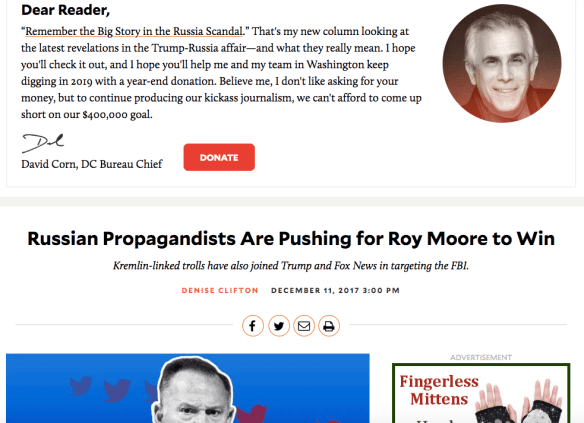
The Montgomery Observer first reported the alleged link: Russian invasion? Roy Moore sees spike in Twitter followers from land of Putin. From there, it was picked up by Mother Jones, whose headline read: Russian Propagandists Are Pushing for Roy Moore to Win. But there was no proof of any Russian connection to the accounts. To bolster its evidence-free claim, Mother Jones simply turned to Hamilton 68, the highly suspect Russian influence monitoring system that Morgan helped design.

Today, as can be seen below, Mother Jones is using a bogus story generated by a disinformation campaign to raise funds for more Russiagate coverage.

As the Russian bot narrative peaked, Moore blamed the Jones campaign for manufacturing the scare. “It’s not surprising that they’d choose the favorite topic of MSNBC and the Fake News outlets — the Russia conspiracy. Democrats can’t win this election on the issues and their desperation is on full display.”

Moore’s opponent, Jones, said he had no knowledge of the operation.

Moore was roundly mocked in liberal circles as a conspiratorial crank, but New Knowledge’s internal report contained a stunning admission: “We orchestrated an elaborate ‘false flag’ operation that planted the idea that the Moore campaign was amplified on social media by a Russian botnet,” its authors revealed.

While the New York Times says the internal report does not confirm that New Knowledge purchased the bot account themselves, the accounts’ flagrant use of Cyrillic language and profile pictures of famous singers including Britney Spears, Christina Aguilera and Avril Lavigne strongly suggest that whoever bought them went to extreme lengths to leave the appearance of a Russian hand.

Disinfo ops to “strengthen American democracy”

The Alabama disinformation campaign was carried out through a network of Silicon Valley tech entrepreneurs and former Obama administration officials who have joined the private sector to leverage liberal anti-Trump outrage into profits.

Billionaire Reid Hoffman, who co-founded the employment networking site LinkedIn, provided $100,000 for the black ops campaign. The money was then pipelined through American Engagement Technologies, which is headed by Mikey Dickerson, a former Google engineer who founded the United State Digital Service. Dickerson is also Executive Director of the New Data Project, an organization dedicated to “testing new approaches” and “serving as an advanced technology research lab for progressives.”

A colleague of Hoffman’s claimed the purpose of his investments was to “strengthen American democracy.”

Since the New York Times’ exposé, Facebook released a statement announcing its suspension of “five accounts run by a multiple individuals for engaging in coordinated inauthentic behavior,” including Morgan’s account. The social media platform has opened an investigation, though it has not revealed what the other pages are or who operated them.

The headline of the New York Times story about the Facebook suspensions appeared to have been crafted to keep the focus on Russia while deflecting scrutiny from the group of Democratic Party-linked hustlers that orchestrated the disinformation operation. It read: “Facebook Closes 5 Accounts Tied to Russia-Like Tactics in Alabama Senate Race.”

For his part, Sen. Jones has demanded an investigation. “I think we’ve all focused too much on just the Russians and not picked up on the fact that some nefarious groups, whether they’re right or left, could take those same playbooks and start interfering with the elections for their own benefit,” he said. “I’d like to see the Federal Election Commission and the Justice Department look at this to see if there were any laws being violated and, if there were, prosecute those responsible.”

Facing an inquiry for possible violations of election laws, Morgan issued a mealy-mouthed statement claiming he “did not participate in any campaign to influence the public and any characterization to the contrary misrepresents the research goals, methods and outcome of the project.”

https://twitter.com/jonathonmorgan/status/1075575821362958337

While the impact of the disinformation campaign on the Alabama senate race may never be quantified, the cynicism behind it is hard to understate. A group of Democratic Party operatives with close ties to the national security state waged a cynical campaign of online deception against the American public, while marketing themselves as the guardians against from foreign interference. Few, if any, Russian hackers could have done as much damage to the already worn fabric of American democracy as they have.


Freedom Rider: UK and US PSYOP Collusion

By Margaret Kimberley

Source: Black Agenda Report

Russiagate hysteria is an international conspiracy, with British spooks spreading lies on three continents. Now Black Americans are slandered as “dupes” of Moscow.

“There was foreign meddling in the 2016 election but it came from British spooks like Christopher Steele and undercover operatives, not Russian agents.”

For more than two years the corporate media, elite think tanks, NATO leaders, and most Democratic Party politicians have insisted that Russia interferes in American and European elections. The charge doesn’t withstand scrutiny but the lies are repeated. There is proof that surveillance state meddling in the affairs of democratic nations is real, but Russia isn’t the culprit. It is the United Kingdom and the United States who lead in skullduggery and meddling with the rights they claim to uphold.

Thanks to the Anonymous hacker community the work of the Integrity Initiative  has been exposed to the public. The Integrity Initiative is a British “charity” founded in 2015. Its mission is to “bring to the attention of politicians, policy-makers, opinion leaders and other interested parties the threat posed by Russia to democratic institutions in the United Kingdom, across Europe and North America.” That mission is suspect in and of itself, a phony trope meant to cover up its own imperialist wrong doing. The Integrity Initiative is an arm of the British government and has received more than $2 million in funding from the British Foreign Office and Defense department. It has also raised money from NATO, Facebook and rightwing foundations.

“The United Kingdom and the United States who lead in skullduggery and meddling with the rights they claim to uphold.”

The Integrity Initiative is a means of undermining the sovereignty of the British people by manipulating them with lies. It engaged in numerous efforts to libel Labour Party leader Jeremy Corbyn and prevent him from ever being elected prime minister. Corbyn has been accused of Soviet era espionage, anti-Semitism and anything else his enemies choose to use against him. Academics and writers who spoke out against UK involvement in attacks on Syria were likewise targeted by The Times and other influential British media. The reporters involved were part of this Integrity Initiative campaign. The attacks are consistent and are obviously coordinated at a very high level.

Integrity Initiative director Christopher Donnelly  is a former member of the British Army Intelligence Corps. He also helped to create the U.S. Army’s Foreign Military Studies Office at Fort Leavenworth, and served as an advisor to several Secretaries General at NATO. After the NATO instigated coup against the elected Ukrainian government Donnelly recommended placing mines in the Sevastopol harbor, an obvious provocation.

“The Integrity Initiative is a means of undermining the sovereignty of the British people by manipulating them with lies.”

When Integrity Initiative isn’t planning to start wars it plots to interfere in the affairs of other countries through orchestrated “clusters” of journalists and academics. The Spanish cluster  quashed the appointment of a new defense secretary through the use of a coordinated social media campaign. They were also involved in subverting the Catalan independence vote.

Clusters are operating not just in the UK and Spain but in France, Germany, Greece, Italy, Montenegro, Netherlands, Norway and Lithuania. After Julian Assange revealed the extent of interference in Spain the cluster targeted the Ecuadorean government to end his asylum.

There is evidence that the Integrity Initiative sent an operative into the Bernie Sanders 2016 campaign for the Democratic Party presidential nomination. An Englishman named Simon Bracey-Lane  got much media attention for volunteering in the Sanders Iowa caucus campaign. Bracey-Lane is now a research fellow at the Institute for Statecraft, the Integrity Initiative’s parent company. There was foreign meddling in the 2016 election but it came from British spooks like Christopher Steele and undercover operatives, not Russian agents.

“Clusters are operating not just in the UK and Spain but in France, Germany, Greece, Italy, Montenegro, Netherlands, Norway and Lithuania.”

The only Americans aware of the Integrity Initiative are those who use social media to gather information outside of the corporate media bubble. The New York TimesWashington Post, CNN and MSNBC haven’t covered this story. They repeat what Robert Mueller says about crooked and amateurish Trump allies who cheat on taxes or pay off porn stars. They repeat flimsy evidence of Russian collusion while America’s allies in the UK cheat their own citizens of their rights. It is miraculous when the people are able to find out anything they need to know.

These miracles occur when Wikileaks or Anonymous steal secrets the powerful want to keep hidden. Americans wouldn’t know about the existence of the FBI Counter Intelligence Program if a group of activists hadn’t stolen the documentary evidence. That is why the leakers and the hackers deserve support from anyone who wants to live in a truly democratic society.

“Americans wouldn’t know about the existence of the FBI Counter Intelligence Program if a group of activists hadn’t stolen the documentary evidence.”

While British spies operate covertly, their American counterparts work in the open as they make a profit off of their disinformation campaigns. The story of a Russian troll farm swaying Americans to vote for Donald Trump was relegated to old news but it was resurrected by a Silicon Valley surveillance state operation.

New Knowledge  is a tech firm created with venture capital cash and founders who are former operatives from the National Security Agency, U.S. military, and State Department. New Knowledge was hired by the Senate Intelligence Committee and tasked with finding out the extent of supposed Russian influence on social media.

As expected, they produced a report claiming not only that the Russians meddled in the election but that African Americans were the most targeted group . This is a rehash of the discredited story that click bait  ad selling schemes amounted to espionage. It also confuses with claims of millions of online interactions  that are a drop in the bucket in comparison with American political sites.

“Phony concern for black people is the last refuge of many scoundrels.”

Of course phony concern for black people is the last refuge of many scoundrels.Now that there has been no evidence presented of Russian government collusion with Donald Trump, the rehashing will be more frequent. The Democratic Party and the corporate media cannot let this story die. They depend upon it and they must keep covering up their own lies. Russiagate is the gift that keeps on giving.

Hillary Clinton, the Democratic National Committee and their establishment supporters are responsible for the Donald Trump presidency. They were more concerned with covering up her scandals, attracting Republican voters and raising corporate money than they were about getting out the black vote that they always rely upon for victory. Despite raising more than $1 billion they presided over one of the worst debacles in American political history. Any outrage about the Trump presidency must be pointed in their direction.

No one should fear terms like conspiracy theory when there are proven conspiracies operating at the highest levels of government and media. There are no coincidences when certain people suddenly come under attack. There is every reason to be paranoid because collusion is quite real. But the stories we’re told about it are the most fake news of all.


Margaret Kimberley’s Freedom Rider column appears weekly in BAR, and is widely reprinted elsewhere. She maintains a frequently updated blog as well at http://freedomrider.blogspot.com . Ms. Kimberley lives in New York City, and can be reached via e-Mail at Margaret.Kimberley(at)BlackAgendaReport.com.


Tomgram: Danny Sjursen, Ringing in a New Year of War

By Tom Engelhardt

Source: TomDispatch.com

On December 9th, the Washington Post covered Donald Trump’s offhand, if long expected, announcement of the ousting of retired Marine General John Kelly from an embattled White House. Its report focused on the chief of staff’s “rocky tenure” there with a nod to his many merits, among them that he “often talked the president out of his worst impulses.” Buried deep in the piece, though, was a single line that caught my eye (and possibly that of no one else on this planet): “Kelly told others that among his biggest accomplishments was keeping the president from making rash military moves, such as removing troops from sensitive zones.”

It was admittedly neither a direct quote, nor attributed to anyone, nor elaborated on in the rest of the piece. So that’s all we know, not whether Kelly took particular pride in stopping the president from removing American troops from, say, Syria, or Iraq, or Afghanistan, or for that matter Niger. But however passing and non-specific that line may have been, it seemed to catch something striking about these last two years, a time when those in the mainstream opposition to the president have come to love so many of the retired generals and former heads of outfits like the National Security Agency and the CIA, and have turned them into the equivalent of security blankets for the rest of us. They were the men (because they were all men) intent on talking Donald Trump out of “his worst impulses” and so, in the phrase of the era, they were the “adults in the room.”

Thanks to the wars and other shenanigans that those “adults” had already been so deeply involved in and the money — more than $5 trillion of it — squandered on them, they were also the men who helped generate the dissatisfaction that gave Donald Trump his opening in the first place. And now, having been part of the problem, they are in full chorus condemnation of Donald Trump’s most recent solution: to withdraw American troops from Syria (and soon evidently from Afghanistan as well).  We — that is, the country whose actions were crucial in creating ISIS in the first place — are now the only “bulwark” against its return.  That goes without saying, of course, among Republicans, Democrats, the national security elite, America’s generals, and that last “adult” in the room, Secretary of Defense James Mattis — or at least it did until, days ago, he resigned in protest.  And as U.S. Army major and TomDispatch regular Danny Sjursen suggests in his year-ending piece, as that one Washington Post line about Kelly indicates, they worked awfully hard to ensure that President Trump wouldn’t withdraw from any part of the mess they made. With that thought in mind and withdrawals about to be under way on an increasingly grim planet, Happy New Year! Tom

The World According to the “Adults in the Room”
A Year of Forever War in Review
By Danny Sjursen

Leave it to liberals to pin their hopes on the oddest things. In particular, they seemed to find post-Trump solace in the strange combination of the two-year-old Mueller investigation and the good judgment of certain Trump appointees, the proverbial “adults in the room.” Remember that crew? It once included Secretary of State Rex Tillerson, the former ExxonMobil CEO, and a trio of active and retired generals — so much for civilian control of the military — including Secretary of Defense Jim Mattis, National Security Advisor H.R. McMaster, and White House Chief of Staff John Kelly. Until his sudden resignation, Mattis was (just barely) the last man standing. Still, for all these months, many Americans had counted on them to all but save the nation from an unpredictable president. They were the ones supposedly responsible for helming (or perhaps hemming in) the wayward ship of state when it came to foreign and national security policy.

Too bad it was all such a fantasy. As Donald Trump wraps up his second year in the Oval Office, despite sudden moves in Syria and Afghanistan, the United States remains entrenched in a set of military interventions across significant parts of the world. Worse yet, what those adults guided the president toward was yet more bombing, the establishment of yet more bases, and the funding of yet more oversized Pentagon budgets. And here was the truly odd thing: every time The Donald tweeted negatively about any of those wars or uttered an offhand remark in opposition to the warfare state or the Pentagon budget, that triumvirate of generals and good old Rex went to work steering him back onto the well-worn track of Bush-Obama-style forever wars.

All the while, a populace obsessed and distracted by the president’s camera-grabbing persona seemed hardly to notice that this country continued to exist in a state of perpetual war. And here’s the most curious part of all: Trump wasn’t actually elected on an interventionist military platform. Sure, he threw the hawkish wing of his Republican base a few bones: bringing back waterboarding as well as even “worse” forms of torture, bombing “the shit” out of ISIS, and filling Guantánamo with “some bad dudes.” Still, with foreign policy an undercard issue in a domestically focused campaign to “Make America Great Again,” most Trump supporters seemed to have little stomach for endless war in the Greater Middle East — and The Donald knew it.

Common Sense on the Campaign Trail

Despite his coarse language and dubious policy positions, candidate Trump did seem to promise something new in foreign policy. To his credit, he called the 2003 Iraq War the “single worst decision ever made” (even if his own shifting position on that invasion was well-documented). He repeatedly tweeted his virulent opposition to continuing the war in Afghanistan and regularly urged President Obama to stay out of Syria. And to the horror of newly minted Cold War liberals, he even suggested a détente with Russia.

Like so much else in his campaign, none of this was from the standard 2016 bullet-point repertoire of seasoned politicians. Sure, Donald Trump lacked the requisite knowledge and ideological coherence usually considered mandatory for serious candidates, but from time to time he did — let’s admit it — offer some tidbits of fresh thinking on foreign policy. However blasphemous that may sound, on certain international issues the guy had a point compared to Hillary, the hawk.

During his presidency, traces of his earthy commonsense still showed up from time to time. In August 2017, for instance, when announcing yet another escalation in the Afghan War, he felt obliged to admit that his original instinct had been to “pull out” of it, adding that he still sympathized with Americans who were “weary of war.”  He sounded like a man anything but confident of his chosen course of action — or at least the one chosen for him by those “adults” of his. Then, last week, he surprised the whole business-as-usual Washington establishment by announcing an imminent withdrawal of U.S. troops from Syria.  Whether he reverses himself, as he’s been apt to do, remains unknown, but here was at least a flash of his campaign-style anti-interventionism.

How, then, to explain the way a seemingly confident candidate had morphed into a hesitant president — until his recent set of decisions to pull troops out of parts of the Greater Middle East — at least on matters of war and peace? Why those nearly two years of bowing to the long-stale foreign policy thinking that had infused the Bush-Obama years, the very thing he had been theoretically running against?

Well, pin it on those adults in the room, especially the three generals. As mid-level and senior officers, they had, after all, cut their teeth on the war on terror. It and it alone defined their careers, their lives, and so their thinking. Long before Donald Trump came along, they and their peer commanders had already been taken hostage by the interventionist military playbook that went with that war and came to define the thinking of their generation. That was how you had to think, in fact, if you wanted to rise in the ranks.

The adults weren’t, for the most part, political partisans. Then again, neither was the militarist playbook they were following. Both Hillary Clinton and Jeb Bush had been selling exactly the same snake oil in 2016. Only Trump — and to some extent Bernie Sanders — had offered a genuine alternative. Nevertheless, the Trump administration sustained that same policy of forever war for almost two full years and the grown-ups in the room were the ones who made it so. Exhibit A was the Greater Middle East.

The Same Old Playbook

While George W. Bush favored a “go-big” option of regime change, massive military occupation, and armed nation-building, Barack Obama preferred expanded drone strikes, increased military advisory missions, and — in the case of Libya — a bit of light regime-changing. In Trump’s first two years in office, the U.S. military seemed to merge aspects of the losing strategies of both of those presidents.

If Trump’s gut instinct was to skip future “dumb” Iraq-style wars, “pull out” of Afghanistan, and avoid regional conflict with Russia, his grown-up advisers pushed him in exactly the opposite direction. They chose instead what might be called the more strategy: more bombing, more troops, more drone strikes, more defense spending, more advisors, more everything. And if a war seemed to be failing anyway, the answer came straight from that very playbook, as in Afghanistan in 2017: a “surge” and the need for yet more time. As a result, America’s longest-ever war grew longer still with no end faintly in sight.

Given such thinking, it’s odd to recall that those adults in the room were, once upon a time, reputed to be outside-the-box thinkers. Secretary Mattis was initially hailed as such an avid reader and devoted student of military history that he was dubbed the “warrior monk.” H.R. McMaster was similarly hailed for having written a book critical of U.S. strategy in Vietnam (though wrong in its conclusions). Both Democrats and Republicans in Washington were similarly convinced that if anyone could bring order to the Trump administration, it would be the ever-responsible John Kelly.

Let’s review, then, the advice that these innovators offered the president in his first two years in office and the results in the Greater Middle East, starting with that presidential urge to pull out of Iraq. You won’t be surprised to learn that U.S. troops are still ensconced there in an ongoing fight against what’s suddenly a growing ISIS insurgency (now that its “caliphate” is no more). Nor has Washington taken any meaningful steps to bolster the legitimacy of the Shia-dominated Baghdad government, which portends an indefinite Sunni-based insurgency of some sort (or sorts) and a possible Kurdish secession.

In Syria, rather than downsize the U.S. military mission in the interest of Trump’s stated wish for détente with Russia and his urge to get the troops out “like very soon,” his administration had more than stayed put. It essentially chose to go with an indefinite American occupation of eastern Syria, including up to 4,000 mainly Special Operations forces backing predominantly Kurdish rebels there. In fact, only recently Mattis and other “senior national security officials” reportedly tried unsuccessfully to talk the president out of his recent tweeted proclamation to end the American role in Syria and withdraw those troops from the country as, it seems, is now happening. In this, he clearly wants to avoid the ongoing risk of war with both Russia and NATO ally Turkey, not to speak of Iran. The Turks continue to threaten to invade the northern Syrian region controlled by those U.S.-backed Kurds, while Russian forces had, alarmingly, exchanged fire with U.S. troops more than once along the Euphrates River buffer zone. The Syrian mission was all risk and no reward, but the adults in the room continued to work feverishly to convince the president that to pull out might create a new “safe haven” not just for ISIS but also for the Iranians.

In Afghanistan, whatever Trump’s “instinct” may have been, after many meetings with his “cabinet and generals,” or what he called his “experts,” the president decided on a new escalation, a mini-surge in that then 17-year-old war. To that end, he delegated yet more decision-making to the very generals who were so unsuccessful in previous years and they proceeded to order the dropping of a record number of bombs, including the first-ever use of the largest non-nuclear ordnance in the Air Force arsenal, the so-called Mother of all Bombs. The results were the very opposite of reassuring. Indeed, the U.S. and its Afghan allies may be headed for actual military defeat, as the Taliban controls or contests more districts than ever, while Afghan government casualties have become, in the phrase of an American general, “unsustainable.”

Now, in a rebuke to those very experts and adults, the president will apparently remove half the U.S. troops in Afghanistan. After so many years of fruitless war, this sensible decision raised immediate alarm among the hawks in Congress and in the rest of the Washington national security establishment.  That decision, plus pulling the plug on the Syrian operation, apparently proved to be a red line for the last adult left standing and Jim Mattis promptly resigned in protest.  For the outgoing secretary of defense, it seems that complicity in Saudi war crimes in Yemen and the murder of Washington Post columnist and Saudi citizen Jamal Khashoggi were passing events.  Trump’s willingness to try to end the American role in two failing, dubiously legal quagmires, however, proved to be the general’s breaking point.

Elsewhere, the Trump team has moved ever closer to a regime-change policy in Iran, especially after the replacement of Tillerson and McMaster by the particularly Iranophobic duo of Mike Pompeo and John Bolton as secretary of state and national security advisor. Still, don’t blame any looming Iran disaster on them. Washington had unilaterally pulled out of the Obama-negotiated nuclear deal with that country well before they arrived on the scene. While the grown-ups might not have been quite as amenable to war with Iran as Bolton and Pompeo, they couldn’t countenance détente for even a second.

And, of course, all those adults in the room supported U.S. complicity in the Saudi-led terror bombing and starvation of Yemen, the poorest Arab country. They also favored sustained ties with Saudi Arabia and its increasingly brutal crown prince, Mohammed bin Salman. Indeed, despite the recent murder and dismemberment of Washington Post columnist and Saudi citizen Jamal Khashoggi in that country’s embassy in Istanbul, Turkey, and the Senate’s increasing disenchantment with the war in Yemen, Mattis remained a vocal supporter of the Saudis. Just before the Senate recently voted to pull U.S. military assistance for the Saudi war, he joined Pompeo in urging that chamber not to abandon Riyadh. In addition, key senators called Mattis’s testimony “misleading” because he “downplayed” the Saudi crown prince’s role in the murder, ignoring the conclusion of the CIA that the prince was indeed “complicit” in it.

So when it comes to outside-the-box thinking about the Greater Middle East almost two years into the president’s first term, the U.S. remains ensconced in a series of distinctly inside-the-box and unwinnable wars across the region.  Trump, however, now appears ready to change course, at least in Syria and Afghanistan, perhaps out of frustration with the ever-so-conventional mess the adults left him in.

A Militarized Planet

Elsewhere, matters are hardly more encouraging. At a global level, the grown-ups have neither tempered the president’s more bizarre policies nor offered a humbler, more modest military approach themselves. The result, as the country enters 2019, is an increasingly militarized planet. Mattis’s own National Defense Strategy (NDS), released in January 2018, represents a blatant giveaway to the domestic arms industry, envisioning as it does a world eternally on the brink of Great Power war.

On that planet of the adults, the U.S. must now prepare for threats across every square inch of the globe. Far from the military de-escalation hinted at by candidate Trump (and suggested again in a recent tweet of his), Mattis’s “2-2-1 policy” has the Pentagon ramping up for potential fights with two “big” adversaries (China and Russia), two “medium” opponents (Iran and North Korea), and one “sustained” challenge (conflicts and terrorism across the Greater Middle East). Few have asked whether such a strategy is faintly sustainable, even with a military budget that dwarfs that of any other power on the planet.

In fact, the implementation of that NDS vision is clearly leading to a new arms race and a burgeoning Cold War 2.0. Washington is already engaged in a spiraling trade war with Beijing and has announced plans to pull out of a key Cold War nuclear treaty with Russia, while developing a new group of treaty-busting intermediate range nuclear missiles itself. In addition, at the insistence of his military advisers, the president has agreed to back an Obama-era “modernization” program for the U.S. nuclear arsenal now estimated to cost at least $1.6 trillion over the next three decades.

So much for a Republican insistence on balanced budgets and decreased deficits. Furthermore, climate-change denial remains the name of the game in the Trump administration and, in this singular case, the adults in the room could do nothing about it. Despite earlier Pentagon reports that concluded man-made climate change presents a national security threat to the country, the Trump administration has ignored such claims. It has even insisted upon substituting the term “extreme weather” for “climate change” in current defense reports. Here, the grown-ups do indeed know better — the military has long been focused on the dangers of climate change — but have dismally failed to temper the president’s anti-science policies.

So, as 2018 comes to a close, thanks to the worldview of those grown-ups and the pliability of Trump’s own ideology (except when it comes to climate change), Washington’s empire of bases, its never-ending war on terror, and its blank-check spending on the military-industrial complex were more firmly entrenched than ever.  It will fall to the president — if indeed he proves to be serious when it comes to a course change — to begin the long work of (modestly) undoing a planet of war.

The Last Adult?

Looking toward 2019 in a world on edge, here are a couple of thoughts on our future. Expect that Robert Mueller’s future report will find many things to focus on, including plenty of collusion with women, but — whatever the Russians did and whatever the desires of those around candidate Trump may have been — no actual collusion of substance with Moscow in election 2016. That will undoubtedly break the hearts of liberals everywhere and ensure — despite the best efforts of a new Democratic House — a full Trump term (or two!). Furthermore, whatever “blue-wave” Democrats do domestically, they are unlikely to present a coherent, alternative foreign-policy vision. Instead, prepare to watch them cede that territory (as always) to Trump and the Republicans. Meanwhile, at least until 2021, they will continue to lament the absence of those “adults in the room” and their supposed ability to preserve a respectable foreign policy, which, of course, would have meant war all the way to the bank.

Maybe it’s time to start thinking of those adults as the tools (and often enough the future employees) of a military-industrial-congressional complex that feeds Americans ample servings of endless war, year after year, decade after decade. In truth, in this century presidents change but the failing policies haven’t.

Call it the deep state, the swamp, or whatever you like, but bottom line: during Trump’s first two years in office, there wasn’t, until now, any serious rethinking of American foreign and military policy, not in terms of peaceableness anyway. Trump’s original adults in the room set the table for endless war. Their replacements clearly intended to devour plentiful helpings of the same dishes. Make no mistake, if it were up to those adults, the United States would be ringing in this New Year with yet another copious serving of militarism.  It still may.

I must admit that I find myself in a lonely spot as 2018 ends. I’ve been serving in the U.S. Army during this period, while dissenting from prevailing foreign policy. After spending 18 years in uniform, including tours of duty in both the Afghan and the Iraq wars, and observing a slew of retired generals and policymakers who oversaw those very wars champion yet more (failed) conventional thinking, forgive me for wondering, from time to time, if I weren’t the last true adult in the room.

Send the Mad Dog to the Corporate Kennel

By Ray McGovern

Source: Consortium News

Outgoing Defense Secretary Gen. James “Mad Dog” Mattis was famous for quipping, “It’s fun to shoot some people.” It remains a supreme irony that Mattis was widely considered the only “adult in the room” in the Trump administration. Compared to whom? John Bolton, the rabid neocon serving as national security adviser? That would be the epitome of “condemning with faint praise.”

With his ramrod-straight image, not to mention his warrior/scholar reputation extolled in the media, Mattis was able to disguise the reality that he was, as Col. Andrew Bacevich put it on Democracy Now! this morning, “totally unimaginative.” Meaning that Mattis was simply incapable of acknowledging the self-destructive, mindless nature of U.S. “endless war” in the Middle East, which candidate-Trump had correctly called “stupid.” In his resignation letter, Mattis also peddled the usual cant about the indispensable nation’s aggression being good for the world.

Mattis was an obstacle to Trump’s desire to pull troops out of Syria and Afghanistan (and remains in position to spike Trump’s orders). Granted, the abrupt way Trump announced his apparently one-man decision was equally stupid. But withdrawal of ground troops is supremely sane, and Mattis was and is a large problem. And, for good or ill, Trump — not Mattis — was elected president.

Marine Wisdom

Historically, Marines are the last place to turn for sound advice. Marine Gen. Smedley Butler (1881-1940), twice winner of the Medal of Honor, was brutally candid about this, after he paused long enough to realize, and write, “War is a Racket”:

“I suspected I was just part of a racket at the time. Now I am sure of it. Like all members of the military profession I never had an original thought until I left the service. My mental faculties remained in suspended animation while I obeyed the orders of the higher- ups. …”

Shortly after another Marine general, former CENTCOM commander Anthony Zinni, retired, he stood by silently as he personally watched then-Vice President Dick Cheney give his most important speech ever (on August 26, 2002). Cheney blatantly lied about Iraq’s (non-existent) WMD, in order to grease the skids for the war of aggression against Iraq. Zinni had kept his clearances and was “back on contract.” He was well read-in on Iraq, and knew immediately that Cheney was lying.

A few years later, Zinni admitted that he decided that his lips would be sealed. Far be it for a Marine to play skunk at the picnic.  And, after all, he was being honored that day at the same Veterans of Foreign Wars convention where Cheney spoke.  As seems clear now, Zinni was also lusting after the lucrative spoils of war given to erstwhile generals who offer themselves for membership on the corporate Boards of the arms makers/merchants that profiteer on war.

(For an earlier critique of senior Marines, see: “Attacking Syria: Thumbing Noses at Constitution and Law.” )

Marine officer, now Sen. Pat Roberts, R, Kansas, merits “dishonorable mention” in this connection. He never rose to general, but did become Chair of the Senate Intelligence Committee at an auspicious time for Cheney and Bush. Roberts kowtowed, like a “good Marine,” to their crass deceit, when a dollop of honesty on his part could have prevented the 2003 attack on Iraq and the killing, maiming, destruction, and chaos that continues to this day.  Roberts knew all about the fraudulent intelligence, and covered it up — together with other lies — for as long as he remained Senate Intelligence Committee Chairman

Scott Ritter on Pat Roberts

Roberts’s unconscionable dereliction of duty enraged one honest Marine, Maj. Scott Ritter, who believes “Semper Fi” includes an obligation to tell the truth on matters of war and peace.  Ritter, former UN chief weapons inspector for Iraq, who in April  wrote in April 2005 “Semper Fraud, Senator Roberts,” based partly on his own experience with that complicit Marine.

Needless to say, higher ranking, more malleable Marines aped Zinni in impersonating Uncle Remus’s Tar Baby — not saying nuttin’.

It is conceivable that yet another sharply-saluting Marine, departing Chairman of the Joint Chiefs of Staff Joseph Dunford, may be tapped by Trump to take Mattis’s job. If that happens, it will add to President Trump’s bizarre penchant for picking advisers hell bent on frustrating the objectives he espoused when he was running for office, some of which — it is becoming quite clear — he genuinely wants to achieve.

Trump ought to unleash Mattis now, and make sure Mattis keeps his distance from the Pentagon and the Military-Industrial Complex, before he is asked to lead an insurrection against a highly vulnerable president — as Gen. Smedley Butler was asked to do back in the day. Butler said no.

Mueller’s End Game

By Peter Van Buren

Source: We Meant Well

A baby born when Robert Mueller started his investigation would be talking by now. But would she have anything to say?

We last looked at what Mueller had publicly, and what he didn’t have, some ten months ago, and cautioned skepticism that he would prove “collusion.” It’s worth another look now, but we’ll give away the ending: there is still no real evidence of, well, much of anything significant about Russiagate. One thing clear is the investigation seems to be ending. Mueller’s office reportedly even told various defense lawyers it is “tying up loose ends.” The moment to wrap things up is politically right as well; the Democrats will soon take control of the House and it is time to hand this all off to them.

Ten months ago the big news was Paul Manafort flipped; that seems to have turned out to be mostly a bust, as we know now he lied like a rug to the Feds and cooperated with the Trump defense team as some sort of mole inside Mueller’s investigation (a heavily-redacted memo about Manafort’s lies, released by Mueller on Friday, adds no significant new details to the Russiagate narrative.) George Papadopoulos has already been in and out of jail — all of two weeks — for his sideshow role, Michael Avenatti is now a woman beater who is just figuring out he’s washed up, Stormy Daniels owes Trump over $300k in fees after losing to him in court, there is no pee tape, and if you don’t recall how unimportant Carter Page and Richard Gates turned out to be (or even remember who they are), well, there is your assessment of all the hysterical commentary that accompanied them a few headlines ago.

The big reveal of the Michael Flynn sentencing memo on Tuesday was he will likely do no prison time. Everything of substance in the memo was redacted, so there is little insight available. If you insist on speculation, try this: it’s hard to believe something really big and bad happened such that Flynn knew about it but still wasn’t worth punishing for it, and now, a year after he started cooperating with the government, nobody has heard anything about whatever the big deal is. So chances are the redactions focus on foreign lobbying in the U.S.

This week’s Key to Everything is Michael Cohen, the guy who lied out of self-interest for Trump until last week when we learned he is also willing to lie, er, testify against Trump out of self-interest. If you take Cohen’s most recent statements at face value the sum is failed negotiations we all knew about already to build a Trump hotel in Moscow went on a few months longer than originally stated. Meanwhile, the U.S. Attorney’s Office for the Southern District of New York submitted a sentencing memo Friday for Cohen recommending 42 months in jail. In a separate filing, Mueller made no term recommendation but praised Cohen for his “significant efforts to assist the special counsel’s office.” The memos reveal no new information.

Call it as sleazy as you want, but looking into a real estate deal is neither a high crime nor a misdemeanor, even if it’s in Russia. Conspiracy law requires an agreement to commit a crime, not just the media declaiming “Cohen was communicating directly with the Kremlin!” Talking about meeting Russian persons is not a crime, nor is meeting with them. The takeaway this was all about influence buying by the Russkies falls flat. If Putin sought to ensnare Trump, why didn’t he find a way for the deal to actually go through? Mueller has to be able to prove actual crimes by the president, not just twist our underclothes into a weekly conspiratorial knot. For fun, look here at the creative writing needed to even suggest anything illegal. Doesn’t sound like Trump’s on thin ice with hot shoes.

Sigh. It is useful at this point of binge-watching the Mueller mini-series to go back to the beginning.

The origin story for all things Russiagate is a less-than-complete intelligence finding hackers, linked to the Russian government, stole emails from the Democratic National Committee (DNC) in 2016. The details have never been released, no U.S. law enforcement agency has ever seen the server/scene of the crime, and Mueller’s dramatic indictments of said hackers, released as Trump met with Putin in Helsinki, will never be heard of again, or challenged, as none of his defendants will ever leave Russia. Meanwhile, despite contemporaneous denials of the same, it is now somehow accepted knowledge the emails (and Facebook ads!) had some unproven major affect on the election.

The origin story for everything else, that Trump is beholden to Putin for favors granted or via blackmail, is opposition research purchased by the Democrats and carried out by an MI6 operative with complex connectionsinto American intelligence, the salacious Steele Dossier. The FBI, under a Democratic-controlled Justice Department, then sought warrants to spy on the nominated GOP candidate for president, based on evidence paid for by his opponent.

Yet the real origin story for all things Russiagate is the media, inflamed by Democrats, searching for why Trump won (because it can’t be anything to do with Hillary, and “all white people and the Electoral College are racists” just doesn’t hold up.) Their position is Trump must have done something wrong, and Robert Mueller, despitehelping squash a Bush-era money-laundering probe, lying about the Iraq War, and flubbing the post-9/11 anthrax investigation, has been resurrected with Jedi superpowers to find it. It might be collusion with Russia or Wikileaks, or a pee tape, or taxes, all packaged as hard news but reading like Game of Thrones plot speculation. None of that is journalism to be proud of, and it underlies everything Mueller.

As the NYT said in a rare moment of candor, “From the day the Mueller investigation began, opponents of the president have hungered for that report, or an indictment waiting just around the corner, as the source text for an incantation to whisk Mr. Trump out of office and set everything back to normal again.”

The core problem is Mueller just hasn’t found a crime connected with Russiagate someone working for Trump might have committed. His investigation to date hasn’t been a search for the guilty party, Colonel Mustard in the library, but a search for an actual underlying crime, some crime, any crime. All Mueller has uncovered are some old financial misdealing by Manafort and chums that took place before and outside of the Trump campaign, payoffs to Trump’s mistresses which are not in themselves inherently illegal (despite what prosecutors simply assert in the Cohen sentencing report, someone will have to prove to a jury the money was from campaign funds and the transactions were “for the purpose of influencing” federal elections, not say simply “protecting his family from shame.” Cohen’s guilty pleas cannot legally be considered evidence of someone else’s guilt), and a bunch of people lying about unrelated matters.

And that’s the give away to Muller’s final report. There was no base crime as the starting point of the investigation. With Watergate there was the break-in at Democratic National Headquarters. With Russiagate you had… Trump winning the election (remembering the FBI concluded the DNC hack was done by the Russians forever ago, no Mueller needed.)

Almost everything Mueller has, the perjury and lying cases, are crimes he created through the process of investigating. He’s Schroeder’s Box; the crimes only exist when he tries to look at them. Mueller created most of his booked charges by asking questions he already knew the answers to, hoping his witness would lie and commit a new crime literally in front of him. Nobody should be proud of lying, but it seems a helluva way to contest a completed election as Trump enters the third year of his term.

Mueller’s end product, his report, will most likely claim a lot of unsavory things went on. But it seems increasingly unlikely he’ll have evidence Trump worked with Russia to win the election, and even less likely that Trump is now under Putin’s control. If Mueller had a smoking gun we’d be watching impeachment hearings by now.

Instead Mueller will end up concluding some people may have sort of maybe tried to interfere with an investigation into what turned out to be nothing, another “crime” that exists only because there was an investigation to trigger it. He’ll dump that steaming pile of legal ambiguity into the lap of the Democratic House to hold hearings on from now until global warming claims the city of Benghazi and returns it to the sea. Or the 2020 election, whichever comes first.


BONUS:

The uber-point of all this Ocean’s Nineteen-level conspiracy is supposedly so Putin can, whatever, sow dissent in America. Because if he wanted a puppet in the Oval Office it has been a damn poor return on investment — sanctions are still in place, NATO is still on Russia’s border, Montenegro joined NATO, Trump approved arms sales to the Ukraine, RT and Sputnik are sidelined as registered foreign agents, Cold Warrior-like hardliners Bolton and Pompeo are in power, the U.S. just delivered Russia an ultimatum on an arms control treaty that could return some American missiles to Europe, and more. On the plus side, there were those friendly Tweets.

Along the way new journalistic “norms” were created: Trump is too stupid to have made his money, so it must be ill-gotten. Trump did real estate deals in NYC and so is mobbed up. Trump’s taxes (albeit available to the IRS and Treasury for decades, the FBI and Mueller via warrant for years) hide secrets. Meanwhile, everyone in Russia with a few bucks is an oligarch, and everyone who anyone from the Trump side spoke with is “connected to Putin.” Trump doesn’t have lawyers, he has fixers and consigliere.

These tropes allow journalists to communicate in a kind of shorthand with the rubes who still imagine something will happen to annul the 2016 election. They allow each mini-development to appear to be a major event, as in the mind of the media everything is related, and everything accumulative. So a lie about a real estate deal in Russia is HUGE because it has something to do with Russia and see that connects all the dots!

None of that is journalism to be proud of, and it underlies everything Mueller. It is almost sad looking back at the old articles and TV tales to see how excited everyone got — Flynn was indicated! Sessions recused himself! Comey will save us! The Nunes Memo! They all used to matter sooooo much. Outlets like the NYT and WaPo rolled out a “source close to the White House” to comment whatever just happened means Mueller is getting close to nailing Trump. The nutters who took over once cogent places like HuffPo and Salon run “reporting” that reads like Game of Thrones plot speculation. Everybody runs the same headlines: BREAKING: Reports: Sources: Trump Fixer to Flip; Avenatti Says “Orange is the New Black, Buttercup!”

As one writer puts it, “For the last two years the mass media machine has been behaving very, very strangely, and it isn’t getting better, it’s getting worse. Not since the lead-up to the invasion of Iraq have we seen mainstream media outlets trying to shove narratives down our throats so desperately and aggressively.”

Democrats downplay Google censorship at congressional hearing

By Andre Damon

Source: WSWS.org

Google CEO Sundar Pichai denied allegations that the company was engaged in political censorship Monday at a hearing before the Senate Judiciary Committee.

Throughout the hearing, Republicans repeatedly claimed that the company was censoring search results to the detriment of right-wing viewpoints, while Democrats either denied the company’s censorship or justified it.

The fundamental reality—completely ignored at the hearing—is that the real targets of censorship by Silicon Valley, working with the US intelligence agencies and with the consent of both political parties, are left-wing, anti-war and socialist political organizations.

In August 2017, Google announced that it would implement changes to its search algorithm to promote “authoritative” news sources to the detriment of what it called “alternative” viewpoints. This action led to a massive decline in search rankings and traffic to left-wing, anti-war and progressive websites.

The campaign to implement this censorship regime was spearheaded by the Democratic Party, which, based on claims of Russian “meddling” in the 2016 election, sought to pressure the technology giants to block and suppress left-wing opposition, which it branded as “extremist viewpoints.”

The narrative of both parties is strikingly at odds with reality. Compared to April 2017, the far-right Breitbart.com had its search traffic increase by 25 percent. By contrast, search results for the World Socialist Web Site are down by 76 percent over the same period, and other left-wing sites remain down by 50 percent or more.

At the hearing, Pichai made one of Google’s most explicit denials to date that it was carrying out political censorship.

“I lead this company without political bias and work to ensure that our products continue to operate that way,” Pichai declared. “To do otherwise would go against our core principles and our business interests. We are a company that provides platforms for diverse perspectives and opinions,” he said.

He added, “It’s not possible for any employee or groups of employees to manipulate our search results.”

In fact, the changes implemented in 2017 by the company were intended to empower “search evaluators” to impact Google search results. These individuals, whose input was added to Google’s more impartial PageRank algorithm, were told to respond negatively to pages displaying “alternative” viewpoints unless users explicitly specified they were looking for such views.

While some political organizations aligned with the Democratic Party were affected by Google’s actions, they either ignored or supported the censorship regime. The far right, meanwhile, made opposition to censorship a rallying cry.

US President Donald Trump, setting the tone for substantial sections of the Republican Party, has prominently accused Google of censoring search results. Republican members of Congress repeatedly held hearings accusing the company of suppressing right-wing and conservative political views.

“Google has long faced criticism for manipulating search results to censor conservatives,” Representative Lamar Smith declared at Monday’s hearing.

The Democrats, for their part, used Pichai’s testimony to alternately deny and justify the company’s censorship. In his remarks, committee chairman Jerrold Nadler declared that “no credible evidence supports this right-wing conspiracy theory.” In effect, Nadler and the other Democrats used the Republicans’ accusations about Google’s ‘liberal’ bias as a straw man, arguing, by extension, that all claims that Google is manipulating search results are a “conspiracy theory.”

Nadler then proceeded to justify Google’s censorship, which he had just denied. “Even if Google were deliberately discriminating against conservative viewpoints, just as Fox News and Sinclair broadcasting and conservative talk radio hosts like Rush Limbaugh discriminate against liberal points of view, that would be its right as a private company to do so, and not to be questioned by government.”

This, too, is a straw-man. In carrying out their censorship of left-wing views, Google and the other technology giants are acting at the instigation of the US intelligence agencies and leading political figures, serving as the state’s accomplice in violating the Constitution.

Responding to the Republicans’ claims, The Washington Post wrote in an editorial, “Members of the conservative majority on the House Judiciary Committee spent much of their time hammering Mr. Pichai with baseless accusations that Google rigs its search results to censor conservative content. Black-box algorithms will inevitably prioritize some content over other content, and to the extent companies can be transparent about how their systems work, they should be. But a single-minded and mindless focus on a nonexistent left-wing conspiracy within Google has had the paradoxical effect of discouraging companies from properly policing their platforms, as they hesitate to remove content that should be removed for fear of unfounded criticism.”

In other words, the Post is concerned that the Republican’s grandstanding about what they allege to be a bias against right-wing viewpoints might undermine the plans by the US intelligence agencies to intensify their censorship of left-wing opposition.

As working class-opposition throughout Europe and around the world continues to mount, the American political establishment is ramping up demands for censorship. Responding to the Yellow Vest demonstrations against social inequality in France, the New York Times wrote an editorial warning that “the power of social media to quickly mobilize mass anger, without any mechanism for dialogue or restraint, is a danger to which a liberal democracy cannot succumb.”

The clear implication is that a growing international upsurge of the working class will be met with even further repression and censorship.

Reimagining the Middle Class

In her new book, Alissa Quart chronicles what happens when capitalism and families collide

By Ann Neumann

Source: The Baffler

AS THE ECONOMIC STATUS OF MANY in the United States has declined over the past several decades, journalists have often focused on the challenges faced by the working poor. In her new book, Squeezed: Why Our Families Can’t Afford America, Alissa Quart writes about how economic inequality has also drastically changed the middle class, destabilizing what was once considered a secure class and sending families into the tailspin of debt, overwork, underemployment, and precarious financial states. Squeezed demonstrates that inequality is not just a problem of those left behind in the lowest financial brackets, but a feature of our current economic system characterized by working professionals who are unable to pay for child care, declining job salaries, shifting work hours, and unaffordable housing. Families too often wrestle with “penalizing” factors, like women’s depressed salaries and unaffordable health care, making success unattainable for a formerly comfortable, educated, and skilled demographic of society.

The book challenges us to reimagine our prior understanding of what it means to be middle class, even as legislators champion “traditional values” that contradict the needs and responsibilities of families—and erode a safety net that once supported U.S. workers. Some of the factors that have upended the middle class are obvious—declining salaries, for instance—but others remain masked by corporate and social portrayal of them as a benefit to today’s workers. The gig economy, which, we’re told, gives workers young and old more flexibility and independence, turns out to be a contributor to what Quart calls the forever clock, a twenty-four-hour schedule that has usurped family and free time by keeping workers on constant call. Squeezed recounts the lives of the teachers who work second jobs, the professional mothers who struggle to pay for day care, the paralegals and adjuncts who have to moonlight to pay the rent, the well educated who never found a job in their intended profession that provides a livable salary. And the book causes us to ask why so many suffer in isolation, too ashamed to acknowledge their economic plight and too belabored to politically address it.

Quart is executive editor of the Economic Hardship Reporting Project, a nonprofit organization founded by Barbara Ehrenreich (a contributing editor for The Baffler) that supports journalism examining economic inequality, its causes and solutions (EHRP has funded my own work and that of others published at The Baffler). Quart is the author of four previous books: BrandedRepublic of OutsidersHothouse Kids, and the poetry book Monetized. She also co-writes, with Maia Szalavitz, a column for The Guardian titled “Outclassed.”

This month, Quart stopped by The Baffler office to talk to me about Squeezed. We’ve known each other for several years and I read the book in manuscript, so our conversation was casual, touching on individuals in the book, our own squeezed lives, how we can counter economic decline, and a necessary new definition of self-help.

Ann NeumannSqueezed straddles the Trump election and very often people on the left—and the right, to be honest—are using this as a clear demarcation. I think one of the things the book does really well is point out that the mechanisms in place that harm working class families have been long in coming.

Alissa Quart: The reason Sanders and Trump could tap into anger are the numbers of those economically squeezed; it’s what I was seeing anecdotally. And you can feel that. You can feel when you go sit in people’s living rooms, when you talk to them on the phone. I went to a conference called iRelaunch that was all about helping people to start their careers over and the room just rippled with shame and fear. And acidic humor.

AN: How did the election change this book project?

AQ: I think it gave it new urgency for me. Just as it gave urgency to the Economic Hardship Reporting Project, the organization I run. I think everyone in journalism felt like we have to tell these stories. The Trump effect has made me feel like I have to keep a laser focus on the things people are ignoring and try to find a way for readers to pay attention to them. We’re all focusing on Ivanka and whether she’s the c-word or not, which is fine, there are all kinds of things happening around us and in our own lives politically that have nothing directly to do with what Trump is tweeting, but the effects of his administration and long-term trends are real and we just need to keep looking.

We just published an article at EHRP about a journalist who lives in a $17 a night Airbnb, places below what you usually scroll to. But this person was a working journalist who was getting six-figure advances fifteen or twenty years ago. There are all these human examples that constantly show this decline. Fine, maybe the job numbers are up, but how many jobs are people working and are they jobs in the professions? Are they jobs that pay enough for people to live in cities? Or they’re working three different jobs which leads us to things like, as in this book, twenty-four-hour day care.

AN: Day care centers that are open twenty-four hours to accommodate parents with nontraditional work hours or multiple jobs.

AQ: And they are growing in number. I wrote a piece on this; I called it the dystopian social net. I feel like that’s part of my life’s work. I love dystopian fiction and science fiction, probably because it seems a few clicks away from the life we’re leading. It’s a markedly different life and childhood than the one you and I had. It may be horrible, or maybe not, but we’re seeing a palpable transformation in what childhood can be in the course of twenty years.

AN: And that’s really just the decline of income?

AQ: It’s people working different hours, it’s corporations using algorithms to find out what times of day are most profitable—when they’ll have the most foot traffic in retail, for instance—and demanding that employees work those times. It’s increasing nightwork. Nontraditional could mean 11 to 3 or it could mean working in the evening, or working in different jobs, hither and thither. That alone points to a huge transformation in things like time. A lot of the issues I address in the book are really about time, how we spend it. In the twenty-four-hour day care section I use the term the forever clock. But that’s true of the upper middle class too, they feel squeezed because they’re also on a forever clock. They’re working in IT, for instance, and they’re working unusual hours and they have the expectation that they should be better paid for it. 

AN: Your work has been focused on economic inequality for a long time.

AQ: Every single one of my books is in some way about economic inequality. I used to teach at Columbia J-school and I always told my students that every writer has a central question they spend their career trying to answer and your job is to find out what your question is. It’s like a parlor game. So I think mine is: what happens when the family—or childhood—hits capitalism? What are the deformations and the formations? I read so many nineteenth-century novels as a kid that I’m fascinated by that intersection. Naturalism is ascetically but also politically and intellectually appealing to me. I think I just like the texture of family, love, money, and how they all meet.

AN: That comes out in the writing of the book because, I’ll tell you, there are economics books that I have no interest in reading because they’re a slog, a data dump. You also coin terms that give us a way to think about worker’s plights. You just mentioned the forever clock but there’s also the middle precariat.

AQ: I was trying to explain the shift in the middle class as an imaginative category. The middle class used to equal solid, fixed, stable. Temporally it was about gratification later, but your life wasn’t miserable while you were waiting for it. It wasn’t like OK, total slog, but you’re going to get that pension. We have to now think of it as a shaken category, an unstable category, and that’s a big shift. When we visualize the middle class, we’re visualizing the white picket fence, like the blue sky on the cover of the book. But it’s really this truck being squeezed between two houses.

It’s an unsettled identity, and you can fall out of it, you can barely get into it, you certainly can’t rise above it very easily. Guy Standing coined the term precariat in 2011 to describe the proletariat, which is a Marxist way of understanding the working class, crossed with precariousness. And people get that. Every time they ride an Uber or they have a gig economy Task Rabbit person come to their house they’re like, OK, that’s the precariat. But I was seeing the same thing among paralegals or those who have law degrees but were still doing temporary work.

AN: Getting a law degree can be like selling your soul to the banks.

AQ: All these people are in debt. Some of it is because they went to for-profit colleges and those colleges were really expensive and they didn’t have a good rate of placement. Which can be traced to for-profit colleges and grad schools that have very little oversight—and are sometimes indeed federally funded. It can also be traced to fewer law jobs overall and too many people imagining that law is a secure profession. This is about reimagining. Once you can reimagine a profession, even if you choose to do it—you choose to be a journalist, you choose be a lawyer—we should understand that we’re choosing something unstable. Awareness is a huge part of survival and I guess part of what I want with this book is to increase awareness. This is your self-help: Don’t blame yourself. We have to come alive to this recognition. You can still do what you love, so long as you know what it can mean.

This is a personal journey for me too. When I was younger, as a freelancer, I had some recognition that journalism was starting to fragment. It was around 2006 or 2007—but it was before that too, the’90s. The word rates used to be consistent and for freelance writers those rates became lower or stayed the same while inflation rose. I remember talking to someone and they said, “just think about us as post modern.” Now you do lots of things, it’s a hustle here and a hustle there. That person was a boomer who had a steady job, who would get social security. I remember feeling an incredible resentment.

AN: So precarious employment has been described to us as a beautiful thing. We’re not chained to a factory job, we get to think and move around, but it doesn’t pan out.

AQ: I personally came from a middle class background. As I describe in the book, my parents were college professors, originally community college professors, and they could afford to send me to a private school. They didn’t have any inheritance or anything. That’s the sort of the world I thought I’d be living in. All of us, our generation, Generation X, had an idea of the world we thought we’d be living in. The generation after us has come to understand some of these things.

AN: That they’re fucked? So do you think this is a moment in capitalism, as we watch continued market decline over the next years, when we either do something about it or devolve into a disordered society?

AQ: Yes, I think so. But this book isn’t depressing because it points to some solutions—not in a pat way, but things that will work. It’s a way to think about what kind of family safety net, federal and local, we need to make sure people aren’t falling through. For instance, a few of the people I write about in the book are on food stamps and other kinds of support, but many of them are a little above that in terms of earning power and they can’t get help. There’s a labor organizer I spoke with who tries to lower her salary to be able to get some sort of subsidized day care, some sort of health insurance program. It’s that edge: people who are middle class in terms of education, but working class in terms of earning. They’re on the edge of being working poor and not being able to access any of those services. That’s most of the people in this book. Once we understand that they’re precarious we need to find a safety net for them.

AN: What this book does is lay out the many ways that people are hurting at the moment and it kind of gives a blueprint as to how precariousness could be addressed. Subsidized day care, for instance. I had no idea about how expensive child care is.

AQ: Child care can be 30 percent of many salaries. Or more. I think for us it was 30 percent of our take-home pay.

AN: How do people do it? In the book you show us. We spend a lot of time with individuals, we get a look at their lives and there’s a revelation for a reader to think, Oh, it’s not just me. There are things that I go without, there are resources that I don’t have access to, there are crises that I lose sleep over or pray will never come my way. There’s something about this book that brings this issue to light and I wonder if that was what you thought you’d get out of the stories? Is that why you used a storytelling approach?

AQ: That’s the chick lit, soap operatic part of me. And there is something of that in these stories. You think, What’s going to happen next? Sometimes I was surprised because they did have the messy amplitude of ordinary life. The people I write about aren’t just symbolic though. Some of them I followed for years.

AN: I think of the co-parenting section where you spend time with families who are trying to come up with creative solutions. In some cases, over time, things were better; in some cases they were worse. But readers still get the sense that nothing is fixed, no one really knows what’s working.

AQ: Or like the nanny who was separated from her son when I first met her and it was one kind of story. It became a story about them reunited, but then it became a story about school choice, and then it became a story about a mixed outcome at the end. She was actually happy, but I think the reader would want her to have a more middle class life given how hard she’s worked and all the effort she’s made to make the right choices.

AN: The anxiety of her life stayed with me. There are so many things that thwart her from getting ahead. She just needs the smallest break, trying to bring her son here, trying to find an affordable place to live. She’s doing everything right and she doesn’t deserve to go through this. That’s what comes out in the story. So when you were doing this reporting, did you get a sense of relief that we’re all going through this at the same time?

AQ: I definitely did. I felt relief. I say that this book is self-help because it makes you realize that it’s not your fault. And that’s how I see self-help. I see it as awareness, really granularly understanding all the ways that systems have made it impossible for you personally to overcome financial challenges—so that you’re no longer blaming yourself.

AN: Thank God someone’s redefining self-help.

AQ: [Laughs] But that’s it. How do you not feel stigmatized, how do you not feel isolated? So many of my friends feel ashamed that they can’t figure out the school system, can’t figure out how to own their home.

AN: The various penalties—for being a woman, for having children, for having debt—stack up. Shaming has abetted this erosion of rights and financial stability.

AQ: Time, day care scheduling, and other demands mean people can’t organize. They’re ashamed of where they are and so that becomes another debilitating factor. The adjunct in one chapter feels ashamed even though she knows politically she shouldn’t. There are people like the teachers who drive for Uber, who feel ashamed even though they know they shouldn’t. And it goes on and on. I don’t want to put it back on individuals, but the personal thing that people can do is start talking openly about their monetary situation. People are startled when you do that. It can erode social norms in a weird way, but I also think it’s important that people stop fronting with one another.

I write in one chapter about the 1 percent media, about the social media where people pretend to live in more expensive places than they do. I call them wealthies, not selfies. So it’s not your imagination when you’re in any of these circumstances and you see people in a sun dappled villa. People are representing themselves in this inflated way and then you feel terrible and isolated. There are so many ways in which the stigma, the isolation, around your class position gets underlined.

AN: Has it always been shameful to be poor?

AQ: Probably.

AN: It’s not a fair question!

AQ: But let’s be clear. A lot of these people are not poor. Most of the people in this book are earning between $45,000 and $125,000. Working class is $35,000. They’re not at the poverty level.

AN: So the shame then comes from not being able to make ends meet.

AQ: The shame comes from having debt for the education that you got in order to be middle class. The shame comes from not doing as well as your peers. The shame comes from not living up to your potential. The shame comes from not owning your home, defaulting on your mortgage. Not giving your kids as good a life as you had. I’m not writing about the working poor. I’m writing about the middle poor.

AN: We still operate under the myth that as a society we can continue to lift people into middle class and lift middle class into other class brackets. We no longer have any of that upward mobility. We cannot anticipate that our children will be better off.

AQ: No, we cannot anticipate that.

AN: But that’s still the American dream, isn’t it? And that American dream has been tied to, say, home ownership or a vehicle or not having debt.

AQ: In New York it’s like what school your kid goes to. What college your kid goes to.

AN: You use the word reimagining; it’s a word that I don’t hear often enough in politics, particularly not applied to class.

AQ: I mean reimagining what it means to be successful, reimagining what it means to be middle class. In a dream scape kind of way, like, This is what we would like to see in this country. But also reimagining middle class in its truth, what it actually means now? Let’s tear the veil and not just say, Oh, it means stability or security. It doesn’t.