The media and the Mueller indictment: A conspiracy theory to end all conspiracy theories

By Patrick Martin

Source: WSWS.org

The announcement Friday by the US Department of Justice that a federal grand jury has returned criminal indictments against 13 Russian citizens and three Russian companies, charging illegal activities in the 2016 US presidential election, has become the occasion for a barrage of war propaganda in the American corporate media.

Leading the charge is the New York Times, which published a front-page “news” lead Sunday, authored by Peter Baker. The article was published online Saturday evening under the headline, “Trump’s Conspicuous Silence Leaves a Struggle Against Russia Without a Leader.” In the newspaper’s print edition, the “struggle” was upgraded to a “war … being fought on the American side without a commander in chief.”

The indictments, the Times argues, “underscored the broader conclusion by the American government that Russia is engaged in a virtual war against the United States through 21st-century tools of disinformation and propaganda.” It noted that only a few days ago, the Trump administration “formally blamed Russia for an expansive cyberattack last year called NotPetya and threatened unspecified ‘international consequences’.”

Given that the US government has just issued a series of strategy documents that, among other conclusions, suggest that a significant cyberattack on the United States could justify retaliation with nuclear weapons, the implications of the argument put forward on the front page of the Times are chilling: What cyberattack could be more significant than an effort to hijack the US presidential election? By the logic of the leading “newspaper of record,” the US government would be justified in responding militarily to an alleged Russian election operation.

What is propounded in the media coverage is a conspiracy theory to end all conspiracy theories. The New York Times, the Washington Post, and much of the media are espousing paranoid views that were once associated with the John Birch Society, which notoriously claimed that President Dwight Eisenhower was a card-carrying member of the Communist Party.

This supposed conspiracy is described in breathless terms in media accounts: “sophisticated,” “massive,” of “breathtaking” scope, one with “tentacles” that “reached deeply into American political life.” Even if one accepts the facts of the indictment as alleged—and that is hardly a legitimate assumption, given the capacity of the FBI and other intelligence agencies for fabrication—nothing in the indictment comes close to supporting what is being claimed by the Times and other media outlets.

The 37-page document details an alleged operation of individuals in Russia to establish false identities on social media platforms and use them to influence political discussion in the US during the election. Conspicuously absent is any indication of direct Russian government involvement in the operation, which was funded by a Russian multimillionaire. Nor is there any claim that the Trump campaign collaborated with the activities of the Russian operatives, or that these activities had any impact on the course of the election.

Only two Russians actually traveled to the United States, visiting several states for what is described in the indictment, with inadvertent humor, as “intelligence-gathering” on the US political scene. The total resources for the effort, under $15 million, could not pay for a serious campaign in a single major US state, let alone influence a presidential election on which billions of dollars were being expended by the Democrats and Republicans.

The claim that this half-baked operation played any significant role in the outcome of the election is an absurdity. There were ample reasons for tens of millions of Americans, particularly working people, to be hostile to the campaign of Hillary Clinton, the favorite of Wall Street and the Pentagon. She ran a campaign of complacency and entitlement promising nothing to those suffering after eight years of supposed “economic recovery” under the Obama administration. That a section of working people, in desperation, cast their votes for Trump only testifies to the reactionary blind alley of the corporate-controlled two-party system.

One fact in the indictment is of genuine significance: the operation began in April 2014. This was well before Donald Trump was on anyone’s campaign radar screen except perhaps his own, and only a month after the right-wing US-backed political coup in Ukraine, which mobilized fascist mobs in the streets of Kyiv to drive an elected pro-Russian president out of office and replace him with an American stooge.

The Ukraine operation was the culmination of a decades-long effort costing an estimated $5 billion, according to Assistant Secretary of State Victoria Nuland. In other words, the supposed Russian operation in the US election was, if anything, a pinprick response to the devastating US attack on Russian influence in Ukraine, a country with long historical and ethnic ties to Russia, and with a large minority of its population speaking Russian at home.

The primary purpose of the indictment was to provide the media with a flimsy basis for headlines screaming about a massive operation by Russia to undermine American democracy.

What is fueling this campaign? First, there is the effort to condition the population for war with Russia.

The Times and the Democratic Party are acting as the media and political spokesmen for a section of the US military-intelligence apparatus that objects to any turning away from the ferociously anti-Russian axis of US foreign policy established during the second term of the Obama administration.

The US military-intelligence apparatus is escalating its anti-Russian military provocations, most recently with an airstrike against Russian forces in Syria, apparently the most significant loss of life in a US-Russia conflict in history. The very fact that the Putin regime has downplayed the incident is an indication of its fears that this could become the spark for a much wider conflagration.

Second, there is the effort to present all social opposition within the United States as the product of Russian operations. The ruling class is terrified of the mounting social tensions within the United States. It is this fear that is motivating the extremely rapid moves to censor the Internet and suppress free speech.

The same issue of the Times that claims Russia is at war with the United States carried an attack on Facebook, headlined, “To Stir Discord in 2016, Russians Turned Most Often to Facebook.” According to the Times, Russia used the most widely used social media platform to foment political and social discontent in the United States. The implication: Facebook must implement even more aggressive censorship methods.

It would be fatally wrong to underestimate the right-wing character of the political conceptions being propounded by the Times and Democrats through the anti-Russian campaign. In the 20th century, only dictatorial regimes were able to get away with lying on the scale now being carried out by the advocates of the anti-Russia narrative. But Hitler’s “big lie” and Stalin’s doctoring of history are the political forerunners of the campaign being waged by the intelligence agents who work in the guise of “editors” and “journalists” at the Times.


Related Articles:

Goofy Indictments Divert Attention from Criminal Abuses at the FBI and DOJ

Mueller Indictment – The “Russian Influence” Is A Commercial Marketing Scheme
Is John Brennan the Mastermind Behind Russiagate?

By Mike Whitney

Source: The Unz Review

The report (“The Dossier”) that claims that Donald Trump colluded with Russia, was paid for by the DNC and Hillary Clinton campaign.

The company that claims that Russia hacked DNC computer servers, was paid by the DNC and Hillary Clinton campaign.

The FBI’s counterintelligence probe into Trump’s alleged connections to Russia was launched on the basis of information gathered from a report that was paid for by the DNC and Hillary Clinton campaign.

The surveillance of a Trump campaign member (Carter Page) was approved by a FISA court on the basis of information from a report that was paid for by the DNC and Hillary Clinton campaign.

The Intelligence Community Analysis or ICA was (largely or partially) based on information from a report that was paid for by the DNC and Hillary Clinton campaign. (more on this below)

The information that was leaked to the media alleging Russia hacking or collusion can be traced back to claims that were made in a report that was paid for by the DNC and Hillary Clinton campaign.

The entire Russia-gate investigation rests on the “unverified and salacious” information from a dossier that was paid for by the DNC and Hillary Clinton Campaign. Here’s how Stephen Cohen sums it up in a recent article at The Nation:

“Steele’s dossier… was the foundational document of the Russiagate narrative…from the time its installments began to be leaked to the American media in the summer of 2016, to the US “Intelligence Community Assessment” of January 2017….the dossier and subsequent ICA report remain the underlying sources for proponents of the Russiagate narrative of “Trump-Putin collision.” (“Russia gate or Intel-gate?”, The Nation)

There’s just one problem with Cohen’s statement, we don’t really know the extent to which the dossier was used in the creation of the Intelligence Community Assessment. (The ICA was the IC’s flagship analysis that was supposed to provide ironclad proof of Russian meddling in the 2016 elections.) According to some reports, the contribution was significant. Check out this excerpt from an article at Business Insider:

“Intelligence officials purposefully omitted the dossier from the public intelligence report they released in January about Russia’s election interference because they didn’t want to reveal which details they had corroborated, according to CNN.” (“Mueller reportedly interviewed the author of the Trump-Russia dossier — here’s what it alleges, and how it aligned with reality”, Business Insider)

Bottom line: Despite the denials of former-CIA Director John Brennan, the dossier may have been used in the ICA.

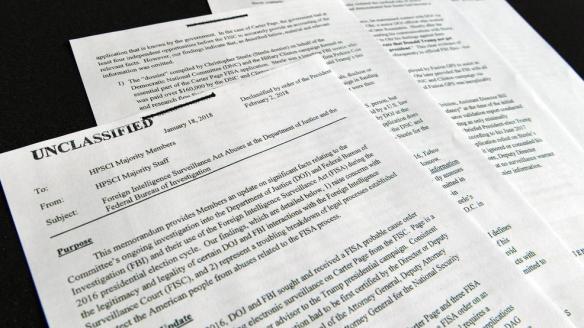
In the last two weeks, documents have been released that have exposed the weak underpinnings of the Russia investigation while at the same time revealing serious abuses by senior-level officials at the DOJ and FBI. The so called Nunes memo was the first to point out these abuses, but it was the 8-page “criminal referral” authored by Senate Judiciary Committee Chairman Chuck Grassley and Senator Lindsey Graham that gave credence to the claims. Here’s a blurb from the document:

“It appears the FBI relied on admittedly uncorroborated information, funded by and obtained for Secretary Clinton’s presidential campaign, in order to conduct surveillance of an associate of the opposing presidential candidate. It did so based on Mr. Steele’s personal credibility and presumably having faith in his process of obtaining the information. But there is substantial evidence suggesting that Mr. Steele materially misled the FBI about a key aspect of his dossier efforts, one which bears on his credibility.”

There it is. The FBI made a “concerted effort to conceal information from the court” in order to get a warrant to spy on a member of a rival political campaign. So –at the very least– there was an effort, on the part of the FBI and high-ranking officials at the Department of Justice, to improperly spy on members of the Trump team. And there’s more. The FBI failed to mention that the dossier was paid for by the Hillary campaign and the DNC, or that the dossier’s author Christopher Steele had seeded articles in the media that were being used to support the dossier’s credibility (before the FISA court), or that, according to the FBI’s own analysts, the dossier was “only minimally corroborated”, or that Steele was a ferocious partisan who harbored a strong animus towards Trump. All of these were omitted in the FISA application which is why the FBI was able to deceive the judge. It’s worth noting that intentionally deceiving a federal judge is a felony.

Most disturbing is the fact that Steele reportedly received information from friends of Hillary Clinton. (supposedly, Sidney Blumenthal and others) Here’s one suggestive tidbit that appeared in the Graham-Grassley” referral:

“…Mr. Steele’s memorandum states that his company “received this report from REDACTED US State Department,” that the report was the second in a series, and that the report was information that came from a foreign sub-source who “is in touch with REDACTED, a contact of REDACTED, a friend of the Clintons, who passed it to REDACTED.”

It is troubling enough that the Clinton campaign funded Mr. Steele’s work, but that these Clinton associates were contemporaneously feeding Mr. Steele allegations raises additional concerns about his credibility.” (Lifted from The Federalist)

What are we to make of this? Was Steele shaping the dossier’s narrative to the specifications of his employers? Was he being coached by members of the Hillary team? How did that impact the contents of the dossier and the subsequent Russia investigation?

These are just a few of the questions Steele will undoubtedly be asked if he ever faces prosecution for lying to the FBI. But, so far, we know very little about man except that he was a former M16 agent who was paid $160,000 for composing the dubious set of reports that make up the dossier. We don’t even know if Steele’s alleged contacts or intermediaries in Russia actually exist or not. Some analysts think the whole thing is a fabrication based on the fact that he hasn’t worked the Russia-scene since the FSB (The Russian state-security organization that replaced the KGB) was completely overhauled. Besides, it would be extremely dangerous for a Russian to provide an M16 agent with sensitive intelligence. And what would the contact get in return? According to most accounts, Steele’s sources weren’t even paid, so there was little incentive for them to put themselves at risk? All of this casts more doubt on the contents of the dossier.

What is known about Steele is that he has a very active imagination and knows how to command a six-figure payoff for his unique services. We also know that the FBI continued to use him long after they knew he couldn’t be trusted which suggests that he served some other purpose, like providing the agency with plausible deniability, a ‘get out of jail free’ card if they ever got caught surveilling US citizens without probable cause.

But that brings us to the strange case of Carter Page, a bit-player whose role in the Trump campaign was trivial at best. Page was what most people would call a “small fish”, an insignificant foreign policy advisor who had minimal impact on the campaign. Congressional investigators, like Nunes, must be wondering why the FBI and DOJ devoted so much attention to someone like Page instead of going after the “big fish” like Bannon, Flynn, Kushner, Ivanka and Trump Jr., all of whom might have been able to provide damaging information on the real target, Donald Trump. Wasn’t that the idea? So why waste time on Page? It doesn’t make any sense, unless, of course, the others were already being surveilled by other agencies? Is that it, did the NSA and the CIA have a hand in the surveillance too?

It’s a moot point, isn’t it? Because now that there’s evidence that senior-level officials at the DOJ and the FBI were involved in improperly obtaining warrants to spy on members of the opposite party, the investigation is going to go wherever it goes. Whatever restrictions existed before, will now be lifted. For example, this popped up in Saturday’s The Hill:

“House Intelligence Committee lawmakers are in the dark about an investigation into wrongdoing at the State Department announced by Chairman Devin Nunes (R-Calif.) on Friday. …Nunes told Fox News on Friday that, “we are in the middle of what I call phase two of our investigation. That investigation is ongoing and we continue work toward finding answers and asking the right questions to try to get to the bottom of what exactly the State Department was up to in terms of this Russia investigation.”…

Since then, GOP lawmakers have been quietly buzzing about allegations that an Obama-era State Department official passed along information from allies of former Secretary of State Hillary Clinton that may have been used by the FBI to launch an investigation into whether the Trump campaign had improper contacts with Russia.

“I’m pretty troubled by what I read in the documents with respect to the role the State Department played in the fall of 2016, including information that was used in a court proceeding. I am troubled by it,” Gowdy told Fox News on Tuesday.” (“Lawmakers in dark about ‘phase two’ of Nunes investigation”, The Hill)

So the State Department is next in line followed by the NSA and, finally, the Russia-gate point of origin, John Brennan’s CIA. Here’s more background on that from Stephen Cohen’s illuminating article at The Nation:

“….when, and by whom, was this Intel operation against Trump started?

In testimony to the House Intelligence Committee in May 2017, John Brennan, formerly Obama’s head of the CIA, strongly suggested that he and his agency were the first, as The Washington Post put it at the time, “in triggering an FBI probe.” Certainly both the Post and The New York Times interpreted his remarks in this way. Equally certain, Brennan played a central role in promoting the Russiagate narrative thereafter, briefing members of Congress privately and giving President Obama himself a top-secret envelope in early August 2016 that almost certainly contained Steele’s dossier. Early on, Brennan presumably would have shared his “suspicions” and initiatives with James Clapper, director of national intelligence. FBI Director Comey… may have joined them actively somewhat later….

When did Brennan begin his “investigation” of Trump? His House testimony leaves this somewhat unclear, but, according to a subsequent Guardian article, by late 2015 or early 2016 he was receiving, or soliciting, reports from foreign intelligence agencies regarding “suspicious ‘interactions’ between figures connected to Trump and known or suspected Russian agents.”

In short, if these reports and Brennan’s own testimony are to be believed, he, not the FBI, was the instigator and godfather of Russiagate.” (“Russiagate or Intelgate?”, Stephen Cohen, The Nation)

Regular readers of this column know that we have always believed that the Russiagate psyops originated with Brennan. Just as the CIA launched its disinformation campaigns against Saddam Hussein and Muammar Gadhafi, so too, Russia has emerged as Washington’s foremost rival requiring a massive propaganda campaign to persuade the public that America faces a serious external threat. In any event, the demonizing of Russia had already begun by the time Hillary and Co. decided to hop on the bandwagon by blaming Moscow for hacking John Podesta’s emails. The allegations were never persuasive, but they did provide Brennan with some cover for the massive Information Operation (IO) that began with him.

According to the Washington Times:

“It was then-CIA Director John O. Brennan, a close confidant of Mr. Obama’s, who provided the information — what he termed the “basis” — for the FBI to start the counterintelligence investigation last summer….Mr. Brennan told the House Intelligence Committee on May 23 that the intelligence community was picking up tidbits on Trump associates making contacts with Russians.”

It all started with Brennan. After Putin blocked Brennan’s operations in both Ukraine and Syria, Brennan had every reason to retaliate and to use the tools at his disposal to demonize Putin and try to isolate Russia. The “election meddling” charges (promoted by the Hillary people) fit perfectly with Brennan’s overall strategy to manipulate perceptions and prepare the country for an eventual confrontation. It provided him the opportunity to kill two birds with one stone, to deliver a withering blow to Putin and Trump at the very same time. The temptation must have been irresistible.

But now the plan has backfired and the investigations are gaining pace. Trump’s allies in the House smell the blood in the water and they want answers. Did the CIA surveil members of the Trump campaign on the basis of information they gathered in the dossier? Who saw the information? Was the information passed along to members of the press and other government agencies? Was the White House involved? What role did Obama play? What about the Intelligence Community Assessment? Was it based on the contents of the Steele report? Will the “hand-picked” analysts who worked on the report vouch for its conclusions in or were they coached about what to write? How did Brennan persuade the reluctant Comey into opening a counterintelligence investigation on members in the Trump campaign when he knew it would be perceived as a partisan attempt to sabotage the elections by giving Hillary an edge?
Soon the investigative crosshairs will settle on Brennan. He’d better have the right answers.

Thirteen Russians and a Ham Sandwich

By Charles Hugh Smith

Source: Kunstler.com

Remember that one from 1996? Funny, that was the American mainstream media bragging, after the fact, about our own meddling in another nation’s election.

WASHINGTON — A team of American political strategists who helped [California] Gov. Pete Wilson with his abortive presidential bid earlier this year said this week that they served as Russian President Boris N. Yeltsin’s secret campaign weapon in his comeback win over a Communist challenge.

—The Los Angeles Times, July 9, 1996

The beauty in Robert Mueller’s indictment of thirteen Russian Facebook trolls is that they’ll never face trial, so Mr. Mueller will never have to prove his case. In the new misrule of law made popular by the #Me Too movement, accusations suffice to convict the target of an investigation. Kind of sounds like going medieval to me, but that’s how we roll now in the Land of the Free.

Readers know, of course, that I’m not a Trump supporter, that I regard him as a national embarrassment, but I’m much more disturbed by the mindless hysteria ginned up Washington’s permanent bureaucracy in collusion with half a dozen major newspapers and cable news networks, who have run a psy-ops campaign to shove the country into a war mentality.

The New York Times published a doozy of a lead story on Saturday, the day after the indictments were announced. The headline said: Trump’s Conspicuous Silence Leaves a Struggle Against Russia Without a Leader. Dean Baquet and his editorial board are apparently seeking an American Napoleon who will mount a white horse and take our legions into Moscow to teach these rascals a lesson — or something like that.

I’m surely not the only one to notice how this hysteria is designed to distract the public attention from the documented misconduct among FBI, CIA, NSA, State Department officials and the leaders of the #Resistance itself: the Democratic National Committee, its nominee in the 2016 election, HRC, and Barack Obama’s White House inner circle. You would think that at least some of this mischief would have come to Robert Mueller’s attention, since the paper trail of evidence is as broad and cluttered as the DC Beltway itself. It actually looks like the greatest act of bureaucratic ass-covering inn US history.

Of course, Deputy Attorney General Rod Rosenstein was quick to qualify the announced indictments by saying that Russian trolling on Facebook had no effect on the 2016 election, and that the Trump campaign was not implicated in it. Maybe the indictments were just a table-setter for something more potent to come out of Mueller’s office. But what if it’s not. What if this is all he has to show for a year and a half of the most scrupulous delving into this “narrative?”

Meanwhile, the damage done among America’s former thinking class essentially leaves this polity like the Scarecrow in The Wizard of Oz: without a brain. I doubt they will be satisfied by Mueller’s indictment of the thirteen Russian trolls. Rather, it may tempt them to even more violent hysterics and greater acts of lawlessness. The only thing that will stop this nonsense is Big Trouble in the financial system — which the news media and most of the public are ignoring at their peril. It is coming at us good and hard and it will feel like a two-by-four to nation’s skull when it gets here.

Freedom Is a Myth: We Are All Prisoners of the Police State’s Panopticon Village

“We’re run by the Pentagon, we’re run by Madison Avenue, we’re run by television, and as long as we accept those things and don’t revolt we’ll have to go along with the stream to the eventual avalanche…. As long as we go out and buy stuff, we’re at their mercy… We all live in a little Village. Your Village may be different from other people’s Villages, but we are all prisoners.”— Patrick McGoohan

By John W. Whitehead

Source: The Rutherford Institute

First broadcast in Great Britain 50 years ago, The Prisoner—a dystopian television series described as “James Bond meets George Orwell filtered through Franz Kafka”—confronted societal themes that are still relevant today: the rise of a police state, the freedom of the individual, round-the-clock surveillance, the corruption of government, totalitarianism, weaponization, group think, mass marketing, and the tendency of humankind to meekly accept their lot in life as a prisoner in a prison of their own making.

Perhaps the best visual debate ever on individuality and freedom, The Prisoner (17 episodes in all) centers around a British secret agent who abruptly resigns only to find himself imprisoned, monitored by militarized drones, and interrogated in a mysterious, self-contained, cosmopolitan, seemingly tranquil retirement community known only as the Village. The Village is an idyllic setting with parks and green fields, recreational activities and even a butler.

While luxurious and resort-like, the Village is a virtual prison disguised as a seaside paradise: its inhabitants have no true freedom, they cannot leave the Village, they are under constant surveillance, their movements are tracked by surveillance drones, and they are stripped of their individuality and identified only by numbers.

The series’ protagonist, played by Patrick McGoohan, is Number Six.

Number Two, the Village administrator, acts as an agent for the unseen and all-powerful Number One, whose identity is not revealed until the final episode.

“I am not a number. I am a free man,” was the mantra chanted on each episode of The Prisoner, which was largely written and directed by McGoohan.

In the opening episode (“The Arrival”), Number Six meets Number Two, who explains to him that he is in The Village because information stored “inside” his head has made him too valuable to be allowed to roam free “outside.”

Throughout the series, Number Six is subjected to interrogation tactics, torture, hallucinogenic drugs, identity theft, mind control, dream manipulation, and various forms of social indoctrination and physical coercion in order to “persuade” him to comply, give up, give in and subjugate himself to the will of the powers-that-be.

Number Six refuses to comply.

In every episode, Number Six resists the Village’s indoctrination methods, struggles to maintain his own identity, and attempts to escape his captors. “I will not make any deals with you,” he pointedly remarks to Number Two. “I’ve resigned. I will not be pushed, filed, stamped, indexed, debriefed or numbered. My life is my own.”

Yet no matter how far Number Six manages to get in his efforts to escape, it’s never far enough.

Watched by surveillance cameras and other devices, Number Six’s getaways are continuously thwarted by ominous white balloon-like spheres known as “rovers.” Still, he refuses to give up. “Unlike me,” he says to his fellow prisoners, “many of you have accepted the situation of your imprisonment, and will die here like rotten cabbages.”

Number Six’s escapes become a surreal exercise in futility, each episode an unfunny, unsettling Groundhog’s Day that builds to the same frustrating denouement: there is no escape.

As journalist Scott Thill concludes for Wired, “Rebellion always comes at a price. During the acclaimed run of The Prisoner, Number Six is tortured, battered and even body-snatched: In the episode ‘Do Not Forsake Me Oh My Darling,’ his mind is transplanted to another man’s body. Number Six repeatedly escapes The Village only to be returned to it in the end, trapped like an animal, overcome by a restless energy he cannot expend, and betrayed by nearly everyone around him.”

The series is a chilling lesson about how difficult it is to gain one’s freedom in a society in which prison walls are disguised within the trappings of technological and scientific progress, national security and so-called democracy.

As Thill noted when McGoohan died in 2009, “The Prisoner was an allegory of the individual, aiming to find peace and freedom in a dystopia masquerading as a utopia.”

The Prisoner’s Village is also an apt allegory for the American Police State: it gives the illusion of freedom while functioning all the while like a prison: controlled, watchful, inflexible, punitive, deadly and inescapable.

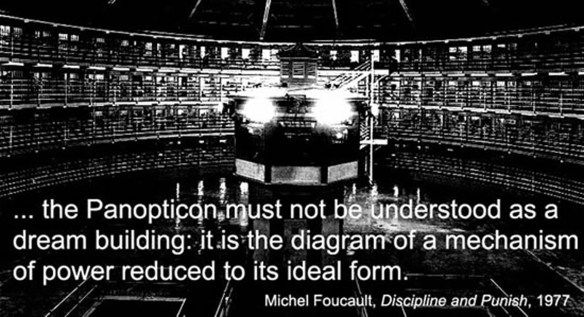
The American Police State, much like The Prisoner’s Village, is a metaphorical panopticon, a circular prison in which the inmates are monitored by a single watchman situated in a central tower. Because the inmates cannot see the watchman, they are unable to tell whether or not they are being watched at any given time and must proceed under the assumption that they are always being watched.

Eighteenth century social theorist Jeremy Bentham envisioned the panopticon prison to be a cheaper and more effective means of “obtaining power of mind over mind, in a quantity hitherto without example.”

Bentham’s panopticon, in which the prisoners are used as a source of cheap, menial labor, has become a model for the modern surveillance state in which the populace is constantly being watched, controlled and managed by the powers-that-be and funding its existence.

Nowhere to run and nowhere to hide: this is the new mantra of the architects of the police state and their corporate collaborators (Facebook, Amazon, Netflix, Google, Instagram, etc.).

Government eyes are watching you.

They see your every move: what you read, how much you spend, where you go, with whom you interact, when you wake up in the morning, what you’re watching on television and reading on the internet.

Every move you make is being monitored, mined for data, crunched, and tabulated in order to form a picture of who you are, what makes you tick, and how best to control you when and if it becomes necessary to bring you in line.

When the government sees all and knows all and has an abundance of laws to render even the most seemingly upstanding citizen a criminal and lawbreaker, then the old adage that you’ve got nothing to worry about if you’ve got nothing to hide no longer applies.

Apart from the obvious dangers posed by a government that feels justified and empowered to spy on its people and use its ever-expanding arsenal of weapons and technology to monitor and control them, we’re approaching a time in which we will be forced to choose between obeying the dictates of the government—i.e., the law, or whatever a government official deems the law to be—and maintaining our individuality, integrity and independence.

When people talk about privacy, they mistakenly assume it protects only that which is hidden behind a wall or under one’s clothing. The courts have fostered this misunderstanding with their constantly shifting delineation of what constitutes an “expectation of privacy.” And technology has furthered muddied the waters.

However, privacy is so much more than what you do or say behind locked doors. It is a way of living one’s life firm in the belief that you are the master of your life, and barring any immediate danger to another person (which is far different from the carefully crafted threats to national security the government uses to justify its actions), it’s no one’s business what you read, what you say, where you go, whom you spend your time with, and how you spend your money.

Unfortunately, George Orwell’s 1984—where “you had to live—did live, from habit that became instinct—in the assumption that every sound you made was overheard, and, except in darkness, every movement scrutinized”—has now become our reality.

We now find ourselves in the unenviable position of being monitored, managed and controlled by our technology, which answers not to us but to our government and corporate rulers.

Consider that on any given day, the average American going about his daily business will be monitored, surveilled, spied on and tracked in more than 20 different ways, by both government and corporate eyes and ears.

A byproduct of this new age in which we live, whether you’re walking through a store, driving your car, checking email, or talking to friends and family on the phone, you can be sure that some government agency, whether the NSA or some other entity, is listening in and tracking your behavior.

This doesn’t even begin to touch on the corporate trackers that monitor your purchases, web browsing, Facebook posts and other activities taking place in the cyber sphere.

Stingray devices mounted on police cars to warrantlessly track cell phones, Doppler radar devices that can detect human breathing and movement within in a home, license plate readers that can record up to 1800 license plates per minute, sidewalk and “public space” cameras coupled with facial recognition and behavior-sensing technology that lay the groundwork for police “pre-crime” programs, police body cameras that turn police officers into roving surveillance cameras, the internet of things: all of these technologies add up to a society in which there’s little room for indiscretions, imperfections, or acts of independence—especially not when the government can listen in on your phone calls, monitor your driving habits, track your movements, scrutinize your purchases and peer through the walls of your home.

As French philosopher Michel Foucault concluded in his 1975 book Discipline and Punish, “Visibility is a trap.”

This is the electronic concentration camp—the panopticon prison—the Village—in which we are now caged.

It is a prison from which there will be no escape if the government gets it way.

As Glenn Greenwald notes:

“The way things are supposed to work is that we’re supposed to know virtually everything about what [government officials] do: that’s why they’re called public servants. They’re supposed to know virtually nothing about what we do: that’s why we’re called private individuals. This dynamic – the hallmark of a healthy and free society – has been radically reversed. Now, they know everything about what we do, and are constantly building systems to know more. Meanwhile, we know less and less about what they do, as they build walls of secrecy behind which they function. That’s the imbalance that needs to come to an end. No democracy can be healthy and functional if the most consequential acts of those who wield political power are completely unknown to those to whom they are supposed to be accountable.”

Even now, the Trump Administration is working to make some of the National Security Agency’s vast spying powers permanent.

In fact, Attorney General Jeff Sessions is pushing for Congress to permanently renew Section 702 of the Foreign Intelligence Surveillance Act, which allows government snoops to warrantlessly comb through and harvest vast quantities of our communications.

And just like that, we’re back in the Village, our escape plans foiled, our future bleak.

Except this is no surprise ending: for those who haven’t been taking the escapist blue pill, who haven’t fallen for the Deep State’s phony rhetoric, who haven’t been lured in by the promise of a political savior, we never stopped being prisoners.

So how do we break out?

For starters, wake up. Resist the urge to comply.

The struggle to remain “oneself in a society increasingly obsessed with conformity to mass consumerism,” writes Steven Paul Davies, means that superficiality and image trump truth and the individual. The result is the group mind and the tyranny of mob-think.

Think for yourself. Be an individual. As McGoohan commented in 1968, “At this moment individuals are being drained of their personalities and being brainwashed into slaves… As long as people feel something, that’s the great thing. It’s when they are walking around not thinking and not feeling, that’s tough. When you get a mob like that, you can turn them into the sort of gang that Hitler had.”

In a media-dominated age in which the lines between entertainment, politics and news reporting are blurred, it is extremely difficult to distinguish fact from fiction. We are so bombarded with images, dictates, rules and punishments and stamped with numbers from the day we are born that it is a wonder we ever ponder a concept such as freedom. As McGoohan declared, “Freedom is a myth.”

In the end, as I make clear in my book Battlefield America: The War on the American People, we are all prisoners of our own mind.

In fact, it is in the mind that prisons are created for us. And in the lockdown of political correctness, it becomes extremely difficult to speak or act individually without being ostracized. Thus, so often we are forced to retreat inwardly into our minds, a prison without bars from which we cannot escape, and into the world of video games and television and the Internet.

We have come full circle from Bentham’s Panopticon to McGoohan’s Village to Huxley’s Brave New World.

As cultural theorist Neil Postman observed:

What Orwell feared were those who would ban books. What Huxley feared was that there would be no reason to ban a book, for there would be no one who wanted to read one. Orwell feared those who would deprive us of information. Huxley feared those who would give us so much that we would be reduced to passivity and egoism. Orwell feared we would become a captive audience. Huxley feared the truth would be drowned in a sea of irrelevance. Orwell feared that we would become a captive culture. Huxley feared we would become a trivial culture, preoccupied with some equivalent of the feelies, the orgy porgy, and the centrifugal bumblepuppy. As Huxley remarked in Brave New World Revisited, the civil libertarians and rationalists who are ever on the alert to oppose tyranny “failed to take into account man’s almost infinite appetite for distractions.” In Brave New World, they are controlled by inflicting pleasure. In short, Orwell feared that what we hate would ruin us. Huxley feared that what we love will ruin us.

You want to be free? Break out of the circle.

Biggest Nunes Memo Revelations Have Little To Do With Its Content

By Caitlin Johnstone

Source: Consortium News

It’s fitting that the ever-tightening repetitive loops of America’s increasingly schizophrenic partisan warfare finally hit peak shrillness and skyrocketed into a white noise singularity on Groundhog Day. Right now, we’re right about at the part of the movie where Bill Murray is driving over a cliff in a pickup truck with a large rodent behind the wheel.

If you only just started paying attention to U.S. politics in 2017 what I’m about to tell you will blow your mind, so you might want to sit down for this: believe it or not, there was once a time when both of America’s mainstream political parties weren’t screeching every single day that there was news about to break any minute now which would obliterate the other party forever. No Russiagate, no Nunes memo, no Rachel Maddow red yarn graphs, no Sean Hannity “tick tock,” no nothing. People screaming that the end is nigh and it’s all about to come crashing down were relegated to street corners and the occasional Infowars appearance, not practicing mainstream political punditry for multimillion dollar salaries on MSNBC and Fox News.

I’m not saying it’s a bad thing that Americans are starting to look critically at the power dynamics in their country, but the partisan filters they’ve pulled over their eyes are causing mass confusion and delusion. Now everyone who questions the CIA is a Russian agent and the term “deep state” suddenly means “literally anyone who doesn’t like Donald Trump.” Your take on the contents of the Nunes memo will put you in one of two radically different political dimensions depending on which mainstream cult you’ve subscribed to, and it will cause you to completely miss the point of the entire ordeal.

The part of the memo that has everyone talking today reads as follows: “Furthermore, Deputy Director McCabe testified before the Committee in December 2017 that no surveillance warrant would have been sought from the FISC without the Steele dossier information.”

This refers to a surveillance warrant requested by the FBI’s then-Deputy Director Andrew McCabe from the Foreign Intelligence Surveillance Court seeking permission to spy on the communications of Carter Page, a member of the 2016 Trump campaign. The controversy revolves around the claim that this surveillance warrant would never have even been requested if not for the clearly biased, Clinton-funded, and error-riddled Christopher Steele dossier which is acknowledged even by its former MI6 author to be 10 to 30 percent inaccurate.

Combine that with the fact that this has never been made clear to the public, and baby you’ve got yourself a scandal. The FBI knowingly using extremely tainted evidence from one presidential campaign to get permission to spy on another would indeed be a very big deal.

There are some problems with the “BOOM! Bigger than Watergate!” exclamations that pro-Trump partisans have been parading around about this, however. The first is that the memo is only an internal communication between Republican congressmen; it’s not a sworn testimony or legal transcript or anything legally binding. It’s basically just some Republican ideas about what happened. The assertions made therein are reportedly being hotly contested by Democrats with knowledge of the situation, which is in turn being disputed by Republicans.

Another thing putting a damper on the GOP’s “KABOOM!” parade is the fact that the memo’s contents are not even entirely new; CNN reported way back in April of last year that sources had informed them that the Steele dossier had been used to get a FISA warrant on the Trump campaign. Additionally, even if every single allegation in the memo is true, the revelations are still arguably far less earth shattering than the Edward Snowden revelations of 2013 exposing the NSA’s sprawling domestic espionage network, so the expectation that these less significant new revelations would cause a radical transformation in U.S. politics when the Snowden revelations did not seems highly unrealistic.

Nonetheless, there have been some extremely important revelations as a result of this memo; they just haven’t come from the contents of the memo itself. In the same way that cybersecurity analysts observe the metadata underlying hacked files rather than the contents of the files themselves, political analysts have been pointing out that a lot can be learned about the political establishment by looking at its response to the possibility of the memo’s release.

“Memo is clearly not a blockbuster. We can tell so by reading it. Which makes Dems’ frantic efforts to prevent anyone from reading it seem even more bizarre,” observed TYT’s Michael Tracey. “Veracity of memo’s claims aside, we were told that its release would undermine the rule of law. So, just checking: is the rule of law still in tact?” he added later.

“Now it is clear to all,” WikiLeaks’ Julian Assange tweeted. “The claims about how the ‘Nunes’ memo would destroy ‘national security’ were lies. Classification stickers are used by bureaucrats trying to obtain ‘political security’ for their cronies.”

“One effect of the memo – it’s an example of how extensively we overclassify information,” wrote National Review’s David French. “I’m highly dubious that any information disclosed threatens national security in any way, shape, or form. I’d be willing to bet the Dem response is similarly harmless. Release it.”

Indeed, both the FBI and high-profile Democrats have been claiming that the memo’s unredacted release would pose a national security threat, with California Congressman (and virulent Russiagater) Eric Swalwell going so far to call it “brainwashing.” A CNN panelist wandered completely off the paddock and suggested that yesterday may have been America’s last day as a democracy. Why were they all flipping out so hysterically over a release of information that plainly poses no threat to the American people?

In addition to Assange’s assertion that government secrecy has far less to do with national security than political security (a claim he has made before which seems to be proving correct time and time again), there’s the jarring question posed by Republican Congressman Thomas Massie: “who made the decision to withhold evidence of FISA abuse until after Congress voted to renew FISA program?”

Whoa, Nelly. Hang on. What is he talking about?

It would be understandable if you were unaware of the debate over the reauthorization of FISA surveillance which resulted in unconditional bipartisan approval last month – the mainstream media barely touched it. In point of fact, though, the very surveillance practices alleged to have been abused in this hotly controversial memo are the same which was waved through by both the House and the Senate, and by the very same people promoting the memo in many cases.

The McCabe testimony was in December. FISA was renewed in January. Why is all this just coming out now? If the Republicans truly believed that McCabe said what the memo claims he said, why wasn’t the public informed before their elected representatives renewed the intelligence community’s dangerously intrusive surveillance approval? Was this information simply forgotten about until after those Orwellian powers had been secured?

Of course not. Don’t be an idiot.

This makes the kicking, screaming, wailing and gnashing of teeth by the political establishment make a lot more sense, doesn’t it? Now suddenly we’re looking at a he-said, she-said partisan battle over an issue which can only be resolved with greater and greater transparency of more and more government documents, and we can all see where that’s headed. In their rush to win a partisan battle and shield their president from the ongoing Russiagate conspiracy theory, the Republicans may have exposed too much of the establishment foundation upon which both parties are built.

The term “deep state” does not mean “Democrats and Never-Trumpers” as Republican pundits would have you believe, nor does the term refer to any kind of weird, unverifiable conspiracy theory. The deep state is in fact not a conspiracy theory at all, but simply a concept used in political analysis for discussing the undeniable fact that unelected power structures exist in America, and that they tend to form alliances and work together in some sense.

There is no denying the fact that plutocrats, intelligence agencies, defense agencies and the mass media are both powerful and unelected, and there is no denying the fact that there are many convoluted and often conflicting alliances between them. All that can be debated is the manner and extent to which this is happening.

The deep state is America’s permanent government, the U.S. power structures that Americans don’t elect. These power structures plainly have a vested interest in keeping America’s Orwellian surveillance structures in place, as evidenced by the intelligence community’s menacingly urgent demand for FISA renewal back in December. If there’s any thread to be pulled that really could make waves in the way Official Washington (hat tip to the late Robert Parry) operates, it is in the plot holes between the bipartisan scramble toward unconditional surveillance renewal and the highly partisan battle over exposing the abuse of those very powers.

If we’re going to see a gap in the bars of our cages, that’s a great place to keep our eyes trained, so keep watching. Watch what happens in a partisan war where both parties have a simultaneous interest in revealing as little of the game as possible and exposing the other party. Things could get very interesting.

Stormy Weather

By James Howard Kunstler

Source: Kunstler.com

For those of us who are not admirers of President Trump, it’s even more painful to see the Democratic opposition descend into the stupendous dishonesty of the Russian Collusion story. When the intelligentsia of the nation looses its ability to think — when it becomes a dis-intelligentsia — then there are no stewards of reality left. Trump is crazy enough, but the “resistance” is dragging the country into dangerous madness.

It’s hard not to be impressed by the evidence in the public record that the FBI misbehaved pretty badly around the various election year events of 2016. And who, besides Rachel Maddow, Anderson Cooper, and Dean Baquet of The New York Times, can pretend to be impressed by the so far complete lack of evidence of Russian “meddling” to defeat Hillary Clinton? I must repeat: so far. This story has been playing for a year and a half now, and as the days go by, it seems more and more unlikely that Special Prosecutor Robert Mueller is sitting on any conclusive evidence. During this time, everything and anything has already leaked out of the FBI and its parent agency the Department of Justice, including embarrassing hard evidence of the FBI’s own procedural debauchery, and it’s hard to believe that Mr. Mueller’s office is anymore air-tight than the rest of the joint.

If an attorney from Mars came to Earth and followed the evidence already made public, he would probably suspect that the FBI and DOJ colluded with the Clinton Campaign and the Democratic Party to derail the Trump campaign train, and then engineer an “insurance policy” train wreck of his position in office. Also, in the process, to nullify any potential legal action against Clinton, including the matter of her email server, her actions with the DNC to subvert the Sanders primary campaign, the Steele dossier being used to activate a FISA warrant for surveillance of the Trump campaign, the arrant, long-running grift machine of the Clinton Foundation (in particular, the $150 million from Russian sources following the 2013 Uranium One deal, when she was Secretary of State), and the shady activities of Barack Obama’s inner circle around the post-election transition. There is obviously more there there than in the Resistance’s Russia folder.

I don’t even understand why Robert Mueller ever had credible standing to preside over this special investigation. He is, after all, the close friend and once-mentor of the figure who is very likely the fulcrum in any case against Trump: James Comey, the former FBI director fired by Trump — theoretically to obstruct justice, the keystone in the effort to find an impeachable offense.

I’m not comfortable acting as a supporter or defender of Trump, but I’m even less comfortable with the appearance of a rogue security and law enforcement apparatus gone blatantly political. The so far poorly-explained antics at the FBI and DOJ reflect badly on all vested authority in the country — and especially for any faction that pretends to be on the side of justice. This is a much larger problem than the public debate seems to recognize. We are not far from a point where nobody will be able to believe anything official in this land.

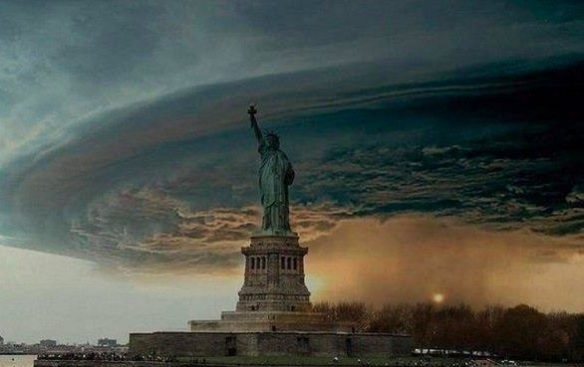
I remain convinced that this circus of scandal and counter-scandal will not necessarily be resolved by the legal machinery, at least not in any meaningful time frame that would allow the political establishment to pull its head out of its ass and actually start paying attention to the public interest. Rather, the circus tent will just blow down in the financial crisis that is spinning toward the US mainland like a superstorm. Mr. Trump now has full, gold-plated ownership of the parabolic stock market, a shuddering bond market, a wobbling currency, and an implacable debt quandary. These are conditions that can blow a society up for real.

The Public Are All Alone: Understanding How the Enemy of Your Enemy Is Not Your Friend

By Eric Zuesse

Source: Strategic Culture Foundation

In political matters, the public are taught to believe that some political Party is ‘good’, and that the others are “bad”; but the reality in recent times, at least in the United States, has instead been that both Parties are rotten to the core (as will be clear from the linked documentation provided here).

Belief in this myth (that the opposition between Parties is between ‘good’ ‘friend’ versus ‘bad’ ‘enemy’) is based upon the common adage that “The enemy of my enemy is my friend.” One side is believed, and ones that contradict it are disbelieved — considered to be lying, distorting: bad. But, maybe, both (or all) Parties are deceiving; maybe all of them are enemies of the public, but just in different ways; maybe each of them is trying to control the country in the interests of (and so to obtain the most financial support from) the aristocracy, while all of them are actually against the public.

Can it really be false that “The enemy of my enemy is my friend?” Not only can be, but often is. And no one is able to vote intelligently without recognizing this fundamental political fact.

It’s true between entire nations, too — not only within nations.

For example: Hitler and Stalin were enemies of each other, but neither of them was a friend of America (except that Stalin did more than anyone else to defeat Hitler, and thereby saved the world, though the U.S. — far less a factor than the U.S.S.R. was in defeating Hitler — still refuses to acknowledge the fact that Stalin did more than anyone else did to prevent the entire world’s becoming dictatorships; so, whatever democracy exists today, is a result of that dictator, Stalin, even more than it’s a result of either FDR or Churchill).

What about internally, then?

Hillary Clinton and Donald Trump became enemies of each other, but neither of them had ever really been a friend of the American public: both of them were instead liars who would, and did, do everything they could to grab control (on the aristocracy’s behalf, who financed their respective campaigns) over what is supposed to be our Government, in a democracy. That’s just a sad fact about reality, which both of America’s political Parties deny (because they both need those voters, not merely those mega-donations; they need the public to believe that the Party cares about them).

Most of the American public have been successfully deceived by the ‘news’media, and by the ‘history’-books (likewise published by agents for the aristocracy), to believe that the U.S. Government serves the public-interest, and not the interest of the centi-millionaires and especially billionaires, who finance political campaigns. But it’s no truer than it’s true that the enemy of your enemy is necessarily your friend: both enemies of each other can be your enemies, too. The difference here is that the enmity between the aristocracy and the public is basically intrinsic, whereas the enmities between (Republican versus Democratic, or any other divisions between) aristocrats, are basically personal — these are matters of business, instead of matters of state. They are, in a sense, different business-plans — competing business-plans. But they are all assisting the aristocracy, to control the public, so as to advance the interests of the aristocracy. They’re all competing for the aristocracy’s support, and deceiving for the public’s support. Two blatant recent examples displaying this were America’s invasion in 2003 that destroyed Iraq, and America’s invasion in 2011 that destroyed Libya. Did either of those invasions advance the interests of the American public? But the owners of Lockheed Martin and other ‘defense’ contractors blossomed after 9/11. In fact: U.S. arms-exports are at record highs.

The now-proven reality in America is that the U.S. Government really does represent those billionaires and centi-millionaires, and not the public. It’s a now-proven reality, that the U.S. isn’t a democracy but a dictatorship — albeit, a two-Party one, with a real competition between billionaire and centi-millionaire Republicans on the one hand, versus billionaire and centi-millionaire Democrats on the other. But all billionaires and centi-millionaires are takers (that’s how they came to be super-rich, even the ones who didn’t inherit it from their parents), who (notwithstanding any ‘charity’ they may establish to avoid taxes while extending their control) receive from the public far more than they give to the public; and, so, there is actually an intrinsic class-war — not at all like Karl Marx famously said, between the bourgeoisie (including small-business owners) versus the proletariat (including some centi-millionaires and billionaires who became super-wealthy from being movie-stars or athletic stars and who don’t necessarily actually control any business at all, and so they’re “proletariats”), but instead between the aristocracy versus the public: the ancient and permanent class-conflict. It’s the entire aristocracy-of-wealth (which is maybe half of the nation’s wealth) that’s arrayed against the public (the poorer 99+% of the people). (In fact, Marx — the promoter of the view that the bourgeoisie are the public’s enemies — had aristocratic sponsors, and he would have remained obscure and died poor, if he had instead blamed the aristocracy, not “the bourgeoisie” — which is mainly the middle class — as being the exploiting-class. Marx, too, was an agent of aristocracy. He succeeded and became famous because he had aristocratic sponsors. Otherwise, his name would have simply been forgotten.)

Anyway, the American public are now alone. No Government represents our interests. It’s now been proven that America’s Government doesn’t represent us; and it’s not even the business of any other Government in the world to represent us; so, no foreign government does, either. No Government represents us.

In order to understand any aristocracy, one must understand what gives rise to almost all wars, because almost all wars throughout history have been between contending aristocracies — between the aristocracies of different nations. Each aristocracy needs to be able to fool its national public, to believe that they’re fighting against the foreign public, when, in fact, they’re fighting against the foreign aristocracy, and they’re fighting for the home-nation’s aristocracy — they are, almost always, fighting for one aristocracy, against another aristocracy. Any public who would know that this is the reality, would just as soon commit a democratic revolution, against the local aristocracy, as go to war for the local one, against the foreign ones. This is the reason why, in every dictatorship, the local centi-millionaires and billionaires buy up all of the ‘news’media that inform, or (on essential matters) misinform, their audiences about international relations, and about who did what to whom and why. They hire only ‘reporters’ who comply with whatever deceptions the owners feel to be necessary, in order to be able to attract sponsorships from other aristocrats’ corporations and ‘charities’. But, the aristocrats themselves are actually all in this together, because their mutually shared enemy is the public. Without deceiving the public about essential matters, no national news-medium would be able to attract the sponsorships it needs in order to grow, or even to survive.

The public thinks it’s fighting an international war, when, in fact, they’re fighting for the local aristocracy (and its allied aristocracies), against foreign aristocracies (and their allied aristocracies). This has been true since the dawn of human civilization. Only the weapons are bigger now, and the alliances (in the World Wars) are now global. (But, of course, if there is another World War, then all of human civilization will immediately end, and not long thereafter, all human and most other forms of life will also end.)

An excellent example of the real class-war, and of its international nature, is James Bamford’s 3 April 2012 masterful and pioneering article in Wired, “Shady Companies With Ties to Israel Wiretap the U.S. for the NSA”. He documented that even very high-up people in America’s NSA were kept out of the loop when joint U.S.-and-Israeli intelligence-agencies and private corporations were creating the present 1984-ish, “Big Brother” reality, in (at least) those countries (but, actually, the Sauds, and probably a few others, were also on the inside — the aristocracies not merely of those two countries, U.S. and Israel, are in the alliance).

The “Deep State” isn’t merely one nation’s aristocracy and its agents; it is basically a form of actually international gang-warfare. That’s what got us into invading and destroying Iraq 2003, Libya 2011, Syria 2012-, Ukraine (by coup 2014), and so many other nations. It wasn’t done in order to serve the American public’s interests. That’s just the standard lie — and it keeps going on, and on. Maybe until we invade Russia.

$21 Trillion of Unauthorized Spending by US Govt Discovered by Economics Professor

Source: Covert Geopolitics

he US government may have misspent $21 trillion, a professor at Michigan State University has found. Papers supporting the study briefly went missing just as an audit was announced.

Two departments of the US federal government may have spent as much as $21 trillion on things they can’t account for between 1998 and 2015. At least that’s what Mark Skidmore, a Professor of Economics at MSU specializing in public finance, and his team have found.

They came up with the figure after digging the websites of departments of Defense (DoD) and Housing and Urban Development (HUD) as well as repots of the Office of the Inspector General (OIG) over summer.

The research was triggered by Skidmore hearing Catherine Austin Fitts, a former Assistant Secretary in the HUD in the first Bush administration, saying the Inspector General found $6.5 trillion worth of military spending that the DoD couldn’t account for. She was referring to a July 2016 report by the OIG, but Skidmore thought she must be mistaking billion for trillion. Based on his previous experience with public finances, he thought the figure was too big even for an organization as large as the US military.

“Sometimes you have an adjustment just because you don’t have adequate transactions… so an auditor would just recede. Usually it’s just a small portion of authorized spending, maybe one percent at most. So for the Army one percent would be $1.2 billion of transactions that you just can’t account for,” he explained in an interview with USAWatchdog.com earlier this month.

After discovering that the figure was accurate, he and Fitts collaborated with a pair of graduate students to comb through thousands of reports of the OIG dating back to 1998, when new rules of public accountability for the federal government were set and all the way to 2015, the time of the latest reports available at the time. The research was only for the DoD and the HUD.

“This is incomplete, but we have found $21 trillion in adjustments over that period. The biggest chunk is for the Army. We were able to find 13 of the 17 years and we found about $11.5 trillion just for the Army,” Skidmore said.

The professor would not suggest whether the missing trillions went to some legitimate undisclosed projects, wasted or misappropriated, but believes his find indicates that there is something profoundly wrong with the budgeting process in the US federal government. Such lack of transparency goes against the due process of authorizing federal spending through the US Congress, he said.

Skidmore also co-authored a column on Forbes, explaining his research.

The same week the interview took place the DoD announced that it will conduct its first-ever audit. “It is important that the Congress and the American people have confidence in DoD’s management of every taxpayer dollar,” Comptroller David Norquist told reporters as he explained that the OIG has hired independent auditors to dig through the military finances.

“While we can’t know for sure what role our efforts to compile original government documents and share them with the public has played, we believe it may have made a difference,” Skidmore commented.

Interestingly, in early December the authors of the research discovered that the links to key document they used, including the 2016 report, had been disabled. Days later the documents were reposted under different addresses, they say.

This is probably where the Deep State government called CIA and State Department took their extra fund to topple uncooperative governments around the world. The bulk, of course, may have gone to the military industrial complex.

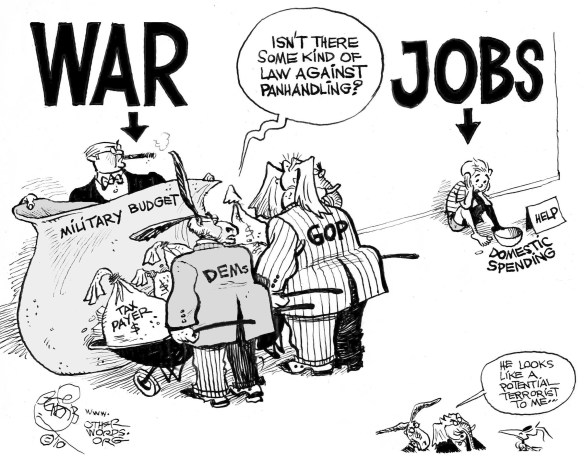
The United States has double the military budget of the combined military spending of Russia, China and G7 countries. Said military spending remains unauditable due to “widespread material internal control weaknesses, significant uncertainties, and other limitations” according to a GAO report in 2010.

So, how can a government spread its wings beyond its own borders, and demand democratic ideals elsewhere when it is not practicing the same values at home?