The Recession Will Be Unevenly Distributed

By Charles Hugh Smith

Source: Of Two Minds

Those households, enterprises and organizations that have no debt, a very low cost basis and a highly flexible, adaptable structure will survive and even prosper.

The coming recession will be unevenly distributed, meaning that it will devastate many while leaving others relatively untouched. A few will actually do better in the recession than they did in the so-called “recovery.”

I realize many of the concepts floated here are cryptic and need a fuller explanation: the impact of owning differing kinds of capital, fragmentation, asymmetry, opacity, etc. ( 2019: Fragmented, Unevenly Distributed, Asymmetric, Opaque).

These dynamics guarantee a highly uneven distribution of recessionary consequences and whatever rewards are generated will be reaped by a few.

One aspect of the uneven distribution is that sectors that were relatively protected in recent recessions will finally feel the impact of this one. Large swaths of the tech sector (which is composed of dozens of different industries and services) that were devastated in the dot-com recession of 2000-02 came through the 2008-09 recession relatively unscathed.

This time it will be different. The build-out of mobile telephony merging with the web has been completed, social media has reached the stagnation phase of the S-Curve and many technologies that are widely promoted as around the corner are far from profitability.

Then there’s slumping global demand for mobile phones and other consumer items that require silicon (processors) and other tech components: autos, to name just one major end-user of electronics.

The net result will be mass layoffs globally across much of the tech sector.Research is nice but it doesn’t pay the bills today or quiet the restive shareholders as profits tank.

The public sector is also ripe for uneven distribution of recessionary impacts.Local government and its agencies in boomtowns such as the SF Bay Area, Seattle, Los Angeles, NYC, etc. have feasted on soaring tax revenues and multi-billion dollar municipal bonds.

The Powers That Be in these boomtowns are confident that the good times will never end, and so the modest rainy-day funds they’ve set aside are widely viewed as immense bulwarks against recession when in reality they are mere sand castles that will melt away in the first wave.

A $1 billion reserve looks impressive in good times but not when annual deficits soar to $10 billion. Local governments depend on various revenue streams, and most rely on a mix of property, sales and income taxes, both wages (earned) and capital gains (unearned). All of these will be negatively impacted in the next recession.

Local governments are especially prone to The Ratchet Effect, the dynamic in which expenses move higher as revenues climb but the organization is incapable of shrinking, i.e. it only knows how to expand. This defines government as an organizational type.

Inefficiencies (including low-level corruption and fraud) pile up and are offset with higher revenues. When revenue crashes, the system is incapable of eliminating the inefficiencies or reducing benefits and headcount.

I call the endgame of The Ratchet Effect the Rising Wedge Model of Breakdown:

The Ratchet Effect is visible in organizations of all scales, from households to sprawling bureaucracies. The core of the Ratchet Effect is the ease with which the cost basis of an organization rises and the extreme resistance to any reduction in funding.

The psychology of this resistance is easy to understand: everyone hired in the expansion will fight to keep their job, regardless of the needs of the organization or the larger society. Every individual, department and division will fight with the fierceness of a cornered animal to retain their share of the budget, for their self-interest trumps the interests of the organization or society.

Since each “ratchet” will fight with desperate energy to resist being cut while those attempting to do the cutting are simply following directives, the group that has pulled out all the stops to resist cuts will typically win bureaucratic battles.

Broad-based cuts trigger Internecine Warfare Between Protected Fiefdoms as entrenched vested interests battle to shift the cuts to some politically less favored fiefdom. Bureaucracies facing cuts quickly shift resources to protecting their budget, leaving their mission on auto-control. (The Lifecycle of Bureaucracy December 2, 2010)

These dynamics create a rising wedge in which “minimum” costs continue to rise over time even if modest cuts are imposed from time to time. The eventual consequence is a cost basis that is so high that even a modest reduction collapses the organization.

In other words, incremental reductions and reforms have zero impact on the endgame. The organization has become so brittle that any structural reform triggers a breakdown.

Those households, enterprises and organizations that have no debt, a very low cost basis and a highly flexible, adaptable structure will survive and even prosper. Those with high debt loads, high fixed expenses and inflexible responses will find incremental reductions and reforms will have little impact on the endgame of breakdown and collapse.

This is one of the core topics of my latest book, Pathfinding our Destiny: Preventing the Final Fall of Our Democratic Republic.

Here’s a household example of the type of organization that won’t just survive but thrive in the recession: a household with $100,000 in revenues from multiple income sources and fixed expenses of $35,000, no debt and a management team (the spouses/adults) that’s willing to implement radical changes in lifestyle, expenses and work at the first disruption of revenues. The household that doesn’t just survive but thrives sees crisis / disruption as an opportunity, not a disaster to be mitigated with denial and wishful thinking.

Why Are so Few Americans Able to Get Ahead?

By Charles Hugh Smith

Source: Of Two Minds

Our entire economy is characterized by cartel rentier skims, central-bank goosed asset bubbles and stagnating earned income for the bottom 90%.

Despite the rah-rah about the “ownership society” and the best economy ever, the sobering reality is very few Americans are able to get ahead, i.e. build real financial security via meaningful, secure assets which can be passed on to their children.

As I’ve often discussed here, only the top 10% of American households are getting ahead in both income and wealth, and most of the gains of these 12 million households are concentrated in the top 1% (1.2 million households). (see wealth chart below).

Why are so few Americans able to get ahead? there are three core reasons:

1. Earnings (wages and salaries) have not kept up with the rising cost of living.

2. The gains have flowed to capital, which is mostly owned by the top 10%, rather than to labor ((wages and salaries).

3. Our financialized economy incentivizes cartels and other rentier skims, i.e. structures that raise costs but don’t provide any additional value for the additional costs.

It’s instructive to compare today’s household with households a few generations ago. As recently as the early 1970s, 45 years ago, it was still possible for a single fulltime-earner to support the household and buy a home, which in 1973 cost around $30,000 (median house price, as per the St. Louis FRED database).

As recently as 20 years ago, in 1998, the median house price in the U.S. was about $150,000— still within reach of many two-earner households, even those with average jobs.

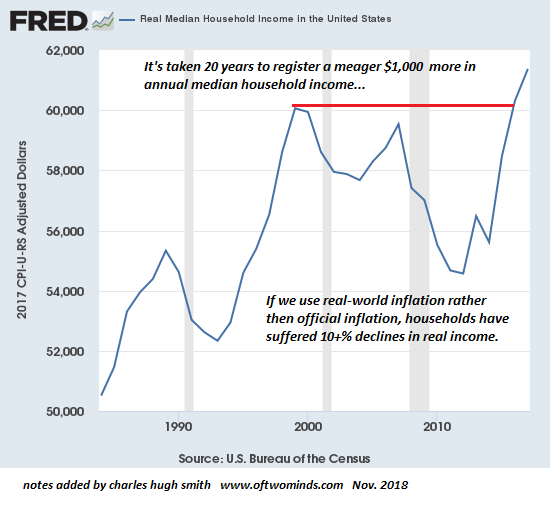
As the chart below shows, real median household income has only recently exceeded the 1998 level— and only by a meager $1,000 annually. If we use real-world inflation rather than the under-estimated official inflation, real income has plummeted by 10% or more in the past 20 years.

This reality is reflected in a new study of wages in Silicon Valley, which we might assume would keep up due to the higher value of the region’s output. The study found the wages of the bottom 90% declined when adjusted for inflation by as much as 14% over the past 20 years:

“The just-released report showed that wages for 90 percent of Silicon Valley workers (all levels of workers except for the top 10 percent)are lower now than they were 20 years ago, after adjusting for inflation. That’s in stark contrast to the 74 percent increase in overall per capita economic output in the Valley from 2001 to 2017.”

source: Why Silicon Valley Income Inequality Is Just a Preview of What’s to Come for the Rest of the U.S.

Meanwhile, the median house price has more than doubled to $325,000 while median household income has stagnated. Please note this price is not adjusted for inflation, like the median income chart. But if we take nominal household income in 1998 (around $40,000 annually) and compare it to nominal household income now in 2018 (around $60,000), that’s a 50% increase–far below the more than doubling of house prices.

To raise stagnant incomes, the Federal Reserve and other central banks have attempted to generate a wealth effect by boosting the valuations of risk-on assets such as stocks, bonds and commercial real estate. But the Fed et al. overlooked the fact that the vast majority of these assets are owned by the top 10%–and as noted above, the ownership of the top 10% is concentrated in the top 1% and .1%.

As a result, the vast majority of the wealth effect capital gains have flowed to the top 1%:

Lastly, the cartel structure of the U.S. economy has raised costs while providing no additional value. One example is higher education, a cartel that issues diplomas with diminishing economic value that now cost a fortune, a reality reflected in this chart of student loan debt, which simply didn’t exist a generation ago:

Our entire economy is characterized by cartel rentier skims, central-bank goosed asset bubbles and stagnating earned income for the bottom 90%. Given these realities, the bottom 90% are left with few pathways to get ahead in terms of financial security and building secure family wealth.


Reimagining the Middle Class

In her new book, Alissa Quart chronicles what happens when capitalism and families collide

By Ann Neumann

Source: The Baffler

AS THE ECONOMIC STATUS OF MANY in the United States has declined over the past several decades, journalists have often focused on the challenges faced by the working poor. In her new book, Squeezed: Why Our Families Can’t Afford America, Alissa Quart writes about how economic inequality has also drastically changed the middle class, destabilizing what was once considered a secure class and sending families into the tailspin of debt, overwork, underemployment, and precarious financial states. Squeezed demonstrates that inequality is not just a problem of those left behind in the lowest financial brackets, but a feature of our current economic system characterized by working professionals who are unable to pay for child care, declining job salaries, shifting work hours, and unaffordable housing. Families too often wrestle with “penalizing” factors, like women’s depressed salaries and unaffordable health care, making success unattainable for a formerly comfortable, educated, and skilled demographic of society.

The book challenges us to reimagine our prior understanding of what it means to be middle class, even as legislators champion “traditional values” that contradict the needs and responsibilities of families—and erode a safety net that once supported U.S. workers. Some of the factors that have upended the middle class are obvious—declining salaries, for instance—but others remain masked by corporate and social portrayal of them as a benefit to today’s workers. The gig economy, which, we’re told, gives workers young and old more flexibility and independence, turns out to be a contributor to what Quart calls the forever clock, a twenty-four-hour schedule that has usurped family and free time by keeping workers on constant call. Squeezed recounts the lives of the teachers who work second jobs, the professional mothers who struggle to pay for day care, the paralegals and adjuncts who have to moonlight to pay the rent, the well educated who never found a job in their intended profession that provides a livable salary. And the book causes us to ask why so many suffer in isolation, too ashamed to acknowledge their economic plight and too belabored to politically address it.

Quart is executive editor of the Economic Hardship Reporting Project, a nonprofit organization founded by Barbara Ehrenreich (a contributing editor for The Baffler) that supports journalism examining economic inequality, its causes and solutions (EHRP has funded my own work and that of others published at The Baffler). Quart is the author of four previous books: BrandedRepublic of OutsidersHothouse Kids, and the poetry book Monetized. She also co-writes, with Maia Szalavitz, a column for The Guardian titled “Outclassed.”

This month, Quart stopped by The Baffler office to talk to me about Squeezed. We’ve known each other for several years and I read the book in manuscript, so our conversation was casual, touching on individuals in the book, our own squeezed lives, how we can counter economic decline, and a necessary new definition of self-help.

Ann NeumannSqueezed straddles the Trump election and very often people on the left—and the right, to be honest—are using this as a clear demarcation. I think one of the things the book does really well is point out that the mechanisms in place that harm working class families have been long in coming.

Alissa Quart: The reason Sanders and Trump could tap into anger are the numbers of those economically squeezed; it’s what I was seeing anecdotally. And you can feel that. You can feel when you go sit in people’s living rooms, when you talk to them on the phone. I went to a conference called iRelaunch that was all about helping people to start their careers over and the room just rippled with shame and fear. And acidic humor.

AN: How did the election change this book project?

AQ: I think it gave it new urgency for me. Just as it gave urgency to the Economic Hardship Reporting Project, the organization I run. I think everyone in journalism felt like we have to tell these stories. The Trump effect has made me feel like I have to keep a laser focus on the things people are ignoring and try to find a way for readers to pay attention to them. We’re all focusing on Ivanka and whether she’s the c-word or not, which is fine, there are all kinds of things happening around us and in our own lives politically that have nothing directly to do with what Trump is tweeting, but the effects of his administration and long-term trends are real and we just need to keep looking.

We just published an article at EHRP about a journalist who lives in a $17 a night Airbnb, places below what you usually scroll to. But this person was a working journalist who was getting six-figure advances fifteen or twenty years ago. There are all these human examples that constantly show this decline. Fine, maybe the job numbers are up, but how many jobs are people working and are they jobs in the professions? Are they jobs that pay enough for people to live in cities? Or they’re working three different jobs which leads us to things like, as in this book, twenty-four-hour day care.

AN: Day care centers that are open twenty-four hours to accommodate parents with nontraditional work hours or multiple jobs.

AQ: And they are growing in number. I wrote a piece on this; I called it the dystopian social net. I feel like that’s part of my life’s work. I love dystopian fiction and science fiction, probably because it seems a few clicks away from the life we’re leading. It’s a markedly different life and childhood than the one you and I had. It may be horrible, or maybe not, but we’re seeing a palpable transformation in what childhood can be in the course of twenty years.

AN: And that’s really just the decline of income?

AQ: It’s people working different hours, it’s corporations using algorithms to find out what times of day are most profitable—when they’ll have the most foot traffic in retail, for instance—and demanding that employees work those times. It’s increasing nightwork. Nontraditional could mean 11 to 3 or it could mean working in the evening, or working in different jobs, hither and thither. That alone points to a huge transformation in things like time. A lot of the issues I address in the book are really about time, how we spend it. In the twenty-four-hour day care section I use the term the forever clock. But that’s true of the upper middle class too, they feel squeezed because they’re also on a forever clock. They’re working in IT, for instance, and they’re working unusual hours and they have the expectation that they should be better paid for it. 

AN: Your work has been focused on economic inequality for a long time.

AQ: Every single one of my books is in some way about economic inequality. I used to teach at Columbia J-school and I always told my students that every writer has a central question they spend their career trying to answer and your job is to find out what your question is. It’s like a parlor game. So I think mine is: what happens when the family—or childhood—hits capitalism? What are the deformations and the formations? I read so many nineteenth-century novels as a kid that I’m fascinated by that intersection. Naturalism is ascetically but also politically and intellectually appealing to me. I think I just like the texture of family, love, money, and how they all meet.

AN: That comes out in the writing of the book because, I’ll tell you, there are economics books that I have no interest in reading because they’re a slog, a data dump. You also coin terms that give us a way to think about worker’s plights. You just mentioned the forever clock but there’s also the middle precariat.

AQ: I was trying to explain the shift in the middle class as an imaginative category. The middle class used to equal solid, fixed, stable. Temporally it was about gratification later, but your life wasn’t miserable while you were waiting for it. It wasn’t like OK, total slog, but you’re going to get that pension. We have to now think of it as a shaken category, an unstable category, and that’s a big shift. When we visualize the middle class, we’re visualizing the white picket fence, like the blue sky on the cover of the book. But it’s really this truck being squeezed between two houses.

It’s an unsettled identity, and you can fall out of it, you can barely get into it, you certainly can’t rise above it very easily. Guy Standing coined the term precariat in 2011 to describe the proletariat, which is a Marxist way of understanding the working class, crossed with precariousness. And people get that. Every time they ride an Uber or they have a gig economy Task Rabbit person come to their house they’re like, OK, that’s the precariat. But I was seeing the same thing among paralegals or those who have law degrees but were still doing temporary work.

AN: Getting a law degree can be like selling your soul to the banks.

AQ: All these people are in debt. Some of it is because they went to for-profit colleges and those colleges were really expensive and they didn’t have a good rate of placement. Which can be traced to for-profit colleges and grad schools that have very little oversight—and are sometimes indeed federally funded. It can also be traced to fewer law jobs overall and too many people imagining that law is a secure profession. This is about reimagining. Once you can reimagine a profession, even if you choose to do it—you choose to be a journalist, you choose be a lawyer—we should understand that we’re choosing something unstable. Awareness is a huge part of survival and I guess part of what I want with this book is to increase awareness. This is your self-help: Don’t blame yourself. We have to come alive to this recognition. You can still do what you love, so long as you know what it can mean.

This is a personal journey for me too. When I was younger, as a freelancer, I had some recognition that journalism was starting to fragment. It was around 2006 or 2007—but it was before that too, the’90s. The word rates used to be consistent and for freelance writers those rates became lower or stayed the same while inflation rose. I remember talking to someone and they said, “just think about us as post modern.” Now you do lots of things, it’s a hustle here and a hustle there. That person was a boomer who had a steady job, who would get social security. I remember feeling an incredible resentment.

AN: So precarious employment has been described to us as a beautiful thing. We’re not chained to a factory job, we get to think and move around, but it doesn’t pan out.

AQ: I personally came from a middle class background. As I describe in the book, my parents were college professors, originally community college professors, and they could afford to send me to a private school. They didn’t have any inheritance or anything. That’s the sort of the world I thought I’d be living in. All of us, our generation, Generation X, had an idea of the world we thought we’d be living in. The generation after us has come to understand some of these things.

AN: That they’re fucked? So do you think this is a moment in capitalism, as we watch continued market decline over the next years, when we either do something about it or devolve into a disordered society?

AQ: Yes, I think so. But this book isn’t depressing because it points to some solutions—not in a pat way, but things that will work. It’s a way to think about what kind of family safety net, federal and local, we need to make sure people aren’t falling through. For instance, a few of the people I write about in the book are on food stamps and other kinds of support, but many of them are a little above that in terms of earning power and they can’t get help. There’s a labor organizer I spoke with who tries to lower her salary to be able to get some sort of subsidized day care, some sort of health insurance program. It’s that edge: people who are middle class in terms of education, but working class in terms of earning. They’re on the edge of being working poor and not being able to access any of those services. That’s most of the people in this book. Once we understand that they’re precarious we need to find a safety net for them.

AN: What this book does is lay out the many ways that people are hurting at the moment and it kind of gives a blueprint as to how precariousness could be addressed. Subsidized day care, for instance. I had no idea about how expensive child care is.

AQ: Child care can be 30 percent of many salaries. Or more. I think for us it was 30 percent of our take-home pay.

AN: How do people do it? In the book you show us. We spend a lot of time with individuals, we get a look at their lives and there’s a revelation for a reader to think, Oh, it’s not just me. There are things that I go without, there are resources that I don’t have access to, there are crises that I lose sleep over or pray will never come my way. There’s something about this book that brings this issue to light and I wonder if that was what you thought you’d get out of the stories? Is that why you used a storytelling approach?

AQ: That’s the chick lit, soap operatic part of me. And there is something of that in these stories. You think, What’s going to happen next? Sometimes I was surprised because they did have the messy amplitude of ordinary life. The people I write about aren’t just symbolic though. Some of them I followed for years.

AN: I think of the co-parenting section where you spend time with families who are trying to come up with creative solutions. In some cases, over time, things were better; in some cases they were worse. But readers still get the sense that nothing is fixed, no one really knows what’s working.

AQ: Or like the nanny who was separated from her son when I first met her and it was one kind of story. It became a story about them reunited, but then it became a story about school choice, and then it became a story about a mixed outcome at the end. She was actually happy, but I think the reader would want her to have a more middle class life given how hard she’s worked and all the effort she’s made to make the right choices.

AN: The anxiety of her life stayed with me. There are so many things that thwart her from getting ahead. She just needs the smallest break, trying to bring her son here, trying to find an affordable place to live. She’s doing everything right and she doesn’t deserve to go through this. That’s what comes out in the story. So when you were doing this reporting, did you get a sense of relief that we’re all going through this at the same time?

AQ: I definitely did. I felt relief. I say that this book is self-help because it makes you realize that it’s not your fault. And that’s how I see self-help. I see it as awareness, really granularly understanding all the ways that systems have made it impossible for you personally to overcome financial challenges—so that you’re no longer blaming yourself.

AN: Thank God someone’s redefining self-help.

AQ: [Laughs] But that’s it. How do you not feel stigmatized, how do you not feel isolated? So many of my friends feel ashamed that they can’t figure out the school system, can’t figure out how to own their home.

AN: The various penalties—for being a woman, for having children, for having debt—stack up. Shaming has abetted this erosion of rights and financial stability.

AQ: Time, day care scheduling, and other demands mean people can’t organize. They’re ashamed of where they are and so that becomes another debilitating factor. The adjunct in one chapter feels ashamed even though she knows politically she shouldn’t. There are people like the teachers who drive for Uber, who feel ashamed even though they know they shouldn’t. And it goes on and on. I don’t want to put it back on individuals, but the personal thing that people can do is start talking openly about their monetary situation. People are startled when you do that. It can erode social norms in a weird way, but I also think it’s important that people stop fronting with one another.

I write in one chapter about the 1 percent media, about the social media where people pretend to live in more expensive places than they do. I call them wealthies, not selfies. So it’s not your imagination when you’re in any of these circumstances and you see people in a sun dappled villa. People are representing themselves in this inflated way and then you feel terrible and isolated. There are so many ways in which the stigma, the isolation, around your class position gets underlined.

AN: Has it always been shameful to be poor?

AQ: Probably.

AN: It’s not a fair question!

AQ: But let’s be clear. A lot of these people are not poor. Most of the people in this book are earning between $45,000 and $125,000. Working class is $35,000. They’re not at the poverty level.

AN: So the shame then comes from not being able to make ends meet.

AQ: The shame comes from having debt for the education that you got in order to be middle class. The shame comes from not doing as well as your peers. The shame comes from not living up to your potential. The shame comes from not owning your home, defaulting on your mortgage. Not giving your kids as good a life as you had. I’m not writing about the working poor. I’m writing about the middle poor.

AN: We still operate under the myth that as a society we can continue to lift people into middle class and lift middle class into other class brackets. We no longer have any of that upward mobility. We cannot anticipate that our children will be better off.

AQ: No, we cannot anticipate that.

AN: But that’s still the American dream, isn’t it? And that American dream has been tied to, say, home ownership or a vehicle or not having debt.

AQ: In New York it’s like what school your kid goes to. What college your kid goes to.

AN: You use the word reimagining; it’s a word that I don’t hear often enough in politics, particularly not applied to class.

AQ: I mean reimagining what it means to be successful, reimagining what it means to be middle class. In a dream scape kind of way, like, This is what we would like to see in this country. But also reimagining middle class in its truth, what it actually means now? Let’s tear the veil and not just say, Oh, it means stability or security. It doesn’t.

Once We Awaken

By Rudy Avizius

Source: OpEdNews.com

Do you get a sense, that something is wrong
like that dissonance, that does not belong

As we move through the journey of life, many people are experiencing a sense of dis-ease, that something is off-kilter, that the narratives we are receiving do not match the reality we are experiencing. There is great hope in this knowledge because once one recognizes this dissonance the process of awakening begins.

Deep down way inside, you may have suspicions
that much what we’re told, are but veiled omissions

The narratives are controlled by a small handful of people who determine what issues and discussions we should be examining. As we watch the main stream news and follow social media, the news and discussions we see are mostly spectacle designed to boost ratings with little or no coverage of the real issues such as: our wars without end, corporate and big money control of government and media, or anything critical of the powers that be. Most of the journalists we see on the main stream media are basically celebrity faces who no longer practice journalism, but are simply parroting what those in power want them to say with little effort made to investigate and corroborate the stories. There is great hope in recognizing this knowledge, as it allows one to view the narratives more critically and to filter out what does not resonate with them.

Why do we listen, to those who would divide
those who leave us empty, with our humanity denied

  • Both of the main stream political parties support the Military/Industrial/Security Complex.
  • Both of the main stream political parties support the multiple simultaneous wars and occupations of other nations.
  • Both of the main stream political parties support a foreign policy of economic and military sanctions on nations that wish to pursue paths that do not fit interests of the global central banking system.
  • Both of the main stream political parties support their corporate donors over their constituents.
  • Both of the main stream political parties voted to extend the surveillance of citizens.
  • Both of the main stream political parties have made little or no attempt to stop the flood of big money into political campaigns.

However, the powers that be are very successful at projecting that there is a real difference between the two political parties. Both political parties are successful in getting people to fight each other over social issues that in the big picture are really not the key issues. Then, as long as the people are focused on fighting each other, those who orchestrated this fight enjoy the benefits of this effective diversion, keeping people from paying attention to the criminal syndicate that has taken over the government. There is great hope in recognizing this old divide and conquer tactic because once one does recognize it, one can stop fearing or hating “the other” and recognize that we have far more in common than what is dividing us. We can stop with name calling and finger pointing, and instead engage in meaningful conversations.

Why listen to those, with so little to tell
the very same ones who, have so much to sell

So many listen to the main stream media where sensationalism such as murders, car crashes, kidnappings, sex scandals and the like dominate the content. This is the same media where 90% of the media is owned by 6 corporations. One does not need a PhD to understand that this concentration of control over the narrative that people experience is not a positive development. Those that control the news keep the masses living in fear. This fear can take many forms, but often it is physical, economic, or social.

This is the same media that now has 36% of its hourly content filled with commercials. The fact that people are recognizing this is good news because they will become more discerning about who they give their money to. They will start to question whether they really need that product or service, or do they just want it.

Once we will awaken, things won’t be the same
we will manifest, an end to their game

Once we will awaken, the angels will observe
as those with dark souls, we’ll no longer serve

Our current political system has been totally corrupted by those with vast accumulations of money. This cuts across all ideologies and political party lines. This system of legal bribery has even been ratified by the highest court in the land which opened the floodgates to even more money corroding our system. How can someone represent you when they are being paid millions to represent others? What we need now goes beyond simple reforms and enters the realm of transformational change. Many articles and videos (mostly those in the alternative media space) connect these dots so that more and more people are becoming aware. This awareness or awakening is a critical step as it opens up the possibility for transformational change to take place.

The changes we are seeking will not take place from the top down, they will take place from the bottom up. Those who benefit from the current paradigm have little motivation to implement meaningful changes. Once we are ready to accept our own roles in this process, we will realize that what needs to happen is that we have to change ourselves. Once we stop playing their game of competing with each other, we will start cooperating instead. Local, self sufficient, and resilient communities will spring up like wild flowers in a field where they grow much of their own food, start their own currencies, and their citizens will stop buying from the big corporations, instead they will patronize their local businesses.

The current system of how we create and distribute money is at the very heart of most of the problems we face. It is absolutely amazing that people will work a significant portion of their lives away to earn money, and yet have only the most elementary understanding of how our debt based monetary system works. What does debt based monetary system mean? When was the last time your main stream media covered this? When was the last time your school taught you this? Why is this information withheld?

This debt based monetary system perpetuates and amplifies the inequalities of how Earth’s abundant resources are distributed. Our very existence on this planet is being threatened as unlimited economic growth within a finite biosphere remains the current paradigm. Until we move to a totally new monetary system, we are only hacking away at branches, and not getting to the root of the problem. There can be no effective transformation of our societies until this happens.

The models for a new monetary system are already in place. However the private individuals who have been given the monopoly power to create money and are benefiting from the current system will fight to make sure that knowledge of these systems does not spread widely. Those benefiting from the current system will work hard to make sure it stays firmly entrenched. When was the last time you heard a corporate media network discuss monetary reform?

Once we have local control of moneyfood productionenergy generation,and governance, the current paradigm of corporate and big money control of our systems will simply become obsolete. It will simply fade into oblivion as it becomes less and less relevant. There will be no need to confront the system. Once we awaken and change our ways, we will “manifest an end to their game”.

Those who sell their souls, for their daily bread
may not take the time, to think of what’s ahead

There have always been those who would sell their souls and use the excuse “it’s my job” to justify their actions. From those who tortured Jesus to more modern times with concentration camp guards to even more currently the mercenaries who were hired to confront those seeking to protect their water supplies from pipeline companies.

Think about this, these mercenaries are people who left the communities they pledged to “protect and serve” to answer a call to “protect and serve” corporate interests in another community, while these same corporate interests were placing local people’s water supplies at serious risk.

These mercenaries were the tip of the spear, there were many behind the scenes who acted as enablers for their behaviors. There were the corporate executives, prosecutors, judges, minor bureaucrats, and politicians without whose support, such injustices could never take place. Those who served helping these forces have “sold their souls for their daily bread.”

“It was my job” is not an acceptable response when it curtails the access of life sustaining necessities of fellow human beings.

It is very easy to develop an “I see nothing” attitude, or to allow oneself to be silenced by monetary gain by “playing along” with those who control and manipulate the system. It is time to witness, it is time to speak up, it is time to resist when you see injustice taking place.

Those that are insatiable, always seeking moar
ever quite so willing, to send others to war

Why do we accede, to their self served schemes
rather than just simply, following our dreams

Once we awaken we will no longer serve those who think only of themselves and their own self serving schemes. YOU can start making a huge difference by the way you spend YOUR money. Think about this, when you give your money to someone or some corporation, as you are transferring some of your your power to them. Is this really something you wish to do?

Do you shop at a local merchant or do you save that 35 cents by buying from Amazon? Do you give a percentage of every purchase to the big banks by using credit cards or do you pay in cash? Do you buy animal products humanely produced? Do you buy organic food or food produced using chemicals that threaten our ecosystem (and your health?) Do you bank at a “too big to fail bank” or a local community bank or Credit Union? Sometimes the lowest price or convenience is not the best buy and can carry an even higher unseen cost.

As we develop our own resilient local communities and economies, our dependencies on the corporate model will be reduced, weakening their tight grip on us. Mother Teresa once said “I alone cannot change the world, but I can cast a stone across the waters to create many ripples.”

Once we will awaken, we will clearly see
many of the others, who’ve also broken free

This is the best part of the awakening process. It is easy to think that the problems we face are overwhelming and that nothing can be done. The powers that be want us to think that way. Yet as we awaken, it becomes very clear that there are so many more of us that feel this same way than we originally believed. Once we awaken we become aware of others who have broken free. It is very empowering once we realize we are not alone. A critical mass is forming. It turns out that it takes only 10% of a population to bring about real changes.

We live in a world of abundance. There is enough air, water, and food for every person, animal, and plant on the planet. We have the resources and ability to make our existence here a paradise, to continue to develop socially, intellectually, emotionally, and spiritually. It is within our power to create a true golden age on this blue oasis floating through space and attain wondrous levels of development on a personal, family, community, regional, and global level while creating this paradise.

For Economic Truth Turn To Michael Hudson

By Paul Craig Roberts

Source: PaulCraigRoberts.org

Readers ask me how they can learn economics, what books to read, what university economics departments to trust. I receive so many requests that it is impossible to reply individually. Here is my answer.

There is only one way to learn economics, and that is to read Michael Hudson’s books. It is not an easy task. You will need a glossary of terms. In some of Hudson’s books, if memory serves, he provides a glossary, and his recent book “J Is for Junk Economics” defines the classical economic terms that he uses. You will also need patience, because Hudson sometimes forgets in his explanations that the rest of us don’t know what he knows.

The economics taught today is known as neoliberal. This economics differs fundamentally from classical economics that Hudson represents. For example, classical economics stresses taxing economic rent instead of labor and real investment, while neo-liberal economics does the opposite.

An economic rent is unearned income that accrues to an owner from an increase in value that he did nothing to produce. For example, a new road is built at public expense that opens land to development and raises its value, or a transportation system is constructed in a city that raises the value of nearby properties. These increases in values are economic rents. Classical economists would tax away the increase in values in order to pay for the road or transportation system.

Neoliberal economists redefined all income as earned. This enables the financial system to capitalize economic rents into mortgages that pay interest. The higher property values created by the road or transportation system boost the mortgage value of the properties. The financialization of the economy is the process of drawing income away from the purchases of goods and services into interest and fees to financial entities such as banks. Indebtedness and debt accumulate, drawing more income into their service until there is no purchasing power left to drive the economy.

For example, formerly in the US lenders would provide a home mortgage whose service required up to 25% of the family’s monthly income. That left 75% of the family’s income for other purchases. Today lenders will provide mortgages that eat up half of the monthly income in mortgage service, leaving only 50% of family income for other purchases. In other words, a financialized economy is one that diverts purchasing power away from productive enterprise into debt service.

Hudson shows that international trade and foreign debt also comprise a financialization process, only this time a country’s entire resources are capitalized into a mortgage. The West sells a country a development plan and a loan to pay for it. When the debt cannot be serviced, the country is forced to impose austerity on the population by cutbacks in education, health care, public support systems, and government employment and also to privatize public assets such as mineral rights, land, water systems and ports in order to raise the capital with which to pay off the loan. Effectively, the country passes into foreign ownership. This now happens even to European Community members such as Greece and Portugal.

Another defect of neoliberal economics is the doctrine’s denial that resources are finite and their exhaustion a heavy cost not born by those who exploit the resources. Many local and regional civilizations have collapsed from exhaustion of the surrounding resources. Entire books have been written about this, but it is not part of neoliberal economics. Supplement study of Hudson with study of ecological economists such as Herman Daly.

The neglect of external costs is a crippling failure of neoliberal economics. An external cost is a cost imposed on a party that does not share in the income from the activity that creates the cost. I recently wrote about the external costs of real estate speculators. https://www.paulcraigroberts.org/2018/04/26/capitalism-works-capitalists/ Fracking, mining, oil and gas exploration, pipelines, industries, manufacturing, waste disposal, and so on have heavy external costs associated with the activities.

Neoliberal economists treat external costs as a non-problem, because they theorize that the costs can be compensated, but they seldom are. Oil spills result in companies having to pay cleanup costs and compensation to those who suffered economically from the oil spill, but most external costs go unaddressed. If external costs had to be compensated, in many cases the costs would exceed the value of the projects. How, for example, do you compensate for a polluted river? If you think that is hard, how would the short-sighted destroyers of the Amazon rain forest go about compensating the rest of the world for the destruction of species and for the destructive climate changes that they are setting in motion? Herman Daly has pointed out that as Gross Domestic Product accounting does not take account of external costs and resource exhaustion, we have no idea if the value of output is greater than all of the costs associated with its production. The Soviet economy collapsed, because the value of outputs was less than the value of inputs.

Supply-side economics, with which I am associated, is not an alternative theory to neoliberal economics. Supply-side economics is a successful correction to neoliberal macroeconomic management. Keynesian demand management resulted in stagflation and worsening Phillips Curve trade-offs between employment and inflation. Supply-side economics cured stagflation by reversing the economic policy mix. I have told this story many times. You can find a concise explanation in my short book, “The Failure of Laissez Faire Capitalsim.” This book also offers insights into other failures of neoliberal economics and for that reason would serve as a background introduction to Hudson’s books.

I can make some suggestions, but the order in which you read Michael Hudson is up to you. “J is for Junk Economics” is a way to get information in short passages that will make you familiar with the terms of classical economic analysis. “Killing the Host” and “The Bubble and Beyond” will explain how an economy run to maximize debt is an economy that is self-destructing. “Super Imperialism” and “Trade, Development and Foreign Debt” will show you how dominant countries concentrate world economic power in their hands. “Debt and Economic Renewal in the Ancient Near East” is the story of how ancient economies dying from excessive debt renewed their lease on life via debt forgiveness.

Once you learn Hudson, you will know real economics, not the junk economics marketed by Nobel prize winners in economics, university economic departments, and Wall Street economists. Neoliberal economics is a shield for financialization, resource exhaustion, external costs, and capitalist exploitation.

Neoliberal economics is the world’s reigning economics. Russia is suffering much more from neoliberal economics than from Washington’s economic sanctions. China herself is overrun with US trained neoliberal economists whose policy advice is almost certain to put China on the same path to failure as all other neoliberal economies.

It is probably impossible to change anything for two main reasons. One is that so many greed-driven private economic activities are protected by neoliberal economics. So many exploitative institutions and laws are in place that to overturn them would require a more thorough revolution than Lenin’s. The other is that economists have their entire human capital invested in neoliberal economics. There is scant chance that they are going to start over with study of the classical economists.

Neoliberal economics is an essential part of The Matrix, the false reality in which Americans and Europeans live. Neoliberal economics permits an endless number of economic lies. For example, the US is said to be in a long economic recovery that began in June 2009, but the labor force participation rate has fallen continuously throughout the period of alleged recovery. In previous recoveries the participation rate has risen as people enter the work force to take advantage of the new jobs.

In April the unemployment rate is claimed to have fallen to 3.9 percent, but the participation rate fell also. Neoliberal economists explain away the contradiction by claiming that the falling participation rate is due to the retirement of the baby boom generation, but BLS jobs statistics indicate that those 55 and older account for a large percentage of the new jobs during the alleged recovery. This is the age class of people forced into the part time jobs available by the absence of interest income on their retirement savings. What is really happening is that the unemployment rate does not include discouraged workers, who have given up searching for jobs as there are none to be found. The true measure of the unemployment rate is the decline in the labor force participation rate, not a 3.9 percent rate concocted by not counting those millions of Americans who cannot find jobs. If the unemployment rate really was 3.9 percent, there would be labor shortages and rising wages, but wages are stagnant. These anomalies pass without comment from neoliberal economists.

The long expansion since June 2009 might simply be a statistical artifact due to the under-measurement of inflation, which inflates the GDP figure. Inflation is under-estimated, because goods and services that rise in price are taken out of the index and less costly substitutes are put in their place and because price increases are explained away as quality improvements. In other words, statistical manipulation produces the favorable picture required by The Matrix.

Since the financial collapse caused by the repeal of Glass-Steagall and by financial deregulation, the Federal Reserve has robbed tens of millions of American savers by driving real interest rates down to zero for the sole purpose of saving the “banks too big to fail” that financial deregulation created. A handful of banks has been provided with free money—in addition to the money that the Federal Reserve created in order to take the banks’ bad derivative investments off their hands—to put on deposit with the Fed from which to collect interest payments and with which to speculate and to drive up stock prices.

In other words, for a decade the economic policy of the United States has been run for the benefit of a few highly concentrated financial interests at the expense of the American people. The economic policy of the United States has been used to create economic rents for the mega-rich.

Neoliberal economists point out that during the 1950s the labor force participation rate was much lower than today and, thereby, they imply that the higher rates prior to the current “recovery” are an anomaly. Neoliberal economists have no historical knowledge as the past is of no interest to them. They do not even know the history of economic thought. Whether from ignorance or intentional deception, neoliberal economists ignore that the lower labor force participation rates of the 1950s reflect a time when married women were at home, not in the work force. In those halcyon days, one earner was all it took to sustain a family. I remember the days when the function of a married woman was to provide household services for the family.

But capitalists were not content to exploit only one member of a family. They wanted more, and by using economic policy to suppress pay while fomenting inflation, they drove married women into the work force, imposing huge external costs on the family, child-raising, relations between spouses, and on the children themselves. The divorce rate has exploded to 50 percent and single-parent households are common in America.

In effect, unleashed Capitalism has destroyed America. Privatization is now eating away Europe. Russia is on the same track as a result of its neoliberal brainwashing by American economists. China’s love of success and money could doom this rising Asian giant as well if the government opens China to foreign finance capital and privatizes public assets that end up in foreign hands.

America’s Debt Dependence Makes It An Easy Economic Target

By Brandon Smith

Source: Alt-Market.com

There is a classic denial tactic that many people use when confronted with negative facts about a subject they have a personal attachment to; I would call it “deferral denial” — or a psychological postponing of reality.

For example, point out the fundamentals on the U.S. economy such as the fact that unemployment is not below 4% as official numbers suggest, but actually closer to 20% when you factor in U-6 measurements including the record 96 million people not counted because they have run out of unemployment benefits. Or point out that true consumer inflation in the U.S. is not around 3% as the Federal Reserve and the Bureau of Labor Statistics claims, but closer to 10% according to the way CPI used to be calculated before the government started rigging the numbers.  For a large part of the public including a lot of economic analysts, there is perhaps a momentary acceptance of the danger, but then an immediate deferral — “Well, maybe things will get worse down the road, 10 or 20 years from now, but it’s not that bad today…”

This is cognitive dissonance at its finest. The economy is in steep decline now, but the mind in denial says “it could be worse,” and this is how you get entire populations caught completely off guard by a financial crash. They could have easily seen the signs, but they desperately wanted to believe that all bad things happen in some illusory future, not today.

There is also another denial tactic I see often in the world of politics and economics, which is what I call “paying it backward.” This is what people do when they have a biased attachment to a person or institution and refuse to see the terrible implications of their actions. For example, when we point out that someone like Donald Trump makes destructive decisions, such as the continued support of Israel and Saudi Arabia in Syria and Yemen, or the reinstatement of funding for the White Helmets in Syria who are tied to ISIS, Trump supporters will often say “Well what about Obama?”

This is a game of shifting accountability. Is one person worse than the other? Possibly. I say give it time and make notes. However, the negative decisions of one politician we don’t like do not diminish the negative decisions of another politician we might like. They should BOTH be held accountable.

The same goes for countries and economies. When an analyst points out that U.S. debt is at historic highs and is utterly unsustainable, people in denial will say “but what about China or Europe?” One does not negate the other and, of course, there are differences that make the situation in the U.S. far more tenuous.

Primarily I am talking about America’s endless dependency on the world reserve status of the U.S. dollar and, beyond that, the steady expansion of debt at low interest rates for the past decade.

The Federal Reserve, once the No. 1 buyer of U.S. debt, has essentially declared it is cutting off support and has begun dumping assets from its balance sheet. The only assets the Fed seems to be maintaining are Mortgage Backed Securities (MBS). All others are being cut, including Treasuries. The American economy is inexorably attached to the idea of our Treasury debt as a safe investment, with our national debt spiking above $21 trillion and many trillions more owed to entitlement programs depending on how you calculate the expenditures, there is a vital need for steady foreign investment in U.S. debt.

But what happens when investment in U.S. debt becomes politically unsavory? Consider the current escalation of the trade war; Many pro-dollar talking heads and cheerleaders have argued in the past that no nation has the guts to dump dollar denominated assets and risk the wrath of American “economic might.” But, already we have seen Russia dump half its U.S. Treasury holdings in a single month and the trade war has only just begun.

Is Russia’s action a sign of things to come? Will other nations like China follow the same strategy? We will have to wait and see, but I believe this is the inevitable outcome of the trade war if it drags on for the rest of the year.

America’s dependent nature, feeding off of foreign investment to support its debts, is a disaster waiting to happen. The concept of economic “recovery” is laughable until this issue is addressed.  And, entering into a trade war while ignoring this blaring weakness is foolish, to say the least.

Beyond the issue of government (taxpayer) debt, let’s not forget about American corporations and consumers. U.S. corporate debt as a percentage of gross domestic product is at historic highs not seen since the housing bubble of 2008 or the dot-com bubble of 2001. There is a distinct difference, though, that makes today’s bubble far more insidious. After years of near-zero interest rates, corporations have become addicted to cheap debt. So much so that they have been borrowing nonstop to support their own stock prices through stock buyback manipulation. But now the Fed is raising interest rates and has committed to expanded hikes in the future.

So, what will corporations do as the cheap debt dries up? Thus far, they are spending the majority of their Trump tax cut still trying to artificially prop up stock process. When this money runs out (and I believe it will much faster than the mainstream thinks), the existing debt of these companies will cost much more to finance, and future borrowing at the same pace will become impossible. This is a threat that is developing now, not in some far-off future.

Eventually, corporations will have to make deep spending cuts rather than borrow. This means mass layoffs, store closures and potential cuts to pensions. And, of course, no more stock buybacks, meaning a market crash will ensue.

What about the U.S. consumer? U.S. consumer debt is set to reach new highs by the end of the year; around $4 trillion by official estimates.  While discussion continues about the alleged “labor shortage” in the U.S., one thing is clear — the jobs that do exist do NOT pay wages that keep up with true inflation. When we see spikes in retail sales in the U.S. and this is applauded as economy recovery, very few mainstream analysts point out that higher retail sales are merely tracking higher inflation.

That is to say, consumers are spending more money on less stuff. Again, this is unsustainable, which is why consumer debt is exploding. Dependency on credit cards and loans is being used by the public to offset much higher costs. But as the Fed raises interest rates, this too will end. Higher Fed rates translate to higher credit rates as well as higher mortgage rates (indirectly). With higher interest payments comes a large drop in overall spending.

As you can see, there are at least two forces at work here that will end all talk of U.S. recovery and which undermine any notion of economic strength — the first is the trade war, which I believe is a massive distraction designed to draw attention away from the actions of international banks and central banks. The second is the Federal Reserve, which has addicted the country to cheap fiat and is now flushing the drugs. We cannot delude ourselves into thinking that this trend will remain slow or that it will not develop into a crash in the near term. We also cannot simply deflect to other countries like China or those in Europe as if their problems are somehow worse and therefore ours are not a concern.

The fact that the health of the US economy is inexorably reliant on the continued foreign demand for the dollar and Treasury debt means any reduction of the dollar’s world reserve status or petro-status, or any decline in treasury purchases, will directly affect the carefully crafted image of America as a stable system.  Without a sudden and aggressive resurgence of domestic production and innovation America has no safety net in the event that our debt addiction is used against us.

The argument that the central bank can jump in at any time to monetize that debt and reduce the danger is also delusional.  This assumes first and foremost that the Fed WANTS to reduce the danger.  I believe they want the danger to increase, not decrease.  Debt monetization also has the added bonus of causing even more inflation as foreign investors dump their dollar denominated assets back into the US.  Monetization is a poison, not a cure.

The crisis is here, now. Seeing and accepting it allows us to prepare accordingly. Denying it as inconsequential sets people up as victims of their own bias and ignorance.

Another Reason Young Americans Don’t Revolt Against Being Screwed

By

Source: CounterPunch

8 Reasons Young Americans Don’t Fight Back: How the US Crushed Youth Resistance” was originally published in 2011, then republished on several Internet sites, and has become one of my most viewed articles. The eight reasons include: student-loan debt; various pacifying effects of standard schooling; the psychopathologizing and medicating of noncompliance; surveillance; television; and fundamentalist religion and fundamentalist consumerism. Over the last seven years, many young people have told me that they appreciate that article, but they have urged me to detail a hugely important pacifying source which I had not included.

First, to be clear, not all young people are completely broken. The general state of acquiescence by young people was recently interrupted by their short-lived burst of dissent in the form of large rallies for gun control, in reaction to fears of being murdered in their classrooms. But that was an exception to the general rule of resignation to eating shit.

A longer period of dissent occurred during Occupy, in which many young people protested against their financial subjugation by the 1%. However, one lesson that young people learned from Occupy is that their rulers only pay lip service to democracy—and so mere dissent has little impact. Young people today are correct to recognize the impotence of mere dissent if it is unaccompanied by a withdrawal of cooperation with the ruling class’s capacity to turn a profit. But because young people have been broken in so many ways, decreasing numbers of them have the individual strength, class consciousness, and group cohesiveness that is required to move beyond dissent to the kind of constructive disobedience (for example, a labor strike) that can create greater justice for them.

It’s not that young people in the United States are ignorant of the reality that they are being financially screwed; they know they have been screwed, they expect to be screwed even worse, and most of them passively accept this reality.

Young people are not ignorant of their increasingly crippling student-loan debt. At last look, 70% of college students graduate with significant debt; the average student-loan debt at $37,172, and the average monthly payment at $393 (and this doesn’t include their credit card debt). Add this to the reality that many young people with student-loan debt never even graduate college; and even among those who do graduate, many of them find only low-paying jobs.

The majority of young people feel so beaten down that they have also passively accepted that they will get screwed out of Social Security benefits. A 2015 Gallup poll asked “Do you think the Social Security system will be able to pay you a benefit when you retire?” Among those 18 to 29 years of age, 64% said no. Yet, most are resigned to having money deducted from their paychecks for benefits that they believe they will never receive.

Since my 2011 article was published, many millennials have informed me that they are being broken by something that I hadn’t originally included: the Internet, which many of them tell me is the most important aspect of their lives. From these young people, I have learned how the Internet creates fears, lowers self-esteem, and divides them—all of which weakens their capacity to resist injustices.

Fear is a great way to break people, and the Internet—similar to other areas that I had previously detailed—creates fear. Facebook, Twitter, Instagram, Tumblr, Snapchat, and other so-called “social media” create the fear of permanent shame and shunning. Millennials repeatedly see how a single error in judgment on social media will not be forgotten and can haunt forever—and destroy lives. While many young students voice concern about a shooting in their school, my experience is that they are more viscerally terrified of something being posted on social media by them or about them that can damage their attractiveness to their peers or to future employers. For young people, denial over their life being ruined on social media is impossible—most never unplug from it.

The Internet heightens a fear-based consciousness. People have different private fears and, as George Orwell detailed, their greatest fears can be exploited to break them. For many young people, their greatest fear is being “doxxed”—having private information about them published on the Internet so as to hurt them. For other young people, their greatest fear is “FoMo”—the fear of missing out—which is intensified on social media where they are constantly bombarded with images of others doing “cool” stuff. One young woman recently told me, “You don’t know how crazy we are. I saw a party on Instagram that looked really cool, and I had FoMo over it, even though I know the guy who posted it always makes parties look cooler than they really are.”

Many young people tell me that the constant barrage of their peers’ self-promotions on social media makes them feel inferior; and low self-esteem—like fear—debilitates the strength to resist. One young man recently explained to me that millennials are always aware of their “digital selves” which can be measured in metrics such as “likes”; and that comparing themselves to others routinely results in low self-esteem. Of course, some young people do attempt rebellion, but effective rebellion, they tell me, requires completely extricating from social media, which would be an extremely radical action.

Not only does the Internet create fear and low self-esteem but also divides, which of course allows the 1% to more easily conquer the 99%. The Gilded Age robber barron Jay Gould reportedly bragged, “I can hire one half of the working class to kill the other half.” Millenials have educated me on the various divides among the 99% that have been created and perpetuated on the Internet.

Every millennial young man tells be about the Internet war between “social justice warriors” and “red pillers.” Young people who care about justice for historically oppressed groups (such as women, people of color, and LGBT folks) are mocked as social justice warriors by those who call themselves red pillers who feel that, today, white males are the oppressed group. In an Internet world absent of face-to-face contact, there is only mutual venom. Absent is a mutual grasping that each side is in the 99%, that each side cares about injustice, and that the financial hell for all of them has been created by the 1%—not by each other.

Screen addiction subverts the in-person contact necessary for face-to-face dialogue and solidarity, and the Internet is even more addictive than television, as young people are virtually never away from their smart phones, laptops, or other screens. Walk into any coffee shop, and you’ll often see many young people in close proximity with one another but locked into their own screens and not looking at each other.

Several of my millennial young male informants tell me that they are afraid to risk face-to-face contact, afraid to be seen as violating a woman’s privacy, afraid to be viewed as a creep. I joked with one young guy, “Are you afraid that if you walk over to some pretty young woman in a coffee shop and tell her that you like her shoes, then you’ll be accused of ‘rape-staring’ and have your life ruined on the Internet, and end up being falsely labeled all over the Internet as a sex offender?” The young man laughed and said, “I know that you are exaggerating, but that’s the kind of shit that many of us millennial guys think about, as we have become pathetic.”

Having young men and young women in the 99% being afraid of one another may be even more of a coup for the 1% than their historical successes at getting ethnic and racial groups to hate one another. With this fear and hate among the 99%, it is impossible to have the solidarity and strength necessary to effectively revolt in an organized way against the 1%.

The Internet technology need not necessarily be a pacifying force as, for example, the Internet was effectively utilized during the Arab spring to foment rebellion and organize resistance. Similarly, some of the other pacifying forces that I originally detailed need not be pacifying. Teachers could inspire resistance against illegitimate authorities rather than indoctrinate compliance to any and all authorities. And my fellow mental health professionals could embrace liberation psychology rather than pathologize and medicate rebellion.

My experience is that young people, in general, are becoming increasingly pained and weakened by multiple oppressive forces, and older people who give a damn about them can help. The 1% will always attempt to seize powerful technologies and institutions to pacify all of us—especially young people. To manage these technologies and institutions, the 1% needs technocrats, administrators, and guards; thus, what would help is what Howard Zinn called a “revolt of the guards.” However, if technicians, teachers, mental health professionals, and other guards never even admit to ourselves our societal role—as guards who maintain the status quo—then we guards will never consider a revolt. Many older people are guards, and they can choose to revolt and help young people gain the strength necessary to resist injustices.


Bruce E. Levine, a practicing clinical psychologist often at odds with the mainstream of his profession, writes and speaks about how society, culture, politics and psychology intersect. His most recent book is Resisting Illegitimate Authority: A Thinking Person’s Guide to Being an Anti-Authoritarian―Strategies, Tools, and Models(AK Press, September, 2018). His Web site is brucelevine.net

Why America is the World’s First Poor Rich Country

Or, How American Collapse is Made of a New Kind of Poverty

By Umair Haque

Source: Eudaimonia

Consider the following statistics. The average American can’t scrape together $500 for an emergency. A third of Americans can’t afford food, shelter, and healthcare. Healthcare for a family now costs $28k — about half of median income, which is $60k.

By themselves, of course, statistics say little. But together these facts speak volumes. The story they are beginning to tell is this.

America, it seems, is becoming something like the world’s first poor rich country. And that is the elephant in the room we aren’t quite grasping. After all, authoritarianism and extremism don’t arise in prosperous societies — but in troubled ones, which are growing impoverished, like America is today. What do I mean by all that?

Let’s begin with what I don’t mean. I don’t mean absolute poverty. Americans are not living on a few dollars a day, by and large, like people in, for example, Somalia or Bangladesh. America’s median income is still that of a rich country, around $50k, depending on how it’s counted. Nor do I really mean relative poverty — people living below median income. While that’s a growing problem in America, because the middle class is imploding, that is not really the true problem these numbers hint at, either.

America appears to be pioneering a new kind of poverty altogether. One for which we do not yet have a name. It is something like living at the knife’s edge, constantly being on the brink of ruin, one small step away from catastrophe and disaster, ever at the risk of falling through the cracks. It has two components — massive inflation for the basics of life, coupled with crushing, asymmetrical risk. I’ll come to what those mean shortly.

The average American has a relatively high income, that of a person in a nominally rich country. Only his income does not go very far. Most of it is eaten up by attempting to afford the basics of life. We’ve already seen how steep healthcare costs are. But then there is education. There is transport. There is interest and rent. There is media and communications. There is childcare and elderly care. All these things reduce the average American to constantly living right at the edge of ruin — one paycheck away from penury, one emergency away from losing it all.

But this isn’t true for America’s peers. In Europe, Canada, and even Australia, society invests in all these things — and the costs of basic necessities societies don’t provide are regulated. For example, I pay $50 dollars for broadband and TV in London — but $200 for the same thing in New York — yet in London, I get vastly more and better media for my money (even including, yes, American junk like Ancient Aliens). That’s regulation at work. And when basic goods like healthcare or elderly care or education are provided and managed at a social scale, that is when they are cheapest, and often of the best quality, too. Hence, healthcare costs far less in London, Paris, or Geneva — and life expectancy is longer, too.

So if you are earning $50k in America, it is a very different thing than earning $50k in France, Germany, or Sweden — in America, you must pay steeply for the basics of life, for basic necessities. Thus, incomes stretch much further in other countries, which enjoy a vastly higher quality of life, even though people there earn roughly the same amount, because they pay vastly less for basic necessities. Americans are rich, but only nominally — their money doesn’t buy nearly as much as their peers does, where it matters and counts most, for the basics of life.

What happens when societies don’t understand all the above? Well, a strange thing has happened to the American economy. While it’s true that things like TVs and Playstations have gotten cheaper, the costs of the basics of life have skyrocketed. All the things that really elevate people’s quality of life — healthcare, finance, education, transport, housing, and so on — have come to consume such a large share of the average household’s income that they have little left to save, invest, or spend on anything else. And what’s worse, while the basics of life have seen massive inflation, wages and incomes (not to mention savings and benefits and safety nets and opportunities) for most have stagnated. The result is an economy — and a society — that’s collapsing.

Yet all that is the straightforward effect of giving, for example, hedge funds control over drugs, or speculators control over housing, healthcare, and education — they will of course maximize profits, whereas investing in these things socially, or at least regulating them, minimizes real costs, and maximizes accessibility, affordability, and quality.

So the average American, who is left high and dry, must borrow, borrow, borrow, just to maintain a decent quality of life — because handing capitalism control of the basics of life has caused massive, skyrocketing inflation in necessities, while flatlining his income. Healthcare didn’t used to cost half of median income even a decade ago, after all — but now it does. So what happens when, in a decade or two, healthcare costs all of median income? How can an economy — let alone a society — function that way?

Well, what happens if the average American steps over the line? Misses a mortgage payment, gets ill and is unable to pay a few bills on time, can’t pay the costs of healthcare? Then they are punished severely and mercilessly. Their “credit rating” (note how banks and hedge funds don’t have them) is ruined. They can easily find themselves out on the street, without finance, without a second chance, without access to any kind of redress or support . And then they are rejected, shunned, and ostracized. They might not have an address anymore — so who will hire them? They are no longer a part of society — they have fallen through the cracks, and finding one’s way back is often next to impossible. Asymmetrical risk — corporations and lobbies and banks bear no risk at all, precisely because the average American bears them all now.

So Americans aren’t just absolutely or relatively poor, but poor in a new way entirely. First, the basics of life exploded in price, to the point that they are now unaffordable for many, maybe most, households. Second, Americans bear the risks of paying those unaffordable costs to an extreme degree, bearing the risks that institutions should, and so those risks are now ruinously high. A bank or hedge fund or corporation might go bankrupt, and liquidate its assets, and its owners stay rich — but if an American’s credit rating is ruined, loses his job, cannot pay his bills, or even if he declares bankruptcy, he falls through the cracks, hounded, embattled, institutionally black-marked. He finds himself outside society, with little way to get back in. Little wonder then that Americans work so much harder than anywhere else — they are always one step away from losing it all, from genuine ruin, but their peers in truly rich countries aren’t.

Marx probably would have called this immiseration. Neo-Marxist theorists call it precarity. And while there’s truth in both those ideas and perspectives, I think they miss three vital points.

We don’t see America as a poor country, but we should begin to. Americans live fairly abysmal lives — short, lonely, unhappy, full of work and stress and despair, compared to their peers. That is because they cannot afford better ones — predatory capitalism coupled with total economic mismanagement of social investments has made the basics of life ruinously unaffordable. In this way, it’s effectively a poor country — yes, there’s a tiny number of ultra-rich, but they are outliers now, off the map of the normal. Because it’s not just any kind of poverty, yesterday’s poverty, or even poverty as we are used to thinking about it.

America is pioneering a new kind of poverty. The kind of poverty that’s developed in America isn’t just bizarre and gruesome — it’s novel and unseen. It isn’t something that we understand well, economists, intellectuals, thinkers, because we have no good framework to think about it. It’s not absolute poverty like Somalia, and it’s not just relative poverty, like in gilded banana republics. It’s a uniquely American creation. It’s extreme capitalism meets Social Darwinism by way of rugged self-reliance crossed with puritanical cruelty.

The kind of poverty America’s pioneering today isn’t absolute, or even relative , but something more like perfectly tuned poverty, strategic poverty, basic poverty— nominally well-off people whose money doesn’t go far enough to make them actually live well, constantly living at the edge of ruin, and thus forced to choke down their bitter anger and serve the very systems which oppress and subjugate with more and more indignity and fear and servility by the year.

America’s still an innovator today. Unfortunately, what it’s innovating now is a new kind of poverty. Yet poverty is poverty. What happens in societies where poverty is growing? Authoritarianism rises, as people lose faith in democracy, which can’t seem to offer them working social contracts. Authoritarian soon enough becomes fascism — “this country, this land, its harvest — it is only for the true volk!”, the cry goes up, when there is not enough to go around. And the rest of the dark and grim story of the fall into the abyss you should know well enough by now. It ends in words we do not say.

Still, history, laughing, has told this tale to us many times. And it is telling it to tomorrow, again, in the tale of American collapse.