Billionaires, Bunkers and Brain Damage

“The rich are not like us”

By Mickey Z.

Source: Dissident Voice

Douglas Rushkoff has an article (based on his latest book) called “The super-rich ‘preppers’ planning to save themselves from the apocalypse,” in The Observer.

This excerpt gives you an idea of how the barbaric brain of a billionaire operates:

Finally, the CEO of a brokerage house explained that he had nearly completed building his own underground bunker system, and asked: “How do I maintain authority over my security force after the event?” The event. That was their euphemism for the environmental collapse, social unrest, nuclear explosion, solar storm, unstoppable virus, or malicious computer hack that takes everything down.

This single question occupied us for the rest of the hour. They knew armed guards would be required to protect their compounds from raiders as well as angry mobs. One had already secured a dozen Navy Seals to make their way to his compound if he gave them the right cue. But how would he pay the guards once even his crypto was worthless? What would stop the guards from eventually choosing their own leader?

The billionaires considered using special combination locks on the food supply that only they knew. Or making guards wear disciplinary collars of some kind in return for their survival. Or maybe building robots to serve as guards and workers – if that technology could be developed “in time.” It’s as if they want to build a car that goes fast enough to escape from its own exhaust

I tried to reason with them. I made pro-social arguments for partnership and solidarity as the best approaches to our collective, long-term challenges. The way to get your guards to exhibit loyalty in the future was to treat them like friends right now, I explained. Don’t just invest in ammo and electric fences, invest in people and relationships. They rolled their eyes at what must have sounded to them like hippy philosophy.

After reading that, you may be wondering if the rich are brain-damaged. To which I reply: Why weren’t you thinking that all along and yes, they are brain-damaged. Some studies to consider:

There’s plenty more where that came from but, of course, all such “research” must be viewed with healthy skepticism. Personally, since I’m justifiably wary of “studies,” I’ll just look around to see — with my own three eyes — how the wealthiest humans on the planet have behaved since, well… forever.

Or consider the words of the immortal Dorothy Parker: “If you want to know what God thinks of money, just look at the people he gave it to.”

Translation: The billionaires are not going to save you — or ever help you. They’re running scared to get their brain-damaged butts into bunkers.

So, connect with your peers. Connect across “party” lines and ideological hive minds. Toss away your purity litmus tests and find common ground.

What will save us is what always saves us: community, resilience, compassion, open-mindedness, innovation, and imagination.

The Gaslighting of the Masses

By CJ Hopkins

Source: Off-Guardian

For students of official propaganda, mind control, emotional coercion, and other insidious manipulation techniques, the rollout of the New Normal has been a bonanza. Never before have we been able to observe the application and effects of these powerful technologies in real-time on such a massive scale.

In a little over two and a half years, our collective “reality” has been radically revised. Our societies have been radically restructured. Millions (probably billions) of people have been systematically conditioned to believe a variety of patently ridiculous assertions, assertions based on absolutely nothing, repeatedly disproved by widely available evidence, but which have nevertheless attained the status of facts. An entire fictitious history has been written based on those baseless and ridiculous assertions. It will not be unwritten easily or quickly.

I am not going to waste your time debunking those assertions. They have been repeatedly, exhaustively debunked. You know what they are and you either believe them or you don’t. Either way, reviewing and debunking them again isn’t going to change a thing.

Instead, I want to focus on one particularly effective mind-control technology, one that has done a lot of heavy lifting throughout the implementation of the New Normal and is doing a lot of heavy-lifting currently. I want to do that because many people mistakenly believe that mind-control is either (a) a “conspiracy theory” or (b) something that can only be achieved with drugs, microwaves, surgery, torture, or some other invasive physical means. Of course, there is a vast and well-documented history of the use of such invasive physical technologies (see, e.g., the history of the CIA’s infamous MKULTRA program), but in many instances mind-control can be achieved through much less elaborate techniques.

One of the most basic and effective techniques that cults, totalitarian systems, and individuals with fascistic personalities use to disorient and control people’s minds is “gaslighting.” You’re probably familiar with the term. If not, here are a few definitions:

“the manipulation of another person into doubting their perceptions, experiences, or understanding of events.”American Psychological Association

“an insidious form of manipulation and psychological control. Victims of gaslighting are deliberately and systematically fed false information that leads them to question what they know to be true, often about themselves. They may end up doubting their memory, their perception, and even their sanity.”Psychology Today

“a form of psychological manipulation in which the abuser attempts to sow self-doubt and confusion in their victim’s mind. Typically, gaslighters are seeking to gain power and control over the other person, by distorting reality and forcing them to question their own judgment and intuition.”Newport Institute

The main goal of gaslighting is to confuse, coerce, and emotionally manipulate your victim into abandoning their own perception of reality and accepting whatever new “reality” you impose on them. Ultimately, you want to completely destroy their ability to trust their own perception, emotions, reasoning, and memory of historical events, and render them utterly dependent on you to tell them what is real and what “really” happened, and so on, and how they should be feeling about it.

Anyone who has ever experienced gaslighting in the context of an abusive relationship, or a cult, or a totalitarian system, or who has worked in a battered women’s shelter, can tell you how powerful and destructive it is. In the most extreme cases, the victims of gaslighting are entirely stripped of their sense of self and surrender their individual autonomy completely. Among the best-known and most dramatic examples are the Patty Hearst case, Jim Jones’ People’s Temple, the Manson family, and various other cults, but, the truth is, gaslighting happens every day, out of the spotlight of the media, in countless personal and professional relationships.

Since the Spring of 2020, we have been subjected to official gaslighting on an unprecedented scale. In a sense, the “Apocalyptic Pandemic” PSYOP has been one big extended gaslighting campaign (comprising countless individual instances of gaslighting) inflicted on the masses throughout the world. The events of this past week were just another example.

Basically, what happened was, a Pfizer executive confirmed to the European Parliament last Monday that Pfizer did not know whether its Covid “vaccine” prevented transmission of the virus before it was promoted as doing exactly that and forced on the masses in December of 2020. People saw the video of the executive admitting this, or heard about it, and got upset.

They tweeted and Facebooked and posted videos of Pfizer CEO Albert Bourla, Bill Gates, the Director of the CDC, official propagandists like Rachel Maddow, and various other “experts” and “authorities” blatantly lying to the public, promising people that getting “vaccinated” would “prevent transmission,” “protect other people from infection,” “stop the virus in its tracks,” and so on, which totally baseless assertions (i.e., lies) were the justification for the systematic segregation and persecution of “the Unvaccinated,” and the fomenting of mass fanatical hatred of anyone challenging the official “vaccine” narrative, and the official New Normal ideology, which hatred persists to this very day.

The New Normal propaganda apparatus (i.e., the corporate media, health “experts,” et al.) responded to the story predictably. They ignored it, hoping it would just go away. When it didn’t, they rolled out the “fact-checkers” (i.e., gaslighters).

The Associated PressReutersPolitiFact, and other official gaslighting outfits immediately published lengthy official “fact-checks” that would make a sophist blush. Read them and you will see what I mean. They are perfect examples of official gaslighting, crafted to distract you from the point and suck you into an argument over meaningless details and definitions. They sound exactly like Holocaust deniers pathetically asserting that there is no written proof that Hitler ordered the Final Solution … which, there isn’t, but it doesn’t fucking matter. Of course Hitler ordered the Final Solution, and of course they lied about the “vaccines.”

The Internet is swimming with evidence of their lies … tweets, videos, articles, and so on.

Which is what makes gaslighting so frustrating for people who believe they are engaged in an actual good-faith argument over facts and the truth. But that’s not how totalitarianism works. The New Normals, when they repeat whatever the authorities have instructed them to repeat today (e.g., “trust the Science,” “safe and effective,” “no one ever claimed they would prevent transmission”), could not care less whether it is actually true, or even if it makes the slightest sense.

These gaslighting “fact-checks” are not meant to convince them that anything is true or false. And they are certainly not meant to convince us. They are official scripts, talking points, and thought-terminating clichés for the New Normals to repeat, like cultists chanting mantras at you to shut off their minds and block out anything that contradicts or threatens the “reality” of the cult.

You can present them with the actual facts, and they will smile knowingly, and deny them to your face, and condescendingly mock you for not “seeing the truth.”

But here’s the tricky thing about gaslighting.

In order to effectively gaslight someone, you have be in a position of authority or wield some other form of power over them. They have to need something vital from you (i.e., sustenance, safety, financial security, community, career advancement, or just love). You can’t walk up to some random stranger on the street and start gaslighting them. They will laugh in your face.

The reason the New Normal authorities have been able to gaslight the masses so effectively is that most of the masses do need something from them … a job, food, shelter, money, security, status, their friends, a relationship, or whatever it is they’re not willing to risk by challenging those in power and their lies. Gaslighters, cultists, and power freaks, generally, know this. It is what they depend on, your unwillingness to live without whatever it is. They zero in on it and threaten you with the loss of it (sometimes consciously, sometimes just intuitively).

Gaslighting won’t work if you are willing to give up whatever the gaslighter is threatening to take from you (or stop giving you, as the case may be), but you have to be willing to actually lose it, because you will be punished for defending yourself, for not surrendering your autonomy and integrity, and conforming to the “reality” of the cult, or the abusive relationship, or the totalitarian system.

I have described the New Normal (i.e., our new “reality”) as pathologized-totalitarianism, and as a “a cult writ large, on a societal scale.” I used the “Covidian Cult” analogy because every totalitarian system essentially operates like a cult, the main difference being that, in totalitarian systems, the balance of power between the cult and the normal (i.e., dominant) society is completely inverted. The cult becomes the dominant (i.e., “normal”) society, and non-cult-members become its “deviants.”

We do not want to see ourselves as “deviants” (because we haven’t changed, the society has), and our instinct is to reject the label, but that is exactly what we are … deviants. People who deviate from the norm, a new norm, which we reject, and oppose, but which, despite that, is nonetheless the norm, and thus we are going to be regarded and dealt with like deviants.

I am such a deviant. I have a feeling you are too. Under the circumstances, it’s nothing to be ashamed of. On the contrary, we need to accept it, and embrace it. Above all, we need to get clear about it, about where we stand in this new “reality.”

We are heading toward New Normal Winter No. 3. They are already cranking up the official propaganda, jacking up the fabricated “cases,” talking about reintroducing mask-mandates, fomenting mass hatred of “the Unvaccinated,” and so on. People’s gas bills and doubling and tripling. The global-capitalist ruling classes are openly embracing neo-Nazis. There is talk of “limited” nuclear war. Fanaticism, fear, and hatred abound. The gaslighting of the masses is not abating. It is increasing. The suppression of dissent is intensifying. The demonization of non-conformity is intensifying. Lines are being drawn in the sand. You see it and feel it just like I do.

Get clear on what’s essential to you. Get clear about what you’re willing to lose. Stay deviant. Stay frosty. This isn’t over.

Consider the Chickens

Intelligence, ethics, and the inner lives of animals

By Rafia Zakaria

Source: The Baffler

I OWE CHICKENS AN APOLOGY. Not only have I been eating them until very recently, but I have refused to even consider the possibility of a chicken having any kind of inner life. This estimation was not made from a lack of interaction. As children, my twin brother and I purchased baby chicks from a street vendor. We did this unfazed by the fact that quite often, the chickens would die. Once, when we were nine, we had two that lived, a hen and a rooster. No one told us that we should probably get more hens. Not having any other female companions, the rooster exerted his attentions on the one chicken. She would lay an egg or two every day, much to our delight, but soon sickened and died. Then there was only an incel rooster who roamed our compound and terrorized the women. After a few ugly incidents, he was “given away” to one of the women who worked at our house. We were never told what happened to him, and I didn’t care. There is nothing worse than an incel rooster patrolling your house all day long.

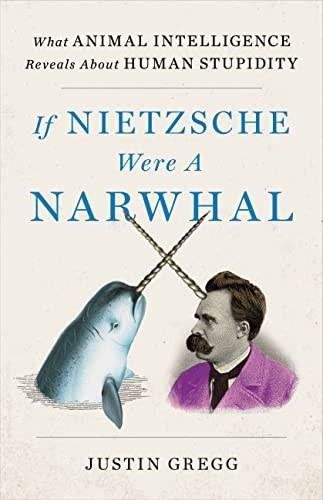
Now, so many years later, I’ve found my way to animal behaviorist Justin Gregg’s brilliant new book If Nietzsche Were a Narwhal: What Animal Intelligence Reveals About Human Stupidity. Gregg’s chicken coop is “a huge enclosed area” with high rafters, because as an animal scientist, he knows them to be jungle birds who need perches on which to sleep at night. But it is not only the magisterial heights of Gregg’s discussion of chickens that stayed with me. I was struck also by Gregg’s description of his chickens’ varied personalities, one anxious, another friendly, and so on; he tells us that these chickens do have inner lives and thus a consciousness of themselves as distinct from others. Instead of the feckless creatures I (and most people) assume them to be, chickens have just the sort of intelligence that is necessary for their own survival. They don’t think like humans, Gregg tells us, because they do not need to.

Intelligence, in Gregg’s explanation, does not exist in the way SATs or other IQ tests would have you believe. Those tests quantify a certain kind of ability to process information. People who do not do well on such tests may have other kinds of abilities that simply are not being measured. Intelligence is not one easily definable thing; engineers working on artificial intelligence cannot agree on a definition of it. But what humans have is a tendency to ask why things operate in a certain way. In Gregg’s terminology, humans are “why specialists,” a proclivity that in natural selection terms is no advantage and perhaps even a liability. A narwhal swimming around in the sea, for instance, would never have the kind of mental breakdown that the German philosopher pondering nihilism suffered toward the end of his life. Animal intelligence is practical and does not get caught up in abstract thought. By and large, animals make calculations based on what they can observe; ideas such as “causality,” which lie at the crux of human intelligence, are outside their capacity for thought.

Humans evolved to become why specialists. As Gregg tells it, 200,000 years ago, humans were hanging out with chimpanzees and exhibited no interest in the whys. They could make rudimentary tools and had some kind of assemblage of grunts that allowed for basic communication. He notes that roughly 40,000 years ago, cave paintings were created. Here were humans asking the whys; symbolic representation is an exclusively human thing.

Inability to be why specialists does not mean that animals are not capable of “metacognition,” the ability to be conscious of their own thinking or cognition. One of the most stunning examples in this book full of stunning examples is that of Natua, a dolphin at the Dolphin Research Center in Florida. An experiment was set up where Natua was exposed to two kinds of sounds, one a very high tone and one a very low tone. After hearing the sound, Natua had to choose between two paddles, one for the high and another for the low. If he chose correctly, he was given a fish for a reward. If he did not, he was sent for a long time-out, in that the experiment stopped. As the experiment progressed, the high tone sound came very close to the low sound such that they were nearly indistinguishable. At this point, Natua was unable to tell the difference; “he just started randomly pressing paddles,” Gregg writes. His behavior proved that some animals are capable of metacognition, the awareness that they do not know, or that their thinking about something is wrong.

It is no surprise that Gregg is pessimistic about how humans have used their abilities as why specialists, and he thinks that there is a chance that humans might not even survive over another century. The prospect of nuclear war and the climate crisis suggest, in Gregg’s view, that the end is possible. In the meantime, developing a consciousness of animals as beings who are capable of metacognition, of having individual personalities and so on, points to the need for a new ethics. This new set of basic premises would abandon the centering principle that the animal-human relationship must always be of one having dominion over the other.

But if you consider the continued resistance to the idea of animal rights, it is hard to be optimistic about the emergence of a new ethics of mutuality that eschews the dominion portion. Too many human rationalizations, attached to what we eat, what we wear, how we live, are predicated on the belief that we are the only feeling beings and that our actions upon animals are independent of consequences. If you know the fear of a chicken or a cow or a pig about to be slaughtered, you may look at your food in a different way. You might eschew fried chicken or beef or pork completely. If you understand that a horse being whipped is suffering terribly, is extremely scared and dissolute, you can also understand that there is a need for a radical expansion of mindfulness and a concomitant shrinking of power.

In the moral universe informed by Gregg’s argument, the survival of the human race is not an imperative for the planet because humans as a species have been far more disastrous for the world than others. “Prognostic myopia” keeps us horribly and condemnably in the moment, burning fossil fuels and trashing the oceans even though we know that it is terrible for the environment. This is a unique position among philosophers, a lot of whom have lately concerned themselves with questions of ethics and planetary survival. 

As a contrast to Gregg, the Oxford Associate Professor in Philosophy William MacAskill, in his What We Owe the Future, proposes “effective altruism” as a way to live ethically in times of climate crisis. If Gregg argues against human exceptionalism, MacAskill reduces humans to data points, where the survival of the most, and the most benefit to the planet, are guideposts to a present and future ethics. Using Gregg’s arguments, however, effective altruism is rendered meaningless. Even those who live sparingly on twenty-six thousand pounds a year, like MacAskill, are still a burdensome threat, unless we define their worth according to tiresome illusions of human exceptionalism.

If Nietzsche Were A Narwhal is the sort of critical look at human dominion that our world needs. A few years ago, Brown University environmental historian Bathsheba R. Demuth wrote Floating Coast: An Environmental History of the Bering Strait, a similarly groundbreaking look at the consequences of the extractive relationship humans have had with the environment. Just as Gregg reveals the risks of humans imagining their power over animals as shorn of consequences, Demuth reveals the consequences of human dominion over nature.

Thinkers and scientists like Gregg and Demuth are presenting readers with the urgent and pressing necessity for a new ethics. The unthinking, extractive, and dominant human treats animals as a lower form of existence, rather than a different form; we assess the environment based on what can be extracted from it. Like our means of communication, our means of travel, of treating disease, and so much else, our ethics need an urgent and pressing update that takes into consideration the understanding of animals. Factory farms, the constant consumption of animal products, and the greedy use of fossil fuels are the seeds of destruction.

I am not sure I could have offered the chicken and rooster of my childhood a deluxe chicken coop with high rafters, but an argument for better living conditions and the introduction of new companions for the rooster would have been easier if we had understood the first thing about the animals around us. I do not need to underscore the rapid pace at which our world is changing. If Nietzsche Were A Narwhal is a must-read because it explains how we can save the world only if we exist in symbiosis with the thinking, feeling creatures that have had the misfortune of sharing the planet with humans, who turn out not to be as intelligent as they believe themselves to be.

Deafening Silences: propaganda through censorship, smearing and coercion

By Dr Piers Robinson

Source: Off-Guardian

There is a case to be made that the most important part of any propaganda campaign is the drive to ensure that certain voices, claims and arguments either never see the light of day or otherwise remain contained within “fringe” or “alternative” circles.

Since the start of the COVID event, authorities around the world have sought to implement quite extraordinary policies including the so-called “locking down” of entire populations, compulsory masking and coercion through, for example, the mandating of multiple ‘vaccine’ injections. Many of these policies fly in the face of long-established and well-evidenced public health approaches to dealing with respiratory viruses whilst the scientific cogency of these measures – including lockdowns, community masking and “vaccine” injections – is coming under increased scrutiny.

At the same time, the catastrophic consequences, the so-called “collateral damage” (a military euphemism for wartime civilian casualties), of these extreme policies for populations around the world is becoming well-established. Randomised controlled trials of the injections to date have not shown net overall benefit, while accumulating evidence from passive reporting suggests they may be a cause of significant levels of harm. A central part of selling these extreme, and ultimately highly destructive, policies has involved the use of propaganda.

One of the problems with researching and writing about propaganda is that many people believe it to be alien to democratic states. However, as Edward Bernays, considered by many to be a key figure in the development of 20th century propaganda techniques, explained and promoted…

the conscious and intelligent manipulation of the organized habits and opinions of the masses is an important element in democratic society.

At least to an extent, this belief in propaganda rests upon an assumption or belief that people are ultimately selfish, egotistical, power-hungry and hedonistic beings who require guidance and incentive; it therefore follows that propaganda is required by powerful actors in order to provide a degree of structure, order and purpose to a given society. In contrast, if one assumes that humans are ultimately good and well-inclined towards each other and to the natural world, and that they are capable of great things if conditions permit, propaganda emerging from self-interested and powerful actors equates to a parasite within the human mind that seeks to lead humans away from their better instincts [1].

To this one might add the propensity of those with power to define themselves as the arbiters of truth and morality:

The moral attitudes of dominant and privileged groups are characterised by universal self-deception and hypocrisy. The unconscious and conscious identification of their special interests with general interests and universal values […]. […] the intelligence of privileged groups is usually applied to the task of inventing specious proofs for the theory that universal values spring from, and that general interests are served by, the special privileges which they hold.[2]

Whatever one’s position on the justifiability of propaganda, and although we usually call these techniques by different names today, employing euphemisms such as “public relations” or “strategic communication”, it is a fact that techniques of manipulation are part and parcel of contemporary liberal democracies.

PROMOTING THE NARRATIVE

In the case of the COVID-19 event, propaganda has been deployed across democracies on an unprecedented scale. In order to gain compliance with the unorthodox and intrusive measures adopted during the COVID-19 event many forms of “non-consensual persuasion” have been employed, ranging from manipulated messaging designed to increase “fear levels” through to coercion.

Indeed, very early on it came to light that behavioural scientists were providing advice to the UK government’s Scientific Advisory Group for Emergencies (SAGE). UKColumn reported that this group, named the “Scientific Pandemic Influenza group on Behaviour (SPI-B)”, was (re)convened on 13 February 2020. One document produced by this group identified “options for increasing adherence to social distancing measures” which include persuasion, incentivization and coercion.

In the section on “persuasion” it states that the…

perceived level of personal threat needs to be increased among those who are complacent, using hard-hitting emotional messaging

The document also referred to using…

media to increase sense of personal threat.

Many of these “behavioural science” approaches to manipulation used in the UK context have been documented in Laura Dodsworth’s influential work State of Fear whilst Dr Gary Sidley has written about the remarkable reluctance of anyone in authority to accept responsibility for the deliberate manipulation of the public. Dr Colin Alexander has, for some time, been tracking the propaganda output across the UK public sphere.

More widely, and as described by Iain Davis, these approaches have been paralleled at the global level. In February 2020, according to Davis, the World Health Organisation (WHO) had established the Technical Advisory Group on Behavioural Insights and Sciences for Health (TAG);

The group is chaired by Prof. Cass Sunstein and its members include behavioural change experts from the World Bank, the World Economic Forum, and the Bill and Melinda Gates Foundation. Professor Susan Michie, from the UK, is also a TAG participant*.

Since then, Susan Michie has taken over as chair.

CREATING DEAFENING SILENCES

One aspect of the COVID-19 event propaganda has been the aggressive promotion of official narratives; but just as important has been the suppression and censorship of those questioning authorities. Indeed, there is a case to be made that the most important part of any propaganda campaign is the drive to ensure that certain voices, claims and arguments either never see the light of day or otherwise remain contained within “fringe” or “alternative” circles.

Part of this process of suppressing arguments and opinion involves superficially well-meaning attempts to manage what has been increasingly labelled as “misinformation” and “disinformation”. Elizabeth Woodworth documents the emergence of the so-called Trusted News Initiative (TNI) prior to the 2020 COVID-19 event and which involved a coalition of mainstream/legacy media establishing a network that would serve to combat “misinformation” and “bias”. She quotes the then BBC Director-General Tony Hall:

“Last month I convened, behind closed doors, a Trusted News Summit at the BBC, which brought together global tech platforms and publishers. The goal was to arrive at a practical set of actions we can take together, right now, to tackle the rise of misinformation and bias … I’m determined that we use [the BBC’s] unique reach and trusted voice to lead the way – to create a global alliance for integrity in news. We’re ready to do even more to help promote freedom and democracy worldwide”

By 2020, according to Woodworth, the TNI had incorporated “Twitter, Microsoft, Associated Press, Agence France-Presse, Reuters, and the Reuters Institute for the Study of Journalism” and, predictably, adopted the role of tackling “harmful coronavirus disinformation”.

In the UK at least, there has also been military involvement with the 77th Brigade operating as part of the COVID-19 communication strategy. 77th Brigade activities include information warfare and “supporting counter-adversarial information activity” which includes…

creating and disseminating digital and wider media content in support of designated tasks.

Tobias Ellwood, who is both a Member of Parliament and Chair of the House of Commons Defence Select Committee, is, remarkably, a reservist with 77th Brigade. In an answer to a written question in parliament it was confirmed that “members of the Army’s 77th Brigade” are…

currently supporting the UK government’s Rapid Response Unit in the Cabinet Office and are working to counter dis-information about COVID-19.

The Rapid Response Unit itself was established in 2018 in order to, according to its head Fiona Bartosch, counter “misinformation” and “disinformation”, and “reclaim a fact-based public debate”.

The World Health Organisation (WHO) has also followed a similar tack cautioning the public about “misinformation” and “disinformation”. In a release titled “Let’s flatten the infodemic curve”, they advise people to refer to “factcheckers” and legacy media:

When in doubt, consult trusted fact-checking organizations, such as the International Fact-Checking Network and global news outlets focused on debunking misinformation, including the Associated Press and Reuters

The WHO describes in detail its involvement with social media and “big tech”:

“WHO has been working closely with more than 50 digital companies and social media platforms, including Facebook, Twitter, LinkedIn, TikTok, Twitch, Snapchat, Pinterest, Google, Viber, WhatsApp and YouTube, to ensure that science-based health messages from the organization or other official sources appear first when people search for information related to COVID-19. WHO has also partnered with the Government of the United Kingdom on a digital campaign to raise awareness of misinformation around COVID-19 and encourage individuals to report false or misleading content online. In addition, WHO is creating tools to amplify public health messages – including its  WHO Health Alert chatbot, available on WhatsApp, Facebook Messenger and Viber – to provide the latest news and information on how individuals can protect themselves and others from COVID-19.”

AN INSTITUTIONALISED CULTURE OF CENSORSHIP AND SUPPRESSION OF “WRONG THINK”

These developments, along with others to be documented in due course via work at PANDA, would appear to have had major consequences in terms of suppression of debate. A preliminary examination of events over the last 2.5 years indicates this suppression has operated in at least three different ways:

  • direct censorship through removal of content and deplatforming;
  • sponsoring of hostile coverage designed to smear and intimidate anyone raising critical questions regarding the COVID-19 narrative;
  • coercive approaches involving threats to livelihood and employment.

I shall deal with each in turn.

• Censorship and deplatforming

Formal approaches to censorship via state-backed action were seen early on in the UK context with the regulatory body OFCOM issuing guidelines to broadcasters.

Dodsworth (p.31) reports that broadcasters were instructed to be alert to:

health claims related to the virus which may be harmful; medical advice which may be harmful: accuracy or material misleadingness in programmes in relation to the virus or public policy regarding it”(Dodsworth p. 31).

One possible manifestation of this policy was the remarkable instruction issued to Oxford professor Sunetra Gupta. On October 14, 2020, she appeared on BBC News to talk about the lockdowns imposed in the north of England. It is claimed that just before she went on air, one of the producers told her not to mention the Great Barrington Declaration, a document signed by eminent scientists setting out an alternative policy that would avoid lockdowns and other unorthodox measures.

Across social media, from almost day one of the COVID-19 event, tech giants (“big tech”) were willingly signing up to a strategy of censorship.

In April 2020 it was reported that YouTube CEO Susan Wojcicki had declared that it would act to remove anything going against World Health Organization” recommendations. Notable removals from YouTube included interviews with Dr John Ioannidis of Stanford University and British physician Professor Karol Sikora whilst US Senator Rand Paul’s speech questioning the efficacy of facemasks in August 2021 was removed by YouTube. Dr Robert Malone, inventor of part of the MRnA technology used in the COVID-19 injections, and who has become a notable critic of official policies and narratives, was also removed from Twitter.

A large part of the policing of debate across social media platforms has involved issuance of warnings that a given post violates “community standards” in some way and some, such as LinkedIn, state that content at variance with authorities can lead to censoring. As Dr David Thunder has documented, the exact wording of Linkedin’s policy on “misinformation” states: “Do not share content that directly contradicts guidance from leading global health organizations and public health authorities.“

Thunder notes:

What does this actually mean, in practice? It means that some select persons, just because they got nominated to a “public health authority” or a “leading global health organization,” are protected by Linkedin from any robust criticism from the public or from other scientists.

Furthermore, censorship and suppression of academic debate has been reported with respect to academic journals whereby articles and research running against the so-called scientific consensus appear to have been unfairly removed or blocked. For example Dr Peter McCullough reports unjustified censorship of a peer reviewed and published article relating to COVID-19 whilst, more broadly, undue suppression of legitimate research findings was reported by Dr Tess Lawrie with respect to Ivermectin trials. All of these are worrying indications that academic processes themselves have become subject to nefarious censorship and control.

The censorship continues unabated and it might even be intensifying. Whilst detailed and systematic research should be conducted in order to identify the scale and range of the censorship that has been occurring, it is reasonably clear now that, relative to pre-2020, the levels are unprecedented and represent a normalization, or routinization, of censorship.

• Character Assassination through Smearing

Suppression of debate is achieved not only through formal censorship, but also through indirect tactics whereby attempts are made to destroy the reputation of those challenging power. Although perhaps not widely appreciated, the tactic of character assassination appears to have become more prevalent in recent years and it appears to be an important feature of contemporary propaganda and our ‘democratic’ landscape.

Broadly speaking, smear campaigns are designed to avoid substantive rational debate and instead denigrate the person making the argument – ‘playing the man rather than the ball’ or ‘shooting the messenger’. A feature of smear campaigns is the use of identity politics sensibilities such as concern (legitimate) over racism and the deployment of pejorative and tendentious labels. For example, those questioning COVID-19 policies have sometimes been described as far right or fascist whilst pejorative use of the term “conspiracy theorist” is frequently employed to describe those questioning official narratives.

Smear campaigns can be justifiably seen as underhand and disreputable approaches to challenging dissenting voices and they frequently pass off without observers or even the victims being fully aware that they are being targeted: those ordering or enabling the smears have good reason to avoid being uncovered whilst those executing the smears, i.e. the journalists, will defend their hit pieces as legitimate critique.

In the case of the COVID-19 event, however, at least one high level smear campaign has been identified.

At the time of the release of the Great Barrington Declaration (GBD) during autumn 2020, the authors were only aware of a barrage of hostile media attention such as the above noted instruction by the BBC to Professor Sunetra Gupta to not mention the Declaration during an interview. But at least some of the hostile coverage was not simply a spontaneous reaction by journalists but had been initiated by high-level officials. When the GBD was published, leaked emails showed Anthony Fauci and National Institute of Health director Francis Collins discussing the need to swiftly shut it down. Collins wrote in an email that this…

proposal from the three fringe epidemiologists … seems to be getting a lot of attention … There needs to be a quick and devastating published takedown of its premises.

Rather than a civilised and robust scientific debate, a smear campaign followed.

Other prominent instances, unproven but which bear the hallmarks of a directed smear campaign, include repeated attacks on the popular US podcaster Joe Rogan. In the European sphere, Professor Bhakdi, an early and prominent critic of COVID-19 policies has been repeatedly accused of anti-semitism and is now being prosecuted by the German authorities for inciting hatred (*see Endnotes for alt. link -Ed.). None of the accusations made in these attacks appear to be reasonable. Rogan, for example, was chastised for promoting the use of Ivermectin with many journalists referring to it, misleadingly, as “horse dewormer”. The vast bulk of Bhakdi’s work and output concerns the COVID-19 policies and, relatively speaking, his references to any issue related to Judaism is at most vanishingly small.

A subtle and arguably more widespread form of smearing involves the routine labelling of information by social media companies as harmful; for example the independent UK-based outlet OffGuardian has its tweets subject to a blanket warning suggesting their output might be ‘unsafe’ and contain…

violent or misleading content that could lead to real-world harm.

Such labelling is, arguably, defamatory.

• Coercion

Suppression of inconvenient opinions works through both the realm of information – censoring a person’s voice or ad hominem attacks – but also through action in the real, “material”, world via coercion. This could be the creation of conditions that deter people from speaking their mind by offering material incentives or, alternatively, threatening to deplete someone’s material circumstances. Put simply, the threat of loss of earnings.

In the case of the COVID-19 event the role of coercion can be seen through the threats to employment experienced by those challenging the narrative.

For example, Professor Julie Ponesse was forced from her position at Western University in Canada because of her refusal to receive the COVID-19 injection following the issuing of “vaccine” mandate there whilst a similar fate was suffered by Dr Aaron Kheriarty (Professor at University of California Irvine, School of Medicine and director of the Medical Ethics Program). Other academics have cited lack of institutional support with respect to their academic freedom, such as Professor Martin Kuldorff.

The coercive nature of mandates is particularly pernicious in that their implementation in universities forces ‘dissident’ academics to either go against their beliefs and opinions and comply or otherwise leave their posts. The disciplining effect is, of course, much more widely felt across the academy: the few who lose their posts serve as a warning to everyone else to reconsider their beliefs and actions. In particular, younger academics and those completing their PhDs will come to understand that compliance with the dominant narrative is the only realistic option if they are to realise their goal of an academic career.

The tactics of censorship, smearing and coercion are synergistic and help construct an environment in which self censorship becomes ubiquitous: Deplatforming of dissident scientists sends a clear warning as to the subject matter and issues that are off limits whilst examples of smearing highlight the potential unpleasant consequences of discussing such issues.

Coercion acts as a final hardstop for anyone entertaining the possibility of risking talking about censored issues and riding out the smears that will result: loss of job and income is simply too much to bear. Overall, the role of authorities in enabling censorship and coercion results in, broadly speaking, an institutionalised culture in which suppression of opinions and debate becomes the norm.

THE DANGERS TO DEMOCRACY AND RATIONAL DEBATE: ONLINE HARM LEGISLATION AND DIS/MISINFORMATION ‘FACT CHECKERS’

Clearly this situation has deleterious consequences for rational debate and democracy. John Stuart Mill explained that silencing the expression of an opinion robs us all of the opportunity to either hear an argument that might turn out to be true, or refine or reject an opinion that is faulty. There are very good reasons for this, as Mill notes:

First: the opinion which it is attempted to suppress by authority may possibly be true. Those who desire to suppress it, of course deny its truth; but they are not infallible. … All silencing of discussion is an assumption of infallibility.

And:

if wrong, they lose, what is almost as great a benefit, the clearer perception and livelier impression of truth, produced by its collision with error.

Scientific and scholarly research demands such openness to questioning and critique and, behind concepts such as tenure, is the core grounding for the academy that scholars need to be allowed to present what might appear to be controversial and even offensive (to some) opinions.

Of course, there are well argued and established limits to freedom of expression – incitement to violence for example – but we are not talking about the usual areas of debate and controversy that lie at the limits of permissible speech. Rather, we are talking about the right of people to raise questions and concerns about policies that directly affect them, such as lockdown, masking and ‘vaccinations’, and, moreover, the right of credentialed experts to raise such questions in the public sphere. That the censorship, smearing and coercion of such people has come to be tolerated is a clear indicator of how far our democracies have slipped into an authoritarian abyss.

And things are, potentially, about to become even worse with the pushing through of so-called ‘online harm bills’ including in the UK, Europe and Canada. In the UK, the proposed bill creates a category of legal but ‘harmful’ speech: as described by the pressure group Big Brother Watch:

Under the threat of penalties, the legislation will compel online intermediaries to censor swathes of online discussion including in matters of general discourse and public policy. Harmful content is defined entirely by the Secretary of State who is also granted a host of executive powers throughout the legislation.

Liberty has explained further the potential dangers of such developments:

We are concerned that the ‘legal but harmful’ category set out in the OSB is inadequately prescribed by law and risks disproportionately infringing on individuals’ right to freedom of expression and privacy. In particular, we are concerned about the wide definition of online harm as meaning “physical or psychological harm” (clause 187). This is an extremely low threshold, and encompasses innumerable kinds of harm, the extent of which in our view far exceeds the qualifications on Article 10 provided by the ECHR and HRA.

And, as Lord Sumption points out regarding the proposed UK online harm bill:

The real vice of the bill is that its provisions are not limited to material capable of being defined and identified. It creates a new category of speech which is legal but ‘harmful’. The range of material covered is almost infinite, the only limitation being that it must be liable to cause ‘harm’ to some people. Unfortunately, that is not much of a limitation. Harm is defined in the bill in circular language of stratospheric vagueness. It means any ‘physical or psychological harm’. As if that were not general enough, ‘harm’ also extends to anything that may increase the likelihood of someone acting in a way that is harmful to themselves, either because they have encountered it on the internet or because someone has told them about it.”

It is likely that such legislative developments will operate in tandem with so-called “fact checking” entities and algorithms that work to define and then exclude what is defined as “misinformation”, “disinformation”, and now “malinformation”.

The latter two are being defined now as, respectively, false information spread in order to mislead or cause harm and accurate information which is used out of context in order to harm or mislead. These terms are so nebulous that they will enable authorities to proscribe virtually any serious debate or criticism in the public sphere.

Here we see the continuing development and entrenchment of the mis/disinformation fact checking industry noted earlier. During the COVID-19 event the United Nations itself started working with the public relations entity Purpose to “combat the growing scourge of COVID-19 misinformation” which is described as a “virus spread by people”.

Purpose states:

[t]hrough Verified, we are leveraging the UN brand, as well as popular brands that connect audiences online and offline: from Cartoon Network in Brazil to Flipkart in India.

UNESCO, similarly, is promoting education about so-called “conspiracy theories”. Remarkably, and in apparent contradiction to rhetoric regarding inclusiveness and community-driven decisionmaking, the WHO actually asks people to report on people spreading “misinformation”: As such, an un-elected international organization is actively advocating for the suppression of free speech in democratic societies.

Entities tasked with deciding what is true and what is false, as opposed to allowing ideas and arguments to be openly debated as Mill would suggest, are already creating the link between dis/misinformation and harm. For example, the Institute for Strategic Dialogue, a state-sponsored think tank, attacked the disparate groups questioning the COVID-19 response with a publication titled “Between Conspiracy and Extremism: A Long COVID Threat?” The institute tweeted:

Today we launch a new series of reports on the global anti-lockdown movement, beginning with this paper examining how COVID restrictions have brought together a broad church of activists in a conspiracy-extremist movement we call a ‘hybrid threat’

On the issue of coercive measures, the recent passing of a bill in California, that will enable doctors who spread ‘false information’ to be charged with ‘unprofessional conduct’ and have their licenses revoked, is a worrying sign of just how aggressive authorities are becoming.

The trajectory here is clear to discern and it entails the move to a world where the truth is defined by factcheckers and authorities, and legislation provides the underlying coercive framework to ensure any deviance is punished. This is entirely at odds with basic principles of open debate, objective scholarship and freedom of expression and is not compatible with democracy.

THE END OF DEMOCRACY?

There is nothing new about censorship, smearing and coercion in western democracies. For some time now, those questioning, for example, western foreign policy have been subjectedto such tactics whilst the broader 9/11 global war on terror spawned wide ranging examples of censorship, smearing and coercion in order to shore up official narratives and the belligerent wars that have been fought under its banner.

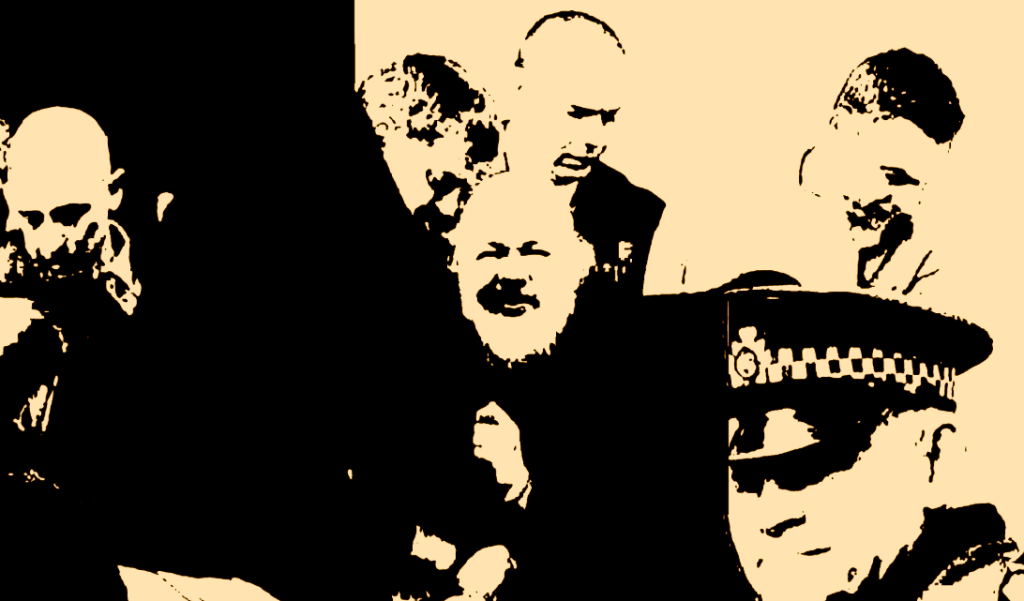
Indeed, in the realm of foreign policy and war, the prevalence of propaganda and associated drives to marginalise dissent are well known to researchers in these fields. And, today, in 2022, we are witnessing a preeminent example of coercion as we see the Wikileaks founder, Julian Assange, facing the prospect of deportation to the US and the rest of his life in prison. His crime was to reveal accurate information about the 9/11 wars, especially those in Iraq and Afghanistan. There is little reason to doubt that authorities in the West are seeking to make a powerful example of Assange; a warning to the rest of us as to the price of questioning our governments when they commit illegal wars of aggression.

What is new with the COVID-19 event is a combination of the spread of these strategies of suppression and a sharp uptick in awareness amongst increasingly large swathes of the population as to the existence of propaganda in democracies. The spread can be seen in how it is now a large number of medical scientists who have been at the receiving end of drives to suppress debate, whereas before it was often just a handful of relatively unknown dissident social scientists researching foreign policy issues.

Regarding public awareness, attempting to censor high profile researchers from the medical sciences alerts more of the public as to what is going on.

And, of course, as we rapidly see the dissident scientists now being vindicated by the facts – lockdowns don’t work, the “vaccinations” can harm etc – more people become aware of the basic truth that the official COVID-19 response has been underpinned by ferocious propaganda campaigns designed to silence any experts speaking truth to power.

It is also apparently the case that trust in mainstream, or legacy, media continues a sharp decline whilst, presumably, increasing numbers of people seek out the new independent media platforms and go to organisations such as PANDA and HART for reliable information on COVID-19 related issues and more widely. [3]

And yet the broader trajectory for our public spheres looks ominous.

Further legislative measures to redefine free speech, networks of sponsored factcheckers defining what is and what is not, resources poured into censoring, smearing and coercing dissident voices all parallel what some analysts argue is a wider drive to restructure Western societies.

Ending any semblance of democracy may indeed be the goal, starting with the ending of freedom of expression. There are likely to be dark days ahead and it has never been so important for there to be a robust and uncompromising defence of freedom of expression.

Endnotes:

  1. Thanks to Colin Alexander for comments on the justifiability of propaganda and to David Bell, Maryam Ebadi, Gary Sidley and David Thunder for other comments and feedback.
  2. Niebuhr, R., (1932), Moral Man and Immoral Society: A Study in Ethics and Politics. New York: Charles Scriber’s Sons.
  3. The array of new and independent media and organisations is vast; some of those, with which the author is most familiar, include media such as OffGuardianMultipolarthe GrayzoneUnlimited HangoutUKColumn; and Organisations such as Brownstone InstituteWould Council for HealthChildren’s Health DefenceGlobal Collateral.

The Trouble With ‘Western Values’ Is That Westerners Don’t Value Them

By Caitlin Johnstone

Source: CaitlinJohnstone.com

Have you ever noticed how those who shriek the loudest about tyranny in foreign countries are always the same people calling for the censorship and deplatforming of anyone who criticizes the western empire?

It’s a ubiquitous mind virus throughout western society. Anyone — and I do mean anyone — who aggressively and consistently criticizes the foreign policy of the US and its allies in front of a sizeable audience gets branded a Russian agent by empire apologists, and this consensus is accompanied by the steadily growing opinion that Russia’s operatives and useful idiots should be banned from western platforms.

Defenders of the western empire won’t admit to wanting all empire critics silenced, but that’s what you get when you combine (A) the fact that they view everyone who criticizes the empire with sufficient aggression as a Russian agent with (B) their opinion that those given to Russian influence ought to be censored. Whenever I criticize the foreign policy of the western empire I get its apologists telling me I’d never be allowed to criticize my rulers like that if I lived in a nation like Russia or China, when they know full well that if it were up to them I wouldn’t be allowed to criticize the western empire here either. They are the same as the tyrants they claim to despise.

The trouble with “western values” is that westerners don’t value them. They think they value them, but all that reverence for free expression and holding power to account with the light of truth goes right out the window the second they see someone saying something that sharply differs from what their rulers and their propagandists have told them to think. Then they want that person silenced and shut down.

In truth, the most forceful critics of the western empire actually embody these western values infinitely more than empire apologists do. It is the critics of empire who value free speech and holding the powerful to account. It’s the brainwashed bootlickers of the US-centralized empire who are calling for censorship and shouting down anyone who directs fierce oppositional scrutiny toward the most powerful people in the world.

People tell me “Move to Russia!” or “Move to China!” depending on what aspect of the empire’s global power agendas I happen to be criticizing at the moment, and I always want to tell them, no, you move to Russia. You move to China. You’re the one trying to suppress dissent and criticism of the powerful. I’m the one who is living by western values as they were sold to me and demanding normal scrutiny of the most powerful empire that has ever existed. You don’t belong here.

In school we are taught that our society values truth, free speech, equality, accountability for the powerful, and adversarial journalism, then we grow up and we see everyone rending their garments because institutions like CBS News or Amnesty International let slip one small report which doesn’t fully comply with the official line of our rulers. We see Russian media banned and censorship protocols expanded to the enthusiastic cheerleading of mainstream liberals. We see astroturf trolling operations used to mass report and shout down those who scrutinize the establishment line about Ukraine on social media. We see Julian Assange languishing in Belmarsh Prison for the crime of unauthorized journalism.

It’s obvious with a look around that the “western values” we’re all told about are not actually terribly common in the west. Look at the west’s major media platforms and they virtually never platform anyone who is meaningfully critical of the real centers of power in western civilization. Look at western governments and they continually dance to the beat of oligarchy and empire regardless of how people vote in their supposedly free democratic elections. Look at the internet and it’s actually very difficult to find authentic criticisms of imperial power unless you already know where to look.

Some of us bought into those western values we were taught about in school, but it’s not the people you’ve been trained to expect. It’s we marginalized outsiders who are adamantly opposing censorship, propaganda and the empire’s war on the press while continuously working to shine the light of truth on the mechanisms of power from the fringes, while we are being yelled at and accused of treason by mainstream sycophants who have far more in common with the autocrats they claim to oppose than with the western values they purport to uphold.

LIFE… IN REVERSAL

By Kingsley L. Dennis

Source: Waking Times

‘We must distinguish between real change and fictitious change. The change that comes from without, from externally imposed training and discipline, is fictitious…Real change comes from within, by conscious work intentionally performed by the being himself.’ ~J.G. Bennett 

It is increasingly difficult in these times to speak of ‘non-verifiable’ or unprovable matters, especially concerns of the spirit-consciousness, for too many people are inculcated with fixed beliefs and thinking patterns. This is itself a sign of social conditioning and of a certain ‘management of mind.’ We should not be surprised that this situation is rife throughout our societies and cultures and is becoming increasingly predominant. Social norms are persuading many people to prefer safety and security rather than the potential discomfort that comes from gaining new realizations and understanding.

An ex-officer of the Soviet secret police who defected to the West (Gregory Klimov), revealed that in the fields of Soviet psychological warfare (and social psychology) they utilized the principles of psychoanalysis. In this, they saw the phenomena of evil as a ‘complicated, complex social illness.’ The psychoanalysts within the KGB equated evil with illness, especially an illness of the human psyche. This perspective places demonic actors and events as ‘objective realities;’ i.e., as various forms of illness of ‘psyche and soul.’ As the Russian anthroposophist G.A. Bondarev writes: ‘The devils represents an involved and complex process of degeneracy or retrogression that in the main consists of three parts: sexual deviation, psychic illnesses and some physical deformities of the organism.

The number of humans already afflicted with this degeneration is legion.’1 Bondarev goes on to say that, based on certain social-psychological testing, the greatest degeneracy exists within the so-called elite of the world (as much as 75%). What this points to, concludes Bondarev, is a drastic decline of the human spirit. What it also tells us is that the phenomenon of ‘evil’ does not necessarily need to be personified or projected into certain personages as it represents an illness of the human psyche. We can recognize its presence operating within psychic imbalance and internal disconnect and detachment. And I would concur with Bondarev’s conclusion in that such psychic dis-ease represents an inner disconnect with the transcendental impulse. This disconnect, or splintering, from a sacred source has now come to signify the nature of the reversal that epitomizes much of contemporary life.

It is within this reversal that we see much of the negating, or counter-evolutionary, forces within humanity. And these forces have been dominating much of our everyday lives and continue to do so. I would suggest that it is our individual responsibility to recognize these forces, attempt to comprehend them, and to transform them into impulses that can work for humankind’s evolvement. In this, we need to come to grips with the presence and activity of those aspects that signify a psychic illness, or dis-ease, within life. Such aspects are a feature of existence as much as positive, developmental forces. They all act within the playground of attraction, repulsion, and the expression of energy. The Rosicrucians recognized these forces when they referred to the Deus Inversus – or the ‘Reversed God.’ This nature of reversal works on humanity through the spheres of imbalance and disharmony to counteract civilizational development. The Austrian mystic Rudolf Steiner was aware of the future impact of such forces when he stated that: ‘It is essential that the forces which manifest as evil if they appear at the wrong place must be taken in hand…in such a way that humanity can achieve something with these forces of evil that will be beneficial for the future of the whole of world evolution.’2 In this regard, it is important that the individual becomes aware of the metaphysical realm that lies beyond the threshold of normal, or every day, consciousness.

If we remain unawares to our own forces of spirit-consciousness, then we are more susceptible to the manipulations of such counter-developmental forces. Those readers familiar with my writings will know that I have attempted to draw attention to certain aspects of our consensus reality in order to gain greater clarity about how we may respond to the situation in a constructive way. I stand by what was written in the Gnostic Gospel of Philip: ‘For so long as the root of wickedness is hidden, it is strong. But when it is recognized, it is dissolved. When it is revealed, it perishes.’ Recognition, through heightened awareness and perception, brings more choice into play. The individual needs to be conscious of certain facts before they can manifest the correct intention and focus of will. What is needed is a culture of revelation – of ‘uncovering’ – rather than of cover up. It is through revelation that insight into the metaphysical foundation of life can be sustained within our increasingly materialistic societies. This access to metaphysical realities can never be wholly eradicated. Yet just a cursory glance at modern life indicates that there are attempts to deepen peoples’ immersion into deteriorating forms of dissonance and distraction. This can be seen as a form of reality deceit.

Reality Deceit

The great deceit that is coming upon us is the unveiling of a so-called ‘utopia’ based on the isolation of the human spirit-consciousness. This fake promise is wrapped up in tech-salvationist terms, heralding a false ideal future. The real dis-ease of the human condition is to be in a state of estrangement. That is, estranged and alienated from any metaphysical influence or nourishment. It is not that the metaphysical background to life must necessarily be obvious to us, or tangible in our daily lives – only that we are cognizant of its existence and continual influence. Yet once this sense of recognition (the act of aware cognition) is dissolved, a barren soulless life is the result. And yet, in most circumstances, people will not be cognizant of this loss – this lack of the transcendental impulse in their lives – for they will be entrained into a reality consisting of a physical-digital mesh that keeps them attached to their lower nature and desires. This deceit consists of a most heinous form of enslavement, for it shall both be a willing one as well as an ignorant one. The splintering of the human being from its metaphysical connection shall go almost unnoticed, and the transfer into a reality of limited consciousness will have been enacted quite skillfully. This sly route to a human condition of alienation, procured through the guise of technological advancement and progress, will be a coup against the creative spirit. And this shall be the reversal of the human reality – the reality deceit.

The almost imperceptible dangers are that we have been slipping into a reversed reality, constructed through a realm of fantasy and make-believe, which now fuels the crass and superficial culture industries that dominate modern life. Any notion of Higher Reality has been twisted into an artificial lesser reality that attempts to hinder, as far as is possible, the developmental impulse from penetrating. This arrangement has culminated in dissociating humankind not only from its natural, organic, carbon-based environment, but also from an inherent contact with its origin – Source consciousness. This increasing disembodiment is reflected in such forms as the techno-digital ecosystem, extended reality (the Metaverse), computerization (including algorithms), and artificial intelligence. For many people today, their digital devices have become their instruments of salvation. But this salvation, this divine deliverance, belongs to the Deus Inversus – and we should choose our gods carefully. We should be careful too, not to be pulled into the encroaching banalization of life. And we should be on the look-out for signs and signals.

If anyone wishes to see how ‘signals’ can operate within the reality deceit, then watch all the episodes in the recent Westworld TV series (2016-2022). In Season Four, the machinic android ‘hosts’ have taken control of the world using a bioengineered virus that infects humans over the course of a generation, turning them docile and susceptible to AI and ‘host’ control. Storylines and narratives are created in order to give people their roles and characters in life, which they passively follow believing them to be their own life stories. Humankind is managed through these manufactured ‘storylines’ (a.k.a. socio-cultural narratives) that are transmitted directly to the minds and lives of humans through a series of radio-sonic transmission signals via the global technological infrastructure…But then again, this is just a fantasy story after all.

The course of external events that inform our political, economic, and cultural systems are not arbitrary, coincidental or natural. The modern human has been subtly manipulated into disconnecting from, and even shunning, the guidance of higher impulses. We are being told that the human being alone is the sole and dominant driving force for the future. And by this, we are propelled ever further into the personality construct with the human ego at the wheel. We are standing at the threshold of adopting a glorified materialistic view of life and the world. The spell of this disease is working to over-materialize materialism in a very deliberate and nefarious way. There may be some discomfort in the unfoldment of awareness, yet this is part of the transmutation of the dis-ease.

Life ‘in reversal’ is working hard and fast on this intensifying of materialism. This deepening materialism not only denies the expansion of consciousness but is actively working to stagnate it. At the same time, we are moving through an impulse of increasing individual awareness against the backdrop of this over-materialization. Yet it is an awareness through the few, and not the many (yet). By recognizing that certain forces within the world are using processes of mass suggestion to introduce a simplification – or ‘dumbing down’ – of human consciousness, we can gain greater awareness over our condition and predicament. And in this awareness, we can gain a natural resistance and protection, as recognition allows a discernment to be made. It is this discernment to step away from the negating energies and frequencies of toxicity that can help a person to attune to a resonance of perceptive consciousness. By choosing where we place ourselves – our focus and attention – we can either take a step forward or stay where we are and stagnate. As always, the choice remains with us.

Escalation: Recent Events Suggest Mounting Economic Danger

By Brandon Smith

Source: Alt-Market.us

A common refrain from people who are critical of alternative economists is that we have been predicting crisis for so long that “eventually we will be right.” These are generally people who don’t understand the nature of economic decline – It’s like an avalanche that builds over time, then breaks and quickly escalates as it flows down the mountain. What they don’t grasp is that they are in the middle of an economic collapse RIGHT NOW, and they just can’t see it because they have been acclimated to the presence of the snow and cold.

Economic decline is a process that takes many years, and while you might get an event like the market crash of 1929 or the crash of 2008, these moments of panic are nothing more than the wreckage left behind by the great wave of tumbling ice that everyone should have seen coming far in advance, but they refused.

In 2022 the job of warning people is far easier than it used to be because we are well past the midpoint of the process of decline. But, believe it or not, I still get people today who claim that we analysts are “doom mongers.” The power of willful ignorance is truly amazing. It’s enough to make a person blind to stagflationary crisis, supply chain disruptions, quickly inflating prices, stock market carnage, bond market instability, record consumer debt, and international conflict.

At this point, I think if a person can’t see the dangers ahead they are probably a waste of time and space and are destined to be buried in the ice; there’s nothing that can be done for them. Yes, there are some people out there that don’t get exposed to the information and we have to take them into account, but my priority will be people that are awake and aware and try to give them a sense of what point in the collapse process we find ourselves.

In the past month there has been a considerable uptick in economic and geopolitical activity that suggests we are entering a new phase, and not surprisingly it’s all accumulating right before we hit October. Here are the events that I find most concerning:

The European Energy Crisis

This is an event that I have been predicting since the Russian invasion of Ukraine and now it is upon us. I wrote about it extensively in my recent article ‘Europe Is Facing Energy Disaster And It’s Going To Bleed Over Into The US’ so I won’t rehash all that information here. What I do want to point out is the complete lack of planning on the part of European officials to deal with the threat. It is as if they WANT a full spectrum disaster.

Russia has now completely cut off natural gas supplies to Europe, which represent around 40% of all EU energy resources. Europe’s benchmark natural gas prices spiked by 28% a week ago, on top of already existing inflation. Oil supplies are also in steep decline for Europe and the EU government has pledged to cut what’s left of Russian oil imports by sea at the end of the year. Sadly, they have offered very little in the way of solutions to the supply-side problem.

There has been talk of increasing imports of alternative resources from other nations, but the EU is already buying up around 75% of all liquid natural gas from the US. OPEC oil producers have indicated they will not be attempting to increase production anytime soon (probably because they can’t due to inflation in operation costs). There is NO backup energy resource for Europe; it doesn’t exist right now. They will try to buy up whatever coal, oil and gas they can find on the market while driving up prices even more for other countries. They will still come up short, which means people are going to freeze this winter.

Best case scenario is that there are mostly mild temps and people barely scrape buy with minimum heating. But EU industry is going to suffer and many manufacturers are going to cut production (which mean more stress on the global supply chain).

Core Inflation Is Still Rising

As I warned last week in my article ‘It’s A Fact That Needs Repeating: The Federal Reserve Is A Suicide Bomber,’ inflation is continuing to rise despite the Fed’s continued interest rate hikes, giving the central bank even more ammunition to justify higher rates into extreme economic weakness.

The latest CPI print showed an increase to 8.3% and was a shock to markets which universally expected a drop. This is the nature of stagflation – Even with falling demand prices continue to climb or remain high for extended periods. The stagflation event of the 1970s lasted for a decade until the Fed jacked rates to 21% and then employment crumbled in the early 1980s.

This doesn’t mean that rates will go to 21% this time; they don’t need to. All it would take is a Federal Funds Rate of around 4% – 5% to crash our current QE addicted system. A 75 bps rate hike is now widely expected at the next Fed meeting this month, with some predicting a 100 bps hike. This would put us close to crash territory for markets and for employment, though I think we still have well into 2023 before unemployment really starts to spike.

Putin’s Meeting With Xi

As I write this, Vladimir Putin is set to meet with China’s Xi Jinping and the nature of the conference is not clear. There are the obvious points of agreement such as China’s continued purchases of Russian oil and other commodities, as well as the ongoing plan to build a pipeline to China by 2025. There is also strategic cooperation which is evident in the recent naval exercises between the two nations around Japan and Taiwan.

The timing of the meeting is concerning to me, because the prime season for a potential Chinese invasion of Taiwan is fast approaching (October is the best month for naval movements to avoid typhoons). China would not necessarily need to commit to a ground invasion, either. They could simply cut off all import/export trade from any source other than China and starve Taiwan until they accept unification.

There is also the issue of Ukraine and arms sales. With the amount of propaganda coming from Ukrainian Intelligence and NATO, it’s hard to say what is actually happening, but I suspect Russia is changing strategies and repositioning to deploy missile and artillery bombardment of infrastructure, including power grids and water. This is a tactic that Russia has avoided for months (until this week), which is surprising because one of the first measures usually taken by the US during an invasion is to eliminate most key infrastructure (as we did in Iraq). You would think Russia would have done the same, but perhaps they were saving that scenario for winter when it is harder for Ukraine to cope.

This would make Ukraine essentially unlivable in the coming winter for most of the population. Putin may be seeking to ensure China remains a steady economic partner should geopolitical pressures increase. They may even be making a deal of mutual support: China takes Taiwan while Russia makes Ukraine a resource wasteland and they each support the other economically when NATO counties try to impose sanctions on China. We probably won’t know until October, but the timing of the meeting should raise eyebrows.

If the manure is about to hit the fan in Taiwan along with Ukraine, then diplomatic and economic ties will be severed and western access to China’s manufacturing will be cut. This is a problem for China’s economy, certainly, which may be why they have continued their mass covid lockdowns well after every other government has abandoned them. Could this be practice for civil controls in an impending war environment?

China’s global dominance in imports/exports gives them considerable economic leverage in trade, however. Many nations would not support sanctions against them. Also, their vast holdings of US dollars and Treasuries could be used as a weapon to damage or destroy the dollar’s world reserve status. If China invades Taiwan this year, then all bets are off – The economic decline will move swiftly from that point on.

There are many other trends which factor into the crash environment but the above factors are the most recent and hold the biggest potential for causing a domino effect globally. The question that always arises is “what can we do about it?” Not much in terms of prevention. What we can do, though, is prepare locally to weather the storm. This means stocking necessities before they rise even further in price or become non-existent. Become a producer and learn a valuable skill for survival in a depleted economy Organize with people locally who are on the same page to create security and alternative trade opportunities.

Hopefully, the aware citizenry will rise to the challenge and organization will be extensive, because the worst case scenario would be great masses of completely isolated people all vying against each other rather than working towards mutual security. Even in a slow collapse scenario this is a problem in terms of rising crime; so plan on working with others if you want to avoid inevitable third world conditions.

Cultivate a habit of small acts of sedition

By Caitlin Johnstone

Source: Intrepid Report

It is not easy being someone who cares about the world and opposes the status quo. It’s a series of disheartening failures and crushing disappointments amid an endless deluge of information saying that everything is getting worse and worse.

The environment keeps degrading. Ruling power structures keep getting more and more controlling. Capitalism gets more and more imbalanced and exploitative. World powers get closer and closer to a mass military confrontation of unspeakable horror.

And what do we get when we try to oppose these things? Letdown after letdown. Politicians we support lose their elections, often after brazen interference from the very power structures we’d hoped they’d oppose. Political organizing breaks down in sectarian infighting. Activist leaders get caught up in sex scandals. Agendas we helped push for fizzle into impotence. Power wins time after time.

What passes for “the left” in the English-speaking world is basically either controlled opposition or a glorified online hobby group. Or both. The real left has been so successfully subverted by power that the mainstream public doesn’t even know what it is anymore; most think the left is either a mainstream political party that’s wholly owned and operated by the empire or a loose bunch of vaguely related ideas like having pink hair or saying your pronouns. The left really has been so successfully dismantled that it has almost been purged from memory.

Every time, at every turn, power wins and the people lose. After a while it starts to feel like you’re bashing your head against an immovable object. Some people fall down after a few hard bashes. Some don’t get back up again. Others keep bashing away, becoming harder and harder and more and more miserable and neurotic the longer they go at it.

And most people don’t even know any of this is happening, that’s what can really make it hard. You talk to your loved ones about what you’re seeing and they just get uncomfortable or look at you like you’re crazy. They don’t see the problems you’re pointing to because none of the places they’re getting their information from tell them it’s happening, because the powerful control those information sources.

As Terence McKenna put it, “The cost of sanity in this society is a certain level of alienation.” And as Marshall McLuhan put it, “In the land of the blind, the one-eyed man is a hallucinating idiot.”

And it sucks. No matter how you slice it, it sucks. It sucks watching this massive juggernaut slowly devour your world and see everyone’s attempts to stop it fail, and to have most people in your life not understand it or even see what it is you’re pointing to.

So what can you do? Is there a way to beat the bastards? Is there a way to stop the machine in its tracks and turn this thing around?

Well, no. Not right this moment anyway, and not by yourself. The machine’s far too big, far too entrenched, and its control over information systems means you’re not going to get help from other people in the numbers that you will need them. It’s just you and a few others against an entire globe-spanning power structure.

But that doesn’t mean you are powerless, and it doesn’t mean there’s nothing you can do. It just means you’re not going to be single-handedly knocking out the bad guy and saving the world in some grand, ego-pleasing way like an action hero in some stupid Hollywood movie.

What you can do as an individual is cultivate a habit of committing small acts of sedition. Making little paper cuts in the flesh of the beast which add up over time. You can’t stop the machine by yourself, but you can sure as hell throw sand in its gears.

Giving a receptive listener some information about what’s going on in the world. Creating dissident media online. Graffiti with a powerful message. Amplifying an inconvenient voice. Sharing a disruptive idea. Supporting an unauthorized cause. Organizing toward forbidden ends. Distributing literature. Creating literature. Having authentic conversations about real things with anyone who can hear you.

Every day there’s something you can do. After you start pointing your creativity at cultivating this habit, you’ll surprise yourself with the innovative ideas you come up with. Even a well-placed meme or tweet can open a bunch of eyes to a reality they’d previously been closed to. Remember, they wouldn’t be working so frantically to restrict online speech if it didn’t pose a genuine threat to the empire.

People tend to overestimate how much they can accomplish in a day, but sorely underestimate how much they can accomplish over a span of several years. Finding little ways to undermine the oppression machine every day gradually adds up to hundreds of acts of defiance in a year, which after a few years becomes thousands.

Do this, and then relax. Don’t expect yourself to save the world on your own. You’re only human, and there’s only one of you. You can only do what you can do, and humanity will either make the leap into health or it won’t. Just exert influence over the things you can exert influence over, and outside that little sphere of influence you’ve got to let go and let be. Don’t put any unfair or unreasonable pressures on yourself.

Perpetrate regular small acts of sedition, and then surrender to whatever life brings. I personally see many reasons to hold out hope that we can bring that machine crashing down together one day.