The Covid-19 Chronicles: USA

By Gunnar Ulson

Source: Land Destroyer

The US is claimed to be hardest hit by Covid-19 with, at the time of writing, over 80,000 deaths attributed to the virus. The nation is also suffering from socioeconomic disaster as lockdowns have driven millions of Americans into not only unemployment, but predictable poverty and hunger as a result.

The crisis has been pounced upon by special interests to help propel various sociopolitical and economic agendas rather than confront and overcome the crisis, leading many to suspect the crisis itself has been deliberately overblown.

Health Impact

At face value the US would seem to be hit by an unprecedented health crisis. Hysteria spread by the mass media focusing on the numbers of infected and dead are provided to a panicked public without context.

Indeed, over 80,000 people have so far died with infections at nearly 1.5 million (confirmed).

Yet a quick look at basic statistics provided by the US government’s own Center for Disease Control (CDC) shows that Covid-19’s impact on human health including total deaths has not even surpassed recent flu season burdens. For example, according to the CDC’s website, the 2017-2018 flu season (running from December 2017 to March 2018) left anywhere between 46,000 to 95,000 dead.

Deaths attributed to Covid-19 have been recorded for 2 full months longer with questionable methods used to attribute Covid-19 as the cause for death.

The death rate has been reported at anywhere between 1% to as high as 5% to 6%. Missing from these seemingly concerning numbers is the fact that widespread testing has not been undertaken. The few instances where it has been done has shown that the number of infected is many times higher than official reports. This means that the death rate is much lower and more comparable to the annual flu than any sort of novel and particularly dangerous pathogen.

Testing in California and New York have revealed that in these states alone millions are likely to have been infected by Covid-19 and simply showed little to no symptoms.

A CBS article titled, “Study shows 13.9% of people tested in New York state have coronavirus antibodies, Cuomo says,” admits:

New York’s first survey of coronavirus antibodies shows that 13.9% of those tested in the state had coronavirus antibodies in their system, meaning they have contracted and recovered from the virus, New York Governor Andrew Cuomo said Thursday. That suggests that 2.7 million people have been infected statewide.

In other words, there are likely more people infected in New York state alone than infected nationwide according to “official” reports.

If information regarding how widespread Covid-19 actually is and how dangerous it is or isn’t, is not accurate, how can the United States formulate appropriate measures to respond to the outbreak?

Measures

Despite what appears to be nothing more than a bad cold or flu, the US has ground its society to a halt with lockdowns and social distancing measures.

“Non-essential” occupations have been encouraged to work from home or to not work at all. The food and beverage industry for example, the second largest employer in the United States, has been ground to a halt with employees furloughed for what has now been weeks or even months. Many of these employees do not expect to return to work until at least June.

In Los Angeles, county officials have extended “stay at home” measures for another 3 months meaning that people will have been shut in for nearly half a year if and when in late August people are allowed to return to their normal lives!

Social distancing is being enthusiastically enforced by police around the nation. In New York City, in order to “protect” people, those not practicing social distancing have been beaten, tased and even arrested. The physical and legal damage done “saving” the public from Covid-19 appears to be more extreme than the actual threat of Covid-19 itself.

Since most New Yorkers (and most people around the entirety of the United States) likely have been infected by the virus anyway, social distancing and lockdowns are more of a psychological exercise than one of isolating the pathogen and stopping its spread, an exercise aimed at addressing public panic, but public panic deliberately fuelled by the media and the government.

Socioeconomic Impact

For the United States, a nation’s whose economy was already in steep decline and losing ground to emerging economies around the globe, most notably China, these lockdowns amount to a self-inflicted mortal wound no conceivable plan of action can reverse.

Had Covid-19 been the deadly pathogen many may believe it is owed to mass media misinformation, the United States stood ill-prepared for it. This was not merely the doing of the current US administration, but a problem known for well over a decade with US presidents from George Bush Jr. to Barack Obama to current US President Donald Trump taking turns ignoring it.

The New York Times reported that things like ventilator shortages were known for at least 13 years and instead of rectifying the problem, large biomedical corporations were allowed by the US government to buy out small contractors tasked with fixing the shortage and ending programs to develop cheap ventilators in order to maintain artificial scarcity and the high prices (and profits) associated with it.

While Covid-19 appears to be far less dangerous than claimed by the mass media, the impact of measures taken by the US government and local state governments has created what is a disaster now being compared to the Great Depression.

Rather than rectifying it by simply rolling back lockdowns and social distancing measures, or even finding ways to aid the millions left unemployed, special interests are taking turns exploiting the crisis by blaming political opponents or even international competitors (like China). They are also looking for ways to cash in, with America’s deeply corrupt pharmaceutical industry being the most prominent example already teeing up massive profiteering by offering “vaccines” to solve Covid-19 fears.

The US, rather than uniting and overcoming whatever Covid-19 actually is, be it a pathogen or an unprecedented wave of widespread panic, has instead allowed itself to become divided and distracted, as well as exposed to the very worst sort of socioeconomic predators lurking amid America’s economic and political landscape.

It is difficult to predict what will happen in the weeks, months and even years to come regarding the state of America socioeconomically considering just how widespread and deep the damage being done now is. A nation as large as the United States plunging so quickly has never historically boded well for that nation nor the world it finds itself free falling in. The US already faced many challenges regarding its decline both at home economically and abroad geopolitically.

Covid-19 has simply exposed and accelerated the process, compounding an already uncertain future with a new degree of damage, danger and desperation.

Get Ready for an Unacceptable New Normal

By Stephen Lendman

Source: StephenLendman.org

At times like now, ideas lying around dormant on the shelf become reality.

Economic and other crisis conditions are times when most people can be convinced to accept unacceptable policies they’d likely reject otherwise.

During and after 2008-09 economic crisis conditions, Americans were brainwashed to accept force-fed austerity, frozen wages, and loss of benefits when economic stimulus and other government help were needed.

Economic recovery was for the nation’s privileged class exclusively. 

Ordinary Americans experienced protracted hard times that may become much worse today looking ahead, the same true in other Western societies.

In his 1995 book titled, “The Rotten Heart of Europe,” noted euro expert Bernard Connolly said the following: 

“The true story of the ERM (Europe’s Exchange Rate Mechanism) has been one of duplicity, skullduggery, conflict; of economic harm done to every country and in the caste interests of the elite; of the distortions of economic logic and the dilution of political accountability,” adding:

“The implication is that increasing globalization of economic activity and mobility of production has been purposely implemented in such a way as to render already destroyed ‘nation-state(s)’ meaningless entit(ies) in economic terms.”  

Protracted “austerity will lead to social unrest” in Europe, the US or elsewhere. Hard times are fertile ground for revolutions and fascist dictatorships.

Censorship is the new normal in the US and West — speech, press, and academic freedoms at risk. Without them all other rights are threatened.

Social and conventional media, Google, and other tech giants are complicit in a campaign to suppress content conflicting with the official narrative.

Controlling the message is the hallmark of totalitarian rule. Anything conflicting with the official narrative on vital issues is considered “inauthentic behavior.”

The US already is a police state. Is martial law the next shoe to drop? Will Trump declare it if current conditions worsen?

While not included in the Constitution, Article 1, Section 9 mentions suspension of habeas, saying the following:

“The privilege of the writ of habeas corpus shall not be suspended, unless when in cases of rebellion or invasion the public safety may require it.”

Will Trump invoke “public safety” or another pretext to take this action?

Article 1, Section 8 empowers Congress to call “forth the Militia to execute the Laws of the Union, suppress Insurrections and repel Invasions.”

The US military and National Guard are today’s “militia.”

Martial law suspends civil rule, replacing it with military authority under the president as commander-in-chief of the nation’s armed forces — including the National Guard when activated.

During the Civil War, Lincoln assumed dictatorial powers.

He suspended the Constitution and habeas corpus, forcefully closed courts, arbitrarily ordered arrests, conscripted US citizens without congressional consent, and closed newspapers opposing his policies.

His Emancipation Proclamation didn’t free a single slave. He wanted them deported at war’s end to maintain America as a white supremacist society.

History taught in the US at all levels of education conceals the nation’s dark side.

What happened before can happen again by presidential diktat.

According to Constitutional Law Professor Bruce Ackerman, US presidents can institute policies by executive orders, military orders, national security and homeland security presidential directives, along with other ways of circumventing Congress and the courts.

They wage illegal wars without Security Council and congressional authorization.

White House lawyers justify the unjustifiable. “They serve as authoritative judges for the executive branch, providing a legal framework for millions of civilian and military personnel as they implement executive decrees,” Ackerman explained.

Checks and balances don’t work, new ones needed, he stressed — enforced to restrain executive power-grabbing.

Following Japan’s December 1941 Pearl Harbor attack, Hawaii, not a US state at the time, was placed under martial law.

After Hurricane Katrina in August 2005, martial law was declared in New Orleans.

Throughout US history, it’s been imposed by federal or state authorities numerous times on the pretext of public safety, restoring order, or another reason.

Will Trump impose it if the US economy is reopened too soon, as apparently planned, and COVID-19 outbreaks increase greatly?

Will larger-scale outbreaks than already if occur be used as a pretext for hardening police state rule, including suspension of the Constitution and imposition of martial law?

Most of the population is locked down. Will Trump by presidential diktat order the extrajudicial arrest and indefinite detention of targeted individuals on the phony pretext of public safety and security?

This type harshness is what fascist tyranny is all about.

Is it coming ahead to the US full-blown in the form of presidential national emergency powers? 

The USA Patriot Act was written before 9/11. Is other draconian legislation on the shelf — ready to be rolled out by congressional action or presidential decree?

Is America the way it was pre-COVID-19, warts and all, to be replaced by hardened rule?

If COVID-19 abates and more greatly flares up this summer or fall will November elections be suspended or cancelled?

Whatever may unfold ahead most likely was planned by the nation’s ruling class.

It happened pre-and-post-9/11. It may be happening again now for ill, not good — including draconian mass surveillance more intensive than before, along with other police state policies.

Is a dystopian future coming for ordinary Americans, resisters subject to harsh repercussions — constitutional rights declared null and void?

What’s unthinkable may be planned and inevitable. 

Virus of Mass Destruction

Medical personnel arrive to perform COVID-19 coronavirus infection testing procedures at Glen Island Park, Friday, March 13, 2020, in New Rochelle, N.Y. (AP Photo/John Minchillo)

By CJ Hopkins

Source: Consent Factory, Inc.

There comes a point in the introduction of every new official narrative when people no longer remember how it started. Or, rather, they remember how it started, but not the propaganda that started it. Or, rather, they remember all that (or are able to, if you press them on it), but it doesn’t make any difference anymore, because the official narrative has supplanted reality.

You’ll remember this point from the War on Terror, and specifically the occupation of Iraq. By the latter half of 2004, most Westerners had completely forgotten the propaganda that launched the invasion, and thus regarded the Iraqi resistance as “terrorists,” despite the fact that the United States had invaded and was occupying their country for no legitimate reason whatsoever. By that time, it was abundantly clear that there were no “weapons of mass destruction,” and that the U.S.A. had invaded a nation that had not attacked it, and posed no threat to it, and so was perpetrating a textbook war of aggression.

These facts did not matter, not in the slightest. By that time, Westerners were totally immersed in the official War on Terror narrative, which had superseded objective reality. Herd mentality had taken over. It’s difficult to describe how this works; it’s a state of functional dissociation. It wasn’t that people didn’t know the facts, or that they didn’t understand the facts. They knew the Iraqis weren’t “terrorists.” At the same time, they knew they were definitely “terrorists,” despite the fact that they knew that they weren’t. They knew there were no WMDs, that there had never been any WMDs, and still they were certain there were WMDs, which would be found, although they clearly did not exist.

The same thing happened in Nazi Germany. The majority of the German people were never fanatical anti-Semites like the hardcore N.S.D.A.P. members. If they had been, there would have been no need for Goebbels and his monstrous propaganda machine. No, the Germans during the Nazi period, like the Americans during the War on Terror, knew that their victims posed no threat to them, and at the same time they believed exactly the opposite, and thus did not protest as their neighbors were hauled out of their homes and sent off to death camps, camps which, in their dissociative state, simultaneously did and did not exist.

What I’m describing probably sounds like psychosis, but, technically speaking, it isn’t … not quite. It is not an absolute break from reality. People functioning in this state know that what they believe is not real. Nonetheless, they are forced to believe it (and do, actually, literally, believe it, as impossible as I know that sounds), because the consequences of not believing it are even more frightening than the cognitive dissonance of believing a narrative they know is a fiction. Disbelieving the official narrative means excommunication from “normality,” the loss of friends, income, status, and in many cases far worse punishments. Herd animals, in a state of panic, instinctively run towards the center of the herd. Separation from the herd makes them easy prey for pursuing predators. It is the same primal instinct operating here.

It is the goal of every official narrative to generate this type of herd mentality, not in order to deceive or dupe the public, but, rather, to confuse and terrorize them to the point where they revert to their primal instincts, and are being driven purely by existential fear, and facts and truth no longer matter. Once an official narrative reaches this point, it is unassailable by facts and reason. It no longer needs facts to justify it. It justifies itself with its own existence. Reason cannot penetrate it. Arguing with its adherents is pointless. They know it is irrational. They simply do not care.

We are reaching this point with the coronavirus narrative. It is possible that we have already reached it. Despite the fact that what we are dealing with is a virus that, yes, is clearly deadly to the old and those with medical conditions, but that is just as clearly not a deadly threat to the majority of the human species, people are cowering inside their homes as if the Zombie Apocalpyse had finally begun. Many appear to believe that this virus is some sort of Alien-Terrorist Death Flu (or weaponized Virus of Mass Destruction) that will kill you the second you breathe it in.

This is not surprising at all, because, according to the official narrative, its destructive powers are nearly unlimited. Not only will it obliterate your lungs, and liquidate all your other major organs, and kill you with blood clots, and intestinal damage, now it causes “sudden strokes in young adults,” and possibly spontaneous prostate cancer, and God knows what other medical horrors!

According to all the “scientists” and “medical experts” (i.e., those that conform to the official narrative, not all the other scientists and medical experts), it is unlike any other virus that has ever existed in the history of viruses. It certainly doesn’t follow the typical pattern of spreading extensively for a limited period, and then rapidly dying down on its own, regardless of what measures are taken to thwart it, as this Israeli study would seem to indicate.

Also, “we have no immunity against it,” which is why we all have to remain “locked down” like unruly inmates in a penitentiary until a vaccine can be concocted and forced onto every living person on earth. Apparently, this mandatory wonder vaccine will magically render us immune to this virus against which we have no immunity (and are totally unable to develop immunity), which immunity will be certified on our mandatory “immunity papers,” which we will need to travel, get a job, send our kids to school, and, you know, to show the police when they stop us on the street because we look like maybe we might be “infected.”

Germany (where I live) is way out in front of this. According to the Süddeutsche Zeitung, the federal government plans to introduce a coronavirus “immunity card” as part of its “Infection Protection Law,” which will grant the authorities the power to round up anyone “suspected to be contagious” and force them into … uh … “quarantine,” and “forbid them from entering certain public places.” The Malaysian authorities have dispensed with such niceties, and are arresting migrant workers and refugees in so-called “Covid-19 red zones” and marching them off to God knows where.

Oh, yeah, and I almost forgot … the germ and chemical warfare researchers at DARPA (i.e., the U.S. military’s Defense Advanced Research Projects Agency) have developed some new type of fancy blood test that will identify “asymptomatic carriers” (i.e., people who display no symptoms whatsoever). So that will probably come in handy … especially if the “white supremacists,” “Red-Brown extremists,” and “conspiracy theorists” keep protesting the lockdown with their wives and kids!

And these are just the latest additions to a list of rather dystopian examples of the “brave new normal” official narrative that GloboCap is rolling out, right before our very eyes (which the OffGuardian editors have streamlined here and here, and which continues on Twitter). It’s all right there in black and white. They aren’t hiding the totalitarianism … they don’t have to. Because people are begging for it. They are demanding to be “locked down” inside their homes, forced to wear masks, and stand two meters apart, for reasons that most of them no longer remember.

Plastic barriers are going up everywhere. Arrows on the floor show you which way to walk. Boxes show you where to stand. Paranoid Blockwarts are putting up signs threatening anyone not wearing a mask. Hysterical little fascist creeps are reporting their neighbors to the police for letting their children play with other children. Millions of people are voluntarily downloading “contact tracing applications” so that governments and global corporations can monitor their every movement. In Spain, they bleached an entire beach, killing everything, down to the insects, in order to protect the public from “infection.” The Internet has become an Orwellian chorus of shrieking, sanctimonious voices bullying everyone into conformity with charts, graphs, and desperate guilt-trips, few of which have much connection to reality. Corporations and governments are censoring dissent. We’re approaching a level of manufactured mass hysteria and herd mentality that not even Goebbels could have imagined.

Meanwhile, they’re striking the mostly empty “field hospitals,” and the theatrical “hospital ship” is now gone, and despite their attempts to inflate the Covid-19 death count as much as humanly possible, the projected hundreds of millions of deaths have not materialized (not even close), and Sweden is fine, as is most of humanity, and … just like there were no WMDs, there is no Virus of Mass Destruction.

What there is, is a new official narrative, the brave new, paranoid, pathologized “normal.” Like the War on Terror, it’s a global narrative. A global, post-ideological narrative. It’s just getting started, so it isn’t yet clear how totalitarian this show will get, but, given the nature of the pilot episode, I am kind of dreading the rest of the series.

Private gain must no longer be allowed to elbow out the public good

By Dirk Philipsen

Source: aeon

Adam Smith had an elegant idea when addressing the notorious difficulty that humans face in trying to be smart, efficient and moral. In The Wealth of Nations (1776), he maintained that the baker bakes bread not out of benevolence, but out of self-interest. No doubt, public benefits can result when people pursue what comes easiest: self-interest.

And yet: the logic of private interest – the notion that we should just ‘let the market handle it’ – has serious limitations. Particularly in the United States, the lack of an effective health and social policy in response to the coronavirus disease (COVID-19) outbreak has brought the contradictions into high relief.

Around the world, the free market rewards competing, positioning and elbowing, so these have become the most desirable qualifications people can have. Empathy, solidarity or concern for the public good are relegated to the family, houses of worship or activism. Meanwhile, the market and private gain don’t account for social stability, health or happiness. As a result, from Cape Town to Washington, the market system has depleted and ravaged the public sphere – public health, public education, public access to a healthy environment – in favour of private gain.

COVID-19 reveals a further irrational component: the people who do essential work – taking care of the sick; picking up our garbage; bringing us food; guaranteeing that we have access to water, electricity and WiFi – are often the very people who earn the least, without benefits or secure contracts. On the other hand, those who often have few identifiably useful skills – the pontificators and chief elbowing officers – continue to be the winners. Think about it: what’s the harm if the executive suites of private equity, corporate law and marketing firms closed down during quarantine? Unless your stock portfolio directly profits from their activities, the answer is likely: none. But it is those people who make millions – sometimes as much in an hour as healthcare workers or delivery personnel make in an entire year.

Simply put, a market system driven by private interests never has protected and never will protect public health, essential kinds of freedom and communal wellbeing.

Many have pointed out the immorality of our system of greed and self-centred gain, its inefficiency, its cruelty, its shortsightedness and its danger to planet and people. But, above all, the logic of self-interest is superficial in that it fails to recognise the obvious: every private accomplishment is possible only on the basis of a thriving commons – a stable society and a healthy environment. How did I become a professor at an elite university? Some wit and hard work, one hopes. But mostly I credit my choice of good parents; being born at the right time and the right place; excellent public schools; fresh air, good food, fabulous friends; lots of people who continuously and reliably provide all the things that I can’t: healthcare, sanitation, electricity, free access to quality information. And, of course, as the scholar Robert H Frank at Cornell University so clearly demonstrated in his 2016 book on the myth of the meritocracy: pure and simple luck.

Commenting on how we track performance in modern economies – counting output not outcome, quantity not quality, prices not possibilities – the US senator Robert F Kennedy said in 1968 that we measure ‘everything, in short, except that which makes life worthwhile’. His larger point: freedom, happiness, resilience – all are premised on a healthy public. They rely on our collective ability to benefit from things such as clean air, free speech, good public education. In short: we all rely on a healthy commons. And yet, the world’s most powerful metric, gross domestic product (GDP), counts none of it.

The term ‘commons’ came into widespread use, and is still studied by most college students today, thanks to an essay by a previously little-known American academic, Garrett Hardin, called ‘The Tragedy of the Commons’ (1968). His basic claim: common property such as public land or waterways will be spoiled if left to the use of individuals motivated by self-interest. One problem with his theory, as he later admitted himself: it was mostly wrong.

Our real problem, instead, might be called ‘the tragedy of the private’. From dust bowls in the 1930s to the escalating climate crisis today, from online misinformation to a failing public health infrastructure, it is the insatiable private that often despoils the common goods necessary for our collective survival and prosperity. Who, in this system based on the private, holds accountable the fossil fuel industry for pushing us to the brink of extinction? What happens to the land and mountaintops and oceans forever ravaged by violent extraction for private gain? What will we do when private wealth has finally destroyed our democracy?

The privately controlled corporate market has, in the precise words of the late economics writer Jonathan Rowe, ‘a fatal character flaw – namely, an incapacity to stop growing. No matter how much it grew yesterday it must continue to do so tomorrow, and then some; or else the machinery will collapse.’

To top off the items we rarely discuss: without massive public assistance, late-stage extractive capitalism, turbocharged by private interest and greed, would long be dead. The narrow kind of macroeconomic thinking currently dominating the halls of government and academia invokes a simpleminded teenager who variously berates and denounces his parents, only to come home, time and again, when he is out of ideas, money or support. Boeing, Goldman Sachs, Bank of America, Exxon – all would be bust without public bailouts and tax breaks and subsidies. Every time the private system works itself into a crisis, public funds bail it out – in the current crisis, to the tune of trillions of dollars. As others have noted, for more than a century, it’s a clever machine that privatises gains and socialises costs.

When private companies are back up and running, they don’t hold themselves accountable to the public who rescued them. As witnessed by activities since the 2008 bailouts at Wells Fargo, American Airlines and AIG, companies that have been rescued often go right back to milking the public.

By focusing on private market exchanges at the expense of the social good, policymakers and economists have taken an idea that is good under clearly defined and very limited circumstances and expanded it into a poisonous and blind ideology. Now is the time to assert the obvious: without a strong public, there can be no private. My health depends on public health. My freedom depends on social freedom. The economy is embedded in a healthy society with functional public services, not the other way around.

This moment of pain and collapse can serve as a wakeup call; a realisation that the public is our greatest good, not the private. Look outside the window to see: without a vibrant and stable public, life can quickly get poor, nasty, brutish and short.

Why Assets Will Crash

By Charles Hugh Smith

Source: Of Two Minds

This is how it happens that boats that were once worth tens of thousands of dollars are set adrift by owners who can no longer afford to pay slip fees.

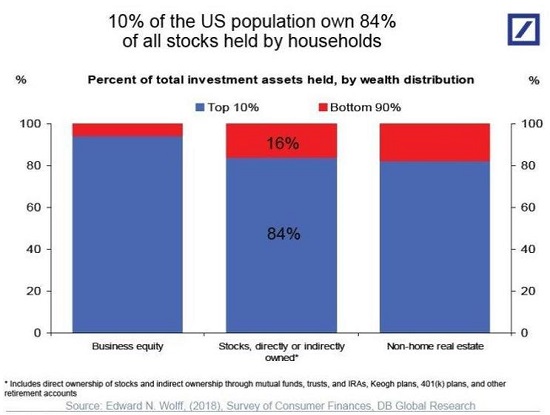
The increasing concentration of the ownership of wealth/assets in the top 10% has an under-appreciated consequence: when only the top 10% can afford to buy assets, that unleashes an almost karmic payback for the narrowing of ownership, a.k.a. soaring wealth and income inequality: assets crash.

Most of you are aware that the bottom 90% own very little other than their labor (tradeable only in full employment) and modest amounts of home equity that are highly vulnerable to a collapse of the housing bubble. (The same can be said of China’s middle class, only more so, as 75% of China’s household wealth is in real estate, more than double the percentage of wealth held in housing in U.S. households.)

As the chart illustrates, the top 10% own 84% of all stocks, over 90% of all business equity and over 80% of all non-home real estate. The concentration of ownership of assets such as vintage autos, collectibles, art, pleasure craft and second homes in the top 10% is likely even greater.

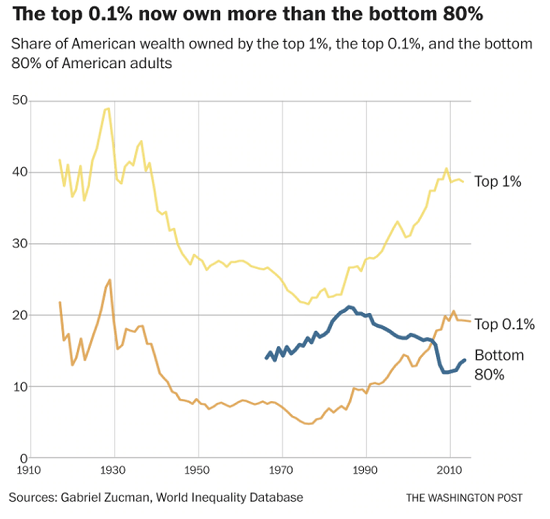
The more expensive the asset, the greater the concentration of ownership, as the top 5% own roughly 2/3 of all wealth, the top 1% own 40% and the top 0.1% own 20%. In other words, the more costly the asset, the narrower the ownership. (Total number of US households is about 128 million, so the top 5% is around 6 million households and the top 1% is 1.2 million households.)

This means the pool of potential buyers is relatively small, even if we include global wealth owners.

Since price is set on the margins, and assets like houses are illiquid, then we can anticipate all the markets for assets owned solely by the wealthy to go bidless–yachts, collectibles, vacation real estate–because the pool of buyers is small, and if that pool gets cautious due to a drop in net worth/unearned income, there won’t be any buyers except at the margins, at incredible discounts.

As we know, in a neighborhood of 100 homes currently valued ar $1 million each, when a desperate seller accepts $500,000, the value of the other 99 homes immediately drops to $500,000.

Since few of the current bubble-era asset valuations are supported by actual income fundamentals, then the sales price boils down to a very small number of potential buyers and what they’re willing to pay.

Houses have a value based on rent, of course, but rents will drop very quickly for the same reason: prices are set on the margins. The most desperate landlords will drop rents and re-set the rental market from the margins. If demand plummets (which it will as people can no longer afford rents in hot urban markets once they lose their jobs), then vacancies will soar and rents will crash as a few desperate landlords will take $1200/month instead of $2500/month.

Due to the multi-year building boom of multi-family buildings in hot job markets (which inevitably leads to an over-supply once the boom ends), there are now hundreds of vacancies where there were once only a few dozen, and thousands where there were previously only hundreds.

As millions of wait staff, bartenders, etc. who made good money in tips find their jobs have vanished, all the urban hotspots will see mass out-migration: Seattle, Portland, the S.F. Bay Area, L.A., NYC, Denver, etc. as demand for rentals will evaporate and rents will be set on the margins by the most desperate landlords. Everyone holding out for the previous bubble-era rent will have $0 income as their units are vacant.

Tech start-ups and Unicorns are melting like ice cubes in Death Valley, and tech-sector layoffs are already in the tens of thousands. This wave of highly paid techies losing their jobs will become a tsunami, further reducing the pool of people who can afford rents of $2,500 to $3,000 for a studio or one-bedroom apartment.)

The concentration of ownership generates a self-reinforcing feedback that further depresses prices: since the top 10% own most of the assets of the nation, they are most prone to a reversal of “the wealth effect.” As their assets soared in value, the top 10% felt wealthier and more confident in future gains, enabling them to borrow and spend freely on second homes, pleasure craft, new vehicles, collectibles, luxury travel, etc.

Once even one class of assets plummets in value–for example, the recent decline in the stock market– the wealth effect reverses and the top 10% feel poorer and less confident about future gains, and thus less enthused about borrowing and spending. The demand for other costly assets quickly evaporates, further reducing the wealth of the “ownership class,” which further reduces their desire and ability to buy bubble-era assets.

The high-priced assets owned by the top 10% will be the assets least in demand due to their high cost and potential for enormous losses: nothing loses value faster in a recession that narrowly owned assets such as vintage cars, art, vacation homes, yachts, etc.

Once assets start sliding in value, the reverse wealth effect quickly dries up demand for all asset classes with narrow ownership. Since these assets are illiquid–that is, the market for them is thin, with buyers few and far between–the prices are set by a very shallow pool of buyers and desperate sellers.

Consider a pleasure craft that retails new for $120,000. In the boom era of rising stocks and housing, a used boat might fetch $65,000. But as the wealth of the small pool of households able to buy and maintain a costly craft evaporates, the number of qualified buyers evaporates, too.

The seller might be aghast by an offer of $35,000 and reject it angrily. Six months later, he’s praying someone will take it off his hands for $15,000, and in another six months, he’ll accept $500 just to get out from underneath the insurance, slip-rental and licencing fees.

This is how it happens that boats that were once worth tens of thousands of dollars are set adrift by owners who can no longer afford to pay slip fees, and vacation homes are abandoned and auctioned off for overdue property taxes: the market for these luxuries dries up and blows away, i.e. goes bidless–there are no buyers at any price.

Once housing and real estate valuations fall, that will trigger a decline in the value of all other costly, narrowly owned assets, which will reinforce the reverse wealth effect.

This is the systemic payback for concentrating ownership of assets in the hands of the few: when their bubble-era priced assets plummet in value, the bottom falls out of all assets with narrow ownership. The price of superfluous assets such as boats, vintage cars, collectibles, art and vacation homes can quickly fall to a fraction of bubble-era valuations, destroying much of what was always fictional capital.

(For more on the intrinsic fragility of a system that concentrates ownership in the hands of the few, please read Our Inevitable Collapse: We Can’t Save a Fragile Economy With Bailouts That Increase Fragility May 1, 2020.)

The Federal Reserve reckons it can “save” the bubble-era valuations of junk bonds by being the “buyer of last resort,” but it will end up being the “only buyer,” effectively making the system even more fragile and prone to collapse.

The public will eventually have to decide if the nation’s central bank should be bailing out assets owned by the financial elite while the upper-middle class watches its assets collapse in value.

America’s Super-Rich See Their Wealth Rise by $282 Billion in Three Weeks of Pandemic

America’s billionaires have accrued more wealth in the past three weeks alone than they made in total prior to 1980.

Source: Mint Press News

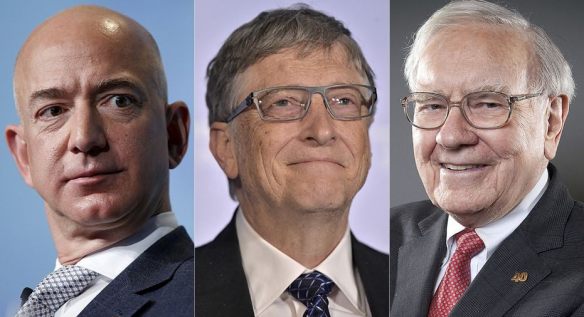
A new report from the Institute for Policy Studies found that, while tens of millions of Americans have lost their jobs during the coronavirus pandemic, America’s ultra-wealthy elite have seen their net worth surge by $282 billion in just 23 days. This is despite the fact that the economy is expected to contract by 40 percent this quarter. The report also noted that between 1980 and 2020 the tax obligations of America’s billionaires, measured as a percentage of their wealth, decreased by 79 percent. In the last 30 years, U.S. billionaire wealth soared by over 1100 percent while median household wealth increased by barely five percent. In 1990, the total wealth held by America’s billionaire class was $240 billion; today that number stands at $2.95 trillion. Thus, America’s billionaires accrued more wealth in just the past three weeks than they made in total prior to 1980. As a result, just three people ­– Amazon CEO Jeff Bezos, Microsoft co-founder Bill Gates and Berkshire Hathaway’s Warren Buffet – own as much wealth as the bottom half of all U.S. households combined.

The Institute for Policy Studies’ report paints a picture of a modern day oligarchy, where the super-rich have captured legislative and executive power, controlling what laws are passed. The report discusses what it labels a new “wealth defense industry” – where “billionaires are paying millions to dodge billions in taxes,” with teams of accountants, lawyers, lobbyists and asset managers helping them conceal their vast fortunes in tax havens and so-called charitable trusts. The result has been crippled social programs and a decrease in living standards and even a sustained drop in life expectancy – something rarely seen in history outside of major wars or famines. Few Americans believe their children will be better off than they were. Statistics suggest they are right.

Billionaires very theatrically donate a fraction of what they used to give back in taxes, making sure to generate maximum publicity for their actions. And they secure positive coverage of themselves by stepping in to keep influential news organizations afloat. A December investigation by MintPress found that Gates had donated over $9 million to The Guardian, over $3 million to NBC Universal, over $4.5 million to NPR, $1 million to Al-Jazeera, and a staggering $49 million to the BBC’s Media Action program. Some, like Bezos, prefer to simply outright purchase news organizations themselves, changing the editorial stance to unquestioning loyalty to their new owners.

The spike in billionaire wealth comes amid an unprecedented economic crash; 26.5 million Americans have filed for unemployment over the last five weeks, and that number is expected to continue to rise dramatically. While the super-rich are holed up in their mansions and yachts, the 49-62 million Americans designated as “essential workers” must continue to risk their lives to keep society functioning, even as many of them do not even earn as much as the $600 weekly increase in unemployment benefits the CARES act stipulates. Many low paid workers, such as grocery store employees, have already fallen sick and died. The mother of one 27-year-old Maryland worker who contracted COVID-19 and died received her daughter’s last paycheck. It amounted to $20.64.

Amazon staff, directly employed by Bezos, also risk their lives for measly pay. One third of all Amazon workers in Arizona, for example, are enrolled in the food stamps program, their wages so low that they cannot afford to pay for food. The vast contrast in the effect that COVID-19 has had on the super wealthy versus the rest of us has many concluding that billionaires’ wealth and the poverty of the rest of the world are two sides of the same coin: that the reason people working full-time still cannot afford a house or even to eat is the same reason people like Bezos control more wealth than many countries. Bezos’ solution to his employees’ hunger has been to set up a charity and ask for public donations to help his desperate workers.

The majority of millennials, most of them shut out from attaining the American dream, already prefer socialism to capitalism, taking a dim view of the latter. The latest news that the billionaire class is laughing all the way to the bank during a period of intense economic suffering is unlikely to improve their disposition.


Alan MacLeod is a Staff Writer for MintPress News. After completing his PhD in 2017 he published two books: Bad News From Venezuela: Twenty Years of Fake News and Misreporting and Propaganda in the Information Age: Still Manufacturing Consent. He has also contributed to Fairness and Accuracy in Reporting, The Guardian, Salon, The Grayzone, Jacobin Magazine, Common Dreams the American Herald Tribune and The Canary.

Corporate Looting as ‘Rescue Plan,’ Robber Barons as ‘Saviors’

By Joshua Cho

Source: FAIR.org

For a perfect illustration of how corporate media function as ruling class propaganda, watch how they spin a titanic upward redistribution of wealth as a “rescue plan” for the US economy, and paint a robber baron like US Treasury Secretary Steve Mnuchin as a “savior” of the American public.

In discussions of the (officially) estimated $2.2 trillion Coronavirus Aid, Relief and Economic Security (CARES) Act—the largest government spending program in US history—before it was signed into law on March 27, corporate media largely abandoned the pretense of serving as watchdogs on behalf of the public in order to advocate for protecting and enriching the fortunes of their owners.

Instead of scrutinizing the bill as the robbery in progress that it is—as an understandable story with identifiable victims and victimizers—corporate media sold the CARES Act as an urgent necessity required to combat the coronavirus pandemic for everyone. Like the previous corporate bailout during the Great Recession (Extra!, 1/09), corporate media avoided raising questions about the necessity of having the government bail out large corporations, or whether the bill could be restructured to serve people rather than profits.

According to the Committee for a Responsible Budget, while the CARES Act dedicated $290 billion in direct payments to people and $260 billion in expanded unemployment benefits, it dedicated $300 billion in tax breaks and $875 billion in loans to big and small businesses—more than two dollars for corporations for every dollar for people, in other words.

When corporate media reported on negotiations and deliberations over the CARES Act, they either hailed it as a bipartisan achievement, or else shamed politicians who accurately pointed out that it overwhelmingly benefited corporations at the expense of workers. On the day the CARES Act was signed into law, NPR (3/27/20) praised the bill as “the largest rescue package in American history and a major bipartisan victory for Congress.”

Reporting in real-time, the Washington Post (3/24/20) spun the CARES Act as an attempt to “address the coronavirus crisis,” with the aim of “flooding the economy with capital to revive businesses and households.” When there was Democratic pushback over the Senate GOP bill for being “disproportionately tilted toward helping companies,” the Post described this as “partisan rancor and posturing on Capitol Hill” that blocked “the rescue bill.” The Post concern-trolled those who supported better legislation, and derided House Democrats’ putative attempts to chart their own “competing piece of legislation,” because “it could take even longer to arrive at a bipartisan consensus that can pass both chambers and get signed into law.”

The New York Times (3/22/20) made it clear that protecting workers and imposing conditions on handing out trillions in taxpayer dollars were frivolous reasons to oppose the legislation, as the Times cast Senate Democrats as villains for ostensibly opposing the bill because it “failed to adequately protect workers or impose strict enough restrictions on bailed-out businesses.” The Times described the “party-line vote” as a “stunning setback” for both the Trump administration’s “ambitious timeline” and “the rescue package,” and warned Democrats that they “risked a political backlash” if “they are seen as obstructing progress on a measure that is widely regarded as crucial to aid desperate Americans and buttress a flagging economy.”

The Times also drew parallels to the “spectacle in 2008,” when the House defeated a “$700 billion Wall Street bailout that aimed to stabilize the financial system amid a global meltdown.” Even in 2020, the Times is still spinning the upward redistribution of wealth from taxpayers to the big banks that caused the crisis as an ostensible success that saved what corporate media consider to be “the economy” (Extra!, 10/10).

Days later, the Times’ “As Coronavirus Spread, Largest Stimulus in History United a Polarized Senate” (3/26/20) spun the 96-to-0 Senate vote in favor of the bill as a heroic bipartisan compromise on legislation “intended to get the nation through the crippling economic and health disruptions being inflicted on the world by the coronavirus.” The Times leaned into corporate media’s civility fetish designed to demobilize opposition to the Trump regime (FAIR.org, 8/1/18, 12/22/19) when it depicted Democratic opposition to Senate Republicans’ “corporate giveaway” legislation as politically reckless and harmful to the country’s interests:

It was a shocking and politically perilous decision in the middle of a paralyzing national crisis, a moment when lawmakers are traditionally expected to put aside differences for the good of the country, or face a political backlash.

By contrast, in the false balance endemic in news coverage in the Trump era, the Times portrayed Senate Republicans as reasonable leaders who were “willing to momentarily abandon their small-government zeal” in the interest of “sealing a quick deal with Democrats” (GQ, 12/10/19; Washington Post, 4/27/12). Though the legislation didn’t include a necessary suspension of rent, utility and mortgage payments, or guarantee monthly payments, as advised by many economists, the Times spun it as a legislative victory for Senate Democrats:

In the end, Democrats won what they saw as significant improvements in the measure through their resistance, including added funding for healthcare and unemployment, along with more direct money to states. A key addition was tougher oversight on the corporate bailout fund, including an inspector general and congressionally appointed board to monitor it, disclosure requirements for businesses that benefited, and a prohibition on any of the money going to Mr. Trump’s family or his properties — although they could still potentially benefit from other provisions.

The problem with this triumphant Democratic ResistanceTM narrative is that it happens to be false. Politico’s report (3/26/20) on the negotiations over what it also hailed as a “rescue package” revealed that the final bill largely reflected the Senate Republicans’ “unemployment insurance and direct payments schemes” as “originally outlined,” with Sen. Mitch McConnell claiming that the CARES Act was a bill that was “largely, not entirely but largely, produced by Republicans in consultation with the Democratic minority.”

The Democratic leadership’s lack of concern with proper oversight of the bailout funds was also exposed when Speaker Nancy Pelosi chose her first-term congressmember friend Donna Shalala as part of the five-member oversight panel, despite her numerous conflicts of interest, evident lack of expertise or reported interest in the job (American Prospect, 4/18/20).

The American Prospect’s David Dayen has done some of the best reporting on the CARES Act, and he’s observed (3/25/20) how means-testing the $1,200 stimulus payments by basing it off IRS data in 2018 and 2019 was designed to limit the number of Americans who can receive it. The miserly one-time $1,200 stimulus payment will primarily reach Americans who already have direct deposit information on file with the IRS, with the unbanked (who happen to be the poorest) having to wait up to four months for paper checks, and who will be lucky to remain at the same address during that time without a suspension of rent payments.

While Democratic leaders like Pelosi opposed emergency universal basic income—and delayed payments to set up a bureaucracy ostensibly dedicated to make sure wealthy Americans don’t get anything—the richest Americans are in fact receiving an average stimulus payment of $1.7 million in the form of a millionaire tax cut.

Dayen has noted how the official “$500 billion” provided by the CARES Act to bailout large corporations is actually underreporting the enormity of the federal government’s corporate giveaway, as Trump regime officials like Larry Kudlow and Steve Mnuchin admitted their intent to leverage the Federal Reserve’s emergency lending authority to turn $500 billion into a $4.5 trillion money cannon aimed at large corporations.

What was in actuality a $6 trillion spending package had few conditions attached to the largesse given to large corporations, as the money can still go to mergers, executive compensation and paying dividends to shareholders, with no requirement that they keep employing workers to receive this handout.

It’s hard to overstate the injustice and scale of this upward redistribution of wealth. Commenting on 2008’s bailout, economist Richard Wolff (Guardian, 11/4/13) pointed out how funding the bailout through borrowing money effectively transfers wealth upward from regular taxpayers to rich bondholders, because the government is borrowing money from—and paying interest to—large corporations and the rich that it could have taxed them for instead. Rather than letting shareholders be wiped out first, according to the ostensible rules of capitalism—where they are supposed to bear the risk, instead of the government—the government is shoveling money to tax-dodging corporations like Boeing who admit to not needing these funds.

By borrowing the money for a program that prioritizes saving the rich, rather than printing money to fund an emergency universal basic income for the people like Rep. Rashida Tlaib’s proposal, the government is effectively paying the rich for saving them. The fact that these viable alternative stimulus proposals weren’t enacted is inexcusable. Especially when the Federal Reserve is hinting its willingness to increase the money supply by buying unlimited debt to fund the CARES Act, the fact that the necessary funds magically appear to fund corporate bailouts instead of necessary social programs (like Medicare for All) exposes the “How are you going to pay for it?” talking point as a fraud (Extra!, 6/12).

Pam and Russ Martens of Wall Street on Parade (3/26/20) observed how the CARES Act also allows the Fed to create “Special Purpose Vehicles” and hide this money from their balance sheets, allowing them to avoid the FOIA requests used to the expose the enormity of the $29 trillion bailout from 2008, in addition to repealing public meeting and recordkeeping requirements for Fed-related programs. This allows the Fed to evade transparency and accountability by holding meetings in secret.

But when corporate media aren’t busy spinning massive corporate robbery of taxpayer money as a rescue package for “the economy,” they’re busy spinning robber barons like Mnuchin as heroic “saviors” instead. Reuters’ “This Is No 2008: Mnuchin Borrows From Paulson’s Economic Crisis Playbook” (3/20/20) depicted Mnuchin as an unlikely hero thrust into the role of solving the US’ economic woes, as they reported:

US Treasury Secretary Steven Mnuchin has stepped into the breach as the Trump administration’s point man to rescue the economy from coronavirus devastation, taking on the role his former Goldman Sachs boss, Hank Paulson, played over a decade ago.

Mnuchin has closely followed the financial crisis playbook used by Paulson when he led the Treasury Department in 2008, reactivating Federal Reserve credit market backstops and asking Congress for $1 trillion to prop up companies and consumers as the economy grinds to a halt due to the spread of the virus.

Apparently, for Reuters, there is only one “playbook” to be followed for all economic crises: massive taxpayer-funded giveaways to large corporations, and crumbs for everyone else. The report contained praise from official sources praising Mnuchin for being “pragmatic” and “rising to the occasion,” with few questions beyond whether he can succeed in his noble mission, as Reuters wondered whether Mnuchin can “strong-arm executives or influence President Donald Trump to take the drastic steps the unprecedented crisis may demand.” Whether Mnuchin and the Trump regime are actually trying to “rescue the economy” is apparently unquestionable, even though Mnuchin would dismiss record-breaking levels of unemployment as “not relevant” only a few days later (Common Dreams, 3/26/20).

The Wall Street Journal’s “How Mnuchin Became Washington’s Indispensable Crisis Manager” (3/31/20) also peddled this fictitious savior narrative when it reported that “Mnuchin has become Washington’s indispensable deal-maker in trying to keep the crisis from throwing the world’s largest economy into the deepest downturn since the Great Depression,” while shepherding “a pair of rescue bills through Congress.”

The Journal depicted Mnuchin’s ability to retain Trump’s confidence while working with Democrats as something that will be “all the more needed in the weeks ahead as the pandemic is expected to worsen,” in order to “get things done in partisan Washington.” Those “skills” didn’t seem to manifest when additional funding for state and local governments, and expanded food stamp benefits needed to rescue people, were left out of the “Phase 3.5” coronavirus legislation last week (Intercept, 4/22/20).

The Washington Post’s “The Dealmaker’s Dealmaker: Mnuchin Steps In as Trump’s Negotiator, but President’s Doubts Linger With Economy in Crisis” (3/27/20) also praised Mnuchin’s efforts to “bridge divides” and forge bipartisan “agreements.” While to the Post’s credit, the piece noted how the “Treasury Department’s demands have often appeared to represent the interests of big business rather than workers,” its overall thrust was encapsulated by its subhead: “Can his economic rescue plan quickly stabilize an economy headed toward calamity?”

The New York Times’ “How Powell and Mnuchin Became the Duo in Charge of Saving the Economy” (3/31/20) reported on Mnuchin’s “vital partnership” with Fed chair Jerome Powell, echoed the “unlikely hero” narrative, and described their efforts as “critical not only to workers and businesses,” but also to Trump’s “re-election” chances:

The coronavirus poses the most significant economic threat since at least 2008, thrusting Mr. Mnuchin and Mr. Powell into key roles in determining whether the United States economy suffers a short, manageable slowdown or enters a deep and painful recession.

When the Times briefly acknowledged concerns about the massive concentration in power and newfound influence in Powell and Mnuchin’s hands, and questions about the integrity of the “oversight” process, it treated the CARES Act favoring big corporations over workers as a hypothetical scenario, rather than a plain fact.

In a unique situation where workers and small business owners have the shared interest in not being wiped out by the pandemic, how else does one characterize the disproportionately stricter conditions placed on small businesses to retain workers to receive bailout money—while big corporations have no such limitations—except as a plan to save big corporations over workers? The Times’ later reports (4/22/20, 4/26/20) on big corporations receiving bailout money intended for small businesses, and receiving concierge service for coronavirus aid at their expense, should’ve been predictable—as it was to some observers in real time (American Prospect, 3/25/20).

Throughout this coverage, it’s quite telling who counts as “the economy” and what measures are considered “necessary” or “adequate,” because it reveals who corporate media consider to be disposable (working class America), and who needs “saving” (large corporations and the American oligarchy). With the CARES Act, corporate media reversed the narrative in a truly Orwellian fashion, portraying corporate looting of the Treasury as necessary to “rescue the economy,” while the main questions regarding “savior” officials like Mnuchin are whether his plans to “save the economy” can succeed. When 26 million Americans lost their jobs between March 18 and April 22, while the wealth of US billionaires increased by $308 billion (more than 10%), there’s no other way to look at corporate media spin as anything but ruling class propaganda to legitimize saving capital while letting people die (In These Times, 4/6/20).

What Does the Bill and Melinda Gates Foundation Want?

By Bill Willers

Source: Dissident Voice

There’s an interview of Bill Gates in which Gates reveals more than he might have intended. Rosemary Frei details many of the Orwellian aspects of Gates’ plans. In particular, consider these comments by Gates from disparate parts of the interview:

It’s [Covid19] quite infectious, way more infectious than MERS or SARS were. It’s not as fatal as they were ….. Nothing like this has ever happened to the economy in our lifetimes. But money — ya know — bringing the economy back and doing money — that’s more of a reversible thing than bringing people back to life. So we’re going to take the pain in the economic dimension — huge pain — in order to minimize the pain in the disease and death dimensions.

Gates is misleading. To admit that Covid19 is “not as fatal” as MERS or SARS is to state that it is less virulent — that the clinical symptoms are not as serious. “More infectious” only means more transmissible, which says nothing about the presence or absence of illness symptoms. So, what is arguably nothing more than a bad flu season is being used to justify the crashing of the economy. Who, exactly, is the “we” in Gates’ “We’re going to take the pain in the economic dimension”? Certainly not billionaire Gates. And wouldn’t “We’re going to…..” indicate that he was involved in the lockdown decision?

Out in the land, countless millions of Americans are seeing their lives put to a ruin beyond salvage. Thousands of small businesses — a life’s work for many — will not survive. In Spring of 2016, mainstream media was reporting that 40% of Americans were unable to come up with $400 to cover an emergency situation. Such a lack of financial cushion is to be barely above outright poverty. Imagine their terror now that their meager income has been further diminished by the lockdown. Gates, a tech genius, either does not comprehend the level of tragedy he advocates, or he does not care. It is no secret that extreme dread, when prolonged, is disastrous to one’s health.

Without detailed research one could not prove that many more Americans will die as a result of the lockdown than of Covid-19, but considering the countless ripple effects throughout the many interdependencies within a complex civilization, reason and experience lead one quickly to that conclusion. There will be mass anxiety, depression, seeking the respite from pain provided by alcohol, frayed nerves leading to violence, and sheer desperation driving many to consider crime in a last ditch effort to hold body and soul together.

Within the interview, Gates drops a bomb: “Eventually, what we’ll have to have is certificates of who’s a recovered person, who’s a vaccinated person, because you don’t want people moving around the world, where you have some countries that won’t have a control sadly.” What kind of “certificates”? What he actually has in mind may be revealed in a report of this past December that the Bill and Melinda Gates Foundation was funding research at MIT in the development of a “Tattoo ID”, to be injected with vaccinations and available for anonymous detection. In time, the failure to have the appropriate identifying tattoo for any given year, and for any given virus officially declared dangerous, would most certainly be used to control individual freedom of movement. This should trigger every thinking person’s attention, particularly as it is reported that Gates refused to have his own children vaccinated.

Ernst Wolff is a German journalist focused on international finance and its ramifications. His March 20, 2020 interview (Here posted March 30 with English subtitles) is worth viewing. He reports that funding and control for the World Health Organization (WHO) began a shift in the 1970s from nation states to the pharmaceutical industry and private foundations. In time, major support was coming from the Bill and Melinda Gates Foundation. Now, Gates’ power within the WHO is unmatched, having given him the status akin to that of a head of state, not only at the WHO, but also at the G20, a collective of world leaders concerned with issues of global importance. At the same time, it is startling that Event201, a “pandemic exercise” hosted by the World Economic Forum and the Bill and Melinda Gates Foundation, took place a scant four months before the Covid19 outbreak and the lockdown decision.

The fact that Gates acknowledged that Covid19 is not as virulent as other viruses of recent history is by itself reason to view the extreme move of economic lockdown, and the isolation of individuals, with suspicion, as is the absence on mainstream media of the voices of dissenting epidemiologists of impeccable reputation. There is also the Coalition for Epidemic Preparedness Innovations, of which the Bill and Melinda Gates Foundation is an “investor and partner”. Its mission: “to stimulate and accelerate the development of vaccines against emerging infectious diseases and enable access to these vaccines for people during outbreaks.”

Bill Gates, with a personal fortune nearly a tenth of a trillion dollars, has placed himself at the forefront of decision-making regarding viral epidemics. His stated interest is the production of vaccines. With a world induced to his way of thinking, the stage is set for acceptance of annual mass vaccinations, a situation that would insure profits for the pharmaceutical industry that are not only astronomical, but also certain to be perpetual. In any given year, a new viral “strain” could, as with Covid19, be given a catchy title, and its death statistics, whether genuine or forged, drilled by media to instill mass dread. In certain situations, vaccination might be made mandatory — in the interest of humanity, of course. In any event, when WHO speaks, it is Bill Gates’ voice, and the interests of the Bill and Melinda Gates Foundation, that are being heard.