Unraveling the Epstein-Chomsky Relationship

Recent revelations that the renowned linguist and political activist met with Jeffrey Epstein several times have surprised and confused many. Why was Epstein interested in meeting with Noam Chomsky? And why did Chomsky agree to meet him despite his past? The answer may surprise you.
By Whitney Webb

Source: Unlimited Hangout

On Sunday, the Wall Street Journal published a report detailing information contained within a “trove” of previously unreported documents of the deceased sex trafficker Jeffrey Epstein. Those documents, which have not been publicly released and appear to have been passed solely to the Journal, included Epstein’s private calendar and meeting schedules. The documents, per the Journal, contain “thousands of pages of emails and schedules from 2013 to 2017” and – as the report notes – detail Epstein’s dealings with several prominent individuals whose names were not on his flight logs or his infamous “little black book” of contacts. One of these individuals is the renowned linguist, political commentator and critic of capitalism and empire, Noam Chomsky.

Chomsky, who has previously discussed the Epstein case in interviews and who has maintained that Epstein’s ties to intelligence agencies should be considered a “conspiracy theory,” had not previously disclosed these meetings. Chomsky, when confronted by Journal reporters, was evasive, but ultimately admitted to meeting and knowing Jeffrey Epstein. 

Many, largely on the left, have expressed dismay and confusion as to why someone with the political views of Chomsky would willingly meet, not once but several times, with someone like Jeffrey Epstein, particularly well after Epstein’s notoriety as a sex trafficker and pedophile. As this report will show, Epstein appeared to view Chomsky as another intellectual who could help guide his decisions when it came to his scientific obsessions – namely, transhumanism and eugenics. What Chomsky gained in return from meeting with Epstein isn’t as clear.

Why Did Chomsky Meet with Epstein?

According to the Journal, Chomsky’s meetings with Epstein took place during the years 2015 and 2016, while Chomsky taught at the Massachusetts Institute of Technology, or MIT. Chomsky told the Journal that he met with Epstein to discuss topics like neuroscience with other academics, like Harvard’s Martin Nowak (who was heavily funded by Epstein). On a separate occasion, Chomsky again met with Epstein alongside former Israeli Prime Minister, Ehud Barak, allegedly to discuss “Israel’s policies with regard to Palestinian issues and the international arena.” A separate date saw Chomsky and his wife invited by Epstein to have dinner with him, Woody Allen and Allen’s wife Soon-Yi Previn. When asked about the dinner date with Woody Allen and Epstein, Chomsky referred to the occasion as “an evening spent with a great artist.”

When confronted with this evidence, Chomsky initially told the Journal that his meetings and relationship with Epstein were “none of your business. Or anyone’s.” He then added that “I knew him [Epstein] and we met occasionally.”

Before continuing further, it is important to note that aside from Epstein, both Ehud Barak and Woody Allen have been accused of having inappropriate sexual relationships with minors. For instance, Barak was a frequent visitor to Epstein’s residences in New York, so often that The Daily Beast reported that numerous residents of an apartment building linked to Epstein “had seen Barak in the building multiple times over the last few years, and nearly half a dozen more described running into his security detail,” adding that “the building is majority-owned by Epstein’s younger brother, Mark, and has been tied to the financier’s alleged New York trafficking ring.”

Specifically, several apartments in the building were “being used to house underage girls from South America, Europe and the former Soviet Union,” according to a former bookkeeper employed by one of Epstein’s main procurers of underage girls, Jean Luc Brunel. Barak is also known to have spent the night at one of Epstein’s residences at least once, was photographed leaving Epstein’s residence as recently as 2016, and has admitted to visiting Epstein’s island, which has sported nicknames including “Pedo Island,” “Lolita Island” and “Orgy Island.” In 2004, Barak received $2.5 million from Leslie Wexner’s Wexner Foundation, where Epstein was a trustee as well as one of the foundation’s top donors, officially for unspecified “consulting services” and “research” on the foundation’s behalf. Several years later, Barak put Harvey Weinstein in contact with the Israeli private intelligence outfit Black Cube, which employs former Mossad agents and Israeli military intelligence operatives, as Weinstein sought to intimidate the women who had accused him of sexual assault and sexual harassment.

In addition, Barak previously chaired and invested in Carbyne911, a controversial Israeli emergency services start-up that has expanded around the world and has become particularly entrenched in the United States. Barak had directed Epstein to invest $1 million into that company, which has been criticized as a potential tool for warrantless mass surveillance. Leslie Wexner also invested millions in the company.

In Woody Allen’s case, he has been accused of sexually assaulting his adopted daughter Dylan Farrow when she was 7 years old. That abuse claim has been corroborated by witnesses and other evidence. Furthermore, Allen refused to take a polygraph administered by state police in connection with the investigation and lost four exhaustive court battles related to child custody and his abuse of Dylan Farrow. One of the judge’s in the case described Allen’s behavior towards Dylan as “grossly inappropriate and that measures must be taken to protect her.” Actress Mia Farrow, Dylan’s mother, alleged in court that Allen took a sexual interest in her adopted daughter when she was between the ages of two and three years old.

Allen subsequently “seduced” and later married another adopted daughter of Farrow’s, Soon-Yi Previn, whom Allen first met when Previn was a child. However, Previn has stated that her first “friendly” interaction with Allen took place when she was a teenager. In 1992, Mia Farrow found nude photos of Previn in Allen’s home and has stated that this was her motive for ending her relationship with Allen.

In the case of Allen and Epstein, and potentially Barak as well, their sexual proclivities and scandals were well known by the time Chomsky met with these men, making a strong suggestion that this type of behavior was not seen by Chomsky as taboo or as a barrier to socialization. It is more likely than not that there was some other major draw that led Chomsky to overlook this type of horrendous behavior toward vulnerable minors.

In terms of reaching a deeper understanding about why Epstein would have been interested in Chomsky – and vice versa, it is important to review – not just the information recently reported by the Wall Street Journal, but also what Epstein himself said of Chomsky before his 2019 death. According to an interview conducted in 2017, but later published in 2019 when Epstein was a major news topic, Epstein openly stated that he had invited Chomsky to his townhouse and he also explicitly stated why he had done so. Oddly, this early acknowledgement of Epstein’s regarding his relationship with Chomsky was left out of the Journal’s recent report.

In that interview, which was conducted by Jeffrey Mervis and later published in Science, Epstein stated that following about Chomsky:

[…] Epstein readily admitted to asking prominent members of the scientific establishment to assess the potential contribution of these so-called outcasts [i.e. MIT students Epstein described as being “on the spectrum”].

“So, I had Jim Watson to the house, and I asked Watson, what does he think about this idea,” a proposal to study how the cellular mechanisms of plants might be relevant to human cancer. Watson is a Nobel laureate and co-discoverer of the structure of DNA. “Likewise with [Noam] Chomsky on artificial intelligence,” he said, referring to one of the pioneers in the field.

In fact, Epstein expressed great respect for the opinions of these elder statesmen. “It’s funny to watch Noam Chomsky rip apart these young boys who talk about having a thinking machine,” Epstein noted. “He takes out a dagger and slices them, very kindly, into little shreds.”

Thus, per Epstein, his interest in inviting Chomsky to his house was explicitly related to the “artificial intelligence,” which was a major scientific interest of Epstein’s. This also provides a major clue as to how Chomsky and Epstein might have first been introduced.

Chomsky, Epstein and MIT

Chomsky is most widely viewed as a famous linguist, political commentator and critic of modern capitalism and imperialism. So, why did Epstein seek to meet with him instead on Artificial Intelligence matters?

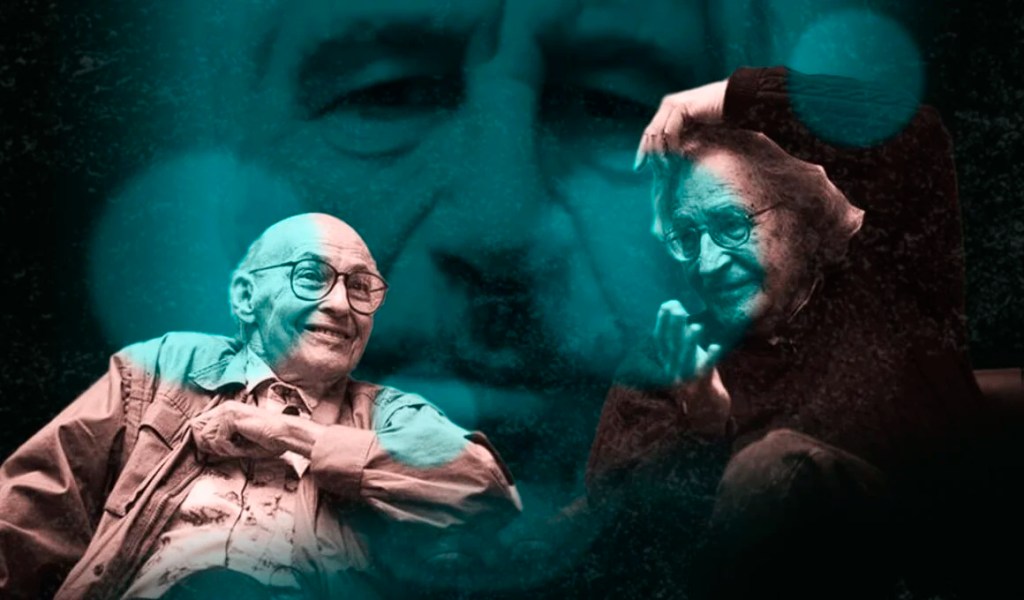
Well, an admitted “friend” of both Chomsky’s and Epstein’s was the AI pioneer Marvin Minsky. Like Chomsky, Minsky was a long-time professor and academic at MIT. It is very possible that Minsky connected the two men, especially considering the fact that Epstein was a major donor to MIT. Epstein described himself as being “very close” to Minsky, who died in 2016, roughly a year after Epstein began meeting with Chomsky. Epstein also financed some of Minsky’s projects and Minsky, like Ehud Barak, was accused of sexually abusing the minors Epstein trafficked.

Chomsky’s views on linguistics and cognition, for those who don’t know, is based very much on evolutionary biology. Chomsky was also a pioneer in cognitive science, described as “a field aimed at uncovering the mental representations and rules that underlie our perceptual and cognitive abilities.” Some have described Chomsky’s concept of language as based on “the complexity of internal representation, encoded in the genome, and their maturation in light of the right data into a sophisticated computational system, one that cannot be usefully broken down into a set of associations.” A person’s “language faculty”, per Chomsky, should be seen as “part of the organism’s genetic endowment, much like the visual system, the immune system and the circulatory system, and we ought to approach it just as we approach these other more down-to-earth biological systems.”

Despite their friendship, Minsky greatly diverged with Chomsky in this view, with Minsky describing Chomsky’s views on linguistics and cognition as largely superficial and irrelevant. Chomsky later criticized the widely used approach with AI that focuses on statistical learning techniques to mine and predict data, which Chomsky argued was “unlikely to yield general principles about the nature of intelligent beings or about cognition.”

However, Chomsky’s views linking evolutionary biology/genetics with linguistics/cognition were notably praised by the aforementioned Martin Nowak, who had attended one of the meetings Epstein had with Chomsky. Nowak, a professor of biology and mathematics and head of the Program for Evolutionary Dynamics at Harvard, later stated that he had “once broke out a blackboard during dinner with Epstein and, for two hours, gave a mathematical description of how language works,” further revealing that Epstein was interested in aspects of linguistics. It is unclear if this particular meeting was the same that Chomsky had attended alongside Nowak to discuss “neuroscience” and other topics.

However, given the importance of evolutionary biology and genetics to Chomsky’s theories, it is hardly surprising that Jeffrey Epstein would have gravitated more towards his views on AI than those of Minsky. Epstein was fascinated by genetics and, even per mainstream sources, was also deeply interested eugenics. Take for example the following from an article published in The Guardian in 2019:

Epstein was apparently fixated on “transhumanism”, the belief that the human species can be deliberately advanced through technological breakthroughs, such as genetic engineering and artificial intelligence.

At its most benign, transhumanism is a belief that humanity’s problems can be improved, upgraded even, through such technology as cybernetics and artificial intelligence – at its most malignant though, transhumanism lines up uncomfortably well with eugenics.


Thus, Epstein’s interest in AI, genetics, and more was tied into his documented obsession with “transhumanism,” which – as several Unlimited Hangout reports have noted – is essentially a rebranding of eugenics. Indeed, the term transhumanism itself was first coined by Julian Huxley, the former president of the British Eugenics Society and the first head of UNESCO who called to make “the unthinkable thinkable again” with regards to eugenics.

Aside from transhumanism, Epstein also had an avowed interest in “strengthening” the human gene pool, in part by impregnating as many women as possible with his “seed” in order to widely disperse his genes. These views may also explain Epstein’s interest in associating himself with people like James (Jim) Watson. As noted earlier in this article, Epstein stated in 2017 that he had invited both Watson and Chomsky to his home on separate occasions.

Watson has been a controversial figures for years, particularly after he openly stated that people of African descent are genetically inferior and less intelligent than their European counterparts. He also previously promoted the idea that women should abort babies that carried a “gay gene,” were such a gene ever discovered. He also felt that gene editing should be used to make all women “prettier” and to eradicate “stupidity”. Notably, Watson made all of these comments well before Epstein invited him to his home.

Watson was also praised, controversially, after these same comments by another Epstein-funded scientist, Eric Lander. Lander, who was recently Biden’s top science advisor, was forced to resign from that post last year after being accused of harassing those who worked under him in the Biden administration’s Office of Science and Technology. Prior to joining the Biden administration, Lander had collaborated with Watson on the Human Genome Project and later ran the Broad Institute, a non-profit born out of collaboration between MIT and Harvard.

Returning to Chomsky, though he may not have been aware of Epstein’s interests in eugenics and transhumanism, it has since become clear that Epstein’s main interest in Artificial Intelligence – his stated purpose for courting Chomsky – was intimately tied to these controversial disciplines. However, Chomsky did know of Epstein’s past, and likely also knew of Woody Allen’s similar past before meeting him as well. He turned a blind eye on those matters, telling the Journal that Epstein had “served his sentence” and, as a result, had been granted a “clean slate”. In saying this, Chomsky is apparently unaware of Epstein’s controversial “sweetheart deal” that resulted in an extremely lenient sentence and non-prosecution agreement. That “deal” was signed off on by then-US Attorney Alex Acosta because Acosta was told to “back off” Epstein because Epstein “belonged to intelligence.” Chomsky had previously told several people, including an Unlimited Hangout reader, that an Epstein-intelligence agency connection is a “conspiracy theory.”

Given Chomsky’s odd views on Epstein’s past and the fact that Epstein frequently discussed transhumanism and eugenics around other prominent scientists, it is possible, though unproven, that Chomsky may have known more about Epstein’s true interests in AI and genetics.

Would Chomsky have been willing to overlook these ethical conundrums? Given his political views on capitalism and foreign policy, many would likely say that he would not. However, finding ways to circumvent these ethical conundrums with respect to AI may have been one of Epstein’s main reasons for heavily funding MIT, particularly its Media Lab. Epstein, in addition to his own donations, also funneled millions of dollars from Bill Gates and Leon Black to the Media Lab.

According to former Media Lab employee Rodrigo Ochigame, writing in The Intercept, Joi Ito of MIT’s Media Lab – who took lots of donations from Epstein and attempted to hide Epstein’s name on official records – was focused on developing “ethics” for AI that were “aligned strategically with a Silicon Valley effort seeking to avoid legally enforceable restrictions of controversial technologies.” Ito later resigned his post at the Media Lab due to fallout from the Epstein scandal.

Ochigame writes:

A key group behind this effort, with the lab as a member, made policy recommendations in California that contradicted the conclusions of research I conducted with several lab colleagues, research that led us to oppose the use of computer algorithms in deciding whether to jail people pending trial. Ito himself would eventually complain, in private meetings with financial and tech executives, that the group’s recommendations amounted to “whitewashing” a thorny ethical issue. “They water down stuff we try to say to prevent the use of algorithms that don’t seem to work well” in detention decisions, he confided to one billionaire.

I also watched MIT help the U.S. military brush aside the moral complexities of drone warfare, hosting a superficial talk on AI and ethics by Henry Kissinger, the former secretary of state and notorious war criminal, and giving input on the U.S. Department of Defense’s “AI Ethics Principles” for warfare, which embraced “permissibly biased” algorithms and which avoided using the word “fairness” because the Pentagon believes “that fights should not be fair.”

Ochigame also cites Media Lab colleagues who say that Marvin Minsky, who worked with the Lab before his death, was known to say that “an ethicist is someone who has a problem with whatever you have in your mind.” Also troubling is the fact that Ito, and by extension the Media Lab, played a role in shaping White House policy with respect to AI. For instance, Obama called Ito an “expert” on AI and ethics during an interview with him in 2016. Ito, on his conversation with Obama, said the following: “[…] the role of the Media Lab is to be a connective tissue between computer science, and the social sciences, and the lawyers, and the philosophers […] What’s cool is that President Obama gets that.”

If you are Jeffrey Epstein, with a history of illegal and criminal activity, and interested in avoiding the regulation of controversial technologies you feel are necessary to advance your vision of transhumanism/eugenics, financing groups that greatly influence “ethics” policies that helps limit the regulation of those technologies would obviously benefit you.

Ochigame goes on to write:

Thus, Silicon Valley’s vigorous promotion of “ethical AI” has constituted a strategic lobbying effort, one that has enrolled academia to legitimize itself. Ito played a key role in this corporate-academic fraternizing, meeting regularly with tech executives. The MIT-Harvard fund’s initial director was the former “global public policy lead” for AI at Google. Through the fund, Ito and his associates sponsored many projects, including the creation of a prominent conference on “Fairness, Accountability, and Transparency” in computer science; other sponsors of the conference included Google, Facebook, and Microsoft.

Notably, Epstein was tied into these same circles. He was very, very close, not just with Bill Gates, but with several other top Microsoft executives and was also known to have a close relationship with Google’s Sergey Brin, who has recently been subpoenaed in the Epstein-JPMorgan case, as well as Facebook/Meta’s Mark Zuckerberg. Notably, many of these same companies are currently pioneering transhumanist technologies, particularly in healthcare, and are deeply tied to either the military or intelligence, if not both.

The MIT-AI-Military Connection

Chomsky is just one of several prominent academics and intellectuals who were courted by Epstein in an attempt to supercharge the development of technologies that could help bring his controversial obsessions to fruition. Notably, many of these characters, including Chomsky, have had their work – at one point or another – funded by the U.S. military, which has itself long been a major driver of AI research.

For example, Minsky and Danny Hillis, a close associate of Epstein’s in his own right, co-created a DARPA contractor and supercomputer firm called Thinking Machines, which was aimed at creating a “truly intelligent machine. One that can see and hear and speak. A machine that will be proud of us,” according to one company brochure. Minsky was Hillis’ mentor at MIT and the pair sought out Sheryl Handler, who worked for a genetic-engineering start-up at Harvard called the Genetics Institute, to help them create their supercomputer firm.

Thinking Machines, which made poor business decisions routinely from the beginning, was only able to function for as long as it did due to multi-million dollar contracts it had secured from the Pentagon’s DARPA. With the close of Cold War, DARPA sought to use its clout with Thinking Machines to push the company to develop a product that could deal with things like modeling the global climate, mapping the human genome and predicting earthquakes. Subsequent reporting from the Wall Street Journal showed that the agency had been “playing favorites” and Thinking Machine’s “gravy train” abruptly ended due to the bad publicity, subsequently leading to the collapse of the company.

Hillis, around this time, met Jeffrey Epstein. The introduction may have been brokered by former Microsoft’s Chief Technology Officer Nathan Myhrvold, a friend of Hillis’ who grew close to Epstein in the 1990s and even took Epstein on an official Microsoft trip to Russia. Myhrvold, who was also named as an abuser of the minors Epstein trafficked, was one of the other top Microsoft officials who was close to Epstein beginning in the 1990s. Another was Linda Stone, who later connected Jeffrey Epstein to Joi Ito of MIT’s Media Lab. As previously mentioned, Epstein would later direct the long-time head of Microsoft, Bill Gates, to donate millions to the Media Lab.

Chomsky’s own history at MIT brought him into contact with the military. For instance, during the early 1960s, Chomsky received funding from the Air Force, which aimed to program a computer with Chomsky’s insights about grammar in an attempt to endow it “with the ability to recognize instructions imparted to it in perfectly ordinary English, thereby eliminating a necessity for highly specialized languages that intervene between a man and a computer.” Chomsky later stated of the military funding of his early career that “I was in a military lab. If you take a look at my early publications, they all say something about Air Force, Navy, and so on, because I was in a military lab, the Research Lab for Electronics.”

Chomsky has since denied that military funding shaped his linguistics work in any significant way and has claimed that the military is used by the government “as a kind of a funnel by which taxpayer money was being used to create the hi-tech economy of the future.” However, reports have noted that this particular project was very much tied to military applications. In addition, the man who first recruited Chomsky to MIT in the mid-1950s, Jerome Wiesner, went on to be Chomsky’s boss at MIT for over 20 years as well as “America’s most powerful military scientist.”

To Chomsky’s credit, after this program ended, he became fully, and publicly, committed to anti-war activism. This activism led him, at one point, to consider resigning from MIT, which he declined to do – likely because he was rather quickly granted professorship. As Chris Knight writes, “this meant that instead of resigning, Chomsky’s choice was to launch himself as an outspoken anti-militarist activist even while remaining in one of the US’s most prestigious military labs.”

By staying at MIT, Chomsky chose to maintain his career, in relative proximity to the centers of power he would later become an icon for denouncing. However, it shows that Chomsky, from this time onward, began to make some choices that undermined his radicalism to an extent. Chomsky may have rationalized his decision to stay at MIT in the 1960s because it gave him a better platform from which to espouse his political and anti-war views. It is not unheard of for prominent public figures to make such compromises. However, in light of the recent Epstein revelations and what they appear to signal, it seems that Chomsky, particularly in his later years, may have become too comfortable and too willing to make these types of compromises – ones that a much younger Chomsky would have surely rejected.

America’s Social Contract Is Broken

Design by Robomega

By Charles Hugh Smith

Source: Of Two Minds

I do not claim any expertise in social contract theory, but in broad brush we can delineate two implicit contracts: one between the citizenry and the state (government) and another between citizens.

We can distinguish between the two by considering a rural county fair. Most of the labor to stage the fair is volunteered by the citizenry for the good of their community and fellow citizens; they are not coerced to do so by the government, nor does the government levy taxes to pay its employees or contractors to stage the fair.

The social contract between citizens implicitly binds people to obeying traffic laws as a public good all benefit from, not because a police officer is on every street corner enforcing the letter of the law.

The social contract between the citizens and the state binds the government to maintaining civil liberties, equal enforcement of the rule of law, defending the nation, and in the 20th century, providing social welfare for the disadvantaged, disabled and low-income elderly.

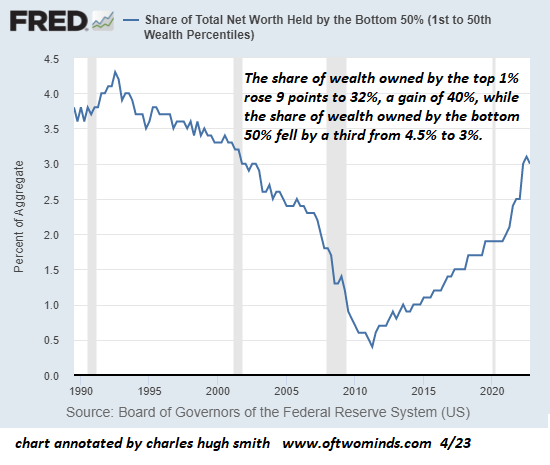
Critiques of “trickle down economics” focus on income inequality as a key metric of the Social Contract: rising income inequality is de facto evidence that the Social Contract is broken.

I think this misses the key distinction in the Social Contract between citizens and the state, which is the legitimacy of the process of wealth creation and the fairness of the playing field and the referees, i.e. that no one is above the law.

Few people begrudge legitimately earned wealth, for example, the top athlete, the pop star, the tech innovator, the canny entrepreneur, the best-selling author, etc. The source of these individual’s wealth is transparent, and any citizen can decline to support this wealth creation by not paying money to see the athlete, not buying the author’s books, not shopping at the entrepreneur’s stores, etc.

The Social Contract is broken not just by wealth inequality per se but by the illegitimate process of wealth acquisition, i.e. the state has tipped the scales in favor of the few behind closed doors and routinely ignores or bypasses the intent of the law even as the state claims to be following the narrower letter of the law.

By this definition, the Social Contract in America has been completely smashed. One sector after another is dominated by cartel-state partnerships that are forged and enforced in obscure legislation written by lobbyists. Once the laws have been riddled with loopholes and the regulators have been corrupted, “no one is above the law” has lost all meaning.

Those who violate the intent of the law while managing to conjure an apparent compliance with the letter of the law are shysters, scammers and thieves who exploit the intricate loopholes of the system, all the while parading their compliance as evidence the system is fair and just. In this way, the judicial system becomes part of the illegitimate process of wealth accumulation.

In America, political and financial Elites are above the intent of the law. Is bribery of politicos illegal? Supposedly it is, but in practice it is entirely and openly legal.

This is the norm in banana republics, whose ledgers are loaded with thousands of codes and regulations that are routinely ignored by those in power. In the Banana Republic of America, financial crimes go uninvestigated, unindicted and unpunished: banks and their management are essentially immune to prosecution because the crimes are complex (tsk, tsk, it’s really too much trouble to investigate) and they’re “too big to prosecute.”

The rot has seeped from the financial-political Aristocracy to the lower reaches of the social order. The fury of those still working legitimate jobs and paying their taxes is grounded in a simple, obvious truth: America is now dominated by scammers, cheaters, grifters and those gaming the system, large and small, to increase their share of the swag.

The honest taxpayer is a chump, a mark who foolishly ponies up the swag that’s looted by the smart operators. Everyone knows that the vast majority of wealth accumulation in America flows not from transparent effort on a level playing field, but from persuading the Central State (the Federal government and the Federal Reserve) to enforce cartels and grant monopolistic favors such as tax shelters designed for a handful of firms and unlimited credit to private banks.

When scammers large and small live better than those creating value in the real economy, the Social Contract has ceased to exist. When the illegitimate process of wealth acquisition–a rigged playing field, a bought-off referee, and an Elite that’s above the law by every practical measure–dominates the economy and the political structure, the Social Contract has been shattered, regardless of how much welfare largesse is distributed to buy the complicity of state dependents.

Once the chumps and marks realize there is no way they can ever escape their exploited banana-republic status as neofeudal debt-serfs, the scammers, cheats and grifters large and small will be at risk of losing their perquisites. The fantasy in America is that legitimate wealth creation is still possible despite the visible dominance of a corrupt, venal, self-absorbed, parasitic, predatory Aristocracy. Once that fantasy dies, so will the marks’ support of the Aristocracy.

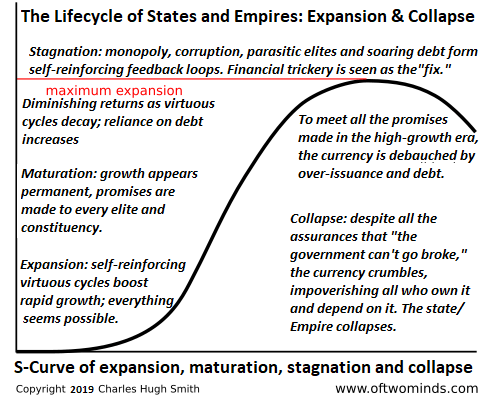
As Voltaire observed, “No snowflake in an avalanche ever feels responsible”: every claim, every game of the system, every political favor purchased is “fair and legal,” of course. This is precisely how empires collapse.

In broad brush, we can trace the transition from feudalism to capitalism to the present financialized, globalized cartel-state neofeudalism and next, to a synthesis built on the opposite of neofeudalism, which is decentralization, transparency, accountability, legitimacy and the adaptive churn of competing ideas and proposals.

Seymour Hersh: the CIA Knows Ukrainian Officials Are Skimming US Aid

Hersh says the CIA estimates at least $400 million was embezzled last year in funds earmarked for diesel payments

By Dave DeCamp

Source: Antiwar.com

On Wednesday, Investigative journalist Seymour Hersh published a report on Substack that alleged the CIA was aware of widespread corruption in Ukraine and the embezzlement of US aid.

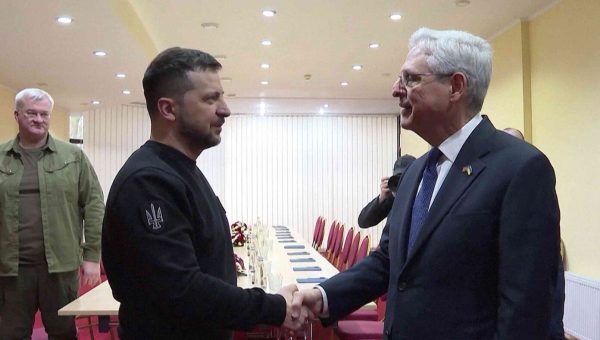
The report said the Ukrainian government has been using US taxpayer money to purchase diesel from Russia to fuel its military. Hersh said Zelensky “has been buying the fuel from Russia, the country with which it, and Washington, are at war, and the Ukrainian president and many in his entourage have been skimming untold millions from the American dollars earmarked for diesel fuel payments.”

Hersh said according to one estimate by CIA analysts, at least $400 million in funds were embezzled last year. Sources told Hersh that Ukrainian officials are also “competing” to set up front companies for export contracts to private arms dealers around the world.

The issue of corruption was raised during a meeting between CIA Director William Burns and Zelensky in January. An intelligence official with direct knowledge of the meeting told Hersh that Burns delivered a stunning message to Zelensky.

Hersh wrote: “The senior generals and government officials in Kiev were angry at what they saw as Zelensky’s greed, so Burns told the Ukrainian president, because ‘he was taking a larger share of the skim money than was going to the generals.’”

During the meeting, Burns presented Zelensky with a list of 35 generals and senior government officials whose corruption was known to the CIA. Zelensky responded by dismissing 10 officials who were engaged in flagrant corruption. “The ten he got rid of were brazenly bragging about the money they had—driving around Kiev in their new Mercedes,” the intelligence official said.

Hersh said Zelensky’s “half-hearted response” and the “lack of concern” in the White House angered some US intelligence officials. The intelligence official speaking to Hersh criticized President Biden’s two main foreign policy advisors, Secretary of State Antony Blinken and National Security Advisor Jake Sullivan.

“They have no experience, judgment, and moral integrity. They just tell lies, make up stories. Diplomatic deniability is something else,” the official said. The official said there was a “total breakdown between the White House leadership and the intelligence community.”

The report said the rift started in the fall when the Nord Stream natural gas pipelines were blown up. According to Hersh’s earlier reporting, President Biden ordered the operation that took out the pipelines. “Destroying the Nord Stream pipelines was never discussed, or even known in advance, by the community,” the official said.

The official said there is “no strategy for ending the war” within the Biden administration and offered more scathing criticism of Blinken and Sullivan.

“Burns is not the problem,” the official said. “The problem is Biden and his principal lieutenants—Blinken and Sullivan and their court of worshippers—who see those who criticize Zelensky as being pro-Putin. ‘We are against evil. Ukraine will fight ’til the last military shell is gone, and still fight.’ And here’s Biden who is telling America that we’re going to fight as long as it takes.”

Hersh’s story comes after a series of leaked top-secret documents from the Pentagon and other government agencies surfaced online. Some of the documents show US war planning for Ukraine and reveal the US doubts Kyiv’s ability to launch a successful counter-offensive, offering a starkly different view of Ukraine’s abilities than what Biden officials have been saying publicly.

An Inconvenient Revolution

By Charles Hugh Smith

Source: Of Two Minds

Convenience isn’t just about small appliances. It’s also about ruling nations. Let’s start with the semantics of ruling nations. Some labels might be viewed as somewhat inflammatory (Kleptocracy, anyone?), so let’s stick with the neutral Ruling Order.

Some things have been extraordinarily convenient for the Ruling Order. Take the life and death of one Jeffrey Epstein, an intel “asset” who assembled a veritable goldmine of dirt on an astounding collection of bigwigs, and then became, well, inconvenient.

Very conveniently, the security camera in his cell failed, the guards dozed off and he hung himself in this fortuitous interlude. This was the acme of convenience.

Extending the Surveillance State into Big Tech’s planetary-wide social media networks was also convenient, and a bargain to boot. Instead of all that expensive stuff the Communist State in China had to pay for, America’s Ruling Order just put the squeeze on Big Tech and saved a bundle.

The Surveillance State assumes that any revolt / revolution can either be nipped in the bud by identifying foreign influences / domestic extremists, or crushed by foreknowledge of the storming of the barricades.

In conventional times, these are pretty safe assumptions. But the times are no longer conventional, and so the Ruling Order is in effect investing its treasure and confidence in fighting the last war.

It’s convenient if rebelling citizens organize themselves in visible networks and concentrate into groups that can be crushed by force. It’s inconvenient if the revolution is not neatly organized and crushable but an invisible revolution of not showing up.

In other words, a revolution of getting fed up and opting out, of finding some other way to live rather than spending 10 years paying down the student loans and another 30 years paying down the mortgage and the last few years of one’s life watching the tides of financial excess erode the sand castles of pensions and retirement.

There’s a consequential asymmetry to the inconvenience caused by people getting fed up and opting out. The average worker not showing up is consequential but not catastrophic. But when the managerial class thins out, and those doing the dirty work thin out, there are no replacements, and the system breaks down.

Few are willing to make the beds, empty the bedpans and work in slaughterhouses. When those willing to do the work nobody else wants to do quit, the system collapses. Those with higher expectations will not volunteer to do the dirty work, and many are unable to do the work even if they are willing. It’s too hard and too physically punishing. (Says a guy who’s carried stupid amounts of lumber up hillsides where no forklift could go.)

Despite what many of us may think, the majority of workers lack the experience and tools to manage complex operations. (Those of us who try soon reach our limits.) Many lack a deep enough knowledge to fix major breakdowns. When the critical operational and managerial people retire, quit, or find some other way to live, the system breaks down.

All the surveillance and all the force that the Ruling Order depends on to maintain its dominance is useless when people get fed up and quit supporting the system with their labor and their borrowing / spending. All the surveillance and facial recognition software is worthless, all the monitoring of kitten and puppy photos on social media, all the tracking of foreign influence–none of it matters any more.

It’s inconvenient when those whose sacrifices are essential to the system get fed up and find some other way to live. Yet this is the inevitable consequence of a system hopelessly corrupted by fraud, inequality and unfairness, a system rigged to benefit the few at the expense of the many. People eventually get fed up and opt out.

They don’t throw themselves on the gears of an odious system, they simply stop greasing the gears with their time, effort, experience, debt and money. It doesn’t take many opting out to trigger decay and collapse. The Pareto Distribution applies. The system can adjust to the first 4% opting out, but those consequential few trigger the decay of the commitment of the next 20%, and the system cannot survive when the 20% find some other way to live. The 80% can still be willing to grease the gears but that’s no longer enough to maintain the coherence of the system.

The asymmetry of decay and collapse is inconvenient.

BYE, BYE KIEV, HELLO COTE D’AZUR: AS WESTERNERS SEND AID, HERE’S HOW UKRAINE’S CORRUPT ELITES ARE PROFITING FROM THE CONFLICT

Ukraine’s newly elected President Volodymyr Zelensky (C) walks to his Presidential office after a ceremony of his oath in the Ukrainian Parliament, in Kiev, Ukraine. © STR / NurPhoto via Getty Images

By Olga Sukharevskaya

Source: New Cold War

For years, and particularly since the beginning of Russia’s military offensive in Ukraine, the United States, the European Union – and their allies – have provided Kiev with $126 billion worth of aid, a number almost equal to the country’s entire GDP but Olga Sukharevskaya reports that officials and oligarchs have diverted much of the financial support sent to Kiev
__________________________

Since the beginning of Russia’s military offensive in Ukraine, the United States, the European Union – and their allies – have provided Kiev with $126 billion worth of aid, a number almost equal to the country’s entire GDP. Moreover, millions of Ukrainians have found refuge in the EU where they were given housing, food, work permits, and emotional support. The scope is huge, even by western standards. Considering that the bloc has been funding Kiev while coping with an economic and energy crisis of its own, the assistance is perhaps especially notable.

Kiev bases its endless funding requests on the collapse of its economy, due to the war, and its need to “resist Russian aggression.” But is the aid reaching its intended destination?

The Monaco Battalion

While Ukraine has undergone a general mobilization affecting all men under the age of 60, many former and current high-ranking officials, politicians, businessmen, and oligarchs have moved to safety abroad – mainly to the EU.

The mass flight of Ukrainian elites started even prior to the armed conflict. On February 14, 2022, 37 deputies from the Ukrainian president’s parliamentary faction “Servant of the People” suddenly went “missing.” Had MPs not been banned from leaving the country the very next day, others would’ve definitely joined them. Meanwhile, former officials and oligarchs enjoyed more freedom to move around. According to the Italian newspaper La Repubblica, 20 business jets took off from Kiev’s Boryspol airport on the 14th as well.

Tycoons were at the front of the line. Entrepreneur and MP Vadim Novinsky, businessmen Vasily Khmelnitsky and Vadim Stolar, Vadim Nesterenko, and Andrey Stavnitzer all left the country on charter flights. Millionaire politician Igor Abramovich booked a private flight to Austria for 50 people – taking relatives, business partners, and fellow party members aboard. Oligarchs flew from Kiev to Nice, Munich, Vienna,  Cyprus, and other EU destinations. Another group of businessmen took off from Odessa on private planes. The owner of Vostok Bank departed for Israel, while the head of the Transship group flew to Limassol. An ex-governor of the Odessa region, Stalkanat’s Vladimir Nemirovsky, also left the country.

In the summer and early fall of 2022, ‘Ukrainska Pravda’ prepared several investigative documentaries about fit-for-service Ukrainian billionaires and officials spotted vacationing on the Côte d’Azur during the war. A movie with the ironic title “The Monaco Battalion” shows Ukrainian oligarchs resting at their villas, mansions, and on yachts. In the first part, we see businessman Konstantin Zhevago, who is included on Interpol’s wanted list, relaxing on his private yacht worth $70 million. The yacht graces the shoreline of the Côte d’Azur as Zhevago’s family disembarks. Kharkov entrepreneur Alexander Yaroslavsky, who promised to sell his yacht and transfer the funds towards the restoration of Kharkov, can be seen sailing alongside.

‘Ukrainska Pravda’ journalists also got a glimpse of the Surkis brothers in France, who’re currently renting apartments worth €2 million per year. Meanwhile, a $300,000 Bentley belonging to Ukrainian businessman Vadim Ermolaev was spotted near the casino in Monaco, and Eduard Kohan, the co-founder of Euroenergotrade, was seen at one of Monte Carlo’s chic hotels.

A whole colony of Ukrainian oligarchs has apparently taken up residence in the elite French commune of Cap-Ferrat. Land developer Vadim Solar, oligarchs Dmitry Firtash, Vitaly Khomutynnik, and Sergey Lovochkin are among those enjoying high life in the middle of the war. The Cap-Ferrat villa once belonging to King Leopold II of Belgium was bought by the richest Ukrainian oligarch Rinat Akhmetov. His neighbors are Alexander Davtyan, President of the Investment Group DAD LLC, and Vladislav Gelzin, a former deputy of the Donetsk Regional Council.

As the creators of the film repeatedly emphasize, deputies and businessmen of “pro-Russian” parliamentary factions left the country during the war. Yet many active supporters of the current government also prefer to defend their homeland from abroad.

‘Ukrainska Pravda’ managed to interview Andrei Kholodov, an MP from Vladimir Zelensky’s faction “Servant of the People”, from his current residence in Vienna. The Austrian capital was also chosen by nationalist Nikita Poturaev and Sergei Melnichuk, a former head of the Aidar battalion known for war crimes reported by Amnesty International. The former head of the Constitutional Court of Ukraine, 59-year-old Alexander Tupitsky, and the 45-year-old ex-prosecutor general of Ukraine Ruslan Ryaboshapka also preferred foreign “trenches.”

Members of the Ukrainian parliament are in no hurry to adopt vitally important laws for the country during wartime. According to the Telegram channel “Volyn News,” as of March 11, 2022, more than 20 MPs had moved abroad for unspecified reasons. The geography is extensive: Great Britain, Poland, Qatar, Spain, France, Austria, Romania, Hungary, UAE, Moldova, Israel, etc. In March, the Prosecutor General’s Office of Ukraine launched an investigation into the actions of six parliamentarians who have remained abroad.

Apparently, neither war nor punishment can put Ukrainian legislators to work. Only 99 deputies out of 450 attended the session of the Parliament on July 20. Presumably distracted by summer, the Côte d’Azur, the Maldives, and yachts… As for defending Ukraine itself – just leave it to the foreign volunteers, they say.

Where’s all the military and humanitarian aid going?

Some western benefactors have recently noticed that most of the military and humanitarian aid never reaches Ukraine’s army or ordinary citizens.

In an original documentary, CBS reported that about 70% of military aid failed to find its way to the intended beneficiaries and donor countries are often unable to control its intended use. According to the creators of the report, some of the weapons are sold on the black market. As US Marine Corps veteran Andy Milburn said, “I can tell you unarguably that on the frontline units these things are not getting there. Drones, Switchblades, IFAKs. They’re not, alright. Body armor, helmets, you name it.”

The Grayzone writes that weapons and humanitarian aid provided by the West to the Ukrainian military is being stolen along the way and never reaches the soldiers. At the same time, Ukrainian MPs recently gave themselves a 70% pay raise. The author of the piece argues that billions of dollars from the USA and the EU have been diverted.

A Ukrainian soldier named Ivan told journalists about western funds never reaching the front: “Imagine telling an American soldier that we are using our personal cars in the war, and we’re also responsible for paying for repairs and fuel. We’re buying our own body armor and helmets. We don’t have observation tools or cameras, so soldiers have to pop their heads out to see what’s coming, which means at any moment, a rocket or tank can tear their heads off.”

Samantha Morris, a medical doctor from the US, drew attention to the theft of medical supplies and the overall corruption: “The lead doctor at the military base in Sumy has ordered medical supplies from and for the military at different points in time, and he has had 15 trucks of supplies completely disappear,” she said. The doctors couldn’t even set up courses for medical assistants until a friend of the Sumy region governor interceded.

CNN talked to a retired US colonel who said that Ukrainian troops are short on supplies. Small arms, medical equipment, field hospitals and a lot more are under the control of private organizations – more concerned about stealing money than saving the lives of their compatriots.

As Stephen Myers, a former member of the US Department of State Advisory Committee on International Economic Policy, insisted“There is little to prevent a field commander from diverting some of the equipment to buyers, aka the Russians, the Chinese, the Iranians or whomever, while claiming the equipment and weapons were destroyed…”

Thousands of tons of humanitarian aid is being stolen. In September, the National Anti-Corruption Bureau of Ukraine (NABU) proved that the head of the Office of the President, Andrei Yermak, his deputy Kirill Tymoshenko, the head of “The Servant of the People” faction David Arakhamiya and his friend Vemir Davityan were behind the large-scale theft of humanitarian aid in the Zaporozhye region. Zaporozhye officials Starukh, Nekrasova, Sherbina, and Kurtev only superficially carried out the task of distributing aid. In six months, they organized the theft of 22 sea containers, 389 railway cars, and 220 trucks. Humanitarian aid was sold in ATB and Selpo – supermarkets owned by Gennady Butkevich and Vladimir Kostelman, respectively. Of course, Tymoshenko, Nekrasova and Davityan all became “refugees” and found asylum in Vienna.

Admittedly, not everyone is on the run. Andrei Yarmolsky, the scandalous former deputy head of the Volyn regional administration – accused of stealing humanitarian aid, supplying defective bulletproof vests, and illegally moving men out of the country – was promoted. He now works for the National Security and Defense Council.

Medical supplies are also being stolen. The Telegraph reportsthat “some of the donated supplies later made their way onto the hospitals’ pharmacy shelves: priced, and listed for sale”. Health workers appropriate medicine, bandages, and medical equipment, and resell them to patients for whom they were intended to be free, the article says.

A similar story was told by the aforementioned doctor Dr Morris: “I got a call from a nurse at a military hospital in Dnipro. She said the president of the hospital had stolen all the pain medications to resell them, and that the wounded soldiers being treated there had no pain relief. She begged us to hand-deliver pain medications to her. She said she would hide them from the hospital president so that they’d reach the soldiers. But who can you trust? Was the hospital president really stealing the medications, or was she trying to con us into giving her pain medications for her to sell or use? Who knows. Everyone is lying.”

War for some, Gucci for others

Enormous cash flows from Western countries are continuously used by corrupt Ukrainian officials for personal enrichment and to acquire luxury goods.

In a recently busted corruption scheme, Odessa customs smuggled shirts, backpacks, sports shoes, belts, and other luxury items by Givenchy, Gucci, Polo, Dolce & Gabbana, Michael Kors, Chanel, Louis Vuitton, and Armani under the guise of army equipment. The documents, declaring the cargo as “for the needs of the Armed Forces of Ukraine,” were signed by the acting head of the Odessa customs Vitaly Zakolodyazhny. According to MP Alexander Dubinsky, this is a common theft scheme. “The work of the customs is unsatisfactory because while some are fighting at the front, others are making money under the guise of their customs uniforms,” the parliamentarian said.

To take another example, in May 2022, Western countries abolished customs duties for Ukraine. Within a week, over 14,000 passenger cars were imported into the country. As the Deputy Minister of Infrastructure Mustafa Nayem commented, “Considering we’re a country at war, our partners in Poland, Slovakia, and Romania were quite surprised by this fast-paced upgrade to our vehicle fleet.”

As they go about acquiring luxurious clothes and cars, the thieves are also taking care to withdraw capital from Ukraine.

According to the Bureau of Economic Security of Ukraine, Ukraine’s budget is missing UAH 4.5 billion worth of taxes from agrotraders: “In August-September 2022, almost 12 million tons of grain crops and oil estimated at UAH 137 billion were exported through the customs territory of Ukraine. Of these, almost 4 million tons were exported by fake companies existing only on paper.” Moreover, “most of the non-resident companies to which grain is exported are high-risk and involved in criminal investigations.” Is this the “grain deal” that the global community is actively cheering? It looks like Ukrainian fraudsters are corrupting not just their own country, but foreign states as well. And this is just one example out of many.

When the Surkis brothers left Ukraine, they took $17 million with them. But that’s just a trifle compared to the “heroes of the Euromaidan.” According to former People’s Deputy of Ukraine Oleg Tsarev, after the outbreak of hostilities leading Ukrainian politicians sent both their capital and their families abroad.

He mentions that the parents and relatives of President Vladimir Zelensky and his wife all left the country. Zelensky’s predecessor, former president Petr Poroshenko, moved not just his children but also about a billion US dollars in cash to the UK.

The same applies to other major Ukrainian officials: former Minister of Internal Affairs Arsen Avakov, the head of the Office of the President Andriy Yermak, the second President of Ukraine Leonid Kuchma, the former Prime Minister of Ukraine Arseniy Yatsenyuk and many others all took their families and fortunes, estimated at around a billion dollars, out of the country. And that’s not to mention the numerous politically-affiliated oligarchs.

Scammers of smaller stature can “individually join the EU” as well. A system of bribery allows military-age males to leave the country. According to Izvestia, the fee is currently between $8,000 and $10,000. The Ukrainian media also actively reports on people paying to cross the border.

***

The sympathy of Westerners towards a country at war is understandable. But while some countries are doing their upmost to aid Ukraine – even while facing an economic crisis themselves – corrupt Ukrainian officials are using the funding to amass personal fortunes and live the high life at fancy resorts. And all at the expense of taxpayers in the West.

In 2015, Arseniy Yatsenyuk, upon leaving the post of the Prime Minister of Ukraine, openly declared that he had become a billionaire. It is yet to be seen how many new Ukrainian super rich tycoons – nurtured by foreign military aid – will appear in the West by the end of the conflict.

***

Olga Sukharevskaya is a former Ukrainian diplomat

I Used To Be Disgusted, Now I’m Disabused

By Charles Hugh Smith

Source: Of Two Minds

It’s certainly possible to be disgusted, but being disabused of the fantasy that the system is self-correcting is the healthier perspective.

I used to be disgusted, now I’m disabused: beneath all the self-serving narratives, fad-memes and over-simplifications regurgitated as serious analysis, these are the core dynamics I see:

1. Imperial corruption of democracy and open markets. I described this in Regardless of Who’s Elected, Imperial Corruption Rules the Nation: the dynamic adaptive churn of unfettered representative democracy and open markets are anathema to insiders, vested interests and elites, each of which has gained asymmetric power by subverting democracy and markets to serve their private interests rather than the public interest / common good–phrases that are meaningless to insiders, vested interests and elites except as simulacra used for PR.

2. The Deep State, the unelected and unaccountable Administrative State. I’ve been discussing the Deep State before it entered common use–for example:

Going to War with the Political Elite You Have (May 14, 2007)

The Dollar and the Deep State (February 24, 2014)

Is the Deep State Fracturing into Disunity? (March 14, 2014)

The Administrative State has existed in some form in every nation-state / empire, but the U.S. Deep State only gained its vast global powers in World War II and the Cold War, where the lesson learned was the public may choose unwisely (for example, choosing appeasement over preparation) and so the really important decisions needed to preserve the nation cannot be left to parochial politicos in elected office–those decisions must be in the hands of those who know what has to be done.

Democracy is the rubber stamp for doing what’s necessary. Beyond that, it’s a potentially fatal hindrance. That’s the mindset of the Deep State, and if you and I were in upper-echelon positions in the Administrative State, we’d agree with this mindset when things get serious.

This mindset is a self-reinforcing group-think feedback loop: those who believe the public should set policy are weeded out, either by self-selection or via being sent to bureaucratic Siberia.

We’re protecting you. That’s all you need to know.

This opens the door to functionaries who came to do good but stayed to do well, i.e. those with the right credentials and connections to enter the Power Circle to “serve the public” but soon become insiders maximizing their own private gains. That’s the problem with the Administrative State: it’s ultimately unaccountable, not just to the public or elected officials but to itself.

3. Vested interests block adaptions that threaten their share of the spoils. Any advance that increases efficiency and productivity and furthers the public good is squelched, suppressed or co-opted by vested interests who rightly fear their share of the spoils might be diminished by advances that obsolete their particular cartel, monopoly or other embedded skim, scam, fraud, embezzlement or simply unproductive dead weight.

The status quo is thus locked into a death spiral as gatekeepers, insiders, vested interests and sold to the highest bidder politicos will protect vested interests even as the engines flood and the ship begins its long descent into the void.

How do otherwise smart people become so blind to what’s going on? They believe the status quo is so wealthy, so powerful, so clever, etc., that it will overcome any obstacles or crises because it’s always done so in the past, and so it is permanent, immutable, forever, and our supping at the trough of free money couldn’t possibly weaken such an enduring Leviathan.

This is the fatal fantasy of every empire. We’re too successful to fail and collapse. But oddly enough, faith in the permanence of success leads to the very collapse that’s deemed “impossible.”

4. Concentrations of wealth, power, capital and production fatally distort the economy and the social order. When “competition” has been reduced to two telecoms, two healthcare insurers, two pork processors, etc., the system has been stripped of adaptability and resilience.

When 10,000 small farmers each have 100 chickens, the stock of 1 million chickens is spread over a wide geography and entrepreneurial network of suppliers, wholesalers, etc. Bird flu may spread widely but it’s far more difficult to wipe out 10,000 small farms’ poultry compared to the ease of bird flu spreading in one giant factory that concentrates 1 million chickens in one facility. Supply chains stripped of network resilience are equally fragile and prone to disruption and collapse.

Concentrating any form of capital, production and power renders the system vulnerable to collapse due to the inherent weaknesses generated by replacing complex networks with vertical-integration under the control of a few cartels, monopolies, autocrats, gatekeepers or regulators–the latter two being easily influenced by political pressure and/or private gain.

It’s certainly possible to be disgusted, but being disabused of the fantasy that the system is self-correcting is the healthier perspective. Everything is forever until systemic weaknesses reveal themselves, typically at the most inopportune junctures.

New York Times — a Bastion of Censorship and Corruption — Warns ‘America Has a Free Speech Problem’

The New York Times editorial board recently opined that Americans are losing “the right to speak their minds and voice their opinions,” yet this same newspaper refused to review, or even publish an advertisement for, RFK, Jr.’s runaway bestseller, “The Real Anthony Fauci.”

By Tony Lyons

Source: The Defender

In a bold, but clearly disingenuous, statement from its famed editorial board, “a group of opinion journalists whose views are informed by expertise, research, debate, and certain longstanding values,” The New York Times issued a cautionary statement:

“For all the tolerance and enlightenment that modern society claims, Americans are losing hold of a fundamental right as citizens of a free country: the right to speak their minds and voice their opinions in public without fear of being shamed or shunned.”

The editorial board pounded the point home:

“People should be able to put forward viewpoints, ask questions and make mistakes, and take unpopular but good-faith positions on issues that society is still working through — all without fearing cancellation …. Freedom of speech requires not just a commitment to openness and tolerance in the abstract. It demands conscientiousness…

“We believe it isn’t enough for Americans to just believe in the rights of others to speak freely; they should also find ways to actively support and protect those rights.”

Of course, The New York Times should be leading by example. In fact, it has not supported free speech, protected the First Amendment, or allowed honest debate. It has not allowed competing perspectives about the most important issues of the day.

Instead, it has been a mouthpiece for greedy corporations and corrupt government officials.

In support of the newspaper’s interests, and at the expense of the interests of American citizens, The New York Times censored Robert F. Kennedy, Jr.’s latest book, “The Real Anthony Fauci,” in every conceivable way.

It ranked the book No. 7 on its non-fiction bestseller list even though the book outsold any other book in America that week by thousands of copies.

Then it refused to allow Skyhorse Publishing to place an advertisement for the book because its censorship division, ironically called “Standards Management,” decided the book itself constituted misinformation — despite the paper’s stated policy that “Standards” only looks into whether an ad itself is “non-defamatory and accurate.”

The New York Times followed up with a scathing hit piece targeting Kennedy as “a leading voice in the campaign to discredit coronavirus vaccines and other measures being advanced by the Biden White House to battle a pandemic that was … killing close to 1,900 people a day.”

The Times accused Kennedy of circulating “false information” — without indicating what that information was or explaining why it was false — and of comparing the government pandemic response to the Holocaust, even though he didn’t do that.

Finally, The New York Times refused to review “The Real Anthony Fauci” or so much as comment on its historic grassroots success, even though it’s become a cult classic, selling more than 1 million copies in just four months, and launching a worldwide movement against government corruption and corporate greed.

“Despite all the lying, or maybe in reaction to it,” Tucker Carlson told me, “Robert F. Kennedy, Jr. is becoming a legitimate folk hero.”

He is a folk hero because he stood up, grabbed a bullhorn and spoke truth to power. He’s risked everything. He’s realized that you either care about justice or you care about personal consequences.

And for him there have been many.

After suppressing freedom of speech for two years and defending a specific, myopic and harmful narrative, the editorial board of the New York Times decided it was the perfect time to take a strong stance against censorship and cancel culture.

The irony of the most powerful and high-profile violator of First Amendment rights lamenting the lack of free speech — and offering up ideas to protect the rights of Americans — was palpable, inescapable and despicable.

Like Captain Renault in “Casablanca,” when he closes Rick’s Café Americain and proclaims: “I’m shocked, shocked to find that gambling is going on in here,” The New York Times gladly accepts its winnings.

The paper’s profitability has soared during the worst and most pervasive period of censorship in recent American history. Its owners have done absolutely nothing to protect the free speech rights of hundreds, if not thousands, of doctors, nurses, scientists and concerned citizens who have tried to discuss views, make arguments and analyze scientific studies that challenge the prevailing COVID narrative.

The Times has silenced debate, worked tirelessly to chastise, vilify and discredit those whose positions they disagree with, and failed to investigate serious claims of government corruption.

Nevertheless, the paper claims to lament that “when public discourse in America is narrowed, it becomes harder to answer … the urgent questions we face as a society.”

What could be more important, more urgent, than the truth about corruption at the highest levels of government, about a pandemic response that led to more serious illness and death than was necessary, about the most powerful public health official in the country being more concerned with helping Big Pharma maximize return on investment and mitigate risk to industry, rather than protecting people’s lives?

As The Times wrote, the worst kind of censorship is cancel culture and the worst kind of cancel culture is the “piling on” kind.

Why then, one might ask, did the paper run a hit piece about Robert F. Kennedy, Jr. that covered essentially the same subject matter as a dozen other hit pieces? Why now? Why this target?

His family thinks he’s wrong about vaccines, The Times noted. His friends think he’s wrong about vaccines. Dr. Fauci thinks he’s wrong about vaccines. Ever heard that before?

Any analysis about vaccine safety? Any facts? Any citations? Any discussion of Dr. Fauci’s despicable corruption as described in “The Real Anthony Fauci”?

No, no, no, no and no.

What was The New York Times doing when the whole world was attacking Robert F. Kennedy, Jr.?

Where was The New York Times when Robert F. Kennedy, Jr., Dr. Robert Malone, Dr. Judy Mikovits, Dr. Pierre Kory — and so many other impressive voices — were being stifled?

They were “piling on.” (If The New York Times really wants to do something for free speech, it should publish a book review, finally, of the runaway bestseller — “The Real Anthony Fauci.”)

The Times has stated it won’t “publish ad hominem attacks,” but it does publish hit pieces that any rational person understands are meant to discredit a book they don’t mention and obviously haven’t read.

The Times protects corrupt government officials against the unsuspecting public by forwarding policy statements or official memos their editors and reporters have not thoroughly vetted, investigated or corroborated.

The Times writers and editors are the worst kind of co-conspirators: the kind that claims to be protecting their victims.

The New York Times writes:

“At the individual level, human beings cannot flourish without the confidence to take risks, to pursue ideas and express thoughts that others might reject…. When speech is stifled or when dissenters are shut out of the public discourse, a society also loses its ability to resolve conflict, and it faces the risk of political violence.”

That’s where we are in America today. There is no debate, no public discourse, and we have lost the ability to resolve conflict.

We have separated the country into two Americas, at least partially because of the policies and practices of The New York Times.

The New York Post pointed out that the New York Times “published lies to serve a biased narrative.” The Post accused The Times of “malicious misreporting” and cites a book, “The Grey Lady Winked,” by Ashley Rindsberg.

Rindsberg is quoted as calling The New York Times “a truth-producing machine.” He believes the “fabrications and distortions” they’ve peddled since the 1920s were a system of twisting facts to manipulate public opinion about everything from “Hitler’s Germany and Stalin’s Russia to Vietnam and the Iraq War.”

The “reporting” is designed to “support a narrative aligned with the corporate whims, economic needs and political preferences” of The New York Times, Rindsberg claims. He believes the paper has consistently created “false narratives.”

The New York Post says The Times has the resources to do it:

“With close to $2 billion in annual revenue, the Times has the money, prestige, experience and stature to set the narratives that other news outlets invariably follow.”

Rindsberg alleges a former Times bureau chief in Berlin was a Nazi collaborator and that another star reporter for the paper parroted Soviet propaganda to defend Stalin.

The New York Times coverage in the lead-up to the Vietnam and Iraq wars seemed like government disinformation designed to support going to war.

More recently Rindsberg points to the stories that The New York Times published about Russia putting a bounty on U.S. soldiers in Afghanistan, which the Biden administration later conceded was misinformation, and the story about Capitol Police Officer Brian Sicknick being “murdered by rampaging Trump supporters,” though it was later proven he died of a stroke.

Similarly, Glenn Greenwald accused The New York Times of participating in “one of the most successful disinformation campaigns in modern electoral history.”

The Times, which before the 2020 election dismissed the Hunter Biden laptop as Russian disinformation, recently conceded that it was authentic.

It seems likely The New York Times coverage of the COVID Pandemic isn’t any different than its coverage of Hitler, Stalin, Vietnam, the Iraq War, January 6, the Russian bounty on American soldiers or the Hunter Biden laptop.

Like most of the major Big Tech platforms, The New York Times appears to have worked closely with Dr. Fauci and others, as representatives of the U.S. government, to control and propagate a specific narrative and to do what the government can’t legally do itself — censor ideas that it disagrees with or narratives that might be harmful to its corporate partners.

As discussed above, The New York Times actively suppressed Robert F. Kennedy, Jr.’s book and his allegations of corruption against Dr. Anthony Fauci. It defended Dr. Fauci without any investigation, without a full, free and fair discussion of what is clearly the most important book of the decade.

By ignoring Kennedy’s book, by refusing to review it, by not allowing advertisements, by misrepresenting its success on its bestseller list, the paper clearly did everything in its power to avoid any debate whatsoever about the real science behind the origins of COVID or the best practices for controlling the virus and protecting the public.

The New York Times has shown a total disregard for the scientific process, individual due process rights or for any real search for truth.

And, once again, it did all this while lecturing us about the importance of free speech.

We have arrived at George Orwell’s “1984.” Doublespeak is the universal language. The paper of record floods the world with disinformation, claims to be working tirelessly to protect the American people and has clearly become The Ministry of Truth.

Reading Robert F. Kennedy, Jr.’s book, “The Real Anthony Fauci” — the book Big Pharma, Dr. Fauci, the U.S. government and The New York Times will do absolutely anything to prevent you from reading — has become an act of rebellion, a blow to fascism and a clear message that censorship in America just doesn’t work.

Tony Lyons, president and publisher at Skyhorse publishing, and an attorney, was publisher at The Lyons Press between 1997 and 2004. He founded Skyhorse Publishing in 2006 and has been involved with every aspect of the book publishing process.

The American Third World: We’ll Soon Be Living in It

By Fabian Ommar

Source: Activist Post

It’s that time of the year, and instead of following tradition and making new predictions and forecasts (which we preppers do all the time anyways), I usually look back into the recent past, review my (and other’s) work and previous analyses, what transpired (or not), where my perspectives need adjustment and where, and so forth.

I decided to review and expand on a few topics addressed previously here and see where we are on those. In April, I wrote about the thirdworldization of the United States, as both it, and the rest of the First World, is gradually shifting towards the Third World.

It’s not only happening, but accelerating. And the entire world is going that way, too – or soon it will, judging by the signs. These things have a delay and don’t happen linearly, but in waves.

Thirdworldization 2.0 – When the First World becomes the Third World

Let’s see some more about how life can be in places constantly suffering with economic crises, political upheavals, moral degeneracy, authority demoralization, institutional failure and social decadence.

For anyone who’s never lived in such a context, understanding the dynamics of the system and societies in the Third World (or any place in which the order has changed drastically, yet not totally evaporated), can be a good way to prepare for what’s already underway.

The current crisis is global and unlike others seen in recent times

Notwithstanding the crap lining up just waiting to hit the fan – a pandemic, a debt time-bomb, geopolitical tensions, and lots more – the capacity to deal with all that is at an all-time low. Even wealthy nations look exhausted, depleted and lost like never before.

There’s zero willingness to cooperate and coordinate a solution, despite authorities’ constant and oddly similar declarations to the contrary. Speaking of the leadership currently in charge, it’s as mediocre, misguided, and uninspiring as it can possibly be.

And this is everywhere. We’re screwed.

It’s impossible to say for sure whether or not all that will end up in a full-blown SHTF of some kind, much less when. It can take a year, or ten. What’s certain is this: until things reach that catalyst point, degradation will force large swaths of populations worldwide, in most if not all countries, to take a few steps back in many fronts.

As I said before, it’s already happening.

The Third World will get much worse, and the First World will become a lot like the Third.

This is not SHTF as some might see it, but a middle-of-the-road-yet-still-gloomy scenario. Many in Preppersphere can’t conceive of anything less than the Apocalypse. Fine, to each their own. Besides, preparing for the worst means covering for everything less, so in principle it’s not a bad strategy, right?

I live in Brazil, but have visited the US, EU, and a few other countries and continents, even having lived abroad for a period during the 1990s. I’ve experienced both realities under different circumstances and gained some perspective on the contrasts between advanced societies, and ones with broken, inefficient, and corrupt institutions, and with weak social contracts.

That’s what I’m here to share. I’ll continue to raise awareness to what society converts into long before TEOTWAWKI happens, and try to help others prepare and deal with that. I do this not only because this is where I have some degree of knowledge, but also because that is what I see happening.

It’s hard to make progress in a ‘quicksand environment.’

In developed countries, people frame their decisions and take action based on reasonable probabilities, and the assumption that certain basic conditions of the social contract won’t change radically or suddenly, depending on who’s in charge or some other spurious reason.

A functional checks-and-balances system warrants the stability of laws, regulations, the tax regime, while the political rules and institutions create a favorable environment for investment and risk taking by people, families, and businesses. That’s what promotes the development and advancement of a country.

That’s perhaps the most important thing to understand about (and consequently prepare for) thirdworldization: it’s not just that things change, but how they change. Thirdworldization is the present and constant possibility that things can get done, undone, and again, at any moment, in unpredictable ways, without debate or warning.

How do you make plans for the future in such context?

Instability and uncertainty make life in general much harder to navigate in the Third World.

If the goalposts are constantly moving, everyone will act short or near term as a way to adapt and survive. The harder and more unstable the context, the faster you must both adapt and act (what is SHTF if not chaos?). So, there’s a silver lining to living like this, but also a price: it’s riskier, more stressful, tiresome, and frustrating.

I won’t say it’s hell, because it’s not.

Most people don’t live 24/7 in fear or under serious risk, not even in severely hit places. It’s not a full-scale SHTF. Life’s just more fluid, more challenging, and not as predictable and calm as in more civilized nations. Actions and consequences don’t follow a linear, predictable path.

Look around and see the sweeping anxiety and depression everywhere. I’d argue it’s not being caused by the pandemic, or even the economy going kaput, but by the appetite of governments everywhere to change basic rules and destroy freedom and individual liberty in the name of an emergency. When you combine this with people’s willingness to forfeit their rights, privacy and liberties in the name of illusory safety you end up with our current world.

That’s what I mean by the world going the way of the Third World.

Observing and understanding the real nature of fluidity in everyday life of a dysfunctional society can be critical, because dysfunctional is exactly what the world is fast becoming.

I’ll give some examples to illustrate what I’m talking about…

What does the path to authoritarianism look like?

The executive, legislative, and judiciary overstepping each other is common in banana republics. Every country can have a bill of rights, but it’s the separation of powers that make the constitution effective. Without a checks-and-balances system, rights are just words on a piece of paper.

This creates both confusion and infighting while simultaneously eroding confidence in the government’s institutions. People lose reference, politicians tend to abuse this strategy more and more, and from there it’s only downhill. It’s the exact script dictators and populists everywhere follow every single time to not only take power but to try to keep it forever.

For a long time this was something unacceptable and unseen in advanced nations. Despite this, though, it’s still been happening for some time now only having escalated in the last couple decades. Since 2020 it’s exploded, and it’s now eroding political and social stability in various developed countries.

And this is not only about inflated presidents declaring wars and contracting treaties and other actions without congressional approval, but also the government ceding increasing powers to agencies – NGOs and others organizations of unprepared, unelected tyrants aligned with the elites, eager to interfere and micromanage both society and people’s lives, as they steal people’s inherent rights and freedoms.

We now have moral ambiguity from top to bottom.

As we go lower down the scale into a full-fledged Third World nation, everyday life begins to border on the bizarre. In developing countries, the public administration is a cesspool of incompetence, poor planning, lack of vision, populism and corruption which drains precious resources and wealth from what would otherwise be a productive population.

The bureaucracy can reach paralyzing levels. The tax regime is so complex and illogical that it’s almost impossible to comply, even if you want to. The regulations are unstable and mutating. Besides punishing the population, these regulations lower the appetite of people and businesses to invest and take risk. The economy becomes less dynamic, less competitive and, eventually, it crawls.

Finally, when the government, institutions, and other authorities begin to become ambiguous with their defining the rules they create and enforce, people start thinking “why should I follow any of that?”

And once this happens, then it’s only a matter of time for disorder to increase and morality to collapse. That’s what a slow-burning SHTF means, after all: a  semi-functional system where everything is fluid and the laws have little practical effect.

There’s little guns can do to solve bigger issues.

But let’s switch gears a little to explain something related: guns are important and can save us in some specific situations. But they can’t help with any of the stuff I’m talking about.

Who are we gonna shoot? The politicians? The corrupt cops? The lazy public workers? The stupid laws? That would solve nothing. All it would mean would be civil war, which only makes everything worse.

Things might get to that point, but it’s a completely different dynamic. When the system is up, shooting someone can land you in jail – even in the Third World.

“How’s that any different from anywhere else?” you might ask. In many ways, this starts with an ineffective investigation apparatus: here only about 6% of intentional homicides are solved, in comparison to an average of 65% in US, 80% in France, and 90% in UK.

Translating, it’s a lot more discouraging to commit a crime in the First World than in the Third. But then other distortions and inequalities come into play. The rich and/or connected almost never go to jail, no matter the crime.

And this leads to the second big difference: the slow and utterly unfair justice system that punishes the entire society, by not punishing the deserving, as it should.

And then there’s the infamous Third World penitentiary system…

These are true SHTF microcosms. No prison anywhere is paradise, obviously. But do you have any idea how bad and dangerous a Third World jail is? If having forty dangerous inmates in a small cubicle originally designed to hold four gives you chills, you understand why honest citizens (especially preppers) are so reluctant to brag about firearms and shooting others in developing countries.

In there, one can get raped, beat up, killed. Or co-opted by one of the many factions that command organized crime, to whom you’ll belong for protection, for the right to live, or even to keep your relatives from being abused, tortured, or killed outside.

Instead of rehabilitating prisoners, this system turns them into even better (that is, worse) criminals.

Mass escapes are also commonplace in Third World prisons. So are violent riots and rebellions in which enemy factions fight, torture, kill and literally rip apart their rivals, as a way to display ruthlessness and inflict fear into opponents. Sure, these things also happen in First World prisons, but not with nearly the same frequency, brutality, or impunity.

There are many ways to get unwillingly involved in this mess of a system, too.

As the situation worsens, so does the entire system. If you do everything right, lay low and get lucky, you may be well. It’s not guaranteed though. Something crazy can happen by pure chance or opportunity, and you’re suddenly involved in something you didn’t ask for, but can’t avoid or escape anymore.

For instance, one day the cops or some government agent – inspection, fiscal, whatever – pay a visit to your small shop or business and ask for a “collaboration”, for… reasons. You pay, of course. It’s extortion, but you don’t want to upset the “law” – and the system can’t protect you from itself.

Now you’re a cash cow.

You go for a jog in the streets and 99% of the time nothing happens. One day you get mugged, or your wife or daughter get groped while riding a bicycle, and there’s little you can do (if you thought “guns!”, go back a couple paragraphs and read what I said about those again).

And then, there’s the organized crime…

I could talk about organized crime for forever, discussing how it grows and spreads based on the same principles and practices that high-profile corporations use to grow and spread. How it infiltrates all levels of society, by corruption, intimidation, lobbying, or even by financing people to occupy strategic positions. How it gets involved with politicians, legitimate businesses, the media – until it’s just one big thing with tentacles everywhere.

Instead, I’ll do you all a big favor and just point to a couple of movies that not only show in true, raw, vivid colors how this whole mechanism works, but do it in a very entertaining and thrilling way. Elite Squad (1997) and its sequel, The Enemy Within (2010) are two of most brilliant and well-made Brazilian movies ever (both rated 8.0 on IMDB).

Apart from superb action flicks, they’re blunt, brutal, realistic portraits of crime, drug fighting/trafficking, institutional corruption, and overall social and moral decadence. They explain how crime evolves and takes over the system – how it gets “institutionalized”. It’s shocking, revealing, and educational.

There’s a reason I keep returning to the topic of crime.

Crime and violence are insidious and pervasive – the first evidence of collapse – while at the same time both the cause and consequence of deeper issues. Crime is the antecedent to (serious) shortages, and skyrockets when the grid goes down. It becomes both a collective and an individual problem. It affects us directly, and indirectly, physically and mentally – an itch no one can scratch.

Look how fast crime has grown in the US and around the world just in the past few months. I’m not talking about a 2% increment, but something in the two or even three figures in some places – and again, in months. For many, especially the part of society living in safe and civilized regions, crime may seem like something distant, numbers and statistics presented in the news.

That all changes when it comes to our door, and then the cat is definitely out of the bag.

To conclude, there’s been a lot of talk about the possibility of civil war in the United States. I think that it can happen, but not necessarily like 1871. It could be a mix of guerrilla warfare and crime, for instance. Or we could witness a steep, sudden, and widespread rise in crime and violence. In Haiti, gangs rule the country and casualties are high. It affects everyday life and impacts the whole population, the economy, everything. It may not be declared, but its de facto a civil war.

Abandoning innocence

When everything is good and there’s a surplus, collaboration happens easily and even spontaneously. With all the challenges and hardships we’re facing, people are entering survival mode everywhere. Becoming more knowledgeable about the dynamics of living in a dysfunctional society can build psychological preparations to live in a fluid and unstable world.

I acknowledge none of what I talked about here is prerogative of Third World or collapsed countries. Disorder, corruption and malfeasance are part of human nature and exist everywhere. But again, it’s certainly more widespread and violent where it’s not contained, and – this is critical – not punished.

And that’s precisely in proportion to the level of institutional efficiency, solidity and civil cohesion. Once these decay, the doors to social maladies are held wide open. And wherever this happens, a similar scenario unfolds.

It’s happening everywhere.