The Mind Control Police: The Government’s War on Thought Crimes and Truth-Tellers

By John W. Whitehead & Nisha Whitehead

Source: The Rutherford Institute

“In a time of deceit telling the truth is a revolutionary act.”— George Orwell  

The U.S. government, which speaks in a language of force, is afraid of its citizenry.

What we are dealing with is a government so power-hungry, paranoid and afraid of losing its stranglehold on power that it is conspiring to wage war on anyone who dares to challenge its authority.

All of us are in danger.

In recent years, the government has used the phrase “domestic terrorist” interchangeably with “anti-government,” “extremist” and “terrorist” to describe anyone who might fall somewhere on a very broad spectrum of viewpoints that could be considered “dangerous.” The ramifications are so far-reaching as to render almost every American an extremist in word, deed, thought or by association.

In the government’s latest assault on those who criticize the government—whether that criticism manifests itself in word, deed or thought—the Biden Administration has likened those who share “false or misleading narratives and conspiracy theories, and other forms of mis- dis- and mal-information” to terrorists.

The next part is the kicker.

According to the Department of Homeland Security’s latest terrorism bulletin, “These threat actors seek to exacerbate societal friction to sow discord and undermine public trust in government institutions to encourage unrest, which could potentially inspire acts of violence.”

You see, the government doesn’t care if what you’re sharing is fact or fiction or something in between. What it cares about is whether what you’re sharing has the potential to make people think for themselves and, in the process, question the government’s propaganda.

Get ready for the next phase of the government’s war on thought crimes and truth-tellers.

For years now, the government has used all of the weapons in its vast arsenal—surveillance, threat assessments, fusion centers, pre-crime programs, hate crime laws, militarized police, lockdowns, martial law, etc.—to target potential enemies of the state based on their ideologies, behaviors, affiliations and other characteristics that might be deemed suspicious or dangerous.

For instance, if you believe in and exercise your rights under the Constitution (namely, your right to speak freely, worship freely, associate with like-minded individuals who share your political views, criticize the government, own a weapon, demand a warrant before being questioned or searched, or any other activity viewed as potentially anti-government, racist, bigoted, anarchic or sovereign), you could be at the top of the government’s terrorism watch list.

Moreover, as a New York Times editorial warns, you may be an anti-government extremist (a.k.a. domestic terrorist) in the eyes of the police if you are afraid that the government is plotting to confiscate your firearms, if you believe the economy is about to collapse and the government will soon declare martial law, or if you display an unusual number of political and/or ideological bumper stickers on your car.

According to one FBI latest report, you might also be classified as a domestic terrorism threat if you espouse conspiracy theories, especially if you “attempt to explain events or circumstances as the result of a group of actors working in secret to benefit themselves at the expense of others” and are “usually at odds with official or prevailing explanations of events.”

In other words, if you dare to subscribe to any views that are contrary to the government’s, you may well be suspected of being a domestic terrorist and treated accordingly.

This latest government salvo against consumers and spreaders of “mis- dis- and mal-information” widens the net to potentially include anyone who is exposed to ideas that run counter to the official government narrative.

You don’t have to be a Joe Rogan questioning COVID-19 to get called out, cancelled and classified as an extremist.

There’s a whole spectrum of behaviors ranging from thought crimes and hate speech to whistleblowing that qualifies for persecution (and prosecution) by the Deep State.

Simply liking or sharing this article on Facebook, retweeting it on Twitter, or merely reading it or any other articles related to government wrongdoing, surveillance, police misconduct or civil liberties might be enough to get you categorized as a particular kind of person with particular kinds of interests that reflect a particular kind of mindset that might just lead you to engage in a particular kinds of activities and, therefore, puts you in the crosshairs of a government investigation as a potential troublemaker a.k.a. domestic extremist.

Chances are, as the Washington Post reports, you have already been assigned a color-coded threat score—green, yellow or red—so police are forewarned about your potential inclination to be a troublemaker depending on whether you’ve had a career in the military, posted a comment perceived as threatening on Facebook, suffer from a particular medical condition, or know someone who knows someone who might have committed a crime.

In other words, you might already be flagged as potentially anti-government in a government database somewhere—Main Core, for example—that identifies and tracks individuals who aren’t inclined to march in lockstep to the police state’s dictates.

As The Intercept reported, the FBI, CIA, NSA and other government agencies have increasingly invested in corporate surveillance technologies that can mine constitutionally protected speech on social media platforms such as Facebook, Twitter and Instagram in order to identify potential extremists and predict who might engage in future acts of anti-government behavior.

Where many Americans go wrong is in naively assuming that you have to be doing something illegal or harmful in order to be flagged and targeted for some form of intervention or detention.

In fact, all you need to do these days to end up on a government watch list or be subjected to heightened scrutiny is use certain trigger words (like cloud, pork and pirates), surf the internet, communicate using a cell phone, limp or stutterdrive a car, stay at a hotel, attend a political rally, express yourself on social mediaappear mentally ill, serve in the militarydisagree with a law enforcement officialcall in sick to work, purchase materials at a hardware store, take flying or boating lessons, appear suspicious, appear confused or nervous, fidget or whistle or smell bad, be seen in public waving a toy gun or anything remotely resembling a gun (such as a water nozzle or a remote control or a walking cane), stare at a police officer, question government authority, or appear to be pro-gun or pro-freedom.

And then at the other end of the spectrum there are those such as Julian Assange, for example, who blow the whistle on government misconduct that is within the public’s right to know.

Assange, the founder of WikiLeaks—a website that published secret information, news leaks, and classified media from anonymous sources—was arrested on April 11, 2019, on charges of helping U.S. Army intelligence analyst Chelsea Manning access and leak more than 700,000 classified military documents that portray the U.S. government and its military as reckless, irresponsible and responsible for thousands of civilian deaths.

Included among the leaked Manning material were the Collateral Murder video (April 2010), the Afghanistan war logs (July 2010), the Iraq war logs (October 2010), a quarter of a million diplomatic cables (November 2010), and the Guantánamo files (April 2011).

The Collateral Murder leak included gunsight video footage from two U.S. AH-64 Apache helicopters engaged in a series of air-to-ground attacks while air crew laughed at some of the casualties. Among the casualties were two Reuters correspondents who were gunned down after their cameras were mistaken for weapons and a driver who stopped to help one of the journalists. The driver’s two children, who happened to be in the van at the time it was fired upon by U.S. forces, suffered serious injuries.

In true Orwellian fashion, the government would have us believe that it is Assange and Manning who are the real criminals for daring to expose the war machine’s seedy underbelly.

Since his April 2019 arrest, Assange has been locked up in a maximum-security British prison—in solitary confinement for up to 23 hours a day—pending extradition to the U.S., where if convicted, he could be sentenced to 175 years in prison.

This is how the police state deals with those who challenge its chokehold on power.

This is why the government fears a citizenry that thinks for itself. Because a citizenry that thinks for itself is a citizenry that is informed, engaged and prepared to hold the government accountable to abiding by the rule of law, which translates to government transparency and accountability.

After all, we’re citizens, not subjects. For those who don’t fully understand the distinction between the two and why transparency is so vital to a healthy constitutional government, Manning explains it well:

When freedom of information and transparency are stifled, then bad decisions are often made and heartbreaking tragedies occur – too often on a breathtaking scale that can leave societies wondering: how did this happen? … I believe that when the public lacks even the most fundamental access to what its governments and militaries are doing in their names, then they cease to be involved in the act of citizenship. There is a bright distinction between citizens, who have rights and privileges protected by the state, and subjects, who are under the complete control and authority of the state.

This is why the First Amendment is so critical. It gives the citizenry the right to speak freely, protest peacefully, expose government wrongdoing, and criticize the government without fear of arrest, isolation or any of the other punishments that have been meted out to whistleblowers such as Edwards Snowden, Assange and Manning.

The challenge is holding the government accountable to obeying the law.

A little over 50 years ago, the U.S. Supreme Court ruled 6-3 in United States v. Washington Post Co. to block the Nixon Administration’s attempts to use claims of national security to prevent The Washington Post and The New York Times from publishing secret Pentagon papers on how America went to war in Vietnam.

As Justice William O. Douglas remarked on the ruling, “The press was protected so that it could bare the secrets of government and inform the people. Only a free and unrestrained press can effectively expose deception in government. And paramount among the responsibilities of a free press is the duty to prevent any part of the government from deceiving the people and sending them off to distant lands to die of foreign fevers and foreign shot and shell.”

Fast forward to the present day, and we’re witnessing yet another showdown, this time between Assange and the Deep State, which pits the people’s right to know about government misconduct against the might of the military industrial complex.

Yet this isn’t merely about whether whistleblowers and journalists are part of a protected class under the Constitution. It’s a debate over how long “we the people” will remain a protected class under the Constitution.

Following the current trajectory, it won’t be long before anyone who believes in holding the government accountable is labeled an “extremist,” relegated to an underclass that doesn’t fit in, watched all the time, and rounded up when the government deems it necessary.

We’re almost at that point now.

Eventually, we will all be potential suspects, terrorists and lawbreakers in the eyes of the government.

Partisan politics have no place in this debate: Americans of all stripes would do well to remember that those who question the motives of government provide a necessary counterpoint to those who would blindly follow where politicians choose to lead.

We don’t have to agree with every criticism of the government, but we must defend the rights of all individuals to speak freely without fear of punishment or threat of banishment.

Never forget: what the architects of the police state want are submissive, compliant, cooperative, obedient, meek citizens who don’t talk back, don’t challenge government authority, don’t speak out against government misconduct, and don’t step out of line.

What the First Amendment protects—and a healthy constitutional republic requires—are citizens who routinely exercise their right to speak truth to power.

The right to speak out against government wrongdoing is the quintessential freedom.

As I make clear in my book Battlefield America: The War on the American People and in its fictional counterpart The Erik Blair Diaries, once again, we find ourselves reliving George Orwell’s 1984, which portrayed in chilling detail how totalitarian governments employ the power of language to manipulate the masses.

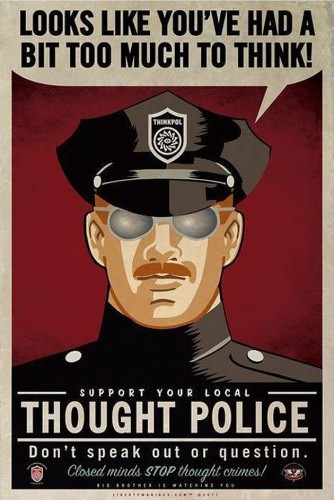
In Orwell’s dystopian vision of the future, Big Brother does away with all undesirable and unnecessary words and meanings, even going so far as to routinely rewrite history and punish “thoughtcrimes.”

Much like today’s social media censors and pre-crime police departments, Orwell’s Thought Police serve as the eyes and ears of Big Brother, while the other government agencies peddle in economic affairs (rationing and starvation), law and order (torture and brainwashing), and news, entertainment, education and art (propaganda).

Orwell’s Big Brother relies on Newspeak to eliminate undesirable words, strip such words as remained of unorthodox meanings and make independent, non-government-approved thought altogether unnecessary.

Where we stand now is at the juncture of OldSpeak (where words have meanings, and ideas can be dangerous) and Newspeak (where only that which is “safe” and “accepted” by the majority is permitted). The power elite has made their intentions clear: they will pursue and prosecute any and all words, thoughts and expressions that challenge their authority.

They don’t just lie to us about wars; they lie to us about everything

By Caitlin Johnstone

Source: Intrepid Report

Propaganda isn’t just about manufacturing consent for wars and ridiculous governmental measures we’d never normally accept. That’s what most people think of when they hear that word, but there’s so very, very much more to it than that.

The lion’s share of propaganda goes not toward convincing us to accept new agendas of the powerful, but toward keeping us entranced in the status quo dream world which enables the powerful to have power in the first place. Toward normalizing status quo systems and training us to shape ourselves to fit into them like neat little cogs in a well-oiled machine.

And it’s not even a grand, monolithic conspiracy in most cases. The giant corporations who indoctrinate us with their advertisements, their Hollywood movies and shows, their apps, their websites and their news media are all naturally incentivized to point us further and further into delusion by the fact that they benefit from the status quo systems which have elevated them to wealth.

So day in and day out we are presented with media which train us what to value, where to place our interest and attention, what success looks like, and how a normal human behaves on this planet. And it always aligns perfectly with the interests of the rich and powerful.

They don’t just teach us what to believe. They teach us who we are. They give us the frameworks upon which we cast our ambitions and evaluate our success, and we build psychological identities out of those constructs. I am a businessman. I am unemployed. My life is about making money. My life is about disappointing people. I am a success. I am a failure. They invent the test of our adequacy, and they invent the system by which we are graded.

These artificial constructs take up such vast portions of our personal psychology that people will live their entire lives completely enslaved to them, making them their entire focus. This enslavement is so pervasive that people will often even take their own lives based on what those made-up constructs tell them about who they are and what they’re worth.

And it’s all a lie. A dream world, made entirely of narrative, constructed by the powerful for the benefit of the powerful. Things as intimate as the thoughts in our heads and the movement of our interest and attention are controlled and dominated with iron-fisted force, all for the benefit of some stupid made-up games about imaginary money and fictional authority.

So most of us sleepwalk through life chasing make believe goals and fleeing artificially constructed demons. Too preoccupied with the illusion to look up and notice the thunderous majesty of life as it really is, and usually too confused to truly perceive it even on those rare occasions when we snap out of the trance for a moment to make an effort.

Untangling yourself from this dream world isn’t easy. It takes time. It takes work. It takes a deep, sustained curiosity about what’s really going on underneath all the muddled mental chatter, about what life truly is underneath all the stories we’ve been told about what life is, about who we truly are underneath all the stories we’ve been told about who we are.

The difference between what we’ve been told and what we find over the course of this investigation is the difference between dream and waking life. The real world is as different from the status quo narrative about the world as it is from any other work of fiction. The two things really could not be any more different.

And the good news is that just as your false view of yourself and your world shaped your human expression in the service of the powerful, the rolling back of that mind fog shapes your human expression into something else entirely. Something grounded in reality. Something authentic. Something primal. Something that exists not for the benefit of some faceless oligarchic empire, but for the same reason the grass grows and the galaxies spin in the cosmos.

And that’s what humanity looks like on the other side of this awkward transition phase that our species is going through at this adolescent point in its development. Free from illusion. In harmony with the real. Enslaved to nobody. Striding clear-eyed into the mystery of what’s to come.

American Pravda: Anne Frank, Sirhan Sirhan, and AIDS

By Ron Unz

Source: The Unz Review

As an heir to the most famous political family in modern American history, Robert F. Kennedy, Jr. is hardly an obscure individual, and recent events have greatly elevated his national prominence.

Although he had spent most of his career as a highly-successful environmental attorney, during the early 2000s he gradually became involved with the grassroots movement questioning the safety and efficacy of our proliferating vaccines, a cause widely ridiculed or ignored by our national elites but increasingly resonating with many worried families.

Then the sudden Covid epidemic moved public health issues to the absolute center of the political debate, including the highly controversial steps taken to control the disease. For the first time in history, most Americans were suddenly subjected to lockdowns, which imposed severe restrictions upon their freedom of movement and assembly, and although these were originally presented as temporary measures expected to last only a couple of weeks, across much of the country they actually remained in place for a year or longer. Moreover, the permanent solution proposed for the crisis was the largest mass-vaccination drive in world history, with the leading vaccines relying upon a new and relatively untested mRNA biotechnology developed by our profit-hungry pharmaceutical giants, a situation that raised deep suspicions among many citizens.

Given these developments, the once marginal anti-vaxxing movement suddenly exploded onto the national stage, cutting across many existing political, social, and ideological fault-lines and encompassing perhaps 20-30% of America’s population, with Kennedy and his Children’s Health Defense non-profit soon becoming leading champions of these fearful individuals. Despite lacking any media coverage or a promotional advertising campaign, his book The Real Anthony Fauci sold over 500,000 copies by early January, spending two months on the Amazon bestseller list, much of that time at the very top.

The media establishment regards our vaccination drive as an absolutely crucial national priority and is intensely hostile to those who challenge it, so Kennedy soon became one of its leading villains. In mid-December, a team of six journalists and researchers at the Associated Press unleashed a ferocious 4,000 word assault, followed a few weeks later by a similar critique in leftist Counterpunch. But both these pieces attacked Kennedy on rather mundane grounds, claiming that his anti-vaccination arguments were wrong, dangerous, and possibly financially motivated, and neither gained much attention, nor seemed to damage his popular momentum.

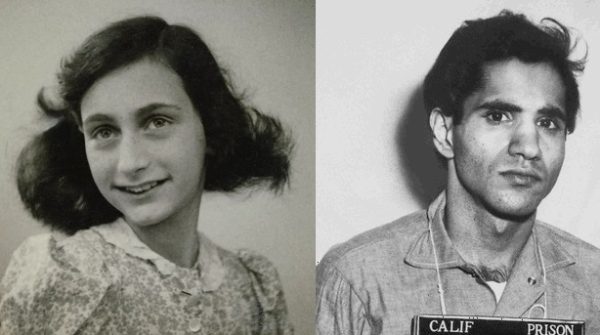
When the media targets an individual, it monitors his every utterance, seeking the slightest opening to vilify him, and last week an opportunity came as Kennedy spoke before a crowd of 30,000 anti-vaxxers at a rally in Washington, DC. Indulging in overly-heated rhetoric, he declared “We have witnessed over the last 20 months a coup d’état against democracy, and the controlled demolition of the United States Constitution and the Bill of Rights.” He further suggested that that government requirements for vaccinations and mandates were imposing “fascism” on our society, with families having nowhere to escape: “Even in Hitler’s Germany, you could cross the Alps to Switzerland. You could hide in an attic like Anne Frank did.”

In our deeply secular society, Nazi Germany has replaced Satan as the epitome of pure evil, while Anne Frank—a Jewish teenager who died of typhus in a German hospital near the end of the war—has been elevated to the status of a sacred martyr. Although drawing such historical analogies is hardly uncommon in political rhetoric, it can sometimes produce angry reactions, especially if these are orchestrated by a hostile media, and Kennedy’s supposedly scandalous references immediately provoked a firestorm of critical coverage, soon leading him to apologize.

With Kennedy’s enemies fanning the flames, his brief reference to the sad fate of a girl who died three generations ago may have received a hundred times more media coverage than the large rally he had headlined or the huge sales of his national bestseller. When the media seeks to destroy someone’s reputation, it will react with hair-trigger reflexes to his slightest misstep.

Yet oddly enough, the same media organs that created a major national controversy out of a few ill-chosen words at a political rally had previously allowed certain of Kennedy’s other, seemingly far greater vulnerabilities to pass almost entirely unnoticed.

These days being labeled a “conspiracy theorist” is a particularly serious charge, with the slur suggesting dangerous mental illness, and surely stigmatizing Kennedy in such a manner would have been an ideal means of discrediting him. But although the author had publicly proclaimed himself a conspiracy theorist of the most explicit sort last month, almost all our hostile journalists carefully averted their eyes.

In the 1960s the conspiratorial term of abuse was first applied to those who challenged the official story that President Kennedy had died at the hands of a deranged lone gunman, and was later broadened to include the many other assassinations that soon followed, including that of the president’s own brother. And on December 8th, nearly the entire Forum page of the San Francisco Chronicle was filled by a Kennedy column arguing that his father Sen. Robert F. Kennedy had been slain by a group of secret conspirators, with the convicted gunman merely being an innocent patsy who should finally be released from prison.

Yet although Kennedy’s legion of media critics attacked him on almost all other grounds, fair or unfair, they carefully avoided that seemingly easy means of branding him as delusional. The long AP attack that ran a week later mentioned not a word, nor did the January Counterpunch piece. As a consequence, I doubt whether more than a tiny slice of the public is aware that Kennedy is a “conspiracy theorist.”

The obvious reason for this strange media reticence was that Kennedy’s position was very solidly grounded in hard factual evidence. In 2018 I drew upon some of the material in David Talbot’s widely-praised 2008 book Brothers to describe the strange aspects of the assassination.

If the first two dozen pages of the Talbot book completely overturned my understanding of the JFK assassination, I found the closing section almost equally shocking. With the Vietnam War as a political millstone about his neck, President Johnson decided not to seek reelection in 1968, opening the door to a last minute entry into the Democratic race by Robert Kennedy, who overcame considerable odds to win some important primaries. Then on June 4, 1968, he carried gigantic winner-take-all California, placing him on an easy path to the nomination and the presidency itself, at which point he would finally be in a position to fully investigate his brother’s assassination. But minutes after his victory speech, he was shot and fatally wounded, allegedly by another lone gunman, this time a disoriented Palestinian immigrant named Sirhan Sirhan, supposedly outraged over Kennedy’s pro-Israel public positions, although these were no different than those expressed by most other political candidates in America.

All this was well known to me. However, I had not known that powder burns later proved that the fatal bullet had been fired directly behind Kennedy’s head from a distance of three inches or less although Sirhan was standing several feet in front of him. Furthermore, eyewitness testimony and acoustic evidence indicated that at least twelve bullets were fired although Sirhan’s revolver could hold only eight, and a combination of these factors led longtime LA Coroner Dr. Thomas Naguchi, who conducted the autopsy, to claim in his 1983 memoir that there was likely a second gunman. Meanwhile, eyewitnesses also reported seeing a security guard with his gun drawn standing immediately behind Kennedy during the attack, and that individual happened to have a deep political hatred of the Kennedys. The police investigators seemed uninterested in these highly suspicious elements, none of which came to light during the trial. With two Kennedy brothers now dead, neither any surviving members of the family nor most of their allies and retainers had any desire to investigate the details of this latest assassination, and in a number of cases they soon moved overseas, abandoning the country entirely. JFK’s widow Jackie confided in friends that she was terrified for the lives of her children, and quickly married Aristotle Onassis, a Greek billionaire, whom she felt would be able to protect them.

Over the years, the 1968 Robert Kennedy assassination has attracted merely a sliver of the books and research devoted to the earlier killing of his elder brother in Dallas, and Talbot’s text spent only a few pages sketching out the strong evidence that the convicted gunman was merely an innocent dupe, manipulated by the true conspirators. But in 2018, two additional books appeared that were entirely focused on the case.

A Lie Too Big To Fail by longtime journalist and conspiracy researcher Lisa Pease ran 500 pages and covered the events of that fatal California evening in exhaustive detail, winning the endorsements of filmmaker Oliver Stone and renowned JFK researcher James W. Douglass. When I read it a few months ago, I found the huge volume of material quite useful but felt that it relied too heavily upon the recollections of eyewitnesses, which can easily grow attenuated over the decades. I was also disturbed to note that the text sometimes seemed to gradually transform reasonable suspicions into apparent certainties, eventually arguing that 3-4 different gunmen were probably firing at the presidential candidate that evening while Sirhan’s own gun had held only blanks.

At the very end, the author also veered off into building castles in the air with regard to other assassinations, arguing that Oswald probably had multiple personalities and that Jack Ruby was operating under a post-hypnotic suggestion, thinly documented claims that seriously weakened her credibility, as did her earlier suggestion that John Lennon had been killed by a government-programmed assassin in 1980 for his past criticism of the Vietnam War. Sometimes less is better, and I think that Pease’s book would have been much stronger if it had been heavily edited and substantially cut. All those extraneous elements should have been left on the cutting-room floor rather than distracting from the central evidence she provided regarding the existence of an RFK assassination conspiracy and Sirhan’s likely innocence.

Meanwhile, The Assassination of Robert F. Kennedy by Tim Tate and the Brad Johnson was released that same year and suffered from none of these flaws. The two conspiracy researchers had spent some 25 years heavily involved in the case, and although their volume was only around half the length of the Pease book, it seemed a far more effective treatment of the topic, including eyewitness accounts but focused primarily upon the undeniable physical and forensic evidence while avoiding any damaging bouts of unwarranted speculation.

While working at CNN, one of the authors had originally obtained the audiotape establishing the number of shots fired, which probably constitutes the single strongest piece of evidence in the case. The book analyzed and evaluated that crucial item in tremendous detail, and also focused upon the fatal shot, which was fired at point-blank range from behind the candidate while Sirhan, the supposed gunman, was standing several feet in front. But since both the publisher and the lead author were British, the work seems to have received much less attention in this country, and I only discovered and read it after Kennedy cited it in his SF Chronicle column.

Unlike many other controversial American killings or terrorist attacks, the powerful evidence of a conspiracy in the case of the RFK assassination was physical and seemingly undeniable. Wikipedia is notoriously reluctant to promote conspiratorial narratives, but in this case the striking facts are presented with only rather weak challenges.

The conclusive proof from the audio recording only came to light in 2004, but I was surprised to discover that all the other strong evidence, including the large number of unexplained bullet holes, had already been known and reported for decades.

Former Congressman Allard K. Lowenstein had been heavily involved in the 1968 election campaign, playing a major role in the effort to unseat incumbent President Lyndon Johnson. In 1977 he published a long cover-story in the influential Saturday Review, setting forth the overwhelming evidence that a second gunman had been involved in the shooting, and my content-archiving system provides a convenient PDF copy. So nearly all the crucial facts in the case have been known for 45 years, but were almost always ignored by our dishonest or cowardly American media.

Three years after publicly revealing that explosive information, Lowenstein himself was dead, supposedly shot at the age of 51 by a deranged lone gunman who had been a former student of his, but I have been informed that his personal friends never believed that story.

Given this massive preponderance of evidence, we can easily understand why the harsh media attacks upon Kennedy had so carefully avoided mentioning his conspiratorial beliefs regarding his father’s assassination. Such criticism would have merely brought the issue to wider public attention, and anyone who began looking into the matter would have quickly concluded that Kennedy was probably correct while our media had spent a half-century covering up the true facts of the 1968 assassination. And if Kennedy were telling the truth and the media lying, many people would begin to wonder if the same might also be true on the vaxxing issue.

Over the last couple of months, I have noted that this pattern of media reticence has been even more pronounced with regard to the actual contents of Kennedy’s landmark book. Perhaps one might argue that his statements about the death of his father were personal matters exempt from media scrutiny, or even that the details of a particular assassination so many decades ago had no relevance to his vaxxing arguments. But it seemed utterly bizarre that all of the harsh attacks on his book had carefully avoided mentioning its major theme.

I had opened Kennedy’s book assuming that it would focus almost entirely on the vaccination issues with which the author had long been identified. Yet I soon discovered that nearly half the text—some 200 pages—was instead devoted to the disease of AIDS, an entirely different topic, and that the claims he made were absolutely incendiary. As I wrote in December:

Yet according to the information provided in Kennedy’s #1 Amazon bestseller, this well-known and solidly-established picture, which I had never seriously questioned, is almost entirely false and fraudulent, essentially amounting to a medical media hoax. Instead of being responsible for AIDS, the HIV virus is probably harmless and had nothing to do with the disease. But when individuals were found to be infected with HIV, they were subjected to the early, extremely lucrative AIDS drugs, which were actually lethal and often killed them. The earliest AIDS cases had mostly been caused by very heavy use of particular illegal drugs, and the HIV virus had been misdiagnosed as being responsible. But since Fauci and the profit-hungry drug companies soon built enormous empires upon that misdiagnosis, for more than 35 years they have fought very hard to maintain and protect it, exerting all their influence to suppress the truth in the media while destroying the careers of any honest researchers who challenged that fraud. Meanwhile, AIDS in Africa was something entirely different, probably caused mostly by malnutrition or other local conditions.

I found Kennedy’s account as shocking as anything I have ever encountered.

In 1985 AZT, an existing drug, was found to kill the HIV virus in laboratory tests. Fauci then made tremendous efforts to speed it through clinical trials as an appropriate treatment for healthy, HIV-positive individuals, with FDA approval finally coming in 1987, producing Fauci’s first moment of triumph. Priced at $10,000/year per patient, AZT was one of the most expensive drugs in history, and with the cost covered by health insurance and government subsidies, it produced an unprecedented financial windfall for its manufacturer.

Kennedy devotes an entire chapter to the story of AZT, and the tale he tells is something out of Kafka or perhaps Monty Python. Apparently, Fauci had been under enormous pressure to produce medical breakthroughs justifying his large budget, so he manipulated the AZT trials to conceal the extremely toxic nature of the drug, which rapidly killed many of the patients who received it, with their symptoms being ascribed to AIDS. So following FDA approval in 1987, hundreds of thousands of perfectly healthy individuals found to be infected with HIV were placed on a regimen of AZT, and the large number of resulting deaths was misattributed to the virus rather than to the anti-viral drug. According to the scientific experts cited in the book, the vast majority of post-1987 “AIDS deaths” were actually due to AZT.

Prior to the Covid outbreak, AIDS had spent almost four decades as the world’s highest-profile disease, absorbing perhaps a couple of trillion dollars of funding and becoming the central focus of an army of scientists and medical experts. It simply boggles the mind for someone to suggest that HIV/AIDS might have largely been a hoax, and that the vast majority of deaths were not from the illness but from the drugs taken to treat it.

My science textbooks sometimes mentioned that during the benighted 18th century, leading Western physicians treated all manner of ailments with bleeding, a quack practice that regularly caused the deaths of their patients, with our own George Washington often numbered among the victims. Indeed, some have argued that for several centuries prior to modern times, standard medical treatments inadvertently took far more lives than they saved, and those too poor or backward to consult a doctor probably benefited from that lack. But I had never dreamed that this same situation might have occurred during the most recent decades of our modern scientific age.

Since the 1980s AIDS has been an explosive topic in the public sphere, and anyone—whether scientist or layman—who questioned the orthodox narrative was viciously denounced as having blood on his hands. During the early 2000s South African President Thabo Mbeki had cautiously raised such possibilities and was massively vilified by the international media and the academic community. Yet when Kennedy’s #1 Amazon bestseller went much farther, devoting seven full chapters to making the case that HIV/AIDS was merely a medical hoax, his media antagonists carefully avoided that subject even while they attacked him on all other grounds.

Once again, the only plausible explanation is that the hostile journalists and their editors have recognized that Kennedy’s factual evidence was too strong and any such attacks might prove disastrously counter-productive. As far back as the 1990s, a former Harvard professor had publicly declared that the AIDS hoax was as great a scientific scandal as the notorious Lysenko fraud, and if a substantial portion of the American public concluded that AIDS was indeed a medical phantom that had been promoted for 35 years by our gullible and dishonest media, the credibility of the latter on current vaccination issues might be completely annihilated.

It would have been the easiest thing in the world for the media to accurately blast Kennedy as “a conspiracy theorist whose book claims that AIDS is a hoax,” and that simple, short phrase would have immediately dealt a massive body-blow to his public reputation. But many people would then have begun looking into the facts, and once they did so, the tables might have quickly turned, destroying the credibility of his critics. The total silence of the media suggests that they greatly feared that possibility.

The hostile media demanded that Kennedy immediately apologize for his heated words regarding fascism and Anne Frank, and to his credit he quickly did so. But I believe that he now has every right to demand that the same media publicly apologize for having spent the last fifty years concealing the true facts of his father’s assassination from his own family and from the American people. And he and others should also begin demanding that the media and medical establishments apologize for the catastrophic HIV/AIDS disaster they inflicted upon our society, a disaster that probably led to the horrible deaths of hundreds of thousands of perfectly healthy Americans. These two matters carry vastly greater weight than a glancing spoken reference to the events of World War II.

One reason that the remarkable silence surrounding Kennedy’s controversial disclosures was so easily apparent to me is that I have become familiar with that pattern. Over the last several years both media outlets and activist organizations have similarly shied away from the published contents of this website and my own writings, doing their best to avert their eyes from material that was many times more controversial than what they would have eagerly attacked and denounced elsewhere. I have discussed what I call this “Lord Voldemort Effect,” and have described some notable examples in the media.

Many of my own essays have dealt directly with the same controversial topics highlighted in Kennedy’s writings and public statements, and for those so interested in exploring them, they are conveniently grouped together in these categories:

Related Reading:

Flu/Covid Fake News Over the Real Thing

By Stephen Lendman

Source: StephenLendman.com

Drowning in the former, much more of the latter is needed at the most perilous time in world history.

Things will keep worsening without mass rebellion against made-in-the-USA war against humanity with unparalleled draconian aims in mind.

Ruling US/Western regimes and their vassal state counterparts want countless millions and billions of unwanted people eliminated at home and abroad.

They want what remains of free and open societies eliminated worldwide.

They want what no one should tolerate anywhere.

Never before have so many people in so many places been assaulted by nonstop fake news over truth and full disclosure on any issues over a longer duration than on kill shots and all else flu/covid related.

For over two years, it’s been the most predominantly reported of all issues with Big Lies drowning out vital to know hard truths.

What should be explained is suppressed.

What’s reported by official sources and MSM is all fake news all the time — truth and full disclosure perhaps on the cusp of being banned.

According to fake news by the Pharma-controlled WHO, half of Europe could contract flu/covid before end of winter 2022 from what it dubiously called a “tidal wave sweeping across the” continent (sic).

Its Europe director Hans Kluge falsely claimed that “over seven million (flu/covid) cases (occurred) in the first week of 2022 (sic).”

Pushing health-destroying kill shots, including boosters, he defied science by falsely claiming that they’re remarkably effective at preventing severe illness and death (sic).

He lied claiming that in Denmark, unjabbed individuals hospitalized for flu/covid are sixfold higher than for their jabbed counterparts (sic).

He fear-mongered unacceptably about the more scariant than variant omicron — a made-in-the-West scam.

Like his counterparts throughout the US/West, he failed to explain that it’s virtually identical to other flu/covid strains.

That they’re all virtually alike.

That numbers of strains don’t matter.

That pre-2020, fear-mongering mass deception unacceptably created public hysteria about seasonal flu-now called covid.

That everything going on since early 2020 has nothing to do with protecting public health.

That it’s all about destroying it and what remains of free and open societies — along with letting Pharma cash in big on a bonanza of profits from kill shots.

Kluge and his counterparts throughout the US West consistently leave unexplained that virtually all reported outbreaks based on PCR test results are false positives.

The test isn’t designed to detect illness. 

It’s been used to falsely diagnose healthy people as ill.

The vast majority of claimed flu/covid outbreaks are either among the jabbed or based on PCR false positive results.

The real number of cases is a tiny fraction of what’s officially reported.

Former Pfizer chief scientist for allergy and infectious diseases, Dr. Michael Yeadon, is an unsung, truth-telling global hero on flu/covid jabs.

They’re designed “to harm people,” not protect them, he explained.

Experimental, improperly tested, rushed to market mRNA technology used in Pfizer and Moderna kill shots are extremely hazardous.

All vaccines risk harm. None protect as falsely claimed.

Flu/covid jabs were designed to inflict maximum harm on maximum numbers of people.

“By choosing this design, the range of outcomes is probably 1,000 times worse than it would be for a conventional vaccine,” Yeadon stressed.

What’s going on is a state-sponsored, MSM proliferated conspiracy against public health.

There’s “clear evidence of fraud,” said Yeadon, adding:

“This is a conspiracy led by the central banking clique and their clients to take over the world.”

“Once they’ve done that, destroyed the economy…a great financial reset which will have us using our vax passes and digital ID, and central bank digital currency…you won’t like those, you really won’t.” 

“It’ll be the end of cash and any privacy for any transactions.”

Without vax passes, you’ll be treated like a pariah, ostracized from society, maybe involuntarily interned, criminalized.

The diabolical “setup is so perfect” for pursuing depopulation on a never before imagined scale, saud Yeadon.

“(C)urrent so-called ‘good’ (kill shot) batches could be batches with code to activate longterm adverse events” — killing jabbed individuals slowly. 

Inventor of mRNA technology Dr. Robert Malone called state-approved, MSM proliferated rubbish “full-on media warfare, information warfare, political warfare…like we’ve never seen before, and coordinated globally.”

“The other thing for me has been the personal journey of coming to terms with what the (diabolical) World Economic Forum really represents…”

“It is a full-on globalist totalitarian vision with money in control.”

It’s beyond totalitarian rule to full-blown tyranny with the worst of diabolical aims in mind.

They include elimination of billions of unwanted people, transforming societies to ruler/serf ones worldwide, and eliminating what remains of greatly eroded freedoms.

No one understands mRNA technology better than Malone, its inventor.

“(N)obody should (be mandated to be jabbed with what’s) experimental” and unsafe based on indisputable evidence.

What’s happening throughout the US/West, Australia, apartheid Israel and elsewhere is in flagrant breach of “the Nuremberg Code, the Helsinki Agreement, the Common Rule, the Belmont Report, etc.” 

It’s state-sponsored “lawless behavior” going on unchecked.

Malone never expected that his scientific invention would land him in the eye of the storm — because of how it’s being misused.

“(A)symmetric…guerrilla warfare” is ongoing is most parts of the world, he said.

What’s crucially needed is “a great awakening” to counter the most diabolically destructive scheme ever concocted by dark forces against humanity in world history.

Totalitarian Paranoia Run Amok: Pandemics, Lockdowns & Martial Law

By John W. Whitehead & Nisha Whitehead

Source: The Rutherford Institute

Totalitarian paranoia runs deep in American society, and it now inhabits the highest levels of government.”—Professor Henry Giroux

Once upon a time, there was a government so paranoid about its hold on power that it treated everyone and everything as a threat and a reason to expand its powers. Unfortunately, the citizens of this nation believed everything they were told by their government, and they suffered for it.

When terrorists attacked the country, and the government passed massive laws aimed at paving the way for a surveillance state, the people believed it was done merely to keep them safe. The few who disagreed were labeled traitors.

When the government waged costly preemptive wars on foreign countries, insisting it was necessary to protect the nation, the citizens believed it. And when the government brought the weapons and tactics of war home to use against the populace, claiming it was just a way to recycle old equipment, the people believed that too. The few who disagreed were labeled unpatriotic.

When the government spied on its own citizens, claiming they were looking for terrorists hiding among them, the people believed it. And when the government began tracking the citizenry’s movements, monitoring their spending, snooping on their social media, and surveying them about their habits—supposedly in an effort to make their lives more efficient—the people believed that, too. The few who disagreed were labeled paranoid.

When the government allowed private companies to take over the prison industry and agreed to keep the jails full, justifying it as a cost-saving measure, the people believed them. And when the government started arresting and jailing people for minor infractions, claiming the only way to keep communities safe was to be tough on crime, the people believed that too. The few who disagreed were labeled soft on crime.

When the government hired crisis actors to take part in disaster drills, never alerting the public to which “disasters” were staged, the people genuinely believed they were under attack. And when the government insisted it needed greater powers to prevent such attacks from happening again, the people believed that too. The few who disagreed were told to shut up or leave the country.

When the government started carrying out covert military drills around the country, insisting it was necessary to train the troops for foreign combat, most of the people believed them. The few who disagreed, fearing that perhaps all was not what it seemed, were shouted down as conspiracy theorists and quacks.

When government leaders locked down the nation, claiming it was the only way to prevent an unknown virus from sickening the populace, the people believed them and complied with the mandates and quarantines. The few who resisted or voiced skepticism about the government’s edicts were denounced as selfish and dangerous and silenced on social media.

When the government expanded its war on terrorism to include domestic terrorists, the people believed that only violent extremists would be targeted. Little did they know that anyone who criticizes the government can be considered an extremist.

By the time the government began using nationalized police and the military to routinely lockdown the nation, the citizenry had become so acclimated to such states of emergency that they barely even noticed the prison walls that had grown up around them.

Now every fable has a moral, and the moral of this story is to beware of anyone who urges you to ignore your better instincts and blindly trust that the government has your best interests at heart.

In other words, if it looks like trouble and it smells like trouble, you can bet there’s trouble afoot.

Unfortunately, the government has fully succeeded in recalibrating our general distaste for anything that smacks too overtly of tyranny.

After all, like the proverbial boiling frogs, the government has been gradually acclimating us to the specter of a police state for years now: Militarized police. Riot squads. Camouflage gear. Black uniforms. Armored vehicles. Mass arrests. Pepper spray. Tear gas. Batons. Strip searches. Surveillance cameras. Kevlar vests. Drones. Lethal weapons. Less-than-lethal weapons unleashed with deadly force. Rubber bullets. Water cannons. Stun grenades. Arrests of journalists. Crowd control tactics. Intimidation tactics. Brutality.

This is how you prepare a populace to accept a police state willingly, even gratefully.

You don’t scare them by making dramatic changes. Rather, you acclimate them slowly to their prison walls. Persuade the citizenry that their prison walls are merely intended to keep them safe and danger out. Desensitize them to violence, acclimate them to a military presence in their communities, and persuade them that only a militarized government can alter the seemingly hopeless trajectory of the nation.

It’s happening already.

The sight of police clad in body armor and gas masks, wielding semiautomatic rifles and escorting an armored vehicle through a crowded street, a scene likened to “a military patrol through a hostile city,” no longer causes alarm among the general populace.

We’ve allowed ourselves to be acclimated to the occasional lockdown of government buildings, military drills in small towns so that special operations forces can get “realistic military training” in “hostile” territory, and  Live Active Shooter Drill training exercises, carried out at schools, in shopping malls, and on public transit, which can and do fool law enforcement officials, students, teachers and bystanders into thinking it’s a real crisis.

Still, you can’t say we weren’t warned.

Back in 2008, an Army War College report revealed that “widespread civil violence inside the United States would force the defense establishment to reorient priorities in extremis to defend basic domestic order and human security.” The 44-page report went on to warn that potential causes for such civil unrest could include another terrorist attack, “unforeseen economic collapse, loss of functioning political and legal order, purposeful domestic resistance or insurgency, pervasive public health emergencies, and catastrophic natural and human disasters.”

In 2009, reports by the Department of Homeland Security surfaced that called on the government to subject right-wing and left-wing activists and military veterans to full-fledged, pre-crime surveillance.

Meanwhile, the government has been amassing an arsenal of military weapons, including hollow point bullets, for use domestically and equipping and training their “troops” for war. Even government agencies with largely administrative functions such as the Food and Drug Administration, Department of Veterans Affairs, and the Smithsonian have been acquiring body armor, riot helmets and shields, cannon launchers and police firearms and ammunition. In fact, there are now at least 120,000 armed federal agents carrying such weapons who possess the power to arrest.

Rounding out this profit-driven campaign to turn American citizens into enemy combatants (and America into a battlefield) is a technology sector that has been colluding with the government to create a Big Brother that is all-knowing, all-seeing and inescapable. It’s not just the drones, fusion centers, license plate readers, stingray devices and the NSA that you have to worry about. You’re also being tracked by the black boxes in your cars, your cell phone, smart devices in your home, grocery loyalty cards, social media accounts, credit cards, streaming services such as Netflix, Amazon, and e-book reader accounts.

And then there are the military drills that have been taking place on American soil in recent years.

In the latest “unconventional warfare exercise,” dubbed “Robin Sage,” special forces soldiers will battle seasoned “freedom fighters” in a “realistic” guerrilla war across two dozen North Carolina counties.

Robin Sage follows on the heels of other such military drills, including Jade Helm, which involved U.S. Army Special Operations Command, the Navy Seals, Air Force Special Operations, Marine Special Operations Command, Marine Expeditionary Units, the 82nd Airborne Division, and other interagency partners.

According to the government, these planned military exercises are supposed to test and practice unconventional warfare including, but not limited to, guerrilla warfare, subversion, sabotage, intelligence activities, and unconventional assisted recovery.

The training, known as Realistic Military Training (RMT) because it will be conducted outside of federal property, are carried out on both public and private land, with locations marked as “hostile territory,” permissive, uncertain (leaning friendly), or uncertain (leaning hostile).

This is psychological warfare at its most sophisticated.

Add these military exercises onto the list of other troubling developments that have taken place over the past 30 years or more, and suddenly, the overall picture seems that much more sinister: the expansion of the military industrial complex and its influence in Washington DC, the rampant surveillance, the corporate-funded elections and revolving door between lobbyists and elected officials, the militarized police, the loss of our freedoms, the injustice of the courts, the privatized prisons, the school lockdowns, the roadside strip searches, the military drills on domestic soil, the fusion centers and the simultaneous fusing of every branch of law enforcement (federal, state and local), the stockpiling of ammunition by various government agencies, the active shooter drills that are indistinguishable from actual crises, the economy flirting with near collapse, the growing social unrest, the socio-psychological experiments being carried out by government agencies, etc.

And then you have the government’s Machiavellian schemes for unleashing all manner of dangers on an unsuspecting populace, then demanding additional powers in order to protect “we the people” from the threats. Almost every national security threat that the government has claimed greater powers in order to fight—all the while undermining the liberties of the American citizenry—has been manufactured in one way or another by the government.

What we’ve seen play out before us is more than mere totalitarian paranoia run amok.

What has unfolded over the past few years has been a test to see how well “we the people” have assimilated the government’s lessons in compliance, fear and police state tactics; a test to see how quickly “we the people” will march in lockstep with the government’s dictates, no questions asked; and a test to see how little resistance “we the people” will offer up to the government’s power grabs when made in the name of national security.

Most critically of all, this has been a test to see whether the Constitution—and our commitment to the principles enshrined in the Bill of Rights—could survive a national crisis and true state of emergency.

We have failed the test abysmally.

We have also made it way too easy for a government that has been working hard to destabilize to lockdown the nation.

Mark my words, there’s trouble brewing.

Better yet, take a look at “Megacities: Urban Future, the Emerging Complexity,” a Pentagon training video created by the Army for U.S. Special Operations Command.

The training video is only five minutes long, but it says a lot about the government’s mindset, the way its views the citizenry, and the so-called “problems” that the government must be prepared to address in the near future through the use of martial law.

Even more troubling, however, is what this military video doesn’t say about the Constitution, about the rights of the citizenry, and about the dangers of locking down the nation and using the military to address political and social problems.

The training video anticipates that all hell will break loose by 2030—that’s barely eight short years away—but we’re already witnessing a breakdown of society on virtually every front.

The danger signs are screaming out a message

The government is anticipating trouble (read: civil unrest), which is code for anything that challenges the government’s authority, wealth and power.

According to the Pentagon training video created by the Army for U.S. Special Operations Command, the U.S. government is grooming its armed forces to solve future domestic political and social problems.

What they’re really talking about is martial law, packaged as a well-meaning and overriding concern for the nation’s security.

The chilling five-minute training video, obtained by The Intercept through a FOIA request and made available online, paints an ominous picture of the future—a future the military is preparing for—bedeviled by “criminal networks,” “substandard infrastructure,” “religious and ethnic tensions,” “impoverishment, slums,” “open landfills, over-burdened sewers,” a “growing mass of unemployed,” and an urban landscape in which the prosperous economic elite must be protected from the impoverishment of the have nots.

And then comes the kicker. Three-and-a-half minutes into the Pentagon’s dystopian vision of “a world of Robert Kaplan-esque urban hellscapes—brutal and anarchic supercities filled with gangs of youth-gone-wild, a restive underclass, criminal syndicates, and bands of malicious hackers,” the ominous voice of the narrator speaks of a need to “drain the swamps.”

The government wants to use the military to drain the swamps of futuristic urban American cities of “noncombatants and engage the remaining adversaries in high intensity conflict within.” And who are these noncombatants, a military term that refers to civilians who are not engaged in fighting? They are, according to the Pentagon, “adversaries.” They are “threats.”

They are the “enemy.”

They are people who don’t support the government, people who live in fast-growing urban communities, people who may be less well-off economically than the government and corporate elite, people who engage in protests, people who are unemployed, people who engage in crime (in keeping with the government’s fast-growing, overly broad definition of what constitutes a crime).

In other words, in the eyes of the U.S. military, noncombatants are American citizens a.k.a. domestic extremists a.k.a. enemy combatants who must be identified, targeted, detained, contained and, if necessary, eliminated.

In the future imagined by the Pentagon, any walls and prisons that are built will be used to protect the societal elite—the haves—from the have-nots.

If you haven’t figured it out already, we the people are the have-nots.

Suddenly, the events of recent years begin to make sense: the invasive surveillance, the extremism reports, the civil unrest, the protests, the shootings, the bombings, the military exercises and active shooter drills, the color-coded alerts and threat assessments, the fusion centers, the transformation of local police into extensions of the military, the distribution of military equipment and weapons to local police forces, the government databases containing the names of dissidents and potential troublemakers.

The government is systematically locking down the nation and shifting us into martial law.

This is how you prepare a populace to accept a police state willingly, even gratefully.

As Nazi Field Marshal Hermann Goering remarked during the Nuremberg trials:

It is always a simple matter to drag people along whether it is a democracy, or a fascist dictatorship, or a parliament, or a communist dictatorship. Voice or no voice, the people can always be brought to the bidding of the leaders. This is easy. All you have to do is tell them they are being attacked, and denounce the pacifists for lack of patriotism and exposing the country to danger. It works the same in every country.

It does indeed work the same in every country.

It’s time to wake up and stop being deceived by government propaganda.

Mind you, by “government,” I’m not referring to the highly partisan, two-party bureaucracy of the Republicans and Democrats.

As I make clear in my book Battlefield America: The War on the American People and in its fictional counterpart The Erik Blair Diaries, I’m referring to “government” with a capital “G,” the entrenched Deep State that is unaffected by elections, unaltered by populist movements, and has set itself beyond the reach of the law. I’m referring to the corporatized, militarized, entrenched bureaucracy that is fully operational and staffed by unelected officials who are, in essence, running the country and calling the shots in Washington DC, no matter who sits in the White House.

Be warned: in the future envisioned by the government, we will not be viewed as Republicans or Democrats. Rather, “we the people” will all be enemies of the state.

Is it already too late to say goodbye?

By Jonathan Cook

Source: Jonathan Cook Blog

It seems we may have reached the moment when it is time to say goodbye. It has been fun, educational and sometimes cathartic – for me at least. I hope you got something from our time together too.

I am not going anywhere, of course. Not for now at least. I love to write. For as long as I feasibly can, I will continue to rail against injustice, call out corporate power and its abuses, and demand a fairer and more open society.

But I have to be realistic. I have to recognise that a growing number of you will not be joining me here on this page for much longer. And it feels rude after so much time together not to bid you a fond farewell before it is too late. I will miss you.

Many of you may have assumed it wouldn’t end this way. You probably imagined that I would get banned by Facebook or Twitter. You would be able to rally round, send in complaints worded in the strongest possible terms, and lobby for my reinstatement. Maybe even sign a petition.

But it isn’t going to end like that. There will be no bang. I have been too careful for that to be my fate. I have avoided rude and crude words. I have steered clear of insults (apologies if my responses have sometimes been a little caustic). I have not defamed anyone. I have avoided “fake news” – except to critique it. I have not peddled “conspiracy theories”, unless quoting the British Medical Journal on Covid now counts as misinformation (yes, I know for a few of you it does).

But none of that has helped. My blog posts once attracted tens of thousands of shares. Then, as the algorithms tightened, it became thousands. Now, as they throttle me further, shares can often be counted in the hundreds. “Going viral” is a distant memory.

No, I won’t be banned. I will fade incrementally, like a small star in the night sky – one among millions – gradually eclipsed as its neighbouring suns grow ever bigger and brighter. I will disappear from view so slowly you won’t even notice.

Which is why I am saying my goodbyes now while I can still reach you, my most obstinate followers.

But this isn’t really about one small light being snuffed out. This isn’t just about our relationship coming to an end. Something bigger, and more disturbing, is taking place.

Journalists like me are part of an experiment – in a new, more democratised media landscape. We have developed new reader-funded models so that we can break free of the media corporations, which until now ensured billionaires and the state controlled the flow of information in one direction only: to speak down to us.

The corporate media need corporate advertising – or their owners’ deep pockets – to survive. They don’t need you, except as a captive audience. You’re both their prisoner and their product.

But the lifeblood of a reader-funded journalist, as the name suggests, are readers. The more of you we attract, the better chance there is that we can generate donations and income and make the model sustainable. Our Achilles’ heel is our dependence on social media to find you, to keep reaching you, to offer you an alternative from the corporate media.

If Facebook (sorry, the Meta universe) and Twitter stop independent writers from growing their readerships by manipulating the algorithms, by ghosting and shadow-banning them, and by all the other trickery we do not yet understand, then new voices cannot grow their funding base and break free of corporate control.

And equally, for those like me who are already established and have significant numbers of readers, these tech giants can whittle them away one by one. Ostensibly, I have many tens of thousands of followers, but for several years now I have been reaching fewer and fewer of you. I am starved of connection. The danger, already only too obvious, is that my readership, and funding model, will slowly start to shrivel and die.

Joe Rogan, Russell Brand and a handful of titans of the new media age are so big they can probably weather it out. But the rest of us will not be so lucky.

Readers will lose sight of us, as our light slowly fades, and then we will be gone completely. Vanished.

I have lost count of the followers who – because, god knows, an algorithm slipped up? – tell me they have received a social media post many months after they last saw one from me. In the cacophony of media noise, they had not noticed that I had unexpectedly gone quiet until that reminder arrived or else they assumed I had given up writing.

Which is why, if you want to keep seeing posts from me and writers like me, if this is not soon to be a final goodbye, if you think it important to read non-corporate analysis and commentary, then you need to act. You should be bookmarking your favourite writers and visiting their sites regularly – not just when you are prompted to by Mark Zuckerberg.

You need to be an active consumer of news – not a passive one, as you were raised to be when the choice was between three TV channels and a dozen print newspapers.

You need to search out and maintain those connections before they are gone entirely and the window has closed. Because those voices you prize now will wither and decay like autumn leaves if they have no audience. If you leave it too long, even when you finally remember to go search for them, you may find they are no longer there to be discovered. You will have missed the chance to say goodbye.

So let us say it now, while we still can: Farewell.

UPDATE:

Writing is a solitary activity, and it can be easy to imagine that what was obvious inside your head will be clear to others when that idea takes its place in the outside world. But a proportion of early readers of this post have mistaken it for an actual goodbye, rather than as a cautionary tale of what has been happening and what is still to come. So let me reassure you: I am going to continue writing and you can continue reading me, so long as either Twitter and Facebook direct you to me or you make the effort to find me.

Here’s hoping that my goodbye will prove unnecessary.

Saturday Matinee: Capricorn One

By Ken Zurski

Source: Unremembered

In 1976, a controversial new book was released that contended the Apollo 11 moon mission never happened. We Never Went to the Moon: America’s Thirty Million Dollar Swindle was written by Bill Kaysing, a Navy midshipman and rocket specialist, who claimed to have inside knowledge of a government conspiracy to fake the moon landing.

Kaysing believes NASA couldn’t safely put a man on the moon by the end of the 1960’s (a promise made by President Kennedy) so they staged it instead. Kaysing’s theories were technical and persuasive and soon a movement of nonbelievers, inspired by the book, was born.

Whether you believed Kaysing or not was a moot point for American screenwriter and director Peter Hyams.  A former TV news anchor, Hyams was more interested in how such a thing could actually be pulled off?

“I grew up in the generation where my parents basically believed if it was in the newspaper it was true,” Hyams said in an interview with a film trade magazine.  For him, he admits, it was the same with television. “I wondered what would happen if someone faked a whole story.”

So he wrote a story based on the concept.

That was in 1972, four years before Kaysing’s book was released. Hyams shopped the script around but got no takers.  Then something unexpected happened. Watergate broke and America was thrown into a government scandal at its highest levels. Interest in a story like a fake moon landing (in the movie’s case, the first manned mission to Mars) had appeal. In 1976, Hyams was given the green light to make his movie as part of deal with ITC Entertainment to produce films with a conspiracy bent.

“Capricorn One” was released in the Summer of 1977. “Would you be shocked to find out the greatest moment of our recent history may not have happened at all?” the movie posters read.

Reviews were mixed. Chicago Tribune film critic Gene Siskel called it “a surprisingly good thriller” while another critic Harry Themal said it was a “somewhat feeble effort at an adventure film.” Variety was even less complimentary calling it “underdeveloped” and the cast “scattershot.”

In the movie, Sam Waterston, James Brolin and O.J. Simpson play the three astronauts. Elliott Gould, Hal Holbrook, Telly Savalas, Brenda Vaccaro and Karen Black round out the cast. While Brolin was known mostly for his television role as Dr, Steven Kiley on Marcus Welby, M.D. Simpson was a celebrity athlete whose acting career was just beginning.

In hindsight the cast was impressive, but the actors weren’t as important as the story.

After the landing is staged and broadcast as real, the nation is told the three astronauts died instantly in a failed reentry.  But Gould, as journalist Robert Caulfield, is suspicious. The astronauts, who are harbored, realize they have no recourse but to escape or be killed. “If we go along with you and lie our asses off, the world of truth and ideals is, er, protected,” say’s Waterston’s Lt Col. Peter Willis. “But if we don’t want to take part in some giant rip-off of yours then somehow or other we’re managing to ruin the country.”

From there its a cat and mouse game between the good guys and bad. A dramatic helicopter chase scene ensues. In the end, Caulfield with the help from Brolin’s character exposes the conspiracy.

The movie’s tag-line accentuated the drama:

The mission was a sham. The murders were real.

“In a successful movie, the audience, almost before they see it, know they’re going to like it,” remarked Hyams. “I remember standing in the back of the theater and crying because I knew that something had changed in my life.”

The film’s final chase scenes were pure escapism. “People were clapping and cheering at the end,” Brolin relayed to a reporter shortly after the film’s release.

Today, the film’s legacy may be in the conspiracy only.  It’s impact may also have been diminished by the negative attitudes towards O.J. Simpson who in 1994 was charged and acquitted in the brutal murder of his ex-wife, Nicole Brown.

Even Hyams concedes to his own bizarre trivia: “I’ve made films with two leading men who were subsequently tried for the first degree murder of their wives,” he said referring to Simpson in Capricorn One and Robert Blake in his first film Busting (1974).  

Fifty years later, on the 2019 anniversary date of July 20, 1969, the moon landing is still celebrated as one of man’s greatest achievements. “We choose to go to the Moon in this decade and do the other things, not because they are easy, but because they are hard,” President Kennedy prophetically said in 1962.

For some, apparently, that was just too hard to believe.

Several years after it happened, a movie showed how it could be done…Hollywood style.

The Lesson of Covid: When People Are Anxious, Isolated and Hopeless, They’re Less Ready To Think Critically

People crowd along a street of Barcelona to buy books and roses at makeshift stands as Catalans celebrate the day of their patron saint, Sant Jordi. Emilio Morenatti | AP

The corporate media is not our friend. Its coverage of the pandemic is not there to promote the public good. It is there to feed our anxieties, keep us coming back for more, and monetize that distress. The only cure for this sickness? A lot more critical thinking.

By Jonathan Cook

Source: Mint Press News

When I criticize meddling in Syria by Britain and America, or their backing of groups there that elsewhere are considered terrorists, it does not follow that I am, therefore, a cheerleader for the dictatorship of Bashar Assad or that I think that Syrians should be denied a better political system. Similarly, when I criticize Joe Biden or the Democratic party, it does not necessarily follow that I think Donald Trump would have made a better president.

A major goal of critical thinking is to stand outside tribal debates, where people are heavily invested in particular outcomes, and examine the ways debates have been framed. This is important because one of the main ways power expresses itself in our societies is through the construction of official narratives – usually through the billionaire-owned media – and the control and shaping of public debate.You are being manipulated – propagandized – even before you engage with a topic if you look only at the substance of a debate and not at other issues: such as its timing, why the debate is taking place or why it has been allowed, what is not being mentioned or has been obscured, what is being emphasized, and what is being treated as dangerous or abhorrent.

If you want to be treated like a grown-up, an active and informed participant in your society rather than a blank sheet on which powerful interests are writing their own self-serving narratives, you need to be doing as much critical thinking as possible – and especially on the most important topics of the day.

Learning curve

The opportunity to become more informed and insightful about how debates are being framed, rather than what they are ostensibly about, has never been greater. Over the past decade, social media, even if the window it offered is rapidly shrinking, has allowed large numbers of us to discover for the first time those writers who, through their deeper familiarity with a specific topic and their consequent greater resistance to propaganda, can help us think more critically about all kinds of issues – Russia, Venezuela, Iran, Israel-Palestine, the list is endless.

This has been a steep learning curve for most of us. It has been especially useful in helping us to challenge narratives that vilify “official enemies” of the west or that veil corporate power – which has effectively usurped what was once the more visible and, therefore, accountable political power of western states. In the new, more critical climate, the role of the war industries – bequeathed to us by western colonialism – has become especially visible.

But what has been most disheartening about the past two years of Covid is the rapid reversal of the gains made in critical thinking. Perhaps this should not entirely surprise us. When people are anxious for themselves or their loved ones, when they feel isolated and hopeless, when “normal” has broken down, they are likely to be less ready to think critically.

The battering we have all felt during Covid mirrors the emotional, and psychological assault critical thinking can engender. Thinking critically increases anxiety by uncomfortably exposing us to the often artificial character of official reality. It can leave us feeling isolated and less hopeful, especially when friends and family expect us to be as deeply invested in the substance – the shadow play – of official, tribal debates as they are. And it undermines our sense of what “normal” is by revealing that it is often what is useful to power elites rather than what is beneficial to the public good.

Emotional resilience

There are reasons why people are drawn to critical thinking. Often because they have been exposed in detail to one particular issue that has opened their eyes to wider narrative manipulations on other issues. Because they have the tools and incentives – the education and access to information – to explore some issues more fully. And, perhaps most importantly, because they have the emotional and psychological resilience to cope with stripping away the veneer of official narratives to see the bleaker reality beneath and to grasp the fearsome obstacles to liberating ourselves from the corrupt elites that rule over us and are pushing us towards ecocidal oblivion.

The anxieties produced by critical thinking, the sense of isolation, and the collapse of “normal” is in one sense chosen. They are self-inflicted. We choose to do critical thinking because we feel capable of coping with what it brings to light. But Covid is different. Our exposure to Covid, unlike critical thinking, has been entirely outside our control. And worse, it has deepened our emotional and psychological insecurities. To do critical thinking in a time of Covid – and most especially about Covid – is to add a big extra layer of anxiety, isolation, and hopelessness.

Covid has highlighted the difficulties of being insecure and vulnerable, thereby underscoring why critical thinking, even in good times, is so difficult. When we are anxious and isolated, we want quick, reassuring solutions, and we want someone to blame. We want authority figures to trust and act in our name.

Complex thinking

It is not hard to understand why the magic bullet of vaccines – to the exclusion of all else – has been so fervently grasped during the pandemic. Exclusive reliance on vaccines has been a great way for our corrupt, incompetent governments to show they know what they are doing. The vaccines have been an ideal way for corrupt medical-industrial corporations – including the biggest offender, Pfizer – to launder their images and make us all feel indebted to them after so many earlier scandals like Oxycontin. And, of course, the vaccines have been a comfort blanket to us, the public, promising to bring ZeroCovid (false), to provide long-term immunity (false), and to end transmission (false).

And as an added bonus, vaccines have allowed both our corrupt leaders to shift the blame away from themselves for their other failed public health policies and our corrupt “health” corporations to shift attention away from their profiteering by encouraging the vaccinated majority to scapegoat an unvaccinated minority. Divide and rule par excellence.

To state all this is not to be against the vaccines or believe the virus should rip through the population, killing the vulnerable, any more than criticizing the US war crime of bombing Syria signifies enthusiastic support for Assad. It is only to recognize that political realities are complex, and our thinking needs to be complex too.

‘Herd immunity

These ruminations were prompted by a post on social media I made the other day referring to the decision of the Guardian – nearly two years into the pandemic – to publish criticisms by an “eminent” epidemiologist, Prof Mark Woolhouse, of the British government’s early lockdown policies. Until now, any questioning of the lockdowns has been one of the great unmentionables of the pandemic outside of right-wing circles.

Let us note another prominent example: the use of the term “herd immunity,” which was until very recently exactly what public health officials aimed for as a means to end contagion. It signified the moment when enough people had acquired immunity, either through being infected or vaccinated, for community transmission to stop occurring. But because the goal during Covid is not communal immunity but universal vaccination, the term “herd immunity” has now been attributed to a sinister political agenda. It is presented as some kind of right-wing plot to let vulnerable people die.

This is not accidental. It is an entirely manufactured, if widely accepted, narrative. Recovery from infection – something now true for many people – is no longer treated by political or medical authorities as conferring immunity. For example, in the UK, those who have recovered from Covid, even recently, are not exempted, as the vaccinated are, from self-isolation if they have been in close contact with someone infected with Covid. Also, of course, those recovered from Covid do not qualify for a vaccine passport. After all, it is not named an immunity passport. It is a vaccine passport.

Emmanuel Macron, the French president, has at least been open about the “reasoning” behind this kind of discrimination. “In a democracy,” he says, apparently unironically, “the worst enemies are lies and stupidity. We are putting pressure on the unvaccinated by limiting, as much as possible, their access to activities in social life. … For the non-vaccinated, I really want to piss them off. And we will continue to do this, to the end. This is the strategy.”

Notice that the lies and stupidity here emanate from Macron: he is not only irresponsibly stoking dangerous divisions within French society, he has also failed to understand that the key distinctions from a public health perspective are between those with immunity to Covid and those without it and those who are vulnerable to hospitalization and those who are not. These are the most meaningful markers of how to treat the pandemic. The obsession with vaccination only serves a divide and rule agenda and bolsters pandemic profiteering.

Crushing hesitancy

The paradox is that these narratives dominate even as the evidence mounts that the vaccines offer very short-term immunity and that, ultimately, as Omicron appears to be underscoring, many people are likely to gain longer-term immunity through Covid infection, even those who have been vaccinated. But the goal of public “debate” on this topic has not been transparency, logic, or informed consent. Instead, it has been the crushing of any possible “vaccine hesitancy.”

I have repeatedly tried to highlight the lack of critical thinking around the exclusive focus on vaccines rather than immune health, the decision to vaccinate children in the face of strong, if largely downplayed, opposition from experts, and the divisive issue of vaccine mandates. But I have had little to say directly about lockdowns, which have tended to look to me chiefly like desperate stop-gap measures to cover up the failings of our underfunded, cannibalized, and increasingly privatized health services (a more pressing concern). I am also inclined to believe that the balance of benefits from lockdowns, or whether they work, is difficult to weigh without some level of expertise. That is one reason why I have been arguing throughout the pandemic that experts need to be allowed more open, robust, and honest public debate.

It is also why I offered a short comment on Prof Woolhouse’s criticisms, published in the Guardian this week, of national lockdown policies. This evoked a predictably harsh backlash from many followers. They saw it as further proof that the “Covid denialists have captured me,” and I am now little better than a pandemic conspiracy theorist.

Framing the debate

That is strange in itself. Prof Woolhouse is a mainstream, reportedly “eminent” epidemiologist. His eminence is such that it also apparently qualifies him to be quoted extensively and uncritically in the Guardian. The followers I antagonize every time I write about the pandemic appear to treat the Guardian as their Covid Bible, as do most liberals. And they regularly castigate me for referring to the kind of experts the Guardian refuses to cite. So how does my retweeting of a Guardian story that uncritically reports on anti-lockdown comments from a respectable, mainstream epidemiologist incur so much wrath – and seemingly directed only against me?

The answer presumably lies in the short appended comment in my retweet, which requires that one disengage from the seemingly substantive debate – lockdowns, good or bad? That conversation is certainly interesting to me, especially if it is an honest one. But the contextual issues around that debate, the ones that require critical thinking, are even more important because they are the best way to evaluate whether an honest debate is actually being fostered.

My comment, intentionally ambiguous, implicitly requires readers to examine wider issues about the Guardian article: the timing of its publication, why a debate about lockdowns has not previously been encouraged in the Guardian but apparently is now possible, how the debate is being framed by Woolhouse and the Guardian, and how we, the readers, may be being manipulated by that framing.

Real, live conspiracy

Interestingly, I was not alone in being struck by how strange the preferred framing was. A second epidemiologist, Martin Kulldorff, a biostatistician at Harvard who serves on a scientific committee to the US Centers for Disease Control and Prevention (CDC), saw problems with the article too. Unfortunately, however, Prof Kulldorff appears not to qualify as “eminent” enough for the Guardian to quote him uncritically. That is because he was one of three highly respected academics who brought ignominy down on their heads in October 2020 by authoring the Great Barrington Declaration.

Like Woolhouse, the Declaration offered an alternative to blanket national lockdowns – the official response to rising hospitalizations – but did so when those lockdowns were being aggressively pursued, and no other options were being considered. The Guardian was among those that pilloried the Declaration and its authors, presenting it as an irresponsible right-wing policy and a recipe for Covid to tear through the population, laying waste to significant sections of the population.

My purpose here is not to defend the Great Barrington Declaration. I don’t feel qualified enough to express a concrete, public view one way or another on its merits. And part of the reason for that hesitancy is that any meaningful conversation at the time among experts was ruthlessly suppressed. The costs of lockdowns were largely unmentionable in official circles and the “liberal” media. It was instantly stigmatized as the policy preference of the “deplorable” right.

This was not accidental. We now know it was a real, live conspiracy. Leaked emails show that Anthony Fauci, the chief medical adviser to the president, and his minions used their reliable contacts in prominent liberal media to smear the authors of the Great Barrington Declaration. “There needs to be a quick and devastating published takedown of its premises. I don’t see anything like that online yet – is it underway?” a senior official wrote to Fauci. The plan was character assassination, pure and simple—nothing to do with science. And “liberal” media happily and quickly took up that task.

The Guardian, of course, went right along with those smears. This is why Prof Kulldorff has every right to treat with disdain both the Guardian’s decision to now publish Prof Woolhouse’s criticisms – so very belatedly – of lockdown policy and Prof Woolhouse’s public distancing of himself from the now-radioactive Great Barrington Declaration even though his published comments closely echo the policies proposed in the Declaration. As Prof Kulldorff observes:

Hilarious logical somersault. In the Guardian, Mark Woolhouse argues that [the] UK should have used focused protection as defined in the Great Barrington Declaration, while criticizing the Great Barrington Declaration due to its mischaraterization by the Guardian.”

Reputational damage 

If we put on our critical thinking hats for a moment, we can deduce a plausible reason for that mischaracterization.

Like the rest of the “liberal” media, the Guardian has been fervently pro-lockdown and an avowed opponent of any meaningful discussion of the Great Barrington Declaration since its publication more than a year ago. Moreover, it has characterized any criticism of lockdowns as an extreme right-wing position. But the paper now wishes to open up a space for a more critical discussion of the merits of lockdown at a time when rampant but milder Omicron threatens to shut down not only the economy but distribution chains and health services.

Demands for lockdowns are returning – premised on the earlier arguments for them – but the formerly obscured costs are much more difficult to ignore now. Even lockdown cheerleaders like the Guardian finally understand some of what was clear 15 months ago to experts like Prof Kulldorff and his fellow authors.

What the Guardian appears to be doing is smuggling the Great Barrington Declaration’s arguments back into the mainstream but trying to do it in a way that won’t damage its credibility and look like an about-face. It is being entirely deceitful. And the vehicle for achieving this end is a fellow critic of lockdowns, Prof Woolhouse, who is not tainted goods like Prof Kulldorff, even though their views appear to overlap considerably. Criticism of lockdowns is being rehabilitated via Prof Woolhouse, even as Prof Kulldorff remains an outcast, a deplorable.

In other words, this is not about any evolution in scientific thinking. It is about the Guardian avoiding reputational damage – and doing so at the cost of continuing to damage Prof Kulldorff’s reputation. Prof Kulldorff and his fellow authors were scapegoated when their expert advice was considered politically inconvenient, while Prof Woolhouse is being celebrated because similar expert advice is now convenient.

This is how much of our public discourse operates. The good guys control the narrative so that they can ensure they continue to look good, while the bad guys are tarred and feathered, even if they are proven right. The only way to really make sense of what is going on is to disengage from this kind of political tribalism, examine contexts, avoid being so invested in outcomes, and work hard to gain more perspective on the anxiety and fear each of us feels.

The corporate media is not our friend. Its coverage of the pandemic is not there to promote the public good. It is there to feed our anxieties, keep us coming back for more, and monetize that distress. The only cure for this sickness? A lot more critical thinking.