
Reuters, BBC, and Bellingcat participated in covert UK Foreign Office-funded programs to “weaken Russia,” leaked docs reveal

New leaked documents show Reuters’ and the BBC’s involvement in covert UK FCO programs to effect “attitudinal change” and “weaken the Russian state’s influence,” alongside intel contractors and Bellingcat.

By Max Blumenthal

Source: The Grayzone

The UK Foreign and Commonwealth Office (FCO) have sponsored Reuters and the BBC to conduct a series of covert programs aimed at promoting regime change inside Russia and undermining its government across Eastern Europe and Central Asia, according to a series of leaked documents.

The leaked materials show the Thomson Reuters Foundation and BBC Media Action participating in a covert information warfare campaign aimed at countering Russia. Working through a shadowy department within the UK FCO known as the Counter Disinformation & Media Development (CDMD), the media organizations operated alongside a collection of intelligence contractors in a secret entity known simply as “the Consortium.”

Through training programs of Russian journalists overseen by Reuters, the British Foreign Office sought to produce an “attitudinal change in the participants,” promoting a “positive impact” on their “perception of the UK.”

“These revelations show that when MPs were railing about Russia, British agents were using the BBC and Reuters to deploy precisely the same tactics that politicians and media commentators were accusing Russia of using,” Chris Williamson, a former UK Labour MP who attempted to apply public scrutiny to the CDMD’s covert activities and was stonewalled on national security grounds, told The Grayzone.

“The BBC and Reuters portray themselves as an unimpeachable, impartial, and authoritative source of world news,” Williamson continued, “but both are now hugely compromised by these disclosures. Double standards like this just bring establishment politicians and corporate media hacks into further disrepute.”

Thomson Reuters Foundation spokesperson Jenny Vereker implicitly confirmed the authenticity of the leaked documents in an emailed response to questions from The Grayzone. However, she contended, “The inference that the Thomson Reuters Foundation was engaged in ‘secret activities’ is inaccurate and misrepresents our work in the public interest. We have for decades openly supported a free press and have worked to help journalists globally to develop the skills needed to report with independence.”

The tranche of leaked files closely resemble UK FCO-related documented released between 2018 and 2020 by a hacking collective calling itself Anonymous. The same source has claimed credit for obtaining the latest round of documents.

The Grayzone reported in October 2020 on leaked materials released by Anonymous which exposed a massive propaganda campaign funded by the UK FCO to cultivate support for regime change in Syria. Soon after, the Foreign Office claimed its computer systems had been penetrated by hackers, thus confirming their authenticity.

The new leaks illustrate in alarming detail how Reuters and the BBC – two of the largest and most distinguished news organizations in the world – attempted to answer the British foreign ministry’s call for help in improving its “ability to respond and to promote our message across Russia,” and to “counter the Russian government’s narrative.” Among the UK FCO’s stated goals, according to the director of the CDMD, was to “weaken the Russian State’s influence on its near neighbours.”

Reuters and the BBC solicited multimillion-dollar contracts to advance the British state’s interventionist aims, promising to cultivate Russian journalists through FCO-funded tours and training sessions, establish influence networks in and around Russia, and promote pro-NATO narratives in Russian-speaking regions.

In several proposals to the British Foreign Office, Reuters boasted of a global influence network of 15,000 journalists and staff, including 400 inside Russia.

The UK FCO projects were carried out covertly, and in partnership with purportedly independent, high-profile online media outfits including Bellingcat, Meduza, and the Pussy Riot-founded Mediazona. Bellingcat’s participation apparently included a UK FCO intervention in North Macedonia’s 2019 elections on behalf of the pro-NATO candidate.

The intelligence contractors that oversaw that operation, the Zinc Network, boasted of establishing “a network of YouTubers in Russia and Central Asia” while “supporting participants [to] make and receive international payments without being registered as external sources of funding.” The firm also touted its ability to “activate a range of content” to support anti-government protests inside Russia.

The new documents provide critical background on the role of NATO member states like the UK in influencing the color revolution-style protests waged in Belarus in 2020, and raise unsettling questions about the intrigue and unrest surrounding jailed Russian opposition figure Alexei Navalny.

Further, the materials cast serious doubt on the independence of two of the world’s largest and most prestigious media organizations, revealing Reuters and the BBC as apparent intelligence cut-outs feasting at the trough of a British national security state that their news operations are increasingly averse to scrutinizing.

Reuters solicits secret British Foreign Office contract to infiltrate Russian media

A series of official documents declassified in January 2020 revealed that Reuters was secretly funded by the British government throughout the 1960s and 1970s to assist an anti-Soviet propaganda organization run by the MI6 intelligence agency. The UK government used the BBC as a pass-through to conceal payments to the news group.

The revelation prompted a Reuters spokesman to declare that “the arrangement in 1969 [with the MI6] was not in keeping with our Trust Principles and we would not do this today.”

The Trust Principles outline a mission of “preserving [Reuters’] independence, integrity, and freedom from bias in the gathering and dissemination of information and news.”

In its own statement of values, the BBC proclaims, “Trust is the foundation of the BBC. We’re independent, impartial and honest.”

However, the newly leaked documents analyzed by The Grayzone appear to reveal that both Reuters and the BBC are engaged yet again in a non-transparent relationship with the UK’s foreign ministry to counter and undermine Russia.

In 2017, the non-profit arm of the Reuters media empire, the Thomson Reuters Foundation (TRF), delivered a formal tender offering to “enter into a Contract with the Secretary of State for Foreign Affairs, as represented by the British Embassy Moscow, for the provision of a project ‘Capacity Building in Russian Media.’” The letter was signed by Reuters CEO Monique Ville on July 31, 2017.

Reuters’ tender was a response to a call for bids by the FCO, which sought help in implementing “a programme of themed tours to the UK by Russian journalists and online influencers.”

Working through the British Embassy in Moscow, the FCO sought to produce an “attitudinal change in the participants,” promoting a “positive impact” on their “perception of the UK.”

In 2019, the FCO put forward a similar initiative, this time articulating a more aggressive plan to “counter the Russian government’s narrative and domination of the media and information space.” In effect, the British government was seeking to infiltrate Russian media and propagate its own narrative through an influence network of Russian journalists trained in the UK.

Reuters responded to both calls by the FCO with detailed tenders. In its first bid, the media giant boasted of establishing a global network of 15,000 journalists and bloggers through “capacity building interventions.” In Russia, it claimed at least 400 journalists had been cultivated through its training programs.

Reuters claimed to have performed 10 previous training tours for 80 Russian journalists on behalf of the British embassy in Moscow. It proposed eight more, promising to promote “UK cultural and political values” and “create a network of journalists across Russia” bonded together by a shared “interest in British affairs.”

Reuters’ tender highlighted the institutional prejudices and interventionist agenda that underlined its training programs. Detailing a series of UK FCO-funded programs dedicated to “countering Russian state-funded propaganda,” Reuters conflated Russian government narratives with extremism. Ironically, it referred to its own efforts at weakening them as “unbiased journalism.”

At the same time, Reuters appeared to recognize that its covert collaboration with the British Embassy in Moscow was highly provocative and potentially destructive to diplomatic relations. Recounting a UK FCO-funded tour it ran for Russian journalists in the midst of the Sergei Skripal affair, after the British government accused Moscow of poisoning a turncoat Russian intelligence officer who spied for Britain, the tender stated, “[Thomson Reuters Foundation] was in constant communication with the British Embassy in Moscow, to assess levels of risk, including reputational risk to the embassy.”

The mention by Reuters of the Belarusian TV Station Belsat, and its particular relevance “to the UK Government Strategy’s capacity to detect and counter the spread of Russian information” was notable. While describing itself as “the first independent television channel in Belarus,” Belsat is, as the Reuters tender makes clear, a vehicle of NATO influence.

Based in Poland and funded by the Polish Foreign Ministry and other EU governments, Belsat played an influential role in promoting the color revolution-style protests that erupted in May 2020 to demand the ouster of Belarusian President Alexander Lukashenko.

Ultimately, Reuters’ bid appears to have been successful, as it received a July 2019 contract with the FCO’s Conflict, Stability & Security Fund (CSSF). But neither entity seemed to want the public to know about their collaboration on a project designed to counter Russia. The contract was marked “Strictly Confidential.”

“Weaken the Russian state’s influence”

The programs exposed through the latest leak of documents operate under the auspices of a shadowy division of the Foreign and Commonwealth Development Office called Counter Disinformation & Media Development (CDMD). Led by an intelligence operative named Andy Pryce, the program has shrouded in secrecy.

Indeed, the British government has denied freedom of information requests about the division’s budget and stonewalled members of parliament like Chris Williamson who sought data about its budget and agenda, citing national security to block their demands for information.

“When I tried to probe further,” former MP Williamson told The Grayzone, “ministers refused to let me have access to any documents or correspondence relating to this organization’s activities.  I was told that releasing this information could ‘disrupt and undermine the program’s effectiveness.’”

During a meeting convened in London on June 26, 2018, Pryce outlined a new FCO program “to weaken the Russian State’s influence on its near neighbors.” He solicited a consortium of firms to assist the British state in establishing new and seemingly independent media outlets to counter Russian government-backed media in Moscow’s immediate sphere of influence, and to amplify the messaging of NATO-aligned governments.

Justified on the basis of Russia’s supposed intention to “sow disunity and course[sic] disruption to democratic processes,” the campaign Pryce laid out was more aggressive and far-reaching than anything Russia has been caught doing in the West.

Pryce emphasized that secrecy was of the essence, warning that “some grantees will not wish to be linked to the FCO.”

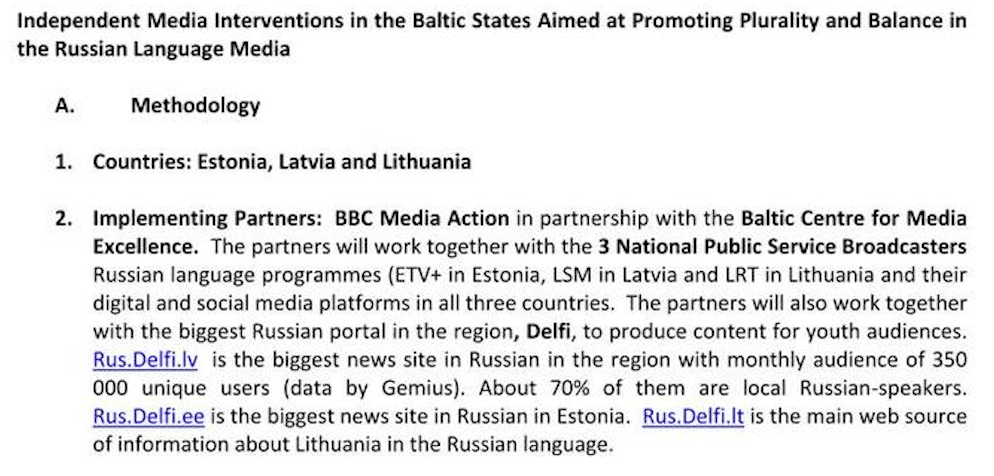
A year later, the FCO’s CDMD division outlined a program to run through 2022 at a cost of $8.3 million to the British taxpayer. It aimed to establish new outlets and support preexisting media operations “to counter Russia’s efforts to sow disunity” and “increase resilience to hostile Kremlin messaging in the Baltic states.”

Thus the British government set out with an array of intelligence contractors to dominate Baltic media with pro-NATO messaging – and perhaps sow some disunity of its own.

As seen below, the BBC placed an apparently successful bid to participate in the covert Baltic program through its non-profit arm, known as BBC Media Action.
The BBC also proposed to participate in a separate UK FCO media propaganda program in Ukraine, Moldova, and Georgia. It named Reuters and a now-defunct intelligence contractor called Aktis Strategy, which participated in previous FCO CDMD programs, as key allies in its consortium.

The BBC identified local partners like Hromadske, a Kiev-based broadcast network born in the midst of the so-called Maidan “Revolution of Dignity” in 2014 that relied on ultra-nationalist muscle to remove an elected president and install a pro-NATO regime. Hromadske materialized almost overnight with seed money and logistical support from the US Agency for International Development (USAID) and billionaire media mogul Pierre Omidyar’s Network Fund.

BBC Media Action proposed working through Aktis to cultivate and grow pro-NATO media in conflict areas like the Donbas region of eastern Ukraine, where a proxy war has raged since 2014 between the Western-backed Ukrainian military and pro-Russian separatists. It was textbook information warfare, weaponizing broadcast media to turn the tide of battle in a protracted, grinding conflict.

The UK FCO propaganda campaign warned that “Kremlin-affiliated structures” could undermine the project if it was exposed. For a media organization that claims to place trust at the heart of its charter of values, the BBC was certainly operating under a high degree of secrecy.

The UK FCO’s meddling in Eastern Europe and the Baltics created a feeding frenzy among contractors seeking to provide “capacity building” and media development assistance on Russia’s periphery. Among the bidders were Reuters and veteran FCO contractors that had participated in an array of information warfare campaigns from Syria to the British home front.

The Consortium

Among the intelligence contractors bidding to participate in the UK FCO-funded Consortium were the Zinc Network and Albany Communications. As journalist Kit Klarenberg noted in a February 18 report on the recent FCO leaks, these firms “boast staff possessed of [security] clearances, individuals who previously served at the highest levels of government, the military and security services. They furthermore have extensive experience in conducting information warfare operations on London’s behalf the world over.”

Previously known as Breakthrough, Zinc has contracted for the UK Home Office to covertly implement media projects propagandizing British Muslims under the auspices of the Prevent de-radicalization initiative. In Australia, Zinc was caught running a clandestine program to promote support for government policies among Muslims.

Ben Norton reported for The Grayzone on Albany’s record of “secur[ing] the participation of an extensive local network of over 55 stringers, reporters and videographers” to influence media narratives and advance Western regime-change goals in Syria, while conducting public relations services on behalf of extremist Syrian militias funded by NATO member states and Gulf monarchies to destabilize the country.

In its bid for the UK FCO media program in the Baltic region, Albany proposed a series of satirical “interactive games” like “Putin Bingo” to encourage opposition to the Russian government and exploit “frustrations experienced by Russians in the EU.”

Albany pitched a Latvia-based outlet called Meduza as “a leading proponent of these games.” A top website among Russian opposition supporters, Meduza has received financial support from the Swedish government and several billionaire-backed pro-NATO foundations.

As a UK FCO contractor, the Zinc Network said it was “delivering audience segmentation and targeting support” not only to Meduza, but also to Mediazona, a supposedly independent media venture founded by two members of the anti-Kremlin performance art group Pussy Riot.

One of Mediazona’s founders, Nadya Tolokonnikova, shared a stage with former US President Bill Clinton at the Clinton Foundation’s 2015 conference. The following year, Tolokonnikova trashed now-imprisoned Wikileaks founder Julian Assange, claiming, “He’s connected with the Russian government, and I feel that he’s proud of it.”

Besides delivering “targeting support” for “independent” outlets pushing the right line against the Kremlin, Zinc proposed leveraging UK FCO funding into a program of direct payments and gaming Google search results in their favor. The intelligence cut-out was explicit about its desire to reduce the search visibility of the Russian government-backed broadcaster RT.com.

The UK covertly funded and managed a network of Russian YouTubers and “activated” anti-government protest content

In a document marked “private and confidential,” Zinc revealed the Consortium’s role in setting up a “YouTuber network” in Russia and Central Asia designed to propagate the message of the UK and its NATO allies.

According to Zinc, the Consortium was “supporting participants mak[ing] and receiv[ing] international payments without being registered as external sources of funding,” presumably to circumvent Russian registration requirements for foreign-funded media outfits.

Zinc also helped the YouTube influencers “develop editorial strategies to deliver key messages” while working “to keep their involvement confidential.” And it carried out its entire program of covert propaganda in the name of “promoting media integrity and democratic values.”

Perhaps the most prominent Russian YouTube influencer is Alexei Navalny, a previously marginal nationalist opposition figure who was nominated for a Nobel Prize after becoming the target of a high-profile poisoning incident that brought relations between Russia and the West to its post-Cold War nadir.

The Russian government’s sentencing of Navalny to a 2.5-year prison term for evading parole has inspired a new wave of anti-government protests. Back in 2018, Navalny personally co-sponsored national demonstrations against the banning of the encrypted messaging app Telegram.

In its bid for a UK FCO contract, Zinc revealed that it played a behind-the-scenes role “to activate a range of content within 12 hours of the recent telegram protests.” Whether those activities involved Navalny or his immediate network was unclear, but the private disclosure by Zinc appeared confirm that British intelligence played a role in amplifying the 2018 protests.

Russian intelligence services have released sting video footage showing Vladimir Ashurkov, the executive director of Navalny’s FBK anti-corruption organization, meeting in 2013 with a suspected British MI6 agent named James William Thomas Ford, who was operating out of the British embassy in Moscow. During the rendezvous, Ashurkov can be heard asking for 10 to 20 million dollars to generate “quite a different picture” of the political landscape.

In 2018, Ashurkov’s name appeared in leaked documents exposing a covert, UK FCO influence network called the Integrity Initiative. As The Grayzone reported, the Integrity Initiative operated behind the cover of a think tank called the Institute for Statecraft, which concealed its own location through a fake office in Scotland.

Run by a group of military intelligence officers, the secret propaganda group worked through clusters of media and political influencers to escalate tensions between the West and Russia. Listed among the London cluster of anti-Russian influencers was Ashurkov.

The Integrity Initiative’s military directors outlined their agenda in stark, unequivocal terms. As the leaked memo below illustrates, they aimed to exploit the media, think tanks and their influence network to stir up as much hysteria about Russia’s supposedly malign influence as possible. Since they embarked on their covert campaign, nearly all their wishes have come true.

Bellingcat joins the Zinc Network, allegedly meddles in Moldova’s elections

After Alexei Navalny’s poisoning, he collaborated with the UK-based “open source” journalism outfit Bellingcat to pin the crime on Russia’s FSB intelligence services. Though it is well established that Bellingcat is funded by the National Endowment for Democracy, a US government entity that supports regime-change operations around the globe, the fact has never appeared in the reams of fawning profiles that corporate media outlets, including Reuters, have published about the organization.

Bellingcat’s role as a partner in the Zinc Network’s UK FCO-funded EXPOSE Consortium may add an additional layer of suspicion about the outlet’s claim to independence.

Indeed, Bellingcat was listed in leaked 2018 documents as a key member of Zinc’s “Network of NGOs.” Among the members in the network was the Institute for Statecraft, the front for the Integrity Initiative.

Bellingcat founder Eliot Higgins has vehemently denied accepting funding from the UK FCO or collaborating with it. But after Zinc documents leaked in early 2019, Higgins disclosed that some version of the Zinc proposal had received the green light from the Foreign Office.

Christian Triebbert, a Bellingcat staff member who was named as a potential trainer by the Zinc documents, and who now heads the New York Times’ video investigations unit, claimed the program consisted of benign workshops on “digital research and verification skills.”

What he and Higgins did not mention, however, was that Bellingcat had apparently been dispatched by the Zinc Network to “respond” to the 2019 parliamentary elections in North Macedonia. Stakes were high as the elections were likely to determine whether the tiny country would enter NATO and join the EU. The pro-NATO candidate triumphed, and not without a little help from the British Foreign Office and its allies.

According to the Zinc proposal, Bellingcat provided training to the Most Network, a Macedonian media outlet. It was joined by DFR Lab, a project of the NATO- and US government-funded Atlantic Council in Washington, DC.

After apparently participating in the covert UK FCO-funded intervention in North Macedonia, Bellingcat published an article ahead of the country’s 2020 parliamentary elections entitled, “Russia’s interference in North Macedonia.”

Several Zinc Network documents list Reuters as a member of the UK FCO-funded Consortium media intervention in the Baltic states.

Asked by The Grayzone how Reuters’ participation in UK FCO-funded programs aimed at countering Russia conformed to the news organization’s Trust Principles, spokesperson Jenny Vereker stated, “This funding supports our independent work to assist journalists and journalism all over the world, as part of our mission to strengthen a free and vibrant global media ecosystem to support a plurality of voices and preserve the flow of accurate and independent information. This is because accurate and balanced news coverage is a crucial pillar of any free, fair and informed society.”

In recent years, the BBC and Reuters have played an increasingly aggressive part in demonizing the governments of countries where London and Washington are seeking regime change. Meanwhile, high-profile online investigative outlets like Bellingcat have sprouted up seemingly overnight to assist these efforts.

With the release of the UK FCO documents, questions must be raised about whether these esteemed news organizations are truly the independent and ethical journalistic entities they claim to be. While they hammer away at “authoritarian” states and malign Russian activities, they have little to say about the machinations of the powerful Western governments in their immediate midst. Perhaps they are reluctant to bite the hand that feeds them.

Comparative Political Leadership: Gandhi vs. Contemporary Leaders

By Robert J. Burrowes

On 2 October 2019, it will be the 150th anniversary of the birth of Mohandas K. Gandhi in Gujarat, India. I would like to reflect on the visionary leadership that Gandhi offered the world, briefly comparing it with some national leaders of today, and to invite you to emulate Gandhi’s leadership.

While Gandhi is best remembered for being the mastermind and leader of the decades-long nonviolent struggle to liberate colonial India from British occupation, his extraordinary political, economic, social, ecological, religious and moral leadership are virtually unknown, despite the enormous legacy he left subsequent generations who choose to learn from what he taught. This legacy is available online in the 98-volume Collected Works of Mahatma Gandhi.

While touching on Gandhi’s legacy in each of these regards, I would particularly like to highlight Gandhi’s staggering legacy in four of these fields by briefly comparing his approach to politics, economics, society and the environment with the approach of contemporary political leaders such as Jair Bolsonaro (Brazil), Xi Jinping (China), Emmanuel Macron (France), Viktor Orbán (Hungary), Narendra Modi (India), Binjamin Netanyahu (Israel), Shinzo Abe (Japan), Vladimir Putin (Russia), Mohammad bin Salman (Saudi Arabia), Boris Johnson (UK) and Donald Trump (USA).

Before doing so, let me offer a little basic background on Gandhi so that the foundational framework he was using to guide his thinking and behaviour is clear.

Gandhi in Brief

In order to develop his understanding of the human individual and human society, as well as his approach to conflict, Gandhi engaged in ongoing research throughout his life. He read avidly and widely, as well as keenly observing the behaviour of those around him in many social contexts in three different countries (India, England and South Africa). Shaped also by the influence of his mother and his Hindu religion, this led to Gandhi’s unique understanding of the human individual and his approach to the world at large.

For a fuller elaboration of the points about Gandhi discussed below and the precise references, see relevant chapters and sections on Gandhi in The Strategy of Nonviolent Defense: A Gandhian Approach.

Gandhi’s conception of the human individual and human nature

In order to understand Gandhi generally, it is imperative to comprehend his conceptions of the human individual and human nature simply because these are the foundation of his entire philosophy.

Gandhi attached enormous importance to individual responsibility. He also had a very positive view of human nature. Gandhi believed that humans could respond to ‘the call of the spirit’ and rise above selfishness and violence. Moreover, this was necessary in their quest for self-realization. Self-realization, as the Gandhian scholar Professor Arne Naess explains it, ‘involves realizing oneself as an autonomous, fully responsible person’.

In Gandhi’s view, this quest is an individual one that relies on nonviolence, self-reliance, and the search for truth. ‘To find Truth completely is to realize oneself and one’s destiny.’ But what should guide this search? According to Gandhi, it can only be the individual conscience: The ‘inner voice’ must always be ‘the final arbiter when there is a conflict of duty’. And in his view, ‘the voice of God, of Conscience, of Truth or the Inner Voice or “the still small Voice” mean one and the same thing.’

This point is centrally important, because the usual descriptions of Gandhian nonviolence stress its morality, humility and sacrifice while neglecting the fundamental norm ‘that you should follow your inner voice whatever the consequences’ and ‘even at the risk of being misunderstood’.

The point, of course, is that creation of the nonviolent society which Gandhi envisioned required the reconstruction of the personal, social, economic and political life of each individual. ‘We shall get nothing by asking; we shall have to take what we want, and we need the requisite strength for the effort.’ Consequently, the individual required increased power-from-within through the development of personal identity, self-reliance and fearlessness.

So what is fearlessness? For Gandhi, it means freedom from all external fear, including the fear of dispossession, ridicule, disease, bodily injury and death. In his view, progress toward the goal of fearlessness requires ‘determined and constant endeavour’. But why is fearlessness so important? Because a person who is fearless is unbowed by the punitive power of others and that makes them powerful agents of change.

Gandhi’s approach to society and political economy

Gandhi’s conception of society is based on a rejection of both capitalism and socialism.

In relation to capitalism, he rejected the competitive market and private property, with their emphasis on individual competitiveness and material progress and their consequent greed and exploitation of the weak. He also rejected the major institutions of capitalism, including its parliamentary system of democracy (which denied sovereignty to the people), its judicial system (which exacerbated conflict and perpetuated elite power), and its educational system (which divorced education from life and work).

In relation to socialism, he rejected its conception of conflict in terms of class war, its claim that state ownership and centralization are conducive to the common welfare, its emphasis on material progress, and its reliance on violent means.

The Gandhian vision of future society is based on a decentralized network of self-reliant and self-governing communities using property held in trust, with a weak central apparatus to perform residual functions. His vision stresses the importance of individuals being able to satisfy their personal needs through their own efforts – including ‘bread labor’ – in cooperation with others and in harmony with nature.

For Gandhi, this horizontal framework is necessary in order to liberate the exploiter and exploited alike from the shackles of exploitative structures. This is vitally important because, in his view, ‘exploitation is the essence of violence.’ Self-reliance and interdependence must be built into the structure in order to enhance the capacity for self-regeneration and self defense and to eliminate the potential for structural violence inherent in any dependency relationship.

This social vision was clearly evident in Gandhi’s ‘constructive program’, which was intended to restructure the moral, political, social and economic life of those participating in it. The constructive program was designed to satisfy the needs of each individual member of society and was centrally concerned with the needs for self-esteem, security, and justice. The program entailed many elements, some of which are outlined below in order to illustrate this point.

A crucial feature of the constructive program was the campaign for communal unity. This was intended to encourage reciprocal recognition of the identity of Hindus, Muslims, Christians, Jews and those of other religions. According to Gandhi, all people should have the same regard for other faiths as they have for their own.

The campaign to liberate women was intended to secure self esteem, security, and justice for those most systematically oppressed by India’s patriarchal society. ‘Woman has been suppressed under custom and law for which man was responsible… In a plan of life based on nonviolence, woman has as much right to shape her own destiny as man.’

The campaign for the removal of untouchability was meant to restore self-esteem, dignity, and justice to the Harijans (Gandhi’s term for those without caste) in Hindu society. Similarly, the constructive program was concerned with recognizing the needs of indigenous peoples and lepers throughout India. ‘Our country is so vast… one realizes how difficult it is to make good our claim to be one nation, unless every unit has a living consciousness of being one with every other.’

The khadi (handspun/handwoven cloth) and village industries programs were intended to make the villages largely self-reliant and Indians proud of their identity after centuries of oppression and exploitation under British imperial rule. Khadi, Gandhi argued, ‘is the symbol of unity of Indian humanity, of its economic freedom and equality.’ The struggle for economic equality was aimed at securing distributive justice for all. It meant ‘leveling down’ the rich, who owned the bulk of the nation’s wealth, while raising the living standards of ‘the semi-starved’ peasant millions.

Thus, Gandhi stressed the centrality of the individual and the importance of creating a society that satisfied individual human needs. ‘The individual is the one supreme consideration’; individuals are superior to the system they propound. In fact: ‘If the individual ceases to count, what is left of society?… No society can possibly be built on a denial of individual freedom.’

According to Gandhi then, the foundation of this nonviolent society can only be the nonviolent individual: No one need wait for anyone else before adopting the nonviolent way of life. Hesitating to act because the whole vision might not be achieved, or because others do not yet share it, is an attitude that only hinders progress.

So how is this nonviolent society to come into being? For Gandhi, the aim is not to destroy the old society now with the hope of building the new one later. In his view, it requires a complete and ongoing restructuring of the existing social order using nonviolent means. And while it might not be possible to achieve it, ‘we must bear it in mind and work unceasingly to near it’.

The political means for achieving this societal outcome entailed three essential elements: personal nonviolence as a way of life, constructive work to create new sets of political, social, economic and ecological relationships, and nonviolent resistance to direct and structural violence.

Gandhi the nonviolent conflict strategist

So what did nonviolence mean to Gandhi?

According to Gandhi: ‘Ahimsa [nonviolence] means not to hurt any living creature by thought, word or deed.’ The individual, humanity, and other life forms are one: ‘I believe in the essential unity of [humanity] and for that matter of all that lives.’

Given Gandhi’s understanding that conflict is built into structures and not into people, and that violence could not resolve conflict (although it could destroy the people in conflict and/or the issues at stake) his religious/moral belief in the sanctity of all life compelled him to seek a way to address conflict without the use of violence. Moreover, despite his original training as a lawyer in England and his subsequent practice as a lawyer in South Africa, Gandhi soon rejected the law as a means of dealing with conflict too, preferring to mediate between conflicting parties in search of a mutually acceptable outcome.

According to Gandhi, British imperialism and the Indian caste system were both examples of structures that were perpetuated, in large part, as a result of people performing particular roles within them. The essence of Gandhi’s approach was to identify approaches to conflict that preserved the people while systematically demolishing the evil structure. Moreover, because he saw conflict as a perennial condition, his discussions about future society are particularly concerned with how to manage conflict and how to create new social arrangements free of structural violence.

More importantly, according to Gandhi conflict is both positive and desirable. It is an important means to greater human unity. Professor Johan Galtung explains this point: ‘far from separating two parties, a conflict should unite them, precisely because they have their incompatibility in common.’ More fundamentally, Gandhi believed that conflict should remind antagonists of the deeper, perhaps transcendental, unity of life, because in his view humans are related by a bond that is deeper and more profound than the bonds of social relationship.

So how is conflict to be resolved? In essence, the Gandhian approach to conflict recognizes the importance of resolving all three corners of what Galtung calls the ‘conflict triangle’: the attitude, the behavior, and the goal incompatibility itself. The Gandhian method of conflict resolution is called ‘satyagraha’, which means ‘a relentless search for truth and a determination to reach truth’, it is somewhat simplistically but more widely known (and practiced) in English as ‘nonviolent action’ (or equivalent names). While the perpetrator of violence assumes knowledge of the truth and makes a life-or-death judgment on that basis, satyagraha, according to Gandhi, excludes the use of violence precisely because no one is capable of knowing the absolute truth. Satyagraha, then, was Gandhi’s attempt to evolve a theory of politics and conflict resolution that could accommodate his moral system.

It is for this reason then that ‘Satyagraha is not a set of techniques’. This is because the actions cannot be detached from the norms of nonviolence that govern attitudes and behavior. Therefore, an action or campaign that avoids the use of physical violence but that ignores the attitudinal and behavioral norms characteristic of satyagraha cannot be classified as Gandhian nonviolence. Moreover, the lack of success of many actions and campaigns is often directly attributable to a failure to apply these fundamental norms to their practice of ‘nonviolent action’ (by whatever name it is given locally). To reiterate: ‘Satyagraha is not a set of techniques’.

But Gandhi was not just committed to nonviolence; he was committed to strategy as well. Because he was a shrewd political analyst and not naive enough to believe that such qualities as truth, conviction and courage, nor factors such as numbers mobilized, would yield the necessary outcomes in conflict, he knew that strategy, too, was imperative.

Consequently, for example, he set out to develop a framework for applying nonviolence in such a way that desirable outcomes were built into the means of struggle. ‘They say “Means are after all means”. I would say “means are after all everything”. As the means so the end.’

Gandhi the ecologist

According to Karl Marx, the crisis of civilization was created by the production relations of capitalism; for Gandhi, it was created by the process of industrialization itself. This process both stimulated and was fueled by the unrestrained growth of individual wants. The remedy, according to Gandhi, lay in individuals transforming themselves and, through this transformation, founding a just social order.

He argued that social transformation, no matter how profound, would be neither adequate nor lasting if individuals themselves were not transformed. A part of this strategy was ‘the deliberate and voluntary reduction of wants’. Gandhi did not begrudge people a reasonable degree of physical well-being, but he made a clear distinction between needs and wants. ‘Earth provides enough to satisfy every [person’s] need but not for every [person’s] greed.’

But, as with everything else in Gandhi’s worldview, he did not just advocate this simple material lifestyle; he lived it, making and wearing his own khadi, and progressively reducing his personal possessions.

Contemporary Political Leaders

While contemporary national leaders obviously display a wide variety of styles, it is immediately evident that individuals such as Jair Bolsonaro (Brazil), Xi Jinping (China), Emmanuel Macron (France), Viktor Orbán (Hungary), Narendra Modi (India), Binjamin Netanyahu (Israel), Shinzo Abe (Japan), Vladimir Putin (Russia), Mohammad bin Salman (Saudi Arabia), Boris Johnson (UK) and Donald Trump (USA) might be readily identified as representative of virtually all of them.

And whatever one might say about each of these leaders, it is clear from both their words and behaviour that none of them regards the human individual and their conscience as the foundation on which their national societies or even global society should be built. On the contrary, individuals are destroyed, one way or another, so that society is not inconvenienced more than minimally by any semblance of ‘individuality’ or individual conscience.

Moreover, while in some countries there are clearly articulated doctrines about reducing inequality and, in a few cases, some effort to achieve this, there is little or no concerted effort to restructure their national societies and economies so that inequality is eliminated; on the contrary, the wealth of the few is celebrated and defended by law. None of these leaders wears a local equivalent of khadi to express their solidarity with those less privileged and model a lifestyle that all can (sustainably) share.

The oppression of certain social groups, such as women, indigenous peoples, racial and religious minorities, particular castes or classes, those of particular sexual and identity orientations or with disabilities, remains widespread, if not endemic, in each of these societies with considerably less than full effort put into redressing these forms of discrimination.

Not one of these leaders could profess an ecological worldview (and national policies that reflected a deep commitment to environmental sustainability) or the simplicity of material lifestyle that Gandhi lived (and invited others to emulate).

And not one of them could pretend that killing fellow human beings was abhorrent to them with each of these countries and their leaders content to spend vast national resources on military violence rather than even explore the possibility of adopting the strategically superior (when properly understood and implemented) strategy of nonviolent defense that Gandhi advocated. ‘I have always advised and insisted on nonviolent defence. But I recognize that it has to be learnt like violent defence. It requires a different training.’ See The Strategy of Nonviolent Defense: A Gandhian Approach or, more simply, Nonviolent Defense/Liberation Strategy.

For just a taste of the discriminatory, destructive and violent policies of contemporary political leaders, see ‘Equality Reserved: Saudi Arabia and the Convention to End All Discrimination against Women’, ‘156 Fourth World Nations suffered Genocide since 1945: The Indigenous Uyghurs Case’, ‘Weaponizing Space Is the New Bad Idea Coming From Washington D.C.’ and ‘Report Shows Corporations and Bolsonaro Teaming Up to Destroy the Amazon’. But for further evidence of the support of contemporary political leaders for violence and exploitation in all of their forms, just consult any progressive news outlet.

As an aside, it is important to acknowledge that the world has had or still does have some national leaders with at least some of Gandhi’s credentials. It also has many community leaders who display at least some of these credentials too, which is why there are so many social movements working to end violence, inequality, exploitation and ecological destruction in their many forms.

Was Gandhi realistic? Was he right?

But even if you concede that Gandhi was a visionary, you might still ask ‘Was Gandhi realistic?’ Surely it is asking too much for modern political leaders to live simply and nurture ecological sustainability, to work energetically against all forms of inequality and discrimination, and to deal with conflicts without violence, for example. Especially in a world where corporations are so powerful and drive so much of the inequality, violence and ecological destruction that takes place.

Of course, ‘Was Gandhi realistic?’ is the wrong question. With human beings now on the brink of precipitating our own extinction – see ‘Human Extinction by 2026? A Last Ditch Strategy to Fight for Human Survival’ – the more appropriate question is ‘Was Gandhi right?’

And if he was, then we should be attempting to emulate him, however imperfect our attempts may be. Moreover, we should be endeavouring to improve on his efforts because no-one could credibly suggest that Gandhi’s legacy has had the impact that India, or the world, needs.

Can we improve on Gandhi?

Of course we can. As Gandhi himself would want us to do: ‘If we are to make progress, we must not repeat history but make new history. We must add to the inheritance left by our ancestors.’

One key area in which I would improve on Gandhi is an outcome of doing decades of research to understand the fundamental cause of violence in human society: the dysfunctional parenting and teaching models we are using which inflict virtually endless ‘visible’, ‘invisible’ and ‘utterly invisible’ violence on children and adolescents. See Why Violence?’, Fearless Psychology and Fearful Psychology: Principles and Practice and ‘Do We Want School or Education?’

This cause must be addressed if we are to have any chance of eliminating the staggering and unending violence, in all of its forms, from our families, communities and societies while empowering all individuals to deal fearlessly and nonviolently with conflict.

Hence, I would encourage people to consider making ‘My Promise to Children’ which will require them to learn the art of nisteling. See ‘Nisteling: The Art of Deep Listening’.

For those who need to heal emotionally themselves in order to be able to engage with children in this way, see ‘Putting Feelings First’.

There are several vitally important reasons why a radical reorientation of our parenting and teaching models is necessary as part of any strategy to end human violence. One reason is that the emotional damage inflicted on children leaves them unconsciously terrified and virtually powerless to deal with reality; that is, to respond powerfully to (rather than retreat into delusion about) political, military, economic, social and ecological circumstances. As casual observation confirms, most individuals in industrialized societies become little more than mindlessly obedient consumers under the existing parenting and teaching models. See ‘Love Denied: The Psychology of Materialism, Violence and War’. This is as far as it can get from Gandhi’s aspiration to generate individuals who are fearless.

Moreover, at their worst, these parenting and teaching models generate vast numbers of people who are literally insane: an accurate description of most of the political leaders mentioned earlier but particularly those who pull the strings of these leaders. See ‘The Global Elite is Insane Revisited’.

Another reason that a radical reorientation of our parenting and teaching models is necessary is so that we produce a far greater number of people of conscience who can think, plan and act strategically in response to our interrelated existential crises. Too few people have these capacities. See, for example, ‘Why Activists Fail’ and ‘Nonviolent Action: Why and How it Works’. Consequently, most activism, and certainly that activism on issues vital to human survival, lacks the necessary strategic orientation, which is explained in Nonviolent Campaign Strategy.

A fourth reason that transformed parenting and teaching approaches are necessary is that it will open up a corner of the ‘conflict square’ that Gandhi (and Galtung) do not discuss: the feelings, particularly fear, that shape all conflicts (that is, the other three corners of the ‘conflict square’: attitude, behaviour and goal incompatibility) and then hold them in place. Fear and other suppressed feelings are central to any conflict and these must be heard if conflict is to be resolved completely. But, more fundamentally, conflict is much less likely to emerge (and then become ‘frozen’) if fear and other feelings are not present at the beginning. Imagine how much easier it would be to deal with any situation or conflict if the various parties involved just weren’t scared (whether of the process and/or certain possible outcomes). See ‘Challenges for Resolving Complex Conflicts’.

Anyway, separately from the above, if you share Gandhi’s understanding that the Earth cannot sustain the massive overconsumption that is now destroying our biosphere, consider participating in a project that he inspired: The Flame Tree Project to Save Life on Earth.

And consider signing the online pledge of The Peoples Charter to Create a Nonviolent World.

Or, if none of the above options appeal or they seem too complicated, consider committing to:

The Earth Pledge

Out of love for the Earth and all of its creatures, and my respect for their needs, from this day onwards I pledge that:

  1. I will listen deeply to children (see explanation above)
  2. I will not travel by plane
  3. I will not travel by car
  4. I will not eat meat and fish
  5. I will only eat organically/biodynamically grown food
  6. I will minimize the amount of fresh water I use, including by minimizing my ownership and use of electronic devices
  7. I will not buy rainforest timber
  8. I will not buy or use single-use plastic, such as bags, bottles, containers, cups and straws
  9. I will not use banks, superannuation (pension) funds or insurance companies that provide any service to corporations involved in fossil fuels, nuclear power and/or weapons
  10. I will not accept employment from, or invest in, any organization that supports or participates in the exploitation of fellow human beings or profits from killing and/or destruction of the biosphere
  11. I will not get news from the corporate media (mainstream newspapers, television, radio, Google, Facebook, Twitter…)
  12. I will make the effort to learn a skill, such as food gardening or sewing, that makes me more self-reliant
  13. I will gently encourage my family and friends to consider signing this pledge.

Despite the now overwhelming odds against human survival, can we get humanity back on track? Gandhi would still be optimistic: ‘A small body of determined spirits fired by an unquenchable faith in their mission can alter the course of history.’

Are you one of those ‘determined spirits’?


Biodata: Robert J. Burrowes has a lifetime commitment to understanding and ending human violence. He has done extensive research since 1966 in an effort to understand why human beings are violent and has been a nonviolent activist since 1981. He is the author of Why Violence? His email address is flametree@riseup.net and his website is here.

Learning from Gandhi

By Robert J. Burrowes

Mohandas Karamchand Gandhi was born on 2 October 1869: 150 years ago this year.

There will be many tributes to Gandhi published in 2019 so I would like to add one of my own.

This reflects not just my belief that he gave the world inspiration, ideas and powerful strategies for tackling violence in a wide range of contexts but because my own experience in applying his ideas has proven their worth. This included his awareness that led him to declare that ‘If we are to make progress, we must not repeat history but make new history. We must add to the inheritance left by our ancestors.’ and his encouragement to reflect deeply and listen to one’s ‘inner voice’: ‘you should follow your inner voice whatever the consequences’ and ‘even at the risk of being misunderstood’.

In essence, we can productively learn from history but we can build on it too. And, vitally, this includes dealing more effectively with violence.

So how did Gandhi influence me?

Shortly after midnight on 1 July 1942, my Uncle Bob was killed when the USS Sturgeon, a U.S. submarine, fired torpedoes into the Japanese prisoner of war (POW) ship Montevideo Maru. The ship sank immediately and, along with 1,052 other POWs, Bob was killed.

Apart from his older brother, my father’s twin brother was also killed in World War II. In Tom’s case, he was shot down over Rabaul on his first (and final) mission. He was a wireless air gunner on a Beaufort Bomber. See ‘The Last Coastwatcher: My Brothers’.

My childhood is dotted with memories of Bob and Tom. The occasional remembrance service, war medals and the rare story shared by my father.

In 1966, the year I turned 14, I decided to devote my life to finding out why human beings kill each other and to work out how such killing could be ended. The good news about this ‘decision’ is that, at 14, it all felt manageable! But I wasn’t much older before my preliminary investigations proved that even understanding why humans are violent was going to be a profound challenge. And I intuitively understood that I needed this understanding if any strategy to end violence was to be effective.

In any case, as one might expect, my research into violence and strategies for addressing it led me to nonviolence. I came across virtually nothing about nonviolence during my own studies at school and university but was regularly presented with news reports of people participating in activities – such as demonstrations and strikes – that I later learned to label ‘nonviolent action’.

In 1981 I decided to seek out materials on nonviolence and nonviolent action so that I could learn more about it. I had not been reading for long when the routine reference to Mohandas K. (or Mahatma) Gandhi, about whom I had heard a little and knew of his role in leading the Indian independence struggle, forced me to pay more attention to his life and work. So I sought out his writing and started to read some of his published work. An Autobiography: The Story of My Experiments with Truth was an obvious and early book but there were many others besides. I also read many books about Gandhi, to get a clearer sense of his life as a whole, as reported by his coworkers and contemporaries, as well as documented by scholars since his death. And I spent a great many hours in a library basement poring over The Collected Works of Mahatma Gandhi.

The thing that struck me immediately about Gandhi was that his own interest in tackling violence had a comprehensive ‘feel’ about it. That is, he was not just interested in the violence that occurs when nations fight wars or one person kills or injures another. He was interested in addressing the violence that occurs when individuals and nations exploit other individuals/nations (such as when British imperialism exploited India and Indians) and the violence that occurs when a structure (such as capitalism or socialism) exploits the individuals within it. In his words: ‘exploitation is the essence of violence’. He was interested in the violence that occurs when members of one social group (say, Hindus) ‘hate’ the members of another social group (such as Muslims). He was interested in the violence that occurs when men oppress women or caste Hindus oppress ‘untouchables’. He was interested in the violence that occurs when humans destroy the environment. And he was interested in the violence that one inflicts on oneself.

This comprehensive interest resonated deeply with me because, apart from war, my own childhood and adolescence had revealed many manifestations of violence ranging from the starvation of people in developing countries to the racism in the United States (highlighted by Rev. Martin Luther King Jr. during the 1960s) to the destruction of the environment, each of which had gradually but deeply embedded itself in my consciousness. Tackling violence was a far bigger task than the large one I had originally imagined. Violence is everywhere. Most importantly, it seemed to me, there was enormous violence directed against children in the family home but little was spoken or written about this.

So how did Gandhi explain violence and what was his strategy for addressing it?

Gandhi on Conflict and Violence

For Gandhi, conflict was a perennial condition. He also viewed it positively and considered it desirable. For him, it is an important means to greater human unity precisely because their shared conflict could remind antagonists of the deeper, perhaps transcendental, unity of life, which is far more profound than the bond of their social relationship.

He viewed violence differently, however. And, as might be gleaned from the many configurations of violence that concerned him, as noted above, he considered that violence was built into social structures and not into people.

Fundamentally, as Leroy Pelton characterized it, Gandhi understood that the truth cannot be achieved through violence (‘which violates human needs and destroys life’), because violence itself is a form of injustice. In any case, violence cannot resolve conflict because it does not address the issues at stake.

To reiterate then, for Gandhi there was nothing undesirable about conflict. However, Gandhi’s preoccupation was working out how to manage conflict without violence and how to create new social arrangements free of structural violence. The essence, then, of Gandhi’s approach was to identify approaches to conflict that preserved the people while systematically demolishing the evil structure. Nevertheless, he firmly believed that structural purification alone is not enough; self-purification is also essential.

In other words, in Gandhi’s view, resolving the conflict (without violence) is only one aspect of the desired outcome. For Gandhi, success also implies the creation of a superior social structure, higher degrees of fearlessness and self-reliance on the part of both satyagrahis (nonviolent activists) and their opponents, and a greater degree of human unity at the level of social relationships.

Two Key Questions

Despite the enormous influence that Gandhi had in shaping my own conception of conflict and the precise conception of nonviolence that should be used in dealing with it, I nevertheless remained convinced that two questions remained unanswered: What is the psychological origin of the violent behavior of the individual who perpetrates it? And what theory or framework should guide the application of nonviolent action so that campaigns of all kinds are strategically effective?

The first question is important because even if someone is trapped within a social structure (such as the class system) that is violent, the individual must still choose, consciously or unconsciously, to participate (as perpetrator, collaborator or victim) in the violence perpetrated by that structure or one must choose, consciously, to resist it. Why do so many individuals perform one of the first three roles and so few, like Gandhi himself, choose the role of resister?

The second question is important because while Gandhi himself was an astonishingly intuitive strategic thinker (whose 30-year nonviolent strategy liberated India from British occupation), no one before him or since his death has demonstrated anything remotely resembling his capacity in this regard.

Hence, while nonviolence, which is inherently powerful, has chalked up some remarkable successes, vital struggles for peace (and to end war); to halt assaults on Earth’s biosphere; to secure social justice for oppressed and exploited populations; to liberate national groups from dictatorship, occupation or genocidal assault; and struggles in relation to many other just causes limp along devoid of strategy (or use one that is ill-conceived). So badly are we failing, in fact, that humans now teeter on the brink of precipitating our own extinction. See ‘Human Extinction by 2026? A Last Ditch Strategy to Fight for Human Survival’.

Anyway, having studied Gandhi extensively and learned from his strategic approach to nonviolence (elements of which I was progressively including in nonviolent campaigns in which I was involved myself), I resumed my original research to understand the fundamental origin of human violence and also decided to develop a strategic theory and framework for addressing violence in the campaign context so that Gandhi’s strategic thinking could be readily copied by other nonviolent activists.

It turned out that developing this strategic theory and strategy was simpler than the original aim (understanding violence) and I have presented this strategic thinking on two websites: Nonviolent Campaign Strategy and Nonviolent Defense/Liberation Strategy.

Despite my preliminary efforts in the 1990s to encourage fellow activists to use this framework, it soon became clear that only the rarest of activists has the capacity to think strategically about an issue, even when presented with a framework for doing so.

The Origin of Human Violence

Consequently, the vital importance of understanding the origin of human violence was starkly demonstrated to me yet again because I knew it would answer key supplementary questions such as these: Why to do so many people live in denial/delusion utterly incapable of perceiving structural violence or grappling powerfully with (military, social, political, economic and ecological) violence? Why is it that so many people, even activists, are powerless to think strategically? How can activists even believe that success can be achieved, particularly on the major issues of our time (such as the threats of nuclear war, ecological devastation and climate cataclysm), without a focused and comprehensive strategy, particularly given elite resistance to such campaigns? See ‘The Global Elite is Insane Revisited’.

Hence, in an attempt to answer questions such as these, Anita McKone and I went into seclusion in an endeavor to understand how our own minds functioned so that we might better understand the minds of others. I hoped it would take a few months. It took 14 years.

So what is the cause of violence in all contexts and which, depending on its precise configuration in each case, creates perpetrators of violence, people who collaborate with perpetrators of violence, people who are passive victims of violence, people who live in denial/delusion, people who are sexist or racist, and activists who cannot think strategically (among many other adverse outcomes)?

Each of these manifestations of human behaviour is an outcome of the adult war on children. That is, adult violence against children is the fundamental cause of all other violence.

How does this happen? It happens because each child, from birth, is socialized – more accurately, terrorized – so that they fit into their society. That is, each child is subjected to an unrelenting regime of ‘visible’, ‘invisible’ and ‘utterly invisible’ violence until they offer the obedience that every adult – parent, teacher, religious figure… – demands.

So what constitutes ‘visible’, ‘invisible’ and ‘utterly invisible’ violence?

‘Visible’ violence includes hitting, screaming at and sexually abusing a child which, sadly enough, is very common.

But the largest component of damage arises from the ‘invisible’ and ‘utterly invisible’ violence that we adults unconsciously inflict on children during the ordinary course of the day. Tragically, the bulk of this violence occurs in the family home and at school. For a full explanation, see ‘Why Violence?’ and Fearless Psychology and Fearful Psychology: Principles and Practice.

‘Invisible’ violence is the ‘little things’ we do every day, partly because we are just ‘too busy’. For example, when we do not allow time to listen to, and value, a child’s thoughts and feelings, the child learns to not listen to themSelf thus destroying their internal communication system. When we do not let a child say what they want (or ignore them when they do), the child develops communication and behavioral dysfunctionalities as they keep trying to meet their own needs (which, as a basic survival strategy, they are genetically programmed to do).

When we blame, condemn, insult, mock, embarrass, shame, humiliate, taunt, goad, guilt-trip, deceive, lie to, bribe, blackmail, moralize with and/or judge a child, we both undermine their sense of Self-worth and teach them to blame, condemn, insult, mock, embarrass, shame, humiliate, taunt, goad, guilt-trip, deceive, lie, bribe, blackmail, moralize and/or judge.

The fundamental outcome of being bombarded throughout their childhood by this ‘invisible’ violence is that the child is utterly overwhelmed by feelings of fear, pain, anger and sadness (among many others). However, mothers, fathers, teachers, religious figures and other adults also actively interfere with the expression of these feelings and the behavioral responses that are naturally generated by them and it is this ‘utterly invisible’ violence that explains why the dysfunctional behavioral outcomes actually occur.

For example, by ignoring a child when they express their feelings, by comforting, reassuring or distracting a child when they express their feelings, by laughing at or ridiculing their feelings, by terrorizing a child into not expressing their feelings (for instance, by screaming at them when they cry or get angry), and/or by violently controlling a behavior that is generated by their feelings (for example, by hitting them, restraining them or locking them into a room), the child has no choice but to unconsciously suppress their awareness of these feelings.

However, once a child has been terrorized into suppressing their awareness of their feelings (rather than being allowed to have their feelings and to act on them) the child has also unconsciously suppressed their awareness of the reality that caused these feelings. This has many outcomes that are disastrous for the individual, for society and for the biosphere because the individual will now easily suppress their awareness of the feelings that would tell them how to act most functionally in any given circumstance and they will progressively acquire a phenomenal variety of dysfunctional behaviors, including some that are violent towards themself, others and/or the Earth.

So what do we do?

Well, if you want to make an enormous contribution to our effort to end violence, you can make the commitment outlined in ‘My Promise to Children’. If you need to do some healing of your own to be able to nurture children in this way, then consider the information provided in the article ‘Putting Feelings First’.

If you want to systematically tackle violence against the biosphere, consider (accelerated) participation in the fifteen-year strategy, inspired by Gandhi, outlined in ‘The Flame Tree Project to Save Life on Earth’. This project outlines a simple plan for people to systematically reduce their consumption, by at least 80%, involving both energy and resources of every kind – water, household energy, transport fuels, metals, meat, paper and plastic – while dramatically expanding their individual and community self-reliance in 16 areas, so that all environmental concerns are effectively addressed. As Gandhi observed 100 years ago: ‘Earth provides enough for every person’s need but not for every person’s greed.’

But, critically important though he believed personal action to be, Gandhi was also an extraordinary political strategist and he knew that we needed to do more than transform our own personal lives. We need to provide opportunities that compel others to consider doing the same.

So if your passion is campaigning for change, consider doing it strategically, as Gandhi did. See Nonviolent Campaign Strategy.

And if you want to join the worldwide movement to end all violence against humans and the biosphere, you can do so by signing the online pledge of The Peoples Charter to Create a Nonviolent World.

Gandhi was assassinated on 30 January 1948. But his legacy lives on. You can learn from it too, if you wish.


Biodata: Robert J. Burrowes has a lifetime commitment to understanding and ending human violence. He has done extensive research since 1966 in an effort to understand why human beings are violent and has been a nonviolent activist since 1981. He is the author of Why Violence? His email address is flametree@riseup.net and his website is here.

Robert J. Burrowes
P.O. Box 68
Daylesford, Victoria 3460
Australia

Email: flametree@riseup.net

Websites:
Nonviolence Charter
Flame Tree Project to Save Life on Earth
‘Why Violence?’
Feelings First
Nonviolent Campaign Strategy
Nonviolent Defense/Liberation Strategy
Anita: Songs of Nonviolence
Robert Burrowes
Global Nonviolence Network

Human Beings are Destroying Life on Earth but Deluding Ourselves that We are Not

By Robert J. Burrowes

It is easy to identify the ongoing and endless violence being inflicted on life on Earth. This ranges from the vast multiplicity of assaults inflicted on our children and the biosphere to the endless wars and other military violence as well as the grotesque exploitation of many peoples living in Africa, Asia and Central/South America. But for a (very incomplete) list of 40 points see ‘Reflections on 2018, Forecasting 2019’.

However, despite the obvious fact that it is human beings who are inflicting all of this violence, it is virtually impossible to get people to pay attention to this simple and incontrovertible fact and to ask why, precisely, are human beings behaving in such violent and destructive ways? And can we effectively address this cause?

Of course, one part of this problem is the existence of many competing ideas about what causes violence. For example, some ideologies attribute the cause to a particular structural manifestation of violence, such as patriarchy (which generates a gendered system of violence and exploitation) or capitalism (which generates a class system of violence and exploitation). However, none of these ideologies explains why humans participate in structures of violence and exploitation in the first place. Surely a person who was not violent and exploitative to begin with would reject such violent and exploitative structures out of hand and work to create nonviolent and egalitarian structures instead.

But most people really just accept the elite-promulgated delusion that humans are innately dysfunctional and violent and this must be contained and controlled by socialization processes, laws, legal systems, police forces and prisons or, in the international arena, by such measures as economic sanctions and military violence. It is a rare individual who perceives the blatant dysfunctionality and violence of socialization, laws, legal systems, police forces, prisons, economic sanctions and military violence, and how these institutions and their violence serve elite interests.

Hence, humans are trapped in a cycle of attempting to address the vast range of manifestations of violent human behaviour – the wars, the climate catastrophe, destruction of the environment, the economic exploitation of vast sectors of the human population (women, indigenous peoples, working peoples…), the military dictatorships and occupations – without knowing what, fundamentally, causes dysfunctional and violent human behaviours and draws many people to participate in (and benefit from) violence in whatever form it takes.

Well I, for one, find it boring to see the same manifestations of violence repeated endlessly because we do not understand or address the fundamental cause (and so even well-meaning efforts to address it in a variety of contexts are doomed to fail). How about you?

Moreover, I find it boring to listen to (or read about) people endlessly deluding themselves about the violence; that is, deluding themselves that it isn’t happening, ‘it was always like that’, ‘it isn’t as bad as it seems’, ‘nothing can be done’, ‘there is another explanation’, that I am ‘doing enough already’, and so on.

To illustrate the above let me write some more frequent examples of people deluding themselves about the cause. You may have heard delusions like these expressed yourself; you may know some of the many others.

  1. ‘The child deserved the punishment.’
  2. ‘She asked for it.’
  3. Violence is innate: it is ‘in our nature’.
  4. ‘War is inevitable.’
  5. The people in Africa/Asia/Central/South America ‘have always been poor’.
  6. ‘The weather hasn’t changed; it was like that when I was a child.’
  7. ‘We can’t control Mother Nature.’
  8. ‘Nature is abundant.’

Of course, the most common delusional state is the one in which most people are trapped: they are just not paying significant attention to critical issues and have no knowledge (and informed opinion) about them but allow themselves to be distracted from reality by the various elite channels used for doing so, such as the corporate media.

So why do most people delude themselves rather than carefully observe reality, seek out and analyze the evidence in relation to it, and then behave appropriately and powerfully in response?

Because they are (unconsciously) terrified.

‘Is that all?’ you might say. ‘Surely the explanation for dysfunctional (and violent) human behaviour is more complex than that! Besides, when people I observe doing the sorts of dysfunctional and violent behaviours you mention above, they don’t look frightened, let alone terrified.’

So let me explain why the explanation above – that most human beings live in delusion, behave dysfunctionally and violently, fail to observe and analyze reality and then behave powerfully in response to it, because they are terrified – is the complete explanation and why people who are utterly terrified don’t ‘look frightened’.

At the moment of birth, the human individual has a genetically-embedded potential to seek out and powerfully pursue their own unique destiny by progressively developing a complex set of capacities to observe and listen, to think and feel, to analyze and evaluate, to plan and strategize, and to behave with awareness and power in response to their own astute insight into reality and the guidance provided by their conscience.

However, rather than nurture this potential so that the child grows up deeply in touch with their conscience, sensing capacities, thoughts, feelings and other faculties necessary to seek out and powerfully travel their own unique path, the significant adults in the child’s life immediately start to ‘socialize’ (that is, terrorize) the child into conforming with culturally and socially-acceptable norms of thought and behaviour on the basis that one human is more-or-less identical with another (give or take some minor variations among races, languages….).

The idea that each human mind might be unique in the way that each body is unique (while conforming to a general pattern in relation to shape, height and other physical characteristics) never even occurs to anyone. The idea that their child could have the potential to be as creative, powerful and unique as Leonardo Da Vinci, Mary Wollstonecraft, Sojourner Truth, Albert Einstein, Mohandas K. Gandhi or Rosalind Franklin never enters the mind of the typical parent.

Instead, we parent and teach children to conform to an endless sequence of beliefs and behavioural norms on the basis that ‘one size fits all’ because we are literally (but unconsciously) terrified that our child might be ‘different’ or, horror of horrors, unique! And we reward most highly those individuals who do conform and can demonstrate their conformity by passing, often literally, the endless series of socially-approved tests, formal and otherwise, that we set. See, for example, ‘Do We Want School or Education?’

The last thing we want is an individual who fearlessly thinks, feels and behaves as they personally decide is best for themself, perhaps even because their conscience dictates. But when they do act out of their own volition, we punish them to ensure that behaviour that is generated by their unique ‘Self’ is, if possible, terrorized out of them.

Of course, there are ‘good reasons’ for doing this. If we want obedient students, soldiers, employees and citizens, it is the perfect formula. Terrorize the child when they are young and obedience to a set of parentally/socially-approved beliefs and behaviours is virtually guaranteed.

Equally importantly, by starting this onslaught against the child from the moment of birth, they will grow up utterly unaware of the fact that they were terrorized out of becoming their ‘True Self’ and seeking their own unique destiny so that they could be the slave of their society, performing some function, menial or even ‘professional’, after they have submitted to sufficient training. The slave who never questions their role is truly a slave. And that is what we want!

Equally importantly, the person who has fearfully surrendered their Self at the alter of physical survival cannot observe or listen to the fear expressed by anyone else, including their own children. So they simply ‘fail to notice’ it.

So what, exactly, do we do so that each human being’s individual Self is crushed and they are rendered too terrified, self-hating and powerless to pursue their own life path, to honestly observe and listen to their own children and to mindfully consider the state of our world and act powerfully in response?

We inflict enormous, ongoing violence on the child, starting immediately after their birth.

‘How?’ you might ask. ‘I don’t scream at or hit my child. And I never punish them.’

Well, if that is true, it is a good start.

But, unfortunately, it is far more complex than these obvious types of violence and, strange though it may seem, it is not just the ‘visible’ violence (such as hitting, screaming at and sexually abusing) that we normally label ‘violence’ that causes the main damage, although this is extremely damaging. The largest component of damage arises from the ‘invisible’ and ‘utterly invisible’ violence that we adults unconsciously inflict on children during the ordinary course of the day. Tragically, the bulk of this violence occurs in the family home and at school. See ‘Why Violence?’ and Fearless Psychology and Fearful Psychology: Principles and Practice.

So what is ‘invisible’ violence? It is the ‘little things’ we do every day, partly because we are just ‘too busy’. For example, when we do not allow time to listen to, and value, a child’s thoughts and feelings, the child learns to not listen to themSelf thus destroying their internal communication system. When we do not let a child say what they want (or ignore them when they do), the child develops communication and behavioral dysfunctionalities as they keep trying to meet their own needs (which, as a basic survival strategy, they are genetically programmed to do).

When we blame, condemn, insult, mock, embarrass, shame, humiliate, taunt, goad, guilt-trip, deceive, lie to, bribe, blackmail, moralize with and/or judge a child, we both undermine their sense of Self-worth and teach them to blame, condemn, insult, mock, embarrass, shame, humiliate, taunt, goad, guilt-trip, deceive, lie, bribe, blackmail, moralize and/or judge.

The fundamental outcome of being bombarded throughout their childhood by this ‘invisible’ violence is that the child is utterly overwhelmed by feelings of fear, pain, anger and sadness (among many others). However, mothers, fathers, teachers and other adults also actively interfere with the expression of these feelings and the behavioral responses that are naturally generated by them and it is this ‘utterly invisible’ violence that explains why the dysfunctional behavioral outcomes actually occur.

For example, by ignoring a child when they express their feelings, by comforting, reassuring or distracting a child when they express their feelings, by laughing at or ridiculing their feelings, by terrorizing a child into not expressing their feelings (e.g. by screaming at them when they cry or get angry), and/or by violently controlling a behavior that is generated by their feelings (e.g. by hitting them, restraining them or locking them into a room), the child has no choice but to unconsciously suppress their awareness of these feelings.

However, once a child has been terrorized into suppressing their awareness of their feelings (rather than being allowed to have their feelings and to act on them) the child has also unconsciously suppressed their awareness of the reality that caused these feelings. This has many outcomes that are disastrous for the individual, for society and for nature because the individual will now easily suppress their awareness of the feelings that would tell them how to act most functionally in any given circumstance and they will progressively acquire a phenomenal variety of dysfunctional behaviors, including some that are violent towards themself, others and/or the Earth.

From the above, it should also now be apparent that punishment should never be used. ‘Punishment’, of course, is one of the words we use to obscure our awareness of the fact that we are using violence. Violence, even when we label it ‘punishment’, scares children and adults alike and cannot elicit a functional behavioural response. See ‘Punishment is Violent and Counterproductive’.

If someone behaves dysfunctionally, they need to be listened to, deeply, so that they can start to become consciously aware of the feelings (which will always include fear and, often, terror) that drove the dysfunctional behaviour in the first place. They then need to feel and express these feelings (including any anger) in a safe way. Only then will behavioural change in the direction of functionality be possible. See ‘Nisteling: The Art of Deep Listening’.

‘But these adult behaviors you have described don’t seem that bad. Can the outcome be as disastrous as you claim?’ you might ask. The problem is that there are hundreds of these ‘ordinary’, everyday behaviors that destroy the Selfhood of the child. It is ‘death by a thousand cuts’ and most children simply do not survive as Self-aware individuals. And why do we do this? As noted above, we do it so that each child will fit into our model of ‘the perfect citizen’: that is, obedient and hardworking student, reliable and pliant employee/soldier, and submissive law-abiding citizen.

Moreover, once we destroy the Selfhood of a child, it has many flow-on effects. For example, once you terrorize a child into accepting certain information about themself, other people or the state of the world, the child becomes unconsciously fearful of dealing with new information, especially if this information is contradictory to what they have been terrorized into believing. As a result, the child will unconsciously dismiss new information out of hand.

In short, the child has been terrorized in such a way that they are no longer capable of learning (or their learning capacity is seriously diminished by excluding any information that is not a simple extension of what they already ‘know’).

Fundamentally, the child is now incapable of carefully observing reality, analyzing the evidence in relation to that reality and responding strategically so that conflicts and problems are moved closer to resolution. That is, the child is now unconsciously trapped, believing and behaving precisely within the spectrum of socially-approved beliefs and behaviours that society terrorized them into accepting, no matter how dysfunctional and violent these beliefs and behaviours might be.

In industrialized countries, for example, this will invariably include overconsuming, which is standard (but highly dysfunctional and violent) behaviour, particularly given the current state of the biosphere. See ‘Love Denied: The Psychology of Materialism, Violence and War’.


Responding Powerfully to Reality

So how do we nurture children to become the unique and powerful individual that is their birthright? Someone who is able to clearly identify what they need and what outcomes work for them, and who does not learn to progressively compromise themselves until there is nothing left of their unique identity. Someone, in short, who is so powerless, that they are incapable of considering themself, others and the state of the biosphere. Someone who lives in delusion.

Well, if you want a powerful child, you can read what is required in ‘My Promise to Children’.

If, after reading this ‘Promise’, you feel unable to nurture children properly, you might consider doing the healing necessary so that you can do so. See Putting Feelings First’.

If you already feel free of the delusions that afflict most people and able to respond powerfully to the state of our world, then consider joining those participating in the fifteen-year strategy outlined in The Flame Tree Project to Save Life on Earth and signing the online pledge of The Peoples Charter to Create a Nonviolent World.

If you are powerful enough to campaign for change against one or more of the ongoing manifestations of violence in the world, consider doing so strategically so that you have maximum impact. See Nonviolent Campaign Strategy.

And if none of the options I have offered immediately above appeals, ask yourself if you are serious about helping to end the violence or just deluding yourself like all of those people I described above.


Biodata: Robert J. Burrowes has a lifetime commitment to understanding and ending human violence. He has done extensive research since 1966 in an effort to understand why human beings are violent and has been a nonviolent activist since 1981. He is the author of Why Violence? His email address is flametree@riseup.net and his website is here.

Robert J. Burrowes
P.O. Box 68
Daylesford, Victoria 3460
Australia

Email: flametree@riseup.net

Websites:
Nonviolence Charter
Flame Tree Project to Save Life on Earth
‘Why Violence?’
Feelings First
Nonviolent Campaign Strategy
Nonviolent Defense/Liberation Strategy
Anita: Songs of Nonviolence
Robert Burrowes
Global Nonviolence Network

The War to End War 100 Years On: An Evaluation and Reorientation of our Resistance to War


By Robert J. Burrowes

British author and social commentator H.G. Wells may have coined the expression that originally popularized World War I as The War that Will End War, as his book, based on articles written during that vast military conflict, was titled. In any case, in one version or another, the expression was one of the most common catchphrases of the Great War of 1914-1918 and has survived as an expression, often used with a grimace of sarcasm, ever since.

As we commemorate the passing of the 100th anniversary of the armistice ending ‘the war to end war’, one can only marvel at how wrong humans can be sometimes. Not content with the violence inflicted during World War I, humans used the twentieth century to systematically decimate human and other life as violence and war raged across the planet with an increasingly massive and sophisticated armory. In fact, by mid-century, in a tribute to their technological ingenuity and psychological dysfunctionality, humans had invented a weapon that could destroy life on Earth.

And by the beginning of the 21st century, humans were living in the era of perpetual war against life – see ‘Humanity has wiped out 60% of animal populations since 1970, report finds’ and Living Planet Report 2018: Aiming Higher’ – with war also the largest contributor to the climate catastrophe: ‘Not only is the Pentagon the single largest industrial consumer of fossil fuels, but fighter jets, destroyers, tanks and other weapons systems emit highly toxic, carbon-intensive emissions, not to mention the greenhouse gases that are released from the detonation of bombs. How quickly the world forgot the toxic legacy of Saddam Hussein’s oil fires!’ See War and Climate Change: Time to Connect the Dots’.

So advanced is our war against life that human extinction is now imminent. See ‘Human Extinction by 2026? A Last Ditch Strategy to Fight for Human Survival’.


Resisting war historically

Of course, the failure to end war has not been the outcome of lack of effort. And while there have been many efforts focused on ending a particular war, efforts directed at ending a particular aspect of war (such as the use of a type of weapon), and efforts aimed at preventing a type of war (such as ‘aggressive war’ or nuclear war), there have also been ongoing efforts to achieve ‘the holy grail’: to end war itself.

These attempts have included ongoing grassroots mobilization by anti-war organizations spawned by World War I (such as the Women’s International League for Peace and Freedom founded in 1915 and War Resisters’ International founded in 1921) and many equivalents since that time, official attempts to outlaw war such as the Kellogg-Briand Pact that outlawed war in 1928 but has been ignored ever since – see League of Nations ‘Treaty Series’ vol. XCIV, 1929, p. 63 – and institutional efforts to prevent it, particularly by establishment of the League of Nations in 1920 and its successor the United Nations in 1945, both also readily ignored or manipulated.

Separately from the above, however, there has been a long history of nonviolent activism to end wars and this has been conducted by individuals and groups all over the world. Undoubtedly the most effective anti-war movement in history was that undertaken in response to the US war against Vietnam, Cambodia and Laos. Inspired and supported by the nonviolent resistance of the civilian population, and building on the long history of resistance to war within the military – see, for example, The Soldiers’ Strikes of 1919 – there was widespread nonviolent resistance undertaken by US troops and conscripts to end the US war against Vietnam, Cambodia and Laos from 1968 until it ended in 1975.

If you like, you can read detailed descriptions of the systematic and ongoing resistance (nonviolent and otherwise) within the US military, in many forms, which progressively incapacitated the US Army, Marine Corps, Navy and Air Force during the last years of the war, forcing the US out of Vietnam, Cambodia and Laos. See Soldiers in Revolt: GI Resistance During the Vietnam War and Self-Destruction: The Disintegration and Decay of the United States Army during the Vietnam Era with a summary of the first book in ‘Antiwar Resistance Within the Military During the Vietnam War’ and a review of it in ‘The soldiers’ revolt in Vietnam: Rebellion in the ranks’.

For a documentary account of the conscientious objection by more than half a million US conscripts to military service in South East Asia during this period, which overwhelmed the legal system making prosecutions beyond a token few impossible and, combined with soldier resistance and civilian efforts, forced Presidents Johnson and Nixon to curtail plans to escalate the war and make plans to end it, see the forthcoming film The Boys Who Said NO!


Reanalysing the Cause of War to Reorient our Resistance

So, if we are to use this 100th anniversary to renew our struggle to end war and to work effectively to achieve that purpose, then clearly we need to reassess our analysis of the cause(s) of war so that we understand the problem more precisely, and then use this revised analysis to guide the development and implementation of a strategy that addresses the cause(s). Of course, I am not suggesting that ending war will be easy, even with a sound analysis and a comprehensive strategy. But at least it will be feasible.

Before proceeding, I would like to record my own passion for this subject. I lost two great uncles to World War I: Tom Farrell was killed in action at Gallipoli and Les Burrowes was a victim of ‘shell shock’ – later labeled post-traumatic stress disorder – after being wounded in action three times at Gallipoli and then dying prematurely some years after the war.

My father served in World War II as a coastwatcher and both of his brothers, including his twin, were killed. I am named after my father’s older brother. Bob died when the Japanese POW ship Montevideo Maru was torpedoed by the USS Sturgeon on 1 July 1942. 1,053 Australian POWs died that night. And my father’s twin, Tom, died when his Beaufort Bomber was shot down on 14 December 1943 killing the entire crew.

So my childhood is dotted with memories of occasional commemorations of war which, for me, always ended with the same question: Why? But not just ‘why war?’ Given other manifestations of violence I observed around the world during my childhood, including exploitation of peoples in Africa, Asia and Central/South America as well as destruction of the environment, the deeper question was always my focus: ‘Why violence?’

Well, despite considerable research over three decades, I was never content with any version of the answer to this question that I found. Consequently, 14 years in seclusion with Anita McKone ‘taking our own minds apart’ finally gave me the answer I wanted. In ugly detail. If you would like to read this answer, which explains the unrelenting ‘visible’, ‘invisible’ and ‘utterly invisible’ violence that adults inflict on children and the enormous lifetime damage (including the legacy of unconscious fear, self hatred and powerlessness) that this causes, you can do so in Why Violence?’ with our process described in Fearless Psychology and Fearful Psychology: Principles and Practice.

Needless to say, understanding a problem makes developing a strategy to address it far easier (which does not mean that the problem is easy to resolve). However, it is also the case that violence has many manifestations – notably including war, violence against huge sectors of the human population in various contexts (ranging from violence against women and indigenous peoples to military occupations and dictatorships), economic exploitation and destruction of the biosphere – and tackling each of these effectively requires its own sophisticated nonviolent strategy.

This is partly because certain manifestations of violence are structural – see ‘Violence, Peace, and Peace Research’ – or cultural – see ‘Cultural Violence’ – as Professor Johan Galtung describes these terms, and they originated long ago and have been recreated and ‘built-in’ over successive centuries.

However, it is important to understand that the nature of any given structure or cultural symbol/process reflects the psychology of those who create and/or maintain it. That is, it is dysfunctionalized human beings who create and maintain dysfunctional (that is, violent and/or exploitative) structures and cultures.

So, for example, while the origin of capitalism can be explained in terms of the development of economic structures and processes that took place over preceding centuries (in a particular socio-political-legal setting), fundamentally the exploitative nature of capitalism is a direct outcome of the badly damaged psychology of those men who progressively created it and now those men (and some women) who maintain it, expand it and primarily benefit from the manner in which it exploits most others.

And if those men and women were not psychologically damaged by the violence they suffered during childhood, then they would devote their efforts to creating egalitarian economic structures and processes that benefited everyone equally and nurtured the biosphere. In short, a human being who is psychologically whole regards the idea of killing or exploiting a fellow human being as deplorable. This is not a moral stance. It is a psychological outcome for the child who is parented lovingly: such parenting produces compassionate identification with others (and, in fact, everything that lives and the biosphere as a whole).

The same reasoning applies to the institution of war particularly as it has evolved and is now conducted by western nations, led by the US, and their allies such as Israel. War is a method of conducting conflict. It has a great many components including elites who promote war-for-profit by using various channels such as ‘think tanks’, the corporate media, government propaganda and education systems to call for and ‘justify’ it, political processes to order it, legal processes to defend it (including against those who take nonviolent action against it), military command, control and communication structures to plan and implement it, corporations employing a labor force to manufacture weapons and other hardware to be used in it, military personnel to deploy and fire the weapons, and citizens willing to pay taxes (or too scared to resist doing so) to finance it.

But at every level of the institution of war, and despite vast advances in peace, conflict and nonviolence theory and practice during the past 60 years, it requires individuals who were terrorized during their childhood into believing that killing fellow human beings is an appropriate way to deal with conflict (or, a variation, that killing human beings is a reasonable way to earn a wage or make a profit). And because they are so psychologically damaged and now deeply embedded within the institution of war, consideration of alternatives to violence is only tokenistically contemplated, if at all (with occasional exceptions by those whose conscience survived the childhood violence they suffered). If you like, you can read a little more about how childhood violence creates insane individuals who perpetuate violence and war in articles such as ‘The Global Elite is Insane Revisited’ but there is plenty more on that website.

In essence, if most human beings were not so psychologically damaged by the violence inflicted on them during childhood (leaving them unconsciously terrified, self-hating and powerless), there would be a mass uprising against the barbarity of war: the large-scale industrial slaughter of people like you.


So what are we to do?

Well, if we consider war as an outcome not of political and economic differences manifesting as military violence but, fundamentally, as an outcome of psychological dysfunctionality preventing intelligent resolution of conflict, then our strategy for ending war can acquire a sophistication it must otherwise lack. Put simply, by understanding the psychological roots of violence we can develop and implement a strategy that intelligently addresses these, both in the short and medium terms.

So how do we tackle, strategically, the interrelated set of problems that constitute the institution of war?

If your primary interest is focusing on war itself, check out the Nonviolent Strategy Wheel which simply illustrates the 12-point strategic framework necessary to conduct an effective nonviolent campaign and then consider the basic list of 35 strategic goals necessary to end war. Choose one or a few goals appropriate to your circumstances and conduct a strategically-oriented nonviolent campaign, as explained on the same website, to achieve those goals.

If you are concerned that you need some form of military defense against those who might attack your country, it is actually strategically superior to use a strategy of nonviolent defense, which is explained in detail in The Strategy of Nonviolent Defense: A Gandhian Approach and presented more simply in Nonviolent Defense/Liberation Strategy. In fact, this strategic framework can be used to plan and implement a nonviolent strategy to defend against a foreign invading power or a political/military coup, to liberate your country from a dictatorship or a foreign occupation, or to defeat a genocidal assault.

As an aside, if your preferred focus is the climate catastrophe, some other assault on the biosphere or a social justice campaign of any kind, the Nonviolent Strategy website will assist you to develop a comprehensive and focused strategy.

When conducting any campaign, keep in mind a clear understanding of ‘Nonviolent Action: Why and How it Works’ and remember the distinction between The Political Objective and Strategic Goal of Nonviolent Actions’. By keeping these points in mind, your campaign (including each of your tactics) will be focused for strategic impact.

If your interest in ending war is more focused on undermining it at its source, consider making ‘My Promise to Children’ and nisteling, whenever appropriate, to children too. See ‘Nisteling: The Art of Deep Listening’.

This will mean that any children in your life are supported, at least by you, to become self-loving and powerful individuals who are immune to the seductions and indoctrination of those who advocate and make war while developing the capacity to pursue life-enhancing behavioral options when dealing with conflict.

If parenting children in this manner feels beyond you, consider allowing yourself the time to heal from the violence that you have suffered throughout your life. See Putting Feelings First’.

And don’t forget: while depending on our psychological dysfunctionality to accept, finance and conduct war as a means of dealing with conflict, at its most mundane level, war is a conflict over resources, particularly fossil fuels, strategic minerals and fresh water, and it is our consumption of these, in all of those products (such as meat and cars) and services (like airline flights) that we buy, that fuels the wars conducted in our name while also destroying the biosphere in various other ways. (If you want to understand the psychological origin of this obsession with material goods, see ‘Love Denied: The Psychology of Materialism, Violence and War’.) In short, there is no point deluding ourselves that we can subvert this violent world order without substantially reducing our consumption on all fronts.

So another way you can have strategic impact in undermining the institution of war (and capitalism), while slowing destruction of the biosphere, is to join those participating in ‘The Flame Tree Project to Save Life on Earth’. The Flame Tree Project outlines a simple plan for people to progressively reduce their consumption, by at least 80%, involving both energy and resources of every kind – water, household energy, transport fuels, metals, meat, paper and plastic – while dramatically expanding their individual and community self-reliance in 16 areas.

You might also be interested in signing the online pledge of ‘The People’s Charter to Create a Nonviolent World’ where the names of many people who are working to end war (and other violence) are already listed.

Ending war is not impossible. Far from it, in fact. But it is going to take a phenomenal amount of intelligent strategic effort, courage and commitment.


Biodata: Robert J. Burrowes has a lifetime commitment to understanding and ending human violence. He has done extensive research since 1966 in an effort to understand why human beings are violent and has been a nonviolent activist since 1981. He is the author of ‘Why Violence?’ http://tinyurl.com/whyviolence His email address is flametree@riseup.net and his website is here. http://robertjburrowes.wordpress.com

Robert J. Burrowes
P.O. Box 68
Daylesford, Victoria 3460
Australia

Email: flametree@riseup.net

Websites:
Nonviolence Charter
Flame Tree Project to Save Life on Earth
‘Why Violence?’
Feelings First
Nonviolent Campaign Strategy
Nonviolent Defense/Liberation Strategy
Anita: Songs of Nonviolence
Robert Burrowes
Global Nonviolence Network

Conflict Theory and Biosphere Annihilation

By Robert J. Burrowes

In a recent article titled Challenges for Resolving Complex Conflicts’, I pointed out that existing conflict theory pays little attention to the extinction-causing conflict being ongoingly generated by human over-consumption in the finite planetary biosphere (and, among other outcomes, currently resulting in 200 species extinctions daily). I also mentioned that this conflict is sometimes inadequately identified as a conflict caused by capitalism’s drive for unending economic growth in a finite environment.

I would like to explain the psychological origin of this biosphere-annihilating conflict and how this origin has nurtured the incredibly destructive aspects of capitalism (and socialism, for that matter) from the beginning. I would also like to explain what we can do about it.

Before I do, however, let me briefly illustrate why this particular conflict configuration is so important by offering you a taste of the most recent research evidence in relation to the climate catastrophe and biosphere annihilation and why the time to resolve this conflict is rapidly running out (assuming, problematically, that we can avert nuclear war in the meantime).

In an article reporting a recent speech by Professor James G. Anderson of Harvard University, whose research led to the Montreal Protocol in 1987 to mitigate CFC damage to the Ozone Layer, environmental journalist Robert Hunizker summarizes Anderson’s position as follows: ‘the chance of permanent ice remaining in the Arctic after 2022 is zero. Already, 80% is gone. The problem: Without an ice shield to protect frozen methane hydrates in place for millennia, the Arctic turns into a methane nightmare.’ See ‘There Is No Time Left’.

But if you think that sounds drastic, other recent research has drawn attention to the fact that the ‘alarming loss of insects will likely take down humanity before global warming hits maximum velocity…. The worldwide loss of insects is simply staggering with some reports of 75% up to 90%, happening much faster than the paleoclimate record rate of the past five major extinction events’. Without insects ‘burrowing, forming new soil, aerating soil, pollinating food crops…’ and providing food for many bird species, the biosphere simply collapses. See Insect Decimation Upstages Global Warming’.

So, if we are in the process of annihilating Earth’s biosphere, which will precipitate human extinction in the near term, why aren’t we paying much more attention to the origin of this fundamental conflict? And then developing a precisely focused strategy for transcending it?

The answer to these two questions is simply this: the origin of this conflict is particularly unpalatable and, from my careful observation, most people, including conflict theorists, aren’t anxious to focus on it.

So why are human beings over-consuming in the finite planetary biosphere? Or more accurately, why are human beings who have the opportunity to do so (which doesn’t include those impoverished people living in Africa, Asia, Central/South America or anywhere else) over-consuming in the finite planetary biosphere?

They are doing so because they were terrorized into unconsciously equating consumption with a meaningful life by parents and other adults who had already internalized this same ‘learning’.

Let me explain how this happens.

At the moment of birth, a baby is genetically programmed to feel and express their feelings in response to the stimuli, both internal and external, that the baby registers. For example, as soon after birth as a baby feels hungry, they will signal that need, usually by crying or screaming. An attentive parent (or other suitable adult) will usually respond to this need by feeding the baby and the baby will express their satisfaction with this outcome, perhaps with a facial expression, in a way that most aware parents and adults will have no difficulty identifying. Similarly, if the baby is cold, in pain or experiencing any other stimulus, the baby will express their need, probably by making a loud noise. Given that babies cannot immediately use a cultural language, they use the language that was given to them by evolution: particularly audibly expressed noise of various types that an aware adult will quickly learn to interpret.

Of course, from the initial moments after birth and throughout the next few months, a baby will experience an increasing range of stimuli – including internal stimuli such as the needs for listening, understanding and love, as well as external stimuli ranging from a wet nappy to a diverse set of parental, social, climate and environmental stimuli – and will develop a diverse and expanding range of ways, now including a wider range of emotional expression but eventually starting to include spoken language, of expressing their responses, including satisfaction and enjoyment if appropriate, to these stimuli.

At some vital point, however, and certainly within the child’s first eighteen months, the child’s parents and the other significant adults in the child’s life, will start to routinely and actively interfere with the child’s emotional expression (and thus deny them satisfaction of the unique needs being expressed in each case) in order to compel the child to do as the parent/adult wishes. Of course, this is essential if you want the child to be obedient – a socially compliant slave – rather than to follow their own Self-will.

One of the critically important ways in which this denial of emotional expression occurs seems benign enough: Children who are crying, angry or frightened are scared into not expressing their feelings and offered material items – such as food or a toy – to distract them instead. Unfortunately, the distractive items become addictive drugs. Unable to have their emotional needs met, the child learns to seek relief by acquiring the material substitutes offered by the parent. But as this emotional deprivation endlessly expands because the child has been denied the listening, understanding and love to develop the capacity to listen to, love and understand themself, so too does the ‘need’ for material acquisition endlessly expand.

As an aside, this explains why most violence is overtly directed at gaining control of material, rather than emotional, resources. The material resource becomes a dysfunctional and quite inadequate replacement for satisfaction of the emotional need. And, because the material resource cannot ‘work’ to meet an emotional need, the individual is most likely to keep using direct and/or structural violence to gain control of more material resources in an unconscious and utterly futile attempt to meet unidentified emotional needs. In essence, no amount of money and other assets can replace the love denied a child that would allow them to feel and act on their feelings.

Of course, the individual who consumes more than they need and uses direct violence, or simply takes advantage of structural violence, to do so is never aware of their deeply suppressed emotional needs and of the functional ways of having these needs met. Although, I admit, this is not easy to do given that listening, understanding and love are not readily available from others who have themselves been denied these needs. Consequently, with their emotional needs now unconsciously ‘hidden’ from the individual, they will endlessly project that the needs they want met are, in fact, material.

This is the reason why members of the Rothschild family, Jeff Bezos, Bill Gates, Warren Buffett, Amancio Ortega, Mark Zuckerberg, Carlos Slim, the Walton family and the Koch brothers, as well as the world’s other billionaires and millionaires, seek material wealth and are willing to do so by taking advantage of structures of exploitation held in place by the US military. They are certainly wealthy in the material sense; unfortunately, they are emotional voids who were never loved and do not know how to love themself or others now.

Tragically, however, this fate is not exclusive to the world’s wealthy even if they illustrate the point most graphically. As indicated above, virtually all people who live in material cultures have suffered this fate and this is readily illustrated by their ongoing excessive consumption – especially their meat-eating, fossil-fueled travel and acquisition of an endless stream of assets – in a planetary biosphere that has long been signaling ‘Enough!’

As an aside, governments that use military violence to gain control of material resources are simply governments composed of many individuals with this dysfunctionality, which is very common in industrialized countries that promote materialism. Thus, cultures that unconsciously allow and encourage this dysfunctional projection (that an emotional need is met by material acquisition) are the most violent both domestically and internationally. This also explains why industrialized (material) countries use military violence to maintain political and economic structures that allow ongoing exploitation of non-industrialized countries in Africa, Asia and Central/South America.

In summary, the individual who has all of their emotional needs met requires only the intellectual and few material resources necessary to maintain this fulfilling life: anything beyond this is not only useless, it is a burden.

If you want to read (a great deal) more detail of the explanation presented above, you will find it in Why Violence?’ and Fearless Psychology and Fearful Psychology: Principles and Practice.

So what can we do?

Well, I would start by profoundly changing our conception of sound parenting by emphasizing the importance of nisteling to children – see Nisteling: The Art of Deep Listening’ – and making ‘My Promise to Children’.

For those adults who feel incapable of nisteling or living out such a promise, I encourage you to consider doing the emotional healing necessary by ‘Putting Feelings First’.

If you already feel capable of responding powerfully to this extinction-threatening conflict between human consumption and the Earth’s biosphere, you are welcome to consider joining those who are participating in the fifteen-year strategy to reduce consumption and achieve self-reliance explained in ‘The Flame Tree Project to Save Life on Earth’ and/or to consider using sound nonviolent strategy to conduct your climate or environment campaign. See Nonviolent Campaign Strategy.

You are also welcome to consider signing the online pledge of The Peoples Charter to Create a Nonviolent World.

As the material simplicity of Mohandas K. Gandhi demonstrated: Consumption is not life.

If you are not able to emulate Gandhi (at least ‘in spirit’) by living modestly, it is your own emotional dysfunctionality – particularly unconscious fear – that is the problem that needs to be addressed.

Biodata: Robert J. Burrowes has a lifetime commitment to understanding and ending human violence. He has done extensive research since 1966 in an effort to understand why human beings are violent and has been a nonviolent activist since 1981. He is the author of ‘Why Violence?’ http://tinyurl.com/whyviolence His email address is flametree@riseup.net and his website is here. http://robertjburrowes.wordpress.com

Robert J. Burrowes
P.O. Box 68
Daylesford, Victoria 3460
Australia

Email: flametree@riseup.net

Websites:
Nonviolence Charter
Flame Tree Project to Save Life on Earth
‘Why Violence?’
Feelings First
Nonviolent Campaign Strategy
Nonviolent Defense/Liberation Strategy
Anita: Songs of Nonviolence
Robert Burrowes
Global Nonviolence Network